ISSN 2364-2351 | A 60711 |
Interview
Life Sciences and Industry Magazine
Karen Massey, CEO of argenx, on what’s next for Europe’s autoimmune champion
Autumn Edition 2026 | Volume 25 | 20 € w w w.europ ean - biote chnolog y.com
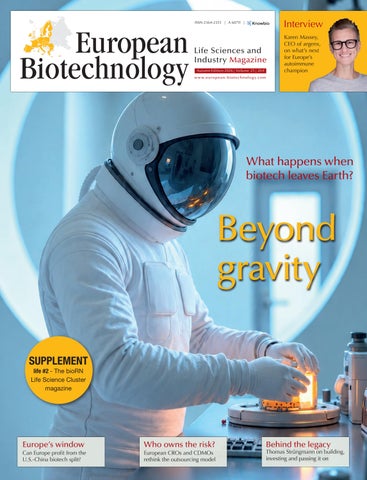
What happens when biotech leaves Earth?
Beyond gravity SUPPLEMENT life #2 - The bioRN Life Science Cluster magazine
Europe’s window
Who owns the risk?
Can Europe profit from the U.S.-China biotech split?
European CROs and CDMOs rethink the outsourcing model
Behind the legacy
Thomas Strüngmann on building, investing and passing it on
MS i M aging easy c A re dual po L arity benchtop D esign easy operat I on
Easy to clean, simple to run With the MALDI-8030 EasyCare you can do routine maintenance yourself. The compact instrument is easy to clean and quickly back in use again. Adding its outstanding performance parameters, it’s the ideal solution for high sample throughput, especially in a clinical environment.
A true multi-talent Enables a wide range of applications, e.g. protein and polymer analysis or quality control for (bio)-pharmaceuticals Available as linear positive MALDI-8020 EasyCare
Self-service maintenance Less maintenance costs, increased uptime Compact benchtop design Allows installation almost anywhere in the lab Outstanding performance Offers comparable performance parameters to larger and more expensive MALDI-TOF instruments
www.shimadzu.eu/easy-care
Learn more!
INTRO
European Biotechnology | Autumn Edition | Vol. 25 | 2026
Picture: © Fresenius
Europe has the investors. It needs the capital. The medicines and devices that will shape European healthcare over the next decade are mostly invented by companies that are still small, or that do not yet exist. Between 2015 and 2021, 65% of new drugs approved for the world’s twenty largest pharmaceutical companies were brought in through licensing or acquisition. The same holds true in medtech, diagnostics and care provision. A strong R&D function is no longer enough. Companies must also be connected to the innovation they do not own. Europe is not short of innovation. It is short of the means to hold on to it. The region’s share of global pharmaceutical R&D investment has fallen from 41% at the start of the century to around 31%. In 2025, U.S. stock exchanges took an estimated 98% of the world’s biotech IPO capital, and mid-sized European drugmakers spent the year acquiring American biotechs rather than being acquired. The sciTHOMAS THESTRUP is Managing ence is still here. The value it creates is increasingly drifting west. Director of Fresenius Ventures, the This is not a capability problem. Large European pharma alnewly established venture arm of ready knows how to be an investor: Novartis, Roche, Sanofi, Fresenius, a >€200 million fund inBoehringer Ingelheim and Novo have run venture arms for decvesting in growth fields adjacent to ades, and two of the three most active corporate investors be(Bio)Pharma, MedTech and Care hind the roughly 70% of biopharma companies that went pubProvision. Before joining Fresenius, lic since 2022 are European. Even the number of active corhe co-founded two companies, porate venture capital units in Europe is not far behind North held business development roles at America’s: an estimated 820 against roughly 1,030. What EuLundbeck and UCB Pharma, and rope lacks is not capability, but capital deployment. U.S. veninvested in life sciences through ture funds manage close to six times the capital of their EuroSunstone Capital and Angelini Venpean counterparts and invest around six times as much every tures. He holds a PhD in neurosciyear. Yet many mid-sized pharmaceutical, medtech and diagence and protein engineering. nostics companies remain on the sidelines. And care providers across the continent still have only little to no venture capabilities. A minority stake taken early is the cheapest, most informed way to understand a technology years before any acquisition, and beats meeting that company in a banker-run auction later. It is a two-way exchange: an industrial parent can offer medical, regulatory and operational expertise as well as access to clinical, scientific and academic networks that help a young company scale – creating value beyond capital alone. Corporate investors can play a growing role in Europe’s innovation ecosystem: patient investors that can engage early, are not constrained by traditional fund cycles, and can provide meaningful strategic support. This is the opportunity Fresenius Ventures was created to pursue. Europe has spent years debating how to stay competitive in healthcare and life sciences. While policymakers continue to refine the framework for innovation, corporate investors do not need to wait. By backing the next generation of healthcare companies today, wherever they emerge, European corporates can strengthen their own competitiveness and ensure that more of tomorrow’s healthcare value creation ■ remains connected to Europe.
Thomas Thestrup
3
CONTENTS
European Biotechnology | Autumn Edition | Vol. 25 | 2026
DEEP DIVE
TOPICS AND HIGHLIGHTS
18
A wall around China’s labs, and a window for Europe?
26
Interview with Karen Massey, argenx’s new CEO
29
Europe’s test: Turn science into global companies - now!
36
The Strüngmann legacy, passed on
38
Fundraising: Relationships matter more than ever
40
Biopeople
74
AI biotech is no longer a useful category for investors
TECHNOLOGY
76
AI drug discovery’s new bottleneck is the lab
Space: Biotech’s new laboratory
78
Associations news & events
82
Company list, preview next issue
When genetics enters the inner ear
06 WATCHLIST
14
Six Spanish biotech startups to watch
70
SUPPLEMENT: bioRN Life Science Cluster magazine No. 2 | 2026
IMPRINT European Biotechnology (ISSN 2364-2351) is published quarterly by: Knowbio GmbH, Lessingstr. 12, 16552 Mühlenbecker Land, Germany, Tel.: +49-30-264921-0, Fax: +49-30264921-11, Email: service@european-biotechnology.com, Internet: www.european-biotechnology.com; Publisher: Joachim Eeckhout; Editorial Team: Dr. Georg Kääb, Uta Mommert, Maren Kühr, Advertising: Oliver Schnell, +49-30-264921-45, Christian Böhm, +49-30-264921-49, Andreas Macht, +49-30-264921-54; Distribution: Michael Kuhrt +49-30-264921-43; Graphic Design: Martina Willnow/Michaela Reblin; Production: Martina Willnow; Printed at: Möller Pro Media® GmbH, European Biotechnology Life Sciences & Industry Magazine is only regularly available through subscription with a Knowbio bundle subscription: €80 for private individuals (students €40) incl. VAT, €120 plus VAT for corporates. Prices include postage & packaging. Ordered subscriptions can be cancelled within two weeks directly at Knowbio GmbH. The subscription is initially valid for one calendar year and is automatically renewed every year after. The subscription can be cancelled at any time and is valid until the end of that calendar month. Failures of delivery, which Knowbio GmbH is not responsible for, do not entitle the subscriber to delivery or reimbursement of prepaid fees. Seat of court is Berlin, Germany. As regards contents: individually named articles are published within the sole responsibility of their respective authors. All material published is protected by copyright. No article or part thereof may be reproduced in any way or processed, copied, and proliferated by electronic means without the prior written consent of the publisher. Cover Photo: © Knowbio GmbH · AI-generated image; © Knowbio GmbH
Pictures: © Freepik - Magnific.com; Flowo - Magnific.com; alex-shuper-yaLbuNZQy-0-unsplash
4
CONTENTS
European Biotechnology | Autumn Edition | Vol. 25 | 2026
SPECIAL
EDITORIAL
Autoimmunity & inflammation
What makes a biotech European?
Autoimmune and inflammatory diseases remain one of Europe’s most active areas of biotech innovation. From inflammatory bowel disease, psoriasis and atopic dermatitis to lupus, vasculitis, multiple sclerosis and rare immune-mediated disorders, European companies are helping reshape how chronic inflammation is understood and treated. The field is now moving beyond broad immunosuppression towards more precise approaches.
21
Europe takes cancer science into immunology
23
Interview with Erik Lundgren, Immunic’s CEO
SPECIAL
Pictures: © www.magnific.com; metamorworks - stock.adobe.com; Knowbio GmbH
CRO & CDMO CROs and CDMOs are under growing pressure to expand their services while navigating global shifts and political uncertainty. Alongside established modalities, they must adapt to a wave of newer technologies, including ADCs, RNA therapeutics, cell and gene therapies and in vivo CRISPR treatments, while keeping pace with increasingly complex and innovative clinical trial designs.
43
Europe rethinks the CRO-CDMO model
53
WuXi AppTec bets on expansion in Europe
56
The handover: Making technology transfer work
60
European CDMOs follow pharma west
63
ADC boom drives European CDMO investment
69
Europe’s complex trials fuel CRO demand
Its headquarters? Its founders? Where it raises money? Those things matter, but perhaps not as much as the influence it has on the ecosystem around it. In this issue, we speak with the new CEO of argenx, a company that has grown into one of Europe’s rare “big biotechs” on the back of Vyvgart. Its importance goes beyond one blockbuster drug. Companies like argenx create experienced teams, attract capital and show that a European biotech can scale without disappearing into a larger company. We a l s o s p e a k w i t h Th o m a s Strüngmann, co-founder of Hexal and one of Germany’s most influential biotech investors. His story illustrates the other side of the same equation: entrepreneurs who turn one success into capital for the next generation. BioNTech is his most obvious example, but the broader effect is what matters: experience and money being recycled back into the ecosystem. That, to me, is what European biotech is ultimately about. A company founded here but acquired, relocated and gradually detached from the region leaves little behind. A company that stays, grows and supports the next generation does the opposite. The real measure of a biotech ecosystem is not simply how many companies it creates, but whether each success makes the next one more likely.
Joachim Eeckhout CEO
5
When genetic medicine enters the inner ear Gene therapies began as proof-of-concept treatments for a handful of rare genetic disorders and now, with emerging tools, may expand into broader territories with new targeted organs. This year, one gene therapy achieved what once seemed improbable: enabling children born profoundly deaf to hear. With the first therapy for genetic deafness now approved, the inner ear is emerging as a promising target for the next generation of genetic medicines.
GENETICS
DEEP DIVE
Pictures: © beststudio - Magnific.com; Freepik - Magnific.com; kjpargeter - Magnific.com
European Biotechnology | Autumn Edition | Vol. 25 | 2026
In April this year, the U.S. Food and Drug Administration (FDA) approved Regeneron’s Otarmeni (lunsotogene parvec), the first treatment ever for a genetic cause of deafness. While Europe awaits a European Medicines Agency (EMA) decision after accepting the filing in May, many other therapeutics and genetic tools are being investigated, riding the wave of the emerging field of inner-ear genetic medicines. OTOF-related deafness, also known as autosomal recessive deafness type 9 or DFNB9, is a congenital, severe-to-profound bilateral hearing loss. The OTOF gene encodes otoferlin, a protein essential for transmitting sound signals from cochlear inner hair cells to the auditory nerve. When pathogenic variants disrupt otoferlin production, the sensory cells may remain structurally intact but cannot efficiently pass auditory signals to the brain. Until recently, this form of deafness was considered permanent and managed
with hearing aids or cochlear implants – devices that can improve access to sound but do not restore the full spectrum of sounds. Otarmeni gene therapy was designed to address the underlying genetic defect by delivering a functional copy of OTOF directly into the inner ear. Administered through a cochlear injection, the therapy targets inner hair cells, aiming to restore otoferlin production and, with it, the cellular machinery needed to transmit sound to the auditory nerve. Besides Regeneron, other companies are developing gene therapies to target the OTOF mutations. In China, Refreshgene Therapeutics developed AAV1hOTOF (also known as RRG-003), which was tested in six children in an early clinical trial published in The Lancet in 2024. Five of the six treated children showed measurable hearing recovery, with improvements in auditory brainstem response and speech perception. After that initial data, no other news has been
shared. Eli Lilly, after its Akouos Inc. acquisition in 2022, announced that its gene therapy, dubbed AK-OTOF, restored the hearing of a child with profound hearing loss within 30 days of treatment. This was part of a Phase 1/2 trial expected to be finalized in October 2028. On the European front, French Sensorion was testing its own OTOF-targeting gene therapy, known as SENS-501. Initial results from the Audiogene Phase 1/2 trial showed the treatment was well tolerated, with no serious adverse events reported, and two of three children in the higher-dose cohort showed early improvements in hearing. However, the Montpellier-based company recently decided to change gears, redirecting its focus to SENS-601, a therapy targeting mutations in the GJB2 gene, a major cause of hereditary deafness. Despite the shift in its pipeline, the company expressed in the announcement that “Sensorion remains fully committed to ensuring the
THE BRIGDE TO YOUR SUCCESS! Customized Enzymes and Reagents from NEB Largest selection of enzymes for genomic research
Research-grade and GMP-grade production
Large to small scale lyophilization capabilities
ISO 9001 and ISO 13485 certified
Formulations without components such as BSA, detergents or glycerol Enzymes at user defined concentrations Custom aliquoting, kitting, packaging & private label (OEM)
Further information on Customized Products and Solutions from NEB
7
DEEP DIVE
European Biotechnology | Autumn Edition | Vol. 25 | 2026
Researchers at MHH are investigating gene and cell therapies for hearing loss.
long-term follow-up of all patients enrolled in the Audiogene trial.” OTOF is just one of the many genes that can cause hearing loss, and experts believe the field is now turning to other genetic causes. “There are more than 160 different genes identified only for recessive genetic hearing loss,” said Athanasia Warnecke, a lead consultant and associate professor at the Clinic for Otorhinolaryngology at Hannover Medical School in Germany. “The FDA granted accelerated approval to Otarmeni [only] for severeto-profound sensorineural hearing loss with confirmed biallelic OTOF variants, preserved outer hair cell function, and no prior cochlear implant in the same ear,” noted Warnecke. She explained that the disease is ultra-rare, with 50 newborns per year in the U.S. and a similar or slightly lower incidence reported in Europe. “This means that more therapeutics are needed for more complex cases of hearing loss,” emphasized Warnecke.
Other genes, same success? While OTOF-related deafness is a monogenic, recessive, relatively homogeneous population with a clear genotype– phenotype and an established diagnostic pathway that enables intervention before long-term deprivation effects dominate for therapeutic benefit, GJB2 makes things more complicated for medicine developers. “In OTOF-related deafness, the cochlear architecture is essentially intact: the ‘hardware’ of hearing is present,
but the signal can’t get out,” said Sensorion CEO Fred Chereau. Instead, “GJB2 loss can affect the broader ionic and developmental environment the cochlea needs [to connect the sound signal to the brain],” explained Chereau, which means that “the therapeutic target is more distributed across cell types, and the biological rationale is closer to restoring a network function than replacing a single missing [protein] within a more defined spatial and temporal expression program.” To make things ever harder, “it is considered to act earlier in development,” he added. The GJB2 gene encodes connexin 26, a protein found primarily in the cochlea’s supporting cells and fibrocytes rather than in the hair cells themselves. Connexin 26 forms gap-junction networks that help recycle potassium and maintain the endocochlear potential – the electrochemical gradient essential for hair-cell function. Although targeting GJB2-related hearing loss is more difficult than conditions due to OTOF mutations, Sensorion believes it can apply the scientific and clinical advances achieved with the SENS-501 asset for OTOF-related hearing loss to advance SENS-601 more quickly. Chereau said that Audiogene, the SENS-501 clinical trial, “built the clinical infrastructure now supporting SENS-601.” He explained that Sensorion can now use the same network of centers of excellence used for Audiogene, and that the handson know-how in running an intracochlear gene therapy trial end-to-end, from sur-
gical protocol through postoperative follow-up, is already set up. The company also plans to expand the clinical approach with additional sites, patient identification, and recruitment pathways developed through OTOCONEX, Sensorion’s natural history study for GJB2-related hearing loss. “SENS-501 was discontinued in June 2026 following a strategic pipeline review, as the competitive and clinical landscape in OTOF shifted; the company’s resources are now concentrated on SENS-601, where we see the larger unmet need,” said Chereau. Sensorion has filed Clinical Trial Applications (CTAs) in Canada and France, where the Agence Nationale de Sécurité du Médicament et des produits de santé (ANSM) granted Fast Track status, and the company targets an Investigational New Drug application (IND) submission in the U.S. by year-end. When asked about its recently announced reverse share split effective in mid-September 2026, Chereau expressed: “It’s a purely technical operation; it doesn’t itself signal a change in strategy or in our development plans for SENS-601.” Compared with SENS-501, which used a dual-AAV vector because the OTOF coding sequence exceeds the packaging capacity of a single AAV capsid, SENS601 requires only one vector. According to Chereau, this represents “a meaningfully simpler manufacturing and qualitycontrol proposition.” The two programs also target different cochlear cell populations, which means they use different AAV serotypes, promoters, and regulatory sequences. These SENS-601 specificities haven’t been shared by the French company yet. The competitive landscape for GJB2-related hearing loss is beginning to expand, although it remains relatively small. The field took an important step forward in August this year when U.S.-based Skylark Bio announced that it had dosed the first patient in the Phase 1/2 SONIX trial of SKY-GJB2, an investigational AAV gene therapy designed to deliver a functional copy of GJB2 directly to the cochlear supporting cells that naturally express connexin 26. The treatment is being developed as a one-time, unilateral intrac-
Picture: © Hannover Medical School (MHH)
8
2027
Save the
Date
© iStock/jotily
13 and 14 April 2027 | Düsseldorf
www.german-biotech.day
DEEP DIVE
ochlear administration for children with GJB2-related deafness. Regeneron, through its 2023 acquisition of Decibel Therapeutics (which brought Otarmeni into its pipeline), also inherited AAV.103, a preclinical GJB2 gene-therapy program. There has been no recent public update on this asset development. Eli Lilly, meanwhile, retains the former Akouos research portfolio, which includes a preclinical program targeting GJB2-related hearing loss.
More than gene therapies Not only are biotech and pharma putting efforts into the hearing loss field, but so are science and governmental institutions. Warnecke’s research group at Hannover Medical School is part of H earing4all.connects, the third funding phase of the H earing4all Cluster of Excellence, funded by the German Research Foundation and complemented by the engineering and technology expertise of Leibniz University Hannover. This new phase of the grant places greater emphasis on genetics and AI as tools to advance hearing restoration. “Within the cluster, my group adds to the translational side,” said Warnecke. “We specifically concentrate on cell-based therapies and on gene therapy approaches.” “The results from the OTOF trials worldwide are exciting, because they prove that the inner ear is a druggable organ system that responds to gene therapy for genetic hearing loss,” she said. But gene replacement has its limits. “In more severe cases, when the hair cells are lost, OTOF gene therapy does not allow hearing recovery,” noted Warnecke. In such cases, replacing a faulty gene may not be enough: restoring hearing could require regenerating lost sensory cells, replacing cells, or developing new approaches that can repair more complex genetic defects. In Warnecke’s view, the approval of Otarmeni establishes an important regulatory precedent while opening the door to a broader range of genetic and regenerative approaches. New genetic tools could also expand what is possible beyond conventional
European Biotechnology | Autumn Edition | Vol. 25 | 2026
gene replacement. Earlier this year, Eli Lilly signed an agreement with Dresdenbased Seamless Therapeutics to explore the company’s proprietary recombinase technology for hearing-loss programs. Unlike conventional CRISPR/Cas systems, which typically rely on cutting DNA and the cell’s own repair machinery to introduce genetic changes, Seamless’s recombinases are designed to make precise, large-scale DNA insertions without relying on those endogenous repair pathways. The approach could eventually offer a way to tackle genetic disorders that are difficult to address with a simple replacement gene. Previous to that, in 2025, Eli Lilly also partnered with South Korean biotech Rznomics in a deal worth up to $1.3 billion to develop RNA-editing therapies for sensorineural hearing loss. Rznomics’ trans-splicing ribozyme platform is designed to modify RNA rather than DNA, potentially correcting disease-causing mutations without permanently altering the genome. However, neither agreement disclosed the specific inherited hearingloss conditions Eli Lilly intends to target. Another approach being explored uses extracellular vesicles (EVs) – tiny particles naturally released by cells that can carry biological cargo. Warnecke’s team, in collaboration with researchers from the University of Kansas in the U.S., is investigating EVs as an alternative to viral vectors for delivering genetic medicines. In preclinical studies in mice, the researchers used EVs to deliver CRISPRCas9 components that edit RNA transcripts associated with MYO7A-related hearing loss, restoring hearing in an animal model. MYO7A-related hearing loss is another genetic form of hearing loss caused by mutations in the MYO7A gene, which encodes myosin VIIa, a protein essential for the normal function of inner-ear hair cells. Depending on the mutation, it can cause nonsyndromic hearing loss (DFNA11/DFNB2) or Usher syndrome type 1B, which combines congenital deafness with progressive vision loss. “In a model of autosomal dominant progressive hearing loss relevant to MYO7A-associated DFNA11 in humans,
A new target for genetic medicines
we used a technology to edit at the transcript level that was so successful that it restored hearing in the affected mice,” expressed Warnecke, and said that the team is currently working on approaches to leverage the potential of EVs under the Hearing4all.connects funding.
More than just one gene As more developments reach success, the diseases to cure also increase in complexity. While early inner-ear gene therapies have focused on relatively straightforward single-gene defects such as OTOF-related deafness, Usher syndrome represents the next level of complexity: disorders in which the same genetic mutation affects multiple sensory systems, and restoring hearing may require overcoming challenges in gene size, delivery and long-term expression. Usher syndrome is not a single disease but a group of inherited disorders that combine hearing loss with progressive vision loss caused by retinal degeneration, with some forms also affecting balance. The three main types differ in severity and onset: Usher type 1 causes profound congenital deafness and severe vestibular dysfunction; type 2 causes moderate-to-severe hearing loss but generally preserves balance; and type 3 is characterized by progressive hearing loss and variable vestibular impairment. Together, they illustrate the complexity of developing genetic medicines that may need to target multiple sensory systems.
Picture: © Yunus Tuğ / Unsplash+
10
MEET US AT BIO JAPAN October 7-9, Yokohama BIO EUROPE November 9-11, Cologne BIO EUROPE SPRING April 5-7, Lyon BIO:CAP June 29-30, Berlin
Advancing the Future of Life Sciences Berlin Brandenburg combines scientific excellence, a thriving innovation ecosystem, and an established pharmaceutical industry. Fast-growing biotech startups and leading research institutions are pioneering breakthrough therapies and technologies, supported by accessible talent pools and collaborative networks. www.healthcapital.de
DEEP DIVE
Research is moving beyond implants.
Usher syndrome adds yet another layer of complexity: “The time point for the genetic intervention needs to be finetuned, and the gene therapy should occur before the onset of too severe disease manifestations or before the sensory epithelial cells are degenerated,” said Axel Schambach, full professor and director at the Institute of Experimental Hematology at Hannover Medical School. He is part of the iHEAR project, a European Research Council (ERC)-funded scientific research initiative dedicated to developing innovative gene therapies to prevent and treat inherited and acquired hearing loss. As part of the project, he collaborates with Prof. Warnecke, Prof. Michael Morgan, Prof. Hildegard Büning, and Dr. Juliane Schott at Hannover Medical School, as well as Prof. Hinrich Staecker at the University of Kansas Medical Center. Despite the complexities Usher syndrome brings to the table, Schambach sees reason for optimism, as advances in retinal and inner-ear therapies could inform one another. “The photoreceptors of the retina and the hair cells of the cochlea and vestibular organ are all sensory epithelia cell types and share biological similarities, so that it may be possible to use similar vector types and local micro-injection techniques,” said Schambach. “There are clear lessons that can be learned and translated between the two fields.” In January 2026, in Italy, Milan-based AAVantgarde completed enrollment in
European Biotechnology | Autumn Edition | Vol. 25 | 2026
the Phase 1/2 LUCE-1 trial of AAVB-081, an investigational gene therapy for Usher syndrome type 1B. AAVB-081 is delivered by subretinal injection, and it is designed to address the retinal component of the disease and protect vision. Although it does not simultaneously restore the hearing and vestibular deficits associated with the syndrome, “results [from this trial] may also influence strategies for the inner ear,” said Schambach. In France, Sepul Bio, part of Laboratoires Théa, is taking a different genetic approach. Its investigational therapy, ultevursen, is being evaluated in the Phase 2b LUNA trial, which completed enrollment in July 2026. Rather than permanently altering DNA, the approach modifies RNA processing. Ultevursen targets retinitis pigmentosa and Usher syndrome type 2a caused by specific exon 13 mutations in the USH2A gene. The strategy highlights how the future of genetic medicine may extend beyond simply replacing faulty genes, with RNA-based approaches offering another way to restore the function of disease-causing genes. In Schambach’s opinion, “gene therapies are still very complex to produce and often expensive, and important issues such as accessibility and costs should be addressed.”
A combination of approaches Schambach believes the treatment of hereditary (and acquired) hearing loss will evolve significantly over the next decade. “We will see a shift from symptom and/or physical management, i.e., cochlear implants and hearing aids, as well as retinal implants, to new molecular medicines and more tailored molecular correction. This may involve state-of-the-art vector systems, like AAV and integrating lentiviral vectors, but could also include novel gene and base editing strategies, based on CRISPR-Cas9 and related systems,” he said. But the arrival of genetic medicines does not necessarily mean the end of hearing aids or cochlear implants. Instead, the future of hearing care may lie in combining genetic treatments with existing technolo-
gies, particularly for patients whose hearing cannot be fully restored by gene therapy alone. “For the non-genetic causes, the acquired hearing loss such as induced by noise, ototoxicity or age-related, there is no single gene to be corrected, and the treatment of choice will remain cochlear implants for hearing restoration,” said Warnecke. In Sensorion’s clinical pipeline, there is an oral small molecule dubbed SENS-401 (arazasetron) aimed at protecting or preserving existing inner-ear tissue. “An otoprotectant like SENS-401 addresses acquired inner-ear lesions or iatrogenic hearing damage, a much broader set of patients [compared to GJB2-targeting SENS-601 gene therapy], including, potentially, anyone undergoing ototoxic therapy,” said Sensorion CEO Chereau. According to Warnecke, in the near future, stratification strategies may identify patients who would benefit from genetic restoration for near-natural hearing. To this aim, she expressed, “genetic diagnosis has to become a routine procedure for any person with hearing loss.” As well, as the field moves beyond relatively well-defined conditions such as OTOF-related deafness, researchers are exploring how genetic interventions could complement devices, restore damaged cells, or preserve residual hearing – potentially turning today’s technologies into part of a more integrated approach to hearing restoration. “Molecular interventions using gene therapy will likely be combined with advanced implantation devices to further improve treatment outcomes and patient quality of life,” said Schambach. As the field of hearing loss and genetic medicines continues to expand, some fundamental questions remain unanswered and still need intensive research. “It remains enigmatic why some people develop earlier hearing loss despite the same genetic disorder, why some, as shown in the OTOF gene therapy trials, respond fully, partially or not at all to the gene therapy again despite the same underlying genetic disease,” said Warnecke. If answers are found, they may shape the ■ next generation of treatments. Francina Agosti
Pictures: © Yunus Tuğ / Unsplash+
12
eady move-in-r mizable fully custo sonuvo.ch
Your new home for life science in Allschwil, Switzerland
34 969 m2 Total area
319
Workplaces (Building 1)
286
Workplaces (Building 2)
9
Floors
WATCHLIST
European Biotechnology | Autumn Edition | Vol. 25 | 2026
Six Spanish biotech startups to watch in 2026 When BIOSPAIN opens its doors in Bilbao from September 29 to October 1, with more than 5,000 one-to-one meetings expected, the Spanish biotech sector will arrive with more than networking momentum behind it. The 2025 AseBio Report shows an ecosystem that is not only expanding, but attracting capital at a new scale: Spain counted 1,119 dedicated biotech companies in 2025, up 10.4% year on year, while 39
new biotech firms were created in 2025. Funding tells an even sharper story. Spanish biotech companies raised a record €408 million across 59 transactions in 2025, up 125% from €181 million a year earlier. International investors participated in capital increases worth €302 million, underlining the sector’s growing visibility beyond Spain. But the headline total only tells part of the story. Deals above €20 million ac-
counted for 67% of all capital raised, while 26 of the 59 transactions were below €1 million. Between those extremes, a new generation of drug developers is beginning to emerge with enough backing to move from platform building and preclinical validation toward the clinic. As European Biotechnology joins BIOSPAIN as a media partner, we highlight six Spanish biotechs that reflect that transition.
1. Telum Therapeutics Telum Therapeutics is developing a new class of protein-based antimicrobials to tackle infections caused by multidrug-resistant bacteria. Its APEX platform mines metagenomic datasets and uses synthetic biology and computational tools to discover and engineer phage-derived lytic proteins that can directly destroy bacterial cells. The lead program targets Acinetobacter baumannii in hospital-acquired and ventilator-associated bacterial pneumonia, one of the pathogens prioritized globally because of antimicrobial resistance. Founded in Navarre in 2019, Telum is still preclinical but is preparing to enter human testing. Its €18 million Series A, led by the AMR Action Fund Profile Founding: 2019 in July 2026, is intended to fund the lead program through Phase 1 development. The Headquarters: Noáin, Navarre company is also building earlier programs against other Gram-negative and GramFocus: Antimicrobial therapies positive pathogens, giving the platform potential beyond a single antibiotic-resistant Clinical Stage: Entering Phase 1 . species. Funding stage: Series A Total funding:
€22.1M (€4.1M initial round + €18M Series A)
telumtherapeutics.com
Picture: © Flowo - Magnific.com
14
NOVEMBER 9–11, 2026 |COLOGNE, GERMANY
The new epicenter of biotech BIO-Europe brings together the global community of biopharma C-suite, investors and partners for three days of structured one-to-one partnering and strategic content that connects business development with regulatory, clinical and manufacturing decisions. What to expect: • 35,000+ scheduled meetings through partneringONE® • Seven specialized content tracks for cross-functional strategy • 6,500+ decision-makers from 60+ countries • 150+ innovative company presentations The only event where curated networking and vibrant spaces create the conditions for conversations that spark partnerships and accelerate the path from innovation to impact.
The sooner you register, the more you save. Take advantage of multiple early-bird price breaks leading up to the event.
Regional hosts:
BIOEUROPE.COM
Ministry of Economic Affairs, Industry, Climate Action and Energy of the State of North Rhine-Westphalia
In collaboration with:
WATCHLIST
European Biotechnology | Autumn Edition | Vol. 25 | 2026
2. Integra Therapeutics Founded as a Pompeu Fabra University spin-off, Integra Therapeutics is building FiCAT, a gene-writing platform designed to insert large DNA sequences precisely and stably into the genome. The system combines CRISPR-based targeting with an engineered transposase and is being developed for cell and gene therapies. Integra is using FiCAT to generate next-generation CAR-T cells for oncology and autoimmune diseases, while also advancing an in vivo gene therapy for a rare pediatric liver disorder. The company remains preclinical, but in 2026 reported that FiCAT could insert four therapeutic genes while removing Profile Founding: 2020 an unwanted gene in a single intervention in preclinical models. Headquarters: Barcelona A €10.7 million pre-Series A in 2025, backed by the EIC Fund, Focus: Gene editing CDTI Innvierte, AdBio, Columbus, Invivo and Takeda Ventures, Clinical Stage: Preclinical is funding further platform development, CAR-T validation and Funding stage: Pre-Series A technology transfer to pharma partners. It also has a proprietary €16.7M (€6M seed + €10.7M preTotal funding: Series A) . rare-disease program. integra-tx.com
3. Nanoligent Nanoligent is developing protein-based nanomedicines designed to deliver potent cytotoxic drugs selectively to cancer cells. Its lead candidate, NNL1524, targets CXCR4, a receptor associated with tumor aggressiveness, metastasis and treatment resistance across multiple cancers. The nanoparticle combines a CXCR4-targeting ligand with a cytotoxic payload in a compact, multivalent protein structure intended to improve tumor penetration while limiting exposure to healthy tissues. Founded from research at the Universitat Autònoma de Barcelona and Sant Pau Research Institute, Nanoligent is now completing regulatory preclinical development Profile of NNL1524. A €12 million Series A closed in October 2025 Founding: 2017 is financing manufacturing scale-up and preparation of a firstHeadquarters: Barcelona in-human Phase 1a study in patients with solid tumors, makFocus: Targeted oncology nanomedicines ing the company one of Spain’s clearest examples of a preClinical Stage: Preclinical . clinical biotech moving toward clinical validation. Funding stage: Series A Total funding: €14.8M (€2.8M seed + €12M Series A) nanoligent.com
4. Orikine Bio Orikine Bio is developing engineered cytokines to reprogram immune cells in autoimmune and inflammatory diseases. Its Foldikine platform combines dual cytokine activities in a single molecule. Lead candidate ORK1 activates CSF1 and IL-10 signaling to drive monocytes toward regulatory macrophages that migrate to inflamed tissue and restore immune homeostasis. Orikine says a single dose reduced ulcerative colitis symptoms in two in vivo models. ORK1 is now in IND-enabling studies, with inflammatory bowel disease as its first planned indication. In September 2026, Sabrina Kuttruff-Coqui became CEO after serving as Aicuris CFO through its $920 million sale to Asahi Kasei and helping Immatics reach N asdaq. Joachim Koch, formerly Affimed's head of discovery and translational immunology, Profile joined as CSO/CDO, while former Immunic CMO Andreas Founding: 2022 Headquarters: Barcelona Muehler joined part-time as CMO, adding clinical and reguFocus: Engineered cytokines latory experience as ORK1 moves toward human testing. . Clinical Stage: Preclinical Funding stage: Post-seed €11.2M equity (€5.5M seed + €5.7M Total funding: extension)
orikine.bio
STARTUPS TO WATCH
16
5. Iteria Biopharma Iteria Biopharma is a very young Galician oncology company built around small-molecule drug discovery for advanced metastatic cancers. Founded in 2024 by GalChimia, Palobiofarma founder Julio Castro and biotech executive Ramon Bosser, the company applies medicinal chemistry to targets that remain difficult to address with existing treatments. Its lead candidate, ITR-251, is a monoamine oxidase A inhibitor being developed initially for metastatic castration-resistant prostate cancer. Two earlier programs target solid tumors through a kinase protein degrader and a nuclear-receptor antagonist. Iteria remains Profile preclinical, but its €5 million seed round in April 2026 was sized to Founding: 2024 take ITR-251 through regulatory preclinical work and a first clinical trial, Headquarters: Touro while advancing the rest of the pipeline. That unusually broad mandate Focus: Small-molecule oncology makes Iteria one of the more clinically ambitious companies at Spain's Clinical Stage: Preclinical Funding stage: Seed . seed stage, despite being founded only in 2024. Total funding: €5M seed round iteriabiopharma.com
6. Adaptam Therapeutics Adaptam Therapeutics is taking aim at a part of the tumor microenvironment that can blunt the effect of cancer immunotherapies: immunosuppressive myeloid cells. The Centre for Cooperative Research in Biosciences (CIC bioGUNE) spin-off is developing antibody-based therapies against targets including glycan-binding proteins and Siglecs expressed on tumor-associated macrophages. Its programs include antibody-drug conjugates and bispecific antibodies intended either to eliminate these suppressive cells or reprogram the immune environment around solid tumors. The company originated in 2022 as Zelula Biopharma before adopting the Adaptam name in 2024, and is led by cancer immunology researcher Asis Palazon. AdapProfile tam remains at an early preclinical stage: its €3 million pre-seed round Founding: 2022, originally as Zelula Biopharma in October 2025, led by Criteria Bio Ventures, is being used to advance Headquarters: San Sebastián its first programs into preclinical development across several oncology Focus: Myeloid-targeted cancer immunotherapy indications and establish a much broader myeloid-targeted pipeline. . Clinical Stage: Discovery Funding stage: Pre-seed Total funding: €3M pre-seed round
adaptamtx.com
STARTUPS TO WATCH
WATCHLIST
European Biotechnology | Autumn Edition | Vol. 25 | 2026
Unlock the full potential of your injectable product
Partner with a leading and independent global CDMO for aseptic fill & finish For over 45 years, pharma and biotech companies around the world have relied on Vetter, a family-owned fill finish partner, to put their parenteral medications on a path to success. We’re proud to help advance your innovative
More info
therapy with flexible, robust, scalable processes and services that set our partnership apart: • Specialized support for your unique clinical development program
solutions that span your product’s life cycle
• High-quality aseptic filling at both clinical and global commercial scale
Rely on us.
• Strategic packaging and device assembly
vetter-pharma.com
• Comprehensive technical, analytical, and regulatory expertise at every step
17
POLICY
European Biotechnology | Autumn Edition | Vol. 25 | 2026
A wall around China’s labs, and a window for Europe? Washington is moving to choke off U.S. investment in Chinese biotech. For European companies already building pipelines on Chinese science, the squeeze could be an opening, but a narrow one, says long-time China expert Franck Le Deu.
COMPETITION
Washington is trying to slow the flow of American money and know-how into Chinese biotech, and it keeps adding tools. The newest is the Biotech Investment National Security Act (BINSA), introduced by Representatives John Moolenaar and Debbie Dingell, which would put U.S. pharmaceutical licensing deals, joint ventures and equity investments with Chinese partners under Treasury Department review. It follows the BIOSECURE Act, which became law in December 2025 and bars U.S. federal agencies from buying from or funding work that relies on a handful of named Chinese biotech firms, and the COINS Act, which screens U.S. outbound investment in sensitive foreign sectors. BINSA would expand that framework to biotechnology.
The money behind the crackdown It’s the scale of the money that has Washington worried. By the account of Representatives John Moolenaar and Debbie Dingell, the lawmakers behind BINSA, cross-border biopharma licensing reached about $136 billion in potential value in 2025, up from less than $5 billion in 2020. Figures from the intelligence firm Evaluate, cited by Fierce Biotech, show the average upfront payment on a WesternChinese licensing deal rising 230% in four years, from $52 million in 2022 to $172 million in early 2026. Bristol Myers Squibb alone signed a $15.2 billion co-development deal for early-stage molecules with China’s Hen-
“whereby European companies re-route the development of China-invented medicines through Europe,” capturing profits that would otherwise flow to American firms.
Europe’s wider window
grui Pharmaceuticals. Moolenaar says he wants to stop American investment from handing “Chinese companies another chokehold over our economy.” But some U.S. investors argue that restricting ties with Chinese biotech could simply redi-
“The signaling and uncertainty does give a wider window to Europe, the UK, and maybe others, to make some moves.” Franck Le Deu, Managing Partner, KerZheng Ventures; Venture Partner, Aulis Capital
rect those opportunities elsewhere. In a widely shared essay for RA Capital, investors Peter Kolchinsky and Tess Cameron argue that walling off China would simply hand the opening to Europe, through what they call “Eurowashing,”
So does the squeeze hand Europe an opening? Franck Le Deu, who led McKinsey’s China life sciences practice and is now managing partner of KerZheng Ventures, where he advises senior bio pharma teams on the China-West dynamic, as well as a venture partner at the new fund Aulis Capital, sees the U.S. pressure opening “a wider window to Europe,” though he cautions that a genuine European third pole is still an aspiration. He is skeptical that the U.S. measures will hurt China much. “The impact of those measures on China is dubious and likely only temporary,” he says. “Like putting car brakes on a bullet train.” China remains the main supplier of active pharmaceutical ingredients to the U.S., he notes, a card Beijing could play “if the U.S. pushed too far on decoupling.” What Washington’s moves mainly generate, he argues, is “signaling and uncertainty.” On the ground, the industry is moving before politics does. Companies “can see the opportunity and are starting to act on it,” he says, though they remain “very much driven by their future U.S. exposure.” Politicians are more ambiguous, he says, wary of being exploited by China once again, and finding it hard to separate emotion from hard truths.
Picture: © Oleksander Kharchenko alkharch@gmail.com
18
European Biotechnology | Autumn Edition | Vol. 25 | 2026
He points to Europe’s carmakers, now partnering with Chinese firms and even building Chinese cars on European soil, as a precedent, “a late and painful one.” The catch, he adds, is that “the car market is less global in nature” than pharma.
you publish, improve on it and beat you on speed to market? And price?” he asks. He calls it “a commoditisation of innovation trend that is real.” But there’s another side to it, he says. The current model reaches a shrinking share of the world’s population. “Will 90% of the population really agree to wait 15 years to get access to disruptive innovation that is lifechanging? Of course not. Innovation has to become more affordable.”
The Windward test
Picture: huntspy - stock.adobe.com
One European company already living the model is Windward Bio. The Baselbased firm raised $165 million this year in a round led by OrbiMed, with RA Capital, Janus Henderson and Sanofi Ventures, taking it to around $365 million raised since it launched in early 2025. Its pipeline, led by WIN378, a long-acting anti-TSLP antibody heading into Phase 3, comes largely from licensing deals with Chinese companies, including Kelun-Biotech and Harbour BioMed. Is a company like that exposed if Washington keeps tightening? Le Deu does not know Windward’s contracts, and says the answer sits in the fine print. “Has the IP been transferred? Is manufacturing going to be out of mainland China? Is ownership majority Western? Are Phase 2 and beyond trials done exChina?” If the only tie to China is the molecule and its early development, he says, it is “hard to see how this could be stopped.”
POLICY
A continent losing ground
FRANCK LE DEU is Managing Partner at KerZheng Ventures, where he helps senior leaders to build bridges between China and the West. He is also a venture partner at Aulis Capital, helping early-stage innovative biotechs with global potential to leverage the China ecosystem.
The deeper worry is whether Europe ends up repackaging Chinese molecules rather than inventing its own. Le Deu frames this as the real fear driving Washington. “How do you prevent 20 Chinese companies from iterating on what
Europe’s own weakness sharpens the stakes. Its share of global pharmaceutical sales has slipped to about 23%, against 55% for North America, and its share of clinical trials has fallen from 22% to around 12%. Le Deu is less concerned about the revenue figure, arguing that “a quarter of global revenues is still healthy and above Europe’s weight in the global economy.” The decline in clinical trials worries him more. Europe, he says, should be a leader in that area and still has room to recover: Spain is already gaining ground, and “if Australia can do it, why not some EU countries?” Europe should “define a real vision for access to innovation” for its own population, translate it into goals for industry, and “recognise that isolation is not the answer.” For Le Deu, that means being “neither panda lovers, nor panda killers”: Europe should stay open to Chinese innovation while strengthening its own position by implementing the core recommendations of the EU Biotech Act on capital markets and regulation “at China speed.” For founders considering a Chinese asset, however, the question is more practical. Le Deu advises them to map ownership, manufacturing and data sources, then ask whether the asset can actually compete. In his view, that commercial question is “a bigger risk than posturing by regulators.” The window Le Deu describes is real, but a narrow path. Whether Europe widens it depends less on what Washington does to China than on what Europe is ■ finally willing to do for itself. Nicole Verbeeck
19
INTELLECTUAL PROPERT Y
European Biotechnology | Autumn Edition | Vol. 25 | 2026
G 1/25: Form over function and how expensive is it? In proceedings before the European Patent Office (EPO), applicants are required to „adapt“ the description to the claims of a patent application once the claims are deemed allowable. The adaptation of the description is an extensive and very costly writing exercise. There was inconsistent case law of the Boards of Appeal (TBoA) on whether and to what extent said adaptation is necessary. The Enlarged Board of Appeal (EBoA) has now decided, and it changes for the worse for the practitioner.
ADVERTORIAL
In the patent description, the applicant seeks to generalize the invention to a certain extent to prevent easy circumvention of the invention; for example, "DNA" would be generalized to "nucleic acid". The claims define what others shall not copy. Patent applications typically start with a broader, generalized description of the invention, and respective broad claims. During prosecution before the EPO, claims are often amended to more specific, narrower subject matter. So, the patent application starts with a “zoo of animals” in the description and in the claims and eventually claims shrink to a certain “species of the zoo”. If the patent was later enforced against an infringer, the national court would look at the claims to determine whether claims are infringed. National courts have always dealt with more specific patent claims in view of a broader description.
The problem The EPO, however, developed the opinion that a broader description along with narrower granted claims could cause confusion. Therefore, the EPO requires to “adapt the description” before the patent is granted. However, the skilled person is aware that patent specifications may contain definitions extending beyond the scope of the claims. How could the mere presence of such definitions give rise to uncertainty as to the meaning of the claims? The skilled person understands that it is the claims that define the invention. How can statements
claims. The other line of decisions saw no basis at all for this unnecessary writing exercise. However, examiners have nevertheless required extensive adaptation of the description. In such a case of diverging case law, the EBoA must decide which line of decisions is the correct one.
The decision G 1/25 of the EBoA
DR. UTE KILGER is a licensed German and European patent attorney with +20 years of experience and partner at Boehmert & Boehmert.
in the description create ambiguity as to what is claimed? This may mean for the applicant that the entire description, which often consists of more than a hundred pages, must be repeatedly “rewritten” to match the shrinking scope of the claims. In oral proceedings applicants may file several claim sets and must submit for each version an “adapted” description – a writing exercise that is extensive and very costly. The case law of the TBoA has developed along two conflicting lines on the question of whether the description must be adapted following an amendment of the claims. One line required extensive rewriting of the description in view of the amended
The EBoA could have provided legal certainty if it had decided in favor of one of those lines. However, it did not adapt either of the two approaches. It created a “middle way” which per se introduces new legal uncertainty that needs further case law to provide understanding. The EBoA stated that the description must be adapted where an “inconsistency” between the claims and description causes non-compliance with the EPC. And that an adaptation is needed if the reader of the claims “would be left in real doubt as to the meaning of the claim”. But when is there an "inconsistency"? What does “real doubt” mean? Future decisions must shed light on what this “oracle” of the EBoA really means. There was no need for the EPO to “help the national courts” by introducing the adaptation requirement to this exhaustive extent. The new decision of the EBoA is not helping either. Applicants are now left with having to allocate substantial resources, either to adapt the description extensively, or to extensively argue against such a request. More work for attorneys, more costs for applicants, no gain, form over function. ■ Ute Kilger
Picture: © Boehmert & Boehmert
20
European Biotechnology | Autumn Edition | Vol. 25 | 2026
AUTOIMMUNIT Y & INFLAMMATION
Europe takes cancer science into immunology Inspired by technology and insights gleaned from cancer research, Europe is leading the quest for a new generation of therapies in immunology and inflammation. Immunotherapy has revolutionised cancer therapy and b ecome standard of care in many areas of o ncology but it has also begun to change outcomes in inflammatory and autoimmune diseases.
Picture: © www.magnific.com
TECH TRANSFER
Getting cancer immunotherapies approved and marketed took vast amounts of clinical trial research, which led to advancements in our knowledge of the immune system, how it works and how to manage it. Over the past few years, landmark research from European scientists has shown that CAR-T therapy – an immunotherapy first developed and approved in oncology – can induce remission in some patients with severe lupus. The idea behind the research came from scientists such as Georg Schett and professor Ricardo Grieshaber-Bouyer, from the Uniklinikum Erlangen at Friedrich-Alexander-Universität Erlangen-Nürnberg. Scientists at University College London Hospital (UCLH) led by Claire Roddie and Maria Leandro have also been trialling the technology in humans to treat lupus. The idea hinges around the way that CAR-T cells can be reprogrammed to attack the B-cells that are the root cause of lupus, where the immune system begins to attack the patient’s own body. Symptoms of the disease include joint pain, skin conditions and damage to organs such as the kidneys. Harvested from a patient’s own body, genetically modified, expanded and then reintroduced through infusion, the CAR-T cells reset the immune system by destroying all B cells in the body, both healthy and disease-causing. Once the treatment is over, the healthy B cells grow back, and the patient’s immune system is reset, without the symptoms of lupus. The drawbacks: the therapy is expensive and takes a long time to make as it is tailored to each individual patient. Side
effects in the Phase 1 CARLYSLE trial at UCLH were more manageable, however. Researchers observed no cases of immune effector cell-associated neurotoxicity syndrome (ICANS), a serious neurological side effect associated with some CAR-T cell therapies. Cytokine release syndrome (CRS), another common side effect of CAR-T therapy where the immune system becomes overstimulated, was limited to only low levels. As of November 2025, nine adults with severe, treatmentresistant lupus had received the treatment, obecabtagene autoleucel, developed by London-based Autolus. All had highly active disease despite multiple previous therapies, and most had lupus nephritis, a serious form of the disease that affects the kidneys. Researchers found that five of the first six patients treated at the lower dose achieved remission according to standard lupus criteria, with improvements emerging within months of treatment. Patients also experienced rapid reductions in disease activity. For patients whose kidneys had been affected by the disease, several achieved complete or partial renal responses, with reductions in proteinuria and stabilization or improvement in kidney function over time. It’s just one example of how expertise in cancer has begun to inform the treatment of autoimmune diseases such as rheumatoid arthritis, psoriasis, Crohn’s disease and ulcerative colitis. Iain Kilty, CEO of UK-based biotech Sitryx, described results from CAR-T therapy in lupus as “phenomenal.” “We are
21
AUTOIMMUNIT Y & INFLAMMATION
seeing sustained remission as it kills the cells that are driving the disease,” he added. However, Kilty noted that the same drawbacks that applied to CAR-T in cancer apply in immunology. While early autoimmune studies have suggested that some familiar CAR-T toxicities may be manageable, safety remains a major question, alongside a manufacturing process that is still cost- and laborintensive. That question gained new urgency in August, when Novartis paused eight studies of its CD19 CAR-T rapcabtagene autoleucel in autoimmune and neurological diseases after three patients died from immune effector cell-associated hemophagocytic syndrome (IEC-HS), a severe inflammatory complication. The company is reviewing the cases with regulators and independent safety boards. Pawel Szczepanski, CEO of Poland’s JJP Biologics, added: “Looking at a purely scientific perspective, the boundary from oncology and autoimmunology is increasingly porous. In cancer, immune response may be insufficient, exhausted and depressed. In autoimmune disease, responses may be persistent and misdirected toward healthy tissue. This creates a degree of target or platform symmetry – a pathway strengthened in oncology may be inhibited in immune disease.” Technology and platforms can be transferred from oncology to autoimmune diseases, along with the knowledge and technical know-how required to discover, manufacture drugs and bring them to market. Szczepanski added: “Expertise in antibody, T-cell therapy, biomarkers and immune monitoring can be transferred. Oncology tech cannot be transferred unchanged, but the synergies exist there. I would dare to say the synergies between target platforms and portfolios are quite evident. We see examples of going from oncology into inflammation and immunology and there is also a portfolio rationale. It creates opportunities to reuse platforms in multi-indication markets.”
A growing demand Driving the research is the demand for new drugs in autoimmune diseases and inflammation. The first generation of blockbuster autoimmune disease drugs, such as AbbVie’s Humira (adalimumab), is encountering biosimilar competition; and while they redefined treatment of many diseases, they were not perfect. They superseded medicines such as methotrexate, which are effective but come with a long list of side effects. Even with biologic therapies, remission only occurred in a fraction of patients depending on the disease area, with considerable unmet need. Between 10% and 30% of patients fail to respond to treatment with anti-TNFs such as Humira, Kilty noted, adding that patients are also looking for convenience with either less frequent injections or medicines administered in pill form. Inflammation and immunology continue to tick the right boxes for big pharma investment in research, according to JJP Bio’s Szczepanski. He said: “Immunology as an area has a few
European Biotechnology | Autumn Edition | Vol. 25 | 2026
Treatment convenience is a growing priority in immunology
characteristics that large pharma tend to appreciate, the substantial disease burden, treatment demand, specialist care infrastructure and the possibility to apply one mechanism across multiple indications. Those are the characteristics that make it attractive to big pharma.” JJP Biologics is part of a biotech ecosystem that is becoming established in Poland. The company’s most advanced clinical asset is nebaprubart, a CD89 inhibitor that is in Phase 1b development in autoimmune diseases. Research has been slowed in this receptor because it is not expressed in mice, meaning that the drug had to be proven in several different preclinical models before it was cleared for human trials. The company’s focus is not only on IgA-driven renal conditions but also on the “big four” inflammation areas: rheumatoid arthritis, inflammatory bowel disease, psoriasis and systemic lupus. Szczepanski said: “We clearly see that despite the general perception that those are crowded markets, the deeper you look, the more you challenge that perception.” Kilty’s work at Sitryx was informed by research originally done by professor Luke O’Neill of Trinity College, Dublin, which suggested PKM2 serves as a critical metabolic switch not only in cancer, but also in chronic inflammation. In the case of diseases such as atopic dermatitis, Sitryx aims to modulate the pathway to normalize the activity of the immune system. The company’s lead drug SYX-5219 is heading for Phase 2 in atopic dermatitis, with an itaconate mimetic SYX-1042 also ready for Phase 2 in psoriasis and psoriatic arthritis. Both Kilty and Szczepanski agree that there is a promising decade for European research into inflammatory and autoimmune diseases, driven by demand for new products and a supply of R&D know-how in academic institutions and the biotech sector. Kilty concluded: “It’s important to focus on those areas where we are differentiated. There’s lots of competition in America and China, and the speed at which they can develop drugs. We have that expertise in Europe, we have people who ■ have progressed assets from idea to approval.” Richard Staines
Picture : © Freepik Company S.L. - www.freepik.com
22
European Biotechnology | Autumn Edition | Vol. 25 | 2026
AUTOIMMUNIT Y & INFLAMMATION
“We want to understand MS patients better than anyone” Immunic is preparing to transition from a late-stage development biotechnology company into a fully integrated commercial organization focused on multiple sclerosis (MS). At the center of its strategy is vidofludimus calcium, an oral therapy being developed for relapsing and progressive MS. European Biotech spoke with Immunic’s CEO Erik Lundgren about the company’s clinical trials and commercial ambitions, the role of neuroprotection and why he believes the next major opportunity in MS may lie beyond relapse control. MULTIPLE SCLEROSIS
tunity to address one of the field’s most significant unmet needs: the progression of disability and the neurodegenerative component of MS. When I joined the company, I saw, and continue to see, tremendous potential in the science, the lead program, and the highly talented team striving to bring this vision forward. A truly outstanding factor is the global, multinational team. At Immunic, we have more than 20 different nationalities among roughly 100 people. That is remarkable for a company of this size and supporting our growth phase.
Picture: © Immunic Therapeutics, Jan Volejnícek
EuroBiotech: Mr. Lundgren, this year marks Immunic’s 10th anniversary, coinciding with what could be a decisive period in the company’s history. How would you describe Immunic’s position today? Erik Lundgren: This is a particularly excit-
ing time for Immunic. As we celebrate our 10th anniversary this year, we are entering what could be one of the most transformative phases in the company’s history. Over the past decade, we have built a differentiated pipeline focused on chronic inflammatory and autoimmune diseases, particularly on neurologic diseases such as MS, and generated data that reinforces our confidence in our scientific approach. Today, we are not only advancing our late-stage clinical asset vidofludimus calcium in MS, but are also preparing to become a fully integrated commercial organization. In addition to research and clinical development, we have started thinking beyond and positioning the company for long-term success. Importantly, we have assembled a highly talented and experienced team and believe that our focused strategy, combined with disciplined execution, puts us in a strong position for the months and years ahead. EB: You came to Immunic at a pivotal time in its development. What persuaded you to join the company? Lundgren: I have spent much of my ca-
reer in MS, so I have always been fascinated by the science behind the disease. Over the years, we have seen our under-
ERIK LUNDGREN Chief Executive Officer, Immunic Inc., has more than two decades of biopharmaceutical leadership experience, with deep expertise in commercialization, commercial strategy and BD. Before Immunic, he led the commercial portfolio organization at Genentech.
standing of MS evolve significantly. First, T cells were the primary focus, then B cells and their antibody repertoire became central to how we think about the disease. I was fortunate to be part of some of those shifts at companies like Genentech and Roche, which initially were not regarded as major players in MS but ultimately helped reshape the treatment landscape. What attracted me to Immunic is its unique scientific approach and the oppor-
EB: From your years of experience in the MS field, what differentiates Immunic’s approach from previous waves of innovation? Lundgren: Having witnessed several
waves of innovation in MS throughout my career, what excites me about Immunic is that we are focused on some of the most important unresolved challenges in the disease: progression, safety and tolerability, and patient choice. One of the reasons I joined Immunic was the insight I gained through many conversations with MS physicians and experts. While tremendous progress has been made in treating MS, significant unmet needs remain, creating opportunities for the next generation of therapies. The first relates to disease progression. For many years, reducing relapses and controlling inflammation were the primary goals of treatment. Today’s reality is different. Many patients experience few
23
AUTOIMMUNIT Y & INFLAMMATION
European Biotechnology | Autumn Edition | Vol. 25 | 2026
Lundgren: What makes vidofludimus cal-
Erik Lundgren in discussion with ...
or no relapses, yet they continue to accumulate disability over time. This progression independent of relapse activity, or PIRA, remains one of the most important challenges in MS. The second unmet need is long-term safety and tolerability. Currently approved therapies have transformed MS patient care, but prolonged treatment can be associated with serious side effects such as infections, gastrointestinal or cardiovascular risks. As a result, therapies with favorable, well-tolerated safety profiles continue to be highly relevant. The third unmet need is patient choice. In the U.S. alone, approximately 125,000 people diagnosed with relapsing MS remain untreated, while around 45,000 patients switch therapies each year. The reasons vary, ranging from access and reimbursement challenges to concerns about tolerability, adherence and the suitability of available treatment options at different stages of the disease. These numbers underscore that many patients and physicians continue to look for therapies that better meet their individual needs. We believe vidofludimus calcium has the potential to address these challenges in a differentiated way, which is what makes the program so exciting. EB: How does vidofludimus calcium address the unmet needs you have identified in MS?
cium particularly interesting is its dual mechanism of action. In preclinical studies, the molecule has demonstrated activation of the transcription factor Nurr1, which is believed to play an important role in maintaining neuronal health. At the same time, vidofludimus calcium is a selective DHODH inhibitor, modulating the activity of overactive immune cells involved in the MS disease process. This combination is especially relevant as it has the potential to target both the neurodegenerative and inflammatory drivers of the disease. We believe this dual approach has the potential to address some of the key unmet needs in MS today: controlling inflammatory disease activity, maintaining a favorable safety and tolerability profile and potentially influencing the mechanisms underlying disability progression. Today, vidofludimus calcium is being evaluated in Phase 3 trials in relapsing MS, which are expected to read out by the end of this year. We also plan to initiate a Phase 3 trial in progressive MS. That setting may ultimately be particularly important, as it could provide a broader dataset on the drug’s impact on neurodegenerative processes. EB: Ultimately, these hypotheses need to be confirmed in the clinic. What are the key questions the ENSURE Phase 3 trials are designed to answer? Lundgren: The trials are designed to pro-
vide a comprehensive assessment of relapse activity. The primary objective of the ENSURE program is to demonstrate that vidofludimus calcium can significantly reduce the risk of relapses in patients with relapsing MS, as measured by time to first relapse. Key secondary endpoints include MRI measures such as new or enlarging T2 lesions and gadolinium-enhancing T1 lesions, as well as annualized relapse rate. Together, these endpoints give us a detailed picture of how effectively the treatment can control inflammatory disease activity. The program also evaluates confirmed disability improvement and confirmed
disability worsening in pooled analyses as part of the secondary and exploratory endpoints. While the studies are not specifically designed to measure disability and therefore the relevant signals may be limited, these endpoints can provide additional insights into the treatment’s potential impact on long-term patient outcomes. Taken together, the ENSURE trials are designed to assess whether vidofludimus calcium can deliver meaningful clinical benefit across multiple dimensions of MS disease activity, with the primary focus on relapse reduction, while continuing to generate safety and tolerability data, which we hope will be in line with the favorable profile observed to date. EB: What could positive ENSURE data mean for the future of vidofludimus calcium? Lundgren: If the ENSURE trials deliver
positive results, our immediate next step would be to finalize the preparations and submit a New Drug Application (NDA). We have already engaged extensively with regulators and continue to maintain an ongoing open dialogue. From a commercial perspective, we believe vidofludimus calcium could be well positioned in the relapsing MS market if we are able to reproduce the efficacy, safety and tolerability results observed in our Phase 2 program. As we discussed earlier, patients and physicians continue to need new treatment options that combine efficacy with a favorable safety and tolerability profile. An oral route of administration, combined with strong relapse control and the favorable safety profile observed to date, could represent a differentiated value proposition for relapsing MS patients. We believe that would provide a meaningful opportunity in the market, even in a treatment landscape with multiple approved drugs. EB: Looking beyond the initial relapsing MS opportunity, where do you see the greatest long-term potential for vidofludimus calcium? Lundgren: We see several opportunities
beyond the relapsing MS market. MS is a
Picture: Immunic Therapeutics
24
European Biotechnology | Autumn Edition | Vol. 25 | 2026
chronic disease in which patients cycle through different therapies over time. For example, around 10% of patients discontinue anti-CD20 treatment each year, creating an ongoing need for additional treatment options. We believe vidofludimus calcium could be relevant for several patient groups, including newly diagnosed patients, patients looking for an oral alternative to switch to and those seeking a treatment with a favorable safety and tolerability profile. We are also seeing an aging MS population. As patients age, immune senescence becomes increasingly relevant. You cannot continue intensifying immune suppression indefinitely, which is why treatment goals and patient needs evolve over time. At the same time, the progressive component of the disease becomes increasingly important. This is where we see a particularly compelling long-term opportunity. Significant unmet needs remain in progressive MS, and our planned progressive MS Phase 3 program will help us further explore the potential of vidofludimus calcium in this setting. If successful, it could provide an important point of differentiation for the drug.
Picture: © Immunic Therapeutics
EB: You mentioned progressive MS as an important future development area for vidofludimus calcium. Why is progression such a critical challenge in MS, and why has it proven so difficult to address? Lundgren: One of the key learnings in MS
over the past decade is that the traditional distinction between relapsing and progressive disease becomes less clear. Current therapies have transformed the treatment landscape, and the waiting rooms are no longer full of patients in wheelchairs, which is a remarkable achievement. At the same time, we have come to recognize that progression remains a fundamental part of the disease. Many patients eventually enter a progressive phase, where relapses become less prominent or stop altogether, but disability continues to worsen. In other words, while the inflammatory component of
AUTOIMMUNIT Y & INFLAMMATION
the disease may decline over time, the progressive component remains and often increases over time. That is why neuroprotection is emerging as one of the most important areas of innovation in MS today, and why we believe approaches that can potentially address both inflammation and neurodegeneration warrant close attention. EB: As Immunic prepares for commercialization, how do you envision bringing vidofludimus calcium to patients globally? Lundgren: Our ambition is to build a
s uccessful commercial organization and bring vidofludimus calcium to patients ourselves in the core MS markets, first in North America. At the same time, we will carefully evaluate the opportunities and requirements of different healthcare systems and regions around the world. We have already begun preparing for this next phase of growth. Earlier this year, we completed a tranched financing backed by strong institutional investors and designed to support our transformation into a fully integrated biotechnology organization. In addition, a second tranche of up to $200 million could become available following ENSURE data. Our current cash position allows us to continue executing on our development priorities. Ultimately, our focus remains on delivering strong Phase 3 data and preparing the organization to capitalize on the opportunities that could follow. EB: What else is in Immunic’s pipeline beyond vidofludimus calcium? Lundgren: We have additional work on-
going around the Nurr1 target with the goal to understand this mechanism and biology even better. While some of its aspects are still a hypothesis, we continue to drive preclinical work to better understand and prove it. Both the preclinical work and the clinical trials will tell us more and we are eager to learn. EB: As Immunic enters this next phase of its development, what is your vision for the company?
... editor Georg Kääb
Lundgren: What motivates me every day
is the opportunity to disrupt MS once again and ultimately improve the quality of life for patients. Over the past decades, tremendous progress has been made, but significant unmet needs remain, particularly when it comes to disability progression and long-term safety. The possibility of making a meaningful difference for patients is what drives me and our team every day. My vision is for Immunic to become the company that understands MS patients better than anyone else. That should be our superpower. Patients’ needs evolve throughout the course of the disease, and our responsibility is to understand those needs and develop solutions that truly address them. We are evolving from a science-driven biotechnology company into a fully integrated organization. But I do not see science and commercialization as competing priorities. Commercialization is the natural extension of great science. Scientific innovation only achieves its full value when it reaches patients. If we can combine scientific excellence with a deep understanding of patients and execute successfully as a commercial organization, I believe Immunic has the opportunity to become a true disruptor ■ in MS.
Georg Kääb
25
AUTOIMMUNIT Y & INFLAMMATION
European Biotechnology | Autumn Edition | Vol. 25 | 2026
What’s next for argenx, Europe’s autoimmune breakthrough? Over the past few years, Belgium’s argenx has become a biotech force to be reckoned with, driven by the success of its autoimmune drug Vyvgart (efgartigimod alfa) in diseases such as generalised myasthenia gravis (gMG) and chronic inflammatory demyelinating polyneuropathy (CIDP). We caught up with CEO Karen Massey to discuss how she plans to build on this success after joining argenx in March 2023 and taking up the role of CEO at the start of this year. LEADERSHIP
European Biotechnology: What attracted you to the job at argenx? Karen Massey: All over the world, people
are living with debilitating autoimmune diseases. Many endure diagnostic odysseys that last for years, going from doctor to doctor as they try to work out what condition they have. And when they do eventually find out, treatment options – often unchanged for decades – can be incredibly limited, and also burdensome. I wanted to be part of a dynamic company – one that is grounded in science and focused on addressing these significant unmet needs. I wanted to be part of a team that is building a different type of biotech. This combination of scientific ambition and patient focus really stood out to me when I first met Tim Van Hauwermeiren, one of the co-founders of argenx and now our Chairman. Having worked across commercial teams and at earlier stages of the value chain during my career, I felt I could bring a broader perspective that would complement the expertise already within the company and help contribute to its next stage of growth. argenx is a company that not only responds to the needs of patients today but is continually anticipating what patients – and other stakeholders – will need in the future. The company combines a listening- and understanding-first approach to the development of medicines with a real spirit of co-creation and scientific entrepreneurship. We work closely with clini-
KAREN MASSEY joined argenx in March 2023. After serving as chief operating officer, she was appointed chief executive officer in May 2026. Karen has over 20 years of experience in the biopharma industry, including as senior vice president of product development and global clinical operations at Genentech (part of Roche). Karen started her biopharmaceutical career in marketing at Pfizer and has held leadership positions in corporate strategy, sales and as a commercial lead in Latin America.
cians and patients to learn what they really need in order to achieve better outcomes. Through our Immunology Innovation Program (IIP) – a program that
integrates leading biologists from academic centres across the world into argenx research teams – argenx is building a deep understanding of the underlying biology driving autoimmune conditions. By combining these insights with argenx’s antibody-engineering expertise, argenx has been able to move at pace to develop and deliver efgartigimod, a precision therapy that is changing the treatment paradigm in generalised myasthenia gravis (gMG) and chronic inflammatory demyelinating polyneuropathy (CIDP), two rare neuromuscular autoimmune conditions. We’re now very hopeful we’ll be able to do the same for other IgG-mediated autoimmune rheumatological conditions, including autoimmune myositis. EB: You worked almost a decade at Roche’s Genentech before joining argenx. What’s the difference between working for a large pharma group and argenx? Massey: What is consistent at both com-
panies is the patient focus. Roche and argenx put the patient at the center of everything they do. Having worked directly with physicians earlier in my career, I have seen first-hand the difference bringing innovative medicines can make to patients’ lives. This is something that motivates me on a very personal level, and seeing that same sense of purpose reflected across argenx is incredibly powerful. The key difference at argenx is that we have an opportunity to build something much earlier in its lifecycle. The world is
Picture: © argenx
26
European Biotechnology | Autumn Edition | Vol. 25 | 2026
changing rapidly, and as a younger company, we can respond to this more quickly. We are able to take advantage of the latest technologies to help us develop better medicines. We can look for the partnerships that will help us accelerate novel science. We can look at other modalities, such as oral formulations of FcRn medicines or next-generation FcRn molecules that offer different dosing intervals, and we can take a really fresh approach to the way in which we develop our digital and AI strategies. Older companies have a lot of legacy infrastructure and systems, whereas we have the opportunity to take a blank sheet of paper and design purpose-built solutions. We have far less organizational drag. We really do have a golden opportunity to build a company that is fit for the future. EB: Can you tell us more about your research into oral drug technology; is it clearly aligned with what you said about patient focus? Massey: Patients are looking for serial in-
novation. Thanks to our strong partnerships with leading disease biologists and our autoantibody engineering expertise, we were the first company to launch an FcRn inhibitor, a precision therapy designed to target the underlying biology of severe autoimmune conditions. But we wanted to go further than simply providing an innovative molecule that needed to be administered intravenously. We understand that, for patients living with chronic conditions, the way in which they take their medicines is very important. So, within just a few years, we will have brought three new modes of administration to market: a subcutaneous formulation administered by doctors, a prefilled syringe that patients can administer themselves without having to come into a clinic, and next year, an autoinjector. And as already mentioned, we have an oral FcRn molecule in development. Our job is to deliver a best-in-class experience for patients, and that is what we are committed to doing. EB: Earlier this year, argenx acquired Forte Biosciences for $2.2 billion. Tell us
AUTOIMMUNIT Y & INFLAMMATION
how this acquisition fits into your drug pipeline? Massey: Our ambition is to be an immu-
nology innovation company. We want to transform lives, treating 50,000 patients across ten different diseases, with five molecules in late-stage development by 2030. As we continue to grow, we are always looking out for compelling, novel science in areas of unmet need. As we assess these molecules, we ask ourselves whether the science is truly novel, whether there is an elegant antibody or delivery approach, and whether it has the potential to treat diseases in areas of high unmet need. Aligned with our cultural pillar of humility, we understand that not everything has to come from argenx – there is a lot of value being created outside of our company. Indeed, much has come through our IIP. With Forte, we found a molecule that fits our formula: novel science addressing autoimmune diseases with high unmet need. We thought, ‘that looks like an argenx molecule,’ so we moved quickly to secure it. EB: It must be a good time to be in charge of a company that has pivoted from a biotech burning through cash to one generating income with a drug on the market? Massey: It is, and with our success comes
a responsibility and a duty to patients and society to invest where we can have the most impact and where there is high unmet need. We do not want to be bringing the tenth medicine to market in an indication that already has multiple treatment options. The success we have with efgartigimod gives us choices and enables us to invest in innovation that can make a meaningful difference to patients, many of whom are having to rely on outdated technologies. EB: In your opinion, how will the European biotech sector develop over the next 10 years? Massey: Whether you look at Europe,
China, the US biotech ecosystem or Australia, where I’m from, we are seeing remarkable scientific progress. The key question is how regions can structure
their ecosystems to ensure they are able to bring important innovations to patients without unnecessary delay. For example, is it possible to conduct first-inhuman studies quickly? How are clinical trial systems set up? How are medicines evaluated in terms of the benefits they deliver to patients? Different regions are doing some things better than others. The region that will be the most successful will be the one that brings all the key pieces together. Europe is a strong hub and has all the right ingredients: great science, a strong ecosystem and good healthcare infrastructure. Going forward, Europe needs to learn from what is working well in other regions and ensure it has a model in place that incentivizes innovation. EB: What’s next for argenx? Massey: Our second molecule, empa-
siprubart, is being investigated in patients with Multifocal Motor Neuropathy (MMN), a neurological condition that results in muscle weakness and where there is high unmet need. The topline results from our Phase 3 MMN study are expected in the fourth quarter of this year. We’re also evaluating empasiprubart in CIDP, and we have a combination study running in MG. Just like efgartigimod, we believe empasiprubart, which is a C2 inhibitor targeting a very specific part of the immune system, could be a pipeline-in-aproduct-medicine for us. We’re also advancing adimanebart, a first-in-class MuSK agonist antibody, in congenital myasthenia syndromes and other neuromuscular diseases, including spinal muscular atrophy. Of course, our recent acquisition of Forte Biosciences further strengthens our pipeline. The lead candidate, FB102, which is currently being trialled in vitiligo and celiac disease, has the potential to be a pip eline -in-a-product a sset t hat addresses multiple autoimmune diseases where there are few treatment options available. The pipeline is looking very strong and we’re making great progress towards broadening our immunology pipeline. ■ Richard Staines
27
AUTOIMMUNIT Y & INFLAMMATION
European Biotechnology | Autumn Edition | Vol. 25 | 2026
AATec is pioneering a new approach to lung diseases AATec is advancing ATL-105, a new recombinant version of alpha-1 antitrypsin for inhalation, into clinical development for chronic respiratory diseases. Rüdiger Jankowsky, CEO, and Gabriele Matschiner, Chief Development Officer, explain the development program, the choice of bronchiectasis and the upcoming Phase 1b/2a trial.
ADVERTORIAL
European Biotechnology: AATec is developing a new class of therapeutics for respiratory diseases. What makes you so excited about the program? Rüdiger Jankowsky: What excites us is the
idea of creating a new platform for respiratory diseases with a high unmet need. Because our approach is based on a human molecule with broad activity and an established safety profile, it could be relevant not only for our lead indication non-CF bronchiectasis, but also for COPD and other lung diseases, as well as rare diseases of the airways. Gabriele Matschiner: The key for us is that we combine this broad activity with delivery to the lungs. We can target several disease drivers directly where they occur and limit drug exposure elsewhere in the body. EB: Why is ATL-10 5 a promising approach for chronic respiratory diseases, and what sets it apart? Jankowsky: ATL-105 is based on alpha-1
antitrypsin (AAT), a naturally occurring human protein that helps protect the lung from excessive inflammation and tissue damage. That is key in chronic respiratory diseases, where inflammation, damaging proteases and infection often come together. ATL-105 addresses several disease drivers at once through its combined anti-inflammatory, antiprotease and anti-infective activity. EB: Why did you choose non-cystic fibrosis bronchiectasis as the first clinical indication? Matschiner: Bronchiectasis still comes
with a high unmet medical need. One of its hallmarks is neutrophilic inflamma-
RÜDIGER JANKOWSKY, CEO and co-founder of AATec, has more than 25 years of leadership experience in biotech, with a focus on product development, regulatory approval and corporate development.
GABRIELE MATSCHINER, CDO, brings more than 20 years of experience in translational and early clinical development, particularly in respiratory diseases and inhaled biologics.
tion, which drives damaging proteases and airway damage. This gives us a very clear way to test the mechanism of ATL105 in patients. And because the disease mainly affects the larger airways, it is also readily accessible to inhalation treatment. EB: Which preclinical findings gave you the confidence to move ATL-105 into the clinic? Matschiner: The key moment was seeing
that ATL-105 reduced neutrophilic inflammation in vivo when we delivered it directly to the lungs. In addition, we saw a clear, dose-dependent effect in lung samples from patients, and it was well tolerated even at high local concentrations in our toxicology studies. EB: What would success look like in the first clinical trial? Matschiner: We will conduct a rand-
omized, placebo-controlled Phase 1b/2a study directly in patients, testing different doses of ATL-105. Success would mean
showing safety and tolerability together with a dose-dependent reduction in protease activity. That would provide clinical proof of concept and help us select the dose for the next stage of development. EB: Was there a moment when you realized ATL-105 could become more than an interesting scientific concept? Jankowsky: The in vivo data were an im-
portant turning point. But what finally transformed the concept into a productdevelopment program was the full package: the biological activity, the excellent product quality and the fact that we could nebulize ATL-105 while completely maintaining its activity. That confidence is reinforced by strong interest from international clinical experts, investors and global pharmaceutical companies, as well as by the backing in our pre-series A financing round of SPRIN-D, the German federal agency for breakthrough innova■ tion.
Pictures: © AATec
28
BUSINESS
European Biotechnology | Autumn Edition | Vol. 25 | 2026
Europe’s test: Turn science into global companies – now! Europe is entering a new phase of competition in life sciences. The issue is no longer whether the continent can produce world-class science. It clearly can. Nor is it s imply a question of whether European biotech companies can raise money. They can — although a ccess to capital is highly uneven. The problem remains scaling. Brussels has to react fast. COMPETITIVENESS
The hard question still is whether Europe can turn scientific excellence into globally competitive companies at scale. That question has become more urgent as the competitive landscape around Europe changes. The United States continues to dominate venture capital, public markets and the ability to finance companies through successive stages of growth. China, meanwhile, has emerged as an increasingly important source of innovative drug candidates, particularly in areas such as oncology, antibodies and antibody-drug conjugates. At the same time, global investors are pouring unprecedented amounts of money into artificial intelligence, semiconductors, robotics and defense. In the first half of 2026, global venture capital investment reached $506 billion, according to Dealroom data, with 77% going to companies whose business models were fundamentally based on AI. More than $237 billion went to just three companies – OpenAI, Anthropic and xAI – while more than 80% of global VC flowed into U.S. companies. Defense and security technologies alone attracted about $40 billion. Life sciences, by contrast, were no longer among the dominant destinations for venture capital. At first sight, this looks like another reason for Europe to worry. But the picture in biopharma is more nuanced. J.P. Morgan estimates that global biopharma venture funding reached $16.3 billion in the first half of 2026, across 235 rounds. Thirteen biopharma IPOs raised $5 billion, already exceeding the total raised
in any full year between 2022 and 2025. Biopharma M&A reached $96 billion across 80 deals, while licensing activity generated an extraordinary $166.7 billion in announced R&D value. The money has not disappeared from life sciences. It has become more selective. And that distinction matters for Europe.
The real European problem is scale and pace Europe’s fundamental weakness is not a shortage of researchers, universities or scientific discoveries. It is the gap between discovery and scale. The European Commission itself acknowledges this. Its Life Sciences Strategy, launched in July 2025, explicitly aims to make Europe the world’s most attractive place for life sciences by 2030. The Commission estimates that life sciences already contribute almost €1.5 trillion in economic value and support around 29 million jobs across the EU. The strategy is backed by more than €10 billion annually from the current EU budget. Yet the Commission also identifies the central structural problem: Europe is losing ground in turning research into real-world products because funding and innovation systems remain fragmented, regulation is complex and market uptake is slow. This is precisely the problem investors are highlighting. The European Life Sciences Coalition (ELSC), launched in February 2026 with Invest Europe and
backed by more than 200 investors, companies and research organizations, has called for more long-term capital, deeper European capital markets, simpler regulation and better conditions for innovation. Its members collectively manage more than €25 billion in life-sciences-specific assets. The message is striking because it comes from investors themselves: Europe does not simply need more public research money. It needs an environment in which private capital can remain invested for long enough to create companies capable of competing globally. That means solving the part of the financing chain between academic discovery and commercial scale. Europe has plenty of seed capital. It has an increasing number of specialized biotech investors. It has public programs such as the European Innovation Council. What remains comparatively weak is the financing available when a company needs hundreds of millions rather than tens of millions to complete pivotal trials, build manufacturing capacity, establish commercial operations or prepare for a global launch. That is where the United States retains a major structural advantage.
America still owns the scale-up machine The U.S. remains Europe’s most important competitor – and, paradoxically, its most important financial partner. The American system combines deep spe-
29
30
BUSINESS
cialist venture capital, a large institutional investor base, a huge domestic pharmaceutical market, sophisticated public equity markets and a mature ecosystem of biotech executives, analysts, bankers and investors. This creates a reinforcing cycle. A promising biotech can raise a Series A. If the data are good, it can raise a much larger Series B and C. If the clinical program works, it can access public markets. If the IPO window closes, large pharmaceutical companies can acquire it. At every stage, there is an established pool of investors that understands the risk profile of drug development. Europe has pieces of the same system, but not the same scale. This is particularly visible in the IPO market. A European biotech can certainly list in Europe, but for a company with ambitions to finance
“We don’t need more government or European funding so much as we need a functioning European capital market. That includes, in particular, Europe’s large insurance companies and pension funds, with their significant financial resources. They need to invest more in European innovation financing — say, 1% to 2%, which would still represent only a very small share of their overall assets.” Dr Olivier Litzka, Andera Partners, European Life Science Coalition
a large clinical program, Nasdaq remains difficult to ignore. The question therefore should not be whether Europe should somehow prevent companies from going to Nasdaq. That would be the wrong objective. The better question is: Why should a European company have to leave Europe to access the deepest pool of public risk capital? The distinction is important. A globally successful European biotech may still choose Nasdaq because its investors, ana-
European Biotechnology | Autumn Edition | Vol. 25 | 2026
lysts, peer group and potential shareholders are concentrated there. That is not necessarily a failure of Europe. It becomes a failure when Nasdaq is the only credible destination for companies once they reach a certain scale. A European capital market capable of supporting life sciences companies through late clinical development and commercialization would not have to replace Nasdaq. It would have to become a credible alternative.
China is changing the equation The other major change is coming from China. For years, the conventional view in Europe and the U.S. was that China was primarily a manufacturing location and an important clinical market. That description is becoming obsolete. Chinese biotech has developed substantial capabilities in drug discovery and development, particularly in oncology, biologics and complex modalities. The evidence is now visible in global dealmaking. According to IQVIA, Chinese-origin assets accounted for 40% of all assets in-licensed by large pharmaceutical companies in 2025. In the first half of 2026, therapeutic in-licensing deals involving Chinese-origin assets reached an aggregate value of $92 billion, equivalent to 88% of the full-year 2025 total. J.P. Morgan data tell a similar story. In the first quarter of 2026, Chinese-origin biopharma assets accounted for 50% of global large-cap pharma deals with upfront payments above $50 million – and 75% of the upfront dollars in that group. These are not isolated transactions. AstraZeneca struck an $18.5 billion deal around Chinese obesity and diabetes programs. Bristol Myers Squibb agreed to a $15.2 billion transaction with Hengrui covering 13 early-stage programs. Pfizer signed a $10.5 billion strategic agreement with Innovent involving 12 oncology programs. The strategic implication for Europe is significant. China is increasingly becoming a source of innovation that Western pharmaceutical companies want to buy. In other words, the global pharma value
chain is no longer simply: U.S. discovers → Europe manufactures → China supplies. It is increasingly: U.S., Europe and China all generate assets – and global pharma shops for the best ones wherever they originate. That is a much more demanding competitive environment for Europe. China has also demonstrated an important advantage: speed. IQVIA points to faster early-stage development, relatively low development costs and a supportive policy environment as factors that have helped Chinese companies generate proof-of-concept data rapidly. BCG estimates that Chinese companies now contribute roughly 30% of the global biotech pipeline and have developed particularly strong positions in modalities such as antibody-drug conjugates. For European investors, this changes the investment calculus.
Investors have not stopped believing in biotech There is another misconception worth challenging. The current global VC boom is often interpreted as evidence that investors have abandoned life sciences for AI. That is only partly true. AI has absorbed an extraordinary and probably historically unusual share of global venture capital. But the biopharma capital markets are recovering at the same time. The more important change is the composition of the money. Investors increasingly want de-risked assets. BioPharma Dive found that almost 70 venture-backed biotech companies raised more than $9.1 billion in the first half of 2026, the strongest first-half total since 2022. But most of those companies already had drugs in clinical testing. EY similarly identifies a major shift toward later-stage VC investment, while early-stage value and deal volume have declined. This creates a dangerous financing gap. The global industry needs early scientific risk-taking to produce the clinical assets that later attract billions. But the investors supplying the largest amounts of capital increasingly prefer to enter after some of that risk has already been removed. This
European Biotechnology | Autumn Edition | Vol. 25 | 2026
is where Europe is particularly exposed. If European investors do not fund the early science and European growth investors do not fund the clinical scale-up, the assets will eventually be financed elsewhere – or sold to companies elsewhere. Europe can therefore end up producing the science while another region captures the company-building economics. That is the strategic problem Brussels needs to solve.
The European answer is beginning to emerge The European Commission is not starting from zero. The EU Life Sciences Strategy is one pillar. The proposed European Biotech Act is another. The Commission says the Biotech Act is intended to strengthen Europe’s health biotechnology sector by connecting R&D, manufacturing and industrial ecosystems, improving access to funding for startups and SMEs, facilitating AI, data and digital technologies, and reducing time to market through a simpler regulatory framework. The political direction is also visible in the Irish Presidency’s 2026 program. Ireland has put competitiveness, strategic industrial sectors and regulatory simplification high on its agenda. Biotechnology is explicitly identified alongside semiconductors and energy-intensive industries as
a central area for legislative work. The program also supports an EU-wide “28th Regime” – or EU Inc. – intended to make it easier for companies to operate across the Union, while the Industrial Accelerator Act is intended to strengthen industrial competitiveness and strategic supply chains. Clinical trials have improved through the EU Clinical Trials Regulation, but the practical implementation of clinical research, ethics approvals, healthcare systems, reimbursement and data access remains fragmented. For biotech, fragmentation is not merely an administrative inconvenience. It is a cost. Every month added to a clinical program consumes cash. Every additional national process increases uncertainty. Every delay pushes a financing milestone further into the future. And investors price uncertainty.
The €5 billion question The most interesting European experiment may therefore be the new Scaleup Europe Fund. In May, the European Innovation Council selected EQT as the preferred investment adviser and fund manager for a €5 billion fund designed to provide growth capital to European deep-tech scale-ups. Its target sectors include AI, quantum computing, dual-use technologies, clean energy, space, bio-
YOUR PARTNER FOR CLINICAL TRIALS
BUSINESS
31
technology and medical innovation. The fund is intended specifically to close the late-stage financing gap and give promising European companies incentives to remain in Europe. In August, the Commission announced that the final legal steps had been completed and that the fund would begin investing, with a target size of €5 billion. EQT is Europe-rooted but global. The fund is being built with a coalition of major institutional investors, including Novo Holdings, Denmark’s EIFO, CriteriaCaixa, Santander/Mouro Capital, Italian foundations, the Dutch pension fund ABP/APG and Allianz. That is exactly the right direction if the objective is to mobilize private capital. But public money does not automatically produce European economic sovereignty. The critical question is what happens after investment. If a European scale-up receives €300 million from a European fund, grows successfully and is then acquired by a U.S. pharmaceutical or technology company, Europe has created value – but it has not necessarily created a European champion. Likewise, if the company ultimately lists on Nasdaq, that is not necessarily a problem. But if European capital systematically finances companies that then migrate their headquarters, IP, manufacturing or strategic decision-making to the U.S., the EU risks
FLEXIBLE. EFFICIENT. OWNER-DRIVEN. Owned and managed by: Martin Krauss martin.krauss@fgk-cro.com
fgk-pv.com
fgk-rs.com
fgk-cro.com Heimeranstrasse 35 80339 Munich Germany
32
BUSINESS
creating a subsidized pipeline for another ecosystem. The Scaleup Europe Fund therefore needs to be judged not simply by how much money it deploys. It should be judged by what happens to the companies five and ten years later. Are they still headquartered in Europe? Are their IP and R&D capabilities still here? Do they manufacture here? Do they employ highly skilled people here? Can they raise their next billion euros here? Can they go public here if they want to? And, critically, are European institutional investors able to participate in the value creation they helped finance?
The capital-market question This brings the debate back to Europe’s capital markets. Europe has enormous pools of savings. The problem is that too little of those savings is systematically channelled into high-growth European companies. The solution is not simply another public fund. Europe needs a deeper equity market.
“While we at Life Sciences Acceleration Alliance (LSAA) fully support the concerns and requests of the ELSC, achieving a strong unified and liquid capital market is like the Holy Grail, and as hard to obtain. The EU needs to show results now and ensure tangible progress for innovative life sciences companies. Europe must focus near term on providing strategic growth capital, harmonizing regulations, and improving the contribution of the longtime largely absent institutional private capital.” Rainer Westermann, Chairman, Life Sciences Acceleration Alliance
European Biotechnology | Autumn Edition | Vol. 25 | 2026
For the life sciences, that means a functioning financing ladder: university research → translational funding → seed VC → Series A/B → growth capital → public market → commercial scale. The U.S. has something close to this. Europe still has gaps between almost every step. A genuine European risk-capital market would require institutional investors – pension funds, insurers, sovereign funds and family offices – to have more practical access to venture and growth equity. It would require simpler cross-border investment rules. It would require harmonized listing and reporting standards. It would require more liquid public markets. And it would require European investors to accept that financing a biotech is fundamentally different from buying a mature industrial company. This is not an argument for abandoning Nasdaq. Quite the opposite. A European biotech should be able to choose Nasdaq because it is the best market for its particular stage and investor base – not because there is no European alternative. The strategic goal should therefore be capital-market optionality. If Europe develops a deeper market, Nasdaq will remain an important global destination. But the bargaining position of European companies will improve, and more value creation can remain on the continent.
Life sciences versus AI versus defense There is another political question: should Europe really prioritize life sciences when investors are currently pouring money into AI, defense and semiconductors? The answer should not be to compete with AI on its own terms. Europe will probably not recreate the U.S. AI capital market simply by creating a €5 billion public-private fund. Nor should it try to spread scarce capital equally across every strategic technology. The better approach is to identify areas in which Europe already has genuine competitive advantages and where technological convergence creates new opportunities.
Life sciences is one of those areas. Europe has globally significant pharmaceutical companies, biotech clusters, research universities, clinical expertise, manufacturing capabilities, diagnostics, medtech and specialist CDMOs. It also has strengths in areas such as RNA, cell and gene therapy, radiopharmaceuticals, biologics manufacturing, precision medicine and industrial biotechnology. AI should not necessarily be viewed as a competing sector. It can be an enabling layer across life sciences. The same applies to defense. Europe’s new defense spending can create demand for technologies with dual-use applications – sensors, autonomous systems, synthetic bio logy, advanced manufacturing, medical countermeasures and AI-enabled diagnostics. The strategic mistake would be to put life sciences, AI and defense into separate political boxes. The opportunity is to connect them.
But Europe must fix the demand Capital alone will not solve Europe’s problem. A biotech investor ultimately needs an exit. An exit depends on the willingness of pharmaceutical companies to acquire assets and companies, on public markets and on the commercial attractiveness of the European market. This is where drug pricing and reimbursement policy become part of industrial policy. Europe cannot simultaneously demand that companies invest billions in innovative medicines and then create a market in which innovation is systematically valued less than in competing markets. The debate is not about allowing unlimited drug prices. It is about recognizing that predictable and sufficiently attractive returns are a prerequisite for private investment in highrisk R&D. The European Life Sciences Coalition has therefore linked capital-market reform to broader market conditions. Its central message is that Europe needs long-term capital, deeper capital markets and regulatory simplification if it wants to keep its next generation of life sciences ■ companies on the continent. Georg Kääb
End-to-end CDMO services For Drug Substance and Drug Product
Proteinsand mAbs for human and animal health • Microbial • Mammalian • Others
Advanced Therapies • Adenovirus • AAVion ® • Plasmid DNA • Cell Therapies
businessdevelopment@3pbiovian.com
www.3pbiovian.com
BUSINESS
European Biotechnology | Autumn Edition | Vol. 25 | 2026
Austria builds life sciences momentum Austria continues to strengthen its position as one of Europe’s most dynamic life sciences locations. New infrastructure, a coordinated national cluster landscape and targeted funding initiatives are reinforcing the country’s role at the interface of research, industry and healthcare. ADVERTORIAL
Austria, a growing research hub for the medicine of tomorrow
In Vienna, one of Europe’s established centres for medical research is preparing for its next development step. On October 1, the Medical University of Vienna (MedUni Vienna) will officially open two new buildings, the Eric Kandel Institute – Center for Precision Medicine and the Center for Translational Medicine, which form part of a broader expansion of more than 90,000 m² of research and teaching infrastructure. The new facilities will bring research, teaching and clinical practice closer together and provide state-of-theart space for translational and personalised medicine. The aim is to enable diagnoses, therapies and prevention to be tailored more precisely to individual patients, supported by molecular insights, data-driven approaches and artificial intelligence. The new MedUni Campus Mariannengasse, which opens in fall 2027, will
also bundle previously scattered preclinical facilities and create a shared environment for around 2,000 students and 750 researchers. For international companies, this is more than an infrastructure story: it strengthens Vienna’s capacity for clinical and translational research and creates new opportunities to engage with academic excellence, clinical practice and potential industrial partners at close range.
A connected ecosystem Austria’s life sciences sector has grown into a dense and well-connected ecosystem. The country is home to more than 1,100 life science companies employing more than 73,000 people and generating around €40 billion in annual turnover. The sector covers biotechnology, pharmaceuticals, medical technology,
diagnostics, digital health, enabling technologies and specialised service providers. Its strength lies not only in individual companies or institutes, but in the way regional clusters, national initiatives and funding organisations work together. As the national umbrella brand, LISA – Life Science Austria plays a central role in connecting these stakeholders and driving joint activities. This coordination gives companies access to partners across the value chain: universities, research organisations, hospitals, startups, manufacturing specialists, regulatory experts, suppliers and investors. Vienna is a major node, but other regions, especially Tyrol, also contribute distinctive strengths, from biotechnology and pharmaceutical production to medical engineering and digital health applications. Styria is particularly strong in industrial biotechnology and bioprocess
Picture: © MedUni Wien/Houdek
34
BUSINESS
European Biotechnology | Autumn Edition | Vol. 25 | 2026
expertise as well as medical technology. With an R&D ratio of more than 5.3%, Styria is one of the strongest research regions in Europe. For foreign companies, Austria offers both scientific excellence and a networked support structure.
Policy backs key technologies Life sciences are also gaining political visibility as one of Austria’s key technologies. The federal government’s Industrial Strategy 2035 places emphasis on sectors that combine innovation, industrial competitiveness and societal relevance. A dedicated Life Science Action Plan has been announced to further strengthen the framework for research, startups and industrial development. The FFG Life Science Programme is equipped with €95 million for R&D projects for the period 2022 to 2026, while the aws Preseed | Seedfinancing is allocating another €19 million to fund and consult innovative startups. Through INVEST in AUSTRIA, the Austrian Business Agency offers international life sciences companies cost-free support on all location-related questions. Digital transformation is becoming a central part of this policy mix. The new “Digital Health Austria” initiative supports large-scale collaborative projects that translate digital innovation into practical healthcare applications. Eligible consortia may include companies, startups, research organisations and other relevant stakeholders. The focus is on scalable solutions that address healthcare challenges while integrating scientific, economic and healthcare perspectives from the outset.
Picture: © Paul Bauer
Attractive research location International companies are already using Austria as a base for life sciences activities. MSD, for example, contributes to its global network through three Austrian sites with activities ranging from clinical research to manufacturing and regional operations, employing around 1,000 people in Austria. Ketryx, a company developing AI-supported software for regulated medical technology, has raised a total of $55 million in Series A and Series B from
International companies have put Austria on the map
international investors and has chosen Vienna as an important European location. Epitome Therapeutics, a biotech startup developing precision epigenome editing, launched in 2025 with €4 million in total funding, including backing from aws, FFG and XISTA Science Ventures. Both Ketryx and Epitome Therapeutics were supported by the Austrian Business Agency in establishing their presence in Austria. Such examples illustrate a broader trend: companies come to Austria for research quality, talent, clinical links, public funding options and access to European markets. The country also offers an attractive R&D environment. Austria’s research intensity remains among the highest in Europe, and the national “Research Premium” gives companies a predictable incentive for eligible R&D expenditure. In a field where development cycles are long and regulatory pathways are demanding, reliable framework conditions are a relevant location factor.
Where to meet ABA and LISA Austria’s life sciences community will be visible at several international events in autumn 2026. On October 1, M edUni Vienna will officially open two new buildings in Vienna. A few days later, MedTech.Circle 2026 in Linz will bring
together medtech, clinical, research and business stakeholders to work on concrete solutions along the patient journey. The Biotech Summit Austria will take place in Innsbruck on October 13-14, followed by the LISAvienna Regulatory Affairs Conference in Vienna on October 15. ABA – INVEST in AUSTRIA and LISA – Life Science Austria will also be present at BIO-Europe in Cologne from November 9-11 and at MEDICA in Düsseldorf from November 16-19. These meetings offer opportunities to connect with the Austrian ecosystem and explore funding and partnering options. Visit the Austrian booths or reach out to schedule a meeting in advance. The search for Austrian partners is possible year-round via the Austrian Life Sciences Directory: ■ www.lifesciencesdirectory.at Contact us: Austrian Business Agency (ABA): investinaustria.at/en Subscribe to the “Austrian Business Update”: investinaustria.at/en/newsletter LISA – Life Science Austria: lifescienceaustria.at Subscribe to the LISA newsletter: lifescienceaustria.at/newsletter or connect with LISA on LinkedIn
35
BUSINESS
European Biotechnology | Autumn Edition | Vol. 25 | 2026
The Strüngmann legacy, passed on Thomas and Andreas Strüngmann have spent decades building pharmaceutical companies and backing biotech entrepreneurs, most famously BioNTech. Now, as a new generation takes a larger role in their family office, an award bearing their name is turning that investment philosophy into a search for Europe’s next biotech builders.
ENTREPRENEURSHIP
When Thomas and Andreas Strüngmann stepped down as voting members of the supervisory board of ATHOS, the family office that manages the Strüngmann family’s investments, at the end of 2023, the next generation faced a question: How do you mark the legacy of two entrepreneurs who have never been particularly interested in monuments? The answer came from the next generation. “It was the idea of the next generation, our children,” Thomas Strüngmann told European Biotechnology in one of his rare media interviews. With biotech at the center of the family’s investments, he said, they wanted to create an award “for the future” and as “recognition” for entrepreneurs – a more fitting tribute than, as he put it, “a statue on Rosenheimer Platz” in Munich. The award reflects a pattern that has shaped the brothers’ careers for decades: first building pharmaceutical companies themselves, then using the proceeds to back other entrepreneurs in life sciences.
The Strüngmann playbook The twin brothers founded generics maker Hexal in 1986 and built it into Germany’s second-largest generics company. In 2005, Novartis agreed to acquire Hexal alongside the Strüngmann family’s 67.7% stake in U.S. generics company Eon Labs for a combined €5.65 billion. The businesses were folded into Sandoz, helping turn the Novartis division into the world’s largest generics company at the time. The exit gave the brothers the capital to do something they would repeat on a differ-
fers private companies, seeks direct contact with management and often takes board seats. “We usually want to have a say in the companies,” he said. Compared with a textbook family-office portfolio, ATHOS is unusually weighted toward direct investments. As the next generation takes a larger role, Strüngmann wants to preserve two traits: “We are fast decision makers and we take on calculated risks.” That philosophy is now being distilled into the award.
What the award rewards Thomas Strüngmann
ent scale: investing in entrepreneurs and technologies they believed could become very successful businesses. BioNTech is the defining example. When the Mainz company was founded in 2008 by Uğur Şahin, Özlem Türeci and Christoph Huber, the Strüngmann brothers and MIG Fonds were among the backers providing $180 million in seed financing. ATHOS still owns about 40% of the company, according to Wolfgang Essler, managing director at ATHOS. But BioNTech is only the most visible part of a much broader portfolio. ATHOS remains heavily allocated in life sciences and healthcare, ranging from wholly owned pharmaceutical businesses such as Megalabs in Latin America and Aristo Pharma in Europe to a 24% stake in biosimilar developer Formycon and roughly a dozen significant earlier-stage biotech investments. Essler describes ATHOS as an “active owner”: the family office generally pre-
The Strüngmann Award comes with a €100,000 cash prize for the winner, but Strüngmann says that is not its main purpose. Instead, the award is “a recognition of what is done” and a way “to show other companies what’s possible,” he explained. Finding the right moment to give that recognition has taken some calibration. At one end are entrepreneurs whose success is already beyond dispute, such as Şahin and Türeci. “They achieved everything,” Strüngmann said of the BioNTech founders. “They don’t need it anymore. That’s not the purpose of the award.” At the other end are scientists who have just left university with an idea and a handful of colleagues. That may be an exciting beginning, but it does not yet prove entrepreneurship. Matthias Kromayer, who heads life science activities at MIG and sits on the award jury, warns against honoring “would-be entrepreneurs” on ambition alone. The jury therefore looks for a narrow but impor-
Pictures: Strüngmann Award
36
BUSINESS
European Biotechnology | Autumn Edition | Vol. 25 | 2026
tant middle ground. Scientific innovation “really has got to be disruptive in a way,” Kromayer said, but it also needs translational impact: “Is there a translation into clinic, into marketable products?” The jury also looks at whether founders have been able to attract capital and turn it into value, as well as leadership and the ability to build a team rather than a business around a single “godlike person.” The first two editions give a sense of that sweet spot. In 2024, the award went to HAYA Therapeutics co-founders Samir Ounzain and Daniel Blessing. Since then, the Swiss RNA biotech has entered into a collaboration with Eli Lilly worth up to $1 billion and moved its lead program HTX-001 into Phase 1. In 2025, the award went to Araris Biotech founders Dragan Grabulovski, Philipp Spycher and Isabella Attinger-Toller, shortly after Taiho Pharmaceutical agreed to acquire the Swiss ADC company for up to $1.14 billion. This year’s finalists are at different points on that same trajectory.
Pictures: Strüngmann Award
Three ways to take the leap This year’s finalists arrived at entrepreneurship from very different directions. Stefano Portolano, CEO of Azafaros, left medicine and basic research for Genzyme in 1998, when rare diseases were still “a little more than an exotic curiosity.” Looking back, he says the move taught him to take chances “when the direction of the field was not obvious.” Wieland Sommer, founder of Jacobian, walked away from a newly secure academic career after becoming one of LMU Munich’s youngest radiology professors. “What I risked was exactly the thing I had worked hardest for,” he said. The jury ultimately chose Jonathan Talbot, CEO of Mosanna Therapeutics and Melodia Therapeutics, as the 2026 winner. Talbot chose biotech over a conventional investment banking career and has since built a playbook around revisiting drug candidates that have fallen by the wayside, asking whether a different structure, delivery method or indication could give them another chance. “I am interested to add value to those drug candidates
Thomas Strüngmann, Stefano Portolano (finalist), Jonathan Talbot (winner), Wieland Sommer (finalist) and Andreas Strüngmann
that give at least some information about their mode of action,” Talbot said. Together, the three finalists offer different versions of the entrepreneurial profile the jury is trying to identify: people whose scientific ambitions have already survived first contact with the much messier task of building a company.
Beyond Germany So far, the award has concentrated on Germany, Austria and Switzerland but that’s about to change. Strüngmann said the intention is now to expand it toward Europe to broaden the pool of candidates while also giving the award a more international profile. The move also reflects the environment in which the next generation of biotech entrepreneurs will have to operate. Strüngmann remains bullish on Europe’s fundamentals, pointing to its “very well educated workforce” as a strength. Kromayer sees progress too: experienced C-level talent, he said, was a weakness a decade ago but is much stronger today. The bigger problem is fragmentation, with Europe still lacking integrated capital markets and remaining divided by national barriers in regulation, pricing and market access. An award cannot solve those structural problems, nor is it intended to, but what
it can do is put attention on the people trying to build companies despite them.
Passing it forward That makes the timing of the award significant. At 76, Thomas Strüngmann says he is “slowly fading out” of the family office. The Strüngmann brothers remain major shareholders and regular presences, but the next generation is taking a larger role in supervising ATHOS and shaping its strategy for the coming decade. The footsteps are large. The brothers built Hexal, turned the proceeds into one of Europe’s most consequential pools of life science capital and helped finance BioNTech long before mRNA became a household term. But perhaps the more interesting legacy is not any single company. It is the conviction that European entrepreneurship needs people willing to leave the comfort of science and build something around it. Asked what he would look for after 50 years in the pharmaceutical industry, Strüngmann eventually reduced it to one word: “passion.” The award carrying his and his brother’s name is an attempt to find where that passion turns into entrepreneurship and, increasingly, to look for ■ it across Europe. Joachim Eeckhout
37
BUSINESS
European Biotechnology | Autumn Edition | Vol. 25 | 2026
Fundraising: Relationships matter more than ever If you ask founders what determines whether they raise capital, most will give you the same answer: great science, compelling clinical data, a large market opportunity and a sensible valuation. For a long time, I would have given exactly the same answer, but I no longer do. After years of working with biotechnology companies, I have come to believe that those factors determine whether a company deserves investment, but they do not necessarily determine whether it gets the opportunity to be evaluated in the first place. Here’s why.
ENTREPRENEURSHIP
Before an investor analyses the science, reviews the clinical data or challenges the valuation, one decision has already been made: Is this company worth my time? Very often, that decision has very little to do with the pitch deck itself. Trust, credibility and the quality of the introduction have often shaped that decision long before the first slide appears. I have seen remarkable science struggle to attract attention simply because the company had no access to the right network. Investors are not looking to be convinced; they are looking to reduce uncertainty. Relationships cannot replace strong science or robust data, but they reduce uncertainty far more quickly than even the best presentation.
The power of the introduction A trusted introduction changes the entire dynamic. Instead of asking, “Why should I spend time on this company?”, the investor begins with a different question: “If someone I trust believes this opportunity deserves my attention, what might I be missing?” That is a completely different starting point. A well-known investment organization once asked me to present a company directly, despite another intermediary already being engaged. It wasn’t about exclusivity or fees; they trusted my judgment after years of my consistently bringing them quality opportunities and wanted my perspective first-hand.
feedback and professional consistency. Once it exists, it becomes one of the most valuable assets in fundraising.
Consistency is the key
VALERIIA SIMANOVSKAIA is the founder and CEO of BioBrokers, an independent advisory firm at the intersection of science, capital and strategic transactions. She advises life sciences companies on fundraising, licensing, M&A and strategic growth, connecting innovators with investors, pharmaceutical companies and strategic partners worldwide.
That experience fundamentally changed my understanding of what creates value in business development. The value I bring has never been a database of investors. Databases can be purchased. Trust cannot. It is built through years of conversations, successful introductions, honest
I have also learned that relationships are not built for a single financing round. The strongest relationships continue long after a deal has closed. Fundraising should therefore never be viewed as a series of isolated transactions. It is a long-term process of building credibility. Every interaction matters. Every meeting, every follow-up email and every introduction contributes to how founders, advisers and companies are perceived long before the next fundraising process begins. Networking has changed as well. Years ago, networking often meant attending conferences, exchanging business cards and hoping someone remembered your name. Today, relationships require consistency. Investors often follow companies for months, sometimes years, before making an investment. They observe how management communicates, whether milestones are delivered, how setbacks are handled and whether expectations are managed honestly. Trust is no longer built during a single meeting. Ultimately, I believe science creates opportunity, execution creates value, trust creates confidence and confidence ■ is what unlocks capital. Valeriia Simanovskaia
Pictures: VALERIIA SIMANOVSKAIA
38
BUSINESS
European Biotechnology | Autumn Edition | Vol. 25 | 2026
Closing AI medicine’s manufacturing gap At the IZB in Martinsried, Invitris is developing a cell-free platform to turn digital sequences into proteins, antibodies and phages within hours. CEO Patrick Grossmann explains why AI is shifting the bottleneck from drug design to manufacturing, how Phactory™ addresses phage production and why microgravity could open new possibilities.
ADVERTORIAL
European Biotechnology: Invitris describes itself as the “manufacturing engine for AI medicine”. What does that mean in practice? Patrick Grossmann: We turn an AI-de-
Pictures: © Invitris
signed digital sequence into physical proteins in four to eight hours at unprecedented throughput. Because our platform is cell-free, we do not need to cultivate living production cells and are therefore not constrained by what a host cell can tolerate or how quickly it grows. This enables a much faster transition from research to manufacturing, which is particularly important in areas such as antimicrobial resistance, where speed from development to production can be critical. EB: Cell-free synthesis is not new. What distinguishes the Invitris platform? Grossmann: Our ultimate goal is to utilize
EB: As AI generates more drug candidates, how does that change the role of manufacturing? Grossmann: AI is already demanding the
manufacturing of more protein variants at higher throughput. I expect this to move from discovery into treatment also. That is where I want Invitris to be ready. That is precisely where our platform comes in. We’re utilizing all the manufacturing work for phages and antimicrobial proteins we’ve already built to apply this to binders and other therapeutic modalities.
PATRICK GROSSMANN, Entrepreneur and Scientist, CEO & co-founder of Invitris
cell-free for the manufacture of personalized treatments. We aim at utilizing one
Team Invitris
platform across different biological products, including complex mammalian proteins, antibodies and nanobodies, peptides, ADCs and phages. We can do this without establishing a new cellular production system for each target. A good example is Phactory™, our cell-free platform for phage production. It allows us to reboot complete phage genomes directly in a cell-free environment and move from a genetic sequence to a functional phage in a single process. This also addresses a fundamental challenge of conventional phage manufacturing: the phage ultimately destroys the bacterial host used to produce it.
EB: You are also exploring the potential of Phactory™ in microgravity as part of the SPRIND Orbital Bioworks Challenge. How could this ultimately translate into benefits for patients? Grossmann: Microgravity could help us
overcome physical limitations that are difficult to address on Earth and enable us to assemble larger and more complex biological structures. Through the SPRIND Challenge, we want to explore whether this can give us access to new proteins and phage-based candidates. Everything downstream would run on the same platform. Ultimately, our goal is to use this flexibility to develop and manufacture phages and other AI-designed proteins in a highly personalized way and ■ bring them to patients faster.
Contact us: Invitris Am Klopferspitz 19 82152 Planegg-Martinsried info@invitris.com
39
BIOPEOPLE
European Biotechnology | Autumn Edition | Vol. 25 | 2026
People & Positions Foventa
Idorsia
BioNTech
CEO/CFO/CMO The British biotech company previously known as Exonate Ltd. appointed Olav Hellebø as new CEO in June, and shortly followed in September with the addition of two more experts: Dr. Zaiba Malik as new C M O, and Julia Jones as CFO. Hellebø took the helm of the Cambridgeb a s e d c o m p any with the goal of advancing the development of the lead Olav Hellebø dr ug c an didat e, EXN407, for diabetic eye diseases. Hellebø brings many years of leadership experience in the international biopharma industry to this role. Throughout his career, he has held leadership positions at Schering-Plough (now Merck), No var tis, UCB and ReNeuron Group. Malik spent over 20 years in clinical ophthalmology Zaiba Malik and the development of ophthalmic drugs in industry and academia, most recently as Global Medical Director and Therapeutic Area Lead for Ophthalmology at Medpace. After qualifying as a certified public accountant at PwC, Jones gained extensive experience supporting biotech companies in the U.S. and Julia Jones Europe from founding to exit. Her notable clients to date include Benuvia Op■ erations, PepGen or MiroBio.
CHIEF EXECUTIVE OFFICER Dr. Roland
CHIEF EXECUTIVE OFFICER Mainzbased biotechnology company BioN Tech SE has appointed Dr. Guido Oel ker s a s it s new CEO, succe e ding long-standing CEO and co-founder Prof Dr. Ugur Sahin. Oelkers has served as CEO of Swedish Orphan Biovitrum A B (S o bi) sin c e 2017. Before joining Sobi, the busin e s s e c o n o mis t held s everal senio r p o sit io ns in the medical technology industr y, i n c l u d i n g C E O of BSN M e dical Guido Oelkers Holding GmbH and President and CEO of Gambro AB. His previous career also includes management positions at specialty pharmaceutical company Invida Holdings Pte. Ltd., Nycomed International Management GmbH, the DKSH Group and ■ Aventis Pharma S.A. China.
Wandeler will take the helm as new CEO of the Swiss biopharmaceutical company Idorsia Pharmaceuticals Ltd. in October. He follows Dr. Jean-Paul Clozel, who has served as interim CEO since March 2026 and will continue in his role as chairman of the Board of Directors. Wandeler is an experienced biopharma executive who combines scientific expertise with strong business sense. He currently serves as President of Biopharma at the Spanish firm Grifols S.A. Among other roles, he was previously general manager overseeing Amgen’s business operations in Germany and the Iberian Peninsula. Before that, he served as COO at MorphoSys. Wandeler started his career as a consultant at the Boston Consulting Group, where he focused on healthcare strategies and transformations for biopharma com■ panies in Europe and the U.S.
Alchemab CHIEF MEDICAL OFFICER Cambridge-
based Alchemab Therapeutics has appointed experienced pharma and biotech leader Dr. Ben Porter-Brown as CMO to accelerate the clinical development of the company’s pipeline of highly novel antibody therapeutics. Porter-Brown joins Alchemab from ImageneBio, where he served as CMO. He started his pharma career at Roche, his last role there being Global Head of Infectious Diseases for late-stage development. He then moved into biotech with Kymab and continued as VP and Global Project Head following their acquisition by Sanofi, before joining MoonLake as Chief Medical Officer. He received his medical degree from Imperial College London, along with a degree in Pharmacology from the University ■ of London.
Qiagen CHIEF EXECUTIVE OFFICER In Septem-
ber, Jonathan M. Pratt succeeded Thierry Bernard as CEO of Qiagen N.V. Bernard had led the biotech pioneer for nearly seven years. Pratt brings more than 25 years of international leadership experience in the life sciences, laboratory technologies, and healthcare sec- Jonathan Pratt tors to the Netherlands-based holding company. Most recently, he served as president and CEO of ■ the Filtration Group.
Pictures: Foventa Therapeutics, SophieWilsonPhotography/Sobi/Qiagen
40
European Biotechnology | Autumn Edition | Vol. 25 | 2026
Lonza After three years as CEO of the CDMO Celonic, Samanta Cimitan will return to Lonza in January 2027 as Chief Commercial Officer, Senior Vice President, and member of the Extended Executive Board. She spent nearly 13 years with the company in leadership roles in sales and strategy, most recently as Vice President of Lonza Group Operations Strategy, where she developed and led transformation Samantha Cimitan programs spanning sales, research and development, and operations. The position of Lonza COO is newly created. Cimitan will assume direct commercial responsibility for Lonza’s strategic customers, as well as responsibility for developing a unified go-to-market approach for the company’s three business platforms. As Celonic’s CEO, Cimitan led the company’s strategic transformation into a focused biologics CDMO. She will leave Celonic at the end of 2026. Her successor has already been selected but has not yet been announced. Together with Celonic’s Chairman of the Executive Board and the CEO-designate, Cimi■ tan will ensure a smooth transition.
NRG TherapeuticsPictures: Celonic/Simris Group AB/Sofinnova Partners/
CHIEF COMMERCIAL OFFICER
Orikine Bio CEO/CMO/CSO/CDO Barcelona-based
Orikine Bio S.L. has hired three key personnel and leading industry experts to its management team: New managing director, Dr. Sabrina Kuttruff-Coqui, served as CFO at Aicuris until the company was acquired by Asahi Kasei for $920 million. She also held several senior positions at Immatics. Dr. Andreas Muehler, MBA, is taking on the role of CMO. Most recently, he served as CMO at Immunic, where he supported the company’s Nasdaq listing
and led the development of several therapies currently in clinical trials. Dr. Joachim Koch has been appointed CSO and CDO. Previously, he served as VP and Head of Discovery, Research and Translational Im■ munology at Affimed.
Simris Biologics CHIEF EXECUTIVE OFFICER Berlin-based Simris Biologics GmbH, a subsidiary of Sweden’s Simris Group AB, welcomed Prof Dr. Andreas Pahl to its team in midJuly, a proven expert in the development and commercialization of innovative antibody-drug conjugates (ADCs). As CEO, he will lead the further development of Simris Biologics’ technology platform and shape future development programs. Until his unexpected depar- Andreas Pahl ture from Heidelberg Pharma AG in November 2025, Pahl served as CEO of the company, which is also active in the field of ADCs. From September 2012 to February 2024, he served as a member of the executive board there, overseeing the Research & Development division. Prior to that, Pahl held senior scientific positions at Nycomed and Takeda ■ Pharmaceuticals.
Sofinnova PARTNER Venture capital firm Sofinnova Partners (Paris, London, Milan) has strengthened the Biopharmaceuticals & Medical Devices team with physicianscientist David Evans. As a new Partner, he will play a key role in investments in private and publicly listed life sciences companies, particularly at later stages of development and financing. Evans brings
BIOPEOPLE
extensive experience in the pharmaceutical industry and drug development. Most recently, he served as Senior Investment Director at the Roche Venture Fund. Evans started his career as a physician in Australia and with Médecins Sans Frontières, before moving into health policy and financing at the World Bank. H e s u b s e q u e n tly held a range of role s acro ss t he pharmaceutical industry, including in health economics and outcomes research as well as David Evans drug development, before moving into life sciences investing. He held senior positions at Roche and Bristol Myers Squibb, where he led global data science teams supporting drug development programs and the launch of new products. He also worked ■ at Eli Lilly at affiliate level.
NRG Therapeutics CHIEF MEDICAL OFFICER In August, Claus Sundgreen, MD, joined the British neuroscience company NRG Therapeutics Ltd. as CMO. Sundgreen held senior medi c a l l e a d e r s hi p positions at biote chnolog y and p har mac e u t ic al companies in Europe and the U.S., Claus Sundgreen including HD Imm u n e , A b c u r o, VectorY, Tikomed, Orphazyme, uniQure and NeuroSearch. Early in his career, he served as Medical Director at Schering Plough and Nycomed, having previously spent 10 years working as a physician, research fellow and senior physician in ■ clinical practice.
41
BUSINESS
European Biotechnology | Autumn Edition | Vol. 25 | 2026
Where Life Science Scales in Basel Real Estate: The Basel region is one of the world’s leading life-science clusters. Pharmaceutical companies, biotech firms and research institutions benefit from a unique combination of talent, infrastructure and international collaboration. As the industry c ontinues to grow, the demand for scalable laboratory and office environments within this innovation ecosystem is increasing. ADVERTORIAL
The Basel life-science cluster is widely recognised as one of the most important innovation ecosystems in the global pharmaceutical and biotechnology industry. International companies, research organisations and start-ups operate within a dense network that combines scientific excellence with strong industry collaboration. As research activities expand and new technologies move closer to clinical application, the need for suitable infrastructure for research and development continues to grow. Companies launching new research programmes or expanding their operations increasingly require environments that combine advanced laboratory facilities with flexible office space. At the same time, many organisations aim to remain within the established Ba-
sel cluster in order to benefit from access to specialised talent, academic institutions and international partners.
Allschwil: a growing life science hub One location that meets these requirements is Allschwil, just outside the city of Basel. In recent years, the Bachgraben district has developed into an important extension of the region’s life-science ecosystem. Situated in the tri-national region of Switzerland, Germany and France, the area provides access to a large international workforce as well as to a strong network of research institutions, pharmaceutical companies and clinical partners. Within this environment, SONUVO offers approximately 35,000 m² of labora-
SONUVO in Allschwil offers approximately 35,000 m² of laboratory and office space within the Bachgraben life science district in the Basel region.
tory and office space designed to support professional research organisations. The buildings were originally developed for the international pharmaceutical company Actelion and therefore meet demanding standards in terms of functionality, safety and technical infrastructure. Designed by the renowned architecture firm Herzog & de Meuron, the site combines modern laboratory environments with flexible office layouts and specialised areas for research, technical operations and support functions. Two buildings allow different usage profiles: while building H89 focuses primarily on laboratory infrastructure, building G06 provides modern office environments that complement research activities. With its combination of infrastructure, flexibility and location within the Basel life-science cluster, SONUVO provides a scalable environment for international companies seeking to expand their research and development activities in one of Europe’s most dynamic innovation ecosystems. SONUVO is exclusively marketed by H&B Real Estate AG. Companies interested in establishing or expanding their presence in the Basel life-science cluster can obtain further information about available laboratory and office space at: ■ sonuvo.ch. Contact us: H&B Real Estate AG Lange Gasse 8, 4052 Basel Phone: +41-61-545 03 37 www.hbre.ch
Picture: © SONUVO
42
life No. 2 | 2026
the bioRN Life Science Cluster magazine
Science
Health + Life Science Alliance Industry
Connection by design
The Heidelberg ecosystem is growing
Partners for research, development & production Networks
The Mainz-Heidelberg connection
INTRO
life – the bioRN Life Science Cluster magazine
CONTENT
Regional strength connected by design Germany’s biotech strength is rooted in regional ecosystems. Over decades, these clusters have brought together research institutions, start-ups, established companies, clinics and specialised infrastructure – each developing its own profile and expertise. But innovation never stopped at regional borders. Increasingly, these ecosystems are reaching out to one another, building networks that extend well beyond their original geographic core. The aim is not simply to become bigger. It is to bring complementary capabilities together, close gaps, open access to infrastructure and expertise, and create greater resilience and critical mass. This is becoming increasingly important in a challenging economic environment and a highly competitive global market. Germany has excellent science and strong biotech regions, but translation, scaling, financing and coordination remain structural challenges. Connecting regional strengths can help address precisely these gaps – by giving companies and researchers access to the partners, capabilities, infrastructure and capital they need beyond their immediate surroundings. New alliances are connecting the Rhine-Main-Neckar region with Munich and Berlin. As we are building an enlarged biotech hub together with Mainz, something more flexible is emerging: a growing network of strong regional nodes. Each adds its own capabilities; together, they can provide a broader base for innovation, investment and industrial development. The following examples illustrate how this network is taking shape – and how regional strength can become a foundation for greater connectivity, resilience and international competitiveness. Join us again at life – the biomedical convention, 3 Feb 2027 in Heidelberg and be part of the community that brings new ideas to life.
Julia Schaft, Managing Director, bioRN Life Science Cluster
Editorial
02
Interview: Heidelberg & Mainz – Two cities, one region
03
Structural Biology: BIMOVIS
05
EIT Health Catapult
06
Health + Life Science Alliance Heidelberg Mannheim
07
Excellence in regulatory frameworks: Concept Heidelberg
08
Artificial Intelligence
Decision intelligence for drug development: Lucera
09
Development & Research Partners:
10
Helping vaccines from Vienna Interview:
11
Interview:
Assesment for bispecifics
12
Service for NAMs
13
Waste control in the lab
14
Viral vectors for ATMPs
15
CDMO as agile partner
IMPRESSUM Address: BioRN Network e.V., Im Neuenheimer Feld 584, D-69120 Heidelberg; Responsible editor: Julia Schaft; E-Mail: info@biorn.org Website: www.biorn.org Publisher: BioRN Network e.V. Editorial team: BioRN Network e.V., Knowbio GmbH; Design: Martina Willnow; Printing: Möller Pro Media® GmbH; Image credits: bioRN; biomindz; Bimovis; HLSA; Concept Heidelberg; Lucera; AGC Biologics; Celonic Group; Wuxi Biologics; Serva/LICORbio; SPT Labtech Ltd; Polyscience Europe; Konrad Gös; Gudrun-Holde Ortner
Picture: Xxxxxxxxxxxx
2
INTERVIEW
life – the bioRN Life Science Cluster magazine
Two cities, one region: New partnership beyond borders Heidelberg and Mainz are joining forces to strengthen the Rhein-MainNeckar biotech region in global competition. In a new Memorandum of Understanding (MoU), Heidelberg Mayor Eckart Würzner and Mainz Mayor Nino Haase agreed to closer cooperation between the cities’ life-sciences clusters and technology-transfer organizations. The partnership could serve as a blueprint for other German biotech regions.
Picture: © Markus Hintzen
HEIDELBERG/MAINZ
life_What is genuinely new about the new cooperation between Heidelberg and Mainz?
broader region rather than the individual location? Wälder_As a city-based organization,
Julia Schaft_As cluster and location development organizations, bioRN and biomindz have been developing their respective ecosystems for some time, and those ecosystems already extend well beyond city and state borders. The Mainz and Rhein Neckar region have a strong history of collaboration stretching back more than 15 years. Probably the most visible example is the HI-TRON, a joint cancer research institute between the DKFZ in Heidelberg and the University Medical Center Mainz. The respective cluster organizations held joint annual conferences and ran several joint innovation and transfer projects. What is new now is that the cities themselves are involved and committed to support the connection. We now have many more opportunities to work together across state borders, leading to further initiatives that we can implement better – or perhaps only implement at all – by working together. Felix Wälder_What we have now is a strategic approach that gives us additional momentum to expand that cooperation. More levels of exchange are being added. We want to bring together as many stakeholders as possible, while also listening and learning what ideas emerge from the community.
you are normally focused on your own city limits and on strengthening the visibility of your own location. This new city partnership removes those constraints and allows us to act as genuine partners. That makes a major difference internally and at the operational level. We should not put too much emphasis only on external visibility, as important as those questions are. Our stakeholders on the ground are just as important, as is the bridge we are building for them. A joint website does not change much by itself. A functioning bridge does. Schaft_The MoU is first and foremost a clear “go.” It gives us a stronger basis for committing to collaboration, avoiding duplication and moving away from a competitive mindset We hope to reach a point where we can coordinate inquiries from outside the region much more effectively: Who can help with a particular issue? Where are attractive investment opportunities? Where are the best conditions for a company to settle within the region? Or even better develop a joint strategy to actively attract life science companies to the region. Ultimately, it should not matter whether that leads to a company locating in Heidelberg or Mainz, or to a partnership being established in either city when it strengthens the greater region. Wälder_The shared commitment to collaboration also goes beyond the life sciences. Frankfurt, for example, is a major
life_Will this also create a more centralized access point to the overall ecosystem – and shift the focus toward the
DR JULIA SCHAFT Managing Director, bioRN Life Science Cluster (Heidelberg, Germany), holds a PhD in biology and completed her doctorate at the Justus Liebig University Giessen and the European Molecular Biology Laboratory (EMBL) Heidelberg in 2002. Julia initially worked in the research department of an in vitro fertilisation clinic in Sydney Australia with human embryonic stem cells, but then moved into increasingly responsible management positions in which she both led scientific projects and worked in the field of legislative and ethical research regulation. In 2016, Julia joined bioRN as a project manager, led BMBF-funded projects and played a key role in the strategic realignment of the bioRN Life Science Cluster.
3
INTERVIEW
life – the bioRN Life Science Cluster magazine
financial center, and of course the airport is an important factor. Artificial intelligence and data centers are also strongly represented here. The city partnership is therefore a starting point, not the limit of our collaboration
pany, for example, may find a research group, a startup or a technology in Mainz that complements what is already available in our ecosystem. Our role is to make these connections easier and more targeted. Wälder_And that works in both directions. By building a bridge between the ecosystems, we expand the range of potential partners and opportunities available to our stakeholders. The aim is not simply to create a larger network, but to make it easier for the right people and organizations to find each other across existing boundaries.
life_What is already changing in concrete terms, for example around events? Wälder_We want to develop new for-
mats together with the community and tailor them to its needs. We want to build a bridge between the ecosystems that help stakeholders overcome existing boundaries and obstacles. Schaft_We believe there are areas where we can achieve more together than either of us could alone, not only by pooling our cluster management resources but also by pooling networks of experts and innovators to create more critical mass. This includes also joint applications for initiatives and funding programs. That would previously have been unthinkable. l i fe_W h e re c o ul d yo u s p e c if i c a ll y streamline activities?
Schaft_We definitely want to reduce duplications. If something is already established in Mainz, Heidelberg does not need to build it again – and vice versa. When it comes to events, everyone would like to see one major, representative industry event that also has international visibility. But every location has gaps somewhere in its offering. We no longer have to close those gaps alone; we can complement each other’s portfolios. One concrete example is the Curious – Future Insight Conference, a high profile science conference which will rotate within the greater region and therefore create much more momentum Wälder_You can compare it to cyclists: alone, you are riding into a headwind; as a team, you can take turns, conserve your energy, regroup and then take the lead again. The same applies to biotech regions. Of course, we should keep duplication in check. But some local activities are simply necessary to bring stakehold-
FELIX WÄLDER is Managing Director of biomindz Standort entwicklungsgesellschaft Mainz mbH, the municipal development agency for Mainz as a biotech nology and life sciences hub. His work focuses on innovation ecosystem development, research and industry networks, life sciences infrastructure, investment promotion andinternational location marketing. Previously, he spent ten years in corporate governance and public asset management at the City of Mainz’s municipal holding company. He holds a Master’s degree in Public Management and Governance from Zeppelin University Friedrichshafen.
ers together quickly around specific topics. life_We have talked a lot about the benefits for the region. But what does the cooperation change for individual stakeholders?
Schaft_For our stakeholders, it means access to a broader network of complementary expertise, technologies and potential partners. A pharmaceutical com-
life_Cooperation between clusters on a national level seems to be increasing. What makes the Heidelberg/Mainz connection special? Wälder_This city partnership is certainly
different from a conventional international partnership, precisely because the two locations are geographically so close. The Draghi report argues that every region needs a recognizable role within Europe in order to be competitive on a global scale. We are taking up that challenge in very concrete terms. By expanding cooperation among stakeholders in Hesse, Rhineland-Palatinate and Baden-Württemberg, we may be seeing the beginnings of a supercluster in the life sciences. Schaft_Our region is also distinctive because the players and topics overlap so extensively that the boundaries are increasingly disappearing – first in terms of content and perhaps eventually on the mental map as well. But I want to stress that cooperation should not stop at Heidelberg and Mainz. We need to make sure that the German biotech sector as a whole is presented and perceived as strongly as possible internationally. Cross cluster cooperation is therefore an approach that bioRN actively and consciously pursues – regionally, nationally and internationally. In addition to Rhein Main Neckar we are for example actively strengthening the axis of the three strong life science hubs Heidelberg, Munich and Berlin.
Picture:©Xxxxxxxxxxxx Picture: Anqelika Loeffler
4
INTERVIEW / START UP
life – the bioRN Life Science Cluster magazine
life_What other opportunities do you see beyond a greater consolidation and the integration of local initiatives and processes? Wälder_Science and technology transfer
is a major theme. We already have cross-city cooperation in this area, and
we can build very effectively on that foundation. Schaft_Greater critical mass will also attract investments from private as well as institutional investors. We already see new regional investments funds emerging. For example Carma Fund soon rais-
ing its second fund, and the DKFZ Mission Fund, currently looking for a fund manager. Other fund activities around the joint hospitals in Heidelberg and Mannheim are emerging. We will fully support these activities and increase the region’s visibility in terms of financing. life_Do you see your partnership as a
model for other clusters and regions?
Wälder_For now, our goal is simply to
improve collaboration. We have a great momentum and support, and above all we need to listen to our stakeholders: What is useful to them? What do they want? These kinds of partnerships are always individual because the stakeholders are different. Our two cities do not exist in this particular constellation anywhere else in the world. life_Is this kind of cooperation particularly useful in difficult times?
Schaf t_ Absolutely. We are simply ■ stronger together.
mental structural biology. By integrating computational predictions with CryoEM, Cryo-ET, and X-ray crystallography, researchers gain a deeper understanding of molecular mechanisms and make more informed decisions.
Pictures: © Bimovis GmbH; bioRN
Profile Founded
2023, Heidelberg, Germany
Focus
AI-enhanced and -driven structural biology
Contact
https://bimovis.com
Artificial intelligence is transforming structural biology and accelerating drug discovery. Tools such as AlphaFold enable rapid protein structure prediction, while molecular modeling, docking, and virtual screening help researchers explore molecular interactions and prioritize promising candidates more efficiently. The greatest impact comes from combining AI-driven insights with experi-
Through consulting, training, and structural biology expertise, BIMOVIS helps biotech and pharmaceutical organizations translate AI-driven insights into scientific and therapeutic break■ throughs.
AI Meets Experimental Biology: The Future of Structural Biology
5
EIT HEALTH
life – the bioRN Life Science Cluster magazine
Europe has the innovation. What about capital to scale? Europe has a paradox in healthcare innovation. Its universities, research institutions and hospitals produce world-class science, while its entrepreneurs are building increasingly sophisticated technologies across biotech, medtech and digital health. Yet turning that scientific strength into globally competitive companies remains difficult. The science is here. The entrepreneurs are here. The next question is whether the investment follows.
FINANCING
› Stephanie Füller, bioRN Life Science Cluster
The European healthtech investment environment has become more demanding. Funding is tighter, regulatory complexity is increasing and investors are looking for stronger evidence that a technology can create both clinical and economic value. This is not necessarily bad news. But it may force European health innovation to become stronger.
Capital is part of the equation As Samantha Jerusalmy, Partner at European venture capital firm Elaia, puts it, investors are becoming increasingly selective, looking for clinical validation, regulatory readiness and credible goto-market strategies. At the same time, European start-ups often face another challenge: exceptional science does not automatically translate into successful international commercialisation.
Antoine D’Hollander, Investment Director at Capricorn Partners, sees a similar shift. For him, the current environment is pushing founders to become more disciplined: demonstrating patient value, economic return, regulatory pre-
paredness and a clear route to market. “The era of easy capital is behind us,” he observes.
Forming investable companies The challenge is particularly acute in healthcare, where development cycles are long, regulatory pathways complex and commercialisation often requires expertise well beyond the founding team. The opportunity is significant, but so is the risk that promising European companies fail to scale here. That makes European investment capacity more than a financial question. It is a question of competitiveness. D’Hollander highlights three characteristics that increasingly distinguish companies capable of attracting investment: clarity about the problem being solved and the business model behind it, preparedness on the harder questions (validation, reimbursement, competition, IP) and a mindset that signals founders are ready to build with, not just pitch to, their investors. Jerusalmy points to another important change: the increasing maturity and ambition of European healthtech. Companies are moving beyond early concepts towards clinically validated solutions with more sophisticated business and goto-market models. Meanwhile, the convergence of AI, biology and big data is opening new opportunities in drug dis-
covery, diagnostics, clinical trials and precision medicine.
A decade for Europe's pipeline Against this backdrop, the EIT Health Catapult program offers an interesting lens on the evolution of European healthtech. Since 10 years, the program has brought more than 300 emerging life sciences and healthtech companies from across Europe into contact with investors, industry and healthcare experts. After a decade, perhaps the most important message of the program is about European capacity: The capacity to discover outstanding founders across borders. The capacity to connect science with capital. And the capacity to ensure that Europe's next generation of health companies can grow here. Arantxa Encinas-López (foto) is leading this European flagship program on behalf of bioRN: “Over the last 10 years, the real achievement of the Catapult is not simply the number of companies we have supported, but the European network and pipeline we have built, connecting scientific excellence with entrepreneurial talent, capi■ tal, industry and healthcare.” Contact: Arantxa E.-López: ae@biorn.org eithealth.eu/programmes/catapult
Picture: © bioRN Life Science Cluster
6
REGIONAL NET WORKS
life – the bioRN Life Science Cluster magazine
From Bench to Biotech: Fueling Tomorrow's Cures Two Heidelberg-area scientists are turning lab breakthroughs into treatments for patients. With backing from the Health + Life Science Alliance's Translational Research Program, Amritha Sathyanarayanan and Mirko Völkers are pushing precision cancer diagnostics and heart-protective therapies toward the clinic.
TRANSLATIONAL RESEARCH
› Gabriele Lange-Edwards, Health+ Life Science Alliance Heidelberg Mannheim (HLSA)
Every year, brilliant ideas take shape in labs across Heidelberg and Mannheim. But the gap between a promising discovery and a therapy that actually reaches patients is notoriously hard to cross. It takes more than excellent science: it takes funding, mentorship, and a network that understands both academia and the market. That's exactly what the Health + Life Science Alliance Heidelberg Mannheim set out to provide, together with its partners. Since 2022, seven of the region's leading research institutions - Heidelberg University, the German Cancer Research Center (DKFZ), the European Molecular Biology Laboratory (EMBL), the Max-Planck-Institute for Medical
Research, the Central Institute of Mental Health, and the university hospitals in Heidelberg and Mannheim - have joined forces under one shared mission: turning world-class biomedical research into real-world impact. At the heart of this effort is the Alliance's Translational Research Program, which provides precommercial funding to help researchers make the leap from bench to business.
Pictures: © Konrad Gös, Gudrun-Holde Ortner
A look at two current grantees Amritha Sathyanarayanan, based at the Medical Faculty Mannheim, is developing OvaTrace – a blood-based assay translating single-cell and spatial tumor insights into circulating markers that track ovarian cancer treatment response. Cardiologist and Heisenberg Professor Mirko Völkers has spent years decoding the molecular machinery behind heart disease, from pathological remodeling to heart failure after a heart attack. His Alliance-supported project is now translating that fundamental research into the clinic, with the aim of protecting heart function when patients need it most.
What connects these two scientists, despite working on very different topics, is the same conviction behind every project the Translational Research Program supports: a great discovery deserves a real shot at reaching patients. The Alliance doesn't just hand out grants, it opens doors across Heidelberg's dense innovation ecosystem, from technology transfer offices to accelerators and investors. Sathyanarayanan and Völkers are only two of the researchers the Alliance is funding this year, and their stories are just a glimpse of what's coming next. Curious what else is brewing in the region's labs? Chances are, some of tomorrow's most important therapies are taking shape right now in the greater Heidelberg region. ■
7
REGUL ATORY
life – the bioRN Life Science Cluster magazine
Precision in Practice: GMP for Tomorrow’s Therapies Highly regulated environments like the pharmaceutical and biotech industries depend on one thing above all: people who not only know the rules, but understand how to apply them in daily practice. That is where CONCEPT HEIDELBERG and the ECA F oundation meet – and where the ECA Interest Groups play a particularly decisive role.
INTEREST GROUPS
› Axel H. Schroeder, Biologist, Operations Director, CONCEPT HEIDELBERG
CONCEPT HEIDELBERG – Europe’s leading GMP & GDP Training and Information Services Provider For more than four decades, CONCEPT HEIDELBERG has been Europe’s leading platform for GMP and GDP compliance information, training and networking. From its base in Heidelberg, the company organises several hundred seminars, conferences, live online trainings and in-house courses every year, complemented by e-learning, consulting, literature and software services. The goal is always the same: to translate regulatory requirements into workable, up to date quality assurance practice.
Exclusive Partnership with ECA Foundation At the European level, CONCEPT HEIDELBERG works in an exclusive partnership with the ECA Foundation (www.ecafoundtion.org ), a non-profit organisation dedicated to promoting regulatory excellence. CONCEPT HEIDELBERG plans and delivers all on site and online events of the ECA Academy – the Foundation’s training arm – including renowned congresses such as the GMP PharmaCongress with PharmaTechnica Expo and the PharmaLab Congress. In parallel, CONCEPT HEIDELBERG manages the ECA Foundation’s administrative backbone, from membership services and web presence to event coordination.
At the heart of the Foundation, however, are its 10 Interest and Working Groups. They connect industry, regulators and academia in specialised expert communities. These groups develop position papers and best-practice guides, comment on new and revised GMP and GDP guidelines, and provide a forum in which emerging expectations can be discussed and aligned. Among them, the Pharmaceutical Microbiology Group and the ATMP Group are dynamic examples of how focused collaboration can move complex topics forward. Both the Microbiology and ATMP Group as well as the Analytical Quality Group will be represented at the PharmaLab Congress in Darmstadt from 23–25 November, with conference sessions and members in attendance. The Pharmaceutical Microbiology Group brings together microbiologists, quality experts and laboratory professionals from pharmaceutical and biotech companies, contract labs and authorities. Their work centres on practical questions
such as contamination control strategies, environmental and cleanroom monitoring, validation of microbiological test methods and sterility assurance. By discussing real-world challenges and regulatory trends, the group helps to shape robust, scientifically sound approaches that companies can apply across different facilities and technologies. The ATMP Group focuses on one of the fastest-evolving areas in modern medicine: advanced therapy medicinal products such as cell and gene therapies or tissue-engineered products. Here, classical GMP principles must be adapted to highly individualised products, short supply chains and novel manufacturing platforms. The group provides a structured platform to exchange experience on topics like facility design, aseptic processing, raw material control and handling of starting materials of human origin. Through its guidance documents and comments on draft regulations, the ATMP Group supports a harmonised understanding of expectations in an area where scientific innovation and regulatory development are advancing in parallel. With their combined strengths, CONCEPT HEIDELBERG and the ECA Foundation ensure that these expert communities have a strong and effective voice. For companies, this means access not only to high-quality training, but also to the latest collective thinking from those who are actively shaping the future of GMP and GDP compliance in Europe. ■
Picture: © Concept heidelberg
8
PRECISION MEDICINE
life – the bioRN Life Science Cluster magazine
From Precision Medicine to Precision Drug Development Precision medicine made disease heterogeneity actionable, linking treatment to individual tumor molecular makeup. Lucera applies this principle to drug development in general. Disease state–the combination of drivers, stage, treatment context, phenotype and progression risk–determines if a treatment is likely to show benefit. DATA SCIENCE
› Dr. Stephan Brock
Lucera GmbH is a newly founded independent Heidelberg-based company drawing on >15 years of biomedical knowledge, technology and drug development experience. We work with pharma and biotech teams to answer these high-stake, critical questions: Can a mechanism impact disease? What is the most relevant patient group? Is the trial optimized for success?
From orthogonality to evidence Lucera ´s model of answering the critical questions
Every trial assumes a therapeutic approach will modify the disease biology in the recruited patients and the effect can be measured with the chosen endpoints and duration. Lucera takes an orthogonal approach, testing a hypothesis from several independent angles to get the answers.
Picture: © Lucera GmbH
Can this drug candidate’s mechanism impact disease? Mechanistic disease and drug models are applied to see how a mechanism impacts disease biology. Lucera reveals where the intervention acts, how biology changes across disease states/stages and where the mechanism would likely alter the course of disease. What is the most relevant patient group? Our Digital Molecular Twins, individual patient clinical records translated into molecular representations, make patient heterogenity interpretable
without deep molecular profiling and show where intervention relevance, risk, and outcomes may differ. This helps identify suitable patient groups. Is the development plan optimized for success? Lucera integrates biological context with trial evidence–mechanism-indication relationships, inclusion/ exclusion criteria, treatment plan and endpoints – to assess if a program is likely to have the desired outcome.
Hypothesis becomes credible The different approaches are executed independently by a team of experienced data scientists and clinicians. When results converge, the hypothesis becomes more credible. Divergence reveals what needs to be addressed before advancing a program.
Success story Lucera modeled distinct disease-driving pathomechanisms in heart failure and assessed candidate interventions against them. A Digital Molecular Twins analysis of >40 million real-world records promoted a lower-ranked drug candidate to top position. Our work also identified GLP-1R, SGLT2, and PCSK9 as highly relevant targets in cardiometabolic disease before their clinical validation. The orthogonal evidence confirmed the mechanistic model and materially changed the prioritization. ■
Contact: Kurfürsten-Anlage 21 69115 Heidelberg www.lucera.eu
9
RESEARCH
life – the bioRN Life Science Cluster magazine
AGC Biologics Team Fuels Shigella Vaccine Trials Shigella, a drug-resistant bacterial threat causing deadly diarrheal disease in children, is under renewed scientific focus. AGC Biologics’ Heidelberg team is advancing vaccine innovation by supplying drug substance for Valneva’s clinical trials – offering hope for a breakthrough in global pediatric health. VACCINE TRIALS
› Jörg Ohl, Associate Vice President, AGC Biologics
In "A gut-wrenching problem we can solve", Bill Gates wrote about discovering the impact of dangerous bacteria on young children around the world. While advances have been made, he singles out Shigella as a dangerous, persistent threat: “And new challenges make the fight against diarrheal diseases even harder than it was 25 years ago. Shigella – one of the nastiest bacterial causes of diarrhea – is becoming more and more resistant to antibiotics, and we still don't have a vaccine.” Shigellosis, or Shigella, is the second leading cause of fatal diarrheal disease worldwide, strongly contributing to pediatric morbidity and mortality. It is estimated that up to 165 million infections are due to Shigella, of which 62.3 million occur in children younger than five years. For decades, researchers around the world devoted their efforts to stopping this deadly disease. Developing an effective vaccine would replace suffering with normal childhood development. As Gates points out, the effect of this disease does not happen in isolation: “For families barely scraping by, diarrhea is both a medical crisis and an economic disaster. Parents miss work to care for sick kids. Kids miss school. Expenses pile up. It's one of the ways that disease keeps families trapped in poverty – and one of the reasons that a country’s public health is key to its development.”
AGC Biologics Heidelberg has 40 years of experience in drug substance and API production. The talented team at AGC Biologics' Heidelberg facility is hard at work supplying the drug substance for Valneva SE’s investigational four-valent Shigella bioconjugate vaccine, producing phase II supply for two important studies: › A randomized, controlled, and blinded study with infants conducted at a single study site in Kenya. › A controlled human infection model (CHIM) study with adults age 18-50. Results of the study are expected in the second half of this year, according to Valneva’s April 9 announcement. Valneva exclusively licensed the vaccine
candidate from LimmaTech Biologics AG, which previously worked with AGC Biologics to establish GMP-compliant manufacturing and quality control of the vaccine’s complex protein-polysaccharide conjugates for first-in-human studies. AGC Biologics' Heidelberg site’s ability to handle complex molecules and multi-valent assets can help this potentially life-saving program reach its next clinical milestone. Valneva has entrusted the team of experts at the site with this challenge, recognizing their contribution to efforts aimed at preventing ■ millions of deadly infections.
Picture: AGC Biologics
10
INTERVIEW
life – the bioRN Life Science Cluster magazine
The Future of Biologics CDMOs Biologics manufacturing is evolving as sponsors seek partners who combine scientific depth with agility and clear accountability. In this Q&A, Dr. Samanta Cimitan, CEO Celonic Group explains how CDMOs are adapting, how mid sized players operate in this environment, and how Celonic is preparing for the future.
BIOMANUFACTURING
life_What does the future of biologics CDMOs look like?
accessible. The key is translating scale into tangible customer value without allowing organizational complexity to become the customer’s problem.
Dr. Samanta Cimitan_The future of biologics CDMOs will be defined by capability, not capacity. Sponsors want CDMO partners who can manage scientific complexity, navigate regulatory expectations, and deliver commercial reliability without slowing innovation. Pipelines are growing, timelines compressing, and global supply expectations rising. CDMOs that respond with clarity, speed, and technical depth will shape the next decade, while scale driven models alone will struggle to meet modern program demands.
life_How will next-generation technologies reshape CDMOs?
Picture: ©Solar Celonic Group Pictures: Foods
life_How are mid sized CDMOs positioned in this new landscape?
Cimitan_Mid sized CDMOs are positioned to excel through expertise, agility, and close collaboration. We operate at a size where commercial delivery is fully credible, while retaining the entrepreneurial mindset that allows us to make fast decisions and pivot quickly by staying close to our customer’s challenges. Sponsors increasingly seek partners that offer clear accountability, direct access and simple governance. At Celonic, we see this reflected in tailoring development approaches as well as maintaining high touch engagement and collaboration. Mid sized CDMOs excel here because we are built for responsiveness. We move with our customers, not around them. life_Large CDMOs are also evolving. How are they adapting?
DR. SAMANTA CIMITAN, CEO Celonic Group
Cimitan_Large CDMOs increasingly recognize that sponsors need more than scale – they expect clarity, accountability, responsiveness and easy access to a broad range of capabilities. Global players are reshaping how they work, by reducing friction, simplifying governance, tightening decision pathways, and improving coordination across capabilities. The opportunity is to combine the advantages of global scale, broad technology platforms, and extensive manufacturing networks with a customer experience that feels connected and
Cimitan_Nex t generation process intensification and perfusion based manufacturing are redefining biologics manufacturing, and Celonic is among the early pioneers proving their industrial viability. Intensified and perfusion processes deliver higher throughput, lower COGs per gram, and significantly lower CAPEX per gram by enabling smaller bioreactors to achieve commercial level output with exceptional efficiency. They shorten seed trains and unlock productivity levels that traditional fed batch systems cannot match. Celonic has invested ahead of the curve, building the toolboxes, expertise, and operational discipline required to run true high density perfusion and intensified production. This is the next era of biologics manufacturing, and Celonic is already operating in it. life_How does Celonic fit in?
Cimitan_Celonic is building a model designed for the future, not the past – a high performance, mid sized biologics manufacturer defined by integrated development to GMP manufacturing capabilities, a proven European regulatory track record, and deep expertise. We focus our strengths where they create meaningful impact, using innovation to move biologics ■ manufacturing into its next chapter.
11
INTERVIEW
life – the bioRN Life Science Cluster magazine
Bispecific & Multispecific Antibody Drug Discovery In this interview, Dr. Jiansheng Wu, SVP & Head of CRO Services at WuXi Biologics, shares practical strategies for designing, screening, and optimizing b ispecific and multispecific antibodies. He highlights how format selection, HTP production, L C-MS-guided purification, and early developability assessment can reduce risks and guide lead screening & optimization. BIOLOGICS DRUG DISCOVERY
life_As bispecific and multispecific antibodies evolve beyond traditional formats to enable new capabilities, what principles should guide the design of novel formats?
Dr. Jiansheng Wu_One of the recurring lessons from supporting thousands of bispecific and multispecific antibody programs is that the ‘best’ format rarely exists at the beginning of a project. It emerges through iterative design, rapid experimental validation, and continuous optimization. Every architectural decision involves tradeoffs. A format with exceptional biological activity may introduce challenges in production, stability, or PK. Success comes from evaluating multiple architectures early, generating high-quality data, and letting the assessments guide format selection. The best molecule isn’t necessarily the most complex; it’s the one that balances function and developability, and ultimately becomes a successful therapeutic. life_With a growing range of target pairs, formats, and modalities, how can researchers screen the most promising leads in early biologics drug discovery? Dr. Wu_Across the many modalities and
therapeutic areas our teams have supported, the strongest discovery programs progressively narrow leads by evaluating biological performance through MOAdriven, stage-based assay design alongside developability. One area that is often overlooked is screening material quality. When many formats and combinations are compared, rapid, reliable screening depends on consistent, high-quality molecules. An
bly behavior may require optimization through chain ratio adjustment and purification scouting, with close monitoring of byproduct profiles. Integrating LC-MS into the purification workflow can distinguish desired heterodimers from impurities that may have similar size/charge and therefore be d ifficult to r esolve by SDS-PAGE or S EC-HPLC. This guides purification strategy optimization and helps consistently deliver high-purity heterodimers at scale for downstream studies.
DR. JIANSHENG WU (SVP & Head of CRO Services, WuXi Biologics) holds a PhD in Molecular Biology and brings 25+ years of industry e xperience across 50+ drug programs.
HTP production platform with an LC-MSverified workflow helps ensure molecule quality while maintaining throughput and cost efficiency needed for large-scale screening. life_Different bispecific formats present distinct quality challenges, especially when scaling up. How can purification workflows consistently deliver highpurity material at scale?
Dr. Wu_Across over 30,000 bispecifics and multispecifics we’ve produced, one principle has remained consistent: variations in molecule properties and assem-
life_How can early developability assessment guide lead optimization and candidate selection?
Dr. Wu_Developability should be assessed at both parental antibody and final molecule levels, because architecture can significantly alter developability profiles. For parental antibodies, early assessments combine in silico analysis, PK and biophysical profiling, immunogenicity, and forced degradation to identify and address liabilities before they are carried into complex formats, like scFv aggregation risks. The assembled bispecifics should be reassessed for potential risks, such as FcRn binding, viscosity, stability, or solubility. These early insights guide lead optimization while providing useful context for ■ downstream development.
Picture: © WuXi Biologics
12
RESEARCH
life – the bioRN Life Science Cluster magazine
Introducing SERVA: A Global LICORbio Brand SERVA is far more than a supplier of chemicals and electrophoresis equipment. Together with LICORbio, it has evolved into an all-inclusive life science partner for r esearchers not only in Germany, but around the world. Their integrated workflows even support the shift towards New Approach Methodologies (NAMs).
BEYOND SERVICE
› Taylor Tunnison, LICORbio
Today SERVA continues to be guided by the same commitment its founder made over seventy years ago: to serve scientists in their pursuit of discovery.
cell and gene therapy. As the exclusive distributor of Nordmark collagenases, SERVA provides essential tools for the gentle isolation of cells from tissue. Paired with the revolutionary LICORbio Atlas™ Imager, these solutions streamline quantitative imaging of 2D and 3D cell cultures, including spheroids, organoids, and microphysiological systems.
A Legacy of Service In 1953, SERVA (from Latin servare, “to serve”) was founded in Heidelberg by chemist Dr. Nikolaus Grubhofer. His dream was to “serve science” by supplying fine biochemical reagents to researchers in academia and industry. After the release of its first catalog of about 450 products in 1961, SERVA quickly became known for world-class service, proprietary electrophoresis products, and reagents for chromatography, isoelectric focusing, and more. As an ISO-certified company, SERVA has always adhered to the highest standards of quality, safety, and sustainability.
Picture: © Serva/Licorbio
LICORbio Acquisition S ERVA wa s a c quire d in 2025 by LICORbio, a leading innovator in life science imaging and analytical solutions. The acquisition significantly broadens LICORbio’s electrophoresis offerings, allowing for end-to-end workflows tailored to the evolving needs of proteomics researchers worldwide. The integration of SERVA’s expertise and proprietary technologies with LICORbio’s industry-leading imaging plat-
New Approach Methodologies SERVA - headquarters in Heidelberg
forms provides scientists with comprehensive solutions from sample preparation and resolution to multiplex imaging, best-in-class quantification, and beyond.
Looking Forward SERVA continues to offer its exceptional electrophoresis instruments, reagents, and fine biochemicals to researchers around the globe. With the addition of premium services, including specialty chemicals, custom packaging and formulation, bulk and contract manufacturing, and quality testing and certification, SERVA now offers tailored solutions for academic and industry customers with unique needs. These services will not only support scientific discovery but provide the company with a key source of future growth. Together SERVA and LICORbio are pioneering advancement in the field of
This integrated workflow supports the shift toward New Approach Methodologies, enabling researchers to study more realistic biological processes and accelerate the development of new therapeutic approaches. LICORbio maintains SERVA’s Heidelberg headquarters, honoring its longestablished legacy and scaling support through expanded global infrastructure. Customers can expect uninterrupted access to SERVA’s full product line, with enhanced service and support and integrated imaging solutions. For more information, please visit serva.de and ■ licorbio.com.
13
L ABORATORY
life – the bioRN Life Science Cluster magazine
Sustainability at the bench: smarter experimental design Science has a waste problem, laboratories are among the most resourceintensive environments in research, and sustainability efforts have long focused on what happens after an experiment, not before. SPT Labtech argues the bigger opportunity lies upstream: precision liquid handling, assay miniaturisation, and smarter experimental design can cut reagent use and plastic waste without compromising data quality.
WASTE CONTROL
Modern laboratories are expected to generate more data, accelerate research timelines and maximise the value of precious samples, often under tighter budget. Sustainability initiatives remain important, but reducing waste at the source can have an even greater impact. Many laboratory workflows consume significant volumes of reagents, plastics and biological samples during assay development, optimisation and routine experimentation. Repeated optimisation cycles and unnecessary workflow complexity can increase both environmental and financial costs. Thoughtful experimental planning helps laboratories get more value from every reagent and sample while avoiding resource use that was never needed in the first place.
Designing smarter experiments E x p e r i m e nta l s t rate g i e s t h at a re planned and optimised before execution help laboratories evaluate more conditions, gain richer datasets and avoid unnecessary optimisation cycles. Approaches such as Design of Experiments (DoE), assay miniaturisation and automated liquid handling all play a role in making that possible. Miniaturised workflows, operating at nanolitre and low microlitre volumes, let researchers generate more data from limited samples and reagents. That matters most in genomics, assay development, drug discovery and cell-based research, where both sample availabili-
ty and reagent costs are real constraints on what can be tested.
Precision without compromise Scientific quality and resource efficiency should go hand in hand, not compete with each other. Precision liquid handling helps laboratories make more efficient use of reagents, consumables and samples while improving consistency and reproducibility. Technologies such as dragonfly® discovery and mosquito® from SPT Labtech support these approaches through flexible, low-volume liquid handling and assay miniaturisation. Efficient reagent use and reproducible dispensing enable laboratories to increase experimental output while conserving materials and valuable samples.
Measuring the impact More efficient use of resources delivers benefits across the whole laboratory. Miniaturised and automated workflows can help reduce reagent and consumable use, conserve valuable samples and
free researchers from time-consuming manual tasks. Reported outcomes include: › Up to 99.9% fewer pipette tips used during assay preparation › Up to 96% fewer disposable tips in enzymatic assay workflows › Up to 80% reduction in plastic consumables in NGS workflows › Up to 98% shorter liquid handling times › Nanolitre-scale dispensing down to 200 nL The greatest sustainability gains are often achieved not through waste management alone, but through better experimental design and more efficient use of valuable laboratory resources. Sustainability is not simply about reducing waste. It is about enabling more discovery from every sample, reagent and ■ experiment.
Access the full story:
Contact: SPT Labtech Ltd Melbourn Science Park, Cambridge Road, Melbourn, SG8 6HB, UK www.sptlabtech.com, marketing@sptlabtech.com
Picture: © SPT Labtech Ltd
14
RESEARCH
life – the bioRN Life Science Cluster magazine
From Transfection to Trust: One Partner Polysciences Europe GmbH brings the full Ott Scientific portfolio – PEI MAX®, MAXgene® GMP, KyFect™-AAV, and ViaCheck™ viability controls – to Europe’s cell and gene therapy, bioprocessing and diagnostics community, from early discovery through GMP release and quality control.
BIOPROCESSING
› Tughan Akbasak, PhD, Polysciences Europe GmbH
Picture: © Polysciences Europe GmbH
Ott Scientific unites four specialist companies — Polysciences, Bangs Laboratories, Kyfora Bio and Ethos Biosciences — spanning transfection and bioprocessing, microparticles and instrument standards, and diagnostic reagents. Polysciences Europe GmbH, in Hirschberg an der Bergstrasse since 1993, is Ott Scientific’s gateway for the Rhine-Neckar life science community, giving local teams direct, single-source access to reagents and instrument controls spanning the workflow from transfection to quality control, backed by regional technical support.
MAXgene® mechanism of action, PEI MAX® AAV9 titer, and KyFect™AAV complex stability data
Transfection reagents that scale Kyfora Bio’s PEI-based reagents follow developers from bench to bioreactor. PEI MAX®, cited in thousands of publications, remains a research-grade standard for early discovery and process development. MAXgene® GMP then offers a seamless, validated transition into clinical and commercial manufacturing — the same chemistry, now with cGMP release and lot-to-lot consistency built in. In head-to-head testing, Kyfora’s PEI delivered up to 5.6-fold higher AAV9 titers, 1.7-fold higher AAV2 titers, and over 60% higher CHO-cell antibody expression than a leading competitor reagent. One of the newest additions to the platform, KyFect™-AAV, is purpose-built for AAV production and delivers up to 2-fold higher viral titers than leading lipid- and polymer-based alternatives. It maintains stable, high titers even when DNA complex formation is extended to 90 minutes – a window in which a leading competitor reagent loses significant potency – and holds that performance consistently across three independent production lots. Flexible with adherent or suspension cells, high or low DNA input, and a range of AAV serotypes, KyFect™-AAV matches competitor yields from half the bioreactor volume, for a meaningfully lower cost per dose. Supplied readyto-use in 1, 10 and 100 mL formats and fully synthetic, it is manufactured in-
house in the US for reliable, consistent supply, with a GMP-grade version coming soon for a seamless move into commercial manufacturing.
Trusting the viability count Higher titers matter only if the viability data behind them can be trusted. Bangs Laboratories’ ViaCheck™ Concentration & Viability Controls are NIST-traceable microsphere standards, available in 5, 10 and 20 µm sizes and aligned with ISO 20391 guidance, that verify and calibrate automated, image-based analyzers such as the Vi-CELL® BLU by correlating instrument counts against certified reference concentrations. Built into a routine QC schedule, they give teams an independent, traceable check on instrument performance – keeping critical quality attribute data defensible for QC release and regulatory submissions. Whether the question is which transfection reagent to scale with, how to validate your viability counts, or where to source custom polymers, monomers, or diagnostic reagents, Polysciences Europe's team is on the ground across the Rhine-Neckar region, throughout Germany, and across Europe – reach out to Melanie Bailey-Treiber, Managing Director, or Tughan Akbasak, PhD, ■ Sales and Marketing Director. Contact: info@polysciences.de +49 (0) 6201 845 200
15
life
3Feb Heidelberg Congress 2027 Center
the biomedical convention
Conference I Expo I Networking
AI in Health Biomedical Innovations Young Scientists´Pitch Competition 30+ Exhibitors sponsored by:
Discover one of the most dynamic life science ecosystems in just one day.
BIO-EUROPE 2026 · COLOGNE
You scout external innovation for the whole company. So we made it easy. T H E B i o R N R E G I O N , S E E N I N AC A D E M I C L A B S
"AcademicLabs maps KOLs, startups and technologies, rankorders them, and provides the ability to score by criteria of interest. Amazing!"
1,100+
17,500+ 600+
70
research groups
pubs per year
trials by biotechs
funded projects
TOP-30 PHARMA, SEARCH & EVALUATION LEAD
S E A RC H E D TO G E T H E R · S C O R E D B Y A I AG A I N S T YO U R C R I T E R I A
110M
150,000
22M
500,000
20,000
research groups
researchers
companies
preclinical biotechs
publications
32M
1M
3M
290,000
ASSETS
patents
clinical trials
funced projects
news articles
"By far the best landscaping solution of all we tried." VP TECHNOLOGY SCOUTING, TOP-10 PHARMA
Learn more — and get a free tailored report. academiclabs.com/cologne
Used by Search & Evaluation teams at 15+ of the world's largest pharma companies. Proud landscaping partner of BioRN.
launching soon
CRO & CDMO
European Biotechnology | Autumn Edition | Vol. 25 | 2026
Europe rethinks the CRO-CDMO model Should a biotech hand its molecule to a single integrated partner, or build a network of specialists around it? Manufacturers and clinical providers are answering in both directions at once: some are adding capabilities and integrating more of the development chain, while others are narrowing their focus and relying on specialist partners. Whichever it picks, the biotech answers for what happens between its suppliers.
Picture: © Sasint - stock.adobe.com
OUTSOURCING
A drug application is judged on the medicine and, separately, on the manufacturing site that makes it. Xspray Pharma learned that the hard way when it signed a manufacturing and supply agreement with NerPharMa in December 2017. The Milan contractor would make both the drug substance and finished product for HyNap-Dasa, a reformulated version of the leukemia drug dasatinib, from clinical supply through to worldwide commercial sale. The Swedish company Xspray Pharma aimed to launch in the United States in 2021. Nine years on, the product is still not on the market. The U.S. Food and Drug Administration (FDA) turned the application down in 2023 over dosing information and again in 2024 over label comprehension and concerns at the contract manufacturer’s site. In October 2025, the FDA issued another complete response letter, this time citing good manufacturing practice observations at the contractor’s site. Xspray said none of the observations concerned the production line used for its product. “It is unfortunate that manufacturing-related issues beyond our control are delaying our launch,” then chief executive Per Andersson said. On Aug. 19, 2026, Xspray disclosed that the FDA had rejected the application again. The agency pointed to unresolved observations at NerPharMa and requested data from additional consecutive commercial-scale batches. Xspray says responsibility for closing them now rests with the site’s new owner, the Benta Group.
Despite those setbacks, Xspray says the FDA has raised no questions about the drug’s clinical data, bioequivalence or stability. What it does not control is the factory. Few biotechs do. They own a molecule, a data package and a set of contracts, but whether the drug reaches the market can depend on how well those external partners perform. Clinical trials stop for the same reason. In January 2025, the FDA placed Atara Biotherapeutics’ active investigational new drug applications on clinical hold after a pre-license inspection found GMP compliance failures at one of the company’s third-party manufacturing sites. The impact extended beyond products made there directly. One affected program used drug product manufactured at a separate, compliant facility, but its starting material came from the site cited by the FDA. The holds were lifted in May. The problem is not outsourcing itself. It is that regulatory responsibility cannot be outsourced with it. Sponsors remain accountable for the quality and reliability of their manufacturing network even when they do not own the facilities, employ the operators or control how quickly deficiencies are corrected. Xspray’s experience shows how that dependence can delay a launch; Atara’s shows that the same risk can reach further upstream and stop clinical development altogether. That dependence has also changed in nature: sponsors are no longer outsourcing capacity alone.
43
CRO & CDMO
Why outsourcing became strategic What sponsors buy through those contracts has changed. Outsourcing began as a way to get capacity more cheaply than building it. Today, increasingly, it is a way to access capabilities that a biotech cannot realistically maintain under one roof. EUCROF, the European CRO Federation, whose member associations span twelve European countries, says CROs “were originally largely a solution to cost; today they are increasingly a solution to complexity and part of Europe’s operational infrastructure for clinical research, not just execution partners.” By its account, trials have gone global, patient populations have narrowed and data and technology requirements have grown, so sponsors need judgment: where to place a trial, where the patients are, which sites can deliver, and which technologies earn their place. The same logic runs through manufacturing. Few developers can justify owning every capability required across the lifetime of a drug, particularly as modalities become more specialized. Outsourcing therefore gives sponsors access to expertise and infrastructure they may need only at particular stages of development.
Where outsourcing breaks down The risk sits at the handoffs. Drug development does not divide neatly into independent work packages, and decisions made by one provider can shape what the next one is able to do. “Cell line development affects upstream productivity; upstream conditions influence downstream purification; process decisions affect analytical strategy, formulation, comparability and ultimately cost of goods,” says Cornelius Klöck, vice president for strategy and technology at Rezon Bio, a Polish CDMO. Divide that chain among vendors and a decision can be right for one work package and wrong for the program. There is an organizational argument too. Each new team reconstructs a process it did not develop, context is lost as data changes hands, and accountability blurs when several companies contribute to one outcome.
European Biotechnology | Autumn Edition | Vol. 25 | 2026
Clinical development creates the same tension. “Too many specialist vendors create complexity and interfaces, while too much reliance on one large provider can reduce flexibility and create dependency,” says Martin Krauss, co-founder of FGK Clinical Research and president of Germany’s CRO association BVMA. Advanced modalities make those trade-offs harder still. An antibody-drug conjugate needs three largely separate industrial disciplines before sterile fill-finish: mammalian cell culture, high-potency payload and linker chemistry and conjugation under containment. Very few sponsors own all three. Similarly, an autologous cell therapy ties one patient’s material to a manufacturing slot and an appointment; a radiopharmaceutical decays while it ships; and for RNA medicines, delivery chemistry is part of the therapeutic itself. The more tightly those steps depend on one another, the more consequential every handoff becomes. A formulation decision can reshape a clinical protocol, while missing process knowledge or incomplete data transfer may not become visible until a regulatory review years later.
Providers try to close the gaps Providers are responding to those risky handoffs by bringing more capabilities together – either under one roof or through tighter partnerships. Samsung Biologics is pursuing the first route. The South Korean CDMO is bidding CHF 1.46 billion (€1.6 billion) in cash for PolyPeptide, which would add peptide APIs to a business built around antibodies and ADCs. The move would give Samsung another manufacturing capability in a field where demand, particularly for GLP-1 drugs, has strained peptide capacity. Lonza has arrived at greater integration from the opposite direction. In March 2026, it agreed to sell control of its Capsules & Health Ingredients division to Lone Star Funds at a CHF 2.3 billion (€2.5 billion) enterprise value while keeping 40%. The deal completes Lonza’s shift to a pure-play CDMO and releases CHF 1.7 billion (€1.8 billion) for growth, acquisitions and share buyback. Samsung is broadening its manufacturing capabilities; Lonza is narrowing its focus. They are arriving at the same destination – a greater emphasis on contract manufacturing – but from opposite directions. Alignment can also be contracted. In December 2025, the Czech cell-therapy CDMO SCTbio and the global CRO Fortrea formed an alliance intended to match GMP manufacturing readiness to clinical logistics from the start of development, addressing the kind of manufacturing-to-clinical interface that Atara’s hold exposed.
Specialists choose their limits Smaller providers are often moving in the opposite direction: narrowing their focus rather than trying to offer every capability themselves. Rentschler Biopharma announced in January 2025
Picture: © metamorworks - stock.adobe.com
44
Rentschler Biopharma SE Erwin-Rentschler-Str. 21 88471 Laupheim www.rentschler-biopharma.com
CRO & CDMO
that it would leave cell and gene therapy and close its Stevenage site, saying growth in that market had been slower and demand lower than it expected, less than 18 months after the site received its cGMP certificate. The exit came alongside a renewed concentration on cell-culture biologics at Laupheim and Milford. Rezon Bio arose from a different narrowing. Polpharma Biologics split in September 2025 into a Swiss biosimilars developer that kept the original name and a standalone Polish CDMO trading as Rezon Bio. Its Warsaw-Duchnice facility won FDA approval for commercial biosimilar manufacturing in February 2026. Rezon says it separated the CDMO from the proprietary pipeline specifically so that it would not develop products in competition with its clients. Neither company presents that focus as a retreat from integration. “The future is not integration versus specialization,” Klöck says. “It is intelligent integration,” by which he means keeping tightly coupled work together where continuity improves speed, cost of goods and accountability, while using specialist partners where they add capabilities that would be inefficient to build internally. Asked the same question, Krauss answers it almost identically: the key, he says, is to combine specialization with integration. His company, FGK, keeps the core of clinical development in-house but uses specialist technology providers where they offer stronger capabilities or expertise, allowing it to stay “flexible in selecting the most suitable partner for each project, especially in fast-moving technology areas.” Both CDMOs make drug substance in-house and reach outside for the GMP drug-product step, Rezon developing formulations itself but coordinating manufacture through qualified partners; Rentschler using Coriolis Pharma for formulation and its Xpert Alliance with Vetter for aseptic filling. Patrick Meyer, Rentschler’s global head of business development, treats that as a feature. Requirements increasingly “demand a higher level of specialization which cannot always be provided by integrated partners,” he says.
European Biotechnology | Autumn Edition | Vol. 25 | 2026
What the client still carries Every configuration returns the risk to the developer. A vendor network produces coordination cost and fragmentation; a single integrated partner replaces that with concentration. Regulators have already settled where the exposure sits. ICH’s good clinical practice guideline lets a sponsor transfer trial activities but not responsibility for participant safety or data reliability, and requires oversight of work vendors subcontract onward. EU GMP rules put the parallel duty on the contract giver: assess the contractor, supply the knowledge it needs, keep access to the records. Klöck’s answer to the concentration problem is knowledge retention. Integration can reduce complexity, he says, but if designed poorly, it swaps many vendors for dependence on one. “Outsourcing should never result in a sponsor becoming disconnected from its own molecule. The moment outsourcing leads to a loss of knowledge, the model is not working as it should.” In practice, that means holding the development data, analytical methods, batch and validation history, reference standards and the reasoning behind critical decisions, and audit trails held in the contractor’s validated systems. Krauss puts the same requirement in contract terms. That is where a sponsor can act on it in advance. Sponsors should keep control of their data, know-how and strategic decisions, he says, and make sure systems and contracts allow activities and data to be moved if necessary. “Outsourcing should extend internal capabilities, not create lock-in.” The same record now has to serve models as well as people. Process data can feed predictive tools and digital twins, but only where provenance is traceable and definitions stay consistent across sites, and if the process moves, the question is whether the structured dataset moves with it. Klöck treats a move as routine. Transferability is “part of responsible process development and an important way of managing vendor dependence risk,” he says, and the usual trigger is growth, since a process built for early supply may later need
Picture: © MINMIN - stock.adobe.com
46
48
CRO & CDMO
more capacity than its site has. Keeping the same CDMO does not eliminate the work. Rentschler began supporting VarmX’s VMX-C001 at Laupheim in 2022, and in January 2026 the companies said Phase 3 supply and process validation would move to Milford. A transfer runs through equipment, training, analytical procedures, validation batches and comparability. And if the transfer happens after approval, the sponsor may also need to submit the appropriate post-approval regulatory filing.
Geography stops being procurement Then there is politics. “Geopolitics has moved from being primarily a procurement consideration to becoming an important part of CMC and manufacturing strategy,” Klöck says. U.S. trade policy is adding another variable. On April 2, 2026, President Donald Trump imposed new pharmaceutical tariffs under Section 232 of the Trade Expansion Act, after a Commerce Department investigation concluded that dependence on imported drugs and active ingredients posed a national security risk. Covered patented pharmaceuticals and APIs face a headline tariff of 100%, while qualifying EU products are capped at 15%. Certain categories, including cell and gene therapies and antibody-drug conjugates, can qualify for zero tariffs under specified conditions. That can change the economics of a manufacturing route without necessarily changing which route is technically viable. Scientific fit, available capacity and familiarity with the target regulator still determine where a product can realistically be made. U.S. policy is also starting to determine which suppliers companies can safely rely on. The BIOSECURE Act, enacted in December 2025, will restrict federal agencies from procuring biotechnology equipment or services from companies designated as national security concerns, and will also affect entities that use those suppliers in federally funded work. The Office of Management and Budget has until December 2026 to publish the initial list of covered companies. WuXi AppTec shows how the commercial impact can begin before those restrictions formally bite. The Pentagon added the Chinese life sciences services group to its separate Section 1260H list of Chinese military companies in June 2026, although a court temporarily blocked the designation in August. Even without an immediate BIOSECURE prohibition, the uncertainty around a supplier’s future eligibility can be enough to make sponsors reconsider where they place work. The clinical side faces a different set of pressures. “In the CRO business, this is less about manufacturing and more about the resilience of a development program,” Krauss says. Patient access, quality, timelines and cost still determine where a trial goes, but sponsors now weigh political stability, sanctions, data sovereignty and dependence on any single region alongside them. He stops short of advocating regional trials. Geographic concentration has become a risk factor in its own right, and a multi-country strategy gives sponsors room to shift if
European Biotechnology | Autumn Edition | Vol. 25 | 2026
conditions change. It also supports the case for a CRO structured like his own. “The disruptions of recent years have demonstrated that a technically strong supply chain is not necessarily a resilient one,” Klöck says. Rezon says some companies manufacturing outside Europe are now looking to qualify a second European manufacturing site while their products are still in development, rather than waiting until a disruption forces them to find an alternative. Building that redundancy is costly. It can require technology and analytical method transfer, qualification of the new site and, depending on the stage of development, comparability studies and regulatory filings. For a small biotech, that work can absorb capital that might otherwise have funded the next clinical or development milestone. “Regionalization should not be confused with complete localization,” Klöck says. “Biopharmaceutical supply chains are global and will remain so.”
Where the seams belong Europe is trying to make that network easier to operate. The Critical Medicines Act covers shortages rather than every innovative biologic, and the broader European Biotech Act remains a proposal. EUCROF, which works with the European Medicines Agency on the Act, backs its ambition and says faster authorization and greater harmonization would reduce fragmentation. But regulation alone will not be enough, the federation argues: Europe also needs investment in clinical research infrastructure, digital capability, sites and people. “Europe’s diversity is an asset; fragmentation is not.” For sponsors, however, there is no regulatory fix for the central design question. Neither an integrated partner nor a network of specialists solves the design problem alone, and providers on both sides of the industry say so. Integration creates value where continuity across tightly coupled work reduces delays, and a specialist justifies the added handoff when its expertise outweighs the coordination it requires. The sponsor ultimately decides where those seams belong. It also has to retain the process knowledge, data, financing runway and transfer options that keep the network workable. Even a very small biotech therefore needs someone internally who owns the integrated schedule, CMC and quality, the link between clinical operations and product release, and access to the underlying data. Xspray shows what happens when that control reaches its limits. The company says it plans to resubmit in 2026 and is prioritizing the additional commercial batches requested by the FDA. Whether its drug reaches U.S. patients next year now depends in part on how quickly an Italian manufacturing site under new ownership can satisfy an American regulator. That dependence ■ traces back to a manufacturing agreement signed in 2017.
Victor Kotsev
Expertise, Capacity and Flexibility to Scale Your Product
IDT Biologika. More than 100 years in Biologics Manufacturing. End-to-End Services. Clinical & Commercial.
Drug Product
Drug Substance
Cell-culture and microbial-based: 200 L - 800 L - 2,000 L
Vials and Prefilled Syringes Ask About Our Latest High-Speed Filling Capabilities
Recombinant Proteins, Vaccines, Gene & Immune Therapeutics, Oncolytic Viruses, Monoclonal Antibodies, Biosimilars Contact us
Proud to be part of the SK bioscience family.
IDT Biologika Dessau-Rosslau, Germany
www.idt-biologika.com
CRO & CDMO
European Biotechnology | Autumn Edition | Vol. 25 | 2026
Perfusion for next generation biosimilars Perfusion is here, and it is rewriting the rules of biologics and biosimilar manufacturing. What was once experimental has become industrial reality: scalable, robust, regulatorily accepted, and commercially proven. As global demand for high quality, cost competitive biosimilars accelerates, perfusion stands ready as the technology built for this moment.
ADVERTORIAL
For years, “N Reactor” full perfusion was viewed as an intriguing but demanding technology – admired for its potential yet approached cautiously. Concerns persisted around scalability, operational robustness, and regulatory acceptance. Today, those questions have been answered. Advances in cell retention systems, single use technologies, automation, and process analytics have transformed perfusion into a reliable, commercially viable platform. Successful GMP campaigns across the industry show that perfusion can deliver consistent performance at scale, with
quality attributes aligned to regulatory expectations.
Meeting the critical challenges Biosimilars stand to benefit most from this transformation. Their commercial reality is defined by intense price pressure, narrow margins, and the need to deliver originator level quality at significantly lower cost. Developers must achieve high productivity, stable CQAs, and predictable supply while operating within constrained budgets and competitive timelines. Perfusion
directly addresses these constraints: it reduces COGs per gram, compresses seed trains, stabilizes product quality, and enables commercial output from smaller reactors. For biosimilars, perfusion is not simply an alternative manufacturing mode – it is a strategic lever for long term competitiveness. Regulators have modernized frameworks to support intensified and continuous manufacturing. ICH Q13 provides harmonized guidance on continuous and hybrid processes, including explicit recognition of time, volume, and mass based batch definitions. For perfusion, this removes ambiguity around how batches should be defined and justified. With ICH Q13, manufacturers can confidently establish batch boundaries aligned to process design – whether based on cumulative harvest volume, defined duration, or total mass – while maintaining full regulatory compliance.
Next wave of biosimilars
The latest-generation Sartorius Ambr® 250 HT 24 Perfusion-Enabled Bioreactor system at Celonic’s Biologics Development Center (BDC) in Basel, Switzerland, supports highthroughput process development and optimization for biologics manufacturing.
The broader market context reinforces this shift. Biosimilars are entering a decisive acceleration phase. Analysts forecast that the global biosimilars market will grow at a solid double digit pace through 2036, driven by patent expiries, payer pressure, and expansion into oncology, immunology, ophthalmology, and rare diseases. Europe remains the most mature market, but the steepest growth curves are expected in the United States and emerging regions. As biologics pipelines diversify and biosimilar competition intensifies, manufacturing
Picture: Celonic
50
European Biotechnology | Autumn Edition | Vol. 25 | 2026
models must evolve. Perfusion enables that evolution. The 2026 BioPlan Annual Report captures this transition clearly: 42% of survey respondents stated they will be evaluating upstream continuous processing and perfusion at their facilities this year. This reflects a structural pivot toward technologies that deliver higher productivity, greater flexibility and lower cost. Samanta Cimitan, CEO of the Celonic Group, sees this shift as both inevitable and overdue. “The economics of biologics and biosimilars have fundamentally changed. Perfusion-based manufacturing is moving from a technical option to an essential strategic capability!”
Perfusion boosts productivity Perfusion unlocks capabilities that directly address modern biologics and biosimilar constraints. High density cell culture enables dramatically higher volumetric productivity, allowing commercial output from 1,000 L–2,000 L single use reactors rather than 10,000 L fed batch systems. Continuous media exchange stabilizes product quality and reduces variability – critical for biosimilar comparability. Compressed seed trains free up facility time and reduce labor intensity. Smaller bioreactors reduce CAPEX and allow CDMOs to support multiple programs without expanding footprint. Perfusion aligns cost, quality, and scalability in a way fed batch cannot.
Picture:Celonic
Supported by automation A major enabler of modern perfusion development is high throughput perfusion screening, now possible with the latest generation Sartorius Ambr® 250 HT 24 bioreactor system. This platform allows developers to evaluate dozens of clones, media strategies, and perfusion rate profiles in parallel under true perfusion conditions. For innovators, it compresses development timelines, increases data richness, and ensures that only the most robust candidates advance into pilot and GMP scale. For CDMOs like Celonic, it strengthens process predictability and reduces scale
CRO & CDMO
up risk – critical advantages in competitive biosimilar and biologics programs. Equally important is the ability to scale perfusion reliably to commercial volumes. Modern single use systems such as the Cytiva Xcellerex™ X platform bioreactors have addressed historical concerns around perfusion scalability, particularly oxygen transfer at large volume. The latest X platform designs deliver significantly higher oxygen transfer capacity, enabling stable perfusion operation up to 2,000 L. With robust mass transfer performance, consistent mixing, and proven integration with ATF based cell retention systems, Cytiva bioreactors make high density perfusion not only feasible but reliable at commercial scale. Perfusion is compatible with modern control strategies, including enhanced PAT, automated perfusion rate algorithms, and predictive culture management.
From niche to new standard Celonic recognized perfusion’s potential long before it entered mainstream biomanufacturing conversations. The company made early strategic investments in perfusion technologies, process intensification, and the operational capabilities required to run high density cultures reliably. These investments now position Celonic as one of the few CDMOs with true industrial perfusion expertise. Celonic offers not only access to perfusion technology, but also the accumulated process knowledge, operational discipline, and development to GMP integration required to implement it successfully. Celonic is not alone in recognizing the strategic value of perfusion. Leading biosimilar and biologics manufacturers – including giants like Sandoz – are actively evaluating or implementing intensified upstream strategies to reduce COGs per gram and increase facility agility. Sandoz’s 2024 acquisition of Evotec’s biologics manufacturing site publicly underscored this trend, adding state of the art capacity with perfusion ready and intensified upstream capabilities. As biologics pipelines expand and biosimilar competition intensifies, perfusion is becoming a
Celonic, Heidelberg, Cytiva XcellerexTM XDR-1000 Perfusion-Enabled Bioreactor
central pillar of next generation manufacturing strategies.
Expertise to rely on Perfusion is no longer a niche technology. It is a commercially proven, regulatorily accepted, economically compelling manufacturing platform that aligns with the next decade of biologics and biosimilar growth. For biotech innovators and bio similar developers, perfusion offers a way to scale smarter, move faster, and compete more effectively. Cimitan frames Celonic’s commitment clearly: “Biosimilars and next generation biologics deserve modern manufacturing. Perfusion is the technology that finally aligns cost, quality, and scalability. At Celonic, we’re committed to making intensified bioprocessing the new standard ■ for our industry.” Contact us: Celonic AG, www.celonic.com elisa.witt@celonic.com
51
CRO & CDMO
European Biotechnology | Autumn Edition | Vol. 25 | 2026
AI in clinical research: hype vs. reality AI can already reduce administrative work, improve decision-making and streamline parts of clinical development. But its impact is often overstated. Evidenze’s Raphaela Schnurbus explains where AI is delivering measurable value today, where human expertise remains essential and what biotechs should ask before buying in.
ADVERTORIAL
feasibility assessments, site selection, and regulatory intelligence is following shortly, further broadening its value across the clinical research landscape. Based on Evidenze’s experience to date, timelines for several key activities can be reduced by 30% to 50%, allowing teams to work more efficiently without compromising quality but trained experts retain full responsibility for the final output and every critical decision throughout the process.
European Biotechnology: Where is AI delivering value today? Raphaela Schnurbus: AI is already creat-
ing value by simplifying processes, reducing administrative workload, and supporting more efficient decision-making. At Evidenze, for instance, the Fast-TrIAl platform can generate study protocols from a draft synopsis, flag potential issues and operational bottlenecks, and recommend suitable sites through predictive analysis of historical trial data. That said, some of the industry's most ambitious expectations have yet to be fully realized. Patient recruitment is a good example. While AI can help refine recruitment strategies and identify potential participants, it has not produced the step-change in enrollment performance that is often suggested. Recruitment outcomes still depend on a combination of clinical, operational, and human factors that technology alone cannot address.
DR. RAPHAELA SCHNURBUS, International Business Operations and Country Manager Italy at Evidenze is an experienced business leader and pharmacology expert with +20 years in drug d evelopment.
EB: Can AI address delays in clinical development? Schnurbus: The most significant delays in
EB: How are you using AI? Schnurbus: Fast-TrIAl is Evidenze’s propri-
clinical trials are mostly driven by organizational and clinical challenges. Fragmented coordination among stakeholders, overstretched site personnel, lengthy contracting processes, and the availability of investigational medicinal products at study sites often have a large impact on timelines. AI can support these efforts by providing insights and improving efficiency across individual steps of the process, but its greatest contribution lies in enabling better-informed decisions rather than replacing human expertise.
etary AI platform, developed to streamline study processes and accelerate timelines across the clinical development journey. This year the platform has been primarily used for protocol drafting and amendments, literature reviews, and document generation. All activities are performed within a secure, controlled environment that ensures consistency, traceability, and compliance throughout the process. Right now, after summer break, Fast-TrIAl is releasing support for statistical activities, and next release for
EB: What should biotechs ask about AI? Schnurbus: Focus on the problem being
solved, clinical impact, workflow integration, human oversight, transparency, auditability, regulatory and data-privacy compliance, implementation effort and time to value. There are also several clear warning signs that should prompt caution. One of the biggest is when the conversation focuses more on the technology itself than on the clinical or operational outcomes it is expected to deliver. Other red flags include manual validation or process duplication, disconnected workflows, standalone tools, limited explainability, auditability, or oversight, reactive compliance approach. Ultimately, biotech companies should look beyond the AI label and focus on outcomes. The best solutions are often those that work quietly in the background, helping teams make better decisions, reducing operational burden, and ■ improving execution. Contact us: r.schnurbus@evidenze.com
Picture: © Verena Neuhaus
52
European Biotechnology | Autumn Edition | Vol. 25 | 2026
CRO & CDMO
WuXi AppTec bets on expansion in Europe Global science, local innovation: In an interview with European Biotechnology, WuXi AppTec Co-CEO Steve Yang explains why Europe remains a key source of scientific innovation, why the company continues to expand its Munich site despite geopolitical tensions, and why trust, quality and international collaboration are essential for the future of drug discovery.
INTERVIEW
Picture: © Wuxi AppTec
WuXi AppTec, the Chinese life sciences services company, is one of the world’s largest providers of research, development and manufacturing services (CRDMO) for the pharmaceutical and biotechnology industries. The company supports customers across the entire value chain – from early drug discovery through preclinical and clinical development to commercial manufacturing. WuXi AppTec has maintained a presence in Europe since acquiring Munichbased Crelux in 2016. Since then, the site has been continuously expanded and today represents a key component of the company’s European research activities. At the same time, WuXi AppTec operates in an increasingly complex geopolitical environment. In the U.S., the company has recently been at the center of national security debates concerning the role of Chinese biotechnology companies. A lthough some of the originally proposed regulatory measures have since been softened, many pharmaceutical companies are scrutinizing their supply chains and development programs more closely than they did just a few years ago. In response, WuXi AppTec is placing greater emphasis on regional operations while pursuing a strategy that combines global integration with a strong local presence. European Biotechnology: Dr. Yang, WuXi AppTec offers virtually every technology and scientific capability one could ask for today. How do you view the landscape of the many highly specialized German companies?
EB: Is that also why you expanded your Munich site? Steve Yang: Exactly. When we acquired
the Munich company Crelux, the team consisted of about 30 employees working in approximately 700 square meters. Today, roughly ten years later, the site has grown to more than 100 employees. Around 70 percent hold a Master’s or PhD degree. The laboratory and office space has expanded to about 3,000 square meters, and we continue to invest. Our goal is to develop the site into a global center of excellence for discovery bio logy.
STEVE YANG, Co-CEO. Before joining WuXi AppTec, Dr. Yang was Vice President and Head of Asia and Emerging Markets at AstraZeneca, Vice President and Head of Asia R&D at Pfizer and Executive Director and head of Pfizer’s global R&D strategic management group. He received his Ph.D in Pharmaceutical Chemistry from the University of California, San Francisco.
Steve Yang: Europe generates outstanding science. The challenge is transforming that science into drug candidates, development programs and ultimately medicines. Anything that accelerates that translation process creates value. That is where we believe we can contribute.
EB: How important is it for you to be physically close to your European customers? Couldn’t you simply say, “Come to our facilities in China, we can do everything there and ship the products back to Europe”? Or has the situation changed to the point where development and manufacturing capabilities are now also required in Europe? Steve Yang: We believe globalization and
localization are two sides of the same coin. By operating facilities across multiple regions, we can offer customers greater flexibility and a more secure supply chain. Although these facilities are geographically distributed, they all operate under the same global quality standards and are managed by the same global organization. EB: Speaking of customer relationships and trust: Do you still have to earn your customers’ trust every day, or has your reputation reached the point where customers already know what to expect?
53
54
CRO & CDMO
Steve Yang: Trust is never something you
achieve once and then keep forever. It has to be earned continuously. Science evolves, and customer needs evolve as well. Our focus is therefore on continuous improvement and on earning our customers’ trust again and again. EB: Can you give us a concrete example? Steve Yang: Certainly. Last year alone, we
underwent 741 audits by customers and regulatory authorities. That included more than 50 inspections by regulatory agencies, as well as approximately 60 information security audits. None of those audits resulted in critical findings. Maintaining that level of performance requires constant effort. Every year we must demonstrate once again that our quality systems, our data protection, our intellectual property protection and our manufacturing standards continue to meet the highest expectations.
European Biotechnology | Autumn Edition | Vol. 25 | 2026
EB: Let’s talk about one of today’s most exciting scientific fields: targeted protein degradation and molecular glues. These technologies are rapidly becoming major areas of drug discovery. It almost seems as though conventional antibodies could one day appear old-fashioned compared with degraders, proximity-inducing compounds and other approaches that enable entirely new ways of manipulating proteins. Steve Yang: I completely share that enthu-
siasm. Today, we have one of the largest scientific teams in the industry working on heterobifunctional molecules, what most people simply call degraders. Every stage of development presents its own scientific challenges, and we aim to provide solutions along that entire journey. EB: Imagine your ideal future. Would it be a world in which everyone simply f ollows the science? One in which
r esearchers choose the best partner regardless of where that partner is located? Steve Yang: Yes, very much so. Our vi-
sion is simple: every drug can be made, and every disease can be treated. Achieving that requires solving countless scientific, technical and operational challenges. Healthcare is fundamentally different from many other industries. Diseases do not recognize national borders. There is no German version of cardiovascular disease, and there is no American version of cancer. Patients everywhere deserve access to high-quality medicines. Science also has no borders. Researchers publish their discoveries, and knowledge spreads around the world. That exchange of knowledge is one of the greatest ■ strengths of science.
Georg Kääb
w w w. e viden ze.c om
Accelerating Biotech Innovation Through Every Phase
Optimized by
Fast TrIAl
From early clinical development to late phase excellence Fast-track your drug development
Want to accelerate your next phase? Scan to discover!
European Biotechnology | Autumn Edition | Vol. 25 | 2026
CRO & CDMO
From development to commercial reality Helping biopharmaceutical innovators build scalable, manufacturable, and commercially viable processes from the start.
ADVERTORIAL
Biopharmaceutical companies face increasing pressure to advance innovative therapies rapidly while ensuring scalability, manufacturability, and commercial viability. Decisions made during early development often have a lasting impact on regulatory readiness, manufacturing efficiency, supply security, and time to market. As part of SK bioscience, IDT Biologika supports pharmaceutical and biotechnology companies in translating scientific innovation into robust manufacturing solutions. With expertise spanning vaccines, recombinant proteins, viral vectors, gene & immune therapies, oncolytic viruses, biosimilars, and sterile injectables, we help customers navigate the path from development to commercial supply.
Commercialization starts during development Manufacturing success is often determined long before commercial production begins. Process robustness, scalability, material strategies, product stability, and cost of goods should be considered early to avoid delays and costly redesigns later in development. By integrating commercial thinking into CMC and manufacturing strategies from the outset, developers can establish a stronger foundation for long-term success.
Picture: IDT Biologika
Using platform knowledge effectively Platform technologies can reduce uncertainty and accelerate development, but successful programs require more than standardization. Their value lies in identifying which technologies, materials, analytical meth-
ods, and unit operations can be transferred effectively while maintaining the flexibility required for product-specific needs. This supports more predictable timelines, stronger scale-up strategies, and informed development decisions.
Managing product-specific complexity Advanced biologics often build on established manufacturing technologies while introducing unique challenges. Oncoly tic viruses, viral vectors, and other complex therapies require careful alignment of dose, potency, concentration, process recovery, manufacturability, and commercial requirements. Addressing these factors early helps establish scalable processes that maintain product quality and support future clinical and commercial supply.
Connecting development and manufacturing Successful technology transfer requires more than reproducing an existing process. Development, manufacturing, analytics, quality, and regulatory considerations must work together to ensure process robustness and commercial readiness. IDT Biologika’s multidisciplinary teams help customers develop manufacturing strategies that balance scientific, technical, and commercial objectives throughout the product lifecycle.
ufacturing, and commercial production, IDT Biologika provides integrated support for biopharmaceutical innovators. Core capabilities include Process & Analytical Development, Technology Transfer & Scale-Up, Drug Substance and Drug Product Manufacturing, Clinical Trial Supply, and Commercial Manufacturing. With Passion We Bring Pharmaceutical ■ Solutions to Life.
Supporting innovation across the product lifecycle From process and platform development through technology transfer, clinical man-
To learn more about our services, visit: IDT Biologika; www.idt-biologika.com
55
CRO & CDMO
European Biotechnology | Autumn Edition | Vol. 25 | 2026
The handover: Making technology transfer work Technology transfer is an often underestimated step in biopharmaceutical manufacturing. Technical hurdles are only part of the challenge: information gaps, unclear expectations and weak collaboration can derail even robust processes. Two experts explain why successful transfers depend as much on people, planning and communication as on science.
COWORKING
Technology transfer is a key milestone in the journey of many molecules, but also a high-risk inflection point in biopharmaceutical development. Often perceived as a purely technical handoff, technology transfer frequently falters due to organizational challenges rather than scientific hurdles, causing delays that affect timelines, costs and patient access. Melanie Jawerka, Senior Director of Manufacturing Science and Technology (MSAT) at Rentschler Biopharma’s German site in Laupheim, and Dante Lepore, Laboratory Head of Downstream Process Development at the company’s U.S. facility in Milford, MA, spoke with Euro pean Biotechnology M agazine about the organizational habits that determine whether cross-continental tech transfer succeeds or fails. The pair agree that successful technology transfer, whether from one CDMO to the other or between one CDMO’s sites, relies on deep expertise, clearly defined processes and a culture of transparency.
Transfers don’t begin at the kickoff meeting Successful tech transfers begin with early collaboration between sponsor and CDMO. Jawerka, whose MSAT function bridges process development and manufacturing at Rentschler Biopharma’s headquarters, is clear on what that means in practice. “Tech transfers often struggle not because of technical limitations, but because of information gaps,” she says. “A
efficiency without compromising product quality.
Process robustness: Stress-testing before scale
MELANIE JAWERKA, PhD, is Senior Director, Manufacturing Science and Technology at Rentschler Biopharma, where she bridges process development and manufacturing.
well-organized development package from the sending site includes process understanding, historical data and analytical readiness in order to create a solid foundation. Throughout the process, maintaining open communication and fostering a truly collaborative one-team mindset is key.” Lepore emphasizes the operational side. “Clear planning and expectation management are key differentiators,” he says. A CDMO should set expectations early: complete parameter uniformity across two sites is unlikely. What matters more is a strong scientific rationale and deep process understanding to improve
Bench-scale success does not always translate to GMP manufacturing. Lepore advocates an almost adversarial approach. “The mindset should be trying to make the process fail for a certain quality attribute while working within your design space,” he says. “If the process stands up to whatever creative forms of disruption you can conceive, it is ready for GMP.” The trade-off in time and resources, he argues, is worth it: the rigor invested before scale-up is less costly than the deviations caught afterwards. Jawerka underlines the scientific foundation. “A robust and well-characterized process is fundamental because it ensures a product can be reliably reproduced when moving from development to production scale,” she says. “When a process is thoroughly understood across relevant operating ranges, teams can define critical parameters, identify sources of variability and establish strong control strategies.”
Facility fit: A cross-site conversation Rentschler Biopharma’s cross-continental dual-site model allows for different technology transfer models. In one case, the development can take place in Germany with late-stage and commercial manufacturing in the U.S. In other cases, a process
Picture: © Rentschler Biopharma SE
56
CRO & CDMO
European Biotechnology | Autumn Edition | Vol. 25 | 2026
the receiving site, often without the context that would resolve them immediately. “In the end, successful tech transfer isn’t just a technical exercise, it's a people-centered one,” says Jawerka. “The strongest outcomes result from both sides committing to transparency, shared problem-solving and a willingness to revisit assumptions as real data emerges.”
might be developed at one site and subsequently be validated and manufactured by both. Flexibility is built into the model. “Starting the facility fit early helps to identify risks, understand the process and close any gaps that we might identify to align the process within our environment. Doing this thoroughly helps teams from both sites understand how equipment, automation, utilities and operational practices will interact with the process long before batches are scheduled,” says Jawerka.
The competitive advantage is organizational
Picture: © Rentschler Biopharma SE
The pitfalls that still catch teams off guard Among the most persistent blind spots, Lepore identifies the loss of process experience when know-how doesn’t fully make it into documentation. “Every process carries unique nuances and historical learnings that the originating site has adapted to over time,” he says. “The rationale behind
DANTE LEPORE, PhD, leads the Downstream Process Development laboratory at Rentschler Biopharma.
specific decisions, often rooted in past troubleshooting, can be overlooked.” That gap triggers unnecessary investigations at
Smooth GMP execution starts with rigorous planning, and timing is everything. Digital tools accelerate the work: bioreactor modeling adds confidence at scale, and AI can help surface the knowledge that gets lost between sites or CDMOs. As biopharmaceutical manufacturing networks become increasingly global, technology transfer is becoming a strategic lever for supply chain resilience. ■ Georg Kääb
Clinical Research, Regulatory and Commercialization Partner in Switzerland Supporting pharmaceutical and biotech companies across the medicinal product lifecycle.
Clinical Research Services
Marketing Authorization and Regulatory Services
Phase I to IV • Study Design • Feasibility • Protocol Writing • Set-up • Submissions • Monitoring Data Management • Statistics • Safety Reporting Medical Writing • Legal Representation
Regulatory Strategy • Dossier Preparation Orphan Drug Designation • Lifecycle Management Variations and Renewals • Inspections and Audits Swiss Access • Commercialization and Distribution
From Clinical Development to Market with Scientific Rigor and Execution Excellence.
www.galser.ch
Contact us
57
CRO & CDMO
European Biotechnology | Autumn Edition | Vol. 25 | 2026
Geopolitical shifts in trial outsourcing Three developments over the past year have changed what “outsourcing” a clinical trial actually means. New U.S. tariffs on patented pharmaceuticals, a revised Chinese trial standard, and faster approval rules in Europe, the UK and Australia are all forcing sponsors to look again at where trials run and who runs them.
DIVERSIFYING CLINICAL TRIAL RISK
Start with Washington. In April 2026, the U.S. used Section 232 to put tariffs on patented pharmaceuticals and their active ingredients: 100% on standard imports, up to 120% for companies without an approved U.S. manufacturing plan, in force from July 31, 2026 (Crowell & Moring, 2026). Generics, biosimilars and cell and gene therapies are exempt. For sponsors, the practical point is that a supply chain built around a low-cost API source or contract manufacturer now needs a second look, and outsourcing contracts should spell out who carries tariff risk if a product’s status changes.
China tightens oversight China moved too. Its revised Good Clinical Practice rules, in force from September 1, 2026, adopt ICH E6(R3) but keep the sponsor fully responsible for outsourced work, including CROs and oth-
er vendors. A new chapter on data governance requires validated systems, audit trails and tighter access controls, and ethics committees can now intervene further into how a trial is run (Cisema, 2026). China still accounts for roughly a fifth of drugs in global development, so this is not a reason to leave; it is a reason to check that contracts clearly assign quality obligations, and that data systems can withstand an audit.
Europe fights back Meanwhile Europe, the UK and Australia are competing harder for the trials that might otherwise go to Asia. The EU’s Joint Clinical Assessment allows one review across member states instead of several, part of a push toward 11% more trial volume by 2030 (Clinical Trials Arena, 2026). The UK has cut median trial setup time from 169 to 122 days under a new 150-
day rule, and Australia offers a 43.5% refundable tax offset on eligible trial costs through Phase 3 (Clinical Trials Arena, 2026). None of this reverses a decade of share loss to Asia-Pacific on its own, but it does mean cost is no longer the only reason to look outside the traditional hubs.
Risk joins cost and speed Put together, these three shifts point to the same conclusion: location decisions and CRO selection now carry trade and regulatory risk that didn’t exist a year ago, and that risk needs to sit next to cost and speed on the same checklist, not after it. Sponsors should ask any CRO how a contract handles a tariff change or a new data rule mid-trial, not just how it handles a missed enrollment target. CROs that can run comparable quality systems across two or three regions at once, and show it on paper, will have an easier conversation with sponsors than those that can only point to being cheap or being big. ■ Lumis International GmbH Heike Schön, CEO hs@lumisinternational.com Sources Crowell & Moring, “Trump Administration Imposes Section 232 Tariffs on Patented Pharmaceutical Imports,” 2026. Foley Hoag, “Executive Order Imposing Section 232 Tariffs on Pharmaceuticals and Pharmaceutical Ingredients,” April 2026. Cisema, “China Revises Drug Clinical Trial GCP to Align with ICH E6(R3),” 2026. Clinical Trials Arena, “Countries compete to reform trials in a bid to attract global sponsors,” 2026.
Picture: © Lumis International
58
European Biotechnology | Autumn Edition | Vol. 25 | 2026
CRO & CDMO
CDMO: How to find a reliable partner Every biopharmaceutical company reaches the same crossroads when selecting a contract development and manufacturing (CDMO) partner. The temptation is to optimize for the lowest quote or the shortest lead time, or both. But the most consequential question is rarely asked directly: which partner will actually carry your program from early-phase clinical through commercial launch without a single avoidable disruption?
ADVERTORIAL
At Richter BioLogics, nearly 40 years of serving the global pharmaceutical and bio technology industry have taught us that several questions deserve a clear answer.
with zero observations, our quality standards are continuously confirmed by the EMA, ANVISA, PMDA, MFDS, and others, among the most stringent regulatory environments in the world.
“Won’t a large, global CDMO give us more security than a specialist?”
Picture: © Richter BioLogics GmbH
Company size can be reassuring, but it is not the same as reliability. Larger providers often spread capacity across a broad range of modalities and a fairly large number of clients, which can mean your program competes for attention and expertise. Richter BioLogics offers something better: deep, focused specialization in microbial manufacturing. Your program, whether it’s a protein, an antibody (VHH/nanobody, ScFv-fragment, pDNA, or a vaccine, benefits from teams whose expertise is concentrated, and from an organization small enough to remain genuinely responsive while mature enough to withstand any regulatory scrutiny. Consistent quality outcomes require consistent people, processes, and leadership rather than reactive management. Our stability on all three fronts is a direct advantage to the programs we support.
“What does a quality mindset actually change in daily operations?” Quality in CDMO manufacturing is not simply a matter of passing audits. The real measure is whether that rigor is embedded in day-to-day work: in how deviations
“Can a quality-first partner still move at the pace we need?” are investigated, how processes are validated, and how knowledge is preserved across teams. At Richter BioLogics, quality is an operating philosophy that runs through every function, and every client engagement. For your program, that means fewer surprises, more predictable timelines.
“Why does a CDMO’s regulatory record matter?” Because a clean regulatory record signals several things about a prospective partner: › Process robustness: Systems that satisfy multiple regulatory bodies across multiple inspection cycles rest on sound scientific and procedural foundations. › Documentation integrity: Zero findings in an FDA inspection reflect a documentation culture that is both thorough and accurate. › Risk mitigation: Every regulatory finding creates downstream risk for timelines, submission dossiers, and commercial supply continuity. A strong inspection record reduces that risk materially. Your partner’s regulatory credibility directly strengthens the integrity of your dossier. Beyond our recent FDA inspection
Yes, and this is the central point. Quality is not a constraint on speed but it is the foundation that makes it possible. That continuity is reflected in several years of revenue growth at Richter BioLogics, sustained by maintaining the standards that keep clients engaged for the long term. The right partnership delivers both quality and pace, because one enables the other.
Let’s continue the conversation If you are evaluating partners for your next protein, antibody, vaccine, or pDNA program, we welcome the discussion. Meet our team at CPhI Milan 2026, Hall 12, Booth F65 (#12F65) taking place October ■ 6-8.
Contact us: Richter BioLogics GmbH Dr. Thilo Kamphausen, Director of Business Development – t.kamphausen@richterbiologics.eu Dr. Kai Pohlmeyer, Managing Director – k.pohlmeyer@richterbiologics.eu Learn more: richterbiologics.eu linkedin.com/company/richterbiologics
59
CRO & CDMO
European Biotechnology | Autumn Edition | Vol. 25 | 2026
European CDMOs follow pharma west European drug manufacturers are putting more steel, reactors and filling lines on U.S. soil. From Evonik and Vetter to Lonza and Siegfried, recent investments show how CDMOs are adapting to a pharmaceutical supply chain increasingly organized around regional production — without abandoning their European base. RELOCALIZATION
For decades, pharmaceutical outsourcing was largely about finding the right technology, quality and price wherever those capabilities happened to be, but nowadays geography is becoming harder to ignore. The pressure is becoming more concrete. U.S. efforts to reshore pharmaceutical manufacturing, including new tariff exposure for imported patented drugs and ingredients, are giving manufacturers another reason to put capacity closer to the American market. For European CDMOs, that turns a long-term supply-chain trend into a more immediate investment question.
In July, Germany’s Evonik committed $100 million over five years to modernize its Tippecanoe drug-substance facility in Indiana. The company explicitly described strengthening its U.S. business as a “strategic necessity,” citing surging demand for U.S.-based CDMO services and the need for a more balanced global manufacturing footprint. Evonik is far from alone. Swiss CDMO Siegfried completed the acquisition of two U.S. drug-substance sites in May: Noramco’s commercial facility in Delaware and Purisys’ clinical API operation in Georgia. The deal gives the company additional U.S. capacity from early development through commercial manufacturing. Germany’s Vetter is going further. It is investing about $285 million in a new clinical manufacturing facility in Des Plaines, Illinois, expected to be ready by the end of 2029. The site will nearly double its U.S. clinical-service capacity and eventually replace its existing Skokie operation.
A transatlantic network
Evonik’s Tippecanoe Laboratories in Lafayette, Indiana, where the German company is investing $100 million.
For some European CDMOs, the U.S. build-out started earlier but is now becoming central to their strategy. Rentschler Biopharma’s expanded Milford, Massachusetts, site – the largest expansion in the German company’s history – added four 2,000-liter single-use bioreactors. Seven new products have been introduced there over the past two years. Sweden’s Recipharm has meanwhile announced another multimillion-dollar
investment in U.S. sterile fill-finish capacity for biologics and advanced therapies. And Lonza is using scale to offer customers something increasingly valuable: optionality between continents. The Swiss group said in July that an expanded agreement with a major U.S. biopharma company would use all of its U.S. commercial biologics sites alongside development and manufacturing capacity in Europe. In September it added plans for a new commercial spray-drying facility in Oregon.
Europe stays in the network The shift does not necessarily amount to a migration of pharmaceutical manufacturing out of Europe. Vetter, for example, is simultaneously building a new German manufacturing site as part of a €1.5 billion investment program spanning Europe and the U.S. Instead, the emerging model looks increasingly regional: manufacture closer to the final market where that reduces tariff, supply-chain or technology-transfer risk, while keeping specialized capacity distributed across several regions. That puts European CDMOs in an unusual position. Their manufacturing expertise was built largely at home. Increasingly, part of their competitive advantage may depend on how successfully they export that expertise – and the factories that come with it – across the Atlantic. That balance may define the next phase ■ of European CDMO growth. Joachim Eeckhout
Picture: © Evonik
60
European Biotechnology | Autumn Edition | Vol. 25 | 2026
CRO & CDMO
Northway Biotech opens 4th facility Building on more than 22 years of CDMO experience, Northway Biotech has opened a €61 million, 3,500 sq. m facility dedicated to cell therapy and personalized medicine. Designed with up to 20 independent cGMP manufacturing lines, the center begins operations with its first customer programs already secured.
Picture: © Mantas Gudzinevicius
A MAJOR STEP IN CELL THERAPY
Located in Vilnius, Lithuania, the Innovative Cell Therapy and Personalized Medicine Center is the first dedicated center of its kind in the Baltic States and the fourth facility developed by the Group. The investment adds significant development and cGMP manufacturing capabilities for advanced and personalized therapies to Northway Biotech’s established CDMO platform spanning mam-
malian and microbial biologics, cell therapy and gene therapy. Leadership built over 22 years Northway Biotech comprises seven bio technology companies across Lithuania, the United Kingdom and the United States, supported by more than 200 highly qualified professionals. The company works with more than 100 partners across Europe, North America and Asia.
■ PK/TK Pharmaceuticals ■ PK/TK Biopharmaceuticals ■ Soluble Biomarkers ■ Cellular Biomarkers ■ Flow Cytometry Services
More than two decades of scientific expertise, continued investment and service to global biotechnology and pharmaceutical companies underpin Northway Biotech’s position today. The company is a member of the Lithuanian consortium for cooperation with MIT and received an Outsourced Pharma 2025 CDMO Leadership Award in the global biologics CDMO category. The new center, part of the wider BIO CITY development, adds another dimension to Northway Biotech’s established CDMO platform — combining biologics expertise with the infrastructure to deliver increasingly complex cell and advanced therapy programs worldwide. ■
61
CRO & CDMO
European Biotechnology | Autumn Edition | Vol. 25 | 2026
Designing biologics for commercial success Justyna Adamczyk, Associate VP Integrated MS&T at Rezon Bio, discusses why integrating development and manufacturing strategies is key to improving late-stage efficiency and commercialization readiness.
ADVERTORIAL
The path from biologics development to commercial manufacturing is becoming increasingly complex. Developers must balance accelerated timelines, evolving regulatory expectations, and increasing pressure to reduce cost of goods while maintaining product quality and supply reliability. While early development often focuses on achieving the desired biological outcome, manufacturing success depends on far more than molecule performance. As programs advance toward GMP manufacturing and commercialization, scalability, reproducibility, process robustness, and operational efficiency become critical determinants of long-term success.
Late-stage challenges Late-stage development brings together process validation, technology transfer, analytical comparability, manufacturing readiness, and regulatory compliance under compressed timelines. Decisions made at laboratory scale can become significant operational constraints at manufacturing scale, increasing complexity, extending timelines, and reducing manufacturing efficiency. For many organizations, these challenges emerge too late to be addressed without additional development work or manufacturing delays. The ability to anticipate potential risks and design processes with commercial execution in mind is becoming an essential component of successful biologics development.
opment, analytical development, Manufacturing Science & Technology (MS&T), manufacturing, quality, and regulatory teams. Integrating these functions early enables organizations to establish stronger process understanding, identify manufacturing risks sooner, and design processes that are scientifically robust and operationally practical. The result is greater manufacturing readiness, improved process robustness, and increased confidence as biologics programs transition from development to commercial supply. Technology transfer also benefits from this integrated model. When development and manufacturing teams work within a connected framework, process knowledge, analytical methods, and operational experience transfer efficiently across functions, reducing variability and supporting smoother implementation at GMP scale. As biologics grow in complexity, successful commercialization will increasingly depend on development strategies that embed manufacturability from the early stages. Integrating scientific expertise with manufacturing knowledge throughout the product lifecycle reduces development risk, improves operational efficiency, and establishes a stronger foundation for longterm commercial success.
Integrated biologics services
An integrated approach
Rezon Bio supports biotech and biopharma companies across the entire biologics product lifecycle.
Late-stage efficiency starts with early collaboration between process devel-
› Cell line development › Process development
› Analytical development › Technology transfer › Formulation development › Clinical & commercial manufacturing › Regulatory CMC support One integrated team. One development strategy. One seamless path to your com■ mercial success.
Meet our expert Justyna Adamczyk, Associate VP Integrated MS&T
Justyna specializes in biologics manufacturing, process scale-up, tech transfer, and MS&T, with 15+ years of experience across mammalian and microbial systems. She supports multidisciplinary teams in scaling processes, validating manufacturing, and ensuring efficient transfer from development to GMP production while ensuring regulatory compliance.
Picture: © Rezon Bio
62
European Biotechnology | Autumn Edition | Vol. 25 | 2026
CRO & CDMO
63
ADC boom drives European CDMO investment The rapid growth of antibody-drug conjugates is reshaping the European CDMO landscape, pushing manufacturers to invest in the specialized chemistry, containment and conjugation capabilities needed to make the increasingly complex drugs.
SCALE-UP
es that range from handling toxic compounds to controlling the conjugation process. As more ADC programs move toward late-stage development, CDMOs are being asked to provide not only development expertise but also larger-scale commercial capacity. Switzerland’s HAS Healthcare Advanced Synthesis is investing more than CHF 100 million across its Biasca and Lugano sites, with ADCs and highly potent APIs among the priorities. Europe already has an established base to build
on. Piramal Pharma Solutions’ Grangemouth site in Scotland has manufactured ADCs since 2004 and commercial products since 2012. The facility expanded its capacity by 70% in 2023. The result is an increasingly competitive European manufacturing niche. As ADC pipelines mature, the advantage may shift toward CDMOs that can connect payload production, conjugation and drug-product manufacturing while minimizing the technology transfers be■ tween them.
Pictures: xxx
Pictures: xxx
Swiss CDMO Lonza became the latest example in June, announcing an expansion of payload-linker manufacturing at its Visp site. The investment will add commercial-scale capacity for highly potent active pharmaceutical ingredients and ADC payload-linkers, part of an effort to offer customers more of the ADC manufacturing chain under one roof. The expansion reflects a wider shift. ADCs combine an antibody with a highly potent drug payload through a chemical linker, creating manufacturing challeng-
CRO & CDMO
European Biotechnology | Autumn Edition | Vol. 25 | 2026
Every process is different. Not the platform. For CDMOs, flexible upstream platforms can help streamline process development while maintaining reproducibility and continuity across scales.
ADVERTORIAL
When every client process comes with its own demands, contract development and manufacturing organizations (CDMOs) need upstream bioprocessing solutions that are flexible and make process development more efficient and reproducible. Teams must develop a thorough understanding of each process, reproduce performance across scales, and establish a clear path to production, often within demanding timelines.
Orchestrated hardware and software tools increase process development efficiency The Eppendorf upstream bioprocessing solutions combine scalable bioreactor systems with process automation and software tools for monitoring, control, and analysis. These solutions can help teams to › Identify critical process parameters more quickly and understand how they influence product yield and quality › Tailor process control to meet the specific needs of the cell type of interest
› Automate process control, sampling, and data management to save time and reduce manual work › Transform experimental results into actionable process knowledge
Platform continuity simplifies technology transfer The Eppendorf upstream bioprocess solutions can support a process from research and development through clinical and commercial manufacturing. They help teams: › Reduce variables by maintaining a consistent bioprocess platform when scaling up from R&D to bench-scale manufacturing › Reduce user training requirements by using the same bioprocess platform across scales and for various cell types The BioBLU® Single-Use Bioreactor portfolio covers cell culture working volumes from 100 mL to 40 L in the same rigid-wall design. The bioreactors can be operated with a single benchtop controller and a
consistent software environment. This allows the same vessel geometry and process control strategy to be applied across scales, reducing equipment-related variables and simplifying technology transfer. The process can continue beyond research and development: BioBLU HNQ Single-Use Bioreactors and the BioFlo ® 320 plus bioprocess controller are suitable for clinical and commercial manufacturing and are offered with Validation Guide to support equipment qualification for manufacturing applications. The Eppendorf platform for biopharmaceutical manufacturing is completed by DASware® control plus SCADA software, which is compatible with 21 CFR Part 11 and EudraLex Volume 4 Annex 11.
Explore eBooks to tackle your process challenges Explore practical insights into common process development challenges and see how Eppendorf can support your work. Learn more about maintaining comparable cell growth and yield during process scale-up, turning bioprocess data into informed process decisions, and optimizing cell therapy bioprocesses. Download the eBook that best matches your current project needs at: ■ eppendorf.group/rz5lmcno
Contact us: Eppendorf SE Bioprocess Center Rudolf-Schulten-Str. 5, 52428 Juelich Germany Tel: +49 2461 980-400 bioprocess-info@eppendorf.de eppendorf.com/bioprocess
Pictures: © Eppendorf SE
64
NEW
Every Move, Seamlessly Transferred. BioFlo® 320 plus – Universal controller for cell culture and microbiology applications, building the bridge from research to manufacturing. The new BioFlo 320 plus bioprocess control system is designed to provide a seamless transfer between research and development and manufacturing. It is suitable for many applications, including the production of cells, secreted proteins, viral vectors, plasmids, and small molecules. By enabling seamless transfer of optimized protocols from R&D to manufacturing, the BioFlo 320 plus ensures consistency and scalability, helping you accelerate your path from innovation to market.
More information https://eppendorf.group/d6dxhe3k www.eppendorf.com Eppendorf®, the Eppendorf Brand Design, and BioBLU® are trademarks of Eppendorf SE, Hamburg, Germany. BioFlo® is a registered trademark of Eppendorf, Inc., USA. All rights reserved, including graphics and images. Copyright © 2026 by Eppendorf SE.
CRO & CDMO
European Biotechnology | Autumn Edition | Vol. 25 | 2026
The CDMO partner for next-gen medicine As advanced therapies and vaccines reshape healthcare, Wacker Biotech is emerging as a CDMO partner of choice. With decades of experience and integrated expertise spanning pDNA, RNA, LNP formulation, GMP production, and targeted LNP conjugation, the company offers end-to-end support to accelerate cell and gene therapies, RNA-based medicines, and next-generation vaccines from development through commercialization. ADVERTORIAL
As advanced therapies move from R&D to clinical trials and commercialization, developers increasingly need a contract development and manufacturing organization (CDMO) that can provide integrated expertise across nucleic acids, formulation technologies, analytics, process development, and GMP production. Wacker Biotech has strategically built exactly this combination of capabilities with an endto-end manufacturing platform spanning plasmid DNA (pDNA), RNA, lipid nanoparticle (LNP) formulation and delivery, analytical development, and GMP manufacturing. This comprehensive approach allows customers to work with a single partner rather than coordinate multiple vendors across different stages of develop-
ment and manufacturing, with the accompanying delays and transfer risks.
End-to-end nucleic acids Unlike many companies that entered the nucleic acid space only after the success of COVID-19 mRNA vaccines, Wacker Biotech invested in RNA technologies and nucleic acid manufacturing well before the pandemic. In the last decade from facilities in Germany and the Netherlands, it produced clinical supply for two RNA candidates at the Phase III stage – a COVID-19 mRNA vaccine and an mRNA infectious disease vaccine. With the backing of parent company Wacker Chemie AG, it has continued investing in state-of-the-art
Lipids that are used to formulate lipid nanoparticles for RNA-based medicines are stored in large stainless steel tanks at Wacker Biotech’s state-of-the-art RNA Competence Center in Halle, Germany.
RNA-based infrastructure, including building a dedicated RNA competence center in Halle, Germany that also serves as a critical pandemic preparedness partner for the German government. And it has expanded its capabilities beyond mRNA to circular RNA, self-amplifying RNA, siRNA, and other emerging RNA modalities. Meanwhile, Wacker Biotech’s pDNA center of excellence in San Diego, USA has been producing plasmid DNA for more than two decades — and for multiple applications including direct applications like DNA vaccines and as starting material for RNA and viral vector (AAVand lentivirus-based) medicines. It has produced 120+ GMP batches of pDNA using a diverse range of E. coli strains including a high-performing, proprietary E. coli strain that forms the basis of the industryleading PLASMITEC® platform. Given the importance of plasmid DNA as a template for RNA production, such long-standing expertise in plasmid manufacturing provides customers with a secure and reliable foundation for end-to-end development programs. Nucleic acid therapeutics and vaccines require tightly controlled production processes. By integrating these capabilities under one roof, Wacker Biotech reduces supply chain complexity, shortens project timelines, and minimizes technology transfer risks. In 2026, Wacker Biotech strengthened this end-to-end offering even further with the launch of Contract Research Services from the WACKER R&D Biotechnology Center in Munich, Germany. R&D scien-
Picture: © Wacker
66
European Biotechnology | Autumn Edition | Vol. 25 | 2026
CRO & CDMO
tists at this facility can help customers optimize nucleic acid candidate molecules – for example through capping strategies and finetuning of nucleotide UTRs (untranslated regions) — while also cost-effectively producing very small quantities of pDNA and RNA at R&D grade. Because these R&D scientists work closely with colleagues at the manufacturing sites, they ensure that a nucleic acid construct is designed from the beginning with efficacy, safety, manufacturability, and scalability in mind.
Enabling the future of vaccines The success of mRNA vaccines for COVID-19 and now their FDA approval in 2024 and 2026 for RSV and influenza, respectively, has demonstrated the efficacy of nucleic acid-based technologies. However, the future vaccine landscape will extend beyond infectious diseases. Personalized cancer vaccines, therapeutic vaccines, and next-generation prophylactic vaccines are expected to become increasingly important components of modern healthcare. Wacker Biotech is ideally positioned at the center of this transformation. Its experience includes the production of pDNA and RNA as well as the formulation technologies required to deliver these molecules effectively. With 750+ GMP batches produced across all vaccine modalities, including two commercial products, the company supports both traditional vaccine developers and innovators pursuing entirely new paradigms. Wacker Biotech guides clients step-by-step through the complete vaccine development lifecycle.
Picture: © Wacker
More precision Lipid nanoparticles have emerged as a leading platform for delivering nucleic acid medicines safely and efficiently. Wacker Biotech has therefore invested heavily in LNP formulation expertise and analytical methods as a core component of its advanced therapy offering. A particularly exciting area is the development of targeted or decorated LNPs. While first-generation LNPs successfully deliver cargo to broad tissue popula-
Wacker Biotech provides solutions for in vivo CAR T-cell therapies, such as RNA delivered with targeted precision via LNPs conjugated with antibody fragments. Once injected into the body, LNPs find and bind to T cells, releasing their nucleic acid cargo to program the T cells to recognize cancer tumor antigens and destroy the cancer cells.
tions, next-generation products increasingly require precise targeting to specific cell types or tissues. This is especially important for advanced therapies, where delivery efficiency can directly influence safety, efficacy, and dosing requirements. And this is where Wacker Biotech’s even more extensive three decades of experience in microbial-based protein production and conjugation becomes another critical asset. By attaching targeting ligands such as peptides, antibodies or antibody fragments, sugars, or other functional molecules to nanoparticle surfaces, Wacker Biotech can create decorated LNPs designed to enhance uptake by selected cell populations. Conjugation approaches can help improve biodistribution profiles, increase potency and safety, and enable entirely new classes of precision medicines. They can even prime T cells in vivo for the fight against cancer or other rogue cells. Such technologies provide a powerful platform for future RNA therapeutics, gene-editing applications, and targeted vaccines.
The regulatory landscape Scientific excellence alone is not enough in advanced therapeutics. To gain the support of funders and regulatory authorities, developers must also navigate scale-up,
regulatory expectations, supply reliability, and commercial manufacturing readiness. Wacker Biotech’s operational maturity in these areas for proteins, vaccines, nucleic acids, and conjugates provides customers with confidence that processes can be seamlessly scaled up into commercial manufacturing workflows.
A partner for tomorrow The future of medicine will be shaped by advanced medicines capable of addressing disease at its genetic roots. From cell and gene therapies to RNA medicines, personalized vaccines, and targeted nucleic acid therapeutics, innovation is accelerating at an unprecedented pace. With its integrated capabilities, proven manufacturing expertise, dedicated infrastructure, and long-standing commitment to innovation, Wacker Biotech is uniquely positioned to help bring these breakthroughs to patients. Its end-to-end platform encompassing plasmid DNA, RNA production, and advanced LNP technologies, including opportunities for targeted and conjugated nanoparticle delivery, makes Wacker Biotech a compelling CDMO partner for companies seeking to transform scientific potential into clinical ■ and commercial success. info.biologics@wacker.com www.wacker.com/biologics
67
CRO & CDMO
European Biotechnology | Autumn Edition | Vol. 25 | 2026
Beyond monoclonals: Multispecific antibodies New biologic logic – Multispecific antibodies extend targeted therapy beyond one antigen or pathway. By combining binding sites, cell recruitment and defined valencies within one molecule, they enable mechanisms that conventional monoclonal antibodies or their combinations cannot reproduce with the same spatial and pharmacological control.
ADVERTORIAL
Multispecific antibodies recognize two or more antigens or epitopes and connect functions that would otherwise remain separate. Established examples are T-cell engagers that bind a disease-related antigen and CD3 expressed on T cells to induce MHC-independent cytotoxicity. Other concepts recruit NK cells or macrophages, combine checkpoint modulation with tumor targeting, or bring enzymes and substrates into proximity. Other bi- and multispecifics act without immune-cell redirection. Dual-receptor antibodies can block compensatory signaling, while biparatopic antibodies bind two epitopes on the same target to increase avidity, promote clustering or accelerate internalization. Multispecificity can also improve tissue selectivity by requiring co-expression, antigen density or a defined spatial arrangement.
Format defines function Today, more than 100 multispecific anti body formats are under clinical investigation. The field comprises IgG-like, fragment-based and hybrid architectures. This diversity reflects a central principle: binding domains alone do not define activity. Geometry, valency, flexibility, affinity, half-life and Fc function jointly determine biological activity. Fc-containing formats offer prolonged exposure and adjustable effector functions. Fc-free formats are smaller and may improve tissue penetration, but often require half-life extension. VHH, Fab and scFv modules allow additional specificities at defined positions. The optimal architec-
Choosing the right therapeutic antibody format. A diverse toolbox of multispecific formats enables the selection of the right biologic for each target and therapeutic strategy.
ture depends on the intended mechanism rather than on a universal platform.
Beyond oncology Clinical development of bi- and multispecifics has been led by oncology, particularly CD3-based T-cell engagers for hematological malignancies. The same engineering logic is expanding into solid tumors, inflammatory disease and autoimmunity. Mechanisms include dual cytokine neutralization, selective depletion of pathogenic immune cells and simultaneous modulation of receptor pathways.
target distribution and activation geometry. Conditional activation, Fc engineering and tuned binding kinetics can improve therapeutic windows.
Outlook Multispecific antibodies represent a conceptual evolution from passive targeted blockade to active, programmable biologics. As computational design matures and safety-by-design engineering further refines toxicity profiles, these molecules have the potential to become a foundational backbone of targeted biological ■ therapy.
Engineering remains decisive Greater functional control comes with increased molecular complexity. Chain pairing, expression, aggregation, stability, product heterogeneity and manufacturability must be considered early. Safety also depends on affinity, valency,
Contact us: Dr. Oliver Hill Senior Director of Protein Engineering YUMAB GmbH Inhoffenstraße 7 38124 Braunschweig, Germany info@yumab.com, +49 531 481170-0
Pictures: © YUMAB - The illustration is AI-generated
68
European Biotechnology | Autumn Edition | Vol. 25 | 2026
CRO & CDMO
69
Europe’s complex trials fuel CRO demand Europe may have simplified the way multinational clinical trials are authorized, but running them across multiple countries still creates a substantial operational burden. New analyses of Clinical Trials Information System (CTIS) data suggest that this complexity is translating directly into demand for CRO support. MULTICOUNTRY TRIALS
overall, but in 90.4% of studies spanning at least 10 countries. Among Phase 2 and 3 colorectal cancer trials, CRO involvement rose from just 7.4% for single-country studies to 100% for the 16 trials conducted in seven or more countries. CTIS has made Europe easier to access on paper: sponsors can submit a single application covering up to 30 EU/EEA countries. But national authorities remain responsible for trial assessment and over-
sight, and multinational applications still involve country-specific requirements and multiple Part II sections. For sponsors, that leaves a familiar problem behind the harmonized front door: site activation, contracting, translations, monitoring and local execution still have to work country by country. The larger the European footprint, the stronger the case ■ for outsourcing that coordination. Joachim Eeckhout
Pictures: xxx
Pictures: xxx
The pattern is particularly clear in latestage and multinational studies. An analysis by Trial Agents of 352 European Phase 3 orphan-drug trials found that 84.7% listed at least one CRO or outsourced provider. Among trials running in seven or more countries, that share rose to 93.6%. The same relationship appears across therapeutic areas. In 887 European Phase 3 oncology trials, CRO or specialist-provider support was identified in 49.9%
TECHNOLOGY
European Biotechnology | Autumn Edition | Vol. 25 | 2026
Space: Biotech’s new laboratory What if gravity is holding biotechnology back? Remove that force, and proteins that make antibody therapeutics can crystallize more uniformly, organoids that mimic human organs can assemble more easily into 3D s tructures, and aging and oncologic models develop faster than they do under normal Earth gravity. The solution to this? S tudying and developing drugs in space.
R&D INNOVATION
Microgravity is becoming a new experimental environment. As launch costs fall, autonomous miniature laboratories emerge, and return capsules are developed, biotechnology is beginning to move beyond Earth – not primarily to keep astronauts healthy, but to discover and manufacture better medicines for patients on the ground. One of the first R&D examples of this approach involved MSD’s development of a subcutaneous formulation of Keytruda (pembrolizumab). In collaboration with the U.S. National Aeronautics and Space Administration (NASA), MSD scientists studied how the drug’s antibody crystallized on the International Space Station (ISS) in microgravity conditions.
The experiments showed that without gravity, protein crystals formed more uniformly and suspensions had lower viscosity, making the formulation ideal for syringe delivery or, in other words, more suitable for subcutaneous injection. The space experiments were not themselves the final manufacturing process: once the optimal conditions were identified in orbit, the company reproduced the relevant characteristics on Earth using specialized mixing and thermal-control techniques. The U.S. Food and Drug Administration (FDA) approved Keytruda Qlex, the Keytruda subcutaneous formulation, in September 2025. “Microgravity studies of pembrolizumab are an example of how the orbital environment can be used to understand crystallization behavior and formulation properties,” said Cora Thiel, Vice Director of the Institute of Aerospace Medicine at the University of Zurich and Director for International Relations at the Center for Space and Aviation Switzerland and Liechtenstein. “Space research can contribute to medical products on Earth when microgravity offers a material or biological advantage that cannot easily be reproduced terrestrially,” she added.
A genomic code of gravity But the potential applications extend beyond pharmaceutical formulations. Thiel’s research, for example, focuses on a more fundamental question: how does
a cell know that gravity has changed? Thiel and her colleague Oliver Ullrich studied how altered gravity affects gene regulation and the organization of DNA inside the cell nucleus. The results suggest that the response can happen remarkably quickly. “In our experiments, altered gravity changed gene expression within approximately 20 seconds, while many of the early transcriptional changes moved back toward baseline within minutes,” Thiel said. “By combining parabolic, suborbital and orbital experiments, we have found that the cellular response to gravity appears to be linked to the spatial organization of the genome itself,” Thiel noted. She explained that active and inactive genomic regions can change their position within the nucleus when gravity changes, accompanied by rapid changes in gene regulation. Her group describes this emerging concept as a possible “genomic code of gravity,” or the idea that part of the cellular response to gravity may be encoded in the spatial organization of the genome. “What remains unclear is the identity of the primary gravity sensing mechanism,” remarked Thiel. The significance of this research may ultimately depend less on understanding how cells respond to gravity than on what scientists and biotechs can do with that knowledge. If changing the physical environment can alter cellular behavior so rapidly, microgravity could also be used deliberately to steer how
Picture: © alex-shuper-yaLbuNZQy-0-unsplash
70
European Biotechnology | Autumn Edition | Vol. 25 | 2026
cells develop and interact. One area where researchers are already testing this possibility is the production of three-dimensional human tissues.
Biology done without gravity For drug developers, the attraction is straightforward: the closer a laboratory model is to human biology, the more useful it could be for predicting what will happen in a patient. Yet reproducing the complexity of human tissues outside the body remains difficult, particularly when scientists want cells to form structures that resemble real organs. “On Earth, researchers generally rely on matrices, scaffolds or other support systems to encourage cells to grow in three dimensions,” explained Thiel. “The biological processes involving these structures are technically demanding, while the structures themselves can influence the developing tissue. Microgravity provides a fundamentally different physical environment in which cells can interact and organize more freely in three dimensions.” Thiel pointed to a joint University of Zurich-Airbus project as an example. They developed a scalable process using adult human stem cells, first carrying out extensive development work on Earth before conducting two production missions to the ISS aboard SpaceX’s CRS-20 and CRS-23 missions. The experiments generated differentiated organ-like structures, including liver, bone and cartilage tissue. “We validated functional tissue markers, achieved a 100% production yield in the flight experiments, and successfully continued cultivation for more than 30 days after return to Earth without an observed loss of quality,” said Thiel. Although the immediate application for microgravity-grown tissue may not be transplantation, it could easily be accelerating drug discovery. Many drug candidates fail because of toxicity. “Threedimensional human liver tissue could allow compounds to be tested earlier and under conditions that better reproduce human tissue biology than conventional two-dimensional cell cultures,” commented Thiel.
In the future, the approach could also support precision medicine. Patient-derived tissues could potentially be used to test different drugs or combinations against biological material from a particular individual, allowing researchers to observe how that person’s tissue responds before a treatment is given. “Human organ-like tissues may additionally reduce the need for some animal experiments by providing a directly human test environment for selected toxicological and pharmacological questions,” added Thiel. In her opinion, “regenerative medicine is a longer-term prospect.” She believes that patient-derived tissues produced in microgravity could potentially become biological building blocks that are matured further after return, assembled through bioprinting or other tissueengineering approaches, or eventually used directly for tissue repair. However, Thiel cautions that transplantation applications will require rigorous evidence of safety, reproducibility, long-term function, manufacturing quality and cost-effectiveness before their application on Earth.
For astronauts and terrestrials “In the current era, we aim to go further and explore new planets and celestial bodies. To do so, we will need to travel for months, with no possibility of a rapid return to Earth,” said Nieves Cubo Mateo, an industrial engineer who works as a clinical engineer at Hospital General Universitario Gregorio Marañón in Madrid, where she coordinates the Advanced Planning and 3D Manufacturing Unit (UPAM3D). She is also a professor at Nebrija University, where she leads the Applied Research Group in Engineering and Computer Science (ARIES). Cubo Mateo and her team recently completed a European Space Agency (ESA)-funded project focused on using machine learning to computationally design bioinspired structures for additive manufacturing (the engineering term for a range of 3D-printing technologies). The project explored structures capable of preventing crack propagation, being manufactured without support struc-
TECHNOLOGY
tures, and maintaining their mechanical performance in both the human body and the space environment. At UPAM3D, the team is currently working on a project funded by ESA, with the company CiTD, to translate technologies originally developed for space applications into clinical practice, with the aim of improving the safety and reliability of patient-specific prostheses manufactured as custom medical devices. “New technologies are now under study to find a way to help the crew if some medical scenarios arise (such as accidents, cancer provoked by changes in the environment that may affect the physiology of the human body, cosmic radiation, etc.),” said Cubo Mateo. “In this regard, cancer seems to be a very probable case scenario and must be looked at in detail. Additive manufacturing technologies will allow scientists to perform more complex and real constructs [to better study oncologic therapeutics].” The ESA is also funding a broader portfolio of research aimed at understanding how the human body adapts to the stresses of spaceflight and developing countermeasures for long-duration missions. Projects are examining changes in bone, muscle, cardiovascular function and the immune system, as well as the effects of isolation and space radiation. The work has applications beyond astronaut health: the same physiological changes can offer insights into conditions on Earth, including osteoporosis, muscle loss and cardiovascular disease. ESA is also testing potential countermeasures, such as neuromuscular electrical stimulation to help preserve muscle strength and mass during spaceflight, while using data from astronauts and ground-based studies to improve medical monitoring and personalized interventions. In this regard, Thiel commented that “space research also provides a powerful model for mechanisms that are highly relevant to medicine on Earth.” She said that mechanical unloading accelerates loss of bone and muscle and therefore offers an experimental window into processes related to immobilization, osteo-
71
TECHNOLOGY
European Biotechnology | Autumn Edition | Vol. 25 | 2026
Astronaut Thomas Pesquet handling the MSD protein-crystallization hardware.
porosis, sarcopenia and aging. “The advantage of the space environment is that it changes a fundamental physical variable, mechanical loading, in a way that is difficult to reproduce with the same completeness on Earth,” she noted. This way, microgravity serves as a catalyst for study models. “Space exploration encourages innovation and international collaboration,” added Cubo Mateo. “It pushes current knowledge further and provides the development of many new technologies and solutions that can be directly transferred to Earth.”
Better crystals in orbit The pharmaceutical industry is increasingly interested not only in using microgravity to study biology, but also in exploiting its physical properties for manufacturing. BioOrbit, a UK company, even offers protein crystallization in orbit as a service. “We learned from the Keytruda experience that certain [R&D] steps (crystallization formulation, in this case) can genuinely benefit from being done in space, and we’ve seen other academics and industry that reinforce it,” said Ken Savin, chief science officer at BioOrbit. “MSD was focused on solving one problem for one product. At BioOr-
bit, we’re focused on the whole landscape of these applications, backed by a hardware approach which we believe is powerful and truly sets us apart from the others working on this in orbit and on the ground,” he noted. The company has a platform that goes from screening to scalability, following the motto “optimal crystallization conditions through scalable microgravity,” and customers are welcome to try its proprietary protein crystallization technology at any of the three steps platform that leads, in the company’s words, “from discovery to production.” BioOrbit cofounder and chief executive officer Katie King explained: “BOX-T is designed to screen crystallization conditions in space, BOX-S is designed to produce a batch of crystals suitable for preclinical and clinical investigations, and BOX-R is the heavy-duty system designed for mass production.” Savin pointed out that until just a few years ago, experiments involving crystals grown in space were essentially a “black box.” Researchers had little visibility into what happened during the experiment until the payload returned to Earth and could be opened and analyzed. New technology is changing that. Cameras and other monitoring systems can now operate inside the experimental platforms, allowing researchers
to observe crystal growth in orbit and compare it with what is recovered after landing. Savin noted that the team’s findings showed that crystals grown in orbit remain stable once they return to Earth, keeping their structure intact. In addition, the space-grown crystals can be used as seeds to grow larger batches on Earth while still preserving that same structure. “It’s rather likeusing a sourdough starter to keep the same character in every new loaf,” said Savin. This means crystallization can begin in orbit, with production scale-up still happening on Earth, without losing the desired structural properties. According to Savin, BioOrbit currently has several promising molecules in its pipeline, but none is in clinical development yet. “We’re hoping to share some interesting results soon,” he added. Going back to the Keytruda example, Savin remarked that “it showed that the intellectual property generated this way can end up as a mainstream commercial product.” But what will happen on the regulatory side when the drug is manufactured, at least in part, in space?
Regulating space R&D No doubt that for microgravity manufacturing to reach clinical adoption, regulators and industry must forge new ground, developing guidance and standards with frameworks to ensure that space-based production systems can deliver the consistency, quality and safety required for patients. In this regard, Savin expressed: “It’s a long, demanding road, but one worth taking, for the pharma companies developing new products, the physicians who are looking for new solutions, and for the patients who need these medicines.” “If a product requires the crystallization process to take place in microgravity, regulation will be needed just as it is on Earth,” added BioOrbit CEO King. She explained that the same regulatory requirements would also apply to any batches produced, for example, for use in clinical trials. King said BioOrbit has already begun discussions with the UK’s Medicines and Healthcare products Reg-
Picture: © NASA
72
European Biotechnology | Autumn Edition | Vol. 25 | 2026
ulatory Agency (MHRA) on the regulatory requirements for pharmaceutical production in orbit. “The regulations are being worked out, and we are at the forefront of this change,” she said. Patent law adds another layer of complexity. Does conducting research in microgravity unlock novel avenues for intellectual property protection, or do the foundational criteria – novelty, inventive step and industrial applicability – remain unchanged regardless of where the invention originates? A patent expert, Daniel Goodman, partner at Carpmaels & Ransford, explained that patentability is generally determined by the jurisdiction in which protection is sought, rather than by where the underlying research was conducted. He said: “For example, the European Patent Office should examine a European patent application in the same way irrespective of whether it related to the fruits of research that was conducted in an orbital laboratory or on Earth.” However, in Goodman’s opinion, “the emerging status of the microgravity research environment may increase the likelihood of generating inventions that satisfy the relevant patentability standards.” Patent protection introduces jurisdictional complexities. According to Goodman, while core patentability standards remain unchanged, the territorial nature of patent rights creates novel questions for in-orbit manufacturing, specifically regarding where infringement occurs and which courts hold jurisdiction. “However, this risk could be partially mitigated by securing patent protection for the product per se in major markets, which could then be deployed to prevent import and sale of the in-orbital manufactured product in those countries following re-entry,” said Goodman.
Picture: © NASA
An infrastructure in microgravity None of this can become a viable pharmaceutical industry without infrastructure capable of making orbital research routine. “The International Space Station is scheduled to be decommissioned around 2030, while new commercial stations are being developed to provide
TECHNOLOGY
Astronaut Jonny Kim removes a cryogenic storage unit containing protein crystals.
more regular access, larger capacities and standardized processes,” said Thiel. “This creates the possibility of moving from rare, highly customized experiments toward repeatable research and, for selected applications, production in low Earth orbit.” On this front, Luxembourg-based Exobiosphere is developing automated laboratories for orbital testing. According to its website, its orbital high-throughput system (OHTS) can conduct over 2,000 automated experiments per orbital mission. OHTS is designed for therapeutic areas including oncology, aging, neurodegeneration, radiation, inflammation and cardiovascular research. Exobiosphere has recently received €1 million in funding from Luxembourg’s Jeune Entreprise Innovante (JEI) program, overseen by the country’s Ministry of the Economy. The company said it will use the funding to expand its commercial activities, strengthen operations and accelerate international business development and marketing, while also supporting the scale-up of its OHTS technology. SpacePharma, with offices in Israel, Switzerland and the U.S., proposes “miniaturized, unmanned, remotely controlled fully automated labs” in the form of lab-on-chip technology. SpacePharma’s latest microgravity mission successfully returned to Earth on June 22, 2026. The company said it delivered “experi-
mental samples and valuable data from the International Space Station.” Similarly, UK Frontier Space offers as its primary product SpaceLab: “a scalable, modular, autonomous lab-in-a-box capable of industrializing in-orbit manufacturing of high-value bioproducts and hosting bio pharma R&D.” In May this year, Frontier Space and San Francisco-based software company g-SPACE partnered to, according to the announcement, “provide commercial, academic and government customers with end-to-end access to space-based biomanufacturing, from experimental d esign and payload integration to post-return analysis.” The emerging model increasingly resembles a distributed laboratory: small automated systems are launched into orbit, conduct experiments with limited human intervention, and either transmit results back to Earth or return physical samples for analysis or direct use in humans. That model could eventually make space another location in a pharmaceutical company’s R&D and manufacturing network rather than a specialized destination reserved for government missions. Although, in Thiel’s words, “the success of commercial space biotechnology should ultimately be measured by whether microgravity produces better research models, products or manufacturing processes than can be achieved on Earth.” ■ Francina Agosti
73
OPINION
European Biotechnology | Autumn Edition | Vol. 25 | 2026
“AI biotech” is no longer a useful category for investors AI has transformed drug discovery, but the “AI biotech” label has become increasingly misleading. Kurma Partners proposes an investment framework that d istinguishes three fundamentally different models – each building a different asset, creating value in a different way and requiring a different investment lens.
VENTURE CAPITAL
Over the last five years, AI has changed what is possible in biology. AlphaFold2 and the 2024 Nobel Prize in Chemistry marked the moment AI solved one of science’s hardest problems: predicting how a protein folds from its sequence alone. Generative models for protein and molecule design followed, and foundation models trained on genomic, single-cell, clinical and imaging data are now deployed across the full development pipeline, from target identification to trial design. None of this was straightforward: large language and diffusion models were built
for text and images, not biology, which is messy, incomplete and governed by constraints with no equivalent in language. Understanding the underlying biology, not just pattern matching, is what every so-called AI biotech company is racing to solve, with different architectures and very different value propositions. The investment landscape reflected that momentum: AI biotech companies raised roughly $3.8 billion in 2025, one of the strongest years on record, while Big Pharma’s AI partnerships grew about 120% year on year between 2024 and 2025.
The three AI biotech investment models. (companies listed are examples and not exhaustive)
In this environment, differentiating signal from noise is hard: value propositions converge on the surface, yet the underlying businesses are fundamentally different in what they build and where the value sits. Here’s one segmentation we found most useful in practice: three distinct business profiles, each requiring its own value creation lens and risk framework.
Model 1: the model company The first category consists of companies whose primary asset is the model itself: biological foundation models, protein
Picture: © Kurma Partners
74
European Biotechnology | Autumn Edition | Vol. 25 | 2026
Pictures: © Kurma Partners
The authors: Benjamin Belot is a Partner for the Healthtech franchise, Samantha Zennou an Associate and Louise-Marie Rakotoarison an Analyst at Kurma
generation systems, virtual cell models, etc. These businesses are not developing a drug; they are building the ability to predict, design or interpret biology at a level not previously possible. Two distinct businesses operate under this label. Frontier model builders are large-scale, talent-intensive operations whose value rests on sustained scientific leadership. Integration-oriented platforms compete differently, becoming so embedded in pharmaceutical workflows, through adoption, customer data and operational importance, that switching away is more disruptive than staying. Competition for both is brutal, from the best-funded labs and from an opensource ecosystem that keeps raising the floor on what “good enough” means. Only a handful of companies have the capital and talent density to credibly compete at the frontier. But the deeper challenge is validation: in most technology markets, performance is easy to measure, but biology rarely offers that clarity. A model can generate structurally plausible proteins, score well on every available benchmark and still fail to capture the biology that matters for a drug to work. Some Model 1 companies address this by running their own wet labs or partnering with external ones, to ground the model’s output in real experimental data. Evaluating a Model 1 company means asking different questions depending on the strategy: talent, compute and proprietary data access for frontier builders; depth of embedding, accumulated customer data and switching cost for integration platforms. The valuation
logic and the risk profile differ accordingly.
Model 2: the learning engine The second category is built around a closed design-build-test-learn loop. The model improves because the lab generates data; the lab becomes more efficient because the model improves. The wet lab is not a cost center, it is the engine, and it is what makes the system hard to replicate from outside. As the loop matures, it naturally produces therapeutic candidates as a by-product, giving these companies a dual source of value: the platform and the assets it generates. But biological data is scarce by nature, expensive and slow to produce, and quality matters far more than quantity. The companies that hold a structural advantage are those that control how data is produced, often through proprietary assay technology that captures properties standard methods cannot, and that treat experimental noise as information rather than error to be filtered out. Evaluating a Model 2 company means assessing two things at once: whether the loop is actually improving, and what feeds it.
Model 3: asset-first AI biotech The third category consists of companies that use AI to augment R&D but remain therapeutics businesses by DNA. It changes how candidates are discovered and how fast, not the fundamental nature of what is being built: a drug candidate that must demonstrate biological validity,
OPINION
safety and clinical efficacy. Many use genuinely sophisticated AI to access biology conventional tools struggle to reach. But once the asset exists, it is the drug candidate, not the platform, that needs to work. This is where the most money gets lost to category confusion. These companies attract valuations that price in both an AI platform story and therapeutic upside, without fully underwriting either. The biology is not de-risked because an algorithm designed the candidate: the same failures that have governed drug development for decades still apply. You are backing a bio tech, and the diligence, milestones and risks to price are those of a therapeutics company, not an AI company. Evaluating a Model 3 company means asking biotech questions first. The AI question is secondary. The team is a tell: only ML researchers, with no drug developers, often signals the transition hasn’t happened yet. Excellent AI does not file an IND.
What risk are you underwriting? These boundaries are not fixed, and companies move between models. A Model 1 platform can start running its own programs to prove the model works on real targets, and pipelines have a way of taking over: investors who backed the model end up funding the biology instead. The same dynamic plays out between Model 2 and Model 3. A learning engine will generate drug candidates as proof points, not endpoints, but if the value is really in the assets rather than the platform, an investor who priced it as a platform is exposed to biotech risk, biotech timelines and biotech multiples without knowing it. The framework is not about putting companies in boxes. It is about forcing clarity on a single question that determines valuation, milestones, diligence and what needs to be true for the investment to work: what risk are you actually underwriting? A foundation model and a drug candidate require completely different frameworks, different comparables and different exit paths. Treating them the ■ same is where the money gets lost.
75
LABOR ATORY
European Biotechnology | Autumn Edition | Vol. 25 | 2026
AI drug discovery's new bottleneck is the lab The most valuable thing a drug discovery laboratory produces today may no longer be a result. Roche and Genentech have twice paid Recursion $30 million for completing large-scale biological datasets, with no drug attached to either payment. In July, GSK agreed to pay Relation Therapeutics up to $110 million for a similar dataset-driven collaboration. The experiment is becoming the product and laboratories are being rebuilt to make it. AUTOMATION
The first wave of AI drug discovery worked with data that already existed from conventional studies. Exscientia, BenevolentAI and others drew on public databases, running experiments aimed at producing a candidate rather than a reusable dataset. They produced drug candidates faster than conventional discovery had typically managed, and then stalled. Exscientia dropped its first after Phase 1, BenevolentAI's lead failed to beat placebo in Phase 2a, and as of today, no AIdesigned drug has reached the market. None of that proves the training material was at fault, but it left the industry asking what AI systems really needed to unlock their potential. AlphaFold kept confidence alive. It learned from the Protein Data Bank, a decades-old archive of protein structures collected in a consistent format, showing how powerful models can become when trained on large, standardized datasets. Predicting a protein's shape is far from finding a drug, but the underlying lesson carried over: better models depend on better, more consistent data. Most existing cell biology data captures a snapshot: what genes are active, which proteins are present or what a cell looks like at a given moment. But drug discovery also requires understanding cause and effect — what happens when a gene is switched off, a protein is inhibited or a compound is added. That requires perturbation data: experiments that deliberately alter cells and measure the response, repeated across thousands or millions of conditions in a standardized way.
Recursion, which combined with Exscientia in 2024, is one of the companies built around that model. It has generated its own data since 2013, and its Roche and Genentech arrangement shows what that is now worth. Recursion has so far delivered six “phenomaps”: image-based maps linking genetic or chemical perturbations to cellular responses. Two cover the whole genome in neuroscience: one drawn from a subset of a trillion iPSC-derived neuronal cells grown in-house, the other from over 100 billion microglial cells and 46 million images. In August 2026, Genentech exercised its option to advance the first neuroscience target into early discovery. Relation Therapeutics made the same logic explicit on July 30, unveiling MORGAN, a foundation model for cellular biology, with an expanded GSK collaboration. The new agreement funds largescale, time-resolved human perturbation data with multi-omics readouts from automated laboratories, produced to train models rather than answer any single question.
Designing experiments for AI In this model, the experiment serves a different purpose. “We are not designing experiments solely to answer an individual biological question,” Relation CEO David Roblin told European Biotechnology. “We are designing them to generate datasets that allow models to learn the underlying rules of biology.” A scientist reading an imperfect experiment fills the gaps with context and judgment. A model cannot do that: an undoc-
umented change in reagent or operator may register as a biological effect. As a result, every condition, control and perturbation has to be recorded the same way every time, which makes the metadata part of the experiment. What matters is covering enough biological variation, not producing one clean result. “Rather than asking only whether perturbing gene X produces phenotype Y, we want to capture enough variation for the model to learn how biological systems respond across many different perturbations and contexts,” Roblin said. A model can learn quirks of the laboratory just as easily as it learns biology. That makes consistency essential: differences in equipment, reagents, timing or handling must not line up with the biological condition being studied, or the model may mistake technical noise for a real biological signal. One common answer is to fix protocols, reagents, instruments and processing pipelines, then repeat the same controls and conditions across batches so drift can be identified and removed. What this gives up is room to improvise. A scientist can keep tuning an assay until it answers the question in front of her; a training-data program that does the same destroys its own comparability. For model training, consistency can matter more than optimizing each experiment in isolation.
Is proprietary data a moat? Whether any of this yields a durable advantage is disputed. “I would not call
Picture: © Gerd Altmann - Pixabay
76
LABOR ATORY
European Biotechnology | Autumn Edition | Vol. 25 | 2026
proprietary data the moat,” said Peter Nestorov, co-founder of Swiss single-cell analysis company Scailyte and head of industry partnerships at UZH.ai, the University of Zurich's artificial intelligence initiative. “Bad or irrelevant proprietary data is still bad data. The moat is the ability to decide which biological question matters, design the experiment that can answer it and then close the loop between experiment and model.” The dataset itself may not be the lasting advantage. Public resources are growing quickly: Tahoe open-sourced a 100-million-cell atlas in 2025 and, with Arc Institute and Biohub, plans to add another 120 million cells. That shifts the advantage from owning a large dataset to being able to keep generating new, proprietary data under controlled conditions. A static dataset eventually ages; an automated laboratory can produce new experiments as models expose gaps in what they know.
So far, the push for better AI training data has focused largely on generating perturbation datasets at scale and under tightly controlled conditions. But there is another question: which cells should those experiments use in the first place? Highly standardized cell systems are useful because they grow predictably and respond reproducibly to perturbations, but they may be poor stand-ins for human disease. Patient-derived models offer an alternative. Some companies are therefore trading scale for greater clinical proximity. Belgium's Sightera Biosciences raised €3 million in July to expand a platform trained on drug responses in organoids from treatment-resistant cancers. France's Orakl Oncology pairs colorectal and pancreatic tumor organoids with clinical records; in a preprint, its SCOPE model identified the better arm in seven of eight head-to-head comparisons, a promising result but not evidence yet
that it can guide a drug-development program prospectively.
The part AI cannot speed up “AI can accelerate almost everything around the experiment: data interpretation, hypothesis generation, study design and patient selection,” Nestorov said. “But it cannot accelerate biology itself. A drug still has to be tested in humans, and many clinical endpoints take years to read out.” That is why the boundary between the AI company and the laboratory is starting to blur. GSK's deal with Relation, for example, is not simply a purchase of data; it is an investment in the capacity to generate more of it, based on the assumption that the company best able to determine which experiment to run next will ultimately build the better model. So far, no clinical result has shown whether that ■ assumption is correct. Victor Kotsev
Supporting Protein Science at Every Step Integrated solutions for stabilization, purification, and automated screening of complex and membrane proteins — enabling reliable data, scalable workflows, and faster discovery:
Picture: © Kasun - stock.adobe.com
NativeMP™ | Strep-Tactin®XT | PlateX MP™ | Custom Protein Services
Cube Biotech
www.cube-biotech.com
77
ASSOCIATIONS
European Biotechnology | Autumn Edition | Vol. 25 | 2026
SLAS Momentum: 2026 & 2027 Join us in San Diego this January for SLAS2027, share your research in our journals’ Special Issues, and connect with the SLAS Europe community in Hamburg. EVENT PREVIEW
The SLAS2027 International Conference and Exhibition takes place 30 January – 3 February 2027 in San Diego, CA, USA, with a scientific program built around nine educational tracks: Assay Development and Screening; Automating Translational Discoveries; Automation Technologies; Cellular Technologies; Data Science and AI; Micro- and Nano Technologies; New Modalities; Omics & Spatial Omics; and a Sample Management Mini-Track. This year’s keynote speakers are Wendy Young, PhD, Scientific Advisor, (Google Ventures) and former Senior Vice President Drug Discovery (Genentech); and Cigall Kadoch, PhD, Professor/ Investigator of Pediatric Oncology (Dana-Farber Cancer Institute). When asked what makes SLAS a mustattend conference, a 2026 delegate had this to say: “The SLAS International Conference and Exhibition is where the future of the laboratory stops being theoretical and becomes tangible. You do not just see technology. You see integrated workflows. Robotics solving real constraints. Data systems driving decisions. Operators, engineers, founders, and executives debating how to scale science responsibly and sustainably.” Poster abstract submissions are open until 16 November for those who require early decisions before arranging travel.
The final deadline for poster abstracts is 11 January 2027. Ahead of the main conference, join your colleagues for pre-SLAS2027 programming on 30 and 31 January, featuring 20 skills-building short courses, the Technology Provider Showcase onsite at
PUBLISH YOUR RESEARCH WITH SLAS We invite you to publish your research with SLAS in our two peer-reviewed journals, SLAS Discovery (Impact Factor 3.3) and SLAS Technology (Impact Factor 3.7). SLAS Technology reveals how scientists adapt technological advancements for life sciences exploration and experimentation in bio medical research and development. SLAS Discovery reports how scientists develop and use novel technologies and/or approaches to provide and characterize chemical and biological tools to understand and treat human disease. Current call for paper topics include spectral and thermal shift assays, emergent electrophysiological technologies, the lab of the future, AIdriven drug discovery, and integrated self-driving laboratory infrastructures. For full details and submission deadlines, visit slas.org/call-for-papers.
UPCOMING EVENTS › October 20, Tübingen, Germany SLAS European Regional Meet-Up: Tübingen › January 30 – February 3 2027, San Diego, United States SLAS2027 International Conference & Exhibition › May 25-27 2027, Hamburg, Germany SLAS Europe 2027 Conference & Exhibition
Thermo Fisher Scientific in Carlsbad, CA, and Thrive in Science: A Women’s Leadership Forum. Registration is now open. SLAS members can take advantage of exclusive discounts until 2 November, with Early Bird rates available through 7 December. Visit slas.org/2027 to register and explore full conference details.
SLAS Events in Germany SLAS returns to Hamburg for SLAS Europe 2027: Bridging Science + Solutions, from 25 – 27 May 2027. Now is the time to plan your participation – whether you wish to exhibit, attend, speak, share a poster, or network with peers. Abstract submission opens in October, and registration opens in November. New for 2027: pre-conference skills-building short courses! Sponsorship and exhibit space are filling fast: more than 55 companies are already committed, and with 160% exhibitor growth over the past five years, we recommend you secure your place early. Sign up for the SLAS Europe 2027 mailing list at slas.org/europe2027 to receive the latest updates on abstracts, ■ exhibitors and registration.
Pictures: © SLAS
78
European Biotechnology | Autumn Edition | Vol. 25 | 2026
ASSOCIATIONS
From EU policy to biotech impact POLICY TO ACTION Europe has acknowledged biotechnology as a
Pictures: © BIOTECH AUSTRIA
strategic sector. BIOTECH AUSTRIA argues that policy must now translate its ambitious initiatives into practical advantages: faster development, better access to capital, less fragmentation and a truly European framework for growth.
Europe has world-class science and a strong base of innovative biotech companies. Yet fragmented markets, limited growth capital and complex regulatory processes continue to hinder growth, while competition from the US and China intensifies. In response, the European Union has put forward the EU Biotech Act to close this ‘innovation gap’ between excellent basic research and weak commercialization and strengthen the resilience and competitiveness of the European biotech ecosystem. For BIOTECH AUSTRIA, the Biotech Act is an important step in the right direction. It recognizes the strategic relevance of the sector and addresses longstanding priorities of Austrian biotech, including simplification and faster innovation cycles. Its success, however, will depend on how effectively these ambitions translate into practical improvements for companies, particularly startups, SMEs and mid-sized innovators, which make up a significant part of Austria’s biotech sector. Financing remains one of the most pressing challenges. Biotech companies require substantial risk capital over long development periods, but markets remain fragmented, institutional investors are difficult to mobilise, and later-stage financing is limited. BIOTECH AUSTRIA therefore advocates stronger fund-of-funds structures, effective public risk-sharing mechanisms and fewer regulatory disincentives that keep pension funds and insurers from investing in biotech. Europe also needs
stronger cross-border public market structures for companies that have moved beyond venture financing.
Faster trials, accessible data The Act also acknowledges lengthy clinical trial procedures and administrative complexity, but lacks strong, enforceable commitments. Faster and more predictable trial approvals, simpler procedures for multinational development and practical access to health data, clinical samples, AI infrastructure and translational resources are needed. Likewise, these measures must be harmonized across member states to avoid renewed fragmentation. BIOTECH AUSTRIA further emphasizes that regulation must better reflect the specific development model of biotech companies: high R&D intensity requiring a significant number of employees, capitalintensive clinical development and long periods without product revenues. Headcount and turnover alone as criteria for SME support therefore leave many companies between categories. More propor-
UPCOMING EVENTS › October 13-14, 2026, Innsbruck BIOTECH SUMMIT AUSTRIA
tionate rules are needed for companies that have outgrown SME definitions but remain far smaller than global pharmaceutical groups. Reducing fragmentation extends beyond biotech-specific policies. BIOTECH AUSTRIA also supports the concept of EU Inc., an EU-wide corporate form designed to facilitate establishing and scaling companies across borders. Austria’s FlexCo has shown the value of more flexible company structures but comes with its own limitations such as the notary requirement. An EU Inc. should therefore provide genuine simplification without adding another administrative layer or national exemptions that could undermine broad adoption. With the Biotech Act and EU Inc., the EU has taken an important step towards making the continent’s biotech industry future-proof. However, execution will matter more than strategic intent. For BIOTECH AUSTRIA, the benchmark is clear: policy must make it easier to finance, build, and scale biotech compa■ nies in Europe.
BIOTECH AUSTRIA working group members in discussion with politicians
79
ASSOCIATIONS
European Biotechnology | Autumn Edition | Vol. 25 | 2026
YEBN expands to Spain and the Gulf This autumn, YEBN’s map gets bigger. FEBiotec joins as the network’s newest institutional member, and a new partnership with the Saudi Pharma and Biotech Network opens a bridge toward one of the Gulf’s fastest growing biotech ecosystems.
EXPANSION
Europe is not the only map YEBN is drawing anymore. This autumn, two new names join the network: FEBiotec, the Federación Española de Biotecnólogos, becomes an institutional member, and the Saudi Pharma and Biotech Network (SPBN) becomes a partner, opening a channel toward one of the Gulf’s fastest growing biotech scenes.
FEBiotec joins as institutional member Founded in 2008, FEBiotec has spent close to two decades giving Spain’s
biotechn ologists a single, recognised voice, representing both professionals and students and building one of the country’s most active networking and science outreach calendars, from the annual Biotech Annual Congress to regional meetings such as BioSouth and BioNorth. Welcoming an organisation with that track record, and the community behind it, is a genuine step forward for YEBN, one that also brings the network its first institutional member based in Spain. The value shows up quickly. On October 1st, YEBN will be at Talent Day, the
flagship recruitment event of BIOSPAIN 2026 in Bilbao, running from 29 September to 1 October, an initiative supported by FEBiotec. There, biotech companies sit down with professionals, researchers and students for structured interviews and direct matchmaking, exactly the kind of practical opportunity FEBiotec’s network can now open up for YEBN’s own members.
Partnership with SPBN Further east, YEBN has signed a partnership with the Saudi Pharma and Biotech Network (SPBN), the organisation connecting professionals, researchers and companies across Saudi Arabia’s pharmaceutical and biotechnology sector. It arrives at a striking moment for that ecosystem: Saudi Arabia’s National Biotechnology Strategy, part of Vision 2030, is targeting 11,000 biotech jobs by 2030 and 55,000 by 2040 as the Kingdom builds itself into a regional hub. For YEBN, the partnership brings a genuine exchange of talent and knowledge with that emerging scene, and a stronger international dimension for the network as a whole. It starts, fittingly, with a conversation: a joint webinar on the state of artificial intelligence in biotechnology, bringing European and Saudi experts together to compare notes from both regions later this year. It is only the first of several initiatives YEBN and SPBN plan to build together, including future exchange and mentoring formats, as the collaboration deepens over the months ahead. Taken together, these two agreements point in the same direction: outward. As YEBN approaches its 25th anniversary in 2027, this is what that growth looks like ■ in practice.
Picture: © YEBN
80
EVENT
European Biotechnology | Autumn Edition | Vol. 25 | 2026
A broad conference program
PharmaLab on the Move NEW VENUE AND NEW TOPICS PharmaLab 2026 brings laboratory exper-
tise, GMP compliance and innovation to the science city of Darmstadt.
Laboratory expertise in focus
New methods, reliable QC
From November 23 to 25, 2026, the darmstadtium in Darmstadt will become a meeting place for experts in pharmaceutical and biopharmaceutical analytics, bioanalytics, microbiology, and quality control. The 14th PharmaLab Congress will take place at its new venue near Frankfurt, combining scientific exchange, practice-oriented presentations, and networking.
The congress will open on November 23 with three pre-conference events: the 7th International Mycoplasma qPCR Testing User Day, Data Quality Management of Aberrant Results, and Quality Control of mRNA/LNP Products. Topics will include robust qPCR/NAT strategies, the handling of OOS/OOT results, and the quality control of innovative RNA products.
Pictures: © Concept Heidelberg
Welcome GREETING Dear colleagues, Over the past 13 years, the PharmaLab Congress has continued to evolve at its Neuss venue. Even during the pandemic, the congress took place — albeit online. Now, with the growing number of conference tracks, presentations, participants, and exhibitors, the time had come to move to a new, more modern, and scientifically focused venue.
We found it at the darmstadtium, the congress center of the Science City of Darmstadt. We look forward to welcoming more than 100 speakers, around 60 exhibitors, and several hundred participants from all over the world. I look forward to PharmaLab 2026 at its new venue!
Axel H. Schroeder Operations Director CONCEPT HEIDELBERG GmbH
From November 23 to 25, the program will cover alternative and rapid microbiological methods, endotoxin and pyrogen testing, Analytical Procedure Lifecycle Management (APLM), artificial intelligence in laboratories, and current GMP compliance trends. Other key topics include laboratory optimization, automation, digitalization, and outsourcing; the bioanalytical control of biological drug substances and pro ducts, bioassays and potency assays; and the quality and safety of cell and gene therapies/ATMPs. Regulatory expectations will be discussed alongside case studies and practical experience from laboratory operations.
Flexible participation Participants can create their own program from the parallel conferences and move freely between sessions and rooms. One- and two-day tickets enable flexible participation. The trade exhibition on November 24 and 25 will showcase products, services, and innovations for analytics, bioanalytics, and microbiology. A social event on the first evening of the congress will provide an opportunity for informal discussions. The early-bird registration deadline is September 30, 2026. Those who register by this date will save EUR 100 per congress day. Further information on the program, speakers, exhibition, and registration is available at www.pharmalab-congress. ■ com/trends.
› QUICK FACTS • 9 parallel conference tracks • 3 pre-conference events • 100+ speakers • 60+ international exhibitors • 10+ poster sessions and presentations • 2 keynote presentations • Social event of first conference day • One- and two-day tickets available
81
82
INDEX / PREVIEW
European Biotechnology | Autumn Edition | Vol. 25 | 2026
3P Biopharmaceuticals S.L. (ES). . . . . . . . 33 AATec Medical (GER). . . . . . . . . . . . . . . . 28 Abbvie Inc. (US). . . . . . . . . . . . . . . . . . . . 22 abc biopply ag (CH). . . . . . . . . . . . . . . . . 63 Adaptam Therapeutics (ES). . . . . . . . . . . . 17 AGC Biologics (GER) . . . . . . . . . . . . 10 LIFE Akouos Inc. (US). . . . . . . . . . . . . . . . . . . . . 7 Alchemab Therapeutics Ltd. (UK). . . . . . . 40 Araris Biotech AG (CH). . . . . . . . . . . . . . . 37 argenx (NL/B). . . . . . . . . . . . . . . . . . . 26, 27 AstraZeneca AB (SE/UK). . . . . . . . . . . . . . 30 Atara Biotherapeutics Inc. (US). . . . . . . . . 43 Athos KG (GER) . . . . . . . . . . . . . . . . . . . . 36 Austria Wirtschaftsservice GmbH/Austrian Business Agency GmbH. . . . . . . . . . . . 34,35 Autolus Ltd. (UK) . . . . . . . . . . . . . . . . . . . 21 Azafaros B.V. (NL). . . . . . . . . . . . . . . . . . . 37 BenevolentAI (LU) . . . . . . . . . . . . . . . . . . 76 Berlin Partner (GER). . . . . . . . . . . . . . . . . 11 BIO Deutschland e.V. (GER). . . . . . . . . . . . 9 BIO-Europe (Informa, US). . . . . . . . . . . . . 15 BioBrokers (F). . . . . . . . . . . . . . . . . . . . . . 38 BioNTech SE (GER). . . . . . . . . . . . 36, 37, 40 BioOrbit (UK). . . . . . . . . . . . . . . . . . . . . . 72 BioRN Cluster Management (GER).6, 16 LIFE Boehmert & Boehmert (GER) . . . . . . . . . . 20 Bristol Myers Squibb (US). . . . . . . . . . . . . 30 CELONIC AG (GER). . . . . 41, 50, 51, 11 LIFE CONCEPT HD (GER). . . . . . 81, CP3, 8 LIFE Coriolis Pharma Research (GER). . . . . . . . 46 CriteriaCaixa (ES). . . . . . . . . . . . . . . . . . . 31 Cube Biotech GmbH (GER) . . . . . . . . . . . 77 CZ Vaccines, S.A.U. (ES). . . . . . . . . . . . . CP4 Eli Lilly (US). . . . . . . . . . . . . . . . . . . . . 7, 10 Eon Labs (US). . . . . . . . . . . . . . . . . . . . . . 36 Evidenze Health Srl (IT) . . . . . . . . . . . 52, 54
Evonik Industries AG (GER). . . . . . . . . . . . 60 FGK Clinical Research (GER) . . . . 31, 44, 46 Fördergesellschaft IZB mbH (GER). . . . . . 39 Fortrea Holdings Inc. (US). . . . . . . . . . . . . 44 Foventa Ltd. (UK). . . . . . . . . . . . . . . . . . . 40 Frontier Space (UK) . . . . . . . . . . . . . . . . . 73 g-SPACE (US). . . . . . . . . . . . . . . . . . . . . . 73 GALSER SA (CH) . . . . . . . . . . . . . . . . . . . 57 Genentech Inc. (US). . . . . . . . . . . . . . . . . 76 GlaxoSmithKline (UK) . . . . . . . . . . . . . . . 76 H&B Real Estate AG (CH). . . . . . . . . . 13, 42 HAS Healthcare Advanced Sythesis (CH). 63 HAYA Therapeutics (CH). . . . . . . . . . . . . . 37 Health+ Life Science Alliance (GER). . . 7 LIFE Hexal AG (GER). . . . . . . . . . . . . . . . . 36, 37 Idorsia Pharmaceuticals (CH). . . . . . . . . . 40 IDT Biologika GmbH (GER). . . . . . . . 49, 55 Immunic AG (GER). . . . . . . . . . . . 23, 24, 25 Integra Therapeutics (ES). . . . . . . . . . . . . . 16 Invitris (GER) . . . . . . . . . . . . . . . . . . . . . . 39 IQVIA Inc. (US) . . . . . . . . . . . . . . . . . . . . 30 Iteria Biopharma (ES) . . . . . . . . . . . . . . . . 17 Jacobian (GER). . . . . . . . . . . . . . . . . . . . . 37 Jiangsu Hengrui (CN). . . . . . . . . . . . . . . . 30 JJP Biologics (PL). . . . . . . . . . . . . . . . . . . . 22 KCAS Bio – Lyon (F) . . . . . . . . . . . . . . . . . 61 Lonza (CH). . . . . . . . . . . . . . . 41, 44, 60, 63 Lucera (GER) . . . . . . . . . . . . . . . . . . . . 9 LIFE LUMIS International GmbH (GER) . . . . . . 58 Melodia Therapeutics (CH). . . . . . . . . . . . 37 MIG Fonds (GER). . . . . . . . . . . . . . . . . . . 37 Mosanna Therapeutics AF (CH). . . . . . . . . 37 MSD (US). . . . . . . . . . . . . . . . . . . . . . . . . 70 Nanoligent (ES). . . . . . . . . . . . . . . . . . . . . 16 NerPharMa (IT). . . . . . . . . . . . . . . . . . . . . 43 New England Biolabs GmbH (GER) . . . . . . 7
Novartis AG (CH). . . . . . . . . . . . . . . . . . . 36 Novo Holdings A/S (DK). . . . . . . . . . . . . . 31 NRG Therapeutics (UK) . . . . . . . . . . . . . . 41 Orikine Bio (ES) . . . . . . . . . . . . . . . . . . . . 16 Piramal Pharma Solutions (UK). . . . . . . . . 63 Polpharma Biologics/Rezon Bio (PL). 44, 47, 62 Polysciences Europe GmbH (GER). . . 15 LIFE Qiagen NV (NL). . . . . . . . . . . . . . . . . . . . 40 Recursion Pharmaceuticals (US). . . . . . . . 76 Refreshgene Therapeutics (CN). . . . . . . . . . 7 Regeneron (US) . . . . . . . . . . . . . . . . . . 7, 10 Relation Therapeutics (UK). . . . . . . . . . . . 76 Rentschler Biopharma (GER). 44, 45, 48, 56, 57 Richter BioLogics GmbH (GER) . . . . . . . . 59 Roche (CH). . . . . . . . . . . . . . . . . . . . . . . . 76 SCTbio (CZ). . . . . . . . . . . . . . . . . . . . . . . 44 Sensorion (F). . . . . . . . . . . . . . . . . . . 7, 8, 12 SERVA Electrophoresis GmbH (GER). 13 LIFE Shimadzu Europa GmbH (GER) . . . . . . . CP2 Siegfried Holding AG (CH). . . . . . . . . . . . 60 Simris Biologics AB (SE). . . . . . . . . . . . . . 41 Eppendorf Process Center (GE). . . . . . . 64,65 Sitryx (UK) . . . . . . . . . . . . . . . . . . . . . . . . 21 SLAS (US). . . . . . . . . . . . . . . . . . . . . . . . . 78 Sofinnova Partners (F/UK/IT). . . . . . . . . . . 41 SpacePharma (CH/IL/US) . . . . . . . . . . . . . 73 SPT LABTECH LTD (UK). . . . . . . . . . . 14 LIFE Telum Therapeutics (ES) . . . . . . . . . . . . . . 14 UAB Biotechpharma/Northway group (LT).69 VarmX B.V. (NL). . . . . . . . . . . . . . . . . . . . 48 Vetter Pharma-Fertigung GmbH (GER).17, 60 Wacker Chemie AG (GER) . . . . . . . . . 66, 67 WuXi AppTec (CN). . . . . . . . . . . . . 48, 53,54 WuXi Biologics Germany GmbH. . . . 12 LIFE Xspray Pharma AB (SE). . . . . . . . . . . . . . . 43 YUMAB GmbH (GER) . . . . . . . . . . . . . . . 68
Coming up in the Winter edition
infrastructure needed to bring these medicines to patients. › Gene editing, looking at how the field is moving from ex vivo approaches toward in vivo therapies, as well as the technologies, companies and clinical programmes shaping its next phase.
cialised European biotech audience. To discuss advertising, editorial visibility or partnership opportunities in our print and online publication, please get in touch. The advertising booking d eadline for the Winter edition is September 10, 2026.
The Winter edition offers companies, research organisations, service providers, investors and other industry stakeholders an opportunity to contribute to the conversation around where European b iotech is heading next and to share their perspectives with our readership.
Contact us:
Q4 2026 PREVIEW The Winter edition of European Biotechnology Magazine will be published on 26 November 2026, bringing together stories and analysis from across Europe’s biotech sector.
This issue will focus on two areas attracting growing scientific, clinical and commercial attention:
› Radiopharmaceuticals, from new therapeutic approaches and targets to manufacturing, isotope supply and the
Alongside the print magazine, our coverage continues throughout the year on european-biotechnology.com, with news, analysis, interviews and background features reaching a highly spe-
Oliver Schnell +49-(0)30-264921-45 oliver.schnell@knowb.io Andreas Macht +49-(0)30-264921-54 andreas.macht@knowb.io Christian Böhm +49-(0)30-264921-49 christian.boehm@knowb.io
th
14
Congress
Developments in Modern Pharmaceutical and Biopharmaceutical Laboratories
any m r e dt, G rt) a t o s p r i m r Da rt A u f k n 026 a 2 r F r e r emb (nea v o N 5 23 – 2 Topics  NEW: Data Quality Management of Aberrant Results  Mycoplasma Detection  Quality Control for mRNA/LNP Products  Analytical Procedure Lifecycle Management (APLM)  Artificial Intelligence in Laboratories  GMP Compliance Trends in Analytical Laboratories  Laboratory Optimisation, Automation and Digitalisation/Outsourcing  Endotoxin and Pyrogen Testing  Alternative and Rapid Microbiological Methods  Cell and Gene Therapies/ATMPs - Quality and Safety  Bioassays/Potency Assays  Bioanalytical Control of Biological Drug Substances and Products
Premium Sponsors 2026
Supported by
All information can be found at: www.pharmalab-congress.com/congress-2026
Biopharmaceutical CDMO
SEED BANK
UPSTREAM & DOWNSTREAM
FILL & FINISH
LYOPHILIZATION
ONE PARTNER. EVERY STAGE From Clinical phases I to III, to Commercial Vaccines & Biologics Manufacturing under One Partner
www.zendal.com
PACKAGING & RELEASE