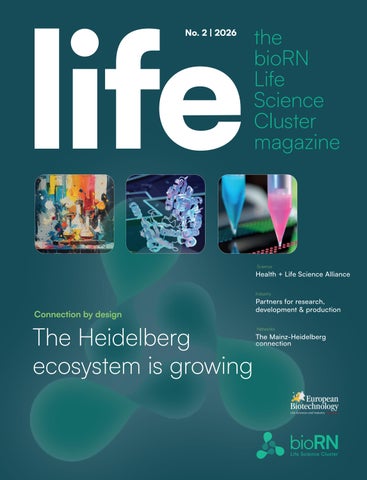
life No. 2 | 2026
the bioRN Life Science Cluster magazine
Science
Health + Life Science Alliance Industry
Connection by design
The Heidelberg ecosystem is growing
Partners for research, development & production Networks
The Mainz-Heidelberg connection
INTRO
life – the bioRN Life Science Cluster magazine
CONTENT
Regional strength connected by design Germany’s biotech strength is rooted in regional ecosystems. Over decades, these clusters have brought together research institutions, start-ups, established companies, clinics and specialised infrastructure – each developing its own profile and expertise. But innovation never stopped at regional borders. Increasingly, these ecosystems are reaching out to one another, building networks that extend well beyond their original geographic core. The aim is not simply to become bigger. It is to bring complementary capabilities together, close gaps, open access to infrastructure and expertise, and create greater resilience and critical mass. This is becoming increasingly important in a challenging economic environment and a highly competitive global market. Germany has excellent science and strong biotech regions, but translation, scaling, financing and coordination remain structural challenges. Connecting regional strengths can help address precisely these gaps – by giving companies and researchers access to the partners, capabilities, infrastructure and capital they need beyond their immediate surroundings. New alliances are connecting the Rhine-Main-Neckar region with Munich and Berlin. As we are building an enlarged biotech hub together with Mainz, something more flexible is emerging: a growing network of strong regional nodes. Each adds its own capabilities; together, they can provide a broader base for innovation, investment and industrial development. The following examples illustrate how this network is taking shape – and how regional strength can become a foundation for greater connectivity, resilience and international competitiveness. Join us again at life – the biomedical convention, 3 Feb 2027 in Heidelberg and be part of the community that brings new ideas to life.
Julia Schaft, Managing Director, bioRN Life Science Cluster
Editorial
02
Interview: Heidelberg & Mainz – Two cities, one region
03
Structural Biology: BIMOVIS
05
EIT Health Catapult
06
Health + Life Science Alliance Heidelberg Mannheim
07
Excellence in regulatory frameworks: Concept Heidelberg
08
Artificial Intelligence
Decision intelligence for drug development: Lucera
09
Development & Research Partners:
10
Helping vaccines from Vienna Interview:
11
Interview:
Assesment for bispecifics
12
Service for NAMs
13
Waste control in the lab
14
Viral vectors for ATMPs
15
CDMO as agile partner
IMPRESSUM Address: BioRN Network e.V., Im Neuenheimer Feld 584, D-69120 Heidelberg; Responsible editor: Julia Schaft; E-Mail: info@biorn.org Website: www.biorn.org Publisher: BioRN Network e.V. Editorial team: BioRN Network e.V., Knowbio GmbH; Design: Martina Willnow; Printing: Möller Pro Media® GmbH; Image credits: bioRN; biomindz; Bimovis; HLSA; Concept Heidelberg; Lucera; AGC Biologics; Celonic Group; Wuxi Biologics; Serva/LICORbio; SPT Labtech Ltd; Polyscience Europe; Konrad Gös; Gudrun-Holde Ortner
Picture: Xxxxxxxxxxxx
2
INTERVIEW
life – the bioRN Life Science Cluster magazine
Two cities, one region: New partnership beyond borders Heidelberg and Mainz are joining forces to strengthen the Rhein-MainNeckar biotech region in global competition. In a new Memorandum of Understanding (MoU), Heidelberg Mayor Eckart Würzner and Mainz Mayor Nino Haase agreed to closer cooperation between the cities’ life-sciences clusters and technology-transfer organizations. The partnership could serve as a blueprint for other German biotech regions.
Picture: © Markus Hintzen
HEIDELBERG/MAINZ
life_What is genuinely new about the new cooperation between Heidelberg and Mainz?
broader region rather than the individual location? Wälder_As a city-based organization,
Julia Schaft_As cluster and location development organizations, bioRN and biomindz have been developing their respective ecosystems for some time, and those ecosystems already extend well beyond city and state borders. The Mainz and Rhein Neckar region have a strong history of collaboration stretching back more than 15 years. Probably the most visible example is the HI-TRON, a joint cancer research institute between the DKFZ in Heidelberg and the University Medical Center Mainz. The respective cluster organizations held joint annual conferences and ran several joint innovation and transfer projects. What is new now is that the cities themselves are involved and committed to support the connection. We now have many more opportunities to work together across state borders, leading to further initiatives that we can implement better – or perhaps only implement at all – by working together. Felix Wälder_What we have now is a strategic approach that gives us additional momentum to expand that cooperation. More levels of exchange are being added. We want to bring together as many stakeholders as possible, while also listening and learning what ideas emerge from the community.
you are normally focused on your own city limits and on strengthening the visibility of your own location. This new city partnership removes those constraints and allows us to act as genuine partners. That makes a major difference internally and at the operational level. We should not put too much emphasis only on external visibility, as important as those questions are. Our stakeholders on the ground are just as important, as is the bridge we are building for them. A joint website does not change much by itself. A functioning bridge does. Schaft_The MoU is first and foremost a clear “go.” It gives us a stronger basis for committing to collaboration, avoiding duplication and moving away from a competitive mindset We hope to reach a point where we can coordinate inquiries from outside the region much more effectively: Who can help with a particular issue? Where are attractive investment opportunities? Where are the best conditions for a company to settle within the region? Or even better develop a joint strategy to actively attract life science companies to the region. Ultimately, it should not matter whether that leads to a company locating in Heidelberg or Mainz, or to a partnership being established in either city when it strengthens the greater region. Wälder_The shared commitment to collaboration also goes beyond the life sciences. Frankfurt, for example, is a major
life_Will this also create a more centralized access point to the overall ecosystem – and shift the focus toward the
DR JULIA SCHAFT Managing Director, bioRN Life Science Cluster (Heidelberg, Germany), holds a PhD in biology and completed her doctorate at the Justus Liebig University Giessen and the European Molecular Biology Laboratory (EMBL) Heidelberg in 2002. Julia initially worked in the research department of an in vitro fertilisation clinic in Sydney Australia with human embryonic stem cells, but then moved into increasingly responsible management positions in which she both led scientific projects and worked in the field of legislative and ethical research regulation. In 2016, Julia joined bioRN as a project manager, led BMBF-funded projects and played a key role in the strategic realignment of the bioRN Life Science Cluster.
3
INTERVIEW
life – the bioRN Life Science Cluster magazine
financial center, and of course the airport is an important factor. Artificial intelligence and data centers are also strongly represented here. The city partnership is therefore a starting point, not the limit of our collaboration
pany, for example, may find a research group, a startup or a technology in Mainz that complements what is already available in our ecosystem. Our role is to make these connections easier and more targeted. Wälder_And that works in both directions. By building a bridge between the ecosystems, we expand the range of potential partners and opportunities available to our stakeholders. The aim is not simply to create a larger network, but to make it easier for the right people and organizations to find each other across existing boundaries.
life_What is already changing in concrete terms, for example around events? Wälder_We want to develop new for-
mats together with the community and tailor them to its needs. We want to build a bridge between the ecosystems that help stakeholders overcome existing boundaries and obstacles. Schaft_We believe there are areas where we can achieve more together than either of us could alone, not only by pooling our cluster management resources but also by pooling networks of experts and innovators to create more critical mass. This includes also joint applications for initiatives and funding programs. That would previously have been unthinkable. l i fe_W h e re c o ul d yo u s p e c if i c a ll y streamline activities?
Schaft_We definitely want to reduce duplications. If something is already established in Mainz, Heidelberg does not need to build it again – and vice versa. When it comes to events, everyone would like to see one major, representative industry event that also has international visibility. But every location has gaps somewhere in its offering. We no longer have to close those gaps alone; we can complement each other’s portfolios. One concrete example is the Curious – Future Insight Conference, a high profile science conference which will rotate within the greater region and therefore create much more momentum Wälder_You can compare it to cyclists: alone, you are riding into a headwind; as a team, you can take turns, conserve your energy, regroup and then take the lead again. The same applies to biotech regions. Of course, we should keep duplication in check. But some local activities are simply necessary to bring stakehold-
FELIX WÄLDER is Managing Director of biomindz Standort entwicklungsgesellschaft Mainz mbH, the municipal development agency for Mainz as a biotech nology and life sciences hub. His work focuses on innovation ecosystem development, research and industry networks, life sciences infrastructure, investment promotion andinternational location marketing. Previously, he spent ten years in corporate governance and public asset management at the City of Mainz’s municipal holding company. He holds a Master’s degree in Public Management and Governance from Zeppelin University Friedrichshafen.
ers together quickly around specific topics. life_We have talked a lot about the benefits for the region. But what does the cooperation change for individual stakeholders?
Schaft_For our stakeholders, it means access to a broader network of complementary expertise, technologies and potential partners. A pharmaceutical com-
life_Cooperation between clusters on a national level seems to be increasing. What makes the Heidelberg/Mainz connection special? Wälder_This city partnership is certainly
different from a conventional international partnership, precisely because the two locations are geographically so close. The Draghi report argues that every region needs a recognizable role within Europe in order to be competitive on a global scale. We are taking up that challenge in very concrete terms. By expanding cooperation among stakeholders in Hesse, Rhineland-Palatinate and Baden-Württemberg, we may be seeing the beginnings of a supercluster in the life sciences. Schaft_Our region is also distinctive because the players and topics overlap so extensively that the boundaries are increasingly disappearing – first in terms of content and perhaps eventually on the mental map as well. But I want to stress that cooperation should not stop at Heidelberg and Mainz. We need to make sure that the German biotech sector as a whole is presented and perceived as strongly as possible internationally. Cross cluster cooperation is therefore an approach that bioRN actively and consciously pursues – regionally, nationally and internationally. In addition to Rhein Main Neckar we are for example actively strengthening the axis of the three strong life science hubs Heidelberg, Munich and Berlin.
Picture:©Xxxxxxxxxxxx Picture: Anqelika Loeffler
4
INTERVIEW / START UP
life – the bioRN Life Science Cluster magazine
life_What other opportunities do you see beyond a greater consolidation and the integration of local initiatives and processes? Wälder_Science and technology transfer
is a major theme. We already have cross-city cooperation in this area, and
we can build very effectively on that foundation. Schaft_Greater critical mass will also attract investments from private as well as institutional investors. We already see new regional investments funds emerging. For example Carma Fund soon rais-
ing its second fund, and the DKFZ Mission Fund, currently looking for a fund manager. Other fund activities around the joint hospitals in Heidelberg and Mannheim are emerging. We will fully support these activities and increase the region’s visibility in terms of financing. life_Do you see your partnership as a
model for other clusters and regions?
Wälder_For now, our goal is simply to
improve collaboration. We have a great momentum and support, and above all we need to listen to our stakeholders: What is useful to them? What do they want? These kinds of partnerships are always individual because the stakeholders are different. Our two cities do not exist in this particular constellation anywhere else in the world. life_Is this kind of cooperation particularly useful in difficult times?
Schaf t_ Absolutely. We are simply ■ stronger together.
mental structural biology. By integrating computational predictions with CryoEM, Cryo-ET, and X-ray crystallography, researchers gain a deeper understanding of molecular mechanisms and make more informed decisions.
Pictures: © Bimovis GmbH; bioRN
Profile Founded
2023, Heidelberg, Germany
Focus
AI-enhanced and -driven structural biology
Contact
https://bimovis.com
Artificial intelligence is transforming structural biology and accelerating drug discovery. Tools such as AlphaFold enable rapid protein structure prediction, while molecular modeling, docking, and virtual screening help researchers explore molecular interactions and prioritize promising candidates more efficiently. The greatest impact comes from combining AI-driven insights with experi-
Through consulting, training, and structural biology expertise, BIMOVIS helps biotech and pharmaceutical organizations translate AI-driven insights into scientific and therapeutic break■ throughs.
AI Meets Experimental Biology: The Future of Structural Biology
5
EIT HEALTH
life – the bioRN Life Science Cluster magazine
Europe has the innovation. What about capital to scale? Europe has a paradox in healthcare innovation. Its universities, research institutions and hospitals produce world-class science, while its entrepreneurs are building increasingly sophisticated technologies across biotech, medtech and digital health. Yet turning that scientific strength into globally competitive companies remains difficult. The science is here. The entrepreneurs are here. The next question is whether the investment follows.
FINANCING
› Stephanie Füller, bioRN Life Science Cluster
The European healthtech investment environment has become more demanding. Funding is tighter, regulatory complexity is increasing and investors are looking for stronger evidence that a technology can create both clinical and economic value. This is not necessarily bad news. But it may force European health innovation to become stronger.
Capital is part of the equation As Samantha Jerusalmy, Partner at European venture capital firm Elaia, puts it, investors are becoming increasingly selective, looking for clinical validation, regulatory readiness and credible goto-market strategies. At the same time, European start-ups often face another challenge: exceptional science does not automatically translate into successful international commercialisation.
Antoine D’Hollander, Investment Director at Capricorn Partners, sees a similar shift. For him, the current environment is pushing founders to become more disciplined: demonstrating patient value, economic return, regulatory pre-
paredness and a clear route to market. “The era of easy capital is behind us,” he observes.
Forming investable companies The challenge is particularly acute in healthcare, where development cycles are long, regulatory pathways complex and commercialisation often requires expertise well beyond the founding team. The opportunity is significant, but so is the risk that promising European companies fail to scale here. That makes European investment capacity more than a financial question. It is a question of competitiveness. D’Hollander highlights three characteristics that increasingly distinguish companies capable of attracting investment: clarity about the problem being solved and the business model behind it, preparedness on the harder questions (validation, reimbursement, competition, IP) and a mindset that signals founders are ready to build with, not just pitch to, their investors. Jerusalmy points to another important change: the increasing maturity and ambition of European healthtech. Companies are moving beyond early concepts towards clinically validated solutions with more sophisticated business and goto-market models. Meanwhile, the convergence of AI, biology and big data is opening new opportunities in drug dis-
covery, diagnostics, clinical trials and precision medicine.
A decade for Europe's pipeline Against this backdrop, the EIT Health Catapult program offers an interesting lens on the evolution of European healthtech. Since 10 years, the program has brought more than 300 emerging life sciences and healthtech companies from across Europe into contact with investors, industry and healthcare experts. After a decade, perhaps the most important message of the program is about European capacity: The capacity to discover outstanding founders across borders. The capacity to connect science with capital. And the capacity to ensure that Europe's next generation of health companies can grow here. Arantxa Encinas-López (foto) is leading this European flagship program on behalf of bioRN: “Over the last 10 years, the real achievement of the Catapult is not simply the number of companies we have supported, but the European network and pipeline we have built, connecting scientific excellence with entrepreneurial talent, capi■ tal, industry and healthcare.” Contact: Arantxa E.-López: ae@biorn.org eithealth.eu/programmes/catapult
Picture: © bioRN Life Science Cluster
6
REGIONAL NET WORKS
life – the bioRN Life Science Cluster magazine
From Bench to Biotech: Fueling Tomorrow's Cures Two Heidelberg-area scientists are turning lab breakthroughs into treatments for patients. With backing from the Health + Life Science Alliance's Translational Research Program, Amritha Sathyanarayanan and Mirko Völkers are pushing precision cancer diagnostics and heart-protective therapies toward the clinic.
TRANSLATIONAL RESEARCH
› Gabriele Lange-Edwards, Health+ Life Science Alliance Heidelberg Mannheim (HLSA)
Every year, brilliant ideas take shape in labs across Heidelberg and Mannheim. But the gap between a promising discovery and a therapy that actually reaches patients is notoriously hard to cross. It takes more than excellent science: it takes funding, mentorship, and a network that understands both academia and the market. That's exactly what the Health + Life Science Alliance Heidelberg Mannheim set out to provide, together with its partners. Since 2022, seven of the region's leading research institutions - Heidelberg University, the German Cancer Research Center (DKFZ), the European Molecular Biology Laboratory (EMBL), the Max-Planck-Institute for Medical
Research, the Central Institute of Mental Health, and the university hospitals in Heidelberg and Mannheim - have joined forces under one shared mission: turning world-class biomedical research into real-world impact. At the heart of this effort is the Alliance's Translational Research Program, which provides precommercial funding to help researchers make the leap from bench to business.
Pictures: © Konrad Gös, Gudrun-Holde Ortner
A look at two current grantees Amritha Sathyanarayanan, based at the Medical Faculty Mannheim, is developing OvaTrace – a blood-based assay translating single-cell and spatial tumor insights into circulating markers that track ovarian cancer treatment response. Cardiologist and Heisenberg Professor Mirko Völkers has spent years decoding the molecular machinery behind heart disease, from pathological remodeling to heart failure after a heart attack. His Alliance-supported project is now translating that fundamental research into the clinic, with the aim of protecting heart function when patients need it most.
What connects these two scientists, despite working on very different topics, is the same conviction behind every project the Translational Research Program supports: a great discovery deserves a real shot at reaching patients. The Alliance doesn't just hand out grants, it opens doors across Heidelberg's dense innovation ecosystem, from technology transfer offices to accelerators and investors. Sathyanarayanan and Völkers are only two of the researchers the Alliance is funding this year, and their stories are just a glimpse of what's coming next. Curious what else is brewing in the region's labs? Chances are, some of tomorrow's most important therapies are taking shape right now in the greater Heidelberg region. ■
7
REGUL ATORY
life – the bioRN Life Science Cluster magazine
Precision in Practice: GMP for Tomorrow’s Therapies Highly regulated environments like the pharmaceutical and biotech industries depend on one thing above all: people who not only know the rules, but understand how to apply them in daily practice. That is where CONCEPT HEIDELBERG and the ECA F oundation meet – and where the ECA Interest Groups play a particularly decisive role.
INTEREST GROUPS
› Axel H. Schroeder, Biologist, Operations Director, CONCEPT HEIDELBERG
CONCEPT HEIDELBERG – Europe’s leading GMP & GDP Training and Information Services Provider For more than four decades, CONCEPT HEIDELBERG has been Europe’s leading platform for GMP and GDP compliance information, training and networking. From its base in Heidelberg, the company organises several hundred seminars, conferences, live online trainings and in-house courses every year, complemented by e-learning, consulting, literature and software services. The goal is always the same: to translate regulatory requirements into workable, up to date quality assurance practice.
Exclusive Partnership with ECA Foundation At the European level, CONCEPT HEIDELBERG works in an exclusive partnership with the ECA Foundation (www.ecafoundtion.org ), a non-profit organisation dedicated to promoting regulatory excellence. CONCEPT HEIDELBERG plans and delivers all on site and online events of the ECA Academy – the Foundation’s training arm – including renowned congresses such as the GMP PharmaCongress with PharmaTechnica Expo and the PharmaLab Congress. In parallel, CONCEPT HEIDELBERG manages the ECA Foundation’s administrative backbone, from membership services and web presence to event coordination.
At the heart of the Foundation, however, are its 10 Interest and Working Groups. They connect industry, regulators and academia in specialised expert communities. These groups develop position papers and best-practice guides, comment on new and revised GMP and GDP guidelines, and provide a forum in which emerging expectations can be discussed and aligned. Among them, the Pharmaceutical Microbiology Group and the ATMP Group are dynamic examples of how focused collaboration can move complex topics forward. Both the Microbiology and ATMP Group as well as the Analytical Quality Group will be represented at the PharmaLab Congress in Darmstadt from 23–25 November, with conference sessions and members in attendance. The Pharmaceutical Microbiology Group brings together microbiologists, quality experts and laboratory professionals from pharmaceutical and biotech companies, contract labs and authorities. Their work centres on practical questions
such as contamination control strategies, environmental and cleanroom monitoring, validation of microbiological test methods and sterility assurance. By discussing real-world challenges and regulatory trends, the group helps to shape robust, scientifically sound approaches that companies can apply across different facilities and technologies. The ATMP Group focuses on one of the fastest-evolving areas in modern medicine: advanced therapy medicinal products such as cell and gene therapies or tissue-engineered products. Here, classical GMP principles must be adapted to highly individualised products, short supply chains and novel manufacturing platforms. The group provides a structured platform to exchange experience on topics like facility design, aseptic processing, raw material control and handling of starting materials of human origin. Through its guidance documents and comments on draft regulations, the ATMP Group supports a harmonised understanding of expectations in an area where scientific innovation and regulatory development are advancing in parallel. With their combined strengths, CONCEPT HEIDELBERG and the ECA Foundation ensure that these expert communities have a strong and effective voice. For companies, this means access not only to high-quality training, but also to the latest collective thinking from those who are actively shaping the future of GMP and GDP compliance in Europe. ■
Picture: © Concept heidelberg
8
PRECISION MEDICINE
life – the bioRN Life Science Cluster magazine
From Precision Medicine to Precision Drug Development Precision medicine made disease heterogeneity actionable, linking treatment to individual tumor molecular makeup. Lucera applies this principle to drug development in general. Disease state–the combination of drivers, stage, treatment context, phenotype and progression risk–determines if a treatment is likely to show benefit. DATA SCIENCE
› Dr. Stephan Brock
Lucera GmbH is a newly founded independent Heidelberg-based company drawing on >15 years of biomedical knowledge, technology and drug development experience. We work with pharma and biotech teams to answer these high-stake, critical questions: Can a mechanism impact disease? What is the most relevant patient group? Is the trial optimized for success?
From orthogonality to evidence Lucera ´s model of answering the critical questions
Every trial assumes a therapeutic approach will modify the disease biology in the recruited patients and the effect can be measured with the chosen endpoints and duration. Lucera takes an orthogonal approach, testing a hypothesis from several independent angles to get the answers.
Picture: © Lucera GmbH
Can this drug candidate’s mechanism impact disease? Mechanistic disease and drug models are applied to see how a mechanism impacts disease biology. Lucera reveals where the intervention acts, how biology changes across disease states/stages and where the mechanism would likely alter the course of disease. What is the most relevant patient group? Our Digital Molecular Twins, individual patient clinical records translated into molecular representations, make patient heterogenity interpretable
without deep molecular profiling and show where intervention relevance, risk, and outcomes may differ. This helps identify suitable patient groups. Is the development plan optimized for success? Lucera integrates biological context with trial evidence–mechanism-indication relationships, inclusion/ exclusion criteria, treatment plan and endpoints – to assess if a program is likely to have the desired outcome.
Hypothesis becomes credible The different approaches are executed independently by a team of experienced data scientists and clinicians. When results converge, the hypothesis becomes more credible. Divergence reveals what needs to be addressed before advancing a program.
Success story Lucera modeled distinct disease-driving pathomechanisms in heart failure and assessed candidate interventions against them. A Digital Molecular Twins analysis of >40 million real-world records promoted a lower-ranked drug candidate to top position. Our work also identified GLP-1R, SGLT2, and PCSK9 as highly relevant targets in cardiometabolic disease before their clinical validation. The orthogonal evidence confirmed the mechanistic model and materially changed the prioritization. ■
Contact: Kurfürsten-Anlage 21 69115 Heidelberg www.lucera.eu
9
RESEARCH
life – the bioRN Life Science Cluster magazine
AGC Biologics Team Fuels Shigella Vaccine Trials Shigella, a drug-resistant bacterial threat causing deadly diarrheal disease in children, is under renewed scientific focus. AGC Biologics’ Heidelberg team is advancing vaccine innovation by supplying drug substance for Valneva’s clinical trials – offering hope for a breakthrough in global pediatric health. VACCINE TRIALS
› Jörg Ohl, Associate Vice President, AGC Biologics
In "A gut-wrenching problem we can solve", Bill Gates wrote about discovering the impact of dangerous bacteria on young children around the world. While advances have been made, he singles out Shigella as a dangerous, persistent threat: “And new challenges make the fight against diarrheal diseases even harder than it was 25 years ago. Shigella – one of the nastiest bacterial causes of diarrhea – is becoming more and more resistant to antibiotics, and we still don't have a vaccine.” Shigellosis, or Shigella, is the second leading cause of fatal diarrheal disease worldwide, strongly contributing to pediatric morbidity and mortality. It is estimated that up to 165 million infections are due to Shigella, of which 62.3 million occur in children younger than five years. For decades, researchers around the world devoted their efforts to stopping this deadly disease. Developing an effective vaccine would replace suffering with normal childhood development. As Gates points out, the effect of this disease does not happen in isolation: “For families barely scraping by, diarrhea is both a medical crisis and an economic disaster. Parents miss work to care for sick kids. Kids miss school. Expenses pile up. It's one of the ways that disease keeps families trapped in poverty – and one of the reasons that a country’s public health is key to its development.”
AGC Biologics Heidelberg has 40 years of experience in drug substance and API production. The talented team at AGC Biologics' Heidelberg facility is hard at work supplying the drug substance for Valneva SE’s investigational four-valent Shigella bioconjugate vaccine, producing phase II supply for two important studies: › A randomized, controlled, and blinded study with infants conducted at a single study site in Kenya. › A controlled human infection model (CHIM) study with adults age 18-50. Results of the study are expected in the second half of this year, according to Valneva’s April 9 announcement. Valneva exclusively licensed the vaccine
candidate from LimmaTech Biologics AG, which previously worked with AGC Biologics to establish GMP-compliant manufacturing and quality control of the vaccine’s complex protein-polysaccharide conjugates for first-in-human studies. AGC Biologics' Heidelberg site’s ability to handle complex molecules and multi-valent assets can help this potentially life-saving program reach its next clinical milestone. Valneva has entrusted the team of experts at the site with this challenge, recognizing their contribution to efforts aimed at preventing ■ millions of deadly infections.
Picture: AGC Biologics
10
INTERVIEW
life – the bioRN Life Science Cluster magazine
The Future of Biologics CDMOs Biologics manufacturing is evolving as sponsors seek partners who combine scientific depth with agility and clear accountability. In this Q&A, Dr. Samanta Cimitan, CEO Celonic Group explains how CDMOs are adapting, how mid sized players operate in this environment, and how Celonic is preparing for the future.
BIOMANUFACTURING
life_What does the future of biologics CDMOs look like?
accessible. The key is translating scale into tangible customer value without allowing organizational complexity to become the customer’s problem.
Dr. Samanta Cimitan_The future of biologics CDMOs will be defined by capability, not capacity. Sponsors want CDMO partners who can manage scientific complexity, navigate regulatory expectations, and deliver commercial reliability without slowing innovation. Pipelines are growing, timelines compressing, and global supply expectations rising. CDMOs that respond with clarity, speed, and technical depth will shape the next decade, while scale driven models alone will struggle to meet modern program demands.
life_How will next-generation technologies reshape CDMOs?
Picture: ©Solar Celonic Group Pictures: Foods
life_How are mid sized CDMOs positioned in this new landscape?
Cimitan_Mid sized CDMOs are positioned to excel through expertise, agility, and close collaboration. We operate at a size where commercial delivery is fully credible, while retaining the entrepreneurial mindset that allows us to make fast decisions and pivot quickly by staying close to our customer’s challenges. Sponsors increasingly seek partners that offer clear accountability, direct access and simple governance. At Celonic, we see this reflected in tailoring development approaches as well as maintaining high touch engagement and collaboration. Mid sized CDMOs excel here because we are built for responsiveness. We move with our customers, not around them. life_Large CDMOs are also evolving. How are they adapting?
DR. SAMANTA CIMITAN, CEO Celonic Group
Cimitan_Large CDMOs increasingly recognize that sponsors need more than scale – they expect clarity, accountability, responsiveness and easy access to a broad range of capabilities. Global players are reshaping how they work, by reducing friction, simplifying governance, tightening decision pathways, and improving coordination across capabilities. The opportunity is to combine the advantages of global scale, broad technology platforms, and extensive manufacturing networks with a customer experience that feels connected and
Cimitan_Nex t generation process intensification and perfusion based manufacturing are redefining biologics manufacturing, and Celonic is among the early pioneers proving their industrial viability. Intensified and perfusion processes deliver higher throughput, lower COGs per gram, and significantly lower CAPEX per gram by enabling smaller bioreactors to achieve commercial level output with exceptional efficiency. They shorten seed trains and unlock productivity levels that traditional fed batch systems cannot match. Celonic has invested ahead of the curve, building the toolboxes, expertise, and operational discipline required to run true high density perfusion and intensified production. This is the next era of biologics manufacturing, and Celonic is already operating in it. life_How does Celonic fit in?
Cimitan_Celonic is building a model designed for the future, not the past – a high performance, mid sized biologics manufacturer defined by integrated development to GMP manufacturing capabilities, a proven European regulatory track record, and deep expertise. We focus our strengths where they create meaningful impact, using innovation to move biologics ■ manufacturing into its next chapter.
11
INTERVIEW
life – the bioRN Life Science Cluster magazine
Bispecific & Multispecific Antibody Drug Discovery In this interview, Dr. Jiansheng Wu, SVP & Head of CRO Services at WuXi Biologics, shares practical strategies for designing, screening, and optimizing b ispecific and multispecific antibodies. He highlights how format selection, HTP production, L C-MS-guided purification, and early developability assessment can reduce risks and guide lead screening & optimization. BIOLOGICS DRUG DISCOVERY
life_As bispecific and multispecific antibodies evolve beyond traditional formats to enable new capabilities, what principles should guide the design of novel formats?
Dr. Jiansheng Wu_One of the recurring lessons from supporting thousands of bispecific and multispecific antibody programs is that the ‘best’ format rarely exists at the beginning of a project. It emerges through iterative design, rapid experimental validation, and continuous optimization. Every architectural decision involves tradeoffs. A format with exceptional biological activity may introduce challenges in production, stability, or PK. Success comes from evaluating multiple architectures early, generating high-quality data, and letting the assessments guide format selection. The best molecule isn’t necessarily the most complex; it’s the one that balances function and developability, and ultimately becomes a successful therapeutic. life_With a growing range of target pairs, formats, and modalities, how can researchers screen the most promising leads in early biologics drug discovery? Dr. Wu_Across the many modalities and
therapeutic areas our teams have supported, the strongest discovery programs progressively narrow leads by evaluating biological performance through MOAdriven, stage-based assay design alongside developability. One area that is often overlooked is screening material quality. When many formats and combinations are compared, rapid, reliable screening depends on consistent, high-quality molecules. An
bly behavior may require optimization through chain ratio adjustment and purification scouting, with close monitoring of byproduct profiles. Integrating LC-MS into the purification workflow can distinguish desired heterodimers from impurities that may have similar size/charge and therefore be d ifficult to r esolve by SDS-PAGE or S EC-HPLC. This guides purification strategy optimization and helps consistently deliver high-purity heterodimers at scale for downstream studies.
DR. JIANSHENG WU (SVP & Head of CRO Services, WuXi Biologics) holds a PhD in Molecular Biology and brings 25+ years of industry e xperience across 50+ drug programs.
HTP production platform with an LC-MSverified workflow helps ensure molecule quality while maintaining throughput and cost efficiency needed for large-scale screening. life_Different bispecific formats present distinct quality challenges, especially when scaling up. How can purification workflows consistently deliver highpurity material at scale?
Dr. Wu_Across over 30,000 bispecifics and multispecifics we’ve produced, one principle has remained consistent: variations in molecule properties and assem-
life_How can early developability assessment guide lead optimization and candidate selection?
Dr. Wu_Developability should be assessed at both parental antibody and final molecule levels, because architecture can significantly alter developability profiles. For parental antibodies, early assessments combine in silico analysis, PK and biophysical profiling, immunogenicity, and forced degradation to identify and address liabilities before they are carried into complex formats, like scFv aggregation risks. The assembled bispecifics should be reassessed for potential risks, such as FcRn binding, viscosity, stability, or solubility. These early insights guide lead optimization while providing useful context for ■ downstream development.
Picture: © WuXi Biologics
12
RESEARCH
life – the bioRN Life Science Cluster magazine
Introducing SERVA: A Global LICORbio Brand SERVA is far more than a supplier of chemicals and electrophoresis equipment. Together with LICORbio, it has evolved into an all-inclusive life science partner for r esearchers not only in Germany, but around the world. Their integrated workflows even support the shift towards New Approach Methodologies (NAMs).
BEYOND SERVICE
› Taylor Tunnison, LICORbio
Today SERVA continues to be guided by the same commitment its founder made over seventy years ago: to serve scientists in their pursuit of discovery.
cell and gene therapy. As the exclusive distributor of Nordmark collagenases, SERVA provides essential tools for the gentle isolation of cells from tissue. Paired with the revolutionary LICORbio Atlas™ Imager, these solutions streamline quantitative imaging of 2D and 3D cell cultures, including spheroids, organoids, and microphysiological systems.
A Legacy of Service In 1953, SERVA (from Latin servare, “to serve”) was founded in Heidelberg by chemist Dr. Nikolaus Grubhofer. His dream was to “serve science” by supplying fine biochemical reagents to researchers in academia and industry. After the release of its first catalog of about 450 products in 1961, SERVA quickly became known for world-class service, proprietary electrophoresis products, and reagents for chromatography, isoelectric focusing, and more. As an ISO-certified company, SERVA has always adhered to the highest standards of quality, safety, and sustainability.
Picture: © Serva/Licorbio
LICORbio Acquisition S ERVA wa s a c quire d in 2025 by LICORbio, a leading innovator in life science imaging and analytical solutions. The acquisition significantly broadens LICORbio’s electrophoresis offerings, allowing for end-to-end workflows tailored to the evolving needs of proteomics researchers worldwide. The integration of SERVA’s expertise and proprietary technologies with LICORbio’s industry-leading imaging plat-
New Approach Methodologies SERVA - headquarters in Heidelberg
forms provides scientists with comprehensive solutions from sample preparation and resolution to multiplex imaging, best-in-class quantification, and beyond.
Looking Forward SERVA continues to offer its exceptional electrophoresis instruments, reagents, and fine biochemicals to researchers around the globe. With the addition of premium services, including specialty chemicals, custom packaging and formulation, bulk and contract manufacturing, and quality testing and certification, SERVA now offers tailored solutions for academic and industry customers with unique needs. These services will not only support scientific discovery but provide the company with a key source of future growth. Together SERVA and LICORbio are pioneering advancement in the field of
This integrated workflow supports the shift toward New Approach Methodologies, enabling researchers to study more realistic biological processes and accelerate the development of new therapeutic approaches. LICORbio maintains SERVA’s Heidelberg headquarters, honoring its longestablished legacy and scaling support through expanded global infrastructure. Customers can expect uninterrupted access to SERVA’s full product line, with enhanced service and support and integrated imaging solutions. For more information, please visit serva.de and ■ licorbio.com.
13
L ABORATORY
life – the bioRN Life Science Cluster magazine
Sustainability at the bench: smarter experimental design Science has a waste problem, laboratories are among the most resourceintensive environments in research, and sustainability efforts have long focused on what happens after an experiment, not before. SPT Labtech argues the bigger opportunity lies upstream: precision liquid handling, assay miniaturisation, and smarter experimental design can cut reagent use and plastic waste without compromising data quality.
WASTE CONTROL
Modern laboratories are expected to generate more data, accelerate research timelines and maximise the value of precious samples, often under tighter budget. Sustainability initiatives remain important, but reducing waste at the source can have an even greater impact. Many laboratory workflows consume significant volumes of reagents, plastics and biological samples during assay development, optimisation and routine experimentation. Repeated optimisation cycles and unnecessary workflow complexity can increase both environmental and financial costs. Thoughtful experimental planning helps laboratories get more value from every reagent and sample while avoiding resource use that was never needed in the first place.
Designing smarter experiments E x p e r i m e nta l s t rate g i e s t h at a re planned and optimised before execution help laboratories evaluate more conditions, gain richer datasets and avoid unnecessary optimisation cycles. Approaches such as Design of Experiments (DoE), assay miniaturisation and automated liquid handling all play a role in making that possible. Miniaturised workflows, operating at nanolitre and low microlitre volumes, let researchers generate more data from limited samples and reagents. That matters most in genomics, assay development, drug discovery and cell-based research, where both sample availabili-
ty and reagent costs are real constraints on what can be tested.
Precision without compromise Scientific quality and resource efficiency should go hand in hand, not compete with each other. Precision liquid handling helps laboratories make more efficient use of reagents, consumables and samples while improving consistency and reproducibility. Technologies such as dragonfly® discovery and mosquito® from SPT Labtech support these approaches through flexible, low-volume liquid handling and assay miniaturisation. Efficient reagent use and reproducible dispensing enable laboratories to increase experimental output while conserving materials and valuable samples.
Measuring the impact More efficient use of resources delivers benefits across the whole laboratory. Miniaturised and automated workflows can help reduce reagent and consumable use, conserve valuable samples and
free researchers from time-consuming manual tasks. Reported outcomes include: › Up to 99.9% fewer pipette tips used during assay preparation › Up to 96% fewer disposable tips in enzymatic assay workflows › Up to 80% reduction in plastic consumables in NGS workflows › Up to 98% shorter liquid handling times › Nanolitre-scale dispensing down to 200 nL The greatest sustainability gains are often achieved not through waste management alone, but through better experimental design and more efficient use of valuable laboratory resources. Sustainability is not simply about reducing waste. It is about enabling more discovery from every sample, reagent and ■ experiment.
Access the full story:
Contact: SPT Labtech Ltd Melbourn Science Park, Cambridge Road, Melbourn, SG8 6HB, UK www.sptlabtech.com, marketing@sptlabtech.com
Picture: © SPT Labtech Ltd
14
RESEARCH
life – the bioRN Life Science Cluster magazine
From Transfection to Trust: One Partner Polysciences Europe GmbH brings the full Ott Scientific portfolio – PEI MAX®, MAXgene® GMP, KyFect™-AAV, and ViaCheck™ viability controls – to Europe’s cell and gene therapy, bioprocessing and diagnostics community, from early discovery through GMP release and quality control.
BIOPROCESSING
› Tughan Akbasak, PhD, Polysciences Europe GmbH
Picture: © Polysciences Europe GmbH
Ott Scientific unites four specialist companies — Polysciences, Bangs Laboratories, Kyfora Bio and Ethos Biosciences — spanning transfection and bioprocessing, microparticles and instrument standards, and diagnostic reagents. Polysciences Europe GmbH, in Hirschberg an der Bergstrasse since 1993, is Ott Scientific’s gateway for the Rhine-Neckar life science community, giving local teams direct, single-source access to reagents and instrument controls spanning the workflow from transfection to quality control, backed by regional technical support.
MAXgene® mechanism of action, PEI MAX® AAV9 titer, and KyFect™AAV complex stability data
Transfection reagents that scale Kyfora Bio’s PEI-based reagents follow developers from bench to bioreactor. PEI MAX®, cited in thousands of publications, remains a research-grade standard for early discovery and process development. MAXgene® GMP then offers a seamless, validated transition into clinical and commercial manufacturing — the same chemistry, now with cGMP release and lot-to-lot consistency built in. In head-to-head testing, Kyfora’s PEI delivered up to 5.6-fold higher AAV9 titers, 1.7-fold higher AAV2 titers, and over 60% higher CHO-cell antibody expression than a leading competitor reagent. One of the newest additions to the platform, KyFect™-AAV, is purpose-built for AAV production and delivers up to 2-fold higher viral titers than leading lipid- and polymer-based alternatives. It maintains stable, high titers even when DNA complex formation is extended to 90 minutes – a window in which a leading competitor reagent loses significant potency – and holds that performance consistently across three independent production lots. Flexible with adherent or suspension cells, high or low DNA input, and a range of AAV serotypes, KyFect™-AAV matches competitor yields from half the bioreactor volume, for a meaningfully lower cost per dose. Supplied readyto-use in 1, 10 and 100 mL formats and fully synthetic, it is manufactured in-
house in the US for reliable, consistent supply, with a GMP-grade version coming soon for a seamless move into commercial manufacturing.
Trusting the viability count Higher titers matter only if the viability data behind them can be trusted. Bangs Laboratories’ ViaCheck™ Concentration & Viability Controls are NIST-traceable microsphere standards, available in 5, 10 and 20 µm sizes and aligned with ISO 20391 guidance, that verify and calibrate automated, image-based analyzers such as the Vi-CELL® BLU by correlating instrument counts against certified reference concentrations. Built into a routine QC schedule, they give teams an independent, traceable check on instrument performance – keeping critical quality attribute data defensible for QC release and regulatory submissions. Whether the question is which transfection reagent to scale with, how to validate your viability counts, or where to source custom polymers, monomers, or diagnostic reagents, Polysciences Europe's team is on the ground across the Rhine-Neckar region, throughout Germany, and across Europe – reach out to Melanie Bailey-Treiber, Managing Director, or Tughan Akbasak, PhD, ■ Sales and Marketing Director. Contact: info@polysciences.com +49 (0) 620 845 200
15
life
3Feb Heidelberg Congress 2027 Center
the biomedical convention
Conference I Expo I Networking
AI in Health Biomedical Innovations Young Scientists´Pitch Competition 30+ Exhibitors sponsored by:
Discover one of the most dynamic life science ecosystems in just one day.
BIO-EUROPE 2026 · COLOGNE
You scout external innovation for the whole company. So we made it easy. T H E B i o R N R E G I O N , S E E N I N AC A D E M I C L A B S
"AcademicLabs maps KOLs, startups and technologies, rankorders them, and provides the ability to score by criteria of interest. Amazing!"
1,100+
17,500+ 600+
70
research groups
pubs per year
trials by biotechs
funded projects
TOP-30 PHARMA, SEARCH & EVALUATION LEAD
S E A RC H E D TO G E T H E R · S C O R E D B Y A I AG A I N S T YO U R C R I T E R I A
110M
150,000
22M
500,000
20,000
research groups
researchers
companies
preclinical biotechs
publications
32M
1M
3M
290,000
ASSETS
patents
clinical trials
funced projects
news articles
"By far the best landscaping solution of all we tried." VP TECHNOLOGY SCOUTING, TOP-10 PHARMA
Learn more — and get a free tailored report. academiclabs.com/cologne
Used by Search & Evaluation teams at 15+ of the world's largest pharma companies. Proud landscaping partner of BioRN.
launching soon