CRO & CDMO
European Biotechnology | Autumn Edition | Vol. 25 | 2026
AI in clinical research: hype vs. reality AI can already reduce administrative work, improve decision-making and streamline parts of clinical development. But its impact is often overstated. Evidenze’s Raphaela Schnurbus explains where AI is delivering measurable value today, where human expertise remains essential and what biotechs should ask before buying in.
ADVERTORIAL
feasibility assessments, site selection, and regulatory intelligence is following shortly, further broadening its value across the clinical research landscape. Based on Evidenze’s experience to date, timelines for several key activities can be reduced by 30% to 50%, allowing teams to work more efficiently without compromising quality but trained experts retain full responsibility for the final output and every critical decision throughout the process.
European Biotechnology: Where is AI delivering value today? Raphaela Schnurbus: AI is already creat-
ing value by simplifying processes, reducing administrative workload, and supporting more efficient decision-making. At Evidenze, for instance, the Fast-TrIAl platform can generate study protocols from a draft synopsis, flag potential issues and operational bottlenecks, and recommend suitable sites through predictive analysis of historical trial data. That said, some of the industry's most ambitious expectations have yet to be fully realized. Patient recruitment is a good example. While AI can help refine recruitment strategies and identify potential participants, it has not produced the step-change in enrollment performance that is often suggested. Recruitment outcomes still depend on a combination of clinical, operational, and human factors that technology alone cannot address.
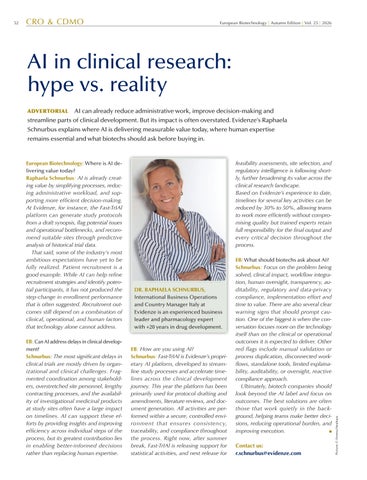
DR. RAPHAELA SCHNURBUS, International Business Operations and Country Manager Italy at Evidenze is an experienced business leader and pharmacology expert with +20 years in drug d evelopment.
EB: Can AI address delays in clinical development? Schnurbus: The most significant delays in
EB: How are you using AI? Schnurbus: Fast-TrIAl is Evidenze’s propri-
clinical trials are mostly driven by organizational and clinical challenges. Fragmented coordination among stakeholders, overstretched site personnel, lengthy contracting processes, and the availability of investigational medicinal products at study sites often have a large impact on timelines. AI can support these efforts by providing insights and improving efficiency across individual steps of the process, but its greatest contribution lies in enabling better-informed decisions rather than replacing human expertise.
etary AI platform, developed to streamline study processes and accelerate timelines across the clinical development journey. This year the platform has been primarily used for protocol drafting and amendments, literature reviews, and document generation. All activities are performed within a secure, controlled environment that ensures consistency, traceability, and compliance throughout the process. Right now, after summer break, Fast-TrIAl is releasing support for statistical activities, and next release for
EB: What should biotechs ask about AI? Schnurbus: Focus on the problem being
solved, clinical impact, workflow integration, human oversight, transparency, auditability, regulatory and data-privacy compliance, implementation effort and time to value. There are also several clear warning signs that should prompt caution. One of the biggest is when the conversation focuses more on the technology itself than on the clinical or operational outcomes it is expected to deliver. Other red flags include manual validation or process duplication, disconnected workflows, standalone tools, limited explainability, auditability, or oversight, reactive compliance approach. Ultimately, biotech companies should look beyond the AI label and focus on outcomes. The best solutions are often those that work quietly in the background, helping teams make better decisions, reducing operational burden, and ■ improving execution. Contact us: r.schnurbus@evidenze.com
Picture: © Verena Neuhaus
52