BINGHAMTON UNIVERSITY ATHLETICS
FALL 2026
Winning EDGE
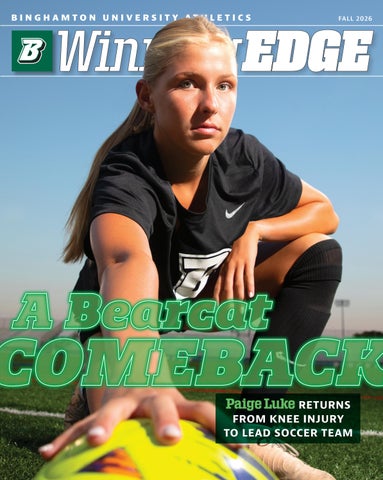
A Bearcat
COMEBACK Paige Luke RETURNS
FROM KNEE INJURY TO LEAD SOCCER TEAM
S R A C Y U B E L E S W HAS E H T T U O H T I W • Fast and Fair
• Free Appraisal • Instant Offer • No Pressure • Get Paid on the Spot Get a legit written cash offer for your car, SUV or truck — good for three days. If you'd like to sell, we'll make it easy. We'll handle all the paperwork, liens, the DMV, and insurance. It's fast, straightforward, and you don't have to buy anything from us. Visit us online or in person at any Mathews Auto location — right here in Vestal. MathewsBuysCars.com 607-584-5354
Mathews GM Center, Mathews Chevrolet, Mathews Nissan Mathews import Center, Planet PreOwned
CONTENTS
WINNING EDGE FALL 2026
FEATURES
3
Paige Luke: A knee injury cost the soccer star her sophomore season, but she has come back over the past year to lead the Bearcats to the top of the America East Conference.
8
Binghamton’s best: Championship memories from the seven student-athletes who have won individual NCAA titles since 1977.
10
Monique Hacker ’00: Track and field great won five championships in the indoor and outdoor triple jump.
14-21
Wrestler Steve Cavayero (1977, 1978 champion) Wrestler Tom Pillari (1984 champion)
CHAMPION
Wrestler Mark Gumble (1988 champion) Hurdler Jewdyer Osborne (1998 champion) Long jumper Brian Hamilton (1999 champion) Pole vaulter Rory Quiller (2008 champion)
22
Jeff Melesky: Meet Binghamton flag football’s first coach. The university’s 22nd Division I varsity sport will begin competition in spring 2028.
HIGHLIGHTS
24
Baseball and softball teams advance to NCAA tournaments. Rachel Carey’s .468 average earned her America East Player of the Year honors, while Conner Griffin and Jackson Mitchell were selected in the Major League Baseball Draft. COVER PHOTO BY JONATHAN COHEN
FROM THE ATHLETICS DIRECTOR
W
elcome to another edition of Winning Edge!
During the University’s 80th birthday celebration, we also have
cause to look back at our athletics history and celebrate our own
success stories. This issue will focus on our seven NCAA champions
whose pinnacle achievements have spanned four decades and all three NCAA divisional levels.
Now in our third year producing the biannual magazine, we also are excited to
expand its reach to include more than 3,100 alumni from our 50-plus year Division III era. For many of you who are looking to reconnect with your alma mater, I hope this magazine serves as a fond reminder of your time here as a student-athlete.
We have continued to fundraise and embark on projects that both enhance our
athletics facilities and provide more support for our student-athletes.
This fall, we opened our new $8.6 million Visions Federal Credit Union Track and
The Binghamton Fund for Athletics directly impacts our studentathletes! BINGHAMTON UNIVERSITY FOUNDATION
MAKE A GIFT
Field Facility. This fantastic facility includes a new track, renovated jumps/vaults areas, lighting, scoreboard, and synthetic turf infield. We are excited to return to hosting high-level track meets as soon as this spring.
Indoors, we are near completion of our $10 million Events Center project, which
began last spring. The comprehensive project includes the replacement of the
binghamtonbearcats.com /MakeAGift
foot repurposed wrestling practice space on the south court of the West
Stay connected
entire event-level surface, six track lanes, basketball court, and bleachers.
We have more exciting projects on the horizon, including a new 8,200-square-
Gymnasium.
Thanks to your assistance, we generated $23.6 million during the 2025-26
academic year.
Binghamton Bearcats
It’s a great time to celebrate Binghamton Athletics and I encourage you to stay
connected in person or via our social channels.
Thank you so much for your continued support. Go Bearcats!
binghamtonathletics @Bing_Bearcats BinghamtonAthletics
Send us your alumni notes
Sincerely,
Eugene Marshall Jr.
Director of Athletics
sports@binghamton.edu
FALL 2026 ATHLETICS DIVISION Director
Eugene Marshall Jr. Senior Deputy Director/ Chief Operating Officer
Dennis Kalina
Deputy Director of Athletics, SWA
Leigh Ann Savidge-Morris
Deputy Director and Chief Development Officer/Divisional Diversity Officer
Senior Associate Director, Financial Operations
Senior Associate Director, Communications
Assistant Provost/Senior Associate Director, Student Services and NCAA Compliance
Senior Associate Director for Business Development
Marisa Colonna-Garrow
David Eagan
Senior Associate Director, Sports Medicine and Performance
Kara Gorgos
Ze D. Zeon
2
W I NN IN G ED GE • FA L L 2026
John Hartrick
EDITORIAL Magazine Editors
Eric Coker John Hartrick
Pat Murphy
Design and Production
Senior Associate Director, Facilities and Operations
University Photographer
Dave Simek
Vice President for University Communications and Marketing
Greg Delviscio
Senior Director of Creative Services
Gerald Hovancik Jr.
David Skyrca ’85 Jonathan Cohen
HOW TO REACH US Athletics Main Number 607-777-2043 Athletics Tickets Office 607-777-BTIX (2849) Athletics Email athletics@binghamton.edu
‘The heart of a lion’ Paige Luke overcomes knee injury to drive women’s soccer toward title By John Hartrick
303 DAYS. Days filled with challenges, doubt,
frustration, and pain. But also days that
yielded small victories — milestones born of determination and celebrated with her
support circle. For Binghamton University soccer standout Paige Luke, there is
JONATHAN COHEN
always an abundance of both.
BI NGH A M TO N U NI V E RSI TY AT H L E T IC S
3
The reigning America East Rookie of the Year had just started an expectation-filled sophomore season in fall 2024. After eight non-conference games, Luke and her teammates made the eight-hour trek to Maine for the conference opener on Sept. 22. It was an early battle between the top two programs in the America East — ones that had traded unbeaten conference seasons in each of the last two falls. But 14 minutes into the game, Luke made a cut away from the ball and went down to the turf. “I heard the ‘pop’ and so did everyone on the bench,” Luke recalls. “That sound is an athlete’s worst fear and I immediately knew I did something to my ACL.” The Bearcats went on to lose that early-season test, 2–1, with Luke relegated to the sidelines on crutches. The sting of the two “losses” — the game and Luke’s serious injury — was exacerbated by the long bus ride back to Vestal. “I must’ve watched the video of me falling about 25 times,” she says. “My knee looked like a softball and I had a bunch of emotions on that bus ride. But my teammates were there for me through everything. No 4
W I NN IN G ED GE • FA L L 2026
matter what the hour on that long ride home, someone checked on me.” Positivity and support are crucial after injuries, along with a steady dose of willpower. Tenth-year head coach Neel Bhattacharjee and the Bearcats have seen more than their fair share of recent ACL injuries, and even Bhattacharjee is no stranger to knee injuries, having had to rehab from simultaneous torn patellar tendons in each knee in 2023. He knows firsthand the long road to recovery and the odds of returning to an elite level. “It’s always a concern when someone suffers a significant injury,” he says. “Rehabilitation requires a lot of time and effort and then you always wonder if a player will return back to pre-injury form. The mental and emotional toll of not being able to play the sport you love, while seeing your teammates perform and trying to support them, too … it’s very hard.” Back in Binghamton, an MRI confirmed the ACL tear. It brought tears to Luke’s eyes. “I remember Coach saying: ‘You have one day to be upset and then you get to work,’” she recalls. “Something about his words kept replaying in my head and I used it for motivation on the days I had none, which honestly was much of the time. My mentality had to kick in.” Surgery was scheduled for Nov. 5, 2024, with team orthopedic surgeon Dr. Kristen Herbst. But there was plenty of work to be done in the month beforehand. It’s important for an injured athlete to complete “prehab” treatment to strengthen the knee, gain range-of-motion, and reduce the swelling and fluid buildup. Luke accepted that challenge head-on. “Early on, Paige became more optimistic, eager, and determined,” Bearcat athletic trainer Santana Ruiz recalls. “She took the time she needed to process her emotions and then she moved on to focusing on her rehab.” Meanwhile, without Luke in the lineup, the Bearcats dropped two straight league games — a rarity in the winheavy Bhattacharjee era. But a four-goal comeback at UMBC sparked a six-game unbeaten streak that carried the team into the postseason.
Two days before her surgery, Binghamton hosted the America East quarterfinals and Luke watched as the third-seeded Bearcats prevailed over sixth-seeded Vermont, 3–2, in penalties. Binghamton’s season ended four days later, however, with a 3–1 semifinal loss at No. 2 New Hampshire. With her team’s season cut short and her teammates turning their attention to some much-needed rest, Luke began her rehabilitation — an arduous, solo journey. “The reality of a long recovery is that people check in a lot in the beginning, but when the months go on it fizzles out and you get really lonely sometimes,” she admits. “I learned how to show up for myself and remind myself of the final goal.”
“I remember Coach saying: ‘You have one day to be upset and then you get to work.’” — Paige Luke
Luke had the benefit of knowing the roadmap of ACL recovery from her older sister Maddie, who went through the same injury in high school before embarking on a successful collegiate career for fellow America East member Bryant. “When I tore my ACL, it was definitely one of the most challenging times in my life,” Maddie says. “Paige was always there for me and constantly encouraged me to keep working hard and stay positive, even on the days when it felt overwhelming. Because of that, I wanted to be there for her in the same way.” The two sisters have always shared a special bond. Paige, Maddie, and younger siblings Ryan, Max, and Ella grew up in Ilion, a small Herkimer County village about 100 miles north of campus. The Lukes are a close-knit crew of children separated by just nine years. Their upbringing has included some difficult times, but with the support of grandparents, the family has remained strong and bonded. “Growing up in a family with five kids was definitely busy, loud, and a lot of fun,” Luke says. “There was always something going on, whether it was sports, school events, or just trying to get everyone where they needed to be. Being so close in age means we’re all really involved in each other’s lives and we’ve built a strong friendship in addition to being family.” “I’ve always joked that I was lucky enough to have a built-in best friend and we’ve been able to experience so much of life together,” Maddie says. “Growing up, we constantly pushed each other to be the best versions of ourselves.” Paige played up an age group, and she and Maddie were teammates for club soccer at Clinton High School, where the pair also shared the field and plenty of car rides with Ilion neighbor and future Bearcat goalkeeper Kaitlyn Williams. It was Williams who gave Luke her tour of campus when she was recruited by Bhattacharjee. BI NGH A M TO N U NI V E RSI TY AT H L E T IC S
JONATHAN COHEN
JONATHAN COHEN
Older sister, grandparents foster love, supportl
5
“Paige has always been incredibly determined,” Maddie says. “I just wanted to be sure she was giving herself the time she needed to fully recover. From the moment she got hurt, she was focused on coming back stronger and nothing was going to stop her.” Luke’s rehab continued in the spring semester, when she began focusing more on agility and increasing plyometric work. By mid-March, she was cleared to do sprinting and controlled cutting and pivoting. In April, she was cleared to begin sport-specific drills. Ruiz recalls the way Luke attacked the rehab. “She came to the training room each day with the mindset of grinding it out and pushing herself. During her rehab, she asked more than once if I thought she would win the University’s Comeback Athlete of the Year (an award presented at the year-end sports banquet). She would joke about how her name was going to be up on the wall in our room. Things like that remind athletes to find things to motivate them and to work hard each day for those things … and that’s exactly what Paige did.” Luke continued her soccer skills work and by May was working toward maximum agility and sprint speed. Bhattacharjee was equal parts amazed and cautious. “I’ve unfortunately seen a number of serious knee injuries in my 20-plus years,” he says. “What Paige did was simply remarkable. My concern was if she was doing too much or doing things too soon. But she kept at the process and her recovery was a sign of her dedication, while never being reckless with rushing things.” By early August, she was cleared by Herbst and reported to preseason ready to join her teammates.
Fitness test provides emotional liftl One of the circled dates in preseason is the fitness test, both for its personal suffering and consequences for those who struggle. The Bearcats use the popular NIKE SPARQ recovery test, where players run 20 meters with a 10-second recovery, to measure aerobic capacity and ability to recover. The test is grueling, especially on a hot August day. Luke lined up with her teammates to begin the test. With each passing level, the number of players slowly dwindled until there was just one player remaining: Luke. For the final 10 levels, amid screams of encouragement, she ran alone. Luke broke the school fitness record and produced an inspiring moment her coaches and teammates will long remember. “I had tears in my eyes,” says head sports performance coach Lori Morgan, who worked with Luke daily on her recovery program. “To see this moment in person is something I will never forget. She is 100% all-in on everything she does, and that’s what I admire about her.” Bhattacharjee, too, was moved. “For Paige to not just come back fit but set a new program record was so inspiring and special,” he says. “It showed not 6
W I NN IN G ED GE • FA L L 2026
only how strong physically she is, but also the mentality and heart she has.” And anyone who wondered how that fitness would translate during a game needn’t look further than the Bearcats’ first two games of the 2025 season. In the season opener at Lehigh, it took Luke less than five minutes to find the back of the net. That goal in her first game back after 11 months reminded all of her immense soccer skills. But four days later in the team’s home opener against St. Bonaventure, her fitness and relentlessness were on display. Just six minutes in, a seemingly benign Bona throw-in was played back to a defender in space. Within a blink of an eye, Luke was bearing down on the back and she deflected a panicked clearing pass that found its way to teammate Jahkaya Davis, who scored a goal propelling Binghamton to a victory. The 2025 season saw Luke tally six goals and a conference-best six assists to earn first-team all-conference and third-team all-region accolades. She led the Bearcats to a 10–2–5 season that included a 13-game unbeaten streak (8–0–5) and just one regular-season loss. The team produced a second unbeaten conference season in the last three years, but fell one game short of a
championship berth. And in May, true to her word, Luke was called up to the stage in front of her 400-plus student-athlete peers to accept the plaque for Comeback Athlete of the Year.
Future plansl Now a senior with graduation on the horizon, Luke says she is excited for what lies ahead. A psychology major and scholar-athlete, she plans to blend those people skills with an MBA for a more business-focused career path, perhaps in health care. “So much of business comes down to understanding people, building trust and creating strong relationships,” she says. “I want to build a career I’m passionate about. But the things that make me happiest are usually the simple moments like spending time with family and friends, being with my teammates, competing, and creating memories.” Maddie knows her sister’s gifts include a big heart and strong bonds with those around her. “Paige genuinely cares about others,” she says. “She’s competitive and serious on the field, but she loves to make
people laugh and she has one of the kindest hearts of anyone I know.” Opponents might think otherwise about her kind heart. “Paige is everything a coach could want,” Bhattacharjee says. “Her work ethic is second to none. She has the heart of a lion and her ability to overcome any obstacle in life is inspiring.” The Bearcats’ team values chosen for the 2026 season are: accountability, competitiveness, unity, resilience, and mindset. Luke’s teammates needn’t look far to see those qualities in action. Having persevered through her own hardships, the striker is looking to lift her team over its final hurdle — one that ends with its first conference championship in 22 years. “My goal for 2026 is simple: Win another regular season title, but, more importantly, we want to reach the final and bring a championship back to Binghamton,” Luke says. “We know we have the talent to do it. Now it’s about putting everything together when it matters most and embracing those big moments instead of putting extra pressure on ourselves. The standard here is high and that’s a good thing. We believe our best soccer is still ahead of us.” BI NGH A M TO N U NI V E RSI TY AT H L E T IC S
7
Catching up with seven student-athletes who won individual NCAA titles
The Champ By John Hartrick
ALMOST 50 YEARS AGO, Binghamton University crowned its first NCAA champion when freshman wrestler Steve Cavayero captured the 142-pound title at the 1977 NCAA Division III Championships, hosted by Binghamton at the West Gym. Long Island native Cavayero added another national championship one year later and his pair of NCAA titles began a stretch of 12 NCAA titles in 32 years across all three divisional levels for Binghamton wrestling and track & field athletes. Championships were won near (twice at the West Gym) and far (Arkansas). Binghamton student-athletes have captured NCAA titles in seven states: Illinois, New York, Massachusetts, Minnesota, Indiana, Wisconsin, and Arkansas. Over the following pages, Winning Edge will chronicle those seven individuals and 12 championships, including a special feature on five-time NCAA triple-jump champion and 14-time All-American Monique Hacker. 8
WI NN IN G ED GE • FA L L 2026
Tom Pillari ’85
Steve Cavayero
pions
WRESTLING 177 LBS. (1984)
WRESTLING 142 LBS. (1977 AND 1978)
Monique Hacker ’00 Mark Gumble ’88, MA ’93 WRESTLING 150 LBS. (1988)
Jewdyer Osborne, ’98, MA ’01 OUTDOOR 110 HURDLES (1998)
INDOOR AND OUTDOOR TRIPLE JUMP (1996, 1997, 1998; FIVE TOTAL CHAMPIONSHIPS)
Brian Hamilton ’99 INDOOR LONG JUMP (1999) (NCAA DIVISION II)
Rory Quiller ’07 INDOOR POLE VAULT (2008) (NCAA DIVISION I)
The Champions TRIPLE
CHAMPION
JUMPER
Monique Hacker
A leap of faith
A fortuitous phone call led Monique Hacker to five track championships at Binghamton By John Hartrick
THE MOST DECORATED ATHLETE in Binghamton University history almost didn’t make the team as a freshman. Well, more accurately, five-time national champion and 14-time All-American Monique Hacker almost wasn’t allowed on the team. It was mid-January 1996 and track and field coach Mike Thompson fielded a phone call days before his team was to begin its spring season at the Syracuse Invitational. The voice on the other end asked if she could join the team. Knowing the challenge of coaching a large roster and wanting to establish a serious structure in his first season as coach, Thompson stuck to his rules and replied: “I’m sorry,” he said. “Practice began in October and it’s too late.” “Thank you,” Hacker replied and the brief conversation seemed over. But in a twist of fate that altered the arc of two lives and Binghamton athletics history, Thompson added a closing question: “What events do you compete in?” “Triple jump, hurdles, long jump, and sprints.” And then a follow-up. “What’s your best distance in the triple jump?”
“Thirty-nine feet.” 10
WIN NING EDGE • FA L L 2026
“Physicals are tomorrow and practice starts at 3:30 p.m. See you then.” Just seven years removed from being an NCAA champion and starting what has become an exceptional 31-year Binghamton coaching career, Thompson knew the numbers. The current school record in the triple jump was less than 35 feet. The rest, as they say, is history.
athletic and could run fast. The blend of individual and team aspects drew her to track and field. “I enjoyed competing and loved being part of a team,” she says. “But I also liked that track and field gave me individual responsibility. Yes, I was part of a team, but my own success not only depended on my God-given talent, but the work I put
Instant success
Hacker started practice on a Friday and, one day later, traveled with the team to Syracuse. Competing for the first time in seven months, she leaped a school-record 39-feet4-inches. That mark instantly was the best jump in the nation and automatically qualified Hacker for the NCAA Indoor Championships in early March. What followed next was three months of titles and records — all done without much fanfare. Hacker was a mid-year addition to a team that doesn’t have many home events. In the days before the internet and social media, her exploits were slow to reverberate. The SUNYAC Championship yielded runner-up finishes in the triple jump, long jump, and 55 hurdles. At the New York State Championship, Hacker broke Binghamton’s hurdles record with an NCAA qualifying time and won two more titles. Another week brought two more titles (ECAC) and another school record. At the NCAA Championship, hosted by Smith College (Massachusetts), Hacker jumped 39-feet-1 ¼ on her first attempt and nobody came within six inches of it. Hacker had become the school’s first NCAA female champion and fourth overall. She added a seventh-place finish in the 55 hurdles after lowering her own school record time in the semifinals. Less than two months later, Hacker added an NCAA outdoor title to her rapidly-expanding resume. In Naperville, Illinois, she was the top seed, but in the finals trailed another competitor with just two jumps remaining. On her fifth jump, amid rain and a headwind, Hacker hit the board precisely and leaped 40-feet-1 ¼ to win by more than a foot. Less than three hours later, she crossed fourth in the 100 hurdles with a new school record and her third college All-America honor. In three months, Hacker had won two NCAA championships — the first time any Binghamton athlete won two national titles in the same year.
Resilience after family moves from Jamaica
Hacker’s path to Binghamton wasn’t straightforward. She grew up in St. Andrew, Jamaica, with her twin sister Yonique, older brother Damien, and her mom. Hacker began competing in track at age 12 after her school teachers noticed she was
in as well. The results were pretty honest; how hard I trained, how committed I was, and how much grit I had usually showed up in the end result.” Early in her senior year, Hacker’s life changed drastically when her family moved to the United States and settled in Croton-on-Hudson, a village in Westchester County, just north of New York City. “Leaving Jamaica was difficult,” she says. “I left behind the only place I knew … my friends, my school, and my culture. Moving to the U.S. was exciting in some ways, but also very emotional as I didn’t know what to expect. I had to adjust to a new school system, a new environment, and even just the everyday cultural differences.” Hacker competed in track at Hendrick Hudson High School and was a state triple jump place-winner despite having learned the event weeks earlier. But she focused her attention on academic opportunities, and that’s when Binghamton hit her radar. “My dad encouraged me to consider Binghamton because of its academics,” she says. “Binghamton had a strong academic reputation and was considered the best public school in New York, so that carried a lot of weight for me and my family.” Despite having received a few scholarship offers from other schools, Hacker centered on Binghamton. Because she was late in the admissions process, Hacker was waitlisted. In the meantime, she took classes at Westchester Community College. Her academic pursuits then brought her to Binghamton and that campus phone call to Thompson. BI NGH A M TO N U NI V E RSI TY AT H L E T IC S
11
The Champions Freshmen titles set stage for epic career
It didn’t take long for Thompson to recognize this special athlete who had landed at his doorstep. “She was so much fun to coach,” he recalls. “She was laidback and easygoing in practice, but focused and determined in competition.” Thompson also recalls Hacker mastering the Rubik’s Cube while waiting to compete at NCAAs her freshman season. “Monique was a totally normal person who just happened to be the best Division III track and field athlete in the country.”
“Monique was a totally normal person who just happened to be the best Division III track and field athlete in the country.” Did Hacker realize what she had accomplished as a freshman? “I don’t know if I fully understood what I had done,” she admits. “I think part of it was that I was young and fearless. Sometimes when you are young, you don’t overthink things. You just show up and jump. I probably didn’t know enough to be nervous. One minute I was trying to get on the team, and the next minute I was winning national titles.” Her 1996 exploits earned Hacker recognition in Sports Illustrated and by her sophomore year, Hacker was a force — and the nation knew it. “My mindset changed,” she says. “I had more confidence and also had a deeper understanding of expectations. I knew people would see me differently, and I knew I had to continue putting in the work.” Fast forward to March 1997 and nowsophomore Hacker is named “NCAA Female Indoor Track Athlete of the Year.” In a span of three weeks in the winter, she accumulated 12 individual titles at the conference, state, and regional championships. And then she performed a one-woman show at Wisconsin-Oshkosh: Hacker qualified for nationals in four events: triple jump, long jump, 55 hurdles, and 55 dash. The exhausting pace of four events, with preliminary heats, crammed into two days took its toll, as Hacker didn’t defend her triple jump titles. But by placing second in the hurdles, third in the triple jump, sixth 12
W INN IN G ED GE • FA L L 2026
in the long jump, and eighth in the dash, Hacker accumulated enough “team” points to give Binghamton a sixth-place NCAA finish. In one dizzying 45-minute span, she ran the hurdles final, immediately moved to the triple jump, and raced back to the dash final — all while enduring a knee gash suffered from an earlier long jump. With full respect to seven-time conference Coach of the Year and National Coach of the Year Thompson, what Hacker needed most in Oshkosh was an event planner. “The meet was exhausting, but exciting,” she recalls. “Competing in four events, I had to be physically ready and mentally organized. I was constantly warming up, cooling down, checking schedules, going to prelims changing spikes, switching my mindset, and trying not to miss anything. In a strange way it energized me.” Two months later, Hacker returned to Wisconsin for the NCAA Outdoor Track & Field Championships at UWLa Crosse. This time, she pared her events down to two and locked into her specialty, much to the chagrin of the other 21 national-caliber triple jumpers. On her first attempt in the rain-soaked finals, Hacker exploded for a stadiumrecord distance of 40-feet-8 ¾. The field was now competing for second. In fact, all five of Hacker’s jumps would’ve won the title and her winning margin was a comfortable 1 ½ feet. Hacker still wasn’t finished, however. She moved to the track and placed seventh in the hurdles final, securing her eighth All-America honor. As a junior, Hacker made a mistake that cost Binghamton a chance to bring home a top-3 NCAA team trophy. At the indoor championship hosted by Brandeis
unprecedented three times. She was inducted into the school’s Athletics Hall of Fame in 2005 and her achievements and records have withstood the test of time. “Monique was the first track and field NCAA champion and 27 years later, her Division III marks still hold up in our Division I era,” Thompson says. “She was the face of the program for many years and helped put Binghamton on the map. And her success helped jump-start my coaching career, as well.”
Family, faith and life after Binghamton
(Massachusetts), Hacker captured her fourth national triple jump title with a stunning final-jump of 40-feet-10 ½. A half-hour later, she added a runner-up performance in the 55 hurdles with a school-record time of 8.10. The 18 team points gave Binghamton a tie for third place — the highest national finish of any Binghamton women’s team and tied for the best finish of any team in history (wrestling placed third in 1984). Hacker’s mistake? Binghamton tied City College of New York for third place and only one team could carry home the big trophy, while the other would wait for their hardware to arrive in the mail. Thompson asked Hacker to make the call on the coin flip and she called “heads.” It was tails. Looking back, it was one of the few times that Hacker didn’t bring home the goods. While Hacker was rewriting the track and field record books, Binghamton was readying for its transition from NCAA Division III to Division I. Hacker’s success, and that of many men’s and women’s teams during that era, set the stage for the historic campus decision. Hacker and five teammates were the final athletes to compete at Division III when they traveled to St. Paul, Minnesota, for the NCAA Outdoor Championships. Hacker made quick work of the field, popping a meet, stadium, and school-record jump of 41-6 ½ on her first attempt. The meet also included a national title from men’s hurdler Jewdyer Osborne and the emergence of future NCAA champ Brian Hamilton. Hacker finished her career as a Division II athlete in 1998 and added two more All-America honors to her ledger, including a runner-up national showing in her final collegiate meet. Her laurels won’t be seen again: five NCAA titles, 14 All-America honors, and 29 state and conference crowns. She was Binghamton’s “Athlete of the Year” an
Hacker earned her degree in math and economics in 2000 and began a career as an actuary with New York Life Insurance Company. Those elite student-athlete qualities serve her well as corporate vice president. “Track and field taught me discipline, resilience, preparation, focus, and how to perform under pressure,” she says. “As an actuary, I have to analyze data, solve complex problems, think long-term, and pay attention to details. So, in a way, I went from jumping into sand to jumping into spreadsheets and models. Different runway … same discipline.” Hacker now lives in Tampa, Florida, with her husband and daughter, and the family enjoys traveling, church activities, and community. She cherishes her life and the people in it. And her memories of Binghamton are central to who she is. “Looking back, I strongly believe that Binghamton was part of God’s plan for my life. Being an athlete at Binghamton helped shape my character,” she says. “It taught me to trust the process and stay committed, even when the outcome is uncertain. Coach Thompson gave me a chance. The program supported me. My time as a Bearcat helped shape the woman I’ve become, as an athlete, wife, mother, and an actuary. I’m proud of the titles, records, and team accomplishments, but I’m even more grateful for the people, the lessons, and the purpose I gained along the way.” Thompson, who owns the unique distinction of coaching NCAA champions at all three divisional levels, is succinct about Hacker. “Monique possessed the greatest combination of talent and determination of any athlete I have ever coached,” he says. And to think it all began with that happenstance phone call some 30 years ago. BI NGH A M TO N U NI V E RSI TY AT H L E T IC S
13
The Champions WRESTLER
CHAMPION
Steve Cavayero
Feat: 1977 NCAA Wrestling champion at 142 pounds, freshman season
has hosted such a prominent event. Cavayero led the Colonials to a 12th-place team finish.
Date: March 5, 1977 Place: West Gymnasium, Binghamton University, Vestal, New York Path: 6–0 with two pins and a major decision; defeated Jim Luster (Humboldt), 7–6, in title match Noteworthy: Cavayero became the school’s first national champion in any sport. Binghamton hosted the national championship for the first of two times (1984) — the only times campus
Memories of the NCAA title: “I can clearly recall getting that last takedown in the third period, which allowed me to take the lead and secure my victory at our home gym in Binghamton in front of our supportive crowd and friends. I felt immense pride in having the opportunity to win the title at home, surrounded by great teammates and a solid program. My exceptional coach, Steve Erber, encouraged me to keep pushing and to always believe in myself. Winning my first
NCAA title as a freshman felt like a dream come true, and I often think about that night.” Feat: 1978 NCAA Wrestling champion at 142 pounds, sophomore season Date: March 4, 1978 Place: Wheaton College, Wheaton, Illinois Path: 5–0 with four major decisions as No. 1 seed; defeated No. 7 Dan Boos (Luther), 8–4, in title match Noteworthy: As Division III champion, he received an automatic invitation to compete in the NCAA Division I National Championships,
14
WINN IN G ED GE • FA L L 2026
which took place two weeks later in College Park, Maryland. At the Division I tournament, Cavayero placed seventh overall, earning Division I All-America honors. After transferring to UCLA for his final two collegiate years, Cavayero was Pac-10 runner-up and earned another trip to the NCAA Division I tournament in 1980. Memories of the NCAA title: “The memory that sticks out the most is how challenging it was to repeat my success. I had severely broken my ankle in the first week of the competition season, and, initially, my chances of returning for my sophomore year seemed dim. There
were many doubters, as it appeared that my chances of competing were slim. During my recovery, which lasted two and a half months, I had to work hard to get back into wrestling shape while still uncertain if my injured
not only put Binghamton wrestling on the map; he helped to put Binghamton University on the map. He turned down a full scholarship from Michigan State to attend Binghamton. He attracted other high school wrestlers
and have been together for 50 years since high school. They have two children and five grandchildren. He is the owner and CEO of The Cavaco Group Inc. - Lafayette Electronics Inc., a U.S. corporation since 1995. His
“Winning my first NCAA title as a freshman felt like a dream come true, and I often think about that night.” ankle would withstand the physical demands. I faced some tough qualifying bouts leading up to the NCAA tournament that year, which was difficult to accept. However, once I arrived at the NCAA tournament in Illinois, everything fell into place. My timing and confidence returned just in time, allowing me to win my second consecutive NCAA title. Again, I will always remember the support and guidance provided by Coach Steve Erber and my dedicated teammates.” Keys to becoming an NCAA champion: “The key ingredients that enabled me to reach the pinnacle of NCAA competition included the confidence to believe in yourself, the desire to win, and the perseverance to keep moving forward. My philosophy in life, then and now, is: I do not settle for mediocrity.” Coach’s comments: “I have said to many people, many times: Steve Cavayero
to Binghamton, including his younger brother, Richie, and his youngest brother, twotime NCAA All-American Keith. Steve was a great wrestling technician. He knew more than I did in some cases and shared it with the team. He was the complete wrestler from all positions and a master strategist. I was sad to see him leave for UCLA, but he said it was not a wrestling decision. Rather, he wanted to make connections in California in the electronics business. He was thinking beyond college, and it worked out pretty well for him.” — Steve Erber Since graduation: Cavayero and his wife and best friend Amy have lived in Boca Raton and Delray Beach, Florida, for the past 41 years. They have been married for 44 years
career has involved licensing, designing, and branding consumer-electronic products, as well as manufacturing in selected facilities in China and Mexico for both consumer and industrial electronics. Additionally, he founded United Wireless Technologies Inc., a global distributor of wireless products including cell-site products and technologies, which he managed from 1991–2014. Student-athlete qualities that were valuable in
his career: “Being an elite student-athlete has greatly benefited me in the years since I left Binghamton. The experiences I had there were extremely meaningful for my character development, leadership skills, and confidence. I have been fortunate to apply these values across all aspects of my life. As a student-athlete,
you bear responsibilities that are often greater than those of non-athlete students. Balancing studying with training and competing taught me many lessons about hard work, focus, and character.” Advice to current Binghamton studentathletes: “Believe in yourself, stay focused, and set goals that exceed the expectations others may suggest for you. Also: Make sure to enjoy these special moments along the way.”
BI NGH A M TO N U NI V E RSI TY AT H L E T IC S
15
The Champions WRESTLER
CHAMPION
Tom Pillari
Feat: 1984 NCAA Division III Wrestling champion at 177 pounds, junior season Date: Feb. 25, 1984 Place: West Gymnasium, Binghamton University, Vestal, New York Path: 5–0 as No. 2 seed; decisioned top seed John Lancaster (Wheaton), 4–3, in title match; allowed only four points in five NCAA matches Noteworthy: Led Colonials to third-place NCAA finish, highest national finish of any Binghamton sports team; was one of two NCAA champions to capture title in front of home West Gym crowd (Steve Cavayero in 1977) Memories of the NCAA title: “That’s a tough question with so many memories … but winning at Binghamton with friends and family present was special.” Keys to becoming an NCAA champion: “Hard work, determination, and having great coaches, teammates, and alumni volunteers to wrestle with every day.” Coach’s comments: “I was never able to recruit a New York state champion, but
16
W INN IN G ED GE • FA L L 2026
Tom Pillari was a pretty good Section 8 (Long Island) high school champion. As a true freshman, he surprised everyone when he placed fifth in the NCAA at 167 pounds, earning the first of his All-America honors. He continued to improve every year, including earning two runner-up finishes in the all-division New York State tournament. As a junior, and team captain, he won the New York State and SUNYAC championship and was 12–0 in dual meets leading up to the NCAAs. His senior year was headed in the same direction when a high ankle injury in the state finals impacted his ability to wrestle. Although he was seeded first in the NCAAs, he had to drop out after his first match, thus forgoing a second NCAA championship. Tom was a strong, position wrestler; conservative, but always in control and with great strength. He was a leader … elected captain three times by his teammates.” — Steve Erber Since graduation: Pillari lives in Cold Spring Harbor,
which is on the North Shore of Long Island. He’s an attorney working in-house for a construction company in New York City, while also helping people buy and sell real estate (now in his 25th year as an MLS broker). Student-athlete qualities that were valuable in his career: “Time-management skills had to be learned if you wanted to wrestle and do well in school. The combination of school work and wrestling teaches you a
lot about managing your time. I’ve also learned how to push myself to achieve goals, lose with dignity, and win with humility. The lessons learned from competing in college are lifelong.” Advice to current Binghamton studentathletes: “Your sacrifice is well worth it. Nothing comes without hard work and discipline. What you’re doing now will build a stronger, better you for the future, while at the same time fostering lifelong friendships and creating great memories.”
WRESTLER
CHAMPION
Mark Gumble
Feat: 1988 NCAA Division III Wrestling champion at 150 pounds, senior season Date: March 5, 1988 Place: Wheaton College, Wheaton, Illinois Path: 5–0 as No. 1 seed; pinned No. 6 Dave McLaughlin (William Penn) in second period of title match Noteworthy: Outpointed first two NCAA opponents 25– 3. … Placed second and third in the two previous NCAA championships. … Three-time All-American with all three being Top 3 finishes. Memories of the NCAA title: “Being able to share the accomplishment with my teammate Greg Geisenhof, who finished third and helped our team finish sixth. It was Greg’s first time placing in the nationals, and it was great to see his commitment to the sport be rewarded. We have remained close friends over the years and still get together to enjoy various wrestling and family events with other lifelong friends from the sport.” Keys to becoming an NCAA champion: “Incredible faith in my God-given abilities to
compete against opponents who wanted to ruin my day when I was still recovering from a shoulder separation. The support system my family provided for me to strive toward my goals throughout my career definitely helped me that day. Beyond that, the focus, grit, and high-level wrestling experience it took to pursue through several matches during that tourney when I was not wrestling close to my best.”
opponent to end his career. I had the honor of being in his corner for his last match as it was my last match as a coach. I retired from coaching at Binghamton to focus on administration full time. In 1996, I left Binghamton to be the athletic director at Muhlenberg College. In 2003, I became the associate director of athletics at Cornell University, and then retired in 2013.” — Steve Erber
Since graduation: After graduation, Gumble took over for Erber and served as Binghamton’s head wrestling coach for nine years before embarking on a successful career in athletics and college administration. He founded Binghamton’s academic support program for student-athletes and directed that area for four years. After seven years at San Diego State serving student-
“Showing up with a good attitude and providing consistent effort ... will make a difference in the long run.”
Coach’s comments: “After a year at Bloomsburg, Mark transferred to Binghamton to be back where he grew up. As a sophomore and junior, he had the misfortune to have some very good opponents in the NCAA tournament. First, a two-time returning champion in the finals as a sophomore, and then a future Division I finalist in the semifinals as a junior when Mark finished third. Had Mark been more fortunate, he might have been a three-time NCAA champion. Mark was selfless. As a freshman, he gave up his spot to a senior at the end of the season rather than wrestle off because he felt the senior deserved it. He was very offense-minded with the ability to score big points from the feet or on the mat. Mark pinned his senior-year finals
BI NGH A M TO N U NI V E RSI TY AT H L E T IC S
17
The Champions mentors who have inspired me through the years. Throughout my professional career, it was always important to build relationships, to have grit to push through long hours/ years of work, and faith in the talents God provided my colleagues and me.”
athletes in academics and life skills, Gumble spent 21 years at the University of Central Florida. He moved from athletics to campus administration and retired in November 2025 after serving as assistant vice president and deputy chief of staff. In retirement, he is serving as a high school wrestling official and volunteers as a wrestling coach for Hagerty High School. The school’s top wrestler, Nik Blake, a Florida state champion, is beginning
his collegiate career as a Bearcat this winter. Student-athlete qualities that were valuable in his career: “Even though wrestling is one of the ultimate individual sports, it requires a team of support to accomplish big goals. The same is true in life. I point to my faith, which has driven me during other challenging points after my wrestling days were over and a support system of loved ones and
Advice to current Binghamton studentathletes: “Build relations with others seeking to do big things. Everything in life is easier if you have someone helping you. Do what you say you will do with joy, particularly the little things that may go unnoticed by others. Showing up with a good attitude and providing consistent effort — even on the hard days — will make a difference in the long run. Take full advantage of days you are healthy enough to go full throttle in practices. There is no substitute for good health, so treat it as a blessing while you are still growing (as an athlete and human).”
NEARMISSES Binghamton NCAA Runners-up (15) Mike Davis, fencing epee (1971) Tim Borshoff, wrestling 126 lbs. (1975) Pete Berti, wrestling 118 lbs. (1976) Ron Reedy, wrestling 158 lbs. (1978) Mike Truncale, wrestling 150 lbs. (1985) Mark Gumble, wrestling 142 lbs. (1986) Crystal Joseph, outdoor high jump (1986) Crystal Joseph, indoor high jump (1987) Crystal Joseph, indoor 55 meters (1988) Chris Coleman, outdoor 200 meters (1988) Sarah Bunting, indoor 1,500 (1996) Matt Feinberg, swimming, 1,650 free (1996) Monique Hacker, indoor 55 hurdles (1997) Monique Hacker, indoor 55 hurdles (1998) Monique Hacker, outdoor triple jump* (1999)
The coach and NCAA wrestling champions. From left: Head Coach Steve Erber, Steve Cavayero, Mark Gumble, Tom Pillari
18
W I NN IN G ED GE • FA L L 2026
*NCAA Division II
HURDLER
CHAMPION
Jewdyer Osborne
Feat: 1998 NCAA Division III Outdoor Track & Field champion in 110 hurdles, senior season Date: May 23, 1998 Place: Macalester College, St. Paul, Minnesota Path: Won his heat and then in finals ran a stadium-record 14.19 to edge a Lincoln University hurdler at the tape to win by 6/100s of a second Noteworthy: Became first male track and field national champion at Binghamton … did it in his final collegiate race and his achievement was the final Division III competition for Binghamton Athletics, which elevated to NCAA Division II in the following fall … ended career as a five-time All-American. Memories of the NCAA title: “The year I won my championship, I began training on my own each morning before joining the team later in the day. Those sessions allowed me to focus on specific aspects of my hurdle race that I felt needed improvement. My greatest memory, however, was crossing the finish line and seeing Coach Thompson and school photographer
Evangelos Dousmanis watching as I finished first. That moment remains unforgettable.” Keys to becoming an NCAA champion: “The key ingredients were taking competition more seriously and dedicating more time to perfecting my craft. One of my biggest realizations was that I needed to compete against myself. At the time, we were a Division III program, and I often found that the real competition did not come until the national championships. I focused on improving my own performances and trying to beat my previous times each race. That mindset set me on a trajectory for success and helped me reach my full potential.” Coach’s comments: “JD was talented enough to compete at the Division I level right out of high school, and was always a standout in Division III. He had several close calls at nationals prior to his win in 1998, and was
Hamilton, Hacker, and Osborne in 2026
unusually confident and composed the day he won. His commitment and discipline were excellent his senior year, and that ended up making all the difference.” — Mike Thompson Since graduation: Osborne lives in Tampa, Florida, and works with the Department of Children’s Services in investigations. After he won the lottery in 2013, he opened a successful chicken-wing franchise with a fraternity brother and celebrity family member. Advice to current Binghamton studentathletes: “Keep your eyes on the prize. Learn to master time
management, and remember that your education should always be your primary job. Understand that your success as a student-athlete helps strengthen the entire athletic program at Binghamton University. Your hard work and determination can help create opportunities for future generations of studentathletes and contribute to continued growth and investment in Binghamton athletics. Most importantly, listen to Coach Thompson. He has been doing this for a long time and understands what it takes to help athletes become the best versions of themselves. It took me a while, but I eventually understood his coaching genius.”
BI NGH A M TO N U NI V E RSI TY AT H L E T IC S
19
The Champions LONG
CHAMPION
JUMPER
Brian Hamilton
Feat: 1999 NCAA Division II Indoor Track & Field champion in long jump, senior season Date: March 5, 1999 Place: RCA Dome, Indianapolis, Indiana Path: Qualified for NCAAs one week earlier in his final jump at the ECAC Championship … then in a field of 10 athletes at the RCA Dome, jumped a school-record 24-feet-2 ½ inches to beat the runner-up from team champion Abilene Christian by 2.25 inches Noteworthy: Became Binghamton’s first and only NCAA Division II national champion ... closed his career as a three-time All-American. Memories of the NCAA title: “My fondest memory of my championship actually happened at the ECAC Championship. I was down to my final jump, and it took a meet-record jump for me to qualify for the NCAA. I had come through in the clutch. I carried that same momentum to the NCAAs and won the only Division II championship for Binghamton University (my favorite trivia question).”
20
W INN IN G ED GE • FA L L 2026
Keys to becoming an NCAA champion: “The dedication of the coaches: Mike Thompson and Karl Williams. At the time, Mike was quietly one of the most competitive people I knew. He fueled that competitive drive in me without a lot of the cliché shouting and screaming. He made us want to do the best for ourselves, himself, and for the University. Another ingredient was the motivation from other teammates, like Monique Hacker and Jewdyer Osborne. I saw them competing at and winning championships, and it motivated me to be the best athlete I could be and have some bragging rights for myself.” Coach’s comments: “Brian was a good athlete, but was still learning the mechanics of long jumping when he arrived at Binghamton. The determination was always there, from his first meet as a freshman to his last as a senior. He always seemed to think he could beat anybody, and was absolutely driven to win. And I have no doubt that he fully expected to win in 1999. I don’t think he was surprised at all.” — Mike Thompson Since graduation: Hamilton lives in Tampa, Florida, and
is a practicing oral and maxillofacial surgeon in private practice. Student-athlete qualities that were valuable in his career: “Consistently performing at your highest level is key to my profession because having a bad day is not an option when you are taking care of patients. One of the key ways of being consistent is through practice and multiple repetitions. While I was at Binghamton, I didn’t always appreciate having to practice in the cold weather or using
the old indoor track back in the day. However, that taught me that to consistently perform at the highest level, you have to practice in different situations and environments to be prepared for anything.” Advice to current Binghamton studentathletes: “Have fun because it passes by so quickly. In what seems like a blink of an eye, in 30 years, you’ll be reflecting on how much fun you had spending time with teammates at practice and on those long bus rides.”
POLE
CHAMPION
VAU LT E R
Rory Quiller
Feat: 2008 NCAA Division I Outdoor Track & Field champion in pole vault, senior season Date: March 14, 2008 Place: University of Arkansas, Fayetteville, Arkansas Path: Top-seed in final field of 14, needed to clear bar at 18-feet, one-half inch on his final attempt to win … beat contenders from Clemson and Texas by a winning margin of four inches Noteworthy: Became Binghamton’s first NCAA Division I national champion and just the second in America East history … it was his third All-America honor after placing second indoors and fourth outdoors as a junior.
most coaches would do. And I remember the support I had from my parents and coach.” Keys to becoming an NCAA champion: “Support from the people around me and a naivety about the challenges of competing at a high level. I think Binghamton was a perfect place for me because the technical coaching was as good as any school in the country while at the same time it was accessible for the injuryprone, mediocre athlete that I was out of high school.”
To me, that jump remains the single most clutch performance in Binghamton track and field history.” — Mike Thompson Since graduation: After graduation, Quiller served oneyear stints as the pole vault coach at both Colorado State University and Colorado School of Mines, while he trained for the 2012 U.S. Olympic Trials in the pole vault. Quiller finished eighth in that competition, to complement his 13th place finish at the 2008 U.S. Olympic Trials. He is now in his 14th year as assistant track and field coach at Navy, where he has coached 15 NCAA pole vault qualifiers. He currently serves as an instructor of
physical disciplines at the Academy. Quiller resides in Annapolis with wife Mandy and their daughters, Kira and Lacey. Advice to current Binghamton studentathletes: “I would advise current Binghamton athletes to always look inward first in challenging times. It is far too easy to shirk accountability when things don’t go well. There are some aspects in athletics that are out of your control, but the most powerful tool you have is your mindset. Develop your positive outlook and you will find a way to accomplish anything.”
Coach’s comments: “Rory was one of the top athletes in New York in high school, but had more success in the hurdles than he did in the pole vault at that point. His eventual vaulting success came from equal parts talent, work ethic, and discipline, and once
I think Binghamton was a perfect place for me because the technical coaching was as good as any school in the country ... Memories of the NCAA title: “I remember having a discussion with Coach Thompson about what pole to use before my final attempt to win. He trusted me at that moment to make the decision, which is not something
his technical ability caught up to his athletic ability, the NCAA title was his to win or lose. He made the winning height on his final attempt: If he made it, he was the national champion. If he missed it, he finished fifth.
BI NGH A M TO N U NI V E RSI TY AT H L E T IC S
21
Q&A with flag football coach Bearcats to begin play in spring 2028
I
n July, Binghamton University hired veteran flag coach Jeff Melesky as its inaugural women’s flag football coach. Melesky brings 10 years of collegiate coaching experience with the last six coming at Webber International University, where he built a contending NAIA program from its inception. Melesky, a native of Virginia, averaged more than 10 wins a season for the Central Florida institution. His inaugural squad went 10–4, including a pair of wins in the NAIA Championship. The team was Sun Conference runner-up and Melesky was tabbed as co-Coach of the Year. Under Melesky’s charge, Webber equaled or increased its win total in each of the last four years, including a 15–6 mark this past spring. Flag was introduced as Binghamton’s 22nd NCAA Division I varsity sport in February. Under Melesky, the Bearcats will begin intercollegiate competition in spring 2028. The Bearcats will be a member of the ECAC and immediately be eligible for NCAA Championship play. Winning Edge: What attracted you to the Binghamton job? Jeff Melesky: Binghamton is a Division I program and I feel there is a great opportunity here to get on the map early and be one of the top programs in the country. The administration has put in a process that will have great results. The fact that I am the one they have put their trust in is a great honor that I won’t take for granted. WE: You’ve had experience building college flag programs from scratch. What are the keys? JM: After building an NAIA program from scratch, I feel as if I know what to look for right off the bat. You have to find 22
W INN IN G ED GE • FA L L 2026
Jeff Melesky, left, stands with Binghamton University President Anne D’Alleva and Director of Athletics Eugene Marshall Jr. during a July news conference introducing the University’s first flag football coach.
student-athletes who will fit into your scheme and style of play. Obviously, the quarterback will be huge and we need to make sure we get a couple in the program who are confident and ready to lead the team and be the face of the program. Good coachable studentathletes will propel this university into the future of flag football.
WE: What kind of studentathletes will you look to recruit to Binghamton? JM: I think I will aim at the same kind of student-athletes who are already here on campus. Strong academic values and athletic ability are important. Student-athletes have to balance a lot of variables in their careers and the ones who can do that usually end up OK in their athletic pursuits, as well as life in general. WE: What geographic areas have you found the most success in terms of talented flag student-athletes?
JM: Florida is the hotbed of flag football. They have had varsity flag in high school for 25 years. We will recruit there, but I’m really looking forward to the untapped talent in the Northeast and finding those hidden diamonds. WE: What will the 2026–27 school year look like as you prepare for the inaugural 2028 flag season? JM: This year will be a lot of traveling and filling out the roster. I believe there are students on campus right now who will help that. I plan on doing some clinics for some of the local high schools. I also will be traveling to local high schools and seeing what they have. WE: What are your goals for that first season and beyond for Binghamton flag? JM: With the way the program has been structured and supported, the pieces are in place for us to be highly competitive. I believe we can be one of the best teams in the country. — John Hartrick
FACILITIES UPDATE Events Center renovation near completion
MICHAEL NAVARRO, JONATHAN COHEN
New track opens It was just a slow jog around a 400-meter track on Aug. 18, but for the Bearcat track and cross country teams, it was a historic lap. The Bearcats got to visit the Visions Federal Credit Union Track and Field Facility for the first time since construction was completed in early August. Formerly known as the East Gym Track & Field, the $8.6 million overhaul was made possible by a significant investment from Visions Federal Credit Union. The improvements to the 30-year facility focused on replacing the existing track to meet NCAA regulations, renovating the long- and triple-jump area, as well as the pole-vault area and adding lighting and safety improvements. “The coaching staff and I could not be happier with the new track facility,” 31year head coach Mike Thompson says. “It is absolutely first-class. The entire team is looking forward to the excellent training environment, as well as having the ability to host meets in the future. This facility is going to have a positive impact on our program for many years to come.”
The groundbreaking ceremony for the Visions Federal Credit Union Track and Field Facility was held Sept. 19, 2025. Nearly 11 months later, the Bearcats got to step foot on the new track. The newly completed facility allows Binghamton to host home meets for the first time since the 2013 America East Outdoor Championships. The Bearcats will host a tri-meet against UAlbany and Bucknell on March 27 and hold an invitational on May 1.
At the Events Center, construction is nearly complete on a $10 million renovation project. Renovation began after Commencement ceremonies in May and is expected to be finished before the men’s and women’s basketball teams open America East conference play in early January. The comprehensive project includes the replacement of the entire event-level surface, six track lanes, basketball court, and bleachers. The renovation is the first major upgrade to the surface since the building opened in 2004. The teams will play home games at the Visions Veterans Memorial Arena in downtown Binghamton during November and December. “As we continue to work to provide our student-athletes with the best possible environment to compete at the highest level, this $10 million renovation project is just another example,” Director of Athletics Eugene Marshall Jr. says. “The new bleachers will provide our great fans with better comfort and safety while attending athletics contests and special events. The new track, basketball court, and additional surface will allow for better practicing and contests for our track, basketball, volleyball, and wrestling teams in the Events Center.”
BI NGH A M TO N U NI V E RSI TY AT H L E T IC S
23
SPRING
SPORTS HIGHLIGHTS
Binghamton’s baseball and softball teams made history in the spring as both programs captured their second consecutive America East titles and played in NCAA regionals. Binghamton became the first school in America East history to win back-to-back titles concurrently in each sport. Despite having to replace two-thirds of his 2025 championship starting lineup, including four first-team all-conference selections, 34-year baseball coach Tim Sinicki took a young 2026 team and accomplished the coveted America East “double”: winning both the regular season and tournament titles. The Bearcats then returned to the NCAA Regionals for the second straight year and third time in the last five years. The team’s school-record 31 wins included 11 straight conference victories that pushed the Bearcats to the top of the standings. The team had 18 comeback wins and showed its grit in a 3–0 sweep in the America East tournament, held at the Bearcats Baseball Stadium. The team’s final comeback of the year was an improbable 6–5 winners’
24
WINN IN G ED GE • FA L L 2026
bracket walk-off win over Maine. One day later, the Bearcats took home the title with another win over Maine. The team was sent to the NCAA Morgantown Regional, where its season closed with losses to ninth-ranked West Virginia and ACC power Wake Forest. Sinicki was named America East Coach
of the Year for the seventh time. In July, junior pitchers Conner Griffin (10th round by the Cincinnati Reds) and Jackson Mitchell (19th round by the Miami Marlins) were selected in the Major League Baseball Draft. It is the first time the Bearcats have produced two top-20 round draft picks in the same year.
JONATHAN COHEN/PROVIDED
Baseball, softball advance to NCAAs for second straight season
Under coach Jess Bump, the softball team repeated as America East champions and earned its second straight bid to the NCAA Tournament. In the conference finals, the Bearcats had to beat UMass Lowell twice to retain their crown — and that they did by scores of 10–8 and 4–2. In the first
game, Binghamton engineered a programrecord seven-run comeback just to force the finale. Leading the way for the Bearcats in 2026 was sophomore third baseman Rachel Carey, who became just the second player in conference history to be named both the America East Player of the Year as well as the America East Tournament Most Outstanding Player in the same season. Her .468 batting average ranked sixth in the nation and is the highest mark recorded by a Binghamton player since 1987. Junior catcher Elisa Allen, meanwhile, broke the Binghamton all-time home run record with her 45th against Cornell on April 21. Both Carey and Allen were named All-Region selections for the second straight year.
Other Notable Spring Achievements Distance runner Sydney Leitner was named America East Woman of the Year — the first time a Bearcat student-athlete has won the top conference honor for academic and athletic achievement and community service. Under conference coach of the year Nick Zieziula, men’s tennis reached the NEC championship match for the third straight season and finished as the runner-up. Women’s lacrosse record-setting goal scorer Emma Blloshmi was named America East Attacker of the Year and men’s lacrosse goalie Connor Winters was named America East Goalie of the Year. Men’s tennis player Andrew Fang won the prestigious Allstate NACDA Good Works Team selection honoring leadership, service, and character at a national level for all NCAA sports.
JONATHAN COHEN/PROVIDED
Binghamton senior swimmer Liam Preston was named Academic AllAmerican — just the eighth Bearcat honored nationally during the school’s Division I tenure. Three outdoor track athletes qualified for the NCAA East Regional held at the University of Kentucky: pole vaulter Alyssa Armitage and throwers Brian Luciano and Gannon Traymore. Two Athletics Division members — administrator Brian Jester and broadcaster Roger Neel — earned induction into the Greater Binghamton Sports Hall of Fame. Student-athletes maintained a spring semester GPA of 3.44, well ahead of the campus student body GPA (3.28).
Mackay wins USATF Outdoor 5,000 championship Emily Mackay ’21 has collected numerous honors during both her college and professional careers. Her latest accolade is that of a United States Track & Field (USATF) Outdoor National Champion in the 5,000. For much of the July 25 race in New York City, Mackay hung with the lead pack, which eventually dwindled down to her and Shelby Houlihan heading into the final lap. The two runners were neck-and-neck until Mackay outkicked Houlihan in the final straightaway. Her time was a season-best 14:55.82, while Houlihan finished in 14:57.88. The victory was Mackay’s second career USATF championship. In February, she was first in the 3,000 at the national indoor meet. Mackay then went on to earn the silver medal in the 3,000 in March at the World Championships in Poland.
BI NGH A M TO N U NI V E RSI TY AT H L E T IC S
25
Non-Profit Org. US Postage PAID Binghamton, NY Permit No. 61 Binghamton University Athletics PO Box 6000, Binghamton, NY 13902-6000
T
JONATHAN COHEN
The Binghamton University men’s and women’s basketball teams, featuring Jeremiah Quigley and Kendall Bennett, open their 2026–27 seasons on Nov. 2. The men play at Northwestern University, while the women travel to Monmouth. The women’s non-conference schedule includes two games in Puerto Rico over Thanksgiving break. The men will travel to Syracuse for a Dec. 22 game. Both the men’s and women’s home non-conference games will be played at the Visions Veterans Memorial Arena in downtown Binghamton while the renovations take place at the Events Center. 26-372