FA L L 2 02 6
U N I V E R S I T Y M AG A Z I N E
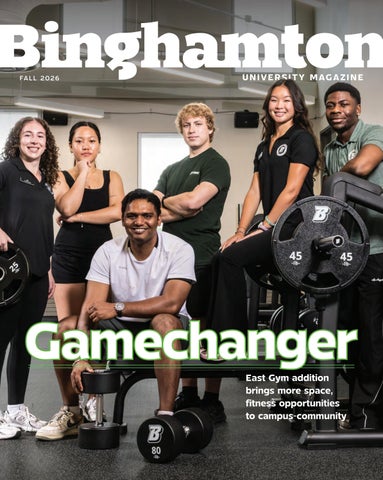
Gamechanger East Gym addition brings more space, fitness opportunities to campus-community
JONATHAN COHEN
Fall 2026 Volume 22-2
Contents FEATURES
4
Singing and acting idols Jesse Findling and Jake Termine reflect on going from campus roommates to starring on television and Broadway in less than a year.
10
Reaching out to veterans Graduates of Binghamton’s clinical psychology doctoral program research and treat the mental health of U.S. veterans.
20
Leadership links Binghamton University alumni work in key administrative positions in the Blind BrookRye Union Free School District.
24
East Gym’s new addition Project adds fitness space, a track, courts, and multipurpose rooms to Binghamton University’s oldest building.
32
A rocketing career As an advanced mission design engineer for NASA, Victor Yu ’17, MS ’20, is helping the Artemis crews get to the moon.
MORE
The Class of 2030 heads to the New Student Kickoff after forming the “Class of B” logo on the Campus Recreation field in August.
2 / President Anne D’Alleva’s inauguration 16 / The University’s five-year strategic plan 30 / Meet nutritionist Julia Furlipa, MS ’19 36 / Connect: Alumni Association award recipients; Class Notes; new book releases; Book Talk
Anne D’Alleva, joined by her family and SUNY Chancellor John B. King Jr., left, was inaugurated as Binghamton University’s eighth president during a ceremony at the Anderson Center Osterhout Concert Theater on Oct. 2.
The inauguration of President Anne D’Alleva
E
ighty years of growth have propelled Binghamton University from humble beginnings to state-of-the-art facilities and the distinction of being named a Top 10 Public Ivy. What hasn’t changed, however, is a belief in higher education’s power to provide a successful future. During an Oct. 2 inauguration ceremony as Binghamton University’s eighth president, Anne D’Alleva pledged to use that belief to fuel the University’s continued growth as a leader in higher education and as one of the world’s top academic institutions. “Higher education truly represents the best of what America, of what humanity, aspires to be,” D’Alleva told a packed Anderson Center Osterhout Concert Theater during a formal inauguration ceremony that served as the
2 BINGHAMTON UNIVERSITY MAGAZINE
“Together, let’s make Binghamton a beacon of possibility, a University that shows what higher education can achieve, and whose light can reach far beyond our campus.” — President Anne D’Alleva
centerpiece of eight events dedicated to the University’s 80th birthday. D’Alleva encouraged Binghamton’s students to ask bold questions and seek out opinions different from their own. She encouraged Binghamton’s faculty to bring their most ambitious ideas forward and advance discovery by sharing their creative work with the world. She encouraged Binghamton staff to help build a University where every member of this community can thrive. She encouraged Binghamton’s alumni to remain connected and share their experiences by mentoring students. And, she encouraged Binghamton’s community partners
to imagine more boldly what these valuable relationships can achieve. “Together, let’s make Binghamton a beacon of possibility, a University that shows what higher education can achieve, and whose light can reach far beyond our campus,” D’Alleva said. “Our students, faculty, and staff are doing great things today, and they also follow in the footsteps of those who came before them. It is an honor to be able to lead such a vibrant and ambitious university.” The inauguration ceremony brought together State University of New York Chancellor John B. King
EDITORIAL UNIVERSITY MAGAZINE EDITOR
Eric Coker ALUMNI EDITOR
Steve Seepersaud DESIGN AND PRODUCTION
Angelo Garufi, Burt Myers, David Skyrca ’85 UNIVERSITY PHOTOGRAPHER
Jonathan Cohen COPY EDITORS
Ethan Knox ’20, Chris Kocher, Steve Seepersaud VICE PRESIDENT FOR UNIVERSITY COMMUNICATIONS AND MARKETING
Greg Delviscio SENIOR DIRECTOR OF CREATIVE SERVICES
Gerald Hovancik Jr.
JONATHAN COHEN
EXECUTIVE DIRECTOR OF ALUMNI ENGAGEMENT
Jr.; SUNY Board Chair Merryl Tisch; SUNY trustees; senior University leadership, including Provost and Executive Vice President for Academic Affairs Donald E. Hall; as well as deans and elected officials, including U.S. Rep. Josh Riley, New York state Sen. Lea Webb ’04, and Assemblywoman Donna Lupardo, MA ’83. House Minority Leader Hakeem Jeffries ’92 and U.S. Sen. Charles E. Schumer also gave video addresses. “Binghamton has long stood as a pillar of higher education in our great state,” Jeffries said. “Under President D’Alleva’s leadership, I have no doubt that our University will continue to flourish and rise to even greater heights.” “Time and time again, you’ve proven yourself an effective leader, educator, and administrator, positively impacting countless
student lives,” Schumer told D’Alleva in his message. “You are just the right fit for a University that is advancing, for a University that is attracting among the best students in the world, for a University that is growing and finding new ways to provide good education for their kids with great futures, and also to provide jobs and and economic growth.” The inauguration ceremony came nearly a year after D’Alleva assumed the presidency in November 2025. Before coming to Binghamton, D’Alleva spent three years as the University of Connecticut’s provost (she was the first woman to serve as provost at the university) and executive vice president for academic affairs. D’Alleva, an art historian, also served for seven years as the dean of the School of Fine Arts at UConn.
Matthew Winston Jr.
— ANTHONY BORRELLI
Cover photo by Jonathan Cohen
HOW TO CONTACT US LETTERS, NEWS AND STORY IDEAS
Telephone: 607-777-6441 Email: magazine@binghamton.edu CHANGE OF ADDRESS
Office of Alumni Engagement PO Box 6000 Binghamton, NY 13902-6000 Email: alumni@binghamton.edu CLASS NOTES
Submit them by visiting bconnectalumni.binghamton.edu Binghamton University Magazine is published twice a year by the Division of Communications and Marketing, Binghamton University, State University of New York, and is mailed free of charge: circulation 152,000. © 2026 Binghamton University, ISSN 1936-7066. Current and past issues of the magazine are online at Binghamton.edu/magazine. The views presented are not necessarily those of the editors or the official policies of Binghamton University. The University does not endorse products or services referenced in these pages. ON THE COVER: From left: Julia Pennella ’26, and students Kels Lama, Shailesh Vilas Chaudhary, Richter Bogust, Leah Chan, and Kingsley Babalola, all Campus Recreation staff members, in the East Gym.
binghamton.edu/magazine I FALL 2026
3
Stage
presence here was something special in the fall of 2025 about 207E Glenwood in Binghamton University’s on-campus Apartments Community. Occupant Jake Termine describes it as “good juju.” His roommate, Jesse Findling, jokingly calls it “magical dust.” By the end of the semester, Termine and Findling were embarking on journeys that took them to great heights in the entertainment world. Termine, a theatre major with a concentration in acting from Rockland County, won the role of Young Happy Loman in the Broadway revival of Arthur Miller’s Death of a Salesman. The production, which starred Nathan Lane and Laurie Metcalf, won six Tony Awards and ran from March to August. Findling, a biology major and musical theatre minor from Long Island, advanced to the top 12 in the ABC-TV reality singing show American Idol. Findling won hearts (and votes) across the country each week with versions of hits such as Ed Sheeran’s “Photograph” and The Fray’s “You Found Me.” Termine and Findling began their pursuits in Glenwood, having become good friends after appearing in the Theatre Department’s MainStage production of Anything Goes in fall 2024. Their successes led them to take a hiatus from Binghamton University at the end of 2025. “When both of us took our gap semesters, we had a line of people wanting to go into that apartment!” Termine recalls. “I hope whoever is in it now is living their best lives.”
T
4 BINGHAMTON UNIVERSITY MAGAZINE
Termine and Findling’s friendship and understanding of what was at stake enabled them to encourage each other during anxiety-filled rehearsals and practices in the apartment. The pair even created a video predicting their 2026 successes. “The support and the respect for one another’s processes was there,” Termine says. “We were able to lift each other up when we needed it.” “I realize how rare it is to have a friend that’s there for you, wants the best for you, and helps you,” Findling says. “We have this special bond.” Termine (who opted not to return to Binghamton for the fall semester) and Findling (who did return) spoke to Binghamton University Magazine about the road to where they are today, and how their time on campus made it possible. Q: How often have the two of you been able to see or talk to each other during this busy year? Jake: We do text often, but it’s been hard to see each other in person. When Jesse was doing American Idol, he wasn’t in New York, and when he got back, my schedule picked up. But the communication never went away. We were always texting and chatting with each other. Jesse: We’ve been messaging for sure. I think I’ve seen you maybe, five … Jake: A few times, yeah. Jesse: He had eight shows a week. We’ve messaged — and we’re still great, close friends. Q: What were your first impressions of each other after meeting as sophomores? Jake: As a performer, when you audition for a specific role — or just a show in general —
JONATHAN COHEN
By Eric Coker
Former campus roommates Jake Termine and Jesse Findling reflect on friendship, success on Broadway and ‘American Idol’
Jesse Findling, left, from American Idol, and Jake Termine, from the Tony-winning play Death of a Salesman, reunite on the Binghamton University campus in September 2026.
binghamton.edu/magazine I FALL 2026
5
you want to see who your competition is. I remember looking up Jesse on Instagram and thinking: Who is this? I saw his name on the callback list, and I didn’t even know who he was. And then I ended up being Jesse’s understudy! Through that, we got close. And we also have a good friend, Vanessa Pliskow, who acted like a mutual anchor point and we were able to get closer through her. The friendship blossomed naturally from there. Jesse: I didn’t do any musical theater my first year at Binghamton. Jake had already done a show, so he knew everybody. I had done musical theater in high school, but my first year I was focused on [college], figuring out what I wanted. My second year, I wanted to do something different. I saw that they were doing Anything Goes, and I had done the show in high school. I had played Moonface Martin, so I auditioned for that role. It ended up working out, and I thank God for that, because that’s how I met Jake and Vanessa, and that’s how I met a lot of my musical-theater friends. Q: In musical theater, you need to be a “triple threat”: singing, dancing, acting. Which is the hardest for you? Jesse: Dancing. And it’s not because I think that I’m horrible. I’ve never done really hard dancing, but I like to think that I have rhythm. I think if I tried, I might be OK, but I don’t want to embarrass myself, so I don’t know if I’ll ever fully get into it. Jake: For sure, dancing for me, as well. I actually think I’m pretty good at it. We had to learn tap before Anything Goes, and we’d never done it before. Jesse: I’m good at tap! Jake: We picked that up pretty fast. I feel like when push comes to shove, if we’re in a situation and we have to learn a dance, we’re going to learn it. And we’re going to do it well. Jesse: Exactly!
6 BINGHAMTON UNIVERSITY MAGAZINE
Q: As roommates in fall 2025, were you discussing short-term projects or goals, or was life day-to-day, class-to-class? Jake: We always talked about our futures. We were optimistic and kept good vibes and high energy in that apartment. It was a good balance of going to classes during the day, and then at night, Jesse would be singing, or I’d be doing an audition. Jesse: I think it also worked well, because we both knew we liked singing and acting. I knew that Jake was going to audition for things, and I would have to leave the room for that. And it wasn’t awkward if I said: “Jake, I’m going to sing really loud now.” Q: What were your reactions that fall to seeing each other pursue Idol and Broadway? Jesse: My American Idol process actually started all the way back in May, before that fall semester. I was posting [performances] on social media, and somebody from the show found one of my videos. I met up with him on Zoom once in May, and then didn’t hear anything back. So, I kept on messaging him: Can we Zoom again? We reconnected in September, and that was when Jake auditioned for a (Broadway) show. It was so random! I then learned that I was going to Nashville for the show. Jake was super supportive — and then he found out he was going to be on Broadway a few weeks later. It all happened so quickly. I was still doing school and singing my audition song for the show (“In the Stars” by Benson Boone) every day. It’s a process — it’s not easy, and there is an aspect of luck, because obviously everybody who auditions can sing. Q: Did the audition process affect your fall classes? Jake: My Death of a Salesman audition came in late November, but I auditioned for Stranger Things on Broadway in late September. Salesman was a very fast process for me. I put myself on tape, and then I was going back and forth with the casting director. After a good three days of communicating and sending in so many materials, I was invited to do an in-person reading with the cast and some of the creative team. They asked: Are you available? Of course I’m available! But I wasn’t really, because it was
“ Every day was a highlight — I got to be on the Winter Garden stage, living out my dream . . . ” — Jake Termine
during finals week. So, I had to miss all my finals. But thankfully, my teachers were understanding, and I was able to make the proper accommodations. The faculty at Binghamton are awesome: They all understood. But in the case that they weren’t understanding, I would have missed my finals — because this [show] was something that I felt like I needed to do.
SHAWN PUNCH (LEFT), LILA BARTH (ABOVE)
Jesse: Idol is unusual because the auditions and the first rounds were filmed late in the fall semester (but didn’t air until early 2026). So, it wasn’t getting in the way of school. But I knew the next round — in Hawaii — wouldn’t take place until early in the spring semester. And there’s a chance I could be sent home, but only miss a few days of classes. I decided: I’m going to hope that this works out. I went all in and took the gap semester in the spring. I ended up doing five more weeks of the show. Q: Jake, you’ve talked in the past about the importance of collaboration, be it on Broadway or in campus productions. What was the Salesman collaboration process like? Jake: I like to seek opportunities that lead with collaboration, because you get your most honest work through others. Coming into Death of a Salesman, the experience I had with collaborating with other artists was through Binghamton shows. Binghamton prepared me to be
open-minded and bring the most honest, deep work that I can. When we started Salesman, my director, Joe Mantello — who is amazing — told us to start with a blank canvas, look out for each other, and he encouraged us to fail, because that’s how you grow. I learned so much by just watching and listening, and working off others. The collaborative aspect stayed the same from Binghamton to Broadway. At the end of the day, theater is artists collaborating. That doesn’t change just because the scale of Broadway to college theater is different.
Jake Termine, left, was featured on Broadway earlier this year in Arthur Miller’s Death of a Salesman with Nathan Lane, center, and Joaquin Consuelos. The revival won six Tony Awards.
Q: Do you get nervous before a performance? How long does it take for thoughts like “Lionel Richie and Nathan Lane are sitting in front of me” to go away? Jake: I’ve never been the nervous type. I’m good at channeling any nerves into adrenaline and excitement. Being on Broadway has heightened that. … It’s surreal acting in the Winter Garden Theatre to 1,600 people. There have been acting idols and legendary people who came to see the show. I got to meet them, and that surrealness doesn’t go away. But there’s no sense of being starstruck, because I was in that space for seven months with these amazing, talented people every single day. Jesse: I got to Nashville and I remember that I could not eat, and I felt like I was going to
binghamton.edu/magazine I FALL 2026
7
Jesse: I was rehearsing so much and trying different things. I was always like: “Jake, is this bad? Is this good?” I knew he would be honest. Jake: I felt like an American Idol judge on some days! Q: Jake, what was it like to attend the Tony Awards? What were the highlights of the Salesman experience?
Jesse Findling is congratulated by American Idol judge Lionel Richie after the Binghamton University student’s successful audition. At bottom: Findling receives advice from guest mentors Keke Palmer and Brad Paisley while the show was filming in Hawaii. Findling advanced to the Top 12 in the ABC-TV competition.
throw up because I was so nervous. I had just been singing on social media, in musical theater, and I had watched (Idol). Am I actually good? There are all of these amazing singers. I was getting into my own head. I was nervous walking into the first audition, but then you’re there and it is what it is. ... I was most nervous hearing the [judges’ feedback]. As the rounds kept going on, I became less nervous because I knew the judges. But the live shows were a different beast! It’s a mental game. You need to make sure you have supportive family and friends. Q: Any nerves singing the national anthem before a New York Islanders game in April? Jesse: The only nerves I had for that was forgetting the words! Not because I didn’t know the song; it’s that the song is its own big thing. Q: Jake, did you ever get tired of hearing the same audition and rehearsal songs from Jesse? Jake: It’s not an exaggeration to say he sang every night. To be honest, because he was so good, I’d say: “Keep on singing! I’m not going to get annoyed.”
8 BINGHAMTON UNIVERSITY MAGAZINE
Jake: Being in that space reaffirmed the hard work that has gone into this and the countless nights asking myself: Am I good enough? It was beautiful being in Radio City Music Hall for a show nominated for nine Tonys. When we won Best Revival, we all sprinted to the stage. I don’t even remember what Nathan Lane said when he accepted the award. I looked out into the audience and thought: “What am I doing here right now?” Then I made eye contact with Daniel Radcliffe in the front row and thought: “That’s Harry Potter! What is going on?” … Every time someone asks about that night, I still stumble on my words. This has been the experience of a lifetime. Every day was a highlight — I got to be on the Winter Garden stage, living out my dream collaborating with these insanely talented creatives. It’s work, but I don’t consider it work. It’s a gift I was lucky to receive.
“ Looking back, I wouldn’t have done anything different on the show. I left it all out there, and I was happy with everything I did.” — Jesse Findling
Q: Jesse, what were your highlights? What songs would you have performed if you advanced? Jesse: Being able to go through the experience with my family was special. They were in Nashville, Hawaii, and there for the live shows. It wasn’t just something I went through — it was a family thing. Seeing the reactions from Jake and other friends was a highlight, too. For the next round, I would’ve sung “New York State of Mind” (by Billy Joel). I posted a video of it on social media. I have no idea what I would’ve sung for Disney Night. There’s a bunch of songs out now that I like, and when I do gigs or have small shows — “Die on This Hill” by Sienna Spiro. Maybe something from Shawn Mendes or Sam Smith. Looking back, I wouldn’t have done anything different on the show. I left it all out there, and I was happy with everything I did.
DISNEY/ERIC MCCANDLESS
Q: How would you describe each other’s growth from Anything Goes to Broadway and Idol? Jesse: Seeing this experience bloom has been special. I was at Jake’s first preview show with some Binghamton friends from musical theater. Jake: Our first show in front of a public audience! Jesse: I was so excited. I’ve seen Broadway shows, but usually musicals. Jake was doing a
straight-up play. Having seen him work so hard for this and want it so badly, I think it felt different for me than others. It’s a heavy, sad show he did eight times per week. And he did it so gracefully. Jake: Jesse has really grown into himself, and I think this was the perfect opportunity for him to learn about who he is and what he’s capable of doing, and understand that he’s there for a reason, because his drive and his passion brought him there. It was such a beautiful process to see from start to finish, from Zooms to my living-room TV. I’m proud of him and excited to see what’s next. I’ll be there every step of the way. Q: What did you learn from your time at Binghamton that helped you in your success? Jake: The atmosphere at Binghamton — the students, the teachers, my friends — prepared me mentally and assured me that I could go out on stage and show 1,600 people that I’m meant to do this. That mindset came from Binghamton. Jesse: I feel like your life really starts when you go to university. All of the lessons that I learned at Binghamton were used by me on the show. But every year I realize that there are also so many resources at Binghamton that I didn’t take advantage of. Binghamton taught me so much — and there’s always more to learn.
binghamton.edu/magazine I FALL 2026
9
Serving those who serve 10 BINGHAMTON UNIVERSITY MAGAZINE
F
or military veterans suffering from post-traumatic stress disorder (PTSD), healing can take various shapes: A traditional psychologist’s office, where they work through their fears or learn to navigate complicated relationships. A virtual reality headset. In a training ring with a wild mustang. Alumni of Binghamton University’s doctoral program in clinical psychology are at the forefront of research and treatment of conditions relevant to veterans. Today, more than half of Associate Professor of Psychology Christina Balderrama-Durbin’s students end up with careers at the Veterans Health Administration. In fact, her first student when she arrived on the Binghamton University campus in 2015 is now a staff psychologist at the nearby VA clinic in the City of Binghamton, and has recently begun supervising graduate students and interns in their clinical work. “It feels like things have come full circle for me,” says Balderrama-Durbin, who also directs the Couple Adjustment to Stress and Trauma Lab at Binghamton. “I credit much of my own clinical training to the experiences I had as an intern at the Minneapolis VA Health Care System. It’s such an honor to serve those who have served this country.” Doctoral candidates in clinical psychology are required to complete an internship year at an external site, and the VA offers one of the largest and most robust evidence-based treatment training experiences for program graduates, Balderrama-Durbin says. Given their positive experiences with alumni, these sites also seek out Binghamton graduates in turn. Terence Keane, MA ’76, PhD ’79, SD ’11, was part of the clinical psychology program’s first class. During his 49-year career at the VA, he developed many of the most widely used PTSD assessment measures. Recognized today as a world leader in the field of traumatic stress, he is the director of behavioral science for the VA’s National Center for PTSD, as well as a professor and assistant dean for research at Boston University School of Medicine.
Graduates of Binghamton’s clinical psychology program trailblaze the treatment of veterans’ mental health
Christina Balderrama-Durbin, an associate professor of psychology at Binghamton University, leads the Couple Adjustment to Stress and Trauma Lab at Binghamton.
JONATHAN COHEN
By Jennifer Micale
binghamton.edu/magazine I FALL 2026
11
“Trying to help the next generation of researchers and clinicians is very important to me,” he reflects. “The training we received at Binghamton University prepared us to do good things here.”
The challenges faced by veterans A friend gave Keane a framed page from an 1866 edition of Harper’s Weekly, depicting an etching by Thomas Nast
D
Terence Keane, MA ’76, PhD ’79, SD ’11, who graduated with Binghamton University’s first doctoral clinical psychology class, is the director of behavioral science for the VA’s National Center for PTSD.
epictions of PTSD can be traced back to Homer’s Iliad and Odyssey in ancient Greece...
titled “Why He Cannot Sleep.” It depicts former Confederate President Jefferson Davis, his stricken face turned toward a pillow; around him, ghostly figures dance amid a scene of slaughter and grief, with a gibbet on view through the window. Above him looms a phantasmal goddess-like figure, symbolizing America. Published in the immediate aftermath of the Civil War, the image depicts the haunting reality of PTSD. “It suggests that somebody very sensitive to the problems of combat veterans was working at Harper’s Weekly,” Keane says. “It was a recognition that people who were involved in wars — who saw the devastation and were perhaps in part responsible — didn’t sleep well. Among the symptoms of PTSD, even today, is poor sleep.” Depictions of PTSD can be traced back to Homer’s Iliad and Odyssey in ancient Greece, Shakespeare’s King Richard and Hamlet, and more. The condition went by various names through the centuries: soldier’s heart in the Civil War, shellshock in World War I, and battle fatigue or combat stress reaction in World War II.
12 BINGHAMTON UNIVERSITY MAGAZINE
Combat isn’t the only cause of PTSD; it’s experienced by survivors of a wide range of traumatic events, from domestic and sexual violence to car accidents. It’s also not the only mental-health challenge that veterans face; while they demonstrate amazing resilience, they are also at increased risk for suicidality and substance abuse, Balderrama-Durbin says. Plus, the adjustment from military to civilian life can affect an entire family system, explains Tarah Midy, PhD ’18, a staff psychologist at the VA of Cleveland, Ohio. Midy, trained in
integrative behavioral couple therapy and a national consultant, works as a local recovery coordinator, ensuring that treatment is grounded in recovery-oriented practices that put veterans’ needs first. PTSD didn’t enter the diagnostic lexicon until 1980, although cases of what was called “post-Vietnam syndrome” began to emerge in the 1970s. Keane first encountered patients suffering from the condition in 1977 during an internship at the University of Mississippi Medical Center, which included a VA center in Jackson, Mississippi; his initial rotations were in the VA’s substance dependence treatment programs. While interviewing patients, he heard war stories — mainly from Vietnam, but also from Korea and World War II. “Thematically, the stories were so similar. It was stunning to me,” he recalls. At the end of his first year at the VA, he helped start the first outpatient program for Vietnam veterans dealing with combat stress. In the summer of 1980, he headed to Purdue University to meet Charles Figley, a Marine veteran and faculty member involved in the development of a new diagnosis: PTSD. Five years later, Keane moved to the VA Boston, helping establish what later became the National Center for Post-Traumatic Stress Disorder. Contrary to popular belief, PTSD is not a life sentence. Today, there are a half-dozen psychological treatments for the condition that are successful in 50-60% of cases, as
“
“
Albert “Skip” Rizzo, PhD ’91, director of medical virtual reality at the University of Southern California’s Institute for Creative Technologies, uses high-tech methods such as virtual reality in his work with veterans.
Y
PHOTOS PROVIDED
ou can get on with your life. You can start having satisfying relationships.
shown in clinical trials. Work remains to be done in addressing the remaining 40%, Keane acknowledges. Overall, treatment involves setting conditions so that clients are willing to face their fears and learn the difference between what is truly dangerous in the present versus reminders of the past, notes Zachary Collins, PhD ’08, a psychologist based in Rochester, New York. “We have a variety of evidence-based approaches,” says Albert “Skip” Rizzo, PhD ’91, the director of medical virtual reality at the University of Southern California’s Institute
— Albert “Skip” Rizzo
for Creative Technologies. “We’re not erasing memories; there are always going to be bad memories, but you can function. You can get on with your life. You can start having satisfying relationships.”
High-tech solutions A research professor with the USC Department of Psychiatry and Behavioral Sciences and at the USC Leonard Davis School of Gerontology, Rizzo explores high-tech ways to treat trauma and brain injury, including virtual reality, gaming, and apps. When he
binghamton.edu/magazine I FALL 2026
13
“
“ I
healthcare resources, and help them establish a safety plan. The VA has recently released a general version of the app, called Sidekick. The goal isn’t to replace clinicians, but to overcome stigma and barriers to care, he points out. Chatbots may also help patients practice cognitive reframing exercises, breathwork, or other strategies in times of stress. Over the years, the VA has adopted virtual reality and digital technologies on a broad scale, using them for pain management, game-based physical and cognitive rehabilitation, social-skill role-playing, and more. The veterans like it, too. In fact, when given the option between VR or traditional therapy for PTSD, 76% of veterans in one study picked VR. Of the 1,000 people who tested the mobile app, 92% said they would recommend it to other veterans and use it themselves. — Albert “Skip” Rizzo “My philosophy is that the thoughtful, scientifically informed, ethically sound use make it difficult for individuals to engage in of technology for the delivery of healthcare is pure imagination, especially when coupled with something we need to pursue,” Rizzo says. “But the avoidance of troubling memories at the there’s a capital E on the ethical.” heart of PTSD. “It’s a way to emotionally engage people at a pace they can handle, even if it’s not an Back to nature exact replica of what they went through,” On the other end of the treatment spectrum Rizzo explains. “What we try to do is help are wild horses. them safely confront and reprocess difficult Collins first began treating veterans during an emotional memories. It’s hard medicine for a internship at the Syracuse VA Medical Center. hard problem.” Since then, he has worked in multiple clinical The program has since expanded from settings, including embedded behavioral health combat-related issues to sexual trauma, another with the U.S. Army at Fort Drum, New York, and significant problem in the military. Recently, in VA residential and outpatient clinics for PTSD. his team has been developing VR systems for Today, his office is on the campus of a clients in Ukraine, Israel, and Gaza. 200-acre horse farm, where he provides free, VR can also be used to determine whether nature-based therapy through the Monroe a soldier is eligible to return to duty after County Veterans Service Agency. Most experiencing a concussion. One day, such participate in group programs, which range from programs may help prevent PTSD from therapeutic horticulture on the site’s three-acre developing, by providing troops with preorganic farm to nature photography, a farm-todeployment resilience training introducing them table cooking class, and an ecotherapy program, to combat environments. In this type of training, in which participants hike, build trails, and the scenario doesn’t just end with death, an gather around a campfire. explosion, or an ambush. A virtual human Collins’ favorite is Mission Mustang, which mentor walks into the scene and guides soldiers involves gentling wild horses provided by the through the normal physiological experiences Bureau of Land Management. of combat, such as increased heart rate, and “Those are wild animals, very much in introduces relevant coping strategies. contrast to our therapeutic herd, who are Another one of his projects: a conversational extremely chill. They come to us untouched AI mobile phone app for at-risk veterans that by human hands, and our expert mustang can answer questions, guide users through trainers coach veterans through the process of started this work in 1995, the equipment was both expensive and primitive; that’s not the case now. With a computer science colleague, Rizzo used 3D footage to build Virtual Iraq, a prototype for the treatment of PTSD in Iraq War veterans. It’s not Call of Duty, but a fully immersive experience with audio, a vibrating floor that simulates a vehicle’s rumble, and even machines that puff out battlefield smells. For patients with comorbid depression, simulations outperform traditional, evidencebased therapy. The reason: Depression can
14 BINGHAMTON UNIVERSITY MAGAZINE
PHOTOS PROVIDED
t’s a way to emotionally engage people at a pace they can handle, even if it’s not an exact replica of what they went through.
training them,” he explains. “The work is really rewarding for both the horse and the veteran participants.” As herd animals, horses are sensitive to the energy around them, serving as emotional mirrors. They can hear a human’s heartbeat up to 4 feet away and will shy from an anxious trainer — in effect, a trauma response. “But the horse doesn’t have PTSD because they’re not in their head, blaming themselves and telling themselves a story,” Collins reflects. Zachary Collins, PhD ’08, incorporates wild horses into his treatment of veterans through the Monroe County Veterans Service Agency.
“That’s really the core of PTSD: ‘I’m telling myself a story about my trauma. This is my fault; I should have prevented it; I should have done something different.’ The horses never do that; they respond to trauma in the moment, but when it stops, they adjust.” During his training at Binghamton, Collins received a key lesson that has shaped his practice — the same one that veterans learn through Mission Mustang: To be effective, a therapist must manage their own emotions before sitting with someone working on trauma. “I have to do my own preparation, which is a mirror of what we’re training veterans to do with the horses. The veteran shows the horse that, hey, this thing that’s scary, we’ll get through it together,” he explains. “Whatever the veterans went through, there’s nothing so bad that we can’t at least talk about it.” Alumni credit Binghamton’s clinical psychology program with providing the grounding they needed for rewarding careers. In both Jackson and Boston, Keane has recruited other Binghamton graduates; many have chosen to remain at the VA for decades. “If you told me 20 years ago that I would be working with veterans, I would find that very surprising,” says Midy, who initially came to Binghamton to study with Professor Matthew D. Johnson and his science-based approach to marriage and family relationships. “I really enjoy the work. Veterans are such a special population. They appreciate the help, and they deserve the best.”
binghamton.edu/magazine I FALL 2026
15
Binghamton is moving
President Anne D’Alleva outlines five-year strategic plan
Binghamton University is setting an ambitious direction for the next five years with a new strategic plan shaped by the voices and ideas of its community. The plan is focused on expanding the University’s impact, deepening partnerships, and advancing Binghamton’s standing among the world’s leading universities.
By Anthony Borrelli
The strategic plan, called “Forward Together: The Vision for Binghamton University,” reflects the collective aspirations of the Binghamton campus community and builds on a distinctive strength: a University large enough to achieve the ambitions of a major research institution, yet small enough to sustain the meaningful relationships that make collaboration possible. More than 2,800 members of the Binghamton community helped shape the plan. Feedback from more than 1,000 students, faculty, staff, alumni, donors, and community leaders during President Anne D’Alleva’s
16 BINGHAMTON UNIVERSITY MAGAZINE
Listening to Lead Tour informed its development, while nearly 2,000 more participated through surveys, meetings, and forums during the spring 2026 semester. “There is, quite simply, extraordinary momentum across this institution, and we must continue to build upon it,” D’Alleva says. “I am confident we can achieve this plan, which reflects our campus community’s collective aspirations, because of what I’ve heard since day one at Binghamton. Our University is building from a position of momentum and promise.”
JONATHAN COHEN
‘Forward Together’
“ Our University is building from a position of momentum and promise.” — President Anne D’Alleva
binghamton.edu/magazine I FALL 2026
17
■
Integrated research and creative activities for undergraduates
■
Transformative graduate education from enrollment to career
■
Fostering a University community of belonging, shared identity, and school spirit
■
Engaged research partnerships and creative collaborations advancing social and economic impact
■
Building bridges locally to globally to promote the common good
1
“Forward Together sets an ambitious vision for the future of research, scholarship, and creative activities at Binghamton University,” says Provost and Executive Vice President for Academic Affairs Donald E. Hall. “Our faculty, graduate students, and undergraduate students are all involved in making important discoveries that shape our understanding of the world around us, creating a rich culture that is based on knowledge and curiosity. The work done at the University also provides great benefits to our partner institutions in industry and faculty peers around the world, driving economic development and prosperity.” To help translate this plan’s vision into action, the University is also inviting proposals for
grant-funded initiatives that advance one or more of the strategic goals. Two levels of grant funding, seed grants and high-impact strategic initiative grants, will be available, and eligibility will be based on factors including strategic alignment, innovation, institutional impact, and sustainability. Each year, the University will refine the strategic plan’s approach and decision-making to guide progress and ensure alignment with the goals. “What distinguishes Binghamton is the community’s shared commitment to shaping and advancing the University’s future,” D’Alleva says. “The years ahead will require sustained collaboration to build capacity toward a next level of effectiveness and impact.”
2
Integrated research and creative activities for undergraduates
Transformative graduate education from enrollment to career
Fostering a University community of belonging, shared identity, and school spirit
Binghamton has built a strong reputation for enabling undergraduate students to participate in world-class research. The strategic plan takes this a step further by embedding research and creative inquiry throughout the undergraduate experience. D’Alleva says the University’s goal is to ensure that students across all academic disciplines and backgrounds have the same meaningful access to research and creative outlets. By making this a defining feature of the undergraduate experience, students will be given a clearer path to career readiness.
Over the next five years, the University plans to implement a comprehensive graduate education strategy to make Binghamton a leading destination for graduate education, emphasizing career outcomes across programs. That begins by bolstering the University’s existing graduate recruitment ecosystem to attract, convert, and enroll high-caliber students. It also means investing more in compensation packages that increase financial accessibility for graduate students.
The University plans to cultivate a more inclusive and vibrant university community for students that endures across generations by building on the common identity shared by Binghamton’s strong network, ranging from current students to successful alumni around the globe. That genuine sense of connection, care, and shared purpose, which D’Alleva calls “The Binghamton Bond,” is part of what makes the University’s educational experience unique and inspires that network to maintain close ties with Binghamton long after graduation.
18 BINGHAMTON UNIVERSITY MAGAZINE
JONATHAN COHEN
The strategic plan outlines progress to be made in five goal areas:
“Forward Together sets an ambitious vision for the future of research, scholarship, and creative activities at Binghamton University.” — Provost Donald E. Hall
3 Moving forward, the University will create new campus traditions, visible symbols of pride, and common experiences that bring students, alumni, and athletes together to celebrate Binghamton’s strengths. Building more accessible student support systems will also make it easier for students to find and receive help when needed, D’Alleva adds. Similar investments will also be made for the University’s faculty and staff, to build a more connected workplace culture that encourages participation in campus life.
4
5
Engaged research partnerships and creative collaborations advancing social, economic impact
Building bridges locally to globally to promote the common good
Binghamton researchers across disciplines are already confronting important industrial and societal challenges, providing the University a powerful opportunity to more fully align and elevate its research and creative ecosystem to drive greater impact and national distinction. Strengthening talent, expanding partnerships, and amplifying the visibility of research and creative work can further position Binghamton as a national leader in those areas, D’Alleva says.
Over the next five years, Binghamton plans to become a greater catalyst for shared progress and global problem-solving by building on its already strong partnerships that extend across the state, nation, and around the world. By working more closely with local partner organizations, schools, industries, and nonprofits, the University can identify where it can better address economic development opportunities and workforce needs in the region. Learn more online at: binghamton.edu/strategic-plan-2026
binghamton.edu/magazine I FALL 2026
19
The
BinghamtonBlind Brook connection
Five University alumni lead Westchester County school district By Tiffany Moustakas ’15
hen Jim Quigley ’10 first arrived at Blind Brook High School in Rye Brook, New York, he was interviewing for a social studies teacher job. Having grown up not too far from the area, Quigley was drawn to the role because of Blind Brook-Rye Union Free School District’s “incredible reputation.” The district, located in Westchester County, serves more than 1,000 students ranging from kindergarten to 12th grade and boasts a mission of preparing them to be “active, lifelong learners.” School was out for the summer, but part of the application process required Quigley to do a demo lesson, which is a way for administrators to evaluate a teacher’s approach to pedagogy. While Quigley was teaching in a room full of adults, something caught his eye: a Binghamton University mug. The mug happened to belong to the high school’s principal, fellow alumnus Mark Greenwald ’84. “I tried to make a connection there and then,” Quigley says, “‘Go Bearcats!’ — that kind of thing.”
W
20 BINGHAMTON UNIVERSITY MAGAZINE
Blind Brook-Rye Union Free School District administrators and Binghamton University graduates (from left) Jim Quigley, Tracy Taylor, Seth Horowitz, Mark Greenwald, and Brian Alm display their Binghamton pride while standing outside Blind Brook High School in Westchester County, New York.
UPKLYAK—MAGNIFIC.COM/PHOTOS PROVIDED
But little did he know that he had already made an impression. “When I look at résumés for positions, if I see Binghamton on it, it’s a leg up — at least in terms of catching my attention,” Greenwald says. “It’s a quality education.” It might be common for a school district to coincidentally employ several alumni from the same college, but how many also have some calling the shots? In Blind Brook’s case, it’s five. That group includes Quigley, who now serves as an assistant principal at Blind Brook High School; Greenwald, who retired in summer 2026 as principal; Brian Alm ’95, superintendent of schools; Seth Horowitz ’96, assistant superintendent of curriculum, instruction, and assessment; and Tracy Taylor ’94, principal of Bruno M. Ponterio Ridge Street School, the district’s elementary school.
Pathways to teaching Despite never meeting until working together, a common thread exists in how the Blind Brook administrators ended up in education: their undergraduate experience. Some administrators, such as Taylor and Horowitz, sought out to be teachers and pursued that through courses and internships at Binghamton; others, like Quigley, Alm, and Greenwald, first had no intention to pursue education or had different ambitions altogether. For Alm, it was the time and freedom to explore that made a difference. He originally got into Binghamton University’s School of Management, but quickly transferred out, opting for more liberal arts classes that were “perfect” for him to “really find [his] way.” “Somewhere around my junior year, I realized that this is probably the only thing I could do that would bring me joy,” he says. “So [teaching]
binghamton.edu/magazine I FALL 2026
21
went from the last thing [I would do] to the only thing.” Greenwald had already started applying to law schools during his senior year at Binghamton when he found out a friend was going to take a student-teaching course at Vestal High School. He decided to take it, on what he described as half-joke and on a whim. “I did it to be with my friend and have a good time,” he says. “And that changed the course of my life.” Quigley also had law school on his mind as an undergraduate, but still opted to take an education class with lecturer David Archer and an internship at Union-Endicott High School. “I look at those experiences at Binghamton, and I think they were more impactful than I thought in the moment,” he says.
Navigating work relationships, building community Even a shared alma mater doesn’t shield the Blind Brook administrators from the day-to-day obstacles that arise in a school district with varying age groups and the decisions that need
22 BINGHAMTON UNIVERSITY MAGAZINE
to be made — but it makes a difference. For Greenwald, trusting one another is key. He gives an example: If he’s having a disagreement with someone like Horowitz, their shared educational experience does come into play. “In the back of my mind, there’s always, ‘Wait, he went to Binghamton. He can’t be all that wrong,’” he says jokingly. “But in all seriousness — we’re of a similar background, so we’ve got to be able to communicate.” Alm recalls that when he first started at Blind Brook, he was immediately impressed by the fact that he didn’t have to “do anything to unify or create common language or common understandings or collaboration” among the district’s three principals. “Even though we’re small in size, it’s easy to become siloed and disconnected,” he says. When Taylor thinks about creating community, it’s about a sense of “understanding that everybody supports one another in the great times, but [also] the times that are hard, that are challenging.” The elementary school is connected to the district office, so access to
FAVORITE BINGHAMTON CLASSES Jim Quigley (history major): John C. Stoner’s History of the 1960s course. (“It was probably the class I look back at the most.”) Mark Greenwald (political science major): A class with politics professor Edward Weisband. (“He wore a microphone around his neck and would race around the lecture hall and jump into a crowd of students to engage them in the discussion.”) Tracy Taylor (English major): A literature class based on New York City. (“[The professor] selected books about … different groups in New York City. I just thought it was very well done.”) Brian Alm (history major): A class with sociology professor Kelvin Santiago-Valles. (“He pushed my thinking probably more than any other professor.”)
UPKLYAK—MAGNIFIC.COM/PHOTOS PROVIDED
Seth Horowitz (economics major): Richard Leighton’s macroeconomics class — which Horowitz went on to become a teaching assistant for. (“Talk about: ‘You should be a teacher, Seth.’”)
her colleagues and establishing a rapport with them “feels like [they’re] one big hug.” “I think that’s very important, and I hope it trickles down and from top to bottom — that there’s this big community feel,” she says. Horowitz credits his time at Binghamton for being able to navigate hurdles. College was the first time he met people from a plethora of backgrounds and having that diversity in his life gave him the tools to “look at things through different lenses and through the lens of empathy.” “With the changes in technology, and with the changes in our country politically, it’s more important than ever that we have to work closely with each other, because sometimes it feels like all we do is put out fires,” he says. “When we come together, we can reset and remember that we’re here for a greater good.”
A new chapter ahead Along with the natural fresh start that comes with any new school year, big changes are underway at Blind Brook-Rye Union Free School District this fall.
Horowitz will build on his previous role working within the district’s middle school, expanding to the whole K-12 system. There’s also a new crop of teachers entering the district, and Taylor says she believes “the next era is coming.” She’s excited for the future. In some aspects of his job, Quigley will be a “veteran administrator” at the high school, and much like he did in his teaching career, he believes this year is another chance to grow. Alm shares a similar sentiment. “There’s always room to be better,” he says. “I think this is the right team to do it.” As for the retired Greenwald, he looks forward to returning to visit the district to lend outside support. He advises his colleagues to “continue to take your days one at a time and not get too far ahead of yourself.” For Greenwald, it’s the people who have always mattered. “I have a unique relationship with all of these people, even though I don’t know them all intimately. But we’re all Binghamtonians,” he says. “For me, the relationships are what will endure going forward.”
binghamton.edu/magazine I FALL 2026
23
East Gym ushers in
a new era of wellness Project adds 75,000 square feet to first building on the Vestal campus By Eric Coker
24
BINGHAMTON UNIVERSITY MAGAZINE
A
fter nearly 70 years, Binghamton University’s oldest building has a new look — and is offering more wellness options for the campus-community. The 75,000-square-foot addition at the East Gym, unveiled in mid-August, features an elevated indoor track, expanded fitness-training space, three basketball/volleyball courts, and five multipurpose rooms. The East Gym has served as the center of campus recreation, aquatics, and intramural activities since opening in April 1958. Binghamton University President Anne D’Alleva provided the Class of 2030 with a first look at the expansion after students gathered on a nearby campus-recreation field for the annual “B” photo during Move-In Weekend on Aug. 15.
The East Gym addition, seen from the outside at far left, includes an elevated indoor track and three new basketball/volleyball courts.
JONATHAN COHEN
“In addition to physical well-being, traditions and school spirit are gigantic elements of student success — as well as for all our faculty and staff who make use of the East Gym,” says D’Alleva, who spoke at a ribbon-cutting ceremony four days later. “The new East Gym is going to be home to so much of that — making this building equally as important as any lecture hall or laboratory space on campus.” D’Alleva notes that the importance of intramurals and well-being goes beyond the East Gym’s opening, to Binghamton’s beginnings as Triple Cities College in Endicott in 1946. “The rich history of health, wellness, and fun will continue here in the new East Gym,” she says. The key elements of the East Gym-Recreation Center expansion are: ▮ FitSpace 2: The fitness-center area (known as FitSpace) has increased by 40%, with new strength-training equipment added. The expanded space will provide more room and shorter waits for students and other users.
▮ Basketball/volleyball courts: Three new wood courts, located on the ground floor of the addition, will offer more access for open and intramural play. The courts will also be used for some men’s and women’s basketball team practices while the Events Center is renovated this fall. The older courts in the main East Gym will be used for badminton and pickleball. ▮ Indoor track: The 200-meter elevated track overlooks the courts and features a premium Mondo surface. Mondo has served as the official supplier of synthetic rubber track surfaces for the Olympic Games since 1976. ▮ Multipurpose spaces: Two rooms have rubberized flooring for group-fitness classes and club meetings. One room has a wooden floor that can be used for dance classes or club sports. A fourth room has monitors, chairs, and tables for staff training, certification courses, and potential classes. The fifth room is a socialization/recreation area with table tennis, foosball, couches, charging stations, and projection monitors.
binghamton.edu/magazine I FALL 2026
25
“Students want a place where they can de-stress, socialize, and be part of a non-academic community.” — Tom St. John, director of campus recreational services
The East Gym saw 280,000 visitors in the 2025–26 academic year, including more than 66,000 for open-play basketball. All students have access to open-recreation activities, such as swimming, basketball, tennis, indoor walking, and volleyball, through their recreation fee. A separate fitness membership is needed for FitSpace. Tom St. John, director of campus recreational services since September 2023, expects the expansion to draw even more student memberships. “Students want a place where they can de-stress, socialize, and be part of a non-academic community,” he says. “The East Gym affords all of those opportunities. There’s the old mantra: If you build it, they will come.” Brian Rose, vice president for student affairs, recalls that the original 102,000-square-foot East Gym was “showing its age” when he began his position in January 2008.
New strength equipment has been added to the East Gym, and FitSpace (the fitness center in the building) has expanded by 40%.
26
BINGHAMTON UNIVERSITY MAGAZINE
“If you looked at the equipment, you would have seen some antique treadmills,” says Rose, who also spoke at the ribboncutting ceremony. “The gym floor at the time had been sanded so many times that I’d describe it as wood veneer, as opposed to actual wood. So, I became an advocate for renovation and expansion.” Renovation arrived in 2012, as the East Gym received a new FitSpace area, multipurpose rooms, and a refloored gym. In 2021, an outdoor fitness court with bodyweight equipment opened. But more space was needed to accommodate Binghamton’s growing student population. University funds were approved for the project in 2024. “Sometimes, higher-education investment in recreation gets panned,” Rose says. “But we didn’t build any lazy rivers or waterparks. There’s nothing frivolous about what we’ve done. I look forward to the ways in which it contributes to student life.”
JONATHAN COHEN
One way is the alignment with the Healthy Campus Initiative, which aims to create a culture and environment that encourages and supports healthy living. “This facility provides a place where students can bring physical activity into their daily routine,” says Rose, who adds that exercise can also be effective in helping people better manage anxiety and depression. The East Gym is also one of the larger student employers on campus, with more than 150 on staff for Campus Recreation. “Aside from the general job skills that students learn here, many over the years have developed career paths in recreation and related fields — like physical therapy and facilities management,” Rose says. “All of those benefits will now be available to a greater number of students.” St. John points to several highlights of the addition, such as more stair-climbing machines and 22 new treadmills (added in 2025 on a three-year replacement schedule) in the FitSpace area, which also offers a friendly flow of exercise spots for the
New outdoor track and field facility
T
“This facility provides a place where students can bring physical activity into their daily routine.” — Brian Rose, vice president for student affairs
he outdoor track next to the East Gym also received a recent upgrade. The Visions Federal Credit Union Track and Field Facility (formerly known as the East Gym Track & Field) opened in August. The $8.6 million overhaul was made possible by a significant investment from Visions Federal Credit Union. The improvements to the 30-year facility include replacing the existing track to meet NCAA regulations, renovating the long- and triple-jump area as well as the pole-vault area, and adding lighting and safety improvements. The newly completed facility allows Binghamton to host meets for the first time since the 2013 America East Outdoor Championships. The Bearcats will host a tri-meet against UAlbany and Bucknell on March 27, 2027, and hold an invitational on May 1, 2027.
binghamton.edu/magazine I FALL 2026
27
“People can come into this facility not just for a workout, but for socialization. We’d like them to come through the doors and stay awhile.” — Tom St. John
28
BINGHAMTON UNIVERSITY MAGAZINE
a high-school athlete to play. You can come to meetings and practices and learn about the sports. We have something for everyone on campus. “Having seen facilities nationwide and in the SUNY system, I can say with complete conviction: What we have built at the East Gym is truly special. Simply put, this facility was built to play. It is something our University and community can be proud of.”
Above: Evan Goldberg and Imani Colon-Solivan, both graduate students in the School of Management, work out at the FitSpace addition to the East Gym in September. Below: The East Gym addition opened in mid-August. Three new courts in the addition can be used for either basketball or volleyball.
JONATHAN COHEN
“strength-training curious.” He calls the elevated indoor track “long overdue and needed.” And he believes the multipurpose recreation room will enable people to remain in the building after wellness visits. “We think it could be a popular spot for watch parties for sporting events like March Madness,” he says. “People can come into this facility not just for a workout, but for socialization. We’d like them to come through the doors and stay awhile.” The East Gym’s legacy, which connects Harpur College, SUNY Binghamton, and Binghamton University graduates from the Class of 1959 to the Class of 2026, is not lost on St. John. “It’s important to remember the past, live in the present, and keep an eye toward the future,” he says. “I would encourage our alumni to come back to their familiar East Gym, see how it’s changed, and feel the vibrancy and energy.” It’s a vibrancy and energy that has been in place for decades in the University’s commitment to student wellness. “This expansion speaks to how impactful a facility and a department like this can be to students,” St. John says. “They can find their community and learn lifelong skills. For example, we offer 45 club sports — and you don’t have to be
SPECIAL COLLECTIONS, BINGHAMTON UNIVERSITY LIBRARIES
East Gym origins t’s a question that has lingered for seven decades: Why in the world was a gymnasium built first at Harpur College’s new Vestal site? According to campus lore, there are several possibilities, including: ▮ New York Gov. Thomas E. Dewey wanted a building as close as possible to the Vestal Parkway so passing motorists could view it and think of him. ▮ SUNY trustees, having seen gymnasiums built at other colleges, took the safe route and ordered a gym as the first building. This would enable them to have additional time to plan and approve future buildings. ▮ Then-President Glenn G. Bartle told an Albany legislative committee in charge of construction funds: The gymnasium comes first. “If classrooms were built first, they could easily be reassigned to a state training school, while dormitories could be used for a detention center for delinquent adolescents,” he said, according to the book From Vision to Excellence: A Popular History of Binghamton University. “Some state agency could be given an office building, or a library could be handed over to become a county library facility. If Albany could be persuaded to supply the funds to construct a gymnasium, I knew the only thing they could do is build a college here!” In 1971, Bartle said the building now called the East Gym led some to believe that Harpur College was prioritizing athletics over academics. “A good many people assumed that was the college … not knowing of the buildings that were beginning to get started back up here on the hill,” he recalled. Whatever the construction reason, the East Gym has been an integral part of Binghamton University since opening in 1958. Groundbreaking at the Vestal site took place on Oct. 6, 1954, with Dewey in attendance. The governor was also in
the area to dedicate a new bridge over the Susquehanna River linking Vestal with Johnson City. It is now known as the Route 201 bridge (talk about a day of history!). It took more than two years for construction to begin. Upon opening in 1958, the $2.4 million gymnasium was used for athletics, recreation, convocations, commencements, concerts, plays, exams, and meetings. Intramural offerings expanded, even though outdoor fields weren’t ready until spring 1959. The gym hosted dorm basketball leagues, swimming, volleyball, and even featured a firing range. The campus saw four residence halls open, and the first convocation took place in the gym on Sept. 25, 1958. Gov. Averell Harriman dedicated the gym on Oct. 3, and the first Commencement at the Vestal campus took place on June 14, 1959. The ceremony was scheduled to take place outside, but (surprise, surprise) cold, windy weather moved it indoors to the gym. Courtney Smith, president of Swarthmore College (Bartle’s inspiration for Harpur College’s vision), served as
The East Gym — the first building constructed on Binghamton University’s Vestal campus — is seen at top in 1963. Groundbreaking took place at the site in 1954, but construction (seen at left in 1957) would take until 1958. The building opened that year and hosted the first Commencement on the Vestal campus in 1959 (above right).
guest speaker. The gym hosted Commencement ceremonies through 1964. In April 1960, Harpur students were finally able to take classes in Vestal, as the classroom-administration building (now known as the Fine Arts Building) opened. By February 1961, the move from Endicott to Vestal was complete, with the gymnasium, residence halls, the Union, Fine Arts Building, a science building (now known as Science 1), a library, and a physical facilities building in place. The first building on the Vestal campus became known as the Women’s Gym after the Men’s Gym opened in 1969. In 1976, the names were changed to East Gym and West Gym. — Eric Coker
binghamton.edu/magazine I FALL 2026
29
A nutritionist to sports stars 2019 grad Julia Furlipa had up-close view of the Knicks’ NBA title run By Steve Seepersaud
J
ULIA FURLIPA, MS ’19, is a certified nutritionist, personal trainer, and entrepreneur, dedicated to helping individuals transform their body composition to look leaner, feel fitter, and thrive inside and out. She is the private nutritionist for Jalen Brunson and Josh Hart, key members of the New York Knicks’ 2026 NBA Championship team. Q: How did you get connected with Jalen Brunson and Josh Hart? A: I was connected with Jalen back in August 2023 through his father and God’s divine timing. From there, I went through a series of interviews to earn the position I am in today. As for Josh, I was connected with him through Jalen just this past March. To clarify, I don’t work directly for the Knicks. Jalen and Josh are two of my private clients, along with a few others who are just as incredible, and it has been absolutely exhilarating to watch them crush it on the court. Q: What sorts of things do you work on with the players? A: In my role, I build specialized daily and travel meal plans, coordinating
30 BINGHAMTON UNIVERSITY MAGAZINE
closely with the team’s registered dietitian and both players’ private chefs. Together, we ensure they are hitting every precise macronutrient and micronutrient target and getting all their essential vitamins. I handle the strategic scheduling of their meals and design customized menus tailored for carb-loading, pre-workout preparation, and post-workout recovery fuel. Q: What impact has the Knicks’ championship had on your business? A: My business has always been entirely referral-based, so I haven’t needed to advertise or promote my services. Moments like this just make me an incredibly proud coach, as my main goal is to solely add on to individuals’ lives. Q: What inspired you to pursue a career in wellness and nutrition? A: This journey began when I was 15. Watching my mother battle colon cancer struck a profound chord. I was consumed by an agonizing question: Why do such good people get so sick? That question drove me to look past conventional management and seek true, holistic vitality. I discovered the radical, often overlooked
power of fiber, and realized how few nutritional protocols acknowledge a whole-food, plant-based lifestyle. Q: Do you have a philosophy that guides your work with clients? A: To change the body, you have to change your mind. You have to be OK with unlearning learned behaviors and asking questions people do not want to ask. You can heal your body from the inside out when you are choosing to not just fuel it with proper foods and nutrients, but to take care of who you spend time with, what you listen to, and what you spend your time doing. Q: What is your book The 7+ Lifestyle: A Recipe Book for Life about? A: It dives into the science of how your body’s pH levels, inflammation, and chronic diseases are connected, and how a vibrant, whole-food, plant-based diet acts as your ultimate shield. We live in an “acidic” world, and it isn’t just about eating junk food. It’s the stress in your mind and toxic relationships. The book shows you the massive difference between living an acidic, inflamed life and stepping into an energized, alkaline state.
PHOTOS PROVIDED
Julia Furlipa, nutritionist to Jalen Brunson and Josh Hart of the NBA champion New York Knicks, stands with the team’s 2026 Larry O’Brien Championship Trophy.
More from Furlipa at bestlifebyyou.com.
binghamton.edu/magazine I FALL 2026
31
To the
moon
Alumnus works on Artemis missions that will reunite humans with our neighbor in space By Chris Kocher
D
uring a nearly 10-day journey in April, an Orion spacecraft carrying four astronauts roared off the launchpad at Kennedy Space Center in Florida, looped around the moon, and splashed down in the Pacific Ocean as part of the Artemis II mission. Those of us back on Earth watched in awe as those intrepid humans visited our lunar neighbor for the first time since the final Apollo mission in 1972, testing systems and conducting important research for a scheduled moon landing in 2028.
32
BINGHAMTON UNIVERSITY MAGAZINE
“
It’s very rewarding to be part of this project, and I’m very grateful for it, but it’s also a big responsibility.”
PHOTOS PROVIDED BY NASA
Victor Yu ’17, MS ’20, worked alongside hundreds of NASA personnel supporting Artemis II at NASA’s Johnson Space Center in Houston. He was the lead developer for abort trajectories that may have been needed during Orion’s trans-lunar injection, the burn that sends the spacecraft and crew to the moon. He helped to map out the best solutions for worst-case scenarios. “We developed hundreds of thousands of cases. For example, if there was a fuel leak or if there was a malfunction in the life-support
— VICTOR YU
systems, how do we get the crew home as quickly as possible?” he says. “It’s very rewarding to be part of this project, and I’m very grateful for it, but it’s also a big responsibility. There are humans on board, and every little thing has to be 100% perfect. You have to be careful not to add any more additional risks to the mission.”
From intern to employee Yu grew up in Brooklyn and went to high school on Staten Island, excelling in his STEM classes. He knew he wanted to be an engineer, but when he decided on Binghamton University, he wasn’t quite sure what kind. His experiences in the Thomas J. Watson College of Engineering and Applied Science’s first-year Engineering Design Division program, which introduces students to the options available at Binghamton, persuaded him to pick mechanical engineering. He admits he was “kind of an introvert” as an undergraduate and
Victor Yu stands in a control room at NASA’s Johnson Space Center in Houston, where he works on the Artemis moon missions.
wishes he’d been more active in extracurricular events and clubs, but he credits his time at Watson with helping him open up to other people. He’s especially grateful for the relationships he built with mechanical engineering faculty members, some of whom became mentors. “It wasn’t until later in my college career when I understood how much of an impact that college has on you, because you grow academically and socially,” he says. “I learned how to talk to professionals, how to talk to professors — how to communicate better. The team projects that I worked on helped me to improve these skills, as well.” As he pursued his master’s degree, Yu interned at NASA’s Goddard Space Flight Center in Maryland, where he worked on the Lunar IceCube project, a nanosatellite intended to collect data on the moon’s ice deposits. The device launched aboard the uncrewed Artemis I. The experience gave him a taste for aerospace engineering, and he also interned for one summer at Collins Aerospace — but NASA became
binghamton.edu/magazine I FALL 2026
33
his passion. He next went to NASA’s Johnson Space Center for a series of internships and co-op roles in life-support systems, astrodynamics, and guidance and control systems. After earning his master’s, NASA hired him as an official full-time employee in Houston. “What’s nice about NASA Johnson is that networking is pretty easy to do here,” Yu says. “You can easily find people who can point you in the right directions, which is how I got my foot in the door where I’m working today as a full-time employee.” His time at Watson College proved to be key: “During my interviews with NASA, they didn’t ask any rigorous technical questions. They asked about my soft skills, with questions about the importance of working as a team. The answer I gave them came from my experiences at Binghamton.”
34
BINGHAMTON UNIVERSITY MAGAZINE
Next stop: The lunar surface
“The mission wouldn’t truly be complete until the crew was safely back on Earth. Once they landed, we had a celebration.” — VICTOR YU
As shown in the film Hidden Figures, human mathematicians did the complex calculations for early NASA spaceflight with little more than paper, pencils, slide rules, and protractors. Apollo 11 landed on the moon with the computational power of a modern pocket calculator onboard. Today, the Artemis program harnesses all the scientific advances from the past half-century, including supercomputers that can do millions of calculations per second. Yu sketches out trajectory ideas in a NASA software called Copernicus and programs them in Python, then connects his laptop to a mainframe that works out the solutions. For Artemis II, he supported in-flight operations by providing real-time abort trajectories if the astronauts needed them. “It’s very exciting, but obviously very stressful, too,” he says. “Once they had a successful flyby around the moon, we knew we had an almost-successful mission. The mission wouldn’t truly be complete until the crew was safely back on Earth. Once they landed, we had a celebration.” Yu’s current assignment is for Artemis IV, which is scheduled to
return astronauts to the lunar surface in early 2028. Working with SpaceX, one of two American companies NASA is working with to develop human landing systems, he is developing potential trajectories across multiple launch periods that will be narrowed down later to one. “It’s a lot more complicated than Artemis II, because now we actually have lunar surface operations, too,” he says. “There’s more than just NASA on the mission — there are different providers like Blue Origin and SpaceX, so we’re working with them on the lunar landing and other mission objectives.” Even though Artemis IV is targeted for 2028, Yu admits the excitement is growing: “Having people step foot on the moon again will be an amazing moment when it happens.”
About the Artemis program In Greek mythology, Artemis and Apollo are twin siblings — so NASA named its lunar return program Artemis to connect the new missions to the historic Apollo moon landings. Five missions are currently mapped out.
◼ Artemis I (2022): The uncrewed maiden flight of NASA’s
Orion spacecraft and the Space Launch System (SLS) rocket tested Orion’s heat shielding by making two orbits around the moon before returning to Earth.
◼ Artemis II (2026): A crew of four astronauts traveled
around the moon for the first time since 1972, testing life support and other key systems aboard the Orion spacecraft.
◼ Artemis III (2027): Four astronauts in an Orion spacecraft will practice rendezvous and docking operations in low Earth orbit with two commercial human landing system test articles — from Blue Origin and SpaceX — to confirm compatibility, operations, and combined flight controls.
◼ Artemis IV (early 2028): Humans land on the moon
again after 56 years. The crew will launch on Orion and transfer to a commercial lunar lander for transportation to the surface of the moon.
◼ Artemis V (late 2028): The second crewed landing is
expected to land at the lunar South Pole region for exploration and preliminary work toward a permanent Moon Base.
NASA plans further missions roughly once a year after Artemis V.
PHOTOS PROVIDED BY NASA
Far left: A NASA Orion spacecraft carrying the Artemis II crew successfully splashes down in the Pacific Ocean on April 10. Left: Victor Yu, an advanced mission design engineer for NASA, received his undergraduate degree in 2017 and master’s degree in 2020 from Binghamton University.
binghamton.edu/magazine I FALL 2026
35
L.J. SPAET LEADS WEEKEND COVERAGE AT CNN
L.J. Spaet ’07 says he was one of the lucky ones. He graduated knowing what he wanted to do, and soon found a job in his field: newswriter at NY1. Pipe Dream, an experience he calls “as close to the real world as it could be,” helped. “I grew up watching NY1 on an old-school TV, and suddenly I was working with people whose faces were part of my childhood,” Spaet says. “In 2010, I was moved to early mornings, which was hard at first, but grew on me. It’s a great time of day to learn problem-solving.” The crazy hours continued at CNN. Though it was challenging to manage the schedule while raising two young daughters, he was excited for the opportunity. After 15 years of overnights as a writer and producer, Spaet became director of weekend news. “I lead our reporting efforts and make sure editorial framing is right on TV and digital platforms,” Spaet says. “The role covers national, international, D.C., business, text, and video. I work with digital programming and visuals for the homepage, coordinate with affiliate teams, and work with beats like sports, weather, health, entertainment, and features. CNN has a lot of moving parts, so I’m collaborating with other editorial leaders to set priorities and plans.”
36 BINGHAMTON UNIVERSITY MAGAZINE
Because so much content is on social media, it’s challenging for Spaet’s team to cover relevant topics without fueling clickbait rage and repeating what can’t be verified. “Content comes from more places than ever, not to mention how much AI is out there, and all of it needs vetting. Independent content creation isn’t as pure and simple as people think. There’s no accountability, no standard, no fact-checking, but it still goes viral.” Breaking news provided his most memorable moments. Hurricane Sandy meant working almost two weeks straight, staying in a hotel near work, and showing up to the office in pajamas. On the day of President Trump’s first inauguration, the next show couldn’t launch on time, so Spaet kept going with hours of unplanned bonus coverage. “My first day filling in on Early Start, there was a hostage situation in a popular chocolate shop overseas. We threw out the whole rundown and did two hours of rolling coverage. I was completely unprepared. It wasn’t perfect, but we found our way. After that, I really believed I could manage anything, because no day would be harder.” — STEVE SEEPERSAUD
2007
Connect
JONATHAN HEISLER
ALUMNI NEWS AND UPDATES
binghamton.edu/magazine I FALL 2026
37
ALUMNI NEWS AND UPDATES
1967
Joel G. Cohn ’67 published a second book, A Collection of Life Stories, which recounts growing up in the Bronx, as well as his education at Harpur College.
1974
Hubert Johnson ’74, MA ’75, co-authored The Patient’s Essential Guide to AI: Using Artificial Intelligence to Understand and Navigate Your Medical Care (independently published, 2026).
1975
Beth Adelman ’75 independently published her first novel, Three Lives in New York (2026), a story about three co-workers at a sketchy real estate company who endure a tumultuous day.
1979
Jeffrey G. Levy ’79 received the Veterinarian of the Year Award from the Veterinary Medical Association of New York City. This annual award is given to members who have served the association and profession in an exemplary manner.
1980
Jorge L. Chinea ’80, MA ’83, has been on the faculty of the Wayne State University Department of History for 30 years. For 22 years, he has directed the Center for Latino/a and Latin American Studies.
38 BINGHAMTON UNIVERSITY MAGAZINE
1981
Martin H. Klein ’81 wrote Rethinking Cognitive Behavioral, Psychodynamic, and Existential Therapy (Routledge, 2025), presenting a new integrative paradigm for psychotherapy that brings together cognitive behavioral, psychodynamic, and existential approaches.
1982
Amy B. Haberman ’82 returned to McCarter & English as a partner, joining the law firm’s immigration practice. She advises domestic and multinational companies on employment-based immigration matters.
1983
David N. Wechsler ’83 joined Tarter Krinsky & Drogin as a partner. He focuses his practice on all aspects of trusts and estate law, including estate planning, trust formation and administration, wills, probate, and estate administration.
IN MEMORIAM James Higgins ’60 died Feb. 8, 2026. He is survived by his wife of 62 years, Nadya Aswad Higgins ’61; children, Jeffrey and Jennifer; and many relatives and friends.
1986
Douglas Katz ’86 practices general, torso, and emergency radiology, and is vice chair of research and professor of radiology for New York University’s Long Island campus. He co-edited Atlas of Emergency Imaging from Head-to-Toe (Springer, 2025). Robert S. Kline ’86, MBA ’90, has been helping individuals and companies with their investments for more than 30 years as a certified financial planner at NFP in Endwell, New York. He lives in Vestal with his wife and two daughters.
1987
Roxanne Henkle ’87 was promoted by the Florida Fourth Judicial Circuit as its alternative dispute resolution (ADR) director. She oversees ADR/mediation services in Duval/Jacksonville, Clay, and Nassau counties. Emily Rubin ’87 was elected to the bench as a Westchester County (N.Y.) Family Court Judge in 2025 after more than 27 years in private practice as an attorney practicing matrimonial and family law.
1991
Susan Joy Henderson ’91 was elected as a fellow of the American College of Physicians for her achievements in internal medicine, in the specialty of adult medical care. She works for the Agency for Healthcare Research and Quality in Rockville, Maryland.
ADOBE’S JAIDEN PRICE HELPS COMPANIES STRATEGIZE
J
aiden Price ’24 studied abroad at Copenhagen Business School, where she interned for a fashion brand, improving its inventory visibility and reducing lead times. It mirrored her eventual work helping automotive and manufacturing companies move faster, better understand their customers, and deliver more personalized interactions. As a senior digital strategy analyst at Adobe, Price partners with sales teams and clients to define the next level of their customer experience and create action plans using Adobe’s platform. “A big part of my work is building executive narratives, leading workshops, and helping organizations align around a clear vision for growth,” Price says. She helps automotive and manufacturing companies address disconnected customer data, inconsistent experiences across channels, and clunky go-to-market processes. Price helped Adobe launch its Customer Journey Analytics B2B Edition, an application that bridges the gap between marketing and sales by visualizing the entire B2B buying journey. “Binghamton helped me build the foundation for how I think and communicate,” says Price, one of the 2026 Bearcats of the Last Decade (BOLD) 10 Under 10 presented by the Binghamton University Alumni Association. “The emphasis on critical thinking, collaboration, and storytelling has been valuable in my role, where I need to distill complex ideas into simple, compelling narratives for executives.” As she focuses on learning more about the industry and growing initiatives that drive measurable business impact, she’s creating TikTok, Instagram, YouTube, and LinkedIn content (@thisisjaide) on early careers, creativity, and life as a young professional in New York. “What started as a passion project has grown into something I’m really proud of,” Price says. “It keeps me grounded, creative, and connected to the next generation of professionals coming up behind me.”
2024
JONATHAN HEISLER
— STEVE SEEPERSAUD
binghamton.edu/magazine I FALL 2026
39
ALUMNI NEWS AND UPDATES
1993
1998
1997
Brian Geldert ’98 joined Cassels Brock & Blackwell LLP as a partner based in the Miami office. He had served as in-house counsel, most recently as counsel, financial services, at Hilton Grand Vacations.
Phillip Nazak ’93 founded Growth Culture Solutions, an educational consulting business working with K-12 school leaders and teachers to increase student engagement and support teacher development.
1992
Dennis Laumann ’92 received a Fulbright U.S. Scholar award. In spring 2027, he will be hosted by the School of Arts, Sciences, and Professional Studies at T.A. Marryshow Community College in St. George’s, Grenada, where he will teach, consult faculty and students, and deliver public lectures. Laumann is a professor of African and African diasporic history at the University of Memphis.
Joseph A. Anci ’97 was elevated to principal status at the national employment law firm Jackson Lewis P.C., in the New York office. He focuses his practice on employment-related litigation before federal and state courts and administrative agencies. Andrew H. Lipton ’97 was promoted to managing director at Morgan Stanley. He is head of the Americas Market and Conduct Regulatory Relations Group.
Melissa Feldman Desjardins ’98 was recognized on the NYC Fintech Women Inspiring FinTech Females 2025 list. This honors women transforming FinTech and supporting other women in the industry.
1999
Haeyong Moon ’99 completed a second feature-length documentary. It focuses on jazz pianist Bud Powell. The film was screened in Los Angeles, New York, and Seoul, Korea. More at budpowell.com.
Lee Karchawer ’05, MBA ’07 (far left in photo), founded Pay Away, a nonprofit organization that aims to inspire hope and spread kindness. Pay Away recently celebrated its 15th anniversary. During its existence, Pay Away has supported more than 150,000 families and youth by paying off back-to-school and holiday balances, helping relieve financial burdens and empower communities. This includes families with children throughout the U.S. in partner community organizations, military families, foster youth, and youth impacted by incarceration. More at payaway.org.
40 BINGHAMTON UNIVERSITY MAGAZINE
PHOTOS PROVIDED
2005
2001
Alan M. Orlic ’01, MA ’10, PhD ’12, founded Tinker Labs, an innovative educational concept focused on inspiring children’s curiosity through hands-on STEAM learning experiences.
2003
Mike O’Connell ’03, MPA ’05, released a spoken word album, Mike O’Connell: AFK. It’s a compilation of speeches he gave from 2003–25.
2004
Jeffrey Williams ’04 rejoined the accounting firm Dannible & McKee, LLP, as an audit manager following more than a decade of continued professional growth in private industry.
2005
Jim Werner, MS ’05, is director of counter target systems for SRC Inc. He provides senior leadership and strategic oversight for several production portfolios, overseeing daily execution while supporting long-term growth and customer relationships.
JONATHAN HEISLER
2006
Melissa Dennihy ’06, MA ’07, co-edited Teaching Community College and Historically Underserved Students: Innovative, Inclusive, and Compassionate Pedagogy (Palgrave Macmillan, 2024), a textbook that integrates the best practices of face-to-face and online teaching.
BAKING UP TREATS THAT ARE SWEET, TASTY, AND SAFE When people are having fun and you can’t join in, you feel left out. Stephanie (Skiba) Fitzpatrick ’07 saw this with her son, Logan. All he wanted was to enjoy the same treats as everyone else, but Logan (now 12) was diagnosed in 2019 with eosinophilic esophagitis, a chronic allergic disease of the esophagus that makes swallowing and eating uncomfortable. As a student, baking was a creative outlet for Fitzpatrick, who shopped for ingredients at Wegmans and used the shared kitchens in College-in-the-Woods. After Logan’s diagnosis, her passion had a new purpose, and that’s how Long Island-based Rare Treats Baking started. After leaving her assistant principal position in 2023 to stay home with her two boys, Fitzpatrick experimented with gluten-, dairy-, and nut-free treats so Logan could enjoy birthdays, holidays, and celebrations. “What began as making safe treats for family and friends slowly turned into people asking if they could place orders. From there, things grew organically through word of mouth, social media, local events, and partnerships with community businesses and markets on Long Island.” Rare Treats Baking (more on Insta @rare_treats_baking) has evolved from custom orders into pop-ups, seasonal specialty menus, and collaborations with local coffee shops and businesses. “I want to expand online offerings, continue participating in community events, and grow the advocacy and consulting side of the business. Rare Treats has become much more than baking — it’s about helping families feel seen and included.” — STEVE SEEPERSAUD
2007
binghamton.edu/magazine I FALL 2026
41
ALUMNI NEWS AND UPDATES
COLE TORNBERG KNOWS A LOT ABOUT PAIRINGS
Maria Giura, PhD ’06, wrote If We Still Lived Where I Was Born (Bordighera Press, 2025), recipient of the 2026 Paterson Book Prize. Peter Tringali ’06 was promoted to deputy general counsel for Red Bull New York, a professional soccer club that competes in Major League Soccer.
2008
Kristina Brandt ’08 married Scott Kostolni on May 3, 2026, on Long Island. Craig Goldwasser ’08 announces that his law firm, Goldwasser & Chan LLP, expanded into New Jersey last October with the opening of its second office.
2010
Travis Nembhard ’10 is deputy attorney general for the Commonwealth of Virginia, overseeing the commerce and infrastructure division. Samantha (Tuchfeld) Weitzberg ’10 independently published Seasons of Memory: ... Of Me and You (2026), her debut collection of poems centering around motherhood.
2014
Ashley Kenny ’14, senior associate at Pietragallo Gordon Alfano Bosick & Raspanti, LLP, in Philadelphia, was named to the Rising Stars in Pennsylvania list for her work in healthcare.
42 BINGHAMTON UNIVERSITY MAGAZINE
2018
Cole Tornberg ’18 has two ways of providing people with positive sensory experiences. One taps into his expertise in wines and spirits; the other makes the most of his musical talents. Tornberg is a sales consultant for Southern Glazer’s Wine & Spirits in San Diego, California, where he partners with retailers to curate tailored mixes that align with their customer bases and market trends. He has training as a sommelier in addition to real-world experiences, such as working at Southbridge Wines and Spirits during his time at Binghamton. “I enjoy the combination of analytics and personal connection, but what keeps me passionate is how the field marries science, sensory experience, and storytelling,” he says. “Every bottle carries a history or innovation, and I get to help people discover it.” Music was a key part of Tornberg’s Binghamton experience. He sang in classical ensembles on campus and realized he had the voice quality and the passion for opera. Tornberg says everything clicked once he studied with voice instructors Mary Burgess and Steven Nanni. With San Diego Opera, Tornberg appeared in classics such as La Bohème, Madama Butterfly, and Carmen, as well as contemporary works including El Último Sueño de Frida y Diego. He has also taken part in regional festivals, chamber opera projects, and concert collaborations. “[At Binghamton], I was encouraged to explore broadly, which later helped me embrace the unexpected pairing of wine-and-spirits work with opera,” Tornberg says. “[My] mentors and ensemble experiences pushed me to grow, introducing me to the rigor and discipline of serious vocal study. “I’m grateful for a career that allows me to pursue multiple passions, and I hope my path encourages others to explore the unique intersections in the paths of their own lives. Some of the most fulfilling careers are the ones we build at the crossroads we never planned for.” — STEVE SEEPERSAUD
2015
Jonathan Gerlach, MA ’15, under the pen name J.B. Gerlach, wrote four independently published novels: Inheriting the Helm (2025), Lost Looking for Nowhere (2025), The Long After (2025), and The Thin Line of Satisfaction (2026).
2016
Joe Goldin ’16, MS ’17, and his wife, Clare (Gilroy) Goldin ’16, MAT ’17, welcomed a daughter, Nora Hughes Goldin, on Oct. 31, 2025. Her middle name is an honor to Hughes Hall, where her parents met in 2013.
PHOTOS PROVIDED
2006
2023 GRAD BRIDGES ENGINEERING AND HEALTHCARE Olivia McLernon ’23 started her career in HVAC sales in New York, learning equipment and city building codes. She loved the work, but missed engineering’s technical side. She transitioned to Weill Cornell Medicine (WCM) where, as an energy engineer, she obtains rebates for WCM from Con Edison’s Commercial and Industrial program, which provides funding for HVAC upgrades once yearly savings are calculated. She completed a fan wall project for a cooling tower and has started a fume hood energy-saving project. “I’m grateful my work supports sustainability and healthcare,” McLernon says. “I see the impact our projects and building system improvements have on reducing carbon emissions from hospital operations. The healthcare-energy industry is collaborative, with engineers sharing ideas and solutions.” McLernon also manages WCM’s compliance with city energy laws. One requires an outside firm to test the building’s equipment, document performance issues, and give the energy engineer a list of items to address. “The year I started, I resolved more than 300 issues across three buildings. It was a quick way to learn energy engineering 101 and see how buildings can drift from their design operations when space use changes and equipment isn’t monitored.” When talking to students, McLernon recommends they join the Association of Energy Engineers and take the FE and PE exams. Majoring in engineering is a plus (she was a mechanical engineering major), but not necessary, McLernon says. “Energy engineering isn’t limited to traditional engineering majors. It’s a flexible field welcoming environmental science majors, economics majors, and anyone passionate about sustainability.” — STEVE SEEPERSAUD
2023
2015
Eduardo “Eddie” Contreras ’15, MBA ’17, joined startup INEOS Automotive in April as a regional aftersales manager supporting the eastern region. Throughout his career, Contreras has worked across mass market, luxury, and premium off-road performance segments at legacy OEMs, such as Mazda and Jaguar Land Rover. “What’s exhilarating is operating across every dealership function: sales, service, and parts,” he says. “My role has been helping dealers drive profitability, meet brand standards, and engage with city, state, and brand regulatory considerations through facility renovations, performance improvements, and dealer management initiatives.”
binghamton.edu/magazine I FALL 2026
43
ALUMNI NEWS AND UPDATES
CLIFF JOSLYN HAS A LIFELONG LOVE FOR SYSTEMS SCIENCE 1989
Cliff Joslyn, MS ’89, PhD ’94, is chief knowledge scientist for Pacific Northwest National Laboratory (PNNL) in Seattle, and is a visiting professor of systems science at Binghamton University.
Q: What’s involved in your PNNL role?
Q: What are some of your more noteworthy research projects? A: I’ve been blessed in my 30 years in the National Laboratory system to have been able to work across a wide range of application areas, with concentrations in computational biology, cybersecurity, and open-source analytics to analyze and integrate documents and databases. Systems science is deeply concerned with the nature of information in models of complex systems, and my work has concentrated on the mathematics of information, especially semantic information which focuses on the meaning, use, or interpretation of signs and symbols. Systems science at Binghamton fueled my passion for methods in modeling complex systems and set me up for a range of successful work in the coming decades. One of the things I am most proud of is to have built — together with some great colleagues — a robust set of capabilities and staff at PNNL working in what
44 BINGHAMTON UNIVERSITY MAGAZINE
are called “high order networks” (hypergraphs) and “computational topology.” The point of these programs is to formally represent the inherent complexity in systems like cybersystems or biological organisms, where multiple collections of entities interact in complex ways across a range of scales.
Q: As a visiting faculty member, what do you teach? A: I’ve engaged with faculty and students in a few ways, including serving as advisor to MS and PhD students, and offering a number of independent studies for graduate students in a range of mathematical methods for modeling complex systems. All of my work with the department is from my home in Seattle — I do wish I could be on campus more. Binghamton has hosted a number of complex systems conferences, and I’ve been able to visit campus then, and some other times. As I move toward retirement from the National Lab system, being able to return to my roots has been a very engaging and gratifying way to put a foot down in scholarly work, in a manner which complements my fulltime career as a “labby.” I’m more than happy to talk more with any interested parties at cajoslyn@binghamton.edu. — STEVE SEEPERSAUD
PHOTOS PROVIDED
A: I lead research efforts in applied mathematics and data science for the Pacific Northwest National Laboratory, sister lab to a number of others, including the Los Alamos National Laboratory (where I also served for 11 years). I’m in the National Security Directorate, responsible for working with federal agencies involved in national security to understand their needs for new, cutting-edge research in mathematics, data science, and artificial intelligence; articulate how that research can be applied and demonstrated against real-world problems; then lead teams including data and software engineers and subject matter experts to build technologies that demonstrate that capability and value.
2026 BINGHAMTON UNIVERSITY ALUMNI ASSOCIATION
SPECIAL RECOGNITION AWARDS SAL CARUANA ’73
LEA WEBB ’04
SARAH GLOSE ’14, MPA ’16
Glenn G. Bartle Distinguished Alumni Award
Edward Weisband Distinguished Alumni Award
Lois B. DeFleur Distinguished Young Alumni Award
Caruana was founder and president of Foster Capital Corporation, which specialized in equities day-trading using a proprietary strategy Caruana developed. He co-founded the Harpur’s Ferry student-run ambulance service. A scholarship enabled Caruana to attend Harpur College and inspired him to serve on the Binghamton University Foundation board, endow the Caruana History Scholarship, and chair a campaign for the Harpur’s Ferry Endowment Fund.
Webb is a New York state senator representing Cortland County, Tompkins County, and part of Broome County. She is the first Black woman to represent her district. Webb is dedicated to making New York more affordable for working-class people and ensuring everyone earns a fair wage. As chair of the Senate Women’s Issues Committee, she is a champion for reproductive justice and women’s equality.
Glose is director of economic development for the City of Binghamton, where she leads efforts to grow the local economy and support small businesses. She was previously a project manager at Empire State Development. Glose is vice president of the Board of Trustees for the Broome County Public Library, board president of Cornell Cooperative Extension of Broome County, and an adjunct professor at Binghamton University.
KATHERINE GREGORY ’96
ERIN HANSEN ’13, MAT ’14
Alumni Achievement Award
Diversity and Inclusion Award
Gregory is dean at the William F. Connell School of Nursing at Boston College. She was previously associate chief nursing officer, women’s and newborn health, research, and innovation at Brigham and Women’s Hospital, and assistant professor of pediatrics at Harvard Medical School. As a researcher, Gregory has worked with a diverse set of scientists and secured National Institutes of Health and National Institute of Nursing Research funding from 2003–24.
Hansen is Q Center coordinator at Binghamton University. She supervises student staff, delivers educational programming to students and employees, and conducts outreach for the center’s initiatives. She taught high school Spanish before returning to the University to work for the Fleishman Career Center. She assumed leadership of the Bing Queers Faculty and Staff affinity group, and later joined the University’s Q Alumni Network Leadership Team.
THE BEARCATS OF THE LAST DECADE (BOLD) 10 UNDER 10 AWARDS The 10 Under 10 Awards recognize 10 outstanding alumni who earned their Binghamton University degrees within the last 10 years. ●
Clare Biging ’16
●
Ali Cain ’16
●
Christina Fuller ’19, MPA ’21
●
Sarah Glose ’14, MPA ’16
●
Jacob Kumpon ’22
●
Darwin Martinez ’11, MBA ’16
●
Thomas Mastro ’16, MPA ’18, MS ’18
●
Oluwafemi Popoola, PharmD ’21
●
Jaiden Price ’24
●
Gabrael Sindoni ’17
binghamton.edu/magazine I FALL 2026
45
ALUMNI NEWS AND UPDATES
RETHINKING COGNITIVE BEHAVIORAL, PSYCHODYNAMIC, AND EXISTENTIAL THERAPY Martin H. Klein ’81 Routledge, 2025
Klein presents a new integrative paradigm for psychotherapy that blends cognitive behavioral, psychodynamic, and existential approaches within a coherent philosophical framework. He suggests that, just as ideas evolve through history, patients move through metaphysical stages — realism, idealism, and existentialism — throughout their therapeutic journey. Klein is a clinical psychologist in Westport, Connecticut.
GHOST TOWN IN THE MOUNTAINS Lynn Becker ’83 Sleeping Bear Press, 2026
Becker is offering a new and funny take on the familiar tune “She’ll Be Coming ‘Round the Mountain.” Two kids visit a ghost town on a dark, gloomy night. The deserted main street is filled with empty storefronts and there’s not a soul anywhere in sight. When the kids come to a boarded-up, creaky, and spooky cabin, they’re tempted to go inside. Do they? If so, what do they find?
46 BINGHAMTON UNIVERSITY MAGAZINE
NEW BOOK RELEASES MOB GUY Raymond “R.J.” Cadmus ’83 Jumpstart Kowalski Publishing, 2026
Cadmus has released the audiobook for his second novel, a story about smalltown life colliding with organized crime. The audio edition was narrated by veteran radio personality and voice actor Ethan Carey. Protagonist Tom Hamilton and his new best buddy, Vince, have a lot in common: Their wives are inseparable, their teenagers are dating, and their younger kids are pals. The problems are that Vince is reputedly the local organized crime boss, and Tom is being eyed with suspicion by the locals.
EDUCATING FOR EQUALITY: A HISTORY OF TWO PROGRESSIVE SCHOOLS COMMITTED TO SOCIAL JUSTICE Roger Catania ’84 SUNY Press, 2026
The author is a lifelong educational practitioner, leader, scholar, and policymaker who represents the 4th Judicial District on the New York State Board of Regents. His book shares the histories of two New York City schools that made social justice their highest priority. Believing
that education can change the world, the schools pioneered innovations like integrated enrollment, manual training, direct ethical instruction, Black studies, an interdisciplinary curriculum, and adult intercultural education to accomplish their broader societal goals.
MASTERING THE LEAN LEADERSHIP JOURNEY Max A. Allway, MA ’91 Leadership Optimization, LLC, 2026
Allway invites readers to stop and think about what leadership means in a rapidly changing world. His book serves as part professional memoir and part practical guide, coming from an American manager who learned Lean principles from the Japanese masters who built the Toyota Production System. The book explores how Lean isn’t just a set of tools; it is a school of thought demanding respect for people, a clear purpose, and consistent execution.
COVID DIAGNOSED THE SYSTEM: LESSONS FROM THE PANDEMIC IN MASSACHUSETTS PRISONS Bridget Conley, MA ’96, PhD ’01 Rutgers University Press, 2026
Conley looks at the first year of the COVID-19 pandemic from inside the cells of the Massachusetts state prison system. Her book exposes the cruelties of incarceration during a massive health crisis, as well as the power of imprisoned people to affect change. “Conley makes a powerful statement of how a crisis serves to expose deepseated systemic problems,” says Susan Sered, co-author of Can’t Catch a Break: Gender, Jail, Drugs, and the Limits of Personal Responsibility. Conley is research director of the World Peace Foundation and associate research professor at Tufts University.
A THOUSAND MORE Karen Bergmann ’97 Twenty Years Publishing, LLC, 2025
Writing under the pen name K.S. Lynn, Bergmann’s award-winning debut family-saga romance novel started from a dream. The story begins in 1982 in Manassas, Virginia, with Ann
Carrington, whose dream of motherhood is realized with the adoption of identical twins. Born prematurely, Michelle and Shelby begin life together until a heartbreaking decision tears them apart. Raised in different worlds and unaware the other exists, each woman embarks on a path marked by love, heartbreak, and unexpected twists of fate. But when long-buried secrets begin to surface decades later, the lives of two families become irrevocably intertwined.
BREAKING LIGHT: TOWARD A POETICS OF OPACITY IN EARLY GREEK THINKING D.M. Spitzer, MA ’17, PhD ’18 SUNY Press, 2026
In this book, Spitzer discloses how opacity and relation orient the thought of Thales, Anaximandros, and Anaximenes. Breaking Light departs from a predominant understanding of philosophy as constituted by clarity, a principle already operative in Plato’s and Aristotle’s interpretations of the shadowy figures from the Greek East identified as the first philosophers, the Milesians. Spitzer is lecturer of arts and humanities at Pennsylvania State University, Mont Alto.
binghamton.edu/magazine I FALL 2026
47
BOOK TALK
KINSEY INSTITUTE DIRECTOR EXPLORES ‘THE INTIMATE ANIMAL’ Justin Garcia ’07, MS ’09, PhD ’12, is executive director and senior scientist at the world-renowned Kinsey Institute and has served as scientific advisor to Match.com. He is the author of The Intimate Animal (Little, Brown Spark, 2026).
Justin Garcia: When we are in love, we focus on that person, and that focus brings us pleasure and meaning. But sometimes that focus means we overlook relationship challenges and unhealthy dynamics. Sometimes we stay in bad relationships because of economics, family, social pressure, or fear of the unknown. But sometimes we stay because there are parts of us that still feel the pull of love even in the most challenging relationships. When we form these intense bonds, they aren’t always with people who are best for us, and they don’t unravel that easily, even when we need them to.
BM: Each of us has the person we can’t forget, someone we dated or wanted to date. Why is that image so sticky? JG: There are two reasons. First, if we fell in love with the person or the idea of the person — we can experience being in love with someone before we really know them — those bonds can be intense. Mother Nature nurtured powerful social bonds because they helped our species weather the storms of life. I have a theory that once we’ve loved someone, part of that attachment stays with us for the rest of our lives. At the Kinsey Institute, we are actually doing an fMRI brain-scan study to test this question.
48 BINGHAMTON UNIVERSITY MAGAZINE
BM: What are we really looking for in the other person? JG: Many daters hyper-focus on finding someone who meets all their predetermined preferences, which gets in the way of connecting with potential partners. When we hone in on what’s most important, several studies have shown that men and women highly value kindness in long-term partners. In our “Singles in America” study with Match, the number one trait people want is someone they can trust and confide in.
BM: Is it less likely that younger generations will have long-term, satisfying relationships? JG: Apps and websites are the most common ways singles meet. Studies examining how the method of meeting might impact relationship stability and satisfaction are nuanced and difficult to apply to our daily lives. Older studies show those who meet online have higher relationship satisfaction, are more likely to live together and, if they marry, are less likely to divorce. Yet some newer studies cast doubt on those findings, suggesting the reasons why one chose to marry and the factors that influenced how they used dating technology might influence relationship stability and satisfaction more than the apps and websites themselves. — STEVE SEEPERSAUD
2007
PHOTOS PROVIDED
Binghamton Magazine: You say people stay in bad relationships and leave good ones. Why is our judgment so poor?
Supporting the future of computing AN INTERNET PIONEER HONORS HER ROOTS
JONATHAN COHEN
G
eraldine MacDonald ’68, MS ’73, LittD ’17, grew up knowing she would go to college. Her parents expected it — they’d come to America from Europe after World War II for a better life. When it was time to choose, the precocious teenager from New York City headed north to Binghamton. While earning her psychology degree, a logic class taught her the fundamentals of computing. It changed her life. MacDonald returned to Binghamton University in the 1970s to integrate computer technology into classrooms, rising to associate vice president. She also earned her master’s degree, which made her stand out when America Online recruited her in the mid-1990s. As AOL’s senior vice president, MacDonald blazed a trail as an internet pioneer — but she never forgot her alma mater. She joined the
Binghamton University Foundation board and has generously funded numerous projects, scholarships, and student activities around campus. Her latest boost to Binghamton: the Geraldine Knoll MacDonald Endowed Professorship in Computer Science, which supports a tenure-track assistant professor at the Thomas J. Watson College MacDonald of Engineering and in 1968 Applied Science’s School of Computing. Jayson Boubin, assistant professor of computer science, was installed in the position on Oct. 1. MacDonald helped to bring the internet to life. Now she wants Binghamton researchers to make the next leap.
Non-Profit Org. US Postage PAID Binghamton University PO Box 6000 Binghamton, NY 13902-6000
binghamton.edu
Book a trip with our Alumni Travel Program. We offer exciting destinations, knowledgeable tour guides, and the company of other Binghamton alumni. Lifelong memories await! Japan: April Holland and Belgium: April ■ Brazil: May ■ Turkey: August ■ Alaska: August ■ Greece and Turkey: September ■ Malta: October ■ Denmark: November ■ Germany and France: December ■ ■
Learn more at bit.ly/BingAlumTravel.
STEVE SEEPERSAUD
WE BRING THE WORLD TO YOU
WANT TO MAKE 2027 AN UNFORGETTABLE YEAR?
26-351