NewWave RESPONSIBLY SAILING OUR OCEANS & RIVERS
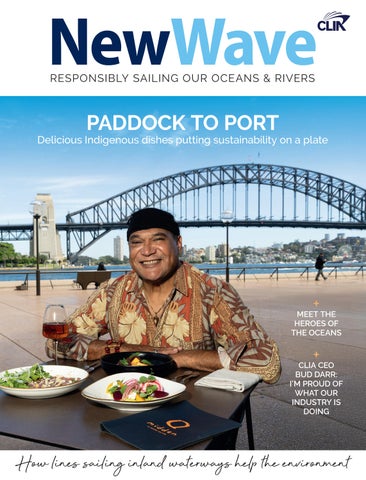
PADDOCK TO PORT
Delicious Indigenous dishes putting sustainability on a plate
+
MEET THE HEROES OF THE OCEANS
+
CLIA CEO BUD DARR: I’M PROUD OF WHAT OUR INDUSTRY IS DOING
How lines sailing inland waterways help the environment CLIA25_001_OFC.indd 1
8/8/2025 5:01 PM
OUR COMMITMENT TO SUSTAINABILITY RUNS DEEP Our purpose is to deliver unforgettable happiness to our guests by providing extraordinary cruise vacations, while honouring the integrity of every ocean we sail, place we visit and life we touch. Carnival Corporation & plc, the world’s largest cruise company, is leading the way in sustainable cruising, by promoting positive climate action, partnering with the communities we sail to and from, and reducing our greenhouse gas emissions. Our ships achieved a 44% reduction in food waste in 2024, compared to 2019, surpassing our target a full year ahead of schedule. We are well on our way towards our 50% reduction goal set for 2030. This is the result of hard work led by our “Less Left Over” food management strategy, finding smart ways to ensure food and ingredients don’t go to waste. Since 2019, we’ve finetuned our provisioning, preparation and meal service practices to minimize waste while further enhancing the dining experience for our almost 13.5 million guests globally every year. We also strive to be collaborative partners with our destination communities, fostering shared value, sustainable growth, and long-term economic activity. There’s no more powerful example of this than Seabourn’s relationship with the Wunambal Gaambera Traditional Owners to help them realise their vision of welcoming guests to country and sharing cultural stories. Seabourn is supporting local artisans develop traditional art using contemporary materials to support economic sustainability in WA’s Kimberley region – a cruise industry first. Carnival Cruise Line, now sailing year-round from Sydney and Brisbane, supports the community by raising funds for the Sydney Children’s Hospital Foundation and the Queensland Children’s Hospital Foundation on every cruise in Australia, through its Conga for Kids Deck Parties. In the beautiful Conflict Islands of Papua New Guinea, our guest-funded Pacific Partnership program has been helping turtle conservation for many years. Princess Cruises guests support conservation and culture projects in New Zealand; safeguarding native birds in the Bay of Islands, expanding efforts to support building habitat for an emerging Blue Penguin colony in Otago and the preservation of a penguin colony. Carnival Corporation is committed to the shore power project at Sydney’s White Bay cruise terminal, which will allow our ships to “plug-in” and reduce engine emissions and noise. From Australia to New Zealand and around the South Pacific, our crew and guests have the privilege of exploring many incredible cultures, environments and ecosystems – constant reminders of our incredible planet, and our shared responsibility to protect it. It’s a responsibility we take very seriously. We’re taking aggressive climate actions to minimise our environmental footprint and advance our long-term sustainability vision, including pursuing net zero GHG emissions from ship operations by 2050. We strive to set a standard of sustainability for the travel industry and be an example of environmental excellence for the world. You can read more about our commitment to the planet at www.carnivalcorp.com/impact
2
c ruising.org.au
CLIA25_002_003_Carnival_Welcome & Contents_indd.indd 2
8/8/2025 5:10 PM
NEW WAVE: WELCOME
A HUGE AMOUNT OF PROGRESS
A
round the world, cruising has never been more popular than it is today. An enormous amount of investment, creativity and innovation has resulted in a spectacularly diverse and vibrant sector. For the traveller, that means an incredible choice of experiences in virtually every corner of the world, resulting in record numbers of guests and very positive forecasts for the future. At the same time, another evolution has been building behind the scenes, creating an industry that is resoundingly focused on sustainability, environmental protection and responsible tourism management. CLIA cruise lines were the first in the maritime sector to announce a united pursuit of net-zero emissions by 2050, and we can already see a huge amount of progress today. Central to this transformation are the massive investments cruise lines are making in the fleet of the future. By the end of 2036, a total of 81 new ships are set for launch, with a combined value of nearly US$70 billion. These new vessels will be among the most advanced and efficient ships ever built. Importantly, more than half of these ships will be able to utilise liquefied natural gas (LNG) as a transitional fuel, which
significantly reduces greenhouse-gas emissions compared to traditional marine fuels. Even better, these ships will be able to transition to future sustainable fuels. Meanwhile, ships are already sailing today with other innovations such as advanced propulsion systems, energy-saving hull designs, sophisticated software to maximise efficiency, and wastewater treatment systems that surpass international standards. We are also seeing pilot projects to refine other sustainable alternatives such as hydrogen fuel cells, electric batteries and hybrid propulsion systems. Beyond reducing emissions, sustainability also involves a strong commitment to destination stewardship. Cruise lines are working closely with local communities to ensure that cruise tourism brings economic benefits while minimising impacts on local environments and cultures. On the following pages, you can read more about some of the many ways cruise lines are investing in sustainability, protecting the marine environment and delivering meaningful benefits in the communities they visit. Joel Katz Managing Director in Australasia, Cruise Lines International Association (CLIA)
Contents 4/ Helping hands Cruise lines’ support for aid and conservation agencies. 6/ From paddock to port Cruise-ship dining, from sustainable food sourcing to exploring culture through cuisines. 8/ Three steps to net zero An interview with Bud Darr, President and CEO of the Cruise Lines International Association. 10/ Explore. Protect. Inspire. Aurora Expeditions is an ambassador for the protection of the world’s most remote regions.
20 12/ Cruise heroes Building strong bonds with communities and Indigenous peoples onshore. 14/ The luxury of experience Extraordinary experiences with Heritage Expeditions. 16/ Spreading the love River cruise lines opening up new destinations such as the Magdalena in Colombia.
18/ Oceans of discovery Ponant’s responsible tourism and meaningful voyages. 20/ Meaningful moments How cruise lines are ensuring all aspects of their operations are more sustainable. 22/ People power Cruise lines’ citizen-science programs allow guests to be part of the discovery process.
New Wave (2025) is published by Big Splash Media Pty Ltd in partnership with Cruise Lines International Association Australasia. All rights are reserved. Reproduction in whole or in part without written permission of the publisher is strictly prohibited. Opinions expressed are those of the individual contributors and are not necessarily shared by the publisher. All reasonable efforts have been made to ensure information is correct at time of going to press. Any advice is of a general nature and information should be checked with a CLIA travel agent before booking cruise holidays. © Big Splash Media Pty Ltd bigsplashmedia.com.au This magazine is printed on sustainable paper stock using inks created from natural substances. Cover: Mark Olive at Midden restaurant.
PEFC/21-31-119 PEFC Certified Paper from sustainably managed forests and controlled sources pefcaustralia.org.au
cruising.org.au
CLIA25_002_003_Carnival_Welcome & Contents_indd.indd 3
3
8/8/2025 5:12 PM
NEW WAVE: GIVING BACK
Helping Hands
CRUISE LINES ARE JOINING FORCES WITH AID AND CONSERVATION AGENCIES TO SUPPORT SUSTAINABILITY AND HUMANITARIAN EFFORTS IN THE DESTINATIONS THEY VISIT. HERE ARE SOME INSPIRING EXAMPLES.
1.
3.
NCL cleans up waterways Norwegian Cruise Line’s Take 3 for the Sea is a not-for-profit program that focuses on reducing plastic pollution in Australia’s oceans and waterways. Recently, NCL supported Flight Centre’s Volunteer Day, where 234 kilograms of rubbish was collected, 100 kilograms more than in 2024, in volunteer clean-up events across Australia. The key message of Take 3 is to pick up three pieces of rubbish each time you visit a beach, park or waterway. NCL also supports the cause by sponsoring the Take 3 Surf Life Saving Program, now reaching 45 clubs nationwide.
4.
MSC’s marine conservation effort In April this year, the MSC Foundation celebrated the official opening of its Marine Conservation Center at Ocean Cay in the Bahamas. It serves as a hub for scientists, students and visitors, with interactive exhibits, a lecture hall, a bio lab and a coral nursery. The facility also supports the Super Coral Reefs program, which aims to restore Ocean Cay’s reefs by introducing coral species resilient to environmental stressors. The MSC Foundation hopes to empower future generations of Bahamian researchers and conservationists.
5.
Ponant targets food security
Paul Gauguin’s seagrass research
Ponant Explorations has partnered with Australian food rescue organisation OzHarvest to support actions to minimise food waste and champion food security. With more than a decade of expedition experience in the Kimberley, Ponant is now supporting OzHarvest’s work in Northern Australia, helping to deliver quality food to those who need it most. In the Northern Territory, OzHarvest distributes 350 kilograms of essential food hampers each week and operates a pop-up store in the Jabiru community, improving access to fresh, nutritious food in the remote region.
Paul Gauguin recently hosted a team of Australian experts to study French Polynesia’s seagrass habitats and their potential to capture carbon dioxide. They discovered seagrass in previously undocumented locations, collecting valuable data. These findings will support scientific research and help to emphasise the global importance of the region’s seagrass ecosystems. The small ship’s unique access to remote sites and ability to provide diving support made this important research possible.
Carnival driving change in Alaska
Disney nurtures Caribbean youth
Carnival Cruise Line has recently implemented several environmental initiatives in Alaska aimed at more sustainable operations. The line donated US$50,000 ($76,600) to the Alaska Carbon Reduction Fund, which installs energy-efficient heat pumps for low-income households, reducing heating costs and carbon emissions. In Juneau, Carnival Corporation’s tour company replaced eight standard buses with four double-deckers, leading to 400 fewer bus trips per year, less traffic and lower emissions in the city.
Disney Cruise Line’s Treasure Tomorrow initiative helps empower Caribbean youth with career exploration and environmental stewardship. In Tortola, students in the Youth Empowerment Project toured Disney Treasure, learning about careers in hospitality and maritime operations. Similar programs in Grand Cayman and Falmouth gave students insight into shipboard careers through visits and virtual sessions. Disney Treasure crew members also join St Thomas students on beach patrols to protect nesting sea turtles and raise conservation awareness.
2.
4
cruising.org.au
CLIA25_004_005_Helping Hands.indd 4
6.
cruising.org.au
4
8/8/2025 5:13 PM
7.
Kicking goals for Tera Fourteen-year-old Tera lives in a fishing village in Madagascar. At age one, he suffered severe burns which fused his foot to his ankle. He was unable to wear shoes, struggled to walk and was sidelined from his greatest passion, playing soccer. With no access to treatment he had little hope – until Mercy Ships offered free surgery aboard its hospital ship. A successful operation restored his mobility. Now back home, Tera can walk with ease and he proudly plays goalkeeper for his village team. The cruise industry is a major supporter of Mercy Ships, a global charity that deploys hospital ships and medical workers to developing nations.
CLIA25_004_005_Helping Hands.indd 5
8/8/2025 5:14 PM
NEW WAVE: WASTE WISE Sourcing local and regional produce for ships in Australia helps reduce transport emissions, supports local farmers and growers, and ensures high-quality, fresh food makes it on board.
From Paddock to Port
TODAY’S CRUISE PASSENGERS CARE ABOUT NOT JUST WHAT’S ON THEIR PLATE BUT WHERE IT COMES FROM. ISABELLE JAMES TALKS TO THE CULINARY VISIONARIES REDEFINING ONBOARD DINING.
F
eeding an entire cruise ship is no small feat – just ask Carnival Corporation. For each nine-day voyage in Australia, the crew loads up to 250 pallets of food onto a single ship. This includes roughly 4000 kilograms of beef, 9800 litres of milk, 850 kilograms of apples and 120 kilograms of Vegemite. Culinary experiences have become a defining feature of modern cruising, offering guests variety, quality and innovation. But now, passenger expectations are evolving. In response to this shift in mindset and the growing emphasis on traceability, cruise lines are prioritising sustainable practices in their supply chains. In 2024, Carnival Corporation sourced $250 million worth of food and beverage from Australian and New Zealand suppliers, compared to $70 million in 2019.
6
/ SUSTAINABLE SOURCING Celebrity chef Luke Mangan is no stranger to high standards. With more than 10 restaurants across land and sea, including his popular Luke’s Bar & Grill and Luke’s Burger Bar aboard Carnival Encounter and Carnival Adventure, Mangan has built a culinary empire rooted not just in flavour, but in responsibility. “Sustainability isn’t just a trend, it’s essential,” he says. “It affects the quality of the produce, the people behind it, and the experience we serve to guests.” For Mangan, sustainability starts at the source. Whether it’s grass-fed, MSA-approved Australian beef, free-range eggs or responsibly caught seafood, the focus is on making sustainable choices wherever possible. The results are not just ethically sound – they’re delicious. “You can taste the difference when food is grown or raised with care. A naturally ripened tomato or a steak from grass-fed cattle – the flavour’s just next level,” says Mangan. “Sustainability leads to higher quality produce, and at the end of the day, flavour is everything. We don’t compromise just because we’re at sea. If anything, it makes us even more conscious of how and where we source from.” Even in more casual settings like Luke’s Burger Bar, sustainability remains a key ingredient in the menu. “Fast food doesn’t have to mean lesser quality. At Luke’s Burger Bars, we use Aussie grass-fed beef, free-range chicken and sustainable packaging. We partner with producers who are committed to reducing their environmental impact, and we constantly review how we can improve.” A key part of Mangan’s ethos is forming long-term relationships with trusted producers, many of them small, family-run Australian farms and fisheries. “Personally, I stay involved. I visit farms, speak with growers and work with teams who share the same mindset. We choose local east coast produce to reduce food miles, respect seafood quotas, and never stop asking questions. One example is Shimo Wagyu. We work with them because of their commitment to sustainability, from responsible farming practices to full traceability. They care deeply about animal welfare, the environment, and producing beef the right way.”
Clockwise, from above: Canapés crafted with care; Chef Luke Mangan; Indigenous food champion Mark Olive; Shimo’s prized Australian Wagyu cattle.
cruising.org.au
CLIA25_006_007_Food.indd 6
8/8/2025 5:16 PM
MARK OLIVE CULTURE THROUGH CUISINE
It’s not just a professional obligation; Mangan sees it as a personal responsibility. “As chefs and restaurateurs, we have a voice and a responsibility,” he says. “We’re the bridge between producers and the public. We can influence how people think about food and help shift the industry toward a more sustainable future.”
/ BEHIND THE SCENES Behind every delicious dish on board is a meticulously coordinated supply chain delivering fresh produce to each cruise ship. Steve Biviano, the general manager of Select Fresh Providores, has long been supplying local produce to cruise companies visiting Australia. Select Fresh supplies some of the world’s leading cruise lines, including Princess Cruises, Disney Cruise Line, Royal Caribbean and Carnival Cruise Line. Their work covers all ports across Australia, New Zealand and the South Pacific. Biviano says it takes an army to keep us fed on our cruise – a single nine-day voyage on a ship such as Diamond Princess can consume around 4000 apples, 1500 kilograms of potatoes and 1000 bunches of bananas. Sourcing local produce is a key priority for the company, both to reduce food miles and to support regional Australian farmers. Depending on the season, lettuce may be sourced from the Lockyer Valley, tomatoes from Bundaberg and apples from Stanthorpe. “We work closely with farmers across Queensland, New South Wales and Victoria to ensure fresh, seasonal produce makes it on board – and we’re constantly reviewing regional supply to align with what’s freshest,” says Biviano. The company is particularly proud of its partnership with food distributor Creative Native, which distributes native Australian ingredients sourced directly from Indigenous communities and growers. “Through this initiative,” says Biviano, “cruise passengers can experience uniquely Australian flavours – like Davidson plum, Kakadu plum or saltbush – that not only taste incredible but also support sustainable Indigenous agriculture and storytelling.” He also emphasises that sustainability extends beyond just the produce – Select Fresh integrates eco-conscious practices throughout its operations. This includes route optimisation technology to cut down on transport emissions, using compostable and recyclable plastic alternatives, and diverting food waste from landfill through donations and composting programs.
•
F
or Bundjalung man and acclaimed chef Mark Olive, working with cruise lines Silversea and Cunard was an obvious fit. “They’re iconic,” he says. “The clientele are curious and open to new flavours.” Olive led Silversea’s Sea and Land Taste program on a visit to Uluru last year. S.A.L.T. offers immersive cultural experiences, revolving around unique foods. Sharing Indigenous Australian culture on a global platform has a deep personal significance for Olive. “Food breaks down all barriers,” he says. “It gets people talking and wondering about what they’re tasting.” Among the ingredients he showcases are aniseed myrtle, which carries a deep, licoricey aroma, and bush tomato, or kutjera, which is smoky, bitter and raisin-like, adding bold flavour to many of his signature dishes. “These ingredients are so unique to this land,” he says. “You can’t get them anywhere else.” Olive has been making his wattle-seed pavlova for more than 30 years. “I top it with wattle-seed cream and a compote made with quandong, Davidson plums and rose petals.” His other signature dishes include wallaby shanks, kangaroo lasagne made with bush tomato, and a version of filet mignon starring kangaroo loin with warrigal greens and pepperberry jus. “I used to serve possum, too,” he says, laughing. “It was slowcooked in merlot, kind of like
osso buco. It’s delicious with aniseed myrtle.” Beyond the food, the voyages offer guests a look at Indigenous culture, with dance performances, welcome to Country ceremonies and visits to communities. “It was a real eye-opener for a lot of people,” says Olive. “And food is what brought everyone together.” Sustainability and community are cornerstones of Olive’s philosophy. “Wherever possible, we use ingredients grown and packaged by Indigenous businesses,” he says. He sources many of his herbs and plants from IndigiGrow, a native plant nursery at La Perouse Public School in Sydney. “They propagate all of the plants there, and it’s a great thing for the school, because the kids are a part of that,” he says. Olive also emphasises that sustainability is inherent to Indigenous foods. “We should be eating kangaroo and emu,” he says. “They’re soft-padded animals that don’t drag up the dirt and damage the topsoil like cattle do. They’re much better for the environment. We’ve embraced cuisines from every other culture, but we’ve overlooked what’s right here in our backyard.” Whether at sea or on land, Olive’s mission remains the same: to honour Indigenous culture, uplift communities and celebrate the incredible bounty of the Australian landscape.
cruising.org.au
CLIA25_006_007_Food.indd 7
7
8/8/2025 5:16 PM
NEW WAVE: INTERVIEW
Three Steps to Net Zero Q&A WITH BUD DARR, PRESIDENT & CEO, CRUISE LINES INTERNATIONAL ASSOCIATION (CLIA)
Q: The cruise industry has an ambition to pursue net-zero cruising by 2050. What are the top three technological innovations or developments? A: Pursuing net-zero emissions by 2050 depends on three core technological pillars. First, the transition to low- and zero-emission marine fuels – by increasing the uptake of alternative fuels as they become available at scale. Second, the deployment of fuel-flexible engine systems that enable ships to utilise future fuels as they become available. Third, the integration of advanced energy-efficiency technologies – such as air lubrication, waste-heat recovery, optimised hull coatings and smart energy-management systems. Energy-efficient solutions are already being introduced across new builds and retrofits, and they make a difference. Q: What are the most impactful operational efficiencies? A: Cruise lines have been early adopters or drivers of onboard technologies that are contributing incrementally to energy efficiency gains, which – while not sufficient alone – are essential components of a broader decarbonisation strategy. For example, cruise lines are optimising routes and speeds using AI and weather modelling to reduce fuel use. Onboard technologies include smart HVAC systems, low-flow water fixtures, air lubrication and special hull coatings – to name a few. Q: What are CLIA’s initiatives regarding waste management and water conservation? A: The cruise industry and our cruise line members are deeply committed to the protection of marine ecosystems through environmental technologies and practices that include responsible wastemanagement models, including systems designed to minimise landfill disposal where possible. Water conservation and the ability to produce up to 90 per cent of freshwater needs onboard significantly reduces reliance on local resources. 8
As cruises often visit fragile ecosystems like the Galápagos Islands, sustainability is a major focus, including eco-friendly ships, strict environmental policies and wildlife conservation.
Q: Tell us about the community partnerships that you find to be the most meaningful. A: Some of the most meaningful examples of cruise-industry partnerships are found in Australia, New Zealand and the South Pacific, where cruise lines are collaborating with Indigenous communities to co-develop tourism experiences that are authentic, respectful and community-led. These types of collaborations are built on trust and shared values, with a focus on cultural integrity, responsibility and economic inclusion. In Australia, for example, cruise lines are working with Aboriginal and Torres Strait Islander communities to co-create shore excursions that reflect local stories, practices and traditions. In New Zealand, partnerships with iwi Māori and tourism groups are helping to ensure that cultural tourism experiences are aligned with tikanga (customs) and led by mana whenua (local Māori iwi). These types of programs go beyond transactional tourism – to support culturally authentic and locally led experiences.
Q: Which recent initiative are you most proud of from the cruise industry? A: What I’m most proud of is the cruise industry’s unified, global commitment to decarbonisation – grounded in sciencebased goals and backed by growing investments, multi-stakeholder collaboration and a commitment to third-party validated reporting and continuous improvement. In Australia, collaborative work with ports has moved from dialogue to funded shore-power plans. Globally, we are seeing the uptake of onboard systems and practices that support biodiversity and cultural stewardship. The momentum is real, and so is the accountability – cruise lines are publishing environmental data, pursuing ambitious decarbonisation objectives and working in lockstep with suppliers, regulators and destinations. That level of industry-wide alignment – where commercial innovation meets shared environmental responsibility – is what sets the cruise sector apart. And that is what I’m most proud of.
•
cruising.org.au
CLIA25_008_009_CLIA_RCI_indd.indd 8
8/8/2025 5:17 PM
SEA THE FUTURE At Royal Caribbean Group, our mission is to deliver the best holiday experiences responsibly. We SEA the Future and are committed to sustaining the planet, energising communities, and accelerating innovation. From bow to stern we innovate, designing the most efficient ships possible to move us closer to achieving Destination Net Zero – our vision for net-zero emissions by 2050.
SUSTAINING OUR PLANET
We are dedicated to sustaining our planet by improving our energy efficiency, treating the water we use, and keeping our waste from landfills.
ENERGISING COMMUNITIES
We take pride in celebrating & energising the communities we visit by inspiring future generations, celebrating local cultures, supporting and economic vibrancy.
ACCELERATING INNOVATION
We dream and pioneer cutting-edge technologies and best-in-class experiences – partnering with the best minds to accelerate innovation in the industry.
Learn more at royalcaribbeangroup.com/sustainability.
CLIA25_008_009_CLIA_RCI_indd.indd 9
8/8/2025 5:17 PM
NEW WAVE: COLLABORATION
FOR MORE THAN 30 YEARS, AURORA EXPEDITIONS HAS BEEN AT THE FOREFRONT OF PIONEERING RESPONSIBLE SMALL-SHIP ADVENTURES TO THE PLANET’S MOST REMOTE PLACES.
A
urora Expeditions’ itineraries are designed for passengers to push their boundaries, explore with purpose, reconnect with the natural world, and become ambassadors of protecting our fragile environment. The Australian-owned expedition line is a global, Certified B Corporation™, and its cruise operations are 100 per cent carbon-neutral. Aurora Expeditions has also made huge product sustainability enhancements, both in terms of the ships’ hardware and the passenger experience. There are little touches on board its three beautiful purpose-built small ships – Sylvia Earle, Greg Mortimer and the soon-to-launch Douglas Mawson – that you might not notice, but make a huge impact. For its Antarctic seasons, the expedition cruise line has committed to sourcing organic ingredients from Argentinian farms as part of its sustainable food program to reduce food miles. So, expect plenty of grass-fed beef, free-range chicken and eggs, as well as organic fruits and vegetables in the ship’s dining rooms. Additionally, all seafood served on board is certified by internationally recognised
Explore. Protect. Inspire.
bodies, while fish eggs and tuna are not offered on due to concerns of over-fishing. Day six on Sylvia Earle cruises are declared “Sustainable Sea Day” and seafood is not available on the menu. The beauty of Aurora’s ethos is that passengers become involved and part of the journey. The line runs eight special citizen-science programs to collect real-time environmental data. Passengers can take part in surveys of seabirds with ornithologists and naturalists in the Southern Ocean and Antarctic Peninsula. The data gathered contributes greatly to scientists’ understanding of the ages and breeding cycles of these beautiful creatures. Aurora has also hosted three onboard research groups in Antarctica, including Oceanites, a non-profit scientific and
education foundation whose mission involves penguin populations in the Antarctic and Sub-Antarctic regions. The expedition line has also introduced Antarctic Ambassador workshops to inspire guests to take environmental action post-voyage. And on top of that, Aurora focuses on meaningful programming such as Women in Conservation voyages with special guest lecturers and hands-on science. One of its three ships is named after the renowned marine biologist, oceanographer and explorer Dr Sylvia Earle. Each of the vessel’s public decks bears the name of a pioneering female conservationist – Dr Carden Wallace AM, Joanna Ruxton, Sharon Kwok, Bernadette Demientieff, Dr Asha de Vos and Hanli Prinsloo – along with a deck dedicated to Dr Earle herself.
•
Aurora Expeditions’ Sylvia Earle off Danco Island, Antarctica (above left); citizen science projects to monitor changes in fjord phytoplankton (above) and to collect cloud data for weather studies (below).
WHAT MAKES AN ENVIRONMENTALLY FRIENDLY SHIP Aurora Expeditions’ three small, environmentally optimised ships not only visit Antarctica and the Arctic, but also destinations in Europe, Oceania and Asia, as well as the Americas. This is how the line has pioneered sustainability practices across its fleet: Ulstein X-Bow® hulls ensure greater stability in rough seas, allowing the ship to cut through the waves at speed. The hull helps to reduce fuel consumption, minimising the ship’s environmental impact. Shore power capabilities Virtual anchoring systems Selective catalytic reduction Reverse-osmosis water system
• • • • •
10 cruising.org.au
CLIA25_010_011_Aurora.indd 10
12/8/2025 9:18 am
A
Small Ships, Big Adventures For more than 30 years, Aurora Expeditions has pioneered small ship experiential travel to the world’s wildest and most extraordinary destinations, from Antarctica to the Arctic and beyond. Experience our unique style of exploration, with more time off-ship, small groups, immersive activities, and thoughtful enrichment program, all with a proudly carbon neutral company committed to responsible travel.
Small Ships – a maximum of 130 travellers
Antarctica & The Arctic
More Time Off-Ship
Ross Sea & East Antarctica
33 Years of Pioneering Exploration
Positive Impact Travel
Australia & New Zealand Subantarctic Islands
Education & Enrichment
Oceania & Asia
World Leading Activity program
Latin America
Relaxed Onboard Atmosphere
British Isles & Ireland
World-Renowned expert guides, ratio 1:7
Atlantic Coast
Mediterranean
For more information and to book, contact your preferred travel advisor or Aurora Expeditions AU: 1800 637 688 | NZ: 0800 447 042 | aurora-expeditions.com/au
CLIA25_010_011_Aurora.indd 11
8/8/2025 5:19 PM
NEW WAVE: DESTINATION STEWARDSHIP
Cruise Heroes
CRUISE LINES ARE CONTINUALLY STRENGTHENING THEIR RELATIONSHIPS WITH LOCAL COMMUNITIES WORLDWIDE, ENSURING THAT EVERY VISIT GOES BEYOND A BRIEF STOP. ISABELLE JAMES LOOKS AT HOW THE INDUSTRY STEPS UP TO HELP OUT.
B
uilding strong bonds with communities worldwide is a top priority for cruise lines, as they champion sustainable initiatives and collaborate closely with the people who welcome us to their shores. They’re working to foster lasting connections, support local livelihoods and create meaningful cultural exchange. Last year, Seabourn was the first cruise line to appoint Traditional Owners as godparents of a ship. The naming of the Wunambal Gaambera Traditional Owners as godparents to Seabourn Pursuit serves as a symbolic gesture of stewardship and responsibility toward the environment and communities. The line has worked alongside the community over the past 12 months so guests can learn about their unique Uunguu Experience. This includes the sharing of
12
Celebrity Cruises’ partnership with Galápagos National Park sees guests view wildlife (above) and plant seedlings (right).
their Wanjina Wunggurr culture through welcome and smoking ceremonies; rock art tours; junba song and dance; and art and stories from the Uunguu Rangers. In addition, Seabourn supplies the Wunambal Gaambera Aboriginal Corporation with pearl shells and art supplies to foster sustainable, commercial arts and craft initiatives. Responsible travel now shapes every journey and shore excursion. Ponant Expeditions has forged links with remote communities in Northern Canada, offering the world’s first-ever cruise on the St Lawrence River in the winter season, in a region where supply by sea is prevented by thick ice between October and mid-July. Ponant’s Le Commandant Charcot is no ordinary ship – its powerful icebreaking hull allows it to reach remote Arctic communities as early as May, a full two months before any other vessels could typically arrive. In May 2023, it provided a much-needed delivery to the villages of Tasiilaq and Ittoqqortoormiit, transporting provisions and bringing an early end to their long winter isolation. Not only does this give Le Commandant Charcot’s arrival a clear sense of purpose when cruising to such a remote region, but it also helps lower food costs for local communities. During this time of year, supplies typically arrive by air, driving up prices, so a port visit from the ship is both practical and warmly welcomed. Aurora Expeditions’ work in Greenland and the Northwest Passage focuses on facilitating organic interactions with the local community, all the while allowing passengers to learn about the region’s peoples and culture. To achieve this, Aurora has partnered
cruising.org.au
CLIA25_012_013_Cruise Heroes.indd 12
8/8/2025 5:21 PM
with the Oxen Network, an Inuit-led, not-for-profit organisation. Shifting attention from icy polar regions to the sun-drenched islands of French Polynesia, Paul Gauguin has partnered with local health authorities to expand access to healthcare in some of the archipelago’s most remote communities. The initiative, named “Taote Gauguin” (taote means “doctor” in Tahitian), provides residents with medical consultations from the ship’s doctors during scheduled port calls. In one of the program’s early efforts, two patients from Fatu Hiva received ultrasounds on board, an essential service unavailable locally. Another important aspect of the initiative is the offer of free transportation for medical specialists aboard MS Paul Gauguin to remote islands. This has significantly improved access to healthcare services in hard-to-reach areas. By bringing medical specialists from Tahiti to the Marquesas, the program will double the region’s existing medical services. While some forms of community support, such as delivering supplies to polar regions or offering medical care in remote islands, may appear more immediately impactful, Royal Caribbean’s celebration of the inaugural Australian Food Hero Awards played a meaningful role in advancing food education and awareness across Australia. The Awards were held aboard Royal Caribbean’s Ovation of the Seas, with renowned chef and childhood-nutrition advocate Jamie Oliver hosting the event and shining a spotlight on local food
heroes. Categories included Food Educator of the Year, the Food Kindness award, the Food for Movement award, the Community of School Food Champion award and the Food Entrepreneur of the Year. Chosen from 1200 entries across Australia, the winners hailed from a diverse range of communities, including the Mulan Aboriginal Community in Western Australia; Mooroopna and Melbourne in Victoria; Kalkaringi in the Northern Territory; and South Albury in New South Wales. Not only are the winners recognised for their work in promoting healthy eating, inspiring the next generation and fundraising for local food charities – they also received some amazing prizes, including a Royal Caribbean cruise for two. Celebrity Cruises, another leading cruise line dedicated to driving positive impact, celebrated the 10th anniversary of its Rewilding Galápagos initiative in partnership with the Galápagos National Park. This effort centres on restoring the archipelago’s unique ecosystems by planting Scalesia seedlings, an endemic tree species vital to the region’s natural habitat. Celebrity passengers have helped plant more than 85,000 of these native trees, highlighting not only their commitment but also the dedicated efforts of park rangers and naturalist guides to preserve the Galápagos ecosystem. The project continues to thrive, offering every passenger aboard Celebrity Flora’s 2027 Galápagos sailings the opportunity to actively participate in this impactful reforestation effort.
•
The Rewilding Galápagos initiative … centres on restoring the archipelago’s unique ecosystems by planting Scalesia seedlings.
NEW WAVE BY THE NUMBERS
61%
of ships can use on-shore power Currently, more than half of all cruise ships are equipped to connect to on-shore power, which allows them to shut down their engines while berthed to reduce emissions. Nearly 80% of the fleet is expected to be equipped by 2028, and CLIA cruise lines have committed to 100% goal by 2035.
90%
of ships can generate fresh water Cruise lines employ advanced water conservation techniques and sophisticated onboard freshwater production systems. The majority of ships generate their own fresh water directly onboard, reducing reliance on external sources in water-scarce regions.
$8.43b
is the value of cruise tourism to Australia Cruising provides enormous economic benefits to local communities. The industry supports more than 26,000 jobs in Australia. In New Zealand, cruise tourism is worth NZ$1.37 billion a year and sustains almost 10,000 jobs.
<1%
of ships worldwide are cruise ships And cruise passengers make up only about 2% of world tourism. Nevertheless, cruise lines are taking a leadership role in moving the maritime sector to net-zero.
cruising.org.au
CLIA25_012_013_Cruise Heroes.indd 13
13
8/8/2025 5:21 PM
NEW WAVE: COLLABORATION
P Clockwise, from left: Meeting the Kwaio people of Malaita in the Solomon Islands with Heritage Expeditions; visiting Scott’s Hut at Cape Evans on Ross Island, Antarctica; Malaita Island.
The Luxury of Experience
TAKING PART IN RARELY SEEN SACRED DANCES ON REMOTE TROPICAL ISLANDS AND ASSISTING LEADING PENGUIN SCIENTISTS IS ALL PART OF THE HERITAGE EXPEDITIONS DIFFERENCE.
E
xpedition cruise pioneer Heritage Expeditions was founded on the luxury of experience, and Australasia’s only family-owned and -operated expedition cruise company has a 40-year legacy of responsibly sharing extraordinary experiences with its guests. A combination of unrivalled expedition cruise experience exploring some of the world’s most remote shores and islands, and decades-long relationships nurtured by the owners of Heritage Expeditions, the
Russ family, gives guests access to life-changing experiences alongside a leading cruise expedition team. It’s the Russ family’s enduring friendship with Chief Esau Kekeubata of the Kwaio people of Malaita in the Solomon Islands which gives Heritage Expeditions’ guests the exclusive opportunity to observe a dance so sacred they have to be invited to take part in order to see it. And taking part means wearing the traditional costume consisting
of a vine belt and one leaf, for both male and female participants. Further south, those wanting to follow in the footsteps of Antarctica’s heroic explorers have the unique opportunity to step inside Scott, Shackleton and Borchgrevink’s historic, perfectly preserved huts and time capsules alongside Heritage Expeditions guide Al Fastier. Fastier led the conservation and preservation of the huts during his 18-year tenure with the Antarctic Heritage Trust and can reveal where he found five crates of whisky encased in ice under Shackleton’s 1908 Antarctic base, along with the restoration work he carried out at each hut. Guests wanting hands-on, authentic citizen-science experiences can assist leading penguin scientist and University of North Carolina Professor Steve Emslie in the collection of penguin bones and egg shells thousands of years old from the world’s largest and oldest Adélie penguin colony at Cape Adare. Home to more than 338,000 breeding pairs of birds, the colony has the longest fossil record of any seabird in Antarctica and provides insights into how the penguin has adapted to climate change and provided significant scientific discoveries. There’s also the opportunity to collect air flask samples for GNS Science (now Earth Sciences New Zealand), something Heritage Expeditions has been doing for 10 years. The samples help scientists understand how the Southern Ocean is slowing climate change as the world’s most important ‘sink’ for man-made carbon dioxide, and the impact this is having on the ocean. As with all Heritage Expeditions voyages and adventures, these experiences are just the tip of the iceberg when it comes to incredible guest opportunities available.
A
C
•
14 cruising.org.au
CLIA25_014_015_Heritage Expeditions.indd 14
Fre 8/8/2025 5:22 PM
PIONEERS IN RESPONSIBLE & SUSTAINABLE TRAVEL 40+ years of adventure & 50+ years of conservation
RED IN AS FEENAATSTUTRAVELER’S COND LACES 25 BEST P 2025
TO GO IN
Proud members, partners and supporters of:
Freephone 1800 143 585 info@heritage-expeditions.com www.heritage-expeditions.com CLIA25_014_015_Heritage Expeditions.indd 15
8/8/2025 5:22 PM
NEW WAVE: RIVER REVIVAL
RIVER CRUISE LINES ARE GOING DEEPER AND FURTHER, DISCOVERING NEW DESTINATIONS SUCH AS THE MAGDALENA, REPORTS BERNADETTE CHUA.
R
iver cruise lines have long been able to develop unique partnerships with local communities – the clever design and smaller size of their ships allows them closer to land and into ports that larger ships can’t access. Every day, if not twice a day, river lines visit destinations where they contribute to the local economy by bringing passengers into smaller towns and creating enduring relationships with guides and producers. Avalon Waterways, for instance, is a destination partner in each village and city it visits. Guests benefit from exclusive access to authentic, immersive and cultural interactions and experiences in interesting destinations away from the masses. And for the community, the line hires local staff. On the other side of the world, South America has been relatively undiscovered by cruise lines. While some operators such as Uniworld already sail the Amazon in Peru, AmaWaterways has made a commitment to Colombia’s storied Magdalena River. It is the first cruise line to launch on the river, and it hasn’t been an easy task for the company, which is better known for its upscale European voyages. What has been so unique about the launch of AmaWaterways’ ship, AmaMagdalena, is the cruise line’s level of collaboration and consultation on the ground. 16
Spreading theLove
This page, from top: AmaWaterways’ new AmaMagdalena; a warm welcome for cruisers in Cartagena.
cruising.org.au
CLIA25_016_017_Rivers.indd 16
8/8/2025 5:23 PM
Not only was the ship built in conjunction with local builders and artisans, but the cruise line also funded and worked with the community to build port infrastructure. Kristin Karst, co-founder and executive vice-president of AmaWaterways, says, “Until now, exploring the Magdalena River region with comfort and ease was complicated, if not impossible. “The company is focused on enhancing the luxury cruising experience along this river, a new destination for river cruising, ensuring guests enjoy authentic and enriching connections to the region’s culture and heritage.” Co-owner and vice-president of sales Gary Murphy says, “It wasn’t until we started building the docks that the local towns started getting really excited and saying: ‘When you come, this is what we’re going to do for you.’ “Like the little town of Baho, which is known for its jazz. They have a jazz festival, and they’re really excited to perform for people other than the local community. They’re going to put a jazz show on every time we show up,” he says. “Each little town has a wonderful history, starting from the colonial period. The Spanish would bring their gold and silver up into the river to hide it from pirates, and they developed these local communities, and then they stopped operating paddlewheelers in 1962. No one has come by to visit them since, so here we come!” AmaWaterways flew in European engineers and welders to help develop a local skill set, with the help of the Colombian government. Local communities have been working with the cruise line to develop nine custom-designed excursion boats that will provide access for guests to some secluded areas of the river that boast rich biodiversity and are still largely unexplored by holidaymakers. Once operational, it is anticipated that these remote excursions will allow guests to interact with the local communities, journey through natural wonders and access regions that are considered untouched. The itineraries have been curated by AmaWaterways in conjunction with Colombian indigenous communities, providing a benefit for all. Each shore excursion will be guided by experienced locals who aim to enhance the cultural experience while boosting employment opportunities for their peoples along the river.
This page, from top: Tour Cartagena with AmaWaterways; Avalon Waterways supports elephant rescue projects in Kenya.
On board the ships, engagement with the community continues with tastings of local tropical fruit, artisanal chocolate, rum and Colombian coffee. The highlight is the 16-seater onboard restaurant, featuring a Colombian chef who will utilise local ingredients and recipes to showcase the best of the country’s cuisine. At the christening ceremony of AmaMagdalena, AmaWaterways co-founder Rudi Schreiner said the attendance by the Governor of the Bolivar Department and the Mayor of Mompox, along with other dignitaries, indicates the “strong partnerships AmaWaterways has built with Colombia’s public and private sectors over the past three years to bring this pioneering project to life”. “The christening ceremony in Mompox marks a powerful moment not just for AmaWaterways, but for the future of river cruising,” he said. “AmaMagdalena represents years of collaboration, vision and trust between our team and our Colombian partners. By opening the Magdalena River to luxury river cruising, we are laying the foundation for sustainable tourism that will benefit travellers and local communities alike for generations to come.”
•
FLOWING BACK WHAT OTHER RIVER LINES ARE DOING Avalon Waterways supports •several animal-friendly causes
Tauck’s riverboat partner, Scylla, •conducts regular hull-cleaning to
through its Lighthouse Project, including the Sheldrick Wildlife Trust. The trust operates the most successful orphan elephant rescue and rehabilitation program in the world. It works tirelessly to conserve, preserve and protect wildlife, including taking anti-poaching measures, safe-guarding the natural environment and providing veterinary assistance.
ensure low water resistance while sailing, and a cleaner-burning diesel fuel for direct emissions reductions. Uniworld’s parent company, the Travel Corporation, saved food waste to the equivalent of 778,766 meals. The company also tripled its local food suppliers and doubled its organic food producers, while 84 per cent of its itineraries offer at least one local dining experience for passengers.
•
cruising.org.au
CLIA25_016_017_Rivers.indd 17
17
12/8/2025 9:16 am
NEW WAVE: COLLABORATION
Oceans of Discovery AS A LEADING EXPEDITION CRUISE LINE, PONANT HAS LONG CHAMPIONED SCIENTIFIC EXPLORATION AT SEA, EMBRACING THE MISSION WITH THE SPIRIT AND DETERMINATION OF A TRUE SAILOR.
encouraged to share their work with guests through talks, lab visits and informal conversations at sea.
From top: Citizen Science Expedition in the North Pole; Ponant’s scientific co-ordinator Daniel Cron.
F
or more than 35 years, Ponant Explorations has been committed to responsible tourism and meaningful voyages of exploration. Founded by a group of Merchant Navy officers in 1988 and driven by a deep respect for the natural world, the Frenchflagged fleet of small ships now numbers 14 and is designed to tread lightly while navigating some of the most remote and fragile regions on Earth. Ponant Explorations continues to strengthen its engagement with the scientific community, offering its fleet as a platform for meaningful, collaborative research. What began with the first scientists sailing in passenger conditions in 2014 has evolved into a pioneering initiative, supported by dedicated onboard laboratories, a growing network of institutional partnerships and a structured approach to delivering long-term impact as a part of the Ponant Science program.
Since the program’s launch in 2021, five ships in the fleet have now hosted scientific missions, with an annual value of approximately €2 million ($3.54 million) committed to supporting marine and environmental research. Ponant Explorations has welcomed 230 researchers on board, offering 3910 nights at sea for scientific work in some of the most remote and understudied regions on Earth. With 88 missions already completed, the Ponant Science program supports critical studies on subjects such as the effects of climate change, biodiversity loss, micro-pollution and human impact on the natural world. Ponant Explorations has formalised its commitment with a dedicated Scientific Department, embedding research into the core of its mission. This team provides consistent support to onboard researchers, ensures open access to collected data and fosters collaboration with the wider scientific community. Scientists are also
t the heart of this initiative is Le Commandant Charcot, the world’s first hybrid-electric polar exploration ship powered by liquefied natural gas. Far more than a vessel, Le Commandant Charcot is a state-of-the-art floating research platform, specifically designed for high-latitude expeditions. Equipped with dry and wet laboratories housing scientific equipment such as a remote underwater vehicle, a conductivity-temperature-depth sensor and a weather station, the ship enables researchers to conduct in-situ studies. In September 2024, Le Commandant Charcot hosted a landmark Transarctic expedition where 20 researchers from six distinct scientific projects sailed from Alaska to Norway over 20 days, crossing the North Pole and enabling access to previously unexplored areas. Ponant Science is also expanding beyond the poles. Since late 2024, vessels have hosted researchers in tropical and temperate ocean regions, including French Polynesia and the Kimberley. Through a new collaboration with the World Ocean Council, Le Paul Gauguin and L’Austral hosted scientific projects in 2024, followed by Le Bellot and Le Soléal in 2025. Through this pioneering program, Ponant Explorations is helping to transform how people travel and why. By connecting science, exploration and storytelling, the company offers guests an opportunity not just to witness the natural world but to be part of its protection. The belief is simple: exploration should serve a greater purpose.
•
Photos: ©PONANT/Mike Louagie.
A
18 cruising.org.au
CLIA25_018_019_Ponant.indd 18
11/8/2025 9:08 AM
The first Zero-Emission Ocean-Going Cruise Ship
Photos: ©PONANT/Mike Louagie.
Innovative multi-energy ship | ECO DESIGN 30 DAYS OF FULL AUTONOMY | 200 PASSENGER CAPACITY
Co-funded by the European Union. Views and opinions expressed are however those of the author(s) only and do not necessarily reflect those of the European Union or the European Climate, Infrastructure and Environment Executive Agency (CINEA). Neither the European Union nor the granting authority can be held responsible for them. Our annual sustainability report can be found at au.ponant.com/more-sustainable-tourism ©PONANT/Stirling Design International. IM013120040.
CLIA25_018_019_Ponant.indd 19
8/8/2025 5:26 PM
NEW WAVE: SAIL LIGHTLY
Meaningful Moments
ISABELLE JAMES DISCOVERS HOW CRUISE LINES ARE HELPING THE ENVIRONMENT WITH SUSTAINABILITY MEASURES THAT NOT ONLY ASSIST THE PLANET BUT ALSO DIRECTLY BENEFIT LOCAL COMMUNITIES.
T
oday’s leading cruise lines are offering more than just drink packages, onboard entertainment and endless shore excursions – they’re giving passengers the chance to travel more sustainably. From procuring responsibly sourced produce and using recyclable materials to boosting local economies, cruise lines are embracing sustainability in ways you might not notice from on board the ship.
/ GO GREEN TOURS Shore excursions are often the most memorable part of a cruise, offering guests the chance to immerse themselves in each unique destination. Cruise lines are increasingly focused on curating authentic, sustainable onshore experiences that support local communities and minimise environmental impact. 20
Cruise passengers are showing growing interest in excursions that offer genuine insights into local life and culture. Regent Seven Seas Cruises’ Go Local Tours and Oceania Cruises’ Go Green Tours are standout examples, both offering sustainability-focused experiences that connect travellers with communities around the world while promoting environmental responsibility. MSC Cruises’ Protectours initiative also champions responsible tourism. In 2023, the line offered more than 190 low-carbon excursions across 100 destinations, ranging from kayaking and hiking adventures to hands-on eco-activities such as beach clean-ups and tree planting. Celebrity Cruises’ itineraries to ecologically sensitive regions, such as the Galápagos and Alaska, are carefully designed to uphold the highest standards
of environmental stewardship. Excursions such as the guided forest hikes around Alaska’s Mendenhall Glacier not only showcase breathtaking landscapes but also educate guests about climate change and its impact on local ecosystems. Princess Cruises places a strong emphasis on cultural connection through the expertise of local guides. Whether offering guests the chance to learn to play bagpipes in Scotland or visit a family-run distillery in Reykjavik, Princess creates intimate, meaningful experiences that foster discovery, connection and support for local economies and communities.
cruising.org.au
CLIA25_020_021_Sustainability Warriors.indd 20
8/8/2025 5:27 PM
Clockwise, from far left: HAL’s Fresh Fish Ambassador, Iron Chef Masaharu Morimoto; lessons with a naturalist on Paul Gauguin; reusable water bottles on Ponant’s cruises; bagpipe lessons with Princess.
/ THOUGHTFUL DINING Mindful dining is another way that cruise passengers can make their holiday more sustainable – and they may not even realise it. Holland America Line is a glowing example, thanks to its Global Fresh Fish Program. This initiative sources more than 80 species of fresh fish from a global network of 60 ports, and transports from port to ship within 48 hours, meaning that guests are fed local, fresh fish and transport emissions are reduced. The program has earned HAL worldwide seafood sustainability certifications – making it the first global cruise line to achieve this distinction. In response to the growing demand for plant-based cuisine, Princess Cruises introduced an expansive vegan menu across the main dining rooms in its 15-ship fleet. Its aim was not just to meet dietary preferences, but to celebrate them. The menu allows guests to try dishes such as plant-based shepherd’s pie, Baja-style cauliflower tacos and stir-fried portobello mushrooms with soy-maple sauce. Feeding a cruise ship is a huge and complex operation, but Avalon Waterways is tackling food waste through its “smart purchasing” plan. By leveraging a sophisticated monitoring and measurement system, the line ensures it only purchases and prepares the food it will actually need. It is also trialling food-waste drying systems on select ships, intending to donate processed waste to local farmers for animal sustenance, which is a practice already in place on its ships sailing in Southeast Asia.
/ EDUCATING THE NEXT GENERATION Sustainability education plays a vital role in fostering long-term environmental stewardship, giving young people the
chance to learn about the importance of conservation. Paul Gauguin Cruises, which is known for its small-ship adventures in remote destinations, created its Moana Explorer program to teach the next generation about the South Pacific ecosystem. The hands-on, interactive learning program combines science activities, crafts, naturalist-led beach excursions, and games. Similarly, Carnival Cruise Line’s STEM programs for children feature engaging marine and environmental
Mindful dining is another way that cruise passengers can make their holiday more sustainable. science activities on board. The remarkable region of Alaska is brought on board Princess Cruises through its immersive North to Alaska enrichment program featuring authentic Alaskan experiences, including local seafood tastings and guest speakers. Royal Caribbean hosts engaging marine biology workshops that ensure learning doesn’t stop at sea. Led by scientists, these workshops teach children to identify species, explore coral reef systems and learn about conservation.
wide waste was diverted from landfills. Plastic pollution in our oceans remains a serious threat to marine life, but cruise lines are stepping up with a range of initiatives. Ponant’s entire fleet has been equipped with specialised Nordic filtration systems, self-serve water fountains that fill recyclable glass containers. This eliminates the need for plastic water bottles, saving nearly one million plastic bottles each year. Norwegian Cruise Line eliminated all single-use plastic beverage bottles fleetwide in 2020 (becoming the first major global cruise line to do so), and replaced them with plant-based carton containers. Paul Gauguin Cruises sets the standards for waste disposal, collecting and storing all chemical and hazardous waste on board for disposal with licensed contractors ashore. To cut down on plastic waste, cabins use refillable toiletry dispensers and drink straws are supplied only on request. All cruise lines follow strict policies around using water and treating wastewater. As a mandatory requirement of CLIA membership, cruise ships do not discharge untreated sewage anywhere in the world during normal operations. Onboard advanced wastewater treatment systems ensure wastewater is processed to standards surpassing those of many coastal shoreside treatment facilities. CLIA’s stringent global wastewater discharge policies exceed regulatory requirements, and member cruise lines must use systems that meet or surpass international standards established by organisations such as the International Maritime Organization.
•
/ TRASH TALK The Royal Caribbean Group’s Save the Waves program is focused on ensuring that all ships are landfill-free. It has introduced waste-to-energy systems on board notable vessels, including Icon of the Seas and Silver Nova, representing an innovative approach to waste management and reduction. In 2023, an impressive 87 per cent of fleetcruising.org.au
CLIA25_020_021_Sustainability Warriors.indd 21
21
8/8/2025 5:27 PM
NEW WAVE: CITIZEN SCIENCE
People Power
FROM SHIPS TO SUBMARINES, CRUISE LINES ARE TAKING CITIZEN SCIENTISTS ALONG A JOURNEY TO ACCESS REMOTE AREAS OF THE WORLD AND BE PART OF THE DISCOVERY PROCESS, WRITES BERNADETTE CHUA.
A
s cruise lines increase their reach around the world, so does their responsibility to educate cruise passengers about the fragile state of our environment. This can manifest in several ways: expedition lines such as Heritage Expeditions, Aurora Expeditions and Ponant host scientists on board their ships, while others might pledge help or funding for research development. Part of the ethos for these cruise lines is that they take their guests on a journey of discovery and education with them. Travelling to the ends of the Earth has resulted in astonishing findings.
/ CHARTING NEW BIODIVERSITY On a Heritage Expeditions “Indonesian Explorer and Discover the Secrets of Melanesia” voyage, guests, along with
22
legendary scientist Professor Tim Flannery, discovered a new mammal species on the rarely visited islands. “My favourite sighting was on Kofiau Island in Raja Ampat. Before our visit, only a single mammal species was known from the island. But over 12 hours there, we documented 19 more, including one of the world’s rarest and most mysterious bats, the Moluccan fishing bat,” says Flannery. “Going to that island was like filling in a huge blank … That is what citizen science is all about. We ended up publishing a significant scientific paper on the findings.” Heritage Expeditions’ expedition leader Aaron Russ recently embarked on a voyage with Ocean with David Attenborough director Toby Nowlan as a special guide on board (see interview at right). “This expedition has its genesis in the work of Alfred Wallace and the fascinating
biogeography of the Philippines and Indonesia,” says Russ. “The itinerary developed and evolved to showcase the very best natural history, landscapes and stories of the region. [It was an] opportunity to explore some of the most remote and pristine corners of the Philippines … Our guests take away the exceptional story of evolutionary adaptation and resilience that has made these islands what they are today.”
/ MARINE REHABILITATION Australian cruise line Coral Expeditions hosts special themed expeditions with expert researchers on board. Next year, the line will visit the Mon Repos Turtle Centre in Bundaberg where guests can participate in species surveys on guided snorkelling sessions, lend a hand to the volunteers at the Cairns Turtle Rehabilitation Centre and
cruising.org.au
CLIA25_022_023_Citizen Science.indd 22
8/8/2025 5:32 PM
learn about how corals are planted and rejuvenated on the Great Barrier Reef.
/ A VOYAGE OF LEARNING For a cruise in 2027, Quark Expeditions has designed an itinerary around looking at the world of whales and seals. Throughout the voyage, guests will learn from naturalist Professor Ari Friedlaender and his team, who focus on new biotelemetry technology to better understand the underwater behaviour and ecology of whales. / DATA COLLECTION AT SEA Aurora Expeditions has a dedicated Citizen Science Program where passengers are encouraged to gather valuable data, which is then shared with the scientific community. The projects focus on the study of seabirds, microplastics, pollution and marine biodiversity, amongst others. In partnership with Happywhales, Aurora Expeditions guests upload photographs of whale sightings to help track marine life globally, helping scientists learn about whales’ movements, population rates, and even survival rates. Similarly, HX’s Polar Citizen Science Collective works with organisations that encourage guests to get involved in projects around animal population surveys, seaweed biodiversity and phytoplankton. / MACQUARIE ISLAND RESEARCH For the past three years, the Ponant Foundation has pledged grants to the Macquarie Island Conservation Foundation in support of its science and research initiatives aimed at understanding the impact of climate change on the island and the recovery of its ecosystem post-pest eradication programs. The island is home to more than 850,000 pairs of royal penguins, an endemic species, as well as king penguins, albatross and seals.
•
Clockwise, from left: Visiting Samar Island, the Philippines with Heritage Expeditions; Ponant supports penguin research on Macquarie Island; snorkelling with Aurora Expeditions in Antarctica.
TOBY NOWLAN A VOYAGE OF DISCOVERY IN THE PHILIPPINES
I
Before our visit, only a single mammal species was known from the island. But over 12 hours there, we documented 19 more…
n July this year, Heritage Expeditions became the first expedition cruise line to visit the remote Philippine islands of Patnanungan, Samar and Matukad. We talk to director of Ocean with David Attenborough Toby Nowlan, who accompanied the cruise as a special guide and guest lecturer. What was the highlight of the voyage? I’ve done many lectures and screenings of Ocean over the last few months – I’ve talked to packed theatres, presidents and prime ministers, heads of industry … yet there was something very special about when I talked to the guests on board the Heritage Adventurer. We had gotten to know each other … so when it came to giving the special guest lecture about Ocean, there was a feeling of connection with everyone on board, and it was especially meaningful and memorable. The reaction to the talk – which involved many tears – was quite overwhelming. What drew you to work with Heritage Expeditions? Heritage Expeditions create truly different itineraries – they design expedition-style voyages that aren’t made by anyone else, to some very special places. It was this unique approach that drew me.
What was the feedback from the passengers? The guests frequently told me they were seeing things and doing things they had never dreamt of. I was often told how they were having an adventure like they’d never had before. The guests also often mentioned how much they were learning – the quality and extent of lectures and knowledge-sharing on board was exceptional. I hope that talking to the guests about Ocean, and showing them the film, contributed to this in some way. How did you meet David Attenborough? I’ve been working on David Attenborough films for 17 years now, so it’s hard to remember how we first met! However, every time I do see David, I’m always blown away by his exceptional talent, passion, professionalism, but also humility and graciousness. To work with David is truly a privilege, though nothing has come close to the honour of directing this film with him. Ocean is surely David’s most reflective, authored and impassioned piece to date, and the culmination of his hundred years showing us the natural world. His final lines of Ocean truly inspire and affect me emotionally every time I hear them.
cruising.org.au
CLIA25_022_023_Citizen Science.indd 23
23
8/8/2025 5:33 PM
PURSUING NET-ZERO EMISSIONS BY 2050 Reducing the carbon footprint of ships while at berth and at sea
A IN LEADING THE WAY AY SUSTAINABLE SAILING Investing in advanced environmental technologies onboard
TOGETHER IN DESTINATION STEWARDSHIP Partnering with cities and ports on sustainable destination management Find out more at cruising.org.au CLIA25_024_OBC.indd 24
8/8/2025 5:20 PM