Industry leaders take top awards at Metals Symposium in London /


BY COLIN MCCLELLAND
Sustainable mining must be the new normal to boost earnings and convince a skeptical public about the industry’s importance to combat global warming as the world enters a metals trade war, Ross Beaty, Rob McEwen and former Conservative Party leader Erin O’Toole say.
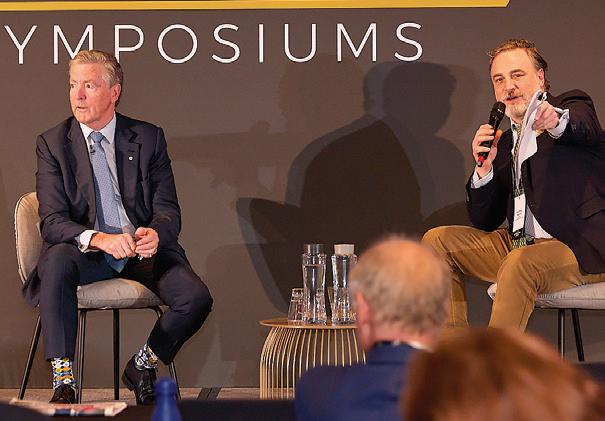
Mining luminaries Beaty and McEwen stressed the importance of tapping renewable energy, eliminating tailings dams and slashing water use as proposed at Equinox Gold’s (TSX: EQX: NYSE-AM: EQX) Greenstone mine in Ontario and McEwen Mining’s (TSX: MUX; NYSE: MUX) Los Azules copper project in Argentina. They spoke on a green metals panel at The Northern Miner’s International Metals Symposium in London Dec. 1-2.
“At the end of the day, it affects your bottom line,” said Beaty, chair of $3.8-billion market cap Equinox Gold. “If you look after the environment, if you look after your employees, if you look after your
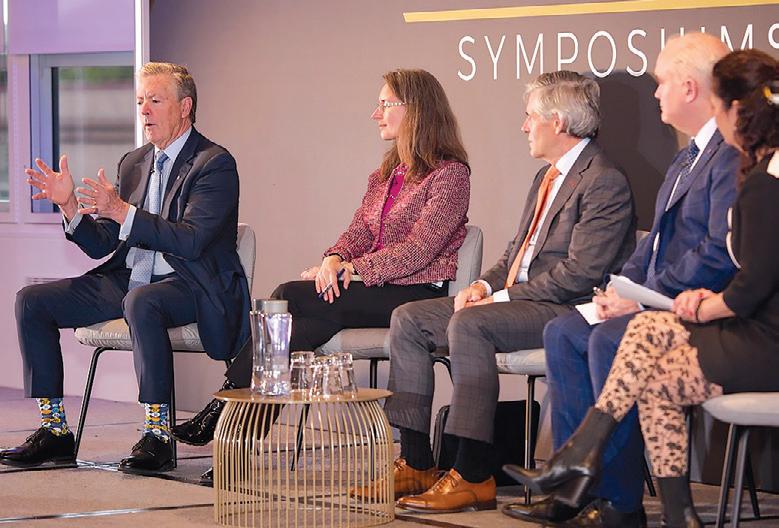
Fellow panelist Nicole Schwab of the World Economic Forum echoed the sentiment with a forecast that critical mineral demand may rise four to six times by 2040 while 16% of mines with those

“At the end of the day, it affects your bottom line... It’s just simple good business.”
ROSS BEATY, EQUINOX GOLD
nature because industries depend
“We are suffering from CO2 tunnel vision,” Schwab said of a fixation on just cutting emissions instead of also saving flora and fauna. “If we look just at the energy transition, we’re missing the point, because we may achieve those targets, but we are going to be on an unlivable
Billions or trillions more dollars are poised to fuel the mining industry as governments pivot to fight climate change. But companies face a slew of challenges after decades of mine accidents and environmental degradation have slammed the sector’s public image. Some miners complain they can’t afford to be sustainable while critical minerals leader China pollutes seemingly unpunished. And now United States president-elect Donald Trump threatens a global trade
war that could cut metal prices and snarl supply chains.
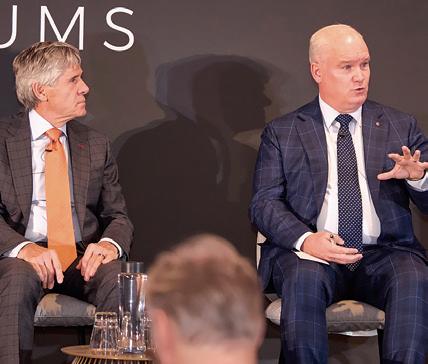
Yet, Canadian miners could benefit from sustainable operations creating their own added value, said O’Toole, a trade lawyer who’s now president of the North American unit of Paris-based business intelligence firm ADIT. The global rules-based liberalized trade order is morphing into a new stage of interventionist tariffs and sanctions, he said.
“Trade is being managed in a range of ways through tariffs, depending on what president-elect Trump tweets on a certain day,” O’Toole said. “But also, you’re going to be seeing managed trade through carbon emissions.”
BRICS challenge
The BRICS nations, led by the namesake Brazil, Russia, India, China and South Africa, but also including Iran, Egypt, Ethiopia and the United Arab Emirates, are considering their own currency to challenge the U.S. dollar. They’re also trying to sidestep the G7’s rising environmental, social and governance (ESG) standards for mining.
“There has to be some sort of policy direction to curtail that and it’s going to be sanctions,” O’Toole said. “It’s going to be carbon, border adjustment tariffs, to recognize that if another country is not pricing in carbon or not reducing emissions, we’re not going to let their products circumvent our own.”
Still, Canadian miners often say
it’s pointless to change ways of generating electricity when they’re a drop in the pollution bucket compared to some other nations, Beaty said.




















Sandvik is the leading partner in mine electrification. Our constantly expanding range of electric equipment produces zero diesel emissions and reduces ventilation and cooling needs in your mine. Our BEV loaders and trucks are designed from the ground up entirely around their battery system and electric driveline. The patented self-swapping battery system enables the industry’s fastest and easiest pit stop.
Go Electric. Go Sandvik.









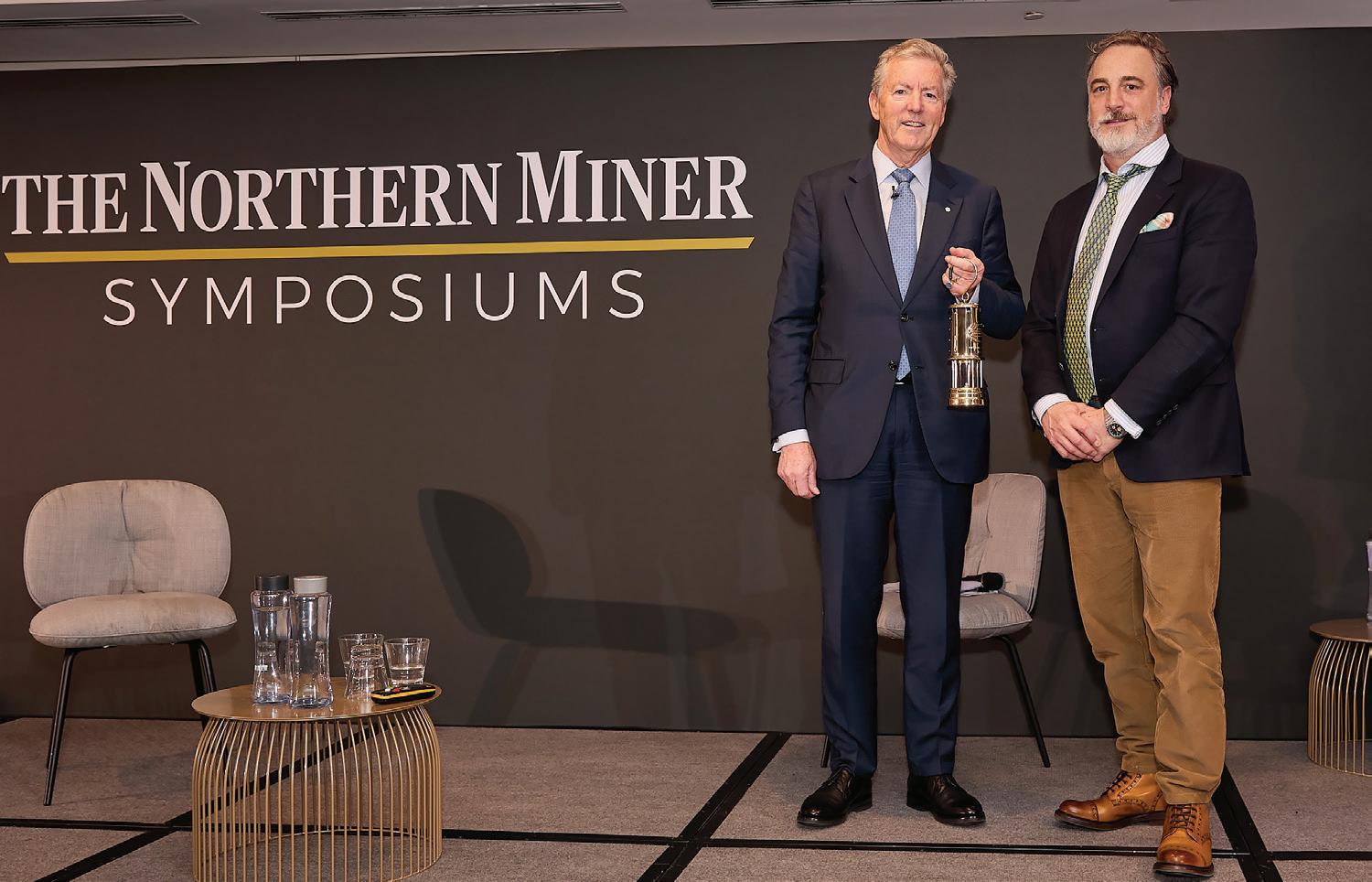
Ross Beaty accepts TNM’s Lifetime Achievement Award from TNM Group president Anthony Vaccaro in London, Dec. 2.
CREDIT: THE NORTHERN MINER
SPECIAL SECTIONS » Global Gold 25
The mining sector saw a sharp uptick in activity last October, aided by an influx of significant drilling results and surge in financings, according to the latest report by S&P Global Market Intelligence.
The Pipeline Activity Index (PAI), which the firm uses to measure the level and direction of overall activity in the mining industry, surged 45% from September to reach its highest level in a year. However, compared to October 2023, the metric was still down by about 4.9%.
S&P reports that the metrics it uses to calculate the PAI were again mostly positive in October 2024. Significant drill results, financings and initial resources all increased, while positive milestones announced by mining companies stayed flat.
Meanwhile, the Exploration Price Index (EPI), which the firm uses to measure the relative change in precious and base metals prices, rose to another record high. However, despite gold hitting all-time highs and a strong monthly showing in base/other metals, mining equities lost steam, and the aggregate industry market cap ended October down 2%.
Companies in the gold sector had the largest increase in financings among the three commodity groups, jumping 412% to more than US$1 billion in October — the highest total since March 2022.
The total number of transactions increased to 315 from 198 in September, while the number of financings valued at more than US$2 million jumped to 97 from 39. There were five transactions valued at over US$50 million, up from one in September.
Lithium Argentina is seeking to redomicile to Switzerland following a corporate review and a new agreement with investor Ganfeng Lithium, the company said on Nov. 29.
The company decided Switzerland was the best jurisdiction on strategic, commercial and legal grounds. It also aims to move the Lithium Argentina group of companies’ operational headquarters to Buenos Aires.
Ganfeng, its joint venture partner in the Caucharí-Olaroz project, has entered into a three-year standstill agreement with the Canadian company.
Lithium Argentina’s plans came about a week after another Canadian developer, Solaris Resources, said its own move to Switzerland from Canada is advancing. Solaris is leaving Canada after the federal government last year began a national security review of China’s Zijin Mining’s plan to invest $130-million in its Warintza project in Ecuador.
A little over two years ago, Ottawa forced Chinese investors to divest from several lithium juniors with assets outside of Canada based on national security concerns.
A special meeting of shareholders to vote on the move is planned for Jan. 17.
BY NORTHERN MINER STAFF
The World Gold Council is skeptical about China’s Nov. 21 claim of discovering a US$83-billion gold deposit in the southeastern province of Hunan.
The Geological Bureau of Hunan Province said it had
found more than 1,000 tonnes of gold (35.2 million oz.) beneath the Wangu gold field in Pingjiang County, the government-run Xinhua news outlet reported. The claim saw widespread mainstream and social media coverage in the following week and a half.
Officials said 300 tonnes (10.5 million oz. gold) had already been identified within 2,000 metres of the surface and extrapolated total resources at 3,000 metres depth to reach the 32 million oz. figure.
Chen Rulin, a geologist at the bureau, said he found visible gold in rock cores. Xinhua reported high-grade intercepts of up to 138 grams gold per tonne at the 2,000-metre-depth range.
But gold council senior market strategist John Reade says it’s not that simple.
“The 1,000-tonne potential resource sounds aspirational,” he said in an emailed response to The Northern Miner. “The 300-tonne figure appears more reasonable—perhaps an inferred or indicated resource. Much more drilling would be needed to turn this into a reserve.”.
He noted that Chinese mineral reporting standards do not align with global frameworks like Canada’s NI 43-101 or Australia’s JORC code. So, independent verification is critical.
BY HENRY LAZENBY
Agnico Eagle Mines is buying O3 Mining for about $204 million in an all-cash deal, the companies said Dec. 12.
The agreement values O3’s shares at $1.67 apiece. The company’s main asset is its prefeasibility-stage Marban Alliance project near Val-d’Or, Que., about 520 km northwest
GLOBAL MINING NEWS • SINCE 1915 www.northernminer.com
PRESIDENT THE NORTHERN MINER GROUP: Anthony Vaccaro, CFA, MBA avaccaro@northernminer.com
INTERIM EDITOR-IN-CHIEF: Colin McClelland cmcclelland@northernminer.com
WESTERN EDITOR: Henry Lazenby hlazenby@northernminer.com
COPY EDITOR AND PRODUCTION EDITOR: Blair McBride bmcbride@northernminer.com
PODCAST HOST: Adrian Pocobelli apocobelli@northernminer.com
ADVERTISING: Robert Hertzman (416) 898-6654 rhertzman@northernminer.com
Michael Winter (416) 510-6772 mwinter@northernminer.com
SUBSCRIPTION SALES/ APPOINTMENT NOTICES/ CAREER ADS
George Agelopoulos (416) 510-5104 (Toll free) 1-888-502-3456, ext. 43702 gagelopoulos@northernminer.com
PRODUCTION MANAGER: Jessica Jubb (416) 510-5213 jjubb@northernminer.com
CIRCULATION/CUSTOMER SERVICE: (416) 510-6789 | 1-888-502-3456 northernminer2@northernminer.com
REPUBLISHING: (416) 510-6768 jmonteiro@northernminergroup.com
ADDRESS: Toronto Head Office
69 Yonge St, Toronto, ON M5E 1K3 (416) 510-6789 tnm@northernminer.com
SUBSCRIPTION RATES: Canada:
C$130.00 one year;
5% G.S.T. to CDN orders.
7% P.S.T. to BC orders
13% H.S.T. to ON, NL orders
14% H.S.T. to PEI orders
15% H.S.T. to NB, NS orders
U.S.A.: C$172.00 one year Foreign: C$222.00 one year
GST Registration # 809744071RT001 (ISSN 0029-3164)
CANADA POST: Return undeliverable Canadian addresses to Circulation Dept. c/o The Northern Miner 69 Yonge

BY COLIN McCLELLAND
The start of a new year brings a lot of dualities with it, especially if one is writing when the year isn’t quite over as The Northern Miner team rushes to put this issue to bed before Christmas. At that point it’s a time of reflection, while one also shifts gears to consider the dawning months ahead under new digits, 2025.
December marked a year for The Northern Miner Group in the portfolio of the innovative EarthLabs with a new studio and colleagues at CEO.ca. The month also saw The Northern Miner’s most well-attended London conference with several hundred delegates from as far away as Mongolia.
We honoured TNM Lifetime Achievement Award winner Ross Beaty, our Mining Persons of 2024: Adam and Jack Lundin, and attracted industry heavyweights such as Sean Roosen, Rob McEwen and Rick Rule. Amparo Cornejo of Teck Resources earned our first Operator of the Year honour for her strong sustainability credentials at QB2 in Chile.
Attendee Terry Salman, who led Salman Capital in raising some $20 billion for the mining industry over the years, praised the event on LinkedIn with some dualities of his own.
“Intimate in an attractive venue, it had a mixture of small and larger companies with excellent numbers of buyside funds,” Salman said. “Sean Roosen’s presentation without notes or slides was inspiring.”
Another of his highlights was hearing about Osisko Metals’ potential revitalization of the Gaspé copper mine in eastern Quebec. He worked there as a high school student and has fond memories of Murdochville, then a bustling town of 5,000. He also enjoyed the one-on-one fireside chats featuring industry leaders with mining veteran Andrew Cheatle, myself or our globe-trotting podcast host, Adrian Pocobelli.
“London before Christmas is always magical,” Salman said. “It’s good to be here.”
“There was cautious optimism about the Donald’s pledges to deregulate industries coupled with an impatience for the Conservatives in Canada to gain power and follow suit.”
Greenfield vs brownfield
Our London coverage includes quips from Roosen and investment advice from Rule. Sean exposes the duality of greenfield versus brownfield. He’s clearly in the latter camp after probing misinterpreted geology first with Canadian Malartic in Quebec and then in B.C. with Cariboo, which just got its environmental permits.
Easier funding for brownfield over greenfield projects was one of the themes emerging from the London symposium. It ties in with the second-life duality that some mining districts are experiencing as high gold prices support new looks at old discoveries.
There’s also the clamour for critical minerals raising interest as longer-term opportunities, even while prices for some of those metals, especially lithium and nickel, collapsed last year.
Part of Rule’s duality lies in his contrarian advice. Find good people and strong assets in commodities the market hates, he says. Millions view his videos and he drew strong crowds to several panels and chats.
The Lundin brothers offer a duality of their own — splitting the management of the company started by their grandfather into chair for Adam and president and CEO for Jack. Their $4.8-billion deal with BHP is one of the news highlights of the past year. The companies’ partnership over developing the Josemaria and Filo del Sol projects shows another duality.
Politics coming, politics going
Another theme running through the London panels concerned the second coming of U.S. president-elect Donald Trump on the one hand, and the likely demise of Prime Minister Justin Trudeau in Canada on the other.
There was cautious optimism about the Donald’s pledges to deregulate industries coupled with an impatience for the Conservatives in Canada to gain power and follow suit.
Erin O’Toole, the former leader of the Conservatives who now helps lead an international business intelligence firm, described a split in the West’s approach to critical minerals. Is it going to be driven by the metals needed for defence, or the green energy transition? Either way, he sees a growing use of sanctions, tariffs, export limits and forced divestments as resource nationalism ratchets up.
Environment and mining
Another thread in London was the acceptance and evolution of environmental, social and governance standards. Sure, there was complaining about lack of uniformity among ESG benchmarks. But there was also an integration, a sense that ESG equals sustainability, that this is what it means to be a Canadian miner.
Ross Beaty brings his own successful dualities to mining. The serial entrepreneur has amassed billions for shareholders across 13 companies. But he’s also an ardent environmentalist leading the British Columbia Parks Foundation in its quest to acquire some 100,000 sq. km for green space.
“I’ve had just a dream career,” he said during a panel discussion. “I was paid to travel, I was paid to climb mountains. I just thought, this is, you know, pinch me. I would have done this for free.” TNM

BY INGRID PUTKONEN, managing director, Metals for Humanity
Metals can directly improve the health of host mining communities and raise their living standards.
Silver is an ideal flag bearer for responsible mining given it is one of the most well-known metals. This is due to its deep historical roots in so many civilizations, be it for making jewelry or once as part of the monetary system. In modern times, the precious metal remains highly prized for its industrial uses.
However, silver also has powerful anti-bacterial properties, which are being put to use to purify water in host communities in Mexico — a move pioneered by Metals for Humanity, and the world’s largest primary silver producer, Fresnillo PLC.
The Pure Silver Initiative (PSI) started in 2015 and has been implemented in three states in Mexico — two where Fresnillo operates — and, during the COVID-19 pandemic, in Mexico City schools.
Direct impact
The initiative has had a strong direct impact on the lives of people in the host communities where it has been rolled out. It has provided over 42,000 people with access to clean drinking water and handwashing facilities. And according to an independent, third-party survey conducted in pilot communities in Hidalgo 52% of respondents reported improvements in their health.
Silver is toxic to bacteria, but not to humans in small doses. It interferes with bacterial metabolisms causing the germ’s cell to overproduce reactive oxygen compounds that are toxic. Silver ions also disrupt the bacteria’s ability to perform basic functions and block cell division.
Metals for Humanity believes the initiative will soon be sufficiently developed to be applied to other silver mines globally – making the metal a potential symbol of sustainable mining.
The lack of drinking water is a major problem across the developing world. In 2022, at least 1.7 billion people were using water contaminated with human waste, according to the World Health Organization.
The mining industry can play a constructive role in bringing clean water to communities living close to their silver mines and improve the health of people living there.
Not just silver…
However, the same approach can be applied to other metals. Zinc, for example, is an important trace element for human health. A zinc deficiency can result in bad skin, hair loss, more frequent infections, wounds that take longer than normal to heal and diarrhea. Encouragingly, these conditions can be treated quickly and easily with zinc supplements. According to the U.S. National Institutes of Health, around 17% of the world’s population is likely to not have enough zinc in their diet.
Regions at high risk of a zinc deficiency include South Asia, sub-Saharan Africa and Central America. Zinc therefore has the potential to bring substantial health benefits to many host mining communities in developing countries.
Other metals have other applications. For example, copper and gold can play a significant role in raising the living standards of poor communities located near mines that extract these resources. Copper is used in solar panels and electric wiring. Introducing widespread electrification can open up very significant opportunities for people living in host communities. For example, lighting in the evening means children can study after the sun has gone down. That gives them a better chance to improve their education and access more economic opportunities when they grow up. Some mining companies are already bringing electricity to host mining communities.
Gold, which is a powerful monetary symbol, can also help out host communities. For example, this could involve making jewelry using responsibly sourced gold. A percentage of the sale from that jewelry would fund economic projects in the community.
However these metals are used, it is important for host communities to feel that they directly benefit from them.
As such, the next phase of PSI is educational. A newly released Spanish-language video, created by Metals for Humanity, plays on the vibrant tradition of Mexican wrestling, lucha libre, to demonstrate silver’s powerful antibacterial properties. The video is a cartoon featuring a masked wrestler representing silver triumphing over harmful bacteria in a dramatized battle. The video is to be distributed across local schools to show children the life-saving properties of silver.
The video imparts its message using storytelling to make it more impactful and memorable.
Engaging with locals Fresnillo’s CEO, Octavio Alvídrez, sees tying the physical properties of metals to the needs of host communities as an important step in creating a deeper understanding between mining companies and the people who live near their operations. Using educational videos is also a novel approach for mining companies to communicate with those communities. It is a potentially powerful engagement tool. It is about taking host community relations a step beyond traditional approaches such as improving local infrastructure, transportation, basic education and utilities. It uses the metals from the mine to solve real problems in the local community. Incorporating metals into local applications and expanding the use of educational tools represents a meaningful step forward for responsible mining companies seeking to build stronger bonds with host communities.
TNM
Ingrid C. Putkonen is the founder and managing director of Vancouver-based Metals for Humanity, which focuses on inspiring the resource industry to contribute to global humanitarian challenges.

By Blair McBride
The ranks of the world’s top 20 gold producers have changed significantly since 1993. The biggest change over those decades is China becoming the number one producer, as its output has more than tripled. Meanwhile, South Africa has lost the top spot and its production plummeted by 83%. South Africa is still a major producer, but other nations on the continent are entering the list. Eight African countries were in last year’s top 20, up from three in 1993.
"In the early years of a freely traded gold price, South Africa dominated the market, producing 79% of 'free world' gold in 1970,” said Krishan Gopaul, a senior analyst with the World Gold Council. “This lead in gold production was still in place in 1993, although to a lesser degree. Today, the gold market is more diversified, with no single country supplying more than 10% of global production. In recent years, West Africa has emerged as a significant region for gold mining, with Ghana now leading as the top producer in Africa. This diversification reduces supply risks from individual countries.”
SCHOLARSHIP | Universities need partners to boost geology studies
BY ERIC DORAIS
Mining is perhaps more crucial today than at any other point in human history. With the global push towards renewable energy, electrification and sustainable technologies, the demand for critical minerals and metals needed for the green transition is expected to surge over the next decade.
However, despite its pivotal role, the mining industry faces significant challenges that could hinder its ability to meet this demand. One of the most pressing challenges the industry faces is the decline in undergraduate enrollment in geology and mining programs, coupled with the retirement of key academic figures in the field. This trend is threatening to create a talent gap at a time when more geoscientists and miners than ever are needed to address the growing demand for critical minerals.
In recent years, universities across the globe have reported a decline in enrollment in geology and mining programs. At the University of Alberta, for example, which boasts one of the top solid earth geoscience departments in the world, enrollment in undergraduate geology programs has dwindled since the COVID19 pandemic. This decline is not unique to Alberta; it is a widespread issue affecting many institutions with strong mining and geology programs.
There are several reasons behind this trend. First, budget cuts across universities have reduced the resources available to maintain and promote geology and mining departments. As a result, these departments struggle to attract new students and retain top faculty. Second, the public perception of mining is often negative, particularly among younger generations who are increasingly concerned with environmental sustainability. Many students may view mining as
“The irony is that while mining is central to the green transition, the industry is struggling to attract the talent necessary.”
— ERIC DORAIS, UNIVERSITY OF ALBERTA STUDENT

a "dirty" industry, contributing to environmental degradation rather than being part of the solution to the global climate crisis.
This perception is at odds with the reality of modern mining, which is evolving to meet the demands of the green economy.
Mining is not only crucial for the extraction of critical minerals like lithium, cobalt, and nickel — essential for batteries, electric vehicles, and renewable energy infrastructure — but it is also undergoing a transformation towards more sustainable practices. Unfortunately, these positive developments have not been widely communicated to prospective students, contributing to the decline in enrollment.
Compounding the issue of declining enrollment is the retirement of key academic figures in geology and mining departments.
At the University of Alberta, many of the professors who were instrumental in building the department’s reputation are either retiring
of Montreal, and 12 km east of Agnico’s Canadian Malartic open-pit mine.
Capital costs are pegged at $435 million for Marban to produce 161,000 oz. of gold per year over a 10-year life, according to a 2022 preliminary economic assessment that’s due to be updated ahead of a feasibility study early this year.
“The Marban deposit is expected to be complementary to other ‘Fill-the-Mill’ opportunities at Canadian Malartic, further improving the production profile at a long-life world class asset,” Agnico president and CEO Ammar Al-Joundi said in a release.
José Vizquerra, president and CEO of O3, said the 57% premium in the cash offer for O3 validates the company’s efforts.
“Having diligently advanced the Marban Alliance project over the past five years, the timing is right for O3 Mining to sell to a more experienced operator that can efficiently navigate the project through permitting and construction,” he said.
SCP Resource Finance mining analyst Brandon Gaspar said the deal is a good outcome for both O3 and Agnico.
“(There are) clear synergies to be realized given (O3’s) proximity to (Agnico’s) mine, mill, and tailings,” he said.
BY NORTHERN MINER STAFF
or nearing retirement. These professors have not only contributed to the advancement of ore geology and related subjects, but they have also been pivotal in mentoring the next generation of geologists and mining professionals. The loss of these academic leaders presents a significant challenge for universities. Finding qualified replacements is becoming increasingly difficult due to the declining pool of candidates entering the field. Furthermore, the budget cuts faced by many institutions mean that even when vacancies are created, there may not be sufficient funding to fill them. This could lead to a shortage of faculty with the expertise necessary to educate and train students in the specialized areas of geology and mining that are critical to the industry’s future.
Despite these challenges, mining is perhaps more crucial today than at any other point in history. The transition to a green economy relies heavily on the extraction of critical
minerals. For example, the International Energy Agency estimates that the demand for lithium could increase by over 40 times by 2040 if the world is to meet its climate goals. Similarly, demand for other essential minerals, such as copper and nickel, is expected to skyrocket. These minerals are essential for the production of electric vehicles, renewable energy infrastructure and energy storage solutions. The irony is that while mining is central to the green transition, the industry is struggling to attract the talent necessary to drive innovation and ensure sustainable practices. This talent gap poses a significant risk to the industry's ability to meet the growing demand for critical minerals. Without a steady influx of well-trained geologists and mining professionals, the industry may struggle to keep pace with the technological advancements needed to improve mining efficiency, reduce environmental impacts and meet regulatory standards.
To address the talent gap, the mining industry needs to take proactive steps to make geology and mining more attractive to undergraduate students. One way to achieve this is through targeted outreach and education efforts that highlight the industry's role in the green economy. Students need to be made aware that mining is not just about extraction; it is about providing the materials necessary for a sustainable future. The industry must communicate the message that geologists and mining professionals are key players in the fight against climate change.
Additionally, the industry should invest in partnerships with universities to ensure that geology and mining departments have the resources they need to thrive. This could include funding scholarships for students interested in mining and geology, supporting research initiatives, and providing internships and job placement opportunities for graduates. By creating a clear pathway from education to employment, the industry can help alleviate concerns about job security and career prospects that may deter students from pursuing degrees in these fields. Moreover, the mining industry can play a role in helping universities retain and attract top faculty. Industry partnerships can provide financial support for academic positions, ensuring that departments have the personnel necessary to maintain high standards of education and research. In turn, this will help universities cultivate the next generation of mining professionals and geologists who are essential to the industry’s longterm success. TNM
Eric Dorais is a Master's Student at the University of Alberta, studying Re-Os geochronology of ore minerals and oreforming processes at the University of Alberta under Dr. Robert Creaser. His research involves dating one of the highest-grade graphite deposits on Earth, the Amitsoq graphite deposit in Greenland.
BY HENRY LAZENBY
The Vancouver Resource Investment Conference (VRIC) 2025 will tackle global forces affecting commodity prices and resource investment, organizer Jay Martin says.
“We’ve entered a post-globalization world,” the president and CEO of investment conference producer Cambridge House International told The Northern Miner. “Trade has become unpredictable, and countries now guard critical resources.”
Martin also highlights the impact of inflationary policies.
“Even promises to fight inflation often trigger inflationary actions, like reshoring and tariffs,” he said.
These rising costs, paired with over a decade of underinvestment in mining, have strained supply chains.
“Capital starvation in mining has created a long-term supply gap, especially for copper. Production hasn’t kept pace with demand since 2015, and we can’t fix that overnight,” he said.
VRIC 2025, to be held Jan. 19-20, is to feature more than 120 keynote speakers. Organizers expect 8,000 attendees.
Two key speakers stand out: retired
colonel Douglas Macgregor and Dr. Pippa Malmgren. Macgregor, a former U.S. military adviser, will unpack global conflicts and how financial incentives shape policy. Malmgren, a former economic adviser to president George W. Bush, will analyze geopolitical risks from the Middle East to the South China Sea.
Attendees can register for free, while VIP ticket holders gain access to exclusive events, including a cocktail reception with keynote speakers. “This conference equips investors to navigate uncertainty and position themselves for the future,” Martin said. TNM
| Belt of junta-led nations stretches across continent
BY TRISH SAYWELL
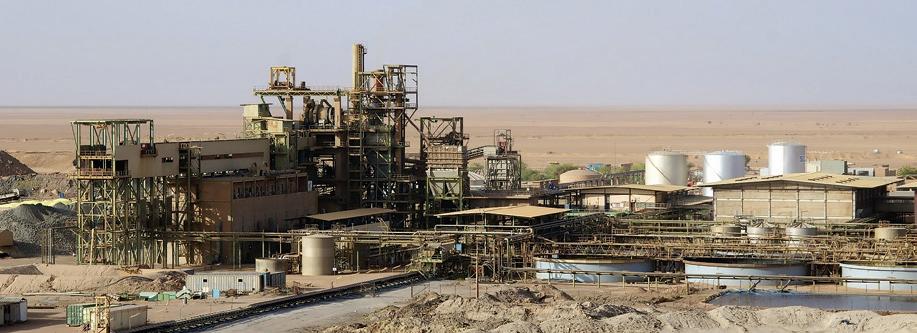
Mali’s military government is trying to arrest the CEO of the world’s second-largest gold company while the junta in Niger has tightened its stranglehold on a French state-owned uranium mine. African dictators are ratcheting up the risk for Western miners.
A combination of resource nationalism, coups and jihadistlinked terror is making West Africa an increasingly difficult region to navigate for Western mining companies.
Cash-strapped military juntas in Mali, Burkina Faso and Niger, three of the key countries in Africa’s volatile Sahel region, are trying to negotiate new mining contracts to support their regimes financially, and to give them the upper hand in a more than decade-long fight against terrorist groups affiliated with al-Qaeda and the Islamic State in the Greater Sahara.
Mali introduced a new mining code last year to increase the government’s stakes to 35% from 20% and abolished certain tax exemptions.
Tensions flared in early December when Mali issued an arrest warrant for Mark Bristow, the CEO of Barrick Gold (TSX: ABX; NYSE: GOLD), in a dispute over taxes and how to share the wealth from the company’s Loulu-Gounkoto mine.
In October, Barrick paid US$85 million to the government amid ongoing negotiations, but denied allegations by the Malian Ministry of Mines and the Finance Ministry that it had not honoured its commitments. The warrant for money laundering follows the regime’s detention in November of four Barrick employees.
Mali also held Resolute Mining’s (ASX: RSGl; LSE: RSG) CEO Terry Holohan and two other employees for 12 days until the company agreed to pay the government about US$160 million in a tax dispute.
“I view it as a form of ‘kidnapping diplomacy,’” Héni Nsaibia,
an expert on the Sahel region at the Armed Conflict Location & Event Data Project (ACLED), said in an interview from Sweden.
“There will be demands from the military regimes on whoever wants to be present in the country and the events around Barrick speak to that. These are juicy sums that are being demanded for unsettled amounts. Companies are literally being pressured to release funds or to buy themselves out; you have executives that arguably have been wrongfully detained.”
In Niger, which has been under military rule since a coup in July of 2023, France-based uranium miner Orano has lost operational control of its Somair mine. Orano suspended Somair’s production in October after months of interference by the government.
In June Niger withdrew a mining permit for Orano’s Imourare project and a month later revoked the mining licence for GoviEx Uranium’s (TSXV: GXU; US-OTC: GVXXF) permit on the feasibility stage Madaouéla project, one of the world’s largest uranium developments. GoviEx filed an arbitration claim in early December through the World Bank’s International Centre for Settlement of Investment Disputes.
Terrorism, Russia, Turkey, Iran
There have been nine successful military coups in the Sahel since 2020 and “at least the same num-
ber of failed attempts, largely in Francophone states,” according to British thinktank Chatham House. At the same time, insecurity in the region has intensified with insurgencies by terrorist groups.
Chatham House reports that 43% of global terrorism deaths in 2022 were in the Sahel — up from less than 1% in 2007.
“Despite its economic potential, the Sahel accounts for more armed conflicts and crisis than any other region in the world,” it said in a recent working paper.
“Jihadist fighters are widening their reach, edging into western Mali, entering zones south of Niger’s capital Niamey, and spilling across borders into the territory of West Africa’s coastal states,” Alex Vines, Africa director at Chatham House, said in the report.
“Militant Islamist violence in the Sahel has been growing for the past decade and has increased by 140% since 2020 and by more than 40% in 2022 alone — it represents 60% of all such violence in Africa. This escalation has displaced more than 2.5 million people and killed more than 8,000 in 2022.”
In Burkina Faso alone, groups including al-Qaeda-affiliated Jama’at Nasr al-Islam wal Muslimin (JNIM), were responsible for more than three quarters of the violence and related deaths in the last five years, the report noted. An attack in August in Barsalogho in central Burkina Faso killed about 200 peo-
BY TRISH SAYWELL
Robex Resources (TSXV: RBX), which has been producing gold at the Nampala mine in Mali since 2017, says the key to its goal of becoming a mid-tier West African producer now lies in neighbouring Guinea.
The Montreal-based junior said in June that it would sell Nampala and all of its assets in Mali, as part of a strategic plan to become a new Guinean pure play developer and accelerate the development of its Kiniero gold project, where it expects to pour first gold in the fourth quarter of 2025.
Tensions between Mali and foreign miners have soared in recent months, with the military backed
government issuing an arrest warrant for Mark Bristow, the CEO of Barrick Gold (TSX: ABX; NYSE: GOLD) on Dec. 3 and the detention in November of four Barrick employees from the company’s Loulo-Gounkoto mining complex in the country’s west. The government also held Resolute Mining (ASX: RSG; LSE: RSG) CEO Terry Holohan and two other employees for 12 days, releasing them only after the Australian miner agreed to pay the government about US$160 million to settle a tax dispute.
Robex reached an agreement in September with Mali that raised the government’s stake in the mine to 20% to conform with the country’s new mining code and said it had settled all tax and customs claims before 2024. But the com-
pany warned that “due to the geopolitical context for investments in Mali, the market for potential buyers is currently very limited.”
Robex did not return emailed requests for comment before press time.
Mali, one of the world’s poorest countries, is among several nations pushing for a greater share of their minerals in recent years. But the cash-strapped nation, which has been under military rule since a 2020 coup, also needs funds to fight al-Qaeda and Islamic State-linked fighters and has hired Russian mercenaries for security and to fight militants.
Robex’s decision to exit Mali “makes sense” says Remi Dodd, an
ple, including two humanitarian workers.
According to ACLED, an international non-profit group that collects data on violent conflict and protest around the world, last year was a record year for violence in the region since the security situation first started to deteriorate in 2012.
“This has been going on for over a decade now and for that reason has become extremely protracted. We don’t see any peace and there is an ongoing brutalization of the conflict due to the various actors — al-Qaeda; mercenaries from Russian paramilitary groups; and state forces themselves, which are abusive.
“All this multi-directional violence is contributing to the bad security situation in the central Sahel and in particular in Mali, Burkina Faso and Niger, which are the countries that are primarily affected by jihadist insurgency.”
The insurgent groups aren’t small anymore, either.
“Ten years ago they were small and medium-sized and now they are raising insurgent armies in an accelerated way because they are pretty successful in getting support from the local population,” Nsaibia says.
“You have military regimes mobilizing militias, but these fledgling militias, whether in Burkina Faso or Mali, don’t stand a chance against the jihadists and become cannon fodder when they face the battle-hardened and better-armed jihadist fighters.”
Some military juntas have also pivoted to countries like Russia, Turkey, Iran for help — turning away from international agencies and Western governments. In Mali the state has hired mercenaries from the Kremlin-linked Wagner Group to shore up their rule.
Little sympathy
Remi Dodd, an analyst at geopolitical consulting group RANE, says if these trends persist, which he expects they will, Western miners will need to make decisions about whether to exit Mali, Burkina Faso and Niger.
“The Sahel’s security environment is very degraded and has worsened over the past year, and that is likely to persist into 2025,” he said in an interview from London. “As a consequence, we may see Western miners becoming less and less willing to maintain their operations in the Sahelian strip, especially in Mali, Burkina Faso and Niger.”
For their part, the military-backed regimes have little sympathy for Western miners, he said.
“The juntas in power right now are not troubled with these Western companies facing challenges and they are not necessarily opposed to them leaving the country,” he said. “The juntas want to diversify relationships with other countries like Russia, Morocco and Turkey, so if Western miners exit these countries, we could see non-Western miners increasing their involvement in the region.”
As for Chinese miners, Dodd noted, they are unlikely to fully fill the vacuum should Western miners leave, as they tend to be more riskaverse than their counterparts in Russia, and security threats would be a “major stumbling block.”
“It’s really difficult to be optimistic,” says Nsaibia. “You have regimes that are inexperienced in governing but also facing precarious economic situations and the mining sector has always been an easy way to tap into or nationalize to get hard currency fast.”

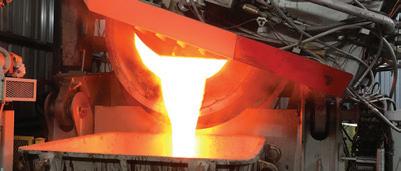
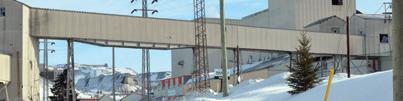
DST is engaged in the development and commercialization of environment-friendly technologies for the treatment of materials in the mining industry. Through the development of patented, proprietary processes, the CLEVR and GlassLock processes, DST extracts precious and base metals from mineralized material, concentrates and tailings, while stabilizing contaminants such as arsenic, which could not otherwise be extracted or stabilized with conventional processes because of metallurgical issues or environmental considerations.


http://dundeetechnologies.com/home info@dundeetechnologies.com
AWARDS | Rare Lifetime Achievement, new operator honour given out in London
BY COLIN MCCLELLAND
Equinox Gold (TSX: EQX; NYSE-AM: EQX) chair Ross Beaty was looking at his life flash by on a slide show when a stricken Jeep appeared on the screen. It was the early ’70s deep in the bush out west.
“This is what happens when you have two flat tires on a gravel road in the same hour. One you have a spare for and the second you don’t.”
It means hitchhiking with one of the flats in a logging truck to a garage to get it fixed. Then you realize you don’t have a jack. So, you use a tree to lift up the vehicle and dig a hole under the tire to get it off. Sound like a two-person job?
“Freedom is about being strong but also adaptable and connected to our environment.”
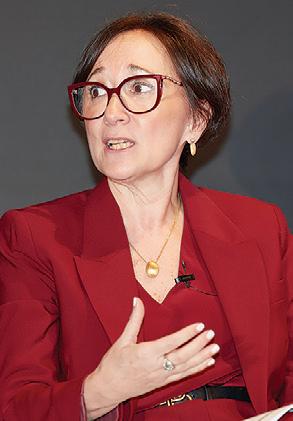
AMPARO CORNEJO TECK RESOURCES
He moved on from being chairman in 2021 to concentrate on Equinox Gold and his other passion, the environment, as head of the British Columbia Parks Foundation. Equinox started the Greenstone mine in northern Ontario last year, while Beaty is amassing 100,000 sq. km for B.C’s green space.

Beaty, a Canadian Mining Hall of Famer geologist with a passion for exploration and an eye for mining projects with economic potential, is one of Canada’s most prolific mine developers. Pan American Silver alone is valued at $11.4 billion and he’s built a dozen other companies since the 1990s.
“I always thought, this is a job from heaven,” he said. “You get paid to have fun doing what you love doing: climbing mountains.”
BY HENRY LAZENBY
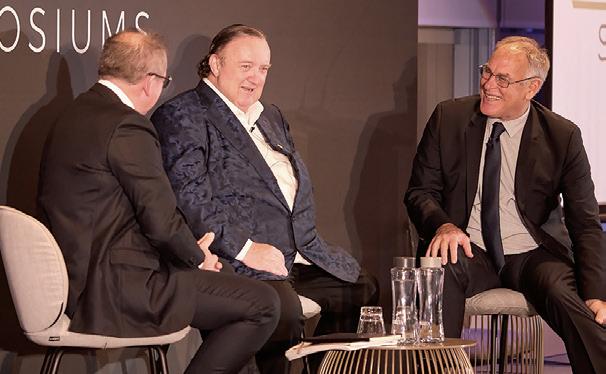
“No one ever won the Kentucky Derby with the best jockey on a donkey,” Osisko Development (TSXV: ODV; NYSE: ODV) founder and CEO Sean Roosen told an industry audience last month in London. He distilled decades of mining experience into a single, memorable truth: “You need a good asset.”
Roosen joined Rick Rule, founder of Rule Investment Media, at The Northern Miner’s International Metals Symposium. They tackled one of the industry’s thorniest issues: the inefficiency of the junior mining sector. Their lively discussion covered misallocated capital, regulatory hurdles and undervalued commodities. They also spoke about changing investor demographics.
Rule, marking 50 years in mining investment, didn’t hold back on the sector’s lack of performance.
“If you merged every junior mining company into one entity, it would lose billions annually, even in a good year,” he said. “The sector is over-capitalized and underperforming. Investors must back good people and strong assets, not the lame, the halt and the blind.”
Both leaders pointed to regulatory burdens and rising costs as major obstacles. Roosen called the industry’s structure an “inverse pyramid.” It has high overhead costs from accountants, lawyers,
brokers and regulators. They dwarf the budgets for actual exploration.
“This kills the entrepreneurial spirit,” he said. “Exploration isn’t what it used to be.”
Hated sectors
The panel highlighted that bold, disciplined investment remains key to success. Roosen noted how Osisko Development focuses on brownfield projects to access data already assembled by others and could be worth some $100 million. He showcased the company’s approach with the Cariboo gold project in British Columbia. Drilling 800,000 metres has outlined 5.3 million oz. of gold, with potential for 15 to 20 million oz. more, he said.
“It’s the Canadian Malartic underground,” Roosen said, referencing Osisko’s earlier success that turned a 35¢ stock into a $12-billion company.
Rule, known for his contrarian style, described his strategy in simple terms.
“I look for good people and assets in sectors the market hates,” he said. “Take platinum, for example. It’s vital for auto catalysts, yet supply is constrained in South Africa and Russia. When production falters, prices will spike.”
Internal combustion vehicles using platinum are unlikely to disappear as soon as some analysts suggest, Rule said. Meantime, there’s potential for unrest in South
Africa — which continually suffers 40% unemployment — and Russia, where the economy is faltering because of an expensive war with Ukraine.
The discussion also touched on how mining can attract new investors, how outreach through education can raise interest, and how the gold price surge has increased the appeal of metals and mining. Rule noted that over half his audience at Rule Investment Media is under 50, with 30% women.
“The industry assumes its constituency looks like me — old, bald and white — but that’s no longer true,” he said.
Mining must find a way to attract some of the circa US$750 billion invested in cryptocurrencies, he said. People earning money from crypto have to put their new wealth somewhere and it’s an opportunity for younger generations to invest in mining, Rule said.
Pension funds, which have little invested in mining because they are wary of its risks, haven’t seen enough high returns, the video host said. Improvements in mining company earnings could entice more pension funds to invest in majors and funds should eventually trickle down to juniors, he added.
Roosen has raised $235 million from wealthy individuals in 60 countries via non-brokered financings. This shows the growing reach of this funding mechanism, he said.
Mining must perform Silver, platinum and the energy transition metals dominated the commodities discussion. Rule predicted silver will outpace gold in bull markets. While gold investing is driven by fear, retail investors apparently drive the silver price, but decent silver company stocks are rare, he said. Roosen called for renewed focus on tangible assets. He urged the industry to focus on mining and developing physical resources like gold, which have intrinsic, lasting value, instead of chasing speculative trends.
Both criticized the slow progress in developing critical minerals outside China. Roosen suggested the hype over green energy metals needs to be spread across more commodities.
“People need to know coking coal and iron ore are critical minerals because you can’t put a windmill on a wooden pole,” he said.
Rule warned that poor returns could alienate institutional investors further. He offered a parting note of practicality for symposium attendees.
“Mining must perform,” he said. “Support good people, fund good assets and deliver returns. It’s that simple.”
Roosen, with a grin, summed it up from the junior industry perspective with his maxim: “Shut up and drill, stupid,” he said. “Drill twice, mine once. If you get it backwards, you’re bankrupt.” TNM
QUEBEC | Millions of dollars, institutional backing on offer
BY BLAIR MCBRIDE
Transitioning away from fossil fuel usage calls for greater collaboration between government and industry to meet the huge demands on critical minerals mining for producing low-carbon technologies.
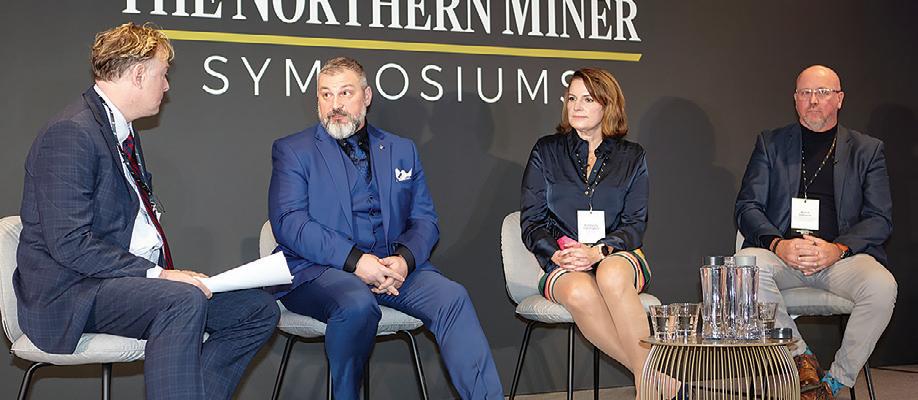
In Canada, the mining-friendly government of Quebec is leading the way and industry is stepping up, said members of a panel at The Northern Miner’s International Metals Symposium in London on Dec. 1. Quebec was the first province to release a critical minerals strategy, in 2020, and miners and exploration companies can access hundreds of millions of dollars in assistance from various government agencies. They include the Diversification of Exploration Investment Partnership (Sidex), the Société Québécoise d’exploration minière (Soquem) and Investissement Quebec (IQ).
Quebec’s copper crown
The government’s support was recently extended to Osisko Metals (TSXV: OM), which is working to revive the past-producing Gaspé copper mine on the Gaspé peninsula in eastern Quebec. The $1.8-billion initial capex project is the largest undeveloped copper-molybdenum deposit in eastern North America, Osisko says.
“Aside from the financial component that Quebec can offer, the Ministry of Natural Resources and Forests (told us) that Gaspé copper was chosen as a pilot project for a new program to maximize economic benefits for the region throughout the development process of the mine,” Kimberly Darlington, Osisko’s communications director, told the panel. “We check all the boxes in that we’re looking for a critical mineral, and we’re in an area that’s depressed economically (since the mine closed). We look forward to getting started with the ministry early in the new year.”
Government’s helping hand
Osisko is also seeking to net a 20% funding deal with IQ, a partnership that would help offset the project’s large initial capital costs.
Formerly known as Noranda, the mine produced 150 million tonnes of copper concentrate from 1955 until it closed in 1999.
Its Copper Mountain deposit hosts 824 million indicated tonnes grading 0.34% copper-equivalent, and 670 million inferred tonnes at 0.38% copper-equivalent, according to a November resource update. Contained copper totals 2.2 million tonnes, with 274 million lb. molybdenum and 46 million oz. silver.
If the company acquires its permits by 2028, the project could start in 2029.
Training the next generation
But despite the potential of Gaspé Copper and the mining heritage of the area, the nearby town of Murdochville has since the 1970’s lost most of its population. It’s now home to less than 600 people. Reviving the mine would require some combination of bringing in trained labourers and training local people, Darlington said.
And while Canada suffers from a nation-wide shortage of trained mining labour, Quebec has a plan to fill those gaps on different levels of education.
The province’s Institut National des Mines “helps structure curric-
ulum for colleges and universities to help identify the workforce and give them proper training and ideally connect them with the companies,” explained panellist Jonathan Lafontaine, strategic adviser for the mining sector with Quebec’s Ministry of Natural Resources and Forests.
“The other component is getting people interested in mining,” he said, referring to Quebec’s critical minerals strategy and its public outreach activities.
“We have a small team that goes out to the primary-level schools and teaches kids about the basics of rocks, minerals and metals and why they’re important.”
Nurturing mining tech
The province’s assistance for mining also extends to innovative developments in technical centres, Lafontaine said.
“We have the mining innovation zone in Rouyn-Noranda, the battery sector park in Bécancour, (and) we have the high tech innovation zone in southern Quebec,” he said.
Lafontaine added the province tries to build an environment that can nurture mine process innovations such as those made by Dundee Sustainable Technologies,
ONTARIO | Province helping industry with education, exploration incentives
BY COLIN MCCLELLAND AND HENRY LAZENBY
Ontario’s bid to lead in the critical minerals boom in Canada is fuelled with funding increases and deregulation goals in a new mining code. Yet the province must still widen education and mining’s appeal, industry leaders said last week in London.
This past year saw Iamgold (TSX: IMG; NYSE: IAG) start the $3 billion-capex Côté mine followed by Equinox Gold’s (TSX: EQX; NYSE: EQX) 400,000-oz.-a-year Greenstone gold mine as Queens Park counted around $44 billion promised by car makers such as Toyota and Stellantis (NYSE: STLA) for new battery plants and assembly lines. The developments coincided with efforts to quicken permitting and feed northern minerals to southern factories.
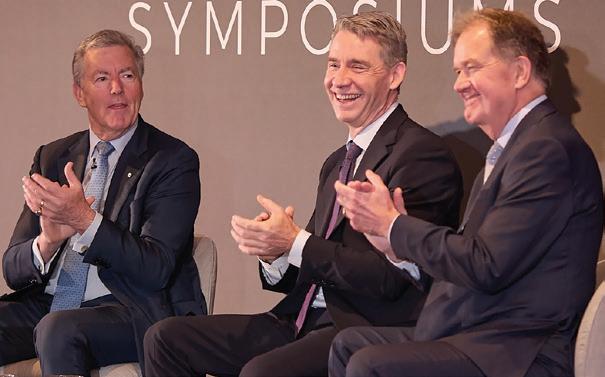
“Mining must move at the pace of business, not bureaucracy,” Ontario Minister of Mines George Pirie said at The Northern Miner’s International Metals Symposium on Dec. 2. “The new mining act is all about how we can shorten the time to get permits across the line, so we build these mines quicker, both for gold and critical minerals,” Pirie said.
Ontario is modernizing permitting, Pirie said on a panel showcasing the province’s gold mining, with Equinox chair Ross Beaty and Iamgold CEO Renaud Adams. Miners can take advantage of Ontario’s green energy grid while the government invests in education to address labour shortages and boost mining investment, he said.
Beaty, who has worked in 18 other countries, lauded the prov-
ince’s history in mining as a foundation for the industry.
“One of the reasons Ontario is such a great place to mine is because it has that historical infrastructure that’s come from the mining industry,” Beaty said. “We can get good workers. We have new technology, lots of suppliers that understand the business. That’s why it’s been such a successful place for us.”
Greeenstone
Equinox’s $1.2-billion Greenstone mine, north of Lake Superior near Geraldton poured its first gold in May after three years of construction. Beaty says project backers in Ontario have all they need to succeed in mining if they have social licence, or the support of local communities. Beaty credited strong ties with five local First Nations for keeping Greenstone on track.
“The company has spent years and years developing goodwill with the community,” he said. “Once you have their support, other things
become easy.”
Iamgold’s Côté mine has had similar success working with the Indigenous community not just on improving drinking water but the area’s flora and fauna, CEO Adams said.
“Waters protect our biodiversity, water matters,” he said. “This project was literally recreating a lake with the fish habitat and so forth. And that was done in part and partnership with the First Nation.”
Côté will contribute to Iamgold’s transformation into a mainly Canada-focused company, with 80% of its business now based in Ontario.
“This shift to more Canadian operations is not just about where we operate — it’s about how we operate,” Adams said.
Gold price
Miners are benefitting from gold prices that have “gone bananas” to record highs, Beaty said, but the company leaders were cautious about how to spend the wind-
fall. Beaty said Equinox would pay down debt and try to manage wage inflation while Adams said Iamgold would maintain financial discipline aligned with Côté’s US$1,500-peroz. gold price assumption.
“Margin matters,” he said. “We’ve seen companies overextend in booms and collapse in busts. We can’t repeat those mistakes.”
The province has also lined up help for the industry to cope with inflated costs, from mapping resources to adding new technology and helping attract post-mining businesses, Pirie said.
“The first step is identifying the deposits, and then we’ve combined that with exploration incentives as well as innovation incentives, so that minerals will be processed there as well. So, it’s matching the mineral potential in northern Ontario with the industrial might in southern Ontario.”
Meantime, the province has the critical minerals to eventually challenge Chinese control of the sector and Conservative Premier Doug Ford to confront U.S. president-elect Donald Trump’s tariff threats, the minister said. However, Beaty downplayed whether the tariffs against America’s main trading partners will ever be enacted.
“Every day Trump wakes up in the morning he has some outrageous bomb he wants to throw in. And whether it happens or not, it’s a whole different thing.”
Labour crunch
Another challenge is the industry’s perennial labour shortage, the panel pointed out. Mining programs at universities and colleges have declining enrolment, Beaty noted. This is forcing companies to
look abroad for skilled workers.
“The world is small now,” Beaty said. “Ontario is a great place to learn modern techniques, but we need to rebuild the pipeline of talent.”
Iamgold is addressing the worker shortage with a strategy, Adams said.
“Of course, in the short term, innovations and technology play a role in mitigating the labour shortage,” he said. “The next five years will see us applying technology to build more valuable and sustainable mine plans.”
By 2035, Ontario will need 8,000 more employees in the mining sector, which means another 40,000 people into northern Ontario, Pirie said. A government poll showed 72% of the province’s population supports mining and 76% want to see more of it, the minister said. He described how Ontario is letting Grade 10 students explore trades via university and college programs.
“We’re not just building mines; we’re building communities,” Pirie said. “We’re working with the education ministry to develop mining-specific curriculum for high school students, so they understand where materials come from and the role of mining in Ontario’s economy.”
Beaty said gold’s high price should attract youth to mining, a flipside benefit to the wage inflation many mining companies have had to endure post-COVID-19.
“If the jobs are there, if they’re well paid, you’re going to end up having students go into those areas,” he said. “When metal prices are high, there’s tons of jobs, and they’re really well-paid jobs, like right now.” TNM
TECH | Electrification, non-cyanide processing, reclamation explored
BY HENRY LAZENBY
Green technologies and sustainability-focused project strategies are helping the industry address risks earlier and build longer-lasting community ties, according to an industry panel in London.
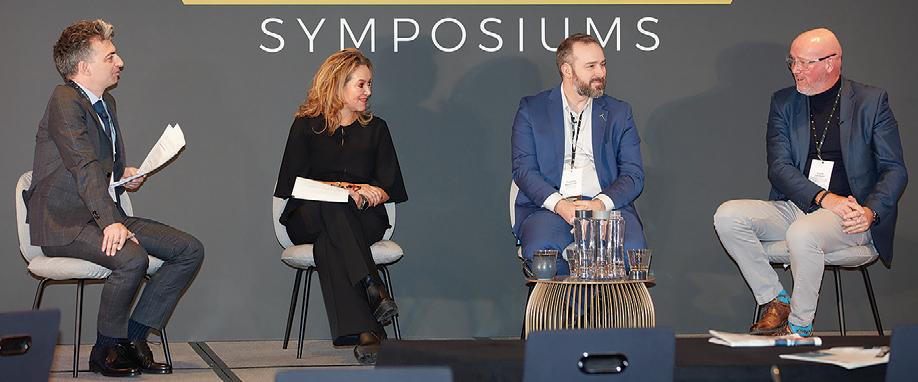
Better technologies, integrating artisanal miners and out-of-thebox mine closure strategies are key to improving mining’s social and environmental impact, The Northern Miner’s International Metals Symposium heard on Dec. 1.
Panellists agreed that mining companies ignoring sustainability risk losing social and political support. They shared how their diverse approaches could bolster projects’ sustainability credentials.
Brent Johnson, vice-president of environment at Dundee Sustainable Technologies (CSE: DST), called his company’s non-cyanide gold extraction process, CLEVR, a breakthrough for safety.
“If cyanide were banned overnight, 80% to 90% of mines would face immediate disruption,” John-
son said. He stressed that new alternatives, like his company’s tech, mitigate risks. They also reduce long-term liabilities, especially in tailings management.
“Our approach eliminates the need for massive tailings dams, transforming how mines manage waste,” Johnson said.
Technological push
Process innovation is one answer.
(NYSE: NEM, TSX: NGT, ASX: NEM), as Canada’s first all-electric underground mine. He noted that, while it shows electrification is viable, such mines are rare. The industry is slow to adopt new technologies due to high costs and risks.
The discussion also explored challenges from artisanal mining. It accounts for 85% of gold production in places such as Colombia. In 2012 and 2013, Aris Mining (TSX: ARIS; NYSE-A: ARMN) began to formalize artisanal miners at its Segovia operations in the country as a way to seal local buy-in for the project, senior vice-president for corporate affairs and sustainability Giovanna Romero said. The company integrated them as contract mining partners.
“New technologies require rigorous testing, often by large companies with the resources to run pilot projects,” he said. “This slows adoption.”
Mumford cited the Borden mine in Ontario, operated by Newmont
But, Thomas Mumford, vice-president for exploration at Scottie Resources (TSXV: SCOT), noted that electrification and automation entail another. They are more sustainable and efficient. But new technologies face hurdles due to high capital costs and slow industry uptake.
This collaboration has led to 44% of the company’s gold production today coming from these partnerships. Romero described them as an important step in reducing environmental harm and fostering
BY KRISTIE BATTEN
The Western Australian gov-
ernment has unveiled a rescue package worth up to A$150 million ($136.6 million) to keep the state’s struggling hard rock lithium sector afloat.
WA supplies up to half of the world’s lithium but the slump in prices has forced producers to suspend operations or curtail expansion plans. Prices are around US$800 per tonne, about a tenth of their spike in 2022 during shortages for the battery metal
WA premier Roger Cook said the government would waive fees for downstream processing, port charges and mining tenement fees for miners during their ramp-up stages for up to two years.
An A$50 million interest-free loan facility will also be temporarily available to miners, depending on their financial position and operating plan. The loans will be repaid quarterly over the two years following the end of the interest-free period, which will occur when average spodumene prices have exceeded US$1,100 per tonne
for two consecutive quarters, or by June 30, 2026.
“This package will provide important temporary and responsible support for WA’s fledgling lithium industry, taking into account the extremely challenging market conditions it is facing,” Cook said.
Liontown Resources (ASX: LTR), whose A$1-billion Kathleen Valley operation is WA’s newest lithium mine, said any support was appreciated.
‘Tough industry’
“Firstly, it’s commendable that the government has responded, so very appreciative of them acknowledging the tough industry that we’re in at the moment,” managing director Tony Ottaviano told reporters after the company's annual general meeting in November.
“It seems well balanced. It’s tackling both the upstream and the downstream collectively, so there’s opportunity from both areas of the lithium supply chain in terms of support.
“And thirdly, as it relates to Liontown, we’re very pleased that it acknowledges companies in start-up, in ramp-up, where we hav-
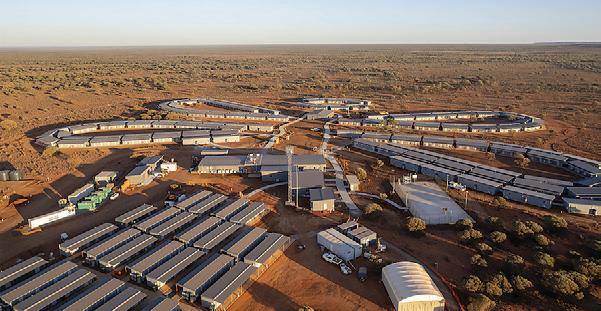
en’t been able to yet amortize our fixed costs, and we’re in a unique position as we ramp-up, and the government’s acknowledged it.”
Pilbara Minerals (ASX: PLS) managing director Dale Henderson said as much as 40-50% of producers were still losing money.
“I put to you that this is unsustainable, and we have to see pricing move, otherwise industry cannot function. And I suspect that we’ll see more supply curtailments, as we have already been seeing over the course of this year,” he told the company’s AGM in Perth in November.
GOLD | Operators lengthen mine lives via grade tweaks
BY NORTHERN MINER STAFF
High gold prices dampened Australian production slightly in the third quarter last year as some miners apparently turned to lower grade stockpiled material to blend into their mill feed, according to Melbourne-based consultants Surbiton Associates.
The country produced 73 tonnes of gold in the three months ended Sept. 30, down from the 75 tonnes produced in the previous quarter.
“It is no surprise that gold production may fall when prices are high,” Sandra Close, Surbiton’s director said in a release. “Treating some lower grade stockpiled ore results in fewer ounces being produced, with a consequent rise in the cost per ounce of production. However, this is a sensible and rational means of optimizing life-of-mine and profitability.”
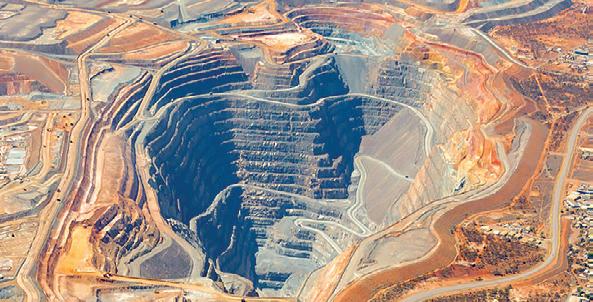
Surbiton pointed to Northern Star Resources (ASX: NST) as one example. The company’s treatment plant at the Super Pit in Western Australia’s Kalgoorlie region processed about 600,000 tonnes more than was mined in the third quarter.
“This suggests that the operation took advantage of the higher gold prices to treat some considerably lower-grade stocks,” the consultants said, noting that the head grade declined from 1.5 to 1.3 grams per tonne gold and output was down by 27,000 ounces.
Another example was Newmont’s (TSX: NGT; NYSE: NEM;
ASX: NEM) Boddington operation in Western Australia, the largest gold mine in the country. The company mined 6.3 million tonnes of ore in the third quarter but treated 8.4 million tonnes, Surbiton noted, “with the difference of 2.1 million tonnes presumably coming from stockpiles.” The result: grades fell by about 5% and production by about 10,000 ounces.
Mind the dollars
“Some analysts and commentators seem to think that lower gold production and higher costs per ounce indicate that an operation is in trouble, or that the management is poor,” Close said. “However, there is another rather more obvious explanation.”
Other important factors at play include the U.S. dollar to Australian dollar exchange rate, which adds to the gold price volatility, and hedging.
“The wild swings in gold prices over the last few months show
that a degree of hedging provides some insurance against sudden price changes, especially for locally listed producers,” she continued. “This can be achieved through the sensible purchase of gold put options, which give the purchaser the right, but not the obligation, to sell their gold at an agreed price.”
For instance, if the gold price in the market is above the agreed price, she explained, the producer sells gold into the market and lets the put option expire. But if the market price is below the agreed price, the producer exercises the put option and sells at the higher agreed price.
Gold prices in September jumped significantly. Spot gold was US$2,630 per oz. at the end of the month, up from US$2,499 per oz. at the start of September. At the end of October, the price peaked at US$2,790 per ounce, before falling to US$2,600 per oz. by the end of November. TNM
“It looks more probable that pricing has to move upwards, otherwise, not only will new supply not come to serve this market, but these other suppliers will have to fall out of the market, because they will not have an economic choice.”
The aid comes after the government of Prime Minister Anthony Albanese introduced a bill in November to provide critical minerals and rare earths producers with production tax incentives as part of its “Future Made in Australia” agenda. Australia’s federal government aims to provide up to A$17 billion in production tax incentives for the critical minerals and rare earths industry.
There have been calls for the government to provide royalty relief, as it has in the past with the iron ore and nickel sectors.
Federal Minister for Resources and Northern Australia, Madeleine King, and the Chamber of
Minerals and Energy welcomed the announcement, with the latter saying it was now clear lithium prices were likely to be lower for longer.
“It’s important for governments to act when necessary to support the sector through periods of temporary market weakness and keep WA’s skin in the game for when the market recovers,” Chamber of Minerals and Energy WA CEO Rebecca Tomkinson said.
The Association of Mining and Exploration Companies described the support as necessary.
“This program will ensure lithium producers across the sector have the best fighting chance to counter the turbulent global headwinds,” CEO Warren Pearce said.
There have been some concerns in the market that Liontown may not be able to withstand a prolonged lithium downturn as it ramps up Kathleen Valley. But company chair Tim Goyder was defiant at the AGM.
“We’ve got it under control folks, so don’t worry and don’t read all that crap in the paper. We don’t want to go broke and we won’t go broke,” he said to applause from shareholders.
Instead, Liontown said in November that it had revised its mine plan to 2.8 million tonnes from 4 million tonnes a year to focus on high-margin tonnes and lower costs. Goyder said Liontown would continue to adapt to market conditions.
BY CECILIA JAMASMIE
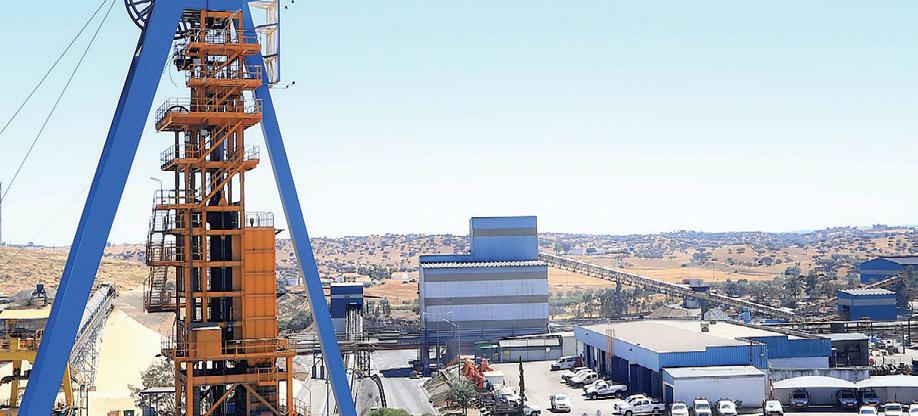
Lundin Mining (TSX: LUN) is selling its Neves-Corvo mine in Portugal and the Zinkgruvan mine in Sweden to Boliden (STO: BOL) for US$1.3 billion in upfront cash, with potential contingent payments of up to US$150 million.
The sale to the Swedish miner will almost double its zinc concentrate output, while increasing production of copper concentrate by 43%, it said on Dec. 9.
Lundin Mining president and CEO, Jack Lundin, described the Neves-Corvo and Zinkgruvan mines as pivotal to the company’s evolution into a global multi-asset base metals producer.
The company’s shares rose 2.6% on the announcement to $14.10 apiece in Toronto, valuing the company at $10.9 billion. Its shares traded in a 52-week range of $9.67 and $17.97.
By selling these assets, the Lundin family has departed from their ancestral homeland of Sweden and Europe to focus mainly on growth plans in South America.
BHP, Filo
Last year, Lundin announced a joint venture with BHP (ASX: BHP;
“Strong industrial logic as well as strategic fit.”
MIKAEL STAFFAS, BOLIDEN
NYSE: BHP) to acquire Filo Corp (TSX: FIL), the owner of the Filo del Sol project in Chile. The copper-gold-silver deposit boasts estimated resources of at least 2.2 billion lb. of copper, 2.8 million oz. of gold, and 133.3 million oz. of silver.
The partners also grabbed the large-scale Josemaría copper-gold-silver project, in the San Juan Province of Argentina, about 9 km east of the border with Chile.
Strategic fit
“The addition of two cash flow generative zinc and copper mines in Portugal and Sweden has a strong industrial logic as well as a strategic fit,” Boliden CEO Mikael Staffas said in a separate statement. The deal is to secure supplies for its smelters at a time of intensifying global competition for mined ores.
The company estimates that zinc and copper concentrate production will rise from 35% to 70% of its zinc
smelting capacity and from 30% to 40% of its copper smelting limit. Overall, the transaction is projected to boost zinc production by 95% and copper output by 43%, based on 2023 figures.
The company anticipates that the new assets will contribute US$300 million to US$350 million in annual earnings over the next five years.
The US$1.3-billion upfront payment will be financed through a bridge loan, Boliden said. Half of the amount will be refinanced via a share issue and the remainder through medium- and long-term debt.
The Neves-Corvo mine, located about 200 km southeast of Lisbon in the Iberian Pyrite Belt, is an underground operation with on-site processing facilities. In 2023, it produced 108,812 tonnes of zinc, 33,823 tonnes of copper, 6,500 tonnes of lead, and 1.9 million oz. of silver.
Zinkgruvan, about 200 km southwest of Stockholm, is also an underground mine with on-site processing facilities. In 2023, the mine produced 76,349 tonnes of zinc, 4,434 tonnes of copper, 26,284 tonnes of lead, and 2.3 million oz. of silver.
The parties expect to complete the transaction by around June, subject to regulatory approvals. TNM
Kurmuk amid post-civil war climate
BY CECILIA JAMASMIE
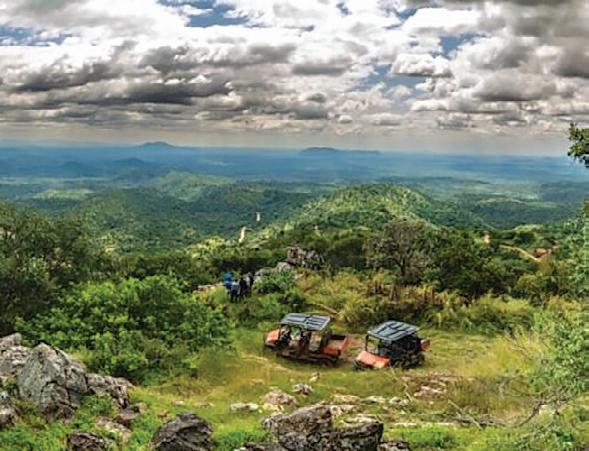
Wheaton Precious Metals (TSX: WPM; NYSE: WPM) has reached a streaming deal with Allied Gold (TSX: AAUC) for the Kurmuk gold project in western Ethiopia. Under the agreement, the Canadian streaming company will pay Allied US$175 million in four equal instalments. In return, Wheaton will receive 6.7% of the project’s payable gold, which will reduce to 4.8% after the delivery of 220,000 ounces. Wheaton will also pay 15% of the spot price of gold, while Allied retains an option to buy back the streaming deal.
Allied Gold said it would use the funds to develop Kurmuk, which is set to become Ethiopia’s first commercial gold mine. Production is expected to begin in mid-2026.
“The gold prepay is expected to be led by the lending syndicate for the company’s revolving credit facility with proceeds available to Allied following the completion of the stream financing,” Allied Gold CEO Peter Marrone, said in
“We rate the (Wheaton) shares outperform.”
BRIAN MACARTHUR, RAYMOND JAMES
a statement.
Analysts at Cormark Securities and Raymond James welcomed the deal.
“Given our positive view of Wheaton’s high-quality and diversified asset base, high-margin and scalable business model, we rate the shares outperform,” Raymond James mining analyst Brian MacArthur said in a Dec. 9 note.
Exploration potential “Attributable gold stream production is forecast to average over 16,000 oz. of gold per year for the first 10 years of production,” MacArthur said. “The project is forecast to have an 11-year mine life based on reserves alone with
SSR Mining (NASDAQ: SSRM; TSX: SSRM; ASX: SSR) is to buy the Cripple Creek & Victor (CC&V) gold mine in Colorado from Newmont (NYSE: NEM, TSX: NGT) for US$275 million. It will add 170,000 oz of gold production annually to become the third-largest U.S. gold miner. When combined with the Marigold mine, SSR expects its total U.S. gold production to average between 300,000 and 400,000 oz. per year.
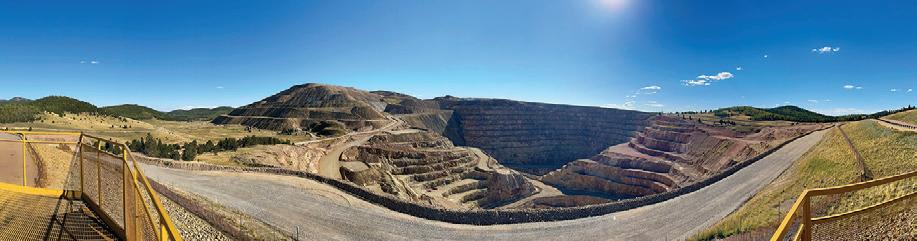
lion depends on easing the Carlton Tunnel permit rules. SSR and Newmont are to share closure costs at CC&V. If they exceed US$500 million, SSR is to pay 10% of the extra costs. Newmont is to cover the rest. They expect to close the transaction this quarter. Shares in SSR gained about a quarter of their value in Toronto to $10.14 apiece after the deal as press time approached. The miner has a market capitalization of $2.1 billion. Newmont’s stock added 3.3% over the same period to $59.61.
BATTERY METALS | Brine operation may produce 53,000 tonnes a year
BY CECILIA JAMASMIE
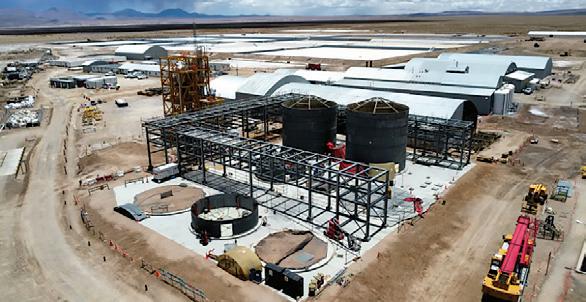
Rio Tinto (ASX: RIO; LSE: RIO; NYSE: RIO) has released its initial resource and ore reserve estimates for the Rincon lithium project in Argentina, marking a significant milestone in its push to become a leading producer of the battery metal.
The world’s second largest miner by stock market value at US$105.4 billion said the asset holds substantial brine deposits. It has 1.5 million measured tonnes of lithium carbonate equivalent (LCE), 7.8 million indicated tonnes, and 2.3 million inferred tonnes. Probable ore reserves stand at almost 2.1 million tonnes of LCE.
Acquired in 2022 for US$825 million, Rincon is located in the heart of the lithium triangle in Argentina’s Salta province, an emerging hub for greenfield projects.
The asset is projected to produce 53,000 tonnes of battery-grade lithium carbonate annually over a 40-year mine life, with plans to expand production to 60,000 tonnes per year. Rio Tinto also plans to build a pilot lithium carbonate plant with an annual capacity of 3,000 tonnes, backed by a US$350 million investment.
The project has already delivered its first lithium output, with initial battery-grade production expected in 2025, pending a final investment decision for full-scale operations by year-end.
Rio Tinto CEO Jakob Stausholm emphasized the company’s goal of expanding its lithium business. Alongside the Rincon development, Rio has proposed the US$6.7billion acquisition of Arcadium (ASX: LTM; NYSE: ALTM). That move could solidify its position as one of the world’s three largest lithium miners, behind only U.S.based Albemarle (NYSE: ALB) and Chile’s SQM (NYSE: SQM). If finalized by mid-2025 as expected, the acquisition would bolster Rio’s portfolio with assets in Argentina, Australia, and processing facilities in the U.S., U.K., China and Japan.
The company’s customer base already includes major automotive players such as Tesla, BMW, and General Motors, aligning with its ambitions to cater to the rap-
BY NORTHERN MINER STAFF
Omai Gold Mines’ (TSXV: OMG) shares jumped 14% in early December after the junior reported high-grade drill results from its WeNot deposit in Guyana.
Highlights from WeNot, one of two deposits at the past-producing Omai gold project, included drillhole 24ODD-085. It intersected 68.7 metres grading 3.16 grams gold per tonne from 451 metres downhole, including 6.65 grams gold over 30 metres.
lion. Its shares traded in a 52-week range of 5¢ to 21¢.
2.5-km-long deposit
The drill holes targeted the Dike Corridor, one of five main subparallel, near-vertical gold zones that make up the large 2.5-km-long WeNot deposit.
idly growing demand for electric vehicle batteries.
Market share
Rio Tinto has steadily expanded its presence in the lithium market over the past six years. In 2021, the company began lithium production from waste rock at its borates mine in California, showcasing an innovative approach to resource utilization.
The miner is simultaneously working to revive its US$2.4-billion Jadar lithium project in Serbia, which could become Europe’s largest lithium mine with annual production of 58,000 tonnes of battery-grade lithium carbonate.
Jadar faces significant hurdles, including a recent parliamentary debate on a proposal to ban lithium and borate mining in the country. If passed into law, this would effectively put an end to the contested Jadar project, despite Serbia’s recent reinstatement of Rio’s mining licence.
The Jadar operation could provide enough lithium to power one million electric vehicles annually and meet 90% of Europe’s current lithium demand, underscoring its strategic importance to the global energy transition.
Rio Tinto’s activities align with a broader industry trend as mining giants race to secure their place in the burgeoning electric vehicle (EV) and renewable energy markets.
Investor revolt
Despite management’s efforts to diversify its global operations, Rio’s corporate structure has faced criticism. Activist investor Palliser Capital is the latest one to urge the firm to consolidate its dual corporate structure by relocating its primary listing from London to Australia.
The U.K.-based hedge fund, which has a stake of about US$250 million in Rio Tinto, said the company should follow rival BHP (ASX: BHP), which moved its primary listing to Sydney in 2022.
Palliser Capital estimates, as reported by Reuters, that this outmoded structure has resulted in a US$50 billion loss in shareholder value.
The activist investor also warned that Rio Tinto’s approach to mergers and acquisitions is both statistically anomalous and unsustainable in the long term. TNM
Drillhole 24ODD-087 cut 45.5 metres grading 4.57 grams gold from 497 metres depth, including 38 metres of 2.4 grams gold and 1.5 metres of 77.71 grams gold. Other notable intercepts in the hole included 2.5 metres at 19.36 grams gold from 202 metres.
“The very significant widths and robust gold grades further demonstrate that the gold zones at WeNot increase in width and grade with depth,” Omai CEO and president Elaine Ellingham said in a release. Omai shares traded at 20¢ apiece after the report and near press time, valuing the company at $100.8 mil-
Omai is a brownfields project, the site of the past-producing Omai gold mine, which churned out about 3.8 million oz. at an average grade of 1.5 grams gold between 1993 and 2005. In that period, the Omai mine was the largest primary gold producer in South America, averaging over 300,000 oz. of gold a year, the company says. It was mined to a depth of 200 to 300 metres.
So far Omai’s drill program has confirmed that the WeNot shear zone extends to the west and east of the new WeNot deposit, by at least 900 metres and 400 metres respectively, well outside of the previously mined area. The company notes that this suggests an exploration target at least 2.7 km long by 450 metres deep and 200 to 300 metres wide.
WeNot contains 17.6 million indicated tonnes grading 1.48 grams gold for 834,000 oz. contained gold and another 25.2 mil-
lion inferred tonnes grading 1.99 grams gold for 1.6 million oz. contained gold.
A preliminary economic assessment in April envisioned an openpit mine averaging 142,000 oz. gold a year over a 13-year mine life for total production of about 1.8 million gold oz. at an all-in sustaining cost of US$1,009 per oz. gold sold. At a gold price of US$2,200 per oz., the project offers an after-tax net present value (NPV) at a 5% discount rate of US$777 million and an internal rate of return (IRR) of 24.7%. Initial capex of US$375 million could be repaid in about 3.5 years.
At a base case gold price of US$1,950 per oz., the after-tax NPV comes to US$556.4 million and IRR to 19.8%.
An adjacent deposit called Gilt Creek was not included in the study because it will be mined from underground. Gilt Creek hosts 11.1 million indicated tonnes grading 3.22 grams gold for 1.2 million oz. contained gold and 6.2 million inferred tonnes grading 3.35 grams gold for 665,000 oz. gold.
The Omai project is 165 km south-southwest of the capital city, Georgetown. TNM
YUKON | Company looks to update estimate later this year
BY NORTHERN MINER STAFF
Drill results from Snowline
Gold’s (TSXV: SGD; USOTC: SNWGF) Valley deposit continue to deliver wide intercepts of gold mineralization from surface at its Rogue project in the Yukon Drillhole V-24-095 returned 604.5 metres grading 0.65 gram gold per tonne from surface, including 160.5 metres of 1.13 grams gold from 168.5 metres, with the bottom 189.5 metres of interval outside the current resource estimate, the company reported in early December.
Hole V-24-096 cut 386 metres grading 1.08 grams gold from surface, including 120.5 metres of 2 grams gold from 139 metres downhole, outperforming the mineral resource block model along its length.
The latest assays “upgrade our confidence in the initial mineral resource estimate, and they expand the physical limits of the mineralized system at Valley as we know it,” Snowline CEO Scott Berdahl said in a release. “It is exceptional to see such consistency across batch after batch of analytical results— and a hallmark of a top-tier gold deposit.”
Resource report tailwinds SCP Resource Finance analyst Brandon Gaspar wrote that Valley results keep outperforming the block model with both infill and drilling on the northeast and southwest fringes. That supports an improvement in tonnes and grade
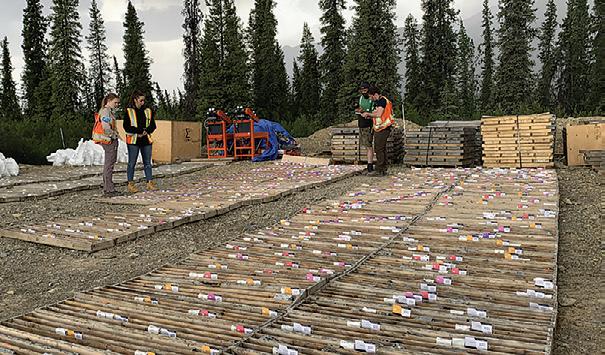
in the upcoming resource update, particularly in the shallow areas of the pit that were previously modelled as waste.
He maintains his buy rating and a share forecast of $11 apiece. The company expects to update the resource estimate this year, incorporating the results from 25,099 metres drilled in 2024.
Snowline drilled its first-ever hole into the Valley target in September 2021 and released an initial resource last June based on 28,000 metres of drilling. Indicated resources stand at 75.8 million tonnes grading 1.66 grams gold for 4.1 million oz. contained gold. Inferred resources add 81 million tonnes grading 1.25 grams gold for 3.3 million contained oz. gold. The resource used a cut-off grade of 0.4 gram gold.
The Valley deposit is a reduced intrusion-related gold system (RIRGS) and geologically similar to other RIRGS deposits now in pro-
duction, such as Kinross Gold’s (TSX: K; NYSE: KGC) Fort Knox mine in Alaska.
Valley is just one of several targets at Snowline’s 112-sq.-km Rogue project, which hosts multiple intrusions (like Valley) along with widespread gold anomalism in stream sediment, soil and rock samples.
In November, assays from Valley included 380.4 metres grading 1.06 grams gold from surface, including 51 metres of 2 grams gold, in drillhole V-24-091, and 219.1 metres of 1.40 grams gold from surface including 72 metres of 2.11 grams gold in drillhole V-24-088.
In 2023, B2Gold (TSX: BTO; NYSE-AM: BTG) made a 9.9% investment in the company.
Snowline shares traded at $5.09 apiece near press time, up nearly 2% in 2024. The junior has traded in a range of $3.88 and $6.40 per share and has a market cap of $807.8 million. TNM
| Part of Europe’s push to develop local supplies
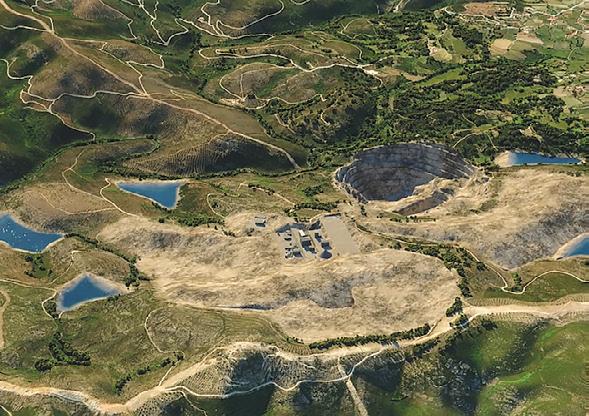
BY TRISH SAYWELL
Germany’s export credit agency Euler Hermes has signed a non-binding letter of interest for a project finance loan guarantee of up to US$270 million for Savannah Resources (LSE: SAV) to develop the Barroso lithium project in northern Portugal.
The loan scheme, which covers 80% of a loan made to a project, will provide an attractive basis for Germany’s KfW IPEX-Bank and other financial institutions to lend to the mining project, Savannah says. The KfW IPEX development bank has supported Savannah throughout the loan guarantee process.
The guarantee underscores the sense of urgency in Germany and among other European Union members to develop a domestic lithium supply chain and reduce dependence on imports from China, which supplies about 97% of the continent’s lithium requirements.
“It’s a significant step for us and comes after the Critical Raw Materials Act was passed,” Emanuel Proença, Savannah’s CEO, said in an interview. “It’s a clear awareness by Europe that it needs to step up its game especially versus China for the transformation of an industry that is absolutely critical.”
Shares in Savannah Resources in London traded near press time at 4.4 pence apiece, valuing the company at £95.6 million ($172.7 million). They’ve traded in a 52-week range of 1.5 pence to 5 pence.
Local sources
The European Critical Raw Materials Act was passed into law in May — just 12 months after the legislation was introduced. It mandates that 10% of the EU’s annual consumption of critical raw materials is sourced domestically and 40% is processed in Europe by 2030.
“The fact that this legislation was passed in record time, and that in a few months after it was passed it is already starting to generate actions like this one, and by some of the most critical entities in Europe, shows there is positive
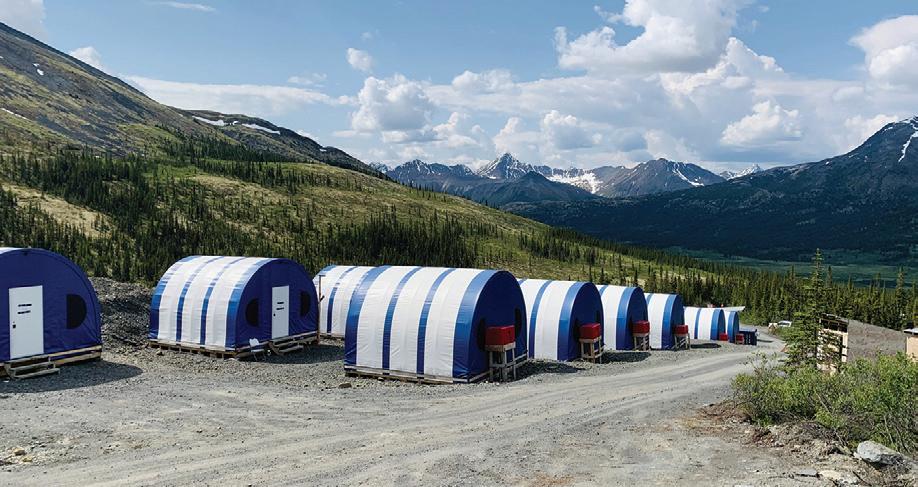
BY BLAIR MCBRIDE
“Europe needs to step up its game especially versus China for the transformation of an industry that is absolutely critical”
EMANUEL
PROENCA, CEO, SAVANNAH RESOURCES
movement in trying to build these supply chains,” Proença noted.
News of the loan guarantee on Dec. 3 follows an equity investment and offtake agreement
Savannah signed in June with Amsterdam-listed AMG Critical Materials Group, a spodumene concentrate producer with a German subsidiary, AMG Lithium.
Under the strategic partnership, AMG took a 15.8% stake in Savannah and can purchase 45,000 tonnes of spodumene concentrate a year for a five-year period from Barosso.
The agreement can be extended to 90,000 tonnes of spodumene concentrate annually for 10 years if AMG provides a full funding solution for the project’s initial capex.
New refinery
In September, AMG opened a lithium hydroxide refinery near Berlin, with capacity of 20,000 tonnes of battery grade lithium hydroxide per year — sufficient to produce enough batteries for about 500,000 electric vehicles.
Savannah’s Barosso project in northern Portugal, about 145 km from the deep-water port of Leixões near the city of Porto, has a JORC-compliant resource of 28 million tonnes grading 1.05% lithium oxide (Li20) and consists of five main deposits.
A 2023 scoping study forecast a 14-year mine life producing a total of 2.6 million tonnes of 5.5% Li20 grade spodumene concentrate. At
High-grade zinc results from drilling at Fireweed Metals’ (TSXV: FWZ; US-OTC: FWEDF) Macpass project in eastern Yukon bring potential for significantly growing resources at the Tom target. Shares rose 2.9%.
Highlight hole TS24-002 at Tom South cut 15.1 metres grading 10.39% zinc, 18.1% lead and 296.9 grams silver per tonne from 595.5 metres depth, including 8.1 metres at 12.76% zinc, 22.44% lead and 361.4 grams silver, the company reported on Nov. 28.
Hole TS24-001 returned 18.1 metres at 9.02% zinc, 7.46% lead and 148.3 grams silver from 732.6 metres downhole, including 8.3 metres grading 16.18% zinc, 13.52% lead and 278.8 grams silver.
“The consistent high-grade intercepts at Tom South reinforce that the feeder zone in this area continues to define Tom as one of the most prolific known concentrations of zinc, lead, and silver in the Macpass district,” Fireweed CEO and president Peter Hemstead said in a release.
Hole TS24-002 represents the highest-grade and closest-to-surface intercept at Tom South yet, he said. Tom has spectacular grades and the intersections are almost entirely of sphalerite and galena, he added.
Resource, drilling tailwinds
The intercepts add to an eventful fall at the Macpass zinc-leadsilver project, where in October drill results returned higher grades and thicknesses at the Boundary zone than estimated in Fireweed’s resource update released in September. That resource focused on Macpass’ Tom, Jason, Boundary and End zones, and bumped indicated tonnes and contained zinc more than four times over a 2018 preliminary economic assessment. Macpass might host one of the world’s largest undeveloped zinc deposits.
Fireweed shares traded for $1.41 apiece before press time in Toronto, valuing the company at $253.1 million. Its shares traded in a 52-week period of 97¢ to $1.55.
TS24-002, with its zinc grade twice as high as the 5.49% grade estimated for the zones in the September
resource update, could help upgrade inferred material to the indicated category and extend mineralization further up-dip, Fireweed said.
That intercept also lies about 145 metres below historical drilling at Tom West, which could make it easier to access mineralization in an underground mine scenario.
Another noteworthy hole reported on Nov. 28, JS24-002 at Jason Main, cut 28 metres at 7.1% zinc, 1.41% lead and 5.6 grams silver from 326 metres depth, including 12.9 metres at 11.3% zinc, 2.74% lead and 10.3 grams silver.
That hole marks a step out that’s down dip from previous drilling, showing continuity beyond the current resource.
Those results are from 25 of 49 holes drilled last year at Macpass, the company’s largest project, sitting on the border of the Northwest Territories. Fireweed’s adjacent Mactung project hosts 41.5 million indicated tonnes at 0.73% tungsten trioxide (WO3) and 12.2 million inferred tonnes at 0.59% WO3, according to a 2023 resource estimate. It stands out as the world’s largest high-grade tungsten resource. TNM
GOLD | Drilling builds on Homestake mine’s 40M oz legacy
BY HENRY LAZENBY
Dakota Gold’s (NYSE-A: DC) step-out drilling at the Maitland gold project has nearly doubled the strike length of modelled Homestake mine-style gold to 1,646 metres, lifting shares.
The 17,000-metre program completed 73 holes last year. It returned 49 high-grade intercepts, averaging 3.8 metres at 10.11 grams gold per tonne. The company says this shows the project’s growing potential. Dakota plans to release a resource update in this quarter and a preliminary economic assessment
soon after.
Important holes include MA24C-058 that cut 0.8 metre at 28.1 grams gold from 828.4 metres depth, located 710 metres northwest of the JB Gold Zone discovery hole MA23C-017. Other notable results include 1.8 metres at 14.45 grams gold from 1,569.4 metres depth in hole MA23C-032D, and hole MA24C-055 which cut 11.5 grams gold over 1.6 metres from 733.9 metres depth. The mineralization remains open along strike and at depth.
“This confirms that the same mineralizing fluids responsible for the Homestake mine enriched
Maitland,” chief operating officer Jerry Aberle said in an early December release. “We’ve surpassed expectations and identified multiple targets, including Blind Gold to the north and the North Drift Discovery to the south, which remain untested.”
The company’s New Yorkquoted shares rose nearly 4% on the report, and climbed to US$2.31 apiece near press time. They’ve ranged between US$1.84 to US$3.25 over the past 12 months and the company’s market capitalization is US$193.5 million.

16 Capital raisings
16 Mining events contents
18 EV metals
20 ETF assets
22 Market data
23 Market news
*Data may not be comprehensive and is provided on a best-efforts basis as of press time. Investors are responsible for their own due diligence.
Delivering fit-for-purpose solutions across the entire project life cycle
Delivering fit-for-purpose solutions across the entire project life cycle
Delivering fit-for-purpose solutions across the entire project life cycle
Delivering fit-for-purpose solutions across the entire project life cycle
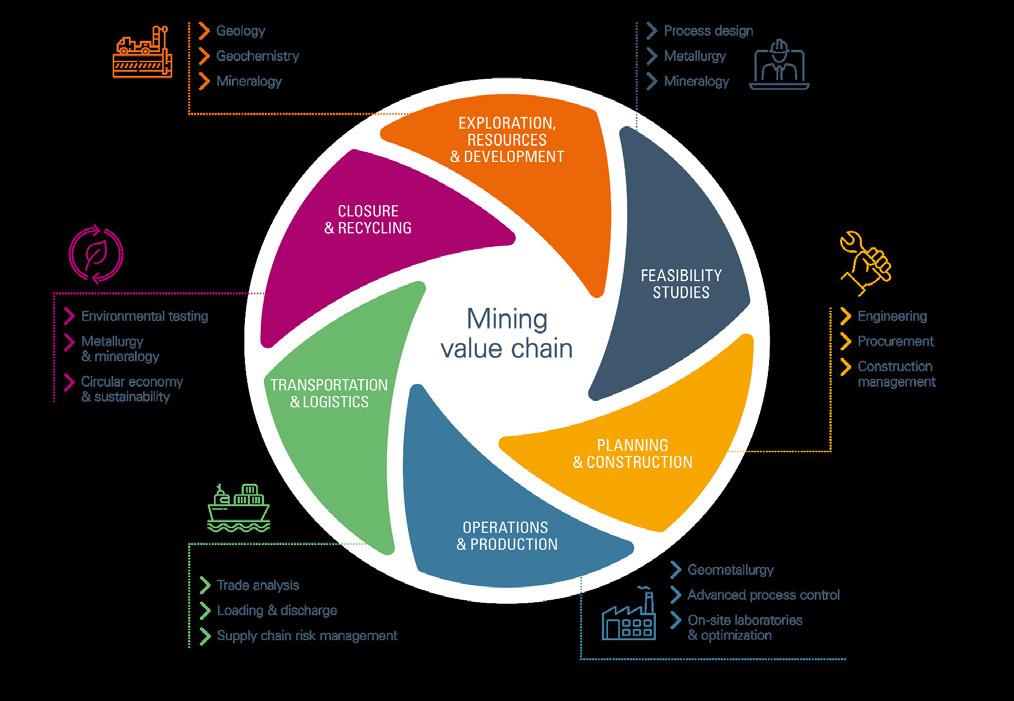
Our fit-for-purpose solutions encompass the skills of qualified geologists, geostaticians, analytical chemists, mineralogists, metallurgists, process engineers and mining engineers and inspectors brought together to provide accurate and timely mineral and process evaluation services across the entire project life cycle.
Our fit-for-purpose solutions encompass the skills of qualified geologists, geostaticians, analytical chemists, mineralogists, metallurgists, process engineers and mining engineers and inspectors brought together to provide accurate and timely mineral and process evaluation services across the entire project life cycle.
Our fit-for-purpose solutions encompass the skills of qualified geologists, geostaticians, analytical chemists, mineralogists, metallurgists, process engineers and mining engineers and inspectors brought together to provide accurate and timely mineral and process evaluation services across the entire project life cycle.
Our fit-for-purpose solutions encompass the skills of qualified geologists, geostaticians, analytical chemists, mineralogists, metallurgists, process engineers and mining engineers and inspectors brought together to provide accurate and timely mineral and process evaluation services across the entire project life cycle.
WWW.SGS.COM/NATURALRESOURCES NAM.NATURALRESOURCES@SGS.COM
WWW.SGS.COM/NATURALRESOURCES NAM.NATURALRESOURCES@SGS.COM
WWW.SGS.COM/NATURALRESOURCES NAM.NATURALRESOURCES@SGS.COM
WWW.SGS.COM/NATURALRESOURCES NAM.NATURALRESOURCES@SGS.COM

2025
n January
January 9
37th Annual Canadian Mining Hall of Fame Dinner and Induction Ceremony — Toronto
VENUE: Metro Toronto Convention Centre
MORE INFORMATION: www.mininghalloffame.ca/ annual-ceremony/
January 14-16
Future Minerals Forum — Riyadh, Saudi Arabia
VENUE: King Abdulaziz International Conference Center
MORE INFORMATION: www.futuremineralsforum.com
January 17-18
Metal Investors Forum - Vancouver
VENUE: Fairmont Pacific Rim
MORE INFORMATION: www.metalsinvestorforum.com
January 19-20
Vancouver Resource Investment Conference
VENUE: Vancouver Convention Centre West
MORE INFORMATION: www.cambridgehouse.com/
vancouver-resource-investment-conference
Please see story on page 6.
January 20-23
AME Roundup — Vancouver
VENUE: Vancouver Convention Centre, East Building
MORE INFORMATION: roundup.amebc.ca
n February
February 3-6
Mining Indaba — Cape Town, South Africa
VENUE: Cape Town International Convention Centre
MORE INFORMATION: miningindaba.com/home
February 12-13
Mining & Critical Minerals Korea Conference and Exhibition — Seoul
VENUE: TBA
MORE INFORMATION: www.criticalmineralskorea.com
February 23-26
Global Metals, Mining & Critical Minerals Conference — Hollywood, Fl.
VENUE: TBA
MORE INFORMATION: capitalmarkets.bmo.com/en/ industries/global-metals-mining/
MINEXCHANGE
INFORMATION: smeannualconference.org
February 24-25 Critical Minerals and Energy Investment — Brisbane, Australia VENUE: TBA
INFORMATION: www.criticalmineralresources. com
n March
March 2-5
PDAC 2025 — Toronto
VENUE: Metro Toronto Convention Centre
INFORMATION: www.pdac.ca/convention
March 18-19
Swiss Mining Institute — Zurich
VENUE: The Dolder Grand
INFORMATION: www.swissmininginstitute.ch
$4,500
$4,000
$3,500
$3,000
$2,500
$2,000
$1,500
$500
PearTree is a Canadian Securities Dealer and Investment Fund Manager advancing over (CAD) $500 million annually for resource exploration and mine development in a uniquely Canadian structure which results in as much as $2.00 of capital deployed for every $1.00 invested by global institutions and family offices.
Watch our video in English, Français, Deutsch, and Español on our website. Note:
Expanding
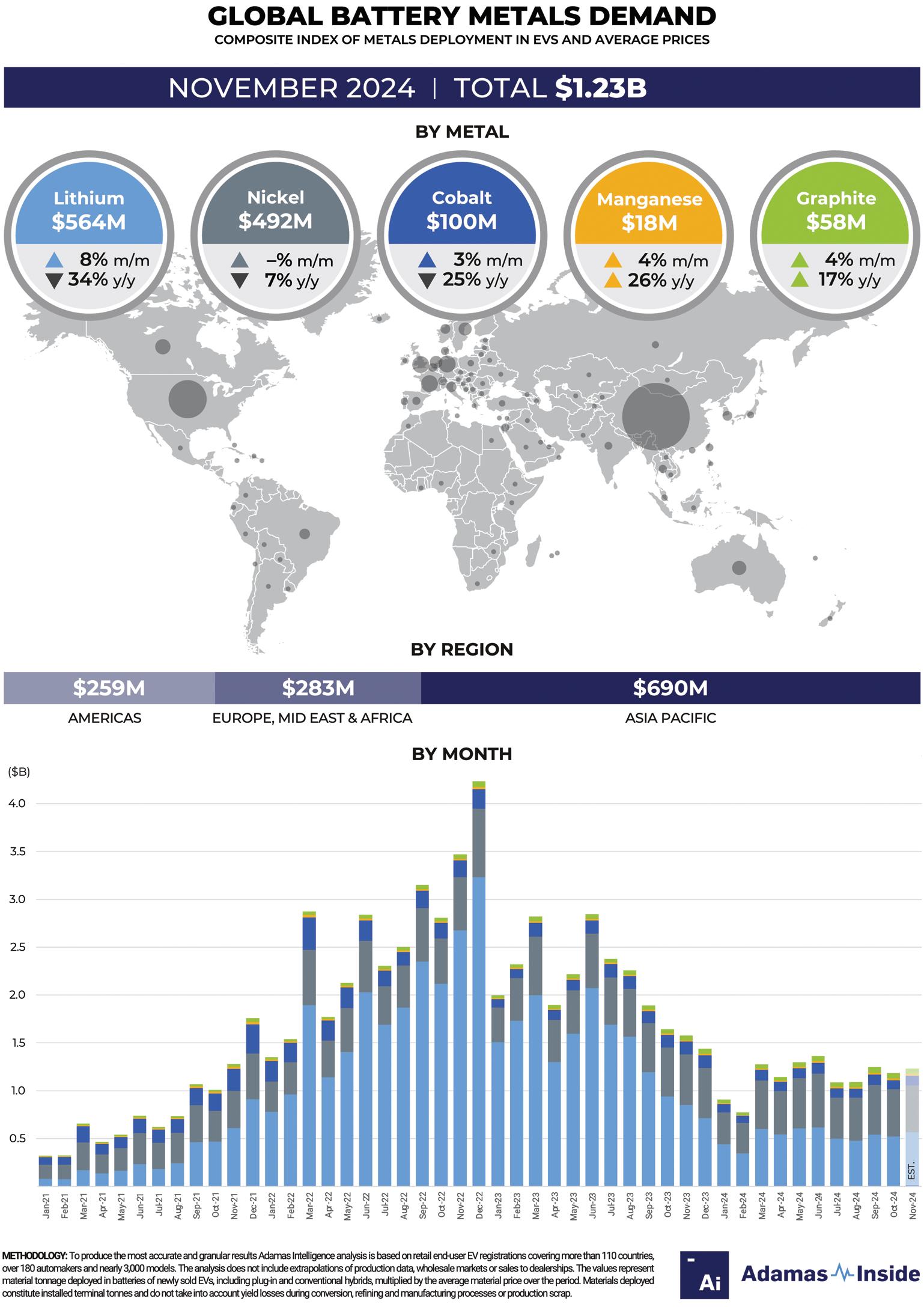
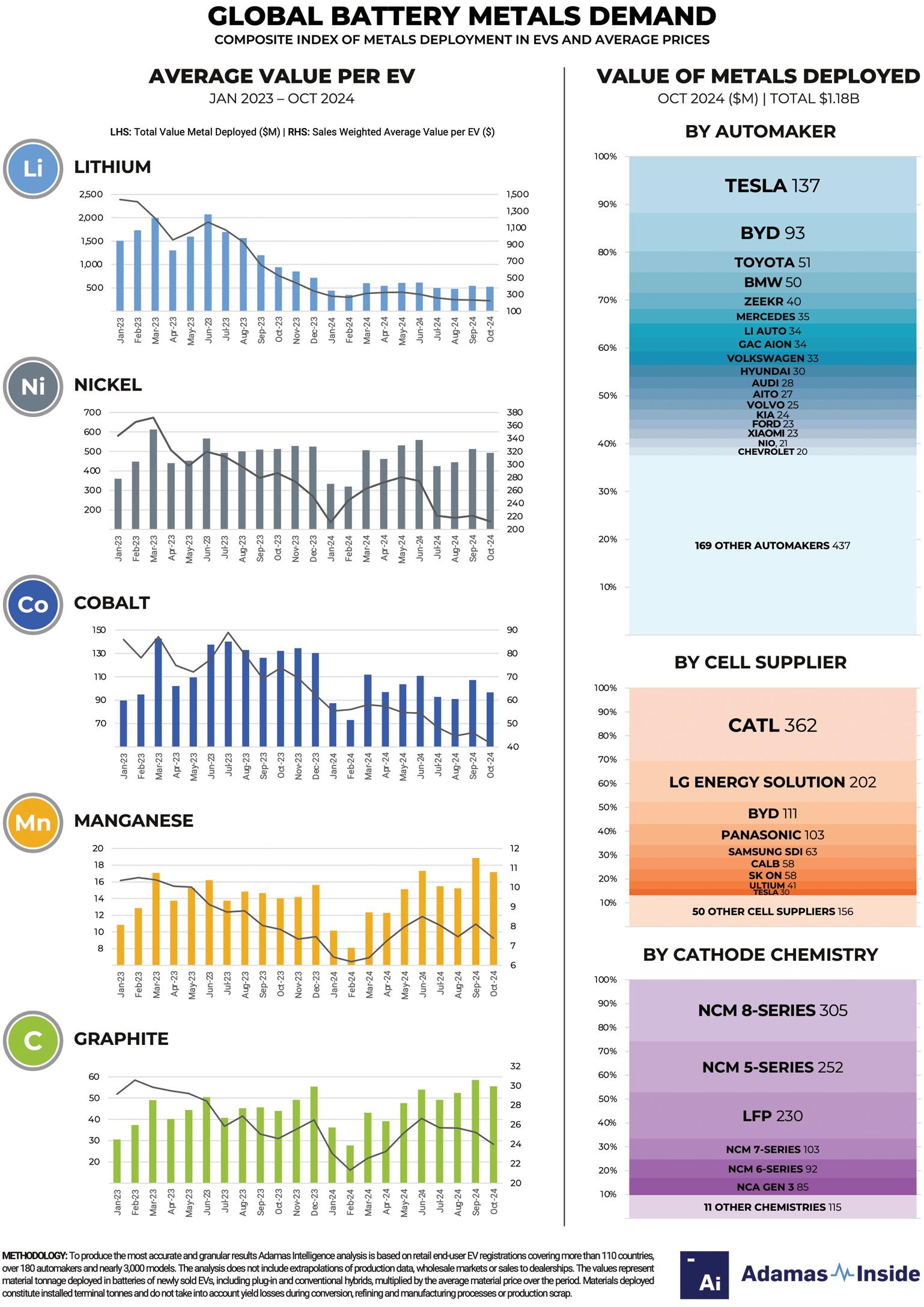
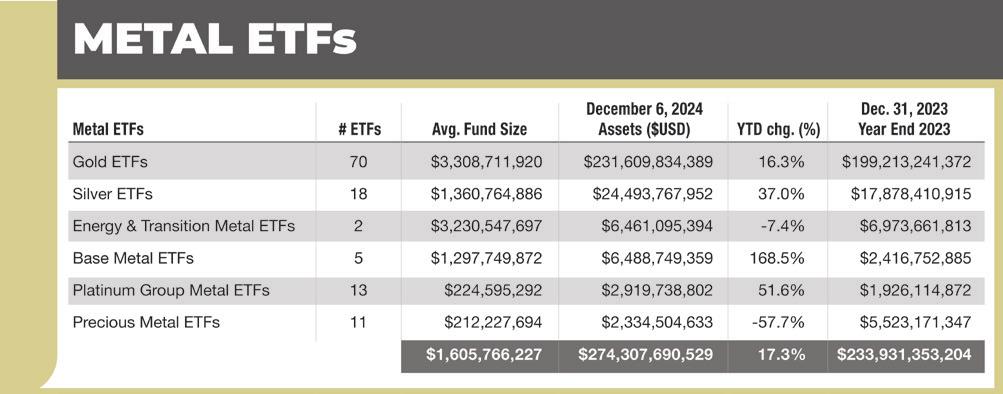
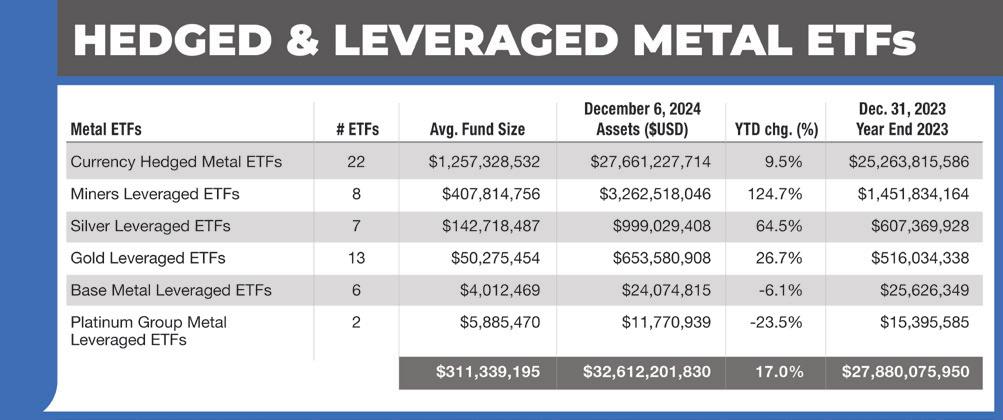
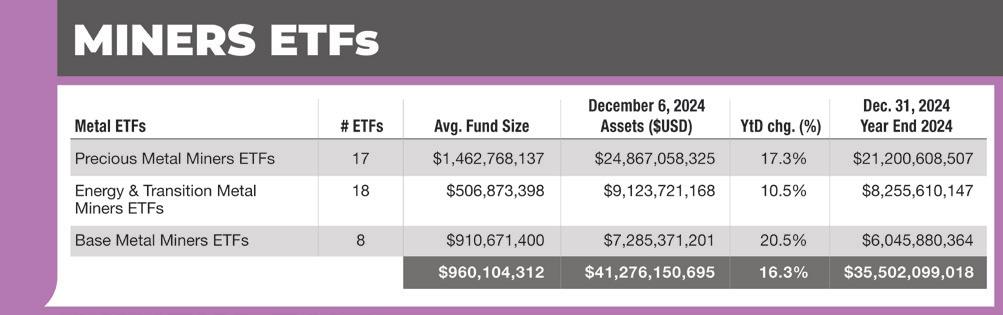

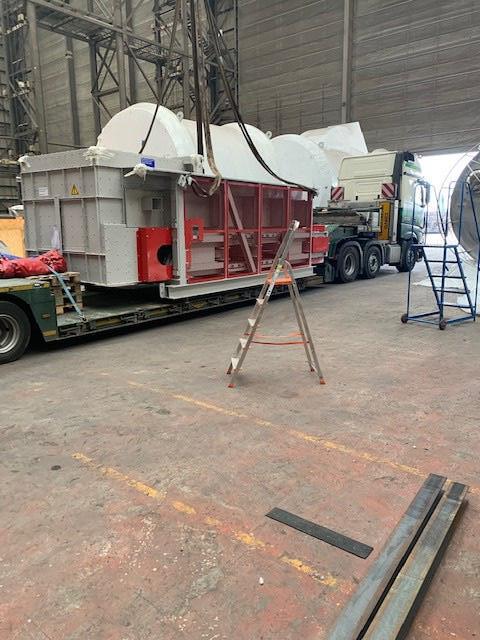
All equipment unused and in storage.
• Epiroc Boltec EC, Fully Mechanized Rock Bolting Rig
• Volvo ECR 235EL Medium Crawler Excavator
• 2x FLSmidth Rotary Dryer Packages
• 4x Weir Minerals Spreader Feeders (F4006C) 1000TPH; fully lined
• 4x Eirich Primary Mixer Granulators (R33/72)
• Allwater Technologies Spray Water Treatment Package C
• 4x Eirich Secondary Mixer Granulators (R33/72) C/W Load Cells
• 4x Eirich Feed Systems for Primary Mixers
• FT Pipeline Systems Gas Filtration, Heating and Gas Pressure Reducing Skid
• 3x FLSmidth Stockpile Reclaim Feeders
• FLSmidth Coarse Ore Belt Feeder: 420TPH
• 4x Haendle GmbH Granulator Discharge Box Feeders (BKSS2005)
• 2x Kaiser SS Coating Agent and Dosing Systems
• 4x Rospen Industries Primary Mixer LIW Feeders & 4 x Secondary Mixer LIW Feeders
• 29x Donaldson Filtration Reverse Jet Dust Collectors
• 2x Schenck Process Dense Phase Pneumatic Conveying Trains
• Schenck Process Covered Truck Reclaim Feeder 360TPH (Intrabulk BRU)
• 4x Solex Thermal Science Inc. Granule Cooling Systems
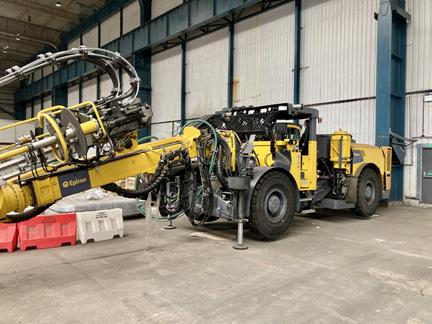
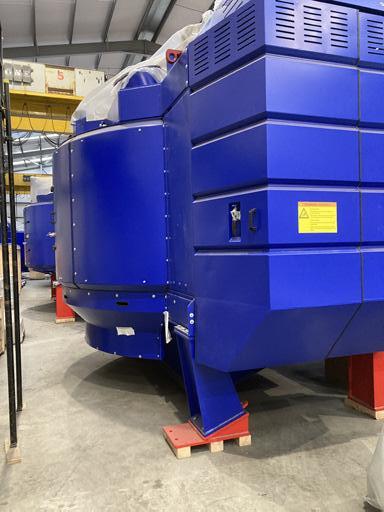
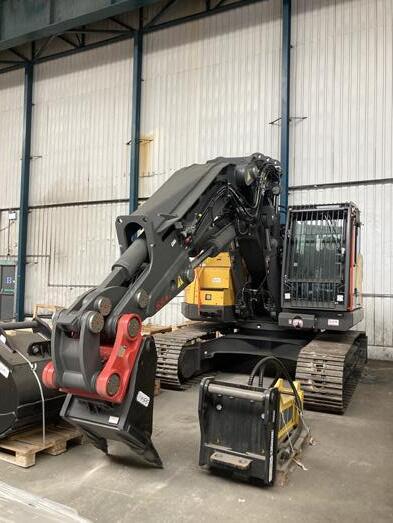
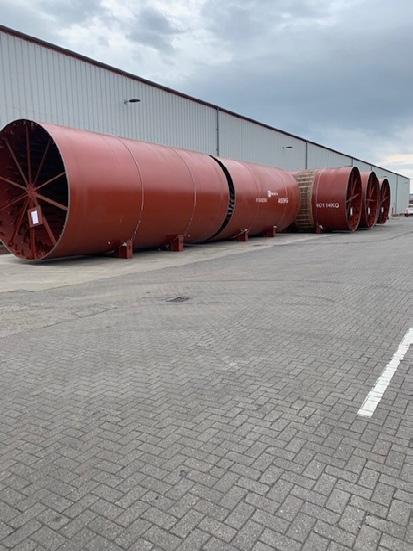
$5.50
$4.50
Commodity Prices 12-Month
Aluminum: US$1.16/lb.
Cobalt: US$11.02/lb.
Gold: US$2,653.94/oz.
Iron Ore 62% Fe CFR China-S : US$105.10
Nickel: US$7.199/lb.
Silver: US$30.51 per oz.
Zinc: US$1.4007 per lb.
COMMODITY PRICES | Prices current December 13, 2024
Coal: Central Appalachia, 12,500 Btu, 1.2 S02-R,W: US$76.25
Copper: US$4.10/lb.
Iridium: US$4,450/tr oz.
Lead: US$0.914/lb.
Rhodium: US$4,575/tr. oz.
Tin: US$13.396/lb.
Coal: Powder River Basin, 8,800 Btu, 0.8 S02-R, W: US$14.20
Copper: CME Group Futures February 2025: US$4.1765/lb.;
March 2025: US$4.1905/lb.
Lithium carbonate: US$10,500/tonne
Ruthenium: US$465 per oz.
Uranium: U 3O 8, Trading Economics: US$76.60 per lb.
Cameco, Perpetua and Founders Metals outperform
By Henry Lazenby
North American markets had mixed results during the week of Dec. 2-6. The S&P 500 hit record highs on strong economic data and earnings. The Dow slipped, and Canadian indices edged higher.
The Dow Jones Industrial Average fell by 268.1 points or about 0.6% to 44,642.52 points, and the S&P 500 gained 57.9 points or about 1% to 6,090.27. In Canada, the S&P/TSX Composite Index gained 43.8 points or 0.2% to 25,691.8 points, while the S&P/TSX Venture Composite Index fell 4 points or 0.7%% to 610.22.
The S&P/TSX Global Mining Index fell 1.4 points or about 1.1% to 122.5, and the S&P/TSX Global Gold Index fell 2.8 points or 0.8% to 355.36. Gold fell US$13.75 per oz. or 0.5% to US$2,637.30
per ounce. The S&P/TSX Global Base Metals Index fell by 3 points or about 1.5% to 206.73, with copper down US7¢ at US$4.10 per pound.
On the NYSE mainboard, the week’s biggest percentage and value gainer was Cameco. It closed at US$1.61 or 2.7% higher at US$61.06 on continued longterm uranium price strength.
In Toronto, Perpetua Resources was the top TSX value gainer, adding $4.03 to close at $17.34. The company’s Stibnite gold project recently achieved key permitting milestones.
On the S&P/TSX Venture Exchange, Founders Metals gained 37¢ to $4.40. It reports steady exploration progress at its Antino gold project in southeastern Suriname.

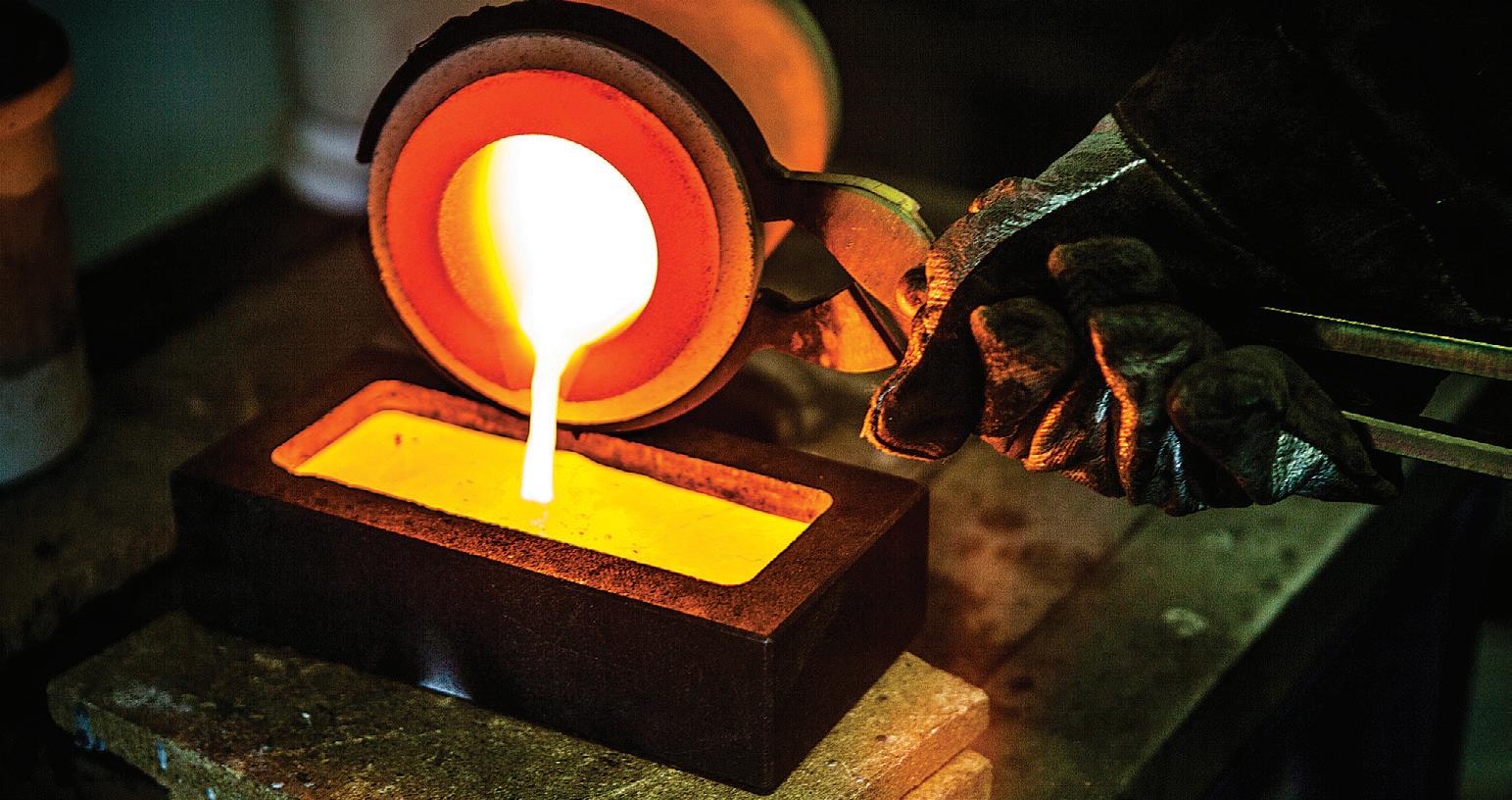
IBY JEFFREY M. CHRISTIAN
n order to focus on what will be important in determining gold prices in 2025 we first need to lay out three important points that help frame CPM’s outlook for gold prices this year.
First, the single most important set of factors in setting the price levels and directions of gold prices are the levels and trends in investment demand for physical gold. That demand in turn is determined by a myriad of economic, financial, and political concerns and uncertainties that cause investors to think they need to own more or less gold.
Investment demand drives prices. Prices drive mine production, secondary recovery from scrap, and fabrication demand.
Second, CPM Group issued a long-term gold buy recommendation in releasing its Gold Survey in November 2000. We laid out the case that there was about to be an upward shift in the investment demand curve: More investors and more types of investors in more parts of the world would want to buy more gold for a longer period of time than ever before. The result of this gold renaissance would be that gold prices, then around US$260 per oz., would rise far beyond the 1980 record US$850 and stay there for decades.
Prior to 1980, hostile economic and political trends would cause investors to buy more gold for a year or two. After such a period, conditions would improve and investors would buy less gold. Gold prices would subside until the next one or two-year set of crises would start the cycle again.
In 2000, CPM stated that the

next cycle would see investors buying more gold for decades, not years.
Finally, there have been major shifts in the international and national political contexts around the world. One of the more significant ones is the imminent return of Donald Trump as president of the United States. His return to power this month could dramatically alter the economic and political fortunes and landscape. It is not clear what his presidency will mean and do to the world, given the internal inconsistencies of his stated plans, but they are likely to be negative for world growth. It is too early to tell.
With these underlying realities in mind, the outlook for gold in 2025 suggests further price increases.
“(Donald Trump’s) return to power this month could dramatically alter the economic and political landscape. It is not clear what his presidency will mean and do to the world.”
JEFFREY M. CHRISTIAN, CPM GROUP
Upward trajectory
Gold prices have risen sharply since the middle of 2019. In 2024 gold averaged US$2,370 as of Nov. 26, 21% higher than the 2023 average of US$1,952.
CPM expects that gold prices might rise further in December, yielding an approximately 23% rise in the annual average gold price for all of 2024. We’re now projecting another 13% increase to an average price around US$2,730 in 2025.
Prices may rise in the first quarter, and calm down a bit in the second quarter of this year, before beginning to rise again, depending on how the economic and political environments evolve.
CPM has been projecting a recession at some point, perhaps most likely in 2025 or 2026. If the
U.S. government slashes its spending and pursues hostile postures toward any number of countries, a recession could arrive sooner and be more severe.
Recession threats?
Trump often considers imposing tariffs. This raises the spectre of a deeper recession sooner.
Republican president Herbert Hoover and Congress sought to combat the Great Depression by enacting the Tariff Act of 1930, known as the Smoot–Hawley Act. It raised tariffs on more than 20,000 imported goods mostly by 40% to 60%. Smoot-Hawley and the retaliatory tariffs in other nations caused a 67% decline in U.S. trade, imports and exports, deepening and prolonging the severity of the Great Depression.
Regarding gold market fundamentals, CPM projects around a 1.5% increase in global mine production in 2025 to around 88.6 million ounces. This would follow an increase of around 0.5% in 2024.
Mining share prices are likely to continue to lag gold metal prices, reflecting long-term shifts in investor attitudes and distinctions between gold bullion and mining equities.
Secondary supply, or recycled gold, in 2025 is projected to rise around 10% to about 40.9 million oz. due to the higher gold prices and anticipated worsening consumer economics in many parts of the world.
Total supply of newly refined gold is projected to be around 136.9 million oz., adding in around 7.4 million oz. from transitional economy exports. This would be up around 3.8% in 2025 from 2024.
Banks getting skittish Central banks are projected to continue to be net buyers of around 8 million oz. in 2025, roughly unchanged to a bit lower than in 2024. Monetary authorities tend to be more price sensitive than private investors. Central banks pulled back from buying as much gold as they had been buying since gold prices broke above US$2,200 at the end of last March. This hesitancy is expected to continue in 2025, since prices are expected to stay strong and rise further.
One big risk is that a politically and economically collapsing Russia might sell several million ounces of its 75 million oz. of monetary reserves.
Investors bought 24 to 26 million oz. of gold on a net basis annually from 2021 through 2023. They are estimated to have bought around 32 million oz. in 2024. CPM is projecting investors will buy around 44 million oz. in 2025 as political and economic conditions elevate investor concerns.
A range of economic and political issues seem likely to keep investors interested in adding gold to their portfolios. That should keep gold prices high and most likely driving them to new record prices over the course of 2025. TNM
Jeffrey Christian is an analyst and adviser in the precious metals and commodities markets. He has been active in the industry since the 1970s and has expertise in a range of commodity markets, including precious metals, energy, base metals, and agriculture. He founded the CPM Group in 1986, which was spun off from Goldman Sachs & Co and its trading arm, J. Aron & Company.
BY NORTHERN MINER STAFF
Geopolitical and economic uncertainty helped drive gold to record highs last year and many believe prices will remain elevated in 2025. Here’s a look at eight juniors with compelling gold projects in all corners of the world.
n Aurion Resources
Aurion (TSXV: AU; US-OTC: AIRRF) is exploring at its pre-resource flagship Risti project in northern Finland’s Central Lapland Belt, about 10 km from the municipality of Sodankyla.
In September Aurion released drill results from the Vanha prospect in the project’s Kaaresselka area. Highlights included 3.1 metres grading 29.1 grams gold per tonne from 20.1 metres downhole in drillhole KS24079 and 9 metres at 2.77 grams gold starting from 85.3 metres in drillhole KS24081.
Aurion also has joint venture exploration properties in the Central Lapland Belt with B2Gold (TSX: BTG; NYSE-AM: BTG). In March, Aurion and B2Gold made a new discovery called Sore in the northwest part of its joint-venture area. Sore, a blind discovery, is about 15 km east of Kaaresselka.
Intercepts at Sore included 2.4 metres of 26.45 grams gold from 104.6 metres in drillhole SOR23010; 1.05 grams gold over 40.7 metres starting from 38.4 metres in drillhole SOR23002; and 1.33 grams gold over 17.9 metres from 5.4 metres depth in SOR23001.
The JV (30% Aurion/70% B2Gold), covers 293 sq. km and includes several discoveries like Helmi (77.5 metres grading 2.05 grams gold); Kutuvuoma (11 metres at 16.47 grams); and Soretiavuoma (1.1 metres at 48 grams gold), among others.
In May, Aurion decided not to acquire B2Gold’s 70% stake in the joint venture under its right of first refusal.
Aurion also has a joint venture called Launi East with Kinross Gold (TSX: K; NYSE: KGC). Drilling at the 23-sq.-km project has returned highlights of 0.37 metre grading 63.9 grams gold from 260.8 metres downhole in LN20014; and 0.55 metre at 8.65 grams gold from 28.4 metres in LN20042. Kinross can earn a 70% stake in the project.
Kinross also owns 9.98% of Aurion and in July opted to top up its shares to maintain its ownership stake in the junior.
Aurion Resources has a market cap of roughly $78 million.
In October, Dryden Gold (TSXV: DRY; US-OTC: DRYGF) reported the highest-grade intercept yet at its Elora target in the Gold Rock Camp in northwestern Ontario. Drillhole KW-24-017 cut 0.55 metre at 313 grams gold, part of a broader interval of 5.7 metres at 30.72 grams gold starting from 192
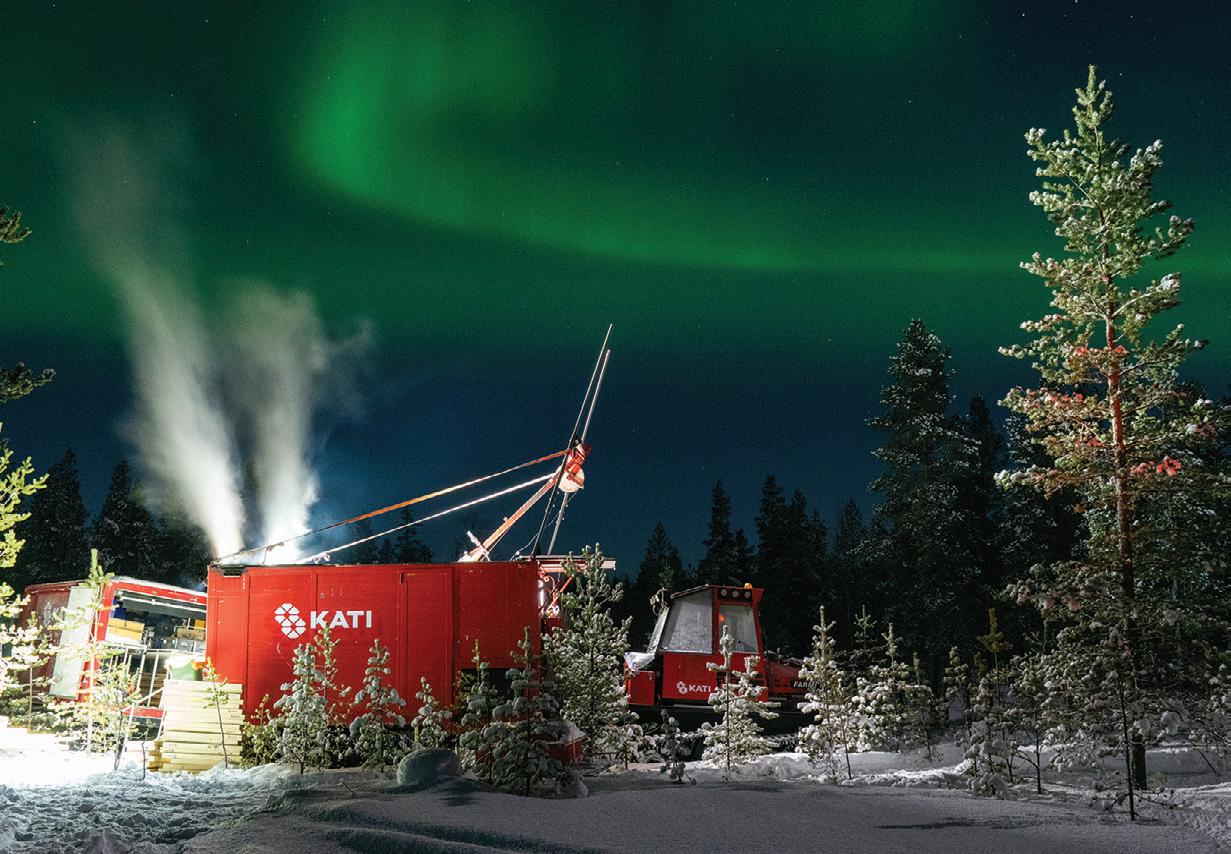
metres downhole.
In March last year, the company reported an intercept of 7.5 metres at 14.1 grams gold from 206 metres in drillhole KW-24-008, including 1.4 metres grading 43.81 grams gold and 0.3 metre at 92.10 grams. Other assays of note were from drill hole KW-24-003, which returned 1 metre at 53.51 grams gold from 53.9 metres, and KW-24-01, which cut 0.33 metre grading 15.9 grams gold starting from 183 metres. Historically, the Elora gold system hosted two mines that lie north of the current drill site. The Elora-Jubilee mine was about 300 metres to the north and the Laurentian mine about 700 metres farther. (The Laurentian mine recovered 19,950 tons at a grade of 14 grams gold down to 146 metres depth.) Both mines represent targets for Dryden’s next drill program.
In the company’s first drill program targeting the Big Master zone, drillhole KW-23-009A cut 3.2 metres grading 26.11 grams gold starting from 107.5 metres downhole, including 0.3 metre at 79.80 grams gold. The historic Big Master mine on the property was mined to a depth of 200 metres. The property hosts gold mineralization over 50 km of potential strike along the Manitou-Dinorwic deformation zone. According to the company, there has been limited exploration with only 33,200 metres of historic drilling district-wide at shallow depths.
Though the company hasn’t yet released a resource for its projects hosted in the Dryden Gold District, NexGold Mining (TSXV: NEXG; US-OTC: NXGCF) has defined a 3-million oz. low-grade resource
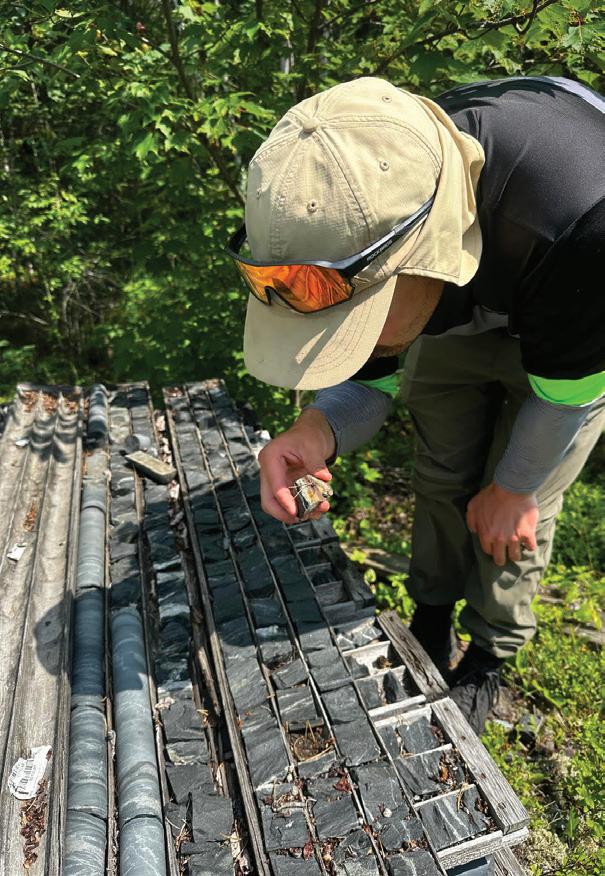
for the district.
Dryden Gold has a market cap of roughly $17.5 million.
n First Mining Gold
First Mining Gold (TSX: FF; USOTC: FFMGF) submitted the final environmental impact statement for its Springpole gold project in northwestern Ontario last November and estimates the process should be completed by the fourth
quarter of this year. It also inked a process agreement with the Cat Lake and Lac Seul First Nations for an Indigenous-led impact assessment.
Springpole, about 110 km northeast of Red Lake, is one of the largest open-pit gold projects in Canada, with 151 million indicated tonnes grading 0.94 gram gold per tonne and 5 grams silver per tonne, and 16 million inferred tonnes averaging 0.54 gram gold and 2.8
grams silver.
A prefeasibility study in January 2021 outlined a mine life of more than 11 years producing an annual average of 335,000 oz. gold during its first nine years. The study estimated a post-tax net present value (at a 5% discount rate) of US$995 million and an internal rate of return of 29% based on a gold price of US$1,600 per ounce. Initial capex was pegged at US$718 million.
In late November, the company released results from the first hole of a five-hole 2024 East Extension drilling program. The Eastern Extension target is at the southeastern boundary of the mineral resource. Highlights from drillhole SP24-007 included 1.1 metre at 6.46 grams gold and 34.87 grams silver from 50 metres in drillhole SP24-007 and 52.5 metres grading 0.83 gram gold and 8.02 grams silver starting from 303 metres downhole.
The company also recently reported drill results from its Duparquet gold project in Quebec. In the Buzz zone, highlights included 15.4 metres grading 1.55 grams gold from 475 metres downhole in drillhole DUP24-028, including 5.3 metres at 3.08 grams gold. In the North zone, DUP24-032 returned 5.7 metres at 4 grams gold from 571 metres, including 2 metres of 6.65 grams gold.
Duparquet, immediately north of the namesake town, and 50 km northwest of the city of RouynNoranda, contains 183,600 measured tonnes grading 1.43 grams gold and 69 million indicated tonnes grading 1.55 grams gold. Inferred resources add 50.8 million tonnes grading 1.62 grams gold. First Mining Gold has a market cap of about $140 million.
n Kenorland Minerals
Kenorland Minerals (TSXV: KLD; US-OTC: KLDCF) holds its main, discovery-stage Frotet
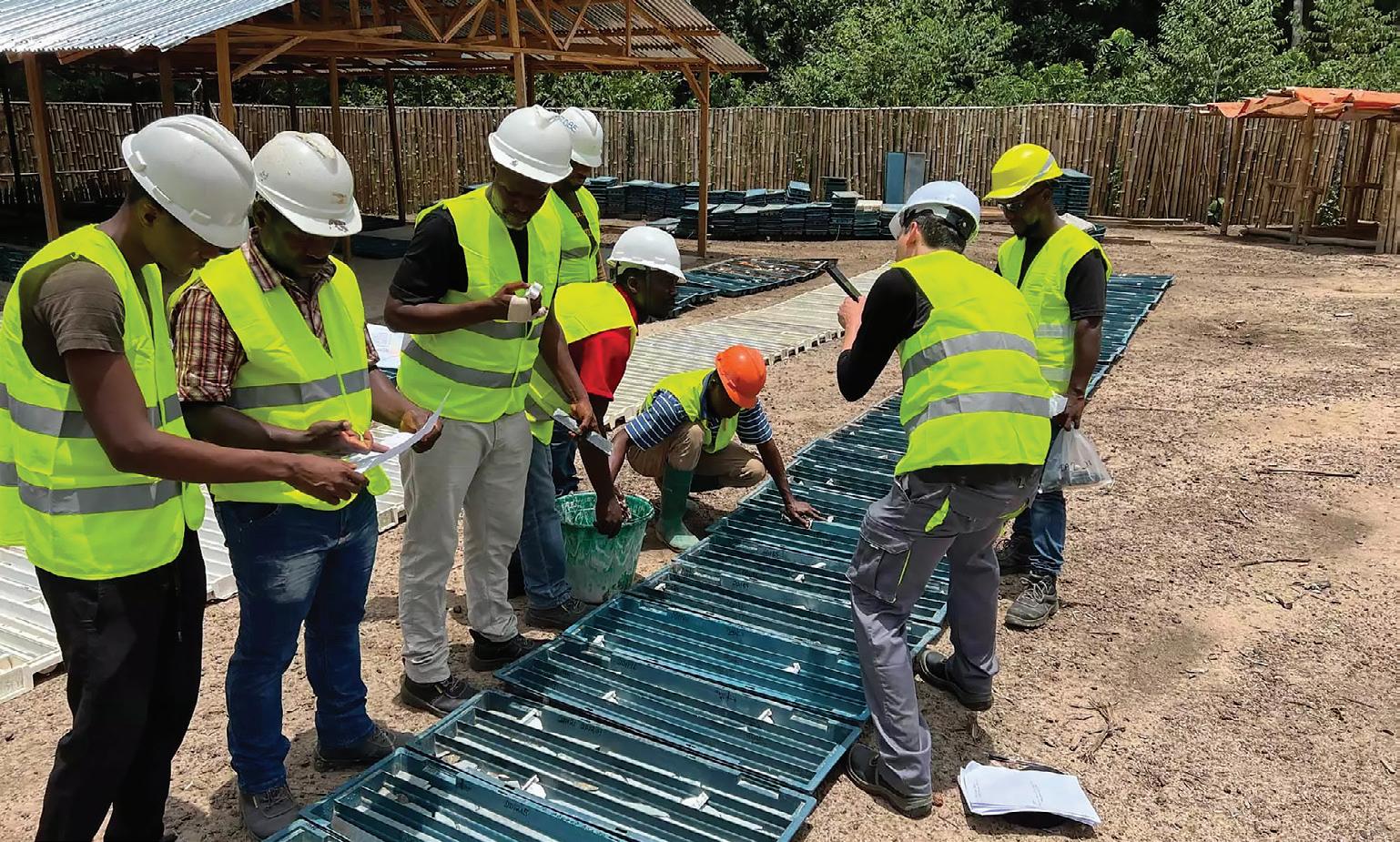
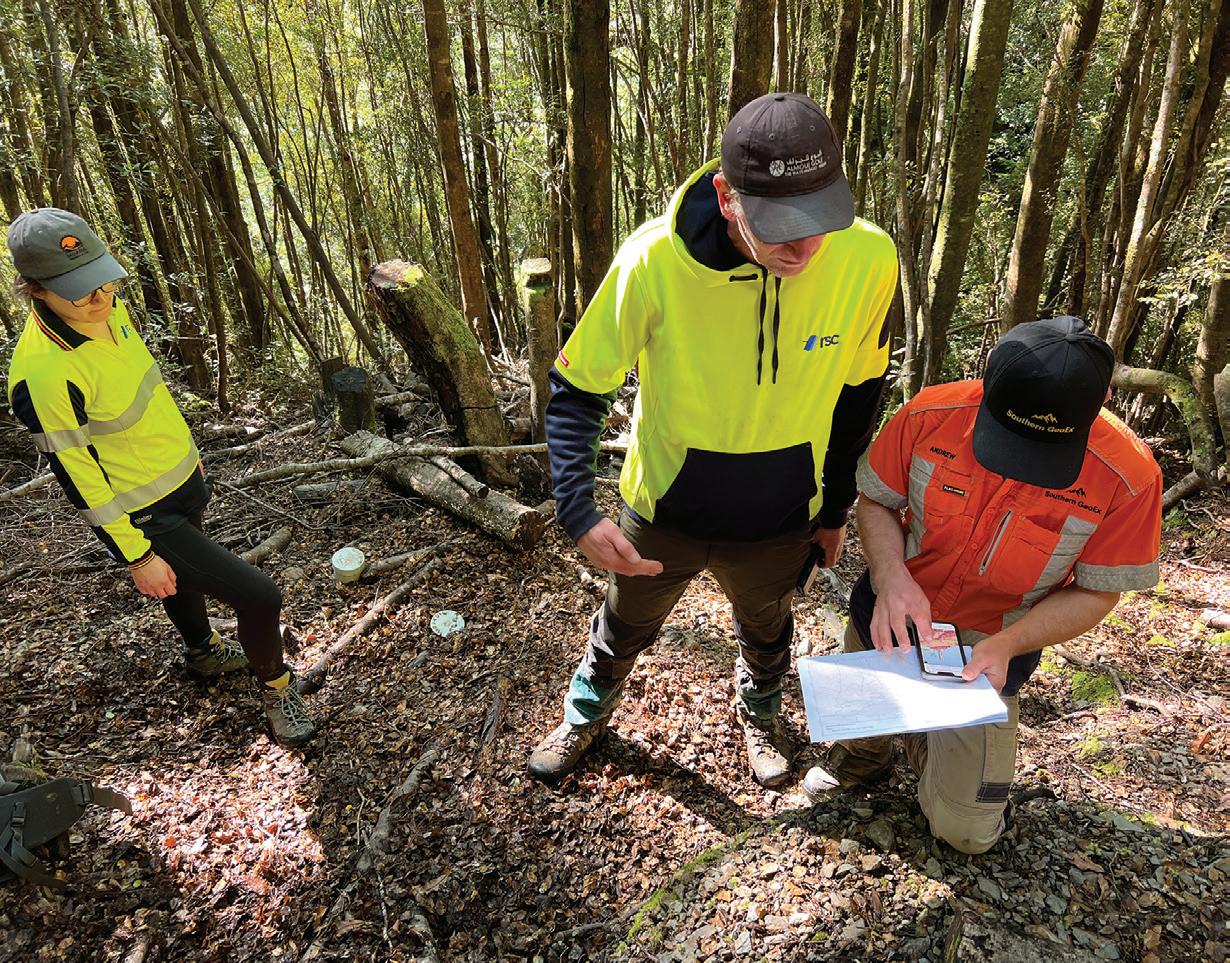
project, 100 km north of Chibougamau, Que. It hosts the Regnault gold system, a greenfields discovery made by Kenorland and Sumitomo Metal and Mining Canada in 2020. Kenorland staked the project in 2017 and then entered into a joint venture and earn-in agreement with Sumitomo in 2018. Earlier this year, Kenorland exchanged its 20% stake in the project for a 4% net smelter return royalty on the project.
Kenorland reported drill results in November from Frotet with
highlights of 3.3 metres grading 26.67 grams gold per tonne starting from 506 metres downhole in drillhole 24RDD223, and 6.3 metres of 9.78 grams gold starting from 277.7 metres in drillhole 24RDD224.
At the corporate level, Centerra Gold (TSX: CG; NYSE: CGAU) became a strategic investor in Kenorland in May and in September topped up its shares to maintain its 9.9% stake in the company. Sumitomo also exercised its top-up right to maintain its 10.1% interest in the junior.
In other news, Sumitomo withdrew from an earn-in and joint venture exploration agreement with Kenorland at its Chicobi project in Quebec. The junior now owns the entire project.
In November, Newmont (TSX: NGT; NYSE: NEM; ASX: NEM) elected to enter the second stage of its agreement to potentially earn an additional 29% participating interest in Kenorland’s Chebistuan project, also in Quebec. Newmont completed its 51% earn-in during the first stage of the option agreement.
Kenorland has a market cap of about $82 million.
n Lavras Gold
Lavras Gold (TSXV: LGC; USOTC: LGCFF) has identified 24 prospects centred on historic gold workings dating to the late 1700s at its Lavras do Sul (LDS) project in southern Brazil, about 320 km from Porto Alegre, the state capital of Rio Grande do Sul.
The company reported 12 drill holes in September from its Fa-
zenda do Posto target, situated at the western edge of the 235-sq.-km property. Gold mineralization at Fazenda begins at surface and has been traced down to a vertical depth of 400 metres. Highlights included 32 metres of 4.3 grams gold starting from 240 metres downhole in drillhole 24FP016, within a broader 59-metre interval of 2.9 grams gold from 233 metres.
Fazenda do Posto is about 150 metres west of the Butia deposit, which hosts 12.9 million measured and indicated tonnes grading 0.91 gram gold and 3.7 million inferred tonnes averaging 0.97 gram gold. Drill results from Butia released in mid-2024 included 236 metres grading 1.4 grams gold from surface in drillhole 23BT019, including 1.6 grams gold over 199 metres from 37 metres downhole, and 228 metres grading 1 gram gold from surface in hole 24BT023. All seven holes intersected gold mineralization, three of which cut more than 200 metres of continuous mineralization.
Its Cerrito prospect contains 8.3 million indicated tonnes grading 0.7 gram gold and 13.2 million inferred tonnes averaging 0.69 gram gold.
Lavras Gold has a market cap of roughly $128 million.
Rua Gold (TSXV: RUA; US-OTC: NZAUF) is exploring pre-resource targets in two historic gold districts in New Zealand: the Reefton Goldfield area on the South Island and the Hauraki Goldfield on the North Island.
The company holds 1,250 sq. km or 95% of the tenements in the Reefton Goldfield district, an area that started producing in 1872 and churned out about 2 million oz. ranging between 9 to 50 grams gold from underground mines in oro-
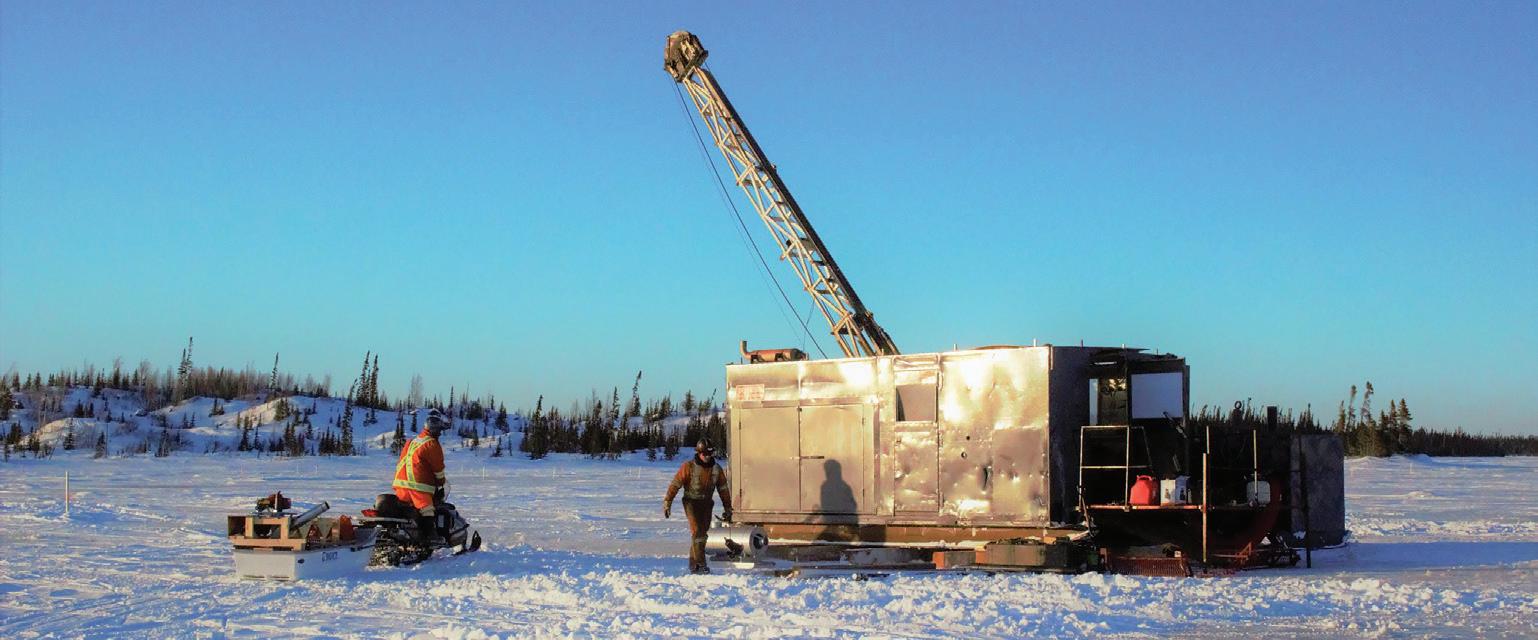
genic quartz vein systems.
Last November the company reported that the second drill hole into the Victoria Lode target at Reefton cut a 0.2-metre interval of 34.1 grams gold from 388 metres downhole in DD-VIC-042. At its Capleston target, the first drill hole, DD-REF-043, intersected a 12-metre zone of quartz-pyrite-arsenopyrite in the hanging wall, including a 1-metre quartz vein from 31 metres to 32 metres grading 3.86 grams gold.
Rua Gold’s other project, Glamorgan, is within 3 km of OceanaGold’s (TSX: OGC; US-OTC: OCANF) Wharekirauponga (WKP) project in the Hauraki district, which historically produced 15 million oz. grading 15 to 30 grams gold, and 60 million oz. of silver.
Based on initial surface soil geochemistry, interpreted geophysical structures and geological mapping, Rua Gold says there is preliminary evidence that Glamorgan has the hallmarks of an epithermal gold system, with features similar to OceanaGold’s WKP project. It plans to start drilling there in 2025.
Rua Gold has a market cap of about $38 million.
Vista Gold (TSXV: VGZ; NYSEAM: VGZ) released results in the fall from its stage two drill program at the Mt Todd gold project in Australia, about 250 km southeast of Darwin.
The drill program focused on the shallow portion of the South Cross Lode zone, a narrower mineralized structure adjacent to the project’s Batman deposit. Assays included 8 metres grading 1.2 grams gold from 22.5 metres downhole and 20.8 metres of 1.96 grams gold
starting from 142.5 metres in drillhole VB24-025.
Other highlights were drillhole VB24-014, which cut 9.1 metres of 3.35 grams gold from 101.8 metres, and BV24-022, which returned 4 metres grading 7.18 grams gold from 106 metres downhole, including 1 metre of 25.89 grams gold.
All major construction and operation permits have been approved.
An updated feasibility study completed in March last year forecast initial capital of about US$1 billion, a US$1.8 billion after-tax net present value (at a 5% discount rate) and an internal rate of return of 29.6%. The study was to reflect first quarter estimates for capital and operating costs. It used a gold price of US$1,200 per oz. and envisioned average annual gold production of 395,000 oz. at all-in sustaining costs of US$1,034 per oz. over a mine life of 16 years.
The company said it plans to update the Mt Todd resource estimate after it completes the drill program started last year, and anticipates moving forward with a new feasibility study targeting throughput in the range of 12,000 to 17,000 tonnes per day, 150,000 to 200,000 oz. of annual gold production, and an initial capex of less than US$400 million.
Vista Gold has a market cap of about $99 million.
n Zodiak Gold
Zodiak Gold (TSXV: ZAU) has intercepted mineralization in 57 of the 65 holes it has drilled so far at its main Todi project in Liberia, about
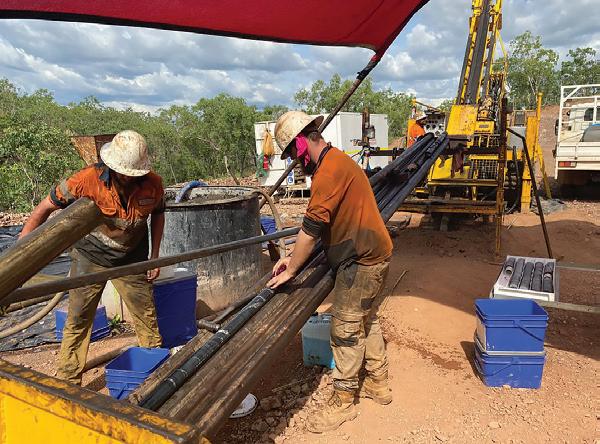
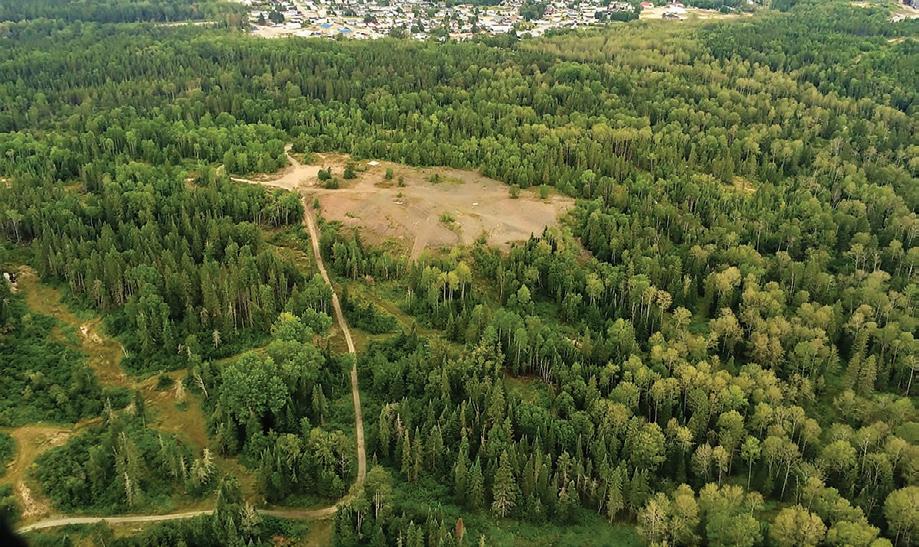
13 km from the capital of Monrovia. Highlights from its Arthington target, a 4-km-long soil anomaly with artisanal workings, include 9.6 metres grading 7.5 grams gold in drillhole ADD007 starting from 87.3 metres, and 6 metres at 10.6 grams gold in ADD004 from 55 metres. Drillhole ADD024 cut 25.9 metres of 2.1 grams gold from 93.3 metres downhole.
At the Alasala target, a 2.4-kmlong by 250-metre-wide soil anomaly—also with artisanal activity— highlights include 19.6 metres of 6.17 grams gold, 6 metres at 7.69 grams gold and 9 metres of 4.6 grams gold.
The pre-resource project also has three other drill ready targets, all of which have artisanal workings. Benben is a 4.5-km-long soil anomaly where rock chips have delivered up to 255 grams gold; Youth Camp-Fehfeh, a 4-km-long soil anomaly where trench results include 30 metres of 1.04 grams gold; and Alasala South, a 3-km soil anomaly.
The project is about 20 km southeast of privately-held Avesoro Resources’ New Liberty gold mine and 30 km south of its Ndablama project.
The company recently acquired two exploration licences for the Bomi South and Bong West sites, which Zodiak says have iron ore potential. The Bong iron ore mine, owned by China Union is adjacent to the east and Vedanta’s Bomi Hills iron mine is adjacent to the north.
Zodiak Gold has a market cap of $7 million. TNM
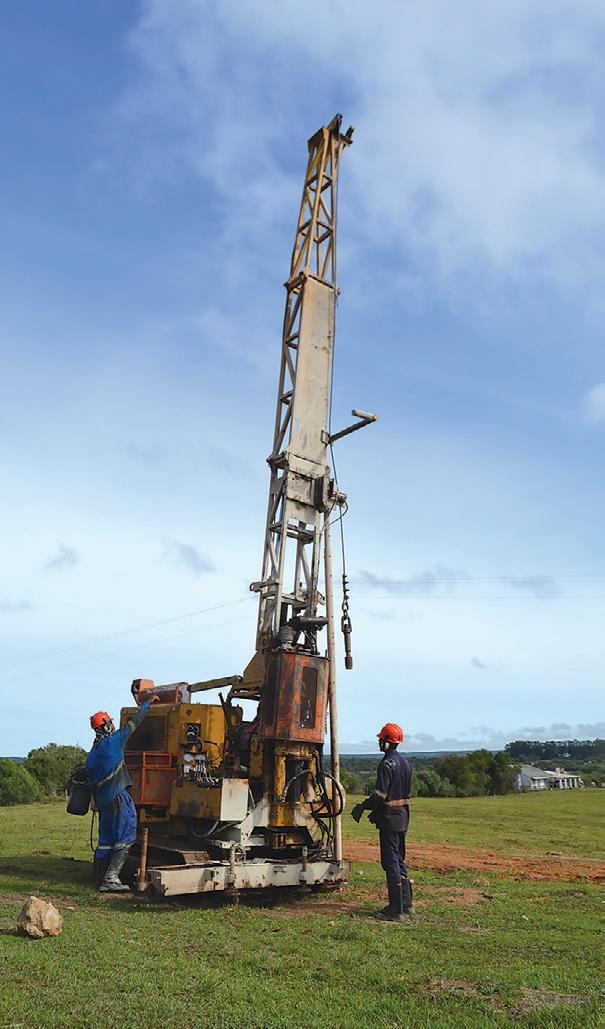




“What can we do in Canada? We say that a lot, but actually, everybody can make a difference, absolutely everybody. And at the end of the day, if everybody does make that difference, big picture changes happen.”
However, junior mining companies often say they can’t afford sustainability because they aren’t making money yet, according to audience member Jamie Strauss, founder and CEO of Dorset, U.K.based ESG technology company Digbee. When should they start? he asked.
“Immediately,” McEwen said. “It’s about social licence. Will the community accept it? This discussion is about the changing environment that you have to meet certain standards before you’ll be allowed to build a mine, to operate a mine and provide the supplies.”
1,000 to one
Beaty was less sure about juniors, saying 1,000 early-stage explorations fold before one mine is ever built. But project developments should adopt sound environmental policies, he said.
“I wouldn’t obsess too much about it, but when you’re more advanced, immediately, to Rob’s point, you should start thinking about how you can do this the best way versus not such a good way. And there are choices. Make those good choices, think about it, reflect on how you can do things with as
little footprint as possible, as little water use, as little damage to the environment as possible.”
The industry is also concerned there are too many ESG standards and bodies with no clear rules and routes for companies to follow, according to conference attendee Theresa Sapara, co-lead at EY’s Americas Mining and Metals Centre of Excellence. How can the industry reduce ESG reporting redundancy? she asked.
The International Sustainability Standards Board is trying to align with the Taskforce on Nature-related Financial Disclosures while the World Economic Forum is providing a framing to converge metrics for the investment side as well as natural capital accounting, Schwab said.
“Obviously each country is also moving at different speeds,” she said. “And kind of in slightly different directions and we know that’s a challenge.”
Beaty agreed there’s a push to make it easier for mining companies to understand what is needed and what they can do. But he said the answer is even simpler.
“There’s sort of one way to do things, and you shouldn’t necessarily look at specific regulations to figure out, well, what can I get away with? How can I avoid this problem or that cost? You just try to take the high road and do things right, because if you do things right, you’re going to satisfy all the regulations. That’s how we try to work.” TNM
analyst at geopolitical consulting group RANE, noting that the security and operational environment for foreign miners in the country has significantly worsened in recent years.
“Nampala is relatively close to Mali’s border with Burkina Faso, where there is significant al-Qaeda-affiliated activity,” he said in an interview from London. “While an attack on Barrick’s Loulo-Gounkoto mine appears unlikely in the next six months, I would not say that of the Nampala mine. Robex seems to be at a higher risk given the mine’s location.”
“We don’t have strong evidence of jihadist activity in Guinea—there haven’t been any notable jihadist attacks there in recent years, meaning the security threat is significantly lower than in Mali, where they happen on a weekly basis.”
As for growing resource nationalism, he adds, “we can’t rule (it) out in Guinea, but there is less of an imperative for military rulers to strong-arm funds from miners, unlike Mali, which urgently needs financial resources to respond to the jihadist attacks.”
Expert’s strategic plan
As part of Robex’ strategic plan released in June, the company appointed seasoned mine builder Matthew Wilcox as CEO. Most recently the managing director and CEO of Tietto, Wilcox led construction of its Abujar mine
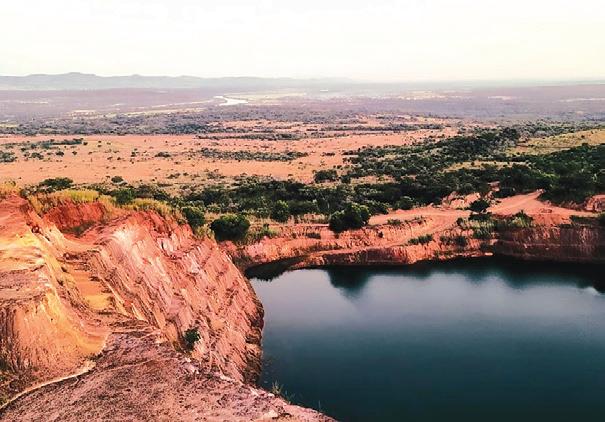
in Côte d’Ivoire before the company was acquired by China’s Zijin Mining. Prior to that, Wilcox oversaw construction of West African Resources’ (ASX: WAF) Sanbrado gold mine in Burkina Faso; served as project director for Nordgold’s Bissa and Bouly gold projects, also in Burkina Faso, among other mine builds in Africa.
Kiniero, a past-producing mine in eastern Guinea, 546 km from the capital of Conakry, operated from 2002 to 2014, producing 418,000 oz. gold before it was put on care and maintenance.
Robex acquired the Kiniero project in April 2022 through its business combination with Sycamore Mining.
The company plans to restart the mine as an open pit with a new 3 million tonne per year carbon-inleach (CIL) processing plant.
Indicated resources for Kiniero’s shallow open pit deposits measure 52.5 million tonnes grading 1.05 grams gold for 1.78 million oz. contained gold. Inferred resources add 35.7 million tonnes grading 1.17 grams gold for 1.35 million ounces.
‘Buy’ rating from SCP SCP Resource Finance mining analyst Justin Chan said Robex is one of his top picks after a recent site visit to the project. The market “will be positively surprised with how quickly production commences” and that the build team is “very experienced and have worked together at multiple mine builds,” he said.
Mining Persons of the Year
Adam Lundin, chair of Lundin Mining (TSX: LUN), recounted the pressure to perform while being raised in a mining family first led by his émigré grandfather Adolph then father Lukas.
“You grow up hearing, ‘OK, you guys are third generation, you’re going to lose it all,’” Adam told the symposium in December via live video. “That really fuelled the fire for me and my brothers to continue going, but also to be very passionate and enjoy the sector.”
Adam and brother Jack, Lundin Mining’s president and CEO, are The Northern Miner’s Persons of 2024 for signing the $4.8-billion Vicuña joint venture copper project in Argentina with BHP (NYSE: BHP; LSE: BHP; ASX: BHP). It makes the Canadian company a major partner in developing two significant copper–gold silver projects in the Andes, including Filo Corp.’s (TSX: FIL) Filo del Sol project.
“We feel like we’ve done something great,” said Jack in a pre-recorded message. “But we also feel like we’re just getting started.”
Lukas won the award in 2015 for amassing projects in North and South America. This month, his sons divested the last of the
company’s holdings in Sweden and Europe to focus on the New World.
“Spending a lot of time with my father, especially when he was ill, I learned you’ve got to remain adaptive,” Adam said. “Things change. Processes change. And you have to be on top of it.”
The BHP deal came about through relationship building with the Aussie giant after the initial Filo del Sol investment, Adam said. He stressed the importance of having a knowledgeable and responsive team that builds value over volume.
“I think you’ve got to demonstrate that it was the right transaction for both parties and to continue moving it forward,” he said. “We are not here to hit any ego milestones. You want to be rewarded for having the best margins and achieving best practices.”
Operator of the Year
Amparo Cornejo is TNM’s first recipient of Operator of the Year award for her work in maintaining high sustainability standards during the development of Teck Resources’ (TSX: TECK.A/ TECK.B; NYSE: TECK) nearly US$9-billion Quebrada Blanca Phase 2 (QB2) copper project in northern Chile.
Cornejo, the company’s chief sustainability officer, lifted women
to 30% of the project workforce. She oversaw the construction of a water pipe, desalination plant and agreements with 22 Indigenous groups in the Tarapacá region at an elevation of 4,400 metres.
Located 240 km southeast of the city of Iquique and 1,500 km from Santiago, QB2 has the potential to double Teck’s copper production.
She’s already been named EY’s executive of the year in Chile.
“I learned a profound lesson in the Atacama Desert — in this harsh landscape where QB2 was born, nature teaches us that freedom is about being strong, of course, but also adaptable and connected to our environment,”
Cornejo said.
“Instead of seeing complexity as a burden, we saw it as an opportunity to demonstrate what modern mining could achieve.”
Cornejo said QB2 was developed without delays related to social issues — an achievement almost unheard of in a large-scale Latin American project.
“These experiences taught me something crucial about modern mining leadership,” she said. “The old divides between operational efficiency and social responsibility, between profitability and sustainability, are false choices.” TNM
With files by James Snell.
A feasibility study in June 2023 envisioned a 9.5-year mine life with average annual production of 90,000 oz. (100,000 oz. annually during the first seven years) for total life-of-mine production of 851,000 ounces.
The study outlined an aftertax net present value (at a 5% discount rate) of US$170 million and an internal rate of return of 31% based on a gold price of US$1,650 per ounce. Initial capex of US$160 million could be repaid in 4.3 years.
Robex says there is opportunity to add economic near-surface oxide ounces to the mine plan through infill and exploration drilling. The project lies in the prospective Siguiri Basin, which is situated in northeastern Guinea and extends into central Mali. Geologically, the Siguiri Basin is part of the West Africa Birimian Greenstone Belt.
At least 47 gold anomalies have been identified on the 475-sq.km property, of which five clusters of deposits—Sabali, Mansounia, SGA, Jean and Balan—have been explored sufficiently for resource estimates.
Highlights from infill drilling priority targets at Mansounia include 16 metres grading 8.06 grams gold per tonne from 27 metres downhole in drillhole MRC23-038; 10 metres of 4.91 grams gold from 52 metres in MRC23-091; and 25 metres of 3.61 grams gold from 18 metres in MRC23-080.
Chan also pointed out that the economic impact of Rio Tinto’s (ASX: RIO; TSX: RIO; NYSE: RIO) US$15 billion Simandou iron ore project was evident—from large advertising signs in the domestic and international airports and significant numbers of international arrivals.
“We think this is a key reason to rank Guinea with Côte d’Ivoire as a top West African jurisdiction— the economy has other sources of growth which reduces the fiscal pressure on gold miners,” he said in a Dec. 5 research note. The analyst also pointed out that Guinea “exceeded” his expectations compared to SCP’s previous visit, and that the country appeared to be “moving in the right direction.”
SCP has a buy rating on the stock and a one-year price target of $4.00 per share. At press time in Toronto Robex was trading at $2.12 per share, giving it a market cap of about $320 million. Over the last year the company has traded in a range of $1.15 and $3.00 per share. Institutional shareholders include the Cohen Group with 26% and BlackRock with 7%.
“We left the site visit very positive on the mining industry in Guinea,” Chan concluded. “Simandou is forecast to add 25% to the country’s GDP and we think the Siguiri Basin is starting to feel like the new Hounde Belt with multiple new discoveries processing to mine build, mid-tiers moving to acquire available exploration tenure and established producers in need to diversify from Mali and Burkina Fasto given increased security and fiscal pressures.” TNM
based in Thetford Mines, 100 km south of Quebec City.
Green solutions
While cyanide usage has long been an industry standard for separating gold from ore, it can harm living creatures and mining’s public image. But Dundee’s “challenging of the orthodoxy” around cyanide initially drew Brent Johnson to the company.
Now vice-president environment with Dundee, Johnson said the company is working on commercializing an alternative technology to cyanide using sodium hypochlorite, or household bleach.
“It provides a very viable and commercially comparable alternative to traditional cyanidation extraction techniques,” Johnson said. “It produces very similar, if not better, recoveries, and it can target ores that have either not been amenable before to traditional cyanidation or even waste or other sources of gold and copper as well.”
Dundee also has a solution for arsenic waste, which is commonly released when gold is smelted, and can pollute mine sites for years
> Dundee Panel from P10 community trust.
“By integrating artisanal miners into our supply chain and sharing geological and technical knowledge, we’ve transformed them into legal, productive partners,” she said.
Innovative mine closure strategies also took centre stage. Romero described Aris’s reclamation project at Segovia that converted a tailings site into a community park featuring football fields and recreational domes. A second instalment includes a photovoltaic plant, further extending the site’s utility.
“This project, managed by the local municipality, illustrates how closures can benefit communities long after mining operations end,” she said.
Technically savvy
The panel stressed that sustainability is a must, not just a goal. It’s vital for both ethics and business.
Mumford called for early plan-
after they close, such as at the former Giant Mine near Yellowknife, N.W.T.
“We’ve developed a vitrification process to turn (arsenic) into glass,” Johnson said. “It’s almost like obsidian. This product meets and exceeds all the U.S. leachate criteria, so it moves from a hazardous waste category to a non-hazardous waste category. This also opens up to the industry…other waste sources that contain residual volumes of gold and copper and make it more accessible.”
Such technologies might also help shorten long permitting periods, a constant headache for mining companies and an issue the federal government admits impacts Canada’s competitiveness in mining.
“Technology that has very little negative environmental impact (will) fast track (permitting),” Johnson said. “If there’s no cyanide, your downstream risks are lower. We’ve got real examples of this in Ghana where we’re working on an arsenic project there, where their equivalent of the (U.S. Environmental Protection Agency) has been impressed with our process and has committed to doing things quicker.” TNM
ning to ensure mine sites can be reused productively after closure.
“Reclaimed mines shouldn’t sit as wastelands. They need to contribute to the community in a meaningful way,” he said.
Johnson emphasized that companies need to factor sustainability into financial risk management.
He cited the 2015 Vale (NYSE: VALE) dam collapse in Brazil, which killed 19 people, polluted the Doce River all the way to the Atlantic and saddled the company with $39.9 billion in damages.
“Spending extra money upfront on sustainable technologies isn’t just ethical — it’s a no-brainer when you consider the long-term savings on liabilities and the avoidance of catastrophic failures,” he said.
Meanwhile, mining communities are becoming more “technically savvy” and demanding better practices.
“A mine could win awards one year and face ruin the next over ESG failures,” Johnson said. TNM
> Wheaton from P12
additional upside from resources and significant exploration potential.”
Cormark said a recent site visit helped allay reservations over a mine in a country recovering from civil war and in a region with the Israeli and Yemeni conflicts, plus Horn of Africa piracy.
“Seeing the extent of the country’s infrastructure first hand and speaking with those knowledgeable about it have given us a more optimistic view,” mining analyst Nicolas Dion said in a Dec. 9 note.
“Two of the project's biggest value drivers are Ethiopia's favourable fiscal terms and low-cost (fully renewable) power. We continue to see risk to transportation routes due to regional tensions, though the worst appears to be behind the country following multiple peace agreements with insurgent groups.”
> SSR from P12
30-year
The large-scale open-pit mine has been active for more than 30 years and has gold mineral reserves of about 1.3 million oz., plus an additional 1.6 million oz. of measured and indicated mineral resources (excluding reserves) and 300,000 oz. inferred. The mine is about 161 km from the company’s headquarters in Denver.
Cormark rated Allied stock as inexpensive, saying it has significant room to increase if the company succeeds in developing Kurmuk and its Sadiola mine stage two expansion in Mali.
“However, investors today will need to be comfortable with the jurisdictions involved and will require patience as Kurmuk's construction is just starting to ramp up,” Dion said.
Allied shares traded at $3.39 apiece in Toronto near press time, down from $3.50 when the company announced the streaming in early December, valuing the company at $1.1 billion. Its shares traded in a 52-week range of $2.69 to $4.50.
The Kurmuk project, with an average life-of-mine production of 240,000 oz. of gold per year, includes the Dish Mountain and Ashashire deposits and spans a
“The acquisition of the CC&V represents a rare opportunity to add a high-quality producing asset in a Tier-1 jurisdiction at an accretive valuation,” SSR executive chair Rod Antal said.
The deal is part of Newmont’s ongoing divestment program to streamline its portfolio. In November the miner announced the sale of its Éléonore mine in Quebec to
based on a shortage of just 4% of market volume.
property of 1,450 sq. km with several exploration targets.
Development is to follow a twostage plan requiring total investment of about US$500 million. The first stage, already underway, required US$155 million in 2024, while the second is to begin this year.
Wheaton’s President and CEO, Randy Smallwood, described Kurmuk as a fully permitted, high-quality development with significant exploration potential.
“We are excited to partner with Allied to unlock opportunities that empower the local communities and help drive the growth of Ethiopia’s emerging metals and mining sector,” Smallwood said.
The deal is projected to increase Wheaton’s total estimated proven and probable gold reserves by 180,000 oz., measured and indicated gold resources by 30,000 oz., and inferred gold resources by 20,000 ounces. TNM
London-based miner Dhilmar for $795 million in cash.
The world’s largest gold miner also announced the sale of its Musselwhite gold mine in Ontario to Orla Mining (TSX: OLA) for $850 million.
Newmont in September sold its Telfer mine, a 70% stake in the Havieron project and other related interests in Australia’s Paterson region to Greatland Gold (AIM: GGP). TNM
an average annual production rate of 191,000 tonnes of concentrate, the project will produce 26,000 tonnes of lithium carbonate equivalent a year.
The early-stage study estimated an after-tax net present value (at an 8% discount rate) of US$953 million and an internal rate of return of 77.3%.
Initial capex of US$236 million, excluding contingencies, could be repaid in just under a year and a half. The capex grows to US$280 million when a 19% contingency is included.
The company expects to complete a feasibility study this year, start construction in 2026 and production in 2027.
If there is one thing metals analysts seem to agree on it’s that the lithium market is oversupplied. Nine new lithium mines started production around the globe in 2023, according to figures from S&P Global. The market is awash in the critical metal, with prices plumbing multi-year lows.
But Proença reasons that by the time Barosso is up and running, the lithium market will have
re-balanced and prices recovered.
“It’s obvious that the market went through a huge spike in 2022 and then through a hangover and it is still going through a hangover,” he says. “But when you look at the pipeline of new projects between 2026 and 2029, you actually see very little. There will be a deficit coming back in 2027 and beyond, and that deficit will become more pronounced because prices are a bit depressed.”
Michael Widmer, Bank of America’s London-based metals strategist, sees 2025 as “the inflection point” for the battery metal.
“You need to see more production cutbacks on the upstream mining side for the lithium market to rebalance,” Widmer said on a Dec. 4 conference call with media discussing his metals outlook.
“One of the issues we’re having is there is a much more strategic focus now from companies and also from government on lithium supply,” he said. “All of that means there is a whole subset of operations the governments want to bring to light because of the realization that lithium is a key resource.”
Thacker Pass
The German government’s poten-
Guidance for the first half of 2026 is 170,000-185,000 tonnes of spodumene concentrate at all-in sustaining costs of A$1,170-1,290 per dry metric tonne of 6% spodumene sold.
Liontown had A$263 million in cash at the end of September after issuing A$250 million in convertible notes to foundational customer LG Energy Solution.
‘Wild ride’
Pilbara’s Henderson described the lithium market as a “wild ride” and said the supply shortage of 2022 that sent spot spodumene prices to as high as US$8,000 per tonne was
tial loan guarantee for Savannah’s lithium project in Portugal is just one example, he said. Others include the recent US$2.2 billion loan from the U.S. government’s energy department to Lithium Americas (TSX: LAC; NYSE: LAC) and its Thacker Pass lithium project in Nevada. The loan will finance the construction of a refining plant. Initially, Thacker Pass is expected to produce 40,000 tonnes a year of battery-quality lithium carbonate.
Even in Serbia, momentum behind the need for a critical raw materials supply chain is gaining traction. Belgrade and the EU signed a memorandum of understanding in July launching a strategic partnership on sustainable raw materials, battery value chains and electric vehicles.
In August, Serbia’s Constitutional Court sided with Rio Tinto (NYSE: RIO; LSE: RIO; ASX: RIO) in overturning a 2022 government decision to block the miner’s controversial Jadar hard rock lithium project. If the project reaches production, it will churn out 58,000 tonnes a year of battery-grade lithium carbonate — about 17% of European demand and enough for one million electric vehicles. TNM
“Despite what was a relatively minor imbalance in supply, it translated through to an outsized pricing response,” he said.
“The second thing to call out is that pricing response was incredibly rapid, and nobody forecast it. It came out of nowhere. Now I put to you that I think a lot of the conditions which set up this run is still here today, and we should bear this in mind as we think about navigating the market as this industry continues to evolve.”
Liontown’s Ottaviano said the company gets calls about spodumene concentrate most days, highlighting that demand is there.
Ottaviano noted that Wood Mackenzie was forecasting spodumene prices to remain at or below US$950 per tonne for the remainder of the decade.
However, that forecast assumed an additional 100,000 tonnes of lithium carbonate-equivalent production out of Australia in 2025, a figure that now looks unlikely due to recent curtailments.
“Now, when is that recovery going to happen? Well, we believe it’s not that far away, because the situation is, demand is growing, and no supply is coming on,” he said. “In fact, supply is being taken out. So there’s going to be a rebalance, and when it rebalances, it will rebalance strong.” TNM
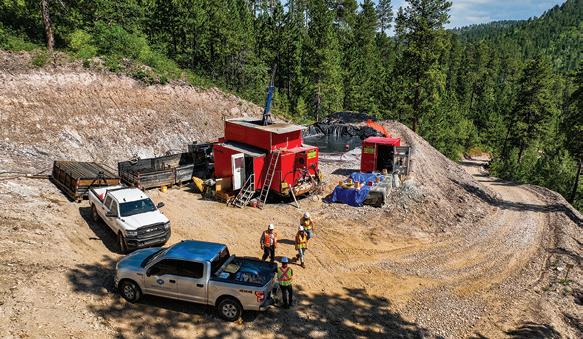
> Dakota Gold from P14
Resource update
Dakota plans to add 145 new drillholes, totaling 45,517 metres, to the resource database.
The exploration at Maitland builds on the legacy of the historic Homestake mine. It produced over 40 million oz. of gold from 1876 until its closure in 2002. It was one of the most productive and longest-running gold mines in the United States.
Last year’s drill campaign aimed to expand on an initial resource released in April. It outlined 51.8 million indicated tonnes grading
0.8 gram gold for 1.33 million oz. and 58.1 million inferred tonnes at 0.61 gram gold for 1.1 million ounces.
With high gold prices and strong demand for domestic production, the project benefits from its location on private land that streamlines permitting, the company said.
The JB gold zone is one of three exploration programs Dakota is advancing in the Homestake District. It’s also exploring the nearby Richmond Hill and Unionville zones. JB shows potential for more mineralization styles, the company said. TNM
Physical Precious Metal Offtake
Metals Financing Including Debt, Equity and Royalties / Streams
Project Finance Advisory
Supply and Risk Management