
Mining industry optimistic in face of Trump tariff threat
BY COLIN MCCLELLAND
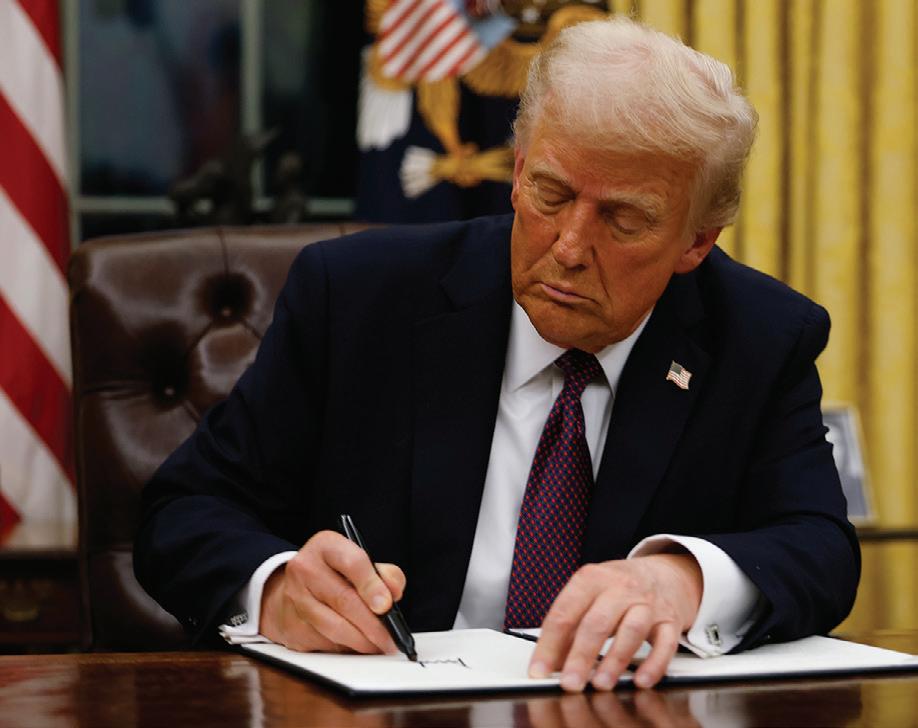
Canada is on edge, but the mining industry appears quietly confident it will emerge largely unscathed from U.S. President Donald Trump’s threat to put 25% tariffs on all goods from its northern neighbour.
More than half of Canada’s mineral exports —valued at more than $80 billion — went to the U.S. in 2022. And just two years earlier Trump in his first term set up the Joint Action Plan on Critical Minerals Collaboration. But Trump seemed ready to tear everything up with comments as this paper went to press:
“We have a tremendous [trade] deficit with Canada,” the president said. “We don’t need them to make our cars, and they make a lot of them. We don’t need their lumber, because we have our own forests, etc, etc. We don’t need their oil and gas. We have more than anybody.”
As most Canadian industry leaders have pointed out, the U.S. depends on Canada for a host of minerals and supplies. It gets germanium, aluminum and nickel far easier than from China, whose stranglehold on critical minerals
Washington is trying to loosen.
“We produce a certain refined product of nickel that is suited for the U.S industries,” Pierre Gratton, president and CEO of the Mining Association of Canada, said in a phone interview. “When China imposed a ban on the export of germanium to the United States, we could supply them with germanium, and this underpinned how important our trade relationship is to one another.”
Decision
Gratton said it’s difficult to believe that Trump will actually follow through on the tariff threat against a major supplier to the American economy, but equally as difficult to determine Trump’s final decision.
“It sure sounds like that’s what he wants to do, just put a shock to the system and make Canada buckle, and that’s very scary, scary for all of North America,” Gratton said.
“But will he in the end get advice that cautions him against that kind of an approach, and will Canada be able to negotiate its way out of this?
I don’t know. I don’t know because the story changes daily.”
Pierre Lassonde, a founder of Franco-Nevada (TSX: FNV; NYSE: FNV) and a former presi-

“It wouldn’t be good for the United States or Canada to start raising costs for mineral products.”
STEPHEN ROMAN, CEO GLOBAL ATOMIC


dent of Newmont (NYSE: NEM, TSX: NGT), said Trump is unlikely to impose tariffs.
“All mine output is raw material for the U.S. industrial complex,” Lassonde told The Northern Miner by email. “[The higher costs associated with] any tariffs automatically go to the consumers as all commodities are traded worldwide for the same price.
“As well, if the USA wants our critical metals, why would they put a tariff to get them? My sense is that
Trump will mostly refrain from tariffs on all raw materials including carbon products, i.e. oil and gas.”
Early days
Stephen Roman, the founder and co-chairman of Gold Eagle Mines, which was acquired by Goldcorp for US$1.5 billion in 2008, said it was early to determine the final outcome but suggested Trump is unlikely to levy tariffs on Canada.
“He had to come out with some fairly strong statements to wake up Canadians that were under a Trudeau government that’s very lackadaisical on many issues and it seems to have had the right effect,” Roman, who now heads Global Atomic (TSX: GLO; US-OTC: GLATF) and its uranium project in Niger, said by phone.
“At the end of the day, it wouldn’t be good for the United States or Canada to start raising costs for mineral products, whether they be oil and gas or metals. We just have to assess it when the final [tariff] determination is made.”







Fastest pit stop Ready to swap?










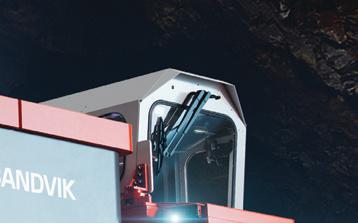
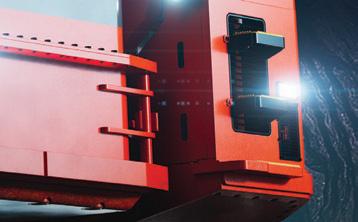
Sandvik is the leading partner in mine electrification. Our constantly expanding range of electric equipment produces zero diesel emissions and reduces ventilation and cooling needs in your mine. Our BEV loaders and trucks are designed from the ground up entirely around their battery system and electric driveline. The patented self-swapping battery system enables the industry’s fastest and easiest pit stop.
Go Electric. Go Sandvik.





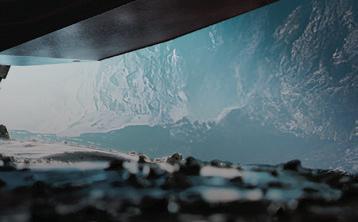




The Vancouver Resource Investment Conference Jan. 19-20 was standing room only for many events
CREDIT: NORTHERN MINER
WESTERN EDITOR HENRY LAZENBY

DEPARTMENTS
SPECIAL SECTIONS » Energy Transition Metal 31
n Bad design behind mine deaths
SSR Mining, the third-largest U.S.-based gold miner, says an independent review shows a heap leach design flaw mostly likely killed nine workers at the Çöpler gold mine in eastern Turkey last year.
The heap leach failure on Feb. 13 caused a massive landslide that dislodged about 10 million cubic metres of earth across a 200-metre slope. It trapped and eventually killed the employees.
Third-party test data overestimated the shear strength properties of the liner system at the base of the heap leach, according to the report by consulting firm Call & Nicholas. Construction crews, believing the liner was safe, built the heap leach following the engineered design.
There was no evidence to suggest excess water, ground vibrations from blasting, nor stacking beyond the design parameters caused the event, the consultant said in the report.
“Knowing now that the failure was the result of an engineering design flaw, and not the result of a failure in our operation or construction of the pad, provides clarity and some reassurance to the team on the ground as we seek to restart the Çöpler mine,” SSR executive chairman Rod Antal said.
Days after the incident, Turkish authorities revoked SSR’s environmental permits and later demanded the company pay the cleanup costs. Until the landslide and water issues are addressed, the mine will remain suspended.
n Rio Tinto, Glencore talks
Rio Tinto and Glencore talked for months last year about combining their businesses, according to people familiar with the matter, Bloomberg reported.
The Australian mining giant and the Swiss commodities trader and miner held early-stage discussions about a deal, the newswire said. It was unclear if talks are still going on, it added.
As with BHP’s failed attempt to acquire Anglo American last year, a Rio Tinto and Glencore combination is centred around copper, thanks to the bellwether metal’s bright prospects as the central commodity enabling the global energy transition.
The two mining giants discussed a tie-up a decade ago, which Rio Tinto promptly rejected.
Rio’s rejection in 2014 of what would have been the biggest ever deal in mining sparked months of public feuding that revealed a gulf between the two companies’ cultures. Glencore boss Ivan Glasenberg claimed Rio didn’t understand the iron ore market, while his counterpart at Rio slammed Glencore’s traders as short-termist.
But when Glencore reached out about a deal last year, it met with a different reception, and Rio was open to talk. Prolonged discussions followed at the companies’ top levels, Bloomberg reported.
Neither company has commented on the situation. Glencore had insisted on a hefty premium even as its share price slid, according to the newswire. BY MINING.COM STAFF
n Mining code update
Canadian securities regulators are aiming to publish proposed revisions to the country’s NI 43-101 mining industry reporting standards this month, a senior geologist with the process says.
The industry is to have 90 days to comment on the proposals for the first upgrade to the code since 2011.
“That’s sort of the time frame we’re looking for,” Craig Waldie of the Ontario Securities Commission told a mining investors luncheon in Toronto in January. “We’ll see if that comes out, but definitely in the next month or two there will be something.”
The plan is to implement a new version of the code by mid-2026, he said.
Some of the code’s definitions are being targeted for clarification, some requirements would be streamlined, and some areas could be harmonized with other jurisdictions, Waldie said. He described them as incremental changes. Also involved is the Canadian Institute of Mining.
OSC data show initial public offerings have declined for the past four years from 825 in 2021 to 546 last year, the geologist said. While gold companies used to make up half the number of technical reports released, now it’s 38% and uranium has grown to 7% from 1%, he said. Copper figures strongly, but lithium and graphite have dropped off.
BY COLIN MCCLELLAND
PHOTO OF THE MONTH
GLOBAL MINING NEWS • SINCE 1915 www.northernminer.com
PRESIDENT THE NORTHERN MINER GROUP: Anthony Vaccaro, CFA, MBA avaccaro@northernminer.com
INTERIM EDITOR-IN-CHIEF: Colin McClelland cmcclelland@northernminer.com
WESTERN EDITOR: Henry Lazenby hlazenby@northernminer.com
COPY EDITOR AND PRODUCTION EDITOR: Blair McBride bmcbride@northernminer.com
PODCAST HOST: Adrian Pocobelli apocobelli@northernminer.com
ADVERTISING: Robert Hertzman (416) 898-6654 rhertzman@northernminer.com
Michael Winter (416) 510-6772 mwinter@northernminer.com
SUBSCRIPTION SALES/ APPOINTMENT NOTICES/ CAREER ADS
George Agelopoulos (416) 510-5104 (Toll free) 1-888-502-3456, ext. 43702 gagelopoulos@northernminer.com
PRODUCTION MANAGER: Jessica Jubb (416) 510-5213 jjubb@northernminer.com
CIRCULATION/CUSTOMER SERVICE: (416) 510-6789 | 1-888-502-3456 northernminer2@northernminer.com
REPUBLISHING: (416) 510-6768 jmonteiro@northernminergroup.com
ADDRESS: Toronto Head Office
69 Yonge St, Toronto, ON M5E 1K3 (416) 510-6789 tnm@northernminer.com
SUBSCRIPTION RATES: Canada: C$130.00 one year; 5% G.S.T. to CDN orders.
7% P.S.T. to BC orders
13% H.S.T. to ON, NL orders 14% H.S.T. to PEI orders 15% H.S.T. to NB, NS orders
U.S.A.:
opinion
EDITORIAL
Anarchy in the USA

BY COLIN McCLELLAND
When the Sex Pistols stormed onto the music scene nearly 50 years ago, one of the slogans their deft manager Malcolm McLaren tossed around was “Cash from Chaos.” Sound familiar? Leader singer Johnny Rotten’s hair was a shade of orange, too. McLaren floated the band on a Thames River barge during the Queen’s jubilee playing their version of God Save the Queen, unleashed them on a TV talk show to spew a torrent of dirty words, and toured the band through the redneck U.S. south to antagonize locals.
The band’s only album released during its heyday, Never Mind the Bollocks, Here’s the Sex Pistols, contains songs like Holidays in the Sun, and New York – both topics that come to mind with Donald Trump. It’s actually true that other songs on the LP are Liar, No Feelings and, of course, Anarchy in the U.K.
Although American thrash metal band Megadeth covered Anarchy in the U.K. and changed the lyrics to make it Anarchy in the USA, we have a new band leader in the White House contemplating his version. He issues threats, mocks people and is a master of self-promotion.
I give you the first punk president.
The Sex Pistols’ music wasn’t that revolutionary – it was basically 50s rock sung through snarls and attitude. But it spawned a million imitators because it seemed to return music from the muso-heights of prog rock to the people. It seemed relatable because anyone could do it.
There’s a parallel here with the politician who has drawn working class Americans away from the Democratic Party even though it may not be in the best interest of their take-home pay if he imposes tariffs on products his constituents like to buy.
But even Rotten, who reverted to his real name, John Lydon, after leaving the Pistols in 1978, has expressed support for Trump. He told British TV several years ago: “I’m working-class English, it makes complete sense to me to vote for a person who actually talks about my kind of people.”
For the mining industry, Trump represents an opportunity to put a thumb on the scales of approvals in favour of getting projects done. The excitement in U.S. mining circles is palpable as Trump exhorts about making America great again, unleashing its power and resources to take on China and the world.


It’s a reaction to a few decades of rising woke-ness and is to be expected. It’s like how Nixon capitalized on Democratic divisiveness over the Vietnam War and middle American outrage over hippie excess to attain the White House in 1968.
And like Nixon, Trump brings to statesmanship the first president since then of openly cultivating the caged madman approach: ‘Better watch out! There’s no telling what I’m going to do!’
Only Nixon could go to China, the saying goes, because he was a virulent anti-communist in the 1950s. It remains to be seen where a president like Trump, an open book on all his pronouncements, would go against his own persona like Nixon did. He’s established his anti-environmentalist credentials.
Speaking last month via video to business and political leaders in Davos, Switzerland, Trump said he would lower business taxes to 15% from 21%, make emergency declarations for project approvals and suggested Canada could dodge his tariff plan by becoming an American state.
The mood across an ocean and another continent at the Vancouver Resource Investment Conference (covered on page 30) was support for Trump to cut red tape and see if it rubs off on Canada, and send more U.S. Defense Department funding north, while B.C. Premier David Eby was defiant about the potential tariffs. It brought to mind Pierre Trudeau at the Washington Press Club in 1969:
“Living next to you is in some ways like sleeping with an elephant. No matter how friendly or even-tempered is the beast, if I can call it that, one is affected by every twitch and grunt.”
Of course, one area where Trump’s detractors are waiting for him to fall into Nixon parallels is corruption. His own Watergate.
But then he was guilty in the hush money sex scandal, found liable for sexually abusing and defaming writer E. Jean Carroll, indicted by a grand jury in Georgia for election interference, and undertook an “unprecedented criminal effort” to overturn the 2020 election results, according to a report by Special Counsel Jack Smith. And nothing seemed to stick.
Tricky Dick lasted only 25 months from the Watergate break-in until his resignation in August 1974. The Sex Pistols lasted 30 months before they self-destructed at the end of that American tour.
Trump has 47 months left. Can he make it, and what can he make of it? TNM
COMMENTARY
America’s other 51st state?

BY JAMES COOPER
Trump’s known for pulling off big deals.
From buying well-known golf courses in Scotland to grabbing swathes of prime real estate in Manhattan. But what about an entire country?
Well, if Trump gets his way, the massive island nation of Greenland could become the 51st state of America!
On the surface, that’s an almost unbelievable development. After all, this autonomous territory sits under the Kingdom of Demark, a longtime American ally and one of NATO’s founding members.
Yet, according to Trump, he’s prepared to use military force to grab hold of Greenland. While this could be familiar Trump bluster, the plan does appear to have a profound motive.
Greenland sits in a highly geologically active region, providing abundant resources. But thanks to glacial melting over the last couple of decades, accessing Greenland’s potential bounty is set to become much more manageable. Bedrock that once laid several hundred metres below the ice is now exposed; opening up new mineral frontiers.
This opportunity could lie at the heart of Trump’s plan to capture Greenland, that, and the region’s strategic access to northern shipping lanes. Geologists can now peer directly into the outcropping rock and examine the mineral potential over this enormous landmass.
Given the rapidly melting ice, moving machinery, like drill rigs, for exploration is now much more straightforward. So, too, is getting those minerals out of the ground.
Russia is already discussing the potential of unlocking massive new mineral fields across its vast Siberian arctic territories as ice sheets subside. And it seems America wants in on this action, too.
But why would the U.S., a leader in advanced technology, finance and banking, suddenly be interested in something as basic as raw materials?
Trade
war
As you may know, China holds a firm grip on critical mineral supply. This is the thorn in the U.S. hegemony’s side, holding it back from dictating the terms of global trade. If the country pursues trade tariffs and other measures too aggressively, it risks a blockade of critically important resources dominated by Chinese supply.
One example is the battery supply chain. China is a force to be reckoned with in this growth sector of lithium refining, cathode and anode materials, and battery cells. But mineral dominance also spills over into technology and defence. This is perhaps why Trump wants access to new mineral frontiers. Trade wars and the battle to secure mineral supply chains are becoming a key focus for national security.
That’s why the U.S. Department of Defense (DoD) has invested
Trump is prepared to use military force to grab hold of Greenland.
billions in mining projects in the U.S., Canada and Australia. Like its US$120-million contract with Australian miner Lynas [ASX: LYC], establishing a first-of-itskind commercial Heavy Rare Earths separation facility in the U.S. Or the DoD’s US$37.5-million investment in Canadian junior Graphite One [TSX-V: GPH]. And that’s why Greenland could become a key focus for American interests in 2025. Already, Trump is putting boots on the ground, with his son, Donald Trump Jr., visiting the nation in January.
The Alaskan playbook
As crazy as that seems, this wouldn’t be the first time the U.S. has gained control of a massive northern frontier. Back in 1867, under President Andrew Johnson, America purchased Alaska from Russia.
At the time, Johnson copped a swarm of criticism for his decision to buy this frozen, inhospitable landmass. Skeptics dubbed the deal ‘Sewards Folly’, a polite way of saying useless land. We now know that’s not the case at all. Alaska has rich oil fields and some of the world’s largest copper and gold deposits. And just like Alaska, Greenland is also endowed with mineral wealth. To date, relatively little exploration or mining has occurred over this emerging frontier. However, the geological survey of Denmark has detected strong potential for zinc, lead, gold, iron ore, heavy and light rare earth elements, copper and oil.
These important resources might allow America to increasingly unwind its reliance on China…eventually.
Commodity conflict
However, perhaps the key point here is that announcements like this speak to genuine concern about global mineral supply. A dramatic shift from five to 10 years ago, when investment in new mine developments and exploration sank to historic lows. Commodities have been taken for granted for years, especially in the West. The building blocks of modern civilization and the fuel that drives every aspect of human civilization. Investment in resources needs to play catch-up in a big way. Without a stable supply, chaos erupts. And dramatic announcements, like gaining control of Greenland, speak to the growing concern that the West has been caught short.
The fallout from these events will have consequences. The least will be the return of interest in mining stocks linked to this trend. So, pay close attention in 2025.
James Cooper is a geologist based in Australia who runs the commodities investment service Diggers and Drillers. You can also follow him on X @JCooperGeo.
Here come the 1970s.
awards
Boyd, Giustra, MacLean, Sheahan inducted
HALL OF FAME | Ceremony awards industry leaders
BY COLIN MCCLELLAND
Sean Boyd, the chair of Agnico Eagle Mines (TSX: AEM; NYSE: AEM), recalled when the company’s performance prompted CNN’s Mad Money host Jim Cramer to eat a crow sandwich on air. Boyd’s mother was watching.
“That man wasn’t very nice to you today,” she said.
Cramer was recanting his conviction after only a poor quarter. Boyd never wavered in his commitment and actually booked the TV appearance to avoid accusations of ducking out when times were tough.
“The producer said ‘Well, thanks for coming on, at least you got to give your side of the story,’” Boyd recounted. “And I said, ‘Remember: I called you,’ and he said, ‘That’s why you’re coming on again.’”
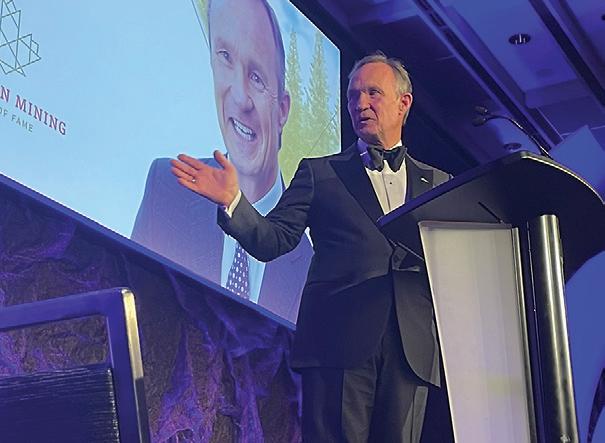
The perseverance and support for media as he built Agnico into a $60-billion company are some of the traits that landed Boyd a place Jan. 9 in The Canadian Mining Hall of Fame. The 37-year-old institution was itself hatched by Mort Brown, then-publisher of The Northern Miner, and then-Agnico chair Paul Penna. Boyd was in the room that day.
“Paul and Mort were fabulous businessmen, great storytellers,” he said. “They understood the importance of mining to Canada, and they understood the importance of celebrating the tremendous achievements of the industry and the tremendous and extraordinary goodness of this industry.”
Sheahan, Giustra, MacLean
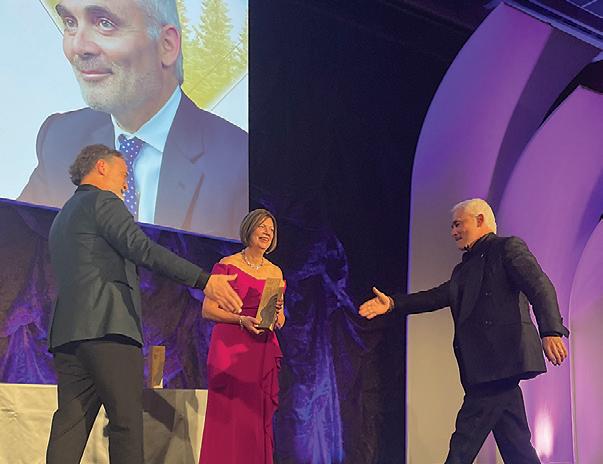
Other parts of that goodness and achievement honoured on stage at the Toronto Convention Centre were newsletter publisher Patricia Sheahan, investor Frank Giustra and equipment designer Donald MacLean.
Sheahan studied Russian at night so she could translate a trove of documents on diamonds. It helped her become an integral part of Canada’s development of the industry in the 1990s.
“It gave me actually the alphabet and key words,” Sheahan said in a video at the ceremony. “So, if I came across something, I would Xerox it and keep it.”
Sheahan started in the industry in 1959, fresh from Carleton University’s geology program. She became a consultant to Selco Exploration and a few others until 1978, when she started her own company, Konsult International.
Two tonnes
It was then she started the Sheahan Literature Service with newsletters first on gold and base metals, and diamonds later. By 1999, she had compiled two tonnes of paperbased research, which she donated to the minerals deposit research unit at the University of British Columbia.
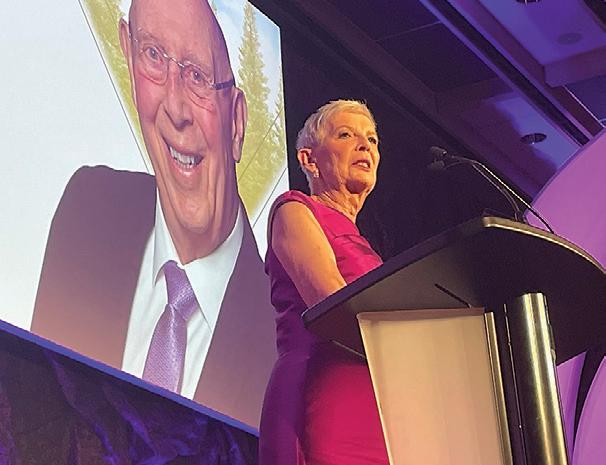
“It’s not common for a woman of my generation to work and travel and build a career in this industry,” a frail Sheahan, suffering from cancer in her late 80s, said from the stage. “Many previous inductees have been mine builders. I choose to think my work has supported
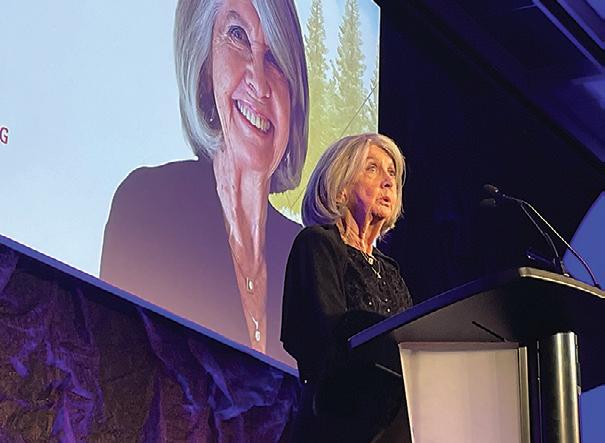
mind, as in m, i, n, d building.”
She gave one-day diamond courses at the Prospectors and Developers Association of Canada and chaired the group’s diamond technical sessions for 30 years. Sheahan was the first woman to join the Engineers Club of Ontario, later the Ontario Club, and served two terms as chair and president.
Sheahan was director of seven junior exploration companies, and was involved in three small diamond mines in Zimbabwe, Colorado and Nunavut. She helped John Kaiser assemble all diamond reference material from 1800 onwards into a searchable database on his Kaiser Research website.
“It was important to me that the
“It’s not common for a woman of my generation to work in this industry. Many previous inductees have been mine builders. I choose to think my work has supported mind building.”
— PATRICIA SHEAHAN, SHEAHAN LITERATURE SERVICE
Telfer wrote for him.
“The truth is that I’m a bit of a fraud, really. Yes, I often come up with ideas, assemble talented people around me, raise the initial rounds of capital, etc., but then I let everybody else do all the hard work while I spend all my time running around, giving speeches and collecting awards.”
In reality, Giustra, born to a miner father in Sudbury, Ont., started as a stockbroker before building Lionsgate Entertainment into one of the world’s largest independent film companies (American Psycho, The Hunger Games).
Uranium deal
He formed UrAsia Energy in 2005 with assets in Kazakhstan which
the way of business.”
Lately, Giustra’s Fiore Group owns 8% of West Red Lake Gold Mines (TSXV: WRLG; US-OTC: WRLGF), which aims to restart the Madsen mine in Ontario this year. MacLean, who died in January 2024 after a 60-year career, combined engineering expertise, safety advocacy and innovative entrepreneurship. His father managed mines in Quebec and the 14-yearold son ran cargo canoes. After a McGill engineering degree, he was an underground shift boss at INCO near Sudbury.
Four plants
He sold equipment at Ingersoll Rand, then started his eponymous engineering company from his apple orchard barn at Thornbury on Georgian Bay in 1973. Now, it has four Ontario plants in Sudbury, Barrie, Collingwood and Owen Sound, plus branches in Mexico, South America, Australia and South Africa.
“Edith Piaf said in French ‘no, I will have no regrets,’” MacLean’s wife, Catherine, told the induction ceremony. “That’s how Don would have summarized his life. He gave it his all.”
MacLean Engineering pioneered the design and production of the scissor bolter to enhance the safety and efficiency of underground mining. They addressed the need for reliable ground support in challenging environments. There’s also the rubber-tire Long Tom pneumatic drill, the Blockholer and various electric vehicles.
“His concern about the effects of diesel-powered equipment in
listings for all meaningful public global diamond information is still available including Canada’s birth as a diamond producer up to 2022,” she said. “I still have the passion to play a role in this great industry, but sadly, not the energy.”
Telfer jokes Giustra, a co-founder of the companies that became Endeavour Mining (TSX, LSE: EDV) and Wheaton Precious Metals (TSX: WPM, NYSE: WPM; LSE: WPM), lampooned his former business partner and hall of famer Ian Telfer.
“This achievement would have never been possible without the leadership of Ian Telfer,” Giustra read from a speech he claimed
SXR Uranium One took over in 2007 for US$3.1 billion. Rosatom, the Russian state nuclear corporation, bought Uranium One and de-listed it. The involvement landed Giustra in a “political shitstorm” in the United States as several media outlets attacked the deal, he said.
“What had been a huge market and business success was overshadowed by my selfish, US$30-million donation to the Clinton Foundation’s HIV AIDS initiative,” he deadpanned. “My need for attention helped to tarnish the reputations of many of my associates, including Ian Telfer. I am deeply sorry that I allowed my global philanthropic ambitions to get in
the mines drove his determination to produce the first McLean battery-operated bolter,” his wife said. “Don had a brilliant mind and was always 10 steps ahead of everyone else, while juggling multiple concepts at the same time.” He was also a man of contrasts; country music yet classical, jazz and Piaf, too; mucking about in the barn; but also dressing up. He was known for sporting fedoras.
“Barely a day went by when he wasn’t stopped by a woman young or old telling him how much they loved his fedora,” she said. “Maybe that’s why he always wore them.”TNM
PHOTOS: COLIN MCCLELLAND
Agnico Eagle chair Sean Boyd thanks The Northern Miner for more than a century of industry support.
Patricia Sheahan produced a newsletter that transformed the diamond industry.
Northern Miner Group president Anthony Vaccaro and Canadian Mining Hall of Fame chair Deborah McCombe greet Frank Giustra.
Donald MacLean was a global leader in mobile underground equipment.
By Blair McBride and Samson Levy
Exploration companies across Canada are hunting for lithium where it occurs in both hard rock and brines, located down old oil wells. But while prices of the critical mineral collapsed after their high of about US$70,000 per tonne in late 2022 and currently remain low around US$10,700 per tonne, exploration continues apace in Canada. The Northern Miner takes a look at how market capitalizations among the main players exploring for lithium in Canada differ between the price's peak and its present level.
Q&A with SRK
Canada has enormous potential but must improve permitting, infrastructure to revive diamond industry, SRK expert says
BY NORTHERN MINER STAFF
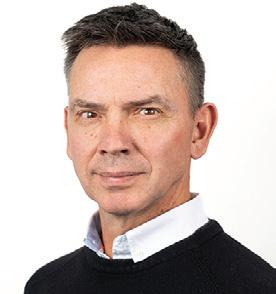
TNAME: Casey Hetman TITLE: Corporate consultant and diamond expert COMPANY: SRK Consulting
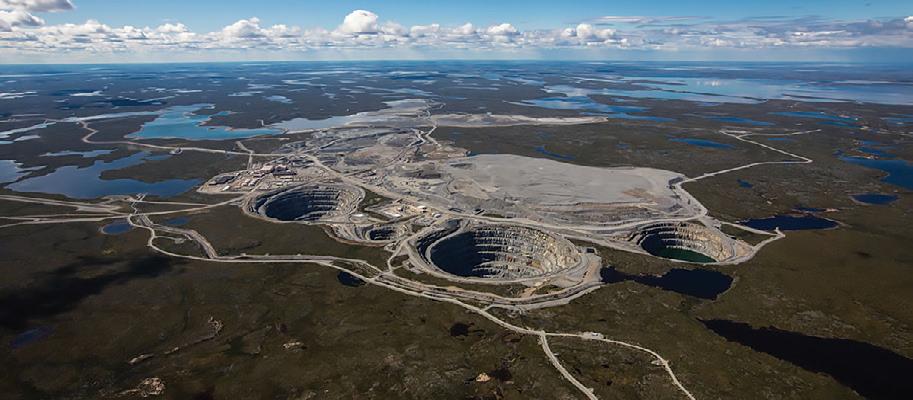
he future of Canada’s diamond sector might seem uncertain as mines wind down, but officials could boost opportunities for those willing to innovate and invest strategically, according to SRK Consulting. To explore these prospects, The Northern Miner’s western editor Henry Lazenby spoke with Casey Hetman, corporate consultant and diamond expert at SRK. Hetman has over 30 years of experience in exploration, evaluation and the development of diamond resources globally including in Canada, Angola and Botswana. He unpacks some of the sector’s challenges, global trends and untapped potential.
Henry Lazenby: Canada’s diamond sector seems to be on a downward slope. Could you provide an update on the industry’s current state and the key factors behind this trend?
Casey Hetman: Canada’s diamond industry has seen remarkable highs, but it’s true that the sector is currently in decline. During the boom years, we saw several world-class mines come online, particularly in the North, such as the Ekati and Diavik and Gahcho Kue mines in the Northwest Territories, Victor in Ontario and Renard in Quebec. These projects represented a golden era for diamond production in Canada. However, many of these mines have now depleted their reserves or are nearing the end of their productive lives.
The decline isn’t due to a lack of geological potential. Canada has over 1,000 known kimberlites and the Superior Craton — one of the world’s largest Archaean cratons — remains underexplored. Geologically, the region offers enormous potential for new discoveries for not only diamonds but gold and base metals. The issue lies elsewhere: economics and permitting challenges are the primary barriers to sustaining the industry.
Canada faces stiff global competition for exploration and development dollars. Regions like Angola and Botswana provide significant advantages in terms of infrastructure, regulatory frameworks and lower costs, making them more attractive destinations for investment.
In Canada, the lack of infrastructure in remote regions, such as the Northwest Territories, Nunavut and northern Ontario, Manitoba and Quebec, makes exploration and mine development significantly more expensive. The logistical challenges of accessing these regions, coupled with high operating costs, deter many companies.
Another factor is the regulatory environment. While Canada prides
itself on rigorous environmental and permitting standards, the process can be slow and expensive compared to other jurisdictions. This creates additional hurdles for companies looking to bring projects to production.
That said, the potential for Canada’s diamond industry to recover is very real. The key lies in fostering a more competitive investment climate. Strategic investments in infrastructure, streamlining permitting processes and promoting innovation in exploration and processing technologies could help revitalize the sector. The geological foundation is there, but the industry needs the right economic and regulatory environment to thrive.
HL: Does this mean the industry could see a resurgence someday?
CH: Absolutely, the potential for a resurgence in Canada’s diamond industry is very real, but it depends on several factors aligning. Canada has a strong geological foundation for diamond mining, with vast regions of underexplored terrain and over 1,000 known kimberlites.
The Superior Craton, in particular, is one of the largest and most promising geological formations globally for diamond discoveries. This indicates that there are still opportunities to develop new mines or revisit older deposits with fresh insights and technologies. However, for the industry to see a resurgence, several challenges need to be addressed. First, Canada must improve its competitiveness as a destination for exploration and investment. This means tackling the high costs associated with operating in remote regions, where lack of infrastructure — like roads and power — can make projects prohibitively expensive. Strategic investments in infrastructure could make exploration and development more viable. Second, regulatory processes need to be streamlined. While Canada’s strong environmental and permitting standards are crucial, a faster and more
“The potential for Canada’s diamond industry to recover is very real. The key lies in fostering a more competitive investment climate ”
— CASEY HETMAN , CORPORATE CONSULTANT AND DIAMOND EXPERT, SRK
predictable system would encourage companies to invest in exploration and development here rather than in more accessible regions like Angola or Botswana. Finally, innovation will play a key role. Advancements in exploration techniques, bulk sampling processes and mining technology could reduce costs and improve the efficiency of discovering and developing economically viable deposits. These innovations could also open the door to reassessing already discovered kimberlites that were previously deemed uneconomic.
Global market dynamics will also influence the industry’s trajectory. Rising diamond prices, increased demand for ethically sourced gems and greater consumer interest in sustainability could position Canada as a preferred source of high-quality natural diamonds. Canada’s reputation for responsible mining practices and strict adherence to the Kimberley Process further enhances its appeal in the global market.
HL: Are synthetic diamonds a genuine threat to the natural diamond market, or could they coexist?
CH: Synthetic diamonds, or lab-grown diamonds, are both a challenge and an opportunity for the natural diamond market. They have gained significant traction in recent years due to their affordability. Lab-grown diamonds are chemically and physically similar to natural diamonds, but they can be produced on demand and at a fraction of the cost, which disrupts certain segments of the market.
However, natural diamonds have qualities that lab-grown stones cannot replicate. Natural diamonds are formed over hundreds of millions to billions of years through complex geological processes deep within the Earth’s mantle. This unique origin gives them a mystique and a connection
to Earth’s history that lab-grown diamonds simply cannot match. Programs like the Kimberley Process ensure that natural diamonds are mined ethically and initiatives such as De Beers’ GemFair platform work to empower artisanal miners in developing countries. These efforts create a story of social and environmental impact that labgrown diamonds cannot replicate.
HL: Moving back to deposits, how has the quality of diamond discoveries evolved in recent years?
CH: Globally, we have an abundance of diamond deposits— thousands of kimberlites have been discovered in countries such as Canada, Angola and Brazil. However, the challenge isn’t necessarily about finding new kimberlites but about understanding the economic potential of those that are already known. Determining a deposit’s value is far more complex for diamonds than for metals like gold. For gold, a simple assay can reveal grade and approximate value. With diamonds, however, the critical factor is the average dollar per carat, which can vary significantly depending on the size, quality and distribution of the diamonds within the deposit.
This evaluation requires extensive bulk sampling to produce enough diamonds for a representative analysis and that process is expensive. For example, to truly understand a kimberlite’s economic viability, you may need thousands of carats on the table to calculate the value per carat accurately. This bulk sampling is often conducted through largediameter drilling or open-pit excavation, both of which require substantial investment. Ultimately, we’re at a point where better science and technology, combined with a willingness to invest in proper evaluation, can unlock the
potential of both new and existing deposits. But this process requires time, effort and capital.
HL: What’s the biggest bottleneck in unlocking the economic potential of these deposits?
CH: The primary bottleneck is the cost and complexity of bulk sampling. Evaluating a diamond deposit’s economic viability is far more intricate and resourceintensive than assessing deposits for metals like gold.
For diamonds, you need to process large amounts of material to generate enough carats to accurately estimate the average dollar value per carat. This is critical because the value of diamonds is influenced by factors like size, quality and grade distribution, which vary significantly even within the same deposit.
This bottleneck isn’t unique to Canada. In countries like Brazil, which has over 1,000 known kimberlite bodies, very few have undergone the necessary bulk sampling to determine their true potential. Similarly, Angola and Botswana have many known deposits, but their evaluation often stalls due to the same challenges.
HL: Are technological advancements, such as AI or automation, making a difference?
CH: It’s still early days for AI in diamond exploration, but advancements in kimberlite volcanology have significantly improved our understanding of kimberlite systems. Over the past decade, our knowledge of emplacement processes—how kimberlites form and erupt—has evolved exponentially. This helps us prioritize deposits with better economic potential.
The preceding Joint Venture Article is PROMOTED CONTENT sponsored by SRK Consulting and produced in co-operation with The Northern Miner. Visit: www.srk.com for more information.
The Ekati diamond mine in the Northwest Territories. ARCTIC CANADIAN DIAMOND
indepth
Lundins, Juárez named Young Mining Professionals of the Year
AWARDS | Dynastic duo, Guatemalan
trailblazer feted in annual prize
BY NORM TOLLINSKY
The winners of the Young Mining Professionals’ (YMP)
Peter Munk and Eira Thomas Awards for 2025 are brothers Jack and Adam Lundin of Lundin Mining (TSX: LUN), and Guatemalan ESG trailblazer Ana Gabriela Juárez.
The YMP awards recognize young mining professionals under the age of 40 who have demonstrated exceptional leadership skills and innovative thinking for their companies and shareholders.
The Peter Munk Award (for men) is named after the legendary founder of Barrick Gold (TSX: ABX; NYSE: GOLD), while the Eira Thomas Award (for women) honours the iconic mining executive renowned for her pivotal role in the growth of the diamond mining company Aber Resources.
Nominees from a public submissions process were judged by a selection committee consisting
of YMP directors from chapters in Toronto, Vancouver, London, Perth, Peru and Switzerland as well as senior executives of the Northern Miner Group. The awards are to be presented on March 1, 5 p.m. at the Shangri-La Hotel in downtown Toronto by Mark Bristow, president and CEO of Barrick Gold, and Eira Thomas, chairperson of Westhaven Gold (TSXV: WHN). Tickets for the event can be purchased by visiting YoungMiningProfessionals.com/ awards.
Sponsoring the awards for 2025 are Barrick Gold, Cassels, KPMG, CEO.ca and The Northern Miner.
Peter Munk Award:
Jack and Adam Lundin Brothers Jack and Adam Lundin, both in their 30s, are the third generation of the Lundin family’s involvement in the mining industry, succeeding their grandfather, Adolf, and their father Lukas. Founded in 1991, Lundin Mining operates mines in Argentina, Brazil, the
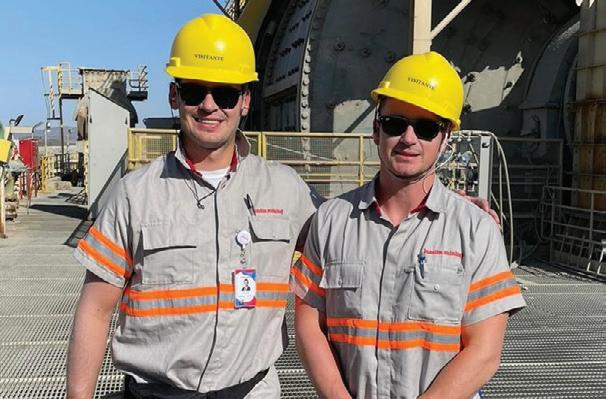
United States, Portugal and Sweden, producing copper, zinc, nickel, gold and molybdenum.
believe responsible resource development is the best catalyst for creating meaningful and lasting value for shareholders and communities alike, and by embracing new technology and ideas we can redefine the benchmark for industry excellence.”
BY NORM TOLLINSKY
The 2024 Young Mining Professionals Scholarship Fund has awarded a total of $225,000 to students pursuing mining-related programs at post-secondary institutions across Canada.
“This year, a record 30 mining companies and other sponsors ral-
Jack Lundin was appointed president of Lundin Mining in 2022 and took over the role of CEO in December 2023. He has extensive experience in the natural resource industry gained through exposure with several Lundin Group companies.
Prior to joining Lundin Mining, Jack was president and CEO of Bluestone Resources and was involved in the highly successful development of Lundin Gold’s (TSX: LUG) Fruta del Norte gold mine in southern Ecuador, serving as the project superintendent. He began his career in the mining sector working prospecting jobs on various early-stage projects in Canada, Russia, Ireland and Portugal.
“We are honoured to be recognized with the Peter Munk Award,” Jack said. “We are strong supporters of the Young Mining Professionals and organizations that help foster and inspire the next generation of mining talent. We
Jack holds a B.Sc. in business administration from Chapman University in Los Angeles and a MEng. in mineral resource engineering from the University of Arizona. He currently sits on the
YMP scholarship fund awards $225,000 to mining students
AWARDS | Firms support young minds to boost industry
lied to the cause of nurturing the development of new talent for the mining industry,” said Anthony Moreau, director of the fund and CEO of American Eagle Gold (TSXV: AE; US-OTC: AMEGF).
The fund awarded 63 scholarships ranging in value from $500 to $15,000. Among them were several scholarships specifically targeting women, Indigenous students and
residents of Northern communities.
A total of 3,189 applications were submitted, testifying to the popularity of the program, organizers said. Successful applicants are considered based on academic achievement, extracurricular activities, and a commitment to a career in the mining industry.
Employment gap
“The biggest challenge for our industry, by far, is people,” Moreau said.
secure the long-term success and growth of our industry.”
ResourceTalks.com, a forum featuring industry experts, said it was happy to support the cause.
“Mining is a challenging and high-risk industry that demands a lot from the people in it, and we believe it’s important to give back where we can, ResourceTalks’ Antonio Atanasov said.
The scholarship fund is a registered Canadian charity offering tax receipts to participating donors. Every dollar contributed by the sponsors goes to the scholarship winners as the program is administered entirely by volunteers.
Benefactors
“The YMP Scholarship Fund enables the Young Mining Professionals organization, with support from its generous sponsors, to identify and reward emerging talent by easing their financial burdens. It’s not just about attracting young talent to the industry, it’s about retaining them and ensuring they stay within our industry. The doors that these scholarships open help with that.
“Many of our sponsoring mining companies use the scholarship program to hire summer interns and build relationships with students for eventual full-time employment, benefitting both the students and mining companies.”
Barrick Gold (TSX: ABX; NYSE: GOLD) said it is proud to support the scholarship fund.



“Investing in the next generation of leaders is crucial for the future of our industry,” the company said. “This initiative has not only allowed us to identify and recruit exceptional talent for Nevada Gold Mines, but also ensures we are fostering a pipeline of skilled professionals who will drive innovation and sustainability in mining. By supporting programs like this, we’re helping to shape a diverse and dynamic workforce that will
“By helping students in miningrelated programs across Canada, the fund plays a key role in preparing the next generation to face the complexities of this field with the knowledge, resilience, and passion it takes to succeed. It’s an honour to contribute, even in a small way, to something that helps build a stronger future for our industry.”
2018 founding
The fund, Canada’s largest scholarship fund for students in mining-related programs, was established in 2018 by the Ore Group and Iamgold (TSX: IMG; NYSE: IAG) with a mere $12,000 awarded to students. The number of sponsors and the value of scholarships awarded has steadily increased since then.
“Nurturing emerging talent is an important aspect of what we can do as a responsible mining company,” said Renaud Adams, president and CEO of Iamgold.
“That’s precisely what we’ve been doing as a proud supporter of the Young Mining Professionals Scholarship Fund since its inception. Through the fund, we’ve had the opportunity to support exceptional candidates as they seek to build a career in our industry and shape its future.”
This year’s scholarships were funded by Agnico Eagle Mines (TSX: AEM; NYSE: AEM), Alamos Gold (TSX: AGI; NYSE: AGI), American Eagle Gold, Awalé Resources (TSX-V: ARIC), B2Gold (TSX: BTO; NYSE: BTG), Barrick Gold, and Baselode Energy (TSXV: FIND); Eldorado Gold (TSX: ELD, NYSE: EGO), Equinox Gold (TSX: EQX; NYSE: EQX), Fireweed Metals (TSX-V: FWZ, US-OTC: FWEDF), Fission Uranium, Gold Royalty (NYSE: GROY), Iamgold, Joan Margaret Stewart, Kinross Gold (TSX: K; NYSE: KGC), Metal Energy (TSXV: MERG) and Mistango River Resources (CSE: MIS); O3 Mining (TSX-V: OIII; US-OTC: OIIIF), Okane Consultants, Ore Group, OreCap Invest (TSXV: OCI; US-OTC: ORFDF), Pan American Silver (TSX: PAAS; NYSE: PAAS), QC Copper & Gold (TSXV: QCCU; US-OTC: QCCUF) and ResourceTalks.com; Snowline Gold (TSX-V: SGD; US-OTC: SNWGF), Sprott, Storm Exploration (TSX-V: STRM), Stuhini Exploration (TSX-V: STU), TD Securities, The Northern Miner, Triple Flag Precious Metals (TSX: TFPM, NYSE: TFPM), an anonymous donor and YMP Toronto. TNM
Adam and Jack Lundin at Lundin Mining’s Chapada mine in Brazil.SUPPLIED PHOTO

indepth
‘Sustained strength’ for gold in 2025: BMO
FORECAST | Factors include inflation hedging, dedollarization
BY NORTHERN MINER STAFF
The outlook for gold remains strong this year based on continued central bank buying; the metal’s role as a hedge against inflation and higher-risk investment in artificial intelligence; and demand from Chinese investors, BMO Capital Markets says.
The main headwind the bank sees for gold is the possibility of lower geo-political risk, which could dampen its allure as a haven. But even with the recent collapse of the Assad regime in Syria and the prospect of a deal to end the war in Ukraine, a power vacuum in the Middle East could sustain gold’s role as a safe harbour.
The incoming Trump administration’s policies of heightened tariffs and more government spending are inherently inflationary and could drive more investors into gold as an inflation hedge, BMO forecasts in its latest report:
“Prolonging Gold’s Golden Era: Five Key Themes for 2025”.
Dedollarization
BMO expects central banks will continue to add to their gold reserves this year, maintaining last year’s trend towards dedollarization.
Gold holdings as a percentage of total reserves reached a record 18% in the third quarter of 2024, according to the World Gold Council, and quarterly central bank gold additions since the fourth quarter of 2022 have averaged above 1,000 tonnes on a rolling four-quarter basis, BMO noted.
“The threat of inflation and dollar index trading significantly above its
historic average is enough to make central banks nervous about being overweight in treasuries at the best of times; however when combined with the potential threat of default represented by a persistent U.S. deficit in a high rate environment, we can reasonably expect dedollarization of central bank holdings to continue into 2025.”
Hedge vs AI bottlenecks
Information technology stocks, which make up about a third of the S&P 500, are expensive with an average price to earnings (P/E) ratio of more than 35. (The average S&P 500 P/E ratio currently sits at over 25, the highest in more than two decades.)
The effect of this rally can be seen in currency markets as well, BMO said, based on data from the U.S. Department of Treasury. It suggests that net foreign acquisitions of U.S. securities and banking flows has averaged US$93 billion per month since the beginning of 2022.
“We expect management of gold companies to maintain their focus on growth, deleveraging, and capital returns.”
— BMO CAPITAL MARKETS, ‘PROLONGING GOLD’S GOLDEN ERA’ REPORT
The investments from abroad hit a record high of US$398 billion in September, spurring the U.S. dollar index to historically high levels.
But there are a number of pitfalls that could slow AI’s rollout compared to expectations, BMO stated.
The first is that there just won’t be enough power supply to support the datacentres that will be required, especially as power consumption for AI increases massively as its tasks get more complex.
Some companies are pursuing re-opening nuclear plants while others are investing in technologies such as small modular reactors. They typically have a power capacity of up to 300 megawatts of electricity per unit.
While some of these efforts will be successful, it’s likely that many will have to scale back their plans for datacentre capacity.
This could have two consequences — both of which are positive for gold.
“The first would be that investors
may begin to price in an even wider U.S. deficit as U.S. GDP growth expectations are reduced, potentially pushing down bond yields as investors seek a safer haven for their capital,” BMO said.
“The second effect would be a wider sell-off in U.S. equities, especially tech stocks, which has the potential to reverse record U.S. capital inflows and weaken the dollar, especially if yields are low.”
Chinese demand
In December, Beijing proposed weakening the renminbi by as much as 15% to counteract U.S. tariffs, and the currency has already depreciated since September, which will likely increase the allure of gold for investors in China.
China’s flagging property market and a slowdown in Chinese equities will also have a positive effect on gold, BMO forecasts.
While the key drivers of gold demand this year — inflation hedging and dedollarization —will sustain the metal’s strong prospects, a slight headwind could be that there will be less demand for gold as a crisis hedge, BMO warned.
“While 2025 will have no short-
age of geopolitical intrigue pertaining to trade wars and possibly currency wars, the intensity of actual wars might be showing signs of diminishing.”
BMO notes that the fall of Assad’s government in Syria is a major blow to Iranian influence and could result in fewer tensions between Israel and Lebanon. Meanwhile, a ceasefire in the Ukraine is high on Trump’s to-do list, and the Israel-Gaza conflict could be resolved, although Trump’s pro-Israel stance could prolong it.
At the same time, however, unexpected impacts could emerge from a power vacuum in the Middle East created by the weaker influence of Iran and Syria, the bank said.
Equities to brighten
While higher gold prices last year failed to translate into a good year for gold equities (the GDX and GDXJ indexes rose just 10% and 15%, respectively, versus a 26% jump in the gold price), BMO believes that cost management and capital allocation will be a key focus for gold companies this year. That could ultimately generate stronger free cash flow.
“We expect management of gold companies to maintain their focus on growth, deleveraging, and capital returns,” the bank said.
“There will be competition for capital given the ex-growth nature of the sector, but we believe the focus will generally remain on asset recapitalization, portfolio rationalization driven by M&A mandates, exploration (greenfield and brownfield), and lower capital intensity projects rather than large-scale, capital-intensive greenfield opportunities.” TNM
Cameco, Ivanhoe, Agnico Eagle lead
BofA picks this year
FORECAST | Uranium, copper, gold, steel producers to benefit
BY COLIN MCCLELLAND
Cameco (TSX: CCO; NYSE: CCJ), Ivanhoe Mines (TSX: IVN; US-OTC: IVPAF), Agnico Eagle Mines (TSX: AEM; NYSE: AEM) and Steel Dynamics (Nasdaq: STLD) are Bank of America’s top choices for mining and metals stock performers this year.
“For Cameco, we see significant potential hidden value (up to +US$22.30 per share), like its diversified exposure across the nuclear energy and fuel supply chains,” lead author Lawson Winder said in a report in January. “We are bullish uranium (Cameco’s key product), and see the shares attractively valued.”
The analysts predict peer-leading production growth, a competitive cost profile and copper exploration potential at Ivanhoe Mines. Agnico has a track record of meeting or beating targets, attractive growth projects as well as exploration potential.
Prices for hot-rolled coil and coated steel are to benefit Steel Dynamics this year, the analysts
said, as it completes an aluminum rolling mill project and increases free cash flow.
Geopolitical tension
The metals and mining industry is set against a backdrop of geopolitical tension, foreign exchange volatility and resource nationalism, according to the researchers. Uranium and copper are benefiting from the energy transition, steel is gaining from a resurgence in non-residential construction while central bank buying and Asian demand is supporting the gold price, the analysts said.
The bank expects resources nationalism — like in Mali, Panama, Niger and the United States — to continue, with higher local fees and tariffs used as instruments to impact aluminum, rare earths, steel and uranium. Also, the strong U.S. dollar versus the currencies of most countries that host mining and metals operations should benefit companies that have operations outside for the U.S., it said.
Uranium is the bank’s highest conviction trade, with the spot price expected to average 36% higher year
on year. Uranium was at US$73.75 per lb. near press time, down from US$106 per lb. a year ago, according to Trading Economics.
“We think strengthening electrical energy demand growth, trade, global nuclear restarts, nuclear new builds, continued mine supply dis-
ruptions, and the return of utility buying are key themes to watch in 2025,” the bank said. “Purchase volumes in 2024 were depressed. These pushed-out purchases imply stockpile depletion, and thus heightened buying to come.”
US$3,000 gold
The bank’s 12-month gold target price is US$3,000 per oz., with the price to average 15% more year on year as demand outpaces falling expectations of U.S. Federal Reserve interest rate cuts. Gold was at US$2,718.70 per oz. near press time, according to Trading Economics.
In steel and copper, tariffs and second-half supply challenges could also help prices. The red metal’s price should average 2% higher year on year, the bank said. The copper price was US$4.387 per lb. near press time, according to Trading Economics.
Bank of America also says it’s bullish on rare earth elements neodymium and praseodymium, aluminum and silver while bearish on platinum group metals and neutral other metals. TNM
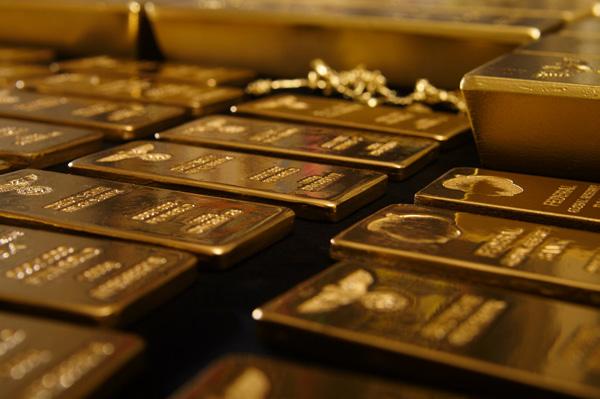
Gold bars. ADOBE IMAGES/ COUPERFIELD
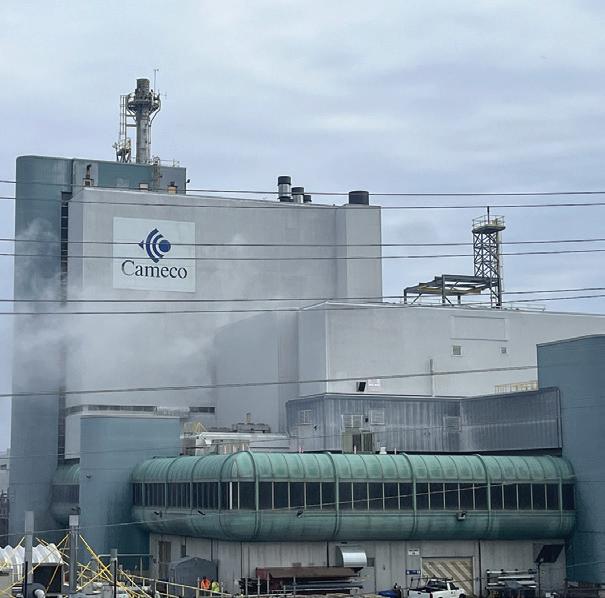
Cameco’s uranium conversion facility in Port Hope, Ont. BLAIR MCBRIDE
Mining Insights
How Dundee Sustainable Technologies’ eco-friendly advances boost ESG credentials
BY NORTHERN MINER STAFF
DNAME: Jean-Philippe Mai
TITLE: President and CEO
COMPANY:
Dundee Sustainable Technologies
undee Sustainable Technologies (CSE: DST) has developed two innovative metallurgical processes that offer significant environmental benefits for the mining industry.
The recent tailings dam breach in the Yukon is a case in point where cyanide-laced material used to extract gold contaminated nearby waterways. But green technologies and sustainabilityfocused projects are helping the industry address risks earlier and build longer lasting community ties.
President and CEO Jean-Philippe Mai, who holds a B.Sc. in Geology from the University of Quebec in Montreal and has worked on projects spanning Canada, Australia and South America, has seen the industry realize that change benefitting the environment helps everyone. Mai, whose career spans years of innovation in metallurgical processes, highlighted the progress of Dundee’s new methods.
Joining the company in 2013, he has played a key role in advancing its innovative solutions. These include the Chlorination Leach in a Vat Reactor (CLEVR) technology that extracts gold from ore without using cyanide and the GlassLock process that stabilizes arsenic.
In January, Mai sat down with MINING.com’s Devan Murugan to discuss how the company’s technology can provide miners with safer and more efficient alternatives to traditional mining practices.
Devan Murugan: It’s been about 10 years since your first demonstration plant went up. That was back in 2014. What gap were you hoping to fill in the market back then? Take us through those beginnings.
Jean-Philippe Mai: Bringing new metallurgical processes to commercialization within the mining industry is quite the journey. So, we’ve been actively focused on developing and now the commercialization of our process for numerous years. We started, of course, with the concept idea at the bench scale, then moved it to the pilot scale in 2009 through 2011.
We then proceeded to the construction of our first industrial demonstration plant in 2015. The objective was always to provide the industry with an alternative. We wanted to develop an efficient gold extraction and gold recovery processes which provided a safe, efficient and a viable alternative to cyanidation.
So, the journey has been quite interesting, but I think that our main objective was really to provide an alternative which not only completely replaces cyanide, but also provides an added efficiency compared to the standard processes that we use today.
DM: From an elementary perspective, what miners do is extract gold using cyanide, which comes with risks. How does Dundee’s process provide an alternative?
“We wanted to develop an efficient gold extraction and gold recovery processes which provided a safe, efficient and a viable alternative to cyanidation ”
— JEAN-PHILIPPE MAI , PRESIDENT, CEO, DUNDEE SUSTAINABLE TECHNOLOGIES
JPM: There’s a lot of ways through which one can chemically solubilize gold for extraction and recovery. Our approach that we’ve taken was to use a chlorinationbased approach. Although, historically, chlorine has been used before to put gold into solution, but chloride can be quite toxic as well when you’re looking at handling elemental chlorine and its associated chlorine gas. But we’ve gone a different route here. We really use sodium hypochlorite with a catalytic amount of sodium hypobromide. So essentially we’re using the kinetics, the fast kinetics of bromide to rapidly put gold into solution using a catalytic amount of sodium hypobromide and sodium hypochlorite.
Essentially, we’re using a diluted version of your household bleach solution, which operates at ambient temperature and ambient pressure. So, this novel chemical approach allows for a very efficient way of solubilizing the gold.
DM: It’s interesting because this method not only eliminates cyanide but also reduces leaching time and waste. That’s a major benefit for mining companies, isn’t it?
JPM: Of course. And the approach, as I mentioned, was always to provide and to improve efficiency, process efficiency. Typical processes can take 24, 36, 48 hours to put the gold into solution. Our approach, using fast kinetics, achieves this within an hour to two hours of contact time.
That’s a huge benefit just in terms of throughput and size of plant for equivalent capacity and throughput. But also, how you handle your contaminants. For us, being serious about sulphur handling is a major aspect of the process where if there’s high amounts of sulphur within the ore, we would look at removing it for properly handling it and then transferring it to the CLEVR process for efficient gold recovery.
Same thing with associated contaminants such as arsenic. So that’s another aspect which we’ve been very involved in. Just being able to properly and efficiently address contaminants such as sulphur and arsenic, and then allowing for the CLEVR process to efficiently solubilize the gold, provides a lot of benefits to mining operations.
You mentioned one, eliminating or reducing some of that waste component. One of the aspects of CLEVR was really to operate in a closed loop where we regenerate all of our effluents, which allows for dry stackable tailings to be generated. So, when you can eliminate ponds out of your overall project site, that’s a huge benefit in terms of liability, but in terms of footprint as well.
DM: And I suppose on the other side of the spectrum, the other process that you do, the GlassLock process, is aimed at similar efficiency, isn’t it?
JPM: We obviously started with our CLEVR process, but when you develop a new gold process, people send you their worst materials. So, we really worked with a lot of
refractory arsenopyrite gold ores. And when we were decomposing that arsenic, that sulphide compound, we were left with an arsenic product which needed to be stabilized.
So, this is really what forced us to develop our GlassLock process, which is essentially an arsenic stabilization using vitrification. When we remove or have an arsenic product to permanently dispose of, we use vitrification, which essentially includes arsenic within a glass matrix and really provides a long-term stability. And again, increasing efficiency in terms of permanent and long-term stability, but also the associated cost of handling and properly stabilizing the arsenic.
DM: Let’s talk about investor appeal. You’re in a space where environmental, social and governance (ESG) standards matter. What’s your investor experience been on that front?
JPM: I think we are offering the industry tools and options to address some of the project problematics differently. And I think that investors and the industry are looking for the right solutions, the right solution for a given project. And it’s important for investors, for communities and for miners to know that they are doing the right thing for the project. Having processes like ours, which at least give them an option to efficiently recover the gold and properly handle contaminants such as arsenic, I think that coupled with the vast experience that our industry has with incorporating novel processes and
the equipment that we use – all the equipment has already been used at the larger scale. Our novelty really is on the chemistry. So, I think that properly understanding and learning about different processes like ours really provide an alternative route which can be welcomed favourably by investors and by miners and by communities.
DM: From an investor point of view, at the end of the day, it’s really about industry adoption, isn’t it? Is there momentum there?
JPM: I think our industry is very conservative. However, our industry is really keen and really willing to learn about processes like ours. So, in the recent years, we’ve seen a lot of interest and we’re really asking for mining companies to be curious and to try us. We really believe that any adoption goes through proper understanding and we need to do the proper development.
We need to do the proper test work, the proper engineering designs to really provide and present data which allows for efficient and sound decision making. And I think that once you generate the technical data supporting your process, I think both operators and investors will be alongside as it is the right thing to do.
The preceding Joint Venture Article is PROMOTED CONTENT sponsored by Dundee Sustainable Technologies and produced in co-operation with The Northern Miner. Visit: dundeetechnologies.com for more information.
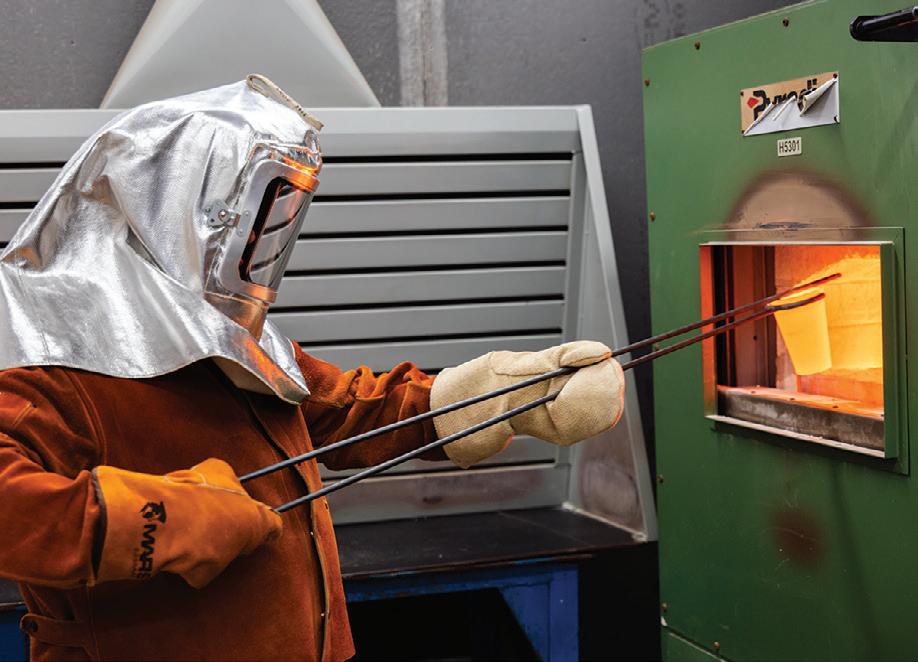
Gold smelting at Dundee Sustainable Technologies’ plant. DUNDEE SUSTAINABLE TECHNOLOGIES
donedeals
Zijin offers US$1.9B for quarter of China lithium miner
LITHIUM | Includes control of Tibet copper project
BY CECILIA JAMASMIE
Chinese copper and gold producer Zijin Mining is proposing to buy a quarter of compatriot lithium and potash miner Zangge Mining for 13.7 billion yuan (US$1.9 billion), the companies said last month.
The deal would grant Zijin controlling rights in Zangge, which operates in the mineral-rich western region of Qinghai. It would also allow Zijin to consolidate ownership of the Julong copper project in Tibet, a joint venture with Zangge.
The purchase stemmed from Zijin’s discussions with Zangge’s two largest shareholders, Tibet Zangge Venture Capital and Ningbo Meishan Bonded Port Area Xinsha Hongyun Investment Management.
The two shareholders collectively own about 40% of the 46.6-billion yuan (US$6.4-billion) miner.
M&A quest
Zijin, one of China’s most acquisitive metals companies and its biggest listed miner, secured government approval last year to boost the Julong mines’ output to about 350,000 tonnes per day.
Once the expansion is completed, the asset will become China’s largest single copper operation, with annual ore mining and processing volumes exceeding 100 million tonnes.
The Chinese mining giant took control of the Julong project in 2020 and had it up and running in just 18 months. Zijin also owns other assets
in Tibet, including the Zhunuo copper mine, which it acquired in August 2023. Additionally, it holds a controlling interest in lithium producer Lakkor Resources, and is the second-largest shareholder of Tibetbased companies Yulong Copper and Tianyuan Mining.
The takeover add to Zijin’s string of recent global acquisitions aimed at boosting gold production and expanding its footprint in battery metals, including copper and lithium.
Lithium assets
The state-backed miner has added multiple lithium assets to its portfolio, notably Canada’s Neo Lithium, which was focused on lithium mining in Argentina, as well as majority stakes in the Lakkor Tso Lithium Salar mine in China’s Tibet region
and the Xiangyuan lithium mine in Hunan province.
Zijin is also involved in the construction of plants to produce lithium iron phosphate for cathodes used in electric vehicles.
It has also increased its presence in precious metals, acquiring the Akyem gold mine in Ghana, a majority stake in Rosebel gold mines in Suriname, La Arena copper-gold mine in Peru, and an indirect interest in the Koné gold project in Côte d’Ivoire to name a few.
Zijin has since postponed the start of certain projects in Argentina and Tibet until 2025, citing weak lithium prices and permitting delays. Despite these setbacks, the company plans to kick off production at its first lithium exploration project in the Democratic Republic of Congo next year. TNM
PHOSPHATE | Disposing non-core assets
BY MINING.COM STAFF
Tampa-based fertilizer company Mosaic (NYSE: MOS), the world’s fourth-largest potash producer, plans to sell a phosphate mine and tailings dams in Brazil to local company Fosfatados Centro for US$125 million in cash.
The deal for the Patos de Minas site located in the country’s Minas Gerais state aligns with Mosaic’s strategy to review and monetize non-core assets while reallocating capital to higher-return investments, the company said Jan. 13.
“This agreement represents an important step for the phosphate supply to the Brazilian fertilizer market and demonstrates our commitment to advancing the National Fertilizer Plan,” Rodolfo Galvani Júnior, owner of Fosfatados Centro, said in the statement.
Shares in Mosaic gained 11% this year to US$27.02 apiece in New York near press time, valuing the company at US$8.6 billion. They’ve traded in a 52-week range of US$23.56 to US$33.44.
Market recovery
Mosaic’s move comes as global potash prices have started to fall and supply levels return to those seen before Russia’s invasion of Ukraine. Top producers Russia and Belarus have circumvented Western sanctions by increasing shipments to Asia and South
“This agreement represents an important step for the phosphate supply to the Brazilian fertilizer market and demonstrates our commitment to advancing the National Fertilizer Plan.”
RODOLFO
JUNIOR,
OWNER FOSFATADOS CENTRO
America, contributing to the market’s recovery. The company’s South American operations include 26 potash and phosphate facilities across Brazil, Paraguay and Peru. They comprise production and blending facilities, offices and infrastructure.
Its São Paulo-based subsidiary, Mosaic Fertilizantes, manages regional commercial and production facilities, as well as port and storage units. The company operates 11 blending facilities, eight toll units, one port terminal, and has a blending capacity of 8.6 million tonnes annually. TNM
Hudbay increases stake in Arizona Sonoran to 9.99%
COPPER | Cactus project has former Sacaton mine
BY MINING.COM STAFF
Hudbay Minerals (TSX, NYSE: HBM) has upped its stake in Arizona Sonoran Copper (TSX: ASCU; US-OTC: ASCUF) with the purchase of nearly 12 million shares under a private placement. The Arizona Sonoran shares in the deal are priced at $1.68 each, representing a total investment of about $19.9 million. The stock gained 13% on the news Jan. 10 to $1.61 apiece. They were 1¢ lower near press time for a market capitalization of $222.6 million.
Arizona Sonoran is to use the proceeds to advance its main Cactus project 80 km southeast of Phoenix. Cactus has three porphyry copper deposits and one stockpile within a 5.5-km trend, including the past-producing Sacaton mine. The company’s aim is to develop Cactus and become a mid-tier copper producer with low operating costs.
“This investment increases our exposure to another high-quality development project in the region as we continue to advance our Copper World project,” Hudbay CEO Peter Kukielski said. He called Cactus “exciting.”
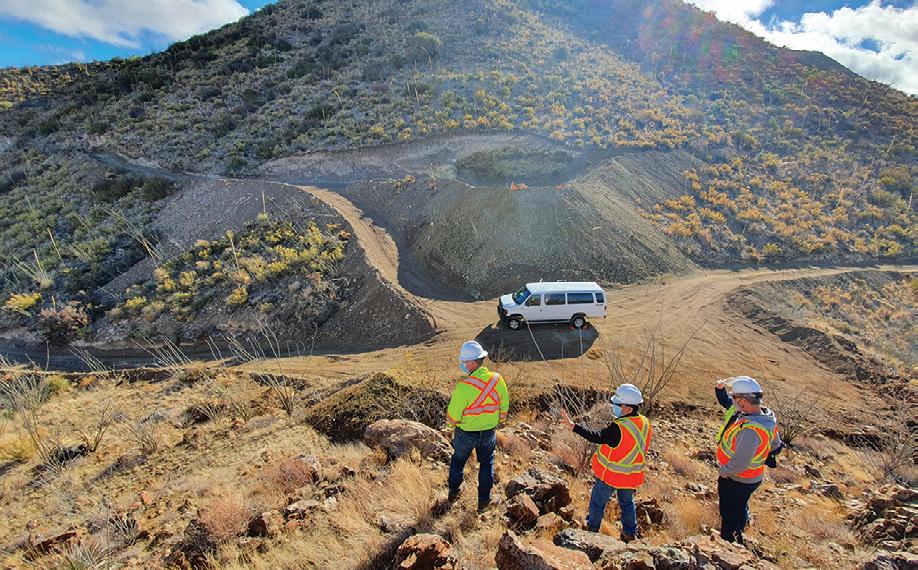
Copper World Hudbay recently secured all necessary permits
“It is the company’s objective to develop Cactus to be a significant
of
for
Ogilvie said in a release. In 2024, Arizona Sonoran released an updated preliminary economic assessment (PEA) on
Cactus that confirmed its potential to become a low-risk copper mine project. It raised the project’s aftertax net present value at an 8% discount by four-fold to US$2 billion, with an increased internal rate of return of 24%.
Open pit
The PEA was based on a modified mine plan that envisioned a standalone open-pit operation with a mine life of 31 years, producing a total of 5.3 billion lb. of copper cathodes. The new mine plan was able to drive down both its cash cost to US$1.82 per lb. and all-in sustaining cost to US$2 per lb. Its initial capital cost is estimated at US$668 million, with a payback of about five years.
“There can’t be many lower-risk copper development projects than Arizona Sonoran Copper’s Cactus,” Ogilvie said at the time of the PEA release. “This project is absolutely going into production as a standalone business case.”
The Cactus project hosts a porphyry copper resource totaling 632.6 million measured and indicated tonnes grading 0.58% copper for 7.3 billion lb. of metal, and 474 million inferred tonnes at 0.41% copper for 3.8 billion lb. TNM
for Copper World, about 200 km southeast of Phoenix, near the Mexico border. Shares in Hudbay gained 2.1% on the news before easing to 1.2% near press
producer
copper cathodes
direct use by industry in the state of Arizona and the larger U.S. supply chain,”
Zijin Mining. ADOBE IMAGES/ TIMON
time in Toronto to $12.80 apiece. It’s market cap is $5.1 billion.
Arizona Sonoran CEO George Ogilvie welcomed Hudbay’s increased investment.
Hudbay’s Copper World project in southeastern Arizona. HUDBAY MINERALS

Young Mining Professionals Scholarship Fund Announces Winners








$225,000 IN SCHOLARSHIPS AWARDED FOR 2024









Congratulations to all scholarship recipients and thank you to our generous sponsors!

























projectupdates
GoGold sees Los Ricos South permits in March
MEXICO | Construction decision expected by midyear
BY MINING.COM STAFF
GoGold Resources (TSX: GGD; US-OTC: GLGDF) says a new feasibility study shows the Los Ricos South (LRS) project in Mexico would cost US$227 million to build and provide a 28% internal rate of return.
The rate would rise to 34% using spot prices of US$30 per oz. silver and US$2,608 per oz. gold for the underground mine in Jalisco state, about 500 km northwest of Mexico City, the company reported on Jan. 17.
The base case net present value, using a discount rate of 5%, is US$355 million, rising to US$469 million with the higher metal prices, it said. The payback period would fall from 2.6 years to two.
“Our expectation is that we will receive a positive outcome on our permit application for our underground mine by the end of March,” CEO Brad Langille said in a release.
“Once we have obtained the permit, we should be able to formally make a construction decision and begin building the mine,” he added.
Shares of GoGold Resources rose 1.5% to $1.39 apiece by press time in Toronto. This gives the company a market capitalization of $473 million.
Underground
The mine would have a 15-year mine life beginning with a dozen underground, followed by an open pit operation that begins in the 10th year, according to the study.
Total production is pegged at
80 million silver-equivalent oz. (41 million oz. of silver, 424,000 oz. of gold and 11 million lb. of copper), including average annual production of 7.3 million oz. silver-equivalent in the first five years.
The detailed process plant design by Ausenco contains front-end engineering that would “allow for a quicker transition to the detailed engineering and field execution” stages, the company said. It re-engineered the 2,000-tonne-per-day plan from a 2023 preliminary economic assessment.
The capital spending includes US$21 million in contingency over an expected two-year build. Sustaining capital costs are calculated at $100 million over the life of mine.
Exploration
Looking beyond the imminent construction, GoGold also sees opportunities for more near-mine exploration with a focus on grow-


GOT OTCQB: GOTRF FSE: B4IF www.goliathresourcesltd.com
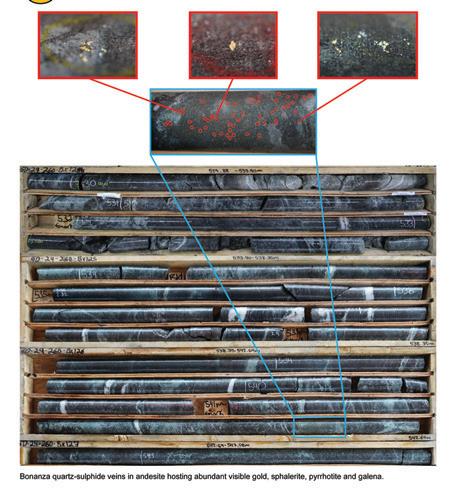
Goliath Drills Remarkable Hole Assaying 34.52 g/t AuEq (1.11 oz/T AuEq) Over 39.00 Meters, Including 132.93 g/t AuEq (4.27 oz/T AuEq) Over 10.00 Meters, System Remains Wide Open, Golden Triangle, B.C.Assays Pending For 89 Drill Holes (51 Have Visible Gold).
ing additional high-grade underground resources at LRS.
It will also look to advance the Los Ricos North (LRN) project located 25 km away. LRN represents the other part of its 240-sq.-km property and is subject to a May 2023 PEA that showed an NPV of US$413 million.
The feasibility study released Friday incorporates an updated mineral resource estimate for LRS totalling 11 million tonnes grading 162 grams silver per tonne, 1.56 grams gold and 0.12% copper in the measured and indicated category. It also has 2.2 million inferred tonnes at 106 grams silver, 1.11 grams gold and 0.27% copper. Over half of the contained metals are from out-of-pit resources.
Some resources have been converted into proven and probable reserves, now estimated at 10.2 million tonnes grading 145.4 grams silver, 1.39 grams gold and 0.1% copper. TNM
Asante Gold’s feasibility extends Bibiani 7 years
GHANA | Project has a 71% after-tax IRR
BY STAFF WRITER
Asante Gold’s (CSE: ASE USOTC: ASGOF) new definitive feasibility study confirms the potential to extend Bibiani in Ghana by at least seven years through mining underground reserves below the existing open pits.
The study, says Asante, reinforces its underground strategy for Bibiani previously articulated at the prefeasibility level last April. It investigates the underground extraction from the Bibiani Main and Walsh orebodies, with total reserves of nearly 12 million tonnes grading 2.36 grams gold per tonne.
Gold production over an initial seven-year life would come to 798,000 oz. at an all-in sustaining cost of US$1,035 per oz. following project completion. The post-tax net present value (at 5% discount rate) is estimated at US$516 million with a 71% internal rate of return.
Initial capital for the underground project — which will be staged with open-pit mining at the main pit — is pegged at US$116 million over two years, net of pre-completion revenue from 33,000 oz. of gold produced. Mineralized material from the underground operation will be processed in the existing Bibiani plant that was recommissioned in mid-2022.
Shares in Asante Gold were
at 99¢ apiece near press time, valuing the company at about $500 million. They’ve traded in a 52-week range of 83¢ to $1.53.
Mine plan
Asante now seeks to finalize the combined Bibiani open pit/ underground mine plan. It aims to choose a contractor in this year’s third quarter to prepare underground mine infrastructure. Construction to be funded from open-pit mining may follow in the fourth quarter. Full production from underground workings is expected in 2027.
“Since Asante acquired the Bibiani property in 2021, we have revitalized the operation and reshaped the business plan,” Asante CEO Dave Anthony said in a Jan. 14 news release.
Bibiani poured first gold in July 2022 following its acquisition from Resolute Mining (ASX: RSG; LSE: RSG).
Anthony also said the underground project is part of the company’s vision to achieve annual production of more than 250,000 oz. at the Ghanaian operation in 2026 and beyond.
Other growth initiatives include the Bibiani-Goaso Highway bypass completed in June 2024 to facilitate access to additional mineralized material. A new sulphide treatment plant is on track for this year’s second quarter. In September, Asante also began mining from a third satellite pit. TNM
Denarius gets Zancudo gold project OK in Colombia
PERMITTING | Project set to generate cash flow
BY MINING.COM STAFF
Denarius Metals (CBOE CA: DMET; US-OTC: DNRSF) has received the go-ahead to begin mining at its Zancudo gold-silver project in Colombia after the local environmental authority approved an impact study.
The company expects first production from Zancudo by the end of March. Zancudo hosts a highgrade deposit and includes the historic Independencia mine in the Cauca belt, about 30 km southwest of Medellin.
“Zancudo is expected to provide a near-term source of cash flow,” Toronto-based Red Cloud Securities said in a note. “Initial production at two of the company’s projects — Zancudo in Colombia and Aguablanca in Spain — is expected to commence in 2025, and additional development milestones and further positive exploration results should help drive the share price in the near term.”
Denarius Metals’ shares on the CBOE exchange in Toronto rose 13% on the news to 70¢ each, before easing to 60¢ near press time. The
company’s market capitalization is $60.7 million.
The project was previously held by Aris Mining (TSX: ARIS) when it was Gran Colombia Gold, and explored by Iamgold (TSX: IMG) under an option agreement. Denarius took full ownership of the project in 2022 after Iamgold decided not to proceed with its earn-in.
High return
At long-term prices of US$1,800 per oz. gold and US$22 per oz. silver, the project’s preliminary economic assessment envisions an underground operation with a 10-year mine life. It may generate an after-tax net present value at a 5% discount rate of US$206.3 million with an internal rate of return of 287% and a payback of 1.2 years.
Based on historic drilling completed by Aris and Iamgold, the Zancudo project currently has an estimated resource of 4.1 million tonnes grading 6.5 grams gold per tonne and 107 grams silver totaling 860,000 oz. of gold and 14.1 million oz. of silver.
The mined material will initially be sold to Soma Gold (TSXV:
SOMA) and processed at its El Limon mill, which has capacity of 225 tonnes per day.
Mill work
The El Limon mill has been on care and maintenance since 2020 and the companies are currently working towards its restart. The plant is located north of Aris Mining’s Segovia operations in the department of Antioquia. It is permitted for up to 400 tonnes a day.
“Processing of Zancudo’s material at the El Limon mill to generate high-grade gold-silver concentrates is expected to commence by the end of February,” executive chairman Serafino Iacono said in a release.
He also noted that the agreement with Soma will help generate cash flow for the company while it gets the new 1,000-tonne-per-day plant at Zancudo ready, which is expected in the second quarter.
Later in 2025, Denarius expects to have a second operating mine at its Aguablanca project. A formal mining licence application has been submitted for the zinc-leadsilver project, which it acquired in 2017. TNM
The Los Ricos South project was launched in March 2019. GOGOLD RESOURCES


Amarc stock surges on gold-copper find at JOY
BC
|
Freeport-McMoRan backs explorer in Toodoggone
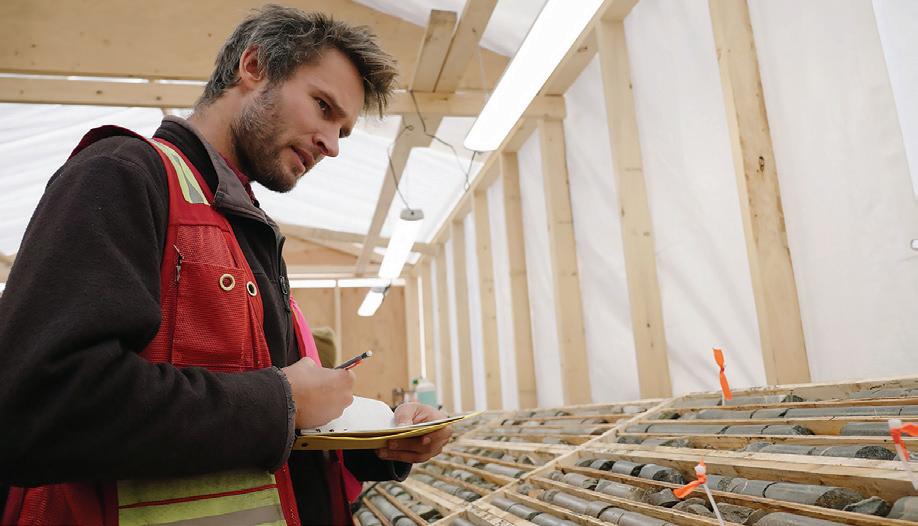
BY MINING.COM STAFF
Shares in Amarc Resources (TSXV: AHR; US-OTC: AXREF) shot up after the company declared a high-grade discovery at its JOY copper-gold project in north-central British Columbia.
The find resulted from initial drilling of the Northwest Gossan (NWG) target area, located at the end of a possible 15-km mineralized trend within the 495-sq.-km JOY district that had not been previously drill tested.
Work programs are being fully funded by copper giant Freeport-McMoRan (NYSE: FCX). It could earn an interest in the JOY project, which is in the Toodoggone region near B.C.’s Golden Triangle, while Amarc serves as the program operator.
The new area, called AuRORA, is a porphyry copper-gold-silver system hosting high and continuous gold grades. Discovery hole JP24057
returned 1.24 grams gold per tonne and 0.38% copper from 18 metres, including 1.97 grams gold and 0.49% copper from 58 metres.
Shares of Amarc Resources gained 21% on the Jan. 20 news in Toronto to 87¢ apiece before declining to 62¢ near press time. Its market capitalization is $136.9 million.
‘Inflection point’
Amarc CEO Diane Nicolson called the AuRORA discovery “a pivotal moment” for the company and “a significant inflection point” in the exploration of the JOY district with Freeport.
“Our discovery is the culmination of years of relentless groundwork by the Amarc team, coupled with the firm, unwavering belief, shared by Freeport, that the JOY district holds significant potential for high-grade porphyry gold-copper deposits,” she said in a release.
Following the completion of JP24057, the Amarc-Freeport team went ahead with an aggressive stepout drilling program with a view
Amarc vice-president of exploration Dr. Roy Greig logging core at the JOY
Uranium junior Auric Minerals options three new projects
QUEBEC | Volatile shares mark journey
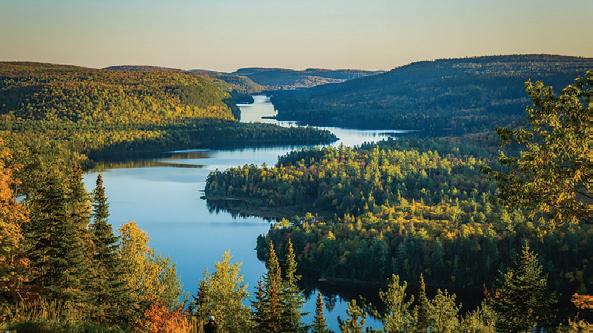
BY MINING.COM STAFF
to begin outlining an outstanding copper-gold-silver deposit and confirm its high-grade potential.
The company also reported six other holes drilled at about 100metre intervals at the NWG target. These returned gold grades as high as 3.69 grams gold and copper grades of up to 0.92%.
Near surface
Amarc said drilling on this section has established a 600-metre-wide zone of porphyry mineralization encountered from near surface that is open to lateral expansion, characterized by excellent lateral and vertical continuity.
The company also noted that the AuRORA discovery area is only one of eight large-scale sulphide mineralization systems clustered along several trends drilled in 2024 at the JOY property.
These sulphide systems, including the 2.5-km-long Pine deposit, were established by 290 line km of property-wide surveying, with drill results pending. TNM
Uranium explorer Auric Minerals (CSE: AUMC) has added three Quebec projects in a bid to strengthen its regional exploration strategy in Eastern Canada.
Under an option agreement signed with an arm’s-length third party on Jan. 14, the company can acquire the Caboose, Kawip and Manic properties for a total payment of $300,000 paid in three instalments.
“As Quebec is one of the topranked mining jurisdictions in the world, Auric is advancing quickly to grow its’ portfolio of highly prospective uranium assets with these three properties,” CEO Chris Huggins said in a release. Shares of Auric Minerals closed the session 16% higher at $1.75 apiece but were down from an all-time high earlier in January of $4.06 and declined to 87¢ near press time. It has a market capitalization of $13.4 million and its 52-week trading low was 12¢.
Project details
Auric, which apparently lacks its
Snow Lake Energy discovers gallium
Snow Lake Energy (NASDAQ: LITM) says it’s made a gallium discovery at the Mound Lake property in northern Ontario to complement its existing portfolio of lithium and uranium assets. Its shares ballooned.
An analysis of sampling conducted by Free Battery Metal (CSE: FREE), its partner on the project, showed that 70% of samples from Mound Lake had gallium values above the average crustal abundance (19 parts per million). Twelve samples returned gallium values over 50 ppm, with the highest measuring 110.5 ppm.
Shares in Snow Lake closed 14% higher on the news Jan. 13 at US78¢ apiece and climbed another 47% to $1.15 near press time for a market capitalization of US$88.9 million.
Shares in Free Battery Metal nearly doubled to 2.5¢ apiece in Toronto
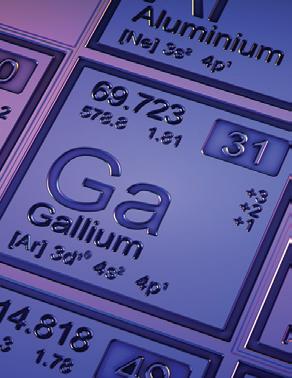
before easing to 2¢, valuing the company at $1.4 million. The discovery of gallium, said Snow Lake in a release, solidifies the company’s position as a “key player in the supply chain for minerals driving the global energy transition and technological revolution.”
“By combining our lithium, uranium and gallium resources, Snow Lake is building a resilient portfolio.”
FRANK WHEATLEY, CEO, SNOW LAKE ENERGY
China ban Gallium is ranked by the United States as the No. 1 critical mineral by supply risk, as highlighted by China’s recent export ban. The silvery-white metal is an essential element for AI technologies, data centres and clean energy solutions.
China accounts for 98.8% of the world’s supply of refined gallium,
according to consultancy Project Blue.
Snow Lake CEO Frank Wheatley said the discovery “aligns perfectly” with the company’s strategy to secure materials that power transformative industries.
“By combining the strengths of our lithium, uranium, and now gallium resources, Snow Lake is building a resilient, future-focused portfolio that addresses the most pressing needs of the AI revolution and clean energy expansion.”
With the gallium find, Snow Lake has signed a binding term sheet with Free Battery to earn up to an 80% interest in the Mound Lake property, which is about 550 km north of Ottawa.
Snow Lake holds 10% of the project and can acquire an additional 70% for $2 million in expenditures and $1.5 million in payments to Free Battery.
Snow Lake is to serve as the project operator until a pre-feasibility
own website, compares the mineralization at both the Caboose and Manic projects to the Rossing-type deposits found in Namibia and Madawaska, Ont.
About 10 radioactive pegmatite dykes are observed on the Caboose property, stretching over a distance of nearly 1 km. Historical sampling in the area yielded grades as high as 1.53% uranium oxide (U3O8).
The target uranium mineralization at the Manic project consists of disseminated uranium minerals in pegmatite and granite, with past samples returning up to 1.65% U3O8
The Kawip property covers greater than 15 km of known pegmatites, with strong uranium mineralization (up to 2.17% U3O8), including a dozen samples returning above 1,000 parts per million U3O8
The project is 50 km northeast of Newmont’s Eleonore mine and 70 km southwest of Winsome Resources’ (ASX: WR1) Cancet lithium project.
Outside of Quebec, the company has two projects in Labrador and one in British Columbia. TNM
study is completed, after which the parties are to contemplate forming a joint venture.
Canadian projects
Snow Lake said its next step is to accelerate its exploration of the Ontario gallium project while continuing to prioritize and develop its lithium and uranium projects.
It holds two hard rock lithium projects in Manitoba and two uranium projects: one in Saskatchewan and one abroad in Namibia. At the end of 2024, the company raised US$20 million to fund its exploration of these four properties.
This work is expected to lead to a new resource estimate for its Snow Lake lithium project, which currently has 8.2 million tonnes grading 1% lithium oxide, of which 89% is in the measured and indicated category, as well as an initial resource for the Engo Valley uranium project in Namibia. TNM
Quebec. ADOBE IMAGES/ PERNELLE VOYAGE
ADOBESTOCK/ NEGRO ELKHA
coppergold project.
AMARC RESOURCES
eye on australia
Minerals 260 buys $150M Aus gold project from Zijin
M&A | Accelerated revival planned for WA brownfield project
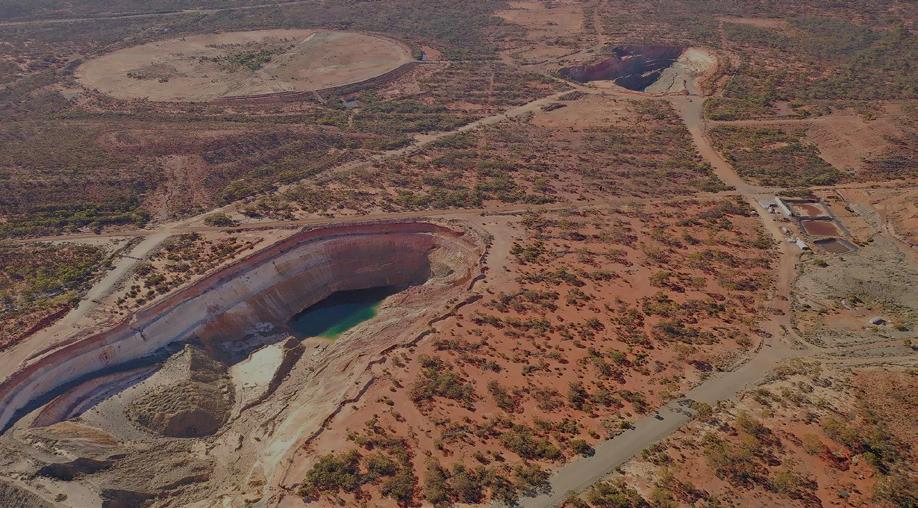
BY KRISTIE BATTEN
Junior explorer Minerals 260
(ASX: MI6) says it will acquire the brownfield Bullabulling gold project in Western Australia from Chinese diversified major Zijin Mining for A$166.5 million ($147.9 million) in cash and shares.
Minerals 260, which had A$9.9 million in cash as of September and a market capitalization of A$30 million, plans to fund the purchase through an equity raising. The company suspended trading Jan. 2 as per ASX rules on the deal’s size for a junior. It may resume in late March or April, it said.
Chair Tim Goyder, who also chairs Liontown Resources (ASX:
LTR) from where Minerals 260 was spun out in 2021, called the acquisition a transformational opportunity in a record-high Australian gold price environment.
“We believe that this opportunity, or this project, will deliver for us,” he said during a Jan. 14 conference call. “There’s no reason why we can’t build a substantial company.”
Shares in Minerals 260 were at A13¢ apiece when they were suspended. They were as high as A35¢ a year ago.
1960s producer Bullabulling, located 65 km southwest of Kalgoorlie, was discovered in the 1960s and produced 179,000 oz. of gold under Resolute Mining (ASX: RSG) before it was placed
on care and maintenance in 1998. Zijin acquired it in 2014 for A$25 million through its subsidiary Norton Gold Fields. The project holds a resource of 60 million tonnes at 1.2 grams gold per tonne totaling 2.3 million ounces.
Minerals 260 plans to fast-track development, capitalizing on current gold prices exceeding A$4,000 per ounce. The company aims to launch 80,000 metres of drilling to complement the 530,000 metres completed and will focus on underexplored southern areas.
Studies are set to start by September to define an initial reserve in the north, where 89% of ounces are in the indicated category.
Managing director Luke McFadyen, formerly of OZ Miner-
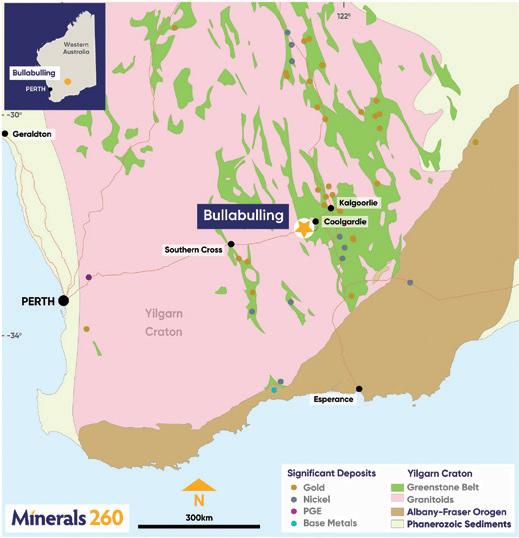
als, said the acquisition would position Minerals 260 for rapid growth in the gold sector, leveraging Bullabulling’s potential amid favourable market conditions. The project doesn’t require A$4,200 per oz. gold to be profitable, as pit shells were calculated at A$3,000 per ounce, he said.
Aggressive plan
“We’ve done the deepest due diligence of my career to ensure the resource stacks up,” McFadyen said on the call. “You won’t see us go slow on this. This is going to be accelerated all the way.”
The project benefits from proximity to infrastructure, including power, water and the Great Eastern Highway, along with established
mining leases and a Native Title Land Use Agreement.
Minerals 260, which had most recently been drilling the Moora copper-gold project in Western Australia, had told shareholders it was actively looking for other opportunities.
Goyder expressed confidence in replicating success at Liontown, which recently completed the A$1-billion Kathleen Valley project to become Australia’s newest lithium producer.
“My phone’s been ringing this morning from engineers, from drilling contractors, all sorts of people wanting to get involved this project,” Goyder said. “So, we’re just going to be doing the doing now and deliver, deliver and deliver.” TNM
Arafura secures A$200M for Nolans rare earths project
BY HENRY LAZENBY
Arafura Rare Earths (ASX: ARU) has secured a A$200million ($180-million) investment from the Australian government’s National Reconstruction Fund to advance the A$2.8-billion capex Nolans rare earth project in the Northern Territory. The unsecured convertible notes with a 15-year term include a 40% premium conversion price linked to future equity raises. There is no cash interest required for the first two years.
The financing for the project 135 km north of Alice Springs comes in addition to Australia’s A$840 million investment package in Nolans last year and US$1 billion in debt from international lenders. The debt reduces the company’s equity risk and all the funding brings the project closer to a final investment decision expected by June.
The Nolans project has a 38-year mine life. It aims to produce 4,440 tonnes of neodymium-praseodymium oxide each year, according to a 2019 definitive feasibility study.
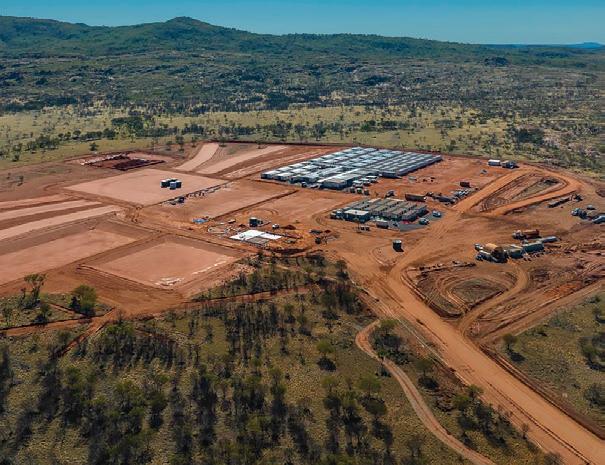
This material is key for electric vehicle motors and wind turbines.
Nolans would be Australia’s first ore-to-oxide rare earth facility if it begins production on schedule in 2027. It will position Australia as a non-China supplier in a market where the Asian giant controls 90% of output.
De-risking
Canaccord Genuity analyst Reg Spencer called the funding a “key de-risking milestone.” It positions Nolans to attract more investor interest.
“It continues to plug the remaining funding gap for Nolans,” Spencer said in a Jan. 15 note. “The
additional Australian government hybrid funding is a strong endorsement of the project and may be a catalyst for other groups to follow.”
Shares in Arafura Rare Earths closed 17% or A2¢ apiece higher on the news in Sydney at A14¢ apiece. They’ve tested A11¢ and A28¢ over the past 12 months. The company has a market capitalization of A$318.8 million.
Fund the gap
Arafura now aims to attract the rest of the funding it needs by seeking investors for sizable stakes in the project.
“This commitment from the NRF solidifies Nolans’ role as a critical asset for Australia and the global supply chain,” Arafura managing director Darryl Cuzzubbo said in a release. “It’s a major step forward, reinforcing confidence in our strategy and enabling us to focus on finalizing equity funding and securing additional offtakes.”
Canaccord’s Spencer sees a strong chance of equity from metal off-takers and original equipment manufacturers. They would cover
a quarter to a half of the A$900 million needed. Hancock Prospecting, a private Australian mining and agricultural company, owns a 9% stake.
Strategic asset
Toronto-based Adamas Intelligence projects neodymium-praseodymium demand to nearly double by 2032. The global energy transition to more EVs and renewables will drive this.
The investment commitment, part of Australia’s A$15-billion plan to fund resource projects and diversify the economy, follows major milestones. In July, the company secured over US$1 billion in debt from nine international lenders. It also signed binding offtake agreements with Hyundai, Kia, and Siemens Gamesa Renewable Energy.
Nolans’ projected cost profile ranks it in the global first quartile. Company documents cite credits from phosphoric acid by-products as the reason. The low cost and strong demand for neodymium-praseodymium boost the project’s case. TNM
The Bullabulling gold project. MINERALS 260 - Right: A map of Minerals 260’s project holdings. MINERALS 260
Arafura’s Nolans rare earths project in the Northern Territory. ARAFURA RARE EARTHS
board of directors of Lundin Gold., the Lundin Foundation, and the University of Arizona’s Lowell Institute for Mineral Resources.
Jack’s brother Adam, chair of Lundin Mining, has many years of experience in capital markets and public company management across the natural resources sector.
“Our grandfather Adolf and father Lukas both believed in the importance of surrounding yourself with great talent,” Adam said. “To be successful, you need a wide array of disciplines aligned with a team-first approach. This mindset helped build the beginnings of the Lundin Group and continues today. This award is a reflection of the support and teamwork that truly creates a successful and sustainable business.”
Adam’s background includes petroleum and mining technology, investment advisory, international finance and executive management. He began his career working for several Lundin Group mining

companies in various countries before moving into finance where he was co-head of the London office for an international securities firm.
Adam is the former president
“(For success), you need a wide array of disciplines aligned with a team-first approach.”
ADAM LUNDIN LUNDIN MINING
and CEO of Josemaria Resources and serves as the chair of the board of directors of Filo Corp. He also serves on the board of directors of Lucara Diamond (TSX: LUC), NGEx Minerals (TSX: NGEX, US-OTC: NGXXF), and the Lundin Foundation.
Both brothers were also recognized by The Northern Miner as Persons of the Year in 2024 in recognition of a $4.8-billion blockbuster deal they negotiated with BHP (NYSE, LSE, ASX: BHP) to acquire Filo Corp. and form a 50/50 joint venture to advance the Filo del Sol and Josemaria projects in Argentina.
inbrief
n Cobre Panama discussed
Panama’s government has begun public consultations on an environmental audit of First Quantum Minerals’ Cobre Panama copper mine.
The Ministry of Environment in early January invited environmental organizations, local communities, academics, the private sector and the general public to participate in the process, which will remain open until Feb. 7. President José Raúl Mulino announced the plan last year after he was elected in May.
Mulino said in July he would order a “strict audit” of the US$10-billion mine, which was shuttered in 2023 after Panama’s Supreme Court ruled that its operating contract was unconstitutional.
The audit’s primary objective is to evaluate the possibility of a temporary reopening of Cobre Panama while ensuring a safe and environmentally responsible final closure.
The president has criticized his predecessor for failing to resolve the issue, and has committed to tackling it with what he described as “credibility and national acceptance.”
First Quantum also initiated two arbitration cases seeking damages from Panama.
Meanwhile, the company has cut its total copper guidance by 3.5% at the midpoint, citing Zambian mine sequencing.
The Toronto-headquartered company expects production of 380,000–440,000 tonnes copper this year, down from earlier estimates of 400,000–450,000 tonnes. At Kansanshi in Zambia, the initial ramp-up of the S3 expansion from midyear will rely on low-grade stockpiles before higher-grade ore is available in 2027.
At Sentinel, the updated mine plan prioritizes the accelerated mining of lower-grade oxidized and transitional ore in stages three and four.
The US$1.25 billion Kansanshi S3 Expansion, 62% complete, aims to enhance processing capacity by 25 million tonnes per year.
BY MINING.COM STAFF
n Big steel working deals
Cleveland-Cliffs is reportedly collaborating with its rival Nucor on a potential bid to acquire US Steel, according to CNBC.
The Jan. 13 development follows the former Biden administration’s decision on Jan. 3 to block Japan’s Nippon Steel from taking over US Steel.
According to CNBC, Cleveland-Cliffs plans to purchase all of US Steel for cash and sell its Big River Steel subsidiary to Nucor. The offer is expected to be near US$40 per share, while Nippon Steel had intended to acquire US Steel for US$55 per share in a deal valued at over US$14 billion. Shares of US Steel traded for US$37.25 apiece before press time in New York. It has a market capitalization of about US$8.4 billion.
Cleveland-Cliffs is North America’s largest producer of flat-rolled steel, while Nucor is the largest steel producer in the U.S. and the leading scrap recycler in North America. Nippon Steel and US Steel announced on Jan. 11 that the Biden administration had delayed until June the order requiring Nippon to abandon its bid.
The delay allows the courts to review a legal challenge brought by the steelmakers on Jan. 6 against the U.S.
Eira Thomas Award: Ana Gabriela Juárez
Juárez is an accomplished Guatemalan leader in the mining industry, renowned for her unwavering commitment to sustainability, women’s empowerment and community development.
With over 20 years of experience, Ana is a trailblazer in the industry, serving as president of CTA Environmental Consultants. She founded Women in Mining Central America and serves as a board member of the Development Partner Institute, a global nonprofit organization working to advance solutions to the challenges facing the mining industry.
Juárez was recognized as one of the 100 Most Inspirational Women in Mining globally, one of the 10 Most Influential Hispanic Canadians, and is a recipient of the Mines and Money Rising Star Award. Her work extends beyond consulting with initiatives such as the Kids Mineralogist Club and her best-selling book series, Ana’s Adventures at the Mine, which
government. Initially, the parties had 30 days to unwind their transaction.
The acquisition, first announced in December 2023, sparked political debate and raised concerns among steelworkers about potential job losses.
US Steel CEO David Burritt has contacted President Donald Trump urging him to reverse Biden’s decision blocking the sale. Trump has also expressed his opposition to the deal. BY MINING.COM STAFF
n NA’s latest salt mine
Atlas Salt says it plans to develop the Great Atlantic Salt (GAS) deposit in Newfoundland and Labrador into the continent’s first mine for the kitchen and winter road staple in nearly 30 years.
The GAS project, which is set to initially produce up to 2.5 million tonnes of rock salt annually, is located near the Turf Point Port in western Newfoundland.
Atlas plans a state-of-the-art “salt factory” as the first new underground salt operation in North America, one that would contribute to a “significant” domestic production shortfall, the company said on Jan. 14.
The St. John’s-based company intends to use computer firm Oracle’s Aconex cloud-based project and financial management software to save millions of dollars. It aims to cut several months off the project timeline set out in the project’s feasibility study issued last May.
The GAS deposit is considered one of the continent’s largest shallow salt deposits. It’s beside the former Flat Bay gypsum mines, which produced 15 million tonnes from the 1950s until production ceased in 1990.
GAS holds 383 million indicated tonnes grading 96% salt and 868 million inferred tonnes grading 95.2% salt, according to an NI-43-101 report. It shows mineral reserves in the probable category total 88.1 million tones at 96% salt.
BY NORTHERN MINER STAFF
n Barrick mulls Zaldivar sale
Barrick Gold is reportedly seeking to divest its half of the Zaldivar copper mine, which is run by Antofagasta in Chile, Bloomberg reported.
Barrick has engaged advisers and initiated discussions with potential buyers regarding its interest in the relatively small mine, sources familiar with the matter told the news wire on Jan. 20.
The Canadian miner, shifting its focus towards larger and more lucrative operations, didn’t immediately reply on Jan. 20 to inquiries from The Northern Miner’s sister publication MINING.COM regarding the potential sale.
The divestment process remains in its early stages, according to Bloomberg‘s sources, and it is uncertain whether a deal will materialize.
Zaldivar, about 1,400 km north of capital Santiago, operates as a 50/50 joint venture. The mine produced around 80,000 tonnes of copper last year, a figure that pales in comparison to larger mines in the region.
Antofagasta is going ahead with a US$1.2-billion expansion of the mine, which would keep operations running through 2051.
While Barrick is keen to expand into the copper sector,
inspires young girls to pursue careers in technology and mining.
Her visionary leadership, dedication to responsible mining practices, and passion for fostering inclusive environments make her an exemplary recipient of the Eira Thomas Award, organizers said Juárez’s journey continues to inspire the next generation of leaders, proving that with resilience and vision, transformative change is possible.
“Receiving the Eira Thomas Award is not only a profound honour but also a powerful affirmation of the path I’ve chosen in the mining industry and a reminder of the impact that we, as young professionals, can make in the industry,” Ana said.
“This recognition deepens my commitment to mining, to my work as an environmental consultant at CTA and inspires me to continue advocating for the industry and the advancement of women. I am deeply grateful for this accolade, and it fuels my passion to keep contributing positively, just as Eira Thomas has remarkably done.” TNM
the company is also prioritizing the simplification of its business model. This includes a focus on tier-one assets and efforts to reduce debt.
The company is also dealing with issues at its Loulo-Gounkoto gold complex in Mali, where operations were suspended in mid-January, in the latest escalation of a months-long dispute.
BY MINING.COM STAFF
n Saudis eye Reko Diq
Saudi Arabian mining fund Manara Minerals is set to buy 10%-20% of the Reko Diq copper and gold project from the Pakistani government, according to the Financial Times Manara Minerals would pay about US$500 million to US$1 billion for the equity stake in the project, which is being co-developed by Barrick Gold, the FT said Jan. 21. It cited unnamed sources close to the negotiations.
Saudi Arabia’s involvement is also to include an offtake agreement. Negotiations are progressing, with an expected deal within six months, the London-based publication said.
Barrick Gold said on Jan. 20 it wouldn’t reduce its half stake in Reko Diq. Pakistan’s national government and Balochistan state each hold a quarter. It’s located near the border with Iran and Afghanistan in a remote, sparsely populated region.
The US$9-billion capex mine over two stages is projected to generate about US$74 billion in free cash flow over 37 years, based on consensus long-term prices, the company said.
The mine’s first stage, expected to produce 200,000 tonnes of copper concentrate and 250,000 oz. of gold annually starting in 2029, is slated to cost US$5.5 billion, CEO Mark Bristow has said. A US$3.5-billion second stage is projected to double production, he added.
BY NORTHERN MINER STAFF
n Vale studies Manitoba exit
Vale’s (NYSE: VALE) base metals subsidiary says it’s started a strategic review to consider selling its nickel mining and exploration assets in Manitoba.
The review is to explore and evaluate alternatives for its operations around the province’s northern town of Thompson, Vale said in a late January release. The report is due after June, the company said.
The assets include two operating underground mines, an adjacent mill and exploration opportunities on the 135-km long Thompson Nickel Belt.
Shares in Vale traded in New York at US$8.89 apiece near press time, valuing the company at US$40.3 billion.
Former Canadian giant Inco, which Vale bought in 2006 for US$17 billion, discovered the ore body in 1956. Mining began in 1961.
Vale Base Metals’ finished nickel production from Thompson totalled 10,500 tonnes for the 12-months period ending Sept. 3o.
In 2021, Vale announced it was investing $150 million to extend its mining activities in the Canadian province by 10 years.
BY MINING.COM STAFF
Ana Gabriela Juárez.
mining, metals & markets
20 Capital raisings
22 EV metals
ETF assets
29 Mining events contents
28 Market news 27 Market data 26 Warrants & shorts
*Data may not be comprehensive and is provided on a best-efforts basis as of press time. Investors are responsible for their own due diligence.
Delivering fit-for-purpose solutions across the entire project life cycle
Delivering fit-for-purpose solutions across the entire project life cycle
Delivering fit-for-purpose solutions across the entire project life cycle
Delivering fit-for-purpose solutions across the entire project life cycle
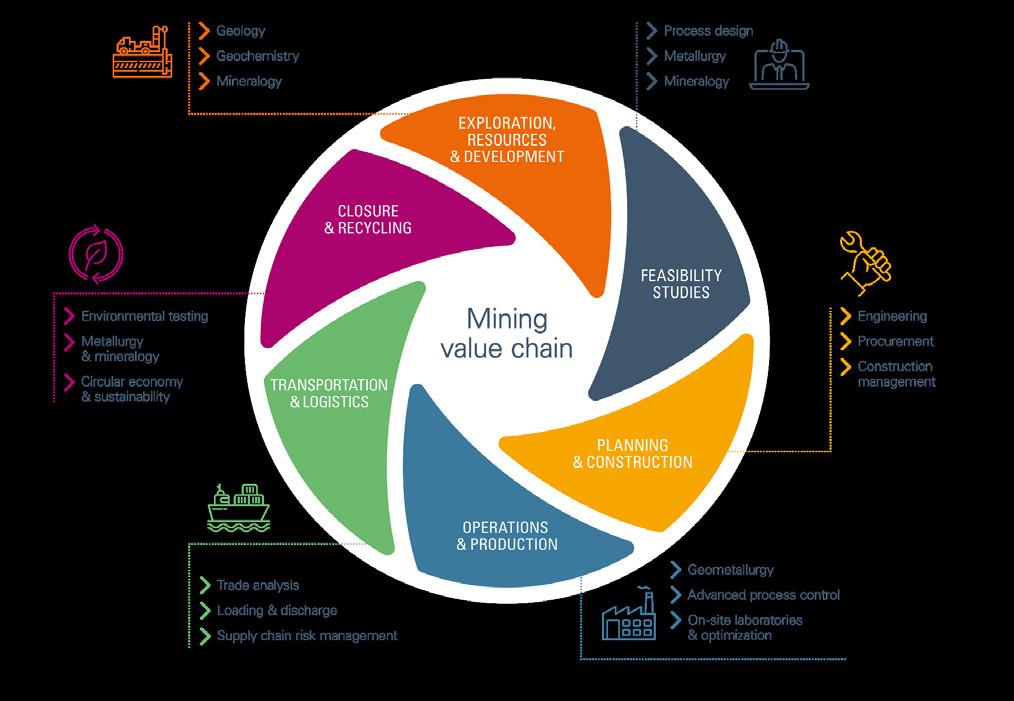
Our fit-for-purpose solutions encompass the skills of qualified geologists, geostaticians, analytical chemists, mineralogists, metallurgists, process engineers and mining engineers and inspectors brought together to provide accurate and timely mineral and process evaluation services across the entire project life cycle.
Our fit-for-purpose solutions encompass the skills of qualified geologists, geostaticians, analytical chemists, mineralogists, metallurgists, process engineers and mining engineers and inspectors brought together to provide accurate and timely mineral and process evaluation services across the entire project life cycle.
Our fit-for-purpose solutions encompass the skills of qualified geologists, geostaticians, analytical chemists, mineralogists, metallurgists, process engineers and mining engineers and inspectors brought together to provide accurate and timely mineral and process evaluation services across the entire project life cycle.
Our fit-for-purpose solutions encompass the skills of qualified geologists, geostaticians, analytical chemists, mineralogists, metallurgists, process engineers and mining engineers and inspectors brought together to provide accurate and timely mineral and process evaluation services across the entire project life cycle.
WWW.SGS.COM/NATURALRESOURCES NAM.NATURALRESOURCES@SGS.COM
WWW.SGS.COM/NATURALRESOURCES NAM.NATURALRESOURCES@SGS.COM
WWW.SGS.COM/NATURALRESOURCES NAM.NATURALRESOURCES@SGS.COM
WWW.SGS.COM/NATURALRESOURCES NAM.NATURALRESOURCES@SGS.COM

2
capitalraisings
CAPITAL RAISINGS | 12-MONTH ROLLING AVERAGE
$4,500
$4,000
$3,500
$3,000
$2,500
$2,000
$1,500
$1,000
$500
$0
02/24-01/25 02/23-01/24
Note: Trended capital raising activity may differ from the previous months as we have switched data providers in order to expand our coverage of market activities.

Investing in the Canadian Resource Sector at Reduced Cost of Capital
PearTree is a Canadian Securities Dealer and Investment Fund Manager advancing over (CAD) $500 million annually for resource exploration and mine development in a uniquely Canadian structure which results in as much as $2.00 of capital deployed for every $1.00 invested by global institutions and family offices.
Watch our video in English, Français, Deutsch, and Español on our website.
Expanding the universe of exploration capital.
evmetals
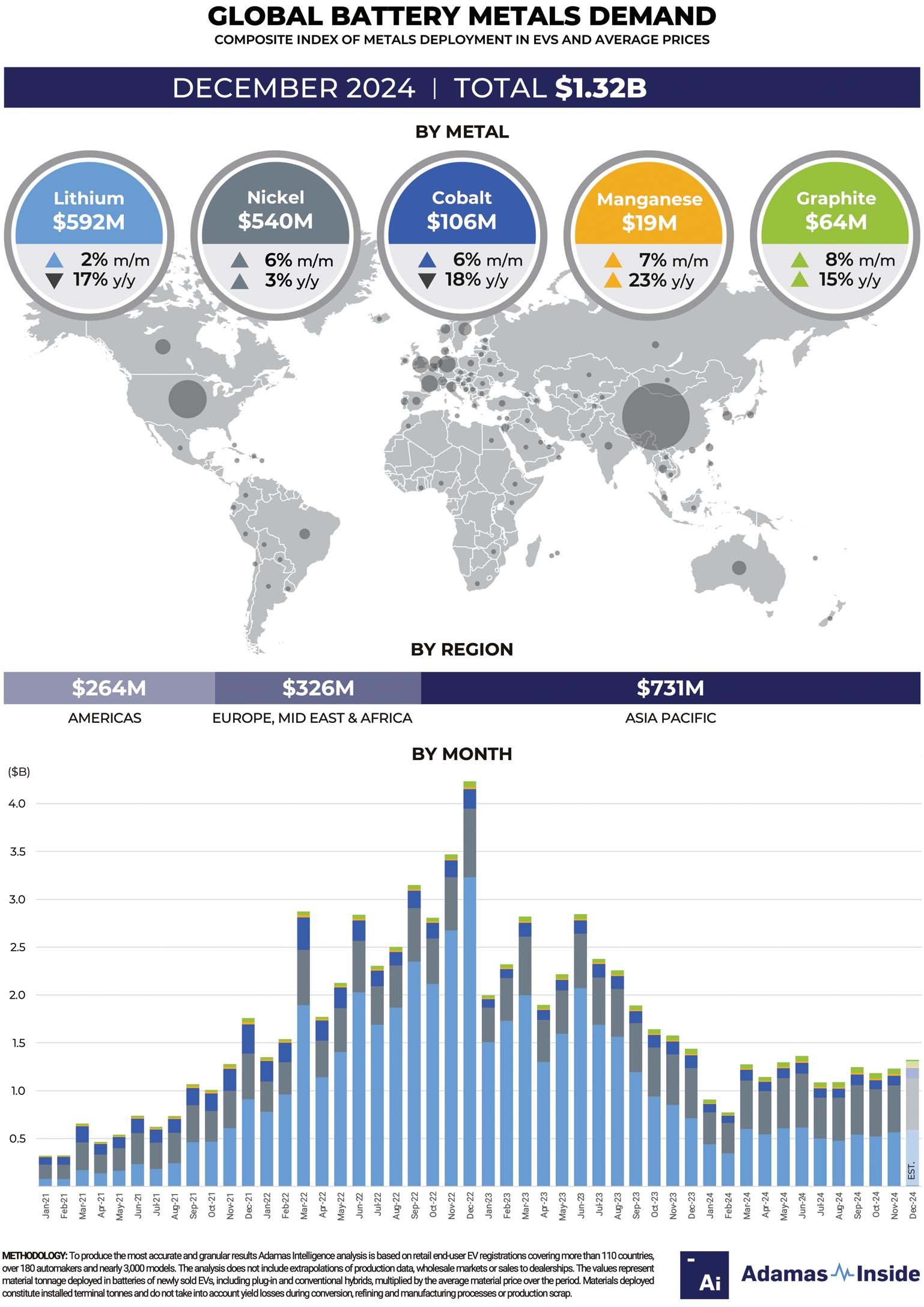
evmetals
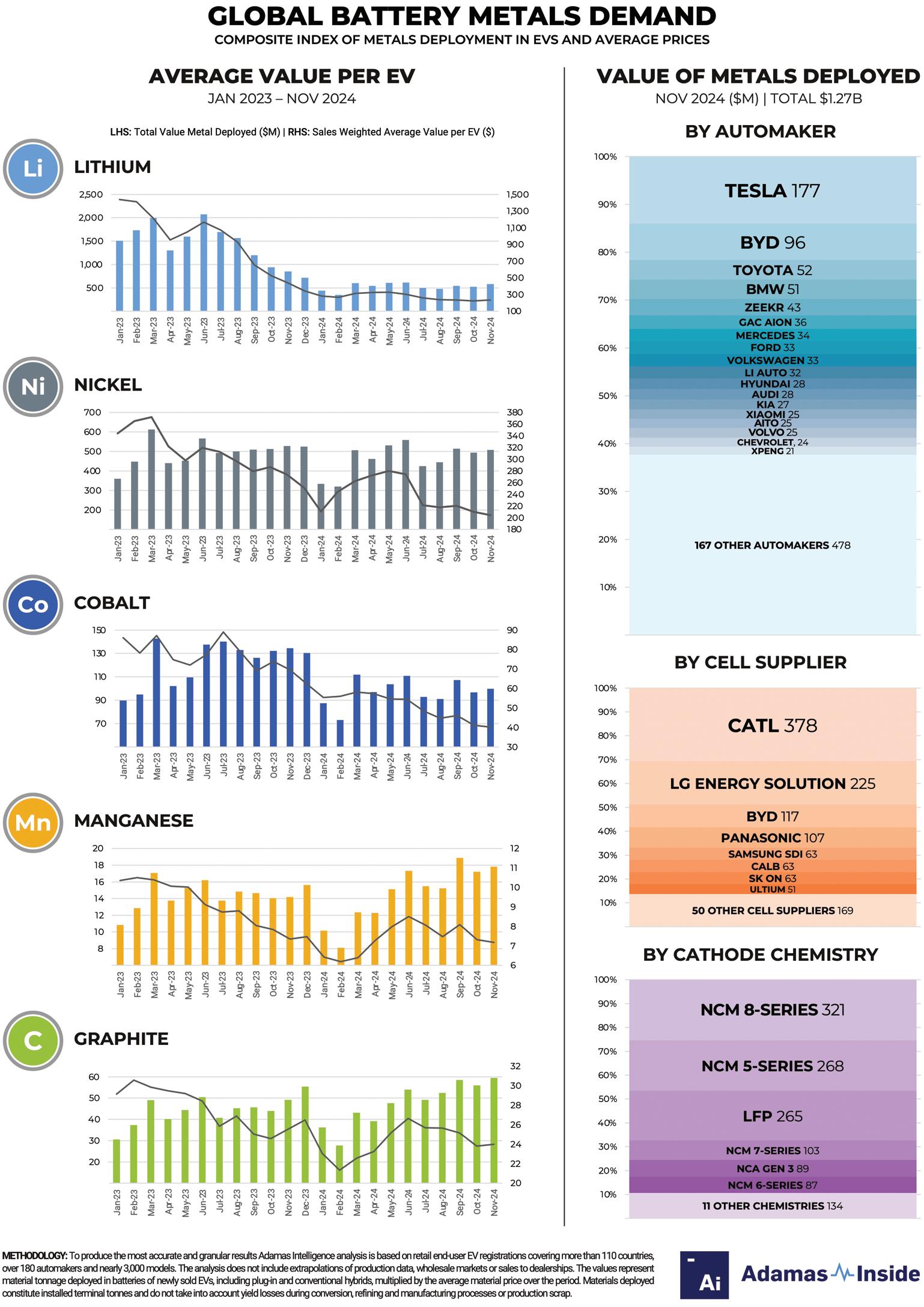
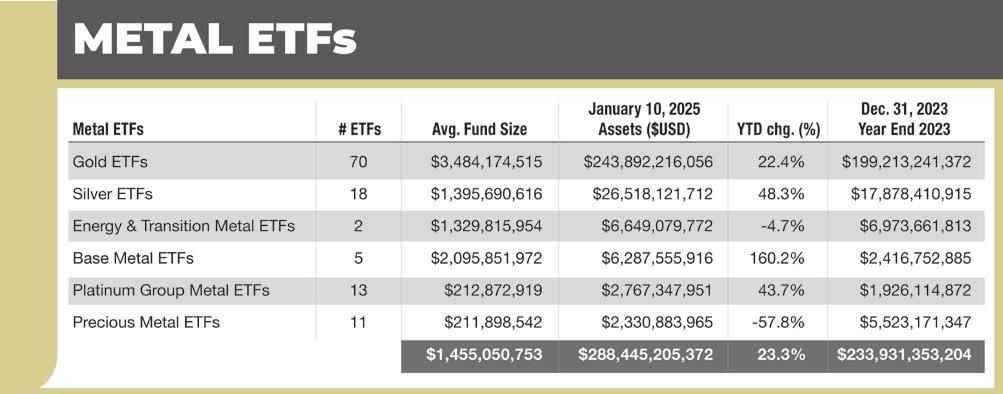
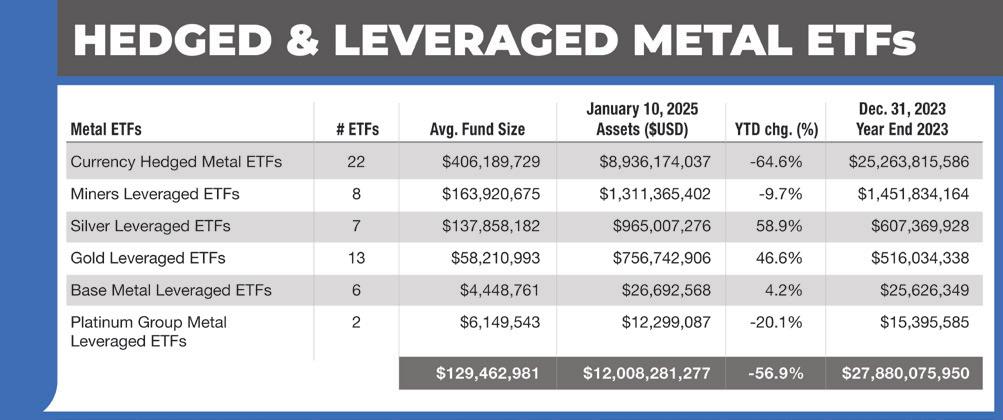
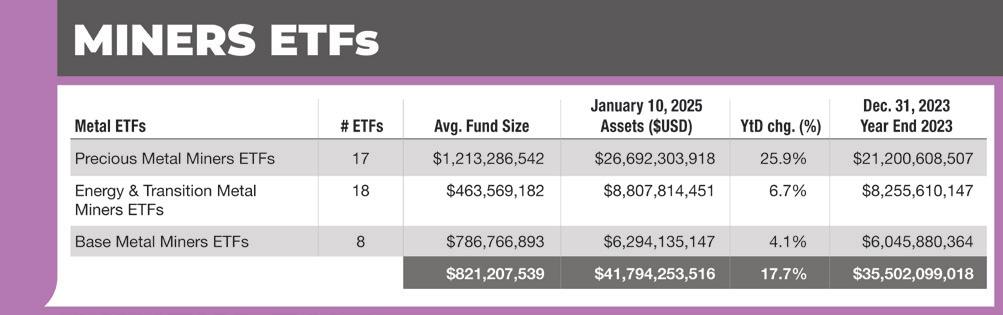
drillresults
TNM DRILL DOWN: TOP ASSAYS OF THE MONTH
Our TNM Drill Down features the top 10 gold, copper and silver assays of the past month. Drill holes are ranked by grade x width.
December 16, 2024 — January 15, 2024
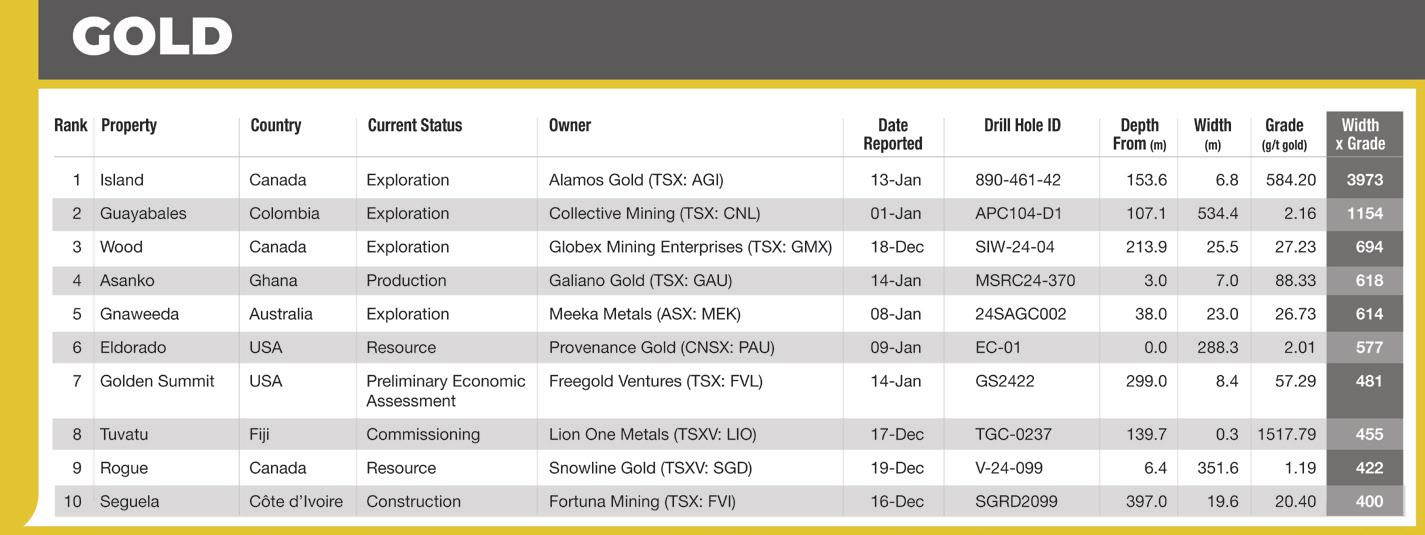
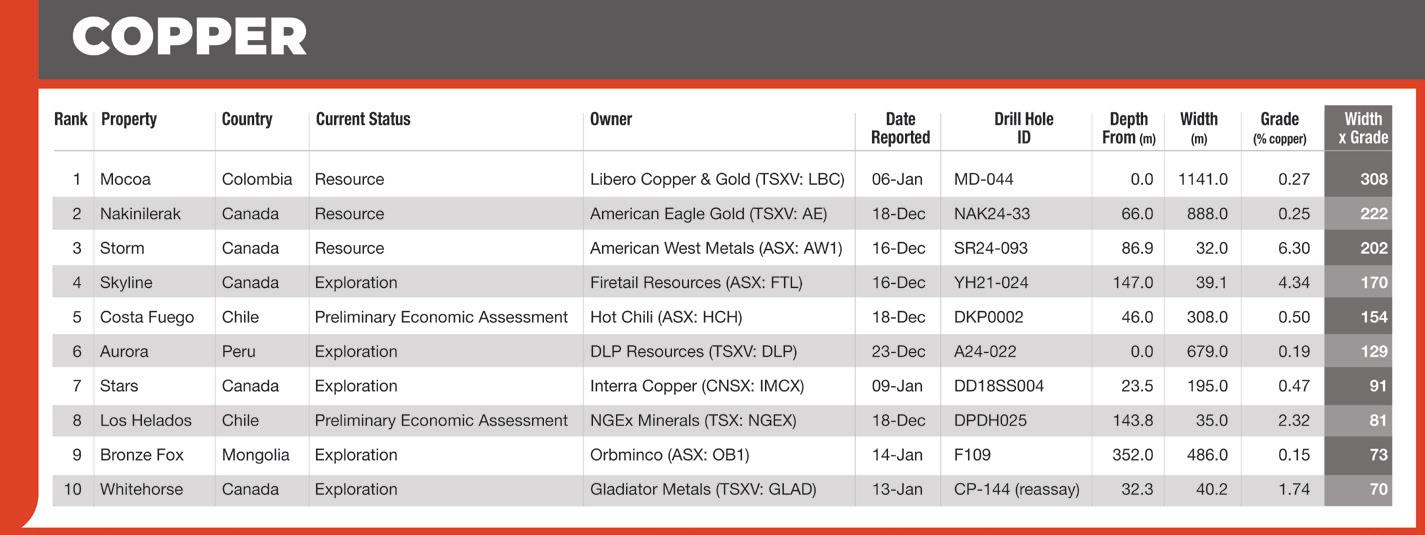
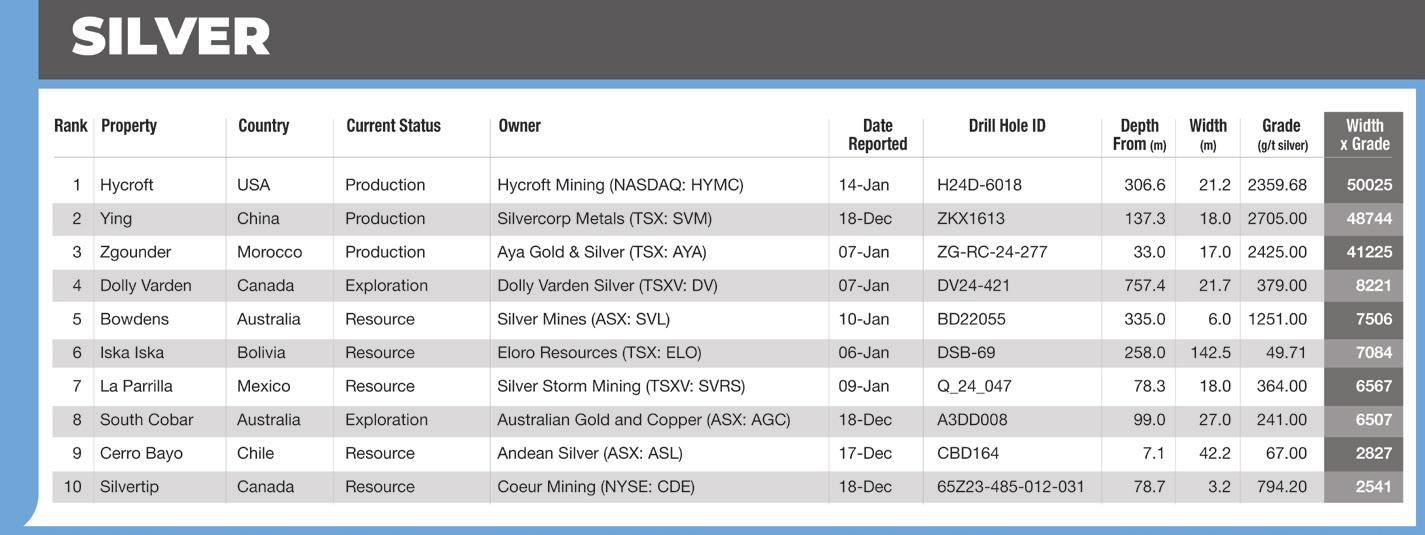
warrants&shorts
TSX WARRANTS
Aris Gold Corporation ARIS.WT One Warrant to purchase one Common 07-29-2025 Share of the Issuer at $2.75 until expiry.
Terms Expiry Date
Giga Metals Corporation GIGA.WT.A One warrant to purchase one common 02-08-2025 share at $0.45 per share.
LithiumBank Resources LBNK.WT One warrant to purchase one common 02-16-2025 Corp. share at $2.00 per share.
Total Helium Ltd. TOH.WT.A One warrant to purchase one common 05-01-2025 share at $0.75 per share.
Caldas Gold Corp. CGC.WT One warrant to purchase one common 07-29-2025 share at $2.75 per share.
Rock Tech Lithium Inc. RCK.WT One warrant to purchase one common 08-19-2025 share at $4.50 per share.
Lion One Metals Limited LIO.WT One warrant to purchase one common 11-11-2025 share at $1.25 per share.
Vizsla Royalties Corp. VROY.WT One warrant to purchase one common 12-31-2025 share at $0.50 per share.
Silver Mountain AGMR.WT.A) One warrant to purchase one common 02-09-2026 Resources Inc. share at $0.45 per share.
Osisko Development ODV.WT.B One warrant to purchase one common 03-02-2026 Corp. share at $8.55 per share.
Denarius Silver Corp. DSLV.WT One warrant to purchase one common 03-17-2026 share at $0.80 per share.
West Red Lake Gold WRLG.WT One warrant to purchase one common 05-16-2026 Mines Ltd share at $1.00 per share.
Aurania Resources Ltd. ARU.WT.B One warrant to purchase one common 10-21-2026 share at $2.20 per share. Name
Tuktu Resources Ltd. TUK.WT One warrant to purchase one common 11-23-2026 share at $0.13 per share.
Freeman Gold Corp FMAN.WT.U One warrant to purchase one common 11-29-2026 share at US$0.65 per share.
Mogotes Metals Inc MOG.WT One warrant to purchase one common 01-31-2027 share at $0.30 per share.
Osisko Development ODV.WT.A One warrant to purchase one common 03-02-2027 Corp. share at $14.75 per share.
Integra Resources Corp. ITR.WT One warrant to purchase one common 03-13-2027 share at $1.20 per share.
Elevation Gold Mining ELVT.WT.A One warrant to purchase one common 03-24-2027 Corporation share at $0.70 per share.
Osisko Development ODV.WT.U One warrant to purchase one common 05-27-2027 Corp. share at US$10.70 per share.
Robex Resources Inc RBX.WT One warrant to purchase one common 06-27-2027 share at $2.55 per share.
West Red Lake Gold WRLG.WT.B One warrant to purchase one common 10-24-2027 Mines Ltd share at $0.90 per share.
Silver Mountain AGMR.WT.B One warrant to purchase one common 04-24-2028 Resources Inc. share at $0.135 per share.
Bear Creek Mining BCM.WT One warrant to purchase one common 10-05-2028 Corporation share at $0.42 per share.
West Red Lake Gold WRLG.WT.A One warrant to purchase one common 03-19-2029 Mines Ltd share at $0.95 per share.
Aluminum: US$1.1961/lb.
Cobalt: US$11.022/lb.
Gold: US$2,771.05/oz.
Iron Ore 62% Fe CFR China-S: US$103.95
Nickel: US$7.067/lb.
Silver: US$30.84 per oz.
Zinc: US$1.2828 per lb.
marketdata
COMMODITY PRICES | Prices current Janary 27, 2025
Coal: Central Appalachia, 12,500 Btu, 1.2 S02-R,W: US$77.30
Copper: US$4.2905/lb.
Iridium: US$4,350/oz.
Lead: US$0.88/lb.
Rhodium: US$4,675/tr. oz.
Tin: US$13.679/lb.
Copper: CME Group Futures April 2025: US$4.275/lb.; May
2025: US$4.291/lb.
Lithium carbonate: US$10,550/tonne
Ruthenium: US$495 per oz.
Uranium: US$71.80 per lb.
Jan. 17 – 24,2025
Markets rise on Trump inauguration
Gold companies advance
By Colin McClelland
Markets gained as U.S. President Donald Trump took office and signed scores of executive orders affecting American policy across the board.
In New York, The Dow Jones Industrial Average advanced 936.42 points or 2.1% to 44,424.25, while the S&P 500 added 104.58 points or 1.7% to 6,101.24.
South African gold miners Harmony Gold, DRD Gold and Gold Fields led the NYSE percentage gainers during the period as the metal’s price grew on inflation concerns during a Trump administration while a risk gauge for the rand fell after the returning president said he’d like to avoid sanctions on China, South Africa’s biggest trading partner.
The gold price rose 2.3% or US$61.60 to US$2,776.80 per oz. during the week and the S&P/TSX Global Gold Index increased 3% or 10.83 points to 376.48. In Toronto, the S&P/TSX Composite Index added 400.57 points or 1.6% over the week to 25,468.49 points. Agnico Eagle Mines advanced the most by value in Toronto after acquiring most of O3 Mining.
The S&P/TSX Venture Composite Index rose 4.91 points or 0.8% to 621.25.
The week’s only decliner was the S&P/ TSX Global Base Metals Index, which lost 1.6% or 3.17 points to 196.18.
The S&P/TSX Global Mining Index gained 1.1 points or 0.9% to 122.62.
miningevents
2025
n February
February 3-6
Mining Indaba — Cape Town, South Africa
VENUE: Cape Town International Convention Centre
MORE INFORMATION: miningindaba.com/home
February 23-26
2025 International Zinc and Zinc Oxide Conferences – San Diego, Cali.
VENUE: Westin San Diego Gas Lamp Quarter
MORE INFORMATION: web.cvent.com/event/ cac7fafa-b48f-4814-9400-819eeccc271b/summary
February 23-26
Global Metals, Mining & Critical Minerals Conference — Hollywood, Fl.
VENUE: TBA
MORE INFORMATION: capitalmarkets.bmo.com/en/ industries/global-metals-mining/
February 23-26
MINEXCHANGE 2025 SME Annual Conference and Expo – Denver, Colo.
VENUE: Colorado Convention Center
MORE INFORMATION: smeannualconference.org
February 24-25
Critical Minerals and Energy Investment — Brisbane, Australia
VENUE: TBA
MORE INFORMATION: www.criticalmineralresources.com
n March
March 2-5
PDAC 2025 — Toronto
VENUE: Metro Toronto Convention Centre
MORE INFORMATION: www.pdac.ca/convention
March 18-19
Swiss Mining Institute – Zurich
VENUE: The Dolder Grand
MORE INFORMATION: www.swissmininginstitute.ch
n April
April 8-10
Discoveries 2025 Mining Conference – Mazatlan, Mexico
VENUE: Mazatlán International Center
MORE INFORMATION: www.discoveriesconference. com
April 22-25
ExpoMin – Santiago, Chile
VENUE: Espacio Riesco
MORE INFORMATION: www.expomin.cl/en/
n May
May 4-7
CIM Convention — Montreal
VENUE: Palais des congrès de Montréal
MORE INFORMATION: convention.cim.org
May 12-13
Mining & Critical Minerals Middle East Conference and Exhibition — Dubai
VENUE: TBA
MORE INFORMATION: www.miningcriticalminerals. com
May 20-22
2025 Global Metals and Mining Conference — Henderson, Nev.
VENUE: TBA
MORE INFORMATION: canaccordgenuity.com/ capital-markets/events-and-conferences/2025global-metals--mining-conference/
May 20-22
Arminera 2025 – Buenos Aires, Argentina
VENUE: La Rural Trade Center
MORE INFORMATION: mstacanada.ca/events/ arminera-2025/
May 20-22
GRX25 Global Resources Innovation Expo –Brisbane
VENUE: Brisbane Convention and Exhibition
Building
MORE INFORMATION: www.grx.au
May 21-22
Mining Investment Asia — Singapore
VENUE: Marriott Tang Plaza Hotel
MORE INFORMATION: www.mininginvestmentasia. com
n June
June 3-5
THE Mining Investment Event of the North –Quebec City
VENUE: Centre des congrès de Québec
MORE INFORMATION: www. themininginvestmentevent.com
June 4-5
Canadian Mining Expo – Timmins, Ont.
VENUE: McIntyre Complex
MORE INFORMATION: virtex.canadianminingexpo. com
June 11-12
Mining & Critical Minerals Investment Latin America — São Paulo, Brazil
VENUE: TBA
MORE INFORMATION: www. criticalmineralslatinamerica.com
June 11-12
UK Mining Conference – Cornwall
VENUE: Princess Pavillion
MORE INFORMATION: www.ukminingconference. co.uk
n July
July 29-30
Life of Mine | Mine Waste and Tailings Conference 2025 – Brisbane
VENUE: Brisbane Convention and Exhibition Centre
MORE INFORMATION: www. ausimm.com/ conferences-and-events/life-of-mine-and-minewaste-and-tailings-conference-2025/
n September
Sept. 8-11
The Uranium, Potash, and Lithium Conference –Saskatoon
VENUE: TBA
MORE INFORMATION: uraniumpotashlithium.org
Never Miss Another Story

BY FRIK ELS
Despite the upheaval of a new Donald Trump presidency in the U.S., pundits at the Vancouver Resource Investment Conference held firm that the metal’s long-term future is as bright as ever.
As key to the energy transition, copper is finding investors from beyond the sector, which has also been cited as one of the reasons behind its roller-coaster 2024. Trump’s tariff threats had seen the red metal hit all-time price highs last year before that dissipated to 15% lower lately.
Lobo Tiggre, founder and CEO of investment advisory Louis James, said copper is his top pick this year, though it’s not all that surprising on a copper panel assembled at an investment conference. Unlike oil, copper is supply constrained, he said. Unlike some of the other favourite commodities of delegates and experts — gold, silver and uranium — copper is relatively cheap at today’s prices.
“That gives you more alpha,” Tiggre said. “Demand is going up even without” artificial intelligence and electric vehicles, he added.
VRIC has been running for more than a quarter century and the city’s
Majors are hunting for explorers
COPPER
| Lack of past investing means buying now
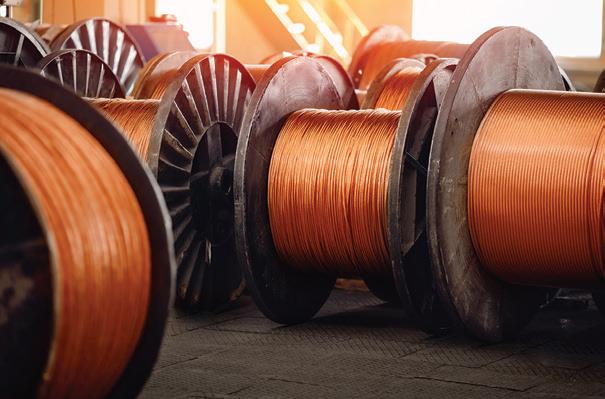
reputation as a junior mining hub sees investors and speculators of all stripes flock to the often raucous get together. According to the organizers, 2025 saw a large proportion of first-time attendees, a reflection of the wider interest mining now receives outside usual junior mining punters.
Large projects
Rick Rule, founder of the businesses now known as Sprott US Holdings and Battle Bank, said that from a speculator’s perspective it’s important to keep in focus the nature of copper mining. They are big oper-
ations requiring big risks, but can produce even bigger payouts.
“I haven’t always had an opinion as to the direction of the copper price,” Rule said. “But I didn’t care much because I knew that a drill hole could put me on the path to a $5-billion company or a $10-billion company.”
Rule pointed out that the mammoth size of many copper mines means that these operations also count as the biggest gold mines in the world.
The prime example of this is Freeport-McMoRan’s (NYSE: FCX) Grasberg mine. In last year’s third

US military bound to retreat as spending goes ‘insane’
BY FRÉDÉRIC TOMESCO
Unsustainably high military spending will soon force the United States to scale back its overseas presence and stop meddling in regional conflicts, former Pentagon adviser Douglas MacGregor predicted.
U.S. Department of Defense spending rose almost 10% to a record US$842 billion in 2023, government data show. In April, Congress approved a US$95 billion defense supplement that included more aid for Ukraine, Israel and Taiwan.
“You cannot maintain the kinds of forces
we have all over the world, intervening in other people’s affairs, telling other people how to live if you can’t afford it,” MacGregor, a retired U.S. Army Colonel and geopolitical analyst, said during a panel discussion at the Vancouver Resource Investment Conference last month. “I read the headlines yesterday that the House and the Senate want to add US$200 billion to the defense budget. It’s insane.”
Military spending now represents just under half of all U.S. federal discretionary budget outlays and about 40% of global military expenditures. For the mining indus-
quarter, in addition to 477,000 tonnes of copper, the mine in Indonesia’s remote West Papua province produced 456,000 oz. of gold. That means that thanks to byproduct credits, Freeport’s copper output is essentially cost-free.
As for demand, Rule says there are still one billion people globally with no access to primary electricity and two billion with only intermittent or too expensive electricity.
“The boom from 2000 to 2010 was mostly as a result of the urbanisation of China. We have the rest of the world to go.”
Old deposits
However, the bigger story for Rule is supply, especially the age of existing mines, depletion and ever lower grades. Among the world’s largest copper mines, No. 1 La Escondida run by BHP (NYSE, LSE, ASX: BHP) in Chile is a relative newcomer — it was discovered in 1981, and only hit 1 million tonnes 20 years later.
The weighted average discovery year of the world’s top 20 biggest copper mines is 1928. U.S. number one mine Morenci, operated by Freeport in Arizona, was discovered in 1870. The world’s number two copper mine, Collahuasi, run in Chile by a Glencore (LSE: GLEN) — Anglo American (LSE: AAL)
joint venture, dates back to 1880.
Worse, said Rule, more recent large-scale and higher-grade deposits like Rio Tinto’s (NYSE, LSE, RIO, ASX: RIO (55%) and BHP’s (45%) Resolution Copper in Arizona continue to languish nearly 30 years since discovery due to “a woefully dysfunctional permitting system.”
The copper sector is ripe for consolidation evidenced by BHP’s approach of Anglo American last year and more recently reports that Glencore and Rio Tinto have been discussing a tie-up.
Both proposed deals centred on copper. A Rio-Glencore combination would result in 1.6 million tonnes of combined annual output while a BHP-Anglo merger would produce the world’s first 2-million-tonne copper operation on an attributable basis.
Major attractions
Further down the copper production ladder M&A is also likely, according to Rule, because the majors have under-invested for 25 years and they know it.
“If you are lucky enough to make a profound copper discovery, you actually need to pretend that you’re going to put it in production your-
Looming U.S. dollar crisis could send gold prices ‘through the roof’
BY FRÉDÉRIC TOMESCO
Ballooning U.S. deficits and a dearth of opportunities to mine gold in geopolitically stable jurisdictions are two major reasons to be bullish on the metal, an annual investor forum in Vancouver heard.
“At some point there will be a U.S. dollar crisis. It’s going to happen in our lifetimes, probably sooner rather than later, and when that happens, gold will go through the roof,” Fiore Group president and CEO Frank Giustra said Sunday during a panel discussion at the Vancouver Resource Investment Conference.
Concerns over inflation, rising geopolitical tensions and unprecedented buying from central banks have all played a part in propelling gold to record highs in recent months. Spot gold topped $2,740 per oz. on Tuesday, Trading Economics data show. It’s gained about 36% in the past year.
Although newly installed U.S. President Donald Trump has vowed to tackle the federal government deficit, having appointed Tesla CEO Elon Musk to engineer massive spending cuts, Giustra is skeptical.
Treasury Department data show the U.S. federal deficit hit US$710 billion for the fiscal year ended in October — a 39% jump from the year-earlier period.
“The fiscal situation in the U.S. is beyond repair,” said Giustra, an inductee this month into the Canadian Mining Hall of Fame. Under the Trump administration, “it’s my estimation that the fiscal deficits will continue to go up exponentially,” he said. “I think it’s completely out of control. And I
“The fiscal situation in the U.S. is beyond repair, deficits will continue to go up exponentially.”
think you you’ll see that it’s all going to come to a head soon.”
Inflation boost
Trump’s second term could provide a further spark for gold prices, conference attendees were told. Key electoral pledges such as new import tariffs, reshoring and mass migrant deportations – which would shrink the U.S. labour pool – all threaten to boost inflation.
Gold’s scarcity is another element that should provide support for prices, according to Goldmining (TSX: GOLD; NYSE-A: GLDG) CEO Alastair Still. Unlike bitcoins, “you can’t create more gold,” Still said. “It’s a finite amount. It’s found where it is, there is a limited supply of it. That’s what makes it scarce. That’s what gives it value.”
Worldwide gold reserves have dwindled by about 40% in the last 12 years, Gold Royalty (TSXV, NYSE-A: GROY) chairman and CEO David Garofalo said at the conference. Garofalo, a 30-year industry veteran, ran Goldcorp until its 2019 sale to Newmont
Production of copper wire, bronze cable in reels at factory. ADOBE IMAGES/ PARILOV
Copper P40 >
ENERGY TRANSITION METAL
Will Indonesia shut the spigot to spur prices?
NICKEL | Global domination has shuttered mines, cratered market
BY TRISH SAYWELL
Indonesia’s clout in the global nickel market rivals OPEC’s in oil.
The Southeast Asian nation — an archipelago of more than 17,000 islands straddling the Indian and Pacific oceans — holds the largest nickel reserves on the planet. It’s the world’s largest nickel producer and second-largest stainless-steel producer.
Last year the country produced 63% of the world’s nickel, up from 28% in 2020, and that share could easily rise to 75% within the next three to five years, according to Jim Lennon, a London-based managing director of commodities at Australia’s Macquarie Group.
“It’s the only place with the huge reserve base, the only place with available capital deployed by Chinese banks to finance projects,” Lennon said by videophone. “In the rest of the world, producers are struggling to get off the ground.”
Between 2020 and 2024, Indonesia added 1.5 million tonnes of new supply to the market. Last year it churned out 2.2 million tonnes of nickel (finished and intermediates), a 16% year-on-year increase, weakening prices and triggering mine closures in other countries.
“The nickel market has been in large oversupply for the last three years,” Lennon said. “Enormous growth in Indonesia has killed the nickel price.”
Last year the annual average LME price for the silvery-white metal plunged 22% year-onyear from US$21,492 per tonne to US$16,812 per tonne. In early January, the price was down to US$15,482 per tonne.
The only other base metal that fell last year was lead, and by comparison, the lead price dropped by just 3%.
Operations suspended
Lower metal prices, combined with significant cost inflation across the mining sector, have forced many producers outside Indonesia to suspend operations. Macquarie estimates that over the last four years miners removed 500,000 tonnes of non-Indonesian supply from the market.
BHP (LSE: BHP; NYSE: BHP; ASX: BHP) put its Australian nickel operations on care and maintenance in October. The move, which may last until February 2027, nixes 90,000 tonnes of capacity a year from the market.
Recently France’s Eramet (ERA: EPA) and German chemical producer BASF (LSE: BASF) cancelled plans to develop a US$2.6-billion nickel-cobalt refinery in Indonesia, claiming there was already an adequate supply of battery grade nickel. Western refiners also must compete with cheaper Chinese refiners that dominate nickel processing in Southeast Asia’s largest economy.
“You’ve seen the closure of the bulk of Australian nickel capacity, and all the guys who had plans to expand production have been driven out of the market,” Lennon said. “Even the big guys like BHP, Glencore (LSE: GLEN) and Vale
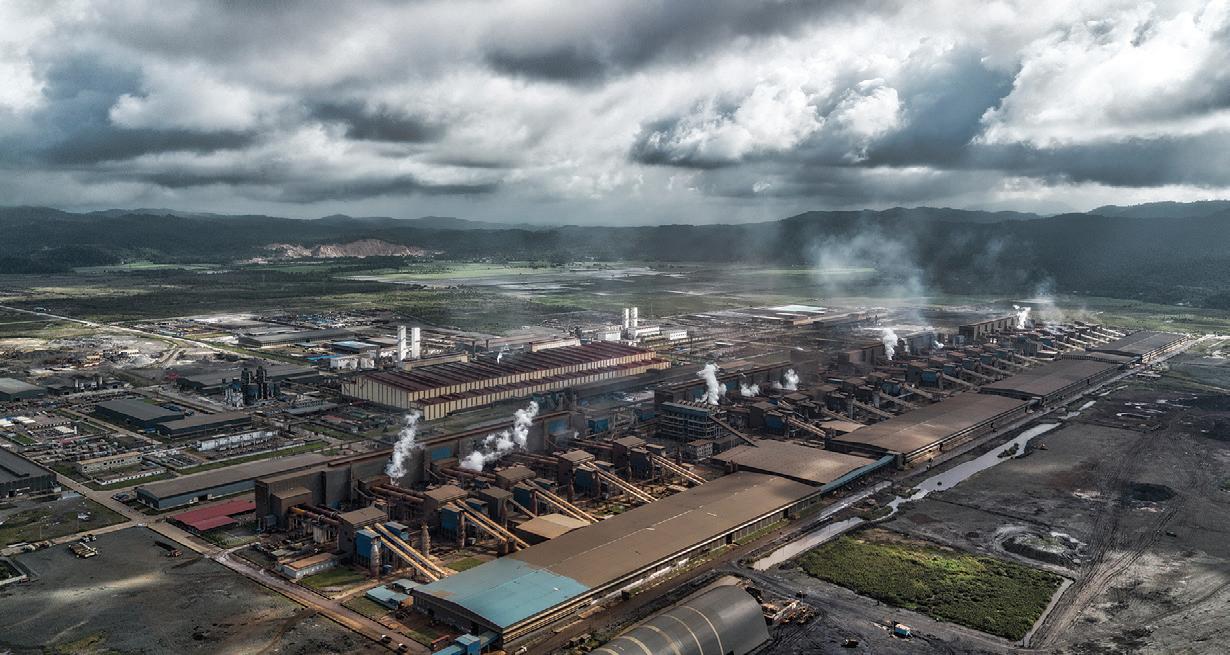
(NYSE: VALE) have been struggling to break even in this environment.”
Half of the industry is cash flow negative, while Canadian projects and juniors are having trouble raising money and even considering to start production, he said.
Government policy
For its part, Indonesia recognizes it needs higher prices in the US$16,000 to US$18,000 per tonne range to sustain its revenue base.
The main lever it has is to restrict its three-year permits, also known as RKABs, an Indonesian acronym that in English means work plan and budget. They were introduced in 2023 to crack down on illegal mining and improve the industry’s ESG standards. Among the new requirements is an environmental audit.
There have been press reports citing a government minister that the country could limit RKABs to as low as 150 million tonnes this year.
Removing 100 million tonnes of ore out of Macquarie’s base case ore production of 250 million tonnes would reduce Indonesian finished nickel production by around 900,000 tonnes, taking 35% off global 2025 supply, according to Lennon.
“But my feeling is they won’t do that, and the market doesn’t believe they’re going to do it because the price of nickel is near a 12-month low so it’s not responding.”
Government delays issuing RKABs last year meant that actual 2024 production of around 200 million to 210 million tonnes was below consumption of 235 million tonnes. The shortfall was met by destocking and by importing about 10 million tonnes of ore from the Philippines.
“It was a small amount, but it was a turning point in the dynamics of the ore market,” Lennon said.
For this year, Macquarie projects a 60,000-tonne nickel surplus, down from a surplus of 195,000 tonnes in 2024.
“(Indonesia’s) the only place with the huge reserve base, the only place with available capital deployed by Chinese banks to finance projects.”
JIM LENNON,
MACQUARIE
GROUP
Price forecasts
Macquarie forecasts LME cash prices will average US$16,500 per tonne this year, rising to US$18,000 next year, US$19,000 in 2027 and to US$20,000 in 2028.
Others are slightly more optimistic.
Mark Selby, CEO of junior developer Canada Nickel (TSXV: CNC; US-OTC: CNIKF), predicts the metal will reach US$20,000 per tonne by year-end, but that higher cost producers won’t rejoin the market until prices are even higher.
“Most of that stuff is not coming back until we see prices higher than US$22,000,” he said during a recent presentation at the Mining Research Analyst Group’s annual forecast luncheon in Toronto.
“That gives Indonesia a lot more room to basically push prices up without seeing a lot of that supply come back into the market.”
He forecasts a US$20,000 to US$22,000 range over the next few years.
Selby, who prior to Canada Nickel raised US$100 million to advance RNC Minerals’ Dumont nickel-cobalt project in Quebec from initial resource to a fully permitted construction-ready project,
predicts that 2025 “is really going to be a pivotal year because this is where Indonesia really flexes its muscles.”
The country has gone from trade and current account deficits to surpluses because of its leading exports, nickel and stainless steel, he said.
“Those numbers look way better at US$20,000 a tonne nickel than they do at US$15,000 a tonne. So, you’re going to see a lot of flex this year in terms of what’s going to happen with mine supply growth,” he said. “Indonesians will want to see a market deficit to see prices go higher.”
Wherefore demand
In terms of demand growth, nickel isn’t faring too badly. Total nickel demand continues to grow at around 5-7% a year, Lennon noted, adding that “copper would die for that kind of growth rate.”
Even with the slowdown last year, nickel demand has grown at nearly 9% a year since 2020, Selby said. Annual battery plant demand in North America alone will reach as much as 300,000 tonnes of nickel in the 2030s, he said.
“As the EV market shifts more to the U.S. and Europe and away from China, most of the battery plants, all but one, being built in North America, are making high-nickel batteries,” he said. “They don’t want to depend on China or Indonesia for all that nickel.”
Stainless steel — the mainstay of the nickel market — dominated growth in nickel use last year, rising 4.8% year-on-year.
Nickel use in batteries hardly grew last year despite 25.4% growth in global EV sales. That’s largely because about 80% of Chinese EV batteries now contain no nickel, Lennon said.
But most analysts anticipate battery demand growth to return this year. Stricter carbon dioxide standards in the European Union and Britain, and the region’s absolute
ban on all new internal combustion engine vehicles by 2035 should build momentum for EV adoption. For the 2023-2030 period, Macquarie estimates a trend growth of 5% for nickel in stainless-steel production, 13% a year for batteries and 6.6% a year overall.
Grades risk
While Indonesia has a stranglehold on supply, Selby warns there are geological limits to the country’s reserves.
“These laterite deposits are basically big piles of soggy dirt five- to 50-metres thick and extend over a huge area,” he said. “You can go and pull the hills down, or valleys and certain ridges, for the highest-grade material. They’ve been doing that for 15 years now and they’re hitting the wall on multiple dimensions, which is really having an impact on grade.”
Macquarie estimates that average Indonesian grades have declined to about 1.6% nickel from a range of 1.8% to 1.9% previously and contain a lot more impurities. By contrast, Philippine ore is low in silica and magnesia.
“If you blend that with some of the ore in Indonesia you get productivity in the furnace,” Lennon said.
At the same time as grades are falling, there have been very few discoveries to rival the last million-tonne high-grade discovery in 1992 at Voisey’s Bay, N.L.
“There’s almost no Western supply in the pipeline,” says Selby, whose Canada Nickel is advancing the Crawford nickel project in Ontario towards likely permits this year.
“I’ve been going at this now in Canada for six years and worrying about someone drilling a Voisey’s Bay — not happened,” and the amount of nickel exploration has fallen, he said. “Nickel is a 3.4-million tonne market and it’s going to be over a 5-million tonne market by 2030.” TNM
A nickel plant in Sulawesi, Indonesia. ADOBE IMAGES/ERBERTO ZANI
US Energy Dept hands out billions
FINANCING | Agency funds projects to ease China threat
BY TRISH SAYWELL
In mid-December, the U.S Department of Energy announced a conditional loan of US$755 million to battery materials and technology company Novonix to build a plant in Tennessee for manufacturing synthetic graphite, a key component in batteries for electric vehicles.
The funding aims to produce 31,500 tonnes of synthetic graphite a year, enough for 325,000 EVs annually. It’s part of the department’s US$77.2 billion in loans under the former Biden administration to meet clean energy goals and reduce reliance on China.
Developing a domestic supply chain for critical minerals has become a national security concern, according to CEOs in the mining industry.
“They are completely panicked about how dependent the U.S. economy is on a bunch of supply coming from China,” Mark Selby, CEO of Canada Nickel (TSXV: CNC; US-OTC: CNIKF), said during a January presentation on nickel to an investor group in Toronto.
“They know the big threat, security wise, for the next 20 years is China and so they are going to spend and throw money and do whatever it takes to basically start to see those supply chains get built. They’re frustrated they haven’t seen more of it already.”
Diverse sectors
As of Jan. 10, the loan office approvals under the Biden administration include US$43.4 billion for 20 conditional commitments across diverse sectors including battery production, the critical minerals supply chain, sustainable aviation fuels and virtual power plants.
The remaining US$33.9 billion included 19 closed loans and loan guarantees for nuclear, hydrogen, critical minerals, virtual power plants and advanced vehicle components, the office confirmed in an emailed response to questions.
Virtual power plants include rooftop solar, EVs and a variety of chargers and flexible electrical
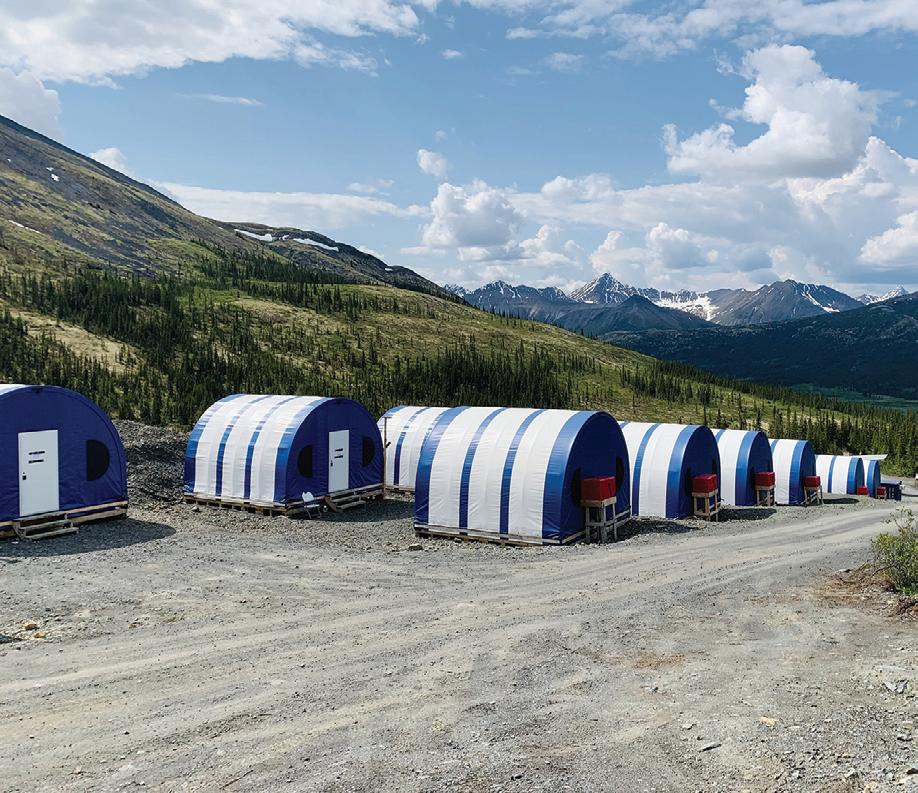
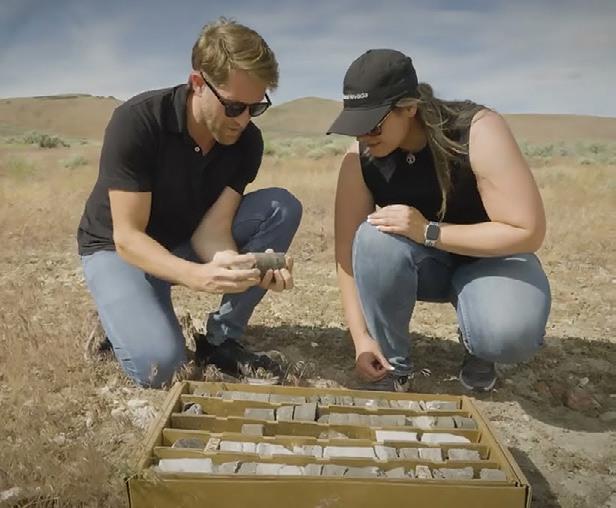
loads that can balance supply and demand like a traditional power plant, the DoE said. While the energy department’s
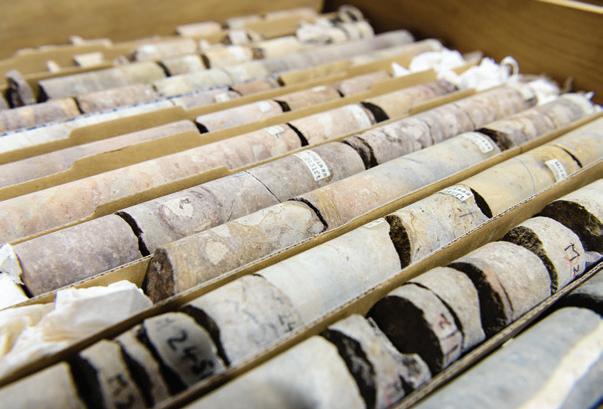
recent funding hasn’t included projects in Canada, similar efforts at the Pentagon have helped finance efforts north of the border.
These include US$15.8 million for Fireweed Metals’ (TSXV: FWZ; US-OTC: FWEDF) tungsgten project in December and US$6.3 million for Fortune Minerals’ (TSX: FT; US-OTC: FTMDF) NICO project in May.
The Department of Energy’s Loans Program Office was created in 2005 to finance clean energy projects that commercial banks were reluctant to back. In its early days the office gave loans to wind and solar farm projects and to Elon Musk’s Tesla.
It issued a US$465-million loan to the EV maker in January 2010 to produce all-electric plug-in cars and develop its manufacturing facility in Fremont, Calif. The loan was fully repaid in May 2013.
Expanding graphite
output
The DoE’s conditional loan to Novonix in the graphite space follows a US$102-million loan in July 2022 to Syrah Technologies to expand its Vidalia facility. It’s a processing plant in Louisiana that produces graphite-based active anode material (AAM) used in lithium-ion batteries and other clean energy technologies.
The DoE estimated that Syrah’s expanded production capacity
100,000 tonnes a year of cathode active materials. Full production would amount to more than 1 million EVs a year, cutting annual gasoline consumption by more than 395 million gallons and avoiding more than 3.5 million tons of CO2 emissions annually.
“To date, nearly all anode and cathode production supporting U.S. battery cell manufacturers occurs in Asia,” the DoE stated in a release. “With this conditional commitment, Redwood Materials will lead one of the first domestic projects that produces cathode materials at scale for battery cell manufacturing.”
Lithium build-out
The loan office also has been active in the lithium mining space. In March last year, it offered a conditional commitment to Lithium Americas (TSX: LAC; NYSE: LAC) for a US$2.3 billion-loan to help finance the construction of a lithium carbonate processing plant at Thacker Pass project in Nevada.
The loan was finalized in October and the proposed processing plant is to produce about 40,000 tonnes of lithium carbonate annually for use in EV lithium-ion batteries. The project is next to another that contains the largest proven lithium reserves in North America.
would support enough EVs to save 52 million gallons (about 200 million litres) of gasoline each year.
Some of the projects the loan office selects from a wide pool of applicants are to contribute to the “circular economy” through recycling critical minerals. In November, the office closed a US$475-million loan to Li-Cycle U.S. to help finance construction of what it describes as “the first-of its kind lithium-ion battery resource recovery facility in North America”.
The loan will help Li-Cycle, a pure-play lithium-ion battery recycler, expand its operations in a suburb of Rochester, N.Y.
Materials will be aggregated and processed into “black mass” — recycled lithium-ion battery feedstock — at three operating sites in New York, Arizona and Alabama and then shipped to the Rochester hub facility for additional processing.
EVs supported by the facility’s output, the DoE said in a release, would reduce gasoline use by up to 71 million gallons per year, or the equivalent of more than 633,000 tonnes of CO2 emissions a year.
Recycling batteries
Another recycling project received a conditional commitment for a loan of up to US$2 billion in February 2023. If the loan is approved, Redwood Materials will use the funds to build a battery components recycling and production facility in McCarran, Nev., just east of Reno.
The Redwood plant would recycle end-of-life batteries from consumer electronics like cell phones, laptop computers and power tools. According to the DoE, Redwood would recover more than 95% of their critical battery elements including lithium, nickel, cobalt, manganese and copper.
It can then use both new and recycled feedstock to make about 36,000 tonnes per year of battery-grade copper foil and about
The site, which is partly supported by an equity investment in Lithium Americas from General Motors, is to produce enough lithium carbonate to support the production of batteries for up to 800,000 EVs a year, the DoE said. That would cut the consumption of 317 million gallons of gasoline a year.
“The project’s output will qualify for the Inflation Reduction Act’s Made in America benefits and sourcing requirements, making it an attractive source of lithium carbonate for domestic automakers,” the DoE said.
Rhyolite Ridge
One of the DoE’s earliest conditional loan offers in the lithium sector was to Ioneer’s (NASDAQ: IONR; ASX: INR) Rhyolite Ridge lithium project in Nevada’s Esmeralda County, about 300 km northwest of Las Vegas. The federal office offered to lend up to US$700 million to finance the processing of lithium carbonate at the project in January 2023.
According to the DoE, the plant could potentially support production of lithium for about 370,000 EVs a year and cut annual gasoline consumption by nearly 145 million gallons and the release of 1.3 million tons of CO2 each year.
“While Asia currently dominates the lithium carbonate refining process, the Rhyolite Ridge deposit is one of two known sizable lithium-boron deposits in the world and is expected to be the second lithium mine in the U.S.,” the department stated.
The only producing lithium mine in the country is Albemarle’s (NYSE: ALB) small-scale Silver Peak brine operation in Nevada.
Another conditional loan in the lithium space went to Ultium Cells LLC. The US$2.5-billion loan closed in December 2022 and was issued to help Ultium finance the construction of new lithium-ion battery cell manufacturing facilities in Ohio, Tennessee and Michigan.
Ultium is a joint venture between General Motors and South Korea’s LG Energy Solution. TNM
Fireweed Metals’ camp near its Mactung tungsten project in eastern Yukon. BLAIR MCBRIDE
Teck sees red metal supply/demand win
COPPER | EVs, lack of new mines combine
BY FRÉDÉRIC TOMESCO
Soaring demand for electric vehicles and power plants should support copper prices over the coming decades as supply constraints continue to plague the industry, Teck Resources (TSX: TECK.A, TECK.B; NYSE: TECK) says.
Copper demand for new energy applications is poised to jump 62% to 42 million tonnes by 2050, according to Teck’s head of market research, Michael Schwartz.
In a “net zero” scenario where countries strive to eliminate greenhouse gas emissions, Teck’s forecast shows annual demand for so-called new energy copper would hit 52 million by 2050 — a 105% surge from 2023.
“We’re relatively bullish long term on copper,” Schwartz told the Mining Research Analyst Group’s annual forecast luncheon in Toronto. “We’ve spent a few billion dollars to prove our commitment.”
Teck, Canada’s largest diversified miner, is in the midst of a four-year, US$3.9-billion plan to boost copper production to about
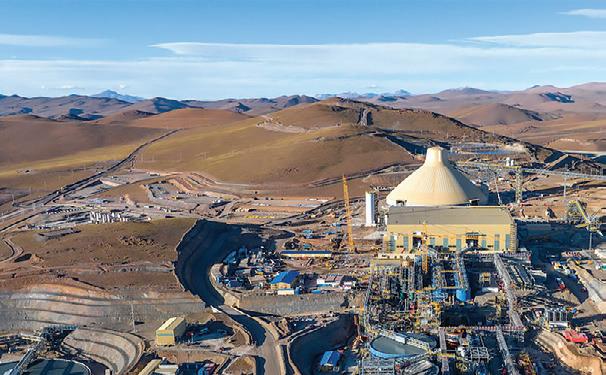
800,000 tonnes annually. Central to this growth plan is the ramp-up of Chile’s Quebrada Blanca mine, which is 60% owned by Teck.
EV driven
Despite a near-term softening in demand, electric vehicles are expected to remain the biggest driver of future copper usage. By 2050, consumption from electric vehicle makers could increase eight-fold from its 2023 level, Teck predicts.
Power grids also figure to be heavy copper users. By 2050, Teck forecasts they will need 10 million additional tonnes of the metal annually.
Urbanization in Asia and elsewhere will be a key accelerator of demand. Sometime in the next decade, Southeast Asia is expected to become the world’s fastest growing region, Teck predicts.
“There is infrastructure that needs to be built,” Schwartz said.
Smelting fees to remain low amid tight supply
COPPER | Scrap use up, flexible terms sought
BY MINING.COM STAFF
Copper concentrate treatment and refining charges (TC/ RCs) paid by mining companies to smelters are expected to stay depressed throughout 2025 amid reduced supply, according to commodity analysis firm Fastmarkets.
In a report released in January, Fastmarkets analyst Andrew Cole forecast an annual average spot TC of US$10.70 per tonne for 2025, approaching US$20 per tonne on a monthly average basis by the year’s end.
TC/RCs have already been in a freefall since last year due to the expansions of smelters and a shortage of concentrates. Last April, Fastmarkets’ weekly copper concentrate TC/RC index tracking the midpoint between smelter and trader buying levels fell into negative territory for the first time.
This trend, according to industry experts, is expected to continue in 2025.
A Reuters poll of industry sources had shown forecasts that were much lower than the 2024 benchmark of US$80 per tonne. In fact, the last time the annual benchmark fell below US$50 per tonne was 2010, according to CRU data.
Chile’s state-run copper commission Cochilco previously stated that it projects supply to tighten by 3.4% this year, which would drive TC/RCs further down.
Volume adjustments
Copper smelters typically book most of their copper concentrate feed under annual contracts with their suppliers at a fixed rate.
In response to tumbling annual TC/RCs, copper smelters are expected to use a more diversified and flexible way in signing annual
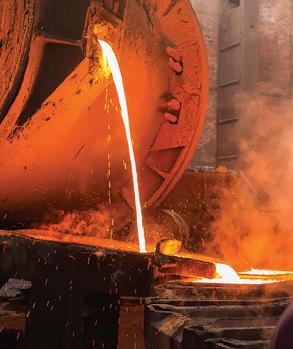
contracts for this year’s supplies, according to Fastmarkets.
“Some smelters are looking for ‘less’ volumes [of copper concentrates] at a fixed number for their 2025’s annual contracts, while others are asking for ‘more’ annual volumes priced against the spot index, and total supplies under long-term contracts are largely stable [from 2024’s],” one supplier source told Fastmarkets.
“Some traders quoted their offers of TC/RCs for 2025’s supplies at low US$10’s [per tonne], which is not a level we can accept. It seems we’re at something of an impasse and are now discussing with one supplier about linking some supplies to the spot index, rather than a fixed number,” a buyer source said.
Intermediate materials
Amid persistent supply tightness, Chinese copper smelters have been encouraged to use more intermediate products, including blister copper and anodes, and copper scrap for their copper production, Fastmarkets also said.
These copper smelters increased the use of copper scrap and inter-
“People are moving into cities. That is going to require more HVAC (heating, ventilation, and air conditioning) systems. It’s going to require more cooling. It’s going to require more refrigeration for food to bring into the cities for people that were in rural communities. All of this is electric-driven, and all of it is positive.”
Supply shortage
While copper demand climbs, producers are having trouble keeping up.
“The copper concentrate market has certainly gotten tighter, and without some drastic action, relatively shortly, we end up with a fairly large supply gap towards 2040,” Schwartz said. “Even by 2035 we’re in a situation where we can’t supply the market.” Global demand for cathodes could exceed production by up to 2.5 million tonnes by 2030, Schwartz’s presentation showed. Last year, global ouput slightly outstripped demand.
While copper producers are starting to expand their mines or extend the lives of some properties, new production sites have
been hard to find. Teck expects global mine output to peak by 2028, leaving existing sites to provide all future demand growth, Schwartz said.
“If any one of those mines was to be delayed or fail or have problems with a startup, that supply deficit becomes greater,” he said.
Scrap surge
The current dearth of copper concentrates has also driven up the price of scrap metal - leading Teck to increase scrap collection efforts, Schwartz said. The company has been approached by several telecom companies that are now looking at digging up old copper wire that was previously too costly to unearth, he said.
“Right now, with the concentrated market being so tight, scrap has become very precious,” he said. “Countries like the U.S. and Europe are now talking about restricting exports of scrap.”
As a result, copper theft is on the rise.
“The stories that we had back during the global financial crisis of people stealing copper, we’re starting to see it again,” Schwartz said. “It’s happening.” TNM
Savannah gains on larger lithium zone
PORTUGAL | Barroso holds 28M tonnes
mediate products during June-August following abundant supplies and decent prices of these materials, sources told Fastmarkets.
However, doubt remains among market participants over production support for copper smelters in 2025 due to market uncertainties over supply increases of copper scrap and intermediate products, they added.
“The [Chinese] government has encouraged more use of secondary materials, but it’s not that easy. Taking copper scrap for example, its supply is very sensitive to copper prices, with supplies growing when copper prices rise and falling and even disappearing when copper prices are not good,” said a copper scrap trader based in Ningbo, just south of Shanghai.
Also, any potential policy change could also impact market sentiment, with fears of tariff hikes between China and the U.S. already keeping Chinese importers away from U.S.-origin scrap imports, sources said.
Byproducts improve
Faced with fierce competition in raw material markets and a gloomy demand for refined copper, smelters of the red metal will become more sensitive and vulnerable to the profitability of byproducts, Fastmarkets said. These include sulphuric acid and recovered metals such as gold, silver and minor metals.
Sulphuric acid is a main income source for copper smelters. Strong prices for the acid during much of 2024 helped provide some breathing room for Chinese copper smelters while spot copper concentrate TC/RCs collapsed. However, the report said it remains unclear whether the sulphuric acid market will remain a supporter this year.
BY CANADIAN MINING JOURNAL STAFF
Savannah Resources (LSE: SAV), the British company behind the Barroso lithium project — Europe’s largest in spodumene — said new exploration results point to a larger deposit than previously estimated at the site in Portugal.
Lab-generated assay results from exploration work on the C-100 and Aldeia (Block B) mining licences show extensive lithium mineralization across the two licence areas, Savannah said on Jan. 22. It may now hold 28 million tonnes of high-grade lithium, it said.
Shares of Savannah Resources traded for 4.3 pence apiece before press time, giving the company a market cap of £94.4 million ($168.9 million).
“The results from the surface exploration our team undertook are truly exciting,” CEO Emanuel Proenca said in a release. “The early conclusion is very clear: the Barroso lithium project remains highly prospective for further spodumene lithium resource delineation.”
The miner said new mineralized pegmatites have been identified at the western end of the C-100 licence, providing additional targets for follow-up work. In addition, extensions to known lithium mineralization at Carvalha da Baccora and Altos dos Cortiços have been confirmed, increasing the potential of these areas.
Rock samples
The company said rock chip samples from Carvalha da Baccora
“Barroso remains highly prospective for further spodumene lithium resource delineation.”
EMANUEL PROENCA, CEO SAVANNAH RESOURCES
returned results including 1.66% lithium oxide (Li₂O), 1.5% Li₂O, 1.75% Li₂O and 1.46% Li₂O. At Alto dos Cortiços, the company found 3.01% Li₂O and 1.9% Li₂O. Savannah plans to construct four open-pit mines in the region to produce enough lithium annually for 500,000 to 1 million electric vehicle batteries. The company aims to accelerate the project, targeting the first commercial output by 2027.
Barroso is already the largest spodumene deposit in Europe. With 60,000 tonnes of known reserves, Portugal is Europe’s leading lithium producer, primarily for the ceramics industry.
However, the project has faced opposition from locals and environmentalists, including protests, legal challenges and refusals to sell land. About a quarter of the required land is privately owned, while three-quarters is traditional baldios, or common land.
Barroso is forecasted to have a throughput of about 1.5 million tonnes annually over its estimated 14-year mine life, based on a resource of 20.5 million tonnes at 1.05% Li₂O. TNM
Teck’s Quebrada Blanca mine expansion is part of a US$3.9-billion copper plan. TECK RESOURCES
Copper Smelter. ADOBE IMAGES/
Biden signs order to power-up AI infrastructure
ENERGY
STORAGE | Data centre electricity demand surges
BY TRISH SAYWELL
Joe Biden issued an executive order in his final week as U.S. president supporting the development of the country’s artificial intelligence infrastructure to meet the enormous energy requirements from AI data centres in the years ahead.
The executive order directed the Department of Defense and the Department of Energy to lease federal sites where the private sector “can build frontier AI infrastructure at speed and scale,” Biden said, including new clean power facilities, all of which will enhance national security.
Among the measures outlined in the order are facilitating AI infrastructure’s interconnection to the electric grid, fulfilling permitting obligations more quickly, and advancing transmission development around federal sites.
“We will not let America be outbuilt when it comes to the technology that will define the future,” Biden said in a White House statement. “These efforts also will help position America to lead the world in clean energy deployment in the context of strategic competition abroad.”
The push for data centre storage power is set to boost mining for energy transition metals such as silver for solar panels, copper for wiring, and lithium, cobalt, manganese, iron, nickel and vanadium for batteries. Aluminum is used in transmission lines. Zinc, lead and graphite are also found in batteries. Steel from iron and molybdenum is used in most wind farms and grid towers. Coking coal helps make steel and copper. Estimates abound about the scores of new mines needed to replace fossil fuels.
Power deficit
Electricity consumption by U.S. data centers alone is growing at an accelerating pace. It posted a compound annual growth rate of about 18% between 2018 and 2023, up
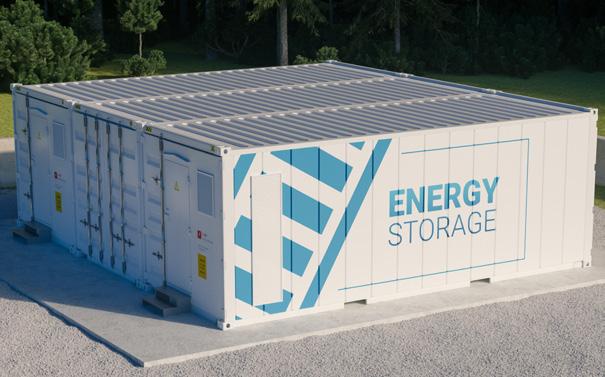
from 7% between 2014 and 2018, and is forecast to range from 13% to 27% between 2023 and 2028, according to the Lawrence Berkeley National Laboratory, a research and development center funded by the U.S. Department of Energy.
By 2018 data centres in the U.S. consumed about 76 terawatt hours (TWh) annually, or about 1.9% of total annual electricity consumption in the U.S. each year. That number rose to 176 TWh by 2023, or 4.4% of total U.S. electricity consumption, according to a new report on 2024 data centre energy usage released in December. The report defined data centre electricity use as including servers, storage, network equipment and infrastructure.
Based on various scenarios, total data centre energy estimates range from a low of roughly 325 TWh to 580 TWh by 2028, according to the report.
“Assuming an average capacity utilization rate of 50%, this annual energy use range would translate to a total power demand for data centres between 74 and 132 GW. This annual energy use also represents 6.7% to 12% of total U.S. electricity consumption forecasted for 2028.”
In May, Duke Energy, one of the largest energy holding companies
“These efforts also will help position America to lead the world in clean energy.”
JOE BIDEN FORMER U.S. PRESIDENT
in the U.S. with 54,800 megawatts of collective energy capacity, signed initial agreements to develop new electricity rate structures—also known as tariffs — to advance the development of carbon-free technologies, including SMRs and long-duration energy storage.
Geo-thermal projects are also gaining favour. Several years ago, Google partnered on a geo-thermal project with developer Fervo Energy in Nevada. In November, power from the project started flowing to Google’s data centres.
Going nuclear
While the world soured on nuclear energy in 2011 following the Fukushima nuclear disaster in Japan, it has slowly come back into vogue with rising demand for reli-
able and carbon-free power. And tech giants scrambling to secure clean power for their AI ambitions are embracing the fuel source.
In September, Microsoft signed a 20-year purchase power agreement with Constellation Energy that would see the restart of one reactor at Three Mile Island, the site of the worst nuclear accident in the country’s history. (The unit one reactor was not affected by the partial meltdown at the neighbouring unit two reactor.)
Constellation, which produces about one-fifth of U.S. nuclear power, will spend US$1.6 billion to resuscitate the undamaged Unit 1 reactor at the Pennsylvania plant. Under the agreement, the reactor is expected to start delivering power in 2028.
Investments in nuclear energy will be positive for uranium, consultants like Atlanta-based UxC say. It estimates that 150 new nuclear reactors will be built between 2024 and 2035, and of those, 80-90 will be in China. At current production rates, the uranium market data firm says, there won’t be enough uranium to meet demand by 20302035.
Uranium prices have nearly tripled in the last three years.
Small reactors
Small modular reactors (SMRs) are becoming a new buzzword in board rooms across North America. The new class of reactors come in a range of sizes and can be put together in a factory.
Last October, Google signed a deal to buy nuclear energy from multiple SMRs that will be developed by San Francisco-based Kairos Power. Under the initial stage, the first SMR will be brought on-line by 2030, followed by additional reactors through 2035.
“Overall, this deal will enable up to 500 MW of new 24/7 carbon-free power to U.S. electricity,” Michael Terrell, Google’s senior director of energy and climate, wrote in a blog
on the company website.
“The next generation of advanced nuclear reactors offers a new pathway to accelerate nuclear deployment thanks to their simplified design and robust, inherent safety. The smaller size and modular design can reduce construction timelines, allow deployment in more places, and make the final project delivery more predictable.”
Amazon has also signed deals to develop nuclear power. The company said in October that it had an agreement with Energy Northwest, a consortium of state public utilities in Washington state. Energy Northwest is to build and operate four advanced SMRs, which are expected to generate 320 MW of capacity during the project’s first stage with the option to boost that to a total of 960 MW—or enough electricity to power more than 770,000 homes.
North Anna In Virginia, Amazon signed a deal with Dominion Energy to explore the development of an SMR project near the utility company’s North Anna nuclear power station. The project would deliver at least 300 MW of power to the Virginia region.
In a third deal, the tech giant invested in X-energy, which is developing next-generation SMR reactors and fuel. The two companies will collaborate to bring more than 5 gigawatts of new power projects online across the U.S. by 2039.
“This collaboration between Amazon and X-energy is a significant step toward accelerating advanced nuclear technologies that can help us bring new sources of carbon-free energy to the grid cost-effectively and safely,” Kevin Miller, Amazon’s vice president global data centres, said in a news release.
At Oracle, Executive Chairman Larry Ellison told a first-quarter 2024 results conference call with analysts that the company had secured building permits for three SMRs to help power a data centre.
Sodium-ion batteries could rival lithium-ion in cost: study
Sodium-ion batteries could rival lithium-ion batteries in cost by the 2030s, according to a new Stanford University study.
The study by Sustainability’s Precourt Institute for Energy and the SLAC-Stanford Battery Center evaluated over 6,000 scenarios to assess sodium-ion’s cost and scalability potential.
Sodium-ion batteries are gaining attention due to two key advantages, abundant resources and ease of scaling. Sodium is more widely available and less expensive than lithium, suggesting a cost advantage. The batteries are compatible with existing lithium-ion manufacturing infrastructure, enabling rapid deployment.
These advantages contribute to the perception that sodium-ion batteries could offer lower costs and more resilient supply chains
compared to lithium-ion batteries. The amount of energy they hold per pound, however, tends to be lower than lithium-ion batteries.
“We recognized that if, when, and how sodium-ion batteries might undercut lithium-ion on price was largely speculative, especially given that the price of lithium-ion continues to fall,” lead author Adrian Yao said in a release with the report in January.
Yao is a doctoral candidate and former founder of a lithium-ion battery startup now operating at a commercial scale.
The study highlights several development priorities for sodium-ion batteries to compete with low-cost lithium-ion variants, such as lithium-iron-phosphate (LFP). Developers need to achieve energy densities comparable to LFP batteries, and they must cut their reliance on critical minerals.
Moving away from costly materials like nickel is essential, the
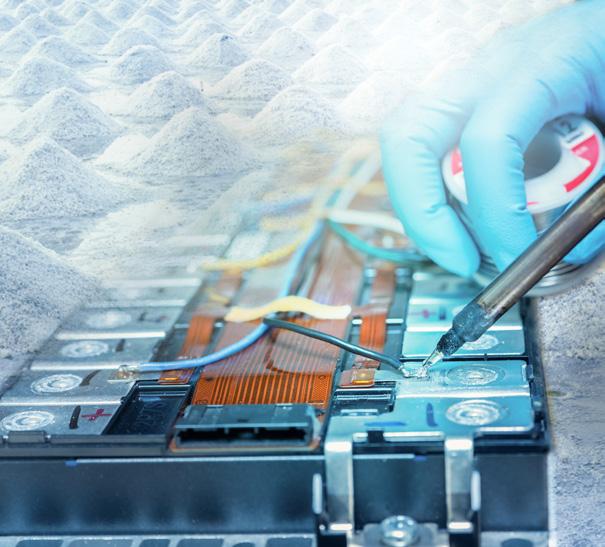
authors said. Most current sodium-ion designs rely on the metal.
“Assuming that substantial progress can be made through targeted research and development, we identify several sodium-ion pathways that might reach cost-competitiveness with lowcost lithium-ion variants in the 2030s,” the researchers said.
While the scientists cautioned against assuming a near-term price advantage for sodium-ion batteries over lithium-ion technologies, particularly before 2030, they emphasized sodium-ion’s potential role in the energy transition.
Supply chain volatility could further enhance the appeal of sodium-ion as a scalable alternative.
“Sodium-ion batteries have the potential to support global energy sustainability goals by providing a viable alternative to lithium-ion technologies under certain conditions,” the study concludes. TNM
Standard, Equinor net US$225M for Arkansas project
LITHIUM | Output planned for 2028
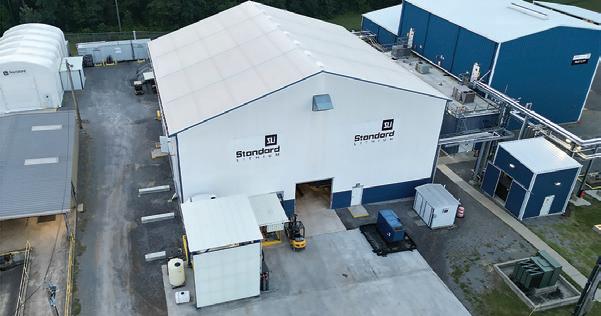
BY MINING.COM STAFF
Standard Lithium (TSXV: SLI) says it’s closed a US$225-million grant from the U.S. Department of Energy to support the stage-one construction of the South West Arkansas lithium project.
Since December, Standard Lithium has operated a pilot direct lithium extraction (DLE) plant at the project, which is owned in collaboration with Norway’s state-owned petroleum company Equinor (NYSE: EQNR).
The pilot plant was expected to operate until late January, producing 1,000 gallons (3,785 litres) of a 6% lithium chloride solution.
Studies underway
A definitive feasibility study and front-end engineering design for the project are underway. The partnership is targeting a final investment decision by the end of this
year, with stage one production slated to begin as early as 2028.
“South West Arkansas is one of the highest-grade lithium brine projects in North America,” Standard Lithium CEO David Park said in a release.
“Through the use of DLE technology, this project presents a nearterm, sustainable opportunity to help secure America’s domestic lithium supply chain.”
Standard Lithium aims to achieve a total output of 45,000 tonnes of lithium annually at the site, developed in two stages of 22,500 tonnes each.
Shares of Standard Lithium closed 1.7% higher in Toronto at $2.39 apiece on the news, before easing to $2.33 near press time. The company’s market capitalization stands at $396.8 million. Equinor’s stock in New York was at US$24.58, down about 50¢, valuing the company at US$66.6 billion. TNM
MP Materials produces rare earth metal
Mountain Pass
BY TRISH SAYWELL
MP Materials (NYSE: MP) has kicked off commercial production of neodymium-praseodymium metal at its Independence facility in Texas along with trial production of neodymium-iron-boron magnets, the company said on Jan. 22.
The facility in Fort Worth will use feedstock from the company’s Mountain Pass rare earth mine in California to build the first fully integrated rare earth metal, alloy and magnet manufacturing plant in the U.S.
MP Materials expects to produce about 1,000 tonnes of finished neodymium-iron-boron (NdFeB) magnets per year, with gradual production ramp-up to begin later this year. First deliveries of the automotive-grade, sintered magnets are on track for year-end and a significant amount will go to General Motors.
“This milestone marks a major step forward in restoring a fully integrated rare earth magnet supply chain in the United States,” James Litinsky, MP Materials’ founder, chairman and CEO, said in a release.
Shares of MP Materials were up 2.9% to US$21.47 before press time, giving it a market cap of about US$3.5 billion.
Northern Graphite restarts mill, plans to hike prices
BY COLIN MCCLELLAND
Northern Graphite (TSXV: NGC; US-OTC: NGPHF), the continent’s only flake graphite producer, restarted its Lac des Iles mill in Quebec on Jan. 13 and plans to raise prices for the battery metal.
After a scheduled maintenance shutdown began Nov. 2 as stated in October, the company told The Northern Miner by email in January it’s continuing plans to double output to around 25,000 tonnes a year.
“We made headway toward that goal during 2024 before deciding to implement the maintenance and repair shutdown, and expect to continue to work toward that goal when mill operations resume,” company spokesperson Pav Jordan said. “The company began permitting in the fourth quarter of 2024 to open a new pit in 2025 and we continue to work toward that.”
Ore processing at the Lac des Iles mill began on Jan. 14, Jordan said.
Shares in Northern Graphite traded at 16¢ apiece before press time, valuing the company at about $21 million. Its shares traded
in a 52-week range of 4¢ to 21¢.
Northern Graphite “negotiated significant price increases with customers for its graphite for 2025 to reflect rising costs of production and inflation,” the company said in a release. It didn’t give figures, as they’re sensitive information.
Price increases
Producers were selling battery grade graphite for US$5,329 per tonne last May but prices could increase to between US$8,707 and US$10,874 this year, according to S&P Global Market Intelligence.
The graphite market is conducted in one-to-one deals rather than in an open process like gold.
“We are starting the year with a strong order book, reflecting continued robust demand as well as recent geopolitical events and supply chain concerns,” CEO Hugues Jacquemin said in the release.
The company is banking on electric automakers sourcing graphite outside of China, as in guidelines for United States government funding established under the Biden administration. President Donald Trump has also stated policies intended to reduce the Asian giant’s dominance.
China, the leading producer of graphite used in electric vehicle batteries, said in 2023 it was curbing exports of the material.
New pit
In October, Northern Graphite said it planned to open a new pit early this year and double output from around 10,000 to 15,000 tonnes a year.
Northern Graphite supplies anode material for lithium-ion batteries and electric vehicles, fuel cells and graphene, as well as various advanced industrial technologies, the company says. Its battery materials division, which has a state-of-the-art laboratory in Frankfurt, leads a mine-to-battery strategy.
The division is focused on developing advanced anode materials to improve the cycle life and charging rate of lithium-ion batteries, and on marketing Northern’s licensed, patented Porocarb® product, it said.
The company also owns the Bissett Creek project in Ontario and the fully permitted Okanjande graphite mine in Namibia, which is currently on care and maintenance.
Sole US mine to delist after running out of cash
COBALT
BY BLAIR MCBRIDE
JLast year the open-pit Mountain Pass mine produced 45,000 tonnes of rare earth oxides (REO) contained in concentrate—an all-time high for primary production in the U.S. The company also posted a midstream production record of about 1,300 tonnes of NdPr oxide.
NdFeB magnets are essential in electric vehicles, robotics, electronics, aerospace, drones and defence systems but for decades the U.S. has relied almost entirely on imports.
By contrast, China produced an estimated 300,000 tonnes of NdFeB magnets in 2024, up from 280,000 tonnes in 2023, according to Ellie Saklatvala, senior editor nonferrous metals at Argus, in a Jan. 15 update.
The powerful and efficient magnets are critical in the green energy transition and for the development of low-carbon technologies.
Demand for rare earth permanent materials will continue to increase, forecasts commodity consultants Wood Mackenzie.
“As we move into 2025, with the improvement of the global economic condition, it is expected that the rare earth market will continue to improve,” it said in a Jan. 10 report. TNM
| Firm gets cash infusion, but shareholders lose
ervois Global (TSXV: JRV; ASX: JRV), owner of the United States’ only cobalt mine, has paused mining, entered bankruptcy proceedings and plans to go private by the end of April.
The restructuring plan involving the U.S. Chapter 11 process includes Boston-based Millstreet Capital Management injecting US$145 million into the company, Jerevois said early last month. But the arrangement’s delisting is a loss for other shareholders.
They include AustralianSuper, that country’s largest retirement fund manager with A$240 billion ($218 billion) under management, and Mercuria Energy Group, a privately held Swiss multinational commodity trading company. They held 23% and 7.8% of Jervois, respectively.
Melbourne-based Jervois intends to use the Millstreet Capital funds to continue operating its Finnish cobalt refinery and spend US$70 million restart its São Miguel Paulista nickel cobalt refinery in Brazil. It shut its Idaho Cobalt Operation (ICO) in March 2023 after inflation and Chinese rivals proved challenging as the battery metal’s price plunged some 70% from a year earlier.
Millstreet, which manages about US$3 billion, is expected to carry out the recapitalization in Australia in a process consistent with the Chapter 11 plan. It requires Jervois to dispose of its assets to a Millstreet nominee, conditional on creditor and ASX approval.
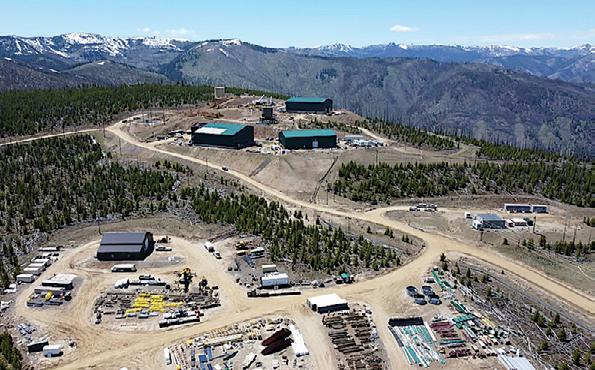
Production on hold
Jervois issued more updates for exploration than for production at ICO last year. The company spent about US$130 million building ICO, commissioning it in October 2022 and producing some 27,000 tonnes for processing. Commercial production was to have started in the first quarter of 2023 at the site, located 350 km northeast of Boise.
The cobalt price dropped about 26% from one year ago and sells for US$11.03 per lb., according to Daily Metal Prices. The battery metal last went this low in 2016.
Most of the world’s supply of cobalt comes from the Democratic Republic of Congo, though mines there face criticism for their low ESG standards.
Resource estimates
ICO’s Sunshine historic deposit hosts 520,000 inferred tonnes grading 0.5% cobalt, 0.68% cop-
per and 0.49 gram gold per tonne for 5.7 million lb. cobalt, 7.7 million lb. copper and 8,210 oz. gold, according to an initial JORC resource published in last year’s first quarter.
That followed a resource estimate for ICO from December 2023 that outlined 5.2 million measured and indicated tonnes grading 0.4% cobalt, 0.7% copper and 0.5 gram gold per tonne for 89,000 oz. contained gold.
That resource and its drilling were funded with US$15 million from the U.S. Department of Defense to help build a domestic cobalt supply chain.
Last year, Jervois also advanced a feasibility study for a cobalt refinery in the U.S., with the company shortlisting sites in Pennsylvania and Louisiana as potential locations for the facility. That study is being supported through the DoD funding. TNM
The extraction plant at the South West project. STANDARD LITHIUM
Jervois Global’s Idaho Cobalt Operation. JERVOIS GLOBAL
SPOTLIGHT: Energy transition metals shine
BY NORTHERN MINER STAFF
Investments in clean energy and artificial intelligence infrastructure are driving demand for critical minerals — from silver for solar panels to copper for wiring to nickel and lithium for batteries. Here’s a look at eight companies with interesting projects to watch.
n Aclara Resources
In December, Chilean industrial miner CAP became the third strategic shareholder in rare earths developer Aclara Resources (TSX: ARA), joining Hochschild Mining (LSE: HOC) and New Hartsdale Capital.
All three companies participated in a US$25 million private placement at 70¢ a share, representing a 41% premium to Aclara’s closing share price prior to the announcement, and giving CAP an initial 10.2% stake in the junior. Hochschild’s ownership rose slightly to 19.7% and New Hartsdale maintained its stake at 37%.
CAP already has a joint venture with Aclara to advance alloy-making capabilities to convert refined rare earth oxides into alloys required for fabricating permanent magnets. CAP will leverage its expertise in metal refining and special ferro-alloyed steels.
Funds from the private placement will be used towards advancing Aclara’s Carina heavy rare earths project in Brazil’s central Goias state and further the company’s broader efforts to develop a vertically integrated supply chain for rare earth alloys used in permanent magnets.
Aclara expects to complete a prefeasibility study on Carina in the third quarter and have three-quarters of a feasibility study finished by year-end. It is targeting commissioning in 2029 but is considering plans to accelerate the timeline to 2027-2028.
In September, a preliminary economic assessment of the ion adsorption clay project outlined
a 22-year mine life producing 191 tonnes of dysprosium-terbium a year (the equivalent of about 13% of China’s 2023 official production) and another 13,500 tonnes of neodymium-praseodymium.
The study delivered an after-tax net present value (at an 8% discount rate) of US$2.2 billion and an internal rate of return of 33%. Initial capex of US$599 million could be repaid in 3.4 years.
Aclara also has an ionic clay deposit rich in heavy rare earths in Concepcion Chile.
Separately, Aclara Technologies, the company’s U.S. subsidiary developing rare earth element processing technologies, is working with the U.S. Department of Commerce to identify the best site for installing a separation facility in the U.S. The facility will process mixed rare earth carbonates sourced from Aclara’s projects and separate them into pure individual rare earth oxides.
Aclara Resources has a market cap of about $86.5 million.
n Cornish Lithium
In October, Cornish Lithium opened the U.K.’s first low-emission, lithium hydroxide demonstration plant at St. Dennis near TreLith in the historic mining region of Cornwall. The £9-million (US$11-million) plant will produce battery-grade lithium hydroxide samples from granite extracted from a former china clay pit at its Trelavour hard rock lithium project.
Cornish Lithium says it will complete a feasibility study by the middle of this year and expects that once in commercial production Trevalour will produce 10,000 tonnes of lithium hydroxide a year. (A 2022 scoping study forecast a 20-year mine life producing 7,800 tonnes per year.)
In September, the U.K. government designated Trelavour as a development of national significance to build a domestic supply of lithium to grow the country’s battery sector and accelerate its transition to renewable energy.
Qualifying for the Nationally Significant Infrastructure Planning regime will “provide clarity in terms of the planning process for Trelavour and certainty in the context of our development timelines,” Jeremy Wrathall, founder, chairman and CEO, said in a release.
Cornish Lithium has also signed a memorandum of understanding with Germany’s HELM, one of the largest independent chemical companies in the world, to work together to produce battery-grade lithium compounds from its geothermal brines.
Lithium was first discovered in ‘hot springs’ in Cornish tin and copper mines in 1864, and the company says there is significant potential to extract lithium-enriched geothermal waters across the region by drilling surface boreholes into permeable geological faults at depth beneath the old mine workings.
The geothermal waters will be pumped to surface and tested. Cornish Lithium then plans to use direct lithium extraction (DLE)
technologies to remove the lithium from the waters starting at its primary United Downs project.
In September 2023, Cornish Lithium announced initial investment of £53.6 million (US$65.6 million) from a group of institutional investors led by the UK Infrastructure Bank, which is owned by the U.K. government, alongside the Energy & Minerals Group (EMG), and existing shareholder Techmet.
n Euro Manganese
Euro Manganese (TSXV: EMN; ASX: EMN; US-OTC: EUMNF) is developing its Chvaletice manganese project in the Czech Republic with the goal of producing high-purity manganese for the electric vehicle industry.
The project involves reprocessing tailings from a decommissioned manganese deposit about 90 km east of Prague that was mined between 1951 and 1975.
Commercial development of the Chvaletice tailings could provide
Left: Marimaca Copper’s namesake project in Chile’s northern Antofagasta region. Right: A sample from the project showing copper mineralization. MARIMACA COPPER
FPX Nickel’s Baptiste project in British Columbia, is one of the world’s next-generation green nickel projects. FPX NICKEL
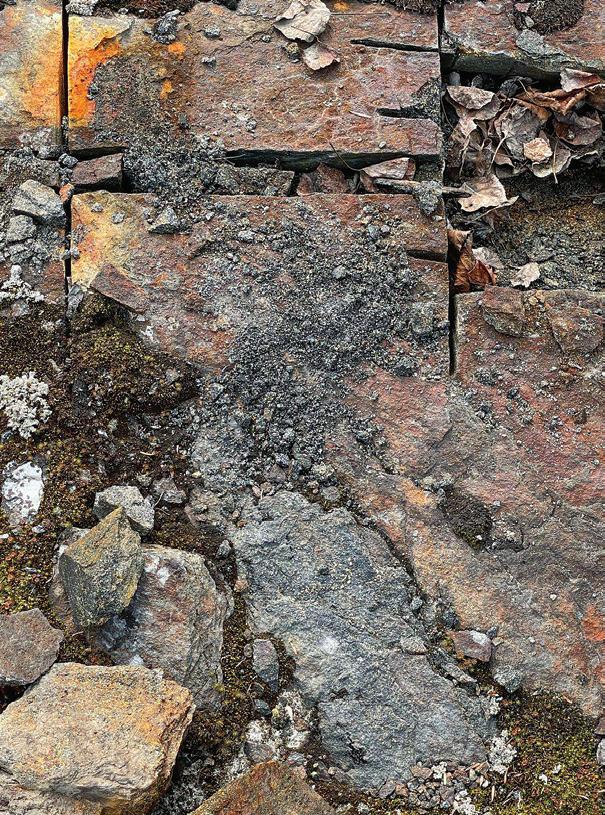
up to 20% of projected 2030 European demand for high-purity manganese, according to the company. In August, it applied to have the project designated strategic under the European Union’s Critical Raw
Materials Act. Lithium-ion batteries used in EVs contain manganese in their cathodes. But a bottleneck in supply is due to the lack of high purity refining capacity.
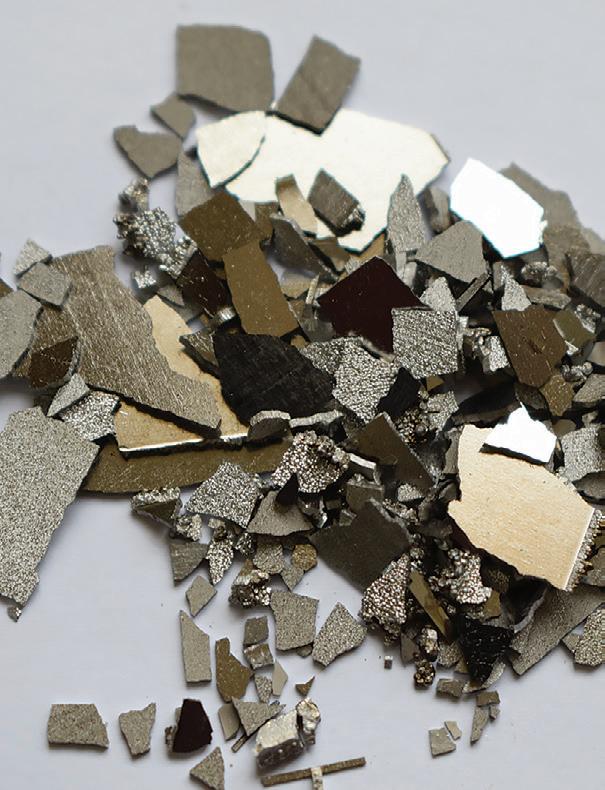
In June, Euro Manganese successfully commissioned a demonstration plant and produced samples of high-purity manganese sulphate monohydrate (HPMSM) from high-purity electrolyte man-
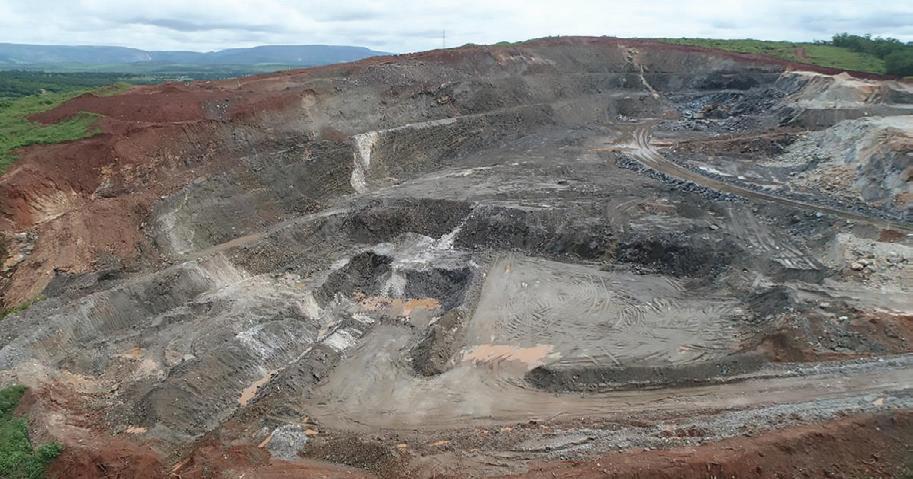
tax net present value (at an 8% discount rate) of US$1.34 billion and a 22% internal rate of return. Initial capex of US$757.3 million, including US$103.2 million in contingencies, could be repaid in 3.6 years.
The company is also evaluating opportunities to produce battery-grade products in Becancour, Que., near Trois-Rivières.
In November 2023, Orion Resource Partners supported Euro Manganese with a US$100-million funding package.
Euro Manganese has a market cap of about $10 million.
n First Phosphate
A preliminary economic assessment of First Phosphate’s (CSE: PHOS; US-OTC: FRSPF) BéginLamarche project in Quebec released in December estimated annual average production of 900,000 tonnes of beneficiated phosphate concentrate at 40% phosphorus pentoxide (P205) and another 380,000 tonnes of magnetite at 92% iron oxide (Fe203) content. The mine life would be 23 years.
The project, 75 km northwest of Saguenay, would generate an aftertax net present value (at an 8% discount rate) of $1.6 billion and an internal rate of return of 33%.
Pre-production capex of $675 million could be paid back in just under three years. The company’s phosphate will be used to produce cathode active material for the lithium iron phosphate battery industry.
Last month First Phosphate signed a technology licence agreement with Praon SA to use the Belgian company’s technology to design, build, operate and maintain in Canada a merchant grade phosphoric acid manufacturing plant with a production capacity of 600 tonnes of P205 a day.
First Phosphate also selected Italy’s Ballestra to provide engineering services for the project and signed two long-term offtake agreements with undisclosed “credit-worthy partners.” The definitive terms of the agreements will be finalized in separate agreements.
ganese metal (HPEMM). The plant can produce the equivalent of about 33 kg of HPEMM a day, which the company said can be converted into about 100 kg per day of HPMSM.
A continuous five-day test in October produced 172 kg of HPEMM — exceeding the company’s target by more than 30%. The electrowinning circuit produced selenium-free HPEMM flakes grading 99.9% manganese.
The demonstration plant will also produce by-product samples for testing and marketing of magnesium carbonate. Euro Manganese plans to test other feedstock, too, including manganese by-products from the processing of “black mass,” recycled battery material.
The demonstration plant will serve as a testing and training facility and the data will be fed into the engineering process for a commercial plant.
A 2022 feasibility study forecast a 25-year project life producing about 1.2 million tonnes of HPEMM, about two-thirds of which is expected to be converted into HPMSM on-site.
The study estimated an after-
The junior completed its first resource estimate in September. Bégin-Lamarche contains indicated resources of 41.5 million tonnes grading 6.49% P205, 10.69% Fe203, and 3.31% titanium dioxide (TiO2). Inferred resources add 214 million tonnes grading 6.01% P205, 10.89% Fe2O3, and 3.63% TiO2.
First Phosphate has a market cap of about $22 million.
n Foran Mining
Foran Mining (TSXV: FOR; US-OTC: FMCXF) expects commercial production at its McIlvenna Bay copper-zinc-gold-silver rich project in Saskatchewan to begin in the first half of 2026.
The volcanogenic massive sulphide deposit, 375 km northeast of Saskatoon and 65 km west of Flin Flon, Man. is forecast to produce an average of 65 million lb. of copper-equivalent annually over an 18-year initial mine life, according to a 2022 feasibility study.
In December, the Canadian government conditionally approved up to $20 million in funding to support construction of a hydroelectric transmission line and an on-site substation at the project as part of the federal critical minerals strategy.
Mine construction is well underway, with the installation of the
Above: Manganese flakes produced at Euro Manganese’s Chvaletice project facilities 90 km east of Prague in the Czech Republic.EURO MANGANESE
Cornish Lithium’s Trevalour hard rock lithium project in Cornwall, U.K. CORNISH LITHIUM
Above: At First Phosphate’s Bégin-Lamarche property in Quebec. FIRST PHOSPHATE
Sigma Lithium’s 100% wholly owned Grota do Cirilo operation is a fully integrated hard-rock lithium mining and industrial beneficiation complex in the state of Minas Gerais, Brazil. SIGMA LITHIUM
> Snapshot from P37
SAG mill shell, foundation work and rebar installation for the process plant and concrete works in the flotation areas and concentrate loadout.
In October, Foran closed an amended and upsized US$250 million senior secured project facility with a fund managed by Sprott Resource Lending. Principal payments will start in June 2027.
Meanwhile, exploration continues apace. In January, the company kicked off a 30,000-metre drill program — the largest in its history — at the project’s Tesla zone. Eight drill rigs will support an initial resource estimate for the zone, which remains open in all directions.
Highlights from last year’s program at Tesla included drill hole TS-24-29, which returned 26.2 metres grading 1.68% copper, 1.18% zinc, 12.5 grams silver per tonne.
The interval included 2.1 metres of 4.11% copper and 6.2 metres of 2.92% copper. Drill hole TS-2434 cut 1.7 metres averaging 4.37% copper, 15.47% zinc, 27.1 grams silver and 0.28 gram gold (8.9% copper-equivalent) from 1,108 metres.
The company also owns the Bigstone deposit, a development-stage deposit 25 km southwest of the McIlvenna Bay project.
Foran Mining has a market cap of $1.6 billion.
n FPX Nickel FPX Nickel’s (TSXV: FPX; US-OTC: FPOCF) main Baptiste project in central British Columbia is to generate $45.6 billion in total GDP and $15.5 billion in federal, provincial and municipal taxes, according to an economic impact study the company released on Jan. 13. The Vancouver-based junior based the latest report on the findings of its 2023 prefeasibility study, which determined that an openpit mine at Baptiste has the potential to produce an average of 59,100 tonnes of nickel a year over a mine life of 29 years.
The nickel project, about 70 km west of Centerra Gold’s (TSX: CG; NYSE: CGAU) Mount Milligan open-pit mine, would generate an after-tax net present value (at an 8% discount rate) of US$2 billion and a 19% internal rate of return at a nickel price of US$8.75
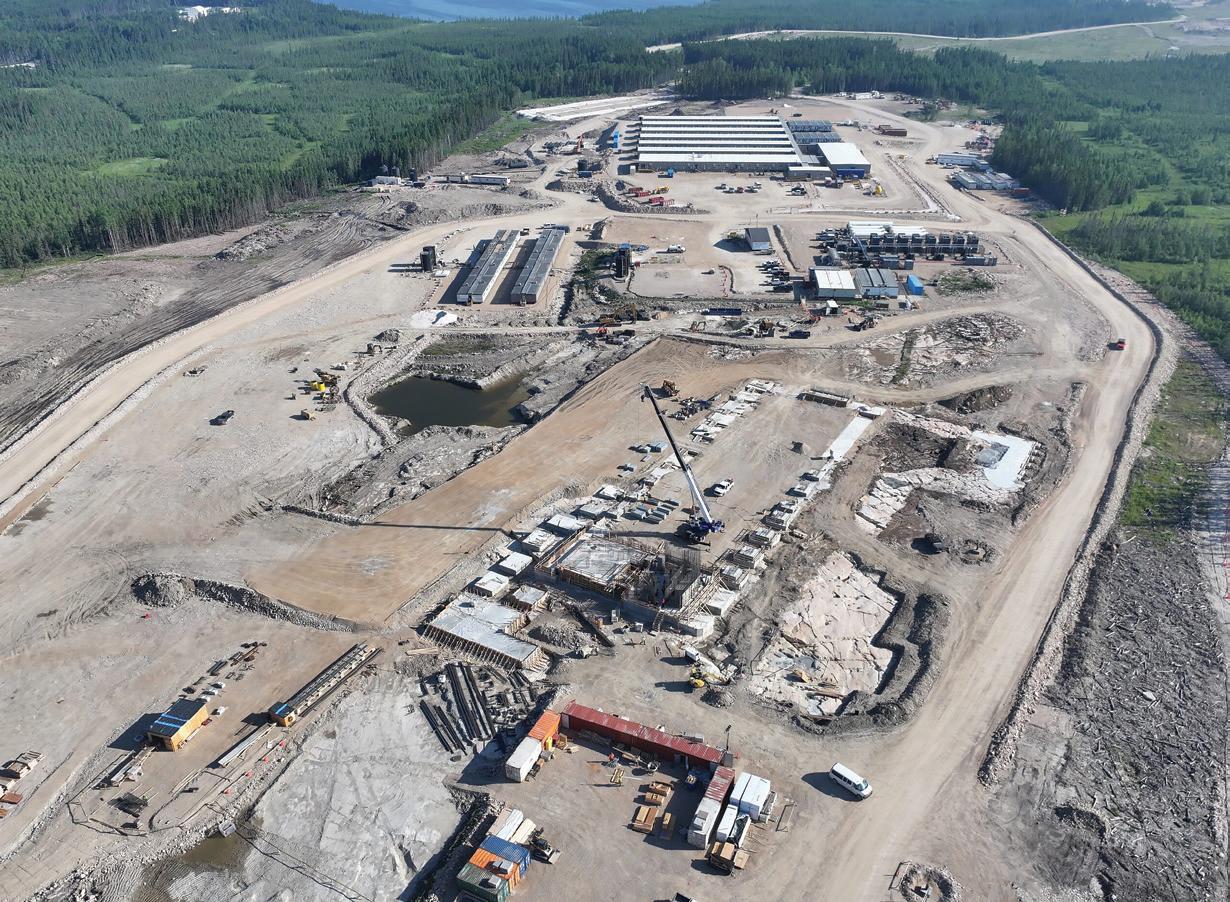
per pound. Initial capex was pegged at US$2.9 billion with a payback period of 3.7 years. In stage one, the mill would run at 108,000 tonnes per day. Stage two, starting in year eight, would see an expansion to 162,000 tonnes per day.
Last October, the company nearly doubled its claims package at Baptiste to 451 sq. km through a combination of staking and acquisitions.
Baptiste is a greenfield discovery, and the nickel mineralization is in the form of a sulphur-free, nickel-iron mineral called awaruite (Ni3Fe) hosted in an ultramafic/ ophiolite complex. The company has found awaruite mineralization at other locations on its claims package, including the Van target, about 6 km north of Baptiste.
Japan’s Sumitomo Metal Mining and stainless-steel producer Outokumpu each hold a 9.9% stake in the junior and both have been granted the right to negotiate future nickel offtake agreements for up to 60,000 tonnes of nickel, or about 3.5% of Baptiste’s estimated
life-of-mine production.
A 2022 resource estimate outlined 1.8 billion indicated tonnes grading 0.21% total nickel for 3.8 million tonnes of contained nickel. Inferred resources stand at 339 million tonnes averaging 0.21% total nickel for 720,000 tonnes.
FPX also has found awaruite mineralization at its Mich property in the Yukon with surface grades comparable to Baptiste.
FPX Nickel has a market cap of about $77 million.
n Marimaca Copper
At the end of December, Marimaca Copper (TSX: MARI) announced it had found more copper mineralization about 400 metres north of its Pampa Medina deposit in the Antofagasta region of northern Chile.
Drill hole SMR-01 returned 400 metres at 0.49% total copper starting from 250 metres downhole. Highlights from within the broad interval included 56 metres at 2.05% copper from 296 metres; 18
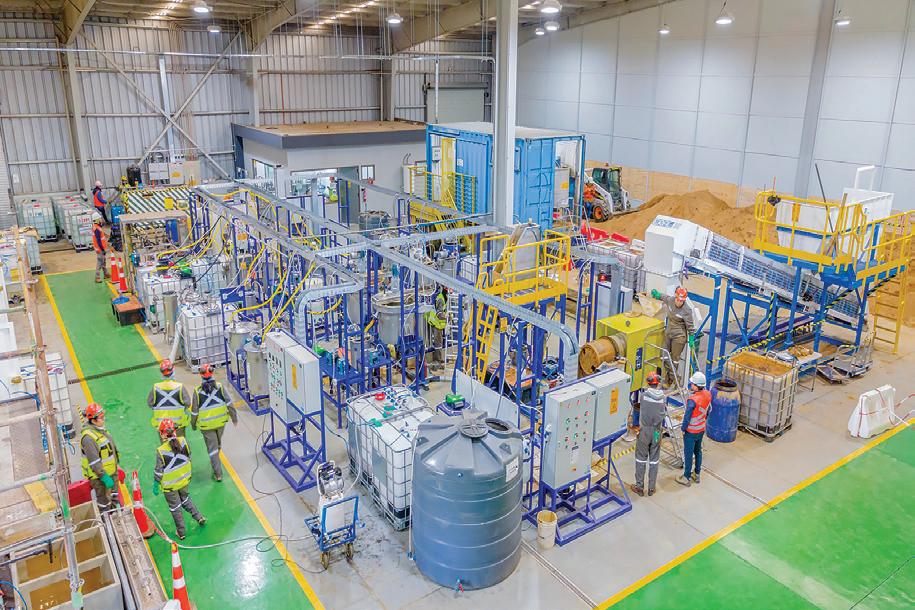
metres at 5.11% total copper from 320 metres; and 32 metres of 0.62% total copper from 618 metres. The company is considering plans to expand its exploration program at Pampa Medina Norte this year.
Pampa Medina and Pampa Medina Norte are just 26 km from the company’s main Marimaca copper-oxide deposit.A definitive feasibility study is underway to evaluate the economics of a bulk tonnage operation.
Marimaca is one of the few greenfield copper discoveries of the last decade and the company has drilled more than 120,000 metres at the 600-sq.-km project since 2016.
Situated about 40 km from Antofagasta city and just 25 km from the port of Mejillones, the company envisions recycling seawater for its proposed solvent-extraction electrowinning processing plant.
An updated resource estimate in 2023 for the deposit outlined measured and indicated resources of 200.3 million tonnes grading 0.45% total copper for 900,000 tonnes of contained copper and 37 million inferred tonnes averaging 0.38% copper for 141,000 tonnes of copper. The resource estimate used a cut-off grade of 0.15% total copper.
Marimaca Copper has a market cap of about $540.4 million.
n Sigma Lithium Resources
Sigma Lithium Resources (TSXV: SGML; NASDAQ: SGML) is ramping up production at its Grota do
Cirilo operation in Brazil, one of the world’s largest hard-rock lithium deposits.
The company produced about 75,000 tonnes of lithium concentrate in the fourth quarter, bringing its full-year production to 240,000 tonnes, and is on track to exceed its 2025 production target of 270,000 tonnes, it said in December.
“We have researched and advanced dense media separation technology for lithium oxide concentrate, taking it to a unique level of production efficiency, reaching 70% of recovery at our Greentech industrial plant, while dry stacking 100% of the tailings, and reusing the water,” the company’s CEO, Ana Cabral, said in a Dec. 23 release.
Stage one of operations started commercial production in the second quarter of 2023 and the company has approved construction of a second facility to double capacity to 520,000 tonnes of lithium concentrate through in stage two.
Sigma produces “Quintuple Zero Green” lithium at its Greentech lithium beneficiation plant, with “zero carbon-intensive energy, zero potable water, zero toxic chemicals and zero tailings dams.”
In December, the company received an environmental licence for the construction, installation and operation of Barreiro—a second mine on its Grota do Cirilio property. Once in production Barreiro will feed the plant with spodumene ore.
Sigma Lithium Resources has a market cap of $2 billion. TNM
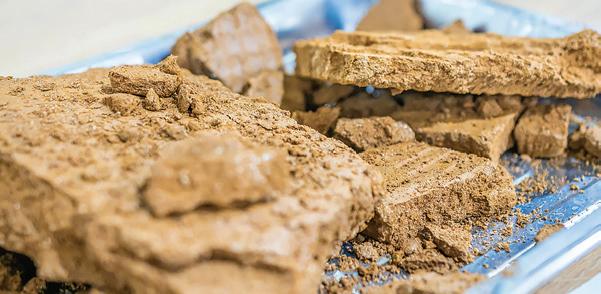
Foran Mining’s McIlvenna Bay project camp. FORAN MINING
Aclara Resources processed 25 tonnes of its Carina project’s ionic clays at a pilot plant in Chile. ACLARA RESOURCES
Aclara Resources aims to produce rare earths for the permanent magnet market. ACLARA RESOURCES
Supercharge your industry knowledge, streamline opportunity discovery, and uncover valuable insights like never before with a TNM


> Copper from P30
self, but you don’t need to worry about that,” he said.
“The Glencores will be there, the Tecks will be there (Teck Resources (TSX: TECK.A, TECK.B; NYSE: TECK)), the Rios will be there and the BHPs will be there. The Zijin’s will be there and they’ll be there like white on the rice.”
Asked about how to weed out too-risky copper explorers and developers when looking to invest in the sector, Ivan Bebek, a gold mining M&A specialist and now CEO of Coppernico Metals (TSX: COPR; US-OTC: CPPMF) ticker), zoned in on capital.
> Geopolitics from P30
try, part of U.S. defence spending includes billions for critical minerals projects including some in Canada.
MacGregor’s warnings come amid a recent rise in geopolitical tensions coinciding with attempts by several Western nations to challenge China’s role as the world’s leading refiner of critical minerals — a vital component in the production of cutting-edge aerospace and defence technologies.
Domestic resources
While U.S. President Donald Trump, who was sworn in for a second term Jan. 20, has not publicly commented on the Pentagon’s support for mining projects, his administration’s policies reflect a concerted effort to reduce reliance on foreign sources for critical minerals, particularly from China. This approach aligns with the broader goal of strengthening national security and ensuring economic stability through the development of domestic resources.
Trump has often complained that the country is paying more than its fair share to the North Atlantic Treaty Organization. Last summer, he campaigned on a pledge to keep
“It’s expensive to drill, it’s expensive to socially impact the [surrounding] communities. Everything about copper is expensive,” said Bebek, whose company is advancing a large-scale copper project in Peru.
“You can also look at share structure and how many outstanding shares and thirdly how much have management bought of their own stock in the last year. That’s critical. If they’re not buying shares of their company at cheap prices, why should you?”
Experience
Another factor to take into account when assessing the risks of investing in a copper exploration com-
U.S. forces “out of wars” — though he vowed in Monday’s inaugural speech to take back control of the Panama Canal.
“If you’re smart right now, you cut your losses everywhere in the world,” MacGregor said. “If you’re an American, you get out. You get out of all of these places, you come home.”
Even massive U.S. aid to Ukraine hasn’t been enough to prevent Russia from steadily making territorial gains, MacGregor stressed. Claims that the Russians are losing the war are “nonsense, just total nonsense,” he said.
Failure to retrench and cut U.S. military spending would put Trump “in a lot of trouble very quickly,” MacGregor said. “The world doesn’t want us in their backyard, contrary to popular belief.”
Regional disputes
To hear MacGregor tell it, U.S. forces need to “step out” of regional disputes, which are increasing and bring their own entrenched leaders to conflict.
“For almost 1,000 years, the leading powers in the Middle East were Persia and the Turks,” he said. “We don’t belong there. We’ve got to get out of this business. When we
pany is experience, Rule said.
Beyond just exploration knowledge, investors should seek companies that know copper and, specifically, have porphyry rock experience. Companies also need the heft to fund or arrange the $5 billion to $10 billion it might take to develop a mine, he said.
“Size really matters in the copper business,” he said. “So if you hear the bootstrap story, like ‘we’re going to start with a small highgrade deposit, and we’re going to use the free cash flow to build BHP over 20 years with no dilution…’
“From an entrepreneur’s point of view, that’s a seductive story, right? But it’s a lie.” TNM
go into places, we disrupt the natural dynamic. We create inequalities between powers.”
Slowing this shift is a misguided belief among some in the U.S. that the country still dominates the world order, MacGregor said.
“In Washington in particular, there is a failure to understand the world, and that’s because we have been the centre of it, at least in our imagination, since the end of the Second World War,” he said.
Countries with millennia-old cultures — such as China, India or Iran — “are roaring back into the world,” he added.
“We’re not very comfortable with that, and we have a bad habit of denigrating it and ultimately grossly underestimating them, and we’ve seen that with Russia. So the world itself is changing, and we are not really changing at all. Our view of the world is that we are the centre of it. It’s a huge problem.”
On top of that, MacGregor argues, the U.S. has lost its monopoly on cutting-edge military technologies.
“Most of the technologies that people are expressing concern about, particularly in terms of military applications, those were ours 30 years ago,” he said. “They are now proliferating everywhere.” TNM
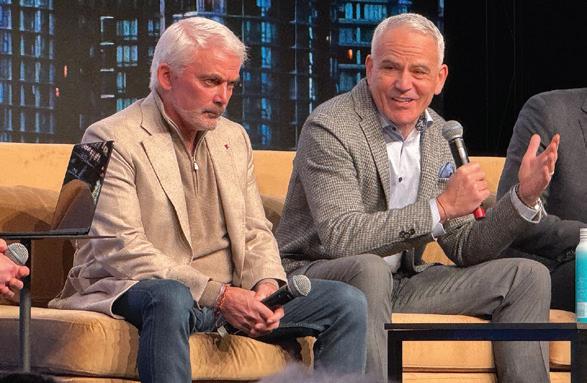
(TSX: NGT; NYSE: NEM). Goldmining owns about 13% of Gold Royalty.
“It seems the world is often shrinking in geopolitically stable jurisdictions where you want to operate in,” Still said. “We’re seeing challenging environments. Having a solid operation with a solid reserve in a geopolitically stable jurisdiction, those types of resources are becoming increasingly scarce. That’s one of the factors driving price here.”
Price forecast?
None of the panelists shared a specific forecast for gold prices. As reserves dwindle, rising production costs are putting pressure on large mining operators, Garo-
falo said. As a result, he argues, investors should be focusing on junior miners due to their potential as takeover targets.
“Where you want to be in the industry is in the development-stage assets, the ones that are going to populate the pipelines that these larger scale companies are going to desperately require,” Garofalo said. Junior miners “are the ones that do all the heavy lifting and exploration.”
Behemoths such as Newmont or Barrick Gold (TSX: ABX; NYSE: GOLD) “have to continually gobble up other companies, play PacMan, to replace a sub optimal production and reserve level that’s simply not sustainable,” he said.
“To sum it up, large scale operators in our universe are doomed. They’re facing a squeeze from declining reserves.” TNM
Originally, Trump declared the tariffs would be slapped on Canada and Mexico (and 10% on China) within hours of his inauguration. Then there was talk of studying the process and some pundits said Trump would have to assemble a trade negotiation team. Trump changed his levy date to Feb. 1, then floated it could be April 1. It was widely reported that no American officials had in fact informed their Canadian counterparts to expect tariffs.
Experts suggested this was a way to keep Canada and Mexico off balance, a negotiating tactic to reopen the North American free trade agreement within months, a year earlier than the deal allows.
“Part of the strategy for him is to create uncertainty in the hopes of creating a better transactional bargain,” Clifford Sosnow, head of law firm Fasken’s international trade and investment group, said by phone. “Maybe he wants to use tariffs to get an energy new deal. It’s really not clear at this stage of the game.”
Orders
One of the scores of executive orders that Trump signed within hours of occupying the Oval Office was a declaration of emergency regarding energy and critical minerals to thwart China’s control over the industry in the name of national security.
The American departments of energy and defence are already sending tens of millions of dollars to critical mineral projects in Canada. Trump wants to make the U.S the dominant producer and processor of minerals, including critical minerals, but that doesn’t mean funding only U.S. mining projects, the trade lawyer said.
“He’s clearly trying to say, ‘it’s time we look to other sources of supply’ and so there’s openings there for Canada,” Sosnow said.
“What does that mean in terms of increased investment in the Canadian mining space? That’s where negotiations come in.”
However, getting a common stance on those negotiations and how to respond to the tariffs threat is creating political in-fighting on both sides of the border. Republicans may not be aware of how tariffs would harm Midwest state economies, especially in the automotive industry.
In Canada, Alberta Premier Danielle Smith and Saskatchewan Premier Scott Moe expressed concern retaliatory tariffs or export bans could slash their billions in revenue from of oil and gas, and uranium and potash, respectively.
Meantime, Ontario’s Doug Ford has called for strong retaliation.
Gun fight
“You can’t bring a knife to a gun fight,” Ford told reporters Jan. 22.
“We have to make sure we match these tariffs dollar for dollar. We’re
need to target where it’s going to impact Americans the most.”
Canada’s stance is further complicated. Ford has emerged as captain of Team Canada after Justin Trudeau said he intends to resign as prime minister. But the Ontario premier may be distracted by holding an early election this month. Even so, the Conservative Party’s Ford and the Liberal Party’s Trudeau agree on the country’s response if Trump carries through on his threat.
“Canada will have a strong, robust response, because we don’t want this, but we will respond if necessary,” Trudeau told reporters within hours of Ford’s gun quip. “Prices for American consumers on just about everything will go up, and we don’t think he wants that.”
Federal opposition leader Pierre Poilievre said he would “fight fire with fire,” but he has dodged questions in news conferences on whether he’s actually more aligned with Smith in Alberta — a core constituency of his — to avoid a strong response to Trump.
Sosnow, the partner at Fasken, questioned the rationale of export bans and strong retaliatory tariffs. Would Ford shut the auto sector or cross-border electricity deals that would ditch billions in revenue?
“It’s a bit like radiation treatments,” he said. “You want to kill the tumor without killing the patient, right? And some of these retaliations could have devastating impacts on the economy.”
BC
floats 3-pronged response to ‘bizarre’ U.S. tariffs threat
AME ROUNDUP | Mining anchors province’s economic stability, Premier says
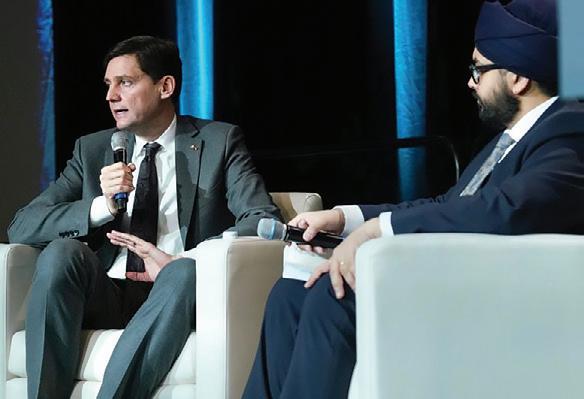
BY HENRY LAZENBY
British Columbia Premier David Eby on Jan. 23 outlined a three-part plan to counter proposed United States tariffs on Canadian imports during remarks at a Vancouver conference.
Eby says the province will support federal ‘everything’s-onthe-table’ tariffs. It will work to strengthen B.C.’s economy by providing additional mining support and by diversifying trade away from the U.S. The province’s mineral wealth is increasingly being treated as the province’s
main bargaining chip and economic strength.
“It’s bizarre to see the U.S. Department of Defense investing in Canadian mines one week and then labelling those same resources a threat deserving tariffs the next,” Eby said at the Association for Mineral Exploration’s Roundup conference.
The 25% tariffs, threatened by newly sworn-in U.S. President Donald Trump, show the fragility of Canada’s trade relationship with its largest partner, the premier said.
Mining remains key to B.C.’s
Goldmining CEO Alastair Still, right, makes a point beside Fiore Group CEO Frank Giustra. HENRY LAZENBY
> Trump from P1
Premier David Eby, with AME CEO Keerit Jutla at Roundup. HENRY LAZENBY
> Bullion from P30



> AME Roundup from P40
economy and its resilience amid external pressures, Eby said. The premier, with a new majority mandate after the Oct. 19 election, appointed Jagrup Brar to head the newly created Mining and Critical Minerals Ministry.
US$46B in mineral exports
In 2023, 77% of Canada’s goods exports went to the U.S. Metals and minerals made up US$46.97 billion of these exports. That made Canada the U.S.’s largest supplier of these resources, U.S. International Trade Commission data from Jan. 14 shows.
Eby pledged full support for Ottawa’s response. It includes targeting Republican-led areas with countermeasures.
“We are fully supportive of the federal government applying retaliatory tariffs in the U.S., especially focused on Republican jurisdictions, to encourage those key decision makers on whom the president relies for assistance to pass his bills of the close connection that we share with the U.S., their friends, their family,” Eby said.
Eby plans to meet with U.S. governors and business leaders in Washington next week. He wants to stress that tariffs would harm the economy. “Everything from the cost of pasta to housing will rise if these tariffs take effect,” he said.
Bargaining chip
Mining forms the backbone of B.C.’s countermeasures. Government data reveals that in 2023, exploration expenditures in the province totalled $552.1 million, down 13% from the previous year’s $643.5 million but still the fourth-highest in B.C. on record.
Mining’s production value is forecast to reach $16.5 billion this year, with private investment doubling since 2017 to $4 billion.
Eby pointed to Teck Resources’ (TSX: TECK.A, TECK.B; NYSE: TECK) Trail smelter. It’s the only North American source of germanium, a critical mineral for U.S. defence and tech applications.
“If the U.S. doesn’t get germanium from Canada, it can’t get it anywhere,” Eby said.
“The success of mining is the success of our province,” Eby said.
“We will work with you to ensure B.C. remains a global leader in resource development.”
Prospecting’s place
The premier acknowledged the role prospectors and explorers play in preparing the province for the bargaining table. He said prospectors’ work ensures the province’s leverage in global trade negotiations.
“When you identify resources unavailable elsewhere, you bolster our economy and bargaining power,” he said.
“We are fully supportive of the federal government applying retaliatory tariffs in the U.S.”
DAVID EBY,
PREMIER
BRITISH COLUMBIA
Trade diversification
To reduce dependence on the U.S., B.C. is expanding trade with Asian markets, including Japan, South Korea and Vietnam. The province has geographic advantages in Pacific shipping access to those markets and the government aims to implement diversification strategies, to make it the least U.S.-dependent province in Canada.
B.C.’s critical minerals, which meet many ethical and sustainability standards, give the province an edge in securing international markets.
“You don’t want to buy metals and minerals from authoritarian regimes. Canada is your partner in democracy and sustainability,”
Eby said.
Also speaking this week during the Roundup event was the Mining and Critical Minerals Minister Brar. He stressed the need to diversify the province’s trade, showcasing recent investments in infrastructure and permits to support sector growth.
MTA update
The provincial government says it has reduced permitting delays to help speed up mining projects. So-called notice-of-work approvals now take an average of 140 days, down from 166, while major mine permitting timelines have fallen by over 30%. Yet, challenges persist.
Victoria is also working to address changes to the Mineral Tenure Act (MTA) after a court ruled that authorities must consult more with First Nations. A court deadline for updated legislation looms in late March.
Eby told explorers that the government should manage these talks. This way, prospectors can keep working without extra challenges.
Keerit Jutla, AME president and CEO, underlined the importance of collaboration in resolving these challenges. “We either learn to compromise, or our collective future will be compromised,” he said.
The premier acknowledged concerns about the act’s implementation but promised minimal disruption. He says a new $1 billion fund is to support First Nations participation in resource development, including equity partnerships.
“When First Nations are equity partners in a mine, permits move faster because everyone has a shared interest,” he said. TNM
Wiring, energy, geopolitics drive 2025 metals: Sprott
OUTLOOK | Electrification poised to take centre stage
BY NORTHERN MINER STAFF
Critical metals, uranium and gold will shine this year driven by accelerating de-globalization and energy security demands, Sprott said in a special report on Jan. 20.
Broader trade conflicts affecting allies and adversaries alike could reduce business investment and global GDP, while decoupling due to rising protectionism and trade tensions will likely accelerate in sectors that are strategic like AI, advanced technology, finance and defence, the asset management company stated.
All of this could drive electrification efforts into higher gear and sustain demand for critical minerals, uranium and gold, said Sprott, which manages some US$34 billion in assets.
Self-reliance and reduced foreign dependence will be key trends in the energy sector this year as countries further decouple and populist and nationalist ideologies come to the fore. This could augment rivalries over critical resources, with resource nationalism driving energy policy.
Prices of commodities tied to critical energy materials such as uranium, copper and silver are already outperforming those commodities affected most by China’s economic policies such as iron ore and metallurgical coal, and this trend is likely to persist in 2025, Sprott said.
EVs thwarted President Donald Trump’s intention to roll back policies supportive of electric vehicles (EVs) and renewables has introduced uncertainty and could include eliminating a US$7,500 tax credit for EVs while reducing dependence on batteries and critical minerals from China. But it may boost EV sales in the short term, BMO Capital Markets said on Jan. 22.
Trump has signed an executive order cancelling Biden’s target of EVs to be half of auto sales by 2030, and the new president is redirecting unspent government funds for charging stations. The order also seeks to keep combustion engine autos in play longer by tweaking rules for states and the Environmental Protection Administration, but that tactic may be challenged.
If Trump repeals all the tax credits under the Biden-Harris administration’s Inflation Reduction Act, solar, wind and energy storage construction would be 19% less over the next five years, according to an analysis by Bloomberg New Energy Finance (BNEF), a unit of the news wire. But even so, renewables would more than double because they have momentum, it added.
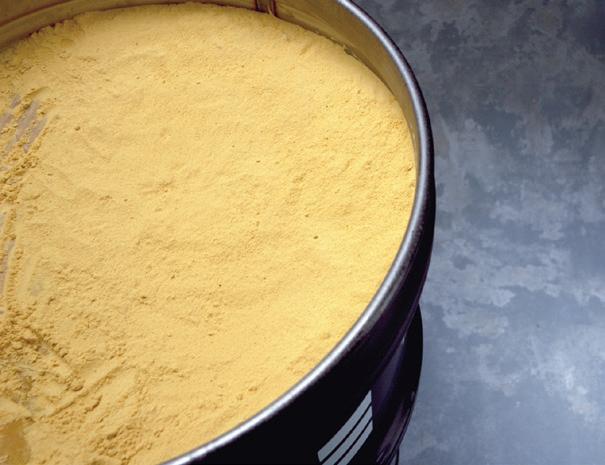
What’s more, a full repeal of existing clean energy legislation “appears unlikely” according to Sprott.
Political shifts, inflation and geopolitical tensions mean that market volatility will be a key characteristic this year, Sprott said. The risk of aggressive tariffs and trade wars “casts a strong shadow on risk assets” and policy uncertainty “could dampen investor confidence.”
Nuclear is back
As a zero-emission, baseload energy source, nuclear energy is well positioned in 2025 to support the energy required in AI’s data centres, machine learning and digital infrastructure. This year Sprott sees “accelerated investment in both AI-driven applications and nuclear energy infrastructure as their synergies become more apparent.”
Prices for uranium in the shortterm market hit a 16-year high last year and Sprott, which manages the world’s largest physical trust of the metal at US$4.9 billion, says the market for the nuclear fuel will continue to grow and remain in a bull market this year. (The average and maximum uranium spot prices in 2024 were their highest in the last six years.)
“Regardless of spot price movements, uranium’s underlying fundamentals continue to grow stronger, driven by accelerating demand, supply constraints and favorable nuclear energy policies,” Sprott noted.
At the same time, current global uranium mine production is insufficient to meet the world’s nuclear reactor needs and there is a structural deficit. While junior miners are restarting mines due to historically high uranium prices, their efforts are unlikely to close the supply-demand gap, Sprott said.
Geopolitics and instability in uranium producing countries like Niger and Russia also adds uncertainty.
Sprott argues that while some
utilities are covered, others do not have the appropriate procurement strategies in place.
“We believe that available-forsale inventories, critical to utilities, have been depleted,” Sprott said. “Utilities’ needs may cascade down the supply chain from conversion and enrichment, where prices are hitting all-time highs, to (uranium oxide) itself.”
Copper imbalance grows Copper is one of the most compelling commodities this year, according to Sprott. AI and data centres rely on copper for infrastructure and its “new omnipresence in the energy-intensive future of global economies may shield it from tariffs proposed by the incoming Trump administration, a threat that has been weighing on the copper market post-election.”
Supply remains a concern and Sprott expects the supply deficit will widen through 2025 and beyond. Production disruptions are expected to continue in the coming quarters, and insufficient investment in future copper supply is a “critical bottleneck.” Declining grades and long project lead times have also constrained supply.
In addition, tighter availability of copper concentrate could put additional upward pressure on prices, while “overcapacity in the smelting sector adds pressure to the upstream segment of the supply chain and may continue to depress treatment charges.”
The gold price jumped 27% in 2024, largely due to central bank and sovereign purchases, and Sprott expects demand from this sector will continue to lift gold prices this year.
“Most central banks expect the U.S. dollar to decline as a proportion of their total reserves, with gold’s share expected to rise over the next five years,” Sprott said. Inflation and geopolitics will also be supportive of the precious metal in 2025. TNM
Processed uranium yellowcake. CAMECO
2.0
AI Powered Search
TNM Marco Polo’s integrated chatbot lets you quickly and easily search more than 2,600 global mining companies and 13,900+ properties by just asking a question.
5,000+ Site-level Contacts
Search more than 13,900 global mining properties for the right contact and connect with them directly through a single click.
Learn more at marcopolo.tnm.global