Ontario to trim early-stage rules |

URANIUM | Westinghouse contracts, India deal buoy Cameco
BY FRÉDÉRIC TOMESCO
The war in Iran could usher in a wave of nuclear reactor construction similar to the one that followed the 1970s energy crisis, Cameco (TSX: CCO; NYSE: CCJ) President and Chief Operating Officer Grant Isaac says.
More than 40% of today’s operating nuclear power plants were built in response to the 1973 oil embargo by the Organization of Petroleum Exporting Countries, according to the International Energy Agency. France, Japan, South Korea and the United Kingdom were among the western countries that began a multiyear push to build nuclear reactors in the wake of the crisis.
“I’ve never been more excited about the prospects for nuclear new builds globally and in particular in the West,” Isaac, a 16-year industry veteran who previously served as chief financial officer, told The Northern Miner in an interview.
His company, which mines uranium and builds nuclear reactors through its 49%-owned Westinghouse Electric joint venture, has multiple irons in the fire as renewable power demand climbs.
“I’m reminded the last time the West built out fleet-scale gigawatt reactors was during a Middle East energy crisis, and here we are in the grips of a Middle East energy crisis again,” Isaac said.
“Now we’re worried about climate security, worried about where our alternative energy is coming from, and in the grips of a national security conversation around the need for 24-hour, carbon-free electrons for things like the data race and the onshoring of supply chains. That combination of climate, energy and national security is a great backdrop for strengthening the tailwinds to nuclear new build.”
Cameco—the operator of Saskatchewan’s McArthur River, the world’s biggest high-grade uranium mine—produces 15% of uranium globally. the Saskatoon-based firm is the world’s second largest uranium miner, after Kazakhstan state-owned producer Kazatomprom (LSE: KAP), which accounts for about 20% of supply. Both companies are partners in the Inkai joint venture, which is projected to produce 10.5 million lb. of uranium this year.
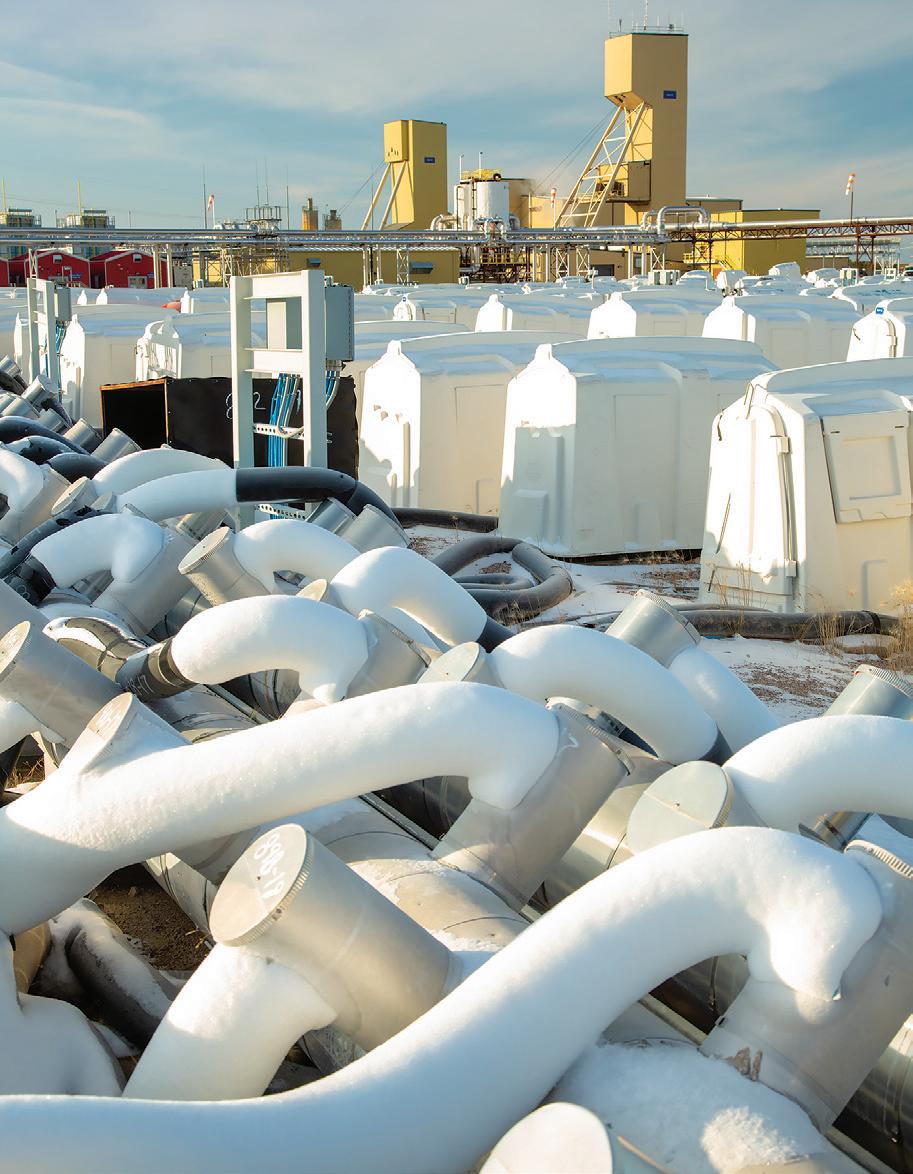
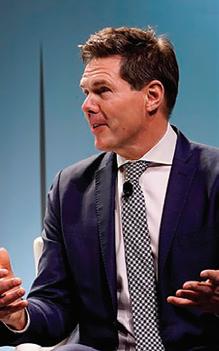
“The last time the West built out fleet-scale gigawatt reactors was during a Middle East energy crisis, and here we are again.”
GRANT ISAAC PRESIDENT AND COO, CAMECO
Uranium is expected to face a widening long term supply deficit over the coming decades due to rising demand, more challeng-
ing primary supply and uncertainty around new mine developments, analysts say. That’s not to say uranium’s
prospects are shock-proof. A nuclear accident such as the 2011 Fukushima disaster in Japan would undoubtedly weigh on global sentiment and uranium prices, possibly leading to policy reversals. Escalating conflicts such as the Iran war could also affect energy consumption—especially if the global economy enters a recession.
For now, worldwide demand for uranium is projected to triple by 2040, showing the need to develop mines. It already outpaces produc-
tion by 50 million to 60 million lb. a year, according to World Nuclear Association data.
“Uranium market fundamentals remain tight,” RBC Capital Markets mining analyst Andrew Wong wrote in a recent note. He predicted “accelerating momentum in nuclear new builds.”
Tech demand
Demand for nuclear energy was on the rise even before the U.S. and Israel began bombing Iran— the result of technology companies moving to build more power-hungry data centres for AI applications. The U.S. government has also been working to accelerate nuclear’s rebound through various supports and fast-tracking uranium projects in the country’s Southwest.
That increased demand has also led to reactor life extensions. Nuclear regulatory authorities in the U.S. last month approved a 20-year licence renewal for the two pressurized water reactors at California’s Diablo Canyon nuclear power plant—the 100th such extension in several years.
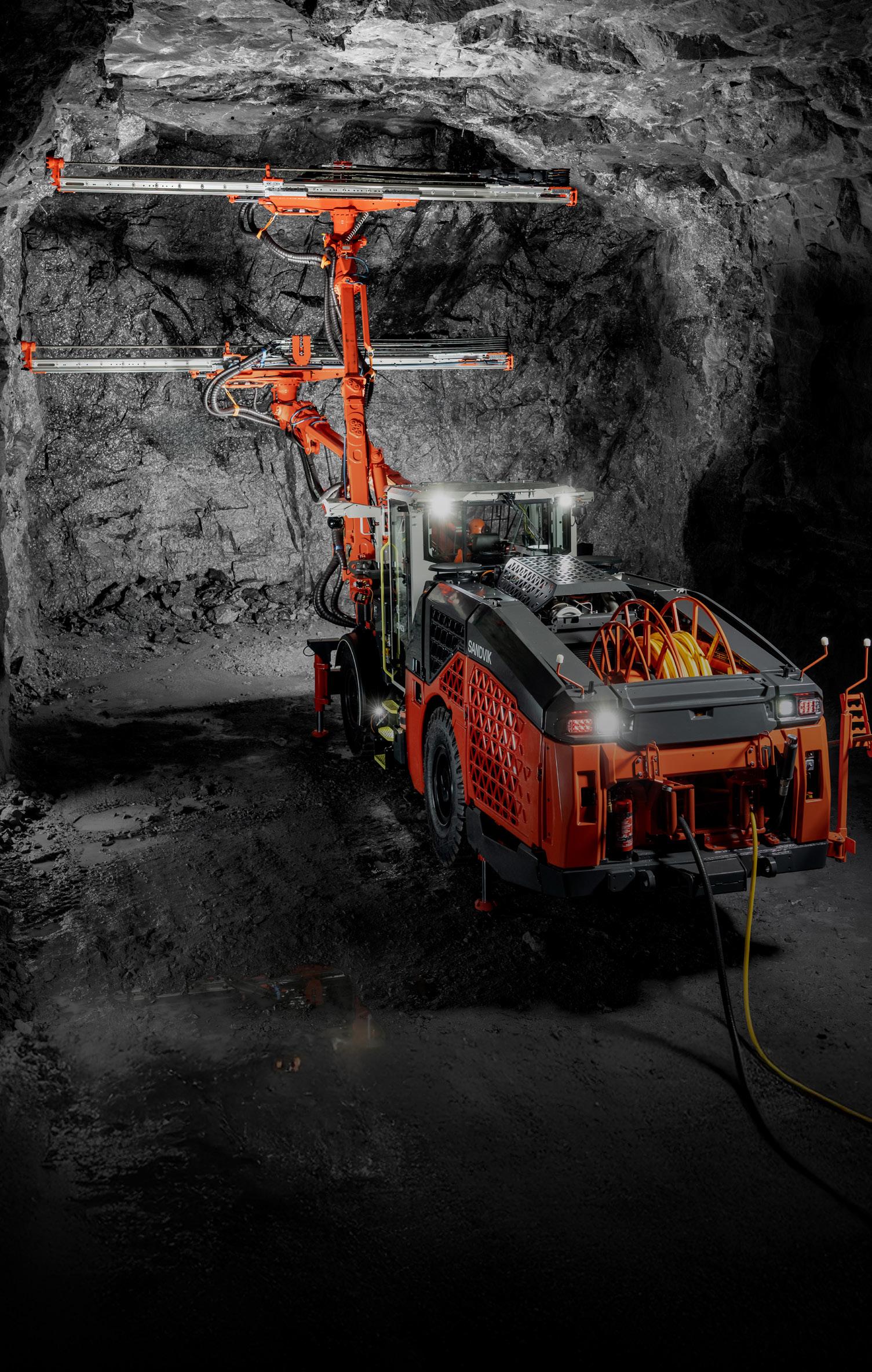
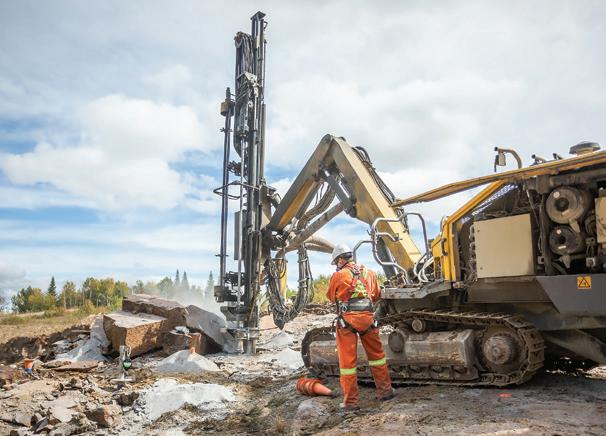
This highly intelligent drill offers more versatility thanks to its new boom design increasing both the face coverage and crosscut drilling. It can drill face sizes from 4 to 7.8 meters.
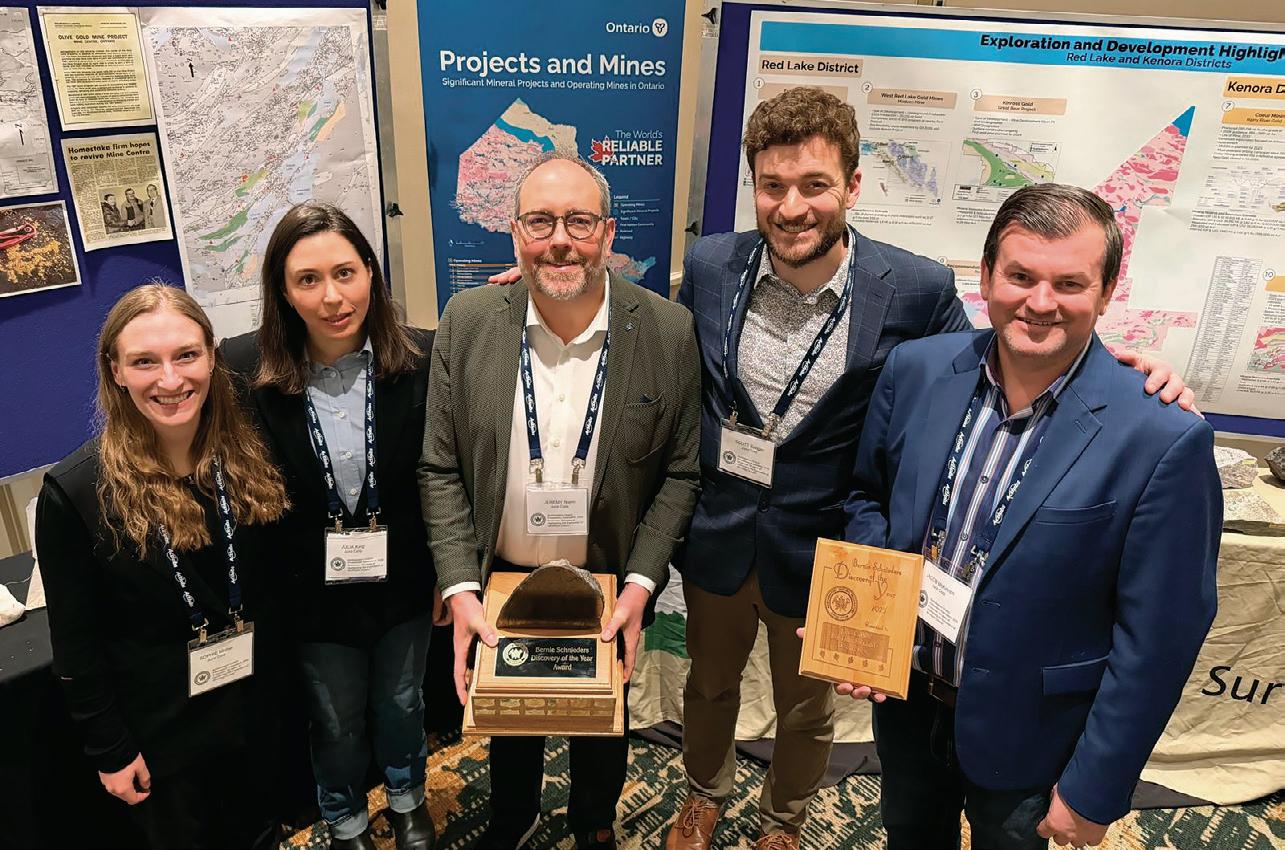
Juno team members
Sophie Michel, Julia King, Chief Strategy Officer Jeremy Niemi, Scott Zelligan and President and Chief Operating Officer Jacob McKinnon receive the Bernie Schnieders 2025 Discovery of the Year Award from the Northwestern Ontario Prospectors Association for the Big Thunder gold deposit in the Ring of Fire region.
CREDIT:
Agnico Eagle Mines put together a $3-billion, three-part transaction to consolidate a district-scale gold camp in Finland, anchored by its acquisition of Rupert Resources.
The deals also include buying Aurion Resources’ and B2Gold’s stakes in the Fingold joint venture, Agnico said April 20.
Together, they would give Agnico full control of a 2,492-sq.-km land package in the Central Lapland Greenstone Belt and support a long-life production hub centred on the Kittilä mine and Ikkari project, with potential output of about 500,000 oz. gold annually.
Denarius Metals boosted its unsolicited all-share bid for Emerita Resources by 50% to 45¢ per share following the resignation of Emerita’s CEO and chairman amid Ontario Securities Commission fraud allegations.
The revised offer values Emerita at C$133.5 million and represents a 73% premium to its pre-bid trading price.
CEO David Gower and Chairman Larry Guy are among a group of four Emerita directors and officers accused by the OSC of having diverted lithium claims in Brazil to a separate company they controlled, Lithium Ionic, while misleading investors by claiming Emerita had “relinquished” the project. Their conduct defrauded Emerita and its investors, the OSC said April 10.
USA Rare Earth agreed to buy Brazil’s Serra Verde Group in a US$2.8 billion cash-and-stock deal, securing control of the Pela Ema rare earths operation and strengthening a Western supply chain outside China.
The transaction supports the company’s strategy to build a vertically integrated mine-to-magnet platform spanning mining, processing and manufacturing.
Serra Verde is one of the few deposits outside Asia capable of producing key magnetic rare earths at scale, including heavy elements.
Backed by U.S. government financing and long-term offtake agreements, the deal is said to be the largest ever for the critical minerals.
The U.S. Senate narrowly voted last month to overturn a 20-year mining moratorium on federal lands in Minnesota, clearing a key hurdle for Antofagasta’s Twin Metals copper-nickel project.
The 50–49 vote reopens access to a large, undeveloped critical minerals district in the Superior National Forest and could revive one of the biggest U.S. copper resources. The project still requires permits and faces potential legal and environmental challenges due to its proximity to the Boundary Waters.
The decision highlights the tension that exists between boosting domestic mineral supply chains and protecting sensitive ecosystems.
BY NORTHERN MINER STAFF
Trilogy Metals plans to seek FAST-41 status for its Arctic copper-zinc-lead-gold-silver project in Alaska after launching the U.S. federal approvals process.
Ambler Metals, the company’s joint venture with Australia’s South32, filed for a Clean Water Act Section 404 permit for Arctic with the U.S. Army Corps of Engineers last month, the key federal authorization required for development.
Located in the Ambler mining district, Arctic is considered one of the world’s highest-grade undeveloped polymetallic deposits. It forms part of a broader strategy to establish a domestic U.S. supply of critical minerals.
In the meantime, Ambler is advancing drilling and engineering work at Arctic under a $35-million program. It’s also preparing exploration at the nearby Bornite deposit, which could support decades of copper production.
Stanmore Resources, Mitsubishi, and BUMA Internasional are among potential bidders for Anglo American’s Australian met-coal assets after a $3.8-billion sale to Peabody Energy collapsed last year, according to Bloomberg News. Acquiring the portfolio would either cement or elevate their standing among the world’s top suppliers of steelmaking coal to Asian markets, currently dominated by the BHP Mitsubishi Alliance and Glencore.
An April 2025 fire at the Queensland-based operations drove Peabody away, a setback to Anglo’s broader plan to divest non-core assets.
GLOBAL MINING NEWS • SINCE 1915 www.northernminer.com
PRESIDENT THE NORTHERN MINER GROUP: Anthony Vaccaro, CFA, MBA avaccaro@northernminer.com
EDITOR-IN-CHIEF: Colin McClelland cmcclelland@northernminer.com
COPY EDITOR AND PRODUCTION EDITOR: Blair McBride bmcbride@northernminer.com
SENIOR STAFF WRITER: Frédéric Tomesco ftomesco@northernminer.com
WESTERN EDITOR: Henry Lazenby hlazenby@northernminer.com
PODCAST HOST: Adrian Pocobelli apocobelli@northernminer.com
ADVERTISING: Robert Hertzman (416) 898-6654 rhertzman@northernminer.com
Kathleen Plamondon (514) 917-5284 kplamondon@northernminer.com
Michael Winter (416) 510-6772 mwinter@northernminer.com
SUBSCRIPTION SALES/ APPOINTMENT NOTICES/ CAREER ADS
George Agelopoulos (416) 510-5104 (Toll free) 1-888-502-3456, ext. 43702 gagelopoulos@northernminer.com
PRODUCTION MANAGER: Jessica Jubb (416) 510-5213 jjubb@northernminer.com
CIRCULATION/CUSTOMER SERVICE: (416) 510-6789 | 1-888-502-3456 northernminer2@northernminer.com
REPUBLISHING: (416) 510-6768 jmonteiro@northernminergroup.com
ADDRESS: Toronto Head Office
69 Yonge St, Toronto, ON M5E 1K3 (416) 510-6789 tnm@northernminer.com
SUBSCRIPTION RATES: Canada:
C$130.00 one year;
5% G.S.T. to CDN orders.
7% P.S.T. to BC orders
13% H.S.T. to ON, NL orders
U.S.A.: C$172.00 one year Foreign: C$222.00 one year GST Registration # 809744071RT001 (ISSN 0029-3164)

BY COLIN McCLELLAND
One of the biggest movies when I was growing up was The Big Chill. It opens with a funeral to the soundtrack of the Stones singing “You Can’t Always Get What You Want.” There is a body. It’s an uncredited Kevin Costner in his first screen role. .
In the uranium market, governments may be committing to nuclear at speed, but the big chill is the realization that the constraint is not ambition, but time. You can’t always get what you want. Projects are no longer waiting on higher prices. They are waiting on time, as a widening gap between policy-driven demand and mine supply begins to take shape.
Global demand already exceeds primary supply by a meaningful margin, with roughly 160 million lb. produced against about 190 million lb. required, according to recent market updates from Sprott Asset Management.
Policy-driven
Unlike previous uranium cycles, the next stage is being set by government policy rather than commodity markets. Countries are extending nuclear fleets, approving new reactors and positioning atomic energy as a pillar of energy security, particularly as electricity demand rises alongside electrification and data centre growth.
The shift is visible in projections from the International Energy Agency, which sees nuclear output rising through the end of the decade, and from the World Nuclear Association, which outlines a significant expansion in global capacity through mid-century.
That demand trajectory is colliding with a supply base that cannot respond quickly.
Years of underinvestment following the last uranium downturn have left the sector with a thin project pipeline and limited spare capacity. Producers have only recently begun rebuilding long-term contract books, a shift that Cameco has repeatedly flagged as evidence the market is tightening after a prolonged period of surplus.
At the same time, the physical market offers little cushion. The spot market remains thin and highly sensitive to incremental buying, reinforcing how little uncommitted supply exists, according to an April market note from junior explorer Purepoint Uranium Group.
U.S. uranium concentrate (U3O8) production in last year’s fourth quarter more than doubled the previous three months to 1.04 million lb. U3O8. But even if that pace could be maintained, it’s still only a fraction of what U.S. reactors consume, Purepoint CEO Chris Frostad says.
“So yes, domestic production is rising, but no, the United States is nowhere near self-sufficiency. This is still a market heavily dependent on foreign supply.”
To its credit, the U.S. is using the Defense Production Act of 1950, which streamlines approvals in the name of national security, to boost fuel output and build more reactors by 2033.
Rook 1
Bringing on new supply is not simply a matter of higher prices. Even the sector’s most advanced deposits face multi-year permitting, financing and construction timelines. Projects such as NexGen Energy’s Rook One highlight the point: large-scale, world-class assets can move forward, but not quickly enough to close a near-term supply gap.
Restarts have also proved slower than expected. Operations returning from care and maintenance, such as Paladin Energy’s restart of the Langer Heinrich uranium mine in Namibia, have taken years to ramp up to steady-state production, underscoring the technical and logistical complexity of the uranium supply chain. The industry is not short of resources in the ground, but it is short of deliverable pounds in the near term.
Even so, prices have yet to fully reflect that constraint. Uranium has recovered sharply from its post-Fukushima lows and is trading near $85–90 per lb., but remains below levels widely seen as necessary to incentivize a new generation of greenfield mines at scale. Developers and financiers, burned by the last cycle, remain cautious, while permitting timelines in Western jurisdictions continue to stretch.
Reactor builds are capital-intensive and subject to delays. But the direction of travel is clear. Governments are committing to nuclear power not as an option, but as a requirement.
That leaves the uranium market in an unfamiliar position. Demand is being set on political timelines, while supply remains governed by geological, technical and regulatory realities that move far more slowly.
Shortage
The result may not be a classic boom-and-bust cycle. Instead, the sector is edging towards something more persistent: a structural shortage that cannot be resolved quickly, even as prices rise.
There is no quick fix, only trade-offs. First, operators can pull supply forward through restarts and expansions, a path already pursued by Cameco, but these add incremental pounds, not a step change.
Second, utilities and governments can pay up, locking in long-term contracts at higher prices to justify new mines, as market signals from Sprott Asset Management suggest.
Third, timelines must be shortened or at least stabilized. Even tier-one projects such as those advanced by NexGen remain years away, reflecting permitting and financing realities that no price signal alone can accelerate.
So what’s left to do? Deliver on promises for one permitting process across different overseers. As Mick sang: “Vent our frustration/If we don’t we’re gonna blow a 50-amp fuse.” TNM

BY MATTHEW FISHER
As 2025 ebbed away, a Kyrgyz government delegation met mining investors in London to discuss a delicate initiative: a reset between Kyrgyzstan and Western capital.
Five years after wresting control of the Kumtor gold asset from a North American operator, the same powers are now using demand for critical minerals to bring Western investors back into Kyrgyzstan. This will test how quickly trust can be rebuilt in an era of resource nationalism.
Trust is low on both sides. The Kumtor saga saw the Kyrgyz government take control of the country’s largest gold mine from Canadian miner Centerra, raising concerns about property rights and political risk in Kyrgyzstan.
It also brought allegations of high-level corruption, ecological destruction and resource-stripping, leaving many Kyrgyz to take a dim view of foreign mining investment. Any reset must therefore be politically defensible in Bishkek while convincing outside investors that contracts will be honoured and disputes resolved without political intervention.
Sellable at home
Mining is a make-it-or-break-it issue in Kyrgyzstan. The 2005 revolution helped topple President Akayev amid perceptions he was selling mineral wealth to foreign interests.
Incumbent president Japarov made his name leading calls to nationalize Kumtor and ultimately rode that movement to the presidency in the 2020 revolution. As a president whose nationalist movement was built on opposing Western mining investments, Japarov will be keen to avoid two things.
The first is bringing back memories of Kumtor. For projects actively backed by the state, that appears to mean no gold and a strong ESG emphasis, targeting investments in critical minerals projects, primarily by UK and European investors.
That’s not to say investments in gold or by investors from other regions are off limits. In January, Silvercorp Metals of Canada paid US$160 million to acquire a 70% interest in the Tulkubash and Kyzyltash gold projects from UK-based Chaarat Gold. This deal, however, was not actively marketed by Bishkek, and involved swapping one foreign investor for another rather than bringing a new Western partner into a state-backed project.
The second potential pitfall is any perception that the government is again handing control over Kyrgyzstan’s mineral wealth to foreigners without delivering real benefits at home. That concern is evident in the government retaining a 30% free-carried interest in the Silvercorp Metals investment.
This also helps explain why the state-backed assets offered to Western investors are minority
stakes, mostly in polymetallic deposits with moderate mine lives, requiring Western expertise but leaving ultimate control in Kyrgyz hands.
A move away from Chinese capital and labour that dominates projects in Kyrgyzstan is also likely to prove politically popular.
Investors looking to re-enter the country will take a different approach, focusing on political cover, investment suitability and legal protections.
In March, the foreign ministers of five Central Asian nations, Kyrgyzstan included, travelled to London for talks with the UK government, with mining at the top of the agenda. There is a clear convergence of interests. The UK is seeking to secure supplies of critical minerals and counter Russian influence in Central Asia, while the countries of the region hope to develop their mineral wealth and avoid over-dependence on Russia and China.
Rather than proposing copper or bulk commodity mega-projects, Kyrgyzstan leads with a portfolio of small-to-mediumsize projects. Some could be developed quickly with limited capex—good opportunities for Western investors.
Legal protection, however, is where the reset looks weakest. While officials have discussed adopting English common-law protections and establishing independent arbitration mechanisms, no new safeguards are in place, leaving investors to rely on existing treaties. EU investors can rely on a modern treaty dating from 2024, while UK investors must rely on a 1994 agreement. Canadian investors have no investment treaty protection at all.
Legal risk alone is unlikely to derail the reset. It will, however, shape the kinds of investors Kyrgyzstan can attract and the terms on which they are willing to commit capital.
The initiative has been carefully calibrated to navigate Kyrgyzstan’s volatile domestic politics. Focusing on critical minerals and diplomatic signalling is also a sensible strategy to woo back Western investors. However, the reset is unlikely to attract significant mainstream capital immediately given Kyrgyzstan’s recent history. What it may do is open the door to a first wave of risk-tolerant equity, most likely from specialist mining investors.
This will not come cheap, with assets likely to be heavily discounted. But if the early projects are licensed, operated and exited without political interference, the country can rebuild its reputation and pave the way for large-scale mainstream investment. TNM
Matthew Fisher is General Counsel at La Mancha, a mining investment fund founded by Egypt’s Sawiris family, with about US$3 billion in assets under management across emerging-market mining projects.
BY ANDREW SEALE
With a full U.S. ban on imported Russian enriched uranium set to take effect in 2028, Western utilities are moving to rebuild enrichment and conversion capacity. That shift is reshaping the economics of the nuclear fuel cycle and driving billions of dollars into new projects.
In April, Urenco, a global supplier of enrichment services, announced it had installed 350,000 separative work units (SWU) of new capacity at its New Mexico plant. The expansion is part of a plan to add 2.5 million SWU across the U.S., the Netherlands and Germany, including 700,000 SWU in New Mexico, the only commercial-scale enrichment plant in North America.
The total represents roughly $250 million to $470 million in annual enrichment value at current prices. It would be enough to fuel about 18 large reactors, capable of powering roughly 14 million homes.
“We’re building what the market needs,” Laurent Odeh, Urenco’s chief commercial officer, told The Northern Miner. “We are in a privileged situation that we can build faster than people build nuclear power plants, so when we have the firm commitment and the clear signals, then we can make the investment decision.”
The buildout marks a broader push across the West to reduce reliance on Russian supply, which still accounts for roughly 44% of global enrichment capacity and about 20% of conversion, according to data from the U.S. Energy Information Administration and the Department of Energy (DOE). Conversion involves turning mined uranium oxide (U3O8) or yellowcake into gaseous uranium hexafluoride (UF6) before enrichment into reactor fuel.
Russian supply
However, enrichment markets have been burned by overcapacity before. With multiple Western conversion and enrichment projects now competing for a limited pool of long-term utility contracts, analysts warn that the cycle could turn if Russian supply re-enters the market. A return of lower-cost Russian material could pressure prices and erode the economics underpinning new builds.
For years, Russian material flowed through the fuel chain at nearly every stage. Russia’s invasion of Ukraine in 2022 exposed the fragility of that system. When the U.S. Congress passed a ban on Russian uranium imports in 2024, with waivers in place through 2027, it underscored how limited domestic capacity had become.
The United States has one commercial enrichment plant, Urenco’s facility in New Mexico, and one conversion facility, Metropolis Works
in Illinois, which was shuttered in 2017 and only restarted in 2023.
In Canada, Cameco (TSX: CCO; NYSE: CCJ) operates conversion capacity at Port Hope, Ont. supplying both domestic CANDU reactors and export markets. However, Canadian utilities avoid the limited enrichment market because CANDU reactors don’t require it, unlike most.
“There’s been a scramble in Europe and North America to replace and expand both conversion and enrichment capacity,” William Freebairn, associate director of nuclear pricing at S&P Global Commodity Insights, told The Northern Miner
Domestic investment
Governments are now stepping in to accelerate that buildout. In January, the DOE committed $2.7 billion over the next decade to rebuild domestic fuel cycle capacity, including funding for France’s
Orano and U.S.-based enrichment players to expand production of both low-enriched uranium (LEU) and high-assay low-enriched uranium (HALEU) for next-generation reactors.
The spending echoes earlier energy security shifts. Freebairn points to the 1970s oil shocks, which drove France and Japan to scale up nuclear capacity, as a precedent for today’s policy response. “It has driven a lot of investor enthusiasm—you see it on the miner side and the physical uranium fund side,” he said.
That enthusiasm is now feeding through the fuel cycle. Prices for both conversion and enrichment services have surged in the wake of the Ukraine war, in some cases rising five to 10 times pre-2022 levels, as utilities move to secure long-term supply, Freebairn said. Enrichment prices have risen to roughly $160 per SWU, up from around $40 per SWU before 2022.
However, Urenco’s Odeh said current enrichment prices reflect the cost of rebuilding capacity rather than a short-term spike. He pointed to the last major buildout cycle around 2010, noting that when those prices are adjusted for inflation, they would exceed $200 per SWU today.
“Yes, the prices have increased sharply when it comes to enrichment,” Odeh said. “But this is what we need to sustainably reinvest in the business.”
The buildout has also exposed a second constraint: conversion capacity. Converters produce the UF6 feedstock required by enrichers, meaning both segments must expand in parallel to avoid creating new bottlenecks. Tightness in either market has pushed prices higher, reinforcing the incentive to
bring new Western capacity online.
Urenco’s low-enriched uranium plus (LEU+), a longer-burning fuel used for more advanced modular reactors or the production of HALEU, requires a special deconversion process to be made into fuel.
“At the moment, there is no deconversion facility ready,” Odeh said. “That could become a pinch point if people do not invest in that field.”
Not everyone is convinced that enrichment or conversion will be the limiting factor.
In March, Vancouver-based uranium miner NexGen Energy (TSX, NYSE: NXE) announced Canadian federal approval for its Rook I project, one of the largest undeveloped uranium deposits globally, in Saskatchewan’s Athabasca Basin.
“While there is concentrated conversion and enrichment facilities, all of our dialogue with the utilities does not suggest that it is actually a substantial bottleneck within the next five years,” Leigh Curyer, CEO of NexGen Energy, said in an interview. “There’s a bigger bottleneck brewing.”
He points to a lack of new mine supply. After more than a decade of underinvestment, few new projects are advancing fast enough to offset expected declines from existing operations. Alongside Rook I, Denison Mines (TSX: DML; NYSE-A: DNN) has begun construction on its Phoenix uranium project in Saskatchewan.
But even with new supply coming online, Curyer said the market may struggle to keep pace.
“Uranium prices still haven’t reached the place they need to get to incentivize other sources of mine supply,” he said. “A lot of the other deposits that could get into production, even if they had the go-ahead today, will still take five years— those mines need $150-plus [per lb. uranium] to make it work.” TNM
BY ANDREW SEALE
Ontario has started construction on the first small modular reactor (SMR) in the G7, as rising power demand and tightening fuel markets test whether new nuclear projects can be delivered at scale.
At the Darlington site east of Toronto, Ontario Power Generation (OPG) has begun building the first of four reactors, each designed to generate 300 megawatts (MW). The first unit, a GE Hitachi BWRX-300 reactor, is expected to come online by the end of the decade. Once completed, the full project is expected to deliver 1,200 MW of capacity, enough to power around 1.2 million homes.
“It strengthens Canada’s role as a trusted partner in a world increasingly focused on energy security and resilient supply chains,” Erveina Gosalci, founder and CEO of the Canadian Association of Small
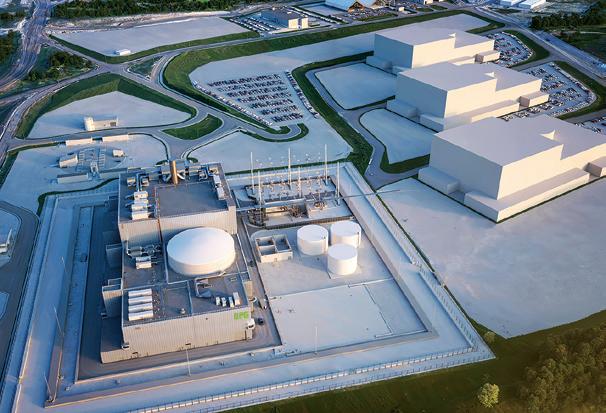
Modular Reactors and the SMR Forum, told The Northern Miner For some in the nuclear industry, the Darlington SMR is an opportunity to elevate Canada’s expertise to the world stage while also driving investment in the domestic sup-
ply chain, including demand for uranium and reactor construction materials such as zirconium, niobium and specialty steels.
Competition
However, Canada is entering an
increasingly competitive field among SMR programs with standardized designs and repeat builds. The industry is striding past the 40th anniversary of the Chernobyl disaster in April with a new approach.
“The United States and the United Kingdom are moving in that direction, with frameworks designed to support faster, more standardized licensing and repeat deployment,” Gosalci said in an email from London, U.K. “The global competition is increasingly about scale and speed.”
The timing reflects a shift in Ontario’s power outlook. After years of relatively flat demand, consumption is rising again on the back of electrification, industrial growth and data centres. That has pushed nuclear back to the centre of the province’s long-term supply plan, following major refurbishment programs at existing stations. Darlington is the first new nuclear
build in Ontario in decades, marking a shift from extending the fleet to expanding it.
The Darlington project has been structured as a long-term, strategic investment, with up to $2 billion from the Canada Growth Fund, $1 billion through the Building Ontario Fund, and a $970-million loan from the Canada Infrastructure Bank.
The key question is whether construction timelines, regulatory processes and existing industrial capacity can support a multi-unit build program rather than a single flagship project.
“This requires a shift from a project-by-project model to a designand-program model,” Gosalci said.
“In practical terms, that means clearer timelines, stronger pathways for standard design approval, more predictable permitting, and regulatory treatment that allows repeat
1

By Blair McBride
Uranium production is shaped by geology, recovery method and cost – a balance that helps explain why a country like Kazakhstan accounts for about 40% of global supply. In other jurisdictions, it's more expensive to mine the metal but high grades can help offset those costs. The Northern Miner looks at four representative producing mines across a spectrum to show how local conditions influence their methods and costs.
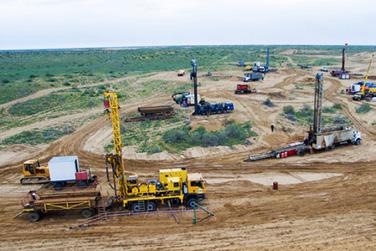
KAZAKHSTAN
$16.50 TO $18 PER LB
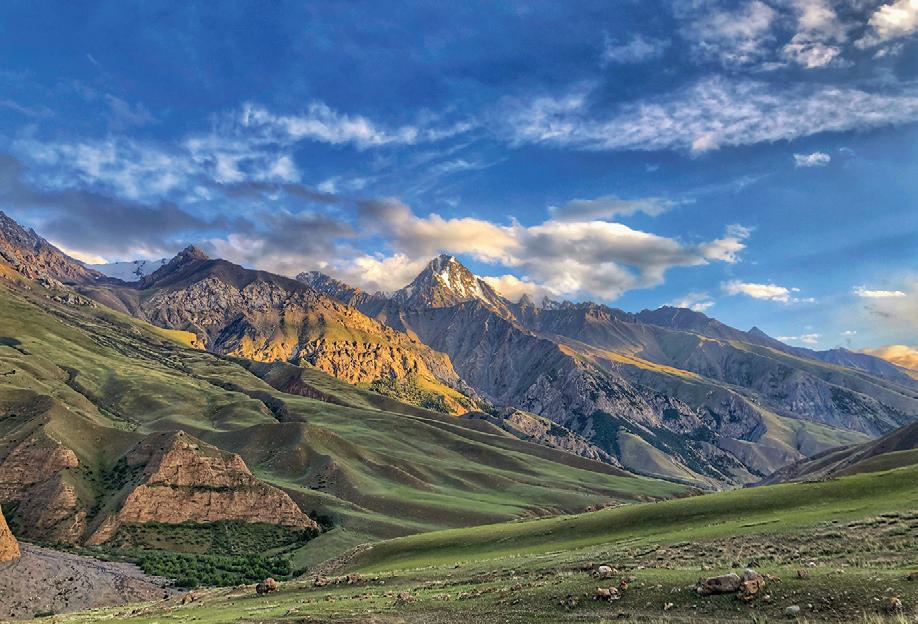
State miner Kazatomprom’s in-situ recovery (ISR) operations in Kazakhstan (2024 data). ISR mining, where uranium is dissolved underground with a solution and pumped to the surface through wells, helps reduce costs beacause it uses far less infrastructure than conventional mining and Kazakhstan has been producing at a large scale for decades.*
2
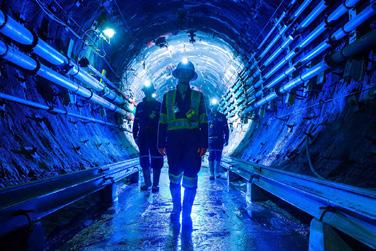
CANADA
$20.60 PER LB.
Cameco’s Cigar Lake underground mine in northern Saskatchewan’s Athabasca basin (2024 data). The mine is technologically complex, using an artificial ground freezing system and high-pressure water jets, but Cigar Lake’s very high grades help reduce the cost per pound of uranium. **
3
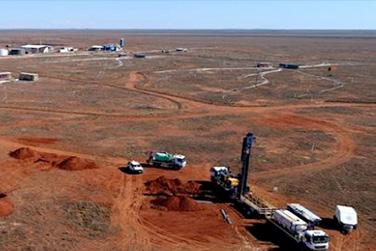
AUSTRALIA
$23 – $25 PER LB.
Boss Energy’s Honeymoon ISR mine in South Australia (2025 data). While ISR mining is generally cheaper than other methods, the Honeymoon mine is still ramping up to capacity, it has a smaller production base and Australia brings higher regulatory and labour costs. *
4
NAMIBIA
$40 PER LB.
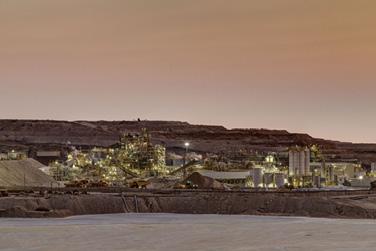
Paladin Energy’s open pit Langer Heinrich mine (2026 data). Its lower-grade ore requires mining large volumes of material and more complex processing, including crushing and alkaline leaching. Namibia’s arid environment also means water must be carefully managed, raising costs further. ***

BY NORTHERN MINER STAFF
The Northern Miner’s Devan Murugan speaks with SRK U.S. President Ben Parsons about how the current commodity upcycle—driven by gold, copper, and critical minerals—is translating into real activity.
Devan Murugan: Ben let’s talk about the U.S. How long have you been in that position at SRK?
Ben Parsons: I’ve been with SRK for almost 20 years. I spent five years in our U.K. offices initially, working under a number of skilled people there. I then transferred to the U.S. 13 years ago to take on the role of principal resource geologist, helping build out our Denver group. In the last six months, I’ve taken on more of a managerial role as well, wearing many hats within our group and stepping into the U.S. president role for our operations.
DM: It’s a very interesting time, isn’t it? You have gold and copper both experiencing highs, along with other precious metals. Has that driven different types of work through your door?
BP: It really is an interesting time. At PDAC this year, you can see the volume of people involved is exceptionally high.
What we’re noticing, though, is that if we look back over the industry, we see clear cycles. There’s always been a cyclic nature to what we do. We’ve seen this sustained uptick in prices if you look at the charts.
However, there’s been a bit of a lag in the typical cycle response. If we look at the last major cycle—2010 to 2012—we were seeing over 1,000 technical reports annually on the TSX and in British Columbia. Right now, that number is still in the 500 to 600 range.
What’s really been happening is that companies have been more controlled with capital deployment. Many have been rebalancing and resetting their balance sheets.
But from discussions here at the conference, particularly with drillers and contractors, there is now a definite uptick in activity. That will translate into more consulting work. If we break it down, there are three areas.
First, there has been a lot of focus on M&A activity as companies rebalance. My group
in Denver specializes in this. We have geologists, mining engineers, mineral economists, and metallurgists working in the financial space, and we’ve seen that advance over the past 12 months.
Second, on the technical side, we’re seeing more focus on brownfield extensions—ways to significantly increase production at existing operations. A lot of that is driven by permitting challenges and the time it takes to bring new projects to market.
There’s a stronger near-term focus on assets that can be brought into production more quickly.
Third, we’re seeing older projects—those that missed out in the last cycle due to weaker economics—coming back.
With new ownership and new approaches, they are being developed again.
These are the trends we would expect, and we believe activity will continue to increase. I would expect that report count to be quite a bit higher by this time next year.
DM: It’s interesting you say that, because I was also wondering whether companies still get caught up in the cycle?
BP: Yes, that has traditionally happened. There is often a rush to get involved when markets are strong.
However, this time we’re seeing more discipline. Companies are taking a more measured approach and looking more holistically at projects.
It’s not just about what’s in the ground. It’s also about environmental and water-related issues that could add complexity. That can influence where and how capital is deployed.
Our role as independent consultants is to provide sound advice and ensure clients don’t get carried away. What we want is for them to develop robust projects that can stand up economically and be brought to market.
DM: The energy transition has brought in a new category of clients. How is that changing the skill set required at SRK?
BP: That’s a really good question. We are seeing new clients, and this has been happening over the last three to five years. Traditionally, we’ve worked with majors, mid-tiers, and junior miners who understand the mining process.
Now we’re seeing car makers, battery companies, and chemical companies entering the space, looking for expertise in areas that are non-traditional to them.
For us, that has meant becoming more integrated as a company. While we had established approaches for gold and copper, those cannot simply be applied to lithium brines— they are completely different.
We’ve had to strengthen our expertise in areas like processing and hydrology, and better understand how these factors influence projects.
At the same time, internal silos have become less rigid, with more collaboration across technical groups. That is leading to better outcomes, even beyond critical minerals.
So it’s a twofold approach— strengthening our technical bench while supporting non-traditional players with broader ESG, water, and regulatory considerations.
DM: Let’s talk about artificial intelligence. How has AI moved the needle in your consulting work?
BP: I think the most important thing is to say what AI is not. Let’s start at that point. AI is not a magic pill. It is not something where we can push a button and develop a geological model, a resource estimate, design a mine, or write a technical report that will meet the rigours needed for regulatory disclosure.
What we are often dealing with is a world where we have relatively sparse data, compared to other industries and the knowledge points we’re trying to pull across.
So, it’s that industry expertise and integration of teams where we are supplementing.
When we talk about AI or new technology, we’ve been doing machine learning, and we’ve had a lot of skilled data scientists working within our groups before these even became buzzwords. We look to technology for ways to augment and add skills for our experts.
If we can make things easier so they can look at more data, it allows us to get to the next level of complexity in the problem. That is really where we see the power of this technology moving.
The idea that there is a chatbot that acts as a magic oracle you can ask a question is a perception that might be out there of what AI will do.
What we focus on at SRK is how we can improve the work we are already doing to get to a better answer, produce something more robust, and achieve a better assessment of risk within the profiles we are already developing for clients.
That is the approach we are taking.
DM: We’re seeing consolidation in consulting. How does that impact SRK?
BP: It’s definitely a trend, particularly over the past one to two years. Private equity and larger engineering firms have recognized the value of these skills and are acquiring smaller firms.
There’s a move toward building one-stop-shop providers across the mine lifecycle.
Where SRK sits is that we are employee-owned and independent. That is fundamental to how we operate.
We provide independent advice with no incentive to be positive or negative. Clients know they will receive a robust and objective assessment, and that remains our position in the industry.
DM: When do companies typically bring you into a project?
BP: We get involved at all stages. Often, we are involved at the front end boots on the ground— through exploration or structural geology work.
We come in when a company wants to move a project to the next phase, often when they need to raise capital.
That hasn’t changed significantly. What has grown is the environmental and closure side of the business, which is less exposed to market cycles.
Our involvement depends on which part of SRK is engaged, but one of our strengths is that we can support projects across the entire lifecycle.
DM: Looking five to 10 years ahead, what does mining consulting look like?
BP: Our core will remain the same—working with clients and understanding their needs. Often, the first question we ask is, “What do you need?”—and sometimes we ask it twice, because it takes time to fully understand the problem.
Technology will give us more tools, but our core business will still be providing independent advice.
Where I see us evolving is working more closely with management teams to help assess and de-risk projects. That independent advice will remain central to what we do.
DM: Ben Parsons, thank you very much for your time.
BP: Thank you.
The preceding sponsored article is PROMOTED CONTENT paid for by SRK and produced in co-operation with The Northern Miner. Visit: www.srk.com/en/ for more information.
BY FRÉDÉRIC TOMESCO
Privately held Global Battery Materials (GBM) is aiming to restart Ontario’s mothballed Kearney graphite mine in less than two years to tap an expected surge in demand for the mineral amid growing calls for domestic production. .
Kearney, which closed in 1994, could initially produce 23,000 tonnes of carbon graphite annually starting in 2028, rising to 50,000 tonnes, CEO Eric Miller said. GBM has hired engineering firm WSP to revise a 2018 feasibility study, and an updated document could be ready by the fall, he said. Toronto-based GBM is also looking at building an anode material plant somewhere in North America.
“This is not a greenfield project, so we don’t need years to turn it on.
Twenty months is what we need,” Miller, a two-decade veteran of the manufacturing and automotive industries, told The Northern Miner in an interview.
GBM’s non-executive chairman is Renaud Adams, Iamgold’s (TSX: IMG; NYSE: IAG) CEO. Adams declined to be interviewed for this story, saying he would rather let Miller remain the spokesperson for GBM.
Chinese dominance
The push to restart Kearney comes as Canada, which has designated graphite as a critical mineral, works to cut its dependence on China. Canada’s southern neighbour, which imports all of its graphite, is pursuing a similar strategy.
China is home to an estimated 70% of global natural graphite pro-
duction and more than 90% of downstream battery-grade graphite processing, analysts say.
“There’s been a huge increase in interest for graphite over the last five years, but the real push especially from miners and investors has come since (U.S. President Donald) Trump took office,” Sid Rajeev, head of research at Vancouver-based equity analysis firm Fundamental Research, told The Northern Miner in an interview. “There’s a clear will to reduce the reliance on China. How do we get stable longterm sources of supply? That’s the bigger story.”
In November, Ottawa referred Nouveau Monde Graphite’s (NYSE: NMG, TSX: NOU) Matawinie mine and processing plant project to its Major Projects Office for fast-tracking. Once in operation, Matawinie is projected to become the largest graphite mine in the G7.
For now, Canada’s Northern Graphite (TSX-V: NGC; US-OTC: NGPHF) – the operator of the Lacdes-Iles mine in Quebec – remains North America’s only producer of natural graphite.
While the global graphite market is currently in surplus, it’s expected to tip into a deficit by the end of the decade, according to a March report from Fundamental Research.
Outsized impact
Graphite typically makes up about 15% to 25% of a lithium-ion battery’s total weight. Recent Chinese export controls and U.S. anti-dumping measures underscore the urgency of developing robust and dependable sources of
supply, GBM says.
Global demand for graphite is expected to climb 9% annually from 2025–2035, according to Benchmark Mineral Intelligence forecasts. Natural flake graphite demand alone is set to more than double to almost 3 million tonnes by 2035, requiring about 30 new mines to meet demand.
“Given the exponential growth expected for graphite demand, supply has to consistently keep increasing,” Rajeev said.
In March, GBM delivered its first graphite samples from Kearney to unidentified U.S. customers. It also opened a laboratory in Mont-Laurier, Que. that’s designed to purify and upgrade natural graphite from low-grade raw ore to battery-grade final concentrate.
Large deposit
Located just west of Algonquin Provincial Park and near the town of Kearney, about 280 km north of Toronto, the namesake site is considered one of the largest flake graphite deposits outside of China.
The mine, which opened in 1989 and processed almost 1 million tonnes of ore, was shuttered five years later amid depressed graphite prices. It’s been in care and maintenance since then.
Kearney held 23 million tonnes of proven and probable reserves grading 1.95% carbon graphite, previous owner Ontario Graphite said in a report from 2020. It also held 61.8 million measured and indicated tonnes grading 1.99% carbon graphite and 59.2 million inferred tonnes grading 1.88% carbon graphite.
“There’s been a huge increase in interest for graphite over the last five years, but the real push especially from miners and investors has come since Trump took office.”
SID RAJEEV, HEAD OF RESEARCH, FUNDAMENTAL RESEARCH
Ontario Graphite owned the mine until filing for creditor protection in 2020 and subsequently selling the property to G6 Energy. GBM acquired G6 Energy’s assets last year.
“This is a generational asset, which has the benefit of being proven,” Miller said. “That resonates with customers when we talk about speed to market.”
Miller won’t say how much the mine—which is projected to have an operating life of at least 20 years —or the midstream plant would cost to build because analysis is ongoing. Kearney’s existing infrastructure means the restart will be “relatively low-cost,” he said without being specific.
Site selection
GBM’s anode material plant should have an annual processing capacity of about 50,000 tonnes, with room for expansion, Miller says. With
BY FRÉDÉRIC TOMESCO
Nouveau Monde Graphite (NYSE: NMG; TSX: NOU)
is securing $297 million (C$413 million) in a transaction that will see Italian energy giant Eni buy a 12% stake to help the Canadian developer advance its proposed Matawinie mine in Quebec towards a final investment decision.
Eni is paying $70 million for its equity share, along with investments of $82 million by the Canada Growth Fund and $61 million by Investissement Québec, Nouveau Monde said April 9 after the close of trading. Nouveau Monde will sell the investors 115.8 million common shares at a price of $1.84 —a 22% discount to the stock’s previous closing price of $2.35 in U.S. trading.
The deal—which also includes an $84-million bought-deal public offering—represents the final step in assembling a broader $633-million project financing package that combines senior debt, equity investments and public market capital.
Canada Growth Fund will become Nouveau Monde’s biggest shareholder with a stake of about 20% once the deal closes, while
Investissement Québec will own about 18%, CEO Eric Desaulniers said following the announcement.
“The most exciting part this transaction is seeing a large industrial player like Eni with big ambitions getting involved in the development of a critical minerals project. Maybe it’s a way for the future,” Desaulniers told The Norther Miner in an interview.
Eni diversifies
Investing in Nouveau Monde “is consistent with Eni’s strategy to diversify its supply chains,” the Italian company said in a statement April 10. The deal will give Eni the opportunity to negotiate exclusive supply agreements for graphite and active anode material.
U.S.-traded shares of Nouveau Monde plunged 23% to
Kearney scheduled to start producing graphite in early 2028, anode materials production could begin near the end of 2028 before ramping up in 2029, he adds.
Site selection work is already under way.
“We’re looking at Ontario, we’re looking at Quebec, we’re looking at the U.S.,” the CEO says.
GBM also plans to look at fundraising options in the second half of 2026, Miller says. Those could include private capital injections, an initial public offering and the sale of a stake to a government entity, he said.
“We’re looking at all options,” Miller said. “Governments are expanding the toolkit as to how they’re going to get these critical minerals projects going. We’re definitely open for equity and whatever that toolkit looks like.”
Uphill battle
No matter how successful western companies such as GBM are in ramping up graphite output, Miller acknowledges they’ll be hard-pressed to catch up with Chinese giants such as BTR New Material Group, the world’s biggest producer of lithium-ion battery anode materials.
“We go to work every day on a mission to change that picture,” he says of China’s dominance. “It might feel like the West has a lot of projects, but when you add them up, it doesn’t really flip the switch in terms of China’s dominance in this space. BTR alone has over 600,000 tonnes of capacity. What we’re working to do is just put a dent in that.” TNM
$1.83 on the day after the deal was announced. In Toronto trading, they dropped 22% to C$2.52 apiece before climbing to $2.99 near press time for a market capitalization of $481 million.
The shares fell as the financing priced new equity at a discount, diluting existing holders and signalling a higher cost of capital to get the project built.
Nouveau Monde’s equity raise comes less than a month after Export Development Canada and the Canada Infrastructure Bank jointly committed C$335 million in senior debt to fund the project through its construction, development and commissioning.
Matawinie—which has an estimated capital cost of $421 million, according to a feasibility study issued in March 2025 – was referred to the federal Major Projects Office in November.
Battery plant
Participants in the public offering are evenly split between Canadian, U.S. and international investors, Desaulniers said.
“The interest seems to be global,” he said. “All the G7 coun-
tries understand the importance of financing such an important critical mineral project.”
Proceeds from the financing will be used to advance development of Matawinie and a new anode material plant Bécancour, Que. The assets will form an integrated North American supply chain for lithium-ion batteries.
Located in Saint-Michel-desSaints, about 120 km north of Montréal, Matawinie is expected to become North America’s largest graphite operation and a cornerstone asset in Canada’s critical minerals strategy as governments and industry work to secure domestic supply chains for battery materials.
Building Matawinie “will ensure we can deliver Quebec’s graphite internationally for decades to come,” federal Energy and Mining Minister Tim Hodgson said April 9 in a message on X.
Offtake agreements
Matawinie was singled out as a priority project in October when Ottawa unveiled plans to support 25 new critical-minerals investments.
ANTIMONY | Canada needs specific funding, miners say
BY HENRY LAZENBY
The war with Iran has pushed antimony further out of the shadows, highlighting the metal’s modern use in explosive formulations, flares and infrared sensors. The United States Geological Survey says 40% of U.S. antimony use last year went into antimonial lead and ammunition.
Canada already classifies antimony as critical but still lacks, miners say, a specific policy built to move the defence metal’s production from exploration to funding, permitting and processing.
“Canada, in my mind, is not doing enough,” Canagold Resources
(TSX: CCM; US-OTC: CRCUF)
CEO Catalin Kilofliski told The Northern Miner. “Canada does not have an antimony-focused strategy. It’s lumped within the general critical metals bucket.”
Canada’s antimony project pipeline remains thin, most tied to gold systems rather than stand-alone antimony mines and still lacks a clear domestic route from mine to metal.
Canadian projects
Canagold’s New Polaris gold-antimony project in northwest British
Columbia is the most advanced, with an update to last year’s feasibility underway. Endurance Gold’s (TSXV: EDG; US-OTC: ENDGF)
Reliance project in southern B.C. is a gold-antimony system with a first gold resource and antimony testwork underway.
At a pre-resource stage are Antimony Resources’ (CSE: ATMY)
Bald Hill in southern New Brunswick and Critical One Energy’s (CSE: CRTL; US-OTC: MMTLF)
Howells Lake project in northwestern Ontario.
New discoveries of antimony matter today given that China tightened export controls in 2024 and then banned metal exports to the U.S., helping drive prices higher and exposing North America’s weak supply chain. New Brunswick in March launched a competitive process for the old Lake George antimony mine, another sign governments want fresh domestic supply.
Where money flows
Also in March, Ottawa reaffirmed more than $3.6 billion (US$2.6 billion) in critical-minerals programs and investments, including a $1.5-billion First and Last Mile Fund and an upcoming $2 billion Critical Minerals Sovereign Fund.
But those are broad critical-minerals tools, not an antimony strategy. That is the divide opening between Canada and the U.S., where Perpetua Resources (Nasdaq, TSX: PPTA) has already received more than US$80 million in Pentagon support for antimony work and where the government’s Export-Import Bank of the United States has advanced a proposed US$2.7-billion loan for Perpetua’s Stibnite gold-antimony project in Idaho now under construction.
“In Canada there really is no antimony development as such,” Antimony Resources CEO James Atkinson said in an interview, contrasting Canada’s thin project bench with U.S. backing for named projects.
Even if Canadian mines advance, the harder problem comes later, because North America still lacks a clear processing route for new antimony concentrate, according to Atkinson.
Canagold has become a test case, according to Kilofliski. The company filed its environmental assessment application for the New Polaris on April 1, putting it ahead of other antimony projects in Canada.
The mine plan contains 5,173 tonnes of antimony, though the current feasibility study gives it no
antimony revenue, and Kilofliski said the company will drill 7,000 metres this summer to try to pull the metal into project economics.
Funding denied
Canagold has applied for Natural Resources Canada-related financial support and was turned down. It appears antimony is competing for capital against a long federal list of priority minerals instead of moving
through its own lane, the CEO said. Antimony stayed on the federal critical minerals list when Ottawa updated it in 2024, yet the metal still competes for funding with 34 others in a framework that spreads money and policy attention across a much larger field, Kilofliski said. Ottawa’s latest progress update says the country had 171 advanced




BY NORTHERN MINER STAFF
Rising demand for nuclear energy is sustaining interest in uranium projects around the world.
Here’s a list of eight companies to watch.
ATHA Energy (TSXV: SASK) is advancing its main Angilak uranium project in southern Nunavut’s Angikuni Basin. The project hosts the Lac 50 deposit, one of the largest high-grade uranium deposits in Canada outside Saskatchewan’s Athabasca Basin.
Exploration last year focused on target areas along three mineralized corridors—Lac 50, KU-Nine Iron and RIB.
The 21-km-long Lac 50 corridor is located just outside the northern margin of the Angikuni Basin and hosts the Lac 50 deposit, which remains open.
Atha has not completed a modern resource estimate for Lac 50, but the company’s 2024 exploration target ranges from 60.8 million lb. uranium oxide (U3O8) to 98.2 million lb. U3O8 with an average grade of 0.37% U3O8 to 0.48% U3O8
The conceptual 2024 target was based on diamond drillhole data including drill program results from 2024 and the ranges
of potential quantity and grade were derived from conceptual vein wireframes, drill core assays, grade interpolation and applied uncertainty ranges.
The 14-km-long KU-Nine Iron Corridor lies within the northern Angikuni Basin, extending from the KU discovery to the Nine-Iron area, while the 18-km-long RIB Corridor is situated along the western edge of the Basin.
The first drillhole in the RIB Corridor, RIBN-DD-001, returned 34.7 metres of total composite uranium mineralization, including 13.6 metres grading 0.53% U3O8 and 1.1 metres grading 4.81% U3O8
In February the company reported final assays from its 2025 drill program, which confirmed high-grade mineralization at the project’s KU and Mushroom Lake targets, as well as expansion of the J4/Ray zone mineralization beyond the Lac 50 deposit exploration target area.
Also in February, the company closed a private placement of US$25 million ($34.9 million) of unsecured convertible debentures from Queens Road Capital Investment (TSX: QRC). Queens Road is a leading financier in the global resource sector and was a critical supporter of NexGen Energy’s (TSX: NXE) development, investing US$100 million between 2020 and 2023.
In addition to Angilak, Atha has other drill-ready targets in the Athabasca Basin, most of which it acquired in 2022 through syndi-
cate deals backed by NexGen and IsoEnergy (TSX: ISO). Atha also has targets in the Central Mineral Belt of Labrador.
The company holds a 10% carried interest in key Athabasca Basin exploration projects operated by NexGen and IsoEnergy.
Atha Energy has a market cap of about $281 million (US$205 million).
n CanAlaska Uranium
CanAlaska Uranium (TSXV: CVV; US-OTF: CVVUF) is fully funded for a busy exploration year across multiple projects on its 5,000-sq.-km land package in the eastern Athabasca Basin.
The company plans to drill at its Key Extension and Nebula projects, which are located 15 km and 30 km, respectively, south of Cameco (TSX: CCO; NYSE: CCJ) and Orano Canada’s past-producing Key Lake mine and currently operating Key Lake mill. That mill is about 530 km north of Regina. The drill programs will focus on high-priority target areas that were identified through recent airborne geophysical surveys.
CanAlaska has also started a co-funded $15 million exploration program with three drill rigs on the West McArthur project, which it holds in a joint venture with Cameco.
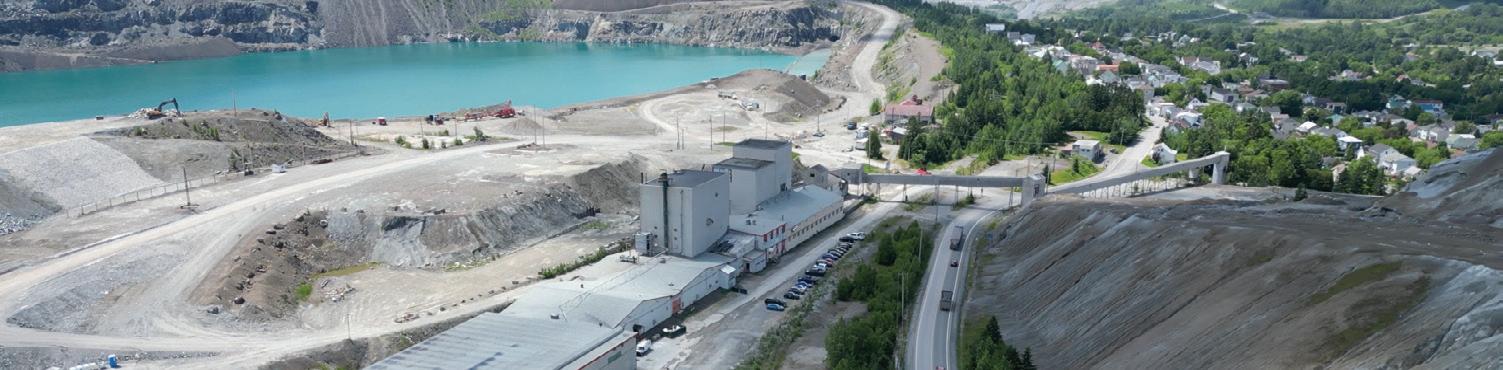
CanAlaska owns 89% of West McArthur, which sits about 20 km west of Cameco’s McArthur River mine in the southeastern Athabasca Basin. The drill program
this year will focus on step-outs from the Pike zone, where previous highlights include 8.6 metres grading 34.6% U3O8, including 5.5 metres at 53.9% U3O8 in drillhole WMA079-01.
The company is evaluating a ground-based electromagnetic survey on its Waterbury South project, about 10 km southeast of Cameco’s Cigar Lake mine in the basin’s northeast. The survey aims to identify conductive corridors to generate drill targets and follow up on historical mineralization and geochemistry anomalism that was intersected during earlier drill programs.
At its Cree East project in the eastern Athabasca Basin, CanAlaska is considering a summer drill program. In the meantime, it is evaluating a groundbased electromagnetic survey to refine historical geophysical targets that were identified before last year’s exploration program. Cree East is 35 km west-northwest of the Key Lake mine and mill.
CanAlaska is also evaluating the potential for drill programs this summer on its Voyager and Enterprise projects, 20 and 30 km south, respectively, of the Key Lake mine and mill.
In addition, the company and its joint-venture partner, Denison Mines (TSX: DML; NYSE-AM: DNN), plan to pursue geophysical exploration at the Moon Lake South project. The project, quarter-owned by CanAlaska, is adjacent to Denison’s Wheeler River property. It hosts the Gryphon and
Phoenix deposits, where Denison is advancing Canada’s first in-situ recovery mine.
CanAlaska Uranium has a market cap of about $159 million.
n
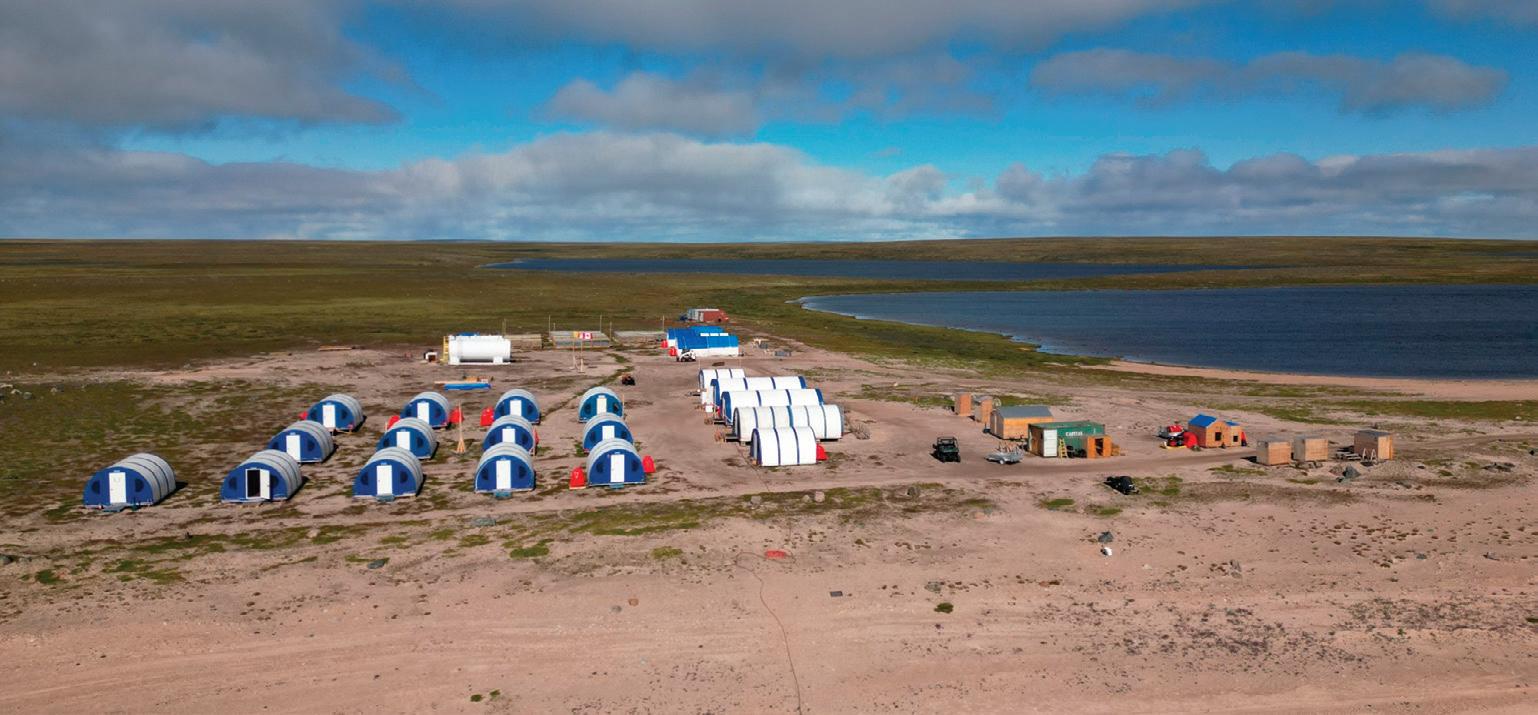
Future Fuels’ (TSXV: FTUR; US-OTC: FTURF) principal asset is the Hornby project in northwestern Nunavut’s Hornby Basin, about 95 km southwest of Kugluktuk near the border with the Northwest Territories.
The 3,407-sq.-km project contains over 40 underexplored uranium showings and the historic Mountain Lake System.
A 2025 ground gravity survey delineated several high-priority gravity anomalies spatially associated with major structural corridors, stratigraphic boundaries and known uranium mineralization.
The company started the permitting process to begin drilling at Hornby in early December. If successful, two helicopter-portable rigs will drill up to 10,000 metres this summer. Future Fuels will also undertake geological mapping, prospecting, geochemical sampling, drone photogrammetry, ground and airborne geophysics and downhole surveys. The program will be carried out by a 25-person helicopter-supported exploration camp
Uranium Spotlight P12 >
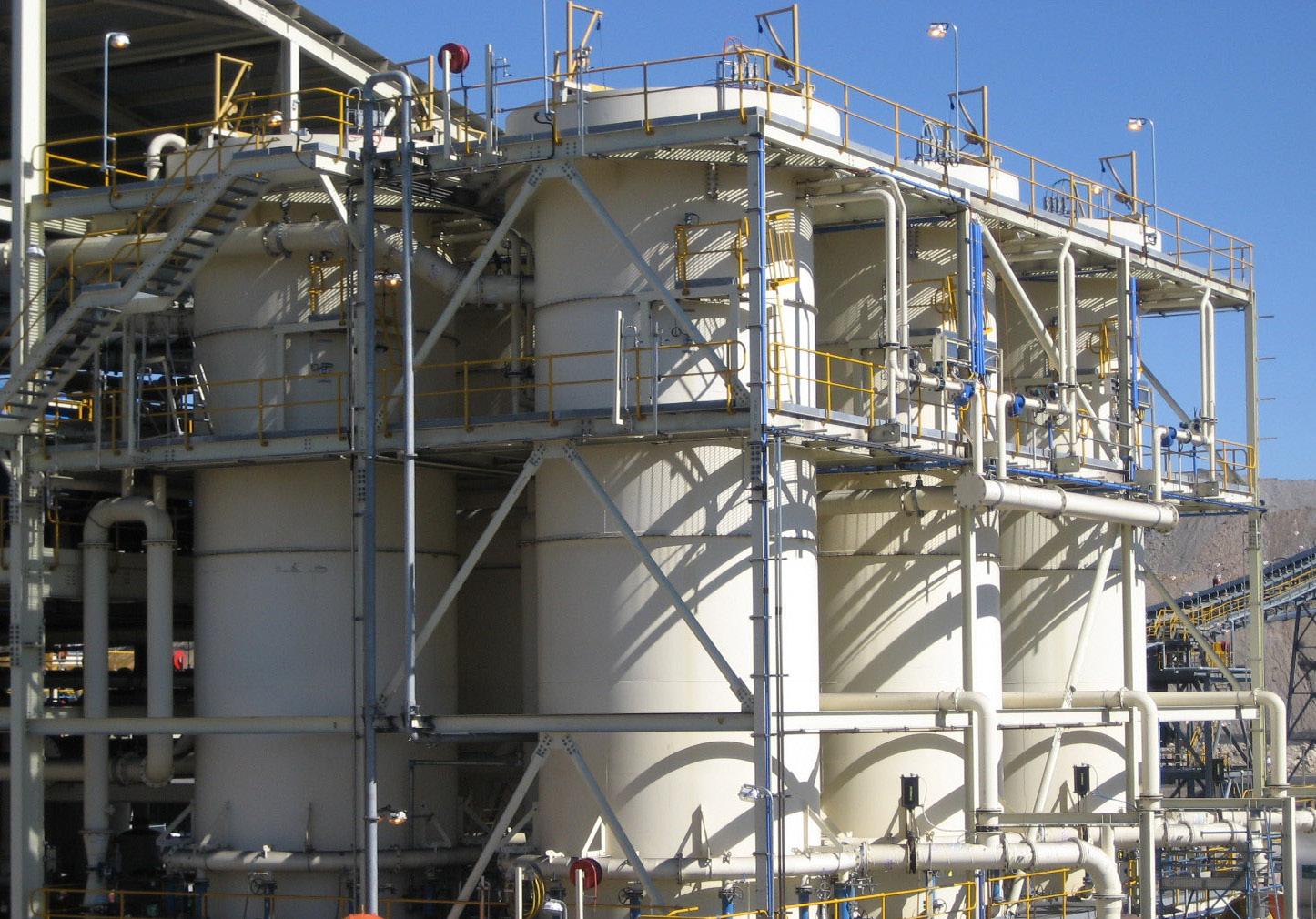
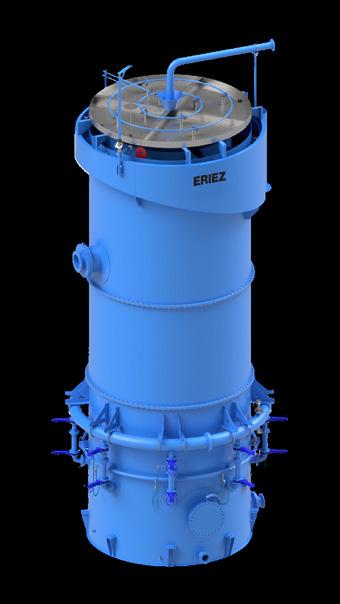
Eriez has supplied more than 1,000 flotation columns throughout the world for mineral concentration and purification. Eriez. Always the Right Choice.
Column Flotation offers superior metallurgical performance, engineered for high recoveries and concentrate quality.
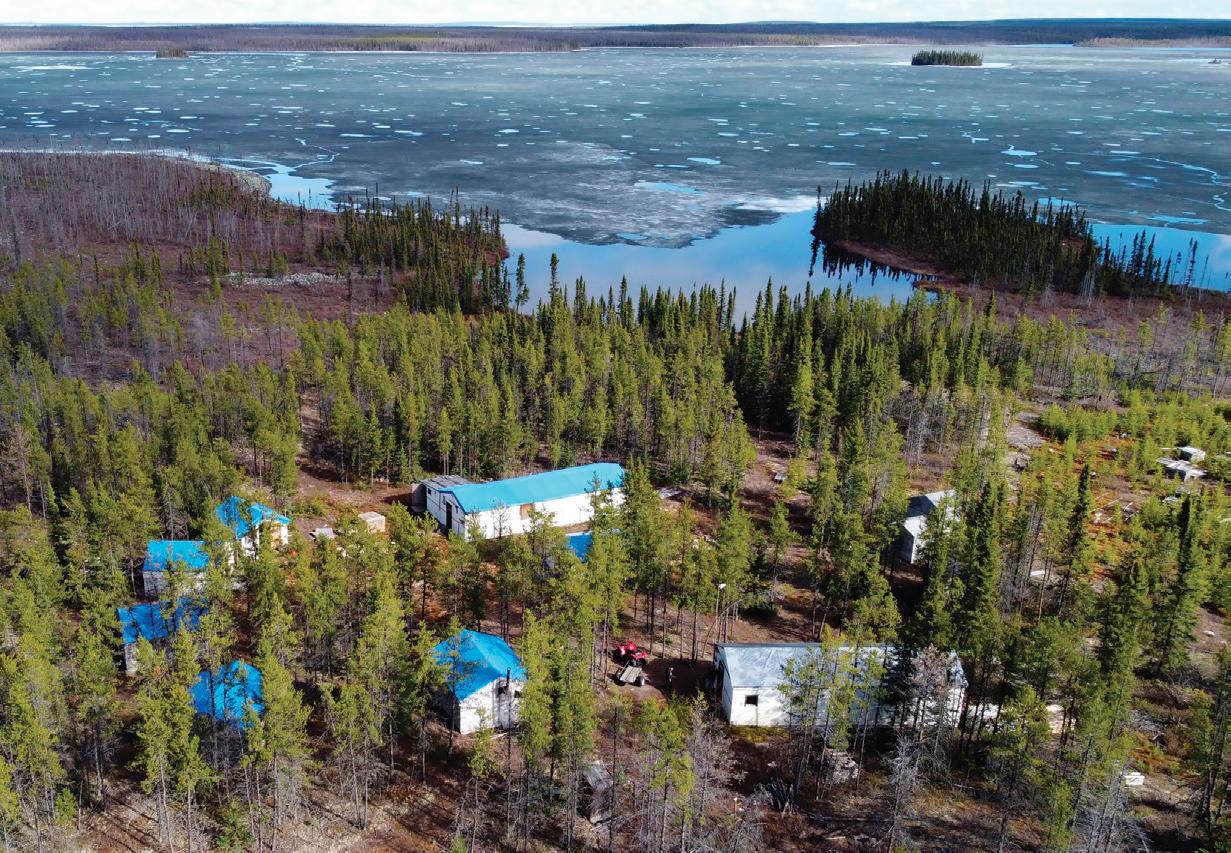
near Mountain Lake.
The last extensive exploration in the area occurred in the 1970s. Esso discovered the Mountain Lake deposit in 1976, completing a non-compliant historical resource of 1.6 million inferred tonnes at 0.23% U3O8 for 8.2 million lb. contained U3O8
In February, Future Fuels entered into an agreement to acquire Hatchet Uranium, a subsidiary of ValOre Metals (TSXV: VO; US-OTC: KVLQF). Hatchet Uranium has five claim blocks in the Athabasca Basin.
The 977-sq.-km claim package lies in the Wollaston Lake area along the eastern Athabasca Basin margin. The claims—Hatchet Lake, CBX/Shoe, Usam, Genie and Highway—have been explored since the 1960s with airborne and ground geophysics, geological mapping, prospecting, geochemical sampling and limited diamond drilling.
More recent work has consisted of data compilation and target generation using VRIFY artificial intelligence, airborne Mobile MT surveys, ground geophysics, prospecting and rock sampling.
The Highway property is under an option agreement with Skyharbour Resources (TSXV: SYH; US-OTC: SYHBF) and once completed, the project will be subject to a 2% net smelter return royalty (NSR).
Uranium-bearing pegmatite and granite boulders at Highway produced spectrometer readings of up to 4,366 counts per second (cps) and 230 parts per million (ppm) uranium.
A 2% NSR is also payable to Skyharbour on the CBX/Shoe, Usam and Genie blocks.
Hatchet Lake is subject to a 2% NSR payable to Rio Tinto’s (LSE, NYSE, ASX: RIO) Canadian exploration unit. Spectrometer readings at Hatchet Lake returned up to 22,000 cps and 1,637 ppm uranium.
Future Fuels has a market cap of about $43 million.
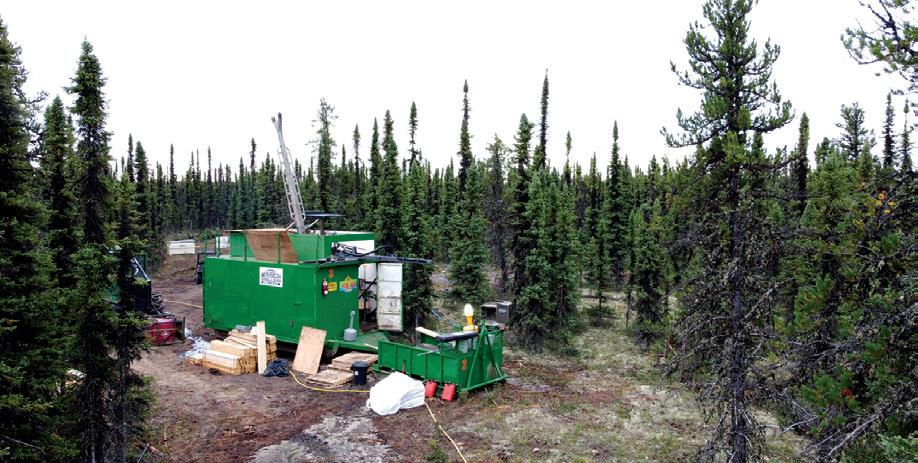
Geiger Energy (TSXV: BEEP; US-OTC: BSENF) holds 3,900-sq.km of exploration claims in the Athabasca Basin and 955-sq.-km in Nunavut’s Thelon Basin.
The company was previously known as Baselode Energy before it acquired Forum Energy Metals last June and renamed itself Geiger in October.
Its primary asset, Aberdeen in Nunavut, hosts the high-grade Tatiggaq and Qavvik uranium discoveries. Aberdeen is about 70 km west of Baker Lake and 1,300 km west of the territorial capital Iqaluit.
Tatiggaq is a basement-hosted prospect defined over a 300-metre strike length consisting of multiple steeply dipping, east-northeast trending mineralized lenses lying at a depth of between 80 and 180 metres. Notable drill intercepts include 11.1 metres grading 2.25% U3O8
Qavvik is a similar basement-hosted prospect, characterized by steeply dipping, mineralized east-northeast trending lenses across a 100 x 100 metre area, extending from surface to about 400 metres depth. The system is open for expansion over a 500metre area and at depth.
Aberdeen also contains over 50
high-priority exploration targets, some of which have never been tested and others that show strong alteration and anomalous uranium from limited historical drilling.
In the Athabasca, Geiger’s Hook project hosts the ACKIO near-surface uranium prospect that extends for more than 375 metres along strike and 150 metres width. ACKIO consists of at least nine distinct uranium pods with mineralization beginning at 28 metres from surface down to 300 metres. The system remains open at depth and along strike to the north, south and east.
Drill results released in March from ACKIO include AK26-148, which intersected radioactive mineralization from 80.7 metres depth with counts averaging 428 cps and a maximum of 958 cps, and at depths from 187 metres, counts averaged 2,291 cps, with a high of 11,491 cps from 202 metres.
Hook also hosts two interesting hydrothermal clay alteration systems—the TT area 5.5 km southwest of ACKIO and the TAB area 5 km to the northeast of ACKIO. Hydrothermal clay alteration is a key indicator of uranium-bearing systems.
At Aberdeen, the company will start its summer drill program in June with 10,000 metres focused
uranium mine and mill.
In April, the company reported results from its 2026 winter drill campaign. The 6,804-metre, 17hole drill program was targeting the South Trend of the deposit for resource expansion and testing greenfield targets up to 3 km east along the Larocque Trend.
Hole LE26-248, which was drilled within the low-grade resource envelope, intersected strongly elevated radioactivity, returning an average RS-125 spectrometer reading on drill core of 1 metre at 30,050 cps within a broader zone of 3.5 metres at 11,275 cps. The samples have been submitted to the Saskatchewan Research Council Geoanalytical Laboratory and assays are pending.
IsoEnergy holds numerous other exploration projects in the Athabasca as well as three joint ventures with Purepoint Uranium (TSXV: PTU; US-OTC: PTUUF): Dorado, Aurora and Celeste Block. Drilling last year at the 5,388-sq.-km Dorado project delivered the Nova discovery, with drillhole PG2507A returning 4.9 metres of 0.52% U3O8 from 391.8 metres depth.
IsoEnergy also has two projects in Quebec (Matoush and Dieter Lake) and permitted past-producing uranium and vanadium mines in Utah with a toll milling arrangement in place with Energy Fuels (TSX: EFR; NYSE-AM: UUUU). The mines, currently on standby, are ready to be restarted when market conditions permit.
In January, NexGen Energy invested $25 million through a private placement to maintain its 30% stake in the junior.
IsoEnergy has a market cap of about $895 million.
Purepoint Uranium (TSXV: PTU; US-OTC: PTUUF) is backed by industry leaders including Cameco, Orano and IsoEnergy in six separate joint-venture projects in the Athabasca Basin.
on the project’s Loki and Tatiggaq areas. Step-out holes at Loki will target the north end of a 4 km gravity anomaly and at Tatiggaq, the prospects are a high-grade basement-hosted zone consisting of two pods over a 300-metre area. Tatiggaq’s 1.5 km gravity anomaly remains open along strike and at depth and sits about 5 km west of Orano’s Andrew Lake deposit.
Geiger Energy has a market cap of about $15 million.
IsoEnergy (TSX: ISO) is focused on the Athabasca Basin and its Larocque East project, which hosts the highest-grade published indicated uranium resource in the world.
Larocque’s Hurricane deposit hosts 63.8 million indicated tonnes grading 34.5% U3O8 for 48.6 million lb. U3O8 and 54.3 million inferred tonnes lb. at 2.2% U3O8 for 2.7 million pounds. Hurricane measures 375 metres long, 125 metres wide and up to 12 metres thick.
The deposit is also relatively shallow at about 325 metres depth, and is located on the Larocque Trend, a regional structure hosting other high-grade occurrences including those on Cameco and Orano’s Dawn Lake joint venture. The project is situated just 35 km northwest of Orano Canada’s McClean Lake
The junior also has six of its own projects, one of which, Denares West, is optioned to Eldorado Gold (TSX: ELD, NYSE: EGO), which acquired Foran Mining in April.
At its Dorado 50:50 joint-venture with IsoEnergy, the companies have approved a 7,450-metre drill program with 17 holes. The winter campaign focused on exploring the 2025 Nova discovery with 10 drillholes (4,300 metres) and the summer program will test priority targets with seven holes (3,150 metres) starting in July.
Exploration programs at Purepoint’s two other 50:50 joint-ventures with IsoEnergy, the 65-sq.-km Celeste Block and the 531-sq.-km Aurora projects, have been delayed due to wildfires.
At its joint-venture Hook Lake project, in which Purepoint owns 21% and Cameco and Orano each hold 39.5%, the partners are considering a 4,850-metre drill program as well as some geophysics. Purepoint is the operator and earns a 10% management fee.
Purepoint is also working with Cameco in a 27:73 joint-venture at Smart Lake, 18 km northwest of the Hook Lake joint-venture and about 60 km south-southwest of Orano’s former Cluff Lake mine.
Physical Precious Metal Offtake
Metals Financing Including Debt, Equity and Royalties / Streams
Project Finance Advisory
Supply and Risk Management
Last year, the partners drilled 1,264 metres in three holes, and are considering a follow-up drill program at the 99-sq.-km project. Early drilling in 2023 and 2024 intersected basement-hosted uranium mineralization associated with a hydrothermally altered, graphitic shear zone that included 15.4 metres of 147 ppm uranium 200 metres from surface.
At Purepoint’s Denare West project, Eldorado has the option of fully acquiring it by spending a total of $19 million. The partners are modelling the results of an airborne electromagnetic (EM) survey along with historical data to prioritize drill targets.
The company is also considering an airborne magnetic survey, soil geochemistry and ground geophysics this year at its Russell South project. The project adjoins Cameco’s Key Lake project. Skyharbour Resources’ Moore Lake project and Rio Tinto’s Russell Lake project lie to the west and south, respectively.
Purepoint Uranium has a market cap of about $32 million.
In January, Skyharbour Resources (TSXV: SYH; US-OTC: SYHBF) staked 40 new exploration claims in the Athabasca Basin, boosting its total land package to 6,629-sq.-km across 43 projects.
The staking rush followed the formation late last year of four joint ventures with Denison Mines at its Russell Lake uranium project. Denison plans to invest up to $61.5 million in cash and exploration spending for stakes ranging from 20% to 70%.
The JVs cover the core Russell Lake (RL) claims along with Wheeler North, Getty East and the Wheeler River inliers. The properties share a 55-km contiguous border with Denison’s Wheeler River project.
Denison has committed at least $4 million for exploration in the first two years at Wheeler North and Getty East. This year, Denison is planning a 7,500-metre drill program at the 164-sq.-km Wheeler North JV (initially 51% Skyharbour/49% Denison and Denison can earn up to 70%) and 3,600 metres at the 31-sq.-km Getty East JV (initially 70% Skyharbour/30% Denison and Denison can earn up to 70%).
The claims at Getty East border Cameco’s Cree Zimmer property, which holds its Key Lake operations to the south. At the 532-sq.-km Russell Lake (RL) JV (80% Skyharbour/20% Dension), Skyharbour plans EM surveys followed by 4,000-5,000 metres of drilling to advance priority targets.
At Skyharbour’s Moore Lake project, 15 km east of Denison’s Wheeler River project, the company will drill 8,000 to 10,000 metres this year. Moore is located 39 km south of Cameco’s McArthur River mine and 42 km northeast of the Key Lake mill.
Highlights from Moore Lakes’ Maverick Main Zone last year included 4.4 metres at 4.84% U3O8 at a depth of 264 metres, including 1.6 metres grading 11.77% U3O8 in drillhole ML25-15.
Skyharbour has also identified a new target called the Nomad Zone about 1.7 km to the southwest of Maverick Main, where it inter-
sected sandstone and basement faulting accompanied by intense hydrothermal alteration.
In addition, Skyharbour has a 25:75 joint-venture with Orano at the 496-sq.-km Preston uranium project. Preston is one of the largest land packages in the Patterson Lake area and is near Paladin Energy’s (TSX: PDN) Triple R deposit and NexGen Energy’s Arrow deposit. This year the JV will drill 3,500 metres focused on two targets, FSAN and Canoe Lake.
Finally, Skyharbour has active earn-in option partners, includ-
ing Nexus Uranium (CSE: NEXU) at Skyharbour’s Mann Lake uranium project; North Shore Uranium (CSE: NSU) at its Falcon project and UraEx Resources at the South Dufferin and Bolt projects; Mustang Energy (CSE: MEC) at the 914W project; and Terra Clean Energy (CSE: TCEC) at the South Falcon East project.
Skyharbour Resources has a market cap of $103 million.
n Standard Uranium Standard Uranium (TSXV: STND; US-OTC: STTDF) is exploring
its main Davidson project in the Athabasca Basin, about 30 km west of NexGen’s Arrow deposit and Paladin Energy’s Triple R deposit and 75 km south of Orano Canada’s past-producing Cluff Lake uranium mine.
The property hosts more than 70 km of conductive trends across four main structural corridors— Warrior, Bronco, Thunderbird and Saint. All four of the geophysical corridors contain target areas favourable for basement hosted uranium mineralization.
The company has secured drill
permits and signed exploration agreements with the Clearwater River Dene Nation. It plans to test new targets this year with an 8,000-metre drill program.
At its Corvo project, which lies beyond the eastern margin of the Athabasca Basin, the company is planning to drill 3,000 metres this year, the first drill program at the project in 40 years. Aventis Energy (CSE: AVE) is earning up to a 75% stake in the project under an option agreement signed last year.
The company also plans to complete the first-ever drill program at its Rocas project, 72 km south of the present-day margin of the Athabasca Basin. The 1,800-metre program will test high-priority zones along the main 7.5-km magnetic low/EM conductive corridor, which hosts several uranium showings.
It covers 7.5 km of a northeast trending magnetic low/EM conductive corridor that hosts several uranium anomalies, including historical mineralized outcrop grab samples along a 900-metre strike length, grading up to 0.5% U3O8
In September, Standard signed an option agreement with Collective Metals (CSE: COMT) to earn up to three-quarters of the project.
Standard Uranium also is exploring its 196-sq.-km Sun Dog project, along the northwestern edge of the Athabasca Basin, and its 73-sq.-km Canary project in the eastern Athabasca.
Sun Dog contains the historical Gunnar uranium mine, which operated between 1953 and 1982. The company is undertaking 3-D modelling and inversions of EM and gravity data and integrating geophysics with sampling and drilling to help refine drill targets. It has completed three reconnaissance drill programs (4,062 metres) at Sun Dog, highlighted by the first drill hole at the Haven discovery, which intersected 1.5 metres of elevated radioactivity up to 1,300 cps. Standard Uranium has a market cap of about $16 million. TNM
BY CECILIA JAMASMIE
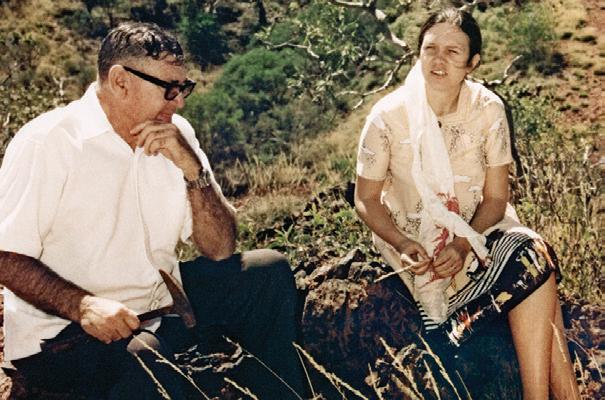
Australian billionaire Gina Rinehart’s Hancock Prospecting and partner Rio Tinto (LSE, NYSE, ASX: RIO) must pay millions of dollars in past and future royalties after a court sided with the heirs of her father’s former business partners.
The West Australian Supreme Court ruled that Wright Prospecting and DFD Rhodes are entitled to a share of royalties from parts of the Pilbara operation, marking a significant turn in a 15-year legal battle. The final payout will be determined at a later trial, though Hancock estimates the claims could total about A$14 million (US$10 million) a year for Wright Prospecting and A$4 million for Rhodes.
The court also rejected competing ownership claims over the Hope Downs and East Angelas tenements, confirming they belong exclusively to Hancock Prospecting and dismissing what the company called “baseless” assertions from Wright family entities.
The ruling adds fresh financial and legal pressure to a long-running dispute over the spoils from Hope Downs, a cornerstone Pilbara operation, and underscores how decades-old prospecting deals can still shape ownership economics at world-class mines.
Rinehart’s father, Lang Hancock, and his former classmate, Peter Wright, teamed up in the 1950s to secure mineral rights in the area that later became Hope Downs.
In 1969, they struck a deal with businessman Don Rhodes that promised a small royalty from ore produced there. The lawsuit later focused on the Hancock-Wright partnership, the division of assets under agreements negotiated in the 1970s and amended before Wright’s death in 1985, and the separate royalty claim advanced by Rhodes’ descendants.
“At the heart of the issues raised by the parties to the proceedings were a number of formal agreements made decades ago between men who were friends or colleagues who for some years engaged in harmonious and cooperative arrangements to explore, discover and prospect for iron ore in the East Pilbara,” Justice Jennifer Hilda Smith said in a summary judgment.
Hancock said the ownership issue was the central question in the court case and welcomed the court’s decision as a decisive victory, noting the judge found rival claims “fail at the first hurdle” and ruled it would be unjust for Wright Prospecting to benefit without contributing to the project’s risks or development.
Wright Prospecting replied by welcoming the judgment. “These proceedings were commenced in 2010 to recover our share of royalties from the Hope Downs 1 –3 mines, and, after many delays, we are pleased to finally receive a result in our favour,” it said in an emailed statement.
Hancock sought to spread the impact, saying Rio will share liability for any royalty payments and related interest to Wright or Rhodes.
“Bringing Hope Downs to life required significant investment in exploration, evaluation and development, obtaining thousands of government approvals, securing major project financing and a joint venture partner,” executive director Jay Newby said. TNM
PLATINUM | Ex-Anglo chief to lead review
sector,” Dorsch said.
BY KRISTIE BATTEN
Chalice Mining (ASX: CHN) has appointed Odin Partnership, founded by former Anglo American (LSE: AAL) chief Mark Cutifani, as a strategic adviser to advance its Gonneville palladium-nickel-copper project in Western Australia.
The move brings in a senior trio that also includes former Anglo executive director Tony O’Neill and ex–Bank of America metals and mining lead Omar Davis, as Chalice steps up development planning, financing strategy and market positioning for the asset.
Managing director Alex Dorsch said the endorsement followed a detailed review that began after an introduction in January. “To have someone like Mark Cutifani put his name to Chalice… it goes without saying he’s bit of a god of the
Odin’s team is expected to review the entire Gonneville project as it undergoes a feasibility study now ahead of a final investment decision in the first half of 2028. Chalice is aiming for the project, about 70 km northeast of Perth, to start production in 2030.
The 2020 greenfields discovery hosts 17 million oz. of palladium, platinum and gold (3E), 960,000 tonnes of nickel, 540,000 tonnes of copper and 96,000 tonnes of cobalt, according to a 2023 resource.
Building capacity
Work with Odin is expected to run from marketing to staging, management talent, potential partners, and off-takers, and help determine the optimal financing structure.
Chalice already has a non-binding memorandum of understanding with Mitsubishi, which has
provided technical and marketing input.
Odin’s networks across platinum group elements and base metals are expected to lift Chalice’s profile in Europe and North America, where the company has had limited exposure. The company may be coming in at the right time to help lift the stock, which has fallen 23% this year.
Investors may have shifted from discovery excitement at Gonneville, which once pushed Chalice’s market capitalization above A$3 billion (US$2.1 billion) towards the slower, riskier development stage. The market also appears to be weighing the project’s exposure to palladium and nickel, two metals that have faced weaker sentiment than copper, even as Chalice pitches the Western Australian asset as a globally significant palladium-nickel-copper project. TNM
M&A | Chinese firm pays $2.4B
BY CECILIA JAMASMIE
Yancoal Australia (ASX: YAL) has agreed to buy an 80% stake in the Kestrel coking coal mine in Queensland for as much as $2.4 billion (A$3.35 billion), strengthening its position among Australia’s largest coal producers.
The company, controlled by China’s Yankuang Energy will acquire the majority stake in the Bowen Basin operation from Hong Kong-based private equity firm EMR Capital and Alamtri Resources Indonesia, the companies said April 15. The deal includes an upfront cash payment of $1.85 billion at closing and as much as $550 million in additional annual payments over five years,
A growing tungsten and strategic mineral portfolio in a world-class mining jurisdiction
subject to certain conditions. Yancoal said it plans to fund the acquisition with a mix of available cash, a $1.2-billion five-year syndicated acquisition loan facility and other financing options. The deal would deepen its foothold in the Bowen Basin, where Kestrel sits near Yancoal’s existing Middlemount joint venture and Yarrabee operation.
Australia’s top coal mine
“The acquisition was a strategic fit for the company and adds a high-quality mine to its portfolio,” CEO Sharif Burra said. “Kestrel delivers increased scale and diversification to Yancoal’s portfolio and is expected to contribute premium metallurgical coal into our product mix.”
Kestrel, Australia’s largest producing underground coal mine, booked saleable production of 5.9 million tonnes in 2025, Yancoal said. The deal is expected to close by the end of the third quarter. A year ago, Yancoal said it was setting aside $1.2 billion for acquisitions.
EMR and Alamtri bought the 80% stake from Rio Tinto (LSE, NYSE, ASX: RIO) for $2.25 billion in 2018. The remaining 20% is held by Japanese trading house Mitsui & Co.
Shares in Yancoal Australia fell 1% on April 15 to close at A$7.23 apiece and were at A$6.92 near press time, valuing the company at A$9.14 billion (US$6.55 billion). They’ve gained more than 38% this year. TNM
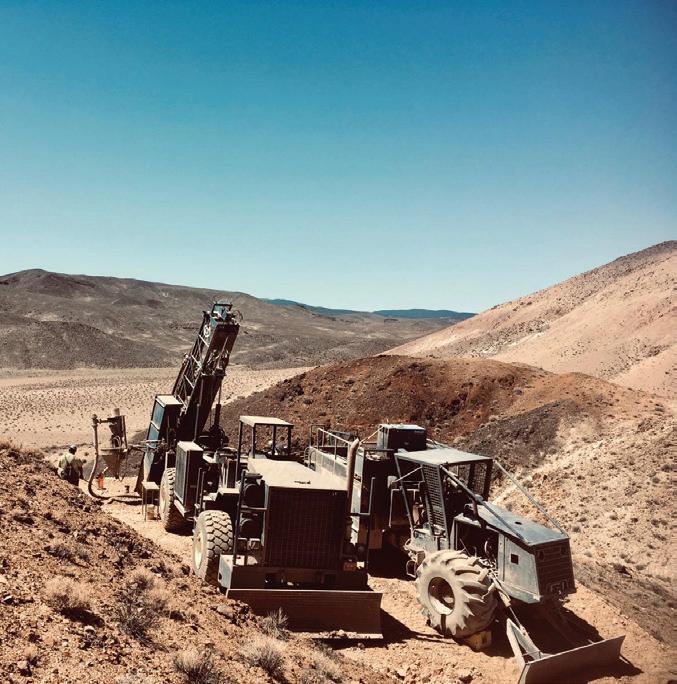
Emerging Tungsten Consistent tungsten occurrence along a 3km corridor
Robust Copper Platform
Defined JORC copper resource at M2 as well as district-scale porphyry driven upside
Precious Metals
Gold and silver exposure at Olympic and other claims
World-Class Location
100% owned claims in Nevada’s Walker Lane Belt Tier-one jurisdiction with established infrastructure and mining heritage




TREASURE HUNT | From forest to fortune, historic Bathurst Camp rises again
BY NORTHERN MINER STAFF
In the early 1950s, northern New Brunswick was not the place where most prospectors expected to strike it rich.
The region was known more for logging camps and fishing villages than for mines. Narrow roads wound through forests of spruce and birch, and the quiet rivers that flowed toward the Gulf of St. Lawrence carried far more timber than ore.
But for geologists studying the ancient rocks of the Appalachians, the area held promise.
Those rocks had formed hundreds of millions of years ago beneath a long-vanished ocean, where submarine volcanoes spewed mineral-rich fluids across the seafloor. In other parts of the world, such environments had produced massive deposits of zinc, lead, copper and silver.
The question was whether northern New Brunswick held the same hidden wealth.
Searches in the bush
One of the men determined to find out was a young geologist named Ken Ritchie, working with Brunswick Mining and Smelting, a company tied to Noranda’s growing mining empire.
Ritchie and his colleagues spent long days scrambling across outcrops, hammering at rock samples and mapping the geology of a region that few had closely studied. Prospectors working with the company followed creeks and ridges, searching for rusty stains on rock faces—the telltale sign of buried sulphide minerals.
One of those prospectors, Murray Brook, is remembered in local stories as a tireless wanderer of the northern woods. Like so many prospectors before him, he embodied a mixture of science, instinct and stubborn persistence.
First sulphide discovery
In 1952, exploration teams made a breakthrough.
Drilling intersected a sulphide body that would later be known as Brunswick No. 6, confirming that the district held significant mineralization. No one yet realized how extraordinary the camp would become.
The real discovery came a year later, when drillers working near the community of Belledune punched into something astonishing. The core samples that came up from the depths were heavy with zinc and lead, shot through with copper and silver. The deposit would become known as Brunswick No. 12 and it would eventually grow into the largest underground zinc mine in the world.
The rush to Bathurst
Almost overnight, the quiet forests around the Bathurst began to transform.
Geologists arrived from across Canada and beyond. Prospectors fanned out through the woods, chasing the same volcanic rock layers that had produced Brunswick No. 12. Drill rigs appeared on ridges and in muskeg clearings. The Bathurst Mining Camp was born.
The discoveries drew a colourful cast of characters to the region. There were seasoned prospectors who had worked in camps from Yukon to Sudbury, and young geology graduates eager to make their first big find. Mine builders, engineers and drill crews arrived from across Atlantic Canada. Among them were men like prospecting veteran Joe Mann, who had spent decades hunting mineral deposits across Canada’s north, and Noranda exploration geologists who believed the Bathurst rocks might hold far more than a single orebody.
Their instincts proved right.
Throughout the 1960s and 1970s, new deposits were discovered across the district.
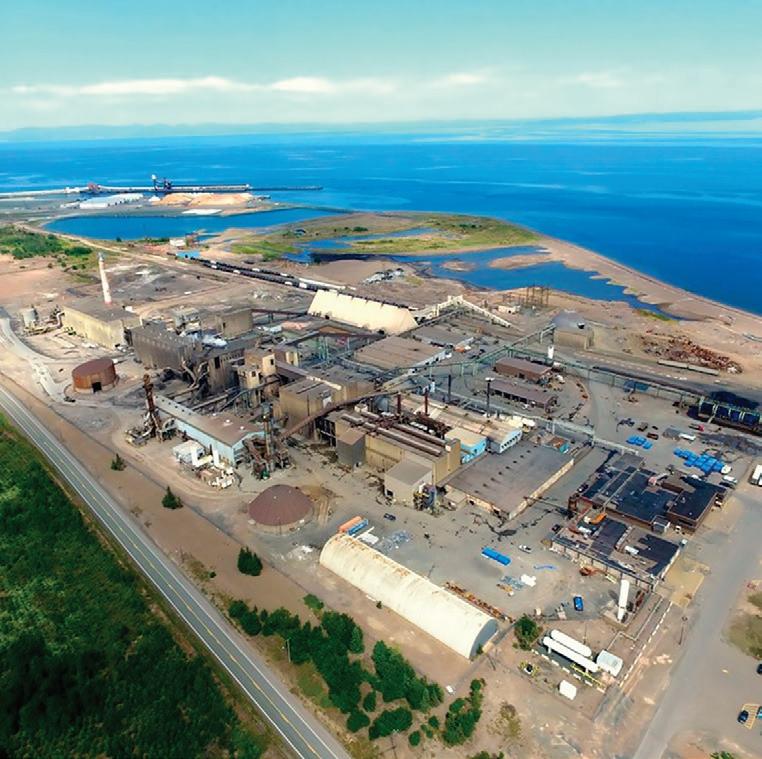

The Great Canadian Treasure Hunt is reaching a fever pitch as explorers across the country tighten their boots and sharpen their wits.
The total prize pool is now hovering around the $2 million mark. This significant valuation jump is driven by the surging price of gold, which has about doubled since the competition first kicked off in August.
“The giant of them all remained Brunswick No. 12. When the mine opened in 1964, few could have predicted just how long it would last. For nearly half a century, miners worked its vast underground chambers, extracting hundreds of millions of tonnes of ore.”
Mines such as Caribou , Halfmile Lake and Restigouche joined Brunswick No. 12 and the earlier Heath Steele mine in transforming the region into one of the world’s great base-metal camps. Each discovery added new chapters to the story.
Supporting growth
In mining towns and small communities across northern New Brunswick, families built their lives around the underground mines. Miners went underground each day to work the ancient mineral layers laid down beneath prehistoric seas.
The communities of Bathurst, Belledune and Newcastle grew alongside the mines. For many families, mining became a generational calling. Fathers, sons and daughters all found work connected to the camp – underground, in mills, on drill rigs or in the engineering offices that kept the operations running.
The metals produced here rarely captured headlines like gold did, but they proved just as important to modern society.
Zinc protects steel from corrosion, helping preserve bridges, buildings and infrastructure. Copper carries electricity through the wiring that powers homes, cities and entire industries.
Lead has long been essential in batteries and energy storage. Silver plays a vital role in electronics and solar panels.
Those metal concentrates were loaded onto trains that rolled toward smelters and refineries, sending these essential metals into the global economy.
Bathurst’s rise and fall
The giant of them all remained Brunswick No. 12. When the mine officially opened in 1964, few could have predicted just how long it would last. For nearly half a century, miners worked its vast underground chambers,
extracting hundreds of millions of tonnes of ore. The mine became the economic backbone of northern New Brunswick.
But like every mining story, the Bathurst camp also faced the inevitable reality of depletion. Ore bodies, no matter how rich, are finite. In 2013, after nearly five decades of production, Brunswick No. 12 finally closed its doors.
For many in the region, it felt like the end of an era. Yet geologists studying the district are quick to point out that the Bathurst camp is far from fully explored.
The same ancient volcanic rocks that hosted the great mines stretch for miles beneath forests and glacial sediments. Modern exploration tools—from airborne geophysics to deep drilling—are giving geologists new ways to search for hidden deposits.
Companies have continued exploring the region, revisiting old targets and searching for new ones that earlier generations of prospectors may have missed.
Mining history has shown time and again that great camps rarely reveal all their secrets at once. Sudbury, Timmins and Flin Flon each produced discoveries for decades after their first mines opened.
Many geologists believe Bathurst may still hold similar surprises as beneath those quiet northern forests lies a geological story that began hundreds of millions of years ago on the floor of an ancient ocean. Somewhere within that story—hidden in rock, waiting for the right set of eyes—the next discovery may still be waiting. TNM
This campaign is proudly presented with the support of industry sponsors including Agnico Eagle Mines, Sprott Money, EarthLabs, Iamgold, Kinross Gold, The World Gold Council, Alamos Gold, Ernst & Young, MINING.COM, CEO.CA and The Canadian Mining Journal.
For those still on the sidelines, opportunity remains for the elusive Grand Prize and regional hauls in New Brunswick and the Golden Triangle. They’re waiting for a lucky, and clever, discoverer.
Recent weeks have seen some remarkable wins. In Toronto, the “hub of mining finance” delivered on its name. A dynamic team in their twenties comprising a brother, sister and their friend made the trek from Saugeen Shores to the big city. Their persistence paid off when they successfully located the treasure, eventually receiving their prize in style at the Northern Miner Group’s annual PDAC party.
The excitement isn’t limited to the younger generation, either. Proving that experience is a formidable asset, a retired couple from Calgary successfully cracked the clues for the Southern B.C. prize. Their victory near Squamish highlights the nationwide reach of the hunt, drawing participants from every province and every walk of life.
Whether you are a seasoned researcher or a weekend warrior, the map is open and the gold is waiting. Good luck to all the hunters still in the field.
For more information, including full contest rules, FAQs and updates, visit treasure. northernminer.com. Follow @northernminer (X/FB/YouTube) | @thenorthernminer (IG) | @mining (X) | @miningdotcom (IG/FB/ YouTube) | @ceodotca (X/IG/FB/TikTok) | @ceocafilm (YouTube) for ongoing clues and community updates.

19 Capital Raisings
20 Drill Results 21 Warrants + Shorts 22 EV Metals
24 Market Data + Mining events
*Data may not be comprehensive and is provided on a best-efforts basis as of press time. Investors are responsible for their own due diligence.
Delivering fit-for-purpose solutions across the entire project life cycle
Delivering fit-for-purpose solutions across the entire project life cycle
Delivering fit-for-purpose solutions across the entire project life cycle
Delivering fit-for-purpose solutions across the entire project life cycle
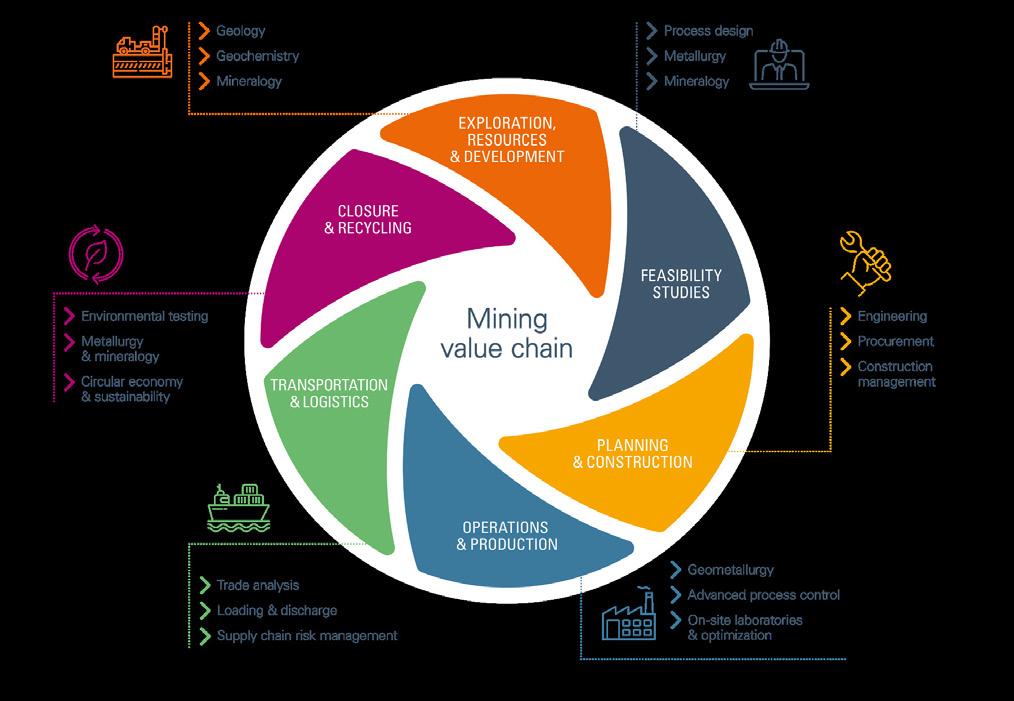
Our fit-for-purpose solutions encompass the skills of qualified geologists, geostaticians, analytical chemists, mineralogists, metallurgists, process engineers and mining engineers and inspectors brought together to provide accurate and timely mineral and process evaluation services across the entire project life cycle.
Our fit-for-purpose solutions encompass the skills of qualified geologists, geostaticians, analytical chemists, mineralogists, metallurgists, process engineers and mining engineers and inspectors brought together to provide accurate and timely mineral and process evaluation services across the entire project life cycle.
Our fit-for-purpose solutions encompass the skills of qualified geologists, geostaticians, analytical chemists, mineralogists, metallurgists, process engineers and mining engineers and inspectors brought together to provide accurate and timely mineral and process evaluation services across the entire project life cycle.
Our fit-for-purpose solutions encompass the skills of qualified geologists, geostaticians, analytical chemists, mineralogists, metallurgists, process engineers and mining engineers and inspectors brought together to provide accurate and timely mineral and process evaluation services across the entire project life cycle.
WWW.SGS.COM/NATURALRESOURCES
WWW.SGS.COM/NATURALRESOURCES NAM.NATURALRESOURCES@SGS.COM
NAM.NATURALRESOURCES@SGS.COM
WWW.SGS.COM/NATURALRESOURCES NAM.NATURALRESOURCES@SGS.COM
WWW.SGS.COM/NATURALRESOURCES
NAM.NATURALRESOURCES@SGS.COM

Week of April 13-17, 2026
By Henry Lazenby
The TSX and S&P 500 surged back to record highs during the week ended April 17 as investors priced out a worstcase Middle East war, bond yields and oil eased, and strong corporate profits underpinned the rally.
American exchanges powered higher. The Dow Jones Industrial Average climbed 1,531 points or 3.2% to 49,447 and the S&P 500 added 309 points or 4.5% over the week to 7,126.06.
Canadian exchanges followed the updraft. The S&P/TSX Composite Index rose 651 points or 1.9% over the week to 34,346, and the S&P/TSX Venture Composite Index gained 62.7 points or 6.3% to 1,055.
S&P/TSX Global Mining Index was up 3.38 points or 1.3% to 257.6, and the S&P/TSX Global Gold Index lost 1.48
points or 0.15% to 977. Gold traded at $4,871.80 per oz., down $79.55 or 1.7%.
The S&P/TSX Global Base Metals Index gained 10.8 points or 3.1% to 356.3, as copper fell 20¢ or 3.5% to $5.99 per lb. on April 17.
Precious metals companies gained the most in value. Wheaton Precious Metals led value growth on both the NYSE and TSX, adding $7.64 to close at $152.38 in New York and gaining $8.47 to close at $208.71 in Toronto.
The most active Toronto issuer was B2Gold with 4.5 million shares changing hands to close 4¢ higher at $6.86. On the S&P/TSX Venture Exchange Sigma Lithium gained $6.24 to $26.88. Tincorp Metals was a top percentagegainer, rising 128% or 64¢ to $1.14.
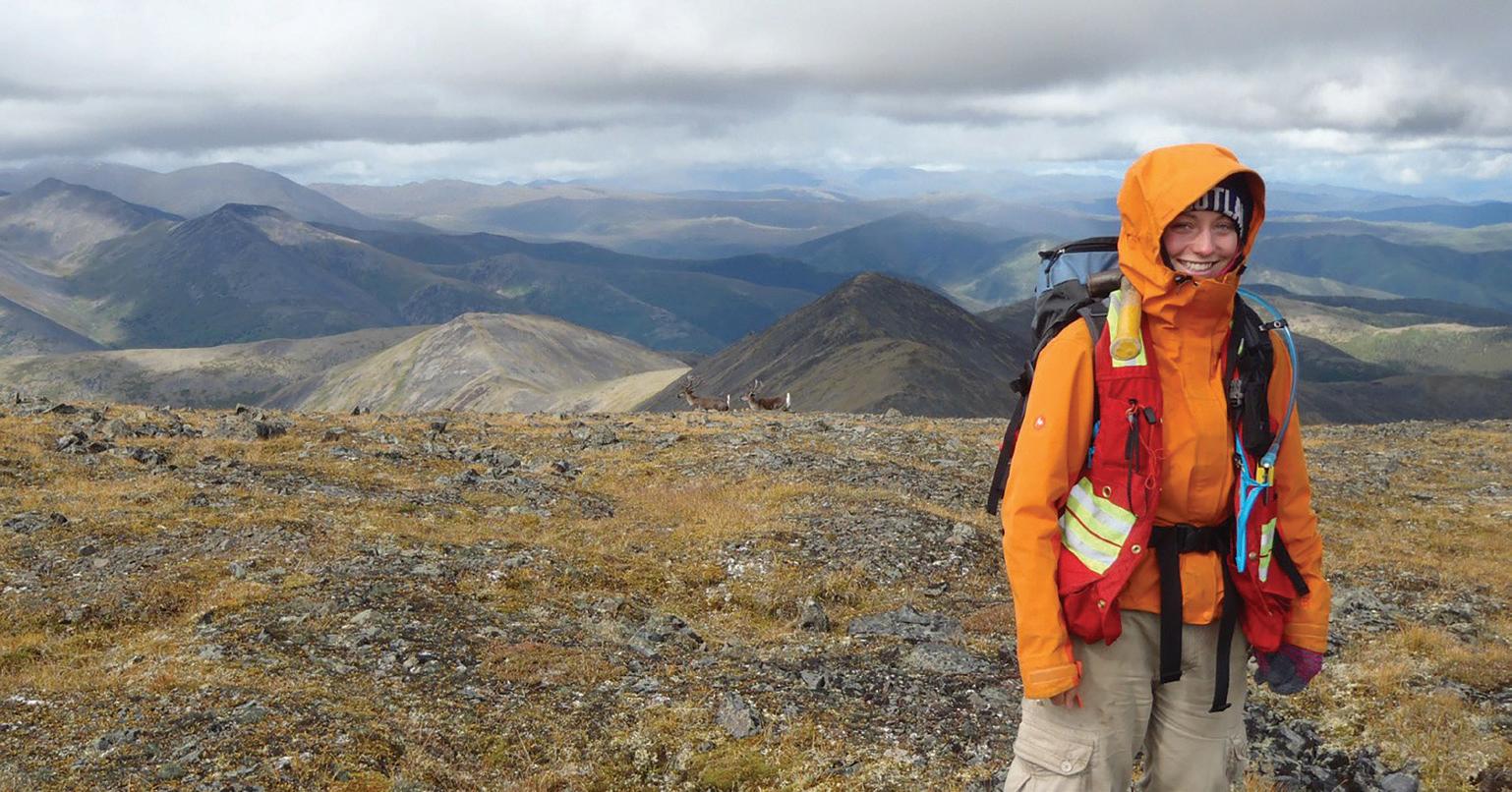


Our TNM Drill Down features the top five gold, silver and copper assays of the past month, as well as five uranium assays from the first quarter. Drill holes are ranked by grade x width. *
March 17, 2026 to April 15, 2026
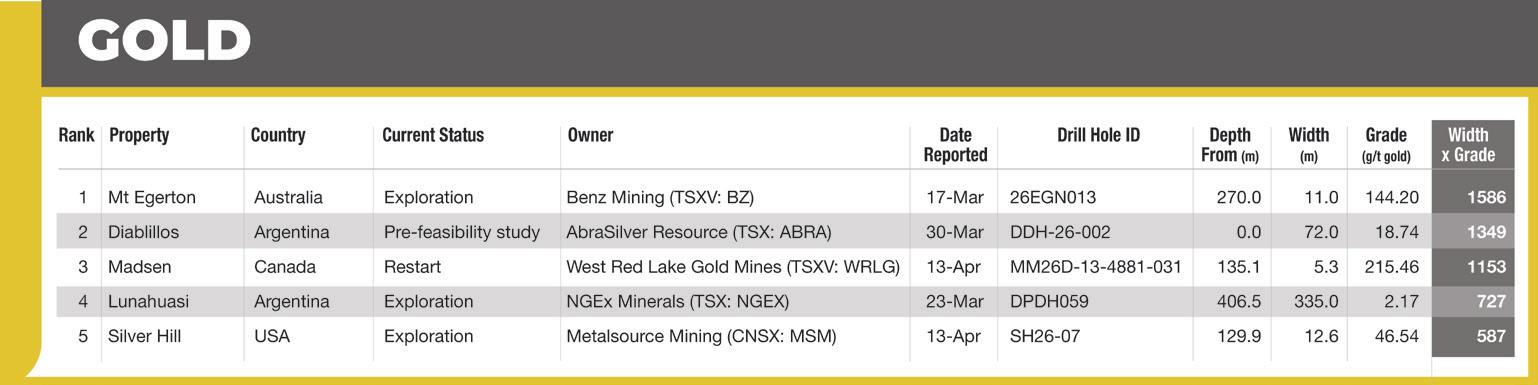
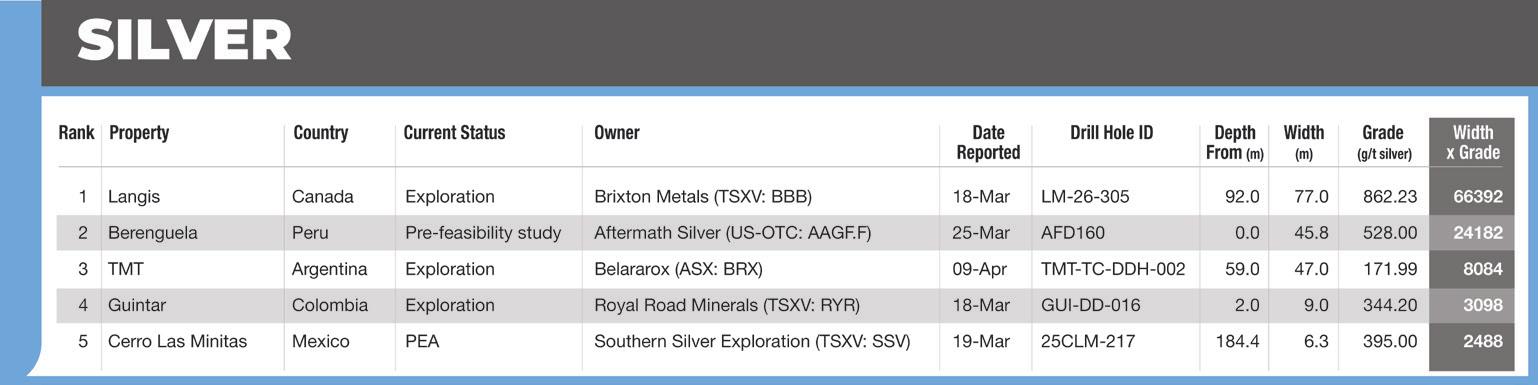
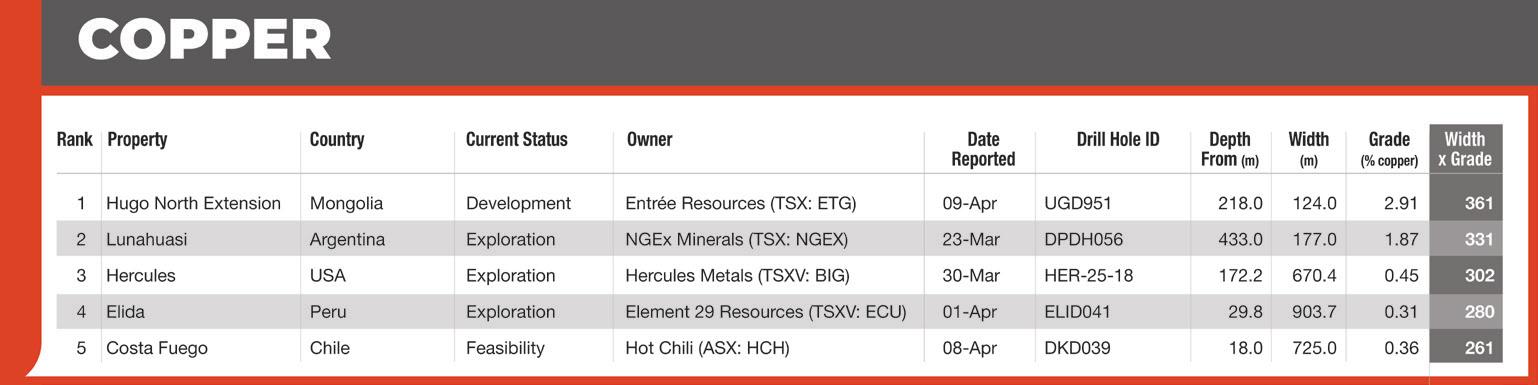
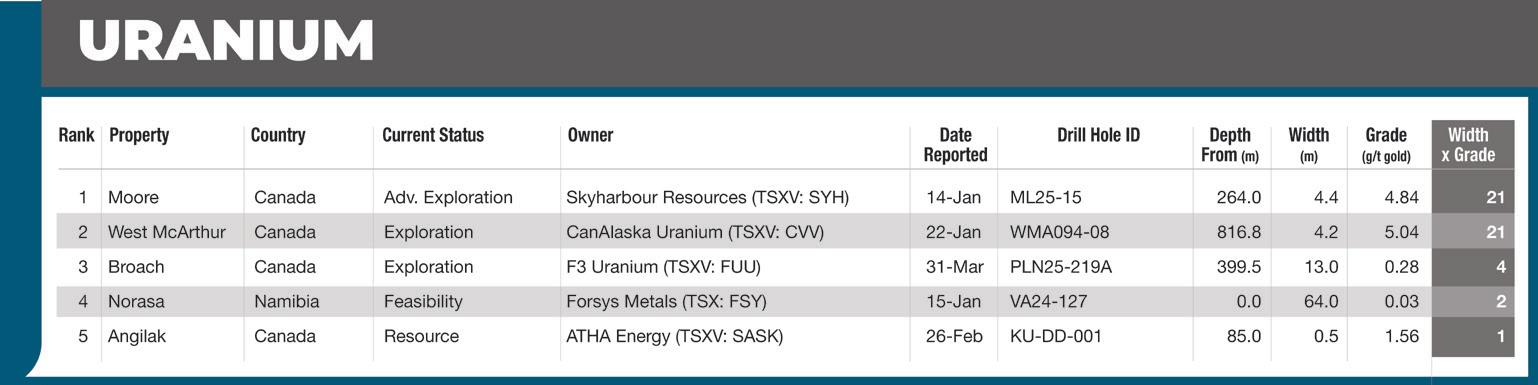
Talisker Resources Ltd. SK.WT One Warrant to purchase one common 5-05-2028 share of the Issuer at $0.75 until expiry
GoGold Resources Inc. GGD.WT One Warrant to purchase one common 11-27-2028 share of the Issuer at $3.50 until expiry
West Red Lake
WRLG.WT One warrant to purchase one
Mines Ltd share at $1.00 per share.
Aurania Resources Ltd. ARU.WT.B One warrant to purchase one common 10-21-2026 share at $2.20 per share.
Tuktu Resources Ltd. TUK.WT One warrant to purchase one common 11-23-2026 share at $0.13 per share.
Freeman Gold Corp FMAN.WT.U One warrant to purchase one common 11-29-2026 share at US$0.65 per share.
Palisades Goldcorp Ltd. PALI.WT One warrant to purchase 0.060538 12-06-2026 common share at $0.50 per share.
Mogotes Metals Inc MOG.WT One warrant to purchase one common 01-31-2027 share at $0.30 per share.
Osisko Development ODV.WT.A One warrant to purchase one common 03-02-2027 Corp. share at $14.75 per share.
Integra Resources Corp. ITR.WT One warrant to purchase one common 03-13-2027 share at $1.20 per share.
Elevation Gold Mining ELVT.WT.A One warrant to purchase one common 03-24-2027 Corp. share at $0.70 per share.
Anfield Energy Inc. AEC.WT One warrant to purchase one common 05-12-2027 share at $0.18 per share.
Osisko Development ODV.WT.U One warrant to purchase one common 05-27-2027 Corp. share at US$10.70 per share.
Robex Resources Inc RBX.WT One warrant to purchase one common 06-27-2027 share at $2.55 per share.
Graphite One Inc GPH.WT One warrant to purchase one common 08-22-2027 share at $1.10 per share.
West Red Lake Gold WRLG.WT.B One warrant to purchase one common 10-24-2027
Mines Ltd share at $0.90 per share.
i-80 Gold Corp. IAU.WT One warrant to purchase one common 11-14-2027 share at $0.55 per share.
Nexmetals Mining Corp. NEXM.WT One warrant to purchase one common 11-17-2027 share at $8.00 per share.
Lion One Metals Ltd LIO.WT.A One warrant to purchase one common 02-14-2028 share at $0.41
share at $0.135 per share.
Bear Creek Mining Corp. BCM.WT One warrant to purchase one common 10-05-2028 share at $0.42 per share.
E3 Lithium Ltd ETL.WT One warrant to purchase one common 10-14-2028 share at $1.50 per share.
Oroco Resource Corp. OCO.WT One warrant to purchase one common 01-15-2029 share at $0.53 per share.
West Red Lake Gold WRLG.WT.A One warrant to purchase one common 03-19-2029 Mines Ltd share at $0.95 per share.
Osisko Development ODV.WT.V One warrant to purchase one common 10-01-2029 Corp. share at US$3.00 per share.
Short positions outstanding as of April 15, 2026 (with changes from March 31, 2026)
Largest short positions
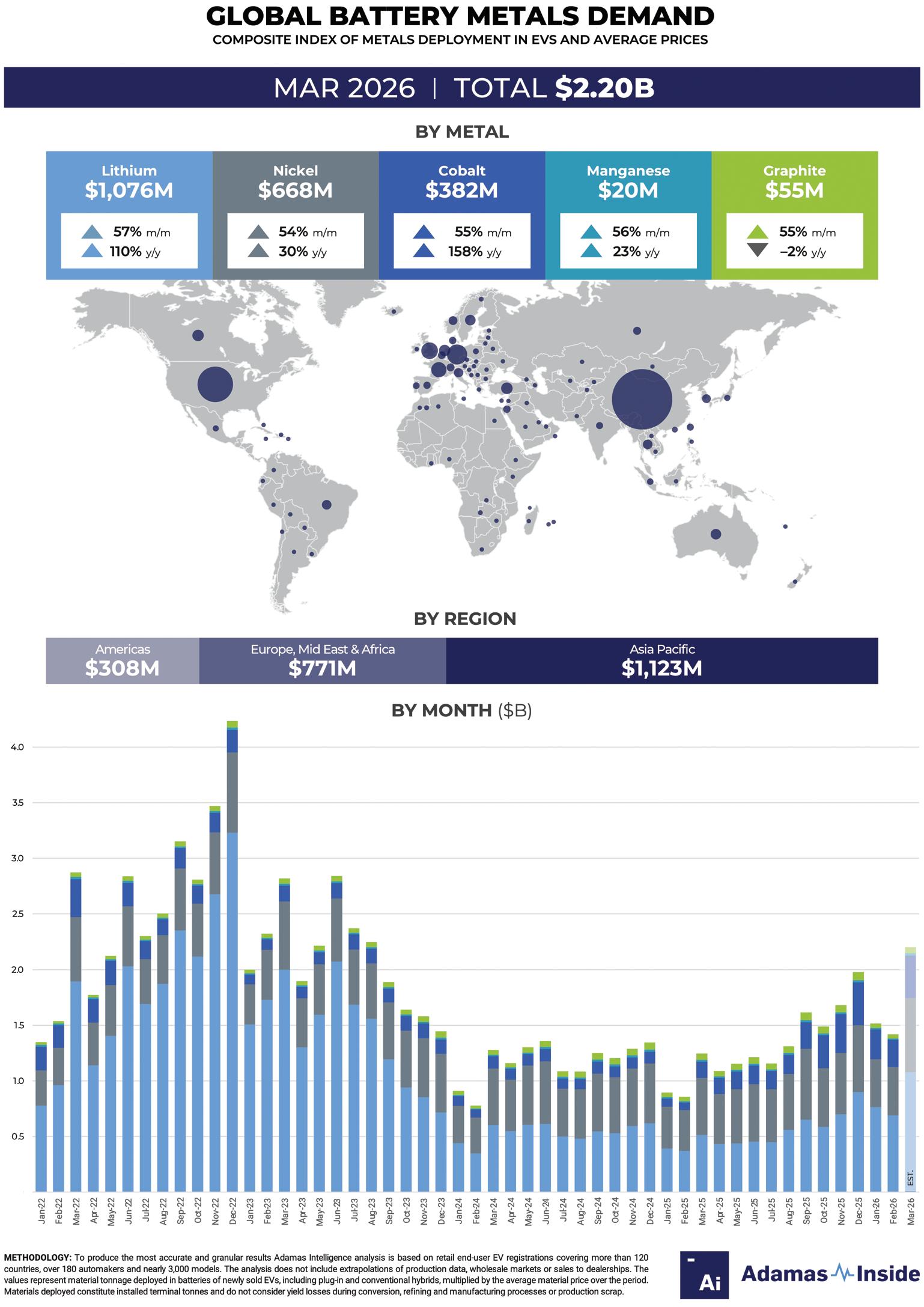
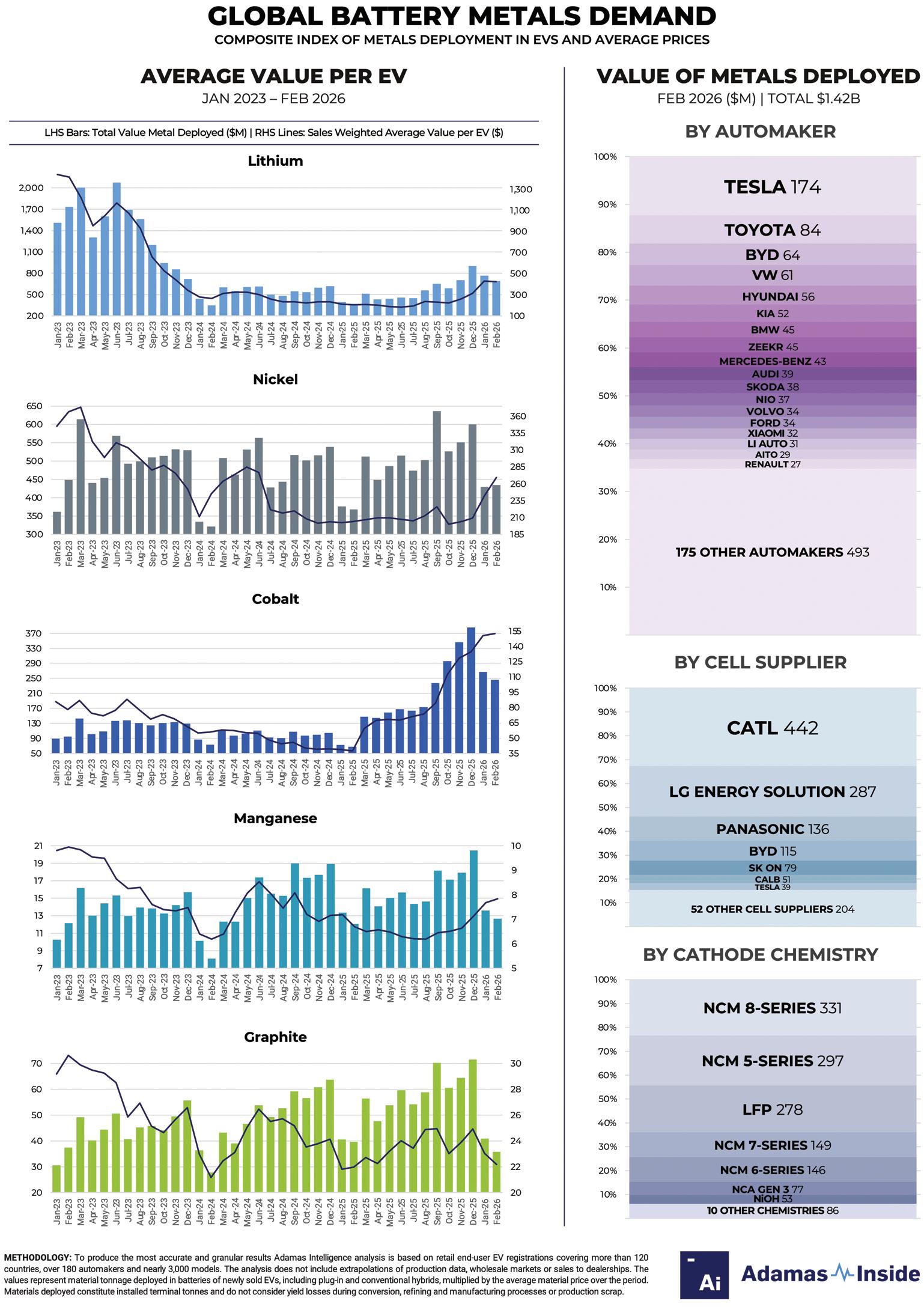
COPPER PRICE ($ PER LB.)
$6.00
NICKEL PRICE ($ PER LB.)
Aluminum: US$1.64/lb.
Cobalt: US$25.31/lb.
Gold: US$4,725.65/oz.
Iron Ore 62% Fe CFR China-S: US$108.00
Nickel: US$8.45/lb.
Silver: US$76.50 per oz.
Zinc: US$1.57 per lb.
2026
n May
May 3-6
CIM CONNECT 2026 — Vancouver
VENUE: Vancouver Convention Centre
MORE INFORMATION: cimconnect.ca
May 8-9
Metals Investor Forum — Vancouver
VENUE: JW Marriot Parq
MORE INFORMATION: metalsinvestorforum.com/metalsinvestor-forum/
May 13-14
Critical Minerals Institute Summit V — Toronto
VENUE: TBA
MORE INFORMATION: criticalmineralsummit.com
May 15-16
Deutsche Goldmesse — Frankfurt, Germany
VENUE: Westin Grand Frankfurt
MORE INFORMATION: deutschegoldmesse.online
May 19-21
Canaccord Genuity’s 5th Annual Global Metals and Mining Conference — Henderson, Nev.
VENUE: The Westin Lake Las Vegas
MORE INFORMATION: canaccordgenuity.com/capitalmarkets/events-and-conferences/2026-metals-andmining/
May 20-21
Critical Minerals Australia Conference & Exhibition — Perth
VENUE: Novotel Perth Langley
MORE INFORMATION: criticalmineralsaustralia.com
May 20-22
Western Mining Summit — Denver, Colo.
VENUE: Gaylord Rockies Resort
MORE INFORMATION: westernminingsummit.com
Coal: Central Appalachia, 12,500 Btu, 1.2 S02-R,W: US$87.00
Copper: US$6.02/lb.
Iridium: US$7,725/tr oz.
Lead: US$0.89/lb.
Rhodium: US$10,050.00/tr. oz.
Tin: US$22.78/lb.
May 24-26
Canadian Diamond Drilling Association: 81st Annual General Meeting & Convention — Victoria
VENUE: Delta Hotels Victoria Ocean Pointe Resort
MORE INFORMATION: cdda.ca/convention/
May 25-27
Mining Transformed — Sudbury, Ont.
VENUE: Norcat
MORE INFORMATION: miningtransformed.norcat.org
May 26-28
Discoveries 2026 Mining Conference — Mazatlán, Mexico
VENUE: Mazatlán International Center
MORE INFORMATION: www.discoveriesconference.com
May 27-28
Argentina Rocks — Mendoza, Argentina
VENUE: Sheraton Mendoza Hotel
MORE INFORMATION: argentinarocks.com.ar
n June
June 2-4
The Mining Investment of the North — Quebec City, Que.
VENUE: Centre des congrès de Québec
MORE INFORMATION: www.themininginvestment event.com
June 10-11
Canadian Mining Expo — Timmins, Ont.
VENUE: McIntyre Centre
MORE INFORMATION: virtex.canadianminingexpo.com
June 16-17
MiningNews Select — Perth, Australia
VENUE: Crown Perth
MORE INFORMATION: perth.miningnewsselect.net/ home
(+$1.44 vs. YA) $8.22 (+$1.27 vs. YA)
Coal: Powder River Basin, 8,800 Btu, 0.8 S02-R, W: US$15.60
Copper: CME Group Futures May 2026: US$6.02/lb.;
June 2026: US$6.05/lb.
Lithium carbonate: US$25,313.25/tonne
Ruthenium: US$1,650 per oz.
Uranium: U 3O 8, Trading Economics: US$87.15 per lb.
June 17-19
DRC Mining Week — Lubumbashi, Democratic Republic of Congo
VENUE: Pullman Lubumbashi Grand Karavia Hotel
MORE INFORMATION: wearevuka.com/mining/drcmining-week/
June 23-24
Mining Asia Conference & Exhibition 2026 — Singapore
VENUE: Marina Bay Sands Expo & Convention Centre
MORE INFORMATION: www.miningasiaconvention.com
June 24-26
27th Annual World Mining Congress — Lima, Peru
VENUE: Lima Convention Centre
MORE INFORMATION: wmc2026.org
n August
August 11
Critical Minerals and Energy Transition Australia Conference and Exhibition — Sydney
VENUE: Hilton Sydney
MORE INFORMATION: australiaenergytransition.com
August 17-20
The 65th Annual Conference of Metallurgy and Materials — Calgary, Alta.
VENUE: Calgary TELUS Convention Centre
MORE INFORMATION: com.metsoc.org
August 25-26
African Critical Minerals Summit 2026 — Johannesburg, South Africa
VENUE: Indaba Hotel
MORE INFORMATION: acmsummit.com
BY COLIN MCCLELLAND
Ontario is preparing legislation this year to slash red tape on early-stage projects as it shifts its minerals strategy towards defence metals and backs Toronto’s bid to host a Nato bank, Energy and Mining Minister Stephen Lecce said in an interview.
The Conservative majority government intends to pass new laws this autumn. It wants to expand on the fast-tracking it started with major projects last year, while strengthening Ontario’s position as a major metals trade partner during Ottawa and Washington’s review starting this month of the CanadaUnited-States-Mexico Agreement (CUSMA).
“Our plan is for a large-scale legislative package in the fall that’s going to help really catalyze private investment confidence and reduce the timelines, all of which is in the national interest,” Lecce said by phone in late April. “We still face very real threats to our economy and our sovereignty given the ongoing dispute with America.”
Ontario, which the Fraser Institute ranked second to Nevada this year among the world’s best mining jurisdictions, is betting on North America’s second-largest financial centre, Toronto, to win over Nato decision-makers as the site for the Defence, Security and Resilience Bank. As members of the alliance scramble to transform military spending amid two regional wars, the multilateral financial institution is to start next year. It’s also when the province’s new minerals strategy is due.
Defence angle
The province’s case is boosted by statistics such as hosting half the country’s manufacturing, 36% of its defence employment, and 900 defence-capable companies, the minister said. Of course, Toronto vies with Sydney as the world’s top mining finance capital with 40% of the world’s public mining companies listed on the TSX and about half of the industry’s capital raised through the exchange, he added.
“We are uniquely positioned to mobilize public and private capital to help finance our defence expansions for our alliance and to build resilient supply chains that are not depending on the likes of Communist China or Russia or other geopolitical adversaries,” Lecce said. “We are supporting this bid enthusiastically.”
The province first said in March it’s shifting its mineral strategy away from electric vehicles after several battery plant projects stalled. Honda’s roughly $15-billion EV and battery complex was postponed by about two years to around 2030; the $5-billion LG Energy Solution NextStar plant in Windsor has been restructured after a brief halt when Stellantis pulled out; and Volkswagen’s PowerCo plant in St. Thomas is progressing more slowly than initially envisioned.
“Our priority when it comes to minerals is to stop the ripping and shipping of those resources by processing more at home.”
STEPHEN LECCE, ONTARIO MINES MINISTER
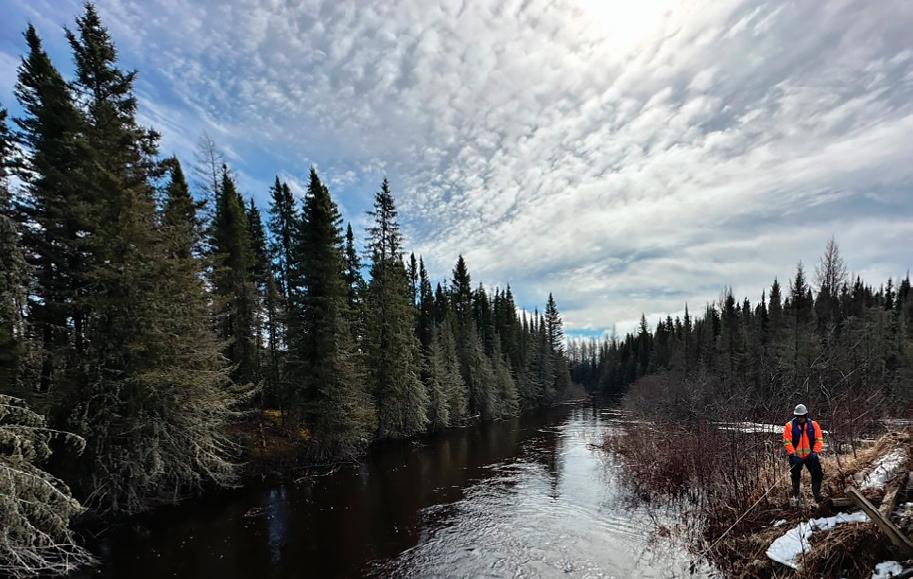
Cars are a big part of the OntarioU.S. cross border trade, with steel, aluminum and auto sector agreements figuring highly in the CUSMA review. U.S. Trade Representative Jamieson Greer has said a deal won’t likely be done by a July 1 deadline, and there will need to be separate protocols on items specific to Mexico and Canada.
Those CUSMA-linked discussions are an opportunity for Canada to negotiate lower tariffs on steel, aluminum, autos and softwood lumber, Dominic LeBlanc, the federal Minister Responsible for CanadaU.S. Trade, said in late April.
Lecce, who was part of a Canadian delegation to Washington in April, said the key component for Ontario mining is ensuring local processing, while promoting the concept of working together to weaken China’s stranglehold on processing across so much of the industry.
“Our priority when it comes to minerals is to truly end the ripping and shipping of those resources by processing more at home,” he said.
“Of course, nickel is a prime case study where you know we provide roughly 50% of nickel that goes into the U.S.
“We went to the U.S., met with
one of the national security advisers to the president on critical minerals to emphasize our value proposition that we are moving with unprecedented speed to build mines, faster transmission lines, roads to Ring of Fire, cut permitting timelines by half and take an aggressive—in fact, I used the word hawkish—approach to responsible resource development, and I think we caught the Americans, we got their attention.”
Canadian negotiators can deflate concerns that the U.S. would seek to recast definitions for processing or mineral origins by emphasizing Ontario’s mineral wealth, Lecce said. And that Canada has trading options, he stressed.
“My message to the Americans is, ‘if you want access to our critical minerals and rare earths, for which we have among the largest bounty on earth, then we need to create some stability by getting this CUSMA review completed’. One follows the other.
“You could have access to the most ethically sourced resources on Earth, low cost, low carbon, democratic and reliable, or we will find alternate markets. And I did alert them to the fact that the Asia-
Pacific and Europe are knocking on our door.”
Lecce’s message is simple: “We mean business, we’re open for business, and we’re not going to slow
In Memoriam: Daniel
down” as it applies to the trade talks as well as for quickening permits for earlier-stage mining projects.
The proposed bill would build on the province’s One Project, One Process program—one of the first announced across the country last year. It reduces duplication on permits across provincial and federal levels while pushing final OKs for advanced developments to enter production.
That program already has Frontier Lithium’s (TSXV: FL; US-OTC: LITOF) PAK, Canada Nickel’s (TSXV: CNC; US-OTC: CNIKF) $2-billion (C$2.73-billion) capex Crawford and Kinross Gold’s (TSX: K; NYSE: KGC) Great Bear. More projects are likely to be added, but first some need to start as mines and others need to advance in their development.
“We want to make sure that we reduce permit timelines at the early exploration, advanced exploration stage, and of course, for every active mine today that is looking to expand,” he said. “I’m committed, and our premier is committed, to slashing the red tape for them as well.” TNM
Geologist and Mining Entrepreneur
Dan Innes passed away on September 30, 2025, in Vancouver, at the age of 78.
He was born and raised in Callander, Ontario and was a well-known Canadian mining entrepreneur with a career spanning over 50 years.
After Graduating from Haileybury School of Mines he went on to complete a BSc. and an MSc. (1973-78) degree in geology from Laurentian University. In the 1969, he began working for the Ontario Geological Survey (OGS) and eventually became the Resident Geologist in Sudbury. Many of Ontario’s geological maps and reports were authored by Dan. After leaving the government, he moved to Vancouver in 1989 where he began his long career has a consultant and an executive in the junior mining sector founding over 14 public and private junior exploration companies and raising hundreds of millions of dollars for mineral exploration. The countries he worked in included Canada, U.S.A, Mexico, Peru, Chile, Argentina, Brazil, Australia, Mongolia and China. Some of the companies he founded or co founded include: Aurora Platinum Corp. that owned the past producing Falconbridge Mine and a large land package in the Sudbury basin (Acquired by FNX Mining and now owned by KGHM International), Lake Shore Gold Corp. that discovered and developed the Timmins West, Thunder Creek and the Bell Creek deep mine (acquired by Tahoe Resources Inc. now owned by Pan American Silver) and Northern Superior Resources Inc. (recently acquired by Iamgold Corporation). The total value of the sales of exploration companies he founded exceeded C$1.28 billion.
He also founded Radon Environmental which has developed technology and products that measure and mitigate harmful cancer-causing Radon gas in homes and offices. He helped create Canada’s first Radon Potential Map identifying areas of concern within Canada.
Most recently he completed an agreement with Pecoy Copper Corp. who acquired all the assets of Pembrook Mining Corp. (Private company he founded) including the large Pecoy Copper deposit and the Tororume Cu porphyry project in Southern Peru.
Those who worked with Dan remember him as a true exploration visionary and mine finder having been involved in many discoveries over his career including Golden Hope (Cu-Zn, Quebec), Timmins West, Thunder Creek, Bell Creek Deep (Au-Ontario), Liam, Minispata, Cerro Quescha, Poracota (Au-Ag deposits) in Peru and the Team 217 Au deposit in Mongolia. Dan will be deeply missed by his wife Carolyn, his children, grandchildren and his many friends and colleagues.
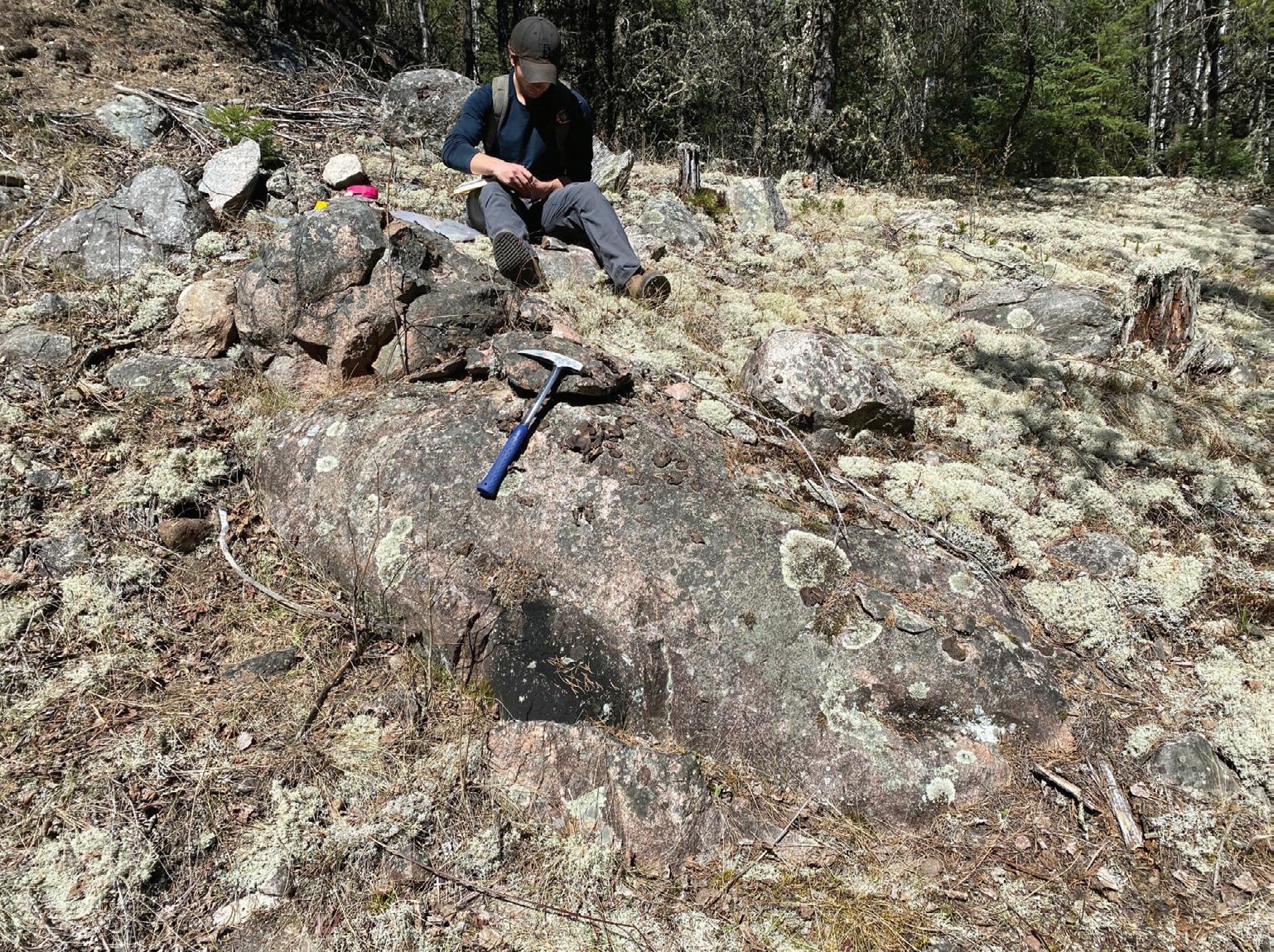
BY NORTHERN MINER STAFF
Ontario is a global mining powerhouse, rich in copper, gold, nickel, lithium and platinum group elements. Here are eight companies to watch.
BTU Metals (TSXV: BTU) is advancing an 8,000-metre drill program this year at its main Dixie Halo project in Red Lake, about 5.5 km east of Kinross Gold’s (TSX: K; NYSE: KK) Great Bear project. The major owns about 14% of BTU’s outstanding common shares. Red Lake is about 1,350 km north of Toronto. BTU expects to have drills turning at three of its gold projects in Ontario this year.
Kinross is earning a 70% stake in Dixie Halo by spending $4.7 million (US$3.41 million) on exploration over four years. The first hole Kinross drilled last year returned an intersection of visible gold. Drillhole BTU-25-001 returned 0.75 metres grading 2.65 grams gold per tonne. While The Northern Miner generally doesn’t report results less than 6 metres, BTU reported no longer cores or assay tables via releases or regulatory filings.
Drilling at Dixie Halo this year will focus initially on the TNT area, which BTU Metals discovered in
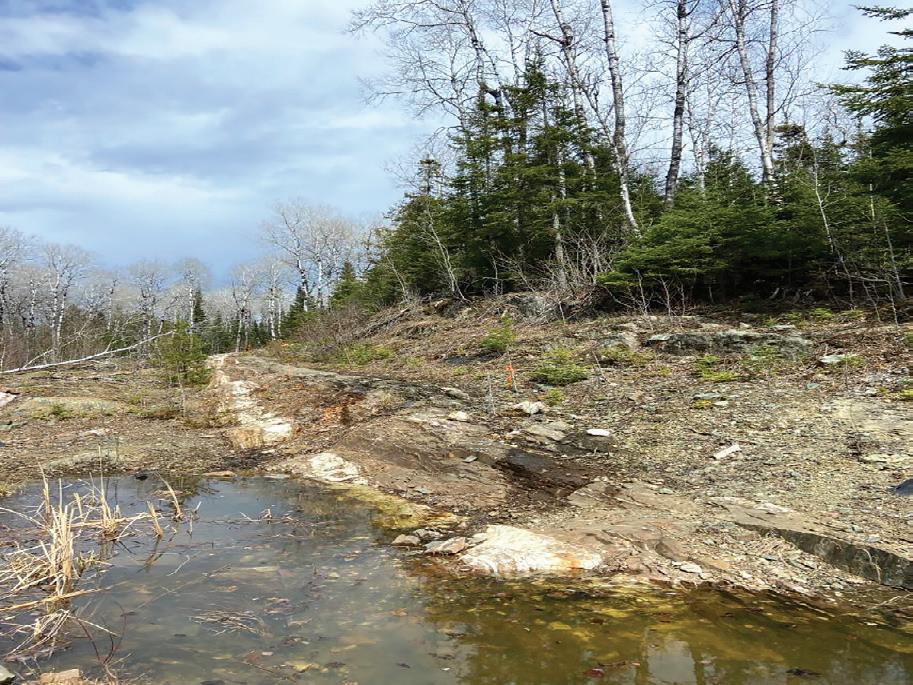
2019. The objective is to intersect and better understand the extent of anomalous gold and copper mineralization and alteration in the area.
BTU is also undertaking geophysics and refining targets at Dixie Halo in preparation for this year’s drill program.
The company acquired the Dixie
East project in September. There has been no drilling on the property since the early 1990s and the small amount of historical drilling was limited primarily to base metal exploration targets near the property’s eastern margin.
BTU is also preparing to drill its Hubcap project in the Wawa area,
immediately south of RPX Gold’s (TSXV: RPX; US-OTC: RDEXF) (formerly Red Pine Exploration) past-producing Wawa project. Historical drill results from Hubcap include 0.6 metres of 8.4 grams gold from 47.2 metres downhole in BS-91-M1 and 0.3 metres of 37.9 grams gold from 61.4 metres in
BS-91-M1.
BTU’s other Wawa projects include Centennial, which contains the past producing namesake gold mine. Historical drill results from the project include 0.15 metres grading 2.8 grams gold from 115 metres downhole in CE-85-01. Its Echum project is contiguous to Alamos Gold’s (TSX, NYSE: AGI) Island mine, one of Canada’s highest grade gold mines. Prospecting samples from Echum returned assay values from trace to as high as 20 grams gold, 65 grams silver and 1,290 parts per million (ppm) copper.
BTU Metals has a market cap of about $10.8 million.
Clean Air Metals (TSXV: AIR; US-OTC: CLRMF) is focused on its Thunder Bay North platinum-palladium-copper-nickel project in northern Ontario, one of the few primary platinum resources outside of South Africa.
The project, 40 km northeast of the city of Thunder Bay and 60 km southeast of Impala Platinum Holdings’ (JSE: IMP) Lac Des Iles mine, consists of two shallow-dipping sister deposits, Escape and Current, located about 2.5 km apart. In March the company was approved for up to $200,000 in government funding as part of the Ontario Junior Exploration Program (OJEP) that will be used to advance work in the 2.5-km-long Escape down-plunge target, where it intersected 53 metres of 0.52
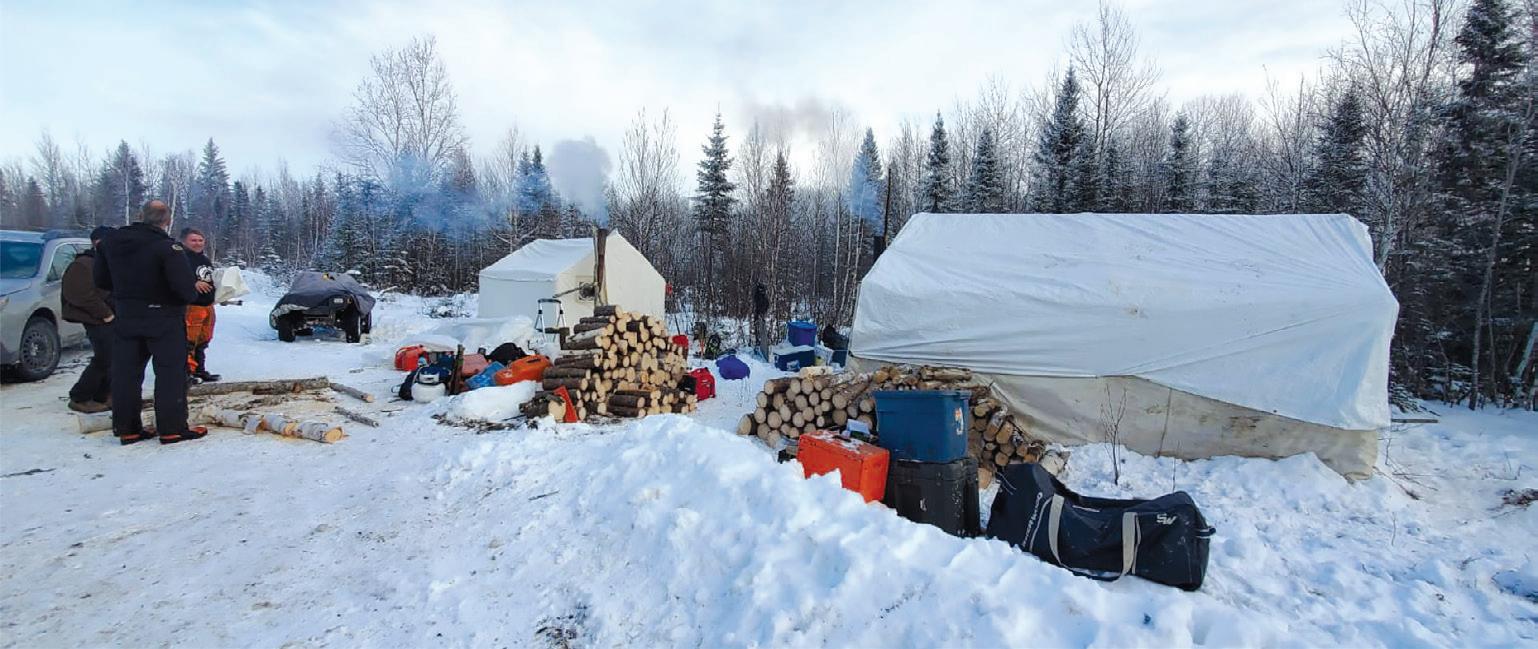
gram platinum, 0.69 gram palladium, 0.26% copper and 0.17% nickel from 404 metres downhole in drillhole EL25-001.
The broad interval included 22 metres averaging 0.84 gram platinum, 1.12 grams palladium, 0.41% copper and 0.21% nickel starting from 411 metres and 11 metres grading 1.08 grams platinum, 1.41 grams palladium, 0.52% copper and 0.24% nickel from 430 metres downhole.
A preliminary economic assessment (PEA) completed in October envisioned a ramp-access underground operation producing 2,500 tonnes per day over 11 years.
The PEA outlined a post-tax net present value (at an 8% discount rate) of $157.5 million and a post-tax internal rate of return of 32%. Initial capital was estimated at $89.5 million with a payback period of 2.5 years.
Platinum constitutes about 40% of the project’s value at current prices, with copper making up about one-third of the value and nickel roughly 10%.
The two deposits host 14.9 million indicated tonnes grading 1.31 grams platinum, 1.37 grams palladium, 0.41% copper, 0.25% nickel, 0.1 gram gold and 2.53 grams silver. Contained metal totals 1.27 million oz. of platinum and palladium, 60,000 tonnes copper, 36,000 tonnes nickel, 44,000 oz. gold and 1.14 million oz. silver.
Inferred resources add 2.37 million tonnes averaging 0.83 gram platinum, 0.82 gram palladium, 0.31% copper, 0.19% nickel, 0.07 gram gold and 1.81 grams silver. Contained metal totals 126,000 oz. of platinum and palladium, 7,000 tonnes copper, 5,000 tonnes nickel, 10,000 oz. gold and 300,000 oz silver.
Clean Air Metals has a market cap of about $16.3 million.
n Dryden Gold
Dryden Gold (TSXV: DRY; US-OTC: DRYGF) has earmarked $11 million for a 32,000-metre drill program this year at its 803-sq.-km strategic land package in the Dryden district of northwestern Ontario.
The underexplored property includes historic gold mines and hosts high-grade gold mineralization over 50 km of potential strike length along the Manitou-Dinorwic deformation zone.
Major shareholders include Alamos Gold (10%) and Centerra Gold (TSX: CG; NYSE: CGAU ) (9.8%).
In March the company reported drill results including 7.5 metres grading 5.03 grams gold, including 0.58 metres averaging 43.60 grams gold in DGR-036; 2.2 metres grading 5.73 grams gold, including 0.3 metres of 32.9 grams gold in DGR037. Drillhole DGR-031 intersected 15 gold mineralized structures over 600 metres.
Previous highlights include 5.7 metres averaging 30.72 grams gold from 118.3 metres in KW-24-024, including 0.55 metre of 313 grams gold from 121.95 metres.
The Gold Rock target hosts various styles of gold mineralization, from quartz veins with free gold to shears hosting gold and disseminated sulphides – the same three known types of mineralization characteristic of northwestern Ontario’s Red Lake Camp. Gold
Rock has a similar geological setting, rock types and dykes with regional folding and also features near-surface, high-grade free gold in an Archean lode gold setting.
Dryden’s regional discoveries include the Hyndman and Sherridon targets. The company believes the mineralization at Hyndman is similar to NexGold Mining’s (TSXV: NEXG; US-OTC: NXGCF) Goldlund deposit, about 60 km northeast of Dryden.
Drill highlights from Sherridon include 15.5 metres grading 1.1 grams gold from 47.5 metres, including 0.5 metres grading 25.2 grams gold, in drillhole DSH-004.
Dryden Gold has a market cap of about $62 million.
n GFG Resources
GFG Resources (TSXV: GFG; US-OTC: GFGSF) has three district scale gold projects in the worldclass Timmins camp of northeastern Ontario.
Alamos Gold holds a roughly 11% stake in the company.
The company’s most advanced asset is the Aljo project on the 200-sq.-km Goldarm property, about 10 km northwest of McEwen’s (TSX, NYSE: MUX)
Fox gold complex and 50 km east of Timmins. The project contains the past producing Aljo gold mine, which operated intermittently from 1918 to 1943.
GFG plans to drill 6,500 metres at Aljo this year, its largest drill campaign to date. Results from last year’s program include drillhole ALJ-25-036, which returned 51.5 metres grading 1.01 grams gold from 291 metres downhole, including 5 metres of 6.36 grams gold.
Drillhole ALJ-25-032 intersected 4.5 metres at 3.68 grams gold from 29.5 metres downhole.
The last two holes of the 2025 drill program were step-outs to the east of the historical Aljo mine and confirmed that mineralization extends beyond the known limits of the mine workings. Drillhole ALJ27-037 cut 16 metres of 1.23 grams gold from 132 metres downhole in the hanging wall zone. ALJ-25-038 returned multiple near-surface and stacked gold intercepts, including 5.3 metres of 2.23 grams gold from 123 metres.
At its 475-sq.-km Pen project, 50 km southwest of Timmins, the company is developing a pipeline of targets and is planning about 1,500 metres of sonic and diamond
drilling this year. Pen covers an approximately 55-km-long section of Archean greenstone that contains the interpreted western extension of the Porcupine Deformation Fault Zone (PDFZ). Pen sits between Discovery Silver’s (TSX: DSV; US-OTC: DSVSF) Borden gold project and Pan American Silver’s (TSX, NYSE: PAAS) Timmins West mine.
At the 212-sq.-km Dore gold project, previously known as the Swayze project, GFG is analyzing drill data to generate drill targets. Dore is about 40 km east of Discovery’s Borden project and 30 km northwest of Iamgold’s (TSX: IMG; NYSE: IAG) Cote Lake gold project. Dore covers a 12-km-long section of Archean Greenstone within the Swayze Greenstone Belt. GFG Resources has a market cap of about $44 million.
n Kirkland Lake Discoveries
Kirkland Lake Discoveries (TSXV: KLDC; US-OTC: KLKLF) has amassed a 400-sq.-km exploration portfolio in the Kirkland Lake region of Ontario’s Abitibi Green-
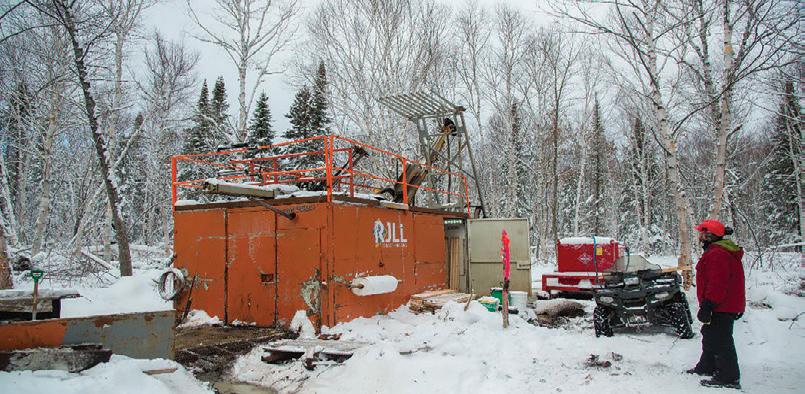
stone Belt, one of the most prolific mining districts in the world.
Its properties span key fault zones, geophysical anomalies and volcanic-sedimentary contacts within the Blake River Group, a highly prospective assemblage known to host gold and polymetallic volcanogenic massive sulphide (VMS) deposits.
The company’s current exploration focus is on the KL West project and the Winnie Lake Stock target area.
Results from its inaugural drill program at KL West last year intersected high-grade copper sulphides from surface and led to two new gold and critical mineral discoveries, confirming a new intrusive-related mineralizing system centered on the Winnie Pluton with a 17-km perimeter.
Highlights from the Winnie Shaft area included 32.8 metres grading 0.42% copper, 1.11% zinc, 0.13 gram gold, 4.49 grams silver and 331 ppm cobalt starting from 14.2 metres downhole in drillhole KLD25-36. It included 4.7 metres at 1.68% copper, 6.02% zinc, 0.62 gram gold, 10.86 grams silver and 1,120 ppm cobalt.
Hole KLD-25-34 cut 36.5 metres grading 0.56% copper, 0.96% zinc, 0.11 gram gold, 4.87 grams silver and 365 ppm cobalt starting from 13.5 metres, including 8.3 metres averaging 1.31% copper, 1.95% zinc, 0.23 gram gold, 8.79 grams silver and 527 ppm cobalt.
Highlights from the Winnie Pluton area include 7 metres grading 0.19 gram gold, 0.81 gram silver, 0.607 ppm tellurium (Te) and 17 ppm bismuth (Bi) starting from 229 metres in drillhole KLD25-31. Hole KLD-25-32 returned 5 metres averaging 1.48 grams gold, 2,14 grams silver, 2.52 ppm Te and 37 ppm Bi from 261 metres depth.
Other high priority targets are Winnie West, the Wolverine Bend Showing and the Nine Mile area.
In March, the company acquired the 25-sq.-km Mirado project, about 15 km south of its flagship KL claims. Mirado hosts inferred
resources of 10.6 million tonnes grading 1.29 grams gold for 442,000 oz. contained gold. The property hosts the past-producing Mirado mine, and there has been only limited exploration below 150 metres.
The company kicked off a 25,000metre drill program in November.
Kirkland Lake Discoveries has a market cap of about $37 million.
n Onyx Gold
Onyx Gold (TSXV: ONYX) is undertaking a 75,000-metre drill program at its principal MunroCroesus project, 75 km east of Timmins.
The 109-sq.-km project along Highway 101 hosts the mothballed Croesus mine, which operated between 1915 and 1936 and produced some of the highest-grade gold ever mined in Ontario.
Munro-Croesus lies about 3 km northwest and along trend of Mayfair Gold ’s (TSXV: MFG) multi-million-ounce Fenn-Gib gold deposit and about 1.5 km from McEwen’s Black Fox underground gold mine.
Onyx identified a new northeast-trending structure along the eastern margin of the Argus Main zone in March. Drillhole MC26267 returned 60 metres grading 0.6 gram gold from 161 metres, including 20.6 metres of 1.1 grams gold. The same hole cut 99.5 metres grading 1.2 grams gold from 344 metres, including 3 metres of 6.4 grams gold and 12.5 metres grading 2.9 grams gold.
Drillhole MC26-270 cut 28 metres grading 0.3 gram gold from 104 metres, and 32 metres of 0.7 gram gold from 150 metres, including 6 metres of 2.1 grams gold and 1.5 metres of 8 grams gold.
The drillholes show characteristics analogous to the company’s Argus North discovery, made last year about 600 metres to the northwest. It lies about 150 metres north of the regional Pipestone Fault, a major structural corridor that hosts several significant gold deposits in the Timmins camp.
The discovery hole at Argus
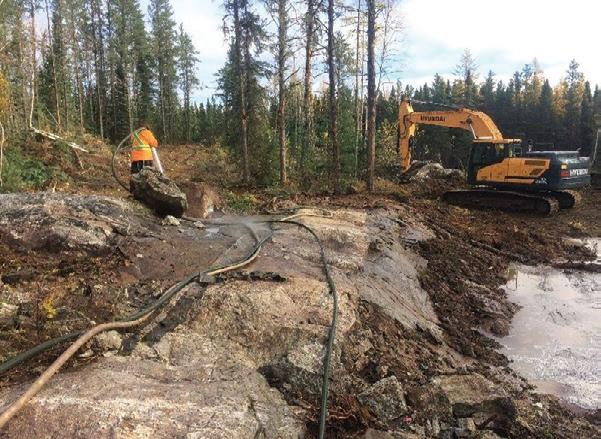
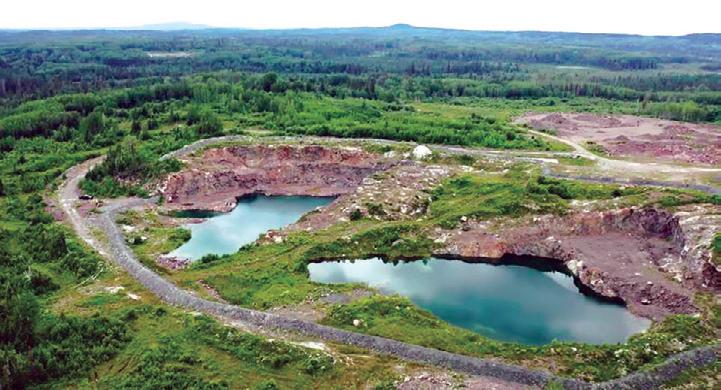
North, Mc24-163, returned 69.6 metres grading 3.4 grams gold from 230.4 metres depth, including 34.5 metres grading 5.4 grams gold and 9.5 metres grading 13.9 grams gold.
Follow-up drilling at Argus North returned 208 metres grading 2.3 grams gold from 78 metres in drillhole MC25-232; 52.2 metres grading 2.2 grams gold from 72 metres in MC25-178; and 91 metres grading 1.8 grams gold from 148 metres in drillhole MC25-168.
The company has two other projects in Ontario—Golden Mile, a 140-sq.-km property 9 km from Discovery Silver’s (TSX: DSV; US-OTC: DSVSF) Hoyle Pond mine; and Timmins South, a 187-sq.-km property adjacent to the Dome mine.
Onyx Gold has a market cap of about $97 million.
n Rock Tech Lithium
Rock Tech Lithium (TSXV: RCK; US-OTC: RCKTF) is building Ontario’s first lithium conversion plant in the town of Red Rock, about 100 km east of Thunder Bay. The project is about 60 km from the company’s Georgia Lake lithium deposit.
The facility will have a production capacity of up to 32,000 tonnes of lithium carbonate equivalent (LCE) a year, enough to supply up to 900,000 electric vehicles. Raw material for the converter will be sourced from Rock Tech’s Georgia Lake spodumene project in the Thunder Bay mining district.
In April, the company announced a strategic partnership with the BMI Group, a Canadian industrial infrastructure company, to develop the plant.
BMI will invest $200 million in the project as part of a broader equity structure that will be finalized as the project moves ahead. Rock Tech will retain full control and responsibility for project development, engineering and operations and all key technical, commercial and strategic decision making.
The deal follows a partnership
agreement with Siemens Canada announced at PDAC 2026, under which Siemens will provide state-ofthe-art industrial automation technology and a full digital twin for the Red Rock converter. The digital twin—a real-time virtual replica of the plant—will enable performance optimization, predictive maintenance and commissioning.
The converter will be built on BMI’s industrial site in Red Rock, which has access to about 120 MW of power capacity, natural gas, roads and CPKC Rail’s transcontinental mainline.
The converter will be designed based on Rock Tech’s Guben lithium converter project in Germany. So far, Rock Tech has invested $65 million in the European site, which has been designated as a strategic project under the EU Critical Raw Materials Act.
The fully permitted refinery will be one of Europe’s first commercial lithium facilities and will produce about 24,000 tonnes of battery grade lithium hydroxide annually, enough to supply roughly 500,000 EVs a year.
Last October, Rock Tech signed a non-binding memorandum of understanding with Sichuan Calciner Technology of China for potential collaboration on engineering and process optimization.
Rock Tech Lithium has a market cap of about $112 million.
n Stllr Gold
Stllr Gold (TSXV: STLR; US-OTC: STLRF) is drilling 8,000 metres in this year’s first half at its main Tower project in Timmins.
The first assay results from the project’s Jonpol deposit were released in April. Drillhole MGA26-48 returned 5.85 metres grading 16.52 grams gold from 160.2 metres downhole, and drillhole MGA26-251 cut 22.65 metres of 1.46 grams gold from 49.7 metres depth, including 3.15 metres grading 5.27 grams gold.
A PEA of Tower last year envisioned an open pit and underground operation producing 273,000 oz.
gold annually over 19 years for a total of 5.2 million ounces. The study estimated all-in sustaining costs of US$1,537 per ounce.
At a base case gold price of US$2,500 per oz., the project delivers a post-tax NPV (at a 5% discount rate) of US$1.01 billion and post-tax IRR of 13.4%. Initial capital is pegged at $1.9 billion.
Tower contains 140.4 million indicated tonnes grading 0.89 gram gold for 4 million oz. gold and another 200.3 million inferred tonnes averaging 1.08 grams gold for 7 million oz. gold.
In March, the company signed an exploration agreement on its Ontario properties with three Wabun Tribal Council member First Nations—Matachewan First Nation, Mattagami First Nation and Flying Post First Nation.
The company is also advancing its Hollinger tailings project, which contains an estimated 50-60 million tonnes of mine tailings from the past-producing Hollinger mine nearby.
In February, Hollinger became the first project to receive a permit under Ontario’s new provincial Recovery of Minerals regime. The program, enacted last July, aims to streamline and accelerate the permitting process for responsible mineral recovery and environmental remediation outcomes of historical mine sites, including from tailings.
The project contains 36.2 million indicated tonnes grading 0.35 gram gold for 412,000 oz. of contained gold. Inferred resources add 7.7 million tonnes averaging 0.37 gram gold for 93,000 ounces.
Metallurgical test results demonstrate 61% recovery via cyanidation. The project has the potential to be a near-term cash-flow opportunity at current gold prices. The Hollinger mine produced 19 million oz. gold between 1910 and 1968.
AgnicoEagleMines (TSX,NYSE: AEM) owns an 11% stake in the company.
Stllr Gold has a market cap of about $247 million. TNM
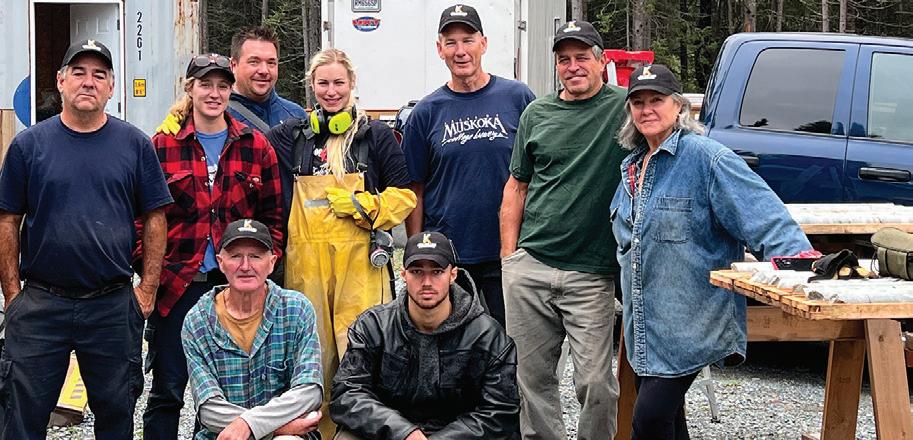




The decisions come on the heels of a May 2025 executive order from U.S. President Donald Trump that aimed to quadruple the country’s nuclear energy capacity to about 400 gigawatts by 2050.
Cameco stands to be a beneficiary of this push—as evidenced by Westinghouse’s October partnership with the U.S. government. Washington envisions that at least $80 billion of new nuclear reactors will be built across the country, using Westinghouse nuclear reactor technology.
Westinghouse could also allow Cameco to make inroads in India as Asia’s most populous country embarks on ambitious plan to beef up nuclear capacity.
Cameco agreed in March to supply almost 22 million lb. of uranium ore concentrate to India over nine years on market-related price terms in an estimated $1.9-billion (C$2.6-billion) deal.
The agreement, which is based on a uranium price of $86.95 per lb., calls for deliveries to start in 2027 and run through 2035. Cameco had previously supplied uranium to India under a five-year contract that began in 2015.
“The opportunities in India go far beyond just selling the uranium or the yellowcake,” Isaac said.
India “effectively has its own reactor model. They have taken the Candu reactor technology and they have modified it for indigenous purposes. They are building more of those types of reactors, and
Cameco is fully integrated in pressurized heavy water reactors. We can sell right through to fabricated fuel bundles, all the fuel services steps in-between. We can even sell key reactor parts to India. And of course, India is also building light water reactors.”
New Delhi’s decision to buy uranium from Cameco and Kazatomprom “sends a very bullish signal,” Sprott Asset Management CEO John Ciampaglia, who runs the world’s biggest physical uranium fund, said in an interview posted on the firm’s website.
“This should signal to the market that everybody needs to get in line to lock down their own supply because these big state-owned entities are doing exactly that.”
New reactors
India, which has 24 operating reactors and a current generating capacity of about 8 gigawatts, is planning to deploy dozens more to reach 100 gigawatts by 2047.
New Delhi has already selected six Westinghouse-made AP1000 reactors as part of its strategy, and other orders are likely, Isaac said.
“When you’re building reactors that are going to run for 80 to 100 years, they require 80 to 100 years of reactor services and fuel fabrication opportunities.”
The India uranium contract shows “just how much sovereign demand is actually out there for big national programs,” Isaac added. “They see that the demand is growing in a more durable and stronger way than the supply stack is growing. These are first-mover countries.”
constrained global conversion and enrichment markets.
projects to benefit from prior experience.”
New fuel
The introduction of the Darlington SMR into Canada’s nuclear ecosystem also signals a shift in fuel requirements. Most of Canada’s existing reactors run on natural uranium fuel, supplied largely by Cameco (TSX: CCO; NYSE: CCJ), one of the world’s largest uranium producers.
Ore mined in northern Saskatchewan’s Athabasca Basin is processed into uranium oxide (U3O8), known as yellowcake, and shipped to Cameco’s Port Hope facility in Ontario, where it is converted into uranium dioxide (UO2) powder and fabricated into fuel bundles for CANDU reactors.
Unlike most reactors globally, CANDU units do not require enrichment, allowing Canada to rely on a largely domestic fuel cycle with minimal exposure to the more
The new Darlington SMRs require enriched uranium as fuel to function. “In Canada, we don’t enrich,” David Novog, director of the McMaster Institute for Energy Studies and an expert on nuclear reactors said. “So part of the decision to build those reactors is essentially becoming dependent on a foreign fuel source.”
Some of the uranium can be converted at Cameco’s Port Hope facility, but enrichment will still need to be done abroad by players such as Urenco in the U.S. or France’s Orano.
Novog said the shift ties Canada into a global enrichment supply chain that is still being rebuilt.
As the U.S.’s war with Iran and Russia’s ongoing invasion of Ukraine continue to test energy security, SMRs are being promoted as strategic infrastructure.
Canada released a SMR action
Rising energy consumption in nations such as India and China is just one of the reasons why Isaac and other industry watchers are bullish about uranium’s long-term prospects.
Uncovered requirements for global utilities are estimated at about 3.1 million lb. of uranium concentrate through 2045, according to data compiled by Cameco. The shortfall “is bigger than it’s ever been in the history of the uranium market,” Isaac says.
Rising prices
That dynamic has started to affect prices. Spot uranium was selling for around $86 per lb. as of press time, about one-third higher than a year earlier. Term uranium prices, which are used in contracts between miners and utilities, were hovering in the $90 range.
“Some utilities already have their head around paying three-digit prices for uranium, because that’s effectively the midpoint of the market-related contracts today,” Isaac said. “We like that dynamic as an incumbent producer.”
Although it has about 30% of its existing mine capacity idle, the India contract won’t be enough to push Cameco to boost output, Isaac stressed.
“In order for us to contemplate running our tier-one assets like McArthur River at a higher level of production, we need to see more demand coming to the market,” he said. “The key is we don’t know exactly when the utilities are bringing the demand. We have to be patient and wait for that demand to come.” TNM
plan in 2020, which included building domestic capacity and exporting the technology, piggybacking on the success of CANDU exports. However, there haven’t been many public updates to the plan since 2022, aside from the federal government’s $2 billion investment package last year.
The SMR category encompasses a broad range, and the success of specific reactors will depend on how far designs move beyond established operating experience, said Megan Moore, technical director with the advanced reactors division at Canadian Nuclear Laboratories (CNL), a federal research organization.
“Some SMR technologies are much closer to what we already know how to build and operate,” she said. “Others introduce new materials or operating conditions that require additional validation before you can really scale them up.”
The constraint emerges in proving performance over time, Moore said. “That’s what ultimately determines whether something is ready to scale, or still needs more validation.”
As far as SMRs go, the BWRX reactor being built at Darlington is considered mature technology. With current market demand, Moore said there’s potential for Ontario to move more quickly than it did with CANDU. The province powered up the first CANDU at Douglas Point near Kincardine, Ont., in 1968. By the 1990s, it had installed 18 CANDU reactors across the province.
“Canada’s a mature nuclear nation,” Moore said. “We’ve got a regulator that’s very experienced and operators like OPG that will be operating the Darlington SMRs that are experienced – now the second round is going to benefit from that.”
> Nouveau Monde from P8
Hodgson also said the country would start its own defence stockpiling regime and support multilateral stockpiling efforts.
The moves followed China’s April 2025 decision to impose export restrictions on seven rare earth elements in response to U.S. tariffs and limits on semiconductors.
Nouveau Monde has since signed offtake arrangements with Canada’s federal government, Japan’s Panasonic and Luxembourg-based commodity trader Traxys.
Matawinie is envisioned as a large-scale open-pit operation producing high-purity natural graphite that will be powered by Quebec’s hydroelectric grid. The mine will supply feedstock to the planned Bécancour facility, supporting electric vehicle and energy storage markets.
Although the March 2025 feasibility study pegged the total capex for the mine and plant at $1.33 billion, Nouveau Monde has since scaled back Bécancour’s projected capacity to about 13,000 tonnes a year. This would reduce the overall investment to about $630 million, Desaulniers said in the interview.
Nouveau Monde acquired a 143,000-sq.-metre brownfield site in Bécancour about three months ago to build active anode material for Panasonic Energy. The indus-
critical mineral projects as of March 2025, but only five had been referred to the Major Projects Office for further review and none were antimony-focused.
British Columbia’s own fasttrack language also looks thinner on inspection, according to Kilofliski, who called much of that language “political noise.” The province’s Critical Minerals Office says it offers concierge support, but it also says it does not change any statutory requirement and has no funding programs.
While New Polaris has not hit delays and the environmental assessment is moving along, Kilofliski said, “the complaint is not that the process has stalled, it is that the policy branding still outruns the machinery behind it.”
Canagold’s feasibility study outlined a $425-million after-tax net present value at a US$2,500 gold price, a 31% internal rate of return and $250 million in initial capex. Subsequent test work produced an antimony-gold concentrate grading 59% antimony at 93% recovery.
“In other words, Canada already has a project far enough along to show what targeted policy could look like,” Kilofliski said.
Beyond New Polaris, the bench thins fast. Bald Hill is one of the few Canadian stories trying to stand up as a primary antimony project rather than a gold mine with antimony credits. Atkinson said Antimony Resources remains in pure exploration mode, with no resource, no preliminary economic assessment and no firm production timeline.
He pointed to Galway Metals’ (TSX: GWM) Clarence Stream gold project in New Brunswick as the only other eastern Canadian exploration project that even hints at antimony output and there the metal still sits behind gold.
Atkinson said his company has
trial building should enable the company to lower infrastructure costs and optimize capital expenditures.
Study update
Saint-Michel-des-Saints-based Nouveau Monde is updating its feasibility study and advancing procurement negotiations with key equipment suppliers. It’s aiming to make a final investment decision and construction decision in this year’s second half.
Strategic shareholders Panasonic and Mitsui & Co. have indicated their intention to vote in favour of the Matawinie mine transaction, which remains subject to shareholder approval, Nouveau Monde said. A vote is expected in the second half of May.
Canada is the only G7 country producing graphite commercially, Hodgson noted in March.
Titan Mining (TSX: TI; NYSE-A: TII) has begun producing graphite concentrate at a small demonstration plant in New York, but large-scale commercial supply remains years away. TNM
three drills turning, has completed about 10,000 metres and may keep drilling rather than rush into a first resource if newer zones continue to open up.
The harder gap comes after the mine gate. “There’s nowhere in North America where we can send it,” Atkinson said of a hypothetical future antimony concentrate.
Atlantic Canada has talked about a small regional refinery, but nothing has moved. That leaves Canadian developers with the same old problem: even if they can drill out a deposit, they still have no domestic chain to turn concentrate into metal.
Ontario upside Critical One Energy sits even earlier on the curve, but founder and CEO Duane Parnham is trying to show Ontario is not off the antimony map.
Howells Lake is shaping up as a district-scale land package stretching roughly 30 km along strike, on ground where antimony was first seen in 1978 but saw little work after the mid-1980s.
Critical One has budgeted $9 million for Howells Lake this year, Parnham said. He expects drilling to continue through the summer as it moves from the East zone to the West zone and then to a western anomaly. The company wants technical data first and a current technical report by year-end, before it rushes into a resource estimate. But the project is remote and would likely need some form of on-site pre-concentration before trucking material south, Parnham said.
That is a long way from a Canadian antimony supply chain. Canada may yet prove it has the deposits. What it has not shown is that it can move fast enough to finance, permit and process them into a domestic supply chain, the three executives said.
“It’s a lot of political noise,” Kilofliski said. “It doesn’t yet translate into actual actions.” TNM
Canada had become the world’s top uranium producer by 1958, with exports of the metal surpassing all others in value as Cold War demand surged. Boomtowns such as Elliot Lake, Ont., expanded rapidly to meet U.S. military needs, capped by the opening of a $3-million, 116-bed hospital in September 1959.
Just weeks later, the mood shifted sharply after Washington said it would not renew uranium supply contracts set to expire in 1962–63, raising fears the industry’s foundation could disappear almost overnight.
Some observers had predicted the move as the U.S. developed its own uranium supply, but the decision still caught producers and mining towns flat-footed. Higher-cost mines shut, stronger operators consolidated assets, and communities like Elliot Lake were left to absorb a steep downturn until civilian nuclear demand emerged later in the decade.
— C. MCCLELLAND