Cutting through the DRIPA

BY BLAIR MCBRIDE AND HENRY LAZENBY
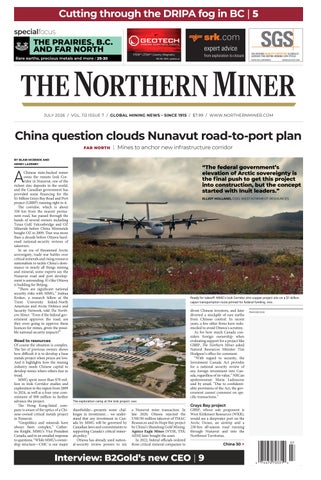
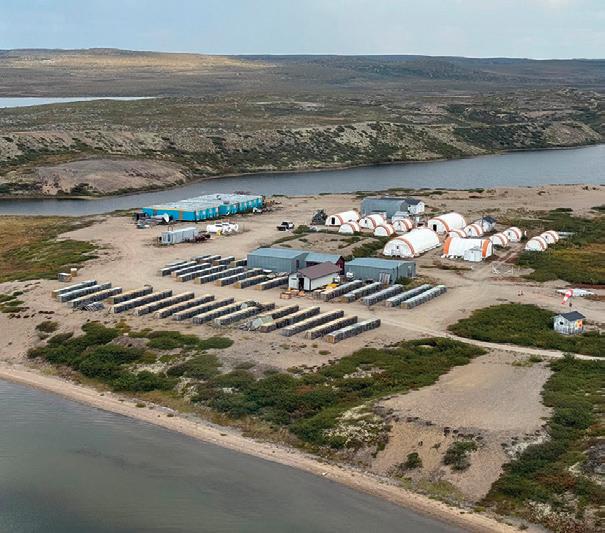
AChinese state-backed miner owns the remote Izok Corridor in Nunavut, one of the richest zinc deposits in the world, and the Canadian government has provided some financing for the $1-billion Grays Bay Road and Port project (GBRP) running right to it.
The corridor, which is about 350 km from the nearest permanent road, has passed through the hands of several owners including Texas Gulf, Falconbridge and OZ Minerals before China Minmetals bought OZ in 2009. That was more than a decade before Ottawa hardened national-security reviews of takeovers.
In an era of threatened Arctic sovereignty, trade war battles over critical minerals and rising resource nationalism to tackle China’s dominance in nearly all things mining and mineral, some experts say the Nunavut road and port development is astounding. It’s like Ottawa is building for Beijing.
“There are significant national security risks with MMG,” Joshua Kroker, a research fellow at the Trent University linked-North American and Arctic Defence and Security Network, told The Northern Miner. “Even if the federal government approves the road, are they even going to approve these licences for mines, given the possible national security impacts?”
Road to resources
Of course the situation is complex. The list of previous owners shows how difficult it is to develop a base metals project when prices are low. And it highlights how the mining industry needs Chinese capital to develop mines where others fear to tread.
MMG spent more than $70 million in Izok Corridor studies and exploration in the region from 2009 to 2024, as well as a four-year commitment of $90 million to further advance the project.
The Hong Kong-listed company is aware of the optics of a Chinese-owned critical metals project in Nunavut.

“The
ELLIOT HOLLAND, COO, WEST KITIKMEOT RESOURCES
divest Chinese investors, and later diverted a stockpile of rare earths from Chinese control. In recent years, a few other firms have redomiciled to avoid Ottawa’s scrutiny.
As for how much Canada considers foreign ownership when evaluating support for a project like GBRP, The Northern Miner asked Natural Resources Minister Tim Hodgson’s office for comment.
“With regard to security, the Investment Canada Act provides for a national security review of any foreign investment into Canada, regardless of its value,” NRCan spokeswoman Maria Ladouceur said by email. “Due to confidentiality provisions of the Act, the government cannot comment on specific transactions.”
Grays Bay project
a Nunavut mine transaction. In late 2020, Ottawa rejected the US$150-million takeover of TMAC Resources and its Hope Bay project by China’s Shandong Gold Mining. Agnico Eagle Mines (NYSE, TSX: AEM) later bought the asset.
GBRP, whose sole proponent is West Kitikmeot Resources (WKR), would see a deepwater port on the Arctic Ocean, an airstrip and a 230-km all-season road running through Nunavut and into the Northwest Territories.
Ottawa has already used national-security review powers to nix
“Geopolitics and minerals have always been complex,” Catherine Knight, MMG’s Vice President Canada, said in an emailed response to questions. “While MMG’s ownership structure—CMC is our major shareholder—presents some challenges in investment… we understand that any investment in Canada by MMG will be governed by Canadian laws and commitments to supporting Canada’s critical minerals policy.”
In 2022, federal officials ordered three critical mineral companies to
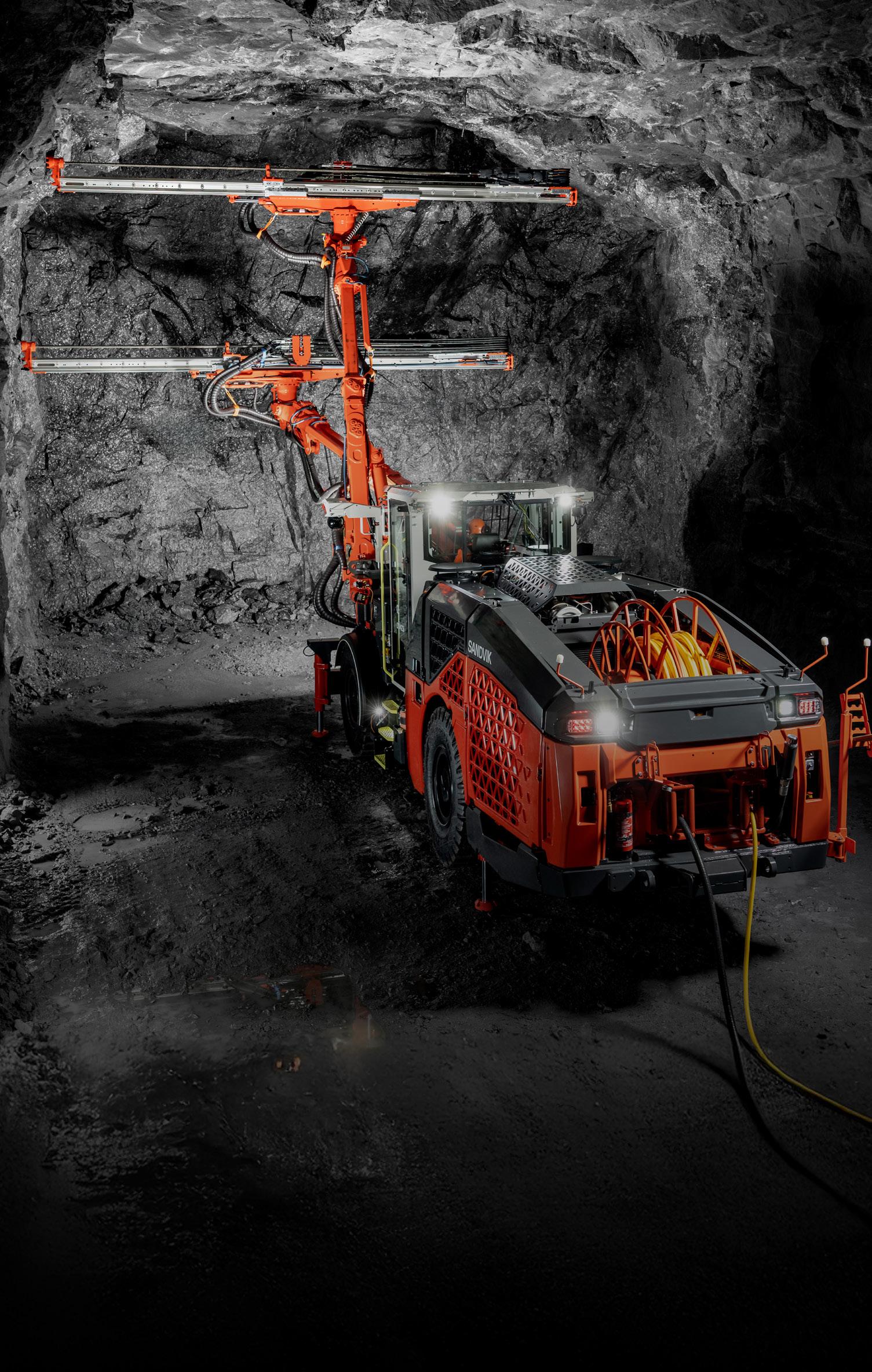
This highly intelligent drill offers more versatility thanks to its new boom design increasing both the face coverage and crosscut drilling. It can drill face sizes from 4 to 7.8 meters.
Central banks are continuing to accumulate gold, though a growing share is no longer being stored in Switzerland—historically one of the world’s main bullion vaulting centres.
A recent survey found the proportion of global gold reserves held at the Swiss National Bank fell to 6% from 12% a year earlier as reserve managers diversified storage locations amid rising geopolitical tensions.
The survey also showed nearly 90% of central banks expect to increase gold holdings over the next year, while 74% foresee lower United States dollar reserves over the next five years. Rather than selling dollars to fund purchases, many central banks are increasingly buying gold with local currencies.
Researchers have confirmed that the Ora Banda structure in Western Australia’s Goldfields is an ancient meteorite impact crater, identifying shock features and traces of meteorite material preserved in impact glass.
The 5-km-wide structure was discovered in a gold-mining district north of Kalgoorlie. Scientists also found evidence that the impact mobilized local gold, with small nuggets preserved in impact breccias. This would suggest gold particles may have been blasted into the air and deposited back onto the surface.
While no economic gold concentrations were identified, the study adds to evidence that asteroid impacts can influence mineral systems and metal distribution.
Australia’s richest person, Gina Rinehart, has bought a stake worth more than US$1 billion (C$1.4 billion) in Elon Musk’s SpaceX through her Hancock Prospecting company.
SpaceX becomes of Rinehart’s largest investments beyond her core iron ore business. The move could create opportunities between SpaceX and Hancock’s critical minerals holdings, which include stakes in rare earth producers outside China.
The investment reflects growing links between mining and space development, as governments and private companies examine how critical minerals, water and energy could support future activity beyond Earth.
The U.S. Department of Energy has created a $17.5-billion loan program aimed at accelerating construction of 10 largescale nuclear reactors in one of the largest government efforts to expand domestic nuclear generation in decades.
The financing will support procurement of long-lead components for five projects, each hosting two reactors based on the AP1000 design developed by Cameco’s Westinghouse Electric joint venture.
Officials say the program could shorten development timelines by up to three years and strengthen the U.S. nuclear supply chain as electricity demand rises, driven in part by AI and data centres.
Utilities and energy companies will partner with Westinghouse on the projects.
BY NORTHERN MINER STAFF
Canada signed 26 new investments and partnerships with nine allied countries at the June G7 summit in France, covering critical minerals supply chains. Prime Minister Carney’s office said these deals will unlock more than $5 billion in capital investment across Canada.
The deals are broadly aimed at countering China’s dominance in global critical minerals supply chains, a concern shared across the G7.
Partner countries including France, Germany, Italy and summit guest South Korea agreed to stockpile minerals sourced from Canada, while specific project investments spanned lithium, graphite, rare earths, and high-purity silica.
The partnerships were structured through Canada’s Critical Minerals Resilience and Production Alliance, which is designed to function as a “buyers’ club” for allied nations.
GLOBAL MINING NEWS • SINCE 1915 www.northernminer.com
PRESIDENT THE NORTHERN MINER GROUP: Anthony Vaccaro, CFA, MBA avaccaro@northernminer.com
EDITOR-IN-CHIEF: Colin McClelland cmcclelland@northernminer.com
COPY EDITOR AND PRODUCTION EDITOR: Blair McBride bmcbride@northernminer.com
SENIOR STAFF WRITER: Frédéric Tomesco ftomesco@northernminer.com
WESTERN EDITOR: Henry Lazenby hlazenby@northernminer.com
PODCAST HOST: Adrian Pocobelli apocobelli@northernminer.com
ADVERTISING: Robert Hertzman (416) 898-6654 rhertzman@northernminer.com
Kathleen Plamondon (514) 917-5284 kplamondon@northernminer.com
Michael Winter (416) 510-6772 mwinter@northernminer.com
SUBSCRIPTION SALES/ APPOINTMENT NOTICES/ CAREER ADS
George Agelopoulos (416) 510-5104 (Toll free) 1-888-502-3456, ext. 43702 gagelopoulos@northernminer.com
PRODUCTION MANAGER: Jessica Jubb (416) 510-5213 jjubb@northernminer.com
CIRCULATION/CUSTOMER SERVICE: (416) 510-6789 | 1-888-502-3456 northernminer2@northernminer.com
REPUBLISHING: (416) 510-6768 jmonteiro@northernminergroup.com
ADDRESS: Toronto Head Office
69 Yonge St, Toronto, ON M5E 1K3 (416) 510-6789 tnm@northernminer.com
SUBSCRIPTION RATES: Canada:
C$130.00 one year; 5% G.S.T. to CDN orders.
7% P.S.T.

BY COLIN McCLELLAND
There is a paradox at the heart of Canada’s relationship with its own territory. The country sits atop some of the most valuable mineral deposits on earth: uranium, nickel, copper, rare earths, zinc. And yet most of it remains untouched, not for lack of interest, but for lack of roads.
The Far North hosts world-class critical mineral projects stranded by distances that would dwarf the highway networks of entire European nations. Meanwhile, the geopolitical pressure on Canada to assert meaningful sovereignty over that same territory has never been greater.
These two facts are not unrelated. They are, in fact, the same problem.
As we report this month on the cover, Chinese-owned mining giant MMG is positioned to benefit handsomely from the long-awaited Grays Bay Road and Port project in Nunavut.
That irony deserves a moment of reflection. A piece of infrastructure funded in part through Canadian public investment, designed to open up Canada’s Arctic to resource development, may do more in the near term to advance the interests of a Beijing-controlled company than to build a sovereign Canadian supply chain.
That is not an argument against Grays Bay, it is an argument for Canada to think much more strategically about what it is building, for whom and why.
The case for Grays Bay and projects like it is overwhelming on its own terms. An infographic published on page six maps seven stranded mega-projects across the territories and northern Quebec, each one a potential economic engine, each one sitting beyond the end of the road.
MMG’s Izok Corridor in Nunavut holds 29 million tonnes grading 8.6% zinc and 2.4% copper—among the richest base metal deposits in the world—and sits 350 km from the nearest permanent road.
A piece of federally-funded infrastructure may do more initially to benefit China than a sovereign Canadian supply chain.
Glencore’s Hackett River silver-zinc deposit, Fireweed Metals’ Mactung tungsten project on the Yukon-N.W.T. border, the Kiggavik uranium deposits controlled by Orano, Denison and UEC, the vast rare earth resources at Nechalacho and Strange Lake—all of them are waiting for the same thing: a road.
Together they represent hundreds of billions of dollars in mineral value and, more critically, resources that allied nations are actively scrambling to secure from any jurisdiction they can find.
Canada has them. It just can’t get to them.
The infrastructure deficit in the Far North is not news. What is new is the urgency. The energy transition has supercharged demand for the very metals stranded in Canada’s Arctic. The AI buildout is driving electricity consumption that is reviving nuclear power globally, putting uranium back at the top of the strategic agenda.
Rare earths, once considered a Chinese monopoly, are now a declared national security priority in Washington, Brussels and Tokyo. And Canada’s own relationship with the United States, still navigating the aftershocks of tariff warfare and questions about continental economic integration, has made the argument for a sovereign Canadian critical minerals supply chain impossible to ignore at the Cabinet level.
So why is the map still dotted with projects going nowhere?
The honest answer is that Canada has consistently underinvested in northern infrastructure while treating each mining project as an isolated commercial proposition rather than a piece of a national strategic puzzle.
The Grays Bay Road and Port is one of the few initiatives that breaks that mould—a corridor concept that serves multiple deposits and multiple purposes, including the sovereign reality of putting Canadians to work in the Arctic. But it has been studied, reviewed, and deferred for decades. The pace of deliberation is not matched by the pace of global events.
The territories are not the only jurisdiction in this issue wrestling with the tension between resource development and regulatory uncertainty. In British Columbia, the mining industry has spent the better part of three years trying to understand what the province’s Declaration on the Rights of Indigenous Peoples Act means in practice for project approvals, a question Senior Writer Frédéric Tomesco examines closely in this issue (page five).
The answer matters enormously, not just for B.C.’s copper and gold sector but as a signal to capital about whether Canada’s western provinces are open for the kind of investment the country urgently needs.
The through-line connecting all of these stories—the stranded mega-projects of Nunavut, BHP’s potash renaissance in Saskatchewan (page seven), the regulatory recalibration in B.C.—is the same: Canada possesses extraordinary mineral wealth at precisely the moment the world most needs it, and the country has not yet built the institutions, infrastructure, or policy frameworks to capture that advantage at scale.
Every year a world-class deposit sits stranded beyond the end of the pavement is a year Canada is not there. The question is no longer whether the country can afford to build north. It is whether it can afford not to.
BY IMARU CASANOVA
Gold is trading near all-time highs. Producers are carrying the strongest balance sheets they’ve had in a generation. Margins are at record levels, free cash flow is strong and management teams, by and large, are showing more discipline than this sector has historically been known for. By almost every conventional measure, the conditions for a sustained re-rating of gold equities are firmly in place. And yet generalist investors are largely absent. The capital that could flow into this sector—that this sector deserves—is sitting on the sidelines, going into physical gold exchange traded funds, or being deployed somewhere else entirely.
It’s not skepticism about gold. It’s a lack of trust in gold equities as the right vehicle to get exposure to it.
Their fears: poorly conceived M&A; cost creep just as gold’s strength should be flowing through to earnings; fragile dividends; mediocre project development and unnecessary overhead eating into margins; and geopolitical, environmental and social risks that feel too opaque. These fears are not irrational. They are the accumulated memory of a sector that has let investors down in the past. Acknowledging that history honestly, rather than dismissing it, is an important message.
How to build trust
There are six principles that, consistently applied, have the potential to convert skeptical capital into committed shareholders. We weren’t speaking to investors in the room. Our message was directed to management teams across this industry.
Protect gold price leverage by defending margins and resisting hedging. The primary reason investors choose gold equities over the metal is leverage to the gold price; hedge away too much of that upside and the central investment proposition is diminished.
Meet your numbers. Set guidance you can beat and then meet it or beat it, every time. A consistent track record of delivery compounds into a valuation premium. Under-promise, over-deliver is not just a communication strategy; it is a cultural signal investors read clearly.
Define value creation. State publicly what metrics you use to measure it—return on invested capital, hurdle rates, cash flow per share—and then report against them every period. If a company won’t measure it, the market won’t believe it.
Be accountable. This is a complex and risky business, and things will go wrong. The test is not whether problems arise, but how management responds when they do. Own it early, explain it clearly and show what has changed. Keep it simple. One strategy, consistently executed. The best gold companies are boring in the
best possible way. Too many jurisdictions, pivots and competing priorities are a red flag for anyone trying to build lasting conviction. And justify M&A, then track it. Almost every company announces an acquisition with a detailed synergy case. Almost none tracks or discloses whether those synergies were actually delivered. The same applies to organic projects and their expected returns. That silence is corrosive.
Scary elite management
Management is a large component of a company’s success and the foundation of investor trust. —yet elite leadership may be the scarcest resource in the industry. We talk a great deal about tier one assets, but what this sector truly needs more of is tier one teams: operators with the skill and discipline to produce gold profitably from even challenging deposits. Elite management means a proven track record through a full cycle, not just a bull market; operational credibility built on genuine technical and regional expertise; capital allocation discipline in both organic growth and M&A; communication that is transparent under pressure; succession depth beyond the CEO; and real skin in the game through ownership and compensation tied to long-term performance.
Right now, this sector has more companies and assets than it has great management teams to run them. Poor leadership destroys value at every stage of the mining cycle, and that is one reason we see a case for consolidation.
Why consolidate?
The case for consolidation is real, but the type of consolidation matters enormously. What we support is regional and geographic consolidation—hub-and-spoke district models where assets share infrastructure, equipment, labour and technical expertise, and where the synergies are real and achievable.
What we push back on is consolidation for scale alone. Increased cross-continent complexity, diluted management focus, synergies promised and never measured, and integration risk chronically underestimated are exactly the patterns that erode trust across the sector.
Trust is the foundation. Build it, and the capital will come.
A small allocation from the generalist pool would have large implications for the sector. Companies that earn that trust should also be able to retain shareholders through downturns if they can consistently demonstrate the ability to navigate the cycles. Over time, that is how gold mining equities can become a recognized sleeve in global portfolios rather than something owned only opportunistically when bullion spikes. TNM
BY FRÉDÉRIC TOMESCO
West High Yield Resources (TSXV: WHY) corporate secretary Barry Baim is one of many mining executives active in British Columbia wondering when the legal fog surrounding Indigenous rights will dissipate.
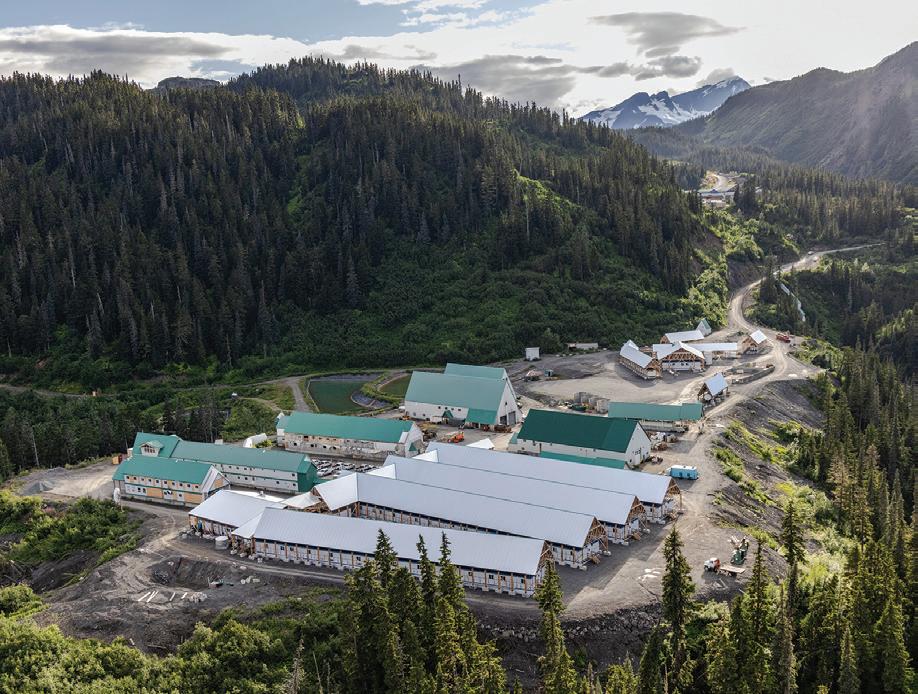
Despite reaching an agreement with B.C.’s Osoyoos Indian Band, Calgary-based West High Yield has seen its efforts to advance Record Ridge, a proposed $30-million magnesium mine in the province’s southeast, stymied in recent months by legal challenges from a U.S.-based First Nation located downriver. The group argues that the project could affect lands and waterways of cultural and ecological importance.
In June, B.C.’s Supreme Court lifted an injunction that had temporarily restricted construction activities pending resolution of a judicial review, allowing work on the project to resume after a six-week halt. Even so, the repeated delays mean West High Yield will be hard pressed to meet its goal of starting production at Record Ridge in next year’s first quarter.
Situations like these are a result of British Columbia’s 2019 decision to pass the Declaration on the Rights of Indigenous Peoples (DRIPA), a first of its kind in Canada. The law commits the provincial government to align its legislation with the principles contained in the 2007 United Nations Declaration on the Rights of Indigenous Peoples (UNDRIP) and to develop action plans in consultation with Indigenous peoples.
DRIPA “has been a detraction for sure” as West High Yield attempts to raise funds for Record Ridge and a magnesium oxide plant to process output from the mine, Baim told The Northern Miner in an interview.
“We have specifically talked to a number of financiers about our project, and one of the stumbling blocks is the lack of clarity over when we will get our final permit to disturb ground. Until this gets resolved, I believe capital is looking at British Columbia and saying: ‘We’re uncertain as to the future there, we need to invest elsewhere.’”
The upcoming Supreme Court case—which pits British Columbia against the Gitxaala Nation—follows a landmark ruling in December by the provincial court of appeal that found the province’s mineral tenure regime breached the Crown’s duty to consult Indigenous Peoples. It also concluded that DRIPA allows courts to decide whether B.C. law is consistent with UNDRIP.
The Gitxaala Nation decided to challenge the province’s Mineral Tenure Act after discovering that about 17% of its territory has been staked without the nation’s knowledge, Chief councillor Linda Inness told The Northern Miner
The Mineral Tenure Act and its automated claim-staking system creates an “overall disregard from the province and industry” for First Nations, Innes said in an interview.
“Prior to our court case, we
UNDRIP and the province’s mineral claims regime are “inconsistent.”
had some pretty bad actors doing exploratory mining,” she said. “By the time we’re aware that someone has been granted rights within our territory, the dominoes are already falling and the decisions have already been made. The Mineral Tenure Act is such an antiquated policy. Consultation must be built into the system, not bolted on after decisions are made.”
Those bad actors include now bankrupt miner Banks Island Gold, whose former Yellow Giant mine sits on Gitxaala land in northern B.C. In 2023, the company’s former CEO was found guilty of 13 environmental violations in relation to waste discharges from the mine in late 2014.
Yellow Giant “is still there and it’s still not remediated. Industry is not held accountable,” Innes says.
“We’re not against mining. We’re against bad actors and bad practices. Responsible development is not the problem. Irresponsible development is.”
Industry hub
B.C. is home to one of the largest concentrations of mining and exploration companies in the world. It’s also home to 204 First Nations, about one-third of the Canadian total. Ontario is next, with about 130 First Nations.
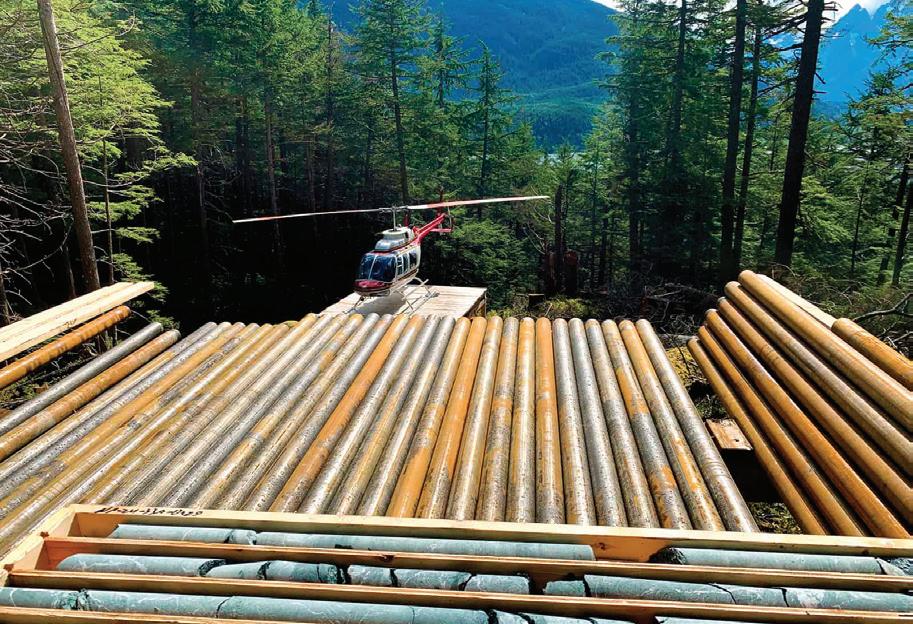
Mining accounts for $18 billion in annual economic activity in B.C. and almost 30% of goods exports, supporting some 4,000 small, medium, and Indigenous affiliated businesses according to data compiled by the Mining Association of British Columbia. Some 11 metal mines, five steelmaking coal mines and two smelters operate in the province—with dozens of projects
affecting their lands and resources.
In April, B.C. Premier David Eby abandoned plans to suspend or amend DRIPA during the spring legislative session. B.C. will instead work together “with all First Nations leaders on a path forward to discuss and consider the government’s stated legal concerns, while upholding the title and rights and human rights of First Nations,” he said.
‘Devastating’
DRIPA “has created an immense amount of confusion,” Thomas Isaac, a Vancouver-based lawyer and partner at Cassels who chairs the firm’s Aboriginal law group and has written a book about the B.C. law, told The Northern Miner
“It’s impossible on a day-to-day basis to interpret every law in B.C. as being consistent with UNDRIP. It’s silliness and unnecessary for reconciliation. It’s not good for business and we’re now in a state of chaos. All thanks to the government of British Columbia. This is all self-inflicted. None of this was necessary. It’s been devastating to the business community.”
To be sure, mining investments haven’t stopped flowing into B.C. because of DRIPA—quite the contrary.
Exploration and evaluation expenditures in the province jumped 36% last year to a record $751 million as junior miners turned on the tap amid sustained appetite for copper projects, according to data compiled by the EY consulting firm. The result contrasts with declining exploration investment across much of Canada. Still, most mining investment in B.C. “tends to be focused on those projects that are moving forward because the First Nations have come to agreement with the proponents and the regulatory approvals are largely in place,” says Todd Stone, a former member of the provincial legislature who heads B.C.’s Association for Mineral Exploration.
at various stages of advancement. How fast—and how far—these investments advance in coming years could be well determined by an upcoming Supreme Court of Canada case.
Canada’s top court has agreed to hear an appeal of a B.C. court ruling brought by the provincial government. It’s asking parties in the case to serve and file their responses by Sept. 24.
In December, B.C.’s Court of Appeal ruled that DRIPA incorporates UNDRIP and creates legally enforceable obligations for the province and developers. It also found that UNDRIP and the province’s mineral claims regime are “inconsistent.”
UNDRIP sets minimum standards for the survival, dignity and well-being of Indigenous peoples. One of its key provisions is the principle of “free, prior and informed consent” (FPIC), which calls for Indigenous peoples to participate meaningfully in decisions
“Where we need to be worried is the next wave. The next wave is quite a ways behind, and at the moment it’s not a very big wave. This is because there are regulatory policies that governments have made that have tended to hold back the progress of junior mining companies. On top of that you have DRIPA and a number of court cases. All of that gets conflated.”
AME is planning to be an intervenor in the upcoming Supreme Court of Canada case, says Stone.
“We need some clarity as early as we can,” says Stone, who voted for DRIPA when he was a provincial legislator.
“The legislation was aspirational in nature. It was a framework. It was a tool to accelerate reconciliation. DRIPA was not supposed to provide a veto. It was not supposed to represent a massive transfer of land resources and rights to First Nations. Yet it has become all of that and more.”
Earlier ruling Complicating matters is a 2025 ruling by the B.C. Supreme Court that recognized the Cowichan Nation’s

By Blair McBride
The vast distances across Canada’s Far North host critical metal projects that are as large as they are inaccessible due to lack of infrastructure. While investors and governments might initially recoil at the costs to build roads to these deposits, they’re so huge and strategically valuable that they can’t be ignored. The Northern Miner takes a look at seven projects* – some hosting the largest deposits of their kind in the world – needing reliable road connections before they can be developed.









POTASH |
BY FRÉDÉRIC TOMESCO
BHP’s (NYSE, LSE, ASX: BHP)
Jansen mine in Saskatchewan
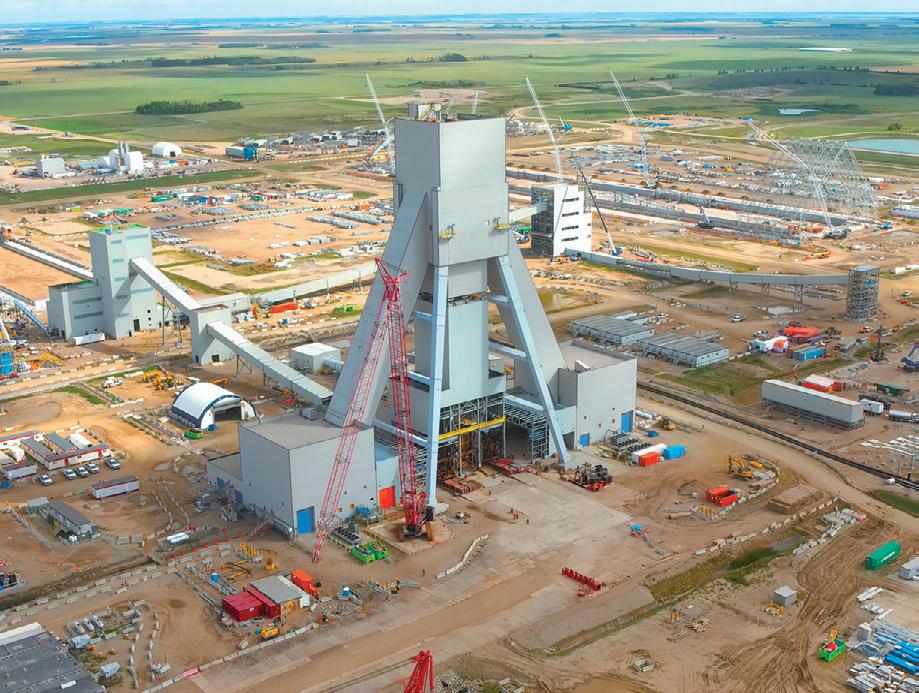
—at $15.3 billion (C$21.6 billion), the company’s biggest ever investment—will join a packed field when it enters production about a year from now.
Output of 12.6 million tons (11.4 million tonnes) from new potash mines in countries including Canada, Russia and newcomer Laos is set to start by 2030, putting pressure on global prices, according to London-based commodities and minerals market intelligence consultancy CRU. That works out to an estimated 8% increase from 2025 output.
“From 2027 onwards, there’s going to be a lot of excess capacity being added,” Alexander Chreky, fertilizer analyst and potash specialist at CRU in London, told The Northern Miner in an interview.
“When you add so much supply to the market, even if you have an increase in demand, there is going to have to be a price response of some sort. The potash industry is kind of a chronically oversupplied industry, so when you’re adding supply, that’s going to mean that prices are pushed down.”
Located about 140 km east of Saskatoon, Jansen is crucial to BHP’s ambitions of building a significant footprint in potash—a new commodity for the mining behemoth. The investment, the largest in Saskatchewan’s history, is part of an effort by BHP to shift its portfolio away from steelmaking materials and towards what executives call “future-facing commodities” such as copper and potash.
“When a new player comes into any market in any commodity, there’s always some placement and positioning,” Allan Pickett, head of fertilizer analysis at S&P Global Commodity Insights in London, said in an interview. “People compete, so the initial reaction is likely to be that prices at the time will be slightly less strong than they otherwise might have been.”
Top-tier producer
BHP is aiming to start producing potash at Jansen in mid-2027, six months later than previously expected. Over time, Jansen is expected to become one of the world’s largest potash mines, producing about 8.5 million tonnes of the fertilizer annually—equivalent to about 10% of current global supply.
Developing Jansen won’t come cheap. A detailed review of cost and schedule estimates for the mine’s first stage, completed in January, led BHP to add $1 billion to its previous forecast. That boosted the overall construction budget to $8.4 billion.
On June 18, BHP blamed additional construction hours and materials as it boosted the total investment estimate for Jansen’s second stage to $6.9 billion, including contingencies—a 41% jump. The cost update, the result of a detailed review, will force BHP to take an impairment charge of $2.3 billion when it releases annual results July 16.
“The potash industry is kind of a chronically oversupplied industry, so when you’re adding supply, that’s going to mean that prices are pushed down.”
“Once ramped up, Jansen will be a world-class, low-cost potash producer” similar to BHP’s Western Australia iron ore operations, outgoing CEO Mike Henry told financial analysts Feb. 17.
“It will also make BHP stronger because potash demand drivers and key customer markets are differentiated from our other commodities, meanings even lower volatility in earnings and cash flow generation.”
Each stage of Jansen is expected to deliver earnings before interest, taxes, depreciation and amortization of around $1 billion of per year, with margins topping 60%, Henry added.
Elsewhere in Canada
Jansen isn’t the only new potash mine being planned in Canada. German miner K+S has begun work on a planned $4.1-billion expansion of its Bethune operation in Saskatchewan. A first stage of construction is expected to be completed by 2030 as part of a broader plan to double annual output to 4 million tonnes by 2040.
K+S and BHP join global rivals such as Russia’s Urakali and Switzerland-based EuroChem Group in planning capacity additions, Chreky said. Combined, Russian producers could potentially add about 5 million tonnes a year of
new output by 2030, he said.
“BHP might be the single largest addition to the market, but actually more capacity is coming online in Russia,” Chreky said.
Canada was the world’s biggest potash producer in 2024, churning out about one-third of global output. Combined, Russia and Belarus accounted for about 38% of supply, Natural Resources Canada data show.
Potash demand is projected to grow by about 70% by 2050, “with very low substitution risk,” Henry said on a February conference call.
BHP expects Jansen’s volumes to be absorbed “without structural disruption,” supported by a “gradual market entry aimed at limiting any pricing impact,” BMO Capital Markets mining analyst Alexander Pearce said in a May 14 note.
Potash resurgence
Jansen’s arrival comes with appetite for potash enjoying a resurgence of sorts. Annual demand has grown by about 1 million tonnes per year since 2024, CRU data show.
Long-term demand for potash typically rises by 1.5% to 2% a year, according to S&P Global’s Pickett. Population growth and wealth are the two main drivers of fertilizer demand, he said.
Potash is the least applied of the three major types of fertilizers, industry data show. Nitrogen is the most popular, followed by phosphates.
Appetite for potash is underpinned by United Nations forecasts showing the global population will continue growing until the 2070s. And as countries get richer, their potash demand increases.
“Potash is a bet on increasing populations, but not only that, on populations getting richer,” Chreky said.
Following a dip to about $270 per tonne in late 2024, potash was trading at about $405 a tonne on the spot market as press time neared. Prices are still well below their historical 2022 peak of over $1,200 per
response,” he said. “The degree really depends on the behaviour of the new entrants. We’re not exactly sure how BHP is going to behave, but they’re adding a lot of capacity to the market, around a little over 4 million tonnes, and that’s just stage one.”
To be sure, even if potash prices do fall, they’re unlikely to enter a multiyear slump comparable to what nickel went through when Chinese producers added new facilities in Indonesia and elsewhere, Chreky said.
“It’s not going to be apocalyptic,” he said. “Nobody’s going to go out of business.”
As Jansen starts operations, BHP may try to use its financial clout to develop new markets in regions such as Africa, analysts say.
“Africa would be an exceptionally good example where not much potash is used, and not much fertilizer is used,” Pickett said.
tonne—a direct result of Russia’s war on Ukraine, which froze Russian potash out of global markets.
Price outlook
As new mines around the globe enter production, potash prices could start falling as soon as the end of 2027, Chreky said. He declined to provide an estimate for the magnitude of the drop, citing proprietary data.
“There will be definitely a price
BHP “could get into new markets that other people haven’t had the ability to target because they have so much money that they can develop the African market, for example, which really lags in terms of potash demand,” Chreky said.
Jansen’s cost almost ensures that the second stage will eventually get built.
“Phase 2 is going to happen for sure. It has to happen because that’s the only way that the BHP Phase 1 really makes sense,” Chreky said. “They sank such a huge shaft that it would just be overwhelming the first stage. So it’s just a question of when it happens, rather than if it happens.”
Offtake, debt deals due next year, CEO says
BY COLIN MCCLELLAND
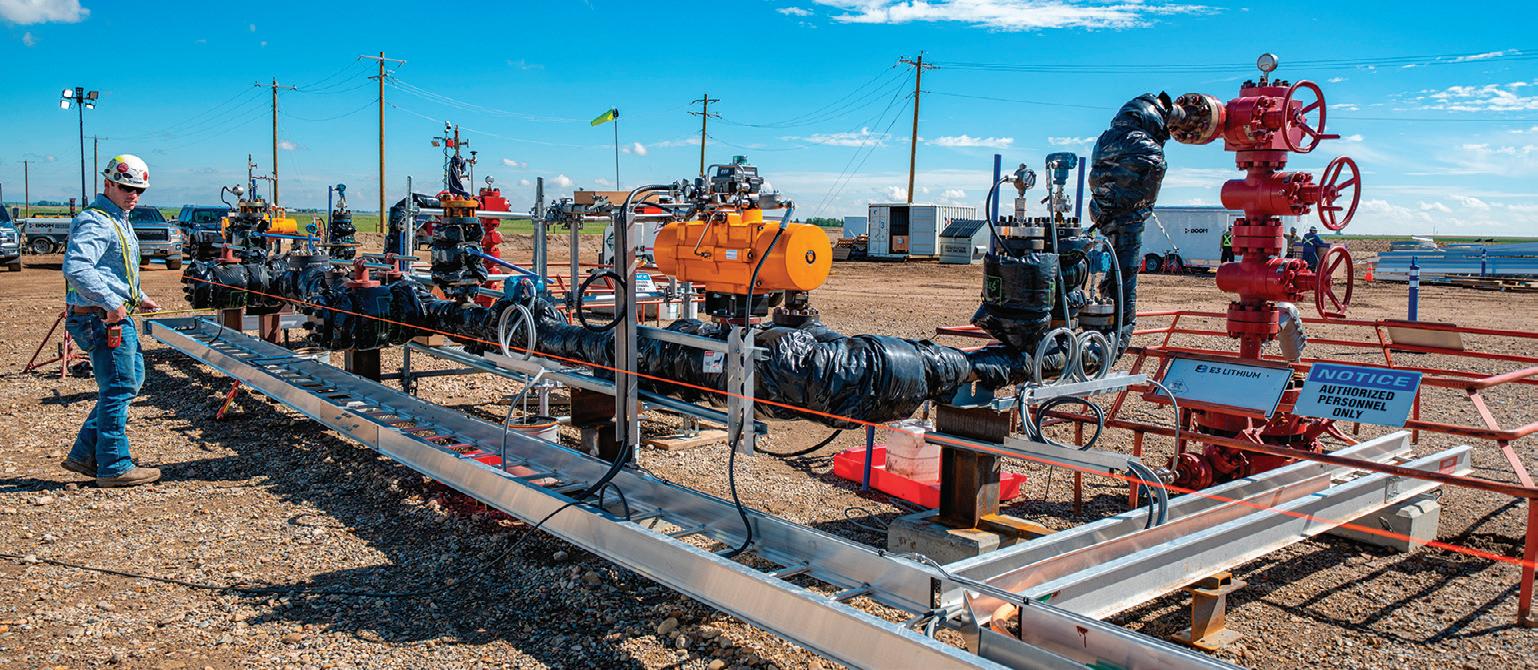
E3 Lithium (TSXV: ETL; US-OTC: EEMMF), whose total holdings represent Canada’s biggest lithium resource, plans to be shovel-ready, drive bank-led funding talks in earnest and reach a final investment decision by this time next year.
The company is targeting first output by mid-2029 of 12,000 tonnes a year of battery-grade lithium carbonate in the first stage of its Clearwater project, about 130 km south of Calgary where E3 is based.
Capital costs are expected to be lower than a 2024 prefeasibility study’s (PFS) forecast of $2.5 billion (C$3.53 billion) for a 30,000-tonneper-year build-out because E3 is removing plans for a downstream hydroxide plant.
E3’s push to be Canada’s first commercial scale battery-grade lithium producer comes as the metal’s prices recover from a twoyear slump that paralyzed investment across the sector. Governments in Canada, the United States and Europe, spooked by China’s control of battery mineral supply chains, have begun propping up domestic supply through grants, stockpiling and price support.
“We’re getting inbounds all the time for requests for proposals for lithium,” CEO Chris Doornbos said in a June phone interview. “The real bank financing for the debt component of this facility will probably start in the new year as we start to nail down offtake.”
Doornbos described E3’s planned capital structure as analogous to a midstream pipeline: roughly 60% to 70% debt secured against longterm offtake contracts, with the remainder raised as project-level equity. Potential equity sources span strategic investors seeking Alberta lithium exposure, the Canada Growth Fund, and funds in Japan or Europe tied to offtake commitments.
E3 says it is fielding requests from automakers, cathode pro-
E3 LITHIUM
ducers, battery makers and mining and energy companies, and expects a handful of major offtake deals to unlock a broader rush of capital into North American lithium development.
“There’s significant interest right now in trying to supply domestic sources of ex-China lithium,” he said. Doornbos said he has traveled to India and plans a Japan trip to speak with potential customers.
The road to a final investment decision is not without risk. Doornbos acknowledged that lithium spot prices remain an imperfect gauge of what a producer actually gets paid, since the metal trades primarily through private contracts rather than open markets. E3 has yet to sign an offtake agreement, and it has not published a compliant capital cost estimate for stage one alone.
The company does have about C$80 million in federal and provincial support, including a C$36.5-million non-repayable federal grant finalized June 10.
E3’s Bashaw District land position in central Alberta holds measured and indicated resources of 16.2 million tonnes of lithium carbon-
ate equivalent (LCE), grading 75.5 milligrams of lithium per litre of brine, according to the June 2024 PFS. The district represents 40% of Canada’s measured and indicated lithium inventory.
The Clearwater project, a 50-year brine production area within Bashaw, holds proven and probable reserves of 1.13 million tonnes of LCE, grading 75.5 milligrams of lithium per litre. Proven reserves for the first five years of operation total 141,200 tonnes of LCE.
Discounted at 8%, the PFS pegged Clearwater’s post-tax net present value at $3.72 billion and its after-tax internal rate of return at 24.6%.
E3’s Garrington district, west of Bashaw, hosts 5 million measured and indicated tonnes at 54 milligrams lithium, according to an initial resource from last summer. It also hosts 300,000 inferred tonnes grading 42 milligrams lithium. E3 has not yet announced plans to incorporate Garrington into the Clearwater development plan.
Alberta’s Leduc Reservoir, a subsurface brine system drilled for decades by the oil and gas industry, underpins both. A March assessment by the Alberta Geolog-
“There’s
significant interest right now in trying to supply domestic sources of ex-China lithium.”
CHRIS DOORNBOS, CEO, E3 LITHIUM
ical Survey put the province’s total resource at 82.5 million tonnes of LCE, placing it third globally.
“Bolivia, Argentina and then Alberta,” Doornbos said. “And then Chile.”
Demo plant
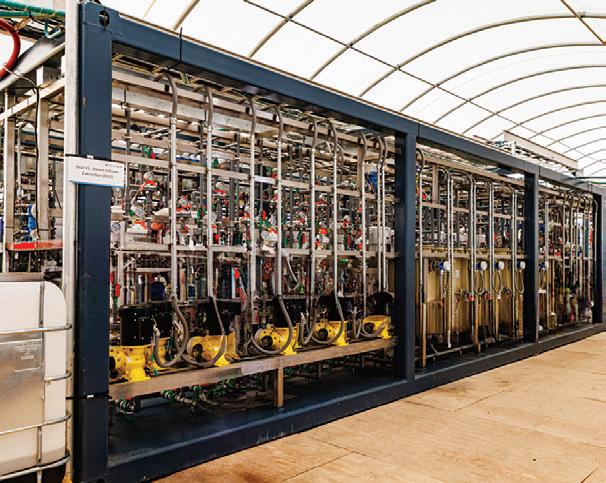
E3 extracts lithium by flowing Leduc brine through a solid absorbent that selectively captures lithium ions and releases them into a clean solution. The company commissioned the second stage of its demonstration facility June 15. It’s running subsurface brine tests and reservoir production work it says fills a key data gap before a feasibility study due early next year.
A third stage, set to start in July, will deploy a single commercial-scale extraction column, one of 120 that would be needed in the full plant. One column processes 850 cubic metres of brine a day and is rated at 100 tonnes a year of carbonate-equivalent output. The module is on order and expected to be operating this fall, giving E3 a one-to-120-scale preview of its commercial facility.
The process exits at 66% lithium purity, Doornbos said, reducing the downstream cleanup burden relative to hard-rock conversion routes that must strip away a 94% impurity fraction. E3 compares its simplified water-treatment-like flow sheet against the large-scale roasting and blending required to convert hard-rock concentrate into battery-grade product.
Costs
“This [dropping the hydroxide]
shift aligns with the growth of lithium iron phosphate battery chemistry versus nickel-rich cathodes, which require lithium hydroxide,” Canaccord Genuity mining analyst Anthony Taglieri said in a June 17 note. “Management expects the phase one capex profile to be significantly lower than the prefeasibility study.”
E3’s preliminary study pegged operating costs at about $6,000 per tonne of lithium carbonate equivalent—on par with Standard Lithium (TSXV: SLI) and Germany’s Vulcan Energy Resources (ASX: VUL), and about a third less than a typical hard-rock operation, Doornbos said. E3 has moved away from incorporating downstream conversion to lithium hydroxide as in the study, he said. Capital spending runs about 12% above Standard Lithium’s published figure, which Doornbos attributed to higher brine volumes needed. He said the gap falls within the plus-or-minus 30% accuracy range of a prefeasibility estimate, making the two projects “very, very similar in total capex.”
E3 brought in Tom Gear as chief operating officer on June 8, adding a seasoned builder to a management team that also welcomed a new chief financial officer, Brian Newmarch, last year.
Doornbos said he expects to eventually add a president for Canadian operations while he focuses on business development and expansion into the broader battery supply chain, including a partnership with Pure Lithium and exploratory talks in the cathode space.
E3’s goals for early next year mean permits, studies and technical data are to be in place before financing discussions heat up.
“The fact that we’re operating Canada’s only battery grade carbonate [pilot plant] today is something that I’m personally very proud of,” Doornbos said. “It’s been a long road to get here, but we’re sort of over that big hump now, and we’re moving all of this forward.” TNM
BY HENRY LAZENBY
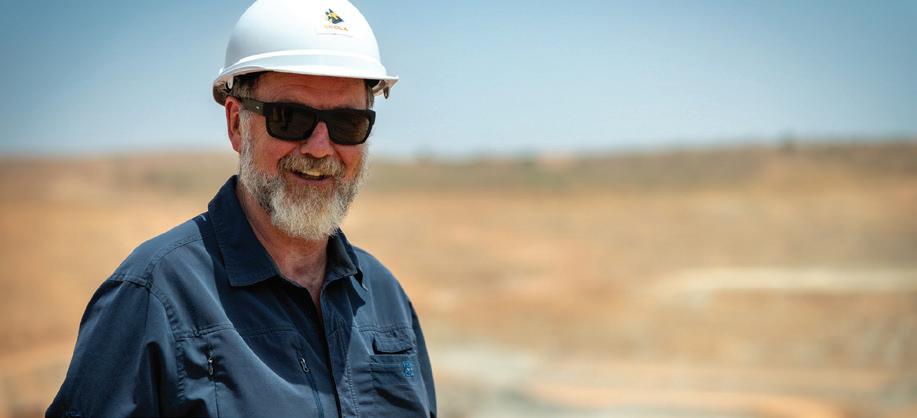
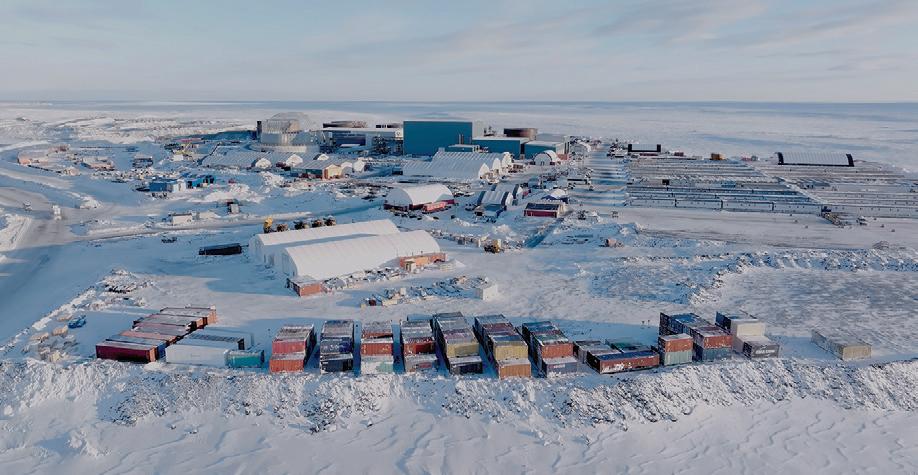
B2Gold (TSX: BTO; NYSE-A: BTG; NSX: B2G) has handed Mike Cinnamond a Far North test in his first weeks as CEO: finish the Goose mine ramp-up in Nunavut to restore the Vancouver major’s million-ounce-per-year status.
Goose, about 1,400 km west of Iqaluit, Nunavut’s capital, is expected to produce 170,000 to 230,000 oz. this year even after an April crusher fire cut expected second-quarter output by about 10,000 ounces. B2Gold expects the mine to average about 300,000 oz. a year from mid-2027, once it finishes repairs and upgrades the crusher to 4,000 tonnes per day.
“Someone said to me, when you stepped in, instead of drawing the short straw, you drew the long straw,” Cinnamond told The Northern Miner. “We’re just coming out of that investment phase and into the cash-flow phase. Right now, you’ve got to execute and we need to demonstrate capital discipline.”
Analysts say the market still wants proof that Goose can run at design rate. Haywood Securities analyst Jamie Spratt on May 7 raised his target on B2Gold to $10.50 from $8.75 after first-quarter production and costs beat estimates. But he said the company’s rerating depends on “the ramp up of crushing and full run rate production at Goose and the receipt of regional exploitation permits at Fekola” in Mali.
B2Gold’s Toronto-listed shares are up 20% over the past 12 months, trading at $6.08 apiece near press time. It has a market capitalization of $8.1 billion (US$5.7 billion).
“The primary focus first is to get Goose up and fully running at steady state.”
MIKE
CINNAMOND, CEO, B2GOLD
tonnes per day by the end of September. A second stage, expected to cost $20-$30 million, is planned for the first half of next year to take the circuit to its 4,000-tonne-per-day design rate.
Goose gives B2Gold grade that few new open-pit gold mines can match. Probable reserves total 10.9
processing capacity to 6,000 tonnes per day.
Partnership
B2Gold is also working to make Arctic logistics less lonely. In April, B2Gold sold its 70% interest in Fingold Ventures in northern Finland to Agnico Eagle Mines (TSX:
keeps feeding the company’s longer pipeline in Nunavut, Mali, Namibia, the Philippines and earlystage targets elsewhere.
Gramalote in Colombia is the largest development option outside Canada. B2Gold has rede-
signed the project around a smaller mill and is working through permit changes it expects to take into early 2027 before deciding whether to build. The project gives Cinnamond another growth lever, but not one he has to pull before Goose and Fekola Regional are running the way investors expect.
B2Gold expects to produce 820,000-970,000 oz. gold this year at all-in sustaining costs of US$2,400-US$2,580 per oz. sold. Its global probable reserve base totals 199.4 million tonnes grading 1.4 grams gold per tonne for 8.99 million oz. of metal. It’s held in 496.7 million indicated tonnes grading 1.09 grams gold for 17.4 million ounces. Inferred resources total 263.6 million tonnes grading 1.23 grams gold for 10.5 million ounces.
Consolidation player?
B2Gold has a strong balance sheet. It produced 237,763 oz. gold in the first quarter, generated $362 million in free cash flow and had $479 million in cash as of March 31. It also repaid the remaining $75 million on its revolving credit facility after quarter-end, leaving the full $800 million available.
Cinnamond said B2Gold’s liquidity does not mean a takeover is next. B2Gold has repurchased $98 million worth of shares this year, sold non-core assets, kept its dividend steady and put its largest exploration budget into Back River. Deals can wait until the company proves it can again run as a steady million-ounce producer, he said.
“We’re not there yet,” Cinnamond said. “We need to do those execution things first.” TNM


BY BLAIR MCBRIDE
With nine months to go until Ottawa is scheduled to devolve powers to the Nunavut government, industry figures say it represents an opportunity for Nunavut residents to pursue their own path of mining development.
By April 1, the process of devolution—transferring responsibilities from the federal government to Nunavut—is due to be complete. Iqaluit will take on management of its own lands, water and resources. Yukon and the Northwest Territories undertook devolution in 2003 and 2014, respectively.
“The government of Nunavut has observed significant industry interest in devolution, with stakeholders viewing the territorial government as a local and potentially more accessible partner,” Stephen Mansell, chief negotiator of Devolution at Nunavut’s Department of Executive and Governmental Affairs, said in an emailed response to questions.
“At the same time, industry has emphasized the importance of a seamless transition that avoids disruption to existing operations.”
$1.4 B mining economy
The Inuit-majority territory is also Canada’s largest by land mass and hosts vast mineral resources, four producing mines and dozens of exploration projects. While most of its mines and exploration sites are hard to access due to limited infrastructure, mining contributed $1.45 billion to the territorial economy in 2025, or 35% of its GDP, according to Statistics Canada.
The Nunavut government, Inuit rights organization Nunavut Tunngavik Inc. (NTI) and the federal government signed the Nunavut Lands and Resources Devolution Agreement in 2024. Since then, the three bodies have been preparing for the transfer of land, water and resource-management powers to Iqaluit.
After the agreement takes effect next April, Nunavut will assume the issuing of mineral claims on Crown lands and mineral tenure management. It will also receive revenues from mining royalties, land leases and development on Crown lands.
Ottawa’s authority will remain over fisheries, migratory birds, navigable waters and other federal issues that can affect mine development.
Narrow royalty path
While the territory will be entitled to receive more royalties, many of Nunavut’s major mining operations and some of its most prospective mineral districts sit on Inuit Owned Lands, and royalties already go to Inuit organizations instead of the federal government. The rest of the territory is Crown land.
All of Nunavut’s producing mines—including Agnico Eagle’s (NYSE, TSX: AEM) Meadowbank-Amaruq and Meliadine, B2Gold’s (TSX: BTO, NYSE-A: BTG) Goose site and Baffinland’s Mary River iron mine—are wholly or partly on Inuit Owned Lands. Agnico declined to comment for this story.
“Royalty amounts or distributions will not change in Nunavut until new mines are found, permitted and are producing on Crown
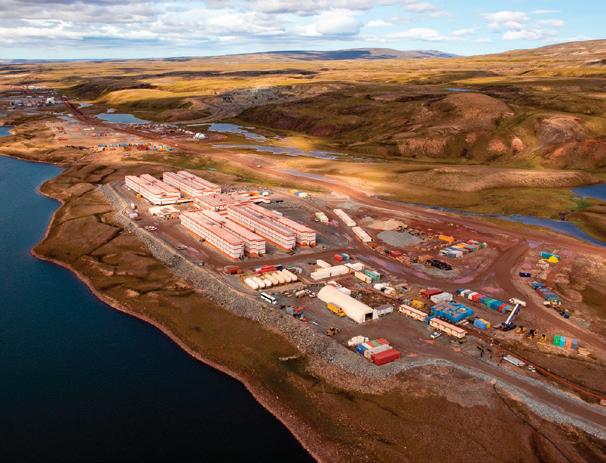
lands as opposed to Inuit Owned Lands,” Paul Hébert, CEO of the NWT & Nunavut Chamber of Mines said.
Yukon caution
But royalties might not be the path to fast cash that many believe it to be, and Yukon stands as an example, warns Ken Coates, Distinguished Fellow at the Macdonald-Laurier Institute and Indigenous Governance professor at Yukon University.
A windfall of royalties requires large, producing mines connected to infrastructure and a royalty policy that captures the right value from mining. Yukon has a good road network and its placer gold mines generated $400 million revenue in 2025, according to Yukon Geological Survey data. However, the Yukon government received just about $39,000 due to its low
placer royalty rate of 37.5¢ per oz., which is also out of step with the gold price.
Nunavut drafting its own mining laws is essential for putting its own stamp on the legislation, Coates said.
“They have such an integrated approach to legislative development in Nunavut,” he said. “[It] should be proactive in getting the support of the communities behind a Nunavut model of resource development, and that has to be also undertaken with the resource companies well represented.”
Infrastructure Mine development might spur building new roads, help lower the cost of living and offer skills training opportunities, Coates said.
“So the Nunavut government can capture the benefits from all those non-revenue opportunities that
come along with resource activity.”
With Ottawa set to play a less prominent role after devolution, miners and explorers are eager to see how decision-making with projects changes and if it potentially moves faster.
Successful permitting will depend more on territorial capacity, staffing and intra-government coordination than on devolution itself, Hébert said.
“Nunavummiut are expected to benefit most from devolution, as it creates the potential for more locally driven decision-making and economic opportunities.”
Baffinland, for its part, expects devolution to strengthen project decision-making in Nunavut, spokesperson Peter Akman said.
“The most significant expected change is that the government of Nunavut will become the final decision-maker for certain project approvals that currently rest with the federal government.”
B2Gold was unable to comment on the specifics of permitting but said the company supports the devolution process.
“This important work will ensure that Nunavummiut benefit from the ability to make decisions about land administration, development and resource management in Nunavut,” spokeswoman Cherry DeGeer said. In the meantime, Iqaluit is focused on drafting “mirror” legislation replicating federal laws for the territory.
“This approach ensures that licences, permits, approvals, and regulatory processes continue uninterrupted when devolution comes into force,” Mansell said. TNM
A
BY HENRY LAZENBY
Transmission capacity has become one of northwestern British Columbia’s main mine-development chokepoints as Golden Triangle projects compete for grid access needed to cut diesel use, lower costs and secure financing.
The issue no longer concerns only generation, The Mining Association of B.C. (MABC) says, but also transmission capacity, interconnection timing and load planning. Delayed grid access can force developers to build projects in stages, add costly temporary generation or wait years for line upgrades.
“Transmission doesn’t just lag development,” the association’s president and CEO Michael Goehring told The Northern Miner by email. “It actively becomes the constraint that determines which projects get built at all.”
Skeena Gold & Silver (TSX, NYSE: SKE), Seabridge Gold (TSX: SEA; NYSE: SA), Newmont (NYSE: NEM; TSX: NGT) and Imperial Metals (TSX: III) all need reliable, low-cost power for mines in the Golden Triangle, near Stew-
art and the southeastern Alaska border. It’s coming to a head just as Ottawa and Victoria work to crank up critical-minerals output.
Provincial power utility BC Hydro plans to twin the 500-kilovolt system between Prince George and Terrace, then add new high-voltage capacity north towards Bob Quinn. The upgrades could more than double power supply in a region where mines, liquefied natural gas (LNG) projects, ports and other industrial users are already competing for capacity.
“When you go from diesel generation, which could be 25¢ per kilowatt-hour-plus, to hydro which is 6¢ per kWh, that’s a big deal,”
Joe Mazumdar, editor and analyst at Exploration Insights, told The Northern Miner
BC Hydro tells The Miner it allocates capacity by queue order, based on when customers file transmission service requests. Some capacity will become available when the first stage of the 165-km North Coast Transmission Line between Williston substation near Prince George and Glenannan substation
near Fraser Lake comes online, the utility said in an emailed statement.
A mine that secures grid power can model lower operating costs, cleaner permitting and stronger financing. A project pushed behind other industrial loads may need diesel, LNG or a staged build while it waits for the grid.
Mine timing
Skeena is closest among the new mine builds to securing grid power. It signed a transmission deal with Coast Mountain Hydro last year, completed first tie-ins to the 287kV line at Volcano Creek and expects power lines to Eskay Creek to be completed in this year’s second half.
Skeena’s 2023 feasibility study assumed power at about 6¢ per kWh for a project requiring about 38 to 39 MWof installed capacity.
KSM carries a much larger load. Seabridge’s 2022 prefeasibility study also assumed grid power at about 6¢ per kWh, Mazumdar said, but the copper-gold project would need about 245 MW of installed power.
BC Hydro is building the Treaty Creek Terminal to connect the new customer north of Terrace to the
mine that secures grid power can model lower operating costs, cleaner permitting and stronger financing.
existing Northwest Transmission Line.
Red Chris faces a different power problem. The mine already operates, but Newmont and Imperial need more capacity to support a proposed block cave expansion. Planned Northwest Transmission Line upgrades could supply up to 145 MW to Red Chris and up to 25 MW for KSM construction.
“Most of these guys are assuming that that grid power is going to be there for them,” Mazumdar said. “They don’t want to be running on diesel.”
The bottleneck reaches beyond the biggest projects. Teck Resources’ (TSX: TECK.A, TECK.B; NYSE: TECK) Schaft Creek would need
a private 95-km, 287-kV line to the Bob Quinn substation, while a Wood Mackenzie assessment shows Kutcho Copper’s (TSXV: KC; US-OTC: KCCFF) remote project east of Dease Lake still depends on finding workable power options.
Line buildout
North of Terrace, mines rely on the 287-kV Northwest Transmission Line and a smaller 138-kV line. BC Hydro’s North Coast plan would twin the 500-kV system from Prince George toward Terrace by fall 2030 and mid-2032, then add a 500-kV line toward Bob Quinn.
The Prince George-to-Terrace capacitor project, now under construction and expected in service by 2028, is already fully subscribed. That leaves later mine loads dependent on the larger North Coast buildout and the order in which customers secured service.
The MABC wants governments to invest ahead of demand rather than wait for each mine to justify a new line. It says B.C. should prioritize long-life, high-value projects that are ready to build, align with electrification and use existing or planned infrastructure well. TNM
BY FRÉDÉRIC TOMESCO APPLETON, NFLD.
New Found Gold (TSXV: NFG; NYSE-A: NFGC) is counting on an expansion of its Pine Cove mill in Newfoundland and the development of the nearby Queensway project to cement its status as a midsized gold producer.
Together with the newly producing Hammerdown gold mine, Pine Cove is one of the key assets that New Found added last year when it completed the $292-million (US$206 million) acquisition of Canada’s Maritime Resources. Located 180 km apart in a central part of the island, Queensway and Hammerdown will share Pine Cove and the Nugget Pond hydrometallurgical plant after the future mine starts producing late next year.
“Things are happening, and they’re unfolding the way that they should,” CEO Keith Boyle said in an interview about the company’s development plans.
“We acquired Pine Cove in order to fast track the Queensway development. It bought us three years of permitting and construction” lead time, he said.
Environmental assessment
Boyle spoke in mid-June as Vancouver-based New Found hosted analysts, investors and reporters to show off Queensway, Pine Cove and Hammerdown.
As press time neared, New Found was waiting to receive the environmental assessment permit for Queensway under an expedited 45-day timeline. A resource update and revamped preliminary economic assessment (PEA) should follow in the second half.
A positive environmental assessment decision “would move Queensway from permitting toward execution,” SCP Resource Finance mining analyst Brandon Gaspar, who visited the site, wrote in a note June 19.
Once confined to exploration, New Found is adapting to life as a producer after taking over Hammerdown. Crews at the mine poured first gold in November.
Commercial production at Hammerdown, which is located about 95 km from Pine Cove, should be declared in this year’s second half, Boyle said. Hammerdown is expected to produce about 251,000 oz. over a 13-year mine life, according to a company presentation.
The site has 3.33 million measured and indicated tonnes across three pits grading 2.43 grams per tonne for 260,000 oz. contained metal, according to a PEA this year. It also has 2.13 million inferred tonnes at 2.34 grams for 161,000 ounces.
Boyle and his colleagues on New Found’s management team are even more sanguine about Queensway’s prospects.
Located about 15 km west of Gander, on the Trans-Canada Highway, Queensway covers more than 110 km of strike on two primary fault zones, Appleton and Joe Batt’s Pond, which are most commonly associated with the mineral
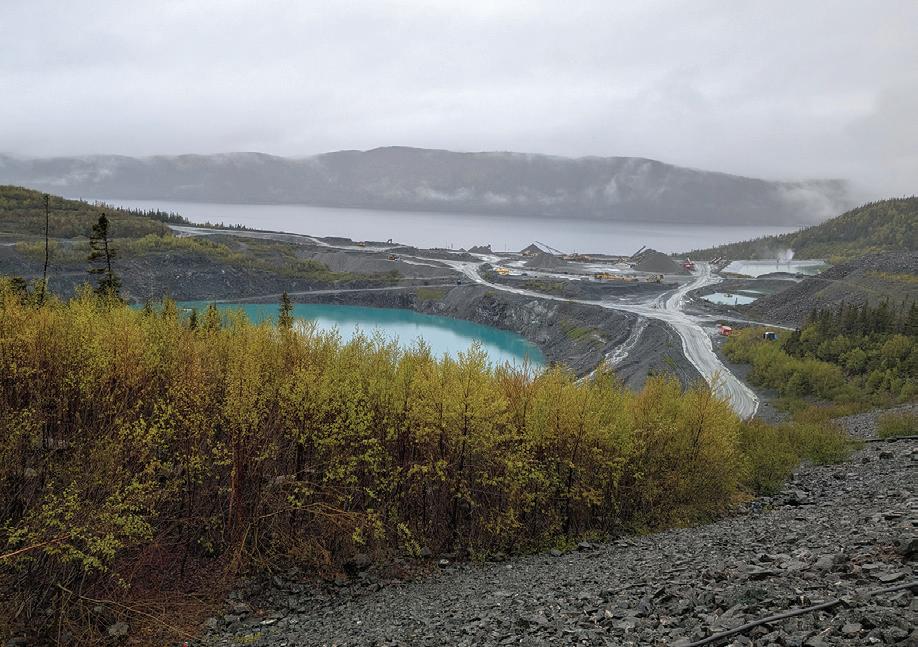
showings on the property.
New Found spent several years consolidating the large regional land package that encompasses the two fault zones. Newfoundland’s Keats family, including veteran prospector Allan and his son Kevin, previously owned the land package that hosts Queensway’s Keats and Iceberg deposits.
“This is a family of prospectors,”
New Found president Melissa Render told The Northern Miner at Queensway. “They drilled the initial holes that identified the low-grade mineralization at Keats. They also had uncovered the Dome prospect.”
After New Found came in and optioned the land, “they did a step out and their first hole went into the high-grade ore shoot that associated with the Keats zone,” Render added. Drill hole NFGC-19-01 cut 19 metres at 92.86 grams gold per tonne in 2019.
“That’s really what launched the project forward and enabled them to finance that first 100,000-metre drill program. Things snowballed from there to where we are now, with many discoveries coming online since then.”
Developing Queensway is estimated to cost $1.07 billion, including $325 million of sustaining capital, New Found says in a slide presentation. Montreal-based engineering services firm WSP was hired in January to advance Queensway and “put some engineering discipline in what we had to do,” Boyle said.
New Found envisions Queensway producing an average of 100,000 oz. gold a year over a projected 15-year life. The project has 18 million indicated tonnes grading 2.4 grams gold for 1.39 million oz. gold, plus 10.7 million inferred tonnes at 1.77 grams for 610,000 oz. contained metal, the company said in its first resource last year.
New Found has adopted a phased approach to build its second operating asset.
Stage one will see the construction of an open-pit mine with offsite toll milling. Its $155-million
cost estimate, as outlined in the PEA, includes about $40 million for mill upgrades at Pine Cove.
A $220-million financing package, completed in April, gives New Found the money needed “to get to the finish line,” Boyle said.
Stage two—at $442 million, the costliest of all three phases—will include open-pit mining with the construction of an on-site processing plant that would open in year four. Stage three would involve building an underground mine, with development scheduled to start in year five.
Construction of stages two and three would begin in the first quarter of 2029, with production from the second stage starting about two years later, chief operating officer Rob Assabgui said.
“By breaking the project into small steps, we’ve reduced the capital and we’ve increased the speed to production,” Assabgui told The Northern Miner in an interview.
“All of these steps have allowed to get from PEA to operations in under two years.”
First gold pour from Queensway’s initial stage is expected by yearend 2027, pending reception of the required permits.
Queensway “is increasingly evolving from a discovery story into a staged production growth story built around the existing Pine Cove/Hammerdown platform,” Gaspar wrote.
Key infrastructure works planned for Queensway during the next year or so include the relocation of three power lines that traverse the property, Assabgui said.
For now, New Found plans to operate four pits at Queensway: Keats, Iceberg, Dome and Lotto. The ore will be shipped to Pine Cove for processing so that all the tailings are stored near the mill, Assabgui said.
None of this would be possible without Pine Cove’s expansion, which will see daily output double to 1,400 tonnes by the time gold is mined at Queensway.
For now, Pine Cove includes a
new circuit standalone and continue to operate Hammerdown,” he said. “We are protecting the revenue stream.”
Pine Cove’s expansion will also give New Found the capacity to process additional quantities should exploration at Queensway unearth new deposits.
“We have more optionality and flexibility that is not included in any PEA,” Assabgui said. “If we have more ore available at Queensway at 6, 7 or 8 grams per tonne, we can handle it.”
Last month, New Found expanded its $44-million drilling program at Queensway to six rigs from four. After completing 74,000 metres of diamond drilling in 2025, it plans to drill about 90,000 metres this year across exploration and infill targets.
ball mill, four flotation cells, four leach tanks, two drum filters, a Merill Crow circuit, onsite refining and in-pit tailing storage space.
“It’s a unique flowsheet. There aren’t very many mills like this,” Assabgui said. Recovery rates have been an issue, averaging no more than 88%, which is why New Found is in the process of installing a gravity carbon-in-leach (CIL) circuit at the mill. Converting Pine Cove to CIL technology will boost recovery rates to 92-93%, Assabgui said.
“The plan is to commission the
Much of the drilling both at Queensway and Hammerdown “remains shallow, leaving significant potential for both down-plunge and district-scale growth beyond the current resource base,” Gaspar said in his note.
Key targets at Queensway include AFZ Core, where deeper drilling will focus below the current resources; AFZ Peripheral, which includes the Dropkick zone; and regional zones such as Paul’s Pond and Greenwood in Queensway South, and Gazeebow South in Queensway North.
Boyle describes Queenway’s exploration package as “campscale.”
“We have way too many targets not to be successful.” TNM
BY HENRY LAZENBY SMITHERS, B.C.
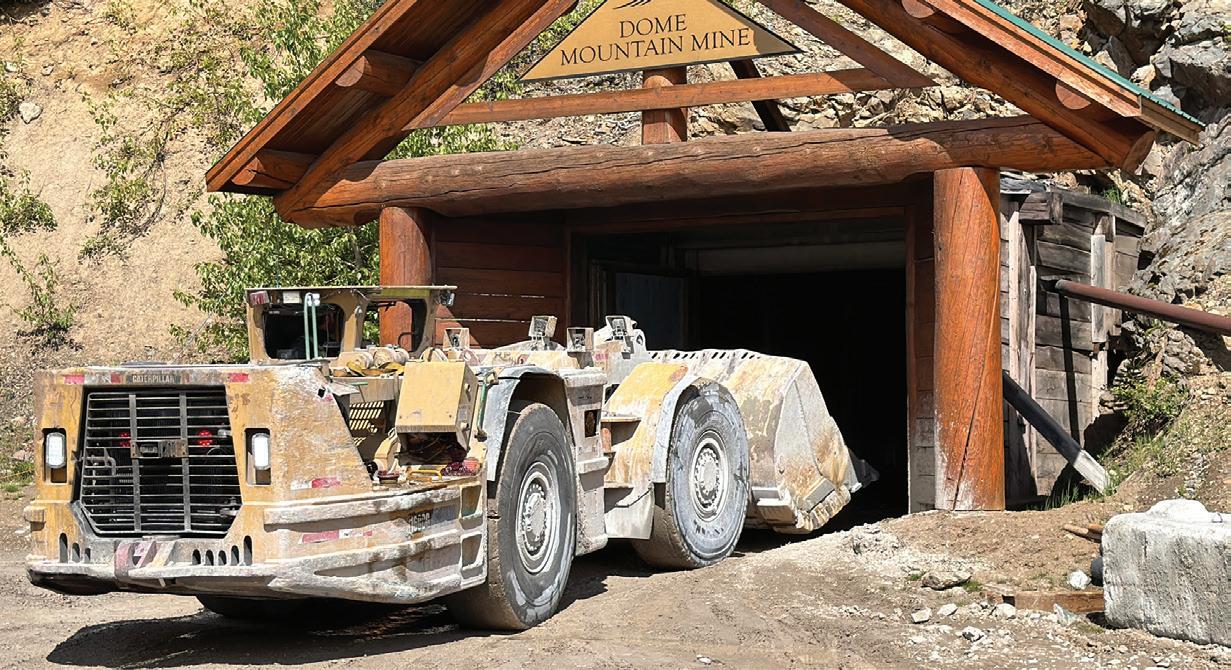
At Blue Lagoon Resources’ (CSE: BLLG; US-OTC: BLAGF) Dome Mountain mine, the morning meeting starts with safety and discussions about connection with the Yintah, or land.
The company is betting its community and team-oriented focus can help the small-scale but high-grade northern British Columbia restart into a million-ounce resource at the Boulder vein. The company declared commercial production mid-May after mining more than 100 tonnes per day for 30 days at the narrow-vein underground mine, about an hour by road from Smithers. The town is about 680 km northwest of Vancouver.
The operation opened a year ago amid much celebration. It now aims to lift Dome to a steady 150 tonnes per day before drill rigs return to the 215-sq.-km property later this year.
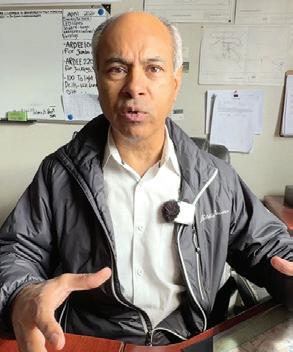
“Really, we’re an exploration play,” CEO Rana Vig told The Northern Miner during a site visit in June. “The next big event that’s going to happen here after we achieve our 150 tonnes a day is going to be the beginning of the exploration.”
The drilling rather than the commercial-production milestone carries the story from here, Vig says, given the company hasn’t done a preliminary economic assessment on the project and doesn’t plan to. If Dome Mountain can pay for its own resource growth, Blue Lagoon could do what few juniors manage: bootstrap an expansion of a highgrade mine, in a hard-to-permit province, without raising cut-rate equity each time the market turns against exploration.
Cash producer
Blue Lagoon has received about $4.5 million from gold and silver sales to date, Vig said. More regular payments are expected as the mine reaches 150 tonnes per day and the flow of material to toll-milling partner Nicola Mining (TSXV: NIM; US-OTC: HUSIF) steadies.
Dome is to produce 15,000 oz. gold over the next 12 months, then move toward 20,000 oz. per year. The mine’s roughly 9-gramper-tonne grade, silver credits and toll-milling deal give the company a shot at that exploration target without building a mill or tailings facility on site.
The ramp-up comes with the daily grind of working a narrow-vein mine. Bill Cronk, Blue Lagoon’s chief geologist and Dome Mountain project manager, says the mine must open enough faces underground so crews can alternate between development and mining to avoid starving the mill feed.
“We have to develop as much as we produce,” Cronk said. “That’s key to all these narrow-vein mines.”
He describes the mine as a structurally hosted quartz-carbonate vein system carrying gold and silver, with lead, zinc and copper in the concentrate. Noranda discovered the Boulder vein in 1985 while chasing zincin-soil anomalies. Blue Lagoon is now following the same structure deeper and along strike.
Cronk, an experience-hardened “blue-collar geologist,” as he calls
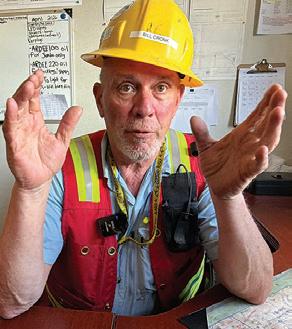
himself, warns against an industry trend that had seen some developers aim too high and build mills they can’t fill in hopes of a takeover, or simply chasing production scale before the mine can sustainably handle it.
“We’re just going to slowly increase this,” he said. “We made promises to the ministry, made promises to the Lake Babine Nation (LBN) and we want to keep those promises before we move on to the next.”
The operation is based on a small footprint. The portal, shop, dry house, fuel tanks, ore storage and water treatment plant sit close together on the mountainside.
Mineralized material comes out of the underground, moves to a loading area and travels about nine hours south by truck to Nicola’s Merritt mill. Nicola turns it into concentrate, which commodity trader Ocean Partners buys.
The distance raised eyebrows before mining began. Vig said the haul works because Dome Mountain is such a high-grade operation.
“The way I look at it, it costs us about a half a gram to ship it,” he said.
In plans yet to be formally announced, the exploration strategy is to hit Dome Mountain’s main working vein with more drilling.
A 2022 resource estimated 136,000 measured tonnes grading 10.32 grams gold for 45,000 oz. and 662,000 indicated tonnes at 8.15 grams for 173,000 ounces. Inferred resources add 85,000 tonnes at 6.02 grams for 16,000 ounces. The estimate uses a 3.5-grams gold cut-off and covers the Boulder vein system.
Blue Lagoon says it can grow that inventory by drilling between known intercepts, along strike and at depth. Since acquiring Dome Mountain in 2020, the company has drilled about 50,000 metres, much of it aimed at upgrading resources and testing the limits of Boulder. Vig says the vein remains open east, west and down dip, with one past intercept 150 metres below the known resource returning more than 3 metres at about 18 grams gold.
The company is to drill every 25 metres in parts of the system to support a resource update due to be released next year. It also wants to return to zones where earlier drilling hit mineralization before the company paused exploration to focus on permitting and mine development.
Dilution bulwark
That pause was deliberate, Vig said. Blue Lagoon could have raised heavily in weak junior markets, but Vig, a veteran of publishing and cannabis ventures, resisted swelling the share count before the mine permit arrived after a sixyear process.
“We’re going to slowly increase this. We made promises to the ministry [and] Lake Babine Nation. We want to keep those promises before we move onto the next.”
BILL
CRONK,
CHIEF GEOLOGIST, BLUE LAGOON
“The gold isn’t going anywhere,” Vig said of navigating a challenging permitting process where the “goal posts” moved several times. “But I was confident that we were going to get permitted.”
Vig says that restraint kept Blue Lagoon near 155 million shares outstanding.
The company’s backers include Crescat Capital, which owns just under 10%; Phoenix Gold Fund of Kuala Lumpur with about 6%; Nicola with about 6%; and Vig, his family and early shareholders with about 12%.
The company’s Toronto-listed shares are down about 6.5% over the past 12 months, trading near press time at 72¢ apiece. It has a market capitalization of $108 million (US$76.4 million).
Ocean Partners, Blue Lagoon’s offtake partner, agreed in May to buy $3 million of shares at 90¢ apiece with no warrants and no discount to market.
Mining Yintah
Dome Mountain sits on LBN traditional territory. That relationship has become part of miners’ daily routine.
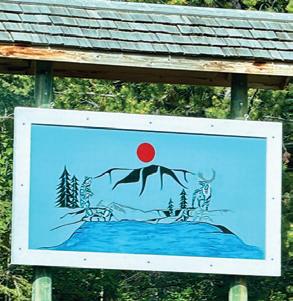
At the mine entrance, Blue Lagoon installed a mural by a Lake Babine artist showing the Nation’s culture, traditions and clans. The company put the mural there instead of in a boardroom so workers and visitors see it first, Vig said. The company later added murals to other site buildings.
The images reflect Yintah, which Vig described as the Lake Babine concept of the land, streams, fish and way of life. He said the company now folds that idea into mining meetings.
“Every mine site, every single morning does one thing: talk about safety,” Vig said. “We do two things: we talk about safety and we talk about Yintah.”
That relationship with the LBN and the land itself helped Dome Mountain win the Prospectors & Developers Association of Canada’s Sustainability Award in March after Lake Babine’s Chief nominated the company.
Beyond Boulder, Blue Lagoon says Dome Mountain hosts 15 known high-grade veins, many sampled but not drilled, plus the Chance zone and other targets across an 18-km strike length. The company says less than 10% of the property has seen focused work.
Cronk says the company has to grow in steps: mine enough to fund drilling, drill enough to grow Boulder and keep the operation from outrunning its people, permits and infrastructure.
“We’ve got to stay focused and grow this wisely,” Cronk said. “We’re not in the business to mine the investors, we’re in the business to mine the rocks. And we’re deadly serious about it.” TNM
| Zinc-lead operator faces test after sell-off
BY HENRY LAZENBY
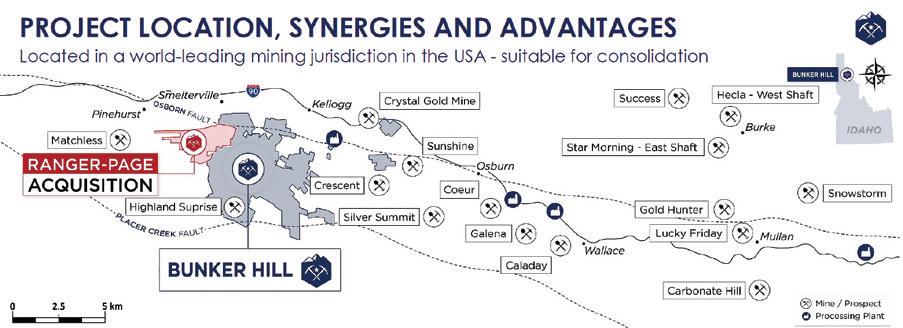
Bunker Hill Mining (TSX: BNKR; US-OTC: BHLL) has started feeding ore through its rebuilt Idaho mill, moving the historical Silver Valley mine from construction to ramp-up after six years of redevelopment. The next test is whether the company can generate steady concentrate shipments and cash flow to counteract poor share price performance this year.
The company has more than 20,000 tons (18,144 tonnes) of ore stockpiled at the crusher and plans to ramp mining towards the mill design level of 1,800 tons per day before reaching full production next year, CEO Sam Ash said in an interview. At steady state, Bunker Hill expects about nine concentrate trucks a day to leave for
Teck Resources’ (TSX: TECK.A, TECK.B; NYSE: TECK) Trail smelter in British Columbia, 210 km north by road.
“We’re putting the first ore through the plant today,” Ash told The Northern Miner on June 25.
“It’s a pretty exciting day.”
It’s now up to Ash, a third-generation mining engineer whose father briefly worked at the Bunker Hill zinc plant in 1976, and the Bunker Hill team, to prove a mine long known for false starts can run in a market looking for closer supplies of zinc, lead and silver. If the plant reaches nameplate capacity and trucks move steadily to Trail, Bunker Hill stands to gain the cashflow base Ash says can fund exploration for new silver zones, a larger haulage system and consolidation in a district that had produced 1.2 billion oz. silver.
However, Bunker Hill’s stock fell 25% in March after a C$33.8-million discounted financing package diluted shares and Chief Financial Officer Gerbrand van Heerden abruptly resigned. The stock has lost 31% of its value this year to $5.40 near press time even though a 1-for-35 reverse stock split boosted the price at one point. Market capitalization was at $255 million.
Cash flow
Capital development for the first three to five years of the mine plan is complete, Ash said, while crews focus on development for later years. The 2022 prefeasibility study pegged initial restart capital at $55 million, including contingency. The final cost appears higher after later refinancing and balance-sheet restructuring, but Bunker Hill has not given an updated all-in restart figure.
Bunker Hill had just under $30 million (C$42.5-million) in the bank at March 31, enough to reach positive cash flow, Ash said. Teck has also provided a $10-million undrawn working-capital facility that Bunker Hill can use if ramp-up problems emerge. Teck helped finance the restart and Ash said the offtake follows standard concentrate sales terms.
Bunker Hill has no metals streaming agreement in place, after refinancing with Sprott’s royalty and streaming arm last year to remove a multi-metal stream from the capital stack, giving the company more exposure to higher met-
“We really see that Bunker Hill will be a primary silver producer and should be viewed through that lens.”
SAM ASH, CEO, BUNKER HILL MINING
als prices. A royalty remains, along with a silver-backed debt facility with Monetary Metals.
Silver pivot
The mine plan starts with zinc-rich ore because it offers the fastest and cheapest route back to production.
Ash said that choice has fed a market view that Bunker Hill remains mainly a base-metals story, even though the old mine produced 165 million oz. silver as a by-product.
“We really see that Bunker Hill will be a primary silver producer and should be viewed through that lens,” Ash said. “We’re changing that narrative.”
The new Cate-8 discovery gives that claim its first near-term drive.
The target sits in the upper mine near existing workings, where Bunker Hill expected to find a single silver vein. Instead, drilling cut a wider mineralized corridor with many high-grade silver veins, Ash said.
The company has drilled 12 holes at Cate-8 so far and all have hit mineralization, the executive said. Assays have been returned for seven. The target lies about 40 to 91.5 metres from existing development, giving Bunker Hill a faster route to possible mining than a surface discovery needing new access.
“What we found was orders of
magnitude greater than what we thought we would find,” Ash said. “We actually stumbled upon a mineralized zone or corridor.”
Minable target
Bunker Hill’s latest target estimate pegs Cate-8 at 50,000 to 168,000 tons grading 5.75 to 9.32 oz. silver-equivalent per ton for about a million ounces. Ash cautioned that the estimate remains conceptual and unproven.
The best early holes include BHE26-02, which cut 28.6 feet (8.71 metres) grading 3.02 oz. silver per ton (103.39 grams per tonne), 7.44% lead and 0.85% zinc from 453 feet downhole, including 17.1 feet at 4.19 oz. silver per ton , 10.67% lead and 0.73% zinc.
Drill hole BHE26-03 returned 15.5 feet grading 6.4 oz. silver per ton, 0.5% zinc and 20.4% lead about 310 feet from current mine development. Bunker Hill said true widths remain unknown.
Bunker Hill is now drilling to move the zone towards indicated status by next year. The goal is to finish enough resource work, engineering and mine planning to add silver-loaded Cate-8 production in 2027, Ash said.
The main bottleneck in the current operation is underground haulage, not the mill, Ash said. Bunker Hill could expand the mill to 2,500 tons per day, but the mine needs more haulage capacity to reach that higher rate.
The proposed expansion, called “Bunker Hill 2.0” is to add a new portal and a 10,000-foot decline.
Bunker Hill has already received a $150-million letter of intent from the U.S. Export-Import Bank to support the work. Ash said desktop work puts the decline cost near $60 million. He expects the remaining funds could help refinance debt
vate land and patented mining claims, Ash said. The company worked through Idaho regulators while rebuilding its relationship with the U.S. Environmental Protection Agency at a Superfund site.
When Ash’s team arrived in 2020, Bunker Hill did not own the asset and held a lease with an option to buy that had to be renegotiated. The team also had to finance construction during a weak market for mine development.
The local labour market has helped the final push. Bunker Hill has passed 100 employees and expects to peak near 200. Many miners in the Silver Valley had kept homes in northern Idaho while flying to jobs in Alaska, Canada, Nevada and Arizona, Ash said.
Exploration is also moving beyond Cate-8. Bunker Hill plans work this summer on the Motor vein, Ranger-Page and Government Gulch prospects.
It acquired Ranger-Page in December, beside the old Bunker Hill mine. The land covers part of a surprisingly poorly tested corridor between two historical operations, according to Ash.
The Government Gulch target lies under cover but has shown a strong geophysical anomaly from surface to about 300 metres depth, Ash said.
and lower the company’s cost of capital.
Legacy concerns
Bunker Hill’s path to first ore was shorter than many U.S. mine builds because the operation sits on pri-
The broader land package supports Ash’s plan to build a multi-asset company in the Silver Valley.
“One mine operation does not make a mid-tier,” Ash said. “The aspiration is to be a multi-asset mid-tier mining company.” TNM


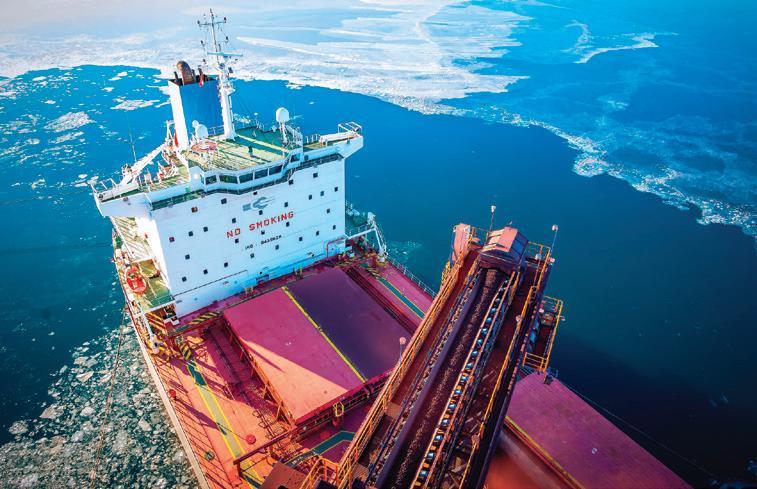
BY FRÉDÉRIC TOMESCO
Canada’s Baffinland Iron Mines has been given a financial lifeline and additional time to stabilize operations while the struggling private company restructures under creditor protection.
The Ontario Superior Court of Justice gave Baffinland immediate access to $110 million (C$154 million) of funding for the period ending June 30, according to a company statement dated June 10. The court also granted the company an extension to the stay of proceedings until Aug. 28, which allows Baffinland to keep operating while seeking approval for interim financing.
A hearing was scheduled for June 30 with the court deciding whether the company can keep an existing $400 million debtor-in-possession financing from Export Development Canada or whether it must replace it with another financing package.
Creditor protection
The financing agreement is intended to ensure that mining, shipping and port activities continue without interruption, said Baffinland. The company, jointly owned by funds managed by The Energy & Minerals Group and an ArcelorMittal (NYSE: MT) unit, operates the Mary River iron ore mine on northern Baffin Island in Nunavut. It’s one of Canada’s largest iron ore operations
and among just a few producing mines in the Arctic territory.
Oakville, Ont.-based Baffinland filed for creditor protection May 15, saying it was unable to meet its financial obligations. News reports said the company disclosed more than $1 billion in debt linked partly to a failed railway expansion proposal.
At the time, Baffinland said the move would allow it to evaluate “strategic alternatives” including a recapitalization or a potential sale.
Baffinland had a cash balance of $21.2 million as of May 30, according to a report by the court appointed monitor dated June 4. A cash flow forecast included in the report shows the company is forecast to burn about $217 million of cash in the period ending Aug. 28.
Extension option
Export Development Canada’s debtor-in-possession financing will mature in 12 months. Baffinland will have the option to extend the maturity by six months under certain conditions.
Baffinland earlier secured court approval for a supplier charge of up to $100 million. The measure was designed to reassure vendors and contractors by allowing the company to provide credit support for goods and services essential to day-to-day operations. TNM
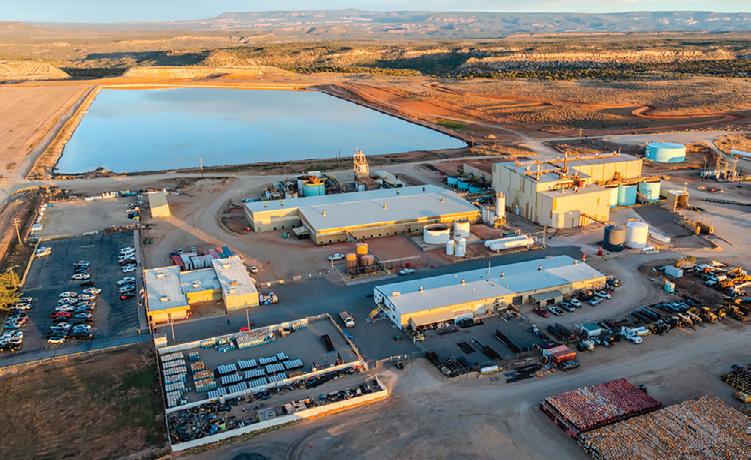
BY CECILIA JAMASMIE
Energy Fuels (NYSE: UUUU; TSX: EFR)
secured a conditional loan commitment of up to $725 million from the U.S. Department of Defense to help the company expand its domestic rare earth processing operations and strengthen U.S. supply chains independent of China.
The financing, combined with additional private capital, is intended to support a new U.S.-based rare earth separation and metallization plant. Energy Fuels, historically a uranium producer, plans to expand into rare earth processing for permanent magnet manufacturing. The company must still satisfy financial, legal, technical and other due diligence requirements before the loan can close.
“Energy Fuels’ expansion into rare earth midstream processing represents a key solution to a national bottleneck that needs to be rapidly addressed,” David A. Lorch, director of the Office of Strategic Capital at the defense department, said in a statement.
The investment marks another step in the Trump administration’s effort to build a domestic mine-to-magnet supply chain as geopolitical tensions and export restrictions expose vulnerabilities in Western access to critical minerals.
It follows a broader wave of government support for rare earth mining and processing
after China moved to restrict exports of rare earth magnets, which are essential for electric vehicles, wind turbines, hard disk drives and medical imaging equipment.
“Recent events have underscored the urgency of building durable supply chains for critical materials, and Energy Fuels is positioned to help lead that effort through a vertically integrated strategy,” CEO Ross Bhappu said in a separate statement.
According to the Office of Strategic Capital, increased output from Energy Fuels would support permanent magnet facilities across the U.S. industrial base while improving access to materials used in defence and other advanced manufacturing sectors. The company already operates uranium processing and rare earth oxide separation facilities at its White Mesa Mill in Utah.
“This partnership drives an aggressive effort to close vulnerabilities in our industrial base and secure a resilient American supply chain for rare earth elements,” said Emil Michael, under secretary of defense for research and engineering.
The financing also underscores the growing role of federal support in reshaping critical mineral supply chains. In fiscal 2026, the Office of Strategic Capital has committed more than $5 billion in debt financing and helped mobilize more than $11 billion in combined public and private capital for industrial and defence-related projects. TNM
BY STAFF WRITER
First-quarter mergers and acquisitions (M&A) activity in mining saw combined deal value surge despite a sizable decrease in the number of transactions, according to S&P Global.
The value of transactions involving metals and mining companies rose 63% to about $26.3 billion (C$36.5 billion) during the January-March period compared with three months earlier, S&P said last month in its latest M&A trends report.
The dollar value of deals represents the second highest ever for a quarter since S&P began tracking the data in late 2013. Securing longterm supply was a key area of focus for companies, the firm said.
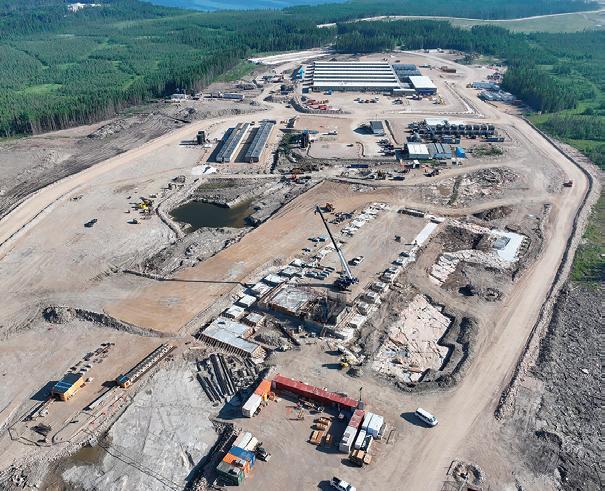
Companies in the mining sector are now seeking immediate scale, which explains the surge in corporate-level deals as opposed to asset acquisitions, S&P noted. In total, there were 30 company acquisitions recorded by S&P during the quarter, nearly double the 16 asset purchases recorded.
The January-March period was the first quarter that the firm included steel deals in its coverage. As such, the $10-billion acquisition of BlueScope Steel—the largest of the quarter—likely overstated the increased value of M&A deals compared to past years.
This was also evident in the number of M&A deals, which at 46 was nearly half of the December quarter totals.
Aside from the steel deal, the second and third largest deals centered on gold and copper respectively, an indication of the strong appetite for the two hottest commodities, S&P said. Several large players, including South Africa’s Gold Fields (JSE, NYSE: GFI) and China’s Zhaojin Mining, have indicated they’re open to deals.
As for individual asset buys, the combined value ($3.35 billion) was well above the quarterly average, buoyed by SSR Mining’s (TSX, Nasdaq: SSRM) $1-billion sale of the Copler mine in Turkey, though it was 12% lower than the previous quarter. Compared to the same period last year, the value of asset purchases was 221% higher.
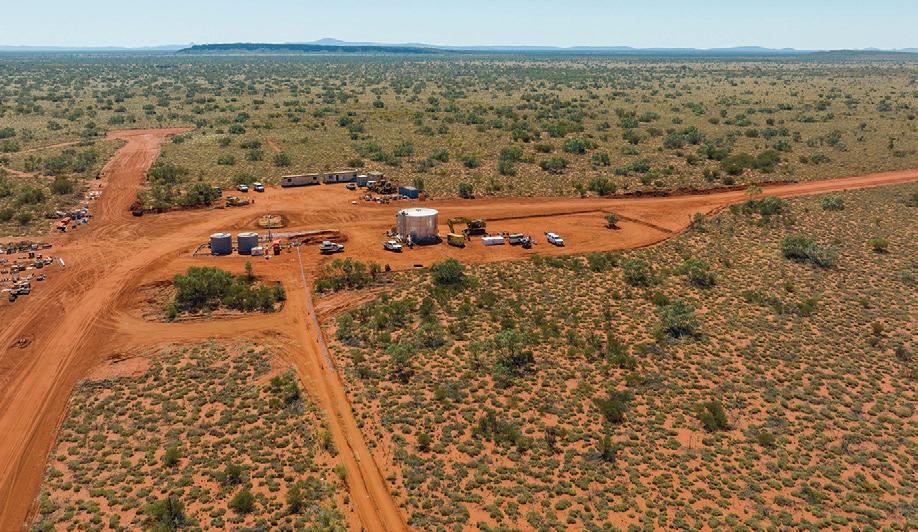
BY DENISE HECKBERT
Arafura Rare Earths (ASX: ARU) is looking to a September construction start at its $1.23-billion capex Nolans mine in Australia’s Northern Territory as the country’s first vertically integrated rare earths complex.
The May decision to start building at the site about 1,140 km southeast of Darwin came within days of total equity financing jumping 40% to $887 million while the company has met 80% of its contracted offtake target. Arafura, in which mining billionaire Gina Rinehart holds 18%, had previously raised about $1 billion in debt from nine domestic and international lenders.
“Arafura is excited to be in a position to deliver Australia’s first fully integrated rare earths mine and refinery,” CEO and Managing Director Darryl Cuzzubbo told The Northern Miner in a mid-June video call. “We have deliberately pursued the ore-to-oxide model as a point of differentiation.”
Arafura’s production milestone could make it the first rare earths mine in Australia where the ore is mined, processed and separated on site, marking a major step towards a domestic mine-to-oxide supply chain. The company’s efforts come as Western countries continue working to build rare earth supply chains outside the control of China, which dominates the mining and processing of the metals.
Expected to start production in 2029, Nolans has a post-tax net present value of $1.73 billion and an internal rate of return of 17%, according to Arafura’s July 2024 project economics. The mine could produce 4,440 tonnes of neodymiumpraseodymium (NdPr) oxide annually as well as heavy rare earths and phosphoric acid over a 38-year life. Its output could represent about 4% of the world’s NdPr.
Nolans could become one of few mines outside China producing an oxide instead of a concentrate or carbonate, which requires a final processing step to eliminate radiation from thorium and uranium, Cuzzubbo said. The others are MP Materials’ (NYSE: MP) Mountain
“We
go a step further so we can be an alternative supply chain to China. Other projects have an issue with not being able to bypass China as they still need processing capability which is largely there.”
DARRYL CAZZUBBO, CEO, ARAFURA RARE EARTHS
Pass mine in California and Lynas Rare Earths’ (ASX: LYC) Mount Weld in Western Australia.
While Lynas has higher production capacity than Nolans, its rare earths are processed and separated at the company’s facility in Malaysia. Mastering the processing and separation steps remains one of the largest challenges facing the West’s efforts to catch up with China’s lead.
“We go a step further so we can be an alternative supply chain to China,” Cuzzubbo said. “Other projects have an issue with not being able to bypass China as they still need processing capability which is largely there, and they can only send it to a country that can receive, process and dispose of radioactive waste.”
Arafura will be building its oxide processing plant as part of stage one construction this fall. That facility and its related infrastructure represent 90% of Nolans’ total cost, the CEO said, underscoring how the economics of rare earth projects are driven more by the costly chemical processing and separation requirements to produce market-ready oxides than by mining.
“The inclusion of on-site downstream processing is a key reason the Australian government has supported the project,” Cuzzubbo added.
Fast track
Nolans received a boost in early June from Australia’s Significant Project framework, which empowers a Territory Coordinator to shepherd strategic projects through the regulatory approvals during construction and expansion. The status assists with secondary approvals needed by Arafura and covers future development at the site.
“We also need potential service providers to build out infrastruc-
BY BLAIR MCBRIDE
Australian gold production fell almost 3% to 75 tonnes in this year’s first quarter compared to the previous period due to rain and bushfires, while gold price highs kept the output valuable, according to Melbourne-based mining consultants Surbiton Associates.
That production total, valued at about A$17 billion ($12 billion), was down just two tonnes from last year’s fourth quarter output. The gold price fluctuated widely during the first quarter, with the yellow metal reaching an historic high of $5,595 per oz. on Jan. 29, before prices dropped to $4,392 per oz. just four days later.
“The March quarter is often the most affected by wet weather,”
Surbiton Director Sandra Close said in a release on June 7. “This time, there was the added disruption caused by bushfires. Fortunately though, the overall result was better than might have been expected for the first quarter of the calendar year.”
Wild price ride
ture,” Cuzzubbo said, such as doubling the container capacity at the Darwin Port. “They need to get approvals and all that needs to be done in the next three years before we go into operation. So that Project of Significance applies to them as well.”
After providing A$125 million in Arafura’s A$481 million financing in late 2025, Rinehart’s Hancock Prospecting contributed A$85 million of the company’s May A$350 million ($245 million) equity raisings.
Nolans’ equity financing will be wrapped up with A$430 million in binding equity commitments from the German Raw Materials Fund, Export Finance Australia and the National Reconstruction Fund Corp., once approved at its shareholder meeting July 2.
Company shares traded for A26¢ in Sydney as press time neared, giving the company a market capitalization of A$1.3 billion. The stock has traded between A16¢ and A62¢ over the past 12 months.
Korean, German offtakes
Among ongoing offtake talks, Arafura has signed 1,500 tonnes per year in offtake deals for its NdPr oxide with automakers Hyundai and Kia in South Korea, 520 tonnes per year with wind turbine manufacturer Siemens Gamesa RE in Germany, and 300 tonnes and 500 tonnes per year with Traxys’ European and North American operations, respectively.
“It is probably going to take towards the back end of this year before that concludes,” said Cuzzubbo of discussions with German manufacturers. “We’re working with multiple layers of the supply chain to get agreement on pricing for rare earths and pricing for mag-
“There is still a great deal of uncertainty in world markets in general.”
SANDRA CLOSE, DIRECTOR, SURBITON ASSOCIATES
and a brief selloff on stock markets.
“To offset the lower value of portfolios, financial institutions sold gold and other assets,” Close said. “That depressed gold prices which triggered margin calls and stop-loss orders, thereby reducing gold prices even further.”
In response, some countries such as Turkey and Russia sold off 66 tonnes of gold reserves “in order to raise foreign exchange to defend their currencies,” she said. Gold prices fell as low as $4,098 per oz. on March 23. A volatile Mideast cease fire near press time saw the gold price sit around $4,155.
Despite the modest production drop, the dramatically higher gold prices lifted the value of Australia’s production output. The price gained 70% or $2,013 per oz. over last year’s first quarter and 18% or $738 per oz. over last year’s fourth quarter.
Geopolitical turmoil indirectly contributed to gold’s fluctuations. The United States and Israel’s late February attacks on Iran, which sparked the closure of the Strait of Hormuz, led to higher oil prices
“Despite the gloom, the fundamentals underpinning the long-term rise of gold and silver prices appear to be intact,” she said. “There is still a great deal of uncertainty in world markets in general.”
Australian operations most affected by rain during the first quarter included Newmont’s (TSX: NGT; NYSE: NEM) Tanami site in the Northern Territory, which saw production fall by Surbiton P30 >
BY NORTHERN MINER STAFF
The total prize pool is now hovering around the $2-million mark for the Great Canadian Treasure Hunt as explorers across the country tighten their boots and sharpen their wits for regional hauls and the elusive grand prize.
The Northern Miner publishes stories with embedded clues like this tale from the Prairies.
Long before Saskatchewan became synonymous with endless wheat fields, another treasure lay hidden deep beneath the prairie soil. It was a mineral bounty so enormous it would eventually help feed billions of people around the world.
But for decades, nobody knew it was there.
The discovery of potash in Saskatchewan was not marked by a lone prospector or a dramatic cry of “Eureka!” Instead, it arrived almost by accident, buried nearly 1 km underground beneath flat farmland. What followed would transform Saskatchewan into one of the most important mining regions on Earth. Today, the province produces about one-third of the world’s potash supply, anchoring a global fertilizer industry essential to modern agriculture and food security.
And yet the story of Saskatchewan potash remains one of Canada’s great hidden treasure tales: a saga of accidental discovery, engineering triumphs, prairie boomtowns and a mineral so valuable it became known as “pink gold.”
A sea beneath the prairie
The story begins more than 350 million years ago, when Saskatchewan sat beneath a vast inland sea.
As ancient waters evaporated under a hot Devonian sun, layers of salt and potassium-rich minerals accumulated on the sea floor. Over millions of years, those deposits were buried beneath sedimentary rock, entombing one of the world’s richest evaporite basins beneath the future Canadian Prairies.
For centuries, nobody suspected the treasure below.
Settlers who arrived on the prairies in the late 19th century saw only fertile farmland and endless sky. Wheat became king, and Saskatchewan grew into one of the world’s great grain-producing regions. But farming steadily depleted nutrients from the soil, especially potassium, one of the three essential elements needed for plant growth.
Potash, rich in potassium, would eventually become indispensable to modern agriculture. It strengthens roots, improves drought resistance and boosts crop yields. Without it, feeding the modern world would be nearly impossible.
Ironically, Saskatchewan farmers were unknowingly growing crops atop the very mineral they needed most.
The accidental discovery
The breakthrough came not from mining, but from oil exploration.
In 1943, drillers searching for petroleum near Radville in south-
ern Saskatchewan encountered thick layers of potassium-rich salts deep underground. Similar discoveries followed across the province as oil companies drilled exploratory holes into the prairie basin.
At first, few grasped the scale of what had been found.
But provincial geologists soon realized Saskatchewan possessed one of the largest potash deposits on Earth.
Among the key figures was geologist F.H. Edmunds, whose mapping helped establish the enormous economic potential of the deposits.
The discoveries attracted global attention. International mining firms rushed to stake claims beneath Saskatchewan farmland.
The challenge was immense. The potash lay more than 1,000 metres below surface in some places, beneath water-bearing rock that threatened catastrophic flooding.
Many experts doubted the mines could even be built.
Sinking the shafts
The race to develop Saskatchewan potash in the 1950s and 1960s became one of the most ambitious industrial undertakings in Canadian history.
American, European and Canadian companies descended on the province. Towns like Esterhazy, Lanigan and Rocanville morphed into bustling mining centres.
The journey towards becoming a global potash powerhouse wasn’t easy, however. Early mine construction proved nightmarishly difficult. Water repeatedly flooded shafts before crews could reach the orebody. Millions of dollars vanished into failed projects.
The most infamous disaster struck near Saskatoon in early 1987, when the Patience Lake mine was closed due to uncontrollable flooding. Engineers battled desperately to save it before it reopened about two years later using a revolutionary solution-mining technique.
Yet Saskatchewan miners and engineers refused to quit.
A breakthrough came through artificial ground-freezing technology. Crews drilled rings of pipes into the earth and circulated superchilled brine to freeze water-bearing rock solid before sinking shafts through it.
The engineering feats astonished the mining world as they were among the most technically difficult mines ever attempted, and they were being built beneath wheat fields.
Boomtowns on the prairie Life was breathed into prairie communities as the mines expanded.
As a result, Esterhazy became one of the world’s potash capitals.
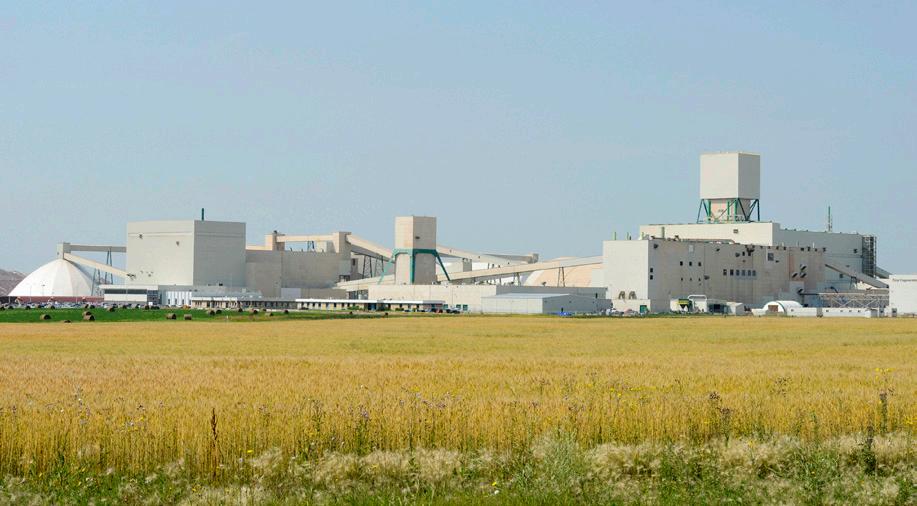
“New gigantic headframes rose above the prairie skyline like steel cathedrals. Rail lines carried millions of tonnes of potash to ports on the West Coast and Thunder Bay for shipment around the globe.”

Rocanville and Lanigan boomed with miners, engineers and immi grant labourers arriving from across Canada and Europe as the mines offered wages rarely seen in rural Canada.
New gigantic headframes rose above the prairie skyline like steel cathedrals. Rail lines carried millions of tonnes of potash to ports on the West Coast and Thunder Bay for shipment around the globe.
Inside the earth, miners worked in surreal conditions unlike any other Canadian mine. Instead of jagged rock veins, potash miners carved vast rooms through pink and white salt beds that glowed under artificial light.
Guests and visitors often remarked the mines resembled underground cities.
All across the subterranean network, massive machines bore tunnels through the salt, sending a steady stream of pink ore to the surface.
National and international markets took notice as this sudden surge of wealth transformed Saskatchewan’s economy.
Pink gold and global power
By the 1970s, Saskatchewan had become the undisputed giant of global potash production.
The province’s mines supplied farmers from Brazil to India to China. Potash exports became a pillar of the Canadian economy, generating billions in revenue and helping finance schools, hospitals and infrastructure across Saskatchewan.
Premier Allan Blakeney’s gov-
nationalizing the industry to ensure greater provincial control over the resource.
Few commodities tied Saskatchewan so directly to the world economy.
The industry endured wild cycles of boom and bust. Mines opened, closed, merged and modernized.
In 2010, Ottawa blocked a massive takeover bid for PotashCorp by global mining giant BHP (ASX, NYSE: BHP), arguing the company was too strategically important to Canada.
It was a reminder that Saskatchewan potash was no ordinary commodity.
Today, Saskatchewan remains the beating heart of the global potash industry.
Modern operations run by Nutrien (TSX, NYSE: NTR), the world’s top potash producer, and Mosaic (NYSE: MOS) produce tens of millions of tonnes annually.
At Esterhazy, miners now operate some of the largest and most technologically advanced underground potash mines on Earth.
The importance of potash has only grown in the 21st century.
As the global population climbs toward 10 billion people, demand for fertilizer continues rising. Farmers must grow more food on less land under increasingly difficult climate conditions. Potash remains essential to improving crop yields and preserving soil health.
Geopolitics have also ele-
vated Saskatchewan’s importance. Belarus and Russia, two other major potash producers, have faced sanctions and supply disruptions in recent years, increasing global reliance on stable Canadian produc-
Some analysts now describe potash as critical not only to agriculture, but to global security itself.
The prairie treasure
Unlike many mining boomtowns that faded after their ore ran out, Saskatchewan’s potash communities continue to thrive because the resource is so immense. Some estimates suggest the province possesses enough potash reserves for hundreds of years of production.
The mines have become woven into prairie identity. Generations of families have worked underground. Giant white tailings piles rise beside prairie highways like artificial mountains, unmistakable landmarks of the hidden treasure below.
And yet, for all its economic might, potash still lacks the romance of gold rushes or diamond strikes.
There were no stampedes over mountain passes or prospectors clutching nuggets beside frozen creeks. Instead, Saskatchewan’s greatest treasure was found beneath wheat fields by drillers searching for something else entirely.
But in its own way, the story is every bit as extraordinary. For deep beneath the quiet prairie lies a mineral bounty that helps feed the planet, proving that Canada’s greatest treasures are not always the easiest to see.
This campaign is proudly presented with the support of industry sponsors including Agnico Eagle Mines, Sprott Money, EarthLabs, Iamgold, Kinross Gold, The World Gold Council, Alamos Gold, Ernst & Young, MINING.COM, CEO. CA and The Canadian Mining Journal TNM
For more information, including full contest rules, FAQs and updates, visit treasure.northernminer.com. Follow @northernminer (X/FB/YouTube) | @thenorthernminer (IG) | @mining (X) | @miningdotcom (IG/FB/YouTube) | @ceodotca (X/IG/FB/TikTok) | @ceocafilm (YouTube) for ongoing clues and community updates.

18 Market News contents
19 Capital Raisings
20 Drill Results
21 Warrants + Shorts
22 EV Metals
23 Market Data + Mining events
*Data may not be comprehensive and is provided on a best-efforts basis as of press time. Investors are responsible for their own due diligence.
Delivering fit-for-purpose solutions across the entire project life cycle
Delivering fit-for-purpose solutions across the entire project life cycle
Delivering fit-for-purpose solutions across the entire project life cycle
Delivering fit-for-purpose solutions across the entire project life cycle
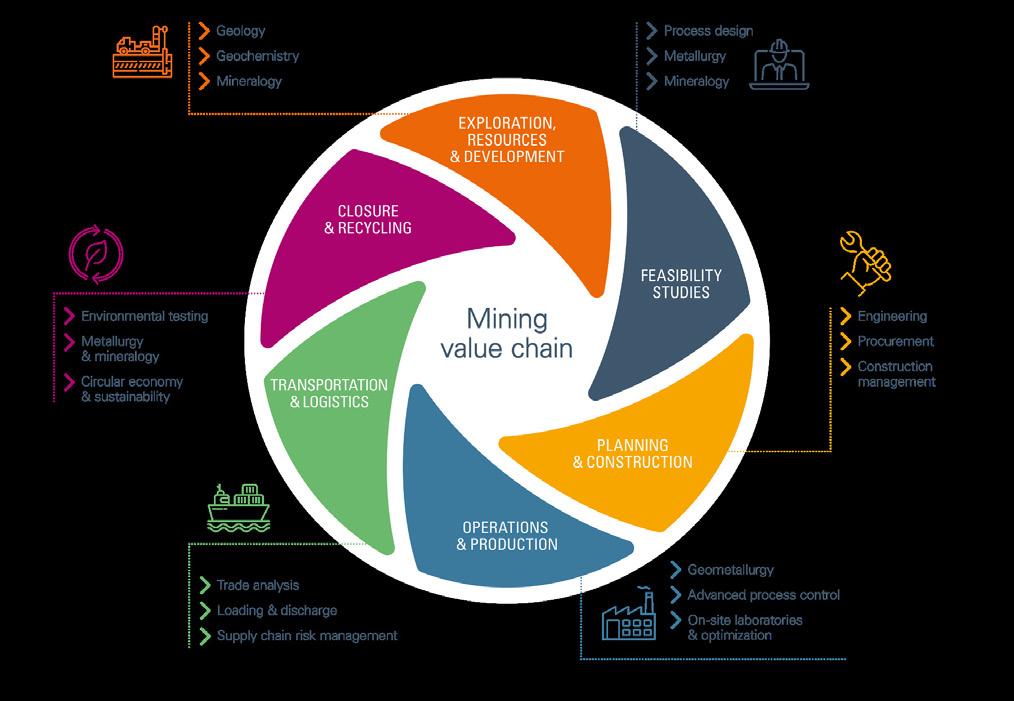
Our fit-for-purpose solutions encompass the skills of qualified geologists, geostaticians, analytical chemists, mineralogists, metallurgists, process engineers and mining engineers and inspectors brought together to provide accurate and timely mineral and process evaluation services across the entire project life cycle.
Our fit-for-purpose solutions encompass the skills of qualified geologists, geostaticians, analytical chemists, mineralogists, metallurgists, process engineers and mining engineers and inspectors brought together to provide accurate and timely mineral and process evaluation services across the entire project life cycle.
Our fit-for-purpose solutions encompass the skills of qualified geologists, geostaticians, analytical chemists, mineralogists, metallurgists, process engineers and mining engineers and inspectors brought together to provide accurate and timely mineral and process evaluation services across the entire project life cycle.
Our fit-for-purpose solutions encompass the skills of qualified geologists, geostaticians, analytical chemists, mineralogists, metallurgists, process engineers and mining engineers and inspectors brought together to provide accurate and timely mineral and process evaluation services across the entire project life cycle.
WWW.SGS.COM/NATURALRESOURCES NAM.NATURALRESOURCES@SGS.COM
WWW.SGS.COM/NATURALRESOURCES NAM.NATURALRESOURCES@SGS.COM
WWW.SGS.COM/NATURALRESOURCES NAM.NATURALRESOURCES@SGS.COM
WWW.SGS.COM/NATURALRESOURCES NAM.NATURALRESOURCES@SGS.COM

Week of June 15-19, 2026
By Frédéric Tomesco
Major North American stock indexes closed the week mixed. New York rose after the United States and Iran signed a tentative accord, while Toronto fell with gold and volatile oil prices.
The Dow Jones Industrial Average rose 362.44 points, or 0.7%, to 51,564.7 points, the S&P 500 rose 69.12 points, or 0.9%, to 7,500.58 and the Nasdaq Composite Index rose 917.99 points, or 3.6%, to 26,517.93.
U.S. markets were closed June 19 to mark the Juneteenth holiday.
In Canada, the S&P/TSX Composite Index fell 80.51 points, or 0.2%, to 34,857.34, while the S&P/TSX Venture Composite Index dropped 4.52 points, or 0.5%, to 954.71.
The S&P/TSX Global Mining Index rose 2.94 points, or 0.1%, to 239.04 and the S&P/TSX Global Gold Index added
23.92 points, or 3%, to 819.22 while gold fell about 1.5% to $4,155.62 per ounce.
The S&P/TSX Global Base Metals Index dropped 4 points, or 1%, to 368.05, while copper futures declined 1.7% to $6.337 per pound.
On the NYSE, Contango Silver and Gold rose 2.8% after it reported Lucky Shot project assays in Alaska including 5.3 metres of 8.89 grams gold per tonne from 16.7 metres depth.
Forsys Metals soared 52% to 50¢ in S&P/TSX trading after hiring Paladin Energy founder John Borshoff as CEO.
On the TSX-V, Vatic Ventures shares more than doubled to 5¢ each after the exchange conditionally accepted the acquisition of Velvet Clean Energy’s rights to earn interests in two Namibian uranium properties.
Our TNM Drill Down features the top five gold, silver, copper and uranium assays of the past month. Drill holes are ranked by grade x width.
May 18, 2026 to June 16, 2026
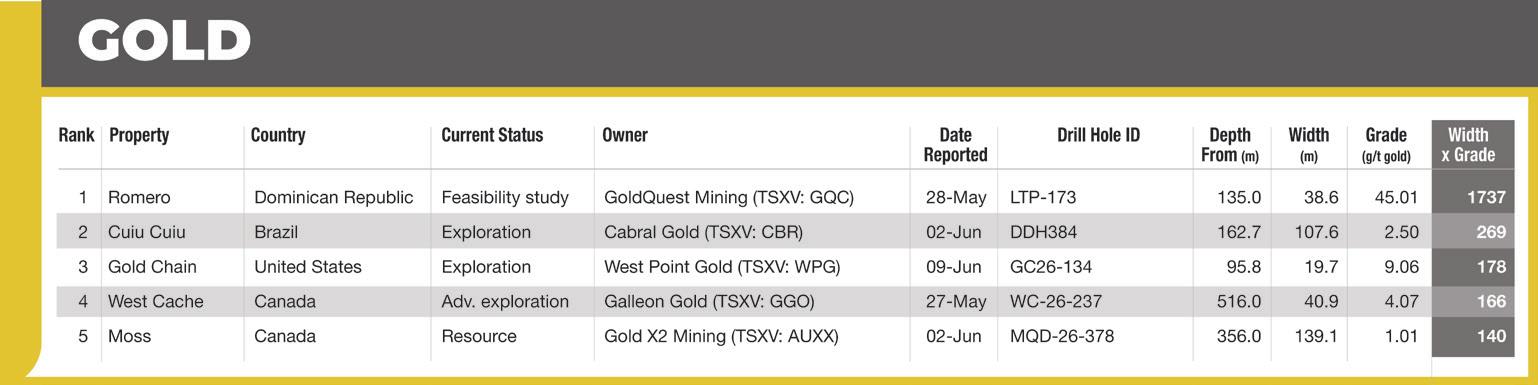
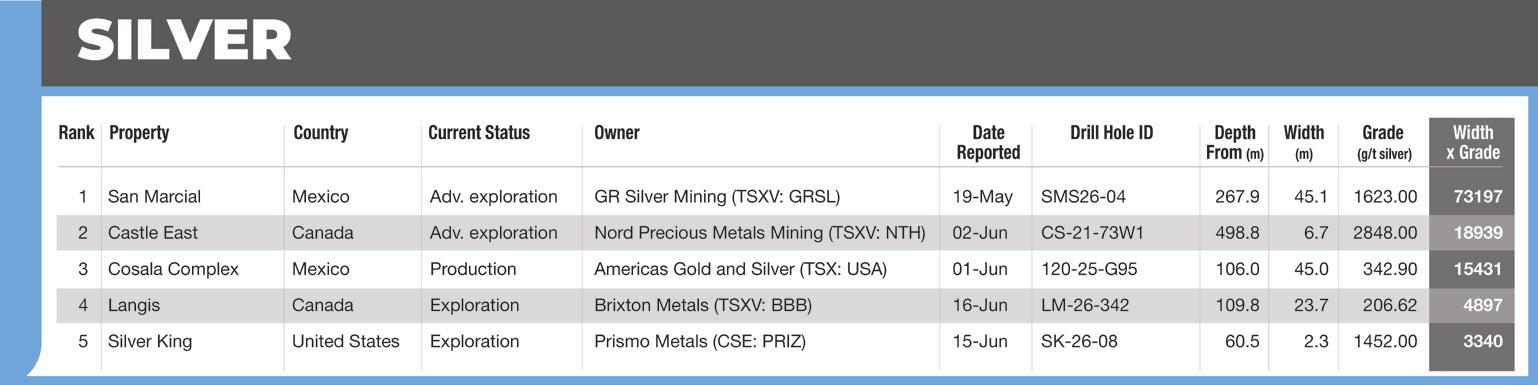
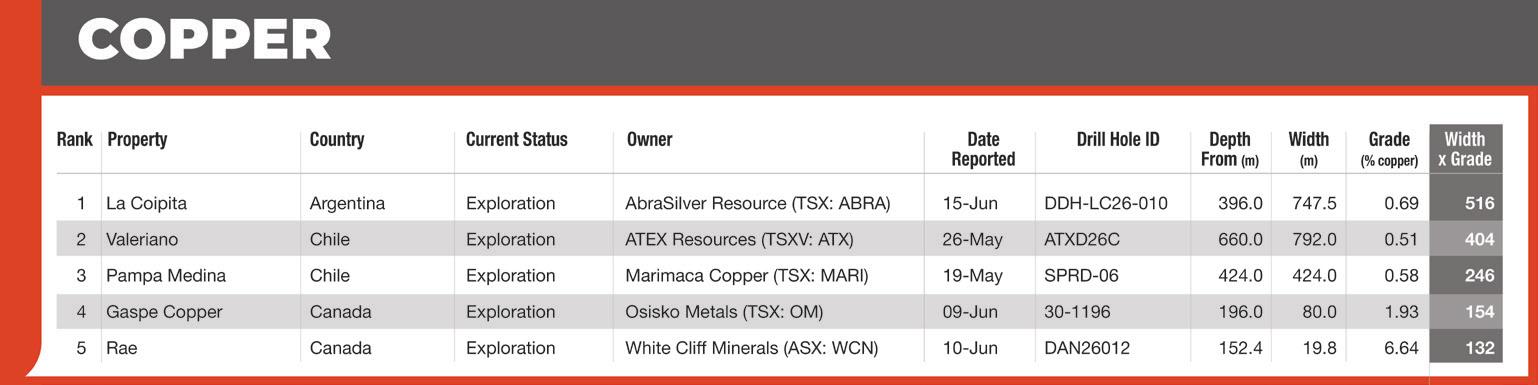
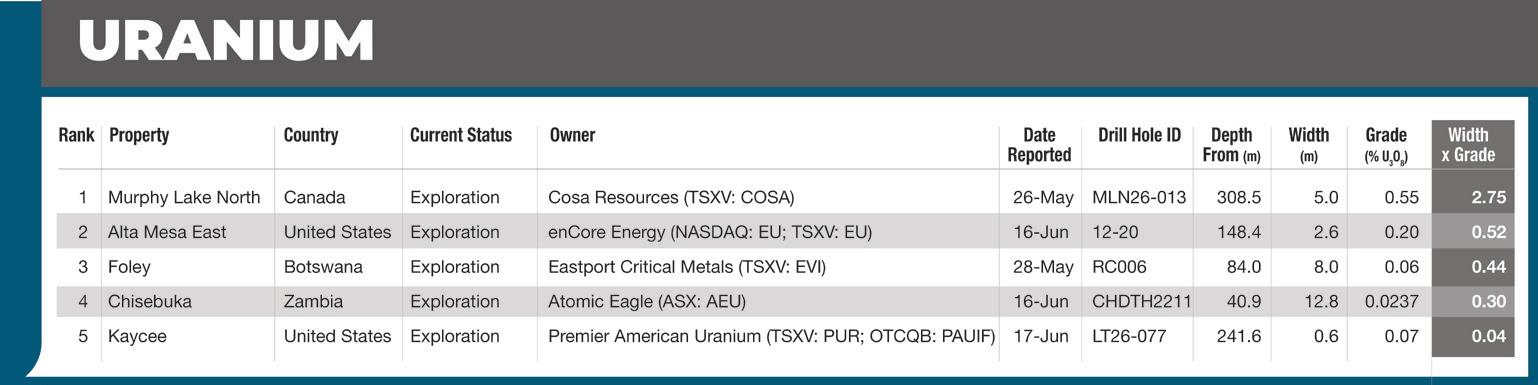
Talisker Resources Ltd. SK.WT One Warrant to purchase one common 5-05-2028 share of the Issuer at $0.75 until expiry
Aurania Resources Ltd. ARU.WT.B One warrant to purchase one common 10-21-2026 share at $2.20 per share.
Tuktu Resources Ltd. TUK.WT One warrant to purchase one common 11-23-2026 share at 13¢ per share.
Freeman Gold Corp FMAN.WT.U One warrant to purchase one common 11-29-2026 share at US65¢ per share.
Palisades Goldcorp Ltd. PALI.WT One warrant to purchase 0.060538 12-06-2026 common share at 50¢ per share.
Mogotes Metals Inc. MOG.WT One warrant to purchase one common 01-31-2027 share at 30¢ per share.
Osisko Development ODV.WT.A One warrant to purchase one common 03-02-2027 Corp. share at $14.75 per share.
Integra Resources Corp. ITR.WT One warrant to purchase one common 03-13-2027 share at $1.20 per share.
Elevation Gold Mining ELVT.WT.A One warrant to purchase one common 03-24-2027 Corp. share at 70¢ per share.
Anfield Energy Inc. AEC.WT One warrant to purchase one common 05-12-2027 share at 18¢ per share.
Osisko Development ODV.WT.U One warrant to purchase one common 05-27-2027 Corp. share at US$10.70 per share.
Sun Summit Minerals SMN.WT One warrant to purchase one common 05-30-2027 Corp. share at 11¢ per share.
Graphite One Inc. GPH.WT One warrant to purchase one common 08-22-2027 share at $1.10 per share.
West
Gold WRLG.WT.B One warrant to purchase one common 10-24-2027
Mines Ltd. share at 90¢ per share.
i-80 Gold Corp. IAU.WT One warrant to purchase one common 11-14-2027 share at 55¢ per share.
Nexmetals Mining Corp. NEXM.WT One warrant to purchase one common 11-17-2027 share at $8.00 per share.
Lion One Metals Ltd. LIO.WT.A One warrant to purchase one common 02-14-2028 share at 41¢ per share.
West Red
TSX SHORT POSITIONS
Short positions outstanding as of June 15, 2026 (with changes from May 31, 2026)
502941
-2482469
Mining ABX 17227185 -1135066
URE 12861699 652372
12349511 35595
Osisko
Largest
-3790276
-2900154
-2548184
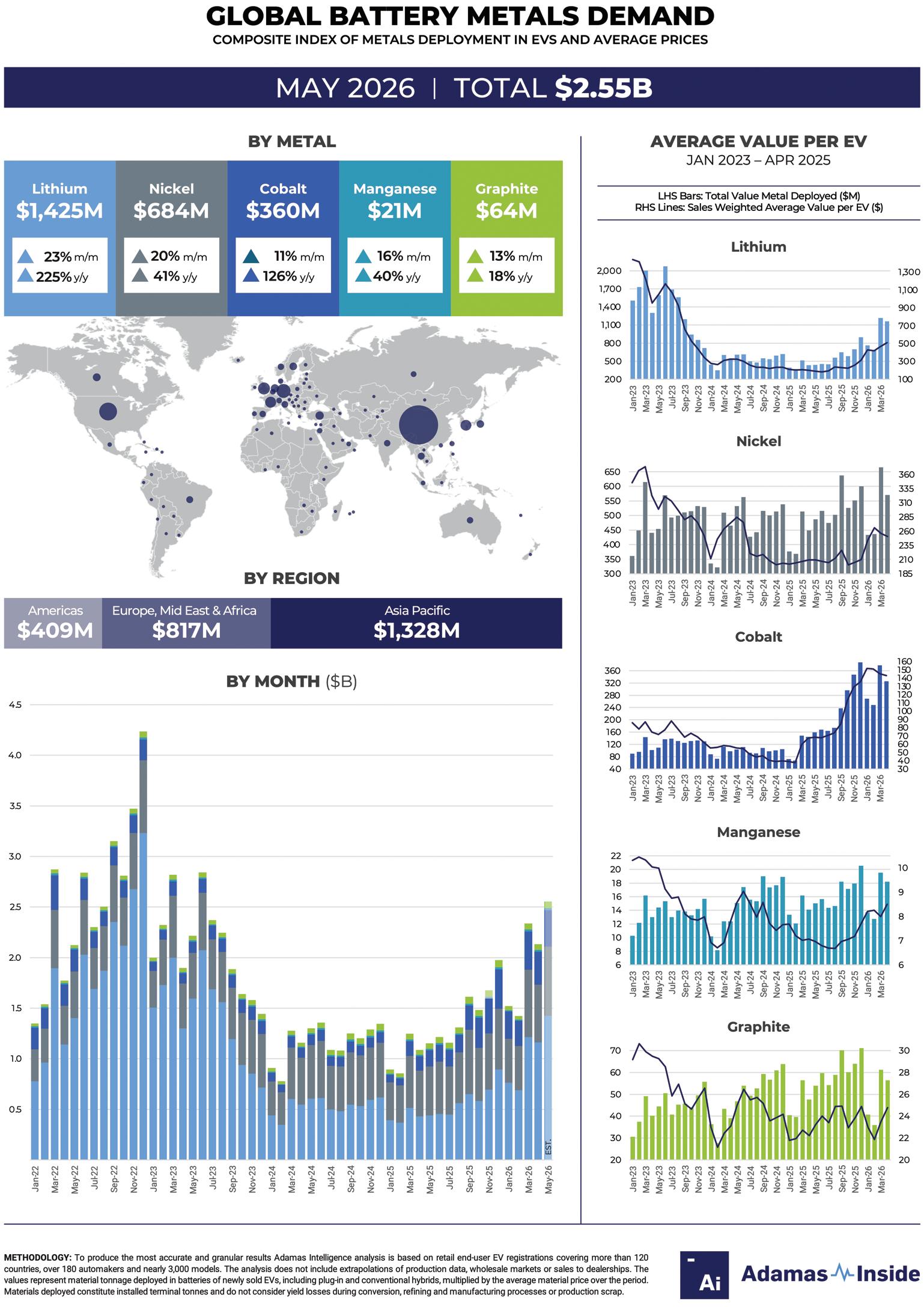
COPPER PRICE ($ PER LB.)
$7.00
NICKEL PRICE ($ PER LB.)
$1.59/lb.
Cobalt: $25.31/lb.
Gold: $4,135.80/oz.
Lead: $0.89/lb.
Rhodium: $7,950/oz.
Tin: $24.97/lb.
2026
n July
July 6
International Conference on Mining Safety Technology and Engineering Innovations — Burlington, Ont.
VENUE: TBA
MORE INFORMATION: conferencealerts.co.in/ event/100754820
July 6-10
2026 Rule Symposium on Natural Resource Investing — Boca Raton, Fla.
VENUE: The Boca Raton
MORE INFORMATION: opportunity-travel.com/rulesymposium/
July 7-8
Mining on Top Africa 2026 — Paris
VENUE: Paris Marriott Rive Gauche Hotel
MORE INFORMATION: miningontop-africa.com
July 14-15
Mines and Money Connect — Online
MORE INFORMATION: minesandmoney.com/online/
n August
August 11
Critical Minerals and Energy Transition Australia Conference and Exhibition — Sydney
VENUE: Hilton Sydney
MORE INFORMATION: australiaenergytransition.com
August 17-20
The 65th Annual Conference of Metallurgy and Materials — Calgary, Alta.
VENUE: Calgary TELUS Convention Centre
MORE INFORMATION: com.metsoc.org
$6.22/lb.
Iridium: $7,300/oz.
Lithium carbonate: $21,075/tonne
Ruthenium: $1,525/oz.
Uranium: U 3O 8: $85.75/lb.
August 25-26
African Critical Minerals Summit 2026 — Johannesburg
VENUE: Indaba Hotel
MORE INFORMATION: acmsummit.com
n September
September 2-3
Digitalization & AI in Mining — Toronto
VENUE: The Westin Toronto Airport
MORE INFORMATION: mininginnovationnetwork. swoogo.com/dmna26
September 7-11
Electra Mining Africa 2026 — Johannesburg, South Africa
VENUE: Johannesburg Expo Centre, Nasrec
MORE INFORMATION: www.electramining.co.za
September 8-9
Critical Minerals Japan Conference and Exhibition — Tokyo
VENUE: Akasaka Intercity Conference Center
MORE INFORMATION: criticalmineralsjapan.com
September 18-19
Metals Investor Forum — Vancouver
VENUE: JW Marriot Parq
MORE INFORMATION: metalsinvestorforum.com/metalsinvestor-forum-2/
September 22–24
ISSA Mine Safety Conference — Saskatoon, Sask.
VENUE: TBA
MORE INFORMATION: issasafety.cim.org
September 23–24
Asia Gold Conference and Exhibition —
Singapore
VENUE: Goodwood Park Hotel
MORE INFORMATION: asiagoldconference.com
Nickel: $8.06/lb.
Silver: $62/oz.
Zinc: $1.64/lb.
$6.50
September 27-30
Mining Forum Americas 2026 — Colorado Springs, Colo.
VENUE: Broadmoor Hotel & Resort
MORE INFORMATION: americas.miningforum.com
September 29-October 1
Tailings 2026 — Santiago, Chile
VENUE: Sheraton Santiago Hotel
MORE INFORMATION: gecamin.com/ tailings/?idioma=ingles
n October
October 1-2
MiningTech South America Conference and Exhibition — São Paulo, Brazil
VENUE: TBA
MORE INFORMATION: miningtechsouthamerica.com
October 5-6
Mining & Critical Minerals Latin America Conference & Exhibition — São Paulo, Brazil
VENUE: DoubleTree by Hilton São Paulo Itaim
MORE INFORMATION: mininglatinamerica.com
October 7-9
DRC Critical Minerals and Industrialization Forum — Kolwezi, DRC
VENUE: TBA
MORE INFORMATION: wearevuka.com/mining/criticalminerals-forum/
October 14-15
Latin Rocks — Santiago, Chile
VENUE: W Santiago Hotel
MORE INFORMATION: latinrocks.cl
October 12-14
Nigeria Mining Week — Abuja, Nigeria
VENUE: Abuja Continental Hotel
MORE INFORMATION: wearevuka.com/mining/nigeriamining-week/
BY ANDREW SEALE
With drought conditions persisting across parts of British Columbia and forecasters calling for a warmer-than-average summer amid a looming El Niño, mining companies are preparing for a wildfire season that could test operations across Western Canada.
Some areas of the province experienced below-normal snowpack and limited spring precipitation, variables that can elevate wildfire risk, Forrest Tower, spokesperson for the B.C. Wildfire Service, said in an interview.
“We’re not seeing as many early wildfire starts this year as we have for the past three years,” Tower said. “It could take a two-day period with a large number of ignitions and from that point on, that’s basically what we’re dealing with for the rest of the summer.”
This year’s El Niño, a climate pattern where Pacific Ocean surface temperatures warm up, is predicted to be very strong and significantly alter weather, amplifying drought and warm winds, which contribute to a more intense wildfire season, according to a seasonal outlook released in June by Environment and Climate Change Canada.
“Once we have fire on the landscape, then all the other conditions come into play, and it just makes those fires more difficult to put out,” Tower told The Northern Miner
The B.C. Wildfire Service identified several areas of concern, including the Chilcotin, Cariboo and Thompson-Okanagan regions. Teck Resources (TSX: TECK.A/ TECK.B; NYSE: TECK) operates the Highland Valley Copper project in the Thompson-Okanagan area, 17 km west of Logan Lake and 50 km southwest of Kamloops.
“We closely monitor wildfire risks across our operations and have comprehensive management plans in place, with employee health and safety being the top priority,” the company said in an emailed statement to The Northern Miner about the compounding effects of El Niño in the back half of the year.
The Vancouver-based miner had to suspend operations at the project in August 2021 due to wildfire risk and an evacuation order issued by the District of Logan Lake.
Growing concern
Wildfire seasons in Western Canada have intensified over the past five years, culminating in the record 2023 season when more than 2,240 fires burned about 2.84 million hectares in British Columbia, while Alberta recorded over 1,080 fires. Saskatchewan had roughly 500 wildfires that year.
“Typically, what happens in seasons [like 2023] is we’ll have two to three weeks of really stable air mass over some parts of the province,” Tower said. “Then we’ll have a breakdown of that air mass, a big
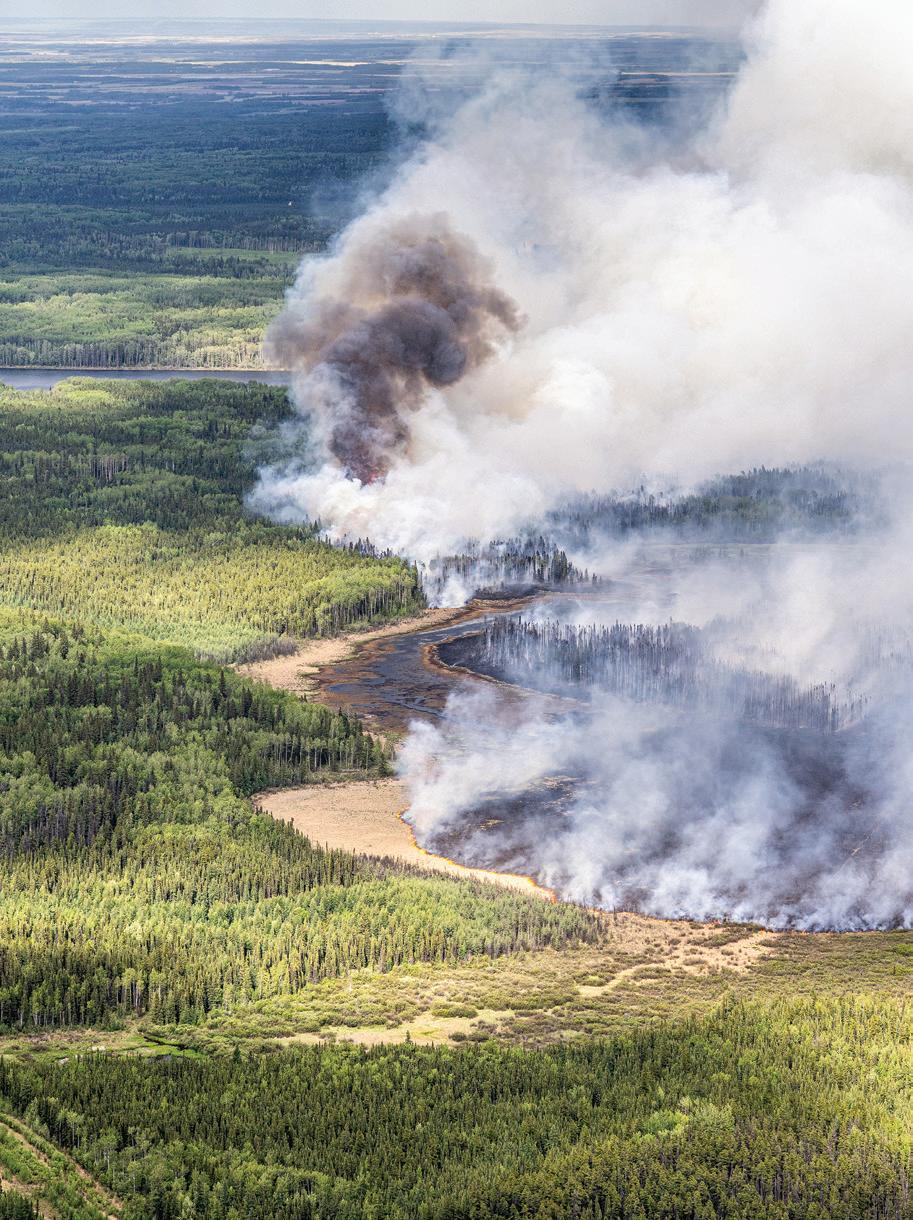
lightning storm, and hundreds of ignitions.”
While the wildfire risk has always existed, 2023’s record season marked a turning point for miners, Raul Munoz, mining leader at risk adviser Marsh, said by phone. “It shifted the discussion from occasional perils that would happen to now something that is being discussed at more of a board level,” Munoz told The Northern Miner
“Wildfires can significantly affect operations even when the fire doesn’t touch the site,” Munoz said.
While 2023 was particularly intense, many wildfire seasons have triggered widespread evacuations, major highway closures and disruptions across key resource corridors.
In B.C., Artemis Gold (TSX-V: ARTG) evacuated all non-essential personnel in 2023 and 2024 from its Blackwater gold and silver mine due to regional wildfires. Osisko Development (TSX; NYSE: ODV) temporarily paused non-essential activities at its Cariboo Gold project in B.C. and removed staff following
a local wildfire evacuation order in 2024. In 2021, Cameco (TSX: CCO; NYSE: CCJ) evacuated personnel from the Cigar Lake uranium mine in northern Saskatchewan in response to wildfires.
As wildfires intensify, they’re increasingly disrupting access roads and power infrastructure. That pressure is creating operational bottlenecks that are influencing mine planning, emergency preparedness and capital allocation decisions.
Business interruption
Power reliability has become a growing concern. Many remote operations rely on long transmission corridors that can be vulnerable to wildfire activity far from the mine itself. Even if a site remains outside an evacuation zone, damage to power infrastructure can interrupt production and affect critical systems, Munoz said.
As a result, some companies are evaluating backup generation capacity and other contingency measures to maintain essential ser-
vices during prolonged outages. BC
Hydro also uses preventative measures alongside regular inspections, including applying fire retardant or fire-resistant steel-mesh pole wraps coated with heat-activated barriers.
The disruptions have also attracted attention from insurers.
The 2023 Okanagan and Shuswap wildfires cost Canadian insurers over $720 million. The 2024 Jasper wildfire’s insured losses were estimated at $1.3 billion.
Insurance providers are increasingly asking companies detailed questions about wildfire exposure and preparedness, similar to the scrutiny environmental, social and governance issues received several years ago, Munoz said.
While coverage remains available, insurers are paying closer attention to business continuity planning, emergency response procedures and how companies assess climate-related risks.
Those risks extend beyond fire, Munoz said. He points to the drier, hotter conditions created by El
Niño. “We’re starting to see that temperature rise across the world, particularly in some of the northern latitudes,” he said. “How is the company dealing with rising temperatures for staff and working conditions outdoors?”
The growing focus on wildfire risk is changing how mining projects are planned, built and operated.
“[Wildfire mitigation] starts back in the planning of a new facility,” Rob Carter, senior principal risk assessor at engineering firm WSP Canada, said. “Don’t build it halfway up a slope… fire goes up slopes. You want to be at the top, set back from the ridge.”
Natural barriers like lakes, rivers and mountain ridges, as well as human-made barriers like hydro and pipeline cut lines, are also being factored into project development plans to protect facilities against wildfires. Distance between buildings, materials used, and design are also being influenced by the growing threat.
“Don’t have complicated roof systems because that’s where embers and debris will start to accumulate,” Carter said. “If we get these ideas in early to put a steel roof on versus an asphalt roof, the cost is minimal. We’re trying to save them from having to make those choices later.”
The other side of risk assessment is looking at when a company’s operations might be a direct cause of the wildfire. It often involves identifying planned periods of higher energy draw during the drier part of the season, and where energy systems might be close to dry vegetation.
“We can’t forecast out years, but at least now, maybe weeks out, we can start budgeting where maintenance should happen,” Carter said. “We can start looking at vegetation management and maybe pre-position crews based on the probability of something happening next week.”
“Climate change is a modifier of risks,” Sean Capstick, principal and senior climate change specialist at WP, said. Capstick worked with the Mining Association of Canada in 2020 to develop guidance on climate adaptation for mine infrastructure.
As part of the association’s guidance, Capstick said it’s imperative that mine operators ask themselves what’s a future risk and what mitigation or resilience activities are critical now. Capstick said the Canadian Centre for Climate Services recently released a tool forecasting the climate’s normal for the next 30 years, which mine operators can use to see how far out of the normal range the regional temperature will be.
“You want to say what are my decade projections for fire? Am I still okay?” Capstick said. “It’s too late to say, what am I going to do for this season? You’re going to be reacting.” TNM
BY BLAIR MCBRIDE
Avalon Advanced Materials (TSX: AVL; US-OTC: AVLNF) is in a new push to develop its Nechalacho rare earths project in the Northwest Territories, with an economic study targeted for the fall and production potentially in three years.
It’s a full circle move for Avalon, which in 2005 acquired Nechalacho —its first project—and did most of the modern exploration, resource and study work that put it on the map. Vital Metals (ASX: VML; US-OTC: VTMXF), which owns part of the Nechalacho deposit, has been more active at the site over the last five years, though it’s less advanced than Avalon. Nechalacho is about 100 km southeast of Yellowknife.
“It really came down to rare earths being in vogue again,” Avalon CEO Scott Monteith told The Northern Miner in a June video call. “Washington and Ottawa have realized that the pricing coming out of China is more manipulation-driven than market-driven and the West is now waking up to that reality. The economics and geopolitics are starting to make the Nechalacho project make a lot more economic sense.”
Avalon’s renewed approach to Nechalacho, one of the largest and most advanced rare earth projects in North America, rides that growing rare earths momentum as it seeks partners and roads for the roughly $2-billion (US$1.42billion) capital cost project. It also comes as the Northwest Territories seeks new mining projects to fill the economic gap left by closing diamond mines.
With market factors and political currents now more favourable, Avalon is considering how to finance the project and get it up and running over the next three to five years. Monteith said he’s speaking with mining and processing companies as well as offtake firms to potentially join as equity partners, joint ventures or other strategic partnerships. He wasn’t able to specify who at this point.
Like many projects in the Far North, Nechalacho lacks permanent infrastructure connections and is accessible only by barge or ice road. But Avalon is in talks with the N.W.T. government about accessing federal financing under the Critical Minerals Infrastructure Fund to potentially build a road to the site.
The preliminary economic assessment that Avalon aims to publish in October would update a 2013 study and resource. An updated feasibility study is planned for next year.
That feasibility study from more than a decade ago pegged Nechalacho’s capital cost at $1.6 billion, but there’s been sharp inflation since then, Christopher Senyk, vice president of corporate development, acknowledged during the call.
“These things are not cheap,” said Senyk, who sees capital costs at around $400 million higher now.
The same study forecast the proj-
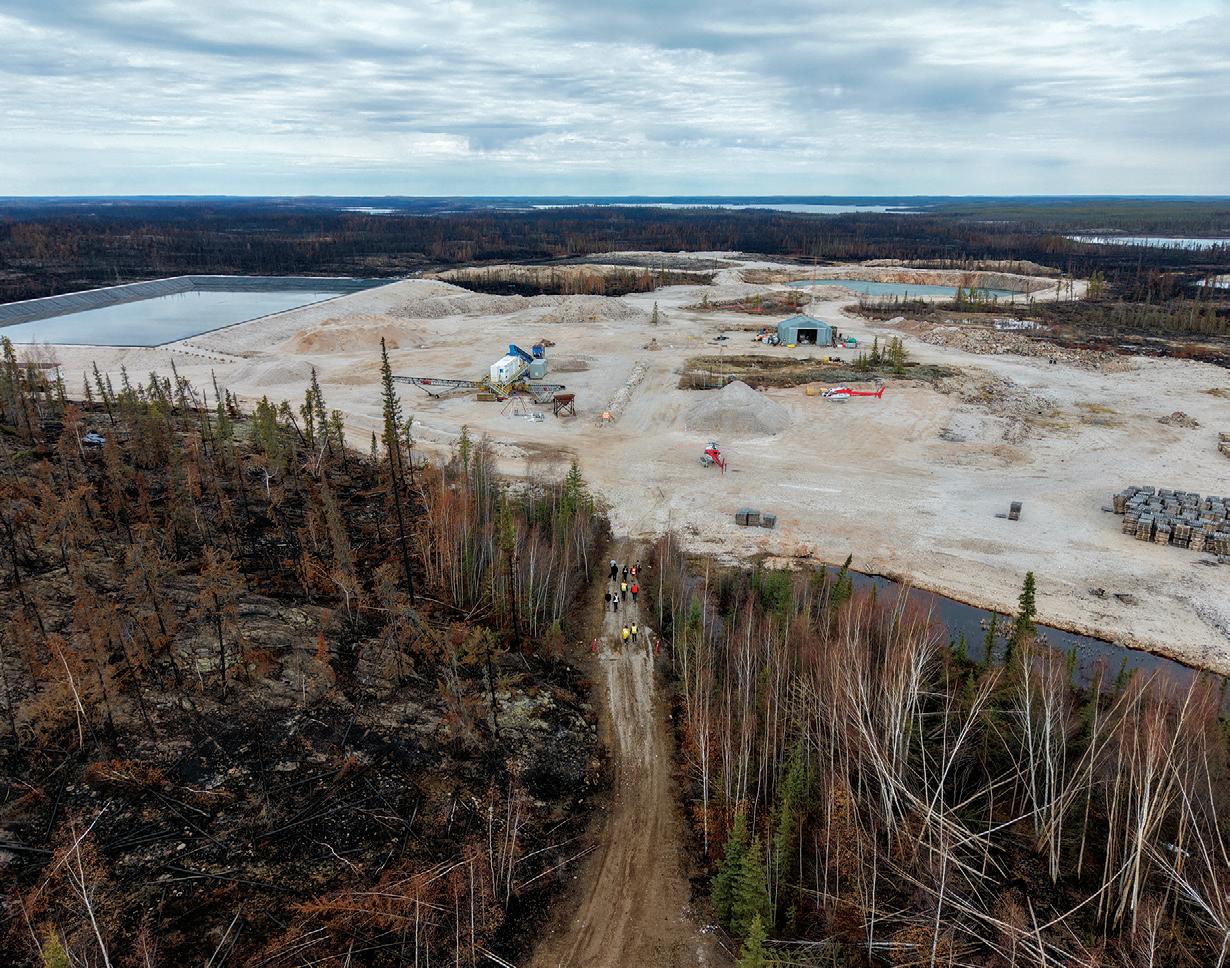
“It really came down to rare earths being in vogue again. Washington and Ottawa have realized that the pricing coming out of China is more manipulation-driven than market-driven. The economics and geopolitics are starting to make the Nechalacho make a lot more sense.”
SCOTT MONTEITH CEO, AVALON ADVANCED MATERIALS
ect’s post-tax net present value at $1.3 billion using an 8% discount rate, and gave it an after-tax internal rate of return of 20%.
Nechalacho’s Basal zone could produce 9,300 tonnes of total rare earth oxides (TREO) annually over a 20-year mine life. It hosts proven and probable reserves of 14.6 million tonnes grading 1.7% TREO and 0.46% heavy rare earth oxides (HREO).
Contained reserves total 247,000 tonnes TREO and 67,000 tonnes HREO, which includes dysprosium, terbium and yttrium. Annual production is projected at 19,763 tonnes of zirconium oxide, 2,230 tonnes of niobium oxide and 243 tonnes of tantalum oxide.
While Vital’s Tardiff zone at Nechalacho has higher estimated annual output of about 14,800 tonnes of TREO, it would have an 11-year life and an NPV less than half of Avalon’s, at about $622.5 million, according to Vital’s scop-
ing study released last summer. Tardiff has initial capital costs of about $400 million and an internal rate of return of 26%.
Vital’s rights to Tardiff extend from surface to about 150 metres depth and Avalon’s Basal from 150 metres and deeper.
And yet, despite Vital’s smaller operation at Nechalacho, the Australian company has made far more headlines for its work at Tardiff over the past few years. It was briefly Canada’s first-ever producing rare earths mine on a demonstration-scale basis during 2021-2023.
But mining ended due to cost overruns, market difficulties and the bankruptcy of Vital’s processing subsidiary in Saskatoon, Sask. Vital did not respond to a request for comment.
Basal is envisioned as an underground mine and Tardiff as open pit. Under an agreement between Avalon and Vital, future mining of
the deposits would follow a simultaneous development model and neither company can impede the other.
But even though Avalon had a strong feasibility study in 2013, it didn’t start developing the site because it couldn’t raise enough cash to build a mine. And so, under its founder and former CEO Don Bubar, the company opted to wait.
“Don and his small team sat on Nechalacho like a junior miner does,” Monteith said. “They were pretty much waiting around to be bought.”
Asset sale
To earn cash, Avalon sold the Tardiff deposit to Vital’s former subsidiary Cheetah Resources for $5 million in 2019.
“I joined the company to start commercializing assets, and in the spring of 2023 lithium was the focus. Rare earths weren’t in vogue yet,” Monteith said.
The company was set to open its Yellowknife office in mid-June.
“Then it becomes its own northwestern identity,” Monteith said. “That helps with relations with First Nations communities and with the people of the Northwest Territories.”
The upcoming PEA will also incorporate cleaner processing methods for Basal. The company wants to avoid conventional methods of processing rare earths that involve intensive use of chemical acids.
“We have patented and proven a new processing technology with
collaboration from the University of Toronto,” Monteith said. “We now have a process that is ecofriendly, using caustic soda instead of acid.”
That process would cost about one-third less than the acid-based approach, Monteith said, and Avalon plans to build a demonstration system at the site.
A proposed power expansion that would run a line north towards the diamond mines northeast of Yellowknife could be connected to Nechalacho through a spur, Project Director Burl Joseph said.
The company is also working on refreshing negotiation deals for impact-benefit agreements it signed with the Yellowknives Dene First Nation and Lutsel K’e Dene First Nation more than a decade ago.
As Avalon seeks project financing and looks to its next milestones for Nechalacho, Monteith emphasizes that this time the project benefits from the right alignment of factors and critical metals.
“We also have zirconium, which is a key material in nuclear power plant construction,” he said. “It’s a very attractive assortment of goodies. As Don Bubar and his team used to call it, it’s the world’s most significant grocery store of rare earths.”
Avalon shares traded for 5¢ apiece before press time in Toronto, valuing the company at $42.1 million. The stock has traded in a 12-month range of 3¢ to 15¢. TNM
BY NORTHERN MINER STAFF
Exploration in Canada’s Prairie provinces, British Columbia and the Far North is heating up with summer drill programs, especially for coveted critical minerals. Here’s a look at eight companies with interesting projects to watch.
n Amarc Resources
Amarc Resources (TSXV: AHR; US-OTC: AXREF) is advancing the Joy, Duke and Ike copper-gold projects in northern, central and southern British Columbia, respectively.
A preliminary budget of $15 million (US$10.7 million) has been earmarked for exploration this year and will focus on the Joy project in the province’s Toodoggone region. The program is to be fully funded by strategic partner Freeport-McMoran (NYSE: FCX).
The Joy district assets are held by AuRORA Minerals, a private joint-venture corporation in which Freeport currently holds a 60% interest, which it earned by spending $35 million.
In September, the Arizona-based miner announced it will earn another 10% stake by investing an additional $75 million at a minimum spend of $10 million per year over five years.
The main target at Joy is the high-grade, near-surface AuRORA copper-gold deposit, which Amarc discovered in 2024.
Amarc says AuRORA represents a new porphyry system. Discovery hole JP24057 returned 82 metres grading 1.24 grams gold per tonne and 0.38% copper from 18 metres, and a separate interval of 69.7 metres grading 2.56 grams gold and 0.42% copper from 120.3 metres. Drillhole JP24060 cut 130 metres grading 2.4 grams gold and 0.61% copper from 74 metres.
Highlights from last year’s 35-hole program included a 266metre interval grading 1.24 grams gold and 0.31% copper from 34 metres depth.
The 630-sq.-km project, about 1,100 km north of Vancouver, also hosts the Twins and Canyon porphyry copper-gold systems and the historic Pine and Brenda deposits.
Drilling last year at Twins intersected porphyry copper-gold systems below an 8.5-sq.-km lithocap and the same at Canyon beneath a 5-sq.-km lithocap.
Amarc also has a joint venture with Boliden at its Duke project. The Swedish miner has invested US$30 million ($41.8 million) to earn a 60% stake. In April, Amarc announced that Boliden will not exercise its option to increase its interest from 60% to 70% for a further US$60 million.
The copper-molybdenum-goldsilver deposit sits about 6 km southeast of American Eagle Gold’s (TSXV: AE; US-OTC: AMEGF) NAK copper-gold deposit and about
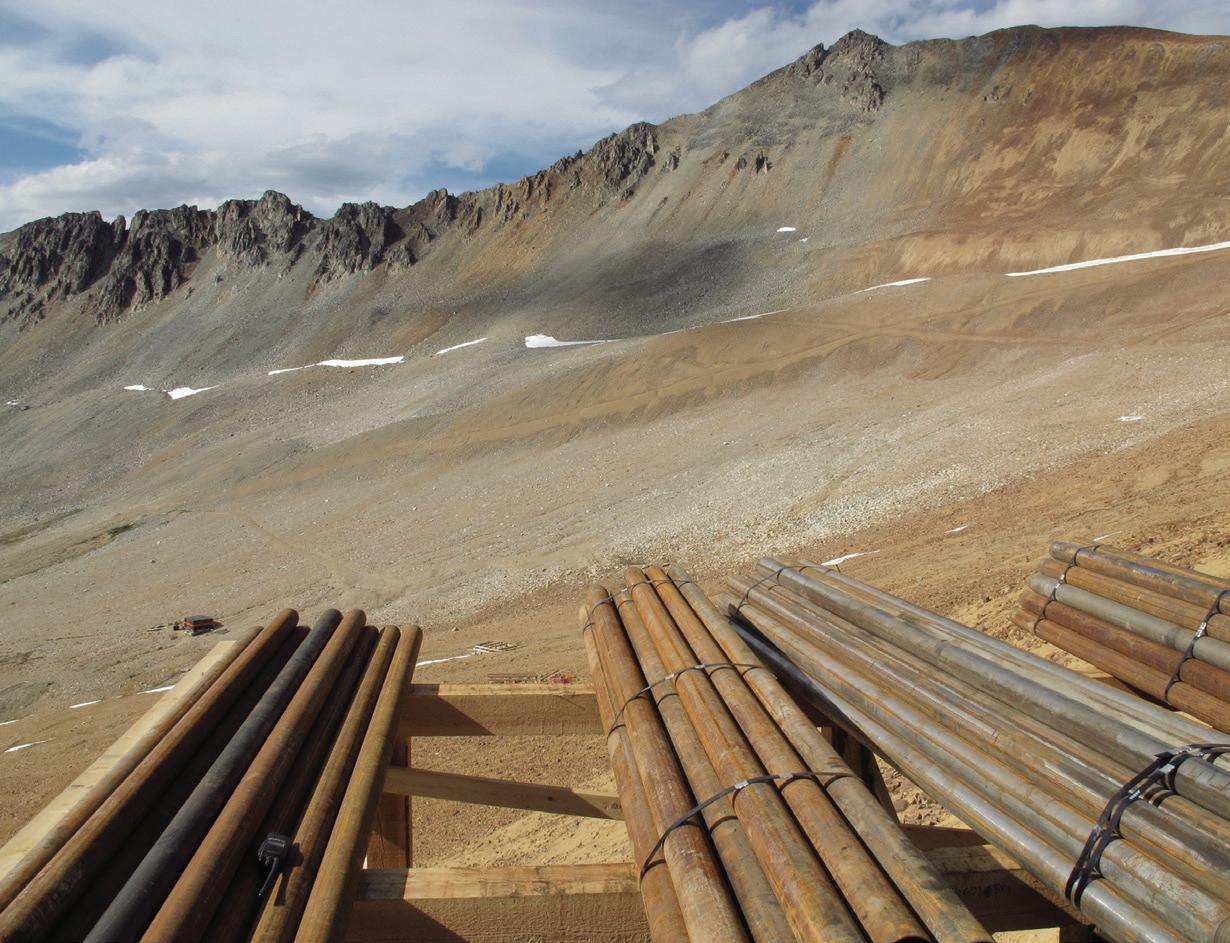
80 km northeast of the town of Smithers.
Drilling at the 732-sq.-km property has identified a porphyry system extending to over 650 metres north-south by 800 metres eastwest and to a depth of over 600 metres.
Amarc Resources has a market cap of $228 million.
n Blue Star Gold
Blue Star Gold (TSXV: BAU; US-OTC: BAUFF) is advancing the Ulu, Roma and Auma gold projects in the Kitikmeot region of western Nunavut, about 210 km southeast of the hamlet of Kugluktuk and 525 km northeast of Yellowknife, N.W.T.
The land position spans 423 sq. km of the underexplored High Lake Greenstone Belt and is situated near the Ottawa-backed Grays Bay Road and Port (GBRP) project, a $1 billion nation-building infrastructure initiative.
Ulu sits just 1,500 metres and Roma 2 km from the GBRP’s proposed 230-km all-weather road that would connect the Arctic Coast to the Nunavut-N.W.T. border. The deep-water port would be located at Grays Bay in the Coronation Gulf. In March, Prime Minister Mark Carney referred the GBRP to the federal Major Projects Office, which was created to fast-track infrastructure projects.
Blue Star released a resource update for Ulu in May outlining 2.2 million measured and indi-
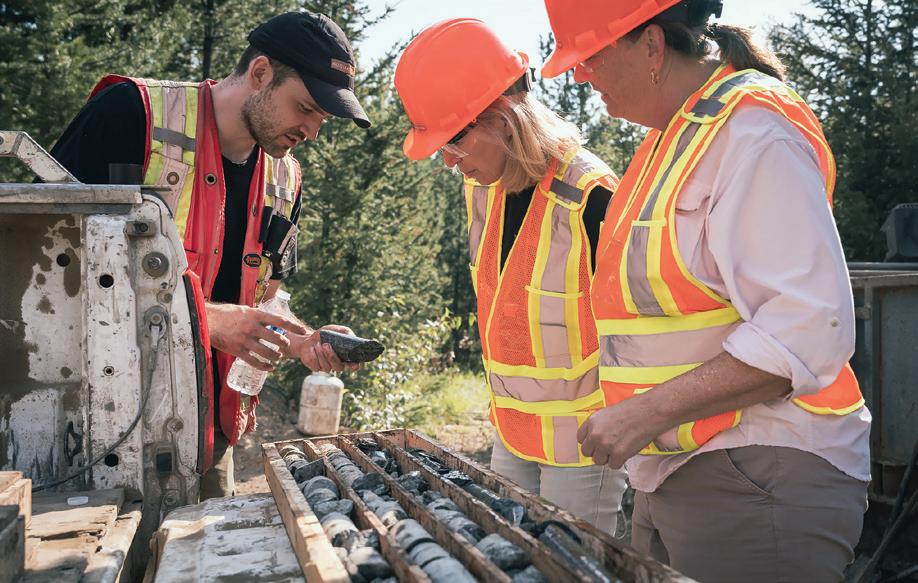
cated tonnes grading 7.87 grams gold for 558,000 contained ounces. Inferred resources stand at 3.2 million tonnes at 4.54 grams gold for 476,000 ounces.
The update puts Ulu in the top ranks of junior gold explorers by contained ounces and grade in Nunavut.
Blue Star envisions Ulu as an open-pit and underground project, where mineralization from three zones (Flood, NTK and NFN) could be co-processed. The company estimates gold recoveries higher than 90%.
Roma sits in the northern portion of Blue Star’s land package and hosts gold showings as well as copper and zinc targets. The Roma Main showing is a 0.3- to 3-metre-wide quartz vein exposed intermittently in out-
crop and boulders over a strike length of about 2 kilometres. Visible gold was noted in three historical narrow diameter drillholes.
The Auma project remains under-explored, and the company says it will be an area for future exploration.
Blue Star Gold has a market cap of about $35.2 million.
Defense Metals (TSXV: DEFN; US-OTC: DFMTF) is advancing its Wicheeda rare earths project in British Columbia, 80 km northeast of Prince George and 500 km east of Prince Rupert, the closest major North American port to Asia.
Wicheeda is one of the more advanced rare earths projects in B.C. Last year, a prefeasibility
study gave the open-pit project an after-tax net present value (NPV) of US$992 million and an aftertax internal rate of return (IRR) of 19%, based on a discount rate of 8%. Initial capital costs of US$1.4 billion could be repaid in 3.7 years. Reserves support a 15-year mine life with an average annual output of 31,900 tonnes of total rare earth oxides (TREO) in concentrate. In May, the company entered into a non-binding memorandum of understanding with South Korea’s Hanwha to explore opportunities for collaboration and potential offtake agreements.
The 118-sq.-km property located on the traditional territory of the McLeod Lake Indian Band, has also been picked for B.C.’s Critical Minerals Office (CMO) initiative.
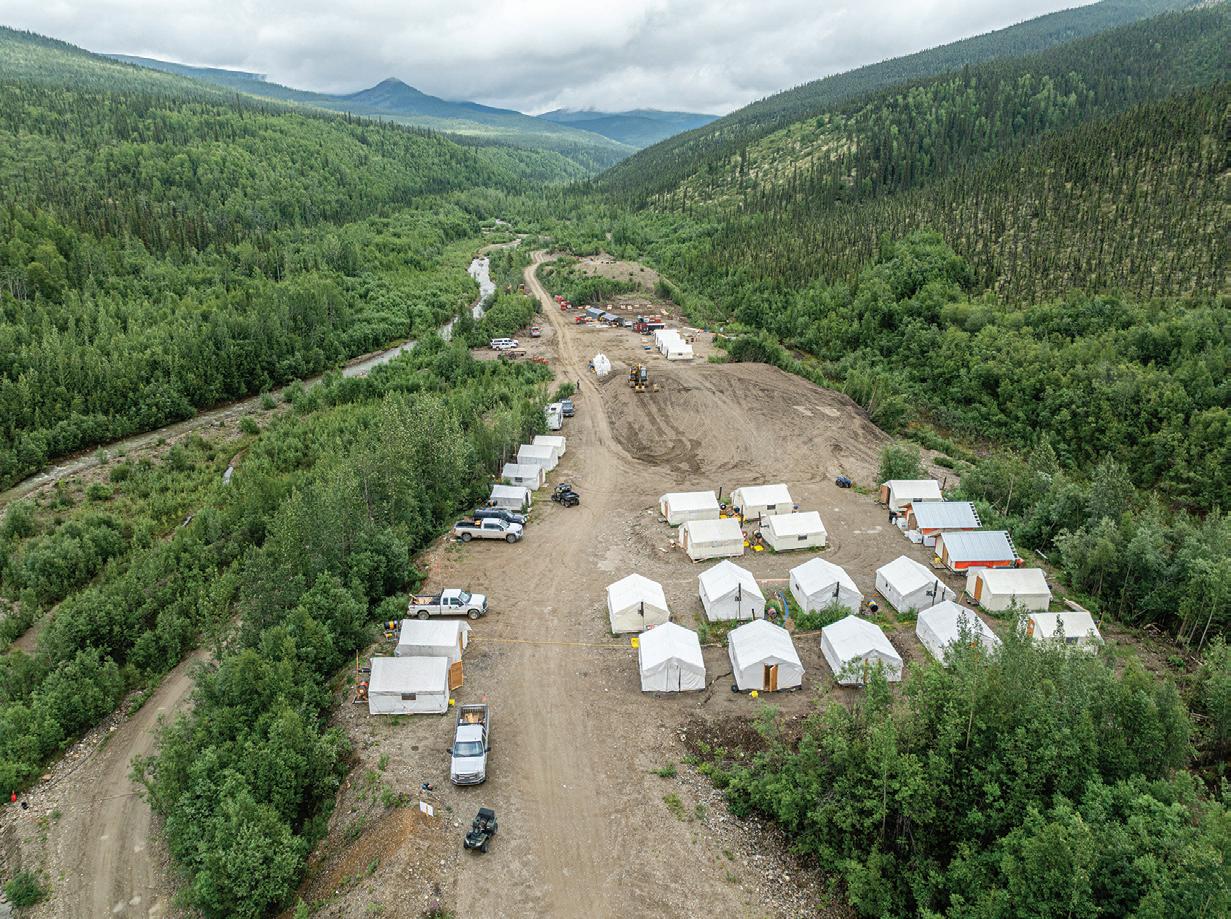
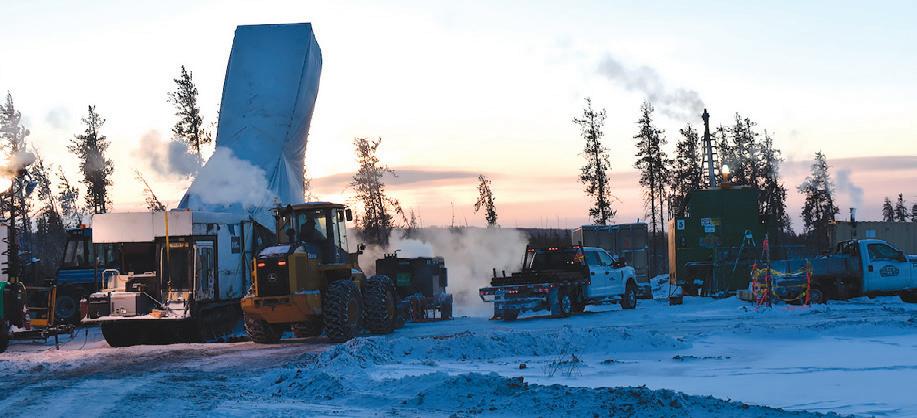
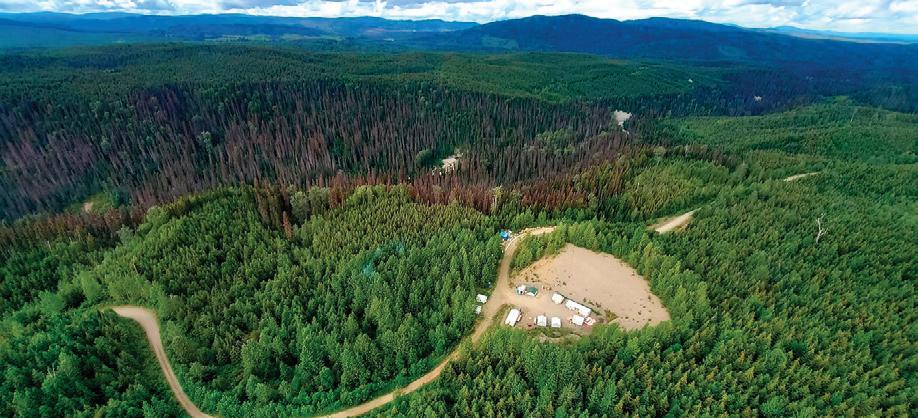
It is in a select group and the only rare earth project to benefit from key services from the CMO to help accelerate promising projects.
In March, Wicheeda received conditional approval for up to $1.9 million in the second call for proposals under the Critical Minerals Infrastructure Fund. The funding would enable the company to develop a new 60-km transmission line designed to deliver up to 35 megawatts of electricity from the BC Hydro grid directly to the project.
The company kicked off its spring drill program in May with
in eastern
plans to drill 6,865 metres. It is also pushing ahead with a pilot flotation plant test program.
Wicheeda is among few rare earth deposits in North America with current reserves other than MP Materials’ (NYSE: MP) Mountain Pass mine in California. Proven and probable reserves measure 25.5 million tonnes grading 2.4% TREO for 619,000 tonnes TREO, 2,661 parts per million (ppm) neodymium oxide and 961 ppm praseodymium oxide.
The site, which is accessible by a paved highway and all-weather
gravel roads, sits close to infrastructure such as hydro power transmission lines and gas pipelines, as well as the nearby Canadian National Railway.
Defense Metals has a market cap of about $79 million.
n F3 Uranium
F3 Uranium (TSXV: FUU; US-OTC: FUUFF) is focused on Tetra, its newest discovery on the Broach property, which is part of the company’s Patterson Lake North project in Saskatchewan. That project’s 430-sq.-km land
Athabasca basin: The J Zone at Waterbury Lake; Triple R at Patterson Lake South (PLS); the JR Zone at Patterson Lake North, and more recently, Tetra.
The PLS and Waterbury deposits were later acquired by Paladin and Denison Mines (TSX: DML; NYSE: DNN).
F3 Uranium has a market cap of about $101 million.
Fortune Bay (TSXV: FOR; US-OTC: FTBYF) is moving ahead with engineering studies, environmental programs and community engagement initiatives as part of prefeasibility study work at its Goldfields project in northern Saskatchewan.
At the same time, drill results it has released this spring continue to demonstrate wide intercepts of gold mineralization.
Assays from the project’s Box deposit reported in March included 17 metres grading 2.54 grams gold from 228 metres, including 5 metres of 6.61 grams gold in drillhole B25-346; 19 metres at 1.86 grams gold from 355 metres and 7 metres of 2.76 grams gold from 367 metres in drillhole B25-347. Drillhole B25-348 returned 9.3 metres grading 2.29 grams gold from 274 metres downhole.
package includes two other properties—Patterson Lake North and Minto—all within the southwestern edge of the Athabasca basin, one of the world’s highest-grade uranium districts.
Located roughly 12 km south of the JR zone, and discovered in 2025, Tetra sits near major uranium projects such as NexGen Energy’s (TSX, NYSE: NXE; ASX: NXG) Arrow deposit and Paladin Energy’s (ASX, TSX: PDN) Triple R, underscoring the district’s development potential.
Results from the fall drill program at Tetra released in March include drillhole PLN25-219A, which returned 13 metres at 0.28% uranium oxide (U₃O₈) from 399.5 metres depth. Hole PLN25-211 cut 4.5 metres grading 0.1% U₃O₈.
In June, F3 started an induced polarity (IP) and resistivity geophysical survey at the Tetra zone to generate new targets. Drilling will focus on extending mineralization along strike and testing the system at depth as crews work to define the scale of the discovery.
At F3’s JR zone—adjacent to Broach and about 23 km northwest of Paladin’s Triple R deposit— assays released in December 2024 featured 7.5 metres at 30.9% U308, including an ultra-high-grade core with 4.5 metres of 50.1% U308
Since 2010, the F3 team members have helped discover four major uranium discoveries in the
The results were followed in April by 7 metres averaging 9.9 grams gold within a 21-metre-intercept grading 3.7 grams gold from 342 metres in drillhole B26350. The intercept was 140 metres outside the deposit’s current openpit constrained resource estimate. Goldfields is 700 km north of Regina and about 13 km south of Uranium City, where there was a uranium mining boom from the 1950s until the 1970s. Gold exploration and mining in the area predates uranium activity by at least a decade. Fortune Bay’s Box target sits where the namesake underground mine produced about 64,000 oz. of gold between 1939 and 1942.
The company has also been drilling its Golden Pond target, just north of the Box mine. In May it reported 23.2 metres grading 1.20 grams gold from 15 metres depth in drillhole GP26-02 and 6.8 metres grading 2.06 grams gold from 43.1 metres depth in GP26-03.
An updated preliminary economic assessment (PEA) for Goldfields, released last fall, outlined a 14-year life with an after-tax NPV at a 5% discount of $610 million and a 44% after-tax IRR.
Initial capital costs were estimated at $301 million and lifeof-mine all-in sustaining costs at US$1,330 per oz., based on an assumed US$2,600 base-case gold price. The proposed open pit mine could produce 4,950 tonnes per day. An accompanying resource for the Box and Athona targets totals
Full turnkey operation, 123 claims on 19 kilometres creek, water permit in place, road accessible, this property was mined previously lots of virgin ground still left , full camp and all equipment on site large derocker and trommel onsite, 50,000 litres of fuel on site, I have large government report on the property available $12,500,000.00 some financing available to qualified parties. Contact: Emmett Gifford at emmett@ryanripper.com, or 780-915-3291
24 million indicated tonnes at 1.28 grams gold for 990,000 oz. gold and 7.4 million inferred tonnes at 0.9 gram gold for 210,000 oz. gold.
While the company’s main focus is gold, it’s also exploring for uranium. In June, it launched a 5,000metre drill program at the Murmac and Strike projects near Uranium City. The program is funded by Manhattan Uranium Discovery (TSXV: MANU; US-OTC: MAUUF) under an option agreement with Fortune Bay.
Fortune Bay has a market cap of $46.1 million.
n Kodiak Copper
Kodiak Copper’s (TSXV: KDK; US-OTC: KDKCF) main asset is the MPD copper-gold porphyry project in southern B.C.’s Quesnel Terrane, which hosts several of Canada’s largest copper-gold porphyry mines and deposits.
The company kicked off a fully funded exploration program in April, which is set to include 6,500 metres of drilling along with 3-D IP and audio-magnetotelluric geophysical surveying, geological mapping and prospecting. The drill program is aimed at expanding the initial resource estimate completed last year.
The resource outlined a total of seven deposits, all of which remain open to expansion. MPD hosts 82.9 million indicated tonnes grading 0.28% copper, 0.15 gram gold and 1.11 grams silver for 519 million lb. contained copper, 390,000 oz. gold, and 2.97 million oz. silver.
Inferred resources add 356.3 million tonnes grading 0.24% copper, 0.11 gram gold and 1.07 grams silver for 1.89 billion lb. copper, 1.28 million oz. gold and 12.31 million oz. silver.
The company says it plans to drill most of the seven deposits this year and notes that there is significant growth potential at the Ketchan, Adit and Dillard deposits.
It has also identified 36 prospective targets, and plans to drill several of the most compelling, including the Dillard East, Star and Tau targets.
In May, the company reported positive results from metallurgical testwork, with less energy invested into liberation due to a higher grind size. Rougher recoveries of up to 91.1%, 81.4% and 80.4% for copper, gold and silver respectively, were achieved while increasing grind size.
Kodiak Copper was launched by Chris Taylor, the founder and CEO of Great Bear Resources, which was acquired by Kinross Gold (TSX: K; NYSE: KGC) in 2022 for $1.8 billion. The company is part of John Robins’ Discovery Group.
In addition to MPD, Kodiak Copper holds the Mohave copper-molybdenum-silver porphyry project in Arizona. In April the company announced it had signed a non-binding letter of intent with Teck Resources (TSX: TECK.A/ TECK B; NYSE: TECK) to create a new U.S.-focused copper exploration company. Under the transaction Kodiak would vend its Mohave project and Teck its Copper Hill project, also in Arizona, into a subsidiary of Kay Copper.
Kodiak Copper has a market cap of about $88.1 million.
n Northisle Copper and Gold
Northisle Copper and Gold (TSXV: NCX; US-OTC: NTCPF) is working on a prefeasibility study for its North Island copper-gold
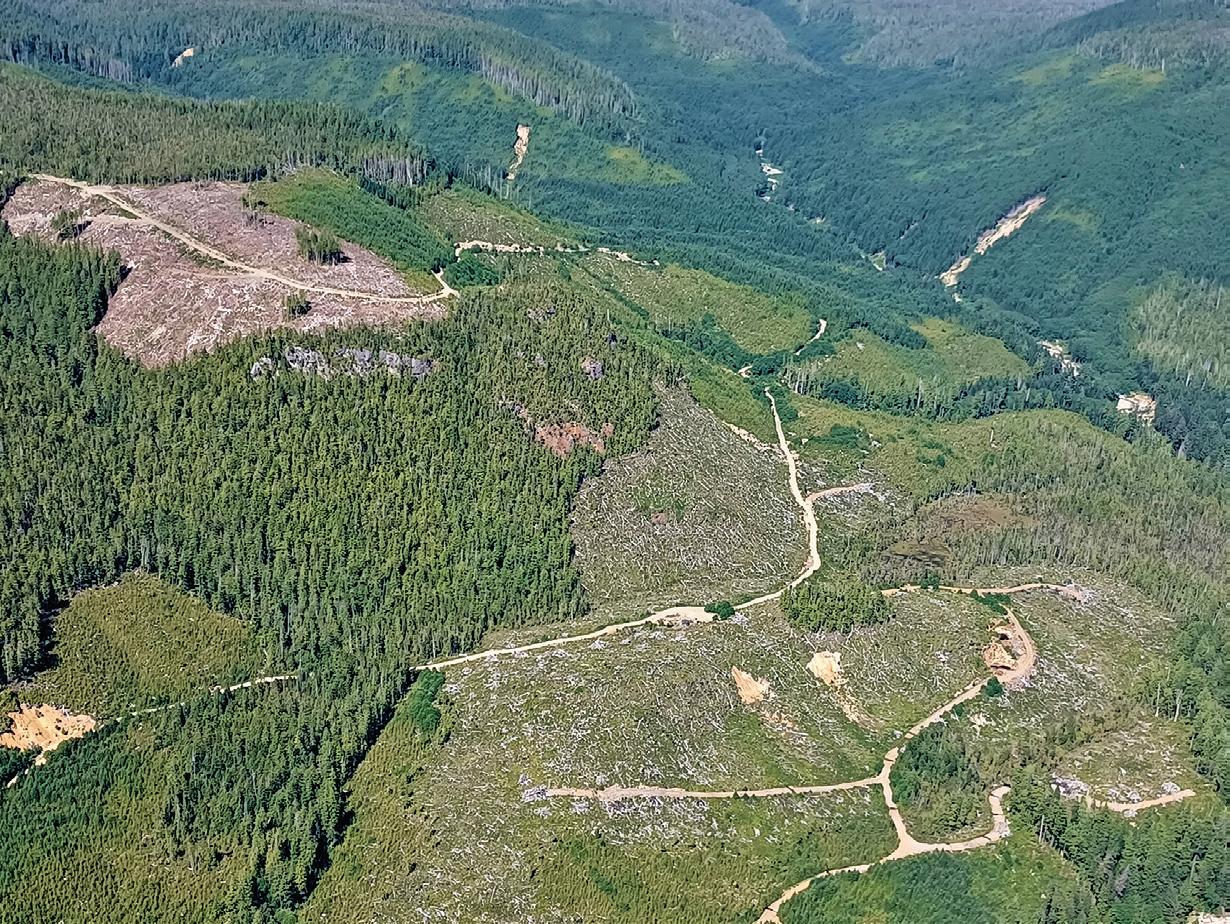
project near Port Hardy on northern Vancouver Island and recently closed a $115-million financing to help move the project towards environmental assessment and permitting. The project was accepted into B.C.’s Critical Minerals Office initiative in February.
A February 2025 PEA estimated an after-tax NPVof $2 billion at a 7% discount rate, an after-tax IRR of 29% and a 29-year-mine life.
The assessment was based on a proposed two-stage development of the Northwest Expo and Red Dog deposits, followed by the Hushamu deposit concurrent with a plant expansion. The previous PEA only included the Red Dog and Hushamu deposits.
In the first stage, the plant is to process material at a throughput rate of 40,000 tonnes per day to produce gold doré and gold-rich copper concentrate for five years.
The second stage contemplates twinning the mill for double the capacity at 80,000 tonnes per day in the sixth year to produce copper concentrate (containing significant payable gold), additional gold doré and a molybdenum concentrate.
Initial capital for the first stage was pegged at $1.14 billion with expansion capital needed for the second phase of $693 million. The initial capital could be repaid in about 1.9 years based on the base case scenario.
The project hosts 906 million indicated tonnes grading 0.16% copper, 0.24 gram gold and 75 ppm molybdenum, for contained metal of 3.11 billion lb. copper, 6.94 million oz. gold and 149 million lb. molybdenum, plus an additional 214 million inferred tonnes grading 0.12% copper, 0.22 gram gold and 52 ppm molybdenum for 571 million lb. copper, 1.53 million oz. gold and 24 million lb. molybdenum.
Infill drill results from the Northwest Expo deposit in March included 117 metres grading 1.22 grams gold, 0.2% copper and 99.3 ppm molybdenum from 231
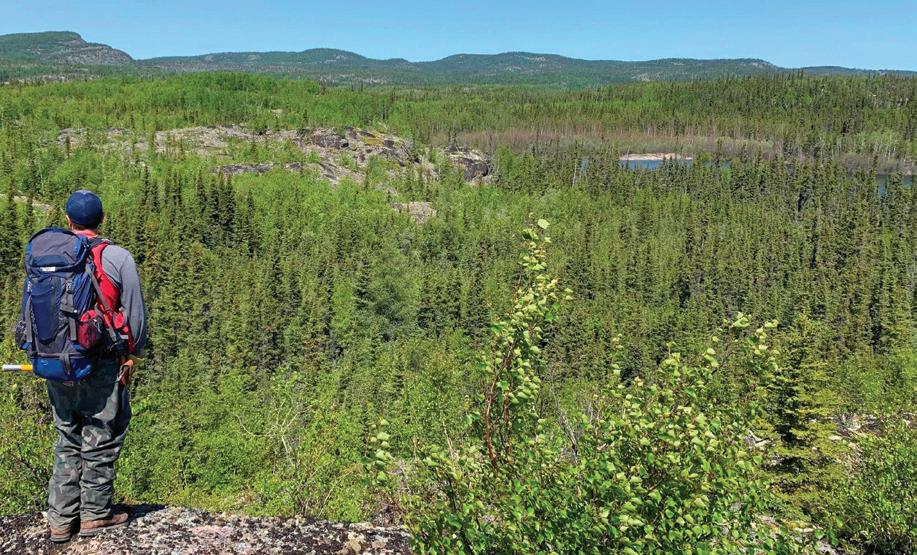
metres in drillhole NW25-57; and 75 metres at 1.09 grams gold, 0.21% copper and 79.1 ppm molybdenum from 246 metres depth in drillhole NW25-54 and 107.7 metres grading 1.02 grams gold, 0.16% copper and 8.89 ppm molybdenum from 254 metres depth in NW-25-53.
The 340-sq-km project is located next to BHP’s (NYSE, LSE, ASX: BHP) now-closed Island copper mine.
Northisle Copper and Gold has a market cap of about $923 million.
n Sitka Gold
Sitka Gold (TSXV: SIG; US-OTC: SITKF) is drilling 60,000 metres this year at its RC gold project in the Yukon’s Tombstone gold belt, about 100 km east of Dawson City.
The fully funded program is to focus on expanding resources at RC’s Blackjack, Eiger and Rhosgobel deposits, all of which remain open, and following up on other high-priority targets.
The first drillhole completed this year at Blackjack returned 273.8 metres of 1.1 grams gold from 642
metres depth, including 94 metres grading 1.8 grams gold and 19.3 metres of 5.04 grams gold.
The hole, DDRCCC-26-21, was drilled about 370 metres below the existing Blackjack resource and is the deepest hole drilled so far at the project at 1,093 metres.
The company says it anticipates updating Blackjack’s resource after the 2026 exploration program has been completed. Blackjack holds 39.96 million indicated tonnes at 1.01 grams gold for 1.29 million oz. and 34.6 million inferred tonnes grading 0.94 gram gold for 1.05 million contained ounces.
About half of the drill program this year will focus on the Rhosgobel deposit, which the company discovered in late 2024. In May, Sitka updated Rhosgobel’s pit-constrained resource to include tungsten and silver. The deposit now contains 100.68 million tonnes grading 0.7 gram gold, 0.9 gram silver and 0.05% tungsten oxide (WO3) for 2.2 million oz. gold, 2.93 million oz. silver and 51,345 tonnes WO3
The Eiger deposit holds 32.14
million inferred tonnes grading 0.52 gram gold for 535,000 ounces. All three deposits begin at surface and have potential for openpit mining and heap leaching. Initial metallurgical testing confirmed that the ore is non-refractory and returned gold extraction rates averaging about 85% for both Blackjack and Eiger. Testing of two composite samples from Rhosgobel yielded gold recoveries of 89% and 96%.
RC sits on a 441-sq.-km property that ranks among the largest consolidated land packages in Yukon. It is positioned midway between the former Victoria Gold’s Eagle mine and its Brewery Creek gold mine. The project is at the headwaters of Clear Creek and Big Creek, an active placer mining district serviced by a network of gravel roads and trails.
Sitka’s other projects in Canada include Coppermine River in Nunavut, about 600 km north of Yellowknifeand the OGI property, 50 km east of Dawson.
Sitka Gold has a market cap of about $474 million. TNM




The road’s economic case is based on connecting projects like Izok Corridor that includes the High Lake deposit, Glencore’s (LSE: GLEN) Hackett River and other gold, copper and base metal deposits with the Grays Bay port. Construction could start in 2028 and be open to traffic by 2035, WKR said.
For the Inuit-owned WKR headquartered in Nunavut’s Cambridge Bay, the ideal outcome for mineral assets in the territory would be increased Inuit ownership, with Canadian coming second best.
“Unfortunately, it is true that there aren’t as many Canadian mining champions as there once were,” WKR’s Chief Operating Officer Elliot Holland said in an emailed response to questions. “But where a company keeps its corporate headquarters is less important than the benefits it provides locally.”
He cited the examples of foreign miners Rio Tinto (ASX, NYSE, LSE: RIO), BHP (ASX, NYSE, LSE: BHP) and Anglo American’s (LSE: AAL) De Beers, who have owned diamond mines in the N.W.T., significantly benefitting its economy.
“[GBRP] has three user groups: mining, community, and security users,” Holland said. “With respect to mining users, Izok Lake, High Lake and Hackett River are the most advanced projects and therefore the most likely mining users of the infrastructure.”
Another corridor
The road and port are also linked to The Arctic Economic and Security Corridor (AESC), a 400-km all-season road from the N.W.T.
In late June, Ottawa announced it’s considering granting national interest status to the GBRP and Mackenzie Valley Highway project, a designation that could push permits and approvals through the Major Projects Office.
“We are in a pivotal moment,” Hodgson said in Yellowknife. “We are facing a global energy crisis, we are facing attacks on our sovereignty, a changing global economic reality, a difficult security environment and major climate change. It’s time to build big things again, both quickly and responsibly, in partnership with Indigenous peoples.”
Prime Minister Mark Carney added Grays Bay and the AESC to the Major Projects Office in March.
Since 2019, Ottawa has committed about $29 million to planning and development work for GBRP and in May earmarked another $50 million through the First and Last Mile Fund. In total, both projects are estimated to cost at least $2 billion.
MMG said it’s providing funding and support for the road project through studies, data sharing
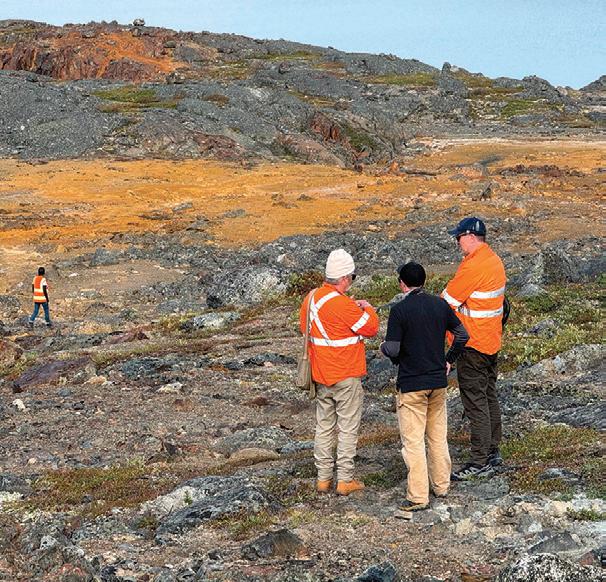
and collaborating with the team, though Knight said she couldn’t give details due to their commercial sensitivity.
High-grade zinc
Izok hosts 15 million measured and indicated tonnes grading 13% zinc and 2.3% copper. High Lake, north of Izok, holds 14 million measured and indicated tonnes at 3.8% zinc and 2.5% copper, according to a feasibility study from 2012.
Despite its zinc-copper potential, the project was in 2012 deemed “uneconomic due to the high capital and infrastructure costs associated with the haul road and port facilities,” Knight said. “A great deal has changed since then. Most importantly, regional infrastructure is now progressing well through regulatory pathways.”For N.W.T. leaders, they want Ottawa to treat northern roads and power projects as one Arctic buildout, not another stack of separate studies.
“There’s now a recognition nationally from the federal government that this country needs to build foundational infrastructure for the whole of the country,” Deputy Premier Caroline Wawzonek said from Inuvik. “We need to see ourselves as an Arctic nation.”
The Mackenzie Valley Highway would run about 800 km from Wrigley to Inuvik, starting with a 320-km link from Wrigley to Tulita and Norman Wells. Taltson would add 60 megawatts of hydro power and a 320-km transmission line to connect the N.W.T.’s North and South Slave grids for the first time.
“Having funds that are for the project as a whole rather than piecemeal is the goal,” Wawzonek said. “We want to build these projects as a group.”
The Grays Bay concept began in the early 2010s as a road to
resources, then became associated with the Arctic Security Corridor and now sits within the AESC, said Kroker, author of a report on the corridor.
The Major Projects Office gives this version a stronger case, he said, but it doesn’t guarantee long-term money or mine demand.
“It definitely still needs the mines component,” Kroker told The Miner. “It still needs to be economically viable on its own. There needs to be people using it, because if there’s no economic use to it, eventually it’ll just kind of fall off.”
Churchill caution Churchill, Man., offers a cautionary example of a northern trade and security project promoted as strategic before all the facts were in, according to Jackson Walling, a Trent University PhD candidate studying dual-use Arctic infrastructure.
A railway runs about 1,300 km from The Pas to Churchill, linking Prairie shippers to Hudson Bay. But the line and port have struggled to make money, Walling said. Its rail link faces chronic damage from thawing muskeg, Hudson Bay needs specialized vessels for dredging, search-and-rescue capacity remains thin and Indigenous representation is contested, he said.
“Who’s going to be maintaining it?” Walling asked of Grays Bay. “It’s great to say I’m going to make a road in practice.”
WKR’s Holland suggests that while security and sovereignty are worthy goals, jobs, access and development were the original motivations for the Grays Bay project.
“The federal government’s elevation of Arctic sovereignty is the final push to get this project into construction, but the concept started with Inuit leaders.” TNM
> Arafura P15
net manufacturing.”
Arafura is campaigning against price floors and in favour of producers and buyers outside China moving to newer indices established by Benchmark Minerals Intelligence and S&P Global’s Platts North America to promote transparent market prices.
“The reason we at Arafura can prosecute this argument is we’re at the bottom of the cost curve because of the phosphoric acid,” Cuzzubbo said. “We want price floors but we don’t really need it.”
That approach contrasts with U.S. government support for MP Materials, where last summer a government-backed pricing mechanism was introduced to encourage domestic rare earth production.
The company is also considering a plan to double annual NdPr output to 10,000 tonnes in a second stage using initial revenue.
Phosphoric acid leverage Arafura aims to produce 144,000 tonnes annually of fertilizer-grade phosphoric acid and is seeking sales in India, Cuzzubbo said.
The phosphoric acid produced at Nolans will be much higher purity than is typically sold for fertilizer, Cuzzubbo said. However, it isn’t quite high enough grade for lithium-ion phosphate (LFP) bat-
teries, another key end use.
“We would like to engage with LFP battery manufacturers to see if any of those parties would do that additional processing so they can secure a non-China phosphoric acid for LFP batteries,” he said. “This will get us a better price and we haven’t assumed it in the economics.”
Heavy bonus Arafura also plans to produce 573 tonnes per year of samarium-europium-gadolinium/heavy rare earth oxides at Nolans, containing about 25 tonnes of dysprosium oxide and 8 tonnes of terbium oxide. Those heavy rare earths are used for wind turbines, electronics and defence applications. While its production output would be much smaller than Lynas’, Nolans could become one of only a handful of non-Chinese sources of dysprosium and terbium.
Arafura received a non-binding letter of intent in October from the U.S. Export-Import Bank to provide up to $300 million in financing for a separate heavy rare earths separation project due after the first Nolans plant starts.
“At the moment, we predominantly produce light rare earths— NdPr—there’s more we can do,” said Cuzzubbo. “Heavy rare earths pricing has gone through the roof with magnet manufacturing moving out of China.” TNM
> Surbiton P15
41,000 oz.; and Gold Fields’ (NYSE, JSE: GFI) Gruyere mine in Western Australia, where output was down 20,200 ounces.
Newmont’s Boddington mine experienced bushfire damage in late December to its water and power supplies and communications systems, Surbiton said. Boddington had to scale back operations and output was 35,000 oz. lower than in last year’s fourth quarter.
Other sites saw higher production in the quarter, with Gold Fields’ Granny Smith in Western Australia producing 19,600 oz. more, Newmont’s Cadia in New South Wales putting out 13,000 more oz. and Northern Star Resources’ (ASX: NST) KCGM Super Pit in Western Australia producing up to 12,500 more ounces. TNM
Aboriginal title to about 3 sq. km of historic village lands in Richmond. The decision is being appealed by the provincial government, the City of Richmond and the Musqueam First Nation.
“We’re in this climate right now in B.C. where industry and private property holders are unsure of what their obligations are to meet and to ensure Aboriginal or Indigenous rights are upheld, and where that encroachment of Indigenous rights might be onto their own private property interests,” Sara Ghebremusse, a pro-
fessor at the University of British Columbia’s Peter A. Allard School of Law who specializes in mining governance, law and development, said in an interview.
“Not only is this legal limbo generating a lot of questions, but it’s also compounding some of this fear and uncertainty that industry and private property holders have.”
Indigenous consultation is a key feature of B.C. law that should be welcome by all of society—including investors—because of the priority is places on protecting the environment, says Guy Archibald, executive director of the Southeast Alaska Indigenous Transboundary Commission (SEITC).
His group—which represents 14 tribes, including members of the Tlingit, Haida and Tsimshian, whose territory extends across B.C. and Alaska—says rapid mining development in the northwestern part of the province “poses a “significant threat” for Southeast Alaska communities located downstream.
SEITC is especially concerned about major projects such as Canagold Resources’ (TSX: CCM; US-OTC: CRCUF) New Polaris mine and Skeena Gold & Silver’s (TSX: SKE) Eskay Creek mine because of their potential consequences on the environment.
“Our tribes have been on this landscape for tens of thousands of years through periods of climate change,” Archibald, a former miner, said in an interview.
“There needs to be a mechanism where that knowledge of the environment can be used with protections to help reduce the environmental effects that these projects have. The only way that’s going to work is that if the tribes here are allowed to conduct their own environmental assessments based on their own values, on their own timelines, through their own governance structure—not just evaluating what a contractor did or a mining proponent did.” Economic growth and tribal sovereignty aren’t mutually exclusive, SEITC’s Archibald argues.
“They can both happen, they can both be recognized, and they can both move forward better through deep consultation and consent of the tribes,” he said.
“We’re not opposed to mining. Metals, to some level, are necessary. Any conditions we may put on a mine authorization lessen the uncertainty of bad things happening, which can only lead to better long-term outcomes, both for the mining companies and the general public that has to deal with the legacy issues—because there’s always legacy issues with mines.”
BY NORTHERN MINER STAFF
Vista Gold (TSX, NYSE-A: VGZ) is building momentum towards a build decision for its Mt Todd gold project in Australia’s Northern Territory. After technical and economic studies, the company downsized the project, raised fresh cash and started permit changes.
The Northern Miner’s video host, Devan Murugan, spoke with CEO Fred Earnest about the smaller mine plan, permitting and whether a partner could still emerge.
Devan Murugan: When we last spoke, Mt Todd was largely a feasibility story. Is it now an execution story?
Fred Earnest: It’s definitely an execution story now. Everything that we’re doing is aimed toward that ultimate goal of executing on the development strategy for Mt Todd.
DM: The new study moved to a smaller, 15,000-tonne-per-day operation. What did that unlock?
FE: One of the biggest changes is the cost. The capital cost has decreased from just a little over US$1 billion in 2024 to US$425 million estimated last August. With that smaller initial capital cost, the project becomes much more financeable.
The smaller scale also makes the project simpler to construct. We’re not dealing with the same size of equipment. Bringing contract mining into the mix and accepting changes like a fly-in, fly-out workforce have resulted in a project that is, maybe the best way to describe it, more Australian. It’s certainly easier to finance and easier to build and get into operation.
DM: You have more than $50 million in the treasury. What should investors watch over the next 12 months?
FE: There are really three things we’re working on right now. We’ve been using the acronym PPE, and it’s not personal protection equipment. It’s permitting, people and engineering.
We’ve already submitted several permit modification applications. We believe permitting will advance in steps and stages with different authorizations over the next 12 months. I think we’ll see probably all but one of the major permit authorizations come in, and that last permit authorization is expected sometime in the middle of 2027.
On the people side, we’ve already hired a number of key people this year. We have a search underway for a managing director, and I’m very excited with the progress. We’ve always said we would not manage the development of Mt Todd from Denver. We’re building a team in Australia. If we get the person we ultimately want, it’ll be someone the industry and investment community in Australia will recognize as someone who’s built, developed and delivered construction projects and built new mines in Australia.
DM: Why is now the time to build that Australian team?
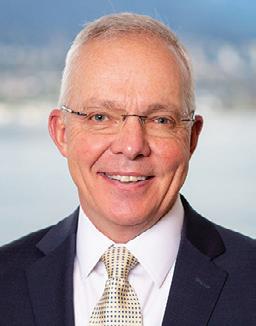
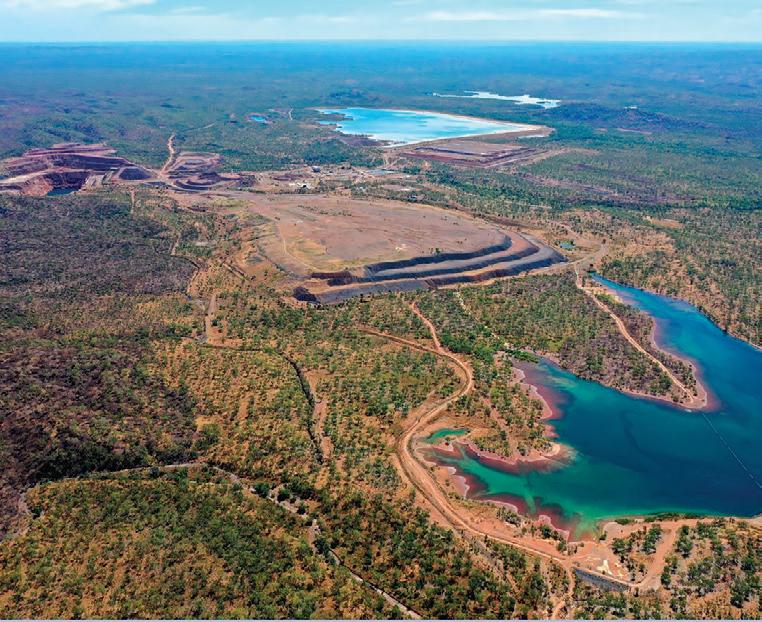
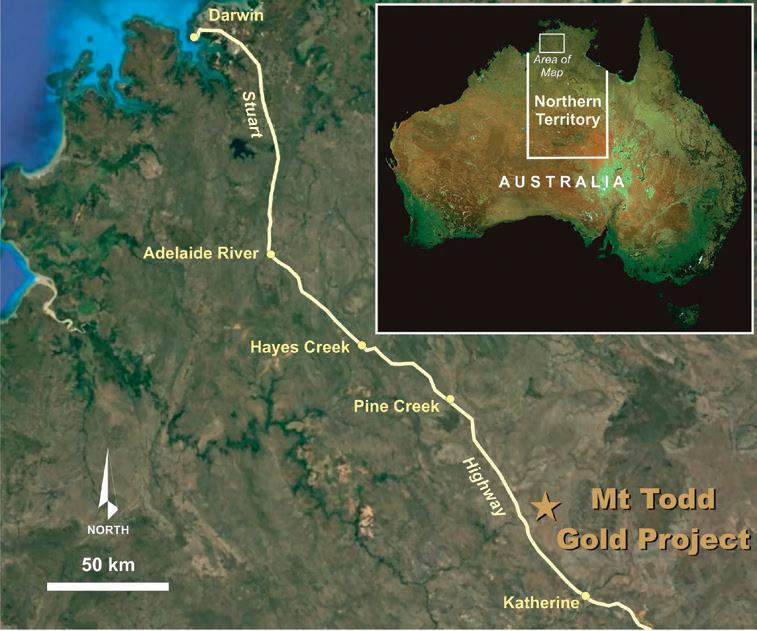
“To advance the project, get the financing we need and make the decisions that will affect how efficiently we’re able to build the project, people are the key.”
— FRED EARNEST, CEO, VISTA GOLD
FE: At the end of the day, we can do a lot of engineering and a lot of permitting, but people are the most important part of any operation.
To advance the project, get the financing we need and make the decisions that will affect how efficiently we’re able to build the project, people are the key. This is absolutely the right time to be adding people to our team.
Once we have the managing director on board, who will lead our organization in Australia, we will begin a more serious recruiting effort. This team we’re building should be the managing director’s team. I want him or her to have the final say on key people such as the project director, construction manager, head of finance and other positions that will follow.
DM: You have talked in the past about potential joint ventures. Are you seeing more interest now that Mt Todd has a clearer path?
FE: We’re not out seeking a joint venture partner or a transaction. Right now, our priority is to build the project.
We’re being true to what we’ve said in the past. If along this journey an opportunity presents itself that represents better value and less risk for shareholders, it will be seriously considered by the board.
But right now, our focus is to build the team and advance the project, ultimately to make a definitive investment decision and build it.
Sometimes along that path, we see other companies show up that decide we’re
serious about it, and things happen. We’ll see if that happens.
DM: What work is happening now at Mt Todd?
FE: This is the third leg of PPE, and that’s engineering.
Early this year, we finished drilling to obtain core for a metallurgical testing program. That program is in progress and we expect it to be finished at the end of September. It is an optimization study. We aren’t changing the flow sheet, but we are looking to refine our sizing and decide whether we’re going to grind to 35 microns, 40 microns or maybe 50 microns. That information will be used to size the mills.
We also have a drill on site as part of the geotechnical investigation. We’re hoping we’ll be able to stand the west pit wall back up to something close to what it was in the previous studies. There are about 70 million tonnes of waste at play that we’re hoping to remove from the current mine plan.
There’s project execution planning going on. There’s engineering in support of permitting. And in addition to optimization, we’re starting some frontend engineering and design so we’re in a better position to start detailed engineering and design in a year.
DM: What should investors be focused on next?
FE: Certainly permitting. We expect to have one of the first authorizations in the next month or two. That’ll be a first key step, and then there will be other modification authorizations through the remainder of the year.
Obviously, investors should watch for an announcement about the managing director. We hope that person has the name recognition that will excite the market and help investors understand that we are very serious about financing and building Mt Todd on a standalone basis. TNM
—This sponsored article is PROMOTED CONTENT paid for by Vista Gold and produced in co-operation with The Northern Miner. Visit https://www.vistagold.com for more information.
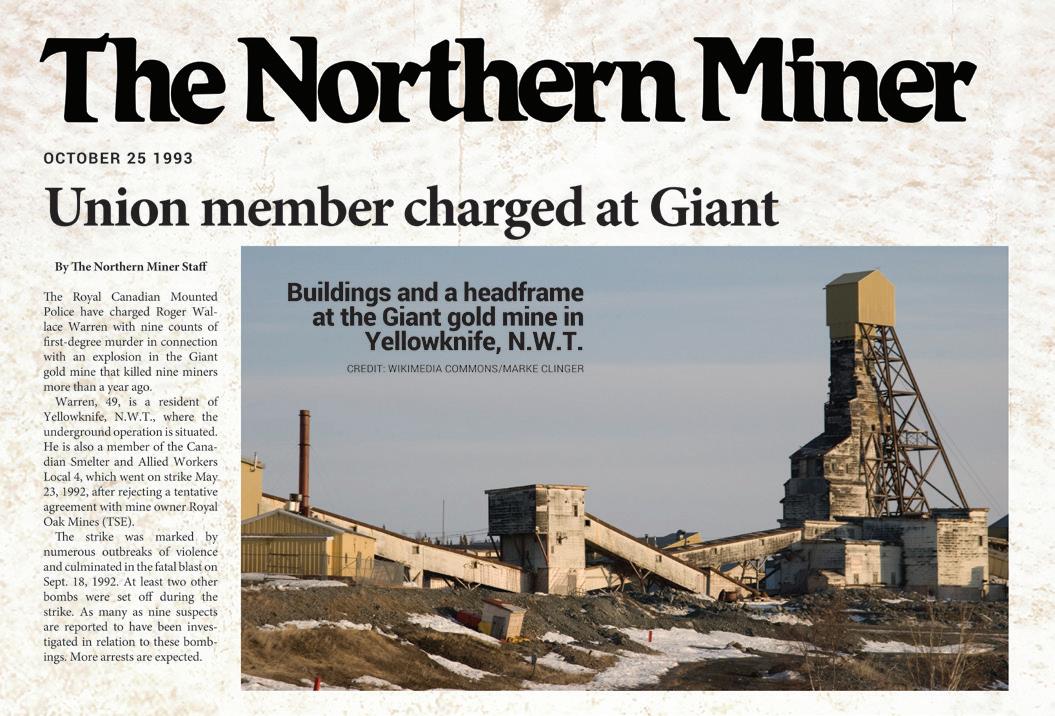
On Sept. 18, 1992, a set of deliberately planted explosives killed nine workers at Royal Oak Mines’ Giant underground site in Yellowknife, N.W.T. The bombing is regarded as the most notorious murder case in Canadian mining history.
of 1992. Amid a four-month strike by miners, Royal Oak brought in replacement workers and tensions escalated to threats, vandalism, sabotage and acts of violence.
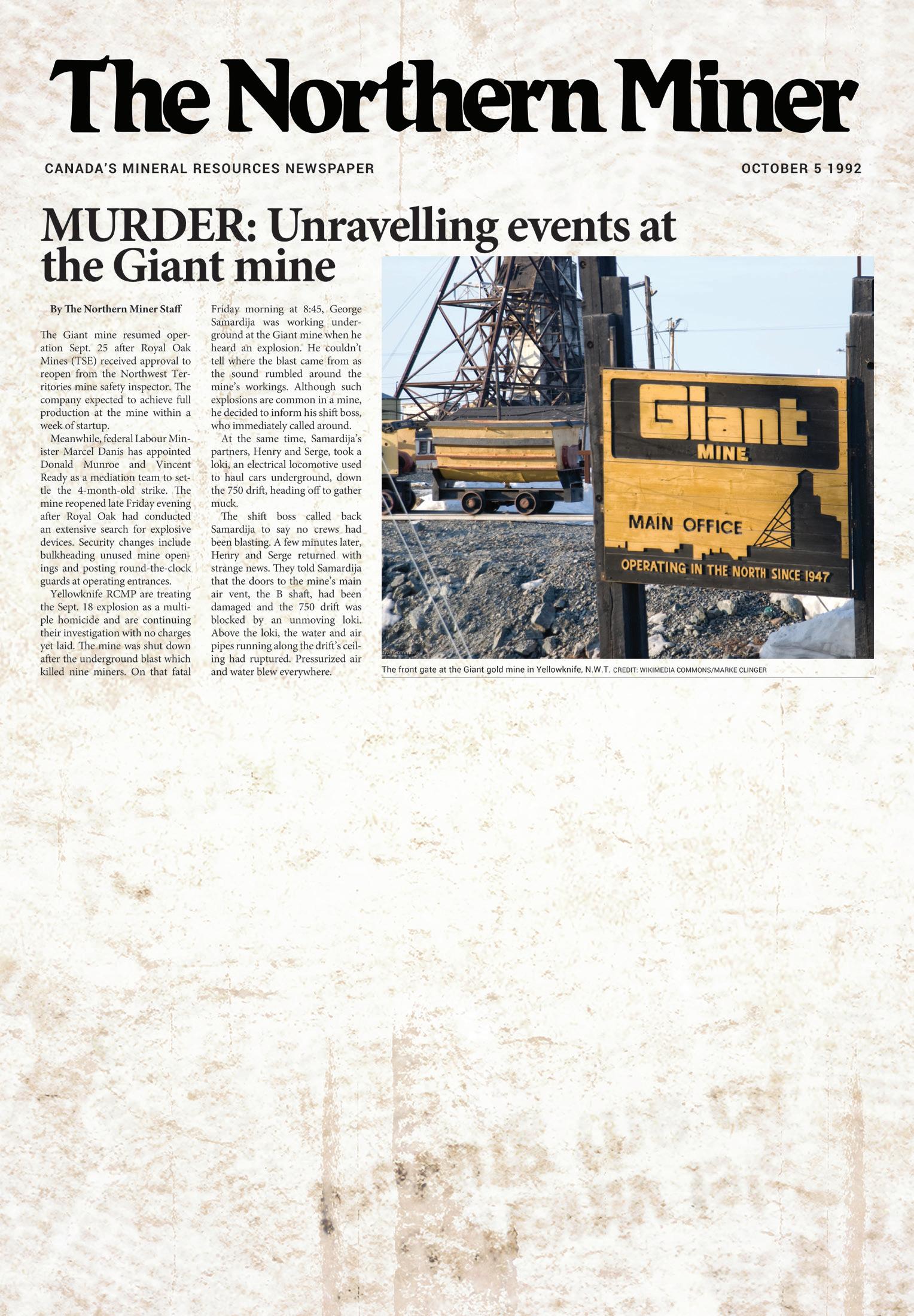
Giant had been in production since 1947. Along with the Con mine, gold mining largely anchored the economy of Yellowknife for the second half of the 20th century. But Giant became the scene of a bitter labour dispute that started in May
In July, explosions at Giant damaged a satellite dish and an air shaft. On the morning of Sept. 18, workers heard a blast. A worker investigated and found a destroyed rail car used for moving miners.
“Everything was in pieces,” he said. “It was hard to see the bodies. I got sick to my stomach.”
In October 1993, after a year-long investigation, RCMP arrested and charged Roger Wallace Warren, 49, with nine counts of first-degree murder. In early 1995, following his trial in which he pleaded not guilty, he was convicted of second-degree murder and sentenced to at least 20 years in prison.
After years behind bars, Warren confessed to the bombing in 2003, saying that the violence at Giant in 1992 had clouded his rational thought.
—B. MCBRIDE