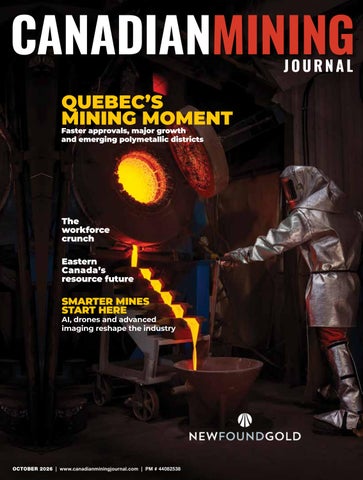
QUEBEC’S MINING MOMENT Faster approvals, major growth and emerging polymetallic districts
The workforce crunch Eastern Canada’s resource future
SMARTER MINES START HERE
AI, drones and advanced imaging reshape the industry
OCTOBER 2026 | www.canadianminingjournal.com | PM # 44082538
Now hiring at our Hope Bay and Odyssey sites. Join Agnico Eagle's world-class mining team committed to safety, sustainability, and career growth.
Learn more
Together, we make mining work.
OCTOBER 2026 VOL. 147, NO.7
FEATURES
MINING IN QUEBEC AND EASTERN CANADA
10 Quebec’s Bill 11: streamlining the Mining Act to accelerate project development. 13 Agnico Eagle grows in Quebec: Becomes world’s second largest gold miner. 16 Power Metallic builds a polymetallic district at Nisk. 18 Beyond the deposit: Turning Quebec’s mineral wealth into lasting economic advantage. 36 Beyond the mine: The multidisciplinary approach shaping Eastern Canada’s mining future.
18
TECHNOLOGY: ARTIFICIAL INTELLIGENCE, DRONES AND EXPLORATION
20 Canadian mines need an AI decision log before automation scales. 24 AI goes prospecting: Can machines unearth the next mineral deposit? 40 The future of mining requires drones: A new way to inspect, survey and map. 44 Muon imaging brings decision-grade intelligence to exploration and mine operations. 51 Digging smarter: How AI is reshaping the future of mining. CRITICAL MINERALS
21 The great Canadian white gold rush. 31 New critical path for critical minerals deals:
21
Canada to implement pre-closing national security review regime.
32 Windy Craggy case study as a financial framework for a Debt-for-Minerals Swap. HEALTH AND SAFETY
26 The fire triangle on heavy equipment: Why prevention alone is not enough. MINING IN ONTARIO: EXPLORATION
30 Ontario exploration needs stronger voice, faster approvals. MAINTENANCE
38 The lifesavers keeping modern mining moving. MINING WORKFORCE
49
42 The critical minerals race is becoming a race for talent. MINING IN NUNAVUT/MINE CLOSURE
46 Cracking the mine closure cost recovery code. ENERGY TRANSITION
49 Coal-fired power plant transition: why early planning changes every pathway. HISTORY OF MINING
53 Mining history: A beginner’s guide.
DEPARTMENTS
4 EDITORIAL | Canada has the minerals — now it must deliver.
6 FAST NEWS | Updates from across the mining ecosystem.
QUEBEC’S MINING MOMENT Faster approvals, major growth and emerging polymetallic districts
The workforce crunch Eastern Canada’s resource future
SMARTER MINES START HERE
AI, drones and advanced imaging reshape the industry
8 MIN(E)D YOUR BUSINESS | From pit to platform: Why mining’s value still lags tech and how Canadian law can help close the gap.
34 ESG | Digging deep: How mining companies need to address community safety internally and externally.
OCTOBER 2026 | www.canadianminingjournal.com | PM # 44082538
About the cover: Gold pour from the New Found Gold’s Hammerdown Gold Mine, Central Newfoundland, Canada. CREDIT: NEW FOUND GOLD.
Coming in November 2026 November issue will focus on the demands of underground mining and tunneling. We shine a light on the safest and most efficient ways to mine underground, with a featured report on ventilation.
For More Information
Please visit www.canadianminingjournal.com for regular updates on what’s happening with Canadian mining companies and their personnel both here and abroad. A digital version of the magazine is also available at https://www.canadianminingjournal.com/digital-edition/
www.canadianminingjournal.com
CANADIAN MINING JOURNAL | 3
FROM THE EDITOR
Tamer Elbokl, PhD
Canada has the minerals — now it must deliver
C
anada does not lack mineral potential. What it needs is the ability to convert that potential into productive mines, resilient supply chains and lasting community benefits. Complex greenfield projects can take many years to advance from discovery through feasibility, permitting, financing and construction to production, depending on the commodity, infrastructure, jurisdiction and Indigenous engagement. The articles in this October edition of the Canadian Mining Journal examine that challenge, but their central message is clear: opportunity means little without execution. Quebec illustrates both the promise and the complexity. Bill 11 seeks to streamline elements of the Mining Act, while the province’s mineral wealth, hydroelectric power and technical expertise strengthen its position in critical mineral supply chains. Agnico Eagle’s growth demonstrates what patient investment, regional knowledge and operational discipline can achieve. Ontario faces a similar test. Exceptional geology and professionals are not enough if permitting timelines discourage capital and early-stage exploration lacks support. At the federal level, Canada’s planned pre-closing national security review regime for foreign investments adds another consideration for critical minerals transactions. Technology is another part of the execution challenge. Alberta’s lithium-in-brine projects demonstrate how direct lithium extraction could create value from depleted oil and gas reservoirs. Artificial intelligence can interpret geological records, rank exploration targets and improve operational decisions, but accountability must keep pace. Drones can inspect hazardous underground spaces, while muon imaging can improve three-dimensional understanding of orebodies and guide drilling. Yet, technology alone will not secure Canada’s place in the critical minerals’ economy. Additionally, the competition for minerals is increasingly a competition for engineers, geoscientists, technicians and researchers. Execution must also be measured by its effect on people. Mining companies must strengthen worker training, mental health support and reporting mechanisms, while building relationships with Indigenous communities. Impact benefit agreements should address social risks as well as environmental matters. Finally, responsibility continues across the asset lifecycle. Fire protection, reliable equipment, measurable mine closure criteria and early energy-transition planning all reduce risk. Mining history also offers lessons that should not be forgotten. Canada’s mining future depends on connecting geology, people, technology, regulation and responsibility. The resources are present. Success will be determined by whether we develop them with speed, discipline and foresight. Looking ahead, our November issue will focus on underground mining, tunneling and ventilation. Editorial contributions should be submitted to the Editor in Chief by Oct. 9, 2026.
4 | CANADIAN MINING JOURNAL
OCTOBER 2026 Vol. 147 – No. 7 69 Yonge St., Ste. 200, Toronto, ON M5E 1K3 Tel. (416) 510-6789 Fax (416) 510-5138 www.canadianminingjournal.com Editor in Chief Dr. Tamer Elbokl telbokl@canadianminingjournal.com News Editor David Cassels dcassels@canadianminingjournal.com Graphic Design Nicholl Spence Production Manager Jessica Jubb jjubb@northernminer.com Manager of Product Distribution Allison Mein 416-510-6789 ext 3 amein@northernminergroup.com Publisher & Sales Robert Seagraves 416-510-6891 rseagraves@canadianminingjournal.com Sales, Western Canada George Agelopoulos 416-510-5104 gagelopoulos@northernminer.com Toll Free Canada & U.S.A.: 1-888-502-3456 ext 2 or 43734 Circulation Toll Free Canada & U.S.A.: 1-888-502-3456 ext 3 President, The Northern Miner Group Anthony Vaccaro Established 1882
Canadian Mining Journal provides articles and information of practical use to those who work in the technical, administrative
and supervisory aspects of exploration, mining and processing in the Canadian mineral exploration and mining industry. Canadian Mining Journal (ISSN 0008-4492) is published nine times a year by The Northern Miner Group. TNM is located at 69 Yonge St., Ste. 200, Toronto, ON M5E 1K3. Phone (416) 510-6891. Legal deposit: National Library, Ottawa. Printed in Canada. All rights reserved. The contents of this magazine are protected by copyright and may be used only for your personal non-commercial purposes. All other rights are reserved and commercial use is prohibited. To make use of any of this material you must first obtain the permission of the owner of the copyright. For further information please contact Robert Seagraves at 416-510-6891. Subscriptions – Canada: $51.95 per year; $81.50 for two years. USA: US$64.95 per year. Foreign: US$77.95 per year. Single copies: Canada $10; USA and foreign: US$10. Canadian subscribers must add HST and Provincial tax where necessary. HST registration # 809744071RT001. From time to time we make our subscription list available to select companies and organizations whose product or service may interest you. If you do not wish your contact information to be made available, please contact us via one of the following methods: Phone: 1-888-502-3456 ext 3; E-mail: amein@northernminergroup.com Mail to: Allison Mein, 69 Yonge St., Ste. 200, Toronto, ON M5E 1K3 We acknowledge the financial support of the Government of Canada.
www.canadianminingjournal.com
FAST NEWS
Updates from across the mining ecosystem
• New housing facility supports Faro Mine clean-up Ross River Dena leaders, elders and community members joined government officials to mark the opening of Tsē Zūl Camp, an accommodation facility supporting the Faro Mine remediation project in southern Yukon. The Camp is supported by $90 million from the Faro Mine remediation project and is expected to run CREDIT: PETER MATHER AND DENA NEZZIDDI DEVELOPMENT CORPORATION through 2029. The camp provides increased accommodation to meet the growing number of workers on site. Thus far, the federal government has invested $9.1 billion into remediation projects through the Northern Abandoned Mine Reclamation program.
• BC’s first majority
Indigenous-owned port opens
Arrow Transportation Systems, alongside the Nisg̱ a’a and Tahltan Nations marked the official opening of the Portland Canal Marine Terminal, in B.C., the CREDIT: PORTLAND CANAL GROUP province’s first majority Indigenous-owned port. The terminal is owned through Portland Canal Holdings Limited Partnership, a partnership between the Nisg̱ a’a Nation, Tahltan Nation Development Corporation and Arrow Transportation Systems Inc. The acquisition of the terminal was supported by a $5 million grant from the province through its northwest strategy. The news follows a recent $672,134 funding package from PacifiCan, the dedicated federal economic development agency in B.C.
• Little Narrows quarry
marks maiden shipment
CREDIT: CGC
CGC’s Little Narrows quarry in Nova Scotia shipped its first batch of gypsum rock, signaling the start of operational commissioning. The news follows the site’s first successful blast and ongoing progress across key infrastructure, including the dock, ship-loader and employee facilities. As the quarry moves toward fullscale operations, gypsum from Little Narrows is expected to be used by CGC’s manufacturing facilities across eastern Canada. Once fully operational, the site is expected to support more than 100 jobs.
• Ontario invests $11M in
critical mineral processing facility
CREDIT: INVEST ONTARIO
Ontario’s government announced an $11 million investment to support the construction of Generation Mining’s new $410 million copper and palladium processing facility in Marathon, Ont. This funding makes Generation the first recipient of the government’s new Critical Minerals Processing Fund (CMPF), a $500 million reserve to back projects that advance the province’s processing capacity. The announcement comes as the provincial government ramps-up domestic critical mineral production amid the Canada-US trade war. “As President Trump attacks our economy, Ontario is fighting back,” Stephen Lecce, the province’s minister of energy and mines.
• Ford threatens to cut off
critical minerals to US
CREDIT: PREMIER OF ONTARIO PHOTOGRAPHY
TEC GPS
AE
RIA
L
T E C S U R V E Y I N G I N C. 6 | CANADIAN MINING JOURNAL
Ontario Premier Doug Ford threatened to cut off electricity and critical minerals to the US in response to Trump’s tariffs on Canadian autos and steel. If Trump continues trying to attack Canadian manufacturing, Ford said, “he better have a pack of batteries,” the Associated Press reported. As the US aims to reduce their reliance on China for these materials, losing Canadian production of high-grade nickel and uranium would be a problem for the country.
www.canadianminingjournal.com
rockprocessing.sandvik
Eco-efficient mineral processing We are a leading provider of rock processing solutions, leveraging more than 160 years of expertise to deliver maximum value to our customers through performance, quality, safety, and sustainability. Our energy-efficient service solutions and equipment for crushing, screening, breaking, and demolition enable mining and infrastructure customers to boost productivity while reducing their environmental impact. Supported by expert process knowledge, digital tools, OEM spare parts, consumables, and life-cycle services, we help customers continuously achieve optimal performance within their comminution operations.
MIN(E)D YOUR BUSINESS
From pit to platform: Why mining’s value still lags tech and how Canadian law can help close the gap
M
ining is not merely a traditional supplier of commodities; it is a foundational component of the physical infrastructure underlying modern computation. Artificial intelligence (AI), hyperscale data centre expansion and emerging quantum computing technologies depend on semiconductor manufacturing, electricity generation and transmission, advanced electronics, cooling systems, batteries and other infrastructure requiring minerals extracted from the earth. The technological economy therefore increasingly depends on a mineral-intensive physical foundation. Apple, Microsoft and NVIDIA generate revenue, earnings and market capitalization that exceed those of individual mining companies. Technology companies command higher valuation multiples because scalable models, low marginal costs and expanding markets create characteristics that mining companies generally cannot replicate. Yet, the physical inputs enabling technological innovation originate upstream, while financial rewards accrue disproportionately to companies higher up the value chain. This valuation difference does not demonstrate that mining is intrinsically undervalued relative to technology. Much of the differential reflects economically rational differences in scalability, capital intensity, geological uncertainty, commodity price exposure and regulatory risk. The question is whether mining’s discount reflects avoidable legal and institutional uncertainty. Geology, commodity prices and capital intensity create structural risks that law cannot eliminate; however, unnecessary legal and regulatory uncertainty can affect project timing, capital requirements and expected cash flows. TSX and TSX Venture Exchange mining companies operate amid front-loaded capital expenditure, geological uncertainty and long-term environmental liability. National Instrument 43101 establishes standards for disclosure of scientific and technical information on mineral projects and requires that technical information be supported by qualified professionals. It distinguishes supported resources and reserves from exploration concepts and other forward-looking expectations, enhancing investor protection and market integrity. Capital markets reinforce the divide. Mining companies are
8 | CANADIAN MINING JOURNAL
more often assessed through net asset value, discounted cash flow, reserve life, production profiles, cost curves, commodity price assumptions and jurisdictional risk, although comparable company multiples, transaction values and exploration optionality also matter. Regulatory exposure enters valuation when permitting uncertainty, delays, litigation or changing requirements affect development schedules, capital needs and cash flows. Canadian obligations, including impact assessment, Indigenous consultation and material climate risk disclosure, can affect project assumptions and returns. Canadian mining companies also face complex environmental and social obligations subject to legal enforcement. The federal Impact Assessment Act, provincial environmental assessment regimes, constitutional Indigenous rights and the federal UN Declaration Act together form a legal landscape in which Indigenous rights, cumulative effects and climate considerations can affect project development and approvals. These frameworks can lengthen timelines and increase complexity. The federal impact assessment regime illustrates why regulatory predictability matters. In October 2023, the Supreme Court of Canada found the designated projects portion of the federal impact assessment scheme unconstitutional in substantial part, prompting Parliament to amend it; those amendments took effect on June 20, 2024. The valuation divergence feeds into mining’s reputational challenge. Canadian public discourse often associates mining with environmental damage, conflicts with Indigenous communities and boom-bust regional economies. Community acceptance and Indigenous relationships can impact the prospects, timing and perceived risk of major projects. Modest financial returns compared with technology can reinforce perceptions of outsized social and environmental costs. Repairing that image requires more than public relations; the credible Canadian legal path runs through demonstrable compliance and environmental, social and governance (ESG) performance. Canadian securities legislation already requires issuers to disclose material climate-related risks affecting their businesses in the same manner as other material information. Canada’s proposed expansion of mandatory climate-related dis-
www.canadianminingjournal.com
CREDIT: MICHAEL EVANS/ADOBE STOCK
By Carlos da Costa
closure remains unsettled following the Canadian Securities Administrators’ (CSA) April 2025 decision to pause development of a new mandatory rule. Material climate risks remain a securities disclosure consideration under existing Canadian securities law, including NI 51-102 and CSA Staff Notice 51-358, while Canada’s broader framework remains under development. Clear disclosure of material climate risks also strengthens investor confidence by demonstrating board oversight of long-term operational and jurisdictional risks. Integrating material climate risks into board oversight and reporting them clearly can give investors a basis for assessing resilience and long-term risk. For boards, counsel and management, legal strategy extends beyond permitting and compliance to the information and relationships that underpin investors’ assessment of project risk. Decisions concerning impact benefit agreements, material climate risk disclosure and Indigenous partnership arrangements can become relevant to investor due diligence when they affect project legitimacy, permitting risk, operational continuity or litigation exposure. These considerations influence project risk and long-term value, making legal strategy part of capital markets strategy. Legal compliance alone does not increase share price. Its financial effect runs through project economics: legal uncertainty can delay construction, increase capital requirements, expose projects to litigation and alter project scope, expected cash flows and required returns. Stronger compliance or ESG performance does not necessarily command a valuation premium; the value lies in reducing avoidable uncertainty while preserving economic optionality. Indigenous rights and benefit sharing are equally central. Canadian jurisprudence on the duty to consult and accommodate establishes a constitutional framework that is particularly important for resource projects. The Supreme Court of Canada’s decisions in Haida Nation, Taku River, Clyde River and Chippewas of the Thames confirm that the Crown must, where the legal threshold is met, consult Indigenous peoples before decisions that may adversely affect asserted or established Aboriginal or treaty rights. They do not create an automatic veto over development but require meaningful consultation and accommodation where appropriate. The duty is context-specific, depending on the right’s strength and the seriousness of potential adverse impacts. Although the duty rests with the Crown, proponents often support consultation and relationships with affected communities. Companies moving beyond minimum procedural compliance toward equity participation, revenue sharing and, where appropriate, co-governance can shift the relationship toward shared value creation. Mine development timelines are another factor shaping valuation. Complex greenfield projects can take many years, from discovery through feasibility, permitting, financing, construction and production, depending on the commodity, infrastructure, jurisdiction and Indigenous engagement. Critical minerals have elevated the strategic importance of mining. Canada’s Critical Minerals Strategy treats critical minerals as strategically important to the country’s economic, technological and national security objectives, with particular emphasis on strengthening domestic production, processing and value chains. Canada nevertheless has gaps in domestic proOCTOBER 2026
cessing and refining capacity for some critical minerals, including lithium, while mining companies often sell into global supply chains where additional margins can accrue to processors, converters and manufacturers. These constraints remain important even as strategic demand increases. One opportunity to narrow the valuation gap is to reframe mining’s role in the energy transition and technological economy. These narratives align with government priorities, including Canada’s commitments under the Canadian Net-Zero Emissions Accountability Act and industrial policy supporting clean technology manufacturing. Indigenous partnership models offer another avenue. Equity participation, revenue sharing and co-governance arrangements can demonstrate commitment to long-term value creation rather than transactional compliance. The UNDRIP Act’s obligations apply to the federal government and federal laws, not directly to provincial and territorial governments. For mining companies, treating Indigenous participation as integral to project legitimacy can be more durable than minimum procedural compliance. Innovation represents a further opportunity. Mining companies investing in digital technologies, automation, circular economy solutions and midstream integration can shift their position in the value chain. These investments can reduce costs, improve environmental performance, create revenue streams and align mining with innovation-driven valuation narratives. The comparison between mining earnings and technology profits exposes a misalignment between where value is created physically and where it is captured financially. Mining produces materials that enable technological innovation, including infrastructure supporting increasingly compute-intensive technologies, yet financial rewards accrue disproportionately to companies that transform those materials into platforms, devices and systems. Canadian law cannot erase this misalignment, but it can create conditions for mining companies to capture more value. Stable regulatory frameworks, predictable permitting, credible climate disclosure and meaningful Indigenous partnerships can reduce perceived project and jurisdictional risk and, in appropriate circumstances, the risk premiums investors apply to mining assets. Lower perceived legal and jurisdictional risk can support valuations by reducing uncertainty around project timing, capital requirements and cash flows, although commodity prices, capital intensity, geological uncertainty and broader market conditions remain dominant influences. Legal clarity can therefore help narrow the discount applied to certain mining assets, but it cannot eliminate structural valuation differences arising from mining’s capital intensity, geological constraints and limited scalability. Mining’s image will improve when the sector demonstrates it is not merely compliant but forward-looking. Environmental stewardship, Indigenous partnership and strategic communication can reposition companies as essential contributors to Canada’s industrial future. The energy transition and expansion of advanced computing require vast quantities of critical minerals, and Canada is well positioned to supply them. The challenge is not to mimic technology valuations but to ensure mining’s indispensable role is recognized and trusted. Carlos da Costa, PhD, is an adjunct finance professor at the University of British Columbia and an experienced financial professional. CANADIAN MINING JOURNAL | 9
MINING IN QUEBEC AND EASTERN CANADA
By David Gravel
Quebec’s Bill 11:
streamlining the Mining Act to accelerate project development Key mining provisions of Bill 11
Quebec is the largest province in the eastern part of Canada, political map. CREDIT: PETER HERMES FURIAN/ADOBE STOCK
O
n June 11, 2026, Quebec’s National Assembly adopted Bill 11, an Act to amend various provisions mainly for the purpose of reducing the regulatory and administrative burden. This omnibus legislation encompasses 63 measures from 15 departments and agencies, spanning sectors as diverse as construction, transportation, municipal affairs and the environment. Of relevance to the mining industry, Bill 11 introduces several amendments to the Mining Act and its implementing regulation, building upon Bill 63 (adopted in Nov. 2024 and now in force), which replaced “claims” with “exclusive exploration rights” (EER) and tightened conditions for obtaining and
10 | CANADIAN MINING JOURNAL
renewing them. According to the government, the combined measures are expected to generate recurring annual savings of approximately $81.9 million for businesses across the province. Yet, behind this promise of administrative efficiency lies a certain tension. Quebec seeks to accelerate mining development and reduce regulatory burden, but critics contend that doing so comes at the cost of transparency and environmental safeguards. This article examines the key mining provisions of Bill 11, their interaction with the recent Bill 63 amendments and the practical implications for exploration and exploitation companies operating in the province.
Prior to Bill 11, the Mining Act’s administrative framework imposed several procedural requirements on exploration and exploitation activities. Impact-work authorizations were subject to variable validity periods, requiring companies to track differing renewal timelines. Annual reporting obligations for exploration work added to the compliance burden, as operators were required to submit detailed expenditure and activity reports each year. Furthermore, the minister was required to provide written reasons when renewing mining leases, a transparency mechanism to ensure public accountability. While these requirements served regulatory oversight purposes, industry stakeholders increasingly characterized them as creating unnecessary delays in project development. The mining component of Bill 11 amends and repeals several of these provisions. Among the most significant measures is the harmonization of the validity period for impact-work authorizations at a fixed three-year term, eliminating the previous variability that complicated planning and renewal cycles. This standardization enables exploration companies to align their work programs with predictable authorization timelines. The bill also eliminates annual exploration-work reporting obligations, a measure that forms part of the government’s announced abolition of 55 government reports. This change removes the requirement for exploration permit holders to file yearly activity summaries, although periodic reporting tied to renewal applications remains in effect. Furthermore, Bill 11 removes the minister’s duty to provide written reasons for mining lease renewals. The elimination of this obligation has drawn criticism for reducing public transparContinued on page 12
www.canadianminingjournal.com
MADE FOR THE FUTURE OF MINING. INTRODUCING NEXT-GENERATION Produro ™
PRODURO has been re-engineered and the results are nothing short of outstanding. Next-generation formulations take oxidation resistance to higher levels; extend equipment life; maintain viscosity in extreme temperatures; stretch drain intervals; and proactively address changing regulations to support long-term sustainability. New PRODURO transmission and drive train fluids will help you extract more from your mine. DIG DEEPER
Trademarks are used under license.
MINING IN QUEBEC AND EASTERN CANADA The nearly 100-year-old Horne copper smelter. CREDIT: GLENCORE
ency and ministerial accountability, as renewal decisions may now proceed without documented justification. The bill’s most contentious provision concerns the Horne Smelter in RouynNoranda. Introduced by way of amendment during the parliamentary process, this provision extends the smelter’s ministerial authorization until Mar. 15, 2033, and postpones the deadline for meeting an annual ambient-air arsenic limit of 15 ng/m³ from 2027 to 2029. Following the bill’s adoption, the facility’s operator announced that it would resume approximately $300 million in atmospheric emission reduction projects. This provision proved divisive, attracting significant opposition from public health advocates.
Industry and civil-society reactions Industry stakeholders generally welcomed the bill. Association minière du Québec (AMQ) emphasized that “regulatory and administrative relief is one of the main levers available to the government to support economic development in the sector.”
ALMOST HARDCORE
WWW.XXIX.CA 12 | CANADIAN MINING JOURNAL
Fédération des chambres de commerce du Québec (FCCQ) considered these measures welcome but “insufficient given the international context and the need to accelerate the development of critical and strategic minerals.” Canadian Federation of Independent Business (CFIB) called the bill “promising for SMEs.” Civil-society organizations raised concerns that the bill favours industry interests over environmental protection. Regarding the provisions affecting the Horne Smelter, medical committee IMPACTE and advocacy group Mères au front criticized the additional time granted to the facility’s operator to meet the arsenic limit, citing public health concerns.
Practical implications for mining companies For exploration-stage companies, Bill 11 translates into a concrete reduction in administrative burden: the fixed three-year impact-work authorization validity period reduces the frequency of renewal applications, and the abolition of annual exploration reports frees up resources. The CFIB estimates that “cutting red tape stimulates the economy” and fosters innovation and productivity. However, the removal of the written-reasons requirement for mining lease renewals may introduce uncertainty for host communities: in the absence of public justification, the predictability of ministerial decisions diminishes, which could indirectly affect a project’s social licence. Companies planning EER transfers during the initial three-year term must also ensure compliance with Bill 63’s minimum work requirements. Specifically, completion of at least 90% of required expenditures before any renewal or transfer is permitted.
Conclusion: Looking ahead Bill 11 is part of a broader regulatory acceleration movement in Quebec. It complements Bill 5, An Act to accelerate the granting of authorizations required to carry out priority national-scale projects, tabled in Dec. 2025, which centralizes the decision-making process for major projects. It also aligns with the Stratégie québécoise pour la valorisation des minéraux critiques et stratégiques 2025-2031, backed by an $88.1 million budget. The provincial election expected in the fall of 2026 may shape the future direction of Quebec mining policy, as parties assess the balance between regulatory efficiency and transparency mechanisms. David Gravel is a partner in the Corporate group in Dentons Canada’s Montreal office.
www.canadianminingjournal.com
MINING IN QUEBEC AND EASTERN CANADA
By Marilyn Scales
Agnico Eagle grows in Quebec: Becomes world’s second largest gold miner
S
ince its founding in 1957 by the legendary Paul Penna, Agnico Eagle Mines has grown to be the world’s second largest gold miner in 2025 (ahead of Barrick and behind only Newmont). Having reached production of 3.5 million oz. of gold in 2025, the company is growing. Agnico has expansion projects at its Canadian Malartic complex in Quebec and the Detour mine Ontario. Both are slated to become million-ounce-per-year performers. Development plans are being made in Ontario, NunDominique Girard, avut, Finland and Mexico. COO for Nunavut, Quebec and Agnico has a unique corporate ethos, as Europe. Dominique Girard, COO for Nunavut, Quebec and Europe explained: “Our greatest as-
set is our people.” The corporate culture is anchored around family, whether it be the families of employees or the community. Round that out with collaboration, innovation and accountability, Girard added, giving Agnico an enviable employee turnover rate of only 5% in Quebec. Girard talked about another key to Agnico’s success: its strategy. Rather than consider itself a “global” miner, the company practices being a “regional” miner. That regional focus means, “We know all the juniors,” he said, and that is reflected in Agnico’s support of small explorers with projects in need of a cash boost. This year, the company has invested tens of millions of dollars to half a dozen juniors. Such a regional strategy gives Agnico a reputation as a skilled, transparent operator. It further supports a quality pipeline of
The Canadian Malartic mill. CREDIT: AGNICO EAGLE OCTOBER 2026
CANADIAN MINING JOURNAL | 13
MINING IN QUEBEC AND EASTERN CANADA
Aerial view of Malartic town and Canadian Malartic mine. CREDIT: AGNICO EAGLE
potential projects that will build reserves and resources. And, again, it includes the ability to attract and retain a skilled and engaged workforce as well as trusting relationships with communities where the company operates. Now, let’s look at three very successful Agnico projects in Quebec, starting with the second largest gold mine in Canada.
Canadian Malartic Complex Gold was originally discovered near Malartic, Quebec, in 1923, and underground mines produced from 1923 through the 1980s. Osisko Mining consolidated the local properties between 2008 and 2011, when it opened the Canadian Malartic open pit. Malartic became Canada’s largest surface gold mine. As mining expanded, the company undertook the challenging job of relocating the town with new housing, roads and services. Osisko was bought out by a joint venture of Yamana Gold and Agnico in 2014, and deep exploration began. By 2018,
CANADIAN MALARTIC COMPLEX Mine type: Surface and underground Location: Malartic, Quebec 2025 Production: 642,612 oz. Au + byproduct Ag 2025 Total cash costs: US$946/oz. Au Proven and probable reserves: 9.05 million oz. Au Measured and indicated resources: 4.12 million oz. Au Inferred resources: 13.56 million oz. Au 2026 Guidance: 590,000 oz. Au 2026 Est. total cash costs: US$1,187/oz. Au the Odyssey, East Malartic and East Gouldie zones had been drilled, with the potential to support an underground operation. Work began on the Odyssey portal and ramp by the end of 2020. Three years later, Agnico bought Yamana’s assets and continues to own 100% of the Canadian Malartic complex. With the depletion of the Canadian Malartic pit in 2024, the Barnat pit has been the source of most of the ore from the complex. On July 1, 2026, a rock mass movement in the pit forced its suspension and required a redesign of the pit. Remediation work is ongoing to restore pit access, with mining activities expected to resume in the fourth quarter of 2026. This will have a negative effect on ounces produced from Barnat during the second half of the year; however, Agnico expects its companywide, full year gold production will remain within guidance — 3.3 million to 3.5 million oz. of gold — although near the lower end. Development for the Odyssey underground mine marks the next step forward at Malartic. The project was approved in Feb. 2021, and in Nov. 2022, the first gold from the project was poured during early development of the ramp. Production from the Odyssey South zone reached its planned mining rate in the fourth quarter of 2023 and has been sustained since. Mining from the East Gouldie zone via the ramp began in Mar.
Underground at LaRonde. CREDIT: AGNICO EAGLE
14 | CANADIAN MINING JOURNAL
www.canadianminingjournal.com
LARONDE COMPLEX Mine type: Underground Location: Cadillac, Quebec 2025 Production: 344,555 oz. Au + byproduct Au-Zn-Cu 2025 Total cash costs: US$829/oz. Au Proven and probable reserves: 2.85 million oz. Au Measured and indicated resources: 2.25 million oz. Au Inferred resources: 1.39 million oz. Au 2026 Guidance: 340,000 oz. Au 2026 Total cash costs: US$919/oz. Au 2026, with two stopes now opened and actively being mined. The first phase of shaft sinking reached a depth of 1,586 metres in July 2026, and ore hoisting is to begin in the second quarter of 2027 from the East Gouldie zone. A second phase of sinking for the No.1 shaft is planned from 2029 to 2031. Ramp development is advancing, expected to reach the planned shaft bottom at 1,870 metres in 2030. Agnico is also designing a second shaft for Odyssey. Agnico has stated plans to reach annual gold output of 1.0 million oz./y at the Canadian Malartic complex, through its “fill-themill” strategy, designed to maximize the site’s 60,000-tonne-perday processing capacity. Starting in 2029 the first shaft at Odyssey is expected to supply approximately 20,000 t/d, enough to produce approximately 550,000 oz. of gold per year. The goal is not out of reach. The construction of a second shaft at the Odyssey deposit and the development of two satellite deposits — Marban open pit and Wasamac underground — could supply much of the balance.
Besides recovering gold, the LaRonde mineral processing plant also has flotation circuits which produce copper and zinc concentrates. Base metal containing material from Goldex is also treated at LaRonde. LaRonde is an award-winning operation. In 2023, it received the TSM Excellence Award from the Mining Association of Canada for the transition to filtered tailings management, which improves sustainability. That year, it also received a community relations award from the Quebec Mining Association for collaboration with the Abitibiwinni First Nations and the Nikan project, which improves integration and retention of Indigenous workers.
LaRonde Complex
Goldex Complex
Agnico’s LaRonde project has surpassed 8.0 million oz. of gold poured since it reached commercial production in 1988. LaRonde is home to the deepest single-lift shaft in the Western Hemisphere — the 2.2-km deep Penna shaft. But the mine is deeper still. Thanks to an internal shaft, mining currently extends to beyond 3.0 km below surface. Mining at such depths inspired Agnico to launch automation initiatives. About 25% of the LaRonde ore was moved to the surface with remote controlled scoops and trucks during the first half of this year. Automated performance continues to improve, for example at the LZ5 zone, where about 2,030 tonnes per fully automated shift was reached in the month of June. Agnico noted in the second quarter report that about 10% of the ore reaching the surface occurs between shifts, a boost to productivity and equipment utilization.
Agnico’s Goldex mine is often thought of as a solid, stable producer, but beware: calling it “stodgy” would be a gross mischaracterization. First opened in 2008 and beset with water inflow, it was closed in 2011. The mine reopened in 2013 on the strength of the Deep 1 deposit. Careful consideration was giving to sustainability for the reopened producer. Ore haulage at Goldex is handled by an innovative Railveyor system between 1,200 metres below surface (the lowest Deep 1 level) and the ore handling facilities on the 750-metre level. This system was installed in 2017 to replace underground trucks, and when the benefits were calculated in 2024, the Railveyor reduced carbon emissions by 39% and lowered operating costs by up to 75%. Where load-haul-dumpers are used, they are extra large 15-yard (11.5 m3) units. Goldex is the winner of double health and safety recognition. In 2023, it was the winner of the CIM’s John T. Ryan national award (for the lowest reportable injury frequency) and the Mining Association of Quebec’s F.J. O’Connell award for underground operations. Reserves are sufficient to ensure the Goldex mine and mill will operate until 2032. Meanwhile, Agnico has a conversion drilling program at the South and Deep 2 zones. Also of interest are the drilling programs at the Bulldog, Akasaba and Akasaba West deposits nearby.
GOLDEX COMPLEX Mine type: Underground Location: Val d’Or, Quebec 2025 Production: 125,501 oz. Au + byproduct Au-Zn-Cu 2025 Total cash costs: US$1,002/oz. Au Proven and probable reserves: 898,000 oz Au Measured and indicated resources: 1.73 million oz. Au Inferred resources: 892,000 oz. Au 2026 Guidance: 120,000 oz. Au 2026 Total cash costs: US$1,054/oz. Au
OCTOBER 2026
The Railveyor system handles ore in the Goldex mine and offers substantial cuts to carbon emissions. CREDIT: RAILVEYOR
Marilyn Scales is a freelance mining writer.
CANADIAN MINING JOURNAL | 15
MINING IN QUEBEC AND EASTERN CANADA
By Tamer Elbokl, PhD
Power Metallic builds a polymetallic district at Nisk
P
ower Metallic Mines, formerly known as Power Nickel, has evolved from a nickel-focused explorer into a Canadian polymetallic company centred on its Nisk District in Quebec’s Eeyou Istchee James Bay territory, with its name change reflecting the project’s expanding mix of copper, platinum group metals (PGMs), nickel, gold and silver. The company holds an 80% interest in the core Nisk property and controls about 330 sq. km of surrounding ground, covering roughly 50 km of prospective basin margins. Its broader portfolio includes the Jabal Baudan copper-gold-zinc exploration licence in Saudi Arabia and a 50% shareholding in Chilean Metals, owner of projects in B.C. and Chile. Despite that geographic reach, Nisk is clearly the main event. Power Metallic’s decision to spin out its Golden Ivan and Chilean exploration properties allowed the company to direct its drilling capital and management attention toward Quebec. That focus has produced three mineralized zones — Nisk Main, Lion and Tiger — along with an extensive land position that gives the company room to test whether those discoveries belong to a much larger system.
From discovery to resource “This inaugural Lion resource confirms what the drilling has been telling us: Lion is a high-grade polymetallic deposit,” CEO Terry Lynch said in a press release on Sept. 8, 2026. The estimate moves Lion beyond a collection of drill intersections, providing a classified resource that can support mine planning, metallurgical studies and the preliminary economic assessment targeted for the first half of 2027. Vice-president of exploration Joe Campbell emphasized the project’s remaining exploration potential, saying, “The deposit remains open at depth.” Power Metallic is testing that potential through deep step-out drilling and borehole electromagnetic surveys below the 600-metre vertical depth covered by the resource model. The inaugural Lion resource, announced Sept. 8, contains 4.145 million tonnes in the indicated category grading 3.86% copper
equivalent. It includes average grades of 1.68% copper, 2.61 g/t palladium, 0.85 g/t platinum, 0.49 g/t gold, 12.21 g/t silver and 0.10% nickel. A further 601,000 inferred tonnes grade 4.01% copper equivalent (1.84% copper, 2.86 g/t palladium, 0.59 g/t platinum, 0.41 g/t gold, 12.47 g/t silver, 0.13% nickel). More than 85% of the Lion resource is classified as indicated. About 2.78 million indicated tonnes and 100,000 inferred tonnes fall within an open-pit-constrained resource, while the balance was reported using underground constraints. The mineralization begins at surface and remains open at depth, according to the company. Those characteristics matter. High grades can reduce the amount of material that must be mined and processed for each unit of payable metal. Near-surface mineralization can also offer development flexibility, although the economic merits of any mining sequence have yet to be demonstrated. Power Metallic plans to assess an initial open pit followed by underground mining at Lion, with possible feed from Nisk Main, in a preliminary economic assessment (PEA) targeted for the first half of 2027. Nisk Main provides a different metal balance. Its updated resource (both open pit and underground) contains 2.703 million indicated tonnes and 2.016 million inferred tonnes, with nickel, copper, cobalt and PGMs. Rather than treating Nisk Main and Lion as identical deposits, the company is evaluating how their different mineralization styles could fit within a broader development strategy.
A drilling rig at the Nisk Main Zone. CREDIT: POWER METALLIC
Power Metallic’s Lion Zone, part of the Nisk District in Quebec. CREDIT: POWER METALLIC
16 | CANADIAN MINING JOURNAL
Metallurgy strengthens the case Metallurgy has strengthened that case without settling it. Locked-cycle testing by SGS Canada, at its Quebec Metallurgical Laboratory, on a representative Lion composite produced a concentrate grading 25.8% copper. Reported recoveries in-
www.canadianminingjournal.com
cluded 98.9% copper, 93.9% palladium, 96.8% platinum, 85% gold, 88.9% silver and 77.1% nickel. A separate low-grade composite also produced a concentrate containing more than 25% copper, with copper recovery of 98.3%. These are preliminary laboratory results, not commercial plant performance, but they indicate that Lion mineralization responded well to conventional sulfide flotation.
Infrastructure and exploration upside Location may become another advantage. The district is accessible by the all-season Route du Nord. The Nemiscau airport is about 30 km west, while Hydro-Quebec’s 735-kilovolt Albanel substation is about four kilometres from Nisk Main and 9.1 km from Lion. Proximity does not guarantee a power connection, permitting approval or favourable economics, but existing regional infrastructure can help distinguish Nisk from more isolated northern projects. Power Metallic is continuing to test the district rather than treating the current estimate as an end point. The company has five drills active and outlined a 40,000-metre program supported by the $28.2-million financing it closed in June when it welcomed Eric Sprott as a new shareholder. Work is targeting Lion at depth, Lion East, the corridor between Lion and Nisk and several geophysical anomalies. Tiger, about 700 metres east of Lion, remains an emerging nickel-copper target without a mineral resource. That two-part strategy was outlined by CEO Terry Lynch in a recent interview. “We are pursuing two tracks: obviously, get
OCTOBER 2026
the MRE out ... to validate what we have already found, and then let’s find more of it,” he said. With the resource estimate now completed, Power Metallic’s attention is shifting toward the planned PEA while drilling tests Lion’s extensions and searches for additional mineralized bodies across the district.
The work ahead The distinction between a promising district and a mine remains substantial. Power Metallic must demonstrate continuity beyond the present resource, complete economic and engineering studies and address environmental, infrastructure, permitting and Indigenous consultation requirements. Mineral resources are not mineral reserves and do not have demonstrated economic viability. Still, Nisk has crossed an important threshold. Lion is no longer supported only by exceptional drill intersections: it now has a largely indicated maiden resource, encouraging preliminary metallurgy and a defined path toward economic assessment. Nisk Main adds nickel-rich optionality, while Tiger and the wider property provide exploration upside. The next question is therefore more disciplined than the one Power Metallic faced after discovering Lion in 2023. It is no longer simply whether the company has found high-grade polymetallic mineralization. It is whether Lion, Nisk Main and future discoveries can be assembled into a practical, financeable Quebec mining operation. The planned PEA should provide the first meaningful answer.
CANADIAN MINING JOURNAL | 17
MINING IN QUEBEC AND EASTERN CANADA
By Patrick Bertrand-Daoust
Beyond the deposit The Matawinie graphite project in Quebec. CREDIT: NOUVEAU MONDE GRAPHITE.
Turning Quebec’s mineral wealth into lasting economic advantage
Q
uebec’s mining sector has long been defined by its geological wealth. Today, its influence extends further. As governments and industries seek reliable supplies of strategic minerals, the province sits at the intersection of the energy transition, industrial reshoring and supply chain security. With significant deposits of lithium, graphite, copper and nickel, Quebec can become an increasingly important partner in North America’s economic future. Geological potential alone, however, will not secure investment or economic leadership. With capital increasingly selective, Quebec wields the strategic imperative to distinguish itself through efficient project development, enabling infrastructure and world-class operating performance.
From resource potential to strategic advantage Critical and strategic minerals are now central to economic resilience and national competitiveness. Governments and manufacturers need stable, responsible sources of materials for electrification and advanced manufacturing, elevating Quebec’s role in continental supply chains. La belle province combines significant mineral deposits with clean hydroelectricity, technical expertise and a mature mining ecosystem. Its predominantly renewable power can reduce the embedded emissions of energy-intensive mining and processing, strengthening the appeal of Quebec products to customers seeking resilient and responsible supply. Importantly, the provincial government has also recognized the urgency of the moment with Quebec’s 2025-2031 Strategy for the Development of Critical and Strategic Minerals presenting its roadmap for accelerating projects and strengthening the full value chain through processing, recycling, innovation, circularity and partnerships.
18 | CANADIAN MINING JOURNAL
Accelerating projects in a competitive world Competition for mining investment is only intensifying further. Regulatory certainty, predictable timelines and a credible development path are essential to converting Quebec’s resource base into financeable projects. Quebec mine development often extends well beyond a decade because of environmental assessments, permitting, infrastructure planning and stakeholder engagement. Recent efforts to streamline provincial and federal reviews are therefore welcome developments, provided they maintain rigorous environmental and consultation standards. Infrastructure is equally important. Many deposits are in remote regions where transportation and energy connections determine project economics. Collaboration among governments, Indigenous communities and industry will be essential to develop infrastructure and advance projects responsibly. The Matawinie graphite project of Nouveau Monde Graphite exemplifies this integrated approach by linking a planned mine and battery material plant with Quebec hydropower in a mine-to-battery-materials platform.
Operational excellence as a competitive advantage Ultimately, long-term success will be measured by what happens after production begins. Operators face inflation, supply disruptions, in addition to rising expectations from investors, regulators and communities. Competitive advantage therefore depends not only on resource quality, but also on operating safely, efficiently and sustainably throughout the mine lifecycle. Indeed, EY’s latest mining risk research identifies operational complexity as the sector’s leading challenge in 2026. For Quebec, this creates an opportunity to improve predictability
www.canadianminingjournal.com
and productivity through automation, advanced analytics and artificial intelligence. But technology is not a silver bullet. Benefits depend on strong governance, workforce development and continuous improvement. Quebec’s leadership in resource development must therefore be matched by excellence in how those resources are produced.
Capturing value beyond the mine gate The greatest economic opportunity lies not only in extraction, but also in converting minerals into specialized products for advanced industries. Processing, refining, material production, component manufacturing and recycling support higher-value activity, deepen expertise and create durable customer relationships. Quebec should retain commercially viable stages of the value chain while remaining connected to continental and global markets. Recycling and circularity can supplement primary supply, reduce waste and strengthen feedstock resilience. Public support should remain disciplined, prioritizing projects with credible technology, secure inputs, qualified customers and a clear path to commercial scale.
Delivering on the critical minerals promise Quebec has the essential ingredients to lead: signifi-
N
over 2.3 m from 59.7 m
Patrick Bertrand-Daoust is the Mining and Metals East leader with EY Canada. A Certified Public Accountant (CPA) and CPA Auditor with more than 30 years of professional experience, he provides accounting, audit and consulting services for a wide range of clients in the mining industry across Canada.
TG-05 2.49 g/t Au over 8.4 m from 29.0 m including:
13.40 g/t Au
TSX-V: BGD.V
over 1.0 m from 32.5 m
Au (g/t)
Terragold Project Validation Drilling Campaign
10+ 5 - 10
• • •
2-5 1-2 0.3 - 1
32 DDH tight-spaced covering over 400m on strike Shallow high-grade gold intercept Assay results pending for 28 DDH
0.05 - 0.3 < 0.05 DDH Assay received
TG-02 1.32 g/t Au
over 1.1 m from 110.0 m
TGNO-03 1.19 g/t Au
C
over 5.3 m from 39.0 m
including:
R21 Channel 2.80 g/t Au
3.43 g/t Au over 1.3 m from 39.0 m
Gold mineralized quartz-feldspar porphyry system In a major, deeply rooted Archean-age structural corridor Within the Abitibi Greenstone Belt OCTOBER 2026
Terragold Showing
Senneterre Industrial Park - 6 Km
TG-01 1.28 g/t Au
cant resources, clean power, technical expertise and a growing downstream ecosystem. Realizing that potential will require coordinated action to get projects off the ground. The decisive issue is now execution — creating more predictable development, enabling investment in infrastructure, establishing strong, sustainable partnerships with Indigenous communities and maintaining high standards of operational performance. If stakeholders can come together to achieve these common goals, then the province can turn its bountiful mineral endowment into enduring competitive value. But the window of opportunity will not remain open indefinitely. Jurisdictions around the world are competing for the same capital, talent and customers. Quebec must act with urgency and discipline to move projects into production, build commercially viable capabilities beyond the mine gate and earn a lasting place in strategic supply chains. If it does, the province will not simply export minerals: it will convert what lies beneath the ground into greater resilience, prosperity and opportunity for generations of Quebecers.
over 9.6 m
including:
22.20 g/t Au over 1.0 m
0
50
100 m
CANADIAN MINING JOURNAL | 19
TECHNOLOGY: ARTIFICIAL INTELLIGENCE IN MINING
By Gleb Tsipursky
Canadian mines need an AI decision log before automation scales
C
anadian Mining Journal recently described a sector becoming smarter, more connected and more constrained, with AI-assisted exploration and real-time monitoring changing how decisions get made. That combination creates a management problem that deserves more attention. When a recommendation moves from an algorithm to a dashboard to an engineer to an operating decision, a mine can gain speed while losing a clear record of who checked what, what was overridden and what happened next. Canadian mining companies should build a lightweight AI decision log before they scale automation across high-consequence workflows. The log should focus on material decisions, rather than every prompt or routine system output. Good candidates include exploration target ranking, predictive maintenance, production sequencing, equipment inspection prioritization, and environmental monitoring. The goal is simple: preserve enough context to understand why a consequential recommendation entered the workflow and how people handled it. Each log should identify five things: the AI-enabled system and its recommendation; operating context or data source; accountable reviewer; whether the recommendation was accepted, modified or rejected and why; and results, including corrections, near misses, rework and recurring problems. Integrate logs into existing systems to avoid bureaucracy. The value goes well beyond compliance. In an April PDAC 2026 interview, Canadian Mining Journal highlighted a central challenge of digital transformation: companies often already possess valuable data, yet they struggle to integrate new tools into workflows and decision-making. A decision log makes those integration failures visible. If a maintenance model keeps producing alerts that experienced tradespeople override for the same reason, the company has discovered a data or model problem. If an exploration ranking repeatedly misses geological context that geoscientists restore manually, the company has found a workflow gap. If one shift uses an AI-generated inspection recommendation differently from another, the company has found a training and governance gap. That feedback also helps companies distinguish useful automation from impressive demonstrations. A model may produce accurate predictions during a pilot while creating downstream rework, slow escalations or extra verification at scale. Those hidden costs rarely appear in a dashboard focused on model accuracy. They do appear when teams record over-
20 | CANADIAN MINING JOURNAL
rides, corrections, time lost and repeated exception patterns. Canada’s current AI transparency consultation gives mining leaders another reason to build this capability now. The federal government is asking how organizations should communicate AI system capabilities and limitations, track serious incidents and track the activity and interactions of AI agents. Mining companies can use that policy window to design traceability around the realities of field operations, rather than waiting for generic requirements that may fit office software better than mines, mills and remote sites. A 90-day pilot would be enough to test the idea. Pick one workflow, such as predictive maintenance or exploration target triage. Ask supervisors and technical owners to review the log weekly. Track how often people override recommendations, what causes the overrides, how long corrections take, whether the same exception returns and whether the process creates unnecessary rework. If logging takes too long, reduce the fields. If teams cannot identify who owns a decision, fix the ownership model. If a vendor cannot provide enough information to distinguish one model or workflow change from another, address that in procurement. Procurement deserves special attention. Vendors should support basic auditability for high consequence uses, including identifiable system changes, exportable records, clear release notes and a reliable way to reconstruct what happened after an incident. When a product cannot support that level of traceability, mines can keep it in an advisory role until the operational controls catch up. The same approach respects the value of frontline judgment. Operators, engineers, maintainers and geoscientists often see failure modes before executives or software teams do. A decision log turns those corrections into organizational learning. It also makes responsibility visible, which helps employees understand where judgment still belongs to people. Mining has always depended on disciplined records because physical operations carry real consequences. AI should meet the same standard. The mines that scale these tools successfully will know more than what a system recommended. They will know who challenged it, what changed, what the result was and whether the correction became part of the next decision. Gleb Tsipursky, PhD, is a consultant and author specializing in decision-making, cognitive bias, AI adoption and the future of work.
www.canadianminingjournal.com
CRITICAL MINERALS
By Diane L.M. Cook Brine pools for lithium mining. CREDIT: CAVAN/ADOBE STOCK
The great Canadian white gold rush
Alberta mining companies use advanced DLE technologies for their lithium-in-brine projects
T
he global energy transition has spurred Alberta mining companies to produce lithium — a key ingredient in lithium-ion batteries for portable electronics, electric vehicles (EVs) and stationary energy storage systems (SESS) — for the North American market. For the past 10 years, growth in lithium-ion battery use has resulted in batteries becoming the leading end-use for lithium. This growth led to a rush to find new sources of vast resources of lithium prompting mining companies to move from mining lithium from hard rock mineral deposits or salars using solar evaporation ponds to lithium-rich brines. The result has been the development of an alternative method to extract lithium from lithium-rich brine, which is found in abundance in depleted oil and gas reservoirs in Alberta.
Alberta Geological Survey According to a new report by the Alberta Geological Survey, “InPlace Lithium Resource Estimate for Alberta,” there is an estimated 82.5 million tonnes of lithium carbonate equivalent (LCE) in place, about 62 million tonnes of which occurs within existing mineral lease properties. This in-place lithium resource estimate is one of the world’s largest known lithium accumulations. The report also says that almost 95% of the total accumulation is found in the Devonian Leduc Formation where the province’s first major crude oil discovery was made in 1947. This formation is now a major source of lithium-rich brine, a waste product from oil extraction from reservoirs, which is being used as feedstock to produce high-purity lithium. Furthermore, the report says that economic assumptions of OCTOBER 2026
the total in-place lithium volume suggest that potential revenue could exceed US$1 trillion using direct lithium extraction (DLE) technology and a price assumption of US$20,000 per tonne of battery-grade LCE.
DLE technology To extract lithium from brine, an advanced form of DLE technology has been developed. This technology can be modified depending on the type of brine and reservoir. The International Lithium Association says, “The DLE process begins with the collection of lithium-rich brine from underground reservoirs, where it undergoes pre-treatment to remove impurities. This purification step ensures optimal conditions for subsequent extraction processes. DLE methods employ various techniques such as adsorption, ion exchange, solvent extraction or membrane processes to selectively capture lithium ions from the brine while leaving other ions behind. These extraction methods offer efficient and selective separation of lithium from the brine, paving the way for high-purity lithium production. Following extraction, the captured lithium ions undergo post-treatment to recover them from the capturing material or phase. This typically involves processes after desorption or stripping processes of DLE to concentrate, refine and convert the lithium salt, usually LiCl, to lithium compounds suitable for various applications.” Compared to lithium extraction from hard rock mineral deposits or salars using solar evaporation ponds, the advantages of DLE technology are that the process can produce lithium within hours compared to months or even years for evaporation; it has CANADIAN MINING JOURNAL | 21
CRITICAL MINERALS a higher recovery rate of up to 95%; it is 66% less carbon-intensive than hard rock mining and requires 50% less energy, it recycles fresh water so no process water is required; and it has a much smaller land footprint, less than 10%. Several Alberta lithium companies are testing DLE technologies, with commercial production expected within one to three years, potentially adding millions of tonnes of Alberta-produced lithium to the North American market.
E3 Lithium’s technology. CREDIT : E3LITHIUM
E3 Lithium
Summit Lithium Technologies
E3 Lithium, a Calgary-based company, has validated its DLE technology on a demonstration scale and is working toward commercialization. The company’s Clearwater Project is a large-scale lithium-in-brine development that leverages DLE technology and existing oilfield infrastructure to produce battery-grade lithium carbonate (LC). E3 Lithium is currently building and operating its Demonstration Facility and designing its Clearwater Project Central Processing Facility near Olds, Alberta. The Demonstration Facility has already verified the company’s ability to produce high-purity, battery-grade LC for domestic and international critical mineral supply chains. E3 Lithium’s total resource (measured & indicated) is over 21 million tonnes LCE and represents approximately 40% of Canada’s total lithium resources, with the company on track to produce the first battery-grade lithium at scale in Canada. The company has proposed a staged development plan with a capacity of 12,000 t/y LC as the first stage of production and expansion potential of up to 36,000 t/y LC. In the greater Bashaw District, E3 Lithium has the brine volume to scale production up to 150,000 t/y LC for 50 years. In addition to its large Bashaw District resource, the company also has the Garrington District resource, hosted in the same well-understood Leduc aquifer as the Bashaw District. The company recently announced it would start a strategic process to optimize value for its Garrington asset. “E3 Lithium is one of Canada’s near-production battery-grade lithium projects, combining scalable domestic resource development with innovative extraction technology to support a secure, low-impact and globally competitive battery supply chain,” says Chris Doornbos, chair and chief executive officer of E3 Lithium.
Headquartered in Alberta, Summit Lithium Technologies (formerly Summit Nanotech), a global technology company, is advancing the commercial deployment of its proprietary DLE technology for lithium producers in Chile, Argentina and the U.S. Summit has built a layered demonstration program that validates its denaLi DLE technology from bench scale through field deployment. The program includes an in-house pilot system in Colorado that has been in operation for approximately two years and a rapid-validation demonstration plant in Santiago, Chile, that began processing customer brine in early 2026. Summit also deployed a field demonstration system on Albemarle’s site in Northern Chile in 2025, confirming that pilot-stage performance translates to real-world operating conditions. Each stage feeds validated data into the next, de-risking the path to commercial deployment. “Canada has the policy framework and engineering talent to play a defining role in securing North American lithium supply. Summit’s pilot and demonstration program proves that sorbent-based DLE can deliver high recovery, low water use and predictable economics. With our intellectual property based in Calgary, that is Canadian innovation helping build the supply chain that the EV battery industry and battery energy storage market will depend on,” says Joe Arencibia, president and chief operating officer of Summit Lithium Technologies. denaLi is Summit’s proprietary sorbent-based DLE technology. At its core is eLivate, a high-performance lithium-selective sorbent engineered for durability, high capacity and fast kinetics. The denaLi system is designed to achieve greater than 98% lithium recovery, greater than 95% impurity rejection and uses approximately 50% to 90% less water than commercial DLE benchmarks. The system architecture is optimized for commercial-scale operation and Summit’s predictive modeling platform integrates data from every stage of testing to continuously improve plant design and performance. The result is a DLE system engineered to deliver the lowest levelized cost of lithium production over a full project lifecycle. “The hardest problem in DLE is scaling a complex multi-column system that performs reliably under real operating conditions. Our approach makes denaLi commercially viable across lithium price cycles, not just in favourable market conditions,” says Arencibia.
LithiumBank Summit’s pilot facility in Denver. CREDIT: SUMMIT LITHIUM TECHNOLOGIES
22 | CANADIAN MINING JOURNAL
LithiumBank Resources is advancing toward commercial lithium production through a phased, modular development strategy focused on leveraging existing infrastructure, proven DLE
www.canadianminingjournal.com
mations. The company has assembled 2770 square kilometreof brine-hosted mineral licenses containing a NI 43101 reported resource of 10 million tonnes LCE. NeoLithica plans to produce battery-grade LC at 99.5% purity. This project is in its pre-commercial development stage with a commercialization program currently underway to initially establish 20,000 t/y of lithium production within a threeyear period. First commercial production is expected to start in late 2027. After annual commercial production of 20,000 tonnes LC has been achieved, production capacity might ultimately be expanded to 100,000 tonnes annu- Instrumentation at Geo40’s NeoLithica Demonstration ally to meet its demand forecast. Pilot. CREDIT: NEOLITHICA “Supporting a domestic supply chain is critical for national security and economic resilience. NeoLithica’s commitment to made-in-Canada lithium ensures that automotive manufacturers in the Ontario-Quebec EV corridor and domestic battery energy storage manufacturers have access to ethically sourced, low-carbon materials without the logistical hurdles of trans-oceanic shipping,” says Barry Caplan, founder and president of NeoLithica. Map of Boardwalk and Park Place Projects. CREDIT: LITHIUMBANK
technology licensed from SLB (formerly Schlumberger), rapid development timelines and disciplined capital deployment. By targeting brownfield-style development in established oil and gas regions, the company aims to reduce upfront capital costs, accelerate permitting and construction and minimize environmental impact compared to conventional extraction methods. Central to LithiumBank’s strategy is its agreement with SLB to deploy the company’s well-to-product lithium solution, enabling continuous brine extraction with high recoveries, rapid processing and a compact footprint. LithiumBank is advancing three lithium-brine projects in Alberta and Saskatchewan near existing infrastructure. Its flagship Boardwalk Project hosts grades of approximately 80 mg/L and a resource exceeding 8 million tonnes LCE, with commercialization targeted for 2029. Park Place has a 15.1-million-tonne inferred LCE resource, with pilot testing delivering strong lithium recoveries consistent with Boardwalk. Saskatchewan’s Kindersley Project offers longer-term growth potential, supported by favourable brine characteristics and existing nearby regional infrastructure. “LithiumBank’s development strategy is built around speed, efficiency and sustainability. We are significantly reducing both capital requirements and development timelines. This positions us to bring lithium production online faster with a limited environmental footprint,” says Paul Matysek, executive chairman of LithiumBank Resources.
Diane L.M. Cook is a freelance mining writer.
Proven, rugged, and reliable design Single, dual, and four idler configurations
WY25 HDS Belt Scale
WY-15 Conveyor Belt Scale
WP50 Belt Scale Processor
NeoLithica Founded in 2021, NeoLithica is a Calgary-based critical mineral resource development company. NeoLithica’s flagship Peace River Lithium Project is situated in northwest Alberta and targets the lithium-bearing brine in the Leduc and Wabamun ForOCTOBER 2026
E: sales@tecweigh.com | W: tecweigh.com CANADIAN MINING JOURNAL | 23
TECHNOLOGY: ARTIFICIAL INTELLIGENCE IN MINING
By Salima Virani
AI goes prospecting: Can machines unearth the next mineral deposit?
W
hat if an exploration geologist could input a set of coordinates into a system and, within minutes, receive a highly accurate mineral potential score for that specific location? That is the idea behind MetalCore, an AI-assisted mineral exploration platform being developed by NRED Intelligent Mining. The platform pulls together millions of public geological records, including geochemical samples, known mineral deposits, mining claims, magnetic surveys and satellite data, then uses that information to give a location a mineral potential score. For NRED chief technology officer Valentin Saitarli, the problem starts with time. “The biggest problem we see right now is the time,” Saitarli told Canadian Mining Journal. “It takes on average 15 to 17 years to bring a mine into production.” To combat this severe bottleneck, NRED is deploying a combination of AI, computer vision and robotics to dramatically accelerate the prospecting timeline.
Teaching AI to see geology Geological information does not arrive neatly packaged for a computer. It can include assessment reports, maps, satellite images, geochemical results, magnetic surveys and decades of exploration work completed by different people using different methods. Saitarli describes part of MetalCore’s job as turning that scattered information into something a machine can understand. “How do you turn a picture into a dataset?” he asked. To explain, he used an unlikely analogy: walking into a foreign supermarket. A shopper may see products they have never encountered before. But the brain still recognizes shapes, labels and packages because it has spent a lifetime learning how to identify objects. An AI model also needs to be taught what it is looking at. Saitarli said MetalCore is being built around domain-specific geological datasets that are meticulously labelled so models can learn to recognize relationships across vast amounts of exploration data.
More data does not always mean better data Dr. Steven E. Zhang, a research scientist and geodata scientist with the Geological Survey of Canada at Natural Resources Canada, said machine learning (ML) is already being used in mineral exploration, although there is a gap between experimental models and technology proven in the field. “There is substantial published evidence of the use of ML in integrated data mining and analysis at up to the prototype stage,” Zhang said. “Beyond the prototype stage and into deployment environments, there are far fewer published studies.”
24 | CANADIAN MINING JOURNAL
The MetalCore dashboard will give users access to generated mineral reports and allow them to launch new property analyses. CREDIT: NRED INTELLIGENT MINING
At larger regional, national and continental scales, integrated data mining remains a research topic. The amount of information fed into a model is only part of the equation. “Quality and labelling are very important for data-driven uses of AI,” Zhang said. “The quality of the outcome is foremost driven by the quality of input data.” Historical geological records may span decades. Sampling methods change, interpretations evolve and some old samples can no longer be checked. Zhang also noted that historical deposits were often higher grade, shallower and geologically simpler than many deposits explorers seek today.
From 4.1 million records to one score According to NRED, MetalCore currently searches more than 4.1 million public records across 11 geoscience data layers and 37 government sources in Canada, U.S. and Mexico. The company says users can receive a report in roughly two minutes. MetalCore’s current 0-to-100 mineral potential score is not an AI prediction that a deposit exists underground. It is a scoring system that looks at how close a location is to different signs
www.canadianminingjournal.com
NRED Intelligent Mining is leveraging millions of public geoscience records to revolutionize the search for minerals. While the technology can process decades of information in minutes, the industry faces a new hurdle: proving that better data actually leads to better discoveries. of mineralization, with some types of evidence given more importance than others. Geochemical evidence carries 53% of the score, proximity to known deposits accounts for 35% and nearby mining claims make up the remaining 12%. Signals decrease in importance the farther they are from the location being analyzed. The company makes that limitation clear in every report: “This report shows potential, not a confirmed deposit.” The score does not estimate a mineral resource, show the probability that a deposit exists or directly measure the rock beneath a property. It is a screening tool designed to help users decide where to look first. A high score may point to an area that deserves a closer look, but it does not replace fieldwork or prove that mineralization is present. NRED says the next stage of MetalCore will add a geological favourability layer, moving the platform from screening what is already known nearby toward predicting where favourable geology may occur.
Can AI mean less drilling? Saitarli sees that as the longer-term opportunity. “We are building an engine that gives us the ability to remove false positives and remove unnecessary work that is extremely expensive,” he said. Ultimately, he said, “the goal is to drill less.” If AI can remove weaker targets earlier, exploration teams could focus more time and money on promising areas. But Zhang said those claims need a clear benchmark. “Any claim must be met with evidence and methodology,” he said. That includes showing where and how a model was tested, whether predictions were validated and what type of deposit it was designed to identify. A claim of reduced drilling also needs a meaningful baseline. Without that comparison, it is difficult to know whether AI actually improved the exploration result or reached a conclusion that conventional methods might also have reached.
The Mars Rover approach NRED’s plans extend beyond analyzing geological data from behind a computer. The company is also evaluating EyeX technology, co-founded by Saitarli, which uses cameras, drones and robotic systems to collect and interpret information in the field. “EyeX turns cameras and robots into one simple system,” he said. Saitarli compared the concept with the Mars Rover. When scientists want to understand an unfamiliar environment on another planet, they send equipment first to collect information. “You send the equipment first, analyze the ground and run the simulation,” he said. Saitarli imagines a similar approach at remote exploration sites. A drone could scan an area, build a 3D model and help teams assess terrain, ground movement or other potential hazards before people or equipment move in. “Analyze and know where to drill, deploy boots on the ground and understand where to go,” he said. He also pointed to space and ocean exploration as examples of industries using technology where people cannot easOCTOBER 2026
ily go. In NRED’s proposed workflow, MetalCore would identify where to investigate while drones, cameras and other sensors gather information in the field.
Putting AI to the test NRED plans to use its Wilmac copper-gold project in B.C. as a testing ground for the technology. “We want this to become used across the entire mining sector and NRED’s Wilmac copper-gold project will be the test site,” Saitarli said. NRED has also opened a waitlist for up to 1,000 people to try a test version of MetalCore and evaluate the technology. Testing on a real exploration property matters because identifying an anomaly is not the same as demonstrating a discovery. Results still have to be compared with field observations, sampling and, ultimately, drilling. For Zhang, that need for proof helps explain why the mining industry tends to be cautious about new exploration technologies. “The mineral industry is very conservative because risks associated with investments are very high,” he said. Without previous success or tangible evidence of current success, he said, claims remain difficult to assess. Reliable results should also disclose the model’s limitations, assumptions and data. His advice is straightforward: “Extraordinary claims require extraordinary evidence.”
Where does the geologist fit? For all the discussion about autonomous exploration, Zhang does not see drilling disappearing. “Drilling will never be replaced as an activity by non-contact sensing methods, whether conducted by humans or machines, because it is the only way to verify subsurface composition and structure,” he said. Nor does he expect AI to remove the need for geologists anytime soon. One challenge is that mineral exploration does not provide AI with the enormous volumes of training data available in fields such as autonomous driving. “No two deposits are exactly alike,” Zhang said. A model trained too broadly may miss what makes one deposit unique. Train it too narrowly and it may fail elsewhere. Zhang believes experienced geologists will therefore remain an important check on what AI produces. “I think geologists with their native multi-modal and multi-scaled experience, acquired as part of their pedagogy and work experience, will likely provide the necessary scrutiny for AI models for now,” he said. Saitarli, despite his enthusiasm for automation, also acknowledged that people remain central to the process. The more machines can do in difficult environments, he argued, the less unnecessary human exposure there may be. But mining will “still need the best minds.” For now, both sources point to a more immediate role for AI: helping exploration teams process information faster, identify patterns and prioritize where to investigate next. Whether those better targets consistently lead to better discoveries is what testing at projects such as Wilmac will have to demonstrate. AI may help decide where the drill should go next. But the drill core still gets the final vote. Salima Virani is a freelance writer. CANADIAN MINING JOURNAL | 25
HEALTH AND SAFETY
By Kevin Kroll
The fire triangle on heavy equipment: Why prevention alone is not enough ticularly relevant in mining. Constant movement can cause wiring, hoses, fittings, clamps and mounting hardware to loosen, rub or deteriorate. Inspections should therefore consider more than whether a component still functions; they should also ask whether its condition, support, clearance or location has created a fire hazard.
Fuel is more than diesel
The fire triangle. CREDIT: AFEX FIRE SUPPRESSION SYSTEMS
T
he fire triangle — heat, fuel and oxygen — is one of the simplest concepts in fire safety. It is especially important for heavy mining equipment because all three elements are present during normal operation. Engines, exhaust components, turbochargers, brakes and electrical systems generate heat. Diesel fuel, hydraulic fluid, lubricants, hoses, wiring insulation and debris provide fuel, while air supplies oxygen. Inspections and maintenance reduce ignition risk, but failures still occur. Mining operations need prevention and protection. For mining operations, the strongest strategy is not prevention or fire protection. It is both.
Understanding the fire triangle on heavy equipment Fire requires heat, fuel and oxygen; removing one prevents combustion. On mining equipment, however, heat-producing systems and combustible materials share compact spaces. Wear, damage, debris, maintenance changes or component failure can increase risk.
26 | CANADIAN MINING JOURNAL
Leaking hydraulic hoses, damaged electrical insulation and accumulated oil or debris can complete the fire triangle. Because equipment ages and operating conditions change, fire risk must be reassessed throughout the machine’s life.
Heat sources are already part of the machine Heavy equipment is designed to generate and manage significant heat. Engines, exhaust manifolds, turbochargers, brake systems and other components routinely operate at elevated temperatures. In most cases, that heat is expected and controlled. The concern begins when combustible material reaches an area where it was never intended to be. A damaged hose or fitting can allow hydraulic oil, diesel fuel or another combustible fluid to contact a hot component. Electrical faults create another possible ignition source. Damaged wiring, loose connections, short circuits and deteriorated insulation can generate heat or arcing capable of igniting nearby material. Vibration makes these hazards par-
Diesel is only one combustible material on mining equipment. Others include hydraulic fluid, oils, lubricants, grease, hoses, belts, electrical insulation and plastics. Pressurized hydraulic fluid can travel beyond a ruptured hose to hot surfaces. Dust, coal fines, oil-soaked dirt, vegetation and debris can accumulate near heat-producing components, increasing fire risk.
Housekeeping is fire prevention Keeping equipment clean is one of the most straightforward ways to reduce combustible material around heat sources. Perfect cleanliness is unrealistic in a mine. The objective is to prevent dangerous accumulation in high-risk areas and clean equipment often enough that developing problems can still be seen. A machine covered in oil, dirt or debris can hide leaking fittings, deteriorated hoses, damaged wiring, missing shielding or signs of excessive heat. Cleaning frequency should reflect the machine, application and environment.
Inspections should look beyond mechanical reliability Pre-shift inspections and maintenance can interrupt the fire triangle before ignition. Personnel should identify leaks, worn hoses, damaged wiring, loose components, chafing, debris and overheating, including service-related hazards. Bad hose routing, lost wiring clearance, misplaced shielding or missing clamps
www.canadianminingjournal.com
Layered fire protection is more effective A complete strategy combines safeguards rather than relying on any single one. Housekeeping reduces combustible buildup. Inspection helps identify leaks, wear and abnormal conditions. Preventive maintenance corrects developing problems. Operator training helps personnel recognize hazards and respond appropriately. Detection helps identify a developing fire sooner. Suppression provides a response after ignition. Emergency procedures guide shutdown, evacuation, communication and accountability. This layered approach matters because no individual safeguard can address every situation. If a hose fails unexpectedly despite preventive maintenance, other protective layers remain. If a fire begins in a concealed area, detection may provide warning before the operator sees it directly. For mining operations, the strongest strategy is not prevention or fire protection. It is both. CREDIT: AFEX FIRE SUPPRESSION SYSTEMS
can connect heat and fuel. Fire prevention belongs to preventive maintenance.
Why prevention alone cannot eliminate fire risk Strong maintenance and housekeeping programs can significantly reduce fire risk, but they cannot eliminate every possible failure. Components can fail suddenly. Hoses can rupture between inspections. Electrical faults can develop unexpectedly. Conditions can change during a shift. That does not mean prevention has failed. Prevention reduces the probability of ignition. A complete fire strategy must also address what happens if ignition occurs anyway. At that point, the priority shifts to protecting people and limiting consequences. Early detection, operator training, onboard fire suppression and emergency response procedures become important.
Early detection supports a faster response Time matters during a heavy equipment fire. A fire identified close to its point of origin presents a different challenge from one that has already spread to additional hoses, fluids, wiring or combustible components. Operators may not immediately see where a fire begins. Many hazards are located inside engine compartments, belly pans or other areas with limited visibility from the cab. An operator may first recognize a problem through smoke, an unusual odor, a warning signal or a change in machine performance. Automatic fire detection can add another layer of protection by identifying fire conditions in designated hazard areas and alerting the operator. Depending on system design, detection can also initiate automatic suppression.
Fire suppression is a response layer Onboard fire suppression systems deliver agent into hazard areas after ignition and may activate automatically, manually or both. Their objective is protecting people, not keeping operators near burning equipment. Procedures should prioritize safe shutdown, evacuation, accountability and emergency response. Suppression complements maintenance because each addresses different stages of the risk. OCTOBER 2026
Mining conditions raise the stakes Mining equipment often operates far from fixed firefighting resources. Large surface mines can cover significant distances, while underground operations create different access and evacuation challenges. These conditions make the initial response especially important. A developing equipment fire may depend heavily on the operator, nearby personnel, site procedures and the protection already installed on the machine. The risk is also not limited to the equipment itself. A fire can threaten the operator first, but it may also spread to nearby equipment, combustible material, infrastructure or other personnel. Depending on where a machine is operating, a localized equipment fire can become a broader site event. That wider view matters when evaluating fire risk. The question is not only, “What could happen to this machine?” It is also, “What and who could be affected if a fire spreads?”
Evaluate fire risk machine by machine Mining equipment presents different hazards depending on design and operating conditions. A machine-specific fire risk assessment identifies where prevention, detection and suppression should focus, considering heat, fuel, debris, visibility, component routing and potential fire spread. Protection works best when tailored to each machine, its specific application and actual operating environment.
Prevention reduces probability; protection reduces consequences The fire triangle helps explain heavy equipment fire risk. Removing combustible debris, repairing hydraulic leaks, correcting damaged wiring and maintaining proper clearances can prevent heat and fuel from combining. However, risk cannot be eliminated: equipment works long hours in demanding environments, components wear, conditions change and failures occur. A complete strategy combines fire prevention with early detection, well-designed, maintained suppression, operator training and emergency procedures. The fire triangle explains how a fire begins. A layered fire protection strategy helps determine what happens next. Kevin Kroll is the president of operations at AFEX Fire Suppression Systems. CANADIAN MINING JOURNAL | 27
MINING IN ONTARIO: EXPLORATION
By Tamer Elbokl, PhD
Ontario exploration needs stronger voice, faster approvals
O
ntario has the ingredients to remain one of the world’s leading mineral exploration jurisdictions, but it must turn political ambition into faster approvals, stronger early-stage investment and better-supported consultation, according to Steve Virtue, interim CEO of the Ontario Prospectors Association (OPA). In an interview with Canadian Mining Journal, Virtue outlined plans to strengthen the association while addressing the pressures facing prospectors and exploration companies. He said the province benefits from exceptional geology, a stable political environment and experienced exploration professionals, but competes for capital against Steve Virtue, jurisdictions moving aggressively to advance interim CEO of the Ontario projects. Prospectors “My priority with the OPA is to make the Association (OPA) association stronger,” Virtue said. He wants it to become a more present partner for the people doing discovery work. That includes building “a sharper voice at Queen’s Park,” improving communications and delivering more value to members. Virtue said much of the groundwork was completed by the OPA board and past contributors through a broader revitalization effort. His immediate task is to build on that work and reinforce the importance of grassroots exploration within the mining supply chain. “Without grassroots discovery, there is no mine in 10, 15 or 20 years,” he said. Ontario’s geology, political stability and pool of exploration talent remain major advantages. However, Virtue said those strengths are not sufficient if investors cannot see a predictable route from discovery to returns. “Permitting timelines have become a disincentive over the years,” he said. Improving timelines does not require lowering environmental standards or weakening engagement with Indigenous communities, he added. The priority should be removing duplication, allowing reviews to proceed concurrently and matching regulatory requirements to the risk and impact of each activity. Virtue pointed to Ontario’s One Project, One Process (1P1P) commitment as a potentially important step. The OPA has prepared recommendations for the provincial government ahead of proposed red-tape-reduction measures. Virtue said the association wants to participate while policy
30 | CANADIAN MINING JOURNAL
is being developed instead of responding after decisions are made. Early-stage exploration also needs better investment incentives and more efficient treatment of low-impact work because it represents the research and development stage of the mining cycle. Consultation capacity is another concern. “Communities are being asked to participate in processes that they are not necessarily resourced to do,” Virtue said. The OPA has requested provincial support to improve dialogue among communities, explorers, government and other interested parties. The goal, he said, is to build an “economic partnership” that recognizes legitimate community concerns while allowing responsible exploration to advance. Virtue cited Ontario’s recent rise to second place in the Fraser Institute’s 2025 Annual Survey of Mining Companies (released February 26, 2026) but warned that such positions can change quickly as competing regions improve their policies. Staying among the top jurisdictions will require sustained attention to exploration, not only investment in mines already approaching production. Over the next five years, Virtue sees an opportunity to establish a mineral industrial policy “anchored around discovery, not just production.” He pointed to the Ring of Fire and the Crawford nickel project near Timmins as examples of the economic value that can be unlocked when deposits move forward. The OPA intends to become a more visible participant in that effort. Virtue said it must work alongside its members, the Ontario Mining Association, governments, First Nations and Indigenous communities to strengthen the province’s exploration ecosystem. The association, he said, is ready to “step out of the shadows of our history and move forward progressively.” Watch the full interview here: https://youtu.be/g7SFfo2iYaY?si=unVIKLJ_bTzVNlZK
Steve Virtue says Ontario has the geology, talent and political stability to lead globally, but it must improve permitting, early-stage investment and consultation capacity. www.canadianminingjournal.com
LAW AND REGULATIONS: CRITICAL MINERALS
By Chris Hersh and Joshua Hollenberg
New critical path for critical minerals deals: Canada to implement pre-closing national security review regime
T
ransactions in the critical minerals space will soon need to navigate a new suspensory, pre-closing notification regime that is expected to come into effect in early 2027. The new regime will apply to all investments by non-Canadians into Canadian entities operating in prescribed sectors where the investor gains certain rights as part of its investment. The expected effect of this new regime is that the notifications will result in pre-closing national security reviews for more transactions, including a considerable number of critical minerals investments.
National security reviews The Investment Canada Act’s (ICA) national security review regime allows the federal government to review any investment by a non-Canadian which it believes may be injurious to Canada’s national security. Where the government makes this determination, it can take remedial action ranging from imposing conditions to blocking or unwinding the investment. National security reviews are typically triggered by the filing of an ICA notification (or an application for review) for the acquisition of control of a Canadian business. A national security review is more likely where (i) the investor has ties to a regime that is not aligned with Canadian economic or security interests; and/or (ii) the Canadian entity operates in a sensitive industry. The government’s Guidelines on the National Security Review of Investments identify critical minerals production and critical minerals supply chains as areas of potential concern. ICA notifications may currently be submitted up to 30 days after closing. Only where a pre-closing application for review is made (requiring certain financial thresholds to be exceeded), or a notification is submitted before closing, can a pre-closing national security review be triggered. The new notification regime will not only expand the range of notifiable transactions to include minority investments and asset transactions, but it will also require the new notifications — and any national security reviews — to be done pre-closing.
New notification regime
production and supply chains) where the investor gains certain specified rights. The scope of the prescribed sectors, and the triggering investor rights, will be set out in regulations, which are expected to be published for consultation in fall 2026 and to come into force (along with the relevant amendments) in early 2027. As a result, a broad range of foreign investments into Canadian entities engaged in the critical minerals sector (possibly including critical mineral operations located outside of Canada) will be subject to the new pre-closing notification regime. The minimum penalty for failing to make a mandatory filing will be $500,000, with the maximum penalty to be set out in the pending regulations.
Key takeaways Foreign investors considering investments in critical minerals companies will need to consider whether there is a nexus with Canada and, if so, whether their investment will be subject to the new mandatory notification regime. At the outset, it may be unclear whether certain investments are caught by the new regime, potentially requiring consultation with the regulator. Critical minerals investors will want to ensure they properly assess whether the regime applies, given the significant penalties for failing to notify and the commercial risk associated with a post-closing national security review. Where the new regime applies to investment, parties will also need to consider the implications of timing, as a full national security review can take up to 200 days (and possibly longer). This article is a general summary of the law. It does not replace legal advice tailored to your specific circumstances. Other versions of this article may appear in other media outlets. Chris Hersh is a partner in the Competition and Foreign Investment Law Group at Cassels. Joshua Hollenberg is an associate in the Competition and Foreign Investment Law Group at Cassels.
The new notification regime will apply to a broad range of investments in prescribed sectors (including critical minerals
OCTOBER 2026
CANADIAN MINING JOURNAL | 31
CRITICAL MINERALS
By Carlos da Costa, Bruce Downing and Donna Beneteau
What have you done today that did not involve a mineral? Part 11
Windy Craggy case study as a financial framework for a Debt-for-Minerals Swap A drill rig in northwestern B.C. CREDIT: BRIXTON METALS
C
anada’s critical minerals strategy rests on a simple premise: the country possesses world-class mineral resources that can support economic growth and supply chain security. A central challenge is translating that geological potential into operating mines under conditions of regulatory uncertainty, lengthy permitting timelines, land entitlement and high capital intensity. Few projects illustrate these challenges more clearly than Windy Craggy, a major copper-cobalt deposit located in northwestern B.C. Long regarded as one of the largest undeveloped copper-cobalt resources in North America, its location within Tatshenshini-Alsek Provincial Park has made it a defining example of the trade-offs between resource development, environmental protection, Indigenous interests and public policy. This article shifts from concept to application. It applies the Debt-for-Minerals Swap (D4MS) model introduced earlier in this series (published in this publication in the August 2026 issue) to Windy Craggy as an illustrative case study, with a focus on costing, financing structure and measurable outcomes. The value of the D4MS approach is best understood through a numerical example. Figure 1 illustrates a conceptual framework of how public debt restructuring, project financing, Indigenous participation, infrastructure development and critical mineral production can be aligned within a single framework. All financial values shown are illustrative and do not reflect any valuation of the Windy Craggy deposit or any prospective transaction. In this case, the illustrative Windy Craggy development re-
32 | CANADIAN MINING JOURNAL
quires total capital of approximately $1.7 billion, structured through a combination of equity, conventional project debt and an associated public debt instrument that functions as credit enhancement rather than direct construction funding. The equity component totals $500 million and is assumed to be provided by a consortium consisting of a mining company, an Indigenous development corporation and institutional investors. In addition, $1.2 billion in commercial project financing was raised from lenders. A key feature of the structure is the inclusion of a $1.0 billion public debt facility that is acquired by the consortium at a negotiated discount and incorporated into the project’s financial framework. The estimated capital cost profile for the project reflects the realities of developing a large-scale mine in a remote region. Mine construction is assumed to require approximately $900 million, while the processing plant accounts for a further $400 million. Access roads and associated infrastructure represent $250 million, environmental assessment and permitting costs are estimated at $50 million, and an additional $100 million is allocated to working capital. These components produce a total capital requirement of $1.7 billion, aligning with the financing structure described in Fig. 1. The public debt component introduces a distinct financial effect. In this example, a $1.0 billion government-related debt instrument is acquired by the consortium for $700 million, reflecting a purchase price of 70% of face value. This transaction allows the government to retire a larger liability while receiving immediate proceeds, resulting in an accounting gain of ap-
www.canadianminingjournal.com
Fig. 1. Illustrative debt-for-minerals swap (D4MS) Financial Model for the Windy Craggy case study. CREDIT: AUTHORS
proximately $300 million, subject to applicable public sector accounting treatment. At the same time, the consortium secures control of a higher-value financial instrument that strengthens the overall balance sheet of the project vehicle and contributes to improved financing conditions. The most significant impact of this structure is observed in the cost of capital. Because a government-issued debt instrument supports the project, lenders perceive lower risk and are prepared to offer more favourable terms. In the illustrative case, the interest rate applied to project financing is reduced from 9% to 6.5%. This reduction produces annual savings of approximately $30 million and cumulative savings of roughly $450 million over a 15-year financing period. These savings represent a substantial proportion of the initial capital investment and demonstrate how the structure can materially influence project viability. From a public sector perspective, the benefits extend beyond the initial debt transaction. Based on assumed operating conditions, the project is estimated to generate annual taxable income that produces approximately $54 million in corporate tax revenue, resulting in total tax contributions of about $1.08 billion over a 20-year mine life. These revenues are complemented by broader economic effects associated with employment, infrastructure development and regional activity, although those impacts are not quantified in detail in this example. Indigenous participation forms an integral part of the financial structure. In this illustrative model, Indigenous partners OCTOBER 2026
hold a 20% equity interest in the project vehicle. Based on projected cash flows, this ownership level translates into annual dividend distributions of approximately $30 million. In addition, procurement opportunities associated with operations are estimated at $25 million per year, supporting long-term economic participation that is directly linked to project performance rather than limited to fixed agreements. The structure also incorporates defined mechanisms for allocating risk between participants. Contractual provisions can establish predetermined responses to specific events, such as permitting delays or missed development milestones. For example, if regulatory timelines exceed agreed thresholds, the project entity may receive financial adjustments such as tax credits. At the same time, failure to meet construction or operational benchmarks can trigger penalties or changes in ownership distribution. By assigning explicit financial consequences to these outcomes, the model converts uncertainty into quantifiable risk that can be incorporated into project evaluation and financing decisions. Any practical application of this approach would need to operate within existing Canadian legal and regulatory frameworks. Environmental assessment requirements, protected area designations, Indigenous rights and public finance rules would all influence how such a structure could be implemented. In the specific case of Windy Craggy, the location of the deposit within a protected area introduces additional complexity that would require extensive consultation, regulatory review and potentially legislative action. This example does not assume that such approvals are available but instead illustrates how the financial structure could function under defined conditions. The Windy Craggy case study demonstrates that the primary contribution of D4MS lies not only in reducing financing costs but in linking resource development directly to broader public outcomes. In this example, the financial structure supports not only mine development, but also the potential to align that development with public infrastructure priorities such as transportation access, energy systems or community facilities. This reflects the central premise introduced in the previous part of this study, where debt restructuring, mineral development and tangible public benefits are integrated into a single framework rather than treated as separate policy objectives. By reducing financing costs by an estimated $450 million while creating measurable fiscal returns and supporting Indigenous participation, the model illustrates how capital-intensive projects can serve both economic and public priorities. While the structure remains illustrative and subject to legal and regulatory considerations, it provides a practical foundation for advancing projects that have remained stalled, while also reinforcing the connection between mineral development, public infrastructure and long-term economic resilience. The next part will build on this foundation by examining participating assets and potential exit strategies for governments, investors and Indigenous partners within a fully developed D4MS transaction. Carlos da Costa, PhD, is an adjunct professor of finance at the University of British Columbia (UBC). Bruce Downing is a geoscientist based in Langley, B.C. Donna Beneteau is an associate professor in geological engineering at the University of Saskatchewan (USask). CANADIAN MINING JOURNAL | 33
ESG: INDIGENOUS AFFAIRS
By Nathan Birch
how mining companies need to address community safety internally and externally
C
anada owes a great deal of its prosperity to the mining industry, with the impact of the resource sector set to grow even further as Canada fast-tracks “projects of national interest” through the newly established Major Projects Office (MPO). The natural resources sector accounted for 19% of total Canadian GDP in 2022, and per a report from Public Policy Forum, the more than 500 resource development projects currently listed in the Natural Resources Canada Major Projects Inventory could have a cumulative positive GPD impact of more than $1.1 trillion by 2035. Tapping into this country’s vast natural gifts is in all Canadians’ interest, but it is also incumbent upon mining and extraction companies to do so in a sustainable way that is healthy for all citizens. Research has linked large resource extraction projects, particularly industrial boomtown environments, to an array of issues in nearby communities, including sexual exploitation and sex trafficking. These negative effects disproportionally impact Indigenous communities and have been linked to the Missing and Murdered Indigenous Women and Girls (MMIWG) crisis in Canada. Workcamp environments have also been shown to have an adverse effect on worker well-being, with all employees reporting elevated levels of stress, anxiety and isolation, and female employees reporting gender discrimination and harassment. The impact extraction projects have on both workers and neighbouring communities are closely connected and putting a greater emphasis on education, safety and health internally can have a downstream positive impact beyond the workplace.
34 | CANADIAN MINING JOURNAL
CREDIT: PAUL/ADOBE STOCK
Community buy-in, particularly from Indigenous groups, is crucial to bringing major projects to fruition, so it is in the best interest of companies to focus their efforts on this issue.
Why the resource extraction industry must address this issue The EmpowerMen Project is part of the Ma Mawi Wi Chi Itata Centre, an established Indigenous-led service provider located in Winnipeg, Man. In Dec. 2025, EmpowerMen published the report “Sex Trafficking and Sexual Violence in Canada’s Resource Extraction Industry: A Review of Evidence, Policy and Recommendations,” prepared by anti-trafficking researcher Allison McKnight. The report is a comprehensive desk review of existing evidence, drawing on over 200 sources, including academic articles, grey literature, news reports and company statements, on the intersection between the extraction industry and sexual exploitation in Canada. Although remote communities may welcome the employment and economic benefits of resource projects, sudden influxes of outside workers can strain policing, medical and social services. Research has linked boomtowns and nearby work camps with increased crime, including violent and sexual assaults. In the 2000s, Fort McMurray police handled caseloads more than twice the provincial average and over three times the national average. Although rates have declined since 2008, the Crime Severity Index (CSI) remains high in resource-dependent communities including Fort McMurray and Lloydminster. A July 2026 Thomson Reuters report found a disproportionate number of MMIWG
www.canadianminingjournal.com
cases in Prince George, B.C., and identified a trafficking “movement corridor” from Edmonton to Fort McMurray. International studies also associate extraction boomtowns with increased sexual exploitation and trafficking. Canada’s 2019 National Inquiry linked extractive industries and transient workers with sexual violence. Implementing Calls for Justice 13.1 to 13.5 is essential to meaningful reconciliation and Indigenous cooperation.
Recommendations for positive change Sexual exploitation and trafficking can sometimes feel like a topic too big and intimidating to take on, but again, companies have a great deal of power over their own culture and employees, which can have a knock-on positive effect on the wider community. The reports, studies and inquiries that have identified links between the resource extraction industry and sexual exploitation and trafficking, have also provided recommendations about what can be done to address the issue. The following recommendations fall under four broad umbrellas, starting internally with training and HR policies, then shifting the focus outward, toward agreements and collaboration with communities, governments and other stakeholders.
1. Worker training Workers need substantive, comprehensive training covering a broad range of topics, including sexual violence and harassment, human trafficking identification and referral, gender-based violence prevention, anti-racism and Indigenous reconciliation. Where possible, companies should partner with community organizations, who will be able to provide more informed, locally grounded training. This is particularly true when working with Indigenous communities. In cases where local training is not available, companies should be prepared to fill in the gaps or fund organizations that can. It is crucial to make sure workers are absorbing and taking to heart the information and messages delivered in this training. Strong procedures and testing to ensure workers are engaging with training materials properly should be in place, and the information being taught should be continually updated and reinforced.
2. Company policies Companies also need to foster a culture of accountability by proactively and publicly addressing the issue of sexual violence and harassment and evaluate current policies using risk-assessment tools. Specific protections for women should be implemented, including safe environments, personal safety tools and reporting mechanisms, with appropriate supports available for when violence and harassment do occur. There should be a zero-tolerance policy for any sort of violence, harassment or support of sexual exploitation. Companies should provide mental health supports for all employees, preferably through a third party, to support confidentiOCTOBER 2026
ality. Low-barrier support groups should be offered, especially for men on how to cultivate healthy relationships and families. Indigenous-led and centered cultural activities and healing services should also be offered. Guidelines for how to respond to workers who are dealing with mental health, substance abuse and other issues need to be in place and consistently followed.
3. Impact and benefit agreements (IBAs) Engaging with Indigenous communities in a good way from the start when negotiating Impact and Benefit Agreements (IBAs) is crucial to future positive cooperation and communication. The IBA process should include Gender-Based Analysis Plus (GBA+) to keep the effect on women and girls front-of-mind. More broadly speaking, companies should seek to move beyond the financial and environmental issues IBAs have traditionally focused on. IBAs should also address social issues, with strong measures to prevent and address gender-based exploitation, violence and trafficking. Of course, strong mechanisms to monitor and enforce the terms of the IBA should also be implemented. Companies should also consider moving beyond the IBA towards more comprehensive agreements that involve First Nations taking a full ownership stake in projects, which will better ensure Indigenous perspectives and interests are represented.
4. Collaboration with community, government and other stakeholders While a company’s internal policies are important, they should also make proactive efforts to reach out to the community to create new relationships and networks. These networks should include Indigenous leaders, law enforcement, health and service providers and other community leaders who are doing the work to document and address sexual exploitation and trafficking. Companies should help create community resources if none exist by providing funding and support for programs and services for people affected by sexual exploitation. Once established, companies can also create a database or map of these resources. If a community is unlikely to be able to offer their own supports, companies should establish their own in-house crisis response programs to address these issues.
How EmpowerMen can help EmpowerMen engages men and boys on sexual exploitation and sex trafficking through initiatives including corporate relationship building. Training delivered with law enforcement, health care workers, service providers and lived-experience speakers helps workers recognize and safely support victims. Sessions use practical scenarios, intervention strategies and resources grounded in trauma-informed, victim-centred practice and can be tailored to company needs. EmpowerMen also consults on training programs, facilitates connections, hosts corporate sessions and organizes a national Law Enforcement Conference. Mining and resource companies can strengthen policies, worker wellbeing and outreach, helping create healthier workplaces, meaningfully advance reconciliation and reduce social risks in remote communities. Nathan Birch is the communications coordinator for EmpowerMen and has over 15 years of experience in the communications, publishing and advertising fields (EmpowerMen.ca). CANADIAN MINING JOURNAL | 35
MINING IN QUEBEC AND EASTERN CANADA
By Catherine Tremblay and Jérôme Pilon
Beyond the mine: NexGold’s Goldboro Gold Project in Nova Scotia. CREDIT: SIGNAL GOLD
The multidisciplinary approach shaping Eastern Canada’s mining future
M
omentum is building across Eastern Canada’s mining sector. Companies are restarting suspended projects, launching new ones and expanding exploration activities. While record gold prices are driving renewed investment, growing demand for critical and strategic minerals is creating even greater opportunities. Developing a strong critical and strategic minerals value chain is increasingly important to Canada’s economic, energy and technological sovereignty. With continued government support, Eastern Canada has the potential to become a powerful economic engine for decades to come, especially as it connects efficiently with European and global markets. Mining companies rely on consulting engineering firms throughout the project life cycle. To fully realize this potential, projects must be planned and executed through a multidisciplinary approach that integrates engineering, environmental management, permitting, infrastructure, energy and community engagement.
Mining projects are increasingly interconnected Many exploration projects in Eastern Canada are in remote northern regions, where advancement often depends on infrastructure such as roads, power supply and transportation networks. Decisions about energy, transportation, water management and community development are closely linked. Power supply influences operating costs and environmental performance, while transportation infrastructure affects project economics and construction schedules. Community priorities also shape project design. When these factors are addressed separately, projects can face delays, redesigns and added costs. A multidisciplinary approach helps identify constraints and opportunities early, reducing risk, improving outcomes and accelerating the path to production.
36 | CANADIAN MINING JOURNAL
Environmental performance and community partnerships Communities increasingly expect meaningful engagement, transparency and clear local benefits. Regulators, investors and Indigenous partners are also placing greater emphasis on environmental performance and responsible resource development. A project cannot move forward without community support, making early engagement and meaningful consultation essential. Many projects are in regions with sensitive ecosystems already experiencing the effects of climate change. Project teams must understand both the environmental impacts of development and its implications for surrounding communities. Multidisciplinary teams play a critical role in ensuring permits and environmental assessments are completed on schedule while helping manage complex projects effectively. They also develop solutions that reduce environmental impacts and support more sustainable outcomes. Long-term success depends on building trust, demonstrating responsible project delivery and maintaining strong relationships with communities, partners and stakeholders. By bringing together engineers, architects, environmental professionals, biologists and other specialists, multidisciplinary teams strengthen project design, improve decision-making and deliver projects that are more sustainable, resilient and broadly supported. Local presence also matters. Teams that understand community priorities and concerns are better positioned to build trust, foster meaningful dialogue and support better outcomes. Without social acceptability, a project simply cannot move forward. Projects should also create lasting benefits for local communities. From access to clean drinking water to reliable energy infrastructure, development can help address broader community needs while supporting regional prosperity.
www.canadianminingjournal.com
Energy is now a critical project driver Access to reliable energy has become a major factor in mining development across Eastern Canada. In many prospective regions, limitations in grid capacity, transmission infrastructure or power reliability can affect project feasibility and timelines. Developers increasingly evaluate energy requirements alongside mine planning, infrastructure development and environmental objectives. Energy-efficiency measures, renewable generation and hybrid systems can improve resilience while managing long-term operating costs. A diversified portfolio of renewable energy sources, including hydroelectricity, solar, wind and green hydrogen, should be a key pillar of economic development in Eastern Canada. Reducing reliance on fossil fuels will help address environmental challenges while limiting exposure to global supply chain disruptions that affect energy costs and availability. Ultimately, competitiveness will depend on production costs. To remain competitive, we must create an industrial environment that encourages renewable energy development. Strategic development, such as the recent Churchill Falls agreement, plays a critical role in providing reliable, affordable and low-carbon energy needed to support long-term economic growth.
Infrastructure creates value beyond the mine Mining projects often require substantial investments in roads, ports, power systems, transportation corridors and communication networks. When planned strategically, these assets can create benefits that extend well beyond a single operation.
Taking a broader view helps ensure infrastructure supports both current mining needs and long-term regional development. Shared infrastructure, improved connectivity and expanded transportation networks can strengthen local economies, support future industries and improve access for remote communities.
Building capacity for long-term growth The mining sector continues to face labour challenges, particularly in remote regions where housing, services and workforce attraction can be limiting factors. Addressing these challenges requires thinking beyond immediate construction and operational needs. Successful projects support workforce development, create opportunities for local businesses and help build long-term regional capacity.
The path forward The future of mining in Eastern Canada will depend on the ability to bring together engineers, environmental specialists, infrastructure experts, governments, communities, Indigenous partners and regional stakeholders around a shared vision for development. By taking a collaborative approach, the industry can unlock new opportunities while ensuring development is sustainable and delivers lasting benefits for future generations. Catherine Tremblay is vice-president, Greater Montreal and Abitibi Regions, and Jérôme Pilon is vice-president, Quebec and Atlantic Regions at BBA Consultants.
ABITIBI-TÉMISCAMINGUE | QUÉBEC A CANADIAN CRITICAL-MINERALS PROJECT
EU STRATEGIC PROJECT | CRMA
CANADIAN NICKEL. BUILT FOR WHAT COMES NEXT. A long-life Québec project designed to strengthen Canada’s critical-minerals value chain. Dumont combines scale, low-carbon hydropower, established infrastructure and longstanding local and Indigenous partnerships — positioning the project to support Canadian processing and the future needs of stainless steel, electric mobility, aerospace and defence.
25,000 t
~50
$1.1B
NICKEL PER YEAR
YEARS OF PROJECTED MINE LIFE
ANNUAL CANADIAN VALUE ADDED*
*Project economic estimate including the project, its suppliers and Canadian processing.
OCTOBER 2026
FROM RESOURCE TO PRODUCTION. DUMONTNICKEL.COM CANADIAN MINING JOURNAL | 37
MAINTENANCE
By Brian Green
The lifesavers keeping modern mining moving
M
ining has always been an industry defined by extremes. Extreme loads, extreme environments and extreme financial consequences when something goes wrong. A single haul truck can move hundreds of tonnes of material in one cycle. A hydraulic shovel may operate nearly around the clock. Underground drills, roof bolters, crushers and loaders work in environments filled with dust, vibration, moisture, heat and abrasive contaminants. Every piece of equipment is expected to perform reliably despite conditions that would quickly destroy standard industrial machinery.
Hydraulic systems make that possible While cylinders, pumps and motors often receive most of the attention, one component ultimately determines whether the entire hydraulic system performs efficiently. That component is the hydraulic valve. As mining equipment becomes more automated and more specialized, off-the-shelf valve solutions are becoming a compromise rather than an advantage. Customized hydraulic valves have emerged as one of the most effective ways to improve machine reliability and enhance operator safety.
Mining does not operate in average conditions Hydraulic valves sold through catalogs are designed to serve the widest possible range of applications. They are intentionally versatile. The problem is that most mining equipment is not versatile. Every machine is built around a specific duty cycle, operating pressure, flow requirement, environmental condition and operator expectation. Even two similar machines may experience dramatically different operating conditions, depending on whether they are working in an underground copper mine, an iron ore operation in Australia or an aggregate quarry in Tennessee. Mining introduces challenges (continuous shock loading, high vibration, fine dust contamination, etc.) that standard hydraulic components were never designed to solve simultaneously. Any one of these factors can shorten component life. Combined, they create an environment where small design compromises become major reliability issues. That is why more OEMs and mining operators are moving toward application-specific hydraulic valve solutions, rather than attempting to adapt general-purpose products to highly
The Hydro Custom BSV-3 series can be assembled with up to 12 sections. CREDIT: BAILEY INTERNATIONAL
38 | CANADIAN MINING JOURNAL
specialized equipment.
Downtime costs more than replacement parts An inexpensive valve that causes just one unplanned equipment shutdown can quickly become the most expensive component on the machine. When production stops, costs accumulate immediately. Replacement components may take days to arrive, while technicians travel significant distances simply to diagnose the problem. Customized hydraulic valves reduce this risk by being engineered specifically around the operating conditions they will experience. This includes selecting appropriate sealing materials, pressure ratings, flow characteristics, mounting arrangements and contamination resistance based on the application itself.
Better control means better safety Mining equipment continues to become larger and more powerful. That increased capability also increases risk. Operators rely on hydraulic valves to precisely control machine movement. Whether positioning a drill boom, controlling a loader bucket, operating a roof support or managing a hydraulic hammer, predictable motion is critical. If you are experiencing any of the following systems, the culprit is likely poor valve performance: • Jerky movements • Pressure spikes • Slow response • Inconsistent flow • Load instability • Excessive heat generation These issues can affect operator confidence and overall jobsite safety. Customized hydraulic valves allow engineers to optimize spool geometry, pressure compensation, load sensing and flow characteristics specifically for the machine’s intended function. The result is smoother operation, more predictable equipment response and greater control during demanding tasks.
Eliminating the weak links One of the biggest advantages of customized hydraulic valves is not necessarily the valve itself; it is everything the customization eliminates. Traditional hydraulic systems often require numerous hoses, fittings, adapters, manifolds and auxiliary components to make standard valves fit the application. Every additional connection introduces another opportunity for leakage, pressure loss, contamination and much more.
www.canadianminingjournal.com
Custom valve assemblies frequently consolidate multiple functions into integrated manifolds designed specifically for the machine. And for equipment manufacturers, this simplifies production while creating cleaner hydraulic layouts that are easier to troubleshoot throughout the machine’s lifecycle.
nance technicians benefit from simplified hydraulic routing. OEMs benefit from more consistent machine performance. Operators benefit from greater uptime. Owners benefit from lower total cost of ownership. Everyone wins.
Designed around real operating conditions
Mining companies aim to move more material with fewer interruptions, while manufacturers seek differentiation beyond horsepower or lifting capacity. Customized hydraulic valves offer opportunity. Though inconspicuous, they influence performance metrics. Hydraulic systems must deliver intelligent, predictable and reliable performance in harsh conditions, not merely power. Average components cannot always meet this expectation. Productivity, automation, safety and cost pressures demand mining-specific solutions. Tailoring control to machine and environment gives OEMs and miners performance, reliability, safety and confidence. Working with a hydraulic engineering partner early can identify improvements and reduce long-term maintenance costs. Greatest gains can come from rethinking the smallest components.
No mining application is truly “standard.” Some operations require continuous heavy-duty cycling, while others prioritize extremely fast response times, for example. Some operate in arctic temperatures; others function in desert heat exceeding 43ºC. Customization allows hydraulic valve designs to account for these factors. Instead of forcing equipment designers to compromise on existing components, the valve becomes part of the engineered solution itself. This shift fundamentally changes system performance.
Supporting the next generation of mining equipment Mining is evolving rapidly (electrification, automation, remote operation, etc.). Each new technology places greater demand on hydraulic control systems. Today’s hydraulic valves often communicate directly with electronic controllers, sensors, joysticks and software platforms. They must respond faster, deliver more accurate control and provide consistent performance under increasingly complex operating conditions. Customized electrohydraulic valve solutions make this integration significantly easier because they are designed alongside the control system, rather than added afterward. Instead of asking, “How can we make this valve work?” Engineers begin by asking, “What does this machine need to accomplish?” That difference drives better machine performance from the earliest stages of development.
Contamination remains the silent killer
The real competitive advantage
Brian Green is a senior technical support specialist for Bailey International.
WESTQUIP | WWW.WESTQUIP.CA ENGINES - PARTS - GENERATORS - SERVICE
If there is one constant across nearly every mining operation, it is contamination. In fact, hydraulic contamination remains one of the leading causes of premature hydraulic component failure because valve clearances are often measured in microns. Even tiny particles can score precision surfaces, restrict spool movement, damage seals or create internal leakage. Customized valve systems help address this challenge through features like improved sealing, better filtration and optimized internal flow paths. Combined with preventive maintenance, these improvements dramatically increase system reliability while extending component life.
Customization is not about complexity One common misconception is that customized hydraulic valves make systems more difficult to maintain. Realistically, the opposite is often true. When engineered correctly, customization reduces unnecessary complexity by designing around the machine instead of adapting the machine around standard components. MainteOCTOBER 2026
WESTQUIP DIESEL SALES LTD.
VANCOUVER 778.705.0743 | EDMONTON 780.960.5560 CALGARY 403.261.0601
CANADIAN MINING JOURNAL | 39
TECHNOLOGY: DRONES IN MINING
The future of mining requires drones:
By Flyability Staff Writer
A drone in an underground mine. CREDIT: FLYABILITY
A new way to inspect, survey and map
U
nderground surveys are necessary at nearly every stage of a mine’s life — from initial excavations to assessing blasts, responding to unexpected scenarios and planning backfill for caverns. The way mines conduct these surveys is ready for change. Drone-based inspection is not the technology of the future; it is a necessity for today’s fast-paced digital world. Traditional inspection methods can be slow and costly, requiring a full team of workers and an entire shift to complete a single ore pass inspection. Despite this time and effort, traditional methods often produce incomplete data with shadowing and low coverage. Organizations are looking to digitally transform their industrial processes while cutting costs and improving safety for workers.
Digitalize your mine to transform ways of working The best advice for any mine operator is to begin the digitalization process now to make it even easier in the future. In just a few flights, you can have a full digital model of your mine, which can then be tracked over time to evaluate changes and allows teams to make highly educated decisions. Drones eliminate the need to send humans into hazardous environments, mapping beyond human access to provide both live video and photos, as well as a point cloud map of the entire space. Terrestrial scanning is nothing new to the mining industry, but the time and physical limitations of these methods leave much to be desired.
40 | CANADIAN MINING JOURNAL
Mines are an always changing environment, where places originally deemed safe could change in an instant. Some robotics methods, like using rovers, are still risky since they contact the walls and ground, which can cause disruptions and potentially dislodging materials. They also face obstacles that they simply cannot get around. What is an alternative that keeps humans away but has limited disruption of the structure? A drone can do a reconnaissance flight before human entry to give an accurate picture of the environment within these spaces. They fit in openings as small as 50 by 50 cm, easily maneuvering around caved-in areas, machinery and even beyond line of sight. In addition to eliminating the risk of disturbing hazardous environments, drones can conduct inspections up to 10 times faster than traditional scanners. This time savings translates directly into increased productivity. Reduced downtime in parts of the mine prevents costly operational delays. Inspectors and engineers gain the time needed to make educated decisions quickly, fixing small issues before they become major problems. Ultimately, last-minute inspections bring peace of mind to the entire facility since they no longer require hourslong shutdowns or lengthy setup times.
What data are confined-space drones capturing underground? Confined-space drones perform visual inspections, and some even carry onboard LiDAR (Light Detection and Ranging). Give
www.canadianminingjournal.com
your engineers and inspectors a live visual feed of the space and take photos of points of interest that you can refer to later. If there is a LiDAR on board, the team can then georeference the mapping and locate the exact coordinates of the issue or defect. The lack of GPS signal underground can obviously pose a problem for some tools, but for drones created for GPS-denied environments, they have the ability to use targets to ensure accurate georeferencing, because manufacturers know how critical it is for mines to have precise location measurements when making decisions, whether it is progress mapping or ore inspections. AI and autonomy have become buzzwords across all industries, but when it comes to drones and robotics it has some tangible abilities that can make any inspection easier. Some drones can autonomously repeat inspections you have mapped out for them. Others can return to the controller when it loses signal or if you need to quickly recall the unit. These features allow you to send a drone into a potentially hazardous environment while mitigating the risk of losing the unit in the process. This gives pilots more confidence to complete their missions and push the drones to access even more.
with the other tools you are using on site. Through these models you can visualize the precise location of defects, especially in hard-to-reach areas or use the models to do stockpile volume calculations.
An investment for the future Drones in a mine may sound like something out of a sci-fi movie, but they are being used by some of the biggest players in the mining industry. Flyability, a confined-space drone company based in Switzerland, was a pioneer in this space
MODEL
and has proven over the last 12 years that drones are essential tools in mapping and surveying. From gold mines in South Africa and Australia to iron ore mines in Sweden, you can find their confined-space drones on site. Drones are now an established part of mine inspections and are fully integrated into the processes at these plants saving them time and money with data that will only help accelerate these savings with time. It is time to invest in your future and bring drones on site.
TA
BELT ALIGNMENT SWITCH
MODEL
RS
PULL CORD SAFETY STOP SWITCH FOR CONVEYORS
MODEL
DB
DAMAGED BELT DETECTOR
™
MODEL
CMS
COMPACT MOTION SWITCH
Post-processing The initial visual and LiDAR information is important for those inspections where you need immediate information. But the data does not stop there. Visual data creates important historical files to reference back to over time with regular flights. They can check corrosion over time on machinery, like crushers and ball mills. The LiDAR data turns this up a notch, allowing teams to truly monitor what is happening in the mine over time. They can compare scans of stopes, stockpiles, volumes and old workings, monitoring if there have been any unexpected changes. This type of data is invaluable, especially having it at your fingertips and sharing across teams. The level of density and accuracy depends on the type of LiDAR, with higher quality ones allowing for incredibly indepth analysis. The more your site is equipped with, the more they can do. Taking these point cloud maps and exporting to software such as Mapteck and FARO Connect allows you to combine the drone data OCTOBER 2026
INTRODUCING AN EASY WAY TO PROTECT YOUR WORKERS AS WELL AS PROTECT YOUR INVESTMENT INTO YOUR EQUIPMENT. THE CONVEYOR SAFETY SYSTEM™ IS AN EASY, COST EFFICIENT WAY TO GET PEACE OF MIND AND PROTECTION FOR CONVEYOR EQUIPMENT. BY BUNDLING OUR MODEL RS SAFETY STOP SWITCH WITH OUR MODEL TA BELT ALIGNMENT SWITCH, MODEL DB DAMAGED BELT DETECTOR WE HAVE YOUR WORKERS AND EQUIPMENT COVERED. COUPLE THAT WITH ADDING ONE OF OUR MOTION SWITCHES (MAG-NEAT-O™ OR MODEL CMS), YOU CAN FEEL CONFIDENT KNOWING THAT YOUR SYSTEM AND WORKERS ARE PROTECTED FOR A FRACTION OF THE COST OF DOWNTIME, REPAIRS AND REPLACEMENT EQUIPMENT.
www.conveyorcomponents.com
AVAILABLE AT IN
CANADIAN MINING JOURNAL | 41
MINING WORKFORCE
The critical minerals race is becoming a race for talent
T
he global competition for critical minerals is accelerating. These resources are connected to national security, advanced manufacturing, communications, clean technologies and energy infrastructure. Consequently, the significant financial resources have been invested in mines and mineral processing facilities. But another competition is emerging alongside the competition for critical minerals resources, i.e., the competition for engineers, scientists, technicians and researchers. The U.S. provided a convincing example on Aug. 7, 2026, when President Trump announced more than US$180 million for mining education and workforce development. A US$100-million Department of Energy program is intended to expand America’s mining and critical minerals workforce through scholarships and programs involving universities, community colleges, trade schools and industry organizations. More than US$80 million is being directed to three universities for technology, workforce-development and recycling initiatives. This is a strategic message that deserves attention, i.e., mining education is becoming an essential pillar of critical minerals race. The Canadian federal government has made critical minerals a strategic economic priority. On Mar. 3, 2026, Ottawa announced more than $3.6 billion in new programs and investments intended to accelerate the development of Canadian critical minerals from mine to market. The same day, Ontario announced plans to modernize its Critical Minerals Strategy around Canadian self-reliance, jobs and supply chains. Among other measures, Ontario highlighted a $500-million Critical Minerals Processing Fund, $25 million through the Critical Minerals Innovation Fund and $70 million for the Indigenous Participation Fund. Canada has also recognized the workforce problem. On June 4, 2026, the federal government launched the Min-
42 | CANADIAN MINING JOURNAL
ing and Minerals Workforce Alliance, led by the Mining Industry Human Resources Council (MiHR) with support from the Mining Association of Canada. The initiative brings together employers, labour, post-secondary institutions, Indigenous partners and other groups to identify skills gaps and develop a coordinated workforce strategy. The federal government has allocated $81 million over five years to Mining and Minerals Workforce Alliances covering six strategically important sectors, one of which is mining and minerals. Ottawa has also announced $30 million to create 900 employment and skills-training opportunities over two years for young people in natural resource sectors including mining, earth sciences, energy, forestry and clean technology. Ontario’s existing Critical Minerals Strategy explicitly identifies college and university graduates and apprentices as important sources of future mining talent. It calls for encouraging enrolment in mining curricula and skilled trades, working with post-secondary and Indigenous institutions, expanding experiential and co-operative training and addressing skilled-trade shortages. On June 4, 2026, Ontario announced nearly $8 million for northern training initiatives intended to reach more than 7,300 workers and jobseekers in sectors including mining and the skilled trades. The province is also supporting a $125-million permanent mine rescue training institute in Sudbury. The question is whether Canada’s mining and mineral education and talent system is being expanded with the same urgency with which governments are attempting to expand the industry itself. The federal government has already acknowledged the strategic nature of the problem. In establishing the Mining and Minerals Workforce Alliance, Ottawa explicitly connected a strong mining workforce with Canada’s critical minerals strategy, major projects, national secu-
CREDIT: ADOBE STOCK
By Vladislav Kecojevic
rity and economic growth. That recognition should now translate into greater attention to the institutions that educate much of that workforce. The human capital cannot be developed on the same timetable as many other industrial investments. A mine can receive financing, a processing plant can be approved, a road or transmission line can be constructed, but a highly qualified mining engineer, geologist, metallurgist, mineral-processing specialist or researcher cannot be produced overnight. Undergraduate education takes years. Advanced graduate training takes longer. Building internationally competitive research groups and specialized educational infrastructure can take decades. Federal and provincial governments therefore should consider workforce capacity before shortages become a constraint on projects, rather than after. There is another reason education deserves more attention: mining itself is changing. The modern industry increasingly intersects with artificial intelligence (AI), machine learning (ML), autonomous equipment, robotics, advanced mineral processing, remote operations, electrification, data analytics and low-carbon technologies. The mining industry does not need only more workers, it also needs people capable of operating at the intersection of mining, computing, energy, materials science, environmental stewardship and community partnership. This transformation is already visible in Canadian universities. At Queen’s University, for example, the Robert M. Buchan Department of Mining combines traditional engineering education with experiential learning, graduate research and professional programs covering areas such as mineral processing, mining technologies and data science. Its research increasingly addresses ML, battery-metal processing, robotics, automation, remote mining, mineral recovery, mine safety, low-carbon extraction and Indigenous partnership models. Queen’s mining overall enrolment increased significantly in recent years, from 70 in 2018 to 219 in 2026, but it is only one part of a much larger Canadian post-secondary ecosystem. Universities,
www.canadianminingjournal.com
colleges, polytechnics and Indigenous institutions have important roles in educating the engineers, geoscientists, technicians, tradespeople, researchers and community leaders required by the sector. But individual institutions cannot be expected to build national strategic capacity through isolated initiatives. Therefore, Canada may want to consider establishing a coordinated national initiative for mining and critical-minerals education and treat mining education as strategic infrastructure. It would not need to replicate the U.S. approach exactly. Canada’s geography, Indigenous relationships, educational system and industrial structure are different. But its ambition should reflect the scale of the opportunity. Such an initiative could bring federal and provincial governments together with universities, colleges, polytechnics, Indigenous institutes, industry and communities around several priorities. Given my work on mining workforce development with the U.S. National Academies of Sciences, Engineering and Medicine, and years spent advocating for stronger support for mining engineering programs, I see several practical steps Canada’s federal and provincial governments, along with industry, could take to strengthen the talent pipeline and modernize the sector: (i) Expand the talent pipeline. Scholarships, graduate fellowships and paid experiential-learning opportunities could encourage more Canadians to study mining engineering, geology, metallurgy, environmental engineering, automation, data science and related disciplines. Mining companies should offer more summer internships and full time roles to international students educated at Canadian universities and other globally recognized institutions. These graduates represent a highly skilled and often underutilized source of future industry talent. (ii) Enhance mining education. Students entering the industry in the 2030s will increasingly work with autonomous systems, AI, advanced sensors, electrified equipment and sophisticated processing technologies. Educational and research infrastructure should reflect that reality. (iii) Strengthen university-industry reOCTOBER 2026
search. Canada’s mines and mineroperations can al-processing become an innovation network in which stu-dents, researchers and companies develop technologies direct pathways to with commercialization. (iv) Indigenous communities’ participation and collaboration should be foundational. Ontario’s strategy already recognizes the importance of culturally appropriate training and partnerships with Indigenous communities. Many important future mineral developments are located near Indigenous communities or on traditional territories. Education, research, training and capacity-building initiatives should therefore be developed through meaningful partnerships and shared decision-making. (v) Mining, as the discipline, needs to be more visible to young Canadians. The sector somewhat still struggles with perceptions based on an earlier industrial era. Modern mining encompasses robotics, software, AI, environmental science, advanced materials, clean technology, community
How focused are your reviews?
engagement and some of Canada’s most sophisticated engineering chal-lenges. Students cannot choose ca-reers they do not know exist. A great example of industry involvement is MiHR' s Mining Industry Experience (MiEX), a prominent two-week im-mersive program for STEM students. The latest announcement by the U.S. should be seen as evidence of where global competition for critical minerals is heading. Countries have already begun competing for mineral deposits, processing capacity and investment. Increasingly, they compete for talent. If critical minerals are strategic assets, then the people who discover, develop, process and transform them are strategic assets too, and there should be a significant investment in them accordingly. Other versions of this article may appear in other media outlets. Vladislav Kecojevic is a professor and head, the Noranda-Falconbridge Chair in Mine-Mechanical Engineering, The Robert M. Buchan Department of Mining, Smith Engineering, Queen’s University.
.com Due diligence
CANADIAN MINING JOURNAL | 43
TECHNOLOGY: EXPLORATION
Muon imaging brings decision-grade intelligence to exploration and mine operations
M
ining companies are looking beyond conventional exploration tools as deposits become deeper, lower grade and harder to evaluate and recover. Ideon Technologies is using muon tomography to give geologists a clearer, three-dimensional view of the subsurface before committing more capital to drilling and development. In an interview with Canadian Mining Journal, Ideon co-founder and CEO Gary Agnew explained how the Ideon REVEAL subsurface intelligence platform combines naturally occurring subatomic particles called muons with rugged sensors, artificial intelligence (AI) and geological data. The aim is not to replace drilling, he said, but to reIdeon Technologies duce uncertainty and help companies deco-founder and cide where to drill, what to develop and CEO Gary Agnew. CREDIT: IDEON TECHNOLOGIES how to operate more efficiently. “The analogy I often use is medical imaging,” Agnew said. An X-ray passes through the body, loses energy as it travels through dense matter and creates a two-dimensional density image on a detector. Multiple images from different perspectives (such as those captured in a CT-scan) can then be combined into a three-dimensional reconstruction. Muon tomography works on a similar principle but using naturally occurring cosmic energy and imaging at the scale of hundreds of millions or billions of cubic metres of rock at once. “Our technique is completely passive, so there is no harmful radiation involved,” he said. Cosmic-ray muons continually shower the Earth and lose energy as they pass through matter. By measuring their directional intensity as they travel through
Ideon muon detectors generate 2D radiographs of density and reconstruct multiple radiographs to create high-resolution 3D models. CREDIT: IDEON TECHNOLOGIES
44 | CANADIAN MINING JOURNAL
By Tamer Elbokl, PhD
rock, Ideon can map density variations at depth and produce volumetric models intended to help miners understand orebodies and other geologic anomalies with greater precision. That added information could shift exploration away from what Agnew described as hit-and-miss drilling. “We are not saying that this removes the need for drilling but rather optimizes it” he said. Drilling remains essential for confirming geology and grade, but improved imaging can focus programs on areas with the strongest economic potential. The value, he added, lies in allocating capital more efficiently and obtaining in months intelligence that might otherwise take years to develop. Agnew pointed to Fireweed Metals in Yukon Territory as an example. The company had invested more than 50 drill holes in an area of interest during resource development. After Ideon deployed its technology in three drill holes at the same site, the resulting model identified several additional targets. Fireweed drilled those targets and achieved an 80% mineralization hit rate, according to Agnew.
Validation drilling of the muon-generated targets at Fireweed Metals’ Macpass project confirmed intervals of zinc, lead and silver sulfide mineralization. CREDIT: IDDEON TECHNOLOGIES
The Ideon REVEAL platform draws on several technologies, including proprietary sensing hardware, integrated imaging systems, AI-powered analysis, quantum sensing and multi-physics data fusion. Agnew said the most important contribution is a new set of high-resolution, high-confidence measured subsurface data. “AI algorithms can query currently available (and often low-resolution) data sets but they are unable to see through a kilometre of rock at metre-scale resolution,” he said. Ideon’s sensors are designed to make that measurement and supply what he called ground-truth data to improve AI analysis and geological models. Customers do not need to master each component of the technology stack, Agnew added. Ideon’s role is to integrate the hardware, sensing and analysis into practical operational insights. “We call it decision-grade intelligence,” he said, describing information that gives a customer greater confidence about what to do and where to go next. That capability could also support governments and companies trying to accelerate critical-mineral supply chains. Agnew
www.canadianminingjournal.com
Ideon Technologies co-founder and CEO Gary Agnew says passive subsurface imaging can sharpen drill targeting, reduce geological uncertainty and help miners manage deeper, lower-grade deposits. asked the industry to imagine the effect of advanced geological understanding early in the process: project development, permitting and environmental assessment timelines could all contract. Ideon claims it can deliver substantial improvements in geological understanding that can optimize operational workflows. “We are in the business of reducing geological uncertainty,” Agnew said. Better subsurface information cannot remove regulatory, financing or engineering challenges, but it can give project teams a stronger foundation for making good decisions. In his view, geological intelligence acts as a catalyst because nearly every subsequent stage depends on the quality of the original geological model. The need is becoming more pressing in copper, where many near-surface deposits have been depleted and operators increasingly face the challenge of recovering lower-grade resources at depth. Agnew said these conditions are changing mining methods. Block caving currently accounts for about 20% of global copper production and is moving toward almost 40%, he said, as more deep, lower-grade deposits enter development. Block caves, however, have traditionally offered operators limited direct measurement inside the active caving environment. Ideon is applying their systems to generate measurements
OCTOBER 2026
that can improve cave models and monitor cave behaviour over time. Agnew said this can help customers “recover more copper, do it more safely and do it in a shorter period of time.” The company’s recent expansion into Chile places it in one of the world’s most important copper jurisdictions as miners confront those depth and productivity challenges. Over the next decade, Agnew expects mineral discovery and mine planning to become more data-led, with drilling guided by higher-resolution sensing rather than used as the only window into the subsurface. Muon tomography will remain one part of a wider exploration toolkit, but its ability to image large rock volumes passively is already helping companies evaluate targets that were previously overlooked or considered too difficult to assess. For an industry under pressure to supply more critical minerals while controlling cost, risk and environmental impact, the immediate promise is practical: fewer poorly placed holes, faster learning and better-informed decisions. As deposits move deeper, the capacity to measure what is happening inside the rock will be as important as the ability to reach it. Watch the full interview here: https://youtu.be/1mqB7If9658?si=UJXeZY6d4hbM7a6e
CANADIAN MINING JOURNAL | 45
MINING IN NUNAVUT/MINE CLOSURE
By Jim McKinley
Cracking the mine closure cost recovery code
O
ne of the best memories of my career happened about a decade ago in Kugluktuk, Nunavut. My coworkers and I had just spent the day presenting our client’s tailings facility reclamation and closure plan in front of the opponent’s scientists/engineers, a bunch of lawyers and local community members. I was still firmly in the intermediate phase of my career and I was left somewhat disappointed by the canned and impersonal nature of the session. I was not senior enough at the time to be involved with any side discussions, but it turns out both parties, client and opponent, were also unofficially disappointed at the lack of progress. Then, something wonderful happened. Somehow the regulator and our client allowed their scientists and engineers to meet after hours to decide how we could gain the opponent’s trust regarding closure of the tailings facility. Instead of following party lines or repeating meaningless language around returning the environment to its original state, we sat down and were brutally honest about current site conditions and what we could and could not do to improve the situation given safety concerns, time, equipment, people and money. We took turns keeping notes because once it got after midnight the person sitting behind the laptop was the one most likely to fall asleep. These meetings ran for two nights, producing permit language that had the burden of evidence for closure bond return embedded within the mine license itself. With the burden of evidence clearly laid out, our client could produce physical and chemical stability monitoring results before post-closure and access funds proactively for progressive closure. I thought at the time that the idea was so brilliant that it was only a matter of time until I would see it again. Unfortunately, over the last decade, I have been proven wrong, which is why I am sharing this Nunavut example as a lesson of what we could be doing in the north, Quebec or any province across Canada. Although this story may not seem applicable to the location, stage or technology of your mining, mine closure fundamentally looks the same regardless of where you are located, and I encourage you to discover how this story fits your project.
The bond trap The territory of Nunavut holds bonds for both active and inactive mines to the estimated total of approximately $600 million in 2026. This estimate does not include legacy abandoned mines, as these sites predate today’s closure requirements. Unfortunately, the information behind the cost estimate is not
46 | CANADIAN MINING JOURNAL
contained in one document and had to be compiled from various sources, such as The Nunavut Water Board public registry; annual reports submitted by each mine; and company technical reports. This pool of security credit should provide a strong incentive for mining companies to close their properties to get their bonds back. However, in most provinces, this incentive is rarely realized since the bond release mechanism is not straightforward, and in some cases, the entire bond is held until all the post-closure conditions are met. Without measurable, quantitative criteria, the monitoring period could stretch to perpetuity. In the absence of clear bond release mechanisms, mining companies are reluctant to spend additional capital to execute closure. Instead, they prefer to enter care and maintenance (CM). In Nunavut, most of the mines contributing to the bond estimate total are active, with the only closed sites being legacy abandoned mines. With the price of commodities such as gold and silver on the rise, Nunavut’s total reclamation security is expected to increase over the next decade. As projects reach full production and existing mines expand or deepen, closure liabilities, and therefore the required financial security, typically grow until progressive reclamation or eventual closure begins reducing those obligations. The true evidence of whether mining is sustainable in Nunavut is whether those active mines become new additions to the very short list of closed mines or new additions to the very long list of mines in CM.
Uncrackable codes In my experience, there are few instances of financially significant progressive bond release, as there are typically no robust procedures for bond return, either before or during closure activities. As a result, many companies decide that entering a state of CM is less risky than attempting to fund closure activities with an unknown bond return mechanism. Although perhaps less risky in the short term, the primary longterm risk with entering CM is that it increases the chances of the bond not covering the cost of closure. Compounding this risk are the chances of the government/regulatory agency inheriting the mine closure. Realistically, the most effective way to
www.canadianminingjournal.com
close mines is to have the operators close their own sites. The operators are the ones that have the institutional knowledge and the practical understanding that comes from physically working at the mine. Mining companies should be encouraged to advance their inactive properties from CM to active closure wherever practicable. However, the current lack of transparency around bond return does not inspire that intended behaviour. Part of the predicament for the mining companies includes a lack of reliable mechanisms to release the bond, which could impair and burden companies with further closure spending.
Combination or sledgehammer? Within the closure security bond, there is a requirement for reclamation research. Historically, reclamation research has been confined to studying the growth of grass on soil. Instead, we should be researching whether a cover system will leave tailings/waste rock that is physically stable, chemically stable and compatible with the surrounding natural environment. The reclamation research requirement should be used as a trigger for initial closure communication with the regulator, regardless of the current project phase. The mining company should not do a thing related to closure without the regulator agreeing that the activity reduces uncertainty related to liability. And if it is agreed that the activity reduces closure liability, the next logical question is “How much?” With these questions being asked early in the process, proof-of-concept or applied science cover and closure trials can be initiated during operations, when there are still abundant people, equipment, time and money. If the trials are successful in proving a closure concept and reducing liability, when the concept is applied at a large scale at the end of operations, the bond return mechanism will be more robust. This methodology could be used to avoid the scenario where a mine cannot afford to double pay for closure and instead goes into CM. Mining companies, regulators and stakeholders need to agree to a transparent, measurable mechanism to progressively release the bond at the completion of individual closure components. This process should allow better financial planning
OCTOBER 2026
Closure liability through mine life. CREDIT: NEWFIELDS CANADA
Closure cashflow through mine life. CREDIT: NEWFIELDS CANADA
CANADIAN MINING JOURNAL | 47
MINING IN NUNAVUT/MINE CLOSURE for mining companies to carry out mine closure in a timely manner according to the approved plan. Most importantly, initiating the bond return conversation allows a starting point for the collective understanding of liability, risk and cost. If the conversation is advanced with the right framework, bond holders do not have to wait decades to see if closure works. The operator can use applied science and complete pilot studies during operations to prove closure concepts, progressively return parts of the bond and most importantly, fail early and often with your internal team to iterate rapidly before actual closure.
Taking a crack at the solution Thinking back to my Kugluktuk experience, one widely-practiced closure concept in the Canadian North was the reliance on permafrost to encapsulate waste rock and tailings. Closure plans developed in the 1980s and 1990s did not have our current understanding of climate change and those plans assumed that permafrost depths would remain relatively constant into the foreseeable future. When monitoring data in the late 1990s and early 2000s began to suggest that thaw depths would penetrate the cover and waste, making the permafrost encapsulation closure concept obsolete. Some mining companies took that shifted understanding as an opportunity to improve their closure plans. Partially saturated covers were not new to mining, but they were relatively new to the Canadian North at the time. Their subsequent adoption as a pivot away from permafrost encapsulation gave mining companies a closure concept that was more physically and chemically stable in the face of climate change. However, the regulators needed some convincing. During the community engagement sessions, we would get cross-examined by the opponent’s SMEs during the day. After dinner, at the only lodge in town, we were allowed to have meetings with those same SMEs in the joint dining room/kitchen that would stretch long into the night. During those sometimes-heated discussions, we would decide collectively what evidence the proponent would need to provide to gain the trust of the opponent, through the language of science and engineering. Tailings facility closure investigations and studies were designed and executed only after indepth communication with the regulators. This allowed both teams to close knowledge gaps and ensure the regulator’s consultants were satisfied with the long-term performance of the closure design. The investigations and studies included centreline geophysical survey of select dams; excavation of test pits for observation of active zone and cover profile in select cells; installation of standpipes, thermistors and moisture meters in select tailings cells; and thermal modelling and stability evaluation with and without permafrost. The primary objective of the work was to confirm that the tailings cover would remain physically stable while providing chemical stability to groundwater contained in the cover and tailings. Ultimately, the regulators were convinced the tailings cover plan, with the presented known risks, was sufficient,
48 | CANADIAN MINING JOURNAL
which allowed the bond return discussion to begin. The objective of that discussion was to identify the sign-off requirements to signify cover completion and release of the associated bond. Once our client gained the trust of the opponent’s consultants, the bond could be released annually based on the submission of sign-off documents and confirmation inspections by the regulators. The released bond allowed the operators to finance the next phase of closure activities with the prospect of more release based on annual milestones. If the operators had not adaptively managed their initial closure concept, the progressive release of bond and ultimate closure of the site would not have been possible. Starting the conversations on closure early ultimately led to the bond return mechanism.
Safecracking 101 While Canadian mines have complied with closure legislation, billions of bond dollars are still held by regulators. The existing legislation, policies, framework, guidelines and money should warrant a high success rate of mine closure, but they have not. I believe operators’ and consultants’ fear of communicating transparently about environmental liability and risk is limiting our opportunity to make mining and mine closure truly sustainable. In mine closure, when we are playing with geologic timescales, it only takes one mistake to create liability, risk and cost indefinitely. The scale of potential consequences is why we must advance our understanding collectively beyond the understanding of any one individual discipline or viewpoint. Capital access optimization for sustainability needs to be a joint effort. The example above would help the collective understanding of the mining industry, but these lessons are not commonly shared, which is a waste of knowledge. If more mining companies and consultants could see that the midnight kitchen meeting is what they want, rather than shying away from an honest discussion of liability and risk, I am optimistic for the future of mining. Why? The midnight meeting is how we start making mining sustainable — portions of the returned bond can be used to fund future closure activities. And creating value without more cost — the mining company can access money they have already spent. Let’s shift from holding billions in trust to actively investing in responsible closure. Jim McKinley, PhD, P.Eng., is a senior hydrogeologist at NewFields Canada Inc.
www.canadianminingjournal.com
ENERGY TRANSITION
By Michael Gallahue
Coal-fired power plant transition:
why early planning changes every pathway
M
any asset owners face a choice that looks simple: continue operating aging coal-fired generating stations or begin planning for retirement. The future of these assets is not defined by a single timeline. Facilities expected to retire years ago are still operating as electricity demand grows and replacement generation needs evolve, so system reliability remains the top priority. At the same time, owners are managing rising maintenance costs, constrained supply chains and increasing environmental obligations while continuing to deliver reliable power. The challenge is no longer deciding whether to plan for transition, but how to prepare for several possible futures at once without constraining future options. Planning for transition is not an alternative to continuing operation. The two can — and should — happen together. Understanding asset conditions, closure liability and future opportunities does not determine when a facility will retire. It provides the information needed to evaluate multiple pathways and make deliberate decisions when the time comes.
Transition planning starts long before retirement Preparing for transition is a multi-year process that often starts five years or more before a facility stops operating. That time is needed not only to develop a closure strategy, but also to understand the asset conditions, future obligations and the range of pathways available as operating conditions continue to evolve. The challenge is that retirement rarely follows a fixed timeline. Facilities may remain in service longer than originally anticipated as electricity demand grows, replacement generation is developed and system reliability requirements evolve. Decisions about maintenance, capital investment and future operations continue throughout that period, making it essential to understand the implications of those decisions before they become urgent. That understanding is built over time. Engineering assessments, environmental investigations, infrastructure evaluations and integrated cost estimations establish the technical foundation needed to evaluate future pathways, underOCTOBER 2026
stand long-term obligations and support investment decisions throughout the remaining life of the asset.
Evaluating the right pathway Transition planning is about understanding the decisions ahead before they become urgent. No facility will follow the same path, so owners need a practical way to evaluate the different options available to them. Drawing on experience across North American coal transition programs, GHD’s recently launched Coal to Clarity guide introduces the following four strategic pathways to help owners align planning with operational realities: 1. Maintain and operate but spend smarter: reframes continued operation as a deliberate holding strategy. The focus is on maintaining system reliability while making disciplined capital decisions that preserve future options and avoid locking in unnecessary cost, risk or strategic inflexibility. 2. Partial transition or hybrid model: recognizes that many assets cannot transition all at once. Early planning defines what remains in service, what can be retired and what should be protected, creating a realistic sequence that reduces cost and schedule risk while preserving future optionality. 3. Alternative power integration: explores how existing sites can support new sources of generation. Early planning evaluates infrastructure reuse, site-specific constraints and future energy opportunities to determine the most practical transition pathway while avoiding assumptions that could limit future options. 4. Planned closure: creates clarity and control long before operations end. By establishing a credible end-of-life pathway while facilities continue operating, owners can improve cost certainty, reduce long-term liabilities and preserve future options. These pathways are not mutually exclusive, and facilities move between them as operating conditions, market needs and long-term objectives evolve. This framework helps owners understand where an asset sits today, what options are available and what information is needed before making the next decision. CANADIAN MINING JOURNAL | 49
ENERGY TRANSITION Understanding the true cost of transition One of the biggest challenges in coal transition is understanding the true cost of an asset’s next phase. Many owners begin planning with conceptual estimates, but the full financial picture only becomes clear as site-specific conditions, environmental obligations and technical requirements are better understood. Every facility presents a different set of challenges. Coal combustion residuals, ash ponds, landfills, groundwater management systems and long-term monitoring requirements vary significantly from one site to another. These differences can significantly affect both project scope and cost. One of the biggest surprises for owners is how quickly the true cost of closure changes once detailed investigations begin. Understanding those costs requires more than applying historical averages or contractor allowances. It depends on developing a realistic picture of the asset through technical investigations, environmental studies and integrated cost estimating. Comprehensive engineering and environmental assessments have, in some programs, increased projected closure costs by as much as 200%. While this can be a difficult finding, identifying those costs early allows owners to evaluate alternatives, refine transition strategies and avoid far greater uncertainty later in the asset lifecycle.
Planning beyond closure Transition planning extends beyond retiring a generating asset. It should also consider the long-term future of the site itself. Decisions made throughout the planning process influence what remains possible long after electricity generation has ended. Many coal-fired power plants occupy strategically valuable locations with existing transmission infrastructure, transportation access, water supply and industrial services. These assets represent significant long-term investment and, in many cases, may continue to support future power generation, industrial development or other regional priorities. Understanding that potential early allows future land use, infrastructure reuse and closure planning to inform one another before major infrastructure decisions have been made. It also helps owners identify which assets should be retained, repurposed or removed to support the site’s long-term objectives. Not every site will be redeveloped, and the right outcome will depend on site conditions, environmental constraints, market demand and community priorities. The objective is not to define a single end state, but to preserve future options while they remain available.
From planning to implementation The four pathways are already helping asset owners navigate coal transition programs across North America. While every facility presents different technical, operational and regulatory challenges, the common thread is a planning process built on a clear understanding of the asset, its future obligations and the options available for its next phase. In one major North American utility program, GHD devel-
50 | CANADIAN MINING JOURNAL
oped a comprehensive “Closure Cost Study and Estimating Methodology” to support the long-term transition of aging thermal generating assets. First applied at a single generating station, the methodology combined engineering, environmental and commercial considerations to develop practical decommissioning plans and realistic closure cost estimates. This method proved successful, with the pilot project completed approximately 20% under the allocated budget and minimal contractor claims during execution of the work. Based on the success of this pilot project, the use of this closure planning methodology was expanded across the client’s entire thermal generation portfolio. Over the past 10 years, GHD has completed similar closure studies and cost estimates at seven additional facilities across the clients portfolio. On another coal transition program, decommissioning and reclamation planning began well before closure activities began. By integrating engineering, environmental and regulatory considerations early in the planning process, the work established a technically robust foundation for managing closure responsibly, improving certainty around future liabilities and supporting long-term environmental stewardship. Although the projects addressed different challenges, they demonstrate the same principle: whether the objective is continued operation, phased transition, alternative power integration or planned closure, informed decisions begin with a clear understanding of the asset and its long-term implications.
The cost of waiting Coal-fired generation will continue to evolve as energy systems change. Some facilities will remain in service longer than originally anticipated, while others will move toward retirement over the coming years. The timing will differ from one asset to another, but the need for preparation does not. The decisions that have the greatest impact on an asset’s future are often made long before a closure date has been confirmed. The years leading up to transition provide the opportunity to understand future obligations, establish credible cost estimates and evaluate multiple pathways while the greatest number of options remain available. There is no single pathway that applies to every asset. The right approach will depend on the condition of the facility, operational requirements, future energy needs and long-term objectives. What matters is having the information needed to understand those options before decisions become urgent. Organizations that invest in early planning are better positioned to manage long-term risk, preserve flexibility and make deliberate decisions supported by evidence. Those that wait until retirement is imminent often discover that the greatest cost is not measured solely in dollars, but in the loss of options. Michael Gallahue is GHD’s team lead, decommissioning, closure and rehabilitation and asset transition service line, Americas, and contributor to Coal to Clarity guide on coal transition planning.
www.canadianminingjournal.com
TECHNOLOGY: ARTIFICIAL INTELLIGENCE IN MINING
By Gordon Feller
Digging smarter: How AI is reshaping the future of mining
F
rom AI-powered mineral discovery to autonomous exploration platforms, a new generation of technology companies is tackling mining’s most urgent challenges — just as the stakes have never been higher. The global mining industry is under siege from two directions at once. On one side, the electrification of everything — from electric vehicles to power grids to fighter jets — is triggering a dramatic surge in demand for critical minerals, including lithium, magnesium, copper and rare earth elements (REEs). On the other, deglobalization and accelerating trade wars are fracturing supply chains, with China sitting at the eye of that storm. China currently controls more than 85% of global supply across lithium, copper, magnesium and REEs, giving it an outsized grip on the very inputs that modern economies cannot function without. The numbers tell a stark story. To sustain defence readiness, industrial growth and the clean energy transition, analysts estimate the world must increase total global metal production by 30 times before 2050. Yet, discovery rates have collapsed by 73% over the past decade. The gap between what the world needs and what the industry is finding is widening fast. National security, energy security and supply chain security, as industry leaders have come to understand, are now inseparable — and all three hinge on access to critical minerals. That reality is forcing a rethink of how the mining sector operates. And OCTOBER 2026
increasingly, the answer involves artificial intelligence (AI). For all the industry’s scale, mining has historically been data-rich but insight-poor. Decades of exploration have generated millions of pages of geological records, subsurface surveys and borehole data — much of it sitting in paper archives or disconnected digital silos, effectively invisible to decision makers. AI is changing that. Machine learning (ML) systems can now ingest and analyze these vast geological archives at a speed and depth no human team could match, identifying mineral signatures, fluid-flow patterns and resource indicators that would otherwise go undetected. This shift is enabling a new generation of resource companies to discover critical minerals faster, cheaper and more efficiently than ever before. Massive, underutilized geological ar-
KoBold Metals is involved in nearly 60 explorations projects across three continents. CREDIT: KOBOLD METALS
CANADIAN MINING JOURNAL | 51
TECHNOLOGY: ARTIFICIAL INTELLIGENCE IN MINING chives — millions of digital and paper pages of historical subal-time ore grade sensing directly at the mine face — reducing surface data — are finally being unlocked through ML. The waste and increasing the precision of extraction decisions. Seequent, a Bentley Systems subsidiary, offers AI-enhanced implications for exploration economics are profound. One of the earliest and most prominent examples of AI applied geological modeling software that helps geoscientists interpret to hard-rock mineral exploration is KoBold Metals. Founded with complex subsurface data more quickly. Meanwhile, companies the explicit mission of using ML to find the materials needed for a like Mineware and Wenco are applying AI to shovel and truck clean energy future, KoBold has grown into a multi-billion-dollar monitoring, turning operational data into predictive maintesuccess story. The company applies AI to evaluating and developing nance alerts and productivity improvements. The common hard rock mining resources, combing through geological datasets thread running through all of these applications is the same: AI to identify where high-value deposits are most likely to lie hidden. converting raw data — geological, operational or environmental KoBold’s rise has become something of a reference case for — into actionable intelligence that reduces cost, risk and time. the sector — proof that AI-native approaches to mineral exThe urgency behind these innovations is not merely comploration can achieve commercial scale. It has also opened mercial — it is geopolitical. Global demand for lithium, magthe door for a broader wave of companies building on similar nesium and other critical minerals continues to outpace supprinciples, each targeting different resource types or applying ply, with leading analysts projecting persistent undersupply AI in distinct ways. through the end of this decade. The macro tailwinds are real Among the most promising new entrants is Atana Elements, and accelerating: every electric vehicle, every battery storage which is positioning itself as an AI-native dissolved mineral — or system, every semiconductor fab and every military platform brines — exploration company. Spun out of Lilac Solutions in Sept. depends on a steady supply of minerals that the West currently 2025, Atana brings with it an AI exploration software stack, three sources overwhelmingly from a single geopolitical adversary. mineral assets (two in the E.U., one in the U.S.) and the 12-person That dependence is no longer sustainable. National governteam that built Lilac’s AI mineral discovery group. Lilac Solutions itments — most visibly the U.S. — are now treating mineral supself has raised $315 million and is backed by both Bill Gates’ Breakply chain security as a matter of strategic priority equivalent through Energy and Lowercarbon Capital. to energy independence. The challenge is that building new Atana’s technology platform combines prosupply takes time: from discovery to producprietary fluid-flow modeling, AI discovery tion, a conventional mine can take 10 to 20 AI-native companies, built tools and more than 3.2 million pages of digiyears. AI-powered exploration, which can from the ground up to tized subsurface data. The company’s initial focompress the discovery phase dramatically treat geological discovery cus is on lithium brines — one of the most capwhile reducing the capital required, is thereas a data problem, can ital-efficient pathways to lithium that batteries fore not just a technological curiosity but a outcompete legacy and energy storage systems require — with fugeopolitical imperative. exploration methods at both ture exploration planned for magnesium, heAI is rewriting the rules of mineral exploralium, hydrogen and geothermal energy retion — and the window for first movers is open speed and cost. sources. right now. Despite a century of geological fieldwork, most of the world’s subsurface data has never been subThe company’s track record is already compelling. While still jected to modern ML analysis. Companies with proprietary dataoperating inside Lilac Solutions, the Atana team used its proprietary AI and modeling stack to acquire, characterize and prove the sets, modeling capabilities and operational expertise to extract Salar de Jama lithium asset over several years. They recently sold insight from that data have more than three-year head start on that asset for $85 million — a three-times return on investment. It competitors who are only now recognizing the opportunity. What KoBold Metals demonstrated in hard rock, Atana Eleis precisely the kind of capital-efficient discovery-and-monetization cycle that Atana now aims to replicate at scale. ments is now pursuing in brines — a less capital-intensive but Atana has raised a $25 million seed round co-led by Lowerequally strategic segment of the critical minerals landscape. Both carbon Capital and Hitachi Ventures, with participation from represent a broader thesis: AI-native companies, built from the Volta, Earthshot Ventures, Sunna Ventures — a large mining ground up to treat geological discovery as a data problem, can LP — and Woven Earth. With over five million acres secured outcompete legacy exploration methods at both speed and cost. and a repeatable AI discovery process, the company’s aim is to The mining industry has long been characterized by boom-andbuild a scalable portfolio of high-value mineral projects, capbust cycles, long lead times and enormous capital risk. AI does not turing value at three distinct stages: land assembly and discoveliminate those dynamics — but it changes the odds. By unlocking historical data, improving subsurface modeling and enabling ery, asset monetization and long-term royalty retention. Beyond exploration, AI is being applied throughout the minfaster, cheaper validation of exploration targets, AI is giving the ing value chain. Companies like Fortescue and Rio Tinto have demining industry tools it has never had before. For an industry ployed autonomous haul trucks and AI-powered fleet managethat must somehow deliver 30 times increase in metal production ment systems at their iron ore operations in Australia, cutting fuel over the next 25 years, those tools are not optional. costs and improving operational safety. Startups such as Plotlogic Gordon Feller is a freelance writer. are using hyperspectral imaging combined with ML to deliver re-
52 | CANADIAN MINING JOURNAL
www.canadianminingjournal.com
HISTORY OF MINING
By John Sandlos
Mining history: A beginner’s guide
The Library and Archives Canada (LAC) in Ottawa, Ont. CREDIT: JEFF WHYTE/ADOBE STOCK
M
uch like exploration geologists, university-based historians do much of their field research in the summer months. Limited more by the demands of the teaching calendar than seasonal weather, historians have for decades converged on archives in Ottawa and other large cities in the summer months. Legend has it that earlier generations of professional historians would often meet on the transcontinental train as it wound its way from city to city toward Ottawa’s national archive. Having recently returned myself from a fruitful research trip to the Library and Archives Canada (LAC), I thought it useful to provide the readers with a brief rundown of how historians do their work, hopefully inspiring at least some readers to take on their own mining history projects. While the prospect might seem intimidating, anyone can do mining history, a field that stands out for its reliance on contributions from non-professional historians (geologists, journalists, local history societies, museum curators and former minOCTOBER 2026
ers or company officials have all made important contributions). Indeed, my research for the book entitled: Mining Country: A History of Canada’s Mines and Miners, relied very heavily on popular books and articles. While some academics might sneer about these being the works of amateurs, I was impressed by the high quality of the research and the obvious passion of the authors. Where, then, does an aspiring mining historian begin? Historians often rely heavily on government documents because, unlike corporate records, the law demands that they are catalogued and available to the public (in some cases privacy restrictions will require researchers to navigate complicated and time-consuming access to information requests). Provincial, territorial and the LAC maintain records about individual mines, but also broader policy issues such as mine safety, occupational health, environmental issues or labour relations. One challenge for researchers is that mining records can be spread across many different record groups. For example, at the Ontario Archives, file groups
on mine safety can be found in parts of five distinct record groups. The archive also maintains substantial collections of documents from non-governmental organizations such as the Ontario Mining Association and the Mine Accident Prevention Association of Ontario. It is a lot to sort through, but most archives maintain detailed inventories known as finding aids, which provide enough information about individual files to allow the researcher to sift the valuable nuggets from the silt, so to speak. An even greater challenge is that collections on individual mines may be spread over several archives, often thousands of kilometers apart. When I was researching the history of the Con, Giant and Pine Point Mines, I had to consult substantial record collections at LAC (because the federal government controlled resource development in the NWT until the early 1970s), but also vast collections at the NWT Archives in Yellowknife. Researchers can also find mining records in smaller archives, museums and libraries. There is a large collection of Cominco records, for instance, at the Trail City Archives; the Cominco company magazine is housed at the University of British Columbia’s Okanagan campus library; and Cominco records related to Con Mine can also be found at the Yellowknife Historical Museum (in addition to a substantial collection of Giant Mine material). Because most archives do not have the capacity to process bulk copying orders, or they must charge very high page fees to provide such services, there really is no alternative to logging the miles if you want to access the relevant records. It all sounds really daunting, but working with original historical documents often yields delightful and unexpected rewards. On my recent LAC trip, the long days spent with union records opened a large window on the lives of Canadian miners. The newspapers of various union locals were particularly rich, featuring not only the expected CANADIAN MINING JOURNAL | 53
HISTORY OF MINING
political advocacy of the local or national office, but also extensive reporting on the sports, cultural events, recreational camps, annual picnics and outdoor recreation (hunting, fishing, boating, etc.) that contributed to the social fabric of mining towns. The newspaper of one Sudbury local revealed changing gender roles in Canada, as the pin-up girl featured monthly in the 1960s gave way to advocacy for women to enter the workforce and pay equity in the 1970s. For years, the same newspaper ran a feature on the “mining family of the month,” providing a close look at the home lives of the men who work in the nickel mines. The travel and time costs of archival research can be greatly reduced with some advance planning and simple equipment. It is always best to do your homework, using online search tools and finding aids to assemble file spreadsheets which can then be used to track progress in the archive. It is never a bad idea to consult with an archivist prior to arrival, if possible. They can often point you to hidden corners of the archive, or unique files (such as newspaper clipping files) that they have assembled. When you do obtain records, the most efficient way to process them is to digitize on site. I use a camera to do this; my students more often use their cell phone, and some archives have scanners for physical documents and microfilm. I photograph all relevant documents in an individual file (shooting first, and asking questions later), download them to my computer, and then bulk convert them to single PDFs with file names that match the original. The result is a digital file structure the mirrors exactly that of the paper archive, making it easy to keep track of everything. With digitized material, you can also make notes directly in the documents when you read them more
carefully back at home. While some researchers still savour the opportunity to read original documents at the archive, for most, digitization in the archives saves weeks, perhaps even months of travel costs. If you cannot travel, there are still ample opportunities to conduct research close to home. Some archives have digitized portions of their collections and there are incredibly valuable online repositories such as www.canadiana.ca and heritage.canadiana.ca that host vast collections of digitized historical documents, including a wealth of mining-related material. When archives were shut down during Covid-19 pandemic, I discovered that the Ontario government has posted online detailed mine accident reports from 1891 to 1971, which can be accessed through a text search at https://www.geologyontario. mines.gov.on.ca/. Local libraries often have newspaper collections, government documents and manuscript collections that can be building blocks for historical work. While some mining histories occur at the national or international scale (think about the large-scale gold rushes of the 19th century), local mining places and people will always be a key focus for historical researchers. The history of many, perhaps the majority, of Canadian mines remain undocumented, so many hands are needed — professionals and “amateurs” alike — if we want a reasonably complete history of such a significant industry. John Sandlos is a professor in the Department of History at Memorial University of Newfoundland. His latest book is The Price of Gold: Mining, Pollution and Resistance in Yellowknife — co-authored with Arn Keeling and published by McGill-Queen’s University Press.
ADVERTISERS INDEX Agnico Eagle........................................................2.............................................. www.agincoeagle.com BBA Consultants................................................45.............................................................. www.bba.ca Bullion Gold........................................................19................................................... www.bulliongold.ca Conveyor Components.......................................41................................ www.conveyorcomponents.com Dumont Nickel....................................................37............................................ www.dumontnickel.com New Found Gold............................................28/29........................................... www.newfoundgold.com Petro Canada Lubricants....................................11...............................www.petrocanadalubricants.com Power Metals Corp.............................................14...................................... www.powermetalscorp.com Sandvik................................................................7.................................... www.rockprocessing.sandvik Sandvik..............................................................56.................................... www.rocktechnology.sandvik SRK Consulting..................................................43............................................................ www.srk.com Tec-Survey...........................................................6.................................................... www.tec-survey.ca Tecweigh............................................................23................................................... www.tecweigh.com TK Mining.............................................................5....................................................... www.tkmining.ca Troilus Gold........................................................17................................................. www.troilusgold.com Westquip............................................................39...................................................... www.westquip.ca XXIX Metals........................................................12.............................................................. www.xxix.ca 54 | CANADIAN MINING JOURNAL
www.canadianminingjournal.com
SCAN FOR DETAILS
One tool, multiple benefits. Tundo™ RH700 cluster hammer makes all the difference Equip your ITH long hole drill rig with Tundo™ RH700 cluster hammer and manage easy changeovers between production drilling and slot hole drilling in any direction, using the same rig and the same tools. Designed to work seamlessly together, this durable, efficient and versatile combination maximizes rig utilization, increases productivity and enhances safety. Drill more meters while keeping your operators out of harm’s way.