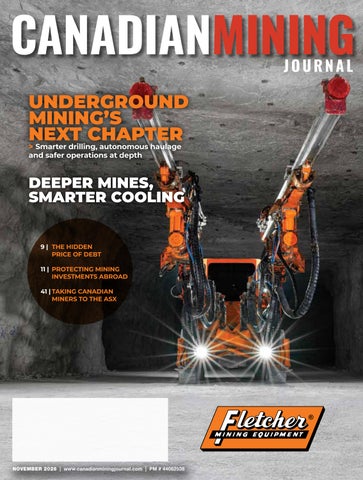
UNDERGROUND MINING’S NEXT CHAPTER > Smarter drilling, autonomous haulage and safer operations at depth
DEEPER MINES, SMARTER COOLING 9 | THE HIDDEN PRICE OF DEBT 11 | PROTECTING MINING INVESTMENTS ABROAD 41 | TAKING CANADIAN MINERS TO THE ASX
®
NOVEMBER 2026 | www.canadianminingjournal.com | PM # 44082538
Less time fixing problems.
More time like this.
Maestro Digital Mine’s purpose-built IIoT devices and last-mile networks give you real-time visibility into underground conditions and device health. With issues easier to identify, you can troubleshoot faster and simplify maintenance - because time spent fixing what’s wrong is time that could be spent doing something better.
The underground, understood.
maestrodigitalmine.com Learn more about us
NOVEMBER 2026 VOL. 147, NO.8
FEATURES
CRITICAL MINERALS
13 Lockheed Martin, Teck Resources and 5N Plus join forces on germanium.
13
UNDERGROUND MINING
17 Sandvik powers the next chapter in underground drilling. 23 Preventing the transformation of groundwater into mine water. 30 Eight years underground: Six lessons from Agnico Eagle’s
autonomous haulage journey at LaRonde LZ5.
36 CEMA guidelines for underground conveyor belt support. VENTILATION
20 Keeping cool as mines go deeper. 28 When minutes become millions: The hidden cost of traditional blast clearance practices in underground mining.
34 Saving energy in mine ventilation through thermal balance.
20
SAFETY
26 Komatsu puts safety conversations to work. 32 Battery-electric mining equipment changes the fire risk:
Is your protection plan ready?
AUTOMATION AND SURVEYING
38 From wheel loader to point cloud: How machines become survey tools. LEADERSHIP, WORKFORCE AND TRAINING
40 The operational heartbeat of mining leadership.
DEPARTMENTS
26
4 EDITORIAL | Connecting the pieces underground. 6 FAST NEWS | Updates from across the mining ecosystem. 9 MIN(E)D YOUR BUSINESS | The hidden costs of debt capital: Why the lowest interest rate is not always the cheapest financing. 11 LAW AND REGULATIONS | International investment law and dispute resolution in the mining sector. Part 1: Foundations of international investment law in the mining sector. 41 LAW AND FINANCIAL REGULATIONS | What Canadian mining companies need to know before listing on the ASX.
38
40
About the cover: JH Fletcher’s J352-LS Dual Boom Drill Jumbo in action. Credit: JH Fletcher. UNDERGROUND MINING’S NEXT CHAPTER > Smarter drilling, autonomous haulage and safer operations at depth
DEEPER MINES, SMARTER COOLING 9 | THE HIDDEN PRICE OF DEBT 11 | PROTECTING MINING INVESTMENTS ABROAD 41 | TAKING CANADIAN MINERS TO THE ASX
®
NOVEMBER 2026 | www.canadianminingjournal.com | PM # 44082538
Coming in December 2026/January 2027 Mining is a global industry, and collaboration has never been more important. This issue examines how Canada and mining jurisdictions around the world are working together to meet the challenges of the energy transition, while also featuring our annual spotlight on British Columbia and Yukon.
For More Information
Please visit www.canadianminingjournal.com for regular updates on what’s happening with Canadian mining companies and their personnel both here and abroad. A digital version of the magazine is also available at https://www.canadianminingjournal.com/digital-edition/
www.canadianminingjournal.com
CANADIAN MINING JOURNAL | 3
FROM THE EDITOR
Tamer Elbokl, PhD
Connecting the pieces underground
U
nderground mining’s next chapter depends on how operators connect technologies such as battery-electric drills, autonomous trucks and equipment-mounted surveying with infrastructure and people. This November issue examines those connections and the preparation needed to turn investment into operating improvements. Our interview with Sandvik’s Johannes Välivaara explores how equipment design, battery capacity, drilling data and automation can improve the underground drilling cycle (see pages 17 to 19). At Agnico Eagle’s LaRonde Zone 5, nearly eight years of autonomous operations offer six lessons about suppliers, communications, productive operating time, workforce development and continuous improvement (see pages 30 to 31). Preparing for the technologies also means planning the infrastructure that supports them. Ventilation is essential to safe underground operations. As mines deepen, our cooling feature examines the space, power, water and heat-rejection routes needed to manage rising temperatures (see pages 20 to 22). Another article examines thermal balance and ventilation energy savings (see pages 34 to 35). Roald Strand explains how intercepting suitable groundwater can help prevent its transformation into mine water (see pages 23 to 25), while conveyor belt support guidance addresses dust, spillage, maintenance access and safety (see pages 36 to 37). Battery-electric machines introduce battery-related fire scenarios requiring careful assessment, detection and emergency planning (see pages 32 to 33). Komatsu’s George Carlough discusses how conversations between leaders and frontline workers build trust and strengthen preventive safety practices (see pages 26 to 27). An article from Sodex Innovations describes equipment-mounted surveying that collects terrain data during routine machine movements (see pages 38 to 39). Our critical minerals coverage examines the proposed germanium supply arrangement involving Lockheed Martin, Teck Resources and 5N Plus, processing investments and supply agreement challenges (see pages 13 to 16). Additionally, in our regular columns, Simon Grant examines financing costs embedded in reporting obligations, collateral and covenants (see pages 9 to 10). Carlos da Costa introduces international investment protections and dispute resolution (see pages 11 to 12), while Robert Speed outlines considerations for Canadian companies pursuing an Australian Securities Exchange listing (see pages 41 to 42). Finally, Philip Angino examines frontline leadership (see page 40). Across these pages, progress depends on practical systems, informed decisions and people equipped to carry change into the realities of each shift, supported by proper training and clear expectations. Mining is a global industry, and collaboration has never been more important. Our December 2026/January 2027 issue will explore how Canada and mining jurisdictions worldwide are working together to address the challenges of the energy transition. The issue will also feature our annual spotlight on British Columbia and Yukon. Submit editorial contributions to the editor-in-chief by Nov. 7, 2026.
4 | CANADIAN MINING JOURNAL
NOVEMBER 2026 Vol. 147 – No. 8 69 Yonge St., Ste. 200, Toronto, ON M5E 1K3 Tel. (416) 510-6789 Fax (416) 510-5138 www.canadianminingjournal.com Editor in Chief Dr. Tamer Elbokl telbokl@canadianminingjournal.com News Editor David Cassels dcassels@canadianminingjournal.com Graphic Design Nicholl Spence Production Manager Jessica Jubb jjubb@northernminer.com Manager of Product Distribution Allison Mein 416-510-6789 ext 3 amein@northernminergroup.com Publisher & Sales Robert Seagraves 416-510-6891 rseagraves@canadianminingjournal.com Sales, Western Canada George Agelopoulos 416-510-5104 gagelopoulos@northernminer.com Toll Free Canada & U.S.A.: 1-888-502-3456 ext 2 or 43734 Circulation Toll Free Canada & U.S.A.: 1-888-502-3456 ext 3 President, The Northern Miner Group Anthony Vaccaro Established 1882
Canadian Mining Journal provides articles and information of practical use to those who work in the technical, administrative
and supervisory aspects of exploration, mining and processing in the Canadian mineral exploration and mining industry. Canadian Mining Journal (ISSN 0008-4492) is published nine times a year by The Northern Miner Group. TNM is located at 69 Yonge St., Ste. 200, Toronto, ON M5E 1K3. Phone (416) 510-6891. Legal deposit: National Library, Ottawa. Printed in Canada. All rights reserved. The contents of this magazine are protected by copyright and may be used only for your personal non-commercial purposes. All other rights are reserved and commercial use is prohibited. To make use of any of this material you must first obtain the permission of the owner of the copyright. For further information please contact Robert Seagraves at 416-510-6891. Subscriptions – Canada: $51.95 per year; $81.50 for two years. USA: US$64.95 per year. Foreign: US$77.95 per year. Single copies: Canada $10; USA and foreign: US$10. Canadian subscribers must add HST and Provincial tax where necessary. HST registration # 809744071RT001. From time to time we make our subscription list available to select companies and organizations whose product or service may interest you. If you do not wish your contact information to be made available, please contact us via one of the following methods: Phone: 1-888-502-3456 ext 3; E-mail: amein@northernminergroup.com Mail to: Allison Mein, 69 Yonge St., Ste. 200, Toronto, ON M5E 1K3 We acknowledge the financial support of the Government of Canada.
www.canadianminingjournal.com
FAST NEWS
Updates from across the mining ecosystem
• Air strike kills at least 72 miners in Sudan At least 72 artisanal miners were killed in an alleged air strike in Sudan’s Jabal al-Uqaydat area, according to Emergency Lawyers, a Khartoum-based human rights group. In a statement posted to the X platform, formerly Twitter, Emergency Lawyers claimed the attacks were carried out by Egyptian warplanes, targeting civilians. “We condemn these attacks, which violate Sudan’s sovereignty and the right to life,” Emergency Lawyers said in its statement. Videos and images posted to social media appear to show dozens of bodies of those killed in the attacks. Canadian Mining Journal is not able to verify these posts. Egypt has not commented on the incident. CREDIT: WOLFGANG BÜRKLE
• Caterpillar invests $10M in North Carolina workforce
CREDIT: CATERPILLAR
Caterpillar (NYSE: CAT) is set to expand its workforce commitment in North Carolina with an allocation of up to $10 million (C$14.19 million). The funding is aimed at preparing current and future workers for jobs in modern manufacturing and industry technician roles. “Investing in people is essential to building the workforce advanced manufacturing will need for the future,” said Christy Pambianchi, Caterpillar’s chief human resources officer. “North Carolina’s growth creates an opportunity to help more people build the skills they need for careers in manufacturing.” This marks the sixth allocation through the company’s $100 million Building the Future Workforce Initiative.
• Komatsu marks 25 years of manufacturing at NMO Employees, partners and community members gathered at Komatsu’s (OTC: KMTUY) Newberry Manufacturing Operation (NMO) in South Carolina to celebrate 25 years of operations. At the celebration, a special anniversary model of the WA485-11 wheel loader, one of the newest wheel loaders manufactured at the plant, was unveiled. Rod Bull, Komatsu North America’s CEO, called the milestone significant and a “testament to the dedication, skill and commitment” of its employees.
CREDIT: KOMATSU
6 | CANADIAN MINING JOURNAL
www.canadianminingjournal.com
rockprocessing.sandvik
Eco-efficient mineral processing We are a leading provider of rock processing solutions, leveraging more than 160 years of expertise to deliver maximum value to our customers through performance, quality, safety, and sustainability. Our energy-efficient service solutions and equipment for crushing, screening, breaking, and demolition enable mining and infrastructure customers to boost productivity while reducing their environmental impact. Supported by expert process knowledge, digital tools, OEM spare parts, consumables, and life-cycle services, we help customers continuously achieve optimal performance within their comminution operations.
FAST NEWS
Updates from across the mining ecosystem
• TCG, Indigenous Nations partner on mining initiative Atikameksheng Anishnawbek and Wahnapitae First Nation have partnered with Thompson Construction Group (TCG) to pursue mining and construction opportunities in northern Ontario. This collaboration establishes Mino-Ayaawin Asin GP Inc., which combines TCG’s construction expertise and project delivery capabilities with the Nations’ Indigenous knowledge, relationships and strengths in procurement, employment, training and community liaison. The partners say they will pursue opportunities that create local employment, skills development, business growth and greater Indigenous participation in projects throughout the region. “Mino-Ayaawin Asin represents what is possible when First Nations and industry come together with a shared vision for prosperity,” said Gimaa Nootchtai, Atikameksheng Anishnawbek’s Chief.
CREDIT: TCG
MINE DEVELOPMENT CONSTRUCTION
• Critical One plans ‘Critical Two’ spin-out
REHABILITATION MECHANICAL & ELECTRICAL SHAFT SINKING RAISE MINING AND MORE...
Team. Work. With an enduring commitment to safety and mining excellence since 1958.
PARTNER WITH US: 705-567-6663 www.macintyremining.com
8 | CANADIAN MINING JOURNAL
CREDIT: CRITICAL ONE
Critical One Energy (CSE: CRTL) announced its plans to transfer the Kenora uranium property in northwestern Ontario, and its uranium and copper interests in Namibia, to a new company, proposed to be called Critical Two Energy. Under this structure, shares in Critical Two would be distributed by way of a dividend to Critical One shareholders of record on a date to be determined. The company says Critical Two is expected to seek a separate stock exchange listing. The company says that its Howells Lake project near Thunder Bay, Ont., remains its primary focus.
www.canadianminingjournal.com
MIN(E)D YOUR BUSINESS
By Simon Grant
The hidden costs of debt capital: Why the lowest interest rate is not always the cheapest financing
W
hen mining executives evaluate debt financing, most of the discussion naturally centres on pricing. What is the interest rate? Are there commitment fees or prepayment fees? How does the proposed facility compare to competing offers? These questions matter. Debt is a cost of capital, and pricing drives much of its economics. But pricing is only part of the story. In recent years, lenders have often responded to commodity price uncertainty not by raising margins but by using more conservative financial models and tighter covenants. In other words, more of the cost of risk now sits outside the pricing grid. It is embedded in the reporting requirements, collateral package, operational covenants and other lender protections that come with the facility. These provisions can shape a project’s economics and flexibility long after the financing closes. Three areas deserve particular attention.
1. Reporting Mining lenders typically expect a flow of information throughout the life of a facility. Financial reporting has long been standard. Today, even on corporate (non-project) facilities, lender requirements may extend to technical reports, reserve updates, environmental matters, Indigenous consultation, perNOVEMBER 2026
mitting, construction progress and other operational metrics. None of this information is free. It must be prepared, reviewed and delivered. Management time is diverted, consultants may need to be hired, and reporting processes must be maintained for as long as the facility remains outstanding. Late or inaccurate reports can be technical defaults even when the mine is performing well, and a default may restrict drawdowns and give lenders leverage. Individually, reporting requirements may seem modest. But collectively over the life of a project, they can represent a real cost.
2. Collateral Lenders understandably want security over the assets that support repayment. In the mining sector, that often means security over substantially all assets, including mineral titles, shares of project subsidiaries, material contracts, bank accounts and project assets. Security has direct costs: legal and registration costs can be material, particularly outside Canada, where some jurisdictions impose significant mortgage registration taxes. Security also limits future flexibility. Once assets are pledged, a later financing will generally require the existing lender’s consent and, often, an intercreditor agreement, which takes time and adds expense. Security is often viewed as a “set it and forget it” CANADIAN MINING JOURNAL | 9
MIN(E)D YOUR BUSINESS closing item. In practice, its impact can be felt years later.
3. Covenants Most mining debt facilities restrict additional indebtedness, liens, asset sales, distributions and other significant business decisions, subject to negotiated exceptions (commonly called “baskets”). These provisions protect lenders, but they can also limit management’s ability to respond to changing circumstances. At closing, those restrictions may seem remote. Few borrowers expect to restructure their capital stack or pursue a major acquisition in the near term. Yet, mining projects frequently evolve in ways that are difficult to predict. Commodity prices change. Development plans change. Market opportunities emerge unexpectedly. Amendments and waivers are rarely as easy to obtain after closing as they may appear before the loan agreement is signed, and they often come with consent fees, legal costs and, at times, repricing. Flexibility that seems unnecessary on day one can become valuable several years into a project’s life.
Negotiating more than the interest rate Many lender protections are reasonable. Mining projects are long-dated and exposed to permitting, environmental, commodity price and geopolitical risks, and lenders legitimately seek protection against them. But these protections carry costs
In mining finance, the lowest interest rate does not always deliver the cheapest financing. The true cost of debt capital includes not only the interest paid to lenders but also the flexibility surrendered, the obligations assumed and the constraints that may shape a project’s future. Prospective borrowers who understand that distinction are better positioned to evaluate alternatives and negotiate debt packages that support a project over its full life. Simon Grant is a partner at Bennett Jones LLP.
RICHWOOD BELT CLEANING SYSTEMS
Rely on
of their own, and borrowers who negotiate them as carefully as pricing can often recover real value. Borrowers should consider the following: • reporting that is more intensive during construction and scales back once steady production is achieved, with materiality thresholds so that only significant developments trigger notice; • debt and lien baskets that accommodate reclamation bonding and streaming and royalty arrangements without recurring amendment requests; • security packages focused on core mining assets, with clear release mechanics for permitted sales and refinancings; and • cure periods that distinguish administrative oversights from genuine credit events.
©Richwood 2023
Mining Journal 7 4JOURNAL 78 4 23.indd 1 10Canadian MINING | CANADIAN
4/13/23 2:07 PM www.canadianminingjournal.com
LAW AND REGULATIONS
By Carlos da Costa
International investment law and dispute resolution in the mining sector Part 1: Foundations of international investment law in the mining sector
M
ining has long served as a stress test for international investment law. The sector’s defining characteristics (high capital intensity, long project lifecycles and regulatory volatility) make it useful for understanding how treaty protections operate. Canadian mining companies maintain a global footprint and routinely engage with investment treaties, investor-state dispute settlement (ISDS) and host-state regulatory systems. These frameworks can influence project financing, operational planning and risk management as companies navigate complex political and social environments. Mining projects often span several decades, crossing multiple political administrations and regulatory generations. The legal and policy environment at investment may therefore differ significantly from that governing the project years later. Investment treaties can address aspects of this vulnerability through protections against expropriation, unfair treatment and discriminatory conduct and, depending on their terms, access to international arbitration. For Canadian firms operating abroad, treaty protection can form one component of a broader strategy for managing jurisdictional risk, particularly where regulatory institutions are evolving, or domestic remedies may be uncertain. It does not replace project economics, contractual protection, political risk insurance, regulatory due diligence or effective stakeholder engagement. The architecture of international investment law relevant to mining is built primarily on bilateral investment treaties, free trade agreements with investment chapters and, sometimes, investment contracts and concessions governed by domestic law. These instruments may establish substantive rights for foreign investors and, depending on their terms, dispute-resolution mechanisms. Bilateral investment treaties commonly contain protections against expropriation, fair and equitable treatment (FET), full protection and security (FPS) and discriminatory treatment, together with provisions concerning ISDS. Free trade agreements may include similar protections while also addressing transparency, regulatory policy, environmental protection, NOVEMBER 2026
sustainable development and other public-interest objectives. The core treaty protections map closely onto mining’s risk profile. Expropriation provisions safeguard against direct takings, such as nationalization, and may also apply to indirect expropriation where state measures substantially deprive an investor of the value or use of a protected investment. Mining concessions, exploitation rights, licences, contractual rights and other project interests may qualify as protected investments, depending on the treaty, domestic law, rights acquired and investment circumstances. When a government revokes a concession, imposes a moratorium or significantly alters project conditions, investors may argue that the measure amounts to compensable expropriation. Tribunals must assess the nature and effect of the measure, the treaty provisions and exceptions and whether the state was exercising legitimate regulatory authority. Fair and equitable treatment is frequently invoked in investment disputes, including mining disputes. Depending on treaty wording, FET claims may concern conduct alleged to be arbitrary, fundamentally unfair, lacking due process or inconsistent with specific representations on which an investor reasonably relied. Tribunals examine the treaty language and the state’s conduct, including administrative transparency and consistency and, where relevant, legitimate expectations. Investment treaties do not generally guarantee an unchanged regulatory framework throughout the life of a mining project. Ordinary and foreseeable regulatory evolution does not, by itself, constitute a treaty breach. Regulatory measures may nevertheless give rise to disputes requiring tribunals to distinguish legitimate regulation from conduct inconsistent with the applicable treaty. Full protection and security is particularly relevant where mining operations face social unrest or political instability. Although the standard traditionally focuses on physical security, its precise scope depends on treaty wording and jurisprudence. In appropriate circumstances, investors may invoke FPS where violence or serious disturbances threaten personnel, property or the investment and the state fails to provide the protection required by the appliCANADIAN MINING JOURNAL | 11
LAW AND REGULATIONS cable legal framework. Tribunals assess FPS claims case‑by‑case, and blockades or disruptions do not constitute a breach absent failure to take reasonable steps within the state’s capacity. Non-discrimination provisions, including national treatment and most-favoured-nation (MFN) clauses, seek to protect against foreign investors being treated less favourably than domestic operators or investors from other countries. Where the applicable treaty prohibits discriminatory treatment, and the relevant comparators are sufficiently alike, investors may challenge differential taxation, licensing decisions, enforcement actions or other measures. Investors have also invoked MFN clauses in attempts to access more favourable procedural protections contained in other treaties, although tribunals remain divided, and several decisions restrict MFN clauses from extending to dispute settlement mechanisms. Investor-state dispute settlement refers to the procedural mechanisms through which a qualifying investor may bring a dispute against a host state under the dispute settlement provisions of an applicable investment treaty or other international investment instrument. ISDS is distinct from substantive treaty protections such as expropriation and FET. Depending on the applicable instrument and the parties’ consent to arbitration, disputes may be administered through the International Centre for Settlement of Investment Disputes (ICSID) or conducted under arbitration rules such as the United Nations Commission on International Trade Law (UNCITRAL) Arbitration Rules. Tribunals may assess whether challenged measures breach applicable obligations and, where liability is established, determine appropriate remedies, potentially including monetary compensation. Mining disputes frequently require tribunals to consider investor protections alongside public interest objectives, including environmental stewardship, Indigenous rights and climate transition policies. Proportionality reasoning appears in investment arbitration, but it does not operate as a single, uniform test. In E.U.-influenced agreements such as CETA (Canada-European Union Comprehensive Economic and Trade Agreement) and the E.U.-Vietnam IPA, proportionality is expressly embedded in right-to-regulate provisions and assessments of measures affecting public welfare objectives. Other jurisprudence may incorporate proportionality through domestic constitutional or administrative frameworks, while ICSID tribunals have used proportionality variably as part of broader reasonableness or balancing analysis. The applicable treaty, challenged measure and circumstances remain decisive. Mining disputes commonly arise from resource nationalism, environmental regulation, permitting conflicts and political instability. Fiscal reforms, royalty increases or contract renegotiations may disrupt project assumptions, while environmental and social regulation may respond to biodiversity, water, health and community concerns. Several disputes illustrate these dynamics. Copper Mesa Mining Corporation versus Republic of Ecuador demonstrates the relevance of investor conduct, including contributory fault in compensation. Bear Creek Mining Corporation versus Republic of Peru illustrates how Indigenous consultation, community relations, social opposition and government action can converge in disputes over mining rights. Eco Oro Minerals Corp. versus Republic of Colombia demonstrates the difficult interaction between en-
12 | CANADIAN MINING JOURNAL
vironmental protection and investment treaty obligations. Indigenous rights and free, prior and informed consent (FPIC) add further complexity. Where states respond to Indigenous rights concerns or community opposition by suspending, modifying or imposing conditions on mining activities, investors may seek to challenge those measures under applicable treaties. Tribunals may need to consider the relationship between investment obligations and domestic and international frameworks governing Indigenous rights. The precise legal significance of FPIC depends on the applicable framework, jurisdiction, project and circumstances; it should not be treated as a universally identical obligation for investors. Community acceptance and stakeholder relations may form part of the factual and regulatory context of disputes, but social licence itself should not be treated as a standardized investment treaty obligation. Host-state expectations are also changing. Governments increasingly seek to reconcile investment with environmental protection, Indigenous rights, climate policy and broader public interest objectives. Investment treaties do not generally prevent regulation, and a state’s regulatory response must be assessed under the applicable treaty and factual circumstances. Relevant considerations may include arbitrariness, discrimination, due process, legitimate expectations, the severity and effect of the measure and the state’s regulatory authority. Effective record-keeping by both investors and public authorities can become important when disputes arise. Records concerning inspections, environmental monitoring, permitting decisions, regulatory correspondence, compliance and community engagement may provide evidence of the history and context of challenged measures. Investor conduct may become relevant to jurisdiction or admissibility, liability, contributory fault, mitigation, damages or state counterclaims, depending on the applicable treaty, domestic law, contractual framework and facts. Canadian mining companies should therefore integrate environmental, social and governance (ESG) and stakeholder considerations into legal and operational risk management rather than treating them solely as corporate policy matters. Canadian companies must also anticipate the evolving political and economic environment surrounding critical minerals. Governments are increasingly developing policies concerning secure mineral supply chains, domestic processing and climate transition. Frameworks such as the U.S. Inflation Reduction Act and the E.U. Critical Raw Materials Act contribute to a more complex policy environment for international mining investment. These developments can affect project economics and regulatory expectations, making treaty planning and broader political risk assessment increasingly important. The foundations outlined in this first part of a four-part study demonstrate how international investment law shapes the governance of mining without eliminating host-state regulatory authority. For Canadian mining companies globally, treaty protection is most effective when integrated with careful structuring, regulatory foresight, project governance, documentation and sustained stakeholder engagement. Carlos da Costa, PhD, is an adjunct finance professor at the University of British Columbia and a seasoned financial industry professional.
www.canadianminingjournal.com
CRITICAL MINERALS
By Diane L.M. Cook
Lockheed Martin, Teck Resources and 5N Plus join forces on germanium
F-35 (AP-1) move during manufacturing. CREDIT: LOCKHEED MARTIN/ANGEL DELCUETO
C
anada plans to nearly double its recovery of germanium — a critical strategic mineral used in advanced electronics, semiconductors, fibre optics and defence applications — to secure the critical strategic minerals that Canada and the world need for economic sovereignty, the energy transition and national security.
NOVEMBER 2026
CANADIAN MINING JOURNAL | 13
CRITICAL MINERALS
Historically, China has controlled between 60% and 80% of global germanium production. However, the country recently tightened controls of its own domestic critical strategic mineral supply chains. This has left customers of global germanium supplies, like Lockheed Martin, looking for new contracts to procure new germanium supplies. For over a year now, Lockheed Martin, a U.S.-headquartered global defence technology company, has been in negotiations with Teck Resources, a leading Canadian resource company, and 5N Plus, a Montreal, Quebec-headquartered leading global producer of specialty semiconductors, which would see Teck Resources and 5N Plus supply germanium to the leading aerospace and defence company. If a deal can be reached, it would help the U.S. strengthen its defence supply chains and eliminate its reliance on China for its germanium supply. The specifics of this trilateral deal would see Lockheed Martin buying supplies of two critical strategic minerals — scandium from NioCorp’s Elk Creek critical minerals project in Nebraska and a zinc-germanium concentrate from Teck Resources’ Red Dog mine in Alaska, with the germanium concentrate then being smelted in B.C. This deal also includes Lockheed Martin receiving germanium supply from 5N Plus which would process the metal from recycled feedstock in Utah.
Loctkheed Martin Founded in 1995 and headquartered in Bethesda, Maryland, Lockheed Martin specializes in defence technology, specifically, aeronautics; missiles and fire control; rotary and mission systems; and space. Most of the company’s business is with the U.S. Department of War and U.S. federal government agencies. Additionally, Sikorsky, a Lockheed Martin company, provides military and rotary-wing aircraft to five branches of the U.S. armed forces. Most notably, Lockheed Martin makes the F-35 Lightning II fighter jet, Patriot interceptor missiles and other weaponry. Germanium is used in infrared optics and so-
14 | CANADIAN MINING JOURNAL
The Canada Critical Minerals Accelerator launch event held at Teck’s Trail Operations on July 7, 2026. CREDIT: TECK RESOURCES
lar cells across the aerospace and defence industry. A Lockheed Martin spokesperson said of the trilateral deal, “We continuously assess the global critical minerals supply chain to ensure access to materials that support our customers’ missions.”
metallurgical facilities in Trail, B.C., and to customers in Asia and Europe. The
Teck Resources Teck Resources is one of the world’s largest germanium producers and a major supplier of germanium to the U.S. Germanium is produced at Teck Resources’ Trail Operations in southern B.C., where it is recovered as a byproduct of processing zinc concentrates, including concentrate from Teck Resources’ Red Dog mine in Alaska. Teck Resources’ Red Dog mine is one of the world’s largest zinc mines, located about 169 km north of the Arctic Circle in northwest Alaska, near Kotzebue. The Red Dog mine operates under an agreement between Teck Resources and the landowner NANA, a regional Alaska Native corporation owned by the Iñupiat of northwest Alaska. The mine and concentrator properties are leased from, and were developed under, the agreement with NANA. Concentrates produced at the Red Dog mine are shipped to Teck Resources’
www.canadianminingjournal.com
Germanium substrate. CREDIT: 5N PLUS
current mine life, based on existing developed deposits, is expected to extend through 2031. In 2026, Teck Resources, Canada Growth Fund (CGF) and Natural Re-
sources Canada’s Canada Critical Minerals Accelerator (CMMA) signed a strategic investment agreement to support Teck Resources’ proposed Strategic Metals Initiative at its Trail Operations.
The agreement establishes a framework for an equity-like investment by CGF of up to $400 million, as part of up to $850 million in potential total investment by Teck Resources to sustain and enhance critical minerals processing capacity at its Trail Operations. The proposed initiative has the potential to double the Trail Operations’ existing production capacity for germanium and antimony and add gallium production capacity for the first time. Dale Steeves, director of external communications and stakeholder relations, says, “Teck is a major global supplier of germanium, including to the U.S. We are
F-35 (AP-1) load during manufacturing. CREDIT: LOCKHEED MARTIN/NATE FORER
NOVEMBER 2026
CANADIAN MINING JOURNAL | 15
CRITICAL MINERALS examining options to significantly scale up production capacity for germanium, antimony and to add gallium production at our Trail Operations.”
5N Plus 5N Plus Inc., a leading global producer of specialty semiconductors and performance materials, deploys proprietary and proven technologies to develop and
MODEL
manufacture advanced materials that are often core components of its customers’ products, with Lockheed Martin being one of those customers. 5N Plus’ products are used in key industries, including renewable energy, security, space, pharmaceuticals, medical imaging and manufacturing. The company manufactures and customizes high-purity, dislocation-free, electrically
TA
BELT ALIGNMENT SWITCH
MODEL
RS
PULL CORD SAFETY STOP SWITCH FOR CONVEYORS
MODEL
DB
DAMAGED BELT DETECTOR
™
MODEL
CMS
COMPACT MOTION SWITCH
INTRODUCING AN EASY WAY TO PROTECT YOUR WORKERS AS WELL AS PROTECT YOUR INVESTMENT INTO YOUR EQUIPMENT. THE CONVEYOR SAFETY SYSTEM™ IS AN EASY, COST EFFICIENT WAY TO GET PEACE OF MIND AND PROTECTION FOR CONVEYOR EQUIPMENT. BY BUNDLING OUR MODEL RS SAFETY STOP SWITCH WITH OUR MODEL TA BELT ALIGNMENT SWITCH, MODEL DB DAMAGED BELT DETECTOR WE HAVE YOUR WORKERS AND EQUIPMENT COVERED. COUPLE THAT WITH ADDING ONE OF OUR MOTION SWITCHES (MAG-NEAT-O™ OR MODEL CMS), YOU CAN FEEL CONFIDENT KNOWING THAT YOUR SYSTEM AND WORKERS ARE PROTECTED FOR A FRACTION OF THE COST OF DOWNTIME, REPAIRS AND REPLACEMENT EQUIPMENT.
www.conveyorcomponents.com
AVAILABLE AT IN
uniform germanium wafers in 100 mm and 150 mm sizes for space and landbased solar applications. As part of the impending trilateral deal, 5N Plus has already received funding from the Pentagon to process germanium from its production facility in St. George, Utah. In addition, 5N Plus was recently selected by the U.S. Department of War to receive a US$7.3 million award to establish domestic production of gallium arsenide components for defence applications. With funding from 5N Plus’ existing capital expenditure plans and its recent awards from the U.S. federal government, the company plans to expand its Utah production facility by 50% which will allow the company to grow its advanced materials capabilities. Construction is expected to begin in the third quarter of 2026 and is expected to be completed by the second half of 2027. Richard Perron, president and chief executive officer of 5N Plus Inc., says, “Expanding our existing St. George facility will create a capital efficient and scalable platform to increase our capacity in step with customer demand.” According to a news release by Reuters dated Aug. 4, 2026, a deal has yet to be reached owing to negotiations among the three companies having faced delays spanning over a year because of persistent disagreements over contract lengths and higher western production costs compared to cheaper Chinese alternatives. And although the specifics of this trilateral agreement — how many tonnes of germanium will be purchased per year, the price per tonne and the length of the contract — have yet to be determined, if a deal can be reached between these three companies, it will mean that the amount of germanium produced in Canada will almost certainly double, greatly increasing the total amount of critical strategic minerals that are mined and produced in Canada, which will build on Canada’s position as a reliable global supplier of critical strategic minerals. Diane L.M. Cook is a freelance mining writer.
16 | CANADIAN MINING JOURNAL
www.canadianminingjournal.com
UNDERGROUND MINING
By Tamer Elbokl, PhD
SANDVIK POWERS THE NEXT CHAPTER IN
UNDERGROUND DRILLING DD423i underground drill rig. CREDIT: SANDVIK MINING
U
nderground drilling brings together several demands: reaching the face efficiently, completing the drilling cycle, following the plan and limiting workers’ exposure to underground conditions. Sandvik’s approach conNOVEMBER 2026
nects these tasks through equipment design, battery technology, drilling data and automation, with productivity and safety running through the discussion. This article is based on an interview with Johannes Välivaara, CANADIAN MINING JOURNAL | 17
UNDERGROUND MINING
Johannes Välivaara, president of underground drilling at Sandvik. CREDIT: SANDVIK MINING
president of underground drilling at Sandvik, during the Future of Mining event in Tampere, Finland. Välivaara explained how the DD423i and battery-electric DD423iE development drills fit into that approach. He described larger boom coverage, increased battery capacity and battery-boosted drilling, alongside the role of data, autonomous functions and operator training. “Automation, digitalization and electrification, the way we see it, they all relate together,” Välivaara said. His explanation linked improvements at the machine level with the wider drilling process, from positioning the equipment to feeding information back into
How focused are your reviews?
18 | CANADIAN MINING JOURNAL
mine planning and carrying out tasks with less operator exposure.
More coverage, less repositioning One of the changes Välivaara highlighted is the SP75 boom, which provides greater coverage than the preceding SP60. Increased boom extension gives the operator more flexibility when positioning the drill and reaching different parts of the face. The benefit is less time spent moving the machine between drilling tasks. He explained that an operator would typically position the equipment at the face, drill the lifter holes and then relocate the machine to complete the remaining holes. With greater reach, the operator can drill the whole face, including the lifter holes, from one position, reducing repositioning and navigation time. The same capability helps when drill-
.com Due diligence
ing crosscuts, particularly where the booms must reach sideways. Välivaara also described a new dual rollover configuration that allows the operator to manoeuvre the booms in both directions. Together, these changes provide flexibility when drilling to the left, right or in front of the machine.
Battery power beyond tramming For the DD423iE, Välivaara pointed to the LFP 2.0 battery system and an increase in capacity from approximately 120 kWh to 180 kWh. Välivaara said the increased capacity brings the available range closer to meeting the needs of most mines, addressing the reach achievable in underground conditions. The larger battery addresses a practical consideration for underground drilling equipment: how far the machine can travel between locations under the conditions encountered in a mine. “Now we have a larger battery capacity on board,” he said. As an example of the increased tramming capability, he described travelling up to nine kilometres uphill on a one-in-seven incline. He identified tramming distance as a traditional limitation for battery-electric drilling equipment and said the increased capacity helps address it. The other change concerns the drilling itself. Välivaara said the difference between diesel and battery-electric equipment had traditionally centred mainly on travelling to the drilling location. The machine could charge its batteries while drilling, then move to the next location. Sandvik is seeking to add a drilling productivity benefit through battery-boosted drilling. The system compares the power needed for drilling with the power available from the underground electrical grid. When drilling requires more power than the grid can supply, the equipment draws reserve power from the battery. Välivaara said constraints on available electrical power become more apparent as mines extend deeper. “We are looking to change that now and the feature is called a battery boosted drilling,” he said. He presented
www.canadianminingjournal.com
Safety through several layers
DD423iE battery-electric underground drill rig. CREDIT: SANDVIK MINING
the capability as a way to drill faster despite grid limitations. Alongside cleaner air and reduced underground heat load, the productivity improvement helps address customers’ difficulty justifying investment in battery-electric technology.
Putting drilling data to work Digitalization adds another dimension to the drilling cycle. Välivaara described the telemetry and information available from the equipment, as well as parameters recorded while drilling into the rock. Those measurements can support geotechnical interpretations and contribute information about the conditions encountered during drilling. He outlined a feedback loop connecting planning tools with the machine. A production drilling plan is created and transferred to the equipment. During execution, the unit records how the holes were drilled and the conditions it encountered. That information can then return to the planning system to complement the mine’s geotechnical model. The value extends beyond measuring drilling output. By connecting planning and equipment, the process also captures information about the rock being drilled. Välivaara described this relationship as a way for the drilling activity to contribute to the model, while the model and planning tools guide the work performed by the equipment. NOVEMBER 2026
Building automation around the drilling cycle Sandvik’s work towards more autonomous drilling includes individual functions that address tasks within the cycle. Välivaara highlighted bit changing, lifter tube installation and scanning solutions that help navigate the equipment. He described a gradual progression towards more autonomous drilling as these functions develop. Customer feedback helps guide that work, alongside collaboration to prepare the technologies for commercial use. He said the company is working closely with customers on the commercial readiness of these technologies and their introduction into its existing offering. Automation also has implications for equipment utilization. Välivaara described opportunities to continue drilling during shift changes and blasting or ventilation windows. Using these periods can increase the time available for drilling and produce more drilled metres. He framed the opportunity as moving operations towards a process that can run around the clock. Consistency is another part of the case. Once a drilling plan has been developed with blasting, fragmentation and drilling control in mind, automation provides discipline in following it. Välivaara said the equipment can execute the plan consistently, helping deliver results from one day or week to the next.
Välivaara described zero entry as a longterm target, with activities carried out autonomously by the machine or supervised remotely by an operator. Tele-remote technology and onboard automation can reduce operators’ exposure to underground conditions. Operators can supervise drilling remotely using tele-remote technology. He also emphasized that safety involves several layers of protection on the equipment itself. Access protection systems are one example. Scanners can detect a person entering the area in front of the drill and stop movement. Another objective is to keep the operator inside the cabin for as much of the work as possible, rather than requiring the person to move to the front of the machine. Bit changing and lifter tube installation are intended to support that objective by allowing those functions to be carried out from the cabin. Combined with autonomous operation or tele-remote assistance, these capabilities can also help complete face drilling tasks during shift changes. Välivaara linked the combination to both reduced exposure and increased drilling output.
Preparing people for technology “Everything starts with the people and the change management,” Välivaara said. He emphasized training and upskilling alongside technical development, noting that some job descriptions may change. Välivaara said the industry still has work to do on this transition, even as the technology becomes ready. Successful change management must accompany the equipment’s capabilities. Sandvik’s role includes providing tools, services and capabilities that help people prepare to use technology. He said work with customers and industry remains necessary to support that transition. The interview connected this preparation with the equipment changes: greater reach, battery-supported drilling, data feedback and automation each address parts of the cycle, while people remain central to putting those capabilities to work underground. Watch a full video of the interview here https://youtu.be/ BgqDK6AXCok?si=S93DBsNpkRejsoY1 CANADIAN MINING JOURNAL | 19
UNDERGROUND MINING: VENTILATION
By Salima Virani
The intake system at Vale’s Coleman mine. CREDIT: VALE
Keeping cool as mines go deeper
K
eeping a deep mine cool takes more than an underground refrigeration plant. It takes space, power, water and a route to carry heat away from the people and equipment. Those needs are easier to accommodate when cooling is part of the original mine plan, says Dr. Stephen Hardcastle, technical director of BBE Group Canada. Today’s shallow mine could end up going much deeper. An operation designed with future cooling capacity in mind can leave room for installations that may only become necessary years later. That is an important consideration as Canadian mines go deeper. Warmer conditions affect how safely people can work, while machines and electrical equipment can also have temperature limits that influence their performance. The opportunity for mine planners is to consider those needs together. Where cooling is installed, how air reaches the workplace and where the removed heat goes, all shape the system’s cost and effectiveness.
Where the heat comes from To choose a cooling system, engineers first need to understand what is creating high temperatures in the mine. In Canada, a major source is the ventilation air itself. As air travels down a shaft, the increasing pressure compresses and warms it. This is called autocompression, explains Agus Sasmito, an associate professor in McGill University’s mining and materials engineering department. With little heat exchanged along the way, the temperature
20 | CANADIAN MINING JOURNAL
can rise by about 10°C for every kilometre of descent. Actual temperatures also depend on the weather at the surface and what equipment the air encounters underground. Dr. Hardcastle says this makes planning for summer conditions one of the most important considerations. Air that is already warm at surface gains more heat as it descends, leaving less capacity to cool the workplace. The surrounding rock at the workplace contributes too. Its natural temperature generally increases with depth, although the rate varies by location. Sasmito says newly exposed rock releases heat into the air then gradually cools as ventilation continues. Equipment, fans, pumps and groundwater add other sources. Their contribution changes with the geology, the machinery in use and the amount of work taking place. “The main challenge is that several heat sources act simultaneously,” Sasmito says. The presence of water can also reduce the air’s cooling capacity. The cooling requirement therefore needs to be calculated for the individual mine and reviewed as it develops.
Making room for cooling Refrigeration helps restore the air’s ability to cool the workplace, which can be employed on surface or underground. Dr. Hardcastle describes two ways to transfer heat between chilled water and air: passing air through a chamber of chilled water sprays or across cooling coils. He compares these to a cold shower and a large radiator. Water also takes the heat from the refrigeration equipment
www.canadianminingjournal.com
with sprays transferring it to another airstream so cooling can continue. This is essentially a hot shower. An underground installation needs three distinct spaces. The cooling chamber is where air is cooled. The plant room houses the refrigeration equipment and associated facilities. The heat-rejection chamber transfers the refrigeration plant-generated heat into air to be carried out of the mine. Engineers must choose a route that can handle the warmer exhaust air without affecting another workplace. “For underground refrigeration plants, one of the biggest concerns is always where do you reject the heat without impacting mine operations; that air stream will be too hot and humid for both personnel and mobile equipment,” Dr. Hardcastle says. These spaces need to be considered alongside the mine’s other infrastructure. Dr. Hardcastle gives an example of chambers measuring six metres by six metres by more than 50 metres as being required depending on the cooling needed. Allowing for excavations of that size early provides more flexibility in the choice of cooling and efficient placement over trying to find a solution and space after surrounding workings are established. The installation will also need electricity, plus water supply and drainage infrastructure. Their availability needs to be considered. For construction, access matters: equipment may have to be transported down a shaft and must fit through the avail-
Choosing where to cool A surface plant generally offers easier construction and access to services. Underground cooling brings the installation closer to the people and equipment that need it. Dr. Hardcastle estimates that installing a megawatt of cooling underground typically costs twice as much as installing the same capacity on surface. However, an underground system may need less capacity because it cools a smaller volume of air near the workplace. The megawatt figures describe cooling capacity rather than the electricity the plant consumes to provide that cooling. That makes the decision more involved than comparing plant prices. The mine must consider how much air needs cooling, how it will reach the working areas and where the heat can be discharged. Vale’s Coleman mine in Sudbury illustrates that choice as it needed cooling during the summer. Dr. Hardcastle describes options ranging from 2 MW of cooling at a deep orebody to 6 MW midway through the mine or 10 MW on surface. The main underground exhaust route also carried trucks. Using it to discharge hot, saturated air would have unacceptably affected trucking conditions and traction. Other concepts were considered but none were feasible with the existing mine infrastructure. For a timely solution, Coleman adopted surface cooling, showing how the existing mine layout can influence the preferred option. At Agnico Eagle’s LaRonde mine, Dr. Hardcastle describes its cooling in stages. LaRonde is significantly deeper and needs cooling year-round. A surface plant cools intake air in summer, while a dedicated ventilation opening brings in cold air in winter. As that air warms during its descent, underground refrigeration plants re-cool that air again. The two examples show why there is no single arrangement for every mine. Cooling must suit the depth, the air routes and the infrastructure already in place.
Planning cooling early gives Canadian mines more options for protecting workers, supporting productivity, equipment performance and managing the cost of operating at depth. able openings; shaft availability and coordinating with other mining activity affect selection and schedules. Time belongs to planning too. Dr. Hardcastle says a surface plant can take up to two years to build after approval with an underground installation potentially taking twice as long. Studies, detailed design and any new ventilation infrastructure extend the overall schedule. His advice is to anticipate future cooling, even where it is not yet required. Leaving room in the layout and considering future power, water and airflow needs can give the mine more choices as it deepens.
NOVEMBER 2026
What electric equipment changes Battery-electric equipment may offer a way to reduce the amount of cooling needed. Replacing diesel engines with electric motors limits heat production, and through removing com-
CANADIAN MINING JOURNAL | 21
UNDERGROUND MINING: VENTILATION
bustion, reduces the airflow needed to dilute diesel contaminants. “Electric machines still produce heat, but generally much less than comparable diesel equipment doing the same work,” Sasmito says. Motors, batteries and charging equipment must still be included when calculating the mine’s cooling needs. The location of charging stations matters. Charging underground can add heat in an area that could impact workplaces, or that needs its own ventilation and cooling consideration. “However, electrification does not completely eliminate heat generation The chiller room on Level 262 at Agnico Eagle’s LaRonde mine. CREDIT: AGNICO EAGLE underground,” Sasmito says. Heat from the mining process and lieved heat-related illness was under-reported by their workrock plus the warming of descendforce. That reflects respondents’ assessments, rather than a ing air remain. Dr. Hardcastle also points out that ventilation measured national rate. must continue to clear dust and blasting fumes and help workSome workers recover quickly on site. Others may not recers lose heat through the evaporation of sweat. As mines get ognize their symptoms, or an injury may be recorded without deeper, the design drivers change. identifying heat as a contributing factor. The next step is to coordinate airflow and cooling with the Tetzlaff recommends measuring conditions close to where work taking place. Sasmito advocates combining ventilapeople work and considering those readings alongside the detion-on-demand with cooling-on-demand: supplying the air mands of the job. Wet-bulb globe temperature, a measure used and refrigeration needed for current activity while avoiding to assess environmental heat stress, needs to be interpreted unnecessary cooling of inactive areas. Options to store cold enwith workload and clothing in mind. ergy could also be applied. A reading from a community weather station cannot show what To make those decisions, engineers use models that predict is happening beside a working face, near equipment or at a freshly underground temperatures. Sasmito says predictions should blasted workface, she explains. Monitoring needs to reflect the conbe checked against measurements from different depths, seaditions underground and how they change during the shift. sons and operating conditions. Local hot spots and busy proShe gives priority to cooling at the source, cooled break arduction periods matter as much as average conditions. eas and mechanical aids that reduce physical effort. Work-rest Protecting workers from heat schedules and personal cooling garments can support these “Environmental sensors measure the space, not the person,” measures. “Heat management decisions should never rest on says Emily Tetzlaff, principal scientist, EHS at Wenco Internaone indicator,” she says. tional Mining Systems and professor at Laurentian University. For Tetzlaff, evidence that cooling works includes fewer Two people working in the same area can experience differsymptoms, reduced strain and workers being able to take proent levels of heat strain. The amount of physical effort required tective action. Those outcomes give operators a way to assess by a task, protective clothing, health and hydration all influwhat their investment delivers where it matters most. ence how well a person copes with the conditions. The same attention should continue as production changes Whether a worker can pause or reach a cooler rest area matand workings deepen. Planning the space and services early, ters too. Tetzlaff says fatigue and reduced concentration can afthen checking performance underground, allows cooling to defect performance as heat strain develops, even before a worker velop with the mine and support the people and equipment recognises signs of illness. that keep it operating. Her research also points to under-reporting. In a survey of Salima Virani is a freelance mining writer. mining health and safety managers she describes, 71% be-
22 | CANADIAN MINING JOURNAL
www.canadianminingjournal.com
UNDERGROUND MINING: WATER MANAGEMENT
By Roald Strand
Efflorescent secondary minerals on exposed underground rock, illustrating ongoing interaction among rock, mine water and underground air. CREDIT: ROALD STRAND/NEWFIELDS CANADA
Preventing the transformation of
GROUNDWATER into MINE WATER
U
nderground water management may not sound difficult in concept: pump out the water, treat it at surface and hope the treatment plant is large enough for late mine life. But that is not really water management. It is a treatment strategy, and an expensive one if every litre entering the mine is allowed to become mine-affected water. Groundwater acquires a geochemical signature from the rock through which it moves. In many Canadian settings, groundwater is relatively dilute. However, mineralized, saline or naturally acid water may be present. Where its quality is suitable, water intercepted before entering the workings may be discharged, reused or reinjected without conventional mine-water treatment. Once it enters an active mine, that opportunity can quickly disappear. Mining changes both the pathway followed by water and the materials it encounters. Blasting creates fractured surfaces, broken muck and fines, increasing surface area and accelerating rates of sulfide oxidation. Blasting also adds explosive residue. Through material handling, reaction product residues are dispersed through the mine. This process creates new pathways for groundwater to transform to mine water. NOVEMBER 2026
Flow and transformation Water finds a way, but it does not move randomly. The pathway matters because water does not travel directly from an inflow to a sump. It may pass through active and inactive workings, flow over fractured walls, infiltrate residual muck and fines and mix with water from other parts of the mine. Along the way, relatively clean groundwater can acquire dissolved metals, acidity, alkalinity, sulfate, nitrogen compounds, suspended solids and petroleum-related constituents. Its final chemistry reflects the reactivity of the exposed materials, the respective loads and dilution and contact with explosive residues and equipment fluids. In reality, a mine is more than a collection of openings and pumps. It is a connected flow path in which groundwater progressively becomes mine water.
The impact of mineral dispersion Blasting dislodges reactive minerals from working faces. Mucking does not remove all material. Residual material remains on working floors, and traffic can crush and disperse it through stopes, drifts and haulage corridors. The result is a distributed inventory of reactive material lying directly in potential drainCANADIAN MINING JOURNAL | 23
UNDERGROUND MINING: WATER MANAGEMENT age pathways. Keeping this material dry limits the transport of acidity, salts and metals, but does not remove the source. Oxidation can continue where sulfide-bearing material is exposed to air and moisture, while later wetting may mobilize accumulated reaction products. As a result, reactive material present in the underground may contribute significant loading. Rock near the orebody carries significant residual geochemical risk. Low-grade ore tends to be stockpiled, creating additional surface exposure pathways for reaction products. Waste rock tends to possess higher sulfide content and increased risk of acidification and metal leaching. Rock left underground may offer different closure options. Flooding can restrict oxygen transport and suppress sulfide oxidation, although it does not eliminate stored reaction products. During operations, the objective remains straightforward: reduce unnecessary exposure and keep water away from reactive material wherever practicable.
Water and ANFO Blasting introduces a distinctly non-geological source of contamination. Ammonium nitrate and fuel oil (ANFO) is commonly used in mining. The challenge arises in ANFO’s highly porous and hygroscopic nature. Water can dissolve the nitrate prills, separate the oxidizer from the fuel oil and reduce blast-
TAKING MINING TO A NEW LEVEL This is the natural habitat for Brokk’s compact giants. With the perfect combination of power, operability and accessibility our demolition robots provide efficient solutions to increase profits. Brokk Inc. | Monroe, WA | 1-360-794-1277 | info@brokkinc.com | www.brokk.com/us
24 | CANADIAN MINING JOURNAL
www.canadianminingjournal.com
Tight underground transit corridors. CREDIT: ROALD STRAND/NEWFIELDS CANADA
ing efficiency. Spillage and incomplete detonation leave soluble nitrogen residues on exposed rock and in blasted muck. In addition to spillage control and explosive management, groundwater control can effectively mitigate exposure. Advance drainage, groundwater interception and localized dewatering can help keep blast holes dry while reducing contact-water volumes. Where wet conditions persist, water-resistant explosives may outperform ANFO. These measures improve blasting efficiency while reducing uncontrolled nitrogen residues and loading that follows the rock out of the mine. Biological treatment can remove nutrients such as nitrate and ammonia. However, preventing that load through practical explosive management and groundwater controls is often more economical than treating exposed water.
Organic chemical signatures Underground equipment operates in confined, physically demanding conditions. Loaders, haul trucks, drills and support vehicles depend on diesel, lubricants, hydraulic oils, coolants and transmission fluids. Hose failures, damaged fittings and leaking equipment are foreseeable operational risks, but the fluids released do not remain neatly where the failure occurred. They can enter floor material, drainage channels and sumps, adding petroleum hydrocarbons, glycols and other organic constituents to mine water. It is easy to treat each leak or spill as an isolated maintenance event. In a connected underground drainage system, however, repeated small releases can become a persistent water-quality load. Once mixed with groundwater and other mine water, these fluids may cause visible sheen, increase organic loading and introduce treatment requirements that would not otherwise exist. Excavating does not disconnect the mine from the surrounding natural system; it creates new pathways through which operational contaminants can move. The controls also improve equipment performance: preventive maintenance, leak inspection, rapid spill response, good housekeeping and removal of contaminated floor material. Maintenance and refuelling areas should also be located away from active drainage wherever practicable. Equipment integrity is therefore more than a reliability or safety concern. It is another form of source control — and one more opportunity to prevent a treatment problem before it is created.
Not every change is deterioration As a university student, I investigated arsenic source terms at a discharging mine adit. Near the upwelling, the water contained elevated dissolved iron and arsenic under low-oxygen conditions. Only a few metres downstream, dissolved oxygen had increased while iron and arsenic concentrations had fallen sharply. As iron oxidized and precipitated, the newly formed solids provided surfaces for arsenic adsorption. The flow path NOVEMBER 2026
had significantly improved the dissolved water quality. Secondary mineral accumulations provide visible evidence of ongoing reactions among rock, mine water and underground air. Where carbonate minerals are present, uptake of carbon dioxide can promote carbonate dissolution and add alkalinity to mine water. This buffers acidity and can limit the mobility of some metals through pH control, sorption and mineral precipitation. These effects help explain why underground mine water does not inevitably deteriorate as it moves through the workings. The mineralogy and geochemical conditions determine the outcome. Beneficial reactions still have operational consequences. Attenuated metals do not disappear; they may accumulate in precipitates, scale or sump solids requiring monitoring and management in closure.
Keeping clean water clean The highest-value mine-water control is not incremental improvement in treatment. It is preventing groundwater from becoming mine water in the first place. Advance dewatering and groundwater interception can reduce inflows to active workings, while localized drainage can improve conditions at the blasting face. Where intercepted water remains suitable, it may be discharged, reused or reinjected without conventional mine-water treatment. I view this as a form of water accounting. Groundwater entering the workings becomes a potential liability: it must be pumped, stored and possibly treated. The same water intercepted before contact may instead become a manageable asset. It can reduce underground pumping requirements, lower the design capacity of surface infrastructure and avoid years of treatment and sludge-management costs. Not every inflow can be eliminated, and interception must account for groundwater drawdown and receiving-environment effects. But the economic hierarchy remains clear: prevent contact first, reduce contaminant loading second and treat the residual water that remains.
Treatment is the last control Underground mine-water management is complex, but its governing principle does not need to be. Intercept groundwater before it enters the workings. Reduce contact with reactive rock, explosive residues and equipment fluids. Keep different water-quality streams separate where practical. Then, treat the residual water that cannot be avoided. These controls can improve blasting performance, reduce equipment downtime and limit the volume and complexity of water requiring treatment. They can also reduce both the capital cost of treatment infrastructure and the operating burden carried into closure. Practical mine-water managers look upstream, understand why the treatment requirement exists and control the cause before designing around the consequence. Before designing a larger treatment plant, we must ask the essential question: how much water could be prevented from requiring treatment? Roald Strand, P.Geo., R.P.Geo, is a geochemistry technical lead at NewFields Canada Inc. CANADIAN MINING JOURNAL | 25
UNDERGROUND MINING: SAFETY
By Tamer Elbokl, PhD
Komatsu puts safety conversations to work Q&A with George Carlough, vice-president of global EHS at Komatsu
W
orkplace safety depends on more than tracking incidents. At Komatsu, meaningful conversations between leaders and frontline workers are central to identifying risks, strengthening trust and supporting continuous improvement. The company conducted more than 47,000 safety engagement conversations in one year, while participation increased 74% and recordable workplace injuries declined 30% over five years. Its approach combines leadership commitment, preventive measures and employee feedback, with technology supporting human judgment and direct engagement. VelocityEHS provides the environment, health and safety (EHS) software used by Komatsu. In this Q&A, George Carlough, vice-president of global EHS at Komatsu, explains how the company builds a consistent safety culture across its global operations and what other manufacturers can learn from its shift toward proactive risk management. Q: KOMATSU MOVED BEYOND CONVENTIONAL BEHAVIOUR-BASED OBSERVATIONS TOWARD ONGOING CONVERSATIONS BETWEEN LEADERS AND FRONTLINE WORKERS. WHAT PROMPTED THAT SHIFT, AND HOW DID THE COMPANY ENSURE THESE DISCUSSIONS IDENTIFIED RISKS AND BUILT TRUST RATHER THAN BECOMING ANOTHER COMPLIANCE EXERCISE?
26 | CANADIAN MINING JOURNAL
Miners underground. CREDIT: KOMATSU MINING
A: Komatsu recognizes that strong systems and trusted relationships are essential to supporting safe behaviours. To reinforce this understanding, we have redefined our employee engagement — observation process to include meaningful discussions between leaders and frontline workforce, helping foster an open and transparent culture of dialogue. When our employees feel heard and valued, trust is strengthened — and that trust is essential to driving sustainable change and continuous improvement.
www.canadianminingjournal.com
Gemba is a Japanese management/ manufacturing concept that translates roughly to “the real place” or “the actual site.” At Komatsu, that typically means going directly to the factory floor, jobsite, mine, forestry operation, dealer shop, etc., rather than trying to understand an issue solely through reports or meetings.
Q: KOMATSU CONDUCTED MORE THAN 47,000 SAFETY ENGAGEMENT CONVERSATIONS IN ONE YEAR, WITH PARTICIPATION INCREASING 74% OVER FIVE YEARS. HOW DID YOU ESTABLISH A CONSISTENT PROGRAM ACROSS MORE THAN 150 FACILITIES IN NINE REGIONS WHILE ACCOMMODATING DIFFERENT LANGUAGES, REGULATIONS, WORKPLACE CONDITIONS AND CULTURAL EXPECTATIONS? A: A consistent safety culture begins with a clear strategic vision, aligned expectations and strong leadership commitment. Our global environment, health and safety (EHS) team, in partnership with their regional operations, logistics and service leadership, plays a critical role in translating our vision into actions, ensuring consistent alignment of safety expectations throughout the global organization. The commitment and leadership of our EHS organization are fundamental in establishing and sustaining a consistent, world-class safety culture across our business. Q: RECORDABLE WORKPLACE INJURIES DECLINED 30% OVER FIVE YEARS. HOW DID KOMATSU DETERMINE THE RELATIONSHIP BETWEEN INCREASED ENGAGEMENT AND IMPROVED SAFETY PERFORMANCE, AND WHICH INDICATORS HELPED DISTINGUISH MEANINGFUL CONVERSATIONS FROM PARTICIPATION NUMBERS ALONE? A: A strong focus on preventive measures and leading indicators is widely recognized as a key driver of improved and sustainable safety performance. Our global data demonstrates a clear association between increased employee safety observation engagements and a reduction in workplace injuries. This positive trend is reinforced by objective measures, including employee safety perception surveys, audits and Gemba observations. These measures demonstrate continued improvement in safety culture, employee confidence and overall safety performance. Q: KOMATSU IS INVESTING IN ARTIFICIAL INTELLIGENCE (AI), AUTOMATION AND CONNECTED EQUIPMENT WHILE EMPHASIZING THAT HUMAN JUDGMENT, ADAPTABILITY AND TRAINING REMAIN ESSENTIAL. HOW CAN MANUFACTURERS USE SAFETY DATA AND EMERGING TECHNOLOGIES PROACTIVELY WITHOUT ALLOWING DASHBOARDS OR ALGORITHMS TO REPLACE FRONTLINE EXPERIENCE AND DIRECT WORKER ENGAGEMENT? NOVEMBER 2026
A: As technology and data increasingly shape how we manage safety, we must remain focused on what matters most — our people. Technology and data are powerful tools that should enhance employee engagement, strengthen feedback and support better decision-making, but they should never replace meaningful human connection. We will continue to engage directly with our employees, listen to their experiences and suggestions and use their insights alongside data to understand the full safety and health picture. As we continue to invest in technology, our commitment to people, relationships and frontline engagement will remain the center of our safety strategy. Q: WHAT PRACTICAL LESSONS CAN OTHER MANUFACTURERS TAKE FROM KOMATSU’S EXPERIENCE, PARTICULARLY THOSE SEEKING TO MOVE FROM TRACKING INCIDENTS AFTER THEY OCCUR TOWARD IDENTIFYING RISKS EARLIER AND BUILDING SHARED ACCOUNTABILITY FOR WORKPLACE SAFETY? A: The foundation for transitioning from a reactive to a proactive safety culture is a unified EHS strategy, reinforced by clear, consistent messaging and strong leadership commitment and active engagement throughout the organization. This strategy must reinforce that disciplined execution of leading indicators is a fundamental driver of sustained improvement in lagging safety performance. Equally important is equipping the organization with the tools, common language, messaging and training necessary to embed this mindset into daily operations and drive lasting cultural change.
WESTQUIP | WWW.WESTQUIP.CA ENGINES - PARTS - GENERATORS - SERVICE
WESTQUIP DIESEL SALES LTD.
VANCOUVER 778.705.0743 | EDMONTON 780.960.5560 CALGARY 403.261.0601
CANADIAN MINING JOURNAL | 27
UNDERGROUND MINING: VENTILATION
By Maestro Digital Mine Staff Writer
WHEN MINUTES BECOME MILLIONS The hidden cost of traditional blast-clearance practices in underground mining
M
ining is a business measured in tonnes, targets and time. Across the globe, many underground mines operate 24 hours a day, seven days a week. Every hour of every shift represents an opportunity to extract more ore, advance development and meet production goals. Every productive hour carries a financial value. And so does every hour of downtime. Mine operators dedicate considerable resources to reducing this downtime. Equipment failures are investigated, maintenance schedules refined and production bottlenecks scrutinized. Continuous-improvement teams examine every stage of the mining cycle, identifying opportunities to improve efficiency and productivity. Yet, one recurring interruption is so firmly embedded in the underground production cycle that the time allocated to it often goes unquestioned.
Blast clearance Depending on the operation and underground conditions, blast clearance can take anywhere from 30 minutes to several hours. That is a significant amount of time in an industry where every minute of production counts. Of course, that time serves an essential purpose. Following a blast, crews must remain clear of affected workings while ventilation systems dilute and remove hazardous gases. Atmospheric conditions must be verified and re-entry authorized before production can safely resume. But while the need for blast clearance is indisputable, the traditional approach to determining how long it takes deserves closer examination. At many underground mines, clearance is still managed through predetermined waiting periods established using engineering calculations, operating experience and historical observations. These
28 | CANADIAN MINING JOURNAL
periods provide an important safety framework, but they are ultimately estimates of a process governed by constantly changing atmospheric conditions. And therein lies the problem.
Air does not follow a schedule Blasting produces hazardous gases, including carbon monoxide and oxides of nitrogen. Their removal depends on air quantity, auxiliary fan performance, duct placement and leakage and the configuration of the ventilation circuit. These variables change as headings advance and infrastructure is extended or repositioned. Two headings operating under the same clearance period can therefore behave very differently. One heading may reach acceptable gas concentrations well before the window expires. Another may still contain hazardous contaminants after the allotted time has passed. A clock can measure elapsed time. What it cannot measure is atmospheric clearance. Research makes that variation difficult to dismiss. In “Evaluation of post-blast re-entry times based on gas monitoring of return air (2019),” D. Bahrami and colleagues at the U.S. National Institute for Occupational Safety and Health (NIOSH) analyzed monitoring data from 265 days of blasting at an underground limestone mine. Their carbon monoxide-based re-entry estimate averaged approximately 1.3 hours. At one standard deviation above the mean, it reached roughly 2.7 hours, and on some occasions exceeded three hours. That spread exposes the weakness of governing clearance by a fixed window. A period set conservatively enough to accommodate the slow days can leave crews waiting on days when monitored conditions improve sooner. An interval based on typical conditions, meanwhile, cannot guarantee that contaminants have cleared on a slower day.
www.canadianminingjournal.com
That delay does not stay confined to the clearance period The activities that follow a blast in the mining cycle — mucking, scaling, ground support and drilling — all depend on access to the affected areas. When that access is held up, equipment sits idle, crews lose working time and activities can spill into the following shift. Because blast clearance is planned, those delays can be easy to accept as part of the cycle. But an interruption appearing on every shift is still an interruption, and even small improvements can accumulate. Take a hypothetical mine conducting one blast per shift, with two shifts a day over 300 operating days. If monitoring and approved clearance procedures safely recover just 15 productive minutes per shift: 0.25 hours × 2 shifts × 300 days = 150 productive hours annually. At an illustrative gross production value of $20,000 per hour: 150 hours × $20,000 = $3 million in potential annual production value. Note that the $3 million is an illustrative opportunity, not guaranteed revenue: it assumes those recovered hours can be converted into additional production. Idle crews, equipment and contractor standby can increase the cost of waiting. Fifteen minutes sounds modest. Repeated through a year of blasting, it is anything but. For an industry so focused on operational efficiency, continuing to rely primarily on predetermined clearance windows when real-time environmental intelligence is available deserves serious reconsideration. By measuring gas concentrations and airflow throughout the clearance cycle, mines can move beyond time-based assumptions, identify unnecessary delays and make evidence-based improvements to their clearance procedures.
reviewing established procedures, while maintaining required atmospheric examinations, re-entry authorization and applicable minimum waiting periods. Putting this information to work requires gas and airflow measurements to be examined together, compared across blasting cycles and supported by reliable instruments. Maestro Digital Mine’s environmental intelligence ecosystem brings these capabilities together through its Vigilante AQS air quality stations and Duetto Analytics platform. Vigilante continuously measures underground gas concentrations and airflow, while Duetto consolidates readings from connected stations, allowing ventilation teams to examine simultaneous sensor trends, compare historical conditions and monitor instrument health. Together, these technologies provide a more complete picture of blast clearance performance, helping engineers identify abnormal patterns, investigate recurring ventilation problems and evaluate the effectiveness of corrective measures. This shared visibility also supports better coordination between ventilation, operations and safety teams. Rather than relying on historical assumptions about how long clearance should take, teams can examine recorded conditions, investigate deviations and use the findings to support improvements to established procedures. Over time, blast clearance becomes a measurable part of the production cycle, subject to the same scrutiny mines already apply to equipment availability, maintenance and operational downtime. In underground mining, minutes have a price. With better ventilation intelligence, that price could be worth millions.
Continuous environmental monitoring provides more than a reading taken at the end of a waiting period It creates a record of how conditions change throughout the clearance cycle: how quickly gas concentrations decline, whether airflow remains steady and which areas take longer to clear. Comparing those measurements across successive blasts allows ventilation teams to establish typical clearance patterns and identify deviations that might otherwise go unnoticed. This becomes particularly important as mine development advances. Ventilation circuits evolve, ducting is extended or repositioned and airflow distribution changes. Conditions that produced consistent clearance times a month earlier may no longer exist, making historical comparisons an important tool for understanding current performance. Consider a hypothetical development heading where carbon monoxide concentrations begin declining more slowly than usual. Historical trends reveal that airflow started dropping two weeks earlier. A ventilation survey identifies damaged auxiliary ducting. Following repairs, measurements from the next blast confirm restored airflow and faster contaminant clearance. Without that history, the mine knows it has a delay. With it, the ventilation team can identify a potential cause, take corrective action and measure the improvement. The same monitoring can reveal headings where gas concentrations consistently return to acceptable levels before scheduled clearance windows expire. That evidence supports NOVEMBER 2026
Proven, rugged, and reliable design Single, dual, and four idler configurations
WY25 HDS Belt Scale
WY-15 Conveyor Belt Scale
WP50 Belt Scale Processor
E: sales@tecweigh.com | W: tecweigh.com CANADIAN MINING JOURNAL | 29
UNDERGROUND MINING
By Brian O’Hara
Aerial view of LaRonde Mine. CREDIT: AGNICO EAGLE MINES
Six lessons from Agnico Eagle’s autonomous haulage journey at LaRonde LZ5
S
ince deploying autonomous underground loaders and haulage trucks in 2018, Agnico Eagle’s LaRonde Zone 5 (LZ5) operation in Quebec has developed one of Canada’s longest-running underground automation programs. Nearly eight years of production experience have delivered gains in equipment utilization, productivity and worker safety, while exposing challenges in communications, workforce development and systems integration. Today, LZ5 has 25 machines available for its AutoMine Core Fleet, with two more being commissioned: 16 Sandvik TH551i trucks, three TH545i trucks and six LH517i loaders. As more Canadian underground mines consider automation, LZ5’s experience shows that success depends on much more than buying autonomous equipment. Six lessons stand out.
maintenance technicians. With a large fleet, the operation has established performance baselines; machines that deviate can be scheduled for log-file review, calibration or parts replacement. More specialized service is available through Sandvik’s local customer service centre in Val-d’Or. The lesson is straightforward: in autonomous mining, the supplier relationship extends far beyond the machine itself.
Toro TH551i is an underground truck with high productivity. CREDIT: SANDVIK
1. Choose your automation partner carefully: It may be a life-of-mine decision
2. Automation creates production time not just labour savings
Autonomous mining is increasingly driven by software as much as by mobile equipment. Fleet management, traffic control, dispatching, analytics and maintenance systems must work together reliably. Choosing an autonomous supplier is therefore more than an equipment procurement decision. It can establish a technology relationship that lasts for much of a mine’s life. Using different manufacturers for loaders and haulage trucks can also create additional integration challenges. Once an autonomous ecosystem is established, switching suppliers can be expensive and operationally disruptive. Operators must look beyond initial machine performance and evaluate a vendor’s technology roadmap, software support, training, future upgrades, licensing, spare parts availability and technical support. At LZ5, Sandvik AutoMine Core Fleet software operates and optimizes the fleet, while onboard Sandvik navigation software enables autonomous operation. Agnico Eagle’s site teams perform maintenance with support from two Sandvik AutoMine
A common misconception is that the primary benefit of autonomous mining is labour reduction. At LZ5, one of the most important benefits is the ability to maintain production when personnel cannot enter the mine. Blasting occurs twice daily from Monday to Thursday and typically restricts underground access for about four hours per day. In a conventional operation, those periods would represent lost production time. Autonomous equipment can continue operating while personnel remain on surface, recovering approximately 16 hours of productive operating time over a four-day workweek. Loading and haulage can also continue Friday through Sunday without personnel underground. No personnel are permitted underground during autonomous loading and haulage at LZ5. That operating model can increase equipment utilization and mine productivity without extending shifts or adding underground personnel. But capturing the benefit requires more than autonomous machines. Mine schedules, blasting practices and workforce arrange-
30 | CANADIAN MINING JOURNAL
www.canadianminingjournal.com
ments must be designed around continuous autonomous operation. The business case is therefore not simply about replacing labour; it is about creating productive hours that would otherwise be unavailable.
3. Communications infrastructure is just as important as mobile equipment
Reliable communications are the foundation of autonomous mining. At LZ5, equipment operates underground on a private wireless network. When trucks travel from the underground portal to the surface crusher; however, even a distance of only about 100 metres requires a second wireless network because of Canadian wireless regulations. Early in the project, Agnico Eagle secured dedicated wireless spectrum for surface autonomous operations. More recently, Canada’s Non-Competitive Local Licensing framework has simplified access to localized spectrum. LZ5 equipment consequently operates with two networks and two SIM cards: one for the underground private network and another for the surface. Physical infrastructure matters as well. Underground haulage ramps must be maintained to a high standard because autonomous trucks can spend much of their operating time on these routes during blasting periods and weekends. Consistent road conditions improve performance and reduce interruptions. Autonomy also increases dependence on IT support. A communications failure, network interruption or software problem can stop production immediately. LZ5 therefore places a high priority on IT resources and fail-safe protocols. The broader lesson is that investment in mobile equipment must be matched by investment in communications systems, road conditions and technical support. Without the supporting infrastructure, even sophisticated autonomous equipment cannot deliver consistently.
4. Automation changes jobs rather than eliminating them
Autonomous operations do not remove people from the process. At LZ5, they shift operators from underground equipment cabs to a centralized surface control room, while human oversight remains critical. During autonomous operation, trucks climb the main ramp without manual intervention. Because the ramp is a single-lane haulage route, uphill traffic receives priority and downhill trucks are directed to designated pull-off bays. Remote operators oversee these movements, as well as truck positioning for loading, reversing into loading bays and movements between the surface portal and crusher. Loading itself is performed remotely by operators in the surface control room. The result is a hybrid operating model: routine haulage functions are automated, while people retain control of more complex interactions and decision-intensive tasks. Control-room personnel supervise fleet movements, manage exceptions, intervene when conditions change and manually
Toro LH517i loader.
control equipment during operating stages where autonomy is not practical or permitted. The operator’s role therefore changes fundamentally. Success depends less on physically controlling a machine and more on situational awareness, troubleshooting, traffic management and decision-making. Automation changes where and how people work, rather than simply removing them from the operation.
5. Change management is as important as technology
Experienced equipment operators do not necessarily move immediately into remote-control or autonomous-supervision roles. Operators accustomed to steering wheels and direct machine control must learn joystick-based systems, digital interfaces and a different way of understanding equipment behaviour. LZ5’s experience indicates that reaching full proficiency can require several months of training and operational experience. Autonomous projects should therefore budget sufficient time for workforce development as well as technology. Operators can be involved early in system testing, training and procedure development, helping them understand how their jobs will change before the technology becomes routine. Change management begins before autonomous equipment arrives on site. Employees who understand why automation is being introduced and what their future roles will involve are better placed to adapt to the new operating model. Technical reliability may get an autonomous system running, but workforce capability and confidence help determine whether it becomes a sustainable production system.
6. Autonomous mining is never finished
After nearly eight years, LZ5 continues to refine its operating procedures, communications systems, software platforms and workforce capabilities. That experience challenges the idea that automation is a project with a commissioning date and a defined finish line. As fleet size grows and operating conditions change, performance must continue to be monitored and the system adjusted. Equipment baselines, software, communications, maintenance practices and operator skills all require continuing attention. The value of accumulated operating experience is therefore as important as the initial technology deployment. Autonomous mining is best viewed as a continuous-improvement process in which each operational issue provides information for the next refinement.
Conclusion LaRonde LZ5 shows that underground autonomy has moved beyond the pilot stage. Its experience demonstrates that productivity and safety benefits depend on much more than autonomous trucks and loaders. Supplier strategy, communications infrastructure, operating practices, maintenance and workforce development all form part of the system. For mines considering automation, perhaps the most important lesson from LZ5 is that the technology should not be treated as an equipment project. It is a long-term operating transformation that must continue evolving with the mine. Brian O’Hara is a freelance mining writer.
CREDIT: SANDVIK
NOVEMBER 2026
CANADIAN MINING JOURNAL | 31
UNDERGROUND MINING: SAFETY
By Michael Medina
Battery-electric mining equipment changes the fire risk:
Is your protection plan ready?
B
attery-electric equipment is moving from trials into working mine fleets. At its Macassa mine in Ontario, Agnico Eagle has reported using 22 battery-electric scoops and six battery-electric trucks, along with electric drilling equipment. Mines are adopting these machines in different settings. In underground mines, replacing diesel equipment with electric ones can reduce exhaust at the source and change a mine’s ventilation needs. Surface mines are also working to introduce battery-electric vehicles into larger fleets. Electrification changes the fire risk, too. A machine may no longer have a diesel engine, but its hydraulic systems, electrical components and combustible materials are still present. The large battery pack adds a new fire risk and may be difficult to reach during an emergency. For an underground operator, the question is practical: If this machine develops a fault or catches fire, how will I know, get out and reach safety? Answering that question requires a careful assessment of the machine, its battery and its operating environment.
spreads to neighbouring cells. A battery failure can also release hazardous, flammable gases. Even after visible flames have been knocked down, heat inside the pack can lead to reignition. Knowing what gases a failing battery may release helps a mine plan its response. Researchers at the U.S. National Institute for Occupational Safety and Health (NIOSH) are studying the gases released during battery failures in mines and ways to address battery fires. As findings emerge, mines can use them to review gas detection, ventilation and emergency response plans. Underground, mining crews must consider where the vehicle is located, how the operator will get out, whether other equipment or personnel are nearby and how they will respond. A loader in a production area presents a different situa-
A different fire scenario underground
Control unit in cabin.
When a lithium-ion battery cell is damaged or fails, it can enter thermal runaway. The cell heats rapidly, and that heat then
CREDIT: AFEX FIRE SUPPRESSION SYSTEMS
32 | CANADIAN MINING JOURNAL
www.canadianminingjournal.com
tion from a vehicle parked for charging or maintenance. When it comes to fire suppression, a battery pack complicates protection. Cells may sit inside an enclosure that limits access. An agent discharged outside the enclosure may not reach a failing cell inside it. The goal for protection should be to detect a problem early, alert the operator, suppress fires the system can reach, provide cooling where possible and support safe evacuation. No onboard system can guarantee that it will stop thermal runaway inside every battery pack.
Dual agent. CREDIT: AFEX FIRE SUPPRESSION SYSTEMS
Start with the machine and where it works A fire risk assessment should begin with the battery. Where is it located? How large is it? Is it enclosed? Can a suppression agent reach the area that needs protection? The assessment should cover hydraulic lines, electrical systems and places where combustible material collects. A fire may start outside the battery pack and spread toward it. Where the machine works matters just as much. Mines should consider where a vehicle travels, charges, parks and receives maintenance. They need to know the operator’s path out of the cab and who will receive an alarm when no operator is present. Charging areas deserve particular attention because a machine may remain there without an operator nearby. The mine should know how a warning will be received, who will respond and how responders can approach the area safely. These questions connect the fire protection system to the mine’s daily operations and emergency plan. Global Mining Guidelines Group’s recommended practices address the wider planning needed to bring battery-electric vehicles underground. Fire protection belongs in that planning, alongside charging, maintenance and crew training.
Design suppression around the outcome Cooling matters during a thermal event because heat can spread between cells. A liquid agent system for battery-electric equipment, that can reach the affected area to provide cooling, may help slow the event. Discharge duration can also be designed to support operator exit. Battery enclosure design, access to the affected area and nozzle placement determine where the agent can be delivered. The risk assessment should also look beyond the battery. A battery-electric loader or truck may still face fires involving hydraulic components, electrical faults or an external fire moving toward the pack. In some applications, a dual-agent system to address these different hazards may be recommended. Dry chemicals provide fast fire knockdown in protected areas, while liquid agents provide rapid cooling. A haul truck, loader and support vehicle may need different system layouts, even at the same mine. The fire risk assessment should identify the areas needing protection and how the agent will reach them.
Use the earliest useful warning
Make the response workable for crews
Most battery-electric machines have a battery management system (BMS) that monitors conditions such as temperature and voltage. Depending on the OEM’s design, it may identify an abnormal condition before off-gassing or thermal runaway begins. If the OEM’s BMS can send a signal to the fire suppression system, this may allow the system to respond while the operator is being alerted to shut down and exit the machine. The mine, OEM and fire suppression provider need to agree on which signal will be used and what happens when it is received. Timing matters underground. An early warning can give the operator a chance to stop the machine and move away before conditions get worse. It can also give the mine time to begin its emergency response. The warning and next steps must be clear to the operator and anyone else who receives the alarm. The BMS should be one part of the design. Heat detection, such as linear detection wire and spot sensors, can add another layer in protected areas. It can also detect a fire that starts outside the battery pack, including one involving hydraulic or electrical components. Off-gassing sensors may be useful on some machines. They need access to the gases released from a damaged cell, generally within a suitably sealed pack or module. If that access is not available, they may not be the right choice. The battery design should guide the decision, rather than assuming every vehicle needs the same type of sensor.
A fire protection plan is only useful if people know what to do when an alarm sounds. Operators need to understand the warning, the machine’s shutdown procedure and how to exit the machine and move to safety. The mine also needs a response plan for a vehicle that reports a fault while parked, charging or operating without someone in the cab. Maintenance teams need to know how to inspect the fire detection and suppression system, respond to faults and return a machine to service. Emergency crews need to know where the battery is located and which areas the onboard system protects. The plan should also be reviewed when the machine changes. Moving a battery, changing its enclosure or adding equipment near a protected area may affect the original fire risk assessment. Bringing battery-electric equipment underground changes more than the power source. It changes what crews need to watch for and how they need to respond. A fire protection plan should fit the specific machine, account for the places it works and be understood by the people who operate and maintain it. When an alarm sounds, anyone who hears it should know what it means and what to do next. That is the measure of a plan that works.
NOVEMBER 2026
Michael Medina is a project manager at AFEX Fire Suppression Systems. CANADIAN MINING JOURNAL | 33
UNDERGROUND MINING: VENTILATION
By Divyanshu Shrivastava
Saving energy in mine ventilation through thermal balance
T
he mining industry has long approached mine ventilation as a cooling challenge, but it is more accurately described as a problem of thermal balance. This distinction is more than semantic — and has major implications for energy consumption, operational efficiency, equipment design and the long-term sustainability of mining operations. Ventilation alone accounts for up to 50% of an underground mine’s total energy consumption, while cooling and refrigeration systems can account for as much as 25% of total electrical energy in deep-level mines. Mining environments are rarely thermally stable. Deep-level mines generate substantial underground heat from machinery, rock strata and process equipment, creating large cooling demands. Yet, at the same time, surface infrastructure in colder climates may require extensive heating. In some operations, fossil fuel burners are used to heat intake air volumes reaching one to two million cubic feet per minute. This means mines are often heating and cooling simultaneously across different parts of the same operation.
34 | CANADIAN MINING JOURNAL
Two thermal directions Heating, ventilation and cooling (HVAC) systems on many mines are still designed around a single operating condition, which is usually peak summer cooling. However, mines operate within a constantly changing thermal environment shaped by seasonal shifts, daily temperature swings and fluctuating operational loads. The thermal envelope that is served by a mining HVAC system is not a single design point. It is a continuously moving target, in two directions; but most installed systems are designed for only one of these directions, creating inefficiencies that significantly increase operating costs. Inefficiencies within fluid systems compound this problem. Many conventional systems still rely on fixed-speed pumps sized for maximum demand. During part-load operation, these pumps often work against throttled valves, wasting energy and generating excess heat. In underground environments, excess heat from inefficient pumping directly increases ventilation demand. That, in turn, increases auxiliary power consumption across the facility. So,
www.canadianminingjournal.com
thermal inefficiency does not remain isolated within the HVAC system — it propagates.
Orchestrated system The answer lies therefore not just in improving isolated pieces of equipment, but in orchestrating the thermal system as a whole — through intelligent control architecture. The optimal approach focuses on integrating control architecture across cooling towers, chillers, pumps and process loads — to create a continuously adaptive thermal management system. Rather than allowing each subsystem to function independently, our solutions coordinate the entire thermal network in real time. Armstrong’s System Envelope (SE) platform, for example, optimizes the performance of cooling equipment by using demand-based algorithms and parallel sensorless technology. The system aligns cooling tower operation with changing ambient wet-bulb conditions rather than relying on fixed operating schedules. The result is continuous adjustment rather than periodic correction. This helps prevent the common failure mode of over-cooling during mild conditions and under-cooling during peak demand. The Envelope platform operates as a plantwide orchestration layer, coordinating chillers, cooling towers, pumps and process systems into a unified thermal management architecture. Importantly, this platform is designed to integrate with equipment from multiple manufacturers; it is not limited to a fully proprietary Armstrong installation.
Real-time tracking Within this system, fluid management station (FMS) dynamically manages fluid flow and pressure while providing real-time performance verification, lifecycle tracking and predictive analytics. This creates a closed-loop thermal control system capable of adapting efficiently across seasonal and operational transitions. Another area where we see opportunity for mines to drive efficiency is in reconsidering redundancy design philosophies within mine HVAC systems. Traditionally, mines ensure reliability through standby capacity — having additional pumps or cooling tower cells held in reserve for failure scenarios. While this approach is dependable, it introduces significant capital costs and embodied carbon through idle infrastructure. Armstrong’s Design Envelope philosophy instead distributes loads dynamically across active equipment, embedding resilience directly into the operating architecture. This allows energy savings of up to 75% compared with traditional constant-speed installations. The system accommodates fluctuating demand and seasonal transitions without switching to standby units, as it is designed to absorb variation. For mining operations facing rising energy costs and increasing pressure to improve sustainability performance, the implications are significant. Thermal management can play a role as a strategic operational asset rather than merely a utility service. Divyanshu Shrivastava is global product manager at Armstrong Industrial. For more information visit https://armstrongfluidtechnology.com/en/armstrongindustrial.
EVERY HEAP IS DIFFERENT We’ve designed and built heap leach projects since heap leaching was first developed in the early 1970s. There are still a lot of failures – due to permeability, heap stability, or lack of respect for the topography – KCA can ensure that your heap starts up quickly, and works as designed. We are not just design engineers – we acted as EPCM contractors on the heaps in these photos – if you want experience and innovation on your side, call us for your next project.
kcareno.com Call Carl or Dan (US) 775-972-7575 NOVEMBER 2026
CANADIAN MINING JOURNAL | 35
UNDERGROUND MINING
By R. Todd Swinderman
CEMA guidelines for underground conveyor belt support
T
o control dust and spillage in underground environments, the design engineer must do whatever is practical to keep the belt’s line of travel consistent. Another concern is space allowances for maintenance, as one side of the conveyor may be too close to the wall to access. While many factors influence the belt’s running line inside and outside the loading zone, proper support and design for safety are key. Modern belt support systems are designed to maintain a smooth belt path with minimal bumping or disruption to settled cargo, avoiding gaps in the loading zone and minimizing belt sag along the system’s length. New designs reduce maintenance costs and improve safety by providing easier access to components and reducing the labour required for routine maintenance.
Building proper belt support Before installing supports, precisely align the stringer, preferably using laser surveying. Follow the Conveyor Equipment Manufacturers Association’s (CEMA) Appendix D tolerances, secure rigid footings and account for loads and impacts to prevent excessive belt deflection.
Idler classifications based on CEMA standards. CREDIT: MARTIN ENGINEERING
Troughed carrying idlers typically consist of three rolls — one horizontal roll in the centre with inclined (or wing) rolls on either side. These support and shape the belt into a specific trough angle for the conveyance of cargo.
Troughed idlers. CREDIT: MARTIN ENGINEERING
A sealed belt in the loading zone. CREDIT: MARTIN ENGINEERING
As noted in Martin Engineering’s “Foundations” industry reference book, the belt’s line of travel must be stabilized with proper support in the loading zone to achieve an effective, minimum-spillage conveyor. With a true belt line, support components can better maintain a sealed environment. According to CEMA, there are several techniques and components that control belt sag by improving belt support in the loading zone. They include idlers, belt support cradles and impact cradles.
Idler type and rating Idlers shape and support the belt and cargo, while minimizing the power needed to transport the materials. They are classified by roller diameter, service type, operating condition, belt load and belt speed, and then rated for load-carrying capacity and calculated bearing life. CEMA uses a two-character code that indicates the idler classification and implied load rating, with a letter code followed by the idler diameter in inches, resulting in classes from B4 to F8.
36 | CANADIAN MINING JOURNAL
Impact idlers typically have a similar load rating to standard idlers, with the same shafts and bearings. One disadvantage is that each idler supports the belt only at the top of the roller, so the rounded shape and deflective rubber will allow the belt to oscillate or sag away slightly from the ideal flat profile.
Impact idlers. CREDIT: MARTIN ENGINEERING
Picking idlers have a shallow trough with a wide base, giving larger raw material a wider area on which to settle. Without that wide base, large chunks would drift to one side of the belt or the other, causing misalignment. Picking idlers. CREDIT: MARTIN ENGINEERING
www.canadianminingjournal.com
Offset idlers place the center roller slightly in front of the wing rollers. By reducing the overall height of the idler set, this configuration is well-suited to cramped spaces, such as mines that require heavy-duty support but lack space.
plane. To address this issue, track-mounted idlers are designed as an in-line set on the same track assembly, engineered to be easily extracted in separate sections for maintenance outside of the conveyor plane. This enables faster, easier maintenance in a safe environment, reducing labor and downtime.
Impact cradles in the loading zone Offset idlers. CREDIT: MARTIN ENGINEERING
Belt sag Belt sag, when viewed from the side of the transfer point, is the vertical deflection of the belt from a straight line across the top of the two adjacent idlers. Even a millimeter of sag is enough to permit fines to become entrapped, leading to abrasive wear. The result is typically high-temperature friction and belt damage, requiring unscheduled downtime to fix.
Impact cradles continuously support the belt edge, eliminating belt sag between the idlers. Some bulk-handling operations drop material from a great height. Repeated high magnitude impacts without proper support can damage the belt. An example would be a 0.46-metre lump of sandstone dropping 2.13 metre. This lump will hit the belt with the same energy as a fully loaded refrigerator falling 3.05 metre. To minimize these negative effects, impact cradles are constructed of a steel support framework with individual impact-absorbing bars made from durable elastomeric materials that combine a slick top surface with one or more spongelike secondary layers. Some models allow the bumpers to be flipped to double the service life.
Belt sag. CREDIT: MARTIN ENGINEERING
Idler spacing and power consumption Sagging causes the load to shift as it is carried up and over each idler and down into the valley between, increasing belt wear and power consumption while contributing to fugitive dust and spillage. CEMA has produced tables of recommended idler spacing for applications outside the loading zone.
CEMA idler spacing chart. CREDIT: MARTIN ENGINEERING
Idler maintenance
Track-mounted idlers. CREDIT: MARTIN ENGINEERING
NOVEMBER 2026
When idlers seize or sustain damage, the unprotected underside of the belt can be damaged as well. Extreme temperatures from the friction may cause combustible cargo or the belt to ignite, carrying the fire the entire length of the belt within seconds. In the past, an idler set could be difficult to access and change, often requiring the worker to reach in past the belt
Impact cradles. CREDIT: MARTIN ENGINEERING
Support cradles Instead of using rolling idlers following the impact cradle, support cradles use low-friction bars to support the belt profile. Support cradles perform two funcA combination cradle. CREDIT: MARTIN ENGINEERING tions: controlling belt sag in the load zone to reduce spillage and providing a slick surface on which the belt can ride. Other benefits of using cradles under the transfer point include fewer moving parts and no lubrication required.
Cradle maintenance Some cradles slide away from the stringer, allowing one worker, using one tool, to perform safer maintenance outside the belt plane, reducing labour and downtime. R. Todd Swinderman is president emeritus of Martin Engineering.
CANADIAN MINING JOURNAL | 37
AUTOMATION: SURVEYING
By Sodex Innovations Staff Writer
SDX-Compact OnTop scanning stockpiles. CREDIT: SODEX INNOVATIONS
From wheel loader to point cloud How machines become survey tools
A
wheel loader makes its daily rounds. Material is loaded, moved, piled up here and taken somewhere else again. Once a month a surveyor comes to the site, but by the time the data is processed and available to the team, it no longer reflects what is happening on site. Inventory numbers are outdated, volume reports lag behind the reality, and operational decisions are based on assumptions rather than accurate measurements. What if the very machine moving the material could also survey it automatically while doing its regular work every single day?
scanner for 3D terrain capture and three optional cameras for continuous photo documentation and point cloud colourization. All components are integrated into a single compact unit that mounts directly onto the machine’s roof. The system is a plug-and-play solution. There are no calibration procedures in the field, no structural modifications to the machine and no weeks of training required before it can be used productively. There is zero engagement from the operator needed. Mounting it on the machine takes minutes and data collection begins as soon as the power is on.
Our approach: Surveying as a byproduct of daily operations
From periodic snapshots to continuous coverage
Rather than treating surveying as a separate task that requires dedicated equipment, specialized personnel and careful scheduling, we turn this task into an automated byproduct of everyday machine operations. SDX-Compact, mounted on the roof of a wheel loader, dump truck or any other vehicle that is on site, captures the surrounding terrain with every movement the machine makes. There is no need to stop, no additional staff required and no coordination with external surveying companies. The machine automatically takes over that job by doing what it is used to doing every single day — the data is collected in the background. Companies like Cemex UK, BHI and CRH already rely on this approach for continuous, automated data capture across their operations.
Traditional surveying in quarries, aggregate operations and larger earthmoving sites follows a familiar pattern: a measurement is taken at fixed intervals, perhaps weekly, monthly or quarterly. Between those intervals, teams work with estimations rather than actual numbers. The actual state of stockpiles, cut and fill progress or material movements remains uncertain until the next scheduled survey. This approach works when decisions are made at those intervals. But in reality, dispatchers plan daily, customers expect
The system: SDX-Compact The hardware is built for simplicity. SDX-Compact combines two global navigation satellite system (GNSS) antennas for survey-grade positioning, a light detection and ranging (LiDAR)
38 | CANADIAN MINING JOURNAL
SDX-Compact OnTop scanning ground. CREDIT: SODEX INNOVATIONS
www.canadianminingjournal.com
reliable delivery quantities, and regulatory bodies demand complete documentation trails. The gap between data and reality grows with every working day. SDX-Compact eliminates that gap. Because the machine scans its surroundings with every pass it makes, terrain data updates continuously. There is no waiting for a surveyor’s availability, no weather-dependent drone window and no data processing backlog. The site model updates itself as work progresses.
Infomap in SDX-Cloud CREDIT: SODEX INNOVATIONS
SDX-Cloud: One platform for all surveying data All terrain data captured by SDX-Compact is automatically uploaded to SDX-Cloud — Sodex Innovations’ central data platform. Drone surveys, terrestrial scans and data from other surveying tools can be imported alongside machine-captured scans, creating a single, unified source of truth for all geospatial data on a project. SDX-Cloud offers teams access to the following: • Real-time dashboards displaying stockpile inventories and volume changes, updated automatically with every machine pass. • Volume calculations with automated tonnage conversion based on material classes. • Target terrains versus as-built comparisons to track progress against design surfaces. • Historical terrain development over time. • Exportable reports for billing, regulatory compliance and stakeholder communication. • Drone data processing directly within the platform, eliminating the need for separate software. The key principle behind SDX-Cloud is consolidation. Many operations already use multiple data sources: drones for periodic overviews, GNSS rovers for control points or perhaps terrestrial scanners for specific tasks. The challenge is not collecting data; it is bringing it all together in a way that enables decisions. SDX-Cloud serves as that central hub. Machine-based scans deliver the daily operational picture, while drone flights and other methods complement it at larger intervals. Everything ends up in one system, one analysis environment, one set of dashboards.
Where it fits and where it does not Machine-mounted surveying is designed for continuous operational data. It excels at stockpile monitoring, earthmoving progress tracking, material flow documentation and auto-
NOVEMBER 2026
mated inventory management. Anywhere a machine moves regularly, useful data is generated. For one-time detailed captures in tight spaces, spot checks on individual slopes or handheld documentation tasks, Sodex offers SDX-PocketScan, a mobile scanning solution that works with LiDAR or photogrammetry scanning through the iPhone’s built-in LiDAR and cameras for quick, georeferenced 3D scans on the go. For regulatory boundary surveys requiring the highest precision standards, a licensed surveyor with classical equipment remains the right choice. This technology does not aim to replace every surveying method. The goal is to fill the gap between periodic measurements with continuous, automated data, and to give teams a reliable daily picture of their site without additional effort.
The bigger picture The construction, mining and aggregates industries are not short on surveying technology. They are short on surveying frequency. The tools exist to measure anything with the highest accuracy but deploying them daily is impractical for most operations. The result is a documentation gap. Accurate data exists at sparse intervals with guesswork filling the space between. This technology addresses this by making data collection invisible. It happens because of normal work, not as a scheduled task. The operator keeps operating. The dispatcher gets daily numbers. The site manager sees progress in real time. The surveyor can focus on tasks that genuinely require their expertise, rather than routine documentation that any machine could handle. Sodex Innovations enables earthmoving, aggregate, pipeline and infrastructure companies to make smarter decisions through realtime data derived from automated terrain documentation. Learn more at sodex-innovations.com.
CANADIAN MINING JOURNAL | 39
LEADERSHIP, WORKFORCE AND TRAINING
By Philip Angino
The operational heartbeat of mining leadership
I
n Canadian mining, we talk a lot about strategy, capital plans, permitting, technology and production targets. But anyone who has spent real time in this industry knows that the true strength of a mine does not come from the boardroom. It comes from the middle, from the supervisors, foremen, coordinators and frontline managers who hold the operation together day after day. These leaders rarely have the biggest titles. They do not sit in the highest offices. Their work is not celebrated at conferences or written into glossy leadership frameworks. But they carry the weight of the mine more than any other layer. They live in two worlds at once. They must deliver on the tactical realities of the shift, including safety, production, equipment and people, while supporting the strategic direction set above them. It is a demanding balance, and it is often invisible to those who have never led crews through uncertainty, pressure or change. Middle leaders in mining often have to make decisions with incomplete information. They absorb pressure so their crews can keep moving. They translate strategy into action in haul trucks, shovels, plants, shops and control rooms. And they do all of this without fanfare, recognition or the comfort of certainty. Over the years, I have come to believe that leadership at this level rests on the following four things: 1. Clarity: seeing the operation as it is, not as you hope it will be. 2. Connection: understanding people before trying to lead them. 3. Courage: stepping forward when the moment asks more of you. 4. Trust: the soil everything grows from. These are not theories. They are lived realities. They show up
40 | CANADIAN MINING JOURNAL
in pre-shift meetings, tough conversations, safety calls and the quiet moments when a supervisor decides who they want to be. Mining depends on these leaders more than it realizes. They shape culture. They stabilize crews. They influence safety more than any policy ever written. They carry the operational heartbeat of the mine while quietly supporting the strategic direction above them. And yet, they are often overlooked in leadership discussions, not because their work is small, but because it is steady, human and unglamorous. Leadership in mining begins long before the title. And in most operations, it lives and thrives in the middle. If we want stronger mines, safer crews and more resilient cultures, we need to pay closer attention to the leaders who carry the weight quietly. They deserve more support, more acknowledgment and more investment than they typically receive. Because when the pressure rises — and in mining it always does — these are the leaders who hold the line. Philip Angino spent more than four decades in mining and heavy industry, working in steelmaking coal with Glencore (formerly Teck Resources), as well as copper mining, iron ore and oil sands operations. His career was shaped by crews, supervisors and middle leaders who taught him what real leadership looks like in demanding environments. Known for his steady, people-first approach, he has coached and mentored hundreds of leaders from the front line to the C-suite. He now writes about the practical, human side of leadership that keeps operations moving and cultures strong.
www.canadianminingjournal.com
LAW AND FINANCIAL REGULATIONS
By Robert Speed
What Canadian mining companies need to know before listing on the ASX
F
or Canadian mining and resource companies seeking access to new capital, the Australian Securities Exchange (ASX) has become an increasingly attractive listing venue. A growing number of Canadian issuers have pursued ASX listings, either standalone or as part of a dual-listing strategy alongside the TSX or TSX Venture Exchange, and the recent listings of Capstone Copper, Advanced Energy Minerals, BMC Minerals, Marimaca Copper and Whiterock Lithium show the pathway is now well-established. Listing on the ASX is not simply a matter of replicating a Canadian IPO. Companies must satisfy ASX admission requirements, adapt technical reporting to Australian standards, navigate CDI structures and waivers and understand a listing process that has evolved significantly. This article outlines the key Australian law and stock exchange issues Canadian mining companies should understand when pursuing an ASX listing.
1. Why the ASX main board matters for Canadian juniors In Canada, many exploration companies begin on the TSX Venture Exchange before graduating to the TSX. By contrast, the ASX allows qualifying junior mining companies to list directly on its main board, providing immediate exposure to a broader investor audience and greater access to institutional capital. ASX notes this can make an ASX listing more comparable to a TSX listing than a TSX-V listing. Australia also offers access to one of the world’s largest pools of long-term investment capital through its compulsory superannuation system, which channels retirement savings into listed equities and creates a substantial domestic capital base for public companies. Australian investors are also highly experienced in mining, routinely assessing opportunities across the full lifecycle from exploration through to production, which can translate into strong engagement with Canadian mining propositions. Resources remain one of the largest sectors on the Australian market, accounting for 32% of its $3.7 trillion market cap (approximate, as of June 30, 2026), making mining a core part of the investment landscape rather than a specialist segment.
2. The tests every applicant must pass A company seeking a standard ASX listing must first satisfy ASX that its structure and operations are suitable for a listed entity. This assessment is subjective and gives ASX considerable discretion. The exchange may consider factors including the company’s governance arrangements, capital structure, manageNOVEMBER 2026
ment experience, operational maturity, related-party relationships and exposure to higher-risk jurisdictions. An applicant must satisfy either the profits test or the assets test. The profits test is generally relevant only to more mature mining businesses. To qualify, an issuer must demonstrate the following: • aggregate profit of at least A$1 million over the previous three financial years; • consolidated profit of at least A$500,000 during the last 12 months; • continuing profitability; and • three years of audited financial statements. Most junior mining companies list under the assets test instead, demonstrating either net tangible assets of at least A$4 million after fundraising costs; or market capitalisation on listing of at least A$15 million. The company must also hold at least A$1.5 million in working capital, have sufficient funding to achieve its prospectus objectives and provide a statement confirming adequate working capital. Applicants must also satisfy shareholder spread requirements of at least 300 non-affiliated shareholders holding parcels worth at least A$2,000 and a minimum free float of 20% (excluding escrowed holdings and holdings of controllers or directors). Companies admitted under the assets test are likely to face additional requirements, including quarterly reporting and mandatory escrow affecting founders, seed investors and other insiders.
3. The JORC Code: What is different from NI 43-101? For Canadian issuers, the most important regulatory adjustment is moving from Canada’s NI 43-101 framework to Australia’s JORC reporting regime. ASX Listing Rule 5.6 requires disclosures relating to exploration targets, exploration results, mineral resources, ore reserves and production targets to comply with the JORC Code. Under JORC, disclosures must be approved by a Competent Person with at least five years of experience directly relevant to the matter reported. For example, exploration results require relevant exploration experience, while resource estimates require resource estimation expertise. JORC is also more principles-based than NI 43-101, giving Competent Persons greater discretion in assessing reporting criteria and the significance of relevant factors, and may allow certain commercially sensitive information to be summarised CANADIAN MINING JOURNAL | 41
LAW AND FINANCIAL REGULATIONS rather than disclosed in full, provided this remains consistent with legal and listing rule requirements. A review of the JORC Code is ongoing, with an updated code likely implemented in one to two years. In the meantime, the 2012 JORC Code remains the applicable framework pending its and any associated ASX Listing Rule amendments.
4. CDIs, waivers and the dual-listing structure Most Canadian companies do not list their existing common shares directly, unless using an Australian company as a top hat, and instead quote CHESS Depositary Interests (CDIs) on ASX in respect of their common shares. CDIs exist because Canadian corporate law does not accommodate the uncertificated electronic ownership system used by ASX’s CHESS settlement platform; investors receive the economic benefits of the underlying shares, while legal title is held by CHESS Depositary Nominees Pty Limited, a subsidiary of ASX. This provides a practical mechanism for maintaining a Canadian primary share register while enabling Australian investors to trade an ASX-listed security. Canadian issuers commonly require ASX waivers, typically dealing with the following: • the use of CDIs; • constitutions that comply with Canadian corporate law rather than Australian constitutional requirements; • quotation arrangements for dual-listed issuers; and • other corporate features of the issuer that differ from standard Australian market practice. Many of these waivers are considered “non-standard” by ASX and may require detailed submissions and additional review time. Any waivers granted generally need to be disclosed in the prospectus.
5. Typical timeframes An ASX IPO typically takes approximately four to five months from the appointment of advisers to commencement of trading, though timing varies with transaction complexity, market conditions and regulatory engagement.
The process generally involves due diligence, prospectus preparation, ASX review, investor marketing, securities regulator (ASIC) lodgement and review of the prospectus, settlement and admission to listing. A distinctive feature of Australian IPOs is the formal due diligence process, with companies commonly establishing a due diligence committee to oversee investigations, verify prospectus disclosures and support statutory due diligence defences. In May 2025, ASX updated Guidance Note 1, clarifying its approach to listing suitability and fast-track eligibility. Most importantly, it emphasises foreign entities should engage with ASX early, well before lodging their application. The fast-track pathway is available only to eligible applicants and generally requires an expected market capitalization of at least A$100 million and the absence of ASX-imposed escrow on securities.
Conclusion For Canadian mining companies, the ASX offers access to a sophisticated mining investor base, substantial pools of investment capital and direct admission to a major exchange rather than a junior market. Success, however, requires a clear understanding of the Australian regulatory framework. Companies must satisfy ASX admission tests, prepare technical disclosures in accordance with JORC requirements, navigate CDI and waiver issues and manage a rigorous IPO process involving both ASX and Australia’s securities regulator, ASIC. Those that engage with Australian advisers, regulators and other stakeholders early and address these issues from the outset will be best positioned to take advantage of the opportunities offered by one of the world’s most important public markets for mining and resource companies. Sydney-based Robert Speed heads McCabes Lawyers’ Corporate practice, specializing in equity capital markets, M&A, securities regulation and corporate governance, with mining experience including a gold explorer’s IPO and ASX listing.
ADVERTISERS INDEX Accutron Instruments.........................21................................................................. www.accutroninstruments.com Alex McIntyre & Associates...................8......................................................................... www.mcintyremining.com Brokk..................................................24........................................................................................ www.brokk.com Conveyor Components.......................16............................................................... www.conveyorcomponents.com JH Fletcher ..........................................1...................................................................................www.jhfltecher.com Kappes Cassiday & Assoc..................35.................................................................................... www.kcareno.com Maestro Digital Mine.............................2................................................................... www.maestrodigitalmine.com Redpath Mining....................................5.......................................................................... www.redpathmining.com Richwood...........................................10.................................................................................. www.richwood.com Sandvik................................................7....................................................................www.rockprocessing.sandvik Sandvik..............................................44.................................................................... www.rocktechnology.sandvik Skyline Assayers & Labs.....................43................................................................................www.skylinelabs.com SRK Consulting..................................18............................................................................................ www.srk.com Tecweigh............................................29...................................................................................www.tecweigh.com TopVu.................................................39........................................................................................... www.topvu.ca Westquip............................................27......................................................................................www.westquip.ca 42 | CANADIAN MINING JOURNAL
www.canadianminingjournal.com
One tool, multiple benefits. Tundo™ RH700 cluster hammer makes all the difference Equip your ITH long hole drill rig with Tundo™ RH700 cluster hammer and manage easy changeovers between production drilling and slot hole drilling in any direction, using the same rig and the same tools. Designed to work seamlessly together, this durable, efficient and versatile combination maximizes rig utilization, increases productivity and enhances safety. Drill more meters while keeping your operators out of harm’s way.