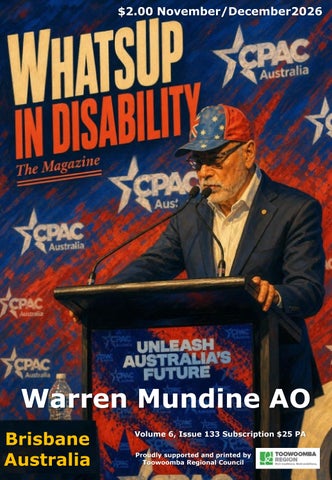
$2.00 November/December2026
Warren Mundine AO Brisbane Australia
Volume 6, Issue 133 Subscription $25 PA Proudly supported and printed by Toowoomba Regional Council
Highlights November/December 2026
Page 4
Page 5
Page 14
Page 17
Page 18
Page 20
Page 21
Page 24
Page 28
WhatsUp in Disability
Page 2
The program drew conservative heavyweights from home and abroad, including former UK Prime Minister the Rt Hon L iz Truss with her address “Save Britain, Save the West,” Senator Jacinta Nampijinpa Price, the Hon Barn aby Joyce MP, investigative journalist Mich ael Shellen ber ger, and Professor Ian Plimer . Across keynotes and panels, delegates tackled the issues at the heart of the movement: free speech, child protection, energy and sovereignty, and the cost of the country’s hard-left turn.
UK PM Liz Truss with The Editor
The weekend’s black-tie Freedom & Hope Gala Dinner featured a keynote from Queenslan d Deputy Premier the Hon Jarrod Bleijie and Gina Rinehart.
Welcome to this issue of WhatsUp in Disability Magazine, a publication by and for people with disabilities that continues to grow from strong local roots.
NatCon 2026 was a rallying point: proof that the leadership is rising, the movement is real, and that Australia’s best days are not behind her, but must be fought for.
Held on 10–11 October at the Royal I nternational Convention Centre in Brisbane, CPAC NatCon 2026 was the largest and most consequential gathering in the organisation’s history, bringing the conservative movement together at a defining moment. Under the banner “Unleash Australia’s Future,” two full days united the leaders who now carry the fight: Opposition Leader the Hon Angus T aylor MP, Sen ator Pauline Hanson, an d Senator Matt C an avan shared the one stage, with Kar l Stefanovic conducting live interviews across all three. WhatsUp in Disability
I was pleased to attend this event in the hope of interviewing some of the speakers to seek their responses to the current situation of the NDIS and their vision of the NDIS in the future. Interviews have been booked and they will be a feature of the next edition. Meanwhile key points raised by the speakers are summarised and appear in this edition of WhatsUp.
Page 3
specific criticism of Chris Bowen’s energy spending and Penny Wong’ s foreign policy conduct. Australia’s vast natural resources and agricultural capacity are being squandered by ideologically driven antidevelopment policies, including restrictions on coal, gas, and minerals exports. Young Australian entrepreneurs and skilled workers — including ex-military drone technology developers — are being driven overseas by high taxes and heavy regulation, representing a serious long-term national loss.
The Chair of CPAC Australia delivered an energetic, politically charged keynote aimed at galvanizing the conservative base. His core message is the urgent need to remove the Albanese federal government and the Victorian Labor government, citing failures in economic management, energy policy, aged care, immigration, social cohesion, and national security. Conservative unity is the central strategic priority — CPAC is framed as the vehicle to unite conservative forces in Australia ahead of federal and state elections. The Albanese government is characterised as economically destructive, ideologically driven, and out of touch with ordinary Australians, with
WhatsUp in Disability
Social cohesion is under threat; the 9 October 2023 Opera House demonstration and subsequent pro-Hamas marches are cited as alarming evidence of cultural fragmentation the government has failed to address. The upcoming Victorian state election is presented as the first critical battleground — a conservative win there would boost national morale and demonstrate that the federal government can also be defeated. Approximately 60% of Australians are dissatisfied with the current government; and Warren argued that conservatives can win their votes by delivering on housing affordability, cost of living, and energy prices. Warren called for action to reduce energy prices and housing affordability.
Page 4
The Coalition’ s recovery blueprint centres on ending reckless spending to relieve inflation and interest rate pressures and restoring fiscal discipline (“government must live within its means”) . Angus pledges to pay down government debt by banking resource revenue windfalls into a future generations fund. He commits to axing all toxic taxes announced in Labor’ s budget and proposes generational tax reform by indexing tax thresholds annually to protect incomes from inflation, with a stated relief schedule for a typical worker: $250 in year one, $500 in year two, $750 in year three, and $1,000 in year four, continuing thereafter.
Mutual Commitment To ground his governing philosophy, Angus recounts growing up in a six- generation farming family and learning to value every dollar, an ethos he argues should guide federal budgeting. He referenced his grandfather’s tenure as chief engineer of the Snowy Mountains Hydro Scheme—completed “ahead of time and be low budget”— crediting empowerment of people and private enterprise. He presented himself as “no career politician,” detailing business ownership and advisory roles across agriculture, energy, resources, and infrastructure, including deregulation efforts to boost competitiveness and productivity. WhatsUp in Disability
To revive enterprise, he announces a permanent $50,000 instant asset write-off for small to medium-sized businesses and promises to rewrite laws, simplify approvals, and slash red tape to expedite projects and economic activity. Regulators would be directed to stop regulating for its own sake and instead make life easier for Australians. Housing supply would be supported through a $5 billion investment in last- mile infrastructure to speed home construction. Prioritising citizens, he proposes limitin g access to housing programs, the NDIS, and 17 welfare programs to Australian citizens only, asserting a principle of mutual commitment (“Only when you commit to Australia should Australia commit to you”).
Page 5
Pauline situates her political identity in lived experience: thirty years prior she delivered her maiden speech as a single mother of four who ran a fish and chip shop in Ipswich. That small business not only paid the bills and fed her family, it gave others work—anchoring her claim to speak for workers and taxpayers who felt unheard by Canberra. She reiterates a core tenet from her maiden speech: a parliamentary seat belongs to the people, is lent to their representatives, and can be taken back. Democracy, in her framing, demands that elected officials tell the truth, take responsibility, keep their word, and remember who they serve.
Pauline Hanson outlined One Nation’ s philosophy of democratic accountability, critiqued the Albanese Labor government and bipartisan policies she says exacerbate Australia’s cost-of-living crisis, and proposes sweeping reforms: scrapping the eSafety Commissioner, init iating a Royal Commission into net-zero, and rebuilding national selfsufficiency in energy and industry.
Pauline threads these obligations through a valuesbased lens rooted in JudeoChristian heritage while explicitly welcoming those who do not share the faith but embrace its civic virtues: duty to family and neighbours, honesty, and moral clarity about right and wrong. This foundation underpins her broader appeal to everyday Australians—workers, farmers, small business owners, parents, and grandparents—who, in her view, deserve authentic representation and accountability.
She calls for conservative cooperation and grassroots mobilisation to translate political change into tangible improvements for families, small businesses, and farmers.
Pauline called for Australia to “stand on its own two feet,” insisting on the capacity to power the nation, feed the population, and defend the homeland.
Australian Governance and Policy Reform
WhatsUp in Disability
Page 6
Matt and Pauline interview with Karl Stefanovic Positioning free speech as the linchpin for all other liberties— “lose it, and you lose the lot”— Hanson condemns what she sees as bureaucratic control over online expression. She argues that an unelected official in Canberra currently decides what Australians may say online, noting that while Labor supports the arrangement, the Liberals hired the official, granted the powers, and extended the tenure for another 5 years. She signals opposition to the role of unelected bureaucrats in constraining speech and criticised public broadcasting entities in that context. In policy terms, she commits that a One Nation government would abolish the eSafety Commissioner, grounding this pledge in the principle that freedom of speech is too important to be policed by unelected authorities. WhatsUp in Disability
Acknowledging that attendees include supporters of the Liberals and Nationals, Hanson commits that One Nation will work with both parties to defeat the incumbent Labor government, emphasising that this cooperation reflects the will of the people. She frames collaboration as a test of integrity: being clear about commitments, keeping one’s word, and prioritizing the nation’s future over personal positions. Drawing on her history—including being thrown out by the legal system, imprisoned, and later having convictions overturned—she underscores her willingness to set aside grievances for the sake of children’s and grandchildren’s futures, calling on others to do the same. Pauline insisted that electoral change must translate into concrete improvements: young couples buying their first home, families affording bills, farmers planning next seasons, and business owners hiring. She appeals to those considering closing businesses, leaving the country, or giving up, urging them to stay and invest their skills and initiative domestically. The pathway she offers is people power: supporters speaking up, running for office, knocking on doors, and talking with neighbours to bring change. She closes with a call to vigilance and action, asserting that Australia’s trajectory is in citizens’ hands and that collective effort can build a better country for the next generation. Page 7
perform physically demanding jobs and often “shower after work, not before work. Matt strongly criticized a recent High Court ruling that effectively links the approval of Australian coal mines to carbon emission levels in China, viewing the underlying laws as fundamentally flawed and in need of urgent change. He dismisses reassurances from Resources M inister Madeline King that the Mount Pleasant Coal Mine has six years of operational life left until 2032, arguing this timeframe offers insufficient job security for workers with long-term financial commitments like mortgages.
Nationals Political Strategy As the Leader of the Nationals, Matt established his primary political mission: to ensure the current Albanese government serves less than 2 more years. He justified his choice of wearing a high-visibility shirt as a deliberate act to provoke his political opponents in the Labor Party, including Prime M inister Anthony Albanese. He asserts that this choice is less “silly” than the “stupid Hawaiian shirts” worn by Albanese and Chris Bowen, which he claims make them look like they are on vacation. Matt contends that the shirt symbolizes his alignment with the hardworking men and women of Australia— the miners, factory workers, farmers, and retail workers who WhatsUp in Disability
Matt laments the decline of Australia’s sovereign manufacturing capability, using the construction of Parliament House as a poignant example of a bygone era. He notes that the building was made almost entirely from Australian products, including grey box gums from the Murray Valley for the Speaker’s chair and jarrah in the Great Hall. Today, he states, Australia’s native forest timber production has fallen by 74% since the building was completed, and the specific jarrah timber is no longer produced domestically. A key proposal is a bill to prevent overseas emissions data from influencing the approval of domestic mining projects. This entire platform is framed within a vision of “Hyper Australia”—a future built on more Australian jobs, industries, farms, dams, and a growing population. Page 8
Jacinta said historical trauma and cultural sensitivity must not take priority over child safety. She criticized an “activist class” and the M inister for Indigenous Australians for focusing on a racism inquiry rather than children at risk. She argued that Indigenous children are disproportionately affected by neglect and abuse, which can contribute to later incarceration. Her position was that children need support, help, and protection before they reach that point.
Child Safety before Cultural or Political Concerns Jacinta said Indigenous children face widespread neglect, abuse, and sexual abuse. She said she has witnessed unmet needs among marginalized Indigenous children throughout her life. I n her view, it is almost impossible to find an adult Indigenous person who has not experienced abuse, neglect, or sexual abuse. The issue is personal to Jacinta. She referred to the alleged abduction and murder of her five-year-old niece earlier in 2026. She said other young people in her extended family have also experienced abuse, neglect, and sexual assault. She described child safety as a central reason that she and her mother, Beth Price, entered politics. WhatsUp in Disability
She called Closing the Gap targets “a farce.” She said the data does not always reflect domestic and family violence and cited an estimate that 90% of abuse cases go unreported. In her niece’s case, she said the child-protection agency had received multiple notifications but treated them as separate matters rather than combining them for risk assessment. She argued that each notification should establish that the child is at risk, and later reports should be considered together and escalated. Jacinta said agencies must stop fearing accusations that child removals would create another Stolen Generation. She said grandmothers on the ground should not have to beg authorities to act. She also accused Labor of keeping Indigenous Australians disadvantaged for political power. She rejected a race-based approach that requires a child’s placement to prioritize culture and country over safety. Page 9
Hon Barnaby Joyce MP
WhatsUp in Disability
Page 10
Sall argued that judges acted as “good little minions,” following orders rather than applying evidence and truth; and claimed to have evidence that a topdown ideology drives these outcomes. Described an imposed ideology that demands ignoring basic instincts, facts, and reality, enforced by government fear and punishment. Sall warned that rights hinge on words like woman, lawyer, tenant, citizen, violence; says judiciary is willin g to redefine terms against those they describe, harming legal protections.
Women’s Sex-Based Rights Sall delivered a speech asserting that courts and government have redefined “woman” to include men, harming women’ s sex- based rights. She recounted losing the Giggle v T ickle case, criticised institutions and policy impacts, and called for political action to restore sex- based definitions and freedoms. Sal went to court to establish “what is a woman” and lost 3 times to a male claimant; asserts men cannot be women. the Australian Human Rights Commission convinced courts that “woman” includes men who identify as women, without evidence, turning “woman” into a mixed-sex category.
WhatsUp in Disability
Claimed that officials don’ t truly believe men can be women, but favour power and chaos created by such claims. Noted the High Court refused to hear “Giggle Beetle” (Giggle v Tickle), declaring no possibility of success; views this as an order, not a legal conclusion. The Sex Discrimination Act (1984) didn’ t define sex, assuming ordinary meaning; asserts current interpretations ignore common sense and reality. Sall calls for a free society where men can wear dresses but cannot redefine themselves as women; insists courts and government are wrong and men are not women. Sall encourages us to email representatives and keeping receipts to ensure officials can’ t claim ignorance.
Page 11
Australian courts are engaging in “judicial activism,” making political decisions that constitutionally belong to the elected, accountable Parliament. The High Court’s decisions to release non-citizen criminals who cannot be deported—and later to strike down monitoring measures like ankle bracelets— prioritize individual rights over community safety, overriding Parliament’ s risk-management efforts. Laws such as Section 18C of the Racial Discrimination Act empower judges to regulate political speech, effectively deciding which side of a political debate is legally permissible.
Judicial Activism Australian courts, particularly the High Court, are exceeding their constitutional role by making political decisions “judicial activism” which undermines the democratically elected Parliament. This has concrete negative impacts on community safety and free speech and M ia calls for greater public scrutiny of the judiciary and for the government to appoint judges committed to judicial restraint. Contrasts politicians’ intense scrutiny (press galleries, question time, elections) with the j udiciary’ s lack of direct accountability; j udges serve until retirement and make consequential decisions without answering to the public.
WhatsUp in Disability
The threat of j udicial review causes “legislative paralysis,” where elected governments hesitate to pass laws until they know what courts will allow, ceding governing power to the judiciary. A rare opportunity exists to reshape the High Court: five of the seven justices will retire over the next decade, enabling appointments of judges who practice judicial restraint. Premier Chris Minns said he would wait for a High Court ruling on a similar Queensland law before legislating to outlaw certain protest chants, criticizing this as an elected government awaiting court permission and asking, “Who is really governing whom?”
Page 12
1. Free speech should be preserved, with legal action focused on incitement to violence rather than offensive speech. 2. Specific slogans (e.g., “globalize the I ntifada”) are viewed by some panellists as direct threats to the Jewish community and potentially prosecutable incitement. 3. Government responses after October 7 are criticized for inflaming tensions and undermining Israel, allegedly correlating with a rise in antisemitism domestically.
A Panel Discussion on Free Speech A conservative- leaning panel discussed antisemitism in Australia, free speech versus incitement to violence, government responses after October 7, and the role of Holocaust education. Speaker 1 supports protecting free speech while prosecuting incitement and defunding entities that spread hatred; Speaker 2 moderates pointed questions
with
Speaker 3 shares first- hand observations from Israel and promotes school-based Holocaust education;
WhatsUp in Disability
4. Education, especially Holocaust education framed around bullying and the historical progression of discriminatory laws—is vital to inoculate young people against indoctrination and hatred. 5. Defunding public institutions that platform or normalize perceived hate (media, universities, certain organisations) is proposed as a policy lever. 6. The panel positions Israel as a frontline defender of Western values and a model of democracy and innovation, urging solidarity and proactive civic engagement. 7. Community-led initiatives (school programs, public talks, trips to I srael) can counter misinformation and foster understanding.
Page 13
By Suzanne Mason Home Carers Alliance
Do you enjoy living with others or prefer your own space? Would you like to be closer to family, friends or community activities? What daily support do you need?
Finding a Place to Belong Understanding the journey to Supported Independent Living Finding the right home is an important step towards greater independence, but for people living with disability, the journey can sometimes feel overwhelming. Supported Independent Living (SIL) provides assistance with everyday tasks, helping eligible NDIS participants develop skills, maintain independence and live as independently as possible. But where do you start? Step 1: Understanding your needs and goals Before looking at properties, think about what matters most to you. WhatsUp in Disability
These conversations help identify what a suitable living arrangement might look like. Step 2: Un derstan din g your NDIS funding SIL funding covers eligible support with daily living tasks, not the cost of the home itself. A Support Coordinator can help you understand your NDIS plan, explore your options and identify whether additional assessments or funding discussions with the NDIA may be needed. It's also important to understand the difference between SIL and Specialist Disability Accommodation (SDA), which provides eligible participants with funding towards specialised housing.
Page 14
Step 3: Finding the right home and housemates
More than just somewhere to live
Once your needs and funding are understood, it's time to explore suitable accommodation.
Finding the right home takes time, conversations and collaboration between participants, families, Support Coordinators and providers.
Consider accessibility, location, shared living arrangements and compatibility with potential housemates. Visiting a property, meeting the people who live there and asking questions about daily routines can help you make an informed decision.
Step 4: support
Planning
Because everyone deserves more than somewhere to live. They deserve somewhere to belong.
your
The right support is just as important as the right home. Work with your support team to develop a personalised approach that reflects your routines, interests, goals and preferences. This might include assistance with personal care, preparing meals, household tasks and accessing community activities.
Step 5: Settling staying connected
in
and
Suzanne Mason – A Brief Biography
Moving into a new home is a big change.
Suzanne Mason is a Toowoomba-based professional with experience in the banking and community services sectors. Having previously been the franchise owner of a local Bank of Queensland, Suzanne has brought her professional experience into the disability support sector, where she is currently associated with Home Carers Alliance.
Having familia r routines, maintaining friendships and participating in local activities can help make the transition easier. Regular conversations with your support team can also help ensure your arrangements continue to meet your needs.
WhatsUp in Disability
Page 15
By Sam Paior The Growing Space
Restrictions Short- term respite is only available to provide relief to an unpaid carer who delivers more than 6 hours of unpaid support per day. It cannot be claimed if the participant is already funded for more than 18 hours of paid support per day.
Short-term Respite NDIS has now changed from “Short-Term Accommodation” (STA) to “Short-Term Respite.” The NDIS outlined some sector trends—such as substantial claim reductions and provider exits—and clarifies what remains permissible, including standard lodging types and support worker accommodation.
Allowable • Participants can still use hotels, motels, Bed & Breakfasts (B&Bs), hostels, and homestays. • Funding can cover accommodation for support workers if overnight care is required and no on-site support is available.
WhatsUp in Disability
Funding cannot be used by individuals living independently alone, or those in Supported Independent Living (SIL) group homes, under SI L arrangements, or under Individualised Living Options (ILO). Short-term respite can no longer be used for capacity building, such as testing independent living transitions for people currently in group homes. Claims for meals and activities are not permitted unless the stay is in a group or centrebased respite facility where meals and activities are bundled into the service. Travel costs cannot be claimed directly from the respite budget; participants may only use their standard fortnightly transport funding allowance. Interstate and overseas travel for short-term respite is prohibited, with narrow exceptions for participants in border towns (e.g., Albury– Wodonga) or very remote areas lacking local facili ties. Page 16
Ms Stoker entered federal politics in 2018 when she was appointed to the Australian Senate as a Senator for Queensland. During her time in the Senate, she served as Assistant M inister to the Attorney-General, Assistant Minister for I ndustrial Relations and Assistant Minister for Women. She also held senior committee responsibilities, including chairing the Senate Legal and Constitutional Affairs Legislation Committee.
The Honourable Amanda Stoker MP is an Australian politician and member of the Liberal National Party (LNP), representing the Queensland electorate of Oodgeroo, which includes parts of the Redlands region. She was elected to the Queensland Parliament at the October 2024 state election. Before entering state politics, Ms Stoker built a career in law and public service. She studied Arts and Law at the University of Sydney before working as a solicitor, serving as an associate to j udges of the High Court of Australia and the Supreme Court of Queensland, and practising as a barrister. Her legal experience included commercial law, administrative law and corporate crime.
WhatsUp in Disability
On 24 October 2026, Queensland Premier David Crisafulli announced Ms Stoker' s appointment to Cabinet following the resignation of Amanda Camm from ministerial responsibilities due to illness. Ms Stoker assumed responsibility for the portfolios of Minister for Families, Seniors and Disability Services and Minister for Child Safety and the Prevention of Domestic and Family Violence. Her appointment was formally sworn in at Government House. The disability services portfolio places Ms Stoker in a significant position of responsibility for policies and services affecting Queenslanders with disability, their families, carers and the organisations that support them. Her role will involve overseeing disability services and contributing to the Queensland Government's broader responsibilities for community care, inclusion and support.
Page 17
By Davina Smith Channel Nine Current Affair
While Ben Holmes acted as the public promoter and Jessica Holmes served as company director handling admin, internal financial discrepancies emerged by 2024
Where’s my Super? A report by A Current Affair journalist Davina Smith examines allegations that Ben and Jessica Holmes, founders of Toowoomba-based NDIS provider Semloh Support Services, failed to pay approximately $500,000 in superannuation to around 80 staff members. Despite selling the business for a reported $1.65 million and maintaining a high-end lifestyle on the Gold Coast, forme r staff continue to wait for substantial unpaid entitlements. Founded in Toowoomba by Ben and Jessica Holmes, Semloh Support Services expanded to 80 employees with plans for Sunshine Coast expansion.
WhatsUp in Disability
Emma, a company manager, noted she had assumed superannuation listed on payslips was being deposited until a support worker reported missing payments. When queried by email, Jessica Holmes acknowledged an issue totalling over $300,000, while Ben Holmes claimed missing funds resulted from back-end processing errors that would soon be deposited. Emma resigned immediately after the response, citing severe disappointment. Individual staff members reported extensive unpaid balances dating back to 2022 despite payslip s recording regular contributions: Kelly (Senior Support Worker): Contacted the Australian Taxation Office (ATO) and identified $10,000 in missing superannuation. When confronted, company management attributed the delay entirely to the ATO. Subsequent ATO distributions have been minimal; Kelly received an $80 disbursement on 2026-09-15 for the first quarter of September 2023, leaving over $8,000 still outstanding, while Emma received a single payment of one cent. Page 18
shifts. From the first full pay period starting on or after 1 June 2026, employers and employees can agree to work shifts of up to 12 ordinary hours where work is performed immediately before and after a sleepover. A maximum of eight ordinary hours can be worked on either side of the sleepover. The changes also affect rest breaks and the way shift allowances are calculated.
Fair Work Ombudsman The Social, Community, Home Care and Disability Services Industry Award (SCHADS Award) is undergoing significant changes in 2026, with important implications for disability support workers, home care employees and the organisations that employ them. The changes follow a Fair Work Commission review into genderbased undervaluation of work in industries traditionally employing large numbers of women. The review recognised the skills, responsibilities and value of work undertaken across the social and community services sector. One of the most immediate changes relates to sleepover
WhatsUp in Disability
A further major development will be the introduction of a new classification structure, revised definitions and changes to the rules governing progression between pay points. These changes are intended to better recognise the skills, experience, qualifications and responsibilities involved in social and community services work. Most of these reforms will commence from the first full pay period on or after 1 October 2027. However, home care employees providing disability care will receive an initial increase of up to 15 per cent to their minimum award rates from 1 December 2026. Any remaining increase for these employees will be applied from October 2027. The exact increase will depend on the employee's classification and applicable pay rate. For disability service providers, the changes mean it is important to review employment arrangements, payroll systems, employee classifications and future staffing budgets.
Page 19
Draft saving: You will have the ability to click "Save for later" on your reports. Drafts will be saved securely in your portal for up to 30 days, allowing you to gather necessary information before submitting. Improved dash boar ds: You will have access to centralised dashboards where you can easily view your submitted reports, manage drafts, and see a list of due or overdue monthly reports for restrictive practices.
NDIS NEWS The new NDIS Commission portal introduces a range of smart features designed to save you time and provide a smoother experience: Pre-filled infor mation: T he portal is integrated with external databases like the Australian Business Register (ABR) and NDIS Worker Screening Database (NWSD) so we can pre- fill your legal name, addresses and key personnel worker screening status when provided with valid Australian Business Numbers (ABNs) or NWSD numbers. Dynamic, tailored forms: Onesize-fits- all forms are gone. The new system dynamically adjusts the fields you are required to complete based on the answers you have already provided.
WhatsUp in Disability
Simplified behaviour support plan an d authoris ation uploads: Implementing providers will be able to manage their authorisation documents more easily, with the option to upload a single authorisation document that applies to all restrictive practices in a plan, rather than doing it one by one. In-portal gu idan ce: The new NDIS Commission portal forms have guidance on how to use them. For example, before submitting a report, there will be an explanation on what is an unauthorised restrictive practice (URP) , versus what should be reported as abuse or neglect. Self-service information our website:
on
The information published on our website for the existing portal will be replaced with new instructions that will help guide you through the new system.
Page 20
You should understand what a service agreement is before making one. You should also understand when you need a service agreement and who can help you make one. Learn about your rights and responsibilities when working with providers before you make your service agreement. You and your provider should work together to make a service agreement. Y ou should understand the information you’ re providing and how it’s being kept private before finalising the agreement.
WhatsUp in Disability
Page 21
Some Thriving K ids supports are available now. More supports will become availa ble over time. They will all be rolled out across Australia by January 2028. There will be no changes to how people access the National Disability I nsurance Scheme (NDIS) until 1 January 2028. Support provided early in a child’s life can make a positive impact on their development. Understanding how children develop, can help you identify earlier if your child may need some extra help and get them access to the support they need.
Thriving Kids is for families
and their children aged 8 and under with developmental delay or autism. Thriving family:
K ids
can
• learn about development
help
your
childhood
• identify if your child need extra support
might
• access trusted resources and information • find supports that match your child’s development needs. Thriving K ids aims to be an easy place to start when families are unsure what might be going on for their child.
Every child develops in their own way. When young children take more time to develop physical, emotional, social, communication or thinking skills, this is called developmental delay. Developmental delay can show up in the way children move, communicate, think, learn, or behave with others. I t can be short-term or long-term. Early support can help children build their strengths, take part in social and school activities, and grow the skills they need for everyday life, giving them the best start in life. Sometimes children who get early support need less or no support as they get older.
You don’ t need a diagnosis to access supports.
WhatsUp in Disability
Page 22
WhatsUp in Disability
Page 23
By Clifford Gouldson Lawyers
arrangements are likely to be non-compliant with the Clerks Award's hours and break provisions. This new clause aims to support "workable" work-from-home arrangements whilst simplifying compliance of the Award for employers.
The Employee Request and Employer Response The new clause 5A allows employers and employees to agree to modify award provisions that might otherwise create compliance difficulties, including the requirement to work ordinary hours continuously, when ordinary hours are to be worked, and the timing of rest and meal breaks.
Working from Home From 26 October 2026, a new provision in the Clerks – Private Sector Award, clause 5A, headed Requests for working from home arrangements, will allow covered employees to formally request working-fromhome arrangements or to formalise an existing working from home arrangement. Importantly, the changes do not give employees an automatic entitlement to work from home.
Why the Change The Fair Work Commission recognised that working from home arrangements amongst clerical employees is widespread, particularly since COVID, and found that many existing working from home
WhatsUp in Disability
Essentially clause 5A simply lets an employee ask to work from home and lets an employer agree. I mportantly, the clause sets no time within which an employer is to respond to a request, and it does not require the employer to provide reasons or grounds on which a request may be refused. T he new clause does not establish an automatic right for employees to work from home. The only formal requirements on the request itself are as per clause 5A.3, which notes that the request must be: • made in writing; and • must specify the day(s) of the week, or the number, proportion or pattern of days, that the employee proposes to work from home.
Page 24
The Agreement Where both parties do agree, the agreement must be in writing and record: • the days of the week, or number of days, proportion or pattern of days on which it is agreed the employee will work from home; • the location from which the work will be performed; • any modifications to the provisions of the Clerks Award e.g. altering the spread of ordinary hours, making up time taken off during working from home, changing shift start and finish times, and time off in lieu of payment for overtime; • the start date; • how the arrangement may be varied or terminated. Further these arrangements must be kept as time and wages records, and employees must receive a copy.
Flexible Working Arrangements The new clause will operate alongside the rights of eligible employees to request flexible work arrangements under section 65 of the Fair Work Act and employers must comply with those requirements where applicable.
What should employers do • Check which award covers your employees - review employee classifications and the applicable modern award. • Review and update workplace policies to align with the new provisions of the Award. Review existing working-fromhome arrangements - consider formalising those arrangements if the employer and employee wish to use the new award provisions.
Workplace right The right to make a working from home arrangement will constitute a workplace right within the meaning of s 341( 1)(a) which is protected by s 340 of the Fair Work Act 2009. So it is important for employers to ensure that no adverse action is taken against an employee as a result of making such a request.
Disputes Any disputes about a request made will be subject to the dispute resolution procedure in clause 40 of the award. WhatsUp in Disability
Page 25
By Steven Paull WhatsUp in Disability
The expo offered an opportunity for job seekers to make valuable connections, ask questions and gain a better understanding of the employment opportunities available throughout Toowoomba and the wider Darling Downs.
Jobs Expo Toowoomba The historic Railway Goods Shed in Toowoomba was transformed into a hub of employment opportunities on Thursday, 15 October, when the 2026 Toowoomba Jobs Expo brought together employers, recruitment agencies, training providers and job seekers. The event provided an opportunity for people looking for work, considering a career change or exploring further training to meet directly with organisations from a wide range of industries. With employers offering information about current vacancies, apprenticeships, traineeships and career pathways, visitors were encouraged to bring their resumes and take advantage of on-the-spot interviews and potential employment opportunities. WhatsUp in Disability
Supported by the Queensland Government and Workforce Australia, the event highlighted the importance of connecting local people with employers and helping build a skilled and sustainable regional workforce. Exhibitors represented industries including health, disability support, manufacturing, construction, agriculture, hospitality, retail, transport, government services and education. Training organisations and employment support providers were also available to discuss qualifications, skills development and pathways into the workforce. Among the local organisations represented was 102.7 FM Community Radio, which showcased opportunities for people interested in community broadcasting, radio announcing and technical roles. Steven and Lucas represented the station, and we were joined by Prince Long Lo from UniSQ.
Page 26
Movie Review Pressure
Starr in g Bren dan Fr aser, Andrew Scott, Kerry Condon and Damian Lewis Pressure is a tense and compelling World War II drama that takes audiences behind the scenes of one of the most important military decisions in modern history: the timing of the D-Day invasion of Normandy in June 1944. Directed by Australian filmmaker Anthony Maras, the film focuses on the critical 72 hours before the Allied forces launch their massive invasion of Nazi-occupied Europe. At the centre of the story is General Dwight D. Eisenhower, played by Brendan Fraser, who faces an almost impossible decision. Should he proceed with the invasion as planned, or delay it because of dangerously unpredictable weather?
By Rob Morgan Media Podcaster
meteorologist Captain James Stagg, whose weather predictions challenge the more optimistic forecasts of his American counterpart. The tension between the two men provides much of the film's drama, highlighting the importance of scientific evidence, professional integrity and having the courage to stand by your convictions.
Verdict: A gripping, thoughtprovoking film that demonstrates how courage, leadership and even the weather can shape the course of history. Highly recommended for fans of historical dramas and World War II films. 8/10
Fraser delivers a powerful performance as Eisenhower, portraying a commander carrying the enormous responsibility of thousands of lives on his shoulders. His performance captures the frustration, determination and emotional burden of a leader who knows that one wrong decision could change the course of history. Andrew Scott is impressive as British WhatsUp in Disability
equally
Page 27
102.7 FM is, first and foremost, a community radio station. Our greatest strength is the people who give their time, skills and enthusiasm to make the station what it is.
102.7 FM Community Following our strategic planning meeting, which was held on Tuesday 6th October, I am pleased to provide an update on our progress and the direction of 102.7 FM Community Radio. The recent meeting was an important opportunity to review the goals and actions we identified in our strategic planning process last year and to assess our progress against our first-year objectives. I am very pleased to confirm that we have successfully completed, or are well on the way to completing, many of these important goals. The next stage will be one of the most challenging and important phases of our strategic plan WhatsUp in Disability
I therefore welcome constructive input from all announcers, members and volunteers as we move forward. Your experience, ideas and feedback are important to ensuring that the decisions we make reflect the needs of our station, our members and the community we serve. We have made significant progress over the past year, and I am proud of what we have achieved together. Our journey towards excellence in community broadcasting continues, and I look forward to working with everyone as we take the next important steps. There is still considerable work to be done before these changes are implemented, and further information will be provided to members and announcers as plans are finalised. Thank you for your continued commitment, support and contribution to 102.7 FM Community Radio.
Page 28
Centre The Paul Myatt Community Centre is a welcoming hub where people with disability, their families, carers and the wider community come together to connect, learn and participate in inclusive activities. Managed by WhatsUp in Disabilit y since 2011, the Centre is dedicated to creating opportunities for social inclusion, education and community engagement. Unfortunately, every time it rains, our car park becomes flooded, muddy and difficult to navigate. For many visitors this is inconvenient, but for people who use wheelchairs, walking aids or have limited mobility, it can make accessing the Centre unsafe—or even impossible. Families with young children, older Australians and transport providers also face significant challenges entering and leaving the Centre. We are raising funds to transform the car park by installing a sealed bitumen surface together with kerb and channel infrastructure to divert stormwater away from the entrance. These improvements will provide a safe, all-weather accessible parking area that can be used year-round, regardless of the weather. Every contribution, no matter how large or small, will help us remove a significant barrier to participation. By supporting this project, you are investing in a more accessible, inclusive and welcoming community where everyone can participate with dignity and independence.
www.givenow.com.au/carpark Click on the GiveNow logo to go to the fundraise page
WhatsUp in Disability
Page 29
November
WhatsUp in Disability
Page 30
December
WhatsUp in Disability
Page 31
New to Disability? Centrelink Payments and Services
132 468
Disability Support Pension 132 717 Health Care Card
132 490
Family Assistance
136 150
Indigenous Call Centre
1800 136 380
Emergency Crisis Payment 132 850 NDIS General Enquiries
1800 800 110
Medicare General Enquiries
132 011
Pharmaceutical Benefits
132 290
MyID Help Desk
132 307
Queensland Government Child Safety
4699 4255
Toowoomba Hospital
4616 6000
Department Housing
4699 4400
Community Groups Carer Gateway
1800 422 737
Lifeline Darling Downs
1300 991 443
Relationships Australia
1300 364 277
There are a number of support groups for most disabiliti es available in this region. Contact WhatsUp in Disability Phone: Email:
WhatsUp in Disability
0427 987 654 steven@bigdog.au
Page 32
Statewide Support Councils across Queensland recently endorsed Toowoomba Regional Council’s motions covering calls for improved security for Mayors and Councillors, statewide business waste audits and school waste education, Councillor candidate election requirements and the restoration of state government-led fluoridation of public water supplies. The motions were supported at the Local Government Association of Queensland (LGAQ) annual conference in Cairns. Toowoomba Regional Council Mayor Cr Geoff McDonald said he and his colleagues were pleased to see majority support for the matters covering important strategic items that would aid local government service delivery in critical areas such as waste diversion and water supply across Queensland. “The annual LGAQ conference provides an opportunity for local governments from across Queensland to form policy positions and advocate to the Queensland and Australian governments on relevant matters,” Mayor McDonald said.
WhatsUp in Disability
“The motions we put forward affect most of the 77 local government areas in Queensland, and we are pleased to see they have been strongly supported. “Local government is committed to playing its part to meet State targets for diverting waste from landfill and our motion calls on the LGAQ to press the Queensland Government to establish, resource and fund a state business waste audit program. “This will aid the assessment of waste generation, disposal practices and resource recovery opportunities across the commercial and industrial sector. The goal is to reduce commercial and industrial waste streams, which are among the largest contributors to landfill, while lowering businesses’ operating costs. “A related motion also asks LGAQ to call on the Queensland Government to fund a coordinated, statewide program to deliver standardised recycling infrastructure and education across all schools to support improved waste outcomes. Published on 02 November 2026
Page 33
Details PUBLISHER Disability Media Association Inc
(Australia)
TELEPHONE (07) 4632 9559 MOBILE 0427 987 654 OFFICE:
Paul Myatt Community Centre 11-15 Alexander Street Toowoomba
(open Monday to Friday 9:00am-3:00 pm) E-MAIL:
steven@bigdog.au
MANAGEMENT BOARD: Steven Paull (Editor) (Committee) Ann Paull (Committee)
Courtney Carroll (Committee) Jess Wright
PUBLISHED January/March/May/July/September/November ABN 72 821 350 911 DISCLAIMER/INDEMNITY Articles and adverts reproduced on these pages are accepted and published in good faith. It is a condition of acceptance that sponsors and article writers accept full responsibility for their sponsorship and articles, and will fully indemnify the producers in the event of any claims or legal proceedings against them. Articles published are not necessarily the view of the publishers. Sponsorships are also accepted on the basis that they do not conflict with any discrimination laws or other laws currently in force. SPONSORSHIP WhatsUp is a nonprofit and charity organisation, we are not funded in any way, and have to cover costs of this publication by charging for sponsorship. WhatsUp reserves the right to adjust, resize or move sponsorship posts when necessary to allow for editing WhatsUp IS AVAILABLE FROM: 1) SUBSCRIPTION
(In advance) $25 per year (includes delivery/postage).
2) A single edition of WhatsUp can be purchased at the Paul Myatt Community Centre and selected outlets. You may also subscribe by using the form on the outside cover. 3) Reference copies are held in the Toowoomba Visitor Centre and Regional Libraries. COPYRIGHT Copyright Protected. All pages are subject to copyright law and may be copied only with the permission of WhatsUp. Copies are not to be used commercially or for profit or for personal financial gain. Permission may be granted to copy only if the purpose is to give it away to others for their personal interest but not to any other organisation or service. DISCLAIMER All articles are accepted in good faith and are not necessarily the view of the Editorial team or Management. Articles are accepted on the understanding that in the event of any claims against WhatsUp, the writer of the article will take full responsibility and indemnify WhatsUp in the event of legislation against it. Articles are also accepted on the understanding that the contents do not breach any Disability laws or other legislation currently in use. ENVIRONMENTAL FRIENDLY/ COPYING WhatsUp In Disability is provided as a Master Copy to individuals and organisations or to view online at our website. We are environmentally friendly; we do not print any more copies than are necessary. We prefer and encourage the practice of passing the magazine from person to person or copying the whole magazine to pass on to others. Permission is needed to copy (see Copyright above) When copying the magazine, we require that the pages be marked ‘copy’.
WhatsUp in Disability
34
WhatsUp in Disability
35
11-15 Alexander Street Toowoomba 4350 Phone: 0427 987 654 Email: steven@bigdog.au
WhatsUp in Disability
36