








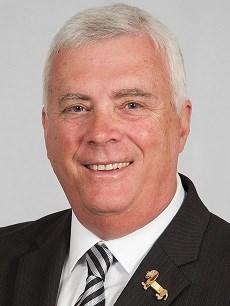

Welcome to this issue of WhatsUp in Disability Magazine, a publication by and for people with disabilities that continues to grow from strong local roots.
For more than 30 years, our magazine has shared stories that matter, and this edition carries that tradition forward with care and purpose.
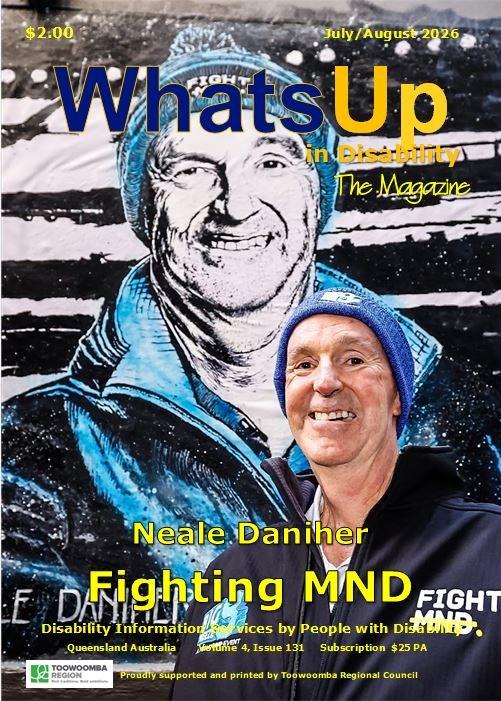
Inside, you'll find a powerful look at community champions, including the motivational story of Neale Daniher, the latest NDIS updates, and practical resources for everyday life.
You’ll also meet contributors whose experiences remind us why community voices belong at the centre of the conversation.
Every article in these pages reflects the time, effort, and honesty of people who want to make their communities stronger and more inclusive.
We are grateful to the writers, volunteers, families, and supporters who help bring each issue to life. Your stories, insights, and encouragement keep this magazine grounded in real experience and shared understanding.
Thank you for reading, contributing, and standing with us as we continue to amplify voices that deserve to be heard.
Together, we keep building a magazine that informs, connects, and empowers.
Just as the entire disability sector had its eyes fixed on the Securing the NDIS Bill inquiry, the NDIA has just quietly dropped its Annual Pricing Review (APR) and the new "Pricing Schedule"- the new name for what was previously the Pricing Arrangements and Price Limits (which replaced the OG Price Guide).
The APR has recommended:
• Passing on the Fair Work Commission’s Annual Wage Review
• Reviewing the DSW Cost Model
• Level 2 Support Coordination and Plan Management rates to remain frozen
• Short Term Accommodation (STA) to be unbundled, creating separate line items for accommodation and support
• Unregistered providers delivering Social, Community and Civic Participation supports will be paid 10% less than registered providers from January 2027
• Some adjustments to different therapy and nursing supports
Annual Pricing Review 2026-27
Pricing Schedule
Available on the NDIA's website.
Steven Paull
WhatsUp in Disability
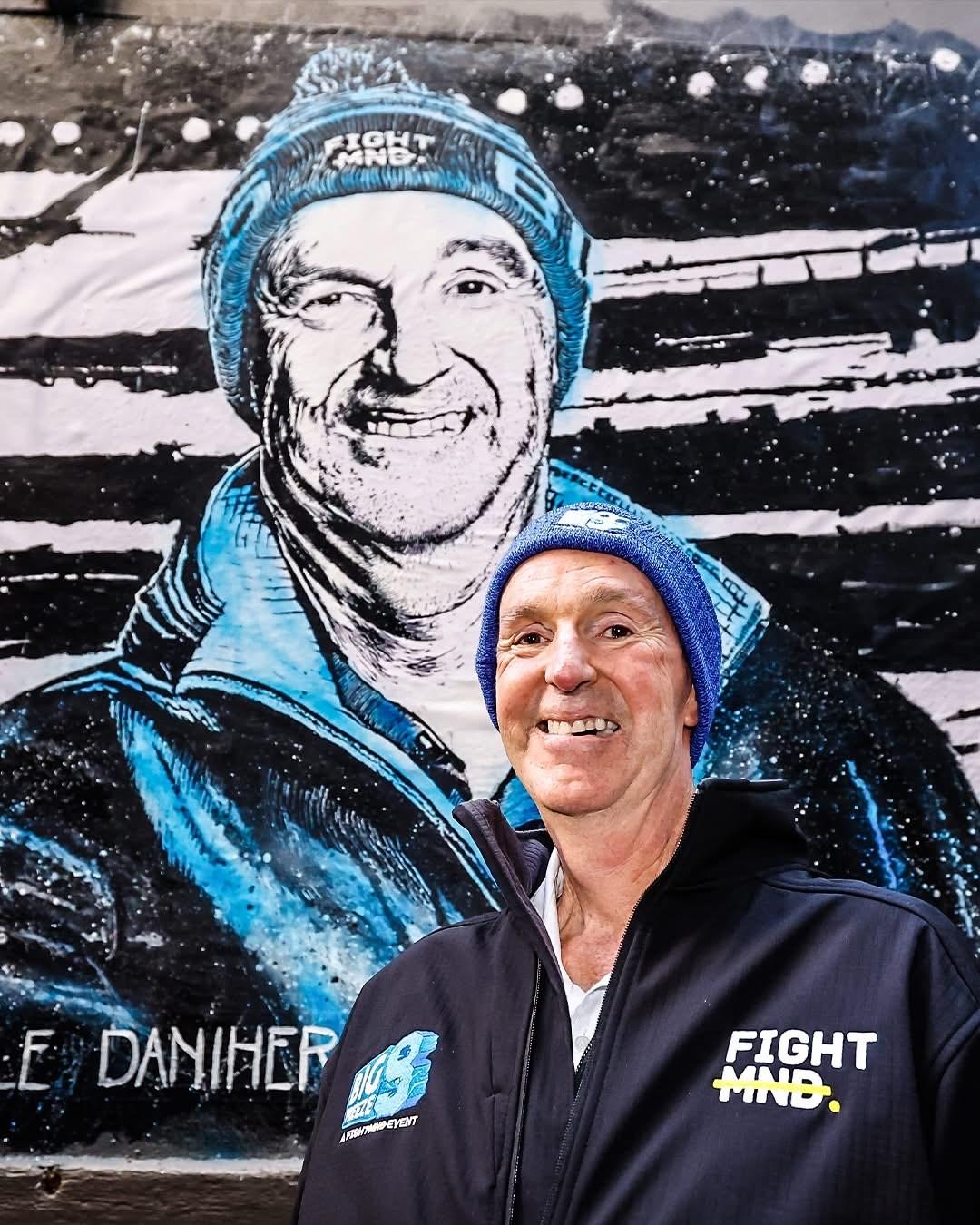
Few Australians have demonstrated courage, determination and resilience quite like Neale Francis Daniher AO.
A respected Australian Rules footballer playing 82 games with the Essendon Bombers. At the age of 20, he was named the Club’s youngest ever captain, a testament to his leadership and dedication. Part of the famous Daniher football dynasty – four brothers from the bush who played a combined 752 VFL/ AFL games – Neale’s promising career was cut short by injuries.
Neale was appointed as the coach of the Melbourne Demons and later with Essendon, Fremantle and West Coast and educator, Neale became one of the nation's most admired advocates following his diagnosis with Motor Neurone Disease (MND) in 2013.
Rather than allowing the disease to define him, he transformed his personal battle into a powerful movement that has inspired millions of Australians and raised unprecedented awareness and funding for MND research.
Born in the small Victorian town of Ungarie and raised on a farming property in the Riverina region of New South Wales, Neale was one of 11 children. Sport was a central part of family life, and four of the Daniher brothers would go on to play Australian Rules football at the highest level. Neale joined the Essendon Football Club in the late 1970s and enjoyed a successful playing career before moving into coaching.
After retiring as a player, Daniher established himself as one of football's most
ByStevenPaull
respected coaches. He served in a variety of coaching roles before becoming senior coach of the Melbourne Football Club from 1998 to 2007. Known for his integrity, leadership and commitment to developing people, he earned widespread respect throughout the football community.
In 2013, Neale received life-changing news. He was diagnosed with Motor Neurone Disease, a progressive neurological condition that attacks the nerves controlling movement, gradually robbing people of their ability to walk, talk, eat and breathe. At the time there was no cure, and survival rates were often measured in only a few years.
Many people would have retreated from public life following such a diagnosis. Neale chose a different path.
Determined to make a difference for future generations, he became a tireless advocate for MND research and support services. Together with his family, friends and supporters, he helped establish the charity FightMND. The organisation was created with a simple but ambitious goal: to find effective treatments and ultimately a cure for Motor Neurone Disease.
One of the charity's most visible initiatives became the annual "Big Freeze" campaign. Each year, prominent Australians slide into a pool of icy water to raise awareness and funds for MND research. What began as a creative fundraising idea quickly grew into one of Australia's most recognised charitable events, attracting national attention and generat-
ing millions of dollars for research. The impact has been extraordinary. Through community support, corporate partnerships and fundraising initiatives, FightMND has contributed tens of millions of dollars towards research projects, clinical trials and care programs. More importantly, it has brought Motor Neurone Disease into the national conversation and given hope to thousands of individuals and families affected by the condition.
Despite the progression of his disease, Neale continued to speak publicly, write, advocate and inspire. As his physical abilities have declined, his influence has only grown. His determination to focus on what he can still do, rather than what he has lost, has become a powerful example of resilience and positive thinking.
"Lessons for those who want to take charge of their life”
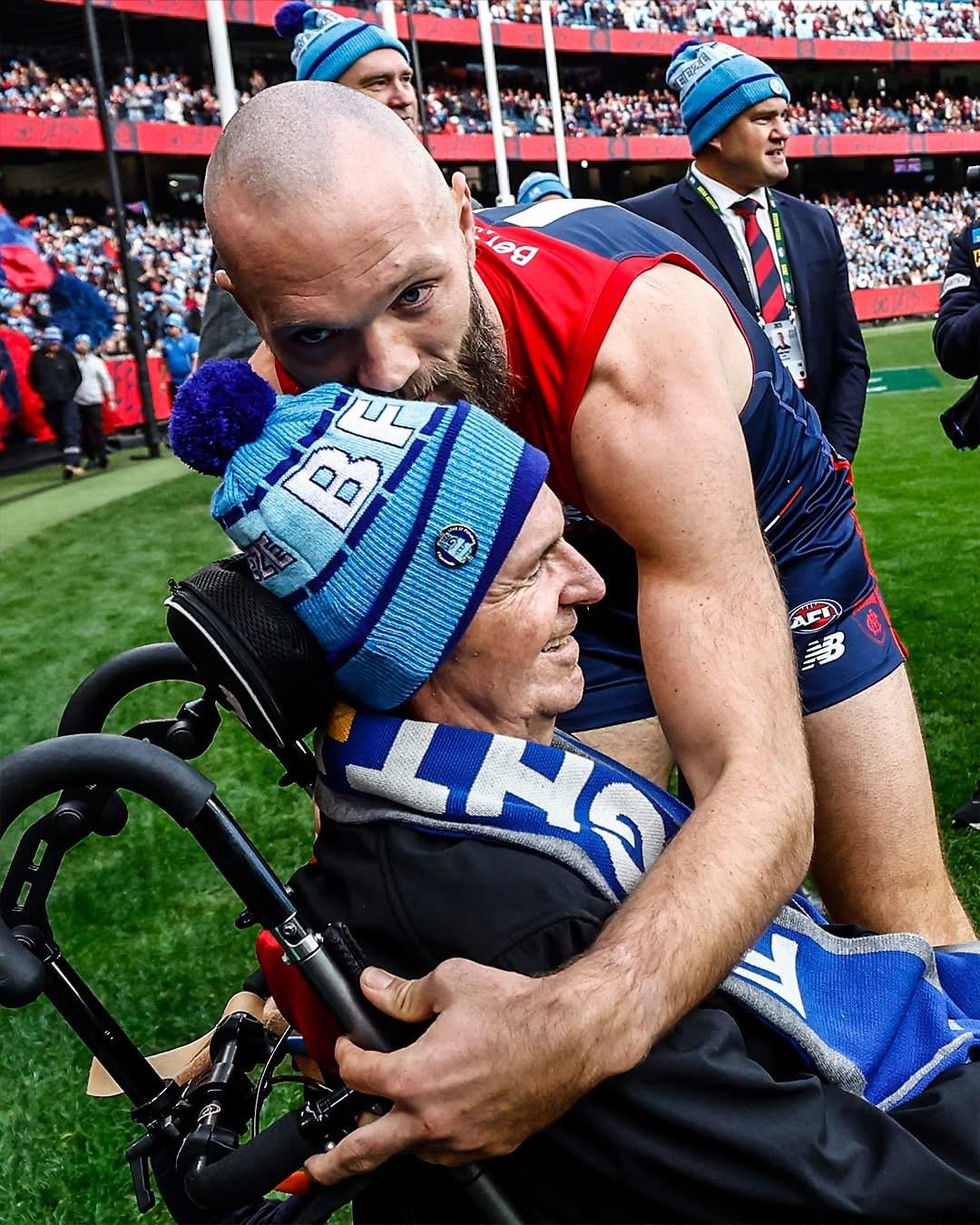
philosophy has resonated far beyond the football field and the disability sector, touching people from all walks of life.
For the disability community, Neale's story demonstrates that disability does not diminish a person's value, leadership or capacity to create change. He has shown that even in the face of immense personal challenges, individuals can continue to contribute, inspire and lead.
His message is one of hope, courage and purpose. Rather than asking "Why me?", Neale often speaks about making the most of every day and using adversity as an opportunity to help others. His
Today, Neale Daniher stands as one of Australia's most influential disability advocates. His legacy extends well beyond football. Through his leadership, fundraising and unwavering optimism, he has changed public perceptions of disability, transformed MND research in Australia and inspired a nation to believe that one person can make a profound difference.
His journey reminds us that true strength is not measured by physical ability but by courage, character and the determination to leave the world a better place than we found it.

By JoelCanning,CanningTaxandAdvisory
Changes to apply from 1 July 2027
The Government is planning to tighten up negative gearing on established residential properties. For properties purchased after 7:30pm AEST on 12 May 2026:
Rental losses can only be offset against rental income or capital gains from other residential properties.
The 2026–27 Federal Budget, released on 12 May 2026, has received more attention than most budgets in recent years.
With proposed changes to negative gearing, the CGT discount and the taxation of trusts, this is a budget that has the potential to materially impact on property investors, business owners and families using discretionary trusts.
However, it is important to remember that the proposed changes are not yet law and we might yet see further developments with some of these key proposals. For example, even though legislation has been introduced into Parliament in relation to some of the measures, there is no guarantee that the Bills will be passed in their current form. While we don’t yet have certainty on how this will all play out, we understand that the proposals are causing some confusion and concern and so we have set out below some comments on what we know so far.
Any remaining losses must be carried forward and applied only against future residential rental income or residential property capital gains.
Grandfathering applies. If you already own an established property or had exchanged contracts before Budget night— nothing changes in terms of negative gearing. You can continue to deduct losses against salary, business profits and other income sources until you sell the property.
The explanatory memorandum released with the legislation indicates that existing negative gearing rules will apply to properties that were acquired before Budget night, even if they weren’t used as rental properties at that time. For example, if you own a property that is currently used as your private residence, but you later move out and start using it to generate rental income then the Government is indicating that existing negative gearing rules can still be available. However, the position is more complex than this and there is a technical issue
that could potentially change this outcome. As a result, please contact us to discuss this further if you are thinking about converting your private home into a rental property.
The new restrictions only apply to residential property, so losses relating to commercial property, shares and other asset classes should not be impacted. There are also carve-outs for commercial residential properties such as hotels, motels and boarding houses.
‘New builds’ remain fully eligible for current negative-gearing rules both before and after 1 July 2027, but final details of what will qualify as a ‘new build’ haven’t been released yet. Additional carve-outs apply to build-to-rent projects and certain government-supported housing.
Changes to apply from 1 July 2027
Individuals who hold an asset for more than 12 months often qualify for a 50% discount to reduce the taxable gain made on sale of the asset. A similar outcome can arise when a trust makes a capital gain and this is distributed to an individual beneficiary.
However, from 1 July 2027 the CGT discount will be replaced for individuals and trusts with:
• Cost base indexation (inflation adjustment), and
• A 30% minimum tax on capital gains.
This change will apply across all CGT asset categories including residential and

commercial property, shares, business assets and even pre-CGT assets.
Importantly, gains that accrue up to 1 July 2027 will still receive the existing CGT discount or benefit from the existing exemption for pre-CGT assets. It will be necessary to determine the market value of assets at that date so that CGT calculations can be performed.
For new residential properties, investors can choose either the existing CGT discount or the new indexation/minimum tax method.
Companies won’t have access to indexation and complying super funds will continue to enjoy the benefit of the existing 1/3 CGT discount. Indexation won’t be available to individuals who have been classified as a foreign resident or temporary resident for tax purposes during the ownership period of the asset.
While it isn’t time to panic, a review of your investment portfolio is essential.
Existing assets bought before Budget night will typically receive more favourable tax treatment compared with newer assets, but the overall impact of the proposed changes will vary depending on your situation.
Changes to apply from 1 July 2028
The introduction of a 30% minimum tax rate on the taxable income of discretionary trusts
would represent a fundamental change to the way the tax system operates at the moment.
The Government is indicating that the 30% tax would initially be paid by the trustee, with beneficiaries (other than companies) receiving a non-refundable tax credit for the tax paid at the trust level.
This measure is aimed at curbing income splitting to lower-taxed family members and corporate beneficiaries (often known as bucket companies).
Some exemptions would apply, including for fixed and widely held trusts, superannuation funds, special disability trusts, deceased estates, charitable trusts, primary production income and some other specific trust types.
While the Government has indicated that existing discretionary testamentary trusts would be exempt from these changes, concerns have been raised about the application of the changes to testamentary trusts that come into existence after Budget night. However, reports in the media suggest that the Government is open to reconsidering this aspect of the changes, but we will have to wait and see how this plays out.
To assist with transitions, three years of roll-over relief will be available for restructures into companies or fixed trusts.
Many business and investment structures will face higher effective tax rates
under the proposed changes, although the Government is planning to undertake a consultation process to refine the rules. It is possible that the final version of the rules will look a bit different to the proposals announced in the Budget.
While the start date for this measure isn’t until 1 July 2028, now is the time to start modelling scenarios and comparing the pros and cons of other options. In some cases the overall impact of the changes might be minimal and no material changes will be required. In some cases it might still make sense to continue utilising discretionary trust structures, but with some alternative distribution strategies in place. In other cases it will make sense to explore whether a restructure might provide better long-term outcomes.
• $250 Working Australians Tax Offset (from 2027–28) – increases the effective tax-free threshold for wage earners and sole traders.
• $1,000 standard deduction for workrelated expenses (from 2026–27) –simplifies tax time for many employees.
• Small business measures – a permanent $20,000 instant asset write-off for plant and equipment.
The proposed reforms are significant, but the practical impact will depend on your situation.

The 2026-27 Federal Budget introduces major changes aimed at slowing the growth of NDIS spending. The government plans to reduce projected costs from $70 billion by 2030, saving around $15 billion over 4 years.
The government says these reforms aim to stabilise the scheme, ensure longterm sustainability, and involve the disability community in shaping future changes.
Participant cap: Targeting 600,000 participants by 2030, down from earlier projections of 760,000.
Tighter eligibility: New functional-capacity assessments will determine access, shifting from diagnosis to demonstrated need.
Mandatory provider registration: From 1 July 2026, all Supported Independent Living (SIL) and digital-platform providers must be registered.
“Thriving Kids” program: From October 2026, children under 9 with mild or moderate developmental delays will be directed to a new earlyintervention program instead of the NDIS.
Reduced plan funding: Average plan size is expected to fall to about $26,000, returning to 2023 levels.
Fraud and compliance measures: $550 million allocated to reduce noncompliance, plus a $200 million Inclusive Communities Fund.
Flexible budgets: Current support categories will be replaced with simplified, flexible budgets to give participants more control over how they use their funding.
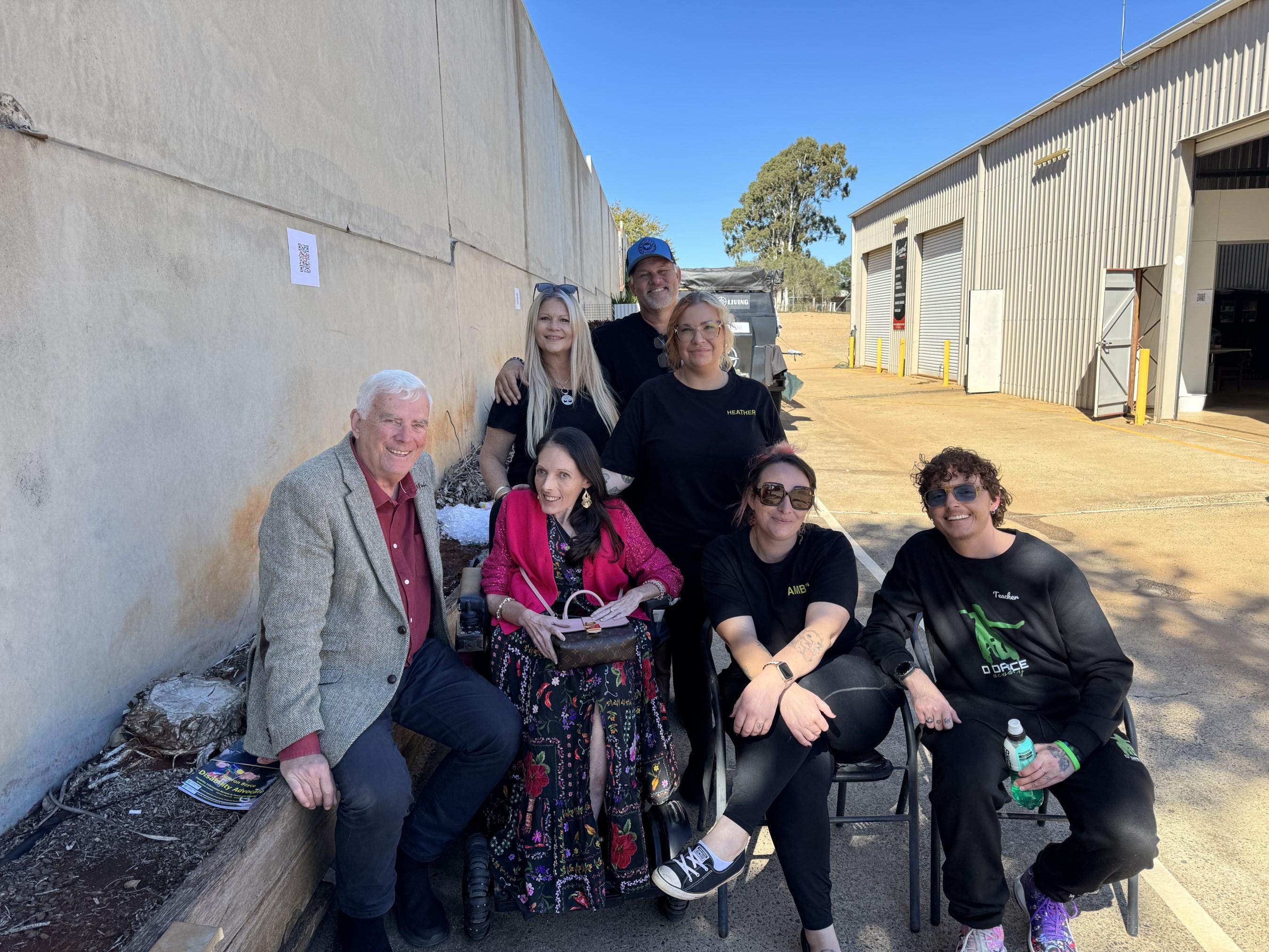
Heather and Amber organised a local, accessible protest in Toowoomba to oppose proposed NDIS cuts, emphasising that community access and respite are essential for mental health, social inclusion, and preventing caregiver burnout.
They acknowledge the need for reforms and better oversight of support worker quality, but reject funding reductions and proposals to scrap the NDIS.
Heather explains they saw protests in Brisbane but couldn’t attend due to fulltime work and parenting. Their participants faced accessibility barriers to travelling. They decided to host a low-key gathering in Toowoomba to give the local community, including people with disabilities, a way to voice concerns about proposed NDIS cuts. Last-minute organisation still drew a strong turnout, with local support including MC Elise Neligan.
Amber, with 11 years across disability sector roles and currently a specialist support coordinator, describes seeing the protest news early Tuesday and coordinating with Heather. They chose a local barbecue-style event to accommodate busy schedules and the needs of participants who couldn’t get to Brisbane, ensuring inclusivity for people with disabilities.
Amber highlights deep concern about the proposed NDIA cuts to community access funding by 30%. She argues such

cuts would prevent events like theirs from happening and sharply increase social isolation. She warns of severe mental health consequences, asserting that reduced access will lead to harm and, in extreme cases, deaths, affecting not only people with disabilities but the broader community.
Amber stresses that community access is crucial for mental health. Without support workers enabling people to leave home, socialise, shop, and perform daily tasks, individuals risk isolation and deteriorating mental health. She emphasises that able-bodied people take these activities for granted, while NDIS participants depend on funded supports.
Addressing the minister’s comment about support workers on phones during community access, Amber acknowledges poor-quality workers exist and have been observed. However, she argues this should prompt targeted improvements and accountability, not funding cuts that harm participants. Heather supports the notion that reforms are needed, but reductions in critical supports are the wrong approach.
Both speakers advocate for system im-
provements better oversight, training, and standards—without cutting essential funding. They contend that cutting harms vulnerable people and fails to address root issues of service quality and program integrity.
Elements of NDIS may move to staterun programs like “Thriving Kids,” focusing on early intervention. Amber says if run properly, it could work, but she lacks confidence in local government to manage such a critical program for vulnerable children. She cites her caseload of young children with ASD who benefit from OT, groups, and parental support under NDIS.
Amber fears “Thriving Kids” may cover therapies but exclude respite. She shares a case of a single parent with three children with ASD who experienced severe burnout and hospitalisation, underscoring the necessity of respite for families. Without respite for caregivers and children, system pressures and crises may increase.
Amber emphasises respite as essential to prevent caregiver burnout, which otherwise leads to higher system demand, including hospitalisations. She pushes back on interpretations that “work is respite,” noting kids also need breaks. Respite supports both carers and participants, reducing strain and improving outcomes.
Both speakers discuss how different support workers bring unique skills and influences, mirroring varied social circles
(sports, movies, gaming). Diverse interactions enrich participants’ lives, teach different skills, and reduce monotony, highlighting the social and developmental value of funded community engagement.
Heather urges the minister and government not to “mindlessly hack” supports. She calls for consultation with people with disabilities and frontline workers before changes, ensuring voices are heard. Cuts, she argues, cause tangible harm, and protections are needed for vulnerable individuals.
While acknowledging systemic failings and the need for reforms, Heather and Amber insist that life-sustaining supports should not be cut. They advocate for thoughtful, evidence-based changes that maintain essential services.
Responding to media suggestions to scrap NDIS and start anew, Heather and Amber warn of catastrophic consequences, asking rhetorically how much “blood” policymakers want on their hands. They argue that dismantling the scheme risks lives and undermines critical supports for a large vulnerable population.

Both interviewees warn that proposed reductions—estimated at 160,000 participants—would harm individuals, families, and the broader community, likely exceeding stated figures due to tighter entry.
Rebecca states the gathering is about protecting disabled people and ensuring they have safe, consistent access to the community. She emphasises the importance of inclusion and community participation for people with disabilities, noting that safety and presence in everyday spaces are core objectives of the movement.
Sophie highlights that the protest aims to ensure people with disabilities are seen, heard, and have a voice and space in the community. She asserts that disabled people have every right to be in community settings every day, and the movement seeks to safeguard that principle.
Rebecca describes a positive change since the NDIS: disabled people are now regularly seen in the community with friends, family, and carers, instead of being confined to occasional group outings (formerly common on pension day). She appreciates seeing people living everyday lives rather than being limited to once-a-week outings, framing this as a key aspect of inclusion.
Sophie notes the figure of 160,000 being discussed and calls the impact “heartbreaking.” She stresses that con-
sequences would extend beyond individuals to families and the broader community, suggesting the wider effects are not being fully considered.
Rebecca adds that the real number may be higher due to people who would no longer be added to the scheme. She provides a personal example: her 14-yearold, out of mainstream schooling for six years due to autism, cannot access other services because they’re not intellectually impaired, falling through eligibility gaps.
Rebecca mentions Toowoomba’s large homeschooling community, comprised of children who “don’t fit” in traditional classrooms or are not accepted. She argues that NDIS supports enable these children to engage with the community and receive teaching, skills training, and therapy beyond the family unit. She connects present supports to future aspirations, such as employment and community contribution. Removing access would undermine these hopes and lead to broader social and economic costs, predicting national repercussions over five to ten years if support for these kids are cut.
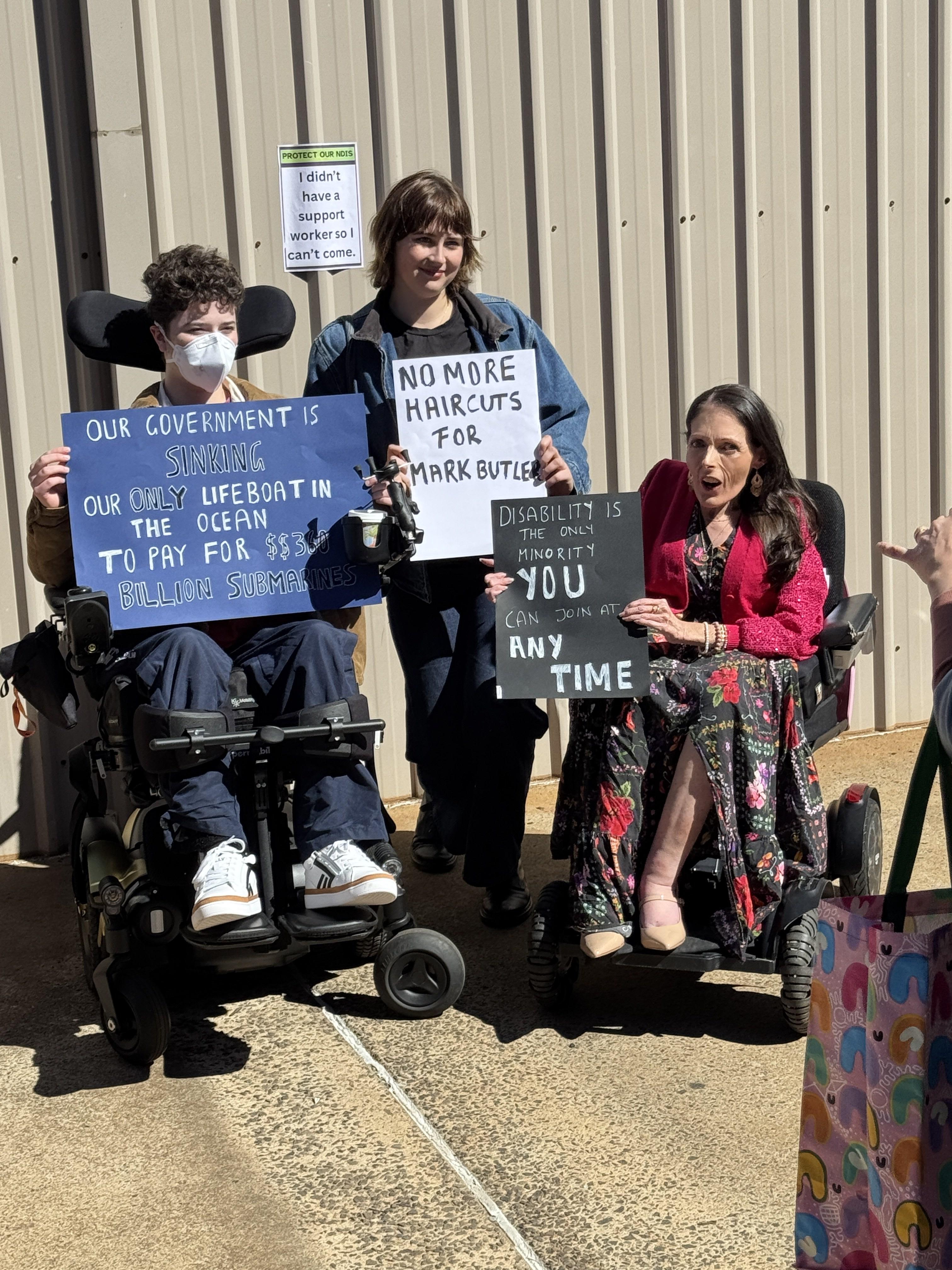
Alyce has been a 5-time candidate for the Greens, is a disability advocate, and is involved in many national organisations, including being a member of the Y Connect Program.
Alyce emphasised the necessity of holding a rally in Toowoomba so regional people who face distinct NDIS challenges can be heard by politicians. She underscored the importance of representation beyond capital cities.
Alyce was asked to emcee on May 8, 2026 just one day before Alyce agreed, viewing it as part of her contribution to the national organising group. She believes everyone should “pitch in and do their part.”
Proposed reforms are actually
et cuts.
Alyce argues the government is disguising budget cuts as “reforms.” She cites the narrative that the NDIS funds “luxury instead of dignity” as a pretext for major cuts to social and community participation funding—the primary threat in her view.
Reducing participation funding will confine people with disabilities to their homes. Alyce clarifies this funding is not for “fun and games” but enables essential activities like medical appointments, visiting family, and attending school events (e.g., a Mother’s Day morning
tea). Such cuts would undo progress made since deinstitutionalisation.
Another major threat is shifting people with “low to moderate support needs” onto state-based systems. Alyce contends these systems—like the former Disability Services Queensland (DSQ)— were extremely limited and lacked capacity, making the plan unworkable.
Alyce raised concerns about heavy administrative overhead, referencing the old DSQ system where about 40% of funds went to administration. Alyce confirmed similar issues persist in the NDIS, noting the irony of cutting participation funding while hiring more officers and spending $60 million annually on legal battles against participants.
Alyce criticised the NDIS for skirting staffing caps by subcontracting roles (e.g., call centres) to third parties. We agreed that despite more spending and staff, service hasn’t improved, with review wait times still long.
Alyce stressed the urgency of ensuring the opposition and other parties understand the harm from proposed cuts and present an alternative that is fiscally re-
sponsible without hurting people with disabilities. The rallies are central to this strategy.
We both agreed the government’s focus on NDIS fraud is “smoke and mirrors.” Alyce noted NDIS fraud is under 0.1% of the budget far less than Medicare fraud by professionals suggesting a hidden agenda.
Alyce observed that Australia, once a global leader in disability support at the
Alyce believes an efficient, fiscally responsible NDIS can also deliver dignity and quality of life. The issue isn’t a lack of funds but the failure to put “the brightest minds on the job.”
Compared to an airline CEO turnaround, Alyce advocated putting competent, experienced leaders in charge of the NDIS.
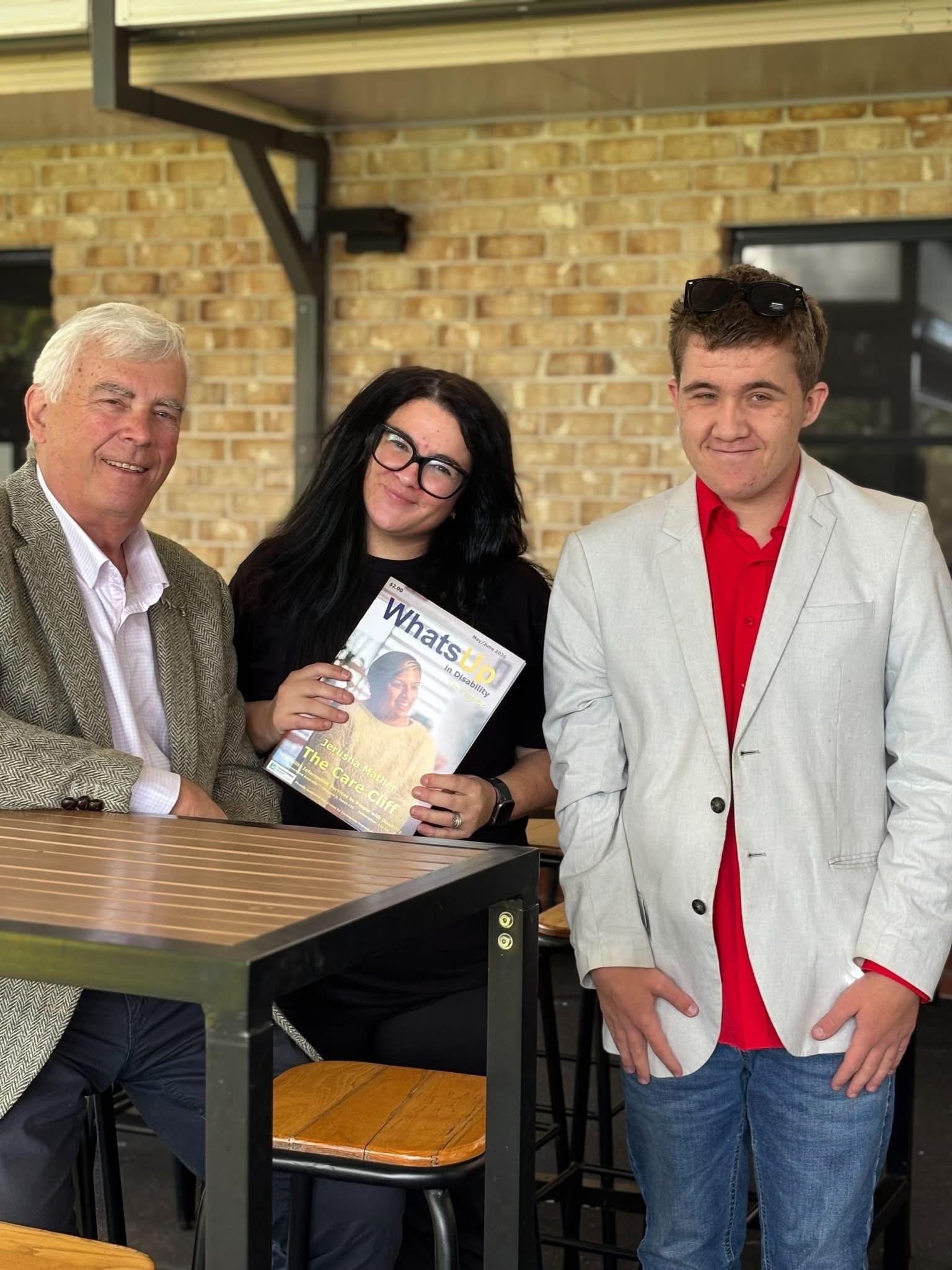
Micharla explains that the expo’s core purpose is to reach communities that lack easy access to big-city resources. By hosting events locally, residents can discover services and supports without travelling. The expo aims to reduce barriers and improve awareness of entitlements and local providers, thereby strengthening community access to disability-related information.
The events intentionally invite the whole community including disability and ageing communities to foster connection and reduce isolation. By creating shared spaces and conversations, the expo helps bridge gaps between groups and promotes inclusivity, addressing loneliness and encouraging a more integrated community fabric.
Over the past year, DEC launched a sister brand: the Aged Care Events Community. While the brands are separate, both focus on ensuring people can access information, support, and each other. They have already brought aged care events to the region and plan to return to the Toowoomba Darling Downs area, emphasising continuity and broadened scope.
Micharla stresses that their organisation is an events facilitator, not a care provider. This stance avoids competition with service providers and positions the expo as a neutral platform that elevates community resources. They seek feedback to improve, underscoring their
ByStevenandLucas
community-first approach.
Success is defined by attendees leaving with knowledge of supports they didn’t realise they qualified for or services they didn’t know existed locally. This discovery not only benefits individuals but also stimulates the local economy by directing demand to nearby providers with available capacity.
Micharla values meaningful, lifeimproving outcomes for attendees, describing the satisfaction as a “dopamine” boost. The focus is on tangible, immediate help that can shift someone’s path, reinforcing the expo’s practical, impactdriven ethos.
The expo hosts 32 providers by design, maintaining a smaller, impactful event tailored to the venue and community. There’s even a waitlist, but the priority is to feature local and community-based organisations such as pharmacies, the council, and a fibromyalgia support group—so attendees can access help immediately and locally.
The event includes a designated quiet hour from 12:00 to 1:00, making the environment more comfortable for attendees with sensory or auditory sensitivities.
Micharla notes feedback is typically very positive but invites constructive input to improve future events. Their ethos is to serve the community without competing with providers, remaining responsive to needs and suggestions to enhance the event’s relevance and effectiveness.
Continuednextpage
Hearing Australia, a government organisation, offers free hearing checks in community settings such as pharmacies, medical clinics, aged care facilities, and expos. These services are available to anyone over 18, recognising that hearing loss can occur at any age and is not limited to older adults.
The organisation delivers comprehensive care from community screenings that flag possible issues through to fitting assistive devices managing the entire process to provide a seamless experience from initial assessment to ongoing support.
Care extends beyond standard hearing aids to include assistive options tailored to individual needs, like TV listening devices and sound-amplifying headsets. The focus is on ensuring the chosen solution is practical, effective, and actually used.
Hearing Australia facilitates access for Auslan (Australian Sign Language) users by arranging interpreters for appointments, ensuring communication needs are fully met.
A Support Coordinator’s primary role is to help NDIS participants manage their plans. This includes creating budgets to prevent overspending and ensuring funds are used effectively for the entire plan duration. They also support participants through the review process to adjust plans as needed.
Another key responsibility is linking participants to suitable service providers. The goal is to meet the participant’s
needs with the best-fit services, which may not always be from the Support Coordinator’s own organisation. The focus remains on the individual’s best interests.
Jakin’s has a garden at its Drayton location that serves multiple purposes: a stress-relief area for staff and a welcoming gathering space for events with participants and other providers, fostering community.
David explains that Challenge Employment and Training is a registered training organisation delivering qualifications across multiple areas. At the expo, they are specifically promoting the Certificate III in Individual Support for Aged Care and Disability. The focus is on practical, industry-aligned training that equips learners for roles in care sectors.
David states their employment side activates after students complete vocational placements. The goal is to transition graduates into paid roles, ideally at their placement site or with partner organisations in aged care or disability services, facilitating a smooth pathway from training to employment.
Courses run in sixteen-week cohorts. After each cohort completes, the organisation helps students move into work across disability and aged care organisations. This indicates a structured pipeline emphasising employability and job matching tied to placements and industry connections.
Helping You at Home is a Toowoombabased company specialising in domestic
assistance. Services include cleaning, housekeeping, laundry, and meal preparation. They serve a diverse client base: NDIS participants, aged care recipients, veterans, and busy families.
This is the company’s first time hosting a stall at the expo. The primary goal is to increase brand awareness and let the community know about the services provided by “the Girls in Pink.” They aim to build connections with potential clients and stakeholders across the disability and community care sectors.
The distinctive pink theme is central to the brand’s identity, making them highly visible and memorable. Pink was chosen after the business owner had her first daughter and is seen as striking yet calming. The team wears pink from head to toe.
A unique aspect is the “Power of Pink” wellness program, empowering a team largely composed of women and mothers to prioritise health. This is demonstrated by staff-friendly, lightweight (4 kg) Velo backpack vacuums that reduce physical strain showing the company cares for its team as much as its clients.
Caitlin explains that she works for North Quiet, based in Toowoomba, which offers a broad range of services to customers. The emphasis is on variety and tailored support, indicating a clientcentred approach within the disability support sector.
The cafe, “Thanks a Latte,” operates as an internal work experience program where customers run the cafe in a supportive environment. Support staff provide oversight and assistance, fostering independence while ensuring safety and quality.
The cafe functions as a training program, building practical, transferable skills applicable to other jobs or industries. This includes barista skills and broader hospitality competencies, preparing participants for future employment opportunities.
Caitlin confirms the presence of qualified baristas, reinforcing the program’s professional standards. She shares feedback from staff that the coffee is excellent and personally endorses the hot chocolate as “the best in town,” highlighting product pride and quality.
Caitlin agrees that hands-on experience is crucial for building life skills and notes that practical engagement enables deeper understanding than theoretical explanations alone.
Lyn has lived with Myalgic Encephalomyelitis (ME/CFS) and Fibromyalgia for thirty-five years. She emphasises a core challenge: patients can appear “really good” externally while feeling “absolutely terrible,” leading to misunderstanding from the public and even medical professionals. Her purpose at the expo is to raise awareness of these invisible illnesses.
These conditions cannot be identified via a simple blood test. Diagnosis depends on thorough symptom analysis by a knowledgeable doctor. For Fibromyalgia, a rheumatologist can assess specific tender pressure points across the body that cause extreme pain when pressed. Even routine procedures like taking blood pressure can be excruciating. Fatigue is not mere tiredness but “total exhaustion.” A hallmark of ME/CFS is Post-Exertional Malaise (PEM), where physical or mental effort triggers a severe symptom flare with delayed onset occurring the next day, several days later, or even a week later.
A volunteer-run support group meets on the first Wednesday of every month (except January) from 10 a.m. to 12 p.m. at the Doctor Price Room, St. Little Street, near the Toowoomba Library. The group receives some funding from Queensland Health and aims to ensure people know they are not alone. Lyn has been involved since October 1991, shortly after its founding.

An Adelaide woman has been arrested and charged on Wednesday 10 June, 2026 over an alleged plot to defraud more than $5 million from the NDIS.
An investigation by the Australian Government Fraud Fusion Taskforce (FFT) –encompassing the AFP, NDIA, Australian Criminal Intelligence Commission (ACIC) and NDIS Quality and Safeguards Commission – began in March, 2026, after the NDIA identified unauthorised access to protected records of NDIA participants.
It is alleged the woman, a NDIA employee, accessed more than 40 NDIA participant records without authorisation, both while at work and outside work hours. The NDIA further alleges the woman submitted fraudulent claims against the plans of members of her family who are NDIS participants, including in circumstances where supports and services were not provided to them.
Motor Neurone Disease is a rare, incurable and fatal condition which is invariably characterised by a rapid deterioration in physical function.
As a result of these particular characteristics, the Government amended the Aged Care Rules to recognise MND as a discrete, specific condition warranting urgent priority for Support at Home.
This change will give all older Australians with MND priority access to the Support at Home Program.
This is in line with the prioritisation pathway available to people with MND in the NDIS.
In 2024, a dedicated NDIS team was established to support new applicants with this degenerative disease.
These two priority pathways into Aged Care or the NDIS provides support and certainty to Australians diagnosed with MND.
The change will apply retrospectively –meaning older Australians with MND who have already been assessed and are waiting for a Support at Home place, as well as those approved in future, will be prioritised for urgent access to their funding.
The Government has also directed the Department of Health, Disability and Ageing to undertake a rapid review of the Support at Home prioritisation mechanism. The Integrated Assessment Tool has improved the consistency and fairness of how in-home aged care is allocated – bringing median assessment wait times down from a peak of around 10 months, to consistently under one month.
The movement perceives the government’s actions not as protection, but as a fiscal strategy designed to dismantle the NDIS. The administration is accused of commissioning the “Redbridge report” to intentionally diminish the NDIS’s public standing, which was once as beloved as Medicare. This has allegedly been followed by a public relations campaign framing the scheme as wasteful, creating a narrative that justifies deep cuts. The central conflict is a perceived betrayal: the very political party that established the NDIS, granting freedom and community access to disabled people, is now systematically revoking those rights under the guise of fiscal responsibility. The core assertion is that proposed changes, such as a 30% cut to community access funding and blocking entry for those with “moderate support” needs, are not optimisations but a direct assault that will lead to isolation, harm, and even death. We refuse to be segregated or have our lives devalued; we are not going back.
1. The Perceived Deception: Fiscal Management vs. Human Rights
The core argument is that the government’s official rationale for NDIS changes “protecting” the scheme is a deliberate misrepresentation. The movement identifies the true motive as budgetary control, which directly threatens the lives and well-being of NDIS participants. The narrative is one of a bait-and -switch: freedom was granted, and now
it is being methodically taken away by the same political forces that created it.
The government is accused of executing a multi-stage plan to undermine the NDIS:
The “Redbridge report” was allegedly commissioned with the specific goal of finding ways to erode public approval for the NDIS.
A subsequent campaign has successfully framed the NDIS as bloated and unnecessary in the public eye. This has neutralised potential outrage over cuts, as the public has been conditioned to see them as a necessary correction.
Proposed changes aim to slash community access funding by 30% and block new entrants under the pretence of excluding those with “moderate” needs, effectively gutting the scheme’s foundational principles.
The consequences of these cuts are framed in terms of life and death, not just fiscal savings. The movement asserts that restricting access to the NDIS will not save money but merely shift costs to other systems, as individuals end up in hospitals, aged care, or isolated at home. The reduction in support has already caused harm and fatalities. The central message is an unequivocal declaration that the lives of disabled people are not a line item to be cut. The movement will not allow a return to an era of segregation and isolation.

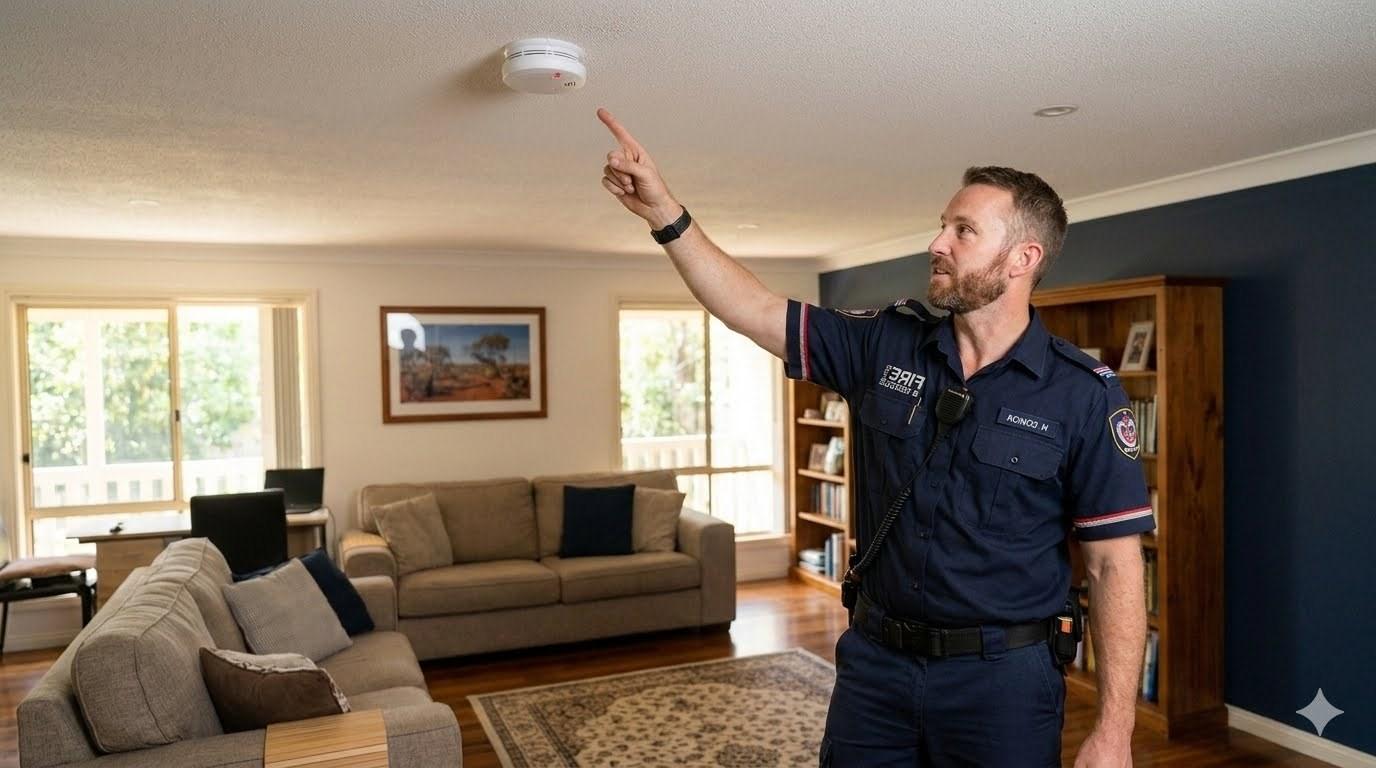
All existing private homes, townhouses, units and manufactured homes require interconnected photoelectric smoke alarms by 1 January 2027.
Interconnected compliant smoke alarms means when one goes off, they all go off.
All registered caravans and motorhomes must also be fitted with a photoelectric smoke alarm.
Legislation introduced on 1 January 2017 requires all smoke alarms to comply with Australian Standard 3786-2014 and requires pre-existing smoke alarms to be replaced with interconnected smoke alarms if the smoke alarm has expired; does not work anymore and/or converting the home into a rental property.
You don’t need to tell the Queensland Fire Department about your smoke alarm compliance. When selling a home, you may need to provide proof that you have complied with the legislation.
Smoke alarms must:
• be photoelectric.
• be interconnected with every other smoke alarm in the dwelling so all activate and go off together.
• comply with the Standard AS37862014 which is marked on the body of the alarm. To locate the marking, you may need to remove from the bracket to look underneath.
• not contain an ionisation sensor.
ByStevenPaull
• be hardwired installed by a licensed electrician (e.g. 240v) to the mains power supply with a secondary power source (eg. non-removable 10-year battery, or a user-replaceable 9V battery) or;
• be powered by 10-year nonremovable batteries type photoelectric smoke alarm that can be installed yourself.
In July 1997, the Building Code of Australia required smoke alarms to be hardwired but had different alarm locations than current legislation. The Building Regulation 2021 requires all new dwellings to have smoke alarms hard wired and interconnected in specific locations. The Fire Services Act 1990 has retrospective requirements, for existing dwellings. For this reason, there may be a combination of hard wired and battery powered smoke alarms in a dwelling. When replacing expired/defective smoke alarms they should be replaced with whichever device was applicable to the time of construction.
Smoke alarms must be installed:
• on each storey
• in each bedroom
• in hallways that connect bedrooms and the rest of the dwelling
If there is no hallway, between the bedroom and other parts of the storey; and if there are no bedrooms on a storey, at
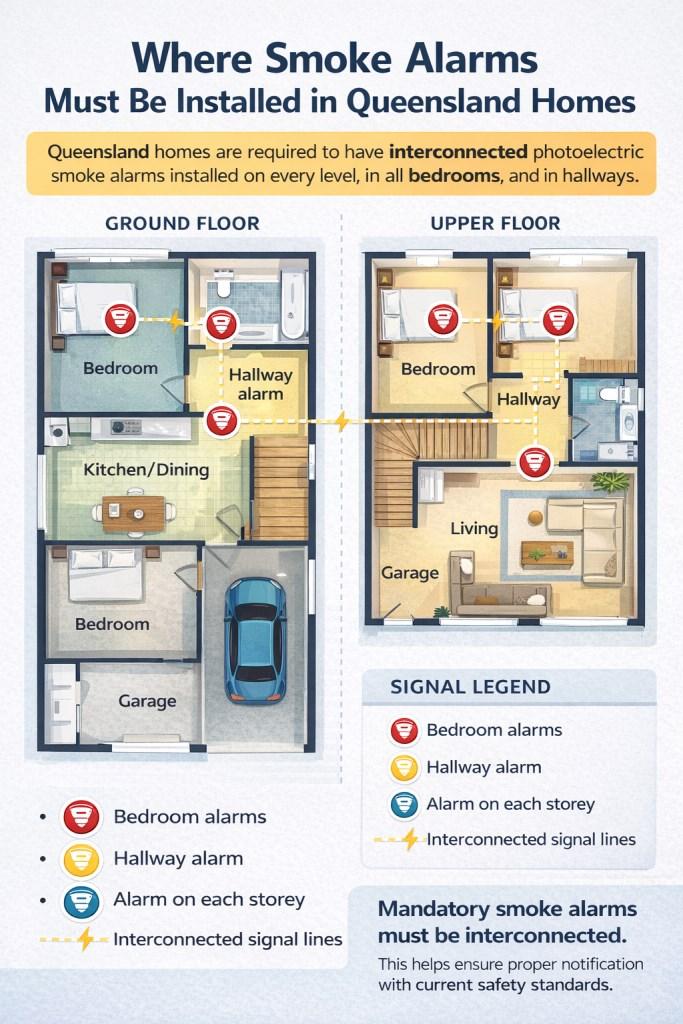
least one smoke alarm must be installed in the most likely path of travel to exit the dwelling.
Smoke alarms should be regularly dusted or vacuumed to make sure they continue working properly. Learn more on
how to maintain your smoke alarms.
Although accidental alarms may go off when there is no fire, it can it can become dangerous and put you and/or your family at risk if you remove the alarm batteries or disable an interconnected system to silence the alarm.
Make sure you regularly test your smoke alarms to ensure they are working correctly.
The fire service is not permitted to disable sounding alarms in unattended residences.
Within 30 days before the start of a tenancy, the lessor/ landlord must test and clean each smoke alarm in the home.
Some real estate agents may outsource smoke alarm maintenance to another company with associated fees paid by the landlord. The real estate may request a "certificate of compliance" from these companies as proof of service. This is not a legal requirement but may be part of the real estate agent's internal process.
Property owners/Landlords will receive an infringement notice if they are proven to have not complied with the legislation.
ByStevenPaull
Steve Rose There comes a point where a man can no longer carry everything alone. For years, I pushed through adversity the way many men do… silently. Trying to be strong. Trying to hold it together. Trying to figure it all out on my own. But the truth is, isolation changes a man.
In Australia, men account for around 75% of suicides. Over half of men report experiencing loneliness. And most men admit they were taught to “tough it out” instead of expressing what they really feel.
One day, after years of thinking about creating a men’s group, an event happened that shook me to my core. It cracked something open in me.
I realised that no matter how self-aware, resilient or capable a man is we are not designed to do life alone.
I needed good men around me. Men who could hold space without judgement. Men who would challenge me. Men who would keep me accountable to my growth. And men, I could do the same for in return.
That moment became the catalyst for Awakening Your Potential. Not a place for pretending. Not a place for ego. Not a place for fixing each other. A place where men can speak honestly about what’s alive in them. A place to be witnessed. A place to grow stronger through connection, accountability and brotherhood.

WhatsUp in Disability has successfully adapted to a rapidly changing media landscape through innovation, resilience and a commitment to sustainable growth. As a specialist publication serving the disability community for more than 33 years, we continually evolve our operations to remain relevant, accessible and financially sustainable.
Innovation has been central to our success. While maintaining our traditional print publication, we have expanded our digital presence through online content, social media engagement, electronic distribution and multimedia storytelling. We have also developed strategic partnerships with disability organisations, businesses and community groups as well as our partnership with 102.7 FM Community Radio to extend our reach and create new opportunities for collaboration. Our Community Hub, located at the Paul Myatt Community Centre, provides an additional platform for community engagement, information sharing and social connection.
We are in the process of applying for registration as a funded Neighbourhood Centre as we have been operating unfunded since 2011, providing a community meeting place, community programs, training, referrals, food and emergency assistance programs.
To remain resilient in a changing business environment, we have diversified our revenue streams through advertising, sponsorships, subscriptions, part-
nerships and project-based initiatives. We regularly review reader feedback, audience trends and industry developments to ensure our content remains relevant and responsive to community needs. Our strong community relationships and reputation for positive, solutions-focused reporting have enabled us to maintain reader loyalty and stakeholder support.

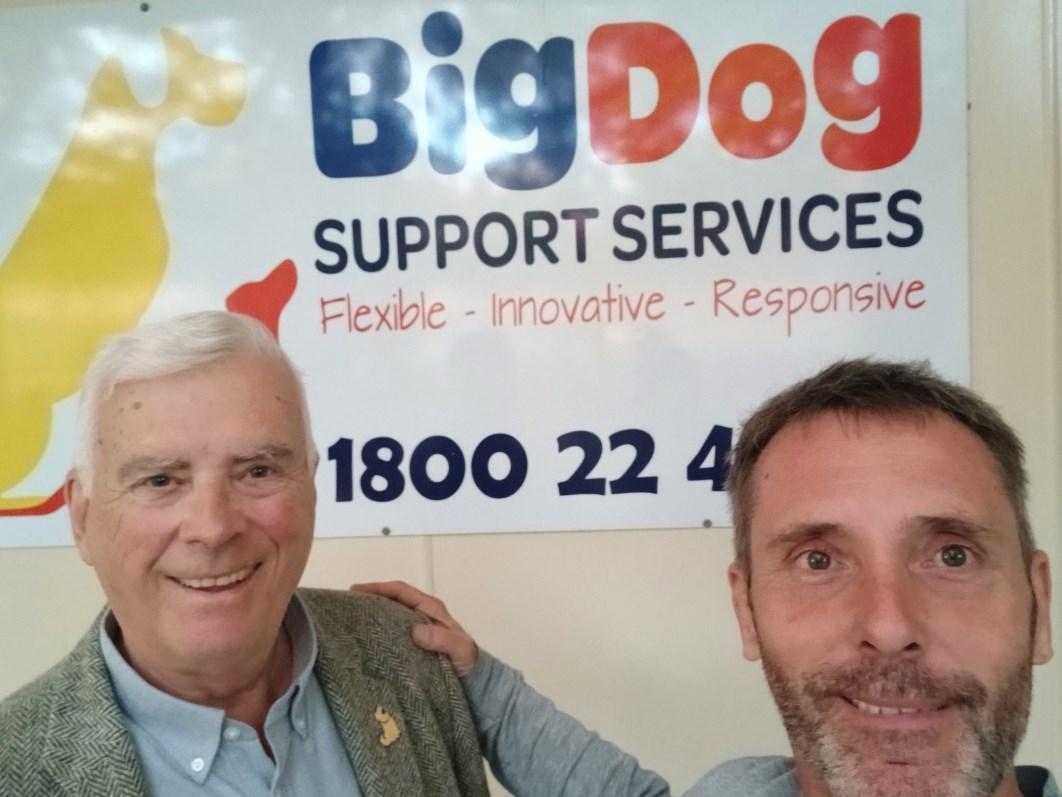
A recent success story is Missy on completing her school-based traineeship with the BigDog team based at the Paul Myatt Community Centre. What a wonderful achievement.

ByStevenPaull
Long before streaming services and social media transformed the music industry, local bands relied on talent, determination and countless hours on the road to build a following.
One of Toowoomba's most successful and influential bands of the 1960s was Chapter III, a group that helped put regional Queensland music on the national stage.
The origins of Chapter III can be traced back to the early 1960s when the band first formed under the name "The Defenders." Made up of a group of talented young musicians from Toowoomba, the band quickly developed a strong local following through performances across the Darling Downs and beyond.
Their energetic performances and contemporary sound captured the spirit of a generation embracing the rapidly changing music scene of the decade.
Seeking greater opportunities, the group travelled to New Zealand in 1965, where they performed extensively and supported international acts including British stars Sandie Shaw and The Pretty Things.
During their time overseas, the band attracted the attention of recording industry representatives and recorded material that helped establish their growing reputation.
Upon returning to Australia, the band adopted the name Chapter III and soon became one of the most popular bands in regional Queensland.
They dominated the entertainment scene across the Darling Downs and regularly performed throughout Queensland.
Their growing success led to appearances on television and performances alongside some of Australia's most recognised musical acts.
One notable highlight was backing the Bee Gees during a 4GR Cabaret Summer Spectacular in 1966.
Chapter III also ventured into recording, releasing several singles that showcased the band's original sound and musical versatility. Songs such as "Fool," "Just Can't Live Without You," and "Please Do Something" demonstrated their ability to blend the influences of British and Australian rock music into a distinctive style that resonated with audiences of the time.
A major milestone came in 1969 when Chapter III became the first regionally based band to reach the Melbourne grand final of the prestigious Hoadley's Battle of the Sounds competition.
At a time when most successful Australian bands emerged from major cities such as Sydney and Melbourne, this achievement was a remarkable accomplishment and a source of great pride for Toowoomba and the Darling Downs.
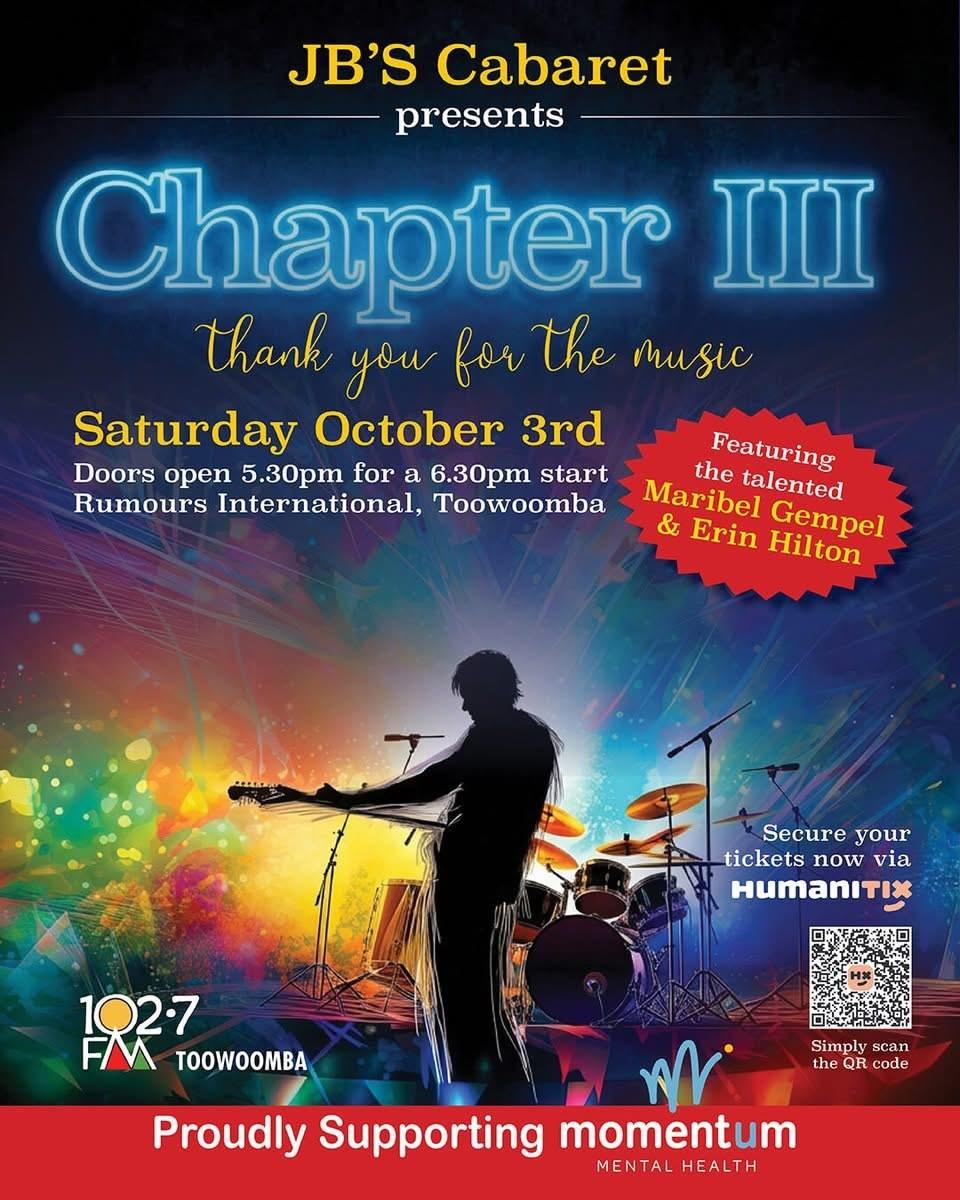
Although the band disbanded in the early 1970s, their influence on the local music scene has endured. Many of the members continued to contribute to music and entertainment, while the band's legacy became part of Toowoomba's rich cultural history. Over the years, Chapter III has reunited for special performances, delighting audiences with the music that made them local legends. Their continued popularity is reflected in reunion concerts and community events that celebrate the band's remarkable contribution to Australian music.
Today, Chapter III remains a symbol of what can be achieved through talent, perseverance and community support. Their story is not only one of musical success but also a reminder that regional communities like Toowoomba have long produced artists capable of competing on the national stage.









PUBLISHER Disability Media Association Inc (Australia)
TELEPHONE (07) 4632 9559
MOBILE 0427 987 654
OFFICE: Paul Myatt Community Centre 11-15 Alexander Street Toowoomba (open Monday to Friday 9:00am-3:00 pm)
E-MAIL:steven@bigdog.au
MANAGEMENT BOARD: Steven Paull (Editor) Courtney Carroll (Committee) Jess Wright (Committee) Ann Paull (Committee)
CONTRIBUTORS: Bronwyn Herbertson, Sharon Boyce, Aidan Wilcock, Dean Gill, Jess Wright, Steven Paull and many others.
PUBLISHED
January/March/May/July/September/November
ABN 72 821 350 911
DISCLAIMER/INDEMNITY
Articles and adverts reproduced on these pages are accepted and published in good faith. It is a condition of acceptance that sponsors and article writers accept full responsibility for their sponsorship and articles, and will fully indemnify the producers in the event of any claims or legal proceedings against them. Articles published are not necessarily the view of the publishers. Sponsorships are also accepted on the basis that they do not conflict with any discrimination laws or other laws currently in force.
SPONSORSHIP
WhatsUp is a non profit and charity organisation, we are not funded in any way, and have to cover costs of this publication by charging for sponsorship. WhatsUp reserves the right to adjust, resize or move sponsorship posts when necessary to allow for editing
1) SUBSCRIPTION (In advance) $25 per year (includes delivery/postage).
2) A single edition of WhatsUp can be purchased at the Paul Myatt Community Centre and selected outlets. You may also subscribe by using the form on the outside cover.
3) Reference copies are held in the Toowoomba Visitor Centre and Regional Libraries.
COPYRIGHT
Copyright Protected. All pages are subject to copyright law and may be copied only with the permission of WhatsUp. Copies are not to be used commercially or for profit or for personal financial gain. Permission may be granted to copy only if the purpose is to give it away to others for their personal interest but not to any other organisation or service.
All articles are accepted in good faith and are not necessarily the view of the Editorial team or Management. Articles are accepted on the understanding that in the event of any claims against WhatsUp, the writer of the article will take full responsibility and indemnify WhatsUp in the event of legislation against it. Articles are also accepted on the understanding that the contents do not breach any Disability laws or other legislation currently in use.
WhatsUp In Disability is provided as a Master Copy to individuals and organisations or to view online at our website. We are environmental friendly, we do not print any more copies than is absolutely necessary. We prefer and encourage the practice of passing the magazine from person to person or copying the whole magazine to pass on to others. Permission is needed to copy (see Copyright above) When copying the magazine we require that the pages be marked ‘copy’.




11-15 Alexander St Toowoomba 4350
Phone: 0427 987 654
Email: steven@bigdog.au
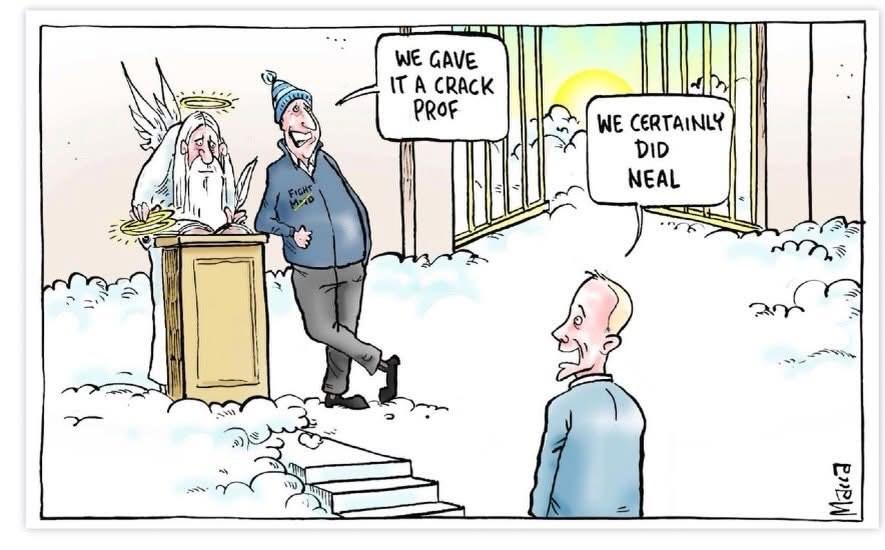
Neil Daniher had a courageous MND battle and renowned melanoma pathologist and researcher Professor Richard Scolyer died at the age of 59 on June 7, 2026, after a courageous battle with terminal brain cancer meet at the Pearly Gates of Heaven.
WhatsUp In Disability APPLICATION FOR SUBSCRIPTION 2025 ($20 per year including postage) NAME
ADDRESS Post Code
TELEPHONE E-MAIL
SUBSCRIPTION $25 MEMBERSHIP $5
SUBSCRIPTION + MEMBERSHIP $30
DIRECT DEBIT: BSB: 638 070 ACC: 1071 4219
“Please make cheques payable to Disability Media Association Inc. (Australia)”
Please cut out / scan and post to:
11-15 Alexander St, Toowoomba 4350 with your cheque