$2.00
January/February 2026
WhatsUp
in Disability
Disability Information Services by People with Disability Queensland Australia
Volume 1, Issue 128
Subscription $25 PA
Proudly supported and printed by ToowoombaWhatsUp Regional in Council Disability
Page 1
Whats
Highlights January/February 2026
6 18 20 22 24 26
Peter Tully and DCAMS
Alyce Nelligan Horror Year
NDIS Provider Penalty
Mandatory Support Worker Training
Centre of Disability Studies I-CAN
Gold Coast Business Awards Cover Page Payge Hollis Cover Model Picture Ali Hassan Diversity Models
Steven Paull JP (Qual) President Page 2
The Editors Desk Diversity Models
picture is available to our readers.
In the previous edition of WhatsUp in Disability, I reported on the A Current Affair story involving Diversity Models as well as the experience shared by one of their models, Larni Jayne. The allegations made in that segment were serious, and it was important that we acknowledged and reported on them with honesty and care. At the time, Larni’s account reinforced the information available to us, and as always, our priority was to give voice to people with lived experience.
Our role is to listen to the voices within our community—all of them—and to reflect their realities with integrity. By presenting these different experiences side by side, we hope to encourage informed conversation, deeper understanding, and above all, respect for the diversity of people’s journeys.
Since then, however, I have had the opportunity to speak directly with two other models who have been involved with Diversity Models. Their experiences stand in stark contrast to the concerns raised in the A Current Affair report.
Bondi Beach Attack The members of WhatsUp in Disability are deeply saddened by the shocking attack at Bondi Beach on Sunday 4 December 2025. Our deepest sympathies and condolences are with the victims, their families, the entire Jewish community and all affected.
Both spoke positively about the support they received, the opportunities they were offered, and the way they were treated throughout their involvement with the agency. Their stories highlight a different side of Diversity Models, one that was not fully captured in the earlier media coverage.
This was a horrific and senseless attack on the first day of Chanukah, which should be a day of joy and thanksgiving.
As an editor, it is important to me—and to WhatsUp that we present balanced reporting, especially when the reputation and wellbeing of people in our community may be affected. No single narrative can ever represent the full truth of a complex situation. For this reason, I felt it essential to include one of the additional perspectives in this issue, not to dismiss any concerns raised previously, but to ensure a fairer, more complete
There is no place in our society for acts of violence that target any group or individual based on their faith, race, culture, or identity.
WhatsUp stands firmly with the Jewish community and strongly condemn all forms of violence, racism, antisemitism and discrimination.
We extend our love to everyone affected including people at Bondi Beach, first responders and those who were affected by this horrifying attack.
Steven Paull WhatsUp in Disability
WhatsUp in Disability
Page 3
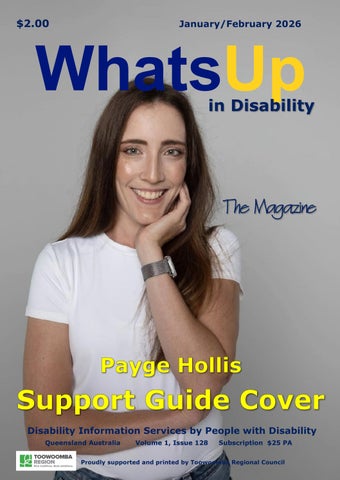
Payge Payge Hollis was born prematurely on Christmas Eve 1998 after her identical twin sister died in utero from complications with a trin transfusion. She was delivered through an emergency Csection to ensure her survival. At birth she weighed 550 grams and spent over three months in the neonatal intensive care unit. She had multiple complications associated with being born with extreme prematurity such as a grade 4 intracranial haemorrhage, low oxygen saturation, multiple cardiac arrests and numerous blood transfusions. Her parents Leanne and David were informed that Paige may have severe disability and could struggle to ever walk, talk or function normally. However, as the face of Disability Support Guide Eastern, and a rising star at Diversity Models, the now 25-year-old has graduated from a mainstream high school with a modified program, learned how to drive, and moved out of home in March 2024. She expressed gratitude for how far she has come with the support network around her.
Page 4
By Parent 2 Parent
“It's a challenge living on my own, but I have help from my family and my support workers. It's another step forward for me to achieve my dreams,” she said. “It was really hard finding work because people only saw my disabilities, which is really disappointing. It was a long time before I got a job, which made me sad. When I was 20 years old, I did get a little job in a supported disability coffee cart. This boosted my confidence and skills, and now I work as an administration and project officer at Parent 2 Parent Queensland. Payge is a passionate self-advocate and advocates for the rights of people with disabilities. She's a member of Loud and Clear Queensland, which is a selfadvocacy group for people with intellectual disabilities based on the Sunshine Coast. Payge is the Queensland representative of our Voice Committee, which provides advice to the Inclusion Australian Board. Her powerful work was forged some exciting opportunities to ask NDIS Minister Bill Shorten hard-hitting questions and attend Parliament House on International Day of People with Disabilities in 2024. Modelling is Paige's latest adventure, and she recently joined Diversity Models. “My experience so far working with Diversity Models has been thrilling and super fun. I want to build my confidence, and this will help me with that,” she said. I want to be involved. that people with disabilities can achieve great things. We should be seen, we should be heard, and we should be respected. My disability does not define who I am.
“When I have a dream, I don't give up, I try hard, I work hard, and I achieve great things.”
WhatsUp in Disability
Page 5
DCA A discussion with Steven Paull, Peter Tully and Grandall Manning The Role and Challenges of Advocacy in the Disability Sector I recently had the opportunity to have a discussion with my friend Peter Tully at the Cobb & Co Museum in Toowoomba about a subject that he is very passionate about—advocacy. The Necessity of 'Lived Experience' in Advocacy Peter Tully asserts that for advocacy to be effective, the advocate must have relevant lived experience concerning the topic. He argues that individuals without this direct experience, such as someone who has never camped discussing camping services, are not the right people for the role. The Perpetual Nature of Advocacy Advocacy is an unending process because new issues continually emerge in sectors like health, employment, and disability. Peter gives the example that while advocacy for airline accessibility might be resolved, future advocacy will be needed for things like driverless cars for people with disabilities. NDIA's Stance on Advocacy Funding Steven points out the irony of the NDIA spending hundreds of millions on legal teams to fight participants' claims, while simultaneously failing to adequately fund advocacy services that support those same participants. The Potential for Collective Advocacy in the Disability Sector Drawing a historical parallel to the formation of unions that advocated against child labour, Steven questions if a similar collective advocacy movement, uniting advocates and participants, could Page 6
emerge and be effective within the disability sector. Peter believes it is possible, citing the progress he has personally witnessed. Personal Journey as a Motivator for Advocacy Peter shares his personal history of being underestimated and told he would never own a house, run a business, or have a family. He has since achieved all of these things, which fuels his belief in advocating for hope and demonstrating that progress is possible for others with disabilities. The Mission of Disability Community Awareness Mentoring Support Started by Peter and Grandall, DCAMS mentors people with disabilities to see their own abilities. They help clients understand NDIS plans, navigate employment and housing, and rebuild trust with service organisations, often acting as a neutral intermediary. The Distinction Between Independent and Structured Advocacy Peter champions independent advocacy, which allows advocates to respond immediately to a person's needs without being constrained by the procedures, paperwork, and funding obligations that he believes limit 'structured' advocacy organisations. Business Model and Future of DCAMS DCAMS operates as a 50-50 partnership, funded by private and government contracts, though they still perform unpaid 'love work'. They are intentionally avoiding a non-profit structure to remain agile and are waiting for more details on the
Mentoring Supports
government's new 'navigator' roles before deciding on their future structure.
Advocacy and Goal-Oriented Support for Individuals with Disabilities The Importance of Passing on Advocacy Knowledge Grandall emphasizes the responsibility to "pass the baton on" to the next generation to ensure advocacy for people with disabilities continues to grow and meet the required level. First Step to Self-Advocacy For self-advocacy, Grandall advises that the first and most important step for an
individual or their family is to find a trusted person, build a relationship with them, and then begin a conversation about their needs and future. Proactive Support for Aging Caregivers Peter expresses deep concern for individuals with disabilities living with aging single parents. He shares a story of how DCAMS assisted two middle-aged men in transitioning from their grandparents' home to supported living over 3 years. The grandparents passed away within 12 months of the move, highlighting the critical need for such proactive intervention.
WhatsUp in Disability
Page 7
Continued from previous page Focusing on Ability, Not Disability Grandall states that their approach is to always see a person's "ability first." They focus on building confidence and skills, which has led to significant achievements, such as a person learning to manage household bills online for their elderly family member. The Challenge of Finding Meaningful Support Peter notes that while many providers exist, a lot of the support offered is "superficial" and not focused on achieving goals. He stresses that NDIS goals should be meaningful and that their work is very goal-based. The Power of Conversation in Goal Setting Both speakers agree that conversation is key. Peter points out that many individuals are hesitant to discuss goals or don't know what they are, believing they are just a requirement for NDIS. It's essential to meet people where they are and work from there. Need for Foundational Support and Vision The speakers concur that despite many new ideas, there is a "long way to go" to fully understand the vision for disability support, and there is a lack of foundational support for these emerging concepts. How did the 2 of you meet?
I met Peter through his parents. I went to a community event in Ipswich and we crossed paths again. I found that we were very like minded. We both worked in disability, volunteering and we were achieving a lot. So we developed DCAMS Page 8
Peter Tully Peter is a valued member of the Ipswich community, striving to ensure people with disability have accurate information, knowledge and confidence to speak up on a range of issues that directly affect them. Peter has worked within grassroots community organisations, the not-for-profit sector and government. He is a volunteer, disability advocate, motivational speaker, IT consultant, group convenor and housing champion. Peter grew up attending CPL – Choice, Passion, Life in New Farm and was involved in all areas of the CPL community into his early adult life. After starting a computer business in Brisbane, Peter moved to Ipswich and joined the Catalyst Church as the IT Support Manager. In 2008, Peter and Linda started Disability Community Awareness and in 2021 was renamed DCA Mentoring Supports (DCAMS) offering services that focus on advocating, networking, promoting community engagement and supporting NDIS participants and their families. Peter has been on the boards of the Ipswich Disability Interagency Network, Ipswich Hospital Community Reference Group, Ipswich Support Coordinators Community of Practice, and the Disability Inclusive Disaster Resilient Queensland project. Peter was a Board Director of QDN and in 2017, was awarded life membership for his significant service and commitment to the disability community.
New CEO The Australian Government has today announced Mr Graeme Head AO as the new Chief Executive Officer (CEO) of the NDIA.
NDIA Media Release
The NDIA Board, headed by Chair Kurt Fearnley AO, appointed Mr Head for a 3 year term following an extensive, national recruitment process. Mr Head brings decades of experience in public administration and social policy to the role. He previously served as the inaugural National Disability Insurance Scheme (NDIS) Quality and Safeguards Commissioner from 2018 to 2021. In his current role as Secretary of the New South Wales Department of Customer Service, Mr Head has championed the needs of consumers, working to streamline service delivery. As CEO of the NDIA, he will be responsible for overseeing the daily operations of the Agency, including administration of the NDIS. He will also work closely with the NDIA Board to ensure the Scheme can continue to deliver for people with disability and their families. Mr Head has been appointed following the conclusion of the current CEO’s term. Rebecca Falkingham PSM has held the position since October 2022. He will commence the role on 24 November 2025. Minister Butler said, “I’m pleased to welcome Mr Head as CEO of the NDIA. His leadership will be crucial as we deliver the reforms needed to strengthen the NDIS and ensure it continues to improve the lives of Australians with disability.”
“I also thank Ms Falkingham for her significant contribution during a period of major transformation and wish her every success in the future.” NDIS Minister Jenny McAllister said “Graham Head will provide the strong and experienced leadership of the NDIA that NDIS participants expect. His distinguished career speaks for itself and his expertise will be invaluable as we continue to reform the scheme.”
“I am very excited to be given the opportunity to play this significant role in the NDIA as key reforms to the Scheme are being shaped and rolled out.”
WhatsUp in Disability
Page 9
Your Will
By Steven Paull
Wills in Queensland What is a Will? Your Will is a legal document setting out how your assets will be distributed when you pass away. Everyone over the age of 18 can and should have one in place. It can also cover things like: • naming who will benefit from your estate (called the beneficiaries) and what you’d like them to have • choosing who gets personal or family items or other property you have • what happens to things like life insurances or other investments
Ways to make your Will
• sharing any wishes for your funeral
With a qualified professional
• naming a legal guardian for your children if they're under 18
• a solicitor or lawyer
• picking someone to administer your Will (called the executor) after you pass away
Self-made Wills
• naming who will look after your pets. What happens if you die without a Will in place? If you die without a will, it is known as dying ‘intestate’. In this situation the law determines who will benefit from your estate. The law follows a line of relationship for those who benefit starting with your spouse and children. The line of relationship can go right down to first cousins. A Will lets you choose who gets your estate, and makes sure your wishes are followed by law.
Page 10
• Queensland Public Trustee Purchase a Will kit from a newsagent or Post Office. Download one from the internet Wills online ( www.get.willed.com.au or www.safewill.com ) with assisted person It’s important to complete these very carefully as the wording or terms used in self-made Wills might not achieve the outcomes you want. If you create a new will, it will supersede your old one and will typically start with a clause like, 'I hereby revoke all previous wills.'
Things to consider in your Will You can pick someone or an organisation to follow and carry out the instructions in your Will after you’re gone. This person can be a family member, a trusted family friend or an independent person or organisation such as a solicitor or trustee.
children until they reach the age of 18. This can be a family member or friend, who you trust to make decisions about things like their finances, education, health and lifestyle. A legal guardian is also not necessarily the person you want the child to live with. For example, a grandparent living in a retirement home can be the legal guardian but not who you decide the children should live with.
Assets
Pets
Your assets include everything you own, such as physical things like your house, vehicles, furniture, clothing and jewellery. It can also include your monetary assets like superannuation, life insurance policies, shares and your bank accounts. You should also consider things like the ‘digital’ assets you store and access on your phone and laptop, for example photos, social media accounts, crypto currency.
You can nominate someone to take care of your pets after you are gone.
Gifts
Things to consider choosing an executor
Executors
You may want to consider items with high monetary or sentimental value individually to ensure they go to precisely who you wish. You can make a specific gift of these items in your Will. For example, leaving your vehicle to one of your children.
Charities Gifts in Wills can also be made to a specific cause, organisation or charity that you are interested in. It can also be referred to as a bequest, and you can choose to leave more than one in your Will if you are passionate about several causes. The gift is not always monetary, and some people gift the profit from the sale of a property or the contents of their house for a charity. Children If you have children or dependents under the age of 18 you can nominate someone to be the legal guardian of the
Trusts You can set up trusts in your Will for a variety of reasons. For example, you may set up a trust for a child, someone with a disability, or to allow a family member to reside in your home after you pass away.
when
It’s a good idea to consider these points when choosing an executor: • Does your executor have the necessary skills, and are they willing and able to administer your estate?
• If you appoint a family member or loved one, they might also be going through a difficult time with stress and grief. • Will your choice of executor cause conflict among your beneficiaries? For example, if you choose the eldest sibling to be executor, could this cause additional tension among the siblings?
• If something goes wrong with the administration of your estate (for example, if property is damaged and not adequately insured), your executor may be personally liable.
WhatsUp in Disability
Page 11
Your Will
Continued from previous page Storing and Reviewing a Will Once a will is created, it must be stored safely and reviewed regularly, as it does not have an expiration date. You can store it at home in a safe or a locked cabinet, but you must give a trustworthy person a key. Alternatively, you can pay an attorney to store it on your behalf. Assets that may bypass a Will Not all assets are covered by a will. Some may pass directly to others outside of the estate. Property owned jointly with another person, such as a house with a spouse, is automatically passed on to the surviving owner and does not form part of your estate. Superannuation funds and life insurance with a valid nomination of beneficiary may also bypass the will and go directly to the nominated beneficiary.
Assignments and Suggestions Even if you have very little assets, you should still get a will done to avoid the unnecessary complexity and cost that comes with passing away intestate. If your situation is complex (e.g., divorce, children with different partners, business ownership), it is strongly suggested that you seek professional help when drafting your estate plan. It is important to review your will on a regular basis, especially after significant life events.
Tax Obligations Understanding the tax obligations of a deceased estate can add an extra layer Page 12
of complexity to an already difficult time in the grieving process. The Deceased Estate Administrator will need to work through a number of administrative tasks relating to the estate, such as identifying assets, checking on any debts or money owed, and confirming the beneficiaries of the estate. • Sending a notification of the death to the Australian Tax Office • Lodging final individual tax returns (if applicable) • Reviewing the deceased’s history of tax compliance • Checking any outstanding tax liabilities • Lodging a final business activity statement (BAS) Are there any tax obligations if you’re a beneficiary? Australia does not have inheritance or estate taxes, but you may have tax obligations for the assets you inherit. Until a deceased estate is finalised, it may continue to earn income, perhaps from rental properties, shares or other investments. Any income from the estate, to which you are entitled, needs to be reported on your individual income tax return. What if you live overseas? If you are a beneficiary who lives overseas, your solicitor or the Queensland Public Trustee is required to deduct withholding tax and potentially pay tax on the Australian sourced income. This may include capital gains tax that can be from the sale of stocks, bonds or real estate, as an example
By Steven Paull Free Will Service I'm with Mark from Cancer Council Queensland, and he's going to talk about a new, very inventive program that they're running. So yeah, we have a free will service. So we work with local law firms in and around the state to provide a free will or to update your will for free. The only thing we kindly ask is that a gift be included in the will to Cancer Queensland and what that does, that helps us in terms of supporting our future research and our support services projects and our prevention services. Well, it sounds like a great idea. Have you had a good intake on this as well. Yeah, it's been fantastic. So we have around 26 law firms around the state who provide that service. So around about 150 Wills we have written every year. And anyone can have their will written. It's not just for people who are going through that cancer journey. So, if you're interested, you can go to our website, which is www.cancerqld.org.au and find out more about the free will service. Can our readers ring someone as well. They can give me a call. I'm on 073634-5190 and I'm Mark Bishop. Thank you, Mark, that's a really good service and I hope that many people will take it up.
“Anyone who needs a basic Will written or updated and kindly includes a gift to Cancer Council Queensland is eligible to use our Free Will Service.”
WhatsUp in Disability
Page 13
Funding Boost Could $2 billion redirected from the NDIS reach 230,000 extra people? The federal government is considering redirecting $2 billion from the NDIS to expand foundational supports for 230,000 more Australians with disability. This article explores the potential benefits, risks and what reforms are needed to ensure equity and sustainability across the wider disability support system. The federal government is reportedly exploring redirecting up to $2 billion from the NDIS to bolster support for a broader group of Australians with disability, potentially assisting as many as 230,000 additional people. If implemented, such a move would reshape the contours of disability support in this country. But who stands to gain, who might lose out – and what does it mean for the future of disability inclusion in Australia? Pressure on NDIS finances The NDIS has ballooned into a major component of Australia’s social welfare spending. For the 2025 financial year, the scheme is expected to cost around AU$48.5 billion, with projections shooting up to over $63 billion by 2028-29. This rapid escalation has spurred concerns around sustainability. The scheme’s growth, particularly among new participants, is placing strain on the federal budget, prompting a push for reforms to reduce cost growth while wid-
Page 14
By Steven Paull
ening the net of support beyond traditional NDIS participants. Analysts argue that a reallocation of some NDIS funding, especially for categories currently consuming disproportionate resources, could go a long way. A comprehensive report by the Grattan Institute earlier in 2025 advocated exactly that: rebalancing NDIS spending to preserve the scheme’s long-term viability while expanding supports to those who aren’t covered now.
Who are the “extra” 230,000 people? The proposed redirection would potentially allow the government to open up support to individuals who have previously fallen outside NDIS eligibility – such as people with less-severe disabilities, or those whose needs were deemed insufficient for NDIS entry. Under existing proposals for a new tier of “foundational supports,” more people could access mainstream, communitybased services, rather than intensive individualised NDIS packages. This has drawn cautious optimism. For many people with moderate or episodic disabilities – or those whose needs are social, educational, or environmental rather than medical – access to mainstream services has long been limited. Redirected funds could help cover those gaps.
Trade-offs and risks: what might be lost But funnelling money away from the NDIS is not risk-free. The scheme was designed to support people with permanent and significant disabilities; moving money out risks diluting the quality or availability of support for existing participants. Recent reforms have seen the introduction of stricter criteria, capped supports, and greater reliance on mainstream services as a gating strategy for NDIS inclusion. There are critical worries that shifting funds could lead to a “postcode lottery” – where access to foundational supports heavily depends on where someone lives, which services are available locally, and how stretched community services already are. Previous analysis has shown that many people with disability already struggle to find consistent supports outside NDIS. The vagueness around eligibility criteria, especially for those with less visible or fluctuating disabilities, could leave many in limbo, uncertain whether they qualify for “foundational supports.” A re-think: from crisis financing to rights-based reform If the $2 billion proposal is treated simply as a cost-saving device, it may entrench systemic inequities – prioritising those easiest to service rather than those most in need.
But if reform is approached with integrity, with proper funding, clear eligibility, accessibility guarantees, and robust oversight, it could mark a shift toward a more inclusive, multi-layered disability supports system. One that distinguishes
between support for intense, lifelong disability and early intervention, social inclusion, and community-level assistance. As the Grattan Institute argued, the key lies not in cutting but in rebalancing, clarifying who the NDIS is for, and building out mainstream systems for others. What needs to happen The government must clearly define eligibility criteria for foundational supports, ensuring people with moderate, complex or episodic disabilities aren’t excluded by arbitrary thresholds. States and territories need to commit to adequately funded community supports, to avoid postcode-based disparities.
People with disability, their families, and advocacy groups must be central in designing the new support tier. Real-world needs and lived experience must guide reform, not just budget metrics. Transparency and accountability must be core: funding levels, services offered, access standards, and evaluation mechanisms should all be publicly available. Redirecting $2 billion from the NDIS to reach 230,000 more people could – if handled properly – expand access to support for many who now fall through the cracks. But without safeguards, inclusivity, and genuine commitment to equity, it risks hollowing out crucial supports for the very people the NDIS was built to help. The stakes are too high for halfmeasures or budget-first reform. If Australia truly values disability inclusion, not just in rhetoric but in reality, this moment must be treated as an opportunity to build a smarter, fairer, rightsbased support ecosystem.
WhatsUp in Disability
Page 15
Disability Overview of Current Disability Reform Agenda Core Principles and Challenges
The reform agenda is guided by the principle that people with disability must be at the centre of all initiatives, a mantra adopted from the Disability Royal Commission and the NDIS review. Consultation Positive— Extensive consultation is a key strength, with increased engagement with states, territories, and local councils. Senior officials' meetings are held frequently (e.g., every fortnight). Negative—The high volume of consultation has led to "consultation fatigue" among stakeholders. There have been instances of different parts of the same organisation consulting the same stakeholders in the same city on the same day.
targeted action plans that underpin most of the department's work, both within and outside the NDIS. The Information, Linkages and Capacity Building (ILC) grants program, a nonNDIS initiative, has been updated.
Departmental & Structural Changes
Employment and Provider Market
The Commonwealth Department of Health is now the Department of Health, Disability and Ageing and the disability portfolio was moved from the Department of Social Services to the Department of Health to better integrate and manage the care sector market stewardship.
Inclusive Employment Australia Program launched on November 1, replaces the former Disability Employment Support Services (DES). It is expected to make an additional 15,000 people eligible for support.
The department manages both NDIS and non-NDIS disability policy, aiming to blur the lines between them to create a more unified approach. Key Initiatives and Programs Australia's Disability Strategy Review released earlier this year, includes new Page 16
Supported Employment faces significant viability challenges, with some large providers ceasing operations this year. The department is actively working on this issue. NDIS-Specific Reforms Thriving Kids Initiative is a key area of focus, linked with broader government efforts to work with state partners.
Reform Agenda
A presentation by Ross Schafer
National Health Reform Agreement negotiations are ongoing with states and territories, alongside the implementation of NDIS Bill 1 and the Thriving Kids initiative.
2. Continue developing and scoping an independent pricing model for the NDIS; engage stakeholders and define governance for independent pricing.
New NDIS Framework is expected to launch in mid 2026, incorporating significant changes from NDIS Bill 1.
3. Develop and implement strategies to increase provider registration under a universal registration system; coordinate across agencies to reduce duplication and address barriers.
NDIS Bill 2 is focused on quality and safeguards and is expected to be introduced into the Senate imminently. It aims to strengthen the powers of the Quality and Safeguards Commission.
Independent Pricing moving towards an independent pricing model for the NDIS. Universal Registration a major challenge is the low rate of provider registration, with only 1 in 16 NDIS providers currently registered. Efforts are underway to increase this number.
Ross Schafer is the First Assistant Secretary, NDIS Markets and Safeguards, Department of Health, Disability and Aging. In this role he has NDIS policy responsibility for Markets, Workforce, Quality and Safeguards, Home and Living and the new Evidence Advisory Committee. Editor
Regional and Place-Based Alternative Commissioning Trial was recently completed in Katanning, Northern Territory, to test new approaches where the community decides how to bundle supports and create a local market. Integrated Care and Commissioning in collaboration with aged care and veterans' affairs, aims to create place-based markets to improve service efficiency and reduce reliance on "fly-in, fly-out" services.
Action Items 1. Monitor the introduction of NDIS Bill 2 into the Senate, which focuses on strengthening the Quality and Safeguards Commission; track progress and prepare briefings. WhatsUp in Disability
Page 17
Horror Year By Alyce Nelligan Spokesperson for Toowoomba and Western Queensland A year of horror: Disability advocate says NDIS is failing disabled Australians. The International Day of People with a Disability this year has an entirely different feeling to others I have celebrated. It is a day that is traditionally for us to celebrate our progress, our wins, our diversity and strength and as well as all the wonderful things that we contribute to the community. For me it is usually about sharing my disability pride, but this year there is not quite as much to celebrate. To co-opt the famous words of the late Queen Elizabeth II this past year has been an annus horribilis for disabled people in Australia. At the end of 2024 we saw the introduction of the new transitional rules for the NDIS and the subsequent onslaught of changes that have been ushered in during 2025. Firstly, came the new in and out lists causing chaos with plan managers and denying disabled people very necessary items under the guise of them being classed as everyday items. People with incontinence are paying for wet wipes and industrial disinfectants while the agency rations things like nappies and tube feed supplies and all NDIS participants are once again suffering from the disability tax (the exorbitant price of anything for disabled people). Then came the new ratios for care, with people being forced to share their homes with strangers. The government's magical goal is 3 people should live together who can share their support hours. While we were once locked into group homes with strangers, now we are living Page 18
with them in suburban streets. People who needed high care are being left alone for hours a day and some people are forced to move back in with elderly family members. Those of us with agency and ability are taking them to reviews and onto the newly named Administrative Review Tribunal in record numbers. In response? The NDIS spending a record $60.7m on 6 external law firms to defend their positions and loosing most of the time. The NDIS is a system designed to cause participants to constantly beg for their needs, tell them their lives are not value for money and deny, deny, deny. While the public heard the government cheer, claiming they have made the system safer than ever for Australia's most vulnerable people through their changes and protected taxpayer money from systemic fraud, they quietly dragged disability rights back 30 plus years. STA or Short Term Accommodation was replaced by STR or Short Term Respite. That word placed an entire community on high alert. Many of us have experienced various iterations of respite and have varying degrees of trauma. With a simple change of a word, they moved us from capacity building and exploring our world to it only being a break for our carers from the terrible task of caring for us. The only participants eligible for STR are those with high levels of informal supports, more than six hours a day and only those who go to respite in a facility will have all their expenses covered. This age of NDIS progress has been the greatest reframing of the public's perception of a minority since the days of the bludger.
The public were convinced into thinking we were all going on cruises and shopping trips while in reality we just wanted some dignity and care. In the aftermath people have died, including many who couldn't get the care hours they need, while others languish in hospital beds, propped up by the state system while they fight the NDIS. The government has now turned their attention to removing mild to moderate-
no access to affordable or accessible homes. 1% of housing is affordable for someone on the disability support pension. It would be remiss of me not to mention that the government rejects 70% of all the DSP applicants and places them onto Jobseeker. Sub-minimum wage is still allowed in many states and territories, paying slave wages to disabled people for their work.
ly disabled people with autism off the scheme and onto the non-existent state supports and training planners to do the work of allied health professionals using AI to create plans. I am not sure what is worse, the attempt to convince the public autistic people do not need assistance, or to put us all in neat little boxes.
In Queensland the new LNP state government is considering throwing out the new housing accessible standards under the guise of cutting red tape. As someone who almost experienced homelessness due to a lack of affordable and accessible accommodation in the region I just cannot fathom such decisions. In such difficult times, we need allies more than ever. Follow disabled people on your social media platforms, read their books and watch shows that feature disabled actors. Try to educate yourself about our issues and support our voices when you can. At the end of the day, we just want an ordinary life.
“Choice and control is dead.” It is not even only on the NDIS front where we must fight, disabled people are caught in the middle of an economic and housing crisis, with disabled people remain living in poverty, with virtually
WhatsUp in Disability
Page 19
Provider Penalty NDIS Commission Media Release Record $2.5 million penalty imposed on NDIS provider for failing to keep participants safe Friday 14 November 2025 NDIS Quality and Safeguards Commissioner Louise Glanville today welcomed a record $2.5 million penalty imposed by the Federal Court against Lifestyle Solutions (Aust) Pty Ltd. This represents the highest penalty imposed by the Court in proceedings brought by the NDIS Quality and Safeguards Commission (NDIS Commission). The proceeding concerned NDIS participants and support workers suffering physical violence and abuse in a Supported Independent Living accommodation facility located on the central coast of New South Wales. Lifestyle Solutions was responsible for providing various supports to the NDIS participants who were residents in the home and required constant care and supervision. One NDIS participant, who has complex communication needs, suffered multiple injuries while living in the home, including being bitten on the face and arm, being put into a headlock, and having her hair torn out. Lifestyle Solutions admitted it had committed 96 contraventions of the NDIS Act, which included multiple breaches of the NDIS Practice Standards and Code of Conduct between June 2019 and October 2021. The Manager, who was responsible for the accommodation facility at the time, admitted she had committed 13 contraventions of the NDIS Act. Page 20
Lifestyle Solutions also admitted that it had committed 1,811 contraventions of the NDIS Reportable Incident Rules as a consequence of Lifestyle Solutions failing to report serious incidents to the NDIS Commission within the required timeframes between November 2018 and December 2023. The Federal Court found the home was not a safe environment for the Residents or support workers, noting abuse was not managed, assessed or responded to adequately or appropriately. Support workers were also subject to harm from other participants in the home, including being bitten, spat on and physically hit. In delivering the Court’s judgment, Justice Abraham said: “As the Commissioner submitted, violence and abuse in supported living accommodation settings is never acceptable and should not be allowed to become normalised. It is important that the penalty imposed on Lifestyle Solutions is of a size that marks the seriousness of the contraventions. “The Residents were entitled to be safe and protected, but they were not. These issues were not managed or reported on adequately. Lifestyle Solutions did not take all reasonable steps to respond to and prevent further violence. The seriousness of the contraventions and the impact that conduct has had on those affected is self-evident.” Commissioner Glanville said the NDIS Commission will continue to take strong action against providers that fail to deliver safe, quality services to people with disability. “The safety of NDIS participants who live
in supported accommodation arrangements is paramount,” Commissioner Glanville said. “Participants have the right to feel safe, secure and respected at all times. “Registered providers have legal obligations to report serious incidents within required timeframes. Failure to do so leaves participants at serious risk of harm and prejudices our regulatory work.” This court case was the first of its kind regarding abuse of this nature in a supported accommodation facility. Associate Commissioner and Chief Legal Counsel Natalie Wade said the Court’s decision demonstrates the serious consequences for providers who breach their obligations. “This legal action and the record high penalty imposed by the Court sends a clear message to NDIS providers who fail to comply with their obligations to keep participants safe,” Associate Commissioner Wade said. “The NDIS Commission will not hesitate to use every power – including civil proceedings – to protect the human rights of people with disability.” A copy of the judgment is available on the Federal Court website at www.fedcourt.gov.au. The total $2.5 million penalty is comprised of: • $2 million against Lifestyle Solutions for its failures to comply with the NDIS Practice Standards and Code of Conduct; and • $500,000 against Lifestyle Solutions for its failures to comply with the NDIS Reportable Incident Rules. The Court also ordered Lifestyle Solutions to pay the NDIS Commission’s legal costs in the total amount of $150,000.
WhatsUp in Disability supports the Australian Council of Social Service (ACOSS) in the removal of new powers Schedule 5 of the Social Services and Other Legislation Amendment Bill 2025 gives the Minister for Home Affairs the power to request the cessation of social security, family assistance, and parental leave payments for an individual with an outstanding arrest warrant for a serious violent or sexual offense. This provision has raised significant concerns from legal and social justice groups who argue it undermines the presumption of innocence, disproportionately impacts vulnerable groups like First Nations people, and bypasses due process before conviction. It enables the Minister for Home Affairs to issue a notice to the Minister for Social Services to stop payments and concession cards for individuals with an outstanding arrest warrant for specific serious offences. Cutting off income support could place families at risk of homelessness or removal, as they may be dependent on that income.
WhatsUp in Disability
Page 21
Mandatory By Jessica Quilty DSC What are the mandatory training requirements for support workers? “I’d like to understand what the mandatory training requirements are for support workers. As an organisation, we want to ensure that we are compliant and at the same time we are not over training. Is there a list?” Great question - many discerning providers reach out to us looking for that magic list that prescribes exactly what training they need to do. I get it, we all want to make sure we are compliant and doing the right thing. However, the only training module that is actually mandated for all registered providers is the NDIS Worker Orientation Module. So does that mean that workers don’t need any other training? No, it doesn’t. While the NDIS Commission does not prescribe any other specific courses, each registered provider needs to determine what training will best equip their workforce to meet their participant’s needs, consistent with the outcomes and quality indicators outlined in the NDIS Practice Standards. And under the Code of Conduct, all providers (including those that aren’t registered) need to ensure their workforce acts in a safe and competent manner with care and skill. The training a worker needs depends on several factors including: • whether the provider is registered • which registration pathway (Certification or Verification)
applies
• the modules the provider is required to meet
Page 22
• the types of services the provider delivers and to which participants While there isn’t an official magic list, if you dive into the NDIS Practice Standards you can find what auditors and the NDIS Commission will be assessing you against. You can conduct your own research to find relevant training in these areas, or you may choose to undertake it in-house. But because we like to be helpful, we have developed our DSC OnDemand training library to address these Practice Standards and Code of Conduct in this handy factsheet.
Baseline training includes • Mandatory NDIS Worker Orientation Program - Worker Orientation Module: Quality, safety and you • Infection prevention and control, including refresher training • Complaint handling procedures • Incident response procedures
• Implementation of disaster and emergency management plans Under WHS laws, businesses must also provide workers with the information, training, instruction or supervision needed to protect them and participants from health and safety risks arising from their work. For example, if workers are performing manual handling or using equipment such as hoists, they must be trained to do this safely. If your organisation has an elected Health and Safety Representative (HSR), they must also be supported to access specific HSR training. Refer to your state WHS regulator for more details.
Support Worker Training Additional training is required if delivering any of these tasks • Management of waste, infectious or hazardous substances • Medication management • Mealtime management • Implementing behaviour support plans, including positive behaviour support and the safe use of restrictive practices High Intensity Daily Personal Activities (HIDPAs) consistent with the high intensity skill descriptors, including refresher training (with many requiring first aid) Training in individual support plans On top of their general training, all workers should be trained to understand and implement individual support plans. Training should: • be tailored to the assessed risks, needs and preferences of each participant.
• be delivered before a worker provides the relevant support. • be refreshed whenever a participant’s plan or risks change. • include training on responding to an individual’s health needs, including when to escalate emergencies. • be documented and evaluated for effectiveness.
What about key personnel? Registered providers and their key personnel are required to understand their obligations under the NDIS Practice Standards and relevant laws and regulations. The specific training required to
operate an NDIS provider will really depend on the skills and experience of the people running the organisation. Specifically, the Practice Standards require the governing body to identify the skills and knowledge needed to govern effectively and undertake training to address any gaps. Maintaining training records The NDIS Practice Standards specify that a registered provider’s HR system must maintain records of: the skills and knowledge of each position, including responsibilities, scope and limitations. pre-employment checks, qualifications and experience. completion of the mandatory worker orientation program.
NDIS
worker performance. infection prevention and control training, including refresher training. worker contact details and secondary employment. A quick word about competence Finally, I’d like to finish with where I began. Under the NDIS Code of Conduct, providers and workers are responsible for delivering support in a safe and competent manner with care and skill. That means providers are responsible for ensuring workers are competent to deliver the supports they are assigned (eLearning modules are a fabulous starting point). Most importantly, every provider should feel confident that each worker has the right skills to support their participants safely. WhatsUp in Disability
Page 23
3 hour chats to replace piles of paperwork NDIS is getting a major makeover – and it’s all about conversation. From 2026, instead of scrambling to collect endless medical reports, participants will sit down for an interview – up to 3 hours – with a trained assessor from the National Disability Insurance Agency (NDIA). A Federal Government spokesperson said the idea was to make support planning “simpler, fairer and more accessible”. The new system uses a tool called I-CAN (Instrument for the Classification and Assessment of Support Needs). It measures how often and how intensely a person needs help across 12 parts of daily life – everything from self-care and mobility to relationships and mental health. On paper, it’s about focusing on function rather than diagnosis – a shift many have long called for. In practice, it replaces medical evidence with selfreported information, which could be empowering for some but problematic for others. Critics say it’s unclear how the assessments will actually determine support levels – or what happens to people who struggle to articulate their needs. “The NDIS must never reduce us to data points in a secret algorithm,” said disability advocate George Taleporos. “We are human beings, and our rights must remain at the heart of the scheme.” Others point out the 3 hour chat might be a marathon for people with communiPage 24
cation, sensory or cognitive disabilities. And there’s concern the one-size-fits-all approach could miss nuances for autistic people, First Nations participants, and culturally diverse communities. The Government insists the system will be fairer and more consistent. But memories of the 2021 “independent assessments” fiasco, which was dumped after public outcry, linger. For now, one thing’s certain: the NDIS is heading into uncharted territory – and the people it’s meant to serve will be watching closely to see if less paperwork really does mean more fairness.
Improve Inclusion By Disability Support Guide $19.6 million Funding Boost The Australian Government has announced a $19.6 million investment via the new Inclusion and Accessibility Fund, aimed at breaking down barriers and shifting attitudes so people with disability can participate more fully in everyday life. If you’re a person with disability – or know someone who is – this investment is relevant. The money will support 25 organisations across Australia to deliver projects tackling issues such as: • encouraging inclusive attitudes in schools, workplaces and community spaces; • developing practical resources and tools to improve access and inclusion in both mainstream and specialist services; • promoting greater community participation for people with disability. The funding comes in response to lingering systemic and attitudinal barriers that many people with disability continue to face in Australia – for example, obstacles to work, education and full community life. The fund also responds to recommendations from the Disability Royal Commission aimed at addressing those barriers.
A big part of this announcement is that the projects will be led or shaped by people with lived experience of disability. That means the solutions aren’t just top-down, but at least in part driven by the community itself.
Often, the most difficult barrier to inclusion isn’t a physical one – it’s the mindset. The way disability and access are perceived in society influences whether someone gets a chance, a fair go, or just plain respect. This funding targets both practical access and cultural change. So if you’ve felt sidelined – whether in an education, employment or community setting – this signal from government is a worthwhile one: you’re not being overlooked entirely, and resources are coming your way that aim at the root of exclusion (attitudes + access) rather than just the surface. If you’re part of a disability-led organisation, community group, school or workplace: watch for grant opportunities from this fund or similar programs – and consider how your project could shape attitudes, not just remove barriers. Ask your local services: “How accessible are you really?” – not just physically, but in your policies, inclusion approach, attitude-training, and engagement of people with disability in shaping what you do. For people with disability and their supporters: keep your eyes open for new tools, resources, podcasts and community-led programs stemming from this funding. These will be practical opportunities to engage, benefit and influence. Share your lived experience. Many of the funded programs rely on stories – if you’re willing and able – your voice matters.
WhatsUp in Disability
Page 25
Awards SEE Group has been named as the Gold Coast’s Business of the Year for the 2nd in a row.
Gerry Harvey and Katie Page inducted into Gold Coast Business Hall of Fame
SEE Group, which was established by brothers Brian and Bruce Turner in 1988, was named the annual winner in front of a crowd of more than 700 business and political leaders at the Gold Coast Business Excellence Awards gala at The Star Gold Coast on Saturday night.
Gold Coast Business Excellence Awards president Adam Twemlow said the unofficial Gold Coast residents’ efforts have helped to shape the Gold Coast’s sporting, cultural, retail and tourism landscape for 40 years.
It is only the second time in the 30-year history of the Gold Coast Business Excellence Awards that a company has won two years in a row. The last time a company achieved the milestone was in 2008 when Zarraffa's Coffee claimed consecutive wins. SEE Group specialises in major infrastructure, urban development and mining projects across Queensland and New South Wales. The business comprises four main arms: civil engineering, quarrying, fleet management and mining. Gold Coast Business Excellence Award president Adam Twemlow said the company had experienced an exceptional year of growth. “In the past 12 months the company has nearly doubled the number of its employees to 820 and it nearly doubled the revenue that it generates,’’ Mr Twemlow said. The company also won the annual Construction and Trades Award.
Page 26
After the international retail operation Harvey Norman listed on the Australian Stock Exchange in 1987, Gerry Harvey teamed up with advertising guru John Singleton and horse breeder Rob Ferguson to rebuild the Magic Millions thoroughbred auction and racing business in 1998. In 2011, Gerry and Katie bought the Magic Millions out-right and set about transforming Magic Millions into the must-attend destination for thoroughbred racing excellence and world-class calendar of equine sporting events that are designed to appeal to everyone and all with the Gold Coast as the spectacular backdrop. For over 20 years Katie Page has been the strongest advocate for the recognition, promotion and pathway creation for Australian women in sport, education and employment. In 2004, Katie became the first woman appointed to the board of an Australian football code with her appointment to the National Rugby League board. In 2005, she launched Harvey Norman Women in League initiative.
Steven Paull and Jasminne Hristic from WhatsUp in Disability and NGO Training
Gerry Harvey and Katie Page key note speakers from Harvey Norman and the Magic Millions WhatsUp in Disability
Page 27
By Steven Paull
(07) 4659 5662
We were so very fortunate to secure the time and skills of John Elliott to take portrait pictures of our announcers to use for promotional purposes. If you didn’t have your picture taken let the office know and we’ll see when John is next in town and make a booking for you.
Graham Higgins shows off his new pic. Page 28
John Elliott is a world acclaimed photographer, country music devotee, broadcaster and writer. How lucky were we to have this person take our photos.
Rotary Foundation Dinner Wednesday 29 October 2025 Steven was invited to be the MC for the Rotary Foundation Dinner representing 102.7 FM with special guest Tony Wigan and motivational speaker Peter Shann Ford on the topic of how to successfully use Artificial Intelligence (AI). Peter had worked with Tony Wigan as a radio journalist on local radio before joining the Seven Network in Sydney as a reporter, news reader and then coanchor on Sunrise. In 1981 he moved to the USA and joined CNN. Peter Ford is now better known as the inventor of NeuroSwitch, a device that helps those with neurone damage, spinal cord injuries. A great night was had by all attending.
Youth Symposium 2025 We're TYP.G [type-gee], a group of young individuals that strives to promote youth empowerment, leadership and peace engagement in our community. We were on air this morning on 102.7 FM with the always inspiring Tony Wigan, sharing all about this exciting event! Sarmad, Chair of TYPG, and Carrie Qu, Project Manager, spoke about what you can look forward to at the symposium — insightful sessions, meaningful connections, and a chance to engage with our youth counterparts from Singapore! Enjoy tea, coffee, snacks, and lunch — all provided with compliments from the organisers. WhatsUp in Disability
Page 29
In January
Key events in Toowoomba for January 2026 include equestrian events like the Equestrian Qld Youth Performance Camp and the Toowoomba Jump Club, the Charolais Youth Stampede, and the Wings Wildlife Show. Additionally, Australia Day 26 January public holiday, local celebrations and fireworks as well as various art exhibitions are expected to occur throughout the month. TAB Magic Millions Carnival 10-17 January Gold Coast Wildlands Festival 1 January in Brisbane
To spread the word about your next event contact WhatsUp on (07) 4632 9559 or email steven@bigdog.au Page 30
In February
In February 2026, Toowoomba will host events such as the International Street Fiesta on 14 February at Queens Park, the Sunburnt Country music festival on 21 February featuring Jason Aldean also at Queens Park, and the Toowoomba Swap on 7 - 8 February at the Toowoomba Show Grounds run by the Darling Downs Veteran and Vintage Motor Club. Other events include a Gillian Welch concert at the Empire Theatre on 15 February and Choirboys performing at the Armitage Centre on 27 February. The Royal Edinburgh Military Tattoo 12-15 February in Brisbane.
WhatsUp in Disability
Page 31
Community New to Disability? First Points of Contact Centrelink Payments and Services
132 468
Carers Disability Support Pension Health Care Card
132 717 132 717 132 490
Family Assistance
136 150
Indigenous Call Centre
1800 136 380
Emergency Crisis Payment
132 850
NDIS General Enquiries
1800 800 110
NDIA Toowoomba Office
07 4592 4057
Local Area Coordinator
07 4646 2800
Medicare General Enquiries
132 011
Pharmaceutical Benefits
132 290
MyID Help Desk
132 307
Queensland Government
Child Safety
07 4699 4255
Toowoomba Hospital
07 4616 6000
Department Housing
07 4699 4400
Community Groups Carer Gateway
1800 422 737
Lifeline Darling Downs
1300 991 443
Relationships Australia
1300 364 277
There are a number of support groups for most disabilities available in this region.
Contact WhatsUp in Disability Phone: 0427 987 654 Email:
Page 32
steven@bigdog.au
Sponsors
WhatsUp in Disability
Page 33
WhatsUp Executive Team
PUBLISHER Disability Media Association Inc (Australia) TELEPHONE (07) 4632 9559 MOBILE 0427 987 654 OFFICE:
Paul Myatt Community Centre 11-15 Alexander Street Toowoomba (open Monday to Friday 9:00am-3:00 pm)
E-MAIL: steven@bigdog.au MANAGEMENT BOARD: Steven Paull (President) Courtney Carroll (Editor) Jess Wright (Secretary) Ann Paull (Treasurer) CONTRIBUTORS: Bronwyn Herbertson, Sharon Boyce, Aidan Wilcock, Dean Gill, Jess Wright, Steven Paull and many others. PUBLISHED
January/March/May/July/September/November ABN 72 821 350 911 DISCLAIMER/INDEMNITY
STEVEN PAULL President
Articles and adverts reproduced on these pages are accepted and published in good faith. It is a condition of acceptance that sponsors and article writers accept full responsibility for their sponsorship and articles, and will fully indemnify the producers in the event of any claims or legal proceedings against them. Articles published are not necessarily the view of the publishers. Sponsorships are also accepted on the basis that they do not conflict with any discrimination laws or other laws currently in force. SPONSORSHIP
WhatsUp is a non profit and charity organisation, we are not funded in any way, and have to cover costs of this publication by charging for sponsorship. WhatsUp reserves the right to adjust, resize or move sponsorship posts when necessary to allow for editing
COURTNEY CARROLL Editor
WhatsUp IS AVAILABLE FROM: 1) SUBSCRIPTION (In advance) $25 per year (includes delivery/postage). 2) A single edition of WhatsUp can be bought at the office and selected outlets. You may also subscribe by using the form on the outside cover. 3) Reference copies are held in the Tourist Office and Regional Libraries. COPYRIGHT Copyright Protected. All pages are subject to copyright law and may be copied only with the permission of WhatsUp. Copies are not to be used commercially or for profit or for personal financial gain. Permission may be granted to copy only if the purpose is to give it away to others for their personal interest but not to any other organisation or service.
JESS WRIGHT Secretary
DISCLAIMER All articles are accepted in good faith and are not necessarily the view of the Editorial team or Management. Articles are accepted on the understanding that in the event of any claims against WhatsUp, the writer of the article will take full responsibility and indemnify WhatsUp in the event of legislation against it. Articles are also accepted on the understanding that the contents do not breach any Disability laws or other legislation currently in use. ENVIRONMENTAL FRIENDLY/ COPYING
ANN PAULL Treasurer
Page 34
WhatsUp In Disability is provided as a Master Copy to individuals and organisations or to view online at our website. We are environmental friendly, we do not print any more copies than is absolutely necessary. We prefer and encourage the practice of passing the magazine from person to person or copying the whole magazine to pass on to others. Permission is needed to copy (see Copyright above) When copying the magazine we require that the pages be marked ‘copy’.
mycommunity www.mycommunitydirectory.com.au
With Darryl Bates Toowoomba Regional Council joined Zonta’s 16 days of Activism Against Gender Based Violence campaign. At a special Flag Raising ceremony in the Village Green adjacent to City Hall on Tuesday 25 November, community leaders joined the Zonta Club of Toowoomba Area Inc, Zonta Club of Toowoomba Garden City and Zonta e-Club of Queensland to mark the beginning of the campaign. Toowoomba City landmarks, including Victoria Street Bridge and The Annex lit up in orange to mark the campaign. Toowoomba Region Mayor Geoff McDonald spoke at the ceremony and said the event was another important opportunity to raise awareness of the terrible impacts of violence against women and children in the community. “Today we committed to doubling down on our efforts to eliminate violence in our community, especially violence against women and children. “Our efforts locally recognise and draw on the ethos of the United Nations’ campaign that marks the signing of the Universal Declaration of Human Rights. We also mark the start of Zonta’s 16 Days of Activism to end violence,” Mayor McDonald said. “The upholding of human rights should be in our consciousness every day. I’m positive that our combined efforts can educate our community and reverse the cycle of violence.” “I’m pleased to see school and community groups voicing their opposition to violence”
www.whatsupindisability.org To contribute to the next edition please send your article to
WhatsUp In Disability
steven@bigdog.au
is proudly printed by the Community Development and Facilities Branch of the Toowoomba Regional Council
by the 20th February/April/June/August/October/December to reserve your sponsorship or story
WhatsUp in Disability
Page 35
11-15 Alexander St Toowoomba 4350 Phone: 0427 987 654 Email: steven@bigdog.au
OUR HEARTS ARE WITH YOU
WhatsUp In Disability APPLICATION FOR SUBSCRIPTION 2025 ($20 per year including postage) NAME ADDRESS
Post Code
TELEPHONE SUBSCRIPTION
E-MAIL $25
MEMBERSHIP
SUBSCRIPTION + MEMBERSHIP
$5
$30
DIRECT DEBIT: BSB: 638 070 ACC: 1071 4219
“Please make cheques payable to Disability Media Association Inc. (Australia)” Page 36
Please cut out / scan and post to: 11-15 Alexander St, Toowoomba 4350 with your cheque