Sheffield Teaching Hospitals NHS Foundation Trust
Autumn 2026
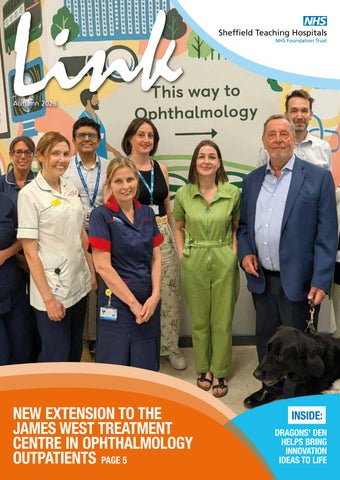
NEW EXTENSION TO THE JAMES WEST TREATMENT CENTRE IN OPHTHALMOLOGY OUTPATIENTS PAGE 5
INSIDE: DRAGONS' DEN HELPS BRING INNOVATION IDEAS TO LIFE
Welcome
Welcome to the latest edition of Link magazine Things never stand still in the NHS and this year we have launched PROUDFuture, which is our approach to ensure we can meet the challenges that we and the rest of the NHS are facing. We are all committed to high quality care, but we need to change how we deliver this in light of increased demand and complexity, financial constraints and new technologies, treatments and ways of delivering care. In this edition you can read more about PROUDFuture and how it will help us to deliver the ambitions in our STH Care 2035 clinical strategy, which is our long-term plan for how we will deliver care over the next decade. Doing this will require us to approach things differently, and that is exemplified by the projects that received funding from our Dragons' Den competition, kindly supported by Sheffield Hospitals Charity. These projects demonstrate how innovation and collaboration can deliver high quality care more efficiently and provide an improved patient experience. Find out more on page 9. We have also passed the one-year mark since we switched to the Connect Electronic patient Record (EPR). Feedback from colleagues across services and roles has been invaluable to understand what is working well and where we need to make changes. A huge thank you to everyone for your support, patience and willingness to share your positive and negative experiences. We are continuing to resolve known issues, and we will keep you updated on the progress of this work. Finally, the British Transplant Games took place in Sheffield in August, and represents a true celebration of the life-saving and changing impact of organ and stem cell transplantation and donation. Many members of Team Sheffield have been patients here at STH and it is truly uplifting to see them competing and being so active post-transplantation. Congratulations to all who took part. Best wishes
Kirsten
Kirsten Major, Chief Executive
CONTENTS 7
5
5 9
10
11
5 New extension to the James West Treatment Centre.
9 Dragons' den helps bring innovation ideas to life.
11 British Transplant Games
10
11 Young man with
7 Rugby player who had to relearn how to walk praises ‘world class’ care. 8 Pioneering 3D printing lab opens. Page 2 • Link - Autumn 2026
Charity news.
returns to Sheffield.
Down's Syndrome who
Follow us on social media
donated organs was an
Find us on Facebook: @SheffieldTeachingHospitals
'inspiration.'
Follow us on LinkedIN: @SheffieldHosp Follow us on Instagram: @sheffieldhospitals
12
Achievements
PROUDFuture and STH Care 2035 our shared plan for the future of care PROUDFuture is our approach to getting us in the best possible shape to meet the challenges we and the rest of the NHS are facing but more importantly to enable us to realise our ambitions set out in our clinical strategy called STH Care 2035. STH Care 2035 is our long-term plan for how we will deliver care over the next ten years. Your ideas and expertise along with research and evidence about population health and what works best to improve care has influenced how we want to shape our future.
“What Matters to You” principle is the ‘golden thread’. Care 2035 sets a clear direction for our organisation, shaped by what matters most to our patients, communities, and staff. It reflects the changing needs of the people we serve, the challenges facing the NHS and our shared commitment to delivering safe, compassionate, and high-quality care.
Care 2035 focuses on: • improving outcomes and experiences for patients.
Why is this important?
• reducing health inequalities.
The growing demand for our care from the populations we serve is evident across our emergency pathways, planned care and community services. Our populations are getting sicker and their needs for care are changing and growing. The tools we have to help care for our patients are changing too – new technologies, treatments, and ways of delivering care are developing all the time. We also have to deliver this plan against the backdrop of a challenging financial position and a low level of funding growth.
• ensuring people receive the right care, in the right place, at the right time. • supporting staff and using our resources sustainably.
How does STH Care 2035 relate to our other priorities? STH Care 2035 is a critical part of our overall strategy for how we can make a difference for our patients through providing high quality patient care. Given this is a ten-year plan, when we update our corporate strategy in
2027 we will align this to support the delivery of our vision. This strategy belongs to all of us. It will guide our decisions, priorities, and improvements in the years ahead. It will require us to think and work differently and collaborate across our services in ways we have not done before. We will also need to work much more collaboratively with other organisations to achieve our shared goals. It is an opportunity to really make a difference for those we are here to care for. You can read STH Care 2035 and find out what it means for you and your service on the dedicated intranet page: STH Care 2035.
Page 3 • Link - Autumn 2026
Cancer doesn’t wait Regrettably despite having a previously good track record on cancer waiting times, we currently are not meeting the national standards and we need to make urgent improvements to make sure we provide our patients with the care they need in a timely way. Our Cancer Doesn’t Wait improvement drive involves us all and if we get behind the actions we need to take, we can improve the time our patients wait to receive their cancer diagnosis and treatment. As we know, every day matters when it comes to cancer care. Quicker tests, faster results, and timely treatment give our patients the best possible chance of recovery and helps reduce the anxiety that comes with waiting for answers. A high number of patients referred to us for investigation do not have cancer and the quicker we can confirm and communicate this to patients, the better it is for everyone. Whether you’re booking appointments, running tests, supporting patients, or managing pathways, small actions will add up to big improvements.
What can you do to help? No matter your role, there are ways you can make a difference such as: • Booking tests and appointments promptly – every day saved matters. • Complete referrals accurately and quickly to avoid delays. • Escalate concerns early if something doesn’t look right or a patient risks breaching standards. • Communicate clearly with colleagues to keep patients moving through the pathway. Ask your colleagues what is happening with
cancer performance in your team and what you can do to improve things Share your ideas – if you’ve spotted a way to speed things up, we want to hear from you. If you have a suggestion or an idea please email: sth.myidea@nhs.net.
What are the three cancer standards we want to meet or exceed? For posters and information, please visit the intranet page Cancer Doesn’t Wait, Neither Can We | Sheffield Teaching Hospitals NHS Foundation Trust
28 Days
62 Days
31 Days
The national standard is that 80% of patients to be diagnosed, or had cancer ruled out, within 28 days of an urgent referral.
The national standard is that 80% of patients to receive their diagnosis and start their treatment within 2 months (or 62 days) of an urgent referral.
The national standard is that 94% of patients to begin treatment within 31 days of doctors deciding a treatment plan.
The Faster Diagnosis Standard:
The 62 day referral to treatment standard:
The 31 day decision to treat standard:
Preventing deconditioning
– Mind and Movement Matters We have launched our Mind and Movement Matters campaign, a wardwide initiative to encourage patients to stay mobile, cognitively active, maintain independence, and support recovery throughout their hospital stay. esearch shows that prolonged time in bed can R lead to:
• Increased deconditioning (physical and/or cognitive decline due to a prolonged period of being inactive) Something as simple as getting dressed, sitting out of bed, and walking regularly can make a significant difference to recovery.
• Reduced confidence and independence
Everyone can make a difference. Whether you are clinical or non-clinical staff, you can help encourage movement and activity throughout the day.
• Longer hospital stays
Encouraging activity does not always mean long
• Loss of muscle strength • Increased risk of falls
Page 4 • Link - Autumn 2026
walks or therapy sessions. Small steps count: • Sitting out for meals • Walking to the toilet • Getting dressed during the day • Taking short corridor walks • Reading a book or magazine Help our patients stay stronger, safer, and more independent. Visit the intranet page for more information and resources: intranet.sth.nhs.uk/ preventing-deconditioning-mind-and-movementmatters-campaign
New £800k extension to the James West Treatment Centre in ophthalmology outpatients A new extension to the James West Treatment Centre in our ophthalmology outpatients department has opened. The newly refurbished space, which includes multi-use theatres to save and preserve sight in common eye conditions such age-related macular degeneration, was officially unveiled by Lord David Blunkett and Lady Blunkett. The theatres will also be used for procedures such as oculoplastic surgery and botox injections for the treatment of certain eye conditions. Complementing the newly refurbished and extended treatment centre is a bright and colourful new mural designed by Lisa Maltby in partnership with our Arts in Health team and funded by Sheffield Hospitals Charity. The mural features recognisable local features and details, providing a more welcoming and calming environment for patients on arrival. The addition of ceiling light panels in the new treatment room, also funded by our Charity, helps visually distract patients, reducing anxiety at a daunting time. Music in the new theatres now helps to create a more relaxed atmosphere.
Eye Clinic Liaison Officers (ECLOs) within the department to provide information, emotional support and advice to patients with sight conditions.
Sheffield Hospitals Charity also funds RNIB
Kirsten Major, Chief Executive, said: “We
were delighted to officially open this fantastic new space which represents an important investment in ophthalmology services for our patients and communities across Sheffield and the wider region.”
New MRI scanner to aid diagnosis and treatment of thousands of patients A new state-of-the art MRI scanner has been unveiled at the Northern General Hospital. It will help clinicians take enhanced pictures of the inside of the body. The new scanner, which cost £2.75m to buy and install in a new building off Vickers Corridor, is ‘cardiac enabled’, meaning it can provide high-resolution imaging of heart structure and function including foetal cardiac scanning. As the eighth MRI scanner at the Trust, it will help to meet the increasing demand for MRI scans across a wide range of health conditions, enabling more scans and reducing waiting times. The scanner will enable MRI to deliver an additional 9,500 scans every year to aid the diagnosis and treatment of about 7,500 patients. It offers improved patient comfort, with ambient lighting and a patient TV screen for distraction, alongside a more ergonomic working area for staff. Kirsten Major, Chief Executive, said: “We are delighted that our latest MRI scanner is now operational. It will provide our patients with
all the benefits of the latest MRI technology, while enabling us to meet increasing
demand and progress patient care as quickly as possible.” Page 5 • Link - Autumn 2026
Do the tests and scans we request progress or delay patient care? We need to think differently and use our diagnostic resources as wisely as possible. Over the last five years we have seen a huge growth in the number of tests, scans and x-rays ordered across our services. While the majority of these are essential for diagnosis or treatment, there are some that add little value to a patient’s ongoing care. As well as being potentially uncomfortable or worrying for patients, in some cases unnecessary tests or scans can actually delay care or discharge. Every test or scan requested puts additional demand on our laboratory and radiography capacity, so it is really important that we stop and think whether the test we are ordering is really needed. Every test that is superfluous can mean a longer wait for a patient whose test results would make a real difference to their diagnosis or care. For example, we know that diagnostic capacity is critical in the work we are doing to improve our cancer performance for patients who have cancer and also
for those who we can tell quickly that they do not have cancer. Please take a moment to think the next time you consider ordering a test for your patient: • Is this test needed for diagnosis? • Will it make a difference to the patient outcome? • Will it progress treatment or management of care? • Has it been done by someone else or very recently? • Could the patient be safely discharged and come back as an outpatient for the test? As well as being the right thing to do for our patients, ordering tests wisely can help us to make the best use of our resources. For example, in times of high demand, it helps patient flow and bed availability if patients are not having to wait for test results before discharge. Also, did you know that just one in 40 fewer lab tests would equate to an annual financial saving of about £800,000. By being thoughtful when we order tests, we can ensure that we are using our diagnostic and laboratory capacity to its best effect for our patients.
Not just a survey - its is your voice being heard Last year, we had an incredible response to the NHS Staff Survey, and so a big thank you to the thousands of colleagues who took the time to share their views. Understandably, many of your comments focused on our new Connect system which went live last July and your feedback has genuinely helped shape the changes and developments we have made over the past year. The establishment of the Admin Advisory Group (a group of administrative colleagues) was a direct result of your feedback and has been invaluable in telling us what is working well and where we needed to make changes. Your comments have helped us understand the experience of colleagues using Connect every day. Another key theme from your feedback was Page 6 • Link - Autumn 2026
flexible working. I am really pleased that, working in partnership with Staff Side, we have been able to develop a new flexible working policy. We have also continued to focus on health and wellbeing, as well as looking at where we can provide additional support with the cost of living. You will have seen our recent move to Perkbox, giving all colleagues access to discounts and salary-sacrifice schemes, including savings on cars, white goods and more. I know everyone is incredibly busy, but I am asking you once again to spare a few minutes when the survey lands in your inbox at the end of September to tell us where you think we have improved compared to last year and where we can do better.
Your feedback genuinely matters, because the anonymised themes we receive are considered by the Board and Trust Executive, and it helps shape where we focus our efforts over the coming year. Please look out for your email and complete it the first time you receive it because fewer reminders reduce the cost of running the survey. Thank you for taking the time to have your say.
Rugby player who had to relearn how to walk following spinal injury praises ‘world class’ care A student rugby player who was left hospitalised for five months after suffering a broken neck and spinal cord injury during a match has praised the ‘world class’ care he received after he was able to walk out of hospital. Harry Bartlett, 21, an economics student at the University of Liverpool, was playing rugby against the University of Sheffield when he was injured going in for a tackle and was left unconscious and unable to move. After undergoing two surgeries, a month-long stay in intensive care and almost four months rehabilitation at the Princess Royal Spinal Centre at the Northern General, he was able to walk out of hospital. Harry said: “It was such a relief and I want to thank all the people who looked after me – the surgeons, doctors, nurses, physios, occupational therapists and healthcare assistants. The care I received was truly world class from start to finish.” The injury happened when Harry took a head on hit going in for a tackle. He was on the ground for about 45 minutes, lost consciousness for a time and was unable to move. He was taken to A&E where scans revealed a broken vertebrae and a spinal cord injury.” The next day, he underwent the first of two surgeries to decompress his spinal cord and stabilise his spine before being admitted to intensive care, where he stayed for 35 days. He was then transferred to the spinal injuries centre to undergo intensive rehabilitation, including learning how to sit, stand, walk and write.
Harry (front centre) with friends after being discharged. Harry said: “After it happened, we didn’t know what the future was going to look like for me. I couldn’t move my body and was completely reliant on other people. But from the moment I arrived in hospital the care was outstanding. From the registrar to the spinal surgeons and the team in ICU, they were on top of everything and I knew they just wanted the best for me and were looking after me.
were some harsh truths, but quite early on they said they thought I would walk out of there which was great to hear because you knew they really meant it. It is hard to believe where I am now compared to where I started.”
“In the spinal injuries centre they knew what I needed and how to push me in the right way. For four months it was constant support. There
He will no longer be able to play contact sports due to the risks, but hopes to be able to continue with an active lifestyle.
After being discharged, Harry spent some time at home recovering but has been able to return to Liverpool to meet up with university friends and will resume his studies next year.
Allergy treatment transforms life of dad who suffered from severe hay fever A dad who suffered from debilitating hay fever symptoms that prevented him from going outside in summer says an immunotherapy treatment has had a transformative effect on his life. Adam Sullivan-Rahman, 31, of Stannington, Sheffield, suffered from a severe reaction to grass and tree pollen that left him with eyes and throat so swollen and runny that it stopped him from seeing or breathing properly. However, a course of treatment with immunotherapy injections at Clinical Immunology
and Allergy Unit has improved his symptoms to the extent that he can now often go out without even using eyedrops. The treatment is six injections over the course of about three years with increasing doses of a modified version of the allergen. This gradually trains the body to tolerate the allergen and reduce symptoms. Adam said: “It has progressively got a lot better. I’m much less restricted. I can go for a country walk, I can help out more with the kids, I can take them to the park. That really that means a lot to me.” Page 7 • Link - Autumn 2026
Research and Innovation
Landmark trial treatment ‘best birthday gift ever’ A Rotherham man has become the first patient at the Trust and among a small number in the world to receive CAR T-cell therapy as a potential “one-and-done" treatment for multiple sclerosis (MS). Numan Unees, was diagnosed with MS six years ago and rapidly lost his ability to walk. He received the CAR T-cell therapy at the Royal Hallamshire Hospital as part of a landmark clinical trial just two days before his 40th birthday, saying it was the “best birthday gift ever”. The phase 1 AUTO1-MS1 trial, which is running in four UK sites including Sheffield, is one of the first to test the safety of CAR T-cell therapy as a treatment for MS. CAR T-cell therapy works by reprogramming a person's own immune system to hunt and destroy rogue cells causing disease. It has shown huge promise in the treatment of some blood cancers, with patients achieving long-term remission after having failed multiple standard treatments. Researchers are now looking to see if this mechanism can be replicated in patients with autoimmune conditions such as MS and lupus. If successful, it offers hope of a one-off, immediate treatment for MS which could slow , or even halt disease progression.
Numan, who has two young children, said: “MS has affected my life severely. I went from being fit and healthy to having to use crutches within three to six months of diagnosis. The
Pioneering 3D printing lab opens A state-of-the-art 3D printing lab producing ultra-realistic medical models for training, surgical simulation and patient-specific anatomical modelling has been unveiled.
This technology is already benefiting patients, with clinical teams using it to plan and implement complex surgical procedures, tailored to individual patient anatomies, such as for complex heart surgery days ahead of the real thing.
Funded through a wider National Institute for Health and Care Research (NIHR) infrastructure grant, the new facility boasts some of the most advanced 3D printing for the creation of lifelike surgical models that look and feel like real bones and tissue.
Clinical Scientist Dr Pete Metherall, who led the lab’s development, said: “3D-printed surgical models provide trainees and surgeons with anatomically accurate, patient-specific replicas to practise on before the real thing, enhancing skills and confidence.”
deterioration was rapid and my mobility was gone. The hope of this treatment for me is that it stops the MS and I can get some mobility back, some purpose back and be working.”
Weston Park top recruiter to major breast cancer radiotherapy trial Researchers from Weston Park Cancer Centre are celebrating after becoming one of the highest recruiters in the UK to a major trial that could significantly shorten radiotherapy treatment time for breast cancer care patients. Led by Dr Claire Baldry, the team have successfully recruited over 30 patients into Fast-Foward Boost since opening as a trial site six months ago. The trial, which is running across 40 NHS Trusts and being funded by the National Institute for Health and Care Research (NIHR), is looking to see if the full course of radiotherapy treatment, including the final tumour site boost dose, can safely be given in fewer treatment visits at a higher dose to make treatment quicker for patients without compromising outcomes.
Page 8 • Link - Autumn 2026
Dragons' den helps bring innovation ideas to life A crop of creative ideas put forward by our teams have been awarded almost £300,000 from Sheffield Hospitals Charity to help further improve patient care. The 13 winning projects, submitted by staff in a Dragons’ Den-style competition, will solve clinical challenges, improve patient experiences and design services that aim to speed up care and reduce hospital stays. Together, they showcase the creativity, expertise and passion of staff working across the Trust. Shasta Ashraf, Director of Grants for Sheffield Hospitals Charity said: “We’re proud to fund Dragons’ Den and hear about innovative projects that have the potential to transform patient care. By supporting STH staff to test new ideas and technologies, we can help improve outcomes, enhance patient experience and make a real difference to people’s lives across Sheffield.” Kirsten Major, Chief Executive said: “All of these projects are a fantastic example of our PROUDFuture in action. They show how colleagues across STH are helping to shape the future of healthcare through innovation, collaboration and continuous improvement. All of us were incredibly impressed with the quality and quantity of this year’s applications, and we look forward to seeing the impact of their work.” One particularly creative project from our catering colleagues will replace white plates, bowls and tableware with blue alternatives on Brearley 7, a ward caring for patients with dementia. The strong colour contrast has been shown to attract attention, stimulate appetite and improve nutritional intake, demonstrating how simple changes can have a significant impact on patient wellbeing. The Dragons were genuinely amazed at the difference a blue plate made to how much more appetising it looked compared to the same food on a white plate. Other successful projects include: • Introducing point-of-care ultrasound in Weston Park Assessment Unit to enable rapid assessment of cancer-related complications.
The blue plate project on Brearley 7 • Creating an enhanced care area within the Acute Medicine Unit. • Developing a bespoke community-based rehabilitation service for longer-stay ICU patients following discharge. • Piloting handheld toe pressure devices within community nursing services to improve the early detection of arterial disease in patients with larger limb swelling or lymphoedema.
Change Makers Have you seen our Change Makers showcase? It highlights examples of change and innovation from across the whole of the Trust that exemplify our PROUDFuture work and make things better for patients and staff. Check it out on the intranet by searching Change Makers.
• Introducing specialist physiotherapy directly into the Emergency Department to provide same-day assessment for patients presenting with back pain. • Establishing a one-stop breathlessness clinic. • Building on pioneering work using artificial intelligence to support faster comparison of heart scans and improve reporting efficiency. Read more about these projects on the Trust intranet, just search Dragons' Den.
Page 9 • Link - Autumn 2026
Largest ever donation funds surgical robot for cancer patients Hundreds of cancer patients in the region will now benefit from a new surgical robot thanks to a generous £1.45m donation from Sheffield Hospitals Charity, the largest single donation from the charity. The brand-new da Vinci Xi surgical system at Sheffield’s Northern General Hospital will deliver life-changing robotic-assisted surgery for a wide range of cancers including lung, oesophageal, stomach, bowel, liver, pancreas and kidney cancers. The advanced surgical system lets surgeons work
in hard-to-reach areas using robotic-assisted arms with flexible, tiny wristed instruments and better visualisation via a high-definition 3D view. This magnifies the surgical area being worked on 10 times to what the human eye sees alone or the equivalent of magnifying a 2p coin to the size of a dinner plate. This will help provide better outcomes for hundreds of patients in Sheffield and beyond, offering fewer and less invasive incisions, shorter hospital stays, quicker recovery and a return to normal life sooner.
Ten years of Saving Precious Minutes for patients Across Sheffield and beyond The helipad at the Northern General was funded by the charity 10 years ago and has helped countless people since then. Before the new helipad was built, air ambulance helicopters had to land elsewhere on site, and because of its distance from the Emergency Department, patients required an additional transfer by land ambulance to reach the hospital. This is a powerful reminder of what a difference people can make when they donate to Sheffield Hospitals Charity.
Domestic abuse can impact anyone, including NHS staff Sheffield Hospitals Charity have funded a project to support NHS staff at Sheffield Teaching Hospitals impacted by domestic abuse. REACH will be delivered across the Trust by a team from specialist domestic abuse organisation IDAS Whether you need support yourself or want to strengthen support for your colleagues, REACH is here to help. To get support call the helpline 0808 808 2241, email reach@idas.org.uk or complete the online form at www.idas.org.uk/reach or to find out more information on how to help your colleagues, email the team. Did you know that Sheffield Hospitals Charity have a dedicated NHS staff section on their website? It's full of information around how to apply for funds and the difference our charity makes. Visit the staff area here: www.sheffieldhospitalscharity.org.uk/nhs Page 10 • Link - Autumn 2026
British Transplant Games returns to Sheffield The British Transplant Games were held in Sheffield in August for the first time since 2013. The games in Sheffield was the biggest in the event’s 48 year history, with more than 2,850 participants including 1,124 organ and stem cell transplanted athletes. Many members of the Sheffield games team have undergone transplants at STH, which is a centre for kidney transplants and stem cell transplants. Among those taking part was golfer Jonathan Thomson, known as ‘Jigger’.
Jonathan, 30, a professional golfer who has competed at The Open, saw his career put on hold following a devastating relapse of leukaemia, an illness from which he had first suffered as a child.
donation really is an incredible thing and so it's really nice that I could promote that at the transplant games. I wasn't in it to compete as such. I was in it to spread the word about the games and about transplantation and donation.”
He underwent treatment with a stem cell transplant at the Royal Hallamshire Hospital and is on the long road back to recovery. He took part in the golf for Team Sheffield at Hillsborough Golf Club.
Find out more about the games at www.transplantactive.co.uk/britishtransplantgames
Jonathan, who has a three-year old daughter, said: “The treatment I have had has been mindblowing. We are so lucky to have this level of expertise and skill here in Sheffield. Stem cell
Young man with Down's Syndrome who donated organs was an 'inspiration' The family of a young man with Down’s Syndrome whose organs saved the lives of three other people after his death say that selfless decision to donate represents his legacy. Eashan Madan died last year aged 27 following complications from surgery on a rare heart condition. His kidneys went to two women in their 20s and 30s, and his liver to a man in his 40s. His pancreas has also been donated for medical research which could help to save further lives in the future. Eashan’s mum, Dr Suvira Madan who is a Consultant Geriatrician at the Trust, said: “It is very fitting for the type of person he was. He was very kind and caring and always saw the good in people. His motto in life was always ‘how can I help?’ This noble act of generosity has given happiness to at least three families.” Eashan lived a full and rich life, working multiple jobs and having a busy social life. Among his roles was a supported internship with the catering team at the Trust. The first sign that something was wrong with
Eashan was when he developed a dry cough, and investigations revealed a serious heart condition requiring surgery. When the severity of his condition became apparent, the fact that Eashan and his parents had had the conversation about organ donation meant they knew what his wishes were and that they wanted the donation to go ahead. Suvira said: “Me and my husband Sanjeev are both on the donor register, so we had had the conversation and Eashan’s decision was that he wanted to donate. We felt that irrespective of his disability, if he could donate and he wanted to then he should. My message is that you shouldn’t think of disability, race, class or anything like that – if you can donate, then you should do it.” The family have received letters from the recipients of Eashan’s organs, expressing their gratitude for his gift and the positive impact it has had on their lives and their families. “It is like the best certificate you can ever have,” said Suvira. “We couldn’t save Eashan’s life, but he has saved three lives.”
To find out more about organ donation, please visit: www.organdonation.nhs.uk Page 11 • Link - Autumn 2026
Apprentices shine
Achievements
Two apprentices at the Trust were successful at the South Yorkshire Apprenticeship Awards which recognise the outstanding apprenticeship network flourishing across the region.
Lifetime achievement award for trauma surgeon pioneer
Lily Graham, won the Professional Services Apprentice of the year, and Freya won the Intermediate Apprentice of the Year.
Mr John Edwards, consultant thoracic surgeon has been recognised by the Chest Wall Injury Society (CWIS) with the presentation of the prestigious William B Long, III, MD, Meritorious Award. The award was given in honour of his outstanding clinical contribution to improving outcomes for patients with thoracic trauma over a 20-year career. Mr Edwards was the first surgeon in the UK to stabilise a patient’s fractured ribs after
severe trauma using pre-contoured titanium rib plates secured into place via an incision over the broken bones with screws to stabilise the injury whilst it heals which was key to national guidelines being published.
Professor elected Fellow of the Academy of Medical Sciences
Cancer nurse wins national award for improving immunotherapy care Rebecca McMinn, Advanced Clinical practitioner Systemic Anti-Cancer Therapy lead, won the Excellence in ImmunoOncology Award at the Immuno-Oncology Clinical Network (IOCN) Awards. The Awards recognise outstanding contributions in immuno-oncology in the UK.
Fetal MRI pioneer honoured for services to women's health
The Trust has also been named the Sheffield College Employer of the Year at the 2026 Apprenticeship Celebration Awards. This recognises the Trust’s success in providing apprenticeship opportunities to individuals who may not traditionally consider healthcare roles.
Sheffield consultant appointed to prestigious national role
Professor Thushan de Silva, Honorary Consultant Physician in Infectious Diseases, has been elected as a Fellow of the Academy of Medical Sciences in recognition of his outstanding contributions to infectious disease and immunity research.
Professor David Sanders, consultant gastroenterologist, has been elected as the President Elect of the British Society of Gastroenterology (BSG), one of the world’s leading gastroenterology organisations.
Churchill Fellow
Podiatry service retains customer service excellence standard for 30th year
Clinical Scientist Jonathan Taylor, who specialises in bringing AI into healthcare, is one of the newly appointed Churchill Fellows. The fellowship was set up in the name of Sir Winston Churchill to support global insights to spark positive change in the UK. Jonathan will learn from international health centres how they oversee AI in clinical settings to help develop guidance for the NHS.
Community podiatry have successfully retained their ‘gold standard’ rating for putting patients first for the 30th consecutive year. The team retained the prestigious Customer Service Excellence (CSE) standard following a e two-day assessment by Government inspectors.
Dr Elspeth Whitby, consultant radiologist, has received the Distinguished Service Medal in recognition of her significant and lasting improvements to women’s health.
Anaesthesia team achieve national accreditation for third consecutive time
She is one of only a handful of individuals to be awarded the national honour in its recent history, which is bestowed by the Royal College of Obstetricians and Gynaecologists to those who demonstrate exceptional, long-term contribution to obstetric and gynaecological care.
Our anaesthesia department has been reaccredited under the prestigious Royal College of Anaesthetists' Anaesthesia Clinical Services Accreditation (ACSA) scheme, recognising its continued commitment to delivering safe, high-quality care for patients.
Dr Whitby pioneered a fetal MRI scanning service which precisely detects some abnormalities in the placenta and babies in the womb.
Accredited departments are assessed against rigorous national standards covering patient experience, patient safety, workforce wellbeing, governance and clinical leadership.
Page 12 • Link - Autumn 2026
ADVERTORIAL
“Impressed would be an understatement” For anyone who struggles to leave their home without support, at-home health services can be a lifeline. This is something that Derek Brown, who cares for his wife Margaret, knows only too well. Specsavers is committed to ensuring that everyone has access to essential eye-health and hearing care – but also understands that it’s not always easy for people like Margaret, who suffers from Alzheimer’s disease, to attend in-store appointments. That’s why, for the past ten years, Specsavers Home Visits has provided comprehensive NHS-funded eye tests to anyone who’s unable to visit a store unaccompanied. It’s also started to provide free at-home hearing services in selected locations in the UK. Derek called on the Specsavers Home Visits service when Margaret needed a routine eye test and it was too challenging to get to a store. He was blown away by the expert care that was delivered during the visit and the difference the new glasses made to his wife. Although Margaret wasn’t able to respond to the questions of the optician and their assistant, during the visit, they adapted their approach so they could prescribe the reading glasses that have expanded her world. “If I was to say I was amazed, that would be an understatement,” says Derek. “What was so significant for me as a full-time carer was that the Specsavers experts were punctual, quiet-speaking and patient, reassuring Margaret with everything they did. The level of care expressed towards her was incredible.”
Alzheimer’s in early 2018. After she spent four weeks in hospital in 2022, Margaret’s condition deteriorated, and she has since been confined to a hospital bed in the couple’s living room, and a hoist to access a wheelchair. With multiple other health challenges, caring for Margaret is complex – but after 25 years of love and marriage Derek has risen to the challenge. As well as taking care of her everyday needs, he’s been able to improve her quality of life thanks to Specsavers at-home service. Following her at-home eye test, the optician suggested Margaret tried some reading glasses to help her enjoy looking at family photos.
Derek, from Northallerton in North Yorkshire, has been the primary carer for Margaret, since her diagnosis with
Derek was unsure how she would adapt to wearing glasses but seeing her smile while looking at old family pictures told him everything he needed to know.
Why Choose Specsavers Home Visits?
“If anyone is in any doubt about inviting Specsavers into their home, all I can say is: simply try it,” Derek says. “You won’t regret it for a second.”
• Convenience: Our experts come directly to you. • Personalised Care: Visits are tailored to the individual’s needs, with specialist equipment to ensure comfort and accuracy. • Peace of Mind: Your loved one will receive the same kind of highquality care as they would expect in-store.
Derek now fights for better support and recognition for carers nationwide, and has launched a website (www.dementiaguidance.co.uk) dedicated to helping carers like him across the UK. He’s keen to ensure they have all the information they need – including the option of getting a comprehensive at-home eye test from Specsavers.
Expert eye and hearing care tailored to your needs For those eligible, our mobile experts will provide a comprehensive NHSfunded eye test from the comfort of your own home, with all the same care and thoroughness as you would receive in-store. Specsavers has now also started to roll out free at-home hearing services across the UK. To find out what locations this service is available in visit our website. Our eye care and hearing services are tailored to each person and their needs. They are designed to provide eye care and hearing services that are as individual as they are and can be adapted to meet their changing circumstances and comfort levels.
To see if you or your loved one are eligible, call 0800 0890144 or visit specsavers.co.uk/home-visits Page 13 • Link - Autumn 2026
Email us: info@octagon.org.uk
Call us: 01302 714528
Quality publications, that cover a specific demographic to help your business reach new customers Advertising opportunities available in our staff magazines, care directories, and independent living guides
SEFTON SPRING 2023
Community Care Guide
COUNTESS MATTERS
Follow, like and add us...
OPTIONS A guide to care and independent living
Spring 2023
Leaving hospital
Liverpool & Sefton Spring 2023
What’s next?
NHS continuing healthcare Who’s eligible?
Supporting and promoting independence, health, fairness, respect, equality, dignity and autonomy as well as safeguarding adults in Sefton
County, City and Borough Council care directories are comprehensive guides to nursing care, residential care and independent living support. Created for individuals and their families exploring the possibility of moving to nursing/ residential care or seeking advice and support to continue living independently at home.
SOCIAL CARE
tips
More on page 5
02 Supporting patients with skin cancer
CARE DIRECTORIES
10
Hospital at Home: supporting patients in their own homes 04 Major investment in theatres
08 Pharmacy team introduces new system
Healthcare services
ICU staff showcase plans for new balcony. More on page 11.
NHS STAFF MAGAZINES
Choosing the right one
NHS publications are circulated throughout hospitals to staff, patients and visitors on a regular basis. Advertising within the publications enables companies to promote their services to NHS employees and are an excellent way to Increase their customer base within this very targeted audience.
OPTIONS CARE AND INDEPENDENT LIVING GUIDES Options provides older people with important information from health organisations such as CQC, ICB and the NHS. Circulated through various healthcare professionals including Council social work teams, NHS hospital discharge, community nurses, and various age related charities.
To advertise in any of our publications in your area please contact us below Page 14 • Link - Autumn 2026
Email us: info@octagon.org.uk
Call us: 01302 714528
Unite - standing up for you in health Sheffield Teaching Hospitals, Barnsley Road, Clocktower Basement, Sheffield S5 7AU Your Health and Professional Union Whilst you are caring for others Unite will stand up for YOU
OUR AIM
To get you the best terms and conditions of service and provide the advice and support on any matter, you may need related to your job. Unite Legal and Affiliated Benefits As a member of Unite you have access to a great range of benefits and services. • Unite Legal Services • Unite Life Insurance • Unite Mortgages
• Unite Prepaid Debit Card • Unite Home Insurance • Unite Motor Insurance
• Unite Lottery • Unite Personal Financial Review • Driver Care
• Unite Credit Union Service • Unite Property Services • FREE goodie bag after joining
IT’S VERY EASY TO BECOME A MEMBER
Join online www.unitetheunion.org Office number: 0114 321 0702
If you need assistance or advice, please contact: sth.unite@nhs.net
Page 15 • Link - Autumn 2026
Do you feel overwhelmed by the responsibilities of caregiving? Let us help. For over 60 years Broomgrove has been a nursing home offering both respite and full-time care options. We are the only charity-run care home in Sheffield, which means all profits are invested back into Broomgrove. We are conveniently placed, just off Ecclesall Road, close to the Botanical Gardens. Call us to arrange a visit, and see for yourself all the benefits our caring community has to offer.
Page 16 • Link - Autumn 2026
Sheffield Teaching Hospitals Trust
OCTAGON
NHS Foundation
DE S IG N & M A R K E T I NG LT D
Autumn 2026
DESIGN PRINT SUPPORT
30 Broomgrove Road Sheffield S10 2LR Telephone 0114 266 1311 www.broomgrove-trust.co.uk
NEW EXTENSION TO THE JAMES WEST TREATMENT CENTRE IN OPHTHALMOLOGY OUTPATIENTS PAGE 5
INSIDE: DRAGONS' DEN HELPS BRING INNOVATION IDEAS TO LIFE
To advertise in this publication please call the sales team on 01302 714528 Rossington Hall, Great North Road, Doncaster, South Yorkshire DN11 0HR 01302 714528 | www.octagon.org.uk | info@octagon.org.uk
Every possible care has been taken to ensure that the information given in this publication is accurate. Whilst the publisher would be grateful to learn of any errors, it cannot accept any liability over and above the cost of the advertisement for loss there by caused. No reproduction by any method whatsoever of any part of this publication is permitted without prior written consent of the copyright owners. Octagon Design & Marketing Ltd.Rossington Hall, Great North Road, Doncaster DN11 0HR Tel: 01302 714528
Sheffield Teaching Hospitals NHS Foundation Trust has not vetted the advertisers in this publication and accepts no liability for work done or goods supplied by any advertiser. Nor does Sheffield Teaching Hospitals NHS Foundation Trust endorse any of the products or services.
Page 17 • Link - Autumn 2026
Page 18 • Link - Autumn 2026
Page 19 • Link - Autumn 2026
Designed & Published by Octagon Design & Marketing Ltd, Rossington Hall, Great North Road, Doncaster, DN11 0HR Tel: 01302 714528