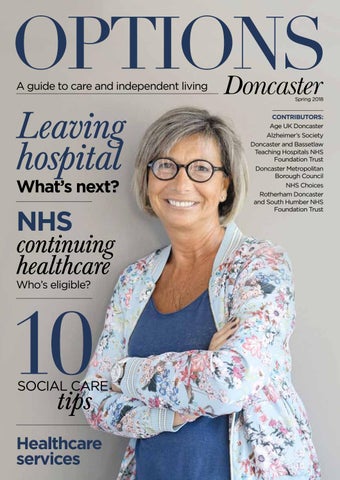
OPTIONS A guide to care and independent living
Doncaster
Spring 2018
Leaving hospital What’s next?
NHS continuing healthcare Who’s eligible?
10
SOCIAL CARE
tips
Healthcare services
CONTRIBUTORS: Age UK Doncaster Alzheimer’s Society Doncaster and Bassetlaw Teaching Hospitals NHS Foundation Trust Doncaster Metropolitan Borough Council NHS Choices Rotherham Doncaster and South Humber NHS Foundation Trust
CQC Registered
Are you considering your long term care options or feeling alone at home on your own? Then why not give us a call or pop in to see what we offer. We are situated in a lovely rural village with a lot of outdoor space including a sensory garden and a stunning courtyard. We have very caring staff to meet your personal needs and enable you to stay as independent as possible, we have kitchen staff who provide a lovely choice of meals to meet your nutritional needs along with an activity co-ordinator who will keep your body and mind active. For further details and to discuss your requirements please call Andrea Goacher on 01427 891204
South Moor Lodge Care Home Ltd
South Moor Road, Walkeringham, Doncaster, South Yorkshire DN10 4LD
Tel: 01427 891 204 • Fax: 01427 891 204 Email: southmoorlodge@jasminehealthcare.co.uk
• Day care, short and long-term respite care • 24 hour care and support • call system in all rooms • home cooking - special diets catered for • television room • outings & entertainment
Tel: 01302 327 004
11 Avenue Road, Doncaster DN2 4AH
Contents Doncaster Council’s approach to adult social care is changing........................................... 4 What will this mean for you?................................................................................................ 4 Why are we doing this?...................................................................................................... 4-6 The Care Quality Commission Social Care and GP top tips.................................................. 7 Lifesaving diagnosis equipment installed at DRI................................................................. 8 Serious falls reduction at Trust.............................................................................................. 8 Improving our response to infection.................................................................................... 9 Welcoming carers................................................................................................................. 10 Keep norovirus out of hospital this winter........................................................................ 11 Wide range of support on offer from Rotherham Doncaster and South Humber NHS Foundation Trust.................................................................... 12-13 NHS continuing healthcare............................................................................................. 14-16 Personalised care............................................................................................................. 16-17 What is NHS-funded nursing care?..................................................................................... 18 The Motability Scheme........................................................................................................ 19 Paying for your own care and support.......................................................................... 20-21 Care services in your own home..................................................................................... 22-23 Age UK Doncaster Services............................................................................................. 24-25 Alzheimer’s Society Services in Doncaster..................................................................... 26-27 NHS hospitals and services in Doncaster and the surrounding area................................. 28 Useful contacts..................................................................................................................... 29
Welcome and
introduction
This guide is intended to help you, your carer and your relatives understand how your local health services can help you after discharge from hospital. Also information to help you to live independently or access support and care services in your area.
Rotherham Doncaster and South Humber
NHS Foundation Trust
OCTAGON DESIGN & M A R K E T I NG LT D
3
Introduction Doncaster Council’s approach to adult social care is changing. Responding to the growing pressures of rising demand and reduced financial resources, we have developed a new plan of how we will change the way we care and support adults by improving outcomes and choice. Our plan means we will have a health and social care system that delivers value for money, improves access locally to a wider service offer, provides opportunities for people to improve their health, puts people in control of their care and support and protects those who are most vulnerable. People tell us that they want to live independent, healthy and fulfilling lives based on choices that are important to them. People tell us that they want to stay in their own homes and communities for as long as possible. Our new approach will make sure that people have the opportunity to do just that.
What will this mean for you? Together with our partners and communities, we will work with people to help them identify what they can do for themselves, and build on this. Finding new ways for people to seek solutions wherever possible, rather than only with traditional council services, will be at the heart of everything we do.
4
housing, and social care providers - to enable groups and people to help each other, providing opportunities for them to gain the skills they need to live independent lives including, where appropriate, help to find or keep work. Supporting people to recover from illness or accidents will be important. Giving older people the tools and support to regain their confidence and physical skills after a fall, for example, is something we are working closely with our NHS colleagues on. If people do need to access help from us directly we are still here for you, but we will provide you with that help in a way that maintains your independence where we can. For example, by accessing a direct payment from us people can have total control over the type of care and support they receive, or it might be we explore using technology to help people stay safe and independent at home.
Why are we doing this?
We will be making information and advice more accessible and relevant to individuals at a local level. A series of hubs will be opened in communities across the borough and will provide a local point of information and advice that will be specific and personal to that relevant area. These hubs will also offer a central point where you can easily access professionals when needed.
There are several reasons why we need to change how we work:
We know that when people feel part of a community they feel less lonely, more able to manage their own needs, and less likely to need social care and health support. We will work differently with partners - including the NHS,
• An increase of 11.2% people who have a limiting long term illness.
• People’s changing expectations about what they need and how they want to live their lives. • The growing number of older people in Doncaster – by 2020, 60,650 residents will be over 65.
• The number of people predicted to have dementia will increase by more than 20% by 2020.
>>
â??I want to live an independent, healthy and fulfilling life based on choices that are important to me.â?ž
5
• The availability of new technology that can help us to work more quickly and efficiently.
knowledgeable workforce that works flexibly with a range of partners to provide services.
• Changes in national social care policy, including the Care Act, the biggest change to social care law in over 60 years.
• Worked jointly with partners to integrate service delivery where appropriate.
By the end of the four year programme of change we will have: • Implemented and embedded requirements of the new Care Act. • Implemented a revised customer journey, with clear and accessible information to help people decide how they live their lives; with an embedded community led model to support people • Become more efficient in the way we work, making more use of technology to produce better results for people. • Supported new and existing providers of public health and social care to increase the range and quality of services. • Developed a confident, skilled and
6
• Reviewed our approach to performance and quality management. We are confident the plan we have in place will deliver all of this. We have already seen some great progress over the last few months, with a significant reduction in the number of people in long term care in favour of more suitable options such as supported living or extra care housing schemes. A good example is Spring Lodge, a purpose built supported living accommodation in Askern, where four adults with a range of disabilities are supported by a team of staff who provide flexible care and support to meet each individual’s needs and promote independence. We want to help you to live ‘YOUR LIFE, YOUR WAY’.
The Care Quality Commission is here to make sure health and adult social care services including hospitals, home and residential care as well as GPs in England provide people with safe, effective, high-quality care. We publish independent inspection reports and ratings about services – information you can use when you’re choosing care for yourself, or a loved one. You can use our website to search for services you might be interested in by geographical area, or by specialism. For example, a care home that might offer specialist care for someone who has dementia. We also welcome your feedback on the care you have received – good or bad. We use this information to help inform our inspections and can alert authorities including local social services, if there are safeguarding concerns about care being provided. You can visit our website at www.cqc.org.uk to find our inspection reports, or share an experience of care. You can also call us to share an experience of care on 03000 61 61 61. Here are some tips to help you choose your care.
Social care Top tips 1
2
3
4
5
6
The Care Quality Commission (CQC) registers all care homes and home care agencies. You can find out which ones support specific groups of people, such as people with a learning disability or those living with dementia. CQC’s Chief Inspector for Adult Social Care, Andrea Sutcliffe always uses ‘The Mum Test’: is a care home safe, caring, effective, responsive to people’s needs and well-led? In other words, is it good enough for my Mum (or anyone else I love and care for)? Look for care homes and home care agencies where the staff involve people who use services and their families and carers, and treat individuals with compassion, kindness, dignity and respect.
7
8
9
Whether you are being cared for in your own home or in a residential setting, the staff looking after you need to be skilled, kind and supportive. They should also be capable and confident in dealing with your particular needs. You should always feel that their support is helping you to live the life you want to. A care home will be a home for you or your loved one. Residents should be treated as individuals with their likes and dislikes taken into account. Think about whether a home is close enough to family, friends, and community facilities. Look at how well-led and managed a home is. What does it have in place to ensure that it delivers high quality care? Does it promote meaningful activity and connect the home with the community?
If you or a loved one needs help with day-today care, you can contact your local council’s social services department. They will ‘make an assessment of your needs’ and depending on circumstances, may be able to help you access financial help. For more advice visit Age UK’s website www.ageuk.org.uk /home-and-care.
If you would like to organise your care yourself, you can find a care worker or personal assistant through an agency. Your local social services department should be able to provide details of approved agencies.
CQC’s ratings will identify services as:
Outstanding Good ● Requires improvement ● Inadequate ● This will help you make informed choices around your care. There’s also useful advice on the Social Care Institute for Excellence’s Find me good care website www.scie.org.uk/findmegoodcare/
10
Safeguarding adults who receive social care is everybody’s business. If you are concerned about the safety of a loved one receiving care, contact the service provider in the first instance. You can also contact social services at your local council. If you feel a crime has been committed, contact the police. You can share your safeguarding concerns with us on our website or contact our National Customer Services on 03000 616161.
The Care Quality Commission has not vetted the advertisers in this publication and accepts no liability for work done or goods supplied by any advertiser. Nor does the Care Quality Commission endorse any of the products or services.
7
Stay well this winter with advi #SnugShazza It’s getting dark early, it’s cold outside and all I can I think of is my fluffy dressing gown, lashings of hot chocolate and curling up in front of the TV. It can only mean one thing: Winter is here! And with it comes the constant snuggly challenge of keeping warm. Luckily, the shops are more than happy to oblige by filling their windows with reindeer onesies, Christmas jumpers and the latest craze – mermaid blankets! But what do we really need to keep warm… and when? Well, I’m a bit of a wimp when it comes to cold weather and to be fair, we get plenty of it in Doncaster, so I’ve pulled together a bit of a survival guide on keeping warm and well – without having to send your thermostat into overdrive or spending an arm and a leg on the latest all singing and dancing miracle blanket!
So here are my top toasty tips: Room temperature: You’ll find that keeping your home at the right temperature will not only be good for your health but for your pocket too. So, if you have reduced 8
mobility, are 65 or over, or have a health condition such as heart or lung disease, you should heat your home to at least 18C. It’s a good idea to keep your bedroom at this temperature all night if you can. During the day you may prefer your living room to be slightly warmer. If you’re under 65, healthy and active, you can safely have your house cooler than 18C, if you’re comfortable. Hot meals and drinks: Have regular hot meals and drinks to keep your body fuelled up ready to fight the cold weather. Flu Jabs: Don’t forget to take
advantage of free flu jabs if you are in an at risk group, pregnant or over 65. Speak to your GP or pharmacist for more information. It’s also a good idea to make sure you are stocked up with prescribed medications, there’s nothing worse than running out over the bank holiday! Warm clothes: Layer up! Wearing plenty of thin layers does the trick. Make sure you wear comfortable shoes with plenty of grip too – save yourself from those embarrassing (and often painful – I know too well) icy pavements. Keep active: Keeping on the move will help you to keep warm; no need to start running marathons, just moderate exercise will have plenty of benefits. So, wrap up warm, get the kettle on and enquire about that flu jab – let’s not let the cold weather get the better of us!
ice from our winter mascots #JackandJoeFrost Watch out, watch out, Jack Frost is about; he’s after your fingers and toes! Again! Again! My little grandson Joe’s voice was reaching fever pitch now, he was getting so excited. I repeated the rhyme again (for about the tenth time) but faster this time and wiggled my fingers again and pulled another face, which he tried to copy. It was hard for him, trying to wiggle fingers, toes and pull a face all at the same time. Such co-ordination for a two year old is quite difficult however he was giving it his best and I had to laugh. A few seconds later, funny face successfully pulled, he was back. Again! Again! Watch out, watch out, Jack Frost is about; he’s after your fingers and toes I wished I could remember the rest of the rhyme, but was stuck with just the first line, so to keep things interesting I decided to take Joe out into the garden for a proper explore. Come on Joe let’s go out and find Jack Frost shall we?
at him, and I followed Joe, walking tentatively so as not to slip (I had my dodgy hip in mind and didn’t want to end up in the Emergency Department).
It was chilly out so I helped Joe put his wellies on the right feet and his favourite blue bobble hat and mitts on and he helped me with mine (it’s funny how helpful two year olds want to be!) and off we went. It was really cold outside, we’d had a dusting of snow and I realised that Jack Frost was everywhere! He got to my fingers and toes straight away, me being older and more susceptible, but Joe loved the white, glistening ice that covered everything from plant pots to the clothes prop. After a few minutes he got down to the serious business of looking around for Jack Frost himself. I think he expected a small being with wiggly hands and feet (a bit like an ice leprechaun) to jump out
We looked up into the trees, behind the shed and under the plant pots but we couldn’t find Jack anywhere, so we decided to build a snow man instead. Looking at Joe’s glowing cheeks and nose, (and not being able to feel mine) I decided it was time to go back inside and thaw out with a warm drink. “Ok Joe shall we go inside and have a lovely drink and a biscuit? We can look for Jack later.” And so in we went, to warm up and keep old Jack Frost at bay. As the weather turns chilly, either young or old, remember to stay warm, dress appropriately and take care if you’re venturing out. And remember to watch out, Jack Frost is out and about! www.nhs.uk/livewell/ winterhealth/pages/ verycoldweather
Please note Doncaster and Bassetlaw Teaching Hospitals NHS Foundation Trust does not endorse any of the companies advertised in this guide.
9
Welcoming carers We are encouraging carers of frail older patients to visit at a time that suits them, in a bid to improve their wellbeing. As frailty is commonly linked with old age, and as people are now living longer than ever, related hospital admissions are increasing every year. Frail older adults are usually weak and have many complex medical conditions which can often require a stay in hospital. They may also be confused and need assistance in dressing, eating and with their general mobility.
The Trust is creating a friendlier hospital experience for its older patients and their carers and have introduced ‘Carer’s Cards’, part of a national initiative called John’s Campaign, which allows carers of those living with dementia to access wards at all times. Extended to frail older patients who need to spend time in Doncaster Royal Infirmary, Bassetlaw Hospital and Montagu Hospital, the Trust is encouraging their carers to visit outside of normal visiting times. Cindy Storer, Head of Nursing and Quality within the Frailty Care Group, said: “Carers help us to gain a better understanding of our patients’ lives and provide valuable insight into their specific needs. Carers play a crucial role in the wellbeing of some of our patients and this is why we have introduced ‘open visiting’ on our wards, so that they can spend time with their frail older relative or friend at a time that suits them. ”As the population ages, we estimate that around 70 per cent of older people will be affected by dementia at some point in their life. Having carers around often helps calm distressed older patients, reduces the risk of falls and helps us to provide better patientcentred care.”
Cindy Storer, Frailty Care Group Head of Nursing
10
In Doncaster alone, around 33,000 people give their time to help others stay well and independent by being their carer.
Keep norovirus out of hospital this winter Staff at Doncaster and Bassetlaw Hospitals are saying ‘no’ to norovirus this winter by urging patients and visitors to stay away if they have symptoms of the illness. Nicknamed the ‘winter vomiting bug’, norovirus becomes more active during the colder months, making its unfortunate victims feel particularly unwell. Spread via contact with contaminated items, it can rapidly infect close-knit areas such as hospitals, schools and nursing homes. That is why hospital staff are reminding anyone who has nausea, vomiting or diarrhoea not to visit hospital until they have been completely symptom-free for at least 48 hours. If they visit before then, it could mean that they unwittingly pass the tricky bug onto hospital patients and staff.
protecting against the virus especially before meals and after visiting the toilet. Following these simple yet very effective steps, can help keep patients safe and norovirus out of hospitals: • Don’t come to hospital if you have signs of a stomach upset • Always wash your hands thoroughly after using the toilet and before handling food • Wait at least 48 hours after being symptom free before visiting hospital.
Dr Kenneth Agwuh, Director of Infection, Prevention & Control at Doncaster and Bassetlaw Hospitals NHS Foundation Trust, said: “The winter months are here again and with them an increase in norovirus. This infection is a very contagious and can infect anyone, and can have extremely worrying consequences for patients already ill in hospital. That’s why it is so important not to visit until you have been symptom-free for at least a couple of days. An outbreak may mean we have to restrict admissions and visitors to wards to contain the virus.” Although very unpleasant, norovirus usually clears up in one or two days and most people can care for themselves with paracetamol and plenty of fluids. Symptoms include the sudden onset of projectile vomiting, watery diarrhoea, and some people may also experience headaches, mild temperature and stomach cramps. Norovirus is very contagious and can be spread through contact with an infected person, by eating or drinking contaminated food or water, or by contact with contaminated surfaces or objects. Washing your hands regularly is very successful in
Dr Kenneth Agwuh, Director of Infection, Prevention & Control
11
Rotherham Doncaster and South Humber
NHS Foundation Trust
Wide range of support on offer A Doncaster based health trust may be one of the agencies you are put in touch with for the help and support you need to help you live as independently as possible. Rotherham Doncaster and South Humber NHS Foundation Trust – known as RDaSH for short – provides a diverse range of services across Doncaster. Its head office is based in Balby and services range from memory services, Older People’s Mental Health services, a range of community services, to the hospice, based just off Weston Road. RDaSH has a range of community services to help Doncaster residents to live as independently as possible. These include specialist nurses, ranging from Hepatitis C, Diabetes, Parkinson’s Disease, Respiratory, Multiple Sclerosis and Epilepsy Nurses who you may be put in touch with for support if you have one of those conditions. RDaSH also runs the tissue viability and lymphoedema services in the borough. Other services run by RDaSH include the Doncaster Community Nursing Services, as well as the intermediate care services – which are rehabilitation wards, based at Tickhill Road Hospital – and a specialist falls service, cardiac services and neuro services. Again, you will be put in touch with staff in these services if you need them. Our Community Nursing staff 12
are easy to contact as they have one phone number (01302) 566999. This number has been set up to receive requests for nursing services for patients who are not able to get to their GP surgery and for consultations that are deemed to be needed to be completed in the patient’s home. The service provides access to community nursing services clinical triage, clinical advice and also offers support for professionals wanting to refer patients to our Community Nursing services. It can also be used for self-referral for patients that are currently on the community nurses caseload and can be used by their families/carers. This service is accessible 24 hours, 365 days per year. Meanwhile, St John’s hospice provides day care for residents living with a life limiting condition, as well as an in-patients facility, for those who need care around the clock. Other support on offer includes care in patients’ homes and a day service. There is a Specialist Palliative Care Team on hand seven days a week. The hospice can be contacted for information by ringing the Specialist Palliative Care Team on 01302 566666 Monday to Friday between 8.30am and 6pm, while they can be contacted on Saturdays and Sundays
Photos courtesy of RDaSH communications
between 8.30am and 4.30pm. Nearby is the Living Well Information & Support Service which aims to empower and support the people of Doncaster, by providing quality information and support about cancer to enable residents to make positive changes to their lives to help them live well. Staff can be contacted by emailing stjohnsinfo@rdash.nhs.uk or calling 01302 796853. RDaSH also offers mental health support and patients can contact the Trust on (01302) 566999 to talk to them about their mental health needs. Alternatively anyone needing mental health support or advice can call into the Talking Shop at 63 Hall Gate, Doncaster. The staff allow visitors to browse the full range of information on mental health issues and gain knowledge about the therapies offered by the Trust. Information at the shop includes prevention and self-help literature, the very latest computer-based intervention programmes, as well as an opportunity for a short initial consultation with a health professional if necessary. However, if you or a loved one is experiencing a mental health crisis you should
always ring RDaSH staff immediately on 01302 566999 where someone from the Crisis Team will be on hand to offer support. The Doncaster Older People’s Community Mental Health Services run by RDaSH offer a wide range of services based on the site in Balby. Here RDaSH provides assessment and treatment to older people aged 65 and over with mental health problems, and aged under 65 with a diagnosis of dementia. If you are a patient and need to contact RDaSH please note that the older people’s services work Monday to Friday, between the hours of 8.30am and 5pm. Outside of these hours please contact the Crisis Team on (01302) 798400. The majority of our phone lines are manned 9am5pm Monday to Friday, other than our hospice Specialist Palliative Care Team and our Mental Health Crisis Team, as outlined above. The full range of services on offer by RDaSH can be accessed via this website: www.rdash.nhs.uk or call the health trust’s reception on 01302 796000. For those of you on social media, you can follow RDaSH on Twitter @rdash_nhs or on Facebook by searching RDaSH NHS.
Please note RDaSH does not endorse any of the companies advertised in this guide.
13
NHS continuing healthcare NHS continuing healthcare, also known as “fully funded NHS care”, is free care outside of hospital that is arranged and funded by the NHS. This means that you will receive care and support to meet your assessed needs at no cost to you.
assess you for NHS continuing healthcare if it seems that you may need it. For most people, there is an initial checklist assessment, which is used to decide if you need a full assessment. However, if you need care urgently – for example, if you’re terminally ill – your assessment may be fast-tracked.
Where can NHS continuing healthcare be provided?
Initial assessment for NHS continuing healthcare
NHS continuing healthcare can be provided in a variety of settings outside hospital, such as in your home or in a registered care home.
The initial checklist assessment can be completed by a nurse, doctor, other healthcare professional or social worker. You should be told that you’re being assessed, and be asked for your consent. Depending on the outcome of the checklist, you will either be told that you don’t meet the criteria for a full assessment of NHS continuing healthcare and are therefore not eligible, or you will be referred for a full assessment of eligibility. Being referred for a full assessment doesn’t necessarily mean that you will be eligible for NHS continuing healthcare. The purpose of the checklist is to enable anyone who might be eligible to have the opportunity for a full assessment. The professional(s) completing the checklist should record written reasons for their decision, and sign and date the checklist. You should be given a copy of the completed checklist. You can download a blank copy of the NHS continuing healthcare checklist from GOV.UK. Full assessments for NHS continuing healthcare are undertaken by a “multidisciplinary team” made up of a minimum of two health or care professionals who are already involved in your care. You should be informed who is co-ordinating the NHS continuing healthcare assessment. The team’s assessment will consider your needs under the following headings: • behaviour • cognition (understanding) • communication • psychological/ emotional needs
Eligibility for NHS continuing healthcare NHS continuing healthcare is for adults. Children and young people may receive a “continuing care package” if they have needs arising from disability, accident or illness that can’t be met by existing universal or specialist services alone. To be eligible for NHS continuing healthcare, you must be assessed by a team of healthcare professionals (a “multidisciplinary team”) as having a “primary health need”. Whether or not someone has a primary health need is assessed by looking at all their care needs and relating them to: • what help is needed • how complex these needs are • how intense or severe these needs can be • how unpredictable they are, including any risks to the person’s health if the right care isn’t provided at the right time Your eligibility for NHS continuing healthcare depends on your assessed needs, and not on any particular diagnosis or condition. If your needs change then your eligibility for NHS continuing healthcare may change. You should be fully involved in the assessment process and kept informed, and have your views about your needs and support taken into account. Carers and family members should also be consulted where appropriate. A decision about eligibility should usually be made within 28 days of it being decided that the person needs a full assessment for NHS continuing healthcare. If you aren’t eligible for NHS continuing healthcare, you can be referred to your local authority who can discuss with you whether you may be eligible for support from them. If you still have some health needs then the NHS may still pay for part of the package of support. This is sometimes known as a “joint package” of care.
NHS continuing healthcare assessments Clinical commissioning groups, known as CCGs (the NHS organisations that commission local health services), must
14
• mobility • nutrition (food and drink) • continence • skin (including wounds and ulcers) • breathing • symptom control through drug therapies and medication • altered states of consciousness • other significant needs These needs are then given a weighting marked “priority”, “severe”, “high”, “moderate”, “low” or “no needs”. The multidisciplinary team will consider: • what help is needed • how complex these needs are • how intense or severe these needs can be • how unpredictable they are, including any risks to the person’s health if the right care isn’t provided at the right time If you have at least one priority need, or severe needs in at least two areas, you should be eligible for NHS continuing healthcare. You may also be eligible if you have a severe need in one area plus a number of other needs, or a number of high or moderate needs, depending on their nature, intensity, complexity or unpredictability. In all cases, the overall need, and interactions between needs, will be taken into account, together with evidence from risk assessments, in deciding whether NHS continuing healthcare should be provided. The assessment should take into account your views and the views of any carers you have. You should be given a copy of the decision documents, along with clear reasons for the decision. You can download a blank copy of the NHS continuing healthcare decision support tool.
Fast-track assessment for NHS continuing healthcare If someone’s condition is deteriorating quickly and they are nearing the end of their life, they should be considered for the NHS continuing healthcare fast track pathway, so that an appropriate care and support package can be put in place as soon as possible – usually within 48 hours.
Care and support planning If you are eligible for NHS continuing healthcare, the next stage is to arrange a care and support package that meets your assessed needs. Depending on your situation, different options could be suitable, including support in your own home and the option of a personal health budget. If it is agreed that a care home is the best option for you, there could be more than one local care home that is suitable. Your CCG should work collaboratively with you and consider your views when agreeing your care and support package and the setting where it will be provided. However, they can also take other factors into account, such as the cost and value for money of different options.
NHS continuing healthcare reviews If you are eligible for NHS continuing healthcare, your needs and support package should normally be reviewed within three months and thereafter at least annually. This review will consider whether your existing care and support package meets your assessed needs. If your needs have changed, the review will also consider whether you are still eligible for NHS continuing healthcare.
Refunds for delays in NHS continuing healthcare funding CCGs should normally make a decision about eligibility for NHS continuing healthcare within 28 days of getting a completed checklist or request for a full assessment, unless there are circumstances beyond its control. If the CCG decides that you are eligible, but takes longer than 28 days to decide this and the delay is unjustifiable, they should refund any care costs from the 29th day until the date of their decision. If your CCG decided that you weren’t eligible for NHS continuing healthcare, but then revised this decision after a dispute, it should refund your care costs for the period between their original decision and their revised decision.
If you are not eligible for NHS continuing healthcare If you are not eligible for NHS continuing healthcare, but you are assessed as requiring nursing care in a care home (in other words, a care home that is registered to provide nursing care) you will be eligible for NHS-funded nursing care. This means that the NHS will pay a contribution towards the cost of your registered nursing care. This is known as NHS-funding nursing care and is available irrespective of who is funding the rest of the care home fees. NHS England has issued guidance on how people can be compensated following eligibility disputes and delays in receiving NHS continuing healthcare. >>
15
Frequently asked questions about NHS continuing healthcare I have a local authority support package that works well. I am now eligible for NHS continuing healthcare – will my support package change? If you are concerned about changes to your care package because of a move to NHS continuing healthcare, your CCG should talk to you about ways that it can give you as much choice and control as possible. This could include the use of a personal health budget, with one option being a “direct payment for healthcare”. If you’re still not satisfied, you may want to complain. Can someone refuse an assessment for NHS continuing healthcare? If they do refuse, will they be able to get services from their local authority? An assessment for NHS continuing healthcare can’t be carried out without someone’s consent, so it is possible to refuse. However, if they do refuse, although they will still be entitled to an assessment by the local authority there is no guarantee that they will be provided with services. This is because there is a legal limit on the type of services that a local authority can provide. If you refuse to be assessed for NHS continuing healthcare, the CCG should explore your reasons for refusing, and try to address your concerns. If someone lacks the mental capacity to consent to or refuse an assessment, the principles of the Mental Capacity Act will apply and in most circumstances an assessment will be provided in the person’s best interest. My relative is in a care home and has become eligible for NHS continuing healthcare. The CCG says the fees charged by this care home are more than they would usually pay, and has proposed a move to a different care home. I think a move will have a negative effect on my relative. What can we do? If there is evidence that a move is likely to have a significantly detrimental effect on your relative’s health or wellbeing, you should discuss this with the CCG who will take your concerns into account when considering the most appropriate arrangements. If the CCG decides to arrange an alternative placement, they should make efforts to provide a reasonable choice of homes. Is it possible to pay top-up fees for NHS continuing healthcare? No, it is not possible to top up NHS continuing healthcare packages, like you can with local authority care packages. The only way that NHS continuing healthcare packages can be topped up privately is if you pay for additional private services on top of the services you get from the NHS. These private services should be provided by different staff and preferably in a different setting. Content supplied by:
16
Personalised c If your local authority agrees to pay for some or all of your home care needs, it must offer you choice over how to meet your needs – this is known as personalisation of your care and support. A good assessment of your needs will help you begin to think about the kinds of things you may want to do to meet you care and support needs. Following this, you will be involved in planning out how you would like to meet your needs, and be given a personal budget, and can choose to take a direct payment. Self-directed support through good planning, personal budgets and direct payments is often called “personalised support” or “personalisation”. It gives you choice and control over how your needs are met, and enables you to do the things you value the most.
Personal budgets A personal budget is the amount of money the local authority allocates for your care, based on its assessment of your needs. You can be put in charge of this “budget” either by telling the local authority how you would like it spent, or by the council giving you the money so that you can directly pay for your own care (a direct payment). It could also be given to a separate organisation (such as a user-controlled trust) that will spend the money on your care as you see fit, if you prefer. These are commonly known as Individual Service Funds. Additionally, you can choose a combination of the above (for example, a direct payment with some council-arranged care and support), often called a mixed package.
Direct payments Direct payments give you the most control over your care, and mean that if you are unhappy with the services you’re getting, you can decide to change who gives you the care services without the process of going through the local authority. However, with this freedom comes the responsibility of accounting for how the budget is spent to ensure it is meeting your needs, and additional responsibilities if you decide to become an employer and hire a personal assistant with your direct payment. The Money Advice Service has a guide to using direct payments.
What does personalised support mean for me? Personalisation means that you will have to spend some
care time and effort thinking about your care and support needs, the outcomes you wish to achieve, and how you may want to meet your needs. Depending on the choices you make, there may be some additional responsibilities. For example, if you decide to request a direct payment to cover the cost of homecare, you could use the payment to hire an individual, giving you the responsibilities of an employer. Alternatively, you could hire careworkers through an agency, which removes the legal obligations of being employer, but may potentially add costs and may remove some of the benefits of having the same person provide your care. Read more about how to choose care services.
How does personalised care and support work? You and your social worker or care manager will work together to create a care and support plan. This plan details your care and support needs, and will be used to work out the value of your “personal budget”. Your support plan should consider: • what’s important to you, including your interests, lifestyle, personal tastes and the people in your life • your hopes for the future, such as whether you’d like to study or take on more hobbies outside the home • what limitations you currently have and how you want to change • what you want to achieve by managing your own support Ensure that you include information about how you’ll manage your money and what you’ll spend the money on (including personal assistants, transport, housing adaptations, therapists and respite services). You will need to clarify how you will manage your money. If you choose to receive your personal budget as a direct payment, the local authority may pay the money straight into a bank account that you control (you must set up a new bank account to do this) or they may give you a prepaid card. Alternatively, you may prefer your personal budget to be managed by the local authority or by someone else, such as: • a friend or family member (the local authority must agree to this) • a broker, independent social worker or an advocate • your care manager or social worker Discuss these options with your social worker or carer
and consider which option is best for you. If someone else will be looking after your money, you may need to create a “decision-making agreement”. A decision-making agreement should state how they will look after your money and what decisions they can and can’t make on your behalf. The local authority may want to check what you do with your money, to make sure you’re spending your budget appropriately and that your care and support needs are being met. You may need to keep receipts where possible (especially for large purchases), so that you can show them you’ve spent your money responsibly. If you choose a direct payment, the council will give you a direct payment agreement that will set out the terms and conditions. If you’re struggling to manage your money, the local authority should advise you on how to make your money work best for you.
Checking your care plan is meeting your care and support needs You should meet with your local authority at least once a year to discuss whether your care plan is working. This is an opportunity to discuss whether your needs are being met in the best way, and it’s also your chance to talk about changes you want to make for the future. You don’t have to wait for a review meeting to change the way in which you spend your budget. You can change things as you go along. If you want to make a big change, consult your care manager or social worker, who may arrange a review. You can ask for a review meeting about your care plan at any time. To prepare for a review, you should provide any receipts you’ve kept since you were awarded a personal budget. If someone is managing your funds for you, get them to join the review meeting.
Disagreements about care plans and personal budgets If you’ve been informed that you’re not eligible for services, or you don’t agree with the amount allocated to you in your personal budget, you can request a reassessment. Speak to your social worker or care manager about being reassessed, or phone your local authority social services department and request a complaints form. Find out how direct payments and personal budgets work.
Content supplied by:
17
What is NHS-funded nursing care? NHS-funded nursing care is care provided by a registered nurse for people who live in a care home. The NHS will pay a flat rate contribution directly to the care home towards the cost of this registered nursing care.
Who is eligible for NHS-funded nursing care? You may be eligible for NHS-funded nursing care if: • you are not eligible for NHS continuing healthcare but have been assessed as needing care from a registered nurse • you live in a care home registered to provide nursing care
How will my needs be assessed? You should be assessed for NHS continuing healthcare before a decision is made about whether you are eligible for NHS-funded nursing care. Most people don’t need a separate assessment for NHS-funded nursing care. However, if you do need an assessment or you haven’t already had one, your clinical commissioning group (CCG) can arrange an assessment for you.
Outcome of the assessment If you’re eligible for NHS-funded nursing care, the NHS will arrange and fund nursing care provided by registered nurses employed by the care home. Services provided by a registered nurse can include planning, supervising and monitoring nursing and healthcare tasks, as well as direct nursing care. If you’re not eligible for NHS-funded nursing care and you don’t agree with the decision about your eligibility, you can ask your CCG to review the decision.
What is the rate of payment for NHSfunded nursing care? NHS-funded nursing care is paid at the same rate across England. In April 2017, the rate was set at £155.05 a week (standard rate). Before October 1 2007, there were three different levels or bands of payment for NHS-funded nursing care – low, medium and high. If you moved into a care home before October 1 2007, and you were on the low or medium bands, you would have been transferred to the standard rate from that date. If you moved into a care home before October 1 2007, and you were on the high band, NHS-funded nursing care is paid at a higher rate. In April 2017, the higher rate was set at £213.32 a week. You’re entitled to continue on this rate unless: • you no longer have nursing needs • you no longer live in a care home that provides nursing • your nursing needs have reduced and you’re no longer eligible for the high band, when you would change to the standard rate of £155.05 a week, or • you become entitled to NHS continuing healthcare instead.
Content supplied by:
18
The Motability Scheme The Motability Scheme allows some disabled people getting DLA, PIP or War Pensioners’ Mobility Supplement to obtain a car, powered wheelchair or scooter. The scheme uses some or all of your mobility benefit payments to cover the cost of “contract hire” or “hire purchase” of an appropriate vehicle. You can also pay an extra amount of money if you want a more expensive vehicle. With hire purchase, the price of the car will be agreed directly with the Motability dealer, and you will own the vehicle outright at the end of the agreement. With contract hire, you won’t own a vehicle, but you will get a new car every three years, full insurance for the driver and passengers, servicing, maintenance and repairs, vehicle excise duty, replacement tyres and breakdown cover.
Adaptations to the car can be made if needed, although there may be an extra charge for some adaptations. Under the Motability Scheme, cars can also be adapted for people in wheelchairs. If you don’t need or want a car, you can transfer your allowance to lease a scooter or powered wheelchair.
Content supplied by:
Contact and Support We are here to answer any questions you may have about the Mobility Scheme. You can contact our Customer Services team directly or one of our Scheme partners depending on the nature on your enquiry. Tel: 0300 456 4566 8am-7pm Monday to Friday, 9am-1pm Saturday. Monday 9am-11am is our busiest period. You may find it easier to call outside these times. If you have specialist Minicom equipment, call our textphone number on 0300 037 0100 or speak to us through a British Sign Language (BSL) interpreter for Deaf customers who have an enquiry about the Motability Scheme.
19
Paying for your own care and support Many people who use care and support services will pay for all of the costs. This is known as being a “self-funder”. The cost of your care will vary depending on its type, intensity, specialisation, location and duration. For example, a place in a residential care home will cost hundreds of pounds a week. To make decisions that have such major financial implications, you may want to seek independent financial advice and it’s always worth researching the costs of alternatives first. For example, if you are considering a care home place, the cost should be weighed against the cost of care and support that may help you remain in your current home, such as homecare.
How much will care cost? If you are thinking about your future care needs or are facing immediate decisions about care options, it can be helpful to get an idea how much care can cost. Inevitably, the price you would pay will depend on your particular circumstances and needs. The costs also vary depending on where you live. Unfortunately, care homes and homecare agencies tend not to provide this information publicly but you may find it helpful to search for and contact care services in your area to get some idea of likely costs.
The ‘cap on care costs’ Currently, it is not easy to plan for your future care needs, as it’s hard to estimate how long you will need care for and how your circumstances may change. From April 2020, a “cap” on the costs of meeting your eligible care needs (but not accommodation associated with care or nursing costs) is being introduced. The cap means that, once reached, the local authority will take over paying the cost of their eligible care needs. The cap will not cover your daily living costs. These costs include expenses such as rent, food and utilities and the costs you would face even if you did not have care needs. It is important to note that daily living costs will be a nationally set figure. This figure will be a “notional” amount rather than the actual costs. This is designed to support consistency and enable people to plan. To benefit from the cap once it comes in, you will need to contact your local authority to see if your needs are eligible. If you are seen to have eligible care needs, the local authority will open a “care account” for you. This account records your progress (the amount of costs you have incurred) towards the cap. The cap does not begin until April 2020 and any costs incurred before this will not count towards the cap. The BBC’s care calculator can estimate how much you may have to pay for care services depending on where you live in 20
England, once the new rules are in place. This will give you an idea of how the cap will work for you, but actual costs will vary to reflect your individual circumstances and needs and how they change over time. For more information on how paying for care is changing from 2020, read about the changes in the Care Act.
Ask for help from your local authority It’s worth checking whether you’re eligible for means-tested support from your local authority or other financial support – for example, through a care needs assessment and a financial assessment. Few of us will have the income or ready access to the cash to pay for our ongoing care needs, and you may need to look at selling or remortgaging any property you may own. The new Care Act means more people may be able to benefit from “deferred payments”. Deferred payments can help people avoid being forced to sell their home in a crisis in order to pay for their care by having the council temporarily cover the cost – usually until you sell your property. Following the Care Act, every local authority in England has to make deferred payment agreements available. As an alternative, you may be able to enter an “equity release scheme” with a financial organisation. Equity release can pay for the fees from the value of property you own. However, you should consider which of these options best meets your needs, and what the overall costs to you will be. Before taking such significant financial steps as equity release, you might want to get independent financial advice. You can find information on equity release for care at home from Which? Elderly Care or the Money Advice Service’s equity release information. If you’re planning ahead, you may consider arranging an investment or insurance plan to fund your care. Again, it may be worth taking independent advice on financial arrangements before making major changes. Because of the new rules, there are likely to be more financial products emerging that are designed to help people pay for care.
You may also want to explore whether the NHS would meet some or all of your care and support costs, or you may have entitlement to benefits that may help you meet costs. Read about other ways of funding care.
Advice on paying for care Even if your local authority is not able to help fund your care, it will be able to make an assessment of your care and support needs. From this, the local authority can provide you with access to a range of information and advice available locally. You can also get independent advice from: • The Money Advice Service website: offers information on paying for care or the option to speak to an online adviser. You can call the Money Advice Service on 0300 500 5000. • The Society of Later Life Advisers: the society can also help you find advice on how to make financial plans for care in your old age. • Find Me Good Care: a website of the Social Care Institute for Excellence. It has advice on all aspects of planning and funding social care. • Age UK: has great advice for older people and those planning for their later years. • Carers UK: an excellent resource of advice for carers who need to help someone else. • Which? Elderly Care has a guide to financing care.
Deferred payments if you are unable to pay for care services Care home fees are a big financial commitment, and the decision to go into a care home is often made at a moment of crisis or urgency, such as when being discharged from hospital. This can make finding the money to pay for fees (usually several hundred pounds a week) challenging for people funding their own care. In particular, if you own property outright but have little in the way of savings, you may be expected to fund your own care but have little immediately available money to pay for it. Some people going to stay in a care home for a long time find that they have no option but to sell their property to pay the care home fees. Your council may be able to help you if you are at risk of having to sell your home. Where there is a delay in selling the property, or you don’t want to sell the property immediately, you may be eligible to have your care fee payment
“deferred”. This is where the local authority helps you to pay your care fees temporarily, and you repay the costs to the local authority at a later date. If the local authority agrees to the deferred payment and pays the care home fees, it will take payment from the money raised once the property is sold. This can be: • during your lifetime if you choose to sell your home • once you die, the local authority can be repaid from your estate All councils must offer people the chance to defer payment if they meet a set of eligibility criteria. A deferred payment scheme is only available if you don’t have enough income to cover your care home fees, and you have less in savings than £23,250. In these circumstances, the savings don’t include the value of your property, but does include money in bank accounts. The local authority will put a “legal charge” (similar to a mortgage) on the property and will then pay the remaining care fees in full. You will then be assessed to see whether they are able to pay a weekly charge to the authority. Your ability to pay is based on your income less a set “disposable income allowance” (currently £144 per week). Before considering deferred payments, you should look into whether the property will or won’t be counted in how your capital is calculated. For instance, it may be disregarded because your partner still lives there, and if it is a deferred payment agreement wouldn’t be necessary. It’s wise to get independent financial advice before agreeing to a deferred payment, and it’s worth bearing in mind that choosing deferred payments can impact on some welfare benefits.
Protection for self-funders While you may have the savings in place to afford care services, if you lack the capacity to make the arrangements, the local authority can step in to help. The local authority can also help people who lack capacity by negotiating fees with a care provider and paying them directly. The local authority will need to be reimbursed. Anyone entering into a contract for care services should be given adequate information about the fees. Care providers should supply: • information about the fees charged for various services provided • arrangements for paying the fees • the fees charged for any additional services If your capital falls below the set levels for local authority funding (currently £23,250), you will be eligible for reassessment for help with funding your care.
Content supplied by:
21
Care services in
your home
If you need help around the home, a good option is to have a care worker come in to your home to help you.
Types of care and support Care and support comes in many forms and has many names used to describe it, including home help, care attendants and “carers” (not to be confused with unpaid family or friends who care for you). Care and support can suit you if you need: • personal care, such as washing or dressing • housekeeping or domestic work, such as vacuuming • cooking or preparing meals • nursing and health care • companionship Care and support can be very flexible, in order to meet your needs, and the same person or agency may be able to provide some or all of these options for the duration of your care: • long-term 24-hour care • short breaks for an unpaid family carer • emergency care • day care • sessions ranging from 15-minute visits to 24-hour assistance and everything in between If you already know what you want, you can search NHS Choices directories for: • local care and support services and agencies • a list of national care and support organisations • services that can help you stay safe and well in your home on a long-term basis; these services, often known as “supported living services”, can include financial, help with medication, advocacy, social and practical support
If you have chosen direct payments or a personal budget, or you aren’t eligible for local authority help and want to get care privately, you can arrange it in several different ways.
Independent care and support agencies If you use an independent care and support agency, you or the person you’re looking after has to find the care agency and pay them. The agency will provide a service through a trained team of care workers, which means you may not always have the same person visiting your home, although the agency will do its best to take your choices into account. Independent care and support providers are regulated by the Care Quality Commission (CQC). Care and support agencies must meet CQC’s national minimum standards and regulations in areas such as training and recordkeeping. The CQC has the power to inspect agencies and enforce standards. Care and support agencies must vet care and support workers before engaging them by taking up references and carrying out Disclosure and Barring Service (DBS) checks on potential employees. Care and support agencies can also: • take over the burden of being an employer – for example, payroll, training, disciplinary issues and insurance • train their care and support workers through national qualifications and service-specific training • replace workers when they are ill, on holiday or resign • put things right when they go wrong An agency will want to see you and the person you’re looking after so that they can assess your needs. This also means that a joint decision can be made about the most appropriate type of care and support.
• a place to live in a family who will care for you, known as “shared lives services” or adult placement services
You can find out more from the UK Homecare Association.
If you believe that you might benefit from some help at home, the first thing to do is to contact your social services department to ask for an assessment of your care and support needs. To contact social services, go to GOV. UK: find your local authority.
What are the disadvantages of using a care and support agency?
If you are eligible for care and support services, the local authority may provide or arrange the help themselves. Alternatively, you can arrange your own care, funded by the local authority, through direct payments or a personal budget. 22
The main disadvantage is the cost of using an agency. The agency will charge a fee on top of the payment made to the care worker to cover their running costs and profit. You normally have to make a regular payment to the agency, which includes both the worker’s earnings and the agency’s fee.
Questions to ask when using a care and support agency The fees some agencies charge can be quite high. Before deciding to go ahead with an agency, you should ask questions about the fee and what it covers, including: • Does the agency check references? • What training and supervision do they provide? • What is their complaints policy? • Who will be responsible for insurance? • Is there any out-of-hours or emergency contact if needed? • Will they be able to provide staff if your own care worker is ill or away? (If an agency contracts to provide care every day, it must ensure that it does.)
Hiring a personal assistant You can hire a “personal assistant” to act as a care and support worker for you. Personal assistants can offer you all that you’ll get from an agency worker, but you’ll also get the continuity, familiarity and ongoing relationship with your assistant. However, if you employ a personal assistant, you will then have the legal responsibility of an employer. This will include arranging cover for their illness and holidays. GOV.UK has more information on becoming an employer, while Which? Elderly Care also has advice on employing private individuals.
Care and support from charities Charities such as Age UK and Carers Trust can provide home help and domestic assistance services. The Carers Trust supports carers by giving them a break from their caring responsibilities through care and support services. Marie Curie Nurses can provide practical and emotional support for people near the end of their lives in their own homes.
Safeguarding vulnerable groups The DBS makes decisions about who is unsuitable to work or volunteer with vulnerable adults or children. It makes this decision based on information held by various agencies and government departments. The service decides who is unsuitable to work or volunteer with vulnerable adults or children. If someone who is barred from working with children or vulnerable adults is working, volunteering or trying to work or volunteer with these groups, they are breaking the law. They could face a fine and up to five years in prison.
Employers must apply for an enhanced DBS check (formerly known as a CRB check) when taking on new employees or volunteers to work with vulnerable adults or children. This includes a check of the barred lists. If an organisation fails to make the relevant checks, they can be penalised. If an organisation dismisses an employee or volunteer for harming a child or vulnerable adult, they must tell the DBS. The DBS must also be notified if any employee or volunteer harms a child or vulnerable adult, but isn’t dismissed because they leave voluntarily. If their organisation does not tell DBS, they will be acting illegally. Questions can be answered by the DBS call centre on 0870 909 0811, or by email.
Employing a care worker on a private basis If you employ a care worker privately, you will not be obliged to use the DBS scheme, but you can use it if you choose to. You need to ask social services or the police to make the checks on your behalf. The care worker must have already applied to be vetted, and must consent to the check. If you have concerns about the suitability of someone you employ privately to work with a vulnerable adult or child, you can ask social services to investigate the matter. They can refer the worker to the ISA on your behalf.
Manual handling If you need help to move, or you need someone to lift you (such as getting out of bed or getting on to the toilet), this can put the person doing the lifting at risk of injury. This “manual handling” can result in back pain and in the most serious cases, permanent disability if not done correctly. The law says that employers must take reasonable precautions to ensure their employees don’t do any manual handling that carries a risk of them being injured. This applies to you if you directly employ a personal assistant to care for you (but most likely will not if you hire someone through an agency). It is particularly important to consider insurance in this situation. This would cover any risk of the care worker injuring themselves, as well as any risk of them causing an injury. There are rules around the risk assessments you need to carry out, and the Health and Safety Executive produces advice on safe manual handling. Editorial content for pages 14-23 supplied by: NHS Choices have not vetted the advertisers in this publication and accepts no liability for work done or goods supplied by any advertiser. Nor does NHS Choices endorse any of the products or services. All information and figures correct at the time of going to print.
23
Age UK Doncaster is the leading charity dedicated to improving the health and wellbeing of older people living in the Doncaster area. Since we began in as Age Concern Doncaster it has been our mission to improve the quality of life of older people across the borough and ensuring their voices are heard in all decisions that affect their lives. An important part of our work has been to develop a range of high quality services responding to the needs of older people. Here are some of the services we currently offer.
Help and Support to live at home
Cleaning Services
Our Home Care service provides personal care to some of Doncaster’s most vulnerable older people. Operating since the early 1980s the service has gained a reputation for providing a reliable, high standard of care. The main areas covered by our Home Care service include Central Doncaster; Town Centre, Balby, Hexthorpe, Cantley, Bessacarr, and reach as far south as Bawtry, Tickhill and Stainton. This service is available to anyone over 50 in the Doncaster area, however we are also able to take on people aged 18 and over who require Home Care and are willing to access the service privately.
This private Cleaning Service offers domestic cleaning to anyone over the age of 50 living in the Doncaster area. Operating week days (Monday – Friday) this service can undertake a wide range of domestic cleaning tasks from a simple hoover and dust, to a full “Spring-blitz”. All the cleaners employed by Age UK Doncaster have completed an enhanced DBS Check and have been fully trained by Age UK Doncaster regarding confidentiality.
Day Services Age UK Doncaster’s Day Service has been providing a friendly and safe place for Doncaster’s over 50s to meet up and socialise since 1996. Currently there are 11 centres running 1 day a week across the Doncaster area. Each of these centres runs from a community venue, be it a church hall or community centre, and offers transport to and from the centre along with a 2 course meal freshly cooked at the centre. The activities available at the centres vary depending on the hobbies and interests of those who attend. The person centred approach means that all the activities we offer are requested by the people who use the service. The Day Service is able to accommodate people living with mild dementia and many other physical or mental disabilities. 24
Home and Garden Services The Home and Garden Service is available to anyone over 50, living in the Doncaster area. This service is able to undertake domestic DIY jobs and gardening. One of the main services offered is the supply and fitting of Key Safes. Our Handypersons are also able to undertake jobs such as building ramps for mobility scooters and repair loose steps. Most jobs are considered and quoted individually, however the service is not able to undertake any work that involves electrics or plumbing.
Volunteering Volunteers are central to the work of Age UK Doncaster. We offer a range of opportunities for people looking to volunteer in their local community. The services which utilise volunteers are; • Day Service • Home from Hospital • Doncaster Carers Service • Advice and Information
We are always looking to recruit more volunteers and appreciate any amount of time people are willing to give. There are many different reasons why people choose to volunteer and Age UK Doncaster aims to support all volunteers to achieve their personal goals.
Training We offer free training to all unpaid and family carers from our main office. Training courses include; • (Basic) Moving and Handling • Health and Safety • Continence • Food Hygiene
Advice and Information The Advice and Information Centre is based on Priory Place in Doncaster Town Centre. This office specialises in all monetary matters including welfare benefits checks This office is open 9am – 4pm Monday to Friday.
A Circle brings people together to help someone who needs it and gives them the opportunity to find out what they can best do to help. The Circle then helps to share tasks, and keeps everyone in the loop about how things are going. Members meet every few weeks with the person being supported and their Circle facilitator, who keeps things on track and makes sure that conversations turn into actions. The service is completely flexible, and we’ve had people explore all sorts of things; from spending more time with friends and family, to getting back to their local church or getting out and about more. We’ll work with you to discover what would work best for you.
Doncaster Carers Service | Carers Moving Forward
The Carers Moving Forward service offers support to unpaid and family carers across Doncaster in order to improve their personal wellbeing. With around 33,000 carers living in Doncaster this service recognises and actively promotes Home from Hospital the positive effect these carers have on the local community The Home from Hospital service is run in partnership with by looking after family members, friends and neighbours in Doncaster Council and Doncaster CCG. The service provides their own time. valuable, practical support to people over 18 leaving hospital. All carers known to Doncaster Carers Service receive The support provided by the service involves shopping, signposting to services and local projects as well and are able preparing meals, washing pots and laundry, prescription to contact Doncaster Carers Service directly to discuss any pick up, and aid with compression stockings as well as issues they may be having as part of their role as carer. signposting to other services and provisions available in Doncaster Carers Service also runs the Carers Emergency the Doncaster area. However, this service does not provide Card Scheme. This scheme provides backup support in case personal care. of an emergency. Support is available up to 48 hours in the Since its launch in 2014 this volunteer led service has helped emergency occurs Monday – Friday, or 72 hours during a over 1000 people avoid readmission to hospital and recover weekend or bank holiday. more effectively. More information can be found at the Age UK Doncaster Circles for Independence in Later Life (CfILL) website; www.ageuk.org.uk/doncaster Circles help people to be happier, healthier and more connected with the support of those around them.
25
Alzheimer’s Society Services in Doncaster If you think you may have a form of dementia, or are caring for a person who has dementia, there are many ways that Alzheimer’s Society in Doncaster can help. Someone to talk to
Memory Café
You can phone at any time during our opening hours to talk in confidence with a member of our Dementia Support Team. Our team are here to listen when you just feel the need to talk, or to offer information on specific issues.
Anyone who has dementia or is caring for a person with dementia is welcome to attend the monthly Cafés. Each Café is staffed by Alzheimer’s Society workers and volunteers. Staff from partnership agencies including Social Workers, Community Psychiatric Nurses and Occupational Therapists are invited to attend the groups. Please contact us for more information including dates and times.
Support from Dementia Support Workers Our Dementia Support Workers give personalised practical and emotional support to people with dementia and their carers. We are in touch with a wide range of services and other organisations throughout Doncaster and can put you in touch with specialists who can help you if your concerns are outside of our expertise.
Home Visits We can arrange for a Dementia Support Worker to visit you at home and provide information, guidance and support.
Information We have a wide range of booklets and fact sheets which include specific information on different types of dementia, care issues and understanding the needs of the person with dementia.
Singing for the Brain An innovative project providing structured musical stimulation for people with dementia and their carers. Singing is an enjoyable activity and provides a way for people with dementia to express themselves and socialise with others in a fun, supportive group. We have two singing for the brain sessions each month.
Carer’s Information and Support Programme The Carer’s Information Support Programme is a series of workshops for people caring for a family member or friend with dementia. The workshops aim to provide you with information and support on topics such as: ■ what is dementia? ■ how you can support and care for someone with dementia ■ the support services that are available ■ planning for the future
Fundraising As a charity we rely heavily on donations to maintain our levels of service. If you would like to help and are able to make a donation of any amount please contact us at the Mexborough office. All donations will be gratefully received.
Membership All members of Alzheimer’s Society receive a monthly national magazine. The more members we have, the greater our lobbying power. Membership is free to carers and people with dementia. Email: doncaster@alzheimers.org.uk
The Alzheimer’s Society have not vetted the advertisers in this publication and accepts no liability for work done or goods supplied by any advertiser. Nor does the Alzheimer’s Society endorse any of the products or services.
26
Dementia Friends Programme
Alzheimer’s Society’s Dementia Friends programme is the biggest ever Initiative to change people’s perceptions of dementia to transform the way the nation thinks, ac talks about the condition. Whether you att a face-to-face Information Session or wat the online video, Dementia Friends is abo learning more about dementia and the sm ways you can help. From telling friends ab the Dementia Friends programme to visiti someone you know living with dementia, action counts. So far we have created ove million Dementia Friends who have know and confidence to help people with deme feel understood and included in their com Because, together, we can create demen friendly communities.
How will it work?
We will train and develop a group of volun to spread the word about what dementia and what action individuals can take in the community. We will then ask them to recru Dementia Friends who will then receive a basic information session on dementia an encouraged to take action.
What is a Dementia Friend?
A Dementia Friend learns a little bit more what it is like to live with dementia during Dementia Friends Information Session an turns that understanding into action.
What is a Dementia Friends Champ
Dementia Friends Champions are volunte who run information sessions where they people about being a Dementia Friend in communities. It’s easy to get involved. De Friends Champions will attend a training c receive support as and when they need it be part of a growing network of people cre dementia friendly communities together.
How can I get involved? It’s easy to get involved. Just visit www.dementiafriends.org.uk and book onto a Dementia Friends Information session.
o a. It aims cts and tend tch out mall bout ing every er one wledge entia mmunity. ntia
nteers is heir ruit a nd be
about a nd then
pion?
eers y talk to their ementia course, t and eating
What should I do now?
Taking on dementia together
For information, guidance and support, please call us on 01709 580543. We are open from 9am to 5pm, Monday to Friday Alternatively you could contact us at: Alzheimer’s Society Doncaster and Rotherham, Room G18, Mexborough Business Centre, College Road, Mexborough S64 9JP
27
NHS Hospitals and services
in Doncaster and the surrounding area
Doncaster Royal Infirmary Armthorpe Road, Doncaster DN2 5LT Tel: 01302 366666
Montagu Hospital, Adwick Rd, Doncaster S64 OAZ Tel: 01709 585171
Thorne and Moorends
Norton and Askern nd ha n t r u o inf by D a t n S ar B
Adwick le Street and Carcroft
Hatfield
Bentley Sprotbrough
e
idg
R an
Wheatley Hills and Intake
m
Ro
Armthorpe
DONCASTER He
xth
by Bal th o S u
ea
nd
Ba
lby
Tickhill and Wadworth
Alzheimer’s Society Doncaster and Rotherham, Room G18, Mexborough Business Centre, College Road, Mexborough S64 9JP Tel: 01709 580543
28
Bessacarr
No
Edlington and Warmsworth
Mexborough
Conisbrough
orp
Civic Office, Waterdale, Doncaster, South Yorkshire DN1 3BU Tel: 01302 736000
Finningley
rth
Rossington and Bawtry
Woodfield House, Tickhill Road Site, Weston Road, Balby, Doncaster DN4 8QN Tel: (01302) 796000
Unit 1 Ten Pound Walk, Doncaster, DN4 5HX Tel: 01302 812345
Useful contacts A Action on Elder Abuse 020 8835 9280 We work to protect, and prevent the abuse of, vulnerable older adults. Action on Elder Abuse, PO Box 60001, Streatham SW16 9BY I www.elderabuse.org.uk I enquiries@elderabuse.org.uk Admiral Nursing DIRECT 0800 888 6678 This helpline has been set up to provide people with an opportunity to talk through their worries and concerns about themselves, friends or relatives with dementia. The lines are open on Tuesdays and Thursdays between 11am and 9pm. Callers can leave messages any time and request a call back. I www.dementiauk.org I direct@dementiauk.org Age UK Doncaster 01302 812345 Unit 1 Ten Pound Walk, Doncaster, DN4 5HX I Admin@AgeUKDoncaster.org.uk I www.ageuk.org.uk/doncaster Alzheimer’s Society Doncaster and Rotherham 01709 580543 Room G18, Mexborough Business Centre, College Road, Mexborough S64 9JP I doncaster@alzheimers.org.uk I www.alzheimers.org.uk Arthritis - National Rheumatoid 0800 298 7650 Arthritis Society (NRAS) or 0845 458 3969 Provide information, support and advice for people living with Rheumatoid Arthritis. I www.nras.org.uk C Care Quality Commission (CQC) 03000 616161 National Correspondence, Citygate, Gallowgate, Newcastle upon Tyne NE1 4PA I www.cqc.org.uk I enquiries@cqc.org.uk Cruse Bereavement Care 0844 477 9400 Cruse Bereavement Care is here to support you after the death of someone close. I www.cruse.org.uk I helpline@cruse.org.uk D Dial Doncaster 01302 327800 Unit 9, Shaw Wood Business Park, Shaw Wood Way, Doncaster DN2 5TB I advice@dialdoncaster.co.uk I www.dialdoncaster.co.uk Disability Benefits – for 0845 712 3456 Disability Living Allowance and Attendance Allowance I Textphone: 0845 722 4433 I www.direct.gov.uk/en/Dl1/Directories DG_10011169 Doncaster Partnership 01302 637566 for Carers (DPfC) The Carers House, 2 Regent Terrace, South Parade, Doncaster DN1 2EE I dpfc@doncastercarers.org.uk I www.doncastercarers.org.uk
E Elderly Accommodation Counsel 0800 377 7070 A national charity that aims to help older people make informed choices about meeting their housing and care needs. It is now more commonly known as EAC. I www.eac.org.uk I info@firststopadvice.org.uk
I Integrated Care Council 01379 678243 (Formerly the National Homecare Council) The Integrated Care Council is a body which brings together British public and independent sector organisations who commission or directly provide support for people living at home. M Mind (National Association 020 8519 2122 for Mental Health) The leading mental health charity in England and Wales. We work to create a better life for everyone with experience of mental distress. I www.mind.org.uk I contact@mind.org.uk N National Osteoporosis Society 0845 450 0230 Advice, information and support group for people with osteoporosis. I www.nos.org.uk NHS 111
111
North East Doncaster CAB 01302 846745 - Stainforth Methodist Church The Hope Centre Stainforth Methodist Church, Church Road, Stainforth, Doncaster, South Yorkshire DN7 5NS North East Doncaster (Thorne) 0344 499 4137 Citizens Advice Bureau Thorne Office, Marriott House, 5a Browns Lane, Thorne, Doncaster, South Yorkshire DN8 5AF I advicecabthorne@fsmail.net I www.citizensadvice.org.uk/northeastdoncastercab P Parkinson's Disease Society 0800 800 0303 I www.parkinsons.org.uk R Royal Voluntary Service 0845 608 0122 A volunteer organisation that enriches the lives of older people and their families across Britain. We support older people by giving time and practical help to help them get the best from life. Royal Voluntary Service, Cardiff Gate, Beck Court, Cardiff Gate Business Park, Cardiff CF23 8RP I www.royalvoluntaryservice.org.uk S Stroke Association 0845 3033 100 Advice and information for stroke patients and their families. I www.stroke.org.uk T The Department of Work and Pensions I www.dwp.gov.uk The Pension Service 0845 606 0265 I www.dwp.gov.uk/about-dwp/customerdelivery/thepension-service Every possible care has been taken to ensure that the information given in this publication is correct at the time of going to print. Whilst the publisher would be grateful to learn of any errors, it cannot accept any liability over and above the cost of the advertisement for loss there by caused. No reproduction by any method whatsoever of any part of this publication is permitted without prior written consent of the copyright owners. Octagon Design & Marketing Ltd. ©2018. Hawks Nest Cottage, Great North Road, Bawtry, Doncaster, South Yorkshire, DN10 6AB. Telephone: 01302 714528 Options Doncaster is published by Octagon Design and Marketing Ltd with editorial contributions from Doncaster Metropolitan Borough Council, Doncaster and Bassetlaw Teaching Hospitals NHS Foundation Trust, Rotherham Doncaster and South Humber NHS Foundation Trust, the CQC, Age UK Doncaster, the Alzheimer’s Society and NHS Choices. The editorial contributors have not vetted the advertisers in this publication and accepts no liability for work done or goods supplied by any advertiser. Nor do the editorial contributors endorse any of the products or services.
29
Notes
We are here to
give a helping hand We offer a wide range of services from personal care and support, meal prep and cleaning services DIY and more. We provide a friendly and compassionate approach to your domiciliary needs, tailoring services to suit each individual and allowing adults to make the most of homely comforts.
Telephone: 01302 788203
Email: info@balbycare.com • Web: www.balbycare.co.uk
Cadcal Offices, Somersby Avenue, Sprotbrough, Doncaster DN5 8HD
OPTIONS t living A guide to care and independen
Leaving hospital What’s next?
Doncaster
Spring 2018
CONTRIBUTORS: Age UK Doncaster Alzheimer’s Society Doncaster and Bassetlaw Teaching Hospitals NHS Foundation Trust Doncaster Metropolitan Borough Council NHS Choices Rotherham Doncaster and South Humber NHS Foundation Trust
NHS continuing healthcare Who’s eligible?
10
SOCIAL CARE
tips
OCTAGON Every possible care has been taken to ensure that the information given in this publication is correct at the time of going to print. Whilst the publisher would be grateful to learn of any errors, it cannot accept any liability over and above the cost of the advertisement for loss there by caused. No reproduction by any method whatsoever of any part of this publication is permitted without prior written consent of the copyright owners. Octagon Design & Marketing Ltd. ©2018. Hawks Nest Cottage, Great North Road, Bawtry, Doncaster, South Yorkshire, DN10 6AB. Telephone: 01302 714528 Options Doncaster is published by Octagon Design and Marketing Ltd with editorial contributions from Doncaster Metropolitan Borough Council, Doncaster and Bassetlaw Teaching Hospitals NHS Foundation Trust, Rotherham Doncaster and South Humber NHS Foundation Trust, the CQC, Age UK Doncaster, the Alzheimer’s Society and NHS Choices. The editorial contributors have not vetted the advertisers in this publication and accepts no liability for work done or goods supplied by any advertiser. Nor do the editorial contributors endorse any of the products or services.
30
Healthcare services
DESIGN PRINT SUPPORT
DES IGN & M ARKETING LTD
OCTAGON DE S IG N & M A R K E TI NG LTD
To advertise in this publication please call the sales team on 01302 714528 Hawks Nest Cottage, Great North Road, Bawtry, Doncaster, South Yorkshire DN10 6AB 01302 714528 | www.octagon.org.uk | info@octagon.org.uk
ROSE FARM
CARE HOME
Styrrup
Albany House Residential Home for the Elderly including Specialist Dementia Unit Albany House is situated in the centre of Woodlands village, north of Doncaster, within a short walking distance of all amenities and bus route to Doncaster Town Centre. Albany House provides a comfortable environment with 24 hour care from highly skilled and motivated staff. The majority of accommodation is on the ground floor with easy access to secure well tended gardens at the rear. Within Albany House we have a specialist facility: Albany Court, offering quality dementia care.
5 Woodlands Road, Woodlands, Doncaster DN6 7JX Tel: 01302 723203 www.albanycare.co.uk
A Quality Care Home for the Elderly 24 Hour care by our trained staff in a friendly, homely atmosphere in which the resident truly feels “at home” At Rose Farm we offer Residential care in a truly outstanding location. In addition within our ‘Garden Wing’ we cater specifically for Dementia related illnesses, all within a purpose built unit.
15 minutes from Worksop, Retford or Doncaster
Tel: (01302) 744664 www.rosefarmhome.co.uk
31
Dr Anderson Lodge is:
A Care Home with Nursing (Nursing Home) with 60 registered places.
• Older People (Over 65) - 29 Residential & Nursing places Care for elderly frail people who need help with day to day living and also have medical problems which require the attention of trained nursing staff.
• Dementia (Over 65) - 11 Residential places - 20 Nursing places
Care for older people with dementia, including Alzheimer’s disease, who need a secure environment and also have medical problems which require the attention of trained nursing staff. Care for the Elderly Mentally Ill (EMI).
East Lane, Stainforth, Doncaster, South Yorkshire DN7 5DY
Telephone: 01302 350003
Designed & Compiled by Octagon Design and Marketing Ltd., Hawks Nest Cottage, Great North Road, Bawtry, Doncaster, South Yorkshire, DN10 6AB. Tel: 01302 714528
Dr Anderson Lodge