A Guide to Extra Care and Care Homes









A Guide to Extra Care and Care Homes
Summer 2026
The information in this guide will help you if you:
• would like to find out more about extra care housing
• are thinking of moving into a residential or nursing care home
• need a short break in a residential or nursing care home
• are looking for care information for a relative or friend
The information in this guide will tell you:
• Who you should talk to if you need help and advice about extra care housing, residential or nursing care
• What we mean by ‘extra care housing’
• What residential care is
• What nursing care is
• About the extra care housing schemes in Hartlepool
• About the residential and nursing care homes which Hartlepool Borough Council has a contract with
• How you can pay for your care and what financial support is available
This guide also includes some things that you may like to consider when you are thinking about moving into extra care, residential care or nursing care.
If you are finding it difficult to manage at home, or if you feel you need more help than your carers are able to give, you may want to think about moving to an extra care housing scheme or care home.
However, you may find that other support - such as home care or housing adaptations – will meet your needs. If you are thinking of moving to any type of extra care scheme or care home it is important that you get as much information and advice as possible. Before you make any decisions you will need to know what your options are and what help you are entitled to. We can help you if you think you may need care and support services such as care in your own home, extra care housing or residential care. Please contact Hartlepool Support Hub.
• By post or in person
Hartlepool Support Hub
Community Hub Central York Road
Hartlepool TS26 9DE
• Contact us
Visit the Support Hub between 10am4pm Monday to Friday
Call 01429 272905 between 8.30am5pm Monday – Thursday and between 8.30am - 4.30pm on a Friday.
Email helping@hartlepool.gov.uk
If you need urgent help when our offices are closed you can contact the Emergency Duty Team on 01642 130080

People living in ‘extra care’ housing live in their own fully-accessible house or flat with a kitchen, bathroom, bedroom(s) and living areas, with care staff available 24 hours a day should they be needed. The level of care offered to each resident differs depending on their individual needs. Often, moving into extra care housing is a positive step taken by those who have a long-term health condition which means they are likely to need support or care in the future. The level of support you get when living in extra care can change over time in order to suit your needs. Most extra care flats and houses are designed to accommodate two people, so couples and relatives can carry on living together. Extra care housing schemes tend to be developments of houses and/ or flats built around community facilities. Facilities vary from scheme to scheme, but tend to include one or more of the following:
• a shop
• a café and/or restaurant
• a luncheon club
• a communal lounge
• a fitness suite or gym
• a hair salon
• landscaped gardens
If you choose to move in to extra care housing, the benefits include:
• You will have a safe and secure place to live
• You will be living in a property designed to the Lifetime Homes standard. This is a set of 16 design criteria that provide a model for building accessible and adaptable homes
• You have control over who comes and goes from your property, and when
• You stay in control of your finances and your life
• You can receive the same level of care that is offered in a residential care home placement
• You will have access to support 24 hours a day every day of the year, should you need it.
The majority of extra care housing provision is dedicated to people aged 55+ with care needs or 60+ without care needs. We also have a limited dedicated provision within extra care for people with a learning disability, working age adults with a physical disability and also people living with dementia.
You will always need to pay something towards the cost of extra care housing. The cost of extra care varies depending on your circumstances and the scheme you choose. There are three main elements to the cost of extra care:
• the cost of buying/renting and living in your home, including council tax, costs of meals and shopping, entertainment and transport.
• your personal care and support costs, if any. These costs will vary depending on the scheme you choose, your own circumstances and whether you are in receipt of any benefits.
• the cost of service charges for living within the scheme. Service charges pay for the maintenance of shared facilities at a scheme, such as heating and lighting in communal areas, gardens and lifts.
Depending on the extra care housing scheme, there are different payment options available, including:
• outright purchase: you pay the whole purchase price and own 100% of the property
• shared ownership: you buy a share of the property, and pay rent to the organisation managing the scheme for the remainder
• social rent: you rent the property from the organisation which manages the scheme, such as Thirteen Group or Joseph Rowntree Housing Trust
If you are interested in extra care housing, you can either:
• contact your care manager, if you have one
• contact the manager of the particular scheme you are interested in. You will find a list of schemes and contact details on page 9

You will normally need to have a means tested financial assessment, which will determine how much you need to contribute towards the cost of your personal care and support. The amount you will have to contribute is worked out using a national set of rules, and our ‘Contribution Policy for Non Residential Support’. As financial arrangements are complicated and can change, it is difficult to tell what amount you will contribute towards the cost of your personal care and support.
How can I get help with the amount of money I need to contribute towards my personal care and support costs?
Hartlepool Borough Council can only help with the amount of money that you are asked to contribute towards the cost of your personal care and support if you provide details of all of your finances to Adults Services and Public Health.
If you want us to help fund what you pay towards your personal care and support you must have a needs assessment. We will only fund your care if we agree after your needs assessment that you need support in an extra care setting or at home.
After your needs assessment we will ask you to complete a financial assessment. In this assessment we will ask you questions about your income, state
benefits and savings. We will use this information to decide how much you will contribute towards the cost of your personal care and support.
We can also arrange for you to have a welfare benefits check to make sure that you are receiving all the benefits you are entitled to.
If you choose not to disclose full financial information you will need to pay for the cost of your personal care and support in full.
Albany Court
Hartlepool TS26 8HA
Bamburgh Court
Bamburgh Road
Hartlepool TS27 3JF
Hartfields
Retirement Village
Middle Warren
Hartlepool TS26 0US Joseph Rowntree Housing Trust 01904 735000 www.jrht.org.uk
Laurel Gardens off Marlowe Road
Hartlepool TS25 0PF
Richard Court
Lister Street
Hartlepool TS26 9LL
A care home provides accommodation and professional help with daily tasks such as washing, dressing and eating.
A care home with nursing provides accommodation and professional help with daily tasks such as washing, dressing and eating. These care homes also provide qualified nursing care to make sure that they meet all of the needs of the people using the service.
Different care homes can offer different types of care, and some provide specialist care for people who need extra support due to dementia or other mental health issues and for those who have a disability.
All of the care homes in Hartlepool are run by either private companies or charities. Hartlepool Borough Council does not own or run any care homes or housing schemes.
You will always need to pay something towards the cost of your care home placement. The amount you will have to pay is worked out using the same set of rules wherever you live in England. As financial arrangements are complicated and can change, it is difficult to tell what the cost of care will be unless a financial assessment is carried out.
In Hartlepool, the Council decides a price which we think it is reasonable to pay for residential or nursing care. This price depends on the type of care home you need.
If you are assessed as needing nursing care, the NHS will pay for the nursing care costs only. You will still need to
contribute towards the residential costs. If you are in need of nursing care, please read ‘About Continuing Healthcare’ on page 18.
Some residential or nursing care homes charge a price which is more than the price which the Council has decided is reasonable to pay for residential or nursing care. If you decide to go into a residential or nursing care home where this is the case then a friend, relative or other person may have to pay the extra amount to meet the price which the care home charges. This is often called a Third Party Contribution or top-up fee. You cannot pay this amount from your own income.
The Council can only provide help with the cost of your residential or nursing care if you cannot afford to pay the full cost of your care.
If you want us to help fund your residential or nursing care you will need to have a needs assessment. We will only fund your care if we agree after your needs assessment that you require residential or nursing care.
After your needs assessment we will ask you to complete a financial assessment.
In this assessment we will ask you questions about your income, state benefits and savings. We will use this information to decide how much you need to pay towards the cost of your residential or nursing care.
If you have savings or investments of more than £23,250 then you will not be able to receive financial help with your care costs from us. You will have to pay for your own residential or nursing care.
The value of your former home may be included as part of your financial assessment, 12 weeks following your admission into permanent residential or nursing care.
The value of your former home should be disregarded if:
• your spouse or partner live there, or
• another relative who is either 60 years of age or receiving disability benefit live with you on a long-term basis before your move in to residential care. The value of your home is ignored if you are admitted to a care home for a temporary stay.
If your property is taken in to account and you have other capital assets of less than £23,250 we will assist you under a ‘deferred payment agreement’. This means we will pay towards your care on a loan basis and this money will need to be repaid when your property is sold later on.
You will always be left with a weekly amount for your own use. This is called a Personal Allowance. As of April 2026 the Personal Allowance is £31.80 per week.
If you are planning to pay the full cost of your care home fees, you will be classed as a self-funder. As a self-funder you can purchase your own care without any involvement from Hartlepool Borough Council. The advantage of this is that you have more choice and flexibility and can
decide for yourself which care home you would like to move into.
The regulations around Council funding for people who are considering living in a care home can be very complex. However you will be a self-funder if:
You have enough income to pay for your care home fees yourself and/or
You have capital, savings or assets above the capital limit of £23,250 (as at April 2026). The capital limit is reviewed in April each year by the Department of Health and Social Care and is published on Gov.uk. You have chosen not to be financially assessed by the Council.
In all cases you will need to arrange your own contract with the care home. We would suggest that you seek independent level of advice to help with understanding the wording of the contract.
For the people who are self-funding, the arrangement will be between you and the care home and we cannot interfere with that arrangement. Self-funder rates will vary from care home to care home and it is important that you find out the self-funder rates from the home you are thinking about living in.
For further information please see you self-funders factsheet – www.hartlepool. gov.uk/adult-social-care/self-funders
Hartlepool Borough Council’s Adult Services and Public Health is the first point of contact to discuss your support needs; call (01429) 272905 or email the helping@hartlepool.gov.uk. Please tell the team that you are ex armed forces.
Hartlepool Borough Council disregards all payments made to veterans under the War Pension Scheme in relation to charging for residential and non-residential services, with the exception of payments of Constant Attendance Allowance, which is specifically intended to pay for care.
For anyone receiving payments under the War Pension Scheme who is not a veteran (e.g. surviving family members) the rules are slightly different, with generally only the first £10 per week disregarded as part of the assessment process. This will be discussed with you at the time of your assessment.
Even if you plan to pay for your own residential or nursing care or think that you may not be able to receive financial help from us, you can still ask us for advice and a needs assessment.
If you choose to have a needs assessment it will help you to decide what kind of care will best meet your needs. We may be able to tell you about other ways of meeting your needs other than residential or nursing care.
If you have a needs assessment we may be able to help you quicker if your savings or investments drop below £23,250 and you are able to get help from the Council with the cost of your residential or nursing care.
If you have a needs assessment we will also be able to provide you with advice and guidance and help you to deal with any concerns you might have about your residential and nursing care.
All care homes in the United Kingdom have to be registered with the Care Quality Commission, or CQC.
The Care Quality Commission is an independent body. It inspects and reports on care services and councils across the country.
The CQC also inspects all care homes. You can see what inspectors have said about each care home by contacting the CQC or visiting their website.
• Post: CQC National Customer Service Centre, Citygate, Gallowgate, Newcastle upon Tyne NE1 4PA
• Telephone: 03000 616161
• Email: enquiries@cqc.org.uk
• Website: www.cqc.org.uk
The CQC does not inspect extra care housing schemes but does inspect the registered agencies responsible for delivering care within each scheme.
As well as the CQC registration process, Hartlepool Borough Council has an assessment scheme for older persons residential and nursing homes to monitor the quality of the care provided. This assessment scheme is called the Quality Standards Framework (QSF). The information for the QSF is collected by the Council and this includes speaking to residents about the home they live in. The Council collects information which includes the following areas: Information and Involvement – how well are residents involved and told about what is happening in their care? How are residents helped to make decisions about how their needs should be met?
Personalised Care Treatment and Support - how well are the needs of the residents assessed and how well does the care home provide co-ordinated care? This section also considered how well the care home met the nutritional needs and preferences of individual residents.
Safeguarding and Safety - how well does the care home protect residents from abuse and promote their rights? How clean is the home and how well do the care home staff make sure residents get the medicine they need, when it is needed?
Suitability of Staffing - how well are staff recruited and managed to ensure that they are appropriately qualified? Are there always enough staff available to meet the
needs of the residents? How well does the care home support staff to learn new skills and improve old ones?
Quality and Management - how well does the care home check and monitor, the quality of its services? How well do they check that residents are safe and happy and how well do staff maintain records about the resident’s care This section also considered how well the home deal with and learnt from complaints about the service.
We aim to support the care homes to improve their standards. Where relevant, they are required to take immediate action to address any concerns that have been identified through the QSF assessment. The home may need to complete an action plan to show how they intend to address any areas of concern and this will be monitored by the Council. This helps the home to make continuous improvements to their services.
To view the most up to date QSF assessment reports, giving explanations about how well the homes do the things described above, visit the Council’s website https://www.hartlepool.gov. uk/adult-social-care/quality-standardsframework
The following list provides information on care homes within Hartlepool and show the categories of care currently provided in each home. Please contact the home direct for information on any other categories that they can support.
Home name and contact details
Brierton Lodge
Brierton Lane, Hartlepool TS25 5DP (01429) 868786
Burbank Mews
1-4 Burbank Mews, Burbank Street, Hartlepool TS24 7NY (01429) 756488
Charlotte Grange
Flaxton Street, Hartlepool TS26 9JY (01429) 860301
Clifton House
94-96 Clifton Avenue, Hartlepool TS26 9QP (01429) 223399
Crescent Care Home
7 South Crescent, Hartlepool TS24 0QG (01429) 861350
Dinsdale Lodge
42-44 Station Lane, Seaton Carew, Hartlepool TS25 1BG (01429) 863440
Elwick Grange
Elwick Road, Hartlepool TS26 9LX 0333 4343 027
Home name and contact details
Five Penny House
42 Westbourne Road, Hartlepool TS25 5RE (01429) 276087
Greenfields Lodge
152a Stockton Road, Hartlepool TS25 5BQ (01429) 232892
Lindisfarne
Masefield Road, Hartlepool TS25 4JY (01429) 244020
Merlin Manor
Merlin Way, Hartlepool TS26 0BF (01429) 756256
Queens Meadow
327 Stockton Road, Hartlepool TS25 5DF (01429) 267424
Rosedale/Rosewood
5-7 Flaxton Street, Hartlepool
TS26 9JY (01429) 269249
Rossmere Park
1 Greenock Road, Hartlepool, TS25 4EU (01429) 812288
Seaton Hall
10 The Green, Seaton Carew, Hartlepool TS25 1AS (01429) 260095
Seymour House
The Front, Hartlepool TS25 1DJ (01429) 863873
Home name and contact details
Sheraton Court
Warren Road, Hartlepool TS24 9HA (01429) 277365
South Highnam
Park Avenue, Hartlepool TS26 0DZ (01429) 864848
Stichell House
The Hospital of God at Greatham, Greatham, Hartlepool TS25 2HS (01429) 872083
Warrior Park Care Home
Queen Street, Seaton Carew, Hartlepool TS25 1EZ (01429) 234705
Westview Lodge
124A West View Road, Hartlepool TS24 0BW (01429) 234929
Wordsley House
10 Westbourne Road, Hartlepool TS25 5RE (01429) 293554
Wynyard Woods
Wynyard Woods, Wynyard, Billingham TS22 5GJ (01740) 646980
NHS continuing healthcare is the name given to care arranged and funded solely by the NHS to meet complex physical and/or mental health needs that have arisen as a result of your disability, accident or illness.
If you have complex health needs it is not always clear whether the services you need are the responsibility of the NHS or your local social care services. Decisions about who has overall responsibility for your care have financial implications as NHS services are free, whereas social care services are means tested.
Your eligibility for NHS continuing healthcare depends on whether your need for care is primarily due to your health needs. You may receive continuing healthcare in any setting, including (but not limited to) your own home, extra care housing, a hospice or a care home. Being in receipt of NHS continuing healthcare does not cover your housing costs but it does guarantee your care costs.
The national framework for continuing healthcare provides detailed guidelines
about whether or not you may qualify you for continuing healthcare. If you think you may qualify or if you would like more detailed information about continuing healthcare, please:
• talk to your care manager, or
• talk to a nurse on the ward if you are in hospital
• find more detailed information on the Department of Health website (www. dh.gov.uk). You may find the booklet ‘NHS continuing healthcare and NHSfunded nursing care: public information’ helpful. If you do not have access to the internet you can request a copy of this booklet by telephoning the Department of Health Publications Orderline on 0300 123 1002
• find more detailed information on the Age UK website (www.ageuk.org.uk).
You may find the Age UK factsheet 'NHS continuing healthcare and NHS-funded nursing care' (Age UK factsheet 20) particularly helpful.
If you do not have access to the Internet you can telephone the Age UK advice line on 0800 169 6565.
Choosing where you live is an important decision. Only you can decide where you would most like to live and which extra care scheme or care home best meets your needs. You should find out as much as possible about any extra care scheme or care home you are considering. This checklist gives suggested questions to ask and things to look for when visiting potential future homes.
• Does the extra care scheme/home feel friendly and welcoming?
• Do staff ask about you and your interests?
• Are the buildings well decorated and well kept?
• Does it smell OK?
• Does it seem to be a comfortable temperature?
• Do staff treat residents in a friendly manner and respect their wishes on how they would like to be addressed (e.g. as Mr or Mrs or by first name)?
• Are staff caring and attentive towards residents?
• Are there adequate members of staff on duty to give enough individual attention?
• Are there people of a similar age to you, with similar interests, who you will be able to get to know further?
• Are the other residents active and content?
• Where is the extra care scheme/home?
• Will visitors be able to get to it easily?
• Will it be easy for you to keep in touch with friends and family?
• Are there transport links nearby? If you are looking at a residential home, does it have its own minibus?
• Are facilities such as shops, pubs, parks and places of worship within easy reach?
• Will it be easy for you to enter and leave the building, and move between rooms and floors?
• If you are looking at a residential home, can residents have personal possessions such as pictures, plants and furniture in their rooms?
For residential care homes in particular: day
• Are you given the freedom to make choices about your daily routine?
• Will you be able to rise and go to bed when you choose?
• Can you choose which clothes to wear each day?
• Are there any restrictions on visiting times or numbers of visitors?
• Where can you go to spend time with your visitors?
• Is the home right for your cultural and religious needs?
• Can the home meet your dietary needs?
• Is there a choice of food, and when and where you can eat?
• Is the home/care agency at the extra care scheme registered to provide the level of care you need?
• Do the other residents seem to have a similar level of need to you?
• What will happen if your needs change or increase?
• Can you choose how often you bathe or shower?
• Are toilets available in all parts of the home?
• How are the staff members trained?
• Can you see a copy of the scheme’s/ home’s brochure?
• Can you see copies of recent inspection reports?
• Can you see a copy of the home’s contract or written conditions?
You should visit the extra care housing scheme or care home with your family or friends if possible. Most managers would prefer people to visit before they make any decisions. You can visit more than one place before making a choice and it may be useful to visit at different times of day. Don’t feel as though you must make an appointment to view a home or scheme: you may get a more accurate impression of a place by turning up unannounced. Try to talk to other residents and members of staff other than the manager, too.
If you have a problem or complaint about a social care provider you should try to resolve it by speaking direct to the provider in the first instance. All providers will have a complaints procedure which you can use to make a complaint if you need to. If you make a complaint about the provider this should not affect the attitude of staff towards you.
If you have a complaint about a registered provider and would prefer to tell someone in confidence, you can contact the Care Quality Commission by:
• Post: CQC National Customer Service Centre Citygate, Gallowgate Newcastle upon Tyne NE1 4PA
• Telephone: 03000 616161
• Email: enquiries@cqc.org.uk
• Website: www.cqc.org.uk
If you have gone through our assessment process you can complain to us whether you pay for your own care or not. You can do this by contacting our complaints officer by:
• Post: Complaints Officer Adults Services and Public Health
Hartlepool Borough Council Civic Centre Victoria Road Hartlepool TS24 8AY
• Telephone: 01429 284020 (office hours only)
• Email: cas.complaints@hartlepool.gov.uk
• Website: www.hartlepool.gov.uk/adultsocial-care/adult-social-careconcerns-complaints
If you have arranged and now pay for your own care, you can complain direct to the Local Government Ombudsman (LGO) by telephone on 0300 061 0614.
All adults have the right to be safe from harm and should be able to live free from fear of abuse, neglect and exploitation.
Safeguarding means protecting an adult’s right to live in safety, free from abuse and neglect. It is about people and organisations working together to prevent and stop both the risks and experience of abuse and neglect, while at the same time making sure that the adult’s wellbeing is being promoted.
There are many different types of abuse and neglect. These may include:
• Physical
For example, hitting, burning, holding down or pushing around.
• Sexual
For example, touching in a way they do not like, forcing someone to have sex, forcing someone to look at sexual pictures or videos, or making someone do something sexual to someone that feels uncomfortable or wrong.
• Financial or material abuse –including theft, fraud, internet scamming, coercion in relation to an adult’s financial affairs or arrangements, including in connection with wills, property, inheritance or financial transactions, or the misuse or misappropriation of property, possessions or benefits.
• Neglect and acts of omission
– including ignoring medical, emotional or physical care needs, failure to provide access to appropriate health, care and support or educational services, the withholding of the necessities of life, such as medication, adequate nutrition and heating.
• Self-neglect – this covers a wide range of behaviour neglecting to care for one’s personal hygiene, health or surroundings and includes behaviour such as hoarding.
• Psychological
For example, continuously threatening to hurt someone or leave, keeping someone away from other people, locking someone in or making someone feel unworthy.
• Discriminatory
For example, treating someone badly or unfairly because of their age, disability, sexuality, gender, religion or the colour of their skin.
• Domestic violence – including psychological, physical, sexual, financial, emotional abuse; so called ‘honour’ based violence.
• Modern slavery – this includes slavery, human trafficking, forced labour and domestic servitude.
• Organisational – including neglect and poor care practice within an
institution or specific care setting such as a hospital or care home, for example, or in relation to care provided in someone’s own home.
If you think that you or someone you know is being abused, contact our Integrated Single Point of Access Team (iSPA):
• By post or in person
Adults Services and Public Health, Hartlepool Borough Council, Civic Centre, Victoria Road, Hartlepool TS24 8AY

• Telephone: 01429 803100
• Email: iSPA@hartlepool.gov.uk
If offices are closed please contact the Emergency Duty Team on 01624 130080.








For anyone who struggles to leave their home without support, at-home health services can be a lifeline.
This is something that Derek Brown, who cares for his wife Margaret, knows only too well.
Specsavers is committed to ensuring that everyone has access to essential eye-health and hearing care – but also understands that it’s not always easy for people like Margaret, who suffers from Alzheimer’s disease, to attend in-store appointments.
That’s why, for the past ten years, Specsavers Home Visits has provided comprehensive NHS-funded eye tests to anyone who’s unable to visit a store unaccompanied. It’s also started to provide free at-home hearing services in selected locations in the UK.
Derek called on the Specsavers Home Visits service when Margaret needed a routine eye test and it was too challenging to get to a store. He was blown away by the expert care that was delivered during the visit and the difference the new glasses made to his wife.
Although Margaret wasn’t able to respond to the questions of the optician and their assistant, during the visit, they adapted their approach so they could prescribe the reading glasses that have expanded her world.
“If I was to say I was amazed, that would be an understatement,” says Derek. “What was so significant for me as a full-time carer was that the Specsavers experts were punctual, quiet-speaking and patient, reassuring Margaret with everything they did. The level of care expressed towards her was incredible.”
Derek, from Northallerton in North Yorkshire, has been the primary carer for Margaret, since her diagnosis with
Why Choose Specsavers Home Visits?
• Convenience: Our experts come directly to you.
• Personalised Care: Visits are tailored to the individual’s needs, with specialist equipment to ensure comfort and accuracy.
• Peace of Mind: Your loved one will receive the same kind of highquality care as they would expect in-store.
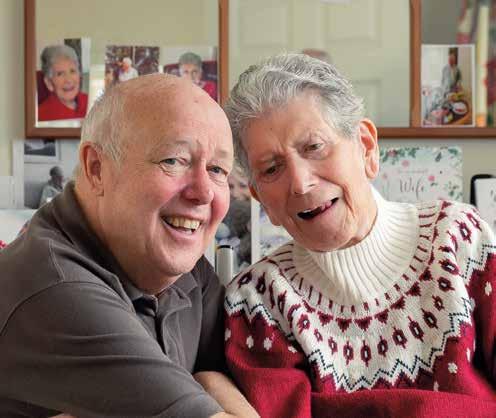
Alzheimer’s in early 2018. After she spent four weeks in hospital in 2022, Margaret’s condition deteriorated, and she has since been confined to a hospital bed in the couple’s living room, and a hoist to access a wheelchair. With multiple other health challenges, caring for Margaret is complex – but after 25 years of love and marriage Derek has risen to the challenge. As well as taking care of her everyday needs, he’s been able to improve her quality of life thanks to Specsavers at-home service.
Following her at-home eye test, the optician suggested Margaret tried some reading glasses to help her enjoy looking at family photos.
Derek was unsure how she would adapt to wearing glasses but seeing her smile while looking at old family pictures told him everything he needed to know.
“If anyone is in any doubt about inviting Specsavers into their home, all I can say is: simply try it,” Derek says. “You won’t regret it for a second.”
Derek now fights for better support and recognition for carers nationwide, and has launched a website (www.dementiaguidance.co.uk) dedicated to helping carers like him across the UK. He’s keen to ensure they have all the information they need – including the option of getting a comprehensive at-home eye test from Specsavers.

For those eligible, our mobile experts will provide a comprehensive NHSfunded eye test from the comfort of your own home, with all the same care and thoroughness as you would receive in-store. Specsavers has now also started to roll out free at-home hearing services across the UK. To find out what locations this service is available in visit our website.
Our eye care and hearing services are tailored to each person and their needs. They are designed to provide eye care and hearing services that are as individual as they are and can be adapted to meet their changing circumstances and comfort levels.

To see if you or your loved one are eligible, call 0800 0890144 or visit specsavers.co.uk/home-visits