recorriendo el caimán
VALLE
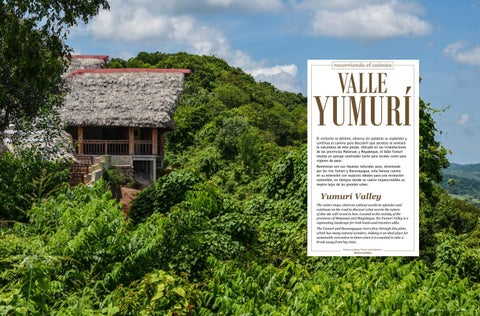
YUMURÍ El visitante se detiene, observa sin palabras su esplendor y continua el camino para descubrir qué secretos le revelará la naturaleza de este paraje. Ubicado en las inmediaciones de las provincias Matanzas y Mayabeque, el Valle Yumurí resulta un paisaje cautivador tanto para locales como para viajeros de paso. Numerosas son sus riquezas naturales pues, atravesada por los ríos Yumurí y Bacunayagua, esta llanura cuenta en su extensión con espacios ideales para una recreación sostenible, en tiempos donde se vuelve imprescindible un respiro lejos de las grandes urbes.
Yumurí Valley The visitor stops, observes without words its splendor and continues on the road to discover what secrets the nature of this site will reveal to him. Located in the vicinity of the provinces of Matanzas and Mayabeque, the Yumurí Valley is a captivating landscape for both locals and travelers alike. The Yumurí and Bacunayagua rivers flow through this plain, which has many natural wonders, making it an ideal place for sustainable recreation in times when it is essential to take a break away from big cities. Textos y fotos/Texts and photos: Bienvenidos
Guía del Ocio y la Cultura en Cuba
29
recorriendo el caimán
El origen
The origin
Habitado en sus márgenes por una tribu taína, antes de la llegada de los colonizadores, abundan en sus áreas los yacimientos arqueológicos que demuestran la presencia aborigen, siglos atrás. Ejemplo de ello es la llamada Cueva del Indio, en cuyo interior pueden admirarse vestigios latentes de la impronta de nuestros primeros pobladores.
Inhabited on its margins by a Taino tribe before the arrival of the colonizers, this area is rich in archaeological sites that testify to the presence of indigenous peoples centuries ago. For example, the so-called Cueva del Indio (Indian Cave), where you can admire the traces of our first settlers.
Varias son las leyendas que giran en torno al nombre de tan bello paisaje, entre ellas la de un amor prohibido entre la joven nativa Coalina, quien no podía enamorarse, y Nerey, un mozo que, impactado por los relatos sobre la belleza de la muchacha, atravesó parte de la isla en su búsqueda. Cuentan que, al producirse el encuentro entre ambos, pletóricos por el sentimiento que los consumía, la tierra comenzó a temblar, se abrió en dos la montaña y fueron arrastrados ambos amantes al foso creado por la grieta. Así nació el Abra del Yumurí, dos formaciones montañosas en ambas márgenes del río del mismo nombre que muestra cada atardecer un paisaje de ensueño. Otra de las hipótesis parte del grito lanzado por los taínos cuando se arrojaban al vacío desde los peñascos propios de la zona para evitar ser sometidos por los colonizadores hispánicos. En ese momento gritaban al viento el vocablo “yumurí” (yu-murí), que semeja la frase en castellano “yo muero”, escuchada a sus captores españoles. Esta suele ser la teoría más acertada, aunque otra leyenda asegura que en las noches de tranquilidad se puede oír al río silbar: “¡Nerey!... ¡Coalina!... ¡Nerey!... ¡Coalina!” ¿Lo cree usted?
30
Valle Yumurí
Bienvenidos N O V I E M B R E 2 0 2 1 N O V E M B E R
Several are the legends that revolve around the name of such a beautiful landscape, among them that of a forbidden love between the young native Coalina, who could not fall in love, and Nerey, a young man who, shocked by the stories about the beauty of the girl, crossed part of the island in search of her. It is said that when the two met, filled with the feeling that consumed them, the earth began to tremble, the mountain split in two and both lovers were dragged into the pit created by the crack. Thus was born the Abra del Yumurí, two mountainous formations on both banks of the river of the same name that offer a dreamlike landscape every time the sun sets. Another hypothesis is based on the cry launched by the Tainos when they threw themselves into the void from the cliffs of the area to avoid being subdued by the Hispanic colonizers. At that moment they shouted to the wind the word "yumurí" (yu-murí), which resembles the Spanish phrase "yo muero" (I die), heard from their Spanish captors. This is usually the most accurate theory, although another legend assures that on quiet nights you can hear the river whistling: "Nerey!... Coalina!... Nerey!... Coalina!" Do you believe it?
El paisaje
The landscape
Los colores del Yumurí parecen salidos del pincel de un gran paisajista, pues la perfección de sus combinaciones no suele ser asociada a creaciones naturales. Con una extensión total de 9 666 hectáreas, guarda entre sus joyas el Melocactus matanzanus una variedad de cactus endémica de esta región, siendo el Valle el territorio donde único se registra su aparición.
The colors of Yumurí seem to come from the brush of a great landscape painter, as their perfect combinations are not normally associated with works of nature. With a total extension of 9 666 hectares, it keeps among its jewels the Melocactus matanzanus, a variety of cactus endemic to this region, being the Valley the only area where its presence has been documented.
Con elevaciones que alcanzan hasta los 150 metros, el paraje resulta ideal para quienes eligen el senderismo como método de esparcimiento. También la vegetación resulta especialmente atrayente, siendo espacio ideal para la observación de aves migratorias que utilizan este sitio como lugar de paso o de reproducción.
With elevations that reach up to 150 meters, it is an ideal destination for hiking. Also, the vegetation is especially attractive, making it an ideal place to observe migratory birds that use it as a flight or nesting site.
Recorrido en gran parte de su extensión por el conocido tren de Hershey -único ferrocarril eléctrico en funcionamiento en Cuba-, las rutas que lo transitan son seguras y poco transitadas, condiciones idóneas para ciclistas que gusten de practicar mountain bike o simplemente un paseo en bicicleta con amigos, dada la topografía del terreno.
Most of its extension is crossed by the famous Hershey Railroad - the only electrified railroad in operation in Cuba - and the roads are safe and lightly traveled, making it ideal for mountain bikers or just for a ride with friends, given the topography of the terrain.
Guía del Ocio y la Cultura en Cuba
31
recorriendo el caimán
Valle Yumurí
From Bacunayagua to Monserrate, the Valley The Bacunayagua Viewpoint is the perfect place to contemplate the magnificence of the Yumurí. Located on one of the banks of the river that gives it its name and guardian of the Bacunayagua Bridge (one of the Wonders of Cuban Engineering and the highest in the country), it is a mandatory stop for those seeking to discover the island and its charms. To the left the sea and to the right the valley, those who arrive on their way from the capital just have to breathe and observe how everything seems to surrender to nature before their eyes. Connected by the imposing viaduct, we have before our eyes a spectacle that must be seen at least once in a lifetime.
De Bacunayagua a Monserrate, el Valle El Mirador de Bacunayagua es el punto por excelencia para observar la magnificencia del Yumurí. Situado en una de las riveras del río que le da nombre y guardián del Puente de Bacunayagua (una de las Maravillas de la Ingeniería cubana y el más alto del país), es parada obligatoria para quien busca descubrir la isla y sus encantos. A la izquierda el mar y a la derecha el valle, quien viene de camino de la capital no tiene más que respirar y observar cómo, ante su mirada, todo parece rendirse ante la naturaleza. Unidas sus dos partes por el imponente viaducto, tenemos ante nuestros ojos una imagen digna de ser observada personalmente al menos una vez en la vida. 32
Bienvenidos N O V I E M B R E 2 0 2 1 N O V E M B E R
Monserrate, on the other hand, is an example of the Hispanic heritage in the city of Matanzas. The Hermitage to Our Lady of Monserrat was built by descendants of Catalonian settlers in the area, on an elevation that may well be the counterpart of Bacunayagua, since from its location you can see the rest of the valley. With a panoramic view, city and nature merge before the eyes of the visitor who can observe how majestic this natural treasure is. The Yumurí Valley is more than just a valley, it is a must-see site if you wish to observe the colors and diversity of an island landscape in its own essence.
Monserrate, por su parte, es muestra del legado hispánico en la ciudad de Matanzas. La Ermita a Nuestra Señora de Monserrat fue edificada por descendientes de catalanes asentados en la zona, sobre una elevación que se antoja contraparte de Bacunayagua pues, desde su ubicación, puede ser observado el resto del Valle. Dueño de una visión panorámica, urbe y naturaleza se funden ante los ojos del visitante que puede observar cuánto de majestuoso posee esta riqueza natural. El Valle Yumurí es más que un valle, es un sitio de visita obligatoria si usted desea ver los colores y la diversidad paisajística de una isla en su propia esencia.
Guía del Ocio y la Cultura en Cuba
33