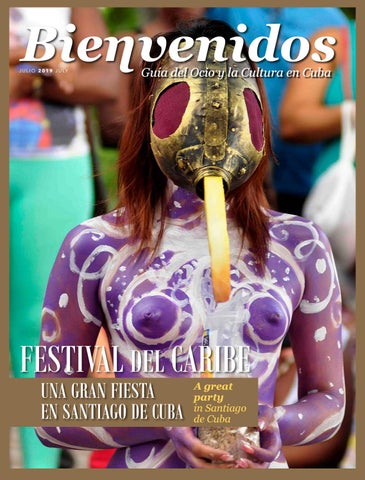
J U L I O 2 0 1 9 J U LY
GuÃa del Ocio y la Cultura en Cuba
FESTIVAL DEL CARIBE UNA GRAN FIESTA EN SANTIAGO DE CUBA
A great party in Santiago de Cuba
summary
SUMARIO Publicación mensual de distribución gratuita. DIRECCIÓN Maria del Carmen Madariaga
6
REPORTAJE
JEFE DE REDACCIÓN Elisenda Martí CORRECCIÓN María de los Ángeles Santana FOTOGRAFÍA DE PORTADA Miguel Rubiera DISEÑO GRÁFICO Dennis Pérez RESPONSABLE DE MARKETING Y PUBLICIDAD Itziar Herrera
FESTIVAL DEL CARIBE: UNA GRAN FIESTA EN SANTIAGO DE CUBA
EDITORIAL: INTELLIGENT SOLUTIONS CONSULTING S.L. Depósito Legal B-40261/99 ISSN 1575-9962 CORRESPONSALÍA EN CUBA corresponsaliacuba@ bienvenidoscuba.es
CARIBBEAN FESTIVAL: A GREAT PARTY IN SANTIAGO DE CUBA
Visite nuestro sitio web: www.bienvenidoscuba.es
4
EDITORIAL
5
CUBA. INFORMACIÓN GENERAL CUBA, GENERAL INFORMATION
12
VILLA CLARA UNA CIUDAD QUE COMPLACE POR SU VERSATILIDAD
A VERSATILE CITY
28
26
REPORTAJE
GALERÍA DE BIENVENIDOS
20
CALIDOSCOPIO
SIEMPRE TU VOZ
RECORRIENDO EL CAIMAN
DOS DIAS EN SANTIAGO DE CUBA
HOMENAJE DE LA EGREM A BENNY MORÉ
THE EGREM PAYS HOMAGE OF TO BENNY MORE
TWO DAYS IN SANTIAGO DE CUBA
32
38
GUÍA DEL OCIO Y LA CULURA
GJUÍA DEL OCIO Y LA CULTURA
GIBARA SE LUCE EN SU FIESTA DE QUINCE GIBARA SHINES ON ITS FIFTEENTH BIRTHDAY
DOCUMENTAL
DONDE VAS TÚ...
LA MÚSICA Y LA POESÍA DE LOS CAMPESINOS CUBANOS DOCUMENTARY FILM “DONDE VAS TÚ...”: THE MUSIC AND POETRY OF CUBAN PEASANTS.
36 MUESTRA DE CINE
ESPAÑOL EN LA HABANA
SPANISH FILM FESTIVAL IN HAVANA
42
INFORMACIÓN AL TURISTA TOURISTS VISITING CUBA ESSENTIALS
44
DIRECTORIO DIRECTORY
EL CARNAVAL DE SANTIAGO DE CUBA: PARA NO DORMIR THE CARNIVAL OF SANTIAGO DE CUBA: FORGET ABOUT SLEEPING!
editorial
J U L I O 2 0 1 9 J U LY
Cuba propone en julio un valioso programa cultural y recreativo que garantiza al visitante un conocimiento fiable de la Isla y pleno divertimento turístico.
This July, Cuba invites you to a cultural and recreational program that will allow visitors from all over the world to discover the Island by means of a wonderful tourist experience.
Bienvenidos le sugiere: Fiesta del Fuego, Festival Internacional de Cine de Gibara, y Carnaval de Santiago de Cuba, para que diseñe las vacaciones, según sus intereses.
Bienvenidos’s recommendations: Don’t miss the Fiesta del Fuego, the International Film Festival of Gibara, and the Carnival of Santiago de Cuba; take these offers and check out which one will be more suitable to your tastes.
La Fiesta del Fuego, será en Santiago de Cuba del 3 al 9 yel país invitado de honor, la República Oriental del Uruguay; su nutrida delegación y más de 500 artistas, de Cuba y otras 20 naciones, tomarán las calles de esa hospitalaria ciudad con su arte. La cita fílmica se desarrollará entre los días 7 y 13, en un marítimo paraje de Holguín: Gibara. Asistirán notables realizadores y actores cubanos, y del cine mundial convocados por su director, el reconocido, Jorge Perugorría, protagonista de Fresa y Chocolate. El Carnaval de Santiago, principal festejo tradicional de esa urbe oriental, es altamente valorado entre los de su tipo en la región; en él, oriundos y foráneos, disfrutan en las calles arrollando al compás de las legendarias congas. Asimismo, proponemos recorrer atractivos lugares de esta ciudad: la Iglesia de la Caridad del Cobre, el Parque Baconao, el Mirador de la Gran Piedra, por solo mencionar algunas alternativas de recreación sana y culta. Sobre Santa Clara,la publicación cuenta detalles y destaca sitios declarados Monumento Nacional como la Iglesia del Carmen, el Parque Leoncio Vidal y el Complejo Escultórico Comandante Ernesto Guevara; asimismo, le invita a conocer la activa vida nocturna de la capital villareña. Hallarán comentarios sobre nuevas producciones de la casa discográfica EGREM: el álbum Siempre tu voz, homenaje al Benny Moré, el más grande músico cubano, que protagoniza Omara Portuondo, y el documental Donde vas tú…, sobre al Punto cubano, Patrimonio Cultural Inmaterial de la Humanidad. Bienvenidos quiere ser parte de su viaje a Cuba, y le invita a enriquecer su historia de vida con esta nueva experiencia.
The Fiesta del Fuego will be held in Santiago de Cuba from July 3rd to 9th and the Oriental Republic of Uruguay is the guest of honor this year; many artists from Cuba and 20 other nations will attend the event. The film festival will take place between July 7th and 13th in the beautiful city of Gibara, Holguin. Important filmmakers and actors were invited by the host, Jorge Perrugoria, star of the famous Fresa y Chocolate. The Carnival of Santiago, main traditional celebration of this eastern city and one of the most amazing of its kind in the Caribbean, has many wonderful surprises, including its legendary congas and colorful floats. We also suggest visiting attractive places of this city: the Iglesia de la Caridad del Cobre, the Parque Baconao, the Mirador de la Gran Piedra, just to mention some alternatives for those who prefer healthy and educational entertainment. Regarding Santa Clara, the magazine reveals exciting details and describes some places declared National Monument such as the Iglesia del Carmen, the Parque Leoncio Vidal and the Comandante Ernesto Guevara sculptural complex; also, it invites you to explore the active nightlife of the capital city of Villa Clara. You will find a helpful review on new productions of the EGREM record company: the album “Siempre tu voz”, a tribute to Benny More, the greatest Cuban musician, featuring Omara Portuondo, and the documentary “Donde vas tú...” about the Cuban punto guajiro, Intangible Cultural Heritage of Humanity. Bievenido wants to be part of your trip to Cuba, and invites you to add unforgettable experiences to your memory.
4
Bienvenidos J U L I O 2 0 1 9 J U L Y
Bandera | Flag
Cuba
what you should know about the island
INFORMACIÓN GENERAL
Geografía: Ubicada a la entrada del golfo de México, el archipiélago cubano está formado por la isla de Cuba, la Isla de la Juventud y aproximadamente 4,195 cayos e islotes. Cerca de 140 km la separan las Bahamas; 77 km Haití; 180 km de Florida; 210 km Cancún y 146 km de Jamaica. La silueta de Cuba, alargada y estrecha, alcanza los 120 km de longitud y entre 32 y 145 km de ancho. En total el territorio abarca 110.922 km, lo que la distingue como la mayor de las Antillas y por su ubicación geográfica la llaman también la llave del Golfo.
Geography: Located in the Caribbean Sea, the Cuban archipelago includes the Island of Cuba, the Island of Youth – Isla de la Juventud – and approximately some 4,195 keys and islets. Its nearest neighbors are: the Bahamas, 140 Km (to the north), Haiti; 77 Km (to the east); Florida, US, 180 Km (to the north); Cancun, Mexico, 210 Km (to the west) and Jamaica, 146 Km (to the southeast). Cuba’s elongated shape – 120 Km long and 32-145 Km wide -, encompasses a 110,922 Km territory, the largest of the Antilles and also known as the ”Key to the Gulf” due to its location at the entrance of the Gulf of Mexico. Mean annual temperature: 25 degrees Celsius (77 degrees Fahrenheit)
Temperatura promedio anual: 25º Celsius (77 º Fahrenheit). La Habana Artemisa
Mayabeque Matanzas
Pinar del Río
Villa Clara
Cienfuegos Isla de la Juventud
Sancti Spíritus
Las Tunas
Productos de exportación: Azúcar crudo y refino, óxido de níquel, pescado y mariscos, tabaco, rones y alcoholes, cítricos. Tasa de Alfabetización: 95%. Habitantes por médico: 183. Esperanza de vida: 77 años. Red de carreteras: 46.000 km Aeropuertos internacionales: 11 Impuesto de aeropuerto: 25 CUC Forma de Gobierno: Parlamentario. Moneda: Aunque el peso cubano es la moneda nacional (CUP), para pagar todos los servicios turísticos del país
Provinces: The Republic of Cuba has 15 provinces: Pinar del Río, Artemisa, La Habana, (previously Ciudad de La Habana), Mayabeque, Matanzas, Cienfuegos, Villa Clara, Sancti Spíritus, Ciego de Ávila, Camagüey, Las Tunas, Holguín, Granma, Santiago de Cuba and Guantánamo; it also has a Special Municipality: Isla de la Juventud. Main exports: Sugar (raw and refined), nickel oxide, fish and seafood, rums, alcohols and citrus fruits.
Ciego de Ávila Camagüey
División político-administrativa: La República de Cuba está dividida en 15 provincias y un Municipio Especial, la Isla de la Juventud. Las provincias son Pinar del Río, Artemisa, La Habana, (previamente Ciudad de La Habana), Mayabeque, Matanzas, Cienfuegos, Villa Clara, Sancti Spíritus, Ciego de Ávila, Camagüey, Las Tunas, Holguín, Granma, Santiago de Cuba y Guantánamo.
Nombre Oficial | Official Name República de Cuba Republic of Cuba Capital | Official Name La Habana (3 millones de habitantes 3 million inhabitants) Población | Population 11,1 millones (70% urbana) 11,1 million (70% urban) Idioma oficial | Official language Español Spanish Área | Area 110.922 km²
Granma
Holguín
Santiago de Cuba
Guantánamo
se emplea el peso convertible (CUC) de forma preferente; el cual circula en las siguientes denominaciones de billetes: 1, 3, 5, 10, 20,50 y 100 y monedas de 5, 10, 25, 50 centavos y 1 CUC . El peso cubano tiene 100 centavos. Circula billetes de 1, 3, 5, 10, 20, 100, 200, 500,1000 pesos y monedas por valor de 1,3, y 5 pesos. Existen monedas de 1, 2,5 y 20 centavos. El euro circula en algunos polos turísticos como Varadero, Holguín y Jardines de Rey. Días festivos: 1 de Enero Día de la Liberación 1 Mayo, Día del Trabajo 25, 26 y 27 de Julio, Aniversario del Asalto al Cuartel Moncada 10 de Octubre, Aniversario del Inicio de la Guerra de Independencia 25 de Diciembre, Día de Navidad 31 de Diciembre
Literacy: 95%. Inhabitants per doctor: 183. Life Expectancy: 77 years. Highways’ network: 46.000 km International airports: 11 Government: Parliamentary. Currency: the Cuban peso (CUP) is the national currency, even though the convertible peso (CUC) is preferably used to pay for tourism services in the country, it comes in the following bill denominations: 1, 3, 5, 10, 20, 50 and 100 bills and also in coins of 5, 10, 25, 50 and one CUC. The Cuban peso equals 100 Cuban cents and comes in the following bill denominations of 1, 3, 5, 10, 20, 100, 200, 500 and 500; also in 1, 3 and 5 pesos’ coins and 1, 5 and 20 cents. Euro is accepted in some destinations as Varadero, Holguin and Jardines del Rey. Holidays: January 1st – Liberation Day May 1st, Workers’ Day July 25, 26 and 27, Anniversary of the Moncada Fortress assault in 1956. October 10, Anniversary of the beginning of the War of Independence December 25, Christmas Day December 31, New Year´s Eve Guía del Ocio y la Cultura en Cuba
5
reportaje
FESTIVAL
DEL CARIBE
UNA GRAN FIESTA EN SANTIAGO DE CUBA Por/ By Bienvenidos
FOTO / PHOTO: ADRIÁN PORTUONDO
Encoantos de una villa que cumple 505 años
Caribbean Festival: A great party in Santiago de Cuba
FOTO / PHOTO: ADRIÁN PORTUONDO
El Festival del Caribe es una auténtica fiesta que se celebra cada año en Santiago de Cuba desde 1981; en cada edición esa hermosa ciudad se colma de sonidos, ideas y colores caribeños y latinos, para acoger a todos con la garantía del disfrute cultural. Del 3 al 9 de julio, Santiago de Cuba recibirá a la República Oriental del Uruguay como invitada de honor de la también llamada Fiesta del Fuego, que este año llevará a las calles de la más caribeña de las provincias cubanas el candombe, manifestación cultural uruguaya de origen africano, y el tango, género musical y danza que comparte su origen entre esta nación y Argentina, ambos declarados Patrimonio Inmaterial de la Humanidad por la Unesco en 2009.
Los tambores del candombe uruguayo, llamados repique, piano y chico, se mezclarán con las tumbadoras, los bongós cubanos y la pasión del tango, todos nacidos de raíces comunes, para animar esta genuina festividad que invita a conocer la cultura latina y caribeña en toda su diversa magnitud. El acostumbrado Desfile de la serpiente inaugurará el festival con una invocación a Elegguá, dios yoruba que abre los caminos, y todos los participantes recorrerán las calles santiagueras en un primer acercamiento a esta plataforma amplia de propuestas para los más disímiles intereses de esparcimiento cultural.
The Caribbean Festival is an authentic celebration held every year in Santiago de Cuba since 1981; in each edition that beautiful city is filled with sounds, ideas and Caribbean and Latin colors. An unforgettable experience is absolutely guaranteed for everyone who enjoys our culture. From July 3rd to 9th, Santiago de Cuba will receive the Oriental Republic of Uruguay as the guest of honor of the so-called Fiesta del Fuego that will surprise us this year by bringing candombe and tango to the streets of the most Caribbean of the Cuban provinces. Candombe is a Uruguayan cultural expression that actually came from Africa. On the other hand, musicologists from all over the world are still trying to unveil the mysterious origins of tango, another typical genre of the
region, which is said to be born either in Uruguay or in Argentina. Both styles were declared Intangible Cultural Heritage of Humanity by UNESCO in 2009.
The drums of the Uruguayan candombe, called repique, piano and chico will be mixed with the tumbadoras, the Cuban bongos and the passion of the tango, all of which has a common source. This genuine party invites you to discover the Latin and Caribbean culture in all its magnitude. The customary Parade of the Snake will inaugurate the festival by summoning Eleggua, the Yoruba god who clears the paths, and all the participants will travel through the streets of Santiago in order to enjoy the most diverse offers of cultural entertainment. Guía del Ocio y la Cultura en Cuba
7
reportaje
Alrededor de cien artistas e intelectuales uruguayos, pintores, poetas, investigadores, representantes del tango cantado y bailado, la Orquesta Sinfónica Juvenil de ese país suramericano, el Ballet Siembra, el Coro Terapia de Miércoles y el Grupo de Candomblé de Canelones, entre otras agrupaciones, serán los protagonistas de estos festejos cada día y ofrecerán una noche rioplatense a través de una gala cuyo corazón será el tango, como regalo para Santiago de Cuba, sus habitantes y su evento. A estos empeños se suman exponentes del arte y el pensamiento deArgentina, Canadá, Curazao, Nigeria, Venezuela y Haití, entre otros que superan los 500 representantes de más de 20 naciones.
FOTO / PHOTO: MIGUEL RUBIERA JSTIZ
Se anuncia que Españase hará presente con las agrupaciones el Bembazaoco y la Fundación Moros de Alquería. México con un grupo de ochenta tamborileros; Holanda con la formación Las chicas del barrio, que interpreta música caribeña, y sendas bandas de jazz de Estados Unidos y Bolivia, completarán este espectáculo de pluralidad artística,
FOTO / PHOTO: MIGUEL RUBIERA JSTIZ
La Fiesta del Fuego es el evento de mayor convocatoria que organiza la Casa del Caribe y aunque esencialmente es una alborozada celebración que sucede en las calles y plazas santiagueras, incluye asimismo talleres, paneles, conferencias, y otros encuentros teóricos como el de Poetas del Caribe y el mundo, Jesús Cos Cause, y el Coloquio El Caribe que nos une,donde se debatirá sobre la historia, la literatura y la vidade la región. Las cuantiosas manifestaciones de la cultura popular tradicional de invitados y anfitriones se muestran en todo su esplendor caracterizando esta fiesta, en la que ocupan un lugar significativo las acciones asociadas a la vida cultural de 8
Bienvenidos J U L I O 2 0 1 9 J U L Y
las comunidades, la culinaria autóctonay la artesanía popular. Para el final del Festival del Caribe, los organizadores han reservado un vigoroso atractivo: el Desfile del fuego, peregrinación festiva que inicia con un ritual Congo, y en el que se entrega la Mpaka que es el emblema de la fiesta, al país al que se dedicará la futura edición. Luego, junto al mar, acontece la Quema del diablo, símbolo del mal, con la que se despide este encuentro de la cultura santiaguera, del Caribe y de América. No se pierda esta oportunidad única en el Caribe para disfrutar de este jolgorio de integración e intercambio cultural.
Encoantos de una villa que cumple 505 años
FOTO / PHOTO: MIGUEL RUBIERA JSTIZ
FOTO / PHOTO: ADRIÁN PORTUONDO
A hundred Uruguayan artists and intellectuals, painters, poets, researchers, tango performers, the Youth Symphony Orchestra, the Ballet Siembra, the Terapia del Miércoles Chorus and the Candomblé de Canelones Group, among other guests, will be the protagonists of these celebrations every day and they will offer a memorable night through a fantastic gala dedicated to tango, as a gift for Santiago de Cuba, its inhabitants and the event. The event is also an opportunity to gather many artistic and scientific celebrities of Argentina, Canada, Curaçao, Nigeria, Venezuela and Haiti. There will be 500 representatives of more than 20 nations. It is announced that Spain will send the Bembazaoco Band and the Moros de Alquería Foundation. Mexico will surprise us with a group of eighty drummers; the ensemble “Las chicas del barrio” will come all the way from Netherlands to play exotic Caribbean music, and two jazz bands from the United States and Bolivia will also be part of this incredibly diverse show. The Fiesta del Fuego is the biggest event organized by Casa del Caribe and although it is basically an exhilarating celebration that takes
place in the streets and squares of Santiago, it also includes workshops, panels, conferences, and other academic meetings such as the Poets of the Caribbean and the world, Jesús Cos Cause, and the Caribbean Colloquium. There we will all gather to debate about history, literature and life in the region. Popular culture expressions will be frequent among guests and hosts, evidencing the true meaning of the event. The actions associated with the cultural life of the communities, the local culinary and the traditional crafts occupy a significant place in the celebration as well. In order to close the Caribbean Festival, the organizers have reserved a fantastic attraction: the Parade of Fire, a festive pilgrimage that begins with a Congo ritual, where the Mpaka –emblem of the party– is given to the country to which the future edition will be dedicated. Then, next to the sea, the Devil’s Burning takes place. People say goodbye to the symbol of the devil, and with this final ceremony, we put this year’s festival to an end. Do not miss the exclusive chance to enjoy this amazing festivity, which is dedicated to friendship and cultural exchange.
Guía del Ocio y la Cultura en Cuba
9
12
Bienvenidos J U L I O 2 0 1 9 J U L Y
reportaje
VILLA CLARA UNA CIUDAD QUE COMPLACE POR SU VERSATILIDAD Textos/ Texts Bienvenidos Fotos/Photos: MINTUR / Norlys Pérez
Situada en el centro de la geografía cubana, Villa Clara exhibe hermosos paisajes y atractivos turísticos donde se mezclan llanuras y montañas, edificaciones coloniales, pueblos pesqueros y acogedoras instalaciones hoteleras. Santa Clara, su capital provincial, fue fundada en 1689 por vecinos de una población costera que huían de los ataques de corsarios y piratas. Razón por la que goza de diversidad arquitectónica y un abanico de estilos constructivos de más de cinco siglos con edificaciones que van desde lo colonial, pre-barroco hasta el movimiento postmoderno y moderno.
Villa Clara a versatile city Located in the center of Cuban geography, Villa Clara has beautiful landscapes and numerous tourist attractions: prairies, mountains, colonial buildings, fishing villages and cozy hotel facilities. Santa Clara, the provincial capital, was founded in 1689 by residents of a coastal town, who were escaping from the attacks of corsairs and pirates. Fortunately, this regular exodus provided a reason to expand the Village, and originated its architectural diversity and wide range of construction styles. There we will meet five centuries of artistic history, thanks to the side-byside coexistence of pre-baroque, postmodern and contemporary buildings. Guía del Ocio y la Cultura en Cuba
13
reportaje
Las Iglesias del Carmen y San Juan de los Remedios, la Catedral de Santa Clara, la Iglesia del Buen Viaje y el antiguo Convento de la ciudad, así como algunas de las construcciones alrededor del Parque Vidal; son ejemplos claros de esta magia que embargan las ciudades cubanas, y que Villa Clara no escapa de ella. Destaca en esta localidad, la llegada de cientos de visitantes que a diario buscan conocer el memorial al Guerrillero Heróico, Ernesto Che Guevara en la Plaza de la Revolución de igual nombre. Mausoleo que constituye uno de los mayores
14
Bienvenidos J U L I O 2 0 1 9 J U L Y
atractivos de la también llamada “Ciudad del Che”, al ser una de las liberadas por el mártir, así como por guardar sus restos y los de sus compañeros. En su centro histórico, declarado Monumento Nacional, se encuentra uno de los emblemas de la Batalla de Santa Clara. El asalto al tren blindado, ubicado en el parque de igual nombre, recrea la lucha por la liberación durante el período revolucionario. Y a menos de un kilómetro, en la misma avenida, saluda el Guerrillero con un niño en brazos en una estatua de bronce esculpida a tamaño real.
Villa Clara, una ciudad que complace por su versatilidad
The Churches of Carmen and San Juan de los Remedios, the Cathedral of Santa Clara, the Church of Buen Viaje and the old Convent of the city, as well as some of the buildings around the Parque Vidal are clear examples of this magic that permeates the Cuban cities, and definitely Villa Clara has a lot of treasures to offer. Hundreds of foreign visitors come every day to discover the Che Guevara Mausoleum, a sculptural complex located in the “Plaza de la Revolución” of the same name. This memorial is one of the greatest locations of the so called “City of Che”. It houses the remains of the revolutionary martyr and twenty-nine of his fellow comrades. In the historic center, declared a National Monument, we can find one of the emblems of the Battle of Santa Clara: the military supply train derailed by Che, which is preserved in its original setting. These vestiges symbolize the fight for sovereignty and independence during the revolutionary period. Less than a kilometer away, on the same avenue, there’s the Guerrilla fighter with a child in his arms: a marvelous bronze statue that replicates the real life size of the hero. Some places, such as the Mejunje, tell the story of a town that stands out for its cultural ajiaco1 made of different attitudes and thoughts. With more than three decades of existence, the Festival of Small Format Theater takes place here. It has a wonderful bohemian nightlife; making Santa Clara the most picturesque city in the country. One of the particularities of Villa Clara is its proximity to the legendary city of San Juan de los Remedios, eighth village founded by the Spanish colonizers during the sixteenth century. It is famous for the traditional Parrandas that are celebrated every year in its streets, with the contribution of almost the whole town. This festivity encourages the development of the nation’s cultural identity. On the other hand, in the southeast of the region of Villa Clara, the municipality of Manicaragua invites the visitor to explore the legendary coffee and tobacco tradition of the area. The cultivation and fabrication of both products provide high heritage values and draw the attention of numerous tourists. 1. A hearty stew made from beef, pork, chicken, vegetables, and a variety of starchy roots and tubers classified as “viandas”. Guía del Ocio y la Cultura en Cuba
15
reportaje
Mientras centros como el Mejunje cuentan también la historia de un pueblo que resalta por su ajiaco cultural de actitudes y pensamientos. Con más de tres décadas de existencia, aquí tiene lugar el Festival Teatral de Pequeño Formato además de una vida nocturna diversa y bohemia; convirtiendo a Santa Clara en la ciudad más tolerante del país. Una de las particularidades de Villa Clara es su cercanía a la legendaria ciudad de San Juan de los Remedios, octava villa fundada por los colonizadores españoles en el siglo XVI. Famosa por las tradicionales Parrandas que se celebran cada año en sus calles, con la participación de casi todo el pueblo; esta festividad contribuye a la formación de la identidad cultural de la nación. Por otra parte, al sudeste de la región villaclareña, el municipio Manicaragua obsequia al visitante la amplísima tradición cafetalera y tabacalera de la zona. El cultivo y fabricación netamente manufacturado de ambos productos, aportan elevados valores patrimoniales y atraen la atención de los turistas.
16
Bienvenidos J U L I O 2 0 1 9 J U L Y
Manicaragua también posee una extensa zona de montaña que forma parte del complejo natural del Escambray. Por su exclusiva diversidad de especies en flora y fauna es perfecta para el ecoturismo, senderismo, fotografía especializada, observación de aves y la pesca deportiva en sitios como el Valle de Jibacoa y el Paisaje Natural Protegido Hanabanilla; único lago intramontañoso del país. La construcción de una autovía sobre el mar, une a Villa Clara con Santa María, Ensenachos y las Brujas, tres joyas de la cayería norte cubana que complacen con paradisíacas playas y hoteles de lujo. Además del balneario de aguas mineromedicinales y termales Elguea; sitio perfecto para combatir el estrés. Son muchos quienes llegan a Cuba atraídos por su rico acervo cultural y natural. Ciudades que quedan para siempre en la memoria… y Villa Clara es uno de esos sitios colmados de dones especiales, a la espera de recibirlo si viaja a Cuba o piensa hacerlo. Razón de más para no dejar que otros le cuenten cuánto puede disfrutar desde una ciudad que complace por su versatilidad.
Villa Clara, una ciudad que complace por su versatilidad
Manicaragua also has an extensive mountain area that is part of the natural complex of Escambray. Due to its exclusive diversity of flora and fauna species, it is perfect for ecological tourism, trekking, specialized photography, bird watching and sport fishing in places such as the Valle Jibacoa and the Hanabanilla Protected Natural Landscape; the only lake in the whole country that runs between mountains.
A highway above the sea connects Villa Clara with Santa Maria, Ensenachos and Las Brujas, jewels of the northern Cuban keys, full of exotic beaches and sumptuous hotels. If you take into consideration that there’s also an incredible health resort (“Elguea”), with medical and thermal waters, this is indeed the perfect place to leave stress behind.
Many people come to Cuba for its cultural and natural heritage. There are cities in our island that will remain forever in your memory... and Villa Clara is one of those special places. If you travel to Cuba, or are planning to do so, don’t skip this opportunity. There are too many reasons to come, don’t let others spoil the surprise for you, and discover this versatile city by your own!
Guía del Ocio y la Cultura en Cuba
17
DESCUBRE EN TU PRÓXIMO VIAJE / TO YOUR NEXT TRIP
Topes deCollantes NATURALEZA • GASTRONOMÍA
recorriendo el caimán
DOS DÍAS EN
SANTIAGO DE CUBA Two days in Santiago de Cuba
… Mi legendaria región, Tierra que tiembla caliente Cuna del sabroso son… *
Textos y fotos / Texts and photos Bienvenidos
*Letra “Veneración”, autor Los Melódicos.
Recorrer en dos días una ciudad donde confluyen cultura, tradición y naturaleza es casi imposible. Desde los más antiguos valores patrimoniales hasta espléndidas reservas naturales lo esperan en este viaje de 48 horas por la tierra caliente. Sin embargo, Santiago de Cuba mantiene sus brazos abiertos para volverlo a recibir, porque seguramente quien la visite, se quedará con deseos de continuar redescubriéndola. Plaza principal de la urbe, desde el Parque Céspedes emergen múltiples sitios que no debemos dejar de conocer durante su estancia. 20
Bienvenidos J U L I O 2 0 1 9 J U L Y
...My legendary region, A place that trembles with heat The cradle of a tasty son...* * Lyrics of “Veneration”, by Los Melodicos.
It is almost impossible to explore a city where culture, tradition and nature come together in a short two-day trip. Ancient heritage values and splendid nature reserves are waiting for you on this 48-hour excursion through this hot land. However, Santiago de Cuba has its arms wide open to welcome you again, because whoever visits it will be surely left with the desire to continue rediscovering it. Parque Cespedes is the main square of the city, from its center emerge multiple sites that we should not miss during our stay.
Dos días en Santiago de Cuba
DÍAday11
1. Nuestra Señora de la Asunción. Aquí puede contemplar la famosa Cruz de Parra, única evidencia material de la llegada de Cristóbal Colón a Cuba. Catedral que, desde su construcción en el Siglo XIX, sufrió los ataques de piratas y corsarios. Nuestra Señora de la Asuncion. Here you can behold the famous Cruz de Parra, the only physical evidence of the arrival of Christopher Columbus in Cuba. Since its construction in the nineteenth century many pirates and corsairs attacked the cathedral, hunting after its treasures.
2. Casa Museo de Diego Velázquez. Construida entre 1516 y 1530, es la casa más antigua de la Isla. Allí residió el conquistador Diego Velázquez al llegar a Cuba en el segundo viaje de Cristóbal Colón. Hoy funciona como museo que exhibe piezas y mobiliario original de la época. Casa Museo Diego Velazquez. It was built between 1516 and 1530 and is the oldest house on the Island. The conqueror Diego Velazquez lived there when he arrived in Cuba on the second trip of Christopher Columbus. Later it was transformed into a marvelous museum that today exhibits pieces and original furniture of that time.
3. Casa de la Trova. Cuna del son y el bolero, la expresión coral y la trova tradicional. Deviene en espacio de encuentro para los amantes de la música cubana y cuenta ya con más de 50 años de historia. Casa de la Trova. This place is the home of son and bolero, the choral expression and the traditional trova. It became a meeting place for Cuban music lovers and its history is already 50 years old. Guía del Ocio y la Cultura en Cuba
21
recorriendo el caimán
DÍAday22 4. Barrio del Tívoli. Escenario donde aún se realiza la popular danza “tumba francesa” con tambores y otros instrumentos africanos. Sus calles acogen sitios de vital interés como la escalinata de Padre Pico, 52 peldaños que dan acceso a las localidades más visitadas de la Villa.
Barrio del Tivoli. This is the stage where the popular “French tumba” dance, involving drums and other African instruments, is still performed. Its streets hide interesting venues such as the Padre Pico stairway, made of 52 steps leading to the most visited towns of the Villa.
5. Cabaret Tropicana. A 15 minutos del centro de la Ciudad, el Cabaret es mundialmente conocido por el show que sintetiza las raíces y tradiciones cubanas mediante el derroche de luz, color y las caderas en erupción de sus bailarinas. Cabaret Tropicana. Only 15 minutes from downtown, the Cabaret is well-known all over the world for an amazing show that pays homage to Cuban traditions through a mixture of light, color and the sensual hips of its dancers.
6. Hotel Casa Granda. Con una privilegiada ubicación en el centro de la ciudad, el Hotel construido en 1914; combina estilos tradicionales y modernidad. Administrado por la cadena Iberostar, la instalación propone 58 habitaciones acogedoras y confortables para descansar mientras recorre la Tierra Caliente. 22
Bienvenidos J U L I O 2 0 1 9 J U L Y
Hotel Casa Granda. Was built in 1914, and has a privileged location in the center of the city. It combines traditional styles and modernity. It is managed by the Iberostar Company. The facility offers 58 cozy and comfortable rooms, which are just perfect if you feel like taking a nap after traveling around the Tierra Caliente.
1. El Cobre. Dispuesto en un pueblo de igual nombre, incontables son las ofrendas, promesas y peregrinaciones diarias a la Patrona de Cuba. Con un altar de plata maciza, la leyenda de la madre de todos los cubanos se remonta a cuatro siglos atrás. Y si está en Santiago, nunca olvide llevar a “Cachita” sus girasoles, flor divina de la Virgen.
El Cobre. People come to give countless offerings and promises on the daily pilgrimages to the Patron Saint of Cuba, in the town of El Cobre. The legend of the mother of Cuba goes back four centuries in the past. Her altar is made of solid silver. If you are in Santiago, never forget to bring “Cachita” a bouquet of sunflowers, her favorite ones.
Dos días en Santiago de Cuba
2. Gran Piedra. El sendero compuesto por 454 escalones lleva al Mirador Natural con más belleza de la zona. Creación geológica que exhibe una exuberante variedad de flora y fauna, especial para los amantes de la naturaleza y la fotografía especializada. Con aproximadamente 63 mil toneladas de peso, se inscribe en el libro de los Récords Guinnes por ser la roca a mayor altura en el mundo. Gran Piedra. The path consisting of 454 steps leads to the Mirador Natural, which offers the most beautiful view of the area. This place is a geological creation that exhibits an exuberant variety of flora and fauna, ideal for the lovers of nature and specialized photography. It is registered in the Guinness Book of World Records as the highest rock of its size (63 000 tons) above the sea level.
3. Cafetal La Isabelica. Declarado Patrimonio Mundial por la UNESCO, hoy sus ruinas funcionan como museo de lo que fuese la hacienda de los franceses Víctor Constantin y su esposa Isabel María en el siglo XVIII. Cafetal La Isabelica. Declared World Heritage Site by UNESCO, its ruins became a museum. It was once the estate of a French couple: Victor Constantin and his wife Isabel Maria, during the eighteenth century.
4. Museo del Automóvil. Atesora una colección de más de 2700 automóviles y elementos en miniatura, además de otros 44 en tamaño real. En él se encuentran vehículos históricos por sus modelos como el Packard americano de Stalin y los utilizados por personalidades como Benny Moré, Alain Delon, Naomi Campbell y Jack Nicholson, entre otros. Museo del Automovil. It keeps a collection of more than 2700 automobiles and miniature elements, in addition to another 44 in real size. There we can find historical models, such as Stalin’s American Packard and those used by celebrities such as Benny More, Alain Delon, Naomi Campbell and Jack Nicholson, among others.
6. Valle de la Prehistoria, Parque Nacional de Baconao. En compañía de 200 dinosaurios gigantes de hormigón junto a hombres de la caverna, el paseo por el Valle de 11 hectáreas representa la época prehistórica en el territorio. Sitio enmarcado al este en la costa sur, donde se encuentra además la Laguna Baconao que da nombre al Parque. Lugar que ofrece montar a caballos, paseos en botes y visitar su criadero de cocodrilos.
Valle de la Prehistoria, Parque Nacional de Baconao. If you travel the 11 hectares of the Valley, you’ll meet 200 giant concrete dinosaurs and many fantastic cavemen. This scenery represents the prehistoric era in the territory. It is located in the east on the south coast. The park is named after the lagoon: Baconao. The place also offers horses and boat rides, and you mustn’t forget to visit to the crocodile hatchery. Guía del Ocio y la Cultura en Cuba
23
calidoscopio
SIEMPRE TU VOZ HOMENAJE DE LA EGREM A BENNY MORÉ Por / By Bienvenidos Fotos/Photos Cortesía EGREM
El disco Siempre tu voz, de Omara Portuondo y la Orquesta Failde, reciente producción de la Empresa de Ediciones y Grabaciones Musicales (EGREM) es un homenaje a Benny Moré en el centenario de su natalicio. Bartolomé Moré (Cuba, agosto 1919-febrero 1963), es para los cubanos una leyenda, un artista que no ha sido igualado por ningún otro y que se mantiene vivo a través de sus antológicos temas. Este disco, de excelente factura, es una mezcla de la más genuina tradición melódica cubana con sonoridades contemporáneas, respetando el espíritu original de las composiciones, cuya producción musical corrió a cargo Ethiel Failde y Orlando Vistel.
26
Bienvenidos J U L I O 2 0 1 9 J U L Y
La proverbial Omara Portuondo, llamada la Diva del Buena Vista Social Club, es la anfitriona de este fonograma en el que se hace acompañar por el cantante dominicano Johnny Ventura, en el tema La múcura, de Toño Fuentes, por los populares intérpretes cubanos Telmary y William Vivanco, y comparte varias piezas con Yurisán Hernández y Yerlanis Junco, cantantes de la Orquesta Failde. Otros ocho títulos de diversos géneros que el Benny inmortalizó en su voz, aparecen ahora con arreglos de Alejandro Falcón, José Antonio González y Roniel Alfonso; entre ellos: Te quedarás, de Alberto Barreto; Cómo fue, de Ernesto Duarte; Mata siguaraya, de Lino Frías, y Las mulatas del cha cha chá, de Evelio Landa. Completa el álbum Siempre tu voz que le da título, de Pedro Pablo Cruz, responsable de la producción general del mismo.
Sin dudas, la singularidad interpretativa de Omara, y sus propios recuerdos del Benny, al que tanto admiró, contribuyen definitivamente a esta emotiva intención de evocarlo. El pasado 17 de mayo fue el lanzamiento mundial de Siempre tu voz, en las principales plataformas y obtuvo el número 50 de Itunes México como el mejor debut de la semana para álbum de música cubana en ese país, y recientemente fue merecedor en la Isla del Premio Especial Centenario Benny Moré en la Feria Internacional Cubadisco 2019. Usted debería escuchar este disco que se encuentra en las tiendas de EGREM y en otras principales plataformas como Spotify, Itunes; y sumarse así a este homenaje a Benny Moré: el más grande de los músicos de Cuba.
Siempre tu voz
The EGREM pays homage of to Benny More The album “Siempre tu voz”, by Omara Portuondo and the Failde orchestra, a recent production of the Company of Editions and Musical Recordings (EGREM) is a tribute to Benny More on the centenary of his birth. Bartolome More (Cuba, August 1919-February 1963) is a legend to all Cuban people, an artist who has not been matched by any other and who remains alive through his anthological themes. This album, remarkably done, is a mixture of the most genuine Cuban melodic tradition and contemporary sonorities; but also keeps the original spirit of the compositions. The musical production was entrusted to Ethiel Failde and Orlando Vistel. The renowned performer Omara Portuondo, called the Diva of the Buena Vista Social Club, is the host of this phonogram. She collaborates with Dominican singer Johnny Ventura, in the song “La múcura” by Toño Fuentes, and popular Cuban artists such as Telmary and William Vivanco. Also, she shares many songs with Yurisan Hernandez and Yerlanis Junco, singers of the Failde Orchestra. Other eight titles that the Benny immortalized in his voice now appear with arrangements of Alejandro Falcon, Jose Antonio Gonzalez and Roniel Alfonso; among them: “Te quedarás”, by Alberto Barreto; “Cómo fue”, by Ernesto Duarte; “Mata Siguaraya”, by Lino Frias, and “Las mulatas del cha cha chá”, by Evelio Landa. The beautiful song “Siempre tu voz”, by Pedro Pablo Cruz, gives the album its name. Certainly, the singularity of Omara, and her own memories of Benny, whom she admired so much, contribute to this emotive intention to evoke him. On May 17th it was the world premiere of “Siempre tu voz” on the main platforms. The album reached the position number 50 of ITunes Mexico as the best debut of the week for a Cuban music album in that country, and was recently awarded with the Special Benny More Centennial Prize at the 2019 Cubadisco International Fair. You should listen to this album and get it in the stores of EGREM and in other main platforms like Spotify and ITunes. Come and join this tribute to Benny More: the greatest of the musicians of Cuba.
Guía del Ocio y la Cultura en Cuba
27
galería de Bienvenidos
DONDE VAS TÚ…
LA MÚSICA Y LA POESÍA DE LOS CAMPESINOS CUBANOS Textos/ Texts Bienvenidos Fotos / Photos Pao Fraga
28
Bienvenidos J U L I O 2 0 1 9 J U L Y
Donde vas tú... La música y la poesía de los campesinos cubanos
El documental Donde vas tú…, ópera prima del realizador Pao Fraga, producido por el estudio de Grabaciones GAVIA, en convenio con EGREM, JLV Pictures y EMILIO LÓPEZ MUSIC, y contó con el patrocinio Havana Cultura perteneciente a Havana Club, Peugeot, Copperbridge y el apoyo fundamental de la Agencia Suiza para el desarrollo y la Cooperación COSUDE y del Centro Iberoamericano de la Décima y el Verso Improvisado (CIDVI) del Ministerio de Cultura quien además, en la persona de su Director Luis Paz Esquivel (Papillo) brindó asesoría; tuvo su preestreno el pasado 20 de junio, y aborda el punto cubano como elemento esencial del patrimonio cultural inmaterial de esta isla caribeña. El punto cubano o guajiro, declarado en el año 2018 Patrimonio Cultural Inmaterial de la Humanidad por la UNESCO, es una expresión poética y musical de los campesinos cubanos; es una tonada o melodía acompañada por una voz que canta en décimas, improvisadas o aprendidas, y tiene su génesis entre los españoles asentados en las campiñas de la Isla, en el siglo XVII, los cuales se acompañaban de instrumentos de cuerda. Pao Fraga, es graduado de la Facultad de Medios Audiovisuales del Instituto Superior de Arte, y un enamorado del punto cubano; su filme, resultado de un arduo proceso investigativo, es un importante aporte a la cultura nacional en tanto examina en 72 minutos las características del punto cubano, su surgimiento, historia, peculiaridades según la zona geográfica donde se cultiva, e intenta esclarecer las causas del desconocimiento de gran parte de la población sobre el considerado por los musicólogos una práctica cultural, y por la mayoría de los artistas que lo interpretan, un género musical. Para su pesquisa el realizador se apoyó en entrevistas a académicos, especialistas, músicos, cultores y ciudadanos del país amantes de esta expresión identitaria que, desde disímiles perspectivas van conformando un cuerpo de ideas sobre el criollo punto guajiro; propicia el diálogo y expresa los sentimientos, conocimientos y valores de las comunidades que lo practican. Dónde vas tú…, de Pao Fraga, es una excelente manera de conocer más sobre la cultura cubana, desde lo más natural de su poesía y su música.
Documentary film “Donde vas tú...” The music and poetry of Cuban peasants The documentary film Donde vas tú..., first feature by director PaoFraga, was produced by GAVIA Studios in conjunction with EGREM, JLVPictures and EMILIO LOPEZ MUSIC and sponsored by Havana Cultura–related to Havana Club, Peugeot and Copperbridge–. It also received support from the Swiss Agency for Development and Cooperation (COSUDE) and the Ibero-American Center for the Decima and the Improvised Verse (CIDVI) of the Ministry of Culture, an institution that provided guidance on behalf of its Director Luis Paz Esquivel (Papillo). It wasscreened on June 20, and describes the Cuban punto guajiro as an essential element of the intangible cultural heritage of this Caribbean island.
The Cuban punto guajiro, declared Intangible Cultural Heritage of Humanity by UNESCO in the year 2018, is a poetic and musical expression of the Cuban peasants; it is a tune or melody accompanied by a voice that sings improvised or learned décimas (a ten-line stanza of poetry), and has its genesis among the Spanish colonizers settled in the countryside of the Island during the seventeenth century, who also played stringed instruments. Pao Fraga graduated from the Faculty of Audiovisual Media of the Higher Institute of Art (ISA), and is a lover of the Cuban punto; his film, the result of an arduous research process, is an important contribution to the national culture as it examines in 72 minutes the characteristics of the Cuban point, its emergence, history and peculiarities according to the different
geographical area, and also attempts to enlighten a large part of the population on what is considered by musicologists a cultural practice, and by most of the artists who perform it, a musical genre. In order to develop his research, the director relied on interviews with academics, specialists, musicians, artists and citizens of the country who love this identity expression, and from dissimilar perspectives are shaping a sum of ideas about the autochthonous punto guajiro; he also promotes dialogue and expresses the feelings, knowledge and values of the communities that practice it. “Donde vas tú...”, by Pao Fraga, is an excellent way to learn more about Cuban culture, from the most natural core of its poetry and music.
Guía del Ocio y la Cultura en Cuba
29
guía del ocio y la cultura
GIBARA SE LUCE EN SU FIESTA DE QUINCE Por / By Dianik Flores
Del 7 al 13 de julio se celebrará el 15 Festival Internacional de Cine de Gibara, en la provincia de Holguín. El certamen, presidido por Jorge Perugorría, contempla una amplia producción cinematográfica y audiovisual, que será mostrada en sus diferentes secciones competitivas y paralelas. Llegarán largometrajes y cortos de ficción, documentales, obras de animación y videoarte, guiones inéditos y la categoría de cine en construcción. El jurado estará integrado por reconocidas figuras nacionales e internacionales del cine, el audiovisual y la cultura en general. Entregará un premio Lucía en cada categoría competitiva, y tantos reconocimientos como estimen pertinente. En la sección Cine en construcción, se otorgará el premio Humberto Solás a la obra que más honre el Manifiesto del Cine Pobre defendido por el cineasta y se otorgará un premio –en metálico– al mejor guion inédito. El evento, aunque cambió su nombre en el año 2017, mantiene la continuidad de la obra creadora y la visión de su fundador, Humberto Solás. Aunque ya no se denomina Cine Pobre, el encuentro del
32
Bienvenidos J U L I O 2 0 1 9 J U L Y
séptimo arte es fiel heredero de sus ideas; pero como dijera hace dos años su actual presidente, con este cambio se amplía el espectro a las obras participantes, en busca de filmes de mejor calidad, independientemente del presupuesto con el cual se facturó. El que llegue a la cita podrá conocer lo mejor que en materia audiovisual hoy se produce. La música, como siempre, será plato fuerte. La inauguración será de lujo, con la presentación de los cantautores David Torrens y Kelvis Ochoa junto al compositor y pianista José María Vitier, y un concierto de Isaac Delgado y su orquesta. Para la última noche, el Festival cerrará su programa con la reunificación de la mítica banda Habana Abierta, los privilegiados que asistan podrán repasar o conocer, de la mano de Vanito, Alejandro Gutiérrez, José Luis Medina, Kelvis Ochoa y Luis Barbería, el repertorio clásico de esta banda y de nuevos temas que prometen un posible nuevo fonograma. También esa noche se disfrutará del concierto de Cimafunk, uno de los más recientes fenómenos de la música cubana, que regresa al Festival.
Gibara shines on its fifteenth birthday From July 7th to 13th the 15th International Film Festival of Gibara will be held in the province of Holguin. The contest, chaired by Jorge Perugorria, includes a wide cinematographic and audiovisual production, which will be exhibited in its different competitive and parallel sections. Full-length films, shorts, documentaries, animated works and video art, unreleased scripts and the “ongoing cinema” category will arrive. The jury will consist of renowned national and international film celebrities, as well as specialists from the audiovisual world. They will award a “Lucia” for each competitive category, and as many prizes as they deem appropriate. For the “ongoing cinema” category, the “Humberto Solas” prize will be awarded to the art piece that pays the greater homage to the Poor Cinema Manifesto, defended by the famous filmmaker of the same name, and a cash prize will be granted to the best unreleased script.
Music, as always, will be the main course of the festival. The opening gala will be luxurious, with first-class performers such as the singer-songwriters David Torrens and Kelvis Ochoa, the composer and pianist Jose Maria Vitier, and a concert by Isaac Delgado and his orchestra. For the last night, the Festival will close its program with the reunification of the legendary band Habana Abierta. This exclusive reunion will give the audience an opportunity to remember, by the hand of Vanito, Alejandro Gutierrez, Jose Luis Medina, Kelvis Ochoa and Luis Barberia, the classic repertoire of this band, as well as enjoying new songs that may be part of a future phonogram. On top of it all, Cimafunk, one of the most recent phenomena of Cuban music, will be attending the festival.
In the same way, these musical nights will invite us to meet bands and performers from Spain and Cuba. From the Iberian nation comes the singer Santiago Auseron, better known as Juan Perro, who was the composer and lead singer of the 80’s band Radio Futura. From the Basque Country comes the group Nøgen, pop-folk artists, whose songs mix English and Basque. The musician, filmmaker and Basque author of graphic novels Fermin Muguruza, aside from showing to the audiences of Gibara his “Black is Beltza” (2018), will perform his melodic works, featuring artists Chalart'58 and Matah. Cuban bands such as Zeus, Toques del Rio, Qva Libre and Nube Roja will be playing there too, in addition to Eliades Ochoa, contemporary icon of Cuban traditional music, the locally acclaimed Pancho Cespedes, as well as Telmary and Cucu Diamantes.
The event, although it changed its name in the year 2017, keeps the continuity of the creative work and the vision of its founder, Humberto Solas. It doesn’t matter if it’s no longer called Poor Cinema; this “seventh art” event is a faithful heir of his ideas. But as its current president said two years ago, with this change the variety of participating works expands, looking only for high quality films, regardless of the project’s budget. Whoever arrives at the meeting will be able to discover the best that audiovisual materials produced today.
CIMAFUNK
Guía del Ocio y la Cultura en Cuba
33
guía del ocio y la cultura
De la misma manera estas noches musicales serán protagonizadas por una variada gama de grupos e intérpretes de España y Cuba. De la nación ibérica llega el cantautor Santiago Auserón, también conocido como Juan Perro, quien fuera compositor y vocalista del cardinal grupo Radio Futura en los 80. Del País Vasco proviene el grupo Nøgen, cultores del popfolk, en cuyos temas mezclan los idiomas inglés y euskera.
Con la tercera entrega del premio especial Lucía de Honor, se homenajeará las carreras de la actriz cubana Daisy Granados, del realizador cubano Fernando Pérez y del actor y productor puertorriqueño Benicio del Toro, uno de los más fieles y constantes amigos del Festival.
El también músico, realizador y autor vasco de novelas gráficas Fermín Muguruza, además de proponer a las audiencias de FIC Gibara su cinta Black is Beltza (2018), ofrecerá sus propuestas melódicas en compañía de los artistas Chalart´58 y Matah. De la isla se podrá compartir con grupos como Zeus, Toques del Río, Qva Libre y Nube Roja, además de los intérpretes Eliades Ochoa, ícono contemporáneo de la música tradicional cubana, el aclamado por los gibareños Pancho Céspedes, así como Telmary y Cucu Diamantes. Obviamente, los públicos de esta edición podrán disfrutar de una rica y variada selección fílmica especial, que cualificarán significativamente el programa audiovisual de todo el evento. Pero también se ha programado un intenso repertorio escénico donde confluyen algunas de las mejores propuestas de la danza y el teatro cubano contemporáneos como 10 millones de Argos Teatro, Hembra del director y dramaturgo Yunior García, y Una niña con alas y La niña que riega la albahaca y el príncipe preguntón de Teatro de las Estaciones. A la par se presentará Infinito de Mi compañía, y sucederá una colaboración entre el elenco de Co-Danza, dirigida por Maricel Godoy, y el compositor y productor musical argentino Osvaldo Montes.
Son muchos los atractivos que propone este año el Festival en el que confluirán amigos de España, Italia, Suiza, Alemania, Bélgica, Eslovenia, Turquía, Irán, Marruecos, India, China, Argentina, Colombia, Haití, Perú, Bolivia, Uruguay, Venezuela, Brasil, Canadá, Estados Unidos y Cuba. Será indudablemente una vez más, la gran fiesta de las artes en Cuba.
Obviously, the audiences of this edition will be able to enjoy a fantastic and varied special film selection, which will significantly improve the audiovisual program of the entire event. An intense stage repertoire has also been programmed, where some of the best contemporary dance, music and theater exponents come together, such as “10 millones”, by Argos Teatro, “Hembra” by director and playwright Yunior Garcia, “Una niña con alas” and “La niña que riega la albahaca y el príncipe preguntón” by Teatro de las Estaciones. At the same time, “Infinito”, by Mi compañía, will be presented, and a special collaboration will take place between the cast of Co-Danza, directed by Maricel Godoy, and the Argentinean composer and music producer Osvaldo Montes. By awarding for the third time the “Lucia de Honor” prize we will honor the careers of Cuban actress Daisy Granados, Cuban filmmaker Fernando Perez and Puerto Rican actor and producer Benicio del Toro, one of the Festival's most faithful and constant friends. There are many attractions this year and friends from Spain, Italy, Switzerland, Germany, Belgium, Slovenia, Turkey, Iran, Morocco, India, China, Argentina, Colombia, Haiti, Peru, Bolivia, Uruguay, Venezuela, Brazil, Canada, United States and Cuba will reunite. It will undoubtedly be once again the great festival of the arts in Cuba.
34
Bienvenidos J U L I O 2 0 1 9 J U L Y
guía del ocio y la cultura
MUESTRA DE CINE ESPAÑOL EN LA HABANA LO MEJOR DE LO MÁS RECIENTE Por / By Bienvenidos Fotos / Photos ICAIC
La Muestra de Cine Español en La Habana se presentará entre los días 3 y 7 de julio con lo mejor de la más reciente producción fílmica de la nación ibérica. Se exhibirán nueve largometrajes de ficción, y en la Fábrica de Arte Cubano tres series del año 2018: La peste, El día de mañana, y Arde Madrid.
En la apertura se proyectará Dolor y gloria (2018), de Pedro Almodóvar, protagonizada por Antonio Banderas, que conquistó lauro en Cannes como mejor protagónico. 36
Bienvenidos J U L I O 2 0 1 9 J U L Y
Importantes cineastas y actrices presentarán sus filmes e intercambiarán con el público asistente a la sala 23 y 12 y al Multicine Infanta. Las actrices son muy conocidas aquí, por sus películas y series: Aura Garrido, de El ministerio del tiempo; Bárbara Lennie, de El incidente y Susy Sánchez, de Presunto culpable (2018).
El director Carlos Marqués –Marcet presentará su cinta Los días que vendrán (2019), que alcanzó en el Festival de Málaga varios premios Biznaga de Oro, y Alberto Rodríguez Librero, mostrará La isla mínima (2014), que realizó de conjunto con su esposa Manuela Ocón, la productora. Ha recibido 10 premios Goya, y Javier Gutiérrez, obtuvo lauro al mejor actor en San Sebastián.
Cierran la nómina El reino (Rodrigo Sorogoyen, 2018). Conquistó siete Premios Goya; Carmen y Lola, (Arantxa Echevarría, 2018). Goya a mejor dirección novel y actriz secundaria; el animado Buñuel en el laberinto de las tortugas (Salvador Simón Busom, 2018). Campeones, (Javier Fesser, 2018), la más taquillera de ese año; La reconquista, (Jonás Trueba, 2016), y La enfermedad del domingo (Ramón Salazar, 2018). Premio Goya 2019 a la mejor interpretación femenina para Susy Sánchez.
La muestra tendrá como colofón un concierto del cantante y compositor español Juan Perro el día 7 en la noche en la Fábrica de Arte Cubano.
Spanish Film Festival in Havana The best of the most recent productions
The Spanish Film Festival in Havana will take placefrom July 3rd to July 7thand it will include the best of the most recent film production of the Iberian nation. Nine feature films will be exhibited,and three series of 2018 (La peste, El día de mañana and Arde Madrid). At the opening, Pedro Almodovar’s Dolor y gloria (2018) will be screened, starring Antonio Banderas who recently won “Best Actor” award at Cannes Film Festival. Important filmmakers and actresses will present their films and share the experience with the audience attending the Sala 23 y 12 and the Multicine Infanta. The actresses are well known here for their films and series: Aura Garrido, from El ministerio del tiempo; Barbara Lennie, from El incidente and Susy Sanchez, from Presunto culpable (2018).
The director Carlos Marques-Marcet will present his film Los días que vendrán (2019) that won several Biznaga de Oro awards at the Malaga Festival, and Alberto Rodriguez Librero will show La isla mínima (2014), a movie he produced together with his wife Manuela Ocon. He has won10 Goya awards, and Javier Gutierrez won the “Best Actor” award in San Sebastian. Some other great films will make it to the festival as well: El reino (Rodrigo Sorogoyen, 2018),with seven Goya Awards; Carmen y Lola, (Arantxa Echevarria, 2018); with eight nominations and two awards (Best Supporting Actress and Best New Director), the animated film Buñuel en el laberinto de las tortugas (Salvador Simon Busom, 2018),
Campiones (Javier Fesser, 2018), the highest grossing movie of that year, La reconquista, (Jonas Trueba, 2016), and La enfermedad del domingo (Ramon Salazar, 2018), a film that gaveveteran Susi Sanchez the Goya Award for “Best Actress”. The show will end with a concert by Spanish singer and songwriter Juan Perro on July 7 at night in the Cuban Art Factory.
Guía del Ocio y la Cultura en Cuba
37
guía del ocio y la cultura
EL CARNAVAL DE SANTIAGO DE CUBA PARA NO DORMIR Por / By Bienvenidos Fotos / Photos Juan Carlos Palomo
El Carnaval de Santiago de Cuba es el festejo tradicional más importante de esa oriental provincia cubana y a él se integra toda la población haciendo gala de su hospitalidad para con el visitante y exhibiendo toda su alegría y musicalidad. Declarado Patrimonio Cultural de la Nación en 2015, el carnaval santiaguero tiene su surgimiento en el siglo XVII; su motivo principal era una procesión en honor a Santiago Apóstol, Santo Patrón de la ciudad, que recorría sus calles con elementos del ritual de los Cabildos Congos. Estas fiestas fueron evolucionando hasta que en el siglo XX surgen las comparsas santiagueras con sus congas, elemento indisoluble de la idiosincrasia popular y una manera festiva de conservar la tradición con un carácter plural e integrador, pues se suman a ellas todas las manifestaciones el arte, fundamentalmente la música, el canto y la danza, y también el teatro, las artes plásticas, y la culinaria. Pero el carnaval es mucho más que comparsas y congas; uno de sus atractivos cardinales son las carrozas que las acompañan, hermosamente engalanadas, y que transportan por todo el paseo a músicos y bailarines que exhiben vistosos y coloridos atuendos y ornamentos. 38
Bienvenidos J U L I O 2 0 1 9 J U L Y
La mezcla de tradición y modernidad del Carnaval de Santiago de Cuba, considerado uno de los más fascinantes de la región del Caribe, la posibilidad que brinda a todos de integrarse al baile y «arrollar» por las calles detrás de las comparsas, al llamado de la corneta china y los tambores, lo convierten en un fenómeno social de extraordinaria trascendencia cultural.
Santiago de Cuba en carnaval, es una fiesta inmensa que no acaba; le invitamos a no dormir en Santiago, desde el 21 y hasta el 27 de julio, a gozar a plenitud esta propuesta de completa diversión, música y ritmo.
The Carnival of Santiago de Cuba: forget about sleeping! The Carnival of Santiago de Cuba is the most important traditional celebration of this eastern Cuban province. The whole population plays a part in the event, particularly by expressing their hospitality, joy and musicality to the visitors. The Carnival was declared Cultural Patrimony of the Nation in 2015, but it took place for the first time in the seventeenth century. In the beginning, it was related to the processions that honored the Apostle Santiago, patron saint of the city. This legendary ceremony also included elements of the ritual of the Cabildos Congos1. The festivities were evolving until the comparsas2 appeared in the twentieth century, as well as the joyous congas3. Both are typical expressions of our popular idiosyncrasy and a festive way of preserving the tradition in a different and inclusive manner. They usually combine music, dance and singing; but there’s also a “theatrical” feeling to it. Visual and culinary arts were introduced in the event as well. But the carnival is so much more than comparsas and congas; the beautifully decorated floats are one of its main attractions. Musicians and dancers are carried around in these platforms, while wearing colorful outfits and ornaments.
The mixture of tradition and modernity of the Carnival of Santiago de Cuba, considered by many the most fascinating of its kind in the Caribbean region, the way it invites us all to join the dance and “roll” behind the comparsas, the call of the Chinese cornets and the drums, are some
of the few reasons that make it a social phenomenon of extraordinary cultural significance. The Carnival is a huge party that never ends; we invite you to stay awake all night in Santiago, from July 21st-27th, to experience fun, music and rhythm like you never have before. 1 “Cabildos de nación” were African ethnic associations created in Cuba in the late 16th century based on the Spanish “cofradías” (guilds or fraternities). Cabildos were institutions that made possible the conservation of the idiosyncrasy, religion and culture of the African nations in Cuba. (Reference: “Afro-Cuban history: A timeline”). 2 A “comparsa” is a group of singers, musicians and dancers that take part in carnivals and other festivities in Spain and Latin America. (Reference: MerriamWebster Dictionary). 3 A “conga” is a Cuban dance of African origin involving three steps followed by a kick and performed by a group usually in single file. (Reference: MerriamWebster Dictionary).
Guía del Ocio y la Cultura en Cuba
39
Ron Conde de Cuba, identidad de los rones cubanos, predomina la fortaleza del añejamiento, los toques de madera muy bien definidos y transformados en el tiempo, de poco dulzor, rones secos, con un balance armónico entre todos sus congéneres. Resaltando en la misma medida que envejecen marcadas notas de madera y frutos secos. Ron Conde de Cuba 7 años Un proceso de envejecimiento lento en barricas de roble , acompañado de la pasión, amor y experiencia de los maestros del ron convierten al Ron Conde de Cuba 7 años en un producto supremo, único en su tipo y con identidad propia. El arte de la paciencia de envejecer con sus ciencias y sus místicas es el proceso que contribuye al desarrollo de aromas y sabores verdaderamente distintivos y de la suavidad extra que es el sello de un ron de calidad superior, con un envejecimiento paciente y prolongado, y un aroma a cerezas secas y piel de naranja, hacen del paladar un sabor a nuez al principio y notas frutales al final, conquistador para todos los gustos.
Ron Conde de Cuba 15 años Con un olor muy bien definido de los rones Ligeros, ausente de compuestos pulsantes y de aromas cetónicos, como los demás rones clásicos Añejos Extras, sus notas aromáticas trascienden de forma compleja, desde marcado aroma de madera bien transformada en el añejamiento, a frutos secos, vainilla, coco, y acaramelado. Existe un equilibrio armónico entre sus componentes aromáticos donde predomina, las notas de añejamiento, suave delicada, y prolongado. Un ron con una correcta evolución de los sabores del alcohol y el aguardiente de caña proveniente de la destilación, un correcto balance de los compuestos de estos destilados, que se suman a su trasformación oxidativa durante el añejamiento, y sus reacciones con los compuestos de la madera, correcto balance de las notas añeja muy predominantes en el sabor, recuerdo muy marcado de la madera envejecida, madera suave sin astringencia, ni amargor, pero si persistente, llena plenamente el paladar. Añejamiento bien marcado, robusto, prolongado sabor de madera sin notas de amargor, ni tueste ahumando, muy persistente, ligeramente fogoso, calor suave sin llegar a ser irritante en el regusto, y muy balsámico. Presentado en una exclusiva botella en forma de “C”, como la caña Medialuna y la reconocida marca Conde de Cuba.
Empresa de Ingeniería y Servicios Técnicos Azucareros Edificio AZCUBA. Calle 23, No. 171, piso 6 e/ N y O, Vedado, La Habana, Cuba. Telef.: (+53) 7830 5060 tecno@tecnoazucar.azcuba.cu www.tecnoazucar.azcuba.cu
información al turista
En las instalaciones turísticas cubanas y otras unidades de servicio, los precios están fijados en pesos cubanos convertibles (CUC). Se aceptan las tarjetas de crédito siempre que NO sean emitidas por bancos estadounidenses ni sus sucursales en otros países. El visitante a nuestro país debe poseer un pasaporte vigente y la correspondiente visa o Tarjeta de Turista. Se exceptúan los países con los que Cuba mantiene convenios de libre visado. Las Tarjetas de Turista pueden solicitarse antes las representaciones consulares cubanas. También en las agencias de viajes y líneas aéreas. Al llegar a la aduana, se entiende por turista aquella persona no residente permanentemente en el país, independientemente de su nacionalidad, que entre al mismo por razones de placer, negocio, salud, deporte, por un periodo mayor de 24 horas y menor de 6 meses. Los turistas podrán importar sus efectos personales, los que entran al país como una admisión temporal; libres del pago de derecho de aduanas y deben ser reexportados a su salida. NO TRAIGA CONSIGO O EN EL EQUIPAJE QUE LE ACOMPAÑA: Droga y estupefacientes. Sustancias psicotrópicas o alucinógenos Sustancias precursoras Explosivos Hemoderivados Literatura, artículos y objetos obscenos o pornográficos o que atenten contra los intereses generales de la nación.
42
Bienvenidos J U L I O 2 0 1 9 J U L Y
EL TURISTA PUEDE EXPORTAR: Hasta veinte (20) unidades de tabaco torcido sueltos, sin necesidad de presentar ningún documento. Hasta cincuenta ( 50) unidades de tabaco torcido, con la condición que estén contenidos en el envases originales, cerrado, sellado y con el holograma oficial establecido, exigencias sin las cuales no se autoriza la exportación. Cantidad en exceso de cincuenta (50) unidades de tabaco torcido, las cuales no pueden exceder el valor de los 5,000.00 CUC, deben presentar la factura de venta oficial expedida por la red de tiendas autorizadas a comercializar tabacos torcidos cubanos, correspondiente a todo el tabaco torcido que intenten extraer y que necesariamente tiene que estar contenidos en envases originales, cerrados y sellados y con el holograma oficial establecido. Las cantidades de tabaco torcido en exceso de las cincuentas (50) unidades que no sea declarado por el viajero y cualquier cantidad que exceda lo declarado, o que habiéndose declarado no se acredite su adquisición lícita mediante la factura de venta oficial o los envases no posean los atributos y demás exigencias que lo identifican como tabaco torcido cubano, dará lugar al decomiso. De igual forma podrá llevar hasta 3 botellas de licor y 200 cigarrillos, Souvenirs o recuerdos de su estancia en el país.
In Cuban tourism facilities, including hotels and others of the kind, prices are set in Cuban convertible pesos (CUC) and all credit cards are acceptable unless those issued by U.S. banks or their branches abroad. Visitors entering the Island must have a valid updated passport as well as a visa or tourist card, except for nationals of countries holding visa exemptions treaties with Cuba. Tourism cards are issued by Cuban consular offices as well as travel agencies and airlines As far as Cuban Customs, a tourist is understood as a non-permanent resident in the country, regardless of his nationality, entering the country for leisure, business and health or sports purposes for more than 24 hours and less than six months. Tourists may import their personal belongings as a temporary admission duty free, to be reexported on leaving the country.
DO NOT BRING WITH YOU OR AS ACCOMPANYING BAGGAGE: Drugs or narcotics Psychotropic or hallucinogen substances Precursors Explosives Blood products Obscene or pornographic literature, articles and objects or those considered as pernicious to the interests of the nation TOURISTS MAY EXPORT: Up to (20) units of twisted tobacco (cigars or snuffed) without proof of purchase and up to fifty (50) units of twisted tobacco as long as packed in their original containers, closed, sealed and exhibiting the official established hologram, otherwise said export is forbidden. For any amount exceeding fifty (50) units of twisted tobacco and not exceeding 5,000 cuc, tourists must provide official sales invoice issued by any of the stores authorized to market Cuban twisted tobacco, corresponding to all the tobacco to be exported and packed in their original containers, closed, sealed and exhibiting the official established hologram. Amounts of twisted tobacco in excess of fifty (50) units not declared by the traveler or any other amount exceeding the one declared, or that even being declared for that matter, either its acquisition is not duly credited by an official sales invoice or packing containers do not meet the identification requirements of Cuban twisted tobacco, will be seized by Custom authorities.
tourist visiting Cuba essentials BILLETES DE CUC / CUC BANKNOTES
El Banco Central de Cuba informa la emisión de una nueva serie de billetes de pesos convertibles. Esta serie comprende todas las denominaciones (1, 3, 5, 10, 20, 50 y 100) e incorpora nuevas características que le confieren mayor seguridad. The Central Bank of Cuba informs issuance of a new series of convertible pesos bank notes. The series includes all denominations (1, 3, 5, 10, 20, 50 and 100 bills) incorporating new features to guarantee a higher security. HILO DE SEGURIDAD / SECURITY THEAD Visible a trasluz, con texto PATRIA O MUERTE-VENCEREMOS Visible against the light with the text PATRIA O MUERTEVENCEREMOS MARCA DE AGUA / WATERMARK Visible a la luz con la denominación del billete y la imagen de José Martí. Visible against the light with The bank note denomination in
numbers and the image of José Martí. IMPRESIÓN A RELIEVE / RELIEF IMAGE Los elementos principales del anverso presentan relieve al tacto. The principal elements on the obverse of the banknote, printed by intaglio process, are touch sensitive.
Similarly, tourists may export up to three (3) liquor bottles and two hundred (200) cigarettes, souvenirs or mementos of their stay in the country.
Guía del Ocio y la Cultura en Cuba
43
directorio DIRECTORY transporte TAXIS Cubataxi Tel: (53) 7855 5555 Sta Ana. Nuevo Vedado, Plaza de la Revolución. Fenix S. A. Tel: (53) 7866 6666 Compostela No. 254 Habana Vieja. Coco taxis Tel: (53) 7878 2444 y 7873 1411 Ayestarán No. 103. Cerro OFICINAS DE RENTA DE AUTOS BOYEROS Aeropuerto Internacional José Martí Terminal No. 2 Tel: (53) 7649 5155 Ave. Van Troy y Final. Aeropuerto Internacional José Martí Terminal No. 3 Tel: (53) 7649 5130 Ave. Van Troy e/ Final y Carretera Aeropuerto. PLAYA Hotel Comodoro Tel: (53) 7204 1706 3ra y 84, Miramar. Hotel Copacana Tel: (53) 7204 0621 1ra. No. 4404 e/ 44 y 46, Miramar. Hotel Meliá Habana Tel: (53) 7204 3236 3ra e/ 76 y 80, Miramar. Dos Gardenia Tel: (53) 7204 3635 Ave. 7ma. esq. 26, Miramar. Memories Montehabana Tel: (53) 72144132 Calle 70 y 5ta B, Miramar. Four Points by Sheraton Tel: (53) 7214 1470 Calle 5ta A y 78, Miramar. Punto 47 Tel: (53) 7207 9055 Calle 47 e/ 36 y 41, Kohly. 44
Bienvenidos J U L I O 2 0 1 9 J U L Y
Hotel El Bosque Tel: (53) 7204 3429 Ave. 49-C esq. a 28, Kohly. Hotel Kohly Tel: (53) 7204 3429 Ave. 49 esq. a 36 A, Kohly. Hotel H10 Habana Panorama Tel: (53) 7204 1699 1ra esq. a 7ma, Miramar. Hotel Memories Miramar Tel: (53) 72046453 5ta Ave. e/ 70 y 72, Miramar. PLAZA DE LA REVOLUCIÓN Oficina Capri Tel: (53 7) 7836 9797 Calle 21, e/ N y O, Vedado. Edificio FOCSA Tel: (53) 78309288 Calle L e/ 17 y19, Vedado. Hotel Tryp Habana Libre Tel: (53) 78384954 Calle L e/ 23 y 25, Vedado. 1ra. y B Tel: (53) 7833 0387 1ra esq. a B, Vedado. HABANA VIEJA Hotel Inglaterra Tel: (53 7) 7866 6218 Prado y San Rafael. Terminal de Cruceros Tel: (53) 7866 0284 Ave. del Puerto. Hotel Sevilla Tel: (53) 7863 2271 Prado e/ Trocadero y Ánimas, Habana Vieja. Hotel Saratoga Tel: (53) 7864 7715 Prado esq. a Dragones. AUSA Tel: (53) 7866 n9316 Desamparados No. 166 e/ Habana y Compostela.
OMNIBUS INTERPROVINCIALES Terminal Vía Azul Tel: (53) 7881 4131, 7881 1108 y 7881 5657 Ave 26 y Ave. Zoológico, Plaza de la Revolución. Terminal Ómnibus Nacionales Tel: (53) 7870 9641 Ave. Boyeros y 19 de mayo. Plaza de la Revolución. HABANA BUSTOUR RUTAS Y PARADAS T1. Alameda de Paula Plaza de la Revolución José Martí (ruta principal) Distancia: 23 Kilómetros viaje en redondo. Paradas: • Castillo de la Real Fuerza • Hotel Sevilla • Parque Central • Hotel Presidente • Plaza de la Revolución • Museo Napoleónico y Universidad de La Habana • Hotel Habana Libre • Casa de las Américas y Ministerio de Relaciones Exteriores • Prado y San Lázaro • Capitolio Nacional Restaurante Floridita • Bar Cabaña • Edificio de la Marina • Alameda de Paula.
GASOLINERAS Tangana Malecón y 13, Vedado L y 17 L y 17, Vedado 17 y 12 12 esq. a 17, Vedado Riviera Paseo y Malecón, Vedado Ayestarán Ayestarán y Ave. de Rancho Boyeros, Cerro El Túnel Calle 2 y Ave. 31, Miramar 31 y 18 Ave. 31 y 18, Playa Santa Catalina Santa Catalina y Vento, Cerro T2. Marina Hemingway Plaza de la Revolución José Martí (ruta secundaria) Distancia: 40 kilómetros viaje en redondo. Paradas: • Restaurante La Ferminia • Centro Comercial Náutico • Restaurante La Cecilia • Miramar Trade Center • Acuarium Nacional • 1ra y 28 Maqueta de La Habana • 1ra y 18 Restaurante Don Cangrejo • Clínica Internacional Cira García • Calle 23 y Ave 47 oeste del puente sobre el Río Almendares • Cementerio de Colón • Plaza de la Revolución En el retorno a la Marina Hemingway se realizan las mismas paradas.
líneas aéreas Aerocaribbean, S.A. Calle 23 No. 64, Vedado. Plaza de la Revolución. Tel: (53) 7879 7524 Aeroflot Ave. 5ta. y 76. Edificio Barcelona. Miramar Trade Center. Playa. Tel: (53) 7204 3200 Aeropostal Hotel Habana Libre Tryp L y 23 Vedado. Plaza de la Revolución Tel: (53) 7833 3296 Aerotaxi Calle 27 No. 102 e/ M y N, Vedado. Plaza de la Revolución Tel: (53) 7836 4064 Air Europa Ave. 5ta. y 78, Edificio Santiago. Miramar Trade Center. Playa. Tel: (53) 7204 6904 Air France Calle 23 No. 64 esq. a Infanta, Vedado. Plaza de la Revolución. Tel: (53) 7833 2642
agencias de viajes Air Jamaica Hotel Habana Libre Tryp. Plaza de la Revolución. Tel: (53) 7833 2447 Fax: (53) 766 2449 L y 23 Vedado. ALM, Compañía Antillana de Aviación Calle 23 esq. a E, Vedado. Plaza de la Revolución. Tel: (53) 7833 3729 Avianca Sam Hotel Nacional de Cuba, Mezzanine. Plaza de la Revolución. Tel: (53) 7833 4700 Copa Airlines Calle 23 No. 64, interior, Vedado. Plaza de la Revolución. Tel:(53) 7204 1111 Grupo TACAl L y 23 Vedado. Hotel Habana Libre Tryp. Plaza de la Revolución. Tel: (53) 7833 2447 Mexicana de Aviación Calle 23 No. 64, Vedado. Plaza de la Revolución. Tel: (53) 7833 3532
CUBANACÁN Casa Matriz Ave 17A No. 71. e/ 174 y 190 Tel: (53) 7208 9920 Buró de Turismo Hotel Tropicoco Ave. Banderas y Las Terrazas. Mar Azul, Playas del Este Tel: (53) 7796 0253 Sucursal Eventos e Incentivos Ave 17A No. 73. e/ 174 y 190, Playa Tel: (53) 7204 4757 Sucursal de Ventas Internacional Calle 68 e/ 5ta y 5ta A. Playa Tel: (53) 7206 9590 Cubanacán Viajes Sucursal Habana Calle 68 No 503 e/ 5ta y 5ta A. La Habana. Teléfono(s) (53 7) 2041658 Sucursal Varadero Calle 24 y Playa. Tel: (53) 4566 7061 CUBATUR Casa Matríz Calle 15 No. 410 e/ F y G. Plaza de la Revolución. Tel: (53) 7835 2902 / 7835 3790 Cubatur La Habana Opcionales Calle 23 esq. a L, Vedado Tel: (53 7833 3569 / 7834 4135
T3. Parque Central - Playa de Santa María del Mar (ruta secundaria por las playas del Este de la Habana) Distancia: 65 kilómetros viaje redondo. Paradas: • Salida del Túnel hacia Playas del Este • Hospital Naval • Villa Panamericana
• Alamar • Villa Bacuranao • Taramar, frente a la Marina Tarará • Villa Mégano • Hotel Tropicoco • Hotel Blau Arenal En el retorno al Parque Central se realizan las mismas paradas.
106 PNR
Policia Nacional Revolucionaria
GAVIOTA Oficina Central Ave 47 No.2833 e/ 28 y 34, Rpto. Kohly, Playa Tel: (53) 7204 7526 / 7207 9481 Gaviota Tours La Habana Ave 49 No. 3620 e/ 36 y 36ª, Rpto Kohly. Tel: (53) 7206 9545 / 7204 7683, Ext. 103 y 108
104 URGENCIA MÉDICA
HAVANATUR Casa Matríz Calle 3ra, esquina a 74. Miramar. Tel: (53) 7201 9752 Celimar Ave. Paseo No. 606, e/ 25 y 27, Vedado. Tel: (53) 7836 3100 Multidestinos Calle 3ra esq. a 74, Miramar. Tel: (53) 7204 7417 Havanatur Tour & Travel Calle 3ra., esquina a 74, Miramar. Tel: (53) 7204 7417 Havanatur Tour & Travel La Habana Opcionales Calle Paseo # 606 e/ 25 y 27, Vedado Tel: (53) 7836 3100 Havanatur Viajes Express Calle 6 No.117 e/ 1ra y 3ra, Miramar, Playa Tel: (53) 72049057 / 7204 1974-75 / 7204 9057 ext. 128 PARADISO Oficina Central Calle 23 e/ P, Vedado. Tel: (53) 7836 5380 Sucursal La Habana Calle 19 No. 560 esq. a C, Vedado. Tel: (53) 7832 9538 y 39 OTRAS AGENCIAS DE VIAJES SAN CRISTÓBAL Calle Oficios 110 e/ Lamparilla y Amargura. Habana Vieja. Tel: (53) 7861 9171 SOL Y SON LOS VIAJES Calle 23 No 64 esq. P. Vedado Tel: (53) 7833 0294 AMISTUR Calle Paseo No. 406 e/ 17. Vedado. Tel: (53) 7833 2374 CUBAMAR Calle 3ra e/ 12 y Malecón, Vedado, Plaza de la Revolución Tel: (53) 7830 1220 Guía del Ocio y la Cultura en Cuba
45
CAJEROS AUTOMATICOS CENTRO HABANA Aguila esq. a Dragones San Rafael esq. a Industria Belascoaín esq. a Zanja Belascoaín e/ San José y San Rafael Galiano esq. a San José Infanta e/ Valle y San José Centro Comercial Carlos III Neptuno e/ Rayos y Manrique HABANA VIEJA Amargura esq. a Mercedes Obispo e/ Aguiar y Cuba Obispo e/ Aguacate y Villegas O’ Reilly esq. a Compostela Prado e/ Ánimas y Virtudes San Pedro y Luz, Belén Empedrado esq. a Aguiar Puntos de conexión WIFI Centro Habana Parque Galiano y San Rafael Parque Trillo Malecón. zona Hotel Deauville Malecón. Exterior Restaurante Castro Poll Parque Infanta y Salud Parque Karl Marx Boulevard de San Rafael Parque Ángeles y Estrella Habana Vieja Plaza Cristo Playa Centro Multiservicios Miramar Parque Coyula Parque 13 y 76 Balneario Universitario Recinto Ferial Pabexpo Palacio de las Convenciones Teatro Karl Marx Laboratorio KCHO Parque Flores Parque Genética Parque Juan Manuel Márquez Parque Náutico Parque Rincón Martiano Parque Lázaro Cárdenas Kolhy 46
Bienvenidos J U L I O 2 0 1 9 J U L Y
PLAZA DE LA REVOLUCIÓN Almendares esq. Desagüe Ave 26 esq. a 51 17 e/ M y N, FOCSA Ave 23 e/ M. Sánchez y 6 Ave 23 esq. a J Ave 23 e/ P y Malecón La Rampa Línea esq. a M Loma y Tulipán Marino e/ Conill y Santa Ana Tulipán e/ Marino y Estancia Universidad No. 64, e/ G y J, Parqueo Hospital Calixto García
PLAYA 5ta y 2 Kasalta 5ta e/188 y 214 Club Habana 5ta esq. 112 Ave 84 y 3ra Hotel Comodoro 3ra y 78 Miramar Trade Center 3ra y 78 Oficina Central BPA Ave 17, No. 8215, entre 82 y 84 CIMEX 1ra No. 40, e/ O y 2 Ave 23, esq. 3ra A, Jaimanitas Centro Comercial La Puntilla, 3ra y Final, Centro Comercial la Copa Ave 42 esq. a 1ra Hotel LTI Panorama 70 y 1ra SEPSA Ave 9, esq. a 26 Centro Comercial 5ta y 42 Náutico y 1ra, Circulo Social José Ramón Rodríguez Ave 42 esq. a 31
CASAS DE CAMBIO (CADECA) PLAZA DE LA REVOLUCIÓN Línea e/ Paseo y A Edificio FOCSA, 17 y M Coppelia, 23 y L CENTRO HABANA Belascoain e/ Zanja y Salud Neptuno e/ Consulado e Industria HABANA VIEJA Obispo e/ Aguiar y cuba Obrapía esq. a Compostela CERRO San Julio esq. San Anselmo PLAYA Centro Comercial 5ta y 42 5ta A y 42, Miramar
Parque Jaimanitas Parque Japonés Plaza de la Revolución La Rampa Parque Línea y L Parque Wilfredo Lam La Piragua El Castillito Centro Tecnológico Hola Ola Malecón (Paseo, Ave Presidentes, Calle 23, Exterior Centro Hispano Americano, Zona Abadía) Parque Línea y H
Cuba), a continuación el prefijo correspondiente a la localidad y finalmente el número deseado.
Parque Abel Santa María Parque Clandestinidad Casa de Las Américas TELEFONIA PÚBLICA Llamadas al extranjero Si usted desea realizar una llamada al extranjero debe marcar el 119 (Salida de Cuba), seguidamente el prefijo del país y finalmente el número deseado. Llamar a Cuba Para realizar una llamada a Cuba, usted debe marcar el número de salida del país, seguidamente el 53 (Código de entrada a
Llamadas a Provincias Si usted ha llegado a Cuba y tiene la necesidad de comunicarse con alguna provincia del país, deberá macar el 0 y seguidamente el código de la localidad a la que llama y finalmente el numero deseado. Prefijos Telefónicos Pinar del Rio: 48 La Habana: 7 Artemisa: 47 Mayabeque: 47 Matanzas: 45 Cienfuegos: 43 Villa Clara: 42 Sancti Spíritus: 41 Ciego de Ávila: 33
LA HABANA 5TA Y 16 5ta Ave. y Calle 16. Playa Telf.: (+53) 7214 4737 HOTEL MELIÁ HABANA Avenida 3ra e/ 76 y 80. Playa Telf.: (+53) 7204 8500 HOTEL MELIÁ COHIBA 1ra y 3ra. Vedado Telf.: (+53) 7833 3636 HOTEL NACIONAL Calle 21 y O. Vedado Telf.: (+53) 7836 3564
HOLGUÍN HOTEL VILLA TUREY GUARDALAVACA Zona Residencial, Playa Guardalavaca. Holguín Telf.: (+53) 2443 0431
FÁBRICA PARTAGÁS Calle Industria No.520 Habana Vieja Telf.: (+53) 7862 3772
VARADERO
HOTEL PALCO Calle 11 y 146, Cubanacan. Playa Telf.: (+53) 7204 7235
1RA y 39 Calle 39 y 1ra Ave. Telf.: (+53) 4561 4719
CLUB HABANA 5ta Ave. y 188 a 192. Playa Telf.: (+53) 7204 5700 HOSTAL CONDE VILLANUEVA Calle Mercaderes Esq. Amargura. Habana Vieja Telf.: (+53) 7801 2293 HOTEL HABANA LIBRE L e/ 23 y 25, Vedado Telf.: (+53) 7834 6111
1RA Y 63 1ra Ave y calle 63. Telf.: (+53) 4566 7843
GALERÍA COMERCIAL LAS AMÉRICAS Centro de Convenciones Plaza América, Autopista Oeste Km 6, Varadero Telf.: (+53) 4566 8181
CIEGO DE ÁVILA
CIENFUEGOS
LA ESTRELLA Pueblo La Estrella, Cayo Santa María. Cayería Norte, Ciego de Ávila Telf.: (+53) 4235 0135
Avenida 54, e/33 y 35. Cienfuegos Telf.: (+53) 4355 2144
CAYO COCO Hotel Blau Colonial, Cayo Coco. Ciego de Ávila Telf.: (+53) 3330 1321
SANTIAGO DE CUBA
CAYO GUILLERMO Hotel Meliá Cayo Guillermo. Ciego de Ávila Telf.: (+53) 3330 1632
MELIÁ SANTIAGO DE CUBA Hotel Meliá Santiago. Calle M e/4ta y Av. de las Américas. Santiago de Cuba. Telf.: (+53) 2264 7168
museos MUSEUMS
Casa Museo Ernest Hemingway
Memorial José Martí
Museo Nacional de Bellas Artes
Museo del Tabaco
GABINETE DE ARQUEOLOGÍA
MUSEO DE LA REVOLUCIÓN
calle Tacón # 12 entre O’Reilly y Empedrado, Habana Vieja Teléf.: (53) 7 8614469
Avda Bélgica, La Habana Teléf.: (53) 7 8601524
MUSEO DE LA DANZA calle Línea y G, El Vedado, La Habana
MUSEO NUMISMÁTICO calle Obispo entre Habana y Aguiar, Habana Vieja Teléf.: (53) 7 8615811
MUSEO DEL TABACO
MUSEO DEL RON HAVANA CLUB Avda. del Puerto 262, esq. Sol, Habana vieja, La Habana. Teléf.: 53 (7) 861 8051 / 862 4108 Plaza de la Revolucion, La Habana
MUSEO NACIONAL DE ARTES DECORATIVAS
MUSEO NACIONAL DE BELLAS ARTES
Calle 17, no 502 | e/ D y E, Vedado, La Habana
CASA MUSEO ERNEST HEMINGWAY Finca Vigía, San Francisco de Paula, La Habana
48
Bienvenidos J U L I O 2 0 1 9 J U L Y
Avda. Paseo y Avda. Independencia, Plaza de La Revolución
MUSEO DEL AUTOMÓVIL Calle Oficios Nº 12, La Habana Teléf: (53) 7 8639942
MUSEO NAPOLEÓNICO
calle Mercaderes Nº 120, Habana Vieja Teléf.: (53) 7 8615795
La Habana Teléf: (53) 7 8632657
MEMORIAL JOSÉ MARTÍ
Museo del Automóvil
teatro, espectáculos, música T H E AT E R S , S H O W S , M U S I C
GRAN TEATRO DE LA HABANA ALICIA ALONSO calle Prado # 458 entre San Rafael y San José, Habana Vieja Teléf.: (53) 7 861 3076
Gran Teatro de La Habana
HAVANA CAFÉ Hotel Melia Cohiba, Ave. Paseo 1ra y 3ra - Vedado, La Habana.
TEATRO NACIONAL DE CUBA Paseo y 39, Plaza de la Revolución Teléf: (53) 7 878 5590
Bares y Clubs
TEATRO KARL MARX Avda 1era. y 10, Miramar, Playa. Teléf: (53) 7 2091991
Avda 23 entre N y O, Vedado, La Habana Teléf.: (53) 7 662402
Centro Comercial Galerías Paseo 3era. Planta Avda. Paseo y 3, Vedado, La Habana
EL GATO TUERTO
CAFÉ O’REILLY
Calle O nº 14, entre l 17 y 19, Vedado, La Habana Teléf: (537) 838 2696
CAFÉ PARÍS
TEATRO HUBERT DE BLANCK Calzada No. 657, entre A y B, Vedado, La Habana Teléf: (53) 7 830 1011
LA ZORRA Y EL CUERVO
JAZZ CAFÉ
Calle O’Reilly 203, esquina Calle San Ignacio | la Habana Vieja, La Habana calle Obispo esquina San Ignacio La Habana Vieja, La Habana,
Cabaret Tropicana
CASA DE LA MÚSICA DE MIRAMAR Avda.. 20 Nº 3308 esquina 35, Miramar, La Habana Teléf.: (53) 7 204-0447 / (53) 7 202-6147
CASA DE LA MÚSICA HABANA calle Galiano entre Concordia y Neptuno
PIANO BAR TUN TUN Avda. 35 esquina 20, Miramar, Playa, La Habana Teléf.: (53) 7204-0447 / (53) 7202-6147
Cabarets
CAFÉ CANTANTE MI HABANA
CABARET TROPICANA
BUENA VISTA SOCIAL CLUB
Dirección:72 A, Playa, La Habana Teléfono: (53) 7 2671717
calle Zulueta 660 entre Apodaca y Gloria, La Habana
Avda. Paseo y 39 Teatro Nacional, Plaza de la Revolución, La Habana Teléf.: (53) 7878-4275
CABARET PARISIEN
SLOPPY JOE’S
Calle 21 y O Hotel Nacional, Vedado, La Habana
calle Animas y Agramonte, Habana Vieja, La Habana
DELIRIO HABANERO Avda. Paseo y 39 Teatro Nacional, Plaza de la Revolución, La Habana
Guía del Ocio y la Cultura en Cuba
49