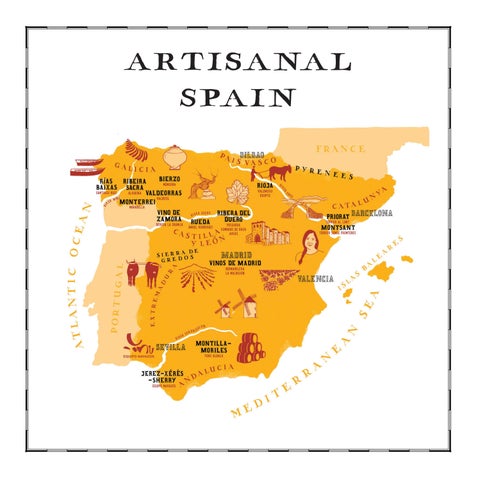
Artisanal Spain
Customer Service: orders@bibendum.com.au 1300 610 919 All prices quoted are Landed Unit Cost (LUC) and include WET but exclude GST Tasting notes for each wine available at bibendum.com.au
GALICIA 6, VALDESIl VALDEORRAS 8, ALGUEIRA RIBEIRA SACRA 10, MURADELLA MONTERREI 12, MENGOBA BIERZO MADRID 16, BERNABELEVA vinos de madrid 18, LA MALDICION vinos de madrid RIOJA 22, EXOPTO rioja alta 24, VALENCISO rioja alta CATALUNYA 28, TERROIR AL LIMIT PRIORAT 30. TERROIR HISTORIC PRIORAT 32. TERROIR SENSE FRONTERES
MONTSANT
CAsTILLA Y LEON 36, AUSAS RIBERA DEL DUERO 38, ALEJANDRO FERNANDEZ 40, MARTINSANCHO RUEDA
RIBERA DEL DUERO
SHERRY COUNTRY 44, TORO ALBALA MONTILLA-MORILES 46, EQUIPO NAVAZOS Jerez-Xeres-Sherry etc.
GALICIA
Valdesil d,o, Valdeorras
It may represent just a pinprick on the Spanish wine map, yet the mineral and slate-rich mountainous region of Valdeorras is one of Europe’s most exciting white wine regions. And, no grower’s history is as entirely intertwined with the region or its signature grape variety of Godello as the Prada-Gayoso family. Back in 1885, at a time when vineyards were planted with multiple varieties, José Ramón Gayoso planted the region’s first 100% Godello vineyard. This vineyard, named Pedrouzos— with ancient, gnarled vines still in production today—squeezes out just 500 litres of precious juice each year to make one of Spain’s most profound white wines. Pedrouzos is the oldest producing Godello vineyard in the world. Fortunately for us, José Ramón Gayos’s descendants didn’t stop there. Using massale cuttings from the original site, the family populated a mosaic of small vineyards, or pezas, across the Sil Valley, predominantly around the village of A Portela. These pezas now form the core holdings of this trailblazing estate. Yet, the Valdesil story does not begin and end with Godello—the indigenous Mencía is also well represented. In more recent times, Valdesil has continued to act as a regional pioneer in both viticulture and winemaking. The team were the first to introduce vertical shoot positioning, cover crops, strict organic methods and increased planting densities in the area. Valdesil was also among the first to return to natural yeast fermentation and barrel maturation. Current owners Borja and Raul Prada Luengo are also trialling biodynamic methods, a significant undertaking in this cool corner of green Spain. The Valdesil wines are products of old vines and low yields, and are naturally fermented, aged on lees and bottled unfiltered. Expect textural, mineral whites with a weight and mouthfeel that resemble that of quality white Burgundy. Valdesil’s Mencías are the kind of juicy, thirstquenching and mineral-scented reds that wine bars were made for. All the wines offer the kind of finesse, interest and sense of place found only in the wines of the very best growerproducers of northern Spain.
Code
Wine
Grape
LUC
1960-75
Valdesil Montenovo Blanco 20
Godello
$24.8
19603-75
Valdesil Valderroa Mencia 2018
Mencia
$20.89
6
Location: Vilamartín de Valdeorras, D.O. Valdeorras Terroir Atlantic climate with continental influence, sheltered from the rain by surrounding mountains. Temperatures are characterized by large diurnal shifts. The soils are broken blue slate with pockets of granite, schist and limestone. The steep vineyards rise to 500 metres above sea level. Viticulture: Organic practice. Story: The Pedrouzos vineyard was planted in 1885 and is the source of all the genetic material in Valdesil’s vineyard holdings. For years, this esteemed vineyard suffered from night-time poachers, who stole cuttings to propagate their own vineyards. It took a confrontation at the local vigneron’s hostelry for the practice to cease!
algueira d,o, ribeIra sacra
If anyone has earned the right to call their wine hand-crafted, the new pioneers of Ribeira Sacra (which acquired DO status in just 1996) must be at the head of the queue. However, even before the creation of this idyllic and isolated Galician DO, Algueira’s Fernando González and Ana Perez had begun purchasing and restoring vineyards abandoned here by the end of the 19th-century. Phylloxera, followed by recession and civil war had brought rack and ruin to these once-proud, ancient vineyards. Thanks to growers like Algueira, new energy has bloomed in Ribeira Sacra. The first step to crafting wines of genuine authenticity was to rebuild the terraces, or solcacos, that were carved by the Romans into the rocky valleys banking the Sil, Miño and Bibei Rivers. Not only have the founding Algueira team painstakingly resurrected these abandonados, they have also demonstrated their land and practice as capable of producing wines that bear comparison with the very best of Europe. From humble beginnings, González and Pérez now tend 20-hectares of vines. Today they are joined by son Fabio González Riveiro and young winemaker David Pascual. The vineyards are based in Ribera Sacra’s prestigious Amandi subzone, where vertiginous slopes of slate and schist rise like staircases from the River Sil. In places, these terraces are so dizzyingly steep they make the hillsides of Côte-Rôtie look like nursery slopes. Algueira’s white varieties shine in the cooler Ribeira del Sil sub-region on soils of gneiss and quartz. Due to the extreme nature of the sites, cultivation is painstakingly slow. Now largely biodynamic, these practices sometimes mean the numbers don’t add up, however González believes the wines deserve every effort. Mencía is Algueira’s paragon variety, producing aromatic wines of silky balance, clarity, and mineral resonance. González was also an early champion of Ribeira Sacra’s native grapes, and to this day makes Spain’s most exciting Merenzao, a variety with close links to Jura’s Trousseau. Algueira’s more sheltered, gneiss and quartz-laden slopes are devoted to Godello, Albariño and Treixadura, which yield some of Galicia’s most limpid, crystalline whites. Whatever the variety, every sip taken of these wines has the potential to profoundly change many drinkers’ perceptions of Spanish wine.
“The wines of Algueira are considered by many the finest and most elegant in Ribeira Sacra.” Jesús Barquín et al., The Finest Wines of Rioja and Northwest Spain Location: Doade, D.O. Ribeira Sacra Terroir: Continental climate with strong oceanic influences. Schist, granite, slate and gneiss soils. Sites are mainly south-facing, extremely steep, terraced slopes overlooking the Sil river. 350 to 550m altitude. Viticulture: Organic practice. Story: The steepest of Algueira’s vineyards is just over 80 degrees. During harvest, pickers use a range of purpose-built, German-designed monorails to ferry the grapes up to the awaiting truck.
Code
Wine
Grape
LUC
1934-750
Algueira Mencía Joven 2019
Mencía
$25.96
19346-750
Algueira Brandan 2019
Godello
$30.76
19347-50
Algueira Finca Cortezada 2019
Godello lb end
$50.65
8
MURADELLA d,o, MONTERREI
The wines of José-Luis Mateo are quite possibly the most refined European wines that most people have never heard of. Mateo is a vigneron widely revered by Spanish producers (especially in Galicia) as the most significant grower of their country. And yet, Mateo is one of the humblest people you’re ever likely to meet. He speaks no English, and with a base in Galicia’s least-known DO, he’s remained hidden from most of the English-speaking world. Having set up shop in 1991, Mateo works with 15 hectares of vines spread across Monterrei’s three growing districts of Pazo de Monterrei, Oimbra and Tamaguelos. The DO Monterrei may be young (established 1992), but its legacy of winegrowing goes back some 300 years. Muradella’s vineyards are generally tiny, isolated ‘hermitic’ plots (both in the hills and on the flatter lands) formerly farmed by the local paysans, and some simply abandoned. Scrupulously resuscitated vine-by-vine, all the Muradella vineyards are managed biodynamically (certified organic) and are populated with a cornucopia of indigenous vines—a list far too long to mention here. Soils vary considerably with differing degrees of slate, granite, iron and quartz, as do the altitude and aspect, offering the artistic Mateo a rich palette with which to express his place. Mateo follows traditional techniques without eschewing technological advances where they aid quality. All the grapes are whole-berry pressed and raised in used Burgundian pièces (228-litre), although he is experimenting with larger-format oak for some cuvées. All ferments are wild, and the wines are neither fined nor filtered. There is tremendous poise, purity, and character to be found in these unique, lovingly made wines. Moreover, these are some of the most delicious and terroir-expressive wines we have tasted from Spain. It is no exaggeration to say that Mateo’s vineyard-driven, artisanal model of winegrowing has been highly influential in Spain. He has worked this way for some 25 years in the remote terroirs of Monterrei, and the trail he has blazed is now followed by many of Spain’s exciting new breed of terroiristas. Just as the cream of young French winegrowers studied and tried to emulate the work of Selosse, Foucault, and Dagueneau, a good number of their Spanish counterparts look to this secluded corner of Galicia for their inspiration.
Code
Wine
Grape
LUC
10728-5
Muradella Crianza 209
Doña Blanca
$46.17
10729-5
Muradella Blanca 209
Doña Blanca
$6.80
15602-7
Muradella Alanda Blanco 2016
Doña Blanca
$3.07
15604-7
Muradella Gorvia Blanco 2013
Doña Blanca
$63.06
2045-7
Muradella Gorvia Blanco 2018
Doña Blanca
$69.63
17945-0
Muradella Alanda Tinto 2016
Mencía
$37.48
2046-75
Muradella Gorvia Tinto 2018
Mencía
$69.63
10
“Many producers consider José Luis Mateo to be the finest grape grower in Galicia. He’s relentless in his search for excellence and is often unhappy with the results even when you think the wines are amazing. In fact, his wines are amazing…and they transcend the appellation and find themselves among the finest wines from Galicia and from Spain.” Luis Gutiérrez, The Wine Advocate Location: Verín, D.O. Monterrei Terroir: Atlantic climate with continental influence, sheltered from the rain by the Sierra de Larouca mountains. Soils are slate, granite, iron and quartz. The steep, terraced vineyards sit between 300 and 850m altitude. Viticulture: Certified organic with biodynamic practice Story: Mateo works with no less than 26 varieties (all planted by massale selection), and trials these different grapes across various locations and diverse of soil types. José explains, “This is a work of many generations. I’m not in a hurry; I’d rather do little but be good at it”.
MENGOBA d,o, BIERZO
The region of Bierzo missed much of the industrialisation that Europe went through postWW2. The extreme landscape was too difficult to mechanise, and there was simply no interest in this remote area until a clutch of winemakers realised the remarkable potential of the high altitudes, old vines and quartz- and slate-rich soils. Bordeaux native Grégory Pérez launched his career with Grand-Puy-Lacoste, and also worked at Cos d’Estournel before travelling to Bierzo on the advice of a friend. What he found in the wild mountains of Bierzo would change his life forever. After acclimatising at Luna Beberide, he launched Mengoba in 2007. Following organic principles, Pérez farms a patchwork of old vines on the hillside vineyards of Valtuille, Villafranca del Bierzo and Carracedo. Head-pruned Mencía and Godello are the key varieties, with smaller holdings of Alicante Bouschet, Estaladiña and Doña Blanca, often all interplanted within the same vineyard. Yet it is the work in the slate-rich highlands of Espanillo that Pérez (and Mengoba) has become most associated with. Espanillo’s steeply sloping vineyards sit at the head of the River Cúa at an altitude of 850 metres and count among the highest in Bierzo. The rocky, fragmented slate and decomposed shale soils—and old vines—beget Mengoba’s most vivid and pungently mineral cuvées. Perhaps the most prised parcel is La Vigne de Sancho Martín, an isolated, 80-year-old plot. This vineyard looks more like a quarry—it’s incredibly stony, with the old trunks of Mencía and Godello protruding from a carpet of craggy fragmented schist. In the vines, Pérez’s artisanal work can only be described as tenacious—or the work of a madman. These challenging, remote vineyards are ploughed by oxen or ancient caterpillar tractor, and Pérez’s brand of organic viticulture requires exhaustive work by hand. The high altitude, shifting pure-slate soils, and the steep uneven terrain makes for slow and often treacherous work. Indeed, several years ago, Pérez flipped his tractor and was lucky to survive the experience. We’re pleased to say that all this inspiring grower’s hard work has been compensated by a stunning portfolio of wines. The new winery in San Juan de Carracedo allows Pérez to utilise the large-format oak he now favours, as well as a growing collection of clay jars and amphorae (and even two ancient sherry botas). With these systematic improvements, Pérez believes his wines are taking on more precision with each passing year. His goal is, and always has been, to make authentic wine with the most profound respect for nature. And the results are dazzling. Code
Wine
19432-750
Mengoba Brezo Blanco 20 16209-75
Mengoba Godello Sobre Lias 2016 137-50 1934-750
Grape
LUC
Godello lb end
$2.56
Godello
$37.3
Mengoba Brezo Rosado 2015
Mencia/Godello
$16.27
Mengoba Brezo Mencía 20
Mencía
$18.79
12
Location: San Juan de Carracedo, D.O. Bierzo Terroir: A variable continental climate, where some years Atlantic influences predominate, but in warmer years there’s influence from Spain’s Meseta Central to the east. The quartz and slate-rich soils have pockets of clay, limestone and granitic sand. The very steep slopes rise to 800 metres altitude. Viticulture: Organic practice Story: “You know, it’s always the crazy guys that make the best wine,” Pérez told us on our last visit to Bierzo. “JoseLuis Mateo [Muradella], people say, he’s that crazy guy in Monterrei. Fernando in Ribera Sacra [Algueira] is another crazy guy, and here, people say I am the crazy guy.”
madrid
bernabeleva d,o, vinos de madrid
Located in the mountains northwest of Madrid at the eastern edge of Spain’s Sierra de Gredos, Bernabeleva produces Garnachas unlike any others in the world—intense yet ethereal wines that give voice to an enchanting region few had heard of even a decade ago. San Martín de Valdeiglesias is the westernmost sub-region of the DO Vinos de Madrid. The first wines were cast at Bernabeleva in the 1930s, and the estate’s vineyards are still chiefly based on Dr Álvarez Villamil’s original 1923 Garnacha and Albillo bush vines. These old vines eke out their living at around 800 metres altitude under the commanding peak of the Cerro de Guisando. This sandy and granite-rich highland terroir is a magical mountain country full of rocky peaks and scrubby pine forests, still infused with a strong legacy of its Celtiberian heritage. It’s a place where altitude, aspect and soil type combine with old-vine plantings to produce a beguiling and uniquely savoury style of Grenache capable of blowing your mind. The challenge in this extreme climate and poor soil has always been to produce wines of finesse. A strong supporter of biodynamic viticulture, Marc Isart has a passion for place and produces wines of great transparency. Of course, it is the vineyards that determine the potential quality—the high altitude and naturally low yields from poor, sandy soils both serve to encourage vivid, balanced raw materials. Yet Isart’s way of working in these vines and in the cellar, moulds wines of enormous depth and complexity combined with great precision and delicious drinkability, all without any loss of intensity or power. Isart starts with hand-picked, biodynamic fruit. He employs long macerations, whole-bunch ferments, limited usage of SO2 and aging in used barrels (so as not to mask the wines’ glorious aromatics). At the core of the offering is a collection of deep, savoury and extravagantly perfumed Garnachas, while the tiny old-vine parcels of Viña Bonita and Arroyo del Tórtolas synthesise all the magical qualities of this region like few others. These are wines free from the confronting excesses of internationalisation or the rustic tannins and high alcohols that often shape this region’s red wines. They are a revelation. Alongside its Garnachas, Bernabeleva is also gaining distinction for its wildcard whites, which are based on this enigmatic, but seldom seen Albillo.. Sumptuously textured, earthy, saline, and slow to unfurl in the glass, Isart’s single-vineyard Cantocuerdas Albillo is a thrillingly savoury and evocative example, while the early drinking, entry-tier Navaherreros is blended with 30% Macabeo, which laces the fullbodied, mineral Albillo, with a zesty, racy lift.
Wine
Grape
206-75
Bernabeleva Camino de Navaherreros 2019
Albillo
$20.36
15807-
Bernabeleva Navaherreros Blanco 2016
Albillo lb end
$25.45
1974-50
Bernabeleva Navaherreros Garnacha 2019
Garnacha
$31.16
1270-5
Bernabeleva Cantocuerdas Moscatel 201
Moscatel
$32.70
Code
16
LUC
Location: San Martín de Valdeiglesias, D.O. Vinos de Madrid Terroir: Continental climate with warm, dry summers and very cold winters. Soils are poor, tawny sands formed from the decomposed granite of Cerro de Guisando, with relatively high acidity. The vineyards range from 700 to 830 meters above sea level. Viticulture: Organic and biodynamic practices. Story: Bernabeleva literally means ‘the path of the bear’. The area was once an ancient Celtic hunting ground, with a countryside dotted with large granite carvings believed to be bears or bulls, marking forests dedicated to the goddess of the hunt. Some of these carvings remain to this day, most notably the Toros de Guisando, which can be found not far from the Bernabeleva winery.
la maldicion d,o, vinos de madrid
When he’s not weaving his magic at Bernabeleva, Marc Isart—with his wife Carmen Pérez— tends to his small family estate, 120 kilometres away in the hills above Madrid at Arganda del Rey. We’re still in Vinos de Madrid country, with the high altitude vineyards situated within the granitic mountain chain that borders Madrid. Despite sharing a DO however, the oftendistant subzones scattered throughout these mountains can be very different. In Arganda del Rey, the granitic sands of the San Martín subzone (where Bernabeleva is based) give way to clay and limestone topsoils. With this change in soils, the varietals are typically different as well. At Bernabeleva, Isart works with old-vine Garnacha and Albillo, while at La Maldición, it’s old-vine Tempranillo for the red and Malvar, a local indigenous white variety, for the white. Isart’s old, low-yielding bush vines lie around the small village of Valdilecha, on an estate Isart has named Maldición, or ‘the curse’. Unsurprisingly the wines are very different to those Isart crafts at Bernabeleva in the Sierra de Gredos. But, applied here, Isart’s organic viticulture, pick-on-freshness, and natural yeast, lo-fi regime still result in wines that are as juicy and fresh as they are delicious. Although, they are certainly more straight-shooting and thirst-quenching in style (a reality reflected in their pricing). The Tinto de Valdilecha is a co-fermented blend of red and white varieties, as was once traditional in the region. His Malvar de Valdilecha white features whole-cluster fermentation followed by extended skin maceration and aging in large-format used oak. In a region where many wines are made just for impact (so you may find you can only drink one glass), the wines of La Maldición offer a refreshing distraction. “My goal is to produce grower wines,”, explains Isart. “wines that are more savoury than sweet. Wines where it is hard to stop drinking…”
Location: Chinchón, Arganda, D.O. Vinos de Madrid Terroir: Arid continental climate with warm, dry summers and very cold winters. Soils are clay and limestone with gypsum and poor, skeletal topsoils. The vineyards range from 700 to 830 meters above sea level. Viticulture: Organic and biodynamic practice Story: The vineyards here are notoriously difficult to work (and reach), hence the historical nickname given to the area by the local farmers: Maldición is Spanish for ‘malediction’, or more simply, ‘curse’.
1976-50
Code
Wine
La Maldición Tinto Fino 20
Grape Tempranillo lb end
18
LUC $17.28
rioja
exopto d,o,C.a rioja
Tom Puyaubert is bringing us up to speed with his new vineyard plots. First, there’s La Mimbrera, a gnarly plot of Garnacha and Tempranillo planted between 1890 and 1950. Also, in Abalos, he’s acquired a parcel in El Hoyo where one plot dates back to 1920. Then, San Cristobal, 0.7 hectares of old Viura at 630 metres, and Carrapeciña, an old vine parcel devoted to high grown Garnacha. By the time he gets to a plot of 1940s Malvasia Riojana in San Vincente, we realise that the man behind Exopto is only getting warmed up. When we first started shipping this producer, we marked French-born Tom Puyaubert as a Rioja star in the making. That was ten years ago, and today the man and his wines have amply delivered on that expectation. Much like in Champagne, in the last 15-20 years, Rioja has witnessed the rise of a small number of growers who are determined to make wines reflective of their place. In doing so, they are emulating the traditions of the cosecheros (grower-producers) of 19th century Rioja, who made wines from their own grapes long before the impact of this region’s more accepted generic ‘traditional’ model. All the critical artisanal boxes are ticked here: outstanding, hillside vineyards on rocky soils; very old vines (averaging 60-plus years); low yields; a terrific little winery replete with new cement tanks and large-format oak; and small production. Then there’s the grower’s passion for a place where, in 2003, he arrived as a barrel salesman. Today he finds himself at the vanguard of Rioja’s return-to-terroir movement. Exopto works a total of 22 hectares of organically tended old vineyards on the slopes of the Sierra Cantabria (Rioja Alta) and Yerga mountains (Rioja Oriental). The majority of these small holdings lie around the villages of Ábalos and San Vicente de la Sonsierra, in the small pocket of Rioja Alta between the River Ebro and the Basque mountains. This postcode has much in common with Rioja Alavesa and is sometimes referred to as Rioja’s Côte-d’Or. The soils here are rich in limestone, the climate is cooler, and the altitude is even higher than most parts of Rioja Alta. Having established Exopto’s core range—-under the Bozeto and Horizonte labels—-Puyaubert has recently turned his attention to several extraordinary single-vineyard wines—something very new for Rioja. Two of the most exciting bottlings we have tasted from northern Spain, La Mimbrera (Ábalos) and El Espinal (San Vicente), now underpin one of the most stimulating portfolios of the new Spain. Code
Wine
Grape
LUC
o Ex pto Bozeto de o Ex pto Rosé 2017
Tempranillo lb end
$14.41
1954-70
o Ex pto Bozeto de o Ex pto 20
Tempranillo lb end
$18.8
o Ex pto Bozeto de o Ex pto 20
Tempranillo lb end
$39.96
Tempranillo
$31.67
1954-0
156-70
2034-75
o Ex pto Horizonte de o Ex pto 2019
22
Location: Laguardia, Álava, DOCa Rioja Terroir Rioja Alta: Continental climate with Atlantic influences. Soils are calcareous and ferrous clay, chalk, alluvium and river stones. Altitude rises up to 650 metres on the slopes of the Sierra Cantabria. Rioja Oriental: A continental climate with influence from the Mediterranean. Soils are sandy with river rocks at an altitude of 300 metres. Viticulture Organic practice. Story: Exopto’s principal vineyards are ploughed by Miguel Angel Mato, a seasoned grower based in San Vicente. Mato owns a number of old vineyards high on the slopes of the Sierra Cantabria, and, under the Exopto label, Puyaubert has been making and releasing a series of small-batch single-vineyard wines sourced off Mato’s familial plots. The grower carries out all the farming duties under Puyaubert’s guidance while Puyaubert makes and sells the wine.
valenciso d,o,C.a rioja
From humble beginnings, Valenciso has risen to become a leading light among Rioja’s small yet growing band of terroir-focused producers. The story began in the late 1990s when wine industry veterans Luis Valentín (Valen…) and Carmen Enciso (…ciso) left behind outstanding careers at Bodegas Palacio and rented a small warehouse with barely enough space to produce their first vintage of 2,000 cases. Today, the vineyards and cellar are located in the far north of Rioja Alta, in Ollauri, a small village four kilometres from Haro. Believing most of the region’s most outstanding wines derive from commune-specific precincts, Valentin and Enciso chose to focus on Ollauri and its immediate environs. Part of what has been proposed as the Western Sonsierra zone, Ollauri’s vineyards are noted for their excellent calcário soils, altitudes of up to 600 meters and Atlantic-influenced climate. These factors are responsible for imparting depth and finesse into the Rioja Alta’s northern Tempranillo. Along with their 30 plots, the domaine also farms vines in nearby villages of Briones, Rodezno, Gimileo, Zarratón and Villalba, all of which lie within five kilometres of Ollauri. Vine age plays a key role—the average age sits around 30 years, rising to 60 years for the Reserva and up to 100 years for the Rioja Blanco. While Valenciso has been working with organics since its inception—a significant challenge considering less than three per cent of the vineyards of Rioja are organically managed—certification is currently in process. Several biodynamic practices are also subscribed to. As Valenciso continues to etch out its own distinctive space in the Rioja story, year in, year out, every wine from this producer points to constant progression. A distinctive feature of Luis and Carmen’s approach is the use of concrete tanks for fermentation, which allows for a gentler extraction of fruit and colour. Aging for the Reserva takes place in French oak barriques (only one-third replaced each year), and the white wine is raised in low-toast Caucasian oak to prevent undue influence on the wine. All the Valenciso wines ferment naturally. These are complex, savoury, terroir-driven Rioja wines, revealing Luis and Carmen’s preference for subtlety, elegance and refinement. In the manner of French Burgundy and the greatest Riojas of the past, Valenciso is all about aromatic volume rather than physical weight. Code
Wine
2057-
Valenciso Rioja Blanco 20 2058-7
Valenciso Tempranillo Blanco 20 1934-750
Grape
LUC
Viura/Garnacha Blanco
$35.5
Tempranillo Blanco
$41.39
Valenciso Rioja Laderas de Cabama 2018
Tempranillo
$24.63
2096-75
Valenciso Cemento 2018
Tempranillo
$32.06
2097-5
Valenciso Graciano 2019
Graciano
$67.81
205-7
Valenciso Rioja Reserva 2015
Tempranillo
$42.58
2056-7
Valenciso Rioja Reserva 10 Años Despues 201
Tempranillo
$68.38
24
“Valenciso is one of the most modern of the traditional producers, or the most traditional of the modern producers. I love their wines, which offer good typicity and drinking pleasure, and I think they deserve more attention than they get.” Luis Gutiérrez, The Wine Advocate Location: Ollauri, DOCa Rioja Terroir: Continental climate with Atlantic influence, sheltered from the rain by the Obarenes Mountains. Clay/ limestone soil overlays limestone bedrock. Altitude ranges from 480 to 610 metres. Viticulture Organic practice (certification due 2022). Story At a dinner in Melbourne (circa 2012), Jesús Barquín, renowned Spanish wine writer and founder of the Equipo Navazos project, had a very clear message. He said this: “If you asked me to name just one producer from Rioja that you should buy, it would be Valenciso.”
catalunya
terroir al limit d,o,C.a priorat
In just twenty years Dominik Huber has created something unique in Priorat and, arguably, in Spain as a whole. While these Catalan hills south of Barcelona are no stranger to critically feted wine, Huber’s transparent, pared-back examples are both striking and radical in the Priorat context. His is a style of Priorat that has seen critics and other wine people scrambling to offer plaudits and comparisons. Put simply, Huber’s wines have redefined what we all once thought was possible from the vineyards of Catalonia. Through many years of trial and error, Huber has managed to evolve a style of Priorat that is all about mesmerising finesse, purity and freshness. With old-vine Carignan and Grenache as the conduit for the reds, Huber has now shown the wine world that Priorat wines do not have to be heavy, thick and oaky. And he has also shown that the whites of the region can be every bit as great as the reds. They are beautiful, textural and mineral whites that taste as if they’re tapped directly from Priorat’s rocky soils. Huber’s vineyard selection has involved a search for high-altitude, old-vine plots that allow him to harvest ripe fruit with maximum freshness. He practices biodynamic viticulture, picks as early as possible (he would pick even earlier if the DOCa allowed it). Huber uses whole-bunch (there’s no destemmer at the winery) and carbonic fermentation to significant effect, favouring an infusion-over-extraction approach. He raises the wines in large-format oak and concrete. All this lends Huber’s wines an almost Burgundian-like shape and structure, generating vibrancy and succulence, with the emphasis placed squarely on the glowing, stony, mineral essence of Priorat’s soils. Terroir al Límit is a Domaine in a constant state of progress, forever seeking to refine and improve the way of working. The arrival of head winemaker Tatjana Peceric to assist Dominik Huber, and the quality emanating from the Montsant project, Terroir Sense Fronteres, are two significant examples in point. In recent years, the range has been downscaled to allow more focus on what Rajat Parr has termed the Domaine’s “maniacal farming practices”. The arrival of head winemaker Tatjana Peceric to assist Dominik Huber, and the quality emanating from the Montsant project, Terroir Sense Fronteres, are two significant factors to this end. All this lends Huber’s wines an almost Burgundian-like shape and structure, generating vibrancy and succulence, with the emphasis placed squarely on the glowing, stony, mineral essence of Priorat’s soils.
2017-5
Code
Wine
Terroir al Límit Arbossar 2019
Grape Cariñena
28
LUC $14.90
“I revelled in these stunning Priorats [of Terroir al Límit] ... These are wines that offer intensity of flavour instead of overwhelming power, and elegance and personality on a worldclass level.” Neal Martin, The Wine Advocate Location: Torroja, DOCa Priorat Terroir: Dry Mediterranean climate, where summers are long, hot and dry and winters are cold. Terroir al Límit farms a variety of soils from the emblematic black slate and quartz (known as llicorella) to the poor clays (with elements of quartz, chalk and limestone) of the Manyes vineyard. Altitudes range from 350 to 800 metres. Viticulture: Organic and biodynamic practice Story With the help of the Pérez family of Mas Martinet, in 2001 Eben Sadie and Dominik Huber purchased some fruit and leased a little corner in the cellar of Cims de Porrera, where they vinified their first vintage of Dits del Terra. Eben Sadie left Terroir al Límit in 2011 to devote his energy to the family domaine in Swartland. The two remain great friends.
terroir historic d,o,C.a priorat
There was a time before the modern winemaking revolution when Priorat was also famous, at least locally. This dramatic region produced lighter-bodied, almost delicate reds and whites, sold in Burgundy bottles. Little was seen or heard of these wines outside of Catalonia—let alone Spain—even though they were made into the 1970s. It was only when René Barbier came to Gratallops from Rioja (followed shortly afterwards by Álvaro Palacios), planted French varieties and started using French-inspired techniques of maceration and barrique aging that the English-speaking world woke up to the potential of Priorat. Given that it was in the 12th century when a Carthusian monk of the Monastery of Scala Dei first planted vines in this region, that’s some eight centuries that we somehow managed to miss out on. These ‘new Priorat’ wines from Gratallops were big, oaky, and often very alcoholic. Sadly, these behemoths came to define what people expected of the region. It took a pair of outsiders (Dominik Huber from Germany and Eben Sadie from South Africa) to begin a process that would challenge this perception. The historic wines of Scala Dei that originally inspired Huber to establish Terroir al Lìmit were regional blends made from purchased grapes. They were crafted using no de-stemming, no pigéage, no extraction and no new oak. So, when Huber found himself getting asked more and more for a value expression of the Terroir al Lìmit style, an idea began to crystalise in his mind. Huber and Tatjana Peceric—TaL’s talented head winemaker—work with a roster of younger growers who have invested in first-rate organic viticulture. Their sources are from all nine historic villages of Priorat: El Lloar, Porrera, La Vilella Baixa/La Vilella Alta, Escaladei, Bellmunt, Gratallops, Torroja, La Morera de Montsant and Poboleda. The vineyards cover multiple terroirs across Priorat’s concertinaed hills: from slate to clay, granite and alluvium; from aubagues (shady spots) to solanes (sunny spots); and from 350 metres to 800 metres in altitude. The wines produced thus create an all-encompassing view of Priorat—one that would have been recognized in the past. In short, Terroir Históric is Huber’s homage to the wines of Scala Dei, before the modern era of Priorat changed everything. Rather than attempting to achieve the lofty single-site expression of the Terroir al Límit labels, Terroir Históric was founded to introduce a more affordable, digestible, everyday-drinking Priorat to the market, as well as to encourage the region’s young growers to move in a more organic direction. This, then, is delicious, juicy, Priorat for the people.
19073-5
Code
Wine
Terroir Históric Negre 2018
Grape
LUC
Garnacha /Cariñena
30
$37.98
Location: Torroja, DOCa Priorat Terroir: Dry Mediterranean climate, where summers are long, hot and dry and winters are cold. Terroir al Límit farms a variety of soils from the emblematic black slate and quartz (known as llicorella) to the poor clays (with elements of quartz, chalk and limestone) of the Manyes vineyard. Altitudes range from 350 to 800 metres. Viticulture: Organic practice Story Legend has it that the ancient monastery of Escaladei (stairway to heaven) in Priorat was built on the site of a celestial staircase which the angels would use to ascend from the vineyards to heaven— carrying wine for The Almighty. This was a time when the wines of Priorat were much lighter and more digestible than much of the region’s modern output. Precisely inspired by that history—and obsessed with reminding the world that Priorat remains capable of producing wines of tremendous finesse—Terroir al Límit is today a standard-bearer for this style.
terroir sense fronteres d,o, montsant
To anyone who knows Dominik Huber’s ground-breaking Priorat wines, Terroir al Límit’s move into Montsant was always going to result in something unique. The genesis of Terroir Sense Fronteres began in 2015 when Huber finally acquired his iconic Garnacha vineyard, Les Manyes. As part of this purchase, Huber was also able to obtain an adjacent four-hectare parcel of Garnacha lying just metres across the Priorat border in DO Montsant. The vineyard is called Els Montalts. While the terroir here is almost identical to Les Manyes, Montsant is another DO, so a new project was born. Montsant’s vineyards lie at widely varying altitudes—Terroir Sense Fronteres’ vines are spread between 350 and 800 metres. And while Priorat’s famous llicorella soils are also found in Montsant, there is more variety here, with clay, sand, gypsum and limestone all playing their part. As well as Garnacha from the Els Montalts site, the Terroir Sense Fronteres portfolio includes Garnacha from the cool, high-altitude slopes of Figuera and parcels of Garnacha Blanca, Macabeo, Garnacha and Cariñena from mature parcels around Capçanes. Aside from a plethora of exciting terroirs and the old vines on offer, Montsant DO regulations allow for the production of lower alcohol wines. Huber has always said he would pick his Priorat wines at lower alcohol if it did not mean losing his DOCa status, so the Montsant project has brought the element of freedom he has been craving. Terroir al Limit’s talented, Serbian-born vigneron Tatjana Peceric run this project, and her rare touch with high-grown Garnacha and Cariñena is cast, clear as crystal, across these wines. Except for the skin-contact white Brisat, the wines ferment as whole bunches in concrete, amphorae and stainless steel, and extraction is as gentle as possible. No bells, no whistles and zero oak—just the purity and tremendous finesse that only a special place, meticulously farmed, can gift. Peceric is adamant that while Montsant does not share Priorat’s fame, its finest terroirs are every bit as exciting—a point entirely borne out in the quality of these wines. They carry the unique mineral signature of their slate- and limestone-rich soils and have the kind of freshness, lightness of being, crunchy/juiciness and textural sensuality that one is usually more likely to encounter further north in the top cellars of Burgundy and the Rhône Valley. Code
Wine
Grape
LUC
19068-75
TSF Brisat 2019
Garnacha Blanca/Macabeu
$38.49
1906-75
TSF Negre 2019
Garnacha C / ariñena
$38.49
1907-5
TSF Vèrtebra de la Figuera 2019
Garnacha
$61.96
17690-5
TSF Vertebra de la Figuera 2018
Garnacha
$61.80
1769-50
TSF Guix Vermell 2018
Garnacha
32
$496.15
Location: Capçanes, DO Montsant Terroir: Dry Mediterranean climate, considered a little less severe than Priorat proper. The palette of soil types includes more clay, sand, gypsum and limestone than the rest of Priorat, and the soil of Montsant often glows bright red, compared to Priorat’s typical grey and black. The vineyards lie between 350 and 800 metres above sea level. Viticulture: Organic and biodynamic practice Story: Alongside her work at Terroir al Límit and Terroir Sense Fronteres, Tatjana Peceric has recently created her own small label, Coreografía. From biodynamically farmed vineyards located high above the village of Cornudella de Montsant, her first wine, Pas de Deux, is a Garnacha/Cariñena blend named for her previous life as a dancer. Our frist shipment is due imminently.
castilla y leon
Ausas
d,o, ribera del duero You may not have heard of Xavier Ausàs, but there’s a good chance you have heard of this winemaker’s previous employer. Ausàs worked at Vega Sicilia and its neighbour, Alión, for 25 years (with 17 of these as technical director). During his first seven years, Ausàs was mentored by the legendary Mariano García, undertaking the kind of education money cannot buy. Now, with 35 vintages under his belt in the region, you could say that what Ausàs does not know about Ribera del Duero is hardly worth knowing. Xavier Ausàs left Vega in 2015 to concentrate on a small consultancy business while setting up his own, Burgundian-sized family Domaine. The following year, to much acclaim, Ausàs launched his first vintage of Interpretación. The building blocks are a number old-vine, highgrown Tinto Fino parcels concentrated around Ribera’s central belt. Having worked with his growers for other domains for many years, Xavier’s professional relationships have evolved into lifelong friendships. There are no contracts and Ausàs is involved in the day-to-day viticultural decisions: a partnership reflected in his label’s logo, a pair of cupped hands. Ausàs varies his purchases and winemaking depending on the character of the vintage. The stony terroir of Nava de Roa brings elegance and blue flowers. Gumiel del Mercado, with its clay soils, delivers fruit generosity and acidity. Moradillo de Roa (Ausàs’ highest source at 950 metres), brings power, freshness and structure, while the clay/limestone soils of Roa de Duero provide “a chalky sensation in the mouth and minerality.” says Ausàs. While much of Ribera is bewitched by new barrels, Ausàs is notable for refined use of oak. The grapes are subject to a cold soak and fermented with indigenous yeasts in stainless steel and concrete vats before aging for 14 months in French oak (just 30% new) in two sizes: half in 225-litre casks and half in 500-litre demi-muid. The wines are vinified by parcel and blending takes place just prior to bottling (unfiltered). In a region known for reds of blind power, Interpretación stands out for its keynote fruit purity, vibrant aesthetic, fine-grained texture and long, chalky structure. Ausàs believes muscle in Ribera del Duero is a given, but searches for the elusive combination of both strength and elegance. He’s off to a flying start.
19574-0
Code
Wine
Ausàs Interpretación 2018
Grape
LUC
Tempranillo
36
$81.9
Location: Quintanilla de Onésimo, D.O. Ribera del Duero Terroir: Short, hot summers and cold winters, with vines are protected from maritime influence by a ring of mountains. The vineyards are situated at high altitude. Soils are clay and sand, with varying layers of limestone, marl and chalk. Viticulture Traditional agriculture with minimal inputs necessary due to the dry, harsh climate. Story: Ausàs purchased his first parcel of vines in 2021 in Nava de Roa: a very poor, stony terroir at 700 metres altitude (Xavier had been working with this fruit for many years at Alión). He praises the site for contributing delicate, blue floral aromas to Interpretación’s blend. Accordingly, this fruit is raised in used in larger format, used 500-litre casks.
Alejandro Fernandez
d,o, ribera del duero Fernández’s Pesquera is one of the legendary Estates of Spain. A family breadwinner from the age of 13, Alejandro Fernández established Pesquera in 1972, with local critical acclaim being key to Ribera de Duero receiving official DO status in 1982. Pesquera also rose to international fame after Robert Parker described the 1982 Tinto Pesquera as “the Spanish Château Petrus”. Perceptions of the region changed forever. One of Spain’s true wine pioneers, Alejandro Fernández passed away in May last year at the age of 88. Having proven that you didn’t need to be Vega Sicilia to produce world-class wine in Ribera, in the mid-1980s, Fernandez established a second property on the steep banks of the Duero between Roa and La Horra. Abandoned for years, the slope had consisted of hundreds of small parcels with separate and stubborn ownership. Following three years of persuasive consolidation, Condado de Haza christened its first vintage in 1988. Unstoppable, in 1998 Fernandez purchased a ranch in Zamora (which also produces olive oil, cheese and chickpeas). Dehesa la Granja is sited at altitude above the Guareña River, just outside the boundaries of the Toro region. Alejandro’s approach was always to emphasize the extraordinary fruit intensity gifted by his high-altitude, limestone-rich vineyards. The wines are made almost entirely from bushvine Tinta del Pais, the local name given to Ribera’s own thick-skinned, wilder mutation of Tempranillo. Over the years, the practices have remained staunchly traditional: hand-harvests; foot-treading; and maturation for years in an astute blend of French, Spanish and American oak barrels. All the wines are well cellared before release. The wines of Alejandro Fernández remain some of the very finest of their genre, part of a select group of deliciously enduring, thought-provoking Spanish wines that have one foot firmly planted in the old school and the other in modern Europe. There is a hands-off, long-aging complexity to these wines that confidently points to the past rather than the current zeitgeist where everything is bright and jubey. The Spanish have a lovely, quirky saying—No hay que buscarle tres pies al gato—which translates as ‘don’t search for three legs on a cat’, or, in Australian vernacular, if it ain’t broke, don’t fix it. These are wines of timeless popularity built around a fulcrum of ripe and silky fruit, classical tannins and the freshness of the continental climes where Fernandez worked until his very last years. Rest in peace, Maestro. Code
Wine
Grape
LUC
165-70
Dehesa La Granja Tinto 207
Tempranillo
$24.41
2085-7
Condado de Haza Crianza 2018
Tempranillo
$30.92
20497-5
eP squera Tinto Crianza 2018
Tempranillo
$42.32
38
Location: Pesquera de Duero, D.O. Ribera del Duero Terroir: Short, hot summers and cold winters, with vines protected from maritime influence by a ring of mountains. The vineyards are situated at high altitude (up to 900 metres). Soils are clay and sand, with varying layers of limestone, marl and chalk. Viticulture: Traditional agriculture with minimal inputs necessary due to the dry, harsh climate. Story: It’s hard to underestimate the respect and esteem with which Fernández was held in his home region. We have witnessed this many times in Spain, where we too have fallen under his charismatic spell. Our last visit was back in 2018, when after his customary two glasses of red wine for breakfast (Dehesa la Granja if you must know), Fernández travelled from Zamora, two hours west to rendezvous with our buyer.
martinsancho d,o, rueDa
Tucked away in the backstreets of La Seca (population 1,000) a visit to Bodegas Martínsancho feels like a step back in time. There is only a single wine produced here, less than 2500 cases of an inimitable Verdejo that takes its name from a 17th-century vineyard called El Pago de Martínsancho. Some bush vines in this vineyard are pushing 200 years of age and represent the oldest Verdejo vines in the world. The original one-acre Martínsancho plot was expanded in the 1970s using massale cuttings from the ancient plot, yet those original vines still persist, producing tiny volumes of fruit. Although this Estate boasts a winemaking tradition that dates back centuries, it was not until 1981 that Ángel Rodríguez began to bottle his own wine. Rodríguez was known as The Man Who Saved Verdejo, the indigenous grape grown in the area since the 11th century. The variety almost became extinct in the 1970s when many vineyards were being pulled up to plant Sauvignon Blanc and Viura. Rodríguez persisted, and shorty before passing away in 2018, his work was honoured with the Cross of the Civil Order of Agricultural Merit by King Juan Carlos I of Spain. Sauvignon Blanc was not the only innovation unwelcome at chez Rodríguez. There remains no packaged yeast, stainless steel, refrigeration or filtration equipment—each now commonplace on the Rueda scene. Untouched by modern techniques, the wine is made entirely by hand, naturally fermented and raised in century-old 5,000-litre oak botas housed in a naturally cold warren of cellars—unusual in a country where most cellars sit above the ground. Ángel´s daughter Concepción and grandson Eduardo continue the legacy here. Luckily for us, the Estate’s wine culture isn’t the only thing here untouched by time; Senor Rodríguez’s tariff has barely budged in the ten-plus years we have been shipping his wine. On the one hand, all this living history would seem to personify the opposite of what the authorities like to call “progress”. On the other, organic viticulture, old vines, hand harvesting and minimalist winemaking offer a shining, idealistic example for Spain’s present forward-thinking producers. The racy, rocky purity of this authentic old vine Rueda brings it all home. Everything old is new again.
19345-70
Code
Wine
Martínsancho Verdejo 2018
Grape Verdejo
40
LUC $20.52
“The quality of [Ángel Rodríguez’s] wine is legendary.” John Radford, The New Spain. Location: La Seca, Valladolid, D.O. Rueda Terroir: Rueda reaches 700 metres above sea level. It has a continental climate with warm days, cool nights and little rainfall. The alluvial soil is pure gravel running to a depth of over 30 feet. Viticulture Organic practice. Story Each of the estate’s 5000-litre casks has a feather sticking out of it. If you asked for a taste, Ángel Rodríguez would hold up a glass and pluck out the feather, which had a little cork on the other end. This cork had stopped a tiny hole in the cask, which would proceed to shoot a jet of cool Rueda that he expertly caught in the glass.
sherry country
toro albala
d,o, Montilla-Moriles Toro Albalá should need little introduction as the most significant producer of Pedro Ximénez in the world today. Under the (some would say eccentric) guidance of Antonio Sanchez Romero, in 1970, Toro Albalá was the first Montilla producer to commercialise bottled, dessert-styled Pedro Ximénez. We believe the bodega also remains the world’s only specialist in 100% vintage P.X. Toro Albalá works with the finest vineyard holdings in Montilla and today houses the oldest and most legendary stocks in the region. Founded in 1844, Toro Albalá is based in Aguilar de la Frontera, right in the bullseye of DO Montilla-Moriles, the hilly Andalucían hinterland that forms ‘P.X. country’. The DO surrounds the two towns of Montilla in the north and Moriles in the south, both in the Province of Cordoba. In 1922 José Maria Toro Albalá purchased the domaine and made his mark by moving the whole bodega into a former electrical plant. It was here that José Maria began to write the blueprint for the modern incarnation of Toro Albalá. Toro Albalá’s old, bush-vine Pedro Ximénez is planted on the bleach-white, chalky albariza soils of the region. This soil type is not unique to Montilla-Moriles—Sherry’s other capitals of Sanlúcar de Barrameda and Jerez de la Frontera share the spoils. However, the combination of these light soils with altitude and the hot, dry climate—one that can sufficiently ripen Pedro Ximénez—set Montilla apart from its maritime-influenced sister regions. This producer’s reputation lies in the balance of extraordinary sun-ripened richness and depth of old vine P.X. combined with a bright, savoury quality, which never allows the wines to veer into the cloying end of the spectrum. This is managed through strict quality control, from the old vines and great soils, all the way through their very long aging process. The bodega’s mindboggling vintage Selección wines are black as pitch, indescribably complex and represent the most profound expressions of P.X. from Andalucía. But Toro Albalá’s offering isn’t limited to their P.X. nectar. Back in the 19th century, when Toro Albalá’s forefather Antonio Sánchez Prieto first started to produce and age wines in the village of La Noria, his emphasis was mainly on Fino wines. This is a tradition kept bang up to date by Toro Albalá’s famous unfortified savoury wines—the Fino en Rama Eléctrico and a stunning thirtyyear-old Amontillado. Code
Wine
Grape
LUC
Toro Albalá Eléctrico Fino del Lagar
eP dro Ximénez
$21.65
Toro Albalá Eléctrico Fino En Rama Bombilla
eP dro Ximénez
$30.86
7896-50
Toro Albalá Cream
eP dro Ximénez
$28.20
7895-0
Toro Albalá Oloroso
eP dro Ximénez
$27.7
1946-375
Toro Albalá Don PX Cosecha 2019
eP dro Ximénez
$26.63
20175-3
Toro Albalá Don PX 19
eP dro Ximénez
$43.85
7893-50 1284-750
44
Location: Aguilar de la Frontera, D.O. Montilla-Moriles Terroir: Semi-continental Mediterranean climate with long, hot, dry summers and short winters. The hillside vineyards of Sierra de Montilla and Moriles Alto lie at 400 to 600 metres above sea level on the finest albariza soils. Story: Stationed in a converted historic electricity plant in Aguilar de la Frontera, it’s no wonder this bodega has been called “a little eccentric and unusual” by Luis Gutiérrez. Albalá’s visionary owner, Antonio Sanchez Romero, is a collector, inventor and entrepreneur, and is prone to insist visitors take a tour of his personal museum—a function-hall-sized room packed with all manner of winemaking (and other) artifacts and books—some 4,000 pieces going back to pre-history.
equipo navazos d,o, Jerez-Xeres-Sherry
It’s been fifteen years since Eduardo Ojeda and Jesús Barquín burst onto the scene with their limited edition, “mind-blowing” La Bota series. Sourced from the region’s rarest, most significant (and hitherto neglected) solera systems, Equipo Navazos swiftly became the cult producer for quality Sherry lovers, knowledgeable sommeliers and indie retailers worldwide. The Equipo Navazos project founders are: one of Spain’s leading experts and writers on Sherry, Jesús Barquín; and one of Jerez’s leading tasters and blenders, Eduardo Ojeda (technical director for the Estévez group, owners of Valdespino and La Guita Manzanilla). One day in late 2005, Ojeda and Barquín were tasting through some 400 casks of Manzanilla at the bodega of Sánchez Ayala in Sanlucar. As Andrew Jefford recounts in the story to the right, one particular wine sparked the project we love so much today. Since that first cask of Amontillado—named simply Bota de Amontillado No.1 after the short story by Edgar Allan Poe, ‘The Cask of Amontillado’—each successive, limited edition bottling has been numbered accordingly and bottled en rama: straight from the cask. The wines are selected for sheer quality as well as their distinct personalities. Initially, these bottlings were intended only for a select group of friends and professionals, but the response to the wines was so enthusiastic that it became evident that something important could come of this idea—namely, Equipo Navazos could remind the world just how great Sherry could be. Guided by their vast knowledge and unparalleled contacts, Navazos has gone on to assemble arguably the finest offering of Sherries in the market, while also promoting the great historical and cultural traditions that lie behind Sherry and the Jerez region. These are all one-off bottlings, and once the bottles for each La Bota release are spoken for, there are no more. Our allocations remain very small and most often sell out before general release. Thankfully, the Navazos story does not end with the hard-to-source La Bota wines. In consultation with a small core of importers (including Bibendum Wine Co.) Navazos also bottles a trio of more accessible yet still unfiltered en rama sherries under the Equipo Navazos label. I Think is a wonderfully potent and briny Manzanilla from the La Guita stable; the Fino ‘En Rama’ is drawn from a gold-standard solera and includes fruit from the ‘Montrachet’ of Jerez—Macharnudo Alto; and the Gran Solera is a stunning Jerezano style P.X. aged for over 25 years. These are shipped freshly bottled, in more significant quantities and positioned at more accessible pricing. Also remarkable is Navazos’ white wine project, inspired by a period in Andalucían wine history before fortification was the norm. (Due to limited availability, Equipo Navazos’ La Bota serieswine are allocated to previous buyers. Please contact your rep for more information).
Code
Wine
Grape
LUC
198-375
Equipo Navazos I Think Manzanilla
Palomino Fino
$20.75
207-35
Equipo Navazos PX Gran Solera O+25Y
Pedro Ximénez
$39.92
196-750
Equipo Navazos La Bota 9 MXIX Florpower
Palomino Fino
$53.39
46
Location: D.O. Jerez-Xérès-Sherry D.O. Montilla-Moriles Vino de Mesa Terroir: The temperate climate is dry, sunny and strongly influenced by the sea as well as the two rivers, Guadalquivir and Gaudalete. Gently rolling hillsides are between 325 and 500 feet above sea level. Soils are Albariza, Jerez’s emblematic bleach-white soil containing between 30 and 80% chalk, the rest a mix of limestone, clay and sand. Story:
“…After they had cantered through the Manzanillas, they started tasting other things in the cellar, and discovered a ‘shrinking’ Amontillado solera which had been untouched and unrefreshed for 20 years. “The casks were beautiful,” Barquín remembers. “But since there was no market for Amontillado, the owner had instructed that instead of refreshing the angel’s share, the solera should be topped up from existing stocks, so the original 74 casks were now 69 or 65, I can’t remember.” Forty years of crisis had left Jerez and Sanlúcar littered with treasures of this sort. That was when the idea dawned on Barquín: why not buy a cask? He and Ojeda could then sell the bottles to their friends.” Andrew Jefford, The Coming of Jesús.
Sophie Carbonneau 0424 198 532 ZoEë Ladyman 0418 125 375 Ben O'Connor 0437 022 436 Tal Thorne 0417 339 362 AARICIA HELLOIN 0486 004 351 Clara Davidson 0468 940 897 Lucie D omerc q 0459 879 006 Niamh Lovett 0424 137 829 Nick Mercer 0438 002 639 Phillip Whyburn 0476 772 066 Jonathon McD onald 0417 592 784 Luke Willis 0406 628 400 Natasha Arnavas 0455 095 418 BRIAN CARPENTER 0484 814 893 Marcel Bellenger 0428 588 255 Roger Duncan 0455 091 551