www.vascularnews.com
■ NOVEMBER 2026 | Issue 112
14 LEADER-PAD Multinational trial of low-cost drug targets primary inflammation in PAD patients
18 Venous data “Huge variation in practice”: Early insights from the ESVS European Venous Registry
16 Profile
IAN CHETTER VSGBI past president on his vascular surgery career
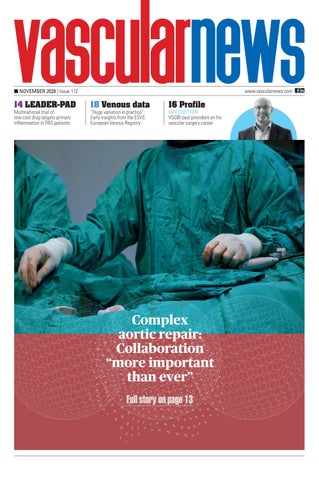
Complex aortic repair: Collaboration “more important than ever” Full story on page 13
2
News
contents
EDITOR’S LETTER
3 News Conference circuit 4 Conference circuit 6 Conference circuit 7 From the journals 9 From the journals 11 Beyond the vessel 13 In-Depth Cover story 14 Interview: Rob Hinchliffe 16 Profile: Ian Chetter 18 Q&A: Baris Ozdemir and Khadija Inam
20 Comment
Anders Wanhainen et al
22 Matt Popplewell et al 25 Launch Pad: Adam Talbot 25 Rachael Forsythe 26 Market Watch Clinical Updates
28 Product Updates 30 Industry Updates 30 Conference calendar
www.vascularnews.com
■ NOVEMBER 2026 | Issue 112
3 New data
Latest findings from SirPAD, STORM-PE and more presented at VIVA 2026
14 LEADER-PAD Multinational trial of low-cost drug targets primary inflammation in PAD patients
16 Profile
IAN CHETTER VSGBI past president on his vascular surgery career
Complex aortic repair: Collaboration “more important than ever” Full story on page 13
Cover credit: Images by Adobe Stock Creative, concept and photomontage by Terry Hawes
“Start spreading the news!” IT’S NOVEMBER, WHICH MEANS WE ARE DISTRibuting an exciting new edition of Vascular News—our fourth and final issue of 2026—featuring extensive coverage coverage, key updates from the journals, and expert insights that have been presented, published, and shared in the past few months. November also means the start of a new conference season, with the annual VEITH Symposium (17–21 November, New York, USA) as a highlight. Although neither of us is Frank Sinatra, we both know a good Vascular News edition as well as a great vascular meeting. Thus, we can “spread the news” in our editorial. This latest issue of Vascular News has many outstanding articles to read and enjoy. We’re featuring the latest research from the International Multicenter Aortic Research Group (IMARG) on the cover, several highlights from recent meetings including secondary analysis data from SirPAD, new results from STORM-PE, and long-term outcomes from the GREAT registry to name a few. We hope you enjoy the profile feature on Ian Chetter, past president of the Vascular Society of Great Britain and Ireland (VSGBI), who is an outstanding surgeon, leader, and mentor. We also feature further responses to the European Society for Vascular Surgery (ESVS) focused guideline update on the use of paclitaxel-coated devices, with Anders Wanhainen leading an editorial defending the selective use of paclitaxel devices and Matt Popplewell proposing a move towards newer research methodologies
in this space. As ever, we invite and welcome feedback on the articles included in this issue as well as any suggestions for future content from our readers. We know the VEITH Symposium is coming as the days get shorter and the weather starts to change in the Northern Hemisphere. We both look forward to New York City every year. Do keep an eye out for coverage of the meeting in Vascular News, both online in real-time and in our January 2027 print issue. Dr Veith recently announced that Gustavo Oderich will be the next leader of his meeting and we send our congratulations to Gustavo on this appointment. We wish everyone a great holiday season to come; hopefully you will have some time with friends and loved ones. If you are on call, we wish you a festive period that does not include too many ruptured aneurysms or ischaemic limbs. Happy early new year and we will see you back in 2027 for more Vascular News.
ROSS MILNER is chief of the Section of Vascular Surgery and Endovascular Therapy and vice chair of perioperative services and clinical affairs at University of Chicago Medicine in Chicago, USA. IAN LOFTUS is a consultant and professor in vascular and endovascular surgery at St George’s University Hospitals NHS Foundation Trust in London, UK.
EU editorial board: Ian Loftus, Rob Morgan, Stephen Black and Nicholas Inston US editorial board: Ross Milner, Erin Murphy, Eric Secemsky and Bart Dolmatch Publisher: Stephen Greenhalgh | Editor: Jocelyn Hudson Jocelyn@bibamedical.com Editorial contribution: Bryan Kay, Jamie Bell, Will Date and Éva Malpass Design: Terry Hawes | Advertising: Nathalie Fortin Nathalie@bibamedical.com and Camille Lumetta camille@bibamedical.com Subscriptions: subscriptions@bibamedical.com Published by: BIBA Medical Ltd BIBA Medical, 526 Fulham Road, Fulham, London, SW6 5NR, United Kingdom Tel: +44 (0) 20 7736 8788 Printed by: Buxton Press. Reprint requests and all correspondence regarding the newspaper should be addressed to the editor at the United Kingdom address. © BIBA Medical Ltd, 2026. All rights reserved. VascularNews
November 2026 | Issue 112
linkedin.com/company/Vascular-news
Scan the QR code to subscribe
If you have comments on this issue or suggestions for upcoming editions write to jocelyn@ bibamedical.com
News
www.vascularnews.com
CONFERENCE CIRCUIT
Sirolimus-eluting balloon achieves patency results in line with bestin-class paclitaxel devices
Sirolimuscoated balloon angioplasty associated with lower one-year TLR rate in SirPAD secondary analysis
THE SELUTION SUSTAINED LIMUS release (SLR) Sustane drug-eluting balloon (DEB; MedAlliance/Cordis) has achieved patency results (90.3%) in line with bestin-class paclitaxel devices and the highest reported Kaplan-Meier (KM) rate in a superficial femoral artery (SFA) investigational device exemption (IDE) trial to date. This is according to Jay Mathews (Manatee Memorial Hospital/Bradenton Cardiology Center, Bradenton, USA), who shared late-breaking 12-month results from the SELUTION4SFA randomised controlled trial (RCT) at VIVA 2026. SELUTION4SFA compared the Selution SLR Sustane DEB to balloon angioplasty for the treatment of femoropopliteal artery lesions. The trial enrolled 300 patients between April 2023 and June 2025. Mathews reported that the trial successfully met the statistical threshold for superiority to plain balloon angioplasty (p=0.019) and that the Selution device demonstrates clinical efficacy for a sirolimus-eluting balloon equating to that of approved paclitaxel devices with a proven safety profile for SFA disease.
Among patients with femoropopliteal artery disease and no tissue loss, angioplasty with the MagicTouch PTA sirolimus-coated balloon (Concept Medical) was associated with a lower one-year rate of target-lesion revascularisation (TLR) compared with uncoated balloon angioplasty in a secondary analysis of the SirPAD trial.
S
tefano Barco (University Hospital Zurich, Zurich, Switzerland) presented this conclusion at Vascular InterVentional Advances (VIVA; 4–7 October, Las Vegas, USA), with results of the secondary analysis simultaneously published online in the Journal of the American College of Cardiology (JACC). Primary results of SirPAD showed that angioplasty with MagicTouch led to a lower incidence of major adverse limb events (MALE) at one year than angioplasty with uncoated balloons among patients undergoing endovascular treatment for infrainguinal artery disease. The present analysis evaluated patients with femoropopliteal target lesions and no tissue loss. Patients had been randomised 1:1 to angioplasty with MagicTouch or a standard uncoated balloon. The main analysis included 597 patients with a median age of 71 years.
Barco reported at VIVA 2026 that, at one year, TLR occurred in 17% of patients treated with MagicTouch vs. 27.1% with uncoated balloons. MALE occurred in 4.1% vs. 8.9%, and the composite of any unplanned amputation or TLR occurred in 17.7% vs. 27.1%. In addition, he shared that target-limb revascularisation occurred in 19.4% vs. 28.4%; clinical improvement by at least one Rutherford category occurred in 76.2% vs. 70%; and all-cause mortality was similar (3.7% vs. 5.3%). He also noted that findings were consistent in the more restrictive lower-disease-burden subgroup. The presenter concluded that these results suggest sirolimus-coated balloon angioplasty reduces repeat revascularisation and improves clinical outcomes compared with uncoated balloon angioplasty in patients with femoropopliteal artery disease without tissue loss.
STORM-PE shows “significant correlation” between wearablecaptured activity and walk test
in the clinical six-minute walk test. The findings were presented at VIVA 2026. The STORM-PE RCT assessed patients with acute intermediate/high-risk pulmonary embolism (PE) who were treated with computer-assisted vacuum thrombectomy (CAVT; Penumbra) plus anticoagulation compared to anticoagulation alone. Data from the trial showed patients treated with CAVT plus anticoagulation experienced improved right ventricular recovery and achieved greater functional improvement compared to anticoagulation alone.
A SUBSET ANALYSIS OF THE LANDmark STORM-PE randomised controlled trial (RCT) demonstrated a significant correlation between real-world, daily stepbased activity as captured on a consumer wearable device and patient performance
PUBLISHED BY
BIBAMedical
3
In a SirPAD secondary analysis, TLR occurred in 17% of patients treated with MagicTouch vs. 27.1% with uncoated balloons at one year
597 patients included in the main SirPAD analysis
STRIKE-PE interim analysis indicates “potential for reduced burden of postPE syndrome after treatment with CAVT” INVESTIGATORS PRESENTED A NEW interim analysis of 1,000 prospective patients from the STRIKE-PE trial, looking at one-year functional outcomes and quality of life for pulmonary embolism (PE) patients after computer-assisted vacuum thrombectomy (CAVT; Penumbra), demonstrating that functional status and capacity were sustained and continued to improve out to one year, the Venous Endovascular Interventional Strategies (The VEINS) 2026 (3–4 October, Las Vegas, USA) heard. STRIKE-PE continues to support the safety and effectiveness of CAVT, including short device times and low adverse events, for treating PE, presenter Andrew Holden (Auckland City Hospital, Auckland, New Zealand) told delegates. The study also found longer-term functional outcomes and quality-of-life benefits, including sustained reduced dyspnoea, increased walking distance, restored functional status and improved quality of life. “These findings suggest sustained clinical benefit and potential for reduced burden of post-PE syndrome after treatment with CAVT,” Holden said.
Issue 112 | November 2026
4
News
CONFERENCE CIRCUIT
Eight-year GREAT data demonstrate efficacy equivalence among limb approaches for CIA aneurysms JESSICA CAO (UNIVERSITY OF CHICAGO Medicine, Chicago, USA) presented eight-year outcomes of iliac limb strategies for the endovascular treatment of common iliac artery (CIA) aneurysms from Gore’s GREAT registry at this year’s Midwestern Vascular Surgical Society (MVSS) annual meeting (17–20 September, Chicago, USA). The data have also been published in the Journal of Vascular Surgery (JVS). Cao began by noting that multiple endovascular strategies exist for the management of CIA aneurysms, including bell-bottom limbs, iliac branch devices, and the coil-and-cover technique. She continued that, although five-year outcomes demonstrated comparable efficacy among limb strategies, the long-term durability of these approaches remains unknown. A total of 198 patients were included in the retrospective study. Cao revealed that, through eight years, there were no statistically significant differences in rates of endoleak or stent-graft migration between the three groups and no cases of stent fracture or aortic rupture in any of the groups. Similarly, all-cause mortality and rates of stroke, paraplegia, and reintervention did not differ significantly among the groups. Notably, the increased rate of additional graft placement during reintervention in the iliac branch device group seen in the five-year data did not persist at eight years. Kaplan-Meier curves for endoleak and reintervention plateaued beyond five years. Overall, Cao concluded that the eight-year follow-up data demonstrate sustained equivalence among all limb approaches in their efficacy for managing CIA aneurysms, with no differences in primary or secondary endpoints between the groups. The presenter noted that minimal late attrition in freedom from endoleak and reinter-
PAD in women: “Equity in care does not mean identical care” ‘ARE WE TREATING FEMALE VASCULAR patients correctly?’ This was the title of a session at the European Society for Vascular Surgery (ESVS) annual meeting (6–9 October, Belgrade, Serbia), which saw Petya Kashukeeva (University Hospital Kaneff, Ruse, Bulgaria) present the case of a female patient with peripheral arterial disease (PAD) as the basis of a discussion about vascular care in women. The discussion highlighted the need to recruit more women to PAD trials, with Joakim Nordanstig (University of
November 2026 | Issue 112
Type B aortic dissection: “Where evidence fails, responsibility begins” “I THINK GUIDELINES ARE ESSENTIAL, BUT we must be honest and acknowledge the limitations,” said Anders Wanhainen (Uppsala University, Uppsala, Sweden) at this year’s Interdisciplinary Aortic Dissection Symposium (IADS; 10 September, London, UK), delivering a presentation titled ‘Guidelines vs. reality: Where evidence fails in type B aortic dissection’. Wanhainen, first author of the 2026 European Society for Vascular Surgery (ESVS) clinical practice guidelines on the management of descending thoracic and thoracoabdominal aortic diseases, advocated a pragmatic approach to treatment in this data-sparse area. “I think the most important conclusion is that where evidence stops, responsibility begins,” he said, “and that means not the freedom to do anything, but to make uncertainty explicit to the patient and decide together.”
Seven skills key to “seaworthy” diabetic foot ulcer service Jessica Cao
“Ultimately, the choice of limb strategy should be individualised to each patient and left to the discretion of the operating surgeon” vention across the three groups further supports comparable long-term durability of all limb approaches for the management of CIA aneurysms. “Selection of limb strategy should therefore balance the increased procedural complexity of iliac branch devices against the potential for suboptimal seal zones with bell-bottom limbs and the adverse effects of hypogastric artery sacrifice with cover and coil,” the authors write in JVS. “Ultimately, the choice of limb strategy should be individualised to each patient and left to the discretion of the operating surgeon.” Gothenburg, Gothenburg, Sweden) noting that, despite the PAD patient population including a roughly even split between men and women, this is not reflected in the available research. The session closed with Kashukeeva highlighting some key questions that need to be addressed going forward, including: are our pharmacological strategies equally appropriate for both sexes? The presenter ended by underlining the importance of tailoring the treatment of women with PAD to the specifics of how the disease presents and develops in this patient population, quoting discussant Trisha Roy (Houston Methodist Hospital DeBakey Heart & Vascular Center, Houston, USA) by stressing to the audience that, “equity in care does not mean identical care”.
AT THIS YEAR’S EUROPEAN SOCIETY FOR Vascular Surgery (ESVS) annual meeting (6–9 October, Belgrade, Serbia), Asha Malan (Mediclinic Bloemfontein, Bloemfontein, South Africa) outlined what she believes to be the minimum skills required for a service to safely manage this patient population. She listed seven key skills, namely recognition of the problem, knowing local limits, connecting care, making care feasible, reassessing and adapting, measuring success, and building local competence. ConcludAsha Malan ing, Malan remarked that diabetic foot ulcer patients need a “seaworthy service”—which these seven skills taken together can provide—rather than a “luxury yacht”.
Do SWEDEPAD-2 and BASIL-3 ‘change everything’? MATTHEW POPPLEWELL (UNIVERSITY of Leicester, Leicester, UK) addressed the question of whether the SWEDEPAD-2 and BASIL-3 trials ‘change everything’ during a session on optimising peripheral arterial disease (PAD) management at the European Society for Vascular Surgery (ESVS) annual meeting (6–9 October, Belgrade, Serbia). “Not everything,” was his answer, before adding the caveat that these trials “shift the burden of proof against the routine use of paclitaxel drug-coated devices”. He underlined the need to “change how we evaluate interventions”—proposing the use of more adaptive trial designs—and closed his presentation by outlining what remains uncertain in the treatment of PAD patients. Here he made reference to the SWEDEPAD-2 mortality signal, the need for more data on newer approaches, and the ongoing question around the value of drug-based technologies.
Read it your way www.vascularnews.com
■ SEPTEMBER 2026 | Issue 111
4 C-TRACT
Data herald “new era” for postthrombotic syndrome following deep vein thrombosis
12 Innovation Cross-disciplinary team in Houston, USA, tackles endograft explantation
16 Profile
ANAHITA DUA PAD pioneer talks precision medicine and political advocacy
SWEDEPAD 2 sparks guideline update for asymptomatic PAD and claudication Full story on page 11
We want to ensure you still receive your copy of Vascular News the way that works best for you. To reconfirm your subscription, scan the QR code. You can also let us know if you would like to change the way you read it by opting to receive a digital instead of a printed version or by moving from digital to print
Scan here
6
News
CONFERENCE CIRCUIT
VASBI delegates discuss re-emergence of catheters in vascular access DELEGATES AT THIS YEAR’S VASCULAR Access Society of Britain and Ireland (VASBI) annual scientific meeting (24–25 September, Liverpool, UK) discussed and shared new data on one of the most contentious issues in dialysis access: the field’s increasing shift away from previous ‘fistula-first’ attitudes in favour of more patient-specific paradigms that acknowledge the important role played by arteriovenous grafts (AVGs) and central venous catheters (CVCs) as first-line strategies. Sitting down with Vascular News at VASBI 2026, Nicholas Inston (Queen Elizabeth Hospital, Birmingham, UK) chose to focus on the significant space CVCs continue to occupy in vascular access algorithms—despite having been “maligned” for many years. “We’ve got to start thinking more about the role for catheters and where they should be used,” Inston said. “We do use them—we use them in about a third of our patients, and up to half in some places—but we’re not talking about them. We’re not talking about the potential benefits; all we talk about is how catheters are bad and everyone has to have a fistula. But we’ve seen from studies presented here [at VASBI] that half the fistulas are not even used and people have a lot of problems with them.” Historically, according to Inston, infection risks and access dysfunction have been considered chief among these problems with CVCs. One factor that is believed to contribute significantly to CVCs ultimately becoming inadequate for dialysis access is fibrin sheath formation—a near-universal complication whereby a fibrous, protein-based buildup begins to form around the catheter within hours of insertion. Left unaddressed, fibrin sheath restricts blood flow, triggers repeated clinical intervention and shortens the working life of the catheter. First documented more than 40 years ago, it has long been managed as a routine, unavoidable side-effect of catheter use, as opposed to being treated as a problem that can be solved within the context of clinical practice and device technology. Inston described this state of affairs as “hugely frustrating”, adding that “patients should be angry”—which goes some way to explaining the nomenclature of the recently introduced Fight Fibrin Sheath (FFS) campaign, for which Inston is a spokesperson. At VASBI 2026, initial results from the OASIS randomised controlled trial (RCT) were shared with attendees by Maarten Snoeijs (Maastricht University, Maastricht, Netherlands). The trial set out to determine the best strategy for vascular access creation in elderly haemodialysis patients with a limited life expectancy, comparing outcomes between first-line arteriovenous fistulas (AVFs), AVGs and CVCs. While the trial’s primary endpoint—the number of access-related reinterventions per year in each group—is set to be presented further down the line, Snoeijs did share data from a key secondary metric: patient-reported outcomes. He disclosed that short-form vascular access questionnaire
November 2026 | Issue 112
(SF-VAQ) scores were significantly better in the CVC group as compared to AVFs and AVGs with regard to a range of physical symptoms, including pain, bleeding, swelling and bruises (p<0.001). A panel of global thought leaders in the kidney care space debated these new OASIS data and the ongoing challenges of optimising vascular access at VASBI 2026. Inston himself was joined by Snoeijs alongside Charmaine Lok (University of Toronto, Toronto, Canada) and Karen Stevenson (University of Glasgow, Glasgow, UK) for this discussion, with session moderator Paul Gibbs (Queen Alexander Hospital, Portsmouth, UK) boldly asking: “Are fistulas going to become the exception rather than the rule?”
VASBI panel
“We’ve got to start thinking more about the role for catheters and where they should be used” In response, Stevenson stated that the context of the patient population and the feasibility of other dialysis access options will likely dictate the answer to that question moving forward, while Lok—who led the 2020 introduction of the Kidney Disease Outcomes Quality Initiative (KDOQI) guidelines that partly instigated the field’s shift away from a ‘fistula-first’ mindset towards more individualised, holistic approaches—added that “you can never go wrong if you think about the patient and their life plan”. “We know that a huge percentage of our dialysis patients are going to need a catheter—so, why don’t we create the best catheters possible?” commented Jeremy Crane (Imperial College London, London, UK), speaking to Vascular News. “It doesn’t necessarily mean that catheters are suddenly going to start taking the front seat and fistulas will take the backseat. People in the vascular access community feel that doing any trial looking at catheter design would be frowned upon, because catheters themselves are frowned upon. But, because we know that a certain percentage of people can’t have a native fistula or a graft, we should do our best to produce the best dialysis catheters that we can, and that’s going to require industry, research and innovation to be at the forefront of those efforts.”
Two-year trial results support sirolimus-eluting balloon for patients with failing AVFs TREATMENT WITH A SUSTAINED-RELEASE sirolimus-eluting balloon (SLR) for patients with failing arteriovenous fistulas (AVFs) was associated with higher target-lesion primary patency (TLPP) through to two-year follow-up, with a favourable safety profile to high-pressure plain balloon angioplasty alone. These were the headline findings from the SAVE trial, presented at the Cardiovascular and Interventional Radiological Society of Europe (CIRSE) annual congress (5–9 September, Copenhagen, Denmark). The two-year analysis of the prospective, multicentre, single-blinded randomised controlled trial investigating the Selution SLR (Cordis) drug-eluting balloon (DEB) were presented by Konstantinos Katsanos (Patras University Hospital, Patras, Greece). At six months, Katsanos revealed, functional TLPP was significantly higher in the Selution SLR group than in the plain balloon angioplasty group (78% vs. 58.5%; p=0.026), with the treatment benefit maintained through two years (p=0.023). Site-stratified Cox regression demonstrated an approximately twofold higher risk of patency loss in the plain balloon angioplasty group compared with the SLR group at two years (hazard ratio [HR] 2.14, 95% confidence interval [CI]: 1.18–3.91; p=0.013). Katsanos stated that access volumetric blood flow consistently favoured the Selution SLR group across all follow-up visits, with an adjusted geometric mean ratio of 1.18 versus plain balloon angioplasty (95% CI: 0.99–1.41; p=0.061) based on a longitudinal mixed-effects model. All-cause mortality was low and comparable between groups (7.1% vs. 9.5% at two years), with no device- or procedure-related serious adverse events reported in either treatment arm.
New vascular access guidelines previewed at ESVS 2026 AT THIS YEAR’S EUROPEAN SOCIETY for Vascular Surgery (ESVS) annual meeting (6–9 October, Belgrade, Serbia), the 2027 ESVS guidelines on vascular access for haemodialysis were presented for the first time. The guidelines update recommendations last published in 2018. In a session co-chaired by guideline chair Raphaël Coscas (Hôpital Américain de Paris, Paris, France) and Maarten Snoeijs (Maastricht University, Maastricht, Netherlands), several speakers presented highlights from the new document. Flavia Gentile Johansson (Centre Hospitalier de Luxembourg, Luxembourg) took to the podium to outline technical recommendations for vascular access creation, highlighting a new recommendation, number 35 in the document, which states that use of an external support device during arteriovenous fistula creation “may be considered to improve primary patency”.
News
www.vascularnews.com
Researchers develop deep learning framework to classify CVI-related skin lesions
FROM THE JOURNALS Study aims to MAXIMISE benefit of supervised exercise therapy for intermittent claudication Intermittent walking, utilising a pain-based prescription and performed three times a week for 30–60 minutes over a period of 12 weeks, is “likely to provide optimal improvements in maximum walking distance” in patients with intermittent claudication.
T
his is according to the authors of a UK National Institute for Health and Care Research (NIHR) Health Technology Assessment (HTA)-funded study, findings of which were recently published in the European Journal of Vascular and Endovascular Surgery (EJVES). The MAXIMISE study aimed to determine the optimal supervised exercise prescription for patients with intermittent claudication, which had been identified as a key area to address in a recent James Lind Alliance Priority Setting Partnership. Researchers Jonathon Prosser (Hull York Medical School and Hull University Teaching Hospitals NHS Trust, Hull, UK) and colleagues conducted a systematic review with network and component network meta-analyses to address their research question. The team initially included 91 trials in the study, 64 of which reported and had valid data for maximum walking distance and were ultimately included in the quantitative analysis. The authors write that their findings “should influence international guidelines and clinical practice by directly informing the exercise prescription used within supervised exercise programmes for intermittent claudication”. Speaking to Vascular News, senior author Sean Pymer (Hull York Medi-
cal School and Hull University Teaching Hospitals NHS Trust, Hull, UK) highlighted the issue central to the team’s research. “Guidelines—while all in agreement that first-line therapy for intermittent claudication should be supervised exercise—are very conflicted in terms of what an exercise programme should look like,” he said. “They’re not clear in terms of how often it should be, how hard patients should be told to work, how long each session should be, and then how long the actual programme itself should be, and that makes implementation difficult. “The aim of the research was to identify the best exercise programme for this population so that we can align those guidelines a little bit better and ensure that everyone’s on the same page.” Pymer underscored a finding of particular interest regarding pain level. “Most of the guidelines say that patients should walk to at least moderate if not intense or maximal pain,” he said, “but we found that, actually, pain level was less important and patients can stop at the point that the pain starts and then go again when the pain subsides. If we don’t need to push patients to the point of maximal pain to get them to improve their walking distance, then that’s something that we should consider.”
IRs critique ESVS claudication guideline update A TEAM OF INTERVENTIONAL RADIologists (IRs) led by Fabrizio Fanelli (Careggi University Hospital, Florence, Italy) has shared a critical appraisal of the European Society for Vascular Surgery (ESVS) focused update on paclitaxel-coated devices in CVIR Endovascular. The authors write that guidelines should be updated based on “comprehensive evidence synthesis” rather than in response to individual trials, opin-
PUBLISHED BY
BIBAMedical
7
ing that SWEDEPAD 2 “does not, by itself, overturn a decade of accumulated evidence supporting paclitaxel-coated technologies”. They add that the interpretation of efficacy and mortality in the ESVS update “raises important methodological questions” and that recommendations “should remain proportional to the strength, consistency and reproducibility of the available evidence”.
“Guidelines are very conficted in terms of what an exercise programme should look like”
KO EUN KIM (KOREA UNIVERSITY Guro Hospital, Seoul, South Korea) and colleagues have shown that a Swin Transformer (Microsoft)-based deep learning model can effectively differentiate chronic venous insufficiency (CVI)-related skin lesions from inflammatory and vascular conditions. Kim and colleagues retrospectively analysed 677 high-resolution dermoscopic images from 248 patients. Once these were categorised into three clinically distinct groups, the Swin Transformer-based architecture—which the authors describe as a deep learning model that processes images at multiple spatial scales to capture both fine local detail and broader contextual patterns—was implemented to analyse the images. The authors report in the Journal of Vascular Surgery-Venous and Lymphatic Disorders (JVS-VL) that the framework achieved an overall area under the curve of 0.935 and an accuracy of 0.848 when differentiating CVI-related skin lesions from inflammatory dermatoses and vasculitis using dermoscopic images. They state that the model provides “objective, non-invasive diagnostic support with the potential to streamline clinical workflows, facilitate early referrals to specialised care, and reduce reliance on invasive diagnostic procedures in the management of lower-extremity skin diseases”.
Study demonstrates feasibility of automated CEAP classification from venous duplex ultrasound reports
0.91 accuracy reported for a natural language processing model predicting CEAP classes across 1,000 consecutive venous duplex ultrasound reports
A SINGLE-CENTRE RETROSPECTIVE observational study recently published in the Journal of Vascular Surgery-Venous and Lymphatic Disorders (JVS-VL) has demonstrated the feasibility of automated Clinical, Etiological, Anatomical, and Pathophysiological (CEAP) classification from venous duplex ultrasound (VDUS) reports. Joseph Cutteridge (Imperial College London, London, UK) and colleagues report that a natural language processing model predicted CEAP classes across 1,000 consecutive VDUS reports with an accuracy of 0.91 and macro-area under the curve of 0.98. The authors write that their study shows a prototype artificial intelligence (AI) system integrating natural language processing and computer vision via late fusion can automatically classify three of the four gold-standard CEAP criteria from routinely collected VDUS reports, with “consistently strong discriminatory performance, offering a proof of concept for automated duplex-derived severity scoring”.
Issue 112 | November 2026
Scan to learn more or visit laminatemedical.com/vasQ
US: VasQ is intended for use as an external support for upper extremity arteriovenous fistulas created for vascular access by means of vascular surgery. EU/UK: The VasQ device is intended for use as subcutaneous arteriovenous conduit support for vascular access. Prior to use, please reference the Instructions for Use for more information on indications, contraindications, warnings, precautions and adverse events available at https://laminatemedical.com/eIFU
©2026 Laminate Medical, Inc. All rights reserved.
News
www.vascularnews.com
FROM THE JOURNALS
CARAS study findings “may help refine indications for carotid revascularisation” Patients with asymptomatic carotid artery stenosis under best medical therapy have a relatively low cerebral ischaemic event risk, but plaque progression and contralateral stenosis increase that risk. This is the main concluding finding of recently published five-year follow-up data from the CARAS study. WRITING IN THE EUROPEAN JOURNAL of Vascular and Endovascular Surgery (EJVES), authors Rodolfo Pini (University of Bologna, Bologna, Italy) and colleagues state that CARAS is a five-year prospective, observational study of asymptomatic carotid artery stenosis greater than or equal to 60% that is exclusively managed with best medical therapy due to high surgical risk or absence of plaque vulnerability. The primary endpoint of the study was the rate of ipsilateral cerebral ischaemic events—namely stroke, transient ischaemic attack, or amaurosis fugax—while secondary endpoints were plaque progression, identification of predictors of cerebral ischaemic events, best medical therapy adherence, and survival. The study enrolled 307 patients with a mean age of 80±7 years and 54.4% of whom were men. Bilateral carotid artery stenosis ≥60% was present in 61 (19.9%) patients and, at enrolment, 238 (77.5%) patients were on best medical therapy, which the study authors had defined as appropriate use of antiplatelets, statins, antihypertensives, and smoking cessation. During follow-up, it is noted that there were eight (2.6%) ipsilateral strokes and 14 (4.6%) transient ischaemic attacks, for a total of 20 cerebral ischaemic events, with two patients experiencing both transient ischaemic attack and stroke. Pini and colleagues reveal that five-year survival was 80±2%, the cumulative cerebral ischaemic event rate was 6±2%, and the annual cerebral ischaemic event rate was 1.3%. The authors continue that 65 (21.2%) patients had carotid stenosis progression, which was associated with a higher risk of cerebral ischaemic events compared with patients who had stable plaques. Similarly, bilateral carotid artery stenosis ≥60% was associated with a higher cerebral ischaemic event rate. They note that these two factors were independently associated with high risk of cerebral ischaemic event in the multivariable Cox analysis. “These results support current guideline
PUBLISHED BY
BIBAMedical
GLP-1 receptor agonists assessed in patients with abdominal aortic aneurysm CATHERINE GO (CHARLESTON AREA MEDIcal Center, Charleston, USA) and colleagues write in an article published in press in the Journal of Vascular Surgery (JVS) that the use of GLP-1 receptor agonists in patients with abdominal aortic aneurysm (AAA) is associated with fewer ruptures and elective repairs, and improved rates of major adverse cardiac events (MACE) and death. The researchers sourced data from the TriNetX research network, identifying patients with AAA who received abdominal imaging every six months. Patients were divided into two groups: one comprising patients who were treated with GLP-1 receptor agonists and another in which patients were not. The team identified 412,490 patients with a AAA diagnosis. Go and colleagues write that a prospective analysis may further elucidate if GLP-1 receptor agonists should be prescribed to reduce the rate of aneurysm growth.
Multicentre, retrospective cohort study supports move toward morphologydriven EVAR planning
Rodolfo Pini
recommendations on individualised surveillance and revascularisation strategies, and offer realworld evidence in an elderly comorbid population typically under-represented in randomised trials,” Pini et al write in their EJVES paper. They also state that the findings “may help refine indications for carotid revascularisation”.
“These results offer realworld evidence in an elderly comorbid population typically under-represented in randomised trials”
Using AI-enhanced handheld ultrasound images may improve carotid plaque detection A NEW STUDY PUBLISHED IN ANNALS OF Family Medicine has found that an artificial intelligence (AI) super resolution model that sharpens handheld ultrasound images after they are taken may help detect more carotid plaque during community screening. The authors write the approach could support more accurate risk stratification and referral decisions in primary care.
9
Authors Jie Lan (University of South China, Changsha, China) and colleagues describe the AI-enhanced handheld ultrasound as a support tool rather than a standalone test for judging whether a plaque is unstable, writing that it “is intended to support triage and prevention in primary care, not to replace guideline-based clinical decision-making.”
MICHAL KAWKA (CITY ST GEORGE’S University of London, London, UK) and colleagues conclude in a recent European Journal of Vascular and Endovascular Surgery (EJVES) paper that high-dimensional morphological phenotyping using fully automated volume segmentation identifies anatomic patterns associated with early type I endoleak after endovascular aneurysm repair (EVAR). They write that the findings “support further investigation of automated morphological risk stratification in preoperative [EVAR] planning and require external validation before clinical application”.
UK researchers report early experience with Gore TBE for complex arch-adjacent disease IN A MULTICENTRE UK EXPERIENCE, thoracic branch endograft repair with the Gore Tag thoracic branch endoprosthesis (TBE; Gore) for arch-adjacent thoracic aortic pathology was associated with high technical success and acceptable early outcomes in a heterogeneous real-world population. The UK-BEAT study included 70 patients from 13 UK vascular centres in the period January 2024 to September 2025. Reporting results in the Journal of Vascular Surgery (JVS), authors Noor Hamo (Guy’s and St Thomas’ NHS Foundation Trust, London, UK) and colleagues conclude that their findings “support the use of thoracic branch endografting with Gore TBE as a pragmatic endovascular option for complex arch-adjacent disease”.
Issue 112 | November 2026
IF PLAN A
DOESN’T WORK MOVE TO PLAN
• BeBack with 2.9 F or 4.0 F for retrograde, antegrade and crossover approach
• Needle out of the tip in adjustable length and direction
www.bentley.global
• The effective low profile catheter for support, crossing and re-entry
News 11
www.vascularnews.com
Mansilha evokes 40 years of ESVS history in presidential address
BEYOND THE VESSEL
DURING HIS PRESIDENTIAL ADDRess at the European Society for Vascular Surgery (ESVS) annual meeting (6–9 October, Belgrade, Serbia), Armando Mansilha (University of Porto, Porto, Portugal) looked back at the foundation of the society. Speaking at a milestone annual meeting for the ESVS—its 40th to date— Mansilha paid homage to founding fathers Roger Greenhalgh and Peter Bell. He delivered a sweeping history dating back to the inaugural gathering, which took place in May 1987 at Charing Cross Hospital in London, UK, and the launch earlier that year of the European Journal of Vascular and Endovascular Surgery (EJVES).
UK government confirms indefinite recognition of CE-marked medical devices The UK government has confirmed that it will continue to accept CE-marked medical devices on a long-term basis, meaning in vitro diagnostic devices (IVDs) and other devices already approved for the EU market will remain available to patients across the UK.
T
he decision, announced on 21 October by the Medicines and Healthcare products Regulatory Agency (MHRA), follows a public consultation that ran from 16 February to 10 April 2026 and received more than 1,000 responses from patients, healthcare organisations and industry. The government says the products covered include insulin pumps, replacement joints, diagnostic tests and surgical equipment. Under the decision, the UK will not require an additional approval route for devices already approved for the EU market. According to the government, this avoids duplication for manufacturers and helps to maintain stable supply and patient access. More than 90% of medical devices registered for use in the UK currently carry a CE mark. The UK Conformity Assessed (UKCA) marking route will continue to operate alongside CE recognition as the domestic approval pathway for devices placed on the market in the UK. It is being modernised through a premarket statutory instrument, which will update the requirements devices must meet to be UKCA marked. The government also intends to continue seeking enabling powers through primary legislation to develop a future licensing approach for medical devices. This is intended to support a more adaptable framework that can respond to advancing technologies, including software and artificial intelligence (AI) medical devices, reflecting recommendations from the National Commission into the Regulation of AI in Healthcare. The MHRA will continue to oversee all devices on the UK market and monitor safety through mechanisms including the Yellow Card scheme. It will also work with international partners to share safety information. These arrangements sit alongside strengthened postmarket surveillance and reporting requirements already in place. “This decision gives patients, the NHS [National Health Service] and industry the
PUBLISHED BY
BIBAMedical
long-term certainty they need on access to medical devices. By continuing to recognise CE-marked devices, we’re ensuring that patients across Great Britain maintain uninterrupted access to the medical technologies they depend on, from life-saving diagnostics to everyday treatments, while our wider device reforms will ensure our regulatory framework is ready for the innovative technologies of tomorrow, including AI-powered medical devices. The MHRA will continue to oversee the safety of every device on the UK market, and we remain committed to working closely with international partners to identify and act on safety concerns quickly,” said Lawrence Tallon, chief executive of the MHRA.
“Regulatory predictability and avoiding unnecessary duplication are fundamental to industry investment decisions”
More than 90% of medical devices registered for use in the UK currently carry a CE mark
CX co-chair receives VIVA 2026 LIVE Award CHARING CROSS (CX) SYMPOSIUM co-chair Andrew Holden (Auckland City Hospital, Auckland, New Zealand) recently received the VIVA Foundation’s 2026 LIVE Award. The prestigious accolade recognises vascular specialists who have “dedicated their professional careers to educating students, postgraduate trainees and peers in all aspects of vascular medicine and intervention”. Holden was presented with the award by Parag Patel (Medical College of Wisconsin, Milwaukee, USA), a member of the VIVA Foundation board of directors, at this year’s Vascular InterVentional Advances (VIVA) meeting (4–7 October, Las Vegas, USA). Holden, a world-renowned interventional radiologist, has been a CX co-chair—alongside Dittmar Böckler (University Hospital Heidelberg, Heidelberg, Germany) and Erin Murphy (Sanger Heart and Vascular Institute, Charlotte, USA)—since 2024.
Steve Lee
CX 2027 to honour the late Norman Rich in memorial lecture
Steve Lee, executive director of regulation at the Association of British HealthTech Industries (ABHI), said: “Regulatory predictability and avoiding unnecessary duplication are fundamental to industry investment decisions, which ultimately determine how quickly patients can access new technologies. Long-term recognition of CE marking is therefore a significant and welcome decision, providing muchneeded certainty for manufacturers, safeguarding patient access and strengthening the UK’s position as an attractive and competitive market for healthtech. The government says it will continue to engage with patients, clinicians and industry as the arrangements are implemented.
TODD RASMUSSEN (MAYO CLINIC, Rochester, USA) is set to deliver an inaugural lecture during the vascular trauma programme at Charing Cross (CX) Symposium 2027 (6–8 April, London, UK) in memory of the late Norman Rich, who died on 18 June this year at the age of 92. Among several accolades, Rich was the recipient of the inaugural American College of Surgeons (ACS) Distinguished Military Lifetime Achievement Award in 2019. Speaking to Vascular News for a 2013 profile interview, Rich told this newspaper that developing and maintaining the Vietnam Vascular Registry—which he started in 1966 based on the cases he saw during the war—for more than 50 years, was one of his proudest achievements.
Issue 112 | November 2026
Shockwave Peripheral IVL
Establishing a new benchmark for patients with CLTI Results from the DISRUPT BTK II study show that in a majority of patients with CLTI, Shockwave™ IVL plays a critical role in laying the foundation for successful wound healing through safe and effective revascularization.
9/10 2/3
patients were free from major amputation patients achieved wound healing or improvement*
Explore Shockwave IVL for calcified BTK lesions
*Mean wound follow up time: 157 days Armstrong E, One-Year Outcomes From the Disrupt PAD BTK II Study: Treatment of Patients With Calcified Below-the-Knee Lesions With a Peripheral Intravascular Lithotripsy System, VIVA 2025 Prior to use, please reference the Instructions for Use for the information on indications, contraindications, warnings, precautions, and adverse events. www.shockwavemedical.com/IFU Product availability may vary by country. ©2026 Shockwave Medical Inc. All rights reserved. SPL 82024 Rev. C.
In-Depth 13
www.vascularnews.com
COVER STORY Complex aortic repair: Collaboration “more important than ever” As the field of complex aortic repair continues to evolve, the need for research initiatives that stretch beyond single centres and single countries becomes increasingly pressing. So say the authors of the latest paper from the International Multicenter Aortic Research Group (IMARG)—a global collaborative network of high-volume aortic centres that pools multi-institutional patient data. THE NEW PAPER DETAILS AN OBSERVA- custom-made and off-the-shelf TAAA FBEVAR tional, multicentre, retrospective review from the devices were used in 79 (83%) and 16 (17%) IMARG that looked at outcomes of total endovas- patients, respectively. cular aortic repair (TEAR) using arch branched Continuing, Gallitto and colleagues reveal that endovascular aortic repair (aBEVAR) and thora- there were 12 (13%) strokes and/or TIAs (aBEVAR, coabdominal aortic aneurysm (TAAA) fenestrated 10; TAAA FBEVAR, two); five (5%) had a modified branched endovascular aortic repair (FBEVAR) in Rankin Scale score >3. They add that 16 patients a selected group of patients with extensive aortic (17%) experienced SCI (aBEVAR, two; TAAA aneurysm disease. FBEVAR, 14) with three cases The research team, led by (3%) of paraplegia. A total of Enrico Gallitto (University of four patients (4%) died within Bologna and IRCCS Sant-Or30 days, which were the sola, Bologna, Italy) and only cases of aortic-related including an international mortality. group of aortic experts, The authors specify that found that multistage TEAR median follow-up in the with aBEVAR followed by study was 32 months and TAAA FBEVAR was associthat, of 67 patients with availated with low aortic-related able one-year follow-up, there mortality, reintervention, were six with target artery and target artery instability. instability and five cardioHowever, they also uncovvascular events. Finally, they ered that stroke and spinal note that estimated threecord ischaemia (SCI) “remain year survival was 79±5% with significant and must be carea cumulative incidence of reinfully weighed during patient tervention of 3±6% selection and treatment”. In the discussion of Writing in an article in their findings, Gallitto and press in the European Journal colleagues summarise that of Vascular and Endovascular this international, multicenSurgery (EJVES), Gallitto and tre experience of 95 patients colleagues share that they treated with staged TEAR retrospectively analysed clin“provides contemporary data ical data from 16 participaton a highly complex treatment ing centres in the IMARG from pathway”. 2014 to 2024. They go on to conclude that, The investigators included in highly selected patients Andres Schanzer all patients who underwent with suitable clinical and TEAR in their analysis, with anatomical characteristics, the primary outcome being staged TEAR using aBEVAR aortic-related mortality and secondary outcomes and TAAA FBEVAR is “effective,” demonstrating including stroke and transient ischaemic attack “satisfactory” short-term outcomes, with low (TIA), SCI, freedom from target artery instability, aortic-related mortality and “acceptable” rates reinterventions, and new cardiovascular events of reinterventions and target artery instability. within one year. “Risks of stroke and SCI remain significant,” Gallitto and colleagues share that, of 98 patients they go on to stress, and “must be carefully scheduled for TEAR, 95 (97%) completed both weighed during patient selection and treatment stages, including 46 (48%) with chronic post-dis- planning”. section aneurysms and 49 (52%) with degenerative aneurysms. Complex aortic field “evolving at an extraorThey note that a multistage approach with dinary pace” aBEVAR followed by TAAA FBEVAR was used in Speaking to Vascular News following the paper’s all patients, with a median interval between stages online publication, co-author Andres Schanzer of 11 months. (University of Massachusetts Medical School, The authors report that one (1%) rupture Worcester, USA) comments that the field of occurred between the staged procedures, which complex aortic repair is “evolving at an extraorwas successfully managed with an off-the-shelf dinary pace, making international collaboration TAAA multibranch stent graft. They add that more important than ever”.
“Collaboration is the key to moving our field forward and represents the future of high-impact clinical research”
PUBLISHED BY
BIBAMedical
“This study, bringing together experience from 16 leading aortic centres, demonstrates the feasibility of treating extensive aortic disease involving both the arch and thoracoabdominal aorta using a fully endovascular approach,” he says. “Importantly, it also highlights the persistent challenges of stroke and spinal cord ischaemia that we must continue to address.” Considering the significance of the research more widely, Schanzer remarks that “collaboration is the key to moving our field forward and represents the future of high-impact clinical research”. He continues: “By pooling our collective experience, we can answer important questions more rapidly, refine patient selection, improve outcomes, and, ultimately, provide safer and more durable treatment options for our patients.” Co-author Kevin Mani (Uppsala University, Uppsala, Sweden) also comments on the “rapidly evolving” nature of complex and extensive aortic disease treatment, necessitating a “clear need for data and evidence”. At the same time, however, he underlines the fact that “this pathology is too rare to study at single-centre or even single-country level”. He stresses that international collaborations such as the IMARG “can provide a platform to study patient groups and techniques at a scale no single unit could reach, as this recent EJVES paper shows”. He adds that the “next horizon” is to move towards prospective, standardised data collection with longer-term follow-up. Group reports FBEVAR trends over two decades The IMARG’s new EJVES article in press relays the results of one of several of the group’s multi-institutional studies focusing on complex endovascular aortic repair and its clinical outcomes. Earlier this year, in an abstract published in the Journal of Vascular Surgery (JVS), Ying Huang (Baylor College of Medicine, Houston, USA) and colleagues described the evolution in patient selection, best practices, and clinical outcomes of FBEVAR over the past two decades, from 2005 to 2024. The researchers collected and combined data from 29 centres across the USA, Europe, and New Zealand, including 6,315 patients in their analysis. Huang and colleagues report that, over time, slightly more high-risk patients underwent FBEVAR and that, in later years, more patients with a ruptured, chronic-dissection, or distal aneurysm underwent FBEVAR. They add that they also observed a small decrease in the vertebral and hypogastric patency. “Most important were the decrease in spinal drainage, the increase in intraoperative neuromonitoring, and the shift away from upper extremity to full femoral access,” Huang and colleagues continue. Furthermore, the investigators share that the early patient outcomes after FBEVAR “declined spectacularly” over time and that, while in the first years mortality was around 10%, the current early mortality rate is less than 2%. “We observed a significant increase in clinical risk and greater anatomical challenges in the last tertile of centre experience,” Huang and colleagues write in their conclusion. “Nevertheless, FBEVAR was performed with drastic and ongoing decrease in early mortality, and life-altering and major adverse events over the past two decades.”
Issue 112 | November 2026
14
In-Depth
INTERVIEW
Multinational trial of low-cost drug targets primary inflammation in PAD patients As the global burden of peripheral arterial disease (PAD) continues to rise, so too does the need for strategies to reduce an “unacceptably high” vascular risk in patients with the condition. Enter colchicine: a low-cost drug designed to target primary inflammation that has already proven beneficial and safe in coronary artery disease. Chief investigator of the UK arm of a recently initiated international multicentre trial to test the drug in PAD is Robert Hinchliffe (University of Bristol, Bristol, UK), who here speaks to Vascular News about how—if successful—the trial could prove transformative for the management of this disease. HINCHLIFFE BEGINS BY HIGHLIGHTING A paradox at the heart of PAD. Despite its ubiquity— affecting around 230 million people worldwide, with numbers only set to rise among an ageing and increasingly diabetes-prone population—and making up a growing proportion of vascular cases given the decline of conditions such as aortic aneurysms, the disease receives less attention than other manifestations of atherosclerosis. “Everyone’s aware of heart disease and stroke,” he says, “but PAD has much less of a spotlight on it.” Another “critical issue” related to PAD, as identified by Hinchliffe, is that patients still have a high risk of premature mortality, limb loss, and other cardiovascular events, regardless of secondary prevention measures. Nowhere is this more evident than in people with the most severe manifestation of the disease: chronic limb-threatening ischaemia (CLTI). “Around one in two patients [with CLTI] will die in the next two to three years,” Hinchliffe stresses, underlining “a real unmet need to try and improve the quality of those people’s lives by preventing limb-related and cardiovascular events and also extending their life.” Understudied inflammation factor Regarding opportunities pertaining to PAD treatment, Hinchliffe notes that a long-recognised inflammation element to the disease has yet to be fully explored. “Management of atherosclerosis and PAD has largely been related to trying to reduce and manage lipids and cholesterol, blood pressure, and diabetes,” he notes, “but there hasn’t been much focus on the inflammatory component of atherosclerosis.” Some research has been conducted on the role of anti-inflammatory medication canakinumab in patients with PAD. “[Canakinumab] was identified to have an impact on atherosclerosis, but
November 2026 | Issue 112
also caused significant side-effects,” Hinchliffe shares, referring to the CANTOS trial by Ridker and colleagues published in 2017 in the New England Journal of Medicine (NEJM). While canakinumab proved not to be the answer to the inflammation question, Hinchliffe describes that work as “the first time there was a feeling that inflammation could be modified and might have a beneficial impact for atherosclerosis”. The work paved the way for the exploration of other inflammation-modifying alternatives. “One of the first drugs that came to everyone’s consciousness was colchicine,” Hinchliffe recalls. He describes the drug as one that has been available for many years and is a frequent treatment for gout, among other conditions, working on similar pathways to canakinumab. Low-dose colchicine has already been assessed in patients with ischaemic heart disease—notably in the LoDoCo2 and COLCOT trials—showing potential promise in this cohort. Furthermore, the medication is now licensed by the US Food and Drug Administration (FDA) for the treatment of ischaemic heart disease and is within the European Society of Cardiology (ESC) guidelines for the treatment of coronary-related atherosclerosis.
(Harry Perkins Institute for Medical Research, Perth, Australia), Canada by Noel Chan (McMaster University, Hamilton, Canada), the Netherlands by Martin Teraa and Gert de Bost (University Medical Centre Utrecht, Utrecht, Netherlands) and the UK by Hinchliffe. The study was supported by the Global Cardiovascular Research Funders Forum [GCRFF] and funding has been achieved through individual participating countries. The British Heart Foundation was the first cardiovascular research funder to support the UK arm of the trial. Since then, Hinchliffe shares, “there have been trials being funded in other countries, including the Netherlands, Australia, the USA and Canada, Belgium, Brazil, Ecuador and Switzerland. And there is pending activation in Germany, Italy, Mexico, North Macedonia and Turkey”. “The idea is that patients receive either a low dose of colchicine [a lower dose than you would receive for gout], compared to a placebo medication,” Hinchliffe explains. Patients will then be followed up to evaluate whether the colchicine has any impact on cardiovascular events and limb events compared with the placebo. As of September 2026, there are 19 sites running in the UK. The plan is to run the study for another two years and achieve a recruitment of around 1,000 patients in the UK. “We anticipate that we will probably need between 5,000 and 6,000 patients internationally,” he says, with the ultimate aim being that researchers “will be able to inform funders, vascular surgeons, and patients about whether colchicine seems to be effective and whether it’s effective in specific subgroups of patients with PAD to prevent cardiovascular events”. Safe, inexpensive and few contraindications A large part of the appeal of the LEADER-PAD trial, according to Hinchliffe, is the strong evidence and low-cost base for colchicine. “I think that’s the attractiveness of this in terms of setting up the trial,” he says. “It’s much easier when you are effectively repurposing medications for other indications.” “It’s easier from the regulatory perspective and for ethics committees to proceed with the trial because the drug is safe in another population of patients,” he continues. In addition, as colchicine has been used for many years already, it is “very, very cheap indeed”. Furthermore, the trial assesses a lower dose of colchicine than is needed for its presently most common use as a treatment for gout. “That’s another attractive aspect to it,” Hinchliffe says. And, while patients with the most severe forms of chronic kidney disease would not be eligible, there are “very few other contraindications to use” of the drug. “We’re very keen to engage with centres who are interested in the trial,” says Hinchliffe. “You’ve got a medication that seems to be generally well tolerated, doesn’t seem to cause too many side-effects, is cheap and doesn’t interact with any other medications. It ticks quite a few boxes,” he says in summary, alluding to the potential impact of the trial for PAD patients.
“Around one in two patients [with CLTI] will die in the next two to three years”
Translation to PAD At the centre of the LEADER-PAD trial is the question of whether low-dose colchicine, given its beneficial effects in ischaemic heart disease, “might work and may work even better in patients with a really high burden of atherosclerosis, i.e. PAD patients”, says Hinchliffe. The study is a combined effort between research teams led in Australia by Shirley Jansen
More information on the LEADER-PAD trial can be found at leaderpad.blogs.bristol.ac.uk.
Subscribe today
Available in print and digital formats and through our social channels
Visit interventionalnews.com and click ‘Subscriptions’ for complimentary print*, digital** and e-newsletter** subscriptions
A specialised news source in the interventional field
A trusted provider of latest news, review of cutting-edge research, congress coverage and opinion from thought leaders
*Available for US and EU readers only **Available worldwide
Editorially independent
BIBAMedical
16
In-Depth
PROFILE
Ian Chetter The first in his family to attend university, Ian Chetter (Hull, UK) speaks to Vascular News about a life and career in academic vascular surgery punctuated by practice-changing research, society leadership, and—latterly—ongoing mentorship of the next generation. Why did you choose to pursue a career in medicine and specifically vascular surgery? I was born and bred in Warrington, a small working-class town in the north west of England. My dad was an engineer and my mum a healthcare assistant. I was the youngest of three children. I played a lot of team sports including football, cricket and rugby league, often also captaining these sides, which was a good introduction to team working and leadership. I was always interested in the sciences at school, particularly human biology and, encouraged by my dad, I applied to do medicine and got into Leeds in 1985—the first Chetter to go to university. Life in Yorkshire is wonderful, it truly is ‘God’s own country’, and, apart from a year in Adelaide, Australia, I have never worked anywhere else. As a medical student I quickly realised I was best suited to surgery; I just really enjoyed the hands-on practical aspects. My time as Ralph Kester’s house officer, who insisted we all scrubbed into cases and learned basic surgical skills, confirmed that vascular surgery would be my career of choice. Additionally, Professor Kester introduced me to academic surgery, and when he offered me a research fellow post, the die was cast. And vascular patients are great; they often present with complex and challenging problems but are usually hugely understanding and grateful. Vascular surgery is also perhaps the most multidisciplinary surgical speciality. Working within, and sometimes leading, this multifunctional team is hugely rewarding. What’s more, vascular surgery is frequently led by high-quality evidence and guidelines, and where gaps exist in the evidence vascular surgeons are often enthusiastic and determined to correct this. These academic opportunities certainly influenced my career choices. Who were your career mentors and what was the best advice that they gave you? Ralph Kester has provided constant support and mentorship throughout my
November 2026 | Issue 112
career. He has provided innumerable gems of advice over the years, but specific examples include ‘with focus, commitment and hard work anything is possible’ and ‘vascular surgery is a team sport—look after your team’. Other mentors who have significantly influenced my approach to vascular surgery include VJ Modgill, Munthur Aldoori, David Wilkinson, Peter Vowden, Alan Wilkinson, Peter McCollum, Bankole Akomolafe, Paul Renwick, Glen Benveniste and Rob Fitridge. On a personal level, Mark Kearney, who was in the year above me at medical school and with whom I played football for Leeds Medics and Dentists AFC, has been a lifelong friend, coach and mentor. His best advice, ‘you are good enough—just do it!’ You led the UK SWHSI-2 randomised controlled trial, which suggested that negative pressure wound therapy (NPWT) should not be first-line treatment for open surgical wounds. Since the publication of this trial in 2025, have you observed any changes in clinical practice? Evidence from our National Institute for Health and Care Research (NIHR) programme grant for applied research demonstrated that surgical wounds healing by secondary intention (SWHSI) are a common problem, often associated with prolonged and complex healing trajectories, with significant implications for patients, clinicians and health providers. We found that NPWT was being used in over 30% of patients with SWHSI with no rigorous evidence to support its clinical or cost effectiveness. The NIHR health technology assessment (HTA) programme therefore funded the SWHSI-2 trial, a pragmatic, multicentre, two-arm, parallel-group, randomised controlled superiority trial to assess the clinical and cost effectiveness of NPWT for SWHSI. Over a period of three and a half years, 686 participants were recruited and randomised to either usual care or NPWT. Vascular patients accounted for 90% of the trial cohort, with 85% having diabetes and 90% foot or leg wounds. NPWT
had no significant effect on the primary outcome (wound healing), on any of the secondary outcomes (wound infection, reoperation, hospital admission, major lower limb amputation, death or quality of life) and was found not to be cost effective in both a within-trial analysis and a decision-analytic model. The main findings were published in The Lancet in May 2025 and in full in the NIHR Journal in May 2026. It is probably too early to evaluate the full impact of this trial, including its effect on NPWT prescribing, wound care guidelines and curricula. That will emerge over the next few years. However, early indicators from a recent survey suggest the trial will have a profound effect, with over 50% of respondents reporting a reduction in overall NPWT use. What are some of your current research projects? My main areas of research include supervised exercise for claudication, minimally invasive endovenous intervention for varicose veins, and surgical-site infection, particularly following major lower limb amputation. However, I am at the stage in my career when it is much more rewarding and valuable to support and mentor other researchers to become successful independent principal investigators (PIs). Current examples include Dan Carradice, George Smith, Sandip Nandhra and Sean Pymer—all of whom were previous research fellows in the Academic Vascular Surgical Unit in Hull. Additionally, I am providing oversight and support for Dave Bosanquet and Matt Popplewell, who are PIs of the two vascular pillars of the NIHR HTA ROSSINI platform trial. You were president of the Vascular Society of Great Britain and Ireland (VSGBI) for 2024–2025. What has your involvement with the society looked like over the years? I have been a member of the VSGBI council for over two decades, and the amount of work the VSGBI council and committees get through is huge and frequently not appreciated. I began as a member and subsequently chaired the education committee. With John Brennan, Keith Jones and Paddy Coughlin, we developed and delivered the ASPIRE programme, a free annual curriculum-matched educational course for each year of vascular surgical training. This was hugely successful with fantastic feedback. Subsequently, I chaired the research committee and undertook the research priority setting programme supported by the James Lind Alliance and established nine special interest groups to develop this and drive the outputs forward to translate into more funding for vascular research, more vascular patients being recruited into research trials, and an increase the number of research-active UK vascular units. Finally, as president, I supported Ansy Egun, chair of the workforce committee, to establish and deliver the VSGBI mentorship
Fact file PRESENT APPOINTMENTS Chair of surgery and honorary consultant vascular surgeon, Hull York Medical School (HYMS), Hull, UK Royal College of Surgeons (RCS) Vascular Society representative Editor-in-chief, JVSGBI Examiner for intercollegiate specialty exams in vascular surgery Member of the NIHR prioritisation committee Member of the scientific committee for the Wounds Research Network PAST APPOINTMENTS (SELECTED): President, VSGBI Chair, VSGBI research committee Chair, VSGBI education committee RCS surgical specialty lead in vascular surgery
In-Depth 17
Peter James Field / Agency Rush
www.vascularnews.com
programme for early-year consultants. What are the biggest challenges currently facing vascular surgery and what do you think can be done to address these? Workforce estimations predict that we are currently training approximately 50% of the number of vascular surgeons required to deliver care over the next 10–20 years. Potential solutions are multifactorial and include training more surgeons, better use of the multidisciplinary team—including nurse- and allied health professional (AHP)-led clinics—management of some conditions in primary care, better use of digital technology and more research into prevention. National and global variation and inequity in access to vascular surgery is another major challenge. In the UK, the Getting It Right First Time (GIRFT) vascular surgery programme led by Rachel Bell and Jon Boyle is addressing variability in areas such as varicose vein surgery and access to hybrid theatres, whilst the newly
PUBLISHED BY
BIBAMedical
“We are currently training approximately 50% of the number of vascular surgeons required to deliver care over the next 10–20 years” formed VSGBI global health subcommittee led by Kaji Sritharan is developing a vision and strategy for global vascular surgery, as outlined in the August 2026 edition of the Journal of the Vascular Societies of Great Britain and Northern Ireland (JVSGBI). What advice would you give to someone looking to start a career in vascular surgery? Vascular surgery is demanding and requires commitment and devotion. It will provide you with the highest of highs and the lowest of lows—be prepared for this. You will need to be resilient. You will need to love being
in the operating theatre, unravelling complex, difficult cases, and will always need a plan B (and often plan C and D)! If this is you then go for it; it really is a fulfilling, hugely rewarding career choice. What are your hobbies and interests outside of medicine? Travelling with my wife, Josie, who has been an academic vascular nurse specialist in our unit for 25 years, and spending time with my three daughters, Georgina, Bethany and Charlotte. I am a sport enthusiast, watching football and rugby, playing golf regularly and running. I have completed the Great North Run three times and am currently trying to complete ‘26 10K races in 2026’—I am up to 18 as of October! My wife and I enjoy going to gigs and festivals; we try to see at least one band a month. My favourite venue is Scarborough Open Air Theatre in North Yorkshire. Finally, good food is a special treat. Over the past five years, my wife and I have tried seven of the 10 Michelin-starred restaurants in Yorkshire.
Issue 112 | November 2026
18
In-Depth particularly striking about this finding is that the data are from centres that are enthusiastic about sharing data and likely therefore enthusiastic about looking after these patients. These are really early data, but over the coming years we will be able to use these insights to either confirm some of the rules that are current dogma or come up with new rules as to how to best manage these patients. Ultimately, we want to work out how best to select patients that should be managed conservatively versus those who should be managed with an intervention.
Q&A Baris Ozdemir & Khadija Inam
“Huge variation in practice”: Early insights from the European Venous Registry The European Society for Vascular Surgery (ESVS) European Venous Registry (EVeR) is set to elucidate clinical practice patterns for the management of deep venous disease, with the aim of improving long-term patient outcomes. Here, registry secretary Baris Ozdemir (Bristol NHS Foundation Trust, Bristol, UK) and ESVS clinical research manager Khadija Inam speak to Vascular News about what can be gleaned from early data, as well as highlighting the importance of viewing quality of life as a key outcome measure.
F
ollowing the registry’s launch nearly two years ago, what are the headline achievements so far? KI: As of mid-September, we have 50+ sites on board and the number of entries into the registry stands at 550+. We have ethics approval for sites across 20 countries throughout Europe, with Switzerland, Germany and Bulgaria the three latest additions over the last couple of months. We have published a core outcome set, and a core descriptor set is under review. A further major area of work has been the development of objective performance goals (OPGs), using data from the EVeR registry, for deep venous interventions. This will provide consistent benchmarks for evaluating the outcomes of new devices and procedures, thereby strengthening the evidence base for evaluating emerging venous technologies. Another key milestone this year is the publication of the first ESVS EVeR annual report in June on the ESVS website. This reflects the collaborative effort behind the registry, bringing together the contributions of participating centres across Europe and highlighting the progress the vascular community has made collectively. A benchmarking report for industry partners has also been developed, providing structured insight on device performance within the EVeR dataset. Alongside this, a platform is being developed that will allow participating centres to compare their patient outcomes with the wider registry to support their own quality improvement. Furthermore, now that the registry has passed
November 2026 | Issue 112
the 500-patient mark, a platform is also being developed through which researchers will be able to submit proposals to use selective data from the registry for research projects. This is expected to launch in September on the ESVS website. Are there any early findings from the registry that have surprised you? BO: Both from registry entries but also from a site survey that Khadija coordinated, we are seeing huge variation in practice. Where procedures are performed—whether that be in a hybrid operating room, a cath lab, or an angiosuite— what kind of anaesthetic is used, and which adjunctive devices or treatments are used all vary widely. One example of this variability relates to the use of intravascular ultrasound (IVUS). The consensus is that every patient who has a deep venous intervention should have IVUS, but its use varies considerably. There are some countries where it’s used extensively and other countries where it’s used minimally. Currently, we don’t know what the consequences of this variation in practice are for patient outcomes. What we have also observed in the early data is that, when you look at overall patient outcomes, although some are improving both in the conservative and procedurally treated groups, there are many patients who do not have good outcomes three months down the line. I think what is
Why is this work important? BO: Venous patients are typically younger and fitter with a long life expectancy. Therefore, the interventions and decision-making are about quality of life. Paradoxically, this often means that these patients are treated dismissively, because quality of life does not seem as dramatic as a limb-saving or life-saving intervention. In my opinion, however, these are the patients with the most to gain from good decision-making or properly executed procedures. The outcomes are not quite as dramatic, but for a 25-year-old, the rest of their life can be changed by the management of their venous disease. We need to pay more attention to quality of life, not just longevity. What’s in store for EVeR in the next 12 months or so? BO: Recruitment is going very well, but our focus over the next year is going to be around data completeness, both at baseline and at follow-up. The reality is that, without data completeness, the registry may not be as useful in improving care as we all hope. This is particularly relevant when it comes to the data that are harder to collect, the quality-of-life and disease severity data. Our entire focus is on trying to make sure that people record as much information as possible. We of course must bear in mind that this is a pragmatic registry—we are not trying to collect as much data as a randomised controlled trial— but we would like to be collecting as complete a dataset as possible. We are going to see how best to support centres to do that, how to learn from centres that do this well, and explore electronic tools to make improvements. KI: The follow-up data capture, which is really crucial to the success of the registry, is certainly going to be a key focus. Our aim is not to recruit patients into the protocol and forget about them. It is really important that participating sites provide timely and complete follow-up, as this is essential to evaluating patient outcomes in due course. BO: I think finally we want to encourage research from the registry data that we gather. When people read the annual report and other papers coming out of the registry, we want them to ask what they could do with the data and how they could use it to further the evidence base in the field. I want to stress that this is not a punitive registry. All the comparative data are for centres to use for their own internal governance and quality improvement. This is a research registry where the main aim is to use variation in practice to generate evidence that will inform how best to look after these patients in the long term and advance the field more generally.
“For a 25-year-old, the rest of their life can be changed by the management of their venous disease”
19
www.vascularnews.com
This advertorial is sponsored by Gore
Treatment flexibility in complex SFA lesions: The role of Gore’s Viabahn endoprosthesis with Propaten bioactive surface
Images courtesy of Gabriele Piffaretti
Against a backdrop of five-year data, Maxime Dubosq-Lebaz (European Hospital Georges Pompidou, Paris, France) and Gabriele Piffaretti (University of Insubria, Varese, Italy) consider the role of the Viabahn® device (Gore) in the treatment of complex superficial femoral artery (SFA) disease. THE VIABAHN DEVICE IS A FLEXIBLE, self-expanding endograft designed for the treatment of de novo and restenotic lesions, as well as in-stent restenosis (ISR) of the SFA and proximal popliteal artery. Five-year data have been reported for the device, including 100% freedom from acute limb ischaemia (ALI) and 79.1% freedom from target lesion revascularisation (fTLR).1,2 For Dubosq-Lebaz, the Viabahn device has become a central part of his complex SFA practice over the past year. “I increasingly use the Viabahn device for long and complex calcified lesions,” he says, citing the recent addition of a heparin bioactive surface to the device—designed to provide lasting thromboresistance—and its low profile. This latter feature, he explains, enables use of the Viabahn device with a 0.018-inch guidewire, which offers “good conformability, pushability, and sustainability for crossing the lesion and delivery of the stent”. Piffaretti, whose clinical experience with the Viabahn device spans three decades, concurs. The device “offers a lot of possibilities in our daily practice”, he says, highlighting its aptness for “the most complex lesions” in the SFA. When an endovascular solution is feasible and attempted for these cases, he says, “in our institution, the Viabahn device is our workhorse”. Going into the specifics of complex SFA interventions, Dubosq-Lebaz stresses that the Viabahn device is well placed to meet some common challenges. “We know that after good vessel preparation, we might face recoil or dissection, we can face many complications,” he explains. “The Viabahn device offers several advantages over some other devices. We can use either a 6Fr or 7Fr sheath and both give us good security. Furthermore, the device is very stable when deployed. This is really important because you don’t want to create malapposition in patients with multi-stage lesions.” Both Dubosq-Lebaz and Piffaretti highlight the particular utility of the Viabahn device at the intersection of open and endovascular surgery in the so-called hybrid repair, especially comprising femoropopliteal debulking and paving eventual residual disease with the Viabahn. The device offers the possibility of performing an “endo-bypass”, he says, the results of which are “pretty satisfactory” in his experience, with few patients requiring reintervention during the mid-to-long-term follow-up. On this note, Piffaretti adds that a hybrid approach is well suited for elderly and frail patients—a cohort that is becoming increasingly
PUBLISHED BY
BIBAMedical
1
2
3 Case demonstrating use of the Viabahn in the SFA. 1. Preoperative; 2. Intraprocedural; 3. Follow-up at 49 months.
“The use of the Viabahn device in combination with a surgical approach at the groin is probably the best application of this device” Gabriele Piffaretti prevalent in day-to-day practice. “If the patient can go for some kind of surgical approach, but we want to avoid extensive surgery, the combination of proximal repair by open means alongside endovascular intervention using the Viabahn device is a viable and effective solution,” he says. “In addition, there is a subset of patients not so fit to receive, in some cases, six hours of conventional intervention, but not so fragile to be ruled out for any kind of treatment.” Piffaretti also highlights the key role of the Viabahn device in especially long lesions. “When
you have to treat a very long lesion, between 20 and 40cm in length, the Viabahn device is the only solution as far as endovascular solutions are concerned,” he shares.* “The use of the Viabahn device in combination with a surgical approach at the groin is probably the best application of this device,” Piffaretti summarises. He notes that, in situations where the lesions are atherothrombotic, “independently of the age of the lesion, the chronicity of the lesion, or the extent of the lesion, we can go for the Viabahn device”. “The main morphological consideration we must take into account in the application of the Viabahn device is heavy calcification along the entire femoropopliteal segment,” he caveats, underlining the need for careful vessel preparation before final treatment. On the data front, Dubosq-Lebaz is keen to stress that, while positive, multicentre data from Japan exist, more are needed in order to strengthen the evidence base. While the Viabahn device is “making its place in the discussion between endovascular and open surgery,” he comments, another aspect of evidence gathering will comprise comparing the Viabahn device to alternative treatment options. “We have to improve data on this device specifically, but also not hesitate to compare it to others including drug-eluting devices and also to open surgery,” he says. Piffaretti adds that data from different research groups need to be combined in order to create a clearer picture of the outcomes. “We need to combine data from different experiences, from different countries and continents, with what is happening in our own experience,” he remarks. “It is not by default in our current practice that we choose surgery or the Viabahn device or a totally endovascular technique,” Piffaretti emphasises in closing. Instead, he says, treatment must be tailored to each individual patient. “Peripheral arterial occlusive disease, especially in the SFA, is so complex, is so prevalent, that it is often difficult to decide on the best treatment option,” he continues. “This perfectly explains why, in the last two decades, as a vascular surgery community, we were not able to establish a definitive treatment algorithm in a single subset category of our patients, because it is so complex, clinically, morphologically, technically, and logically.” More generally, Piffaretti considers the wider landscape of SFA treatment and the growing need for robust solutions against an increasingly complex disease background. “The clinical-morphological scenario is becoming more and more challenging and complex,” he says. “The only way to go is to build experience, knowledge, and clinical data.” References 1. Iida O, Ohki T, Soga Y, et al. Five-year outcomes of the Gore Viabahn endoprosthesis for the treatment of complex femoropopliteal lesions from a Japanese postmarket surveillance study. Vascular Medicine 2024;29(4):416–423. 2. Ohki T, Kichikawa K, Yokoi H, et al. Long-term results of the Japanese multicenter Viabahn trial of heparin bonded endovascular stent grafts for long and complex lesions in the superficial femoral artery. Journal of Vascular Surgery 2021;74(6):1958-1967.e2. *Gore Medical notes that Viabahn is the only device with a long configuration (25cm) to treat long lesion with minimum devices.
Issue 112 | November 2026
20
Comment
Why the ESVS focused update on claudication recommends selective use of paclitaxel-coated devices
Anders Wanhainen In response to Peter Schneider (San Francisco, USA), Thomas Zeller (Bad Krozingen, Germany) and colleagues’ recent comment article for Vascular News on the European Society for Vascular Surgery (ESVS) claudication guideline update (see issue 111, page 22), Anders Wanhainen (Uppsala, Sweden), alongside co-authors Jonathan Boyle (Cambridge, UK), Maarit Venermo (Helsinki, Finland), Joakim Nordanstig (Gothenburg, Sweden), Christian-Alexander Behrendt (Neuruppin, Germany), Christopher Twine (Bristol, UK) and Isabelle van Herzeele (Ghent, Belgium), put forward their argument for the selective use of paclitaxel-coated devices. SCHNEIDER AND COLLEAGUES CLAim that the ESVS focused update represents an abrupt, inadequately supported change and that it ignores important randomised evidence.1,2 Neither claim is correct. The update recognises that particular paclitaxel-coated devices improve patency in selected trials. What it rejects is the unsupported assumption that better patency justifies routine drug exposure for people with intermittent claudication. The purpose of treating claudication is to make patients feel and function better. A recommendation for routine use therefore requires evidence that the added treatment improves outcomes that matter to them. This is a proportionate, responsible, and evidence-based conclusion, not a rejection of earlier research. The earlier trials, many of them industry-sponsored, showed better patency for specific products in selected populations, frequently with scheduled imaging and protocol-driven reassessment.3–5 Those results matter. However, they do not prove that all patients treated in routine practice gain meaningful symptom relief or avoid clinically important procedures. Target-lesion revascularisation (TLR) can be influenced by surveillance intensity and the decision to intervene on an imaging finding. Schneider and colleagues give patency and TLR great weight, yet describe disease-specific quality of life as “subjective” and even potentially “experimental”. For a condition treated primarily to relieve symptoms, that hierarchy is backwards. Patient-reported benefit cannot be set aside because device-cen-
November 2026 | Issue 112
tred outcomes look favourable. SWEDEPAD 2 was a multicentre, participant-masked randomised test of a paclitaxel-coated treatment strategy in routine care.6 It found no better disease-specific quality of life at one year, no significant reduction in target-vessel reintervention, and no significant advantage in ankle– brachial index change or Rutherford class improvement. Its pragmatic design cannot establish whether one particular device platform improves imaging-defined patency. Without imaging, it also cannot distinguish procedures at the target lesion from those elsewhere in the target vessel. These limitations do not erase its primary result. Calling a trial insufficient because it did not measure the surrogate outcome preferred by device proponents evades the question it was designed to answer. The authors argue that including patients with milder symptoms made a benefit harder to detect. This weakens their case for routine use across a broad claudication population. If a meaningful benefit is confined to particular patients, devices or lesions, the evidence must identify them; it cannot justify exposing everyone to the drug. Nor does variation in Swedish practice invalidate randomisation. A costly device that delivers a cytotoxic drug in a non-limb-threatening condition should demonstrate worthwhile patient benefit. Advocates of routine use must show that its additional exposure, complexity and cost are justified. The burden of proof does not shift to guideline authors to demonstrate harm or absolute absence of benefit before they may advise against routine use. The claim that the focused update ignored older trials is plainly wrong. The 2024 ESVS guideline had assessed them.7 The update reviewed new evidence in light of that earlier work. Earlier positive patency findings remain relevant, but new patient-relevant randomised evidence changes what can reasonably be concluded from them. The authors’ proposed Class I or IIa, Level A interpretation mistakes strong evidence of a patency effect for strong evidence of patient benefit. A guideline recommendation is about a clinical decision, not simply the number of trials with favourable device outcomes. It would be poor guideline practice to preserve a recommendation merely because it has become customary or commercially embedded.
“The ESVS focused update neither discarded the earlier paclitaxel trials nor denied that some devices improve patency”
The authors also overstate the update’s position on safety. SWEDEPAD 2 did not prove that paclitaxel increases mortality, and the update did not claim that it did. The overall long-term mortality comparison was not statistically significant; other analyses and observational cohorts offer some reassurance.8–10 Yet, a five-year imbalance in a randomised trial deserves investigation. A registry study showing no association, or lack of a proven biological mechanism, cannot settle the question. This uncertainty matters more when additional patient benefit from routine treatment has not been shown. Caution in that setting is sound clinical judgment, not a claim that the devices are proven dangerous. The article’s discussion of trust and transparency makes its authors’ conflicts of interest impossible to treat as a formality. Four of the five authors disclose relationships with medical device companies.1 Schneider lists consultancy for Medtronic, Boston Scientific and Abbott among 10 companies; Zeller reports honoraria, consultancy and institutional research grants from many manufacturers, including BD Bard, Boston Scientific, Cook and Medtronic; Gouëffic reports research funding, personal fees and grants from companies including Abbott, BD, Boston Scientific, Cook and Medtronic; Steiner reports consultancy for 11 companies. Several of these companies have a direct commercial interest in drug-coated or other peripheral arterial disease (PAD) devices. These extensive relationships concern the very product at issue. They create a substantial potential financial conflict when the authors argue against a recommendation that limits routine use. Disclosure lets readers see these interests; it does not remove their potential influence. Repeated consultancy, honoraria and sponsored research may affect which questions experts consider important, how much they trust industry-funded device trials, and how they judge a pragmatic randomised trial in routine care. That is exactly the tension exposed by this article: its authors ask readers to regard patency as compelling evidence for routine use, while casting doubt on a randomised patient-reported outcome because it did not confirm the expected benefit. Their critique therefore requires close examination, not unquestioning trust based on years of device experience. These relationships do not prove that anyone acted improperly, and they do not settle the evidence. But their critique cannot be judged separately from those interests. We disclose our own guideline, editorial, trial and industry relationships below and expect the same scrutiny. The ESVS focused update neither discarded the earlier paclitaxel trials nor denied that some devices improve patency. It recognised that better patency does not necessarily mean better quality of life, fewer clinically important reinterventions or a clearly favourable balance of benefit and risk. SWEDEPAD 2 tested a drug-coated strategy in routine care and found no superior patient-reported
Comment 21
www.vascularnews.com outcome. Its findings do not prove harm, but they cannot be dismissed because they challenge established practice. The appropriate response is selective use, and further studies to establish which patients gain a meaningful benefit. Routine use remains a claim in need of proof. References: 1. Schneider P, Zeller T, van den Berg J, et al. How should the new claudication guideline be interpreted? Vascular News. 23 September 2026. 2. Nordanstig J, Hinchliffe R, Lejay A, et al. Editor’s choice – Focused update on paclitaxel coated technologies, from the 2024 European Society for Vascular Surgery (ESVS) guidelines on the management of asymptomatic peripheral arterial disease and intermittent claudication. Eur J Vasc Endovasc Surg. 2026;71:923–927. 3. Rosenfield K, Jaff MR, White CJ, et al. Trial of a paclitaxelcoated balloon for femoropopliteal artery disease. N Engl J Med. 2015;373:145–153. 4. Laird JR, Schneider PA, Tepe G, et al. Durability of treatment effect using a drug-coated balloon for femoropopliteal lesions: 24-month results of IN.PACT SFA. J Am Coll Cardiol. 2015;66:2329–2338. 5. Dake MD, Ansel GM, Jaff MR, et al. Durable clinical effectiveness with paclitaxel-eluting stents in the femoropopliteal artery: 5-year results of the Zilver PTX randomized trial. Circulation. 2016;133:1472–1483. 6. Nordanstig J, James S, Andersson M, et al. Paclitaxelcoated versus uncoated devices for infrainguinal endovascular revascularisation in patients with intermittent claudication (SWEDEPAD 2): a multicentre, participantmasked, registry-based, randomised controlled trial. Lancet. 2025;406:1115–1127. 7. Nordanstig J, Behrendt C-A, Baumgartner I, et al. Editor’s choice – European Society for Vascular Surgery (ESVS) 2024 clinical practice guidelines on the management of asymptomatic lower limb peripheral arterial disease and intermittent claudication. Eur J Vasc Endovasc Surg. 2024;67:9–96. 8. Parikh SA, Schneider PA, Mullin CM, et al. Mortality in randomised controlled trials using paclitaxel-coated devices for femoropopliteal interventional procedures: an updated patient-level meta-analysis. Lancet. 2023;402:1848–1856. 9. Katsanos K, Spiliopoulos S, Saratzis A, et al. Editor’s choice – Dynamic risk of death following application of paclitaxel coated devices in the femoropopliteal artery: a contemporary meta-analysis of randomised controlled trials. Eur J Vasc
Endovasc Surg. 2026;71:928–941. 10. Wargny M, Leux C, Chatellier G, et al. Mortality in a nationwide practice-based cohort receiving paclitaxelcoated devices for lower limb peripheral artery disease. J Am Coll Cardiol. 2024;83:1207–1221
ANDERS WANHAINEN is professor of vascular surgery and deputy head of the Department of Surgical Science at Uppsala University (Uppsala, Sweden); JONATHAN BOYLE is a consultant vascular surgeon at Cambridge University Hospitals NHS Trust and affiliate assistant professor of surgery at the University of Cambridge (Cambridge, UK); MAARIT VENERMO is professor of vascular surgery at the University of Helsinki and head of the Department of Vascular Surgery at Helsinki University Hospital (Helsinki, Finland); JOAKIM NORDANSTIG is associate professor of vascular surgery at the University of Gothenburg (Gothenburg, Sweden); CHRISTIAN-ALEXANDER BEHRENDT is adjunct professor of vascular surgery at Medizinische Hochschule Brandenburg Theodor Fontane (Neuruppin, Germany); CHRISTOPHER TWINE is a consultant vascular surgeon at North Bristol NHS Trust and honorary professor of vascular surgery at the University of Bristol (Bristol, UK); and ISABELLE VAN HERZEELE is associate professor of thoracic and vascular surgery at Ghent University Hospital (Ghent, Belgium). The authors have declared the following disclosures: Anders Wanhainen: chair of the ESVS guide-
lines steering committee (GSC); institutional educational grants from Cook Medical and Gore Jonathan Boyle: member of the ESVS GSC and editor-in-chief of the European Journal of Vascular and Endovascular Surgery (EJVES) Maarit Venermo: member of the ESVS GSC and senior editor of EJVES; co-investigator in industry-funded research involving Medtronic, Medistim and Inari Joakim Nordanstig: chair of the focused update on paclitaxel-coated technologies, from the 2024 ESVS guidelines on the management of asymptomatic peripheral arterial disease and intermittent claudication; principal investigator of SWEDEPAD; lecture honoraria from Novo Nordisk, Medtronic, BD and Abbott; academic executive and steering committee roles in trials sponsored by AstraZeneca, Eli Lilly and Regeneron; president of the Swedish Society for Vascular Surgery Christian-Alexander Behrendt: co-chair of the focused update writing committee and section editor of EJVES Christopher Twine: member of the ESVS GSC and section editor of EJVES Isabelle van Herzeele: member of the ESVS GSC and section editor of EJVES; co-investigator in industry-funded research involving Abbott, Bard, Bayer, Biotronik, Boston Scientific, Cook, Novo Nordisk, Medtronic and Philips
DURABLE 4-YEAR OUTCOMES IN BTK DISEASE Spur® RST + Paclitaxel DCB1 Results from DEEPER OUS Trial2
84.5% Freedom from CD-TLR3
96.6%
Freedom from Major Amputation4
References: 1. Any commercially available DCB; 2. Brodmann M. Long-Term Evidence from DEEPER OUS: Four-Year Outcomes of RST in Conjunction with DCB. Presented at AMP 2026; August 2026; Boston, MA; 3. Clinically-driven target lesion revascularization (CD-TLR) defined as: any reintervention at the target lesion associated with worsening Rutherford Class or wound status. Results based on Kaplan-Meier estimates; 4. Major amputation defined as: amputation at or above the level of the ankle in the target limb. Results based on Kaplan-Meier estimates. Indications for Use: The Spur is indicated for treatment of de novo or restenotic infrapopliteal lesions, with reference vessel diameters ranging from 2.5–4.5 mm, prior to treatment with a commercially available drug coated balloon. Intended Use: The Spur is intended to treat de novo or restenotic lesions in the infrapopliteal arteries to prepare the vessel for treatment with a commercially available drug coated balloon to enhance drug absorption. ©2026 Reflow Medical, Inc. All rights reserved. Reflow Medical, Spur and The Pulse of Medical Ingenuity are registered trademarks or trademarks of Reflow Medical, Inc. These devices are restricted to sale by or on the order of a physician. Refer to the Instructions for Use for a complete listing of the Indications, Contraindications, Warnings, Precautions, Adverse Events, and Procedural Steps. MM0209 EU Rev A
www.r eflowmedical. com
PUBLISHED BY
|
info @re flo wme dical. com
BIBAMedical
Issue 112 | November 2026
22
Comment
The ‘paclitaxel evidence lifecycle’ and the case for faster, more innovative evaluation of PAD interventions
Matt Popplewell Weighing in on the fallout from the recent European Society for Vascular Surgery (ESVS) focused update on paclitaxel devices, Matt Popplewell (Leicester, UK), Thanos Saratzis (Leicester, UK) and Matthew Menard (Boston, USA) advocate a move towards newer research methodologies that aim to shorten the timeline between adoption of a new technology and the evidence to support its use.
W
e read with interest the recent exchange between Schneider, Zeller and colleagues (see issue 111, page 22) and Wanhainen and colleagues (see page 20) over the 2026 ESVS focused update, which was highlighted at the recent ESVS annual meeting (6–9 October, Belgrade, Serbia) as a clash of opinions.1–3 We feel that this is better read as the predictable endpoint of an evidence lifecycle that every healthcare intervention passes through. The use of paclitaxel-coated devices has probably been the most controversial debate of the 21st century in vascular surgery. Almost two decades ago, the THUNDER trial (2008) provided early proof of concept for this technology, demonstrating reduced restenosis after femoropopliteal drug-coated angioplasty.4 Industry-sponsored and funded pivotal trials then demonstrated superior patency and lower target-lesion revascularisation (TLR) for specific devices in selected groups.5–7 Such devices gained regulatory approval and diffused rapidly into routine clinical practice globally. Controversially, a 2018 meta-analysis, which predominantly included reports of claudicants undergoing endovascular revascularisation, suggested a late mortality signal for participants receiving paclitaxel-coated treatments; later patient-level analysis did not confirm this.8,9 Most recently, the large, pragmatic SWEDEPAD 2 randomised trial explored whether paclitaxel-based treatments improve quality of life in claudicants and found that they did not.10 This journey mirrors the stages of evaluating a healthcare intervention that are suggested in the IDEAL framework.11 Each stage asks a different question. The two previous commentaries largely disagree about how much weight the latter stages should carry relative to the earlier ones. The earlier device trials and SWEDE-
PAD 2 sit at opposite ends of the explanatory–pragmatic continuum described by PRECIS-2.12 Explanatory efficacy trials ask whether an intervention can work under controlled conditions. They use defined devices, lesions and patients, and are essential for establishing a biological effect and for device-specific regulatory decisions. Pragmatic effectiveness trials, however, ask whether such interventions ‘work’ in routine care, across heterogeneous patients, operators and devices, using outcomes that matter to patients. Neither answers the other’s question. Outcomes such as patency and TLR are intermediate outcomes, and improvements in such do not always reliably translate into patient benefit, as demonstrated in SWEDEPAD 2.13 Conversely, a pragmatic trial that pools many devices under one ‘paclitaxel strategy’ suggesting a class effect cannot prove that no single device is efficacious, and this may dilute the effect of better-performing platforms, as Schneider and colleagues suggest.1 In our opinion, a mature evidence base needs both: efficacy trials to show which devices work and how, and effectiveness trials to show whether that translates into benefit for patients in routine practice. The central problem here is not that either side is wrong, but that the paclitaxel evidence lifecycle has taken 18 years to complete, from THUNDER in 2008 to a focused guideline update in 2026. Interestingly, in the UK, the National Institute for Health and Care Excellence (NICE) had recommended that when stenting is required, that bare-metal devices should be used. However, they are yet to comment on the use of paclitaxel devices following SWEDEPAD 2. A strong recommendation is upheld that supervised exercise therapy, smoking cessation and risk factor management should remain the mainstay of therapy for most patients.14 The Medicines and Healthcare products
“New research methodologies could shorten this timeline”
November 2026 | Issue 112
The paclitaxel evidence lifecycle has taken 18 years to complete, from THUNDER in 2008 to a focused guideline update in 2026
18years THUNDER 2008
ESVS focused update
2026
Regulatory Agency (MHRA) advises that paclitaxel devices can be used ‘where indicated’ in both claudication and chronic limb-threatening ischaemia (CLTI).15 These recommendations were also made prior to the publication of SWEDEPAD 2. Patients, clinicians and healthcare systems cannot afford evidence that arrives a generation after adoption. We believe that newer research methodologies could shorten this timeline such as registry-based randomised trials, platform and basket factorial multi-arm multistage trials (MAMS) and those that employ Bayesian adaptive or seamless designs. Such methodologies have been utilised in other fields; the large RECOVERY trial showed how quickly this approach can answer clinical questions at scale during the pandemic (factorial platform trial).16 The first iteration of this methodology in vascular surgery is due to start enrolment imminently, investigating multiple interventions to reduce surgical site infection following arterial groin exposure and major lower limb amputation (ROSSINI-Platform).17 These designs and methods need rigorous, transparent reporting, but they offer a route to answering efficacy and effectiveness questions faster or together, within years rather than decades.18 Finally, the guideline’s defenders argue for selective rather than routine use of paclitaxel-based devices, but the update, as well as other key guideline documents, do not define who or what should be selected.2 Without criteria, ‘selective use’ risks becoming either routine use by another name or no use at all, depending on opinion. The identification of patients who might benefit from this technology needs to be investigated more thoroughly using the available trial data that we have. Defining these groups requires prespecified analyses of treatment-effect heterogeneity in existing trials, an individual-patient-data meta-analysis that pairs patency with patient-reported outcomes, and validated risk-prediction tools. Until then, selection should rest on shared decision-making that is explicit about uncertain benefit. Defining ‘selected patients’ is the natural final stage of this lifecycle, and one that we should now reach quickly. References: 1. Schneider P, Zeller T, van den Berg J, et al. How should the new claudication guideline be interpreted? Vascular News. 23 September 2026. 2. Wanhainen A, Boyle J, Venermo M, et al. Why the ESVS focused update on claudication recommends selective use of paclitaxel-coated devices. Vascular News. 5 October 2026. 3. Nordanstig J, Hinchliffe R, Lejay A, et al. Editor’s choice – Focused update on paclitaxel coated technologies, from the 2024 European Society for Vascular Surgery (ESVS) guidelines on the management of asymptomatic peripheral arterial disease and intermittent claudication. Eur J Vasc Endovasc Surg. 2026;71(6):923–927. 4. Tepe G, Zeller T, Albrecht T, et al. Local delivery of paclitaxel to inhibit restenosis during angioplasty of the leg. N Engl J Med. 2008;358(7):689–699. 5. Rosenfield K, Jaff MR, White CJ, et al. Trial of a paclitaxel-coated balloon for femoropopliteal artery disease. N Engl J Med. 2015;373(2):145–153. 6. Laird JR, Schneider PA, Tepe G, et al. Durability of treatment effect using a drug-coated balloon for femoropopliteal lesions: 24-month results of IN.PACT SFA.
Comment 23
www.vascularnews.com
MATT POPPLEWELL is associate professor of vascular surgery at the University of Leicester (Leicester, UK); THANOS SARATZIS is the National Institute for Health Research (NIHR) professor of vascular surgery and professor of vascular surgery at the University of Leicester (Leicester, UK); and MATTHEW MENARD is a vascular surgeon at Brigham and Women’s Hospital (Boston, USA).
Popplewell at ESVS 2026
SFA. J Am Coll Cardiol. 2015;66(21):2329–2338. 7. Dake MD, Ansel GM, Jaff MR, et al. Durable clinical effectiveness with paclitaxel-eluting stents in the femoropopliteal artery: 5-year results of the Zilver PTX randomized trial. Circulation. 2016;133(15):1472–1483. 8. Katsanos K, Spiliopoulos S, Kitrou P, et al. Risk of death following application of paclitaxel-coated balloons and stents in the femoropopliteal artery of the leg: a systematic review and meta-analysis of randomized controlled trials. J Am Heart Assoc. 2018;7(24):e011245. 9. Parikh SA, Schneider PA, Mullin CM, et al. Mortality in randomised controlled trials using paclitaxel-coated devices for femoropopliteal interventional procedures: an updated patient-level meta-analysis. Lancet. 2023;402(10415):1848–1856. 10. Nordanstig J, James S, Andersson M, et al. Paclitaxel-coated versus uncoated devices for infrainguinal endovascular revascularisation in patients with intermittent claudication (SWEDEPAD 2): a multicentre, participant-masked, registry-based, randomised controlled trial. Lancet. 2025;406(10508):1115–1127. 11. McCulloch P, Altman DG, Campbell WB, et al. No surgical innovation without evaluation: the IDEAL recommendations. Lancet. 2009;374(9695):1105–1112. 12. Loudon K, Treweek S, Sullivan F, et al. The PRECIS-2 tool: designing trials that are fit for purpose. BMJ. 2015;350:h2147.
13. F leming TR, DeMets DL. Surrogate end points in clinical trials: are we being misled? Ann Intern Med. 1996;125(7):605–613. 14. National Institute for Health and Care Excellence. Peripheral arterial disease: diagnosis and management. Clinical guideline [CG147]. London: NICE; 2012 (updated 2020). 15. Medicines and Healthcare products Regulatory Agency. Paclitaxel-coated devices (PCD) used in the treatment of peripheral arterial disease: update to previous MHRA guidance on use. Device Safety Information DSI/2024/001. London: MHRA; February 2024. 16. RECOVERY Collaborative Group. Dexamethasone in hospitalized patients with Covid-19. N Engl J Med. 2021;384(8):693–704. 17. T he ROSSINI-Platform Investigators Collaborating Group. ROSSINI-Platform – Reduction of surgical site infection with a platform trial utilising a ‘Basket-MAMS’ design – application acceleration award. NIHR Open Res. 2024;4:76. doi:10.3310/nihropenres.13641.1 18. Dimairo M, Pallmann P, Wason J, et al. The Adaptive designs CONSORT Extension (ACE) statement: a checklist with explanation and elaboration guideline for reporting randomised trials that use an adaptive design. BMJ. 2020;369:m115.
The authors have declared the following disclosures: Matt Popplewell: investigator in the BASIL-3 trial; educational grant from LeMaitre Vascular Thanos Saratzis: funded in full by the NIHR; research support (external research funding) by Shockwave (Johnson and Johnson), Abbott Medical, Cook Medical, Boston Scientific, and Angiodroid; honoraria/travel support from Shockwave Medical; educational grants from Cook Medical, Cordis, Boston Scientific, Philips; treasurer of the ESVS (no direct conflicts) Matthew Menard: grant support from Novo Nordisk Foundation; education grant support from Gore Medical; scientific Advisory Board: Regeneron, Novartis, Dialybrid
This is more than a conference. It’s where vascular innovation comes to life with live cases, real-time insights, and global collaboration. Engage with worldrenowned experts in endovascular medicine.
Experience real-time case transmissions showcasing the latest interventional techniques.
Discover the most innovative technologies shaping the future of vascular interventions.
Registration is open. hmpglobalevents.com/linc 26–28 January Leipzig 2027
LI27_EVT_October.indd 1
PUBLISHED BY
BIBAMedical
13.10.26 14:04
Issue 112 | November 2026
6–8 APRIL 2027
REGISTER NOW O LY M P I A LO N D O N
Scan the QR code to register now with our early bird rates
CXSYMPOSIUM.COM
Comment 25
LAUNCH PAD
www.vascularnews.com
The patients we never see again
Adam Talbot Adam Talbot (Manchester, UK) writes about the often only fleeting encounters vascular trainees have with their patients. VASCULAR SURGERY BRINGS US INTO contact with patients at some of the most significant moments of their lives. Yet for those involved in their immediate care, these encounters can be remarkably brief. As trainees, on-call commitments, changing rotas and rotations between hospitals mean that we may assess a patient, explain their condition, meet their family and participate in their initial management, only to have little further involvement in their recovery. The patient moves through their treatment and is discharged, while we move on to the next shift. Often, our paths never cross again. There is an interesting imbalance in how these encounters are remembered. For the patient, an emergency admission may be an extraordinary
Circulation Foundation’s short film premiers in UK parliament
Rachael Forsythe Rachael Forsythe (Edinburgh, UK) provides an update from the Circulation Foundation—the UK’s only national charity dedicated to vascular disease. ON 10 SEPTEMBER, VASCULAR DISEASE was firmly on the Westminster agenda. The culmination of efforts from the UK Vascular and Venous All Party Parliamentary Group (VVAPPG) and allies saw a parliamentary debate on vascular disease attended by the Minister for Health Innovation and UK member of parliament (MP), James Frith. Several other MPs, including former vascular and transplant surgeon Zubir Ahmed, called on the UK government for urgent reform in the vascular sector, to reduce avoidable amputations, unequal access to care and unacceptable delays in treatment. In the formidable setting of the historic Westminster Hall, and in the presence of a handful of onlooking vascular surgeons and
PUBLISHED BY
BIBAMedical
event, accompanied by uncertainty and considerable anxiety. For the clinician, it is one of many encounters during a working week. This does not diminish the care or attention given to the individual, but it does mean that the same interaction can occupy very different places in the memories of those involved. I was reminded of this when I met a patient almost three years after being involved in their emergency admission. They recognised me immediately, while I struggled to recall our previous encounter. They remembered my manner, the reassurance they had taken from our conversation and that I had recently become a father. It was a detail I had almost certainly mentioned in passing, yet they recalled it years later. What struck me was how clearly they remembered an interaction that had largely faded from my own memory. It reminded me that patients may carry away more from these encounters than the clinical information we provide. Sometimes, it is the smallest, most human aspects of a conversation that remain with them. There is, however, another dimension to the patients we never see again. In vascular surgery, some patients require prolonged surveillance, while others are appropriately discharged following treatment without routine follow-up. A patient undergoing treatment for varicose veins, for example, may have no further contact with the operating team after an uncomplicated recovery. Their treatment may have been successful, but we might never hear how much their symptoms have improved or how their experience has affected their daily life. Conversely, certain patients become famil-
iar faces in vascular clinics over many years, particularly following complex reconstructions or prolonged treatment. Their progress provides an opportunity to appreciate outcomes beyond the immediate technical result. Seeing a patient return to activities they had previously struggled with can be particularly rewarding. Equally, reviewing someone whose recovery has been difficult, or whose symptoms have not improved as anticipated, can offer important lessons. For trainees, this longer-term perspective is not always easy to obtain. Much of our experience is concentrated around assessment, intervention and the early postoperative period. We become familiar with procedural outcomes, but may have fewer opportunities to understand how patients experience the months and years that follow. Yet these later encounters can influence our understanding of treatment just as much as the initial admission. Not every patient needs ongoing follow-up, nor should continuity depend on the personal interest of an individual surgeon. Nevertheless, there is value in recognising what we may miss when our involvement ends. The patients we never see again continue their lives beyond our clinics, wards and operating theatres. Although our part in their story may be brief, the impression we leave, and the consequences of the care we provide, can extend far beyond that encounter.
clinicians, the motion was passed unanimously and with unusually strong cross-party support. Immediately following the debate, the Circulation Foundation co-hosted a parliamentary drop-in event at the House of Commons, for the premiere screening of our short film, ‘Peripheral artery disease: not just a walk in the park’. Funded by industry, this was attended by parliamentarians, policymakers, clinicians, charity and industry representatives, and patients. The 50-strong room was pin-drop silent during the six-minute film. Through the stories of three patients affected by peripheral arterial disease (PAD), we heard first-hand how serious, under-recognised and devastating the disease can be. Patients were also in attendance at the event, and one made a moving speech about how the combination of PAD and diabetes resulted in major lower limb amputation. She drew attention to her prosthetic leg as she encouraged more action to prevent other patients experiencing the same fate. This was the defining moment of the afternoon: bringing the patient voice in front of policymakers and parliamentarians is more powerful than any clinician oration. Buoyed by supportive speeches delivered by Jessica Randall-Carrick from NHS England and Zubir Ahmed, there was a palpable energy in the room as the sector once again united around the issues facing our patients. But, what next? The Circulation Foundation is proud of its short film, the success of the Westminster event and the building momentum amongst the wider stakeholder group. We
are grateful for the uptick in support from the vascular community—our Relay26 baton is being passed between 18 vascular units in the UK, raising awareness and funds for our work and has had incredible support from many colleagues around the country; the Body Walk challenge during September was well supported and we have seen increased engagement from our industry colleagues, allied societies and charities. We also stand by other efforts, including the soon-to-launch ‘Are your legs killing you?’ PAD awareness campaign in Leicestershire, which was co-created with patients and lay members. This major public awareness campaign featuring adverts on buses, public spaces and in the media is a huge step towards PAD being recognised in the national psyche as an important cause of early cardiovascular death. But we are now facing the challenge of following through on our ambitions, now that the excitement of the short film screening has abated. We must not let this pass as a single day’s glory. With the hope of increased donations, industry partnerships and collaborations with other societies, our next goal is to fund more research specifically focusing on patient-facing issues, and to build a network of patient groups around the country. We invite all the vascular community to join with us.
ADAM TALBOT is a specialty trainee in vascular surgery based in Manchester, UK, and education representative for the Rouleaux Club—the vascular trainees’ association for Great Britain and Ireland.
RACHAEL FORSYTHE is a consultant vascular surgeon in Edinburgh, UK, and chair of the Circulation Foundation. Issue 112 | November 2026
26
Market Watch Clinical Updates
IBE Plus
First patient enrolled in Gore Excluder IBE Plus stent graft pivotal study
Gore has announced the first patient enrolment in the IBE Plus pivotal study, a clinical trial evaluating the investigational Gore Excluder iliac branch endoprosthesis (IBE) Plus stent graft for the treatment of aortoiliac and common iliac artery aneurysms. The first patients were implanted by Shahab Toursavadkohi, national principal investigator at the University of Maryland (College Park, USA), and Aleem Mirza, principal investigator at Orlando Regional Healthcare System (Orlando, USA). Gore shares in a press release that the IBE Plus clinical study is a prospective, non-randomised, multicentre interventional trial. It plans to enrol patients in two study arms at approximately 30 sites in the USA, with follow-up through five years. “The initiation of this pivotal study is an exciting step forward for patients with aortoiliac aneurysmal disease,” said Toursavadkohi. “Maintaining internal iliac artery perfusion remains a key consideration in treatment planning. This study is an important milestone in the development of treatments to potentially expand iliac branch repair for more patients.” Mirza added: “Aortoiliac aneurysmal disease can present unique treatment planning considerations, making continued clinical research especially important. We are excited to participate in this study and contribute to the clinical evidence being generated.”
iVascular presents one-year iliCo results at CIRSE 2026
iVascular has announced the presentation of the final one-year iliCo study results at the Cardiovascular and Interventional Radiological Society of Europe (CIRSE) annual congress (5–9 September, Copenhagen, Denmark). The data were presented by Bahaa Nasr (CHU Brest, Brest, France), co-principal investigator of the study. The iliCo study is a prospective, multicentre, non-randomised, single-arm observational study evaluating the efficacy and safety of the iCover covered stent for the treatment of de novo iliac atherosclerotic lesions in patients with symptomatic arteriopathy of the lower limbs. Led by Bahaa Nasr and co-principal investigator Thomas Zeller (University Heart Center Bad Krozingen, Bad Krozingen, Germany), the study enrolled 232 patients across
November 2026 | Issue 112
18 sites in Germany, France, Belgium, To date, principal investigator and Spain, with follow-up planned for Zoltan Galajda (Sanconfind Medical up to two years. Center, Câmpina, Romania) has treated The study’s primary endpoint is four patients using the AIFU system. primary patency at 12 months, while “As a clinician, I’m always looking secondary endpoints include freedom for innovations that improve patient from all major adverse events (MAE), outcomes while simplifying procedures. major amputation of the target limb, The AIFU device delivers on both fronts. target lesion revascularisation (TLR), Precision and simplicity observed in the target vessel revascularisation, and first treated patients are impressive and quality of life. highly encouraging. I’m confident this The iliCo study includes all types of technology will set a new standard in iliac lesions, including the most comvenous care,” he remarks. plex ones: 30% of cases presented with Following completion of the TASC C and D lesions, 31% exhibited safety cohort, the first patients in severe calcification, and 31% were the performance group have been completely occluded. treated along their GSV in less than iVascular reports that, as a result of 12 minutes without anaesthesia. iCover’s navigability and easy implanta“The first patients treated with AIFU tion, the technical success was 100%. technology showed promising results, At one-year follow-up, the company with smooth and complication-free reveals that iCover demonstrates procedures. Preliminary observations at “excellent” efficacy in iliac arteries, one week post-treatment—including including complex lesions, achieving vein occlusion and vein-wall remodel• Freedom from TLR: 96.7% ling—are very encouraging. If these • Primary patency: 90.3% preliminary results are confirmed in These results were this study, AIFU will highlighted by Nasr, be a game-changer for who emphasised the physicians and patients complexity of the treated who want effective treatlesions and the durability ment without injection, of the outcomes: “These surgery, or downtime,” results are highly encouradds co-investigator aging, particularly given René Milleret (Sanconthe complexity of the find Medical Center, iliac lesions treated comCâmpina, Romania). AIFU procedure at pared with other covered Sanconfind Medical Center stent trials. Achieving Jupiter on 8 September 2026 96.7% freedom from TLR Endovascular and 93.6% freedom from restenosis reveals SPIRARE II results for demonstrates the strong and durable Vertex thrombectomy system performance of iCover, supporting its in intermediate-risk PE role as an effective solution for chalJupiter Endovascular has announced lenging iliac interventions.” the publication of full results from its SPIRARE II pivotal trial in EuroInterVeinsound launches firstvention. The trial evaluated the Vertex in-human investigation of thrombectomy system in patients with AI-focused ultrasound for CVI acute, intermediate-risk pulmonary and varicose vein treatment embolism (PE). Veinsound recently announced the According to a recent company press successful launch of its first-in-human release, SPIRARE II met all primary (FIH) EASY-VEIN NT trial, which has and secondary endpoints at 48 hours, been designed to assess artificial with symptom improvement sustained intelligence-focused ultrasound (AIFU) through 30 days. The publication builds for the treatment of chronic venous on topline data first presented at Euinsufficiency (CVI) and varicose veins. roPCR 2026 (19–22 May, Paris, France), The first patients were treated at adding the complete clinical methodolSanconfind Medical Center in Câmpina, ogy, patient severity breakdowns, and Romania, with Veinsound reporting invasive physiologic outcomes. positive early clinical observations. The Vertex system uses Jupiter “Treating the first patients marks a Endovascular’s proprietary Transforming significant milestone in our developFixation (TFX) platform. This is a single ment. This helps assess whether AIFU catheter designed to navigate flexibly can treat CVI and the great saphenous through the right heart and stabilise on vein [GSV], in an office setting, without demand in the pulmonary arteries. heat, needles, or catheters. The value Of the 123 patients enrolled, 85% proposition we have championed from were classified as intermediate/high the start—a simple, fast, anaestherisk under the European Society of Carsia-free and in-office treatment—is diology (ESC) 2019 criteria. In a post-hoc now becoming a clinical reality. I analysis applying the 2026 American warmly thank the patients and the Heart Association (AHA)/American investigators who make this study College of Cardiology (ACC) multisociety possible,” says Thomas Charrel, CEO of PE guidelines, 54% met the criteria for Veinsound. normotensive cardiogenic shock.
For the primary endpoints, the mean reduction in right ventricular-to-left ventricular (RV/LV) ratio at 48 hours was 0.39 (95% confidence interval [CI]: 0.33, 0.45; p<0.0001). The major adverse event (MAE) rate was 2.4% (3/123; p<0.0001). Invasive measurements showed a 29% reduction in mean pulmonary artery pressure (mPAP; −8.5±6.3mmHg), with 50% of patients reaching complete mPAP normalisation (≤20mmHg). Systolic pulmonary artery pressure fell by 29% (−14.2±10.5mmHg) and total pulmonary vascular resistance by 26% (−1.7±2.3 Wood units). Severe or very severe dyspnoea, measured using the modified Medical Research Council (mMRC) grade, fell from 58% of patients at baseline to 8% at 48 hours and 3% at 30 days, an 85% relative reduction. Technical success was 100%, and no adjunctive thrombolytics were used. Mean thrombectomy time was 28.5 minutes (±15.8). Re-crossing of the pulmonic valve was not required in 83% of cases, and a super-stiff guidewire was not required in 39%. “In a growing landscape of PE technology and research, we designed SPIRARE II to provide a more comprehensive look at the effect of PE treatment on a patient’s recovery. PE is fundamentally a cardiovascular disease, not just an obstructed vessel, and patient recovery is determined by haemodynamic normalisation and restoration of right heart function. That’s why we designed SPIRARE II to measure the full invasive haemodynamic profile by paired right heart catheterisation in every patient, alongside independent core laboratory assessment of imaging and independent adjudication of every safety event. This assessment allowed us a physiological view of how the device performs rather than relying on surrogate imaging or unadjudicated, site-reported outcomes,” said Catalin Toma (UPMC Heart and Vascular Institute, Pittsburgh, USA), global co-principal investigator of SPIRARE II and chief medical officer of Jupiter Endovascular. Sameh Sayfo (Baylor Scott & White The Heart Hospital, Plano, USA), fellow global co-principal investigator, said: “SPIRARE II underscores the importance of device mechanics in achieving meaningful clinical outcomes. Rapid normalisation of haemodynamics, while maintaining safe right-heart navigation and procedural stability, has remained a key challenge in PE thrombectomy. With more than half of patients in this study presenting with normotensive cardiogenic shock, a population at heightened procedural risk, it is encouraging to see immediate restoration of haemodynamics with improvements sustained over time. These findings highlight the potential of this technology to rapidly restore cardiopulmonary function in patients with acute PE.”
iCover BX covered stent
The art of innovation UNIQUE VISIBILITY • Precise implantation • Exact location and post-expansion
Crafted with Care, Backed by innovation, 100% Made in Europe Discover how we achieve a unique visibility here:
www.ivascular.global iCover: Peripheral balloon expandable PTFE covered stent system
28
Market Watch Product Updates
US FDA clears Penumbra’s Lightning CAVT technology for DVT
Penumbra has announced that the US Food and Drug Administration (FDA) recently granted clearance for the treatment of deep vein thrombosis (DVT) to its Lightning computer-assisted vacuum thrombectomy (CAVT) technology. The indication is supported by results from the BOLT-DVT investigational device exemption (IDE) trial. BOLT-DVT was a prospective, multicentre IDE trial that demonstrated first-line use of CAVT for DVT to be safe and effective, the company says in a press release. “The standard treatment for DVT has been anticoagulation and there has not been a meaningful change in standard of care for decades,” said Patrick Muck (TriHealth, Cincinnati, USA), co-principal investigator of BOLT-DVT. “Anticoagulation primarily prevents clot progression and does little to remove the existing clot. The BOLT-DVT trial showed that CAVT delivered rapid clot removal, durable patient-reported pain relief and a low rate of rethrombosis. The data resulted in the first cleared indication for the treatment of DVT amongst mechanical thrombectomy devices, underscoring the potential of CAVT to advance the treatment algorithm of DVT and improve patient outcomes.” BOLT-DVT enrolled patients with iliofemoral DVT, building on the historical precedent set by the ATTRACT randomised controlled trial but with modern technology. Some 98% of patients experienced complete or near-complete thrombus removal, with a median device time of 18 minutes and a 48-hour major adverse event rate of 3.1%. These procedural outcomes were accompanied by a low rethrombosis rate and improvements in patient-reported and clinician-assessed outcomes, including reduced pain and symptoms, and improved quality of life. Additional findings included no device-related deaths or serious device-related adverse events, and a rethrombosis rate of 3.9% within 30 days. Thirty-day patency rates ranged from 88.8% to 96.3% across treated vessels, and 84.3% of patients had no post-thrombotic syndrome (PTS) symptoms (Villalta 0–4) at 30 days. Median leg pain severity fell from five (moderate to severe) at baseline to zero (no pain) immediately after the procedure and at 30 days. Median VEINES-QOL scores improved from 49.3 to 84.2 at 30 days. “In the BOLT-DVT trial, treatment with CAVT successfully restored lower extremity deep venous flow in a single session,” said Kush Desai (Northwestern Medicine, Chicago, USA), co-principal investigator of BOLT-DVT. “Perhaps more significant, patients felt immediate pain relief and by 30 days, there was significant improvement in
November 2026 | Issue 112
venous stasis symptoms that included lower extremity pain and swelling. These findings provide clinicians with important evidence supporting the benefits of advanced intervention, such as CAVT, as a first-line treatment for acute iliofemoral DVT.” Penumbra’s CAVT portfolio incorporates Lightning Flash technology, which uses pressure- and flow-based aspiration control algorithms during thrombectomy procedures to detect blood clot and blood flow.
to offer physicians and their patients in the US this novel, patch-based approach to large-bore vascular closure.” Nicolas van Mieghem (ZOL Hospital, Genk, Belgium), co-investigator of the ELITE study clinical trials, said: “I have found PerQseal Elite to be easy to adopt and intuitive to use, with rapid haemostasis being a particularly notable feature. In both the ELITE study and our early clinical experience, it has integrated well into procedural workflows for large-bore arterial interventions.”
Haemonetics announces US FDA approval of PerQseal Elite vascular closure system
US FDA approves Gore Viabahn VBX balloonexpandable endoprosthesis for expanded use in FEVAR and BEVAR
Haemonetics has announced US Food and Drug Administration (FDA) approval of the PerQseal Elite vascular closure system for large-bore arterial procedures. According to the company, the approval expands Haemonetics’ portfolio of clinically differentiated large-bore closure devices for structural heart and endovascular procedures in the USA, following its acquisition of Vivasure Medical in January 2026. Haemonetics shares that the PerQseal Elite system provides sutureless, large-bore vascular closure following structural heart and endovascular procedures performed with 14–22Fr sheaths. Its fully bioabsorbable patch seals arteriotomies up to 26Fr from within the vessel, enabling near-instantaneous haemostasis and leaving nothing permanent behind. Physicians can confirm haemostasis while maintaining guidewire access, with the flexibility to reposition or recover the system until implant release. Results from the prospective, single-arm, multicentre ELITE arterial study demonstrated 0% major compli-
PerQseal
cations per VARC-3 and a mean time to haemostasis of less than one minute. In 2025, PerQseal Elite received CE mark approval in Europe for both arterial and venous indications. “US FDA approval represents an important milestone in our strategy to bolster our presence and growth in advanced vascular closure, with new and meaningful innovation to meet evolving procedural needs,” said Jan Hartmann, senior vice president and chief medical officer at Haemonetics. “PerQseal Elite has the potential to further simplify minimally invasive procedures such as transcatheter aortic valve replacement (TAVR), while supporting patient comfort and experience. We are pleased
• 93.9% vessel-level freedom from target-vessel instability (TVI) The BEVAR analysis included 165 patients and 454 target vessels treated with the VBX stent graft. Three-year outcomes included: • 94.0% vessel-level primary patency • 88.4% vessel-level freedom from TVI The three-year findings build on previously presented one-year EMBRACE registry outcomes and provide longerterm, core lab-adjudicated evidence of VBX stent graft performance in both FEVAR and BEVAR.
Endovascular Engineering receives two US FDA 510(k) clearances for PE thrombectomy devices
Gore has announced US Food and Drug Administration (FDA) approval of an Endovascular Engineering (E2) recently expanded indication for the company’s announced that the US Food and Drug Viabahn VBX balloon-expandable endoAdministration (FDA) has granted 510(k) prosthesis (VBX stent graft) for use in clearance for both the Hˉelo thrombecfenestrated and branched endovascular tomy system and Hˉelo Return, a blood aneurysm repair (FEVAR and return system. BEVAR). According to the company, “This FDA approval is an Hˉelo is a physician-inspired, important milestone for phypurpose-built thrombectomy sicians treating patients with platform for treating pulmocomplex aortic aneurysms,” nary embolism (PE), which said Jason Belzer, Gore Amerleverages a unique design icas business leader. “We are that consistently led to effiEric Secemsky proud to bring US physicians cient single-pass procedures an indicated bridging stent option for in the ENGULF investigational device both FEVAR and BEVAR and to continue exemption (IDE) study. The platform innovating to advance treatment showcased the highest reported clot options for patients with complex aortic reduction and the lowest estimated disease.” blood loss across all PE thrombectomy The approval comes on the heels of IDE studies. While ENGULF provided newly released three-year outcomes important clinical validation of the platfrom the EMBRACE registry, unveiled at form’s capabilities, the company states this year’s European Society for Vascuthat the US FDA clearances “represent lar Surgery (ESVS) annual meeting (6–9 a significant step forward as E2 brings October, Belgrade, Serbia). The core its innovative platform to a broad range lab-analysed and multicentre-designed of physicians and patients”. registry evaluated real-world use of the “The treatment of PE with mechanidevice as a bridging stent in FEVAR and cal thrombectomy is rapidly evolving as BEVAR among patients with complex emerging data and new technologies aortic aneurysms. continue to shape the field. These “FEVAR and BEVAR have transclearances mark an important milestone formed the treatment of complex aortic in that evolution,” said Eric Secemsky aneurysms, allowing more patients (Beth Israel Deaconess Medical Center, to be treated with minimally invasive Boston, USA). “The platform addresses techniques. As these procedures have real practical challenges we face in evolved, the need for a standardised, these procedures, and I believe it has evidence-based approach to bridging the potential to meaningfully expand stent use has become increasingly imaccess to mechanical thrombectomy for portant,” said Gustavo Oderich (Baylor a broad range of patients.” College of Medicine, Houston, USA). The Hˉelo thrombectomy system has “Having an FDA-approved bridging a 15Fr crossing profile and steerable stent option specifically indicated for navigation enables physician-controlled these procedures and backed by longermovement within the pulmonary vascuterm clinical evidence is an important lature, the company details. A 24Fr clot advancement for physicians treating ingestion funnel on the distal end of the these challenging cases and, ultimately, catheter helps pull in clots that are then for the patients who may benefit from remodelled through a dual-action apthese procedures.” proach combining continuous aspiration A Gore press release details that the and mechanical clot disruption. FEVAR analysis included 103 patients Hˉelo Return completes the platform and 208 target vessels treated with the by providing workflow-integrated VBX stent graft. Three-year outcomes blood return when used with the included: Hˉelo thrombectomy system, leading to • 97.5% vessel-level primary patency near-zero blood loss as observed during
Market Watch 29
www.vascularnews.com
the ENGULF trial. Supported by testing conducted in accordance with US FDA guidance to evaluate blood quality under continuous vacuum conditions, Hˉelo Return is the first blood‑return system cleared for use with continuous vacuum aspiration. Data from the testing were presented at the Society of Interventional Radiology (SIR) annual scientific meeting (11–15 April, Toronto, Canada).
Shape Memory Medical receives ANVISA market authorisation for Impede embolisation plug family in Brazil
Shape Memory Medical has announced that Brazil’s national health surveillance agency, ANVISA (Agência Nacional de Vigilância Sanitária), has granted authorisation for the Impede embolisation plug, the Impede-FX embolisation plug, and the Impede-FX RapidFill. The approval process was supported by Biomedical, which acts as Shape Memory Medical’s Brazilian registration holder for its peripheral embolisation product line. “Brazil represents one of the largest and fastest-growing endovascular markets in Latin America, with an estimated 30,000 embolisation procedures performed annually and projected market growth exceeding 10%, making this an important milestone for Shape Memory Medical,” said Ted Ruppel, president and CEO of the company. “Together with Biomedical, we look forward to bringing our novel shape memory polymer solution to physicians treating peripheral vascular disease while continuing to expand our presence in the region.”
Impede-FX RapidFill
A press release notes that, in Brazil, the Impede embolisation plug, Impede-FX embolisation plug, and Impede-FX RapidFill are indicated to obstruct or reduce the rate of blood flow in the peripheral vasculature. The Impede and Impede-FX embolisation plugs are available in three sizes, with the largest device offering an expanded diameter of 12mm and an embolic volume capacity of 1.25mL. The Impede-FX RapidFill offers up to 6.25mL of expanded embolic volume, which provides a “versatile solution” for embolisation procedures across a wide range of peripheral vessels, according to Shape Memory. The company adds that multiple peer-reviewed studies have demonstrated the safety and effectiveness of the company’s shape memory polymer solutions in peripheral embolisation. The Impede embolisation plug product
PUBLISHED BY
BIBAMedical
family incorporates Shape Memory Medical’s novel shape memory polymer, a radiolucent and highly porous material designed for catheter-based delivery. Once delivered through a standard catheter, the polymer expands upon exposure to body temperature and blood, returning to its pre-set shape. Shape Memory details that this process creates a conformable scaffold that encourages thrombus formation without exerting untoward radial force on vasculature and supports efficient, long-lasting vessel occlusion.
Inquis Medical launches “first” thrombectomy catheter with full 360-degree directional aspiration for PE
Inquis Medical has announced the US commercial launch of its latest Aventus catheter, which is designed to provide physicians with 360-degree sweeping directional aspiration for clot removal within the vasculature. Austin Bourgeois performed the first-in-human pulmonary embolism (PE) procedure using the new catheter at Huntsville Hospital in Huntsville, USA. A company press release details that Aventus is the first and only thrombectomy system to offer physicians 360-degree directional aspiration, real-time TrueClot tissue sensing, and autologous blood return in a single platform. Inquis Medical received US Food and Drug Administration (FDA) clearance for the Aventus thrombectomy system to treat PE in June 2025 and expanded the platform with 510(k) clearance for the newest Aventus catheter in July 2026. “The latest Aventus catheter brings a new level of control to navigating the complex anatomy of the pulmonary vasculature,” said Bourgeois. “The system made it easy to direct the aspiration tip toward the clot, while tissue sensing helped me distinguish clot from vessel wall. These features together made clot removal more targeted and efficient, and I was able to move through the branches of the pulmonary arteries with agility. In my first case with the new Aventus catheter, I saw firsthand the precise control it offers, which is exactly what we need in challenging PE cases with complex anatomy.” Inquis Medical adds that the catheter pairs with the recently launched Aventus introducer sheath, which provides controlled haemostasis across device sizes and facilitates blood return.
Medtronic receives US FDA Breakthrough Device designation for IN.PACT BTK drug-coated balloon Medtronic has received US Food and Drug Administration (FDA) Breakthrough Device designation for its IN.PACT below-the-knee (BTK) drug-coated balloon. While drug-coated balloons
transformed treatment above the knee, physicians treating chronic limb-threatening ischaemia (CLTI) below the knee are still working with a standard of care that often falls short, describes the company in a recent press release. Currently, Medtronic is planning IN.PACT BTK DELTA, a global, randomised pivotal trial enrolling approximately 400 patients with BTK lesions.
Mölnlycke launches Biogel radiation protection gloves
the Biogel radiation protection range combines a proprietary tungsten and polyisoprene formulation with “the fit, comfort, and tactile sensitivity expected from a Biogel surgical glove”—according to Mölnlycke. This newly launched range is fully US Food and Drug Administration (FDA) 510(k)cleared for direct patient contact, and is intended for surgeons and clinicians working in environments where radiation exposure to the hands is a routine Biogel radiation element of care delivery.
protection gloves Mölnlycke Health Care US recently announced the launch Humacyte announces of a new surgical glove range designed US FDA authorisation to reduce clinician hand exposure to extending Symvess shelf scattered radiation during fluoroscolife to 36 months py-guided, interventional, and other Humacyte recently shared that the US image-dependent procedures. The Food and Drug Administration (FDA) has company’s Biogel radiation protection authorised an extension of the expiragloves combine radiation attenuation tion dating period for Symvess (acellular with the dexterity expected from a tissue engineered vessel-tyod, or ATEV) Biogel surgical glove, as stated in a from 18 months to 36 months when press release. stored refrigerated at 2–8 degrees Surgeons’ hands are the “most Celsius (36–46 degrees Fahrenheit). exposed yet least protected” area A press release notes that the during radiation-guided procedures, expiration dating extension is supported Mölnlycke claims—also noting that, by additional stability data demonstratin some settings, hand exposure has ing that Symvess continues to meet all been found to be nearly 1,000 times established product quality specificahigher than exposure to other parts of tions throughout the extended 36-month the body. However, while lead aprons dating period when stored under and shields are worn in 99% of cases, approved conditions. The extended radiation-attenuating gloves are used in shelf life helps hospitals keep Symvess only 10% of applicable procedures, the on hand for urgent vascular repairs company’s recent release adds. while simplifying inventory planning Radiation exposure, Mölnlycke also and reducing product waste. states, is “cumulative and often invisi“This FDA authorisation represents ble at first”, and—over time—can lead an important advancement in supporting to skin and nail damage, deeper tissue the commercial availability of Symvess injury, impaired hand function, and an for hospitals and healthcare systems,” elevated long-term cancer risk. In one said Laura Niklason, founder, president, clinical survey cited by the company, and CEO of Humacyte. “Extending the 31% of surgeons reported dermatoloshelf life to 36 months provides greater gist-diagnosed, radiation-induced skin inventory flexibility while maintaining injury to their hands. the same storage requirements and However, recent research also indiapproved clinical use. We believe this cates that radiation-attenuating gloves enhancement will further facilitate can reduce hand radiation exposure by hospital adoption and ensure surgeons 58–80%—depending on glove compohave access to Symvess when urgent sition and procedural conditions. vascular repair is needed.” “Radiation safety protocols have Symvess was approved by the FDA advanced in many areas, but hand proin December 2024 as a vascular conduit tection has remained a clear blind spot for adults with extremity arterial injury for many of my colleagues,” commentwhen urgent revascularisation is needed Ashish Sahai (Spine and Orthopedic ed to avoid imminent limb loss and an Center, Boca Raton, USA). “Surgeons’ autologous vein graft is not feasible. hands may receive dramatically higher “As a first-in-class, off-the-shelf exposure than the rest of the body; bioengineered human tissue, Symvess yet, protection still lags far behind lead is available for use on-demand in the aprons and thyroid shields. Our hands operating room, sparing surgeons the are our most valuable asset, and these time required to harvest a vein from the new gloves offer an option for wearing patient and avoiding a second surgical radiation protection while preserving site on a patient who is often already the dexterity and tactile sensitivity critically injured,” Humacyte shares. modern surgery demands. Surgeons The company expects to file a supshould never have to choose between plemental Biologics License Application protecting themselves and performing during November 2026, seeking to add at their best for the patient.” dialysis access as the second approved Unlike traditional radiation gloves, indication for the ATEV.
Issue 112 | November 2026
30
Market Watch Industry Updates
Surmodics adds ultrathin polymer surface modification technology to its haemocompatible portfolio
Surmodics has acquired the business of Alta Biomed, a medical device coating and testing services company specialising in surface technologies for vascular and other medical devices, the company recently shared in a press release. The acquisition is a strategic addition to Surmodics’ growing portfolio of haemocompatible and biocompatible surface technologies, the company says in a press release. “As medical device innovation advances in neuromodulation, brain-computer interfaces, neurovascular, structural heart, and venous and arterial technologies, engineers and scientists need a broader range of surface technology options to address increasingly complex blood-contacting applications,” said Charlie Olson, president, Surmodics Coatings, Biomaterials and Catheter Technologies. “PzF gives our customers another proven thin-film surface modification to consider as they develop the next generation of devices.” PzF is an ultra-thin polymer surface modification technology designed to enhance haemocompatibility for blood and tissue-contacting medical devices and materials. The technology can be applied to a variety of substrates including metals, polymers, medical fabrics, and tissue. Device applications include stents, grafts, catheters, filters, nitinol devices, ePTFE devices, and PET/ polyester materials.
Endologix rebrands as Rhevera Medical
Endologix has announced Rhevera Medical as its new corporate brand— an updated identity that reflects the company’s broader commitment to partnering with physicians who treat complex vascular disease, and supporting patients whose lives, mobility and independence depend on the company’s technologies, as stated in a press release. For decades, Endologix has worked
alongside physicians who care for patients with serious vascular conditions, including abdominal aortic aneurysms (AAAs) and peripheral arterial disease (PAD). As the company has expanded beyond aortic repair into percutaneous bypass and mechanical thrombectomy, its purpose has remained centred on the “simple clinical need” to “preserve blood flow where it is threatened and restore it where it has been lost”. Rhevera Medical “brings that purpose forward” through a portfolio designed for physicians managing some of the most challenging vascular cases, the recent release adds. The company’s technologies include the Alto abdominal stent graft system, the AFX2 endovascular AAA system, the Detour system for percutaneous bypass in PAD, and the Pounce thrombectomy system. Together, these platforms are intended to give physicians meaningful options when conventional approaches may not fully address a patient’s clinical needs. “Our name has changed because the needs of physicians and patients have expanded,” said John Liddicoat, president and CEO of Rhevera Medical. “Rhevera Medical reflects who we are becoming: a company focused on helping physicians preserve and restore blood flow for patients facing serious vascular disease. Whether a patient is at risk from an aneurysm, threatened by limb ischaemia, or experiencing an acute vessel blockage, our work begins with the clinical reality physicians face and the outcomes patients are counting on.” Rhevera combines ‘rheo’, which is Greek for ‘flow’, and ‘vera’, which is Latin for ‘true’. The name expresses the company’s focus on true, sustained blood flow across its therapies, and the clinical outcomes physicians and patients seek, according to Rhevera Medical’s press release. “Rhevera Medical represents a clear commitment to the physicians who take on difficult vascular cases and to the patients who need dependable treatment options,” commented John Martin, senior clinical advisor of vascular therapies at Rhevera Medical. “Our goal is to support clinical decision-making with technologies that are differentiated, evidence led, and built
around the realities of patient care.”
Funding secured for development of Silkothane arteriovenous graft for haemodialysis vascular access
Dialybrid has announced the closing of a €15 million series A round. Led by new investor XGEN Venture, with the participation of CDP Venture Capital, the financing will fund the clinical development of Dialybrid’s Silkothane arteriovenous graft as a haemodialysis vascular access, and preclinical development of the Silkothane material in other vascular applications. A first-in-human (FIH) clinical trial is enrolling and the first patient has been successfully implanted by coordinating principal investigator Matteo Tozzi (Insubria University, Varese, Italy).
Dialybrid’s team
Francesco Giovanni Greco, chairman and CEO of Dialybrid, commented: “We are delighted to announce the closing of our series A round and the start of the first-in-human trial, a transformative milestone for our company. According to the KDOQI [Kidney Disease Outcomes Quality Initiative] clinical practice guideline for vascular access, the ideal haemodialysis access should provide adequate flow rates to sustain prescribed dialysis and be easy to access/ cannulate, cost effective, acceptable to patients, and associated with excellent long-term patency and minimal complications. We are developing the Silkothane arteriovenous graft to offer physicians and patients a novel vascular access solution for haemodialysis that delivers all these characteristics, ultimately addressing a strong unmet clinical need.” “We are excited about our investment in Dialybrid, which reflects our focus on Italian, innovative life science companies developing novel bestin-class solutions for unmet medical
needs, such as vascular access in haemodialysis. We look forward to supporting the company as it advances the Silkothane arteriovenous graft through the clinical stage towards regulatory approval,” said Daniele Scarinci, co-founder and managing partner at XGEN Venture. “I am proud to lead the first-in-human trial investigating the use of the Silkothane arteriovenous graft in vascular access for haemodialysis and extremely satisfied by the ease of implant in the first-ever patient. If it works as intended, this new graft may provide vascular surgeons a new tool with shorter cannulation time than native fistulas and longer durability than commercially available grafts,” said Tozzi. “We are proud to support Dialybrid at this important stage in its development. Silkothane is a technologically innovative and clinically relevant product in the strategic vascular access for haemodialysis market, with the potential to improve patient outcomes and redefine standards of care,” said Caterina Siclari, head of CDP Venture Capital’s Rilancio fund. The Silkothane arteriovenous graft is a novel, partially resorbable vascular access solution based on a patented hybrid material that delivers the advantages of both native and synthetic materials, the company says in a press release. The device consists of silk fibroin, a biocompatible and bioresorbable material that supports endogenous tissue remodelling, combined with polyurethane, an elastic synthetic biocompatible material that does not resorb and endows the graft with increased durability and long-term stability. The proprietary Silkothane manufacturing process, based on electrospinning, enables precise tuning of mechanical properties optimised for rapid graft use, long-term patency, and low rates of infection, overcoming the limitations of commercially available vascular access options. The first-in-human study is planned to enrol 18 adult patients across four Italian centres. The open-label single-arm study will measure safety and performance of Silkothane arteriovenous graft for haemodialysis access. The trial will follow patients for up to 60 months with interim analyses at six, 12 and 24 months.
Conference calendar 12–14 November Venous Symposium Europe Athens, Greece venoussymposiumeurope.com 17–21 November VEITH Symposium New York, USA veithsymposium.org
November 2026 | Issue 112
25–27 November The Vascular Societies’ annual scientific meeting Liverpool, UK vascularsociety.org.uk/ events/98/vascular-society-asm
18–21 January International Symposium on Endovascular Therapy (ISET) Miami Beach, USA hmpglobalevents.com/iset
3–5 December Paris Vascular Insights (PVI) Course Paris, France paris-vascular-insights.com
26–28 January Leipzig Interventional Course (LINC) Leipzig, Germany hmpglobalevents.com/linc
27 February–2 March American Venous Forum (AVF) annual meeting Nashville, USA venousforum.org 7–9 March European Vascular Course (EVC) Maastricht, Netherlands vascular-course.com
20–24 March Society of Interventional Radiology (SIR) annual scientific meeting Los Angeles, USA sirweb.org/education/events/sir2027-annual-scientific-meeting 6–8 April Charing Cross (CX) Symposium London, UK cxsymposium.com
GORE® VIABAHN® Endoprosthesis with PROPATEN Bioactive Surface*
THEIR NEXT FIVE YEARS IS IN YOUR
HANDS in SFA†
Your choice today can shape your patients’ future. Choose the GORE® VIABAHN® Endoprosthesis with PROPATEN Bioactive Surface with 100% freedom from acute limb ischemia (ALI)1 at 5 years and with 79.1% freedom from target lesion revascularization (fTLR)2 at 5 years, for long-lasting intervention-free outcomes.
®
*As used by Gore, PROPATEN Bioactive Surface refers to Gore’s proprietary CBAS Heparin Surface. †
SFA, superficial femoral artery.
1. Iida O, Ohki T, Soga Y, et al. Five-year outcomes of the GORE VIABAHN Endoprosthesis for the treatment of complex femoropopliteal lesions from a Japanese postmarket surveillance study. Vascular Medicine 2024;29(4):416-423. DOI: 10.1177/1358863X241233528 2. Ohki T, Kichikawa K, Yokoi H, et al. Long-term results of the Japanese multi-center Viabahn trial of heparin bonded endovascular stent grafts for long and complex lesions in the superficial femoral artery. Journal of Vascular Surgery 2021;74(6):1958-1967.e2. https://www.sciencedirect.com/science/article/pii/S0741521421010119 Refer to Instructions for Use at eifu.goremedical.com for a complete description of all applicable indications, warnings, precautions and contraindications for the markets where this product is available. Products listed may not be available in all markets. © 2026 Gore Medical GmbH. All rights reserved. All trademarks referenced are trademarks of either a member of the Gore group of affiliated companies or their respective owners. “Together, improving life” mark and design are trademarks of a Gore company. 25PL2304-EN01 MARCH 2026 MAT-0218-1
W. L. Gore & Associates, Inc. goremedical.com Asia Pacific +65 6733 2882 Australia/New Zealand 1800 680 424 United States Flagstaff, AZ 86004 800 437 8181 928 779 2771
Europe 00800 6334 4673
TREO®’s Sac Regression Results are a Reflection of its Design
Repair. Remodel. Results. 54%
99.1%
0%
Sac Regression at 2 years 1
Absence of Type I Endoleak at 2 years 1
Type III & IV Endoleak at 2 years 1
63/116
112/113
(0/113)
Discover more terumoaortic.com/treo LinkedIn
VuMedi
X
1. TREO US IFU
View IFU at eifu.terumoaortic.com for more information on use, indications, contraindications and warnings/precautions. PM-09057
Product availability subject to local regulatory approval. For distributor information, visit terumoaortic.com/contact
Bolton Medical Inc 799 International Parkway Sunrise, Florida 33325, USA