■ NOVEMBER 2026 | Issue 64
5 MMAe data
Meta-analysis findings indicate reduced haematoma recurrence with MMA embolisation
www.neuronewsinternational.com
11 Robotic revival Two neuroradiologists share unfiltered views on re-emergence of neurovascular robotics
14 Profile
MICHAEL HILL Outgoing CNSF president discusses the world of stroke care
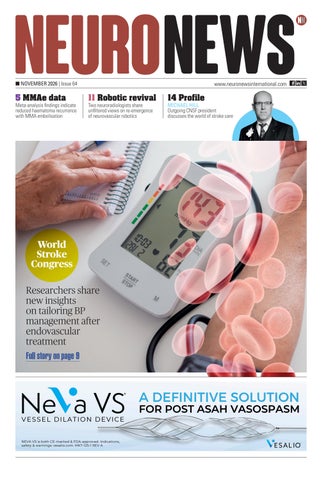
World Stroke Congress Researchers share new insights on tailoring BP management after endovascular treatment Full story on page 9
A DEFINITIVE SOLUTION VESSEL DILATION DEVICE NEVA VS is both CE-marked & FDA-approved. Indications, safety & warnings: vesalio.com. MKT-125-1 REV A
FOR POST ASAH VASOSPASM
News
2
contents 2 News Stroke prevention 5 From the journals 7 ESMINT 2026 9 In-Depth Cover story 11 Robotic re-emergence in neurointerventional surgery
14 Profile: Michael Hill 17 Global aneurysm prevalence 19 New approaches to
measuring stroke outcomes
21 Comment
Innovation, evidence and policy
23 Flow-diverter
healing with rosuvastatin
23 Radiation safety and clinician hand exposure
24 Neuro Genesis: The pull
towards medicine’s new frontier
24 A novel technique for angulated aneurysms
25 Market Watch Clinical Updates
26 Industry Updates 27 Conference Calendar
■ NOVEMBER 2026 | Issue 64
5 MMAe data
Meta-analysis findings indicate reduced haematoma recurrence with MMA embolisation
www.neuronewsinternational.com
11 Robotic revival Two neuroradiologists share unfiltered views on re-emergence of neurovascular robotics
16 Profile
MICHAEL HILL Outgoing CNSF president discusses the world of stroke care
World Stroke Congress Researchers share new insights on tailoring BP management after endovascular treatment Full story on page 9
A DEFINITIVE SOLUTION VESSEL DILATION DEVICE
FOR POST ASAH VASOSPASM
NEVA VS is both CE-marked & FDA-approved. Indications, safety & warnings: vesalio.com. MKT-125-1 REV A
Cover credit: Images by Adobe Stock Creative, concept and photomontage by Terry Hawes
STROKE PREVENTION
Edoxaban fails to reduce stroke or systemic embolism in unselected patients with post-ICH atrial fibrillation Edoxaban—an oral anticoagulant medication—failed to reduce stroke or systemic embolism but did increase major bleeding in high-risk patients with atrial fibrillation (AF) who had experienced an intracranial haemorrhage (ICH) within the ENRICH-AF trial, from which results were presented for the first time at the 2026 European Society of Cardiology (ESC) congress (28–31 August, Munich, Germany). “THE IDEAL STRATEGY TO PREVENT ISCHAEMIC were significantly reduced with edoxaban versus no stroke is uncertain in patients with AF and a prior ICH, anticoagulation; however, this benefit was offset by an as these patients have been excluded from the large almost three-fold excess in haemorrhagic stroke. And, landmark trials assessing oral anticoagulants,” additionally, the primary safety outcome of commented Ashkan Shoamanesh (McMasInternational Society on Thrombosis and ter University, Hamilton, Canada), principal Haemostasis (ISTH) major bleeding occurred investigator of the ENRICH-AF trial. “This in 11.6% of patients with edoxaban and 5.2% leaves us with a challenging clinical dilemma with no anticoagulation (HR, 2.23; 95% CI, that is becoming more frequent with our 1.39–3.59; p<0.001). ageing population. Data from small studies “Our findings do not support the use indicate that oral anticoagulation may result of edoxaban in unselected patients with in net overall benefit among survivors of ICH AF after ICH, but highlight the need for an with AF. We conducted the large ENRICH-AF individualised decision-making approach,” trial to evaluate the efficacy and safety of oral Shoamanesh added. “Ongoing trials, includAshkan anticoagulants further in these patients.” ing the double-blinded, randomised ASPIRE Shoamanesh ENRICH-AF was an investigator-inititrial comparing apixaban versus aspirin, will ated, open-label, blinded-endpoint, event-driven trial add to the evidence base. Additionally, a prospective, conducted across 174 sites in 20 countries. Patients with individual participant data meta-analysis of all trials— high-risk AF and prior ICH were enrolled. Following data COCROACH—will ultimately provide useful additional and safety monitoring board (DSMB) review in 2023, no insights on how best to individualise optimal stroke further patients with lobar intraparenchymal haemor- prevention in this very vulnerable patient population.” rhage or convexity subarachnoid haemorrhage were included because of safety concerns. Eligible participants were randomised 1:1 to 60mg of edoxaban once daily—with dose adjustments to 30mg daily, according to the label—or no anticoagulation, meaning no antithrombotic therapy or single antiplatelet therapy, as determined by the clinician. The study population included 948 patients who had a mean age of 77 years and 39% of whom were women. Across an average of 28 months of follow-up, edoxaban did not significantly reduce the primary endpoint of stroke—including ischaemic and haemorrhagic stroke—or systemic embolism compared with no anticoagulation (11.8% vs. 12.8%; hazard ratio [HR], 0.88; 95% confidence interval [CI], 0.61–1.26; p=0.48). Ischaemic stroke and myocardial infarction (MI)
“Our findings do not support the use of edoxaban in unselected patients with AF after ICH, but highlight the need for an individualised decision-making approach”
Editor-in-chief: Prof Philip M Meyers Publisher: Stephen Greenhalgh Editor: Jamie Bell jamie@bibamedical.com Editorial contribution: Jocelyn Hudson, Will Date and Éva Malpass Design: Terry Hawes Advertising: Abbie Richardson abbie@bibamedical.com Subscriptions: subscriptions@bibamedical.com
Scan the QR code to subscribe
Published by: BIBA Medical Ltd BIBA Medical, Europe, 526 Fulham Road, Fulham, London, SW6 5NR, United Kingdom Tel: +44 (0) 20 7736 8788 Printed by: Buxton Press. Reprint requests and all correspondence regarding the newspaper should be addressed to the editor at the United Kingdom address. © BIBA Medical Ltd, 2026. All rights reserved. Neuronews
November 2026 | Issue 64
linkedin.com/company/neuronews
@NN_publishing
If you have comments on this issue or suggestions for upcoming editions write to jamie@ bibamedical.com
P
Read it your way A
T 2.0 -19 ADPAAPGE 18
ER OS AT CL OK LO
■ MAY 2026 | Issue 62
5 ESOC roundup Tenecteplase, blood pressure management, tandem lesions and more
www.neuronewsinternational.com
11 Flow diversion Do the latest unruptured aneurysm guidelines truly reflect clinical practice?
16 Profile
GUILHERME DABUS SNIS president on leadership, research, and the road ahead
Debate heats up following contrasting trial results on brain cooling during stroke thrombectomy Full story on page 9
Full story on page 05
We want to ensure you still receive your copy of NeuroNews the way that works best for you. To reconfirm your subscription, scan the QR code. You can also let us know if you would like to change the way you read it by opting to receive a digital instead of a printed version or by moving from digital to print
Scan here
PUBLISHED BY
BIBAMedical
Issue 64 | November 2026
No compromise, no confusion, just the epitome of precision in simplicity. ASPIRATION CATHETER SYSTEM
Effortless Navigation
Access the clot face with confidence, without compromising control.
Seamless Capabilities
Continuous compatibility from access to aspiration with a unified platform that integrates effortlessly into your workflow.
Confidence Built-In
Engineered to handle complexity so you don’t have to, as you address flow issues quickly.
Q’Apel Medical —
4245 Technology Drive Fremont, CA 94538
qapelmedical.com
Scan for Important Safety Information
© Q’Apel 2026. All rights reserved. This information is solely intended for healthcare professionals. Q’Apel and Lynx are trademarks of Q’Apel Medical, Inc. For distribution only in markets where Q’Apel products have been Regulatory cleared or approved. All data on file at Q’Apel.
Q'Apel Lynx Ad Neuronews MAT-0157 v1.0 (210x315mm).indd 1
MAT-0157 v1.0
10/19/26 10:24 AM
News
www.neuronewsinternational.com
FROM THE JOURNALS
Post-surgical MMA embolisation reduces haematoma recurrence without significantly improving functional outcomes or mortality Despite markedly reducing chronic subdural haematoma (cSDH) recurrence without significantly increasing overall adverse events, adjunctive middle meningeal artery embolisation (MMAe) was not associated with significant improvements in functional outcomes or mortality in an updated meta-analysis of randomised controlled trials (RCTs) investigating this procedure.
N
onetheless—writing in the Journal of Stroke and Cerebrovascular Diseases—a research team led by Tallal M Hashmi (Rawalpindi Medical University, Rawalpindi, Pakistan) states that “these findings support adjunctive MMAe as an effective and safe strategy for improving disease control in patients undergoing surgical treatment for cSDH”. Since early 2024, several RCTs have produced positive findings indicating that MMAe is a promising adjunctive treatment for cSDH, resulting in the publication of a Society of Vascular and Interventional Neurology (SVIN)-led consensus statement advising that the approach “may become a standard of care” for the management of selected cSDH Tallal M patients. However, as noted by Hashmi Hashmi et al, the overall efficacy and safety of adjunctive MMAe compared to surgery alone “remains uncertain”. As such, they performed a systematic database search for RCTs comparing adjunctive MMAe plus surgical evacuation versus surgical evacuation alone in cSDH patients, with their primary outcome of interest being haematoma recurrence. Eight RCTs—the large-scale EMBOLISE, STEM, EMMA-Can and MEMBRANE trials, as well as four smaller studies—were included for analysis. The researchers relay that these RCTs comprised 712 cSDH patients who received adjunctive MMAe after surgical evacuation and 747 who underwent surgical evacuation alone. Hashmi et al’s pooled analysis found recurrence rates of 4.6% with MMAe versus 13.9% without—demonstrating a significant reduction with adjunctive MMAe compared to surgery alone, corresponding to an absolute risk reduction of 9.3% and a number needed to treat of 11 to prevent one recurrence. This overall effect estimate remained stable upon ‘leave-one-out’ sensitivity analysis, with no individual study materially influencing the pooled effect, while additional sensitivity analyses excluding trials with higher recurrence rates in their surgery-only groups also revealed findings consistent with the primary analysis.
All three of the researchers’ secondary outcomes of interest were shown to be comparable between study groups, however. There was no statistically significant difference in the odds of all-cause mortality, with 29 deaths occurring in the adjunctive MMAe group versus 33 with surgery alone across seven of the RCTs. Similarly, a good functional outcome—a modified Rankin scale (mRS) score of 0–2—was achieved by 244 of 326 patients in the MMAe group and 253 of 336 patients in the surgery-alone group across four RCTs, translating into statistical parity between the groups. Finally, across six of the RCTs, there were comparable rates of overall adverse events, with 108 and 113 occurring in the MMAe and surgical groups, respectively. “Similar observations have been reported in prior studies, highlighting a persistent disconnect between anatomical success and functional recovery in patients with cSDH,” Hashmi et al state, before also highlighting the “improved disease control and reduced need for subsequent procedures” that greater recurrence prevention—driven by adjunctive MMAe—may confer. “These findings strongly reinforce the recommendations of the SVIN consensus statement and add further confidence to the evolving role of MMAe in cSDH,” SVIN president Santiago Ortega-Gutierrez (University of Iowa, Iowa City, USA) told NeuroNews. “The nearly 70% relative reduction in recurrence—and an absolute reduction of approximately 9%—is clinically meaningful, particularly in a frequently elderly and vulnerable population in whom repeat surgery carries important consequences. At the same time, the absence of a demonstrated mortality or functional benefit reminds us not to equate radiographic or disease-control success with global patient recovery. The take-home message is that MMAe is becoming an important component of cSDH management, particularly as an adjunct to surgery, but thoughtful patient selection remains essential. Our next challenge is to better define which patients derive the greatest clinical—not simply radiographic—benefit.”
“[There is] a persistent disconnect between anatomical success and functional recovery in patients with cSDH”
PUBLISHED BY
11:20 AM
BIBAMedical
5
Health leaders advocate equitable acute stroke care at UN General Assembly Week GOVERNMENT OFFICIALS, GLOBAL HEALTH leaders, clinicians, patient advocates, professional societies and industry partners recently gathered during United Nations (UN) General Assembly Week (18–28 September 2026, New York, USA) for a meeting titled, ‘From resolution to action: investing in acute stroke care’, which focused on translating global commitments on stroke into concrete improvements in prevention, acute treatment, rehabilitation, and access to care. The 22 September reception was convened through the Society of Vascular and Interventional Neurology’s (SVIN) Mission Thrombectomy in partnership with the Business Council for International Understanding (BCIU), Philips, and Medtronic Neurovascular. The event brought together representatives from international cardiovascular, stroke, neurointerventional and neurosurgical organisations, alongside ministries of health and other global stakeholders. A SVIN press release adds that this gathering came at “a pivotal moment for global stroke policy”, as WHA79.10—adopted by the World Health Assembly in May 2026—represents a “landmark global commitment” to addressing stroke comprehensively, covering prevention, acute care, rehabilitation, and health-system readiness. WHA79.10 was championed by the Egyptian Ministry of Health and Population with support from the Global Stroke Action Coalition (GSAC). The resolution represents an “important example” of how governments, professional organisations, patient advocates and industry “can work together to elevate stroke on the global health agenda”, the SVIN release also states. Discussions at the General Assembly Week centred on the challenge of making timely mechanical thrombectomy procedures more accessible for eligible patients. The conversation was opened by Fawaz Al-Mufti (New York Medical College, New York, USA), global chair of SVIN’s Mission Thrombectomy, who shared ‘the clinical and economic case for acute stroke treatment’, highlighting thrombectomy’s “extraordinary effectiveness” in large vessel occlusion (LVO) patients. “We are already paying for stroke,” he commented. “The question is whether we choose to pay for recovery today or disability for years to come. A timely thrombectomy can offset a lifetime of disability and its associated costs. We need to stop viewing thrombectomy simply as a procedural expense and recognise access to effective stroke treatment as an investment in people, families, and national capacity.” Following a presentation from stroke survivor Margaret O’Neil Wheeler on the patient perspective, Mission Thrombectomy founder Dileep Yavagal (University of Miami, Coral Gables, USA) outlined a need to shift ‘from global advocacy to global action’. He described stroke as a “long-neglected pandemic” and emphasised that solving the global access gap requires public and prehospital education, government advocacy, technology, financing, trained teams, and implementation strategies tailored to individual countries. “We have crossed the scientific frontier—we know thrombectomy can profoundly alter the course of a devastating stroke,” Yavagal said. “The frontier before us now is access.”
Issue 64 | November 2026
Subscribe today
Available in print and digital formats and through our social channels
Visit interventionalnews.com and click ‘Subscriptions’ for complimentary print subscription* and e-newsletter subscription**
A specialised news source in the interventional field
A trusted provider of latest news, review of cutting-edge research, congress coverage and opinion from thought leaders
*Available for US and EU readers only **Available worldwide
Editorially independent
BIBAMedical
News
www.neuronewsinternational.com
CONFERENCE CIRCUIT
Stroke patients with large infarcts are predominantly fast progressors SHARING DATA FROM A SECONDARY analysis of the TENSION trial at ESMINT 2026, Olga Ciobanu-Caraus (Heidelberg University Hospital, Heidelberg, Germany) relayed that large-infarct acute ischaemic stroke patients appear to be “predominantly fast progressors”. As such, she added, cutoffs derived from small-to-moderate infarct populations “do not transfer” to patients with larger ischaemic cores. The analysis—which set out to evaluate the prognostic value of infarct progression rates in these large-core patients—found both previous stroke and hypertension to be associated with faster progression, while collateral status proved to be the “strongest predictor” of rapid progression. Investigators also discovered that a higher infarct progression rate (IPR) was independently associated with worse 90-day functional outcomes. However, clinical and imaging-related variables only accounted for around 35% of the observed variance in IPR rates—with Ciobanu-Caraus positing that this underscores the need for further research into determinants of infarct growth in this patient population.
Matthew Zidan
MATERNA-X study reveals benefits of radiation shielding during pregnancy “Protecting the foetus begins with protecting the mother,” was the concluding message delivered by Matthew Zidan (Bonn University Hospital, Bonn, Germany) based on late-breaking findings from the MATERNA-X study presented at the 2026 European Society of Minimally Invasive Neurological Therapy (ESMINT) congress (2–4 September, Marseille, France). THE STUDY USED A ‘FAKE’ PREGnant woman’s belly filled with different amounts of water to simulate amniotic fluid in order to compare theoretical radiation dosage to a foetus—with versus without the Nova-X system (Cathpax)—during the three trimesters of pregnancy. Its results indicated radiation dosage reductions of 49%, 35% and 57% during the first, second and third trimesters, respectively. Zidan noted that the foetus therefore appears to benefit from their mother’s full-body protection, even during the period before the pregnancy is known about, which underscores the value of a shielding system that is used routinely as opposed to relying on individual adjustments over time. Zidan went on to conclude that full-body shielding seems to be provided—regardless of abdominal circumference—during the later trimesters, with preliminary
data indicating that the additional hourly dose to the foetus with Nova-X appeared to be comparable to environmental background radiation (0.1uSv) through each of the three trimesters. “As a mother of two, I know very well the concerns women have when working in the angio suite during pregnancy,” commented Franziska Dorn (Bonn University Hospital, Bonn, Germany), congress chair for ESMINT 2026, speaking with NeuroNews. “The MATERNA-X study addresses a topic that is highly relevant for our field: concerns about radiation during pregnancy remain a real barrier for women considering a career in neurointervention. Our key message is that a full-body shielding system can protect the unborn child from the very first weeks, often before a pregnancy has been disclosed. If we can bring foetal exposure close to background levels, we remove one of the reasons talented women leave or avoid our specialty.”
ESMINT announces new executive board and cross-societal agreements
New president Taschner—who has been closely involved in the society’s leadership and strategic development for some time—succeeds 2024–2026 ESMINT president Anne-Christine Januel (Toulouse University Hospital, Toulouse, France). At this year’s congress, the society’s general assembly also approved the appointment of Michael Walker as executive director of ESMINT. Additionally, the congress saw ESMINT announce new memorandum-of-understanding agreements with the respective national neuroradiology societies of Belgium, Bosnia and Herzegovina, North Macedonia, Portugal, and Serbia.
AT ESMINT 2026, THE SOCIETY introduced its new leadership following elections for the 2026–2028 term—including president Christian Taschner (University Medical Center Freiburg, Freiburg, Germany), general secretary Luca Valvassori (San Carlo Borromeo Hospital, Milan, Italy), and treasurer Jan Gralla (University Hospital of Bern, Bern, Switzerland).
PUBLISHED BY
BIBAMedical
7
“Our findings challenge the longstanding belief that pmSAH is venous in origin”
Underlying aetiology of pmSAH may have “significant impact” on clinical outcomes THE ROLE PLAYED BY BASILAR ARTEry perforator aneurysms (BAPAs) in perimesencephalic subarachnoid haemorrhage (pmSAH) may be “well beyond” what was previously suggested, as per insights from the PERFAN registry presented by Tomas Dobrocky (University of Bern, Bern, Switzerland) at ESMINT 2026. Dobrocky further noted that the underlying aetiology of pmSAH appears to have a “significant impact” on associated clinical outcomes. “Our findings challenge the longstanding belief that pmSAH is venous in origin, especially given the increasing detection rates of BAPAs,” he continued, also stating that pmSAHs do not follow a uniformly benign course, and they may be reflective of a “clinical and radiological continuum” of BAPA-related events. Additionally, new data from the PERFAN registry—which, as claimed by Dobrocky, represents the largest cohort of BAPA patients to date—suggest that management of ruptured BAPAs is “inconsistent”, with close to half of all patients undergoing invasive treatment. Findings from the registry also “challenge the assumption” that these invasive treatments lead to improved functional outcomes, indicating that best medical therapy is a viable first-line strategy in selected patients.
Issue 64 | November 2026
Mastery in Practice Intentional systems for demanding procedures.
The most effective systems aren’t built around more. They’re built around what matters. Every component. Every transition. Every decision. Designed to reduce complexity. Engineered to perform predictably. Confidence comes from knowing your system will do exactly what it’s intended to do.
Mastery. In Your Hands.
See route92medical.com/ safety-information for complete safety information. © 2026 Route 92 Medical. All rights reserved. APM-0004862 | Date of Release 10/2026
November 2026 | Issue 64
Route 92 Medical 1375 W 8040 S West Jordan, UT 84088 route92medical.com
P
In-Depth
www.neuronewsinternational.com
COVER STORY
World Stroke Congress: Researchers share new insights on tailoring BP management after endovascular treatment Late-breaking research presented at the 2026 World Stroke Congress (WSC; 21–23 October, Seoul, South Korea) has provided fresh insights on the benefits of individualised strategies for post-thrombectomy blood pressure (BP) management—including the potentially significant role played by haemorrhagic transformation (HT) incidence.
O
ptimal BP management remains a pressing, unresolved problem following a successful mechanical thrombectomy for acute ischaemic stroke. In recent years, several clinical trials—BP-TARGET, ENCHANTED2/MT, OPTIMAL-BP and BEST II—have produced definitive evidence that intensive, ‘one-size-fits-all’ BP control is not the answer; despite evaluating targets ranging from 100–129mmHg in BP-TARGET to <160mmHg in BEST II, the four trials collectively indicate that non-individualised strategies are, at best, futile in improving functional independence rates and reducing symptomatic intracranial haemorrhage (sICH), and, at worst, may be linked to worse functional outcomes and increased mortality. A far more promising signal comes from the aptly named HOPE trial, published earlier this year in JAMA Neurology, which showed that tailoring BP control based on the degree of reperfusion achieved by each patient can lead to improved functional outcomes and reduced HT without increasing major safety events. In this prospective, randomised trial’s treatment arm, patients who achieved modified thrombolysis in cerebral infarction (mTICI) 2c–3 reperfusion were assigned a systolic BP target of 100–140mmHg,
PUBLISHED BY
BIBAMedical
and those who achieved mTICI 2b reperfusion were assigned a target of 140–160mmHg, while patients in the control arm had a systolic BP target of <180mmHg. Now, a secondary analysis of HOPE has revealed new insights on the specific relationship between reperfusion-guided BP management and HT. This analysis—shared for the first time by Joan Miquel Fernández-Vidal (Hospital de la Santa Creu
“This shouldn’t be interpreted as ‘the lower, the better’; rather, there is a need to avoid high and sustained levels of systolic BP in patients with mTICI 2c–3 post-thrombectomy” i Sant Pau, Barcelona, Spain) at WSC 2026—solely included the 397 (90.2%) HOPE trial patients who achieved mTICI 2c–3, as this subgroup was found to have experienced an overall clinical benefit, whereas the mTICI 2b subgroup did not. Its primary endpoint was the occurrence of any HT,
9
while HT subtype and sICH were among secondary endpoints of interest. The analysis showed that, of the 139 patients with HT, 42.6% were in the standard BP management group and 30.9% were in the individualised group (odds ratio [OR], 0.57). This statistically significant difference across the two study arms was maintained after the researchers adjusted for multiple baseline characteristics that differed between groups, including Alberta stroke programme early computed tomography score (ASPECTS), National Institutes of Health stroke scale (NIHSS) score, number of thrombectomy passes, and time from symptom onset to randomisation (adjusted OR, 0.62). “It’s also important to highlight that, even though the numbers of any HT were different, there were no differences in the HT subtypes or sICH rates,” Fernández-Vidal told NeuroNews. “This underscores the increasingly popular idea that asymptomatic HTs are not necessarily clinically unimportant—especially given that patients with HT had a worse functional outcome at three months [modified Rankin scale (mRS) 0–2, 39.1% with HT versus 64.7% without HT] in this analysis.” Further examinations revealed that patients with HT were not more hypertensive at the point of randomisation compared to those without HT. In Fernández-Vidal’s view, this is significant, as hypertension at randomisation has been part of the inclusion criteria for prior trials in this space. Additionally, a restricted cubic spline analysis performed by the researchers showed that, while the relationship between systolic BP levels and HT appears to be non-linear, a mean systolic BP ≥160mmHg demonstrated a significant association with increased HT likelihood at both 0–12 and 0–24 hours. As such, Fernández-Vidal concluded his presentation by noting that, based on these analyses, a mean systolic BP of less than 160mmHg during the first 12 hours after thrombectomy has emerged as a potential population-level threshold in patients who achieve mTICI 2c–3. “Patients in the individualised treatment group were also significantly less likely to be exposed to systolic BP levels above this threshold,” he added. “But, even though we have identified a potential threshold for mean systolic BP, it’s about more than just a single reading above this threshold—it’s about sustained exposure during the first 12–24 hours. This shouldn’t be interpreted as ‘the lower, the better’; rather, there is a need to avoid high and sustained levels of systolic BP in patients with mTICI 2c–3 post-thrombectomy.” Furthermore, while this analysis sheds new light on the role played by HT, Fernández-Vidal believes key gaps remain in the stroke community’s knowledge of post-thrombectomy BP management. “We are still trying to fully explain why the HOPE trial was positive, and I think it is multifactorial as opposed to just one thing,” he stated. “One hypothesis is that those patients [who underwent tailored BP control] had lower HT incidence, but we are looking at collaterals and looking to see if they had less oedema as well. We are also planning another trial—the HOPE 2 trial— that will assess post-thrombectomy BP control using a bigger sample size, across a greater number of countries and different ethnicities, as well as using CT [computed tomography] or MRI [magnetic resonance imaging] scans to more accurately determine whether patients have HT during the first few hours after a thrombectomy.”
Issue 64 | November 2026
10
This advertorial is sponsored by Siemens Healthineers
Portable head CT scanners: fast and reliable answers for critical care patients A portable head computed tomography (CT) imaging system—SOMATOM On.site (Siemens Healthineers)—can help hospitals transform their critical care workflows. By bringing head CT scans directly to patients’ bedsides in the intensive care unit (ICU), it has the potential to save time and may help reduce transport-related risks.1,2 “THE SOMATOM ON.SITE ALLOWS US TO scan patients with excellent image quality at point of care in the ICU where they are located, which carries several advantages,” said Johan Wasselius (Skåne University Hospital, Lund, Sweden), whose centre has adopted this innovative technology. “We know that transportation to and from radiology causes complications in up to 70% of cases, and we are reducing these complications by imaging the patient at the ICU instead. We’re also reducing the time for the ICU staff to take the patient to and from radiology.” Clinical research has established that time is of the essence when it comes to critical head
results to be automatically sent to the archiving system for review by radiologists, at which point diagnosis and treatment can begin based on the findings. This process removes multiple steps from traditional hospital workflows, reducing standard total workflow times from 50 minutes down to 20 minutes, on average. In addition to time-saving capabilities and the ability to reduce transportation burden, portable head CT scanners can carry notable benefits for healthcare staff across the entire critical care workflow as well.1,3 Patients with acute and critical conditions tie up stationary CT scanners in the radiol-
“We know that transportation to and from radiology causes complications in up to 70% of cases, and we are reducing these complications by imaging the patient at the ICU instead” Johan Wasselius
VasQ extravascular support device
conditions, with these patients needing constant supervision owing to risks of sudden health status deterioration, which, in turn, requires rapid additional evaluation. Transportation also increases adverse event risks for roughly one in four patients, as existing health conditions may be exacerbated due to the delicate nature of these ICU cases.2 SOMATOM On.site has been designed to circumvent these issues, enabling a more streamlined and ultimately faster critical care workflow.1 After the treating physician has ordered a CT scan and the technologist has been informed, the portable system can be easily manoeuvred to the patient’s bedside to perform the scan.1 From there, the only remaining step is for these
November 2026 | Issue 64
ogy department for at least twice as long as compared to non-acute or non-critical patients— meaning the availability of a portable CT scanner allows technologists to utilise their time more effectively.4 The same can be said for ICU nurses. By requiring—dependant to local regulations— at least two accompanying nurses, critical care transportation takes time and resources away from the ICU. It is also estimated that a shortage of 13 million nursing staff in the future will result in significantly overburdened personnel.3 Scanning patients in their hospital beds, however, means ICU nurses can focus on their core tasks without leaving the unit, thus supporting continuous patient care. Additionally, unscheduled interruptions
within the radiology department can be reduced with the availability of an extra portable scanner dedicated to critical care patients, enabling a more streamlined utilisation of the stationary fleet. SOMATOM On.site brings with it several features intended to help physicians achieve fast and reliable answers while managing their critical care patients. Among these is a “first-ofits-kind” telescopic gantry design that allows easy patient positioning, minimises motion artifacts, and protects staff as well as neighbouring patients from scatter radiation during scanning. SOMATOM On.site also has a self-shielding radiation system that has been built with the safety of staff and neighbouring patients in mind, protecting them from scatter radiation—one of the main challenges associated with portable scanning. Furthermore, regarding driveability, the system can be manoeuvred through hospitals seamlessly thanks to its two driving speeds, front-facing camera, brake, and ergonomic handle. Further integrated accessories support physicians to position patients for consistent scan results, while SOMATOM technologies ensure that sharp, high-quality images can be obtained reliably. Lastly, SOMATOM On.site comes equipped with Siemens Healthineers’s myExam Companion, which is an intelligent software designed to work with the user to achieve optimal scan results, as well as myExam Cockpit, which helps users to standardise the protocols they use, and myExam Compass, which provides additional guidance during the examination. Siemens Healthineers establishes a “new standard” in head CT imaging with SOMATOM On.site, highlighting intraventricular cerebral bleeding, follow-up brain tumour detection, head CT angiography and post-surgical follow-up as key examples of cases in which it provides an effective solution. “We see several benefits of point-of-care CT imaging,” Wasselius commented. “And, now, with a scanner that can provide image quality that is actually superior to stationary scanners, we really don’t see any reason why—if possible— patients should not be scanned at the ICU.” References: 1. Rumboldt Z, Huda W, All J W. Review of portable CT with assessment of a dedicated head CT scanner. Am J Neuroradiol. 2009; 30(9): 1630–6. 2. Parmentier-Decrucq E, Poissy J, Favory R et al. Adverse events during intrahospital transport of critically ill patients: incidence and risk factors. Ann Intensive Care. 2013; 3(1): 10. 3. International Council of Nurses. ICN Policy Brief - The global nursing shortage and nurse retention [Internet]. International Council of Nurses. 2021 [cited 2026 Aug 28]. Available from: icn.ch/node/1297. 4. Data on file. For more information on SOMATOM On.site, visit https://servedby.flashtalking.com/click/2/327263;11170497;5 0126;211;0/?ft_width=1&ft_height=1&gdpr=${GDPR}&gdpr_ consent=${GDPR_CONSENT_78}&us_privacy=${US_ PRIVACY}&url=45940890. The products/features (mentioned herein) are not commercially available in all countries. Their future availability cannot be guaranteed. The statements by customers of Siemens Healthineers described herein are based on results that were achieved in the customer’s unique setting. Because there is no “typical” hospital and any variables exist (e.g., hospital size, case mix, level of IT and/or automation adoption) there can be no guarantee that other customers will achieve the same results.
P
In-Depth 11
www.neuronewsinternational.com
tion (FDA) Breakthrough Device designation for remote, robotic-assisted thrombectomy in acute ischaemic stroke in September 2026. Having gained its own US FDA Breakthrough Device designation last September—followed by CE-mark approval in May this year—Sentante announced the completion of 11 full end-to-end thrombectomies performed transatlantically on perfused human cadaver models using its endovascular robotic platform in October 2025. Weeks later, the same platform was utilised in living subjects for the first time, with animal models being operated on remotely by physicians located in the UK, USA and Lithuania. Iris Grunwald (University of Dundee, Dundee, UK), who led the UK-based procedure, subsequently highlighted the significance of this particular system being device-agnostic, as well as describing the haptic feedback it provides as “exceptional”. “You feel exactly what the device is doing, even though you’re operating it remotely,” she stated at the time of the announcement. “The subtle, tactile cues give you confidence in every movement. It’s almost like having your hands directly on the catheter, but with even greater stability.”
FEATURE
Are endovascular robotics the future of stroke care or a superfluous business venture? Over the past few years, endovascular robotics has re-emerged as a notable ‘hot topic’ in the neurointerventional space. While this revival appears to have been partly driven by new industry players working to develop the latest generation of these technologies, several leading physicians are also advocating the advantages of robotics in the treatment of various neurovascular conditions. However, as with any novel introduction on which high-level evidence remains limited, endovascular robotic systems have their vocal detractors. Here, NeuroNews speaks to a neurointerventionist from each of these camps to get their unfiltered perspectives on one of the most contentious talking points currently facing the field.
S
ubsequent to its 2019 acquisition of Corindus’s CorPath GRX robot, Siemens Healthineers discontinued the system’s usage for cardiology procedures in May 2023, choosing instead to focus more intently on neurovascular indications. Last year, six-month data on more than 100 brain aneurysm patients treated endovascularly using the CorPath GRX system were shared for the first time, demonstrating positive technical and clinical outcomes. Siemens Healthineers also announced shortly thereafter a collaboration with Stryker to advance robotic technologies capable of performing ischaemic and haemorrhagic stroke procedures alike. Along a similar timeline, several smaller companies—including but not limited to Nanoflex, Microbot, Remedy, Sentante, Stereotaxis and XCath—have publicised their own milestones relating to neurointerventional robotics.
PUBLISHED BY
BIBAMedical
In October 2025, Remedy debuted its artificial intelligence (AI)-powered N1 system and announced what it described as the world’s first entirely remotely operated, in-human endovascular interventions requiring no bedside interventionist. The following month saw XCath disclose the successful in-human use of its system in three patients with complex brain aneurysms, dubbing this “the second time in history” that a surgical robot had been used in an intracranial neurovascular intervention specifically. Earlier this year, in March, XCath also claimed to have completed the world’s first telerobotic stroke procedure, with Vitor Mendes Pereira (University of Toronto, Toronto, Canada) leading a remote mechanical thrombectomy from Clinica Norte in Santiago, Panama—more than 200km away from a patient located in Panama City. The Iris system deployed during this procedure went on to gain a US Food and Drug Administra-
Technological advances “If you’d asked me 18 months ago, I would’ve said [these systems] are not there yet—but they’ve made a very big leap forward,” Grunwald comments, speaking to NeuroNews to reflect on these recent milestones and the broader landscape of neurovascular robotics. “The first CorPath robot was essentially useless. It took a long time to load the devices, you needed assistance to get all the way up [into the neurovasculature], it could only be used to do the final part of the procedure—capturing the thrombus—and the feedback and torque-ability just weren’t there. “So, previously, I would have said there is too much of a time delay and it would be better to train other specialties to do thrombectomy [to make these procedures more accessible]. But this robot is very intuitive, it has a very easy setup, and the latency is about the same as the blink of an eye—a delay of 36–136 milliseconds has been reported—which is not going to negatively impact the intervention. At first, I thought this was just a gimmick but, now, having seen and felt what this robot can do, I am completely converted.” Grunwald’s view is that the capacity for a robotic system to deliver haptic feedback to the operator is a vital consideration—particularly in the neurointerventional sphere. “The vessels in the brain are really tiny, and there are also lots of perforators,” she adds. “If a vessel is blocked, we cannot see what is behind it. That means we often advance our wires and tubes relying on haptic feedback, and, if there is resistance, we don’t continue to push. That’s what prevents us from advancing larger catheters and causing perforations. As such, I do not think any robotic device without haptic feedback or torque-ability will survive.” Expanding on the need for these systems to also be device-agnostic—meaning existing, approved wires, catheters and stents can be selected at the operator’s discretion—Grunwald suggests this is also a prerequisite for any robotic technology looking to stand the test of time. “Many of the companies are developing specific devices solely for their robots,” she continues. “That’s not going to work, because you’ll have Continued on page 12
Issue 64 | November 2026
12
In-Depth
Continued from page 11 devices that will expire, each operator is familiar with and has preferences for different devices, and some devices may be better than others in specific situations. You have to be able to use any device you have on the shelf and that you are comfortable with in order to reduce the learning curve.” Reflecting on the landmark procedures she co-led late last year from Dundee, Grunwald also recalls a “nightmare scenario” whereby, during the operation, there was a complete power outage in Paris, France, where the porcine model itself was located. “Normally, if a hospital has a power outage, the angio suite will go onto a backup generator that gives you an extra 20 minutes to complete a rescue strategy,” she says. “But, because this was an animal lab, they didn’t have one, so they needed to hand ventilate the pig and they had to use torches in order to see. The only thing that was still working was the robot, because it runs on mobile data networks and also has built-in batteries. That was quite reassuring, because I was able to finish the intervention without switching to a manual procedure, and I think it’s important to see what the robot does in those situations.” In spite of the various achievements announced over the past couple of years, there are still those within the neurointerventional space who feel—as Grunwald once did—that the re-emergence of robotics is little more than a fad driven by industry. One of Christophe Cognard’s (Toulouse University Hospital, Toulouse, France) primary reservations centres on the fact that robots add minimal benefit relative to what can be achieved by physicians themselves. “I don’t see the value of having a machine to do something that a human can do with their hands, quite easily and efficiently, after two years of training,” he tells NeuroNews. “And, for me, the complexity of neuroendovascular treatment is in the brain [of the physician] rather than the hands. Proceduralists should not become too proud of what they can do with their hands. You have to perfectly understand the patient’s disease, and then make decisions about what to do and how you will do it. The majority of our job is intellectual, not manual. “People also consider that these things could be done better by a robot than by a human hand, but I don’t think that’s true at all.” What Cognard alludes to here is the notion that robotic systems may one day be able to actively enhance the precision of neurovascular procedures, as opposed to merely facilitating operators in performing these treatments from a remote location. While she believes there is potential on this front, Grunwald corroborates the view that optimising existing techniques is not likely to be the first port of call for robotics. “In the future, there may be submil-
November 2026 | Issue 64
limetre precision and movements that can even counteract tremor in the operator’s hand,” she says. “Robotics may even be able to automate the more repetitive steps within a procedure, and magnetic steerability could be useful in leading the wire directly into an aneurysm—but I don’t think we’re there yet. They have the potential to [enhance] what human operators are capable of, but I don’t think there is the imminent need for this, and the technology is not far enough along right now.” Is there a genuine need? In what context, then, can today’s robots truly influence patient care for the better and in a meaningful way? In addition to the technical progress that has been made in recent years, Grunwald believes an increased “pressure” on providing equitable access to mechanical
“It’s a matter of politics, and of business— and people, including physicians, want to be part of that business because they will make a lot of money” Christophe Cognard
thrombectomy has also played a significant role in rekindling interest in these systems. Here, she warns against development that moves in “the wrong direction” relative to what is needed by physicians and their patients. “At the moment, I think everyone is trying to build an all-singing, all-dancing robot with many different arms [and capabilities],” Grunwald explains. “The question is, where is the true indication for robotics? For me, the biggest indication is in thrombectomy, particularly in centres that have the least money and the fewest resources. Are they all going to have these fantastic robotic systems that require a high level of maintenance and probably use specific devices developed solely for that robot? I don’t think so.” Grunwald’s solution to this hinges on the idea of two different and fairly distinct types of robotic systems, with the first variant being one that can be installed quickly and easily at any hospital, is relatively cheap, and enables manoeuvrability of a maximum of three or four catheters in order to facilitate thrombectomy. “It’s not just about being able to instal the robot,” she continues. “We need the procedures to be faster than transporting the patient [to a thrombectomy-capable centre]. That’s the important part, and it requires a stroke network. I think, in five years, we will have comprehensive, telerobotic stroke networks, because development is moving so quickly. But there
October 2025
Fully remote, in-human neurovascular interventions
December 2025
Transatlantic thrombectomies in animal models
March 2026
“World’s first” telerobotic, in-human stroke procedure
cannot be a huge learning curve for interventionists to use these robotic systems, and they need to be simple, cheap and practical.” Given that every additional six minutes following a stroke equates to a 1% reduction in the likelihood of a good functional outcome, the most obvious and pressing use case for remote, robotics-led interventions appears to be in more rural or sparsely populated areas where patients may face delays of several hours before they can be transferred to a thrombectomy-capable hospital. A more efficient and ultimately affordable system may therefore hold the key to expanding the reach of stroke interventions beyond the walls of dedicated centres, and delivering 24/7 thrombectomy services on a more consistent basis. Meanwhile, in Grunwald’s view, “all-singing, all-dancing” robots of the more long-term future—incorporating greater imaging capabilities, magnetic steerability and various forms of AI assistance—are likely to be deployed at larger hospitals as part of an interventional neuroradiologist’s day-to-day practice, including for more complex cases. This eventuality, however, represents a less immediately obvious clinical need or health-economics justification, with the primary advantages being reduced radiation and improved comfort for the operator. “I think we need two robots, and I’m hoping that these companies will not just try to compete with each other over who has the biggest and best system that can do the most, because then everything will become much more expensive,” Grunwald adds. “I’m hopeful they can give us a simple, robust solution for thrombectomy procedures.” Recent landmark procedures like XCath utilising its robotic system for an intracranial aneurysm procedure may not be representative of the most pressing clinical indication as of today, but Grunwald believes such milestones do serve as a valid proof of concept. “If we have a perforation during a thrombectomy, the only way to solve this is via endovascular rescue techniques—similarly to aneurysm treatments [involving coils or balloons]—to close that perforated vessel off,” she explains. “So, a robot needs to allow deployment of a coil for emergency rescue procedures, and showing that this is possible was a good idea. But, at the moment, I don’t believe there is a clinical need to cover everything and for aneurysms to be treated robotically.” Hurdles to overcome Even in a world where the theoretical benefits of robotic systems are accepted and embraced—which is no guarantee— there are several practical considerations that are yet to be fully addressed. Cognard feels that, among those championing these technologies, there is a failure to recognise that neurointerventional care involves a full team of specialists, each with their own essential role to play
P
In-Depth 13
www.neuronewsinternational.com in maximising the chances of a positive outcome. Inside the angio suite, the surgeon is typically joined at the operating table by an assistant and a nurse, while multiple technicians as well as a neuroanaesthesiologist and anaesthesiology nurse may also be present. “So, there could be seven or eight people in the room, and all of them are highly important,” he says. “The fact all of these team members are very well trained is the most important point in making the procedure safe and efficient—and the robot will only replace one of them.” Cognard also highlights the need for a team member to be present onsite to prevent air bubbles and clots accumulating inside each catheter. “People might consider that, with the robot, I can be in Toulouse operating on a patient on the other side of the world, but it’s not true, because the whole team has to be very well trained. It is important that the team members are used to working together and that it is a collective effort,” he continues. “People are also saying the robot will be used in the middle of Australia, the north of Sweden, or parts of the USA where there is less activity—but, if there is only one thrombectomy per month in these places, none of the team will be performing well.” There is a fear among many that, if operators and other clinicians involved in neurovascular procedures become heavily reliant on robotic systems, there could be a dropoff in their experience and overall skill levels, which becomes problematic when a manual procedure is required. Challenges around skill retention may also be encountered regarding the actual usage of robotic systems if operators are only performing these types of interventions on a very infrequent basis. Another elephant in the room is the “incredible cost”—in Cognard’s words—of deploying robotic systems. As he states, any neurointerventional procedure is unavoidably expensive, with this being a key reason for uptake of thrombectomy—despite its proven benefits—remaining very limited in poorer regions. “The cost of these robots is enormous, and something that increases the cost of these treatments in an unreasonable fashion is not acceptable,” Cognard notes, before also questioning the sustainability of robotic technologies, owing to the large quantities of disposable plastics they use, as well as the “tremendous amounts” of both energy and data they require. “It’s a very big business,” he posits. “It’s very good for the companies, and it’s very good for the doctors at congresses saying, ‘I’ve done a case with a robot’. People are excited about these technological developments, but there’s no need for it. It’s a lot of money and energy for a drop in the quality of patient care. “It does not solve anything in terms of lack of organisation. In countries that don’t have enough angio suites, or the necessary imaging systems, or stroke units or INR [interventional neuroradiology] teams, robotics will not solve the problem at all, because you will need to have people on the ground, everywhere, in every country. It’s about the entire team, not just the operator, and they will need to be trained to do remote cases just as they would with local cases. Endovascular robotics is a dream created by a fascination with technology but, in reality, it’s completely useless.” While she reiterates that reducing the upfront costs of robotic systems must remain a priority, Grunwald does not share Cognard’s concerns regarding longer-term cost barriers.
PUBLISHED BY
BIBAMedical
“We know how much more expensive a patient becomes [for the healthcare system] with each category of mRS [modified Rankin scale], so the cost-effectiveness in stroke is immediately clear and will be shown very easily,” she states. Grunwald also feels that there is a “huge political element” to these debates. In her opinion, underlying the “scepticism and defensiveness” of many robotic detractors is the fact that they are “afraid they will lose their jobs”—perhaps not today, or even within the next few years, but potentially further down the line if robotics-driven automation of endovascular procedures becomes more commonplace. She notes, however, that these reservations are misplaced when it comes to robotic-assisted procedures. “You’re still being treated by an interventionist,” Grunwald explains. “It’s not the robot that treats you—which I think is often miscommunicated. You’re still going to have the same hand movements, the same decision-making and expertise, and the same choices over devices
“If you’d asked me 18 months ago, I would’ve said [these systems] are not there yet—but they’ve made a very big leap forward” Iris Grunwald
and access. “I would personally feel comfortable being treated [robotically] by anyone with neurointerventional experience, and that’s always how I judge these things. I don’t think it will replace neurointerventionists; we, the operators, are still in charge and doing the procedure, and I think acceptance will work very well once people have had these systems in their hands and experienced how lifelike they are.” What does the future hold? Despite their opposing stances on robotics, Cognard and Grunwald have both advocated the training of non-neurointerventional specialists as a means for broadening access to thrombectomy— via formal European Society of Cardiology (ESC) guidance on the interdisciplinary management of ischaemic stroke, and the 2023 World Federation for Interventional Stroke Treatment (WIST) guidelines, respectively. “The [ESC] guidelines state that cardiologists can become neurointerventionists as soon as they’ve done the requisite training, which takes two years—but, by law, every cardiologist can do a thrombectomy,” Cognard comments. “It depends on the healthcare system in each country. We need to have more centres, operators, angio suites and stroke units. It’s a matter of politics, and a willingness to develop healthcare systems and stroke networks, to buy angiography machines, and to train enough people.” While Grunwald remains a believer in cross-specialty training, recent technological advances have convinced her that robotics also have a crucial role to play. “We still need some basic infrastructure,” she states, acknowledging one of Cognard’s prevailing concerns. “We need an angio suite, we need
someone capable of doing arterial access—at least at this point—we need monitoring capabilities, we need someone to sedate our patient or administer general anaesthesia, and we need someone to manage their postoperative care as needed. We need the local site to have the equipment [and personnel] to deal with emergencies as well as certain other aspects too.” Additionally, Grunwald notes that successfully establishing robotic stroke networks will be key to ensuring skill retention and guaranteeing standards of care remain consistent. “The robot is no longer the challenge,” she adds. “I don’t think they’re ready for everything else but, for thrombectomy, they are ready. The challenge lies in setting up networks and being able to immediately communicate with each other.” Heading into 2027, clinical studies evaluating these robotic systems are an imminent inevitability, with Sentante and other companies already targeting more widespread evaluation. In addition to assessing the feasibility of setting up robotic thrombectomy teams, Grunwald believes the focus of these studies should be to analyse the performances of these teams—as opposed to the robots themselves. In her view, the main outcome measures in such studies will likely be comparisons of time to treatment before and after robotic implementation, as well as the safety of the interventions, including any complications and how they were dealt with. “I often hear people say these sites need to be able to manage any emergency or complication that could occur,” Grunwald comments, “But, here, we’re not talking about treatment at a specialised neuroradiology centre versus treatment somewhere else; we are comparing no treatment, or significantly delayed treatment, versus robotic treatment. That’s also why I believe informed consent won’t be a problem from an ethical perspective, because the options will be not receiving thrombectomy treatment—where we know how bad the outcomes are—or a robotic thrombectomy if you otherwise would not be able to make it to a centre offering this procedure.” Cognard, on the other hand, does not see a place for robotic systems when he looks to the horizon of neurovascular care. “It’s a matter of politics, and of business—and people, including physicians, want to be part of that business because they will make a lot of money,” he argues. “We need to stop being fascinated by everything that is novel, and we should not accept a new technique without evidence from several RCTs [randomised controlled trials] showing that using robotics is beneficial in terms of patient care. We should also consider the environmental cost in terms of carbon, electricity, and plastics. “I would say it will never fully develop, but it is such a big business and it’s good for the companies. So, it could be the case that it becomes routinely used, but it’s purely financial. In reality, do these physicians believe that, in the future, every patient in the world will be treated by a robot? I don’t think so. I think they are biased and they have too much of an interest in the field. I cannot see how people can defend the fact that they will use a robot.” Ultimately, time—and, with it, further realworld experiences and evidence from clinical studies—will tell whether robotic systems have a legitimate role to play in the future of neurointerventional care, as well as elucidating what that role might be.
Issue 64 | November 2026
14
In-Depth
PROFILE
Michael Hill Following his recent induction into the Canadian Medical Hall of Fame—and at the end of his term as Canadian Neurological Sciences Federation (CNSF) president—neurology professor and pioneering stroke researcher Michael Hill (Calgary, Canada) speaks to NeuroNews to discuss the formative stages of his career, the landmark ESCAPE trial, the future of stroke care, and more. Why were you drawn to a career in medicine? The truth is that I was not drawn to medicine. I had no idea what that career might entail and I had no sense of what clinical medicine was—I was interested in research and science. I applied to medical school because I thought that the most interesting biochemistry, which I was studying at McGill University (Montreal, Canada), was going to be human biochemistry. I was accepted and ultimately deferred entry into medical school for a year so I could finish my undergraduate degree at McGill. Who have your key mentors been and how have they impacted your career? There are many from whom I learned and followed their example; most are now retired. Probably first, my father, Richard P Hill, who was a radiation physicist working in cancer research, instilled an interest in science and biology. In Ottawa, from Andreas Laupacis, I concluded that I necessarily should get formal training in clinical epidemiology; from Pierre Cardinal, I took a strong interest in critical care medicine; from Alan Guberman, and from Barry Guppy, who was my senior resident during my first neurology rotation, I got the bug for neuroscience. In Toronto, from Gyl Midroni, I learned the importance of meticulous work and critical relevance of measurement error in clinical decision-making. These mentors culminated in Calgary working with Alastair Buchan in stroke and Bill Ghali in epidemiology, from whom I learned too many things to count, and with whom it remains a great privilege to work. We completed the work necessary to obtain final regulatory approval for alteplase for stroke treatment in Canada. Finally, the team I work with now are colleagues, yes, but also mentors at many levels from whom I learn everyday—and it is only together that we have been able to impact stroke care.
November 2026 | Issue 64
What are your major goals as CNSF president? I came to the role at a time of transition— although I did not know that initially— and stayed on to provide stability in that transition. Goals changed to stabilisation and renewal based upon a firm belief that the neuroscience community is stronger together, but the nature of the field requires specialisation. The CNSF has a renewed governance model with six active member societies, plans and hopes to expand, and a growing sense of vigour. A new president-elect is ready to take the reins in 2027, and I hope that the vision can continue to grow and expand. The community deserves a well-functioning active organisation to allow Canadian clinical neuroscience to fulfil its potential. How would you assess the ESCAPE trial’s legacy roughly a decade on from its initial publication? Mayank Goyal, Andrew Demchuk and I co-led the trial, and we were heavily invested in stroke imaging research and working collaboratively with Joseph Broderick, Thomas Tomsick, and the IMS III trial team. We designed ESCAPE to be fast, to select patients with proven occlusions and minimal change on non-contrast computed tomography (NCCT) imaging, and to maximise timely, complete reperfusion. We were able to convince colleagues at 22 sites and we were able cobble together funding. It was these collective features that led to such a dramatic result, which—published together with EXTEND-IA—both confirmed and extended the MR CLEAN trial results published a month earlier, and then was later reinforced further by the REVASCAT and SWIFT PRIME trials. I think the reason ESCAPE was the only trial to confirm a mortality benefit was speed of treatment. I have no doubt that, overall, very fast endovascular therapy
(EVT) does indeed save lives. The most gratifying part of the trial outcome was that it was an amazing example of very rapid translation to clinical routine care. The effect size from all the trials—summarised in the HERMES collaboration work— was so large that it demanded immediate implementation. The teams involved in the trial were able to instantly transition to routine provision of care because the trials tested a process of care. There were no regulatory barriers or delays in getting approvals. Further, the procedure was not just cost-effective, but cost-saving; it was financially worthwhile to do the procedure for hospitals and healthcare systems. On a personal note, from working on the stroke unit as an attending stroke neurologist, there was a visible and palpable change in the makeup of the inpatient census. Patients were going home in a few days and not being discharged to longterm care or skilled nursing facility, and that continues today. Do you think neuroprotection has a significant role to play in the future of stroke care? More broadly, it may be better to think that multiple interventions—perhaps timed—in the trajectory after stroke onset will be forthcoming. The initial idea on neuroprotection was always that it could span the gap in time between stroke onset and reperfusion. Blood is the best neuroprotectant. However, the rapidity and success of reperfusion treatments have made this a very difficult hill to climb. The niche areas where patients are treated and transported for EVT or ambulance-based delivery of such agents may yet be proven. The accumulated data suggest that, if neuroprotection is to work, as defined above, it must be delivered very quickly after stroke onset. Other interventions given later have been lumped under the rubric of ‘neuroprotection’. To some extent, this is semantics—interventions given after reperfusion treatments are the next frontier. What is one thing within stroke medicine that is not being talked about enough? Probably, measurement error on brain and neurovascular imaging. Too much of the time, we do not acknowledge in common language and discussions—in rounds, written papers and editorials, and presentations—that our imaging techniques have limits. This occurs among all specialities: neurology, neurosurgery, neuroradiology. The resulting assumptions become implicit, and lead to poor or at least incomplete clinical decision-making as errors of commission in our logic. What excites you most about the field of neurology right now? The amazing proliferation of novel treatments for both common and rare diseases suggests to me that we are at a new threshold in neurotherapeutics. Antisense oligonucleotides (ASOs) for spinal muscular
Fact file CURRENT ROLES Senior medical director, Neurosciences Care Alberta, Acute Care Alberta Full professor, Department of Clinical Neurosciences, University of Calgary President, Canadian Neurological Sciences Federation
EDUCATION 2003: MSc, clinical epidemiology, University of Calgary 1999: FRCPC, neurology, University of Toronto 1997: FRCPC, internal medicine, University of Ottawa 1993: MD, medicine, University of Ottawa 1989: BSc, biochemistry, McGill University
HONOURS (SELECTED) 2026: Canadian Medical Hall of Fame 2024: Margolese National Brain Disorders Prize, University of British Columbia 2022: Officer of the Order of Canada 2021: Distinguished Scientist Award and Lecture, Canadian Society for Clinical Investigation (CSCI) 2017: Fellow, American Heart Association (AHA) 2016: Fellow, European Stroke Organisation (ESO)
P
In-Depth 15
Peter James Field / Agency Rush
www.neuronewsinternational.com
atrophy (SMA), SOD1 amyotrophic lateral sclerosis (ALS), Machado-Joseph disease and others are immensely exciting. Immunotherapies for myasthenia gravis and novel beta-amyloid clearing agents for Alzheimer’s disease are the thin edge of the wedge on neurotherapeutics. Asundexian (Factor XIa inhibitor) is a milestone achievement—not just because it works and will be a new treatment for stroke prevention, but because it was tested in stroke first. New intravascular shunt devices for cerebrospinal fluid-to-petrosal sinus diversion will revolutionise the treatment of normal-pressure hydrocephalus (NPH) and idiopathic intracranial hypertension (IIH). Overall, neuroscience is emerging into a new era of therapeutics and this is going to mean a strong demand for clinical practitioners in neurosciences—neurology, neurosurgery, and neurointervention. I foresee tremendous and ongoing growth in clinical neurosciences driven by the rapid development of neurotherapeu-
PUBLISHED BY
BIBAMedical
“Too much of the time, we do not acknowledge in common language and discussions—in rounds, written papers and editorials, and presentations—that our imaging techniques have limits” tics. Finally, the intersection of the artificial intelligence (AI) revolution with neurology is full of promise and fraught with perils. We will need to get this right, and neuroscience must play a pivotal role in these debates. What are your interests outside of stroke care? Professionally, I have always been interested in the business of medicine and the struc-
ture of healthcare delivery. As I live in a country where much of care is centralised, my perspective is coloured by that experience and I have a central leadership role in my home province of Alberta. I have always played team sports, including varsity-level soccer as an undergraduate and, later, ‘old-man soccer’, as my kids called it. I have played hockey since I was five years old and, although a meniscal tear has stopped me playing soccer, I can skate without aggravating it, so I continue to play hockey—beer-league hockey, of course. I run for fitness and occasionally enter 5K or 10K races. My wife and I have a big garden, and we grow our own vegetables; last year, we grew enough potatoes to last us until about May! My two kids are grown up and pursuing their own careers, and, of course, I am substantially invested in helping them and in their success. Finally, I see my role now as focusing on really kickstarting, aiding and abetting the careers of up-and-coming clinician researchers— locally, nationally, and internationally.
Issue 64 | November 2026
16
This advertorial is sponsored by WallabyPhenox
Optimised tools, packing density and device sizing among keys to success in complex aneurysm treatment As the treatment of more complex intracranial aneurysms becomes increasingly feasible and widespread, the technical aspects of these procedures, in turn, continue to take on greater relevance. With this in mind, NeuroNews recently caught up with three experienced neurointerventionists to get their insights on optimal strategies and key considerations when utilising an innovative device pairing—the pCONUS 2 Hydrophilic Polymer Coating (HPC) neck-bridging implant and Avenir coil embolisation system (both WallabyPhenox).
over time, particularly in larger aneurysms—a viewpoint shared by Gustavo Foa Torres and Federico Roca (both Instituto Oulton, Córdoba, Argentina). “Based on our experience, the most important factor in obtaining durable occlusion is the complete and homogenous packing of the coils inside the sac,” Roca comments. “Of course, larger, more complex aneurysms in challenging locations mean more complex procedures, but, independent of the patient anatomy and aneurysm morphology, if you have stable positioning with pCONUS 2 HPC in the neck as well as dense coil packing, that is a strong predictor of longterm occlusion with low recanalisation rates.” Providing anecdotal evidence of this, Roca revisits the topic of recanalised aneurysms, noting that retrospectively reviewing many of the cases they have retreated has revealed insufficient packing density as a common reason for recurrence. Roca also notes that he and his colleagues tend to be especially aggressive in seeking maximal packing density in aneurysms they feel are more likely to recanalise over time due to haemodynamic factors or other complexities stemming from their location, size, or shape.
OUTLINING THE PROGRESS MADE BETWretreatments involving lateral compaction are een pCONUS 1 and pCONUS 2, Silvia Garbugino generally more challenging, but—provided the (Hospital Británico, Buenos Aires, Argentina)— pCONUS 2 HPC is oversized by roughly 1mm and based on her experiences with each—highlights placed directly at the neck of the original aneugreater conformability, petal density and overrysm, without touching the dome—recanalised all visibility with the latest iteration, enabling cases involving larger aneurysms that are not improved control and device positioning while especially shallow can be resolved successfully also reducing the likelihood of coils protruding with minimal risks by advancing the pCONUS 2 Device sizing into the parent artery during embolisation. HPC “gently” and also coiling “softly”, even in Foa Torres and Roca are also aligned with In Garbugino’s view, such “important the presence of previously deployed implants. Garbugino on the benefits of ‘framing’ the aneuchanges” have expanded the numbers and rysm walls with larger, complex coiling types of aneurysms that can be treated with systems—stating that sizing of the first coil these devices. She also highlights the combiremains “critical”—before using smaller nation of pCONUS 2’s shorter shaft—resulting coils to concentrically fill remaining gaps. in a smaller amount of metal at the parent Roca notes that, over time, he and Foa artery—alongside the HPC surface modificaTorres have learned that a more “delibertion as a “big advantage” that allows patients ate focus” on these subsequent coils may to undergo aneurysm embolisation without be the true determinant of long-term duraSilvia Garbugino Gustavo Foa Torres Federico Roca mandatory dual antiplatelet therapy for an bility, and prioritising dense, targeted packextended period of time. Optimal coiling and packing density ing at the neck is “essential” to seal the inflow Another notable introduction with pCONUS 2 Discussing her preferred coiling practices, zone, accelerate endothelialisation, and miniis an update to its ‘point of articulation’, which Garbugino starts by referring back to the design mise recanalisation risk. enables lateral movement of the crown relative to of pCONUS 2, which has six individual ‘petals’— “Since adopting this refined concept, we have the device’s shaft, thus facilitating the treatment versus the four seen with pCONUS 1—and thereobserved no recurrences and have never needed of more complex aneurysms located in arterial fore better facilitates a high degree of packing to retreat any of these patients,” Roca adds. bifurcations. density within the aneurysm. In aneurysms “Regarding pCONUS, for us, the most important “Both pCONUS devices are very important larger than 6mm, she prefers to use complex, technical tip is to advance your microcatheter to in our treatment of aneurysms up to 15mm three-dimensional coils like Avenir 18 FRAME the middle of the sac, completely open up the because, right now, there is no available intrasComplex that, when sized appropriately to the petals inside the sac, and then pull the microaccular device that allows for treatment of these sac, allow her to build a “strong, stable cage” catheter back until the petals get stuck to the larger aneurysm sizes,” Garbugino adds. without creating risks of compaction or rupture. neck—and you can feel that in your hands, and From there, she will pack more flexible helical you can see the shape of the petals change [on Recanalised aneurysms coils inside that cage before filling any empty imaging] when you have good apposition to the Garbugino is also keen to emphasise the benefits or less densely packed spaces that remain with neck as well.” she sees when operating on previously treated smaller ‘finishing coils’. Additionally, Foa Torres and Roca suggest aneurysms that have recanalised—a phenomeIn addition to advising other physicians not that the pCONUS device should be oversized non most commonly caused by coils or an intrato be “afraid” of withdrawing their catheter and by 1–2mm relative to the aneurysm neck width saccular device shifting towards the aneurysm re-entering the aneurysm in order to introduce in order to further enhance neck apposition, dome over time, creating a neck remnant, or more coils, and ensure sufficient packing density ensure lateral compression, and ultimately minilateral compaction due to haemodynamic stress has been achieved throughout the sac, Garbugmise dead spaces and prevent coils protruding or insufficient packing density resulting in a new ino advocates fully unsheathing the pCONUS 2 into the parent artery. lobule. HPC across the neck to enhance its stability and “The pCONUS 2 HPC is very easy to recapture “In either case,” she states, “you can retreat prevent unwanted movement. And, offering and reopen, and you can reposition the device with pCONUS. As long as the diameter of the neck a final word of wisdom on the coiling process and adapt it to different morphologies to achieve remnant is more than 3mm, you can treat those itself, she recommends selecting the size of the the right level of support,” Roca concludes. “The cases just as you would a new aneurysm—there primary coils based on the distance between petals are also very soft so, in most cases, there is no difference. And, in cases of lateral compac- the pCONUS device’s crown and the aneurysm are no perforation risks. We have treated bifurtion, the articulation zone and lateral movement dome—as opposed to measuring from the aneucations and sidewall aneurysms, and I think it’s I mentioned previously mean the smaller lobule rysm’s neck to its dome. a perfect device for these indications because can be treated successfully with pCONUS 2 HPC An essential message Garbugino conveys of the improved junction between the petals as well.” on the relevance of dense coil packing is that and the crown with pCONUS 2. This is a great Embellishing on this, Garbugino notes that this will likely lead to more stable occlusion innovation.”
November 2026 | Issue 64
P
In-Depth 17
www.neuronewsinternational.com
INTERVIEW
“Largest meta-analysis to date” reveals aneurysm prevalence has doubled over the past 20 years A study published in The Lancet Neurology—which analysed 162 studies spanning seven decades—has revealed, “for the first time”, an increase in the prevalence of brain aneurysms from 2.9% to 6.6% over the past two decades. The study also identifies the groups most affected by these aneurysms: women are nearly twice as likely to be affected compared to men, as are patients with polycystic kidney disease, connective tissue disorders, or a family history of subarachnoid haemorrhage (SAH). For the first time, smoking and high blood pressure have been shown to measurably increase the risk of aneurysms as well. However, according to the researchers, the study—when considered alongside other data—suggests that very few brain aneurysms require treatment. THE PREVALENCE OF BRAIN ANEURYSMS and the people they affect had last been systematically determined 15 years ago, with the present study providing an updated and even more extensive worldwide analysis of this prevalence. The study analysed data from 316,131 individuals, including 11,822 with an unruptured brain aneurysm. Its key finding was that, on examinations of healthy adults using modern vascular imaging, the prevalence has more than doubled over the last two decades—rising from 2.9% between 2002–2015 to 6.6% between 2016–2022. This translates into one in 15 healthy adults having a brain aneurysm today. The study also identifies the groups at the highest risk of developing a brain aneurysm. The most pronounced difference is between the sexes: women are affected nearly twice as often (5.5%) as men (3%). And, in a reference population without underlying medical conditions— with a mean age of 50 years and of whom 50% were women—the study estimates a prevalence of 3.9%. Significantly higher rates are further found among people with autosomal dominant polycystic kidney disease (12.8%), individuals with a family history of SAH or aneurysm occurrence (7.9%), and those with genetic connective tissue disorders, such as Marfan syndrome or Ehlers-Danlos syndrome (10.3%). For the first time, the researchers reiterate, it has also been possible to quantify the impact of modifiable risk factors. Active smoking is associated with a 1.4-fold increased risk of aneurysms, while high blood pressure is associated with a 1.6-fold increase. The researchers add that, in practical terms, this means that the question of targeted screening needs to be reconsidered for clearly defined high-risk groups—and smoking and blood pressure are the two key factors that affected individuals can personally influence. Additionally, in the researchers’ view, two initial explanations for this increase in aneurysm prevalence may appear “obvious”: the improved or more frequent use of imaging techniques, and the overall trend of ageing populations. However, they continue, neither factor alone accounts for the doubling observed over the last
PUBLISHED BY
BIBAMedical
“Our data demonstrate that an incidentally discovered aneurysm is, on average, less dangerous today than it was 20 years ago” Nima Etminan
two decades; the argument that more frequent detection via sensitive imaging techniques is the cause is undermined by the fact that, during the same period, the prevalence of both small and larger aneurysms (≥5mm) doubled—rising from 0.7% to 1.4%. The ageing factor is also ruled out due to the increase persisting even when age is statistically adjusted for—although, over the broader seven-decade span of time, the ageing of the population does make a significant contribution, according to the researchers. Finally, smoking and high blood pressure can be excluded as
causes, as their prevalence across the studied population is steadily declining. “Other as-yet-unknown influences must therefore be at play—environmental factors, for instance,” said Gabriel Rinkel (University Medical Centre Utrecht, Utrecht, Netherlands), co-supervisor of the study. “Identifying these unclear factors is one of the most pressing open questions for the coming years.” The full significance of these figures becomes apparent when viewed in the context of an earlier study by the same group. In 2019, Rinkel, Nima Etminan (University Medical Centre Mannheim, Mannheim, Germany) and colleagues demonstrated via a JAMA Neurology paper that, globally, brain haemorrhages caused by ruptured aneurysms had declined by approximately 40% over the course of three decades. A higher number of aneurysms coupled with fewer aneurysm-related haemorrhages implies, in the researchers’ view, that the proportion of aneurysms that are unlikely to rupture is significantly higher than previously assumed. Overall, roughly one in 15 healthy individuals harbours an aneurysm, yet only about one in 1,000 of these aneurysms rupture annually. As also submitted by the researchers behind the present study, this annual rupture risk of approximately 0.1% stands in contrast to the risks associated with preventive aneurysm closure—whether via endovascular techniques like coiling, or microsurgical clipping procedures—where there is a likelihood of roughly 2–3% of the patient suffering a stroke or dying as a result of the procedure itself. “Our data demonstrate that an incidentally discovered aneurysm is, on average, less dangerous today than it was 20 years ago,” commented Etminan, who was the senior author for both the 2019 JAMA Neurology paper and the study published in The Lancet Neurology earlier this year. “For the vast majority of affected individuals, the appropriate course of action is therefore not a preventive procedure, but rather a careful assessment of individual risk and reliable monitoring of risk factors through periodic imaging.” According to the researchers, these new data shine a light on a growing group of older adults with small, usually harmless aneurysms—often discovered incidentally—whose clinical significance frequently remains unclear. Etminan also noted that this is among the driving factors behind his centre’s attempts to establish a Center for Cerebral Aneurysms, which, he posited, is not designed as a facility for performing preventive treatments “as frequently as possible” but, rather, as a resource for individual risk assessment, counselling based on the latest scientific findings, and structured long-term monitoring—including for relatives of individuals in high-risk groups. A key focus here is the development of non-invasive treatment strategies; international studies like PROTECT-U are investigating whether the risk of rupture can be reduced through medication. “We don’t treat aneurysms—we treat people with aneurysms,” Etminan concluded. “Our data now reveal just how many people are affected. What almost all of them need is a clear answer to the question, ‘what does this finding mean for me?’”
Issue 64 | November 2026
19th Congress 2027
8 - 10 September 2027
Palais du Pharo, Marseille, France
November 2026 | Issue 64
esmint.eu
P
In-Depth 19
www.neuronewsinternational.com
novel outcome measure that they believe could help overcome the limitations of mRS scoring in patients with minor strokes. Writing in Stroke, they state: “The vast majority of patients with minor stroke achieve what are considered good or excellent outcomes on mRS, yet many are dissatisfied with their outcomes. There is a need for a functional outcome measure tailored for minor stroke that better reflects the spectrum of clinical outcomes within this population.” COSMOS consists of seven grades ranging from complete recovery (0) to loss of independence for As the stroke community continues to construct a greater understanding of the various an instrumental or basic activity of daily living, or factors that influence patient outcomes, many have called for more nuanced alternatives worse (6). However, via its intermediary grades to the modified Rankin scale (mRS) and other longstanding metrics that are regularly from 1–5, COSMOS also goes beyond activities of deployed in clinical studies as well as routine care. Recently, a team led by Canadian daily living, accounting for performance limitaresearchers—including Mayank Goyal, Aravind Ganesh (both University of Calgary, Calgary, tions and losses of a person’s hobbies or passions, Canada) and Nishita Singh (University of Manitoba, Winnipeg, Canada)—has proposed two and of their employment, educational, service or scoring systems intended to more effectively capture the breadth of outcomes experienced by patients across the full spectrum of stroke. caregiving pursuits. The study published in Stroke saw researchers develop a total of 100 test case vignettes, PUBLISHED EARLIER THIS YEAR BASED and susceptible to bias”—before noting with stroke physicians, fellows, and on a narrative evidence review in the Journal of that future studies comparing the two research nurses and staff, being invited NeuroInterventional Surgery (JNIS), the proposed are “essential” to defining an optimal to review training materials and provide ELAN score integrates six variables: cognition, balance between speed and precision. a grade for 20 cases representing the full pre-existing disability/frailty, comorbidities, Based on the synthesis of evidence range of COSMOS scores. After a minimental health, social support, and financial situ- outlined in their JNIS paper, the authors mum wash-out period of two weeks, they ation. Mental health and social support are attrib- present the aforementioned ELAN were asked to grade the same 20 cases uted scores of 0–1, while the remaining factors are score—specifying that this new metric again. The study ultimately showed that— graded 0–2, providing an overall score out of 10. is currently intended for prospective among 33 participants with a median Outlining the backdrop to this new approach, validation rather than immediate clinof 12.5 years of experience—COSMOS the authors posit that determinants of outcomes ical deployment, with the aim of guidachieved substantial inter-rater reliabilare now understood to extend well beyond tradi- ing structured data collection and future ity (80.5% agreement) and “almost-pertional metrics—including National Institutes of substantiation efforts as opposed to fect” overall intra-rater reliability (87.1% Health stroke scale (NIHSS) score at presentation, representing a finalised scoring system agreement), with weighted Cohen’s infarct volume, occlusion location and quality of or fixed set of weights. kappa measurements finding almost-perrecanalisation—that stem from viewing patient In their view, the next “critical step” is fect agreement for both inter- and intraprognostication through a ‘stroke lens’. As such, prospective validation spanning diverse rater reliability too. Similarly positive they advocate the more explicit consideration of healthcare environments—extending results were also seen when considering biomedical and biopsychosocial factors. beyond single-country or single-system key subgroups based on the raters’ posiTop: Mayank The authors state in their JNIS paper that, studies, as there is likely to be variabiltions and duration of experience. Goyal, Aravind Ganesh and despite recent advances in acute stroke manage- ity across differing geographies, medical The authors caveat this success by Nishita Singh ment, “clinicians and families alike are often financing models, and social norms—with noting that future research remains key, struck by the disconnect between radiographic formal modelling being as COSMOS’s reliance on findings and functional recovery”. warranted to deterpatient-reported chal“The pooled HERMES analysis of EVT [endo- mine how the individual lenges may mean the vascular therapy] trials demonstrated that, while components of ELAN system is vulnerable to reperfusion is strongly associated with improved interact with each other fluctuations in mental mRS scores, many patients with technically as well as with traditional health, or to varying successful reperfusion fail to achieve independ- biological predictors. accounts of pre- versus ence,” they continue. “Similarly, patients with Contextual prognostipost-stroke functioning. identical ASPECTS [Alberta stroke programme cation frameworks, the authors add, should be As such, future cohort studies “should also invesearly computed tomography score] and occlusion “adaptable rather than rigid”. With this in mind, tigate the stability of COSMOS scores over time”. status at baseline may have dramatically different they plan to initiate a worldwide study evaluatOngoing efforts are also evaluating how COSMOS long-term trajectories. One in eight patients with ing the ELAN scoring system in the near future. interacts with other clinical or patient-reported small post-treatment infarct volumes neverthe“Our initial international ELAN survey showed outcome measures; the scale is currently being less has poor functional outcomes. These gaps that clinicians consistently recognise that factors deployed as either a secondary or tertiary underscore the limits of anatomical and phys- beyond the stroke itself shape expectations of outcome measure across a total of five global iological predictors alone. Beyond biological recovery and adaptation,” Singh states, speaktrials involving minor stroke patients. Furtherfactors, recovery is increasingly recognised to be ing with NeuroNews. “The critical next step is to more, training for structured interviewing of shaped by cognitive reserve, functional vulnera- determine whether these perceptions translate raters has already been developed to expand its bility, mental health, social support and socioec- into real-world outcomes. We have therefore availability for less experienced clinicians. onomic context.” launched a prospective, multicentre international “An exciting testament to the value added by The authors also aver that, while age is a study that will validate ELAN against established these new measures is that they are already being “powerful predictor” of stroke outcomes, “it domain-specific measures and 90-day patient embedded in various international collaborais not perfect”, adding that chronological age outcomes across diverse healthcare settings. The tions,” Ganesh tells NeuroNews. “For example, “masks heterogeneity”. In their view, understand- study will also help refine the score and deterCOSMOS is being used in multiple ongoing stroke ing prognosis therefore likely requires shifting mine data-driven weighting of its components. RCTs [randomised controlled trials], aided by our from age alone to “a vitality- and context-based We welcome additional international centres and creation of the COSMOS Structured Interview— framework”. investigators interested in participating in the CSI-Stroke—and a certification module through In their paper, the authors attempt to weigh ELAN validation study.” Let’s Get Proof to permit standardised assessthe importance of clinical discretion versus strucAdditionally, last year, a broader research team ment. CSI-Stroke in turn has been translated into tured scoring of stroke outcomes as well—writ- also including Goyal, Ganesh and Singh shared Mandarin and Norwegian for further validation ing that “clinician ‘gestalt’ is indispensable in the findings of a study intended to assess the of this patient-centred outcome. We encourage acute care, yet intuitive judgments are variable inter- and intra-rater reliability of COSMOS—a anyone interested to reach out to us!”
INTERVIEW
Newly proposed metrics seek to more effectively capture post-stroke outcomes
“These new measures [...] are already being embedded in various collaborations”
PUBLISHED BY
BIBAMedical
Issue 64 | November 2026
Subscribe today cardiac rhythm news
cardiac rhythm news cardiac rhythm news
Available online and through our social channels
cardiac rhythm news Visit cardiacrhythmnews.com and click ‘Subscriptions’ for e-newsletter subscription
A specialised news source in the cardiac rhythm field
A trusted provider of latest news, review of cutting-edge research, congress coverage and opinion from thought leaders
Editorially independent
BIBAMedical
Comment 21
www.neuronewsinternational.com
lenged prevailing assumptions about vertebroplasty. Neither demonstrated superiority over sham treatment for its principal outcomes, and the resulting controversy was profound. Subsequent studies—including the positive VAPOUR and VERTOS V trials, along with a growing mortality literature— provided additional evidence supporting the value of augmentation in appropriately selected patients. Unlike the relatively decisive turning point represented by the 2015 thrombectomy trials, vertebral augmentation has followed a more contested evidentiary path. These histories illustrate an essential principle: evidence must be evaluated in the context of the question a study was designed to answer. A randomised trial comparing intervention with usual care addresses a different question from a sham-controlled trial. Neither should be interpreted beyond its design and population. Ultimately, the question is not simply whether a procedure works; it is which patients benefit, under what circumstances, and compared with which alternatives.
Innovation, evidence and policy: The journey from discovery to patient access
Joshua A Hirsch In an adaptation of the Grant Hieshima Luminary Lecture he delivered at this year’s Society of NeuroInterventional Surgery (SNIS) annual meeting (20–24 July, Seattle, USA), Joshua A Hirsch (Los Angeles, USA) explores a “continuing cycle” of innovation, clinical evidence and health policy, as well as the neurointerventional specialty’s duty to shepherd this process forward. NEUROINTERVENTION IS A SPECIALty built on innovation. Over a remarkably short period, we have transformed our ability to diagnose and treat diseases of the cerebrospinal axis. Procedures that would have seemed unimaginable to an earlier generation are now routine. Reflecting on several decades in the field, I have come to appreciate that technical innovation is only the beginning of a much longer journey. For an advance to achieve its potential, it must be evaluated through rigorous evidence, incorporated into clinical practice, and supported by healthcare policies that enable appropriate patient access. Innovation creates possibilities. Evidence establishes value. Policy determines access. These elements are closely interconnected, although their relationship is rarely as linear as that formulation suggests. From possibility to clinical reality The history of neurointervention illustrates the extraordinary power of physicians and scientists willing to challenge established boundaries. Cerebral angiography, introduced by Egas Moniz in 1927, provided the diagnostic foundation. Sven Ivar Seldinger’s catheterisation technique, developed in 1953, made increasingly sophisticated endovascular procedures possible. Pioneers including Alfred Luessenhop and Fedor Serbinenko subsequently demonstrated that catheters could be used not simply to visualise disease, but to treat it. When I entered neurointervention in the 1990s, the specialty was transitioning from invention toward maturation. Detachable coils were transforming aneurysm treatment, while advances in microcatheters, guidewires and embolic agents were rapidly expanding our capabilities. These developments reflected an important characteristic of our specialty:
PUBLISHED BY
BIBAMedical
innovation rarely arises in isolation. It depends on collaborations among physicians, engineers, scientists and industry, often extending across institutions, countries, and traditional specialty boundaries. The subsequent evolution of mechanical thrombectomy provides perhaps the most dramatic contemporary example. Early endovascular approaches to acute ischaemic stroke were technically promising, but achieving reperfusion was not equivalent to demonstrating improved clinical outcomes. Device development was essential, yet it was only one component of the transformation that followed. Two different journeys The modern history of thrombectomy demonstrates what can happen when technological innovation and convincing clinical evidence converge. The 2013 randomised studies failed to establish the expected benefit of endovascular stroke treatment but—following refinements to patient selection, imaging protocols, devices and treatment workflows—multiple landmark trials reported in 2015 fundamentally changed the landscape. For appropriately selected patients with emergent large vessel occlusion (ELVO), thrombectomy produced substantial improvements in functional outcomes. The implications extended far beyond the angiography suite. Stroke systems of care were reorganised, referral pathways evolved, and hospitals invested in the infrastructure necessary to deliver time-sensitive endovascular treatment. Here, evidence did more than validate an innovation; it transformed the organisation of care. The experience with vertebral augmentation offers a contrasting yet equally instructive history. Vertebroplasty originated in France in the 1980s as a treatment for painful vertebral haemangiomas. Its subsequent extension to osteoporotic compression fractures represented an important conceptual shift: from treating a destructive vertebral lesion to relieving pain and restoring mechanical stability. As the technique spread, clinical experience and observational studies suggested substantial benefit. Randomised trials including FREE and VERTOS II subsequently demonstrated advantages over non-surgical management. Then, in 2009, two sham-controlled trials published in the New England Journal of Medicine chal-
Translating evidence into access Even compelling clinical evidence does not automatically translate into widespread patient access. The rapid evolution of mechanical thrombectomy required changes in stroke systems, institutional capabilities, clinical guidelines, and reim-
“Ultimately, the question is not simply whether a procedure works; it is which patients benefit, under what circumstances, and compared with which alternatives” Joshua A Hirsch presenting at SNIS 2026
bursement structures. A highly effective treatment has limited value to a patient who cannot reach an appropriately equipped hospital in time. This is where healthcare policy becomes inseparable from clinical innovation. In the USA, the Current Procedural Terminology (CPT) system provides the language through which medical services are described. The American Medical Association’s Relative Value Scale Update Committee (RUC) recommends physician work and resource valuations, while the Centers for Medicare & Medicaid Services (CMS) establishes Medicare payment policies. These processes may seem remote from clinical practice, but their consequences are anything but abstract. Continued on page 22
Issue 64 | November 2026
22
Comment
Continued from page 21 I experienced this directly through my involvement in the valuation of mechanical embolectomy. In 2016, the RUC recommended 17 physician-work relative value units for CPT code 61645. The CMS instead established an interim value of 15, leading to further discussion through its refinement process. The disagreement concerned technical questions about the work included in the service, including postoperative care, yet the larger issue was how our healthcare system recognises and values a rapidly evolving, highly specialised intervention. This experience reinforced an important lesson: demonstrating that a procedure benefits patients and establishing an appropriate payment structure are distinct challenges. The same tensions arise in coding changes, bundling decisions, coverage determinations, and efforts to account for efficiencies in procedural services. My understanding of these issues has also benefitted enormously from my association with the Neiman Health Policy Institute (NHPI; Reston, USA), where I serve as a senior affiliate research fellow and have been fortunate to receive research grant support. The institute’s emphasis on rigorous health policy research has reinforced my appreciation for the importance of bringing objective evidence to discussions of healthcare delivery, value and reimbursement. Professional societies therefore have a responsibility that extends beyond education and scientific meetings. They must participate constructively in the policy process, bringing clinical expertise and rigorous evidence to decisions that influence patient care. Effective advocacy is
not simply a matter of seeking higher reimbursement. It is about ensuring policy appropriately recognises clinical value, supports beneficial innovation, and promotes responsible use of limited healthcare resources. Stewardship and maturity I have increasingly come to view innovation, evidence and policy as components of a continuing cycle rather than sequential steps with a defined endpoint. Once a treatment is adopted, our responsibility does not end. New evidence emerges. Technologies improve. Indications expand or contract. Payment policies influence clinical behaviour, and clinical experience generates questions requiring additional investigation. Physicians and professional societies must be willing to reassess established practices,
“I have come to appreciate that technical innovation is only the beginning of a much longer journey” refine patient selection, and advocate for policy changes when the evidence warrants them. This is particularly important in a specialty where technical capabilities can advance faster than the systems designed to evaluate and support them. Neurointervention has progressed from a collection of pioneering techniques into a mature clinical discipline capable of transforming outcomes for patients with devastating diseases. With that maturity comes responsibil-
ity. We must continue to innovate, insist on meaningful evidence, and participate in the policies that determine whether advances reach patients. Perhaps our most important responsibility, however, is to the next generation. We must encourage our trainees not only to master the remarkable technologies available to them, but also to question established practices, generate the evidence that will shape tomorrow’s care, and engage in the policy decisions that determine whether their innovations reach patients. The future of our specialty will depend as much on their willingness to assume these responsibilities as on their technical ingenuity. Innovation creates possibilities. Evidence informs decisions. Policy enables access. Stewardship ensures that the entire enterprise remains focused on patients.
JOSHUA A HIRSCH is chair and professor of clinical radiology in the Department of Radiology at the University of Southern California’s (USC) Keck School of Medicine in Los Angeles, USA. Over more than three decades, he has helped shape the evolution of neurointerventional stroke care, minimally invasive spine intervention and healthcare policy through a career spanning clinical practice, research, education, and professional leadership. He is a past president of the SNIS as well as the American Society of Spine Radiology (ASSP) and the American Society of Neuroradiology (ASNR). Hirsch was also profiled by NeuroNews in 2017. The author disclosed that they are an NHPI grant recipient.
Subscribe today
■ SEPTEMBER 2026 | Issue 111 ■ APRIL 2026 | Issue 110
4 C-TRACT 6 Innovation Data herald “new era” for postMiniature, thromboticwearable syndromeultrasound following prototype vascular patients deep veinfor thrombosis passes first hurdle
12 Innovation 17 CX 2026 Cross-disciplinary team
What to expect this year’s in Houston, USA,from tackles CX Symposium, taking place endograft explantation 21–23 April in London, UK
16 Profile
www.vascularnews.com www.vascularnews.com
14 Profile ANAHITA DUA KAKpioneer KHEE YEUNG PAD talks precision ESVS president-elect her medicine and politicalon advocacy vascular surgery career so far
Available in print and digital formats and through our social channels
Data and guidelines SWEDEPAD 2 sparks guideline show progress towards best update for Et intotaturio et late queprae PE care asymptomatic olest aspietur, se nos de PAD and nestiur? Optae aspietur, se no claudication Fullstory storyononpage page0505 Full
Full story on page 10
Full story on page 11
Visit vascularnews.com and click ‘Subscriptions’ for complimentary print*, digital and e-newsletter subscription**
A specialised news source in the vascular arena
*Available for US and EU readers only **Available worldwide
November 2026 | Issue 64
A trusted provider of latest news, review of cutting-edge research, congress coverage and opinion from thought leaders
Editorially independent
BIBAMedical
P
Comment 23
www.neuronewsinternational.com
Can a statin help flow diverters heal? Lessons from a preclinical study Francesco Diana In a preclinical study recently published in the Journal of NeuroInterventional Surgery, Francesco Diana (Barcelona, Spain) and colleagues evaluated whether adding rosuvastatin to aspirin could improve aneurysm healing after flow diversion in a rabbit model. Here, Diana outlines key findings, signals that warrant caution, and where research should go next. FLOW DIVERTERS HAVE RESHAPED THE endovascular treatment of intracranial aneurysms, yet two problems persist. Thromboembolic and haemorrhagic complications still occur in the perioperative period, and roughly one in five aneurysms fails to occlude. Both share a common denominator: how quickly and how
Radiation safety in endovascular procedures—what are we still overlooking? Melissa Kirkwood As the topic of radiation safety across various interventional specialties continues to garner increased interest, Melissa Kirkwood (Dallas, USA) homes in on the under-recognised issue of clinician hand exposure during these procedures. FOR NEUROINTERVENTIONISTS, FLUORoscopy is essential to guiding complex procedures. Yet, the imaging that supports patient care also exposes operators to significant scatter radiation. Protecting clinicians from this occupational exposure is therefore an important part of practice in the interventional suite. Radiation can cause two types of harm: deterministic effects, typically cataract development in operators, and stochastic effects, including cancer. Both forms of injury are two-to-
PUBLISHED BY
BIBAMedical
well the device is covered by healthy neo-tissue. Rather than modifying the device, we asked whether we could pharmacologically improve the biology of the host. Rosuvastatin was a logical candidate. Beyond lowering lipids, it mobilises endothelial progenitor cells, increases nitric oxide bioavailability, and promotes a less thrombotic endothelium. These effects have already been shown to accelerate re-endothelialisation after stenting and coiling. We randomised rabbits with elastase-induced aneurysms to rosuvastatin plus aspirin or aspirin alone. Each animal received a bare-metal flow diverter across the aneurysm neck and a second device in the abdominal aorta covering the lumbar branches. At two weeks, complete occlusion was numerically higher with rosuvastatin versus without (84.6% vs. 66.6%). All treated aneurysms achieved adequate occlusion, compared with 88.8% of controls. Neither difference reached statistical significance. The clearest signal concerned side branches. Patency of covered branches ≥1mm was 94.4% with rosuvastatin versus 46.1% with aspirin alone (p=0.007). For branches <1mm, it was 95.4% versus 73.4% (p=0.036). A composite of complete occlusion with all branches patent also favoured rosuvastatin (76.9% vs. 22.2%, p=0.011). Serum rosuvastatin levels correlated strongly with endothelial cell coverage of the device (r=0.92), which points to a biological, dose-dependent effect. We saw no signal of excessive neointimal hyperplasia. These results need perspective. Occlusion and histological strut coverage only showed trends. Endothelial and collagen surface coverage on multiphoton microscopy did not differ between groups. The cohort was small, and four control
animals were lost after implantation. Follow-up was limited to two weeks, and we used aspirin monotherapy rather than the dual antiplatelet therapy that is standard in patients. Finally, the rabbit sidewall model cannot reproduce human bifurcation haemodynamics. Still, I believe the rationale is compelling. Statins are inexpensive, safe and familiar, and many of our patients already have an indication for them. A drug that protects covered branches and supports neck healing would complement surface-modified devices rather than compete with them. The priority now is a prospective, randomised clinical study of periprocedural rosuvastatin in patients treated with flow diversion. Its endpoints should be occlusion, branch patency and thromboembolic events, ideally stratified by baseline lipid profile. Preclinically, we need longer follow-up, dual antiplatelet regimens, dose-finding work, and head-to-head comparisons with coated flow diverters. If these findings are confirmed, a simple oral drug could become part of the flow diversion toolkit.
three times more likely in interventionists than in the general population because of occupational exposure. These risks underline the importance of reducing exposure throughout every procedure. Standard practice follows ‘as low as reasonably achievable’ (ALARA). This means applying the principles of time, distance and shielding to limit radiation exposure. A 0.5mm lead apron and thyroid collar are recommended for interventionists, but additional protection should also be considered— particularly during complex procedures. Our published research has shown that adding lead arm sleeves and leg wraps can significantly decrease exposure and operator risk. Additionally, a recent multi-society consensus document published in the Journal of the Society for Cardiovascular Angiography & Interventions raises the standard of care by recommending enhanced radiation protection devices for all interventional rooms. Even with these measures, the operator’s hands remain unprotected. For clinicians manipulating wires, catheters and other devices close to the imaging field, hand protection deserves particular attention. Placing hands directly in the X-ray beam during fluoroscopically guided interventions is contraindicated. However, this is sometimes unavoidable and may happen more often than operators realise. The role of protective gloves remains debated. The 2023 European clinical practice guidelines on radiation safety recommend against radiation protection gloves—a class III recommendation supported by level C evidence—because of concerns about increased scatter radiation. We therefore sought to answer a practical question: can tungsten protective gloves reduce hand radiation dose without increasing scatter dose to the operator? We conducted a prospective clinical trial involv-
ing 50 fluoroscopically guided interventions: 25 using tungsten protective gloves and 25 using regular surgical gloves. Optically stimulated luminescence detectors were placed at matching locations on both hands, with control detectors positioned over the sternum. We found that hand radiation dose was significantly lower with protective gloves versus regular gloves with no increase in scatter dose measured at the operator’s sternum. These data were corroborated by a phantom study in which protective gloves reduced hand dose by 58%—again, without increasing scatter dose to the operator. Best practice remains to keep the interventionist’s hands out of and away from the X-ray beam, but certain cases cannot be completed without hands entering or approaching it. In these circumstances, wearing protective gloves protects the hands without increasing radiation dose to the body. These findings bring hand protection into the wider discussion about occupational radiation safety. Gloves should sit alongside the established principles of time, distance and shielding within procedural planning. Given the increased risk of certain cancers associated with occupational exposure, it seems prudent to use all available forms of protection to limit exposure and protect the clinicians delivering these procedures throughout their careers.
FRANCESCO DIANA is director of the Neurointervention Unit at Hospital de la Santa Creu i Sant Pau in Barcelona, Spain, and associate professor at Link Campus University in Rome, Italy. The author disclosed that they are a consultant for Medtronic, Balt, Penumbra, Galaxy Therapeutics and WordMedica, and have received an educational grant from Medtronic. Balt provided the flow diverters used in this study.
References and disclosures for this article are available online at neuronewsinternational.com/ radiation-safety-endovascular-procedures-handexposure. MELISSA KIRKWOOD is a professor and chief of the Department of Surgery’s Division of Vascular Surgery at the University of Texas (UT) Southwestern Medical Center in Dallas, USA. Issue 64 | November 2026
24
Comment
NEURO GENESIS
Neurointervention: Why I can’t ignore the pull towards medicine’s new frontier Hunter Hutchinson As part of NeuroNews’s debuting Neuro Genesis column, MD/PhD student and aspiring neurointerventionist Hunter Hutchinson (Gainesville, USA) provides early perspectives on a field he finds himself increasingly drawn to. NEUROINTERVENTIONAL SURGERY IS the future of care for patients with neurological diseases. As a physician-scientist in training, I
A simple manoeuvre for safe deployment of intrasaccular devices in angulated aneurysms Han Seng Chew Han Seng Chew (Birmingham, UK) outlines a simple ‘slide-and-roll’ technique intended to ensure safety during the treatment of angulated intracranial aneurysms using an intrasaccular device. CONSTRUCTED FROM NITINOL-BASED drawn-filled-tube (DFT) braids, closed-shell intrasaccular devices like WEB (Terumo Neuro) or Artisse (Medtronic) exhibit unique mechanical properties that influence their behaviour during deployment. When fully constrained within the delivery catheter, the device assumes a relatively rigid, elongated configuration, increasing the risk of aneurysm perforation if advanced directly against the aneurysm wall. As the dome of the device expands into its characteristic ‘light-bulb’ configuration, the braid becomes more compli-
November 2026 | Issue 64
can’t ignore the pull toward neurointervention. Every hour in the angiography suite, every Journal of NeuroInterventional Surgery paper and every conference draws me further in. Looking back on my path so far, I see three themes that define the field: leadership, innovation, and excellence. I have watched others embody them, and I work to do the same. As a first-year medical student, I was fascinated by every corner of the neurosciences, from movement disorders to skull base to spinal cord injury. Then I watched my mentor, Brian Hoh (University of Florida, Gainesville, USA), perform a mechanical thrombectomy. He navigated smoothly from the access site to the M1 segment and achieved a thrombolysis in cerebral infarction (TICI) 3 reperfusion on the first pass, reversing a patient’s stroke in minutes. What struck me the most was how the vasculature serves as a natural highway through the central nervous system. This highway has its own pathology to repair, from emboli that jam traffic to aneurysms that weaken the road. It also offers precise access for new therapies across the full range of neurologic diseases. To me, neurointerventional surgery is medicine’s new frontier. Its leaders bring calm to the chaos of emergencies like acute strokes, and they push the field forward through research on new drugs and devices that will help an even broader population of patients. My first Society of NeuroInterventional Surgery (SNIS) conference in 2025 showed me how far innovation reaches in this field. I arrived expecting to learn more about aneurysms and subarachnoid haemorrhage—the focus of my PhD. I left thinking about diseases I had never connected to the angiography suite. I heard about intra-arant, allowing the device to conform to the aneurysm cavity without the risk of traumatic wall injury. Consequently, the delivery microcatheter tip is often positioned near the centre of the aneurysm sac to allow the distal segment of the device to expand freely before further advancement. However, this can be challenging in angulated aneurysms with an unfavourable parent vessel-aneurysm axis, where the microcatheter tip may be directed towards the aneurysm sidewall rather than the centre of the sac. To address this challenge, we describe an alternative deployment strategy in which the microcatheter tip is positioned near the aneurysm neck or—in selected cases—just outside the aneurysm, while remaining oriented towards the aneurysm lumen. The device is partially deployed until the dome assumes its ‘light-bulb’ configuration. Both the delivery catheter and partially deployed device are then advanced together in a controlled, coordinated manner, which allows the distal marker to gently engage the aneurysm, slide along its inner wall, and gradually rotate—or ‘roll’—towards its dome. We recently demonstrated the use of this ‘slideand-roll’ technique during the deployment of a 9x5mm WEB device into a wide-necked anterior communicating artery (Acom) aneurysm through an 027 catheter. Within a 0.027-inch microcatheter, the relatively large WEB implant tends to straighten the distal end of the microcatheter as
“Whether it’s 2pm or 2am, our attendings’ and fellows’ standards never change” terial lidocaine for migraines, super-selective intra-arterial chemotherapy, and endovascular brain-computer interface stents. I quickly realised that the field’s cutting edge reaches well beyond vascular disease. Together, these talks showed me that neurointerventionists can utilise the vascular highway used to treat strokes and aneurysms to deliver therapies to almost any part of the brain, and that this field is only beginning to explore the possibilities. Beneath all this innovation and clinical leadership is a commitment to excellence. As an MD/ PhD student, I collect biospecimens from emergent thrombectomy cases, often at odd hours. Whether it’s 2pm or 2am, our attendings’ and fellows’ standards never change. My advice to other trainees is to get involved in neurointerventional research early and hold themselves to that same standard. Excellence does not go unnoticed, and this field rewards those who work hard and hold themselves to a high standard. I am excited for each step ahead, and I intend to carry leadership, innovation and excellence throughout my career.
HUNTER HUTCHINSON is an MD/PhD student (GS1) at the University of Florida in Gainesville, USA. The author declared no relevant disclosures. the collapsed implant approaches the tip. This pushes the catheter tip against the aneurysm wall before the device can be safely deployed. To overcome this, the microcatheter was repositioned immediately below the aneurysm neck. The device was then carefully deployed until its dome assumed the ‘light-bulb’ configuration, followed by gradual advancement together with the catheter until the distal marker engaged the aneurysm wall. The device was then gradually slid along the inner wall and rotated towards the aneurysm dome until it was fully deployed. The underlying principle of this technique is to exploit the increased compliance of the partially expanded braid, rather than advancing the device directly against the aneurysm wall in its relatively rigid, constrained configuration. The softer device dome may facilitate gentler wall interaction in aneurysms with challenging angulated anatomies. A more proximal position of the microcatheter tip may also reduce tension within the delivery system, allowing for easier device navigation and deployment. However, careful control of catheter movement and deployment forces remain essential to minimise the risk of wall injury or aneurysm perforation.
“The underlying principle of this technique is to exploit the increased compliance of the partially expanded braid, rather than advancing the device directly against the aneurysm wall in its relatively rigid, constrained configuration”
HAN SENG CHEW is a consultant neuroradiologist at Queen Elizabeth Hospital in Birmingham, UK The author declared no relevant disclosures.
P
www.neuronewsinternational.com
Market Watch 25
Clinical Updates Arissa announces 12-month clinical results with Syntra device in complex aneurysms
Arissa Medical has announced the completion of 12-month digital subtraction angiography (DSA) follow-up for all 16 patients enrolled in its prospective pilot clinical study of the Syntra intrasaccular device. The 12-month results ReWire demonstrated a 100% rate of technical VNS system success as well as a 93.75% rate of adequate aneurysm occlusion, with 15 of 16 patients achieving Raymond-Roy device exemption (IDE) application Class I–II. Additionally, there were zero for STROKE-REWIRE, a pivotal study retreatments, zero device- or procedure- evaluating the ReWire vagus nerve related serious adverse events, and stimulation (VNS) system in patients zero instances of device migration. No with chronic ischaemic stroke and parent-vessel stenosis, thrombosis upper-limb dysfunction. or compromise were identified This prospective, multicentre, on 12-month follow-up imaging. randomised, sham-controlled study will Furthermore, all 16 patients achieved enrol up to 135 participants across up 12-month modified Rankin scale (mRS) to 12 US clinical sites. Study initiation and National Institutes of Health stroke is expected in the first half of 2027, scale (NIHSS) scores of zero. subject to institutional review board Angiographic outcomes in the approvals and site readiness. pilot study were evaluated through The investigational ReWire system independent review with blinded core combines a miniaturised, wireless, laboratory assessment. The study— battery-free implant with closedwhich targeted complex, wide-neck, loop technology that monitors limb irregular sidewall and bifurcation function to automatically pair VNS with aneurysms, including anatomies successful rehabilitation movements. characterised by challenging angulation This approach is designed to strengthen relative to the parent vessel—was the neural pathways involved in those conducted at Instituto de Neurocirugía movements, and support enhanced Dr Alfonso Asenjo in Santiago, recovery of arm and hand Chile under the direction of function. principal investigator Juan STROKE-REWIRE will Gabriel Sordo. evaluate the safety “Our objective and effectiveness of with Syntra is to give the ReWire system. physicians another tool Its primary efficacy for aneurysms in which endpoint is the change conventional coiling can from baseline in the Fuglbe technically challenging,” Meyer assessment-upper commented Sordo. “The extremity (FMA-UE) score—a Syntra device ability to position the device measure of upper-limb completely within the aneurysm while motor impairment—assessed after providing support for coil embolisation completing 18 in-clinic rehabilitation offers an interesting intrasaccular sessions. The study will compare treatment strategy for selected complex the changes in this score between anatomies. Furthermore, the Syntra participants receiving active VNS intrasaccular device was designed paired with rehabilitation and those to assist in the treatment of terminal receiving sham stimulation paired and lateral brain aneurysms with a with rehabilitation. Participants will wide neck, acting as a scaffold that be followed for two years to assess allows the subsequent placement of long-term safety, the durability of any detachable coils inside the dilation observed improvements, and changes in without risk of their migration to the arm and hand function during at-home lumen of the carrier vessel. This feature use of closed-loop stimulation. makes Syntra replace the need to place assistive devices in the carrier Perfuze shares “first” artery, such as stents and eCLIPs benchtop study comparing [Evasc Neurovascular], allowing to super-bore catheters and increase the intra-aneurysmal packing cyclic aspiration density, improving rates of complete Perfuze has announced the publication occlusions.” of a peer-reviewed study in Clinical Neuroradiology comparing three NeuWire gains US FDA IDE aspiration thrombectomy techniques approval for STROKE-REWIRE for large vessel occlusion (LVO) stroke pivotal study in a benchtop model. The study NeuWire Medical has announced that evaluated super-bore aspiration using the US Food and Drug Administration the company’s Millipede88 aspiration (FDA) has approved its investigational catheter, cyclic aspiration through a 6Fr
PUBLISHED BY
BIBAMedical
catheter, and conventional aspiration Built on Piraeus’s patented, through the same catheter. The ‘linerless’ catheter construction, authors report this as being the first the 6Fr 70 NeuGlide is engineered study to evaluate these two emerging to optimise inner diameter relative techniques against conventional to outer diameter while combining aspiration. distal flexibility with proximal “Two new aspiration techniques support. The addition of the 6Fr 70 arrived at once, and neither had been NeuGlide represents another step compared against the other under in the company’s mission to “rethink identical conditions,” said Ameer neurovascular access” and give Hassan (Valley Baptist Medical Center, physicians new tools for navigating Harlingen, USA), first author of the increasingly complex procedures, as study. “In this model, getting more noted in a Piraeus press release. clot into the catheter only Following initial US helped if the clot did not cases with the 6Fr 70 fragment on the way in. NeuGlide catheter, Waleed Super-bore aspiration Brinjikji (Mayo Clinic, gave the highest first-pass Rochester, USA) said: “It effect [FPE] and the highest was an honour to perform final revascularisation in the first-in-human case both territories—and the with the new 6Fr NeuGlide fewest fragments escaping from Piraeus. I haven’t downstream—in every clot seen anything like it, the type we tested.” proximal support and distal Ameer Hassan Key findings from flexibility of the catheter the study include an 88% FPE rate allowed us to achieve the distal in middle cerebral artery (MCA) positioning necessary to successfully occlusions with super-bore aspiration, take down a complex dAVF [dural compared with 71% for conventional arteriovenous fistula], all through aspiration with the 0.071-inch catheter 6Fr access.” and 62% for cyclic aspiration with 0.071-inch catheters. Respective rates Sonorous obtains US FDA of complete clot ingestion in MCA IDE approval for pivotal trial occlusions were 82%, 59% and 62% of venous sinus stent in with each approach. A final complete pulsatile tinnitus revascularisation rate of 91% with Sonorous Neurovascular has super-bore aspiration in both the MCA announced that the US Food and Drug and internal carotid artery (ICA)—the Administration (FDA) has approved highest rate of the three techniques its investigational device exemption in both territories—and super-bore (IDE), authorising the company to begin aspiration produced the lowest distal B-SILENT 2—a US pivotal trial of the embolus burden in both territories, BosSTENT device. with cyclic aspiration producing the BosSTENT is a braided, selfhighest overall. expanding stent engineered specifically Perfuze also recently announced for the cerebral venous sinuses to treat the publication of final results pulsatile tinnitus caused by venous from the MARRS pivotal study sinus stenosis. evaluating its Millipede88 system in B-SILENT 2 is described by Sonorous the Journal of NeuroInterventional as the first US FDA-approved IDE trial of Surgery. The Millipede88 aspiration a venous sinus stent for the treatment catheter received US Food and Drug of pulsatile tinnitus. Administration (FDA) 510(k) clearance in “Pulsatile tinnitus can be profoundly March 2026, and is currently available disabling, and our patients deserve in the USA through a limited market treatment decisions based on rigorous release in select comprehensive stroke evidence rather than extrapolation centres, with broader commercialisation from devices and indications to follow. developed for other conditions,” commented Emanuele Orru (Lahey Piraeus announces first Hospital & Medical Center, Burlington, clinical cases with 6Fr 70 USA), co-principal investigator NeuGlide catheter following of B-SILENT 2. “This study is an US launch important opportunity to evaluate Piraeus Medical has announced the US a device designed specifically for launch of the 6Fr 70 NeuGlide catheter the venous sinus, and to establish a alongside first clinical cases utilising more rigorous framework for patient the device following US Food and Drug selection and treatment of venous Administration (FDA) clearance. The 6Fr pulsatile tinnitus.” 70 NeuGlide expands Piraeus’s growing Sonorous expects to begin US neurointerventional access portfolio, enrolment in the fourth quarter of joining the 7Fr 87 NeuGlide+ and 8Fr 2026. Additionally, outside the USA, 93 NeuFlex catheters. The company the B-SILENT study is actively enrolling states that it now offers three catheter across six sites in France and Canada platforms backed by “one distinct to support CE-mark certification of the approach” to catheter design. BosSTENT.
Issue 64 | November 2026
26
Market Watch Industry Updates Acandis completes merger with Angionautix
Acandis has announced the completion of its merger with Angionautix—a Spain- and Latin America-based neurovascular distribution specialist. Angionautix will continue to operate under its own brand and culture, with its founding team remaining in place to lead the next chapter of the company’s growth. A recent press release notes that joining forces with Acandis opens a “new frontier” for Angionautix. With access to a broader product portfolio, deeper research and development (R&D) capabilities, and a European operational backbone, the Angionautix team will be “better equipped than ever” to serve its markets and its patients. Additionally, for Acandis, Angionautix unlocks a “meaningful and immediate presence” in some of the world’s most dynamic markets for neurovascular care, the release adds. “We are proud of what we have done so far and the great team we created, but our very demanding business requires a continuous will to innovate and adapt our organisations to the new challenges ahead,” commented Alberto Pérez-Rosado, chief executive officer (CEO) of Angionautix. “This integration with Acandis, the most cutting-edge neurovascular manufacturer, opens a bright future for us. We are now one team focused on serving our customers in all the steps from R&D to clinical practice.”
Anaconda Biomed secures US$56 million financing round
Anaconda Biomed has announced the closing of a US$56 million financing round with participation from new and existing investors. Proceeds will support product development and clinical work, including completion of the ongoing ATHENA pivotal investigational device exemption (IDE) study—a prospective, randomised, 327-subject trial intended to evaluate the safety and performance of the company’s Ana funnel catheter. Omega Funds led the financing round, along with Spain’s co-investment fund (FOCO)—managed by COFIDES— as a new investor, and continued participation from Asabys, Ysios Capital, and CDTI through its SICC Innvierte. “This latest funding round allows us to further advance our work in the acute treatment of those suffering a stroke, with the goal of reducing disability and death caused by large vessel occlusive disease,” said Trent Reutiman, chief executive officer (CEO) of Anaconda. “The support of this leading group of investors reflects the growing confidence in our technology platform, and the funds raised will ensure that the company has the required resources to complete the clinical and regulatory requirements. We sincerely appreciate
November 2026 | Issue 64
the commitment of this prestigious group of investors.” Anaconda’s proprietary funnel catheter platform is a novel endovascular technology designed to improve clot capture, reduce embolic complications and maximise brain reperfusion. According to the company, in combining aspiration power with flow arrest and flow reversal, the platform may address clot retrieval, fragmentation and downstream embolisation, potentially tackling “thrombectomy’s most persistent challenges”. Anaconda also notes that its product portfolio will include supplementary tools like stent retrievers, sheaths and guidewires designed to complement the use of the funnel catheter technology, and pave the way for additional clinical applications.
Cerevasc appoints Tony Kingsley as president and CEO
Cerevasc has announced the appointment of Tony Kingsley as its new president and chief executive officer (CEO), with Dan Levangie—the company’s longstanding president and CEO—set to transition to chairman of the board, where he will continue to provide strategic guidance and support throughout Cerevasc’s next phase of growth. Kingsley brings extensive leadership experience, and a strong track record of building and advancing innovative healthcare companies. As president and CEO, he will lead Cerevasc’s strategy and operations as the company prepares for commercial introduction of its breakthrough eShunt system— an endovascular device presently being evaluated in the treatment of hydrocephalus as well as other conditions. “We are thrilled to welcome Tony to Cerevasc,” said Levangie. “His deep commercial leadership experience in neurology, strategic perspective and passion for advancing meaningful healthcare innovation make him an outstanding choice to lead the company forward. I am tremendously proud of what the Cerevasc team has accomplished, and I look forward to supporting Tony and the organisation in my new role as chairman.” Kingsley’s appointment and Levangie’s transition to chairman became effective on 15 September 2026.
GE HealthCare lands CE mark for advanced photon-counting CT system
GE HealthCare has obtained a CE mark for Photonova Spectra—an advanced photon-counting computed tomography (CT) system featuring the company’s proprietary Deep Silicon detector technology. This regulatory milestone expands access and enables clinical
Photonova Spectra
matter in the brain at the same time— as well as oncology, musculoskeletal and thoracic imaging, and cardiology. GE HealthCare says it will now begin commercial activities in countries that observe the CE mark. This latest regulatory achievement follows Photonova Spectra’s 510(k) clearance by the US Food and Drug Administration (FDA) and Japanese regulatory approval in March 2026.
adoption of the technology in countries that observe CE marking, as per a press release from GE HealthCare. Mölnlycke launches Biogel GE HealthCare claims that, as radiation protection gloves to healthcare providers navigate rising reduce clinician hand exposure patient volumes and increasing Mölnlycke Health Care US has diagnostic complexity, they need clear, announced the launch of a new timely answers to inform decisions surgical glove range designed to reduce across care pathways—and Photonova clinician hand exposure to scattered Spectra was intentionally engineered to radiation during fluoroscopy-guided, help clinicians “address these realities”. interventional and other imageBy harnessing the full potential of GE dependent procedures. The company’s HealthCare’s proprietary Deep Silicon Biogel radiation protection gloves detector technology, the system’s combine radiation attenuation with ultra-high-definition (UHD) imaging is the dexterity expected from a Biogel designed to work with wide coverage, surgical glove, as stated in a press enabling fast acquisition speeds, and release. the precise visualisation of subtle tissue Radiation exposure, Mölnlycke variations, small lesions and vascular claims, is “cumulative and often structures. With on-demand spectral invisible at first”, and—over time—can and spatial imaging for every scan, and lead to skin and nail damage, deeper a one-protocol setup for many exams, tissue injury, impaired hand function, Photonova Spectra seeks to empower and an elevated long-term cancer clinicians to detect, characterise and risk. In one clinical survey cited by the monitor disease with confidence while company, 31% of surgeons reported also reducing complexity and supporting dermatologist-diagnosed, radiationefficiency, the company states. induced skin injury to their hands. “Deep Silicon brings a meaningful However, recent research also indicates evolution to photon-counting CT,” that radiation-attenuating gloves can commented Johan de Mey (Vrije reduce hand radiation exposure by 58– Universiteit Brussel, Brussels, Belgium). 80%—depending on glove composition “Silicon’s unique properties as a and procedural conditions. semiconductor enables precise photon “Radiation safety protocols have energy measurement, helping advanced in many areas, but hand power advanced spectral protection has remained a imaging capabilities. clear blind spot for many For us, that may offer of my colleagues,” Biogel new opportunities commented Ashish gloves to differentiate Sahai (Spine and materials like iodine, Orthopedic Center, calcium and fat, as Boca Raton, well as provide image USA). “Surgeons’ quality that holds up hands may receive even in challenging dramatically higher patient scenarios. exposure than the rest Additionally, with Photonova of the body; yet, protection Spectra’s rapid 0.23second rotation still lags far behind lead aprons and speed and 80mm detector coverage, thyroid shields. Our hands are our we can achieve fast, motionfree most valuable asset, and these new acquisitions across care areas, helping gloves offer an option for wearing ensure that detail and diagnostic radiation protection while preserving confidence aren’t compromised. These the dexterity and tactile sensitivity advancements aim to provide a more modern surgery demands. Surgeons reliable picture of how a condition is should never have to choose between evolving or whether a treatment is truly protecting themselves and performing working, supporting more timely and at their best for the patient.” informed decisions for every patient.” Unlike traditional radiation gloves, According to GE HealthCare, the the Biogel radiation protection range clinical potential of Photonova Spectra combines a proprietary tungsten and with Deep Silicon spans a wide range polyisoprene formulation with “the of specialties, including neurology— fit, comfort and tactile sensitivity with “excellent visualisation” of tiny expected from a Biogel surgical structures like the inner ear, and clear glove”—according to Mölnlycke. This delineation between grey and white newly launched range is fully US Food
P
Market Watch 27
www.neuronewsinternational.com
and Drug Administration (FDA) 510(k)cleared for direct patient contact, and is intended for surgeons and clinicians working in environments where radiation exposure to the hands is a routine element of care delivery.
access to care so more patients are able to benefit from the latest technology.”
Lynx catheter
Q’Apel announces US launch of Lynx aspiration catheter system
Q’Apel Medical has announced the US launch of the Lynx aspiration catheter system, an advanced family of catheters that supports physicians Penumbra has announced the performing mechanical thrombectomy appointment of Donald Frei (Denver, in the treatment of patients with USA) as its associate chief medical acute ischaemic stroke due to vessel officer of Neuro. As a leading occlusion. Following its US Food and neurointerventional surgeon and Drug Administration (FDA) clearance, past president of the Society of the Lynx system is now commercially NeuroInterventional Surgery (SNIS), Frei available across the USA. brings clinical and research expertise Q’Apel notes in a recent press in stroke and neurovascular care to release that, as procedural techniques Penumbra’s clinical leadership team, evolve, physicians need technologies according to a press release from the that enable efficient access and clot company. retrieval while navigating increasingly Reporting to James Benenati— complex anatomy. The company also Penumbra’s chief medical officer— states that, having been designed Frei will help guide the company’s specifically for the demands of stroke neurovascular clinical strategy, support intervention, the Lynx aspiration evidence development, and catheter system delivers collaborate with physicians responsive performance worldwide to advance with seamless tracking, patient care. optimised versatility, Throughout his and the navigability career, Frei has authored and support physicians more than 200 peerrequire to access complex reviewed publications, cerebrovascular anatomy. and contributed to Together, these design the advancement of characteristics provide neurovascular therapies Donald Frei the flexibility and control through extensive clinical needed to efficiently adapt research and evidence generation. He to changing flow dynamics during timewas the co-principal investigator of the sensitive thrombectomy procedures, THUNDER study, which demonstrated according to Q’Apel. that Penumbra’s computer-assisted “While every stroke case presents vacuum thrombectomy (CAVT) platform unique anatomical challenges, my with Thunderbolt technology is safe goal remains to perform the fastest and effective, paving the way for US and safest thrombectomy for every Food and Drug Administration (FDA) patient,” commented Kaustubh Limaye clearance and CE-mark approval of the (Indiana University School of Medicine, system. Frei was also instrumental Indianapolis, USA). “The Lynx aspiration in launching the Get Ahead of catheter system offers three highly Stroke campaign to improve stroke trackable catheters, each sized to track triage and expand access to lifesaving through the next, that work seamlessly neuroendovascular care. together. This innovation sets Lynx “With the recent launch of CAVT apart, giving me the flexibility to with Thunderbolt, the neurovascular select the right catheter for the vessel. space is prime for transformation,” In stroke, where every minute matters, Frei commented. “I look forward to this this can be the difference between a opportunity to help advance innovation, timely save and procedural delays.” generate evidence, deepen trust and Lynx is the second product built closer collaboration with our medical on the proprietary Q’Apel Laser Cut and professional societies, and improve Tube (QLCT) technology, extending the
Penumbra names Donald Frei as new associate chief medical officer of Neuro
company’s differentiated engineering platform into the aspiration category. Its bimetal shaft design balances proximal support with distal flexibility, and—as claimed by Q’Apel—the unique, open-spaced nitinol structure delivers excellent kink resistance and structural resilience, which are key to maintaining lumen patency, preserving deliverability, and transmitting force effectively. The unified Lynx platform includes three inner diameter (ID) sizes—0.044-inch, 0.058-inch and 0.072-inch—for optimal vessel-to-catheter ratios and coaxial compatibility across all sizes.
Route 92 secures US FDA clearance for FreeClimb 46 catheter with Tenzing 4
Route 92 Medical has announced US Food and Drug Administration 510(k) clearance for the FreeClimb 46 catheter with Tenzing 4—two components that are engineered as an integrated system to provide neurovascular access. “In neurovascular intervention, access is critical,” said Matthew Alexander (Sutter Medical Center, Sacramento, USA). “Tenzing supports consistent navigation through even the most challenging cases, allowing us to reach the anatomy we need to treat. The FreeClimb 46 with Tenzing 4 expands Route 92’s catheter technologies to smaller and more distal vessels, where the clinical need is large and accurate delivery is critical to achieving the best outcomes for my patients. I look forward to bringing this next level of neurovascular access into my practice.” FreeClimb 46 and Tenzing 4 are the newest offerings in Route 92’s portfolio of advanced neurovascular catheters. The FreeClimb 46 system joins FreeClimb 54, 70 and 88, and complements the HiPoint 70 and HiPoint 88 systems, which also feature the company’s proprietary Monopoint single-operator system. All Route 92
access and aspiration catheters are powered by custom-sized Tenzing delivery catheters. According to the company, the navigational capabilities of Tenzing enable atraumatic, precise and controlled access through neurovascular anatomy, establishing stable access for the treatment of complex neurovascular diseases. The FreeClimb 46 catheter system— including Tenzing 4—and all Route 92 catheters and systems are covered by a portfolio of more than 200 issued patents in the US and international jurisdictions, the company also states in today’s press release.
VS3 Medical receives US FDA breakthrough designation to treat debilitating pulsatile tinnitus
VS3 Medical has announced that the US Food and Drug Administration (FDA) has granted a Breakthrough Device designation to its VS3 system. According to the company, this designation is based on evidence demonstrating that the system has the potential to resolve debilitating pulsatile tinnitus caused by venous sinus stenosis. “We believe the FDA’s recognition of pulsatile tinnitus as a debilitating condition is another positive step towards more timely diagnosis and appropriate treatment pathways for patients,” said VS3 founder Matthew Amans (University of California San Francisco [UCSF], San Francisco, USA). “Advances in imaging have significantly improved our understanding of the intracranial venous anatomy, enabling the development of technologies like ours that are designed to specifically address the underlying anatomical causes of symptomatic venous sinus stenosis.” The investigational VS3 system was designed to specifically address the unique properties of the venous anatomy and stenoses. The selfexpanding VS3 stent is engineered to conform to the venous sinus, and provide sufficient radial force to open intrinsic and extrinsic stenoses, the company states in a press release, also noting that the device is delivered using a dedicated stent delivery system designed to smoothly navigate the venous sinus anatomy and accurately position the stent upon deployment.
Conference calendar 6–7 November 72nd UK Neurointerventional Group (UKNG) Biannual Meeting Sheffield, UK W: ukng.org.uk/biannual_meeting/programme.aspx 11–13 November Advanced Live Interventional Course of Essen (ALICE) Essen, Germany W: alice-the-course.info
PUBLISHED BY
BIBAMedical
17–20 November International Subarachnoid Haemorrhage Conference (ISAH) Sydney, Australia W: subarachnoid.org
27–28 November LINNC Seminar - Asia Edition Singapore W: linnc.com/Course-information/LINNCSeminar-2026-Asia-Edition
18–20 November Society of Vascular and Interventional Neurology (SVIN) Annual Meeting Las Vegas, USA W: svin.org/i4a/pages/index.cfm?pageid=3764
29 November–3 December Radiological Society of North America (RSNA) Annual Meeting Chicago, USA W: rsna.org/annual-meeting
7–9 December 7th Annual BRAIN Conference London, UK W: brainconference.co.uk 7–11 December European Course in Minimally Invasive Neurological Therapy (ECMINT) 6.4 Oxford, UK W: esmint.eu/education/ecmint
Issue 64 | November 2026
6–8 APRIL 2027
REGISTER NOW O LY M P I A LO N D O N
Scan the QR code to view the latest programme updates and secure early bird rates
CXSYMPOSIUM.COM