■ AUGUST 2026 | Issue 63
9 “I am a star”
Founding course director Jacques Moret blends audacity and humility during emotional LINNC farewell
www.neuronewsinternational.com
13 EVT trials
Raul Nogueira discusses the most fruitful avenues for endovascular thrombectomy trials of the future
14 Profile
CHRISTIAN TASCHNER In conversation with the new ESMINT president
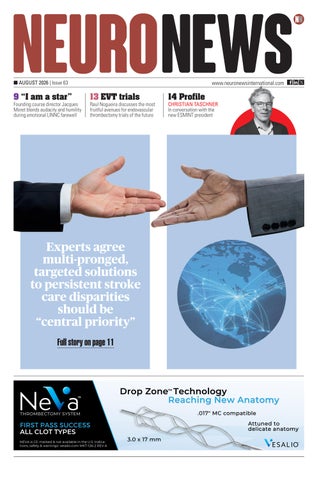
Experts agree multi-pronged, targeted solutions to persistent stroke care disparities should be “central priority” Full story on page 11
Drop Zone Technology Reaching New Anatomy TM
.017" MC compatible
THROMBECTOMY SYSTEM
FIRST PASS SUCCESS ALL CLOT TYPES NEVA is CE-marked & not available in the U.S. Indications, safety & warnings: vesalio.com MKT-126-2 REV A
Attuned to delicate anatomy 3.0 x 17 mm
News
2
contents
NEW DATA
Microsurgery retains comparable clinical outcomes versus endovascular therapy in ruptured wide-neck aneurysms
2 News Ruptured aneurysms 5 Clinical research 7 Conference circuit: SNIS 2026 9 Outside the operating room 11 In-Depth Cover story 13 Presentation: Raul Nogueira 14 Profile: Christian Taschner 17 Presentation: Vincent Costalat 19 Interview: Incoming WFITN president Seon-Kyu Lee
21 Comment
Point of View: Who funds stroke trials in Europe?
22 Point of View:
Mechanical angioplasty and the vasospasm treatment algorithm
23 Point of View:
Outpatient neurosurgical care
25 Market Watch Clinical Updates
26 Industry Updates 27 Conference Calendar
■ AUGUST 2026 | Issue 63
9 “I am a star”
Founding course director Jacques Moret blends audacity and humility during emotional LINNC farewell
www.neuronewsinternational.com
13 EVT trials
Raul Nogueira discusses the most fruitful avenues for endovascular thrombectomy trials of the future
14 Profile
CHRISTIAN TASCHNER In conversation with the new ESMINT president
Experts agree multi-pronged, targeted solutions to persistent stroke care disparities should be “central priority” Full story on page 11
Drop Zone Technology Reaching New Anatomy TM
.017" MC compatible
THROMBECTOMY SYSTEM
FIRST PASS SUCCESS ALL CLOT TYPES NEVA is CE-marked & not available in the U.S. Indications, safety & warnings: vesalio.com MKT-126-2 REV A
Attuned to delicate anatomy 3.0 x 17 mm
Cover credit: Images by Adobe Stock Creative, concept and photomontage by Terry Hawes
In the treatment of select ruptured wide-neck intracranial aneurysms, microsurgical clipping can achieve clinical outcomes on par with those obtained via endovascular techniques, according to new data from EVERRUN-2—a multicentre, prospective registry spanning seven US institutions. These findings were shared by Justin Mascitelli (UTHealth, San Antonio, USA) during a late-breaking abstract session at the 2026 Society of NeuroInterventional Surgery (SNIS) annual meeting (20–24 July, Seattle, USA). MASCITELLI CONCLUDED—BASED ON THESE data—that microsurgery “should remain in the armamentarium” for physicians treating ruptured wide-neck aneurysms, also reporting that rates of incomplete occlusion and retreatment remain “substantially higher” with endovascular therapy. The overall EVERRUN registry included a total of 301 ruptured wideneck aneurysms—those with necks ≥4mm or a dome-to-neck ratio >2—with 218 being treated endovascularly and 83 treated surgically. Mascitelli relayed that, within the registry’s endovascular arm, the most common treatment modality was balloon-assisted coiling (42.7%) followed by standalone coiling (40.8%), with stent-assisted coiling (5%), intrasaccular systems (4.1%) and flow diversion (2.3%) being utilised more sporadically. Aneurysm location information was available for all 301 cases, and demonstrated that the anterior communicating artery (ACoA), and the internal carotid artery (ICA)-posterior communicating artery (PCoA)/foetal posterior cerebral artery (PCA), were the most common locations for endovascular therapy, at rates of 34.4% and 28.4%, respectively. The middle cerebral artery (MCA) was the most frequent location for microsurgery at 47%. Overall, a higher ratio of anterior-circulation aneurysms were treated microsurgically (97.6%) versus endovascularly (87.2%). As per the registry’s primary clinical endpoint, rates of
a modified Rankin scale (mRS) score 0–2 at one year were comparable between microsurgical (74.3%) and endovascular (75.7%) approaches. Analyses of the primary angiographic endpoint—retreatment, which Mascitelli said was used as a surrogate for occlusion-related failure—occurred at a rate of 0% Justin Mascitelli with microsurgery versus 37% with endovascular techniques. He also noted that final Raymond-Roy occlusion classification grading is “ongoing”. Furthermore, secondary endpoints of interest revealed parity in terms of ventriculoperitoneal (VP) shunt usage, and treatment-related stroke, but symptomatic vasospasm was found to be more frequent in the microsurgery group (42.2%) compared to the endovascular group (27.6%). Two episodes of rebleeding and one retreatment-related death occurred in the endovascular arm as well. Prior to concluding, Mascitelli reported the findings of propensity-matched analyses including 81 “well-balanced” patients from each group. Rates of mRS 0–2 at both discharge and one year were statistically similar between microsurgery and endovascular therapy. However, retreatment was “persistently higher” in patients treated via endovascular techniques. Mascitelli acknowledged the limitations of this research, including its non-randomised nature, relative lack of power and minimal number of cases utilising intrasaccular devices, but also highlighted its strengths: EVERRUN-2 was conducted in a real-world setting, employed “rigorous” outcomes, and addresses a gap in the current literature. “A true RCT [randomised controlled trial] may be challenging, but larger, prospective analyses with rigorous methodology and propensity matching should be pursued,” he concluded.
“Larger, prospective analyses with rigorous methodology and propensity matching should be pursued”
Editor-in-chief: Prof Philip M Meyers Publisher: Stephen Greenhalgh Editor: Jamie Bell jamie@bibamedical.com Editorial contribution: Jocelyn Hudson, Will Date and Éva Malpass Design: Terry Hawes Advertising: Abbie Richardson abbie@bibamedical.com Subscriptions: subscriptions@bibamedical.com
Scan the QR code to subscribe
Published by: BIBA Medical Ltd BIBA Medical, Europe, 526 Fulham Road, Fulham, London, SW6 5NR, United Kingdom Tel: +44 (0) 20 7736 8788 Printed by: Buxton Press. Reprint requests and all correspondence regarding the newspaper should be addressed to the editor at the United Kingdom address. © BIBA Medical Ltd, 2026. All rights reserved. Neuronews
August 2026 | Issue 63
linkedin.com/company/neuronews
@NN_publishing
If you have comments on this issue or suggestions for upcoming editions write to jamie@ bibamedical.com
Read it your way A
T 2.0 -19 ADPAAPGE 18
ER OS AT CL OK LO
■ MAY 2026 | Issue 62
5 ESOC roundup Tenecteplase, blood pressure management, tandem lesions and more
www.neuronewsinternational.com
11 Flow diversion Do the latest unruptured aneurysm guidelines truly reflect clinical practice?
16 Profile
GUILHERME DABUS SNIS president on leadership, research, and the road ahead
Debate heats up following contrasting trial results on brain cooling during stroke thrombectomy Full story on page 9
Full story on page 05
We want to ensure you still receive your copy of NeuroNews the way that works best for you. To reconfirm your subscription, scan the QR code. You can also let us know if you would like to change the way you read it by opting to receive a digital instead of a printed version or by moving from digital to print
Scan here
Subscribe today
www.vascularnews.com
■ APRIL 2026 | Issue 110
6 Innovation
Miniature, wearable ultrasound prototype for vascular patients passes first hurdle
17 CX 2026
What to expect from this year’s CX Symposium, taking place 21–23 April in London, UK
14 Profile
KAK KHEE YEUNG ESVS president-elect on her vascular surgery career so far
Data and guidelines show progress towards best Et intotaturio et late queprae PE care olest aspietur, se nos de nestiur? Optae aspietur, se no
Fullstory storyononpage page0505 Full
Full story on page 10
Available in print and digital formats and through our social channels
Visit vascularnews.com and click ‘Subscriptions’ for complimentary print*, digital and e-newsletter subscription**
A specialised news source in the vascular arena
A trusted provider of latest news, review of cutting-edge research, congress coverage and opinion from thought leaders
*Available for US and EU readers only **Available worldwide
Editorially independent
BIBAMedical
News
www.neuronewsinternational.com
CLINICAL RESEARCH
Successful thrombectomy found cost-effective in patients with moderate-to-severe pre-stroke disability Economic analyses have determined that successful endovascular thrombectomy procedures are cost-effective in patients with moderate-to-severe pre-stroke disability, with more pronounced signals being observed in individuals with a modified Rankin scale (mRS) score of 3—as compared to 4. These findings were shared for the first time at the 2026 Society of NeuroInterventional Surgery (SNIS) annual meeting (20–24 July, Seattle, USA) by Na Young Evelyn Park (University of Tennessee College of Medicine, Memphis, USA). “PREVIOUS STUDIES HAVE SUGGESTED that successful recanalisation is associated with better functional outcomes and lower mortality rates compared to unsuccessful recanalisation, which supports the clinical rationale for pursuing endovascular thrombectomy in patients with moderate-to-severe disability, or mRS 3–4,” Park noted, speaking at SNIS 2026. “And, while previous economic analyses have shown that endovascular thrombectomy is cost-effective for patients with mild pre-stroke disability—or mRS 1–2—patients with mRS 3–4 have not yet been evaluated. This is the question we’re trying to answer today.” To this end, Park and colleagues built an analytic model comparing successful versus unsuccessful recanalisation in patients with pre-stroke mRS scores of 3 or 4, which were analysed separately via data from the Stroke Thrombectomy and Aneurysm Registry (STAR)— co-founded by Alejandro Spiotta (Medical University of South Carolina, Charleston, USA) and Ali Alawieh (Semmes-Murphey Clinic, Memphis, USA). “Patients underwent endovascular thrombectomy, were assigned a 90-day utility-weighted mRS score, and then entered a long-run projection phase assuming an average life expectancy of 4.2 years,” Park explained. “Functional outcomes were measured using utility-weighted mRS, converted to QALYs [quality-adjusted life years], and ICERs [incremental cost-effectiveness ratios] were calculated so that we could determine cost-effectiveness and compare it against willingness-to-pay thresholds of US$50,000 and US$150,000.” The results of the analysis showed successful recanalisation to be cost-effective across both mRS 3 and mRS 4. Regarding mRS 3 specifically, successful recanalisation carried an additional cost of roughly US$11,000 but led to gains of 0.52 QALYs, equating to an ICER of US$22,000 per QALY. And, for mRS 4, successful recanalisation carried an extra cost of approximately US$8,500 alongside 0.29 QALYs, resulting in an ICER of US$29,000 per QALY. “Both ICERs were well below the US$50,000 threshold,” Park commented. Touching on data from one-way sensitivity analyses performed by the researchers—whereby
PUBLISHED BY
BIBAMedical
they introduced variability into the thrombectomy costs and time horizons— Park reported that their initial Na Young findings on mRS Evelyn Park 3 were “robust”. Howeve r, fo r mRS 4, higher estimated procedure costs and pessimistic combined scenarios saw cost-effectiveness exceed the US$50,000 willingness-to-pay threshold. “This indicates that, with changes in model assumptions, there was some uncertainty,” Park added. Finally, the presenter shared the findings of probabilistic sensitivity analyses that saw the researchers run a total of 10,000 simulations in which they varied several key parameters, including thrombectomy procedure costs, annual care costs, and mRS scores and mortality rates at 90 days. Regarding mRS 3, roughly 60% of those simulations demonstrated cost-effectiveness at the US$50,000 threshold, rising to 91% for the US$150,000 threshold—and the same figures on mRS 4 were approximately 43% and 64%, respectively, also indicating “greater uncertainty” in the latter group, according to Park. “In conclusion,” she averred, “endovascular thrombectomy is cost-effective in both pre-stroke disability groups, but our findings were more robust for mRS 3. Prospective studies should include patient-level cost data from hospitals’ administrative records and long-term survival data to replace literature-based assumptions, and a societal perspective analysis incorporating caregiver burden would likely strengthen the economic case further—particularly for pre-stroke disabilities of mRS 4.”
“Both incremental costeffectiveness ratios were well below the US$50,000 threshold”
5
Meta-analysis supports IVT’s use beyond 4.5 hours in selected patients ADMINISTERING INTRAVENOUS THROMBolysis (IVT) in the extended time window—more than 4.5 hours after last known well—is associated with improved functional outcomes alongside no increase in mortality, supporting its use in selected patients despite data indicating a higher rate of symptomatic intracranial haemorrhage (sICH) as compared to best medical therapy (BMT). That is according to the findings of a systematic review and meta-analysis published in Neurology by Georgios Tsivgoulis (National and Kapodistrian University of Athens, Athens, Greece) et al. The researchers included a total of 13 studies comprising 2,456 patients who received IVT plus BMT and 2,411 control-group patients who received BMT alone. They found that IVT significantly improved rates of excellent functional outcomes (risk ratio [RR], 1.23)—equating to a number needed to treat of 13—and good functional outcomes (RR, 1.15) as well as reduced disability (common odds ratio, 1.26). Additionally, while IVT was associated with an increased risk of sICH (RR, 2.11)—resulting in a number needed to harm of 75—rates of any ICH and all-cause mortality were similar between the two study groups. No significant subgroup differences were documented across various subgroups, and the researchers relay that trial sequential analysis confirmed that the cumulative evidence for the primary outcome crossed the efficacy boundary, supporting a “robust treatment effect”.
Intensive blood pressure lowering cuts post-ICH recurrent stroke risk by 38% INTENSIVE, LONG-TERM BLOOD PRESSURE (BP)-lowering treatment reduces the risk of recurrent stroke by 38%—without increasing serious adverse events—in people who have survived an intracranial haemorrhage (ICH), as per meta-analysis findings published in The Lancet Neurology. After analysing four randomised controlled trials involving 2,944 adults with ICH, researchers found that, over a follow-up period of up to six years, recurrent stroke of any type occurred in 6.5% of patients receiving intensive BP lowering compared with 10.4% of those receiving less intensive treatment or standard care in the control arm. This translated to a 38% reduction Craig Anderson in recurrent stroke risk, with consistent benefits observed across all studies. The reduction in recurrent stroke was mainly driven by a roughly 61% lower risk of ICH among patients receiving intensive treatment. Additionally, there was no observed increase in serious adverse events, which occurred in approximately 29% of patients in the intensive treatment group and 33% of patients receiving standard care. “Our analysis shows intensive BP treatment can prevent 16 recurrent strokes for every 1,000 patients treated within the first year alone,” said senior author Craig Anderson (George Institute, Sydney, Australia). “These findings reinforce the central role of BP control in secondary stroke prevention.”
Issue 63 | August 2026
6
This advertorial is sponsored by WallabyPhenox
Confidence in surface modification bolstered by oneyear COATING trial results New clinical data from the COATING randomised controlled trial (RCT)—presented for the first time at the 2026 LINNC Paris course (1–3 June, Paris, France)—are likely to further bolster the neurointerventional community’s confidence in Hydrophilic Polymer Coating (HPC; WallabyPhenox) surface modification as a potential means for safely reducing their patients’ antiplatelet therapy burden following intracranial aneurysm procedures. That is according to Laurent Pierot (Reims University Hospitals, Reims, France) and Omer Eker (Bordeaux University Hospital, Bordeaux, France), who spoke to NeuroNews to offer fresh perspectives on the trial’s latest findings. “FOR A VERY LONG TIME, THE MAIN Analyses of this primary endpoint were problem we’ve had to manage during the endo- presented by Pierot at last year’s LINNC Paris vascular treatment of intracranial aneurysms meeting, successfully demonstrating non-infewith stents or flow diverters has been thrombo- riority with HPC plus SAPT versus no HPC plus embolic complications—which occur at a rate of DAPT, as per mean numbers of DWI lesions of six around 10%,” Pierot avers. “That’s why, by using and 5.3, respectively. Additionally, one-month surface modification, we are trying to reduce safety data showed no statistically significant platelet aggregation when we place a device difference in thromboembolic events between inside the artery.” the two groups. These findings were subseThe COATING study—a prospective RCT for quently published in the Journal of NeuroInterwhich Pierot is the principal investigator—was ventional Surgery. devised to evaluate one such surface modificaAnd, now, these initial positive data have tion technology: HPC. In the trial, 171 been backed up by analyses of COATunruptured aneurysm patients were ING’s longer-term results—including, in enrolled across 15 European centres, Pierot’s view, the “important” step of and randomised to treatment with evaluating rates of delayed thromboeither the p64 MW HPC flow-modulaembolic complications, haemorrhagic tion device plus single antiplatelet therevents, and in-stent stenosis, as well as apy (SAPT) or the uncoated version of aneurysm occlusion outcomes at six the p64 MW device plus dual antiplateand 12 months. let therapy (DAPT). Ultimately, the between-group Laurent Pierot According to Pierot, the trial utilised parity in thromboembolic events a novel yet conservative primary observed at one month was mainendpoint—core lab-adjudicated diffutained out to one year, while morbision-weighted imaging (DWI) lesions mortality rates—assessed via modified observed within 48 hours of the index Rankin scale (mRS) scores—were also procedure—that allowed investigators statistically similar with HPC versus to compare thromboembolic events without at both 30 days and 12 months between the study arms in a “relatively post-procedure. Pierot goes on to note objective” way while also reducing the that there were no statistically signifnumber of patients required to achieve Omer Eker icant differences between the study sufficient statistical power. Pierot notes groups in terms of intra-procedural or that, in the years since the trial was first intro- post-procedural cerebral haemorrhagic events duced, many other published papers have exam- out to one year. ined DWI lesions as an endpoint of interest—with Regarding its key efficacy endpoints, the COATING investigator Eker adding that “it has trial found a statistically non-significant trend become a new standard”, with its only tangible towards improved complete aneurysm occlusion limitation being the fact that it captures thrombo- at six months in the HPC group (74.4%) versus the embolic events relating to the entire procedure non-HPC group (63.5%)—although these rates as opposed to the implanted device alone. levelled out to 79.5% and 76.8%, respectively, “DWI is the most sensitive way to assess any at 12 months. thromboembolic event,” he explains. “In our “This is probably because being under DAPT practice, anywhere from 30–60% of procedures slows down the process of intra-aneurysmal are associated with these events—most of which thrombosis, meaning patients receiving SAPT are asymptomatic. So, comparing DWI lesions— obtain complete occlusion more rapidly,” Pierot rather than three-month clinical outcomes— says. “But, at one year, everything is more or less is the best way to ensure we don’t miss any the same in both groups.” thromboembolic events. Secondly, if we had Pierot also highlights the “very interesting” used a clinical primary endpoint, we would’ve finding that, among patients with available digineeded hundreds or even thousands of patients tal subtraction angiography (DSA) data, in-stent in each study arm, which is not feasible given stenosis rates were statistically similar between the numbers of aneurysm patients who stand to the HPC and non-HPC groups at both six months benefit from flow diversion.” (30.2% vs 24.1%) and 12 months (15.2% vs 15.7%)
August 2026 | Issue 63
as well. Additionally, zero target aneurysm retreatments were required at six and 12 months with HPC, while one retreatment—caused by a technical problem as opposed to aneurysm recurrence—was needed out to 12 months without HPC. “This is very relevant to clinical practice,” Eker states, commenting on the significance of these data. “Thromboembolic complications and aneurysm occlusion outcomes are multifactorial. Our goal as physicians is to give patients the best chance of achieving complete occlusion while minimising complications, and, if we can remove one of the factors that contributes to these complications—for example, the haemorrhagic risks associated with DAPT, especially in older patients—this will be beneficial. “The data also suggest that aneurysm thrombosis occurred more quickly in the HPC group, offering hope for us to consider reducing the duration of antiplatelet therapy in cases where the aneurysm has occluded completely at an earlier stage. This is also of benefit to the patient, as they could undergo antiplatelet therapy for six or eight months, rather than 12, decreasing their exposure to the complications associated with these therapies.” In addition to reducing the haemorrhagic risks associated with prolonged DAPT intake, Pierot is keen to point out that reverting to SAPT lowers a patient’s daily medication burden—which could involve, for example, ticagrelor in the morning and evening, and aspirin in the middle of the day—meaning they are more likely to adhere to their prescribed drug regimen post-treatment, further reducing the likelihood of longer-term complications. “Based on this study, we can confidently say that, with SAPT—provided you have the HPC surface modification—patients will do as well as they would with DAPT alongside a bare flow diverter,” Eker opines. “This is a significant improvement in our practice.” At this stage, some of the most experienced neurointerventionists have already been utilising surface-modified flow diverters plus SAPT in realworld practice for several years. However, Pierot feels that these results provide the scientific evidence that is needed to ensure this approach can be adopted more widely, in addition to establishing HPC as the only surface modification technology supported by randomised trial data for use alongside SAPT—a consideration that may apply to other stents and even intrasaccular devices as well as flow diverters. “I have travelled all over the world to present on the COATING trial, and I can tell you that a lot of physicians want a simple, logical protocol that can be applied to every single case,” he adds. “Flow diversion is a fantastic technique, and it allows us to treat many complex aneurysms that we couldn’t tackle before,” Eker concludes. “However, simplification is required for this technique to become more widespread—and simplification of the antiplatelet therapy is mandatory. As such, COATING is a significant milestone in the democratisation of flow diversion.” Pierot and Eker are ultimately in agreement that, based on these data, HPC stands as the first and only surface modification with proven safety and efficacy when deployed alongside SAPT in neurovascular procedures.
News
www.neuronewsinternational.com
CONFERENCE CIRCUIT
Experimental technique shows promise for treatment of severe back pain
David Fiorella
RESEARCHERS HAVE PRESENTED new findings on an experimental neurointerventional technique designed to treat severe back pain that involves delivering medication through the arteries supplying the painful area. The approach deploys catheter-based procedures commonly used for stroke treatment to target the source of pain in the spine. In the study—shared during a late-breaking data session at SNIS 2026—researchers treated six patients by guiding a catheter through their femoral artery, and infusing lidocaine and dexamethasone directly into the affected area. Patients reported an average pain score of 9.5 out of 10 before treatment compared to zero immediately afterward. The procedure was also found to have reduced patients’ need for opioid pain medication, with two patients eliminating opioid use entirely during their hospital stay. Pain scores remained low three months after the procedure, and four patients even participated in physical therapy after the procedure—which, according to the researchers, they had been unable to tolerate pre-procedure due to their pain.
Modulated aspiration demonstrates safety and effectiveness in stroke care Results have been announced from the THUNDER investigational device exemption (IDE) study evaluating the safety and effectiveness of Thunderbolt (Penumbra)—a novel computer-assisted vacuum thrombectomy (CAVT) system— in stroke patients with emergent large vessel occlusion. These late-breaking data were presented during the 2026 Society of NeuroInterventional Surgery (SNIS) annual meeting (20–24 July, Seattle, USA) by co-principal investigator David Fiorella (Stony Brook University Hospital, Stony Brook, USA).
T
HUNDER is a single-arm, prospective, multicentre study with corelab adjudication that enrolled 216 patients across 29 US centres. The study met its predefined performance goal, with 87.5% of cases achieving successful reperfusion, defined as modified thrombolysis in cerebral infarction (mTICI) 2b–3, after treatment with Thunderbolt. And, post-Thunderbolt treatment, mTICI 2c–3 reperfusion was achieved 70.4% of the time. Additionally, the study saw a 64.8% rate of firstpass mTICI 2b–3 and a median time to revascularisation of 20 minutes, while the complete clot ingestion rate was 83%. Furthermore, device/procedure-related serious adverse events occurred at a rate of 2.8%, symptomatic intracranial haemorrhage (sICH) occurred at a rate of 0.9%, and the rate of all-cause mortality at 90 days was 11.7%.
“Mechanical thrombectomy is considered frontline treatment for stroke; however, current technologies may not fatigue and completely ingest the clot quickly or effectively at the site of the occlusion,” said Donald Frei (Swedish Medical Center, Denver, USA), co-principal investigator of THUNDER. “The THUNDER study demonstrated a high rate of complete clot ingestion with Thunderbolt, along with a low rate of complications—an important combination when striving for optimal patient outcomes.” “In the THUNDER study, we observed that modulated aspiration facilitated consistent and complete clot removal when used in conjunction with standard-sized aspiration thrombectomy catheters,” added Fiorella. “Through this study, our early experience with Thunderbolt suggests that this technology could significantly advance treatment for stroke patients.”
Anaesthesia experience may shape post-thrombectomy outcomes
cases were reported from three CS-dominant centres, 17 GA-dominant centres, and five mixed-practice centres. They found that CS-dominant centres reported faster door-to-recanalisation times, higher first-pass effect and lower in-hospital mortality, on average. Also, compared with CS-dominant centres, GA-dominant centres had nearly quadruple the intensive care unit admission rate and double the median hospital length of stay. However, the benefits of CS were observed only at centres where it was routinely used. At GA-dominant and mixed-practice centres, CS was not associated with lower mortality or faster reperfusion.
A HOSPITAL’S OVERALL EXPERIENCE with general anaesthesia (GA) or conscious sedation (CS) may influence how anaesthesia modality choices affect patient outcomes during mechanical thrombectomy, as per a study presented at SNIS 2026. In the study, researchers analysed 9,036 thrombectomy procedures performed at 25 stroke centres. These
PUBLISHED BY
BIBAMedical
7
“One of the biggest challenges in treating malignant brain tumours is that every patient’s anatomy is different”
New AI-guided technique may improve delivery of brain tumour therapies A “GROUNDBREAKING” ARTIFICIAL intelligence (AI)-guided technique may improve the accuracy of delivering experimental therapies directly to malignant brain tumours, according to research presented at SNIS 2026. The approach uses AI to identify all of the blood vessels feeding a tumour, allowing physicians to deliver therapy to more of the tumour while reducing off-target delivery. “One of the biggest challenges in treating malignant brain tumours is that every patient’s anatomy is different,” said Christopher Young (University of Texas MD Anderson Cancer Center, Houston, USA), the study’s primary author. “AI gives us another tool to personalise treatment based on each patient’s unique blood supply, with the goal of delivering therapy more precisely. While more research is needed, this approach has the potential to improve patient care and marks an exciting advancement in neurointerventional oncology.” In the study, three patients with malignant brain tumours were treated via this approach. AI-assisted mapping successfully identified multiple tumour-feeding arterial pedicles in every patient, enabling treatment of all these pedicles and covering more than 85% of each tumour across all cases.
Issue 63 | August 2026
Subscribe today
Available in print and digital formats and through our social channels
Visit interventionalnews.com and click ‘Subscriptions’ for complimentary print subscription* and e-newsletter subscription**
A specialised news source in the interventional field
A trusted provider of latest news, review of cutting-edge research, congress coverage and opinion from thought leaders
*Available for US and EU readers only **Available worldwide
Editorially independent
BIBAMedical
News
www.neuronewsinternational.com
European societies publish physiciandriven standards for evaluation of endovascular stroke devices
OUTSIDE THE OPERATING ROOM
Jacques Moret bows out after more than 25 years as LINNC’s founding course director At this year’s LINNC Paris (1–3 June, Paris, France), neurointerventional pioneer Jacques Moret (Bicêtre University Hospital, Paris, France) stepped down from his role as course director, having ideated and founded the meeting more than 25 years earlier at a time when the interventional neuroradiology (INR) field was still in its infancy.
Image credit: LINNC
A
celebration of Moret’s career, legacy and innumerable contributions to this space was led by Laurent Spelle (Bicêtre University Hospital, Paris, France) and Vitor Mendes Pereira (St Michael’s Hospital, Toronto, Canada)—both of whom will continue as LINNC course directors in his stead—as well as longstanding faculty member Michel Mawad (Lebanese American University, Beirut, Lebanon). Having worked alongside Moret for 35 years, Spelle highlighted his mentor’s unique clinical capabilities, inspirational leadership, ambition, and seemingly innate, effortless understanding of concepts far beyond many of his peers. Among the many ways Moret has indelibly impacted the INR space, Spelle pointed to the invention of neurovascular balloon-assisted coiling, the training of hundreds of physicians across five continents, and the educational value of the live case demonstrations and expert debates that take place at LINNC each year. Following this, Pereira saluted the man who shaped his career. He recalled first seeing Moret challenge a celebrated surgical presentation at a conference in Brazil—an intervention that revealed his unwavering commitment to what he believed was best for patients. Years later, after joining Moret’s fellowship, Pereira came to appreciate the qualities that made him such a transformative figure: technical mastery, extraordinary generosity, honesty, creativity, and a refusal to lay down when faced with widely accepted limitations. Moret himself took to the podium next, asserting that this was not a eulogy, but the
PUBLISHED BY
BIBAMedical
9
acknowledgement of “a necessary emancipation that the founder of LINNC, like all parents, has a duty to encourage”. Moret delivered a typically audacious talk in which he proclaimed throughout that “modesty is my priority” before also stating, “I know I am a star”, and quoting Napoleon Bonaparte while explaining his decision to step away from the educational dynasty he created back in 1997. He also spoke of the many doubters and critics he faced while trying to establish the INR field, contrasting this with the increasing number of neurosurgical procedures—including brain aneurysm, arteriovenous malformation and subdural haematoma treatments—that are performed endovascularly today. Additionally, Moret paid tribute to Jacqueline Vignaud and Alain Rey—the two people without whom his accomplishments would not have been possible—as well as Pierre Lasjaunias, a fellow founder of the ABC-WIN Seminar, and Dominique Doyon. Moret received a lengthy standing ovation upon concluding his talk. Closing the session, Mawad hailed Moret’s calmness and poise inside the operating room, intellectual integrity, and ingenious ability to innovate and solve problems. Mawad further highlighted the great number of practice-altering techniques and concepts Moret was responsible for but humbly never put his name to. He added that Moret’s legacy will endure for years to come, not only through LINNC—which continues to expand globally—but also through the hundreds of clinicians he has mentored, and the thousands more they have trained thanks to the passion for teaching he instilled in them.
THE EUROPEAN SOCIETY OF MINImally Invasive Neurological Therapy (ESMINT) has welcomed the publication in the Journal of NeuroInterventional Surgery of new clinical evidence standards for high-risk endovascular devices in ischaemic stroke. These recommendations are intended to offer practical guidance for planning, conducting and reporting clinical studies of single-use endovascular stroke devices to support regulatory approval. Among the publication’s key findings is the notion that prospective observational studies are appropriate for most regulatory scenarios involving thrombectomy devices, while it also acknowledges that conceptually novel devices may require more rigorous comparative evaluation. The panel behind these recommendations achieved consensus on essential study design elements too, including multicentre participation, operator and centre requirements, independent imaging adjudication, endpoint selection, safety monitoring, and data transparency. Additionally, the document provides recommendations on sample size planning, post-market evidence generation, comparator selection, and study governance.
US Stroke Act introduced to support research and expand public education NEW US CONGRESSIONAL LEGISLAtion has been welcomed and applauded by the American Heart Association (AHA), which notes in a press release that this legislation—the Stroke Act—would improve the quality of stroke care for patients across the country by supporting research, establishing a national stroke registry, strengthening systems of care, improving access to rehabilitation and recovery services, and expanding public education and prevention efforts. US senator and stroke survivor Ben Ray Luján, along with 10 other senators, introduced the Stroke Act on 5 August. The AHA and the American Stroke Association (ASA)—a division of the AHA—are now urging congress in the USA to quickly advance this legislation, which the association says would help improve outcomes for people affected by stroke nationwide. According to the AHA, the Stroke Act would support research to improve stroke care delivery, identify gaps in prevention and treatment, establish a national stroke registry, and strengthen coordination across the continuum of care—from emergency response through rehabilitation and recovery.
Issue 63 | August 2026
10
This advertorial is sponsored by Medtronic
Randomised data and technological advances fuel continued expansion of MMA embolisation
explains that having this lower viscosity, alongside Onyx 12’s “very good” reflux control, is critical in facilitating precise and distal penetration of the embolic material—for cSDH in particular, but also for arteriovenous malformations (AVMs), dural arteriovenous fistulas (dAVFs) and brain tumours. “The visibility is perfect, allowing the safe and secure injection of the embolic material, and its behaviour is really nice and compares favourably to other low-viscosity embolic agents,” Berlis adds. To illustrate these points, he highlights two noteThe presentation of data from multiple large, randomised clinical trials over the worthy examples from the handful of cases he has past two years has seen middle meningeal artery embolisation (MMAe) emerge as completed since Onyx 12 arrived at his centre: a a safe and effective adjunct to surgical drainage in chronic subdural haematoma tentorial dAVF treatment in which it provided the (cSDH) management—with the Onyx™ liquid embolic system (LES; Medtronic) being precise control he needed in order to stop embolisthe agent of choice in several of these studies. And, more recently, the introduction ing immediately after filling a single venous pouch, of the lower-viscosity Onyx 12 LES has expanded the potential armamentarium of and a challenging brain AVM in which—despite the neurointerventionists treating cSDH in Europe even further. Here, NeuroNews speaks AVM having undergone eight prior embolisation to two physicians who are at the precipice of this ongoing shift in neurovascular care. procedures—Onyx 12 remained fully visible upon injection. Berlis recalls that the latter of these EMMA-CAN—ONE OF THE AFOREMEN- in EMMA-Can is the lowest figure achieved in any observations was “absolutely astonishing” to him. tioned trials to have substantiated MMAe’s bene- such trial to date. When asked about notable differ“While you can combine different DMSO [dimefits—was conducted across nine Canadian tertiary ences that distinguish EMMA-Can from these trials, thyl sulfoxide]-based embolic agents, most of my care centres, randomising 192 adults with symp- Shankar first highlights the omission of repeat colleagues only want to use one material to treat tomatic, unilateral cSDH measuring at least 10mm surgery from EMMA-Can’s primary endpoint owing AVMs and cSDHs,” he also states. “Therefore, it’s in axial thickness who were undergoing surgi- to this outcome measure being multifactorial and important to have all of these different viscosical drainage. These patients were randomised to “highly subjective”, as well as the pragmatic nature ties within one product family; you can start with either surgical drainage alone or surgical drain- of EMMA-Can’s patient population, adding: “We Onyx 20 or 18, and, if you need more [distal] peneage followed by MMAe within 72 hours of surgery feel our trial has a more applicable and more gener- tration, you can go ahead with Onyx 12.” using Onyx 18 LES. The primary efficacy endpoint alisable inclusion criteria compared to others.” Even with all these positive traits in mind, was symptomatic cSDH recurrence detected on Additionally, EMMA-Can was an open-label trial however, Berlis feels the greatest benefit introcomputed tomography (CT) at 90 days, with with blinded-endpoint adjudication, with rando- duced by Onyx 12 is its one-minute shake time—a safety outcomes assessed separately.1 misation occurring only after surgical drainage, marked decrease from preparation times of “The trial demonstrated a substantial reduction maintaining blinding of the operating surgeons 15–20 minutes recommended for other tantain symptomatic recurrence following adjunctive during the procedure and reducing the poten- lum-based products. MMAe,” relays EMMA-Can principal investigator tial for treatment allocation to influ“It’s a really big advantage that the Jai Shankar (University of Manitoba, Winnipeg, ence surgical completeness. Shankar preparation time is so fast,” he avers. “If Canada). “The primary endpoint occurred in just also cites the fact that the significance of the tantalum powder and the embolisa4.3% of patients in the MMAe arm compared to distal penetration during embolisation tion material are not properly mixed, 28% in those who received surgery alone. This was emphasised a priori as part of the you may have reduced visibility during represents an absolute risk reduction of 23.7%. trial’s methodology. the injection, which is very dangerous. And, based on this risk reduction, the number “The last point is that we only lost one That’s why a short preprocedural shake needed to treat [NNT] was 4.2, which suggests patient to complete follow-up,” Shankar time is so important—especially if you a very clinically meaningful treatment effect.” comments. “Loss to follow-up is a very need it very quickly, such as when the Jai Shankar Touching on the trial’s key secondary important aspect of any study, and ours patient has acute bleeding. Previously, endpoints, Shankar also notes that radiographic was just 0.5%, [minimising the potential we would have to use glue or coils in haematoma recurrence was observed in 49.5% of for bias from missing data and strengththese situations, but—with this one-minsurgical patients versus 14% of MMAe patients— ening confidence in the findings].” ute shake time—liquid embolics are now with the NNT for this metric being closer to “This is definitely an exciting time for available for more indications.” three—while rates of overall mortality and seri- innovation in cSDH care,” he continues. “The reflux control, [distal] penetraous adverse events were statistically similar “We feel that adding MMAe to surgery tion and visibility are really good but, if between the two groups. will reduce repeat operations, shorten you look at all the available EVOH [ethylAnsgar Berlis “I have to say that [the NNT] was a pleasant hospital stays, decrease healthcare ene vinyl alcohol]-based liquid embolics surprise to our team—we were expecting it to costs and, overall, improve patients’ quality of with a lower viscosity, the short preparation time is be positive, but we did not expect the NNT to be life. We have to understand that not everything what makes the difference,” Berlis concludes. “For that low,” he adds. “In neurosurgery and neurol- was proven in EMMA-Can—but secondary analy- me, the introduction of Onyx 12 is a very important ogy worlds, an NNT of three or four is not very ses are now also showing that adjunctive MMAe step. My initial experience has been really good, common. The NNT for thrombectomy in acute hastens the rate of resorption, as per [significantly and—because I’m so happy and confident with ischaemic stroke is around four, so we are reaching greater reductions in] haematoma thickness and it—I see Onyx 12 becoming a routine part of my that threshold. Moving forward, the challenge—as volume at 90 days, which is very important.” clinical practice.” with thrombectomy—will be implementing this highly effective treatment into routine clinical Control, visibility and speed References: practice; but, given the evidence is now there, In addition to the wealth of recent data on the posi- 1. Shankar J, Alcock S, Kashani N et al. Management of chronic subdural hematoma with adjunctive embolization healthcare systems should move to incorporate tive outcomes that can be achieved using established of middle meningeal artery: the EMMA-Can randomized this treatment over the next few years.” iterations of the Onyx LES, European physicians clinical trial. JAMA. 2026; 335(20): e264965. treating cSDH received another boost earlier this DISCLAIMER: The data and content included in this article A distinct design year with the launch of Onyx 12—a lower-viscosity express only the clinical perspectives of the presenters. While other randomised trials have produced agent that “completes” the Onyx product family. positive findings on MMAe—including EMBOLISE, So says Ansgar Berlis (University Hospital Augs- They are completely independent and do not necessarily reflect the opinions of Medtronic. MAGIC-MT and OTEMACS utilising Onyx, as well burg, Augsburg, Germany), who was among A full regulatory statement from Medtronic can be viewed as studies like STEM and MEMBRANE that eval- the first physicians to begin utilising this new online at neuronewsinternational.com/randomised-datatechnological-advances-expansion-mma-embolisation. uated alternative embolic agents—the NNT seen LES following its recent CE-mark approval. He
August 2026 | Issue 63
In-Depth 11
www.neuronewsinternational.com
COVER STORY Experts agree multi-pronged, targeted solutions to persistent stroke care disparities should be “central priority” Three studies presented throughout the 2026 Society of NeuroInterventional Surgery (SNIS) annual meeting (20–24 July, Seattle, USA) have shown that racial, geographic and socioeconomic disparities continue to influence stroke treatment and outcomes across the USA. Together, these data suggest that, while advances in stroke care have improved survival and expanded treatment options, not all patients are benefitting equally. SPEAKING TO NEURONEWS IN LIGHT OF these findings, SNIS past president Joshua Hirsch (University of Southern California, Los Angeles, USA)—who highlighted this topic, among many others, during his Grant Hieshima luminary lecture at SNIS 2026—said: “The studies presented at the SNIS annual meeting reinforce that disparities in stroke care are multifactorial and thus do not lend themselves to a single solution. The first step is to rigorously measure, enabling an understanding of where differences reflect access to care, transfer pathways, socioeconomic barriers or other clinical and systems-level factors. “From there, one can develop and perform targeted interventions, such as strengthening regional stroke networks and rapid transfer pathways where geography limits access, while addressing different barriers in underserved urban communities. Importantly, equity should mean that every eligible patient has timely access to evidence-based care, rather than simply achieving identical treatment rates. As always, continued measurement including outcomes will be essential to knowing whether/which interventions are actually working.” In the first study—a national inpatient sample analysis—researchers evaluated more than 325,000 acute ischaemic stroke patients treated at US teaching hospitals between 2018 and 2022. They found that Black patients were less likely than white patients to receive an endovascular thrombectomy procedure. This disparity existed across all levels of stroke severity and increased as stroke severity worsened, with Black women consistently found to be the patient population that was least likely to receive treatment. At a National Institutes of Health stroke scale (NIHSS) score of 20, the predicted probability of receiving thrombectomy was 33% for white men, 32% for white women, 28% for Black men and 26% for Black women. “As stroke severity increases, timely access to thrombectomy becomes increasingly important, yet our findings suggest treatment disparities also become more pronounced,” said co-first author Muhammed Amir Essibayi (Albert Einstein College of Medicine, New York City, USA).
PUBLISHED BY
BIBAMedical
“Understanding how race, sex and stroke severity annual meeting reveal that racial, geographic and intersect may help health systems identify opporsocioeconomic disparities continue to heavily tunities to ensure patients have equitable access influence stroke treatment and outcomes across to lifesaving treatment.” the USA. Mitigating these divides first requires A second study—RISE-HD—examined more than high-quality patient outcomes research—such 120,000 patients hospitalised with haemorrhagic as the above studies—to identify specific disparistroke in the US state of Florida between 2013 and ties and opportunities for improvement,” Ansari 2024. While researchers found that mortality rates told NeuroNews. “National stroke and neurointdeclined significantly during the study period, erventional data infrastructures such as the AHA substantial disparities persisted among patients GWTG [American Heart Association Get With The from different racial, geographic and socioecoGuidelines] and NVQI-QOD [Neurovascular Qualnomic backgrounds. After adjusting for age, sex ity Initiative-Quality Outcomes Database] regisand comorbidities, Black patients were found to tries could be better supported and mandated by experience higher odds of in-hospital mortality governmental, healthcare provider and/or payor than white patients. Patients living in rural areas institutions. This would allow not only real-world and those insured through Medicaid or other assessment and comparison of quality care across non-commercial insurance plans also faced signifigeographies and healthcare systems, but also the cantly higher mortality rates. Researchers identidownstream effects of targeted interventions. fied regional differences in outcomes across “Next, specific US CMS [Centers for the state too, highlighting potential gaps Medicare and Medicaid Services] and in access to specialised stroke care. HHS [Department of Health and Human “The encouraging decline in mortalServices] health policy strategies must ity over the past decade demonstrates target the structural gaps limiting access meaningful progress in stroke care, but to care in both rural and urban popuour findings show that significant barrilation centres. These interventions may ers remain,” commented primary study include expansion of rural transfer author Natália Vasconcellos (Thomas networks and direct triage protocols to Jefferson University Hospital, Philadelthrombectomy-capable centres or CSCs, phia, USA). “Addressing disparities in investing in underserved urban healthaccess to specialised stroke systems— care institutions to dismantle racialised particularly for underserved commueconomic segregation, and establishing nities—will be critical to improving health system accountability through outcomes for all patients.” national health equity mandates and/or In the third and final study, researchers value-based care reimbursements.” analysed haemorrhagic stroke mortality Expanding the scope of these discusacross 433 counties in the ‘Stroke Belt’ sions into European stroke treatment—in region located in the southeast of the USA conversation with NeuroNews—European to examine factors associated with differSociety of Minimally Invasive Neurological Top: Joshua Hirsch, Luca ences in outcomes between rural and Therapy (ESMINT) treasurer Luca Valvasurban communities. The study evaluated Valvassori and sori (ASST Santi Paolo e Carlo, Milan, Italy) Sameer Ansari distance to the nearest comprehensive added: “Ensuring equitable access to the stroke centre (CSC), community-level socioecocurrent standard of stroke care should be a central nomic disadvantage, racial and economic segrepriority for the neurointerventional community. gation, and human immunodeficiency virus (HIV) Advances in thrombectomy, imaging, devices, and burden. The rural and urban findings were marktreatment pathways, can significantly improve edly different, accordoutcomes, but their beneing to the researchers. fits should not be limited In rural counties, longer by socioeconomic status, travel times to CSCs were geography or healthcare more strongly associated infrastructure. Neurowith mortality—while, in interventionists have an urban counties, racialised important role in advocateconomic segregation and ing for appropriate referHIV burden were more ral networks, training, strongly associated with resources and infrastrucpoorer outcomes despite ture that allow evidencecloser geographic access to based treatments to be Joshua Hirsch specialised care. delivered consistently. “The neurointervenReducing disparities in tional access problem in the Stroke Belt is not one access is essential to ensure that technological problem, it is two,” stated Dylan Yates (Tulane progress translates into meaningful improveUniversity School of Medicine, New Orleans, USA). ments in outcomes for all stroke patients. “In rural communities, improving access means “However, particularly in Europe—which expanding stroke transfer networks and strengthcomprises more than 40 countries with substantial ening connections to CSCs. In urban communities, differences in healthcare systems and economic addressing structural disadvantage and investing resources—this is ultimately a political and poliin underserved neighbourhoods is critical. These cy-related challenge. It involves issues of inclusivfindings show that the neurointerventional access ity, fair allocation of resources to less advantaged gap differs between rural and urban communities, regions, and decisions regarding which aspects and suggest that improving outcomes will require of stroke care should be considered essential different strategies in each.” and universally guaranteed. As healthcare costs According to SNIS secretary Sameer Ansari continue to rise, dedicated national funding, (Northwestern University, Chicago, USA), a number targeted programmes involving industry partners, of existing initiatives may have key roles to play in and improvements in transportation and emeralleviating current inequities across US stroke care. gency referral networks, may represent important “Three studies presented at the recent SNIS initial steps towards reducing these disparities.”
“Equity should mean that every eligible patient has timely access to evidence-based care, rather than simply achieving identical treatment rates”
Issue 63 | August 2026
12
This advertorial is sponsored by Terumo Neuro
Global experts outline stentassisted coiling’s perennial role in aneurysm care
walls to bifurcation locations, in conjunction with coils. Dabus paints a similar picture, describing stent-assisted coiling as a “great combo” that he utilises frequently—also noting that the LVIS EVO device is particularly well-suited to parent vessels with a challenging angulation in which intrasaccular systems may face difficulties. And, although his view is that experience with both devices is necessary in order to “truly tailor” Despite decades of innovation in endovascular aneurysm therapy, recurrence and treatments, he leans towards selecting the LVIS limited durability associated with these treatments remain among the most persistent EVO device in cases where its tighter mesh and challenges facing daily practice. With this in mind, Guilherme Dabus (Baptist Health increased metal coverage are likely to be most Miami Neuroscience Institute, Miami, USA) and Ansgar Berlis (University of Augsburg, beneficial in promoting occlusion, such as very Augsburg, Germany) discuss their experiences with the HydroCoil™ Embolic wide-necked sidewall aneurysms in the middle System (HES) and the LVIS™ EVO™ Intraluminal Support Device (both Terumo cerebral artery, anterior communicating artery, Neuro) as well as the substantial body of clinical evidence on these technologies. or basilar tip. Dabus and Berlis are in broad TO DATE, MULTIPLE RANDOMISED STUDBased on their extensive agreement over diameter-misies have demonstrated comparable safety combined exper ience with match scenarios with the LVIS EVO outcomes and improved effectiveness with second-generation Hydrogel coils, device too, with both saying these Hydrogel coils versus bare platinum coils (BPCs). Dabus and Berlis both state that the situations occur rarely in their pracThe European GREAT trial showed a statis- softness, manoeuvrability and overtices and Dabus describing them as tically significant reduction in a composite of all control offered by these devices “manageable”. He advises operators aneurysm recurrence, retreatment, morbidity mean they can be deployed in virtuto size stents based on the diameand mortality—as well as significantly higher ally any coiling-suitable case—with ter of the largest vessel requiring packing density—across 484 patients with a wide especially very small aneurysms coverage, and take into consideraspectrum of aneurysm types.1 The 600-patient (<3mm) being the only instances for tion the fact that the braided strucHEAT trial conducted throughout the USA and which they are more likely to select ture of the LVIS EVO device means Guilherme Dabus Canada produced similarly positive results, BPCs instead. it may elongate or shorten following including a statistically significant reduction in “Hydrogel coils—particularly placement. the primary study endpoint of recurrence withHydroSoft™ 3D—are very soft, very Finally, the two physicians referout elevated risks of haemorrhage, mortality or flexible, and their behaviour is very ence the ongoing SEALANT study other adverse events.2 Both trials also revealed similar to other coils, meaning you evaluating aneurysm treatment equivalent safety profiles between Hydrogel can use them in all cases,” Berlis using Hydrogel coils in combinaand BPCs. comments. “The HydroFrame™ tion with the LVIS EVO device, More recently, the HYBRID randomised trial device is [more robust than the from which results are expected to involving 432 patients in Japan showed signifi- HydroSoft device], so I use it in be published soon.5 cantly lower rates of major recanalisation with larger aneurysms for initial neck “Every physician’s job is to decide Hydrogel coils compared with BPCs at one year.3 bridging before going ahead with [on] the best individual strategy for “We can see clearly, based on this strong the softer coils. One advantage Ansgar Berlis each patient,” Dabus concludes. evidence, that these coils are exactly the same they have is a higher volume, with “Our job is to make sure patients in terms of safety concerns,” Dabus avers. “Effecthe Hydrogel expanding within the metal to are provided with the safest and most effective tiveness is where things get more interesting, fill hollow spaces, and what we know from treatment possible, and I think the fact we have because the studies—particularly HEAT—show clinical trials is that small and medium-sized all of these devices available to us is marvellous.” lower recanalisation with Hydrogel compared aneurysms have much better results with a to BPCs. So, if you want to decrease the risk of lower recurrence rate. Overall, they are really References: 1. Taschner C A, Chapot R, Costalat V et al. Secondaneurysm recanalisation in the future, there’s a good coils.” Generation Hydrogel Coils for the Endovascular Treatment clear advantage to using Hydrogel coils.” While Hydrogel coils are well-suited to the of Intracranial Aneurysms: A Randomized Controlled Trial. Here, Berlis also draws attention to the “reasmajority of smaller or medium-sized aneurysms, Stroke. 2018; 49(3): 667–74. 2. Bendok B R, Abi-Aad K R, Ward J D et al. The Hydrogel suring” recurrence rate of just 4.4% seen with their utility in larger and wider-necked aneuEndovascular Aneurysm Treatment Trial (HEAT): A Hydrogel coils in HEAT. rysms has also been enhanced following the Randomized Controlled Trial of the Second-Generation “All these trials have the same conclusion on introduction of the LVIS EVO device—a braided Hydrogel Coil. Neurosurgery. 2020; 86(5): 615–24. recanalisation rates,” he adds, “and we have stent intended to provide additional support 3. Imamura H, Sakai N, Sakai C et al. Hydrogel coils in intracranial aneurysm treatment: a multicenter, prospective, learned […] that we have to achieve high-density during coiling procedures. randomized open-label trial. J Neurosurg. 2025; 142(6): packing with Hydrogel coils. The packing density Berlis led the world’s first handful of clini1803–9. is important, and then you have the additional cal cases with this device back in 2019, and has 4. Fiorella D, Toth G, White T G et al. Final results of the Ruptured Aneurysms treated with HydroGEl Coils (RAGE) effect of the expansion of the inert Hydrogel [to since deployed it within hundreds of aneurysm study: a multicenter study of 771 patients. J NeuroInterv fill the dead space of the coil’s primary wind].” treatments. Surg. 2026. DOI: 10.1136/jnis-2026-025097. By prospectively enrolling 771 patients with “It has really good visibility [on imaging] due 5. Clinicaltrials.gov. 2024 [cited 2026 Aug 10]. Available from: ruptured aneurysms specifically, the North to the platinum inside the stent struts, and you clinicaltrials.gov/study/NCT04999423. American RAGE study—also presented last year— can see very well how close the coils are to the DISCLAIMER: Physician quotes reflect individual preferences has further established the role for Hydrogel struts, meaning you can make a high-density and professional experience of individuals and do not coils in these more acute cases, demonstrating package up to the neck of the aneurysm while necessarily represent the views of Terumo Neuro or imply clinical superiority of any medical device. Some physicians an adequate occlusion rate of 86% at 18 months avoiding the coils coming into the parent artery,” may have affiliations with Terumo Neuro. For medical alongside an “exceptionally low” rebleed rate of he says. “This is a major advantage of the LVIS professional use only. 0.3% at 30 days and 0.5% at 18 months.4 EVO device compared to other stents.” To read more about Terumo Neuro clinical research, visit “This shows—in a very scientific way—that the Another key benefit Berlis cites is the LVIS terumoneuro.com/clinical-studies. For more information and product details, please refer to Hydrogel coils are safe and effective, and will EVO stent being ‘resheathable’, meaning it can the Hydrogel and LVIS EVO brochures. Instructions for use/ provide complete or adequate occlusion in the be repositioned easily mid-procedure to optimise intended purpose of these devices can also be found online at vast majority of cases with a very low risk of caus- neck coverage. He has deployed the device in a neuronewsinternational.com/stent-assisted-coiling-perennialing problems,” Dabus notes. variety of wide-necked aneurysms, from side- role-aneurysm-care.
August 2026 | Issue 63
www.neuronewsinternational.com
In-Depth 13
PRESENTATION
“The low-hanging fruit is gone”: larger trials and more proactive treatment key to further advancing stroke thrombectomy
candidates in the previous example, over-selection led to 10% experiencing benefits compared to 16% when more inclusive criteria were used. “Being more selective means my personal outcomes will look better, but it’s not about me; it’s about patients. And, right now, we are leaving a lot of them behind.” On the topic of large-core ischaemic strokes, Nogueira stated that—while a possible ceiling effect in core volumes >150ml was revealed by the latest data from the ATLAS meta-analysis—the procedure has consistently demonstrated benefits across the majority of patients with these more severe infarcts. He also posited that the density of these infarcts—as measured by net water uptake— With mechanical thrombectomy now long-established in ischaemic stroke care, its in addition to the volume, appears to be imporcontinued expansion as well as further improvements in associated outcomes moving tant in determining whether damage to the brain forward will be more incremental compared to the revolutionary progress seen over the can be halted and reversed via a thrombectomy past decade—with larger clinical trials and more proactive treatment paradigms likely procedure, as per imaging data from the SELECT2 being required to drive this forward. These were among the salient points conveyed by and TENSION trials. As such, Nogueira added, Raul Nogueira (University of Pittsburgh Medical Center, Pittsburgh, USA) via a recent core volumes alone should not be used to exclude presentation at the 2026 LINNC Paris course (1–3 June, Paris, France). patients from these treatments. Similarly, the relevance of an individual “ONE OF THE MOST MISUNDERSTOOD but that’s not actually true. We are mistakenly patient’s frailty and biological age, as opposed topics in our field is this idea that people don’t bene- labelling any case without a good outcome as to merely chronological age, is also becoming fit from thrombectomy—we need to understand the ‘futile’, even if they experience a better outcome increasingly recognised, according to Nogueira. difference between benefit and good outcomes,” than they would’ve had without thrombectomy.” He went on to acknowledge, however, that Nogueira asserted. “How do we improve outcomes Nogueira posited that the idea of futile reperfusome patients do genuinely experience poorer in patients who still don’t benefit? The answer is to sion must be revisited, also criticising the dichotopost-thrombectomy outcomes despite initially do more thrombectomies. There are other factors, misation whereby thrombectomy is considered appearing to be good candidates for the procedure. but the main reason we are not seeing a greater to have been successful if a patient achieves an One driver of this is believed to be reperfusion benefit is that we are undertreating with thrombec- mRS score of 0–2 versus unsuccessful injury, with Nogueira noting its undertomy. That is a critical message.” if their mRS score is 3–6. In his view, lying causes—including excitotoxicity, According to Nogueira, many operators use more emphasis should be placed on oxidative stress and inflammation— magnetic resonance (MR) or computed tomog- mRS ordinal shift analyses and utilrepresent potential therapeutic targets. raphy (CT) perfusion imaging to estimate how ity-weighted scoring, which go some Usage of neuroprotection as an adjunct likely a given patient is to derive benefit from way to avoiding this oversimplification. to thrombectomy has demonstrated thrombectomy treatment. However, while these “Sometimes, a good outcome is just promise here; Nogueira highlighted tools may be suitable for prognostication, they not possible, but there may still be a positive findings from OPENS-2—a are—at present—“incapable” of reliably predict- benefit in terms of shifting patients randomised trial published last year ing who will benefit from these interventions. towards reduced disability,” he added. Raul Nogueira in The Lancet, which found that the “Most imaging biomarkers are predictors “The absence of a good outcome is not equal “simple” approach of normobaric of outcome rather treatment effect modifiers. to futile reperfusion, and the goal should not be oxygen therapy can safely improve outcomes Therefore, these techniques should not be used ‘good outcomes’ but, rather, ‘better outcomes’— in patients treated endovascularly. He also drew primarily to exclude patients from thrombec- meaning any functional improvement. attention to intra-arterial brain cooling during tomy,” Nogueira clarified. “Part of the problem is also a lack of under- thrombectomy procedures, remote ischaemic To demonstrate this point, he cited data from standing of the difference between predictors conditioning using standard blood pressure the JURaSSiC study, in which 111 expert clinicians of outcomes and treatment-effect modifiers. We cuffs, and numerous drug candidates, that have were asked to predict the probability of vari- consider older ages, late time windows and large all produced positive signals in clinical studies. ous outcomes across five ischaemic stroke case cores to be predictors of a worse outcome. But, if Suboptimal thrombectomy outcomes have also scenarios. Some 48% were unable to accurately you compare similarly treated patients, with simi- been attributed to the ‘no-reflow’ phenomenon, predict the probability of the primary outcome—a lar age, time and size of stroke, none of these things whereby the procedure successfully restores modified Rankin scale (mRS) score ≥3—in any of nullify treatment effect, so we shouldn’t be using blood flow within the ‘macro-circulation’, but the five cases, and none accurately predicted the them to exclude people from thrombectomy.” smaller occlusions remain within the brain’s outcomes of all five scenarios. Subsequently, Nogueira touched on the ‘micro-circulation’. On this front, Nogueira high“This is worse than tossing a coin—but this is ‘denominator fallacy’, which, in his view, demon- lighted recent evidence from the CHOICE2 trial what we are doing in our daily practice,” Nogue- strates “how egocentric—versus patient-cenindicating that giving alteplase after thrombecira commented, also noting that more recent tric—medicine can be”. Using the EXTEND-IA tomy may boost outcomes, but added that new studies have revealed similar trends. “We are not randomised trial as an example, he noted that thrombolysis solutions that target more of a good at predicting outcomes and, if we cannot the overly selective use of CT perfusion imaging blood clot’s constituent parts, including platepredict, we cannot assume; when in doubt, we has been shown to result in a high rate (70%) of lets, Von Willebrand factor (vWF), neutrophil must treat [with thrombectomy].” 90-day mRS 0–2 and a number needed to treat extracellular traps (NETs) and DNA—as opposed Another key problem, Nogueira continued, (NNT) of 3 among patients receiving thrombec- to just fibrin—may be needed too. is that physicians fail to distinguish between a tomy, while more inclusive selection via non-con“We need to understand that the low-hanging ‘good outcome’ and overall clinical benefit, often trast CT means a greater number of patients fruit is gone,” Nogueira concluded. “The trials falsely attributing mRS scores >2 to the phenomundergo the procedure, leading to a lower averwe did in the past compared thrombectomy to enon of futile reperfusion. age rate (35%) of mRS 0–2 and an NNT of 5 across medical management; now, we are in an age of “We have this paradigm of angiographic-clinthis broader cohort. comparing thrombectomy plus something else ical mismatch,” he explained. “People will say “But, we can’t forget that our duty is not only versus thrombectomy alone. We are going to see that we open the vessel up 90% of the time but to the patients we operate on, but to all the more modest, incremental benefits, and what only 50% of patients do well—meaning they patients we consider for treatment,” Nogueira we consider to be a minimal clinically important achieve functional independence [mRS 0–2]— commented, highlighting the fact that, across difference will be in the low single digits, so we’re and this has been defined as futile reperfusion, all patients imaged as potential thrombectomy going to need much bigger trials.”
PUBLISHED BY
BIBAMedical
Issue 63 | August 2026
14
In-Depth
PROFILE
Christian Taschner Having recently been confirmed as the new president of the European Society of Minimally Invasive Neurological Therapy (ESMINT) for 2026–2028, Christian Taschner’s (Freiburg, Germany) significant contributions to the interventional neuroradiology (INR) field—as a clinician, researcher, author and educator—look set to continue in earnest. Here, Taschner— deputy medical director and head of INR in the Department of Neuroradiology at University Medical Center Freiburg—discusses this field and his distinguished career to date with NeuroNews. What initially drew you to medicine, and to neuroradiology specifically? I come from a family with a long tradition in law and religious scholarship, so choosing a career in medicine made me something of an outlier. My initial interest grew from a general fascination with the life sciences during my school years in Brussels, Belgium. The decisive personal influence, however, was a close family friend who worked in internal medicine in the Black Forest in Germany. The way he combined a deep seriousness of purpose with humour, genuine humanity and warmth left a profound and lasting impression on me. When I was 17 years old, I spent a month during the summer working as an observer in his department. By the end of that experience, I knew that medicine was what I wanted to do in life. Neuroradiology came later. While working on my doctoral thesis at the Charité in Berlin, Germany—focusing on functional magnetic resonance imaging (MRI) and image-guided therapy—I became increasingly drawn to neuroimaging. During my training in diagnostic neuroradiology in Switzerland, however, I realised that diagnosis alone was not enough for me. I wanted more contact with patients and the opportunity to contribute directly to their treatment. This ultimately led me to a fellowship in INR in France, and into a field that brings together imaging, technology, clinical decision-making and hands-on therapy in a uniquely fascinating field. Who have your mentors been, and how have they impacted your career? In German academic medicine, mentorship has traditionally been less formalised
August 2026 | Issue 63
than in some other academic cultures. In Switzerland, Daniel Rüfenacht gave me important support and opened the door to the University Hospital in Lille, France—and, with it, the fascinating world of neurointerventions. In Lille, Jean-Pierre Pruvo and Xavier Leclerc welcomed me with remarkable generosity and warmth. In fact, not only the department in Lille but the French neurointerventional community as a whole proved exceptionally open and supportive—even to a Belgian-German-Swiss physician with a rather creative command of their beautiful language at the time. Martin Schumacher subsequently gave me the opportunity to return to Germany, where I have worked ever since. During this period, I also learned a great deal from Ajay Wakhloo, who helped me deepen and sharpen my scientific thinking. His support gave me a much better understanding of the technological foundations of our specialty. The longer I reflect on this question, the clearer it becomes that many other individuals have had a lasting impact on my career— far too many to name here. Much of this influence arose through the professional platforms that are so important in our small and highly specialised field. Meetings like the ESMINT congress, ABC WIN seminar, LINNC course, SNIS annual meeting and WFITN congress are places where ideas are exchanged, challenged, and debated—and ultimately developed into new projects and collaborations. What are your main goals during your tenure as ESMINT president? Many excellent initiatives are already
well established within ESMINT and have been developed to a very high standard. I therefore see my role less as someone who needs to reinvent the society and more as someone entrusted with carrying the flame for the next two years—an honour and a privilege. A central theme of my tenure will be evidence. Through my work in device evaluation within ESMINT and as vice-chair of a European Medicines Agency (EMA) expert panel on cardiovascular implants, I have become increasingly engaged with the question of how we evaluate techniques, procedures and devices in medicine. INR is an innovative specialty, and innovation is one of its defining strengths, but innovation must be accompanied by robust data, transparent evaluation and a willingness to subject our own procedures to the same critical scrutiny that we expect from others. My goal is therefore to place evidence for INR techniques, procedures and devices at the centre of the agenda, while continuing to support education, training, collaboration with neighbouring disciplines, and opportunities for the next generation of neurointerventionists. What are the three most impactful studies you have been involved with throughout your career? Among the projects in which I have personally been involved, three stand out because, together, they trace the evolution of my own approach to evidence generation. The first is GREAT, an investigator-led, German-French randomised trial comparing second-generation hydrogel coils with bare platinum coils in the treatment of intracranial aneurysms. It gave me first-hand insight into both the value and the practical challenges of randomised device trials. The second is the multicentre Derivo study of flow diversion for unruptured intracranial aneurysms, which helped me understand what well-designed, prospective, non-randomised studies can contribute—and where their methodological limitations lie. The third is our recently published European multi-society consensus on clinical evidence standards for high-risk endovascular stroke devices under the EU Medical Device Regulation (MDR). This was not a conventional clinical trial, but an evidence-building project combining a systematic review with a clinician-led Delphi process. For me, it represents a further step: from conducting individual studies to helping define the standards by which future device trials should be designed and evaluated. And, in combination, these three projects mark a progression from testing a specific technology in a randomised trial, to evaluating new devices in prospective studies, to shaping the framework for evidence generation itself. Ultimately, the objective remains the same: to support meaningful innovation while ensuring that it rests on evidence that is both clinically relevant and methodologically robust, for
Fact file CURRENT ROLES 2026–2028: President, ESMINT 2020–present: Vice chair, European Medicines Agency Expert Panel on Cardiovascular Implants 2013–present: Deputy medical director, Department of Neuroradiology, University Medical Center Freiburg EDUCATION AND TRAINING 2004–2007: Fellowship in INR (Lille, France) 2002–2004: Fellowship in diagnostic neuroradiology fellowship (Basel, Switzerland) 2001–2002: Residency in neurosurgery (Zürich, Switzerland) 2001: MD (Berlin, Germany) 1997–2001: Residency in radiology (Berlin, Germany) 1990–1997: Medical studies (Berlin, Germany; London, UK)
RESEARCH INTERESTS: Clinical and preclinical evaluation of medical devices for INR Health services research in patients with neurovascular diseases Development and evaluation of non-invasive neurovascular imaging techniques
In-Depth 15
Peter James Field / Agency Rush
www.neuronewsinternational.com
the benefit of our patients. What is the most pressing unmet need in the INR space right now? The most pressing unmet need is not another device, but a more reliable basis for deciding who to treat, how, and when. Our technical capabilities have advanced faster than our ability to distinguish patients who are likely to benefit from those in whom intervention may add little—or expose them to unnecessary risk. In many areas, we know what can be done, but not yet clearly enough what should be done. Addressing this will require better disease characterisation, validated prediction tools, comparative clinical data and follow-up centred on outcomes that matter to patients. The goal should be a more precise and individualised form of neurointervention, in which treatment decisions are driven by expected clinical benefit rather than technical feasibility alone.
PUBLISHED BY
BIBAMedical
“The most pressing unmet need is not another device, but a more reliable basis for deciding who to treat, how, and when”
implants—should make treatment safer and reduce the need for prolonged antiplatelet therapy. Simulation and competency-based training will help shorten learning curves, while robotic or remote assistance may eventually improve consistency and broaden access to specialist care. The innovations that matter most will be those that make neurointervention more personalised, less invasive, and more reproducible— not simply more technically sophisticated.
Which innovations are likely to have the greatest impact over the next 10 years? I expect the greatest impact to come not from a single disruptive technology, but from the convergence of advanced imaging, artificial intelligence (AI), and device engineering. Imaging and AI will increasingly support triage, risk stratification, procedural planning and real-time decision-making. At the same time, smaller, more navigable and less thrombogenic devices—including next-generation thrombectomy systems, surface-modified flow diverters, and improved intrasaccular
What are your interests outside of medicine? Above all, I value spending time with my family. We enjoy being in the mountains— hiking in summer and cross-country skiing or ski touring in winter. I am also a keen cyclist and particularly enjoy longer cycling tours. Music plays an important role in my life, and I sing in a vocal ensemble. At home, I like working with my hands, especially in the garden and with my bees. Together, these activities provide a welcome balance to my clinical and academic responsibilities.
Issue 63 | August 2026
Subscribe today
www.cardiovascularnews.com
■ MAY 2026 | Issue 81
3 Top trials
10 Legacy
EUGENE BRAUNWALD The father of modern cardiology remembered
12 Profile
BERNARDO CORTESE Founder of DCB Academy discusses coronary advances
0.81
Practice-changing trials from a packed conference schedule
Beyond the wire Latest-generation physiology technologies show promise for guiding PCI
Full story on page 14
Available in print and digital formats and through our social channels
Visit cardiovascularnews.com and click ‘Subscriptions’ for complimentary print subscription* and e-newsletter subscription**
A specialised news source in the cardiovascular field
A trusted provider of latest news, review of cutting-edge research, congress coverage and opinion from thought leaders
*Available for US and EU readers only **Available worldwide
Editorially independent
BIBAMedical
In-Depth 17
www.neuronewsinternational.com
PRESENTATION
New ‘small-vessel occlusion’ definition may hold key to reproducible outcomes in complex thrombectomy cases Owing to the “confusion” created by recent randomised controlled trials (RCTs) evaluating mechanical thrombectomy in more distally located stroke-causing occlusions, the neurointerventional community should shift its focus away from traditional, location-based definitions in favour of a simpler and more reproducible paradigm centred around vessel diameters. That is according to Vincent Costalat (University Hospital of Montpellier, Montpellier, France), who stated that “we need to completely rethink these inconsistent anatomical definitions” while introducing this updated concept at the 2026 LINNC Paris course (1–3 June, Paris, France). COSTALAT BEGAN BY RECAPPING THE findings of three RCTs—the DISTAL, ESCAPEMeVO and DISCOUNT studies—that were designed specifically to evaluate thrombectomy’s benefits in ischaemic strokes caused by primary distal or medium-vessel occlusions (D/MeVOs), but ultimately failed to demonstrate superior efficacy over standard medical care. Additionally, interim analyses from the prematurely halted DISCOUNT trial revealed potential safety concerns with the procedure. However, while these negative results appear to be partially responsible for a “significant drop” seen recently in mechanical thrombectomy usage in more distally located occlusions, this landscape “started to become confusing” following the presentation of the DISTALS and ORIENTAL MEVO trials earlier this year, according to Costalat. “We cannot attribute exactly the same level of evidence to DISTALS—it was very well-performed, but this is an industry-sponsored trial with only 100 patients,” he added, also stating that, while the previous trials used clinically led primary endpoints relating to modified Rankin scale (mRS) scores, the DISTALS investigators selected successful reperfusion as their primary endpoint of choice. Nonetheless, Costalat continued, the trial did find that patients randomised to undergo thrombectomy with a tailored, low-profile stent retriever achieved statistically significantly higher reperfusion rates compared to those receiving standard care, while “almost no complications” were reported. Additionally, a trend towards improved rates of mRS 0–1 with thrombectomy versus standard care was observed. “And, even more importantly, we now have an RCT—with a similar design to the earlier negative trials—that is significantly positive on both mRS 0–1 and mRS 0–2,” Costalat said, referring to ORIENTAL MEVO. “So, now we have three negative trials and two positive trials, what should we do? That is the big question.” Diving deeper Providing a closer look at the data from these five discrepant studies, Costalat highlighted the delivery of intravenous thrombolysis (IVT) as being “very different” between the positive and negative groups of trials. More than half of the patients in both study arms in DISTAL, ESCAPE-MeVO and DISCOUNT received IVT, compared to 0% in DISTALS and roughly one third in ORIENTAL MEVO.
PUBLISHED BY
BIBAMedical
Vincent Costalat
“There is a mismatch between RCTs and daily clinical practice” “In DISTALS, you are basically comparing the patient’s natural history versus mechanical thrombectomy,” the speaker noted. “But, in the negative trials—where you had best medical therapy with or without IVT—there was a rate of up to 75% of good outcomes in M2 occlusions treated just with IVT. Trying to show thrombectomy is superior to this is much more difficult, whereas, without IVT, you are only fighting against the natural history of the patient. That is the main reason why we now have these positive trials.” Furthermore, according to Costalat, the reason many centres have stopped regularly deploying thrombectomy in distal occlusions is likely due to the safety signals observed to date, with the procedure being associated with a trend towards increased symptomatic intracranial haemorrhage (sICH) occurrence across positive and negative RCTs alike. This is despite overall complication rates remaining low with no statistically significant between-group differences in all trials except DISCOUNT. “We may feel that this signal of complications with thrombectomy is due to the technique—stent retrievers were the most commonly used modality in most of the trials,” he continued. “But, when you compare subgroups using aspiration versus stent retrievers, you don’t see a clear differ-
ence regarding the safety profile.” Costalat then described the current guidelines on D/MeVO thrombectomy practices as “extremely conservative”, leading to fewer operators performing these more complex and technically demanding procedures. “But,” he posited, “many operators observe a clear benefit in the real world, and I think that’s the problem. We have some patients with more distal occlusions who are reopened and they are doing much better after just a few hours. There is a mismatch between RCTs and daily clinical practice.” A new paradigm? Arriving at the fulcrum of his presentation, Costalat shared various versions of the same patient anatomy on angiographic imaging, highlighting occlusions in multiple different hypothetical locations before conducting audience polls to ascertain which of these occlusions they would treat via thrombectomy. These crude surveys produced a diverse range of responses—even revealing disharmony regarding different occlusions in similarly distal locations, despite the fact many of these occlusion types were considered equally suitable for thrombectomy in the aforementioned randomised trials. As such, Costalat averred that—in clinical practice—it is actually vessel diameter, often coupled with the degree of tortuosity, that drives a neurointerventionist’s decision to perform a thrombectomy, as opposed to solely occlusion location. “This is an experience we all share, but it is difficult to translate it into systematisation and reproducible decision-making,” he added, alluding to the nuanced nature of each individual acute stroke case. “What we know is that the diameter is at least measurable, and it has been proved to be linked to safety. There is a very interesting article from Virtanen et al showing that, when you go after an occlusion with a device that is 1.2 times the vessel diameter, you increase the risk of sICH threefold. “The risk-benefit balance probably should not be dictated by the anatomic location, because you make the decision intuitively based on the full picture on the final angiogram. And, the bigger the vessel, the bigger the benefit, because the part of the brain that is supplied by this artery is larger—but, also, the safety profile of the intervention is better. This means the risk-benefit ratio is primarily defined by the vessel diameter.” Costalat subsequently proposed the introduction of a new definition: small-vessel occlusion (SVO). In his view, this offers a simple, diameter-based concept intended to replace the “inconsistent” anatomical definitions that are used presently. To demonstrate his point, Costalat stated that A2, M2 and M1 occlusions located in a 2.3mm-wide vessel are all likely to carry the same risk-benefit ratio, as are M3, P1 and distal M1 occlusions in vessels with a diameter of 1.2mm. Defining these vessel-diameter thresholds will involve looking back over the imaging information from all of the D/MeVO thrombectomy RCTs conducted up to now, with these pooled datasets and digital subtraction angiography (DSA) review being key to identifying “clinically meaningful diameter cutoffs”, according to Costalat. “So, what should we do in 2026?” he concluded. “Select patients carefully—of course—focus on vessel diameter, and support ongoing trials to continue evidence-based innovation. DISTAL 2 and ESCAPE-MeVO 2 are on the way, and I hope they will help us to define the vessel-diameter threshold, because we know this is the key. There is too much variability between proximal M2s, distal M2s, proximal A2s, and so on, and this is not reproducible.”
Issue 63 | August 2026
18
This advertorial is sponsored by Vesalio
Purpose-built devices play vital role in enabling safe, reproducible treatment of post-aSAH vasospasm As interest in optimal strategies for treating post-aneurysmal subarachnoid haemorrhage (aSAH) cerebral vasospasm continues to grow, two physicians helping to drive innovation and clinical research on vasospasm management—Charles Matouk (Yale New Haven Hospital, New Haven, USA) and Paul Bhogal (Royal London Hospital, London, UK)— discuss this evolving landscape with NeuroNews. “IN ASAH PATIENTS WHO REACH THE hospital, the number one reason for not making it out of the hospital unscathed is this issue of cerebral vasospasm,” Matouk explains. “Angiographic vasospasm occurs in the majority of patients after a significant SAH—and a minority of those patients will experience symptomatic vasospasm, putting them at risk of stroke or even death.” Matouk recalls that, when he was in training, approaches like induced hypertension, intra-arterial administration of vasodilators, and the off-label use of balloon catheters—an intervention “fraught with complications”—were among the “very few” available options for managing post-aSAH vasospasm. “It was [and is] a serious problem, but we didn’t have great tools to deal with it,” he adds. Against this backdrop, researchers began to explore the use of stent-based vessel dilation as a safer alternative to balloon angioplasty, which involves occluding the vessel and carries a substantial risk of vascular rupture. “You need something that has all the benefits of a balloon but none of those downsides— and that’s where purpose-built devices come in. They don’t impede flow, you can tailor them to provide optimal radial force, and the chances of rupturing the vessel are extremely low,” says Bhogal, who co-authored the first research paper on this concept almost a decade ago. “The literature up to that point said stent retrievers can’t work because they don’t generate the required radial force, but the real world showed me they do work in certain scenarios,” Bhogal continues, also citing a subsequent publication in which he and his colleagues posit that damaging the vessel’s smooth muscle cells alone, as opposed to the entire extracellular matrix, is the key underlying mechanism through which vasospasm can be resolved. “What it comes down to is the contractile force of the vessel and the outward radial force of the stent. There appears to be a threshold you have to hit—between those competing forces—in order to damage those smooth muscle cells and relax the vessel.” Purpose-built tools NeVa VS (Vesalio)—a self-expanding, non-detachable vessel dilation device—has emerged from this line of thinking. The device offers a tailor-made solution for cerebral vasospasm management, having gained US Food and Drug Administration (FDA) humanitarian device
August 2026 | Issue 63
here were more durable and aligned with a ‘one-and-done’ philosophy,” he says. Matouk’s team have been using NeVa VS to manage symptomatic vasospasm for more than two years, deploying it in cases where they believe this ‘vessel clampdown’ is contributing to the patient’s neurological deterioration— both within the context of the real-world DILATE registry as well as in routine clinical practice. “We’ve been very pleased with the overall results and how the device has performed so far, and I think its safety profile is definitely favourable compared to balloon angioplasty,” he comments. “It’s a wonderful tool that complements other forms of treatment for SAH, and it’s a very important device for all of us to have on the shelf.”
Future directions exemption (HDE) approval in 2022 followed by While NeVa VS offers a much-needed solution in a CE mark in 2026 for this indication. the treatment of post-aSAH symptomatic vasos“Some naysayers have said they’ve used pasm, Matouk and Bhogal both feel that using certain stent retrievers to treat vasospasm and the device to manage angiographic vasospasm— it hasn’t worked, but that’s because those devices deploying it prophylactically before symptoms were designed to do something else and their emerge—is among the most pertinent topics for radial force has not been optimised for vasosfuture research. pasm treatment,” Bhogal explains. “In order to “That’s a fascinating concept,” Matouk says. achieve reproducible results, having a dedicated “I think it’s an open question but also an approdevice is critical. That’s where NeVa VS comes priate question to ask with NeVa VS because of into its own; it’s been designed and optimised its strong safety profile.” with this concept in mind, and it also adds an Matouk and Bhogal are also in agreement extra layer of safety because, provided you use that improved pathophysiological understandit sensibly, the risk of rupturing the vessel drops ing and more nuanced approaches will likely be close to zero.” required to optimise the broader management of “Through a microcatheter, you can deliver aSAH patients. and expand the device into a blood vessel, gener“Cerebral vasospasm is probably caused by ating radial force for several minutes and multiple things that are all interrelated, essentially performing a very gentle angimeaning we have to take a multifaceted oplasty,” Matouk adds, describing his approach,” Matouk states. “I think firsthand experiences with NeVa VS. we’re going to be routinely remov“And, it can be recaptured, meaning ing blood from the head through you don’t need to drag it back through drainage, active filtration or lytics; the vessels, which potentially causes some form of anti-inflammatory regi[unnecessary] irritation.” men will likely come along to prevent Charles Matouk Another advantage Matouk highvasospasm occurring in the first place; lights is the fact that—unlike with and treatments including intra-arteballoon angioplasty—NeVa VS leaves rial vasodilators and NeVa VS, as well enough space within the vessel for as the possibility of a drug-eluting operators to introduce vasodilacomponent to these devices, may be tor medications while the device is required. That’s probably where the expanded. field is heading.” “This is the first US FDA-approved “It’s a Venn diagram of overlapping Paul Bhogal device intentionally designed for vasosproblems, and we’re yet to fully grasp pasm,” he continues. “One of the reasons that’s how they’re all related,” Bhogal adds. “To really important is because you need an on-label device optimise outcomes in aSAH patients, you have to do a clinical trial on vasospasm treatment, to be looking at CSF [cerebrospinal fluid] flow, meaning this is also very attractive to the clinical glymphatic flow, microthrombosis and immunoresearch community.” thrombosis, as well as vasospasm. These things Initial clinical evidence on NeVa VS was generare all intertwined, and that’s why it’s been ated by VITAL—a single-arm, prospective, multidifficult to make a significant impact in these centre study including 30 patients that ultimately patients; our complete understanding of the deemed the device capable of safely providing picture is pretty much there, but different drugs, controlled expansion to regain vessel diameter in devices and other treatments are needed—likely severely narrowed intracranial arteries secondat different times—to truly optimise patient care. ary to aSAH-associated vasospasm. “What we want is a way to essentially monitor It was shortly following publication of these the brain autonomously, look for early signs of data in the Journal of NeuroInterventional Surgery vasospasm, and then treat the patient intervenin 2021 that Matouk began taking an interest in tionally using a strategy with a risk profile that is the device. as close as possible to zero—and that pathway is “The study showed the device to be both safe probably a lot closer than we realise.” and relatively effective in the sense that, where References for this article are available online at vasospasm often requires multiple treatments neuronewsinternational.com/purpose-built-devices-vitalrole-cerebral-vasospasm. across consecutive days, the angiographic results
In-Depth 19
www.neuronewsinternational.com
INTERVIEW WFITN seeks to balance education and innovation during period of “exponential growth” for neurointerventional field With the World Federation of Interventional and Therapeutic Neuroradiology’s (WFITN) 2026 congress (11–15 October, Busan, South Korea) looming large on the horizon, incoming WFITN president Seon-Kyu Lee (Montefiore Medical Center, New York, USA) sits down with NeuroNews to provide a snapshot of the federation’s past, present and future. “THE WFITN WAS ESTABLISHED IN as important as ever, also positing that 1991; a few pioneers from Europe and the there is a key distinction between trainUSA had been meeting throughout the ing, which emphasises developing and late 1980s before they decided to create practising technical skills, and education, this single organisation,” Lee explains. which denotes a deeper and more holis“At that point, neurointervention was a tic understanding of neurointerventional very small specialty facing a lot of difficul- care. Here, Lee quotes the late surgical ties, and only a handful of people across pioneer Clare Marx in stating that, “good surgeons know how to operate, the world had been performing better surgeons know when to these types of procedures.” operate, but the best surgeons Today, the WFITN stands as know when not to operate”. the only global professional “We want to provide our organisation focused specificolleagues that foundational cally on neurointerventional knowledge of anatomy, physisurgery. In addition to funcology and embryology as well tioning similarly to many other Seon-Kyu Lee as ethical considerations to facilneurointerventional medical societies, acting as a non-profit organi- itate them becoming truly mature neurosation that offers membership and holds interventionists,” he adds. “It’s about a recurring congress, the WFITN chose appreciating that, even with all these to form a federation assembly in 2019 in fantastic devices and facilities, you can order to “promote the coordination of choose not to operate. “One of the challenges with education is neurointervention societies throughout the world”. Numerous regional societies that it takes time. It takes a lot of dedicated spanning six continents have since joined time to understand things like the exact details of patient anatomy. But, nowadays, this assembly. in a practical sense, people don’t have that type of time, because they have so many Education and innovation The initial bedrock of the WFITN centred things to do and also because there are on the principles that underlie neurovas- so many manuscripts—maybe 50 neurocular pathologies like brain aneurysms, interventional articles per week—being arteriovenous malformations and dural published. You cannot read everything.” Lee’s feeling is that, while recorded arteriovenous fistulas—including anatomy, physiology, embryology, and understand- lectures and webinars are useful tools ing of microstructures—as well as educa- in this context, additional educational tion and ethical clinical practice. However, resources will be needed—a consideration according to Lee, the federation’s purview he plans to prioritise during his tenure as has expanded to incorporate innovation WFITN president. Here, he highlights the possibility of as a more integral area of focus over the increasing the frequency of the WFITN’s past decade. “Neurointervention is now at the fore- Course in Neurovascular Anatomy— front of medical innovation,” he explains. which have been held annually and most “What we’ve been doing is absolutely recently took place from 15–18 June in amazing, and there has been exponential Zurich, Switzerland—to more than one growth in patient treatment thanks to new edition per year. Additionally, regarding ethical practechnologies and techniques.” Notable examples of this innovation tices, Lee notes that neurointerventional Lee highlights include everything from decision-making “can be swayed by many acute stroke treatment using mechanical influences” beyond purely clinical factors, thrombectomy, to coated flow diverters ranging from patient preference to pracfor aneurysms and new embolic materials titioners’ own biases and industry input. for arteriovenous malformations, to more With this in mind, Lee and his WFITN navigable catheters and reduced-radia- colleagues plan to work with other socition imaging machines, to the integration eties to create a new ethical standards document that will serve as a muchof artificial intelligence (AI) and robotics. Nonetheless, he reiterates that the needed update to existing guidance introfounding principles of the WFITN remain duced almost 15 years ago.
PUBLISHED BY
BIBAMedical
“Neurointervention is now at the forefront of medical innovation”
Across the neurointerventional space Discussing the geographic coverage and predominant specialties within the WFITN’s membership, Lee reports that— as of its most recent biennial congress two years ago (6–10 October 2024, New York, USA)—around 50% of the federation’s members were neuroradiologists, with roughly one-third being neurosurgeons and the remainder being neurologists and interventional radiologists. “This is understandable because the majority of our membership is from either Asia or Europe,” he explains. “About 90% of European neurointerventionists are neuroradiologists—it has always been like this—while, in North America, about 60% of neurointerventionists are either neurosurgeons or neurologists.” “As for Asia, 60% of neurointerventionists from China are neurosurgeons, followed by neurologists and radiologists, while around 90% of JSNET [ Japanese Society for Neuroendovascular Therapy] members are neurosurgeons. South Korea is very unique in that the neurointerventional field there was founded by neuroradiologists who were then followed by neurosurgeons; neuroradiology still occupies about 60–70% of the field, with neurosurgery taking up the remainder. “The bottom line is that the WFITN was originally created by neuroradiologists— primarily physicians from France, the UK and the USA—but, over time, the populations from neurosurgery and neurology have increased significantly.” Lee feels that, as such, the WFITN is well-placed to collaborate with any and all of the other groups, societies and organisations in this specialty, adding that the federation will work alongside and support international colleagues, agonistic to their background, in an effort to “enrich one another’s goals”. What will the landscape of neurointerventional therapy look like as the WFITN presses forward with these efforts? According to Lee, further progress is necessary in “encouraging and promoting” interventional stroke treatment, as utilisation of mechanical thrombectomy remains low despite its proven benefits, while middle meningeal artery embolisation (MMAe) for chronic subdural haematoma (cSDH) will also continue to proliferate in line with ageing population trends. “And, for me, the next step forward in neurointervention is going to be in neurointerventional oncology,” he posits. “Neurointerventional oncology has to be the next target after MMAe; we need to address the fact that, because of the bloodbrain barrier, current intravenous chemotherapy is not necessarily that effective for brain tumours. We have been working on ways to temporarily disable the bloodbrain barrier, as that will give us a very good potential avenue to resolve tumours with neurointerventional techniques. The benefit of direct intra-arterial chemotherapy has been demonstrated in retinoblastoma in children—so, we have a kind of proof of concept, and I hope there will be continued funding and initiatives to help us study this further.”
Issue 63 | August 2026
Subscribe today cardiac rhythm news
cardiac rhythm news cardiac rhythm news
Available online and through our social channels
cardiac rhythm news Visit cardiacrhythmnews.com and click ‘Subscriptions’ for e-newsletter subscription
A specialised news source in the cardiac rhythm field
A trusted provider of latest news, review of cutting-edge research, congress coverage and opinion from thought leaders
Editorially independent
BIBAMedical
Comment 21
www.neuronewsinternational.com
POINT OF VIEW ers from less experienced centres to collaborate with more established triallists. Looking ahead, the future of stroke care will depend on our ability to sustain and expand the clinical trial ecosystem. Strengthening collaboration, reducing barriers to participation and aligning resources with clinical need are essential steps toward achieving this goal.
Who funds stroke trials in Europe—and why this matters more than ever Smriti Agarwal Michael Knoflach Following the release of new findings from a survey conducted by the European Stroke Organisation Trials Alliance (ESOTA) on how clinical trials in stroke care are funded, Smriti Agarwal (Cambridge, UK) and Michael Knoflach (Innsbruck, Austria)—alongside members of the ESOTA steering group—provide a closer look at these data and their wider significance. MAJOR ADVANCES IN STROKE medicine have been made possible by publicly funded, rigorous, well-designed randomised controlled trials (RCTs). Yet, despite the central importance of clinical trials in driving progress forward, the public funding landscape for trials across Europe currently remains unclear. A recent survey conducted by ESOTA offers an important perspective on this issue. By systematically assessing public funding for investigator-led stroke RCTs across Europe between 2022 and 2023, the survey provides a glimpse into the resource allocation for European trials. Across 13 responding countries, the number of grant applications submitted during the study period varied widely, ranging from none to as many as 17 per country. The success rates were also highly variable, ranging from 0% to more than 60%. However, perhaps the most striking observation is the absence of jointly funded cross-border trials during the survey period. In an era where large, multicentre, international studies are essential to generate robust and generalisable evidence, the lack of European co-funded trials represents a major missed opportunity. The survey also highlighted broader structural disparities where countries with higher gross domestic product (GDP) tended to demonstrate greater funding success, whereas those with a lower GDP and higher burden of stroke often had lower success rates. The regions that face the greatest clinical need are not necessarily those best equipped to conduct or fund research. As
PUBLISHED BY
BIBAMedical
a result, populations with the highest incidence of stroke may be underrepresented in clinical trials. Additionally, stroke research continues to be underfunded compared with other disease areas. Data from the UK funding landscape illustrate this imbalance: stroke trials account for only a small fraction of overall RCT applications, and even fewer receive funding. While industry funding partnerships are emerging and will play a critical role in advancing trials, publicly funded studies may be more inclined to address pragmatic clinical questions—including those related to service delivery, prevention, and rehabilitation—and may also be less susceptible to conflicts of interest. However, funding alone does not explain the entire picture. Barriers to submitting research proposals include limited infrastructure, insufficient time for clinicians to engage in research, administrative complexity, and a lack of experienced triallists in certain regions. One potential solution to this lies in strengthening collaboration across Europe. ESOTA itself was established to facilitate academic collaboration, and provide a platform for sharing expertise, resources and ideas. Another is the creation of a centralised, transparent repository of funding opportunities, applications and outcomes, which could significantly improve access to information and enable more strategic planning of research efforts. A key step would be the development of mechanisms to support cross-border funding. Aligning funding calls, simplifying administrative processes, and encouraging joint applications, could greatly enhance the feasibility of multinational trials. The ESOTA survey sends a clear message: while Europe has made tremendous strides in stroke care, the systems that support ongoing research remain fragmented and inequitable. There is a need for better communication of funding opportunities, trial coordination and supporting research-
SMRITI AGARWAL is a consultant neurologist and assistant research professor in the Department of Stroke Medicine at the University of Cambridge (Cambridge, UK). MICHAEL KNOFLACH is an associate professor of neurology at Innsbruck Medical University (Innsbruck, Austria). Agarwal and Knoflach led this project working with members of the ESOTA team, including JeanMarc Olivot (Toulouse, France), Thomas Meinel (Bern, Switzerland), Christine Roffe (Keele, UK), and ESO association coordinator Noémie Le Quément. The authors declared no relevant disclosures or conflicts of interest.
■S tudy snapshot
“The ESOTA survey sends a clear message: while Europe has made tremendous strides in stroke care, the systems that support ongoing research remain fragmented and inequitable”
• Survey responses were received for 13 out of 14 European countries whose national trial leads were approached • The number of applications varied from zero to 17 with a mean of 5.8 and median of 4.5 • The distribution of funding applications was uneven across countries, with no randomised controlled trial (RCT) applications made in two networks (Ireland and Turkey) and more than 10 in three countries (UK, France and Switzerland) over the 24-month study period • The success rate of applications varied from 0% to 66.7% in the networks where applications were made for investigator-led RCT funding from public bodies • There was a trend towards a higher success rate in countries with higher gross domestic product (GDP) and a lower rate among those with higher stroke incidence; quantitative statistics were not performed here given the small numbers • Responses from individual funding bodies were only available for the UK trials network, with the overall success rate across the three funding bodies that received stroke RCT applications being 33.1% in the survey period • There were no joint European or crossborder funding-supported trials in the time period covered by the survey
Issue 63 | August 2026
22
Comment
POINT OF VIEW Why mechanical angioplasty deserves a place in the vasospasm treatment algorithm Adrien Guenego Boris Lubicz As part of a PhD programme supervised by Boris Lubicz, Adrien Guenego (both Brussels, Belgium) recently conducted the first prospective randomised trial directly evaluating the added benefit of mechanical angioplasty to intra-arterial chemical treatment for refractory cerebral vasospasm after aneurysmal subarachnoid haemorrhage (aSAH). Here, the two authors discuss what these results— published in the American Journal of Neuroradiology—mean for clinical practice, and why larger trials are now essential. REFRACTORY CEREBRAL VASOSPASM remains one of the most feared complications of aSAH, driving delayed cerebral ischaemia
and contributing significantly to poor outcomes. Intra-arterial chemical angioplasty—typically nimodipine—has long been the default endovascular treatment, yet recurrence is common, and the added value of mechanical angioplasty has remained a matter of practice variability rather than evidence. Our pilot randomised controlled trial set out to address this gap directly. We randomised 44 internal carotid artery (ICA) procedures in 12 patients with refractory vasospasm to either intra-arterial nimodipine alone or nimodipine combined with mechanical angioplasty. Randomisation occurred at the level of the ICA rather than the patient—a pragmatic and, we believe, ethically necessary choice given that vasospasm is frequently focal, asymmetric, and recurrent within the same individual. The results were striking. Brain perfusion, measured by percentage change in ‘time to drain’ on computed tomography (CT) perfusion, improved by 42% in the mechanical angioplasty group versus 14% with chemical treatment alone (p=0.006). Vessel diameter increased by 91% versus 30%, respectively (p<0.001). Retreatment was required in only 33% of mechanically treated vessels compared with 96% of those receiving chemical angioplasty alone (p<0.001). Complications occurred in 4.5% of procedures, with no disabling sequelae. The choice of perfusion as the primary endpoint was deliberate, and we believe it is the right one. Much like in acute ischaemic stroke— where the goal of thrombectomy is not merely to reopen an artery but to salvage hypoperfused tissue before it progresses to infarction—the purpose of vasospasm treatment is not arterial dilation for its own sake, but the restoration of adequate cerebral blood flow to at-risk brain. CT
perfusion allows us to quantify this directly, at the segment level, before and after treatment. In a population where most patients are intubated and clinical endpoints are unreliable, it provides the most meaningful and reproducible surrogate for what we are actually trying to achieve: preventing ischaemic injury. Viewed through this lens, a 42% improvement in time to drain is not a technical curiosity—it reflects meaningful tissue rescue in patients who cannot tell us whether they are getting better. These findings should encourage a shift away from chemical angioplasty as a default monotherapy in significant arterial narrowing. Mechanical angioplasty produces a more durable result, reducing repeated procedures and their cumulative risk. That said, this remains a pilot study. Larger, multicentre trials with patient-level randomisation and clinical endpoints—including modified Rankin scale (mRS) and infarct burden—are now essential. We believe this trial represents a meaningful first step toward an evidence-based treatment algorithm for refractory cerebral vasospasm, and we hope it catalyses the larger trials this field urgently needs.
ADRIEN GUENEGO is an interventional and diagnostic neuroradiologist at Erasme University Hospital/Université Libre de Bruxelles in Brussels, Belgium. BORIS LUBICZ is head of the Department of Interventional Neuroradiology at Erasme University Hospital/Université Libre de Bruxelles in Brussels, Belgium. The authors declared no relevant disclosures or conflicts of interest.
Subscribe today
Available online and through our social channels
Visit venousnews.com and click ‘Subscriptions’ for e-newsletter subscription
A specialised news source in the venous arena
A trusted provider of latest news, review of cutting-edge research, congress coverage and opinion from thought leaders
Editorially independent
BIBAMedical
August 2026 | Issue 63
Comment 23
www.neuronewsinternational.com
POINT OF VIEW
indication for the angiography. The difference was remarkable. Patients spent an average of nine hours at the hospital, while those who underwent the procedure at the ambulatory surgery centre spent 4.7 hours in the facility. In other words, patients had the same procedure completed and returned home in about half the time.
Less waiting, shorter stays, and the same high standards: the future of outpatient neuroendovascular care
Rosalind Lai Elad Levy A study recently published in Stroke: Vascular and Interventional Neurology has found that diagnostic cerebral angiographies performed in the ambulatory setting can be completed more efficiently than those performed in a traditional hospital, highlighting how advances in neuroendovascular care are expanding the locations in which patients can safely receive treatment. Here, on behalf of their colleagues in the University at Buffalo Neurosurgery (UBNS; Buffalo, USA) endovascular research team, Rosalind Lai and Elad Levy discuss these findings and their broader significance. AMBULATORY SURGERY CENTRES have transformed many areas of medicine, including ophthalmology, obstetrics and gynaecology, and general surgery. The concept emerged in the 1970s as physicians recognised that certain procedures could be performed safely outside the hospital in a more efficient setting. Since then, ambulatory surgery centres have expanded across many specialties by focusing on elective procedures for appropriately selected patients who do not require prolonged hospital stays. This shift has been made possible by advances in technology, anaesthesia and minimally invasive techniques. Neurosurgery has been slower to adopt this model because many procedures historically required intensive monitoring and prolonged recovery. However, advances in neuroendovascular technology have changed this landscape. Many procedures— including the treatment of certain cerebral aneurysms—can now be performed minimally invasively through catheters. Some procedures that once required hospital admission can now be completed with patients safely returning home the same day. This raises an important question: can appropriately selected neuroendovascular procedures be performed in an outpatient surgery centre while maintaining the same high standard of patient care? A new setting Recognising this opportunity, we developed a dedicated ambulatory neuroendovascular programme in western New York to evaluate how neuroendovascular procedures could be delivered outside the traditional hospital setting for appropriately selected patients. The goal was not simply to create a different location of care delivery but, rather, to develop a model focused on efficiency and patient experience while maintaining the same rigorous standards of safety and quality as the hospital. Similar transitions have already occurred in
PUBLISHED BY
BIBAMedical
other areas of neurosurgery, such as spine surgery. With advances in catheter technology, device design, procedural safety, and the increasing use of conscious sedation, neuroendovascular care represents the next frontier in this evolution. To better understand whether this model could improve the delivery of neuroendovascular care, we evaluated the efficiency of procedures performed in the ambulatory centre compared with those performed in the traditional hospital. We reviewed patients who underwent elective neuroendovascular procedures at both our ambulatory surgery centre and the hospital between January and October 2024. We compared how efficiently each facility cared for patients by measuring how quickly one neuroendovascular procedure could begin after another, the time at which the first procedure of the day started, and how long patients spent in the facility from arrival to discharge. The differences were substantial. At the ambulatory surgery centre, the average time between procedures was just 12 minutes, compared with 31 minutes at the hospital. The first procedure of the day also started earlier, suggesting fewer delays and a more predictable schedule at the ambulatory surgery centre. Why was the ambulatory surgery centre faster? Unlike traditional hospitals, which must constantly adjust schedules to accommodate emergency cases, ambulatory surgery centres primarily care for scheduled patients. The combination of dedicated staff and streamlined workflows helps procedures stay on schedule. Patients are also generally healthier and undergoing planned procedures, making their care more predictable. We then asked what this meant for our patients. We compared 98 patients who underwent diagnostic cerebral angiography at the ambulatory surgery centre with 98 similar patients who had the same procedure at the hospital and went home the same day. We matched patients based on age, sex, past medical history and
“As procedures continue to become less invasive and technology continues to advance, more patients may benefit from receiving care at specialised centres designed around efficiency, accessibility and patient experience”
Real-world benefits For patients, this means less waiting, fewer delays, and a more convenient experience—but the benefit extends beyond convenience. Less time before the procedure means patients spend less time waiting and worrying, reducing the stress that often accompanies a hospital visit. Earlier discharge allows patients to return to the comfort of their own homes sooner and spend less time away from their normal routines. Family members and caregivers also benefit from a more predictable schedule, fewer disruptions, and the ability to support their loved ones at home sooner. For physicians and the healthcare team, this means a more efficient workflow and a more predictable schedule. Reducing unexpected delays can help decrease the burden and stress experienced by healthcare providers. This also benefits hospitals by allowing them to reserve valuable resources for patients who need a higher level of care, including those with complex medical conditions or emergency situations. Performing appropriate elective procedures in the ambulatory setting can reduce delays and improve access to care. Our study shows how advances in neuroendovascular care are making it possible to safely move selected procedures to the outpatient setting. Importantly, this is the first published study to directly compare the operational efficiency of neuroendovascular procedures performed in an ambulatory surgery centre with those performed in a hospital, providing early evidence for how outpatient neurointervention may reshape future care. As procedures continue to become less invasive and technology continues to advance, more patients may benefit from receiving care at specialised centres designed around efficiency, accessibility and patient experience. Ultimately, the evolution of outpatient neurosurgical care represents a shift in healthcare delivery, improving efficiency while maintaining the highest standards of quality and safety.
ROSALIND LAI is a cerebrovascular and endovascular neurosurgeon at UBNS, and assistant professor of neurosurgery at the Jacobs School of Medicine and Biomedical Sciences at the University at Buffalo (Buffalo, USA). ELAD LEVY is the L Nelson Hopkins professor and chair, director of endovascular fellowship and stroke service, and co-director of the Gates Stroke Center, at UBNS—and a State University of New York (SUNY) distinguished professor at the University at Buffalo (Buffalo, USA). The authors declared no relevant disclosures or conflicts of interest. Issue 63 | August 2026
Subscribe today
Available online and through our social channels
Visit renalinterventions.net and click ‘Subscriptions’ for e-newsletter subscription
A specialised news source in the field of renal disease management
A trusted provider of latest news, review of cutting-edge research, congress coverage and opinion from thought leaders
Editorially independent
BIBAMedical
Market Watch 25
www.neuronewsinternational.com
Clinical Updates
Next-generation liquid embolic leads to “substantial” cSDH resolution and functional outcome gains
Arsenal Medical has announced latebreaking results from the EMBO-02 clinical study, in which NeoCast—a shear-responsive, solvent-free liquid embolic—was evaluated for middle meningeal artery embolisation (MMAe) to treat chronic subdural haematoma (cSDH). Results presented at the Society of NeuroInterventional Surgery (SNIS) annual meeting (20–24 July, Seattle, USA) showed that the study met its primary feasibility and safety endpoints with positive clinical outcomes. At final follow-up, 96% of 24 participants achieved at least 50% volume resolution, and 75% had complete haematoma resolution. Functional outcomes were “strong”, according to Arsenal, with 79% of patients improving versus baseline on modified Rankin scale (mRS) and quality-of-life measures through 180 days. Notably, 79% of 24 patients were treated with embolisation alone, and 10 subjects were treated without general anaesthesia. “These NeoCast results are encouraging in ways that could have meaningful implications for both physicians and patients,” said EMBO-02 investigator Tim Phillips (Sir Charles Gairdner Hospital, Perth, Australia). “In my experience, NeoCast demonstrated highly predictable distal penetration, allowing effective embolisation without the need to advance the microcatheter deep into the target vasculature, which simplified and streamlined the procedure. Equally important, because NeoCast is free of toxic solvents, patients experienced a virtually pain-free injection. The ability to perform MMAe without sedation represents a meaningful advancement in patient care.” Arsenal also recently announced US Food and Drug Administration (FDA) investigational device exemption (IDE) approval for RADIANT—a prospective, randomised, multicentre study for the treatment of symptomatic subacute and chronic SDH adjunctively with surgery. The trial will compare NeoCast to the Onyx liquid embolic system (Medtronic).
Reversible thrombolytic drug restores blood flow in microfluidic model of ischaemic stroke
Basking Biosciences has announced the publication of preclinical research in Communications Biology—a Nature
PUBLISHED BY
BIBAMedical
Portfolio journal—showing that its lead candidate, BB-031, restored blood flow in a microfluidic model of arterial occlusion using blood samples from acute ischaemic stroke patients by selectively inhibiting Von Willebrand factor (vWF), which is described by the company as a key mediator of clot initiation, growth and stabilisation. The study evaluated how BB-031—a first-in-class, targeted, reversible thrombolytic therapy—reopens vessels and compared its performance with the two approved fibrinolytics: alteplase (tPA) and tenecteplase (TNK). In the model, fully occlusive, plateletrich clots were formed under arterial flow conditions, allowed to mature for up to six hours, and then treated. Results showed that BB-031 restored blood flow through occluded channels more effectively than both tPA and TNK, including clots that had matured for three-to-six hours. BB-031 also worked by preventing vWF from recruiting new platelets to the clot surface—a process that continually reinforces platelet-rich arterial clots and makes them resistant to current fibrinolytics. “The model allowed us to see what may be happening to arterial clots in prolonged settings, providing a closer analogue to clinical reality,” said Susan Shea (University of Pittsburgh, Pittsburgh, USA), senior author on the study. “This advance allowed us to better interrogate the potential advantages of a vWF-targeting strategy, complementing our earlier studies.”
Cerevasc completes enrolment in STRIDE pivotal trial of eShunt system
Cerevasc has announced it has completed patient enrolment in its STRIDE pivotal trial evaluating the investigational eShunt system in patients with normal-pressure hydrocephalus (NPH). With patient enrolment complete at 32 clinical sites, STRIDE is progressing through remaining treatment and follow-up activities for consented patients, keeping the company on track toward topline data and continued progress through the US Food and Drug Administration (FDA) premarket approval (PMA) process, as stated in a press release. STRIDE is a prospective, multicentre randomised controlled trial comparing the eShunt system head-to-head against the current standard of care— the ventriculoperitoneal (VP) shunt—in elderly patients with NPH. The results are intended to serve as the clinical basis for Cerevasc’s anticipated PMA submission to the US FDA. “Reaching full enrolment is an important achievement for STRIDE and reflects the clinical community’s commitment to studying less invasive treatment options for patients with NPH,” stated Charles Matouk (Yale
New Haven Hospital, New Haven, USA). “The study will continue to follow its protocol as previously consented patients complete the remaining clinical steps.”
CGUARDIANS II shows positive 30-day outcomes for carotid stent use in TCAR procedures
InspireMD has announced positive 30day outcomes from the CGUARDIANS II clinical trial of the CGuard Prime 80cm implant for use in transcarotid artery revascularisation (TCAR) procedures. Key 30-day outcomes observed in the CGUARDIANS II trial include acute device success in 100% of patients; no deaths, strokes, or myocardial infarctions reported within 30 days; no stent thrombosis within 30 days; and
CGuard
complete stent patency at 30 days in evaluable subjects. “The 30-day results observed in the CGUARDIANS II trial suggest that the CGuard Prime 80cm stent may deliver exceptional safety and efficacy when used with a TCAR approach,” commented Patrick Geraghty (Washington University School of Medicine, St Louis, USA), co-lead investigator of the CGUARDIANS II study. “Notably, the 100% acute device success rate with zero major adverse events has the potential to make CGuard Prime the gold-standard implant for high-risk patients undergoing TCAR procedures.” CGUARDIANS II is a prospective, multicentre, single-arm pivotal study that enrolled 50 patients across 11 trial sites. The objective of the study is to evaluate acute device success and technical success of the CGuard Prime 80cm when used in conjunction with the US Food and Drug Administration (FDA)cleared Enroute TCAR neuroprotection system (NPS) in patients considered at high risk for adverse events from carotid endarterectomy.
Long-term data support durability of River stent in IIH treatment
Serenity Medical has announced four-to-five-year results from the RIVER study, which is described as the first multicentre evaluation of the company’s novel venous sinus River stent for the treatment of idiopathic intracranial hypertension (IIH). Long-term follow-up data from the study—shared for the first time at the Society of NeuroInterventional Surgery
(SNIS) annual meeting (20–24 July, Seattle, USA) by Serenity founder Y Pierre Gobin (Weill Cornell Medicine, New York, USA)—demonstrated durable clinical, radiological and patient-reported benefits following River stenting, with sustained improvements across symptoms including headaches, vision, quality of life, and imaging outcomes. Clinical improvements observed at one year remained stable or continued to improve through long-term follow-up with no evidence of in-stent stenosis or thrombosis. Additionally, the clinical benefit of River stenting was observed regardless of weight loss. Further key findings include improvements in headache relief, with sustained improvement in headache burden, no rebound or worsening headaches, and 90% of patients achieving clinically meaningful improvement by year five, as well as papilloedema resolution, as papilloedema resolved in 95.7% of participants by year two, and in 100% by years four and five. And, regarding quality of life, significant improvements were sustained through five years, with no evidence of longterm deterioration.
Spryte Medical completes enrolment in INSYTE trial
Spryte Medical has announced the completion of subject enrolment in the INSYTE trial, noting that this represents a key milestone in the clinical development of its proprietary neuro optical coherence tomography (nOCT) imaging system. The company is now advancing toward a US Food and Drug Administration (FDA) submission relating to an indication for use of the system during endovascular treatment of intracranial aneurysms. “I have observed firsthand the unique insights that intravascular nOCT imaging can provide into vascular disease, vessel wall and device-tissue interface,” said INSYTE co-principal investigator Ricardo Hanel (Baptist Health, Jacksonville, USA), who shared this update at the Society of NeuroInterventional Surgery (SNIS) annual meeting (20–24 July, Seattle, USA) and also enrolled the first participants in the trial in March 2026. “I am excited about the higher levels of precision and confidence this will provide us, helping us to deliver the best possible treatment for our patients.” The investigational device exemption (IDE) INSYTE trial is designed to determine the nOCT system’s ability to safely and effectively generate highresolution intravascular images during aneurysm treatment procedures, and subsequent follow-up evaluation. In the trial, 65 subjects were enrolled in five months by 16 investigators at eight centres across three countries.
Issue 63 | August 2026
26
Market Watch Industry Updates
Neuromodulation therapy designed to reduce post-aSAH vasospasm gains US FDA breakthrough designation
Aurenar has announced that the US Food and Drug Administration (FDA) has granted a Breakthrough Device designation to its V-Link system for the reduction of cerebral vasospasm in adults with aneurysmal subarachnoid haemorrhage (aSAH). The designation applies to the use of V-Link in adult patients—aged 22 years and older— with aSAH as an adjunct to clinical management to reduce the incidence of cerebral vasospasm while in the intensive care unit (ICU). This designation gives Aurenar priority, interactive engagement with US FDA reviewers, and a more efficient path through the agency’s premarket process, as V-Link advances toward pivotal trials and regulatory submission, according to the company. Aurenar’s V-Link delivers low-energy electrical stimulation to a branch of the vagus nerve through the outer ear. This is designed to help regulate the body’s inflammatory response, which plays a significant role in the secondary brain injury that can occur after a haemorrhagic stroke and other critical illnesses. The device’s simple, wireless design is intended to allow neuro-intensive care physicians and ICU nursing staff to use the device efficiently, Aurenar further claims. The core method underlying V-Link—known as transauricular vagus nerve stimulation—originated from research led by Anna Huguenard and Aurenar founder Eric Leuthardt at the Washington University School of Medicine (St Louis, USA). In a randomised clinical trial involving 27 patients with SAH, the therapy reduced moderate-to-severe vasospasm by more than 40% and was associated with improved patient outcomes. Additionally, there were no associated adverse events. A companion analysis also showed a 20% drop in 30day hospitalisation costs directly linked to the method.
Boston Scientific recalls specific lots of Enroute transcarotid systems
As per an Early Alert from the US Food and Drug Administration (FDA), Boston Scientific has issued a letter to affected customers recommending that certain percutaneous catheters should be removed from where they are used or sold. Affected devices include the company’s Enroute transcarotid neuroprotection system (NPS) and Enroute transcarotid NPS Plus. Boston Scientific has stated that it is initiating the removal of specific lots of these systems due to reports of arterial sheath tip separation or partial tip separation during use. The US FDA alert details that tip separation may require
August 2026 | Issue 63
endovascular or surgical retrieval of the retained tip, with embolism, stroke, transient ischaemic attack, restenosis or thrombosis being among potential associated complications. As of 9 July, Boston Scientific has reported one serious injury and no deaths associated with this issue. On the same date, the company sent all affected customers a letter recommending the following actions: immediately stop further use or distribution, and segregate affected product; return product to Boston Scientific; notify relevant personnel in your facility who use these devices; and, if any systems have been forwarded to another facility, contact that facility and provide them with the firm’s notice. “The FDA is currently reviewing information about this potentially high-risk device issue and will keep the public informed as significant new information becomes available,” the regulator also notes in its Early Alert, dated 24 July.
Nova-X
Cathpax rolls out Nova-X radiation protection system across multiple European sites
Cathpax, a spinoff of nuclear radiation protection group Lemer Pax, has announced the commercial launch of its Nova-X radiation protection system in Europe and the Middle East. The company says it has already signed several distribution contracts and, throughout 2026, has installed its product in different centres across strategic geographic regions. Cathpax notes in a press release that these efforts were buoyed by “excellent clinical results” highlighting Nova-X’s “unparalleled radiation protection performance”, against a current backdrop that favours the implementation of team-wide, full-body radiation protection equipment over conventional personal protection equipment that only provides partial protection—as per the new ‘As Low and As Light as Reasonably Achievable’ (ALARA+) standard. Earlier this year, results from NOVARAD—a multicentre, two-arm, prospective clinical study assessing the effectiveness of Nova-X—were presented at the ABC Win Seminar (18–23 January, Val d’Isère, France). NOVARAD, which is described by Cathpax as the world’s first study aimed at evaluating exposure to X-rays in interventional neuroradiology, saw Nova-X produce “unique results” when
compared to competing or conventional systems on the market. Cathpax states that, as such, it has already received several expressions of interest. To date, distribution contracts have been signed in multiple geographic regions, including Poland with Model Medical, and the DACH region—Germany, Austria and Switzerland—with MedUnity. Several systems were also delivered before this announcement to centres including Bonn University Hospital (Bonn, Germany) and Hospital de Santo António (Porto, Portugal). By the end of 2027, Cathpax intends to have a total of 50 systems installed in the Europe, Middle East and Africa (EMEA) region.
Galaxy Therapeutics lands CE mark for Seal embolisation system
Galaxy Therapeutics recently shared that it has received a CE mark under the European Medical Device Regulation (MDR) for the Seal embolisation system following successful assessment by Germany-based notified body DQS Medizinprodukte. The CE mark enables commercialisation of the Seal embolisation system across the European Economic Area and recognises compliance with the EU’s rigorous requirements for quality management, Seal safety, performance, and clinical evidence, as noted in a Galaxy press release. Galaxy says it is now preparing the phased commercial introduction of the Seal embolisation system across selected European markets while continuing to advance global regulatory initiatives, including review of its premarket approval (PMA) application by the US Food and Drug Administration (FDA). The Seal embolisation system is designed for the endovascular treatment of ruptured and unruptured wide-neck intracranial aneurysms. Developed “by physicians, for physicians”, the device offers a novel intrasaccular approach intended to simplify aneurysm treatment while addressing a broad range of complex anatomies. That is according to Galaxy’s recent press release. The present approval builds upon several years of product development, engineering, manufacturing, and clinical investigation, including Galaxy’s international clinical programmes and the pivotal US SEAL IT investigational device exemption (IDE) trial—described by the company as one of the fastest-enrolling neurovascular IDE studies conducted in the USA.
Imperative launches Ikon 24 Pro guidewire to support more efficient stroke procedures
Imperative Care has announced the launch of the Ikon 24 Pro guidewire—a next-generation neurovascular guidewire that has been purpose-built to improve vascular access during stroke procedures. Imperative details in a press release that, having been engineered differently from traditional guidewires, Ikon 24 Pro incorporates three core capabilities: a 0.024-inch diameter throughout the length of the guidewire, engineered to deliver robust performance and precise control from tip to tail; an innovative transitional shaft design precisely matched to the company’s Zoom catheters, facilitating a balance between support and flexibility above and below the arch; and a design intended to enhance tactile feedback to provide intuitive handling and real-time control at every turn. Together, Imperative adds, these capabilities are intended to give physicians a guidewire designed to enhance the entire stroke system for aspiration thrombectomy. The company also notes that Ikon 24 Pro is ultimately designed to help improve procedural speed and efficiency when paired with the Zoom stroke system. “Ikon 24 Pro offers a reliable balance of support and flexibility that is well-suited for acute stroke interventions,” commented Kunal Vakharia (University of South Florida, Tampa, USA), who was among the first physicians to perform patient cases with the guidewire. “In my clinical experience, the wire has provided consistent navigability and excellent control, making my stroke procedures more efficient with the Zoom system.”
J&J announces CE-mark approval for multiple Cereglide catheter sizes and Innerglide 7 delivery aid
Johnson & Johnson (J&J) has announced that it has received CE-mark approvals for its Cereglide 42 and Cereglide 57 aspiration catheters, noting in a press release that—together with Cereglide 71 and the Innerglide 7 delivery aid—these additions expand J&J’s MedTech Stroke Solutions portfolio in the Europe, Middle East and Africa (EMEA) region. The Cereglide 42 and Cereglide 57 aspiration catheters are single-lumen, variable-stiffness catheters, each of which has a hydrophilic coating to improve lubricity during navigation and includes a radiopaque marker on the
Market Watch 27
www.neuronewsinternational.com
distal tip for fluoroscopic visualisation, according to J&J. The Cereglide 71 aspiration system is composed of the Cereglide 71 aspiration catheter—which shares the aforementioned qualities associated with smaller Cereglide catheter sizes— and the Innerglide 7 delivery aid, which is designed to facilitate delivery of Cereglide 71 to selected neurovascular vessels.
Medtronic completes acquisition of Scientia Vascular
Medtronic recently shared that it has completed its acquisition of Scientia Vascular. The acquisition is valued at US$550 million, subject to customary adjustments, with potential undisclosed earn-out and milestone payments post-acquisition. According to a Medtronic press release, Scientia has developed “best-in-class” access products that enable simplicity and access for physicians treating complex neurovascular conditions. The release goes on to note that Scientia’s portfolio of guidewires and catheters can be “seamlessly” integrated with Medtronic’s existing suite of neurovascular products, strengthening the its ability to support physicians across the full procedural workflow.
NeuraNova receives US FDA 510(k) clearance for Stedi bioimpedance spectroscopy device
NeuraNova has announced that the US Food and Drug Administration (FDA) has granted 510(k) clearance to the Stedi device—a bioimpedance spectroscopy device designed to measure impedance ratios, aiding in the assessment of fluid volume asymmetry between the cerebral hemispheres in adult patients undergoing neurological assessment. The Stedi device is intended as an adjunct to standard clinical evaluation methodologies. This clearance represents a defining milestone for NeuraNova—previously known as StrokeDx—and years of focused work by its scientists, engineers, clinicians, study teams, advisors, partners, and supporters,
according to a press release from the company. Designed for use in hospital settings, Stedi is a portable, automated device that non-invasively measures the distribution of fluid within the head and provides clinicians with rapid, objective physiologic information at the bedside. Stedi is built on NeuraNova’s proprietary sensor platform, which uses low-energy electromagnetic measurements to characterise physiologic differences within the head. The system was engineered to make repeatable measurements through a streamlined, automated workflow suitable for the bedside. The US FDA clearance follows a development and verification programme that included engineering validation, repeatability testing, software verification and validation, risk management, and review, through the regulator’s 510(k) premarket notification process.
Thunderbolt modulated aspiration system secures US FDA and CEmark clearances in stroke care Penumbra announced in a recent press release that it has received US Food and Drug Administration (FDA) and European CE-mark clearances for the Thunderbolt system, expanding its computer-assisted vacuum thrombectomy (CAVT) technology into the world of acute ischaemic stroke. “Stroke is the second-leading cause of death worldwide and, if a blood clot is not fully removed, there is an increased risk of serious complications, disability or death,” commented Vincent Costalat (University Hospital of Montpellier, Montpellier, France). “I am really enthusiastic and eager to see what Thunderbolt will bring for patients. What I love in the system is that it brings intelligence to the vacuum.”
Thunderbolt
“Modulated aspiration may facilitate more consistent and complete clot removal when used in conjunction with standard aspiration thrombectomy catheters,” added David Fiorella (Stony Brook University Hospital, Stony Brook, USA). “Our early experience with Thunderbolt, within the context of the [THUNDER] trial, suggests that this technology will meaningfully change how we approach stroke treatment, and could substantively improve outcomes in patients with emergent large vessel occlusion.” Penumbra notes in its release that, as the only CAVT device available for stroke treatment in the USA, Thunderbolt represents a first-of-itskind advancement in acute ischaemic stroke care. Powered by the Penumbra Engine, Thunderbolt introduces modulated aspiration to the company’s neurothrombectomy portfolio, offering advanced CAVT technology designed to detect, fatigue and completely ingest clot at the site of the occlusion. Penumbra says Thunderbolt will be prepackaged with one of its marketleading catheters—Red 62, Red 68, Red 72 Silver Label, or Red 72 Silver Label with Sendit technology.
Rapid Medical announces US FDA clearance of Drivewire 35 alongside first stroke cases
Rapid Medical has relayed that it has received US Food and Drug Administration (FDA) clearance for its Drivewire 35 device—the “first” steerable 0.035-inch guidewire designed to help physicians reach the treatment site quickly and precisely during stroke and other intravascular procedures. Jeremy Rempel (University of Alberta Hospital, Edmonton, Canada) performed the first clinical cases worldwide, including successfully navigating catheters to treat an intracranial occlusion without crossing the clot. “In stroke, every minute matters,” said Rempel, commenting on these initial experiences. “Drivewire 35 lets me shape the wire inside the vessel and precisely direct the catheter toward the clot without pushing the wire through it. Its steering and support help me navigate around vessel edges, bypass the ledge effect, and potentially reduce the need for additional devices. This can simplify access and save valuable time.”
Drivewire 35 is described by Rapid Medical as a ‘shapeable’ wire that adds active steering to compatible catheters. By deflecting and reshaping the wire inside the vessel, physicians can articulate the catheter tip and direct it through complex anatomy— effectively turning a conventional catheter into a steerable system. This control helps physicians select vessels, navigate challenging anatomy, bypass the ledge effect, and reach the treatment site with fewer nested devices, the company adds.
ThruFlo Endovascular secures funding to advance “first purposebuilt flow diverter for bifurcation aneurysms” ThruFlo Endovascular has announced the completion of seed funding led by Atlas MedInnovation to accelerate development of its novel bifurcated flow-diverter platform. Proceeds will be used to establish formal research and development (R&D) operations, complete device design, initiate additional preclinical studies, and submit an investigational device exemption (IDE) application to the US Food and Drug Administration (FDA), as detailed in a press release from the company. ThruFlo also states in this release that approximately 60% of intracranial aneurysms occur at bifurcations— locations in which standard flow diverters “were never designed to work”. ThruFlo’s device seeks to address this gap with an anatomically specific, dual-limb, Y-shaped design that deploys as a single modality, eliminating the need for coiling, and reducing procedural complexity, time and risk. ThruFlo claims to hold “a strong IP [intellectual property] portfolio anchored by multiple issued international patents”, as well as additional US and international pending patent applications. The company also says it is supported by a scientific advisory board that includes leading neurological surgeons and interventional neuroradiologists from the University of Southern California and Keck School of Medicine in Los Angeles, USA.
Conference calendar 2–4 September European Society of Minimally Invasive Neurological Therapy (ESMINT) Congress Marseille, France W: esmint.eu/congress 30 September–4 October European Society of Neuroradiology (ESNR) and British Society of Neuroradiologists (BSNR) Annual Meeting London, UK W: esnr.org/event-details/6941
PUBLISHED BY
30 September–4 October European Association of Neurosurgical Societies (EANS) Congress Hamburg, Germany W: eans.org/page/EANS_ Congress
11–15 October World Federation of Interventional and Therapeutic Neuroradiology (WFITN) Congress Busan, South Korea W: wfitn2026.org
7–9 October neuroRAD 2026 Mainz, Germany W: neurorad.de
12–16 October Society of British Neurological Surgeons (SBNS) 100 London, UK W: sbns.org.uk/event-calendar/ sbns-100.html
BIBAMedical
21–23 October World Stroke Congress (WSC) Seoul, South Korea W: worldstrokecongress.org 29 October Stroke Live Course (SLICE) Worldwide Virtual W: masterandfellow.com/slice/ ww
31 October–4 November Congress of Neurological Surgeons (CNS) Annual Meeting Washington DC, USA W: cns.org/annualmeeting 7–8 November LINNC Seminar China Edition Tianjin, China W: linnc.com/Course-information/LINNC-Seminar-2026China-Edition
Issue 63 | August 2026
ASPIRATION AMPLIFIED
CAVT ™
Computer Assisted Vacuum Thrombectomy
THUNDERBOLT IS DESIGNED TO DETECT
FATIGUE
INGEST
THUNDERBOLT leverages pressure differentials and flowbased algorithms designed for clot detection at the catheter tip
Modulated Aspiration is designed to fatigue the clot up to 12 times per second a
Designed for Complete Clot Ingestion at the site of the occlusion
a. Data on file at Penumbra, Inc. Renderings for illustrative purposes only. Product availability varies by country. Prior to use, please refer to the Instructions for Use (IFU) for complete product indications, contraindications, warnings, precautions, potential adverse events, and detailed instructions for use. Copyright ©2026 Penumbra, Inc. All rights reserved. Penumbra P, Circle P, Penumbra, THUNDERBOLT, and CAVT are registered trademarks, trademarks, or logos of Penumbra, Inc. in the USA and other countries. 34817, Rev. A 06/26 OUS
34817A_ESMINT2026_ProgramAd_OUS.indd 2
For the complete Penumbra™ IFU Risk Statements, scan QR code or visit: peninc.info/risk
7/6/26 1:43 PM