DON’T GET CAUGHT WITH BAD BENEFITS
GET YOUR FREE BIAW HEALTH INSURANCE QUOTE
HEALTH INSURANCE YOU CAN TRUST BIAWHEALTHTRUST.COM
EDITORIAL STAFF
FEATURED
VP - COMMUNICATIONS Janelle Guthrie
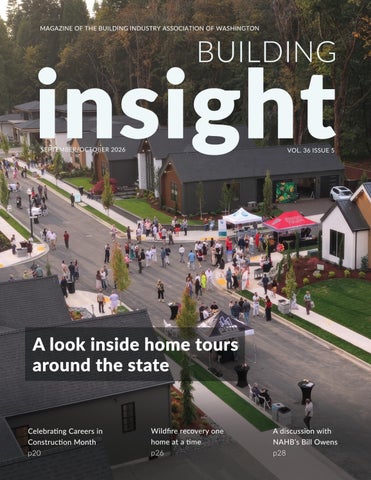
10 Look inside the 2026 Home Tour season Homeowners, potential home buyers, future remodeling clients and dreamers got a look at what Washington’s homebuilding community can offer through home tours and shows put on by local homebuilding associations across the state.
COMMUNICATIONS MANAGER Hannah Cassara PRINCIPAL UX DESIGNER Lena Anderson
20 Celebrating Careers in Construction Month
BIAW MANAGEMENT EXECUTIVE VICE PRESIDENT Greg Lane
Meet BIAW’s 2026 scholarship and grant recipients as we celebrate the building industry, inspire the next generation, and highlight the many careers our industry offers during Careers in Construction Month.
WASHINGTON HOME BUILDERS FOUNDATION DIRECTOR Al Audette VP - INDUSTRY PARTNERSHIPS & RESEARCH Chris Corry
IN THIS ISSUE
19 2027 Compliance Calendar What WA builders need to act on before year-end
VP - COMMUNICATIONS Janelle Guthrie
4 President’s message
VP - BUSINESS DEVELOPMENT Bart Hansen
5 Upcoming classes
VP - OPERATIONS Stephen Hyer
6 Executive Vice President’s message
ROII DIRECTOR Jenn Kavanaugh
7 FREE safety training for
VP - GENERAL COUNSEL Ashli Penner LEGISLATIVE DIRECTOR Andrea Smiley
CONTACT US For editorial inquiries, contact hannahc@biaw.com Interested in advertising in Building Insight? Contact communications@biaw.com
26 Wildfire recovery one home at a time
ROII participants
28 A discussion with NAHB’s Bill Owens
30 Keeping experience on the job A preferred worker success story
8 Associate Spotlight
31 What you need to know
about WA’s new income tax
9 PWB Week
Celebrating making a difference in workforce and policy
32 BIAW General Election Voter’s Guide
34 Hard hat expiration and
14 Washington’s 2024
replacement
Residential Energy Code
ON THE COVER
16 A 40-year analysis of housing
An overhead look at the Building Industry Association of Clark County’s 2026 GRO Parade of Homes in Vancouver, which took place September 10-27. Check out other home tours and shows put on by local homebuilding associations across the state this year on page 10.
affordability in WA
www.BIAW.com Building Insight magazine is published on behalf of the Building Industry Association of Washington by Print Northwest.
18 WA’s Housing Attainability Index: Q2 2026
WE’D LOVE TO HEAR FROM YOU
@BuildingIndustryAssocWA
As always, we want to hear from you! We invite you to take a quick survey about your thoughts on Building Insight. Happy reading!
@biawofwa
@BIAofWA
Building Industry Association of Washington
b u i l d i n g i n s i g ht | s e pte m b e r/october 2 0 2 6
3
President’s message Earlier this year, I watched a Kaiser webinar on “quiet cracking,” where people continue work despite carrying deep anxiety, depression, family stress or other mental health challenges. It really hit home. Faced with economic uncertainty, increased regulatory challenges, labor shortages and family responsibilities, those of us who work in the construction industry face a higher risk of suicide or other deaths of despair, such as those related to drug and alcohol abuse.
Aaron Marvin
President
I’ve talked with many friends and colleagues who’ve experienced losses on their teams, in their local associations or even in their family—and I’ve experienced losses as well. It makes you feel helpless and overwhelmed. Yet our industry traditionally chooses to tough it out instead of seeking help.
We can help each other Throughout my year as BIAW president, I’ve shared the benefits and opportunities your local home building association membership brings you. I’ve talked about the free contracts we provide to help you run your business, the constellation of professional peers that bolster your business, legislative and legal advocacy, wildfire recovery resources and more. This month, I’m reminded that our membership is about much more than our businesses. We can help each other navigate our lives as well. September is National Suicide Prevention Month. BIAW joins the National Association of Home Builders (NAHB) in raising awareness and asking members to check in with one another. It can be as simple as asking “How are you doing?” NAHB also has training and toolbox talks to help make addressing mental health as prominent as discussing fall prevention and other physical safety issues.
4
building insight | se ptem b er/o c to b er 2 0 2 6
STAND up for suicide prevention The Construction Industry Alliance for Suicide Prevention encourages all of us to take the pledge to STAND up for mental health and suicide prevention. Safe: Create a culture where team members feel safe asking for help if they are having suicidal thoughts or if they worry their fellow co-workers may be at risk of suicide. Training: Make suicide prevention training available to all team members so that they can recognize the warning signs and be equipped to help those at risk. Awareness: Raise awareness through trainings, safety meetings, toolbox talks, team meetings, newsletters, and social media posts about suicide prevention. Normalize: Normalize the topic of suicide prevention as a health and safety priority by talking about suicide, suicide prevention, and mental health. Decrease: Help decrease the risk of suicide in construction by ensuring that all team members know about the Employee Assistance Programs provided through our health insurance plans as well as behavioral health benefits, screening tools, community crisis support, the Suicide Prevention Lifeline, and Crisis Text Line.
Let’s connect Many of our local associations hold regular Contractor Roundtables or Build Better programs where members can gather for candid conversations about running their businesses. These are great gatherings for connecting with other builders and associates to get fresh ideas to help you through difficult times. It’s one of the best benefits of membership! Access NAHB training and toolbox talks resources.
Pledge to STAND up for mental health and suicide prevention.
UPCOMING CLASSES
Thinking about suicide?
Project Management November 5 | Vancouver
ROII Safety Roundtable November 9 | Suncadia
Certified Erosion & Sediment Control Lead (CESCL) November 11 | Online
CESCL Recertification November 13 | Online
Aging Workforce: Protecting Your Legacy Workers November 17 | Online
Call or text 9-8-8 anytime for 24/7 crisis support. Text HELLO to 741741 to connect with a counselor.
WHY RISK IT?
Protect What You Build.
Fall Protection/Ladder Safety Awareness December 1 | Online
CPR/AED Basic First Aid December 18 | Vancouver
Certified Erosion & Sediment Control Lead (CESCL) January 20 | Online
CESCL Recertification
Written Insured Warranties for New Home Construction Solid Coverage from Foundation to Rafters Minimize liability and reduce your financial risk. Expert assistance in handling disputes / free mediation. Attract more buyers with peace of mind protection.
January 22 | Online Learn more and register at:
biaw.com/members/classes
800-247-1812 x2188 sales@rwcwarranty.com rwcwarranty.com
b u i l d i n g i n s i g ht | s e pte m b e r/october 2 0 2 6
5
Executive Vice President’s message As we head into the general election, I encourage you to support candidates who understand what’s at stake for housing affordability and the American Dream of homeownership.
I-645 would repeal this unconstitutional tax and protect Washington businesses, individuals, entrepreneurs and families from unfair taxation.
Vote for pro-homebuilding candidates
Our next chance to get together is coming up soon, and I hope to see many of you there. The BIAW Fall Board Meeting will be at Suncadia Resort in Cle Elum, Nov. 9-11.
Decisions made by Congress, the Legislature, and the courts directly affect the homebuilding process and whether families have a realistic path to homeownership. These decisions influence housing supply, construction costs and the economic conditions that allow our industry to build, families to afford homes and communities to thrive.
Greg Lane
Executive Vice President
That’s why it’s so important to carefully consider candidates to ensure we are electing policymakers who understand that a strong building industry is essential to expanding opportunities for homeownership. The Washington Affordable Housing Council (WAHC), BIAW’s political advocacy arm, met at the BIAW Summer Board Meeting in June to review recommendations from local homebuilding associations and vote on endorsements for the Washington State Legislature. Later in this issue, we outline those endorsements for legislative candidates and the five Supreme Court races in the 2026 BIAW Voter’s Guide. Please take a look.
Vote YES on I-645 to repeal the income tax We also encourage you to vote YES on Initiative 645, which would reverse the state’s newly passed income tax. Don’t be fooled by advocates for this tax – it is not just for millionaires. Many legislators have openly admitted they plan to reduce the threshold well below just residents who earn $1 million, meaning this income tax is coming for all Washingtonians.
6
building insight | se ptem b er/o c to b er 2 0 2 6
Join us in Suncadia
Our BIAW Board Meetings are a great opportunity to network with builders and associates from across the state, meet with your councils and committees, and help shape our approach to the upcoming legislative session. We’ll celebrate the installation of BIAW’s new senior officers, induct our newest BIAW Hall of Fame member, and elect the next BIAW and NAHB officers. I look forward to the important work we will accomplish together.
Congratulations, Janelle Guthrie Last but certainly not least, I am thrilled to share that our very own VP of Communications, Janelle Guthrie, was recently honored with a lifetime achievement award by the Public Relations Society of America Puget Sound Chapter! Janelle, a long-time leader for the Public Relations Society of America, received the 2026 Jay Rockey Lifetime Achievement Award, which recognizes the career achievements of a Puget Sound area public relations professional whose work has advanced the field and demonstrated outstanding professional ability and conduct throughout their career. Congratulations, Janelle! This award is so well deserved, and we are very honored to work alongside you.
FREE SAFETY TRAINING FOR ROII PARTICIPANTS Upcoming Classes ROII participants have access to a variety of FREE safety classes designed to help reduce risk, meet state requirements and keep crews safe. Take advantage of these upcoming courses that tackle liability, safety, and inspections. Sign up early to secure your spot!
November 9 | Suncadia (BIAW Fall Board Meeting — open to all BIAW members) NEW! ROII Safety Roundtable
Join fellow safety professionals for a roundtable discussion focused on L&I Safety Consultations, featuring guest speakers from L&I Consultation. Network with peers, ask questions, share ideas, and leave with practical insights you can apply in your workplace. Breakfast and coffee provided.
November 17 | Online Aging Workforce: Protecting Your Legacy Workers
Your most experienced workers are one of your greatest assets. This class provides practical strategies to improve safety, reduce physical strain, and preserve the knowledge and skills that keep your workforce strong.
December 15 | Online Help Minimize Risk: Condition Your Workforce for Safety
This 3-hour workshop covers topics rarely discussed in construction safety. The class will show you how to cultivate a workforce centered around safety and build habits that stick, as well as best practices for hiring and common injuries with various solutions for avoiding them.
These classes are just one of the many safety resources available to ROII participants. If you're not enrolled in ROII, it's easy to find out if you qualify. Get started at roii.com/inquiry.
b u i l d i n g i n s i g ht | s e pte m b e r/o ctobe r 2 0 2 6
7
Associate Member Spotlight
Rowdy Yates of Total Energy Management HVAC & Electrical A longtime, dedicated HBATC volunteer, Rowdy Yates has 20 years of experience in the construction industry, including 18 years in HVAC. Yates actively serves on HBATC’s Parade of Homes Committee. His commitment, reliability and willingness to go above and beyond whenever help is needed exemplify the true spirit of service. Born and raised in the Tri-Cities, he lives there today with his wife and two boys.
ROWDY YATES Home Builders Association of Tri-Cities
Associate members are a vital part of our industry, making up 66% of the National Association of Home Builders (NAHB) membership. They include dedicated suppliers, service professionals and manufacturers, and they are fundamental to the strength of both our industry and our association. BIAW’s Associate Advisory Council proudly hosts the annual Associate Star Awards each year at the BIAW Fall Board Meeting. Join us in honoring the final 2025 Associate Star Award recipient, Rowdy Yates of the Home Builders Association of Tri-Cities (HBATC).
Total Energy Management offers a wide variety of services including HVAC service and repair, replacement heating and cooling solutions, new construction HVAC and electrical services, automation and controls, complete fabrication design and more. Their experienced team provides the expertise to support all project scopes. Learn about all Management has www.teminc.com.
Total Energy to offer at
Honoring our Associates NAHB’s 2025 member census shows that Associate members remain the largest contingent of its membership— and that their businesses are thriving.
8
building insight | septem b er/o c to b er 2 0 2 6
Associate members’ gross median revenue was $3.4 million in 2025, a 12% rise from 2024 and the highest (in nominal terms) in the census’s 18-year history. Of the roughly members:
71,000
Associate
n 42% are primarily subcontractor/ specialty trade contractors n 12% have a professional specialty n 9% are either in retail dealerships/ distributorships or financial services n 6% are wholesale dealerships/ distributorships These figures underscore why Associate Member Appreciation Month matters. Every September, we celebrate Associate members and recognize their contributions to the NAHB Federation and the home building industry.
These numbers show the strength and diversity of NAHB’s Associate membership—and the importance of members doing business with members. Thank you to all our Associate members for the vital role they play in building the American Dream.
Professional Women in Building Week celebrates making a difference in workforce and policy by Janelle Guthrie Vice President - Communications
Women make up a growing share of the construction workforce—and Washington state ranks among the top five states for the highest percentage of women in the workforce.
PWB leading in workforce development
As the National Association of Home Builders (NAHB) celebrates Professional Women in Building (PWB) Week this year, they’re also celebrating that “the number of women employed in the construction industry rose to around 1.37 million in 2025, an increase of about 31,000 from 2024. Women accounted for 11.3% of total construction employment, the highest share in the past 20 years.”
In Pierce County, PWB members teamed up with the Girl Scouts of Western Washington to learn skills and little libraries at the Building Beyond the Walls training center.
In Washington, that percentage is even higher, with women making up 13% of the workforce. The growth of women in the workforce and in public policy positions is making a difference.
PWB councils pave the way The increase in women working in construction comes at a time when the number of PWB councils across Washington has exploded. In the last two years alone, PWB has grown from three local councils in 2023 to nine local councils and a statewide PWB council. The total number of PWB members in Washington is now close to 300. This growth in PWB councils brings opportunities to mentor students and young professionals, celebrate success and learn from one another.
PWB members across Washington are making a difference in building the workforce in a variety of ways.
PWB members from Pierce County, Whatcom County and King County also stepped up to support the Renton Technical College Construction Trades Advisory Group, including Lucy Wilson from Reier Construction, Denise Lones of The Lones Group and Jennifer Tennyson of Jennifer Tennyson Remodel. Other PWB councils host regular conferences and awards programs to spotlight top women in our industry and share professional development.
Bateman shared how she became involved in politics and became a champion for housing, while also providing updates on HB 1110, SB 5148, and her role as Chair of the Senate Housing Committee. Talbert shared her experience as a woman co-owner in construction, and Janis shared updates on housing bills that help create more housing opportunities for everyone. As the PWB movement continues to grow, one thing is clear: women are making a difference in workforce development and public policy, and that’s something to celebrate!
TOP 5 STATES FOR WOMEN IN CONSTRUCTION
Women helping to shape public policy
14.2% Delaware
One of the legislature’s newest housing champions is Olympia’s Sen. Jessica Bateman. Bateman, who spoke at BIAW’s Winter Board Meeting at SeaTac, also joined the Olympia Master Builders for their regular “Food for Thought” series.
13.3% Alaska
Bateman joined Juli Talbert from West Coast General Construction LLC and Christina Janis with Epic Realty for “Policy and Progress: Building Pathways for Women in Construction.”
13.5% Florida 13.2% Hawaii 13%
Washington
11.3% National average
b u i l d i n g i n s i g ht | s e pte m b e r/october 2 0 2 6
9
Builders, trades and designers enjoy the spotlight during 2026 tour season by Janelle Guthrie Vice President - Communications
Homeowners, potential home buyers, future remodeling clients and dreamers enjoyed a taste of what Washington’s homebuilding community can offer over the last several months. Whether visiting a parade, a tour, or a festival, guests explored a wide variety of designs, beautiful materials, and exemplary craftsmanship across a range of home styles, sizes, and price ranges. Events like these expose potential new customers to the possibilities available to them when they work with homebuilding association members. They also give builders, remodelers, subcontractors, suppliers and designers the opportunity to work together and showcase their best work. With events ranging from one day to nearly three weeks, homebuilding association staff and local volunteer committees work nearly year-round to ensure success. 2
Building Industry Association of Clark County (BIACC) GRO Parade of Homes presented by Mechanics Bank Sept. 10-27 This single-site event featuring eight newly constructed homes by eight different homebuilders in Vancouver is the longest and only single-site tour in Washington.
1
1. VIP party attendees kick off the GRO Parade of Homes. 2. The Aurora, built by Generation Homes Northwest with Emily Jean Interior Designs, features special touches like a scullery kitchen, a stunning master suite and a custom golf simulation room. For a virtual tour of the homes, visit: groparadeofhomes.com/web/homes/year/2026
10
building insight | se ptem b er/o c to b er 2 0 2 6
The GRO Parade of Homes kicked off with a ticketed “Hot Havana Nights” VIP Party giving guests a preview of the parade with music, great food and beverages. Members of the general public purchased tickets for $20/day or $50/for a season pass with part of the proceeds benefiting St. Jude Children’s Research Hospital. The Parade also featured special themed days including: n A Vendor & Supplier Show on Sept. 12 and 13 n Industry & Design Day on Sept. 17 with Color and Design tours, a Designed for Success panel and the Industry Professionals White Party, where guests wore all white. n A special Food Drive day in memory of BIACC staffer Danielle Kilian.
Home Builders Association of Tri-Cities (HBATC) Parade of Homes Sept. 12-13, 16, 17 and 19-20 The HBA of Tri-Cities featured 11 new homes in Richland, Kennewick and Pasco. The event featured a special sold-out Chefs on Parade evening on Sept. 17 where six local chefs prepared samples of their signature dishes in six different Parade homes. 1
1. The Banner Bank Best in Parade Award went to Prodigy Homes Inc. and the Interlude Flex Euro. This Modern European style, 2,380-sq. ft. home, located in Harmony Estates, included three bedrooms, 2.5 baths and a dedicated flex space. (Photo courtesy of HBATC) 2. Jason Wilkinson, Certified Builder, and his team celebrate their awards. To view the 2026 Parade Homes, visit: www.paradeofhomestricities.com
2
Central Washington Home Builders Association (CWHBA) Tour of Homes Sept. 15, 17, 19-20 The Central Washington Home Builders Association Tour of Homes launched with its Builder Bus on Sept. 15, followed by Chefs on Tour – an exclusive ticketed event pairing stunning homes with top culinary talent. Hosted on Sept. 17, guests enjoyed a sneak peek at select homes with savory gourmet bites and craft beverages. The tour opened to the public on Sept. 19 and 20 with a $10 admission to visit seven homes around the Yakima Valley. Three more homes could be viewed online, including the Best in Show Winner built by Graphite Construction. 1. The People’s Choice Award went to HiLine Homes with its welcoming timber-frame porch and expansive outdoor living area.
1
View photos, virtual tours and videos of the homes at: www.cwhba.org/tour-of-homes
b u i l d i n g i n s i g ht | s e pte m b e r/october 2 0 2 6
11
Olympia Master Builders (OMB) 27th Annual Tour of Homes Sept. 19-20 The Olympia Master Builders 2027 Tour of Homes gave attendees 13 opportunities to find inspiration with stops at a new condominium project, multiple residential remodels and accessory dwelling units, a commercial project and new construction. 1. The 2026 People’s Choice award for Best Overall Experience went to Doyle Construction, LLC, for an extensive waterfront remodel that included a new second story to enhance the home’s incredible water views. The free lattes from Boogie Beans added a nice touch! Photo: The Doyle Construction team with designer Diane Gasman of Interior Dimensions amidst the beautiful entryway water feature by Nature Perfect. 2. The 2026 Award for Members Doing Business with Members went to Kuster Homes & Remodeling, LLC, and Jeff Kuster for his work with Amber Bevacqua from Maple + Marble Cabinets + Interiors. The duo teamed up to refresh an entire home, including Bellmont cabinetry, new countertops and hardwood floors in the kitchen.
1
Check out the OMB Tour at ombtourofhomes.com 2
Spokane Home Builders Association (SHBA) 22nd Annual Fall Festival of Homes presented by ICCU Sept. 25-27 and Oct. 2-4 Spokane’s Fall Festival of Homes has featured more than 500 homes over the last 22 years.
1
This year’s free scattered-site event featured 23 homes by 18 builders in Liberty Lake, Spokane Valley, South Hill, North Spokane and Deer Park. 3
1. The SHBA Showcase Home built by Condron Homes (#17), spotlighted the master craftsmanship of a collaboration of SHBA members. 2. Strohmaier Design & Build - Set among the rolling hills of the Palouse, Crimson & Clover boasts a stunning kitchen described as the centerpiece of this 4,800-sq. ft. home. 3. Brian Offield from Gordon Finch Homes and Katie Getman from Katie Getman Design celebrate winning multiple awards at the Fall Festival of Homes Kickoff night in late September. 2 12
building insight | se ptem b er/o c to b er 2 0 2 6
Tour the Fall Festival homes at fallfestivalofhomes.com/showhomes
Kitsap Building Association (KBA) Parade of Homes Oct. 3-4 Kitsap Building Association’s free scattered-site parade included new custom, multifamily and manufactured homes, an aging-in-place accessory dwelling unit and a Habitat for Humanity project. 1. Molly McCabe of McCabe by Design/Fine Line Carpentry, LLC, and Scotti Campbell of SJC Design and Interiors teamed up to help a repeat customer take advantage of new ADU ordinances to transform an unused daylight basement space into an innovative and accessible new apartment for the customer’s mother. Featured in Forbes, the project incorporated aging-in-place components like wayfinding design to assist with vision limitations, a wheel-chair friendly, curbless shower with handheld shower head and fold-out bench and undercounter microwave. (Photo: Scotti Campbell with the homeowner) 1
View the KBA Parade of Homes at: www.kitsapparadeofhomes.com/homes
Master Builders of Pierce County (MBAPC) Tour of Homes Oct. 3-4 After being on hiatus since COVID, MBA of Pierce County hosted a scattered-site event featuring six homes by five builders in Tacoma and Gig Harbor. Admission to attend was $20.
1
Master Builders of King & Snohomish Counties (MBAKS) Remodeled Homes Tour
1. Chris Ellis and Lucy Wilson, Certified Builder, of Reier Construction greeted guests at a newly remodeled 1934 home overlooking Commencement Bay. Reier Construction’s award-winning remodel required concealed structural steel improvements to correct previously hidden deficiencies before they could complete the expanded chef’s kitchen. The home also features the hidden second-floor laundry room that captured a BIAW Excellence in Remodeling Award in 2025. (l-r: Karissa Kolman-Chairez and Ana Rogers from Infinity Stone Works, Wilson, Reier, Juile Evans from Statements Tile, Cristina Gotti from Contract Furnishings Mart.) View a virtual tour of the homes at: masterbuilderspierce.cpjam.com/2026-Tour-of-Homes/properties
Oct. 17 The Master Builders of King & Snohomish Counties presented a one-day scattered-site tour showcasing top remodeling projects. Four homes were featured for in-person viewing, with several others available to be toured virtually. To view the Virtual Remodeled Homes Tour, visit remodeltour.com
b u i l d i n g i n s i g ht | s e pte m b e r/october 2 0 2 6
13
Washington Center for Housing Studies
Washington’s 2024 Residential Energy Code Affordability Gains and Energy Choice Penalties Prepared by Patrick Hanks
The Washington State Building Code Council (SBCC) is preparing to adopt the 2024 Washington State Energy Code for residential and commercial buildings (WSEC-R and WSEC-C, respectively). In this study, BIAW’s Center for Housing Studies analyzed some of the most significant changes in the 2024 WSEC-R, estimated how they will likely change construction costs, and analyzed their likely effect on housing affordability and attainability in Washington.
2024 code may reduce construction costs
costs than homes using natural gas. Even with the 2024 WSEC’s overall cost reductions, gas homes face $25,319.85 more in construction costs to comply with the code compared to electric homes. This is because the WSEC continues to set different effective energy-savings targets by heating fuel type and requires additional costs, such as electric readiness, for gas homes. It’s easy to see how natural gas is penalized when you compare credit
requirements for heating types across the last few WSEC editions. Each 0.5 credit in R406 is considered equivalent to 600 kilowatt-hours (kWh) of energy savings. The credits “provided” in R406.2 carbon count towards the required credits in R406.3. So, by subtracting the carbon emission equalization from the primary credit requirements and multiplying each half credit by 600 kWh, we can average the effective energy savings required across home sizes for each heating type. This is illustrated in the graph below.
The proposed 2024 WSEC-R is unusual because, for the average 2,376 square foot home, it may lower construction costs compared to the 2021 WSEC. This analysis estimates average first cost savings of about $1,759 under the prescriptive pathway and about $4,307 under the Energy Rating Index compliance pathway. Most of those savings come from two changes: updated home size brackets and the new ERI pathway, which gives builders more flexibility than the prescriptive code.
Discouraging natural gas in homes However, the savings are not evenly distributed. Homes using electric heat pumps generally have lower compliance Note: Definition of heating types changed between the 2018 and 2021 WSEC, this graph approximates how the heating types would be compared across the codes.
14
building insight | septem b er/o c to b er 2 0 2 6
“
The cost of regulation for an average new home is $131,734. —NAHB Report
The graph shows that the 2015 WSEC did not treat fuel types differently. The 2018 WSEC introduced penalties for electric resistance and natural gas. Then the 2021 WSEC made these penalties far more severe, particularly for natural gas. On average, new homes using natural gas in Washington are expected to achieve 2,000 to 3,000 kWh more energy savings than homes using electric heat pumps.
What does electrification mean for Washington’s grid?
7.7 TWh annually. The Chief Joseph hydroelectric dam, the second-largest power plant in Washington, produces 11.2 TWh annually. So, just to meet demand for converting current homes using natural gas to electric, Washington would need another nuclear or hydroelectric [PH8] power plant. The hypothetical power plant would need to produce enough power to become the new third-largest power plant in the state.
The push for an all-electric grid means that existing homes and infrastructure that rely on natural gas will need to be converted at some point. Currently, natural gas provides 26% of Washington’s electricity generation.
This estimate only accounts for homes relying on natural gas for primary heating (not secondary heating or other uses) and doesn’t account for future homes.
Additionally, one-third of Washington homes use natural gas for primary heating. The residential sector accounts for one-fourth of the state total for natural gas consumption.
A recent study from the National Association of Home Builders (NAHB) showed that—based on surveys from builders and developers—the added cost of regulation to the price of an average new home is $131,734. Of that regulatory cost, 30% ($40,288) comes from changes to the building codes over 10 years.
The report estimates converting the state’s natural gas-heated homes to electric heating, water heating and cooling could represent roughly 9.1 terawatt-hours (TWh) of annual electricity demand. To contextualize that figure, the Columbia Generating Station, the thirdlargest power plant and largest nuclear power plant in Washington, produces
design options, or not produce net cost savings for consumers in a reasonable timeframe. This report recommends lower-cost alternatives for the SBCC to make targeted changes before final adoption to remove unnecessary cost increases or design limitations. Overall, the 2024 WSEC includes important affordability improvements, but targeted amendments are still needed to reduce unnecessary costs. Read the full report at housingstudies.biaw.com.
Reducing unnecessary regulatory costs
While that figure is for all building codes, builders often cite the energy code specifically as one of the biggest regulatory cost drivers for housing. Several proposed changes in the 2024 WSEC will increase costs, limit
About the Washington Center for Housing Studies
BIAW’s Washington Center for Housing Studies delivers in‑depth research and data‑driven policy analysis on the high costs of homebuilding in Washington state. Our mission is to spark actionable solutions—streamlining regulations, reforming impact fees, expanding financing for workforce housing, and improving planning frameworks—so more Washington families and workers can access quality housing at fair prices.
b u i l d i n g i n s i g ht | s e pte m b e r/october 2 0 2 6
15
Washington Center for Housing Studies
The 115% Economy A 40-year analysis of housing affordability in WA by Riley Helean External Affairs & Research Coordinator
Was the median-priced home ever truly attainable for households earning near the median income? A recent report by BIAW’s Washington Center for Housing Studies answers this question by establishing a 40-year historical baseline for housing affordability in Washington.
115% to 181% economy
Since 2024, the Washington Center for Housing Studies has produced the Housing Attainability Index (HAI), a recurring report that measures how affordable local housing markets are for working households by estimating the share of residents who can and cannot afford the median-priced home. In its most recent publication, the HAI found that only 25 percent of Washington households can afford the medianpriced home.
From 1984 through 2021, the medianpriced home generally remained within reach of Washington households earning only slightly more than the area’s median income. On average, a household needed to earn 115% of AMI to purchase the median-priced home without becoming cost-burdened.
Historically, one of the defining economic expectations of the American working class was that ordinary earnings could support ordinary homeownership. This report looks at whether that was ever a practical reality in Washington state.
The HAI also examines the income required to purchase the median-priced home, expressed as a percentage of Area Median Income (AMI). AMI is the midpoint household income for a given area. Throughout its publication history, the HAI has consistently found that Washington requires approximately 170-180% of AMI to afford the medianpriced home, indicating a substantial disconnect between household incomes and housing prices.
16
building insight | septem b er/o c to b er 2 0 2 6
By 2026, that threshold had risen to 181% of AMI, leaving Washington in what may now be described as a “181% economy.” Rather than needing to earn 15% more than the median household, prospective homebuyers must earn 81% more than the median household to comfortably purchase the median-priced home. See the chart below. The same trend can also be shown in nominal dollar terms. In 2026, the qualifying income required to purchase the median home has risen to nearly $180,000 annually, roughly $80,000 more than the median household income. This
More concerning, these elevated levels have persisted for four consecutive years, suggesting that what initially appeared to be a temporary affordability shock has instead become a new and substantially less affordable housing environment.
Reversing the gap This report’s central question was whether the median-priced home was ever truly attainable for households earning near the median income. The answer is yes. For nearly four decades, Washington’s housing market operated within a remarkably consistent range, where the median-priced home generally required only modestly above-median earnings. historically unprecedented gap exceeds any other year in this dataset. Similar to the first chart, the data show that the income required to qualify for a median-priced home generally tracked median incomes until 2022. One explanation for the sudden recent decline in affordability is the rapid spike in interest rates beginning in 2022. However, that explanation does not tell the whole story. Even after the 2022 interest-rate spike, mortgage rates are still lower than pre2008 levels. This suggests that historically low mortgage rates during the 2010s may have temporarily masked underlying long-term housing supply constraints, allowing affordability to remain relatively stable despite a decade of weak housing production, during which housing units permitted per capita declined by 28% compared with preceding decades. The next chart compares housing cost and household income growth in Washington State since 1984, the first year in the dataset. Because 1984 had exceptionally high mortgage interest rates (approximately 14%), it was one of the least affordable years in the study period despite relatively modest home prices. As a result, growth in household income generally kept pace with, and often exceeded, growth in monthly housing costs for much of the following four decades. This relationship remained
largely intact until 2022, when housing costs began increasing substantially faster than household incomes, producing the sharp affordability deterioration observed today. This divergence has accelerated sharply in recent years. Since 2012, housing costs have more than tripled, while household incomes have not even doubled. In other words, housing costs have grown nearly four times faster than incomes since 2012.
Since 2023, however, purchasing a median-priced home has required roughly 51%-52% of median household income, representing the highest sustained housing burden in the historical record.
If Washington wishes to restore broad access to homeownership, the state must do more than slow the decline in affordability. It must meaningfully reverse it. The gap between the median household and the median home has grown too large to close through marginal adjustments alone. Recreating the conditions that once made homeownership broadly attainable will require housing outcomes at a scale not seen in recent years.
Read the full report at housingstudies.biaw.com.
b u i l d i n g i n s i g ht | s e pte m b e r/october 2 0 2 6
17
Washington Center for Housing Studies
Washington State’s Housing Attainability Index: Q2 2026
Housing affordability in Washington by Riley Helean External Affairs & Research Coordinator
The Housing Attainability Index is a recurring Washington-based resource for assessing whether county-level housing markets provide a range of housing choices that are affordable— and therefore attainable—for the state’s workforce.
Homeownership remains unaffordable for roughly 75% of Washington families: on average, a household must earn approximately 177% of area median income (AMI), or about $175,000 annually, to qualify for a loan on a median-priced home.
Homeownership out of reach for 75% of WA families
By contrast, the median Washington household earns approximately $99,839—well below the income needed to purchase the median-priced home at a price of approximately $601,016.
Inflation continues to shape the broader economic outlook as prices rise across multiple sectors. Annual overall inflation has hovered around 3.5 percent since spring, hitting its highest level since May 2023 and tempering earlier expectations for rate cuts in 2026. Shelter inflation remains slightly below both overall inflation and wage growth, suggesting modest, continued gains in housing affordability, largely driven by interest rate reductions. Even so, Washington home prices remain well beyond the reach of median-wage households who do not possess existing financial assets.
What stands in the way? Frequent code changes The added regulatory costs from building codes since 2009 is $39,876, with a majority of that amount associated with the State’s energy code, which is the most stringent in the nation.
Given concerns about inflation, new taxes, and higher interest rates, current attainability metrics may represent a near-term high-water mark unless structural changes improve underlying market conditions. Since the November 2025 update, interest rates have declined slightly, while wages and median home prices have each increased marginally. Despite these changes, homeownership attainability remains essentially unchanged. 18
building insight | septem b er/o c to b er 2 0 2 6
This does not diminish the importance of energy performance goals, but it shows how layering regulations can make a good’s cost unaffordable for most households. A more deliberate code-adoption schedule would allow policymakers to evaluate implementation effects before layering on additional requirements. Land scarcity Outside Urban Growth Areas (UGAs), residential subdivisions are generally prohibited. Today, only 3.74% of Washington’s land is located inside UGAs and therefore subdividable. This constraint directly affects housing attainability because land scarcity limits builders’ ability to achieve scale. Policy options exist that focus on targeted land availability and recognize both the value of comprehensive GMA goals while balancing the need for a land base sufficient to support attainable housing production. Permitting delays Lengthy or inconsistent permitting increases carrying costs, delays production, and makes it more difficult for builders to plan projects with confidence. Solutions that reduce discretionary uncertainty while maintaining appropriate local review should remain a statewide policy goal. Read the full report at housingstudies.biaw.com.
2027 Compliance Calendar
Private 401(k): Features significantly higher contribution limits ($24,500), potential tax credits to offset plan fees, and employer matching options that strengthen recruitment in competitive trade markets.
What Washington builders need to act on before year-end
Action step: Total your 2026 employee hours at year-end to check coverage, then choose the retirement option that best fits your hiring and retention goals.
by Ricky Redman Paylocity Partner Advocate
Most compliance issues in construction start as an overlooked paperwork gap before becoming legal trouble. The next twelve months bring key state deadlines, including new requirements for smaller employers. Here is what is coming, along with a practical action step for each.
display mandatory program posters in the workplace.
Want a second set of eyes before January?
Action step: If you have 15–24 employees, update your leave policies, verify recurring payroll deductions, and establish coverage plans for key roles during potential midproject absences.
1. Fall 2026: 2027 Workers’ comp rates
3. June 30, 2027: Noncompete agreements become void
L&I announces proposed rates in early fall, adopts final rates later, and applies them January 1, 2027. For 2027, L&I evaluates reported hours and claim costs from July 1, 2022, through June 30, 2025. Because Washington’s system is hoursbased, wage increases don’t change the base rate paid.
Under ESHB 1155, Washington bans virtually all noncompete agreements with employees and independent contractors effective June 30, 2027. This state ban applies retroactively, rendering existing agreements completely unenforceable.
I’m offering BIAW members a free 20-minute 2027 readiness review. We’ll walk through your headcount against the PFML and Washington Saves thresholds, how your hours are tracked by risk class, and what your payroll and HR setup needs to handle before these dates hit. No pitch, and you’ll leave with a short list of what to fix first, whoever you work with.
Action step: Review your rate notice when it arrives. Ensure worker hours are classified accurately, especially for crew members splitting time between field projects and shop or office work.
2. January 1, 2027: Leave protection expands to 15-employee shops Under HB 1213, Paid Family and Medical Leave (PFML) job protection expands to smaller employers: 15+ employees in 2027, down from 25 in 2026. Workers employed for at least 180 calendar days gain job protection. Without an hoursworked minimum, many part-time employees are newly covered. This change raises the compliance stakes on everyday PFML administration: Leave limits: Employees can take up to 12 weeks of leave, 16 weeks for multiple events, or 18 weeks for pregnancy-related incapacity. Funding & rules: Employers with fewer than 50 workers only collect and remit the employee portion. Catch-up payroll deductions for missed premiums are strictly prohibited, and employers must
Training-repayment clauses are also restricted. Narrow exceptions exist primarily for business sales involving an ownership interest transfer of one percent or more. Action step: Audit offer letters, subcontractor agreements, and training clauses during winter. Employers must make reasonable efforts to notify affected current and former workers by October 1, 2027.
Contact Ricky Redman at RRedman@paylocity.com. Ricky Redman works with Washington builders and multi-location employers on payroll, HR, and workforce compliance as a Partner Advocate at Paylocity, a BIAW partner. He is based in the Treasure Valley and covers Idaho and Washington. This article is for general information and is not legal advice.
4. July 1, 2027: Washington Saves state retirement mandate Washington Saves launches July 1, 2027, applying to businesses operating at least two years with 10,400+ combined annual employee hours (roughly five FTEs) unless they offer a qualified private retirement plan. Employers must evaluate statesponsored auto-IRAs against private retirement plans: State Auto-IRA: Offers simple setup and low administrative burden, but features lower contribution caps ($7,500 limit) and strictly prohibits employer matching contributions.
Brought to you by our partners at Paylocity
b u i l d i n g i n s i g ht | s e pte m b e r/october 2 0 2 6
19
Celebrating Careers in Construction Month October is a time to celebrate the building industry, inspire the next generation, and highlight the many careers our industry has to offer during Careers in Construction Month. The residential construction industry offers a range of rewarding, in-demand opportunities. According to the National Association of Home Builders (NAHB), the country needs skilled tradespeople in carpentry, plumbing, electrical and
more, with 326,000 openings across the industry. For many, these careers offer a chance to earn a quality living without the expense of a traditional four-year degree. In 2025, the national median construction wage was $61,370— higher than the U.S. median annual wage of $50,980—and the top 25% of construction workers earned at least $83,480.
Meanwhile, 47% of students who graduated from four-year institutions owed an average of $29,560 in student debt, according to the College Board’s 2025 Trends in College Pricing and Student Aid report.
BIAW’s Washington Home Builders Foundation The Washington Home Builders Foundation (WHBF) is BIAW’s charitable arm. The foundation’s purpose is to educate, train, and grow the construction workforce to establish careers, build more homes, and foster hope for generations to come. WHBF was founded in 2012 to address educational and workforce needs in the building industry through charitable activities. Its mission is to open doors to construction careers by providing hands-on training, industry-recognized credentials, and direct connections to employers.
BuildStrong Academy of Pierce County, powered by HBI In 2025, BIAW launched the BuildStrong Academy of Pierce County, powered by the Home Builders Institute (HBI). Academy students get hands-on learning, classroom instruction and reallife experience under one roof, with a focus on job placement, mentoring and ongoing support. In just eight weeks and seven hours a day, academy graduates master construction fundamentals, earn a high-paying wage, and transform their lives and communities. The academy is located at the Goodwill Milgard Work Opportunity Center in Downtown Tacoma. Learn more at biaw.com/constructiontrades-training-academy. 20
building insight | septem b er/o c to b er 2 0 2 6
The Summer 2026 cohort of the BuildStrong Academy of Pierce County, powered by HBI, graduates with their Pre-Apprenticeship Certificate Training in Construction, ready to enter the workforce.
Scholarship and Grant Program Through its scholarship program, WHBF provides financial assistance to Washington residents pursuing construction-related careers at accredited community colleges, technical schools, apprenticeship programs, or universities within the state. Scholarships are awarded to students who demonstrate both a commitment to the building industry and a need for additional financial support to complete their education, helping develop the next generation of skilled professionals in fields such as construction management, engineering, welding, carpentry, and other building trades. In addition to individual scholarships, WHBF offers grants to organizations that deliver construction-related education,
career training, continuing education, apprenticeship opportunities, skills assessments, and technical training programs. These grants strengthen workforce pipelines by supporting schools, nonprofit organizations and industry training programs that prepare students and workers for careers in residential construction. Since its inception, BIAW has awarded over $890,000 in scholarships and grants.
The foundation awarded six scholarships to students pursuing careers related to residential construction, engineering and the skilled trades.
Meet BIAW’s 2026 Scholarship and Grant Recipients
“We’re proud to support the next generation of homebuilders,” said WHBF Chair Corey Condron. “Whether they are pursuing careers in engineering, construction management or the skilled trades, these students will help address our state’s workforce shortage and build stronger communities for generations to come.”
BIAW’s Washington Home Builders Foundation (WHBF) awarded $60,000 in scholarships and grants in 2026 to support students and workforce development programs across Washington state.
In addition to student scholarships, WHBF awarded grants to four educational programs that are helping train and inspire the next generation of construction professionals.
b u i l d i n g i n s i g ht | s e pte m b e r/october 2 0 2 6
21
“
I dream of going abroad and combining the skills that I’ve attained with new knowledge of people and cultures.
Molly Malone, Washington State University, Civil Engineering
Leticia Ramirez-Espinoza, Bellingham Technical College, Welding
Inspired in part by her father, who is a civil engineer, and her love for math, Molly Malone chose to pursue civil engineering for its versatility and the opportunities it offers to make a meaningful impact through infrastructure and design.
After attending a high school Career Day, Leticia Ramirez-Espinoza was inspired to enroll in metalworking classes.
“Ever since I can remember, I have loved math,” Malone said. “Since coming to college, I’ve got to really dive deeper into math itself, and how it relates to me. Now, taking my first-ever Civil Engineering course, I can clearly see how math relates to what I dream of becoming.” She sees engineering as an opportunity not only to build technical expertise but also to connect with different cultures and communities, gaining a global perspective that will strengthen her ability to solve problems and serve others. “I want to be a student of the world,” Malone said. “I dream of going abroad and combining the skills that I’ve attained with new knowledge of people and cultures.”
“
There is something uniquely satisfying about walking away from a project and being able to point to something physical and say, ‘I helped make that.
Evan Sturdivant, University of Washington, Engineering Growing up, Evan Sturdivant was always drawn to building things. But something clicked during a 2024 mission trip to Rosarito, Mexico, where he helped build homes for families in need. The experience showed him firsthand how construction can transform lives and strengthen communities. Now a student at the University of Washington, Sturdivant is considering a degree in Civil or Mechanical Engineering. He hopes to contribute to projects that improve communities through innovative building systems, energy-efficient design, and practical infrastructure solutions. “There is something uniquely satisfying about walking away from a project and being able to point to something physical and say, ‘I helped make that,’” Sturdivant said. “That instinct has shown up repeatedly throughout my life, and it is what ultimately led me toward engineering and the construction industry.”
22
“
My interest began during my sophomore year on Career Day, when two welders visited my school and introduced us to the trade.
building insight | se ptem b er/o c to b er 2 0 2 6
“My interest began during my sophomore year on Career Day, when two welders visited my school and introduced us to the trade,” Ramirez-Espinoza said. “Their presentation introduced me to the technical skills, safety practices, and career opportunities within the field.” Through her high school’s metalworking program, RamirezEspinoza built a strong foundation in welding techniques, including MIG and ARC welding, while gaining valuable experience working with tools and fabrication processes. She has continued to expand her skills through advanced coursework, participation in her school’s SkillsUSA Club, and involvement in extracurricular projects and competitions. A 2026 graduate of Nooksack Valley High School, Ramirez-Espinoza is now enrolled in Bellingham Technical College’s welding program. With a strong work ethic and growing technical expertise, she is focused on building a successful future in welding and contributing to the next generation of skilled trades professionals.
“
I hope to focus on becoming a cabinet maker, where I can use my skills and creativity to build quality pieces that people will use in their homes for years to come.
Jaden Allison, Carpenters Training Center, Carpentry Apprenticeship Program It wasn’t until Jaden Allison’s junior year that she began seriously thinking about the career path she would follow. She knew she didn’t want to sit in front of a screen all day, and she found that working with her hands and building things was what she felt most passionate about. A Liberty High School graduate, Allison is now enrolled in the Carpentry Apprenticeship program at the Carpenters Training Center in Spokane. After graduation, she plans to complete the courses necessary to obtain her journeyman’s certificate in carpentry. “I hope to focus on becoming a cabinet maker, where I can use my skills and creativity to build quality pieces that people will use in their homes for years to come,” Allison said.
“
I hope to be able to help the people who share the world with me through building and constructing the tools and places that are used all across society in everyday life.
Connor Banta, Gonzaga University, Mechanical Engineering Drawn to solving problems and finding practical solutions, Connor Banta naturally gravitated toward a career in the construction industry. Growing up with a father who worked in construction, he gained an early appreciation for the impact builders, engineers and tradespeople have on everyday life.
2026 Educational Program Grant Recipients Kitsap Building Association (KBA) Foundation — Builder Grant Program The Builder Grant Program is a workforce development and job placement initiative serving young adults ages 18–24 in Kitsap County. The program is designed for young adults exploring career pathways outside a traditional four-year college route and seeking hands-on learning and direct connections to local employers in the building and construction trades.
Now a Mechanical Engineering student at Gonzaga University, Banta is developing the technical skills needed to turn ideas into real-world solutions. His long-term goal is to apply his engineering and construction knowledge to designing and building tools, infrastructure, and systems that improve everyday life. Banta believes the industry’s future lies in balancing innovation with proven building practices, and he hopes to contribute solutions that benefit communities for generations to come. “I hope to be able to help the people who share the world with me through building and constructing the tools and places that are used all across society in everyday life,” Banta said.
“
I want to try and focus my work on smart homes/buildings, passive homes and net zero homes/building.
Bryan Sheedy, Washington State University Construction Management Growing up in a family rooted in the construction industry, Bryan Sheedy developed an early passion for building and construction. His father has spent more than three decades working on major commercial construction projects throughout Washington and the West Coast, while his mother works with the Skagit/Island Counties Builders Association.
Participants complete an application and interview process, then are matched with a local trades company based on their interests and career goals. Participants receive paid, on-the-job training, hands-on instruction in trade skills, and mentorship from experienced KBA & Foundation member professionals. The program provides participants with real-world experience, industry exposure, and the confidence needed to enter a living-wage career. Quilcene School District Construction Trades Program
Growing up with a front-row seat to his parents’ careers gave Sheedy a unique perspective on the people and opportunities in the building trades, sparking his interest in construction and shaping his career goals. Now a student at Washington State University (WSU) pursuing a degree in Construction Management, Sheedy is focused on building the knowledge and experience needed to succeed in the industry.
The Construction Trades Program provides students with an introduction to the construction industry and foundational construction skills. Students learn to follow safety protocols, to use, clean and store tools appropriately and to apply construction knowledge to projects.
“My future plans and career goals are first to graduate from WSU with a degree in construction management, then I would like to try and work under my dad and gain as much experience as I can,” Sheedy said. “Next, I want to try and focus my work on smart homes/buildings, passive homes and net zero homes/building.”
Students engage with construction measurement, explore print reading, expand their knowledge of common construction materials and fasteners, and learn the basics of foundations
b u i l d i n g i n s i g ht | s e pte m b e r/october 2 0 2 6
23
and framing. Students develop project management skills, including applying construction math to calculate estimates, developing a project schedule and closing out a project. Community Works/Puget Sound Voyaging Society More than 20 years ago, Community Works began as the Puget Sound Voyaging Society to provide experiential learning through maritime programs. Over the years, the group expanded its vision of experiential learning for young people, adding construction training alongside intergenerational mentorship that builds life skills like communication, time management, and problem-solving. Community Works requested funding for 12 young people to participate in its three-month internship program that blends leadership, teaching, and organizational skills with technical woodworking expertise. This offers local workforce development, contributing to local economic growth while helping young people chart a better future for themselves. South Puget Sound Community College (SPSCC) Residential Construction Academy The SPSCC Residential Construction Academy uses Home Builders Institute (HBI) curriculum to provide hands-on training that prepares individuals for careers in residential construction while helping strengthen the workforce needed to build housing in our region. Through real-world building experience, students develop the skills, confidence and industry knowledge needed to enter the skilled trades. The SPSCC Residential Construction Academy provides students with real-world experience and industryrelevant training, including: n Carpentry fundamentals n Framing and residential building practices n Jobsite safety and OSHA standards n Tool use and construction techniques n Teamwork and project-based learning 24
building insight | septem b er/o c to b er 2 0 2 6
Students work alongside instructors and industry professionals to gain practical skills that prepare them to enter the workforce with confidence. Graduates gain access to: n Pathways to family-wage careers in the trades n Industry connections and mentorship n Practical experience valued by employers
About the Washington Home Builders Foundation Washington’s homebuilding industry continues to face a shortage of skilled workers. Through scholarships, grants and workforce development initiatives, WHBF works to ensure students and job seekers have opportunities to explore rewarding careers in residential construction. Since its inception, the Washington Home Builders Foundation has invested hundreds of thousands of dollars in workforce development, scholarships and educational programs that strengthen the residential construction industry throughout Washington state. The Washington Home Builders Foundation is the charitable arm of the Building Industry Association of Washington. The foundation promotes careers in the residential construction industry through scholarships, workforce development initiatives, educational grants and community outreach programs. Learn more at biaw.com/donate.
BUILDING STRONGER FUTURES Your support helps provide scholarships, grants, and workforce training through the Washington Home Builders Foundation and BuildStrong Academy of Pierce County.
Ways to Give Make a one-time tax-deductible donation Set up monthly giving Shop BIAW Swag or attend BIAW education courses Leave a lasting legacy through planned giving
b u i l d i n g i n s i g ht | s e pte m b e r/october 2 0 2 6
biaw.com/donate
25
Wildfire recovery one home at a time Spokane Home Builders Association, NAHB, BIAW and partners help survivors navigate their futures by Janelle Guthrie Vice President of Communications
As friends, family and colleagues continue down the long road to recovery after surviving the Spokane Complex fires in early August, members of the Spokane Home Builders Association (SHBA) are stepping forward to help—not just as contractors but as trusted resources with the knowledge and compassion to bring relief after this senseless tragedy.
Senseless tragedy The Old Trails Fire started mid-day on Saturday, Aug. 1, sweeping across northwest Spokane and jumping the Spokane River, causing officials to evacuate thousands of people, including members and staff at the Spokane Home Builders Association, their friends, family and customers. Started by an arsonist, then fueled by high temperatures and strong winds, the Old Trails Fire and two others, now known as the Spokane Complex, ultimately destroyed roughly 700 homes in the Spokane area. “We have members, family and friends who lost their homes,” said Joel White, SHBA’s Executive Officer. “We’re here to help them, give them the best advice we can and help them rebuild. We want to be the trusted resource for homeowners.”
“Good contractors don’t have time to go knocking on doors,” said SHBA member Matt Graupner with Farmers Insurance.
BIAW staff helped update the SHBA Disaster Recovery Resources page, prepare social media content and reach out to Spokane media.
Local, state and federal assistance critical
SHBA members and others across the state and nation volunteered to help both with clean-up and rebuilding and by sending donations to the SHBA Wildfire Disaster Recovery Fund.
Providing early guidance In the early days of recovery, Spokane home builders, clean-up companies and insurance professionals shared resources and wisdom with fire survivors to help them avoid unscrupulous businesses that might prey on their desperation and desire to rebuild quickly. “Our focus is on rebuilding and the longterm recovery process because we know this isn’t going to be a short process,” White said. “Time is sometimes not your friend because the process may take longer than it normally would in a construction project.”
Almost immediately, phones started ringing as displaced homeowners sought to get a head start on rebuilding their homes, White said.
The homeowner’s first step is to contact their insurance company to review their coverage and report damages BEFORE hiring any contractors. Most agencies have 24/7 claims centers to help with next steps, including help with additional living expenses to cover temporary housing, food and other needs.
By Monday, Jonathan Falk, Director of Disaster Operations at the National Association of Home Builders (NAHB), had reached out to SHBA with a series of templates and ready-to-post content to help builders and affected homeowners navigate the road ahead. He’d also provided similar resources to the Central Washington Home Builders Association
SHBA also advised homeowners to resist the urge to work with scammers who pressure them into signing contracts right away or ask for cash up front. SHBA has a list of reputable contractors ready to help. While contracts and deposits are common, homeowners should never give in to pressure from a door-to-door contractor.
Springing into action
26
and Home Builders Association of Tri-Cities as their members dealt with wildfires in their communities.
building insight | septem b er/o c to b er 2 0 2 6
Early in the recovery efforts, state and local government officials stood up an Emergency Disaster Center at Shadle Park High School where individuals could replace critical personal documents like driver’s licenses, birth certificates and vehicle and vessel titles at no charge, access disaster recovery and emergency assistance, find housing, financial assistance and insurance resources and get food, basic needs and financial support. The Spokane Complex Fire was one of many this summer, prompting Gov. Bob Ferguson to sign an emergency proclamation suspending state laws to help those affected. He also requested and received a federal emergency declaration for six counties and three Tribal nations. Both BIAW and SHBA worked with state and local officials to identify exactly which laws and ordinances could be suspended or changed to expedite recovery. Among those suggestions was suspending the 2021 Washington State Energy Code and allowing builders to rebuild under the 2006 or 2015 codes depending on when the home was built. Expedited permitting, flexible zoning and tax relief were also suggested.
Coming together to speed rebuilding In early September, SHBA members joined representatives from Spokane County, the City of Spokane, Spokane Regional Clean Air Agency and Medical Lake in a two-hour community forum to discuss building and how to work together on recovery.
n Cory Carper from Rob’s Demolition walked the group through the demolition and clean-up process.
Together, the group shared how they could work together to help families shell-shocked by the loss of their homes.
n Fred Anderson from Compass Construction discussed restoration, fire and water damage recovery and rebuilds.
“The vast majority of those impacted have never built anything, never built a house, never completed a major renovation,” Falk said. “They have no idea where to start.”
n Titus Hug, SHBA’s current president from Hug Construction, provided insights from his experience rebuilding after the Gray fire several years ago.
“It’s your job to help keep them from making a mistake,” Anderson said. “We have to remember we’re all on the same team here, and there’s plenty of work.”
n Graupner covered insurance and claims.
Adjusting ordinances and laws to speed recovery
The group agreed it all starts with showing care and compassion to fire survivors who’ve lost everything and face a long road to rebuild.
Ferguson recently asked the Washington State Building Code Council to adopt an emergency rule allowing affected homeowners to rebuild with the following adjusted guidance.
“These people woke up one day thinking they were going to work, and the next thing you know, their whole life is turned upside down,” said Anderson, a past president of SHBA. “This is not just another build.” “Every insurance company is different, every house is different, and every customer is different,” Hug said. NAHB’s Falk agreed. “You’re not rebuilding 700 homes at a time,” he said. “You’re rebuilding one home, by one home, by one home. You are the front lines of your community.”
In early October, the Spokane City Council approved two ordinances to help affected homeowners rebuild with fewer barriers, including allowing property owners to add an accessory dwelling unit (ADU) adjacent to their property before their primary home is rebuilt and allowing homeowners to rebuild a home in a “like-for-like” manner.
Next steps Now over two months since fires first blazed through these neighborhoods, the recovery and rebuilding efforts continue moving slowly, but surely, forward.
Washington’s home builders are here to help. “We have a great community of builders here,” Hug said. “We’ve built Spokane before. Let’s do it again.”
General tips for working with homeowners to rebuild after tragedy 1. Listen first, build second: Before discussing permits, plans or budgets, take time to listen as people process their grief. 2. Become their trusted guide: Right now, homeowners need more than a contractor. They need a guide to help them understand the process. 3. Communicate constantly: Overcommunicate, if necessary. These people didn’t plan to build a home. Many have never worked with a builder. 4. Slow down important decisions: Help people understand that rebuilding is a lengthy process. Making a thoughtful decision today can prevent future regrets. 5. Lead with compassion: If your heart is not connected with your customer, you won’t be successful. You’re not just rebuilding a home. You’re helping a family recover from one of the worst experiences of their lives.
b u i l d i n g i n s i g ht | s e pte m b e r/october 2 0 2 6
27
Leadership, advocacy, disaster recovery and mental health A discussion with NAHB’s Bill Owens I’m a builder and remodeler from Columbus, Ohio, and I’ve been involved with NAHB for many years, first through my local and state associations and later through national leadership. I’ve also spent a lot of time teaching in the industry and have had the opportunity to work with builders across the country. My wife, Betsy, is my partner in life and business. We’ve built our careers together and raised three sons. Serving as chairman has been incredibly rewarding because it gives me the chance to represent more than 140,000 members and connect with professionals from every corner of our federation.
Aaron Marvin: Many
After National Association of Home Builders (NAHB) Chair Bill Owens visited the BIAW Summer Board Meeting, BIAW President Aaron Marvin followed up with an in-depth chat about NAHB member benefits, advocacy, support for local associations facing disasters, and mental health. Here are some of the highlights.
Aaron Marvin: Bill, tell us a little about yourself and your role with NAHB.
Bill Owens: I’m honored to serve as the 2026 Chairman of the National Association of Home Builders. BIAW is one of our strongest state associations, and I appreciate the partnership we have with Washington builders. 28
members know NAHB for its advocacy work, but membership offers much more than that. What do you consider the most valuable benefits of membership?
Bill Owens: Advocacy is certainly one of our core strengths. Most people are familiar with our federal government affairs efforts, but we also provide significant support at the state and local levels. Beyond advocacy, education and professional development are extremely valuable benefits. Through our designation and certification programs, leadership development opportunities, spokesperson training, the International Builders’ Show and numerous specialty conferences and symposiums, we help members build successful businesses and careers.
building insight | septem b er/o c to b er 2 0 2 6
The third major benefit is networking. We create opportunities for members to learn from one another, share ideas, build relationships and support each other through the challenges of the industry. Whether it’s our leadership meetings, Legislative Conference or other events, those connections are often just as valuable as any program we provide.
Aaron Marvin: NAHB’s federation model provides members with local, state and national membership through one investment. Which level of membership do you consider most important?
Bill Owens: The local association is absolutely the foundation of everything we do. You’ve heard me say before that there is no NAHB without members, and that’s true. Membership starts at the local level. That’s where relationships are built, where members engage and where we find our strongest connection to the industry. Our job at the national level is to support local and state associations by providing resources, services and expertise they can’t easily provide on their own. The federation is strongest when every level understands its role and works together. Local and state associations have their own unique identities and ways of doing business, and we fully support that.
Aaron Marvin: Washington builders face challenges ranging from housing affordability and permitting delays to workforce shortages and regulatory burdens. How does NAHB support state associations like BIAW in addressing these issues?
Bill Owens: We have one of
Bill Owens: NAHB maintains
the strongest advocacy teams in the industry, with more than 40 professionals focused on federal, state and local government affairs. We also have a strong legal team that helps support builders when policy or legal action threatens housing affordability or property rights.
disaster relief resources and support systems to assist builders, communities and associations following natural disasters. When events such as wildfires, hurricanes, or floods occur, we work with local and state associations to identify needs and provide assistance.
One of our biggest roles is serving as a clearinghouse for successful strategies and best practices from across the country. We help state and local associations learn from one another and avoid repeating mistakes others have already encountered. We provide research, data, legal resources, advocacy training and strategic support. We also help train builders and members to become more involved in the public policy process, including helping them run for local office and become part of the decisionmaking process. Ultimately, we want our members to have a seat at the table and be part of creating housing policy rather than simply reacting to it.
Aaron Marvin: When states adopt policies that can negatively impact housing affordability or consumer choice, how does NAHB respond?
Bill Owens: Housing affordability is fundamentally a housing policy issue. At NAHB, we consistently advocate for policies that increase housing opportunities and improve affordability. Too often, well-intentioned regulations add costs, delays and barriers that ultimately make housing less attainable for families. We often describe today’s affordability challenges as “death by a thousand cuts.” There isn’t just one policy causing the problem. It’s the cumulative impact of regulations, fees, permitting delays, restrictions and mandates. Our advocacy efforts focus on helping policymakers understand those impacts and encouraging practical, balanced approaches to housing policy.
Aaron Marvin: Wildfires and other natural disasters continue to affect communities across the country. What role does NAHB play in recovery and resilience efforts?
From a building perspective, resilience is becoming increasingly important. Builders are constantly balancing performance, safety and affordability. Whether it’s fire-resistant materials, defensible space planning or emerging technologies that improve home resilience, we’re focused on helping builders make informed decisions that protect homeowners while keeping housing attainable. As the industry’s housing professionals, we have an important role to play in rebuilding communities and improving long-term resilience.
Aaron Marvin: One of the major initiatives we’re hearing about nationally is NAHB’s Blueprint to 100. Can you tell us more about it?
Bill Owens: Blueprint to 100 is a strategic effort focused on preparing NAHB for its next century of service. The initiative is centered around three key areas. First, we’re taking a fresh look at our membership model. We know that local associations across the country operate differently, and we want to make sure our national structure effectively supports where membership actually happens, which is primarily at the local level. Second, we’re reviewing our governance structure and bylaws. Over the years, we’ve added layers of complexity that can make it more difficult to respond quickly in today’s business environment. Our goal is to create greater flexibility and agility while maintaining strong governance. Third, we’re developing a three-year strategic plan that will guide our nearterm priorities and support our longterm vision.
where we gathered feedback from members, association executives and even non-members to understand what they want and need from a national trade association moving forward.
Aaron Marvin: Mental health has become an increasingly important topic in construction. Why is mental health awareness important for builders, contractors and tradespeople?
Bill Owens: Construction can be an incredibly rewarding industry, but it can also be challenging physically, emotionally and mentally. One of the biggest changes we’ve seen in recent years is a willingness to talk openly about mental health challenges and substance abuse issues that affect our industry. That’s an important step forward. At NAHB, we’ve been working to provide resources, tools and training that help members recognize warning signs, understand available support systems and create healthier workplace cultures. Whether we’re discussing substance abuse, suicide prevention, stress, or overall wellness, the goal is to make sure people know they’re not alone and that help is available. I think simply having more open conversations is one of the most important things we can do. When people feel connected and supported, they’re more likely to seek help when they need it.
Aaron Marvin: Final thoughts for builders across Washington state?
Bill Owens: Washington has an outstanding association and an incredibly engaged membership. The professionalism of the staff, volunteer leaders and members throughout Washington is something the rest of the country can learn from. I appreciate the partnership and all the work you’re doing to support housing and the building industry.
Watch full video
A major component of this work has been an industry-wide “pulse check,” b u i l d i n g i n s i g ht | s e pte m b e r/october 2 0 2 6
29
ROII
Keeping experience on the job: A preferred worker success story by Leah Jaber ROII Communications & Marketing Manager
When a workplace injury changes a worker’s ability to perform their job, many employers assume they have no choice but to replace them. But with the right support, that’s not always the case. One of ROII’s participants, a company specializing in underground utilities, faced exactly this situation when a longtime employee was injured after slipping on ice at a jobsite. The worker had been with the company for 27 years and was a highly valued member of the team. Unfortunately, the fall resulted in a serious shoulder injury that ultimately required two surgeries. Even after treatment, his medical provider determined that he would be left with permanent restrictions and would no longer be able to perform all the duties required in his original position. For the employer, the possibility of losing nearly three decades of experience and industry knowledge was a tremendous concern. Rather than accepting that outcome, ROII’s claim representative worked closely with the employer and the medical provider to explore return-towork options. The first step was to create a detailed job description outlining the worker’s preinjury duties. The medical provider then identified which specific tasks the worker could no longer safely perform. Using that information, ROII staff helped the employer develop a modified position that combined approved job duties, additional responsibilities, and practical accommodations. The plan also included
30
ways other crew members could assist with tasks that exceeded the worker’s restrictions. Once the new position was developed, the medical provider reviewed and approved the job description, allowing the worker to return to work safely in his new role. The ROII claim rep then guided the employer through the Preferred Worker application process, and the worker received Preferred Worker certification through the Washington State Department of Labor & Industries.
What is the Preferred Worker Program? Many employers are unfamiliar with the Preferred Worker Program, but it can be a valuable tool when a worker has permanent restrictions after an injury. The program helps employers retain experienced workers by providing financial incentives and protections when hiring or accommodating a certified Preferred Worker. Depending on the situation, employers may qualify for benefits such as partial wage reimbursements, reimbursement for certain training costs, and protection against claim costs if the worker experiences a subsequent injury while working within their approved restrictions. For employers, it can make the difference between losing a valuable employee and keeping their knowledge, skills, and experience within the company. For workers, it creates an opportunity to remain employed, continue contributing,
building insight | septem b er/o c to b er 2 0 2 6
and stay connected to an employer and industry they know well.
Preferred Worker Benefits — Worker Injury Date After Jan. 1, 2025 n Wage reimbursement: 50% of base wages for up to 120 workdays or up to $25,000 (within a consecutive 24-month period) n Tools & equipment: Reimbursement up to $5,000 n Clothing: Reimbursement up to $1,000 n Continuous employment incentive: $25,000
The ROII difference Successful return-to-work outcomes don’t happen by accident. They require coordination between workers, employers, medical providers, and L&I. In this case, ROII’s claim representative helped identify a workable solution that allowed a dedicated employee to remain with the company after 27 years of service. The employer retained a trusted team member, the worker returned to productive employment, and the company was able to take advantage of Preferred Worker benefits available through L&I. It’s a great example of how proactive claims management and return-to-work planning can lead to better outcomes for everyone involved. If you are not currently enrolled in ROII and want to see if your company may qualify, visit roii.com/inquiry to get started.
Sold as a tax on Wall Street. Built for Main Street. What you need to know about WA’s new income tax by Andrea Smiley Legislative Director
Throughout the 2026 legislative session, BIAW and its members fought efforts to impose an unconstitutional income tax on the people and businesses of Washington state. But the legislative majority and our governor ignored the opposition and approved it anyway. Despite the rhetoric, the new “millionaires tax” isn’t about millionaires at all. It’s about redesigning Washington’s tax code to be more progressive with the hope that it will withstand scrutiny from the state Supreme Court. It will, or should, given that the majority party in Olympia has been appointing judges for the better part of the last 40 years. If the new income tax was truly about millionaires, corporations wouldn’t have sold out small businesses. The harsh reality is that the new tax is structured to reach personal income while largely exempting wealth retained inside major corporations.
What you need to know n The $1 million standard deduction exists in statute today, but like a pie crust, it can be easily cut away by future legislatures. n Rental income isn’t exempt. The $1 million deduction is a speed bump, not a guardrail. Lower it, and more rental income is taxed, increasing pressure on rents. n A $100,000 cap on charitable deductions penalizes generosity, weakens civil society, and shifts more responsibility from communities and charities to the state. n 21,000 taxpayers. 300 new tax administrators. That’s roughly one new government employee for every 70 households paying the tax, a striking level of overhead for a tax advertised as affecting only a small group. n By eliminating pension exemptions, the bill turns future taxation of retirement income into a threshold debate rather than a statutory rewrite. Main Street businesses, property owners, retirees, and investors don’t have the luxury of waiting to see how future legislatures or courts respond. The best defense against uncertainty is preparation. Members should consult trusted tax, legal, and financial advisors to assess their individual exposure, identify planning opportunities, and make informed decisions based on their unique circumstances. For access to member directories across the state, please visit biaw.com/join-locally.
b u i l d i n g i n s i g ht | s e pte m b e r/october 2 0 2 6
31
Legislative races bring new faces With open seats, emerging candidates and shifting political dynamics, these legislative races are poised to be some of the most closely watched contests of the cycle. We’ve endorsed the following candidates: n Alan Nolan – Representative DISTRICT 6
n Daria Ilgen – Representative
General Election Voter’s Guide
DISTRICT 23, running against the infamous Rep. Tarra Simmons
n Erika Creydt – Senate DISTRICT 42
n Hillary Pham – Representative DISTRICT 4
n Joe Bushnell – Representative DISTRICT 29
n Jonathan Bingle – Representative DISTRICT 6
Don’t miss your chance to advance pro-homebuilding candidates for local elected and legislative offices in the upcoming November general election. The Washington Affordable Housing Council (WAHC), BIAW’s political advocacy arm, met at the BIAW Summer Board Meeting in June to review recommendations from local homebuilding associations and vote on endorsements for the Washington State Legislature. County election offices will mail out ballots by Oct. 16. Be sure to vote by Nov. 3 to make sure your voice is heard!
Races to watch 3rd Congressional District State Senator John Braun is challenging incumbent Marie Gluesenkamp Perez for Washington’s 3rd Congressional District, a perennial battleground in Southwest Washington and one of the nation’s most closely watched races. Braun enters the contest as a credible challenger with a legitimate path to victory. The key question may not be whether the district is competitive, but whether divisions within the Democratic coalition ultimately prove a greater liability for Gluesenkamp Perez than Republican opposition.
32
4th Congressional District Meanwhile, in Eastern Washington, Yakima County Commissioner Amanda McKinney is running in Washington’s 4th Congressional District, one of the state’s safest Republican seats. Barring an unexpected political earthquake, the district is not expected to produce any surprises in November. Supreme Court Let’s be honest, most voters don’t have the time, resources, or legal background to thoroughly evaluate judicial candidates. Supreme Court races can be some of the most difficult choices on the ballot, even for the most engaged voters. While no one can predict how a judge will rule, we’ve done our best to identify candidates whose judicial philosophy, record and approach to the law align most closely with the interests of small businesses. Based on that review, we recommend the following candidates for the Washington Supreme Court: n Scott Edwards (Position 1) n David Stevens (Position 3) n Sean O’Donnell (Position 4) n Dave Larson (Position 5)
building insight | se ptem b er/o c to b er 2 0 2 6
n Joshua Thompson – Representative DISTRICT 13
n Justin Pike – Representative DISTRICT 42, Giving Rep. Timmons a run for his money
n Katy Cornell – Representative DISTRICT 26 open seat, Caldier’s vacant seat
n Luc Jasmin III – Representative DISTRICT 3 open seat after Ormsby retirement
n Robert “Chili” Hicks – Representative DISTRICT 10 running against Rep. Shavers
n Steve Ewing – Representative DISTRICT 39
Housing Champions Housing solutions require leadership, and Legislative District 35 delivered. Rep. Couture and Rep. Griffey each earned perfect Housing Champions scores of 100%, while Sen. MacEwen earned 93%, making District 35 one of Washington’s strongest-performing districts on housing issues. We thank the district’s lawmakers for their commitment to increasing housing choices, reducing barriers to development, and helping more families achieve housing stability.
Housing Allies
Rep. Hackney, District 11 = 44%
Rep. Walen, District 48 = 84%
We are proud to recognize our Housing Allies: legislators who earned our endorsement, received our full campaign support, and partnered with us in advancing housing solutions in the legislature. These leaders have demonstrated a sustained commitment to expanding housing opportunities and making attainable homes a reality for more Washingtonians.
Rep. Hall, District 5 = 50%
Rep. Walsh, District 19 = 86%
Rep. Jacobsen, District 25 = 99%
Rep. Waters, District 17 = 93%
Rep. Keaton, District 25 = 97%
Rep. Ybarra, District 13 = 97%
Rep. Klicker, District 16 = 99%
Rep. Zahn, District 41 = 52%
Representatives
Rep. Manjarrez, District 14 = 96%
Rep. Abbarno, District 20 = 90%
Rep. Marshall, District 2 = 97%
Rep. Abell, District 7 = 97%
Rep. McClintock, District 18 = 87%
Rep. Barkis, District 2 = 99%
Rep. McEntire, District 19 = 71%
Rep. Barnard, District 8 = 99%
Rep. Mendoza, District 14 = 82%
Rep. Berg, District 44 = 48%
Rep. Orcutt, District 20 = 99%
Rep. Burnett, District 12 = 98%
Rep. Peterson, District 21 = 48%
Housing Partners
Rep. Callan, District 5 = 48%
Rep. Reeves, District 30 = 59%
Rep. Chase, District 4 = 94%
Rep. Richards, District 26 = 90%
Rep. Connors, District 8 = 99%
Rep. Rude, District 16 = 97%
Rep. Corry, District 15 = 90%
Rep. Rule, District 42 = 75%
Rep. Davis, District 32 = 48%
Rep. Salahuddin, District 48 = 48%
Rep. Dent, District 13 = 92%
Rep. Schmick, District 9 = 83%
Rep. Duerr, District 1 = 48%
Rep. Stearns, District 47 = 48%
Rep. Dufault, District 15 = 77%
Rep. Steele, District 12 = 91%
Our Housing Partners have earned our endorsement and varying levels of campaign support because they have shown a genuine interest in tackling the state’s housing challenges. While their legislative records do not always match our priorities, they have demonstrated a willingness to engage, collaborate and support housing policies when opportunities arise.
Rep. Engell, District 7 = 100%
Rep. Stokesbary, District 31 = 97%
Rep. Entenman, District 47 = 52%
Rep. Street, District 37 = 50%
Rep. Fitzgibbon, District 34 = 52%
Rep. Stuebe, District 17 = 93%
Rep. Gregerson, District 33 = 48%
Rep. Tomiko Santos, District 37 = 59%
Rep. Leavitt, District 28 = 66% Rep. Ley, District 18 = 97% Rep. Low, District 39 = 96% Rep. Macri, District 43 = 48%
Senators Sen. Fortunato, District 31 = 83% Sen. Holy, District 6 = 96% Sen. Krishnadasan, District 26 = 62% Sen. Liias, District = 60% Sen. Pedersen, District 43 = 47% Sen. Salomon, District 32 = 53% Sen. Short, District 7 = 94% Sen. Torres, District 15 = 87%
Rep. Donaghy, District 44 = 44% Rep. Nance, District 23 = 52% Rep. Reed, District 36 = 48% Sen. Alvarado, District 34 = 47% Sen. Lovick, District 44 = 49%
Honorable mention Lt. Governor Heck has been a strong and effective advocate for addressing Washington’s housing shortage and expanding homeownership opportunities for more families. Few elected leaders have demonstrated the same consistent commitment to increasing housing availability and improving affordability across the state. He supports thoughtful, balanced, and practical solutions, and has always been willing to listen to and work collaboratively with BIAW members.
b u i l d i n g i n s i g ht | s e pte m b e r/october 2 0 2 6
33
ROII Safety
Hard hat expiration and replacement by Bob White ROII Safety Services Director
Hard hats are designed with highquality, wear-resistant materials but do not last forever. The hard hat’s protective properties will degrade with exposure to many common work environments, such as extreme temperatures, chemical exposure, sunlight, and normal daily wear. It is important to carefully read and follow all instructions and warnings that accompany your hard hat. Failure to follow the instructions listed on your hard hat may result in serious injury or death. Always consult the manufacturer if you have questions concerning the care and use of your hard hat.
Even hard hats with a five-year expiration date are recommended to be replaced as soon as after two years under heavy use.
How can I tell if the hard hat is reaching the end of its service life? To ensure that a hard hat shell or suspension has not reached the end of its service life, visually inspect the shell for breakage, cracks, crazing, discoloration, chalky appearance, or any other unusual condition. Inspect the shell for brittleness by flexing the brim (do not compress the shell sides). These conditions can indicate a loss of impact, penetration, and/or electrical
Do not use paints, solvents, chemicals, adhesives, gasoline, or like substances on hard hats – doing so can lessen the protection from impact and penetration. How long is the expiration period? Depending on the make and model, a hard hat’s standard lifespan is generally three years after manufacture, but this isn’t always the case. Many manufacturers, such as JSP and 3M, now give a five-year lifespan from the date of manufacture. Don’t expect your hard hat to last that long. It might if it is barely used and stored in perfect condition. Be aware you will often need to change your hard hat before it expires.
34
building insight | septem b er/o c to b er 2 0 2 6
ALWAYS replace the hard hat after it has withstood impact or penetration.
Your hard hat has a date stamp The number in the middle (13) is the year of manufacture, and the arrow points to the month (5). So, this hard hat was manufactured in May of 2013.
resistance. If you see any of these signs, replace your hard hat immediately. Check the suspension for loss of flexibility. Also, look for cracks, breaks, frayed straps, or damaged stitching. If any of these conditions exist, immediately replace your suspension. These are recommended service-life guidelines. Wear or damage noticed during a regular inspection may determine that an earlier replacement of the entire hard hat is necessary.
If you are an ROII participant and would like to receive my regular safety updates, including ideas for safety topics, please contact me at (360) 352-7800 ext. 109 or bobw@biaw.com.
Not an ROII participant? Visit roii.com to learn more.
CUSTOM WINE CELLARS & SAUNAS DESIGN
BUILD
INSTALL ATIONS SINCE 1992
CUSTOM WINE CELLARS & COOLING SYSTEMS
CUSTOM SAUNAS & COLD PLUNGE TUBS
• Traditional Wood Contemporary Metal Racking Systems
• Traditional and infrared Saunas
• Cabinetry/Tabletops/Lighting • Climate Control Equipment • Expert BTU Analysis for sizing eq. • Cooling Installation & Service
• Modular Indoor or Outdoor Saunas • Sauna Heaters/Doors/Accessories • Locally Made for Quick Lead Times • Cold Plunge Tubs
FREE ON-SITE CONSULTING & CAD SERVICES (425) 226-2500
INFO@RHINOWINECELLARS.COM
PROUD SUPPORTER OF BIAW AND ITS MEMBERS STATEWIDE
b u i l d i n g i n s i g ht | s e pte m b e r/october 2 0 2 6
35
Building Industry Association of Washington 300 Deschutes Way SW, Ste. 300 | Tumwater, WA 98501 (360) 352-7800 | BIAW.com
2026 BIAW FALL BOARD MEETING
NOV. 9-11 Suncadia, Cle Elum Spotlight Events ANNUAL MEMBERSHIP LUNCHEON
Plan to attend BIAW’s annual meeting of the membership and a buffet-style luncheon. Election of BIAW and NAHB Officers In conjunction with the luncheon, BIAW directors convene to vote on BIAW and NAHB officers for 2027.
NEXT WAVE SOCIAL
Grab a bite and a drink and find out what it takes to serve in BIAW leadership: from a committee member to a chairperson to senior leadership. Hosted by the Past Presidents’ and Past Second Vice President Councils.
INSTALLATION AND AWARDS GALA
Join us as we install BIAW’s 2027 senior officers, Presidentcandidate Matt Willard; honor the Builder, Associate, and Remodeler of the Year; and induct Bob Johnson into the BIAW Hall of Fame.
Register
Network with builders and associates from across the state, meet with your councils and committees, and help shape our approach to the upcoming legislative session.
Learn more and register: biaw.com/biaw-board-meeting