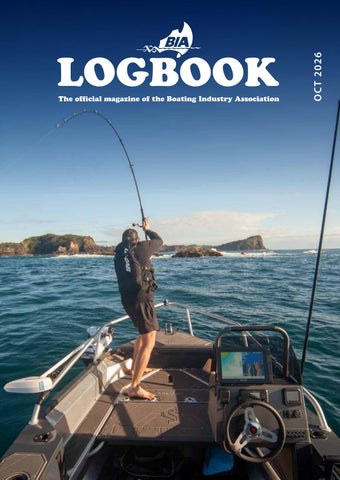
OCT 2026
The official magazine of the Boating Industry Association
TAKE THE WORRY OUT OF BOATING Choose Australia’s Top Rated Boat Insurance, as recognised by Product Review. There’s a reason why 9 in 10 members renew year after year.1
GET A QUOTE TODAY
1 Based on Club Marine data, as at July 2026. Insurance is underwritten by Allianz Australia Insurance Limited (Allianz) ABN 15 000 122 850 AFSL No. 234708, GPO Box 9870, Melbourne 3000. Club Marine Limited (Club Marine) ABN 12 007 588 347 AFSL No. 236916 issues this insurance and handles and settles claims as agent for the insurer Allianz Australia Insurance Limited. We do not provide advice based on any consideration of your objectives, financial situation or needs. Before making a decision, please consider the Product Disclosure Statement (PDS) and full terms and conditions. The PDS, Target Market Determination and full terms and conditions are available at clubmarine.com.au.
Contents 4
From the President
6
Small Boats: Big Impact
10
Change Makers – The Next Generation
14
Riding Responsibly
18
Raising the Standard – Broker Accreditation
26
Member Spotlight
34
Marine Jobs – Career Initiatives
40
Marine Careers Profiled
50
National WHS Horizons
58
Membership & Governance
63
BIA Director Profile
64
2026 State of the Industry
66
Advocacy
6
10
14 STAFF Chief Executive Officer - Andrew Fielding Chief Financial Officer - Andrew Scott General Manager Member Services - Nik Parker General Manager Government & Public Relations Neil Patchett Membership Programs Manager - Shane Wilson Manager Business Support, SA & NT - George Bolton Marine Jobs Project Officer - Maria Hobbs Marketing, Communications & Events Coordinator Alyssa Carnell Cover image - Stabicraft 1550 Frontier
18
The official magazine of the Boating Industry Association Ltd PO Box 431, OXENFORD, QLD 4210 Ph: 1300 726 287 Email: info@bia.org.au Web: bia.org.au Logbook gratefully acknowledges those that contributed to producing this publication. Please send editorial contributions to info@bia.org.au © Copyright 2026 Boating Industry Association Ltd. The opinions, advice and information contained herein have not been sought by any member or any other person but are offered as an information service and should not be relied upon as a substitute for detailed advice or as a basis for formulating business decisions. BIA intends by this statement to exclude any liability for any such opinions, advice or information within this publication.
From the President The Sydney Boat Show and surrounding events have once again given us the opportunity to come together as an industry, to reconnect with members and, more importantly, spend time with the boating public. There was a great energy around the Show and despite the continued pressure on household spending, there is still a real appetite for boating. People are keen to be out on the water, they want to see what’s new and they continue to value the lifestyle and experiences that boating offers. Our latest BIA State of the Industry Survey results reinforce just how significant our industry is to the Australian economy. With a national turnover of $10.5 billion and employment numbers exceeding 35,000 we need to remind ourselves we are a significant Australian industry. An industry built on small businesses and the people behind them. The strength of those businesses remains at the core of what we do as an association. Our role is to advocate for our industry, demonstrate its economic and social value to Government, support members and promote participation. We must also continue to encourage the next generation into boating and careers across the industry.
4 | LOGBOOK OC TOBER 2026
While the Sydney Boat Show may have finished the opportunities it created continue. Conversations started at the Show will develop over the coming months and as we head into the summer, the industry can build on the momentum. Let us not forget, boating is about more than just the boat itself. It may be fishing with friends, taking the family out cruising, learning a new skill, or simply escaping the noise of everyday life. Its shared moments and experiences that keep people coming back and attracts new people to such a great lifestyle. As President, I want to see us continue telling that story, while building a strong, sustainable industry behind it. There is plenty of work ahead but also so much to be positive about. I look forward to working with our members, State councils, fellow Board members, industry partners and the wider boating community as we enter another boating season. Tracy Souris President, Boating Industry Association
From the CEO Over the past six months, the BIA has continued to focus on the practical work that matters most to members: advocating for policy settings that allow marine businesses to operate, invest and grow with confidence; promoting boating participation; supporting marine careers; and building industry capability. A clear example of this work was the Sydney Boat Show at Sydney Showground, Sydney Olympic Park, which brought together leading brands, marine businesses, product innovation and boating lifestyle experiences. The event reinforced both the strength of the sector and the continuing appetite Australians have for time on the water. Member and exhibitor feedback was strongly positive, with quality audiences, solid buyer interest and good energy across the show. Just as importantly, it demonstrated the role BIA can play as a peak body in creating opportunities, promoting participation and supporting commercial outcomes for members.
reputation with facility operators, educators and regulators. At the same time, Discover Boating remains central to promoting participation and delivering direct value to members. Targeted campaign activity is moving beyond awareness to create more meaningful engagement with potential boaters and customers. Recent dry stack, marina referral and nurture communications work is designed to connect interested consumers with relevant member businesses and convert interest into action, ensuring campaigns are not only visible but valuable to members.
While major events remain a powerful platform for industry, our long-term success also depends on people. Through Marine Jobs activity, BIA has continued to strengthen links between schools, TAFE, training providers, employers and students considering marine careers. This has included regional career events, practical school-to-industry pathways such as immersion days, taster programs and local marine hub activity. These initiatives are helping young people see a future in the industry while giving employers better connections to future apprentices and skilled workers.
BIA’s advocacy role remains highly valued by members. We continue to work so the marine industry is represented early and effectively in decisions affecting regulation, infrastructure, access, standards and business conditions. Recent activity has included boating infrastructure issues, regional access matters, AMSA Class 4 review work, shared-use and hire-and-drive considerations, vessel technical standards, responsible boating campaigns, ski racing advocacy and ongoing liaison with government and regulators including Safe Work Australia and the Department of Employment and Workplace Relations. Across each of these areas, the objective is the same: to reduce unnecessary friction and ensure boating remains accessible, safe and well supported.
Capability and professionalism are equally important. Marine Card and Access Management (AMS) continue to support safer, more consistent site access arrangements and demonstrate the industry’s commitment to workplace safety, responsible operations and professional standards.
The past six months have shown the value of a memberowned peak body that delivers, advocates and adapts. Across events, careers, training, access management, consumer campaigns and Government engagement, BIA’s work is focused on strengthening the conditions in which members and the wider marine industry can succeed.
Current work across delivery opportunities, supplier engagement, training settings and enhancing the AMS is helping build a nationally relevant framework that supports members and strengthens the industry’s
Andrew Fielding Chief Executive Officer, Boating Industry Association
LOGBOOK OC TOBER 2026 | 5
SMALL BOATS, BIG IMPACT:
WHY AUSTRALIA’S UNDER 8 METRE FLEET MATTERS
by Tim Stackpool
The vast majority of Australia’s registered boats are under eight metres, and according to these BIA members, that segment is where the whole marine economy actually starts. When the general public pictures the Australian boating industry, they might just imagine offshore game boats, marinalined harbours, the champagne cruiser gleaming at a boat show. But that image misses the industry’s foundation entirely. The overwhelming majority of registered vessels in this country sit under eight metres, and it is this segment, being tinnies, RIBs, trailer boats, tenders and family runabouts, that quietly does the heavy lifting. Talk to the people who sell, service, insure and manufacture these boats, and a consistent story emerges. Small boats aren’t a lesser tier of the industry. They’re the foundation everything else is built on.
Neil Webster of Sirocco Marine, describes the segment as the lower rungs of a ladder. “People start small, build confidence and experience, and move up in size as their circumstances and ambitions grow,” he says. “Without a healthy under-8-metre fleet, the top of that ladder eventually empties out.” Sally Stessl of Makocraft and Sea-Trex puts it more simply: “It’s not about the size of the boat, it’s about the size of the moment.” Family fishing trips, a first ski, a first solo launch. These are the experiences that hook people for life, and they overwhelmingly happen in something under eight metres. Not everyone frames the entry point the same way. Jon Hunt of Hunt’s Marine says “I think the reality these days is that it’s just not possible to manufacture a ‘tinnie’ package for less than $10,000 or a family sized runabout for under $35,000.”
Consumer Trends
The Participation Engine
Cost-of-living pressure is reshaping demand but not in a way that’s pushing people out of boating altogether. Mark McWilliams of Northside Marine says buyers are still committing, just more cautiously: “People are still buying but they’re taking longer to decide, shopping harder on value, and leaning more on finance to make it work.”
Every operator interviewed for this article agreed on one thing: nobody starts big. Tim Wiles of Club Marine frames boating as a genuine skill to be learned. Reading tide, wind and current, reversing a trailer, judging distance on the water. As he puts it: “A sub-8-metre boat lets new participants develop their skills in a forgiving environment... before the consequences of getting it wrong become more significant on a larger platform.”
Graeme Monkhouse of BoatsOnline sees the same pattern nationally, with trailer boats holding their ground because “they also avoid ongoing marina or berth fees, which have become a real sticking point for budget-conscious buyers.” He also points to a shift toward multi-purpose boats, “ones that can handle fishing, family days out and light watersports without needing three different vessels.”
6 | LOGBOOK OC TOBER 2026
Fishing keeps coming up as the single biggest driver. Brad Cuming of Christies Beach Marine has seen “a large resurgence in small boat sales for customers ‘down-sizing’,” with rising marina fees, upkeep and fuel costs pushing owners back toward trailerable boats. Joshua Padmos of Terrace Boating agrees, noting buyers “are looking for practical, easy-to-use boats that maximise their time on the water.” Not everyone agrees demand is evenly spread, though. Hunt argues that in his market, boating has become a discretionary purchase for people who simply have the money.
The Business Opportunity Commercially, the picture is unambiguous. Small boats are not the side business, they are the business for much of the industry. Northside Marine’s revenue is roughly 95 per cent built on the sub-8-metre segment, supporting a workforce of 42 people, while Bar Crusher, Sea Jay and Makocraft all operate exclusively within it. Sam Holmes of Bar Crusher argues value isn’t just purchase price. “Value extends far beyond the price you might pay for something. It’s the pleasure a quality product brings, the longevity it delivers.” The real commercial value, several businesses stressed, extends well past the initial sale. Alfie Nevin of Boeing Trailers points out a trailer is “not simply something that comes underneath the boat, it is a critical part of the complete boating package,” generating an ongoing relationship through servicing, repairs and upgrades. Wiles makes a similar point from the insurance side: “The real value of this segment isn’t captured in any single line item. It sits in the lifetime relationship.” Stessl agrees, noting many of her Makocraft customers are now on their second, third or fourth hull.
LOGBOOK OC TOBER 2026 | 7
Infrastructure and Access If there’s one issue uniting almost every voice in this article, it’s infrastructure, and the consensus is that it’s under serious strain. Congested ramps, inadequate trailer parking and shrinking storage options came up in nearly every interview, particularly around capital cities. Wiles sums up the stakes plainly: “Anyone who has backed a trailer down a neglected ramp and found themselves bogged in sand or mud, knows how quickly a poor experience can deter people from getting out on the water.” McWilliams raises a wrinkle worth noting. Trailer boats themselves are growing, thanks to the wider availability of SUVs capable of towing up to 4.5 tonnes. “Infrastructure planning still tends to assume a tiller-steer tinnie on a small trailer,” he says, “when in reality we need to plan for larger centre-console and bowrider trailer boats with bigger tow vehicles and bigger trailers taking up more ramp and parking space.” Stessl and Monkhouse both flag housing density as a compounding problem. “With higher-density housing and smaller blocks, many people simply don’t have the space at home to store a trailer boat,” Stessl says. Hunt says future growth will most likely come from emerging regional and coastal population centres. He argues this highlights the value of BIA’s ongoing efforts nationwide to promote new and improved access and infrastructure for trailer boats. Others, including Cuming and Holmes, point to state-level issues such as algae blooms, fishing closures and shed-height restrictions, all as evidence environmental and planning decisions can have an outsized effect on participation. Whatever the cause, the message from industry is consistent: ramps, parking and storage need to be treated as genuine participation infrastructure, not an afterthought.
8 | LOGBOOK OC TOBER 2026
The Future of the Segment Looking ahead, technology is the thread every contributor to this article pulls on, even if they land in different places. Electrification features heavily. Wiles expects electric outboards and hybrid propulsion to gain real traction over the next decade given the shorter, closer-to-shore trips typical of small boats. “Lower maintenance, quieter operation, reduced emissions... I expect uptake to accelerate.” McWilliams points to early but credible momentum already in the Australian market, noting one electric tender “can push a 3m tender along at 17 knots with three people on board.” Phillip Scharf of Mountain Boats takes a different angle again, building small craft from engineered wood rather than aluminium or fibreglass. “With a strength-to-density ratio comparable to aluminium, and wood’s built-in buoyancy... no one was making a simple off-the-shelf wooden boat to compete in the modern market,” he says, betting sustainability and manufacturing innovation will matter as much as propulsion technology.
Connectivity is the other big theme. McWilliams describes docking systems now accessible enough that “it is now possible for an absolute beginner to dock a boat alongside with one finger on a joystick.” Webster expects RIBs specifically to keep gaining share as “light to tow, stable, safe and family-friendly.” Not every business is convinced innovation will radically reshape the hardware itself, though. Hunt sees this differently: “in reality how different can you manufacture a trailer boat, be it fibreglass or aluminium.” He sees electronics, not the hull, as the real frontier. A handful of those interviewed also flagged shifting ownership models. Boat share, syndicates and subscription access all pull the genuine growth lever. Wiles notes the trend is “gaining traction, particularly among younger participants who value access over ownership,” while Holmes agrees “shared ownership and club memberships may play a big part.”
The Bottom Line Strip away the differences in geography, product and business models, and the BIA members who supply, insure and build Australia’s small boats are telling a remarkably consistent story. This segment is where new boaters are made, where the industry’s future customers are found, and where the bulk of its ongoing commercial activity (service, finance, insurance, accessories) actually happens. The opportunities are real. Emphasis is on growing regional markets, evolving technology and new ownership models that could bring in participants the traditional purchase model never reached. But so are the constraints, chief among them an infrastructure network in many cities that hasn’t kept pace with demand. For an industry built overwhelmingly on boats under eight metres, getting the entry point right isn’t a niche concern. It’s the lifeblood of the sector. ☐
LOGBOOK OC TOBER 2026 | 9
Andrew Harris from Nortbank Boats
CHANGE MAKERS
THE NEXT GENERATION SHAPING THE FUTURE
by Jeni Bone
Australia’s marine industry has always been powered by people with a passion for the water and the ambition to turn that interest into a livelihood. But beneath the surface, these businesses face mounting pressures. Now, a new generation is stepping forward. From young entrepreneurs launching ventures of their own to emerging leaders taking the helm of established businesses, these professionals are bringing fresh thinking, new skills and renewed energy to every segment of the boating and broader marine industry. As the industry navigates skills shortages, succession planning and a changing business landscape, their stories offer an encouraging look at the talent shaping the next chapter. The industry is large and diverse: the BIA State of the Industry Report states the Australian boating industry supports more than 35,000 jobs across more than 2,000 businesses, with opportunities ranging from manufacturing and maintenance to marinas, tourism and professional services. The majority of marine businesses are small to medium enterprises, many of them family-owned and operated over two or more generations. Curtis Fielding left the family business just over a year ago to establish his own yacht brokerage, Fielding Marine. As a thirdgeneration Gold Coast boat sales professional, following in his dad and grandfather’s footsteps, he was born into the business. According to Curtis, there are many and varied pathways into the industry, and that “provided people are willing to learn and
10 | LOGBOOK OC TOBER 2026
Curtis Fielding from Fielding Marine step outside their comfort zone”, there are ample opportunities. “Technology, sustainability and advanced manufacturing are making boats safer, more efficient and more environmentally responsible, while creating exciting new career opportunities across the industry,” he observes. “Marine apprenticeships in boatbuilding, marine mechanics and electrical work offer some of the best opportunities for school leavers. For anyone keen to enter the marine industry, strong communication skills, reliability and problem-solving ability are a must.” Andrew Harris, Managing Director at Northbank Boats in Lonsdale, South Australia, was a customer before he bought the business. “I started my career in the Defence Force and law enforcement, where I developed strong leadership, discipline and problem-
Their business, which specialises in the development and manufacturing of anode technology for vessel corrosion protection, has been operating for 17 years and has found a foothold globally. “It’s a really exciting time for new products in corrosion and advanced protection,” she explains. “We have spent the past three years engaged in R&D and now we’re preparing to present a new product to market which has attracted worldwide interest. Our aim is to keep everything in-house, an Australian team and local manufacturing.” Their 18-year-old daughter who began working in the business while studying is now considering coming on board full-time, thanks in part to the interesting people and the diversity of projects she deals with. Northbank Boats Team solving skills. When the opportunity arose to acquire Northbank Boats, I saw an industry built around Australian manufacturing, craftsmanship and innovation. “What attracted me most was the opportunity to build something tangible with a great team while improving our processes to help grow an iconic Australian brand.” Northbank specialises in premium Australian-built fibreglass fishing and family boats ranging from around 5 to 7.5 metres, and employs around 20 people across manufacturing, production, administration and management, with a significant investment in apprentices. “Since entering the industry I’ve focused on learning every aspect of the business from manufacturing processes and product development through to sales, marketing and strategic planning.” The variety and spirit of innovation are what motivates Andrew, who says, “We’re constantly improving products, introducing new models and finding better ways to manufacture. “The most rewarding part is seeing a product go from raw materials to a finished Australian-built boat that creates lifelong memories for families. It’s also incredibly rewarding to develop young apprentices and employees, watching them build skills and confidence throughout their careers. “No two projects are ever the same and there are genuine longterm career opportunities.”
“And that’s what sets the marine industry apart,” Jess states. “From boat shows and events, we have made life-long friends in the industry and our customers span the entire length and breadth of boating. These genuine relationships are what motivate us. “The marine industry also offers incredible diversity, which should really inspire young people. Whatever skillset or interest you have, they are adaptable to the marine industry in Australia and around the world.” Danny Jordin, a self-confessed boat-obsessed sales and marketing professional who from an early age could conceive of no other livelihood apart from working with boats, is Australasian Sales Manager at Maritimo Motor Yachts. While studying for a degree in Education, Danny worked parttime at his local wakeboarding cable park and watersports store. When the opportunity of a full-time management role arose, he took it, left university and never looked back, working his way up the ladder with businesses of the calibre of Malibu Wake Boats and Cruise Craft. “My ultimate ambition was to be involved with Maritimo Motor Yachts and to have my own business,” he recounts. “Today, that dream has become a reality. Two years into business ownership, I am doing exactly what I have always wanted, working in an industry I am passionate about and building something I can be proud of.”
For Jess and Brian Gatt, Directors at Marine Protection Systems, establishing a business in the marine industry happened “organically”. “It happened by fortunate accident,” says Jess. “Both of us grew up sailing and enjoying the water, but I undertook a degree in health with the aim of becoming a doctor, and Brian is a qualified electrician.” Parenthood changed their direction somewhat, and the couple took the opportunity to explore what they describe as “a niche field in the marine industry”, which harnessed their talents and allowed them to work on and around boats. “Brian has a technical brain and is brilliant at problem solving and I use my skills gained in health which include taking a holistic approach to every project.”
Sean Savage and Danny Jordin from Maritimo Motor Yachts
LOGBOOK OC TOBER 2026 | 11
It’s not all sunshine and sailing. Operating a business in an industry comprising services, trades, manufacturing, tourism and events, is closely tied to the economy, consumer sentiment and the skills and labour shortages impacting so many industries. “Working in the marine industry, especially in boat sales, certainly looks glamorous on social media, and to be fair, a lot of the time it is,” Danny shares. “People do not see the long days and the enormous amount of work that happens behind the scenes. Like any profession, there is plenty of administration, preparation and problem solving that underpin the exciting moments. The glamorous days are only possible because of all the hard work that comes first. Nothing comes easy.” As for the impact of the global economy, Danny points out that “boat sales have always been a rollercoaster”. “You can do everything right, work incredibly hard and leave no stone unturned, yet market conditions still make things difficult. Fortunately, we are still doing ok and I think that comes down to staying positive, working harder than ever and refusing to waste opportunities.”
my job for sure, and seeing them spend fantastic family time on the water.” The more challenging side of running a family business is the seven-day demands and busy seasons that prevent business owners from enjoying time off themselves. “It’s hard to step back from the business and balance family time with work commitments,” says Jac, adding that it’s rare for them to manage more than a couple of weeks off each year, and never together as an extended family. “And when we are together, it only takes five minutes before we’re ‘talking shop’, which must be annoying for mum and family members who aren’t involved in the day to day.” Fortunately, Jac and Cam are “chalk and cheese” in their personalities and strengths. “He’s very laid back and has a business brain, and I’m bursting with energy and more of a people person. It just works. If we ever need to resolve an issue or disagreement about the business, we’re lucky we can call dad and rely on his expertise to adjudicate. That family dynamic really helps the business.”
Jac Ford and Cameron Myles are the sister and brother combination running Elite Ski Boats in Hilton, South Australia after their dad and business founder, Stuart Myles retired in 2020. Proudly celebrating 30 years in 2026 and Australia’s longest-standing Malibu dealer, Elite has earned a loyal following of owners over two generations, thanks to the personalised service and support.
Despite the long hours and complexities of running a multifaceted business that employs 10 people, Jac says “The tradeoff is we get to do something we’re really passionate about.”
Jac, who joined the business in 2003 from a background in hospitality, says the satisfaction of sharing customers’ happy moments is the best part of the job.
If you weren’t born into the business or have a boating background, a career path to the marine industry is accessible through TAFE and other Registered Training Organisations, while apprenticeships combine formal qualifications with paid, hands-on experience.
“Boats are something people save and save for, something they dream about for years. New boat handovers are the best part of
Jac Ford and Cameron Myles from Elite Ski Boats 12 | LOGBOOK OC TOBER 2026
Mentoring, training and passing on traditional skills to the next generation while keeping pace with advances in technology and AI are crucial to the industry’s ability to flourish into the future.
The BIA plays a key role in getting this message out, actively recruiting young people through career events, school engagement and marine immersion days.
From this broad poll of industry proponents, responses shared themes of integrity, commitment and passion – resoundingly passion.
BIA works with Government, TAFE, other RTO and industry partners to strengthen training pathways and connect people with employers, including programs that give students practical exposure before progressing into Certificate III apprenticeships.
“I honestly believe passion is the foundation of a successful and enjoyable career,” Danny emphasises.
The latest initiative is a collaboration between the BIA and Club Marine, who have produced a video called “Find Your Path to the Water”. Created for online and social media distribution, the promo features six profile stories challenging the perception that people need to be experienced boaties to enter the industry. Those who share their personal stories highlight the excellent long-term prospects. “The key message is that if you have drive and motivation, a job in the boating industry can take you anywhere, and you will be supported by many great people who want to see you succeed,” comments Club Marine CEO Tim Wiles. That sense of community and collaboration is a major drawcard, as Danny Jordin explains. “It might sound like a cliché, but the best part of working in the marine industry is the people. The marine industry really does feel like one big community. “It’s an industry full of passionate people who all share a love of being on the water, and I feel incredibly lucky to be part of it.
“A career in the marine industry can take you anywhere. You just need to choose a role, or find a niche, that genuinely interests and excites you.” The first port of call is as simple as contacting the BIA, says BIA Marine Jobs Project Officer Maria Hobbs. “Reach out and introduce yourself, your background and what your ambitions are, and we will have options for you to consider, whether you’re a student or mature age looking to change career. “There are so many thriving marine businesses offering opportunities for long-term careers.” Perhaps the biggest selling point is that a marine career doesn’t mean choosing between a trade and technology, or between work and lifestyle. It can offer all of those things and evolve as your interests and ambitions change. For a young person, or a seasoned professional seeking a career change, that’s a compelling proposition. ☐ Marine Jobs is the BIA’s online portal and workforce development program. The BIA digital careers guide is available online at marinejobs.org.au
LOGBOOK OC TOBER 2026 | 13
RIDING RESPONSIBLY:
INDUSTRY CHARTS A COURSE FOR GROWTH AND EDUCATION
by Jeni Bone
As we move into summer and the peak boating and watercraft season, it’s pertinent to examine the facts and stats surrounding the personal watercraft (PWC) sector, which is one of the most dynamic parts of the recreational boating industry. Australia has over 95,000 PWCs, making up approximately 10 percent of total 1 million registered recreational vessels. According to Boating Industry Association data, registrations for PWCs climbed by close to 30 percent over the past five years, outpacing other powered vessel categories. This is largely due to their comparative affordability and ease of operation, towability and simple storage, maintenance and versatility. More than watercraft for a quick blast from A to B, today’s owners use their PWC for fishing, tow sports, island hopping and family fun, while authorities such as Maritime Safety Queensland, NSW Maritime, Water Police and Surf Life Saving use them to carry out patrols and rescues. Jeff McNiven has operated JSW Powersports on the Gold Coast for 27 years. The business has held the coveted title of number one Sea-Doo dealer worldwide for the past 14 years – no small feat for a regional Australian business! Commenting on the rise in popularity, McNiven says it’s driven by “a more diverse range of models which has attracted a wider demographic of buyers.
14 | LOGBOOK OC TOBER 2026
“Specialist models like the Sea-Doo FishPro attract boaties who potentially would not have considered a PWC previously.” McNiven asserts “there is no stereotypical buyer”, “The old school philosophy of PWCs used as a watertoy in a small area is simply not accurate anymore. Growth has been driven by the flexibility and ease of use of modern PWCs, quieter powertrains, larger and more usable storage on board, and additional usage-specific optional accessories, making these craft a viable option for general boating and family activities.” With that growth comes a shared responsibility to ensure the sector develops sustainably and maintains the confidence of other waterway users and the wider community. Manufacturers, dealers and industry bodies say they are united in the cause, and committed to investing in rider education, safety technology and responsible-ownership campaigns, while also supporting appropriate enforcement of unsafe behaviour. Recent industry initiatives have specifically acknowledged that irresponsible or dangerous riding by a minority can attract significant attention and affect perceptions of the entire PWC community. The reality is – and claim data from insurers such as Club Marine support this – that despite highly publicised and serious incidents, the majority of owners understand their responsibilities, comply with the rules and want to share the waterways safely and respectfully. The challenge for industry lies in supporting growth while continuing to promote a culture in which responsible ownership, education and consideration for others are the norm.
With increased ownership comes a rise in the number of incidents, due in part to younger or inexperienced riders underestimating the high-performance nature of the current generation of PWC. Transport for NSW figures show instances of speeding, and irregular riding on PWC have increased considerably in the latest reporting period. Complaints about PWC include speeding, distance from people in or by the water, excessive noise, manoeuvring in groups and dangerous behaviours. A Transport for NSW (TfNSW) Spokesperson says, “Our data shows that jetskis are overrepresented in serious injury incidents, with around half of all jetski accidents resulting in a serious injury. That’s why responsible riding and compliance with the rules are so important.” TfNSW continues, “The majority of serious PWC incidents involve male operators, younger or inexperienced riders, and instances where safety equipment or proper lookouts are compromised. “The most common issues NSW Maritime is seeing relate to lifejacket compliance, speeding and irregular riding behaviour.” According to Club Marine Insurance, the perception of increasing incidents of poor behaviour doesn’t align with their claims data. Tim Wiles, CEO Club Marine explains, “Less than 1 percent of our PWC-related claims involve third-party injuries and liability claims linked to negligent behaviour remain consistently low. This backs up what manufacturers and dealers have been saying – while there is visible bad PWC etiquette out there, it is a minority compared with the bulk of responsible owners. “The reality is that a small number of high-profile incidents attract significant media attention and shape public perception in a way that doesn’t reflect the broader PWC community. Most riders are doing the right thing and are enjoying their time out on the water.”
Wiles adds that one significant issue of concern is a lack of reporting of collisions and incidents by users to local maritime authorities. “Without accurate reporting, regulators can’t build a true picture of what’s happening on our waterways and it undermines the collaborative efforts needed to keep everyone safe. “We encourage all PWC operators to report incidents to their relevant maritime authority, as good data leads to good policy.” This sentiment is shared by industry – dealers and manufacturers – who collaborate with industry bodies including the BIA on campaigns emphasising safety and enforcing compliance. BRP, manufacturers of the Sea-Doo range of PWCs, promotes a “Responsible Rider Program”, giving dealers access to practical resources they can use and share with customers, including ready-to-use and printable materials focused on safety, environmental stewardship and responsible riding behaviour. “Education is an important part of the approach,” explains Alexandre Borduas, Public Affairs and Government Relations Lead for Asia-Pacific and the USA at BRP. Developed in partnership with Tread Lightly! – a non-profit group promoting ethical outdoor recreation – BRP offers a free “Responsible Rider Masterclass” which consists of online training for riders covering practical principles of safety, environmental stewardship and riding etiquette. “Our dealers are encouraged to share the PWC Masterclass with their customers and rider communities. We also have a dedicated version of the Responsible Rider Masterclass for BRP dealers, outfitters, and rental operators, and it is available through the BRP Training Institute. The training helps our partners understand the principles behind the program and, importantly, how they can reinforce them through everyday conversations and interactions with riders.”
LOGBOOK OC TOBER 2026 | 15
“It is expected the Draft Maritime Safety Plan 2031 will be released for public exhibition later this year, providing an opportunity for the general boat public and industry to provide feedback before the Plan is finalised.” In the meantime, NSW Maritime is actively pursuing a range of PWC safety reforms as part of the Marine Safety Regulation remake which is expected in 2027. In WA, where PWC use is a firmly established pastime and growing in popularity, the focus is on prevention of accidents through intelligence and education. Graeme Meinema, Director, Waterways Safety Management at the Department of Transport and Major Infrastructure reports a 26 percent increase in ownership in the past 18 months, which he attributes to affordability and fun.
Gordon Davies, Business Development Specialist at Kawasaki Motors, manufacturers of Kawasaki Jet Ski, says the brand “puts safety first” in every aspect of communication. “We want all users of our products to use them responsibly and keep safe on the water.” Davies describes the brand’s advertising as “deliberately created to show fun, safe, and responsible riding, along with ensuring necessary safety equipment is visible in the artwork”. He agrees the onus is on industry as a whole to work together to address reputation and incidents on water, and liaise with government authorities on regulation. “PWC manufacturers engaged the BIA directly to assist with action items, advocacy, and to represent the industry bodies at council level through to state and federal levels, increasing the voice of all, including PWC users. “To date, there have been good inroads made where government officials, bodies, and departments can benefit from industry knowledge by providing action lists to regulators targeted to address irresponsible riding behaviour, with a view to forming better, more balanced outcomes and reforms for all concerned.” For their part, marine safety bodies around Australia fund targeted compliance and education campaigns around busy periods, such as Easter holidays and in the lead up to summer. The NSW-based campaign Ride Smart, Boat Safe conducted in early 2026 focused on key safety issues, with a particular emphasis on teenage boys, who are overrepresented in the data. “The aim is not to take a punitive approach, but to educate young riders, promote safer behaviour, and help everyone share NSW waterways safely.” Recent targeted stakeholder workshops on the development of the next Maritime Safety Plan 2031 indicated strong industry support to work with Transport for NSW in helping to share key safety messages with PWC operators.
16 | LOGBOOK OC TOBER 2026
“Especially at a time when there are cost of living pressures, jetskis are seen as affordable, compact, easy to store and maintain, and a great option for family-friendly fun. Rottnest is just 10 or so nautical miles from Perth, and the current generation of PWC are very quick and powerful.” And that’s the issue. “People are taking risks,” Meinema states. “Operating at high speed, close to shore and other people. In the hands of young or inexperienced riders, 100km/h can be dangerous.” Over summer 2025, the WA Department of Transport (DoT) reported a 51 percent rise in the number of infringements issued to people using PWC, jumping from 513 in 2023-24 to 775 in 2024-25. Among the offences were a 65 percent jump in speeding and a 90 percent surge in reckless navigation, freestyling, and failure to keep an adequate lookout. The objective in WA, which has a coastline of 12,895 kilometres and numerous islands – is to channel resources such as CCTV surveillance and DoT marine officers’ insight to identify areas of high risk – generally popular waterways such as the Swan River, Rottnest Island and inland dams – and target recidivist “hooning” offenders, often with a hefty fine, license disqualification or the penalty of jail in the case of reckless navigation or driving under the influence. But Meinema believes education is key. Adapting a “Cool Your Jets” campaign that ran in Victoria and Queensland, Marine Safety WA used Fremantle Dockers AFL star and safe boating ambassador, David Mundy to promote PWC licensing, safety and responsibility. “We also work closely with other states and the Australian Recreational Boating Safety Committee, retailers and manufacturers – as well as representatives from the PWC community.” Maritime Safety Queensland (MSQ) runs local and statewide safety initiatives like “RideSAFE Ride Responsibly” to enforce dual-licensing rules, appropriate speeds and lifejacket laws. Ahead of the spring school holidays in September, MSQ reminded all boaties and PWC riders to put safety first on the water with their version of the “Cool Your Jets” campaign.
MSQ officers were out on the water delivering compliance checks and safety education, concentrating on speed and distance rules, the importance of keeping a proper lookout and wearing lifejackets. The BIA measured the success of its PWC Summer Campaign which ran online and in social media from December 2025 to February 2026, promoting “Responsible Boat Ownership” on two key NSW waterways. The campaign used fresh, familyfocused imagery in static ads and short-form videos. Post-campaign analysis showed the campaign achieved 1.5M+ Total Impressions, 11.644 link clicks, and 9,812 landing page views, demonstrating broad campaign visibility across target audiences. It reached over 430,000 unique accounts with a dual-messaging strategy targeting both broader lifestyle audiences (“Own It”) and existing enthusiasts (“Maintain & Enjoy”), achieving high engagement quality and significant website traffic, particularly among the high-risk 18 to 34 male demographic. Currently, the spotlight is on licensing and education reform, starting with NSW and expanding nationwide. “The industry, along with the BIA, is advocating for licensing and education reforms,” says Gordon Davies. “The PWC licensing requirements (knowledge testing) are accepted as adequate, and the on-water training providers provide a high level of training and professionalism. However, in NSW the PWC registration and licensing fees are disproportionate to the other States and is the highest in Australia, making PWC licensing somewhat less affordable compared to a standard boating license.”
Using input from industry and stakeholders, the BIA worked with the major PWC brands to finalise and submit a 5-Point Plan to NSW State Government authorities for education, compliance, enforcement and behaviour change, focusing on curbing “dangerous and persistent anti-social behaviour on NSW waterways” by a minority of rider who run the risk of spoiling it for the majority of riders.
The 5-Point Plan recommends: Compliance Cameras: Adopt the road network’s infringement-issuing camera model for waterway hot spots. License and Vessel Sanctions: Create clear rules to suspend or cancel licenses and seize vessels for serious or repeat offenses. Education Campaigns: Partner with industry groups to fund and run sustained public education campaigns on responsible ownership and use. Hoon Legislation: Adapt road-based “hoon” vehicleimpoundment laws for state waterways. Demerit Points: Implement a driver-style license demerit point system for marine environments.
The leading PWC brands in Australia – BRP, Kawasaki and Yamaha – are in support of the Responsible Boat Owner digital campaign and the BIA 5-Point Plan to support the safe, responsible and enjoyable use of PWC. Alexandre Borduas says BRP is firmly behind the BIA initiative and supports the organisation’s leadership in promoting safe use of PWCs. “The BIA 5-Point Plan for government action strikes the right balance by targeting the unsafe behaviour of a small minority, while protecting the interests and enjoyment of the majority of PWC riders who use their PWC responsibly and in accordance with regulations,” he states. “We believe a strong and unified industry voice supported by all PWC manufacturers is essential in demonstrating our collective commitment to rider safety and responsible PWC use across Australia,” he continues. “By speaking with one voice, the industry can more effectively advocate for practical solutions that enhance safety, promote education, and ensure the long-term enjoyment and sustainability of recreational boating.” Going forward, the ideal situation would be a “buy-in” by State and Federal governments. Davies asserts, “As an industry we would like to see more government funding for rider safety education programs in a proactive and positive manner to address issues. As an industry we already do this independently for our products. “To collaborate with Australian authorities would be a very powerful tool in creating positive change where necessary and a safer environment for all waterways users.” ☐
LOGBOOK OC TOBER 2026 | 17
RAISING THE STANDARD:
WHY BIA BROKER ACCREDITATION MATTERS NOW MORE THAN EVER
By Steve Williams, Luxury Yacht Broker & BIA Vice-President In a recreational boating industry built on passion, trust and major financial decisions, the quality of the brokerage involved can determine whether a boat sale is seamless or stressful. The BIA Marine Broker Accreditation Program was designed to protect that trust, lift professional standards and give participating brokerages a clear market advantage. For sellers, buyers and the wider boating community, accreditation is fast becoming the benchmark for professionalism, transparency and quality.
Why Accreditation Matters Buying or selling a boat is rarely straightforward. Whether the vessel is a trailer boat or a luxury yacht, the process involves documentation, inspections, proof of title, contracts, deposits and the secure handling of substantial client funds. Consumers rightly expect their broker to manage these steps with competence, transparency and ethical discipline. The BIA Marine Broker Accreditation Program exists to meet that expectation. It provides a practical framework to ensure accredited brokerages follow best practice, comply with statutory requirements and deliver positive customer experiences. Market and regulatory pressures are also raising expectations. Consumers increasingly prefer businesses that are properly structured, insured, ethical and accountable, particularly where large sums and personal safety are involved. Robust self-regulation through accreditation is preferable to heavier external regulation because it delivers meaningful consumer protection while keeping cost and administration manageable for participating businesses.
18 | LOGBOOK OC TOBER 2026
Accreditation also strengthens confidence across the marine sector. Consistent standards benefit brokers, clients, surveyors, insurers, service trades, vessel managers and marina operators. By encouraging better systems and greater accountability, accreditation supports collaboration and helps brokers deliver a more professional, coordinated outcome for every client.
Benefits for Participating Brokerages Brokerages that achieve accreditation gain practical commercial benefits. They become preferred providers for informed consumers and can demonstrate to regulators that they operate to elevated standards. The BIA supports this through the “BIA Accredited Marine Broker” brand, allowing accredited businesses to display approved branding and be promoted through BIA and Discover Boating channels. Crucially, this program aligns with broader national efforts to elevate safety and accountability. The initiative delivers on formal recommendations made by the NSW Coroner following the Beeby Inquiry, which urged maritime regulators to support industry in the implementation of a robust industry-led accredited broker program. Internally, accreditation encourages stronger procedures for listing vessels, contracting sales, handling deposits, disbursing funds and managing disputes. These processes reduce risk, improve efficiency and create a more professional workplace.
BIA digital broker ads
BIA digital broker locator
Access to training and continuing professional development also helps principals and staff remain current as regulation and customer expectations evolve.
contracts, mishandled deposits and unresolved disputes. As a result, accredited brokerages can position themselves as the lower-risk, higher-trust choice.
In short, accreditation is both a quality mark and a business development tool. It signals that a brokerage takes its responsibilities seriously and is prepared to be measured against recognised industry standards.
Creating Program Momentum – and why your brokerage should participate
Positioning Against Non-Accredited Competitors For sellers, choosing the right brokerage is critical. They need confidence that their vessel will be marketed effectively, negotiations will be handled professionally, client funds will be protected and the transaction will proceed smoothly to settlement. Accreditation gives brokerages a credible way to address these concerns. Accredited operators can point to clear safeguards, including: • Use BIA-approved documentation designed for clarity and legal robustness
The program is gaining momentum, with more brokerages securing accreditation and beginning to leverage the brand. As consumer awareness grows through BIA promotion, the distinction between accredited and non-accredited operators will become more visible. Brokerages outside the program risk being seen as less committed to the standards the market expects. For brokerages yet to join, the early-mover advantage remains available but will not last indefinitely. As more accredited businesses appear on official lists and promotional platforms, later entrants will need to work harder to build the same recognition. BIA membership is the essential first step; accreditation is the next logical move for any brokerage focused on long-term reputation and competitiveness.
• Hold client funds in trust-styled bank accounts
Prerequisites and the Code of Ethics
• Commit to enhanced dispute resolution processes
Accreditation is available only to BIA members, who must comply with the BIA Code of Practice. Accredited brokerages must hold current membership, use BIA-approved transaction documents unless otherwise agreed, participate in enhanced dispute resolution, meet statutory obligations, operate truststyled accounts for client funds, cooperate with compliance audits and follow best-practice guidelines for brokerage processes.
• Operate under the BIA Code of Practice • Undergo ongoing professional development and are subject to compliance oversight This combination of safeguards and transparency is difficult for non-accredited competitors to match. Sellers increasingly understand that accredited brokers reduce exposure to unclear
LOGBOOK OC TOBER 2026 | 19
The Principal must demonstrate sound knowledge of legal obligations and best practice, either through training or evidence of equivalent experience, and must participate in continuing professional development. Individual brokers within accredited businesses must complete Marine Card workplace health and safety training and undertake annual CPD. The BIA Code of Practice reinforces expectations of honesty, fairness, professional courtesy and integrity. Brokers must advertise truthfully, protect the public from fraud or misrepresentation, respect confidentiality, avoid conflicts of interest and place client interests first while dealing fairly with all parties. These obligations protect consumers and preserve confidence in the profession.
A Clear Choice for the Profession The BIA Broker Accreditation Program is more than a compliance exercise. It is a practical framework for protecting consumers, strengthening member businesses and elevating marine brokerage across Australia. Participating brokerages gain a meaningful point of difference, improved operational resilience and the support of a national promotional effort. For brokerage members committed to professionalism, transparency and long-term success, the path is clear: maintain BIA membership, meet the accreditation requirements, uphold the Code of Practice, complete Marine Card safety induction and prepare for individual broker training. In doing so, they strengthen their own position while contributing to a more trusted, sustainable and respected boating industry.
20 | LOGBOOK OC TOBER 2026
BIA digital ads To support the program, BIA’s Discover Boating campaign features the broker locator and boat buying tips that promote using a BIA Accredited Broker. ☐
For more information Call 1300 000 128 or +61 400 763 841 Email: admin@integmarine.com.au Visit. : integmarine.com.au
We service all Australia & Internationally located vessels LOGBOOK OC TOBER 2026 | 21
GROWING PARTICIPATION IN BOATING
Sydney Boat Show Delivers a Strong Four Days for Industry
Sydney Showground came alive with boats, marine technology and boating enthusiasts from 30 July to 2 August, as the 2026 Sydney Boat Show brought the industry together for four busy days. Building on Sydney’s boat show legacy dating back to 1960, the 2026 event transformed the Showground into Australia’s largest off-water marine showcase, with more than 100 exhibitors presenting over 350 boats and watercraft alongside thousands of marine products and accessories. From luxury motor yachts and trailer boats to engines, electronics, fishing equipment and watersports, there was plenty for visitors to explore. Australian premieres, new technology and product launches gave the industry an opportunity to showcase not only what is available today, but where recreational boating is heading. Most encouraging, however, was the response from exhibitors. Attendance increased on the previous year, while businesses across the Show reported a consistent flow of visitors and importantly, strong buyer intent. For Cameron Bow of Sportsman Boats, the quality of the audience was a standout.
22 | LOGBOOK OC TOBER 2026
“I had a brilliant Sydney Boat Show. It was the best boat show I have exhibited at for the past 10 years. The constant flow of people Thursday, Friday, Saturday and Sunday was excellent and the quality of people was amazing as they were genuinely interested in buying a new boat. I feel like the slump is over.” That sentiment was shared by Nathan Dark of Lewis Ski Boats, whose team secured its first deposit just 30 minutes after doors opened on Thursday. “We had the best show by far since buying the business,” he said. “Last year we walked out of the show happy but this year we were blown away with the total number of deposits and genuine interest every day.” After almost 30 years of exhibiting, Hunts Marine’s Blake McArthur also noted the consistency of crowds across the four days. “Overall I thought the show presented very well and it was the most constant crowd I have seen in almost 30 years, and in strong numbers. The people we spoke to were engaged, enquiries were up and we secured some solid results in sales and strong leads.” While connecting exhibitors with potential customers remains at the heart of the Sydney Boat Show, the event also plays a broader role in promoting boating, education, safety and careers.
GROWING PARTICIPATION IN BOATING
Transport for NSW’s interactive Boating Safety Zone proved popular throughout the event, providing visitors with practical information about safer boating, while State Government safer boating forums created opportunities for discussion around issues affecting people on the water. Introducing the next generation to the marine industry was another important part of the program. More than 700 high school students attended BIA Careers Information Days across Thursday and Friday, gaining an insight into the diverse career pathways available across the sector.
With another Sydney Boat Show complete, the attention for exhibitors now turns to converting the conversations and leads generated across those four days into longer-term opportunities. And while one successful event does not define the market, the consistent crowds, quality enquiries and positive sentiment reported across the Show provided an encouraging platform as the industry heads towards another Australian summer. ☐
Fishing and education also featured prominently throughout the weekend. Andrew “ET” Ettingshausen, Steve Starling and Michael Cooke drew crowds with appearances and presentations, while Paul Burt returned with his live Catch ‘N’ Cook demonstrations. Younger visitors were also catered for, with Sydney FishTok creator Shroom entertaining audiences in the Young Anglers Zone. Together, these elements helped broaden the Show beyond those already immersed in boating, giving families, young people and first-time visitors another reason to engage with the marine lifestyle. For BIA Chief Executive Andrew Fielding, the combination of increased attendance and positive exhibitor feedback provided an encouraging indication of the resilience of Australia’s recreational marine sector. “The Sydney Boat Show once again demonstrated why it is the city’s premier marine and lifestyle event, bringing together industry leaders, State Government partners, boating enthusiasts, families and first-time visitors under one roof,” Fielding said. “It was fantastic to see so many people embracing the boating lifestyle, exploring the latest innovations and connecting directly with manufacturers and experts. The enthusiasm across the four days reflects the passion and resilience of our industry.”
LOGBOOK OC TOBER 2026 | 23
GROWING PARTICIPATION IN BOATING
DISCOVER BOATING
RETURNS FOR SUMMER Following the strong results of last summer’s campaign, BIA is preparing to launch the next phase of Discover Boating, continuing our commitment to growing participation and keeping boating front of mind as one of Australia’s great lifestyle activities. Running across the key summer boating period, the multichannel campaign will once again combine television, digital video, paid social, Google advertising and BIA-owned channels to reach millions of Australians across metro and regional markets. A key focus will remain attracting new participants to boating, supported by activity to re-engage lapsed boaters and encourage existing boaters to spend more time on the water. Campaign creative will showcase the breadth of boating
experiences available and the adventure, connection and enjoyment that life on the water can offer. Importantly, the campaign will extend beyond traditional boating and outdoor audiences, placing Discover Boating in mainstream media environments to introduce the boating lifestyle to people who may not yet consider themselves boaters. Delivering a campaign of this scale is a collective industry effort, and BIA sincerely thanks our Discover Boating campaign partners GMSV and Club Marine for their continued support. Their contribution enables us to continue promoting boating on behalf of the broader industry. We look forward to another summer of inspiring more Australians to discover life on the water. ☐
STATE OF THE INDUSTRY
New South Wales
Some of our best wins came out of this quarter with a solid delivery of the 2026 Sydney Boat Show and our recent NSW Parliamentary Drop in Day where councillors met directly with key decision-makers to outline industry priorities and support for boating as a leading recreational activity enjoyed by millions of people in NSW. This is the BIA value members asked for and as highlighted in recent survey, Government Advocacy continues to remain at our core. I am also pleased to announce that one of our NSW councillors David Kurczewski was recently appointed to the Board, please join me in thanking David for stepping up and bringing his experience, industry knowledge and leadership to drive NSW and broader BIA initiatives. Looking ahead the BIA will continue to address workplace requirements including deepening of relationships with key stakeholders including Club Marine who have recently entered a joint venture with the BIA to promote marine careers and support a strong talent pipeline across essential trades and skills. This initiative, alongside the solid delivery of the 2026
24 | LOGBOOK OC TOBER 2026
Sydney Boat Show, reinforces the council’s ongoing commitment to supporting our members, promoting industry capability, and advancing the State’s marine economy. Our congratulations also go out to the Royal Motor Yacht Club (RMYC) on achieving its 100-year anniversary - a significant milestone reflecting a century of contribution to our boating community. Well done to all involved. Overall, it is pleasing to report that the recreational boating sector across New South Wales continues to demonstrate resilience and steady progress. With members in all States and Territories in Australia, NSW remains a vital contributor to Australia’s maritime landscape, driven largely by local small and family-owned businesses. Tracy Souris Chair, New South Wales State Council
GROWING PARTICIPATION IN BOATING
Building Demand: Why Industry Campaigns Matter
For an industry to grow, it isn’t enough to respond to existing demand. We also need to create it.
using a marina, servicing an engine, purchasing equipment or simply spending more time on the water.
One of BIA’s key strategic priorities is to promote boating at an industry-wide level - building awareness, encouraging participation and addressing the barriers that may prevent people from getting on the water. Strategic campaigns give us the opportunity to speak collectively to audiences at a scale that individual businesses may not be able to achieve alone.
By creating demand, supporting participation and promoting positive boating experiences, industry campaigns help build the market our members operate within - today and for the future. ☐
But successful campaigns begin well before an advertisement goes live. They start with understanding the challenge. Who are we trying to reach? What is stopping them from participating? What message could change their perception or behaviour? From there, BIA works with members, partners and industry stakeholders to develop campaigns that respond to a genuine need and deliver a clear outcome. Sometimes that means inspiring Australians to consider boating through lifestyle campaigns such as Discover Boating. At other times, the objective may be more targeted — promoting responsible behaviour, supporting a particular sector, responding to changing market conditions or helping consumers discover easier ways to participate. The execution is equally important. Combining television, digital advertising, social media, email, public relations and member channels allows a message to reach people at different stages of their decision-making journey. Industry and commercial partnerships can further extend that reach and strengthen the campaign.
Built to last a lifetime Australian Yacht Winch Company Used by over 70% of Australian cruising and charter yachts.
Ultimately, however, the reason we do it is simple: a stronger boating audience creates a stronger boating industry. Every person inspired to try boating has the potential to become a future customer - buying a boat, joining a club,
PO Box 401 Galston NSW 2159 PH: (02) 9653 2111 EM: sales@huttonwinches.com WEB: www. huttonwinches.com LOGBOOK OC TOBER 2026 | 25
MEMBER SPOTLIGHT
CUMBERLAND CHARTER YACHTS
THE SMARTER WAY TO OWN A YACHT
For many Australians, owning a yacht is a lifelong ambition. Yet the realities of private ownership - maintenance, servicing, insurance, marina fees, cleaning and compliance - continue whether the boat is used or not. This has helped create growing interest in ownership models that put vessels to greater use while supporting a broader ecosystem of charter, servicing, marina and tourism businesses. Increasingly, buyers are asking a different question. Rather than “Can I afford to own a yacht?”, they’re asking “Can my yacht help pay for itself?” It is a shift that has helped charter management establish itself as an important part of the ownership landscape, combining private investment with professionally managed commercial operation. As the longest-running bareboat charter company with a fleet of 39 luxury yachts operating in the Whitsundays Great Barrier Reef Marine Park, Cumberland Charter Yachts has refined this model over decades of working with private owners and the wider marine sector. For more than forty years, Cumberland Charter Yachts has helped Australians combine yacht ownership with charter operation. Today, every vessel in Cumberland’s fleet is privately owned — a model that enables the business to maintain a substantial charter fleet without following a traditional company-owned fleet structure. The difference isn’t simply owning a yacht. It’s selecting an asset suited to the charter market and establishing the right structure around its operation, management and return expectations. Purchasing a yacht for charter is very different from purchasing one for private use. Success begins long before the first guest steps aboard. Selecting the right model, understanding charter demand, navigating commercial survey requirements and preparing a vessel for commercial operation all require
26 | LOGBOOK OC TOBER 2026
specialist knowledge developed over hundreds of owner partnerships. This is where Cumberland Charter Yachts (CCY) has built its reputation. From the outset, CCY works alongside prospective owners to select vessels suited to both their personal use and investment objectives. The team then manages the process from commissioning and survey compliance through to maintenance, servicing, marketing, bookings, guest support and presentation. For owners, the model provides a single management structure; for the broader industry, each vessel entering charter generates ongoing activity across areas including sales, maintenance, servicing and marina operations.
MEMBER SPOTLIGHT
Charter income can help offset ongoing operating costs, while owners retain access to their yacht for personal use. Potential financial advantages, including GST recovery and depreciation benefits for eligible owners, can further contribute to the investment proposition, subject to independent financial and taxation advice. The model also demonstrates the close relationship between the boating and tourism economies. Few cruising destinations rival the Whitsundays. Set within the Great Barrier Reef Marine Park, its protected waters, 74 islands, anchorages, coral reefs and destinations including Whitehaven Beach and Hill Inlet provide the experiences that ultimately drive demand for charter boating in the region. Four decades after welcoming its first owners into the fleet, Cumberland Charter Yachts continues to demonstrate that successful charter ownership relies on much more than the vessel itself. It requires an understanding of customer demand, asset selection, compliance, vessel management and the network of marine businesses required to keep a charter fleet operating successfully. ☐
ccy.com.au
LOGBOOK OC TOBER 2026 | 27
MEMBER SPOTLIGHT
Elite Ski Boats: A Family Legacy on the Water Celebrating 30 Years of Passion, Performance and Community
In 2026, Elite Ski Boats celebrates 30 years of serving South Australia’s boating and watersports community - a milestone built on passion, family and lasting customer relationships. The business was founded in 1996 by Stuart Myles, who made an unexpected career change after owning and operating a successful menswear business with stores across Australia. A lifelong waterskiing enthusiast, Stuart decided to turn his passion into a profession, establishing Elite Ski Boats with the goal of delivering premium ski and wake boats backed by exceptional customer service. That vision has established Elite Ski Boats as one of Australia’s marine industry success stories and what is widely regarded as South Australia’s leading ski and wake boat dealership. Based in Hilton, the family-owned business represents Malibu and Axis Boats and, from the very beginning, has offered a complete ownership experience through its showroom, fully equipped service centre and comprehensive watersports retail store. Today, Elite Ski Boats employs a team of ten dedicated staff. The business has remained proudly family owned. Stuart’s daughter, Jac, joined the dealership in 2003, followed by his son Cameron in 2007. After years working alongside their father
28 | LOGBOOK OC TOBER 2026
and learning every aspect of the business, they now lead the company, allowing Stuart to retire in early 2020. For Jac and Cameron, the greatest achievement isn’t measured by awards alone - it’s the relationships built over three decades. Many customers who purchased boats from Stuart in the 1990s still return today, and increasingly it’s their children who are now buying boats from the next generation of the Myles family. That loyalty reflects the personalised service and long-term support that have become the hallmark of Elite Ski Boats. The dealership’s commitment to excellence has also earned national recognition. Elite Ski Boats has twice been awarded Club Marine’s National Platinum Dealer of the Year Award and is proud to be Australia’s longest-standing Malibu dealer, celebrating a 26-year partnership with one of the world’s leading towboat manufacturers. Beyond the showroom, Elite Ski Boats has always believed in giving back to the boating community. The business has been a supporter of Wakeboard SA since the club’s inception in 1996, helping foster grassroots participation in wakeboarding across South Australia. It has also sponsored numerous sporting clubs and individual athletes while investing in the future of the
MEMBER SPOTLIGHT
marine industry through school-based apprenticeships. Two Elite Ski Boats apprentices have gone on to win the Boating Industry Association’s Apprentice of the Year Award. Innovation at Elite Ski Boats isn’t just about the latest boats - it’s about creating a complete ownership experience. From expert advice and premium watersports equipment to professional servicing and after-sales support, the team is committed to ensuring every customer enjoys their time on the water with confidence.
As the business enters its fourth decade, Jac and Cameron remain focused on continuing the family legacy while embracing new opportunities and technologies within the boating industry. Although much has changed over the past 30 years, one thing remains constant: a genuine passion for boating and a commitment to building relationships that last for generations. ☐
eliteskiboats.com.au
LOGBOOK OC TOBER 2026 | 29
MEMBER SPOTLIGHT
CATAMARAN COMPANY AND IAN MACKENZIE INTERNATIONAL BROKERAGE:
EXPERIENCE AT THE HELM
For Catamaran Company and Ian Mackenzie International Brokerage, good brokerage is about much more than completing a sale. It’s about knowing boats, understanding the market and, just as importantly, understanding what people want to get out of their time on the water.
One feature that sets the brokerage apart is its hardstand sales area - effectively a “365-day out-of-water boat show.” Buyers can see much more than they would from the marina alone, inspecting vessels both above and below the waterline before making a decision.
That approach comes from decades of first-hand marine experience.
Helping customers make informed decisions is a recurring theme. Pre-purchase inspections and marine surveys with reputable service providers are strongly encouraged, while buyers are also guided through maintenance, safe operation and the realities of boat ownership.
Founder Ian Mackenzie established the two businesses following 12 successful years as a marine broker with Bosun’s Locker at Southport Yacht Club. Catamaran Company specialises in power and sailing catamarans, while Ian Mackenzie International Brokerage focuses on cruising yachts and expedition motor yachts. Since 2013, the businesses have called The Boat Works at Coomera home. Today, the boutique brokerage has a team of four, bringing together experience in offshore sailing, commercial skippering, composite boat building and more than a few sea miles. It means the advice offered to customers comes from people who genuinely know boats and understand what ownership involves. That experience remains central to the business, but the way boats are marketed and sold has evolved considerably. CRM systems, digital marketing, virtual tours and databasedriven lead generation have helped the brokerages reach new audiences and geographical markets, while the vessels being represented have also grown in size and calibre. Along the way, repeat customers, referrals and strong online reviews have played an important role in building the businesses.
30 | LOGBOOK OC TOBER 2026
MEMBER SPOTLIGHT
And the relationship doesn’t necessarily end when the keys change hands. Many customers return as their boating needs evolve purchasing, upgrading and eventually selling again. Building those long-term relationships has become an important part of the brokerage model, with the team seeing its role as matching the right person with the right boat rather than simply making a sale. Market knowledge also plays an important role. Using real sales data to inform valuations helps buyers understand what they are purchasing and gives sellers a realistic view of where their vessel sits in the market. Transparent transactions, accurate documentation and correctly managed ownership transfers and compliance help provide confidence on both sides of the sale. Now, the businesses are looking towards their next chapter. Catamaran Company plans to further focus on exceptional ocean-going catamarans for couples and families looking to cruise, with new brand relationships currently being developed for the Australian market. While the business continues to evolve, its underlying approach remains straightforward: combine genuine boating experience with good advice, build relationships that extend beyond a single transaction and, ultimately, help match people with boats that allow them to enjoy more of life on the water. ☐
catamarancompany.com.au
LOGBOOK OC TOBER 2026 | 31
MEMBER SPOTLIGHT
Burgar’s Boat Co Keeping Traditional Shipwrighting Alive
Burgar’s Boat Co is a family-owned and operated business specialising in the repair, restoration, conservation and maintenance of traditional wooden boats. Based at Coorong Quays on Hindmarsh Island, the team has developed a strong connection to the vessels, people and boating heritage of the region. Founded in 2020 by Jordy and Sarah Burgar, the business was built on a shared passion for traditional craftsmanship, genuine customer relationships and a commitment to quality. Director and qualified Shipwright Jordy Burgar brings more than 20 years’ experience across the timber and marine industries, beginning as a cabinetmaker before completing his second trade as a Shipwright. Today, Burgar’s Boat Co is proud to be among the few specialist timber boat repair businesses in South Australia employing qualified Shipwrights. That formal training, combined with decades of practical experience, gives owners confidence their vessels are in specialist hands. The company’s mission extends beyond repairing boats- it’s about protecting Australia’s maritime heritage and ensuring these specialised skills continue to be passed on to future generations. Every vessel is approached with respect for its original construction, combining traditional craftsmanship with proven techniques for the best long-term outcome. Working with recreational boat owners, commercial operators and heritage vessels throughout South Australia, the team is also proud to contribute to the wider marine industry. Burgar’s Boat Co works with SA Water to help maintain River Murray lock gates and other essential marine infrastructure. The company also serves as principal contractor and project manager for council-owned River Murray paddle steamers, helping preserve these iconic vessels that continue to play an important role in the region’s history, identity and tourism.
32 | LOGBOOK OC TOBER 2026
Burgar’s Boat Co has grown steadily through a commitment to quality workmanship and professionalism. This commitment was recognised with 7th place in the 2026 BDO Fast Movers South Australia Awards. Equally important has been the investment in apprentices, while also welcoming local high school work experience students into the workshop, with the hope of inspiring the next generation of Shipwrights. That commitment extends beyond the workshop, with Jordy and Sarah’s children, Ella and Jack, growing up surrounded by traditional timber boats. Jack has already set his sights on becoming a Shipwright, reflecting the family’s hope that these specialised skills continue for generations to come. As a familyowned and operated business, genuine, personalised service
MEMBER SPOTLIGHT
is just as important as the quality of the work itself. The team enjoys getting to know boat owners and the stories behind their vessels, recognising that many boats carry decades of family history and cherished memories. Many customers become lasting friends, built on trust, shared values and a mutual appreciation for South Australia’s boating heritage. Boat owners also value the team’s approachable nature, clear communication and reliability throughout every stage of their project. As a fully EPA-licensed marine repair facility, Burgar’s Boat Co is committed to protecting South Australia’s waterways through responsible environmental practices. Looking to the future, Burgar’s Boat Co remains committed to investing in its people, expanding its capabilities and continually improving the services it offers South Australia’s boating community. While embracing innovation where it adds value, the business remains grounded in traditional shipwrighting skills and craftsmanship. Burgar’s Boat Co believe every project is about more than repairing a boat - it’s about preserving the stories, craftsmanship and heritage that keep Australia’s boating traditions alive. ☐
burgarsboatco.com.au
LOGBOOK OC TOBER 2026 | 33
PROMOTING EDUCATION, SKILLS AND JOBS
New Marine Jobs Video Making Waves with Schools and Industry
The Australian marine industry has a powerful new tool to help attract the next generation of talent, with the recently launched Marine Jobs: Find Your Path to the Water video already receiving strong support from both education providers and industry businesses.
Bridging the Awareness Gap
Developed through the Marine Jobs initiative and proudly supported by Club Marine, the new digital resource is designed to showcase the breadth of careers available across the marine sector and challenge common misconceptions about who can build a successful career in boating.
The new video addresses this challenge by showcasing six real career stories and highlights the wide range of pathways available, from boatbuilding, marine mechanical and marine trimming trades, together with marine insurance plus marketing and event management.
Filmed in real workplaces around Australia, the video takes viewers inside workshops, boatyards and marinas highlighting the people, technology and opportunities that drive our industry.
BIA CEO Andrew Fielding said increasing awareness about marine careers is critical to supporting the industry’s future workforce needs.
Importantly, the resource is already proving valuable as a careers engagement tool, with positive feedback from educators, careers practitioners and industry employers who recognise the need for more accessible information about marine career pathways.
34 | LOGBOOK OC TOBER 2026
For many young people, parents and career changers, the marine industry remains a largely undiscovered employment sector.
“The video highlights not only the variety of roles available, but also the pathways into those careers,” Mr Fielding said. “It’s about helping young people, career advisers, parents and job seekers understand what opportunities exist, where they can train and how apprenticeships and vocational pathways can lead to rewarding long-term careers in our industry.”
PROMOTING EDUCATION, SKILLS AND JOBS
Supported by Industry The project was only made possible through the support of Club Marine, which recognised the importance of building awareness of marine careers and strengthening the industry’s future workforce. Club Marine CEO Tim Wiles said the company was proud to support an initiative that helps create clearer entry points into the sector. “We have long been supporters of attracting great talent into our industry,” Mr Wiles said. “The video shows the many opportunities available and helps people understand that there are multiple pathways into a marine career. Whether you’re a school leaver or considering a career change, the boating industry offers exciting opportunities, strong career progression and the chance to work with passionate people.”
A Resource for Industry and Educators
By featuring real people in real workplaces, the video helps demonstrate that the marine industry offers far more than many people realise, while showcasing the innovation, technology and rewarding career opportunities available across the sector.
Watch and Share BIA encourages members, educators, careers advisers and training providers to use and share the resource to help build awareness of marine careers and inspire future talent. Watch Marine Jobs: Find Your Path to the Water: youtu.be/8iO8lMKEPlc Explore marine career pathways: marinejobs.org.au Together, initiatives like this help strengthen the industry’s workforce pipeline and ensure the next generation can discover rewarding careers connected to Australia’s boating lifestyle and marine sector. ☐
The video has been designed as a practical resource that can be used across careers expos, school presentations, employment events, apprenticeship promotion activities and workforce attraction campaigns. As workforce shortages continue to be experienced across many marine businesses, the resource provides members with an engaging way to introduce prospective employees to the industry and spark conversations about career opportunities. Early feedback has highlighted the video’s authenticity, industry relevance and ability to connect with audiences.
STATE OF THE INDUSTRY
Queensland
As we approach the peak summer season and the festive period, I am pleased to share an optimistic yet realistic view of the recreational boating industry here in Queensland. The latest BIA data confirms the sector remains fundamentally solid and is even showing encouraging growth. Boating participation remains high: more than 2.5 million Australians hold a boat licence, close to one million vessels are registered, and Queensland continues to lead in boat storage and activity. Our waterways are busy, and the love of boating that defines so many Queensland families has not diminished. Cost-of-living pressures have made discretionary big-ticket purchases more considered. As a result, we are seeing a clear shift: boat owners are prioritising the vessel that they already own. Proper maintenance, servicing, upgrades and safety improvements are taking precedence over immediate replacement. This is not a sign of market contraction but moreover a sign of maturity and care. At the same time, new boat sales have held relatively steady while the earlier boom in pre-owned boat transactions has cooled – this is exactly the normalisation we expected after several intense years.
Looking ahead to the impending boating season, the outlook is encouraging. We anticipate strong activity in needs for servicing, antifouling, purchases of safety gear, electronics and accessories as owners prepare their boats for the season. For those ready to step up to a new or different vessel, the market remains competitive and wellstocked. To our member businesses: your dedication under pressure is the reason Queensland’s recreational marine sector remains a proud contributor to local jobs, regional economies and the continued enjoyment of our waterways. The path ahead into the boating season is bright – the BIA stands firmly behind every member business and every boat owner who shares our passion for the boating lifestyle. Steve Williams Chair, Queensland State Council
LOGBOOK OC TOBER 2026 | 35
PROMOTING EDUCATION, SKILLS AND JOBS
Closing the Gap: Building Marine’s Workforce The 2026 BIA National Jobs & Skills Survey highlighted the immediate and long-term workforce challenges facing the recreational boating sector nationwide, revealing there were significant opportunities to improve the operational capacities and financial performance of marine businesses through recruitment. According to the 2026 BIA National Jobs & Skills Survey released in May, more than 90 per cent of businesses are concerned about the lack of skilled labour, while almost nine in 10 are worried about the shortage of apprentices entering the sector. For an industry generating more than $10.5 billion in annual turnover, employing around 35,000 people across more than 2,000 businesses, the implications are significant. The issue is no longer simply about finding the right person for an open role. Skills shortages are increasingly affecting productivity, project delivery, customer experience and, ultimately, revenue. BIA CEO Andrew Fielding said the findings point to an urgent need for continued investment in workforce development, education and vocational training. “The 2026 National Jobs & Skills Survey confirms workforce shortages are no longer just an administrative headache - they are a direct threat to industry prosperity,” Mr Fielding said. “When nine out of 10 businesses tell us they are worried about skilled labour and apprentice pipelines, it is a clear call to action.” “Crucially, these shortages are hitting the hip pocket of our members, 75 per cent of whom operate small family businesses. Over half of our industry is suffering direct revenue losses, and nearly half are losing valued customers simply because they cannot find the hands to do the work.” The survey found 52.1 per cent of businesses are experiencing a direct loss of revenue, while 42.1 per cent are managing project delays and delivery backlogs. For an industry built around specialist knowledge, technical capability and hands-on skills, the flow-on effects can be considerable. “If our businesses cannot build and service vessels, it directly impacts the lifestyle of millions of everyday Australians.”
Where the demand is greatest The strongest demand remains concentrated in core marine trades. Among businesses looking to build their apprentice pipeline, Shipwrights and Boat Builders were the most sought-after at 38.8 per cent, followed by Marine Mechanics at 21.5 per cent and Marine Trimmers at 12.4 per cent. These roles are central to the building, maintenance and longevity of Australia’s recreational fleet, where family
36 | LOGBOOK OC TOBER 2026
runabouts up to six metres - including the familiar tinnie — make up more than 90 per cent of registered vessels. But the skills challenge extends beyond traditional trades. Almost half of businesses surveyed - 48.2 per cent - are looking for non-trade skilled workers, while 25.9 per cent are seeking sales and marketing professionals. It reinforces the diversity of the marine workforce and the breadth of capability required to support the industry’s growth.
Finding the right people With 71.9 per cent of marine businesses actively recruiting during the past year, the survey also examined where employers are finding candidates - and which channels are delivering results. Seek remains the most widely used recruitment platform, with 70.3 per cent of respondents using it and 35.6 per cent reporting successful outcomes. BIA’s specialist Marine Jobs platform was used by 35.9 per cent of respondents and achieved a 34.8 per cent success rate, demonstrating the value of a targeted industry employment platform. Traditional relationship-driven recruitment also remains highly effective. Word-of-mouth was used by 67.2 per cent of businesses and generated a 37.2 per cent success rate, while school and college engagement programs recorded a 37.5 per cent success rate despite being used by only a quarter of respondents. “The data proves that a multi-pronged, targeted approach works best,” Mr Fielding added. “While mass-market boards have a role, specialised platforms like Marine Jobs, blended with grassroots school engagement and word-of-mouth, provide the most financially viable pathways to secure the next generation of marine professionals. “The BIA is a not-for-profit body that reinvests all surpluses back into the growth, safety, and promotion of the boating lifestyle. We remain fully committed to working alongside State and Federal governments, training providers, and our membership base to bridge this gap, protect small family businesses, and promote world-class marine career paths.”
Building the pipeline The survey makes one thing clear: there is no single solution to the workforce challenge. Industry recruitment needs to start earlier. Career pathways need to be more visible. Employers need access to better networks and targeted platforms. And training providers, government and industry need to work together to ensure marine qualifications align with the skills businesses actually need.
PROMOTING EDUCATION, SKILLS AND JOBS
For BIA, this work continues through initiatives such as Marine Jobs, career engagement programs and collaboration with education and training providers. BIA is also working directly with Federal and State Governments to achieve structural improvements in the VET sector,
from updated syllabus for Apprenticeships to promoting opportunities to improve Skilled Migration. The challenge is substantial, but so too is the opportunity. ☐
Opening the Door to a Career in Marine – BIA launches Careers Guide
For someone already working in the marine industry, the breadth of career opportunities available can seem obvious. For a high school student, careers adviser or someone considering a change of direction, the pathway into the industry can be much harder to see. BIA is helping to change that with the development and launch of the new Marine Jobs Careers Guide, a digital resource designed to showcase the diversity of careers available across Australia’s boating and marine industry. The guide forms part of BIA’s broader Marine Jobs initiative and has been developed to do more than simply showcase available roles. It profiles people already building careers within the industry, provides practical advice on getting started and preparing a résumé, and features informative and educational content to give prospective employees a better understanding of the sector. While high school students are a key audience, the guide has deliberately been designed with a wider workforce in mind. Apprentices and trainees can use it to explore where their skills could take them, while experienced professionals considering a career change can discover opportunities to transfer their existing skills into marine. Careers advisers and educators are another important audience, giving those guiding young people
and jobseekers a clearer picture of the pathways available. As a digital-first resource, it will be hosted on the Marine Jobs website and promoted at more than 40 major careers expos and marine industry events across Queensland and NSW, with QR codes providing direct access. Distribution will also extend through schools, TAFEs, universities, training providers and career counselling networks, supported by BIA and Marine Jobs’ own digital and industry communication channels. That network provides considerable potential reach. Marine Jobs currently connects with more than 45,000 careers expo attendees, attracts more than 10,000 website visitors and has a database of more than 3,000 industry and jobseeker contacts. For industry, the objective is straightforward: make marine careers easier to discover and easier to understand. Australia’s marine sector offers opportunities across a wide range of skills and professions, but attracting people into those roles starts with awareness. A student cannot aspire to a career they don’t know exists, and an experienced worker is unlikely to consider bringing their skills into an industry they know little about. The Careers Guide provides another way to bridge that gap, connecting prospective employees with the businesses, people and pathways that make up the sector. ☐
LOGBOOK OC TOBER 2026 | 37
PROMOTING EDUCATION, SKILLS AND JOBS
MARINE IMMERSION DAYS:
CONNECTING FUTURE TALENT WITH INDUSTRY
As workforce attraction and skills shortages continue to challenge marine businesses across Australia, creating meaningful connections between industry and young people has never been more important. Through the Marine Jobs program, BIA is working in partnership with education departments in New South Wales and Queensland to deliver Marine Immersion Days, providing Year 10 and 11 students with a unique opportunity to explore a future career in the marine industry.
The host marina becomes a hub where local marine businesses and trades can engage directly with students, showcasing the diverse skills, services and career opportunities available across the industry. Students are exposed to a broad range of trade and technical careers including marine mechanics, shipwrights, boat builders, electricians, Government agencies such as Queensland Police Service or Boating Safety officers from NSW Transport. They also learn about the many non-trade opportunities within the industry, including marina operations roles.
Unlike traditional career expos, Marine Immersion Days are specifically designed for students who have already expressed an interest in marine-related careers. By partnering directly with schools and education departments, Marine Jobs is able to identify and engage students who are actively considering vocational pathways, apprenticeships, traineeships, further training or employment opportunities within the sector.
Importantly, students gain exposure to the wider maritime environment, helping them understand the connection between recreational boating, marine trades, marina operations and the broader maritime sector.
This targeted approach ensures students attend with genuine curiosity and enthusiasm, while local marine businesses have the opportunity to connect with young people who are already exploring what a future in the marine industry could look like.
An Industry Showcase at the Marina The Immersion Days are hosted at leading marina facilities, including venues such as The Quays Marina in New South Wales and Scarborough Marina in Queensland. These working marine environments provide the perfect setting for students to experience the industry firsthand and gain a deeper understanding of the businesses that keep Australia’s marine sector operating.
38 | LOGBOOK OC TOBER 2026
PROMOTING EDUCATION, SKILLS AND JOBS
A Hands-On Career Exploration Experience Marine Immersion Days are designed to be practical, engaging and interactive. Students move through a range of industry experiences, meeting business owners, apprentices, technicians and industry professionals who share insights into their careers and day-to-day roles. The opportunity to engage directly with industry allows students to ask questions, explore different pathways and gain a realistic understanding of what working in the marine sector involves. Seeing skilled professionals in action helps bring career possibilities to life and enables students to better align their interests with potential future opportunities. A key feature of the program is the opportunity for students to connect with local TAFE representatives and MEGT, who provide information on the education, training and employment pathways available to enter the industry. Students gain valuable advice on apprenticeships, traineeships, vocational education and qualifications that can help them build successful marine careers. Students are also able to register their interest in undertaking work experience placements, creating a direct pathway from career exploration to workplace engagement. This connection between students and employers is a critical step in helping young people gain practical exposure while supporting businesses to identify potential future apprentices and employees.
Why Businesses Should Get Involved Marine Immersion Days provide businesses with a valuable opportunity to engage with the industry’s future workforce. At a time when many businesses are struggling to attract skilled workers, these events allow employers to connect directly with motivated Year 10 and 11 students who are actively exploring career options. Businesses can showcase their workplace, demonstrate specialist skills and technologies, and highlight the exciting and rewarding careers available within the marine sector. Participation also enables businesses to support students in understanding the pathways into the industry, while identifying potential candidates for future work experience, apprenticeships and employment opportunities. Most importantly, businesses play a critical role in shaping the next generation of marine professionals. Every conversation, demonstration and interaction helps build awareness of the industry’s opportunities and inspires young people to consider a future in marine. Through Marine Immersion Days, Marine Jobs is creating meaningful connections between students, educators, training providers and industry. By providing Year 10 and 11 students with authentic industry experiences, exposure to marine and maritime career pathways, and direct access to employers, TAFE and MEGT, the program is helping to build a stronger, more sustainable workforce for the future of Australia’s marine industry. If you would like to support Marine Jobs by taking part in or hosting a marine immersion day, please contact info@marinejobs.org.au ☐
LOGBOOK OC TOBER 2026 | 39
PROMOTING EDUCATION, SKILLS AND JOBS
Marine Careers Profiled A Conversation with Talent in the Marine Industry Joshua Sherran Trainee Master at The Port of Brisbane
survey vessels, and bed levelling vessels. My day-to-day duties involve assisting with vessel operations such as vessel handling, docking manoeuvres, engine room checks, basic servicing and completing operational documentation. We typically operate with two crew members on board, working an hour on and an hour off. While one person is on the helm, the other completes preventative maintenance, engine checks, or required paperwork to ensure the vessel is operating safely and efficiently. The role is very hands-on and requires strong communication, situational awareness, and a strong focus on safety. What key skills or qualifications have helped you succeed in your role? I am currently completing my Certificate III in Maritime Operations (Master <24m Near Coastal), along with my Marine Engine Driver qualifications, which are helping me build both vessel handling and mechanical knowledge. From my previous construction career, I already held licences such as Dogging, which gave me a strong understanding of lifting and load control operations. I have also completed my Basic Rigging qualification, along with confined space and working at heights training, all of which are highly relevant to working safely on vessels.
What inspired you to pursue a career in the marine industry? I’ve always had a strong connection to the water. With family involved in fishing and the local tug and pilot boat industry, I was exposed to maritime from a young age. That early exposure inspired me to pursue a long-term career in the maritime industry. How did you get started in the industry, and what was your first job? I got started in the industry after seeing an advertisement for a marine traineeship on SEEK and successfully applying for the role. Before moving into maritime, I worked in construction for around 12 years in FIFO roles. I made the decision to take a pay cut to transition into the marine industry, but it has been extremely rewarding to pursue a career I’ve always wanted. The traineeship has given me the opportunity to gain hands-on experience and build my qualifications while working in a real operational environment. Can you tell us about your current role and what it involves? In my current role as a Trainee Master at the Port of Brisbane, I am training to operate a variety of vessels including dredgers,
40 | LOGBOOK OC TOBER 2026
These skills have helped me transition into the maritime industry by giving me a strong safety mindset, practical mechanical awareness, and confidence working around heavy equipment and operational environments. What has been the most rewarding moment in your career so far? The most rewarding part of my career so far has been making the transition into an industry I’ve always wanted to be part of. Being able to work on the water every day in a role that is hands-on and operational is something I really value. I also find it rewarding knowing I am building a long-term career in an industry with strong progression opportunities and ongoing learning. What advice would you give to someone considering a career in the marine industry? Maritime is a great place to learn and progress. You can start with your basic tickets; I already had my maritime safety skill set and Coxswain grade 2. I also worked for a maritime construction company to get some work experience. The maritime industry is a great place to learn and build a long-term career. My advice would be to start by getting your basic tickets and looking for opportunities to gain practical experience on the water.
PROMOTING EDUCATION, SKILLS AND JOBS
Marine Rescue Queensland (MRQ) is also a very good starting point for young people coming into the industry. It provides valuable on-water experience, helps build confidence around vessels, and exposes you to real-world marine operations in a structured and safety-focused environment. I’m also a member of Marine Rescue Queensland and have seen firsthand how valuable that experience can be for building confidence and practical marine skills.
more advanced systems being introduced to improve safety, efficiency, and environmental outcomes.
Gaining any hands-on experience you can, even outside of commercial operations, can make a big difference when trying to enter the industry. It’s also important to have a strong safety mindset, be willing to learn from experienced crew, and be prepared to start at entry level and build your experience over time.
Can you share a personal or career goal that you would like to achieve in the next 3-5 years?
Where do you see the industry heading, and what excites you about the future? I think the maritime industry is heading toward increased use of technology, particularly in areas such as survey work, dredging operations, and vessel automation. We are already seeing
Mel Hardy General Manager at Rowland Street Boat Trimmers
What excites me most is how technology will support crews in making operations safer and more efficient, while still requiring skilled people to operate and manage these systems. The industry is constantly evolving, which means there will always be opportunities to learn new skills and continue developing professionally.
Over the next 3–5 years, my main goal is to complete my traineeship and continue building sea time and operational experience across a range of vessel types. I would like to progress into operating larger vessels and continue further study toward higher-level qualifications such as Master IV, and eventually working toward Master 500. I’m focused on building a long-term career in the maritime industry and continuing to develop both my technical skills and operational knowledge. ☐
business. It was one of those moments where all the pieces fell into place. How did you get started in the industry, and what was your first job? My first job in the marine sector was as a Sailing Instructor while at university. With my role now as a business owner, I’m not on the tools every day. With my business background, my role focuses on the overall business strategy, project management and working closely with customers to scope and plan their trimming projects. However, I’m always keen to learn and have been developing my marine trimming skills by helping with some of the smaller jobs alongside our team, and I now have a good knowledge of the materials and developments in our space. Can you tell us about your current role and what it involves?
What inspired you to pursue a career in the marine industry? Boats and the marine sector have always been part of my life, so when the opportunity arose to make boating a larger part of my career, it felt like the perfect fit. The timing was right for my family, when my husband and I were able to purchase Rowland Street Boat Trimmers, a well-established marine trimming business that complemented his existing yacht rigging
I manage the day-to-day operations of the business, including project management, estimating, workflow planning, marketing and customer relationships. We have up to five trimmers/upholsters working in the business, and I oversee the flow of project and boats coming and going, to make sure we get everything done to a high standard. By handling the business side of operations, I enable our skilled team to focus on what they do best, delivering high-quality trimming work for our customers. What key skills or qualifications have helped you succeed in your role? Attention to detail is critical in marine trimming. Every boat and every project is different, so creative thinking and problemsolving are essential. Our customers are looking for custom, tailored solutions rather than a one-size-fits-all approach, so understanding their needs and finding the best outcome
LOGBOOK OC TOBER 2026 | 41
PROMOTING EDUCATION, SKILLS AND JOBS
for each vessel is a key part of what we do. My business qualifications help, but also having a passion for being around boats and the water sure helps!
ask questions and take every opportunity to learn. You’ll find a welcoming industry with plenty of opportunities to build a rewarding career.
What has been the most rewarding moment in your career so far?
Where do you see the industry heading, and what excites you about the future?
The past six months have probably been the most rewarding. Following the severe storm that impacted Manly, Queensland, late last year, many local boat owners needed major repairs and replacements for damaged clears, canvas and trim work. We worked closely with customers, insurers and suppliers to help get vessels back on the water. It was an incredibly busy and challenging period for our entire team, but knowing we were able to support our community and help every customer through that process was very satisfying; especially seeing all the boats in the marina featuring our team’s work.
In marine trimming, demand continues to grow. More extreme weather events are creating a greater need for covers to protect the major investments that people have made in their beloved boats. Customer expectations for bespoke and customised solutions are higher than ever. It’s exciting to see the industry continually evolving and embracing innovation to meet these changing needs.
What advice would you give to someone considering a career in the marine industry? The marine industry is full of passionate, skilled and diverse people who genuinely love what they do. It’s a unique industry because we’re supporting an activity that people enjoy and are passionate about. My advice would be to get involved,
42 | LOGBOOK OC TOBER 2026
Can you share a personal or career goal that you would like to achieve in the next three to five years? I want to continue building my technical knowledge and industry expertise to support the long-term sustainability of our business. Rowland Street Boat Trimmers is approaching its 50th year, and one of my biggest goals is to honour that legacy while continuing to grow and develop the business for future generations. ☐
PROMOTING EDUCATION, SKILLS AND JOBS
CELEBRATING BIA’S
2026 APPRENTICE AWARD WINNERS
The future of Australia’s marine industry depends on attracting skilled people, giving them opportunities to develop and, importantly, recognising those who are already making their mark. At this year’s Sydney Boat Show, Lachlan Fraser of Onboard Marine Services at The Spit, Sydney, was named the 2026 BIA Apprentice of the Year, following his recognition as NSW Apprentice of the Year. Still completing his apprenticeship, Lachlan has already demonstrated an appetite to take his skills well beyond the requirements of his formal training. Alongside his apprenticeship, he has undertaken further training with Onboard Marine Services’ principal engine brands - Volvo Penta, Mercury and MAN - trained in fire suppression systems and recently become a qualified surveyor. BIA CEO Andrew Fielding said Lachlan’s commitment to continued learning had made him a standout candidate. “While still completing his apprenticeship, our Apprentice of the Year undertook further training with the business’s principal engine brands, Volvo Penta, Mercury and MAN, trained in fire suppression systems and has recently become a qualified surveyor. “His employers, Liam Webb, Nick Benjamin and Daniel Scifleet, along with all their team, are extremely pleased to have our winner as part of the team, and are impressed with his continued commitment to learning and helping to strengthen their business.” As the national winner, Lachlan will receive a return trip for two to Hobart, sponsored by BIA, to attend the 2027 Australian Wooden Boat Festival. He also received a special $1,000 prize sponsored by BIA Marine Jobs. Lachlan was one of three talented young marine professionals recognised through the 2026 awards, alongside State winners from Queensland and South Australia. Teresa Gorey, Marine Mechanic at Sugar City Marine in Mackay, was named Queensland Apprentice of the Year.
“Teresa’s enthusiasm for the boating industry is genuine and infectious,” Fielding said. “She has a clear passion for marine technology, takes immense pride in her work, and consistently represents Sugar City Marine with professionalism.” Teresa also received a special $1,000 prize sponsored by the Queensland Recreational Boating Council. In South Australia, Liam Gambell, Shipwright at Matrix Boats in Adelaide, received the State’s Apprentice of the Year award, along with a $1,000 special prize from Australian Institute Engineering. “Liam joined the Matrix team in 2021 and quickly demonstrated a strong work ethic, positive attitude, and natural aptitude for the marine manufacturing industry,” said Fielding. “His ability to quickly grasp complex concepts and apply them effectively in the workplace set him apart from his peers and established him as a highly valued member of the team.” Each State winner also received a certificate, trophy and $500 in tool vouchers from BIA Partner Repco Commercial. The Apprentice of the Year Awards form part of BIA’s broader commitment to developing the marine workforce, with Marine Jobs identified as one of the Association’s four key priorities across member States and Territories. “Marine Jobs is one of our top four key priorities across all member State and Territories. These awards are part of our support for apprentices and each State winner received a certificate, trophy and $500 of tool vouchers from BIA Partner Repco Commercial.” For an industry that relies heavily on specialist skills and handson expertise, supporting apprentices is about much more than recognising individual achievement. It is an investment in the capability of marine businesses and the skills the industry will need for decades to come. Lachlan, Teresa and Liam demonstrate the calibre of emerging talent already building careers within the sector - and provide plenty of reason to be optimistic about the next generation of Australia’s marine industry. ☐
LOGBOOK OC TOBER 2026 | 43
PROMOTING EDUCATION, SKILLS AND JOBS
The Industry School’s Marine Academy Continues to Create Opportunities for Young People
South-East Queensland’s thriving marine industry continues to provide exciting career opportunities for young people, with The Industry School proudly helping students turn their passion for the water into rewarding careers.
Amanda has worked closely with local industry representatives, including Leon Rebello and Herman Vorster, to ensure apprenticeship and traineeship career pathways remain front of mind as the Gold Coast continues to grow.
So far in 2026, students from The Industry School have completed 126 placements within the marine industry, resulting in 28 apprenticeship sign-ups. This follows another strong year in 2025, when 33 students commenced apprenticeships, helping to address ongoing skills shortages across the sector.
“Having a career or classroom connected to our enormous waterways is something worth pursuing,” she said.
Through its specialist Marine Academy, The Industry School actively promotes the diverse range of careers available on and around the water. From boat building, cabinetmaking, and marine mechanics through to tourism and maritime operations, students are discovering that the marine industry offers a wide variety of pathways and long-term career opportunities.
Hayden Sets Sail with Riviera Australia
As a long-term partner of TAFE Queensland, The Industry School is excited about the introduction of the Certificate II in Maritime Operations (Coxswain Grade 1 Near Coastal) from 2027, as it will provide students with even greater access to training and employment pathways in the maritime sector. Many students who choose The Industry School’s deliberately different approach to education are naturally drawn to practical, hands-on careers around the water. “Young people usually join our school from all over the Gold Coast and beyond, and once they get here, they realise they are with like-minded people who enjoy fishing, jet skiing, and tinkering with boats,” said Amanda Middleton, Principal of the Gold Coast campus. “By partnering with marine businesses, we can help prepare students for the real world while staying connected to industry challenges and opportunities.”
44 | LOGBOOK OC TOBER 2026
The positive impact of these partnerships can be seen in the success stories of students who have recently begun their careers in the marine industry. Congratulations to Hayden, who has secured a school-based apprenticeship with Riviera Australia. Hayden has always had a passion for the marine industry and took every opportunity to build his experience through work placements with a variety of employers. Through these placements, he developed valuable skills and industry knowledge that helped him secure his apprenticeship opportunity. Hayden will complete a Certificate III in Marine Craft Construction while also gaining his Queensland Certificate of Education (QCE) and graduating Year 12. Best wishes to Hayden for a successful career ahead! Jordan Launches a Career in Marine Manufacturing Congratulations also to Jordan, who has commenced a school-based apprenticeship with Riviera Australia. With a strong interest in both construction and the marine industry, Jordan completed numerous work experience placements that allowed him to gain practical skills and workplace experience. His dedication and willingness to learn helped him secure an apprenticeship pathway that aligns with his interests. Jordan will undertake a Certificate III in Cabinet Making while completing his QCE and Year 12 studies. Good luck, Jordan, as you begin this exciting journey!
PROMOTING EDUCATION, SKILLS AND JOBS
Josh Begins His Marine Mechanical Career Another student taking advantage of opportunities within the sector is Josh Cooper, who commenced a Certificate III in Marine Mechanical Technology with SD Marine on 6 July 2026. Josh’s apprenticeship highlights the growing demand for skilled workers across the marine industry and the many opportunities available for young people looking to combine their passion for boats, engines, and life on the water with a rewarding career.
not only create rewarding careers, but also help strengthen the industry for years to come.” With strong industry partnerships, growing training opportunities, and passionate young people eager to learn, the future of the Marine Academy on the Gold Coast looks exceptionally bright. As more students discover the opportunities available on and around the water, The Industry School remains committed to helping them navigate a successful course toward meaningful and rewarding careers. ☐
Building Careers and Strong Industry Connections The Industry School’s connection with the marine sector extends well beyond helping students secure apprenticeships. Over the past 20 years, the school has seen graduates build successful careers across all areas of the industry, from trades and manufacturing through to leadership positions. Many former students regularly return to the school to speak with current students, share their experiences, and mentor the next generation. “Over the past 20 years, we’ve seen many of our students build successful careers throughout the marine industry. What is particularly rewarding is seeing them return to the school to share their experiences and mentor our young people,” Amanda said. “That’s what good seamanship and mateship is all about. The marine industry is built on strong values, teamwork, and learning from those who have gone before you. These qualities
LOGBOOK OC TOBER 2026 | 45
PROMOTING EDUCATION, SKILLS AND JOBS
AIE Strengthens Training, Celebrates Excellence, and Expands Learning Pathways Composites training in action A recent tailored Composites Workshop for apprentices from Penguin Composites brought technical learning into a practical setting, supporting skills development within Tasmania’s growing composites sector. The workshop covered composite materials, mould preparation, resin systems, lay-up techniques, workplace safety and quality practices. Apprentices then put that knowledge to work, designing and manufacturing composite sandwich panels as a team.
From hands-on composites training to recognising outstanding apprentices and creating more flexible ways to upskill, the Australian Institute of Engineering (AIE) continues to expand its industry-focused approach to vocational education.
The finished panels were assessed for strength, stiffness, weight and overall performance, giving participants practical insight into how different materials and manufacturing processes influence the finished product. The workshop also demonstrated the value of collaboration between training providers and employers in ensuring vocational training remains closely aligned with the skills businesses need.
MEM30719
CERTIFICATE III IN
MARINE CRAFT CONSTRUCTION DO YOU HAVE THE SKILLS BUT NOT THE QUALIFICATION? Have you been working in the marine sector building boats, undertaking repairs, or performing other related tasks? Your existing industry experience may align with units from the Marine Craft Construction qualification. Through assessment-only training, you may be able to have your skills recognised and gain a formal qualification without repeating training you already know.
info@auie.edu.au
+61 3 9302 1296
www.auie.edu.au
46 | LOGBOOK OC TOBER 2026
ABN: 13 612 727 143 | RTO ID: 45356 | CRICOS CODE : 03685G
JOIN NOW
PROMOTING EDUCATION, SKILLS AND JOBS
Recognising apprentice excellence The strength of that training pathway was also evident at the 2026 Composites Australia Industry Awards, where Hart Marine apprentice Lionel Morell was named Apprentice of the Year. The recognition reflects Lionel’s workmanship, dedication and commitment to the composites and marine manufacturing industries, while also highlighting Hart Marine’s ongoing investment in mentoring, workplace learning and apprentice development.
workplace skills. Rather than committing to a full qualification, participants can target areas relevant to their role, emerging technologies or future career development. Together, these initiatives reflect an increasingly flexible approach to workforce development - combining formal qualifications, workplace learning and targeted upskilling to help build the capabilities Australia’s marine and composites industries need.
Supporting SA boatbuilders
Alongside formal vocational training, AIE is also responding to demand for shorter, more targeted professional development through its MicroSkills Academy.
In South Australia, BIA has partnered with AIE for the last five years to help reinvigorate the shipwright training program in the state. With now over 20 apprentices engaged across all years of the Marine Craft Construction course – and with the second cohort of graduates expected at the end of last year – this revitalised, and much-needed, trade in the South Australian boatbuilding sector has been well-received by leading manufacturers. AIE also joined the BIA team at the SA Careers Expo in May, showcasing 3D printing of boat parts as a new skill for this most traditional of trades. ☐
The platform offers flexible, self-paced, non-accredited short courses focused on specific technical knowledge and practical
For more information reach out to our AIE Team +61393021296 info@auie.edu.au
His achievement is a strong example of what can be accomplished when employers, industry and training providers work together to develop skilled people and create meaningful career pathways.
More flexible ways to upskill
STATE OF THE INDUSTRY
South Australia
Summer now seems a distant memory, yet we are already planning for the final quarter of the year and the Christmas period. In the last issue, I reported on the wide range of challenges facing our industry, and South Australia’s boating sector continues to confront these head-on. Unfortunately, we can now add growing geopolitical uncertainty to the list. The conflict in the Middle East has once again highlighted how closely oil prices are linked to almost every aspect of our economy. Higher fuel costs have flow-on effects for boating, transport, manufacturing, tourism and the cost of everyday living. It serves as a timely reminder of just how dependent we are on oil. Bird flu is another issue attracting increasing attention. While the potential economic consequences for boating and tourism remain unclear, we trust that governments and relevant agencies, having had time to prepare and plan for such an event, will be well-positioned to respond should the situation escalate. Across the industry, the overall feedback remains consistent: business activity is generally slow, and customers are cautious and measured in their spending decisions. While consumer confidence remains subdued, the South Australian economy continues to perform relatively well overall. However, it is worth noting that a significant portion of this performance continues to be supported by government expenditure and major infrastructure investment.
Reports from inland water operators remain steady. The BIA, insurers and government agencies continue to work closely with operators to address ongoing infrastructure issues resulting from the flood events. Having recently visited the region myself, I can confirm that it continues to offer exceptional boating and holiday opportunities and remains well worth a visit. We are also looking forward to the Adelaide 4WD and Adventure Show and Club Marine SA Boat and Fishing Show at the Wayville Showgrounds this October. Similar events around the country have generated strong interest and positive feedback, and we are optimistic this event will provide a welcome boost for the industry. The BIA’s work in South Australia with the Australian Institute of Engineering (AIE) also continues, with school field days scheduled for September. Thanks to the BIA, AIE, Dockyard and Northbank Boats for supporting this important initiative, which plays a critical role in attracting and developing the future workforce our industry needs. Jason Day Chair, South Australia State Council
LOGBOOK OC TOBER 2026 | 47
LAWYERS AND PARTNERSHIPS
Positive Duty:
Managing Harassment Risks from Customers, Members and Contractors
Peter Petropoulos, Associate at Australian Business Lawyers & Advisors Since the introduction of the Positive Duty in 2022 under the Sex Discrimination Act 1984 (Cth), much of the focus has been on how employers can protect employees from other employees. But what about protection from customers, contractors, suppliers and members of the public? What is often overlooked is that the Positive Duty also applies to these categories of people as well. This is naturally a complex issue as employers do not have the same level of control over third parties as they do over their own staff, yet they are still legally required to take reasonable and proportionate measures to eliminate, as far as possible, unlawful conduct in connection with work.
What is the Positive Duty? The Positive Duty requires employers to take proactive steps to eliminate the following types of unlawful conduct: • Discrimination on the grounds of sex • Sexual harassment • Sex-based harassment • Conduct that creates a hostile workplace environment on the grounds of sex • Victimisation related to these behaviours Importantly, this is a duty to eliminate, not just mitigate. Employers must act before a complaint arises by identifying risks and implementing controls to prevent unlawful conduct from occurring.
10 Key Questions for Marine Businesses To assess whether your organisation is meeting its Positive Duty obligations in relation to third parties, consider the following questions. 1. Have we identified high-risk roles or environments? Consider whether employees regularly interact with customers, contractors or the public in settings such as marinas, clubhouses, workshops, boat shows, vessel inspections, charter operations or after-hours events. 2. Do we have appropriate physical and procedural safeguards? This may include security measures, CCTV, radios or communication devices, adequate lighting around marina facilities, visitor management procedures and clear escalation pathways when incidents occur. 3. Are employees trained to respond to inappropriate behaviour? Staff should understand what unlawful behaviour looks like, how to de-escalate situations safely, when to remove themselves from a situation and how to report concerns. Often issues arise because staff do not know ‘where the line is’ and what is considered inappropriate behaviour. This is often the case where workplace cultures are more informal in nature. 4. Do we clearly communicate behavioural expectations to members, customers and visitors?
Why Third Parties Matter in the Boating Industry
Codes of conduct, signage, event conditions and membership rules can reinforce that harassment and discriminatory behaviour will not be tolerated.
The boating industry presents a number of unique challenges. Employees often work in customer-facing environments, engage with vessel owners, contractors and suppliers, attend social events, or work in isolated areas such as marinas, workshops and boatyards.
Expectations can also be communicated via in person meetings, training sessions, online modules and checklists that require staff members to sign off to confirm they have understood their obligations.
Many businesses also operate in environments where alcohol is served, including yacht clubs, regattas, corporate functions and member events. Employees may work outside standard business hours, travel with clients, attend industry events or spend extended periods on vessels with customers or contractors.
This may include a lockable office, staff-only area, workshop facility or designated supervisor who can provide immediate support.
These circumstances can create heightened risks of inappropriate behaviour, harassment and discrimination. While employers cannot control how every third party behaves, they are still required to take reasonable and proportionate steps to protect their workers.
48 | LOGBOOK OC TOBER 2026
5. Is there a safe place employees can go if they feel threatened or uncomfortable?
6. Do we have a clear reporting process for incidents involving third parties? Employees should know how to make a report, who will investigate concerns and what support will be provided throughout the process.
LAWYERS AND PARTNERSHIPS
7. Are contractors, service providers and volunteers held to the same standards?
heightened scrutiny when it comes to sexual harassment and workplace culture. The boating sector is no exception.
Marine businesses often rely on contractors, instructors, maintenance providers and volunteers. Ensure expectations around respectful behaviour are clearly communicated and enforced.
Education and training are essential to ensure employees understand what unlawful behaviour looks like, what support is available and how they can reduce their exposure to inappropriate conduct.
8. Do leaders understand and champion the Positive Duty?
BIA will be supporting members with access to advice, guidance and training resources, provided by our business support partner, Business NSW and their legal division, ABLA. BIA members should look out for upcoming webinars and other training opportunities in the coming weeks.
Managers, directors and business owners play a critical role in setting expectations and driving accountability throughout the organisation. 9. Are we collecting information about incidents involving third parties? Monitoring complaints, reports and recurring issues can help identify trends and determine whether current controls are effective. 10. Have we consulted employees about their experiences and concerns? Employees are often best placed to identify high-risk situations. Consultation helps ensure risk controls are practical and responsive to real workplace experiences.
Every Workplace Will Be Different This is not an exhaustive list and compliance with the Positive Duty must be a live and ongoing process. The ‘set and forget’ method will not be sufficient in the event of legal proceedings. Each boating industry business should undertake a risk assessment specific to its operations and consult with employees about situations they consider high risk. The risks, and the controls needed to manage them, will vary depending on the nature of the business and the work being performed.
Training and Prevention Are Critical Industries centred around hospitality, membership organisations and social gatherings continue to face
If any concerns arise from your answers to these questions, or if you would like tailored advice on complying with the Positive Duty, please contact Australian Business Lawyers & Advisors at info@ablawyers.com.au. ☐
Positive Duty toolkit – BIA member special rates As we continue to see sexual harassment matters attracting significant penalties and causing serious reputational damage, organisations must be able to demonstrate they have taken all reasonable and proportionate steps to meet their Positive Duty obligations. If you do not know where to start, consider the Sexual Harassment Positive Duty Toolkit created by Australian Business Lawyers & Advisors. The toolkit provides a practical six-step framework, including resources to conduct risk assessments, communicate expectations to staff and customers, educate employees and manage reports of unlawful conduct. BIA Members can access an exclusive 20% discount by mentioning this article and quoting their BIA member number.
LOGBOOK OC TOBER 2026 | 49
PROGRAMS, PRODUCTS AND SERVICES
NATIONAL WHS HORIZONS: CODES OF PRACTICE, WORKPLACE RESPECT, AND CONFINED SPACE SAFETY As Work Health and Safety (WHS) obligations continue to evolve across Australia, marine business operators face rising expectations around risk management, legal compliance, and workplace culture. While recent regulatory shifts - such as the 1 July 2026 Codes of Practice changes in NSW - begin at a state level, legislative updates in key jurisdictions historically set the benchmark for national harmonization. In this feature for BIA’s Logbook, we outline why national operators must pay attention to these state-level shifts, examine key Respect at Work and confined space duties, and highlight how the Marine Card and Access Management System (AMS) help maintain seamless compliance across borders.
Codes of Practice: Why NSW Changes Signal a National Shift While the positive statutory duty took effect on 1 July 2026 is a NSW-specific legislative update, marine operators nationwide should treat it as an industry-wide signal. State-level WHS reforms often serve as test beds that influence Safe Work Australia’s model regulations and spur reciprocal changes across other jurisdictions.
The National Baseline Across all states and territories, WHS Acts and Regulations establish legal duties, while Codes of Practice offer practical guidance on how to satisfy those duties. Historically, adhering strictly to a Code has not been strictly mandatory, provided a business can prove its alternative methods meet or exceed the safety standard. Courts and regulators nationwide rely heavily on Codes as benchmark evidence of what is “reasonably practicable”.
50 | LOGBOOK OC TOBER 2026
The Key Shift in NSW and What It Means Nationally On 1 July 2026, NSW introduced a statutory duty requiring a Person Conducting a Business or Undertaking (PCBU) to either: • Direct-comply with an approved Code of Practice, or • Implement alternative controls that demonstrably provide an equivalent or higher standard of safety. Even for businesses operating outside NSW, this shift elevates the nationwide expectation for risk documentation. If a workplace incident occurs in any state, regulators will evaluate whether an organisation’s safety controls match the rigor established by leading state standards.
The Marine Industry Perspective Marine environments are dynamic - marinas, boatyards, dealerships and contractors all deal with constantly changing weather, vessel movements, sub-contractors, and public access. Off-the-shelf compliance templates rarely cover these realities. The priority for national operators is not simply following a specific state Code word-for-word, but being able to justify, document, and defend how their operational controls achieve equivalent or superior safety outcomes anywhere in Australia.
Action Steps for National BIA Members • Audit National Practices: Review state-specific and national Codes of Practice relevant to your operations. • Benchmark Controls: Compare your internal safety procedures against the highest state standard (e.g., NSW
PROGRAMS, PRODUCTS AND SERVICES
2026 requirements) to ensure cross-border consistency. • Strengthen Verification: Ensure alternative controls are supported by documented risk assessments and operational rationale. • Unify Documentation: Maintain standardized evidence of worker consultation, regular reviews, and active safety monitoring across all locations.
Workplace Respect: National Standards Under the Respect at Work Act
Broad Workforce Coverage These federal protections cover the entire workforce chain nationally, including direct employees, contractors, subcontractors, labour hire personnel, apprentices, trainees, and volunteers. Members seeking national HR or legal guidance can access support through the Fair Work Ombudsman or engage with BIA’s myBusiness platform, provided by Business NSW, for a full suite of workplace and WHS policies, plus direct support via the Workplace Advice helpline.
Ensuring a safe working environment extends beyond physical hazards to workplace culture and psychological safety. The Respect at Work Amendment Act updated the Fair Work Act 2009 and Sex Discrimination Act, establishing national legal obligations that apply to all marine businesses across Australia.
Key National Provisions • Expanded Definitions: Embeds clear definitions of “sexually harass” and “sexually harassed at work” directly into federal workplace law. • Fair Work Commission Orders: Grants the Commission authority to issue orders to stop sexual harassment at work across all states. • Hostile Work Environments Prohibited: Explicitly bans conduct that creates a gender-based hostile environment for workers or prospective employees. • Valid Grounds for Dismissal: Confirms that workplace sexual harassment is a valid reason for employment termination. • Compassionate Leave Extensions: Provides compassionate leave access for employees or partners affected by a miscarriage.
LOGBOOK OC TOBER 2026 | 51
PROGRAMS, PRODUCTS AND SERVICES
Confined Spaces in Recreational Vessels: High Risk, High Priority Confined spaces on recreational vessels - such as engine rooms, bilges, and enclosed lockers - present severe hazards regardless of geographic location. Restricted space, poor natural ventilation, and fuel presence create acute risks that demand rigorous national WHS compliance.
Core Operational Hazards • Vapour Accumulation: Volatile petrol or diesel fumes in tight spaces pose severe fire and explosion hazards. • Ignition Sources: Non-rated electrical equipment or aerosol chemical solvents (e.g., cleaning solvents) can spark flash fires. • Mechanical & Physical Constraints: Narrow access complicates emergency rescue, while moving engine components increase crush risks.
Case Study Warning: Bilge Cleaning Flash Fire A recent incident involving a worker using aerosol brake cleaner in a vessel bilge resulted in a severe flash fire when trapped chemical fumes ignited. This incident serves as a critical national warning: flammable, volatile solvents must never be used in enclosed vessel voids without strict control measures.
Hierarchy of Controls for Vessel Confined Spaces 1. Elimination: Mandate non-flammable or water-based alternatives for bilge and engine compartment cleaning. 2. Engineering Controls: Deploy mechanical forcedair extraction and ventilation prior to and during any enclosed work. 3. Administrative Controls: Enforce strict confined-space entry permits, pre-work gas testing, and explicit chemical safety guidelines. 4. PPE: Provide task-appropriate flame-resistant clothing, eye protection, and respirators. 5. Emergency Planning: Ensure localised emergency rescue equipment and practiced evacuation procedures are in place at every facility.
NATIONAL COMPLIANCE INFRASTRUCTURE: MARINE CARD & AMS Managing multi-state operations, evolving WHS standards, and variable site risks requires a standardized, reliable access control system across all facilities.
Importance of the Marine Card for Contractors With evolving Work Health and Safety obligations - such as the 2026 NSW Code of Practice updates, heightened workplace
52 | LOGBOOK OC TOBER 2026
respect standards, and complex confined-space risks - Marine Card serves as an essential safety foundation for all contractors entering a site. It ensures that third-party workers, subcontractors, and technicians have undergone standardized, marine-specific safety inductions and possess a clear understanding of site hazards before setting foot on a boatyard or marina. Requiring a valid Marine Card provides marinas with verified proof that contractors are aligned with industry safety expectations, minimizing operational risk, legal liability, and workplace incidents across high-hazard zones.
The Access Management System (AMS) as a Non-Negotiable Tool Complementing the Marine Card, the Access Management System (AMS) acts as a critical operational control and risk management tool for modern marinas. By integrating access control with real-time compliance tracking, the AMS guarantees that only contractors with active Marine Cards, valid insurance policies, and up-to-date qualifications are permitted entry onto the property. Automating insurance management and entry verification through an AMS provides marina operators with complete oversight, precise attendance logging for emergencies, and an audit trail that satisfies WHS statutory duties. Implementing AMS as standard infrastructure is vital for every marina aiming to protect its workers, secure its assets, and maintain seamless risk compliance. For Marina operators, deploying AMS across their site provides: • Uniform Contractor Verification: Seamless compliance tracking across state borders. • Emergency Site Oversight: Real-time digital headcounts for accurate roll calls during an incident. • Defensible Audit Trails: Automated digital records proving that statutory WHS duties and contractor oversight are consistently enforced nationwide. By setting high baseline safety standards, utilizing Marine Card inductions, and enforcing access control through AMS, BIA members can stay ahead of state-level legislative changes and ensure robust safety compliance nationwide. ☐
PROGRAMS, PRODUCTS AND SERVICES
myBusiness -
Workplace Advice for BIA Members
The Boating Industry Association, in partnership with Business NSW, now provides members with access to Australia’s leading workplace advice platform, mybusiness.
interpretation, wage rates, leave entitlements, terminations, employment contracts, workplace policies, and more, helping you navigate complex issues with confidence.
Managing employment matters in the modern workplace legislative environment is becoming ever more complex and this new member benefit program will provide much-needed support.
Call packages are available from $105 per call, providing excellent value for reliable advice on some of the most important issues and decisions smaller businesses may face with workplace regulations.
BIA’s mybusiness is tailored to support the unique needs of the boating and marine sector: from HR and WHS resources to expert advice and cyber protection, the mybusiness team is here to help your business thrive. BIA has negotiated exclusive BIA member-only rates for the many tools available via mybusiness, with the platform providing access to a wide suite of essential business tools and expert advice, including: • The Workplace Advice Line for one-on-one expert guidance • A portfolio of 180+ HR documents, policies and contracts • Fortnightly HR insights and monthly webinars • Cybersecurity tools
Workplace Advice Lince calls Get expert guidance on HR, workplace law, and industrial relations. Delivered by the workplace advice team at Australian Business Lawyers & Advisors, the Workplace Advice Line offers tailored support on key workplace matters including award
HR and WHS template documentation Access a Workplace Relations Management Platform that helps you stay compliant. Create, assign, and sign off on employment documents using 180+ legally reviewed templates, securely stored in a compliant digital system. Stay up to date with fortnightly HR insights and join monthly webinars from Australian Business Lawyers & Advisors covering key topics in HR, workplace relations, and employment law. Special BIA member-only packages and rates are available to reflect BIA membership tiers, with Tier 1 members having access to this valuable resource for only $872 per year – which also includes 6 Workplace Advice Line calls valued at over $600. For Tier 2 & 3 members, the rate is $1282.50 (with 12 calls included) and for Tier 4 & 5 members, $2047 with a very generous allows of 24 Workplace Advice Line calls available for the largest of marine industry employers. Full information is available on the BIA Member Portal under Member Resource, or please contact membership@bia.org.au as required. ☐
LOGBOOK OC TOBER 2026 | 53
PROGRAMS, PRODUCTS AND SERVICES
Industry Technical Standards Small Craft Standards International standards work BIA represented members and the wider marine industry during the recent International Standards ISO/TC188 Small Craft annual standards week, held in Sweden in early June, with Nik Parker attending the meetings online as Chair of Standards Australia Committee CS114 Small Craft. Other members of CS114 also represented the industry, with notable thanks to Adam Gohl of the Australian Maritime Safety Authority covering the ongoing electrical standards review. ISO/TC188 maintains a portfolio of more than 150 small craft standards, covering vessels up to 24m hull length, aimed at boating safety, supporting industry innovation and helping to reduce barriers to international trade, a key driver for Australian interests, particularly boat manufacturers supplying vessels into European, US and other overseas markets. Work addressed at the 2026 meetings included: • the ISO 12217 series for stability of vessels up to and over 6 metres, which provides the basis of assessment of suitability of vessels in terms of buoyancy, loading and performance in varying levels of environmental conditions, ie wind speed and wave height, referenced in the Australian domestic standard AS1799.1 • ISO 25429 EMC - Electromagnetic Compatibility, a test method standard propulsion systems and electronic sub-assemblies, an increasingly important topic in the growing electrification of recreational vessels. • ISO 13297-3 – lithium-ion charging, concerning the design, installation and testing of interfaces of onboard AC/DC charging circuits and systems for lithium-ion batteries using shore-power supply, including charging and safety system design, sequence and communication design, monitoring and control design; and charging circuit installation and testing. • ISO 13297-2 – marine DC electrical installations, addressing low voltage DC installation from 60v-1500v. Any member requiring information on ISO standards or related matters such as the EU RCD regulations should contact Nik Parker at nik@bia.org.au Australian Standards AS 1799.1 General requirements for power boats The key standard for design and construction of powered boats manufactured in Australia for the local market is AS 1799.1 General requirements for power boats. This standard is the preferred technical standard for compliance with the National Standard for the Australian Builders Plate, the regulated standard for boats entering the Australian market, whether new build, imported (including imported second-hand) or conversions of commercial/government vessels to recreational use
54 | LOGBOOK OC TOBER 2026
AS 1799.1 is particularly relevant to smaller boats, with a key focus on requirements for stability, flotation, loading and powering of boats up to 6m in length and then slightly modified requirements for larger boats. Other technical specifications for recreational boats, such as electrical and gas systems, are covered by/regulated by other standards, including AS 3004.2 and AS 5601.2, respectively; manufacturers installing such systems should ensure they are familiar with these requirements also. AS3004 Electrical systems marinas and boats The revision of the AS3004 standards series for electrical systems on marinas and boats is nearing completion, with the Standards Australia Electrical committee meeting in recent weeks to finalise detailed issues regarding cabling specifications and definition of earthing requirements for vessels with multiple electrical components. BIA is represented at the committee and working group meetings by two BIA members and a liaison representative for the Small Craft and Marina committees supported by Nik Parker. The committee has undertaken a comprehensive review of the AS3004 series, updating requirements to accommodate the significant increase in typical vessel size, on-board electrical systems and power demand, and, importantly, the emergence of electric vessels. The public consultation exercise at the end of 2025 has provided extensive commentary on the revision of the documents and the new edition is expected to present a considerable enhancement to earlier editions. Support for BIA members The BIA team is well-placed to support members with advice on the ABP and related technical standards, with many years of experience in standards development at local and international standards levels; BIA maintains representation on many Standards Australia committees , including small craft, electrical, gas, greywater, marinas, lifejackets, radio and emergency equipment. Queries on standards, including how to access or seek interpretation, should be addressed to the BIA team via membership@bia.org.au Boating safety equipment BIA holds key roles including Chair in the work of several Standards Australia work streams in boating safety equipment under the CS 060 committee. This work resulted in an updated standard for Marine distress flares and signals for pleasure craft which included development of a Part 2: Electronic Visual Distress Signals (EVDS). Another project the review and update of Standard: AS12401 Safety deck harnesses with the focus on improving safety hook performance following an offshore sailing fatality where a hook bent under load resulting in a person going overboard. ☐
PROGRAMS, PRODUCTS AND SERVICES
BLA Recognised for Sustainability Leadership Sustainability continues to play an increasingly important role in the future of recreational boating, with businesses across the industry looking for practical ways to reduce their environmental impact and protect the waterways on which boating depends. At this year’s Sydney Boat Show, BLA was recognised for its contribution to this effort, taking home the BIA Sustainability in the Boating Industry Award. Presented during the BIA Hospitality Event at Sydney Showground, the annual award recognises businesses demonstrating outstanding commitment to sustainable practices and environmental responsibility within the boating industry. For BLA, the award followed its decision in March to introduce the August Race Oceans Assured product range to Australia and New Zealand, after identifying an opportunity to change the way the leisure marine sector approaches pollution prevention. Rather than simply introducing another environmentally positioned marine product, the initiative responds to a practical and often overlooked challenge affecting waterways and aquatic life. The August Race Oceans Assured range provides professional-grade marine cleaning, valeting, maintenance and operational products developed to reduce the environmental impact associated with routine vessel care. The range has been formulated as non-harmful to the marine environment (Non-HME) and aligned with MARPOL Annex V requirements, providing boat owners and marine businesses with a more evidence-based approach to product selection and pollution prevention.
Importantly, Oceans Assured goes beyond the products themselves. The range is supported by a digital compliance platform providing access to verifiable documentation including MARPOL statements, Material Safety Data Sheets, product and packaging specifications, biodegradability and toxicity information, and live batch-level traceability. This provides marine businesses, operators and vessel owners
BLA Senior Sales Manager Simon Zacpal, August Race Group Technical Director Peter Wallbank and BIA President Tracy Souris. with greater transparency around the products they use while helping simplify record keeping and environmental compliance. The initiative was developed following two years of work by August Race to reformulate its range and move marine sustainability away from broad environmental claims towards a more science and evidence-led approach. It extends across vessel care and operational maintenance products, including deck and exterior cleaners, bilge products, galley and bathroom cleaners, degreasers and other products routinely used onboard. The award reflects a broader opportunity for the marine industry. Protecting the environments in which people boat is intrinsically linked to the long-term health of the sector, and businesses have an important role to play in bringing solutions to market that make more responsible practices achievable. That role is particularly significant given the scale and reach of Australia’s marine industry. The BIA reported national industry turnover of more than $10.5 billion last year, with around 35,000 people employed across more than 2,000 businesses. Seventyfive per cent of BIA members are small family businesses, employing local workers and supporting communities around Australia. The Sustainability in the Boating Industry Award provides an opportunity to recognise businesses turning environmental responsibility into tangible action, while encouraging innovation and progress across the wider sector. For BLA, this year’s award acknowledges an initiative that combines commercial innovation with a practical response to protecting the waterways at the heart of Australia’s boating lifestyle. ☐
LOGBOOK OC TOBER 2026 | 55
PROGRAMS, PRODUCTS AND SERVICES
Strong Member Support Guides Our Future Direction The results of our 2026 BIA Member Satisfaction Survey are in, providing clear direction for the Association as we continue working to support and grow Australia’s recreational boating sector. With 20 per cent of businesses sharing their feedback from across New South Wales, Queensland, South Australia, Victoria, and beyond, members delivered a resounding vote of confidence in the BIA’s role as the peak industry body. Over 70 per cent of respondents rated BIA’s representation of industry interests at the highest level, while overall satisfaction with BIA performance remained strong. Unsurprisingly, government advocacy emerged as the highest priority for members, closely followed by efforts to grow boating participation, promote marine careers, and deliver value-adding products and services. High value was placed on direct advocacy, industry data, networking opportunities, and marketing programs.
As a not-for-profit organisation, BIA reinvests every dollar into advancing the industry’s interests, supporting local businesses, and ensuring safe, responsible, and enjoyable boating for millions of Australians. Member feedback ensures our strategic focus stays aligned with what matters most to your business.
Feedback on service delivery highlights key successes while pointing to clear opportunities to sharpen our focus, improve engagement, and ensure all member programs deliver clear, practical value.
Thank you to everyone who participated. We look forward to building on these results and delivering even stronger advocacy, support and services in the year ahead. ☐
STATE OF THE INDUSTRY
Victoria
The months since the last iteration of Logbook have been cooler, and the economy tighter, especially in Victoria, however, there has certainly been a great deal going on in the boating industry. The period kicked off with the inaugural Gippsland Lakes Boat Show. This took place, to great acclaim, at Paynesville in the state’s East in early March, alongside the Classic Boat Rally. The site and exhibitor layout were excellent, 12,500 people attended, exhibitor satisfaction levels were high, BIAV’s first foray into fishing competitions, the Bream Cup, was very successfully conducted, and BIAV extended its industry network across the East Gippsland region. All up, a successful regional boat show, and a likelihood of returning in 2028. An April highlight was the enhancement of the AGM to include a dinner and guest speaker. This was very much enjoyed by the 60 attendees and has been the springboard to further enhance the next AGM with annual Pursuit of Excellence awards. The process for this is getting underway, at the time of writing. The AGM process saw the re-election of Scott O’Hare as President, Daved Lambert as vice, and a very strong and stable supporting Board. The 2026 economy has been challenging and the market fragile. That said, industry resilience has been at the forefront, and BIAV members mostly remain busy and positive. BIAV’s ‘road show’ has been extremely valuable and it is anticipated that by the end of August half of all members will have had a personal visit, and chance to update with BIAV. This includes recognising
56 | LOGBOOK OC TOBER 2026
their situation and needs, and BIAV sharing its offering and objectives for the industry. It has been of great value. The long awaited, much anticipated Boaters Marketplace has been further developed during the period and by the time logbook is released, will have launched. It’s an excellent, however simple platform with one job, to attract boaters and potential boaters to BIAV member businesses. BIAV has also decided to re-frame and re-launch its Life’s Better with a Boat Campaign. This will complement the Boaters Marketplace, Melbourne Boat Show, and other boating promotion. April to July were hectic months for Boating Careers with more than a dozen attendances at expos and career days. This led into the Industry Immersion day period of July-September where there will be 12 of these days also, spread across the state. These are member-supported activities, when 20-40 targeted students get to immerse in various aspects of the industry. There’s plenty more going on, including preparations for the 15-18 October Melbourne Boat Show, and then a big summer of boating. Steve Walker CEO, Boating Industry Association Victoria
PROGRAMS, PRODUCTS AND SERVICES
20 years of the Australian Builders Plate The Australian Builders Plate is 20 years old; are you confident that you are up to speed with how the standard works? Recent concerns raised by leading marine manufacturers about the compliance of new vessels and modifications being made to existing vessels mean it’s important that all involved with a vessel’s technical standards compliance are clear about what the ABP covers and what may need to be reassessed when changes are being considered. Background One of the key standards that the marine industry works to is the national Australian Builders Plate Standard (ABP). The ABP sets criteria for the performance of a powered recreational vessel in way of loading, number of persons, floatation characteristics and powering. As a national standard, it is regulated in every state and applies to all new-build vessels and those entering the recreational vessel market for the first time, such as imported boats (new or used) or conversions of commercial, research or defence vessels. While there are some exemptions from compliance with the standard (sailing yachts, human powered and more), and some variations in way of compliance options (PWC and inflatables), in general terms every recreational boat in the national fleet since mid-2006 should be compliant with the ABP, demonstrating conformity by use of either the domestic technical standard AS 1799 or international standards from ISO and the US ABYC. Now in the 20th year of the ABP, it is important that all BIA members – and wider industry – that interacts with a recreational vessel, whether in design, manufacture, sale, survey, or service and repair, are fully aware of the significance of the standard, and that the requirement of compliance – and conformity with the specification of the ABP for each vessel – remains for the life of the vessel.
Requests to modify a vessel From time to time there may requests from an owner or purchaser to modify a recreational vessel, such as by adding additional equipment or repowering. Data determined by the original manufacturer in way of loading and powering are particularly important to be aware of when considering any such changes to the vessel. Any business undertaking such modifications should be aware that any variation from the data listed on the ABP plate will mean that the business is then potentially liable for any non-compliance with the ABP, particularly so where there an incident that is investigated by regulatory authorities or is subject to an insurance claim. The opportunity to sell a new, higher-powered engine, or fit an extra bait tank, awning or seating, must always be reviewed alongside how to confirm whether the changes will still be compliant with the original ABP specification. If the data on the plate does not support a new engine – noting that powering changes may impact both safe directional control and loading of the vessel – then you should either seek to have a new ABP assessment carried out or simply decline to make the modification. Support for BIA Members The BIA Member Services team is well-placed to support members with advice on the ABP and related technical standards, with many years of experience in standards development at local and international standards levels. BIA is assessing legal advice on the matter, but the warning is clear: if you are unable to validate data on the plate against changes being requested, or have been asked to modify the plate, it’s better to not proceed. Seek guidance from the BIA team as a first step. BIA members should contact Nik Parker nik@bia.org.au for advice on the ABP and all related standards matters. ☐
LOGBOOK OC TOBER 2026 | 57
MEMBERSHIP AND GOVERNANCE Membership profile September 2026
Membership by Tier
Membership numbers at end-August 2026 were 643 consisting of 558 full financial members, 25 group memberships, 24 industry supporters, 14 trade members and 21 Life Members.
The profile of members by Tier (based on number of engaged employees and contractors) shows 352, or around 62%, in Tier 1, 114 in Tier 2, 59 in Tier 3, 20 in Tier 4 and 13 members with a large workforce listed as Tier 5.
There continues to be a very encouraging pick-up in new members, with 30 joining in the last six months, with a number of further applications being progressed. 2026 has, however, seen a larger number than usual of memberships not being renewed. As with every year – and in every industry association – there are always memberships not renewed due to business consolidation, closure, new directions and retirement; or a smaller number considering that they don’t understand the value of association membership. 2026 has seen though a growth in the number of businesses cancelling, or pausing, membership as part of a cost-saving program.
400 350 300 250 200 150 100 50 0
Tier 1
Tier 2
Tier 3
Tier 4
Tier 5
Membership by state The state-by-state profile of financial members shows 261 located in NSW, 188 in Queensland, 73 in SA, 20 in Victoria and 16 reporting a head office based in another state/overseas.
Australia’s boating industry has changed enormously over the past six decades. Boats, technology, businesses and consumer expectations have evolved, but many of the organisations that helped build the industry remain an active part of it today.
350 300 250
At the 2026 Sydney Boat Show, BIA recognised 24 organisations that have each logged more than 50 years of Association membership - an extraordinary collective contribution to both BIA and the Australian marine industry.
200 150 100 50 0
More Than 50 Years Together: Recognising BIA’s Longest-Serving Members
NSW
QLD
58 | LOGBOOK OC TOBER 2026
SA
VIC
OTHER
BIA President Tracy Souris reflected on the significance of the milestone and the role membership has played since the Association was founded in 1960.
MEMBERSHIP AND GOVERNANCE
“The association was founded in 1960 by an inspired group of industry leaders who realised the importance of a collective effort to promote boating, advocate to governments, support marine jobs and deliver services to support marine business. “The BIA has continued to evolve through time but in one regard it has not changed; and that it the importance placed on the membership.” The 50-year-plus Honour Roll reads like a who’s who of Australian boating, but one name stands out for the sheer length of his contribution. David Binks OAM, of South Australia’s Binks Marine, is BIA’s longest-serving member and a BIA Life Member whose involvement in the industry spans more than two-thirds of a century.
Welcome new members During the last six months, BIA welcomed 30 new and returning members from across Australia. These new members demonstrate the continuing growth and success of the boating industry in Australia and the appreciation of the importance of being a member of the national industry association.
New Members welcomed March 2026 to September 2026 COMPANY
STATE
Andre Marine Electrical and Electronic
NSW
Carbon Yachts
NSW
Coastal Marine Management
QLD
Commercial Vessels Australia
Vic
LegASea Pty Ltd
NSW
Man Marine
NSW
Marine Rescue Qld
QLD
Maritime and Civil Delivery Group
NSW
MPAC Equipment
QLD
Newport Marina
QLD
North Star Suzuki Marine
QLD
Oceania Marine
QLD
Odyssey Houseboat
SA
Our Marine Finance Brokers
NSW
While each business has its own reason for remaining part of BIA, a common theme emerged among the long-standing members: the value of knowing that important industry priorities are being pursued collectively on their behalf.
Picnic Boat Hire Sydney
NSW
Princess Yachts Australia
QLD
Pronto Marine Services
QLD
Advocacy to government, promoting the boating lifestyle and supporting the future marine workforce through initiatives such as Marine Jobs were among the areas members identified as continuing to make Association membership relevant.
Propeller Warehouse
QLD
Redbeard Boat and Jetski Licensing
QLD
River Murray Rentals
SA
For Matt Hodson of John Crawford Marine, the sentiment was simple: he was “proud to be a member of the BIA.”
Rowland Street Boat Trimmers
QLD
Shellharbour Marina
NSW
That long-term support is significant. Member associations are built on collective participation, and the strength of BIA has always been closely connected to businesses willing to contribute to something larger than their individual operations.
SSAF Sheetmetal
QLD
Sunset Marine Shellharbour
NSW
Swellpro NSW
NSW
Recognising more than 50 years of membership is therefore about more than longevity. It acknowledges the businesses and people who have grown alongside the Association, supported the industry through periods of change and helped build the foundations on which today’s boating sector operates.
Trident Marine Solutions
QLD
Trojan Wake Ski Snow
NSW
Vice Marine
NSW
Yacht Controller Asia Pacific
QLD
Yachtshare
QLD
A renowned racing sailboat designer, builder and passionate sailor, Binks began his career as an apprentice in Port Adelaide in the mid-1950s before founding Binks Yacht Constructions in 1959. His career has since run alongside generations of change and development within Australian boating. Joining Binks Marine on the Honour Roll are Austral Propeller Co., Castlecrag Boatshed, David Rose Yachts, Hunts Marine, Lifestyle Marine, Steber International, Cruise Craft Boats, Cohoe Marine Products, Bukh Diesel Australia, D’Albora Marinas, Mercury Marine, Clontarf Marina, Fenwicks Marina, Wynnum Marine, Yamaha Pitmans Marine, EJ Milde & Co Pty Ltd, John Crawford Marine, Lakeside Marine, Northside Marine, Whitworths Marine & Leisure, Port Lincoln Boat Supplies, Terrace Boating & Leisure Centre and JN Taylor Marine. Collectively, these businesses represent a remarkable crosssection of the industry — from boat building, sales and servicing to marinas, propulsion, equipment and marine retail.
Further BIA member recognition initiatives will continue to roll out later this year.
LOGBOOK OC TOBER 2026 | 59
MEMBERSHIP AND GOVERNANCE
New Members Profiled
Marina Match
Davis Marine Brokerage
Davis Marine Brokerage is a Sydney-based marine brokerage specialising in the sale, acquisition and management of quality vessels across Australia. Led by Director Sam Davis, DMB combines hands-on industry experience, trusted advice and tailored marketing to help owners present their boats properly and connect buyers with the right opportunities. Working alongside Sam is broker Nathan Sanderson, a Master 5 skipper with experience captaining superyachts and providing practical, hands-on vessel training. DMB also imports Duchy Motor Launches, Hardy Motor Yachts and represents Pendennis Shipyard, connecting Australian clients with respected British craftsmanship and world-class marine expertise. From premium brokerage to vessel management and new boat representation, DMB is built around making boat ownership clearer, easier and more enjoyable.
Marina Match was founded on the belief that the future of the marine industry lies in intelligent, global connection. They are building a platform that brings marinas, yacht clubs, private docks and boaters together, laying the groundwork for a more connected marine world. Their vision extends beyond berth booking and marina management: an ecosystem where live data, intelligent infrastructure and automation enable vessels and marinas to communicate seamlessly. As marine technology evolves, they aim to support both people and autonomous vessels through connected software and hardware.
Oceania Marine Brokerage & Yacht Services
Newport Marina
Newport Marina is located in the Newport Waterways canals nestled within a residential estate at the northern end of Moreton Bay where you are ensured protection from the weather, a peaceful and clean-living environment, all paired with an ambience that feels like home. They have deep water access for both power and sailing vessels from 10m up to 18m in length and host a variety of vessels from across the globe. At Newport Marina, they take pride in giving their visitors a relaxing and stress-free experience, as well as making sure their premises are as comfortable and safe as possible.
60 | LOGBOOK OC TOBER 2026
Oceania Marine Brokerage & Yacht Services is a Gold Coast-based business combining decades of experience across yacht sales, marine engineering, vessel operations and project management. Led by Helen and Mark James, the family-owned business offers a comprehensive approach to boat ownership, buying and selling, backed by more than 20 years in the marine industry. With a focus on quality sailing yachts, catamarans, powerboats and commercial vessels, Oceania Marine provides professional brokerage services alongside refit support, marine consulting, vessel deliveries and owner representation. As a licensed Second-Hand Dealer and BIA member, the business is committed to delivering trusted advice, personal service and professional standards for boat owners throughout South East Queensland and beyond.
MEMBERSHIP AND GOVERNANCE
OurMarine
OurMarine Finance Brokers is a specialist marine finance brokerage helping individuals and businesses across Australia secure tailored funding for boats, yachts and marine equipment. With access to 40+ lenders, they focus on structuring finance around each client’s position and goals, not just the rate. OurMarine work across both personal and commercial marine lending, offering flexible solutions, fast approvals, and a more considered approach to finance.
Rowland St Boat Trimmers
Based in Slacks Creek (Brisbane), Rowland St Boat Trimmers specialises in custom marine canvas, heavy-duty covers, clears, and full upholstery refits for trailer boats, moored cruisers, and yachts across Southeast Queensland. Built for Queensland’s harsh sun and salt environment, every project utilises premium materials to protect and enhance each vessel’s value long-term. With dedicated workshop facilities for trailer drop-offs and mobile marina service to major bayside berths, they deliver precision craftsmanship, clear plain-English advice, and customdesign protection designed around how their customers actually use their boats. They partner with public customer and major boat builders and dealers.
Trident Marine Solutions
Based on the Gold Coast, Trident Marine Solutions provides specialised robotic in-water hull cleaning and underwater inspection services using the innovative KeelCrab robotic system. Their fully mobile operation services private, commercial and fleet vessels directly at their berth, offering a convenient and environmentally conscious approach to preventative hull maintenance. By removing early-stage marine growth while vessels remain in the water, Trident Marine Solutions helps vessel owners maintain hull condition, performance and efficiency, while reducing downtime and the need for unnecessary haul-outs.
Yacht Controller Australia
Yacht Controller Australia specialises in advanced marine technology, helping boat owners take the stress out of docking and manoeuvring with the innovative Yacht Controller Maximo. Designed for vessels up to 26 metres, the wireless handheld controller allows owners and captains to operate engines, thrusters and anchor systems from anywhere on board, providing greater visibility, precision and confidence when berthing or positioning their vessel. With more than 30,000 systems installed worldwide across 270+ boat brands, Yacht Controller combines cutting-edge technology with practical on-water experience. Features including personalised user profiles, real-time system diagnostics and Dynamic Positioning System (DPS) technology help simplify vessel handling in a range of conditions. Based at Sanctuary Cove on the Gold Coast, Yacht Controller Australia provides local sales, installation and support throughout Australia and the Asia-Pacific region.
LOGBOOK OC TOBER 2026 | 61
MEMBERSHIP AND GOVERNANCE
BIA Governance BIA Ltd, Member Networking and divisional meetings
Report was published to support these meetings, delivering members a full financial report on the association, as well updates on the key priorities of the association, as defined in the Strategic Business Plan.
BOARD OF DIRECTORS
A list of current directors is available on the BIA Member Portal.
The governance structure of the BIA consists of a Board of Directors elected by their peers in each of the states declared under the BIA Ltd Constitution. The current Board of nine consists of three representatives from each of NSW, QLD and SA. The Board is permitted to appoint up to two additional directors to provide specialist input to deliberations. The Board meets regularly throughout the year, usually with three in-person meetings and a further three online meetings, to review delivery against the BIA Business Plan. The Chairman of the Board of Directors is Tracy Souris of Sydney Boathouse; Tracy stands also as President of the BIA. Supporting Tracy as Vice President is Steve Williams of Flagship International Yacht Brokers in Coomera, Treasurer Richard Hopkins of EJ Milde in Adelaide, and directors Karen Baldwin (Qld), Miriam Griffen (SA), Rob Hughes (SA), Jon Hunt (NSW), Nic Kitchen (Qld) and David Kurczewski (NSW). Rob Hughes and David Kurczewski joined the Board in mid2026 following the retirement of Andrew Hayes and Adam Smith in SA and NSW respectively, each after several years as directors of the association, and each having also served as President. Thanks go to both Andrew and Adam for their service on behalf of their fellow BIA members. The BIA Ltd AGM was held on 12 May 2026, with members participating via an online ballot, now for the 10th year running; the BIA Ltd AGM was preceded by State Council AGMs in NSW, Qld and SA, providing local members with the opportunity to ask questions of the BIA Board and Executive. The BIA Annual
62 | LOGBOOK OC TOBER 2026
STATE COUNCILS Supporting and reporting to the Board are three state councils, which consist of up to 11 councillors elected by their peers in the local state membership, each serving a three- year position representing members’ interests on state related matters. State councils meet in the fortnight ahead of a formal BIA Board meeting, or as required, depending on local issues being considered. The role of a state council is to provide guidance to the Board and be a source of directors for the Board. The three State Councils are chaired by Tracy Souris of Sydney Boathouse, Jason Day of Dockyard and Steve Williams of Flagship International Yacht Brokers in NSW, SA and Qld respectively. A full list of State Councillors is available on the BIA Member Portal. The 2026-27 State Council meeting programme has seen Councillors meeting twice since March, plus the 2026 State Council AGMs which provided also a formal member networking event in each state. Members were then invited to a larger, national membership networking event at the Sydney Boat Show, an event which saw the announcement of BIA’s Apprentice of the Year and the awarding of recognition of more than 50 years of membership 24 long-standing members. The final state-based member events will be held in the next few weeks in each state, commencing with the SA member event at the Club Marine SA Boat Show in late October. ☐
MEMBERSHIP AND GOVERNANCE
BIA DIRECTOR PROFILE
Miriam Griffin Miriam established Griffens Marina Blanchetown, a houseboat hire business with private moorings with her late husband Don in 2000. A “river change” after careers in teaching and farming, Miriam’s childhood also included many years of family boating and fishing adventures at Aldinga Beach, south of Adelaide. Miriam and Don immediately saw the benefit of joining the Houseboat Hirers Association and Riverland Tourism Association to help promote houseboat holidays, learn about the marine and tourism industries, and contribute to regulatory matters. Miriam later served as a Board Member on Destination Riverland for nine years. After the HHA became a division of the BIA Ltd, Miriam became Vice Chair of the HHA, joined the BIA State Council, and was appointed a Director in 2019 - the first female appointed to the Board. Miriam is also the past Chair of BIA South Australia.
As a Director of the BIA, you have insight into a wide range of the association’s initiatives. Which of these do you consider most valuable, and which ones are you most excited about? My time on the Board has been a contrast of highs and lows including COVID uncertainty, lockdown pressures, supply disruption, the Murray River flood, algal blooms, changing environmental needs and uncertain world conditions!
new conditions. Advances in technology and AI are also impacting our industry; this can be addressed through webinars, workshops and network events.
We don’t always see the invaluable work the team does in the background to help members through difficult times. However, working with Government agencies, sitting on committees, advocating on varied issues and contributing to standards amplify why belonging to an association for support and liaison is paramount. It is important to remember that this work is always happening, and constantly benefits all divisions and members.
How important is the BIA role in supporting member businesses across the country?
A great initiative is Marine Jobs. By providing opportunities and career pathways, Marine Jobs connects members and trades, and it also serves as a vital link in addressing skill shortages. As well, the Discover Boating platform has been instrumental in promoting safe boating and introducing many to the boating lifestyle, and will be fundamental to progressing the Association.
What do you see as the biggest challenges facing the marine industry over the next 5-10 years, and what steps can businesses take now to prepare for them? Workforce shortages, global supply issues, economic pressures and the changing face of small business are top of mind for many in the industry. Keeping informed, working together, contributing, and planning for succession - or business restructure - helps prepare for
With all the current uncertainty and pressure, I believe supporting member businesses is vital. With advances, disconnection can also occur. The need to feel seen and valued is so important. Belonging to a collective with common problems, aspirations and hopes helps. Often, it is just knowing someone is available by phone or email to answer a query.
Why do you believe the BIA is so crucial to the success of the marine industry, and what motivated you to join the Board? As the peak industry body, we must work collaboratively to ensure the marine industry’s continued success. Members, Councillors and Directors all have a role to play in shaping the future. As a small business owner, my motivation to join the Board was to learn more, help shape strategies, and be an objective voice on governance, accreditation and industry issues. Representing a group that makes up the majority of our membership base - those who deal with day-to-day pressures, family and contribute their own economic resources - is an important perspective to have when considering the bigger picture. ☐
LOGBOOK OC TOBER 2026 | 63
The marine industry in Australia by the numbers 2026 Industry data Turnover in 2025-2026
$10.5bn
23,500 People employed directly by the industry + more than 11,500 contractors engaged.
Industry profile by sector The marine industry covers a broad range of sectors, with yard services, new boat sales, storage and charter operators leading the way.
x1000
NEW BOAT SALES
14.5%
YARD SERVICES
14.5% 13.5%
MOORING/MARINA 12%
USED BOAT SALES/BROKERAGE 10.5%
RETAIL / WHOLESALE 8%
BOATBUILDING
2000+ Businesses
Operating in the recreational and leisure marine sectors in Australia.
TOURISM
7%
ENGINE SALES
7%
MANUFACTURING
7%
PROFESSIONAL 4%
64 | LOGBOOK OC TOBER 2026
6% > 50
6.5% 26–50
1.5%
5.5% 16–20
21–25
13%
27% 6–10
There are significant larger companies in the boatbuilding and professional sectors.
11–15
28.5% SOLE TRADER
Companies in the marine industry are predominantly smaller businesses, typically employing less than 10 people. However, companies employing 25 or more people, account for 50% of the total workforce.
12%
Industry profile by employment
<6
OTHER 2%
Boating activities
Change in length over 5 years
Paddling
3%
2%
Other
Yacht Racing
PWC
<3m
3-4m
8-10m
>10m
BIA Boating Data powered by DECKEE provides insights about where, when, and how people move around the waterways. By analysing over 6 billion real-time and historical data points, unlock intelligence that can help you achieve economic, safety and environmental outcomes.
Distance per Trip (kms) Up to x km
Boating is one of the leading pastimes in Australia 1 in 10 Aussies have a boat licence
38%
20
24% 14%
40
>1000 >275 WA
SA
VIC
>450 >200
8%
50
QLD
>300 >50
Percentage of Trips
10 30
Perpetual licences in QLD, SA & WA
6-8m
Make data-driven decisions for everyday waterway challenges.
2.5m
Licences in 1000s Registered Boats in 1000s
5-6m
BIA Boating Data
A nation of boaters
>300 >100
4-5m
8%
6%
Sailing
4%
7%
+17%
10% Watersports
+7%
Cruising
0%
11%
Fishing
+1%
29%
Boating
-12%
32%
+20%
Preferred boating activities
5%
60
3%
70
2%
80
1%
90
1%
100 1%
NSW
>550 >240 TAS
67 32
>100 3%
Duration per Trip (hrs) Up to x hrs
Percentage of Trips
2
39%
2-4
24%
4-8 8-12 >12
22% 7% 9%
LOGBOOK OC TOBER 2026 | 65
ADVOCACY
ADVOCACY Championing Recreational Boating Across Australia A summary of BIA’s strategic advocacy outcomes and member support since April 2026 As the peak industry body representing Australia’s recreational boating sector, the BIA continues to deliver robust advocacy, supporting safe, responsible and enjoyable boating, marine jobs, new and improved boating access and infrastructure across all States and Territories. Results from our 2026 Member Satisfaction Survey explicitly highlighted advocacy as the most valued of BIA’s four key strategic priorities, underscoring our commitment to defending member interests. With national industry turnover exceeding $10.5 billion and around 35,000 people employed across more than 2,000 businesses, boating plays a vital economic and social role. Over 85 per cent of Australians live within 50 kilometres of the coast, and more than 5 million people enjoy boating each year. BIA champions these interests, noting that 75 per cent of members are small family businesses directly supporting local communities.
Key Advocacy Outcomes Since April 2026 • Workforce & Training: Secured Federal-level approval for the updated AUR30520 Certificate III in Marine Mechanical
Technology qualification and advocated for reviews into automotive electric vehicle skills. • Government & Policy Engagement: Lodged submissions on a range of subjects including: NSW Maritime Assets Review, NSW Maritime Infrastructure Plan, NSW Maritime Safety Plan, Queensland Commercial Marina Lease Policy, Commonwealth Marine Parks Review, multiple Safe Work Australia proposals, NSW Fisheries swing mooring review, AMSA and national maritime safety standards. • Industry Standards & Safety: Represented members on Standards Australia committees (publishing EVDS standard AS 2092.2), South Australia’s Maritime Safety Plan, Flite School in SA and actively participated in the AMSA Class 4 Industry Reference Group. • State Infrastructure & Access: Held critical briefings regarding waterway management in Queensland, vessel anchoring, and access and infrastructure improvements across New South Wales, Queensland, and South Australia. Advocacy to NSW Government for improved outcomes for PWC in that State. • Parliamentary Representation: Organised the NSW Parliament Boating Industry Drop-In Day to ensure key decision-makers understand sector priorities. Through these targeted initiatives, the BIA remains dedicated to reinvesting back into the industry to grow participation, enhance skills, and protect our marine economy. ☐
Marina Matters Strengthening Marinas and Boatyards Across Australia The BIA continues to deliver strong advocacy for our marina and boatyard sectors, driving outcomes that support sustainable infrastructure, fair regulations, and long-term industry growth. In Queensland, the BIA represented sector interests on the Gold Coast City Council Climate Adaptation Project Briefing to support resilient marine infrastructure. The BIA also maintained active advocacy regarding the Commercial Marina Lease Policy, engaging State government and Maritime Safety Queensland (MSQ) to encourage security of tenure, sustainable rents, and private investment in public infrastructure. Additionally, ongoing work with MSQ on waterways management strategies is establishing clearer frameworks for on-water storage and mooring management statewide. As well as engagement with MSQ on future master planning projects in State Boat Harbours. Across New South Wales, the BIA actively championed local facility infrastructure, presenting key industry and community benefits to support proposed marina upgrades. Advocacy efforts also addressed critical environmental and operational
66 | LOGBOOK OC TOBER 2026
policies, such as the Crown Lands and Transport for NSW Maritime Assets Review. In response to the Fisheries NSW call for submissions on swing moorings and seagrass impact, the BIA engaged the NSW Council and Marina Division to ensure sector perspectives are heard. In SA, focus has remained on improving access to haulout facilities on the River Murray, with an urgent need to increase the number of slipways and boatyards able to support the commercial hire houseboat fleet. Recent closures of several facilities have not been matched with commissioning of longawaited new facilities, with BIA continuing to advocate for new developments in Renmark and Mannum. At the national level, the BIA has addressed key operational and compliance standards, participating in Safe Work Australia consultations on crane licensing, workplace exposure limits and hazardous chemical monitoring to generally to promote education before regulation. Through direct government engagement and strategic policy submissions, the BIA remains dedicated to protecting and advancing the commercial interests of marinas and boatyards nationwide. ☐
From Stock to Ownership: Finance as a Growth Engine for the Marine Industry A connected wing-2-wing Vendor Finance Program can support the entire marine sales journey right from the manufacturer and distributor, through the dealer network, to the customer. In marine retail, the path from factory or importer to dealer showroom and, ultimately, the water depends on more than product demand. It also depends on having the right finance structure at every stage. A well-designed vendor finance program gives marine brands a more connected way to support their network. Rather than treating wholesale funding and customer finance as separate transactions, MitchCap and MitchMarket Finance work together to create branded programs that can support the entire sales lifecycle. MitchCap provides tailored distribution and inventory finance for manufacturers, distributors and dealers, helping businesses hold and move stock with greater flexibility. At the retail end, MitchMarket Finance gives participating dealers access to customer finance solutions that can be introduced earlier in the sales conversation and aligned with the brand’s ownership proposition. For marine businesses, the value is not simply access to finance. A vendor program can deliver a more consistent experience
across a dealer network, supported by point-of-sale materials, digital enquiry pathways, dealer training and dedicated account support. It can also provide a platform for campaign-based offers around product launches, boat shows and seasonal sales periods, subject to credit criteria and lender approval. The recent launch of Groupe Beneteau Finance Australia demonstrates how this model can be applied in practice. Powered by MitchCap and MitchMarket Finance, the program was developed to complement Groupe Beneteau’s premium customer experience while giving participating Australian dealers a structured pathway from customer enquiry through assessment, approval and settlement. “Customers are looking for more than access to finance. They want clarity, speed, flexibility and confidence throughout the ownership journey,” said MitchCap CEO Paul Mitchell. As the marine market continues to evolve, vendor finance offers manufacturers and distributors a practical way to strengthen dealer capability, support stock movement and make boat ownership more accessible. For brands seeking deeper dealer relationships and a more seamless customer journey, finance should not be an afterthought. It should be built into the program from the beginning.
LOGBOOK OC TOBER 2026 | 67
Not just for Cars: Repco supports Marine If you think Repco is only for cars, vans and trucks then think again. The leading automotive parts and accessories retailer offers a huge range of gear for boats and watercraft of all types and sizes. Repco stocks leading brands for boaties and marine mechanics everywhere, including lubricants from Penrite and Castrol, and servicing items from trusted names like NGK, Champion and Donaldson Filters. Their huge range of OEX electrical components includes everything from marine-grade wiring and air-conditioning components to diagnostic tools. They also stock a big selection of marine-specific GME communications products, including speakers, UHF radios and entertainment units. The company’s extensive Milwaukee Tools range makes them a one-stop-shop for any workshop, and their environmentally friendly Lanotec degreasers and lubricants suit a multitude of marine applications. Gary Downs, Repco’s National Commercial Manager, says watercraft owners are big buyers of the brand’s lighting related products. For example, STEDI high-performance lighting has
earned its reputation in the toughest off-road environments and their Marine-specific range of LED lights and accessories are equally durable and hard-working on the water. Repco’s range of CTEK jump starters and chargers are also ideal for boats, especially those that are used infrequently, making them ready to go when you are. Conveniently, boat owners can access Repco’s range of marine products at more than 300 stores across Australia. Online shopping is also available at repco.com.au. Home delivery and click & collect are both offered. Trade customers and workshops can also order via Navigator Pro. To discuss how Repco Gets you goin’ with tailored solutions and expert advice, contact your dedicated Commercial Customer Development Manager today. Alternatively, send your enquiries to commercialenquiries@repco.com.au and let us help you keep your operations productive and profitable. ☐
Servicing marine
industries
PROUDLY SUPPLYING
68 | LOGBOOK OC TOBER 2026
For more information, contact us,
commercialenquiries@repco.com.au
Uniforms as Brand Strategy: A Perspective from the Marine Industry By Duncan Curnow, Sales & Marketing Director – Quality Marine Clothing
businesses translate their brand identity into something their teams are proud to wear.
After many years working in branded apparel, I’ve noticed a clear pattern: businesses that view uniforms as an investment tend to think differently about their brand altogether.
I’d be interested to hear from others in the industry: has your perception of a business ever shifted based on how its team presented itself? ☐
They rarely ask, “What’s the cheapest polo?” Instead, they ask: “What do we want our customers to feel when they meet our team?” It’s a subtle shift, but an important one. Whether it’s a luxury resort, a marina, a superyacht, or a shipyard - uniforms form part of the broader guest experience. They shape first impressions, instil confidence in teams and reinforce the standards a business wants to be known for. Time and again, I’ve seen how a well-considered uniform program helps businesses present themselves more consistently across locations, strengthen team pride and leave a lasting impression on customers. At Quality Marine Clothing, this is the conversation we find most rewarding — not simply selecting garments but helping
LOGBOOK OC TOBER 2026 | 69
Thank You to our Key Industry Partners The BIA would like to acknowledge and thank our key industry partners who support the association and its members.
DIVE INTO SUCCESS WITH BIA COMMERCIAL PARTNERSHIP OPPORTUNITIES Join the partnership program and tap into unique industry opportunities, and audiences to propel your business to new heights.
WHY PARTNER WITH US? •
Boost your brand
•
Expand your reach
•
Forge valuable connections with industry
•
Drive growth through the boating industry sector and boating community
Enquire about partnership opportunities with the BIA today, contact info@bia.org.au
70 | LOGBOOK OC TOBER 2026
YOUR BEST MEMORIES START HERE
EXPERIENCE CAN BE TRUSTED