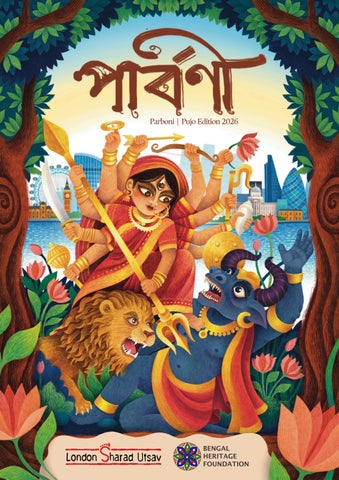
Parboni | Pujo Edition 2026
We completed a hat-trick at prestigious MUSE Creative Awards with a GOLD (2025) and two SILVER (2023 and 2026). We also won GOLD at prestigious Hermes Creative Awards (2026).
2
SHARODIYA PARBONI 2026 - ANNUAL PUJA MAGAZINE OF LONDON SHARAD UTSAV | A BHF INITIATIVE
L
ETTER FROM THE EDITORIAL TEAM
Every year, Parboni begins the same way: with a handful of people, a shared love of Britain and Bengal, and the stubborn belief that a community magazine can be something special. Last year, that belief was recognised far beyond our own circle. For the third year in a row, Parboni was acclaimed internationally. Our last edition of Parboni won Gold at the Hermes Creative Awards and Silver at the MUSE Creative Awards. These honours belong to every writer, artist, volunteer and reader who has shaped these pages. Thank you. This year, at London Sharad Utsav, we celebrate a voice that raised generations of Bengalis: Akashvani. For a hundred years, radio has carried Bengal into our homes, from Birendra Krishna Bhadra's Mahishasuramardini at dawn on Mahalaya to Sunday afternoon plays, Rabindrasangeet and sports commentary through crackling static. Many of us grew up with the radio playing in the next room. Many of us still wake before sunrise on Mahalaya, now with a phone instead of a transistor, because some rituals refuse to fade. Our cover is an ode to you, the Bengalis of Britain. To those who arrived decades ago with one suitcase and an address scribbled on paper, who built pujas in rented halls and friendships over endless cups of tea. To the children who move from Bangla at the dinner table to London slang at school without missing a beat. Along the way, we learned to queue, to talk about the weather, and to love a Sunday roast as much as luchi and alur dom. Our London Sharad Utsav now welcomes neighbours from every corner of the world, many of whom have never set foot in Bengal. Together, we have made a home here without forgetting where home began. That is why Parboni is always about reconnecting with Bengal, as a living relationship rather than a memory. It lives in the stories we tell our children, the songs we still sing, the addas that still run long past midnight, the dishes our mothers taught us by feel rather than measurement, and the journeys back that leave us changed. Distance can make a culture fragile. It can also make it precious. As you turn these pages, we hope you hear something familiar, like a voice on the radio from far away, reminding you that you are still part of the story.
JOYDEEP PAL
SUBHAM PAL
SAMBRITA DAS
AMIT GUHA
SOURAV NIYOGI
Shubho Sharodiya!
SHARODIYA PARBONI 2026 - ANNUAL PUJA MAGAZINE OF LONDON SHARAD UTSAV | A BHF INITIATIVE
3
T
HE UNBOUND TRIUMPH FIERCE ROOTS, BOUNDLESS SKIES
Our Cover Art
For this illustration, I wanted to capture the strength and energy of the iconic moment of Durga defeating Mahishasura. I kept the imagery rooted in tradition, but used bold colours and expressive forms to bring a sense of movement and celebration to the scene. The London skyline in the background brings the story into the present, representing a tradition that has travelled across borders, while continuing to bring people together and create a sense of home.
Our Cover Artist Anushua “Shua” Sinha is a Bengali illustrator and designer, from Mumbai, currently based in Seattle. With a background in architecture and an MFA in Illustration from The Savannah College of Art and Design, her work is often inspired by nature, culture, storytelling, and everyday life. Through bold colours and expressive details, she creates illustrations for books, publications, brands, and cultural projects.
4
SHARODIYA PARBONI 2026 - ANNUAL PUJA MAGAZINE OF LONDON SHARAD UTSAV | A BHF INITIATIVE
where Festivity meets Tradition
THE BHF & LSU F ROM PRESIDENT’S DESK Ma Durga Comes Home — And So Do We Hello Friends, For Bengalis, Durga Pujo is far more than a religious festival. It is emotion, nostalgia, food, music, adda, culture and celebration. But above everything else, it is about coming home. Every autumn, we welcome Ma Durga not merely as the Goddess we worship, but as the daughter returning to her “Baaper bari” with her children. Wherever a Bengali may live, these few days bring an extraordinary sense of belonging. We save the best of ourselves for Pujo- our food, clothes, music, culture and, above all, devotion. We wait throughout the year for that familiar call: “Maa Ashchhen.” This year, London Sharad Utsav celebrates its 18th year. What began as a dream of creating a little Bengal in London has grown into one of the largest Durga Pujo celebrations outside India, certainly among Europe’s largest. Last year, over 15,000 people joined us. That number fills us with pride, but even greater humility. Behind every visitor is a family offering anjali, a child discovering Pujo, friends reconnecting over adda, or someone finding a little piece of home thousands of miles away from Bengal. This year, at Gunnersbury Park Sports Hub near Ealing, we promise another memorable celebration of food, music, culture and togetherness. Our talented London community
will perform alongside the inimitable Mir from Kolkata, whose voice woke generations of Kolkatans for over two decades. We are delighted to welcome him on Sunday the 18th. Yet, amid the festivities, Ma Durga remains at the heart of everything. Our dedicated sanctum offers devotees a peaceful space to offer prayers and anjali and seek Ma’s blessings, away from the bustle of celebrations. Eighteen years would not have been possible without our volunteers, members, artists, sponsors, supporters and, most importantly, every visitor who has made London Sharad Utsav their own. On behalf of the Bengal Heritage Foundation, my heartfelt gratitude to you all. So come with your families and friends. Come for the Pujo, food, music and adda. Come to celebrate Bengal, our heritage and everything that connects us. But most importantly, come home. Because wherever we may live, when Ma Durga comes home, somehow we all come home too.
সবাইেক শারদীয় ী ত ও শুেভ া। May Ma Durga bless everyone with happiness, health and prosperity.
শুভ শারদীয়া। Koushik Chatterjee (KayCee) President Bengal Heritage Foundation
SHARODIYA PARBONI 2026 - ANNUAL PUJA MAGAZINE OF LONDON SHARAD UTSAV | A BHF INITIATIVE
5
WHAT'S I SIDE
4
6
N
5
Our Cover
From the President’s Desk
11
16
Voices Across the Waves: Bengal, Britain, and a Century of the Airwaves (1927–2027)
Listener's Companion: A Century of Akashvani’s Radio Journals
Joydeep Pal
Apratim Basu
20
23
হাটসেরান্দির দুর্গাপট: দুই শতা ীর বহমান ঐিতহ
Devi in Bengal Temple Sculpture
Kamal Banerjee
Amit Guha
27
31
The Woman from Bengal who won Mauritius
কলকাতার ঐতিহাসিক দ্বৈরথ: ওয়ারেন হেস্টিংস ও ফিলিপ ফ্রাি েসর িবখ াত িপস্টল ডেয়ল
Swagata Ghosh
দীপাঞ্জন ঘাষ
35
39
Tracing Back a Bengali Revolutionary Through Karē Raisu in Japan
কালঘুম
Saumik Paul
ডাঃ পাঞ্চজন ঘটক
SHARODIYA PARBONI 2026 - ANNUAL PUJA MAGAZINE OF LONDON SHARAD UTSAV | A BHF INITIATIVE
WHAT'S I SIDE
43
N
47
Sky-High, Stone-Deep: Why Cappadocia Is the Ultimate Travel Paradox
From Eden Gardens to Lord’s, with BHF Along the Way
Subham Pal
Annesha Ghosh
51
56
The World Cup and a Nine-Year-Old
When Intelligence Became Artificial- Have We Forgotten How to Be Human?
Sourav Niyogi
Mithun Chakraborty
59
62
AI Meets Heritage: Can Technology Preserve Culture—or Will It Rewrite It?
The Rise of a New Bengal — A New Beginning
Sambrita Das
Suranjan Som
65
70
BHF Creative Corner
BHF Kids and Gen Next
84
99
Bengal Heritage Foundation 360°
Our Sponsors & Supporters
SHARODIYA PARBONI 2026 - ANNUAL PUJA MAGAZINE OF LONDON SHARAD UTSAV | A BHF INITIATIVE
7
RATEFUL FOR THE GGOOD WISHES
8
SHARODIYA PARBONI 2026 - ANNUAL PUJA MAGAZINE OF LONDON SHARAD UTSAV | A BHF INITIATIVE
RATEFUL FOR THE GGOOD WISHES
SHARODIYA PARBONI 2026 - ANNUAL PUJA MAGAZINE OF LONDON SHARAD UTSAV | A BHF INITIATIVE
9
Perspectives
V OICES ACROSS THE WAVES:
BENGAL, BRITAIN & A CENTURY OF THE AIRWAVES
BY
JOYDEEP PAL INNOVATOR AND STORYTELLER
The author explores the broadcast centenary, revealing how Kolkata’s scientific ingenuity and cultural resonance transformed early British radio into an enduring London–Bengal airwave bridge.
SHARODIYA PARBONI 2026 - ANNUAL PUJA MAGAZINE OF LONDON SHARAD UTSAV | A BHF INITIATIVE
11
When organized commercial broadcasting debuted in Eastern India on August 26, 1927, radio transformed from an experimental laboratory instrument into a defining cultural medium. As media historians prepare for the 2027 Broadcast Centenary-marking 100 years of organized radio in India and its deep historic ties with the BBC; Bengal’s contribution remains central to the technological and artistic evolution of the airwaves.
THE SCIENTIFIC GENESIS & EARLY EQUIPMENT (1923–1927) Before London’s BBC infrastructure was extended across British India, Bengali scientists laid the technical foundations of wireless transmission. In 1923, pioneering physicist Dr. Sisir Kumar Mitra established the Wireless Laboratory at Calcutta University’s College of Science (Rajabazar). Operating under the experimental call sign 2CZ, Mitra constructed custom vacuum-tube transmitters and held regular trial broadcasts. Simultaneously, British radio enthusiasts John Rouse Stapleton and J. Briggs founded the Calcutta Radio Club at Temple Chambers, utilizing a 100-watt amateur transmitter. These trials demonstrated to British authorities that Calcutta possessed the technical capability and public demand for a permanent station. Dr. Sisir Kumar Mitra, The Father of Radio Science in India
THE INDIAN BROADCASTING COMPANY (IBC) & THE BBC CONNECTION (1927–1930)
Indian Broadcasting Company opened its doors at 1 Garstin Place in 1927.
The Nerve Center: 1 Garstin Place In 1927, the Indian Broadcasting Company (IBC) inaugurated its Kolkata station a month after Bombay, transmitting at 1.5 kW on medium wave. Its headquarters at 1 Garstin Place-a colonial brick structure named after Major General John Garstin —became India's most famous radio building. Seeking technical and operational expertise modelled directly on British public broadcasting, the IBC partnered with the BBC in London. 12
SHARODIYA PARBONI 2026 - ANNUAL PUJA MAGAZINE OF LONDON SHARAD UTSAV | A BHF INITIATIVE
To build the infrastructure: BBC Personnel Secondment: The BBC sent senior personnel to head Indian stationsformer BBC Savoy Hill announcer Eric Dunstan to Bombay, and senior BBC director C.C. Wallich to Kolkata. Microphone Tech: Early broadcasts relied on Marconi-Reisz marble-block transversecurrent carbon microphones, later upgraded in the 1930s to Marconi-EMI ribbon microphones for richer vocal fidelity. Bifurcated Programming: Under Wallich and Indian Program Director Nripendra Nath Majumdar, the station ran a dual schedule: European hours (Western classical music, BBC news relays) and Vernacular hours (Rabindrasangeet, Indian classical ragas, and Bengali dramas).
Vol. I, No. 1 of The Indian Listener, 1935, served as the official organ of the Indian State Broadcasting Service (ISBS)
Vintage blue Radio/Television Licence booklet issued by the Indian Posts and Telegraphs department
IBC broadcasts sparked immediate fascination as crowds gathered at local clubs, tea stalls, and neighbourhood paras to experience spoken Bengali and live music over the airwaves for the first time. Audiences formed a deep emotional bond with the new medium, eagerly tuning in for Rabindrasangeet, classical ragas, and early radio plays that gave the city a shared acoustic identity. Despite enthusiastic listenership, high customs duties on radio receivers and widespread license-fee evasion starved the IBC of revenue. On March 1, 1930, IBC went bankrupt into liquidation. Faced with severe public backlash over the sudden silence on the airwaves, the British Indian government stepped in on April 1, 1930, placing broadcasting under the Department of Industries and Labour. In 1932, it was renamed the Indian State Broadcasting Service (ISBS)- a temporary, state-run arrangement that saved radio infrastructure in India from permanent collapse. SHARODIYA PARBONI 2026 - ANNUAL PUJA MAGAZINE OF LONDON SHARAD UTSAV | A BHF INITIATIVE
13
LIONEL FIELDEN, TAGORE, AND THE BIRTH OF ALL INDIA RADIO (1935–1938) Recognizing that the ISBS was bureaucratic and stagnant, Viceroy Lord Willingdon requested a top-tier broadcast administrator from London. In 1935, Lionel Fielden, a senior BBC talks producer, was appointed India’s first Controller of Broadcasting.
Lionel Fielden BBC talks producer and India’s first Controller of Broadcasting
Fielden was determined to transform a government organ into a vibrant cultural network. On June 8, 1936, Fielden officially rebranded the ISBS as All India Radio (AIR), establishing a centralized public utility framework inspired by the BBC's Royal Charter. In May 1938, when AIR Kolkata inaugurated its highpower shortwave transmitter, Nobel laureate Rabindranath Tagore composed a dedicated poem titled ("Voice from the Sky"). Tagore’s lyrical term captured the public imagination so completely. Akashvani eventually became the official name for All India Radio after Dr M. V. Gopalaswamy’s private radio station, Akashavani from 1935.
Nobel laureate Rabindranath Tagore composed a dedicated poem “Akashvani” in 1938 Birendra Krishna Bhadra, the iconic baritone voice behind his timeless “Mahishasura Mardini”
During this golden decade, Kolkata producers adapted BBC drama handbooks to create the crown jewel, Mahishasura Mardini(The Destruction of Mahishasura). First broadcasted in October 1931 and formalized by 1937, this legendary pre-dawn Mahalaya broadcast, scripted by Bani Kumar, composed by Pankaj Mullick, and narrated by Birendra Krishna Bhadra, became an annual radio tradition. Gathering in the studio at 3:00 AM every autumn, musicians performed live into shared directional ribbon microphones. Bhadra’s goosebump-inducing recitation proved that sound alone could evoke an entire civilizational sentiment. The All India Radio artists and crew of “Mahishasura Mardini”
14
SHARODIYA PARBONI 2026 - ANNUAL PUJA MAGAZINE OF LONDON SHARAD UTSAV | A BHF INITIATIVE
THE LONDON–KOLKATA BROADCAST TIMELINE In April, colonial government takes over IBC assets, establishing the temporary Indian State Broadcasting Service.
Indian Broadcasting Company opens Kolkata station at 1 Garstin Place under BBC Director C.C. Wallich.
Experimental Phase 1923-25
Dr. S.K. Mitra (2CZ) conducts ionospheric physics research; Calcutta Radio Club broadcasts via amateur transmitters.
1927
IBC Bankruptcy 1930
IBC Established
1930
Rabindranath Tagore writes the Akashvani poem for AIR Kolkata's shortwave inauguration.
AIR Rebranding 1936
BBC Bengali Service 1941
1938 Tagore's 'Akashvani'
ISBS Formed In March, IBC files for liquidation due to mounting debts and low license revenue.
AIR Kolkata moves from Garstin Place to Akashvani Bhavan near Eden Gardens.
BBC Producer Lionel Fielden renames ISBS to All India Radio (AIR) and overhauls production standards.
BUSH HOUSE AND THE SHORTWAVE BRIDGE (1941 ONWARD)
1969 Modernization
BBC World Service launches Bengali shortwave broadcasts from Bush House, London.
BBC World launched the BBC Bengali from Bush House
With the outbreak of World War II, broadcasting took on critical strategic significance. On October 11, 1941, the BBC World Service launched the BBC Bengali Service from Bush House in London. Operating alongside the BBC Eastern Service-where figures like George Orwell worked closely with Indian writers in London; the Bengali Service beamed daily shortwave bulletins across Asia.
THE WARM GLOW OF THE ETHER: A NOSTALGIC CENTENARY ECHO Beyond institutional restructuring and physics equations, this century-long connection was deeply personal. For generations of listeners gathered around wooden radio receivers on humid Kolkata mornings or chilly London evenings, the warm-up glow of thermionic valves and the faint crackle of shortwave frequencies were magical.
AIR Akashvani Bhavan near Eden Gardens
This airborne bridge dissolved thousands of miles of ocean, turning copper antennas and thermionic valves into a shared emotional pulse; a timeless reminder of how two worlds came together through the simple power of the airwaves.
Joydeep Pal is a serial entrepreneur, business consultant, and Adjunct Faculty at The University of Manchester, where he also completed his PhD and MBA. His leadership earned international recognitions, including Outlook India’s "Visionary of the $5 Trillion Economy" (2026) and UK’s "Most Influential CEO 2026: Growth & Innovation Leadership". As a member of Bengal Heritage Foundation, he uncovers historical archives to bridge scientific legacy with cultural memory. *All Images sourced from public online archives and web resources for editorial and non-commercial storytelling purposes.
SHARODIYA PARBONI 2026 - ANNUAL PUJA MAGAZINE OF LONDON SHARAD UTSAV | A BHF INITIATIVE
15
L C
A CENTURY OF ISTENER’S AKASHVANI’S RADIO OMPANION JOURNALS
BY
APRATIM BASU CITIZEN RESEARCHER AND COLLECTOR 16
The author explores the six-decade arc of Akashvani’s radio journals, revealing how vibrant multilingual print companions connected millions of listeners before bureaucratic centralization forced their discontinuation.
SHARODIYA PARBONI 2026 - ANNUAL PUJA MAGAZINE OF LONDON SHARAD UTSAV | A BHF INITIATIVE
THE BEGINNING: While organized broadcasting began in India on May 5, 1932 when the colonial government of India decided to run radio broadcasting services in the country under state management, both radio and radio magazines had a much earlier beginning. This decision of the government was the result of the failure of several private efforts to operate a broadcasting service. When Indian Broadcasting Services started operations on July, 1927 with the Bombay station of the company, the first journal in English “The Radio Times” was published on 15th July. The annual subscription rate was Rs 1-14-0, and a single copy was priced at one anna. It was published twice a month and contained the programmes of Bombay and Calcutta in outline, technical articles and notes, and a few talks. While the second station was opened in Calcutta on August same year, Betar Jagat, the Bengali radio journal was first published in September, 1929.
IBC Betar Jagat (Calcutta) 1929 Indian Radio Times (Bombay) 1933
Due to financial difficulties, in 1930 the IBS company went into liquidation and Indian State Broadcasting Services (ISBS) was formed. However, on 5th May 1932, the Colonial Government of India finally decided to take over the broadcasting services under state management, on public demand. Indian Radio Times circulation increased from 6,000 in 1934 to 12,000 in 1935 when BBC programmes were included with the programmes of Calcutta and Bombay stations. On 22nd Dec 1935, the “Indian Radio Times” was renamed the “Indian Listener” and appeared in a new format. With a new layout, contents increased by adding reading matter and more foreign programmes. To offset the increased printing costs, advertisement tariff was increased and subscription rate was increased from Rs 3 to Rs 4. The Indian State Broadcasting Service was named “All India Radio” (AIR) on June 8, 1936. Indian Listener, one of the earliest broadcasting trade publications of India had a circulation of 2,750 (April 1931 – June 1932), 6,000 (1934), 12,000 (1935). Publishing was transferred from Bombay to Delhi on August 1937. On 16th June 1938 the first issue of “Vanoli” in Tamil and “Vani” in Telugu was published from Madras. Indian Listener having a circulation of 16,500 on Jan, 1937 reached 19,000 in 1938 with the introduction of the Lahore station.
The Indian Listener (Bombay) editions- 1935 (L) and 1937 (R)
SHARODIYA PARBONI 2026 - ANNUAL PUJA MAGAZINE OF LONDON SHARAD UTSAV | A BHF INITIATIVE
17
THE GROWTH YEARS: The radio journals provided a useful link between broadcasting and its listeners. 1939 review showed the journals reaching 33,100 people (47% of its listeners). Number of subscribers of the journals in 1939 were as follows: Indian Listener (English) 21,250, Awaz (Urdu) 5,000, Sarang (Hindi) 2,500, Betar Jagat (Bengali) 3,100, Vanoli (Tamil) 1,250. These journals apart from listing individual programmes time-band wise, and station wise also had explanatory notes under individual items of programs to help readers appreciate the programs and have a better understanding of the aims and objectives of AIR. The Indian Listener 1938
Awaz (Urdu) 1940 Sarang (Hindi) 1951
There were editorial comments on activities of AIR and articles on technical questions. Readers enquiries on questions were also answered and published in the correspondence columns. A number of texts of broadcast talks were also reproduced in these journals. From 70,000 listeners the AIR station directors received 20,000 letters critical/ appreciative of the services between October 1938 to March 1939 indicating high engagement. Indian Listener from a magazine of 48 pages in 1937 grew to 104 pages by Dec 1938 – with additional stations coming up at Lucknow and Madras in 1938 and introduction of alternative programmes from Bombay, Delhi and Madras. To offset costs, subscription rates were increased from Rs 4 to Rs 6 per annum, as circulation rose from 14,000 in August 1937 to 21,000 in December 1938. Betar Jagat had a subscription rate of Rs 1-14-0 in 1927, with individual copies being sold for 1 anna. In 1934, the magazine was made slightly more ambitious and attractive, by adding articles of special radio interest, news of the world, more programme details, and illustrations. This led to increase in subscription rates to Rs 2 while individual copies were sold for 2 annas each. The two journals Vanoli in Tamil and Vani in Telugu were started simultaneously on 16th June, 1938 on the opening of the Madras station of AIR.
Vanoli (Tamil) 1942 (L) and Vani (Telugu) 1967 (R) 18
Awaz the first bilingual radio journal was first published on 1st Jan 1936 when the Delhi broadcasting station was opened. Published in Urdu and Devnagari, its circulation increased from 500 in 1936 to 6,000 in 1938. Its annual subscription was Rs 2 and single copies sold for 2 annas each. As demand for bilingual journal was low and to reduce waste, from 1st July 1938 the fortnightly journal was bifurcated into Sarang (Hindi) and Awaz (Urdu). Sarang had a subscription of 2,000 by end 1939. Navobhani (Gujarati) started in 1948 and Akashi (Assamese) in 1958.
SHARODIYA PARBONI 2026 - ANNUAL PUJA MAGAZINE OF LONDON SHARAD UTSAV | A BHF INITIATIVE
The “Akashvani” name was adopted by AIR in 1957. The naming and re-naming of the radio journals have followed these changes that radio broadcasting underwent in India. “Betar Jagat” (Wireless World), the first language journal – printed in Bengali in 1927 continued. The other language journals were introduced later and all were fortnightlies. Following All India Radio’s adoption of the on-air name Akashvani (coined originally by Professor M.V. Gopalaswamy and famously blessed by Rabindranath Tagore), The Indian Listener was officially renamed Akashvani (English) in January 1958. Akashvani (Hindi) followed. Akshvani was initially a weekly before becoming a fortnightly. In the early 1950s, the Indian Listener’s circulation was 30,000 copies. Betar Jagat reached the highest circulation figure of 80,000 copies amongst any of the AIR journals in 1963 and made a profit for three years, while Vanoli (Tamil) and Vani (Telegu) had circulations of 30,000 and 20,000 respectively. Circulation subsequently fell and they became a drag on the financial resources.
Navobhani (Gujarati) 1967 (L), Akashi (Assamese) 1966 (R)
Radio Times of India 1948 (L) and Akashvani (English) 1964 (R)
THE END: The 1985 circulation numbers were extremely low: Akashvani: 10,500; Betar Jagat: 6,500; Vanoli: 7,000; Vani: 3,500 and Nabhovani: 300. To achieve economy, the publication of 8 Akashvani journals was subsequently discontinued, ‘Akashi’ (Assamese), ‘Betar Jagat’ (Bengali), ‘Nabhovani’ (Gujarati) and ‘Vani’ (Telugu) with effect January 1986 and remaining ‘Akashvani’ (English), ‘Akashvani’ (Hindi), ‘Awaz’ (Urdu) and ‘Vanoli’ (Tamil) in April 1987. These journals were incurring losses over the years, not self-supporting and did not do much to publicise the AIR programs. Akashvani (English) 1976
Awaz (Urdu) 1946 (L), Akashvani (Hindi) 1971 (R)
What killed them was the mistaken policy of centralization pursued by the Ministry. The regional language journals were forced to go to Government presses even with higher charges, poorer printing and continuous late delivery. All space selling was centralized through DAVP in Delhi, which had neither initiative nor interest. Further, listeners lost interest in the journals since they provided few details about the scheduled programmes.
Apratim Basu has an experience 25 years in management across companies in India and has studied at IIT Kharagpur and IIM Ahmedabad. He is an avid collector and citizen researcher on freedom movement of India. He has a personal archive of more than 2,000+ books on Netaji and 6,000+ newspapers dating back to the 1940s in Kolkata. SHARODIYA PARBONI 2026 - ANNUAL PUJA MAGAZINE OF LONDON SHARAD UTSAV | A BHF INITIATIVE
19
হাটেসরা র দুগাপট: দুই শতা ীর বহমান ঐ তহ্য
কমল ব্যানার্জি
স্বাধীন কৃ -সংরক্ষক ও গেবষক 20
দ্বিশতাব্দী প্রাচীন দুর্গাপটের অনন্য শিল্পশৈলী ও ঐতিহ্যপ্রেমে লেখক প্রত্যক্ষ করেছেন বাংলার এক প্রবহমান সামা জক দ লল।
SHARODIYA PARBONI 2026 - ANNUAL PUJA MAGAZINE OF LONDON SHARAD UTSAV | A BHF INITIATIVE
দুর্গাপুজোর দিনগুলিতে কলকাতার চেনা কোলাহল আর মণ্ডপের দীর্ঘ লাইন এড়াতে শান্তিনিকেতন এবং বীরভূ মের গ্রামীন পরিবেশ এখন দারুণ এক বিকল্প হয়ে উঠেছে। তাঁেদর মেধ অেনেক আবার পৗঁেছ যান বীরভূ েমর ছাট্ট াম হাটেসরা েত, এখানকার ঐ তহ্যবাহী পেটর ঠাকু র দখেত। এই াম আজও বাংলার এক বরল ল্প-ঐ তেহ্যর ধারক ও বাহক। ১৯৬০ সালে শান্তিনিকেতনের পৌষমেলায় গিয়েছিলেন ‘দেখা হয় নাই’-এর লেখক, প্রশাসক ও ক্ষেত্রসমীক্ষক অমিয় কু মার বন্দ্যোপাধ্যায়। মেলার দ্বিতীয় দিনের পর আর বিশেষ কিছু দেখার বাকি ছিল না। তখন মেলার অফিসার-ইন-চার্জ শান্তিদেব ঘোষ তাঁকে হাটসেরান্দি গ্রাম ঘুরে আসার পরামর্শ দেন। সঙ্গে হাতে ধরিয়ে দেন বাদামভাজার একটি ঠোঙা। বলেছিলেন “ওই গ্রামে এখনও বেশ কয়েক ঘর গেরস্থ বা ড়েত পেট আঁকা দু গা প্র তমার পূজা হয়।”
বোলপুর থেকে বাসে প্রায় আট মাইল পথ অতিক্রম করে তিনি পৌঁছেছিলেন হাটসেরান্দির মোড়ে। সেখান থেকে কাঁচা রাস্তা ধরে হেঁ টে পৌঁছন চট্টোপাধ্যায় পরিবারের বাড়িতে। তখনও হাটসেরান্দি বীরভূ মের অন্যতম সমৃদ্ধ ও প্রাচীন গ্রাম হিেসেব প র চত।
চট্টোপাধ্যায় পরিবারের ঠাকু রদালানে বহু প্রজন্ম ধরে পটে আঁকা দুর্গাপ্রতিমার পূজা হয়ে আসছে। প্রচ্ছদ ছবিটি চট্টোপাধ্যায় পরিবারের পট। অমিয়বাবুর সময়ে গ্রামের মোট অমিয়বাবুর আশঙ্কা ছিল, পৌষ মাসে গিয়ে দুর্গাপট দেখবেন তেরোটি দুর্গাপুজোর মধ্যে সাত-আটটি ছিল পটের ঠাকু রের। কীভাবে? উত্তরে শান্তিদেব ঘোষ জানান, হাটসেরান্দিতে বাকি বাড়িগুলোতে মাটির প্রতিমা পূজিত হত। আশ্চর্যের উপাসিত পট সারা বছর বাড়িতে রাখা হয় এবং পরের বছরের বিষয়, ২০২৬ সালেও এই অনুপাত মোটামুটি অপরিবর্তি ত নতু ন পট আঁকা হলে তবেই পুরনো পট বিসর্জ ন দেওয়া হয়। রয়েেছ। তেব য বষয় ট কেমেছ, তা হেলা ল্পীর সংখ া। ফলে পৌষ মাসেও আগের বছরের দুর্গাপট দেখা সম্ভব। তৎকালীন প রবহণ ব বস্থা আজেকর মেতা উন্নত ছল না। একসময় গ্রামের দশ-বারোটি সূত্রধর পরিবার পট আঁকা ও প্রতিমা নির্মাণের কাজে যুক্ত ছিল। বর্ত মানে সেই সংখ্যা নেমে গ্রামের একটি শতাব্দী প্রাচীন ও অত্যন্ত জনপ্রিয় পুজো হলো এসেছে দুই-তিন ঘরে। জীবিকার প্রয়োজনে অনেকেই পেশা মণ্ডল বা ড়র পুেজা ( মাড়ল বা ড়)। বদলাতে বাধ্য হয়েছেন। পট আঁকার কাজ না থাকলে এখন কেউ টােটা চালান, কউ অন পশায় যুক্ত থােকন। অমিয়বাবু তাঁর সফরে সাক্ষাৎ করেছিলেন গ্রামের বিখ্যাত পটুয়া কালিপদ সূত্রধরের সঙ্গে। তাঁর ভাই গুরুপদ সূত্রধরও ছিলেন সমান খ্যাতিমান শিল্পী। কালিপদ সূত্রধরকে কেন্দ্র করে পূর্ণেন্দু পত্রী তথ্যচিত্র নির্মাণ করেছিলেন। পরবর্তীকালে সাহিত্যিক সুধীর চক্রবর্তীও তাঁর সাক্ষাৎকার নেন। তখন কালিপদ বৃদ্ধ; চোখে প্রায় দেখতে পান না। তবু মহালয়া এলেই পট আঁকার টান তাঁকে নতু ন করে জাগিয়ে তু লত। দীর্ঘ অভ্যাস ও শিল্পপ্রেমের জোরে জীবনের অন্তিম দিন পর্যন্ত তু লি হােত কাজ কের গেয় ছেলন ত ন।
SHARODIYA PARBONI 2026 - ANNUAL PUJA MAGAZINE OF LONDON SHARAD UTSAV | A BHF INITIATIVE
21
পট নির্মাণের প্রক্রিয়াও অত্যন্ত আকর্ষণীয়। বাঁশের ফ্রেম তৈরি করে তার ওপর কাদামাটি ও কাপড়ের স্তর বসানো হয়। পরে খড়িগোলার প্রলেপ দিয়ে জমিন প্রস্তুত করা হয়। প্রথমে হালকা লাল রঙে আঁকা হয় রেখাচিত্র, তারপর ধাপে ধাপে বিভিন্ন রঙে প্রতিমাকে জীবন্ত করে তোলা হয়। সর্বে েষ নীল রেঙ ভরাট করা হয় প াৎপট। হাটসেরান্দির দুর্গাপটের সবচেয়ে লক্ষণীয় বৈশিষ্ট্য হলো এর রঙপ্রয়োগ। ঘন নীল পটভূ মির ওপর লাল, হলুদ, সবুজ ও সাদা রঙের উজ্জ্বল সমাবেশ এক অনন্য দৃ শ্যরচনা করে। দুর্গা, লক্ষ্মী, সরস্বতী, গণেশ, কার্তি ক, অসুর, সিংহ—সকল চরিত্রেই রঙের ব্যবহারে দেখা যায় এক বিশেষ শৈলী ও সংযম। শিল্পী সুশোভন অধিকারীর মতে, আধুনিক শিল্পভাষায় হাটসেরান্দির পটুয়াদের প্রকৃ ত অর্থেই ‘কালারিস্ট’ বলা যায়। চালচিত্রেও রয়েছে বৈচিত্র্য। কোথাও শিব, কোথাও কালী, আবার কোথাও রাম-সীতা, রাধাকৃ ষ্ণ বা শুম্ভ-নিশুম্ভ বধের দৃ শ্য স্থান পেয়েছে। শাক্ত, বৈষ্ণব ও রামায়ণধারার উপাদানের এই সহাবস্থান বাংলার লোকঐতিহ্যের অসাম্প্রদা য়ক চ রত্রেকই তু েল ধের। একসময় এখানে উদ্ভিজ্জ উৎস থেকে রং তৈরি করা হত। কালিপদ সূত্রধরের স্মৃতিচারণায় জানা যায়, কু লগাছের লাক্ষা থেকে লাল, ধোপার নীল থেকে নীল, গিরিমাটি থেকে হলুদ বা কমলা এবং ভু সোকালি থেকে কালো রং প্রস্তুত হতো। পরবর্তীকালে সেই প্রথা লোপ পেয়ে বাজারচল ত রেঙর ব বহার শুরু হয়। এই গ্রামের দুর্গাপুজোর আরেকটি অনন্য বৈশিষ্ট্য হলো সপ্তমীর নবপত্রিকা স্নান। ভোরবেলায় আঠারোটি
পটের দুগা’, হাটেসরা , বীরভূ ম
পুজোবাড়ির সদস্যরা একত্রে স্থানীয় পুকু রে যান। সেখানে ঘটভরা ও নবপত্রিকার স্নান সম্পন্ন করে পালকিতে নবপত্রিকা নিয়ে শোভাযাত্রার মধ্য দিয়ে নিজের নিজের বাড়িতে ফিরে আসেন। আবার দশমীতে ঘট বিসর্জ নের পর নতু ন পটটি গ্রামের মন্দিরে সংরক্ষিত হয় এবং পূর্ববর্তী বছরের পট বিসর্জ ন দেওয়া হয়। পরের বছরের রথযাত্রায় সেই পটের গায়ে মাটি ছুঁ ইয়ে নতু ন কাপড় ও দড়ি দেওয়ার মধ্য দেয় শুরু হয় নতু ন দু গাপট সৃ র প্র ক্রয়া। দুই শতাব্দীরও বেশি সময় ধরে হাটসেরান্দির দুর্গাপট কেবল একটি ধর্মীয় অনুষঙ্গ নয়, বরং বাংলার লোকশিল্প, পারিবারিক ঐতিহ্য এবং গ্রামীণ সংস্কৃ তির এক মূল্যবান দলিল হয়ে টিকে আছে। আধুনিকতার প্রবল স্রোত এবং শিল্পীর ক্রমহ্রাসমান সংখ্যা সত্ত্বেও এই গ্রাম এখনও প্রমাণ করে, ঐতিহ্য কেবল সংরক্ষণে নয়, চর্চার মধ্য দিয়েই বেঁচে থাকে। হাটসেরান্দির দুর্গাপট তাই বাংলার সাংস্কৃ তিক উত্তরা ধকােরর এক উজ্জ্বল এবং জীবন্ত নদশন।
কমল বন্দ্যোপাধ্যায় একজন স্বাধীন কৃ ষ্টি-গবেষক এবং গোলপার্ক রামকৃ ষ্ণ মিশন ইনস্টিটিউট অব কালচারের অতিথি অধ্যাপক। 'বাংলার জেলাগুলির অরক্ষিত স্থাপত্য-ঐতিহ্য' বিষয়ে তাঁর সাম্প্রতিক সক্ষমতা বৃদ্ধি সংক্রান্ত উদ্যোগ বিলীয়মান গ্রামীণ ও জেলা-স্থাপত্য সংরক্ষণে স্থানীয় সাধারণ মানুষ এবং ঐতিহ্যপ্রেমীদের বিশেষভাবে অনুপ্রাণিত করেেছ। 22
SHARODIYA PARBONI 2026 - ANNUAL PUJA MAGAZINE OF LONDON SHARAD UTSAV | A BHF INITIATIVE
D EVI IN BENGAL
TEMPLE STRUCTURES
BY
AMIT GUHA AUTHOR, RESEARCHER AND ART COLLECTOR
The author explores the Goddess’ iconography across Bengal’s terracotta temples, revealing how Sanskrit myths, folk epics, and Tantric traditions turned regional storytelling into an enduring masterpiece of architectural art.
SHARODIYA PARBONI 2026 - ANNUAL PUJA MAGAZINE OF LONDON SHARAD UTSAV | A BHF INITIATIVE
23
Hindu temple iconography is replete with representations of the Devi in her many beautiful and terrifying manifestations. The terracotta temples of Bengal are no exception. The excerpt below on the forms of Devi depicted on Bengal's temples is from my recently published book Tapestries in Brick: A Guide to the Architecture of Bengal (Harper Collins India, 2026)
AS KALI AND CHAMUNDA The 5th-century Sanskrit text Devi Mahatmyam recounts Durga’s battles with the asuras, especially the powerful, shape-shifting Mahisha. Born from the combined power of the gods, Durga battles Mahisha’s generals — Chanda–Munda, Raktabija, and ShumbhaNishumbha — by assuming terrifying forms such as Kali and Chamunda. In Bengal, various forms of Devi were patronized and worshipped by the elite since the Pala-Sena period. In the 18th and 19th-centuries, the Nadia Rajas and figures like Ramprasad Sen and Sri Ramkrishna popularised Durga and Kali worship more generally. Devi Mahatmya battles are often shown above the temple entrance arches. Kali riding her lion into battle against Sumbha and Nishumbha on their elephants, or Chamunda battling Chanda and Munda on horseback. Superb examples can be seen at Tilantapara in Medinipur, Uchkaron in Birbhum, Atpur in Hugli, and Kantanagar in Bangladesh.
Kali battling asuras, Radha Gobinda Temple, Atpur, Hugli
Durga Mahisamardhini, Ura, Bardhaman
AS DURGA MAHISAMARDHINI The iconic image of Durga as Mahisamardhini — standing on her lion, spearing Mahisha, and flanked by Ganesha, Lakshmi, Saraswati, and Kartika — is commonly depicted on the central panel of porch columns. She sometimes appears spectacularly depicted above the battlefield in the Ramayana battlescenes, as Rama invokes her before battle (Akal-Bodhon). 24 SHARODIYA PARBONI 2026 - ANNUAL PUJA MAGAZINE OF LONDON SHARAD UTSAV | A BHF INITIATIVE
Kamale Kamini and Devi Mahatmya, Saulan, Medinipur
AS CHANDI IN CHANDIMANGAL The Mangal-Kavya (‘Auspicious Poems’) are indigenous Bengali epic poems written down around the 14th century, each centred on a local deity who tests human devotion to them over the Sanskritic deities. Protagonists face calamities until they acknowledge the deity’s superiority, after which their fortunes are restored. The most celebrated of these is the Chandimangal, especially Mukundaram Chakravarti’s brilliant 16th-century version, known for its lyrical depiction of Bengal’s villages, festivals, and merchant voyages. In the story, the Shiva devotee Dhanapati, on a voyage to Sinhala, has the vision of a magnificent, elephant-eating lotus goddess: Kamale-Kamini. On hearing this,
King Shalibahan of Sinhala asks to see this vision, but when they are both out at sea, the goddess remains invisible, hidden behind lotuses. Angered, Shalibahan imprisons Dhanapati. Years later, Dhanapati’s son Srimanta, a devotee of Chandi, journeys to rescue his father but meets a similar fate. As he is led to the gallows, a resplendent Chandi appears in a miraculous vision, seeing which Dhanapati pardons Srimanta. Chandimangal scenes became popular with merchants, who identified with the protagonist. Such temples depict Kamale-Kamini seated amid lotuses, holding an elephant by its trunk, with Shalibahan on one elaborate boat and Srimanta on another. Some temples also show Srimanta being led to the gallows and the vision of the ten-armed Chandi. The finest depictions are at Alangiri, Suratpur, and Saulan in Medinipur; and at Sonamukhi and Joypur in Bankura.
SHARODIYA PARBONI 2026 - ANNUAL PUJA MAGAZINE OF LONDON SHARAD UTSAV | A BHF INITIATIVE
25
AS TANTRIC DEITIES Tantrism - with its esoteric images, beliefs, and rituals — has a long history in Bengal, evolving from Vajrayana Buddhism under the Palas and becoming incorporated into Hindu worship of deities like Kali. Tantric iconography in terracotta temples is rare but striking. The 17thcentury Raghunatha Temple in Ghurisa has large images of Chhinnamasta holding her own severed head and Kali with her garland of skulls. A ruinous 18thcentury temple at Daintikra near Katwa shows images of a jackal-faced Kali wearing garlands of severed hands and a sword-wielding deity on a magnificent yali. In the 19th-century, the cult of the Dasamahavidya became popular, and these deities — Kali, Tara, Kamala, Tripurasundari, Bagalamukhi, and Chhinnamasta — were depicted on rekha deuls in Bardhaman and Birbhum. Chandi Mangal, Alangiri, Medinipur
Shodashi / Tripurasundari, Ghurisa, Birbhum
Amit Guha is an independent researcher, art collector, and author of Tapestries in Brick: A Guide to the Architecture of Bengal, a monograph based on over two decades of field research across West Bengal and Bangladesh. He balances his art-history research with a professional career as Vice President in an enterprise AI software company. 26
SHARODIYA PARBONI 2026 - ANNUAL PUJA MAGAZINE OF LONDON SHARAD UTSAV | A BHF INITIATIVE
W
THE OMAN FROM BENGAL WHO WON MAURITIUS
BY
SWAGATA GHOSH HERITAGE RESEARCHER
The author explores the story of Anna Van Bengale, revealing how a 17th-century woman led a daring anti-colonial revolt that shook the Dutch administration and established her legacy as Mauritius’ first freedom fighter.
SHARODIYA PARBONI 2026 - ANNUAL PUJA MAGAZINE OF LONDON SHARAD UTSAV | A BHF INITIATIVE
27
This August when I arrived in Mauritius that beautiful winter day, I had no idea what lay in store for me. I had planned to run away from that choking heat that had gripped England, away after another heaving academic year and straight into the arms of that languid African winter sun. This summer holiday began like all summer holidays do – bathed in sun, sea and a little sangria – but didn’t quite end like one. Mauritius’ story doesn’t begin once upon a time. It begins just over 400 years ago when on 18 September 1598, after a night of violent storm, a Dutch ship dropped anchor at a sheltered harbour on the South-East coast of the island. Along with Admiral Wybrandt van Warwyck on that fateful journey was an Indian sailor called Guzerate Abdul from Java and a Malagasy interpreter. It is believed that Abdul helped Wybrandt negotiate a safe passage into Grand Port Bay. Although long known to Arab navigators and Portuguese cartographers the island just east of Madagascar was uninhabited. The Dutch named it Mauritius after their prince. It soon became a handy stopover for replenishing supplies for Dutch ships sailing between Europe, Bengal and Batavia. But it wasn’t until another 40 years that it came to be properly settled. In 1639, a year after permanent occupation, Dutch Commander Adriaan van der Stel, introduced slaves and sugarcane to Mauritius.
Parrot hunting in Mauritius by Johann Theodor de Bry, 1601 Copper engraving from Het Tweede Boeck showing Dutch activities on the shore of Mauritius during the 1598 voyage of Admiral Jacob van Neck
However, slaves and sugarcane were not the only things that the Dutch introduced. Their ships dumped several invasive non-native animals – pigs, rats, cats and monkeys. Within a few years, a fort rose overlooking the calm harbour – Fort Frederik Hendrik – around which grew a community of sailors, plantation owners and slaves. But just as new species were introduced, others dropped quietly into oblivion. Less than 90 years since the Dutch first set foot in Mauritius, the dodo was wiped out. By 1681, it became extinct. But this is not a story about the dodo. It is a story about greed, infinite cruelty 28
SHARODIYA PARBONI 2026 - ANNUAL PUJA MAGAZINE OF LONDON SHARAD UTSAV | A BHF INITIATIVE
and prodigious courage in the face of ruthless authority and power, about audacity and grit to take on a colonial power. It is the story of the sheer spunk of one woman from Bengal, who just over 300 years ago, led a revolution to take on the Dutch at the very heart of their administration in Mauritius. Anna Van Bengale (not her real name) was a young girl from Bengal, who like thousands like her had arrived at the Dutch East India Company (VOC) headquarters in Chinsurah, Hooghly. There at the thriving VOC slave market she was sold, stripped of her identity and religion and put on a ship bound for Batavia. From there she was possibly sold again and brought to Mauritius in 1679. There, as a VOC slave, she was given a new name, Anna van Bengale and put to hard labour as a servant and cleaner at Fort Hendrik. Baptising and changing names was common practice with the Dutch traders and was widespread across their colonies from Batavia to The Cape. While Anna’s heritage and her original name remains a puzzle, historians largely believe that all ‘Van Bengales’ originated from Bengal and the wider region. Failing crops, famine, drought and utter penury kept a steady stream of people arriving at Chinsurah, which was once a notorious holding hub for VOC slaves.
In Mauritius, the slaves were subjected to hard labour, the men sent to work the sugar plantations and the women as servants and concubines for the VOC or plantation owners. But many escaped, often as soon as they arrived, running into dense forests of ebony ‘black as tar and smooth as ivory’ and high mountains whose peaks were often shrouded in clouds and mists. Flights and desertions of slaves became so endemic in Mauritius that the Governor pleaded with his superior at The Cape to send reinforcements. The escaped slaves were called maroons and in 1644 Governor Stal organised the first ‘maroon hunt’ without much success. But Anna did not escape. Instead, for 16 years she endured, waited and plotted. And then just before dawn on 18 June 1695, Anna and her three companions, set fire to Fort Hendrik. Everything went up in smoke and Governor Deodati barely escaped with his shirt on. The mutiny shook the core of the Dutch administration in Mauritius. Deodati wrote urgently to The Cape, “These were matters of very dangerous consequences, tending to the utter ruin of this island.” The mutiny was short-lived. Anna and her friends were soon captured and in their confessions on 23 June, they acknowledged that they had planned for several weeks to destroy the fort, and burn down the governor with everything the Company owned. After the fort they would have moved on to the plantations, set them on fire, freed the slaves and ended Dutch rule. This was Deodati’s worst nightmare. Without waiting for his superior’s instructions from The Cape, he sentenced Anna and her friends to immediate death.
View of Fort Frederik Hendrik
SHARODIYA PARBONI 2026 - ANNUAL PUJA MAGAZINE OF LONDON SHARAD UTSAV | A BHF INITIATIVE
29
Anna died but her legacy was hard to quell. She had challenged the very core of Dutch administration. Frequent maroon attacks and slave conspiracies grew rife on the island and finally 15 years after Anna’s challenge, in 1710 the Dutch left Mauritius for good. Before they left, they set the fort and everything on fire. Today, nothing remains of the fort where Anna lived, but she is remembered as Mauritius’ first freedom fighter who tore through convention and challenged injustice. Last year, Mauritius’ Minister of Arts and Culture, Mahendra Gondeea, unveiled a metal monument and lit a fire in Anna’s memory with the words,
‘Freedom is not a given right—it is built every day by those who dare to fight for it.’ Mauritius’ Minister of Arts and Culture, Mahendra Gondeea lit a fire in Anna’s memory last year The author with her husband at the former Beau Plan Sugar Mill which houses the L'Aventure du Sucre in Mauritius where she first encountered Anna Van Bengale
Swagata Ghosh is Head of Multimedia Technical Services at Bath Spa University, UK and a writer on British India. Her current research is on Decolonising Education: The impact of Rammohan Roy’s legacy on diasporic South Asian communities in Britain.
30
SHARODIYA PARBONI 2026 - ANNUAL PUJA MAGAZINE OF LONDON SHARAD UTSAV | A BHF INITIATIVE
কলকাতার ঐতিহাসিক দ্বৈরথ: ওয়ারেন হেস্টিংস ও ফিলিপ ফ্রান্সিসের বিখ াত পস্টল ডুেয়ল
দীপাঞ্জন ঘাষ রে ডও ব
ত্ব এবং ভ্লগার
হেস্টিংস ও ফ্রান্সিসের ঐতিহাসিক দ্বৈরথে লেখক প্রত্যক্ষ করেছেন ঔপনিবেশিক ক্ষমতার দ্বন্দ্ব ও 'ডু য়েল অ্যা ভ নউ'-এর এক প্রবহমান সামা জক দ লল।
SHARODIYA PARBONI 2026 - ANNUAL PUJA MAGAZINE OF LONDON SHARAD UTSAV | A BHF INITIATIVE
31
আঠােরা শতেকর দ্বতীয়াধ। তৎকালীন টশ ভারেতর রাজধানী কলকাতায় ইস্ট ই ন্ডয়া কাম্পা নর ঔপ নেব ক শাসন তত দেন কবল জাঁ কেয় বসেত শুরু কেরেছ। ঠক সই সময়, ১৭৮০ সােলর এক মঘলা ভাের কলকাতার আ লপুের ঘেট ছল এক অভূ তপূব ও রামাঞ্চকর ঘটনা- ভারেতর প্রথম গভনর জনােরল ওয়ােরন হ স্টংস এবং সু প্রম কাউ েলর প্রভাবশালী সদস ফ লপ া েসর মেধ এক মুেখামু খ পস্টল দ্বরথ বা 'ডু েয়ল'। আপাতদৃ ষ্টেত এ ট দুজন কমকতার ব ক্তগত স ােনর লড়াই মেন হেলও, এর নপেথ লু কেয় ছল ঔপ নেব ক ভারেতর ক্ষমতা দখল ও রাজকীয় প্রশাসেনর এক গভীর রাজৈন তক দ্বন্দ্ব।
ডু য়েল বা দ্বরেথর প্রাচীন ঐ তহ্য ইউরোপ য় সমাজব ব ায়, বে ষ কের মধ যুেগ, যখন কােনা ব ক্ত বা প রবােরর স ানহা ন ঘটত এবং স টর বচার আদালেতর আই ন ব ব ার মাধ েম সম্ভব হেতা না, তখন জন্ম নেয় ছল ' ায়াল বাই কমব াট' বা দ্বরেথর রী ত। তৎকালীন সামা জক বশ্বাস ছল- জীবন-মরেণর এই মুেখামু খ লড়াইেয় ঈশ্বর সবদা সত ও নেদাষ পক্ষেকই জয়ী কেরন। প্রাথ মক যুেগ ডু েয়ল লড়া হেতা ধারােলা তেলায়ার দেয়। তেব ১৭৭০-এর দশেক ইংল ােন্ড তেলায়ােরর ান দখল কের নয় বে ষ ধরেনর 'ডু েয় লং পস্টল'। দ্বরেথ চরম নরেপক্ষতা ও সমান সুেযাগ ন ত করার জন একই কারখানা থেক ন মত ও সমান শ ক্তসম্পন্ন একেজাড়া পস্তল ব বহার করা হেতা। দুই পেক্ষর প্র ত ন ধ হেসেব থাকেতন একজন কের ' সেকন্ড'। তাঁেদর প্রাথ মক দা য়ত্ব ছল দুই পেক্ষর মেধ আপস করােনা, আর তা ব থ হেল কেঠার নয়মকানুন মেন নরেপক্ষভােব দ্বরথ প রচালনা করা।
ওয়ারেন হেস্টিংস, ভারতের প্রথম গভর্নর জেনারেল ফিিলপ
াি স, সুিপ্রম কাউি েলর সদস
রাজৈন তক ববাদ, রগুেল টং অ াক্ট ১৭৭৩, এবং সু প্রম কাউ েলর গৃ হযুদ্ধ ১৭৭৩ সােল টশ পালােমন্ট ভারেত ইস্ট ই ন্ডয়া কাম্পা নর প্রশাস নক অ নয়ম দূর করেত পাস কের ' রগুেল টং অ াক্ট'। এই আইেনর অধীেন বাে ও মা াজ প্র সেড েক কলকাতার অধীেন আনা হয় এবং চারজন সদস ব ষ্ট বঙ্গল সু প্রম কাউ ল গ ঠত হয়। ওয়ােরন হ স্টংসেক ভারেতর প্রথম গভনর জনােরল নযুক্ত করা হয়। তেব কাউ েলর সদস হেসেব লন্ডন থেক আেসন ফ লপ া স, জন ভা রং ও জজ মনসন। 32
SHARODIYA PARBONI 2026 - ANNUAL PUJA MAGAZINE OF LONDON SHARAD UTSAV | A BHF INITIATIVE
কলকাতায় পা রাখা মাত্রই হেস্টিংস ও ফ্রান্সিসের সুসম্পর্কে চির ধরে। চাঁদপাল ঘাটে অভ্যর্থনার সময় ঐতিহ্যবাহী ২১টি তোপধ্বনির বদলে ১৭টি তোপধ্বনি দেওয়াকে ফ্রান্সিস নিজের অপমান বলে মনে করেন। তা ছাড়া, ফ্রান্সিসের দৃঢ় ধারণা ছিল যে ওয়ারেন হেস্টিংস একজন চরম দুর্নীতিগ্রস্ত শাসক এবং গভর্নর জেনারেল পদের একেবারে অযোগ্য। ফলে সুপ্রিম কাউন্সিলে হেস্টিংসের যেকোনো প্রশাসনিক প্রস্তাব বা নীতিতে সংখ্যাগরিষ্ঠতার জোরে বাধা সৃষ্টি করাই হয়ে ওেঠ া স ও তাঁর মত্রেদর প্রধান কৗশল।
রাজনৈতিক টানাপোড়েন থেকে ব্য ক্তগত শত্রুতা পরবর্তী সমেয় কাউ েলর অন দুই বেরাধী সদেস র মৃ তু র পর হ স্টংেসর ওপর রাজৈন তক চাপ কছু টা কেম। এ সময় দ ক্ষণ ভারেত মারাঠােদর সেঙ্গ কাম্পা নর যুদ্ধ চলাকােল হ স্টংস া েসর সেঙ্গ এক গাপন প্রশাস নক সমেঝাতায় পৗঁছান। চু ক্ত অনুযায়ী া স প্র তশ্রু ত দন য ত ন মারাঠা সংক্রান্ত সাম রক নী তেত কােনা বাধা দেবন না। তেব যুদ্ধ যখন উত্তর ভারেতর যমুনা অঞ্চল পযন্ত প্রসা রত হয়, তখন া স পুনরায় হ স্টংেসর নী তেত ভেটা দন।
ফ্রা েসর এই ভূ মকায় হ স্টংস মারাত্মকভােব ক্ষপ্ত হন এবং এেক চরম ' ব াসভঙ্গ' হেসেব গণ কেরন। ১৭৮০ সােলর ৩ জুলাই হ স্টংস সু প্রম কাউ েল এক ট অত ন্ত তীব্র ও আক্রমণাত্মক ' ম নট' (অ ফ সয়াল নাট) জমা দন। হ স্টংস সখােন স্পষ্টভােব লেখন য, া েসর ব ক্তগত ও রাজৈন তক কােনা আচরেণই সত , সততা বা স ােনর ব ুমাত্র অ স্তত্ব নই। অসুস্থতা থেক সের ওঠার পর া স এই অপমােনর বদলা নেত ১৭৮০ সােলর ১৫ আগস্ট হ স্টংসেক সরাস র পস্টল ডু েয়েলর আ ান জানান।
১৭৮০ সােলর ১৭ আগস্ট: আ লপুেরর রক্তক্ষয়ী ভার দ্বৈরেথর স্থান হেসেব নবাচন করা হয় আ লপুেরর বলেভ ডয়ার এেস্টেটর (বতমান জাতীয় পাঠাগার) পাে র এক নজন প্রাঙ্গণ। ১৭ আগস্ট ভার পৗেন ছয়টায় উভয় পক্ষ সখােন পৗঁছায়। া েসর পেক্ষ ছেলন ফাট উই লয়ােমর প্রধান প্রেকৗশলী কেনল ওয়াটসন এবং হ স্টংেসর পেক্ষ ছেলন আ টলা র কমা ার কেনল টমাস ডন পয়াস।
উইলিয়াম ি নেসপ কতৃ ক ১৮৩৮ সােল অি ত ' বলেভিডয়ার হাউস, আিলপুর, কলকাতা'-র রখািচত্র।
SHARODIYA PARBONI 2026 - ANNUAL PUJA MAGAZINE OF LONDON SHARAD UTSAV | A BHF INITIATIVE
33
জনসাধারেণর কৗতূ হল এড়ােত বলেভ ডয়ার থেক কছু টা প েম রচাড বারওেয়েলর ফাঁকা বাগানবা ড়র প্রাঙ্গণ বেছ নওয়া হয়। দুই প্র তদ্ব ীর মেধ দূরত্ব নধারণ করা হয় মাত্র ১৪ কদম। মজার বষয় হেলা, গভনর জনােরল হ ংস বা া ন্সসকােরারই পূেব পস্তল চালােনার বাস্তব অ ভজ্ঞতা ছল না। ফেল সেকন্ডেদর কাছ থেক সংেক্ষেপ ব ুক লাড করা ও লক্ষ স্থর করার নয়ম েখ নেত হয়।
তলোয়ারের স্থান দখল করে নেওয়া সেই বিেশষ ধরেনর 'ডেয়িলং িপস্টল'
হাউস অফ লর্ড সে ওয়ারেন হেস্টিংসের বিরুদ্ধে দীর্ঘ ৭ বছর ধরে চলা ঐিতহািসক 'ইি চেমন্ট' মামলা
সংেকত পাওয়ামাত্রই দুজেন একসােথ গু ল চালান। া ন্সেসর গু ল লক্ষ ভ্রষ্ট হেলও হ ংেসর ছাঁড়া গু ল া ন্সেসর বুেকর বাঁ দেক আঘাত কের পাঁজেরর হাড় ঘঁেষ পঠ দেয় ব রেয় যায়। মারাত্মকভােব আহত া ন্সস মা টেত লু টেয় পেড় চৎকার কের ওেঠন, "আ ম ষ!" তেব সৗভাগ বশত গু ল ট কােনা গুরুত্বপূণ অভ ন্তরীণ অঙ্গ স্পশ না করায় ত ন দ্রুত প্রাথ মক চ কৎসার পর বঁেচ যান।
রাজৈন তক প্র ত য়া ও কলকাতার বুেক আধু নক ারক সুস্থ হেয় ওঠার কছু দন পর ফ লপ া ন্সস ইংল ােন্ড ফের যান। কন্তু হ ংেসর প্র ত তাঁর প্র তে ােধর আগুন নেভ যায় ন। তাঁরই রাজৈন তক প্রেরাচনা ও ষড়যে র ফেল টশ পালােমেন্টর হাউস অফ লডেস ওয়ােরন হ ংেসর বরুে দীঘ ৭ বছর ধের ঐ তহা সক 'ই চেমন্ট' বা অ ভশংসন মামলা চেল। বচাের হ ংস নেদাষ সাব স্ত হেলও, এই মামলার বপুল খরেচ ত ন প্রায় দউ লয়া হেয় পেড়ন। ১৮১৮ সােল অ ু ত এক কাকতালীয় সূেত্র হ ংস এবং া ন্সস- দুজেনই মৃ তু বরণ কেরন। আজও কলকাতার আ লপুের তাজ বঙ্গেলর পাশ দেয় খােলর জ প রেয় য রাস্তা ট চেল গেছ, তার এক ট অংে র নাম 'ডু েয়ল অ া ভ নউ'। আধু নক মহানগরীর ব স্ততার মেধ ও এই রাস্তার নাম আঠােরা শতেকর সই ঐ তহা সক ও রামাঞ্চকর রক্তক্ষয়ী দ্বরেথর ৃ ত বহন কের চেলেছ।
মির্চি দীপ' খ্যাত দীপঞ্জন ঘোষ কলকাতার অত্যন্ত জনপ্রিয় ও জাতীয় পুরস্কারপ্রাপ্ত রেডিও ব্যক্তিত্ব এবং ভ্লগার। রেডিও জকি হিসেবে তাঁর 'বাম্পার টু বাম্পার', 'কলকাতা এক্সপ্রেস', 'ক্লাব মির্চি ' এবং অনবদ্য কণ্ঠশৈলীতে 'সান্ডে সাসপেন্স' শ্রোতামহলে ব্যাপকভাবে সমাদৃ ত। পাশাপাশি একজন সফল ভ্লগার ও কনটেন্ট ক্রিয়েটর হিসেবেও তিনি দারুণ জনপ্রিয়। *এই নিবন্ধ ট তাঁর জন প্রয় ইউ টউব চ ােনল 'হাফ প ান্ট হ ' (Half Pant History)-র এক ট পেবর অনু ল প থেক গৃ হীত। 34 SHARODIYA PARBONI 2026 - ANNUAL PUJA MAGAZINE OF LONDON SHARAD UTSAV | A BHF INITIATIVE
T
RACING BACK A BENGALI REVOLUTIONARY THROUGH KARĒ RAISU IN JAPAN
BY
SAUMIK PAUL ECONOMIST AND PROFESSOR
The author explores Bengali revolutionary Rash Behari Bose’s life in Tokyo, revealing how his introduction of authentic Indian curry turned a subtle act of anti-colonial resistance into an enduring pillar of Japanese culinary and economic history.
SHARODIYA PARBONI 2026 - ANNUAL PUJA MAGAZINE OF LONDON SHARAD UTSAV | A BHF INITIATIVE
35
If you visit Tokyo, it is hard to ignore Nakamuraya. Its branches are scattered across the city, each one specializing in Indian curry. Why did a bakery come to be obsessed with Indian curry for nearly a century? Aizo Soma founded the Nakamuraya bakery in 1901 and, in 1907, relocated it to Shinjuku, then an underdeveloped part of Tokyo. Aizo judged that the area had potential to become a thriving shopping district. With his wife, Kokko, he built the business there selling sweets and used the premises to host a salon for artists and writers. Nakamuraya became a modest but genuine hub of Japanese literary and cultural life, and it was through this salon that its connection to India began. In 1915, Rash Behari Bose, a Bengali revolutionary implicated in the bomb attack on Viceroy Lord Hardinge and in the Ghadar conspiracy in Lahore, fled to Japan to escape a near-certain death sentence in British India. Bose had been a key organizer in the movement for Indian independence and would later lay the groundwork for the Indian National Army, a role he passed to Subhash Chandra Bose in 1943. Under pressure from the British Embassy, Japan's Foreign Ministry ordered his extradition. Aizo Soma, at considerable personal legal risk, sheltered him in a studio near the restaurant, where he remained in hiding for months.
Rash Behari with his wife, Toshiko A postcard with Rash Behari’s photo
Aizo and Kokko's eldest daughter, Toshiko, supported Bose throughout this period. Her fluency in English made her a natural point of contact, and the two later married and had two children. Toshiko died at twenty-six, worn down by the hardship of those years in hiding, but her parents did not hold this against Bose. If anything, their support for him deepened. In 1923, Bose became a Japanese citizen, registered his family under the Bose name, and became a shareholder and, eventually, director of Nakamuraya, which was incorporated as a public company that same year. 36
SHARODIYA PARBONI 2026 - ANNUAL PUJA MAGAZINE OF LONDON SHARAD UTSAV | A BHF INITIATIVE
Shinjuku prospered, as Aizo had anticipated, and as demand for restaurants grew, Nakamuraya opened a cafeteria in 1927. It was around this point that Bose, an accomplished cook in his own right, proposed something new: rather than the Anglo-Indian curry already familiar to Japanese consumers through the navy, Nakamuraya should serve what he considered the authentic Indian version. Aizo agreed, and Kokko is credited with entering the dish on the menu using the phonetic rendering " " (karii raisu).
カリーライス
Rash Behari with Aizo, Kokko, Toshiko, Masahide, Tetsuko and Tagore
For Bose, the venture was not merely commercial: reclaiming Indian cuisine from its Anglo-Indian adaptation was, in his view, a small act of resistance against colonial cultural authority, part of the same struggle that had brought him to Japan in the first place. He was formally appointed an auditor of the company in 1927 and promoted to director by 1933. Bose died in 1943, two years before India achieved independence.
Rash Behari giving a speech
Rash Behari’s letter to his daughter, Tetsuko. Rash Behari with Japanese dignitaries
SHARODIYA PARBONI 2026 - ANNUAL PUJA MAGAZINE OF LONDON SHARAD UTSAV | A BHF INITIATIVE
37
My own interest in this story began in 2016, during my time as an economics professor at a university in Tokyo. I set out to trace how Nakamuraya evolved into a major curry chain under Bose's directorship, and along the way met Professor Takeshi Nakajima, author of The Bose of Nakamuraya. He introduced me to Daitō Bunka University in Tokyo, where more than 500 scholarly materials on Rash Behari Bose are archived. The data I collected there point to steady growth in Nakamuraya's capital stock and sales between 1927 and 1940 — the period spanning Bose's various positions within the company, right up to the outbreak of the Second World War.
A book written by Rash Behari Bose
Study materials data collected from
Nakamuraya grew substantially into a leading name in curry rice during Bose's tenure, and its curry remains a fixture of convenience and department stores across Japan today, sold both as a restaurant dish and as a pre-packaged product. Yet the socio-economic history behind this story has drawn little scholarly attention. The coexistence of Anglo-Indian and Bengali-style recipes, and the way Japan's curry industry evolved around this hybrid culinary tradition, is an underexplored case of cultural assimilation shaping economic outcomes in modern Japan. Note: Photos and data are collected from Daitō Bunka University, Tokyo. Growth of Nakamuraya under the leadership of Rash Behari Bose
Saumik Paul is an Associate Professor at The University of Manchester and Editor of the European Journal of Development Research, specializing in global development with a focus on labor markets, inequality, and climate change. He previously worked at the World Bank and the Asian Development Bank and held academic posts in the US, Japan and the UK and has authored several books and numerous journal articles. 38
SHARODIYA PARBONI 2026 - ANNUAL PUJA MAGAZINE OF LONDON SHARAD UTSAV | A BHF INITIATIVE
কালঘুম
ডাঃ পাঞ্চজন ঘটক চ কৎসক এবং ই তহাসানুরাগ
ইতিহাসের অবিরত পুনরাবৃত্তি ও নর্মান্ডি তটের বালি ছুঁ য়ে লেখক স্বৈরাচারের পতনের আড়ালে আঁকতে চেয়েছেন রক্তক্ষরণে ক্ষয়প্রাপ্ত মানবজা তর এক গভীর আে াপল ।
SHARODIYA PARBONI 2026 - ANNUAL PUJA MAGAZINE OF LONDON SHARAD UTSAV | A BHF INITIATIVE
39
রাশিয়া - ইউক্রেন এর যুদ্ধ কদিন হলো ? চার বছর? কতজন মারা গেছেন এখন পর্যন্ত ? এক মিলিয়ন ? আরো ব ? গুগল কেরও স ঠক সংখ া পলাম না। ভাবুন তা, আপনার কােনা প্রয়জন যুেদ্ধ মারা গেছন। মৃ েতর তা লকায় নাম আেছ ক নই, সটু কুও বাঝা যাে না ? কমন লােগ প রবােরর ? আ ীয় বন্ধুেদর ? ২০০৮ সালে লেখা একটি বইতে এডওয়ার্ড লুকাস বলে দিয়েছিলেন এই যুদ্ধের সম্ভাবনার কথা। আমরা ইতিহাস থেকে শিক্ষা নিই নি, আমরা ইতিহাস থেকে শিক্ষা নিই না - তাই ইতিহাসের পুনরাবৃত্তি হয়েই যায়। আশা রাখতে হয় তবুও। তাই একটু ইতিহাসের দিকে ফিরে তাকানো। ৮২ বছর আগের সেই দিনটার কথা। ফ্যাসিবাদের বিরুদ্ধে লড়াইয়ে জ্বলজ্বলে সেই দিনটা। ৬ই জুন, ১৯৪৪ ডি-ডে। মানবজাতির ইতিহাসে এরকম দিন খুব বেশি আসেনি। মিত্র শক্তির ইউরোপের মূল ভূ খণ্ডে অবতরণ করে হিটলারের সঙ্গে শেষ যুদ্ধ শুরু করার দরকার ছিল। পূর্ব দিক থেকে ঠেলা মারছে সোভিয়েত বাহিনী। পশ্চিম দিক থেকে হিটলারকে চেপে না ধরলে যুদ্ধোত্তর ইউরোপের ভারসাম্য নিয়ে জটিল সমস্যা দেখা দেবে। ফ্যাসিবাদের ধ্বংসের সময় দীর্ঘায়িত হবে। ইউরোপের পশ্চিম উপকূ ল জুড়ে নাৎসিদের বিরাট দুর্গপ্রাকার। মিত্র শক্তির কাছে কঠিন পরীক্ষা মূল ভূ খণ্ডে অবতরণ করা। এর আগে দুবার চেষ্টা করা হয়েছিল। নরওয়েতে খানিকটা সাফল্য পেলেও, মিত্র শক্তি উত্তর ফ্রান্সের ডিয়েপ যুদ্ধে গোহারা হেরেছিল জার্মান শক্তির কাছে। ১৯ অগাস্ট ১৯৪২ এ। সেই হার থেকে শিক্ষা নিয়েছিল মিত্র শক্তি। বুঝতে পেরেছিল খুব ভালো ভাবে প্রস্তুতি না করে এধরণের যুদ্ধে নামা যাবে না। জেনােরল আইেজনহাওয়ােরর সু প্রম্ কমাে প রকল্পনা করা হয় অপােরশন ওভারলেডর। জামানরা ভেব ছল অবতরণ হেব াে র ক ােল অঞ্চেল। যখােন াে র সে েটেনর ইং লশ চ ােনেলর দূরত্ব সব চেয় কম। মত্র শ নানা ভােব নাৎ সেদর এই বাতা দেত থােকন য তাঁেদর ধারণা ঠক। হটলার ছেলন নাৎ স বা হনীর সবা ধনায়ক। শ শালী প ানজার বা হনীেক ওই অঞ্চেল অব ান কেরন হটলার। তাঁর হুকু ম ছাড়া কউ প ানজার বা হনীেক নড়ােত পারেব না - এরকম ফরমান জা র কেরন।
৬ই জুন, ১৯৪৪ সালে মিত্র শক্তির ফ্রান্সে ঐতিহাসিক নর্ম্যান্ডি অবতরণ ডি- ড অবতরেণর মানিচত্র
কিন্তু নাৎসি বাহিনীকে ধোঁকা দিয়ে মিত্র শক্তি অবতরণ করে ফ্রান্সের নর্মানডি অঞ্চলে। ৬ই জুন ১৯৪৪ এ। ইউরোপের এই অঞ্চলে সুদীর্ঘ দিন থাকে এই সময়। দিনের আলো ফোটে চারটে নাগাদ। সূর্যাস্ত হয় রাত ১০টা নাগাদ। অন্ধকার হতে হতে রাত ১০৩০। এই লম্বা দিনের দরকার ছিল। অতর্কি তে এই আক্রমণ হবে। ওই একটি দিনে যতোটা পারা যায় 40 SHARODIYA PARBONI 2026 - ANNUAL PUJA MAGAZINE OF LONDON SHARAD UTSAV | A BHF INITIATIVE
ভেতরে ঢুকে পড়তে হবে। ইউরোপের মূল ভূ মিতে দাঁড়ানোর একটা পোক্ত জায়গা করে নিতে হবে। এটা করা না গেলে জার্মান বাহিনী অন্য জায়গা থেকে সৈন্যের ঢেউ এনে ভাসিয়ে দেবে কৌশলগতভাবে দুর্বল জায়গায় থাকা মিত্র শক্তিকে। খুব খারাপ আবহাওয়ার চাদর মুড়ে মিত্র শক্তির ১২০০ বিমান, ৫০০০ নৌবাহিনীর জাহাজে ১৬০,০০০ সৈন্য ঝাঁপিয়ে পড়েন নর্মানডি উপকূ লে। ওমাহা, উটাহ , জুনো, গোল্ড, সোর্ড আর পয়ঁত দু হক সমুদ্রতটে। সেভিং প্রাইভেট রায়ান, দ্য লঙ্গেস্ট ডে (Saving Private Ryan, The Longest Day) ছায়াছবিতে এই অবতরণের তীব্রতা আর বীভৎস যুদ্ধের ছবি আমরা দেখেছি। নেটফ্লিক্সে দ্বিতীয় বিশ্বযুদ্ধ (World War II in Colour) তথ্যচিত্রের পর্ব ৯ এ আসল যুদ্ধের ফু টেজ দেখতে পাবেন। রঙিন ফু টেজ ফু টিয়ে তু লেছে অসংখ্য মানুষের রক্তক্ষয়। বীরত্ব। মৃত্যুর মুখে ঢলে পড়া। হিটলার তাঁর অধস্তনদের কড়া নির্দে শ দেন ৫ই জুন রাতে যে কোনো অবস্থাতেই ৬ই জুন সকালে তাঁকে যেন না ডাকা হয়। উনি ওঁর সময় মতো উঠবেন। ভোরের আলোর ফোটার সঙ্গে সঙ্গে নাৎসি বাহিনীর ওপর আছড়ে পড়ে মিত্র শক্তি। কিন্তু শক্তিশালী প্যানজার বাহিনীকে নর্ম্যান্ডির দিকে চালনা করার হুকু ম দিতে পারেন শুধু হিটলার স্বয়ং। তাঁকে ডাকতে অস্বীকার করেন তাঁর সাঙ্গ-পাঙ্গরা। ছিদ্র হতে থাকে জার্মান বর্মে। ছিদ্র বাড়তে থাকে বেলা বাড়ার সাথে সাথে। প্রায় মাঝদুপুরে হিটলার ঘুম ভেঙে আড়মোড়া ভাঙতে ভাঙতে নর্ম্যান্ডি অবতরণের কথা শোনেন। ডিক্টেটরদের একটা ব্যাপার থাকে- নিজের ওপর অগাধ বিশ্বাস আর অন্যের প্রতি অবজ্ঞা ও জটিল সন্দেহ। হিটলার মানতে পারেন না, উনি মনে করেন মিত্র শক্তি তাঁর ধারণামত ক্যালে অঞ্চলেই অবতরণ করবেন। এটা মিত্র শক্তির দৃষ্টি ঘোরানোর কৌশল মাত্র।
দুপুর গড়ানোর পর চার্চি ল টেলিগ্রাম করে স্তালিনকে জানান“সব কিছু ভােলা ভােব শুরু হেয়েছ। মাইন, প্র তবন্ধকতা এবং উপকূ লীয় কামােনর ঘাঁ টগুেলা অেনকটাই অ তক্রম করা সম্ভব হেয়েছ। আকাশপেথ সন অবতরণ অত ন্ত সফল ও ব াপক প রসের সম্পন্ন হেয়েছ। পদা তক বা হনীর অবতরণ দ্রুতগ তেত চলেছ এবং অেনক ট াঙ্ক ও স্বয়ং ক্রয় কামান ই তমেধ ই তীের পৗঁেছ গেছ। আবহাওয়ার পূবাভাস মাটামু ট ভােলা।” স্তালিন কিছু ক্ষনের ভেতর উত্তর দেন টেলিগ্রামের“ওভারলড’ অ ভযােনর শুরুর সাফেল র বষেয় আপনার বাতা ট আ ম পেয় ছ। এ ট আমােদর সবার জন ই আনে র এবং আরও সাফেল র আশা জাগায়।” (উৎস: উইনস্টন এস. চা চল র চত ‘দ সেকন্ড ওয়াল্ড ওয়ার’, ষষ্ঠ খণ্ড, প্রথম সংস্করণ, পৃ ষ্ঠা ৬) ভা গ স নদ্রা দবী ৬ই জুন ১৯৪৪ এর সকােল কালঘুম হেয় নেম এেস ছেলন হটলােরর চােখ। না হেল হয়েতা আেরা কছু দন ব লাগেতা ফ া সস্ট শ ক্তর পরাজেয়র। কন্তু ফ া সস্ট শ ক্তর পরাজয় চরকাল হেয়েছ। তাও কছু স্বরাচারী এই রাস্তায় না হঁ েট পােরন না। ছাট-বেড়া স্বরাচারী- তাঁেদর ব ক্তেত্বর ভতর লু কেয় থােক ংেসর বারুদ। কন্তু স্বরাচারীর ংেসর আেগ সই বারুেদর ফু ল কর বরাট আগুেন পুেড় ষ হন অসংখ মানুষ। তাই ই তহাস থেক ক্ষা নেয় আমরা যন সজাগ থা ক দশকােল। যারা ই তহাস ভু েল যায়, তারা সই ই তহােসর পুনরাবৃ ত্ত করেত বাধ হয়। ওমাহা সমুদ্রৈসকত
ঘুম আর একনায়ক সুলভ আত্ম বশ্বােসর ধাঁয়া কা টেয় যখন প ানজার বা হনীেক নম া ন্ডর দেক এেগােনার হুকু ম দন, তখন অেনক দ র হেয় গেয়েছ। মত্র শ ক্ত ততক্ষেন সারা দন লড়াই কের গঁেড় বেসেছন াে র মা টেত। SHARODIYA PARBONI 2026 - ANNUAL PUJA MAGAZINE OF LONDON SHARAD UTSAV | A BHF INITIATIVE
41
বহুদিনের ইচ্ছে নর্ম্যান্ডি অবতরণের সমুদ্রতটে মিউজিয়াম, যুদ্ধ সংক্রান্ত যাবতীয় ছড়িয়ে থাকা স্মৃতি দেখার। ইন্টারনেট ঘেঁটে বুঝি কাজটা সোজা নয়। অনেকটা বড় এলাকা। গাড়ি ভাড়া করে ভ্রমণে ভালো হয়, কিন্তু ফ্রান্সে অন্যদিকে গাড়ি চলে, যাতে আমি স্বচ্ছন্দ নই। আর যেই গবেষণার প্রয়োজন এসব ঘুের দখার বা বাঝার- শুধু ই ারেনট থেক তা সম্ভব নয়। বছর কেয়ক আেগ আমােদর ছেল, প্রায়াম, ু েলর েপ ান্স যায় বেলত থেক। দনটা ছল ৬ই জুন। প্রেত ক বছর ড- ডর দন আ ম একটু চন্তা ভাবনা ক র দনটা নেয়। আেগ যুেদ্ধর অস্ত্র-শস্ত্র, রণনী ত নেয় পড়াে ানা করেত, জানেত ইেচ্ছ করেতা। বেয়েসর সে মানুেষর জীবেন যুেদ্ধর প্রভাব, একটা এলাকার ওপের যুেদ্ধর প্রভাব নেয় জানার ইেচ্ছ বাড়েছ। প্রায়াম ড- ডেত ু েলর ব ু েদর সে ইং লশ চ ােনল পেরােত ইেচ্ছটা বেড় গেলা। নর্ম্যান্ডি আমেরিকান সমাধিক্ষেত্র, ওমাহা িবচ
চেক কাঁটাচুয়া
ডি-ডে সৈকত থেকে ডি-৭৯ বািষকীেত সংগ্রহ করা বািল
সুেযাগ এেস গেলা হঠাৎ। ২০২১ সােলর জুন মােসর মাঝামা ঝ, হাসপাতােল কাথা থেক যন একটা হ লেড পু স্তকা হােত এেলা। তােত দখলাম নম া ন্ড অবতরণ টু েরর ব ব া আেছ সই ড- ডর দেন। লজার কা া নর বাস টু র। গাইড, থাকার ব ব া সব ওেদর, বমােনর ঝােমলা নই। আমােদর শহর লঙ্কন থেক বােস ওঠা যােব। বড়ােনার েষ আমােদর শহেরই না মেয় দেয় যােব। বরাট লা া র বাস। ২০২৪ সােল নম া ন্ড অবতরেণর ৮০তম বা ষকী। কন্তু তার জন প্রায় দু বছর অেপ া করেত হেব। মন চাইেলা না। ২০২৩ এর ৬ই জুন টু েরর বু কং কের অেনক দেনর একটা ইেচ্ছপূরেণর দেক খা নকটা এ গেয় গলাম। ২০২৩ সােল ৬ই জুন ছল দ-৭৯। জুেনা, সাড, গাল্ড, ওমাহা আর উটাহপাঁচটা তেটর নানা জল- উ াল হাওয়া ছুঁ েয় সংগ্রহ ক র বা ল এবং অেনক দেনর একটা ইেচ্ছ স ণূ হয়। ৮০ বছর আেগ এই বা ল ভেজ ছল রক্তধারায়। আজও ভজেছ বা ল, মা ট, আকাশ- মানুেষর রেক্ত ভেজই চেলেছ। বা ড়েত যত্ন কের রেখ দেয় ছ পাঁচ ট কাঁেচর পােত্র সই বা ল আমার কােজর ঘের। কােজর ফাঁেক চাখ চেল যায় সই পাত্রগুেলার দেক। মেন হয়, ৮২ বছর আেগ এই বা ল ভেজ ছল রক্তধারায়। আজও ক এই বা লেত খুেঁ জ পাওয়া যােব কােনা জ টল রাসায় নক বে ষেণ সই রেক্তর লা হতকণা ? ২২. ০৯ .২০২৬ লিঙ্কন , ইউেক
ডাঃ পাঞ্চজন্য ঘটক পেশায় ফরেনসিক সাইকিয়াট্রিস্ট এবং একজন অসামান্য লেখক। ওনার অবসর সময়ে লেখােল খ, অ ভনয় ও ই তহাসচচায় ব াস্ত থােকন। উ ন লন্ডন শারদ উৎসেব পৗেরা হত কের থােকন। *ছবি গু ল লখেকর এবং ই ারেনট থেক নওয়া।
42 SHARODIYA PARBONI 2026 - ANNUAL PUJA MAGAZINE OF LONDON SHARAD UTSAV | A BHF INITIATIVE
S KY HIGH, STONE DEEP
WHY CAPPADOCIA IS THE ULTIMATE TRAVEL PARADOX?
BY
SUBHAM PAL ADVENTURE SEEKER
The author explores how high-altitude ballooning, subterranean history, and rich Anatolian culture transform a windsculpted moonscape into an unforgettable Turkish adventure.
SHARODIYA PARBONI 2026 - ANNUAL PUJA MAGAZINE OF LONDON SHARAD UTSAV | A BHF INITIATIVE
43
Forget tropical beaches and crowded tourist traps. If you want a destination that looks like it was ripped straight out of a sci-fi fantasy novel, let me introduce you to Cappadocia. Most people have not the slightest clue what’s actually waiting on the high plains of central Turkey—an eccentric, wind-sculpted moonscape of towering “fairy chimneys”, hidden valleys, and ancient cave dwellings. Having lusted after this surreal landscape on our digital vision boards for years, actually touching down here felt like stepping into an alternate dimension. And let me tell you: the hype is real, the energy is electric, and the adventure is entirely off the charts.
Our pilot Halil and co-pilot Ibrahim steered us through a maze of stone needles like absolute pros. Landing wasn't just touching ground; it was a full-blown victory party complete with fizz, cake, and official flight medals because we survived the clouds! Panoramic, sweeping view of Love valley, Cappadocia
Our journey kicked off with a smooth hop from Istanbul straight to Nevşehir, dropping us into a terrain that feels half-sculpted by nature and half-imagined by an eccentric artist. We bypassed boring standard hotels and set up our base camp at Sultan Cave Suites. Stepping into our stone-carved cave suite felt like discovering a secret, ultra-cozy explorer's hideout built right into the cliffside. The natural cave walls gave us that glorious, silent, cooling embrace that screams “total luxury reset”. Standing out on our stone balcony that first evening, nursing a drink and waiting for the morning show, the air buzzed with pure, unadulterated excitement. Because who needs sleep when you have 600 meters of altitude calling? At 4:00 AM, our alarms detonated, dragging us into the ultimate aerial heist of the dawn. With Turquaz Balloons Cappadocia, we traded gravity for glory, floating silently over the jagged teeth of Rose Valley while the sunrise painted the sky in melted sherbet colors. 44 SHARODIYA PARBONI 2026 - ANNUAL PUJA MAGAZINE OF LONDON SHARAD UTSAV | A BHF INITIATIVE
But we didn't just stay in the skies—we dove headfirst into the earth's ancient history. Back on solid ground, we went full Indiana Jones. We scrambled through the Göreme Open Air Museum, tracking the chalky footsteps of 10thto-12th-century Byzantine monks who literally
carved monastic hubs and vibrant, mindbending frescoes straight into living rock. Then, we went underground. Kaymakli Underground City is an 8th-century BC subterranean marvel plunging eight levels deep into soft volcanic tuff. Picture a
SHARODIYA PARBONI 2026 - ANNUAL PUJA MAGAZINE OF LONDON SHARAD UTSAV | A BHF INITIATIVE
45
massive, rock-carved labyrinth where over 3,000 people once lived, complete with ingenious ventilation shafts and living quarters. It’s equal parts survival engineering and quirky genius. From there, our expedition blew past the multiheaded rock monsters of Pasabag Vadisi, the sweeping ridges of Pigeon Valley, the dramatic heights of Uçhisar Castle, and Love Valley—where local folklore tells of doves nesting in cliffs to carry back precious onyx stones.
Exploring vibrant carpet shops in Göreme town
Delicious Cappadocian spread at Michelin-recognized Seten Restaurant
Göreme Open Air Museum rock-cut architecture
When we finally dragged ourselves back to civilization, the local culture swallowed us whole. We wandered into the dusty, vibrant alleyways of Avanos to watch master potters mold the very ground we walked on into artistic masterpieces. We got delightfully lost in cascading walls of brilliant, hand-woven carpets that practically shouted color against the taupe landscape, capturing those spontaneous, in-between moments where random snapshots turn into your favorite memories. And oh, the food. If Cappadocia is a feast for the eyes, it’s an absolute carnival for the stomach. We kicked off our mornings with a legendary breakfast spread back at Sultan Cave Suites, hunted down exquisite Mutancana at the Michelinrecognized Seten Restaurant, stuffed our faces with sizzling, authentic Testi Kebab and Tavuk at Master’s Kebab Place, and sealed the deal with a decadent Turkish coffee soufflé at Aiza while the sunset turned the tuffs into glowing embers. As we zipped up our bags and stole one last look from our stone balcony before heading back to catch our flight, it hit us. Cappadocia isn't just a stamp in your passport; it's a quirky, unforgettable fever dream that gets completely under your skin. We came for the fairy chimneys, but we left completely hooked.
Subham Pal, a corporate strategy leader, passionate globetrotter and member of Bengal Heritage Foundation, is a true adventurer at heart. Through his fearless exploits and deep love for nature and photography, he has become a stellifying storyteller, bringing his journeys to life with every image and word. 46 SHARODIYA PARBONI 2026 - ANNUAL PUJA MAGAZINE OF LONDON SHARAD UTSAV | A BHF INITIATIVE
E L
FROM DEN GARDENS WITH BHF TO ORD’S ALONG THE WAY
BY
ANNESHA GHOSH SPORTS BROADCASTER AND WRITER
The author captures her dream season as an international sports broadcaster, revealing how serendipitous cultural encounters and quiet perseverance turned a period of profound personal loss into a triumph of memory and professional ambition.
SHARODIYA PARBONI 2026 - ANNUAL PUJA MAGAZINE OF LONDON SHARAD UTSAV | A BHF INITIATIVE
47
There are moments and months that feel dream-like, and yet, despite the reality of it all, never quite sink in. Even long after they have passed. For me, the summer of 2026 in England carried that dreaminess. I was in the UK on a nearmonth-and-a-half-long tour, commentating and presenting at the 2026 Women’s T20 World Cup and, later, the first-ever women’s Test at Lord’s. My assignment began at the sprawling Loughborough University Ground on June 5, working for International Cricket Council (ICC) TV during the official warm-up matches. A week later, for the tournament proper, I was to join BBC Test Match Special (TMS) and ICC Radio. In between, on June 7, I hitched a ride to London with my media friends on the South African team bus for the official World Cup launch at the iconic Waterloo Bridge, transformed into a cricket pitch for all 12 captains to play with locals, including children. It was unlike anything I had experienced: cricket on a bridge on a chilly, drizzly Sunday, with little sign of the English “summer” I had been promised.
Commentating and presenting the ICC Women’s T20 World Cup at The Oval Commentating at The ICC Women’s T20 World Cup at The Lord’s
The novelty soon made way for the real business of the World Cup. TMS was not entirely unfamiliar territory. I had previously commentated for them during the 2026 Men’s T20 World Cup at Eden Gardens, a ground where I grew up watching cricket before beginning my own commentary journey in domestic cricket with the Bengal Heritage Foundation-organised Indo-British Heritage Cup in December 2024. Almost a year later, I returned as an official BCCI commentator for the Syed Mushtaq Ali Trophy men’s tournament. All of that played a part in me reaching England. 48 SHARODIYA PARBONI 2026 - ANNUAL PUJA MAGAZINE OF LONDON SHARAD UTSAV | A BHF INITIATIVE
My first match of the Women’s T20 World Cup proper was India versus Pakistan at Edgbaston, also my first India Women’s match as a commentator at a World Cup. A day earlier, on June 13, though, my father had passed away in Kolkata after a period of illness. I stayed on, as my family and I had discussed before I left home, but had not told my BBC colleagues about my father’s passing. On match day as the teams lined up for their national anthems before a record crowd, my eyes welled up. I thought of my father, one of the strongest supporters of my career, but also the fathers of those 30-odd Indian and Pakistani women cricketers standing there with pride and purpose, women who had, in different ways, negotiated social, economic and gender barriers to represent their countries. When the microphone came to me, my first remarks were about them: the fathers, theirs and mine. To wield that microphone is an honour and privilege, but also a responsibility. I am not a former international cricketer. I know how much work it has taken me to get here, and what it means to be trusted by organisations such as ICC TV, ICC Radio and BBC TMS.
Sharing the box with the great Isa Guha MBE, former England cricketer
I remain grateful the World Cup took me from Birmingham to Leeds, Manchester and London, and that I got to call the tournament alongside former cricketers-turned-broadcasters Isa Guha (a fellow Bengali, no less!), Alex Hartley and Steven Finn. During the knockouts, I also commentated in Hindi for a pilot programme for BBC Hindi and ICC Radio Hindi. Though India exited in the league stage and Australia beat hosts England to emerge champions, my English summer was not quite over.
The BBC Radio team
Before the watershed Lord’s Test, I explored London with my friend and Paris 2024 colleague Andy Rolle on a July evening.
SHARODIYA PARBONI 2026 - ANNUAL PUJA MAGAZINE OF LONDON SHARAD UTSAV | A BHF INITIATIVE
49
After dinner at The Cinnamon Club, housed inside the breathtaking Old Westminster Library, we walked around Leicester Square, ice cream in hand. Out of the blue, we stumbled upon the tail end of the world premiere of Christopher Nolan’s The Odyssey. An ardent lover of cinema and Nolan’s work, I stood transfixed by the illuminated ODEON Luxe theatre. Cricket had brought me to England; an evening walk had deposited me at a Nolan premiere. As someone who hopes to make films someday, the serendipity was not lost on me.
Commentating at the inaugural women’s Test at historic Lord’s
A few days later came another first: commentating on the inaugural women’s Test at Lord’s, where India defeated the hosts emphatically. I had the privilege of calling the winning moment alongside Alison Mitchell, a stalwart of cricket broadcasting and trailblazer for women behind the microphone. Amid all this came another memory I hold close: Bengal Heritage Foundation members treated me to a lovely dinner. The warmth and camaraderie gave me a little piece of Bengal thousands of miles from Kolkata. Perhaps that is why, all these memories fused together, I haven’t quite been able to wrap my head around the English summer of 2026, even all these months later as I write this. There was history I had the privilege of calling, dreams I was living and others I was still daring to dream, and, through it all, the quiet presence of my beloved Baba, who was no longer there.
Dinner with the Bengal Heritage Foundation members
Some moments take longer than others to sink in. For me, those weeks of the English summer may never quite do.
Annesha Ghosh is an international cricket, Olympic and Paralympic Games broadcaster, independent sports writer and documentary producer from Kolkata, India. A former district-level left-hand top-order batter under the Cricket Association of Bengal, she is also a Media Trainer with the International Olympic Committee and the International University Sports Federation, a role that sees her mentor up-and-coming sports storytellers from around the world. *Images sourced from public online archives and web resources for editorial and non-commercial storytelling purposes.
50 SHARODIYA PARBONI 2026 - ANNUAL PUJA MAGAZINE OF LONDON SHARAD UTSAV | A BHF INITIATIVE
WORLD CUP AND T HE A NINE-YEAR-OLD EIGHT GAMES, FIVE CITIES, A LOUNGE HABIT, SOME FINE DINING AND ONE BROKEN ENGLAND HEART.
BY
SOURAV NIYOGI WANDERING STORYTELLER
The author chronicles his two-and-a-half-week pilgrimage across five American cities for the football World Cup, revealing how a journey of eight matches, cross-cultural camaraderie, and heartbreak reconnected him with the nine-yearold who fell in love with the game.
SHARODIYA PARBONI 2026 - ANNUAL PUJA MAGAZINE OF LONDON SHARAD UTSAV | A BHF INITIATIVE
51
The first time the football World Cup properly grabbed me, I was nine years old and growing up in a sleepy industrial town in India. It was 1982, the year of that dazzling Brazil side, and one name lodged itself in my head for good: Dr Sócrates. From then on, Brazil were my team. Then came 1986. While the rest of the world swooned over Argentina, I stayed stubbornly unmoved — one of very few, I suspect. Watching late into the night on our black-and-white Oscar television, it was Gary Lineker who captured my imagination. Little did I know I would one day live in his country and inherit its very particular brand of footballing heartbreak, which I am fairly sure is now part of the citizenship test. For four decades I watched from the sofa, usually at unsociable hours. So when the chance came this year to go in person, saying no was never an option: eight matches, five American cities and two and a half weeks of football, flights, friendships and the occasional sleep. All credit goes to my university classmate Pinesh, who lives in the Bay Area and planned it all over 18 months with the thoroughness of a man organising a moon landing. Without his constant nudges, this would have died quietly in a group chat.
Official FIFA World Cup 2026 Host City commemorative plaque for New York and New Jersey
Times Square, New York during World Cup
NEW YORK: WHERE IS EVERYBODY? I flew into New York braced for World Cup fever. Instead, New York did what New York does: carried on being New York. Times Square was the exception: the Brazilians were out in force, while the Norwegians practised their rowing celebration with the earnestness of a Boat Race crew. Getting to the stadium took the customary amount of muttering, but the ride from Penn Station was smooth and the atmosphere enormous. The beer prices made even a Central Londoner wince, and we are professionals at overpaying for a pint. Brazil lost, and their fans went into collective shock. Later, a Brazilian couple mistook me for a fellow countryman, probably thanks to our similar skin tones, and poured their hearts out in Portuguese. I didn’t understand a single word. I understood every emotion. 52
SHARODIYA PARBONI 2026 - ANNUAL PUJA MAGAZINE OF LONDON SHARAD UTSAV | A BHF INITIATIVE
Cristiano Ronaldo CR7’s last World Cup game
DALLAS: CR7’S FAREWELL Our next Round of 16 game was in Dallas, where the Iberians met. We took an early-morning flight from New York and, purely in the interests of research, made the very best use of the Polaris lounge. It was Cristiano Ronaldo’s last World Cup game, and the devotion of the Portuguese fans to CR7 was something to behold. But as at my previous game, this was not a tournament that smiled on Portuguese speakers. The Spanish Armada sailed on, while the stadium’s air conditioning spared us the Texan heat. We made a same-day exit from Dallas and landed in Atlanta at 1.30 in the morning. The glamorous life of a football tourist.
ATLANTA: BLUE, WHITE AND BLISSFULLY AIR-CONDITIONED The city of Martin Luther King, Coca-Cola, Georgia Tech and the 1996 Olympics also had one of the best stadiums of the trip. It, too, was air-conditioned, which in an American summer is less a luxury than a human right. Egypt played their hearts out and deserved to win, but their second goal was controversially ruled out. An invisible hand of God carried Argentina through. Forty years on, that hand is still on the payroll. Argentina vs Egypt match in Atlanta, Georgia, Boston Tea Party in New England
The city was swamped in blue and white; America has well and truly adopted Messi since his move to Inter Miami. And if you’re flying out, the airport’s Centurion Lounge is, after extensive and entirely voluntary research, the best Amex lounge in the world.
BOSTON: A SILENT RESOLUTION Boston, a city I had longed to visit for years, won me over almost at once. Our Airbnb sat between the Theatre District and Chinatown, and to someone living in old England, New England felt oddly like home. I made a silent resolution to retire here. I have not yet run this past my wife, who will almost certainly have an opinion or two. Uni mate Joydeep joined us, and I paid homage at MIT and Harvard, which is as close as I will ever get to either admissions office. Cheerful Moroccan fans sang all the way to Foxborough, though SHARODIYA PARBONI 2026 - ANNUAL PUJA MAGAZINE OF LONDON SHARAD UTSAV | A BHF INITIATIVE
53
France won comfortably. At the site of the Boston Tea Party, as a Londoner, I kept a respectfully low profile, while privately mourning the terrible waste of tea.
MIAMI: THE ROWING STOPS HERE My first England game at a World Cup could not have had a better setting than Miami. After a long journey, including a return visit to the Polaris lounge at Newark, we ended up in another fabulous Airbnb, this time downtown in the Magic City. Warm weather, a vibrant international culture, brilliant nightlife, beautiful beaches and a great restaurant scene — what’s not to like? For a couple of days, the World Cup tour quietly turned into a holiday.
My first England game at a World Cup in Miami
England, meanwhile, made sure there would be no further rowing at this World Cup. The Norwegians shipped their oars and headed home. I celebrated in the traditional English manner: cautiously, in case it all went wrong later.
DALLAS, AGAIN: THE ARMADA SAILS ON We were back in Dallas for the first semi-final, where France were baffling and massively below par, losing to Spain in a very dull game. As an England supporter, I am historically obliged to feel uneasy whenever a Spanish Armada makes progress, though in fairness, we do have form against them. Still, credit where it’s due. Off the pitch, Dallas was a joy: some lovely fine dining, and the chance to reconnect with family and old friends. It is also the city where JFK was assassinated. We stayed on Elm Street, about a ten-minute walk from where he was shot, a sobering reminder that history often sits just around the corner.
First semi-final match: France vs. Spain in Dallas
Second semi-final match: England vs. Argentina in Atlanta
ATLANTA, AGAIN: THE ONE THAT GOT AWAY The second semi-final, in Atlanta, was an emotional rollercoaster. England were leading. If you have supported England for any length of time, you already know how this paragraph ends. They made a tactical change they will regret forever, and I will spare you the details, mostly because I am not yet ready to relive them. I left with a heavy heart as a boisterous, rowdy Argentinian crowd took over Atlanta for the night. Supporting England at a World Cup remains, as ever, an exercise in managing hope. 54 SHARODIYA PARBONI 2026 - ANNUAL PUJA MAGAZINE OF LONDON SHARAD UTSAV | A BHF INITIATIVE
NEW YORK: A NINE-YEAR-OLD POINTS THE WAY Back in New York for the final, there were more friends to meet, and a creeping sadness that my two-and-a-half-week sojourn was coming to an end. Still nursing England’s exit, I met a lovely nine-year-old girl on the train to MetLife Stadium.
Empire State Building illuminated in red and yellow to honor Spain’s historic victory in Final game
We chatted about football like two old pundits, and she reminded me of myself in 1982, falling for the World Cup for the very first time. As we left the train, she looked at me firmly and informed me that I must support Spain, since I come from Europe. I didn’t have the heart to explain that, since Brexit, the matter is somewhat contested. I didn’t argue. I obliged. And Spain obliged too.
FINAL WHISTLE Looking back, I remember the football, of course: the brilliance, the missed chances and the decisions I remain entirely unqualified, yet fully prepared, to dispute down the pub. But what stays with me is everything around it. The Brazilian couple who trusted a stranger with their heartbreak. The Moroccan songs on the train to Foxborough. Meals with old friends. A nod from someone in a familiar shirt. Small kindnesses, shared laughter and conversations that needed very few words. In a world scarred by war and division, there was something quietly hopeful about people crossing oceans to care so deeply, together, about a game. The nine-year old kid posing with the FIFA World Cup 2026 Winner’s Trophy
I had gone to America to watch a World Cup. Somewhere along the way, I found the nine-year-old who first fell in love with it.
Sourav Niyogi is a London-based management consultant, traveller and lifelong sports enthusiast. Happiest exploring new cities and the cultures within them, he has a keen eye for the people and places that turn a journey into a story. *Images sourced from public online archives and web resources for editorial and non-commercial storytelling purposes.
SHARODIYA PARBONI 2026 - ANNUAL PUJA MAGAZINE OF LONDON SHARAD UTSAV | A BHF INITIATIVE
55
INTELLIGENCE W HEN BECAME ARTIFICIAL HAVE WE FORGOTTEN HOW TO BE HUMAN?
BY
MITHUN CHAKRABORTY HUMANIST AND TECHIE
56
The author explores our calculated social habits, revealing how we seek empathy from AI while forgetting to practice simple, uncalculated human warmth.
SHARODIYA PARBONI 2026 - ANNUAL PUJA MAGAZINE OF LONDON SHARAD UTSAV | A BHF INITIATIVE
Why is it that when I talk to someone one-toone, I may speak with so much care and affection, but when the same person meets me in a group setting, I suddenly behave as if I don’t really recognise them? It’s nobody. It’s we ourselves who have set all these rules. But the question then comes — Why?
We are the ones who made this so-called AI world. In fact, it is doing a much better job than we do in our non-AI lives. Do you remember how we used to talk and walk together in our childhood? We used to talk without thinking about who is what. We used to play on the same ground without thinking about who is who. We never used to spend so much money to chill and dine out at expensive restaurants, but we had enough to contribute and have something we loved together. So, who is stopping us now from talking and behaving normally in this artificial “Intelligence” world? Who has asked us to talk in such a calculative manner? Who has asked us to talk only to those who talk to us first, or only to those with whom we always have a good conversation? Have we asked ourselves why I behave differently with different individuals in different circumstances?
Another striking characteristic we notice nowadays in people is that, mostly, they don’t recognise others or keep themselves shut when it comes to saying appreciative words to someone else. I don’t know whether they do this intentionally or unintentionally, or whether there is some reason known only to them. Interestingly, people with the opposite traits are often seen to be quite successful in both their personal and professional lives. They get more appreciation and liking among different groups. They get along excellently with like-minded people. They naturally receive appreciation without even expecting it. They often build stronger networks, achieve financial stability and, overall, become some of the most wanted or attractive personalities within their groups. On the other hand, exactly the opposite can happen with people who lack these traits. Just like countries in a geopolitical arena, we often see people doing a lot of PR about their work or themselves getting a lot of attention and appreciation within social groups. Also, there are people who actually do much more work on the ground but never care to do any PR for themselves or their work.
SHARODIYA PARBONI 2026 - ANNUAL PUJA MAGAZINE OF LONDON SHARAD UTSAV | A BHF INITIATIVE
57
They are hardly recognised by people and often receive much less admiration from others. It may not always be about who does more. Sometimes, it is simply about who communicates what they do and how they make others feel. I think if we give all these inputs to any of the AI chatbots, they will probably come up with a long list of remedial actions that we humans can take to fill these behavioural gaps. Ironically, we ourselves fed all this knowledge and experience into these AI models through their training data, but we don’t always want to apply or follow those lessons in our real lives. AI can tell us to communicate openly. It can tell us to appreciate people. It can tell us to be empathetic. It can tell us not to judge others too quickly. It can tell us to build relationships, acknowledge people’s efforts and make people around us feel valued. But why do we find these things so difficult to practise? Are we shy? Are we hesitant? Do we think too much about our position in society? Does our ego come into play when we are in these situations? Or have we become so accustomed to calculating every interaction that we have forgotten how to simply be ourselves?
These are some of the key questions. And perhaps these are questions we don’t need to ask AI chatbots. We just need to ask our inner selves. However, we may be reluctant to ask ourselves these questions or correct ourselves because we are too preoccupied with preconceived notions of what we should do, how we should behave, what others might think, and how much importance we should give to the people or situations around us. Maybe the irony is that we created “Artificial Intelligence” by learning from generations of human knowledge. But somewhere along the way, perhaps we humans need to relearn some of the most basic intelligence ourselves: Talk because you want to talk. Appreciate because you genuinely appreciate it. Say hello even if the other person didn’t say it first. Ask someone how they are without needing a reason. Celebrate someone else’s success without comparing it with your own. And treat the same person with the same warmth, whether you are alone with them or standing in a crowd. Maybe that is the intelligence we already had. We just stopped practising it!!
Mithun Chakraborty is a technologist and member of the Bengal Heritage Foundation writing on technology, culture, and human behavior. He explores how we can relearn basic human connection in an artificial world. 58
SHARODIYA PARBONI 2026 - ANNUAL PUJA MAGAZINE OF LONDON SHARAD UTSAV | A BHF INITIATIVE
H ERITAGE:
AI MEETS
CAN TECHNOLOGY PRESERVE CULTURE OR WILL IT REWRITE IT?
BY
SAMBRITA DAS TECH LEADER AND CULTURAL CUSTODIAN
The author explores the role of AI in cultural preservation, revealing how the push to digitize diaspora heritage makes community institutions and personal storytelling more vital than ever to ensure machines retain human complexity.
SHARODIYA PARBONI 2026 - ANNUAL PUJA MAGAZINE OF LONDON SHARAD UTSAV | A BHF INITIATIVE
59
Imagine a Bengali child growing up in London asking an artificial intelligence assistant, “Tell me the story of Durga Puja.” Within seconds, a story appears: the Goddess, Mahishasura, the triumph of good over evil, perhaps even an image of Durga astride her lion. A tradition born thousands of miles away is suddenly accessible at the touch of a screen. It is an extraordinary possibility. But it raises a more complicated question: whose version of our culture will the machine remember? For generations, heritage has travelled through people. Bengali culture crossed continents through language and literature, Rabindrasangeet and recitation, recipes remembered rather than measured, stories heard from grandparents, and the unmistakable sound of Mahishasura Mardini announcing that Pujo was approaching. For those of us in the diaspora, preserving these connections has always required conscious effort. Our children inhabit multiple identities with remarkable ease. They may celebrate Durga Puja in London, speak English at school, hear Bengali at home and grow up feeling both British and Bengali without seeing a contradiction. Artificial intelligence now adds another dimension to this inheritance. Used thoughtfully, technology could become one of heritage’s most powerful allies. Imagine conversational AI helping a British-born child practise Bengali; forgotten manuscripts being digitised and translated; family photographs being restored; oral histories recorded before they disappear; or young people discovering Tagore, Nazrul and Sukumar Ray through technologies that make literature accessible in entirely new ways. Yet preservation is not the same as understanding.
60 SHARODIYA PARBONI 2026 - ANNUAL PUJA MAGAZINE OF LONDON SHARAD UTSAV | A BHF INITIATIVE
AI learns from vast collections of existing information. Cultures with extensive digital records inevitably leave a larger footprint than traditions preserved through regional languages, oral histories and family memories. The danger is subtle: AI does not necessarily erase culture; it can standardise it. Many versions of a story can become one definitive answer. Nuance can disappear in translation. Ritual can become separated from history and context. Gradually, we risk moving from asking technology to preserve our heritage to allowing technology to define what that heritage was. That distinction matters particularly for Bengal—a culture whose richness lies in its extraordinary diversity and capacity for reinvention. Bengali identity cannot be reduced to festivals, recipes or famous names. It lives equally in adda, poetry, theatre, cinema, music, humour, intellectual debate and countless family traditions that may never appear in a searchable archive. This is why AI should not make cultural
heritage organisations less important. It makes them more important. Institutions such as the Bengal Heritage Foundation, alongside families, artists, historians and community organisations, can become custodians not only of physical traditions but of our digital cultural memory. Recording oral histories, digitizing archives, documenting the stories behind our celebrations and encouraging younger generations to create in Bengali may ultimately influence what future technologies know about us. Technology has always changed culture—from the printing press and radio to television and the internet. Each generation has adopted new tools while deciding what deserves to endure. AI will be no different. The responsibility, therefore, remains profoundly human: to ensure that when a child in London, Kolkata or anywhere in the world asks a machine about Bengal decades from now, the answer contains more than information. It should contain something of our memory and soul.
Sambrita Das is a Technology Leader, Trustee of the Bengal Heritage Foundation and advocate for digital cultural preservation. Drawing on her leadership in emerging technology and commitment to diaspora heritage, she champions the responsible use of innovation to preserve cultural memory, strengthen identity and connect heritage with future generations. SHARODIYA PARBONI 2026 - ANNUAL PUJA MAGAZINE OF LONDON SHARAD UTSAV | A BHF INITIATIVE
61
T HE RISE OF A NEW B ENGAL — A NEW BEGINNING
BY
SURANJAN SOM CORPORATE EXECUTIVE AND PATHFINDER 62
The author contrasts Bengal’s rich heritage and long economic decline with its emerging policy momentum, calling on the global diaspora to move past comfortable cynicism and actively underwrite their homeland’s potential.
SHARODIYA PARBONI 2026 - ANNUAL PUJA MAGAZINE OF LONDON SHARAD UTSAV | A BHF INITIATIVE
There is a question that surfaces at every Bengali gathering in London, usually somewhere between the second cup of tea and the last of the mishti: "So - will you go back?" For most of my working life I have answered it with a shrug. Not because the longing was absent — it never left — but because longing and arithmetic are different things, and the arithmetic had stopped working. It was not always so. Bengal was once the financial and cultural capital of the subcontinent, and it did not hold that position by accident. Dwarkanath Tagore — merchant, banker, mine-owner, shipping magnate — was arguably India's first global entrepreneur, floating ventures in Calcutta and raising capital in London a century before cross-border dealmaking acquired a name. The Birlas built their empire out of Burrabazar. The Tatas' earliest industrial ambitions were financed and administered from this Presidency. The Mittals learned steel here. ITC has been headquartered in Kolkata since 1910. Chittaranjan Locomotive Works, and Hindustan Motors at Uttarpara — which gave the country the Ambassador, the car that carried every minister, every bride, and half the memories of my generation — were ours. And a Nobel roll-call runs through this one city: Tagore, Ronald Ross, C.V. Raman, Mother Teresa, Amartya Sen, Abhijit Banerjee. Few cities anywhere can match it.
right- each departure made the next one easier. Singur was the final chapter. When the Tatas were driven out in 2008 and the Nano went to Sanand, the message travelled to every boardroom on earth: Bengal is not a place where you can build things. That is the ledger the diaspora inherited. Many of us made our peace with it. We sent money, we came home for Pujo, we grew misty over Rabindrasangeet in a hired hall in London — and we quietly decided that our retirement would happen somewhere else. May 2026 changed the calculation. For the first time in its history, West Bengal has voted decisively for a BJP government, on a turnout of nearly ninety-four per cent — the highest ever recorded in an Indian election. Whatever one's politics, a number like that is not merely a mandate; it is a demand. The state has asked, unambiguously, for something different.
Then, slowly and then all at once, we lost it. Capital is the most sensitive instrument ever devised for measuring trust, and Bengal spent fifty years teaching capital not to trust it. Aditya Birla left in the late 1970s and vowed never to return. Militant unionism, the quiet flight of headquarters, an administrative culture in which a permit was a favour than a SHARODIYA PARBONI 2026 - ANNUAL PUJA MAGAZINE OF LONDON SHARAD UTSAV | A BHF INITIATIVE
63
What has followed is at least the right grammar. The first budget put industry and infrastructure at its centre: a review of the Urban Land Ceiling Act, the most-cited obstacle to large-scale manufacturing here; a dedicated investment fund; legislation aimed squarely at the "syndicate" extortion that has quietly taxed every construction site in this state for a generation. A Global Capability Centre policy and an AI mission with incentives for data-centre investment — which matters more than it sounds, because Bengal's true comparative advantage was never cheap land, it was educated people, and GCCs are the one industry that buys precisely that. The Tajpur deep-sea port. A greenfield airport near Kalyani. Some ₹82,000 crore of central infrastructure projects unblocked. I am a consultant by trade, so let me be honest about what I have just described: these are intentions, not results. Budgets are speeches. Land reform is a bill until it becomes a title deed. Corruption at the grass roots is not uprooted by legislation but by ten thousand officials deciding, daily, that the old way no longer pays. The test of the next five years will not be investment announced but factories commissioned — and the credibility of the courts and the police as ordinary people actually encounter them. I will believe it when a mid-sized
manufacturer in Durgapur tells me he got his clearances without knowing anyone. But I have watched enough turnarounds to know that the hardest part is the beginning, and the beginning has happened. What Bengal now needs is what every turnaround needs: people willing to vouch for it. That is us. We sit in the boardrooms and investment committees of London, New York, Singapore and Dubai. We know the difference between a jurisdiction that is genuinely risky and one that is merely unfamiliar. If Bengal is to be re-underwritten by global capital, some of that underwriting will have to be done by Bengalis abroad who are prepared to put their names to it. So this year, when the dhak falls silent and someone asks whether I will go back, I find I no longer shrug. It is not yet a promise. It is, for the first time in fifty years, a possibility — enough of one that Jibanananda's line has begun to sound less like an elegy and more like an itinerary: “Aabar aashibo fire, dhansiritir teere, ei banglay.” Let us be able ambassadors of our motherland. And let it ring true once more that
“What Bengal thinks today, the world thinks tomorrow.”
Suranjan Som is an Accenture leader, sociopreneur, and broadcast pioneer dedicated to strengthening Indo-UK ties. A founding Trustee of the Bengal Heritage Foundation, he builds lasting cultural bridges across borders. A musician and veteran radio host, he brings a passion for creative storytelling to every pursuit. 64 SHARODIYA PARBONI 2026 - ANNUAL PUJA MAGAZINE OF LONDON SHARAD UTSAV | A BHF INITIATIVE
Creative Corner
T
IDAL AMPHITHEATER TINTAGEL HAVEN, ENGLAND MODHURA ROY
66 SHARODIYA PARBONI 2026 - ANNUAL PUJA MAGAZINE OF LONDON SHARAD UTSAV | A BHF INITIATIVE
G
REEN SALMON PALAK DHANIA SALMON
BY
APARUPA CHAKRABORTY
2-3 servings 25 minutes
INGREDIENTS
DIRECTIONS 1.Marinate Salmon: Add ¼ tsp turmeric and ¼ tsp salt to Salmon and mix it well. Set aside. 2.Blanch Spinach: Boil spinach in salted water for 20 seconds, then immediately shock in cold water to retain its bright green color. Drain and cool. 3.Fish Fry: Heat oil with a pinch of salt over medium heat (prevents sticking). Gently sear (Do not deep fry) salmon on both sides until cooked. Set fish aside, keeping leftover oil in the pan. 4.Make Green Paste: Blend cooled spinach, coriander, whole spices (except cumin), and 30 ml water into a smooth paste. 5.Let’s Start Cooking: Heat leftover pan oil with 1 tsp butter; fry cumin (30s) and sliced onions until golden brown. Stir in green paste (30s), ¼ tsp turmeric, and 1 tsp coriander powder. Cover on low (30s).
Salmon: 5-6 medium pcs (boneless) Spinach: 300 gms Coriander: 10-20 gms Onion: 1 Big sized (cut into slices) Cardamom pieces: 3-4 big Ginger(peeled): 10 gms Green chilli: 4-5 Salt: As per taste Butter: 2 tbsp White oil: 4-5 tbsp Spices(powder) - Turmeric: 1/2 tsp - Coriander: 1/2 tsp - Garam Masala: 1/4 tsp Whole spices - Cinnamon: 2 inch - Cloves : 5-6 - Cardamom: 3-4 - Black pepper: 8-10 - Cumin: 1 tsp
Add blender-rinsed warm water and simmer on low for 2 minutes. Gently mix in fried salmon, garam masala, and 50 ml
NOTES
water; cover and cook for 1 minute.
Track salt carefully, as it's
Flip fish, stir in 2–3 green chillies and ½ tsp butter.
added throughout.
Remove from heat and rest covered for 1–2 minutes.
Pan-sear the salmon—do not
6.Serve: Pair hot with steamed or Jeera rice. Enjoy
🙂
deep fry.
SHARODIYA PARBONI 2026 - ANNUAL PUJA MAGAZINE OF LONDON SHARAD UTSAV | A BHF INITIATIVE
67
S
HARODOTSAV DREAMS WRAPPED IN GRACE AND TRADITION
MODHURA ROY
68 SHARODIYA PARBONI 2026 - ANNUAL PUJA MAGAZINE OF LONDON SHARAD UTSAV | A BHF INITIATIVE
L
UNAR PROMENADE Eastbourne Pier, England
ARANYA DEB
SHARODIYA PARBONI 2026 - ANNUAL PUJA MAGAZINE OF LONDON SHARAD UTSAV | A BHF INITIATIVE
69
Kids and Gen Next
BHF KIDS
Mark (6 years)
SHARODIYA PARBONI 2026 - ANNUAL PUJA MAGAZINE OF LONDON SHARAD UTSAV | A BHF INITIATIVE
71
BHF KIDS
Be a Bee Hero - Save Our Bees! Bees may be tiny, but they have a BIG job! They help flowers bloom, plants grow and give us many of the fruits and vegetables we love. So next time you hear a little buzz, remember — that busy bee is helping to keep our planet green and beautiful. Plant a flower. Protect a bee. Help nature thrive. Be kind to bees - because a world that buzzes is a world that blooms!
Ira (5 years)
72
SHARODIYA PARBONI 2026 - ANNUAL PUJA MAGAZINE OF LONDON SHARAD UTSAV | A BHF INITIATIVE
BHF KIDS
Hiaan (5 years)
SHARODIYA PARBONI 2026 - ANNUAL PUJA MAGAZINE OF LONDON SHARAD UTSAV | A BHF INITIATIVE
73
BHF KIDS
Anaisha (7 years)
74 SHARODIYA PARBONI 2026 - ANNUAL PUJA MAGAZINE OF LONDON SHARAD UTSAV | A BHF INITIATIVE
BHF KIDS
Riyanshi (9 years)
SHARODIYA PARBONI 2026 - ANNUAL PUJA MAGAZINE OF LONDON SHARAD UTSAV | A BHF INITIATIVE
75
BHF GEN NEXT
Rishabh(10 years)
76
SHARODIYA PARBONI 2026 - ANNUAL PUJA MAGAZINE OF LONDON SHARAD UTSAV | A BHF INITIATIVE
BHF GEN NEXT
Away From The Chaos Again When my world becomes too heavy, I’m scared and I’m not ready, I find my quiet place somewhere And close my eyes and disappear. A refuge from sadness and pain Away from the chaos again. It’s my world and mine alone When I feel like just skin and bone. I retreat to my peaceful space And pause to breathe at my own place. I can find it in shine and rain Away from the chaos again. I can’t see it, but I can feel it: Serenity and my heart lit. I perceive it in my mind’s eye Real, it’s no longer a lie It’s only real in my brain Away from the chaos once again But can’t it be real outside If I can feel it here, inside?
~ Tanvi (12 years)
SHARODIYA PARBONI 2026 - ANNUAL PUJA MAGAZINE OF LONDON SHARAD UTSAV | A BHF INITIATIVE
77
BHF GEN NEXT
My trip to Tenerife In 2026 we went to Tenerife, And there we saw a stunning sea. We went to see Mount Teide, And suddenly I felt complete. We had a rooftop dinner, And we were pleased by live singers. I had my best dress on, And my hair was nicely done. It was my dad’s birthday, Luckily it wasn’t a workday! We placed the birthday candle on, But in the rooftop wind,the flame was gone. We took a boat into the Atlantic sea, To watch the whales swim wild and free. We also went to see dolphins too, But sadly there were none,boohoo! Though the candles blew and the dolphins were gone, The memories of Tenerife will always live on. by
Aurora (10 years)
78 SHARODIYA PARBONI 2026 - ANNUAL PUJA MAGAZINE OF LONDON SHARAD UTSAV | A BHF INITIATIVE
BHF GEN NEXT
PROPRIOCEPTION THE SIXTH SENSE THAT EXPOSES THE ADAPTIVE BRAIN BY TATHOI (13 YEARS) Touch your nose. Now rewind a moment — did you have to look at your hand or consciously calculate the movement? Probably not, yet your finger landed exactly where you intended. That effortless accuracy comes from proprioception: the body’s often overlooked “sixth sense” that allows us to move without thinking. While proprioception clearly enables basic movement, a deeper question emerges: to what extent can this sense be developed? Exploring this reveals not only the flexibility of proprioception itself, but also the remarkable adaptability of the brain. Proprioception arises when mechanical changes in muscles, tendons and joints are converted into electrical signals that the brain interprets as limb position. It evolved because early humans needed to move accurately while hunting or avoiding predators, long before vision could reliably guide them. Voluntary movement begins in the motor cortex, which sends commands to the muscles, while proprioceptors simultaneously detect stretch, tension and joint angle. This information travels rapidly to the somatosensory cortex, and the cerebellum compares intended and actual movement, allowing real‑time corrections that keep actions smooth and precise. Understanding this system is essential for assessing how far it can be trained. This interaction between sensory input and motor output forms the foundation of any skill that can be trained, showing that proprioception is a dynamic system rather than a fixed one. Some argue that proprioception cannot be deliberately improved, yet practical evidence suggests otherwise. In a brief dance training task, practising a sequence without visual support led to noticeably greater accuracy and control. Removing vision forces the performer to rely on internal sensory cues, strengthening proprioceptive awareness rather than simply reinforcing repetition. Similarly, individuals recovering from limb surgery are often prescribed balance and stability exercises specifically to retrain proprioceptive feedback, demonstrating that targeted practice can enhance this sensory system. Athletes also routinely train proprioception through balance boards, unstable surfaces and closed‑eye drills, all of which challenge the body to refine its sense of position without relying on sight.
SHARODIYA PARBONI 2026 - ANNUAL PUJA MAGAZINE OF LONDON SHARAD UTSAV | A BHF INITIATIVE
79
BHF GEN NEXT This raises an important debate: the distinction between proprioception and muscle memory. It is often argued that repeating a movement strengthens only muscle memory rather than proprioception. This view is partly correct, as repetition does consolidate motor commands. Yet it overlooks the fact that the same practice simultaneously refines proprioceptive feedback. Repetition strengthens both systems, but for different reasons: muscle memory automates the movement, while proprioception becomes more accurate as the brain’s sensory map is repeatedly updated. In other words, muscle memory concerns how a movement is executed, whereas proprioception concerns where the body is during that movement — two processes that develop together but serve different functions. Proprioception does more than coordinate movement; it reveals the brain’s remarkable capacity to adapt. Each time a movement is practised, the brain updates its internal understanding of the body, tightening the gap between what we intend and what we feel. From infancy, this adaptability is already visible: most children take about six months to a year to learn to walk. Gradually, the somatosensory cortex sharpens its map of limb position, and the cerebellum becomes quicker at predicting errors, turning uncertain actions into confident ones. This quiet process of adjustment, more commonly known as neuroplasticity, explains why balance can be relearned after injury and why skilled performers seem to move with effortless precision. This lifelong capacity for refinement suggests that proprioception is not merely a passive sense but an actively maintained and continuously updated system. Proprioception may seem subtle, but its trainability shows how adaptable the brain truly is. With practice, the brain sharpens its internal map of the body, and even after injury it can rebuild the systems that support balance and coordination. Seen across evolution and across a lifetime, proprioception is not fixed but shaped by experience. To a significant extent, it can be trained , and this capacity for improvement reflects the brain’s steady and powerful ability to change. Ultimately, the extent to which proprioception can be trained mirrors the extent to which the brain itself remains open to change — consistently, meaningfully, and throughout life.
80 SHARODIYA PARBONI 2026 - ANNUAL PUJA MAGAZINE OF LONDON SHARAD UTSAV | A BHF INITIATIVE
BHF GEN NEXT
Rohan (12 years)
SHARODIYA PARBONI 2026 - ANNUAL PUJA MAGAZINE OF LONDON SHARAD UTSAV | A BHF INITIATIVE
81
BHF GEN NEXT
“Summer of ‘26”: My Unforgettable Trip(Verses) to India I and my family awaited to get on the plane, The journey was smooth and not insane. We were provided with breakfast,lunch and dinner to eat, Oh! The food was not up to standards, which any restaurant can beat. In Kolkata, as we did land, It was filled with hustles and bustles of the city that we somehow could withstand. We voyaged to my grandparents' house in a cab, I saw my Dadai-Maa had made yummy dishes to grab. After a tummy-delicious week, we flew to Pune in IndiGo, And when we reached there,my excitement started to grow. Then to get to my paternal side of the family' flat, we booked a cab, When we entered their house, the decor looked fab. My Thammi made us dinner which made us so full, After that I started rummaging through my cousin’s things like a bull. Since it was already midnight, we all started to yawn, And the next day we all woke up after dawn. On following Saturday we started for Shirdi on my Pipi’s brand new car, It was still quite dark so we could still see the glistening stars. The journey was really long so it took in total 6 whole hours, When we reached the 9 coin hotel, we were welcomed with heavy showers. As we got settled in our hotel room, we straightaway ordered our food, After which we could not wait to go out to locate the Sai Baba temple for our good. Next day we woke up early and left for the mondir, As we had VIP passes, we avoided the huge expected bheer(crowd). After we prayed, we left the temple and had breakfast, I was the one who enjoyed it the most but finished last. Then we left the hotel and went to Shani-Shingnapore temple to pray, Then to Shirdi, after all blessings, had a sad goodbye to say.
82
SHARODIYA PARBONI 2026 - ANNUAL PUJA MAGAZINE OF LONDON SHARAD UTSAV | A BHF INITIATIVE
BHF GEN NEXT After spending scrumptious days, we packed our bags and left Pune at midnight, When our plane left we saw from the top, Pune’s astonishing sight. When we reached Kolkata again,it became dawn, When we got in the taxi, the gentle breeze blew against my face and I started to yawn. When we reached my Dadai-Dadai Maa’s home, I felt really drowsy, They welcomed us again and asked me to take it easy. I then took a nice and warm shower, I used the shower gel which made the bathroom scented like a flower. A few days later, We, GrandParents and Mishtu family headed to Puri by train, The chaos and the noise in the station really hurted my brain. In Vande Bharat (our train) they provided us food, Even though we got the same thing for lunch and dinner, it was still good. When we reached Victoria hotel, it seemed like it was built for Kings and Queens, Its food and outside atmosphere,I just captured ample beautiful scenes. For 2 days, went to the beach where I, Mesho & Dadabhai enjoyed like crazy, Joy Jagannath Temple’s visit made this trip complete and then I slept like a baby. In our last days stay in Kolkata, I was feeling quite dejected, So, I enjoyed every second, making sure I didn’t rest my head. Finally, I realised, time said, it’s time to go, I didn't have any answer but felt extremely low. Leaving my Maa and my sister there, I and my dad said nothing but a silent Bye, Then in the taxi, I alone wept and started to cry. My dad saw,hugged and consoled me and said “We two will enjoy”, We will watch movies, eat and play, which will be full of joy. As we slept through our domestic flight,which was our first flight, I ensured, in the London flight,I would be causing harm to my eyesight. When we finally landed, we were stuck in a long immigration queue, We took the taxi home, and as we entered our house, I sighed “phew!”
Rohan (12 years) SHARODIYA PARBONI 2026 - ANNUAL PUJA MAGAZINE OF LONDON SHARAD UTSAV | A BHF INITIATIVE
83
Bengal Heritage Foundation 360°
Cultural | Community | Business | Sports | Heritage | Charity | Movies | Collaboration
L
ONDON SHARAD UTSAV GRACED BY DIGNITARIES
His Excellency Vikram Doraiswami, High Commissioner of India to the UK Mr. Deepak Choudhary, Minister (Coordination) at the High Commission of India Dr. Rohit Dasgupta, First Citizen, Newham Mr. Hitesh Tailor, ex-Mayor of Ealing and Cllr for East Acton, Ealing Dr. Aysha Raza, Cllr for Central Greenford, Ealing Mr. Tariq Mahmood, Cllr for Perivale, Ealing Mr. Jonathan Kennedy, Sr Arts Director, British Council Mr. Rohit Gupta, CEO of Cognizant UK Mr. Lok Mishra, Board Advisor, Revolut Ms. Paroma Chatterjee, CEO of Revolut India Ms. Nisha Trivedi, CFO of Castrol Mr. Raghav Singhal, CEO of ICICI Bank UK Mr. Amit Vatsa, Head HR, ICICI Bank UK Mr. Sudhir Sharma, ex-CEO of SBI UK Mr. Pratap Singh, ex-Retail Head of ICICI Bank UK Mr. Vaibhav Tanwar, Sr Immigration and Human Rights Lawyer, V&M UK SHARODIYA PARBONI 2026 - ANNUAL PUJA MAGAZINE OF LONDON SHARAD UTSAV | A BHF INITIATIVE
85
Cultural
C
ULTURAL
“EMBRACING DIVERSITY”
HARMONY, TRADITION, AND LEGACY FCDO CELEBRATION LANCASTER HOUSE | NOV 2025 Bengal Heritage Foundation performed at a special FCDO event celebrating the India–UK relationship at London’s Lancaster House. BHF delivered a Western and Bollywood musical medley before a distinguished audience including HRH Prince Edward, Deputy Prime Minister David Lammy, and High Commissioner Vikram Doraiswami, highlighting its vital role in strengthening cultural ties between both nations.
REPUBLIC DAY INDIAN HIGH COMMISSION LONDON | JAN 2026 Bengal Heritage Foundation proudly joined the 77th Republic Day of India celebrations hosted by the High Commission of India, London. A key highlight of the ceremony was a moving rendition of Vande Mataram presented by BHF members Tanusree Guha, Rupsha Chatterji, and Satarupa Ghosh to mark 150 years of the national song.
RABINDRA JAYANTI THE NEHRU CENTRE | MAY 2026 The Bengal Heritage Foundation, in partnership with The Nehru Centre, London, and the High Commission of India, celebrated Rabindra Jayanti 2026. Titled "Tagore & Britain — A Living Archive", the event highlighted Tagore's enduring legacy through music, dance, and recitations by singer Prabuddha Raha and BHF artistes, drawing a standing-room-only crowd.
86 SHARODIYA PARBONI 2026 - ANNUAL PUJA MAGAZINE OF LONDON SHARAD UTSAV | A BHF INITIATIVE
C
Cultural
ULTURAL
“EMBRACING DIVERSITY”
HARMONY, TRADITION, AND LEGACY MUSICAL EXTRAVAGANZA LONDON SHARAD UTSAV | SEP 2025 The Durga Puja celebration featured a vibrant lineup of cultural programs, anchored by memorable musical nights. Talented singers captivated the crowd with a dynamic blend of Bengali and Hindi tunes, honoring the rich musical heritage of Bengal and India. Driven by the audience's electrifying energy, the performances delivered an unforgettable experience.
DHAAK DHUNUCHI LONDON SHARAD UTSAV | SEP 2025 The traditional dhunuchi naach, set to the rhythmic beats of the dhaak, served as a major highlight of the festivities. Dancers of all ages performed while balancing clay pots of burning incense, filling the air with fragrant smoke and creating a mesmerizing spectacle that showcased Bengal’s timeless cultural heritage across generations.
QUIZ AND ANTAKSHARI LONDON SHARAD UTSAV | SEP 2025 Beyond the performances, the celebration featured two crowd-favourite interactive events: a stimulating quiz on India and Bengal's history and culture, and an immensely popular antakshari. The high-energy musical competition brought competing teams and a cheering audience together, creating an electric atmosphere of friendly rivalry and shared enthusiasm.
SHARODIYA PARBONI 2026 - ANNUAL PUJA MAGAZINE OF LONDON SHARAD UTSAV | A BHF INITIATIVE
87
Community
C
OMMUNITY
“EMBRACING DIVERSITY”
HARMONY, TRADITION, AND LEGACY LONDON SHARAD UTSAV LONDON | SEP 2025 We hosted a stunning Durga Puja at Gunnersbury Park, blending Bengali and British traditions. The celebration centered around a classic “ek chalar thakur” (singleframe idol) adorned with Chandernagore lights and featured a symbolic kola bou snan. LSU preserved the festival's authentic roots by serving free bhog twice daily alongside traditional rituals, including anjali, cultural performances, boron, and a sindur khela on Dashami.
LOKKHI PUJO LONDON | OCT 2025 Bengal Heritage Foundation marked Kojagari Lakshmi Puja with traditional reverence. In-house purohit Vishnu Saraswathi led the rituals, Soma Lahiry recited the Lakshmi Panchali, LSU prepared a grand spread of narus and bhog, and Next Gen decorated with handpainted alpona before a final community feast.
SARASWATI PUJO LONDON | JAN 2026 The Bengal Heritage Foundation hosted a members-only Saraswati Puja and Vasant Panchami celebration to mark the onset of spring. Welcoming the season in bright spring attire, attendees gathered as younger generations took center stage with cultural performances and prayers for wisdom. The celebration concluded with traditional Khichuri Bhog and prayers invoking Goddess Saraswati's blessings for knowledge and creativity. 88 SHARODIYA PARBONI 2026 - ANNUAL PUJA MAGAZINE OF LONDON SHARAD UTSAV | A BHF INITIATIVE
B
Business
USINESS
“EMPOWERING ENTERPRISE”
INNOVATION, GROWTH, AND OPPORTUNITY UK FCDO DIPLOMATIC RECEPTION LANCASTER HOUSE | NOV 2025 Amid growing bilateral investment and ongoing UK– India Free Trade Agreement (FTA) discussions, the Bengal Heritage Foundation joined key diplomatic figures at the FCDO’s Lancaster House reception. The high-level gathering, featuring HRH Prince Edward, and High Commissioner Vikram Doraiswami, reinforced how strong people-to-people bridges continue to support deepened economic and institutional partnerships.
BENGAL HERITAGE DINNER BRITISH CLUB KOLKATA | DEC 2025 The annual Bengal Heritage Dinner, hosted by the Bengal Heritage Foundation (BHF) in Kolkata, on Dec 28 brought the diasporas together to strengthen ties. Celebrating the "living bridge" through panel discussions on the UK–India FTA and Kolkata’s cultural advantage, the evening was attended by representatives from the British Deputy High Commission, the British Council, Indo-British Scholars’ Association (IBSA) and key figures from creative and corporate sectors.
BENGAL-UK DIASPORA DIALOGUE CITY OF LONDON | SEP 2026 The Bengal Heritage Foundation, in partnership with the High Commission of India, hosted an exclusive business forum in the City featuring Rathindra Bose, Speaker of the West Bengal Legislative Assembly, on his international diaspora outreach tour. Bringing together select corporate leaders and London professionals, the evening focused on strengthening UK–Bengal trade ties, driving investment, and deepening economic collaboration. SHARODIYA PARBONI 2026 - ANNUAL PUJA MAGAZINE OF LONDON SHARAD UTSAV | A BHF INITIATIVE
89
Sports
S
PORTS
“CHAMPIONING SPIRIT”
UNITY, STRENGTH, AND COMMUNITY DIASPORA CRICKET LEAGUE LONDON | NOV 2025 Celebrating cricket as a living bridge for the diaspora, the Bengal Heritage Foundation hosted a six-team tournament uniting sport, culture, and community. The Jorasanko Stars clinched the title against the Maidan Mavericks in a dramatic last-ball finish, with standout performances from Rohan Chakraborty, Sarbartha Chakrabarti, and Tanusree Guha.
INDO BRITISH HERITAGE CUP EDEN GARDENS | KOLKATA | DEC 2025 Championing the next generation, the Bengal Heritage Foundation partnered with CAB and Jhulan Goswami at the Indo-British Heritage Cup to equip five rising U-15 women cricketers—Ariktha Manna, Debosmita Kalsa, Radhika Kumari, Saikh Athiana, and Sneha Mahato— with complete kit bags. On the pitch, Team UK in India defeated Team India in the UK by 17 runs.
DIASPORA BADMINTON LEAGUE LONDON | MAR 2026 Fostering community connection and active living, the Bengal Heritage Foundation held its Badminton Battle 2026 in London. Players competed across Men's, Women's, and Kids' Doubles categories, culminating in trophy presentations for finalists and medals for every child, marking another successful sporting fixture on the BHF calendar.
90 SHARODIYA PARBONI 2026 - ANNUAL PUJA MAGAZINE OF LONDON SHARAD UTSAV | A BHF INITIATIVE
H
Heritage
ERITAGE
“PRESERVING LEGACY”
EMBRACE, EDUCATE, & CELEBRATE HERITAGE KOLKATA’S HERITAGE ADVANTAGE DISCUSSION BRITISH CLUB | DEC 2025 Highlighting the value of urban preservation, the BHF hosted panel brought together leading voices across academia, conservation, and civic engagement. Moderated by British Council’s Debanjan Chakraborti alongside Kamal Banerjee, Sujaan Mukherjee, Medha Mallick, Sarbajit Mitra, and Rangan Dutta, the dialogue underscored how restoring Kolkata’s built heritage drives cultural identity, tourism, and community pride.
SAVE UNPROTECTED BUILT HERITAGE INITIATIVE PINGLA, WEST MEDINIPUR | 2026 Advancing heritage preservation in Bengal, the Bengal Heritage Foundation (BHF) launched a low-cost conservation drive to save the historic 1799 Navaratna Raghunath Temple in Pingla, West Medinipur. Celebrated for its fine terracotta craftsmanship, the vegetation-damaged site was cleared through local community action, establishing a sustainable model for grassroots restoration.
KOLKATA ILLUMINATION PROJECT KOLKATA | 2026 The Bengal Heritage Foundation (BHF) supports the Kolkata Illumination Project by promoting it to the global diaspora. Driving vital crowd-funding and support from the NRI (probashi) community for Mudar Patherya's initiative, which has successfully lit up over 100 historic structures, including Raj Bhavan and the General Post Office (GPO).
SHARODIYA PARBONI 2026 - ANNUAL PUJA MAGAZINE OF LONDON SHARAD UTSAV | A BHF INITIATIVE
91
Charity
C
HARITY
“CHAMPIONING SPIRIT”
COMPASSION, CARE, AND SUPPORT VIKASHITA SUNDARBANS | WEST BENGAL Advancing youth empowerment, the Bengal Heritage Foundation continues to commit over ₹5 Lakhs annually to support 67 primary students (Classes I–V) and four teachers. The fully funded initiative provides free primary education, vocational skills, basic healthcare, uniforms, textbooks, and stipends to uplift underresourced youth.
BANCHBO SORBOJONIN SUNDARBANS | WEST BENGAL Continuing its festive outreach for a third year, the Bengal Heritage Foundation supported local students during Durga Puja with new festive attire and a traditional Mangsho Bhaat feast. Backed by a ₹40,000 donation from BHF members, the drive underscores the Foundation’s commitment to grassroots community welfare and social impact.
AMAR DURGA SUNDARBANS | WEST BENGAL Bringing festive warmth to the Sundarbans, the Bengal Heritage Foundation annually contributes over ₹1.5 Lakhs to present new cotton sarees to 300 underprivileged women in Maitip for Durga Puja. Organised alongside a dedicated collective of doctors, the drive ensures families in remote coastal regions can celebrate the festival with dignity and joy.
92
SHARODIYA PARBONI 2026 - ANNUAL PUJA MAGAZINE OF LONDON SHARAD UTSAV | A BHF INITIATIVE
M
Movies
OVIES
“STORIES, STARS, AND CULTURE” SHOWCASING CINEMATIC BRILLIANCE
UNVEILING ELEMENTARY, MY DEAR HOLMES LONDON | OCT 2025 Advancing bilateral storytelling, the Bengal Heritage Foundation supported the unveiling of Srijit Mukherji’s Elementary, My Dear Holmes, a landmark BFI-NFDC coproduction. Highlighting historic items from the Sir Arthur Conan Doyle Estate, the project underscores BHF’s ongoing work to deepen creative and cultural ties along the India-UK corridor.
4K RESTORED ARANYER DIN RATRI SHOWCASE BFI SOUTHBANK LONDON | APR 2026 Bridging film preservation and cultural celebration, the Bengal Heritage Foundation collaborated with the BFI to showcase the 4K restoration of Satyajit Ray’s landmark film Days and Nights in the Forest (Aranyer Din Ratri). Marked by a special Naba Barsha presentation at BFI Southbank, the Cannes Classics feature underscored BHF’s commitment to championing Indian masterworks on the global stage.
BIYE FIYE NIYE (ALL ABOUT WEDDINGS) PREMIERE LONDON | JULY 2026 Promoting South Asian storytelling, the Bengal Heritage Foundation teamed up with Baithak and the London Indian Film Festival to showcase Neel Dutt’s Biye Fiye Niye (All About Weddings) in London. The partnership highlights BHF’s effort to strengthen cultural diplomacy by connecting global audiences with contemporary Bengali cinema.
SHARODIYA PARBONI 2026 - ANNUAL PUJA MAGAZINE OF LONDON SHARAD UTSAV | A BHF INITIATIVE
93
Collaboration
F
OSTERING EDUCATION, INNOVATION, AND CINEMA Bengal Heritage Foundation and IEM-UEM Group
In 2026, Bengal Heritage Foundation (BHF) UK partnered with the IEM-UEM Group and SMART Society USA for a multi-disciplinary summit series in London, reinforcing BHF’s commitment to driving cross-border collaboration across education, electronics, and cinema.
2026 DISTINGUISHED GLOBAL LEADERSHIP AWARDS CEREMONY HOUSE OF LORDS, LONDON | APR 2026 The Bengal Heritage Foundation (BHF) partnered with the IEM-UEM Group and SMART Society USA to co-host the 2026 Distinguished Global Leadership Awards Ceremony at the House of Lords. Spearheaded by senior BHF delegation members Suranjan Som, Sourav Niyogi, and Mridul Sengupta, this joint initiative celebrated 22 leaders across industry, academia, and public service while spotlighting cross-border collaboration and autonomous tech innovation. 2026 honourees included Guest of Honour Lord Raminder Ranger (House of Lords, UK), alongside Distinguished Global Leadership Award recipients Prof. Kenneth T V Grattan OBE FREng (City University London), Prof. Helge A Wurdemann (University College London), Prof. Rebecca Cheung FRSE (The University of Edinburgh), Prof. Balbir Barn (Middlesex University), Prof. Marco Di Renzo (King’s College London), Prof. Polina Bayvel (University College London), Dr. Pauline Gordon (Edinburgh Napier University), Loknath Mishra (United Bank for Africa UK), and Nathaniel Whitestone (A Fairer Society). Additionally, the Young Global Leadership Award was conferred upon Dr. Dominic Appiah (Royal Holloway, University of London). Bridging leadership with forward-looking academic inquiry, the symposium "Agentic AI: Navigating the Future of Autonomous Intelligence" examined ethical frameworks and industrial scale-up, featuring Prof. Bikash Pal and Prof. Paul Mitcheson (Imperial College London), Prof. Yang Gao (Surrey), Prof. Sankar Sivarajah (Bradford), Prof. Kenneth T. V. Grattan (City University London), Dr. Abbas Fotouhi (Cranfield), Dr. Paola Falugi, and Dr. Becky Lees. 94 SHARODIYA PARBONI 2026 - ANNUAL PUJA MAGAZINE OF LONDON SHARAD UTSAV | A BHF INITIATIVE
Collaboration
IEMTRONICS 2026 IMPERIAL COLLEGE LONDON | APR 2026 The summit highlighted a joint commitment to technological advancement between the IEMUEM Group, Bengal Heritage Foundation (BHF) UK, and SMART Society USA. Led by General Chair Prof. Kenneth T. V. Grattan OBE (City, University of London), global experts addressed AI, IoT, and robotics breakthroughs, featuring keynotes from Imperial College London Professors Bikash Pal and Paul Mitcheson on autonomous grids and sustainable tech. Peer-reviewed proceedings to be published by Springer Nature and indexed in Scopus, EI Compendex, and INSPEC, concluding with a high-level networking forum to expand international research ties.
CONSORTIUM OF FILM & CONTENT CREATORS FESTIVALS (CFCCF) HOUSE OF LORDS | APR 2026 Bringing together independent cinema and digital storytelling, the festival's 3rd edition saw the Bengal Heritage Foundation (BHF) co-host alongside the IEM-UEM Group, SMART Society USA, and the Forum for Film Studies and Allied Arts, Kolkata. In the inaugural session, BHF President Koushik Chatterjee joined Convener Prof. Sanghamitra Poddar, IEM-UEM Chancellor Prof. Banani Chakrabarti, and UEM Vice Chancellor Prof. Satyajit Chakrabarti to highlight cross-border artistic ties. During the valedictory session, Rabindranath Bannerjee, filmmaker Goutam Ghose, jury member Roger A. Fratter, and Jury Board Chairman SV Raman shared insights on filmmaking before presenting awards to the Winner, 1st Runner Up, and 2nd Runner Up. The event closed with director remarks, teaser unveilings, an exclusive screening, and a gala dinner.
SHARODIYA PARBONI 2026 - ANNUAL PUJA MAGAZINE OF LONDON SHARAD UTSAV | A BHF INITIATIVE
95
Collaboration
L
EADING KNOWLEDGE EXCHANGE SESSIONS WITH INDUSTRY EXPERTS Bengal Heritage Foundation and Adamas University
As part of the Bengal Heritage Foundation’s (BHF) core mission to connect the diaspora in the United Kingdom with academic and cultural institutions in India, BHF facilitated a comprehensive series of high-impact knowledge exchange sessions at Adamas University. Recognizing that higher education must extend beyond theoretical frameworks to navigate an increasingly interconnected world, this strategic initiative brought frontline international industry perspectives directly into the classroom. By leveraging BHF’s network of UK-based senior corporate leaders and diaspora professionals, the collaboration aimed to equip students with direct insights into emerging global technology, enterprise strategy, and financial transformation. The knowledge exchange initiative featured three specialized sessions led by distinguished UK-based corporate executives:
CAREER UNPLUGGED: DATA, AI, AND YOU – MAPPING YOUR TECH PATH Delivered by Mr. Rahul Bagchi, Data and AI Leader at IBM UK Operations, this session provided students with an indepth analysis of how Data and Artificial Intelligence are revolutionizing multi-sector enterprise operations. Mr. Bagchi highlighted practical tech trajectories, the rapidly shifting skill sets required in an AI-driven global economy, and the crucial necessity of continuous upskilling and adaptability for emerging engineering and technology graduates.
RE:IMAGINE: RETHINKING BUSINESS. REDEFINING WHAT'S POSSIBLE Conducted by Mr. Sourav Niyogi, Senior Partner at EY UKI, London, this interactive session introduced business students to modern corporate frameworks and global consulting realities. Focusing on supply chain transformation, enterprise resilience, sustainability, and the strategic integration of artificial intelligence, Mr. Niyogi challenged students to rethink traditional commercial models and cultivate future-ready management competencies. 96 SHARODIYA PARBONI 2026 - ANNUAL PUJA MAGAZINE OF LONDON SHARAD UTSAV | A BHF INITIATIVE
Collaboration FINAI: HOW DATA & AI ARE RESHAPING BANKING AND FINANCIAL SERVICES Led by Mr. Suranjan Som, Client Account Leader for Capital Markets at Accenture UK & Ireland Operations, this talk explored the dynamic intersection of technology and global finance. Mr. Som provided a comprehensive breakdown of how emerging digital architectures and predictive data models are modernizing capital markets, retail banking, and risk management across international markets. Complementing these global perspectives, Adamas University continues to advance its own flagship initiatives to ensure holistic student development, most notably through the Adamas School of Experiential Learning. Designed to immerse students directly in India’s leading economic and innovation hubs—including Delhi-NCR, Mumbai, Pune, Ahmedabad, Hyderabad, and Bengaluru—this program offers intensive corporate interactions, industry visits, and professional immersion opportunities. By establishing dedicated centers and mobility infrastructure across key metropolitan hubs, the university ensures that classroom concepts are reinforced through hands-on, real-world application across engineering, business, and education cohorts. From the Bengal Heritage Foundation's perspective, these interactions underscore the vital role that non-profit diaspora organizations play in building sustainable, intellectual bridges between global corporate hubs and Indian educational institutions. By complementing Adamas University's focus on experiential learning and global exposure, the program helped students bridge the gap between academic learning and real-world executive expectations. Beyond acquiring technical knowledge, participating students gained direct mentorship, developed a global business mindset, and built a clearer understanding of contemporary workplace dynamics. Looking ahead, Bengal Heritage Foundation reaffirms its commitment to serving as a catalyst for educational empowerment, diaspora engagement, and international collaboration. By continually facilitating direct access to world-class expertise, Bengal Heritage Foundation and Adamas University are fostering an ecosystem where young talent can develop the confidence, practical capability, and global vision needed to innovate and lead on an international stage.
SHARODIYA PARBONI 2026 - ANNUAL PUJA MAGAZINE OF LONDON SHARAD UTSAV | A BHF INITIATIVE
97
BHF IN THE PRESS
98 SHARODIYA PARBONI 2026 - ANNUAL PUJA MAGAZINE OF LONDON SHARAD UTSAV | A BHF INITIATIVE
Our Sponsors and Supporters
WE THANK OUR SPONSORS & PARTNERS Food Partners
GOLD Sponsor
Healthcare Partner SILVER Sponsors Community Partner Bronze Sponsors Storage Partner
Our
GM BUILD AND DEVELOPMENT
M RI CHAAT BHANDAR
TASTE THE MAGIC OF KOLKATA
100 SHARODIYA PARBONI 2026 - ANNUAL PUJA MAGAZINE OF LONDON SHARAD UTSAV | A BHF INITIATIVE
With Best wishes for the festive season
where Festivity meets Tradition
JOIN OUR CAUSE BE A MEMBER AND A PART OF SOMETHING BIGGER
PRODUCED BY GOLD CROWN FOODS (EPZ) LIMITED. P.O BOX 89103-80100. MOMBASA - KENYA. GOLD CROWN SPECIALITY FOODS LIMITED . ONE DUCHESS STREET -5TH FLOOR. LONDON W1W 6AN - UK WWW.KERICHOGOLD.COM/CONSERVATION