FALL | 2011
m a g a z i n e
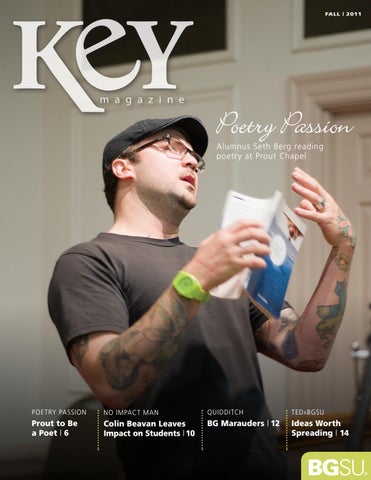
Poetry Passion Alumnus Seth Berg reading poetry at Prout Chapel
POETRY PASSION
NO IMPACT MAN
QUIDDITCH
TED x BGSU
Prout to Be a Poet | 6
Colin Beavan Leaves Impact on Students | 10
BG Marauders | 12
Ideas Worth Spreading | 14
BGSU
®
Letter from THE EDITOR DEAR READERS, Every year, Bowling Green State University has many new opportunities to offer students. These opportunities can come in the form of new organizations, scholarships, events and much more. Key Magazine documents these changes, such as writing about the new dining and residence halls, so everyone can look back at University advancements and remember how they were part of the growth. To reach out to a wider audience, the staff wants to provide a magazine that continues to include stories about the Bowling Green community. In this issue, you’ll see a story about the community gardens in Bowling Green and visiting writers who read their work at Prout Chapel. The magazine is undergoing changes that will provide a Web presence for readers as well. I’ve had the chance to watch the magazine grow since its debut in 2008. This year, I am excited to have the opportunity to expand the publication for readers and future staff members. Thank you, staff members, for your perseverance and willingness to overcome obstacles. All the best, EDITOR Emily Tucker
A S S I S TA N T E D I T O R Emily Tucker, editor-in-chief, and the Key Magazine staff
KEY MAGAZINE
Key Magazine is published by the Office of Student Publications at Bowling Green State University, Bowling Green, Ohio, 43403. It is distributed at locations throughout campus and at select locations in the surrounding community of Bowling Green. Student editorial offices are located in 28 West Hall, and any questions related to content may be directed to student editor Allison Borgelt at aborgel@bgsu.edu or by calling 419-372-8086. Questions related to advertising in Key Magazine may be directed to Assistant Director of Student Publications Tonya Whitman at twhitma@bgsu.edu or by calling 419-372-0430. Key Magazine is published two times per academic year at Bowling Green State University, once in the fall and once in the spring. Student Publications, Division of Student Affairs
Tom Nepomuceno
REPORTERS Sarah Bailey Hannah Mingus Brittney Moffatt Rachael Murphy Collin Sims Chris Talbert
COPY EDITORS Sarah Bailey Allison Dunn Ambre Dziczek Alexander Elfreich Kelley O’Brien Collin Sims Chris Talbert Lisa Wendel
PHOTOGRAPHERS Sarah Bailey Kelley O’Brien Brittney Moffatt Rachael Murphy Marketing & Communications
DESIGNERS Brittany Fritz Stephen Shankster
Table of CONTENTS 5
RECAP OF HOMECOMING 2011 by Brittney Moffatt
6 PROUT TO BE A POET by Collin Sims
9
B L A C K S WA M P A R T S F E S T I VA L 2011
10
C O L I N B E AVA N
by Emily Tucker
12
BG MARAUDERS By Hannah Mingus
4
KEY MAGAZINE | VOL 4 ISSUE 1 | FALL 2011
14 IDEAS WORTH SPREADING by Christine Talbert
17
NEW RESIDENCE AND DINING HALLS by Christine Talbert
20
BOWLING GREEN COMMUNITY GARDENS by Rachael Murphy
22
ON THE EDGE BODY ART STUDIO by Sarah Bailey
RECAP OF
HOMECOMING Story & Photos By Brittney Moffatt
“Don’t Stop BGing” was this year’s Homecoming theme, and it was all about keeping University spirit alive. Homecoming kickoff was Wednesday, Oct. 12, in the Union Ballroom. Students were jumping onto a Velcro wall and riding a mechanical bull. Wacky photos were taken in a photo booth as music blasted from the speakers. Oct. 13, students decorated foam fingers in the Union. Students participated in contests where they hopped on one leg and whistled, and they had the chance to win prizes such as an Amazon Kindle. The Homecoming Student Steering committee held a trivia session at the Black Swamp Pub during the evening hours. “Our Homecoming kickoff was so successful. The parade went on without a hitch,” Rachel Rosenthal, director of the 2011 Homecoming Student Steering committee, said. The main event Oct. 14 was the parade, which included many organizations such as The BG News, The Student Health Center and many sororities and fraternities. Earlier
that day, there was a residence hall window splash competition, and judges selected the most outstanding Homecoming decorated windows. Sigma Kappa had an open house for anyone, including alumni, to eat and watch the parade. After the parade was the Falcon Pep Rally. The University Dance Team showed off their moves while the Pep Band performed. Nicole Krueger and Shawn Gilbert were announced Homecoming queen and king. The University of Toledo Rockets defeated the Falcons 28-21 at the Saturday football game. n KEY
To look at what other Homecoming events took place, visit the website at http://www. bgsu.edu/offices/mc/homecoming/index.html.
Homecoming Parade
KEY MAGAZINE | VOL 4 ISSUE 1 | FALL 2011
5
” By Collin Sims
PROUT TO BE A POET I just genuinely ” understand A don’t
people who say they have nothing to write about.
“
-Aimee Nezhukumatathil
6
KEY MAGAZINE | VOL 4 ISSUE 1 | FALL 2011
ttendees at the Prout Chapel Reading Series are given suggestions by authors like Aimee Nezhukumatathil to read, floss and write thank you notes instead of emails. “You’d be surprised how few people do that these days,” she said. Every Thursday, writers crowd to Prout Chapel. Students, faculty, alumni and guest writers come to share their work at the Reading Series hosted by the Creative Writing Program. The program started in 1967, and about 75 people attend the Reading Series every week, according to the Director of the Creative Writing Program Lawrence Coates. Coates is the current director of the Reading Series, but the title will shift to someone else next year since it is a rotating position.
The readings are open to the public, but creative writing students are required to attend as part of a zero hour credit class for at least four semesters. “I think it is valuable to have them gather here to share their works and hear from visiting writers,” Coates said. Coates said the visiting writers are chosen at the beginning of the year when the director sends out a call to faculty and students for suggestions. Then, decisions about who can come read are based off the budget and resources. Since Prout Chapel is “an opportunity to hear good writers” and helps create a sense of community between writers, Coates said he is hoping to increase the number of noncreative writing students who attend.
Coates said the readings are held at Prout Chapel mainly as tradition, and a lecture hall would be difficult to sign up for and may seem sterile. When a presentation writer visits, however, the department tries to find a room with better seating and a better sound system. Poet Nathan Riggs, a graduate student, spoke at Prout Chapel Oct. 6 to share some of his works of poetry. Riggs said he has been writing since he has been able to write or at least remembers writing. He wrote his first short story when he was six or seven years old. “With poetry in particular, though, it’s a little difficult to define. It’s a bit cliché, but I started writing poetry at 12 or 13 as a form of self-therapy,” Riggs said. “I think I still do, though it’s now a bit more convoluted than that. I didn’t even know I wrote poetry, honestly, until after I graduated [from] high school. It was just something I did on my own, and I didn’t share it with anyone.” Riggs said he thought his inspiration came from “transgressive activities” like sex, drugs and alcohol, but now that he has reflected upon it Riggs found the matter “irresponsible” for his poetry. “I write a lot about the stupid things I’ve done in my life, or the stupid things that have happened pertaining to my life, so I guess that my best answer is that my inspiration comes from experience and reflecting on it,” Riggs said. “I don’t think experience alone makes a good writer, nor reflection alone. I think it takes a bit of both.” Though his poetry is and has always been “personal and confessional, though often cryptic,” Riggs is still getting used to collaborating since he did not share his
works with anyone for a long time. Riggs said he has always wanted to try writing fiction and wasn’t sure if being a poet was something worthwhile until he discovered Charles Bukowski, an American poetry and fiction writer. “Even then, it took me a long while to realize that I might be an OK fiction writer, but I’m probably a better poet,” Riggs said.
You won’t figure yourself out until you figure out how the world fits you into itself... It took me longer than most. - Nathan Riggs When asked if he has work published, Riggs said he has not had anything “substantial” printed. “I probably could, but I have a general sense of lethargy when anything monotonous is involved,” he said. “And damn, submitting is monotonous.” Riggs studied computer science initially before switching to philosophy, and then history before English. After spending seven or eight years driving to the various branch campuses of Ohio University to save money and because of his liking of smaller class sizes, the administration told him he was no longer allowed to take classes at the university. “Since I had the most hours spent in English and history courses, I pursued both fields in a specialized degree,” Riggs said. “Most of my education, as I see it, came from working in factories and warehouses, and sometimes in the dark corners of seedy bars.
I learned more doing that than any class ever taught me.” After taking classes as an undergraduate, Riggs realized he had room to improve and figure out what he loved doing. In spite of it being clear from the beginning, he said very few people plan to spend thousands to become a poet. Something many writers experience at some point is writer’s block, which Riggs said he gets around by revising and writing to avoid staring at a blank screen. “If there’s a serious generative problem, then I’d suggest doing something else until it goes away,” he said. Time he spends writing varies since he is constantly thinking about something that eventually makes its way into his writing as part of a dialectal process. What he claims is his greatest difficulty as a writer is what is considered “easy for everyone else.” “I think the difficulties I have in daily life generally help me be a better writer but can also threaten to stop me from doing much of anything with myself. I am, like everyone else, a work in progress,” he said. To anyone wanting to write, the advice Riggs offers is to simply live your life. “You won’t figure yourself out until you figure out how the world fits you into itself,” Riggs said. “It took me longer than most.” A week later, visiting poet Nezhukumatathil came to Prout Chapel and shared some of her works of poetry with the audience. Writing since her junior year of college after studying chemistry at The Ohio State University, which is where she also received her Master of Fine Arts in English (poetry and non-fiction), Nezhukumatathil said her inspiration comes from nature. Her works
Photos provided by Emily Tucker
KEY MAGAZINE | VOL 4 ISSUE 1 | FALL 2011
7
begin with a singular image before growing to symbolize something else. “So, I might start out with the image of firefly larvae glowing in the dark, but the poem is most probably not going to simply be about fireflies,” Nezhukumatathil said. Recently, Nezhukumatathil prefers writing poetry even though she has been branching into lyric non-fiction, and she’s had three books of poetry published. Her most recent book is “Lucky Fish.” She is currently collaborating with Ross Gay, an English professor at Indiana University, about garden poetry. “I will write a couple of stanzas, then he retypes them and adds a couple of stanzas,” Nezhukumatathil said. In addition to collaborating with Gay, Nezhukumatathil cites David Citino, who died in 2005, as her mentor from OSU. She said he told her she was a poet in spite of turning in not so stellar work, and whose enthusiasm for poetry was contagious to where it took hold in her.
“You couldn’t not be on fire for poetry in his presence,” Nezhukumatathil said. “Any time someone referred to a writer in class and I wasn’t familiar with the work, I’d make sure to get info about that writer from the library. I read. And read a lot.” As a mother of 4-year-old and 16-month-old children, Nezhukumatathil said she will write a couple times per week at most, but when she does she can be very productive in that time while she is focused. Citing her greatest difficulty as a writer as “being as clear as possible, in the loveliest way as possible,” Nezhukumatathil refuses to believe in writer’s block. Nezhukumatathil said even though she can sometimes find nothing to write about, she tells herself to look harder at the world around her to find inspiration. These ideas sometimes come from her body, someone else’s body or the outdoors from when she was young. “I just genuinely don’t understand people who say they have nothing to write about,” Nezhukumatathil said. n KEY
”
Any time someone referred to a writer in class and I wasn’t familiar with the work, I’d make sure to get info about that writer from the library. I read. And read a lot.
“
— Aimee Nezhukumatathil
The readings begin at 7:30 p.m. in Prout Chapel. A complete list can be viewed at http://www.bgsu.edu/departments/creativewriting/read.html.
Aimee Nezhukumatathil
8
KEY MAGAZINE | VOL 4 ISSUE 1 | FALL 2011
A quick look at the 2011
BLACK SWAMP ARTS FESTIVAL
right: Music performances are a festival favorite below: Dwayne Dopsie & the Zydeco Hellraisers
left: Attendees look at artwork being sold and talk with friends.
KEY MAGAZINE | VOL 4 ISSUE 1 | FALL 2011
9
By Emily Tucker Editor-in-Chief
COLIN BEAVAN LEAVES
IMPACT
ON STUDENTS
”
We’re so dependent on the consumption of oil that we have to go to war for it. ..
“
— Colin Beavan
10
KEY MAGAZINE | VOL 4 ISSUE 1 | FALL 2011
C
olin Beavan said he was going to change himself instead of worrying about changing everyone else. He told the audience members to ask themselves the followin question: “What can I do?” Beavan’s book “No Impact Man: The Adventures of a Guilty Liberal Who Attempts to Save the Planet, and the Discoveries He Makes About Himself and Our Way of Life in the Process” was chosen for the Common Reading Experience this year. The book documents his struggle for one year to reduce his carbon footprint by making temporary changes such as not using toilet paper, electricity, elevators and more. At the event in the Union Ballroom, Beavan said he used to get so angry when he saw so many people driving SUVs, which
consume a considerable amount of gas. At some point, though, he said he began to realize he was part of the problem of harming the environment. Beavan spoke for an hour about his book, and he told a few stories to the audience. One of the first topics he talked about was oil consumption. He asked students if they knew anyone in the military who is stationed overseas. Beavan said he grew up during the Vietnam War but did not remember too much because he was very young. “We’re so dependent on the consumption of oil that we have to go to war for it,” he said. He told a story about what people were saying about the polar bear’s environment being disrupted. Then, he said, “If the habitat
can’t support the polar bear, how long is it until the habitat can’t support us?” After discussing how the habitat is stressed, he spoke about topics like the similarities between human and chimpanzee DNA and how recycling is a good place to start if one wants to make a difference. Following the presentation was a question and answer session, and many students raised their hands to ask questions regarding his lifestyle and the book. The event ended with a book signing, and the line extended across the Union Ballroom. “I want to have conversations with people about how they live their lives,” Beavan said. “That’s what I want to do.” Abbey Tobe, a senior double majoring in environmental studies and geology with a focus in watershed management, said she was inspired by Beavan’s book. “My friend gave me a copy of the book to borrow in 2010, and then another friend got it for me for my birthday,” Tobe said. Tobe emailed Beavan last summer to tell him he inspires her. She said she was invited to a luncheon so she could meet Beavan when he visited the University. For her honors project, she will turn in a portfolio that consists of environmentalthemed poetry and a blog that she’s been working on. The project lasts for one semester, and the presentation ceremony is April 2012.
Look at what she’s doing... I mean, how can you not want to do what she’s doing? — Emily Ancinec For the project, she tries to make the least amount of impact as possible on the environment. She said her posts consist of her experiences attempting to live this lifestyle and reactions to how other people treat the environment. Tobe’s goal was to post once per day, but she said she has only been able to post every couple days because of a busy schedule. “I haven’t worked on a blog since freshmen year,” she said. “I had to think about the strangers that might view my blog. I re-read the first post at least 10 times before posting.” Tobe said at first she had two followers on her blog that she did not know, and now she has seven followers. Some of the followers are friends, and others are people she has never met. She is not sure if she will continue the blog after she completes the project, but she wants to try continuing the lifestyle.
“It’s going to be hard to switch back to the old swing of things, especially when you’re changing your eating habits,” she said. Emily Ancinec, president of Undergraduate Student Government, said she met Tobe freshmen year because they lived in the same residence hall. Ancinec has sent emails to numerous people around campus, spreading the word about Tobe’s honors project. “There are so many challenges involved with school, anyway,” Ancinec said. “The fact that Abbey is doing this is admirable.” Ancinec attended Beavan’s speaking event. Although she expected him to primarily talk about his personal life, she enjoyed his humility and hearing about his outlook on life in general. She read the book, and it is her favorite Common Reading book from the past four years. Since she is president of USG, she said she felt the need to read the book that all freshmen were required to read. Ancinec said she is proud of what Tobe is doing, and being around Tobe has made her aware of how disposable society has become. “Look at what she’s doing,” Ancinec said. “I mean, how can you not want to do what she’s doing?” n KEY
Photos provided by Emily Tucker Above: Beavan speaks to the audience about oil consumption Oct. 26. Below: Tobe and Beavan pose for a photo. They are trying to decrease their environmental impacts — photo provided by Emily Ancinec, Undergraduate Student Government president. Bottom: Beavan signs books for students and poses for photos with them.
Colin Beavan’s blog - http://noimpactman. typepad.com/ Abbey Tobe’s blog - http://tobe-no-waste. tumblr.com/ To learn more about the Common Reading Experience and other events from No Impact Week - http://www.bgsu.edu/offices/sa/firstyear/ page97371.html KEY MAGAZINE | VOL 4 ISSUE 1 | FALL 2011
11
BG MARAUDERS By Hannah Mingus
”
I really like being in a community of people who share the same passion for Harry Potter as I do...
“
— Ashley Chapman
12
KEY MAGAZINE | VOL 4 ISSUE 1 | FALL 2011
O
ne by one, students walk to the front of the room and take their seats as they wait to be sorted into their specified houses. For many, their dreams of following in Harry Potter’s footsteps at Hogwarts School of Witchcraft and Wizardry are finally coming true here at the University. Just like in the Harry Potter series, members of the BG Marauders are sorted into the four houses of Gryffindor, Hufflepuff, Ravenclaw and Slytherin. They are asked three questions: What do you do when you get angry? Do you like to be alone or with people? Do you like to get wet? BG Marauders became a student organization September 2010 because of senior Alexis Moody. Moody said she had not heard of a Harry Potter club like this before, only Quidditch teams at other college campuses. She and several other students decided to start a fan club, along with a Quidditch team, and so the BG Marauders was created. This year as a way to celebrate the one year anniversary, the club got
together, had cookies and sang “Happy Birthday” to one another. Event Planning Officer Ashley Chapman joined the club last year after seeing several posters around campus and attending a meeting with a friend. “I really like being in a community of people who share the same passion for Harry Potter as I do,” Chapman said. “Even though the series ended, we still love it the same amount as we did years ago.” There is a specific topic planned for each meeting such as discussing people’s favorite and least favorite moments of the series. “Some people get really fired up,” Moody said. They try to give everyone a good understanding of the series by not only discussing Harry Potter, but also by playing games such as Harry Potter Scene It and Harry Potter video games for Nintendo GameCube. The BG Marauders also have different theme nights planned throughout the year. Examples are Weasley Twin Appreciation Night where members will wear
ugly Christmas sweaters, a trivia game night, stargazing and a Halloween costume party. The Halloween party, which was Oct. 28 in the Union, helped raise money for the club. The party featured a costume contest, which awarded students for the “best overall,” “most creative,” “best Harry Potter” and “worst overall” costumes. Chapman said her favorite costume that night was worn by Kathryne Rubright, who dressed as a serial killer. Rubright won the “most creative” costume award. Awards were based off of applause from the audience, and the winners received a movie. Besides the Thursday night meetings, the BG Marauders Quidditch team is active on campus. The team had 45 people try out this year; 20 people joined the traveling team, and 10 are on the reserve team if a spot filled or someone drops. “An average game usually lasts about 20 minutes,” Moody said. “Some have gone up to 30-45 minutes, and those are horrible and so long and tiring.” The way the Quidditch game is played is very similar to the Harry Potter books and films. The Chasers handle the Quaffle, and a deflated volleyball is used as the Quaffle. The goal is to get the ball through the hoops, and tackling is allowed. The Beaters throw dodge balls at the players, so they run back to their hoops. The Keepers act as goalies. There is a Snitch, who is one of the players running around with a tennis ball in a sock. Once the Seekers catch the Snitch and get the ball, the game is over. All of this occurs while the players are running with a broom between their legs. “The broom is a challenge for a portion of the people to get used to,” Moody said. “But I wouldn’t want Quidditch without a
broom.” During the Loyola University Chicago game, the players had several injuries. A player sprained a finger, and the Keeper’s knee blew out after being tackled numerous times. Moody said one of the team’s newest members, Ty “Muscles” Parish, has been “dynamic, tough, fast and a great addition” to the Marauders. Several other players who have had “stellar” performances on the field are Daniel Daugherty, Joe Pavilik and Katie Milligan, who is a captain on the team. “The entire team is very good,” Moody said. “Each person has a specific talent and is good at what they do.” They are currently working on creating rituals to do before each game. They all sing “Ay Ziggy Zoomba” together, and then they put their hands in middle and yell “We are BG,” followed by their motto “Hey don’t bleed on our broom!” From Nov. 11-14, the BG Marauders competed in the fifth World Cup in New York City, hosted by the International Quidditch
The broom is a challenge for a portion of the people to get used to, but I wouldn’t want Quidditch without a broom. — Alexis Moody
Association. Moody said it is the fastest growing sport she has seen. The club did fundraisers for the trip by selling The Cookie Jar cookies in the Union, hosting a shadow cast of “A Very Potter Musical” and having the Halloween costume party. The Quidditch team, along with most of the officers and several BG Marauders members, attended the World Cup. “I was really excited about going since I’d never been to the World Cup or New York before,” Chapman said. Quidditch is mainly a seasonal sport, but the team continues to practice throughout the winter months. Moody said it was difficult last year during the winter since not many people were coming to practices. “I was incredibly scared, and it was a tough time to keep going as a captain,” she said. The games began again in the spring, and an intramural league plays during the summer since many of the team members return home. Moody is extremely proud of how much the BG Marauders club has grown in the past year. “My favorite memory was our first meeting of the year,” she said. “I knew we’d had a successful Campus Fest, and it was amazing to watch over 100 people walk through the door.” The club currently has over 140 members and is still growing. By attending meetings and events, members can earn house points in order to win “best house” and other individual awards at the end of the year. The BG Marauders meet at 9 p.m. every Thursday, and they are always looking for more Harry Potter fans to join. n KEY
Photos provided by Emily Tucker KEY MAGAZINE | VOL 4 ISSUE 1 | FALL 2011
13
IDEAS WORTH SPREADING By Christine Talbert Photos provided by Marketing & Communications
At first these comments stung, but I am okay with my body now... — Brittany Gibbons
14
KEY MAGAZINE | VOL 4 ISSUE 1 | FALL 2011
M
oments after walking onto the stage, Brittany Gibbons, editor of The Curvy Girl Guide magazine, reached for her necklace and threw it onto the floor. Then, she kicked off her shoes and began to unbutton her blouse. “You’re starting to get nervous now, aren’t you?” She asked the audience. Within a matter of minutes, Gibbons stripped down to a navy one-piece bathing suit, showing hundreds of students, faculty and community members how proud she was to have a “plus-sized” body. Gibbons used her 18 minutes as a TEDxBGSU speaker to recreate her time in New York when she stood in the middle of
Times Square in a bathing suit while on a media tour with Lands’ End. “I have a magazine call The Curvy Girl Guide, which actually got a lot of public attention, and Lands’ End asked me to be in their 2011 catalogue, and then asked me to do a media tour for them,” Gibbons said. “I ended up going to New York City and did 196 interviews in only five days. Part of this tour was to stand in the middle of Times Square with only a bathing suit on.” Gibbons said she was nominated by an anonymous individual to be part of the University’s TEDxBGSU event, and she believed it was because students wanted to hear her speak about having positive selfesteem.
“There are people that comment on the blog I have called ‘Barefoot Foodie’ that would say things like ‘I can’t believe you found someone to marry you’ and ‘How about instead of writing a blog about being fat, you go and exercise instead?’ or ‘You know, you really aren’t that attractive,’” Gibbons said. “At first these comments stung, but I am okay with my body now. And after turning 30 and having three children, I’ve had time to come to terms with what I look like.” During her TEDxBGSU presentation, Gibbons said she hoped the students at the University were able to see her and by hearing what she had to say are able to take away something from it.
I cannot imagine my daughter going to school and being ridiculed about something so personal. — Brittany Gibbons
“I’ve looked like this since I was 8, and my low self-esteem started with bullying on the playground. I hope girls and women stop acting this way and instead are more open minded to what natural, average women’s bodies look like and be okay with it. Be proud of it,” she said. “I cannot imagine my daughter going to school and being ridiculed about something so personal.” TEDxBGSU Curator and University student Skyler Rogers said he had been watching TEDTalks for a couple years and was continuously blown away by the messages people were sending. TED stands for technology, entertainment and design, and there is a global set of conferences called TEDTalks. TEDTalks is famous for the tag line “Ideas worth spreading.”
”
Gervais Tompkin - Principal, Gensler
A few of the other presenters that were at TEDxBGSU included Gene Poor, a professor of entrepreneurship in the College of Business Administration at the University, and his son, Michael Poor, who is a visiting assistant professor in the Department of Computer Science. They spoke together about audio-animatronics and the illusion of life. Poor joked during his presentation about his research in accessibility computing and life-like robots. “If you steal from one person it’s theft, it’s plagiarism. But if you steal from several people, it’s research,” he said. Another speaker was CEO of Root Learning Jim Haudan, whose presentation was called “The Art of Engagement – Inspiring People, Creating Change and Making a Difference.” Haudan spoke about how humans respond best to honest assessment. Haudan said he wished people were more open and told the truth outside of the bathroom and next to the water cooler. Something Haudan touched on was how people visualize things differently.
“Take for example, I say the word ‘bear,’” he said. “What do people think? Gummy bear, black bear, Bayer aspirin, grizzly bear, bare feet, bare naked?” Haudan said this happens with organizations all the time, and in order for everyone to be on the same page, everyone’s vision needs to be the same. TEDx is an extension of TEDTalks, and University alumnus Steve Hanson had been to a TED event in California, one of the first annual conferences with leaders from around the world called the “TEDizen.” Rogers reached out to Hanson, and with his help secured the license to hold a TEDx event. Since November 2010, Rogers had been planning all the bigger details. He opened up the speaker nomination process and had a few nominations. He put together a speaker selection committee to come together and then chose the speakers so that there was a good mix of presenters and the ideas these presenters were expressing complimented each other.
If you steal from one person it’s theft, it’s plagiarism. But if you steal from several people, it’s research.
“
- Michael Poor
KEY MAGAZINE | VOL 4 ISSUE 1 | FALL 2011
15
Since the event, Rogers said he and his team of students and staff members have received praise for holding the event. “I think we were definitely able to bring some excitement, optimism and forward thinking to the campus. Tickets sold out for the event, and once we started talking about it and as soon as more people started to understand what the event was all about, it really took off,” he said. “We had resounding support from people and Bowling Green State University.” President Mary Ellen Mazey supported TEDxBGSU by funding 100 of the tickets so 100 students could attend the event for free. “I just thought that was so great for the University president to do that,” Rogers said. “I really respect her student-centered philosophy and all she has invested in making the student’s experience at BG better.” At the event, a lunch was provided for those who attended. Rogers said the lunch was delicious, but some non-vegetarians were expecting a buffet rather than only a salad for lunch. “With the help from Dining Services and their executive chef, we were able to supplement this food from local venders within a six-mile radius,” he said. Junior Gabriel Morgan got involved
with TEDxBGSU early when Rogers came up with the idea to host a TEDx event at the University. “Skyler and I both have always appreciated TED as an organization and of course the TEDTalks, but I think more so the idea of why TED exists and why it needs to in our time more than ever,” Morgan said. “Skyler, knowing that I loved TED, asked if I wanted in, and I said I would help him do anything I could to make this happen.” According to Morgan, during the beginning steps of putting together the event, he contributed around 10-20 hours with weekly meetings. Time was also
The fact that a student coalition could bring such a large event and receive such a large response is a precedent.
spent researching ideas other conferences have done in regards to environmental sustainability, stage design, the timing of the daily event and the content the speakers are nominated for. “Some things I think I did to make the event successful was help choose the theme from which we were basing the nomination of speakers around, and I helped Skyler develop plans for making the event environmentally sustainable,” Morgan said. “I was a host for the event the day of, and that was an important contribution as the liaison from speaker to speaker and speaker to audience.” Morgan considered the event a success and was proud of what it represented for the community, being the first event to take place at the University. “I personally feel that it created a new level outside of what conventionally brought large names, movers-and-shakers to campus. To think that some of the leading thinkers, makers and leaders in the United States today wanted to come and speak at our University without pay?” he said. “The fact that a student coalition could bring such a large event and receive such a large response is a precedent.” n KEY
— Gabriel Morgan
Gene and Michael Poor — BGSU & Lifeformations
16
KEY MAGAZINE | VOL 4 ISSUE 1 | FALL 2011
R E S W I D E E N N DINING CE and CATER H A TO STU L L S DENTS ’ NEE rt
e Talb tine
hris
By C
DS
...we have created the right kind of community that students want to be a part of. — Sarah Waters
After one year’s worth of planning and 14 months of development, Falcon Heights and Centennial Hall have become home for over 1,000 students. Since December 2009, the Office of Residence Life and Dining Services have worked together to create two new residence and dining halls at the University. “Typically, there would be years and years worth of preparation that would go into this kind of project before the shovel goes into the ground, but these residence halls were different,” Director of Residence
Life Sarah Waters said. “That’s because we really needed to update housing at Bowling Green State University, so we were able to develop these residence halls within only one year’s worth of planning.” During the difficult financial period, the University decided to take part in a publicprivate partnership, meaning there is a third party involved assisting with the funding of the new residence halls. An independent foundation owns the building, while the University owns the land. “We did this so financially we would KEY MAGAZINE | VOL 4 ISSUE 1 | FALL 2011
17
Left: Falcon Heights Lobby Below: Outside of Falcon Heights
Photos provided by Kelley O’Brien
be able to break even,” Waters said. “So, we requested for a proposal to secure a developer in December 2009 and then broke ground in spring 2010, and they opened in August 2011.” According to Waters, the design process went much faster than is normally anticipated for this kind of project, which differentiates the University from other institutions. “We hadn’t built anything new in a while, even though the Wolfe Center was a go and the Stroh Center was about to go underway. We made an intentional decision to change the admissions process to show the potential incoming students and current students that even in bad financial times we would do things to benefit the student experience,” Waters said. “We worked hard to put our money and resources in the right places and hoped we’d end up with more students coming in, and we did.” In order to repay loans and continue financing operation costs of the new residence halls, both Falcon Heights and Centennial Hall needed to be at 95 percent capacity at all times in order for the University to break even and make money instead of losing it. According to Waters, the third party pays for the building to operate. By keeping the residence halls at a certain capacity, the University is able to reimburse the foundation and possibly have a surplus pool
18
KEY MAGAZINE | VOL 4 ISSUE 1 | FALL 2011
of money that can be transferred back into the University reserves. This semester, Residence Life implemented the new policy that students are not able to move out of Falcon Heights or Centennial Hall unless they have another student fill the vacancy. Waters said the housing staff tries to help in these situations so they can better facilitate who is coming in and out in order to ensure students are having an enjoyable experience. As of Oct. 17, Falcon Heights is 98.9 percent full, and Centennial Hall is completely full. “As of fall 2011, the retention rate for these residence halls has been good. Fewer students have been withdrawing from the University, but we did have six no-shows on move-in day. So, we were able to fill those spaces and allowed other students to move
in,” Waters said. “Last year in the fall and spring, we were at 90 percent capacity. We hope to beat that this year and trust it will be because we have created the right kind of community that students want to be a part of.” Although Falcon Heights is an upperclassmen residence hall, Residence Life will begin allowing freshmen to move in if they please. Currently, all residents in Centennial Hall are first year students. First year student Mel Dickey said she is pleased to be living in one of the University’s new residence halls. “Centennial has definitely spoiled me. It’s nice having my own bathroom, and living in a brand new building is cool, too. It’s also nice that it’s in the center of campus and that there is a dining hall and Outtakes right next
Centennial Hall
door,” Dickey said. “I think my experience would’ve been different if I lived in one of the older residence halls because when it was unbearably hot when I first moved in, I couldn’t imagine being able to do homework in my room or being able to sleep. But I still feel like we get the same freshmen experience since we’re all new to BGSU.” According to Mike Paulus, director of Dining Services, the dining projects were completely separate from the building of the new residence halls, and it was intentional to not have dining halls in the new residence halls. “The Oaks took 14 months for us to build once we had the land cleared. Before we started building, we had to determine what the University had in mind for their master plan, meaning what their intent was for the University within the next 20 years,” Paulus said. “And so what we worked on was creating these academic neighborhoods that consisted of academics, residence halls and dining in three quadrants on campus.” According to Paulus, Commons and McDonald dining halls were in need of renovations since they were built in the 1960s and had maintenance issues. Paulus sat in during residence hall planning sessions, and those who worked in Residence Life were invited to all of the Dining Services planning sessions in order to work together with the spaces they were provided for the new buildings. Dining Services looked into the cost to renovate buildings rather than tearing them down to create something new. However,
it would cost 80 percent of what it would to build a new building, and so rebuilding became the best option for the University. Paulus said the planning of Carillon Place took time because of problems with some of the existing water, sewer, steam and data lines underneath Commons that needed to be relocated so development could begin. “In terms of sustainability, we have done a lot to make sure these new dining halls are green,” he said. “We actually ground up some of the Commons and Mac buildings and used it as landfill material that we needed to fill in some holes. Anything that could be sold, or reused or recycled, we did before we turned the buildings over for demolition.” Dining Services recently received their quarterly reports, and there has been an increase of cash traffic on campus by 27 percent from last year. “I purposefully chose this corner of
campus in order to bring in more outside community spending. Dunkin’ Donuts has helped make The Oaks popular because it’s right next door,” he said. “I just had to buy some booster seats and create kids meal prices because we’ve had that many community members coming to The Oaks. I’ve never had to do that at any other university I have worked at, and I think where we strategically placed The Oaks dining hall has a lot to do with that.” Location of where the new dining halls would be placed was an important factor for the University to consider. What used to be Mac Beach now has a fire pit off of The Oaks, and behind Carillon Place is a green landscape for students to play football. Paulus said he worked to create a space for students to use so that they weren’t losing recreational areas because of the creation of the new buildings. According to Paulus, Dining Services’ next project is to renovate the Falcon’s Nest in the Union. Paulus called the current design of the eating area “cave-like” and not very accessible for students. “It is also an opportunity for us to bring more brands to campus. I just presented this new idea to the University and hopefully they go for it so that students can begin to enjoy a new Falcon’s Nest starting next summer,” Paulus said. n KEY
FALCON FACTS > Falcon Heights has 646 students living in it (As of Oct. 18). > Centennial Hall has 664 students living in it (As of Oct. 18). > Carillon Place is 17,000 sq. ft and fit to serve 3,300 to 3,500 meals per day. > The Oaks is 25,000 sq. ft and fit to serve 6,500 meals per day.
The Oaks
KEY MAGAZINE | VOL 4 ISSUE 1 | FALL 2011
19
BOWLING GREEN COMMUNITY GARDENS PROVIDE ORGANIC FOOD AND BONDING Story and photos by Rachael Murphy
”
I think we don’t get to be outside enough as a culture... I think we don’t get to work enough...
“
— Miriam Hitchcock
20
KEY MAGAZINE | VOL 4 ISSUE 1 | FALL 2011
A
lthough residents of Bowling Green have complained about days of continuous rain, Miriam Hitchcock, a volunteer for the local community gardens, was happy with the results from the rain. “It’s amazing how much easier this is after it’s rained for three days straight,” Hitchcock said. As the volunteer coordinator for The Common Good community center’s community gardening program in Bowling Green, Hitchcock has been arranging and attending volunteer work days since last spring. Now, the gardeners have harvested most of their produce, including squash, cucumbers, onions, lettuce and radishes. Community gardens have been gaining popularity in recent years as a means of community bonding and providing less expensive organic produce, Amanda McGuire Rzicznek, a food columnist for The BG News, said. The community gardening program in Bowling Green is just one example of many throughout the nation. The presence of a community garden in a low-income area can raise property values up to 9.5 percent within five years of a garden’s opening, according to a 2006 study. The American Community Gardening Association estimates that there are as many as 18,000 community gardens in the United States and Canada, and that’s only the number of gardens that are registered on the
I just think it’s really valuable for people to know where their food comes from, to know that it doesn’t grow on shelves.
— Miriam Hitchcock
website database. Only a small amount of formal research has been done on the trend of community gardening, so it’s difficult to estimate how many community gardens there actually are in the United States. Hitchcock said that she tries to coordinate workdays when multiple people will be available so that those who have gardening experience will be there to help those who do not. During summer workdays, volunteers pulled weeds, planted seeds and staked tomato plants. Currently, the volunteers are winterizing the garden to ensure it will be able to grow in the spring. The process involves digging up the grass and planting a cover crop that will prevent soil erosion and maintain the soil’s nutrients. The volunteers use natural insect repelling methods to keep their produce organic. Marigold flowers, for example, are natural insect repellents. Although she has killed a few squash bugs by hand, Hitchcock said she loves that gardening is outdoor work. “I think we don’t get to be outside enough as a culture,” Hitchcock said. “I think we don’t get to work enough.”
The gardens are open for anyone to work in and to take from. Ideally, anyone who wants to take from the garden will also put work into it. Some of the produce is donated to The Common Good community center for its open community meals every Monday, Thursday and Friday. Lindsey Dougherty, a volunteer at The Common Good community center, helped start the community gardening program five years ago. She first learned about the benefits of community gardening during a servicelearning trip to the South Bronx, New York. Organic community gardens in urban areas provide a safe place for people to hang out and a productive use for vacant lots that otherwise collect garbage, Dougherty said. The Bowling Green community gardens are built on the idea of reciprocity, which Dougherty described as “Do what you can; take what you need; leave the rest.” Community gardens also provide the communities they serve with free organic produce that is guaranteed to be fresh. Organic produce can substantially cost more than regular produce in grocery stores. Rzicznek said if there is one disadvantage in the community model of gardening, it would be trying to schedule a time for people to volunteer. “It’s hard to rely on other people – it has to be a community that is really dedicated, and if they aren’t, the garden suffers,” Rzicznek said. The Common Good community garden volunteers have worked to get the word out about the community gardens by going doorto-door in lower income neighborhoods and hosting picnics, but it has been difficult to get volunteers to show up consistently, Hitchcock said. “I just think it’s really valuable for people to know where their food comes from, to know that it doesn’t grow on shelves,” Hitchcock said. n KEY KEY MAGAZINE | VOL 4 ISSUE 1 | FALL 2011
21
ON THE EDGE BODY ART STUDIO
Thrives Despite Downturn Of Economy Story & Photos by Sarah Bailey
”
We’ve actually had more customers, but I also credit the store’s customer service for our success.
“
— Dennis Foust
22
KEY MAGAZINE | VOL 4 ISSUE 1 | FALL 2011
Dennis Foust is a father of five children, a regular church attendee and an artist of 200,000 tattoos. Foust is the manager of On the Edge Body Art Studio on North Main Street in Bowling Green. While other businesses struggle during the downturn of the economy, Foust’s trophy-decorated and portrait-covered studio is an example of a business that is doing the opposite. According to a story by “U.S. News and World Report,” tattoo businesses are not only doing well, but they are growing. According to the report, there are now 15,000 functioning tattoo studios, and about one new studio opens every day. As the manager of the business for 11 years, Foust said he has seen the store grow while the economy plummeted. Realistically,
the store was expecting a couple of bad years because of the economy, Foust said. “We’ve actually had more customers, but I also credit the store’s customer service for our success,” he said. The popularity of tattoos has recently increased, and the people getting them are changing, too, Foust said. “I think the tattoo business is becoming mainstream, 100 percent,” he said. Foust said he has tattooed teachers, lawyers and even a neurosurgeon from Toledo who has a large tattoo covering his entire back. “Tattooing in general has really grown so much in the last 10 years,” Foust said. According to a study by the Pew Research Center, more than one-third of Americans between the ages of 18 and 25 have a tattoo.
”
Everything was very clean, and they made sure I was comfortable the whole time... I couldn’t have asked for a better experience.
“
— Paige Fenner An estimated 40 percent of people between the ages of 26 and 40 have a tattoo. In any given day, Foust said the store has around 150 customers, about 25 of which get tattoos and the rest get piercings. Tattoos start at $25 and piercings at $10, he said. At the studio, a tattoo artist works with a customer to draw out his or her desired design, and then an appointment is scheduled within the next few weeks for the customer to get the tattoo. The business is certified by the Wood County Health Department, and all of the tattoo artists are trained in first aid, Foust said. Foust started doing tattoos in 1999 after he became tired of working as an engineer at an automotive manufacturer. He already had a few tattoos at that point in his life and decided he was ready for a career change. “I realized I had a passion for tattoos at that point,” he said. “Someone gave me the opportunity, and I went for it.” He said what makes the business different than others is the store’s loyalty to the customers. “In this particular business, we just do good work and take really good care of our customers,” he said. “We stand by our work.” Paige Fenner, a junior at the University who got her tattoo at the studio last year, described her experience as easy and informative. “When I went through, the whole process was satisfying and as painless as possible,” Fenner said. To assure her that the utensils were sanitary, the tattoo artist showed her the packaged tools, opened them in front of her and cleaned the entire area thoroughly before and after the appointment, she said. “Everything was very clean, and they made sure I was comfortable the whole time,” she said. “I couldn’t have asked for a better experience.” In addition to satisfying customers,
Foust said there are plenty of highlights he experiences from managing the store alongside Tobe Drew. “Our perspective of how we do business and how we treat our customers translates down to all of the employees,” he said. Ryan Nickens, who has worked at the studio for a year and a half, described his experience with Foust as a relationship built on respect. “We’ve had a lot of good moments with each other,” Nickens said. “He’s kind of like the dad figure around here.” Customers can get in touch and hear about the studio’s latest news through different types of media, according to Joe Frias, another artist from On the Edge Body Art Studio. According to Frias, the main forms of media the store uses are Facebook, MySpace, radio and television advertisements. An official website is in the works, he said.
Frias, who has been working at the store for five years, said he’s always believed as an artist there is room for improvement. “Everyone has their own style, and I have definitely learned a lot from Dennis,” Frias said. Foust was swift to recognize what his employees mean to him. “I couldn’t ask for more. These guys are the greatest crew ever,” he said. “I’m truly blessed.” n KEY
Dennis Faust
KEY MAGAZINE | VOL 4 ISSUE 1 | FALL 2011
23
SU By joining the BGSU Bookstore on Facebook you will be the first to know about secret sales and special promotions going on in the store!
BG 4 Me Create your profile, choose what you'd like to include in your registry, and send the link to your friends and family. You can choose from a wide selection of apparel, gifts, school supplies, gift cards and more!
Sign up to be a V.I.F. (Very Important Falcon) and receive e-mail notifications about: Special events, promotions and sales Author events and promotions The latest technology products Alumni Specials Much, much more!
When parking in the Student Union lot, your first hour of parking is free when you spend $25 or more at the BGSU bookstore.
419-372-2851 bookstore.bgsu.edu KEY MAGAZINE | VOL 4 ISSUE 1 | FALL 2011