the
SUMMER ~ 2014 THE MUSE ISSUE 9
MUSE
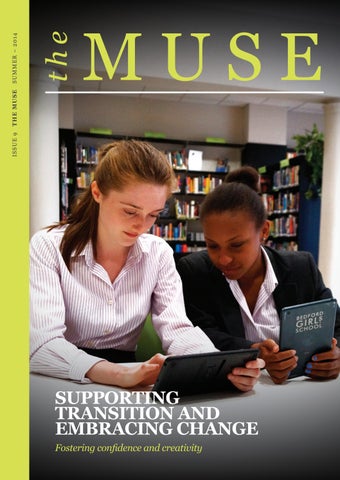
SUPPORTING TRANSITION AND EMBRACING CHANGE Fostering confidence and creativity
Visits & Voyages This list is by no means exhaustive, but offers a flavour of guests in and visits out during the Summer Term.
Visitors In Activity Morning with Bedford Prep School, Year 5 Boombiz Careers Day, Year 10 Community Dance Workshop with Harrold Middle School, Year 6 Community Dance Workshops with Pinchmill and Renhold Lower Schools, Year 4 Greek Day with specialist teaching group Off the Page, Year 5 Lucy Ackroyd, Alumna, Ethiopia Gap Year Talk for Xplore Lucy Charatan, Alumna, Law Talk to Sixth Form Onatti Theatre Company - German Language Play for Years 8, 9 and 10
Onatti Theatre Company - French Language Play for Years 8, 9 and 10 Val Gibson, Professor of High Energy Physics, University of Cambridge for Prize Giving Red Cross First Aid Training - Babysitting Course, Year 10 Tori Swann, Alumna, Law Talk to Sixth Form UCAS Personal Statement Information Evening, Lower Sixth University Admissions Staff, for Higher Education Evening, Lower Sixth Victorian History Assembly, Year 4 Work the Room Event, Lower Sixth
Voyages Out Biology Field Trip to Holt, Lower Sixth Art/Drama Trip to London, Year 7 Art and Technology Visit to Cecil Higgins Museum, Year 8 Bridge Walk in Bedford, Year 5 Chemistry Schools’ Analyst Competition at the University of Hertfordshire, Sixth Form
Duke of Edinburgh Silver Assessed Expedition to the Peak District Electric Car Racing at Rockingham Motor Speedway GCSE Geography Trip to Sheringham Geography Fieldwork, Year 7 History Trip to British Schools Museum, Year 4
Combined Cadet Force Annual Army Camp to Nesscliff
IB Students Visit to Leighton/Linslade Water Recycling Centre, Lower Sixth
Combined Cadet Force NCO Cadre to Chicksands
La Rive Multi Activity Trip to South West France, Year 7
Combined Cadet Force Pre Cadre Training at Bedford School
Osmington Bay Trip, Year 8
Combined Cadet Force RAF Flying at RAF Wyton
Residential Trip to Burwell House, Year 3
Drama Trip to see West Side Story at Milton Keynes Theatre, Years 6 and 7
Residential Trip to Grafham Water, Year 4
Duke of Edinburgh Bronze Assessed Expedition to the Chilterns Duke of Edinburgh Gold Assessed Expedition to the Lake District
Residential Trip to Kingswood, Year 6 Taste of London Food and Drink Festival in Regent’s Park, Lower Sixth Team Building at Ickwell Bury, Year 8 Textiles Trip to New Designers Exhibition in London, Years 10 and Lower Sixth Trip to Guardian News Education Centre, Years 7, 8 and 9 Trip to see Twelfth Night at Regent’s Park Open Air Theatre, Year 9 Visit to Marson Vale Forest Centre, Year 4 Battlefields Trip to Ypres, Belgium, Year 9
Editor’s Insight
A
s we return from our summer break and the girls fill the
building once again with their
enthusiasm and vitality, it is always impossible not to enjoy a sense of excitement and
anticipation for the academic year ahead. To me, every Autumn Term brings with it an
unrivalled feeling of newness. From welcoming new pupils and families to the school, to seeing new events and activities on our
school calendar, it is a time when possibility and potential seem boundless. With this
newness comes a wonderful opportunity
to acknowledge and embrace change and
progress. Just as we can now see the effects of the summer sunshine bearing fruit in the season’s hedgerows, so too can we fully
appreciate the fruition of some of the many
innovative projects and ideas Bedford Girls’ School has pioneered since its inception.
Following our extensive research into one to one iPad use in education and our own trial of classroom devices and apps across the
curriculum, I am thoroughly looking forward
to seeing each girl in the Junior School being
given access to her own device for use during
school hours. Equally, I am confident that, with iPads being distributed to all Senior School
girls throughout the year, this bold move will
see teaching and learning enhanced across the curriculum. Throughout the iPad trial, I never ceased to be impressed by the enthusiasm of teachers and pupils in exploring ways of
benefiting not just from the technology itself
but from the opportunities it presents to work collaboratively, to think critically and to share ideas and information.
Our ability to work together and to each other’s strengths is one of the things I am most proud of in our school community. It is central to our culture and ethos, helping us to value others, to reflect upon our own actions and choices and to make positive choices and decisions for the right reasons. Whether performing together as a musical ensemble, solving problems or learning the benefits of networking, when we accept difference, embrace change and work together in a respectful, supportive and empowering manner we become not just accepting of change but instigators of it. We need to educate our girls to have resilience and integrity, and to display independent thinking and compassion. We should be educating girls to make a difference or as the IB motto would have it ‘Educating for a better world.’ It strikes me as highly poignant that in an issue of The Muse where we look to the future of technological progress, welcome our new Deputy Head, Tom Hill, and examine our innovative approaches to both transition and relationship management, we are also able to look back to the legacy of the First World War and the lasting impression the war graves at Ypres made upon visiting girls from BGS. I strongly believe that girls who are empowered to embrace change today have much to contribute to lead the world to a better place. To do so, they also need to possess the qualities of listening, watching, empathy and be able to find peaceful solutions for the new world. As a 21st century school, the possibility to provide all girls with a fair and just balance of opportunity and responsibility has never seemed greater. I look forward to sharing our many success stories with you throughout the year.
“ When we accept
difference, embrace change and work together in a respectful, supportive and empowering manner we become not just accepting of change but
”
instigators of it.
Jo MacKenzie Headmistress
The Muse | 02
Inspired by
Natasha Phillimore Year 9
Nicole Ward Year 9
Ypres
T
o mark the centenary of the First World War in a respectful and thought provoking way, Bedford Girls’ School has launched a programme of activities which will run for four years, recognising the impact that the war had on our wider community. Every year, we run a trip to Ypres for our Year 9 students, to enable them to see first-hand the scale of the Great War. The whole experience leaves a lasting impression and highlights the powerful impact that a trip of this nature can have on learning and our understanding of identity, as Natasha Phillimore and Nicole Wardle explain. Natasha said: “We managed to pack a lot in to our two day visit and our first stop was the McCrae Dressing Station. We walked amongst the gravestones and laid a cross next to those who were in the Bedfordshire regiment, the youngest of whom was only 15.” Nicole adds: “Rosie Billington read her poem Why Do The Poppies Fall? and others read In Flanders Fields. The bunkers were small and dark and it was hard to imagine soldiers being treated there. The poetry added to the sombre mood.” “Next, we visited the ‘In Flanders Fields’ Museum, which was almost completely destroyed by artillery fire in the First World War. The music and low lighting made the sharp black and white projections seem even more real and gave me a greater understanding of the hardships of the war.” The girls then travelled to Sanctuary Wood, one of the few places where an original trench system remains. The experience brought the 03 | The Muse
realities of war home for them, as Natasha explains: “We explored the trenches, which were very shallow and filled with water. The tunnels were small, cramped and dark and were very difficult to navigate.” Nicole adds: “They looked very rundown and were full of mud, just as they would have been during the First World War. We saw the damage caused by exploding shells, which reminded us of the number of men who lost their lives where we were standing.” After an emotional day, the girls returned to their hostel before attending the Menin Gate Memorial service, which is organised each evening by the citizens of Ypres. The experience proved very poignant, as Natasha describes: “As we listened to the last post and watched the band perform, I felt rather sad as I looked at all the names on the walls and reflected on the terrible loss of life.” Nicole felt the same: “The music was immensely powerful, but it was good to know that these men won’t be forgotten.” On the second morning, the girls visited Tyne Cot Cemetery, the largest of the Commonwealth war cemeteries and both girls found the experience very moving. “Among the rows of neat white grave stones, there was a sense of calm,” Nicole explains: “It was very peaceful and the vast space reflected just how many people died. We were sad to think how many families must have been affected and realised how lucky we are today.” In order for the girls to gain a truly balanced understanding of the impact of the conflict, a visit was arranged to Langemark Cemetery, one of the only German First World War cemeteries in the Flanders region.
Natasha said: “We visited the Langemark Cemetery which holds over 44,000 German soldiers. Due to lack of land, many of them were in mass graves of up to 100 soldiers. It was very upsetting to see that despite the fact they too had fought for their country, they never earned the right to their own grave. The graves were just black slates on the floor.” Nicole added: “This was the saddest cemetery in my opinion. It was not as grand as the Commonwealth cemeteries, but it is important to remember all of the soldiers who gave their lives, no matter what side they fought on.” Nicole says: “Our final visit was to Talbot House in the town of Poperinge, a place of refuge for Allied soldiers. The house had an amazingly calm atmosphere and objects from the time were on display, including a piano and a moveable organ that had been taken to the front during the war, which we were allowed to play. It is good to know that the soldiers had a place to relax.” Before returning to the Channel Tunnel they stopped at the Mendinghem Military Cemetery, the final resting place of Isobel Jones’ great great grandfather, Herbert Clement Watts. Pupils in Isobel’s class, 9BLC, had read his letters from wartime; they knew his story and they paid their respects to him. Natasha concludes: “The trip was amazing. I learnt so much and I have gained a new perspective on the war and on a soldier’s life. The trip has left a permanent mark on me and I hope to return in the future.”
The Muse Interviews
Tom Hill
The new Deputy Head of Bedford Girls’ School Three weeks before the end of a very busy term and just before he embarked on a hectic day of house hunting, The Muse caught up with Tom Hill, our new Deputy Head, to hear how he hopes to use his diverse experience to build on the school’s strong foundations.
Welcome to Bedford Girls’ School. Can you tell us a bit about your background? Thank you very much. Well, I have a very multicultural background as my father is Italian and my mother is Scottish. I was born in Brazil as both of my parents worked there and then we moved to Argentina before returning to the UK when I was eight. We settled in Preston, Lancashire and as a child, I always enjoyed English and sport. Not wanting to give either of these up, I looked for a university course that could offer both and hit upon Loughborough University where I studied English and Sports Science. As part of my course I was lucky enough to spend some time working in a school setting and found I really enjoyed it. On the basis of this experience, I decided to embark on a PGCE after university. My first school position was at Sandringham School in St Albans, which is where I met my wife. During my next role, I was made Head of English which was a fantastic opportunity for myself as a young teacher and I felt I was able to make an impact on the school and my students. I was given the opportunity to implement a number of new initiatives to ensure that the English provision was improved across the school. In 2006 my wife and I decided we wanted to gain some overseas experience so we moved to Dubai and joined JESS (Jumeirah English Speaking School, Dubai). JESS was a newly opened secondary school, which provided a fantastic environment to challenge and extend our teaching skills. It was a school at the beginning of its journey and every decision was innovative and new. This was also where I had my first experience of the International Baccalaureate (IB), as it was the primary post 16 choice. I spent two years at this school, before returning to the UK in 2008 where I spent some time at Longridge Towers School before joining Lincoln Minster as Head of English. I was quickly promoted to Head of Sixth Form where my role was to open minds to the possibility of different career paths and to break down stereotypes based on background and gender. By steering students to choose subjects based on their personal strengths, 92% of students got on to their first choice of university course. The Muse | 04
The Muse Interviews Tom Hill Continued
to seeing the methodology in practice within the classroom to gain a better understanding of how this is happening. Once I have a better understanding, I will make sure that it is being fully realised at every level, in everything we do in the school. What qualities do you expect to see in a Bedford Girls’ School student? I expect them to be bold, imaginative and reflective, ready to grasp lots of opportunities to develop as confident young women who are excited about learning. What most excites you about the role of Deputy Head at Bedford Girls’ School? Bedford Girls’ School’s core values are to be bold, imaginative and reflective and I strive to be all of those things. The pedagogy and ethos of the school closely matches my own, in that the school is very innovative and at the beginning of its journey. As a new and growing school, it is willing to think outside the box and to take new approaches. I feel it is important that, as teachers, we acknowledge that we have a responsibility to prepare the girls to face the ever changing world that they are going into. Core skills are just as important as academic achievement to equip them with the necessary resources to thrive in any situation. From a personal point of view, it is very important to me that I work in a school that I am happy to send my own daughters to. Bedford Girls’ School is a school that I am proud to be sending my older daughter to, as it encompasses all that is right about single sex education, providing a gender tailored curriculum where girls are free to grow and express themselves without the need to conform to gender stereotypes. What unique skills do you believe you will bring to the role? I really enjoy working closely with people. I think my strengths lie in the building of teams, and uniting people. I am a strong believer in harnessing the power of the team and playing to everyone’s strengths. I am very adaptable and open to change and innovation. Having worked in a variety of different educational environments, I am able to adapt easily and bring with me skills that I have learnt in many different educational settings. What are you most looking forward to about working at Bedford Girls’ School? I am really looking forward to working with the girls as I have never worked in female only education before. I am looking forward 05 | The Muse
You have worked in other schools offering the IB Diploma Programme; why do you feel so passionate about it? I believe this qualification provides the opportunity to challenge and extend as it covers a wider breath of the curriculum than other courses and explores the links between them. The result is a qualification that is very rewarding and that provides longer term dividends. Other qualifications work on subjects in isolation from one another, whereas the IB explores the connections between them. With the IB, students need to develop a broad range of skills which all fit together. Each subject is given equal value and they are all interlinked.
What is your favourite book? As an English teacher, I have many favourites, but I am big fan of modern American fiction, such as Catch 22. I believe a good test of a book is whether it can stand up to teenage scrutiny, to both read and study. Post modern books are great as the meaning is not too obvious and is put across in a way that doesn’t patronise the reader. Catch 22 is also semi-autobiographical – which makes it great to study with a left field approach that challenges stereotypes. Have you got any hidden talents? I really enjoy cooking and coming from an Italian background, my speciality is the family ragu sauce recipe. I am afraid that it is top secret though! How would you spend your ideal day out? Last year we bought a Clumber Spaniel puppy called Hector and we all love spending time with him. My ideal day would be spent going on a long walk, particularly at the beach and enjoying being out in the countryside with my family. Who is your hero?
Another reason that the IB is so unique is that it is not influenced by political agendas as it is set internationally. This leads to a more consistent course that avoids the potential for political games to be played.
My hero would have to be my paternal
From a student perspective, it is a great option if you don’t want to narrow down your choices at an early stage. It is also fantastic grounding for undergraduate study.
grandfather was in the forces and travelled all
Finally, the IB is an international qualification, which means students are better equipped to fit in to a global market place.
set up her own coffee shop which thrived and
Tell us something that not many people know about you. I was selected to play rugby for the North of England when I was 17.
grandmother, known to me as Nonna, who sadly passed away last year at the age of ninetyseven. She was an archetypal Italian matriarch, born in Rome and one of nine children. My over the world with them. When he got a job in London, she came to England with a young baby and was a remarkably resourceful woman. She was a remarkable entertainer. She is my hero as she was true to her own culture and her history, but was also very flexible and able to make any situation work for her. She was a woman who was full of life, regardless of the challenges that she faced and I believe this is something we can all learn from.
I think my strengths lie in the building of “ teams and uniting people. I am a strong believer in harnessing the power of the team and playing to everyone’s strengths.
”
MOVING ON UP On a warm late June afternoon, in the leafy grounds of the Junior School, a group of Year 6 girls shelter from the sun under the branches of a tree. Gleefully and harmoniously, they break into an impromptu rendition of Idina Menzel’s Let it go, from Disney’s hugely popular film Frozen, their infectious enthusiasm and spontaneous laughter imbuing the song with great hope and a deep-seated sense of unity.
At the beginning of the Autumn Term, the same girls will form part of a new Year 7 in the Senior School. As such, their choice of song, its lyrics a positive response to change and new beginnings, is as fitting as Frozen’s icy animated landscape is incongruous with the summer sunshine and their relaxed, unselfconscious manner hints at anything but nervousness at the changes ahead. At Bedford Girls’ School, the transition between Junior and Senior School is recognised as an important milestone not just in every pupil’s educational journey but also in developing a lifelong confidence in embracing change and progression. Helping each girl make a seamless and happy transition to her next level of learning is a core component of the Junior School’s philosophy and as such begins not in Year 6 but from the moment pupils join the school in Year 3. As well as benefiting from a gradual familiarisation with the Senior School site and ample opportunities to meet and work with older girls, pupils develop key ways of thinking and learning, fully preparing them for their next step and enhancing their social and emotional development. Through regular contact with Senior School teachers, and ongoing communication and progress tracking throughout the whole school, girls also benefit from being assessed on all of their strengths and attributes rather than entering an unfamiliar
environment where their potential and capabilities are measured merely on baseline academic assessment. As Head of the Junior School, Carolyn Howe, explains, this strategic and holistic approach is key to ensuring girls are prepared for the next step and continue to make progress in the new term: “Transition to the Senior School is a big milestone and parents are naturally worried about whether their daughters will take it in their stride. However, at BGS, we know that supporting the girls to become independent learners in the Junior School equips them with the skills and enthusiasm not merely to make the move but to fly. We also have a dedicated Head of Transition, Mrs Fiona Clements, who plays a vital role in helping the girls to settle in to Senior School life.” “In recent years, many schools have experienced a phenomenon whereby far from excelling as they move from Year 6, pupils typically take a big step back in their progress that is seldom recovered by the end of year 7. As a result, transition is now widely regarded as a time when learners either disengage or are made for life. At Bedford Girls’ School, the confident Year 6 girls leaving us this summer will continue to make sustained progress academically, socially and in their passion for learning rather than losing a full school year,” she adds.
The national decline in standards attained in the first year of Senior School is often attributed to the way children are assessed at the end of Year 6. In measuring an individual child’s capability against a national benchmark, SATs do not allow scope for properly evaluating a pupil’s full range of ability, attributes or skills. Having moved to a new school in September, children who have worked hard in their assessments the previous summer often find themselves reassessed and afforded a lower level than previously. Feeling devalued and de-motivated, they often find themselves in the position of having to go over old ground in the classroom while trying to assert themselves as individuals with unique strengths and abilities among people who are yet to know them sufficiently to learn where their talents and interests lie. In contrast, Bedford Girls’ School Year 7s not only benefit from a rounded approach to assessment and knowledge sharing between the Junior and Senior Schools but also from the transferable thinking skills they have developed since joining the school. As a result, they feel confident and appreciated within a safe, familiar and community environment and are fully equipped to meet and exceed the challenges of the Senior School curriculum. For Carolyn Howe, the security and confidence pupils gain during a successful transition, cannot be overstated in its importance or longevity: “If a Year 6 girl is exceptionally strong in the arts, or passionate about sport – for example – when she moves to the Senior School they will have this information and be able to truly engage her. Already equipped with the skills of thinking and reasoning that the next stage of learning requires, she will thrive. At a point in life when girls are typically going through so many developmental changes both physically and emotionally, being able to move to the next stage comfortably and securely is enormously important,” she says, glancing towards the still singing group under the tree. “In the Junior School, our approach to transition sows the seeds of success and happiness not just at points of educational change, such as starting GCSE study or joining Sixth Form, but also for a life where change and progress are not daunting but something to celebrate and to sing about.” The Muse | 06
Inspiring B iPads
edford Girls’ School has a growing reputation as a school that encourages innovation. This year, the school was awarded the prestigious 3rd Millennium Learning Award by the National
Association of Advisors for Computing in Education (NAACE) for promoting the role of technology in education. We are one of only 90 schools in the world to have received it, recognising our position as a leader in ICT innovation in the UK. Excellence in education requires technology to be fully integrated throughout the curriculum and we believe that the most effective learning tool is the iPad, as James Potter, Director of ICT explains: “Rather paradoxically, what we want to
Today’s world has changed. No longer do our children learn solely in the isolation of a classroom, where the memorisation of facts and figures is the aim. To keep up with an ever changing global community, children must learn to be complex problems solvers, work collaboratively and to be competent digital citizens.
achieve is to find a device that is invisible for our students. We want them to be able to use it in a completely seamless manner to help enhance their education and also as a tool for workflow and organisation. To do this we needed a device which required minimal configuration and training, yet also had a huge amount of support from the educational community. After testing other devices, the iPad was the best fit for us because of the mature educational ecosystem and outstanding e-safety features that Apple provides.” When the research began, there were three studies which looked at the impact of tablet devices in school. Melhuish and Falloon examined the extent to which tablet devices would shape the context of teaching in the future. More recently, and in a UK context, Heinrich conducted a study at Longfield Academy, where iPads were introduced to the whole
07 | The Muse
school in 2011. The most substantial review was that undertaken by Burden et al for the Education Department in Scotland. The studies all pointed in one clear and unambiguous direction; the use of iPad technology in school has a transformative effect on teaching and learning. Several studies in Australia, where this technology was embraced, reinforced these findings, with reported gains in literacy, numeracy and increased student confidence and independence in their learning. Over the last year and a half, Bedford Girls’ School has trialled iPads with Year 9 students and teachers and they have used their iPads in a myriad of ways. During the trial period, the positive impact of the iPads was clear. It provided a means for each girl to study at their own rate and the iPad technologies enabled them to work in an order that suited them. This meant that the girls were able to tailor a personal learning journey without disrupting the class and they were able to repeat difficult topics, while exploring in more depth those they found interesting. In September, every girl in the Junior School will be given access to an iPad during school hours, to be used when and where teachers feel appropriate, whilst in the Senior School, the iPads will be rolled out over the course of the next academic year. In the lower year groups of the Senior School, some of the iPad functionality will be disabled to deter girls from using it as a device for social networking. As the girls become increasingly mature and digitally responsible we will give them more freedom, enabling them to use it for a higher level of research in lessons. Mr Potter adds: “A good teacher is not available in the App Store, and nothing can replace one, but we cannot ignore the shift in education and business to a more mobile, anytime, anywhere style of work. Education is now moving rapidly away from the idea that a teacher is the silo of knowledge, which can only be dispensed in hourly sessions every week, towards a more flexible system where teachers become facilitators of knowledge, and that discovery is no longer limited to sitting inside a classroom for five hours a day. iPads will enable us to be at the forefront of this way of working, where a student’s course and associated work can stay with them and be accessed wherever and whenever they like.”
homework, students can work in small groups wherever they happen to be. At university and in the work place, many projects are undertaken by teams from around the world and our students need to be prepared for this. But the chance for collaboration extends far beyond the classroom and with the iPad, at no cost, they are able to communicate globally; with access to free video conferencing they can interact with schools in other countries. From an educational viewpoint, there can be no greater way to gain an understanding of other cultures and societies than through direct dialogue and collaboration. As a school creating global citizens, it is vital we open these pathways and encourage girls to engage. The iPads also offer a broader range of ways for girls to organise and present their work. In the past, students worked in exercise books and what they wrote was seen only by their teacher. When using the iPads they can make a presentation, take photographs, record videos, create animations, compose music, make a website or create a blog. Interactive simulations and illustrations can really enable the girls to gain a greater understanding of a concept. Using apps like Explain Everything, teachers can conduct onscreen investigations and demonstrate concepts far more easily than with just words alone. Because the students have access to the same tools on their iPads, they can then reinforce the ideas by experimenting with the concepts themselves in their free time or at home. The advent of computers and the internet has created a world of endless possibilities. There is an ocean of information, which can be harnessed on the iPads and used in school. The inclusion of technology in the process of
learning makes learning an enjoyable activity, thus inviting greater interest from the girls and teachers. Throughout our trial period we saw work being presented in increasingly creative ways as the iPads enable the girls to bring together skills and ideas to develop a deeper understanding of their projects. As part of our trial we explored both the positives and negatives of iPad use. The trial highlighted the choices of some pupils who saw it as a social networking device more than an educational tool and, in some instances, it was used inappropriately. Consequently, girls will be taught the importance of digital citizenship. If they are to be effective in their use of technology we have to educate them in all aspects of digital etiquette, digital communication, digital rights, digital security and digital law. Mr Potter adds: “Girls need to be taught how to store their work on the iPad, how to use and look after it and how to choose the appropriate apps for learning. They will need to be selective in their use of information from the internet and not to accept everything at face value. Girls need to learn how to be digital citizens, to use the iPad safely and appropriately and to understand the consequences if they do not.” The are exciting times. At Bedford Girls’ School, we are not just educating women of the present, we are facilitating an education which will enable them to succeed in the jobs of the future. The workplace is ever changing and we are preparing our girls for jobs that may not even exist today. In a shifting global society, we must focus on what is best for our pupils and provide them with the opportunities and tools they will need in order to flourish.
Current trends demonstrate that a vital skill in the new digital world is the ability to work collaboratively on projects with others who may not be physically close. With an iPad, this is possible using websites, email, instant messaging, blogs and a whole host of other mediums. Rather than struggling alone with The Muse | 08
CULTURE OF KINDNESS
F
or anyone whose day has been brightened by a selfless good deed, Aesop’s assertion that ‘No act of kindness, no matter how small is ever wasted’ holds particular significance. For others whose lives have been changed for the better through compassionate actions, the words, written by an ancient Greek slave, have even more pertinence in encapsulating the importance of care and consideration in preserving a just society. Last September, Glen James, a homeless man sleeping rough on the streets of Boston stumbled across a rucksack lying in the street, containing over $40,000 dollars in cash and traveler’s cheques. Despite his own circumstances, James flagged down a passing police car and handed it in while vocalising his concerns for the person who’d lost it. In doing so, James evoked an immediate and wholesale public desire for his honesty to be rewarded. The Boston police honoured him with a special citation and stranger, Ethan Wittington, started an online fundraising page that would lead to James being rewarded by more than $100,000 dollars in donations made by ordinary people who wanted to reward his act of kindness. This and countless other stories of selflessness and a desire to reward those who show compassion are more than just heart-warming. They also illustrate how, no matter how diverse society is, an innate sense of justice and reward stemming from shared values enables us 09 | The Muse
to build stronger communities and better relationships at all levels, be it globally, locally or within the school community. At Bedford Girls’ School, a strong system of shared values has enabled both pupils and staff to promote and reward positive behaviour and choices across all areas of school life, building strong relationships at every level and creating a dynamic whereby girls feel safe and eager to form enduring friendships based on care and respect. Just as strangers were driven to acknowledge and reward Glen James for his positive actions, so does a culture of kindness at BGS promote recognition and accolade for pupils whose positive actions exemplify the school values. Additionally, this culture is instrumental in helping everyone reflect upon their decisions and actions, to understand when they have made mistakes and to make better choices going forward. Sue Willis, Assistant Head (Pastoral), explains: “Belief in trust, mutual respect and co-operation were right at the front of our thinking from the inception of Bedford Girls’ School. We knew that relationships at all levels, between staff, girls and staff and girls and girls, were vital to building a culture where positive behaviour was rewarded. We decided to shift from a behaviour management policy to a relationships management policy and then all became clear; where girls made mistakes or poor choices, we had to focus on
restoration rather than retribution. Restorative justice may sound a strong term for a school where relationships are respected and behaviour standards are high but, in essence, this was our approach.” Responding to critics of restorative justice, who claim the approach is too soft, she says: “Focusing on repairing harm and upset caused rather than on punishment is not about fudging the issue, or avoiding difficult and challenging conversations. In fact, the reverse is true. Being placed in a position where girls have to reflect upon their actions, to accept responsibility and to regulate their own behaviour is far more impactful and beneficial than being subject to a punishment, while not understanding or fully accepting the consequences of particular actions.” Indeed, as Senior Lecturer at the University of Cambridge Faculty for Education and conflict resolution expert, Dr Hilary Cremin, points out, where a school with strong values and a culture of kindness employs a restorative approach, the effects can have a positive and lifelong impact not just on individuals but on society as a whole: “The ultimate goal in restorative justice should be in transforming the way in which we understand ourselves and relate to others in our everyday lives. Human thriving is achieved not by providing frameworks of structure and control but by removing barriers to communication and connection, enabling human beings to
become the best of what they already are. Schools and other institutions can and should be places where restorative justice become embedded into the education and care of young people.” Bedford Girls’ School is also keenly aware of how girls specifically can respond negatively to punishment, particularly if it is associated with feelings of guilt and remorse. A punishment approach where pupils are sanctioned in front of their peers can lead to girls developing a sense of shame and humiliation, sharply undermining their sense of confidence. Bedford Girls’ School examined how to balance the need for girls to reflect on their feelings of self-disappointment and acceptance of responsibility, whilst also helping them to explore empathy and generosity. When supported in facing up to the consequences of their actions, girls are able to see that reparations can be made without lasting judgement and condemnation, and therefore given the confidence to move on rather than suffering a sense of enduring failure. These consequences can involve a wide range of actions, from indicating the improved behavioural patterns and a desire to make amends right through to removal of social time or full exclusion from school. For Sue Willis, it was soon clear that a restorative approach also helps those girls who behave consistently well to develop greater confidence and pride in the choices they make: “As Belinda Hopkins says in ‘The Restorative Classroom’, by moving away from asking ‘How do we punish this?’ to ‘How do we make this better?’, we were able to remove any notion that some girls only behave well to avoid punishment. Instead, staff and students saw clearly that good behaviour and positive relationship building are choices determined by an individual’s own awareness of what is right and just. By rewarding positive behaviour, we are recognising an individual’s choice to do the right thing instead of taking it for granted as retributive systems often do.”
empathy underpin our culture and our values,” she adds. Through a series of carefully managed steps, pupils across all years, are encouraged not merely to reflect on the consequences of their behaviour but to develop and self-manage their responses and reactions to situations, thus increasing awareness of the importance of acting in a just and empathetic manner to the benefit of themselves, their peers and thus, the wider community. By allowing pupils to make mistakes within a supportive environment and without fear of retribution, the restorative model also empowers all girls to make continual improvements. In doing so, every pupil knows that leadership and peer-mentoring roles are attainable irrespective of whether mistakes have been made. More broadly, the restorative philosophy is one that encourages and promotes a more humanistic approach to relationships and, in encouraging and rewarding just actions and approaches, reinforces a sense of fairness. At Bedford Girls’ School, we reward respect, good manners, empathy and kindness. As Sue Willis explains, the practical consequences of the restorative approach are also easily measured in tangible terms, creating a better learning environment for all: “In focusing not on ‘who is at fault?’ but on ‘how do we make it right?’, the restorative approach supports everyone in developing an awareness of what is right and wrong and in realising the boundaries, girls can
build on their own ideas to restore the balance. The steps we have put in place, from conversations with different members of staff, to communication with parents and to individual reports, support the girls in making improvements, fostering positive relationships between girls and their tutors, Heads of Year and subject teachers. Instead of a sense of shame and guilt, they can make amends for the consequences of their actions, maintain and strengthen relationships and develop a positive approach to learning and growth. What is for sure is that, as the restorative approach becomes further embedded in our school, we all enjoy a truly positive environment; very few girls now appear in the previously mentioned detention. A culture of responsibility increases the girls’ awareness of their place in the world and the important role they play in making it better for everyone.”
“ By allowing pupils to make mistakes within a supportive
environment and without fear of retribution, the restorative model empowers all girls to make
”
continual improvements.
“In a supportive learning environment, rather than a controlled one, all girls become aware of the differences between right and wrong and, where mistakes are made, are able to reflect on better ways of behaving next time. In restoration, someone who has made a poor behavioural choice needs to acknowledge what she has done, understand its impact and be involved in finding a way to put things right. Everyone’s sense of justice is reaffirmed. We have created an environment where meaningful dialogue, kindness, respect and The Muse | 10
Working the Room: Skills for Life At Bedford Girls’ School, we recognise our responsibility to develop the “whole” student and not to focus on academic ability alone. In addition to a strong focus on academic excellence, we provide girls with additional skills to ensure that they leave school as confident young women. In a world where many achieve strong academic results, we must look for additional ways to support our girls in their transition to the wider world and provide them with skills that will set them apart from the rest. Hutchings said: “I signed up for the course as I knew with university interviews coming up, the ability to communicate confidently and intelligently in order to make a good first impression was going to be of paramount importance to me.”
J
o Mackenzie, Headmistress, explains: “As girls move in to Sixth Form, we expect them to work more independently and to build skills that will help them both academically and in the work place. As a school, it is our role to help girls to develop these skills, which will enable them to make the transition with confidence and to embark on new situations with ease and grace. Many of our students are attending university interviews, open days and work placements. This is when the need for a broader skill set comes to the foreground and we are keen to ensure they are well prepared.” In line with this, in June our Lower Sixth students were given the opportunity to take part in a business networking course at Bedford Girls’ School. Lower Sixth student, Rebecca 11 | The Muse
The evening began with a two hour workshop delivered by Kate Whitlock, a member of our alumnae and a professional business coach. The first session looked at what it means to network with a purpose and the girls had a chance to discuss and explore the qualities needed to be an effective networker. Kate emphasised the role that positive body language and active listening skills can play in a networking situation and demonstrated ways to break in to a group discussion. The girls then took part in role play activities, which gave them an opportunity to explore the differences that open and closed posture or positive and negative language can play in a networking setting. Kate also discussed the importance of adequate preparation and prompt follow up after after an event. To finish, girls were asked to plan a unique ‘lift pitch’, a short snappy statement which would spark the interest of a listener and contain enough information to trigger further conversation. Rebecca explains: “My lift pitch was based on the fact that I write a literature blog and, after testing the pitch at the networking event, I feel confident that I could employ this technique to strike up a conversation in the future.” The second half of the evening was a formal drinks reception, attended by a number of guests representing a cross section of
professions. Drawing on our network as a school, there were representatives from a wealth of businesses, many of whom were members of our alumnae and were keen to give up their time to share their experience and expertise with the students. The girls rose to the occasion magnificently, putting the skills learnt in the workshop into practice. Guest, Alison McCulloch, Head of HR, Retail and Distribution at Homebase Ltd said: “It was great to hear the aspirations of the girls, see them use humour in a networking context and most refreshingly give networking a try. As the evening went on confidence levels rose and girls appeared more able to strike up a conversation - this really is a super skill as I so often interview school leavers or graduates who appear only able to respond to questions rather than ask questions themselves with genuine interest. I thought they really threw themselves in and they should be very proud of themselves.” Emily Tapp, a member of our Lower Sixth, said: “I run my own photography business and the event provided a great opportunity to speak to a variety of different professionals from local businesses. I was able to discuss my ambitions for the business and discussed taking photographs for local blogs and companies. I know that I will be much more confident when faced with similar situations in the future” Rebecca Hutchings added: “I will use these new skills in university interviews and also at university itself as a means of securing summer work placements or internships with successful companies who may be looking to recruit students. I am sure the skills will also be invaluable when it comes to interviews for a first job after university.” It is clear that the girls gain a great deal from events like these and that each new experience adds to the girls’ tool kit. As they move to the Upper Sixth, there will be further opportunities to develop these core skills to ensure that they leave school with the confidence to move seamlessly onto the next stages of their lives.
THE POWER OF THE ENSEMBLE “ Music gives a soul to the universe, wings to the mind, flight to the imagination and life to everything. Plato
”
R
egardless of age or ability, the far reaching benefits of music and ensemble playing have been widely published. Research shows that pupils who play or sing in a regular music group develop a stronger sense of musicality, community and confidence, whilst demonstrating skills such as team work and commitment. At Bedford Girls’ School, there are a wealth of opportunities for students to take part in ensemble music, so whether they are part of larger groups such as the First and Second Orchestras and Bel Canto Choir, or the smaller ones including Senior Glee Club, Transition Choir, Ukelele Club, Recorder Group, Wind Band or Brass Academy, there is something for everyone. Ensemble playing is a discipline that teaches problem solving, a strong work ethic, creativity, and self-expression, all skills that can be applied to any field. Most managers will tell you that they would love to employ people who are self-motivated, self-disciplined and who
are able to collaborate and cooperate with others to get the job done. These are all skills required by young musicians when playing in an ensemble situation. Our music groups also offer opportunities for girls to take on leadership and peer mentoring roles and encourage our Sixth Formers to work with our younger girls. Lower Sixth IB students Katy Sergeant and Rebecca Swaney have been doing just this. As Katy explains: “Rebecca and I set up the string group Six Strings as we both played the violin and thought it would be a fun and interesting way to share our passions for the instrument. We chose to work with younger students because we believed we could be most beneficial to younger players. We use the club as a way to build on their performance skills and to pass down our own experiences, tips and ideas to them from the extra years we have spent performing. Being an IB music student myself, I am required to perform regularly for a good percentage of my overall result and I thought this would be a great way to pass down the knowledge I acquire through my performance lessons.” The Muse | 12
The Power of the Ensemble Continued
assess their level amongst their peers. As they gain more positive experiences on stage, many girls soon feel comfortable performing duets and solo pieces. Music performance teaches young people to conquer fear and to take risks. A little anxiety is a natural, and something that girls will come up against throughout their lives, but by learning to deal with it early they are better prepared when faced with it again.
In order for an orchestra to function effectively, all players must work together towards a single performance goal and must commit time to learning the music and attending rehearsals. With a busy programme of academic and co-curricular study, girls are often worried about finding the time to dedicate to individual music practice. Ensemble playing is a great way to overcome this issue as many rehearsals take place during lunch breaks and after school, which provides the girls with a regular practice slot where they can get together to support each other with their playing. The girls are required to develop a practice plan and adhere to the schedule in order to reach their goals in the time required. These skills will be invaluable when revising for examinations as girls are called upon to plan and commit time to achieve results. At Bedford Girls’ School, we have also found that girls who are part of an ensemble are more readily able to listen and value the opinions of others, helping to build a sense of community. The concept of a balanced community is something that is paramount to ensemble playing and achieving the right balance between instruments is extremely important, as it enables girls to understand who has the melodic line and who is accompanying them. Helen Parsons (nee Gould), Director of Music, explains: “When playing in an ensemble, girls share a common interest in the pieces that they play, which gives them a common goal. This means that when they go home to practise, the girls are all very conscious of the overall piece that will come together as a result of all their hard work. In ensemble work, it is not about who can play the loudest, but about respecting your peers and making sure that everyone is heard. It is also about stepping 13 | The Muse
back and allowing the melody line to sing through. This is a skill which is transferable to many areas of the school community, to ensure that everyone’s opinion is heard and that everyone’s voice is given as much value as each others.” Rebecca Swaney has also found that girls gain in confidence when they play together. She explains: “The girls arrived quite timidly to our first rehearsal, but since then they have become more confident and are now offering their own opinions and taking charge of the rehearsal themselves.” Research shows the girls who may not otherwise be confident enough to perform alone, are more likely to try it when given the chance to play amongst a supportive group of peers. We offer a variety of performance opportunities, from annual orchestral concerts to evening soirees and informal recitals and there are opportunities for all girls to get involved. Katy Sergeant agrees: “I think music ensembles are a great way to practise, get rid of nerves, gain performance experience and just enjoy playing music with other people. When Six Strings perform, I love to watch them gain in confidence and I really feel proud of them as they have come so far in a very short period of time. I would like to hope that some of their improvement is down to Rebecca and me and our little ensemble. Teaching the girls also builds my confidence as a violinist and a person, just as much as it improves theirs and I am able to get in the violin practice I am not always able to get in at home.” Many of our young musicians also attend the annual Bedfordshire Festival of Music, Speech and Drama, which gives girls the chance to compete against their contemporaries and
Mrs Parsons says: “Looking to the future, I would like to think that after a certain point, the students who take part in the younger ensembles will be at a higher playing level when they come into the more advanced groups. At Bedford Girls’ School, we encourage the Junior School girls to watch our Senior School concerts, so that they can see where their hard work will lead in the future. Whilst leading the First Orchestra and Bel Canto I have seen a keen sense of a community develop between the girls that play together. It is important for the girls to know that they aren’t alone in their studies and to work alongside more advanced pupils so that they can see where their playing may lead.” Rebecca Swaney agrees: “One of the reasons I’m still playing the violin is due to being inspired by Alison Balsom when she performed at the school opening ceremony. I think it is really important that the younger girls have the same sort of involvement in music as I did to help motivate them to keep going into their senior years. The senior years are where musicians receive the most opportunities and recognition and it is really such a rewarding experience.” Mrs Parsons adds: “Our role is to encourage all girls to get involved with music in some way, so whether they play to an advanced level, or simply enjoy being part of the Junior School music groups, the time they devote to music now will equip them with a broad range of transferable skills which will be invaluable in years to come.”
Sports Report
Zoe Gray PE Teacher
Rounders When people think of rounders they often smile, as they revisit memories of a fun, team sport they enjoyed at school or in the local park. Rounders is still a much loved and thriving British team game and for many schools, the Summer Term is not properly underway until the rounders pitch is marked up and the first game is played. As Bedford Girls’ School’s rounders teams enjoy increasing success both locally and nationally, Zoe Gray, Teacher of Physical Education, explains the attraction of the sport and its importance in the sports curriculum.
R
ounders is a popular team sport at Bedford Girls’ School and frenzied cheers can always be heard even during a friendly class game. Rounders can bring out the competitive spirit in most of us and therein lays the great advantage of the game; it can be played and enjoyed at all ability levels. We introduce rounders from the moment the girls enter the school in Year 3, both as part of the curriculum and as a co-curricular activity. It is a very accessible sport and enables the pupils to develop their core skills of hand-eye coordination, batting and catching at an early age. We are fortunate to have several large outdoor pitches and a number of coaches, which gives us the flexibility to have several matches taking place simultaneously. This is a great advantage because it means everyone can get involved and the contact time that the girls experience is greatly increased. Each week we also run 16 non-selective co-curricular rounders clubs for girls in Years 3 to Upper Sixth, giving every pupil the chance to have a go. In addition to helping develop core sports skills, rounders also helps foster a number of social skills including independence, collaboration and confidence. However, the true value of the game lies in its inclusivity as a team game. It is a sport that really brings people together, as success in rounders can be achieved with varying skill levels. We hold an annual staff versus Upper Sixth rounders competition, which is a great chance to bring staff and students together and is highly competitive as the title is much sought after. The rules of rounders provide the freedom for each player to rotate and try out every position and can be easily adapted to include all young people of different abilities. For example, during training sessions at school, we often adapt the scoring system to award additional points to fielders for their catching and throwing ability.
Whilst we encourage the girls to have fun on the pitch, we also ensure that we provide rigorous training to develop skills which can be transferred to other sports. With the introduction of iPads, we are now able to make use of the latest apps to help improve technique and form. Using the “Coaches Eye” performance enhancing video app, we can record the girls’ performances and allow them to reflect on their current skill set. Then, together with their coaches, they can come up with ways to improve and progress. These innovations really make a difference to levels of ability. From Years 5 to 10 we enter into the Bedfordshire Schools District Rounders League, giving girls the chance to compete against schools from the local community. In Years 5 to 8, we enter ‘A’ through to ‘D’ teams, which gives as many girls as possible the chance to get involved, whilst in Years 9 and 10 we enter both A and B teams. At a national level, we enter the U11 IAP’s Championships and the JET Rounders Competition each year and continue to enjoy success in both of these tournaments. This year our U10A, U11A, U12A and U13A teams were all crowned district champions, beating other well known schools in the county to the title. Our U11 team also won the
National IAP’s Rounders tournament for the second successive year and our U13 players made it through to the quarter finals of the Royal National Children’s Foundation JET Rounders Competition. The JET is a highly competitive tournament, where the top forty schools in the country compete against each other for the top spot. This year our girls made it through to the final eight, which among such strong competitors was a fantastic achievement. Looking to the future, we will be training hard to ensure that we hold on to our title as IAP’s Champions and will also be focusing on the national JET Rounders Competition, with a view to progressing to the finals. Whichever way girls choose to get involved, whether as part of a competitive team or in their curriculum lessons, it is clear that rounders will continue to be the sport that truly represents the summer sports season here at BGS. The Muse | 14
Legend in their Lifetime
RACHEL WHITEREAD
Christina Lugsden Head of Art and Technology
By Christina Lugsden
Turner Prize, for her works House and
geometric form. With the positive side
Ghost. Whiteread is well known for
facing outwards the viewer is able to see
taking casts of common place objects;
solidified the spaces they inhabit, with
she solidifies the spaces, not casting
small traces of wall paper embedded
the objects but rather the spaces above,
in the surface, soot on the protruding
below, adjacent or inside them. Objects such as sinks, tables, and bookshelves have all been used in her work. She WHITEREAD 1993 House photo by Sue Omerod
O
ver the years I have been to a wide variety of exciting and inspiring shows, but nothing compares to the 1997 Sensation Exhibition of the Young British Artists (YBA), at the Royal Academy. It was the first definitive survey of work by the younger generation of British artists, a show that not only shocked me, it made me question everything I thought about Art; it made me ask how and why I made Art. The Sensation Exhibition presented work from 42 of the most exciting artists of the time, including: Richard Billingham’s emotive photographs of family life; Jake and Dinos Chapman’s grotesque mannequins; Marcus Harvy’s controversial portrait Myra; Ron Mueck’s scaled down ultra-realistic figurative sculpture, Dead Dad; Jenny Saville’s large paintings of the female nude and Tracy Emin’s unflinching works. There was not one particular artist that made the show so inspiring: it was everything from the scale and breadth of the work, to the different themes, styles and approaches. It was a truly breath taking show. There was, however, one particular artist whose work I have reflected on many times since; her name is Rachel Whiteread. Born in London 1963, Whiteread studied painting at Brighton Polytechnic before studying sculpture at the Slade School of Art. In 1993 she won the prestigious
explained: “I wanted to get inside them or beneath them to try to reveal something previously unknown.” It is the element of mystery within her work that intrigues me, where she “…makes solid the spaces
fire place, and a familiar yet reversed indentations of the light switch and sockets. Reality had somehow been turned inside out, the mundane had been monumentalised. In 1993, Whiteread created a cast from inside an entire 19th century terraced house in London’s
we inhabit… spaces that contain our
East End, to produce House. Like many
existence.” Creating a negative imprint
public sculptures and memorials House
of everyday life makes what appear to
was a cast, but unlike bronzes which
be ghostly fossils that physically embody
commemorate heroes of history or great
the negative space to produce a very
events, it commemorates memory,
literal representation of emptiness. These
preserving the private space we inhabit.
objects appear strange and unusual,
It became a mute memorial to the spaces
puzzling and surreal, yet vaguely familiar.
we had lived in and the importance of home. House only stood until 1994, but
“ A show that not only
shocked me, it questioned everything I thought about Art; it made me ask how and why I made Art ”
had between 500-800 visitors per day. Whiteread’s work has always inspired me but never more so than when I saw it alongside other YBA’s work at the Sensation Exhibition. Whether this show was as amazing as I remember, or whether it just came at the right time I don’t know, but it was definitely a key moment in my career as an artist. As a
She explores the residue of human
young student of fine art I was unsure
life, and her work references a human
where my work sat in the great scheme
presence now missing, creating a true
of things; this exhibition re-kindled my
feeling of memory and loss.
passion for what I was doing and to make
One of her most famous pieces Ghost,
work I could be proud of. It gave me new
produced in 1990 is a cast from within
ideas of where I wanted my work to go
a living room taken from a deserted
and what I wanted the viewer to question.
1930s North London terraced house. It
I hope you all have your own ‘Sensation’
is a seemingly familiar space that can
moment; hopefully it will come along
no longer be entered, taking on the
when you most need it, and it will remind
feel of a sarcophagus, with its white,
you of why you do what you do.