the
SPRING ~ 2014 THE MUSE ISSUE 8
MUSE
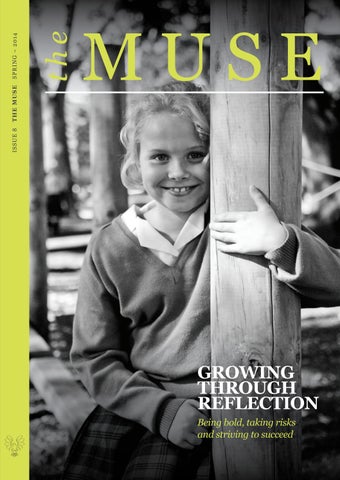
GROWING THROUGH REFLECTION Being bold, taking risks and striving to succeed
Visits & Voyages This list is by no means exhaustive, but offers a flavour of guests in and visits out during the Spring Term.
Visitors In Anglo Saxon Day, Year 3
Megan Reitz, Former BHS Head Girl,
Alex Forman, Arctic Explorer, Year 4 Talk
Leadership Talk, Senior School
Bella Leonard, Textile Artist, Sixth Form Textiles Workshop
Pete Churchill, Professor of Jazz at the Royal
Ben Walden, Contender Charlie, Year 10 Leadership Workshop
Year 9 Music Day
British Cartographic Society, Restless Earth Geography Workshops, Years 10 and 11
Sixth Form
Captivate Theatre Company, Year 9 What’s on Your Mind Workshops Community Dance Workshops with Putnoe Primary School and Roxton Lower School, Year 4 Duncan Piper, The Young Leaders’ Consultancy, Year 9 Leadership Workshop Egyptian Day, Year 6 German Exchange Student Visit, Years 10 and 11 Dr Francesca Denman, University of Cambridge, Maths Lecture, Years 8, 11 and Sixth Form Dr Gerry Oram, Professor Clive Emsley, Vincent Trott and Dr Annika Mombauer, Sixth Form World War One Conference
Academy of Music and Trinity College, Richard Gill, Author, English Literature Lecture, Roger Williams, former University of Cambridge Music graduate and Inspector of Music and Drama, Sixth Form World War One Poetry Recital Roman Day, Year 8 The Association Family Quiz Night Teri Terry, Author, Twitterchat with the Book Club Women in History Day, Year 8 World War One History Day, Year 9 Activity Morning with Bedford Prep School, Year 5 Quiz with Bedford Prep School, Years 7 and 8 Young Enterprise, Year 9 Logistics Day
Voyages Out Bedford, The Annual Rowing Club Ball Bedford Corn Exchange, Year 4
Institute of Education, Sixth Form English
Language students, Annual Language Conference
Captain Safety Roadshow
London, Year 5 Cultural Trip
Bedford School, Pilgrim’s Progress Production
London, Ethics Matters Conference, Year 12
Bedford School, Rock Night Birmingham Symphony Hall, GCSE ScienceLive!, Year 11 Science Trip
Cambridge Speaking Union, Sixth Form European Youth Parliament Debate
Cavendish Laboratory, at the University of
Religious Studies A Level and IB Philosophy Milton Keynes Theatre, Dance Trip, Matthew Bourne’s Swan Lake
Milton Keynes Theatre, Ethics Theatre Trip, Wicked Launch of Go4SET at the University of Cambridge Engineering Department, Years 8 and 9
Cambridge, Sixth Form Physics Trip
Paris, Year 12 French Trip
CCF Annual General Inspection, Bedford School
Royal Navy Field Weekend
Duxford, Imperial War Museum, Year 5 Trip
Safety Centre (Hazard Alley), Milton Keynes,
El Puerto de Santa María, Spain, Spanish Trip Globe Theatre, Merchant of Venice, Year 8 English Trip
King’s School, Junior Maths Team Challenge Krakow, Poland, History Trip
Year 6 Trip
University of Bedfordshire, Go4Set Industry Visit Warwick Arts Centre, GCSE, AS and IB Drama Trip, The Believers
West End Theatre Society, Theatre Trip, We Will Rock You
Bedford Girls’ School | www.bedfordgirlsschool.co.uk Bedford Girls’ School is part of The Harpur Trust. Company no. 3475202 / Charity no. 1066861
Editor’s Insight
T
he start of every Summer Term is a significant waymarker along
the route each of us takes during
the Bedford Girls’ School academic year. For older girls, it is a time of excitement
to an inexhaustible passion for enquiry. Education, he argues, is not linear but is instead organic. I cannot help but agree. In the digital age enquiry, analytical skills and passion are indispensible. These are the skills
and anticipation as they prepare to sit
and the impetus by which our girls will be
For younger pupils, it is a chance to reflect on
throughout their lives.
examinations that will help shape their future. the progress made since September and to celebrate how far they’ve travelled towards the next stage of their learning journey. For
parents and teachers, it is a chance to marvel
able to access and accrue knowledge readily
We are constantly evaluating the way we teach and are always looking for new ways in which to unlock the creativity and potential
at the work the girls have produced and to
within every pupil and this begins in the Junior
have demonstrated along the way.
reading about our vision for a new curriculum
take joy from the ideas and individualism they
For girls moving through the school today,
the world is a very different place than when their parents were younger. Information,
facts and knowledge are readily accessible to them online and, for the first time, a
generation is able to express opinions, ideas and personalities globally without leaving
the home or classroom. As a Headmistress, and a teacher, I am constantly aware that in order to best equip girls for success in the 21st century, teaching and learning needs
to evolve and grow continually to embrace
School. In this issue, I hope you will enjoy for Years 3 - 7 and how we are extending the principles of our Leadership programme down from the Lower Sixth throughout the school. I also hope you’ll enjoy reading the experiences gained by those girls involved
constantly aware that in order to best equip girls for success in the
The Lion, the Witch and the Wardrobe. His
21st century, teaching
Narnia stories are brimming with imaginative thinking. In taking the best from Lewis’
and learning needs
imagery and using it as a device for which
to evolve and grow
to view things differently, we were able
continually to embrace
and capitalise on change. To this end, I
deed, are at the forefront of a turning tide in
a successful production, helping to develop
test is superseded by a recognised need
their learning journey.
am delighted that our staff, in thought and
critically about each component of staging
education; whereby merely teaching to the
skills that they can transfer to other areas of
proactive learning. As explained by Creative
and a teacher, I am
in last term’s production of C S Lewis’
to offer the girls an opportunity to think
for a diversity of talent and enthusiastic,
“ As a Headmistress,
and capitalise on change.
”
Just as we always retain the very best
Educationalist, Sir Ken Robinson, such
teaching practice and standards, so do we
the needs of an ever-changing workplace
advance our understanding of how best to
shifted the onus from information retained
lead throughout their lives.
innovation is essential if we are to meet
as educators employ creativity to inform and
where rapid technological development has
equip girls and young women to learn and
Jo MacKenzie Headmistress
The Muse | 02
Inspired by
Harriet Ensor-Clinch Year 11
Jenny Wight Year 11
Science Live! A
constant quest for teachers is how to turn interest in a subject into a lifelong passion. Many of our students immerse themselves in science, but are we making sure that they see the potential of their choices and are exposed to the plethora of opportunities and specialisations which exist. ScienceLive! events have been established to help facilitate this shift, to inspire curiosity and to create an impulse to find answers. With inspirational lectures from leading scientists, students are given an insight into how science really is at the forefront of solving many of the world’s greatest problems and to understand the inextricable link between science and the humanities. Chemistry Teacher Rosemary Houghton, believes these fast moving interactive lectures are just what many of our girls need to stir that lifelong passion for science and help them to understand how science is at the centre of everything we do. She took current GCSE students to join another 2,000 students for a ScienceLive! event. Five of Britain’s top scientists featured as guest speakers, and talked about their work in fields from anatomy and astrophysics to relativity, time travel and zebra stripes. Speakers included Lord Robert Winston, famed for his TV series Human Body, and Superhuman; the chemist, Professor Andrea Sella; Professor Alice Roberts and BBC Radio 4 presenter and physics professor Jim Al-Khalili. For Bedford Girls’ School pupils, the excitement was heightened by the opportunity to hear from Dr Lucie Green, a former pupil of Dame Alice Harpur School, and now a world leading researcher at University College London’s Department of Space and Climate Physics.
03 | The Muse
Year 11 pupil Jenny Wight, explained her reaction to the trip: “I am already considering a career in science, but I had little idea of the range of science based careers and was blown away by the speakers and the interesting and varied projects they were involved in. With the huge variety of lectures ranging from human fertility and evolution, to astrophysics and the possibility of time travel, there was constantly something to spark the imagination.” “The enthusiasm and passion shown on the faces of the speakers was incredible and held me captivated throughout the day. It demonstrated the level of the determination, dedication and commitment that these sciencists have for their work. It made me reflect on the years of hard work and research that they have put in to get their projects to the stage where they could present them in a way that students would understand and be able to connect with.” Harriet Ensor-Clinch agrees that it opened her eyes and mind to the incredible range of possibilities that studying science can really bring: “I wasn’t sure quite what to expect when I heard about the ScienceLive! trip. To be honest I didn’t think it would be anything too exciting. However, I was to be proved wrong when Lord Robert Winston walked onto the stage. He was so animated with bundles of energy. Throughout his lecture on fertility I was absolutely enthralled by everything he had to say.” “By going on this trip Lord Robert Winston opened my mind to a variety of different career paths and not necessarily just the ‘studying Medicine and becoming a doctor’ idea, which
I was so set upon. I have now realised that instead of being slightly narrow minded and thinking that if I couldn’t study Medicine there was nothing else to study, I have learnt that there are many different fields of science to study at university and not necessarily the more mainstream subjects.” A highlight for all our students was the chance to hear our very own alumna Dr Lucie Green present. Her talk about her work on the magnetic fields in the sun, and how she can programme a satellite from her living room to collect information for work being done in Japan was truly inspirational and demonstrated to the girls what can be achieved and how you can aspire to combine creativity with scientific skills. Jenny added: “It was exciting to see Dr Lucie on the stage and to think that she once sat in the same science labs where we now study.” By taking science out of the lab and showing the girls the incredible ways in which science shapes the world, our students can start to reflect on the endless possibilities open to them. As Jenny enthused; “I really was inspired. I have been exposed to so many options, and this is just the tip of the iceberg. What do I want my career to be? The best answer seems to be simply, scientific.” We look forward to seeing more alumnae from Bedford Girls’ School on the stages of ScienceLive! in the years to come, building bridges between the humanities and science, and finding answers to those unsolved problems.
In the ruined Priory of Ankerwyke, Berkshire, stands a stately yew tree with more than 2,000 years of history and experience ringed within its 31ft wide trunk. Said to have been where King John signed the Magna Carta in 1215 and rumoured meeting place of Henry VIII and Anne Boleyn, this vast organic symbol of resurrection and rebirth continues to add new growth to its stately branches whilst its roots remain steadfast in the soil of ages.
Learning
Leaves A
t Bedford Girls’ School, the
roots of learning are planted firmly in the Junior School,
a caring, engaging and inspiring
environment where teachers, with a specific
understanding of girls and how they learn, are adept at identifying and igniting each pupil’s curiosity. Through innovation, engagement, enthusiasm and cutting-edge thinking, our
Junior School teachers begin to introduce our
girls to the school’s core values and allow them the freedom to explore what it means to be
bold, imaginative and reflective. Empowering girls to take intellectual risks and supporting
them in becoming active proponents in their
own learning and experiences, lies at the heart of the Junior School ethos and, at its kernel, is
an exciting and ever evolving curriculum where creativity and exploration thrive.
Tailored specifically to meet and exceed the specific learning requirements of girls in Years 3 - 7, a strong curriculum is not merely the lifeblood of academic success but also an opportunity to introduce a sense of wonderment at the possibilities open to imaginative and adaptive learners in the contemporary age. As technology and global communication continue to develop and grow apace, the Head of the Junior School, Carolyn Howe, explains the importance of reviewing and updating the curriculum to best equip the girls both in the classroom and in the wider world: “Girls who are part of the Junior School today are part of a generation who have more access to factual information than ever before. Unlike their parents and grandparents, they no longer need to spend hours poring over books or memorising facts and figures by rote. With information readily available online and the world at their feet, the skills that will stand
them in good stead throughout their lives are very different,” she said. “The idea of a tree of learning provides a good analogy for our vision of a new curriculum for the Junior School. The leaves represent the knowledge or facts learned in lessons while the lessons themselves are like the branches of the tree. At the trunk are the abilities needed to think and work well in lessons, including the confidence to speak in class and to enjoy the process of learning. The roots of the tree are skills such as reading, writing, numeracy and thinking skills while, at the very tips of the roots, are the different dispositions and attitudes that help pupils explore ideas, persevere in their studies and to feel empowered to be bold in forming and shaping ideas and developing talent. These are the areas where our curriculum will excel and we know that, by working from the tips of The Muse | 04
Learning Leaves Continued
the roots to the top of the tree, we will be able to truly meet the needs of today’s learners and ensure every girl can flourish.” ‘We also recognise that, above all, learning should be enjoyable. To that end, as well as brimming with opportunities for girls to apply creativity and talent to every area of learning, they will be able to immerse themselves each day in truly enjoying everything they do at school. From being introduced to the use of iPads to enjoying themed lessons both in and out of the classroom, we will develop the curriculum to ensure that a high level of engagement and happiness informs every aspect of school life.” As a forward looking school, BGS has embraced curriculum creativity from its inception. Therefore, much of the day-to-day change experienced by the Junior School girls will be a subtle evolution of an already broad programme of study. However, through new developments they will experience even greater scope to develop as independent thinkers. They will also utilise and understand technology in order better comprehend their role within the wider world and in appreciating their contribution, role and responsibilities as global citizens. All the while, excellence in literacy and numeracy will be maintained and English and Mathematics will remain vital to the ongoing vision. Subjects such as Dance, Drama, Modern Foreign Languages and Physical Education will broaden in scope to reflect wider thematic issues and girls will have added time spent with their class teachers and peers in identifying key themes and topics. As a consequence, girls will work more closely with each other and with other adults and enjoy a far more interactive role in determining their own learning outcomes.
Through involvement with the Girls’ Leadership Group and the Junior School Council, they will also have an opportunity to voice their views on areas they wish to study and explore, as regular consultations with both groups help determine what is relevant and important to girls today. A new Deputy Head of the Junior School has been appointed, Tina Copp, with responsibility for ensuring the development and smooth implementation of the new framework and for working closely with Subject Coordinators, Heads of Year, the Senior Leadership Team and other key staff. Parents have been invited to attend curriculum workshops where they too shared their ideas and feedback as well as becoming more involved with their daughters’ learning. For Carolyn Howe, the new vision is not just about helping the girls begin positively on a pathway of lifelong learning but also a means of enabling teachers to approach their work creatively and bring fresh, dynamic practice to every lesson. By encouraging innovation and creativity in everyone involved in the girls’ learning experience, she sees a future where pioneering teaching can truly bring out the courage in each and every girl to take a lead in her key areas of talent and interest throughout her time at BGS and beyond. “The new curriculum is about assessing each girl’s understanding of a topic or problem and supporting her to excel as an independent learner. We will see teachers spending more time on providing good feedback, encouraging girls to think for themselves and giving them the freedom and security to take intellectual risks and to reflect on their learning. As a 21st century school, we need a curriculum that joins
up the dots of the modern world and enriches the girls’ understanding of their place in it. To return to the tree analogy, in today’s information age - where facts and figures can be found at the touch of a screen - we might see that type of knowledge as deciduous. We no longer need to retain it in our heads all the time but with strong roots and healthy branches, aided by our creative new curriculum, the girls will have the skills and judgement necessary to grow and thrive intellectually, growing new leaves of knowledge whenever they need to.”
We know that, by working from the tips of “ the roots to the top of the tree, we will be able to truly meet the needs of today’s learners and ensure every girl can flourish.
”
Carolyn Howe, Head of Junior School
05 | The Muse
Tina Beddoes
Hannah Ventisei
Your School, My School, Our School Tina Beddoes, former Dame Alice Harpur School pupil and Chartered Accountant has returned to be involved actively in school life through her role as Chair of Governors. As a House Captain for Franklin, Year 13 student Hannah Ventisei plays a key role in motivating girls throughout the school to support House activities and strengthen our links with the wider community. Here, both reflect on their time at school.
Do you remember your first day at school? TB: I remember it very clearly. On that first morning when our Form Teacher, Miss Barnes, came into the classroom we all stood up and the class was immediately quiet. This was a very different experience from my previous school and quite a shock! I also remember wearing a hand knitted jumper made by my Nan from the school knitting pattern. HV: Sadly, I don’t remember my first day, but I do remember my second day! It started with me in tears for not completing the homework I had been set by my teacher on the first day during Form Time. I came from a Lower School where you only had to do homework once a week and had totally missed her request!
Why have you chosen to be involved in the “leadership” of the school? TB: I was extremely privileged to receive a
full bursary and have always been thankful for
the opportunity this gave me and the excellent education I received. When I returned to live in Bedford, I reconnected with DASHA and my
involvement gradually extended. It has been
wonderful to be part of the creation of a new school under the leadership of a visionary Headmistress.
I passionately believe in the benefit of an
all-girls’ education. I continue to want to be
an active part of the community that supports Bedford Girls’ School as it strives to provide top quality, innovative education, in an
environment where girls are happy and can
become strong independent young women.
What was/is your favourite subject and why? TB: I liked most subjects. If I had to choose one, then I would say Chemistry as I had the same teacher, Miss Crocker, from Year 9 to
HV: I have always enjoyed the House events and found Franklin to have an atmosphere
that I loved. When I was in Year 12 I wanted to continue making the House a fun place so I applied for House Captain. It has
been, without a doubt, the most amazing opportunity of my school career.
Year 13. I remember she was a passionate cricket player, a very engaging teacher and thoroughly decent lady. HV: This is a difficult question because I try to be enthusiastic about everything. I have applied for English and French at university so those two are the subjects I am most passionate about. Whilst doing the IB I have found a hidden love for the logical nature of Mathematics.
If you could have started your school time again what would you have done differently? TB: With the benefit of what I know now, I would have taken English and History at
A level, because I really enjoyed them. I took science subjects because I believed they
would give me the best career opportunities.
HV: I would change nothing. Sometimes I lament I have chosen the wrong subject, but I am a firm believer that you should never have any regrets and make the most of every opportunity.
How has your school life shaped your views and values? TB: My education at Dame Alice taught me that there are no boundaries, that you can achieve your dreams and ambitions through hard work and commitment (and a little bit of luck). I never felt hindered by my gender and developed the confidence to believe in myself and that I could do whatever I wanted to do. I hope that many generations of young women leaving BGS will have that same sense of self belief. HV: School is an influence on anyone’s life regardless of gender, nationality or background. Being at a girls’ school has heightened my awareness about the place of women in the world. I feel so privileged to have had such a high standard of education. I hope that one day women across the globe can work together to fight gender inequality and the stereotypes presented by the media to create a world in which there is education for everyone, boy or girl.
If you could sum up your time at school in three words what would they be? TB: Rigorous, fun, rewarding. HV: Discovery, growth, friends. The Muse | 06
Stepping Through The Curtain
When C.S Lewis wrote
“The Lion, the Witch and the Wardrobe” in the wake of the Second World War, he wrote a story about courage, friendship and standing up for what is right even in the face of the fiercest opposition. He also created an unlikely heroine, in the form of bright school girl Lucy Pevensie. In Lucy, we find a strong female spirit and a character that is bold, imaginative and reflective.
07 | The Muse
When the Drama Department chose
Mime, clowning, dance and slap-stick
academic links between Bedford Girls’
this production, not only did it present
all have an influence on physical theatre
School and Bedford School.
a fantastic opportunity to showcase
and the cast made use of many of these
a courageous female character it also
techniques during the production.”
Sue and her team were also determined
“Physical theatre enabled us to complete
themselves with the backstage element of
provided a platform for both the department and the girls to embrace those values, stepping out of their comfort zones to learn and direct new performance skills.
transitions quickly which is essential in fantasy productions. The girls were able to use their bodies as vehicles to create
Sue Perren, Head of Drama and Dance
effects which moved the story forward
at Bedford Girls’ School explains:
and reduced the need for further props,
“Although described as a play with
scenery or technical effects. Supported by
music, it was very different from any
the sterling work of the stage management
of the musical productions we had
team, the scenes flowed seamlessly
produced in the past. Critically it was the
from an abandoned room in a dusty old
first production to explore the genre of
mansion to the sparkling world of Narnia,
fantasy. Fantasy is notoriously difficult
as if by magic. By keeping the process
to perfect, as it requires the audience to
as simple and smooth as possible we
buy into landscapes and creatures that
ensured there was no break in the action,
don’t really exist.”
so the spell was not broken for our
“From the moment the audience
audience.”
to encourage the girls to challenge the show. Whether this was in the creative areas of costume design and maskmaking, or the more technical side of stage management and lighting design, there were opportunities to lead and develop their skills. This approach also enabled the girls to get a real understanding of the diversity of talent needed to put on a production of this scale. Many girls took key roles within the production crew, whether as stage managers or as part of the technical team. Stage Manager, student Alice Fish, found the experience invaluable: “The staff let
entered the school we needed them to
None who saw the production could fail to
us take real ownership of the production
be transported to another world. This
be impressed by the incredible costumes
required us to draw upon many theatrical
and masks produced by the girls in
and demonstrate our leadership skills
techniques that we had not used before,
collaboration with the Art Department.
both in terms of our stage management
As Sue explains, the addition of masks to
and performance. We needed the cast and
the production was not straightforward
crew to work in ways that weren’t familiar
and provided another steep learning curve.
to them, developing skills such as mask
“Masks can be challenging to work with as
work, puppetry and physical theatre. This
the wearer is no longer able to use facial
was a real risk for such a young team and
expressions to support their character. The
involved a great deal of trust on their part,
cast had to learn to use their physicality
but once we had gained their trust, the
to convey emotions and to directly face
girls become emboldened, using their new
their audience at all times so that their
found skills to step out of their comfort
characters were not lost.”
zones and really bring the piece to life.”
The most impressive mask of all was that
when managing the backstage area. We had a lot of support from the teaching staff leading up to the show, and during the interval but once the curtain went up, we were on our own! The particular highlight for me was seeing all of our hard work come together, after many months of rehearsals.” And so, as the curtain falls once again on another Bedford Girls’ School production, it is clear that Lucy and her story have worked their magic on a whole new generation of young women. Offering a
“One of the key areas we had to develop
of Aslan himself, puppeteered beautifully
was the use of physical theatre. This
by Harry Guthrie of Bedford School.
technique originates in storytelling, where
Several other students from Bedford
involved and an enchanting production for
the speaker uses movement to enhance
School were involved in this production,
those who were transported through the
and explain their story to the audience.
strengthening the already solid social and
wardrobe to Narnia.
fantastic learning experience for those
The Muse | 08
WAR STORIES One hundred years after the outbreak of the First World War, the causes and effects of the earth-shattering conflict remain a core component of the National Curriculum for children aged 11 to 14. However, with the likes of Children’s Laureate, Michael Morpurgo, and Journalist and Broadcaster, Jeremy Paxman, wading into the debate about the way the centenary should be observed in schools, the teaching of the Great War and its legacy has never been subject to such intense public scrutiny.
09 | The Muse
While Paxman laments a heavy reliance on war poetry when teaching the Great War, decrying its use as “luxuriating in the horror”, Morpurgo advocates the use of stories and first-person narratives in helping to explain complex social and political concepts that may otherwise be too broad and far reaching for children to fully comprehend. Both, however, agree that children must be taught events with a clear understanding of the role context and provenance can play in determining the ‘truth’ and, more importantly, in helping them evaluate critically how some sources, and the study of them, can be coloured and shaped by subjectivity. For Bedford Girls’ School Head of History and Politics, Kathy Cruse, the pursuit of determining a rounded view of the realities of World War One also lies in the ability to analyse and appraise the way different historians have themselves treated the period over the last century. As the debate surrounding the best way to commemorate the anniversary heated up, it became clear that an opportunity to listen to a variety of historians speak on different aspects of the conflict would help the girls develop a more holistic, considered understanding of the historical significance of the Great War as well as enabling them to become active participants in the centenary discussions themselves. To this end, as part of its observance of the 100th anniversary, Bedford Girls’ School invited four eminent guest historians to speak at its inaugural
Sixth Form World War One Conference on Thursday 6th March 2014. As Kathy Cruse explains, the experience helped the girls honour the memory of those who lost their lives during the conflict and to begin to ask pertinent and insightful questions about what we, in Britain, assume to be unassailable truths about the war to end all wars. “For too many years, the teaching of History has focused on the accumulation of factual knowledge but, at Bedford Girls’ School, we don’t think it’s sufficient for girls merely to learn that World War One started in 1914, was fought in the trenches and ended with Germany’s defeat in 1918.” She elaborates: “There are important facts to know about the conflict but it is a core part of the way girls learn here that they grow to understand something far more profound than the core basics before they can really come to feel they ‘know’ or understand something fully. To this end, it simply didn’t do justice to the magnitude of the topic for us to work solely with sources, however powerful and valuable they may be.” “In organising the conference, I wanted to offer pupils an opportunity to add further thinking to their existing knowledge and their reaction to sources and to give them an understanding of how historians use, translate and apply their own knowledge when forming a hypothesis or opinion. It is
no longer enough for pupils to demonstrate the retention of factual information in a history examination. They increasingly need to show their ability to think and respond like historians, forming and articulating reasoned arguments and working with sources to structure their own debates,” she said. “In hearing four historians talk about different aspects of World War One, they were given a clear, tangible example of how it is the skills of research, analysis and creative thinking that make an effective historian and that it is always right to continually question and re-evaluate what we hold to be true.” With the day’s first speaker, Professor Clive Emsley, encouraging the girls not to lose sight of the continual need to question, the stage was set for a thought-provoking and informative analysis of the many different theories surrounding the causes of World War One. Introducing the girls to a variety of historical viewpoints and, perhaps more pertinently, to how agreed opinion and counter argument has waivered and evolved over time, Professor Emsley traced the debate back to shortly after the war broke out and guided the girls through a chronology of the historiographical controversy right up to the present day, citing David Cameron’s insistence that World War One was fought in a just cause against the threat of a Prussiandominated Europe, a prime example of how the notion of historical truth can shift over time. With open minds and a new perspective on the conflict, the girls were delighted to hear from Dr Gerry Oram, whose lecture on Wales in the Great War provided them with a very different perspective on the effects of conflict on a smaller community already touched by tragedy. Immediately, the girls began to grasp how readily subjectivity, first person narratives and the personal situations of protagonists can impact upon what we hold to be historical truths. A talk by Vincent
“ Our vision is to create a
memory bank to reflect the enormity of the conflict for future generations of Bedford Girls’ School pupils
”
to analyse and assess.
Trott, entitled Memory, Myth and The First World War offered further insight into why and how people may actively seek to manipulate history for propagandist purposes and how an over-emphasis on a particular type of source might well, as Paxman asserts, influence and shape a less than wholly accurate view of an event or circumstance. Finally, the girls were addressed by Dr Annika Mombauer who highlighted further the debate on the causes of the First World War and talked of the ongoing significance of what could be described as the 20th century’s defining tragedy. As Kathy Cruse explains, this rounded view of history and an ability never to stop questioning is a vital acquisition if we are to apply our knowledge of history to contemporary society in a way that enables progress. “The aim of the conference was to help girls understand that in choosing to study History, they themselves become part of it. Through listening and enquiry, they are part of the fabric that holds significant events in our collective consciousness. The history, myths and memories of the First World War are all around us and it lives on through books, including War Horse and Birdsong, as well as through films, television programmes and poetry. As a result, many of us feel we ‘know’ the Great War,” she said.
“The conference is just one element of a four year programme to commemorate World War One, where, as a community we start to understand the impact and implications of the Great War on our lives and that of our families, villages and towns. The girls are being encouraged to bring in family memories from this period, so we see how the war truly affected every aspect of our society. Further conferences, debates, and trips to the battlefields will all enhance our understanding and enable our pupils to start to form individual evaluations of this period of history. Our vision is to create a memory bank to reflect the enormity of the conflict for future generations of Bedford Girls’ School pupils to analyse and assess.” “While historians, social commentators and politicians today argue over whether this was a futile war, I hope that through these experiences, the girls will continue to see the worth - as global citizens - of evaluating, analyzing, questioning and, above all, educating others about the war that shaped the 20th century and what it can teach us all.” Members of the Bedford Girls’ School community who have World War One memorabilia which they are happy to share with the school should please email ww1@bedfordgirlsschool.co.uk
“However, this knowledge in itself is not what will define its legacy for future generations. That responsibility lies with the historians of tomorrow. In always asking questions and encouraging others to do likewise, Bedford Girls’ School historians can play a vital role in the commemorations and the rituals of remembrance honouring the 6,000 soldiers who were killed each day during the conflict and the civilians who lived through hunger and bereavement,” she enthuses. The Muse | 10
GIVING VOICE TO VALUES As a fresh-faced 20 year old, standing before the gates of Bergen-Belsen, Philanthropist, Helen Bamber, was swept by a momentary feeling of uselessness. Having travelled alone from the UK, intent upon helping those displaced by the ravages of the infamous death camp, the enormity of the atrocities committed within engulfed her impetuous until she came face to face with someone to whom she knew she could immediately reach out. “I came across a woman sitting on the floor” she explains: “She was so thin. From a distance she looked like a piece of material. I sat with her while she dug her fingers into my arm and we rocked together, on the floor, while she rasped out her story of loss. I said: “I cannot change history but I can be your witness and I promise that your story will be told over and over again.” Now aged 88, she continues to help victims of torture find a voice and, as a founder of Amnesty International and the Medical Foundation for care of victims of Torture, is a pioneer of human rights and ethical justice. When we think about leadership, helping others to find a voice may not be foremost in our minds. Equally, when we consider what it means truly to be bold, we might not immediately consider the value of liberating others through championing their right to be heard. Yet, as Helen Bamber
and her life’s work demonstrates, fighting for the freedom and protection of others is a cornerstone of human benevolence and one of the most powerful weapons in the fight for a better, more egalitarian, world. However, at Bedford Girls’ School, an innate understanding of defending and empowering others is an integral component of its leadership philosophy. As emancipated and educated girls and young women, pupils of all ages are encouraged to reflect on their potential to lead and to consider at all times how they can each make a positive difference both in school and the wider world. It is in this way that the role and purpose of the Girls’ Leadership Group (GLG) most effectively filters down through the school and helps shape the lives of even the youngest pupils as they grow and learn. As BGS appoints its third successive GLG, many girls in the Lower Sixth are reflecting
Newly appointed: Deputy Head, Georgina Lusty; Head Girl, Juliet Allen; Deputy Head, Sarah Morse
11 | The Muse
on the outcome of the selection process. Whether appointed or unsuccessful, they have each had time and opportunity to look inwardly and evaluate objectively the unique qualities they might bring to the available roles. As in previous years, the process has been exacting. From writing the initial letter of application, to the tasks facing shortlisted candidates on selection day, the appointment process is designed to encourage the girls to find and confidently use their unique inner voice. For those appointed to the GLG, the rewards and expectations are clear. For those not selected, the benefit of putting themselves forward in testing circumstances are also manifold. Above all, the opportunity to express, freely, one’s own voice and a desire to shape the lives of others is invaluable. The recognition of the right of others to be heard, perhaps doubly so. For the first time this year, Student Voice has introduced its own selection process, whereby candidates in Years 7 - 10 must write a letter of application and are interviewed prior to selection. As Headmistress, Jo MacKenzie explains, these girls are required to be as pragmatic as the older girls when assessing their own potential for leadership. “Student Voice fulfills a very important function within the school. Those appointed are effectively responsible for speaking on behalf of others throughout the whole school, even the very youngest pupils. They are also asked to make decisions and voice opinions about how the school can make a positive difference to the world around us. Both functions carry with them great privilege and responsibility.” “By introducing a selection process for appointing to Student Voice, we wanted to encourage the girls to seriously examine what they felt they could bring to the role. As with the GLG, the ability to evaluate critically one’s unique talents and abilities and to assess what qualities define a potential to lead is a truly valuable skill. It is one that contributes greatly to effective and empowering advocacy and, whether appointed or not, I am extremely proud of all girls who demonstrated throughout both selection processes tremendous understanding of the right of all to be heard and their role, as young female leaders, to protect and promote that right for all.”
What is Wicked? Since the time of Socrates, one of the most frequently asked questions of philosophers is a basic one: “Can you teach Ethics?”
B
elieving that “self-knowledge
decision making and the array of choices
and subjective dilemmas. Pupils often find
is the sufficient condition to
and shades within this. Girls, as part of
the subject, alongside Religious Studies,
the good life,” Socrates was
the GCSE, A Level and IB Philosophy and
to be far more liberating than those where
adamant that virtue could
Ethics syllabus are asked to explore a
learning is more factual and less theoretical.
not only be taught, but was essential
series of deep questions and to evaluate
As Kate Long, a Year 11 student explains:
for mankind to evolve and exist. Some
some of the answers. They explore
“Ethics definitely stands out from the rest of
2,500 years later and while much of life
the views of what are considered to be
my subjects. It allows me to question and
has changed immeasurably, mankind’s
amongst history’s greatest minds as well
innate compulsion to search for the truth
as studying the responses from ordinary
is as strong as ever. What has moved on,
people subject to a particular set of
however, is what we mean by teaching
circumstances and influences. The benefits
Ethics and the way in which we measure
of this approach are twofold.
the value such study affords to pupils.
Firstly, there is the sheer intrinsic interest
At Bedford Girls’ School, the ethos of
of the questions girls get to study.
Philosophy and Religion lessons is not
Girls relish the opportunity to investigate
to give directives as to what is right and
the underlying ideas and assumptions
wrong, as they might have been in Ancient
that shape our society such as nuclear
Greece. At the heart of the Philosophy and
deterrence, the existence of God, what
Ethics course is the perplexities of moral
constitutes evil as well as more personal
challenge ideas in a structured way and enables me to contribute my thoughts in a safe environment. In Ethics we constantly encounter new ways of looking at life’s issues and sometimes I realise that my own preconceived position on something needs to shift to accommodate these new insights.” Secondly, there is the training in critical thinking that Philosophy and Ethics imparts. Girls learn how to think rigorously and assess the strengths of arguments for and The Muse | 12
What is Wicked? Continued
all the issues that seemed crammed into the lavish performance. Benevolent dictatorship, ethnic cleansing and choices faced by the individual confronted by an unjust regime. Add to this the power of the individual to change society or to simply be demonised as part of a propaganda machine. These are not to mention the ease with which we are all drawn into an illusion of happiness, guided by things that seem so alluring yet mask a lack of substance, lack of morality or integrity. Whilst the show is filled with gaudy colour, costumes and exhilarating harmonies and lighting, this ‘bling’ is, in itself perhaps, a symbol of the blind spots that can afflict us in life. Two of the units included in the current Ethics curriculum ‘Social Injustice’ and ‘Equality’ seem to be at the heart of this show”. Reflecting on the themes explored in Wicked, Kate Long added: “Seeing Wicked against the different views they encounter.
the country attend lectures, seminars and
Building on the skills they develop
participate in debates about some of the
throughout the school in Thinking Skills
fundamental questions facing society
lessons, this has incalculable benefits
and humanity in the 21st century. Similar
and will carry across into all areas of life, including university and the workplace.
experiences are provided within school by exploring different types of intellectual
Kate added: “I find that this allows me to
stimuli such as films, newspapers and art.
apply these skills to my other subjects
During the Spring Term Years 10 and 11
such as History and even Sciences as I am able to understand both sides of issues and come to a sensible judgement about my own view.” To support work in the classroom, the school also offers valuable opportunities for the girls to employ the skills they have developed in a wide variety of settings where they are required to think quickly, rationally and creatively to form reasoned arguments even when they might not agree with the motion. As well as key involvement with Harpur Trust wide
students were given the opportunity to see the hit West End show Wicked. This raised eyebrows with some of the students, but as Joanna Ackroyd, Religious Studies Teacher explains, it brought to life many of the themes explored in the classroom. “What on earth has the show Wicked got to do with RS and Ethics? a girl asked me. Interestingly, she herself had seen the musical and yet had not really engaged with the ideas, beyond the emotion and colour in the story. It struck me that these things can be rather subjective.”
made me realise that we are surrounded by ethical issues, whether we realise it or not. Ethical issues are not scientific or historical or cultural; at their heart they are about people: people’s views, people’s actions and reactions, and the choices people make. In particular seeing Wicked focused my thinking on whether it’s right to stand up to unjust governments, and the role of social justice in an individual’s life. It was interesting to see how easy it was to apply lessons learnt in the classroom to watching a musical in Milton Keynes. This shows just how versatile and accessible Ethics really is.” Unlike in Socrates’ time, Ethics lessons are not about setting down a moral code for behaviour or establishing a social doctrine. Instead, they are about broadening the mind, encouraging creative thinking and promoting rational argument and debate. Above all, they are about developing the
debates, pupils are able to take part in
Mrs Ackroyd added: “My experience
girls’ capacity for bold, visionary and
national events such as the annual
of the show was of emerging with eyes
independent thinking - qualities central
Years 12 and 13 Ethics Conference held in
somewhat red and my mind distracted and
to the pursuit of ‘self-knowledge’ and
London where Sixth Formers from across
racing as I tried to categorise and process
invaluable skills for life.
13 | The Muse
Sports Report
Nikki Howlett Cross Country Coach
Cross Country
“Cross country: no half times, no time outs, no substitutions. It must be the only true sport.”
wonderful results with our Years 9 and 10 team reaching the English Schools regional finals. Other highlights include winning the Bedfordia Run (Years 5-8), and the Upper Schools Bedfordshire District Competition (Years 6-13) and we were also the overall winners of the Girls’ Middle Schools Bedfordshire District Competition (Years 5-8). However, the trials and tribulations of a race day create many obstacles and stumbling blocks and success is rarely down to ability alone! The start line can feel like a herd of stampeding horses; it is truly exhilarating if you keep up but one slip and you are nothing but hoof prints! If you are lucky enough to get around a course without practising your dives into puddles the size of swimming pools or having lost a spike in quagmire that upon first assessment looked innocuous, but in reality was shin deep; then you have done well.
T
he euphoria of crossing the line having fought your way around a course that is typically wet, very muddy and often in weather conditions that would see most other sports be abandoned, is a feeling that is hard to replicate. The sense of personal achievement is second to none. But as Coach, Nikki Howlett explains cross country running is sometimes a hard sport to tackle. Cross country running is an honest sport; you genuinely get out of it what you put in. There is no hiding once the race starts - it is you against the rest of the field. You cannot take a back seat and allow team mates to take on the mantle, nor can you ask to be substituted if you are having an off day. Although it can feel punishing at times, the results far outweigh the short lived pain during the race. At Bedford Girls’ School our students can run competitively from Year 5 to Year 13. Although some girls have always shown an aptitude for running, it is clear that even modest running talent can be developed with persistent training and hard work. It also allows an opportunity for girls who find team games
more challenging, a chance to experience the pride linked with representing their school. The ultimate glory of school cross country is to qualify for the County Championships. This gives individual runners the opportunity to be selected for the county team that then competes in the National Finals. Bedford Girls’ School is a force to be reckoned with in the county. We regularly take a clean sweep of district titles and have numerous girls selected for the county team. Although mainly considered to be an individual sport, in a number of school competitions the individual scores are combined to make a team total. So if your first four runners were to finish 1st, 8th, 9th and 11th in the race then your team score would be 29. This individual contribution to a team total means the girls form a strong bond and can also enjoy the camaraderie of working as a unit towards a common goal. A notable race in the cross country season that adopts this system is the English Schools’ Athletic Association (ESAA) Cross Country Cup. With this event, you progress through rounds spread out across the season to reach National Finals. This year our teams have once again achieved
People often see the physical challenge of cross country as the key to success but its demands ‘run’ so much deeper. The mental stresses often rival the physical requirements and a combination of both of these elements is key to the performance of successful runners. cross country certainly teaches you a lot of selfdiscipline. You learn that you can push yourself beyond the limits that you thought your body could endure. You realise that with greater mental strength you can overcome the pain barriers and take yourself to a performance level that allows you to outperform others in the race. The determination, courage and strong work ethic required for cross country running is something our girls have in abundance. They are prepared to work for each other and push beyond their comfort zone. To not be scared of a challenge and to realise that success is not achieved without hard work are lessons we can all apply in every walk of life, whether we are runners or not. As Nelson Mandela reflected: “Running taught me valuable lessons. In cross-country competition, training counted more than intrinsic ability, and I could compensate for a lack of natural ability with diligence and discipline. I applied this in everything I did.” The Muse | 14
Legend in their Lifetime
Oliver Bowden Head of Physics
Sir FRANK WHITTLE Inventor of the Jet Engine
Frank Whittle is a member of an elite club of great British inventors. Motivated by a childhood dream and a determination to succeed, Whittle’s invention of the jet engine not only changed the face of air travel but revolutionised our travel opportunities.
A
s a young child at primary school, I became aware of an alumnus called Frank Whittle. A plaque commemorating the time which he spent at our school and his subsequent achievements hung in the school dining room. However, it wasn’t until much later in my education that I understood the enormous impact he had on the world of engineering. Whilst at university, as we explored the laws of thermodynamics and fluid mechanics, I began to appreciate both the physics behind Whittle’s invention of the jet engine and the engineering challenges in building such a device. His incredible intelligence, perseverance and commitment to pushing conventional boundaries have inspired me ever since. Whether it is a latent memory of our hunter gatherer origins, or simply a quest for new experiences, humans seem to have an inbuilt desire to travel and explore. For centuries this was only possible at a slow, measured pace with either animals or the wind providing the motive force, but in the nineteenth century, the advent of railways meant that journeys within countries now took hours, rather than days. However, journeys between countries and continents across the oceans remained slow, regularly taking weeks or even months. In 1907 an individual was born whose work was set to change that forever.
As a young boy it was a chance witnessing of an early aeroplane making an emergency landing on Hearsall Common that first ignited Whittle’s aeronautical curiosity. When his father set up a small engineering company in Leamington Spa, Frank found his interest deepen and spent many hours in the local library reading about Mathematics, Physics and Engineering. With a passion for aeronautics the obvious career path for Frank was to join the Royal Air Force. His application was successful with the exception of the medical which he failed on the basis of being physically slight. Undeterred, he embarked on a vigorous training regime and on his third attempt was accepted. Once in the RAF Whittle’s talents, especially his aptitude for Mathematics, were noticed and he was recommended for officer training.
“ His incredible intelligence, perseverance and commitment to pushing conventional boundaries have inspired me ever since.”
The aeroplanes which Whittle flew were powered by reciprocating piston engines, but performance issues and poor reliability limited further development. As part of Whittle’s training he had to produce a thesis - providing an opportunity to outline a revolutionary new type of propulsion, the jet engine. Those who read his thesis worried about the feasibility of the design, as it would push the material technology of the time to, and perhaps beyond, its limits.
Still determined to see his plans turned into a reality, Whittle continued to work hard, rising through the ranks of the RAF, and spending time at Cambridge University where he gained a first class degree. When state funding failed to materialise, Whittle persevered and gathered private funding to allow him to turn his concept into a reality with the first ever test on a jet engine running in April 1937. His fortunes changed with the outbreak of war in 1939, when the British Government finally saw the potential of the jet engine and increased funding was released, speeding up the development process. Soon prototype jet aeroplanes were flying, proving that Whittle’s original concept had the real potential to be a success. The simplicity of the jet engine increased its reliability, and its capabilities for high speed high altitude flight made it possible for aircraft to fly faster and higher. After the war the civil aeroplane industry was quick to seize these advantages and in 1949 the first modern airliner, the De Havilland Comet, flew. It set the pattern for the aircraft still used today. So, whilst the railways reduced journey times within countries from days to hours, it is thanks to Whittle’s jet engine that journey times between continents shrunk from weeks to hours, opening up a whole world of commercial and travel opportunities. His story is a poignant reminder of how hard work and determination can reap huge rewards but it is perhaps his unswerving belief in his dream that has made him truly one of the greatest legends of 20th century engineering. In the words of his friend and apprentice, Roy Fowkes: “Frank was an inspirational team leader devoted to the Royal Air Force. He was gifted in both theory and practical disciplines. In addition, he demonstrated honesty, determination, vision, courage and dignity. His motive was not financial, his sole ambition and purpose was to achieve success in the Service he loved and to create the best possible equipment, that is what inspired him and gave him the motivation to succeed.”