the
AUTUMN ~ 2013 THE MUSE ISSUE 7
MUSE
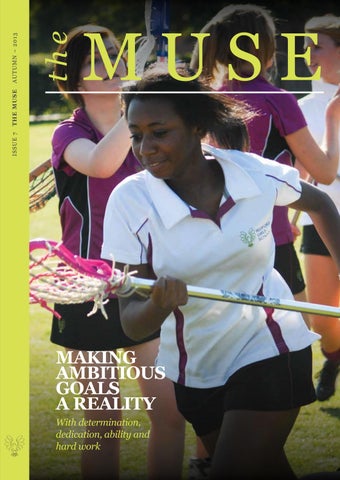
MAKING AMBITIOUS GOALS A REALITY With determination, dedication, ability and hard work
Visits & Voyages This list is by no means
Visitors In
exhaustive, but offers a flavour of guests in and visits out during the Autumn Term.
Alice Lisle-Denny, Former DAHS Pupil, Talk on Volunteering in Tanzania
Paul Saunders, Clarinettist currently performing in West End production of musical Wicked
Alumnae Christmas Social
Professor Krasimira Tsaneva-Atanasova, Sigma Society Lecture
Ama Agbeze, England International Netball Player, Netball Master Class Anti-Bullying Ambassadors’ Event, Local Schools Celia Rees, Author, LRC Opening Future Fortunes Conference, Year 12
Roman Day, Year 3 The Tempest Workshop, Year 6 The Association Christmas Fayre The Association Jazz on the Lawn
Ghosts Workshop, Year 12, Led by Almedia Theatre
Year 3 Christmas Production with Feeder Schools
Jeff Stultiens - Sixth Form Portrait Painting Workshop
Years 7 & 8 Disco with Bedford School
Medieval Day, Year 7
Young Enterprise, Year 8 Earn to Learn Careers Day
Voyages Out Abbots Bromley School, Year 5 Songfest Trip Almeida Theatre, Year 12 English Theatre Trip, Ghosts Bedford Prep School, Year 4 ‘Operation Challenge’ Bedford School Medical Association Lecture with Pierre Sinclair, ‘Life as a Medical Student’
London, Years 11 and 13 Psychology Residential Trip London, Year 11 Royal Institute of Science Christmas Lectures London, Year 12 Art Trip to the National Portrait Gallery London, Year 6 Sleepover at London Zoo
Bedford School, Combined Cadet Forces Sixth Form Christmas Social
London, Years 11 and 12 Trip to Winter Wonderland
Bedford School, French Society Event Bosworth Museum, Leicester, AS History Trip
Milton Keynes Theatre, A Level English Theatre Trip, Vagina Monologues
Cambridge, Senior Maths Team Challenge
National Space Centre, Year 5 Trip
Castleton, Derbyshire, Year 9 Geography Trip
New London Theatre, West End Theatre Group Trip, War Horse
Cheltenham Ladies’ College, GSA Girls Go Gold Conference
New York, Year 12 Art Trip
Christ Church, Bedford, An Audience with Pippa Nixon, Former Pupil & Royal Shakespeare Company Actor
Northern Ireland, A Level Geography Trip
Cranedale, Year 12 Geography Field Trip Dorset, Year 12 Residential Trip
Oxford Playhouse, Harpur Trust English Society Trip to see George Orwell’s 1984
Edale, Derbyshire, Year 10 Residential Trip
Senate House, London, Psychology Study Day
Hampton Court, Year 4 Trip
St Paul’s Church, Opera Club Performance
Iceland, Geography Field Trip
Sywell Autodrome, Young Aviator’s Day
Ickwell, Duke of Edinburgh’s Award Expedition Training
Tate Modern, London, Years 11 & 13 Art Trip
Open University, Milton Keynes, Year 13 Maths Christmas Lecture
Loire Valley, Year 13 French Work Experience
The Rose Theatre, Kingston, Drama & Classics Trip, Medea
London, A Level Philosophy Conference
Years 3 & 4 Magic Show at Bedford School
London, Institute of Education, Year 13 IB Trip
Years 5 & 6 Quiz at Bedford School
Bedford Girls’ School | www.bedfordgirlsschool.co.uk Bedford Girls’ School is part of The Harpur Trust. Company no. 3475202 / Charity no. 1066861
Editor’s Insight
A
s a new year dawns so does a
had impacted negatively on their own
renewed sense of purpose, rigour
aspirations. While saddened to read about the
and resolve. With spring just
girls’ resignation and feelings of inadequacy,
around the corner and the days
I was also able to identify a rich vein of hope
grow slowly longer, this is the ideal time for us all to take stock of what truly matters to us and to set goals for the year ahead. For me, each New Year is also a time for hope and optimism when positive change seems not merely possible but readily attainable to those who are prepared to try. As a Headmistress and a person who cares
tracing through their words. In expressing their opinions, these girls were quietly challenging the lack of role models they keenly felt and were sowing the first seeds of their own fight back against quashed aspiration. At Bedford Girls’ School, the ability to develop resolve and to challenge injustice is inherent
deeply about the welfare of the world, one of
in our philosophy and methodology. As a
the things I want to see change is society’s
school where every girl matters and is able
attitude to young women and girls. Whether in
to thrive free from gender stereotyping, we
music videos, song lyrics, celebrity magazines
have an abundance of female role models
or on the cat walk, last year seemed to mark
who, first and foremost, are classmates, older
a low point in the degradation of women,
pupils and friends. It is with great pride that,
particularly in the western world, where,
every day, I see the girls coming together to
conversely, years of struggle in the battle for
share experience, to give advice and support
gender equality have opened up opportunities
and to stand before the school community as
of which previous generations of women could
to challenge injustice
examples of how determination, dedication,
is inherent in our
only dream. Perhaps most worryingly of all is that, occasionally, it is women themselves who subject themselves and others to the trappings
ability and hard work can make the most ambitious goals a reality.
of belittlement, be it through a passive
Whether staging a play, from the first rehearsal
collusion with a culture of over-sexualisation or
to the final curtain call, or working together
via a meek acceptance of low aspiration and
to raise awareness of the 66 million girls,
male dominance.
“ At Bedford Girls’
School, the ability to develop resolve and
philosophy and methodology.
”
worldwide, who are denied an education,
When, last autumn, Girl Guiding UK published
our girls are not merely role models but life
its report Attitudes Explored, I was dismayed
changers. It is in them that I see the tide
but unsurprised to read that a significant
turning for women and it is in them I find my
number of girls aged between 7 and 21 felt
steadfast belief in their capacity to achieve
that a deficit of positive female role models
their dreams and to sculpt a better world.
Jo MacKenzie Headmistress
The Muse | 02
Inspired by
Jessica Brown Lower Sixth
Starry Night in NYC
W
hether it’s Joey Ramone belting out 53rd and 3rd or Old Blue Eyes hitting Times Square in his vagabond boots, New York has a deserved reputation for brashness and a bold, irrepressible city sound that won’t be silenced day or night. Behind the facades of its museums and galleries, however, hides a rich cultural heritage in the visual arts. From Van Gogh to Warhol, the city houses one of the most impressive collections of visual arts in the world, providing an opportunity for artists and textile designers the world over to find inspiration and validation among its breathtaking exhibits and unique display spaces. As Lower Sixth student, Jessica Brown discovered, the city’s stunning architecture also proved a bountiful seam of information to help her prepare for her final fine art examination piece. “I was so excited and delighted that I was able to go on the Art and Textiles trip to New York. I couldn’t wait and thankfully time flew by. This was my first time in NYC and it definitely lived up to my expectations from the moment we arrived.
Although you hear it’s a ‘city that never sleeps’ you never quite understand this fully, until you are there yourself swamped by masses of people all day every day. It is simply overwhelming and the atmosphere is infectious. My favourite gallery was definitely the MOMA. I am very interested in all kinds of Modern Art in particular Pop Art and they had many lovely exhibits from various artists including Andy Warhol. As soon as we walked through the door, I wanted to see everything and could feel myself soaking up so many stimuli and influences. It was like a creative energy flowing through the group. I enjoyed very much the work by Andy Warhol but my favourite piece was definitely Van Gogh’s The Starry Night. It was amazing to see it in real life. It stands alone on a blank white wall and it really draws you in. I even managed to get a cheeky selfie with it! I also found both the visit to the Empire State Building and the Statue of Liberty incredible. The view of New York from both these landmarks was absolutely breath-taking and while the pictures I took didn’t nearly do them justice, my memory of them has definitely inspired me to use bold imagery and large scale elements in my work. Since being back I have also been inspired to include Pop Art in my work and the whole experience, not just the art, has helped to give
me inspiration of all the possibilities I could use for my final piece It has made me feel that not only would I like to go back to New York again but I now want to explore other parts of the world in the same way, by which I mean culturally rather than just at first glance. The trip has made me more aware of how big and different the world is and it has helped me to find the boldness to go travelling in the future. By being put into a group of people I did not know very well, the trip has also helped me become a lot more confident in speaking to people and making new friends which will hopefully help in later life beyond BGS, when I have to make new friends at university as well as moving into the workplace. It was an amazing experience to go to New York and I fully encourage anyone who has the opportunity to go, to take it. It is a great way to broaden your understanding of the world and life experiences, as well as a terrific way to view different types of art in a fresh, exciting way. Although I already knew most people on the trip before I went, whilst there, my relationships with the other students and with the teachers grew a lot stronger and by the end, it was sad to leave them all. However, coming away so invigorated was a great feeling and, when I look at my final piece, I will relish seeing the memories, experiences and sights of New York City reflected back at me.”
You can read more about our Art and Textiles trip to New York on our Visits and Voyages blog:
http://trips.bedfordgirlsschool.co.uk/ 03 | The Muse
Fresh Futures W ithout exception, when parents and girls visit the Junior School for the first time they all comment upon how uplifting they find its warm, vibrant and unique atmosphere. In the corridors, classrooms and gardens a near audible buzz of enthusiasm resonates from each and every girl. Lessons are engaging, with opportunities for hands-on work and collaborative working, helping pupils to gather the skills they need to reach their individual potential. Much more than just preparation for the Senior School, the Junior School is where our teachers first get to know the girls, identifying their specific strengths and unlocking a love of learning and a future of limitless possibility. Put simply, our Junior School teachers are special. Combining teaching expertise with a passionate belief in all girls’ education, they are adept at identifying, harnessing and developing each girl’s strengths while helping them grow their confidence and skills in other areas. Passionate, dedicated and personable, they are themselves lifelong learners who are committed to equipping girls not just for today but for their future in a rapidly evolving world. The Muse caught up with new teachers, Annie-Louise Smith (Year 4), Nicole Arnold (Year 5), Nicola Childs (Year 4) and Trini Button (Year 5) to find out about their first impressions of the Junior School and their vision for the future as they near the end of their first term.
What were your first impressions of the Junior School?
that runs right the way through the school from Year 3 to Upper Sixth.
NC: I had heard about BGS from parents and friends and knew the vision and values matched my own. Having taught in a small village school, I was struck by how very big Bedford Girls’ School appeared. In the Junior School, I first noticed the fabulous staircase and painted ceilings which gave it a real sense of history, yet I was also impressed by the availability of technology. The combination of a long and impressive heritage, coupled with contemporary attitudes and teaching tools in a warm and welcoming community atmosphere was overwhelming.
TB: The atmosphere made a real impression on me too. Particularly the girls’ sense of purpose, busy timetable and enthusiasm for what is an exciting curriculum. I also thought the buildings were beautiful and I loved the colour scheme!
NA: I also thought the building was comparatively vast and so well-equipped! The lessons were exciting and the girls were all friendly and very enthusiastic to learn. I was amazed that a Junior School could have access to all the facilities at the Senior School, including the pool! AS: I was aware of BGS’ excellent reputation for both teachers and students from completing my teacher training in Bedford. I was immediately impressed by the warm atmosphere and the nurturing environment
What inspired you to become a teacher? NC: I can remember telling my parents I wanted to be a teacher when I was six! I researched the skills and attributes I needed and doggedly pursued my goal. All my own memories of school are positive and I was very lucky to be encouraged to try everything I was interested in. I always enjoyed learning a wide variety of subjects and I wanted to help other people develop their own confidence as learners and thinkers. NA: My first primary school teacher, Mrs Hawkins, was my chief inspiration. She was kind and caring and I loved reading to her. For me, every day is an opportunity to learn something new, to gain skills and develop ideas. I am continuously improving and updating what I do as a teacher so I can… The Muse | 04
Fresh Futures Continued
…make learning stay fresh, interesting and relevant for the girls. That’s what I enjoy about teaching and why it’s my vocation. AS: Ever since I can remember, I’ve wanted to be a primary school teacher and I really enjoy it every single day. I’ve taught in Malawi and Ghana and I’ve gained such an appreciation of the importance of education no matter what the setting. I am so happy that my aspirations as a child have proved so richly rewarding. TB: I was working as a church youth leader and taking a module on training adults to use computers at the same time. I so enjoyed training to teach and working with children that I just knew I’d love being a teacher. What’s the most rewarding part of your role in the Junior School? NC: I love teaching a wide variety of subjects and I get to do that every day in the Junior School. When I arrive each morning, I feel warmed by the girls’ smiles and I relish the sense of discovery and excitement as new discoveries are made. I love the girls’ sense of humour and how their opinions develop as they make links between subjects. Their enthusiasm is infectious and no two days are ever the same. NA: If I could sum up the atmosphere in the Junior School in just a few words, they would be: positive, engaging, energetic and adventurous. Like Nicola, I enjoy the girls’ positive response to learning. I also enjoy the co-curricular activities such as raising money for Children in Need. I’m PSHE Coordinator and I coordinate Student Voice - both excellent opportunities to get to know the girls opinions and ideas, which is great. AS: There’s a moment of relative calm at the start of each day when my class undertakes a morning challenge. This is a lovely
opportunity to chat to them informally before the frenetic pace of the day really gets going. I feel so happy walking into my classroom and see the bright colours and the excellent work on display. I feel equally happy, and proud, when I hear the girls leave a lesson raving about what they’ve just experienced. TB: As well as greeting the girls each morning, I love it that our lessons are so varied. We usually have a little starter to warm up our brains but from then on, it’s like a brand new page each time. There’s generally time for independent and cooperative work, and afterwards we discuss what we’ve done and reflect on our learning, but each lesson is a fresh and exciting experience. What is unique about working in an all girls’ environment? NC: The environment here is very special. Girls are confident to share their opinions and know they can take risks, make mistakes and learn from them as part of a supportive community. Every girl has the opportunity to develop her interests in a way not possible in a co-ed school. NA: The values of bold, imaginative and reflective are central to the way we teach. Everyone is free to be an individual and to be confident in expressing their opinions and views. BGS is such a supportive place where girls can aim for success without fearing failure. The success and achievements of the girls are encouraged and hard work rewarded. There are no notions of ‘soft subjects’ and girls are free to love subjects traditionally regarded as ‘boyish’. AS: I think the range of opportunities available, combined with an unbiased approach to learning, means we can really focus on challenging and extending the girls without worry about restrictive gender stereotypes.
TB: I went to an all girls’ high school so being in a single sex school is a familiar environment for me. I choose ways of learning that are proven to be of particular interest to girls. I have high expectations of them all because, they are already well behaved and achieving well. I like to encourage them to push that little bit harder and escape the notion that they should sit quietly and not put themselves forward because of any ill-conceived notions of gender. What are you looking forward to most during the Spring Term? NC: I am really looking forward to spending another chapter in my class’s learning journey, watching them develop and grow. Teaching is filled with magic moments that can be big or small. It can be when someone has overcome a barrier or when an overwhelming sense of awe and wonder takes hold. NA: I’m looking forward to teaching some fantastic subjects, including space, the Greeks and World War II. I’m also yearning for springtime at BGS. Some of my happiest memories of my Junior School days are of the smell of cut grass, playing under the trees and of running around with my friends. Truly magical! AS: Next term we’re teaching the Victorians which is my favourite topic. I also run a sign language club at school and am really looking forward to building upon the skills we are learning over the forthcoming months. TB: There are so many things, the WWII party, our trip to Duxford and, of course, our residential visit to London. I’m also the Science coordinator so I’m looking to get the girls involved in some really exciting science-based learning which, above all, will be great fun.
For me, every day is an opportunity to learn “something new, to gain skills and develop ideas. Nicole Arnold, Year 5 Teacher
05 | The Muse
”
Girls Rising When you educate a girl you can change a whole community. Within one generation, you can change the world. Across the world, 66 million girls are missing out on schooling and, in more than 50 countries, no free schooling exists. In the developing world, this has dramatic consequences for the health, wealth and well-being of millions, affecting everything from infant mortality to GDP and the spread of HIV and AIDS. On 11th October 2013, to coincide with the United Nations International Day of the Girl, the Bedford Girls’ School Girls Leadership Group concluded a week-long series of events and initiatives to highlight the plight of girls around the world who live each day without the life-changing benefits that a free, accessible education affords. As well as raising money to support charities working to knock down the barriers girls in the developing world face, they also wanted to spend the week reminding their fellow pupils of Malala Yousafzai’s timely advice that girls in Britain should not take their education for granted. As part of their campaign, the GLG teamed up with more than 30 other Girls’ School Association schools and charity Plan UK to walk the World Wide Walk as part of a nationwide campaign called Because I am a Girl. Walking in solidarity with the millions of girls throughout the world who are missing out on basic learning, literacy and freedoms, the GLG each walked 10km. With raising awareness as an equally important priority as generating funds, however, the girls also took steps to add a further dimension to the original Plan UK challenge by making the walk and its message accessible to girls in all years. Head Girl, Harriet Clough, explains: “Poverty, child marriage, violence and discrimination are just some of the many barriers keeping girls out of school and the consequences of this are felt perhaps most by the very young. A child born to a literate mother has a 50% better
chance of surviving to the age of five than a baby born to a mother without an education and one in four babies around the world is born into chronic poverty. “We wanted every girl in the school to be able to understand the implications of an
“ If one girl with courage is a revolution, united there is surely little we can’t achieve.”
educational gender divide and to walk with us in solidarity with the many girls around the world who do not enjoy the basic right to learn which we all accept as normal. We knew that, for the younger girls, a full 10km would simply be too much and that - even for those who could manage the distance - doing it after school might be a problem. After putting our heads together, we decided to ask everyone to join us in groups of ten to walk 1km each every lunchtime that week and we were overwhelmed by the response,” she smiles. “As we walked across the embankment, people were asking us what we were doing and it was great to hear even the youngest girls explaining not just why we were walking but what happens to individuals and communities when girls receive an education. It was certainly one of the high spots of my year and I am really proud to be part of a school where we don’t take our education for granted but, instead, want girls who are currently denied their basic right to schooling to benefit just as we have.”
Later in the week, the girls again extended their campaign to the whole school by inviting everyone to a charity fair held in aid of Educate Girls Globally. Thanks to the GLG’s commitment and initiative, Bedford Girls’ School is one of 34 schools from around the world who have joined together to raise funds for a student-nominated project in Rwanda. A truly international collective, the coalition of schools was put together entirely by pupils and aims to take direct yet peaceful action in the war against gender inequality and learning. During the fair, the girls also took a break to show an excerpt from Girl Rising, a poignant and moving film following the life of nine girls, from nine different parts of the world, who have struggled to obtain their right to an education and who have, ultimately, changed not just their own lives but others’ once they have secured their dream. As Harriet explains, the film proved the perfect end to an inspiring week, and helped everyone appreciate their own ability to make positive changes both to their immediate community and to the world beyond. “Girl Rising tells us that ‘one girl with courage is a revolution’ and I certainly took that message away with me. When you educate one girl, she in turn can educate 10. Imagine what hope that brings to the world? It felt incredible to be able to share this message with the girls and to help directly change the lives of others for the better. In learning about the opposition others have faced, it is important not to forget that we too have the strength to make positive changes. If one girl with courage is a revolution, united there is surely little we can’t achieve. And that,” says Harriet, “is a remarkable place to be.” The Muse | 06
Rewarding Quiet Courage 07 | The Muse
When Bedford Girls’ School deliberated and decided upon its three core values, it gave much thought to what they truly mean. Dedicated to the development and progression of individuals, we also evaluated how differently each girl might grow to define the true meaning of the words and hone her own unique essence of the values.
Susie Mason Patel (left) Assistant head Elizabeth Gardner (Right) Mathematics Teacher
T
he diversity of the values’
accordingly. The Headmistress, Head
yet less vocal girls, while receptive to the
connotations were among the
of Year and I meet regularly to review
idea of being acknowledged for their work
key points of discussion
the progress of every single girl and
and success, had very definite ideas about
among pupils and staff
identify strategies to improve or support
how they would like this to take place.
when considering which iconic women
their learning. This threefold approach
to embrace as inspiring role models
means we can build up the best possible
“Whereas some girls relish the public
for its House system. When the girls
knowledge of all girls, so those who
accolade what we discovered was there
overwhelmingly decided upon Rosa Parks
are naturally quiet and who don’t put
are many other girls who would balk at
they recognised the value and power of
themselves forward are known by us and
this,” explains Elizabeth Gardner. “The
quiet courage and its role as a peaceful yet
actively monitored to ensure they are
working group all felt this would impact
revolutionary force.
not ‘hidden’. We respect their characters
negatively upon their desire to extend
and work with them to help them reach
and challenge themselves in the future.
their potential, and with time we see their
Overwhelmingly, what they favoured was
confidence develop and become more
the idea of a personal message from a
comfortable with the challenges provided.
teacher, delivered without fanfare. We
Always dignified but never fazed; the former seamstress - jailed for refusing to give up her seat on a bus to a white man - embodied the unassailable truth that bravery is not the sole preserve of the outspoken or leadership a platform exclusively reserved for those comfortable with being heard above others. In April 2013, the whole school was treated
Having established this core pupil performance programme, we decided to undertake further research with Year 9 to identify practical daily solutions to support our strategy.”
implemented this immediately, through the introduction of postcards with a hand written message, given to girls in form time having been nominated by their peers for being good buddies, helping them to
to a special assembly on Rosa Parks.
Mathematics Teacher, Elizabeth Gardner,
learn new skills, for giving support when
As well as reflecting on the life of the
responsible for leading the research
woman known as the Mother of the Civil
explained: “We wanted to ensure each and
needed and other acts of quiet strength.
Rights Movement, they were asked to
every girl felt recognised and appreciated
consider how best quiet courage could be
for her efforts and potential, even though
recognised and respected within their own
she might not be one of the more
school community.
outspoken and easily identifiable pupils.
As, Assistant Head, Susie Mason Patel explains, this was just the first stage of a piece of internal research commissioned to build upon the unique pupil monitoring processes we use to ensure the progress
As a school where everyone is valued,
As well as rewarding individual girls, this showed them how prepared we were to act upon their suggestions, increasing their confidence to be quietly bold within the very framework of the working group.”
we also wanted to make sure we were
“What soon became clear was that girls
rewarding quiet courage in the right way,
many regarded as introverted disliked
least girls feel intimidated or overwhelmed
words such as ‘quiet’ or ‘shy’ being used
by the type of rewards offered.”
where it could be interpreted as a negative
of each and every pupil at Bedford Girls’
“Rosa Parks challenges us to question
connotation.” she explains. “for example,
School: “When girls join our school
our assumptions. Why shouldn’t quiet be
the group felt concerned that a school
community, we are committed to getting
strong? What else can a quiet approach
report might suggest their quietness in
to know them individually. In order for us
achieve that we don’t always give credit
class was an obstruction to their learning
to help them achieve their full potential, we
for? The assembly set out with the aim of
or comprehension and all felt that their
need to understand what enthuses them,
helping everyone to respect those who are
their passions, their ideas and the differing
reflective thinkers. What it also led to was
approach was what mattered and worked
ways in which each of them learns. With
research that built upon the book Quiet, by
girls who are very forthcoming and arrive
Susan Cain, which focuses on the power
“In an act of quiet courage, by getting
with a lot of confidence, this information
so-called ‘introverts’ can wield in creating
involved in the research group, these girls
is often relatively easy to glean. However,
a better world,” she muses.
have helped define and shape Bedford
for girls who are not as vocal and not as prominent within a class group, it is not
Following the assembly, a select group
for them,” enthuses Elizabeth Gardner.
Girls’ School’s perceptions of reflective
of girls were approached to become
thinkers and to develop an effective and
part of a working committee, looking in
appropriate way of rewarding those who,
“At Bedford Girls’ School our pupil
further detail at how best to recognise
like Rosa Parks, may not seek centre
performance programme is designed
the value and input of quiet, methodical
stage but who have passionate considered
to ensure we monitor every girl as
achievement. What soon become apparent
opinions and a valuable role in tomorrow’s
an individual and tailor our teaching
was that many such, diligent and reflective
model of leadership.”
always as easy.
The Muse | 08
In 2008, Iceland faced a perilous financial future following the collapse of Landsbanki, the bank behind Icesave. In the wake of the crash, the country found itself indebted to the British and Dutch Governments who stepped in with taxpayer funds to compensate ordinary savers, thus sparking a poisonous diplomatic row.
LESSONS FROM THE LAND OF FIRE & ICE
F
or a deeply-proud nation, the banking crisis was a difficult blow to weather and the consequences of its meltdown potentially catastrophic. However, its breathtaking natural beauty and global ranking as the best place in the world for women to live, according to the Global Economic Forum, have ensured Iceland has staged a more than effective fight back against the forces of financial strife. As a group of Bedford Girls’ School geographers discovered during a trip to the land of fire and ice during the Autumn Term, the roots of the country’s economic fight back are bedded in its geological instability where violent forces of nature, unleashed by tectonic plate movements, give rise to aweinspiring volcanic landscapes, earthquakes and a myriad of geothermal features, all proving as irresistible to tourists as they are integral to the Geography curriculum. Iceland’s stunning scenery, with its bare, lava-strewn flats, snow-capped mountain ranges, glaciers, volcanoes and hot springs, is due to its location on one of the earth’s major fault lines, the mid-Atlantic ridge. A vast underwater mountain chain, some
1,000km wide and stretching 14,000km from the Arctic to the South Atlantic, features a huge rift valley in its central zone. Known as ‘the bridge between two continents’, the boundary between the plates is among the country’s foremost tourist destinations and was the first port of call for the girls after touching down at Keflavik Airport. The dramatic surroundings of the bridge at Reykjanes Peninsular made an immediate impression upon the group. Crossing the Alfalgja Valley, some 20ft above the rift, between the Eurasian and North American plates, left an indelible imprint upon their memories as well as greatly enriching their ability to translate their study of tectonics into real physical examples. Alex Walters, Upper Sixth student, said: “I thought the landscape was really striking. The contrast between miles and miles of flat land and then giant mountains and volcanoes was remarkable. To board a plane at Gatwick then, just hours later, be walking the path between continents was overwhelming. I am about to study tectonics and first-hand examples have proved really helpful.”
You can read more about our Geography trip to Iceland on our Visits and Voyages blog:
http://trips.bedfordgirlsschool.co.uk/ 09 | The Muse
Year 11, GCSE Geographer, Rachel Sayers agreed: “In the first 24 hours, the thing that struck me most was how Iceland swarms with geysers, glaciers, volcanoes and waterfalls. Since the trip, I can honestly say I’ve found Geography more interesting and I’ve felt much more confident in my ability to understand our current topic, The Restless Earth.” During an action-packed first afternoon, the group also made a stop at Gunnuhver Hot Springs, one of the most famous high temperature geothermal areas in Reykjanes and exceptional among geothermal areas because the groundwater is 100% seawater. In typically Icelandic fashion, the girls didn’t just soak up the natural beauty of the powerful physical phenomenon but also discovered the hot spring’s place in the country’s rich folklore tradition. The name Gunnuhver, they learnt, originates from a witch called Guðrún whose spectre caused tumult and disturbance for the island folk until Eiríkur Magnússon, a priest at Vogsósar, set a trap for her and she fell into the spring. While the significance of gaining greater insight into the myths and fables surrounding the Icelander’s relationship with the features and landscape of their unique island may not be immediately apparent, it soon became clear to the girls that the tales of wonder and awe surrounding the sights they visited was intrinsic to the relationship the people have with the instability of their immediate environment, their courage in tussling against its tremendous power and, above all, their ability to understand the power it affords and learn how to harvest it. Perhaps nowhere is this more evident than on Heimaey, in the Westmenn Islands, where, in September 1973, residents awoke to the unexpected sounds of Mount Eldfell erupting. As their houses succumbed to a five to six month shower of ash dust and lava, residents thanked the quick thinking shipping boats who rallied to evacuate them and mourned the destruction of their once tranquil archipelago. Visiting the island by ferry the girls were fascinated to learn how the island had managed to harness the volcano’s fury and gradually repopulate Heimay. “Visiting Heimay was extremely interesting,” said Rachel Sayers. “We were able to climb up one of the island’s two volcanoes and see, first hand, the vast impact the 1973 eruption had. The teachers we were with had excellent knowledge of the area and it made the experience all the more engaging to discover how the islanders rebuilt
Heimay, even using the lava, which is still hot, to heat their houses.”
their rivers and streams and clean up
Such resourcefulness is common in Iceland with glaciers and rivers being harnessed to generate 80% of the country’s electricity needs through hydropower. Furthermore, the geothermal fields provide up to 20% of the country’s electricity needs. These underground fields, which provide pools such as the famous Blue Lagoon (a favourite destination among the group) also offer Icelanders with an almost limitless and inexpensive supply of natural hot water. In 2010, the eruption of Mount Eyjafjallajökull again tested the country’s relationship with its unique geothermal features, as the girls found out during a visit to the Eyjafjallajökull Visitor Centre. Iceland’s people have adapted and changed in response to another set of circumstances that could have proved disastrous. While its effect on international air travel raised eyebrows and pique across the globe, in Iceland, no sooner had the eruption quelled than people began to look for a silver-lining. As with the banking crisis, many said, both events attracted the world’s TV cameras and - with that - an increase in the tourism trade.
and devastation, they had the shoots of
For the inhabitants of Thorvaldseyri Farm, sitting directly under one of the volcano’s southern glaciers, it took a little longer to look on the bright side as the ash cloud began to threaten their livelihood. Their crops and water supplies were destroyed and local flooding washed away roads and their access to the wider world. Meanwhile images of their home, a huge dust cloud rising above it, were transmitted around the world while they were forced to sit back, powerless against nature’s wrath.
like a bigger accomplishment
Volunteers heard of their plight and came to help them shift thick layers of ash and tourists took part of it away as souvenirs. They began to move huge boulders from
their water supplies. Amid all the dust a new idea. Throughout the eruption they recorded the whole experience on film. At that time it was only for home viewing, “We wanted to have it as a history as we thought we might have to move away,” explains Thuridur Vala Olafsdottir, mother, farmer and latterly filmmaker. It is this film the girls were treated to at the Visitor Centre, an experience, they found both moving and inspirational. Laura Lopez-Odriozola, Year 11, said:
“ These people worked so
hard to get everything back to normal after the eruption and the film really gave me an insight into how tough it must have been for them. One thing I’ll definitely remember for the future is that everything feels when you’ve tried your hardest as the Icelandic people have done time and time again. It was a wonderful opportunity and so worth it. We did so many diverse things in a breath-taking country where both the people and places are
”
just awe inspiring.
The Muse | 10
ROLE MODELS IN THE SPOTLIGHT In the aftermath of Miley Cyrus’ controversial performance at the MTV Music Video Awards, in August, the topical issue of what makes a positive role model for young women and girls has gained greater prominence than ever in the national press.
F
rom the BBC Breakfast sofa to Hollywood’s red carpets, academics, entertainers and politicians have been calling for the promotion of better rolemodels. Dismayed that, in the wake of the 2012 Olympics, women such as Cyrus with their manufactured and highly sexualised image are still promoted over the genuine achievements of sportswomen such as Jessica Ennis and Katherine Grainger, head teachers and academics have repeatedly urged schools to help girls find role-models of greater substance to counter the increasing objectification of young women. According to research by Girlguiding UK, with 55 per cent of girls aged between 11 and 21 feeling let down by a lack of credible female role models in mainstream media, it is not just adults who are disheartened by the current trend for the devaluation of intellect, innovation and inspiration on grounds of gender. For Headmistress, Jo MacKenzie, the value and effectiveness of positive role models are intrinsic to the ethos of Bedford Girls’ School. She is determined not just to bemoan the lack of strong, positive aspirational females in the public sector but also to evaluate what makes an inspirational role model in today’s fastpaced society. 11 | The Muse
At the heart of the school’s philosophy is the conviction that each and every girl has the capacity to be a strong and inspiring role-model with the potential to become an inspirational mentor and motivational leader. While the school welcomes incoming guests with the power to ignite the girls’ enthusiasm and fire their selfbelief, it also recognises the invaluable role the girls themselves can play in acting as role models for younger pupils. From the Junior School Head Girl’s Team to our Year 13 Girls’ Leadership Group, the school places great emphasis on peer support, sharing and collaborative working towards a collective aim. It is, perhaps, in this initiative that the school is most effectively able to offer the girls tangible examples of how real girls and young women can become powerful drivers of change. One of the areas where this philosophy is most evident is in the school’s thriving House System, where girls of all year groups come together regularly to celebrate achievement and to improve life within the school and the wider community. As soon as pupils join the Junior School, in Year 3, they are able to build relationships with girls of all ages through the shared bond of House affiliation. These ties and friendships endure as the girls move through the school, gradually assuming ambassadorial and leadership roles as they grow and develop as people, gain
confidence in their own skills and learn the sheer joy of sharing their valuable knowledge with others. This year the school introduced a brand new opportunity for Lower Sixth girls to act as role models while welcoming September’s Year 7’s into the Senior School. Through the medium of a House Drama competition, the two year groups were encouraged to come together and direct, produce and perform a play where teamwork and leading by example would take centre stage. With Lower Sixth pupils at the helm, and sheer commitment and dedication on the part of Year 7, each House succeeded in fulfilling the brief without any drama, other than that inherent in the play, creeping into their preparation and performance. In fact, the girls’ organisational abilities and independence were firmly in the spotlight from the moment rehearsals began until long after the final curtain call. “When we sat down and conceived the notion of introducing a Year 7 and Lower Sixth House Drama at Bedford Girls’ School, I had every confidence that both age groups would rise to the challenge and work well together to bring their own unique reading of a short play to the stage,” says Jo MacKenzie. “But what did surprise me was the degree to which the girls worked independently at every stage of the project, so much so that - other than assigning them the texts to begin with neither Heads of Years, or Head of Houses had very much input at all. “We certainly weren’t required to direct proceedings, either dramatically or organisationally. Both Year 7 and Lower Sixth turned up enthusiastically for each rehearsal and worked diligently to ensure they were 100% ready to play their part in what turned out to be an extremely rewarding process. Year 7 took on the acting while the Lower Sixth took on the responsibility of directing and stage crewing. For me, having seen the project through to fruition, I felt that it proved the perfect vehicle by which the older girls could act as positive role models for Year 7 and set in motion a legacy that the younger girls will themselves pass on as they move through the school.”
“ Our young leaders find strength in their individualism, their hard work and their ability to think and act creatively and with passion ” Each group was assigned a segment of one of two short plays: Superheroes, by Steve Merrell or Richard Marsh’s Lotti and the Never-Dids. Both plays are short, easy to read and hugely entertaining. With plenty of punchy one-liners and a host of comedic characters, the two texts also offer plenty of scope for actors, directors and a young crew to play to their individual strengths while keeping the audience thoroughly entertained. Crucially, each play also lent itself brilliantly to being spliced into segments, giving each group a chance to take centre stage, without distracting from the narrative flow. Having just transferred from Junior to Senior School, Year 7 leapt at the opportunity to throw themselves into an initiative that would see them play a pivotal role in the launch of a brand new event for the school as well as building relationships with girls outside their immediate age and friendship groups. The girls were enthusiastic about working with the Lower Sixth and buoyed by the school’s all-encompassing culture of peer support and compassionate leadership, they were eager to sign-up and work closely with a group of older girls they already viewed as aspirational figures. For the Lower Sixth, House Drama provided a welcome opportunity not just to pass on valuable knowledge and experience to the younger girls but also to
test their own leadership credentials before deciding whether to apply for a role in next year’s Girls’ Leadership Group later in the academic year. In turn, the project offered the staff a prime opportunity to get to know each and every girl better, to evaluate their individual motivations and talents and to understand further the valuable role each can play within a team. “For Year 7 and the Lower Sixth, House Drama provided the chance to see a project through from inception to completion,” explains Miss MacKenzie. “For the younger girls, this was an undertaking. They had only joined the Senior School a matter of weeks previously yet, having benefitted from the older girls’ leadership and guidance before, they readily threw themselves into working alongside young women they value as true models, in so far as they can see how it is possible to cut a pathway towards achievement and personal growth through learning, personal development, hard work and strong values. For the Lower Sixth, the process enabled them to apply their own unique style of leadership to a key event in the school calendar. From start to finish, they managed commendably and every one of them gained an insight into the kind of work the GLG undertakes during its year of office. As well as offering them an opportunity to reflect upon the type of role they might or, or might not, be suited
to should they put themselves through as GLG candidates, it also gave us a window on the attributes and skills they could bring to the variety of GLG roles on offer,” she continues. “Above all, this was about bringing our view of what makes a good role model to the fore. Giving girls an opportunity to get to know the older girls as individuals and to understand the steps they have taken towards becoming strong leaders who are also caring, personable and true to their own values,” she concludes. “It is quite fitting that the winning House, Hepburn, was recognised for its scenes from Superheroes, a play where a seemingly ordinary cast of characters harbour extraordinary powers which come to the front through teamwork. For me, strong role models do not have to come from the world of entertainment. Indeed they need not be public figures of any kind. Our young leaders find strength in their individualism, their hard work and their ability to think and act creatively and with passion. As such, they are ideally equipped to not only inspire others but also to challenge the media’s obsession with easily manipulated and sometimes shallow representations of women and provide a real and lasting alternative for girls everywhere.” The Muse | 12
Sports Report
Carly Rutter Water Polo Coach
Water Polo Building upon the sporting tradition of its heritage schools, Bedford Girls’ School is one of just a handful of single-sex schools in the country to offer girls the opportunity to play Water Polo. Here, Coach, Carly Rutter, explains the appeal of the sport and how Bedford Girls’ School is helping to build a bright future for the women’s national game. Like many ball sports, Water Polo involves two teams on opposing sides each trying to score the most goals and win the game. That it takes place in a swimming pool, and that players are not allowed to touch the bottom of the pool at any time, adds more than a little challenge to the action and makes for an exciting spectator experience. Each team is allowed seven players in the water at any one time and, other than the goalkeeper, they move constantly throughout the course of the game. Players can move the ball by throwing to a teammate or swimming while pushing the ball in front of them. Another element of challenge is provided by players, again with the exception of the keeper, only being able to hold the ball with one hand, all the while - if not swimming - treading water using a technique called the egg-beater.
ater Polo is a fast-paced and incredibly exciting game which involves endurance, stamina and skill. While the sport’s popularity has grown nationally, an all girls’ school can play a vital role in changing the perception that Water Polo is a tough, aggressive sport played mostly, or solely, by men. Our girls show that, as well as strength, Water Polo requires skills, agility, endurance and most of all teamwork - attributes and abilities our girls have in spades. By raising the profile of the women’s game, we hope other schools will open up opportunities for girls to play one of the world’s most technically demanding and challenging sports and to enjoy the enormous sense of achievement gained from taking part. I have been teaching Water Polo at Bedford Girls’ School for two years and play for three teams competing regularly in the British Water Polo League. I was in Year 9 at Dame Alice when the sport was introduced in 2003 and we used to play regular friendlies against the High School who also played the sport. 13 | The Muse
The game has given me extra confidence, skill and a tremendous degree of satisfaction, so it’s great to see girls in both the Junior and Senior Schools taking part and gaining so much from all Water Polo offers. We have teams at U14, U16 and U18 with training taking place on Monday and Tuesday lunchtimes. On Fridays, the girls often play matches and a number of our players also play for ICENI, an Eastern region Water Polo team. We play friendly matches throughout the year in preparation for the English Schools’ Swimming Association National Championships between January and March. In 2012, we qualified for the National Finals a brilliant achievement and a real inspiration to the girls. It also attracted a number of new potential players who have subsequently discovered how fantastic the game is for anyone who loves swimming, thrives on teamwork and enjoys other ball sports such as Netball or Dodgeball. Providing girls can tick those few boxes, it’s almost guaranteed they’ll love Water Polo. It’s fast-paced and exciting but with clear and simple rules that leave everyone free to concentrate on the game.
The atmosphere at games is phenomenal, with supporters cheering on their favourite teams and players. The camaraderie among the teams is also great, giving every player additions to their support network and friends outside their immediate class groups. It is deeply rewarding to know we are playing an active part in helping to build the future of the women’s game and that our girls could well go on to play at the highest levels. This year, Ella Cotton, in Year 8, has been invited to attend the National Water Polo England Talent trials, in January 2014, and we are going from strength to strength. It is my immediate ambition for us to become English Schools’ Champions and for every girl to keep improving her skills, working hard to reach her potential within the game. I want the girls to retain their enthusiasm for the sport beyond school and to continue to reap the multiple benefits of taking part not just during their time at university but throughout their lives. Above all, I want to offer them the very best opportunities offered by Water Polo so they not only aim high for themselves but also become ambassadors for a wonderful sport and role models for a new generation of players.
Our alumnae are a diverse and inspiring collection of women. We are lucky to have two strong and longstanding alumnae associations from our founding schools - the Bedford High School Guild and the Dame Alice Harpur School Association. Today they retain their individual identities but work alongside the Bedford Girls’ School Alumnae Association to encourage all our alumnae to continue their relationship with present and former pupils, staff and parents of Bedford Girls’ School. Here we share its aims and ambitions. What is The Alumnae? The Bedford Girls’ School Alumnae provide the vital link between the present and former pupils, staff and parents of all three Schools. Our aim is to create an engaged association where we can foster a sense of community and support each other throughout our lives. Who is a member of The Alumnae? All new pupils to Bedford Girls’ School gain membership on joining the school on a lifetime subscription basis. All Bedford Girls’ School staff are invited to join on leaving. All pupils and staff of Bedford High School and the Dame Alice Harpur School are automatically members of Bedford Girls’ School Alumnae unless they choose not to be. Why do we need an Old Girls’ Association? What role does it play? One of our objectives at Bedford Girls’ School is to build a connected community. We want to create a community that has a sense of belonging and involvement and our alumnae are integral to that. We aim to build a structure which is capable of proactively reaching out to our alumnae in a number of different ways, beyond reunions at school, and offers a wide range of activities to benefit members of different ages in diverse communities. We are very proud of our shared heritage and the success of all former pupils and staff. Each and every one brings a unique story and varied experiences that can benefit both those in the current BGS community as well as our alumnae. We encourage our alumnae to take an active interest in the life of the school whether in
time, expertise or support in order to benefit our current girls through networking, work experience and opportunities for career progression. Equally we hope they will provide a valuable and supportive network for each other, helping those embarking on new careers or returning to the work place, offering mentorship, insights and connections. How do I get involved? We would like to be in touch with as many members as possible, so we can create a diverse and stimulating alumnae association We look forward to welcoming past pupils and staff to Bedford Girls’ School throughout the academic year and hearing their news and successes. We were delighted to welcome recent graduates from Bedford Girls’ School, Dame Alice Harpur School and Bedford High School to The Alumnae’s first Christmas drinks party at the end of term. The festive evening was an excellent opportunity for girls to revisit the school and catch up with friends and teachers over drinks and canapés. Details of the next event at the May Rowing Regatta will soon be released. To help make staying in touch easier, we have invested in a new online portal for our alumnae community and we hope to encourage as many of our members as possible to register at http://community.bedfordgirlsschool.co.uk. If you would like to get in touch or find out more please contact our Alumnae office on 01234 361900 or email alumnae@bedfordgirlsschool.co.uk
The Committee Our committee comprises individuals from all aspects of the school community and includes representation from both Bedford High School and the Dame Alice Harpur School. The committee meets on a termly basis and holds an Annual General Meeting that is open to all members. Our next AGM is at 6pm, Monday 3rd February at Bedford Girls’ School. The President: Miss Jo MacKenzie, Headmistress Assistant Head: Kate Jones Marketing and Development Officer: Emma MacKenzie Treasurer: Ann Maltby A member of the Governors of Bedford Girls’ School: Tina Beddoes A pupil representative (nominated by the Chairman of the Governors and the President): Head Girl, Harriet Clough The Chairman and Vice-Chairman of the Bedford High School Guild: Dorothy Chandler and Jane Hall Representative of Dame Alice Harpur School Association: Carolynn Roberts
The Muse | 14
Legend in their Lifetime
Jane Wilkins Head of Year 11
CHARLOTTE DUJARDIN By Jane Wilkins, DT Teacher, Head of Year 11 and Equestrian Coach impression as a dressage debutante. Within months, her performances marked her out as a rising star with coach, Judy Harvey, quick to offer her an opportunity to spend four years polishing her technique while gaining valuable work experience in her stables.
T
he Bedford Girls’ School Equestrian Team has enjoyed an incredible 12 months with success in both jumping and dressage. Culminating in a fantastic eighth place finish at the National Schools Equestrian Association Championships, the year afforded the girls an opportunity to grasp the concept that, with hard work and determination, there need be no limit to their aspirations and achievements. This ‘reach for the stars’ philosophy is embodied in Olympic horse woman, Charlotte Dujardin OBE, who has been an inspiration not just to our team but to thousands of female riders both young and old. Charlotte’s passion for her sport is evident in the poised, controlled and elegant way she rides and also in her ‘can do’ approach to life. A keen rider from the age of two, she made early inroads into an equestrian career with encouragement from her grandmother and mother, despite facing a level of financial constraint unusual in the equine world. Poignantly, by way of her inheritance, it was Charlotte’s grandmother who provided the funds for her first horse, Fernandez. ‘Horse dancing’, as the sport is colloquially known, was not a common pastime for a girl attending Vandyke Upper School in Leighton Buzzard, and finding time for sport and school work was a challenge. Charlotte remained resolute and through sheer grit and endurance, worked tirelessly with Fernandez to make an
In 2007, Charlotte’s evident talent was spotted by Olympic dressage rider, Carl Hester MBE, as part of the British Dressage Young Professionals Award. After some persuasion on the part of mother, Jane, Hester offered the then 21 year old Charlotte lessons in exchange for some casual work in his Gloucestershire yard. After a mere ten days, Hester offered Charlotte a permanent role as a rider and she began her astronomical ascent through the dressage ranks. In the same year, Charlotte started riding Valegro, her ‘dream horse’ with whom she would subsequently clinch two Olympic Golds and Great Britain’s first ever Olympic medals in dressage.
“ With the right attitude
and with dedication, you can succeed in whatever you want to do. ”
As she stood on the podium celebrating her second dressage gold of the London 2012 Olympics, a mere 18 months after her Grand Prix debut, Charlotte imagined her grandmother watching over her smiling. Euphoric and proud, she found herself weeping as she recalled the tremendous support, encouragement and inspiration her pragmatic and stalwart grandmother had given her. Kissing Valegro on the nose, to the roar of the 23,000-strong crowd, she said: “This is what dreams are made of and there are no words to describe it. I am so proud. This is unbelievable. My family didn’t
have lots of money or anything; I literally did it through hard work and dedication. I worked six days a week for very little money. But I did it because I wanted to and I loved it. I set myself goals. For me it was a challenge. “My mother and grandmother influenced me greatly and, above all, they showed me how success is not just about talent and definitely not about privilege. What it is all about is dedication, integrity and willingness to push yourself and to learn from your mistakes. Today, the connection I have with Valegro - the fact that we learned everything together - has resulted in the biggest possible reward for us both. All the way through our preparation for today, if I got it wrong, or if he made a mistake, between the two of us we both learned how to get it right. This is the sort of relationship I have always shared with my family and it runs through everything I do. For anyone who thinks this sport is just for the very rich, I ask them to think again. With the right attitude and with dedication, you can succeed in whatever you want to do,” she said. For our girls, these words proved incredibly motivational and single Charlotte out not just as a skilled rider but as a young woman to whom they can truly relate. As a relatively new team, the girls faced a number of challenges but, like Charlotte, they steadily looked for ways to overcome them. Even when the odds have been stacked against us, the girls have found the confidence to compete with style and pride, never letting obstacles or their lack of status as a new team stand in their way. Like Charlotte, their dedication has been stalwart and their aspirations are boundless. Charlotte is an intelligent, well-grounded and refreshingly open young woman who has forged a new path for female riders. Just as her grandmother’s legacy opened the equestrian world to her, so has her legacy and leadership brought so much to the next generation of female dressage Olympians, a victory that deserves as much applause as her own medal wins and a reason why, for me, she is truly a legend in her lifetime.