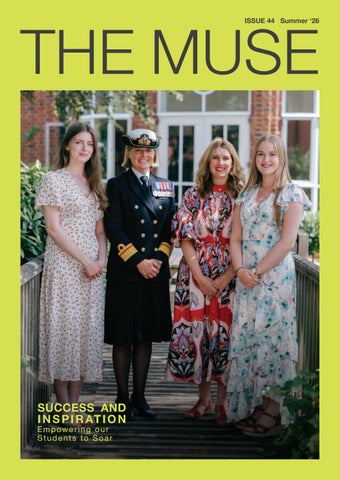
THE MUSE
ISSUE 44 Summer ‘26
SUCCESS AND I N S P I R AT I O N
Empowering our Students to Soar
Carbon balanced print is produced by a carbon balanced printer on carbon balanced paper.
Designed by firebrandcreative.com
01
EDITOR’S INSIGHT By offering this exceptional range of opportunities, we are able to help our students find genuine interests and passions; this is where they will truly shine.
all lie years of thoughtful reflection, endless hours of passionate discussion, research, and planning; expertise that has shaped BGS and its heritage schools for over 140 years. At a time when independent schools face complex challenges, it is wonderful to reflect not only on our outstanding achievements this past year, but also to celebrate the dedication and vision that make these moments possible. Compelling research consistently shows us that girls truly soar academically, socially, emotionally, and in sports in an all-girls environment. Studies highlight that girls in single-sex schools develop remarkable levels of confidence and mental resilience compared to their peers in co-educational settings. Academically, single-sex girls’ schools excel at both GCSE and Sixth Form levels; girls are twice as likely to pursue Physics or Further Maths in Sixth Form, and 70% more likely to take Chemistry and Computer Science. On the sports field, girls in single-sex settings show a fantastic 25% higher rate of participation, are five times more likely to play cricket and are significantly more likely to stay active and engaged through adolescence. Reading the Muse is always a powerful reminder of just how uniquely special girls’ schools truly are! We are part of a vibrant community consciously designed, in every single aspect, around the specific needs of girls; this is an environment where no compromises are ever made. We have the absolute privilege of placing our girls at the heart of everything we do: our dynamic approaches to learning and pastoral care to; every event we host; sports match we play; charity we support; and spaces we create. This extraordinary uniqueness is something we can easily take for granted as we go about our daily routines, following timetables, teaching lessons, and leading activities. Yet, behind it
Our students achieve these incredible milestones because of the intentional way we build our school experience. Our deep expertise ensures that everything, from the elite sports programmes we offer to our vibrant Junior School PYP curriculum, actively fosters the exact skills, courage, and attributes young women need to lead rich, fulfilling lives. We are passionate about empowering our students with strong, confident voices, a clear sense of self-responsibility, and independence. We encourage them to challenge stereotypes boldly while remaining grounded in empathy and kindness. Their experiences, ambitions, and bright futures inspire everything we do. There is no single template for success as a
02
woman, and our girls grow up knowing that every path is open to them. Our core mission is to bring out the absolute best in each individual so she can spread her wings and soar! In this issue, you will see our living philosophy brought to life. Discover our engaging approach to sport in the Junior School, where we inspire every student to build confidence and strong technical skills with an enthusiastic, can-do attitude. You will also love reading our profile of some of our inspiring younger alumnae, who reflect warmly on how their BGS education laid the foundation for their success beyond school. I hope you will also take time to enjoy the recap of Prize Giving, always a highlight in our calendar and particularly special this year as our new Chair of Governors, Fleur Bassett (Surgeon Rear Admiral Fleur Marshall FRCGP FCIPD MA), inspired parents and girls alike with her stirring words of wisdom. As one of the UK’s highestranking military leaders, Fleur shared her journey to an extraordinary career alongside fond memories of her school days, captivating everyone present. I am immensely proud to lead BGS, and to celebrate another incredible year of success. Behind every page are heartwarming personal stories of overcoming challenges, quiet acts of kindness, brilliant accomplishments and moments of shared joy. Being a Headmistress is truly the best job in the world, but being the Head of a girls’ school is, without a doubt, the absolute icing on the cake. Best wishes
Gemma Gibson Headmistress
ROMAN HISTORY COMES TO LIFE Creating opportunities for learning to come to life is a key part of a BGS education; seeing how different civilisations have influenced the development of the world around us provides students with inspiring thought provoking opportunities to learn. Mrs Claire Everitt, English and Classics Teacher who led the trip, reflected: “Bath is the perfect city to introduce students to the wonders of the classical world, as well as showcasing the influence it has had for many centuries over society and culture.” The GCSE Latin course includes social and historical background, and students are expected to know about Roman baths and how they worked. A main focus of the trip was a visit to the world-famous Roman Baths, a UNESCO World Heritage Site, and one of the best preserved Roman bathing complexes that exists. Mrs Everitt said: “Prior to the trip, students had studied the role of the bathing complex in the Roman world; but visiting a bathing complex confers a sense of reality and even awe that is not possible in the classroom. It is one thing to study the baths on paper, but quite another to stand in front of them and see the scale, detail and history for yourself.” “What is particularly interesting about the Roman baths site in Bath is the fusion between Celtic and Roman religious practices, with the temple of the sacred complex being dedicated not just to the Roman goddess Minerva, nor to the Celtic goddess Sulis, but to a combined goddess: Sulis-Minerva, which in itself gives significant insight into the Romans’ strategy of invasion and occupation. As such, students learn important history in a very tangible way, symbolised, for example, by a simple, famous statue head of Sulis‑Minerva, one of the key exhibits.”
structures around the top, including statues of Roman emperors and generals. Mrs Everitt commented: “Students were fascinated by how immediate the site feels. Even after all these centuries, it still has a sense of movement and atmosphere that brings Roman life vividly into focus. The baths are such a useful teaching tool because they show students not only what the Romans built, but how they lived. The engineering, religion and social customs all come together in one place.” While in the centre of Bath, the trip made the most of other cultural and historical sites. They walked to the Royal Crescent, enjoying magnificent views over Bath, and visited the stunning Georgian house, Number 1 Royal Crescent, which has recently been popularised as the exterior of the Featheringtons’ London home in Bridgerton. The audio-visual tour charts the experiences of the house’s original owners, living in fashionable Bath and jostling for place and status with their neighbours, over tea in the parlour and balls at the assembly rooms. This visit also gave the students a sense of the massive expansion of Bath in the eighteenth century. That evening, the group enjoyed a trip to Bath’s famous theatre for a production of Midsomer Murders, before returning to their accommodation at the Bath YMCA in Broad Street. While in Bath, students also learned more about the city’s most famous former resident, Jane Austen, who used Bath as a setting for two of her novels, Northanger Abbey and
Mrs Everitt added: “This kind of detail helps students see history as something layered and real. It is not just about dates and names, but about belief, identity and the way different cultures were brought together under Roman rule.” The Great Bath is stunning; intact as a bathing pool, with the original Roman pavements surrounding it and elevated by Victorian 03
Persuasion. They were able to walk along the very same Gravel Walk where Anne Elliot and Captain Wentworth have a significant tête-à-tête in the latter novel. They then visited the prestigious shopping street, Milsom Street, where, in Persuasion, characters visit Mollam’s confectionery shop and make millinery purchases. Mrs Everitt said: “Our visit to the Jane Austen Centre was marked by an unexpected greeting from John Willoughby (Sense and Sensibility), who opened the doors with such flourish that many of our party screamed in surprise.” “Bath was beautiful, the baths were historically eye-opening, and the local retail was fantastic. I couldn’t recommend it enough.” commented a student. The trip was rounded off with a visit to a grassy Roman amphitheatre and the Corinium Museum in Cirencester. Corinium was one of the largest towns in Roman Britain and is home of intricately preserved Roman mosaics from the area and a famous acrostic graffito. Offering a fascinating end to a wonderful few days of inspiring learning. Students described the trip as “one of the best I’ve done with BGS” and said they enjoyed “every moment.” Another student added: “I had a wonderful experience exploring the Roman Baths with my fellow classmates. It was interesting combining the knowledge from both Latin and Classics students, making the experience even more enjoyable. I would definitely go again if I could!”
GROWING THROUGH THE IB When the International Baccalaureate (IB) Diploma results arrived this summer, there was plenty to celebrate for BGS’s 2026 leavers. With an average score of 39 points and 67% of students achieving more than 40 out of a maximum 45, the cohort was ranked second in the world in the 2026 IB Schools Global Small Cohort League Table.
The results marked the end of a demanding but rewarding two years for this cohort, who worked steadily across a broad and challenging programme of study. The IB asks students to balance depth with range, independence with collaboration, and academic rigour with hard work. For this group, that balance paid off in results that reflected both achievement and growth. Students secured confirmed places at leading universities including the University of Oxford, UCL, the University of Bristol, the University of Bath, King’s College London and the University of St Andrews. They will go on to study a range of courses, including History and Philosophy of Science, Law with German Law, Physics, Physics and Philosophy, Chemistry with Mathematics, and Global Health & Social Medicine. Mr John Gardner, Senior Deputy Head, said: “These results are hugely well deserved. The students have approached the IB with real energy and focus, and it has been a pleasure to see them grow through the course. We’re very proud of what they have achieved, and excited to see what they go on to do next.” Gracie Beech reflected: “I have thoroughly enjoyed studying the IB, I feel as though it has given me so much depth and scope of knowledge.
“I’m really looking forward to my next steps at UCL to study the History and Philosophy of Science, and I know the IB has set me up well to cope with the demands, and resilience needed for university. My course at UCL even has IB resources for students and teachers and this helped in reassuring me that the skills and ways of thinking, developed uniquely by the IB, will continue to be invaluable at university. “I have loved the IB and feel as though it has been the highlight of my time at BGS. A large part of this has been down to the amazing IB teaching staff, who have made lessons so much fun, while encouraging us to develop our curiosity and passion for the subjects we love.” Sonia Erwig reflected: “I’ll be studying Law with German Law at the University of Oxford. What I valued most about the IB was the opportunity to study a broad range of subjects, drawing on literature, history, and perspectives from around the world. I also appreciated the emphasis on coursework throughout the two years, which allowed for more sustained engagement with each subject.” Rosie Freear said: “I’ll be studying Physics and Philosophy at the University of Bristol. I think the structure and breadth of the IB allowed me to keep my options open and enter into a multidisciplinary degree. I am grateful to the 04
teachers and all the people in our IB group as it truly felt like its own tiny community.” Danae Karavaggelis said: “I’m extremely glad that I had the opportunity to undertake the IB and I’m particularly grateful to my amazing teachers who supported me throughout. Studying so many subjects at this level was definitely a challenge but has taught me important life skills in regard to time management and prioritisation. I look forward to continuing my studies in Chemistry and Maths at St Andrew’s next year - using the skills I have learned in a higher education setting.” Taken together, these results reflect a cohort who approached the IB with commitment and purpose, and who leave BGS ready for the next stage of their education. They have achieved highly, but they have also developed the confidence and resilience that the Diploma is designed to foster. It was a strong way to end the academic year, and a reminder that the IB is about more than grades alone. It is also about the thinking, confidence and community built along the way.
CREATING THE CHANGE THEY WANT TO SEE The IB PYP Exhibition is a defining moment for Year 6 at BGS, marking the culmination of their time in the Junior School. Each year, pupils take the lead on projects exploring issues they care about, working collaboratively to research, present and take action in ways that are both thoughtful and impactful.
The culminating project of the International Baccalaureate Primary Years Programme (IB PYP), the exhibition provides pupils with an opportunity to investigate real-world issues that matter to them, conduct independent research, collaborate with others and take meaningful action to make a positive difference. It is a celebration of the knowledge, skills and learner attributes they have developed throughout their primary education.
To assist them each group is provided with a mentor - a member of staff from across the school to offer guidance, support them as they refine their ideas and help them learn the art of time management. Mrs Gemma Gibson, Headmistress, always relishes being a mentor and said: “I love supporting the Year 6 students with the PYP Exhibition. I am always impressed to see the teams collaborating, refining their ideas, articulating their thoughts with maturity and passion. It is then great to see this turned into action. The girls are always so creative and was blown away by my group’s model turtle made from recycled plastics to demonstrate devastation of ocean pollution. The project provides a wonderful opportunity for Senior School staff to get to know Junior School students before they join Year 7, so there are plenty of familiar friendly faces ready to welcome them when they start in the Senior School in September.”
The girls work independently in groups across the final half-term to bring their projects to life. Across the period of the project the teams answer central questions, including essays and data research in their final exhibition. They have to take action to educate others, create a compelling display and use a form of artwork to help articulate their central thought. It is a lot of work in an intense period and teaches important wider skills of time management, presentation and marketing as they work hard to ensure their exhibition is engaging and attracts attention from their audiences. 05
Mrs Inkson added that this year’s exhibition had an additional surprise: “This year, the afternoon of the exhibition began with huge excitement as our Grand Opening was led by Mrs Susan Lousada, His Majesty’s Lord Lieutenant of Bedfordshire, who officially opened the exhibition by cutting the ribbon. We were delighted that she spent so much time visiting the displays and talking with the girls about their projects and the causes they are passionate about; giving the students an incredible opportunity to talk to her about the change they want to see in the world. “Having such an inspiring guest of honour to open our exhibition was extremely exciting for the girls. They were wonderful ambassadors for the school and spoke with confidence and knowledge. They demonstrated the skills that the IB programme has embedded over the last four years and showcased that BGS students are ready to create positive change in the world around them. We are extremely thankful to His Majesty’s Lord Lieutenant of Bedfordshire for spending the afternoon with us. Her presence left a lasting impression on our students.” Throughout the afternoon the students continued to be busy as they welcomed alumnae, alongside Junior School and Year 7 pupils and staff from across the school, who enjoyed exploring the exhibition and learning from the girls’ work. In the evening, parents and family members joined and the hall was buzzing with activity. The displays were outstanding, and the girls spoke confidently and passionately about the issues they had investigated and the actions people can take to help. Mrs Inkson commented: “The range of issues that the students decided to investigate was as diverse as ever - with ethical use
of AI, fast fashion, animal rights, environmental issues, children’s mental health, accessibility in sports and LGBTQ+ rights amongst the causes being explored. What is wonderful about the exhibition is the independent nature of study means that although groups might have the same broad theme they are all taking very individualised approaches, resulting in a huge diversity of thought and ideas. Sharing this with the younger students, both on the day of the exhibition and in the weeks running up to the event is really inspiring, showing them that we can all have different perspectives and learn from each other. It creates a collective atmosphere of hope across the school. The PYP Exhibition is the highlight of my year. It is always a very fitting end to their time in the Junior School and I have such an immense feeling of pride as I see how far they have all come.” The celebrations concluded with the traditional cutting of the exhibition cake and a delicious BBQ with parents and friends prepared by our wonderful Greens Kitchen team. Year 6 then delivered a memorable final performance of Firework by Katy Perry, featuring a song and dance routine they had choreographed themselves. It was the perfect ending to an inspiring showcase of learning, creativity and action. Mrs Inkson concluded: “Central to a BGS education is for our students to soar - the IB PYP Exhibition delivers on that promise. It teaches each of our girls to think deeply and to have conviction in their beliefs; to share their ideas thoughtfully and creatively; and to collaborate and communicate effectively. Seeing these come together in such a meaningful way shows our students they are ready for the opportunities and challenges of the Senior School. They leave us as confident, happy learners. They are ready to soar in the next phase of their BGS journey.” 06
SOARING TOGETHER “Bedford Girls’ School is where girls soar.” Fleur Bassett (Surgeon Rear Admiral Fleur Marshall FRCGP FCIPD MA)
This summer, the BGS community gathered for a succession of Prize Giving events in the beautiful marquee setting within the school grounds. As the final celebrations of the academic year, the events offered a chance to recognise achievement and reflect on the effort and resilience shown by students across the school.
During each ceremony, the students were treated to musical, speech and drama performances from their cohort before listening to an address from Mrs Gibson, which reflected on the BGS values, particularly the importance of always being “Bold”. Mrs Gibson reminded the audience: “Reflection and boldness shouldn’t be seen as being completely different; in many ways, they are companions.” She added: “It often takes far greater courage to pause than to carry on.” Her message was a reminder that reflection is part of growth, and that boldness is not always about action alone.
The Prize Giving events celebrated the success of students from Years 7 up to Upper Sixth, who have gone above and beyond this year. Mrs Gemma Gibson, Headmistress, reflected: “This year, it is the turn of “Bold”. I suspect that if I asked everyone in this room what being bold means, I would receive many different answers. For some, it is speaking up for what is right, even when your voice shakes a little. For others, it is having the confidence to seize an opportunity or to take on a leadership role.” Her words set the tone for a day that combined celebration with reflection.
Throughout each ceremony, for the first time, our special guest speaker Fleur Bassett (Surgeon Rear Admiral Fleur Marshall FRCGP FCIPD MA) delivered a speech to a lively marquee. Fleur, an alumna of Bedford High School and appointed Chair of Governors in the Spring Term of 2026, is one of a handful of women in high-ranking positions in the British military. Fleur is a senior leader in the British Military and, until recently, was responsible for medical personnel and training across the Defence Medical Service. Her career gave the girls an example of what can happen when opportunity is met with determination, and when confidence is matched by a willingness to take on something new.
The prizes ranged from Academic Excellence to Citizenship. Throughout the day, the different year groups celebrated with their peers and enjoyed refreshments and cakes on the lawn, which created a lovely atmosphere for all in attendance. All students engaged in the celebrations as they wrote their personal “Bold, Imaginative and Reflective” reflections on tags displayed in the marquee. In many ways, this summed up the purpose of the day: not only looking back on success, but also recognising the effort, resilience and commitment behind it.
Fleur said: “Maximise every opportunity that comes your way,” encouraging students to embrace the moments that may feel slightly outside their comfort zone. For the leavers in particular, this was a
07
message that connected closely with the moment they are at in school life. As they prepare to move on, Fleur’s words encouraged them to see new situations as something to approach with confidence rather than hesitation. As Fleur stood at the lectern on the stage, she reflected on the unexpected turns in her career and reminded the audience: “Not everything will work out and that is OK.” She explained that “the things that do not work out are the things that help you discover what really matters.” In a room full of students about to take their next steps, it was a useful reminder that progress does not always follow a straight line, and that setbacks can often shape a person just as much as success. Fleur also encouraged the leavers not to “self-impose barriers on what you can achieve.” That message suited the tone of the day, where ambition and self-belief were recognised alongside academic success. Her address made clear that students should not limit themselves before they have had the chance to find out what they can do, or allow uncertainty to become a reason not to try.
students that “success is about becoming the best version of yourself and making a positive difference to others,” and encouraged them to be “curious,” “courageous” and “kind.” These words brought a wider perspective to the prizes being awarded and the achievements being celebrated, reminding everyone present that character matters as much as accomplishment. Her final words: “And now it is your turn to soar into life,” captured the message of the afternoon. It was a fitting conclusion to a day that marked achievement, but also looked ahead to what comes next. The Prize Giving events reflected the BGS community, celebrating both academic achievement and the school’s values of being “bold, imaginative and reflective.” Fleur’s speech provided a clear conclusion to a day that recognised individual accomplishments and the values that define the BGS community. Together with Mrs Gibson’s reflections, her message reminded students that success is not only about what is achieved in school, but about the character and purpose they take forward with them.
Fleur’s address engaged the audience as she shared that “when talent meets opportunity, remarkable things can happen” and that success is “not only about titles, promotions or achievements.” She reminded
08
SPORT FOR EVERY GIRL At BGS, Junior School sport is about much more than results. Mr Sam Mee, Assistant Director of Sport and Head of Junior School Sport, says the aim is simple: “To provide competitive experiences for all girls at a level that is appropriate, challenging and enjoyable, ensuring every girl has the chance to pull on a BGS kit, be part of a team and represent the school.” The real strength of the programme lies in making sport meaningful for every girl, whatever her starting point. That balance between breadth and ambition sits at the heart of Junior School sport. It is this combination of opportunity and excellence that gives Junior School sport its character. Mr Mee explained: “We have a unique advantage as an all-through, all-girls school. Everything we do can be tailored to how girls best learn and develop. Our coaching techniques and our approach to sports well‑being and balance are all centred on girls’ having the highest standards of coaching but also that they enjoy sport from an early age and see it as an essential part of a healthy life.” “Nationally a shockingly high proportion of young women drop out of sport as they go through adolescence; often because they do not feel supported, feel overlooked in a co-ed environment or are not offered sports that appeal to them. At BGS we are able to build a culture of inclusivity in sports and a sense of confidence in their ability in an all girls’ environment. Building this confidence from an early age definitely gives us the advantage on the field; but equally importantly teaches our girls about the role teamwork, community and leadership plays off the field too.
cricket, tennis, athletics, football, swimming and lacrosse. Whilst co-curricular sports, such as triathlon, offer further opportunities. Mr Mee added: “Every girl has a route into sport. We want them to try as many sports as possible, allowing them to find their natural fit. Feeling happy and confident in one area, often leads to being able to take a risk and try new sports. This is key, breaking down barriers and just giving things a go.” Multiple competitive teams are run from Year 3 onwards and results are impressive. Across hockey, football and netball, BGS girls have regularly progressed to the latter stages of IAPS competitions, showing the quality and commitment that exists across the Junior School.
We know all of our students really well. The same PE Team work with them from the age of seven right through to the Sixth Form. Not only does this allow us to really hone their skills and performances but it creates an incredible sense of community.”
In triathlon, a sport still in its infancy at BGS, girls have already claimed podium finishes at the IAPS Championships. Mrs Davinia Inkson, Head of Year 6, and Mr Ed Castro, Head of Swimming, have played a key role in supporting the development of the programme, and the team’s performance at the IAPS National Triathlon Championships in Bath reflected months of hard work and preparation. Mrs Inkson and Mr Castro were particularly proud of the Year 6 team, whose strong swim and transition saw them out onto the bike course before any other competitors. Their efforts were rewarded with team gold, while the Year 5 squad secured team silver. Imogen Murphy in Year 6 also produced an outstanding individual performance to become national champion.
The breadth of opportunity is one of the great strengths of the Junior School programme. Girls have sports lessons in netball, hockey,
Swimming continues to go from strength to strength, with the Year 5 and 6 swimmers competing at the ESSA National Primary Team 09
Championships in Sheffield and producing excellent performances. Mr Mee said: “It was especially pleasing to see the way the girls supported one another; every swimmer made a valuable contribution to the overall result. Their team spirit AND maturity made them excellent ambassadors for the school.” That success was echoed by Isabelle Smith in Year 5, who qualified for the IAPS National Swimming Finals. Having entered the competition ranked 20th nationally, she swam superbly securing a place in the final, where she went on to place sixth overall. Football has also grown significantly, with teams reaching GSA national finals and competing strongly against some of the best schools in the country.” Mr Mee added: “The greatest measure of success is not always found on a podium, but in the hundreds of girls who represent BGS each year, many of them for the first time. For some, sport at BGS begins with a first match or race; for others, it becomes a pathway to national competition. For all of them, it offers the chance to belong, to improve and to grow in confidence. We are proud of the performances, proud of the results and proud of the national successes, but above all we are proud that sport at BGS is truly for every girl. That, more than anything, is what gives Junior School sport its depth.”
BUILDING INTELLECTUAL AGENCY IN THE RISE OF AI “AI in the hands of a passive learner is just a shortcut. In the hands of a critical thinker, it’s a superpower.”
Mrs Gemma Gibson, Headmistress, explained why integrating AI into education is an essential part of learning. “Over the past decade, it became clear to me that providing our students with a solid digital foundation isn’t optional, it is essential. I have become deeply curious and energised about how we can use technology to enhance teaching and learning. As AI will influence nearly every future career and aspect of life, it is incumbent upon us, as educators, to prepare our students effectively. At BGS, we look at how technology and AI can be used in our curriculum to enhance, not replace, learning. It is never the end product but used effectively, critically and ethically to build knowledge, extend skills and create efficiencies in processes. Our approach focuses on our students’ developing human skills for a digital age: skills of deep critical thinking, creativity, collaboration and communication, balanced with an understanding of when and how to engage with emerging technologies. Implementation of our plans is not always easy to deliver; the rapid rate of development and the ethical debates create a landscape that is not straightforward and is forever shifting; but whilst there are hurdles and challenges, I remain optimistic and believe that we have both the critical focus and programmes in place which support our aims. We have spent significant time developing a clear AI policy accompanied by a subject-specific traffic light system which indicates when AI isn’t permitted for ethical and educational reasons, but more crucially when it can be used to add value to a student’s learning. Our approach is explained in our new Digital booklet. In summary, in the younger years any use of AI is managed by the teacher; used as a tool to support learning in distinct ways but never independently in the hands of the students. However, students aged 13+ have access to two AI platforms: Microsoft Copilot and NotebookLM. We debated how to introduce this at length and decided to adopt an opt-out approach in case parents had concerns over their child using AI; interestingly no parents have currently opted out. We are actively teaching students how to question AI properly ensuring they continue thinking critically and don’t use AI as a crutch to replace their own thoughts and ideas.
When we talk about AI literacy at BGS, what we’re really building is intellectual agency. It was wonderful to see this in action at our annual Year 6 IB PYP Exhibition. A number of groups focused their investigations into the arena of AI; delving into its developments, its potential, when it can be used for good and where we should be wary. Witnessing our younger students intellectually interrogating information, debunking myths and drawing sophisticated conclusions as they used their intellectual agency to educate themselves and others was extremely encouraging. Just as important to teaching effective technology use is educating our students on how to find balance. We recognise that this is a growing concern for our parents and two years ago we introduced phone pouches for our senior school students. Recently, we partnered with the University of York on research into young people’s use of mobile phones and social media, and their impact on their wellbeing and sleep. We have been able to use the findings to build a unique programme that helps support our students to achieve the balance they need; using technology to enhance their lives and learning. Our innovative programme can be used for students aged 7-18, developing with them as they mature and their interactions with technology change. The final area we have focused on over the past two years is integrating VR technology into our classroom practice. While some might dismiss VR as a gimmick, I fundamentally disagree. With proper training and guidance VR brings learning to life: it can take you to far flung parts of the world; it can take you to the past or inside the body; it can spark imagination; and, as we find so successfully, it can be used in supporting emotional dysregulation in some of our SEND learners. As a historian, I am not naturally a “tech” person. However, my role is to ensure our young people are best prepared for the world that they will enter; ready to grasp opportunities and actively solve challenges. I believe that an education which promotes proficiency with AI and other emerging technologies will give our students the advantages they need to achieve this.”
10
REVOLTINGLY BRILLIANT “Nobody but me is gonna change my story.” Matilda Jr. The Musical
At the end of the summer term, the Black Box Theatre was filled with excited audiences for four sold-out performances of Matilda Jr. The Musical. Our talented Year 7 and 8 students delivered a vibrant and energetic production, bringing to life the story of a young girl who dares to dream of a better future. Full of humour, heart and rebellion, the show had audiences firmly on the side of the “revolting children” as they set out to teach the grown-ups a lesson.
“Adding in the gymnastics sequences for the Escapologist and Acrobat scenes was an exciting choice and I loved having the opportunity to showcase those students’ breathtaking and daring skills. I was really grateful that my daughter, Daisy Emberson, BGS alumna and British Gymnastics-qualified coach was able to come and support the students with those sequences.” Akaiya who played Matilda said: “I absolutely loved playing Matilda! This year, I was lucky enough to land the lead role. It taught me that with focus and dedication, anything is possible. I’m so glad I pushed myself to audition and to be part of this amazing experience with my amazing friends and cast. A few years ago, I met Alisha Weir and hearing her stories about being Matilda really inspired me. I am so grateful for this opportunity and the support from the drama department. I had the best time ever!”
Over 60 students took to the stage, having spent weeks rehearsing choreography, learning lines and perfecting songs. The standard of acting, singing and dancing showcased the dedication and commitment of every performer. With two casts sharing the principal roles, Matilda was brilliantly portrayed by Year 8 students Akaiya and Nyah, each bringing their own unique interpretation to the role. Directed by Ms Abi Emberson, Drama teacher, and Mrs Laura O’Rourke, Dance teacher, the production was a true collaboration. Mr Page, Director of Music, and Mrs Jones, Music teacher, were instrumental in rehearsing and developing the students’ singing. From the imaginative set and creative costumes to the infectious energy on stage, every element combined to create a memorable theatrical experience for all who attended.
Nyah also played Matilda added: “I was absolutely thrilled to be a part of the school production; playing Matilda has genuinely been a dream role of mine! It was such a great experience, and the entire
Ms Emberson reflected: “Auditions for Matilda Jr. The Musical took place way back in March and I was absolutely blown away by the interest in the play, and the talent on display. We made the decision to have a large ensemble who would become the absolute heart of the show, and to double cast all the speaking parts. This meant we could offer the opportunity to as many students as possible. The result was a cast of over 62 students - the biggest ever for a Years 7 and 8 production at BGS. We did wonder how we would manage so many students on stage and wondered if some of them might change their minds once they saw the level of commitment and hard work needed from them. So, it was another surprise that not one student dropped out, and they all stayed the course unfazed by whatever we threw at them.
11
cast was amazing. I’ve made so many brilliant new friends. The final performances went so well, and everything from the costumes and choreography to the sound was completely fabulous. I’m incredibly proud of the show we created and how far we all came together.” Bella, Year 8, who played Miss Trunchball said: “Matilda Jr. The Musical has been one of my best experiences in school. I am so grateful to have been a part of this production. I have made so many friends along the way. The musical has given me the opportunity to come out of my comfort zone and perform in front of my family, teachers and friends. This school production was better than I could’ve ever imagined but I would not have had that much fun or confidence without Ms Emberson, Mrs O’Rourke, Mrs Jones and Mr Page. I’ve gained so many friends from our cast and have really grown as a drama and dance student. I can’t wait to be involved in further productions although I’m sad that Matilda is over, I am so grateful to have been involved.” Ruby, Year 8 said “I was very grateful for the opportunity to be in Matilda Jr. The Musical. I really enjoyed being a part of this incredible cast and have made a lot of new friends from different years through this play! I also am very fortunate to have had Ms Emberson and Mrs O’Rourke help me improve in my drama skills and to direct the play!”
Florence, Year 7 reflected: “Matilda Jr. The Musical was a great experience for the Years 7 and 8 girls. We all really enjoyed it; this was a fun activity to do. I was lucky enough to get a main role as Mr Wormwood and this really was an excellent experience from all teachers and staff. All teachers welcomed everyone with wide-open arms and pushed us to our limits in my rehearsals and shows. If you ever needed help or support, there was always someone! I am so thankful for this opportunity!” A parent commented: “It was a brilliant show. The cast were excellent. The costumes were excellent and all went so well... (My daughter) was nervous but loved it as soon as she was on stage. Thank you for creating such a magical experience for the girls and their families.” Ms Emberson concluded: “Well done, you were wonderful performers! Keep aiming high, working hard and never forget that if it’s not right, then you have the power to put it right.” And, as Matilda reminds us, “you have to be a little bit naughty” something our performers embraced brilliantly on stage.
12
BUILDING FUTURES BEYOND BGS We hear from six BGS Alumnae who have reflected on their experiences at BGS and how the opportunities, encouragement and support they received at BGS have helped their careers since leaving the school.
Faith Adeyemi-Abere (2024) Business Management student Faith is in her third year at the University of Nottingham. Her interest in Economics was first sparked when she attended an Economics taster session while considering her A Level choices. The older students leading the session inspired her and, once she embarked on the course, she found her teachers’ enthusiasm brought the subject to life, with engaging teaching alongside real-world examples embedding her knowledge. Having also set up her own handmade jewellery business during Covid, Faith was able to view the experience of starting a business from a different perspective. Sport has always been a big part of Faith’s life. She was introduced to Lacrosse and loved the fast-paced nature of the game when she joined BGS. She was also a keen athlete. Learning how to juggle sports and academics has allowed Faith to continue to play sport at university, where she regularly represents the university in Lacrosse and has most recently competed at the BUCS Outdoor Athletics Championships in the 4 x 100ms. Alongside her sporting commitments, Faith holds three ambassador roles, including the Black Sports Collective Ambassador, supporting students from underrepresented backgrounds to excel in sport. Faith’s long-term ambition is to build a career in the world of business; short term she hopes to travel, to gain new experiences and discover where her interests might lead her.
Charlie Anderson (2018)
Dr Alice Fish (2015) Doctor
HR Data Analyst
Alice first completed an undergraduate degree in Film and Literature at the University of Warwick, before going on to study for a Master’s degree in Psychology at the University of Bedfordshire. She then embarked on a postgraduate degree in Medicine at Swansea University and is now completing her GP training.
Reflecting on her time at BGS, Charlie remembers feeling well supported by her teachers in pursuing her interests in Maths and Science. STEM subjects were actively encouraged, and she never felt that being a girl was a barrier to studying them. From an early age, the school nurtured her confidence in analytical thinking and problem solving, experiences that ultimately inspired her to pursue a career in Computer Science.
Alice remembers BGS as a supportive and nurturing environment where pupils were encouraged to take responsibility for their own learning while striving to achieve their personal best. The school equipped her with the skills to revise effectively and develop independent study habits, providing an excellent foundation for university.
After graduating in Computer Science from the University of East Anglia, Charlie began her career in Business Intelligence within local government before joining Red Bull Racing & Technology. Charlie transforms workforce data into meaningful insights, developing predictive models that help inform decisions around recruitment and retention, employee performance and experience.
Alice credits BGS with giving her the confidence to thrive in a variety of settings and to work effectively with people. These qualities have proved invaluable in a hospital environment, where she has been able to build a strong rapport with patients and colleagues. She also values the confidence BGS instilled in her to appreciate others’ achievements without feeling intimidated by their success.
Charlie credits BGS with instilling the confidence to thrive in environments where women remain underrepresented. Whether studying on a predominantly male degree course or working alongside industry-leading experts in Formula One, she has always been confident in her own abilities and contributions.
13
Etienne Maughan (2023) Athlete and learning support assistant Etienne remembers arriving at BGS in Year 9 and feeling at home straight away. She describes the environment as ‘a breath of fresh air’ and ‘very forward-thinking’. Etienne enjoyed many aspects of school life and always felt academically challenged, which helped to develop a real love of learning in her. She particularly enjoyed her coursework research in History, English and Geography, as well as her Extended Project Qualification (EPQ), which explored the experiences of the Windrush generation. This research went on to inspire her dissertation, where she explored the topic of decolonising the National Curriculum. Etienne also remembers the support she received from the PE Department and her A Level subject teachers, who understood the demands of her sporting commitments and helped her to balance her academic studies alongside a busy training schedule. This early foundation in time management has proved invaluable as both the demands on her have increased over the years. Etienne has recently graduated from Newcastle University with a First Class degree in English Literature and History. An accomplished hurdler and sprinter, Etienne was also a sports scholar and achieved five British Universities & Colleges Sport (BUCS) athletics medals. It has been a pivotal year for her athletically, and she now represents Harrow AC. Etienne has also recently secured a position as a Learning Support Assistant in a secondary school in Newcastle. She is excited for this new chapter, combining her passion for learning with her desire to support young people.
Helena Nicolaides (2022)
Dr Lainey Williamson (BGS 2015)
Post graduate student
Biochemist
Helena’s favourite time at BGS was Sixth Form, when she was able to focus on the subjects she loved most – Maths, Physics and Fine Art. She particularly enjoyed the balance these subjects offered, allowing her to develop both her analytical and creative skills. Helena also remembers her subject teachers fondly, not only for their subject knowledge but also for the encouragement they gave her.
Lainey joined BGS for Sixth Form and, following her A Levels, went on to study Biochemistry at Cardiff University, completing both an Integrated Master’s degree and a PhD.
Helena credits the teaching she received at BGS, both at GCSE and A Level, with giving her a strong foundation for her future studies. She valued the additional learning sessions to help consolidate her understanding. She also has fond memories of learning yoga, a discipline she continues today. Helena also took part in the BGS Alumnae Mentoring Programme, where she was matched with her mentor, Rachel. Through this experience, Rachel helped Helena to develop her reflective skills and her preparation for interviews. Following BGS, Helena went on to study Mathematics and Philosophy at the University of Southampton. Having dreamed of attending Oxbridge since childhood, she is now fulfilling that ambition as she completes an MPhil in Planetary Science and Life in the Universe at the University of Cambridge. Helena is also a recipient of the prestigious Parasol Foundation Scholarship, which supports women in reaching their potential in STEM.
Now based in the picturesque Massif Central region of France, Lainey works in Research and Development as a Structural Biologist for Limagrain Europe, an agricultural seed company. In her role, she applies her expertise in synthetic and structural biology to identify, optimise and improve target genes that enhance agronomic performance, helping to develop more resilient and productive crops. Reflecting on her time at BGS, Lainey speaks warmly of her Sixth Form experience. “I received excellent teaching in Science and Maths, and the small class sizes meant I benefited from plenty of individual support. The all-girls’ environment particularly helped to build my confidence in STEM subjects. I also received really valuable careers guidance.” Lainey also embraced rowing and made the most of the school’s extensive co-curricular programme, balancing experiences that helped shape her confidence, resilience and enjoyment of learning beyond the classroom.
As for what comes next, Helena is still deciding where her journey will take her. She is considering pursuing a PhD and is also interested in exploring the world of scientific communication.
14
Legend in their Lifetime
Mr Jonathan Wade Head of Year 8
JEAN-LUC PICARD Fictional character in the Star Trek franchise
Growing up, I never expected one of the greatest influences on my life to be a fictional starship captain. Yet if someone asked me to name the person who has shaped my understanding of leadership, character and what it means to be a good human being, my answer would certainly be Captain Jean-Luc Picard from Star Trek: The Next Generation. To many people, Star Trek is a science fiction series about spaceships, strange new worlds, and futuristic technology. For me, it was always something more. Beneath the transporters and warp drives were stories about justice, prejudice, duty, forgiveness and what we owe to one another. At the centre of those questions stood Picard. As a child, I was captivated by his intelligence. Unlike many television heroes, Picard rarely solved problems through force. His greatest strengths were his willingness to listen, to ask thoughtful questions and to understand perspectives different from his own. He approached disagreement not as a battle to be won, but as an opportunity to learn. Watching him taught me that wisdom often comes from curiosity rather than certainty. As I grew older, I found myself admiring different aspects of his character. Picard never claimed to be perfect. He made mistakes, accepted responsibility when he got things wrong and was willing to change his mind when presented with better evidence. That humility struck me because it is surprisingly rare. There is a quiet confidence in admitting you do not have all the answers, and an even greater strength in continuing to learn regardless of how much experience you have. One of the qualities I admire most is his unwavering moral compass. Throughout The Next Generation, Picard is repeatedly faced with impossible decisions where there is no obvious right answer. Time and again, he chooses principle over convenience. Whether defending the rights of an individual, standing against prejudice or refusing to compromise his ethics, he demonstrates that integrity matters most when it is difficult.
That lesson has stayed with me far beyond the television screen. In education, as in life, we are constantly making decisions that affect other people. Students quickly recognise whether the adults around them are fair, consistent, and honest. I have often found myself reflecting on Picard’s example: listen carefully, treat people with dignity, be prepared to explain your reasoning and never stop striving to do what is right, even when it would be simpler to do something else. What makes Picard such an enduring figure is that he leads through respect rather than fear. He expects excellence because he believes people are capable of achieving it. He trusts those around him, encourages debate, and welcomes opinions that challenge his own. He understands that leadership is not about having all the answers, but about creating an environment where others can contribute their best. As a teacher, that philosophy resonates deeply. The classroom is at its strongest when questions are welcomed, mistakes become opportunities to learn and every individual feels valued. There is one quote from Picard that I have returned to many times over the years: “It is possible to commit no mistakes and still 15
lose. That is not a weakness. That is life.” It is a remarkably simple observation, but one that offers reassurance to anyone who has worked hard only to fall short. Success is not measured solely by outcomes, but by the integrity and resilience with which we approach the challenge. Some childhood heroes fade with time. Captain Picard has not. If anything, I appreciate him more now than I did when I first watched The Next Generation. He represents the belief that intellect should be paired with kindness, authority with humility and conviction with compassion. In a world that often celebrates certainty over curiosity and volume over substance, Picard reminds us that the greatest leaders are those who inspire others to become better versions of themselves. For someone who spent his career exploring strange new worlds, his greatest legacy was never discovering what was out there. It was showing us what we might become if we choose curiosity over fear, principle over popularity and humanity above all else. Lessons, I hope, I bring to my classrooms every day.