the
ISSUE 43 THE MUSE SP RING ~ 2026
MUSE
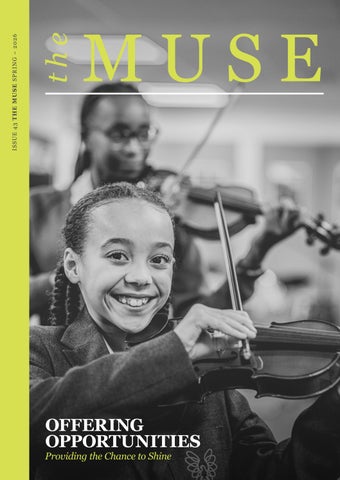
OFFERING OPPORTUNITIES
Providing the Chance to Shine
Carbon balanced print is produced by a carbon balanced printer on carbon balanced paper.
01 | The Muse
Editor’s Insight
T
here is an immense sense of pride that comes from seeing our students succeed. I am not always talking about the big public successes; sometimes it is the small moments, such as when a student steps outside of their comfort zone to try something new, or works extra hard to prove they can break through that elusive grade boundary. Yet, sometimes it is indeed the big moments, when the commitment, determination, and practice come together and they win, be it on the sports field, in a debating competition, or on a stage. Witnessing the sense of confidence and self-belief in these moments is truly magical. Crucially, creating a wide and diverse range of opportunities so that every student can have their moment is central to our educational approach. What I also witness is how much more willing girls are to put themselves forward and strive for these moments in a single-sex school. In a girls-only educational environment, our students are free from gender stereotyping. They rightly see themselves represented in every room, confident that they can be the best sports team in school, the best mathematicians, and that they deserve that first place in a debating competition without the unconscious bias that can seep into co-ed settings. Research confirms that girls perform better in single-sex schools, but the evidence is clearest in the daily ambition and intellectual risk-taking displayed by our students. Here, ambition is the norm, and they are encouraged to challenge traditional expectations in all fields, from engineering to the arts. By offering this exceptional range of opportunities, we are able to help our students find genuine interests and passions; this is where they will truly shine. The key to lifelong growth is recognising that success in one area breeds the courage to take a risk in another. Having done it once, they will be motivated to try something new. This creates a vital, self-perpetuating cycle where success fuels aspiration, turning tentative steps into confident strides. This holistic approach ensures that personal growth extends beyond the classroom, cultivating the essential qualities of leadership, resilience, and creative thinking. This edition of the Muse is a celebration of just some of these successes. I hope you enjoy reading about the outstanding achievements of our lacrosse students at the National Schools Championships, a remarkable testament to their dedication and exceptional teamwork.
Similarly, the growing successes of our debaters highlights their intellectual maturity and persuasive skill. We also celebrate our wonderful achievements at the annual Bedfordshire Festival of Music, Speech and Drama, demonstrating the breadth and depth of our students’ talents in the creative and performance arts from Years 3 to Lower Sixth. These features underscore our philosophy that the spirit of competition and collaboration is just as valuable as the final outcome. For students to succeed, having positive role models is critically important. Our students need to see themselves represented, as women, in all walks of life. We are so fortunate to have incredibly engaged alumnae who are always willing to share their successes with our current students. Last term saw inspiring visitors from across the creative arts field and the world of STEM, sharing their unique journeys, opening our students’ eyes to a world of possibilities. These real-world connections make career paths tangible and achievable, reinforcing the belief that there are no limitations to what they can pursue. Finally, our focus on student wellness continues to expand. I am excited to try our new food options from the Greens Kitchen. It is rare for a school to have its own in-house catering operation. We are fortunate to have a dedicated team who are able to work in partnership with our students and parents to create wonderful, fresh, and original food that is tailored to the needs of our school community. This summer, we are trialling the option of al fresco lunches, as an alternative to the hot options, allowing our Senior School students to enjoy lunch with their friends outside. This new initiative provides well-balanced, tasty options that offer more flexibility and choice. You can read more about these nutritious options, designed to fuel both intellectual and physical activity, on page 4.
By offering this exceptional range of opportunities, we are able to help our students find genuine interests and passions; this is where they will truly shine.
We look forward to another term dedicated to extending their intellect, challenging their limitations, and growing their self-belief. I hope you will join me in school and one the sidelines to celebrate their successes. Best wishes
Gemma Gibson Headmistress
The Muse | 02
CERN
Where Science Comes to Life In the early hours of Saturday 28th February, a group of 10 Sixth Form students and two teachers set off for Geneva, Switzerland on the school’s biannual visit to CERN, the world’s largest particle physics laboratory. Excitement was high as the group prepared to spend the day discovering where some of the most significant research in modern physics takes place.
M
rs Emma Smart, Physics Teacher, who led the trip, reflected: “There are few experiences in teaching as rewarding as seeing students encounter science on a global scale. Visiting CERN gives them a glimpse into the world of real research and shows how classroom learning connects to discoveries shaping our understanding of the world.” CERN, originally known as the Conseil Européen pour la Recherche Nucléaire (now the European Organisation for Nuclear Research), was founded in 1952 and remains at the forefront of scientific exploration into the smallest building blocks of matter. The day began in the exhibition centre, an interactive space filled with engaging displays on particle accelerators, quantum mechanics and the wonders of the subatomic world. One fact that particularly captured the students’ attention was that only one per cent of the human body’s mass comes from the particles that make it up, while the remaining ninety-nine per cent is the energy binding them together, elegantly expressed by Einstein’s equation, E=mc². Mrs Smart explained: “That idea always captures their imagination. It reminds us that most of what makes us who we are is energy rather than matter, which is both deeply scientific and wonderfully poetic.” After lunch in the CERN canteen, the group attended a demonstration lecture on the states of matter, featuring experiments with liquid nitrogen and practical examples that brought complex principles to life.
Re-energised, the group began their guided tour of the research complex. They learnt how the first particle accelerator, a 2,500-tonne synchrocyclotron, was built and saw its history brought vividly to life through a light display projected across the massive structure. Mrs Smart reflected: “The exhibition offered an excellent overview of CERN’s history and how scientific progress builds on the ideas of past generations. It really helped the students appreciate how far research in this field has come.” The visit continued with a tour of ATLAS, one of the two main detectors on the Large Hadron Collider. Students were fascinated as a window turned transparent to reveal scientists working in the control room. “Seeing professional researchers in action was a real highlight for many of the group. It offered a glimpse into the collaborative nature of modern science and showed how theories discussed in lessons translate into real investigations.” Mrs Smart added. Zaynab Choudhury, Lower Sixth, reflected “Our trip was an astronomically interesting experience that showed me a completely different side of physics. One of the most memorable parts for me was seeing the artwork Chroma VII, which linked physics with philosophy. It made me think about how physics isn’t just equations, but also about observation and trying to understand things we can’t directly see, like dark matter and the structure of the universe. “I enjoyed learning about real-world applications of physics, especially the colour X-ray technology using Medipix detectors. Seeing how ideas from particle physics can be used in medicine, such as detailed wrist scans for diagnosing conditions like arthritis, made the subject feel much more relevant and impactful. “After lunch, we attended a demonstration lecture on states of matter involving liquid nitrogen, which became especially memorable during the more dramatic moments of the demonstrations and the speaker’s allusions to Star Wars. Visiting the ATLAS detector was another highlight, as it showed how scientists detect incredibly small and short-lived particles, and I particularly enjoyed catching the researchers working in the control room off guard.”
03 | The Muse
For Alice Lawson, Upper Sixth, the experience made classroom learning feel vividly connected to the real world: “Visiting CERN allowed us to draw clear links between what we have learnt in the classroom and scientific research taking place today. Seeing how theoretical models have been proven by various experiments deepened my understanding of particle physics and caused a curiosity about fundamental particles.” Mitali Misra, Upper Sixth, added: “The trip was equal parts enjoyable and informative. The interactive exhibits in the museum were extremely engaging. The tour of the site was incredible and to be able to see the actual chalkboard used in a critical discovery of the facility was thrilling. As a student that doesn’t take A Level physics but is nevertheless fascinated by the world of quantum mechanics, I found the trip very interesting, and fortunately comprehensible, despite my slightly different perspective.” Before heading home, the group enjoyed a short sightseeing stop in Geneva, with views of the United Nations buildings and a stroll along the lakeshore. Mrs Smart concluded: “I would like to commend our brilliant students on their thoughtful questions throughout the day. They were an absolute credit to BGS and made the whole experience such a pleasure. Watching them connect classroom learning to world-changing research was inspiring and it reminds me exactly why we bring them here. For our young women especially, trips like this are so important in showing that they belong in the world of science. Seeing female physicists leading cuttingedge work at CERN helps turn ambition into confidence, and curiosity into action.”
A Fresh Approach This summer term marks an exciting step forward for the Greens Kitchen Team as they introduce a brand-new Grab & Go lunch offering. Shaped by student feedback, parent collaboration and the school’s commitment to sustainability and wellbeing, it promises to deliver quick, healthy cold lunch options for students to enjoy.
M
rs Katie Tombs, Catering Manager, reflected on what drives this student-led initiative: “At the heart of this launch is genuine student voice. Through ongoing conversations, surveys and casual chats in the Dining Hall, it became clear that our students crave flexibility, speed and choice during their busy school days. They told us they want nutritious options they can grab quickly especially on those sunny afternoons when they’d rather be outside or enjoying their co-curricular activities.”
Mrs Tombs continued: “Sustainability drives everything we do at Greens, and Grab & Go is no exception. Thoughtful portioning minimises waste right from the start, while we prioritise responsibly sourced ingredients from local suppliers whenever possible. “We’re also weaving education into the mix, helping students understand food’s wider impact. Small actions like finishing what’s on your plate or choosing Grab & Go to avoid overserving truly add up over time. It’s about empowering our girls to make mindful choices that benefit both their health and the environment.”
The Grab & Go concept delivers exactly that. These convenient, nutritious packed lunches are perfect for sunny days in the dining hall or enjoyed outdoors on the playground or sports fields, while upholding the high standards you’ve come to expect from the Greens Kitchen Team. Mrs Tombs said: “These aren’t just any packed lunches; they’re thoughtfully curated with fresh, seasonal ingredients that reflect what our students have told us they love most. Simple, good-quality sandwiches made with premium bread and fillings like roast chicken or tuna, fresh poke bowls, crisp vegetables served on the side rather than stuffed inside and popular accompaniments like crudités with creamy hummus all feature prominently. It’s all wrapped in sustainable packaging that’s easy to carry and kind to the planet.”
This ethos shines brightest in our Junior School, where we nurture lifelong habits from the earliest years. Through initiatives like Eat the Rainbow, our younger students dive into a world of vibrant fruits and vegetables, learning how different colours contribute to their health and wellbeing. Mrs Tombs said: “These interactive sessions go far beyond basic nutrition; they introduce mindful eating, teaching the girls to appreciate where their food comes from, savour its flavours, and recognise its true value. It’s delightful to see their excitement as they ‘shop’ from colourful produce displays and experiment with new combinations.”
Equally vital has been our close partnership with parents, which truly came to life during a taster event during the Spring Term. Mrs Tombs said: “We are always keen to work with parents to ensure their daughters are eating well, feel supported with their allergy requirements and that they feel they are getting good value from a school lunch. It was important to us that parents had an understanding of the new concept, so we invited them into school at the end of February for a tasting session, where they sampled proposed Grab & Go items and shared their invaluable thoughts. It was a fantastic opportunity, and we are so grateful to everyone who joined us. Parents shared that their daughters really like the idea of cold options during the summer months. There was strong support for simple, goodquality sandwiches made with fresh ingredients, vegetables served on the side rather than inside sandwiches, and crudités. This feedback has been incredibly helpful in refining our final offer.”
To bring this learning full circle, we’re organising a special field trip for members of our Junior Eco Club. Students will visit one of the farms that supplies our vegetables, then trace the produce through our trusted fruit and vegetable supplier, before returning to school to watch it being prepared for our lunch counters. Mrs Tombs explained: “This hands-on ‘farm to fork’ adventure connects all the dots, deepening their grasp of sustainability and food systems in a way no classroom lesson alone can match. It’s these experiences that turn knowledge into action.” Grab & Go is more than a new lunch option; it’s a reflection of our evolving food culture at BGS. Mrs Tombs concluded: “It embodies our commitment to listening intently, adapting thoughtfully and nurturing a dining experience that fuels individual wellbeing while protecting our planet. We can’t wait to see students embrace it this summer term and make it their own.”
The Muse | 04
Learning How to Learn The Muse talks to Mrs Carolyn Howe, Head of the Junior School, to better understand the magic of the IB Primary Years Programme (IB PYP) approach to learning.
M
rs Carolyn Howe, Head of the Junior School explained: “I was recently observing a class writing Haiku poems. They had been outside, using their senses to observe the seasonal changes. They had also explored the background knowledge necessary to understand the key features of haiku: counting syllables, the structure, seasonal references and juxtaposition. This had all taken place before I entered the classroom. As the girls worked, I observed several things happening at once. I watched them pause and think deeply about their writing. They were monitoring their own efficacy as writers; they used self-regulation and reflection to adjust words, they were checking the flow of their writing, and searching for that juxtaposition, or as they called it, ‘something unexpected, a surprise.’ They went on to evaluate their own work and the work of a friend, removing excess words, hunting for that ‘aha!’ moment in the final line, and looking objectively at the success of their writing. What I was witnessing was not simply a group of children completing a task, I was observing something far more powerful: metacognition in action. This is the power of the IB PYP approach.” 05 | The Muse
Metacognition is the term used to describe a person’s awareness and understanding of their own thought processes; it is thinking about thinking. In 2025, the Education Endowment Foundation drew on a large body of international evidence to rate metacognition as a high-impact approach that is proven to increase attainment in learners. It is one of the effective interventions available to schools. It is a vital skill for effective learners in the 21st century. In the Junior School metacognition is embedded in our Approaches to Learning and is central to classroom practice. Mrs Howe explained: “Approaches to Learning, or ATLs as we call them, are an integral part of the IB PYP. The approach is underpinned by a simple but powerful belief: that learning how to learn is just as important as learning what to learn. Rather than being a separate subject or add-on, the how to learn (the ATLs) are purposely woven into each lesson.”
ATL encompasses five categories of skills that support all our pupils in becoming confident, self-regulated learners: •
Thinking skills: creative and critical thinking, problem-solving, reflection
•
Communication skills: reading, writing, speaking, listening and presenting ideas effectively
•
Research skills: gathering, organising and evaluating
•
Social skills: collaboration, conflict resolution and respecting others
•
Self-management skills: organisation, time management, perseverance and emotional regulation
Mrs Howe added: “These categories are not a checklist, they are learning habits, which when repeated and cultivated, transform the way our girls engage with their learning and with the world around them.” “In the classroom, ATL provides the why of metacognitive practice and visible thinking routines provide the how. In our classrooms, I see activities such as See, Think, Wonder, What Makes You Say That? and 3-2-1 Bridge being used as natural parts of the learning process. I see teachers verbalising and modelling their own thinking aloud, so that the pupils can observe, discuss and replicate the way decisions are being reached. They can understand the processes, step-by-step, so they can articulate how thinking is happening in the moment of learning. I see pupils engaged in purposeful metacognitive talk: debating strategies, questioning assumptions, and reflecting on what is and isn’t working. Teachers provide structured opportunities for pupils to plan their learning, monitor their progress, and evaluate their outcomes. These are not extras; they are central to how we teach.” Throughout the Junior School, you will see thinking routines displayed on working walls throughout the classrooms, and recorded in students’ inquiry learning journals. Mrs Howe explained the importance of these reinforcements: “These visible references create a shared language for learning, one that belongs to the girls, not just the teacher. It means that the skills and strategies they encounter in one lesson become tools they can reach for independently in the next.” Mrs Howe is keen to point out: “None of this happens by chance. Our teachers are thoughtful, deliberate practitioners who plan not just what girls will learn, but how they will develop.
When designing their lessons, they consider carefully which ATL skills are most relevant, how they will be modelled, taught, assessed and celebrated. This requires teachers to be more than deliverers of content. It asks them to model the very skills they are asking our pupils to develop. When a teacher pauses mid-lesson and says, “I’m not sure about this, let me think through what I already know,” they are giving pupils permission to think carefully rather than rush to an answer. This profound and often underestimated act teaches the pupils the importance of the pause in deep learning.” The skills the girls develop do not stay neatly within the boundaries of one unit of inquiry or one subject. A child who learns to synthesise information from multiple sources during a science unit is building the same skills they will use in history. A pupil who practises evaluating their own writing in English can use the same reflective strategy during a maths investigation. Mrs Howe said: “For example, I was observing a Year 5 pupil and mid-way through a maths task, she reached for a thinking map she had used weeks earlier in a completely different subject. She had not been asked to. She simply recognised that the tool would help. That moment of independent, purposeful application of a learned skill is what ATL is designed to produce. Our Junior School pupils move into Year 7 knowing how to learn, not just what they have learned, and this gives them a considerable and lasting advantage. Self-management, independent research, collaborative inquiry and reflective thinking are not niche skills; they are the foundations of successful secondary learning. ” Mrs Howe concluded: “We also know that happy children thrive and learn. Girls who feel in control of their learning, who can manage frustration and recover from difficulty, are more confident, more willing to take risks and more engaged in school life. When we teach a child to think, pause, reflect and try again, we are teaching them something that goes far beyond the classroom. They use these skills throughout all aspects of their life, in how they manage friendships; organise their work; or respond to a setback. These skills are building blocks for emotional resilience. Looking back to those children writing Haiku, I am struck by what I was really seeing. They were not simply learning a new poetic form. They were practising the art of thinking carefully, evaluating honestly and persevering creatively. They were developing habits that will serve them throughout their education. Our approaches to learning creates better learners. Girls who know how to think, how to ask good questions, how to work with others and how to keep going when things are hard. Students who are ready, not just for the next stage of school, but for whatever comes after that too.”
The Muse | 06
T
Shared Festival Moments
he annual spring Bedfordshire Festival of Music, Speech and Drama offers something special for young performers. More than a competition, it creates a rare chance for students to step beyond the classroom or rehearsal room and share their talents with a wider audience, gaining confidence, experience and a sense of achievement that stays with them long after the final applause.
Mr Page outlined two key strands: solo performances where students take the stage as singers and instrumentalists, blending concert and exam in a unique challenge, and ensembles across ten categories built on rehearsals. “While certificates and trophies may follow, the real achievement lies in the preparation and the courage it takes to perform. These are lessons that extend far beyond music,” he said.
For BGS, the festival proved a celebration of dedication, creativity and courage. More than 100 students from Years 3 to Upper Sixth took part across music, speech and drama classes in solo, duet and group performances. From choirs and orchestras to verse speaking, mime, acting and prepared reading, entries showed the school’s talent and the value of performance chances. Year 3 students who have just started their Speech and Drama journey gaining confidence through their first festival poetry performance to Lower Sixth students eager for feedback to perfect Shakespearian sonnets before embarking on their final LAMDA examinations.
Mr Page continued: “One minute listening, the next performing, sharing music with a new audience in a new space. The joy of collective performance lies at the heart of the Festival. Hearing other schools perform is equally inspiring.”
The Festival’s long tradition, one of the oldest of its kind, brings performers of all ages and abilities together in a supportive yet challenging atmosphere. Mr Geoff Page, Director of Music, highlighted its power for BGS musicians: “It was wonderful to hear many students excelling in solo classes and equally thrilling to see our choirs and ensembles performing so successfully. Our two Senior Choirs, Genesis and Bel Canto, began the week with an exciting head-to-head. Both were judged Outstanding, with Bel Canto taking the coveted first place.”
07 | The Muse
Students watched peers and picked up ideas. One Junior Choir member said hearing a rival group gave her tips for her own, turning competition into something useful. These moments help build performers and audiences for life. Adjudicators provided valuable feedback that helped everyone improve, shared through written notes and verbal discussions. Mrs Jenaya Smith, Speech and Drama Teacher, pointed out the benefits: “We are hugely proud of the students who take part as their involvement offers a blend of personal, social and creative benefits. Each discipline strengthens different skills. Many students took part in multiple classes including verse speaking, prepared reading and acting, which gives performers a rich blend of artistic and personal development.”
Verse speaking built rhythm and feeling, prepared reading worked on meaning, acting needed character work. Mrs Smith described the growth: “These festivals create a rare space where confidence, communication and imagination grow side-by-side. Standing on a stage, whether delivering a poem, performing a monologue or taking part in a group piece, builds a kind of confidence that everyday life rarely demands. Participants learn to manage nerves, project their voice and hold an audience’s attention. Over time, this strengthens self-belief and resilience. The constructive feedback from experienced adjudicators, which is shared both verbally and in a written format, helps performers understand their strengths and identify areas to develop.”
We are aware that in addition to those students who are entered by the school, other students may be entered independently by their parents or by outside organisations and we want to celebrate all those students, their achievements and the benefits they gain through their participation. Festivals cultivate a lifelong appreciation for the arts, and many participants find that the skills gained, confidence, communication, empathy and adaptability, become invaluable in education, careers and everyday life.”
Prep work got students deeper into text, looking at form, feeling and purpose, skills that help in English classes and exams, as a Senior School host said at the recent Junior School Speech and Drama concert on World Book Day. Students went over poems or scenes, talked choices with teachers, made practice into real thinking.
The Festival gave students chances to back each other up and try new things, a real celebration of young people, creativity and the confidence that comes from being heard.
The week allowed students to see all kinds of work and feel part of a bigger group. A Year 9 student said her nerves went down with applause from other schools. Teachers saw change from shaky starts to strong finishes.
Duets and groups taught teamwork with timing and listening, while entries from parents or outside groups got equal praise. Mrs Smith said: “This year many students were involved in duet and group performances, which in particular teach teamwork, trust and cooperation, as success depends on listening, timing and mutual support. Beyond the competition element, festivals celebrate the power of language and storytelling.
The Muse | 08
More Than a Game Each spring, the National Schools Lacrosse Championships bring together thousands of players, coaches and supporters for one of the most anticipated fixtures in the school sporting calendar. At the Aldershot Garrison Sports Centre, the atmosphere is alive with the noise of the crowd, the rhythm of the game and the quiet determination of the girls on the pitch.
F
or BGS, this event represents more than four days of competition. It is the culmination of months of focused training, co-curricular practices and teamwork honed over an entire season. Competing nationally provides students not only with an opportunity to challenge themselves against the best schools in the country, but also with the chance to reflect on the values that shape them as athletes.
The U19B Team also enjoyed a strong tournament, progressing to Division 2 and displaying both determination and teamwork in their matches. Their performances reflected the culture of collective effort that runs throughout the school’s lacrosse programme.
Mrs Verity Mason-McLeod, Director of Sport, reflected: “There are few experiences in teaching as rewarding as seeing students encounter sport on this scale. National Schools Lacrosse is about so much more than competition. It’s about players testing themselves, learning from every moment, and taking pride in representing their school on a national stage.”
The final day of competition brought the younger players together for their first National Schools experience, as the U13A and U14A teams took to the pitches. For the U13A squad, it was a memorable debut. They began with a 9–0 victory over Heathfield, followed by wins over St Paul’s Girls, Wycombe Abbey and Benenden, and a hard-fought 1–0 win against Haberdashers’ in the last 16. Their run ended in the quarter finals against eventual champions Putney, placing them among the top eight teams nationally.
The Championships began with the U19A and U19B teams over the opening weekend. The U19A Team delivered an outstanding level of play, finishing in the top 24 nationally and progressing to the Division 1 quarter finals. Their journey included four victories in the group stage and a composed win against Sherborne Girls’ School before meeting eventual champions Birkenhead School. Led by captain Jessica Parrish, Upper Sixth and England Lacrosse Aspire player, the team epitomised composure and unity throughout. Reflecting on their performance, Mrs MasonMcLeod commented: “National Schools challenges our players to perform at the highest level, but it also reveals something deeper: how they lead, support one another and respond under pressure. Our senior players set an exceptional example this year, showing younger teammates what it means to wear the BGS colours with pride.”
09 | The Muse
Building on the energy from the senior teams, the U15A squad demonstrated determination and teamwork to secure a place in Division 1, a demonstration of the rising talent across BGS.
The U14A team also impressed, finishing in the top 16 and again demonstrating the strength across the BGS programme. For Mrs Mason-McLeod, experiences like this play a crucial role in shaping students’ sporting journeys, she said: “The lead-up to National Schools is one of the most valuable parts of the process. It teaches organisation, discipline and resilience. Students learn to balance training with their academic work, to manage pressure, and to support one another on and off the pitch. By the time we arrive at the tournament, they haven’t just improved as athletes, they’ve grown as people.” The Championships reinforced what many already know about lacrosse at BGS, that it is not only about winning, but also about learning, collaboration and joy.
For some, the tournament marked the culmination of years of commitment; for others, it opened the door to new opportunities and ambitions in the sport. Lucy Nissen, Upper Sixth, captured the experience perfectly: “National Schools is one of the best sporting events we take part in. Making lifelong memories with my friends and teammates, and being able to bond with other year groups, is so special. It’s a good way to look back at all the hard work we have put in over the season. Seeing the team come together for one final time is always so amazing.” Mrs Mason-McLeod concluded: “Watching our students play with such pride, positivity and unity makes every training session worthwhile. Events like this are powerful reminders of how sport shapes character, builds confidence and connects our community. Our students returned not just as stronger athletes, but as young women who understand the true value of teamwork and perseverance. It underpins our sporting ethos which continues to deliver outstanding sports women and consistently places BGS amongst the best schools for sport in the UK.”
Path to Oxbridge “As a woman in a male dominated STEM field, I find it very important to raise these questions and keep pushing forward.” Professor Irene Tracey, Neuroscientist and Vice-Chancellor of the University of Oxford
T
his year’s Oxbridge cohort at BGS has excelled, securing offers in Jurisprudence, Veterinary Medicine, Chinese, Law with German Law and Experimental Psychology. These successes showcase the rigour of a BGS education and the courage of young women ready to pursue excellence wherever their academic passions lead.
Mrs Emma Yeomans, Oxbridge Coordinator, reflected on their journey: “Every year brings challenges and opportunities, but the Oxbridge cycle tests even our brightest students. It’s a path marked by hard work, personal growth and genuine passion for their subject. As Coordinator, I’m privileged to guide them through applications. Even those taking different roads emerge transformed by the process.” BGS alumna, Emily Fordham (2022)
The BGS Oxbridge Programme nurtures independence and intellectual engagement from day one. Students receive coaching on subject choice and extra curricular activities that stretch well beyond classroom learning. Critical thinking workshops help them articulate their ideas and often push outside comfort zones. Personal statement support focuses on honing the specific Oxbridge requirements, while admissions test preparation offers subject-specific advice alongside written work refinement. Interview preparation is particularly intensive, supported by BGS staff and alumnae who are able to share their experiences and expertise. Earlier this Spring Term, BGS alumna, Emily Fordham (2022), visited our potential Oxbridge applicants to recount her Cambridge application journey. Her talk unpacked the preparation, challenges and ultimate success of gaining her place at Sidney Sussex College to study Law. Mrs Yeomans said: “Emily made clear that stellar grades alone aren’t enough. Critical thinking, preparation, interview poise and admissions test performance must all shine before final grades even come into play.” Now in her final year, Emily detailed Oxbridge’s distinctive rhythm: weekly supervisions, the college system, academic expectations alongside representing Cambridge in Lacrosse and Hockey. Mrs Yeomans added: “She estimated spending 30 hours weekly on sport, a discipline rooted in her BGS days on school teams. Our Lower Sixth cohort asked thoughtful questions: which colleges feel most academic? How many supervisions per week? These practical considerations now shape our sessions and their bespoke preparation plans.”
These offers reflect far more than academic brilliance. Mrs Yeomans continued: “An all-girls education builds fearlessness for traditionally male dominated fields and bravery tackling ab initio languages like Chinese. Our successful applicants balanced exceptional grades with impressive wider engagement. They entered essay competitions, took leadership roles in the Girls’ Leadership Group (GLG) and CCF, completed extended research projects, achieved Olympiad success, ran academic societies, and gained work experience in their chosen fields. All of these areas are vital to demonstrate a commitment and passion to your chosen subject.” “Their resilience truly stands out. They stretch beyond exam syllabuses, welcome challenges, and show academic strength in unfamiliar situations. This cohort was impressive.” The programme’s true value extends beyond Oxbridge offers. Mrs Yeomans explained: “While receiving an Oxford or Cambridge place marks fantastic achievement, our deeper purpose equips students for university life wherever they end up studying. We develop skills and optimism that serve lifelong. An Oxbridge education isn’t inherently superior, recent rankings show excellent alternatives. What matters most is finding the right academic fit.” Mrs Yeomans continued: “As they tackle Lower Sixth exams alongside broad commitments, everything comes into sharp focus. The pressure reveals priorities and builds resilience. Whatever path they follow, I’m excited to support their growth.” Key to the BGS’s Oxbridge programme is helping students individualise their preparation. Linking students with alumnae and friends of BGS who have the level of experience and expertise needed to ensure the students are best prepared for the complex application process and understanding that different courses are looking for a range of different requirements. The diversity of this year’s cohorts highlights the importance of such individualised programming. Veterinary Medicine applicants are expected to have shadowed clinics; Jurisprudence students immersed in ethical debates; Chinese students built fluency from scratch. Wider achievements impress: Olympiad medals alongside essay competition success; research projects gaining recognition; thriving academic societies they founded. Mrs Yeomans concluded: “Wherever their academic journeys lead, these young women carry scholarly determination and optimism. An Oxbridge place opens one door, but BGS preparation unlocks endless possibilities. Their futures promise brilliance. I can scarcely wait to witness where they lead.”
The Muse | 10
Debate Matters Debate Club continues to be an engaging part of school life at BGS. Meeting every Monday lunchtime, it offers a welcoming space where students explore ideas and challenge one another respectfully. They develop the confidence to express their opinions clearly and persuasively; building invaluable transferable skills which will be of huge benefit to them long after they leave school.
S
tudents from Years 7-10 take part in lively practice debates on a wide range of topics. These sessions are designed to be enjoyable while strengthening communication and criticalthinking skills. This term, the focus has been on two key debating techniques: countering arguments and raising Points of Information (POIs). Reflecting on the group’s development, Mrs Chloe Lincoln, English and Psychology Teacher, commented: “We have seen incredible improvement in how students respond directly to their opponents’ points and engage spontaneously in discussion. It’s wonderful to see them grow more confident in offering POIs, something that really builds their courage and quick thinking.” Mrs Ann Bezzer, English Teacher, added: “Supporting our thriving Debate Club is one of the most enjoyable aspects of my BGS life. It is so important to empower our young people to have the confidence to let their voices be heard, and equally important to teach them critical thinking, intellectual curiosity and the ability to evaluate and synthesise information. I love the fact that we get to help students develop a key life-skill whilst having a lot of fun along the way.”
11 | The Muse
A highlight of the term was a topical debate to mark International Women’s Day, where students discussed the motion Society today is still far from true gender equality. The discussion prompted thoughtful consideration of social, political and cultural perspectives from around the world. Mrs Lincoln reflected: “It was fantastic to see students engage with such a complex issue so maturely. They presented well-researched arguments and listened respectfully to one another, exactly the kind of balanced, critical conversation Debate Club aims to nurture.” Beyond the weekly sessions, Debate Club has been active in inter-school and national events. Earlier this year, BGS hosted a friendly debate for Year 7 and 8 students against Goldington Academy. For many, it was their first formal debating experience, and they rose to the challenge admirably, demonstrating teamwork, preparation and composure. Year 9 students also showed tremendous initiative by organising their own inter-school debate with Bedford School. Taking the lead on planning and delivery, they represented BGS with confidence and professionalism. Amrita Tumber, Year 9, said: “I joined the BGS debate team a couple of years ago, and I’ve really enjoyed the experience. I love working collaboratively, expressing my opinion and thinking on my feet during debates. It’s helped me to develop my critical thinking and reasoning skills while competing in a really fun way.”
BGS debaters have also represented the school nationally through the English-Speaking Union (ESU), entering both the Public Speaking Competition and the prestigious Schools’ Mace Debating Competition. The latter saw a team of BGS older students progress to the second round, a significant achievement given the high standard of competition. Lower Sixth student, Nicole Lapis shared: “The Mace competition was my first proper experience in a formal debate environment, and despite my initial nervousness, my confidence in debate and public speaking skills has significantly improved as a result of the two rounds I competed in. Although we didn’t make it further than the second, I am very grateful I had the opportunity to experience this wonderful event and develop my abilities.” For Lower Sixth student, Hania Tauqeer, taking part in competitions has been equally valuable. “I really enjoyed taking part in the ESU Schools’ Mace this year. This was my first experience taking part in a formal debating competition and I really enjoyed being able to give a longer speech and research topics in more detail. Debating gives you the skills to think logically and ‘disagree agreeably’. I have found it really helpful in solving real-life discussions.”
refine their skills in a competitive yet supportive environment. They build independence, resilience and confidence that go far beyond debating itself.” Debate Club has become an important part of school life, giving students the confidence to speak up, listen carefully and think independently about the world around them. Students learn to analyse complex issues, weigh evidence and communicate clearly, all while respecting opposing views. These skills are vital to hone in a safe supportive environment and will be needed both at university and in the working world. Mrs Lincoln added: “Collaborative group projects are standard place on most university courses, our students will have the advantage of not only being able to express their ideas but to be able to critically evaluate others and to respond in a thoughtful, respectful manner. Likewise, most graduate assessment programmes expect young people to give presentations as part of the selection process; to know you have the confidence to stand up in front of a room of strangers and present your argument gives you a head start. Debating really helps future proof our students.”
Mrs Lincoln added: “It’s such an achievement for our students to reach this stage. The standard is always incredibly high, and the girls’ preparation, teamwork and intellectual agility really shone through.”
Mrs Lincoln concluded: “What stands out to me most is the way our debaters have grown, not just in confidence, but in their ability to listen, think critically and engage respectfully with different perspectives. Debate Club is all about curiosity, communication and courage, and I couldn’t be prouder of the progress our students have made this year.”
In November, Year 10 students took part in a full-day debating event at St Francis’ College, featuring multiple debates, workshops and discussions with other schools. The experience was, as Mrs Lincoln described, intensive but immensely rewarding. “Opportunities like this allow students to
Debate Club remains open to students from Years 7-10, and new members are always welcome. With more debates and competitions planned for the coming months, including the eagerly anticipated House Debate in the summer term, the future looks bright for our passionate debaters.
The Muse | 12
Mrs Lugsden, BGS alumna, Anna Cooke (2022) and Mrs Smith.
Artistic Voices
Celebrating Creative Pathways Beyond the Classroom At a time when the importance of creative education is increasingly discussed, opening our students eyes to the endless possibilities of a creative pathway is vital. We are fortunate to have inspiring role models who can show them the way. Mrs Christina Lugsden, Head of Art and Textiles reflects on their visits.
W
e have been delighted to welcome back a number of our alumnae as part of our growing Artistic Voices series, an inspiring programme of talks celebrating creative careers and the many pathways that begin with a love of Art and Textiles at school. Each of our visitors once sat in the very same classrooms as our current students, studying Fine Art or Textiles Design, and it was both affirming and motivating to see how those early experiences have shaped such varied and exciting futures. At a time when the importance of creative education is increasingly discussed, these visits offered a powerful reminder of its lasting value. Creativity is not simply about producing artwork; it develops resilience, problem-solving, independence and the confidence to think differently. These are skills that transcend any one subject or career. Our alumnae demonstrated that a creative education does not lead to a single, fixed destination, but instead opens doors to a wide and evolving range of opportunities. 13 | The Muse
We were particularly pleased to welcome Shama Johns (DAHS 2012), whose journey highlighted the non-linear nature of creative careers. After studying A Level Fine Art at school, Shama initially pursued Biology at the University of Leicester and later worked in marketing. However, her passion for art remained constant, eventually leading her to make the bold decision to return to a creative path. Today, she has developed a distinctive artistic practice centred on still life, often inspired by food and its ability to bring people together. Alongside her fine art, she produces commissioned illustrations. Her honest reflections on changing direction and following her passion resonated deeply with students, reinforcing the idea that creativity can remain a lifelong pursuit, even if the path is not straightforward. In contrast, Sophie Watson (BGS 2022) offered insight into the early stages of a creative career. Now embarking on her goal of working as a 2D animator, illustrator and character designer. Alongside studying A Level Fine Art, Sophie spoke about how an animation summer course first sparked her interest to pursue this creative area further, an experience that
ultimately led her to study the subject at the University of the Creative Arts. Her talk gave students a fascinating glimpse into the animation process, from initial storyboarding through to final production. By sharing her own work and discussing the discipline required to succeed, Sophie provided both practical advice and a relatable example of how school interests can evolve into professional practice. Our Textiles Design focused alumnae further demonstrated the breadth of creative industries. Anna Cooke (BGS 2022), who studied both Fine Art and Textiles Design A Level at BGS, recently graduated in Textiles from the Arts University Bournemouth, shared her exploration of materials including wood, metal and fabric, and spoke about her ambition to work in interior design, creating bespoke pieces for commercial spaces. Her work was innovative and highly creative, showing students the depth of understanding that can be developed through further study into creative subjects beyond school. Her willingness to return next year to work directly with our Lower Sixth students is a wonderful example of the ongoing relationship between school and alumnae. Megan Clough-Ambridge (BGS 2016) offered a particularly striking perspective from the world of film and television. Having studied Fine Art A Level and then going on to study Design for Film and Television at Nottingham Trent University, she has developed specialisms in prosthetics and creature design, contributing to major productions and creating work worn by internationally recognised actors. The diversity of work she produced, and the productions she has worked on was highly inspiring for current students. Her story, sparked by an early visit to a film set, highlighted how formative experiences can shape future ambitions, and how creative skills can lead into highly specialised and collaborative industries.
Similarly, Velvet Few-Wiegratz (BGS 2022), following her studies into both Fine Art and Textiles Design at A Level, she was able to share her experiences of studying costume design for stage and screen at Nottingham Trent University, bringing examples of her work for students to see firsthand. Her plans to continue her studies at postgraduate level demonstrate the depth and progression possible within creative disciplines, as well as the importance of continued experimentation and growth. Collectively, these talks not only celebrated individual success but also showcased the strength of creative provision within the school. Our Art and Textiles departments continue to nurture curiosity, technical skill and independent thinking, qualities clearly evident in the journeys of our returning students. It is especially meaningful for current students to see these outcomes reflected in real people who once followed the same courses, worked in the same studios and were guided by the same teachers. Perhaps most importantly, these visits underline the value of connection. Hearing directly from alumnae allows students to engage with authentic, lived experiences of creative careers, the challenges as well as the successes. It makes the future feel tangible and achievable, while also reinforcing a sense of community that extends well beyond school years. We are incredibly grateful to all our visiting alumnae for their generosity, honesty and enthusiasm. Their stories have inspired and motivated in equal measure, and we look forward to continuing to build these connections in the future.
DAHS alumna, Shama Johns (2012)
BGS alumna, Sophie Watson (2022)
BGS alumna, Velvet Few-Wiegratz (2022)
The Muse | 14
Legend in their Lifetime
Mr Aris Gavrilis Classics Teacher
Paulo Freire Brazilian educator and philosopher (1921-1997) ‘Thinking correctly requires critical thinking’. Paulo Freire, Pedagogy of Freedom
F
or everyone involved in education, students, parents, teachers, professional services staff, there remains a fundamental question in the back of their minds: when a pupil revises for a difficult examination; when a parent is deciding on which school their child should attend; when an individual is considering teaching as the next step in their career. That question is simply: what is the purpose of education? In my case, when I was deciding whether to pursue teaching as a career, Paulo Freire gave the most convincing answer to this question. Freire’s educational philosophy not only answered this question, but in doing so has transformed the way the world thinks about learning and schooling. Paulo Freire was born in Recife, in the northeast of Brazil. He studied law, but soon, shocked by the phenomenon of illiteracy among Brazilians, particularly in the most marginalised communities, quickly turned his focus to education. He eventually became Professor of History and Education at the University of Recife, and his methods, which aimed to tackle illiteracy in Brazil, by establishing thousands of local ‘culture circles’, were adopted by the democratically elected Brazilian government. However, the Brazilian dictatorship of 1964, perceiving that the more educated Brazilian citizens became, the greater the threat to their regime, imprisoned and exiled Freire. While in exile, Freire took up a visiting professorship at Harvard University, and travelled extensively across Asia, Africa and Latin America, promoting educational reform and strategies to secure education for all, regardless of their social, economic, cultural or religious backgrounds. By 1979, the political situation in Brazil had changed and Freire returned to his homeland. In 1988, he became the Secretary of Education, and began the implementation of radical reforms, emphasising democratic education, empowering
15 | The Muse
teachers and local communities to create learning environments which establish critical thinking at the heart of the schooling process. Evidently, Paulo Freire had a remarkable record of educational action. His books and theories about learning also had a substantial influence on how we understand education today and continue to inspire educators and educational systems across the globe. This positive impact has been recognised by the United Nations, which awarded Freire the 1986 UNESCO Prize for Peace Education. Among his most influential works are The Pedagogy of the Oppressed, Education as the Practice of Freedom, and Pedagogy of Hope. Freire believed that ‘education must be an act of love, and thus, an act of courage’. For Freire, this meant that true educators must have the courage to question the way knowledge is taught and who gets to decide what is worth learning. He stressed the importance of the compassion to treat every student as a thinking, feeling human being worthy of dignity and respect. He believed that education should empower people, not simply fill their heads with facts. Rather than treating students as passive recipients of knowledge (an approach he called banking education),
he advocated for an approach that encourages critical thinking, active problem-solving and genuine engagement with the world around them. Freire believed that when students are invited to question, discuss, and reflect, they begin to see themselves not just as learners, but as people with the power to change their circumstances. This is why his work remains so relevant today in a world full of social, political, environmental, and technological challenges, the ability to think critically and act meaningfully is perhaps the most important thing a school can give its students. I hope you agree with me, that these principles guide today, to a larger or lesser extent, the schools operating in democratic societies. I believe it is our duty, not only to remember and acknowledge the achievements of educators like Paulo Freire, but to engage with their work and continue doing what Freire believed to be the very purpose of education: to develop a critical mind and empathy towards our fellow human beings. I know this belief is shared by my colleagues at BGS as it underpins all we strive to achieve for our students.