the
AUTUMN ~ 2012 THE MUSE ISSUE 4
MUSE
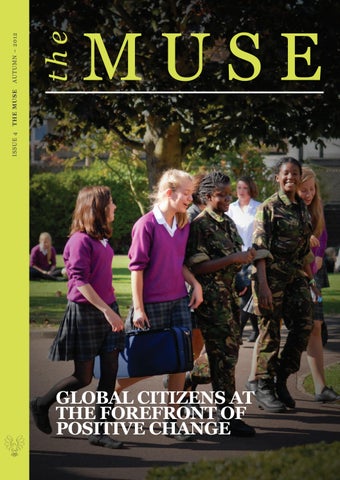
GLOBAL CITIZENS AT THE FOREFRONT OF POSITIVE CHANGE
Visits & Voyages This list is by no means
Visitors In
exhaustive, but offers a flavour of guests in and visits out during the Autumn Term.
A Level and GCSE Awards Evenings, DAHS
Lead to Learn Day, Year 11
Economics and Business Society Talk
Medieval Day, Year 7
Frantic Assembly, Drama Workshop
Open House
French Society Reunion
Party for Sight Concern
Future Fortunes Conference, Year 12
Pilgrims Activity Day, Year 3
English and Media Careers Evening
Roman Day, Year 3
History Society Talk
Tempest Workshop, Year 6
Interview Technique Talk, Year 13
Young Enterprise, Year 8 Earn to Learn Careers Day
Voyages Out Bedford Hospital Careers Event for Prospective Doctors
London, Years 10 to 13 Textiles Trip to Knit and Stitch Show
Bedford, Year 10 Art trip to St Paul’s Church
London, Year 11 Psychology trip
Bedford Magistrates Court, Mock Trials Competition
London, Years 11 and 12 Trip to Winter Wonderland
Castleton, Derbyshire, Year 9 Geography Trip
London, Years 11, 12 and 13 Art Trip to The National Gallery
Chiltern Hills, Duke of Edinburgh’s Award Silver Assessed Expedition Coventry Cathedral & Warwick Castle, Year 8 History Trip Cranedale Centre, Year 12 Geography Field Trip
London, Years 11, 12 and 13 Classics Trip to the British Museum London, Years 12 and 13 Psychology Conference
Edale, Derbyshire, Year 10 Residential Trip
Leicester, Year 5 Trip to the National Space Centre
English GCSE Trip to Oxford
Malta Rally Lacrosse Tour
English Society Trip to London
Milton Keynes, Opera Experience Day and Marriage of Figaro Performance
France, Trip to the Loire Valley Hamburg, German Language Trip
Northampton, Drama A Level Trip
Harpur Science Forum Lectures, Bedford School
Northampton, UKMT Senior Mathematics Challenge Trip
Harpur Trust Debate, Bedford Modern School
Oxford, Year 6 Trip to the Ashmolean Museum
Ickwell Bury, Duke of Edinburgh’s Award Silver and Bronze Expedition Training
Oxford, Year 13 A2 and IB Economics Conference at Oxford University
London, AS Classics Lecture Trip
Peterborough, Years 7 to 13 Trip to Flag Fen
London, Design & Technology Trip to V&A Museum
Thetford, Norfolk, CCF Field Weekend
London, Mathematics Trip to the Institute of Education
Watford, Theatre Trip Our Country’s Good
Warwick, A Level Theatre Trip Beautiful Burnout
London, Sixth Form History Lectures Trip
Woburn Sands, Year 7 Ice Skating Social Trip
London, Theatre Trip Much Ado About Nothing
Year 5 Happy Puzzle Day, Bedford School
London, Year 6 Sleepover at the Science Museum
Years 10 and 12 Bedford School Observatory Trip
London, Years 7 to 13 Theatre Trip STOMP
Year 12 Religious Studies Lecture in London
Bedford Girls’ School | www.bedfordgirlsschool.co.uk Bedford Girls’ School is part of The Harpur Trust. Company no. 3475202 / Charity no. 1066861
Editor’s Insight
B
uilding a connected community is one of the most important aims of Bedford Girls’ School. When we reflect upon what that really means we have to think beyond the life we offer our pupils, parents and staff and even beyond our connection and links with those in our local vicinity. A truly connected community is an international one - a global network of citizens who work together to realise a shared vision and to make the world a better place. As an IB World School, we are fortunate to share a link with 3,490 others in 144 countries. Being part of this international community means we share not just a common curriculum but crucially, a philosophy with an emphasis on developing character and on public service.
remarkable advances today’s pupils will see during their lifetimes. I also felt an immense sense of pride as it became apparent that many of the innovative, forward thinking and imaginative initiatives being discussed had already been implemented at Bedford Girls’ School.
‘Network’ and ‘connectivity’ are words we all now associate with technology and digital communications. The development of the internet, the rise of mobile telephony and the advancement of social media are innovations people use the world over. They empower us to build connections and links with people on a global scale, to share excellence and research and to find common ground, peace and understanding with people who - in bygone days – we may have misunderstood. Technology helps us to make huge advances in research and science, improving medical care and treatment and saving lives. It helps us to create 21st century tools that equip us for ever greater challenges and it provides a facilitating infrastructure for pioneering thoughts and vision. Above all it makes global citizens of us all and empowers us to have a greater say in the way our community is led, guided and looked after.
What has made this possible, in addition to hard work and investment, is our determination to be a school that is not afraid to be bold and to take intellectual risks. We were prepared to be innovative and forward-thinking with our ICT strategy because we felt confident in the virtue of effecting change. It is this approach that we seek to nurture in the girls, but we must lead by example. As Professor Athene Donald observed, writing in The Guardian after speaking at the school in November 2012, we recognise the value of resilience and of being brave in our thoughts and ethos. In all subjects, we encourage girls not to just opt for success which comes easily but to try new things without fear of failure. In all subjects, including Science, Languages, and PE, we encourage girls to be bold, unafraid to embrace change and to adapt to new situations and circumstance.
During the Autumn Term, I travelled to Liverpool for the Girls’ School Association Annual Conference. From the outset, it was clear that the focus of the event was very firmly upon the way digital communications have changed the world - and our classrooms - forever. Listening to the many inspiring speakers, I was overwhelmed both by the possibilities technology presents and by imagining the
It has always been our aim to move away from an outmoded ICT curriculum and to take a fresh approach to new technology. We were determined to help girls develop a richer understanding of ICT and not be daunted by it. Looking around the school today, I can see how that vision is taking shape and it is enormously gratifying that others are beginning to see the value of our ICT philosophy and are gradually making steps towards adopting similar measures themselves.
The strength and wellbeing of our community is paramount and our ties both locally and internationally continue to grow and flourish. Through our eco initiatives, our digital literacy and our commitment to respecting our neighbours far and near, we are true global citizens at the forefront of positive change.
“ In all subjects,
including Science, Languages, and PE, we encourage girls to be bold, unafraid to embrace change and to adapt to new situations and circumstance.
”
Jo MacKenzie Head
I hope you enjoy this issue of The Muse and I wish you all a very happy New Year. The Muse | 02
Inspired by
Work Experience in the Loire Valley
T
he benefits of learning a language are undeniable and impact positively on career, salary and travel. For a true linguist, there’s no better way to boost vocabulary and perfect an accent than by immersing oneself in the culture of a country and talking solely in its native tongue. For Sixth Form girls Robyn Stewart and Chloe Pinn this experience was further enriched by an opportunity to undertake work experience in France while spending a week with host families in the beautiful town of Descartes. As well as improving their French, they came away with a sense of real affection for a town they took to their hearts, as well as an abiding warmth for the people who made their stay unforgettable. Flying out in the October Half Term, both felt some trepidation about meeting their hosts for the first time but their nervousness quickly proved unfounded. Instead, they were overwhelmed by the kindness they received and soon began to regard themselves as honorary citizens. “I stayed with a family that had two children, aged three and six, who were just delightful. Driving to their house from the airport in Tours was a strange experience as we began learning about their culture and adjusting to the change of language. They were so welcoming and gave us a tour of the town straight away, so we wouldn’t get lost on the way to work the next day.’ said Chloe. 03 | The Muse
“Our first day of work at the Mairie, or Town Hall, was hectic but everyone was extremely friendly. We translated the website from French to English, met most of the people who work there, and learnt about what they do, including all seven Adjoints au Maire, which apparently was very lucky! The experience really helped me to appreciate the history of the town and to reflect upon the nature of national identity. By the end of the week, I began to feel almost French myself and I didn’t want to get off the plane when we arrived back in England.” “Flying to France on our own, and spending the week with people we had never met before was quite daunting,” agrees Robyn, “but as we were met with big smiles and welcomes, I knew it would be fine. Beatrice and Didier were humorous and delightful, and during that week we shared many jokes and stories. We were looked after as if their own.” ”I was working in a local primary school and, at first, the children were shy to talk to us. However by the next day, the ice was broken and we found ourselves surrounded by children asking us questions, hugging us, telling us stories and generally being the centre of attention. Seeing their utter fascination with England and what it is like was particularly amazing; their sheer interest in our lives and how we live was obvious as we were constantly being asked questions such as “Do you have shops?” and “Do you have TVs?” Despite
sometimes almost being suffocated as twenty children hugged me all at once, I absolutely loved working with them and I didn’t want to leave.” Like Chloe, Robyn found saying goodbye extremely hard and is already making plans to revisit what quickly became a home-fromhome “After a wonderful week, we were faced with the sadness of saying goodbye to our hosts. We had some last laughs and hoped to see each other again in the future. I would love to return and stay with them again, and perhaps revisit the school. I loved the week; it was beneficial for my French studies at school but at the same time meeting so many new people who were so welcoming and kind and who really immersed me into the French culture was incredible,” she said. What surprised both girls is how readily they became part of the community of Descartes and the speed with which they each developed a sense of belonging. As well as improving their French, they both credit the experience with increasing their comprehension of a global community and their place within it. A rich source of happy memories, the trip has spurred them both to evaluate their perceptions of other cultures and has inspired them to see living and working overseas as an exciting prospect and a challenge they one day could not only master but revel in.
Words by: James Potter, Director of ICT
RETHINKING ICT
T
oday’s children have the world at their fingertips. Information, games, pictures, video, music and books are readily available at the touch of a screen. Girls are becoming tech-savvy from an increasingly young age. It is not surprising to see Year 3 girls using iPads confidently and competently in their lessons. Here, James Potter, Director of ICT, explains how Bedford Girls’ School has kept apace with these changes. Bedford Girls’ School doesn’t teach ICT at GCSE, a move increasingly applauded by education experts. Why did we decide to take a different approach? ICT GCSE was not fit for purpose as the syllabus was out-dated. There has been much publicity surrounding how schools should teach coding and programming in which is an excellent discipline, but clearly is not for everyone. What needs to be taught is digital literacy, which covers programming, how a computer or mobile device works, how the internet works and how a network functions. Digital literacy is not about merely using technology as a passive consumer; it’s about understanding the concepts, processes and mechanics behind it and being able to transfer this knowledge to different and new ICT situations. BGS girls are given the chance to explore new and different types of software and hardware, including taking apart and rebuilding PCs. How does this help them? I think that if students understand the basic concepts behind how computer hardware
works, they will have a better understanding of what to do if they encounter problems when they are using ICT. It gives them confidence in using the computers. Once they understand how the internals work there is less mystery about the ‘box’ that sits under their desk. They can also apply this knowledge very easily to the mobile devices that they carry around in their pockets every day. How do you assess girls in ICT without a formal examination structure? We monitor the girls’ achievements and progress through skills sheets, based on standardised ICT skills, which are matched to lesson objectives in our schemes of work from Years 3 - 9. These follow the student from Year 3 all the way through the school so we can track the skills that they have and haven’t covered. This informs planning so if there are any skills gaps, we can pick this up quickly. Last summer, the school was awarded an ICT Mark by NAACE. Can you explain more about the organisation and why it’s so highly regarded? NAACE, or the National Association of Advisors for Computing in Education is the organisation responsible for the voice of UK educational technology, here and around the world. Their membership ranges from teachers, all the way to political advisors, so they cover a very broad spectrum. Their ICT Mark is recognition that we are one of the leading schools in using ICT across the school so it was a fantastic achievement.
What do we offer in ICT that other schools don’t? We are willing to invest in and try out innovative new hardware and software. It is not just a case of getting lots of kit into the School; it has to have a practical application in Teaching and Learning. We have staff and students who are willing to request what they want and implement this new technology in their lessons, and if they see the benefits, they are keen to share that experience with colleagues so that they can use it in their lessons. The girls are passionately interested in technology that can enrich their lives, and the environment we have at BGS allows them the freedom to experiment. The NAACE report was particularly complimentary about our visionary approach to ICT infrastructure and teaching. How do you ensure you’re always at the cutting edge of new technology in the classroom? We have a student led ICT Council called the Tech Squad who feed their views into how ICT should be integrated into the school. We also have an ICT Leaders Group, comprising a teacher from each department who attend ‘hands on’ meetings and then disseminate good ICT practice around their departments. We have an iPad Teachers Group who have been responsible for looking into mobile learning and how we can integrate iPads into our curriculum. We also have an ICT Steering Group, which has representatives from the teaching staff, SLT, the governers and also an
The Muse | 04
Rethinking ICT Continued
How will these help them in HE and these skills?
“ I’m confident that our track record of being
willing to experiment in and outside of lessons will put us in good stead to be the school that is setting these changes in motion, rather than
”
following the pack.
outside consultant. All of these groups integrate the Junior and Senior Schools closely as it is important that all students, regardless of age, have access to the same technology. How do you roll out ICT strategies to ensure girls are getting the most out of the new technology? Much of this starts with teacher training and giving the teachers the opportunity to play with and test the new technology. I run weekly drop in sessions, and an all year training programme so teachers always have access to support when they wish to implement these technologies in their lessons. One of the most interesting, exciting and sometimes frightening things we do, though, is to hand control over to the students. The iPads provide the ideal opportunity for this because a teacher can ask the students to choose an app to demonstrate a concept in their lesson. This gives the student control over how they wish to work as they can choose an app which suits their style of learning. The twenty-first century learner understands and learns technology at a rapid pace, so there is little need for ‘traditional’ student training sessions. The girls at BGS are extremely adaptable and are very happy to use new technology as and when it is implemented. 05 | The Muse
Bedford Girls’ School is increasingly using Google Apps. Why? What are the benefits to pupils and staff? Google Apps has changed my teaching practice totally as it provides some outstanding collaborative and cloud tools which are very easy to use. Google Apps offers the ability to collaborate seamlessly together on the same document. Students can now work on the same document in real time in groups, rather than having to follow the old model or emailing various versions to themselves or staff. Teachers can look into the document that the students are working on at any time and leave comments to help improve the work further. Also, as Google Apps is cloud based, students can access their work on any device that they have an internet connection with. Particularly handy if you want to get some revision done on the bus! Going forward, what is your vision for ICT at BGS? We need to be a school that is always at the front, pushing the boundaries when it comes to using technology in and outside of the classroom. We shouldn’t be afraid to take risks with the technology, as whether what we do works or not, we will learn from the experience. We need to be adaptable and not get stuck with one mode of working. Typically schools are very Microsoft focused, but now our students have the opportunity to use Apple products, Google products, and products from smaller vendors, such as the Raspberry Pi. They, in effect, can choose the tool which works best for them, rather than the more traditional ‘top down’ approach. What qualities and skills would you like to see the girls develop? We need to equip the girls with the confidence and skills to use the newest technology, and apply it to their lives in an effective way. The technology they will use in their post school life has not even been invented yet. We want them to be at the front of the queue when it comes to the adaptability needed to use this technology.
I am confident that a BGS student, who has taken a computer apart and reassembled it, who has experienced a variety of operating systems on a variety of devices, who has used and chosen software that works for her, who has used ICT to collaborate in team situations will have a head start on people from other educational institutions which might have not have shared the same values as we do when it comes to using ICT. What projects do you have on the cards right now? Continuing to embed the iPads and Google Apps in teaching is my on-going project at the moment after the roll out of these technologies over the last year. We are also researching and writing an academic paper to look at the 1 to 1 deployment of tablet devices, possibly the iPad Mini or Nexus 7, to see if this would be right for our vision for Bedford Girls’ School. We are also in the middle of rolling out our radio station broadcasts internationally after a year of in house broadcasting. We are working with our web design company to embed a widget in our school website where anyone can click and listen in live to BGS Radio. We currently have five active radio groups who have quickly realised that working in a team is the most important factor in putting together a successful broadcast. What will a school of the future look like? A school of the future certainly won’t have ICT suites! As the cost of personal computing continues to fall, and the power of processing increases, we will see devices closely tied to students, maybe even physically. Knowledge will no longer be the sole preserve of the teacher, or University Professor as it will be instantly accessible on the web. Control of education will pass from the teacher to a student-teacher partnership where technology will allow students to work anytime, anywhere and in the manner that best suits them. The old teaching model of ‘sage on the stage’, will be replaced by a ‘guide on the side’, where the students will have total freedom in how they learn. Will BGS be ready to embrace such changes when the time comes? I’m confident that our track record of being willing to experiment in and outside of lessons will put us in good stead to be the school that is setting these changes in motion, rather than following the pack.
The Muse interviews…
Carolyn Howe Our new Head of Juniors then go to supervise the girls before school. Each morning begins with an assembly which I sometimes lead. I often also support with Year 3 Mathematics during lesson 1. A typical day includes a lot of meetings with Senior Leadership, Heads of Year, staff, girls and parents. There is also time spent with prospective parents and planning and preparation for major events. I also make time to work on strategy. With each day such a whirlwind, it’s not surprising to hear that Carolyn makes the most of her free time.
A
t the end of a busy and exciting first term as Head of Bedford Girls’ School Junior School, we caught up with Carolyn Howe to ask about her first Headship, her vision for the school and what it’s been like becoming part of such a dynamic environment. Appointed in the Spring Term, Carolyn had time to reflect on the nature of the post before September. We asked if joining us was how she imagined it to be. Smiling enthusiastically, she exclaims: “Yes! It’s completely how I imagined it to be! The first term has been very busy – there is always so much going on at BGS. It was my goal to spend this term getting to know the girls and staff and the routines of the school. Happily, I’ve been able to do just that. “One of the hardest things has been to take a step back. I am quite an active, hands-on person but it is really important as a Head that you dedicate quality time to planning and projects that will make a positive mark on school life”. As we talk, Carolyn frequently takes time out to speak to staff and girls and deal with dayto-day aspects of running a thriving Junior School. Returning to the conversation, she is un-phased by the interruptions and clearly enjoys the varied nature of her post. We ask her if a normal day is always so hectic. “There isn’t really a normal day! I usually catch up on emails as I eat my breakfast because it’s the quietest part of the day for me. I arrive at school, check my emails and
“I have two young children which can also make our home life quite chaotic! We often have a family DVD night which I love and a ‘naughty tea’ (sandwiches eaten in front of the TV of course!) while we watch it. When I get the chance I also enjoy a good mooch around the shops!” Warm, relaxed and attentive, it’s hard to imagine Carolyn ever getting flustered. She possesses an inner calmness that seems to project upon those around her, however busy school life becomes. It seems pertinent to ask if she always knew these skills would prove invaluable as a Head Teacher.
“Girls in single sex schools are more confident. We now know so much more about learning styles and how the brain actually acquires knowledge and skills and can fine tune our teaching practices according to what works for girls. We provide an environment where girls feel comfortable taking risks and challenging stereotypes. This is particularly relevant for Junior girls as learning habits are formed from a young age,” she says, smiling at the girls we pass as they make their way between classes. “It is very frustrating that I don’t know every girl’s name yet,” she confides. “I know a lot, but not nearly enough. I think the biggest challenge for Heads today is making sure that our school reflects and embraces the world we live in. The girls are naturally curious and as teachers we have to create a little bit of magic to bring the ‘awe and wonder’ back into the classroom and I really think we do that here,” she says as we reach her destination. Turning towards us, just before she enters the room, she says:
“I didn’t go into teaching with a plan to be a Head,” she explains. “My mother inspired me to be a Primary School teacher and she was a very forward-thinking teacher in her day. Early on in my career I was fortunate to work in schools where teachers were given a lot of responsibility. I have clear ideas about what I want to achieve and a strong desire to ensure that quality learning and pupil engagement takes place in every aspect of school life which is what drove me to becoming a Head.”
“ My vision is that we are
Carolyn’s passion for teaching is evident. She is entirely at home in the Junior School environment and it’s no surprise to learn that she has a long affiliation with girls’ schools.
the girls are encouraged
“I went to an all-girls’ school from age 11. It gave me the confidence to believe that as I approached adulthood I could achieve absolutely anything. We were inspired to go out and make our mark on the world and to pursue interesting and exciting careers,” she explains, asking if we can walk and talk because she needs to support a lesson in a nearby classroom.
the first choice for parents
of girls in Bedford. We can achieve this by making a school that is exciting, where learning is fun and engaging and where to think and work with
”
individual creativity.
With that, a group of Year 3 girls begin to arrive and all greet Carolyn warmly. When all are present and met with a personal welcome, she smiles warmly before closing the door and immersing herself once more in the job she loves. The Muse | 06
Science: a gender issue?
07 | The Muse
Words by: Vicky Lockren, Head of Science
L
ast year, almost half of all UK schools failed to send any girls on to study Physics after GCSE. In stark contrast, more than a quarter of Bedford Girls’ School Sixth Formers are taking the subject at IB or A level. With 53% of girls studying Biology in Years 12 and 13, and 34% taking Physics, it’s safe to say the school is convincingly bucking a depressing national trend. Head of Science, Vicky Lockren, explains what we’re getting right when others are getting it so wrong. Science is an integral part of the curriculum at Bedford Girls’ School starting from Year 3 where the girls show great enthusiasm for a topic sometimes overlooked in primaries due to a lack of specialist teachers. Our Junior School is equipped with its own laboratory, and both the Senior and Junior School work closely to ensure opportunities for the girls to explore the world of science are on offer in the curriculum and cocurriculum. Our approach ensures that girls’ natural curiosity is harnessed and that they stay engaged with Science right through the school. Recently we have collaborated on a Science Museum sleepover trip, where both Junior School and Senior School staff spent a night the museum with Year 6, exploring electricity and magnetism and watching a fascinating Imax film on how repairs were carried out on the Hubble telescope. Unusually, we teach all of the Year 6 Science lessons in the Senior School, as separate Sciences. Because of this the girls develop their confidence in the laboratory and have a raised awareness of the three main scientific disciplines from an early age. In the Senior School, all girls study separate sciences for GCSE, providing a firm foundation for studying them at either A Level or as part of the IB Diploma. Up take of sciences beyond GCSE remains strong, with Biology being the most popular A Level subject in the Sixth Form. Physics and Chemistry are also thriving with a yearly increase in numbers. Through the study of science girls are able to develop many invaluable skills and a heightened curiosity about the world around them. They are encouraged to explore traditional scientific concepts and their practical applications and to acquire
the skills necessary to conduct research through extensive practical experience. Our wide range of co-curricular activities enables the girls to broaden this experience beyond the classroom. For example, we have a thriving Biology and Chemistry club and a team working alongside Technology developing an electric car. Our Eco-Council is promoting good environmental practice around the school, and this year we are running a Forensic Science trip to the Isle of Wight with Year 8, which has been oversubscribed. Our Years 12 and 13 students also run a Medical Society, attend a variety of lectures from leading scientists in their fields as part of the Harpur Trust Science Forum, participate in Science Olympiad Competitions, enter Science Essay writing competitions, and support the girls lower down the school by taking an active role in the co-curricular opportunities available. The senior girls are also keen to extend their academic knowledge beyond the curriculum through their involvement in the YASS project, where they complete Science modules accredited by the Open University, and the CREST Award scheme, where girls participate in extended projects, supported by scientists. Outside normal school hours, our careers team encourages and supports involvement in courses and seminars run by outside agencies such as universities and the Smallpeice Trust. Our success in this area is robust and, unlike in some co-educational schools, girls aren’t subject to subtle messages that they shouldn’t study Science because it won’t secure them a career. In contrast, our girls feel positive about careers in science and pupils, such as Nikita Bascombe, who was awarded a Gold Crest Award for her work and research at Cranfield University over the summer, are already flying high. CREST is a project-based awards scheme for the STEM subjects (Science, Technology, Engineering and Mathematics) run by the British Science Association. It links the personal passions of students to curriculum-based learning and is well-respected by all. That girls from our school are excelling like this speaks volumes. Brian Cox may have made Physics ‘cool’ again and commentary from Richard Dawkins, Steve Jones and Robert Winston
remain as popular as ever, but there are so few female scientists in the public eye, naming a single one might prove difficult for many it’s really important for an all girls’ school to address this bias and to help girls understand that they can become pioneers in their chosen field even in a subject where women are beset by a lower profile than their male counterparts. When girls come to us, some may know Rosalind Franklyn because she has one of the Bedford Girls’ Houses named after her. Its then up to us to ensure they actually know the significance of her work on x-ray images of DNA. Some current names we might wish to celebrate include Joscelyn Bell Burnell an, Astrophysicist who discovered the first pulsar and was the first female president of the Institute of Physics, Athene Donald - an expert in the structure of “soft” matter, Jane Godall, a primatologist and environmental campaigner, who has conducted groundbreaking work on chimpanzees and shortened the gap between our species, or Molly Stevens, a Professor of Biomedical Materials and Regenerative Medicine, Imperial College London. Learning about such role models is inspiring for the girls and makes them think about the opportunities available to them. In November, Bedford Girls’ School was delighted to welcome Athene Donald who has written at length about her conviction that a single-sex education delivers a far brighter future for female scientists. It was inspiring to hear how her love of Physics was honed at an all girls’ grammar school in London. She said that she simply didn’t realise that wanting to do physics was an odd thing for a girl to do and she was supported and encouraged to keep studying Science in the Sixth Form. Later she gained a place at Girton College, which was then single sex but she was one of only eight girls out of more than 100 overall in physics. She explained how being in an all girls’ college had helped her succeed in an area where many girls do not. There’s every possibility that the next Athene Donald could be a Bedford Girls’ School girl and that is a wonderful feeling.
The Muse | 08
International Insight Internationally recognised, well-regarded by universities and employers and with no examinations in Year 12, the International Baccalaureate Diploma sounds like the ideal post 16 qualification for anyone wanting to get ahead in Higher Education and the workplace.
H
owever, its reputation as a challenging and rigorous course of study can be off putting for some students who continue to see it as a curriculum suited only to the academic elite. Others are worried at the prospect of studying Mathematics and a language for a further two years while those who dislike English often want to drop it. Girls with a keen interest in Science worry that their university options might be better served by specialising at A Level and students with a passion for the arts could consider their creative opportunities diminished. For whatever reason, the notion that the IB is not for everyone still persists. Keen to try a little myth-busting we talked to Year 12 students Victoria Beardow, Emily Moule, Johanna Rawlings, Rebecca Preston and Hannah Ventisei about their decision to pick IB over A Level. In Year 11, did you ever think the IB might not be the best programme of study for you? VB: My biggest concern was taking Higher Mathematics because people kept telling me how difficult it was. I want to study Physics at University so studying it at Higher Level was inevitable. It certainly crossed my mind that taking Further Mathematics at A Level might be a safer option and secure me a better grade! EM: I’m strong in most areas but I really disliked English at GCSE. I did wonder whether continuing with it was the right thing to do and whether it would be possible for me to achieve a high total score while studying my least favourite subject. 09 | The Muse
RP: For me, I was worried that the workload might just be too great. It’s one of the things you often hear about IB and the prospect of no down time was quite daunting! JR: I’d read that IB students are all extremely academic and I was worried that I might not be clever enough. The structure of the diploma is very different from A Level and I did question how easily I would adapt to a different style of learning. HV: I am not a science-y person. So many people say they’re thinking about IB but they’re not good at languages or they’re not good at English or they’re not good at whatever subject. Everyone who takes IB has that one kryptonite subject but that is only to be expected from a course designed for such breadth. At GCSE I hated Biology, and I contemplated giving up IB entirely in order to avoid studying it! How did you set about addressing your worries and electing to take IB after all? JR: I realised that I love so many subjects that dropping over half to study A Level would not be easy. I also weighed up the amount IB changes you as a person and how it lets you look at things from a new angle, with lessons like Theory of Knowledge. The structuring of the lessons is different. For example, in English you study more books, including books in translation, so you gain a broader outlook on life and in History you study more international History and compare the histories of different countries more. I sort of came to the point of view therefore that - if life is a journey and the meaning of life is enjoying that journey - then growing as a person is just as important as good grades. I just knew that IB would deliver this for me.
VB: Because of my specific worries about Higher Mathematics, I spoke to a number of girls who had previously studied at that level. They generally said that Higher Mathematics is fine for people who really enjoy the subject and coped well with it at GCSE. They also told me that it would be difficult but that by working hard and reading ahead, there was no reason that one shouldn’t do well. RP: I felt much more positive about the IB when I knew I could take Mathematics at Studies Level. It’s now my most relaxed lesson! What really persuaded me was reading the History course. I absolutely loved the prospect of studying Russian and Chinese History. Now I’m studying it, I can only describe it as amazing. HV: I spent a long time considering the structure of the IB and what it could offer me as a fluid two year course rather than split like AS and A Level. This became important to me when I saw just how big a leap I made in between my GCSE mocks and my real GCSE exams. I just felt that if those 6 months could make such a difference in my results then imagine how wide the gap could be at AS and A Level? EM: Both of my parents have taught the IB and, together with the school, were able to explain the marking system to me very clearly. I have always had one eye on Oxbridge and once I’d received the reassurance that English wouldn’t make my score too low for an offer, my mind was made up. Now you’re studying IB, how do you feel looking back on the reservations you had? HV: I now know there’s nothing wrong with having a kryptonite subject and - in fact Biology is now one of my favourite lessons.
If there’s anything I don’t understand it’s cleared up very quickly. With the IB you’re not bombarded by constant assessments, you have time to learn and the course is more guided towards what will benefit you in your life as well as what your exam requires. I love the opportunities the course gives you, not just to grow intellectually, but also to make new friends and to be part of a community. RP: I don’t regret taking the IB at all and I get to study some of the most fascinating periods of history ever. English is engaging and interesting and, while it’s a lot of work, I’m really enjoying Physics as well. EM: IB was definitely the right choice for me and I really enjoy the challenge of independent study. The structure of the programme really helps you to focus and help and support are readily provided by all the teachers. The English course is so varied that I’m actually beginning to enjoy it. Even when it feels like a challenge, I am able to remind myself that it isn’t my main subject and the number of lessons I have is comparatively few. JR: IB is challenging but the idea that the workload leaves no time for anything else is a myth. I still get to do DofE, CCF and netball; and as for the idea that IB students have no social life? It’s not true. IB lets you
create new friendships with people who you’ve never had the opportunity to speak to before. Despite my original misgivings, I’m glad that I’m doing the IB course. VB: It’s very easy to talk to the teachers and all of the girls taking IB have become quite close, so it is easy to ask for help from them too. Everyone in the class is really passionate about the subject, which makes it a nicer environment for learning. The teachers are particularly supportive because they want you to do well. So I’m able to cope with the difficult subjects as well as having a range of subjects to study. What would you say to girls who are undecided about taking the IB? VB: I would tell others thinking about taking higher level Maths, not to be put off by the fact that hardly anyone gets a 7, because there are classes where all the students who took higher level maths got a 7, and that it is often just as difficult to get a 7 in other higher level subjects. If you really enjoy the subject, and you would consider studying at University, then go for it! JR: If you’re worried about your aptitude for the IB and are worried you’re not clever enough then, remember, A Level are challenging too. I feel like I’ve gained rather than lost, and feel now part of a big family
of new friends, whilst still being able to chat with my old friends. EM: Definitely look at the IB and don’t let one subject put you off the whole programme. I wouldn’t have taken History and Latin at A Level and studying them more than makes it worthwhile. Universities value the IB just as much as A Level and I really think you have more fun along the way because there are some subjects you’re doing just for the enjoyment rather than necessarily because you think you’ll use them in later life. RP: Mathematics Studies is an excellent option for those who don’t like the subject and prefer a relaxed atmosphere in comparison to the stressful standard and Higher classes. Don’t be afraid to take the leap to the IB. You’ll have a stressful time adjusting but it’s worth it in the end. HV: At the end of the day I cannot say enough good things about the IB. I am still new at it but I have been completely converted. It’s a myth that IB is unholy amounts of work. I won’t lie, thus far it has been quite taxing, but then if you don’t want to kick your brain into gear by the time you reach Sixth Form then you should be asking yourself whether you want to be in higher education at all. You should be under no illusions. A Level is a lot of work too.
The Muse | 10
Contextual Lives
Claire Everitt English Teacher Paperback, hardback, eReader or audio book? Actually, anything other than an eReader, which I find more like a scroll. A book that always makes me laugh The Private Eye annual (and the magazine itself). I like the on-going depiction of the government as the New Coalition Academy and the reflections on, for example, sports’ day (the Olympics). I’m afraid this isn’t very high-brow, but it does always make me laugh. Recently, though, Ian McEwan’s Enduring Love made me laugh, at the point at which protagonist Joe Rose comes up with various comparisons regarding the appearance of a man from whom he is about to buy an illegal firearm. The moment is very tense, and there has just been a serious fight between two other characters in the scene. And at the very time when a straight face is most desirable, Joe finds himself weeping, snorting, even, with laughter over childish jokes. The use of the incongruous appeals to me: the juxtaposition of the serious and tense with the irreverent and trivial - it’s the stuff of comedy.
A book to read aloud Dickens ought to be read aloud because it’s so dramatic. But actually, Anglo-Saxon verse really needs to be read aloud, in the original. I love the Germanic verbs and raw vowel sounds. I tried a short extract from a poem depicting the battle of Maldon on one of my classes. It describes the successful attack, in 991, by the Vikings against the resident English, at a small town in Essex, and how the “wicinga werod” (Viking army) came “ofer scir waeter” (over the gleaming water) and took possession of the land. The girls survived my rendition - but I don’t think they’ve become fluent in Anglo-Saxon as a result! My favourite bookshop The aptly-named Treasure Chest, in Suffolk, by the coast. The best thing about it, as a second-hand bookshop, is that you never know quite what you’re going to find in it. It has miles of shelves (literally), and alcoves where you can sit, on the floor, and read fairly undisturbed. It has something on just about every subject you might want to know about - from topiary or skydiving to resuscitating a hamster (probably).
A desert island book R M Ballantyne’s The Coral Island might help me spot a few edible plants (such as the Breadfruit tree), but might make me worried that I could end up on the wrong side of the western Christianised tradition on my desert island, and be treated as a native. Which could be grimly life-threatening. I’m not sure. Perhaps best to take a collection of Rachmaninov preludes or Chopin’s nocturnes to hum - or, failing that, the Riverside (no pun intended) edition of the complete works of Chaucer. A book to give Well - a book someone gave me recently is a rather large encylopaedia of British plants. I love English plant names – from the functional Hen or Flea Bane to the descriptive Cranesbill. I’ve been trying to learn more Latin names of plants, sometimes just because I like the sound of them (such as betula pendula, Silver Birch) or the etymology behind them - as in Sycamore’s acer pseudoplatanus, or ‘false Plane’: it looks like a Plane tree, but isn’t. Ironically, the Ash tree’s name (fraxinus excelsior) derives from the idea in Norse mythology of its being able to touch heaven, so great is its height. Poor fraxinus excelsior.
A Place of My Own Hannah Ventisei I’ve deliberated long and hard about a place in Bedfordshire I could truly describe as being my own. I am quite a diverse person and I love many places in the area. For example, I love the cinema (most notably for its supersalty popcorn), I love the chair I habitually sit on at meal times and I especially love my bed. However, somewhere unusual that really defines who I am, which I could compare skillfully and artfully with my own character, is what I call ‘Shingle Beach’. One of my misgivings about Bedford is that it’s positively land-locked. It is further away from the sea than any other point in Britain and yet the water that falls from the sky sometimes feels like it could fill an ocean. I have often visited what I view as comparable paradises on the coastline of Britain, the kind of places with arcades and brass bands that underscore your day trip. How fantastic would it be to have the choice to chat with your friends on the sand, breathing in fresh, salty air rather than inhaling exhaust fumes in an overcrowded 11 | The Muse
town, browsing through a dismal shop in an effort to keep warm? I think that is one of the reasons why I am so attached to Shingle Beach: it is like my own little seaside except smaller and with fewer tourists. Even the dogs which hurl themselves into the water with disregard for the scary swans don’t bother me; even the fact that the water in Priory Lake is a little dirty and weedy doesn’t bother me; even the cyclists and joggers who make me feel guilty about my own inactivity don’t bother me. These things don’t bother me primarily because Shingle Beach is, by definition, covered in shingles. A shingle is, according to Ventiseis, a slightly bigger pebble and thus Shingle Beach is a treasure trove of quality skimming-stones. I have whiled away many a morning at Shingle Beach skimming stones and afternoons vainly taking pictures here with my friend. At the end of the day, the reason why I would choose Shingle Beach over places I frequent much more often, such as the cinema or my bed, is because I do
love that beach. I love how small it is, I love how I can sit there and watch the waves lap for hours and I love how it seems miles away from the urbanity of Bedford town. However, overall I think that my favourite aspect of Shingle Beach is that the Ventiseis have adorned it with a theme tune and our rendition of the slightly revised Echo Beach originally by Martha and the Muffins has much more life than any seaside brass band could muster.
really supports their comprehension of both Thinking Skills and team-working. The girls also relish seeing their plans and strategies affect real changes and achieve measurable results. During the Autumn Term, the girls made and ate pizzas with toppings they’d grown themselves and this gave them a real sense of pride in their ongoing work growing organic vegetables. They are always learning cross-transferrable skills that support their studies and will stand them in good stead as they move through the school”.
Girls go green
I
t’s been more than 2,400 years ago since the philosopher Socrates claimed: “I am not an Athenian or a Greek, but a citizen of the world” but the notion of global citizenship has never been more talked about or relevant. Deforestation, carbon emissions, climate change and dwindling fossil fuel reserves are just some of the issues we all need to think about and act upon if we’re going to preserve the planet for forthcoming generations. To be true global citizens, we need to live within our environmental means and it’s no surprise to learn that the Bedford Girls’ School Eco-Council is helping us to do just that. What might be less obvious are the considerable academic, social and emotional benefits the girls acquire through their involvement with the co-curricular force behind our ethical environmental strategy. From the Junior School to the Sixth Form, it is the girls on our Eco-Council who shape, implement and guide our environmental policy through a wealth of activities, actions and projects. As well as demonstrating how acting locally really can impact globally, it has offered the girls a broad range of experiences that have enhanced their learning and developed their understanding of the international importance of subjects such as Science and Geography. Above all, it
has empowered them to play a pivotal role in realising our vision for a truly connected community through teamwork and sharing what they know with peers, parents and staff. Such collaborative learning lies at the heart of the Eco-Council and it’s a value the girls begin to live by when they enter the school in Year 3. Tina Copp, Eco-Council Coordinator at the Junior School explains:
“ Children are naturally
inquisitive about our planet and our need to protect it. It’s this quality we seek to harness and develop.
”
It gets girls thinking about the impact their actions have on their immediate environment and the wider world. They are extremely enthusiastic about getting involved with the Eco-Council and appreciate being able to have a say in the really important issues surrounding global sustainability. “They also benefit from working together and sharing those ideas which, in turn,
“Taking part in initiatives such as switchoff fortnight, in November, is also very empowering for the girls – not least because they are encouraged to tell their parents how big a difference it can make to the world. It helps them to think creatively about projects they can undertake to guard the planet’s welfare and how they can enlist the support of others in their aims. It’s a responsibility they take very seriously. Perhaps most importantly, it helps them to start thinking about how careers in science, engineering and conservation can be extremely rewarding and make the world a better place. Working with older girls on joint projects is also a major plus and certainly helps make the transition to the Senior School in Year 6 much easier”. A further bonus of involvement with the Eco-Council is the opportunity it affords for the girls to learn in the field and experience the manifold virtues of the great outdoors. Invariably, research shows that outdoor education really helps improve children’s learning outcomes as well as promoting improved wellbeing and engagement with a subject. Over recent months, the Senior School Eco-Council has begun work on its Jubilee Wood, a project to plant 120 Rowan, Cherry, Birch and Oak trees on a local farm. Together with the Biology department it has also been given the gardens behind Burnaby House where it will create a space for practical work and for growing plants and produce. The girls are also undertaking outreach work in conjunction with the local council, encouraging people to grow their own fruit and vegetables. Before Christmas, as the weather became increasingly wet, The Muse | 12
Girls go green Continued
the eco-club wrapped-up warm to make compost and braved the elements to prepare their allotment space for planting in the spring. As Jane Hutcheon, EcoCouncil Coordinator at the Senior School explains, getting out and amongst it is what its all about and it’s what helps the girls develop a sense of themselves as globally responsible leaders with a vision for a better world. “Bedford Girls’ School prides itself on delivering a holistic education to each and every girls and the Eco-Council does just that. As well as simply savoring the joy of being immersed in nature, getting outside and working in all weathers really helps the girl develop their confidence as practical people who can make really positive changes. This assists them in every area of the curriculum and encourages them to try new things and not be daunted by tasks and challenges sometimes thought of as traditionally masculine. In Science, it’s particularly useful and a real boon to girls studying Biology. Last summer, a group of girls spent a day at Stibbington Field Studies Centre in Peterborough for a special Ecology workshop. Those who were involved in the Eco-Council were able to apply the knowledge and skills they’d acquired and felt it greatly enriched what they took away from the day”. In 2011, the Cardington Road Senior School site was awarded Green Flag status by Eco Schools England, the fastest growing sustainable schools’ project in the world. As the first senior school in Bedfordshire to reach the coveted benchmark, the Eco-Council has worked hard and innovatively to retain its reputation as a local leader in environmental issues. Through sharing this expertise with others, they have also learnt that by making considered choices and affecting direct change they can influence their parents, their peers, their school and - ultimately the collective future of us all. 13 | The Muse
SUPPORTING OUR ECO-COUNCIL Over recent years, Bedford Girls’ School has worked closely with the local community, the council, parents and - most importantly - the girls to develop its own bespoke travel plan We have listened to our neighbours on the Cardington Road and have explored the consequences of carbon emissions on our local environment and the wider world. Our Travel Plan has enabled us to begin to address concerns about increased traffic and parking shortages from the local community and to introduce more environmentally responsible measures in line with the Eco-Council’s strategic plans.
Walking to and from school: Swapping the car for the pavement, even just once a week, can make a huge difference to the environment and our health.
We have been heartened by the warm response our plans have received. Increased parking provided for parents and Sixth Formers has been welcomed, our free afterschool care has been widely adopted, helping to stagger the number of vehicles leaving the site, and the smoother flow of traffic and greater consideration of parents on Cardington Road have been much appreciated by our local residents.
Car Share: Bedford Girls’ School is part of a joint Harpur Trust car share initiative whereby parents with children at any of the Trust schools can match journeys online and make arrangements (exclusively with other approved parents) to split the cost, stress and environmental impact of the school run. Car sharing is also ideal for weekend and after-school sporting fixtures.
However, as the Eco-Council is keen to remind us, we can always do more to reduce our carbon footprint and play our role in safeguarding the environment. In order to support their aims, and to fulfill our own responsibilities as global citizens, we are continuing to ask parents to consider how they can reduce the environmental impact of their journey to and from school. Please take the time to reflect on your journey to school and evaluate whether any of these options are for you:
Buses and Trains: Cardington Road is well served by buses and is within walking distance of two train stations. Buses serving the school are run by private operators but are often restricted to use by Harpur Trust pupils.
Cycling: Fast, efficient and a passport to freedom, travelling by bike is environmentally sound and extremely liberating. Next term, we are offering places on the Bikeability safety scheme.
A full version of our Travel Plan can be found on the school website, alongside details of buses and trains serving the school, footpaths and cycle ways and more information about registering for our Car Share Scheme.
Words by: Martin Mason-McCleod, Hockey Coach
Sports Report
Hockey During the past year, participation in Hockey has grown exponentially and official figures from Sport England show it to be the fifth fastest growing sport in the UK. While some of its increased popularity can be attributed to the London 2012 effect, much of hockey’s appeal lies in the evolution of a game where pace, passion and power have banished cold, wet afternoons of not-so-jolly hockey sticks permanently to the sidelines. Hockey Coach, Martin Mason-McCleod explains how technological advances and expert coaching have ensured the sport is also thriving at Bedford Girls’ School.
P
laying on muddy pitches is now a thing of the past and the game is played solely on artificial grass. Improved carbon fibre hockey sticks mean the ball travels much faster, increasing the pace and excitement of the sport. There are now rolling substitutions and no offside rule, plus you’re able to self-pass from free hits. The consistent surface of the Astroturf offers scope for a much higher-level of skill, making it great to watch and much more rewarding to play. Altogether, hockey is now an exhilarating, intelligent game with a deserved reputation for coolness. Thanks to increased coverage in the media and far more televised Team GB and England games, girls are aware of this and eager to get involved. Every girl in the school plays hockey as part of the curriculum and its fairness and inclusivity as an equitable and consistent sport make it fully accessible. With five members of PE staff who have played at a high level in the English National League, as well as an experienced external coach, we’re able to ensure everyone receives the right level of coaching at the appropriate stage of their development. This means that, from Year 3 upwards, the girls feel confident in their abilities and are able to develop their
skills and make continual improvements whatever level they start at. It also means they are able to access expert coaching and tuition before and after school and benefit from specialist training, such as goal keeper sessions, as part of the co-curriculum. Furthermore, as an all girls’ school we have the advantage of being able to offer hockey throughout the year whereas, in coeducational schools, coaching is split and with girls just playing in the autumn and boys in the spring. Competition is also a vital part of our hockey provision and, again, our strength in coaching numbers and expertise enables us to ensure the girls are playing against opponents at the right level for them. We are one of a very few schools to field C and D teams for all age groups, offering the experience of competitive hockey to everyone irrespective of ability. Sometimes this means we have as many as 20 teams playing on a single day and it can be a logistical challenge. However, the benefit to the girls is unassailable. This year, for the first time, our senior teams have been playing in the prestigious Independent Schools Midland League and playing against the region’s premier squads.
In other competitions, in the last term alone, two BGS teams have won their respective age groups in the Bedfordshire County Tournament and a third were runners-up in their category for the same event. In indoor hockey, which has a reputation as a harder and more skilful game, we’ve been crowned Bedfordshire champions for both the Under 16 and Under 18 age groups, with both teams qualifying for the East Regional Indoor Finals. Many of our girls also represent Bedfordshire at Junior Development and Junior Academy Level and in the Spring Term we will be introducing High Performance groups designed to bring more of our elite players through to international level. Hockey demands speed, stamina, a mastery of intricate hand-eye coordination and teamwork but is amazingly fun for all abilities. Whether playing in the A or D team, or simply enjoying hockey as part of the curriculum, the girls learn that to succeed as a team requires hard work, determination, discipline, cooperation and intelligence. As well as a lifelong love of physical activity and personal confidence, they can take these skills into future life making them more successful and well-rounded individuals.” The Muse | 14
Living Legend
ELIZABETH LOFTUS by Paula Harrold
E
lizabeth Loftus, Distinguished Professor of Social Ecology, Psychology and Social Behaviour; Criminology, Law, and Society; Cognitive Sciences and Fellow of the Centre for the Neurobiology of Learning and Memory - has devoted her life to studying whether we can trust even our most certain memories. Her answer is that we cannot. Loftus’ ground-breaking work on memory over the past 40 years has made her a figure of international renown, despite the fact that at the beginning of her career in the 1970s, Psychology was very much a male-dominated profession. Loftus originally intended to be a teacher of Mathematics, but whilst studying at UCLA she discovered Psychology and eventually graduated with a joint degree. Unable to quell her fascination with the way people work, she went on to achieve a PhD in Psychology from Stanford University; the only woman in the 1970 cohort. Whilst likely a sad loss to the teaching profession, her impact upon the practices of the legal system cannot be understated. After publishing a seminal article in 1974, about a murder trial she had seen and the
role eyewitness testimony ought to play in such a case, lawyers and even judges began to write to her requesting training. For Loftus’ research had uncovered an incredible fact: that our memories can’t be trusted not only because we forget information, but also because we unconsciously embellish it. Loftus repeatedly found that simply phrasing questions to witnesses in a certain way could cause them to incorporate new information into their supposedly pre-formed and rigidly set memories. Unsurprisingly, Loftus herself became a highly sought-after expert witness, who was called on to put apparently damaging evidence in context. She has, to date,
“ The most horrifying idea is that what we believe with all our hearts is not necessarily the truth ” E. Loftus 1996
been asked to testify in over 250 cases, and consulted on many more, including the trials of O.J. Simpson, the police officers accused of beating Rodney King, Ted Bundy and even the Bosnian war crimes trials held in The Hague. Loftus’ work became even more important in the 1990s when a host of child abuse scandals shook both America and the UK. With the ‘help’ of their therapists, people were uncovering ‘repressed’ memories of traumas that had happened to them in childhood. Many people were charged with crimes on the basis of such ‘recovered’ memories; George Franklin was convicted of a 20 year old murder of a young girl, on the basis of the
testimony of his own daughter, who had been a child herself at the time. Loftus, aware of how easy it could be to amend memories, started researching if they could also be created. In her famous ‘lost in the mall’ studies, she found this was the case. Again, she was called to the stand, testifying to the nature of ‘created memories’ and the discrepancies found in Franklin’s daughter’s testimony, showing her memory could not be real. Loftus’ work resulted in stricter requirements for the use of recovered memories in trials as well as a greater requirement for corroborating evidence, without ever discrediting those who had genuinely suffered from abuse. Elizabeth Loftus is one of the great academic, female pioneers; her scientific work has changed lives and ensured that justice can be done. I asked her if she had any words of advice for others who want to make their own way in the world – her answer reflects her truest love: Psychology. “I learned that Science is not just a huge bowl of facts to remember. Science is a way of thinking. One writer put it aptly, when he said: Science is based on a fundamental insight - that the degree to which an idea seems true has nothing to do with whether it is true, and the way to distinguish factual ideas from false ones is to test them by experiment. We who have studied Psychology have an important gift. That is the gift of knowing how to ask the right questions about any claim that someone might try to foist upon us. We don’t just ask, “What is the evidence?” We demand more: What kind of study was done? Was there a control group? What kinds of statistical tests were used to analyse the data? Has the study been replicated? We’re not satisfied until we get a fuller answer and can think more deeply about “What EXACTLY is the evidence?”