the
ISSUE 30 THE MUSE AUTUMN ~ 2021
MUSE
STEPPING FORWARD Educating for a Better World
University Destinations 2021 1.
2.
3.
Aston University
Birkbeck, University of London Cardiff University (x2)
4.
Durham University
6.
Kings College London (x2)
5. 7.
8. 9.
10.
Imperial College London Lancaster University
London Institute of Banking and Finance University of Kent
Newcastle University (x2)
11.
Oxford Brookes University
13.
University College London (x2)
12.
14.
15.
16. 17.
18. 19.
20.
Sheffield Hallam University
University of Birmingham (x4)
University of Bristol (x2)
University of Edinburgh (x3) University of Essex
University of Exeter (x4) University of Leeds (x4)
University of Leicester (x4)
21.
University of Liverpool
23.
University of Nottingham (x3)
22. 24.
25.
26. 27.
28.
University of Manchester University of Oxford (x3) University of Reading
University of Sheffield (x3)
University of Southampton (x2)
University of Sussex
29.
University of the Arts London (x2)
31.
University of York (x2)
30.
University of Warwick (x2)
2021 Leavers 88% gained a place at their first choice university 69% accepted a place at a Russell Group university All of the IBDP cohort achieved a place at their first choice university IBDP average 39.6 points; with one student achieving top marks of 45 points 5 students gained a place at Oxbridge Wide range of courses across STEM, Humanities, Social Sciences, Languages, Business and Economics and the Arts
Carbon balanced print is produced by a carbon balanced printer on carbon balanced paper.
Editor’s Insight
T
he Autumn Term always feels special; it marks new beginnings, a fresh start and comes with a sense of anticipation and excitement. For me, the 2021 Autumn Term has held special significance, as it was the first time since I began my headship that the School has felt “back to normal”; although we are still enduring some COVID imposed restrictions, we have finally been able to introduce co-curricular activities, drama and music performances; and sports are once again fully up and running. There has been the most wonderful sense of momentum. This academic year also sees us celebrate our first full decade. It is 10 years since BGS was founded and in that time we have created a future inspired education model, which delivers an outstanding forward-looking educational experience for every student. We aspire to create joy in learning, where every member of our community uses their intellect to remain continually inquisitive to endless possibilities and opportunities; I hope you see this ambition come to life through the pages of the Muse. We are particularly proud to achieve the prestigious International Baccalaureate Primary Years Programme (IB PYP) accreditation in the Junior School; now joining our Sixth Form in holding IB World School status. Our vision is closely aligned with the IB philosophy of educating for a better world and their PYP child centric transdisciplinary approach to learning develops self-belief and independence in our students. It is a wonderful pedagogical advancement for the school and provides the most incredible foundation for our younger students. I am sure you will find our interview with the Head of the Junior School, Mrs Carolyn Howe, insightful, as she explains how the programme transforms the classroom. Amongst other exciting developments has been the establishment of a long-term partnership with the international educational charity, United World Schools (UWS). We aim for our students to be globally minded, to live their lives with empathy and to have the desire to change the world around them. UWS focuses on working with some of the world’s most marginalised communities, providing vital education to those most in need of support. We want our students to really understand other perspectives, to see how effective interventions create life changing opportunities and through this partnership, we hope to widen horizons and develop meaningful
life skills. The programme will create many opportunities for our students to step out of their comfort zones and enhance their understanding of complex global issues. Mrs Jane Axford, Assistant Head - Co-curriculum and Experiential Learning talks to the Muse about her ambitions in Inspired by: Building a Global Community. The School has been buzzing with activities and it has been wonderful to see the pleasure our students get from these wider opportunities; it is impossible to list them all but I am sure that those of you lucky enough to see our interpretation of The Wonderful Wizard of Oz: Re-imagined. Re-Twisted last term, will agree it was an uplifting and thought-provoking show. The joy the performers and Theatre Crew felt from being part of this collaborative opportunity was clear to see, and the article entitled The Creation of Wonder brings back lovely memories. Likewise, there has been immense fun and hard work on the river as our rowers prepared to return to competitive rowing for the first time in nearly two years. Their commitment and dedication to the sport is clear to see and I hope you find time to read the reflection from Miss Victoria Huckle, our Head Rowing Coach, as the club worked hard towards the new racing season. As we enter our 10th Year, it is lovely to look back at the last ten years and I have personally really enjoyed reading about the first ten Head Girls, who have led the student body through our first decade. They are an impressive group of role models and I am excited to watch their futures unfold. You can read about what they are up to on pages 9 and 10.
the renewed enthusiasm and passion for learning that I have witnessed this term, leaves me with a sense of incredible optimism for the months ahead.
We are all aware that the New Year will bring more challenges and that we will need to continue to live with the impact of the pandemic; but the renewed enthusiasm and passion for learning that I have witnessed this term, leaves me with a sense of incredible optimism for the months ahead. I look forward to sharing many of these experiences with you. My very best wishes for a healthy and happy 2022.
Gemma Gibson Headmistress
The Muse | 02
Inspired by
Building a Global Community One book, one pen, one child, “ Let usoneremember: teacher can change the world. ”
M A L A L A YOUS A F Z A I, PA K I S TA N I AC T I V I S T F OR F E M A L E E DUC AT ION
W
e all recognise the power of education to change the world; yet globally, despite Sustainable Development Goals to have every child in school by 2030, over 250 million children are estimated not to have access to education as a result of socio-economic, geographical, political and gender imbalance. At Bedford Girls’ School, we strive to help all of our students develop an outward looking global mindset, to be aware and knowledgeable of the world’s most pressing issues and to have the skills to take agency to help solve them. Mrs Jane Axford, Assistant Head Co-Curriculum and Experiential Learning spoke to the Muse about her approach: “We have always promoted a culture of service and students from Years 3 to Upper Sixth are all encouraged to be active participants in a number of charitable programmes. It is only through exposure to global issues, understanding the causes, impact and possible solutions that we can gain global perspectives of the wider world and start to explore what we can do to create a positive impact. We have worked really successfully with a number of international organisations across the globe, including Educate Girls, India, and Afghan Connection as well as continuing to develop longer term links with local organisations doing significant work in our own local communities.” “My ambition is to further embed this culture; I would like every student to leave BGS as an active global citizen, to act with empathy, 03 | The Muse
humility and boldness. We need to help develop these attributes in School; to introduce them to situations outside of their day-to-day lives, to build relationships with organisations, which can fundamentally change the life chances of children who are sadly not able to grasp the opportunities open to our young people.” Mrs Axford went on to explain: “I believe that in order to achieve this ambition, it is important to establish a long-term partnership with both global and local organisations, so that students can build relationships across their school careers, engage in issues and start to see the impact that they are having through their actions.” In October 2021, the School announced that it had entered into a five-year partnership with United World Schools (UWS), a registered not-for-profit organisation who deliver primary level education to marginalised communities in parts of South East Asia, and Africa where even the most rudimentary education is unobtainable. Established in 2009, UWS works in collaboration with remote local communities, local governments and teams on the ground in Nepal, Cambodia, Myanmar and Madagascar. They aim to bring equality in education to children in some of the most remote areas in these regions; through a low cost sustainable educational model which ensures children can unlock potential and break free from the cycle of poverty. UWS’s vision is “a world in which every child has the chance to go to school” and they “seek to teach the unteachable”. Over the last 12 years they have had 35,000 students on roll.
Mrs Axford explained the appeal of partnering with UWS: “The organisation has an exceptional track record and has made a significant impact in the communities they serve. As part of their strategy, they have developed a specific Schools Partnership programme, which aims to engage young people in the issues of educational inequality and to enable them to take action in a meaningful, impactful way. Through this partnership we will not only raise awareness and funds for a UWS project but we will be involved in developing direct links with a school on the ground, gaining a unique insight into the challenges, issues, outcomes and practical logistics of delivering education in remote marginalised communities. “Over time we will have the opportunity to visit the school and work with the community to help achieve sustainable change. It is this hands-on approach which I believe is so important; we can help our students make connections, build empathy and gain a real understanding of the community we are supporting. It is all too easy to give to a cause without really engaging emotionally or intellectually in the “why”; I believe the depth of this partnership will build a long-term commitment to a culture of service in every BGS student. It is an exciting development and we will be launching programmes across the School to raise awareness and funds, as well as looking at how we can further extend learning in the classroom through the curriculum; helping our students bring knowledge and real-world examples together as we all work to create positive change to the world around us.”
Back to Travelling “ The study of geography is about more than just memorising places on a map. It is about understanding the complexity of our world.” BA R ACK OBA M A , F OR ME R US PR E SIDE N T, POL I T IC I A N, L AW Y E R , A N D AU T HOR
T
he pandemic has radically reshaped our daily lives, including where and how we work; how we travel; our interactions with friends, family, and the wider community. School closures and the move to remote teaching made delivering creative and hands-on elements of the curriculum quite challenging. For geography fieldwork in particular, the benefits of students connecting with the wider environmental issues on both local and global scales is undeniable and impossible to fully replicate remotely. Ms Seri March, Head of Geography reflected: “Fieldwork is such an essential ingredient of geography, it provides a ‘real-world’ opportunity for students to develop and extend their thinking; it adds value to classroom experiences. The outdoors is a resource for geographical learning and fieldwork should be planned as part of the geography curriculum, not added on as a ‘special’ activity. Geography fieldwork is very much ‘hands on’; when students are involved in fieldwork enquiries they are collecting primary data; formulating questions to investigate; seeking answers to their questions; and communicating their findings. Fieldwork’s importance for learning and raising achievement in geography is endorsed by geographers everywhere.” Ms March continued: “The COVID-19 pandemic had an impact on the ability to give students such experiences, to be able take students out of school and give them a chance to study the environment around them; residentials were completely off the agenda. Residential fieldwork provides social and shared experiences, which can be motivating and also can help students to develop confidence, interpersonal and teamwork skills,
and to collaborate and engage with others and hear their attitudes and values. So, it was received with much excitement that fieldwork outside of BGS could resume and even more welcomed was the news that the geography residentials could now also go ahead!” Thursday 23rd September 2021 was a special day for the BGS community as it marked the return of residential trips. The Geography Department had the pleasure of taking 111 Year 9 students to Castleton in Derbyshire for two days of fieldwork. The students and staff were overjoyed at the prospect of being together and exploring the beautiful landscape in the Peak District. Mrs Sara McPhail, Geography teacher reflected on the residential: “Whilst driving through Sheffield, the students saw at first hand the way in which the city has been regenerated. The closeness of the Peak District National Park to the buzzing university area is always a surprise for the students and soon we were witnessing beautiful limestone scenery. First stop was Ladybower Reservoir, where the students learnt about the Derwent Valley and the way in which the dam was used to prepare the British in their attack on the German dams in WW2. “Then onward to Castleton, before a long walk around Mam Tor admiring limestone scenery and the beautiful Hope Valley. Learning outside the classroom is fundamental in enabling the students to be able to appreciate the themes learnt in class. They sketched and annotated diagrams and walked through the spectacular Winnat’s Pass before heading to the YHA. “Friday was another packed day, starting with Treak Cliff Cavern to see spectacular stalactites and stalagmites. We then visited
two sites along Peakshole Water and conducted river surveys. Everyone enjoyed the chance to experience new skills and bring back plenty of information to use for the assessment back in the classroom.” Year 9 student, Ava Oldroyd said: “The Castleton trip was fun and educational because we visited many gorges, valleys, streams, caverns and more. We learnt about how different landforms are created and maintained. There were so many amazing hiking trails, which we made sure to follow in order to experience every aspect of the geographical landscape we see around us every day. This helped us to understand how and why these geological features are so important and what part they play in our day-to-day lives.” Year 9 student, Isla Campbell added: “Castleton was such an amazing area, and being able to explore it with all of my friends was a one-time opportunity, I thoroughly enjoyed it!” Year 9 student, Aryaana Rafi reflected: “Visiting Castleton was a great practical learning experience. I learnt a lot about about UK physical landscapes and many landforms, such as meanders, v-shaped valleys, gorges, hills and others. I think it was a good way to learn about the landforms, and going into the caverns to see stalactites and stalagmites was very interesting as well as visiting the local village and exploring tourism.” Ms March concluded: “From exploring the beauty of Castleton to the Upper Sixth visiting the Jurassic Coast during October, the value of outdoor education has never been more important.” The Muse | 04
Critical Thinking, Teamwork and Leadership In an era of rapid global and societal changes, learning about the world is more important than ever. We prepare our students exceptionally well to make their next steps into the wider world through various academic and co-curricular pursuits including the Model United Nations (MUN).
H
ead of Business and Economics at Bedford Girls’ School, Mrs Sonia Barber, gives a background on the academic simulation of the MUN: “The first recorded MUN Conference took place at the University of Oxford in 1921. As the United Nations did not exist at this point it was a simulation of the League of Nations committees and the conferences were called ‘International Assemblies’. However, the format and procedures would still be recognisable today and in 1927 the first conference in the USA was held at Harvard University. After the Second World War and the establishment of the United Nations, the conferences changed their name and increased in popularity. Today many events follow the procedures set out in 1968 at The Hague International Model United Nations (THIMUN), which brought MUN to students across Europe, the Middle East, Africa and Asia.” Students attending a MUN Conference will ‘represent’ a country, be allocated to one of the UN Committees and try to resolve real world issues. The committees vary between conferences but generally include The Security Council, ECOSOC (Economic and Social Council), UNHCR (United Nations High Commissioner for Refugees), WHO (World Health Organisation) and Environment (UN Environment programme). The organisers of the conference will then list the countries that attendees will become a delegate for and this is the start of the role play. A delegate becomes the voice of this country, presenting their views and forwarding policies. The experience of a MUN conference challenges students, especially if you personally disagree with the views of a country you are representing.
05 | The Muse
The key to success is research. Mrs Barber explained: “In preparation for the conference students write a Position Paper, which outlines their countries’ current standing on the issue being discussed and an opening speech which summarises what they are hoping to achieve at the conference. Once attending the conference, the committee will together write a resolution, which includes clauses that reiterate what can be done to resolve the issue. At each stage these clauses will be debated and voted upon until the complete resolution is written.” Through MUN, our students develop many valuable skills and gain a better understanding of the inner workings of the UN. Research skills are honed to make sure that they are fully prepared for any questions they might be asked. Collaborative and communication skills are the key in the debating and caucus, where like-minded countries join together to build coalition and consensus on what can be done. Mrs Barber expanded on the skill sets BGS students gain: “At the centre of MUN is problem-solving and being able to get diverse countries to work together and achieve a result. In amongst all this is an improved awareness and knowledge of the world in which we live and the issues that different groups are facing. To be successful, students need listening skills and compassion to see the world through a different ‘lens’ which we might not otherwise register. The confidence that can be gained for making a first speech or having a clause debated and agreed is immense, as is the courage to stand up and speak in the first place. These are skills that, as a School, we are keen to build and develop in our students. Additionally, the opportunity
to meet students from other schools, many international, allows for friendships to flourish.” Since MUN started at BGS in 2019, the schools’ experience of conferences has been limited to online attendance. However, a regular fixture has been the Cambridge University Model United Nations High School conference where debates have taken place with students from all over the world. The issues are always topical and guaranteed to get a good discussion going. This year, the rights of the LGBTQ community and the humanitarian crisis in Yemen were discussed by those on UNHCR, while ECOSOC looked at migration in Latin America and WHO the distribution of medical supplies. Additionally, in the Summer Term BGS attended a conference organised by St George’s International School, Rome and attended by the Lady Elizabeth School, Alicante. This one-day conference was the first time a number of our students had attended a conference but this did not stop them from actively getting involved and making a real contribution to their committees. At the end of a conference awards are given by the chairs of each of the committees and it was really rewarding for a number of our delegates to be recognised in these. Mrs Barber concluded: “MUN is something I really enjoy. Watching students gain the confidence to speak in their committee, putting forward views that have developed from their hard work in research, is wonderful, as is helping them through the rollercoaster of emotions that they can experience! We are looking forward to attending future conferences and the chance that before long we may be able to do this in person!”
THE CR E ATION OF WONDER
A
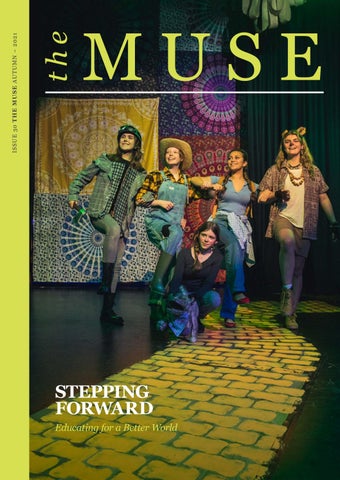
fter COVID stopped many of our co-curricular productions from running, the Drama Department were determined to create an experience for our students where fun and creativity were at the forefront of the production process, so that they could celebrate the courage and resilience it has taken for us all to get this far. Director of Drama and Dance at Bedford Girls’ School, Mrs Catherine Howe, reflected: “We began by making a show as inclusive as possible, opening the production up to anyone in Years 10 to Upper Sixth who wanted to take part. We were also keen to include as many of the students from our Theatre Crew Club as possible in the company. This then meant selecting a play that could provide a myriad of interesting roles as well as opportunities for Theatre Crew to get stuck into theatre design and stage management.” Mrs Howe continued: “Poet Caroline Bird’s adaptation of The Wonderful Wizard of Oz: Re-imagined. Re-Twisted seemed to fit the bill, filled as it was with great characters and an episodic structure that flitted between multiple fantastical locations. This play choice also felt timely, reflecting Bird’s attempt to re-work the original novel through the lens of diversity and inclusion as communicated through Lion and Nick Chopper’s love for a Squirrel and a Munchkin respectively. But it is perhaps Dorothy’s journey that felt most relevant to share during a pandemic; showing as it does the story of a young girl suffering immense loss and thrown into a grey, colourless world where she must confront her grief and find a way to accept the changes thrust upon her. As her anger manifests in the form of her puppet companion, Toto, Dorothy confronts her feelings of worthlessness and finds her way out of the darkness through the support of her loyal gang of friends and a courageous Mouse Army.” Working with the largest senior cast and crew to date did bring a number of new creative and logistical challenges for everyone. Not least how to stage the ever-changing locations within a traverse configuration; a staging choice meant not just to highlight Dorothy’s journey along the winding yellow brick road but also to emphasise and enhance the shared experience the theatre uniquely provides. Mrs Howe added: “This was from start to finish a highly collaborative production with the Theatre Crew taking on responsibility for designing the wacky puppets for the show and the cast offering many imaginative solutions on
how to stage a number of the magical moments required. From how to have Dorothy’s shoes instantly change to the red slippers, to Winkie Slave’s tongue being pulled out by Monkeys to how to show a witch had exploded on stage!” Throughout the many challenges COVID brought, the whole company remained positive and upbeat working with a joyful enthusiasm to be back in the rehearsal room as highlighted by Ava Oliver, Year 11 cast member said: “The Wonderful Wizard of Oz was a phenomenal experience. It was great to get back into doing productions after missing out on so much over the pandemic. The show brought me out of my comfort zone and introduced me to new people who I quickly became friends with. It was an exciting process and all the shows were spectacular, all our hard work paid off! I am going to thoroughly miss all the cast and crew and can’t wait to work on upcoming productions.” The whole company formed a strong bond throughout the production process, as Tireni Salako, a Year 10 member of the Theatre Crew reflected: “Being in the production was like being part of one big family because of how supportive and friendly everyone was towards each other. My favourite memory is the shared excitement and anticipation we all felt backstage before each show. Rehearsals taught me so much about teamwork and patience, especially in watching everyone work so well collaboratively to pull off the show. I had so much fun and I can’t wait to join in on future shows.”
From the start it has been “ the theatre’s business to
entertain people … it needs no other passport than fun.
”
BE RT OLT BR E CH T, GE R M A N T HE AT R E PR AC T I T ION E R , PL AY W R IGH T, A N D POET
The power of theatre within education has an ability to join its cast and crew together in a collective endeavour that crosses multiple year groups; where they learn so much about themselves and others. This was certainly the experience for Polly Taylor, Year 10, cast member and puppet designer: “I absolutely loved being part of The Wonderful Wizard of Oz. I’ve enjoyed being able to work with the older year groups and I have now made many new friends and memories. This production was a big opportunity and allowed me to show everyone what I can do. Making so many connections with people that I wouldn’t usually talk to was possibly one of my favourite things about it.” Mrs Howe concluded: “We are so incredibly proud of what our students achieved and the memory of this show will last a long time for us all.”
You can view all the stunning photos from the production on our Flickr gallery at: www.flickr.com/photos/bedfordgirlssch/albums Photography by: Andrew AB Photography
The Muse | 06
EDUCATING for a BETTER WORLD Last term, the Junior School celebrated gaining the prestigious accreditation to be an International Baccalaureate (IB) World School offering the IB Primary Years Programme (IB PYP); joining the Senior School, where we are an accredited IB Diploma Programme School. How does it connect? What is the impact? The IB PYP recognises that we live in a complex world and that every issue is interlinked. The learner develops the ability to see a 360 view of every situation, enhancing their cognitive development as they progress through school.
T
his award is the result of a rigorous two-year candidacy programme, during which the Junior School had to demonstrate that it was delivering a truly child centric education in line with the International Baccalaureate’s ambitious and innovative framework. The Muse chatted to the Head of the Junior School, Mrs Carolyn Howe, to understand more about the significance of this development. Why is becoming an IB PYP school such an important development for the Junior School? Becoming an accredited IB PYP school has been a long-term goal, as we seek to truly align approaches to learning across the whole School. Our students live in a highly challenging and complex world; in order to prepare them to navigate this volatile environment, they need a very different educational experience to that of their parents. We need to develop attributes and approaches to learning which will help them in 10, 20 and 30 years time. We are educating for tomorrow not for today; and the IB PYP is a very future skills driven curriculum. 07 | The Muse
Learning is centred around IB determined half-termly themes, which address real world problems and where learning is interlinked. We refer to this approach as transdisciplinary learning. The easiest way to describe it is like a cake: you start with a whole lot of individual ingredients, you can either use them by themselves or you mix them together. The individual elements are no longer distinguishable but the result is something completely different, and more speculator. Rather than studying subjects in silos, you look at how they join together to create a broader picture of the world. The IB PYP accreditation was a natural next step for us, we launched our own creative curriculum nearly seven years ago and we witnessed a transformation in learning, self-confidence and self-responsibility; the IB PYP builds upon this, offering a really exciting educational experience. Through the IB PYP, we develop the 10 core attributes and skills which are aligned across the whole School. This means that everything is helping build the foundations towards the end result - confident, resilient and empathic young women who demonstrate the intellect and motivation to be the change-makers of the future. How does the IB PYP differ from other styles of learning? The focus of the IB PYP looks at the whys, rather than giving students information, facts and figures. The approach is concept driven, inquiry led and transdisciplinary. It ensures students use critical and creative thinking to develop knowledge, understanding and skills across subject areas; creating a sense of selfbelief in every individual learner. Students are expected to use questions as central prompts - What does this tell me?
At the heart is a partnership between the teachers and the students; they are jointly invested in learning. It is this sense of active ownership, and agency, which really engages students in quite extraordinary ways. What do you feel are the key benefits of the IB PYP approach to learning? There are so many benefits we could be here all day! The stand out benefit is the level of selfdevelopment and independence which students develop. They take control of their own learning from a very young age building confidence, self-belief and intellect. The level of commitment is much greater when you can make choices, discover an answer, solve the problem or formulate the question all by yourself! Secondly, it nurtures global mindsets; we live in a global community and the IB PYP encourages learning which has a multifaceted approach to every situation; they consider an issue from many different perspectives. This creates a maturity of thinking which translates into every aspect of their lives.
Let me give you an example, the overarching theme in the Junior School last half term was Where we are in place and time. Under this umbrella, our Year 4 students considered the central statement: The way modern civilisation functions is influenced by past cultures. From this starting point they looked at what makes a civilisation? How do they develop? and Why do they change?
understanding of world politics and current affairs (sourcing unbiased information, research skills); study and interpret economic information (employing Maths skills); and use English skills to communicate their thinking; whilst importantly developing empathy for the plight of others by gaining a deeper level of understanding of a pressing global issue.
They had to employ research skills, use data analysis, understand historical information, and develop geographical knowledge to answer these questions. Their learning included a trip to the British Museum, where students were able to select an ancient culture to research (independence and choice); they spent the day recording information on their iPad (taking responsibility to inquire and using technology to self-record), and they then used their findings to investigate the significance of the culture on the world we live in today (looking at different perspectives and making connections). Every girl had the opportunity to take a different approach and draw her own conclusions, backing everything up with first hand evidence (understanding the sources of knowledge).
In Year 3, their central concept was to Understand how the past has an impact on the present. Within this they considered the role of influential people; they asked questions such as: Why should people from the past be remembered? Who do you think should be remembered and What contribution have they made? Each student chose someone they considered to be influential and had to research them. They held a showcase day when the girls came to school as a representation of their influential person and had to demonstrate their learning by presenting to classmates why they thought they were significant. However, another level of agency was added to the project, all the representations had to be made up of things from home, everything had to be upcycled; so within the project we were able to weave in a sustainability message. The girls had to think carefully about how they were able to make their characters come to life; students had to consider what made their character distinguishable. Everything works together to build depth and breadth to the experience.
Can you provide us with other examples of transdisciplinary learning in action? Yes, of course. Year 6 were looking at the central statement Human Migration is a response to challenges, risks and opportunities. In order to respond they had to draw upon a cross section of skills and subject areas. They needed to employ geographical skills (the study of push/pull factors, map reading, and physical geography); develop an
Can you track attainment and development in this approach to learning?
looking at individual depth and breadth of work. Teachers can identify areas of challenge with each individual and help them overcome it by suggesting different approaches and strategies. This is light years away from traditional models where the teacher would have provided all students with the same information delivered in specific subject silos with little or no opportunity for making connections. The classroom becomes a buzzing active environment, when everyone is engaged as they self-direct their study under the watchful experienced eye of a teacher who is guiding the arc of learning. We are looking at skills and the development of attributes as opposed to the percentage data in a quick test. We have a very rigorous framework of ongoing expectations for each student and we are always tracking, and reviewing progress. This provides us with a thorough and detailed view of each students’ progress at each stage. Any final thoughts? I think for me, the overwhelming advantage of being an IB World School is that we are now part of a global network of outstanding schools. We can connect with schools across the world, who are investigating the same themes and concepts but applying them to their local context. It offers amazing opportunities for collaboration and partnerships. When our students leave BGS, being able to say that they are IB Alumnae will automatically open them to a wider global community; this, I feel, is really exciting.
A teacher is able to see how far each individual girl has moved from one level of knowledge to a new understanding by
The Muse | 08
10 YEARS OF THE GIRLS LEADERSHIP GROUP The Muse catches up with the Head Girls who led BGS through it’s first decade. Lucy Charatan (2012-2013)
Ellen Lovell (2015-2016)
Lucy studied Philosophy & Ethics, French and History A Levels and was the inaugural Head Girl at BGS.
Ellen studied Economics, Spanish, English, French, Maths and Biology for her IB Diploma.
Lucy read Law at the University of Cambridge, achieving a First and went straight to work as a trainee for global law firm, CMS Cameron McKenna Nabarro. Alongside her work, Lucy has gone on to gain her LPC and MSc at the University of Law (achieving a distinction) and later went on to undertake a Postgraduate Diploma in EU Competition Law at King’s College London. Impressively Lucy was awarded the Dickson Poon School of Law Prize for best overall mark.
Harriet Clough (2013-2014) With a passion for the sciences at School, Harriet went on to read Veterinary Medicine at the University of Nottingham. She qualified as a Small Animal Veterinary Surgeon in Summer 2020 and works for a practice in Bristol.
Juliet Allen (2014-2015) Juliet studied the International Baccalaureate Diploma Programme and read BA French and Philosophy at the University of Oxford. After university she moved to Brussels to work for COWBOY, a tech start-up that designs electric bikes and publishes thought pieces on the ideal sustainable city. Specialising in Creative, she writes and works on film shoots, most recently in Lisbon and Kiev. Now based in London, in her spare time she enjoys painting and film making.
09 | The Muse
She read Business Administration at the University of Bath, which also included a semester at the Sydney Business School, achieving a First class degree. Since graduating Ellen worked for subscription-based workout app, FIIT, an app rivaling the traditional gym model. Most recently, she has just started a new role at McLaren Racing as a Customer Relationship Management Executive. A water sports enthusiast, Ellen has attained both her driving licences for RYA Powerboat Level 2 and the British Waterski Ski Boat Level 2.
Anna Hunt (2016-2017) In the Sixth Form Anna undertook the International Baccalaureate. Anna read BSc Biological Sciences at Durham University, which included a work experience placement at Waitrose’s Leckford Estate, as part of their Arable Team. She was President of the Durham University Netball Club as well as becoming the Sports Officer for her college, St. Mary’s. Since graduating Anna has secured a job as a Trainee Assistant Farm Manger, at Elveden Estates, combining her love of science and farming. She continues to play competitive netball and remains involved with the Young Farmers.
Devon Ward (2017-2018)
Leigh-Ann Cudjoe (2020-2021)
Devon is a Fourth Year Medical student intercalating in Psychology at Cardiff University. Devon has a keen interest in Psychiatry and this year she is also studying for a Psychology degree to improve her understanding of psychological medicine and mental health.
Leigh-Ann completed A Levels in Biology, English Language and Politics in the Summer of 2021. She has embarked upon a Law degree at the University of Leeds.
Around her studies Devon is a mentor for those wishing to study Medicine. She is a writer for Geeky Medics, writing 330 multiple-choice questions focusing on anatomy and histology. Her questions have been answered over 42,000 times by medical students and other healthcare professionals! Devon is also a university ambassador for the Unofficial Guide to Medicine (UGTM), a text book series working on a peer-led publishing model written by students and junior doctors. We are also grateful to the help Devon offer aspiring BGS medical students help with interviews and applications.
Lauren Lewis (2018-2019) Lauren joined BGS in Year 9 from Kingshott School and she studied Mathematics, Philosophy & Ethics and Physics at A Level. Lauren is currently reading Physics with Philosophy at the University of Sheffield. She reflected on her time at BGS. “I am a strong believer that you are the product of the role models that are in orbit around you, and in looking back at the teachers that I have had the pleasure of being taught by over the years, I truly can see so many of their values in myself. My history teacher and my maths teacher at primary school, my form tutor during my GCSEs, and my science teachers during my time at school, just to name a few, have all imparted their passion for the value of education onto me, and for that I am eternally grateful.”
Chloe Boul (2019-2020) Chloe and her twin sister joined BGS Sixth Form from North Carolina, USA. Chloe studied Chemistry, Maths, Further Maths and Physics.
Leigh-Ann Cudjoe reflected on the extraordinary year her GLG had: “When we were appointed as the GLG in 2020, I think it is fair to say we were not expecting the year to turn out how it did. However, despite the challenges we faced, I believe that as a team we overcame these challenges and were able to fulfil our roles with the help and support of our peers and staff. When deciding our campaign One Smile, I did not anticipate how impactful it would be. Throughout a year where so many faced their own personal challenges, it was lovely to see our school community come together to keep each other smiling throughout challenging times. “This year has been a whirlwind, but it has taught us all many lessons, it has shown us that in times where we face difficulties we can adapt. I also think this year has shown us just how much our school life means to each and every one of us and how important it is for our wellbeing. “I cannot thank our teachers enough for encouraging us and supporting us in all the ventures we have set out to complete. As bittersweet as it is to be leaving, I can say that I am leaving knowing that the tight knit community we have will always welcome us all back with open arms, and will be there to champion our success, just as they have done for the last 10 years.”
Masooma Sultana (2021-22) Masooma is our current Head Girl and she is studying Physics, Economics, Maths and Further Maths. Masooma has applied to read Philosophy, Politics and Economics at university. Masooma has been at BGS since Year 7 and has thoroughly enjoyed every moment of her time here. She tries to take part in as many clubs and experiences as possible, including being one of founders of the South Asian Society with fellow Sixth Form students. Masooma is a very proactive member of the wider community and is the Deputy Member of Youth Parliament. She is very passionate about giving every young person a voice and is leaning towards having a career in Politics.
Since leaving school Chloe has gone on to read BSc Natural Sciences at Durham University and has hopes of becoming a teacher one day. “Some of the teachers I had early on were really awesome and this made me think that I should be a teacher when I grow up. I started helping out the teachers in lessons by teaching younger kids when they were busy. This really made me realise that teaching is was what I want to do. I have yet to meet a teacher who hasn’t encouraged me and told me to go for it. I can honestly say that teachers have been a huge part of making me who I am today.” The Muse | 10
Digital Dynamics: Always Moving Forward The School’s strategic focus of investing in technology for education has paid dividends over the last 18 months as students and teachers have had to move seamlessly from in person to remote learning.
H
owever, to ensure our students are truly prepared for the 21st century workplace, we must constantly be investigating and evaluating new emerging digital tools which will enhance learning and knowledge. As part of this strategy, the School remains committed to working with Apple and were recently awarded our Apple Distinguished School status for the third time. The Muse sat down with the Digital Development team Mr James Potter, Director of Digital Learning and Ms Kit Davies, Digital Creator and Computer Science teacher to learn more. Ms Davies explained why retaining our Apple Distinguished School Status was important to BGS: “The use of technology at BGS is fully embedded, you could drop into any class at any point and see how technology is being utilised to transform a lesson. Teachers and students move between using difficult approaches and applications to maximise the learning. Our community is technologically fluent; many of our staff have achieved an Apple Teacher qualification, demonstrating
11 | The Muse
their commitment and expertise in the use of technology in teaching. Recent research by World Skills UK highlighted that the UK is “heading towards [a] digital skills shortage” with a shortage of schools investing in people with the right skills for the future jobs market; the demand for skills in AI, Robotics and Cloud are rapidly increasing but young people are not being equipped for these areas as part of their education. We recognise the role education plays, we want to ensure that we are inspiring more women to enter the tech sector and help redress the current tech imbalance. Ms Davies continued: “Being a member of the Apple’s Distinguished Schools programme, helps us to remain at the forefront of technological innovation through access to Apple’s suite of products but it also provides access to their knowledge and network. We are at the frontier of new developments and can then assess what can add value within our context. The Apple Distinguished School Award is given for a three-year period. BGS was one
of the first schools in the UK to achieve this prestigious mark and has recently renewed its status for a further three years. As part of the rigorous re-accreditation process, we had to submit an application that shows how it has progressed with its technological integration and how it is adopting new technologies to further build our students’ skills. Mr Potter, Director of Digital Strategy, went on to talk through the new technologies which were being tried and tested: “It is always important that we are not just jumping on a bandwagon. We need to make sure that anything we adopt has real benefits to teaching and learning; there is always a lot of new ideas and hype around tech development but if it doesn’t help build future-proof skills we need to question if it is a priority.” The School currently has identified three key priority areas that it is looking to further embed into the digital tool kit: Augmented Reality (AR); Robotics and Adaptive Learning (AL). Mr Potter explained: “We have already moved forward with our vision of being able to host
and create bespoke AR experiences and have purchased an iPad Pro which is equipped with a LiDAR scanner. This can scan objects large and small and turn them into 3D elements which can be put into AR to give the students a virtual representation of a physical object. Examples have included looking at Roman scutums in Classics, computer hardware in Computer Science and medical objects to allow Year 6 students to visualise and experience the medical developments through time. AR is a powerful tool to allow our students to visualise objects and therefore concepts in their own physical space. This creates a more memorable experience than if they were looking at a picture in a book or a video. It also allows us to bring objects into the classroom that are impossible to normally show, for example, Year 6 can view a CT scanner in the classroom in full 3D. This would not be possible without a trip to a hospital. These are really exciting developments which will transform learning and personalised experiences for the students.”
chariot to a spherical robot without the chariot falling off? They have also been programming the device to play golf by setting up a few holes and plotting the best route through the course to get in the hole.
only is it useful for students with their current learning but they will no doubt be using AL elements to augment their jobs later in life, so to get an understanding of this technology now is beneficial.” added Mr Potter.
“Meanwhile our older students have been experimenting with our humanoid robot which has the capability to link into the Microsoft AI platform. They have created programs which will recognise objects by programming the robot to watch an object, compare the object to the online database, and then use AI to get the robot to say what it thinks the object is. They have also programmed the robot to recognise emotion on people’s faces and then perform an action. For example, if the robot camera detects a sad face, the robot will play some music and dance to cheer them up. This can be developed further into social robotics and potentially investigating how robots and humans can live side by side. It is really exciting for the students to get to experience programming and see the results”
Both Mr Potter and Ms Davies were keen to stress that developing the skills is only one piece of the story; in order to really prepare our students to be the tech champions of the future we need to work with universities and industry to expose the students to the endless possibilities, through visits, work experience and careers talks.
The School’s investment in Robotics is driven by the aspiration for our students to be workplace ready and to enter any sector with agile skills and confidence. Robotics is already a big feature of the working world and ensuring that our students have mastered these skills is vital.
The third priority is the use of Adaptive Learning platforms to personalise learning and individual the experience for each student.
Ms Davies demonstrated how Robotics is used in the classroom: “We have two types of robots at BGS, The Sphero, which is a programmable ball with an LED screen on it and our Revolution JD humanoid robot. In their younger years, our students experiment with the Sphero balls and may be tasked with solving problems such as, how do we attach a
“We have continued with the use of Seneca, which is an Adaptive Learning (AL) platform. This uses algorithms to analyse performance over a series of small quizzes and tests and will start to suggest to students what it thinks may be students’ weaker areas in order for them to practise on them. Seneca is used across different departments in school and also individually by students and allows them to have greater control over the trajectory of their learning. We are averaging around 6500 adaptive learning sessions per month and not
Mr Potter added: “We actively encourage our students to take part in competitions; gain additional qualifications, run their own research and inquiry projects. As a snapshot within the last term: we have taken students to the University of Buckingham to visit their new AI and Innovation Hub; Sixth Form students have established the Lovelace Society and are running a series of tech talks; and we have welcomed alumnae into school to inspire current students including Charlie Anderson (BGS 2018) who talked to a group of students about studying Computer Science. Current students are encouraged to gain additional qualifications, such has Alex Gentry in Year 11 who recently achieved a Silver Industrial Cadet Certificate after completing the BAE Systems Virtual Work Experience course. Technology at BGS is never an afterthought, or an add-on; it sits at the centre of our model of education and looking at the success of our recent alumnae, we can see that our students are already making their mark in the technology space.”
The Muse | 12
Returning to the Water Bedford Girls’ School Head Rowing Coach, Miss Victoria Huckle, reflects on our strong community spirit and returning to competition.
W
ith 100 students currently rowing, the Boat Club at BGS is full of enthusiasm as we begin a new season filled with the opportunity to compete, something that has been missed by the whole BGS rowing community over the last 18 months. Our committed and passionate rowers have shown incredible resilience and determination over the past two years, continuing their training in a wide variety of ways throughout the pandemic, and we now hope they will be rewarded for their efforts with the opportunity to compete in a wide range of fantastic locations across the country. After two ‘virtual’ seasons of yoga, HIIT and running from home, with hundreds of kilometres completed on the rowing machine – there is no ‘home training’ location that has not been explored – from kitchens to gardens,
13 | The Muse
our rowers have remained committed to their training and united as a community. Lower Sixth student, Chloe Howe, said: “Throughout the first few months of the pandemic, we had very little in person training, but this was made up for with virtual workouts where the whole boathouse would get together to exercise and stay fit, it was motivating to keep working hard in such an uncertain time. Getting back to rowing at School demonstrated just how strong our team was and we’ve stepped up the training to hopefully progress in competitions. Recently we’ve had a lot of opportunities to compete which has been great fun and has given us a fantastic starting point to build on. I look forward to see what we can do in the future! Year 11 student, Emily Pinkney, added: “During lockdown, the enthusiastic rowing
coaches kept us engaged through fun virtual workout sessions. As we have now returned to racing, the fitness we had gained in lockdown has definitely paid off in the boat. It’s been amazing being able to race again after such a long period of not being able to row, and fingers crossed there will be many more races to come!” After months of virtual sessions, the Boat Club at BGS were thrilled to have been able to reunite and return to the water. In March 2021, we took to the water for the first time with a race in sight. Rowing in year group bubbles, all the students enjoyed being back out and training together again. In the Summer Term, although behind closed doors, we were delighted to be able to attend Peterborough Junior Regatta, National Schools Regatta and Henley Women’s Regatta. With the whole of our Junior Club,
Years 9 and 10, competing on the multi-lane course at Peterborough in their first ever regatta. At the National Schools Regatta, over 30 students competed on the National stage at the London 2012 rowing venue, Dorney Lake. Although without spectators, it was fantastic to have the rowing community back competing against crews from across the country. To conclude a short, but very exciting regatta season, four Year 11 rowers competed at Henley Women’s Regatta, racing on the prestigious Henley course Chloe Howe, Anna Beckmann, Tess Garratt and Emily Coughlin put in a fantastic performance to finish 13th in a field of 30 crews. A brilliant performance after a difficult period of training and racing. Having missed lots of water time throughout the pandemic, we took the decision to continue rowing throughout the summer holidays. This provided lots of water time on beautiful, flat and quiet water for all students in the Boat Club from Years 9 to Upper Sixth to practise their small boat skills. This was a brilliant opportunity to fast track our Years 8 and 9 small boat skills, alongside giving our more senior rowers the chance to increase their water time and mileage in sessions ahead of the start of a new season. Our summer rowing programme also gave our leavers some extra water time to prepare to join their respective university rowing programmes. Following a summer filled with skills, drills, smiles, sunshine and some swimmers too, we returned to School in September and were able to run a full rowing training programme for the first time since March 2020.
The return of our enthusiastic rowers to the river and gym has been fantastic to see, and each and every one of our rowers continue to train hard through the winter months in anticipation of a full racing season over the coming academic year. It has been brilliant to have the whole of the BGS rowing community able to reunite in their training with the return of our whole Boat Club before school training sessions where we see all 100 rowers together in training.
Although things are “ unsettled now, this storm will pass, the shutters of our boathouses will unroll, and we will take the first few strokes of a new season, together. BRITISH ROWING
”
Upper Sixth student, Lydia Franklin, reflected on returning to the water: “The team has been so enthusiastic coming back into rowing this term, after weeks of home training and online sessions, we’ve been so excited to get out and show off all our hard work. We had a great day in the sun on our home river for Star Head, where all of Years 9 to Upper Sixth were racing. The Seniors had loads of fun helping out the younger year groups and cheering the
crews on coming under the suspension bridge. It’s been great to have our cross-year group circuit training in the early morning, the whole club gets to come together and workout once a week, and it has been lovely getting to know the future BGS squad that will be taking over when we leave. I’m looking forward to some intensive training and fun this winter in preparation for regatta season. Returning to a full racing programme this term, we kicked off the 2021/22 season with a trip to the infamous Henley stretch competing at Henley Sculls. This was a fantastic opportunity for our rowers to begin to see the benefits of their hard work and commitment to the Boat Club throughout the pandemic. On Sunday 21st November 2021, the BGS Boat Club competed on home water for the first time in two years at Star Head, with a very first race for many, and our Senior Squad boating in eights for the first time in over three years. It was an exciting day for the BGS Boat Club. All crews competed well, showing all of the hard work that they have put in over the past few months is paying off. Our overall results saw BGS finish second or third in all categories entered, a step on from our Summer Term racing and a great springboard into the 2022 racing calendar. For the first time since the pandemic, the whole BGS rowing community were also able to come together with the Friends of Bedford Girls’ School Rowing Club enjoying the racing, and lining the banks to support our rowers. It was fantastic to return from behind closed doors to hear so much BGS support! The Muse | 14
Legend in their Lifetime
Heather Dawson Biology Teacher
Zakia Moulaoui Guery
Founder and CEO at Invisible Cities their own campaign to raise awareness of a social issue, and the Years 7 and 8 Christmas charity afternoons where hampers of donated gifts and festive food are made to give to charities supporting local families. Our partnership with United World Schools (UWS) has added an international perspective, encouraging our students to research and raise awareness of the importance of female education in improving the life prospects of young women in Cambodia, Myanmar, Nepal and Madagascar.
I
have always been encouraged to be community focused. As a child, I remember my mum being absent on Christmas Day as she volunteered at a homeless shelter. She also worked with a charity supporting illiterate family members write letters to their loved ones in prison. Now, in retirement, she is a founding member of a community interest company, Saturday Outreach Society (SOS), which works with the homeless in Bedford, particularly those who do not traditionally access existing homeless services. Growing up in a single parent home where we were not well off, I learnt that giving to charity did not just mean giving money and that charity is not something that is done to people, but with people. When I took over as Charities Coordinator at Bedford Girls’ School, I wanted to adopt this ethos in the School: our focus should not just be on fundraising, but on understanding what a charity does; how money and donated items can support their service users; and how giving our time, energy and enthusiasm, as well as physical resources, can support their work. We are making good progress, with the introduction of the Giving Forward advocacy project in Year 10, where groups work in partnership with a local charity of their choice to compete for £1500 grant money; the Campaign Challenge in the Lower Sixth, where groups design
“ Ultimately, I think
community is about finding a sense of belonging, a place of acceptance and a place where you can be empowered and empower others, whether it’s about a place or a group of people.
”
ZAKIA MOULAOUI GUERY
I recently heard Zakia Moulaoui Guery speak. Zakia grew up in the South of France, where she was also raised by a single mum, who provided her with as many opportunities as possible despite limited excess money, and was her biggest champion, much like my own mum. She earned a scholarship to study at The Lycée Français Charles de Gaulle, and then studied English Language and Literature at the Université Jean Monnet de Saint-Etienne, before working as a language assistant at George Heriot’s School in Edinburgh. From here, she joined a non-profit organisation, the Homeless World Cup Foundation, where she worked her way up to become Director of International Partner Development, supporting footballbased programmes and social enterprise development around the world. These street football organisations run projects in 420 cities, reaching 100,000 homeless
people every year. Zakia then went to work with Social Bite leading their efforts in providing training, employment and volunteering opportunities to homeless people, to help them to transform their own lives. In 2016, Zakia launched her own social enterprise, Invisible Cities, which trains people who have experienced homelessness to become walking tour guides in their city. Invisible Cities work to raise awareness of homelessness and to break down the stigma surrounding it. They provide training to their guides, developing transferable skills such as public speaking and self-confidence, and give support through access to housing, food, further education and counselling. A sense of community requires four things – membership, influence, fulfilment of needs and integration - and Invisible Cities embodies these perfectly; enabling residents of these cities, who may previously have felt like outsiders, the opportunity to become a valued and empowered member of their community. They now operate across six cities in the UK and won the Lonely Planet’s Best Community Tour in the World Award in 2021. Zakia states that she has never sat down and planned her career, instead choosing to study what she enjoyed. As a student, Zakia said that she ‘always lived with a sense of urgency. [She] felt that if something was not happening now, it would never happen and that [she] needed to do/feel everything right now’. She believes that ‘what is for you won’t go by you’ and many times encounters or events have led to life or career moves, rather than by choice or conscious decision. For our students, many of whom believe that their career pathway should be defined before leaving school, this is a refreshing outlook, and alongside her inspirational career, she is a role model for any young person wanting to support and empower their local community. She embodies the values that I was brought up to believe in, and hope that I am inspiring in the students at BGS.