the
SUMMER ~ 2012 THE MUSE ISSUE 3
MUSE
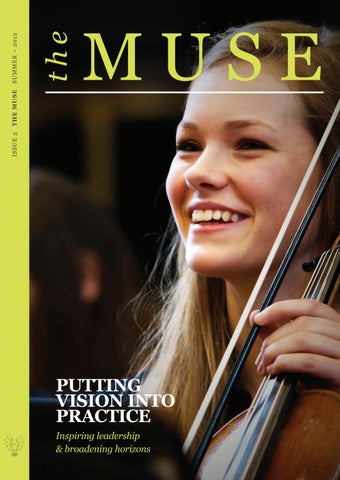
PUTTING VISION INTO PRACTICE Inspiring leadership & broadening horizons
Visits & Voyages Visitors In
Voyages Out
flavour of guests in and
Alison Balsom, Internationally Acclaimed Trumpet Player, Official Opening
Alton Towers, IB Group 4 Science Project
visits out during the
Alzheimers Society, Collaborative Concert
Summer Term.
Bedford School & Mr Speed, Year 3 Lego Olympic Village
BBC Three Counties Radio, Year 10 Radio Station Team Visit
This list is by no means exhaustive, but offers a
Gail Emms OBE, Olympian, Sport Relief
Barton Le Clay, Geography Year 7 Field Trip
Bedford Autodrome, Bedford Schools Grand Prix
Good Schools Guide assessor
Bedford International Athletic Stadium, Junior & Senior School Sports Days
Harpur Trust Almhouse Party
Bedford Park, Golden Mile Run, Marathon Club
IBSCA, IB Network Meeting
British Schools Museum, Year 4 Trip
ICT Mark assessors
Burwell House, Cambridgeshire Year 3 Residential Trip
Julia Jarman, Author, World Book Night Mike Sewell, Admissions Tutor Selwyn College Cambridge, Higher Education Evening workshop
Derren Brown, Aylesbury Waterside Theatre, Year 12 & 13 Psychology Trip DofE Bronze training expedition, Sandy
Off the Page, Specialist Historical Educators, Greek Day Year 5
DofE Bronze assessed expedition, Sandy and Wimpole Hall
Philippa Gregory, Author, Live Web Chat
Drayton Manor Park, Year 11 Trip
Putnoe Primary School, Junior School Community Dance Workshop
Frankenstein production with and at Bedford Prep School
Scene Productions, Perfoming Kafka’s Metamorphosis for Drama Examination Students
Grafham Water, Year 4 Residential Trip
Summer Exhibition
Ickwell Bury, DofE training expedition
Red Cross, Expert First Aid Training, Year 10
Ickwell Bury, Year 9 Team Building
Year 7 Charity Event for Ally Satchwill
Kingswood, Cromer, Year 6 Residential Trip
UCAS Talk on Personal Statements by Admissions Officer from Birmingham University
Krakow, Cultural Residential Trip, Years 10 -13
Heart Radio Milton Keynes, Year 10 Radio Station Team Visit
La Rive, France, Multi Activity Trip Les Misérables workshop and performance in West End, London London, Year 5 Residential Trip Randalls Farm Environmental Education Centre, Bedfordshire, Year 4 Trip Sheringham, Year 10 Geography Field Trip STANTA, CCF Annual Camp STANTA, CCF Combat Cadet Competition University of Bedfordshire, ‘Scientists in Sport’, Year 8 Trip University of Bedfordshire, UCAS Regional Fair Welbeck College, CCF Military Competition Year 12 Biology Field Trip, Cambridgeshire Yorkshire Dales, DoE Silver Practice Expedition
Bedford Girls’ School | www.bedfordgirlsschool.co.uk Bedford Girls’ School is part of The Harpur Trust. Company no. 3475202/Charity no. 1066861
Editor’s Insight
I
n a year full of important landmarks
a leader capable of steering others towards
in the life of our school, the Summer
new possibilities and exciting opportunities.
Term offered the perfect opportunity to look back with pride, upon the
successes we’ve achieved throughout the merger and to look forward to our continued momentum as Bedford Girls’ School.
When we selected our Girls’ Leadership Group this term, we wanted each girl to be confident of her vision for the role and to have the courage to share her dreams and hopes as part of a team with a common
Vision lies at the very heart of our school
goal. This was a demanding process for all
community and it forms the core of our
the girls but their sensitivity, bravery, maturity
philosophy and purpose. Individually and collectively, we are driven by our commitment to equipping girls with the tools they need to build a vital and rewarding place for themselves within society. To do this, we recognise that they cannot work in isolation but, instead, must work collaboratively with others in pursuit of a common goal. In acting together, we know our girls can achieve great things. We recognise that, by understanding their value to the wider world and through helping others to find the confidence to follow their dreams, they can become pioneers who open doors for subsequent generations and improve the lives of those around them.
and capability shone through. I am extremely proud of the group and also the environment which saw them appointed in such a caring, considered and forward-thinking manner. Over the coming year, the GLG will play a vital role in developing the Student Council so every girl feels she has an important voice within the school. They will act as ambassadors for their peers in the wider community and will demonstrate to girls in lower years how positive change can be affected both in school and the
“ With our Official
Opening a bright and inspiring way-marker behind us, I look
world at large.
forward to a year of
Such leadership is integral to our belief
further successes and
that there are no barriers to aspiration and
achievements and look
achievement save those inflicted by self-
forward to sharing
imposed restraint. It is why, in a year where
Putting vision into practice requires courage
we have achieved excellent results in GCSE,
those with you as the
and confidence. It also needs planning,
IB and A level, we have also seen our girls
terms unfold.
preparation and often patience. However,
flourish as young engineers, broaden their
with determination it is possible to
horizons through school trips and excel
achieve great things and to become
as sports women.
”
Jo MacKenzie Head
The Muse | 02
Inspired by
Krakow enduring city of culture
T
ravel is about much more than places and a country is as defined by the people who live there as it is by landscape, architecture and climate. A journey overseas doesn’t just offer a fantastic opportunity to see new sights as it allows us also to immerse ourselves in a new culture. In using all of our senses in an environment where a sense of place is tangible, we are able to re-evaluate our preconceptions and to consider our pre-existing knowledge in a vibrant real-life context. During the Easter Holidays, a group of girls from Years 10 to 13 visited the Polish City of Krakow. During the tour, they paid an emotional and enlightening visit to Auschwitz Birkenau where stories from a concentration camp survivor brought the harrowing reality of Nazi tyranny to life. In the Jewish Museum, family artefacts and personal belongings evoked a spine-chilling realisation of the sheer scale of man’s inhumanity to man. However, in the midst of such solemnity, the girls also saw hope and optimism. The bravery of the Polish people, their pragmatism and determination to triumph over disaster shone a light on both the city and the girls. Anna Irwin, Year 10, explains: “When I first heard about the trip I was really keen to seize the opportunity to learn more about the war 03 | The Muse
and how it affected ordinary Jewish people. Our visit to Auschwitz was extremely moving and even more haunting than I’d imagined. It will stay with me forever.
What will also live long in “ my memory and my heart is my first-hand experiences of Krakow as a city whose people have worked tirelessly to make it a colourful, fascinating and uplifting place despite the tragedies it has witnessed in its
”
past. It is incredibly uplifting.
Louise Gardner, also Year 10, said: “I didn’t know what to expect from Krakow. I had imagined it might be a bleak, sad place where people remained thwarted by the appalling treatment Ghetto Jews received in World War II. “Instead, we discovered a beautiful city where everyone is enthusiastic, determined and excited to share their rich heritage and bright future. Krakow seems to be thriving.”
With an array of galleries, 11 theatres and 40 museums, Krakow has long been heralded as Poland’s cultural capital. A wealth of bustling cafes, restaurants and shops demonstrate the steep progress that Poland has made since slipping the leash of communism a mere 30 years ago. Home to some of the world’s most stunning and ambitious architecture, Poland’s second biggest city provides an endlessly fascinating vista and an excursion to the Wieliczka salt mine left the group in awe at its vastness. From exploring the narrow streets of the Old Town to shopping at the Easter Market, the girls were constantly struck by the inspirational people who breath vibrancy into Krakow’s spirit and economy. Anna said: “People’s enthusiasm is infectious in Krakow. They are extremely proud of their heritage and see their city as a constantly evolving place. Rich in culture and extremely friendly, this is the perfect place to visit to put your own feelings and thoughts into perspective. “That the people of Krakow can adjust, grow and move forward when there is such cruelty in its history is truly inspiring. It is a city of the present and future, a place that has learnt from its past and moved on with dignity, enthusiasm and a sense of certainty of its own importance to the world.”
LEADERSHIP LIGHTS THE WAY
A
brand new school requires a dynamic new approach to leadership. Underpinned by vision, creativity, respect and teamwork, the recently appointed Girls’ Leadership Group was carefully selected to ensure every girl in the school feels confident her voice can both be heard and an instrument for positive change. Head Girl, Lucy Charatan, explains. Congratulations on your appointment as the first Head Girl of Bedford Girls’ School. What did the selection process involve?
The selection day was very rigorous. Was it what you were expecting? It was certainly intensive, more so than I’d anticipated but it made everyone aware of what the roles actually entailed. All of the aspects were things that I’ve then gone on to do as Head Girl and I came out of selection knowing exactly what I’d signed up for. If I had struggled or hadn’t enjoyed the process, I would have known it wasn’t the right position for me in the first place. What was the most challenging part of the day?
“ From the outset,
I knew I wanted to be part of the GLG and to play a part in building a team that would have an important role for today’s pupils as well
Unlike many traditional selection systems, we were required to do much more than make a campaign speech before putting ourselves forward for election by our peers.
There were many aspects of the day, and all
preparation for the roles themselves.
girls who will enter the
Each post within the Girls’ Leadership Group was advertised with a full job description and we all had to submit a letter of application to be considered for the roles we felt suited us. After this, there was a vote to determine who would be shortlisted but the vote was based on the strengths each individual could bring to each post as part of the whole team rather than a process where someone’s aptitude for a particular position was considered in
For example, the Head Girl applicants had
school in the future
isolation. We were all encouraged to consider the bigger picture before voting and to think about how a successful team needs different strengths and diverse personalities.
based on real situations other Leadership
After this, shortlisted applicants were put forward for selection day where all of our skills were put to the test through a series of challenges, including making speeches and acting out scenarios, before being interviewed.
own approach to matters; dealing with what
were challenging. However, each of them was also extremely rewarding and excellent
lunch with the Governors and then each of us
as forging a path for
”
gave a speech to an audience of teachers and governors as if it were an Open Day. While this did need a great deal of thought and confidence at the time, it proved an invaluable experience when I was preparing for the Official Opening of the school in May. There was also an in-tray exercise which was Groups have been faced with. We were given a full inbox of emails and various descriptions of scenarios and we than had to take our we thought was important and working out what order to tackle the tasks in. In the last term I’ve had to deal with similar situations, although luckily not all at the same time!
The Muse | 04
Leadership Lights the Way Continued
first session focused on improving our public speaking, confidence and assertiveness and a discussion of the structure of our team. The Women’s Officer, Ruth Graham inspired us with what she has achieved for the students of Cambridge, including the Zero Tolerance to Sexual Harassment campaign and the Right to Light campaign which successfully improved street lighting in poorly lit areas around Cambridge. We started to discuss the role of the GLG and the kinds of areas we want to focus on to make a significant change. We had a lot of discussion on potential campaigns and are particularly keen to be able to pass on our experience to the younger years so we focused on three areas in particular: social pressure, health and well being, and giving back to the community. Ruth gave us some excellent advice on campaigning and ways to make effective change.
How did you prepare for the interview and
We don’t have to fill anyone’s boots. As a new
what was it like?
and different team, we create our own boots!
The session gave us a focus and made us realise
We’re already very proud of everything we have
our potential. It helped us think strategically
done in the Summer Term and are most proud
about what we are going to do and the interim
of some of the differences we’ve already made.
steps that we will take in order to do it. Over
The interview was formal but not too pressurised. I felt mentally prepared because the whole process had made me ask myself
the summer we are all meeting up for a day to
repeatedly whether or not I was truly ready
We’ve been focused on building up the House
for the responsibility and challenge of the role.
communities and the BGS sports day was
Each time I asked myself those questions, I
certainly one of the highlights of the term. The
For us we want to be able to shape the very
felt more confident. I also felt increasingly
House Captains in particular felt the reward
school we are in. But we do not want to
enthusiastic about the possibility of becoming
of their efforts, not just in the final results but
make our decisions as 12 individuals. Our
Head Girl and I was inspired and full of ideas
in the cheering and sheer enthusiasm from
first assembly was on the Student Voice and
when I went into the interview.
across the Houses. We’ve already started to put
I believe that is what defines our team. We
in place schemes for the year ahead and have
want people to engage with us so that we can
How did it feel to hear you’d been appointed?
reformulated the system for School Council,
represent them and so create change that they
From the outset, I knew I wanted to be part of
written a letter to the new Year 12s introducing
want, change that they will recognise
the GLG and to play a part in building a team
them to Sixth Form, collected the views of
and appreciate.
that would play an important role for today’s pupils as well as forging a path for girls who will enter the school in the future.While I felt immensely proud to be appointed, I also felt proud of everyone else who’d been involved in
students across the years for Prize Giving, made plans for introducing inter House sport and played an important role in the Official blog so you can follow our progress.
will not be empty ones. We’ve felt unrestrained
that underpinned the whole selection process.
your views on the role of Leadership and the
There have already been so many rewards associated with being part of the GLG, it would be impossible to pick one thing.
GLG for the school year ahead? I am determined that our visions for the GLG
How has being part of the GLG affected
for the GLG so far?
As Head Girl, what are your visions for the
Opening. Next term, we plan to launch a GLG
the process and the care, respect and support
What has been the most rewarding experience
work on our action plan for next term.
important role of women leaders in society?
in the sense that there are no limits to what we can achieve other than the number of hours in a day! The year ahead will be challenging, but I have been reassured by a recent news story:
The whole of the GLG has already gained
through blogging daily photos of her school
so much from the experience and we’ve all
lunches, nine year old Martha Payne helped
re-evaluated our definition of leadership. We
raise nearly £100,000 for Mary’s Meals, a
don’t take our responsibilities lightly and we
charity which helps feed children in the third
are acutely aware that what we do today can
world. If a much younger girl can use creativity,
In broad terms, perhaps the most exhilarating
open doors for women throughout society. In
determination and bravery to have such a great
thing is that, as the first Leadership Group, we
late June, we went to Cambridge Students’
impact internationally, our own ambitions are
have felt able to define our roles for ourselves.
Union for a workshop on Leadership. The
definitely achievable.
05 | The Muse
Connected Community
Learning through giving Over the last academic year, the House System has played a pivotal role in bringing everyone together with a common purpose and inspiring deep-seated passion and pride in Bedford Girls’ School. The unity it helps create has proved a great source of strength to the girls and their enjoyment of House activities and support of their House charities give evidence of this perfectly. When, in 1998, the trustees of three separate local charities sat down to discuss merging into one large organisation for the blind and partially sighted, they too were certain that together they could achieve great things. Since the charities amalgamated to form Hepburn’s House Charity, Sight Concern Bedfordshire, this is just what has happened. Working together, the three pre-existing organisations found that services for blind and partially sighted people in Luton and Bedfordshire have been dramatically improved. With the goal of finding thousands of people across the county who are considered blind or partially sighted but are not registered as such and do not access any specialist services, the organisation added hundreds of new people to its database in its first month. Year on year, numbers have continued to grow and more blind and partially sighted people than ever are benefitting from specialist help, advice and guidance. Operating from offices in Bedford and Luton, Sight Concern Bedfordshire provides a comprehensive range of services including advice and information, home visits, a befriending service, an accessible library of information, help with completing forms, carers courses and a regular news service. It also offers telephone assistance on weekdays
and campaigns for the rights and interests of blind and partially sighted people on a local and national level. Hepburn supports Sight Concern through its fundraising activities but the girls also benefit from learning about the experiences of blind and partially sighted people and the challenges they face. The charity also regards its relationship with the girls as mutually beneficial. Nick Gibson, Chief Executive Officer of Sight Concern Bedfordshire said: “Through our work, we want blind people and partially sighted people to be inspired by our services and our work with local communities. We want to develop their understanding of their own world and to make sense of their place in it. We strive to help them set new horizons, to help regain or reach their potential and to have confidence in their experience, skills and abilities and the contribution they can make to society. We want to help them rediscover creativity and abilities, to challenge them to consider new ways of doing things, and stretch themselves to achieve new goals. We want blind and partially sighted people to be surprised by what they experience and can be involved in and to have fun with new people, with friends and with family. “In our aims, we share much with Bedford Girls’ School and its aspiration for the pupils. We are very grateful for the fundraising the girls do on our behalf but we are equally appreciative of the opportunity to forge a relationship with a forward-thinking school which, like us, does not set parameters on expectation.”
At the heart of Bedford Girls’ School’s Connected Community lies care. We ask our girls to think about the world outside school with the same consideration, concern and care they show to each other throughout the day. In doing so, the girls learn about their responsibilities, as people, to the wider community and are able to develop their role in helping to sculpt a compassionate, considered society where everyone is valued and support and encouragement are freely given.
groups which meet regularly in Bedford,
Nightingale’s House Charity, Carers in Bedfordshire, is an organisation which supports unpaid carers as they take on the responsibility of looking after a less able family member. Carers can be any age and the people they care for have a diverse array of needs and requirements.
Bedfordshire and learn about the challenges carers, many of them
Through its two centres in Bedford and Biggleswade, Carers in Bedfordshire provides emotional and practical support, advocacy, signposting, training and opportunities to socialise with other carers and cared for people. It also operates a number of carers’ support
including school, around caring for a family member. The empathy this
Biggleswade, Ampthill, Shefford, Houghton Regis and Leighton Buzzard. Being a carer is extremely demanding and the charity runs a free training programme for carers and former carers which has been specially developed to ease the daily stresses and frustrations carers face. This training includes computer tuition, relaxation pampering sessions, armchair exercising, emergency first aid, understanding difficult behaviour and other important issues affecting carers. Through the many fundraising activities organised by the House system, girls in Nightingale are able to support the work of Carers in children themselves, face. Not only does this enable them to see the immediate benefit of their hard work as fundraisers, it also helps them to learn how some of their contemporaries must fit their daily life, has afforded the girls over the year has transferred to their appreciation of the lives they enjoy and of the love and care they feel and are shown by their own families. The Muse | 06
ENGINEERING IN POLE POSITION Just as the sun breaks through the clouds on a windy afternoon at Bedford Autodrome, a helicopter makes its descent into a nearby field. Alerted by the noise, 500 people look on as the craft comes into land and entrepreneur and former racing driver, Jonathon Palmer, steps out and is escorted to trackside.
07 | The Muse
A
mong those watching are 12 pupils from Bedford Girls’ School, there to take part in the town’s annual Schools’ Grand Prix. Working as either drivers or pit crew, the team is competing against 11 other cars in a two hour, 40 minute endurance race over five miles of track laid out over the 384 acre site. To extend the challenge, the rules stipulate that all cars must be built from scratch, entirely by the pupils themselves. For the young drivers, each 25 minute stint behind the wheel is a nerve-wracking but exhilarating experience. For crew, ensuring the smooth running of the car and executing swift yet accurate pit stops, is tense and demanding. With one of the youngest and smallest teams on the grid, Bedford Girls’ School applied itself bravely to the task and excellent driving and quick-thinking mechanics in the pit lane saw its car pass the chequered flag in sixth position. In a contest largely comprised of older all-boy teams, the girls’ performance, and a first place for Bedford High School for Girls, also afforded a podium position to young female engineers, and the teaching excellence behind them. Alarmingly, the UK has the lowest proportion of female engineers in the EU and research has shown that many girls still regard the subjects underpinning engineering as predominantly masculine preserves, either too complex or boring to enjoy. At Bedford Girls’ School, however, the uptake of Science, Technology and Mathematics at GCSE and A Level is sizeable and the number of girls who go on to study them at degree level eclipses the national average. In an all-girl environment, pupils are able to feel confident in their enjoyment of these subjects and are empowered to ask questions without fear of disapproval. They are not exposed to gender stereotyping and are actively encouraged to undertake practical tasks and to bring their theories and ideas to life. As with the Schools’ Grand Prix, they are able to manage hands-on projects and to see possibilities rather than boundaries. Above all, they are taught that Engineering is exciting, globally important and highly relevant to their own lives as well as being
an interesting and rewarding career choice. Work on the electric car began back in October 2011 when a group of girls in Years 7 to 9 came together to plan their route to the finish line. Under the guidance of Head of Design Technology, David Jackson, and Head of Physics, Oliver Bowden, they started examining the best way to build a car reliable enough to see them through the race yet lightweight enough for optimum speed. Constructing the aluminum vehicle called on them to utilise their existing knowledge in a variety of academic areas and provided a valuable opportunity to work together as a team. Laura Goodship, Year 9, explained: “It was really good to work with a group of people who I don’t usually share lessons with. It was really helpful to come together as a team and share skills and ideas because we each had strong but distinct thoughts about the best way to proceed and, in discussing those, felt we were able to pick the very best design from a large pool of concepts, plans and perspectives.
“ We also employed
hands-on skills we’ve learnt in Design Technology and Art as well as being able to see theories we’ve learnt in Science applied, and working,
”
in a practical way.
“The race itself was great. We were all really nervous about the car and whether it would last the distance. Several other cars dropped out but we were able to keep ours going right to the end. One of the most challenging elements is ensuring there’s enough power supplied to the 240 watt electric motor. Each team is allowed two 12 volt car batteries and you have to fit changing one of them around pit stops. As soon as we took one battery out, we had to be ready to fix up the new one really quickly before hastily putting the other on charge for the next time.
“A mistake in timing can cost the race but, because we are such a strong team, we worked together really well. The pit crew knew what to do to support the drivers and the girls who were driving stuck to the plan we’d made before the start. We were well-prepared and able to think on our feet when we had to. Sixth place is a real achievement. I’d urge other people to get involved. “This really opened my eyes to how exciting engineering is and to how girls can work just as well, if not better than, boys when it comes to hands-on practical tasks.” Research conducted in 20011 by Engineering UK, showed that a key component of encouraging girls to consider an engineering career is to ensure they are regularly able to take part in practical demonstrations of how Science, Technology and Mathematics work. The Bedford Autodrome Schools’ Grand Prix is just one example of the school’s commitment to ensuring that girls are able to enjoy hands-on engineering tasks and one of the many reasons why they continue to enjoy subjects often seen as traditionally male into the Sixth Form and beyond. Even for Autodrome owner, Jonathon Palmer, it was this early engagement that inspired a lifelong passion for motorsport and led to a second career as a Doctor. “As a child I used to love the satisfaction of building karts and working on all sorts of machinery and it is wonderful to see other youngsters enjoying the same thing with the Bedford Autodrome Schools’ Grand Prix,” he said. “We live in a world increasingly dominated by electronics and I feel an important part of education is working with physical things. The excitement of actually going to race something that one’s own team has created is quite fantastic. “A love of engineering and mechanics, coupled with the study of the academic subjects that make it possible, fires the imagination and opens the door to an array of exciting careers.” “Engineering is open to everyone and I’m delighted to see girls gaining so much from taking part,” he added. The Muse | 08
Sports Report
WELL BEING COMES FIRST With large numbers of girls in co educational schools dropping out of Physical Education because the environment makes them feel embarrassed and intimidated, it’s perhaps not surprising that participation in sport at Bedford Girls’ School bucks the national trend.
I
n 2005, research by the Loughborough University-based Youth Sport Trust found that 30 percent of 11,000 girls surveyed didn’t like their PE kit while 40 percent disliked taking part because they were selfconscious about their bodies. One in five said they only turned up for PE because they had no choice. A further 15 percent said they actively disliked all sport and three per cent said they rarely did PE at all. One in five said they believed that being good at sport was not important for girls and that it was not ‘cool’ to be seen as good at sport. At Bedford Girls’ School, however, more girls than ever before are enjoying both curricular and co-curricular sport and every girl can enjoy the benefits to health and well being provided by regular participation. As part of a strategic approach, the school introduces a fully accessible approach to PE as soon as pupils enter the school in Year 3. In applying an inclusive policy right through to Year 13, staff are also able to preempt many of the reasons a girl’s interest in sport might wane as she grows into adolescence. Head of PE, Jane Axford, explains: In a co educational environment, boys can be, or are seen to be, dominant in PE. Girls’ gross motor-skills: running, bouncing, jumping, develop later and even in the first few years of education, they can begin to experience feelings of inadequacy and low self esteem. Co educational schools also have to offer 09 | The Muse
separate sessions for boys and girls in the same year and form groups. This means they are often unable to provide specialist coaching to both groups simultaneously, cutting the number of activities pupils can engage in and limiting opportunities for timetabled participation. In contrast, we currently offer curriculum opportunities in multiple sports including athletics, lacrosse, netball, dance, swimming, hockey, rowing, rounders and tennis while activities such as wakeboarding, skiing, equestrian and our lunchtime Marathon Club are open to girls as part of our co curricular programme. Extended and additional coaching is also provided off-timetable and we are continually looking to broaden our provision to reflect an even wider spectrum of interest. We also intend to make several activities available to different age groups in the very near future. Our staffing ensures everyone benefits from the very best teaching and coaching as well as making sure the right level of challenge is extended to each individual girl, whatever her natural ability as an athlete. Our facilities, including our ongoing use of the SPA on the Bromham Road mean we can teach large and diverse groups throughout the day whereas, for many schools, court time must be restricted, equipment is limited and use of a large pool impossible. Pertinently, the Youth Sport Trust research revealed that single-sex PE lessons and
female-friendly activities are pivotal in maintaining girls’ involvement in sport. While this accounts for much of the school’s success in keeping girls active, an inherent culture of encouragement and nurture also helps to foster a positive attitude to PE among pupils themselves, enabling them to develop their own selfconfidence and enthusiasm. In the Junior School, PE is inclusive without exception. A heavy emphasis on teamwork and peer support helps everyone to feel genuine confidence and pride in their achievements as well as increasing the joy of being active. We’re able to get to know the girls and learn how to motivate and encourage them as individuals. These relationships are two-way and, while we expect them to turn up for training and to take part with enthusiasm and focus, the girls know that we, too, are giving our very best and care passionately about our sports. Nationally, girls are most likely to stop regularly participating in sport between the ages of 11 and 16. The reasons for this are complex but are firmly rooted in self-confidence issues. The positive relationships we are able to build with pupils mean that we are often able to see when a girl is becoming less enthusiastic and are able to help her overcome this. They also mean that we can confidently operate an open door policy whereby a girl who may have dipped out of taking part will know she can re-engage at anytime without fear of being frowned upon or left behind, As a department, we recognise that girls have other commitments and interests and we are highly supportive of that. When their commitments do conflict, our appreciation of that helps to ensure the girls don’t feel pressured into dropping one interest entirely in favour of the other. It also helps them to learn time management, to juggle priorities and to appreciate themselves as people who are capable of achieving across the board; not exclusively either on the sports field or in the classroom. In consequence, what we see in Year 13 are young women who feel empowered by their achievements and draw strength from their athleticism as well as their academic prowess.
It is these girls who are likely to continue with regular physical activity after they leave school, take part in university sport and who will certainly reap the health benefits as they progress through life. Evidence of the girls’ attitude to sport can be seen in the Dining and Common Rooms during lunchtime and break, where pupils talk about recent results without pretention but with pride. Continued academic progress strongly indicates that increased confidence, facilitated by an inclusive PE programme, directly transfers to the classroom and the take-up of new sporting activities is unprecedented. This year, the school has achieved success in at least one national, regional or local competition in every sport on the curriculum and, in June, Bedford Girls’ School was awarded its first Great Britain vest in international J16 rowing. Outstanding performances in athletics, rounders, netball, badminton and lacrosse have seen girls compete and win against formidable opponents while excellence in disciplines such as swimming and fencing, have secured pupils strong positions in national rankings. Spotting and developing such talent is as much a part of an inclusive sports policy as ensuring that girls who are less confident in PE are able to enjoy taking part.
In order to be fully inclusive, we need to ensure that everyone is not only given the opportunity to take part in a variety of sports but also that they are able to compete. Whether elite performer or not, taking part in regular sporting activity is hugely beneficial not just to fitness but also to general well being, happiness and to the acquisition of valuable life skills. Competition is an intrinsic part of many
“ ...what we see in Year 13 are young women who feel empowered by their achievements and draw strength from their athleticism as well as their academic prowess
”
sports we offer and it would be unfair to preclude anyone from that experience so we encourage everyone to take part. Sometimes, this means we are fielding four teams in a tournament and, often, our D team will play against an older C team because many schools simply can’t offer opposition of the same age and rank who
are confident and capable of competing. For those girls, this can often be a huge confidence boost. It also shows them that there is a pathway, through hard work and determination, towards greater sporting success. That we are able to field as many teams in a tournament is just one example of how proactive and essential our coaching and team-working is as a department. Unlike many schools, we are able to teach a diverse range of sports to large groups of girls but without compromising on the standard of delivery. We do not have to divide our time on the basis of gender and are able to work together to ensure that each girls receives the expert coaching she requires to make progress. As well as our own highly-qualified and experienced team, visiting coaches, parents and members of staff from other departments work alongside us in making sure girls of all abilities are catered for and challenged. This includes the development of our elite performers, as well as opening up sport for all. Our continued commitment to inclusivity is the cornerstone of sport at Bedford Girls’ School. Not only does it makes occasions like Sports Day fun for all, it also underpins our determination to strive for excellence and to achieve it through increased confidence and bravery in an environment where everyone is supported. The Muse | 10
Contextual Lives
Tina Copp Paperback, hardback, eReader or audio book? I prefer a hardback when I am desperate to read that newly released book and can’t wait for the cheaper. There’s just something luxurious in the quality. I think Kindles are like Marmite: you either love them or hate them. I object to the rising giant of Amazon as it diminishes our libraries and traditions and I would like to borrow and lend the books I read more freely. I love having stories read to me and am rather fond of The Man in Black; dark tales on Radio 4 Extra! A book that made me cry? Schindler’s Ark by Thomas Keneally. Even thinking about this book, and indeed the related movie, makes me cry. Although the film version is excellent, the book allows you to get into the minds of Oskar and the Jewish people with whom he was closest, especially Itzhak Stern and Helen Hirsch. It is a lengthy read but engaging from beginning to end. It
Junior School Teacher, PSHE, Charities and Eco-Schools co-ordinator exposes the dark depths that humans can sink to, as well as showing the liberating beauty of a generous man who sought to make as big a difference in the lives of others that one could possibly manage. Inspiring and sad. A book I wish I’d written? I have to say that I wish I’d written the Horrible Histories series of books by Terry Deary, not just because of its success in selling millions of copies, but because it totally engages and draws young readers in to aspects of history in a way that is exciting, gory, factual and intriguing; it stimulates their interest in different periods of history and aids learning about history at school. Brilliant! A book that always makes me laugh? I have to confess, when it comes to humour, I love the satirical wit of Ben Elton. He is clever and funny and knows how to write a complicated plot that works so well, if sometimes a little crude! It is easy reading and I usually am lost to my family for a day or two as I sit absorbed. Inconceivable is perhaps the funniest, especially for those who have been through pregnancy or taken steps on the journey towards it. It’s hilarious. He is not afraid to address issues, be they social or political, and does so in a way that makes us question our acceptance of things as they are.
A Place of My Own Megan McMellon I have been coming to school in Bedford since I was seven years old. When deciding where I would go to school for the next 11 years, making gingerbread men in the white sparkling science lab made me choose to come here. Over the next four years Howard House, which is where the Junior School is found, became a very special place for me. I remember the first day; countless pictures in my new school uniform, talking to the rest of my new class, and trying not to get lost in what seemed like a maze-like building. I have so many memories of the building, from running around playing hide and seek in the well kept gardens to the annual harvest service in the Randle Hall. Recently, I went back into the Junior School for the first time in years, and suddenly I felt like that little eight year old girl again, forgetting I was way too tall for the play equipment…Seeing the current 11 | The Muse
girls skipping and singing Balamory made me feel extremely old as I have no idea where my time at school has gone. It has been a crazy 11 years but I have loved it. I have made some amazing friends here who I know I will stay in touch with forever. School has been a constant in my life for as long as I remember and it will be difficult to break the routine that I have been used to for so long, as when each September there would be the big ‘back to school’ shop to buy pencils, pens, uniform and anything else I could possibly need! Having now nearly come to the end of my time here, the one piece of advice I would give to current pupils is to make the most of your time at BGS and to take all the opportunities that you can - I can guarantee that you, like me, will miss it very much when you leave!
If you could read a book anywhere in the world right now, where would it be? A village called Marfa in the Himalayas, Nepal. I read Touching the Void by a mountaineer called Joe Simpson when my husband and I visited some years ago. It recounts how two young climbers attempted to reach the summit of Siula Grande in Peru and faced a situation that pushed their survival instincts to the very limits. The quiet, detached, timeless beauty of the place has stayed with me. We could see much of the Annapurna mountain range as we trekked through, meeting with Tibetan refugees who had settled in encampments along the route to Muktinath, a sacred place to Buddhists. It is a place that can make you feel vulnerable to altitude sickness, disorientation and dehydration if you step a foot wrong which paralleled rather hauntingly the novel that I was reading. We had to trek through the valley and find a way across the Kaligandaki River as it flooded. We were happily accompanied by a group of Tibetan monks on their way to the shrine at Muktinath – their bright humour and warm company was one of the purest treasures I have ever experienced. The humility of the Tibetan and Nepali people shames us; they know how to live with so little, yet show astounding generosity. Are we civilised?
Travelling Companions
T
here is substantial evidence to show that school trips offer learners opportunities to develop their knowledge, skills and well being in ways that add value to their everyday experiences in the classroom. Specifically, fieldwork and challenging activities in the outdoors can have a positive impact in long-term memory because the location lodges so firmly in the mind. Residential visits, in particular, are credited with promoting individual growth and improvements in social skills and physical activity away from school can be credited with strengthening the marriage between thoughts and actions, building a bridge to higher learning. Even very young children benefit from learning and exploring outside the classroom and that is why Bedford Girls’ School offers a residential trip each year to girls in every year of the Junior School.
a close family member. It is also their first experience of sleeping in a dormitory with their friends. The overall aim of the trip is to promote team working and cooperation and to build the girls’ confidence in trying new things and mixing with a wider circle of friends.
For girls in Year 3, their two and a half day visit to Burwell House is often the first time they’ve stayed away from home without
In the evenings, the girls share their meal and clean up together after eating. The emphasis is very much on care and
Situated in the village of Burwell on the border between Cambridgeshire and Suffolk, the large country house is comfortable and well equipped with a home-from-home atmosphere. Outside, nearly three-acres of walled grounds offer an opportunity to explore and to discover specimen trees, an orchard, meadows, a wildlife pond and a wide array of sculptures. They also provide the perfect location for the girls to embark upon a series of fun challenges and games where they must combine their individual skills and strengths and complete the tasks as a pair or in teams.
how, together, they can achieve more and support each other. They learn to compromise and, between them, come to see that people and relationships can differ in varying circumstance. They also understand that they are all equal in their adventure. Over the course of the trip, the girls mix with the whole of their year group and form new friendships. They gain a deeper understanding of the merits of collaborative working and they develop confidence in completing the tasks they’ve been set. It is also the perfect preparation for the Year 4 trip to Grafham Water Centre where the challenges offered to the girls are bigger, more daring and more testing. Like Burwell House, Grafham Water Centre is in Cambridgeshire and its close proximity to home provides the girls with an immediate sense of security. However, the physical environment is bigger and the activities the girls take part in, including raft-building, sailing and kayaking, offer an extended sense of risk. The Muse | 12
Travelling Companions Continued
Children have many different styles of
the city’s attractions, including the Natural
learning but a sense of adventure and
History Museum and Madame Tussauds,
freedom to explore benefits them all.
is always a brand new experience for
Reactive and independent thinking,
them. Instead of sleeping in dormitories,
essential in a fast, dynamic, physical
they stay in hotel rooms where they take
activity such as canoeing, gives the girls a
responsibility for their own welfare and
new perspective and understanding of their
belongings. They travel on the Tube and
own potential to learn and discover, making
enjoy a dinner and a theatre visit before
them more motivated when they get
walking back to the hotel through the
back to school. On school trips, children
midnight streets and experiencing all the
can take risks and be bold in ways they
nocturnal nights and sounds of the
wouldn’t be able to in the classroom. They
bustling city.
are able to exceed their own expectations of themselves by breaking out of their normal pattern of behaviour and, in doing so, receive the support of their peers. Back in the classroom, this translates directly into confidence in their ability to grow as learners and to challenge themselves to
“ Children have many
different styles of learning but a sense of adventure
motivate themselves towards goals they
and freedom to explore
previously considered unattainable. Their
benefits them all
relationships with each other benefit from
”
their shared experiences and perception of themselves as a united group within a vast environment, helping them to develop a sense of their place within the wider world.
While the Year 5 trip does not involve any specific physical challenges, it does demand a different type of boldness from
In Year 5, the girls’ sense of place and
the girls. Sleeping in a hotel and dressing
physical space is challenged further with
for dinner independently calls for maturity,
an overnight trip to London. While many
decision making and confidence, while
girls have visited the capital before, some
walking through the city, particularly
of them frequently, the two-day tour of
at nights, requires them to be alert,
13 | The Muse
aware and conscious of the people and environment around them, to be confident and not feel small and afraid. Back in the classroom, the girls apply that maturity and sense to extensive work reflecting on their trip and quickly develop the ability to cross-transfer the skills it helped them develop. Over the course of Year 6, supportive peer relationships become particularly valuable to the girls as they begin to prepare for the next stage of their academic journey. When they visit Kingswood Residential Activity Centre near Cromer, in Norfolk, the girls have a chance to take on challenges, including rock climbing, caving and abseiling, which would have seemed insurmountable to them in Year 4. As well as building upon the confidence and bravery they have developed during their time at the Junior School, the trip also provides an opportunity for them to overcome their fears as a team, a process they then carry directly into transition. Girls are empowered to take on new challenges in an environment where everyone is on a level-playing field. They learn to be supportive and to take risks as part of a caring community and, above all, they learn skills and build memories that they carry into the Senior School and beyond.
THE ROAD TO TOMORROW When Bedford Girls’ School came together to celebrate our Official Opening on Friday 4th May 2012, the occasion provided an exciting opportunity to reflect upon the remarkable achievements of all
worked with a group of girls to prepare for
those involved in its beginnings
the inaugural performance of the school’s
and to look forward to a future
Specially written to honour the occasion, the
full of promise. In the morning, the girls enjoyed taking part in a varied programme of activities each designed to highlight their place in the emerging story of the school and their role in shaping the ethos, vision and heart of its community for themselves and successive generations of pupils. From writing and producing a school newspaper of the future to taking part in a Mini-Olympics alongside former Great Britain badminton champion, Gail Emms, the girls spent the morning off-timetable and undertaking fun hands-on tasks with an end result of which they could be proud. Working together in groups, they applied themselves to meeting challenges, solving problems and achieving a tangible outcome. Through pooling their individual skills, opinions and ideas they achieved outstanding outcomes and demonstrated both their collective and individual strengths. Elsewhere, singer, songwriter and musical director, Pete Churchill,
brand new song The Road to Tomorrow. song is an uplifting and contemporary tribute to the school’s core values; bold, imaginative and reflective. For girls in the orchestra, rehearsing and performing with special guest, internationally renowned trumpeter, Alison Balsom, proved an unforgettable experience while the Girls’ Leadership Group were impressive in their ability to work successfully as a team to ensure both guests and girls understood that the Official Opening was not just about a milestone in the life of the school but also a celebration of the girls who embody its spirit. During the ceremony itself, the atmosphere in the Assembly Hall was one of pride, optimism and community. Guests, including VIPs, staff, parents, governors, alumnae and the wider community shared in the excitement of a future without boundaries. In the Sports Hall, the girls watched the proceedings on a large screen; their unity and shared happiness served to underline the key messages in Alison Balsom’s inspiring speech.
Addressing the girls directly, the two times Classical Brit Award winner said: “If you can keep your vision above the minutiae of every day logistics and on your real and ultimate goal, this will always remain your most rewarding achievement. Almost all of the most challenging moments in my life are away from the concert stage. The real work is in choosing the programmes and repertoire, performing as if your life depends upon it when you’re feeling under par or very tired and a whole host of other frustrating and, sometimes, tedious activities, not to mention the many hours of practice needed for every single performance,” “One piece of advice I can pass on to you is to keep your eye on the long game and stay true to your vision whatever obstacles are placed in your way. To be present at this momentous occasion today is a joy and an honour and I know all of you have a future of much promise and opportunity. “As determined, visionary and creative young women, you are each capable of achieving tremendous success and satisfaction in your lives. Collectively, you are part of something even bigger and together, I know, you will become ambassadors and pioneers for girls who have not enjoyed the same freedoms,” she said.
The Muse | 14
Living Legend
MICHAEL PALIN, OBE President of the Royal Geographical Society (June 2009-June 2012), Writer and Comedian
early age. Some of my most
I
on the world comes via the media and
and are as accessible and interesting as
enjoyable childhood memories
none is more powerful than the television.
places closer to home. He and his team,
Some programmes highlight certain
including the inspired photographer,
elements of a place, some are decidedly
Basil Pao, have brought a greater degree
biased but others give a real sense of
of understanding of not just the natural
“ My love of Geography was unwittingly kindled at an
are connected to a return ferry ticket, an old tent and a box of guidebooks. I had my own
was lucky but how do others
knowledge of. In Eastern Europe he
receive knowledge of the world
showed how countries cut off from the
and its variation in the personal
rest of the continent by the Cold War and
sense? For many their window
the Iron Curtain are now open for business
Geography and are about people, place
world but also the cultures and traditions
adventurer in the form of my
and process. For me, those presented by
of far-away places. They have looked
father for whom no country was
Michael Palin represent the very best of
at what makes humanity so varied and,
too far and no one too foreign.
this skill. Through his own accessibility
at the same time, observed what we all
and entertaining style he has opened up
have in common. They have stirred up a
the world and this exciting, valuable and
vast desire to find out more about these
rewarding subject to a new
places and they have helped the hidden
global audience.
geographer in all of us to come to the fore.
Michael Palin’s lifelong curiosity about
His programmes highlight that
We didn’t stay on purpose built campsites. We simply travelled where the mood, the interest and the weather dictated. Many years later my methods and
the world was inspired by his Geography
when travelling it is experiences,
means of travel have changed
teacher and his passion for the subject
communication, compromise and
but my interest and need to
has never waned. Describing Geography
compassion that are important and not
experience new places and enjoy
as: “A living, breathing subject, constantly
material possessions and change for the
adapting to change,” he firmly believes in
sake of it. He shows that travel can be
its enduring relevance and is committed
achieved on a shoestring budget and
to sharing his enthusiasm with a new
how venturing off the beaten track and
generation of Geographers. Palin is
avoiding the commercialism of the tourist
also a staunch supporter of the Royal
industry brings unexpected rewards. In
Geographical Society and its work to
doing so Michael Palin has motivated
highlight local, national and international
his viewers to follow in his footsteps and
events and has been involved in
actively embrace his view of Geography
curriculum changes as well as supporting
as “A great adventure with a purpose”.
the well known is still alive. ” Dorothy Whiteley
Geography in schools.
We can learn from the past, but we must
As a travel writer and travel
understand the present and look to the
documentarian, his journeys have taken
future and we cannot do this if we live in
him across the globe, from the North to
isolation or learn about the world through
the South Pole, across the Sahara Desert
other people’s eyes. Ultimately, Michael
and the Himalayas and, most recently
Palin teases and encourages us to stop
through Eastern Europe. Books have
being couch travellers and to go out and
been compiled from his diaries and eyes
sample the world for ourselves and once
have been opened as he described and
appreciated, at whatever scale, we
explained places many had not heard
will never see it in the same light again.
of and even more had only a superficial
That can only be for the good.