the
ISSUE 29 THE MUSE SUMMER ~ 2021
MUSE
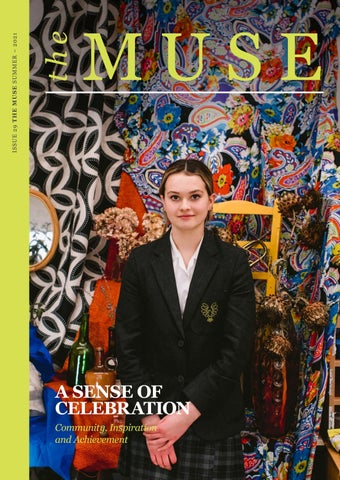
A SENSE OF CELEBRATION Community, Inspiration and Achievement
#BGSCommunity
Carbon balanced print is produced by a carbon balanced printer on carbon balanced paper.
Editor’s Insight
T
his edition of the Muse marks 12 months since I took over the headship of Bedford Girls’ School and what a year it has been! Although it is not how I would have imagined, it has given me an unprecedented view of the incredible community that I have the honour to oversee. I have seen the students manage an inordinate amount of challenges and come out stronger; I have seen the depth of their humility and sense of kindness that runs deep in the School; I have seen creativity, as teachers and students brought different concepts alive in online lessons; and I have seen an incredible commitment to lifelong learning as we all had to be agile, realign and constantly learn new ways of delivering an outstanding education. It has been exhausting and we all needed the long summer break, but it has also been exhilarating and incredibly rewarding. Our students are fantastic, their energy lifts even the toughest day and I am so looking forward to our gradual return to normality, where I can spend time with them in person and really get to know each and every one of them. Our focus in the Summer Term was trying to find ways to celebrate and reflect on what we have achieved this year. Sometimes when you are in the middle of handling another operational constraint, or change to government guidance, it is possible to forget just how far we have travelled. I believe we must always take time to celebrate and reflect; our students are always at the heart of what we do and we were committed to celebrating with them. We managed to deliver events for every year group, from puppet shows to Leavers’ Balls, we may not have been able to have parents or guests, but we had a lot of fun. I hope you enjoy reading about two of these events, our special Prize Giving Day and the Year 6 Exhibition, in this issue of the Muse. Our Annual Art Show may have had to be cancelled but the work on display in School is incredible and I think you will enjoy our Head of Art and Textiles, Mrs Lugsden’s insight into the creative process in the article Understanding the Creative Journey on pages 5-8. Our alumnae have once again astounded us with their achievements this year, and we reflect on some of these in our Inspired By article on pages
3 and 4. We are so very thankful for the many members who have taken time to be involved in school this year. They have participated in our largest ever mentorship programme, provided online work experience, spoken at STEM days, given university guidance, and have been active in critical discussions on issues of diversity and gender equality. We are inspired by their thoughts and actions. We are building a network of women supporting women and I can see it becoming a very powerful forum. One lesson our alumnae have taken with them from their BGS education is the responsibility to have a global outlook, be well informed and to always listen to the different perspectives. Our students must not shy away from discussing difficult issues and taking a principled stance, but they must do so with an open and inquisitive mindset. Our Diversity and Inclusion Days for Years 7 and 8 on page 9 helped our students practise these skills and our Year 10 introduction to the IB Diploma examined how the programme is structured to continually embed these important attributes; we review this day on page 10. Finally, do find time to read Mrs Ann Bezzer’s Legend in their Lifetime, about Maggie Alphonsi MBE, an inspirational female role model and the face of international women’s rugby, Maggie is arguably one of the most well-known names in women’s team sports on the planet. We hope this piece about breaking barriers and diversity inspires you all. By the time you receive this publication, we will be embarking on a new school year. 2021-22 marks the 10 year anniversary of the founding of Bedford Girls’ School, and I am very excited about the next chapter. I look forward to a year of celebrating our past and our future with you all, in person, in school.
One lesson our alumnae have taken with them from their BGS education is the responsibility to be global looking, well informed and to always listen to the different perspectives.
Best wishes
Gemma Gibson Headmistress
The Muse | 02
Inspired by
Inspirational Alumnae Sharing their Journeys Over the last 140 years of education through BGS and our heritage schools, Bedford High School and Dame Alice Harpur School, our alumnae have gone on to achieve great things and this year has been no exception!
O
ur alumnae network aims to provide opportunities and benefits, both to our Old Girls and to current students. From the day that they join the School, students become part of a unique community which includes not only their peers, but those who have gone before and those who will come after. Alumnae have the ability to provide intellectual and motivational inspiration to our students. And, as they progress through the School, students can benefit from the assistance and advice of alumnae who have gone on to study at university and into successful careers. In a time of unprecedented global challenges, we wanted to share some of the more recent remarkable achievements of our alumnae, who continue to bring positive change in the world. While many of us have been working remotely from home throughout the lockdowns, many members of our alumnae community have been on the frontline in the fight against COVID-19. Since graduating from Oxford Brookes University with an Adult Nursing 03 | The Muse
degree, BGS alumna Finola McDonagh (2015), has been working as a Critical Care Staff Nurse in the ECMO (Extra-corporeal Membrane Oxygenation) unit at the Royal Papworth Hospital, Cambridge. ECMO is a highly specialised technique and Finola completed her training for the unit shortly before the start of the first wave of the pandemic. Consequently, her ascent into working practice in the unit has been very fast paced during the peaks of the pandemic, and culminated in an increased responsibility in the number of patients she cared for. Finola said her work has been very mentally and emotionally draining during the pandemic. She also touched on how difficult it has been talking to the families of patients who have been unable to see their loved ones. During her time at BGS, she gained work experience in practice nursing, geriatric care, palliative care and completed a phlebotomy course. Many of our alumnae have also been making strides in sports, wellbeing and fitness. In May, BGS alumna, Courtnay Osborne-Walker (2015), was selected to join The Body Coach
team. And, it was certainly a difficult decision for the nations’ favourite PE coach, Joe Wicks, as there were a mammoth 5000 applications for just three places! With the mission to get the world fitter, happier and healthier, Joe Wicks reached out to inspiring personal trainers across the country to join The Body Coach fitness team. Courtnay, who is the founder of Cardiocollective, impressed Joe with her amazing energy and passion to inspire others. Her role involves creating fitness content for the new Body Coach app, as well as the UK’s leading YouTube channel, Body Coach TV channel. Joe Wicks said: “Courtnay’s amazing energy and passion to inspire others stood out from 5000 entries. Congratulations Courtnay and thank you for joining the team.” Courtnay reflected: “I am so grateful to Joe and The Body Coach team for providing me this opportunity to make an impact and share my passion and love for fitness with the global body coach community.
Pictured (Left to Right): Gloria Onitiri, Revee Walcott-Nolan, Courtnay Osborne-Walker, Jane and Nina Leech, Finola McDonagh, Alumnae members of Bedford Ladies Hockey Over 35s squad
It’s been an incredible journey so far. Thank you so much to everyone for all the love and support, it means so much to me.”
especially winning National competitions as Over 35s in the same team (after much friendly rivalry at school!).
For BGS alumna, Revee Walcott-Nolan (2013), her Olympic dreams came true in June. Following her sensational 1500m title at the Müller British Championships in Manchester (25th - 27th June 2021), Revee was selected to represent the Team GB squad at the Summer Olympic Games in Tokyo. On Monday 2nd August, Revee donned her GB running vest and achieved a personal best time in the 1500m heat, sadly missing out on a place in the semi finals by a mere 0.01 of a second. An incredible achievement and such an inspiration to us all. Revee left BGS in 2013 and went on to study Sports Science at St. Mary’s Twickenham. Alongside her sporting achievements, Revee has a burgeoning career as a model, modelling for many well-known brands including Sweaty Betty and Superdry.
“Our goal in the PE department is to develop students that enjoy sport long after they leave BGS. I have coached all the ladies from the heritage schools who won these coveted competitions and they are fantastic role models to the BGS students who also play at Bedford Hockey Club. Hockey is a great way to stay fit, make new friends and is open to everyone, whatever your standard.”
Our alumnae have also continued to shine on the hockey pitch, producing outstanding performances in national competitions. In September 2020, Bedford Ladies Hockey over 35s, Hannah Shanahan (née Shires, DAHS 2001), Natalia Norford-Reynolds (née Norford, BHS 2001), Kate Costin (BHS 2003), SJ McDonald (née Darrington, BHS 2003) and Katherine Winger (née Wood, DAHS 1996) lifted the much-coveted Tier 2 Investec Masters Title with a 3-1 victory against Timperley from Greater Manchester. National hockey success continued in 2021 for the talented team with victory in the England Hockey Women’s Over 35s Championship during July. The same players, this time including BGS Director of Sport, Mrs Mason-McLeod (née Mason, BHS 2004) triumphed 2-1 over Taunton Vale. BGS Head of Hockey, Mr Mason-McLeod said: “It is so nice to see alumnae still playing hockey after representing DAHS or BHS,
“ In a time of unprecedented global challenges, we wanted to share with our community some of the remarkable achievements of our alumnae, who continue to bring positive change in the world.
”
In October 2020, we were delighted to announce that Chair of the BHS Alumnae Association, The Guild, Jane Leech (née McKendrick, BHS 1982), was awarded an MBE in the Queen’s delayed birthday honours list for the recognition of her work at Yarl’s Wood immigration removal centre in Clapham, Bedford. Jane has been a voluntary member of the Independent Monitoring Boards (IMB), including five years as Chair, for the past 14 years. The role of the Independent Monitoring Boards is to monitor and maintain fair treatment of people in prison or immigration detention.
Jane reflected: “It was a wonderful surprise and a huge honour to be awarded an MBE. I am passionate about the role and about the value of IMBs: in these uncertain times, when so many people are on the move across the globe, it’s never been more important to check those who find themselves in immigration detention are treated justly and humanely.” As we rise to challenge of the ‘new normal’, many of our alumnae in the Arts world have had to adjust to the ever-changing environment. Unable to perform due to the global pandemic, DAHS alumna and actress, Gloria Onitiri (2002), had a time of self-reflection and creative opportunity to launch a series of podcasts entitled, Letter to a Black Girl. Gloria interviews a number of inspirational professional black women, including Dawn Butler MP and actress Lorna Gayle, to share their life stories and experiences of being a black female. Each woman is also asked to write a letter to their younger self – hence, Letter to a Black Girl. Excitingly, Gloria collaborated with BGS students during spring and tasked them with writing letters to their older selves. This culminated in two episodes which were broadcast over the summer. Gloria was recognised as a gifted and versatile performer at School before going on to have a very successful career, both on the stage and in television. During the summer, she has been staring as The Godmother in Andrew Lloyd Webber’s highly anticipated, Cinderella. Whilst this is just a snap shot of some of the achievements of some of our incredible alumnae, it acts as a reminder of the diverse and exciting futures that our Old Girls’ go on to lead; we are lucky to have such a special connection with these great ambassadors, who continue to inspire our students to aim high and dream big. The Muse | 04
Understanding the Creative Journey A n explanation of the creative p r o c e s s b y H e a d o f A r t a n d Te x t i l e s , Mrs Christina Lugsden.
05 | The Muse
T
here is nothing more exciting than visiting a gallery or seeing a collection of work all together in one space: Observing the progression and development of ideas, skills and visual language always serves to inspire - there is a connection with the art on a different level and, to some extent, with the artist, standing where they would have stood, observing the effects of light and shadow. However, is that final pulling together of work our soul aim and objective? Curating a show demands the artist to think about their audience, considering in great detail how their use of visual language serves to answer their own personally set questions. Do they want to make the viewer feel a certain way, question something, reflect on an idea or concept? As artists, we have it in our power to leave a viewer feeling any number of emotions; happy, sad, confused, angry - it is this that enables us to focus down on our development to ‘final work’. Of course, an audience is made up of individuals, with varying experiences, so their response to pieces will be different. There needs to be consideration of how work can affect an individual, so dealing with sensitive issues must be done with careful thought and consideration; whilst the audience is not always at the centre of decision making, it needs to play a part in this. That said, the Art making process is not completely dictated by the ‘end product’, but the journey to it; you rarely have a realised outcome with no ‘working out’. Without our end of year Summer Show, are we somehow as a creative department denied our end goal, our full stop on a year well done? I would say, very much the answer is, no! Our celebration of creativity happens every day, in every lesson, with every trial and sample made. The creative process towards an end product is a highly personal one, and we work hard to allow for true independent learning to take place through encouraging all to express their thoughts, feelings and ideas visually; striving to develop students visual communication skills and aesthetic awareness. We challenge preconceptions and work to develop a stimulating experience in which all can achieve, where an open-minded approach is demanded,
and determination and dedication are rewarded.
decisions about what they enjoy most and where their interests lay.
So, how do we enable students to embark on their very independent and personal journey successfully? It is essential that good foundations are laid early on, and projects are developed with this very much in mind; mapping skills across the school. There are key elements that are woven into every project to ensure students have the strong base on which to build a successful body of work. Drawing and recording is a fundamental element, and can mean different things to different students.
A key part of their investigation is the research into the work of other artists, craftspeople and designers. Building a love of looking at and appreciating work from different artists, times, cultures and contexts is at the very heart of each project. Analysing work is undertaken by students both visually and in writing, to really enable them to build a clear understanding of the work they are researching.
“
The process of constructing a creative project is thoroughly rewarding, and encourages creative thinking, risk-taking and having to develop a wide range of possible solutions to answer a problem. The ‘answer’ to a creative ‘problem’ is one that is not always straightforward.
”
It is an essential skill to understand the purpose and relevance of what is being explored in order to tap into appropriate approaches to recording - is a photograph required? A careful tonal pencil study? Or is an expressive abstract response more appropriate? All methods of recording serve to enable students to develop their ideas and creative skills; students will develop an understanding of their investigation, whilst forming an integral part of gathering and manipulating visual language, and essentially weaving this knowledge into their journey. Exploring a wide range of techniques is key to the success and ongoing development of students’ work and creative journey. Creatively solving problems with a handson approach, with the need to reflect critically on outcomes, and link back to initial personal intentions. It is therefore essential that students are exposed to a wide range of skills and techniques enabling all to make
Weaving in contextual information builds students awareness of the reasons behind why creative people make work and the ideas and issues that surround their art making process. Responding visually to others’ work really focuses their attention, encouraging them to look and analyse with great care - which as an art making activity is invaluable; learning by doing is essential. Integrating what artists, craftspeople and designers do, their handing of media, colour, line, surface, ideas and so on serve to inspire and direct students in new and innovative directions, as they integrate this learning into their own creative journey. The process of constructing a creative project is thoroughly rewarding, and encourages creative thinking, risk-taking and having to develop a wide range of possible solutions to answer a problem. The ‘answer’ to a creative ‘problem’ is one that is not always straightforward. Building a body of evidence to enable students to construct a solution that best answers their question is a clear focus of their development work. As students move up the School, they are encouraged to see beyond a linear approach to art making, with a beginning, middle and end. They will explore varying paths that run in different directions, leading to differing destinations. This is an essential part of being creative, working around a problem and seeing varying ‘answers’ to their personal set of questions. The creative journey is what we thrive on, each and every step of each and every project is a clear point of celebration of the wonderfully diverse, innovative and inspiring work the students of BGS have developed this year. As ever, we are hugely proud of all of their achievements; creatively, it has been a year to remember!
The Muse | 06
3
2
1
8
9
10
11
12
16
17
18
23
KEY 1. Rebecca Turner, Year 11
16. Emmie Rose Stephens, Year 11
2. Mia Cooke, Upper Sixth
17. Ellie Douglass, Year 11
3. Alicja Green, Year 11
18. Alicja Green, Year 11
4-6. Sophie Harrington-Law, Upper Sixth
19. Isabel Almeida, Year 11
7. Etienne Maughan, Year 11
20. Emily Coughlin, Year 11
8. Sara Atab, Year 11
21. Scarlet Stokes, Year 11
9. Sophie Forbes-Laird, Year 11
22. Xindi Anderson, Upper Sixth
10-12. Kimya Ghods, Year 11
23. Giorgiana Roberts, Upper Sixth
13. Anna Mathew, Year 11
24. Kate Sutton, Upper Sixth
14. Natasha Humphreys, Upper Sixth
25. Mia Cooke, Upper Sixth
15. Bea Anderson, Year 11
26. Daisy Minney, Upper Sixth
07 | The Muse
19
24
7
4
5
6
13
20
14
15
21
25
22
26
The Muse | 08
Kathy Cruse Head of Years 7 & 8
Global Thinkers At the heart of our vision is ensuring that we are developing a global outlook within our students; so that our young people are continually inquisitive and remain open to listening, learning and valuing other perspectives. The diversity of our community makes us stronger as a whole and we recognise the importance of exploring different cultures and social issues related to inclusion. The Muse talked to Mrs Kathy Cruse, Head of Years 7 and 8, about the Diversity and Inclusion Days for these year groups.
“W
e are a multicultural community and our students are incredibly proud of their different cultural backgrounds. It is really important that we continue to celebrate our differences. It is also important to me that we use the skills we are developing in the classroom to consider issues relating to race and identity and how a wider understanding can help shape and challenge our awareness of the world around us. I want students to come together and to feel free to express their views in non-judgemental surroundings. “In particular, I felt after long periods of lockdown, it was important to take time to collaborate as a community, to listen to each other and explore social and political issues, with fellow students that you might not have been able to spend much time with so far this term. Although sadly on the day some of our Year 8 students were in isolation, it still gave us time as year groups to stop and consider important global issues. Whilst we continually address aspects through both the curriculum and the co-curriculum, I believe that coming off timetable to investigate some of the wider issues allows us space to collaborate and explore new issues in different ways. It stimulates wider discussions and a greater appreciation of each other’s views and that this learning can be translated back to curriculum study.” Mrs Cruse continued: “The theme for the Year 7 Day was Human Rights, looking specifically at the global rights of children and the role
09 | The Muse
children have played in creating change. We had a particular focus on South Asia linking to the South Asian Heritage Month which ran from 8th July to 17th August. The morning started with a fabulous South Asian inspired dance session delivered by two talented dancers - Narayani Joshi and Aleena Azam, creating a fun and enthusiastic start to the day. Students then worked in groups looking at Children’s Rights and the Children’s Peace Prize and then designing a poster or display, which campaigns for Children’s Rights, together with a more in-depth piece of research on one of the winners of the Children’s Peace Prize. After watching the film: He Named Me Malala, the students were asked to write a reflection starting with the prompt: ‘I tell my story, not because it is unique, but because it is not. It is the story of many girls.’ “I was impressed by the levels of engagement and thinking from the students. They all enjoyed the dance session and really appreciated the effort that fellow students had put into creating this workshop.” Aleena Azam, Year 7 reflected: “Our Diversity and Inclusion Day was a way to express our culture and also learn about how some children don’t have the rights that they should, and how passionate people like Malala are in making the world a better place, telling their story on behalf of themselves and girls around the world. I thoroughly enjoyed choreographing the South Asian dance and performing it; thank you for the opportunity. The documentary was incredibly interesting
and I really felt I was put in Malala’s shoes, thinking about what she’s gone through. I hope we have another Diversity and Inclusion Day it was very enjoyable. Thank you to Mrs Cruse for organising the day!” The Year 8 day focused on Racism and the impact that this has had on society. Students researched the impact of the murder of Stephen Lawrence, the art work of Christopher Ofili, who won the 1998 Turner Prize, and then they undertook some literature-based tasks. around the film and novel The Hate U Give. Mrs Cruse added: “Year 8 were given the opportunity to discuss a number of very important issues, including how diversity and integration will help further in promoting respect and tolerance and building community cohesion. We also studied the origins of the Black Lives Matter movement, so they could understand the importance of it in a social and political context before discussing the impact it has had on society over the last 12 months. We want our students to use their voices to facilitate positive change, but to do this they need to ensure that they always take the time to fully understand the issues that they feel passionate about. Spending time exploring the background of the Black Lives Matter movement hopefully helped reinforce this message.” “The students demonstrated outstanding sensitivity and approached the topics with sophisticated thinking. I hope they enjoyed the workshops and left with an increased understanding and sense of positivity.”
An IB Day In the Sixth Form at BGS students have the choice of studying A Levels or the International Baccalaureate (IB) Diploma Programme; making sure they understand the unique differences between these programmes is important.
M
r John Gardner, Senior Deputy Head, Teaching and Learning explained: “We are very fortunate to offer a choice in Sixth Form, so that every student can build a portfolio of subject study which plays to their passions, strengths and aspirations. However, it is really important that they understand the different approaches so that they maximise the Sixth Form experience.
programme had on her further education and career pathways. Hannah read English and French at Durham University and now has begun a career with leading food company, Danone. She reflected on how the skills she developed through the study of the IB Diploma helped her manage the demands of her degree and the challenges of the working world. She highlighted how she realised how well prepared she was once she got to university.
“After this stressful year, we wanted to enthuse our Year 10 students with thoughts of the future, starting to think about the exciting possibilities that the next few years hold. We appreciate that thinking about possible post school aspirations when you are in the middle of GCSE study may seem early, but we do not want our students making choices based on hearsay or in a rush. We want them to consider, research and understand the range of opportunities that they have and then to look at the pros and cons of different combinations and approaches.
“We were delighted that Hannah talked to the students, hearing from someone who has experienced it and moved into the working world is powerful. The structure of the programme, the independent nature of study, and the transdisciplinary approach really gives students an edge at a degree level” added Mr Gardner.
“We are very familiar with the philosophy of the IB as it underpins our ethos. However, how the IB Diploma Programme is structured, and how it differs in the approach to A Levels is new to them all. We developed a day to introduce the programme and debunk some myths.” The day started with a talk from alumna Hannah Ventisei (BGS 2014), who had studied the IB Diploma at BGS. Hannah shared her experiences and explained the impact the
Having heard from Hannah, students then spent the rest of the day being introduced to the different areas to study, from options for Maths and Languages, Individuals and Society, English, Sciences and Visual Arts as well as the additional core elements – Theory of Knowledge, CAS and an Extended Essay. Mr Gardner explained: “The IB Diploma differs from A Levels in that there is a core element of study, which extends life skills, embeds a global mindset and develops intellectual confidence. Theory of Knowledge prepares students for university and beyond. It explores the nature of knowledge and how we use evidence to justify our claims and beliefs. I introduced this to the students by asking them to consider as many ways as possible that opinions can be justified or shared, and to then rank them from a weak to strong justification. We also discussed the statement “Extraordinary claims require extraordinary evidence” (Carl Sagan). It was a buzzy and engaging session as they enjoyed exploring and discussing these issues.” Miss Heather Dawson, Biology Teacher and CAS & Service Coordinator, spoke to the group about the nature of the Creativity, Activity and Service elements of the IB and why they were both fun and important aspects of the programme. Miss Dawson outlined how CAS helped develop the wider skills, which are important for life but also enhance university applications and a CV through engagement in creative projects, service and involvement in physical activities. The students were asked to develop a service campaign, helping them to think about the questions, task and actions they would need to take to make it a success. Miss Dawson also explained how maintaining
a reflective journal was a key component of the course and as students demonstrated the skills they were developing at each stage. Mr Gardner said: “As the day continued, different subject specialists introduced their areas, which opened the students minds to the broader global approaches to the curriculum and how it works to interlink subjects and areas of study.” The day finished with an introduction to IB Visual Arts. Ms Kerry Nelson, IB Art teacher explained: “The focus for IB Visual Arts is extremely broad. It is focused upon the journey that an artist goes on during the 18 months course, bringing together ideas, research, communication skills and artistic techniques. It is very self-directed and free for students to experiment as an individual. I tasked the students to take photos whilst considering a number of words – such as lines, mundane, delay, opposite and reflections. They had to explain their image in relation to the words. I hope it helped them to understand the freedom to make choices and follow their own direction. There is no right or wrong, just a framework within which students explore artistic concepts and ideas, and by doing so build confidence, knowledge and technical skills.” Mr Gardner concluded: “I hope we were able to encourage the students to start to consider which approaches and style of learning they would like to explore in Sixth Form and that we were able to demonstrate the IB Diploma programme builds upon their skills and learning attributes, to ensure they are well prepared for life after school. Sixth Form should be about taking academic risks, stretching and extending your intellect to maximize your potential, I truly believe the IB Diploma Programme achieves this aim and is an extremely rewarding course of study.” The Muse | 10
SHOWCASING SKILLS The Year 6 Exhibition is the culmination of the Primary Years Programme (PYP) in the Junior School; a true celebration of learning which provides the students with the opportunity to work collaboratively on a project, inquire into the wider world and extend their critical thinking skills whilst creating a positive action as a result of their inquiry.
M
rs Davinia Inkson, Head of Year 6, explained the rationale in greater detail: “The PYP Exhibition is a vital component of the Primary Years Programme approach to learning as it celebrates all of the attributes that students have developed throughout the PYP. The project gives the students the opportunity not only to display the IB learner profile skills they have acquired, but to also self-reflect on just how far they have come as they bring together their skills in this exciting central project. “We started preparing for the Exhibition six weeks before the final date; the students were given total autonomy to select a global issue that they felt passionate about under the central theme: Global Citizens take action for the future of our Planet. Students worked independently in small groups to investigate global issues and to then
11 | The Muse
consider the causes of the issue and what can be done to help solve the issue or improve the lives of people impacted by it. Having researched the wide variety of global issues currently facing society, each group decided on what they would like to focus on. The range of issues was wide ranging stretching from over-fishing, gender equality, deforestation, throw away fashion, access to education for girls, LGBTQ+ rights, plastic pollution and racial equality. They were given three questions to consider to help focus their research - What is it? Why does it happen? What are my responsibilities? “For me, the third question, ‘What are my responsibilities?’ is perhaps the most salient as this opens up the question of action. Action is a central theme of the PYP as it is the learning which inspires and empowers students to undertake action to create impact and this really comes through in the Exhibition project.
I really enjoyed listening and participating as the students discussed what action they could take to support their chosen issue. They started to understand that action can take many forms – from starting a campaign to sharing knowledge so others understand the issue to simply changing their own or their family’s behaviour.” added Mrs Inkson. When considering the action they were going to take, the students had to think about how they could create impact; how can you engage younger Junior School students in a number of issues at the same time; how do you create understanding, especially if you introduce new issues or activities which many may not be familiar with. “These are complex concepts and initially some groups started off by thinking that a great action would be to simply raise money for a relevant charity – and although this is a valuable activity, we soon realised that a
much more powerful action is to try to change people’s behaviours and attitudes. As a year group, they took truly impressive action which demonstrated great creativity and persuasive skills. Some groups ran colourful poster competitions to help spread information, another set up a clothing collection to collect unwanted ‘fast fashion’ so that it can be redistributed to families in need. We had groups produce documentaries, assemblies and lessons for the younger years in the Junior School, to help raise awareness and one team even launched a vegetarian and vegan cooking challenge. The range was impressive and all showed a depth of understanding”
On the week of the event there was an industrious feel in the air as the groups put final touches in place and practised their presentations. Each Year 6 class had a morning or afternoon in the marquee to set up their exhibits and then welcomed parents into the tent to share their work.
In a bid to make sure students fully understand the global issues they were investigating, they set about looking at data to substantiate their arguments and to understand the importance of quantifiable evidence in supporting their findings. Bringing maths, scientific and analytical skills together, they used statistical interpretation skills – reading, and drawing line graphs and pie charts to extend their learning. They then employed their transdisciplinary skills to create exciting visual elements painting, building, drawing, making videos and innovative models.
The exhibits were vibrant, creative and beautifully presented, comprising written work, art work, statistics, scientific investigations and digital work. During the exhibitions, the girls spoke clearly and confidently and were able to answer any questions the visitors had.
Mrs Inkson explained the final stage: “Once all of the research had been completed and the inquiry questions written up, the students were challenged with gathering peer-to-peer feedback, listening carefully to constructive suggestions and then taking time to reflect before making final improvements to their work.”
“It is vitally important that the students had a live audience to present to, they need to be able to articulate their ideas and demonstrate their depth of understanding through answering questions. We worked carefully in a COVID secure way to invite parents to the exhibition in small groups. It created an electric atmosphere as the girls proudly displayed their hard work.”
Mrs Inkson added; “It was lovely to see the girls all enjoying sharing their knowledge clearly and conducting themselves so confidently. You could see how passionate they were about their issues and their confidence and public speaking skills grew as they introduced the projects to their parents and other visitors.” The Year 6 parents were equally impressed and kindly took the time to write to the students and staff; comments included: “I wanted to drop you an email after today to say how impressed I was with the whole
class, all the girls were a delight and engaged and every one of them had learnt key facts about their project and really came across confidently.” “Whilst speaking to the other girls about their work I was always aware of my own daughter’s voice in the background, answering questions capably and explaining what she has learnt with a good depth of knowledge. I was able to stand back and watch her talk confidently with no hesitation and with belief in what she was saying.” “The exhibition this morning was absolutely fantastic. Their level of knowledge on their chosen subjects was amazing. Their hard work has very visibly paid off and they should all be immensely proud of their achievement. The media they used to display their facts, figures and global issues made the exhibition so visually appealing - I thoroughly enjoyed it”. Extracts from Year 6 student reflections on the exhibition process: “I enjoyed working collaboratively with my group and it was fun to have a deadline to work towards!” “Working on the exhibition was really fun and I think our group talked really confidently to the visitors about overfishing. It was sad for it to come to an end.” “I didn’t really understand what an exhibition was at the start but it was amazing. The exhibition let you make your own choices and you had ownership of your learning. You also got to choose how you presented it to the parents. I enjoyed working in my group.”
The Muse | 12
A REASON TO CELEBR ATE
P
After a year of intense lockdowns and restrictions, we have been desperate to get back to what we all enjoy most, coming together as a community to collectively celebrate our achievements and recognising the challenges we have overcome.
rize Giving is an important part of the end of the academic calendar; it marks the passing of an academic year and allows us to recognise those who have made a particular contribution to the BGS community. Sadly, with harsh restrictions still in place for Schools, we were unable to celebrate with our parents but were determined the students should still have the opportunity.
13 | The Muse
Mrs Gemma Gibson, Headmistress explained: “The students have been extraordinary; it has been such a tough year and they have continued to astound me with their levels of resilience and determination to find fun despite the restrictions placed on them. My greatest sadness in the first year of Headship has been the inability to spend physical time with the students in
large groups. I love the coming together of a school community for assemblies, events and celebrations. The collective energy lifts everyone’s spirits and really shows how we can soar. I was determined to find a way to celebrate the end of the school year in person with the students, to bring us all together safely, to recognise achievements and the overcoming of huge hurdles.
Working with a team of colleagues we created the concepts of mini Prize Giving Events in a marquee where we could keep students in their Year group bubbles but have a number of bubbles safely in the same outside space. Sadly, we could not invite parents, so recording the live ceremonies was the second-best option. We invited musicians and drama students to perform, so that each ceremony could focus on the celebration of those particular year groups, as peers came together to recognise each other’s achievements. We replicated our traditional Prize Giving Drinks Reception with canapes and soft drinks after each event and the students were invited to wear their own smart clothes for the events. I definitely wanted it to feel special and I hope we were able to achieve that.”
Mrs Gibson addressed each group before
Across the 6th July, the ceremonies created a real buzz in School with the students excitedly celebrating their friend’s achievements.
in their first face-to-face appearance in their
handing out the prizes and spoke about the importance of taking time to reflect
on what they have achieved this year and
sharing those moments with their friends. She explained that coming together to
celebrate and feast is deeply rooted in human behaviour and not only has it created a rich
and diverse set of traditions around the world, but the act of celebrating together helps
humans feel part of something bigger than
themselves. She reflected on how important
that sense of community had become after a year of enforced separation.
Finally, our new Head Girl, Masooma Sultana and Deputy Head Girls Emily Fordham and
Tamara Oakley-Holton concluded the events
and shared their reflections with the students new roles. They encouraged their fellow
students to celebrate the small successes as well as the big ones, drawing upon the
example of the life of Ruth Bader Ginsburg, the champion of equal rights and Associate Justice of the American Supreme Court as inspiration: “Sitting here today, take some time to think about what your aspirations are. Ruth Bader Ginsburg had a huge, and at some points insurmountable, goal to fight for gender equality, and despite her many setbacks, she remained resilient to the challenges she faced. She also recognised the small achievements that led to, and culminated, in the larger change. This, I feel, is something we should all try to do as we progress forward into the new academic year” Masooma Sultana commented to the students gathered before her. Watching the students relaxing and laughing on the playing fields after the events reminded us all that brighter times are coming and a lot more celebrations lie ahead for all at BGS.
The Muse | 14
Legend in their Lifetime
Ann Bezzer English Teacher
Maggie Alphonsi MBE England rugby player and pioneer for change in the game and society
2003 did not prove to be the watershed moment many hoped it would be. Or did it? On the 6th June 2003: the T-Bird Stadium in Vancouver, Canada, watches on as a 19-year-old woman takes to the field for the first time in what will become a defining moment in her and her country’s sporting history. The event? A match between the England Women’s rugby team and the United States. The woman? Margaret Alphonsi, better known as Maggie and – though few would have perhaps guessed it back in 2003 – someone who would go on to become a powerhouse in the game of rugby and beyond, leaving a legacy of passion and perseverance that has inspired many both on and off the pitch.
22nd November 2003: the Telstra Stadium in Sydney, Australia, holds its breath as a 24-year-old man kicks a ball in what will become a defining moment in both his and his country’s sporting history. The event? The 2003 Rugby World Cup Final between Australia and England.
T
he man? Jonny Wilkinson. Winning the World Cup and kicking the winning drop-goal are legacy-making moments
for both the England team and Jonny
Wilkinson respectively; MBEs, OBEs and even a knighthood follow in the wake
of the win. Hope of a glorious revival of
grassroots rugby, with year upon year of Six Nations Championships and back to back World Cup wins remains just that, however. A hope. Whilst the game in
England is currently in a very healthy state,
It wasn’t always destined to be this way, however. In and out of hospital as a child, undergoing operations to correct the club foot she was born with, Maggie acknowledges that this challenging experience was in many ways the ‘start of [her] journey’ – a journey that has taken her from a council estate in Lewisham to the top of the rugby world, with 74 England caps, a Rugby World Cup winners’ medal, an MBE and countless other accolades accumulated in recognition of her stellar playing career. Despite her indisputable achievements on the field of play, her athletic prowess and World Rugby Hall of Fame status is only part of the story. Hanging up her international boots in 2014, no one could have been surprised or disappointed if Maggie had chosen to enjoy a quiet retirement away from the spotlight that had followed her outstanding success as an integral part of the England Women’s rugby team for over a decade. That is not the path Maggie chose, however, and it is for this reason that I believe she more than deserves her ‘legend’ tag. ‘If you can’t see it, you can’t be it.’ This saying has become almost synonymous with Maggie as she has used her
trailblazing rugby career to continue pioneering for change both in the game and in society more generally: the first former female player to commentate on a men’s international rugby match and be a columnist for a national newspaper; the first England Women’s player to be elected to the Rugby Football Union’s Council as a National Member… the list could go on, but what sets Maggie apart is her drive and desire not to be the last. As one of only seven women on the 61-strong RFU Council, she is still the only Black person to be part of the group and is committed to changing this. Her leading role on the Diversity and Inclusion steering group is one part of this vision, as is her welldocumented goal of being the President of the RFU Council. She continues to be determined to use her influential position to ‘make a damn difference’ so that others can enjoy access to similar pathways in the future. But perhaps the most compelling argument for Maggie’s legend status is not the national and international impact she has, but the personal impact she makes on those who know something of her story and are inspired into action as a result. Just ask mega-fan Zainab Alema. As an African Muslim woman, rugby might not have been on her radar but for Maggie’s pioneering journey; now, as a club rugby player for Barnes RFC with aspirations of playing for England herself one day, Zainab is smashing stereotypes and blazing a new trail of her own, ‘using rugby to make life better’ locally and globally through a range of initiatives that have earned her the Sunday Times Sportswoman of the Year Award. ‘If you can’t see it, be it.’ Maggie’s mantra for a new generation. In a world still filled with huge hurdles to tackle, don’t wait for others to show you the way. Be yourself and blaze a trail for others to follow – and do it with kindness, compassion and integrity. Do it the Maggie Alphonsi way – the way of a true legend in their lifetime.