the
ISSUE 26 THE MUSE SUMMER ~ 2020
MUSE
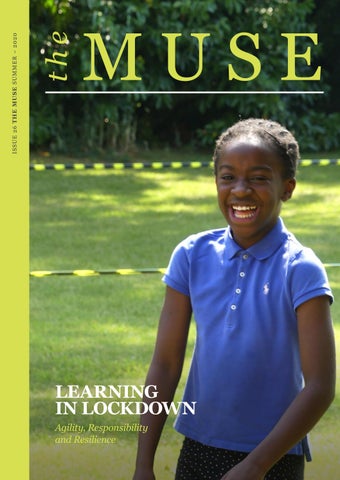
LEARNING IN LOCKDOWN Agility, Responsibility and Resilience
#BGSCommunity
Editor’s Insight
R
eviewing this edition of the Muse has left me with the strangest feeling; I look back at the last few months with a sense of slight disbelief, who could have envisaged that the world would have been through such a period of uncertainty and that a strange new normality would now be enveloping us. The Muse has a very different feel this term, but I hope it reflects some of what we have been through as a school; I feel it is important that we record the impact COVID-19 has had on us as a community. It was also my final term of Headship; I feel a mix of great pride, tinged with a sense of sadness. Pride in the way the students and staff have risen to the challenges; pride in the fact that the school was technologically prepared to move so swiftly to virtual learning. Pride in knowing that the school opened every day to support Key Workers and that we came together to respond to government guidance quickly, enabling our Junior School students to return safely for the last part of the Summer Term. However, I am so sad that I did not have the chance to say goodbye to my colleagues and students in person; sad that the students missed the chances to prove themselves in the exam halls and that they were denied so many important rites of passage; and that we did not have the opportunity to celebrate success, but, most of all, sad that our corridors have not been filled with the sounds of laughter for most of this term. I have be overwhelmed by the creativity and agility that our community has shown. My parting words to the Upper Sixth Leavers at our Virtual Prize Giving reiterated my belief that the purpose of an education is not the grades you achieve, but the skills you develop. Skills which enable you to adapt to both opportunities and challenges, and to have the intellect and self-belief so that you understand that setbacks do not define you; skills which embolden you to keep trying. You can always rise above and come out stronger, and my goodness, BGS has proved this in the last few months. As a community we have demonstrated that we are self-motivated,
imaginative, supportive and passionate. If we are developing these skills in our students, I know they will be able to tackle every obstacle that they face; they will stumble but they will always pick themselves up, and find a different way through. This is a true mark of a BGS education. I think it is human nature to take so much of what we have for granted, and for me, a positive outcome from lockdown has been the time to reflect and to consider what an extraordinary school BGS is. I want to remind our students not to take it for granted. As I review the last 10 years, I am amazed by just how much we have achieved. Our outstanding Independent School Inspectorate report earlier this year is a culmination of the collective effort of the whole community – teachers modelling the lifelong learning behaviour that we encourage in our students; students grasping every new opportunity, committing and thriving in all that they do. What we have created has been achieved through a collective sense of responsibility and purpose, all of us moving in the same direction and supporting each other every step of the way. I have worked and visited so many schools and this is not the norm; BGS is a very special place. As a school we punch above our weight, we are respected, admired and loved. As a community of learners, we are making a difference to the world around us and l look forward to watching the school move to even greater heights.
I have worked and visited so many schools and this is not the norm; BGS is a very special place. As a school we punch above our weight, we are respected, admired and loved.
I feel so privileged to have led BGS. I thank our families for your support and for putting your trust in us. I wish Mrs Gibson so much success, I know she will lead the school forward and I share her sense of excitement for the future. Best wishes
Jo MacKenzie Headmistress
The Muse | 02
Inspired by
BGS in the Community
O N T H U R S D A Y 1 9 th M A R C H , B G S H E A D M I S T R E S S , M I S S M A C K E N Z I E , M A DE T HE F OL L OW I NG A N NOU NC E ME N T:
Today is a difficult day for all schools in the UK, but I am extremely proud “ of the students and staff who have remained focused on their lessons, and are showing immense support for one another. Our community is strong and will rise to the challenges that we will face. We are here to support you all. In the weeks and months since the outbreak of the COVID-19 pandemic, BGS rapidly moved away from teaching in school to virtual learning.
A
s an Apple Distinguished school, we were extremely well prepared for virtual learning, our students and staff have extensive experience and a well-developed understanding of a wide range of digital learning tools. Our students, staff and alumnae also stayed true to the school values and took positive action to make a difference to the communities around them. Although the pandemic continues to have a devastating impact globally, we witnessed so many heart-warming community initiatives, which lifted our spirits during lockdown. We are very proud of the BGS community who have been there to support those most at risk. Like many others across the country, our staff in our DT and Science Department, put their expertise and skills to good use, to protect those fighting at the frontline of the virus. 03 | The Muse
”
Our DT department produced much needed PPE for local GPs, health care workers and Bedford Hospital. Using their design and manufacturing knowledge, Mrs Redfern, Head of DT, and her team produced over 1600 visors. Using donated materials, the frames were laser cut using polypropylene and the replaceable visor was an acetate sheet. Our Science Technicians came in during the Easter holidays to pack up all our eye protective glasses and sent them to be used in local health practices. Students and staff utilised their seamstress skills to support their local communities by making PPE. Mrs Marsh, Mathematics teacher, produced scrub sets for Milton Keynes surgeries and Bedford Hospital. At the beginning of lockdown, usual suppliers of scrubs were struggling to keep up with orders, Mrs Marsh said: “It is so inspiring to see everyone wanting to do their bit, however big or small.” Meanwhile sisters, Amelia, Year 8 and Evie Mead, Year 5, alongside their mum, sewed wash bags and headbands for frontline Key Workers. They have also provided scrubs for GP practices and care homes in Milton Keynes, Bedford and Bucks.
During May, we were overwhelmed by the response of the BGS community in support of the NHS Pamper Bag initiative. The project was initiated by Shannon-Rose Scanlon, Year 9 and her mum, who had originally distributed pamper bags to NHS workers at Milton Keynes and Luton and Dunstable hospitals. The initiative was then extended to the BGS community, Miss Heather Dawson, Biology teacher and CAS (Creativity, Activity and Service) Coordinator said: “Students, parents and staff from across the community made small drawstring bags, and filled them with toiletries, candles, herbal teabags, sweets and chocolate. Each bag also included an original poem by Rebecca Turner, Year 10, entitled Saviour in the Ward. The pamper bags were donated to Bedford Hospital and given to staff, particularly those working away from their families.” Our Year 3 students have continued to keep in touch remotely with Salvete Care Home in Bedford by sending uplifting pictures and inspirational messages to residents. Charlie at Friends for Life Bedford, sent a reply to the students, she said: “Thank you so much for taking the time to write such beautiful letters to the residents in our care homes. I know they will be so pleased to receive your lovely drawings and letters you have created.
to song to maintain our sanity, our hope, and our empathy toward one another. The Music Department have been with our talented students, producing uplifting performances for the BGS community.” Mr Keating-Roberts continued: “Perhaps the last celebration of Music and certainly the highlight of this year has been the virtual performances and of course the whole school community performance of Lean On Me in particular. Students, staff, parents and alumnae – came together with a virtual performance of the Bill Withers classic, aptly celebrating the importance of community during challenging times. A superb performance that was incredibly moving and inspirational.”
Modern Calligraphy workshop format to create a Modern Calligraphy Kit for people to order to learn calligraphy from the safety of their own homes. Ellie reflected: “Although recent months have brought so many challenges with them, the lockdown has really demonstrated the flexibility that I have as a small business owner to adapt to the changing times.” For us all, the pandemic has been an adaptive and transformative challenge. However, the uncertain times have pulled us all together, helped us find creative solutions to play our part and as a community we have shown solidarity, compassion and kindness.
It is not just our current students and staff that have made us proud with their community mindedness. We have been delighted to support past students, including BGS alumna, Sarah Lee (2017), who is currently studying a BSc Music at Coventry University. She produced and released her own song on Spotify and Apple Music, called Strawberry Mojito. Sarah said: “The purpose of releasing this song is to spread positivity and happiness to everyone during these unsettling times. Whether people want to listen to this in their bedroom alone, or play it out loud while having a BBQ outside, this song will bring a smile to people’s faces.” “At the moment they are not able to see people in their family in the normal way and I know they will be missing those of you that have visited them before. Your letters will have put big smiles on their faces and given them a happy day. Thank you for thinking and caring about them. What stars you are.” At the beginning of June, Hilda Makamba, Lower Sixth, volunteered for the Queen’s Park Community Orchard, delivering food parcels to the local community. Hilda said: “One thing that had always concerned me since the beginning of lockdown was the panic buying and stockpiling craze, and how these items were not reaching vulnerable people in our local communities. When I heard about QP Community Orchard and their food parcel deliveries, I knew I had to get involved!” Whilst these times may be uncertain and restrictive, especially at the beginning of lockdown, one intriguing trend we have begun to see in response to social distancing laws are the ever-inventive ways that many global communities are reaching out to each other, particularly musically. Mr KeatingRoberts, Director of Music said: “From lullabies sung from a parent to their infant, to mass jam sessions online, we can all turn
BGS alumnae, Betsy Banks (2017) and former Head Girl, Anna Hunt (2017) organised charitable initiatives during lockdown. Betsy raised funds for charities that are very close to her heart: CHUMS and MIND BLMK. She created a challenge by which you list five things you do to make yourself feel good. Anna, a student at Durham University, took on a running challenge for the NHS Charities Together, with members of her university netball club, they ran a combined distance of 1407km in just seven days! The pandemic has also had a major impact on local businesses, and many of our alumnae have had to explore new areas and become very agile. Dame Alice Harpur School alumna, Sarah Turner (née Bolster, 1998), recently spoke to Forbes about the challenges her sustainable business has faced and how she has successfully explored and implemented new technology in her business, Little Beau Sheep. Changes have included an overhaul of the main retail website and the development of a dedicated website for trade customers for when they are able to re-open. Ellie Pryer’s (DAHS 2011) ERA Calligraphy and Stationary Studio business had to find alternative ways to run her business until normal work could resume. She modified her The Muse | 04
M I S S M A C K E N Z I E O N H E R D E C A D E O F “A decade to a child is a very long time. For a brand-new school, it is a long time, but for an adult and a well-established school it feels like no time at all. As I sit at my desk and reflect on the last ten years, it feels a very long time which is now quickly over.
I
n 2010, I was given the unenviable task of merging two significant and much loved schools that had served the young women of Bedford and surrounding areas for more than 130 years. It was recognised that it had to be done but the appetite to do so had always been lacking. I quickly understood why. Mergers bring significant change and schools by their nature are resistant to change; from the pupils who love their school, to parents who chose the school, and staff who are rightly loyal to their school, through to the alumnae who feel affection of their alma mater. Mergers are undertaken for excellent economic reasons, but loyalty is not based on economic arguments. It is not surprising, then, that in the first few
05 | The Muse
R E F L E C T S L E A D E R S H I P
years we had large number of stakeholders who were resistant to the merger. As a new Head, I was naïve about the strength of resistance. I had been given the task and had to get on with it. What was made clear to me, is that this was a merger not a takeover, this meant a new school had to emerge; everything had to be looked at, nothing was sacred, a new different school had to arise. I saw it as an exciting challenge, and my naivety allowed me to assume everyone else agreed. My experience has since led me to appreciate the sensitivities of the different stakeholders. I have always been an advocate of an all girls’ education but for too long all girls’ school were seen as old fashioned, fusty, girls molly coddled and not being prepared for the real world. Unsurprising in these types of girls’ schools, girls were voting with their feet and moving to co-ed schools that seemed more relevant to them. I wanted to provide an education which specifically suited the needs of modern young women, that understood girls, reflected their interests and most importantly, a school that
appreciated how they learned and was free from stereotypes. A school where they were respected as forward thinking individuals who were comfortable in who they were and would go out and make a difference to the world. A place where it was cool for girls to learn. The girls have to be at the centre of every decision. I have always believed schools should be places where we give our pupils an inner confidence, a sense of self-belief, that they could go out and make a difference. This sense came from a range of experiences they would encounter in the school environment, from their learning in the classroom, their relationships with their teacher and friends, and to the extra opportunities outside of the classroom. It is the sum of all these opportunities and encouraging the girls to try them, to step outside their comfort zone, to take risks and share their experiences that would give them that inner confidence. I strongly believe that there are no boundaries in life except those which are self-imposed. The most important thing we have always tried to achieve is to develop the girls’ self-belief and sense of being valued. As Maya Angelou
said: “I’ve learned that people will forget what you said, people will forget what you did, but people will never forget how you made them feel.” Our identity needed to reflect our uniqueness. We wanted it to be soft, feminine, and distinctive and, working with our talented creative design agency Firebrand we designed the BGS logo, the eagle, affectionately called the “squeegle”, which became the symbol of BGS. We chose lime green because it was vibrant, edgy, different to the rest but we used it subtly, and against the grey it was sophisticated, elegant and refined, reflecting the girls it represented. We needed a curriculum and co-curriculum that served their individual needs. We wanted to combine the best, most up-to-date teaching strategies that worked for girls, with a rich co-curriculum that would enable them to move easily into the work place with the right skill set for the 21st century, combining all of this in an environment filled with joy, vibrancy and laughter. We were innovators, preparing girls for a VUCA world; a volatile, uncertain, complicated and ambiguous world. Teachers and students had to be technologically savvy, flexible in their teaching, thinking and learning. So, from the start we gave all the girls iPads, all teachers laptops, and all classrooms had interactive whiteboards installed. At BGS, we were ready. I was acutely aware that we needed a team of people who believed in our vision. I needed a team who could help drive through the changes. All positions were re-defined, and everyone including me, had to reapply for their news roles, over 300 staff. For me, the staff re-structuring was the most difficult part of the merger. What still strikes me is how phenomenally professional staff were through this very difficult period. They supported each other, genuinely cared for each other, and this supportive culture runs deep into BGS. They understood that change was not just inevitable, but necessary and I think this makes them a very wise, open-minded team of professionals who do their best for the school. It has been such a pleasure working with them. We held fantastic discussions with staff, girls, parents and alumnae about the values of the school, asking the question “What makes an educated woman of the 21st century?”. The International Baccalaureate philosophy of “educating for a better world” resonated with everything we were trying to do and the clarity of the IB learner profile, the skills and values needed to be an effective learner, became our bedrock upon which our link to High Performance Learning would sit. Our aim has
always been to educate our students to make a better world and encourage them to be open minded, balanced, enquiry learners, who are unafraid to take risks – characteristics which give our girls the edge in the work place.
reflect the needs of those groups and still to come is a new Arts and Textile area. I always loved the start of the Autumn Term when girls would race round the school to see the changes that had happened over the summer.
Our pedagogy is at the heart of the school and we must always be critically reviewing educational research to ensure we bring best practice into the classroom. It ensures we continually review our offer, introducing for example, the IB Primary Years Programme in the Junior School, and even now debate whether our curriculum is modern and diverse enough. It is these debates that I love so much.
I knew bringing two communities together would be challenging. The BGS community would be initially made up of two groups of traditional rivals. I had to work hard in the year before the merger to organise opportunities to break down barriers. What struck me, was how impressive the girls were, they just got on with it. The original pioneers of BGS, led ably by the first Girls’ Leadership Group, became role models for the younger years. Each leadership group since has brought something new to the community, each one building on this culture of kindness that positively radiates throughout the school, highlighted so strongly in the 2020 ISI report.
If we teach today as we “were taught yesterday we rob our students of tomorrow.
”
JOHN DEW EY,
EDUCATIONAL INFLUENCER
Once the Cardington Road site was agreed as our home, we considered how it could realise our vision. Fortunately two properties came onto the market, Trinity (our Music Wing) and Burnaby, enabling to extend our campus and modernise space on the main site. However, with students in place building work could only be completed in the summer holidays of 2011. In seven weeks, we extensively redeveloped the site, creating two new labs, new ICT suites, a radio station, enlarged kitchen facilities, new front entrance, new staff room, six new classrooms, redecorated the whole building, packed and unpacked furniture, books and resources from both schools into the new BGS. No mean feat and I look back even now and wonder how! We learned that with exceptional planning much could be achieved, and with small investments each year we could continue to significantly upgrade the site. Every year we put money aside for building projects that would transform the learning experiences and replicate the world the girls were moving into. So in the last decade, the library has transformed into the Learning Resources Centre, a new Drama Wing created, the old gymnasium into a modern fitness centre, the 1930s Science labs into modern flexible spaces, with the i-Create space now at the heart of the school. The Junior School and Sixth Form House were modernised into spaces that
Throughout the whole decade, we have had the support of the parents, and the alumnae. Initially there was much skepticism. Many things they had valued in the schools they had chosen had changed and, at first, it was hard for some to understand what we were trying to achieve. They experienced it second hand through their daughters. Once the girls responded positively and engaged wholeheartedly in the school, parents began to recommend us to their friends. I am always indebted to the original parents who stayed loyal to us, through the challenging part of the merger. Our PTA, The Association, in particular, has been outstanding in bringing together the different parental bodies in the initial phase of the merger and still today work hard to make new parents feel part of BGS. BGS is very much a community made up of strong-minded, caring and encouraging individuals. Those who leave and become alumnae I hope feel proud of their heritage, and those alumnae of the legacy schools, feel proud of the success of the new school, which lies, with much honour, on the rich foundations of Bedford High School and Dame Alice Harpur School. As I leave and look back, I know I have been shaped by BGS. Our school values set out in 2012 - Bold, Imaginative, Reflective - are the values that I now live by, as I move onto my next chapter where I am stepping out of my comfort zone. I could never be a Head of another school; nothing could live up to BGS. Schools shape you as human beings, BGS has shaped me in such a positive way for which I am eternally grateful. I know it will continue to shape others and it is that which makes me so proud.
The Muse | 06
A Welcome Return From the beginning of June, in line with government guidance, we started to welcome back Junior School students, Mrs Carolyn Howe, Head of the Junior School, explained why it was so important to bring back the younger members of the school.
“W
e would have loved to have been able to welcome all of our students back to BGS, but given the restrictions that were in place, I felt it was vitally important to see how we could work to bring our younger learners all back into school. They have coped incredibly well with the virtual learning; however, we recognise that school physically provides an important framework for that learning to take place. For our younger students, who are still at the start of their educational journey, embedding many of the important skills happens inside the school day, with the guidance and support of teachers. “Our younger learners need more assistance, although we encourage them to be independent and to work on self-directed tasks. They need help and reassurance, and respond best to the acknowledgement and support of a teacher and class peers. We are very thankful to our parents who juggled work and supported their daughters at home, but we also know that this cannot replicate the classroom environment.” Once the government had announced its decision to allow schools to open for Year 6, Mrs Howe and the Senior Leadership Team set about considering the implications for BGS. 07 | The Muse
Mrs Howe explained: “We have to follow Government directives and guidelines at each step of the way, as well as taking into consideration the view of the teaching unions. As a member of the Harpur Trust, we also have to work collectively to find common principles around the reopening of all of our schools safely. We had remained open for Key Worker children throughout the pandemic, so we knew that we could operate a safe environment on a small scale, but looking to replicate this for a wider group of children was a complex task.
within the strict social distancing framework. We also had to recognise that our students had lived through a difficult and traumatic few months, they needed to feel nurtured and have fun. It was important that they socialised and worked as a team, both inside and outside of the classroom, so the return of PE classes was considered key. How we achieved all this, with a two week turn around was the challenge! However, I knew that if we could manage the return of Year 6 smoothly it would provide a blueprint for other year groups.”
Mrs Howe added: “I started by determining my success criteria. If the girls were coming back into school, not only did we need it to be safe, but we needed to add value to their teaching and learning. It is already easy to forget, but back in May, many families were still shielding and since March all of us had very limited exposure to the outside world; coming back into school was going to be a big decision for many of our families and staff, we needed to ensure that the girls would truly benefit from the experience.
Mrs Howe then looked at every aspect of the school day in detail, from timetables to staggered break times; enhanced cleaning and room set ups, lunches and carparking, every bit was assessed and amended to create an environment which could achieve the schools aims and comply with the stringent guidelines. The risk assessments and plans had to be scrutinised by the School Committee and verified by the Harpur Trust Trustees before the School could reopen.
“Central to my plan was the importance of returning to face-to-face teaching, I did not want them purely continuing with virtual learning whilst sitting in a classroom. We needed to recreate our collaborative classroom model that the girls thrive in, but
“The guidance was clear that the girls would be in Teams, and the class teacher could work across her form Teams; however, we had to limit movement around school and interaction with other staff. We sadly had to compromise on our Year 6 girls returning to
the Senior School for science, and practical arts subjects. The movement around the building and the number of staff that they would have needed to come into contact with made it impossible to achieve – we had to put safety first. The advantage of Year 6 is that the second half of the Summer Term is spent working on their final exhibition projects, Build Your Own Country, so they had plenty of creative and innovative tasks to enjoy. In fact, this year more than ever, as they could not physically showcase their creations. They had to be extremely imaginative with their use of technology to create engaging video presentations.” When the School opened its doors on the 1st June, over 85% of Year 6 students returned, carefully following the strict dropping off and picking up procedures. “It was very emotional to see the girls, you realise just how much you have missed them! They were a little apprehensive, but as soon as they were in the garden, safely in their Teams with their friends and teachers the nerves lifted and were replaced with laughter and smiles. For the first few days we focused the curriculum on well-being and self-care, which worked really effectively to help the girls settle and process the experience they had been through. We then
replicated this model for each of the year groups as they returned. The girls returned in their own clothes, partly for ease of washing, but importantly to help them distinguish that although we are back it is not “normal” school and different rules apply. The girls were outstanding in understanding and following the “new norm”. The change in the students was almost instantaneous, they went from managing to thriving. They had been amazing at selfmotivating and engaging in remote lessons, but virtual learning does not allow for the collaborative work and the more challenging moments which are key in the learning journey of primary aged children; they need the socialisation and peer to peer contact to really help them extend their skills.” With Year 6 settled and the Government announcing that schools were able to plan for younger years, Mrs Howe set about adapting her blueprint to bring back Years 3, 4 and 5. “Of course, there was a lot of work to be done, but with the support of the SLT, and our amazing Premises and Catering teams, as well as the wider BGS staff, we were able to fine tune our plans and create a staggered day which meant all Junior School students could return to school. Once again, we saw
such a huge benefit; the happy smiles and sense of self-confidence and engagement in their learning said it all. Mrs Howe added: “Interestingly there have been advantages which we hadn’t anticipated. For example, moving Year 6 to the Senior School (to accommodate additional classroom space for the Year 5 teams) has really helped them conquer any nerves ahead of September. Likewise it has been lovely to see our younger students getting to know our Senior School sports and drama staff, who have supported them in the classroom, developing a wider support network across our community. “I know I speak for the whole of BGS, we would have given anything to have the whole school back on site, and we cannot wait for September. But given the restrictions it has been such a joy to have the Junior School back. I am thankful to our parents who put their trust in us to bring the girls back safely, and to our staff for giving a 100% commitment to create a happy and vibrant environment for the students. These are untested and untravelled waters, our students have shown that they are very resilient, and that collectively we can rise to any challenge, be agile and adaptable as we continue to respond to a very rapidly changing world.” The Muse | 08
The Muse Interviews
Mrs Gemma Gibson Bedford Girls’ School welcomes Mrs Gemma Gibson as Headmistress from September 2020, when she will succeed Miss Jo MacKenzie. Mrs Gibson will be joining BGS from her role as Deputy Head (Academic) at Harrow International School, Hong Kong. The Muse caught up with her during the Spring Term, before we went into Lockdown
Can you tell us a bit about your background? I was lucky to grow up in the countryside in Cheshire, so I spent much of my childhood outside with my horses, dogs and cats, which has left me with a lifelong love of animals. I was a keen competitor in equestrian sports right up until I left for university. I went to the University of Glasgow to study History, spending my third year in France at the Université de Caen, Normandy. Since my experience of studying abroad, I have not stopped exploring the world, travelling and working in such places as the USA, Canada, South East Asia, South America, Australia and New Zealand. It has also led to my love of learning languages and I subsequently went on to learn Spanish, whilst travelling around Costa Rica and Cuba. After my undergraduate degree, I completed my law conversion course and Legal Practice Course at the College of Law, before accepting a training contract in the City. After retraining as a teacher, I worked in North London for a decade teaching History and Law, before moving to South Korea and then Hong Kong. I am married to an English teacher and have two sons who will be starting at Bedford School. What attracted you to the role of Headmistress at Bedford Girls’ School? Bedford Girls’ School is such an exciting place! I think that BGS is a really progressive school and I love the fact that it wants to use technology to enhance learning. From my visits to the school, I can see that the community is so warm, inclusive and nurturing. In particular, I like that the girls leave the school as empowered and selfpossessed young women ready to tackle the modern world with thoughtfulness, determination and compassion; never was that more clear to me then when I met the GLG at my interview! Having attended an all girls’ school myself, I always wanted to become Headmistress of a girls’ school, as I can attribute much of my success to the confidence and determination I gained there. I want to be able to replicate the learning environment I benefited from, where the students supported each other and believed they could achieve anything they put their minds to.
09 | The Muse
What unique skills do you believe you will bring to the role? First and foremost, I love teaching and I am very passionate about making sure the students I am responsible for enjoy their learning. Not only that, but I really care about student wellbeing and this will always be a priority for me. As I have travelled extensively and lived in many different countries, I believe I have quite a global outlook; I am also very passionate about learning languages as I think it is so important to be able to communicate well. Having been a lawyer, I am very thorough in my approach and I love to plan; it also makes me quite business minded. However, I am also quite creative (you should see the cupcakes I bake!), so I love to see pupils getting involved in the Arts and I look forward to experiencing all the creativity that BGS students possess. You initially qualified as a solicitor and practised for three years before moving into teaching. Why did you decide to make this transition? Whilst I really enjoyed the intellectual challenge of working in the City and obviously there were great financial rewards, being a solicitor didn’t nourish my soul and that was really important to me. Having undertaken volunteer work in schools in deprived areas, I realised I could really make a difference to children’s lives and this inspired me to change my career. I remember early on in my teaching career I was helping out the Drama Department, stood on a chair trying to teach a group of teenage boys the dance at the end of the film Grease, and even though they were struggling to master the moves, we were all having such fun! It was at this point that I couldn’t believe my luck, that this was my job...and although I don’t get to do such fun activities as much anymore, I can confidently say changing careers and becoming a teacher was the best decision I have ever made. Over the years, I’d like to think I have made a difference to many students’ lives in some small ways, either through inspiring them to become lawyers, advising them on the subjects they could take at A-Level or university, or just being there to listen when they are upset. It really is the best job in the world! What are you most looking forward to about working at Bedford Girls’ School? This is a hard one to answer, as there is so much to look forward to! I have recently
met all of the Senior Leadership Team and the Heads of Department and they’ve told me about so many exciting opportunities across the school that I want to experience. Obviously, I am most looking forward to getting to know the students: I want to see them competing in all their sports; getting creative in Art, Music, Textiles, DT and Drama; thriving and excelling in their subjects; working as a team in their Houses; playing and collaborating together; and also preparing for the big transitions in life - from settling in the Year 3s to the Year 6s coming up to the Senior School and for the Upper Sixth preparing to go off to university. I’m also looking forward to working with all the fantastic teachers, who are clearly so committed to making sure the girls have the best possible experience at school. What is the biggest challenge facing education today? I think it is well recognised that the mental wellbeing of young people today is a challenge all us need to be aware of. In a recent Girl Guiding survey, only 31% of 17-21 year olds surveyed felt confident in themselves. There is a huge pressure on students to conform and a lack of self confidence and self belief is unfortunately prevalent. In this uncertain world, the students will need to have the resilience to cope with the ever shifting social, environmental and political landscape. They need to understand that they must look after their mental health as much as their physical health. I am extremely committed to making sure that the girls have the opportunities they need to maintain their physical and mental wellbeing, so they leave us happy and confident young adults ready to take on the world. Which book do you believe every student should read? This is another difficult question for me to answer as I love reading and there are so many books to choose from! My family will attest to the fact that I am often found hidden in a corner somewhere with a good book. However, if I had to narrow it down to just one book, I would suggest My Brilliant Friend by Elena Ferrante (and even here I am slightly cheating as it is the first of a series of books). I couldn’t put these books down and I particularly like the portrayal of female friendship and the importance of education. The story shows how far gender equality has
come since the 1950s, but I hope the girls will find the characters in them inspirational and can still learn valuable lessons from them. What inspiring female voice(s) would you ask the BGS and wider community to follow on social media and why? I would suggest Christine Lagarde on Twitter. She is such an inspiring woman, making a huge difference in the largely male dominated world of finance and banking. She is the first woman to head the European Central Bank and was the first in charge of the IMF. She strongly recommends gender reform of the banking industry and famously said “... if it had been Lehman Sisters rather than Lehman Brothers, the world might well look a lot different today...” In her new role, she has recently posted on Twitter about her desire to see bankers contribute to the fight against climate change. Her strong moral standpoint and her unwavering support of women are character traits I really admire and hope to emulate. Tell us something that not many people know about you. I would say the most surprising thing about me is that I love Muay Thai boxing! I have been doing bits of boxing for years at the gym, but took up Muay Thai about six months ago. I love the discipline of it and that it’s a great workout. However, the best thing about it is that it is such a good stress release! How would you spend your ideal day out? My ideal day out is spending time with my family; I love going to National Trust properties (I can’t help it, I am a historian!) and having long walks around the grounds. It would also involve going out for a nice lunch somewhere; you can’t beat a Sunday Roast, which is something I have really missed living in Asia. However, I am also partial to a day at the Spa and wouldn’t ever turn down an invite from one of my friends for a bit of pampering!
The Muse | 10
ALWAYS AIMING HIGHER World class schools constantly question what they can do to improve; there should always be a desire to embrace professional development programmes which will enhance the classroom experience and raise overall outcomes.
T
he renowned educational academic and writer, Deborah Eyre, first published her research into creating consistently high performing schools, called High Performance Learning in 2016. Her findings struck a chord with the Senior Leadership Team at BGS. As John Gardner, Senior Deputy Head Teaching and Learning explained: “As with all aspects of life, neurological and psychological research, together with technological advancements, are constantly moving us forward, and changing traditional views of education. We need to look carefully and identify which new theories can fundamentally add value to the educational outcomes of our students.
11 | The Muse
“We are exposed to many interesting new theories and we firstly consider if they add substantive value to the learning experience; secondly, we ask if they align with our educational philosophy, and finally, can they be delivered consistently, across the school, through different subject disciplines and age groups. We expect our students to be inquirers and life-long learners, so we need to model this behaviour, we need to always be looking at refining our practice in the classroom to benefit the students and to open new exciting opportunities for teachers to discover more effective ways of teaching and delivering the curriculum.”
Pupils take a high level “of responsibility for their
studies, demonstrating an intrinsic motivation and determination to do well.
”
ISI INSPECTION REPORT 2020
Deborah Eyre’s book, and her principles of High Performance Learning (HPL) resonated with the values at BGS, and sat alongside the school’s commitment to provide an education that was based on the development of skills and attributes rather than the regurgitation of facts to achieve certain grades. As a school, BGS is committed to the International Baccalaureate (IB) philosophy of education and Deborah Eyre’s research aligned itself with this philosophy and discussed how, through enhanced teaching practices, attainment across a school can improve, not
just in the academic sphere, but also in line with our vision by ensuring that all students become active participants in their learning and embed a broad skill set. Mr Gardner continued; “We felt that HPL provided an effective, deliverable framework which would help us achieve our overall ambitions. What excited us about the approach was the synergy with our philosophy and that it wasn’t an off the shelf approach, but provided a guiding set of principles and questions which we should be asking, and scaffolding that we could adopt into our planning and delivery. “Fundamental to our vision is that every student has the capacity to be a highly engaged learner, who has self-belief, mastery of their subjects and demonstrates high cognitive performance. Building that level of self-confidence and guiding them to take accountability for becoming a self-regulated learner is at the heart of the principles. If students are going to improve and raise their own aspirations they need to recognise and understand what strategies work for them as individuals and take collective responsibility to participate in their improvement. Our role as educators is to deliver the pedagogy in such a way that these principles become implicit in every lesson.” Alongside her published research, Deborah Eyre had established a programme for schools to follow, to be accredited as a High Performance School. Participating schools follow a rigorous 24-month pathway and demonstrate that they adopt teaching practices that have visibly lifted attainment across a number of factors, not just academic results. The model had been tested in a number of international schools, with impressive outcomes, and the Senior
Leadership Team at BGS were confident that it could be as effective. Over the last two years, all staff at BGS have been adopting the principles laid out by Professor Eyre and her team, working collaboratively across the school, under the guidance of a teacher led steering group who have championed the programme across the different disciplines and supported by a team of educational experts from the HPL organisation. Mr Gardner explained: “When you break two years in to teaching terms you have a lot to achieve within a relatively short period. We recognised that we had to keep the momentum high, and actively promote and support the programme with staff to ensure that they were motivated and supported to embrace the changes. Although the programme was principally aimed at classroom practices it was key that all staff understood the journey that we were taking. Every member of staff, across teaching and support staff were asked to read the book and understand that we all had a role to play in achieving our aims. “The project team developed a strategic roadmap to embed the principles and practices associated with HPL into every classroom across a two-year period. BGS has a very clearly defined vision and were already delivering a high standard of education but this was specifically about fine tuning and amplifying what we were doing. We started by establishing what our goals were, where we needed to do things differently and where we could build upon already excellent teaching practices. This was not about reinventing the wheel but improving our pedagogy across the school. We developed a termly approach which focused on exploring specific key
principles and learning behaviours in more depth, with an emphasis on innovative and creative teaching delivery to help embed the skills with our students.” We looked forensically at how we could best implement improvements across curriculums, lesson planning, classroom delivery, departmental reviews, staff training, and how we track and report on students progress, changing reporting structures to reflect the importance we place on attributes and skills. For the implementation to be effective, we needed students to understand our expectations and how adopting new learning behaviours can improve their outcomes. So, we spent time explaining the attributes and skills we wanted them to demonstrate, such as the importance of meta cognitive behaviour and why automaticity is important in learning, or the importance of flexibility in learning. We helped them recognise when they were displaying these skills and behaviours, and to understand the impact that this had on their learning. We communicated our approaches to parents, through open mornings, information evenings and Curriculum Conversations where we explore learning concepts with them to provide an opportunity so they understood the strategies we were implementing in the classroom; we highlighted achievements and reflections in our marketing and communications materials. “We had to break down some preconceptions and ensure that all constituents were actively engaged in the journey. Central to the success of the programme was having evidence that our key educational outcomes were improving; this involves recording and collecting evidence-based data; we were not just interested in results from
assessments but from the improvement in learning style, active participation and cognitive understanding. In addition to internal monitoring of student performance, we introduced a series of pulse-check questionnaires across the two years to measure feedback from parents, staff and students, and introduced student reflections into school reports, so we can monitor if reality is reflecting our aspirations. “One of the transformational elements was the sharing of great practices through our open-door classroom approach where teachers were encouraged to sit in on each other’s lessons and give feedback; not only did it allow for “live” sharing of best practice but it also promoted a culture of positive peer-to-peer feedback; which again we actively encourage amongst our students. We were all learning from each other, and this is a collective experience which is moving our culture and outcomes forward; as recognised in our February 2020 ISI report when they acknowledged “Pupils make rapid progress in developing knowledge, skills and understanding as a result of the high expectations and effectively prepared teaching.” “We were extremely pleased to be accredited by HPL in the Spring of 2020, it reflects the focus and dedication of our teachers to continually innovate in the classroom and to ensure that our students receive a world class education. But it is important that we continue to adapt and improve our teaching practices; one thing we have all learnt from the last few months that in a VUCA world the ability to remain agile, adaptable and responsive to changing circumstances are key learning skills that we all need to be demonstrating to succeed.”
The Muse | 12
K EEPI NG
FOCUS
With lockdown came the announcement that public examinations were cancelled. After the shock of the decision, a priority was ensuring that Years 11 and Sixth Form students were supported over the Summer Term. The Senior Leadership Team came together to develop bridging programmes to prepare our students for the next steps.
M
rs Helen Woolley, Director of Sixth Form, explained: “We were very conscious that in years to come employers will ask, What did you do in the summer of 2020? And we needed to help students undertake meaningful projects, which would help address that question.” They needed to keep focused and take back control, not to ponder on a situation that they could not change; but to take initiative and develop new skills. They could not spend potentially six months out of education, it would undo so much of what they have already achieved. We believed it would be disheartening for the girls to purely finish exam specs. We were extremely mindful that students were struggling with a huge sense of shock, school had come to an abrupt end, exams cancelled and they would not be able to enjoy the celebrations at the end of these milestones. These students needed rest, inspiration and support.” Mrs Woolley expanded: “Whilst we recognised this was an opportunity for Year 11 students to start on Sixth Form options, we decided not to start the official curriculum. They have plenty of time to pursue those courses, they had just completed two intense years of GCSE work and they needed something more liberating. We focused on providing platforms to enable them to delve into areas of interest, exploring around subjects, giving them time to develop knowledge and ask questions through mini projects or to extend key skills that are important for success at the next stage. Each week the girls met with the subject teachers of their Sixth Form options, different departments took different approaches, for example Maths focused on practising key skills and revisiting concepts, which are building platforms for Sixth Form study, whilst in Psychology the students had the opportunity to undertake their first research project. Not only did these classes inspire but also it helped the students understand different learning approaches in the Sixth Form and allowed some to reconsider options.” 13 | The Muse
For the Upper Sixth the focus was clearly on getting them ready for the wider world, with a structure under the umbrella of Discover. Focus. Action. With students leaving BGS to pursue such a diverse range of options, the programme needed to be highly flexible so students could self-develop their learning, and gain new skills to prepare them for the next steps, whilst still providing support, expertise and resources as they adjusted to the situation they faced.
“ Out of a chaotic situation, our students really proved that they could motivate themselves to stay focused and develop new skills, and to know that the wider school community will always support them.
”
Mrs Woolley explained further: “They needed to visualise life after BGS and to be excited about the opportunities ahead. We developed a two-pronged approach, firstly a practical list of post-school activities, such as sorting finances, planning for leaving home and developing self-guided life skills; together with a programme of supervised project work and skills development that would help prepare them for the next stage of their education or entry into the working
world. All of this was supported by individual mentoring and careers advice from the BRIDGE. Students were assigned a Tutormentor who they met with once a week to develop projects to add to their CV. We were very thankful to parents who offered to support our programme and ran specific skills development courses in areas such as project management. The girls found these immensely valuable and the opportunity to work with experienced professionals was incredible.” In addition, we called upon our younger alumnae. Many had returned home early from university, and were at a loose end; it made perfect sense to team students up with Alumnae-mentors. The response to the scheme was fantastic, nearly 70 students had mentors, who either studied the same degree, were at a university that the students were applying to or had followed a similar employment route. These pairings were extremely successful, providing our Sixth Formers with real insight into their aspirations whilst helping the alumnae develop new skill sets and allowing them to reconnect with BGS. There was a lovely sense of supportive networks, which is a key aim of our alumnae, and provided the participants with the start of a longer term professional network.” Mrs Woolley concluded: “Out of a chaotic situation, our students really proved that they could motivate themselves to stay focused and develop new skills, and to know that the wider school community will always support them. I hope it helped them see the bigger picture, you are not defined by examinations but by how you respond to challenges, when asked what they achieved in the summer of 2020, they will all have plenty to say.”
House System
A
quote in the first ever edition of The Muse, Autumn 2011, has resonated during the pandemic: “The school also delivers preparation for life and an opportunity for everyone to assume their place in society with dignity, compassion and an awareness of the needs of others.” We have seen how the BGS community have stood together through its involvement in a huge variety of community initiatives. However, it has also been equally as important for students and staff mental health and wellbeing to have been connected throughout lockdown through virtual House competitions, keeping the community together and helping everyone celebrate small successes.
Creating a sense of belonging during lockdown
Mrs Axford continued: “Online learning is demanding; students and staff needed time to rest and recuperate. We wanted to ensure that we were supporting their sense of well-being and encouraging physical activity. We needed to help students maintain self-confidence; normally they find opportunities in and outside of the classroom through daily participation in sport, arts, music, drama and clubs. We needed to recreate this and by participating in competitions and being supported by others members of your House we were able to offer these important little boosts to self-esteem.
Once lockdown slowly lifted and Junior School students transitioned back to school, the PE department hosted an adapted Sports Week. Mrs Becky Tarrant, PE teacher, explained: “Our aim was to make the event fun, inclusive but still with the inter-house competitive spirit. During the Junior School PE lessons, each student competed in four events within their bubble. It was fantastic to see the girls really embracing this adapted sports day format, wearing their colourful House t-shirts whilst cheering for their peers.”
Mrs Jane Axford, Assistant Head with responsibility for Co-curriculum, Experiential Learning and the House System, explained: “The lockdown forced staff and students to suddenly change the way they worked. Alongside virtual learning, it was important to maintain our House co-curriculum activities that were fun, and allowed everyone to interact across year groups, albeit virtually via Google Classroom and Google Meet. The strength of the House System at BGS brought a sense of community, and provided an important element of light relief.
On Monday 27th March, BGS launched the first House challenge, The 7’s Challenge. A slightly physical one, this challenge required hand-eye coordination and perseverance. Students and staff had to film their entry and submit to Mrs Axford. This was followed by the popular Bake Off competitions, which ran for eight consecutive weeks, culminating in an Afternoon Tea extravaganza, which was won by Catriana Boul in Year 9, who made delicious raspberry mille-feuilles and an intricately assembled croquembouche. Ella Coupland, Year 3, claimed the most overall points, whilst Polly Taylor, Year 8, won the most creative design award for her honey and rosemary focaccia.
Mrs Verity Mason-McLeod, Director of Sport, added: “We were delighted we could still go ahead with the event under the circumstances. A huge well done to all of the students who competed. We then replicated a virtual version of the Senior School sports day and were amazing by the numbers of girls and staff taking part in the different categories.”
“Throughout Lockdown, we created many engaging remote House Competitions for staff, students and their families to participate in, providing focus and the rewards that we all needed during these times. Every entry contributed to the final House total and anyone placed 1st, 2nd and 3rd or Highly Commended scored extra points for their House. The competitive spirit and collaboration between the year groups was wonderful to see. I have been so impressed by how our community have used their ingenuity, creativity and resourcefulness at home.”
Mrs Axford said: “It was wonderful to see mouth-watering entries rolling in every week and seeing the different year groups and staff virtually interacting with each other on Google Chat. So many departments organised a huge range of competitions including weekly Maths challenges; design a card to celebrate Eid; art competitions to turn everyday objects into fun illustrations; Bank Holiday challenges and a Time Capsule competition to name just a few. The students also suggested ideas for competitions and took the responsibility for organising them too with the creative 3D Craft competitions driven by two pupils in Year 8.”
Speaking at the end of an extraordinary Summer Term, Mrs Axford reflected: “We really have seen the whole community pull together, but I think we must say a special thank you to our newly elected House Captains and Prefects. They took on their responsibilities at the beginning of lockdown and have been pivotal in keeping the competitions alive and for helping their fellow students feel a sense of belonging. They really have been brilliant role models. “It was therefore fitting to have them in attendance as part of the GLG bubble, at Miss MacKenzie’s farewell assembly, where they presented the House trophies via a live stream to the winning Houses, with Nightingale coming out top for 2019-20. It has been a year of House activities that will never be forgotten.” The Muse | 14
Legend in their Lifetime
Paula Harrold Head of Psychology
Reni Eddo-Lodge
I wish I could say that this is a timely piece but, if we’re being honest (and we do need to be honest), the truth is that it is long overdue. Talking to White People about Race. In the title alone, Reni Eddo-Lodge had successfully evoked how talking about racial matters, with even well-intentioned white people, can be an exhausting minefield for black people in this country. ‘I need to read that’, I thought. Eddo-Lodge’s book was an impressively written eye-opener to my own white privilege, white fragility and tremendous ignorance of the experience of British people of colour*. She clarified for me the nature of systemic racism in this country, as well as the fact that adopting a position of ‘colour-blindness’ denies individuals the possibility of feeling seen and removes important language needed to discuss and resolve the reality of racism.
T
o explain why Reni Eddo Lodge is a living legend, I need to start from how I came upon her work. A couple of years ago, I upset a black person during a conversation about race. I now understand that I’ve probably done this on many occasions, despite my best intentions, but this time was significant in several ways. Firstly, I genuinely had no idea what I’d said that was so upsetting, which made it very difficult to apologise. Secondly, this individual was a student, which meant I had become yet another person - one in authority - who had failed her, and accidentally made the school a less welcoming place. Thirdly, it was particularly difficult to seek answers to how I had gone so wrong. It simply cannot be the responsibility of students to educate their teachers on these matters, and I didn’t wish to distress her further. I set about re-building our relationship, but was painfully aware I needed to do more. Fortunately, just days later, I saw someone on the tube reading Why I’m No Longer
Her book outlines how the dearth of Black British history, art, literature and science in the curriculum has white-washed the past. The curriculum does this not just by largely ignoring the atrocities of colonial times and how they have created the racial tensions reverberating in the UK today, but also by failing to acknowledge how people of colour have shaped our nation in positive and powerful ways. This denies our BAME* students the opportunity to see themselves reflected in their learning of who and what matters – and so, implicitly, it tells them that they do not. Eddo-Lodge’s book, recounting case after case of aggression, microaggression and marginalisation, evidences that the common white view that ‘we don’t really have a problem with racism here’ is simply not true. That these problems are exacerbated by intersectionality, in which characteristics that deviate from the white, heterosexual, cis-gendered, nondisabled male norm combine to increase discrimination, is another important issue she tackles. Reading her book made it clear to me where I had gone wrong in my conversation with my much-valued Year 12 student. Whilst always careful about the imbalance of power in the student-
1. The Long Read, ‘Why I’m no longer talking to white people about race’, The Guardian, Tue 30 May 2017 05.30 BST *I appreciate neither of these terms are embraced by all and that both have their limitations. Book cover design courtesy of © Bloomsbury Publishing Plc.
teacher relationship, I had otherwise approached the conversation about race as a discussion between equals. EddoLodge is unequivocal about my privilege and error here when she discusses the difficulties of talking about race. After dealing with those who deny the possibility that racism exists, she notes: ‘Worse still is the white person who might be willing to entertain the possibility of said racism, but who thinks we enter this conversation as equals. We don’t.’1 She then goes on to explain how a lifetime of different experiences leads to very different expectations going into any such discussion. I cannot possibly outline these experiences or expectations here, nor could I do them sufficient justice even if I had the space. It is becoming (belatedly) clear to white anti-racists that, socialised as we are by a systemically racist society, we can never understand the experience of people of colour. Reni Eddo-Lodge is the reason I know this: her bravery in pursuing that difficult conversation with white people despite her emotional exhaustion is life-changing. She is the reason I managed to re-build my relationship with my student, leading a group to speak openly to the school about their experiences at BGS. She is a key reason the school’s inclusion group has a better understanding of what we need to do moving forward; she will impact this school for the better. She is also the reason that I am sorry that once again, in this article, a white voice is being vocalised – though we do need to play our part in the conversation. This article is a chance to acknowledge that, if we truly wish to achieve an inclusive society, our part is to listen, change the status quo and amplify the BAME voices of our community. So, please do look out for more of these changes in the future – and, if you haven’t already done so, please consider reading Why I’m No Longer Talking to White People about Race.