the
ISSUE 25 THE MUSE AUTUMN ~ 2019
MUSE
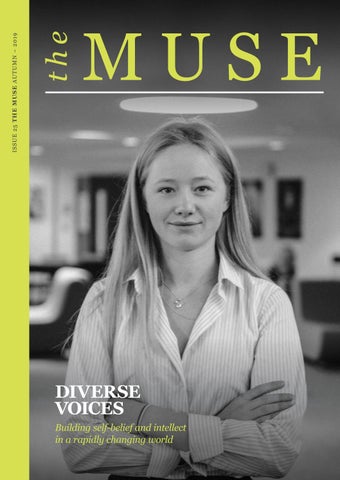
DIVERSE VOICES Building self-belief and intellect in a rapidly changing world
Visits & Voyages This list is by no means exhaustive, but offers a flavour of guests in and visits out during the Autumn Term.
Visitors In Alumnae Mentors, Upper Sixth
House Talent, Whole School
Polam Annual Activities Event, Junior School
Avenue Q (School Edition) Theatre Production
Junior School Christmas Concert
Primary Mathematics Challenge, Year 6
Budge Rogers visit, Former England Rugby International Player, Junior School
Junior School Teatime Music Concert
Rowing 24hr Ergo, Whole School
Lunch Club, Senior School
Senior Mathematics Challenge, Sixth Form
Lunchbox Lecture, Hollie Sturgess, Degree Apprenticeships
Senior School Christmas Concert
Careers Day, Year 8 Celebration of Learning Parent Afternoon, Year 3 Children’s Book Fair, Junior School Colegio San Albano, Argentina, Hockey Tour, Senior School European Universities Fayre, Sixth Form European Week of Languages, Years 7-Upper Sixth
Lunchbox Lecture, Jane Cooper, Religious Studies and Ethics Lunchbox Lecture, Jess Howard, Finding Your Way as a Woman in Business Lunchbox Lecture, Kate Morgan, Norland College Lunchbox Lecture, Lee Barney, Cyber Security
Exchange programme Presbyterian Ladies College Students, Year 10
Lunchbox Lecture, Nicola Reddy, Running your own Business
Explorer Day, Year 5
Lunchbox Lecture, Suzy Wimbourne, Photography Career
First Team vs Old Girls’ (Alumnae) Lacrosse Match, Cople Fields French Play, Les Garçons, Years 8-10 Fundraising Concert for Sue Ryder, Sixth Form Giving Forward Final Grandparents Day, Whole School House Drama, Years 7 and Lower Sixth
Milton Keynes Prep and Broughton Manor Activities Event, Whole School Open Morning, Whole School Oxbridge Mock Interviews, Upper Sixth from BGS and various schools
Senior School Lunchtime Concert Sixth Form and Staff Pantomime Sixth Form Open Evening Sixth Form Taster Week STEM Science Communicator Workshops, Various Schools in Bedfordshire, Years 9-Lower Sixth The Association Christmas Fayre The Association Games on the Lawn, Junior School Gardens, Junior School The Cube Mathematics Event, Senior School The DAHSA 2019 Reunion for all eras Two Thirds Sky Dance Workshop, Years 10-Upper Sixth Whole School Remembrance Assembly
Pilgrims Preparatory School Annual Activities Event, Junior School
Year 3 Christmas Production
GSA Girl Power STEM Conference, National Space Centre, Years 11 and Lower Sixth
Wicked, the Musical Trip, Apollo Theatre London, Year 11
Historical Tour of Bedford, Year 3
Winter Wonderland Social Trip, London, Years 11 and Sixth Form
Voyages Out Advent Service, Bel Canto Choir, St Paul’s Church Art Trip, National Portrait Gallery, Lower Sixth Art Trip, St Paul’s Church, Bedford, Year 10 Art Trip, Tate Modern, Year 11 Art, Textiles and Business Studies Trip, Japan, Years 11-Upper Sixth Bedford School Open Mic Night Charity Event Bletchley Park Trip, Year 10 and Presbyterian Ladies College Students Blue Plaque Tour of Bedford, Year 5 British Museum Trip, London, Year 4 Castleton Geography Trip, Derbyshire, Year 9 CCF RAF Flying, RAF Wittering, Senior School Challenge and Extend Trip, British Library, Year 8 Christmas Market Trip to Cologne, Germany, Years 7-9
Junior School Christmas Carol Service, St Paul’s Church, Bedford Junior School Head Girls’ Team Deliver Harvest Goods, Bedford Loire Valley, France Trip, Years 9-11 Magic Show, Bedford Prep School, Years 3 and 4 Mathematics in Action, London, Lower Sixth One Man, Two Guvnors Theatre Trip, Quarry Theatre Senior Mathematics Challenge, Northampton Senior School Deliver Harvest Goods to FACES SoupFest 2019, Bedford Stratford-upon-Avon, Year 10 and Presbyterian Ladies College Students
Classics and Latin Trip, British Museum, Years 9-Upper Sixth
Team Building Day at Ickwell Bury, Year 3
Condover Hall Netball Trip, Shropshire, Year 8
Theatre Trip, A View From the Bridge, Derngate Theatre, Northampton, Year 10
Cultural Trip to Cambridge, Year 10 and Presbyterian Ladies College Students Cyprus Swimming Camp, Senior School Edale Challenge Trip, Derbyshire, Year 10
Theory of Knowledge IB Trip, New College, Oxford, Lower Sixth Wasps Netball Community Day, Ricoh Arena, Coventry, Year 6
Editor’s Insight
I
In the middle of the Autumn Term, I disappear from School for a couple of days, to attend the Girls’ Schools Associations Heads Conference. It always falls at a particularly nice point in the Autumn Term, once we have settled into the new academic year, it gives me time to think beyond the day-to-day running of the school, and to consider some of the wider issues facing young women growing up in today’s world. This year I was struck by a series of conversations concerning independent thought, identity and role models. The challenge for young people today is to navigate the world when they are bombarded with unrealistic images, fake news and superficial views. How do we, as educators, help them make sense of it all, building their self-belief and intellect so that they are able to seek out the truth, and engage with meaningful issues rather than highly stylised imagery. How do we help them become confident to speak up for what they believe in? In a world which is currently so polarized, it is more important than ever that we support our students with intrinsic strategies to successfully manage this highly conflicted and confusing time. Part of the answer, I believe, lies in ensuring that we encourage our students to develop a global outlook, and ensure that we introduce them to a wide range of diverse voices. I was therefore fascinated by a presentation from the organisation, The Female Lead, who discussed the positive influence that role models have in shaping ones perception of the world. They have published fascinating research into the correlation between the role models that girls follow on social media and their self-confidence; just following two influential voices can help girls develop a stronger sense of positive identity. We all have a part to play in influencing other lives. I am keen that our younger students see our older students as role models, and therefore encourage Alumnae to return to BGS through many different ventures to work with current students. Early in the Autumn Term, three of our more recent leavers returned to undertake projects in our Marketing and Alumnae Department. It was a delight to have these confident young women, about to embark on their careers, back in our midst. For them, it was an opportunity to learn from our teams and to experience a working environment, but it also provided an opportunity for them to be role models; to start to recognise their own value and see what they can offer to others.
I am greatly encouraged by their reflections, on pages 13 and 14, as they articulate the part that school, teachers and the wider BGS community have played in shaping who they are becoming. Working collaboratively through Sport and Drama helps the girls learn from each other, developing friendships and support networks across the year groups. In this edition, we review our stunning, and hugely entertaining, production of Avenue Q (School Edition) and the students look back at what they learnt from our first overseas swimming camp, which took place in Cyprus during October Half Term. It is equally as important that we explore different cultures, understand different perspectives and draw from them aspects which improve our lives and the ways in which we interact with each other. During the Half Term, I accompanied 33 students to Japan. It was wonderfully rewarding to witness first-hand how they embraced another culture, and through doing so learnt more about themselves. I do hope you enjoy reading their Cultural Reflections on pages 9 and 10. I hope you will be equally as interested in our Year 4 article, A Trip to the Museum, which examines how they have been exploring culture and identity through their Unity of Inquiry. The girls have been considering what defines a civilisation, studying ancient cultures and understanding the impact that these cultures have had in shaping the world we live in. They are gaining wider perspectives, global mindsets and developing transdisciplinary connections. As a community of learners, our teachers are also always keen to benefit from the latest educational research and implement new strategies, which will benefit our students, and The Muse talks to our Senior Deputy Head, John Gardner about the focus during this Term.
It is equally as important that we explore different cultures, understand different perspectives and draw from them aspects which can improve our lives and the ways in which we interact with each other.
Finally, do find time to read Mrs Sonia Barber’s Legend in their Lifetime, about Dame Ellen MacArthur, another inspirational female leader whom I would encourage you to follow as she strives to make the world a better place. I wish you and your families a happy and healthy start to 2020. Best wishes
Jo MacKenzie Headmistress
The Muse | 02
Inspired by
Cyprus Swim Training Camp “ Success isn’t final, failure isn’t fatal, it’s courage that counts.” A li c i a C o u t t s (Au s t r a li an mu l t i-m e d a l li s t s w i m m e r, r e c a l l e d th e w or d s of S ir W i n s ton C hur c hi l l).
It’s fair to say that Sir Winston Churchill’s inspirational quote not only resonated with Olympic swimmer Alicia Coutts, but also with the 21 Senior School swimmers and coaching staff, throughout their October Half Term training camp in the beautiful surroundings of Paphos, Cyprus.
T
his was BGS’s first overseas swimming camp and Mr Edward Castro, Head of Swimming, explained the importance of the holistic training opportunity: “Cyprus offered a great all-round training environment, allowing the girls to fully immerse themselves in their swimming training, taking them out of their comfort zones. Of course, the blue skies and warm weather made getting up 03 | The Muse
early in the morning for training much easier. However, the healthy dose of Vitamin D wasn’t the only motivator, there were much wider training benefits including access to world class facilities, a positive mindset created by the idyllic setting and the opportunity for the group to foster friendships and really work hard as a squad.” During the intensive six-day camp, the swimmers trained twice a day, with pool sessions each being two hours long. In addition, different days involved other training activities. This was made up of training on land, including running and circuit training to improve fitness. Flexibility and stretching sessions aided recovery from the pool sessions. The girls also had the opportunity to experience some open water swimming, this was a new challenge for some of them and one which they all enjoyed. The participants encompassed a broad range of swimmers from National and club level, to those who just train at School, therefore the sessions needed to be carefully planned across different standards.
Mr Castro explained: “It was beneficial for the less experienced swimmers to be mixing with the more experienced, as they could see not only the outcomes of those girls who were swimming the fastest, but also understand the effort and training that goes in to reaching those high standards. Each group had slightly different sessions according to their ability, which ensured sessions were challenging but achievable for all.” The camp balanced training with some down time excursions, allowing the girls to bond and make the most out of their Cyprus experience. Year 9 student Lucy Young looks back at the training camp, she commented: “I really enjoyed the camp especially the training, some days we swam for four hours! Every night a group of us would walk down to the beach to experience the beautiful sunset. “In addition, I really enjoyed mixing with other girls in different year groups, that I wouldn’t normally get to know so well at school. I took a lot away from this trip. Resilience was a key attribute that everyone
needed when the sessions got extremely challenging. I think everyone would agree that it was a brilliant trip, and my swimming really improved. I am excited to go on the next camp.” Miss Zoe Grey, Head of Years 9, 10 and 11, who assisted with the coaching during the week, added: “The camp provided a fantastic opportunity for the girls to experience an intense and focused swimming programme, whilst having lots of fun! Mr Castro arranged some amazing individual training sets, giving full technical assessments, including video analysis of swimming, to ensure each girl had highly individualised feedback to help them reach their next goals.” The overall ambition of the trip was to improve the squad’s fitness and swimming ahead of the gala season, Year 10 student Aimee Hughes, explained: “I found training
more challenging than I had expected, as the pool at 50m was longer than we are used to. However, I really pushed myself and kept trying to complete the sets without breaks. This determination and perseverance have made me a better swimmer. Overall, the training week was very well planned and balanced, as we were also able to enjoy the relaxing facilities in the hotel resort.” The camp also provided an opportunity to train on land through various circuit and track routines, Amy Hall, Year 10 reflected: “On the second and third days we were challenged by morning track sessions, we participated in track running and circuit training to improve our core strength and muscular endurance. This helped boost our performances in the afternoon pool sessions. After the sessions were complete, we were able to go down to the beach and enjoy
the beautiful sun set over the horizon. My favourite part of the trip was the open water swimming. It was great to have a change of scenery and what could be better than the Mediterranean? Mr Castro was in his element!” Mr Castro concluded: “Our holistic training approach provided an uplifting and motivating environment, where the swimmers supported one another and demonstrated good team spirit. By the end of the camp, all the swimmers have come away with memories and experiences that will live with them forever. We now look forward to the rest of the gala season.”
The Muse | 04
A TRIP TO THE MUSEUM What defines a civilisation and what does the study of other civilisations tell us about how we live today? These are questions that our Year 4 students have been considering as they explore the idea of where we are in place and time.
and involves the girls linking their learning and thinking across a range of subjects, exploring geography, history, language and scientific developments. For example, at the start of the Unit of Inquiry, the students were set some challenging questions around the use of a language in a society - is a unified language important to a culture? And how does it change and develop over time? The students looked at the different languages and were enthralled to discover that Incas used knots and string to communicate rather than a form of written script.”
rs Holly Crawford-Smith, Year 4 teacher and BGS’s Primary Years Programme coordinator explained: “Central to this Half Term’s Unit of Inquiry is the exploration of ancient civilisations and culture. We have asked the girls to consider what is a civilisation? What is the role of culture in a civilisation? And how do ancient civilisations still influence the world today? Through the study of these questions, our students can start to understand how the world is inherently interlinked and shaped across time and place.
Mrs Crawford-Smith continued: “To kick start the Unit of Inquiry, students worked collaboratively in their classes to develop definitions and decided on central questions they wanted to investigate. Then they were given the freedom to decide on which civilisation they wished to research. The girls were given total independence to study any civilisation they wished, helping them take full responsibility for their learning and encouraging them to build confidence in their ability to make intellectual decisions. The range was enormous including the Aztecs, Incas, Greeks, Romans, Mesopotamians, Mayans, Ancient Chinese to highlight a few!”
M
“It is a fascinating theme as it enables the exploration of big philosophical questions 05 | The Muse
The girls launched into their research, forming their own list of questions, which they wished to answer, drawing information from a range of sources. To help the girls really visualise their chosen civilisations, they spent an exciting day at the British Museum in London. To ensure that the experience was truly student led, the girls were given maps of the museum and asked to highlight the areas which related to the civilisations they wanted to investigate. The girls grouped themselves by areas of interest. They were tasked to design a route to get from the main auditorium to the galleries, and to mark a route to come back to the central meeting point at the prescribed time. And off they went (with teachers in tow to observe, not to lead). Once in the galleries, the girls set immediately to work, studying artefacts, paintings and carefully reading all the descriptions. Each student used their iPads to make an iBook of research, recording their ideas and thoughts, all the time related back to their list of self-determined questions. They busied themselves taking photos of objects, and annotating the pictures with comments and further questions, which led to the need to uncover more detailed information.
Studying the objects and artefacts up close enabled the girls to find new links within the museum. For example, a reference may be made to an image of an individual on an ancient pot, but who was this person? And why were they significant? The girls would then search the galleries to find other evidence to answer their questions. Natalie Tshuma 4S reflected: “I found the British Museum so helpful because we saw what each group of people made and how they lived their lives. It helps everything make sense, seeing things in real life.” Madelynn Scorer 4S, agreed and added that whilst researching her chosen civilisation in the museum she made an exciting link between Science and her inquiry work. “I found an ancient sun dial. We have been looking at how the Earth goes around the sun, and they must have known this to use a sun dial.” Mrs Crawford-Smith added: “It was the best trip I have ever led, and I was extremely proud of the girls. They relished the independent nature, and showed great maturity as they worked out their routes and organised themselves into groups, discussing shared interests around their selected civilisations. They were totally absorbed in their research, taking full responsibility for collating ideas and recording their evidence onto their iBooks.
It was amazing to observe, I didn’t need to instruct or intervene, but was there to share their excitement as they uncovered new discoveries. Their energy was electric and before we knew it they had been studying hard for many hours. As they made their way back to the central meeting point, the chatter was still focused on shared findings and how they were going to use it to inform their central investigation.” “Using the iPads allowed the students to record thoughts, questions and observations quickly onto the images. This process has really aided their level of understanding, and led to much deeper thinking as they intensively studied each element of the gallery. In a much broader context it also helped them understand how to navigate a museum, how to take time to really look at objects and appreciate the finer elements, rather than rush through merely glancing around them. These are wider transferable life skills that we are encouraged to see the girls gaining.” Back at School, inspired by the experience, the girls started to use clay to interpret ideas into objects. Mrs Crawford-Smith added: “My class were due to work with clay before the trip to the museum, but the girls asked if we could delay it until after the trip as they felt they would be better equipped with knowledge and ideas having studied the
‘real things’. I was impressed by this level of
ownership and planning amongst girls of eight and nine years of age.”
Armed with their newly found knowledge, Year 4 students set to work to use their research to record not only information about ancient civilisations, but to also look at connections with the modern world. Head of Year 4, Mrs Helena Scholfield added: “As a form, we started to unravel which influences still remain, exploring the significance of those influences and why certain cultures have remained more prevalent than others. They looked at transportation systems, movement of goods, migration, education and religion, and started to understand the intertwining nature of our world and different cultures.” Mrs Crawford-Smith observed: “The girls have taken total ownership of their own learning, not only have they grown their academic skills by setting ambitious and challenging targets, but they have developed their communication skills and self-confidence along the way. The level of self-motivation is outstanding, they have been continuing their work at home and enthusiastically embracing additional opportunities to extend their learning. They are extremely well prepared to now share that knowledge and understanding.” The Muse | 06
The Muse Interviews
Francesca Graves Bedford Girls’ School welcomed Mrs Francesca Graves to its community as Head of English, in September 2019. Francesca joined from Haberdashers’ Aske’s School for Girls. The Muse caught up with her during the Autumn Term. Can you tell us a little about your background? I come from a Literature based academic background, with a degree in English Literature and a Masters in Modern Literature and Creative Writing. I’m really glad I took the time before I began teaching to complete my Masters as it broadened my experiences as a reader and writer. I discovered I had quite a niche interest in the literature of the AIDS crisis, which is what I wrote my dissertation on. Once I began teaching, I found that being open to a challenge allowed me to try all sorts of new things. I have taught three different A Level subjects (English Literature, Creative Writing and Communication and Culture) as well as writing enrichment courses for students. I also try to bring my personal passions into my work, I’ve been an Assistant Director for a school productions and edited school magazines. What inspired you to teach English? I genuinely can’t ever remember wanting to do anything else! I come from a family of readers, I was surrounded by books as a child. I knew that books could open doors for me, both imaginatively and in terms of my future, and I knew very early on that I wanted to help other people feel that connection. I believe that there are few, if any, skills as important as being able to express yourself, your wants and your needs, coherently. The skills that we develop in our classrooms empower people in so many ways - to speak out, to be heard, to listen and understand, to work co-operatively, and to approach situations critically to find solutions rather than see problems. What attracted you to the role of Head of English at Bedford Girls’ School? I was very drawn to the school’s ethos and attitude to learning when I first found out about the role. I was interested in the opportunities that the role would offer me 07 | The Muse
in terms of developing my own teaching and learning, as well as taking on new levels of responsibility. What unique skills do you believe you will bring to the role? I am very passionate about promoting reading, both for pleasure and as a critical part of academic life. In recent years I’ve been studying research on reading in schools, and have been developing different approaches to what I call social reading, which aims to remove the idea of reading as a silent or laborious task and make it more appealing to people who might be reluctant readers. Your favourite and most inspiring author(s) as a child? I have always loved L. M. Montgomery’s novel Anne of Green Gables, which presents the world through a child’s eyes as a place of unrelenting beauty and hope, despite quite miserable circumstances. I still re-read it every few years and find myself captivated by the story. I’m also an unashamed fan of both J. K Rowling and Enid Blyton, whose literary antics shaped my own expectations of adventure in childhood. Now, with my own young daughter, I’m thoroughly enjoying starting all over again with children’s literature, from The Hungry Caterpillar to Charlotte’s Web, but with a much more developed sense of irony and literary criticism. If you were stranded on a desert island, what music, book and luxury item would you bring? I’m not sure if tea counts as a luxury item, but I really couldn’t be without it so I’d have to take that. I’m torn between a book that I could read again and again and still love, or something from my ever-growing pile of books waiting to be read. I’ve been trying to read Sapiens: A Brief History of Humankind by Yuval Noah Harari for years, and I only ever get as far as the first chapter. Music is the hardest as I’m a playlist type of person – I always go for variety. If it was for relaxation it would have to be Michael Bublé, although he might just be on my mind, since Christmas is approaching and he is synonymous with the season. Was the School’s International Baccalaureate (IB) ethos a factor in you joining the School? Initially I found the IB a really exciting new opportunity as a teacher to develop my approaches to teaching and learning, and as a reader to engage with some different styles of literature. The more I started to understand the ethos and how it permeates the whole school, the more passionate I have become about the opportunities that the IB style of thinking and learning opens up for students.
Do you have a mentor/role model? I’ve been very lucky to be surrounded by a lot of people that I can look up to in both my life and my career. I was very close with my grandparents as a child, and they were definitely influential in my love of literature and my belief in the benefits of a good education. My grandfather was a sports journalist, although I didn’t know a lot about that until after he had passed away, and I subsequently felt a great connection to him as a writer as well. I take inspiration from many female role models around the world as well, and I’ve been particularly interested in the work of Emma Watson, The Duchess of Cambridge, Chimamanda Ngozi Adichie and Natasha Devon. Tell us something that not many people know about you? I have a number of interests and I’m always trying new things. Every year it’s an ambition of mine to find something and stick to it, and recent endeavours have included yoga, crochet, learning Italian, dressmaking, and cake decorating. When I was younger I was involved in a lot of musical groups and societies, I performed in drama productions, and I danced, so I often wish I could get back into those interests as well but for now I’ll just keep trying new things as I come across them. What was an early experience where you learned that language had power? My first thoughts in response to this question were about powerful speakers - Martin Luther King, Churchill, Mandela and so on. I thought about church sermons, and school assemblies, and Christmas adverts that have made me cry. But in truth, my understanding of language on a deeper level didn’t really happen until I was at university and studying the history of the English language. Learning about how our language was pieced together across hundreds of years, with puzzle pieces forming from every invasion and invention, really taught me that a knowledge of how and why their language works is a powerful key to understanding any society.
Avenue Q – Edu-tainment at its best! Politically incorrect and edgy, Avenue Q (School Edition) is a hilarious and delightfully catchy musical sung by a mixed band of Sesame Street-style puppets and human characters, which is definitely not your average puppet show!
not dumb down its content. Yes, there are some songs that have been altered to make them age appropriate but much of the original remains. As Avenue Q takes a tongue and cheek approach rather than a didactic one, it is able to resonate more with audiences; supported by the device of using puppets. These help to distance the audience allowing them to view the play more objectively, reducing the chance of offence. The themes are universal and of course, timely, which is why it is especially important that we do not shy away from tackling these types of topics within schools.”
Technical Director Miss Emily Elsom said:
roduced by a talented cast and crew from Bedford Girls’ School and Bedford School, this version has been toned down to make it acceptable for a younger audience. We follow a puppet named Princeton, a bright-eyed college graduate, who comes to New York City with big dreams to find he can only afford to live on the dilapidated Avenue Q where, with the help of new friends, he tries to discover his Purpose.
The cast not only maturely handled the subjects the show addresses, but also masterfully brought the puppets to life. Year 10 student Tess Garrett (Nicky, Trekkie Monster and Newcomer) reflected: “Handling a puppet is a very hard skill, but our intensive practice sessions paid off. The whole cast felt very confident before the first performance. I was an arm for a two-person puppet, which I found very challenging at first, as I had to do gestures for what the other person was saying, but also make sure I was not doing the exact same as the other arm. I did get the hang of it in the end and it felt quite easy. Overall I loved performing in Avenue Q, as it was not your average musical and very different to what I have been in before.”
11 student Darcy Edwards (Kate Monster)
Upper Sixth student, Sophia Baker (Christmas Eve) added: “I enjoyed the challenge of approaching such taboo subjects with the support from fellow cast members and teachers; overall I learnt that comedy is the perfect method for not overthinking society because if we take it too seriously we would constantly be in a state of chaos.”
mean feat and I hope this experience will stay
P
Ms Catherine Howe, Director of Drama and Dance explained the premise: “Avenue Q is a state-of-the-nation musical from the 1990s, which uses the shared cultural reference of Sesame Street. It is about real life, focusing on the ‘sensitive’ subjects, and tackling the conversations that arise. As Princeton looks for his Purpose, the story explores finding and losing work, learning about racism, being different, falling in love and discovering the world and the part we play in it.” But how does a school’s version of a famously crude and thematically adult show work? Well, very well. Ms Howe explained: “Avenue Q does
You can view all the stunning photos from Avenue Q on our Flickr gallery. © Andrew AB Photography
“The cast managed to tackle not only learning the difficult skill of puppetry with Avenue Q, which contained over 30 puppets, but also
the complications that can arise with working with a live band of professional musicians.
Every obstacle they encountered was met with determination and perseverance, and ever the consummate professionals all the cast and
student crew created a comedic production that enthralled the audiences.”
The cast fed off one another’s energy,
supporting each other throughout. Year
explained: “I have thoroughly enjoyed the
process and can honestly say there wasn’t
a dull moment during rehearsals. I have felt
very lucky to work with such a talented and supportive cast, making the entire process
even more fun and rewarding. Although the
play dealt with many serious issues, it did so in a way that was comedic and entertaining, creating a very comfortable atmosphere for these topics to be discussed.”
Ms Howe concluded: “It has been a real
pleasure to work with such a dedicated team
of young technicians and performers. Learning to breathe life into these magical puppets,
whilst also singing and dancing, has been no with them for some time.
“With the poignant message the show brings
of acceptance and discovering our purpose in
life; we hope that the cast, crew and audiences all enjoyed themselves and remember that everything in life is only For Now.”
The Muse | 08
Cultural Reflections During the Autumn Half Term holiday, BGS ran a Textile, Arts and Business trip to Japan, where 33 students immersed themselves in aspects of Japanese culture and lifestyle. From exploring the stunning temples in Kyoto, understanding the impact World War II had on Hiroshima to studying futurist design at Toyota and wandering through the frenetic shopping areas of downtown Tokyo, the girls embraced and learnt from every opportunity. Towards the end of their week-long visit, the students took time to consciously reflect, in true Japanese style, on the impact of the trip.
We visited many brea th-taking many ama places and zing people met . One of m places wh y favourite ich we vis ited was M where ther iyaji-ma Is e were am land, a zing view Japanese landscape s of the a n d where we tr ue Japan ex perience ese cult ure d by wearin tast ing tra g kimonos dit ional Ja and panese foo d.
erent Ex periencing the diff s an wa n pa Ja cultures in and e, nc rie pe ex amazing with y sta ll wi s the memorie ! er ev for me
09 | The Muse
e the th m nd i w d oto a nate n Ky ss. It re s o i h e l c i p h la nt w e tem tat ion c q ue s ome it ing th i d m chni d e e e t s m i n Th v n e o e s aZ xat i ne e d t wa mos g part in bout rela ich was y! n wh wa ot a taki ind, usy sub eal m m y t b h m taug learing n the c r ip o t d r n u a o af ter
s t t rips, a f the bes o e f n o o e n r e o It has be eyes to m ened my t ive of p c o e s p a s r h it the pe m o r ota F . ld g to Toy the wor ess, goin e in s u t B a g f wh w st udyin t some o u p ly e it n context. has defi rnt into have lea
Af ter worr y in g a b the t ri out go p with in g only o wa s c lose to ne per on , it w a son I gett in s the b g to kn est thi ow n e ng w peo buildi ple an ng f r i d e nd s h ips.
Thi enli s has be ghte en o n T he n re h ing t rip e of th em av e on t sIh ost he t b av e ee n r ip refle b s ee n e whe v e ra ct o on. re I lm nt imp orta he simp have b oment s e nc e licit en a of y ble t ha b its w rit uals of life, o an e ta a ke fo nd eve d the r r gr ante yday d.
ealise e me r d a m re an to Jap chool a Going t our s a nd s r a e h le c ha b the tea pproac a e . r t o though much m than I e r e nt caring g a diff in e e s eciated them. I appr side to
ve d , I lo p i r t e st ays the b will alw as, I r o f I w u pan k yo of it. ul Ja lly loved Than second f i t u y a ia e ve r w be s pec ally er ho eave! I e nd I fin b m l a e , o m t d re ks. nt foo p s t ic ’t wa ing and o n h d c i d e hopp ow to us the s h w o kn
T he mom e nt mo s t was that mad stat u Hiro e me es s the s and arch hima. Th reflect th ev ite e e the b erit y of t ct ure m museum ad e m , omb he e v on su e e re a ch a nts, the i how mpa lise b e au luck ct ti y we are t f ul place of o be a nd alive .
Japa n wa e x pe ctat io s complet e ns. I resili have ly beyond e nc e t my a ke n k a s pe and c cts of nowl onfid e the jo dge, e e x pe nc e urne r i e nc y and f rom all e it a abilit wo ga y to t r y ne in. I feel a uld love t worl o w s thoug d f ro thing m an h my other s and obs e r ve angle the ha s g r ow n .
I hav e lear to ste p out nt that it i s goo of yo and t ur co d r y ne mfor w thi t z n o migh gs, ev ne t be s en if car y they at fir st.
as et w e m we . Th t son cious ved a r e p a ra ry e. lw dg Eve ite an ren al elcom l d w o l p chi elt so f ool sch and I us
From th is trip, I took aw self-confi ay dence. I tr things I ied and d wouldn’t id have don and I’m e before happy I decided feel so m to attend uch mor .I e p ow e r did befo ful than re we left I for Japa n.
y e of m tely on i so n s fi a e wa s d hing w ourite Japan rips, ever yt v a f t y mo s ew rite t favou fect. M ing a f ull vi r e p d e n e a e s l u s u q if wa uni b e aut all the h e t r ip t e f nt r o u e t o h n ,w dM mome kyline ble an s i s i ’s o v y y arl of Tok ri zon. e re c le the ho ngs w i n d l o i s u a b Fuji w
enerosit y panese) g Their (Ja irit has ness of sp d and kind ching an emely tou ed to g e il been extr iv ver y pr l e fe I . le another memorab a week in d e c n ie r e anese. hav e e x p st the Jap g n o m a cult ure
I w ill a lways how k re me m ind an be r d re s p Japan e c t f ul ese ar the e to ev er yon e.
The Muse | 10
The Evidence Informed Classroom
Faithfully Adopted…Intelligently Adapted As a school we are always keen to engage with the latest educational research and to consider its findings on improved student outcomes. The Muse talked to Mr John Gardner, Senior Deputy Head, to understand the role that sharing good practice plays in implementing new effective strategies and increasing learning levels.
M
r Gardner started by throwing light on the background: “Over the past five years, research and education have become increasingly interconnected, and as a result we have access to a huge range of evidence informed teaching strategies. We like to remain at the forefront of educational practices, ensuring we are developing the learning skills necessary to enable our students to become successful adults. With access to so many ideas, it is vitally important that we 11 | The Muse
are concentrating on implementing strategies which really make a difference, and that can be adopted consistently across the school, so learning is seamless. The importance of sharing evidence of good practice is key so that we ensure everything we do fundamentally improves student outcomes. “Education is not a one-size fits all model, teachers must use their professional judgement and knowledge to ensure that the strategies are selected to meet the needs of their students. Working in a collaborative manner to share ideas and to reflect on the
outcomes, ensures that research is faithfully adopted but intelligently adapted to the needs of our students. We encourage peer-to-peer observations to share good practice and inspire the development of teaching strategies across the school.” During the Autumn Term, teachers visited lessons to gather evidence of the development of the skills and attributes required to be a successful learner. This evidence will then be shared with the wider teaching community, giving a lens into new strategies that can be adapted for different subjects. To ensure that the observations were meaningful, the team were looking at specific areas of learning development. The central focus was to gather evidence that demonstrated how teachers develop the skills necessary to commit subject knowledge and skills within long-term memory, a process referred to as Automaticity. Mr Gardner added: “Automaticity is the ability to respond instinctively and accurately to
aspects of knowledge, which then frees your mind to focus on other cognitive functions such as critical and creative thinking. Automaticity is an important block building skill and we are keen to observe what strategies are being used within the school, to help the students develop the ability to embed subject knowledge into their long-term memories. It is impossible in a busy working week for all staff to observe each other and this is why we have a team of teaching leads who observe lessons across the curriculum and then share their findings with the community, as well as giving feedback to the teachers they have observed. Mrs Helen Woolley, Director of Sixth Form, Ms Catherine Howe, Director of Drama and Dance, and Ms Seri March, Head of Geography observed a number of classes and joined Mr Gardner to share insights from just a few of their visits. They all agreed that it had provided a fantastic opportunity to see innovative and engaging teaching where students are developing strategies to improve their cognitive performance to help make certain skills instinctive. One method they have seen being used very effectively across the school was use of reflective practice. When students reflect and articulate their learning, it aids their understanding and helps them see how they can transfer that skill or knowledge to a related task. Mrs Woolley gave an example of a lesson she observed: “In Physics the students were getting to grips with understanding the concept of conventional current flow vs what they knew about electron behaviour using analogies and connecting questions. At the end of the lesson, they had to identify the skills they felt they had developed and how confident they were with those skills, helping them to distinguish which areas they clearly understood and which they needed to put more focus on next time.” Mr Gardner concurred with Mrs Woolley’s observations: “Research shows that skills, which are practised repeatedly, require less of your attention, therefore becoming second nature and allowing more time to devote to more complex tasks. It is important to see how we can encourage students to practise
certain skills and embed knowledge in an engaged manner so that they can progress to more advanced tasks. The use of reflective practice, going back over what they have learnt, is an effective tool and one that all staff can employ in lessons.” Mrs Woolley added: “Self-reflection was also being used very effectively in PE lessons. In swimming, students were breaking down their own performances to identify strokes/ techniques which needed improvement to reach faster speeds. They self-selected on areas of focus but had to justify their decisions and set target speeds. Similarly, in lacrosse, students were working on automaticity and improving the fluidity of pick-ups with their non-dominant hand; they understood the purpose of their activities and were able to reflect on how working at this intensity was improving their skills.”
“ The importance of
sharing evidence of good practice is key so that we ensure everything we do fundamentally improves student outcomes.
”
Teachers have also been considering how improving speed and accuracy of tasks are an effective way to build proficiency and develop instinctive learning habits. Learning from mistakes and using time controlled situations to tackle tasks are known to be effective in developing automaticity, and the team were keen to see this in action. Ms Howe added: “The advantage of observing a class is seeing how the girls react, if they are enthusiastically engaging the strategy has value. In a Year 7 Drama class, the students were building automaticity through the use of freeze frames. By responding repeatedly to the given stimulus they were able to portray emotions with increasing levels of accuracy and speed, embedding knowledge, whilst building confidence.”
Ms March explained how the use of speed could also be effective in honing examination techniques: “I observed a History lesson, where a teacher discussed with the class how to structure a good answer to a six mark question. They then completed an exam question under tight timed conditions. The students showed an immediate improvement in technique and all completed the task within the time frame, proving to themselves that they could do it. Often students overthink and worry about committing answers to paper. Through this style of practice they learnt to trust their judgement, and to understand how much time should be proportioned to the different questions. “I also observed a Sixth Form Geography lesson linked to this approach. Again, the teacher first outlined what an examiner would expect, and helped the students make connections from areas of previous learning so then they could adapt existing knowledge to the question in a speedy but thoughtful manner. They then peer evaluated their answers, helping build confidence through reflection. These techniques can be replicated across the curriculum.” Similarly, in a Lower Sixth Form Business class, the students were enthralled by Biz Quiz Friday, which quickly got the girls to connect classroom theory to real world current business news. Not only did this promote the speed and accuracy that will be needed in exam conditions but made those wider world links. The girls’ responses prompted discussions, helping them further embed their knowledge.” Mr Gardner concluded: “From the snap shots that Cat, Helen and Seri have shared, you can get a sense of the range of engaging teaching that is happening across the school. Through regular open classroom visits, we can further build on these by providing timely feedback, case studies and sharing with staff who can then adapt these for different scenarios. As a community of educators, it is vital that we learn from each other, and in doing so continually strengthen the experience for our students so that they are receiving a consistently outstanding level of teaching across the curriculum.”
RECONNECTING WITH BGS
At the start of the Autumn Term, we enjoyed welcoming a number of alumnae back to School to undertake work experience as we continue to support them as they move toward the working world. Whilst they were with us, we took the time to ask them to reflect on their BGS education. Flora Charatan (2015), gained a 1st Class Hons in Geography from the University of Cambridge and is now embarking on a Master of Philosophy (MPhil) in Geographical Research. “On my last day at BGS I didn’t feel particularly sad; I knew I’d keep in touch with most of my friends and teachers and I had a gap year to look forward to, not to mention the more pressing matters of the Leavers’ Ball, Interrailing and girls holidays (and A Level results). BGS – rewarding and supportive though it was, seemed to have served its purpose and I can’t say I gave it much more thought than that. Four years later and with an undergraduate degree under my belt, it’s a lot easier to look back on the things that didn’t seem so significant at the time. “Perhaps the most important purpose BGS served was to kick-start my journey through life as a feminist. Being educated alongside so many funny, intelligent, musical, sporty, creative, assertive and kind girls for eight years left me unable to see women in any other way. By the time I got to university, the confidence I had in myself and other women couldn’t be challenged by anyone – not even by the fact my College had a gender balance of seven males for every three females and only started accepting women in 1978. That said, it’s also worth remembering 13 | The Muse
that we are all fairly privileged feminists and I think BGS worked hard to make us aware of this fact. “And at the same time that I was encouraged to perform academically, BGS also taught me that academics aren’t everything. I met a few people at university who had clearly been valued for their scholarly achievements above all else – and it showed! I think BGS encouraged us, subtly, to think not just of other ways to impress but to redefine what ‘impressive’ means. In a world that is growing increasingly tired of elitist standards of success and competence, it’s important to remember that scoring highly is of equal value to being a thoughtful and fully-formed individual. “Finally, BGS taught me that there’s no shame in going back. I’ve returned to work at BGS for a month before starting my Master’s and I’ve really enjoyed reconnecting with the place where it all started. Doing research for the Alumnae Department, I read somewhere that networking is a skill that comes more naturally to men than women. Studies show that women require closer, more trusted networks to get ahead, whilst men are happy to reach out to more tenuous contacts to get what they want. The BGS Alumnae community has the potential to be both tight-knit and broadreaching. Given that we all have a brilliant education in common and ambitions to match, we would do well to look back and use it.”
Kesia Daley (2015), gained a 1st Class Hons in Sociology from Manchester Metropolitan University and has recently completed a MSc in Applied Quantitative Methods. “Having returned to BGS to gain some experience in the Marketing and Admissions Department, I was surprised by how at ease I felt from the moment I stepped through the door. My time as a marketing intern has been such a positive experience. I have learnt a considerable amount, developed my confidence in the workplace and hopefully, been of some use! “What could have been a lonely time finishing off my Master’s dissertation (with all my friends close by embarking on their travels or starting grad jobs) was made pleasurable by my internship. Working at BGS not only supported me
Katy Mansell (2016), is in her final year studying Hospitality Management at Oxford Brookes University. “I am always proud to say I was a pupil at BGS. I was incredibly fortunate to have gained an education at such a school, where I was truly able to thrive though discovering my passions and abilities, as well as being pushed to achieve my very best academically. What I appreciated most about my school were my teachers. Particularly when it came to Sixth Form and also playing in a sports team, every member of staff had my best interests at heart and would always go above and beyond to assist where needed. I have no regrets attending an all-girls school. I believe doing so has enabled me to achieve self-confidence as well as selfbelief, which has benefited me hugely since leaving school and moving on to the next chapter of my life. “I don’t think I fully appreciated my school until returning and making use
my with career goals but gave me another opportunity, away from long days in the library, to reflect on the skills I have developed and refined over the past four years. “Another surprise I had was the instant and overwhelming affiliation I felt to the school right from the beginning of my placement, which although I was not actively aware of, has clearly stayed with me since leaving four years ago. Seeing old teachers and the building (albeit quite upgraded with many new facilities) felt miraculously familiar and brought back so many heart-warming memories. “More than that, I was dazzled by how vibrant, intelligent and well-mannered all of the girls I communicated with during my time back at the school were. Now, leaving BGS for a second time, I realise that I am truly grateful for my education and immensely proud be a member of the Alumnae community.”
of the BGS Alumnae. Upon returning, I found it particularly interesting how much work is involved with regards to Admissions and the BGS Alumnae Association itself. Reflecting on when I was a pupil, at the time I was very much unaware of how much work is put into this side of operations at the school and very much took it for granted. Through being put in contact with old girls of the School, I was able to widen my network and get in contact with women currently working in my desired industry. I consider this such a valuable aspect of attending a school like BGS. Knowing that even when I have left school after completing A Levels and moving onto university for example, my peers and I are still very much part of the community. As an alumna myself, I was able to give advice to a student at BGS currently looking into undertaking my undergraduate course at university. As young women, I believe it is essential not only that we remain in contact with our school but also with each other, in order to widen our professional networks and help one another with our futures.”
The Muse | 14
Legend in their Lifetime
Sonia Barber Head of Economics and Business
Ellen MacArthur
Sailor and Founder of the Ellen MacArthur Foundation in the Paradox of Thrift. It was then that the realisation of our economy as linear came into focus – things are produced, used and discarded. In September 2010, she set up the Ellen MacArthur Foundation to promote the philosophy of a Circular Economy “using things rather than using things up”. Ellen engages with governments, businesses and academics to look at how to design ways to cut out waste and pollution, how to keep products and materials in use, and to regenerate natural systems. Business need to take responsibility for their products and reducing their waste. There are two examples which I feel really sum up what can be achieved.
A
s someone who spent a good many Sundays as a child in the middle of a small lake dinghy racing, my memories are of the fun competing but also the cold and boredom when the wind was too low and we were marooned, not going anywhere. These memories resurfaced when I watched a TED talk of Dame Ellen MacArthur describing her sailing exploits. She started sailing at the age of four and loved the sense of freedom it gave her. To have the commitment to save your lunch money, eating just potatoes and beans, to buy your first dinghy is impressive. To devote years of your life to sailing, finishing 2nd in the Vendée Globe, an around the world race, demonstrates commitment. To then decide that was not enough and aim to be the fastest person to sail solo around the world is something else. Her journey is the stuff of adventure stories: fighting the elements, experiencing the highs and lows that most people cannot imagine. It was in preparing for this journey that she started to understand the idea of finite resources. She would need to take everything with her that she required for three months. Absolutely everything! Food, water, fuel, clothes, toilet paper…we are used to popping to the shop if we run out, it is hard to imagine being that organised. But, she also needed to carefully consider their use. When we can easily access goods it does not matter if we use a bit
more than needed or throw away leftovers. However, when you have a finite amount the use is paramount. For Ellen this was a lightbulb moment. She realised that her trip was a way of seeing the global economy, understanding our resources and how we use them.
“
Ellen engages with governments, businesses and academics to look at how to design ways to cut out waste and pollution, how to keep products and materials in use, and to regenerate natural systems.
”
Ellen devoted four years to travel the world learning more about the global economy and the factors that influence it. She looked at energy: her great grandfather had been a coal miner and the realisation that the amount of coal left was equivalent to how long ago he had been born resonated with her. Raw resources are being used up at a quickening rate – as more is wanted, more is produced for a growing population that, on the whole, is getting wealthier. Her initial response was to buy less but this is only a temporary solution and brings other problems – as JM Keynes explores
Image courtesy of the Ellen MacArthur Foundation, find out more at www.ellenmacarthurfoundation.org
The Municipality of Milan wanted to reduce food waste. One component was to work with the municipal food agency that manages school catering in the city. Pupils in school canteens tend to waste fruit that is served at the end of their lunch, so children were instead encouraged to take their fruit as a mid-morning snack. Children were also provided with reusable doggy bags to take leftover food at the end of the school day. The campaign resulted in a 17% reduction of food waste. Fashion is by its very nature wasteful – the encouragement to buy ‘what’s in’ and the process of making the clothes (both the material and its assembly) leads to terrible environmental damage. Denim is particularly targeted in this for the water and chemicals used in its production. The Ellen MacArthur Foundation’s Make Fashion Circular initiative has brought together more than 40 denim experts from academia, leading brands, retailers, manufacturers, collectors, and NGOs, to work on a project called The Jeans Redesign. The initiative has developed industry guidelines and the first pair of redesigned jeans will go on sale next year. As an Economics teacher I spend my life talking about scarce resources and unlimited wants – it is the foundation of economics. With her leadership and name, the Ellen MacArthur Foundation is trying to create change to make a difference for future generations. I find it inspirational that Ellen gave up sailing, her passion, to dedicate her life to doing something constructive for the world in which we live in.