the
ISSUE 24 THE MUSE SUMMER ~ 2019
MUSE
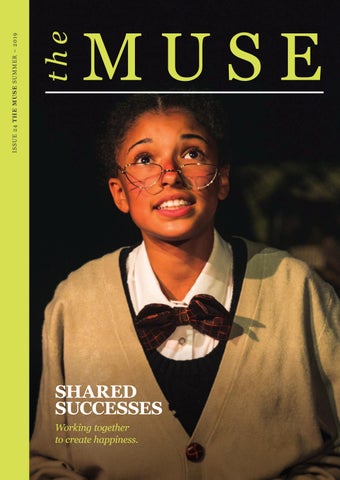
SHARED SUCCESSES Working together to create happiness.
Visits & Voyages This list is by no means exhaustive, but offers a flavour of guests in and visits out during the Summer Term.
Visitors In Alumnae Mentoring, Lower Sixth
Greek Exhibition, Year 5
Senior School Summer Concert
Annual Prize Giving Evening, with Sir Anthony Seldon, Vice - Chancellor, University of Buckingham, Prize Winners and Parents
Junior School and Year 7 Induction Day
Shakespeare Festival, Year 7
Junior School New Parents’ Evening
Sixth Form Introduction Day with Bold Voices
Junior School Summer Concert
Sports Awards Evening with Olympic Cyclist, Joanna Roswell Shand MBE
Art and Textiles Exhibition Evening, Years 9-Upper Sixth Australian BBQ for Parents, Year 3 Author Visit, Olaf Falafel, Junior School Building a Country Exhibition Evening, Year 6 Careers Day, Small Business Challenge, Year 9 Celebratory Brunch, Upper Sixth Leavers Changes and Challenges Evening, Year 6 Craft Sale, British Heart Foundation, Year 7 Dame Alice Harpur School 1985 Reunion Dame Alice Harpur School 1999 Reunion Dance Workshop with Putnoe Primary School, Year 6 German Play, El Viejo Saloon, Years 8-10 Greek Day, Year 5
Junior School Teatime Concerts Lunchbox Lecture, Jasmine Banghard, Legal Careers Lunchbox Lecture, Suzanne Perkin, Applying to US Universities
Streetfood Showcase, Year 9 The Wind in the Willows, Drama Productions, Years 6 and 7 Tudor Day, Year 4
Music Technology Evening, Years 7-Upper Sixth
UCAS Application Day, Lower Sixth
Musical Theatre Showcase, Years 7-10
University of East Anglia Webinar, Lower Sixth
Open Morning for Pilgrims Prep School Parents
Why IB? An Evening with John Claughton, parents of Bedford School and BGS Senior School
Open Morning for Polam School Parents Open Morning, Whole School Oxbridge Day with Independent Thinkers Education, Lower Sixth Public Speaking Competition, Years 7-9 Senior School New Parents’ Evening
Work the Room, Lower Sixth Write On Fiction Fest, Senior School Year 9 Independent Project Exhibition Year 11 Prom
Voyages Out Activity Day with Bedford Prep School, Year 5
Flex Friday Activities Day, Senior School
Opal Coast, France, Language Trip, Year 9
Activity Lego Morning, Bedford Prep School, Year 3
Geography Field Trip, Mid-Bedfordshire, Year 7
Preston Montford Residential, Year 6
Activity Morning with Bedford Prep School, Year 4
Geography Field Trip, River Kym, Cambridgeshire, Lower Sixth IB Students
Residential Trip to Ypres, Belgium, Year 9
BBQ and Social Event, Bedford Prep School, Years 7 and 8
Geography Field Trip, Sheringham, Norfolk, Year 10
Bedford Amateur Regatta, Whole School and Alumnae
Grafham Water Residential Trip, Year 4
Bedford Hydro Power Project Visit, Year 4
House and Alumnae Regatta, The Harpur Trust Boathouse
Brancaster Residential Trip, Year 3
Imperial War Museum Duxford, Year 10
CCF RAF Flying, Wittering, Senior School
Junior School Sports Day, Bedford International Athletic Stadium
Code Quest Computer Science Competition, Lockheed Martin, Year 10 Duke of Edinburgh Bronze Expedition, Senior School Eco Challenge Day, Cople Fields, Year 6 Eco Club Cycle Ride, Priory Park EPQ Digital Research Day, British Library, Lower Sixth Exhibition Visit to Egham School, Year 6 Faith Tour, Queens Park Bedford, Year 6 Flatford Mill Residential Trip, Suffolk, Year 6
Leavers Ball, The Bedford Centre Hotel, Upper Sixth Leavers Drinks, Parents and Upper Sixth London Alumnae Networking Event, The German Gymnasium, King’s Cross National Space Centre Trip, Leicester, Year 5 New Designers Trip to London, Years 10 and Lower Sixth Northampton Festival of Performing Arts, Selected Students, Whole School Opal Coast, France, Language Trip, Year 7
Royal CCF Inspection, Bedford School Science Museum Trip, London, Year 8 Senior School Sports Day, Bedford International Athletic Stadium Shakespeare in the Garden, The Quarry Theatre, Senior School SIX The Musical, London Arts Theatre, Lower Sixth Tower of London Trip, Year 4 University of Bedfordshire UCAS Fair, Lower Sixth University of Buckinghamshire Computer Science Lectures, Year 10 Wimbledon Tennis Trip, London, Years 11 and Lower Sixth Workshop with Royal Shakespeare Company and Shakespeare Festival at Bedford School, Senior School
Editor’s Insight
T
en years ago this summer, the announcement was made by the Harpur Trust that they intended to bring together the two existing heritage schools, Bedford High School and Dame Alice Harpur School to create Bedford Girls’ School, bringing the best of the two schools together. Ten years ago, our 2019 Upper Sixth leavers were just eight years old, starting into Year 4; the world looked and felt very different to the world today. Over those ten year’s BGS has come a long way. We have faced challenges, we have faced uncertainty, but we have thrived. In 2018 we had the best set of GCSE results, not just in the school’s history but also amongst the other Harpur Trust schools. This summer we have just celebrated similar success with the 2019 GCSE results, and seen excellent results across both A Levels and the IB Diploma. We are placed eighth in the top 100 ranking for sport in the UK, second in sport for girls’ day schools. We have achieved incredible success in the arts, in music and built deep routed connections with a vast array of outreach projects. We have achieved this by developing and delivering a forward thinking educational approach, which is best preparing your daughters for the volatile, uncertain, complex and ambiguous (VUCA) world they are entering as young women. It may be a world which is very different to what was imagined when our Upper Sixth were in Year 4, but I know that these young women leave with the confidence and skills to flourish in the challenges ahead. As a school, we want our students to understand fully how to use their intelligence and knowledge in order to lead purposeful lives. To achieve this our students need to be open-minded and global in their outlook and they need to embed a wide set of skills. In this issue of The Muse, we share some of the activities and projects that have taken part in the last term, which illustrate how we are achieving this. It is lovely to look back and see what is being attained across so many areas of the school and across such a wide age group of girls. One of the elements that impresses me repeatedly is the level of cooperation and collaboration, which creates success. Recognising that we cannot do everything
alone and that our successes are most often shared success is an important skill. Having the confidence and understanding to listen to others, to both take and give advice are very important attributes to demonstrate if we want to achieve our best. The advantages of working in a team are clearly articulated in a number of articles in this issue, including in our Junior School article, Working Together, which explores collaboration with Bedford Prep School; in our review of the stunning The Wind in the Willows production which brought Years 6 and 7 girls together (Building Camaraderie and Lasting Friendships); and in our focus on embedding Service Culture throughout BGS. Working together not only helps create greater results, but also brings about a sense of deep rooted satisfaction which comes from sharing a common moment or bond, it helps create a sense of happiness; not the flash of immediate gratification which is gained from instant pleasure, but from a sense of being part of something bigger and greater than ourselves. In July, we held our Prize Giving, we were extremely honoured to welcome Sir Anthony Seldon, leading educationalist and historian as our guest speaker. Having spent a lifetime in education (and no doubt giving many prize giving speeches!), he spoke inspiringly about the importance of directing our lives towards achieving this state of happiness, and how vital it was to be working as a community to lead richer and more fulfilling lives. As I looked around the marquee, I could see both parents and girls agreeing with everything he said. It is extremely rewarding to be part of a school where we all share this common goal and I do hope you find time to read more of Sir Anthony’s wisdom in the Inspired By article. His message is simple, sadly often overlooked, but which is at the heart of our educational values.
We have faced challenges, we have faced uncertainty, but we have thrived. In 2018 we had the best set of GCSE results not just in the school’s history but also amongst the other Harpur Trust schools.
I look forward to the term ahead which I hope it is filled with the pursuit of happiness.
Jo MacKenzie Headmistress
The Muse | 02
Inspired by
Happiness
P
rize Giving is a joyful occasion as the members of the school community gather to celebrate a whole range of achievements, not only academic but also those who have made a difference to our community. This year we welcomed the esteemed educationalist and historian, Sir Anthony Seldon, Vice Chancellor of the University of Buckingham, as our Guest Speaker. Sir Anthony has spent all of his professional life in the world of education; as a teacher, an incredibly well respected Headmaster of both Brighton College and Wellington College, and as an advisor to the Government on educational (and historical) issues. He is well known for his calls to reform the education system, to shift the pendulum away from the confines of a system that focuses purely on academic achievement. He is an advocate of the IB Philosophy of education and believes the purpose of education should be developing young people who are engaged in changing the world, and in doing so will help to alleviate human misery and find happiness. The premise of Sir Anthony’s speech was simple, we must strive for happiness. Amongst Sir Anthony’s many varied roles, he is a co-founder of the Action for Happiness; a mission that was established in 2011 with the ambition of putting the pursuit of happiness, (not to be confused with pleasure) at the centre of education. As he said at the time of its launch: “We need to reassert the case for love, for treasuring our relationships, and for celebrating life in all its richness. This happiness agenda bolsters families, communities, and personal responsibility. It is too serious a matter to be treated as flippant any longer.” Sir Anthony asked the audience to consider what was the purpose of education? How do 03 | The Muse
you define a life well spent and how do we measure intelligence? He questioned why we still judge intelligence by means of an IQ test developed in the early 1900’s by middle class men to demonstrate how bright other middle class men were? We need to ask what relevance does this play in our 21st Century world; does it illustrate or determine vital elements of intelligence such as the ability to question, to be compassionate, to empathise, and reflect? An IQ test cannot predict who will use their voices for change and who will work towards creating a kinder, more peaceful world. Globally employers are telling us that graduates often do not have the skills they need to
Happiness isn’t “ superficial, it is our deepest longing. ” Sir Anthony S eldon
succeed. They can pass examinations with flying colours but they cannot empathise, communicate ideas or believe in themselves to think creatively. Sir Anthony reminded the audience that much of what we learn, and do can be delivered through Artificial Intelligence. Machines will not need to sleep, take holiday or fall sick, there are many jobs that they will be able to perform better than humans. If we are going to have fulfilling lives, we need to measure the value of our intelligence and self-worth in different ways. Defining ourselves solely through examination results will not
create a stronger, happier or more progressive society. Appreciating what we have truly learnt through the process of studying and what we can do with the knowledge and skills we have acquired, can however greatly shape who we become and influence the life we can lead. Sir Anthony is quoted as saying: “Happiness is all about depth, which is the opposite of the superficiality of so much of modern living.” His words resonate with the founding principles of BGS, our vision is to develop young women who will go out and make a difference to their worlds and our focus is on helping every student develop her own deep-rooted sense of self-worth, so she can understand her own meaning of happiness. Like Sir Anthony, we want our students to see the difference between pleasure and true happiness that comes from intelligently striving for a life well spent. We want them to understand the satisfaction we feel for challenging ourselves to complete a task we find hard; to take time to reflect on a situation and use the experience to learn from it rather than viewing it as a failure; to accept that not every day will be a good day, moments of disappointment and self-doubt are normal. They must learn the importance of developing a balanced approach to life, enjoying sports, drama, music, and sleep. Moreover, to understand the importance of being an actively engaged member of a community, as the academic Tal Ben-Shahar, who introduced happiness to Harvard undergraduates, said: “If you want to feel good, do good.” Sir Anthony’s words were joyful, the marquee was full of laughter as he delivered an uplifting speech, which will resonate with the audiences as they, we hope, are inspired to succeed in the pursuit of profound happiness.
Building Camaraderie and Lasting Friendships
I
How a reinterpretation of a classic novel helped form new friendships.
nside the intimate Studio Theatre, there was a real sense of excitement as the space was transformed into the Wild Wood; bringing to life Kenneth Grahame’s endearingly evocative 1908 novel of riverside life. Adapted for the stage by Mike Kenny, the play retells Mole’s journey and the different friendships he makes as we meet his trusty friend Ratty, the incorrigible Toad and the stalwart Badger. One of the challenges of bringing The Wind in the Willows to the stage was how to believably create animals with human characteristics, who could retell the story in authentic fashion. Mrs Catherine Howe, Director of Drama and Dance, was impressed by how the Years 6 and 7 cast seized every opportunity: “It has been a delight to see them grow as actors, working hard to overcome the challenges of developing truthful characterisations and embracing professional production values to create a captivating piece of theatre. We recognise that the move from Year 6 to Year 7 can be daunting, but the Year 6 curriculum is structured to prepare the girls for this transition. Drama is a perfect route to help alleviate some of those nerves by developing a network of familiar faces as the girls make that change from Junior to Senior School.” Technical Director, Miss Emily Elsom said: “The camaraderie between the girls has been
joyful to see. After a few rehearsals, you stopped seeing them as Years 6 and 7, and saw an ensemble forming before your eyes. They took the initiative to go off and rehearse their scenes together, they became aware of who possibly needs that little guidance in a rehearsal. It has been such a learning experience, they really matured over such a short period of time.” For many of the Year 6 cast, it was their first professional production as Anna Whomsley reflected: “To be acting alongside the Year 7 cast who had previously undertaken a production of this scale was both exciting and daunting. The final product was brought together with the whole performance cast and also extended to the backstage runners, props managers and the design team of older year groups who were part of the Theatre Crew.” Year 7 pupil Polly Taylor added: “When I got the email telling me that I was in the production of The Wind in the Willows, I was amazed and excited. I was aware that this was going to be a challenge for some of the Year 6 cast, as for many this was the first large scale production they had been in. After just a few rehearsals, everyone was on the same page; sharing ideas, socialising outside of rehearsals, practising scenes and coming together as an ensemble. We will always share the wonderful memories and friendship from The Wind in the Willows.”
Realising and leading the design concept for the production involved the hard work and creativity of several girls from Years 9 to the Lower Sixth, who have been developing production and design skills over the year as part of the weekly Theatre Crew Club. The costumes for the four main characters were designed by Year 11 student Anna Hull; the set was designed by Year 9 students Charlotte Sanders, Tess Garrett and Stephanie West, with the assistance of Ms Charlie Gardner; and Laura Ellis and Emily Polhill in Year 9 took the lead on sound design, with Emily operating the sound in performance. Lower Sixth student, Holly Sanders provided her special effects expertise to design and create the warty Mr Toad and other fabulous makeup looks. Mrs Vivienne Redford, Head of Speech and Drama, who co-directed the production, concluded: “The collaborative teamwork on display was impressive with the whole production team working efficiently with each other to ensure the story came to life imaginatively, whilst also providing great support and mentorship for the younger students. We were very proud of them all. As Badger will remind us, ‘People come, they flourish for a while, and they go’. We hope the girls will remember Badgers words and look back on this performance with fondness.” © Andrew AB Photography
The Muse | 04
Working Together One of the many advantages of being part of the Harpur Trust is belonging to a wider community of learners and the possibilities of working together that these links open up.
L
ooking around a busy hall for Year 3 students from BGS and Bedford Prep working together to build their vision of a perfect village you can clearly see the benefits. Teams of Year 3 students are deep in discussion and carefully dividing tasks as they take the responsibility of planning and building their villages very seriously. Working together they had to consider what were the vital elements which make a village, how
05 | The Muse
will it be designed and how to engineer the buildings. They then need to carefully divide tasks and complete their build in the allocated timeframe. All of this is taking place with great concentration but accompanied by large smiles and friendly chatter. Mrs Carolyn Howe, Head of the Junior School, explained why days like this are important moments in the curriculum: “I do enjoy watching the girls and boys come together and it is really interesting to observe how they interact. There is a lot of research, which concludes that in a single sex environment girls are able to develop skills such as communication and teamwork at a greater pace; they are more willing to take risks and make mistakes in a single sex class and as a result, their inner confidence grows. However, it is important that they have opportunities to demonstrate and test their skills in a wider group, by stepping out of their comfort zones they are able to see for themselves just how much they have grown and how their confidence is developing. These are key steps in their development.” Each of the Junior School year groups works with Bedford Prep students on a range of joint learning opportunities. In addition to the Lego Village Day, Year 3 students all enjoy
joint STEM activities and a Christmas magic show; in Year 4 the focus is put on the wider Performing Arts, whilst in Year 5 the students are challenged by an outdoor learning day. By the time the girls are in Year 6, and approaching transition to the Senior School, the focus moves to providing the girls and boys with the opportunity to start to develop social skills through early evening social events. Mrs Howe continued: “Collaboration plays an important part in many aspects of our daily lives; having the flexibility to come together as a small team and to work on a specific project is a great skill to hone and these activities introduce the students to these concepts. Working with a new set of people can be daunting for many of us, so building strategies on how you can work together in different ways from an early age provides a great base.” “All the students also benefit from working with different staff who offer different teaching styles. For example, this year we ran the Performing Arts day for the Year 4 students, the boys were able to work in our state-of-theart theatre with our Drama team; whilst the Year 5 girls went to Bedford School where the dedicated Combined Cadet Force staff ran an outdoor practical problem solving challenge.
These activities not only provide the students with an insight into Senior School opportunities but also engage the students in different ways of thinking. It is always refreshing to work in new environments and this helps the students to think and behave in ways that are more flexible. In addition, there are also incredible benefits for the teaching staff, who are able to share best practice and ideas in more informal settings.” As the girls go through the Junior School, the focus on the joint days varies to help highlight different attributes, to encourage the students to hone key skills. The focus on Performance in Year 4 really asks students to move beyond their comfort levels, as they are encouraged to perform in front of a wider group. This provides opportunities to try new challenges but also to think and work creatively, providing immediate response to different creative stimuli. A further highlight for the Years 3 and 4 students is the joint Christmas Magic Show. A lovely prelude to the Christmas holidays, it provides a chance for the children to form friendships. Many of our students will be at BGS and Bedford School for over 10 years and the friendships they build with each other
during this time will often last a lifetime. We start gradually introducing social as well as academic opportunities into the programme so they can start to develop these friendships.
“By introducing concept and joint activities in the Junior School it becomes a platform from which the girls take advantage of
opportunities to collaborate in the Senior School, both intellectually through joint societies and collaborative IB Diploma
“ Working with a new set
of people can be daunting for many of us, so building strategies on how you can work together in different ways from an early age provides a great base
”
work, but also co-curricular through music,
CCF and drama events. These roots can be well established in the Junior School in a supportive environment “
As a School, we work with a much wider range of schools that are equally as
important for the girls. We have a number of local primary schools who join us for dance workshops. We enjoy schools coming in to
share our STEM activities and to watch some of our performances, but our relationship
with Bedford School enables us to go a little bit deeper and really plan a programme Mrs Howe added: Once in Year 6 it seems appropriate, in the pre-teen year, to arrange social activities that will then be built upon in the Senior School. Making sure that young people are comfortable and relaxed around each other is an important part of a balanced approach to life, and over the past few years pizza nights or BBQs have proven to be very popular.”
which dovetails both our curriculums.” Mrs Howe concluded.
Taking a final look at the range of Lego
villages, it is clear to see that the students
have risen the challenge and had great fun in the process, although we do pity the person who had to sort out all those little pieces of Lego on the floor!
The Muse | 06
SERV ICE CULT UR E
F
rom pledges to supporting equal education for all, to a giant whale tail made out of waste reminding us about ocean pollution, these visual stimuli signify how deeply rooted the culture of active service is in the BGS community. Ms Heather Dawson, Biology teacher and CAS (Creativity, Activity and Service) Coordinator explained: “Our school’s ambition is to develop young women who will go out and make a difference to the world around them, who have the intellect and skills to be active members of their chosen communities. We need to help them develop a sense of selfresponsibility and an understanding of how to be an effective catalyst for change.” Ms Dawson continued: “It is easy for students to be busy raising money without understanding why; how many cake sales have we given money too without even registering the organisation or handed in another £1 for a non-uniform day without asking who is the beneficiary? Community engagement must not be a tick box exercise. We want our girls to be responsible for their academic learning and we want to replicate this mind-set in all aspects of their lives; learning to take responsibility for their work in advocacy and charitable giving is an important part of their education at BGS. 07 | The Muse
Walking through the corridors and you become instantly aware of the range of community and service projects that the School is involved with at any one time.
“We build empathy and a global mind-set with our students, so that they demonstrate inclusivity and compassion, by encouraging them to consider, discuss and work alongside a wide range of issues we are gradually helping them develop these attributes.”
always being a voice for change, through their words and their actions. The programmes are developed so that they build more confidence and independence at each stage; they deepen their engagement and expand their tool-set to create action.”
In the Junior School, enquiry led learning lends itself perfectly for wider discussions and exploration of both local and global issues and the students are introduced to supporting and campaigning for UK and international charities. In addition, the Junior School Student Voice spearhead campaigns each year to support local charities.
Earlier in the Summer Term, Year 7 worked in teams to be the Voice of Change. Students had to select a UK charitable cause, create a presentation to give to their fellow form members and compete to host a fundraising stall. Under the central premise of utilising research and communication skills outside of curriculum subjects, the girls had to consider how to engage an audience through a persuasive speech, which would appeal to both hearts and minds. To do this the girls had to research effectively, to understand the values of their chosen charities, and then think carefully about how to gain traction when they presented.
From Year 7 to the end of the Upper Sixth, all students participate in community and service programmes, to help build skills and to understand the relationship between emotional and rational responses to social issues and causes. The service programme is both woven into the curriculum and developed as stand alone projects and introduces them to different avenues of service, from running awareness campaigns, organising fundraising events, to arranging donation drives and developing funding pitches. “By introducing them to so many different aspects of philanthropic behaviour, we hope they learn to appreciate the importance of
The winning team from 7CAB pitched in support of the British Heart Foundation and held a lunchtime fayre selling homemade heart shaped items, raising nearly £200 in the process. They learnt teamwork and organisation skills and had the huge satisfaction of being presented a cheque and explaining their campaign to a representative from the charity.
“ Giving is not just about making a donation; it’s about making a difference. ” Kathy Calvin, CEO United Nations Foundation
Miss Dawson went on to explain that in the Autumn Term Year 8 will launch a new project. They will be tasked with running charity drives, where donations of goods will replace that of money. Working independently they will select a cause, do their due diligence and understand what items are needed and consider how to persuade people to donate. “An easy task on the outside, but we are all inundated with requests to donate and this is a test of how you can be effective in your management of a campaign, keeping momentum to ensure donations come in.” These skills will benefit the girls as they move into Year 9 and take on the Educate Girls mantle. This global initiative focuses the girls minds on global injustice and helps them to explore the concept that even from Bedford they can still become voices for global change. The commitment with which they embrace the Educate Girls campaign each year is impressive as they bring together the skills they have practised further down the school to create a year-long programme. In Year 10, students step out of their comfort zones to work more intensively with local organisations. They reach out to charities and arrange to meet them, they have to start to understand the organisations objectives and how it is funded, and in conjunction
with the organisation identify a specific area which would benefit from funding. Teams of students then pitch their funding proposal to a panel. Called Giving Forward, the idea of the project is to help students understand the realities of running a not-for-profit organisation and to be made aware of the pressure and challenges that they face in terms of funding priorities. Delivering funding pitches to an external panel is a big ask and the girls rise to the challenge. The project is hugely successful and builds longer term links between students and local organisations, many of which are revisited in the Sixth Form. During GCSEs, the girls do not take on additional charity projects, but many are involved in Duke of Edinburgh programme, so continue with volunteering work for local organisations with whom they have built links. Earlier this year, the School launched a compulsory project for the Lower Sixth called The Campaign Challenge where the girls worked in their tutor groups to identify and build a campaign for an issue and run it over a given four week period in the Spring Term. The success of each campaign was evaluated on how widely their messaging spread; the level of awareness they managed to create in
a crowded environment and how they used creativity to convey messages. At the end of the month long campaign the girls were asked to reflect on their work and through this build knowledge and expertise which they could transfer to other situations. Projects included throwing light on mental health issues, addiction to painkillers, ocean pollution, the environmental impact of instant fashion and isolation in the elderly. Ms Dawson comments: “During the reflective panel the girls were asked to discuss what they did well, what they found challenging and what transferable skills had been learnt. It was impressive to listen to their thoughts, they demonstrated a great ability to objectively analyze their work.” Ms Dawson concluded: “As global citizens, it is vital that our students are active participants in change; that they have the confidence, and skills to challenge the status quo and help create a difference in the world. By integrating CAS into the curriculum we are helping the girls along this path; witnessing the commitment, understanding and enthusiasm with which they embrace these projects is extremely rewarding and demonstrates the long term value of our approach.” The Muse | 08
lare Blampied
Your School, My School Dame Alice Harpur School
Clare Blampi
1981 alumna Clare Blampied OBE is the founding Managing Director of Sacla UK Ltd. She is affectionately referred to as the original ‘Pesto Pioneer’, credited with bringing Pesto to Britain. Clare was awarded an OBE in 2016 for her services to the food industry. Chloe B
BGS Head Girl for 2019-20, Chloe Boul joined the School in the Lower Sixth from Laney High School in Wilmington, North Carolina, USA, and is studying Chemistry, Further Mathematics and Physics at A Level. Chloe has aspirations to study Natural Sciences at Cambridge.
09 | The Muse
ou l
ed
What are your memories of your
What are your favourite subjects
How did school/teachers shape your
first day at school?
and why?
value and aspirations?
Clare: Moving from North Wales I joined
Clare: My favourite subjects were Home
Clare: The teachers operated a highly
as a boarder in 1974 when Miss Morse
Economics and English. Mrs Proudfoot was
disciplined environment with an emphasis
was the Headmistress. I have a very clear
a very inspiring teacher and her lessons
on organisation and management of time.
memory of my first day in Howard House
were like a Cordon Bleu cookery course.
We were encouraged to be resourceful,
and its huge staircase. I was wearing an M&S kilt, a white knitted jumper and black patent shoes. For the occasion, I had made a necklace out of dried Honeydew melon seeds! We were five girls in a dorm and the provisions were pretty basic, the water always seemed to be cold. I do remember fondly the chocolate shortbread pudding with chocolate sprinkles, less so the semolina! School was pretty strict and you always stood to one side when Miss Morse was walking along the corridor. Uniform needed to be worn correctly – top button done up, tie worn and no short skirts. Skirts were routinely measured. On my last day I threw my straw boater off the bridge much to my Mother’s dismay! Chloe: From my first day of school, when I was five, I only remember that I matched my twin sister in what I was wearing and I desperately wanted to start reading books from the classroom’s library at nap time instead of sleeping. On my first day at
Mrs Betts and Mrs Wright as English teachers were very encouraging in helping me improve in this subject area. They would mark my essays and then give me another title to work on in my lunch hour and remark. Looking back, their input and dedication were incredible. I also enjoyed Textiles and being away from the rest of the school. It was a very serene environment. Chloe: Definitely Physics because the topics we study are like Maths but with more doing and less theorising. Coming from the US educational system I have never really done any kind of practicals before so they are all rather new to me and I mess them up quite often but still enjoy them! My other favourite subject is Chemistry, mostly because some solutions end up turning pretty colours, and you feel pretty cool when you get something right. If you could have your school years again is there anything you would do differently?
independent and have practical skills. The teachers expected high standards from us and operated high standards themselves. They always made themselves available and from this I learnt a lot about working as a community and its importance. Continuous improvement was encouraged; if you haven’t failed, you haven’t tried was the message. I have actively used this approach in my professional life, setting up focus groups within my company to moderate all areas of the business. Be curious in life and it will take you on an interesting journey. Chloe: Some of the teachers I had early on were really awesome and this made me think that I should be a teacher when I grow up. I have started helping out the teachers in lessons by teaching younger kids when they were busy. This really made me realise that teaching is what I want to do. I have yet to meet a teacher who hasn’t encouraged me and told me to go for it. I can honestly say that teachers have been a huge part of making me who I am today.
BGS, I once again matched my sister, but
Clare: I would have embraced sport
this time struggled with quite a few more
rather than have made excuses and I would
Sum up your school days in three
buttons than I’d had the last time. I was
have also stood up for myself a bit more.
words or more?
super nervous but everyone was really nice
However, I am not someone who likes to
and helpful. The school felt like a giant
dwell on the past, preferring always to look
maze, and I almost got lost at least twenty
forward
times, but I made it through the day admittedly with a lot of help, but still.
Chloe: Stress less, sleep more. That’s
Clare: Enormous freedom within a framework. Chloe: Oh my days...
pretty much it. Apart from that I’m happy.
The Muse | 10
THE WORLD AT YOUR FEET
R
esilience, camaraderie and a sense of adventure – Geography is a subject that not only evokes these facets, but also helps us better understand the places we live in, why they matter and how they are connected to a globalised world. From understanding everything from how and why volcanos are formed to the impact of overcrowding in urban areas; Geographers are integral to help find solutions to some of the biggest issues in the world, such as climate change, urban over-development and natural disasters. Ms Seri March, Head of Geography, explained: “Through studying geography, our students begin to appreciate how places and landscapes are formed, how people and environments interact, what consequences arise from our everyday decisions, and what a diverse range of cultures and societies exist and interconnect. It is an umbrella subject because of its capacity to make tangible and effective connections across other subjects.” The foundations of Geography are at the core of the Junior School curriculum, where the building blocks of deeper explanation and understanding provide entry points to geographical conversations from around the world. From Year 3, local geography is contextualised through the Discovery Box, Unit of Enquiry. Pupils learn about and develop an understanding of the geographical features in the locality, through the study of both the human and physical geography of the area. The enquiry approach to learning is one of
11 | The Muse
geography’s strongest assets. By the time a pupil reaches Year 6, they will draw on their geographical investigation skills throughout the Building your Own Country project, which gives them total freedom to be creative, independent and take risks.
“ I looked at books,
I looked at maps, I looked at atlases, I enjoyed that, but the thing that inspired me most of all was being taken from the school into the local area to look at nature.
”
Sir Michael Palin, comedian, actor, writer and travel documentarian.
Studying Geography outside the classroom truly ‘broadens the mind’. Ms March, expanded: “The best way to develop your field skills is to immerse yourself in the environment. We allow our students to witness first-hand some of the world’s most spectacular natural wonders, explore interactions between people, place and environment and understand contemporary geographical challenges. Learning through adventure develops a deeper and richer understanding of concepts taught in the classrooms. However, most importantly, allowing
you to connect to various communities and cultures.” The wonderful aspect of Geography is that it can be studied at local level. From Year 3, pupils begin to formulate questions, develop their intellectual skills and find answers to issues affecting their local area. Questions such as what is it like to live in/near Bedford? What was it like to live in Bedford in the past? Who lives around here? Why do they live here? What jobs do they do? Can I ask and answer geographical questions about the physical and human characteristics of a location? To answer these questions they are introduced to distinctive investigative tools such as maps, fieldwork and the use of digital resources. The study of local geographical locations continues when pupils begin their Senior School journey. Ms March added: “During the Spring Term, Year 7 pupils enjoyed a whistle-stop tour of mid-Bedfordshire, which involved investigating the relationship between landscape, rock type and economic activity. The girls spent the day making observations and sketches on geology and land use in and round mid-Bedfordshire. Stops included Stewartby, the Millennium Country Park, Ampthill, Sharpenhoe Clappers and Barton-le-Clay.” Linked to the study of Italy in Year 7 and natural hazards in Year 8, pupils will have the opportunity to bring their learning to life during the short trip to Sicily, next spring. The island of Sicily, just off the southern ‘toe’ of Italy, will
give our geography students the perfect opportunity to see so many of their coursework topics outside the classroom. They will get up close to Europe’s most active volcano, Mount Etna, exploring its fiery collection of lava flows, volcanic rocks and parasitic cones. The trip also links with students studying Classics and Latin, where they will gain a deeper understanding of Greek and Roman civilisation, exploring the stunning Mediterranean island steeped in history and culture. During the Easter holidays, pupils from Years 9 to the Lower Sixth had the fantastic opportunity to explore Iceland. Truly unmatched in its natural splendour, Iceland is a haven of unspoiled landscapes, extraordinary scenery and geographical gems. Mrs Sara McPhail, Geography teacher, added: “Iceland really is a geographer’s dream. It fits perfectly with topics covered at GCSE and A Level/IB and even for non-geographers it is a very special place, where you can stand on the Eurasian plate one minute and the North American plate the next. It has everything, from spectacular waterfalls to amazing geysers.”
Year 11 pupil Holly Smith enjoyed witnessing Iceland first hand, she said: “From walking up a volcano to taking a dip in the Blue lagoon, we had so many fantastic experiences in Iceland as we put our geography skills into action. However, the highlight of the trip for me would have to be Gullfoss and Skogafoss waterfalls. Paired with the sunshine and snow, the sights at Gullfoss were magical, and after climbing 370 steps up to the top of Skogafoss, my breath was actually taken away by the view!” It is important for students to stretch their minds, challenge themselves and to think out of the box. Mrs McPhail elaborated: “In addition to trips, as teachers we are always seeking many ways to engage our pupils outside the classroom, and I feel The Young Geographer of the Year national competition does just that. This year’s competition theme is ‘Where can Geography take you?’. During the summer holiday, our Year 7 pupils will be investigating geography all around them and completing their entry for The Young Geographer of the Year.”
The number of students studying Geography continues to grow, with Geography graduates having one of the highest rates of graduate employment, pursuing various careers paths (Royal Geographical Society, 2018). Ms March, added: “Geography graduates enjoy free rein over their chosen career path as they are seen as highly employable due to their combination of transferrable skills including problemsolving and critical thinking. Geography helps you to investigate the complexities of world both from the human and physical aspects. Furthermore, graduates can go into a range of occupations and areas of further study including town planning, cartography, surveying, environmental campaigning, landscape architecture and meteorology. However, due to the wealth of transferable skills gained, these can carry you into more general careers such as IT, finance, marketing etc.” Ms March concluded: “Through active engagement in Geography, pupils are enabled to learn not only about the world but also how it works, how it fits together and importantly, how to make a difference and become positive contributors to it.”
The Muse | 12
SPORT I NG A SPIR AT IONS expressed by double Olympic champion cyclist, Joanna Rowsell Shand, who was the guest speaker at the Sports Awards evening in the Spring Term.
B
Mrs Mason-Mcleod commented: “The Sports Award evening not only recognises and rewards the extraordinary achievements of our girls, but also introduces them to inspirational role models. It is important for the girls to see high achieving women, who are resilient, determined and courageous – Joanna has embodied these principles throughout and after her cycling career.” Christine Pearson, Sports Captain elaborated: “Joanna demonstrated that it is possible for everybody to succeed, no matter how many setbacks they come across. I am sure that I am speaking on behalf of everybody in saying that we were all inspired by Joanna’s story, and that she is an influential role model to many young female athletes across the globe.”
I
n the 2016 Rio Olympic Games, Team GB took its highest ever contingent of female athletes to an away Games, with 162 women selected as part of the 366 strong team. As the Games progressed, these athletes competed in 21 of the 23 sports in which Team GB had qualified places and returned from Brazil having contributed to 26 of the total 67 medals, including a gold for Joanna Rowsell Shand. These medals not only marked record-breaking achievements, but also signified the growing number of inspiring role models who have amplified women’s voices in sport – empowering girls from a young age to realise their potential on and off the field. The Muse sat down with outgoing Director of Sport Mrs Jane Axford (Assistant Head 13 | The Muse
Mrs Axford added: “It is important for our pupils from all age groups to see the incredible achievements of athletes such as Joanna and know that they too can accomplish such great feats both in their sport and later in their careers and personal lives. Experiential Learning) and our newly promoted Director of Sport, Mrs Verity Mason-McLeod, and some BGS students to discuss the importance of role models in sport. Mrs Axford said: “Increasing the visibility of women in all realms of sport and physical activity should be considered as a tool to aid the next generation of girls to feel inspired to maintain interest in the field and beyond. We believe that it is important for our girls to set goals, have dreams from a young age and the perseverance needed to make those dreams come true.” It’s easy to believe Olympic and World Champions are born with medals around their necks – however, this is not the case. The journey to reach the highest levels in sport is not smooth sailing; this was eloquently
“The strength of the school’s sporting facilities and coaching staff allows the girls to enjoy more than 1,500 annual fixtures over 10 disciplines against some of the best independent and state schools in the country. Many of our girls pursue different sports outside of school and we value their sporting interests and successes whether they are in cricket, cycling or golf to name a few. This formula has not only led to the school achieving an array of national and regional titles but also developed incredible future talent.” All students have full support from all staff when balancing their academic work with extra-curricular activities. Current Sixth Former, Sophie Lewis, who is part of the Great British Cycling Team Junior Academy Programme and was awarded Sports Woman
of the Year Award at the Sports Awards Evening, said: “My biggest challenges this year have been stepping up to racing in the elite women’s category in some of my races, as I am having to compete against people who are full time cyclists. It is tough fitting in six hours on bike training sessions a week and one or two gym sessions, as well as studying four A Levels, but you just have to plan ahead and be organised.” Year 8 student Amelia Barrow Jones, who balances cricket and hockey alongside her academic studies added: “I love the intensity of my cricket and hockey sessions. Recently, I have been given the opportunity to train with the Bedford Hockey Club Ladies teams, which has allowed me to push myself to the next level in hockey. In cricket, I am part of the Buckinghamshire County Emerging Players Programme (EPP) and captain the U13 county squad. I play a lot of cricket matches for county and club as well as summer league hockey and so I can keep the level of my hockey high, the schools support is important to help me balance all of my sport.”
did not go as I had hoped as I injured myself one month before the competition. I was disappointed with my performance as I had high expectations, as every athlete does, but the whole experience helped me to become a mentally stronger athlete and more determined to be selected the following year.
“ I can’t control how fast
others ride. All I can affect is how fast I ride. And with my alopecia, I can’t control if my hair grows, so I focus on wigs and make-up instead.
”
Joanna Rowsell Shand MBE, Olympic, World and European Champion Cyclist.
Mrs Mason-McLeod elaborated: “As a department, we build character through sports – by developing a positive mind-set with all our pupils they will stretch their abilities, take inspiration from other athletes and believe setbacks help you learn. One of the greatest challenges many of our aspirational athletes face are dealing with setbacks from injury.”
“One year on, due to my hard work and dedication, I have achieved the qualifying standards for the 100 metres, 200 metres, 75 metre hurdles and long jump. My goals for the future are to continue to compete at a high level and to represent my country at international competitions.”
Talented Year 9 track athlete, Etienne Maughan has experienced injury setbacks in her young career, she said: “In 2018, I was selected to compete for my county at the very highly regarded English Schools Athletics Championships. However, my preparation
Perseverance and persistence have been key in Natalie Simmons cross country career. The Year 9 athlete reflected on her English Schools Cross Country Championships experience: “For the past two years, I have been lucky enough to compete in the English
Schools Cross Country Championships, However, disappointingly both Championships haven’t gone to plan. In my first year I tripped over, which resulted in a top 100 finish. The following year, I was spiked in the heel and had to stop after falling over multiple times due to missing a shoe. However, these experiences have made me more determined to do better next year and to hopefully represent my country in future international competitions.” The ability to work together towards a common goal is also an essential part of team sports, as well as an important life skill, which has been demonstrated globally by the England Women’s Football Team who reached the World Cup semi-finals in France 2019 and the incredible performances by our athletes at the 2019 National Schools Lacrosse Championships. Sports Captain and 1st lacrosse team player, Christine Pearson reflected: “The 1st Lacrosse team had a busy year training hard, in order to be better equipped for a successful National Schools. As a result of all of the hard work from the team and coaches, we progressed to the quarter finals, placing in the top 8 of the country - a position reflecting not only the strength of the team, but also the support that all of the team members had for one another.” Mrs Mason-McLeod concluded: “The influence of positive role models on aspiring athletes, both in competition and in life, is vital. More importantly for our girls, having a role model such as Joanna is an important part of social learning that allows them to emulate the positive aspects of attitude, work ethic and setting aspirational goals.
The Muse | 14
Legend in their Lifetime
Sarah Rogers Learning Resources Manager
J. K. Rowling OBE
Author, Humanitarian, Philanthropist - Born 1965 Joanne Rowling was born on 31st July 1965 and grew up, surrounded by books, she said: “I lived for books…I was your basic common-or-garden bookworm, complete with freckles and National Health spectacles.” From an early age Joanne wanted to be a writer. She wrote her first book at the age of six – a story called Rabbit.
and excitement than its predecessor.
Supermarkets held midnight launches, with books delivered by the crateful
to members of the public who would
dress as their favorite Hogwarts wizard.
Sophisticated book jackets were designed to satisfy the growing number of adults
enthralled by this magical world, reading them on a commute to work or to their children at bedtime.
I was privileged to be part of a reading
“
J. K. Rowling re-engaged young adults with the world of literature and has gone on to be an amazing role model to a new generation.
”
revolution that has inspired and influenced an entire generation. J.K Rowling
re-engaged young adults with the world of literature and has gone on to be an
amazing role model to a new generation. As someone who has risen from poverty
to fame and fortune, she has made a point of giving back to those less fortunate. In
her 2008 Harvard commencement speech Very Good Lives: The Fringe Benefits of Failure and the Importance of Imagination, she stated, “[Poverty] is not an ennobling
A
s a young child I would take a weekly trip to my local public library and watched enthralled as the librarian
carried out what appeared to be pure witchcraft, finding the location of books from wooden draws full of handwritten cards, and placing brightly colored tickets in each of my precious books. My passion for reading and libraries grew and in 1997 I found myself at the University of Brighton, studying a BA Hons in Information and Library Studies, the very same year as J. K. Rowling’s Harry Potter and the Philosopher’s Stone was published, quickly becoming a bestseller. The rest, as they say, is history.
Joanne went to school at Wyedean Comprehensive School and then went on to study French and Classics at the University of Exeter. Her Classics studies would come in very handy later when she was thinking up all the spells in Harry Potter. The Harry Potter books have since broken many records. In 2007, Harry Potter and the Deathly Hallows became the fastest-selling book ever, selling 2.65 million in the first 24 hours in the UK.
experience. Poverty entails fear and
J.K. Rowling first had the idea for Harry Potter in 1990 while delayed on a train travelling from Manchester to London King’s Cross. Over the next five years, she began to plan out the seven books of the series. She wrote mostly in longhand and amassed a mountain of notes, many of which were on scraps of paper.
in 80 languages, and over 500 million
As a professional librarian I have witnessed firsthand the legacy of the Potter phenomenon. Reading was suddenly cool again. Each book reached more dizzying heights of hype
stress and sometimes depression; it
means a thousand petty humiliations and hardships.” With this mind-set, she has
gone on to support numerous charities.
In 2011, she donated 16% of her total net worth, equal to about $160 million.
Personally, one of J.K Rowling’s most endearing attributes is her desire and
ability to remain a very private individual. The Harry Potter series is now published copies have been sold across the world. The films, merchandise and theatre productions have led to worldwide
notoriety but her appearances are rare
and her family and private life are fiercely protected. In a world where many seek constant attention, it is refreshing to
see an individual who has not let her
international success and staggering
wealth change her, but given her the tools to make positive changes throughout the world.