the
ISSUE 23 THE MUSE SPRING ~ 2019
MUSE
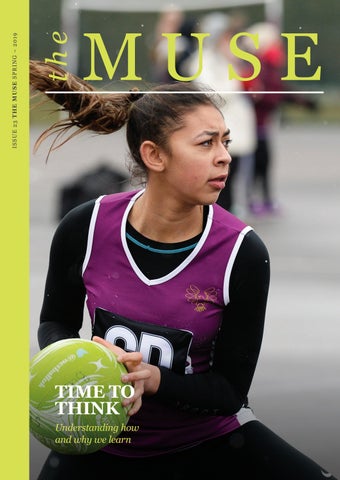
TIME TO THINK Understanding how and why we learn
Visits & Voyages This list is by no means exhaustive, but offers a flavour of guests in and visits out during the Spring Term.
Visitors In Alumnae Mentoring Workshop, Lower Sixth
House Times Table Challenge, Whole School
Open Morning, Whole School
Apple Distinguished School International Visitors, from Europe and Asia
IB Visual Arts Exhibition, Senior School
Performing Arts Workshop with Bedford Prep, Year 4
Arctic Explorer Visit, Mr Jonathan King, Year 4 Author Visit, Holly Smale, Senior School British Biology Olympiad, Upper Sixth British Science Week, Whole School Careers Evening, MFL and English, Year 10-Sixth Form Charity Lacrosse Match against Bedford School, Years 11 and Sixth Form Chinese Lion Dance Workshop, Year 6
Intermediate Mathematics Challenge, Years 9 and 10
Psychology Speaker Event, Clinical Psychologist Dr Alex Harbourne, Years 11-Upper Sixth
Junior School Teatime Concert, Years 3-6
Senior School Curriculum Conversation, Metacognition and Self-regulated Learning
Kier Visit, International Women’s Day, Senior School Lunch Club Lunchbox Lecture, Alison Bloomfield, Oxford Media and Business School, Senior School
Dance Production, Impressions, Whole School
Lunchbox Lecture, Daisy Culver, Accounting, Senior School
Drama Production, Euripides’ Iphigenia, Years 9 and 10
Lunchbox Lecture, Dr Amal Marogy, Aradin Charitable Trust, Senior School
Educate Girls Film Night, Years 3, 4 and 9
Lunchbox Lecture, Ellie Pryer, Calligraphy, Senior School
Evening of Dance Higher Education Evening, Lower Sixth House Competition, Ready, Steady, Cook! Senior School House Cupcake Competition House Ergo Rowing Competition
Voyages Out
Lunchbox Lecture, Hannah Shires and Amanda Stopp, Civil Engineering, Senior School Lunchbox Lecture, Harriet Brettle, From Maths to Outer Space, Senior School Lunchbox Lecture, Rachel Collingwood, The Girls Home in Granada Charity, Senior School Lunchbox Lecture, Sophie Alabaster, Music, Senior School
Bedfordshire Festival of Music, Speech and Drama, Whole School
Mind Mapping Workshop, Bedford Prep School, Junior School
Black Country Museum Trip, Dudley, Year 7
National Schools Lacrosse Championships, Senior School
British Museum Trip, London, Year 3 CCF RAF Ground Competition, RAF Honnington, Senior School Challenge and Extend Trip, Holocaust Workshop, The Higgins, Year 9 Spring Chamber Music Concert with Bedford School Classics Lecture Day, London, Lower Sixth Dance Competition, University of Bedfordshire, Years 9 and 10 Drama Trip, The Oresteia, Years 9-Sixth Form
Old Bedfordians Careers Fair, Bedford School, Sixth Form Philosophy and Ethics Lecture Day, London, Years 10 and 11 Politics Trip, New York City, Philadelphia and Washington, D.C., Sixth Form Rock Night with Bedford School, Quarry Theatre Rowing Ball, The Bedford Centre Hotel, Bedford Rowing Training Camp, Hazewinkel, Belgium, Years 10-Upper Sixth Scott Polar Institute Trip, Cambridge, Year 4
Geography Trip, Iceland, Years 10-Lower Sixth
Ski Trip, Madonna di Campiglio, Italy, Years 7-Upper Sixth
Junior Mathematics Challenge, Cambridge, Years 8 and 9
STEM Ambassador Training, Goldington Academy, Junior School and Year 9
London Cultural Trip, Year 5
The Association, Burns Night, Bedford School
Mathematics Trip, Airbus Foundation Discovery Space, Stevenage, Year 7
The Big Bang UK Young Scientists and Engineers Fair, NEC, Birmingham, Senior School
Maths Feast, Milton Keynes, Year 10
WE Day Conference, Year 10
MFL Trip, Valencia, Year 9
PSHE Day, Positive Relationship, Year 9
Junior School Curriculum Conversation, Enhanced Curriculum
Senior School Informal Lunchtime Concerts Sigma Society Lecture, Mr Philip Coggins, Sixth Form Spanish Play, El Viejo Saloon, Years 8-10 Speech and Drama Evening Spring Chamber Concert The Association, Quiz Night World Book Day Celebrations, Whole School
Editor’s Insight
H
ow often do we really take time to think about what we are doing? To think deeply about the strategies we are employing when faced with a problem or learning something new? I know, like many of us, I can go from one task to another, without taking time to really consider the job in hand, only to realise afterwards that if I had slowed down and given it more consideration in the beginning, I could probably have completed it more effectively. When we do take time to reflect, we tend to focus more on what went wrong, rather than considering what went well, or how we can use those positive lessons to improve next time. Thinking about thinking, or the process of metacognition, is an important part of learning, and in this edition of The Muse, I hope we are able to throw light on why. Educational research highlights that the process of engaged deep thinking can significantly improve attainment. It is an important attribute to embed in our students and we aim for these processes to become second nature whilst they are still at school. Last term, our Senior Deputy Head, Mr John Gardner, hosted a Curriculum Conversation on this subject, and together with Biology teacher, Mrs Helen Woolley, demonstrated how metacognition translates into a classroom setting, I hope you find their article Thinking about Thinking an insightful read. We continue to explore this theme in our Inspired By piece, as we look back at a fabulous inquiry project in Year 5 where they were challenged to select the Eighth Wonder of the World. Working collaboratively, the girls had to pull together all of their known knowledge to select and create a compelling case for a new wonder before judging other nominations. When it came time to judge, the teams peer-reviewed each submission, leaving comments of praise, or improvements for each other. Throughout this exercise the girls assessed which elements were successful and which were not, and most importantly, they could apply these outcomes to their future work. All whilst having a great deal of fun. I was extremely interested to see how musicians are intrinsically using cognitive processes in the way they learn, as explained by Music teacher, Mr Ben Atkins, in his piece on the neurological benefits of Music. Ben describes
how he attempted to learn snowboarding in a day, using strategies he would ordinarily apply to learn new music. Through hours of practice and self-appraisal he knew which techniques worked best for him, and therefore honed the new skill at a quicker rate than many would manage. His article Music Minds is a fascinating read. In the article, Meaningful Mentorship, we outline a number of successful schemes, introduced over the past eighteen months into the School. Mentorship is a powerful tool to help individuals reflect and gain new perspectives through which they are then able to move forward with confidence, to see their potential. I am particularly proud to have our alumnae to student mentorship scheme up and running, thanks to the hard work of our Alumnae Chair, Mrs Kate Whitlock and our alumnae volunteers who are kindly giving their time and expertise to work with Lower Sixth students. The conversations and guidance are invaluable, helping our students crystallise their thoughts and aspirations; fine-tune their plans and develop personal organisational skills. It is fitting that our Legend in their Lifetime is Michelle Obama, a great advocate for the power of mentorship, support and role models in young people’s lives.
It gives me great pleasure to report that BGS is ranked as the second best all girls’ independent school for sport in 2018.
Finally, it gives me great pleasure to report that BGS is ranked as the second best all girls’ independent school for sport in 2018. This has been made possible through the dedication and commitment of our incredible PE department and the culture they create at BGS, where hard work, continual practice, reflection and focus on teamwork creates powerful performances across every age group in all of our sports. An impressive achievement. I look forward to seeing many of you at BGS this term, both on and off the sports field. Best wishes
Jo MacKenzie Headmistress
The Muse | 02
Inspired by
The Wonders of the World
Last term Year 5 students went on a global journey, investigating and assessing what it takes to be considered a Wonder of the World. What would get your vote?
I
ndependent inquiry and building
Mrs Davinia Inkson, Year 5 teacher expanded:
peer reflections on each other’s work and vote
intellectual confidence are at the core
“Once the girls were engaged with the concept
for a final winner.
of the Junior School enhanced
and had a level of understanding, we wanted
curriculum and each term the girls are
to explore how far they could independently
Mrs Rachel Baker, Year 5 teacher noted: “It was interesting to observe the different
introduced to new challenges and questions. In
extend and challenge themselves in their
the Spring Term, the girls were introduced to
intellectual thinking.”
the Seven Modern Wonders of the World.
The year group all came off timetable and
collaborative approach within their teams -
Mrs Jennie Thomas, Year 5 teacher explained:
were put into new teams for a mini-project,
some would delegate set tasks and explore
“We want the girls to be intrigued by the world around them and to be keen to find out more. Introducing them to the Seven Modern
collaborating with peers from other classes, working alongside girls they may not know that well or may not have had the opportunity to
strategies of planning and organisation across the groups. The girls very quickly found a
a number of possible avenues, whilst other groups came quickly to a decision on what they would nominate and spent time building
Wonders of the World allowed us an entry
work with before.
point into investigating great architecture for
They were then set a simple central question,
engaged, the creative energy was incredible.
If you could choose the Eighth Wonder of
“We were also very impressed by the different
our Unit of Enquiry, Grand Designs. By asking them to consider why one building stands out from another and to really think deeply about what makes something a ‘Wonder’, we were able to open up whole new areas of learning and knowledge. “We led the girls into the unit with a series of questions; What makes a Wonder? Where are
the World, what would it be and why? Their task was to nominate a potential Wonder and develop a persuasive presentation to convince the judges to select their submission as the Eighth Wonder. Over the course of an afternoon, the girls had
their presentation. Every single girl was totally
approaches taken to create their submission. They had total freedom to present their findings in any way possible, so they had to think about what would capture the audience’s imagination. Final presentations ranged from models, beautifully decorated presentation
to work entirely independently in their teams.
boards and slide shows, to impressive use of
they? How do they get awarded this Accolade?
They had to shortlist and agree on an iconic
virtual reality technology to create 3D iMovie
What criteria would they use if they were
building or place to put forward; find resources
tours of their sites. In every case the teams
deciding on a Wonder? Having discussed all
to use for research and decide what information
demonstrated their skills as they researched
of the questions, the girls then researched
was important, and then create a compelling
information, thought carefully about how to
independently to find out more about one of the
presentation to promote their submission to
present data and most importantly how to build
Seven Wonders and presented their findings
the rest of the year group. At the end of the
a compelling and persuasive argument to try
back to their class.”
afternoon, all girls were asked to give peer-to-
and secure votes.”
03 | The Muse
Nominated Wonders included: Stonehenge,
work; they really took on board what other
their project, so that everyone had a distinct
The Easter Island Heads, The Sydney Opera
teams had done differently and were ready to
role, which would have made a more effective
House in Australia, The Burj Khalifa in
offer praise. Having all started from the same
use of time. Other groups reflected that they
Dubai, The Statue of Liberty in New York,
point the girls had a level playing field and
should have spent more time doing a greater
The Leaning Tower of Pisa in Italy, and
they could therefore really appreciate it when
depth of research so that they had more
The Sagrada Familia in Barcelona.
a team had achieved something particularly
information to support their arguments.
Mrs Inkson added: “The girls really enjoyed
impressive and were willing to learn from that.”
finding out about new places from each other,
said Mrs Baker.
there was wonderful peer-to-peer learning.
Mrs Thomas agreed: “There were some
We could see confidence increasing in the girls as they shared their ideas and the rest of group gave them positive feedback. Working in such a short timeframe, the girls had to step out of their comfort zones as they had to put themselves forward and take on the tasks in hand, they all jumped in enthusiastically and worked well in their teams.” Towards the end of the afternoon, all of the students turned into judges as they had the opportunity to assess each other’s work. They
fascinating submissions and it was wonderful that they were so diverse and truly global. The final winner was The Statue of Liberty, which was chosen, not only because of its stunning location and iconic shape, but because the girls felt that its symbolism made it stand out from the other shortlisted sites. The girls felt inspired by the message of liberty and freedom represented through the figure of Libertas, a Roman goddess. We were all extremely proud of the maturity of the girls’ decision making.
visited each submission and were encouraged
For them to understand the importance of the
to leave post-it note comments on the work.
wider issues, beneath a building facade, was
They used their critical thinking skills to
impressive.”
compare one submission to another, mentally
All agreed that they had loved the project, had a wider knowledge of important global landmarks and had developed new teamwork, IT and communication skills. Mrs Baker concluded: “The girls were really inspired and excited by being allowed to take total ownership of the project; it has really enabled them to develop critical appreciation and analytical skills which they can utilise across so many aspects of the curriculum. The confidence they built working across the year group, often with girls they didn’t know very well was extremely worthwhile and will stand them in good stead as they move through the School and collaborate more and more outside of their immediate form groups. As teachers, we were thrilled with the success of the day, it super-charged the girls’ thinking and we
The afternoon came to a close with a reflective
are now looking at how we can incorporate
session. As a year group the girls discussed
more independent inquiry activities into our
what went well and what they thought they
curriculum. In the meantime, we are also busy
“We were really pleased to see how open the
could have done better. Many teams recognised
planning our holidays to some of the fabulous
girls were with their feedback of each other’s
that they needed to spend more time planning
places that they introduced us to!”
weighing up the pros and cons of all of the different projects.
The Muse | 04
Music Minds Mr Ben Atkins, Music Teacher, considers the intrinsic role Music plays in cognitive development.
I
n the Spring Term Year 8 girls took part in a competition called CyberFirst, run by the National Cyber Security Centre, part of GCHQ. The week-long challenge included puzzles in Cryptography, Logic & Coding, Cyber Security and Networking, and there was a striking aspect of the results: the entirety of the winning team and 50% of second and third placed teams consisted of many of our keenest and most capable musicians in the year group. This may seem like a surprising coincidence but in reality it is far from isolated: take for instance Old Bedfordian, and former England cricket captain, Sir Alastair Cook, who attributes much of his success to the discipline and focus he learnt at a young age as a chorister of St Paul’s Cathedral. BGS’ Digital Design Creator and fellow musician, Ms Kit Davies, who oversaw 05 | The Muse
the CyberFirst project, shed more light on this phenomenon: “Musicians are used to dedicating time outside of lessons practising to refine their ‘solutions’. They have a tenacity and creative ability to think about a problem from different angles. They are able to work independently as well as contribute and communicate as a team member.” It doesn’t end with academic achievement. The main patron of the choir I sang in as a student recalled how he had been a member of the choir that also made up the college’s rowing team. I remember him explaining to me why it was the fastest eight on the river: “It didn’t matter whether we were in the boat or the chapel, performing as a team in perfect synchrony and harmony became second nature to us, to the point where we breathed as one”. With teamwork such a key part of musicianship, is it any wonder that our own Director of Sport, Mrs Jane Axford is an accomplished pianist and violinist, having chosen Music at A-Level; or that our Director of Music, Mr Dominic Keating-Roberts is a keen rugby-player? As a bass guitarist, I see my role as perfectly paralleling that of a so-called ‘domestique’
in the sport I love: cycling. In either case, the role is not to seek personal glory but to enable a teammate, be it the lead singer or top sprinter, to deliver the performance of their life. Music also aids with the nurturing of many advanced cognitive performance characteristics, as I personally experienced when I attempted to learn how to snowboard during a single day. And, much less to my surprise than that of my fellow snowboarding novices, succeeded. How? By applying the principles that I employ in practising an instrument. By knowing exactly how my brain and body acquire new skills and how to maximise their efficiency in doing so. By understanding intricately how deliberate repetitions of a single action lead to both the development of muscle memory and the formation of new neurological pathways and by having the skills to analyse each repetition, reward myself for successes and refine areas of improvement. I learnt to snowboard in a single day by spending years learning musical instruments. However, is there scientific evidence to back up these bold claims? Yes. A number
of studies have been carried out in recent years to examine the way the brain responds to music as compared with tasks like reading or completing mathematical exercises. The findings show that while other activities tend to engage one or two areas of the brain, listening to music involves most of the brain; and while these results are impressive, they pale almost into insignificance when compared to brain scans of participants playing a musical instrument. Particularly noteworthy is the manner in which playing an instrument uses both sides of the brain. The first reason is simple: fine motor skills, which are required when playing rather than listening, are controlled by both sides of the brain. To understand the second, however, requires a little analysis of the processes inherent in playing an instrument. If you have ever wondered why music is written in a strange cipher of dots and lines, it’s because it is a highly refined and efficient way of encoding densely concentrated information, such that a single note can essentially be viewed as a multi-dimensional package of content communicating high-level detail of pitch, time, volume, articulation and contextual meaning. Of course, this means that to read notes involves a super high-speed game of code breaking, usually under pressure. Just to read the timing of notes, one of many dimensions, requires several mental arithmetic calculations per second. The left hemisphere of the brain, which is responsible for linguistic and mathematical processes, is highly involved in music making. It is perhaps more obvious that the right hemisphere, the creative and imaginative side of the brain, should likewise be heavily engaged in the process, given that Music remains ultimately a form of artistic and
emotional expression. It is for these reasons that playing an instrument has been found to increase the volume and activity of the corpus callosum: the bridge between the two hemispheres. No wonder Beethoven had an estimated IQ of 165.
“ Musicians are used to
dedicating time outside of lessons practising to refine their ‘solutions’. They have a tenacity and creativity to think about a problem from different angles.
”
The benefits of music have also been noticed by educational pioneers. Last September BBC News reported on Feversham Primary Academy, in Bradford, which headmaster Naveed Idrees was tasked with restoring after it had been put under special measures. His approach was not to invest all his resources in Maths and English, as less innovative educators might have done, but to place Music at the heart of the curriculum. The results, Feversham Primary’s eldest students now place in the top 1% and 2% in England for progress in Maths and reading respectively. What the studies above have failed to do, however, is produce a comparison between playing an instrument in isolation and in a group. If such research were possible, I would anticipate even more impressive findings.
During a gig, I estimate that a maximum 10% of my attention at any given moment is focussed on what I am playing. The remainder goes on the rest of the band: listening, watching, pre-empting and communicating. In a choir, singers are required to ‘blend’. Blending means listening carefully to all the singers and shaping one’s own sound around them, to create the effect of a single voice. At its most intricate level, it involves listening to the exact pronunciation and accent of every consonant, down to the precise moment each singer merges one vowel of a diphthong into the next, and then mirroring and balancing each utterance. It is extremely difficult to master, and takes place almost completely subconsciously. With that level of activity taking place in an ensemble context, it is tantalising to imagine the brain scan images of a choral singer in full flight. As an undergraduate, I was lucky to rub shoulders with many of the finest young musicians in the country. You might imagine that these rising stars were studying Music. You would be wrong. Whilst some were, many were aspiring Engineers or Medics. If, as some seem to think, Music just takes up precious time that could be spent studying subjects that are more likely to result in UCAS success, then do we have to assume that this correlation is simply an extraordinary and probability-defying coincidence? Or could it be that we traditionally have seriously underestimated the place that Music has in an holistic education; and that my fellow students gained places on the most challenging and competitive courses at one of the best universities not despite, but because of the countless hours they dedicated to Music?
The Muse | 06
A closer look at healthy nutrition At Bedford Girls’ School, the Green Kitchen plays a vital part in helping girls achieve a well-balanced diet and develop healthy eating habits, which will help increase academic performance and long-term health benefits.
The Muse caught up with
from a young age and encourage a balanced
for example, cottage pie with a cheesy mash
the new Chef Manager,
diet. Here in the Green Kitchen we love
potato topping or seeing what is currently
introducing new and exciting flavours along
trending to get some inspiration. Research
Mr Ian Pickard and Front
with traditional food, which offers the girls
is the key, I regularly practise new dishes at
of House Supervisor,
the best choice possible every day. One day
home, before trialling them at school.
the girls can have street food from Asia and
L J - We look for inspiration from
Mrs Louisa Jackson.
the next a fantastic roast dinner, so they have
Why is nutrition and having a well-
It is important to teach the benefits of a
many ideas from students themselves,
balanced diet so important?
healthy and balanced diet from a young age.
especially the Junior School. We’ve had some
During the Junior School lunch service, all
great ideas come forward and will be looking
our staff ensure girls are going away from the
into incorporating them onto the menus at
counter with the best plate of food possible.
some point.
I P - Good nutrition keeps the brain healthy, attention spans improve and a well-balanced lunch should help prevent the mid-afternoon crash. We offer fresh fruit every day along with a choice of two meat dishes, one vegetarian dish, pasta and sauce, jacket potatoes and sweet potatoes with various fillings and a fresh salad bar, which the girls can help themselves to. We are keen to promote this both for the girls but also for staff, so that as a community we model good sensible eating practices. L J – I feel with today’s hectic lifestyle it is important to ensure a healthy diet to help
the opportunity to try many new flavours.
Being a mum myself, I know how important it is for the girls to try new things and have a great lunch to see them through the day. It is always a delight seeing girls try new healthy cuisines from around the world including curried goat and kimchi. What exactly goes into creating new dishes? What’s your secret when it comes to creating something completely new?
everywhere, looking at new food trends, talking to both staff and students. We get
Every term along with the Food and Nutrition Department, Year 8 students design a new dish to put on the school menu, as part of the Green Kitchen dish project. The students carry out independent research to find out information such as; what people want, why school meals are important and what they need to include to make it healthy. Some of them built on existing ideas, whilst others came up with completely new concepts. This term Harriet Gates won with
balance our bodies. Offering a wide variety of
I P - I like to cook meals that I would like
a fantastic and tasty vegan lentil bolognese
cuisine is a great way to create a love of food
to eat, it might be a spin on an old classic
dish and it has been very popular!
07 | The Muse
Why is food diversity important on
Working alongside the Eco Club, the
How do you support girls and staff
the menu?
School achieved the Food for Life
with special dietary requirements?
I P - I have previously worked with Bedford School, and there a diverse menu was important to give the international students a taste of home but also enable them to try British classics, which they may not have eaten before and vice versa. The same principle applies at BGS; we want the girls to take risks and try new foods, to be culturally aware of what is out there so that when they travel they are willing to try anything. L J - Food has been, and will continue to be, a massive part of life and having a great knowledge of new and old cuisines will always be a benefit. Our diverse menu gives the girls a taste of what is available across the world and with the help of the science, informs them why a balanced diet is essential for a long and healthy life. Introducing local and seasonal produce also offers a pathway to a sustainable future for the food industry.
Bronze Award in January 2018. How do you champion healthy, tasty and sustainable meals at BGS?
I P - Some food categories can have an adverse effect on some people and be life threatening to others. It is important to
I P - It is important for me that through
have an understanding of these so all girls,
food we can play a part in the school’s
staff and visitors can eat with confidence at
conversations around awareness for
Greens. We will work with the girls and their
environmental issues. We use local suppliers
families to understand their requirements.
where available, Red Tractor meats and
The team will then be aware of who the girls
sustainably caught fish, and we don’t use
are and how we can support them.
palm oil. We grow some fresh produce on the grounds, and we have some fruit trees in our orchard at Cople Fields, which I am looking forward to sampling when harvested.
L J - We are seeing an increasing number of students who experience allergic reactions to food. In response to this, we aim to provide a visually consistent menu which is
L J - It was a great achievement to receive
differentiated to meet the needs of individual
the Food for Life Bronze Award for the
students. For instance, when we have pizza
Green Kitchen. A big part of the award
on the menu, we also offer gluten and dairy
focussed on using seasonal and local
free pizza for the girls that require them.
produce, with lots of hard work from the
However, other times our chefs will create
Eco Council, we were supplied all through
a special dish just for particular students.
the summer with home grown produce
We also offer a fantastic range of gluten and
from the school’s kitchen garden. It was
dairy free desserts, which always puts a
fantastic to see what fresh vegetables,
smile on the students’ faces.
herbs and fruits were delivered to the kitchen and then consider how we could incorporate them onto the menu.
Pictured - Harriet Gates, Mr Pickard and Mrs Diane Traisneau, Sous Chef.
The Muse | 08
THINKING ABOUT THINKING The Muse talks to Senior Deputy Head of Teaching and Learning, Mr John Gardner, and Biology Teacher, Mrs Helen Woolley, about the latest educational research and why BGS believe it is important to ensure our students are thinking about their thinking.
M
etacognition is a word that has become popular within the teaching arena. Put simply cognition is the mental process of learning and knowing; Meta refers to learning how to learn. In practice, this is related to a student’s ability to think about what and how they are learning, and to reflect on what works well and where they can do things better. In recent years there has been extensive research into factors which significantly impact student learning, Mr Gardner explained: “Leading educational researchers and academics, such as Shunk and Zimmerman, have conducted extensive studies into how young people process and learn, and importantly how teachers can get the best outcomes for the students by studying the factors that really make the difference in the classroom. The development of metacognitive behaviour in students is shown, on average, to equate to seven months additional learning per student. Adopting metacognitive methods helps students to embed knowledge and skills, building confidence and self-belief 09 | The Muse
in their abilities. As a self-regulated learner, they are more likely to show discipline around their learning, not be afraid to take an academic risk and will seek out support and advice from others, and as a result, their performance will increase. “Metacognition focussed the students on thinking about their thinking and it develops the idea of self-reflection into all that they do. Through this practice, they develop a flexible learning approach where they can consider how they build their knowledge and apply those strategies to different situations, rather than trying to absorb and regurgitate a lot of content. Developing these skills not only has hugely beneficial outcomes in the classroom but also on wider life skills.” Metacognitive learning is most effective when the learning is scaffolded around a series of questions, rather than being presented as a copy and repeat task. At the centre of developing metacognitive practices is an emphasis on questions, feedback and planning. At the beginning of the task, instead of giving out a set
of defined instructions, students are asked to consider what they think the right approach would be for tackling the work; not only does this help the students apply prior knowledge to this task but also helps the teacher assess the level of understanding amongst the group. Students are then asked to consider what they think they might expect to find out during the task, or how are they going to plan the work. Upon completing a task or a project, there could be peer-to-peer marking and feedback, followed by a period of both self-reflective and group discussion on what were the outcomes and why, what could have been done better; what can they take away from this exercise, what could they do next time. The level of student engagement significantly increases each time they undertake this process, over time it becomes an internalised ladder that they climb as they complete assignments and tasks. They learn to understand that in certain situations, this level of self-regulation and reflection might take them back down a rung or two, but next time they will be able to climb higher.
Mrs Woolley offered examples of how this process is used in Biology lessons: “For example, the girls may be presented with a graph; before we look at the questions I will ask them to annotate the graph, either individually or in a group. This helps remind them what they already know, encouraging them to think beyond the information in front of them, and it helps highlight potential gaps in their learning. They will then complete the task and afterwards self or peer mark, keeping them engaged in understanding how you get the marks, what information is missing or most relevant in the answer, so then they can be more selective in future. We get them to add the missing information to their work or make notes on how they can improve technique. We will then discuss both, as a group and one-to-one, what could be done differently and the girls will set themselves development goals. “I refer to this approach as MEP. M stands for self-monitoring; do I really understand this subject? Did I enjoy this way of learning? What didn’t I understand? E stands for evaluating: what went well, what went wrong? and finally P stands for planning: how do I modify my approach for next time? Current
examination curriculums, particularly in Sixth Form, expect the students to apply their knowledge, so the importance of developing flexible thinking skills where they can adapt knowledge and strategies to work across different situations is key.” Mrs Woolley continued: “I find that promoting learning in peer groups is very effective. We all make mistakes and if the girls can see that in others, the idea of perfectionism diminishes, and personal confidence increases. By using your knowledge and understanding to explain a concept to a fellow student you are often able to consolidate your own learning. It helps them to see mistakes not as ‘failure’ but as a learning process, a route towards an end result. They look at mistakes as opportunities to learn a little bit more each time rather than berating themselves for getting a wrong answer.” Mrs Woolley explained that when the concepts are first introduced girls can put up barriers, they can feel exposed having to share peer to peer feedback and nervous about taking risks with new approaches to learning; they may initially find the process unsettling when asked to reflect on what they could do better. It takes investment in time and real thought and
until they start to see the benefits this can take students out of their comfort zones. “Developing self-regulation takes time, both from the teacher and student perspective. Students are not going to become self-regulated learners overnight and as a teacher you have to help guide them. In the beginning I might pre annotate a graph or put comments next to data to give them a starting point. I introduce them to strategies which will help them walk through steps of questions or I model metacognition in my comments on questions, writing my thoughts as I read the question so that they can use this to work from until they have the confidence to go it alone.” Mr Gardner agreed with Mrs Woolley’s comments, and concluded: “Ensuring that the girls are taking intellectual ownership of their learning is central to our strategy and we believe both from academic research and classroom based evidence that the use of metacognitive skills over time can furnish impressive improvements for each and every student. Both in terms of results, but more importantly in providing our students with attributes which will take them out of the classroom and into the wider world.”
The Muse | 10
MEANINGFUL MENTORSHIP
W
e recognise that as our students grow, they need guidance and advice from many different influences to ensure that they develop self-confidence and empathy. Whilst the role of teachers and parents in helping the girls develop a strong sense of self is crucial, we also place value on the important role that both peers and wider members of the community can play, whether that is older students, health professionals, careers advisors, support staff or alumnae. Mrs Elaine Teale, Deputy Head Pastoral, explained: “Our community is grounded in respectful and supportive relationships, both between girls and staff but also between the student body and colleague to colleague. We want our girls to understand that in life there are always people who will be willing to engage and listen to you, who will support you in achieving your goals and aspirations. “They need to recognise that at times we are not always the best judge of our own abilities and decisions, and it is important to feel empowered to ask for help from someone more experienced. It should not 11 | The Muse
be seen as a weakness, but a strength, as through the process you grow and develop skills, which can be drawn upon when faced with a similar scenario. “We aim to provide girls and staff with an environment where they learn how to manage different types of relationships in a respectful and supportive manner. I place great value on ‘mentorship’, in helping all of us grow. The beauty of a mentor relationship is that it is a two way stream; both the mentee and mentor have the chance to gain valuable growth.” Added Mrs Teale. Mentorship can be defined as a relationship in which a more experienced or knowledgeable person helps guide a less experienced or knowledgeable person. It helps raise aspiration and self- confidence, helping the mentee develop self-belief by helping them to define a goal through encouraging them to develop the right questions and challenging their thoughts. For example, Sixth Formers may mentor Year 9s as they prepare to make their GCSE options, this could help Year 9 students think more clearly about the decision making process, whilst helping the Lower Sixth students reflect on how they can use their experiences to help others.
“This year we have teamed Lower Sixth with Form Groups from Years 7 to 11; current staff are mentoring new staff; and some of our senior staff are involved in mentoring staff at other schools, who are aiming to move into leadership roles. This creates a culture where a commitment to improvement and growth is valued,” added Mrs Teale. Over the last year, the School has also developed and piloted a new exciting mentoring programme involving alumnae mentoring students. Mrs Kate Whitlock, Chair of the Alumnae Association who worked with the school to establish the Alumnae Mentoring Programme explained: “A mentor can help you to accurately evaluate your skills, identify blind spots and formulate plans for improvement.” “This is an invaluable opportunity for Lower Sixth girls as they embark on decisions about their steps to the wider world. They may not have the confidence or experience to feel they can make decisions and the mentors are there to guide them on this journey. In addition it builds connections between the girls and Alumnae and demonstrates the wealth of experience,
“ A mentor is someone who allows you to see the hope inside yourself. ” Oprah Winfrey
and the role models, available to them as part of the wider BGS community as they move beyond school.”
had made and enabled them to feel more confident in their instincts and abilities to make sound judgements and decisions.
For the pilot scheme, four students were matched with four mentors who met twice a term over nine months, in addition to phone calls and email exchanges. During this time, the student gained insight on how to build a professional relationship and, through this relationship worked towards defined goals, which have been jointly discussed, and then formulated a mutually agreed development plan. The mentor continued to offer support, challenging and encouraging the student for the duration of their mentoring relationship.
Upper Sixth Student Bronwyn Tagg reflected that: “The Mentoring Programme was a hugely beneficial experience during which I was guided to writing a sophisticated personal statement for my UCAS application; my mentor provided a starting point of a solution, a sound board for my ideas and adjustments as well as a reassuring voice of confirmation having finished my personal statement.”
The four mentees all agreed that being part of the scheme had been incredibly useful and a hugely beneficial experience, helping them in a plethora of ways. They all felt that having an independent voice from an adult who was not a parent or a teacher brought a fresh perspective to issues and ideas. The girls also appreciated the truly bespoke aspect of the programme, they were given the space to be self-reflective and think as an individual about the direction of their goal, and had the space and time to truly focus on self-improvement. The mentors helped them see the progress they
Importantly the girls also felt that it had been a great platform to help them to learn how to handle a different style of a professional relationship, in a safe understanding and supportive environment. They commented that this had helped take away some of the nervousness they felt about entering a stage in their lives when they would need to work along-side more experienced professionals. The girls all agreed that they would readily take part in mentoring schemes again and would encourage others to take part in such programmes. Mrs Whitlock also explained how rewarding being a mentor can be:
“Mentors can expect to achieve personal satisfaction from helping and guiding a younger individual at a key point in their life. Mentoring also offers mentors the time and space to reflect on and develop their own professional inter-personal and communication skills. By introducing the girls to the concept whilst they are at school I hope it will encourage them to look for opportunities to be part of professional mentoring schemes both at a university and in the workplace, they are a valuable tool for continued learning and development.” The success of the pilot now sees the Alumnae Mentorship Programme being expanded this year to eight pairs and in time, the School aspires to establish an Alumnae to Alumnae Mentorship scheme. Mrs Teale concluded: “We are preparing our students for the next stages of their lives. Mentoring provides a perfect platform to introduce them to skills that they can use in the outside world whilst giving them support to help them recognise their potential and aspirations. Mentorship plays a valuable role amongst a huge range of tools to provide the girls the chance to grow in a strong and supportive environment.” The Muse | 12
Second to None
B
GS consistently ranks highly amongst girls’ schools for sport in the UK, with the School Sport Magazine ranking BGS as the second best all girls’ independent school for sport in 2018. Overall BGS is placed eighth on the list of all co-educational and single sex independent schools, rising two places from 2017. This is an outstanding achievement against sports specialist schools. In 2018, BGS achieved considerable success at local, regional and national levels, winning titles across a range of disciplines from athletics, hockey, lacrosse, netball, rounders, rowing, swimming and tennis. Director of Sport, Mrs Jane Axford, believes BGS’ key to success is providing an outstanding sporting education where every girl has the opportunity to flourish, she believes that every girl has the potential to be a sportswoman. “As a school we strive to employ an opendoor policy for sport and from the start of the school (Year 3) our sports programme enables all students to take part in a variety of sports at all levels, helping them to develop holistically and embed technical skills. It is important that we create an environment where our girls can truly develop, improve and enjoy their sport. The PE Department plays a pivotal role in teaching each girl to take risks, be resilient and build self-confidence. “We set high expectations and aspirations for girls and build a culture where the expectation is that everyone gets involved in school sport. Ensuring girls feel an affinity with the school, that they are proud to represent BGS is very powerful and reflects in their level of performance as a team. “Within our PE Department, we have staff, who have performed and coached at international level. Therefore, the girls have a whole range of role models to work with. 13 | The Muse
They are given the opportunity to see elite sportswomen in action, such as trips to the Netball Superleague, Wimbledon or hockey matches. Our girls see high performing female athletes first-hand, which gives them the belief that they can reach this level too.” The PE Department works hand-in-hand with each individual student to help them balance school life with their sporting commitments, to build bespoke programmes to support their ambitions. Their success is fundamental to our success, whether achieved at school or for clubs, county and country; what is important is that they are developing as sportswomen. Creating a culture where we put girls first enables the girls to shine.
At Bedford Girls’ School “Sport is in our DNA, it is nurtured in every student from the day they start to the day they leave.
”
Mrs Axford added: “It is also important that we focus on each girl as an individual and ensure that all girls across the ability range are encouraged to attend practices/clubs. Everyone who attends practices regularly get opportunities to represent the school, we have a full competitive fixture list with 100s of girls playing from A to F. This allows all girls to develop confidence, teamwork and leaderships skills and boost self-esteem.” The school offers over 10 major sports where girls can compete in inter-school competitions playing over 1,500 fixtures a year. The school fields 26 netball teams; 200 girls play hockey and lacrosse; over 80 row and 150 represent the school at tennis. The
extensive programme is delivered by a team of over 20 PE staff and specialist coaches, many of whom have been and are currently international athletes themselves. Notable achievements in the last 12 months include reaching the National Finals in netball, swimming and tennis. The U19a and U15 teams reached the quarter-final stages of the National Schools Lacrosse Championships and the U13 rounders team became National School Champions. In hockey, the U19As reached the final 16 of the Independent Schools Cup competition and the U13s finished in the top 4 of both the Independent Schools hockey and netball cup competitions. Over 60 girls are on regional and national pathway programmes or play at national level, including, a GB track cyclist; England water polo player; England U16 hockey player; five players in the Wasps Netball Hub; twelve regional academy lacrosse players; three regional hockey performance centre players and thirty Junior County Hockey Academy centre players. An Upper Sixth golf player is English Girls’ Champion of Champions and an U10 is National Golf Champion. International talent also reaches out to alumnae including GB Lightweight Sculler, Ellie Piggott (BHS, 2009), who was crowned World Champion in 2016, she is now aiming to qualify for the Tokyo 2020 Olympics. In 2018, marathon runner Rebecca Murray (BGS, 2013) finished as the third placed Brit and 12th overall in the elite women’s race on her London Marathon debut. Mrs Axford concluded: “Whilst the individual and team successes are tremendous, most importantly I want all of our girls to be happy, to enjoy sport, leaving the school with positive memories of sport that will last a lifetime. We are developing outstanding, confident young women who have the attributes to embrace the opportunities and challenges.”
E N T ER I NG T HE DEBAT E “ Somewhere inside of all of us is the power to change the world. ” Roald Dahl
A
gainst a volatile national and international political backdrop, engaging Year 9 students in a debate on lowering the voting age seems more relevant than ever.
The nature of the subject lends itself well to collaboration and the introduction of formal debating skills, teaching the girls how to build persuasive arguments, as well as honing listening and communication skills.
arguments and present them in a way that was effective, and overall, I reinforced my opinions using other’s counter-arguments, instead of weakening my side of the issue. I think this taught me to be more resilient.”
All Year 9 students study Politics where they are introduced to a wide range of concepts and issues such as the powers of a Prime Minister; the role of the United Nations and the difference between the UK and USA political systems. Putting topical issues into a broader context helps frame current affairs, ensuring the girls having an understanding of political systems.
“The question, Should the voting age be lowered to 16? resonated deeply with Year 9 as it goes to the heart of the Brexit debate; the girls feel very passionate about the issue as they feel younger voices have not had a say in their own future. Prior to the debate the girls undertook independent and group research into the issue; they were asked to consider which side of the debate they are on and prepare their points so that the exercise stayed well-structured and meaningful,” said Mrs Cruse.
Ishani’s experience echoed this: “It was enjoyable to contribute my ideas in the debate on how our voting system should change so that 16 year olds can share their opinions and make them count towards our laws. I was more vocal than I would usually be; I really wanted to share my ideas. I felt my research and opinions helped build on the debate and help it grow into a wider range of ideas.”
History and Politics teacher, Mrs Kathy Cruse explained: “With the growth in social media we are finding that many of our students are aware of a wide range of current affairs and political issues, but we need to ensure that they have a deeper understanding rather than looking at often sensational headlines. We want them to look beneath the surface and explore the wider implications, so that they are able to objectively analyse issues and express their own points of view in an informed and rationale way.” A group of current Year 9 students agreed, as Ishani Patel explained: “I like learning about our laws and government and the voting systems and how everything works together with different campaigns for each party.” Tess Garratt concurred: “I really enjoy how current everything is that we talk about. I think it is a great opportunity learning it as we get to understand the politics that is happening in our world in more detail. Another thing I really enjoy about it is that we are not always sitting and writing, we get to also engage in group tasks.”
Alishba Khalid explained: “The debate was interesting as we, first of all, could experience the atmosphere in parliament, with all the varied opinions and collective thoughts of individuals that gave light to the two sides of the argument. Having the unique approach of each student’s individual research and conclusion helped us see the arguments in a way we wouldn’t have thought of, letting us explore open-mindedness.” Jemima Peacock added: “The debate was interesting as we got to look at both sides of the story and see someone else’s point of view.” The students agreed that the experience helped develop communication skills, as well as introducing them to the conventions of debating. Alishba reflected on what she had learnt: “When I was conducting my research, I learnt how to consolidate my arguments not just with empty facts and figures, but how it would impact the bigger picture. As the debate went on, and as counter-arguments were delivered to me, I had to articulate my
Tess added: “I think it is a great way for getting your view across and it was a great exercise for communication skills. At first, it was hard to listen to others as you just wanted to get your point across, but I did learn to listen to my peers and wait until it was my time to speak. We also had to reflect on our debate afterwards so we could be better next time.” Mrs Cruse finished the reflective conversation: “We encourage the girls throughout the school to be involved in the democratic process, to be advocates for the freedom of speech and to be aware of world issues. We replicate elections and always have an incredibly high turnout. As you would probably expect in this debate, despite good arguments for keeping the voting age at 18, the majority of students came firmly down in favour of lowering the age, mainly in response to the current political impasse and a sense that the views of the younger generation have not been considered. We hope, through developing these skills, our girls will continue to realise they have an important democratic obligation to be well informed and they have the confidence to express their views to influence positive change.” The Muse | 14
Legend in their Lifetime
Kristie Whomsley Junior School Head of Year 5
Michelle Obama
A
few days before being asked to write this piece, one of the girls in my class asked me who my idol was and, without hesitation, I was able to answer her: Michelle Obama. Whilst recounting the story to my husband later that evening, I realised that it is probably the first time in my life that I have had such a figure to aspire to. I grew up in the era of having many female ‘leaders’: Margaret Thatcher as Prime Minister; a Queen leading the Royal Family; businesswomen such as Nicola Horlick and Lynne Franks all whilst watching Madonna top the charts, yet never before have I felt such a draw to one particular person. Michelle Obama had a modest start in life and was raised with a focus on values, education, perseverance and hard work underpinned by a home clearly filled with love and support. Her parents instilled a belief that she could achieve anything. After graduating from Princeton University then Harvard University, she went on to practise law. However, she recognised that she had other dreams to pursue and bravely changed career paths to work in public service. She argues that young people no longer have to decide on one job for life, but rather can embrace the opportunity for changing one’s role and career path. In the ever-changing world our children will be entering, I think this is such an important message and one that resonates with me personally having followed two different career paths myself. Whilst working for a law firm, she met her future husband, whilst being assigned to be his mentor. Shortly after, they embarked on a relationship, despite her hesitancy to do so, and they married two years after meeting. She recounts the story of their first ‘date’ as Barack taking her to a community meeting. Whilst to many this may seem an unlikely destination, it is apparent he understood they shared the same values, the desire to make positive changes in their community. To watch the two interact with each other, to hear them talk about each other is so powerful. She presents an extraordinary dichotomy of, on one hand, being so independent and selfassured, whilst also celebrating the role she plays in this supportive relationship.
Relationships are important to Obama. As well as her devotion to her family, she celebrates the significance of friendships in her life and the benefits of having dedicated time with friends. She described her time with friends, away from The White House, as time that enabled her to recharge and refocus; to be able to laugh and listen without the distraction of the commitments of daily life.
I find her vision of making the world better and brighter through our individual words and actions both encouraging and hopeful. From humble beginnings, she shows how we can all achieve.
In a climate of growing awareness of mental well-being and, with recent research reporting that students are amongst the most stressed in society with the majority stating loneliness as one of the prime causes, her arguments for time spent with friends are a worthy message. Whilst celebrating the influence of the women around her, Obama, in turn, has become well known for delivering inspiring speeches and supporting young people, using her own life story as an example. I admire her honesty, personal ambition
and drive; she admits she grew up viewing being smart as ‘being cool’. She knows hard work can be the key to success and perseverance is fundamental. I was even more inspired by this message after recently discovering that her careers advisor at school advised her that she was not suitable for Princeton University. Thankfully, she didn’t listen to this advice. I will continue to follow Obama with a mix of interest and awe. Recently, I read one of her comments on her Instagram page about empowering women and the small actions we can make to enable this, from mentoring to simply listening to your peers and colleagues. Once successful, she presses the importance of those people ‘reaching back’ to help others along the way. I find this viewpoint of helping and supporting one another to succeed so refreshing, rather than competing and comparing ourselves. From the outset, Obama’s mother encouraged her to use her voice to speak out and she has heeded this advice. Now, she encourages others, particularly young people, to have the confidence to use theirs to make positive changes and to strive for their goals. She encourages people to dream and to follow those dreams by making small changes; something she has certainly proven in her life so far. I find her vision of making the world better and brighter through our individual words and actions both encouraging and hopeful. From humble beginnings, she shows how we can all achieve.