the
ISSUE 22 THE MUSE AUTUMN ~ 2018
MUSE
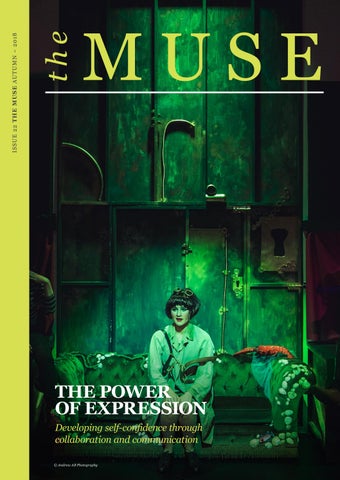
THE POWER OF EXPRESSION Developing self-confidence through collaboration and communication © Andrew AB Photography
Visits & Voyages This list is by no means exhaustive, but offers a flavour of guests in and visits out during the Autumn Term.
Visitors In Children’s Book Fair, Junior School Chocolate Experience Workshop, Year 4 DAHSA Reunion for all eras including a 1958 reunion lunch DAHSA Reunion, 1980 Drama Production, Alice, Year 11 and Sixth Form Duke of Edinburgh’s Awards Evening Esperanto Workshop with Victor Sanchez Jimenez
Voyages Out Lunchbox Lecture, Hannah Cooper, Liz Male Consulting
A Christmas Carol, Stratford-upon-Avon, Year 8
Lunchbox Lecture, Jess Howard, Business Development in Sport
Advent Service, Bel Canto Choir, St Paul’s Church
Lunchbox Lecture, Captain Annelise Milton, British Army, Royal Engineers
Art Trip, New York, Year 11 and Sixth Form
Milton Keynes Prep School and Broughton Manor School Activities Event, Senior School
Art Trip, St Paul’s Church, Bedford, Year 10
Music Recital Evening, Year 11 and Sixth Form
Art Trip, Tate Modern and Tate Britain, Year 11 and Upper Sixth
GSA Girl Power Trip, Cambridge Academy of Science and Technology, Year 8 GSA Girls Go Gold Conference, Tudor Hall School, Years 11 and Lower Sixth Junior School Head Girls’ Team deliver Harvest goods, Bedford MFL Trip, Berlin, Germany, Years 10 – Upper Sixth Natural History Museum Trip, Year 8
National Poetry Day, Whole School
Bedford School Open Mic Night, Charity Event
Open Morning, Whole School
Bletchley Park Trip, Year 5
Pilgrims Preparatory School Annual Activity Event, Junior School
Cambridge Festival of Ideas, Sixth Form
Polam School Annual Activity Event, Junior School
Castleton Geography Trip, Derbyshire, Year 9
Stratford-upon-Avon, Year 10 and Presbyterian Ladies College Students
Richard Gill English Lectures, Sixth Form
CCF RAF Flying, RAF Wittering, Year 10
Team Building at Cople Fields, Year 8
Grandparents Day, Whole School
Senior Mathematics Challenge, Sixth Form
Challenge and Extend Trip, British Library, Year 8
History Webinar, Dr Miriam Dobson, Sixth Form
Senior School Christmas Concert
Chemistry in Action, Emmanuel Centre, London, Lower Sixth
European Week of Languages, Years 7 – Upper Sixth Exchange programme Presbyterian Ladies College Students, Year 10 First Team vs Old Girls (Alumnae) Lacrosse Match, Cople Fields Fundraising Concert for Sue Ryder, Sixth Form
House Chess Competition, Years 7- Upper Sixth House Drama Competition, Years 7 and Lower Sixth House Glee, Whole School Junior School Christmas Concert Junior School Curriculum Conversation, Learning through Enquiry Junior School Teatime Music Concert
Senior School Curriculum Conversation, Teaching Science Senior School Lunchtime Concert Sixth Form Open Evening Textiles Speaker, Jorden Barratt, Years 11 and Sixth Form The Association Christmas Fayre The Association Games on the Lawn, Junior School Gardens, Whole School The Association Wine-Tasting Event
Lunch Club, Senior School
World War ll Tea Party, Year 5
Lunchbox Lecture, Anna Jacobs, Music Therapy
Year 3 Christmas Production
Christmas Market Trip to Cologne, Germany, Years 7 - 9 Condover Hall Netball Trip, Shropshire, Year 8 Cranedale Geography Trip, Yorkshire, Lower Sixth Creative Arts Careers Evening, Bedford School Cultural Trip to Cambridge, Year 10 and Presbyterian Ladies College Students
Senior School deliver Harvest goods to SMART Sixth Form History Conference, London
Team Building at Ickwell Bury, Year 3 Theatre Trip, Lovely Bones, Royal and Derngate Theatre, Years 10 and 11 Theatre Trip, Missing, Battersea Arts Centre, Sixth Form Theatre Trip, Othello, Globe Theatre, Sixth Form Theatre Trip, The Crucible, Sharnbrook Mill Theatre, Year 9 Theory of Knowledge Trip, Cambridge, Lower Sixth Trip to Cecil Higgins, Bedford, Year 3 Trip to Think Tank Museum, Birmingham, Year 6
Edale Geography trip, Derbyshire, Year 10
Victoria and Albert Museum Trip, London, Year 9
English Trip, British Library, Sixth Form
Wicked, the Musical, Apollo Theatre London, Year 11
English Trip, The Lover/The Collection, Harold Pinter Theatre, Lower Sixth
Winter Wonderland Social Trip, London, Year 11 and Lower Sixth
Editor’s Insight
E
very year I try to attend two conferences in the Autumn Term: The International Baccalaureate’s European Conference and The Girls’ Schools Association Heads Conference. These events bring together educationalists and thought leaders from around the world. As a school, it is important that we engage in research and be part of conversations which concern the latest thinking in education, cognitive research, technology and societal issues, such as mental health and well-being. It is also important that we are working collaboratively with educational institutions, both home and abroad, sharing best practice to continually innovate and raise the bar for educational standards. On a more personal level, the time spent at conferences provides me with a chance to listen and learn. As a Head, much of my time is spent dealing with day-to-day issues associated with running a large school. It is important for me, as it is for our students, to be open to learning opportunities and to take time to consider new ideas, to listen to a plethora of differing views that often alter my opinions and help me understand global perspectives. A huge advantage of being an International Baccalaureate school is belonging to a global network of schools offering the programme; for both teachers and students it creates ready-made global links. As alumnae, our girls will have shared experiences with young people from around the world. Communication and global mind-set are key strands of the IB learner profile and I believe both are important in preparing our girls for life after school. As the UK undertakes a fundamental shift in our relationship with the rest of the world, now, more than ever, language fluency will be key. Early this month the CBI (the Confederation of British Industry) released a report entitled Educating for Business, and it singled out the need to get language teaching ‘right’ in order to achieve the government’s ambition for a Global Britain. With this in mind, Head of MFL, Madame Aude Helm, explains the importance BGS places on teaching languages and their benefits, in the article Preparing for a Wide World. At conferences, I repeatedly hear how frustrated employers are by the lack of good communication skills in graduates; they lack self-confidence, do not know how to articulate their views or present
ideas. I believe we have a huge obligation to develop these skills in our students; we are doing bright young minds a disservice if we do not help them develop the confidence and technical skills to express their thoughts clearly. Providing opportunities, whether through performance, speaking at conferences, in assemblies or working collaboratively in the classroom, are key to enabling students to build these vital skills, as well as helping them develop a sense of self-belief and open-mindedness. At BGS, we weave opportunities into all that we do and you can read about some of these in Inspired By and our Junior School article Learning Through Performance. Providing innovative teaching and learning environments to encourage these skills was also at the forefront of our objectives when redeveloping our science areas. Head of Science, Mrs Emma Smart, explains the rationale in her feature Pioneering Science Developments. The Autumn Term is always full of performances, from House Drama and House Glee to the Year 3 Christmas production and the Senior School play. This year our senior girls tackled Laura Wade’s complex reinterpretation of Lewis Carroll’s Alice. Visually stunning and intensely moving, the Year 11 and Sixth Form students created an extraordinary production, exploring the central theme of grief with immense sensitivity. Not only were they extremely cognisant of the needs of the script, but also had an awareness of members of the community who have been affected by grief. To witness this level of empathy made me extremely proud, and reassured me that they are well prepared to face any challenges ahead.
As the UK undertakes a fundamental shift in our relationship with the rest of the world, now, more than ever, language fluency will be key.
Finally, we welcome Mr John Gardner to BGS as our Senior Deputy Head. He takes over the mantle from Mr Tom Hill who has taken up a Headship at Brighton College, in the United Arab Emirates. Coincidentally Mr Gardner comes to us from an international school in the UAE and brings with him a wealth of experience in developing forward thinking pedagogy. You can read about his background in his interview. I will wish you a very happy and healthy 2019. Best wishes
Jo MacKenzie Headmistress The Muse | 02
Inspired by from left: Anika Sharma, Ellie Hind, Isobel Horsfall, Charlie Spencer, Dr Amal Marogy, Judith Tarrant, Rosie Inman, Miss Jo MacKenzie and Beth English
Exploring Culture and Identity
T
he role of education is to ignite a
Such an occasion arose last term when a
humanities or social sciences, in a creative
fire for life-long learning in
conversation in a Sixth Form tutor meeting
and thought-provoking way which can lead to
every student and to develop
resulted in a group of Upper Sixth students
inspiration for others.”
a thirst for inquiry. It is
presenting a research project at the
important that as a school we create
prestigious The Cambridge Festival of Ideas,
opportunities for our students to extend
to an audience of visitors to the Festival and
their thinking and help them develop the
Cambridge academics. The Muse sat down
confidence to explore their intellectual
with the team to reflect on the experience.
curiosity; this is particularly important in the Sixth Form as we are preparing the girls for the wider world. Our ambition is for students to use the skills they learn through their academic study and extend this to wider issues, and through this process explore how they can make positive contributions to the world around them.
03 | The Muse
Beth English told the Muse what sparked the idea of getting involved: “Mrs Barrett (English teacher) and I were discussing themes of culture and perfectionism during a tutorial one day and we found it so interesting
Now in its 11th year The Cambridge Festival
we wanted to expand on it. Mrs Barrett
of Ideas is a key event in Cambridge’s cultural
introduced me to the Cambridge-based
calendar, focusing on a celebration of the
charity Aradin, which focuses on cultural
arts, humanities and social sciences with
preservation, and we began the process of
two weeks of debates, workshops, talks and
researching and discovering what culture,
performances. Upper Sixth student Anika
especially British culture, means to young
Sharma explained: “The Cambridge Festival
people. We brought together a group of Upper
of Ideas encourages the public to explore a
Sixth girls and we worked with students and
subject of your choice, in the fields of the arts,
teachers at both BGS and Bedford School to
cultivate our own findings on British culture
topic that I’ve never really thought about
the significance of culture amongst young
in the modern age and how young people
the significance of before. It also formed
people. Overall, I am really grateful for the
view it. From here, we decided to apply to The
a diversion from academic studies which
opportunity as it has made me more aware
Cambridge Festival of Ideas, with the hopes
I thought was important, partly because
of my own culture but I’m also hopeful that
of sharing our findings with academics and
the way that we approached the task as a
our findings will be able to help other young
other people interested in the importance of
group resulted in using research methods
people.”
having a strong cultural identity. Luckily, we
that are not necessarily taught as part of
were accepted to present at the Festival and
the curriculum and gave insight into how
we were able to share our ideas.”
professionals research certain ideas.”
Inspired by Aradin’s work into the
The team also recognised that the project
preservation of endangered linguistic and
had greater impact on them than they
cultural heritage, the girls carried out an
had originally imagined. Not only has it
in-depth action research project into the
given them the confidence to undertake
question of how young people view their
independent study of this nature at an
own cultural identity, in particular British
intellectual level, but it has also made them
culture, and how this conflates with other
question and consider, as individuals, the
cultural identities. Under the supervision of
themes they were investigating, as Isobel
people about this.”
Mrs Barrett, the team conducted extensive
Horsfall explained: “The project made me,
research with a cross section of students
for the first time, subconsciously try to define
Dr Amal Marogy, Affiliated Researcher in
and developed a final paper entitled Young
what culture is and what it means to me; the
Britain: Culture and Identity to present at
very same questions which we were asking
the Festival. In summary, the research found that young people view culture as something that gives ‘vibrancy’ and ‘colour’ both to the individual and a community, as well as giving people a ‘freedom to be themselves’. The findings also concurred with research projects in Canada and Australia, which show that a strong sense of cultural identity is vital for good mental health. The BGS team concluded by suggesting that the link between cultural identity and emotional well-being should to be addressed in schools.
the research participants. Throughout our research process it became more and more apparent to me just how important an issue
Rosie Inman agreed: “What was especially intriguing, by having done some research into it, was the emergence of the concept of political correctness and perfectionism in our results and I, perhaps, wouldn’t have realised the significance of such themes being a characteristic of some of the young people’s answers. I feel I am now much more aware of the crucial need to preserve cultures of the world today and the need to educate young
Neo-Aramaic Studies at the University of Cambridge and founder of Aradin, expressed her excitement about BGS’s part in the Aradin collaborative project; she concluded: “I am so excited about the work of these young women. Getting young people to think more deeply
we were handling. Personally, I picked up
about issues of culture and identity is vital for
that as young people try to navigate the tricky
the creation of a peaceful and healthy society
years of adolescence, a good relationship
for our next generation. It is evidence of the
between culture and self is key. The lessons
kind of deep thinking, where academic study
we learnt from the project, although I will
interfaces with the issues in the real world,
carry them forwards with me, are also very
which is what universities are now looking for
valuable to a school community because it
in future students and what our future world
is imperative that schools start to recognise
really needs.”
The process of both developing their thesis and conducting their research was inspiring for the team, as Judith Tarrant reflected: “Working towards The Cambridge Festival Ideas was a fascinating and enjoyable experience, which I think I can best describe as having been intellectually liberating; being free from the constraints of our specifications and able to view concepts holistically was exciting and freeing, but undeniably slightly daunting to begin with. We started by floating round abstract ideas with little idea of the direction in which this might lead, so developing these into a PhD style research project was an engaging and gratifying experience and provided an insight into university study.” Anika concurred with this view: “For me, the way that our theme ‘Culture and Identity’ fitted into Ardin’s concept was particularly important as allowed me to look into a The Muse | 04
The Muse Interviews
John Gardner Senior Deputy Head
Bedford Girls’ School welcomes John Gardner to its community as the Senior Deputy Head. John joins us from Al Bateen Academy in the United Arab Emirates. The Muse caught up with him during the Autumn Term.
Can you tell us a bit about your
teaching and learning. Upon returning
moving onto Churston Ferrers Grammar
background?
to the UK, I moved to the South-West of
School, and then Kingsbridge Community
England where I studied Music at Plymouth
College in the South Hams. Whilst teaching
University. Whilst there, I was keen to
in Devon I was fortunate enough to be able
develop my experiences in teaching, and
to continue my postgraduate education,
so I took the opportunity to deliver a
completing a master’s degree in education
series of music workshops for schools in
at University of Exeter.
I spent my childhood growing up in a small village in south Northamptonshire, where in my school years I developed a keen interest in music and sport. Before embarking on my undergraduate degree, I took a gap year to travel the world. Part of this experience included a four-monthlong period working as an instructor at an outdoor activities centre in Ohio, USA. This provided me with my first structured
the local area. This cemented my interest in teaching and led me to take up a school centred postgraduate training programme, providing me with a thoroughly experiential pathway into the profession.
In 2011, my wife and I decided it was time for an adventure, so moved to the UAE to experience living and working overseas. Having thoroughly enjoyed the seven years we spent there, we are now returning to the
experience of educating young people and
My first teaching position was at Lipson
UK with our two-year-old daughter Grace
one which sparked a lifelong passion for
Community College in Plymouth, before
and baby number two due in March.
05 | The Muse
What attracted you to the role of
What qualities do you expect to see
Senior Deputy Head at Bedford
in a Bedford Girls’ School student?
Girls’ School?
What is your favourite book? I spend the majority of my reading time
Fundamentally, I expect the students to
focused on education-related texts and
In researching the role, it became quickly
embody the core values of the school: to be
research. I am particularly interested in the
apparent to me that Bedford Girls’ School
bold, imaginative and reflective. The focus
connections being drawn between cognitive
is a highly innovative and nurturing
on developing the IB learner profile serves
psychology, pedagogy and the curriculum.
environment which, serves to develop
as an excellent conduit through which the
With an increasingly strong evidence base
individuals who are intellectually and
girls can realise these qualities in all that
available, this scientific model of developing
socially confident. Bedford Girls’ School
they do at the School.
teaching and learning is proving to have a
holds high-quality teaching practices central to its aims and this is something I personally hold dear and will continue
You have worked in other schools offering the IB Diploma, why do you
to support with both passion and
feel so passionate about it?
commitment.
My passion for the IB was initially sparked
What unique skills do you believe you will bring to the role?
by my involvement in helping to build the IB Diploma Programme from scratch at my previous school. It was through this
I have found adopting an ‘emotionally
experience that I became fully engaged
intelligent’ approach can prove highly
with the IB philosophy, drawn in particular
effective in helping to engage and empower
to its holistic nature and interconnected
others. This is particularly useful when
curriculum. I assumed responsibility for
building a culture of collaboration amongst
leading the Theory of Knowledge core
teams and the wider school community.
component which explicitly engages
I am also a great believer in providing personal and professional development for all staff, helping to align and balance individual requirements with school priorities. This is best achieved utilising a full range of training and development methods, from group workshops to one-toone coaching, ensuring that all development experiences are engaging and effective.
students in critical thinking processes,
significant impact on student progress. One book which sparked my interest in this field is Seven Myths about Education by Daisy Christodoulou. It boldly critiques a range of long-held beliefs about educational practice and intelligently dismantles them, making way for more evidence-informed classroom practices. This book clearly stands on the shoulders of giants, but provides an excellent gateway into the field of cognitive psychology and its application within the classroom. How would you spend your ideal day out?
requiring them to challenge the nature of
One of the things I missed the most about
their subjects. After delivering this course
living in the UK was the countryside. So
over the past four years, I have seen the
my ideal day out would have to involve a
positive impact that it has had on preparing
long walk with my family in tow, preferably
students for the demands of university and
somewhere dramatic like the Lake District
the work-place.
or the Cornish coastline.
Tell us something that not many
Who is your hero?
people know about you.
In equal measure, my parents. They have
What are you most looking forward
Since returning to the UK I have re-
both had such a positive impact on my
to about working at Bedford Girls’
formed a three-piece band that I used to
life, supporting me to follow my own path
School?
play in whilst living in the South-West.
whilst instilling a sense of integrity and
We used to perform regularly and made
social awareness. My dad inspired me to be
two recordings of our own material. The
creative and develop myself musically, whilst
other two members of the band have both
my mum has always promoted a proactive,
since moved to London, so the aim is to
positive and selfless outlook on life.
It is my first experience of working in an all girls’ school and I am really excited to develop a greater understanding of best practice approaches to teaching and learning in this context. Bedford Girls’ School provides a unique environment in which girls can flourish, free from the pressures to conform to gender stereotypes, at a time when gender-related issues rest heavy on the collective social conscience.
get together at least once a month to write and rehearse. I have to be honest and say that I feel a little out of my depth playing alongside my old bandmates, who have made music their profession, but I’m doing my best to keep up!
There is still a long way to go, but it is clear that Bedford Girls’ School is having a hugely positive impact on the pathway towards greater gender balance in society.
The Muse | 06
PIONEERING SCIENCE DEVELOPMENTS
“ Life is not easy for any of us. But what of that? We must have perseverance and above all confidence in ourselves. We must believe that we are gifted for something and that this thing must be attained.
”
MARIE CURIE, F irst sc ie nt i st to be awarded a Nobel P r i ze in t wo dif fe re nt c ategor ie s.
A
s part of the School’s ongoing refurbishment plans, students and staff were greeted after the summer holiday with an innovative and remodelled Science Department, designed to foster curiosity and a love of Science in an environment that is both challenging and inspiring. Mrs Emma Smart, Head of Science, explained: “In the new Science curriculum there is greater emphasis on skills acquisition, requiring girls to work in groups or independently to find solutions to problems. Girls are also expected to be able to apply their knowledge and understanding to new and different situations. The original lab set up did not allow for these skills to be practised easily. Some of the labs were very large with ineffective use of space. “Scientists, engineers, technicians no longer work in isolation, they work in multidisciplinary teams, with a focus
07 | The Muse
on problem solving. Our girls need to be able to work well as part of a group and communicate clearly with the other people they work with, practising their interdisciplinary skills.” Mrs Smart continued: “Equally, in delivering Science effectively, the different departments needed a space where they could come together to share thoughts and ideas, work collaboratively and share good practice. Therefore, we created a new science workroom to allow teachers to work more collaboratively together. Bringing the whole downstairs space together with a centralised prep-room area for Biology and Chemistry and the innovative ICreate space, has created a more cohesive and collaborating learning environment.” The modern and cutting-edge ICreate space in the centre of the School features a nine-screen LCD TV wall, a coloured LED light feature and height adjustable tables. Within this space is a curved glass wall,
creating a multi-purpose area that the students and teachers make full use of. The new labs have been carefully designed to allow for flexible teaching with movable benches. Possible layouts are endless and include group work, practical work and more traditional teaching layouts where all girls can easily view the new interactive Clevertouch screens or slidable whiteboards. We no longer adopt the ‘demo at the front’ approach and girls are encouraged to be as hands on as possible, involved in designing their own experiments and working together using collective skills to problem solve. In the current climate women still remain under-represented in fields of STEM (Science, Technology, Engineering and Mathematics) occupations. They make up only 14.4% (Wise, 2018) of all people working in STEM in the UK. How do we begin to close the gender gap and inspire the next generation of female innovators and leaders?
Mrs Smart added: “Our girls are free from gender-weighted expectations and stereotypes which could prevent them from a fulfilling future in a STEM career. There is no such thing as a girl’s subject or a boy’s subject and girls are free to follow their inclinations with little of the pressure they might otherwise feel.” Research from different perspectives converge on the idea that there is little to no difference in boys’ and girls’ average ability at STEM subjects. This means that in order to attract more girls to study STEM subjects at university and enter STEM careers, we need to tackle the stereotypes they are exposed to and we need to do this early. One way to overcome this is shining the spotlight on women succeeding in STEM careers. Research conducted by Microsoft in 2017 revealed that the number of girls interested in STEM across Europe, on average, almost doubles when they have a role model to inspire them. The research showed more than half (52%) of women aged 11-30,
who looked up to either fictional or nonfictional people involved in STEM, said they were interested in getting a job in the sector. The moment a student steps into our science labs, she will see the name of a pioneering female scientist on the door, ranging from Rosalind Franklin and Marie Curie to alumnae Lucie Green (DAHS, 1993) and Anna Ploszajski (DAHS 2009). Providing our students with access to role models helps girls to see they can achieve their aspirations and dispels stereotypes associated with STEM subjects and careers. At our recent Prize Giving ceremony in 2018, the school welcomed Anna Ploszajski as the guest speaker. An award-winning materials scientist, engineer and comedian, Anna, who left Dame Alice Harpur School in 2009, went on to study Materials Science at the University of Oxford (2009-2013) and has recently completed her engineering doctorate at University College London in
hydrogen storage materials. In 2017, she was honoured as Young Engineer of the Year by the Royal Academy of Engineering. Anna delivered an inspiring speech to all the girls about how her upcoming challenge (swimming the Channel) was teaching her about failure and how we all face it in our lives. She reiterated the importance of support from your friends, family and mentors, as you embark on your next challenge. Mrs Smart concludes: “We are in the best possible position to teach STEM subjects, which provide a powerful lens to our students for understanding the world and addressing societal changes. Giving our students challenges sets them up for life, as they’ll learn how to think their way around a problem and try out solutions. There are no barriers for our girls studying STEM related subjects; we encourage our girls to reach far, set goals, step outside their comfort zone and discover their passion and desire to contribute to the world.”
The Muse | 08
Preparing for a wider world
As the news is dominated with the UK withdrawal from the EU, Madame Aude Helm, Head of Modern Foreign Languages at Bedford Girls’ Schools, reminds us of the importance of foreign language proficiency in a globalised world.
N
ational statistics on the lack of students studying a modern foreign language at Sixth Form and degree level makes worrying reading, and according to analysis by the Press Association (2017), the number of students applying for language related courses at university has fallen by a quarter since 2012. This decline is happening against a backdrop where businesses and governments are stressing the importance of learning languages for both employability, and for ensuring that future generations retain a global outlook. The British Council recently stated: “As the UK comes to reposition itself on the world stage language skills matter now more than ever. We must do everything we can to encourage more people to acquire these vital skills.” Head of MFL at BGS, Madame Aude Helm, whole-heartedly agrees with this view and the School’s commitment to ensuring that all students embed at least one, but ideally two, modern foreign languages during their school years. All girls study Spanish from day one in the Junior School, developing an understanding of one of the world’s most widely spoken languages and gaining a level of proficiency, which provides them with the confidence to grasp a second language in the Senior School. All girls then study two languages (from French, Spanish, German and/or Latin as a classical language) up to the end of Year 9, at which point they continue with at least one option for GCSE, with many choosing two. Moving into Sixth Form girls either study a language as part of the IB Diploma Programme or opt for it at A Level. Madame Helm explained: “Our values are rooted in ensuring that our students are active global citizens; the ability to communicate in a foreign language is key to achieving this aim. The study of language goes beyond developing linguistic skills: it has extensive cognitive advantages boosting problem solving, creativity and 09 | The Muse
lateral thinking skills. Languages help us develop greater cultural sensitivity. Living in times of such global volatility it is vital that girls develop empathy for other cultures.” Junior School girls have two lessons a week, which increases to two hours for each language in Years 7- 9. From Year 11, students are supported by language assistants with weekly conversation classes. In addition, the School hosts activities throughout the year to enrich learning opportunities, from speakers and lectures to taking part in regional MFL debating competitions and quizzes, to watching live theatre performances in French, Spanish and German. Trips to Spain, France and Germany add further depth as the girls develop confidence through conversational practice and gain cultural understanding in relaxed settings. Madame Helm added: “The key to learning language is helping the girls make the connections to the wider world, they need to see its relevance, to understand that learning languages breaks down barriers, it allows you to connect with people at a deeper level of understanding. This is hugely beneficial not only from a future career perspective but also from a personal one. Our week-long activities to mark the European Day of Languages are examples of how we celebrate the joy of learning languages.” She continued: “This year as part of our celebrations, students taught their peers their native language or a language they were familiar with. Students also designed language stones, which were placed around school. A colleague from Bedford School introduced the girls to Esperanto. It was fascinating to understand the philosophy behind the language and the girls really enjoyed learning a few phases. This joy at learning something new and being about to communicate in different ways is fundamentally what learning a language is all about.”
“Sadly in many schools in the UK the study of languages is not greatly valued; however at BGS we encourage the girls to continue with languages in Sixth Form, either through the IB Diploma programme or at A Level. It is well understood that embedding a language until the age of 18 helps it stay with you for life; CBI research highlights that three quarters of employers in the UK value linguistic skills, as do leading universities, whether you are studying humanities or medicine.” BGS students are fortunate to have different Sixth Form pathways to develop their languages. If they love to explore the structure of language at depth, either IB Higher Level or A Level provide a great route; if however they want to deepen communication skills and fluency, then the IB Standard Level course provides this. Fundamentally, the girls need to recognise that the ability to walk into a room anywhere in the world and converse in a non-native language builds huge confidence. Our students will be competing for jobs in a global market place; they will need language skills to be competitive. Madame Helm concluded: “Language skills are a valuable attribute to global businesses and for those young people equipped with a modern language it will open up real opportunities.”
S
G OI NG D OW N A R A BBI T HOL E
earch for the dictionary definition of ‘going down the rabbit hole’ and you get: ‘entering into a situation or beginning a process or journey that is particularly strange, problematic or chaotic; especially one that becomes increasingly so as it develops or unfolds.’ In choosing Alice, Laura Wade’s version of Lewis Carroll’s beloved tale, Mrs Catherine Howe, Director of Drama and Dance at Bedford Girls’ School, commented that she was not only struck by the joyfully bizarre Wonderland that Wade creates, but also by her decision to have her Alice go down the rabbit hole to escape the death of a loved
one. An ever- present part of life, grief touches many of members of the BGS community, and it is important that we support those who are affected with kindness and sensitivity. Mrs Howe added: ”We want our students to feel able to discuss and explore all of their feelings and experiences, drama provides an incredible platform to examine our emotions, whether you are performing or in the audience. My hope was that our production of Alice would be enormous fun to watch but also provide a cathartic and reflective experience. I was incredibly impressed by the mature manner in which our cast of Year 11 and Sixth Form students from BGS and Bedford School tackled this challenging theme.”
As Alice journeys through Wonderland, she is guided by the White Rabbit to the realisation that this topsy-turvy world is all a construct of her mind, invented to protect her from the trauma of her sister’s death and the guilt she feels at surviving. Only once she has accepted her grief, can she come back out of the rabbit hole. A challenging play, both artistically and thematically, it enthralled and enchanted all of those lucky enough to see it. You can view all the stunning photos from Alice on our Flickr gallery. www.flickr.com/photos/bedfordgirlssch
“ It’s ok to be happy eventually. It’s ok to laugh. You mustn’t hold yourself back because you think you ought to be in constant pain. And remember what the Caterpillar says - one day at a time.
”
W H I T E R A B B I T , Alic e By L aura Wade
© Andrew AB Photography
The Muse | 10
Learning through Performance
T
he whole of Year 5 beam as they take their final bow and their grandparents burst into rapturous applause as they finish their World War II performance after weeks of hard work and preparation. Head of the Junior School, Mrs Carolyn Howe, observed the happy scene: “This is the moment when you can see the girls visibly grow; the importance of providing these opportunities cannot be underestimated. It pushes many of the girls into unchartered waters and for some of them takes real courage, but the end results are worth it, as the confidence and self-belief they develop through the process can be applied to other aspects of their learning. “Performance opportunities do not only help develop strong communication skills but also work on a much wider range of attributes – from self-confidence to reflection, organisational skills; collaboration and perseverance. Preparing for a performance is not a straight line; it takes time and commitment to learn lines or to perform a piece of music, sometimes a rehearsal goes beautifully, other times you may forgot your cue or misplay a note. These are all learning opportunities; the little set back encourages you to dig deep and to commit a little bit more, and makes the final success even more rewarding. We want the girls to focus on their start and end-point, to reflect on their individual improvements so they can be proud of how far they have travelled. What I love about learning through performing is that
11 | The Muse
the girls can really take a level of ownership, whilst still working as a team, it is when they all work together and in partnership with their teachers that the performance becomes really polished.”
“ What I love about learning through
performing is that the girls can really take a level of ownership, whilst still
”
working as a team.
In Year 3, all girls take part in the Christmas performance when they act and sing in a custom made production. With the girls having only joined BGS four months earlier, this provides a chance for parents to see just how quickly the girls have settled in, and how they have adapted to a larger environment where they are introduced to a wider curriculum and study with specialist teachers across Music, Drama and Dance. Working as a whole year group, the girls enjoy learning their lines, and practising songs. By the time show-night arrives although there are some nerves most girls are excited to be finally putting on their costumes and performing to parents. Mrs Charlotte Martin, Head of Year 3, added: “This year we performed How Christmas Came to Be, a tale which took a musical journey through the ages, exploring how the Christmas we know and love has evolved. The play taught of old customs and explained how they have shaped modern Christmas, which provided great opportunities to link to our current Unit of Enquiry – A historical journey through the ages in Bedford. Through the girls dedication to the play, they develop their collaboration and communication skills, whilst accepting vulnerability; that it is okay not to be able to do everything first time. We believe strongly that every girl should
have the opportunity to take a role in the production and ensure that her contribution is celebrated and valued equally. ” The opportunities extend far beyond these year group productions, with the Junior Choir, multiple music groups and orchestras, dance, and speech and drama opportunities open to all girls. Mrs Howe commented: “Fundamentally we want to see the girls enjoying themselves, and in the process develop vital technical skills and learner attributes. I am always impressed by the number of Junior School girls who volunteer to take part in annual House Glee competition. From Years 3 to Year 6, they stand on the Senior School stage in front of hundreds of girls, singing, playing their instrument or dancing because they enjoy it and want to contribute to our community through their participation. The support of the audience is amazing as they cheer and clap, celebrating each and every performance. I feel great pride for every girl.” “We make sure that opportunities are available for each girl and we work across departments to ensure all needs can be met; in Music for example some girls are just comfortable having their lessons and playing in assembly, whilst others really enjoy taking part in the more informal tea-time concerts in front of families and friends. The girls love the choir and this gives them an opportunity to be part of wider group, which again is more appealing to some girls. “Each year the Junior Choir has a number of performances, both in and outside of School, whilst on average over 200 Junior School girls enter the Bedfordshire Festival of Speech and Drama. Our dancers take part in our annual Dance showcase and there are termly musical concerts. The girls in the Junior School are busy and actively engaged in all aspects of their learning, and the skills they learn through performance are repeatedly demonstrated in the classroom where I see once shy girls presenting a concept to their peers with utter ease. They are learning such great life skills, which will always help our girls stand apart.”
THE
HOCKEY PATHWAY
If you ask any athlete where they have met many of their friends, they will probably say through sport. At Bedford Girls’ School, for many those friendships have been formed on the hockey pitch. Head of Hockey, Mr Martin Mason-Mcleod added: “Hockey at Bedford Girls’ School (BGS) continues to grow. In December 2018, BGS had 24 teams, 270 girls, from U10D to the U18 1st team playing Kimbolton School. This growth coincides with Great Britain’s women’s historic gold medal at the Rio Olympic Games in 2016, and bronze at London 2012.” Thanks to the outstanding work of the network of local clubs and schools across the country, England Hockey has seen unprecedented growth at both ends of the age range, with the average club size having grown by 54%. This increase in interest has resulted in increased TV coverage and many BGS students now visit Lee Valley Hockey Centre at the Olympic Park to watch top international hockey, giving the girls the opportunity to see their role models first hand. It is not just friendships that hockey brings, according to Forbes, playing a team sport, and developing both collaboration and leadership skills associated with being in a team also help future career progression. Around 82% of the women in executive positions have played a team sport in either middle school, high school or university.
A tremendous amount of skill is required to succeed in any sport, but hockey is one of the most skill-based sports, as using a stick to move the ball around whilst constantly moving needs a high level of co-ordination, concentration and practice. There are a large number of technical skills, which need to be mastered to be successful, including the reverse-hit, aerial, push, sweep, flick, and 3D skills. Mr Mason-Mcleod explained: “We are seeing more girls taking part in hockey camps in their school holidays; they are really working consistently hard on developing a high level of skills all year round. We hold pre-season hockey training for all year groups, and in the October half term hosted a hockey camp with GB player Lydia MacDonnell for students in Years 6 to 10. During the Easter holidays we will be running another course with an international hockey coach. “The biggest positive impact on BGS hockey is the amount of girls who are now inspired to also play hockey outside of school. We are seeing more and more girls join local clubs, as well as playing for their counties and in local hockey academies. Obviously the more they play, the better they become, and we have noticed the girls who are also playing outside of school are making better decisions on the ball, their thought processes are becoming quicker and they are physically faster and stronger. This was demonstrated with our 1st team victory over a very talented Rugby School team. Head of Hockey at Rugby School, James Stedman, commented that the difference between the teams was due to the fact most of our 1st team play club hockey” continued Mr Mason-Mcleod. He added: “Our success is down to the hard work of the girls and also the quality of
hockey staff at BGS. We are lucky to have seven members of the staff who have all played National League hockey and highly experienced external hockey coaches that oversee the development of hockey at School. Whatever the standard or age, all girls at BGS get high quality hockey coaching and get the opportunity to represent the School.” This quality coaching has led to girls being part of the England Hockey Performance pathway and representing their regions in the England Hockey Futures Cup and going on to represent England at U16 and U18 level. Recently the School reached the finals of the U11 IAPS, the U13 England Hockey In2Hockey National finals, and won the U13 Independent Schools National Cup Championships. Hockey development is not just contained to this country. In 2016, 42 girls visited the West coast of America, travelling from San Francisco to San Diego and finishing in Los Angeles on a hockey and lacrosse tour. The girls experienced playing against American teams on foreign soil. In 2020, the girls will be visiting the East coast of America, again on a hockey and lacrosse performance tour, travelling from Washington to New York. The aim of these tours are to come back better sportswomen and is for the girls more importantly, as well rounded individuals with a better understanding of their peers and staff. Mr Mason-Mcleod concluded: “At BGS we aim for all girls to enjoy their sport, to be the best they can, be fearless and not worried about making mistakes. We want to develop life-long sporting participation. Looking out at the hockey pitches on any given day in the Autumn Term, I think we are well on the way to achieving this aim.” The Muse | 12
DUKE OF EDINBURGH
Beyond the Classroom Since its creation in 1956 by HRH the Duke of Edinburgh, the Duke of Edinburgh’s Award scheme (DofE) has gone from strength-to-strength. Guided by the same set of principles and by young people themselves, it’s as relevant today as it was then.
T
he current DofE Manager for Bedford Girls’ School is Mr Phil Ellis and he is no stranger to the benefits of the award scheme. With a 24 year career in the military, he knows first-hand how valuable the impact and benefit of good teamwork, clear leadership, co-operation and trust can be, in a wide range of situations. The skill set and experiences gained whilst on DofE can prove invaluable during an interview process, as Mr Ellis can verify, as he spent six years serving within the military careers service, conducting selection interviews and advising on career options. It is well known that employers in the UK recognise the DofE scheme as a positive addition to any CV. It was because Mr Ellis realised the
13 | The Muse
value of the scheme and the benefits it offered young people, combined with his love of the outdoors, that led him to set up the Award scheme programme at the college where he previously taught to help participants build skills which would benefit them in the world of work.
Mr Ellis continued: “Currently at BGS over 200 students are actively involved in the scheme, from Years 9 to Upper Sixth. We could not deliver the scheme on this scale without dedicated staff who offer their time, energy and support to delivering the many expeditions throughout the year.”
Mr Ellis said: “I have been involved in the running of the DofE Award scheme now for six years. Last year saw the introduction of cycling as an expedition option for Gold participants within BGS. Participants of the scheme gain real life experiences and new skills that they can continue to draw upon in their wider life. These include problem solving and decision making in adverse conditions and perhaps even the confidence to challenge themselves to operate outside of their normal comfort zone.”
Undertaking DofE not only has a positive impact on a student’s physical wellbeing, but also develops a range of social skills as well as a sense of self-satisfaction and pride. Upper Sixth student and Head girl, Lauren Lewis reflects on her DofE journey: “I have taken part in the Bronze, Silver and Gold award schemes, and looking back and seeing how far I have grown from my first expedition on Bronze to my final expedition for Gold, I really do think, it is incredible.
“The DofE Award scheme taught me that I could overcome anything that I set my mind to, no matter how big or small that challenge may seem. It taught me leadership and teamwork skills and a deeper level of empathy, as I learned how to support my friends when they were finding things tough, just as they did for me. “By far the biggest thing I will take away from any of my DofE experiences became most apparent on my Gold expedition this summer, for which we cycled 208 kilometres coast to coast across the UK over five days, from St Bees in the Lake District to Sunderland. DofE has taught me that there is so much more to life than simply studying and working hard inside sitting at a desk, and although this of course is incredibly important, there is a whole world outside of this to be explored and learned from. I am so thankful to the School for opening up my eyes to this and I can honestly say that the programme is one of the best opportunities I have ever had, and it truly has shaped me and my values enormously.” The programme has a huge positive impact beyond school and higher education. Bedford High School alumna, Charlotte Fricker (2002) credits the programme
as a gateway into her career, she said: “For me, the DofE Award was a personal examination, testing my patience, adaptability, stamina, responsibility and, at times, sense of humour! It was an open gateway to the discovery of parts of our varied landscape, which would lead, in my later life to a career based around walking and the preservation of the countryside and a love of ultramarathons. You cannot ‘go it alone’ in DofE. “The service sections devote your spare time to helping others directly, often in the very unromantic setting of a charity shop or wet playing field. The naïve preconceptions of character (‘cool’ or ‘sad’) become irrelevant when trudging two miles the wrong way through heavy clay due to a footpath blockage and everyone is tired. You all pull together to make the best of the situation on an expedition: team play and benevolence are essential to succeed, these qualities are often forgotten in the rat race of today’s executive world. Recognition is also for sticking with and being enthusiastic about activities you really enjoy.” Charlotte added: “DofE is an opportunity to reach outside one’s comfort zone but with the ‘lifejacket’ of the leader’s guidance. At no point did I feel vulnerable
or unsafe on an expedition or activity, but I was stretched emotionally and physically. The Gold Award involves a residential aspect. I stayed at an RSPB centre in Norfolk for a week introducing a group of African schoolchildren to British wildlife. Suddenly I was no longer the student but the teacher and had to think health and safety, how to keep up the children’s interest involving games and their love of singing about EVERYTHING, as well as meeting the requirement to study the local ecology to further my knowledge and learning how to allocate precious time to myself. “It is such an honour to collect your Gold Award from St. James’ Palace because this achievement has been due to your own unique efforts. It is not something artificial intelligence will ever be able to recreate.” Reflecting on these words Mr Ellis smiles and commented: “The most rewarding aspect of running the scheme is hearing the girls’ words, when they can clearly articulate how participation in the scheme has enhanced their lives. I hope this acts as encouragement to our younger pupils to get involved.”
The Muse | 14
Legend in their Lifetime
Melanie Lowe Head of Careers
Kate Adie Journalist, Born 1945
I
was gripped as a seven year old watching the television with my parents and seeing Kate Adie
report on the Lockerbie Bombing in
1988. Kate was, and still is, a strong,
fearless, intelligent woman and I found her inspirational. Kate was also the reason I
wanted to cut my very long hair into a bob, much to my parent’s disappointment.
Kate Adie was born in 1945 and had her big break in the same year I was born,
1980. Kate covered the London Iranian
Embassy siege. Whilst on evening duty she received the call and was the first
on the scene as the Special Air Service stormed the building. I remember
studying this whilst at King Alfred’s University, reading Media and Film
I am still passionate about news but after three years of studying, work experience in local newspapers and spending time in Bosnia Herzegovina working in an orphanage, I felt differently as a twentytwo year old. I was still inspired by Kate’s passion to inform and educate but I wanted to work with people on a one-toone basis. My understanding and study of the media helped me develop and grow. My affection for Kate Adie led me to finding my passion for helping others and I found myself working with disadvantaged families, young offenders and substance misusers. I wanted to travel and see some of the places Kate reported from: I did not wish to report, I wanted to support and work with people.
Combined Honours. Kate reported live from behind a car door, it was exciting
and in real time. Currently we are so used to news reaching us immediately via the internet, streaming and vlogging. When
I was younger this was not the case and Kate was iconic for leading this style of
reporting news live to an audience before knowing the whole story. In interviews
she has commented how often she used
to be reporting and feeling quite ignorant about the situation in hand, describing
Kate was one of the first British women reporters sent into danger zones all around the world. She showed no fear, in fact she seemed excited and alive in hazardous and treacherous environments.
the situation and trying to keep the public abreast of incidents that have yet to be investigated fully.
In 1989, she became the Chief News
Correspondent for the BBC and held
this role for fourteen years. Reporting on the Tiananmen Square Protests
of 1989, the Gulf War and Rwandan Genocide, Kate was one of the first
British women reporters sent into danger zones all around the world. She showed no fear, in fact she seemed excited and alive in hazardous and treacherous
environments. I have always believed in
feminist principles and as a young person, I believed she was setting the tone for
female journalists and reporters. It excited me and allowed me as an ambitious girl to believe I could be a reporter, like Kate.
In 1993, Kate was appointed an O.B.E. (Officer of the Order of the British Empire) for her services to journalism. She was awarded the CBE (Commander of the Order of the British Empire) in the 2018 Queen’s Birthday Honours List for her services to Media. She is the author of several books which reflect on her life in the front line of reporting; her honesty and integrity is refreshing in a world of commercialism and fake news. Aside from her autobiography, The Kindness of Strangers, Kate has published many books, including personal favourites, Corsets to Camouflage and Nobody’s Child. Kate was also involved in the 2017 film covering the Iranian Embassy siege, 6 Days by Toa Fraser, to ensure it was
realistic. “People always seem to assume that we have a full, back-up support team - make-up, costume and a driver - but usually, in a war zone, there’s only me and the cameraman”, Kate Adie explained. Still not ready to slow down Kate often entertains people with after dinner speeches; how wonderful it would be to attend one of these events and listen to the many stories she has to share. She hosts the BBC Radio 4 show, From Our Own Correspondent. It is inspiring that in her seventies she is still so engaging to listen to and is active in current affairs. Kate was quoted saying: “I keep telling myself to calm down, to take less of an interest in things and not to get so excited, but I still care a lot about liberty, freedom of speech and expression, and fairness in journalism.” This attitude is something I feel is very important to foster in young people: a search for the truth, freedom of speech, respect for world news and global suffering.