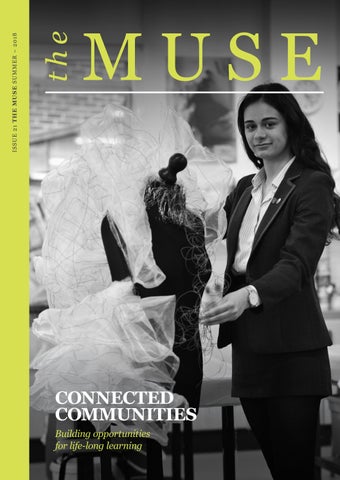
the
ISSUE 21 THE MUSE SUMMER ~ 2018
MUSE
CONNECTED COMMUNITIES Building opportunities for life-long learning
Visits & Voyages This list is by no means exhaustive, but offers a flavour of guests in and visits out during the Summer Term.
Visitors In A Step Beyond, Dance Showcase
International Cuisine Showcase, Year 9
Senior School Summer Concert
Allied Health Careers Evening, Years 9 - Sixth Form
Junior School and Year 7 Induction Day
Speaker Event with Dan Clayton, Year 7, Year 10 and Lower Sixth
Art and Textiles Exhibition, Years 9 - Upper Sixth Building a Country Exhibition Evening, Year 6 Careers Day, Small Business Challenge, Year 9 Changes and Challenges Evening, Junior School, Year 6 Charity Movie Night, Year 8 Dance Workshop with Adam Garcia, Whole School Dance Workshop with Pinchmill Primary School, Year 4
Junior School Coding Day Junior School Curriculum Conversation, Inquiry Based Learning
Tudor Day, Year 4
Junior School Summer Concert
UCAS Day, University of Surrey, Lower Sixth
Lunchbox Lecture, Anna Martin, Psychology
Work the Room, Lower Sixth
Lunchbox Lecture, Charles Little, Accountancy
Zulu Warrior Nation Workshop, Year 6
Lunchbox Lecture, Dr Claire Kotecki, The OU Moondial, Drama Production, Year 6 Music Technology Evening, Years 7 - Upper Sixth Open Morning for Pilgrims Prep School Parents
Educate Girls Charity BBQ Event, Year 9
Open Morning, Whole School
English Speaker Event, Pride and Prejudice, Year 9 and Lower Sixth
Performing Arts Awards Evening
Independent Project Exhibition, Year 9
Preparing for University Open Days, University of Leicester, Lower Sixth
French Play, Mes Chers Voisins, Years 8 - 10
Prize Giving Evening, Prize Winners and Parents
Greek Exhibition, Year 5
Public Speaking Competition, Years 7 - 9
Guild Biennial, Bedford High School Alumnae Reunion
Senior School Curriculum Conversation, The Creative Arts Curriculum
Harpur Trust English Society, Eras of English, Sixth Form
Senior School Curriculum Conversation, The Pastoral Care Structure at BGS
Hetty Feather, Drama Production, Years 7 - 9
Senior School New Parents’ Evening
Voyages Out
Activity Lego Morning, Bedford Prep School, Year 3 Alumnae Debating and Dinner Event, Alumnae and Sixth Form, Bedford School
Junior Team Mathematics Challenge, Caroline Chisholm School, Years 8 and 9 Leavers Ball, Park Inn, Bedford, Upper Sixth London Stock Exchange Trip, Sixth Form
Alumnae Drinks Reception, Drake and Morgan, London
Macbeth, the Quarry Theatre, Bedford, Year 10 and Sixth Form
Biology Trip, Flatford Mill, Suffolk, Lower Sixth
National Space Centre Trip, Leicester, Year 5
Brancaster Residential Trip, Year 3
Netball Superleague Match, Ricoh Arena, Coventry, Years 5 and 6
Bushcraft Experience, Boughton Woods, Northamptonshire, Year 8
Opal Coast Trip, France, Year 7
Community River Clean Up, Bedford River, Years 9 - Upper Sixth
Physics Trip, Wave Particle Duality, London, Lower Sixth
Eco Challenge Day, Cople Fields, Year 6
Political Ideas Student Day, London, Lower Sixth
Faith Walk, Queens Park, Bedford, Year 6
Residential Trip to Ypres, Belgium, Year 9
Flatford Mill Trip, Suffolk, Year 6
Science Museum Trip, London, Year 8
Flex Friday Activities Day, Senior School
Sports Activity Morning, Bedford Prep School, Year 4
Geography Field Trip, Mid-Bedfordshire, Year 7 Geography Field Trip, Sheringham, Norfolk, Year 10
Theatre Day, Year 4
Junior School New Parents’ Evening
Eco Schools Green Flag Visit
Activity Day, Bedford Prep School, Year 5
The Association Ball
The Mick Deards Boat Launch, The Harpur Trust Boathouse
Grafham Water Residential Trip, Year 4
Virtual Orchestra, Bedford, Years 4 and 5
House Regatta, The Harpur Trust Boathouse
Wimbledon Tennis Trip, London, Lower Sixth
Editor’s Insight
O
ur role as educators is to prepare young people to be active and engaged members of society. For me the importance of developing a strong sense of community cannot be under estimated. At our heart, we are a community of learners, teachers and girls learning together inside and outside of the classroom. But education is so much more than a set of academic results and to truly inspire young women who want to make a difference to the world around them, we need to create a community that is diverse, which comes together to share their experiences and expertise, and which helps support and nurture the ambitions of our students. Collectively we need to demonstrate to our students that there are many routes to success. We need to reflect that life does not take a linear trajectory and that there is no one right answer to what we classify as “a life well lived”. I feel extremely fortunate that we have an extensive community, made up of parents, alumnae, friends and supporters all of whom are actively involved in being part of our girls education. Their collective voices help ensure that our students understand the wider complexities of the world and are prepared to enter it with confidence. The Summer Term is a wonderful time to share our girls’ successes with our community, and this edition of the Muse hopefully gives you a flavour of some of those events where the girls can show their parents and friends their achievements, demonstrate their love of learning, and articulate how they have developed over the year. Our articles Creating a Country and Creativity and Courage give you a sense of some of these moments. We were delighted at the end of term to welcome alumna and award winning materials scientist, Dr Anna Ploszajski as our Prize Giving speaker; she is an incredible role model combining a career in science and engineering with stand-up comedy and still finding time to swim the English Channel! Anna spoke engagingly about her fears of swimming the Channel and the strategies she had developed to overcome them. Her words resonated with the audience, we all have fears and we all need to build the resilience and strategies to face them. By sharing so honestly,
Anna showed our girls how someone at the top of her chosen profession is at her core just like them. We were inspired by her words and we all followed her successful Channel swim with great interest. For me, one very special event this year was the launch of our Mick Deards boat in memory of our much-loved rowing coach. Mr Matt Wells, Director of Rowing, organised our inaugural House Regatta, bringing girls, teachers, families, alumnae and Bedford’s wider rowing community to the riverbank. It was a joyful afternoon and demonstrated the power that sport has in creating a community that stays with you forever, and although Mick would have hated being centre of attention, he would have loved the coming together of students past and present in a shared love of the sport. Mr Wells outlines his vision for Rowing at BGS in his interview with the Muse, whilst we also discuss the role that PE plays as an academic qualification in A Sporting Education. The end of the academic year is also a time when we say goodbye to both girls and staff who move on to new adventures. We do hope that they will become active members of our Alumnae, coming back to share their experiences in the future. I thank each one of them for the contribution they have made to the BGS community during their time with us. As we now start the Autumn Term, we also welcome new families and new staff to BGS, it is an exciting time and the start of a new era. In this issue of the Muse, we introduce you to our new Director of Music, Dominic Keating-Roberts and I am sure you will find our interview with him fascinating as he brings with him a wealth of experience as a performer and a teacher.
we need to create a community that is diverse and wide, which comes together to share their experiences and expertise, and which helps support and nurture the ambitions of our students.
I look forward to welcoming you all into School over the coming few weeks.
Jo MacKenzie Headmistress
The Muse | 02
Inspired by
Creating a Country
I
f you were given free rein to create
able to analyse and prioritise knowledge that
kept interest and ensured that each member
your own nation what would it look
they have gained throughout the year, and to
of the team could investigate different areas.
like, where would it be, how would
see if they can work in a trans-disciplinary
you govern and what would be your
manner, making intelligent and informed
nation’s language? These were just some of
decisions as they pull together information
the questions that Year 6 students posed as
from different sources. As teachers, this
they embarked on their final project in the
enables us to really assess their levels of
Summer Term.
understanding and to see the development
Head of Year 6, Mrs Nicola Childs, explained:
of learner attributes, which often cannot
“It was also important to demonstrate to the girls that the process of posing questions, researching, reflecting and sifting through information to draw conclusions was as important to the project as the final outcomes.” added Mrs Childs.
truly be demonstrated in a formal written
The last few weeks of term were busy
total freedom to be creative, take risks and to
assessment.”
with final decisions and creating the
be independent, the girls were truly inspired
The girls had to revisit work they had
“Building your own country is a project with
by the endless possibilities.” Students worked in teams, using their enquiry
completed earlier in the school year and transfer knowledge that they had gathered to
time and homework slots to complete the
inform their decisions.
project, with the goal of displaying their new
“We started the year studying Right and
nations at the Year 6 Exhibition Night where parents, friends and staff got the opportunity to quiz them on their ideas. Mrs Childs added: “The project was totally student led, they had to plan out their time to ensure everything would be ready for the
Responsibilities and reflecting on what they learnt helped the girls consider what type of society they wanted to build; in the Spring
to parents and friends at the celebratory Exhibition Night. “There was an intriguing range of projects on display, all demonstrating a great depth of understanding and attention to detail. The Randle Hall was buzzing as the girls acted as ambassadors from their newly
Term we moved onto our theme Beyond the
formed nations.”
Great Wall, where we took Chinese culture
Head of the Junior School, Mrs Carolyn
and political history as a starting point,
Exhibition Night; they needed to consider
again giving them plenty of food for thought
the different stages of the project and assign
when deciding on a political structure. In
responsibilities within their teams. They
our Footprints Unit of Enquiry, we focused
collectively decided how they were going to
on geographical, ecological and economic
research, develop and present their decisions.
impact, which provided further useful
There was no set path, we wanted to see
insights and considerations for the girls.”
how the girls could manage and we were
exhibition stands before the grand unveiling
Howe reflected on the work: “The fabulously executed outcomes showed how the girls really stretched themselves and engaged in critical thinking. I loved the range of countries, it is hard to decide which one I would choose to live in! As the girls move across to join the Senior School, this final
As the work unfolded the students realised
project gave them the confidence to see that
they had layer upon layer of decisions to make
they have the ability and skills to take an
– from determining a legal framework to
independent approach to their work and
“As the year end approaches it is important
designing a national flag, considering a motto
that are ready to enjoy the challenges and
that we review how well the girls have been
and forming a foreign policy. The complexity
opportunities which await in Year 7.”
on hand to give guidance or advice when requested.”
03 | The Muse
A SPORTING EDUCATION
C
entral to the Bedford Girls’ School educational philosophy is enabling students to become confident, connected, and actively involved lifelong learners. We want every pupil to enjoy regular participation in curricular and co-curricular sports. The benefits of Physical Education (PE) not only improves physical health but also teaches teamwork and problem solving skills, boosts self-esteem and facilitates lasting relationships. Mrs Jane Axford, Director of Sport, explained: “At Bedford Girls’ School, we want PE to be the norm and part of a student’s healthy balanced lifestyle. The word ‘sport’ and its traditional image can trigger negative associations for many women. We address this from a young age by making sport inclusive for all, regardless of ability. We also believe sport in a single sex environment has its advantages as girls often are less shy, which means they are willing to take more risks. They become more positively competitive. They embrace sports with gusto without worrying about their appearance.” Research conducted by Women in Sport, in partnership with the Youth Sport Trust in 2016, shows girls still turn away from school sports in high numbers. The data surveyed 25,000 girls and boys from 138 secondary schools across England and Northern Ireland, and found a gulf in attitudes towards physical activity between girls and boys. PE is a compulsory part of the national curriculum for all pupils at every Key Stage, from age four to 16. However, once a pupil reaches Sixth Form, PE is no longer compulsory if they do not choose it as an A Level option, however BGS does not agree with this approach.
Mrs Verity Mason-Macleod, PE Teacher, elaborated: “PE is compulsory in Sixth Form, and all students participate in two timetabled lessons in a fortnight, it is just as important that our Sixth Formers are as fit and active as it is for younger girls. Our approach to sport
also encourages students to participate in a diverse range of co-curricular sport and fitness activities alongside those taught in timetables lessons; we want them to see fitness as a life skill and for it to become embedded into their routines.”
“ Sport is a universal
language, building more bridges between people than anything else I can think of.
”
SEBASTI A N COE,
British Politician and Former Track and Field Olympian
“Evidence also suggests that PE significantly improves a student’s cognitive ability and their academic performance. Students who are more active are better able to focus their attention, are quicker to perform simple tasks, and have better working memories and problem solving skills than less-active children. Developing an interest in sport in the early years translates into GCSE and PE A Level being popular options in the Senior School, and the study of these subjects in the classroom often then further enhance performance on the field as the students understand both technical and physiological aspects of sport.”
“The nature of the GCSE and A Level courses are very holistic, as they weave in the study of biology, psychology, technology, as well as an understanding of the cultural and ethical influences that impact sports. Not only does PE compliment the study of STEM subjects but it also helps the students understand the intra-disciplinary nature of learning, which is important for any route of study they take after school. “Many top universities will expect a student to study at least one of sciences alongside PE at A Level when applying for a Sports Science or related courses. This is also applicable to a career in Physiotherapy where you will typically need a biological science (biology or human biology) and/or PE. The transferrable skills learnt through studying PE, such as decision-making and independent thinking, are also useful in any career path. Sport and fitness are growing global industries and making sure that our students have the skills to access the wide range of career paths is central to our ethos. “It is exciting to see Alumnae taking centre stage in sports related careers whether that be performing at elite level or on the commercial side of the sporting world. Knowing that we have helped them develop that passion and drive is extremely rewarding.”
Mrs Mason-Macleod added: “For many girls the fact they are spending a significant amount of time already participating in sports makes the study of PE at GCSE a natural
choice, as they can combine the performance elements into their existing schedules. At GCSE, each student is expected to record performance in three sporting activities, and this continues at A Level where the students need to demonstrate performance or coaching skills. The Muse | 04
The Muse Interviews
Dominic Keating-Roberts Director of Music
Bedford Girls’ School welcomes Dominic Keating-Roberts to its community as the Director of Music. Dominic joins us from Walton High School. The Muse caught up with him during the Summer holidays.
windowless room at Abbey Road Studios looking at a projection of animated film sequences. The London Oratory School provided me with a broad range of performing experiences and instilled in me the significance of nurturing and developing young talent whilst providing platforms to thrive and perform at their fullest potential. I went on to read Music, Drama and Performance at Kingston University London, studying under international baritone Jeffrey Black. During my time there, I directed several successful choirs and performance arts groups as president of the Music Society.
Tell us a little about your background? I was first introduced to music formally as a Treble at Liverpool Anglican Cathedral under the direction of Professor Ian Tracey. During this time Liverpool faced many challenges and music provided an escape. It was my first experience of being able to express myself through music and proved incredibly intoxicating. It was at Liverpool Cathedral that I gained experience as a soloist, quickly progressing to opportunities at The Royal Liverpool Philharmonic Hall in performances such as Faure’s Requiem, Paul McCartney’s Liverpool Oratorio, and travelling to the Royal Albert Hall to perform as a Proms soloist in Honeggar’s Joan D’Arc. I feel so truly fortunate to have performed with such an amazing orchestra and to work with the likes of Sir Paul McCartney and conductors 05 | The Muse
such as Libor Pešek, it completely changed my outlook on what my future could hold. Prior to that, like many a Scouse youth my only ambition was to be a footballer! Prior to my GCSEs, I moved to The London Oratory School and sang with the prestigious London Oratory Schola Choir, directed by Michael McCarthy. He is now Director at The Washington National Cathedral and remains a great inspiration to me. In addition to a number of liturgical duties, the Schola toured and performed many high profile engagements, both in the U.K and across Europe, to a wide range of audiences from members of the Royal Family and the Pope to crowds at Stamford Bridge, the home ground of Chelsea F.C. We also recorded film scores for Sleepy Hollow, The Lord of the Rings and Harry Potter films. However, it was not all glamour; we were often huddled in a
I still perform as a freelance Cathedral songman with several London Cathedral choirs such as St Paul’s, Brompton Oratory and Westminster, and record as a session musician for a range of different musical genres from Musical Theatre to Rock and Pop. I also sing with Colla Voce, a London based choir. I think it is vital to maintain contact with the professional industry to ensure that what I deliver in my teaching remains current and relevant to the everchanging modern world of performance and music. Through my performing I have become a fellow of The Academy of St Cecilia, specialising in early and renaissance music, whose fellows include Dame Emma Kirkby and James Bowman. What inspired you to go into teaching? Whilst studying at Kingston University London, I trained in Opera and Performance, and my career as a soloist
began to take hold, which led me to be invited to audition at the National Opera Studio. However, at the same time, I was directing several choirs and teaching in local schools and various local organisations. My lightbulb moment came where I was part of an outreach-teaching programme at Feltham Young Offenders Institution. Performance, whilst wonderful, was not nearly as satisfying as that moment of seeing someone’s life enriched, realising their self-worth and value. That immediately drew me into teaching. Not to mention the influence of so many fantastic teachers and mentors that I had been privileged to encounter, their passion for sharing their various areas of expertise had rubbed off. What most attracted you to Bedford Girls’ School? I know a number of alumnae from the heritage schools; they always tell me about the opportunities they had, and I have always been struck by how confident they are in themselves, I was drawn to a culture that created independence and sense of purpose. I was also attracted to the School’s fresh approach to learning with a clear forward thinking vision, being part of a school that is focused on providing a truly holistic education is very exciting. During my first tour of the School, every girl I spoke to was lively, engaging and effervescent. You immediately feel a buzz, there is no dead space; this is something I have not felt in any other school and I feel immensely privileged to be a part of such a community. Why is it important to study music? Music is so much more than simply learning to play an instrument or to sing. It is the chance to explore the immense variety of culture and forms of expression that the world has to offer. For me music is not about elitism or being the best at playing an instrument because there is no perfection. It is about a commitment to life-long learning, the idea that you can continually improve and better yourself, whilst still feeling that sense of achievement. One of the things I love about music is that it is the easiest form of us expressing ourselves. Whatever you have bottled up, feeling angry or happy, you have an outlet in the form of something immediately
accessible and tangible. The connection you make in performance with audiences or the bond you make with fellow performers really reminds you of what it means to be a sentient being, connecting with others through expression of emotion and sentiment. This is why I love singing – having people sit in a room who have never sung before, and then within 15 minutes you can have them singing harmonies, it is very uplifting. The driving force behind my ethos of music making is to understand the purpose of what you are trying to achieve and refining your skills to ensure you can achieve this to your fullest potential. What attributes would you like to develop further at Bedford Girls’ School? The attributes I am bringing are endless passion for my subject. I am committed to the belief that ‘every student does matter’. I cannot teach without a connection to the students. I have to understand who they are and what makes them tick. Music is such a personal subject, it is very exposing, especially when you are singing for example, as you cannot blame the instrument, the instrument is you. I think it is important to know what the girls want and not for me to dictate. I am looking forward to getting to know all the pupils and their parents in order to drive Music forward in a way that truly resonates with BGS students and its community. Do you have a mentor/role model? I have had many role models; firstly, my mother for her resilience. She is one of those people who has been through an incredible amount in her life and yet has always bounced back. She will never let you know that things are difficult. That resilience has always been inspiring. If I am finding things difficult, I always remind myself of what my mother has had to endure during her life.
producing their best for themselves and the school, opening many avenues to the wider world of music. He remained humble about the work he did and what he had achieved, always directing praise back onto the students. It is an ethos that has stuck with me. He is now the Director of Music at Liverpool Anglican Cathedral, right back where we first met when he was an Organ scholar. Do you have any particular hobbies/ interests? Spending time with my family is extremely important to me. I have a young daughter, and she is a constant reminder as to why ensuring all children get access to great teachers is so vital. I play rugby to a reasonable level and had a short stint with London Irish U18s and continue to play for Kempston although probably heading towards the Vets team now. I love music making and whilst I still perform regularly, I also currently direct Campton Community Singers. They are a wonderful group of women that have often joined after rediscovering music and sing for the sheer joy of it. What is your favourite piece of music? My music taste is incredibly eclectic; sometimes I will be in the mood for soul and electro pop, then other times it is expressive opera or sacred music that has me thinking about past memories. I find it impossible to answer this question as music is so diverse and I can never pin my tastes down to one particular piece.
One of my earlier music mentors was the director of music at the Oratory School; Lee Ward was this larger than life passionate character, his zest for life and his subject was so infectious and inspired all his students. He truly understood the importance of connecting with the students and engendered a culture of consistently striving towards excellence within our academic work and performing. This ensured a heritage of students always The Muse | 06
CREATIVITY AND COURAGE
T
he summer art exhibition is always a wonderful celebration of just some of the creative work at BGS; a time for the community to admire and reflect upon the vast range of talent, technical skills and inspiration across Art, Textiles and Food and Nutrition. This year the studios were buzzing with parents, friends and students admiring the stunning work. Whilst downstairs Year 9 Food and Nutrition students held a showcase of some of the fabulous international cuisine they have been developing. Mrs Christina Lugsden, Head of the Art and Textiles Faculty, explained: “This event is just a glimpse into the huge array of work which is being developed all year
07 | The Muse
round. For me creativity is a continual process, there is no end point, we are constantly moving forward, refining, developing and reinterpreting what we do. This approach is fundamental to how we teach the arts subjects at BGS, we don’t want our students to see them as stand along subjects, we are not here to teach them how to draw or to use a sewing machine. We are here to allow them to develop the confidence and self belief to trust their creative thoughts, and we believe this is a vital component of every child’s education. “Matisse once famously said ‘creativity takes courage’ and this statement really resonates with me, I feel it is so important. The world is telling us they need more creative people, the Arts
industry alone accounts for £91.8 billion a year. We need to allow our girls the freedom to flourish creatively, and our approach to teaching underpins that. We want our students to show courage in what they do, and take risks, whether they are in an art studio or a science lesson. We need them to independently analyse what they are doing, see how it can be refined and have the courage to sometimes start again. They need to enjoy the process of improving, building the scaffolding of technical skills, which will allow them to be bold and free in their creative work.” Mrs Lugsden added: “As a Faculty we balance the curriculum to ensure that we are teaching them technical skills but also spending time studying designers and
artists, getting the girls to contextualise their learning but also to see how all artists have developed and experimented. Creatives are the ultimate life-long learners and this is the idea that we want the girls to really understand and embrace. What you see on display at the exhibition is the result of just one of the many experiences they have had, it is just a moment in time, and we want them to use what they have learnt to develop their ideas further, to go on and experiment with a different response next time.” In the creative subjects, it is important that students all learn to love mess, to see an element of chaos as a step to improvement. Art, Textiles and Food and Nutrition, are great subjects for the girls to understand that learning does
not follow a linear path. Accepting that something has not gone according to plan, being able to reflect on what can be improved and starting again shows great self-awareness, perseverance and strength. These skills can be translated to all aspects of life both at school and beyond.
Seeing the development as each student
Miss Toni King, Head of Food and Nutrition agreed: “The Year 9 showcases are the results of experiments and plenty of practice. I wanted the girls to take ownership of an independent project, to understand the origins of food and to explore how and why it has developed in different ways in different countries. It is important they think about how tastes and textures come together, food is influenced by culture, history, and style.
to develop as individuals. We value all
studied a different cuisine and then created dishes to represent their areas of interest was exciting, and the dishes were very tasty!” Mrs Lugsden concluded: “Our role is to give the students space and mentorship that they do, we want them to experiment different styles, different media and different techniques and for them to see how they are improving and growing as individuals. As I watch them talk to parents and friends about their work, I feel extremely proud of who they are, but watch this space, this is just the start for them all.”
The Muse | 08
Teaching with Technology
I
n line with the School’s aim of preparing students for the future, Bedford Girls’ School unveiled its strategy to integrate technology into teaching and learning in 2014 with the rollout of iPad minis for all students and teachers across the School. The iPad gives students freedom to explore and express their creativity, it empowers teachers to interact with all students intuitively and allows them see progress on app-based homework. Students can access their course materials and learn with increased portability.
practical subjects, such as Food and Nutrition and Design Technology, where printed workbooks are replaced by full colour digital texts with videos, links, and diagrams. The Philosophy and Ethics Department now have a collection of books supporting topics such as Humanism, Ethics and GCSE anthologies. Junior School girls studying units relating to China and World War II followed week by week resources with a series of books to support their independent study.”
The School’s success of implementing iPads into the curriculum has led to BGS becoming an Apple Distinguished School in 2016. The designation is reserved for schools that meet criteria for innovation, leadership and educational excellence, and demonstrate a clear vision of exemplary learning environments.
“ The iPad is the
Having already appointed a Mobile Device Technician in 2014, BGS made the choice to appoint a Digital Design Creator, Ms Kit Davies, to begin publishing its own resources. The School now creates multi-touch books to support the curriculum and since April 2016 has created over 60 books to support teaching and learning with many more on the way. Miss Davies elaborated: “Multi-touch books are beautiful textbooks for iPads, iPhones and Macs. They can include galleries, video, interactive diagrams, quizzes, 3D objects and animation, which brings content to life in ways the printed page never could. They can engage students in a wider range of ways and importantly help keep resources in one place, helping with organisational skills. Staff use a combination of existing resources and original content to help compile books.” “The books allow us to create our perfect resources. This has proven especially useful in 09 | The Muse
clearest expression of our vision of the future of personal computing.” TIM COOK, CEO OF APPLE INC
TIM COOK, CEO OF APPLE INC
Ms Davies continued: “Interactive exercises, animation and colour diagrams are popular in the Science faculty, with revision books for Years 7-9 packed full with self-checking quizzes to test recall. In Chemistry, key topics such as salts and bonding now have supporting books; including content contributed by the girls and specially filmed experiments by their teachers. These encourage students to go back over work in their time to supplement their own notes and to help ensure they understand the lessons.
computing.” future of personal of our vision of the clearest expression “ The iPad is the
“Multi-touch books also help personalise learning as the material can be used and adapted in a number of ways, for example each book can have its own glossary, which are automatically converted to a set of flash cards within the iBooks app, which is useful for revision. Further to this, any text in the book
can be highlighted with notes. The text can also be read aloud by the iPad, for those student who prefer oral learning and books have a scrolling view where text can be enlarged.” The need to photocopy has been greatly reduced as the multi-touch books can be distributed easily through the iPads or by downloading from the self-service app, this also means that parents can access the resources to support their daughters study. A further positive outcome is the reduced need to carry bags of heavy books around the corridors! The School regularly hosts overseas visitors to show how iPad technology benefits learning. In January 2018, BGS hosted over 100 international visitors from France, Belgium, Luxembourg and Hong Kong to share best practice on how to integrate Apple iPad technology into the classroom. Mr James Potter, Director of Digital Strategy, added: “Our status as an Apple Distinguished School allows us to have opportunities to meet and share best practice with educators in other countries and to create links, which will be beneficial going forward. Visitors are extremely impressed with the girls’ confidence in explaining how they use the iPad, the high standards that the girls were achieving and how our teachers are putting learning first when it came to technology integration. “The iPad has added another dimension to traditional teaching methods in the classroom as students now take ownership in their learning. Students are not just reading, they are interacting, sharing ideas and learning more efficiently with the iPads and the digital resources we can develop help amplify this, providing them with the skills, knowledge and adaptable mind-set to be ready for an ever changing world.”
S C I E N T I F I C AWA R E N E S S
T
What are the key attributes needed for mastering scientific understanding? Where are my individual strengths and weaknesses within these skill sets? These are questions students should be asking as they embark on their IB Diploma Programme.
o help facilitate this process, early in the Autumn Term the Lower Sixth IB students come together to take part in the Group 4 Science Project, an important aspect of the IB Diploma Programme, where they set out to explore the nature of science. Head of Science, Mrs Emma Smart explained: “The Group 4 project is a great way for the girls to start contextualising learning and understanding the inter-related nature of science in the real world. It is an exciting project as the girls are able to look at any aspect of science, to explore something which they are interested in, free from the confines of a curriculum, all that is stipulated is that their projects must incorporate aspects from all three major areas of Science – Biology, Chemistry and Physics. They have to undertake an investigation and present their findings to a panel at the end of the process. What and how they do this is entirely in their hands.” Mrs Smart continued: “It is rewarding to see the level of maturity and sense of responsibility the girls take during the self-guided learning, it is impressive. Science is a collaborative subject, in the real world scientists from across all sort of disciplines work on specific projects and this exercise replicates that experience in the classroom, we want them to understand ‘the whole is more than the sum of its parts’.” “The success of the project is not defined by the results of the investigation, it is fundamentally about learning from the process. We want them to demonstrate critical thinking, master observational skills, and show that they are numerate and analytically literate. They also need to be able to reflect on their strengths and use the experience to help them identify weaknesses in their skill sets so they can see where they need to reinforce and grow. It is a great learning opportunity.” The project is run in an intensive time frame, with only a week to compete the work, again replicating the wider world where teams are often pulled together to complete projects within very tight deadlines. Armed with only a broad theme, the girls are placed in groups and tasked with developing a question to
investigate. During the week timetables are adjusted to allow the girls to work together, a lab is set aside for practical work and the girls work collectively with the school’s team of expert technicians in developing experiments, and then analyse their findings. Over the week the girls develop a cohesive presentation which communicates a level of understanding, and illustrates that they have reflected on what they have discovered and learnt. Mrs Smart elaborated: “This year’s theme was plastics, to link to global environmental concerns. The questions and areas of investigation were extremely diverse and ambitious in their remits.” Sixth Form student, Anna Kayani, explained her teams approach: “Centred on the theme of plastic, we constructed our own experiments, drawing on skills acquired across the three Sciences. Within my group, we decided to conduct an experiment that would allow us to determine whether aluminium coke cans or plastic coke bottles are better suited to their purpose within the Coca Cola consumer industry.
By testing the physical properties of aluminium and plastic, namely durability, density, the effect of pH, and heat resistance, we predicted that plastic would emerge as the superior material (solely on this basis). However, the excitement of having complete independence and free rein on deciding the nature of our experiment made us perhaps a little too ambitious. Our failure to take the limitations of our environment into account soon became apparent when we came to the realisation that it probably was not a good idea to try to reach the 600°C heat needed to melt aluminium in a school laboratory!” Anna added: “Working alongside my peers, and seeing the huge diversity within the different investigations that were taking place was truly inspiring. The combination of disciplines from across the Sciences allowed for a wider range of perspectives and insights that was extremely useful. In a wider sense, this experience led me to really appreciate the plethora of opportunities available to me; the fact that we could do anything and, not even for a moment, consider any boundaries is an ardent reminder of the innovative and nurturing ethos of our school.” The Muse | 10
Rowing
I
On a balmy summer’s evening in July, over 200 members of the Bedford Girls’ School community, family and friends gathered to celebrate the memory of our much-respected rowing coach, Mick Deards, who sadly died last year, and to launch a boat in his name.
t was a fitting tribute at the end of a fantastic afternoon of rowing which saw students and staff battle it out on the water at the inaugural BGS House Regatta. The occasion was full of a riotous sense of fun and competitive spirit. “Rowing should be fun and inclusive” explained Mr Matt Wells, Director of Rowing at BGS. “I want all girls to have the opportunity to try rowing and for those that choose to follow it to really enjoy the sport. When they look back on their school lives, rowing should be one of the elements that bonds them together. Of course, I am ambitious for the squads and aim to be considered one of the top rowing schools in England, but there are a much wider set of skills to be learnt through rowing and developing these skills in our students is equally as important”. “Rowing, like many sports, teaches skills which cannot always be easily taught in the classroom. The success of the boat is the result of everyone coming together, it really is down to the strength of the entire crew, it is all about communication both verbal and non-verbal, understanding and anticipating
11 | The Muse
each and every move to make sure you work seamlessly together, it is a real team sport. ” Mr Wells, an Olympian who won a bronze medal at the Beijing Olympic Games, joined BGS in the Autumn Term of 2017 and is looking to build upon the School’s previous successes. “There is a long tradition of rowing for BGS, it was a popular sport at both heritage schools, and I am lucky to have the opportunity to build upon that heritage.” His ambitious plans include doubling the size of the squads and have at any one time around 120 Senior School girls involved in the sport. All girls have the opportunity to start rowing in the Summer Term of Year 8, and then can take it as one of their PE options in Year 9. Once the girls enter Year 10, training becomes more intensive as they prepare for a wider range of competitions; so most girls tend to then consider rowing as their primary sporting option. Training combines work on the water as well as extensive land training to build fitness and stamina. “This year, 11 BGS crews raced at the National Schools’ Regatta over three days,
65 girls represented the School, this is a significant number but ideally I would like to see more. I want all girls to get the opportunity to race, they may not always win but the process of training, preparing and taking part is really important and we need to open this opportunity up to as many girls as possible.” National Schools’ Regatta may be one of the most prestigious regattas of the season but rowing continues all year, with a combination of winter Head Races (time trials) and Summer Regattas, with crews competing up and down the country most weekends throughout the year. This year, the School’s first eight put in a strong performance at the Henley Women’s Regatta, but were unfortunately beaten by a very established American crew. “Racing in the Peabody Cup at Henley was a pinnacle of all the hard work the senior girls (Years 11 to Upper Sixth) have put in over the year and I was really pleased that they had an opportunity to compete amongst some of the best crews in the UK and USA. Although there can only be nine seats in the boat at the starting line, I wanted the day to
be a representation of the 15 girls who make up our senior squad. To put it into context for every stroke of the 1500m course each girl in the squad will have taken in training 450 strokes, lifted around 1000kgs and had moments of self-doubt and panic. As a team they had built their strength together and I was so pleased that some of the squad not in the boat accompanied us to Henley and were able to watch from the Umpire’s Launch, on that water with their squad every metre of the race.” “Parents and girls often misconceive rowing as taking away time, but actually it really compliments their academic studies. The tight schedules and rigorous training sessions really help to keep the girls focused. As they approach the exam years, it gives them a release from the pressure of schoolwork whilst teaching them about time management, dedication and hard work, skills that are very transferable back to managing their deadlines and revision. Training and preparation in rowing are just like that in a classroom, you need to work with purpose and prepare carefully. If you consistently put the work in all year round the racing will come easily, of course it may
not always go according to the race plan, but you cannot ‘cram’ for a race, in the same way you cannot do your best in an exam if you have left it all to the last minute.” Mr Wells added that the rowing coaches work closely with the academic and pastoral staff to get the balance right for each girl. He expanded: “Rowing has to be a partnership with parents, school and the girls. We work closely with the girls and can help them build resilience and develop coping strategies, which they can then apply to other aspects of their lives. Each time you get in a boat you can have a different experience, it is not a linear path to success and we need to ensure the girls understand how to break it down into chunks, see it as a long process, rather than being overcome by the feeling a pressure to win. These strategies help them handle all types of pressure. We were very fortunate to have alumna and current Team GB rower, Ellie Piggott speak to the girls at our annual rowing ball, and she spoke about how she maintains motivation in the tough times. It really resonated with our rowing community, and this role modelling is so important for our students.
“The rowing squad are really supportive of each other and the older girls often mentor the younger girls, both on and off the water. This is a great use of learning to communicate effectively but also builds empathy, and leaderships skills.” Mr Wells stressed the role that parents and supporters play. How driving to those early sessions, long days standing by the river bank are so important to motivate the girls, and that keeping them fed and watered during regatta days is vital to keep spirits and performance high. “The social side of rowing for parents and supporters is great, attending some of the UK top schools regattas, watching hundreds of young people racing down rivers and lakes is uplifting, even if the English weather isn’t always on our side!” Watching the girls happily scrubbing down boats and put away the oars, Mr Wells concluded: “This afternoon embodies what is at the heart of my vision for rowing at BGS, the whole community coming together to celebrating its’ past and future successes. A fitting end to a rewarding first year at the School.”
The Muse | 12
Your School, My School Bedford High School 1979 alumna Ruth Hogan is the author of the award winning The Keeper of Lost Things, and her second novel The Particular Wisdom of Sally Red Shoes has recently been published. Her career in writing came after a number of significant life events, including a car accident and illness which gave her the push to start to writing.
BGS Head Girl for 2018 - 19, Lauren Lewis joined the School into Year 9 from Kingshott School, and is studying Mathematics, Philosophy and Ethics, and Physics at A Level. Lauren is currently leaning towards a joint degree in Physics and Philosophy but is still exploring a range of possibilities.
13 | The Muse
What are your memories of your first day at school?
principally Physics and its quest to
LL: I am a strong believer that you are
understand how the universe ticks. For
the product of the role models that are in
RH: Getting lost! The school seemed so
the same reason Philosophy has always
orbit around you, and in looking back at
been a joy to study, its literal translation
the teachers that I have had the pleasure
being ‘love of wisdom’.
of being taught by over the years, I truly
enormous and I remember getting lost on the way to the cloakroom. LL: The majority of my memories relating to my earliest days of school have faded, but I do remember my dad ushering me out into the garden on my first day of primary school when I was just four years old, to take a picture of me in my brand new, and somewhat oversized school uniform, which I was assured that given time, I would “grow into nicely”. I also met my best friend of 13 years on my first day of school, and we have been inseparable ever since. I also remember the awe that I felt on my first day at BGS in Year 9. Having come from a school where there were only sixteen people in my year, and entering into one with over one hundred was a massive change for me, a change that definitely took some time to get used to!
What were your favourite subjects and why? RH: I loved English literature and English language. I’ve always loved reading and writing – playing with words! I also liked Latin (handy for reading gravestones!) and cookery (aka domestic science) because it seemed more like mucking about than a proper lesson! School inspired my love of books! I learned to understand and love Charles Dickens, Jane Austen, Chaucer and Shakespeare. I think this was largely down to my amazing English teacher, Mrs Molian.
If you could have your school years again is there anything you would do differently?
can see so many of their values in myself. My History teacher and my Maths teacher at primary school, my form tutor during my GCSEs, and my Science teachers during my time at BGS, just to name a few, have all imparted their passion for
RH: Work harder. I didn’t realise when I
the value of education onto me, and for
was at school how valuable my education
that I am eternally grateful.
would be to me throughout life. LL: Now that I am nearing the end of my time at school, the only thing that I wish I had done differently is savoured my time more. I have always been extremely focused on achieving the best grades that
Sum up your school days in three words? RH: Invaluable, hectic and life-changing! LL: Exhausting. Eventful. Unforgettable.
I can, putting 110% into all my school work, often at the expense of sleep, downtime, or time spent with friends and family. However in hindsight, although of course a determination to succeed I’m sure will prove to be an invaluable life skill, I now realise that the stress I put myself under to excel in end of term tests and projects that seemed like the be all and end all at the time, meant that my time at school has swept by in the blink of an eye, and I would love to go back and relive my school years utterly in the moment.
How did school/teachers shape your value and aspirations? RH: My time at Bedford High School gave me a very broad education which has proved invaluable. Subjects such as Music Appreciation and Art History
LL: Ever since I was little, I have always
didn’t seem important at the time, but I
been a child that continually asks “why?”
have been thankful for what I learnt so
about anything and everything, and
often in my adult life in both social and
consequently subjects that attempt to
academic situations. My time at the High
answer my questions are the ones that
School gave me confidence, broadened my
I have truly fallen in love with during
horizons and taught me the value of good
my time at school. For this reason the
manners, and I made friends who are still
sciences have always fascinated me,
my friends today.
The Muse | 14
Legend in their Lifetime
Gillian Greig Deputy Head of Mathematics
Meghan Markle
I
nspirational woman have dominated the media this year, sending shockwaves through society. The groundbreaking antisexual assault and women’s empowerment movements #MeToo and #TimesUp have become a global phenomenon. In less than a month, 300 high profile women in Hollywood raised $20 million to support victims of assault and drive gender equality. According to TIME magazine #MeToo was Googled in all 195 countries, showing the ever-greater role celebrities have in influencing the way that we think. Meghan Markle was the most Googled person in Britain last year. It is no surprise that she is regarded as one of the most influential females in the world. When a photograph of her appears, her outfit sells out. However, it is not her wardrobe that leads her to be my inspiration (not entirely anyway). I admire her passion for philanthropy and desire to use her celebrity status to give those less fortunate a voice. Meghan has garnered an international reputation for her work with female empowerment and humanitarian projects. At the United Nations Women’s Conference in 2015, she revealed that she has been passionate about gender equality since she was a child. Aged 11, she wrote to Proctor and Gamble after watching their sexist television advert for dishwashing liquid. She asked them to change the wording of their commercial from “women all over Photograph by World Vision UK
America are fighting greasy pots and pans” to “people” and they did. The success of this seemingly small act became a catalyst, as she realised that her actions could create positive change. Meghan’s consciousness surrounding the obstacles women encounter in their daily lives stuck with her and, as she entered the public eye, she was eager to use her fame to make a difference. She wrote an article for ELLE magazine in 2016 where she said: “With fame comes opportunity, but it also includes responsibility – to advocate and share, to focus less on glass slippers and more on pushing through glass ceilings. And, if I’m lucky enough, to inspire”. This highlights her understanding that her role as a celebrity can have a powerful influence and that she must use this wisely. Therefore, it is not surprising that she has devoted much of her time to carrying out humanitarian work. Notably, she has been Global Ambassadors for World Vision, Myna Mahila Foundation and the United Nations. As a Global Ambassador for World Vision Meghan travelled to India to meet girls whose menstrual health was affecting their ability to access education. Meghan found that hundreds of millions of girls are unable to go to school especially in adolescence, because of a lack of resources. More than half of schools in India do not have a toilet and most girls do not have access to sanitary pads.
Meghan also travelled to Africa with World Vision, to support their clean water projects. She visited Rwanda to see the importance of clean water in communities and became so inspired she continued to fund raise when she returned home to America. Although the main reason to source clean water is for drinking, she promoted the impact it has beyond this. Meghan could see that access to clean water had a knock on effect to girls’ education, as it meant they were not walking for hours each day to source water for their families. Her compassion for the difficulties that these communities endure was evident and she spoke about the struggle she had when it was time to leave. In this country, it is easy to take education for granted and forget about the many barriers that girls in other countries face. However, at Bedford Girls’ School, our students do phenomenal work in this regard and I can see many parallels in what they have achieved to Meghan’s work. From their donation of sanitary products to local homeless shelters, to the incredible work they do with Educate Girls, India, they have made a significant impact both locally and internationally. I am always inspired by their drive and passion for these causes. Since becoming a member of our Royal family, Meghan has taken a step back from her Global Ambassador roles. However, this is not a sign that she is retreating from her humanitarian work or that she is afraid to stand up for her opinion. In fact, during the first ever Royal Foundation Forum Meghan discussed her passion for women’s rights saying she was excited to “hit the ground running”. She expressed her support for the #MeToo and #TimesUp campaigns urging us to “continue to shine a light on women feeling empowered”. Discussing her philanthropy work with ELLE magazine, she stated that she “always wanted to be a woman who works”, emphasising that “this type of work is what feeds [her] soul”. Therefore, I am confident that that she will continue to have a voice for women and work hard to support those in need.