the
ISSUE 20 THE MUSE SPRING ~ 2018
MUSE
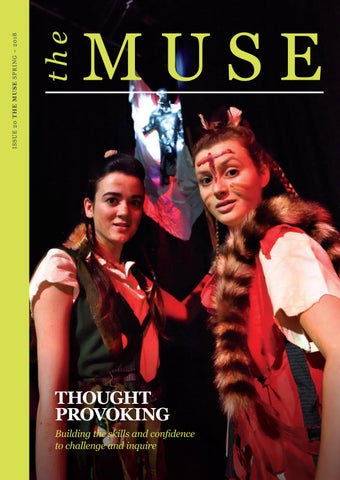
THOUGHT PROVOKING Building the skills and confidence to challenge and inquire
Visits & Voyages This list is by no means exhaustive, but offers a flavour of guests in and visits out during the Spring Term.
Visitors In Antarctic Explorer visit, Year 4 Art and Technology Faculty Day, Year 8 BGS Lacrosse 1st XII vs Bedford School 1st XV Rugby Charity Lacrosse Match Biology Olympiad, Sixth Form Charity Netball Event with Bedford School Chinese Lion Dance Workshop, Year 6 Dance Workshop with Renhold VC Primary School, Year 4 Egyptian Exhibition, Year 3 First Give, Lower Sixth French Students Visit, Year 9
Lunchbox Lecture, Abi Mountford, Careers in Chemistry, Senior School Lunchbox Lecture, Erica Roffe, Editor of the Bedford Clanger, Senior School Lunchbox Lecture, Helena Prettyman, National Youth Theatre, Senior School
UKMT Intermediate Mathematics Challenge, Year 9 and 10
Open Morning, Whole School
World Book Day Celebrations, Whole School
Performing Arts Morning with Bedford Prep School
PSHE Day, Positive Relationships, Year 9
Hyphen Theatre Company, The Soft Subject: A Love Story, Senior School
Senior School Concert
IB Visual Arts Exhibition, Senior School
Senior School Curriculum Conversations, Teaching and Learning
Junior School Curriculum Conversation, Internet Safety
Senior School Curriculum Conversations, The BGS Approach to Teaching English
Junior School STEM Week
Senior School Spring Chamber Concert
Junior School Teatime Concert, Years 3-6
Sigma Society Lecture, Sixth Form
Lord of the Flies Drama Production, Years 10-Upper Sixth
Spanish Cooking Workshop, Year 5 Spanish Play, La Casa Encantada, Years 8-10
Voyages Out American Politics Revision Course, London, Upper Sixth
Mathematics Trip, Airbus Foundation Discovery Space, Stevenage, Year 7
Anne Frank Challenge and Extend Workshops, The Higgins, Bedford, Year 9
Maths Feast, Milton Keynes, Year 10
Bedfordshire Festival of Music, Speech and Drama
National Debating French Competition, The Perse School Cambridge, Lower Sixth
Bel Canto Choir, Bedford School, Years 9-Upper Sixth
Old Bedfordians Careers Fair, Bedford School, Sixth Form
Botanical Gardens Trip Cambridge, Year 4
Romeo and Juliet Drama Production with Bedford School, The Quarry Theatre, Bedford
Classics Lecture Day, London, Upper Sixth
Rowing Ball, Park Inn by Radisson, Bedford Rowing Training Camp, Hazewinkel, Belgium, Years 10-Upper Sixth
Eco Visit to Watergate Farm, Junior School
Science Activity Morning with Bedford Prep School, Year 3
Educate Girls India assembly at Pilgrims PrePreparatory School, Year 9
Scott Polar Institute Trip, Cambridge, Year 4
French Visit to Pilgrims Pre-Preparatory School, Year 7 Geography Trip, Sicily, Year 8 Geography Trip, Changing Places, Bedfordshire, Lower Sixth London Cultural Trip, Year 5 Mathematics Road Show, Sutton Lower School, Year 9
The Association Race Night
Lunchbox Lecture, Lottie Quinn, the Film Industry, Senior School
Higher Education Evening, Lower Sixth
CCF RAF Ground Competition, Honnington, Senior School
The Association Quiz Night Times Tables Rockstars with Bedford Prep School, Year 6
Playhouse Creatures Drama Production, Sixth Form
British Museum Trip, London, Year 3
Speakezee Physics Event with Heidi Thiemann, Years 8-Upper Sixth
Lunchbox Lecture, Lizzie Martin, Physics and Cyber Security, Senior School
German Play, Hausarrest, Years 8-11
Lunch Club
Spanish Salsa Workshop, Year 5
Ski Trip, Italian Dolomites, Italy, Years 8-Upper Sixth Spanish Trip, Alcalá de Henares, Spain, Year 11 and Sixth Form The Big Bang UK Young Scientists and Engineers Fair, NEC, Birmingham, Senior School The Grinning Man Theatre Trip, Trafalgar Studios, London, Sixth Form
Editor’s Insight
I
have spent a good part of the Easter holidays formulating the next strategic plan, something that I work on with my senior leadership team every three years. At the start of this process, it is important that I take time to reflect on how far we have come as a community of learners. Are we fulfilling the strategic directions of our current plan? What do we need to do better or differently to achieve our aims? Most importantly, I always question if we are truly providing our students with a forward thinking education that prepares them for a world which will be so different from the one that many of us entered into as young graduates. The ability to think for one’s self, to reflect and question are such important skills, which should lie at the centre of every child’s education. We should not be creating a generation of young people who accept everything they see and read on face value; but now, more than ever, we need to encourage the ability to think critically about information, to question presumed knowledge and to have the confidence in their own voices to articulate their thoughts. We need them to be able to analyse data and then draw their own conclusions. On my regular learning walks, I love to watch such debate unfold in the classroom. For me, a sign of a successful lesson is seeing this interplay between students and teachers, where ideas can be expressed and discussed; where the girls are engaged and excited as they share their points of view, and in doing so stimulate further questions and ideas from classmates. This demonstrates a level of intellectual curiosity, which we aim to foster in all BGS students. Employers are crying out for these skills, and if we want our girls to take their place tackling the big issues facing our world, we need to ensure they are fully confident in displaying these attributes. In this issue of The Muse, we show just some of the ways in which we build these skills and how they become part of a BGS girls’ DNA. It starts in the Junior School where we build the roots of learning, and our feature entitled Beyond the Great Wall, which highlights the Year 6 Unit of Enquiry on China, clearly illustrates how we put this ethos into practice.
I believe that the study of Philosophy and Religion is a vital part of all students’ education, which is why it remains part of the core curriculum up until the end of Year 11, even if the girls do not choose to study it as a GCSE option. It allow students to explore large questions, outside the confines of subject specific curriculum, it builds open mindedness and provides the students with the chance to start to explore their views and thoughts on ethical and political issues in a non-judgemental space. Head of Philosophy and Region, Mrs Ellen Paglairo and her team deliver a wide and varied curriculum as she explains in the article Provoking Thought. Questioning how one would react if you were stranded on a desert island was central to the cast and crew of the School’s fabulous interpretation of the iconic story The Lord of the Flies. It raised interesting questions for the audience and cast alike as we witnessed the savagery unfold; by pushing the boundaries and stepping outside of their comfort zones, our performers explored questions around the gender stereotyping of expected patterns of behaviour. Dr Jennifer Walters, Director of Sixth Form, also encourages us to be more self-questioning in her reflective piece Missing Out, which challenge us all to turn the fear of missing out into a learning opportunity.
The ability to think for one’s self, to reflect and question are such important skills, which should lie at the centre of every child’s education.
Finally, I hope our Classics teacher, Mr Christopher Stretton intrigues you with his reflections on the top three lessons he learnt from Dr Don Fowler in his Legend in their Lifetime and that they leave you with a willingness to look at new challenges from a different perspective. I look forward to Spring finally arriving and to a new term full of fresh ideas and plenty of questions.
Jo MacKenzie Headmistress
The Muse | 02
Inspired by
STEM
I
ntroducing students to the plethora
With this in mind, the whole of Year 7 spent
A highlight for many was seeing the Mars
of career choices is a key driver in a
the day at the Airbus Foundation Discovery
Rover Robot, which is currently being tested
Bedford Girls’ School education. We
Space (STEM education centre), in Stevenage.
at the facility and is viewed through a glass
Newly opened by astronaut Tim Peake, the
walled gallery, allowing visitors to make the
want our students to understand the
wider, real world applications of the subjects that they study, drawing parallels to where they could take them in a working world. In a time of rapid technological innovation, many
Airbus Foundation Discovery Space aims to galvanize young people into exploring the incredible applications for science, design and mathematics in advances into space.
connections between the activities and actual space development projects, as they watch the Rover Robot Team at work. This was very inspiring for many of our students as they
of our students will have careers that are not
Throughout the day, the girls were led on
realised that just 40 minutes away from School
yet imagined, and we need to ensure that
a journey of exploration, which included
is the centre for innovative science exploration.
our students have the belief that anything is
workshops and presentations into areas such
possible. Being open-minded to change and
as rocket launching, robotics, and the creation
embracing new ideas is key to how we teach.
of the solar system. The day was constructed
Throughout their school life, the girls are
areas of specialisation are interconnected and
introduced to diverse figures from all walks of life. In the Junior School we encourage parents to talk to the girls in assembly about their careers; whilst in the Senior School careers days, evening events and Lunchbox Lectures ensure that our girls are introduced to a wide variety of potential careers. With the current disparities between men and women in leading roles in STEM subjects, it is important to show the girls the wide
so that the students were able to grasp how how, through the study of the past, we are constantly able to discover more about the future. A fascinating 3D video presentation took the girls back to the beginning of time and explained the creation of the planets, examining how the solar system, as we currently know it, was created. The impact of
During the day, students were put into the shoes of a space engineer, challenging them to use both maths and design skills to create solutions across number of experiments and model making sessions. These included coding mini-lego robots and building satellites. Such experiences helped the girls understand areas of science that could not be so fully comprehended in the classroom. Riddhi Malepati and Manal Husain both decided that making satellites was the highlight of the day as it pushed them out of
the film was impressive, as Megan Howlett
their comfort zones. They had to try a number
and Freya Arnold explained: “After watching
of different approaches before they got it right.
range of opportunities that exist under the
the video our minds are now full of extra
It helped them to understand that science
STEM umbrella.
knowledge on the universe and its history.”
is often about taking risks, being creative
03 | The Muse
“ Imagination is more important than knowledge ” A LBERT EINSTEIN
and learning through trial and error; by
hands on experiments at the Discovery Centre
Isabel Jackson added: “The trip has definitely
persevering, you can find the right solution
helped my friends understand the concepts in
opened my eyes and made me think more about
in the end.
a simple, creative and fun way, so we could all
how science and maths can be used in areas
enjoy it together.”
such as space, rather than just everyday things.
Arya Moodley and Aliza Zaheer agreed and
Although my Dad is an engineer, and I know
they explained: “Our favourite part of the trip
Mrs Mary Ellwood, Mathematics teacher,
was making model satellites, we like how our
who organised the trip explained: “We want
skills were tested at the end, when someone
the girls to understand the plethora of real
shook the satellite we had made to simulate
opportunities on their doorsteps, exciting
it being launched into space. As part of the
science discoveries are happening right here,
challenge you had to place an egg in the inside
just down the road from BGS. It is about
the satellite and if they broke the egg with the
having the knowledge and mind-set to want to
shaking it was not secure and robust enough
be part of the world’s progress. We wanted this
Finally, Isabel Baker commented: “I always
to go into space. Luckily, our satellite was safe
trip to encourage the girls to aspire to working
thought that if you were a scientist you just
enough! It made us think about how robust
in these type of roles, where they can bring
sat in a lab all day with test tubes, but actually
materials have to be in space and the impact
creativity, maths and science together. The
this visit showed me that you can do amazing
that forces have on it as well. We had never
girls had a great time and were really animated
things like design robots that might one day
thought about this, it was really fascinating.”
a bit about engineering, the day at Airbus has given me a greater understanding of what is involved and what skills are needed, it helped me understand that you need to be creative too. I really enjoy science, maths and DT and these are all important skills in a job in engineering.”
by what they saw and learnt, it stimulated lots
land on Mars!”
The girls also spent time in the interactive
of questions and thought.”
The girls’ infectious enthusiasm was felt by the
areas where they enjoyed hands on
Reflecting on the visit Faith Adeyemi-Abmere
team at Airbus, who kindly wrote and shared
experience of whispering dishes, black hole demonstrations, investigating electric shocks and robotic claws.
commented: “The trip has really inspired me, during the visit I noticed something that was not expected, all the people teaching us
the following feedback: “What a delightful group of young ladies you brought with you. Their enthusiasm and engagement made them
For Izzy Dennis, this part of the day helped her
about the wonders of science and maths were
an absolute pleasure to work with.”
share her passions with her friends, she said:
women. This inspired me to think that it is not
Watch out for BGS girls leading the way in
“I love science and maths, but it can be difficult
only men that can have jobs at the cutting edge
the development of space probes, robots and
to explain exactly why to my friends. The
of science but that women are just as good.“
rockets in the future! The Muse | 04
Natural Connections “One individual cannot possibly make a difference, alone. It is individual efforts, collectively, that makes a noticeable difference - all the difference in the world!” DR . JA N E G OODA LL , DBE , PR IM ATOL OGIST
D
eveloping a global mind-set and looking at how we can all make a difference to the world that we live in is engrained
in a Bedford Girls’ School education. The school’s Eco Council plays a pivotal role in both the Junior and Senior School, giving students the chance to interact with the real world and discovering first-hand the wonders of our environment and what we can do to support and protect it. Under the guidance of the Eco Co-ordinators, Mrs Natalie Morgan and Mrs Kristie Whomlsey, the Eco Council comprised of both Junior and Senior School students, a parent representative Mrs Carrie Clarke, strives to make Bedford Girls’ School as sustainable as possible and raise awareness of environmental issues affecting the community at a local and global level. Mrs Morgan, Eco Co-ordinator explained: “Our role is to be ambassadors for environmental issues, to promote awareness and action in the School. We actively engage with the ‘whole school’ on issues of sustainability, particularly around issues, which link food, nutrition and waste.” 05 | The Muse
Mrs Morgan continues: “The Green Kitchen are champions at promoting healthy and sustainable food, using local and seasonal produce where they can, and we work in partnership with the catering team to extend the communities knowledge of how food should be grown, stored, consumed and recycled.” To underpin the School’s commitment, the Eco Council have worked hand in hand with the kitchen towards being awarded the Food for Life Bronze Award in January 2018. The Award programme, run by The Soil Association, champions healthy, tasty and sustainable meals in schools and aims to raise awareness of the importance of food provenance and the benefit of using local, seasonal produce. Mr Sean Skipper, Executive Chef of the Green Kitchen adds: “Achieving the award is invaluable, and the Eco Council have played a pivotal role on the Food for Life journey by providing students with the opportunity to visit local farms, take part in cooking classes and growing nutritious fruit and vegetables. We have learnt so much about the sustainability of food and investing in
the future of farming in this country. We are extremely proud to be part of this, and the process has stimulated lots of ideas for the kitchen team.” The girls do not only see the benefits of this initiative at lunchtime, the topic of healthy and sustainable food features widely across curriculum subjects. To support learning on where food comes from, the Junior School Eco Council visited Watergate Farm in Hockliffe during the Spring Term. The farm has been in the Hunt family for four generations since 1924 and is currently run by the parents of former Head Girl, Anna Hunt (2017). The students gained a real hands-on experience of farming life during the peak lambing season, seeing the new-born lambs and understanding how the farm plays an integral part in conservation for future generations. The enriching and wider learning curriculum is designed to engage and involve everyone; students from both the Junior and Senior Schools regularly collaborate with each other and grow a variety of fruit and vegetables in the Green Kitchen Garden. Students help with the watering, weeding and harvesting
such as the impact of deforestation. This topic was further developed in English and the students investigative, written and public speaking skills were enhanced as they researched and discussed these issues, culminating in a public debate with the MP for Bedford, Mr Mohammad Yasin, who praised the students for their excellent analytical discussions and mature participation in the debate.
and have successfully grown a variety of fruit and vegetables including asparagus, sweetcorn, squashes, broad beans, borlotti beans, strawberries, courgettes, rocket, radishes, beetroot, leeks and carrots, as well as a range of herbs. All the fruit and vegetables grown are included as ingredients in the various dishes served by The Green Kitchen during lunch service. The School also boasts vast outdoor learning spaces at Cople Fields, which in addition to the sports facilities houses a community orchard with tree species native to the area, swift boxes and hibernaculums. In early spring, the Eco Council successfully secured a delivery of fruit trees from Orchards for Schools. The Eco Council planted apple, pear and plum tree varieties, which are all native to the Bedford area, increasing landscape resilience against pests and diseases and promote biodiversity.
align with these objectives and members of the Eco Council are encouraged develop programmes and projects which link back to the Green Flag’s aims. Mrs Whomsley commented: “The Junior School Eco Council meets on a weekly basis to focus on specific areas of the action plan such as the launch of Switch off Fortnight in assembly. The team encouraged all students to save energy at school and at home as part of their focus on making the School as energy efficient as possible. They are passionate about supporting projects with the Senior School to make the School as environmentally friendly as they can.” The action plan is also linked to the Junior School’s Enhanced Curriculum where students in Year 4 investigated global issues
Meanwhile students from the Sixth Form have been investigating global issues surrounding the cosmetics industry. They presented an assembly about the environmental impacts of the use of microbeads in cosmetics, and how they are detrimental to the world’s oceans and marine life. This resulted in the Eco Council running workshops for the whole school on how to make environmentally friendly facemasks and scrubs. Mrs Morgan concluded: “We are proud that our community are engaged with environmental issues and have a significant influence in many of our initiatives. It is important that we are planning and providing the girls with the knowledge and strategies to help them lead a more sustainable life. As a Council, we are continually leading the way and investigating future initiatives, including research into alternative energy sources and expanding recycling activities to include glass and food waste. We are using our voices to encourage everyone to make small simple changes, which collectively will make the difference.”
Mrs Morgan commented: “The Green Kitchen Garden and Cople act as educational resources and supports learning in subjects such as Geography. Our Year 7 students have spent time in the kitchen garden as part of their lesson on organic farming, learning what it means to farm organically and what the advantages are to the customer and the environment.” The School’s commitment to environmentalism reaches beyond the kitchen and we are proud to also be holders of the Eco-Schools Green Flag, an award Bedford Girls’ School has held since 2009. The award is reviewed every two years and requires schools to provide evidence of project work across an action plan of the following areas – energy, water, transport, waste (recycling)¸ litter, global citizenship, school grounds, healthy living and biodiversity. The Eco Council’s priorities The Muse | 06
I
HAUNTED BY THE BEASTIE
n the Spring Term, Bedford Girls’ School staged a captivating and chilling production of William Golding’s brutal classic Lord of the Flies, adapted for the stage by Nigel Williams. A timeless story that is relevant today, the all-female cast of Year 10 to Upper Sixth actors produced a spellbinding interpretation of Golding’s original tale of little boys trapped on a desert island after a plane crash who resort to savagery as they hunt the Pig and then eventually the ‘beast’ within. Mrs Catherine Howe, Director of Drama and Dance, explains why she chose William’s adaptation: “I had been fascinated for some time about whether an all-female version of Lord of the Flies would work; especially as it is based so firmly on the innate barbarism and savagery of masculine culture. I was keen to explore and perhaps dispel Golding’s own assertion that his story couldn’t be told with a group of little girls because: “If you... scaled down human beings, scaled
07 | The Muse
down society, if you land with a group of little boys, they are more like a scaleddown version of society than a group of little girls would be. “Then coincidentally, our re-imagining of Lord of the Flies came as news broke over the summer of 2017 of an all–female film version of the play. This caused controversy with many critics feeling that the two male screenwriters responsible, David Siegel and Scott McGeehee, had missed the point of a story that focuses so heavily on male violence. And they had doubly sinned in presuming that they as men could also write from the female perspective! This added real fuel to our creative fire as we began workshopping the play.” Mrs Howe, continues: “There were moments during the rehearsal process where the cast felt that they as young girls wouldn’t be as boisterous or as free to play as boys. They cited girls’ acute awareness of judgement by their peers
as an inhibiting factor and this informed their development of the playful scenes of Act One. However, what they did not find challenging was the rationalisation of the girls’ ability to perpetuate violent and cruel acts. These characters are after all in a world without restraint and fighting for their own survival.” The intimate traverse setting of the Studio Theatre asked much of the actors, requiring a constant awareness of the audience surrounding them on all sides. The multi-level set, designed by Ms Charlie Gardner, as well as the challenging movement sequences demanded precise timing, physical dexterity and for the actors to be fearless. Upper Sixth pupil Mia Brittle who portrayed Ray (Ralph) in the production adds: “There was a physical and emotional challenge to create a believable representation of someone who had just crashed landed on a deserted island, especially when portraying an 11 year old.
“I think women are foolish to pretend they are equal to men, they are far superior and always have been” S I R W I L L I A M G OL DI NG , BR I T I S H NOV E L I S T, PL A Y W R IGH T, A N D P OE T
“It was great to see how we came together as an ensemble, from building the set to the costume design and makeup, to the performance itself. It was a real privilege to be a part of one of the first Senior School production in the new Studio Theatre.” The highly atmospheric environment of the desert island and its descent into chaos was created through the beautiful lighting design of the Technical Director, Miss Emily Elsom and further enhanced by emotive music and an evolving costume and make-up design. Charlie Gardner, Costume and Set Designer adds: “Lord of the Flies was one of the most challenging, yet exciting, pieces of theatre I have had the pleasure to design for. When I was designing this production, I wanted the cast to be able to climb, explore and most importantly, play. It was such a joy to watch them climb through trap doors, scramble up netting and launch themselves off the many levels like the ‘savages’ they were slowly becoming and
with the help of Emily’s beautiful lighting I felt the set really came to life.
evoked the brutal realities of the stage
When it came to costuming this piece, I wanted to create an all-female Lost Boys look and had a lot of fun playing with recycled school uniforms and things they may have found on the island. It was great to see the cast really embrace their costumes, they even started adding things to their costumes themselves during the rehearsal process.”
the senses by building tension and at times
The set and costume design helped build the tension of each act as the audience watched with growing horror the disintegration of the girls’ fragile community as they descended into violence and cruelty.
uncomfortably plausible. I went to bed
Emily Elsom said: “Lord of the Flies technically strived to re-create the haunting locations from the original text as well as the adapted stage version. For such an intimate performance space there was a vast array of physical areas for the performers to explore. The sound design
performance, and the lighting encouraged disarray to the complex story telling.” The production embodied intense performances, which both terrified and shocked the audience. As one audience member commented: “I found the production gripping and downright chilling, but so well acted, so haunted by the beastie, and much more besides…” Mrs Howe concluded: “I am incredibly proud of the cast and crew of Lord of the Flies. There is no doubt that the production moved and disturbed many in the audience in equal measure. The company powerfully and sensitively brought to life the capacity for violence and grace that exists in everyone; a timely message for the world we face today.”
The Muse | 08
Missing Out T H E F E A R O F I T, T H E J O Y O F I T
In a world where we are constantly bombarded by manipulated filter images of imagined lives, Director of Sixth Form, Dr Jennifer Walters reflects on the Fear of Missing Out.
I
was struck by a recent
where it is defined as the experience of
announcement from Wimbledon
‘Anxiety that an exciting or interesting
High School for Girls who have started a movement to counter a
event may currently be happening elsewhere, often aroused by posts seen
condition, known, colloquially, as FOMO.
on social media’.
Wimbledon High urges its pupils to reject
FOMO can create a powerful emotional
FOMO (Fear of Missing Out) and replace it with the JOMO (Joy of Missing Out). FOMO currently commands its own hashtag and a place in the Oxford English Dictionary, 09 | The Muse
response. In some causes it can be related to specific events, not being included in
depicting friends and acquaintances in
various contexts and places. Alternatively, maybe only very tenuously linked to the
individual’s actual life and circumstances,
pictures of named or anonymous people, in places unknown, and enjoying encounters, which, the viewer feels they do not have access to in their life.
things by people you know; or it can be
We are emotional animals, and such images,
general in nature such as viewing posts
at our sense of self, make us vulnerable
related to a person’s lived life, but be more
posts and updates have the capacity to tug
to comparisons, and, if we experience
FOMO, it means we have found in ourselves something wanting.
For some people, the effects can be severe.
I believe, that what we should really consider
If you care to think of it, prime examples
if FOMO is indeed new, or more prevalent
of a FOMO sufferer can be found in
as current opinions suggests, or is it more deeply routed in our psyche and should we
One case study I read, shared the story of a
view it as an aspect of ourselves, which we
her career. She identified herself as a FOMO
control.
young women whom had just embarked on
need to learn how to evaluate, manage and
sufferer. The sheer number of social choices
Psychoanalyst and contemporary
she had available to her meant she struggled with every act of decision making that her
social life, and social media, demanded of her. The fear of missing out was so great for her that the question of what to miss
was unthinkable. This lead to her making increasingly complex arrangements with
the tightest of timings, not to miss out on
philosopher, Adam Phillips, addresses these issues in his study Missing Out: In Praise of the Unlived Life. For Phillips, it is notable just how much of ‘our mental life is about the lives we are not living, the lives we are missing out on, the lives we could be leading but for some reason are not.’ He writes,
anything. As a result, more and more of her valuable leisure time was used travelling between places, events, friends and
friendship groups. In the article, she recalled how she would, suddenly in a panic, cut
“ What we fantasize
about, what we long for,
short her time at one party, in order to get to
are the experiences, the
for however short a time. This is an extreme
things and the people that
the next, to relieve the fear of missing out, and notably literal case of the negative
effects: it cost time, money, and quality of
life. Yet, despite being extreme, its message
seems to me to be meaningful: in thinking so hard about the right place to be, but with no
clear individual sense of what the right place
are absent. It is the absence of what we need that makes us think, that makes us
”
cross and sad.
for her meant, she found herself everywhere,
prevalent among young people today, partly as an effect of social media, which allows
us to view a myriad of opportunities on the edges of our lives. Many feel they cannot
live up to the idealised self. Psychologists
call this phenomenon ‘compare and despair’ to look at others and find yourself wanting. Wimbledon High suggest challenging this
head on and students are being encouraged to ‘actively miss out’ and take time out of
In Act 1 Scene 1, Lear, calls upon his daughters to express their love. The elder two do so, cynically, in order to secure a greater share of wealth. The youngest, Cordelia, cannot and will not play her part in the small drama of excessive demand. When asked ‘What can you say to draw / A third more opulent than your sisters?’ Her reply is a series of ‘nothings’. These nothings make his demand and therefore his want void, invalid, nothing. The problem for King Lear, and resulting in tragedy, could be that he struggled to, or perhaps learnt too late, trust in an unlived life as a paradoxically fulfilling aspect of a lived life. In any case, the King Lear hashtag FOMO for JOMO thesis suggests that this, frustration, has perhaps long been a human condition. You will not find the acronym FOMO, or the proposed alternative JOMO, in Phillip’s study. But you will find that he identifies thoughts and feelings, and states of mind, that in different ways, are aspects of our unlived lives. These include ‘frustration’, ‘not getting it’, ‘getting away with it’, ‘quitting and getting out of it’. The collective effect of
yet nowhere.
FOMO is believed to be particularly
Shakespeare’s King Lear.
Phillips suggests that the origins of these feelings lie in childhood, and so is the means we find to cope with them. As children, one of the first things we notice is that our needs are often unmet. If this is one of the first life lessons we acquire knowledge of, it means that one of the first lessons we learn as a human is that we are to be shadowed by the possibility of not getting what we think we need or want.
social media.
That we tend to call our wants, ‘wishes’,
At BGS, we are a forward thinking
instead of wants, is an example of one way
of celebration and often too in the spirit of
them ironic, we build into the feeling of
are important channels to connect to our
not be possible at all. This is one of the
change our approach but equally we need
the study Missing Out, and the examples it draws upon, for me, re-frames the debate. I would argue that FOMO is not new and that we need to recognise it as part of human nature and find strategies to manage the feeling through a careful and thoughtful process of self-evaluation. Sometimes this may mean having to come to the conclusion that something is not possible, other times it may be a call to action, an opportunity to turn an aspiration into a reality, So although I am fully in support of the concept of JOMO, I believe we should use
community, we tweet and blog in the spirit
of coping. By calling them wishes, we make
self-examination and reflection. I feel these
wanting, an acknowledgement that it might
community and I would not suggest we
greatest lessons that life ensures we learn ‘We learn to live somewhere between the
I believe, can we start to understand our
to consider the concept of FOMO and its
lives we have and the lives we believe we
unlived lives and learn to live our actual lives
would like.’
more fully.
impact.
the fear of missing out as a trigger to take time to reflect and evaluate what knowledge can we find out about ourselves, when we look beneath the ideal labels. Only then, do
The Muse | 10
ng i e b n a m u is a h physical? purely
Provoking Thought
is mathem invented aotics discovered r ?
Where in a school will you find thought provoking questions on the ‘challenge walls’ ranging from how we might programme a driverless car, to whether we should support mitochondrial replacement therapy, to whether it is morally justifiable to use drones in warfare? Is there room in a curriculum to house these issues and what value do these discussions hold?
I
n an increasingly uncertain world
experiencing with politicians, celebrities,
in order to distinguish between different
where we are all bombarded with
sports stars, banks, business corporations,
religious and humanist attitudes towards the
news and views 24/7, it is crucial
and religious organisations all being the
that our students learn to develop
recent focus of ethical scrutiny is taking
critical thinking skills and are able to
place in the spotlight of social media.
research, refine, and articulate their views
Everyone is free to have a say, and to try to
on issues. At the heart of the International
influence decision-making. One of the key
Baccalaureate educational ethos, is the
strengths of Philosophy and Religion is that
mission to create a better world through
it is rigorous, it teaches the girls to think for
education. At Bedford Girls’ School, we
themselves and to think critically, to analyse
embrace this challenge, and believe that
ideas and issues, to formulate arguments,
the study of Philosophy and Religion is
and to evaluate arguments. These skills are
an important element in helping the girls
essential in a world of “fake news”.
develop a moral compass, embrace global mind-sets and celebrate diversity.
The study of ethics is integrated into the curriculum from the start of the School.
Mrs Ellen Pagliaro, Head of Philosophy and
In the Junior School ethical questions
Religion explained: “We constantly have our
are interwoven into the termly Units of
eyes on the media to try to engage directly
Enquiries, whether that is studying women’s
with the issues; girls for example researched
right in relationship to the role of women
and gave presentations after the Charlie
in World War Two or holding a debate on
Hebdo events in Paris, others concerning
deforestation in Year 4 as part of the study
Charlie Gard in the medical ethics case. The
of Chocolate, the girls are encouraged to
question of justice is frequently fundamental
ask the big questions and formulate their
to the considerations the girls must make,
own opinions on issues. There are no right
and the study of Philosophy and Religion
and wrong answers, the purpose is to keep
encourages this kind of reflective and
an open mind, listen to the views of others
principled thinking. It is important that our
and to formulate individual conclusions.
legislators of the future are equipped with the tools to ask the right questions, and the boldness to answer them ethically.”
As the girls move into the Senior School ethics is taught through Philosophy and Religion as a specific subject. Here the
Mrs Pagliaro continued: “The moral
issues considered can be as diverse as
revolution, that we are arguably
Year 7 looking at the question of foxhunting
11 | The Muse
treatment of animals; in Year 8, the focus is on the question of wealth and poverty, and in Year 9 the sensitive subject of abortion. In Year 10, the girls explore ethical theory, this includes Philippa Foot’s trolley car problem, recently brought to life so dramatically in the Netflix series, The Good Place. Philosophy and Religion remains on the timetable in Year 11, ensuring that beyond GCSE the girls are provided with the space to discuss and explore profound questions about what it is to be human. Mrs Pagliaro went on to explain: “Studying religion should lead to a celebration of the diversity of beliefs and ways of life, not mere tolerance. Studying different cultures with different festivals, customs and lifestyles is colourful and inspiring, and encourages us to look more closely at ourselves. The subject is academic, yes, but it also demands a degree of introspection that is both challenging and liberating. It should encourage young people to reflect on their own ideas and develop their own thoughts about questions of meaning. This encourages both the development of inquiry skills but also reflective behaviour, all of which are vital for the girls to develop as part of their holistic education and to build their self-confidence. We are a diverse community at BGS, and it is a small world;
we want to ensure that the girls understand
theory of a Just War and how this is coming
or as an A Level option. In addition, and
others’ cultures and religion.”
under particular strain with the development
reinforcing the importance of the attributes
Mrs Pagliaro expanded on this point: “It is important to help young people to
of A.I and the use of drones as fighter planes and submarines.
it develops, all IB Diploma students follow a Theory of Knowledge course as an element
understand the ideas and opinions of
of the IB Core programme, strengthening
those whose beliefs and values might
critical thinking skills and the understanding
differ from their own. To understand each other requires understanding of the faith backgrounds that people come from. The real and present challenge facing society is to improve the level of knowledge and understanding of everyone about what religions are really about and what they teach. As John Donne famously said “No
“ It is tragic that our
technological mastery is greater than our wisdom
”
about ourselves. Pope Jean-Paul II; 1982
man is an island” and we strongly believe
likely to display prejudice and discrimination and to embrace the diversity.” Beyond the classroom, students are provided with plenty of opportunities to widen their understanding of the world around them and to participate in debates and conferences. Earlier in the Spring Term, a group of Year 11 GCSE students attended an Ethics Conference in Cambridge with renowned Theologian, Dr Peter Vardy. His seminars provided our girls with a new understanding
ethical issues. Mrs Pagliaro concluded: “The study of Philosophy and Religion develops skills and learner attributes, which can be transferred to all other subjects and into the world of post school study and employment. We need to prepare our students for a
that where people know more about a wide variety of beliefs and attitudes, they are less
of how to analyse information and assess
world where perceived knowledge and Year 11 students Laura Judd and Erin Christmas, thoroughly enjoyed the debate and said: “We found the trip very insightful because it linked the core content to the issues in the outside world”. Such conferences expect the students who attend to take part in the debates, and BGS girls relish these opportunities to test their debating skills, often to great effect with
understanding are constantly changing, they need to have the confidence and ability to pose questions, solve problems and recognise complexity in ideas. To develop these skills in a non-judgemental environment is a huge advantage. They develop not only a more a more open minded global view of the world but also empathy and interest in others, important
Dr Vardy at the most recent conference
skills for the working world where they will
praising BGS students for their mature
be expected to be able to collaborate. To
contributions and levels of engagement.
quote the Dalai Lama: “Finding common ground among faiths can help us bridge
of the issues that are currently dominating
As the girls go into Sixth Form students can
the global community; including a
continue to study Philosophy and Religion
needless divides at a time when unified
discussion on the issue of conflict, and the
either as part of their IB Diploma programme
action is more crucial than ever.” The Muse | 12
Beyond the Great Wall
T
he Junior School’s termly Units
welcoming in a Chinese workshop where they
and pride in what they have achieved as an
of Enquiry provide a platform
were given the opportunity to experience
individual.”
from which learner attributes
making Chinese lanterns, slat books and
can be developed enabling
shadow puppets as well as being introduced
the girls to acquire knowledge, skills and
to calligraphy and the art of jiǎnzhǐ (paper
confidence through a rich and engaging
cutting). From this point, the girls started to
journey of discovery. The Year 6 Spring Term
formulate questions to guide their learning:
focus has taken the girls to China, where they
What do willow pattern plates tell us?
have been exploring Beyond the Great Wall.
How and why were they made? How does
Timed to tie in with Chinese New Year,
calligraphy show different patterns? Why
the Unit of Enquiry provides a wonderful opportunity for the girls to gain an understanding of one of the world’s fastest growing nations, helping them to understand the links between a country’s history and
were books made of wood? Such lines of enquiry led the girls into research areas of art, history and geography, whilst the shadow puppets were used as a collaborative tool to develop their own versions of traditional
culture, and how that has influenced its
Chinese tales.
modern day development.
“The multi-curricular nature of the project
Mrs Nicola Childs, Head of Year 6 explained:
also allows the girls to follow their interests
“We want our students to develop a global mind-set and to look outwards. Rather than studying in isolation. We want them to see how the culture, ethics and societal changes influence the development of a country and how these are linked to its history and geography. The study of China provides a
and to pursue more independent lines of research. We are keen for the girls to widen their areas of investigation and start to understand there are no single sources of evidence. They need to start pull together data and draw conclusions, using appropriate language and vocabulary” Mrs Childs
wonderfully rich curriculum, we are able to
explained.
look at art, language, history, geography and
She added: “In addition, the girls often work
religion; and explore how all these elements
Introducing cultural understanding and ethical debates are an important part of learning at BGS, and the study of China provides a rich ground for discussion as the girls progress on to study traditional Chinese culture and religion and contrasting these to life in the UK. The girls are expected to reflect on the differences and use analytical skills to look at population growth in China. The project also explores Chinese art, and the girls are encouraged to look at how art and language are interwoven. Not only does such study improve mastery of artistic skills but also teaches them the fundamentals of art appreciation, as they start to learn to look beyond the visual image and uncover meanings from a painting, linking their findings back to the wider themes of the Unit of Enquiry. Mrs Childs concluded: “The girls are in their final year in the Junior School, and whilst we want them to enjoy this special time, we are also focused on ensuring that they have the skills to adjust quickly and seamlessly into life at the Senior School. Our Units of
collaboratively and can therefore split tasks
Enquiry are devised to take the girls out of
to accommodate their interests. Their work
their comfort zones, asking them to take
is recorded in their Unit of Enquiry books
risks with their learning and skills, as they
and it is fascinating to see how different girls
learn to take on more responsibility and
have decided to focus on some areas more
independence. The results are impressive;
than others. Taking individual responsibility
the girls embrace the challenge, love
to how they research and present their work
mastering new skills and enjoy developing
is a big part of the project, as it shows us how
an appreciation of a various cultures.
Coming back from the Christmas break
they are progressing as learners. It also helps
Classrooms are busy and bursting with
the girls were treated to a stunning start,
them take ownership for their development
creativity.”
have been adapted and influenced modern day developments. Providing the girls with such a holistic view of a country really helps them embrace the theme, as they share the excitement of making connections and using their independent learning skills to ask new questions and uncover the answers.”
13 | The Muse
S W I M, BIK E , RU N “If we let our head drop, our heart drops with it. Keep your head up, and your body is capable of amazing feats.” Chrissie Wellington OBE, four-time Triathlon World Champion
A
t Bedford Girls’ School, the importance of sport is much more than just the benefit of physical activity; it increases self-esteem, confidence and a sense of well-being. Above all, our approach to sport is to develop a holistic and inclusive fitness programme, which encourage our students to experience a wide range of sports in the extensive co-curricular programme including triathlon and biathlon training. Triathlon was catapulted into the public domain by the Olympic heroics of the Brownlee brothers and inspired many more people to get involved with this fast growing multi-disciplinary sport. In 2016, there were around 150,000-committed active racing triathletes in the UK and Sport England believe that about 200,000 people in England completed at least one triathlon in the last year. Bedford Girls’ School has been competing in multi-event sports for the last three years and has benefited from the teaching and coaching expertise of Head of Swimming, Mr Edward Castro, who himself is an accomplished elite triathlete winning the World Champion Age Group Sprint Distance in 2014 and European Champions Age Group Standard Distance in 2015 and 2016. Mr Castro explained: “I took up triathlon five years ago after a shoulder injury cut short my international swimming career. I quickly caught the triathlon bug and am now working with our multi-discipline athletes within the School, accommodating and supporting their triathlon pursuits.” Triathlon’s slogan is ‘Swim Bike Run’, but it is much more than this. Competing in three different sports gives the athletes a strong aerobic base and there are a range of different distances and event combinations. Due to the nature of the disciplines competitors get a great sense of achievement often talking about the ‘triathlon bug’ and look forward to training harder and the next opportunity to race. Mr Castro expanded: “Triathlon requires a delicate mix of the three disciplines and needs careful time management in order for the athlete to succeed and also to be
balanced with other important life aspects. We encourage pupils who show potential in both running and swimming to have a go at the school biathlon competitions on offer throughout the year as a way to ease them in to multi-discipline events.” The School is proud to have two students at the forefront of the triathlon wave; Bronwyn Tagg (Lower Sixth) who competes at a junior elite level, recently coming 2nd in the 2018 British Schools Modern Biathlon Championships, and Gabriela WoodroffeGomez (Year 7) is at the beginning of her multi-event sports career, competing in the Tri Stars category for junior triathletes. Bronwyn said: “For me, triathlon is a way to switch off from all the pressures of school, home and everything else Sixth Form throws at me. After a tough lesson, it calms me down and allows me to take my mind off work or an upcoming essay. It helps me relax, despite my heart rate often being above 180 BPM. It also helps me switch on in the sense that after sleepily getting up for a 6:30am swim start, I feel ready for the day; I feel strong enough to conquer everything that challenges me that day. Triathlon helps me focus on what I want to gain from life as a whole, it has helped me gain many transferable skills; from the organisational skills that would help anyone balance work and play, to setting goals, to learning how to come back from a ‘bump’ in
the road and how to dust yourself down and start all over again.” For Gabriela, triathlon has helped build her resilience and overcome challenges, she added: “One of my proudest moments was finishing a race after falling off my bike at Hever Castle. I could have given up but instead, I carried on and finished the race. Crossing the finish line that day made me feel like I had achieved something really good.” The School’s holistic approach to sport provides the students with a strong platform, so they have the ability and mind-set to attain the highest level of performance possible. Achievements in triathlon that follow the ups and downs of training give participants the boost that if they set their mind to something it can be achieved, and this mind-set carries over into their everyday lives away from the competitive field. Mr Castro concluded: “It is a very exciting time for triathlon at Bedford Girls’ School; as more girls transition to multi-event sports, it is important to identify and inspire girls who have the correct mind-set and passion for the demands of the sport. The School’s support structure allow our students to achieve in both their sporting and, more importantly, academic lives. By controlling all the different parameters, we can build a great training environment for the students to achieve their aims.” The Muse | 14
Legend in their Lifetime
Christopher Stretton Teacher of Classics
Dr Don Fowler Tutorials passed too quickly in a whirl of ideas within a wall of books. Years later,
Fellow in Classics, Jesus College, Oxford, 1953-1999
one of the best (of many brilliant) parts of
teaching is witnessing that look of dawning realisation when a student takes rightful
joy in a connection they themselves have made.
Lesson Three: Embrace complexity I have kept a few of my marked
undergraduate essays. On one early essay
of mine, Don finished his usual thoughtfully written feedback with the question “How can I persuade you that complexity and polysemy are good to eat?”
One of Don’s specialist areas was the study
I
of literary criticism and I remember him t is 1997. I am sitting at a large table in a beautiful set of wood panelled rooms full of books. I am a new undergraduate.
I am nervous. I am excited. I am trying too hard to impress. At the head of the table sits a kindly, enthusiastic, and astoundingly clever man. He is already pulling various books off the shelves and writing witty example sentences to illustrate some tricky point of grammar. I am impressed, instantly at ease and mesmerised. I am swept along in a river of words and ideas and interest. Dr Fowler was an extremely charismatic teacher and now, as a teacher myself, I am very interested in what sticks in students’ minds. When I was asked to write this article, I therefore thought I would share my top three lessons from Dr Fowler. Lesson One: Jump in and use your brain A surprise lurked on my reading list a few weeks into my first term. Several of the articles were written in languages I had never studied. I asked Don about this in a manner which, looking back, was probably more youthfully accusatory than I would now like. The reply was ever patient yet firm. I was encouraged to ‘jump in and use my brain’.
Later in the squeaky-floored hall of a Bodleian Library reading room I sat with a hastily borrowed dictionary. I concentrated. I surprised myself. My training in classical languages, the formulaic nature of journal articles, and some careful analysis all led to a basic understanding of each article. At library closing time, an elated student walked back to college as if he were Caesar back from conquering Gaul. Lesson Two: Make connections A regular feature of any tutorial with Don was the ever-increasing pile of books, which he would excitedly pull from the shelves to present to us students. Each one demonstrated a connection from the text we were reading to another classical or modern text. In addition, Don was at the forefront of the use of technology in Classics and we frequently used databases to compare the use of a phrase across all known classical texts. Some connections were easy to understand. Others could initially be daunting (see lesson one!). All were interesting and provoked debate. To make a connection between two things means to compare them and carefully analyse whether that connection is valid. Comparing things helps us question and understand the nature of each. Connections develop imagination and lateral thinking.
Photograph by Rick Schneider, reproduced by permission of Jesus College, Oxford.
clearly demonstrating that the meaning of
a text could not be limited to what we think the author intended. In other words, there
are many possible meanings to a piece of art (‘polysemy’ from Ancient Greek, ‘poly’ meaning ‘many’, ‘sema’ meaning ‘sign’).
If we limit ourselves to one interpretation, we are missing out on a huge amount of beautiful complexity.
With Don’s guidance, I learned to embrace complexity. The world is a complex place
full of ambiguity and contradictions. Whilst
we need to weigh up information and make decisions, we should also be aware that
our initial interpretation of a situation may not be the best or most useful one.
So there are the three lessons. These have stayed with me ever since and I often think
of that formative time. Sadly, Don died from cancer at the beginning of my third year at Oxford. The saddest moment was seeing
his tutorial room after the memorial service. There were no books on the table.
However, reading this, you may have
already jumped in, used your brain, and
made a connection between these three
lessons and the three words that are quite rightly used extensively at BGS. Perhaps
that is why I feel so at home here? On the
other hand, we would not want to limit our interpretation to just one possibility. Would we?