the
SPRING ~ 2012 THE MUSE ISSUE 2
MUSE
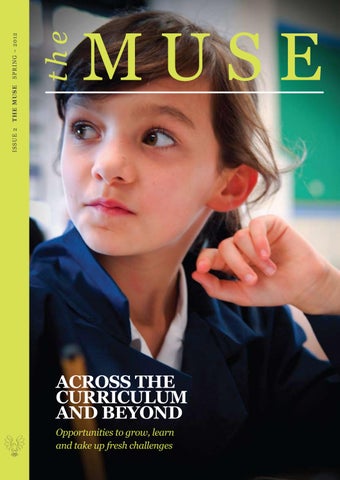
ACROSS THE CURRICULUM AND BEYOND Opportunities to grow, learn and take up fresh challenges
Visits & Voyages This list is by no means
Visitors In
Voyages Out
Alzheimer’s Society Talk, Year 9
Bedford Hospital, Year 13 Physics Students Studying Medical Imaging
exhaustive, but offers a flavour of guests in and visits out during the Spring Term.
Bedfordshire Police, Personal Safety Talk Charlie Lupton of Make Your Own History, Year 4 Tudor Workshop Developer for a Day, Year 9 Careers Workshop Dr Sullivan, performs The Death of Nancy from Oliver Twist Happy Puzzles Day Harpur Trust Charity Workshop with Home-Start and Uprising Charities Jack Trelawny, Children’s Author Law and Languages Careers Evening Lucy James, GB Junior Medalist and Olympian Hopeful
Bedfordshire Festival of Music, Speech and Drama British Schools’ Museum, Year 6 Cambridge Arts Theatre, Weekend Breaks, by John Godber Doctors’ Show, Year 11 Duxford Imperial War Museum, Year 5 Friends Meeting House, London, English Literature ‘Love through the ages’ Conference Girls’ Leadership Team Training Weekend GSA Business Challenge, Year 10, Burgess Hill Hazard Alley Trip, Year 6
Mayor Dave Hodgson, talk to Bedford Girls’ School Politics Society
HMS Bristol, Portsmouth, CCF Royal Navy Division
Mr Creed, Talk on War in Bedford
Ickwell, Duke of Edinburgh’s Award Scheme Training
Mrs Zaman, Insight into Islam Peter Churchill, Pianist, Singer, Writer and Performer
Institute of Education, London, Years 12 and 13 English Language Conference
Peter Joyce, Isaac Newton Science Talk, Year 5
Institute of Education, London, Year 12 Mathematics Conference
Professor Chris Binns, University of Leicester, Harpur Science Forum
London, Year 5 Cultural Trip
Professor Simon Conway Morris, University of Cambridge, Harpur Science Forum
Milton Keynes Theatre, Taming of the Shrew
Mayor’s Parlour, Borough Hall, Bedford
Richard Denton, Children and Young People Development Officer for Bedfordshire Police, Surf Safely Campaign
Model United Nations, Sixth Form John Warner School
Richard Fuller MP, talks to Bedford Girls’ School Politics Society
Paris, Year 12 French Students
North Wales, CCF Adventure Training
Roman Re-enactor, Year 7 Classics Day
Philosophy and Ethics Conference, London Years 12 and 13
Year 4 Dance Workshop with Local Primary Schools
Pueto de Santa Maria, GCSE - U6 Spanish Trip Snowdonia, CCF Expedition Sports Photography Workshop, Biddenham University of Bedfordshire, Year 8 Scientists in Sport Event University of Cambridge, Cavendish Laboratory Lecture, Physics Students University of Cambridge, UKMT Team Maths Challenge 2012 Victoria and Albert Museum, GCSE and A Level Textiles Students
Bedford Girls’ School | www.bedfordgirlsschool.co.uk
Editor’s Insight
A
s we launch ourselves into a brand new term, I hope this edition of The Muse offers you an opportunity to reflect upon the many events and activities the girls have enjoyed since returning to school after the Christmas Holidays. Across the curriculum and beyond, opportunities to grow, learn and take up fresh challenges have been offered and grasped with vigour, enthusiasm and a developing sense of personal and collective confidence. As the school becomes more secure in its status as an integrated entity so does its community become more adept at trying new things, working together and embracing change. In this issue, we want to share with you a snapshot of the many varied, stimulating and exciting opportunities open to the girls and to explain how, by finding the courage to take part in new experiences, they are empowered to discover different aspects of themselves and achieve greater success as a team. With nearly 160 girls taking part, the Duke of Edinburgh’s Award Scheme is an increasingly popular extra-curricular programme, presenting the girls with a chance to use resourcefulness, teamwork and determination to earn a tangible award and develop life skills. The scheme encourages the girls to think strategically about how they can best reach their goals and improve their own outcomes while simultaneously supporting them as they make reasoned, independent choices. Similarly, while our Thinking Skills programme strives to help the girls develop their capacity for intellectual and critical self-reliance, it does so while nurturing their boldness
and ensuring that independence does not equate to isolation. Through changing their responses to questions and approaching problems in different ways, the girls learn that critical thinking is a valuable skill and an exciting resource. Equally, they also understand that collective discussion and the objective sharing of ideas is a vital proficiency and a source of intellectual strength. As one of our core values, boldness is at the heart of our vision and provision. We are committed to offering all girls opportunities whereby they can test and stretch themselves beyond the parameters of their own expectations and modesty. To do this, it is essential that we equip them with an innate ability to self-appraise, to reason and to develop as people within a framework which is caring, supportive and structured. From Year 3 to Year 13 we aim to deliver the richest possible learning experience for all of the girls. Our imaginative and innovative approach to teaching, helps to build the girls’ involvement in their own learning process and increases their capacity for empathy and higher-level understanding. Reflections on the Homefront and Emotional Themes Behind the Scenes, two very different studies of World War II, demonstrate this structured approach to independent thinking and varied approach to learning. Girls are able to grasp, process and appreciate even the most complex topics with a maturity and understanding beyond their years. I very much hope you enjoy this edition of The Muse and share with me an enormous pride in the many talents, achievements and abilities the girls continue to demonstrate and develop.
“ Across the
curriculum and beyond, opportunities to grow, learn and take up fresh challenges have been offered and grasped with vigour, enthusiasm and a developing sense of personal and collective confidence.
”
Jo MacKenzie Head
The Muse | 02
Inspired by
Design for Life
W
ith an estimated
Jane Brearley, Teacher in Charge of
Jacovou has been working with the pupils
worth of £21bn a year,
Textiles, explained: “Design is a huge
on their individual projects; helping them
British fashion
area of potential future employment for
develop their creative techniques and
isn’t just about designer
young people and the high standards of
bringing her knowledge of the latest trends
dresses and catwalk shows. It’s seriously
British creativity are respected worldwide.
and insights into the classroom.
big business and one of the UK’s most
Design is an essential part of young
important creative industries.
people’s lives and key to how they build
At Bedford Girls’ School pupils studying textiles who have an interest in working in the sector are encouraged to take an analytical view of the industry and to make objective judgments about realistic career
and communicate their identity. The girls are surrounded by branding and design
It has been an inspiring collaboration for the students. Rebecca Dipple one of the students explained:
statements everyday and are already critical consumers who regularly make informed choices based on designers’ work.
“ Charlotte is amazing for
ideas and advice. She has pushed
paths. They are also supported in making
The Victoria and Albert Museum is an
the most of their talents through intensive
important creative hub in which students
studies of other artists’ and designers’ work
and professionals can study, collect and
and then incorporating what they have
reinterpret visual ideas. The exhibits also
techniques; techniques I would
learnt in their own pieces.
tell us how textile design has evolved from
never have thought of before.
In early February, girls in Years 10 to 13 were able to visit the Victoria and Albert Museum, home of the country’s largest and most comprehensive collection of fashion and textiles. From robes worn by a Daoist Priest, dating back to 1650, to a
past to present. In introducing the girls to
me to creatively explore different
some of society’s richest cultural resources,
Her enthusiasm has driven me to
the trip provided exciting inspiration for
be far more motivated in order
their own projects and sparked ideas for
to achieve my personal goal. She
visual motifs and forms that have enhanced their own imaginative designs.”
has been truly inspiring!
”
plethora of exhibits from the key points in
Years 12 and 13 Textile students have been
contemporary fashion history, the museum
also been delighted to welcome former
proved the perfect springboard for the girls
DAHS pupil, Charlotte Jacovou, to their
to launch into their own innovative projects
recent lessons. A lifestyle and futures
informed by the work of some of the world’s
trend editor at Fashion Snoops, a global
also enjoyed the window it has provided
foremost creative designers.
trend research and advisory service, Miss
into the world of fashion and the career
Many have not only leant from her design skills and knowledge, but have
opportunities available. One such student, Abiola Onabule said: “Having Charlotte assist us in our Textiles lessons has been an invaluable source of help. As someone who wants to go into the fashion industry, it has really inspired and helped me to be able to
Former DAHS pupi l, Charlotte Jacovou
talk to a trend forecaster and find out what it is like to be a part of that industry. It has been a fantastic experience”. 03 | The Muse
THINKING SKILLS: An introduction from Cliff Canning, Director of Thinking Skills
A
ll of us have the capacity to
appropriately and quickly, thinking skills
sharpen their minds, making them more alert
think in particular ways in
can greatly increase our comprehension
to thinking and learning opportunities and
order to achieve a desired
of the information we receive and help us
encouraging their eagerness to grasp them.
outcome and we each use
determine more successful outcomes in our
While there’s much talk of independent
different types of thinking in our daily lives.
responses to it.
Reasoning, problem solving, imagining,
Bedford Girls’ School is committed to
matched by a commitment in terms of
remembering and decision-making are just
educating the whole person, the girl in
curriculum timetabling and expertise. At
a few examples of the invaluable mental
all her aspects, and thinking skills play a
Bedford Girls’ School, Thinking Skills
tools everyone uses to appraise, analyse
pivotal role in ensuring we achieve this and
lessons are a key component of making
and assess information and to make sense
our girls become capable well-rounded
independent learning a practical reality by
young women who are able to succeed and
helping the girls to develop their capacity
achieve throughout their lives.
for creative thinking, building their resilience
of the world around us. Rather like a mental filing cabinet, Thinking Skills help people readily access and utilise these tools in a vast array of situations and to do so consciously and with a clear
In Scandinavia and North America, Thinking Skills have been taught at several schools and universities for more than 20 years.
learning in UK schools, it’s not always
as independent learners and empowering them with the ability to evaluate critically information in a wide variety of situations.
Harvard University, in the US, has long
As the girls’ capacity for independent
been one of the leading exponents of the
thought increases, they begin to participate
As with all learnt practical skills, this
implementation of Thinking Skills within
more widely in lessons and, although
process can be honed and developed
education. Its Visible Thinking and Thinking
examination success is not the primary aim
with practice and through the use of
Classroom have developed an international
or purpose of the thinking skills programme,
new techniques. As well as helping us
reputation for successfully keying into
grades and standards are raised across
to apply different types of thinking more
children’s natural curiosity; helping them to
the curriculum.
sense of purpose.
The Muse | 04
Thinking Skills: An Introduction Continued
Up to and including Year 9, all girls have a timetabled Thinking Skills lesson every
“ We are
fortnight. The effect of these lessons is then felt in Years 10, 11, 12 and 13
one of the
where girls are increasingly required to apply critical thinking to every area of the
few schools
curriculum.
in the UK to
As part of the programme, the girls
offer Thinking
are asked to think of themselves as philosophers. In seeking answers to
Skills as a timetabled subject.
complex questions, they are asked to use
Already, the girls’ growing
more than just amassed knowledge and
confidence in their abilities
are encouraged to apply different types of thinking to a challenge or problem. They
as active participants in their
also hold objective discussions in groups
own life-long learning is
where they present reasoned and informed
impacting positively across
arguments for their own position while By not merely focusing on the ‘What?’
respecting and acknowledging the value of
the curriculum. They very
questions but also encouraging pupils
each other’s contributions.
much enjoy the opportunity
Collective enquiry is critical, creative
to employ higher-level
to consider the ‘Why?’ and ‘How?’ questions, the teaching of Thinking Skills helps the girls structure their innate desire to evaluate and comprehend the world around them. Their confidence as active participants in their own education increases and they develop transferable skills they can employ to great effect throughout their lives, not just academically.
and analytical and taps into girls’ natural collaborative ability. More so than boys,
”
abstract thinking.
girls are highly adept at group work, tend to be excellent listeners and are supportive of one another. Where thinking skills really extends the challenge to girls is in pushing them beyond the comfort zone of seeking peer approval through acquiescence where opinions may differ
teachers to look at things in different ways and to learn how, sometimes, refining the question might lead to a better answer. The blunter the instrument a craftsmen uses, the more rudimentary the artifact
In short, thinking skills are not an end
and they fear upsetting a friend or of being
in themselves but a means to an end.
perceived as being impolite in expressing
Utilising them helps girls evolve into self-
a different viewpoint. For the most part,
motivated intentional learners who are
girls have a tendency to be risk adverse
fully prepared for life. When pupils are
and sometimes see a conflict between
simply required to amass more and more
expressing their individuality and being
knowledge in the pursuit of examination
liked and accepted by their social group.
We are one of the few schools in the UK
success, they are primarily accidental
Undertaking collective enquiry from a more
to offer Thinking Skills as a timetabled
learners who are not always equipped
philosophical perspective helps them to
subject. Already, the girls’ growing
to apply knowledge they’ve acquired in
understand that knowledge and thoughts
confidence in their abilities as active
school to their lives beyond education.
can be discussed in the abstract, can be
participants in their own life-long learning
depersonalised and that they are able to
is impacting positively across the
be analytical, critical and compassionate
curriculum. They very much enjoy the
without fearing disapproval.
opportunity to employ higher-level abstract
Universities, particularly Oxbridge, and employers are increasingly looking for applicants with expertise, talent and
he’ll produce. Similarly, sharpening the mind through analysis, evaluation, creativity and higher-level thinking shapes and hones the intellect and its capacity for deeper comprehension.
thinking and are increasingly contributing
creative approaches, enabling them to
Succinctly, our Thinking Skills programme
see beyond the subject and apply higher-
ensures the girls are equipped with the
level thinking and problem-solving skills.
sharpest and most appropriate mental
Our commitment to educating girls in their
tools to creatively craft and shape their
In the near future, we are hoping to
entirety and as individuals underpins our
individual talents and ability. It encourages
undertake collaborative research with
whole ethos. Thinking Skills play a vital
original and independent thought but
Exeter University who are experts in the
role in ensuring our aims and objectives
requires that answers and opinions be
field of Thinking Skills and have recognized
are realized in solid, practical ways that will
qualified through a rational, logical and
our innovative and successful approach to
help the girls throughout their lives.
critical process. It helps both pupils and
its implementation.
05 | The Muse
to lessons and demonstrating creative and independent thought in their work.
The Second World War remains the single most significant event in Modern European History but as fewer and fewer children are able to turn
Reflections On the Homefront
to a relative and ask: “What did you do in the war?”, conveying its relevance to girls in the Junior School has never been more important or more challenging.
W
hen many children’s
Without the means of a tangible and
knowledge of the conflict
personal connection, the sheer weight
stems solely from
and complexity of the subject matter and
contemporary films, novels
its far-reaching global consequences can
and television programmes, the period can
make studying the period bewildering
already seem quite alien and remote by the
and daunting. Concentrating solely on the
time they encounter it as part of the Year
study of facts and documented resources
5 curriculum. While girls may have great
can also provoke a degree of disaffection
empathy for fictional characters they’ve
with the value of historical accuracy and
encountered and have a rudimentary understanding of the broader human cost of warfare, they might not yet have grasped the wider reaching impact of World War II
a disassociation from its contemporary relevance. If History is not kept exciting and pertinent children can be pushed away from the intrinsic value of the pursuit of historical truth and towards the more
or developed an understanding of the very
sanitised less than authentic accounts
real consequences of the conflict, still felt
of warfare favoured by the entertainment
in their own communities today.
industry. At best, this means some children The Muse | 06
Reflections On the Homefront Continued
are missing out on fostering the skills of
to function under normal conditions and
considered how the war’s lasting legacy
enquiry, enrichment of knowledge and
both Bedford High School and Bedford
of change, trauma, bravery and emotional
ability to discern offered by the study of the
Girls’ Modern School, latterly Dame Alice
hardship has impacted upon their own
past. At worst, it could render the future
Harpur School, were forced to operate a
families, their neighbours and the
actions of society, and their consequences,
shift system where one group of children
wider community.
less secure and more erratic as an
attended each morning and another in the
increasing lack of historical understanding
afternoon.
Having thought widely about both the lives
leaves us vulnerable to repeating our
of children during World War II and the
forbear’s mistakes.
intergenerational legacy of the conflict, the
Over the Spring Term, the Junior School employed a number of creative and innovative teaching techniques to help
“ In enabling the girls to look at the familiar surrounds of
girls were prepared for a further challenge. Inspired by learning about wartime entertainment the girls had to produce
girls in Year 5 develop an informed
the school buildings from the
and perform an afternoon of 1940s
understanding of the huge impact of the
perspective of social historians,
themed entertainment for guests. Charged
conflict and to spark an enthusiasm for
with applying all of their knowledge and
ongoing historical study. To this end, the
the visit added a new dimension
girls were asked to become both active
to their perception of the war
Bedford during the conflict into dancing,
and ignited a fresh enthusiasm
singing and music, the girls worked
detectives and protagonists in discovering and telling the story of Bedford during the war. They were encouraged to consider the effects of the war at a local level and to
”
for studying the past.
compare and contrast their lives today with those of children living in the town during the period. They also began to use the school itself as a historical resource and to think about the emotions, thoughts and physical circumstances of the girls who had sat in their very classrooms nearly 70 years ago.
insight into the lives of people living in
hard to ensure their performances were historically accurate and representative of the entertainment enjoyed at the time. Performing before an audience comprised
The shift from using documents and texts
of parents, other relatives and invited
as solo resources to using a tangible
guests from neighbouring Rays Close,
and familiar structure as a radius for
they showcased their work with empathy,
further research, immediately enriched the girls understanding of the day to day effects of the conflict and helped them to contextualise information and apply
integrity and understanding. Poignantly, having developed a fresh understanding of their community’s history through studying the past, the girls received numerous
In February, local historian, Niall Creed,
emotionally intelligent responses to it.
visited the school to talk about Bedford
They were then able to consider the
compliments from the Ray’s close
in the 1940s. He explained how the town
experiences of refugees, as they faced
residents including one from an elderly
had become home to hundreds of refugees
separation from their families and an
gentleman who said: “I’ve learnt this
during the war. With the sudden influx of
uncertain future, with a greater sense of
afternoon that young people today are no
children, the town’s schools were unable
realism and emotion. From there, they
different from the way we were back then”.
07 | The Muse
Connected Community
Learning through giving Continuing our series profiling this year’s chosen House charities we feature the work of the Alzheimer’s Society (Franklin House) and Ormiston children’s charity (Hepburn House). Described by Prime Minister, David Cameron, as a “National Crisis”, dementia is thought to affect 670,000 people in the UK although estimates suggest approximately 400,000 people have the condition but are yet to be diagnosed. Over the next 10 years, the number of sufferers in the UK is expected to rise to one million, prompting the Government to launch what it calls a “National challenge on dementia”. The condition currently costs British society around £23bn a year, a figure expected to rise dramatically over the next decade as the population ages. Funding for research into dementia will more than double by 2015, reaching £66m, from £26.2m in 2010, making Britain a worldleader in the field. However, one of the principle organisations spearheading research and support, Franklin’s House Charity: the Alzheimer’s Society, is keen to point out that dementia does not mean people are not able to lead full, active lives and remain very much part of the community. Sarah Russell, Development Officer for the Alzheimer’s Society in Bedford, explained: “In addition to our commitment to undertaking research, we are also aware of the need to create a dementiafriendly society, one that recognises that people living with the condition still have plenty of knowledge to share and can fulfill really important roles within communities.
With more than 30 services supporting vulnerable children and families across the region, Ormiston is the biggest children’s charity in the East of England and works with children and families in a variety of settings including homes, schools and prisons. In Bedford, the charity undertakes therapeutic work with children and young people affected by the imprisonment of a parent or close relative. Explaining the complex emotions children may feel under such circumstances, Ormiston Support Worker, Angela Lawton said: “Children often begin their own silent sentence when a family member goes to prison. They may be grief-stricken by the separation and frightened about what might happen to the absent person. They may also feel shame and guilt or be angry and emotional. They may be worried about being bullied at school too.
“Our affiliation with Bedford Girls’ School is very much two way. As well as helping to fundraise for our work, the girls’ contribution to joint collaborations has been greatly appreciated by everyone they’ve met. Working alongside us also provides the perfect opportunity for the doctors, solicitors and researchers of tomorrow to learn about dementia and to understand the importance of ensuring people living with the condition remain valued, purposeful and appreciated within society”. In February 2012, 9MMW were delighted to welcome Ben Shorten and Peter Stileman to their History class. During a question and answer session, the gentlemen, who both care for wives living with dementia, offered the girls a firsthand account of life during World War II from a young person’s perspective. Well received and appreciated by the girls, the visit proved equally enlightening to their guests who commented that the insightful questions asked and the courtesy of the class had reassured their faith in young people and made them feel proud to have been invited.
“Working to alleviate some of this trauma not only has immediate positive effects but, with research showing that 63% of boys with a father in prison will end up offending in later life, intervention and help now could also help break an intergenerational cycle of criminality”. As the nominated charity of Hepburn House, Ormiston is in regular receipt of funds raised by pupils at Bedford Girls’ School. Close ties with the charity also help pupils develop empathy and understanding for people experiencing difficulties they may not previously have considered. It also encourages them to think compassionately about the hidden victims of offending behaviour. The Muse | 08
GIRLS RISE TO THE CHALLENGE While the benefits of The Duke of Edinburgh’s Award scheme are widely known, the unique challenges it offers within an all girls’ school adds a whole new dimension to the adventure. DofE Co-ordinator at Bedford Girls’ School, Joy Martin, explains:
T
he Duke of Edinburgh’s Award Scheme is an adventure from start to finish. Everyone taking part enjoys a wealth of new experiences, learns new skills and discovers talents they didn’t even know they had. Using their own initiative and setting their own programme, girls are challenged from the moment they start working towards their bronze award and they rapidly develop confidence, fitness and mental agility as they progress through to their gold award. As girls, they aren’t able to regard the scheme simply as a physical challenge because, unlike boys, they don’t always have the strength to carry heavy loads on expeditions. From the outset, this means they have to be more savvy than their male counterparts and to think more strategically. Whereas an individual boy might be able to carry a tent, plenty of clothing and a considerable amount of food with them, girls have to plan and work together to meet the challenge and ensure they are properly equipped. Rather than carrying a one-person tent each, for example, what we tend to see is girls carrying a two person tent between them, sharing out their food supplies so they all bear an equal weight and making reasoned, detailed decisions about the clothing they take on expeditions well in advance of their departure date. Teamwork is vital to the girls’ success as is their ability to adapt and constantly reevaluate their response to the challenges
09 | The Muse
facing them. On their first practice expeditions, they soon learn how to condense their loads and spread the weight of their packs among a group. They are resourceful and employ clever strategies to help them get the very best outcomes from the experience. For example, a group of girls quickly worked out that, by cutting a camping towel in half, they were able to take both halves with them without significantly adding to their load. More so than for boys, the girls have to be resourceful and to assess their own performance on an ongoing basis as the nature of the challenge shifts and evolves. In essence, they have to be better than boys and work more cerebrally. However, their added efforts and more intelligent approach leads to better outcomes for them and the range of skills they acquire is broader and more significant. Their team working and communication skills flourish and grow and they learn to look at the nature of a team from different perspectives. Their appreciation of the differing qualities and skills each of them brings to the scheme develops and their ability to share ideas and learn from each other increases over time. At Bedford Girls’ School, peer-led learning plays a vital role in the Duke of Edniburgh’s Award Scheme, and the girls act as ambassadors and mentors as they progress through the three awards. When the Year 10 girls produce a presentation for their parents, highlighting all
they have benefitted from while undertaking
problem solvers and are able to respond
their bronze awards, the girls in Year 9
to matters more instinctively and their
are invited to attend to see if they would
empathy grows as they share the wealth of
like to take up the challenge themselves.
“ Exacting, testing
experiences the scheme offers.
but, ultimately,
the scheme, they are clearly enthused by
“Perhaps the biggest benefit of the scheme
the experience of a
the presentation and by the older girls’
is that it offers a challenge to everyone,
accounts of their experiences. Girls from
irrespective of their interests and where
lifetime, the Duke
the Sixth Form who have achieved their
they might see their core skills lying. Girls
of Edinburgh’s
gold awards, help out on expeditions and
who are very academic do use those
are generous in sharing their own skills and
skills within the scheme but they are also
Award Scheme challenges
knowledge with the younger girls both in the
challenged to try new things and to test
every aspect of every girl.
field and in the planning stages. As well as
areas of competency they perhaps didn’t
being of huge benefit to the younger girls,
Learning practical skills
even know they had. Similarly, girls who
this provides the Sixth Formers with skills
enjoy the physical challenge of sport are
for life is just one benefit of
With nearly 160 girls currently involved in
in training which can help enormously with applications for University and employment.
also encouraged to think laterally about
the programme which also
a broad range of issues and must test
encourages each individual
“With recent research demonstrating that
out their cerebral skills as well as pushing
time spent in the outdoors has a direct
themselves physically.
impact on mental well-being and academic performance, the Duke of Edinburgh’s
“The nature of the scheme, where girls
to work collectively as valuable team members and
choose their own programme, means it is
as well-rounded, mature,
girls’ performance in the classroom. A more
flexible and accommodating for everyone.
natural view of the world and becoming
On expeditions, the girls can choose to ride
responsible individuals.”
more reliant upon themselves and each
horses, canoe or to cycle instead of hiking
other, also helps the girls increase their
and for their bronze award they can even do
capacity for independent thinking. They
aerobics or yoga to make up the six hours
become more effective
of activity needed to gain the award.
Award Scheme does genuinely benefit
The Muse | 10
Emotional Themes Behind the Scenes In February 2012, Bedford Girls’ School staged a highly acclaimed production of Rogers and Hammerstein’s
E
verything about Rogers and
wealth of sympathetic characters make the
Hammerstein’s South Pacific
musical more than worthy of its stand-
bristles with a sense of
alone status as an uplifting celebration of
closeness and fragility.
US nostalgia, it is more than just a carefully
From the crackling humidity of the island
crafted series of vignettes on the time-old
heat to the fledgling relationships formed
variances of the sexes.
between the characters, intimacy is
South Pacific. As well
constantly overshadowed by a looming
Interspersed with comedy and wry upbeat
as showcasing the
atmosphere of impermanence.
songs, South Pacific opens an insightful
performing arts talents
The sultry weather brings with it an
of a young cast and crew, the production opened up opportunities for the girls to explore wider
undeviating implication of an imminent storm and the ties forged between friends and lovers appear as delicate as they are passionate. Like glistening gossamer webs in the pale dawn of an anxious post-war age, they hang at the mercy of the
window onto the lives of a group of disparate young people taking their first tentative steps into a brave new world. It also serves as a vehicle for its creators’ to express their own liberal consciences and to address racism and cultural difference from an entirely innocuous and widely acceptable stance.
issues and to successfully
elements and sway precariously in the
challenge their own
winds of change.
A challenging production for such a young
skill sets before the
Set in 1949, this tale of men and women
cast, South Pacific demands strong acting
finally unshackled from the long tyranny
and vocals from everyone in the cast. While
of World War II is as heartwarming as it is
the leads have several solos requiring strong
provocative. With a score as all-American
individual acting and vocal performances,
and wholesome as apple pie, the deeper
the ensemble pieces and often comedic
issues of South Pacific are sometimes
script test the abilities of all involved making
overlooked in favour of its sheer ability to
rehearsals for the show lengthy
entertain. While the joyous songs and a
and exacting.
curtain went up on the opening night.
11 | The Muse
Head of Drama and Dance, Sue Perren, said: “We began auditioning for South Pacific at the beginning of the Autumn Term and were overwhelmed by the response from the girls in our newly merged school. “In what we hope to be the first of many collaborations, we were joined by boys from Bedford School and the girls worked closely with them to ensure their performances were polished, precise and honed. “The cast are all in Years 8, 9 and 10, which is very young to be tackling such a complex production. Over the rehearsal period, their understanding of the more serious issues explored in the show gradually developed and we have been hugely impressed not just by their approach to learning the songs ands scenes but also by their growing sensitivity to a period of history many of them are yet to study.” Emily Tapp, as Ensign Nellie Forbush, brought the heroine’s frightened racism to the stage with great aplomb. Her portrayal of the naïve nurse from Little Rock perfectly captured the skittish, slightly ditsy pluckiness of the young woman embarking on a heady romance with French plantation owner, Emile de Becque. Her sensitive handling of the scene where Nellie struggles with the knowledge that de Becque’s children are half Polynesian ensured the nurse remained a sympathetic character despite her obvious flaws.
cautiousness. Even when singing about her new-found love for a “wonderful guy”, Emily gave Nellie an air of complexity not always ascribed to the character, helping to give the performance an overall air of reflection and seriousness as befits the more topical central themes Excellent comedic performances from Georgia Harris-Love, as Bloody Mary, and Elizabeth Webster, as Stewpot, were also underpinned by a note of serious contemplation, ensuring the characters were believable and well rounded. Olly Bowes, as Emile de Becque, also gave his character enough gravitas to convey his troubled past and hint at a darker subtext to the light-hearted, romantic moments he shares with Nellie. The sense of deeper meaning behind the façade of naïve optimism also translated into the set of the show. Simple, bright and perfectly evocative of the tropical setting and post-war period, the props, costumes and styling were deliberately understated. Never detracting from the emotive performances, the set helped to focus the
audience’s attention on the performers and encouraged the eye to look beyond the happy, heady joyousness of a blossoming romance. Sue Perren, said: “It was essential that everyone involved in South Pacific didn’t take the musical at face value. We wanted to convey to the audience the knowledge and understanding the girls had developed as we rehearsed. For us to communicate this effectively, it was important that this understanding extended beyond the cast to the technical crew as well, who were all girls who had volunteered to help with the production. “Working as Stage Managers and as Sound and Lighting crew, these girls came to appreciate and understand the complex themes at the heart of South Pacific just as much as the cast did. Many of them skilled performers themselves, they were able to learn new skills, giving them a holistic knowledge of working theatre, while simultaneously growing their own appreciation of the production’s liberal message and it’s historical significance.”
As well as bringing the character’s “cockeyed optimism” to life, Emily’s performance successfully conveyed the heroine’s apprehensive thrall to convention and
We have been hugely impressed not just by their approach to “learning the songs and scenes but also by their growing sensitivity
”
to a period of history many of them are yet to study.
The Muse | 12
Contextual Lives
Tricia Lennie English Teacher Paperback, hardback, eReader or audio book? All of them! I’m an obsessive reader and will read anything, anywhere. As an English teacher I want all my students to read too. Not just literary fiction either. I think reading is like an intellectual GPS system and it teaches you who you are in relation to everything else that has been thought or written. Read fiction, non-fiction, newspapers, magazines, blogs: anything that interests you. This is not time wasted: it is brain food. A book that changed our world Henry Fielding’s Tom Jones (1749) was arguably the first novel ever written. It’s hard to imagine what English lessons would be like if there were no novels.
A Place of My Own Carla Barberio
A book every English student should read The Surgeon of Crowthorne by Simon Winchester is a good page turner, like a thriller, but actually charts the process by which the very first Oxford English Dictionary was put together. Fact really is stranger than fiction.
I recall, as a seven year old, sitting in the main hall gazing in awe at the intricately decorated ceiling; hearing the glorious sound of the golden organ pipes echoing all around and feeling the penetrating gaze of every past Headmistress; their pictures compelling me to aim high Alta Petens the school’s motto. The ornate stone masonry, the stained glass window and the bell tower reigning in splendour above were equally enthralling as the interior. 13 | The Muse
Mike Leigh’s Abigail’s Party set in the 1970s. A poetry book to reverse an aversion to verse I’d advise starting with lyrics. Christopher Ricks, who was a professor of poetry at
A book I wish I had written A Concise Chinese-English Dictionary for Lovers by Xiaolu Guo because it is so simple but so effective. The first person narrator is a Chinese girl, living in England, trying to learn English with Mrs Margaret and trying to adjust to the peculiar ways of doing things in this weird country of ours. Her grammatical struggles are hilarious and endearing! A book that always makes me laugh It’s hard to select just one as I love to laugh. I like quirky characters and writing styles such as Samuel Beckett’s Murphy, Annie Proulx’s The Shipping News or Marina Lewycka’s A Short History of Tractors in Ukrainian. Social satire is also a rich vein to tap into, from Anthony Trollope’s Barchester Towers which
Yet the buildings were by no stretch of the imagination perfect. The windows let in just as much cold air as light; the faces of Trinity’s gargoyles were perpetually chilling; and
When I was asked to write about a place that I found significant and inspirational, there was one place that came to mind above all others. A place, in which, during the last decade I have spent many happy hours. Steeped in heritage and tradition, its Victorian façade grand, imposing and undoubtedly beautiful - I am, of course, talking about the buildings of Bedford High School.
ruthlessly dissects 19thC clergy to plays like
the Victorian insulation did not retain much heat. Nonetheless, the good and bad quirks, along with the countless nooks and crannies, formed its character. Of course, I miss those buildings. But a building does not make a school. At BHSG, we were encouraged to apply the principles we learnt to our daily lives, to be “True Bedford High School Girls”. My short time at Bedford Girls’ School has taught me much, but perhaps the most prominent lesson has been the ability to value my heritage whilst embracing my future. So I will not forget those marvellous buildings and the effect that they had on me; but as I aim high and look to my future I will be Bold, Imaginative and Reflective and a “True Bedford Girls’ School Girl”.
University of Oxford, wrote enthusiastically about the lyrics of Bob Dylan and regarded them as every bit as profound as more traditional poetry. My favourite bookshop If I had to design heaven it would look very much like The Ceilidh Place, Ullapool. It is a hotel, café, art, theatre and music space in the Highlands of Scotland. I worked there the summer between leaving school and starting University and I met my husband Magnus there. We go back as often as we can. The bookshop is small but amazingly wellstocked and it is one of the few places on the planet where I don’t think, “So many books, so little time!”
Sports Report: Rowing
Rowing When Britain’s greatest Olympian, Sir Steve Redgrave, won his fifth gold medal at the Sydney 2000 games the nation developed an overwhelming admiration for the athletic prowess and determination of its rowers and a new generation of enthusiasts grew up wanting to try the sport.
T
welve years on, rowing is still among the most popular sports in the UK and growing numbers of women are keen to take part. Perfectly located and equipped for rowing, Bedford Girls’ School is achieving increasing success on the water with girls attending national trials and competing at the highest level. Head of Rowing, Jacqui Round, explains the attraction and appeal of the sport. “Rowing is a uniquely challenging sport that offers incredible rewards and experiences to everyone who works hard to train and take part. At Bedford Girls’ School, we are fortunate to have 23 single sculls, 8 double sculls, 12 quads and 3 eights as well as a boathouse on the river which we share with Bedford School and Bedford Modern. We do both sweep and sculling disciplines and we row in singles, pairs, fours and eights and our range of boats ensure we can cater for any type and size of team within each of the different rowing styles. In the PE Department we have a Head of Rowing, an Assistant Head of Rowing and a number of part time coaches who are on hand to instruct and encourage the girls in training and in competition. All girls from Year 8 and upwards are invited to sign up for Rowing at the start of each term ensuring everyone has an opportunity to try this Olympic sport during their time at
the school. The best rowers tend to have long limbs so height is a definite advantage, but there are also openings for coxes who need to be small, weighing around 50 - 55kg.
the water, this helps everyone support
The rowers train more than girls involved in any other sport and, consequently, have an extremely high level of fitness. Girls in Years 11, 12 and 13 have ten training sessions a week spread over six days. Sundays are normally left free but the girls often compete at weekends so a full week’s commitment is not unusual. The Year 10 rowers train for six sessions a week over four days while Year 9 train for three sessions a week over three days. Pupils in Year 8 train two days a week for two sessions. The girls don’t take part in other sports because the Rowing season starts in September and doesn’t finish till early August, so they only have three weeks off each year.
and academic commitments collectively,
While this schedule is undeniably demanding, the advantages of rowing are numerous. On a personal level, enjoying such a high degree of fitness is liberating and empowering. Competing is an exhilarating experience and a marvellous confidence booster and the sense of achievement gained translates directly into success in other areas.
In just seven months the Bedford Girls’
Within school, a shared dedication to rowing leads to the establishment of very solid friendship groups. As well as guaranteeing excellent camaraderie and team spirit on
More than 90% of our rowers will go on to
and inspire each other in all aspects of school life. Training and studying together means the girls can schedule their sporting ensuring they are able to give their all to both areas. We are very well supported by the Friends of Bedford Girls’ School Rowing Club, a group of parents who give their time freely and generously to help and encourage the girls at competitions. The group raise funds by holding an annual ball and other social events throughout the year and have recently bought us a gazebo to take to competitions. When the girls are away at events, the group provide food and drinks helping to create a real family atmosphere as well as keeping everyone’s strength up.
School Rowing Club has created a strong team with a very promising future. So far this season we have achieved some outstanding results and are hoping to go on and win a medal at the National Schools’ Regatta in June. We have girls attending trials for the Junior Great Britain team and we have won medals at national events. row at university and we have athletes of such calibre they may well go on to represent Great Britain.” The Muse | 14
Living Legend
RICHARD EVANS “ Richard Evans’ book ‘In Defence of History’ could be judged sufficient reason to afford him legendary status. The book is a passionate challenge to the postmodernist theory that history is out of date and no longer useful and is a remarkable work. His Third Reich Trilogy is the most comprehensive history of the rise and fall of the Third Reich ever written by a single scholar making Evans a leading expert on German history. However, the area where I have the most respect for him is his role as an expert witness in the trial of David Irving. ” Kathy Cruse, Head of History from September 2012
C
ontentious, challenging and notoriously critical of his colleagues, historian Richard Evans has garnered a global reputation as a passionate defender of his subject with a steadfast commitment to voicing his opinions.
Evans remained stalwart and defiant in the face of mounting frustration and provocation, intricately dismantling Irving’s reputation and credibility with hard and fast evidence resulting in the judge ruling conclusively in favour of Lipstadt and Penguin.
Often accused of arrogance and not always well liked, the Cambridge Don’s meticulous research and precise, engaging writing have won the respect of even his harshest critics. His refusal to pander to the popular vote imbues him with an air of bravery and insures he is no stranger to controversy and debate.
When asked to describe the experience of being cross-examined by Irving, Evans said: “He was a bit like a dim student who didn’t listen. If he didn’t get the answer he wanted, he just repeated the question”. As well as belittling the discredited historian, Evan’s retort is a reminder of his dedication to teaching History and a nod to an auspicious academic career.
As an Expert Witness for the defence in the libel trial of American historian Deborah Lipstadt and Penguin Books, in April 2000, he guaranteed his own place in the History books when his evidence directly led to the High Court labelling David Irving a falsifier of history and a holocaust denier. Despite Irving threatening to “tear him to shreds should he venture into the box”, Evans spent a total of 28 hours giving damning evidence in support of Lipstadt’s claim that Irving was an anti-Semite and a fascist who routinely twisted History “until it conformed with his ideological leanings and political agenda”.
In addition to his position of Regius Professor of Modern History at Cambridge, Evans is also President of Wolfson College and the Professor of Rhetoric at Gresham College. The author of more than 25 books, Evans is an internationally renowned expert on German history and is well known for his writings on the value and importance of History both as a subject and a social necessity. In 1999, Evans received both acclaim and criticism for his book In Defence of History. Rallying against post-modern theories declaring History to be a construct and an outmoded one at that,
Evans divided opinion by then asserting that other postmodern criticisms have been largely beneficial to the subject as a whole. Further criticism was levelled at him by fellow academics who felt he was unfairly negative about conservative historians while simultaneously advocating a conservative approach to the subject. In true fighting style Evans duly produced a detailed defence of the book, addressing each criticism at length. Evans’ refusal to be silent or to backdown when his theories are questioned and challenged is as central to his belief in the power of his subject as it is to his remarkable character. As he explains: “History is central to many things we do and think about and historians shouldn’t shut themselves away in the ivory towers of academe just talking to each other; we work on major aspects of life in the past and so we have a contribution to make to intellectual and public life in the present. “I hope to get readers not just interested in and enthusiastic about the topics I write on but also to think about them critically, to realize the enormous richness and diversity of human experience, and by learning from the horrors and disasters of the past, to commit themselves to building a freer, more open and more democratic future.”