the
ISSUE 19 THE MUSE AUTUMN ~ 2017
MUSE
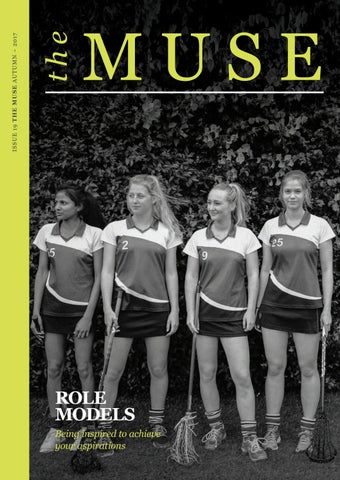
ROLE MODELS Being inspired to achieve your aspirations
Visits & Voyages This list is by no means exhaustive, but offers a flavour of guests in and visits out during the Autumn Term.
Visitors In Charity Music Event, Year 11 and Sixth Form
House Glee, Whole School
Christmas Production, Gimme, Gimme, Gimme, Year 3
Junior School Christmas Concert
DAHSA Reunion, Alumnae Daffodil Planting in Senior School for Marie Curie, Whole School
Junior School Teatime Music Concert Learn to Earn Careers Day, Year 8 Lunchbox Lectures, Years 9 - Upper Sixth
Deforestation Debate with MP Mr Mohammad Yasin, Year 4
Milton Keynes Prep and Broughton Manor Activities Event, Senior School
Drama Performance DNA by Dennis Kelly, Year 10 and Upper Sixth
National Poetry Day, Whole School
Duke of Edinburgh’s Awards Evening
Pilgrims Preparatory School Annual Activity Event, Year 2
Educate Girls India, Red Ribbon Day, Year 9 Elevate Speaker Event, Sixth Form English Forever Festival Week, Whole School European Week of Languages, Years 7 - Upper Sixth
Paperbirds Theatre Day, Year 8
Polam and Orchard Schools Annual Activity Event, Years 2 and 4 Open House, Whole School Open Morning, Whole School
Exchange Programme Presbyterian Ladies College Students, Year 10
Sixth Form Open Evening
Festive Lunch Club, Senior School
The Association Games on the Lawn, Junior School Gardens, Whole School
First Team vs Old Girls (Alumnae) Lacrosse Match, Cople Fields
The Association Christmas Fayre
World War ll Tea Party, Year 5
House Drama Competition, Years 7 and Lower Sixth
Voyages Out Art Lecture on the work of Paul Catherall, Bedford School, Senior School
French Study Trip, Loire Valley, France, Years 9 - 11
Art and Textiles Trip to the Tate Britain and Tate Modern, London, Years 10 and 11
Geography in Action Trip, Imperial College London, Sixth Form
Art Trip to The Higgins and St Paul’s Church, Bedford, Year 10
Geography Trip to Cranedale, Yorkshire, Lower Sixth
Balenciaga Exhibition, London, Sixth Form
GSA Girls Go Gold Conference, Wimbledon High School, Years 10 - Upper Sixth
Bedford Open Mic Night Charity Event
Pitt Rivers Museum Trip, Oxford, Sixth Form Psychology Residential Trip, London, Years 11 and Sixth Form Senior Maths Challenge, Cambridge, Sixth Form Team Building at Cople Fields, Year 8 Team Building at Ickwell Bury, Year 3 The Jungle Book Theatre Trip, Royal and Derngate Theatre, Northampton, Year 4
Bletchley Park Trip, Year 5
GSA Stem Conference, University Technical College, Cambridge, Lower Sixth
British Museum Trip, London, Years 9 – Upper Sixth
Hockey Coaching Course, Bedford Hockey Centre, Years 9 - Sixth Form
Business and Economics Trip to India, Sixth Form
Jazz Concert Trip, The Quarry Theatre, Bedford, Years 10 - Sixth Form
Castleton Geography Trip, Derbyshire, Year 9
Winter Wonderland Social Trip, London, Years 11 and Sixth Form
Junior School Head Girls’ Team deliver harvest baskets, Bedford
Wicked, the Musical, Apollo Theatre London, Year 11
Christmas Market Trip to Cologne, Germany, Years 7 - 9 Condover Hall Netball Trip, Shropshire, Year 8 Cultural Trip to Cambridge, Year 10 and Presbyterian Ladies College Students Curatorial Experience Trip to The Higgins Art Gallery, Bedford, Upper Sixth Duke of Edinburgh Cycling Event, Lake District, Lower Sixth Edale Geography Trip, Derbyshire, Year 10 Educate Girls India Charity Walk, Year 9
Love through the Ages English Conference, London, Sixth Form
Think Tank Museum Trip, Birmingham, Year 6 Victoria and Albert Museum Trip, London, Year 9
Editor’s Insight
F
or each of us inspiration comes in many forms; for me it can come from the words of great individuals who have worked to change perceptions, to beautifully crafted words in a novel or a song, or from the unexpected act from a student, which illustrates to me their strength of character and understanding. As a Headmistress, I aim for our students to understand that inspiration does not always have to come from the great and good. It is not always the poster girl or boy that you need to look up to, often inspiration is much closer to home, and I want to instil into our students that we must always be open-minded to all that is around us. I feel incredibly lucky that Bedford Girls’ School is an open and diverse community, that we have a rich heritage and can draw much inspiration from within our community. We must look for new and exciting discoveries, which challenge our thoughts and inspire us to do better. The importance that we place upon ensuring that every girl receives an inspiring education comes across, I hope, very strongly in this issue of The Muse and I do hope you enjoy all of the articles in this edition. I think we can all remember at least one great teacher who has influenced who we have become and it is lovely to read about the influence the renowned educator, Mr Rex Walford had on a member of our Geography Department, Mrs Sara McPhail. Very close to my own heart, as a fellow geographer this Legend in Their Lifetime was truly larger than life character. Rex Walford personified all that a great and honourable teacher should be, and his ethos, teaching techniques and warmth have influenced many. I was also extremely interested to read what inspired our new Head of Modern Foreign Languages, Mrs Aude Helm, to become a teacher, how she combined a love of business and communications with her passion for languages. This is an important message for all of our students to understand that learning should open your options, not limit them, and if you are interested and motivated by something you can always find a way to make it work for you.
As both a geographer and a teacher it is always extremely rewarding to see how much overseas trips can inspire our students, it makes all the hard work preparing the visits so worthwhile. The mature reflections from the Sixth Form students who went on the Economics and Business Studies trip to India illustrate clearly how a wellstructured trip really can have a huge impact on personal learning, often far more than can ever be achieved in a classroom. India is a country of such diversity and I am pleased that the students were open to the multiple aspects of Indian life and have carefully thought about all that they saw and learnt. I am also always fascinated by the personal inspiration that students draw upon in the creative arts subjects and enjoyed reading about the creative process that guides our teaching of Textiles in Textile Talents. I am always personally in awe of the huge range of stunning pieces that come from the department and it is extremely satisfying to see that the wider educational world acknowledge the depth of talent developed by Mrs Brearley and her team. Personalising the learning experience is key to inspiring lifelong learners and in the Junior School employing the Activity-based learning (ABL) model helps our younger students to be excited by the endless possibilities of learning. Mrs Howe explains how they put this into practice in our feature Learning Through Action demonstrating just how fun and engaging learning is in our Junior School.
“ I can truly
say that I draw inspiration from the energy, commitment and enthusiasm the girls put into all aspects of their life at BGS
”
As I now reflect on the extremely busy first term of the 2017 academic year, I can truly say that I draw inspiration from the energy, commitment and enthusiasm the girls put into all aspects of their life at BGS. The terms always race by and I believe it is important for each of us to take time to consider just how much has been learnt and achieved. They really do continue to astound me! I do hope you enjoy this issue of the Muse and I wish you all a healthy and happy 2018. Jo MacKenzie Headmistress
The Muse | 02
Inspired by
India
T
rips should create memories, but more importantly they should expand horizons, pushing students out of their comfort zones through new experiences and allowing them time to reflect on what they have seen and learnt. Where better to put this into practice than a trip to India, a country of vast extremes where your senses and thoughts are constantly alive as you re-evaluate your preconceived notions and your eyes are open to a plethora of sights everywhere you turn. During the October half term, 18 Sixth Form students travelled to India and experienced a fascinating insight into the culture, history and economics of this truly incredible country. Arranged by the Head of Economics and Business, Mrs Philippa Hooley, the trip provided excellent opportunities for the girls to expand their understanding of the country. Mrs Hooley outlined the rationale for trip: “India is still a country of contrasts, it is one of the world’s fastest growing economies and is home to the largest number of billionaires in the world, but over 25% of the population still live in poverty. This was a perfect opportunity for girls to see first-hand the challenges and aspiration of a diverse nation. Although the trip was arranged through the Economics and Business Studies department it was equally as 03 | The Muse
relevant to girls studying Geography, History and Art, providing a wonderful example of cross-curricular learning, helping them link knowledge and ideas together.” The trip focused on highlighting the juxtaposition of new India against old, helping the girls understand many of the factors influencing its growth and current challenges. The sights, sounds and smells of the Janpath flea market and the freneticism of Old Delhi’s streets proved an exciting first couple of days in a city which houses 22 million people. Visits to Gurudwara Bangla Sahib, where the girls enjoyed making bread for the community meals, and Jama Masjid provided context for understanding both the Sikh and Muslim influences in India. A trip to the UKIBC (UK India Business Council) provided a stimulating and informative presentation of the current state of trade between India and the UK. Whilst a meeting with the Delhi Mumbai Industrial Corridor (DMIC) office inspired the girls with the aspirations of India’s government to create sustainable global manufacturing and training hubs across the country to boost economic growth. Current Upper Sixth Year student Katie McDonagh commented: “I found the ambition of both the UKIBC and, especially, the DMIC to improve the India’s economy and,
therefore, the lives of the Indian people very encouraging.” To experience investment in modern India, the group visited the Yakult factory to see modern manufacturing processes in state of the art facilities, this was then contrasted with a visit to Dilli Haat, a local market selling traditionally made goods in preparation for Diwali. Mrs Hooley explained: “Understanding the hive of activity that is taking place at any one time in and around Delhi fascinated the group, whether it was small scale market production or visiting an industrial size plant they could start to understand how Indians are generating income both through entrepreneurial activity and foreign direct investment.” Lily Jefferies, Upper Sixth added: “I found how hard people worked in India inspiring. I learnt that there is hope for improvement always, as shown through the plans for the new cities and the businesses which want to invest in India.” The trip also aimed to introduce the girls to the cultural and historical significance of the country and no trip to Northern India would be complete without a visit to the Taj Mahal. When travelling through India every moment offers a new experience and the train journey from Delhi to Agra enabled the girls to see another view of the country. From the mass of humanity jostling for space at the crowded
train station in Delhi to observing mile-upon-
Being in India at Diwali was a special
experiencing the Diwali celebrations. I also
mile of countryside they gained a sense of the
moment, known as the Festival of Lights, it
found the extent of the poverty some people
size and scale of India and her population;
is the largest festival in Hindu faith and the
were living in very humbling and it ensured
as well as having the chance to spot some
whole of Rajasthan was awash with colour
that I would put my own privilege into
incredible wildlife by the edge of the railway
and light. The group were lucky to celebrate
perspective.“
tracks!
Diwali in a rural village, taking part in
Once in Agra the girls had a once in a lifetime
traditional activities, including a visit to a
treat, visiting the iconic Taj Mahal, an
shrine and enjoying a fireworks display.
Izzy Swaney added: “Trying on the saris and getting to experience a taste of local Indian culture in Dausa was very special. I learnt
architectural marvel constructed from white
about the caste system in India and the
marble, which took 20,000 craftsmen over
history of its implementation. I also learnt
17 years to construct. The monument did not
more about Indian culture as a whole which
disappoint, leaving the girls awestruck by its sheer scale and incredible beauty, as Upper
“ The girls handled
was fascinating.”
Sixth student Izzie Swaney commented: “The
each new situation with
Mrs Hooley concluded: “The trip was a
visit to the Taj Mahal and learning about the
sensitivity and good
country and I feel that all the girls really
techniques used to build it and the incredible precision achieved with seemingly basic tools blew me away.” Sampling rural life in a village near Dausa in Rajasthan was a highlight for many. Drinking masala chai under the neem trees and learning how the subsistence farming was the responsibility of the women of the village, whilst the men travel to work as electricians
humour, they were great ambassadors for the School and demonstrated open-mindedness and empathy.
”
and plumbers, was an enriching experience
success on so many levels, India is a complex got under the skin of the challenges and opportunities it faces and were interested and engaged in all that they saw and learnt. For all of us there were many eye opening moments, which took us out of our comfort zones. The girls handled each new situation with sensitivity and good humour, they were great ambassadors for the School and demonstrated open-mindedness and empathy. Such trips teach the girls how to look and question with
and brought to life how communities have to
a new perspective, it allows them the freedom
work together. It also provided the girls with
The girls were deeply affected by their
to explore areas which fascinate them without
the opportunity to meet the children of the
time in India, Katie McDonagh reflected:
the restriction of a syllabus, this is real
village and understand how valued education
“I felt I learnt a lot about Indian culture
learning and it is wonderful to see the girls’
is in India.
through visiting mosques and temples and
intellectual curiosity come to the fore.”
The Muse | 04
English Forever Samuel Johnson famously said that whoever is tired of London is tired of life. We might say, though, that whoever is tired of English is tired of life for in this subject we find the essence of humanity; the most evocative and discerning critique of society; the powerful means of communicating any thought expressible by mankind.
05 | The Muse
A
t a time when we hear employers lamenting the fact that young graduates can no longer communicate effectively or use good grammar, Bedford Girls’ School students can be confident that they will leave school with the skills and attributes to stand out. Mrs Carole Hopkins, Head of English explained the BGS approach: “The English curriculum is designed not merely to instruct, but to inspire. A good command of language is a life skill, and it is essential that we would like the girls to feel confident in experimenting with it, as well as being sure of the essential structures that underpin it. By the time the girls leave BGS they will take with them an understanding and appreciation of different genres of literature.” The English Department have formalised the teaching of essential grammar in Years 7, 8 and 9 as a way of consolidating and building on the grammatical knowledge that the girls will already have gained in younger years. The Junior School has a robust and rigorous approach but as the girls enter the Senior School with so many demands from different subjects, it is important that they revisit and reinforce these essential skills as they move forward. From the start of Year 7, teachers begin to introduce some of the terminology that will be used in IB and A Level English Literature and English Language; the school does not believe that there is a limit on the attainment of the girls, and wants to extend their learning as far as possible. “We are extremely conscious that a wider vocabulary enables people to express their ideas with precision and subtlety, and this idea is behind our spelling and vocabulary lists. We want the girls to feel that they can look a word up, and work out what it means, and use it in their own writing. We are working at ways of encouraging the girls to use the vocabulary items they encounter in English in their dayto-day lessons and work, and would like to reward their endeavours with house points! Our work is as much about confidence and performance, we want the girls to embrace the idea that the English language is incredibly rich and varied; and that now is the perfect time to explore it. We actively encourage the girls to have strong principled views and they need the language and vocabulary to articulate these voices effectively.” English is such a wide and varied discipline and the School are keen that the girls are exposed to a plethora of influences before making decisions about specialisms in the Sixth Form.
Mrs Claire Everitt, Second in English commented: “It is our strong belief that literature is the touchstone of our community, in which we can explore other worlds and experiences. It provides a standpoint for evaluating our own self and society, and acts as a tool of instruction and a key provoker and, sometimes, determiner of thought. Our texts are chosen to engage students not merely in an interesting narrative, but to introduce them to situations and characters that are moving and wonderfully crafted. Our approaches are varied; our enthusiasm is boundless.”
“ It is our strong belief that literature is the touchstone
of our community, in which we can explore other worlds
”
and experiences.
In Years 7, 8 and 9 girls might encounter works as varied as Michelle Magorian’s modern classic Goodnight Mr Tom, Dickens’ A Christmas Carol or a Shakespeare text such as A Midsummer Night’s Dream. This helps the girls develop the confidence to approach even quite weighty texts, and ensures that they are exposed to a range of writing styles over various eras - Renaissance, for example, or Victorian or Modern - and to be able to appreciate great writing, whatever the book or time period. By way of responses to texts, girls might consider how to act out a scene; they might construct a dream-catcher or a mini-stage scene; they might analyse a theme such as the representation of power; or they might follow an iTunes-U course comparing the way authors have built on and departed from stylistic models of the time. Mrs Everitt continued: “The attributes that are being developed can be applied across the girls’ entire education: the ability to write well, to use language discerningly; to evaluate the written and spoken word, and to communicate their own thoughts and feelings in a compelling and sophisticated manner are life skills. At times, this might involve the girls evaluating the presentation of arguments in a range of articles, before writing one of their own; similarly, they might use a photograph or an event in a narrative as a stimulus for a piece of creative writing. Students regularly give presentations to their class, and all girls read a
poem of their own choice and deliver speeches in large settings as part of the curriculum in both the Junior and Senior School. The popular annual Poetry Reading and Public Speaking Competitions provide great opportunities for girls to build confidence.” Mrs Hopkins elaborated: “Students need opportunities to present and perform; in talking to an audience, they learn much about poise and gesture, about pace, and the construction of texts. It is important to speak and listen well in any society, and we aspire for the girls to have excellent communications skills in this area, whether by talking individually to a group, or by collaborating on a project, or even by creating their own iMovie.” Equally important, students need to be exposed to English in action out of the classroom. The Department provides a rich and varied programme, both in the curriculum and co-curricular visits and speakers which bring the subject to life. Visits to Stratfordupon-Avon, the British Library and West End theatres ignite interest and enthusiasm throughout the year groups. The ever-popular English Forever Week celebrates the subject, through all-day Harry Potter readings (conducted by a whole array of wizards and witches), quizzes, a poetry slam, and an annual one-person theatre production. The English department is keen to develop meaningful links with other subjects. This involves, for example, independent research into the cultural and social context of texts, so that the girls are better informed and able to understand a little more the reasons why a writer might have presented a certain topic or done so in a certain way. When studying Jane Eyre in Year 8, girls have been able to draw on their knowledge of life during the Industrial Revolution - to understand the relative peace of the countryside, as well as the poverty and deprivation of many rural areas. Mrs Hopkins added: “We are always keen to innovate to ensure English remains both exciting and purposeful. We are currently investigating collaboration with the MFL and Classics Departments to enhance our approach to teaching grammar and to aid our study of the ways in which language has changed over time. Not only will this help the girls with development in all subject areas; it will aid the girls when they study literature in translation.” She concluded: “At Bedford Girls’ School English really is forever and we will never tire of it. Far more than an academic subject, it is giving girls the attributes that will carry them forward in life.” The Muse | 06
TEXTILE TALENTS Bedford Girls’ School and its heritage schools have long held an outstanding reputation for innovation and creativity in textile design with numerous alumnae going into the fashion, textiles and costume design fields, providing a plethora of inspiration for our current students who look to follow in their footsteps.
W
ith Britain’s leading role in fashion and design BGS is preparing the girls for exciting futures and a walk through our corridors is testament to the creativity as you cannot fail to be impressed by the incredible work on show. Mrs Brearley, Head of Textiles, explained her philosophy: “My overriding aim is to offer an art, craft and design education through textiles. My wish is for all girls to leave Bedford Girls’ School with an appreciation and understanding of beautiful design and quality craftsmanship. The pursuit of ideas through an intellectual and creative approach often produces the best work as it is thought provoking and original.” “We teach textiles very much as a creative process, exploring the way in which fabric designs are devised, printed and products created. From when the girls first enter the textile studios in Year 6 right through to Sixth Form, we focus on introducing the creative cycle. Through this process students learn to use a combination of techniques and skills to produce work which is multi-layered incorporating and encompassing drawing, design, embellishment and construction techniques.” “Textiles is a wonderful subject through which the girls can really explore their individual creativity and take control of their own responses to a brief. The learning process often takes many out of their
07 | The Muse
comfort zones as they work independently. Craft and garment making techniques and production skills are new to all girls, so it is a lovely level playing field for them all to work and develop new skills together. For me the process of making is just as important as the finished product and I take great pleasure in observing the students as they explore patterns, colours, and embroidery techniques. Seeing confidence as well as technical ability grow is extremely rewarding.” Throughout the curriculum the students are introduced to artists, fashion and textiles designers so that they broaden their creative horizons and develop research based skills, which can link textiles back to other areas. The skills and knowledge they are developing are transferable to Art, Design and Technology and a wide range of other subjects. Mrs Brearley added: “Exploration through play can lead to some exciting and innovative outcomes. Taking risks in a controlled environment is encouraged, we want our girls to experiment and learn from the process, as this is how they build confidence in their creativity.” Not only do the students have the support and guidance of expert teachers but also are also lucky to have on hand the assistance of specialists who work alongside the team to support the girls with their work, helping them to challenge themselves just that little bit further. Renowned textile artist and the School’s Arts Technician, Jane Smedley, supports the girls with her wealth
of experience, and fashion industry expert Rajinder Mahli is also currently working with the students. In Years 7 and 8, all students study Textiles as part of the creative suite of subjects, they start with a creative brief looking at a specific theme for inspiration, for example natural form and architecture. The students will work on individualised fabric designs from this theme and then develop specific dyeing techniques to enhance the design work. Finally, the fabric is turned into a product, employing sewing and embroidery skills. Once in Year 9 girls can decide to specialise in Textiles as one of their creative arts subjects, as a step towards making decisions about where their interests and talents may lie, many students then decide to continue with it at GCSE. Mrs Brearley explained: “By the time the students start the GCSE course they all have a strong level of comprehension of the core attributes and are able to selfdirect their learning. At this point, their body of work can be concept led, process led or materials led. The journey is very creative, reflected in their course work journals, using a wide range of sources for inspiration, from designers, nature and other art forms. Mastering technical equipment and tools, such as advanced sewing techniques, the heat press and silkscreens can also be very empowering and confidence boosting.” Ms Mahli expanded on the work she is currently undertaking with the GCSE students: “I am working with Year 10 on Cubism within textiles and fashion. We have approached the subject matter by introducing fabric manipulation techniques, from fabric origami to folds and tucks in a variety of fabrics. Some of the techniques have been challenging, but it has been pleasing to see the girls enthusiastic and keen to learn with rewarding results. I hope they will use the techniques they have learnt in their future projects. The department allows the individual to develop their own style and flourish. I personally feel a creative environment should not be restrictive or rigid and that the whole process is beneficial for the preparation of final examinations.”
The Department’s approach has been highly praised by external moderators, with the 2017 GCSE moderators commenting: “The high level of work with a rich and skilful series of personal response made it a pleasure to moderate at this school.” and went on to comment on the submissions showing “confident, diverse and very individual lines of enquiry.” Moving into Sixth Form, either through A Level or the IB Visual Arts course, the work becomes further refined and original with the students’ own interests directing the progression and outcomes. Some students will naturally approach it from a fine art perspective and others a design perspective. In either case, the textile work evolves in an organic way where decisions are made as the project unfolds, this takes a level of maturity to where the students have to trust their own instincts and embrace the process. Mrs Brearley said: “It is important that the student has time to make these considered decisions so that they can stand back in order to review, modify, reflect and refine their work; aesthetics, form and function are key. There is always much to do by way of problem solving and the making of a garment, for example, adds an extra dimension and challenge.” The results speak for themselves and the stunning final coursework and exhibition pieces attract the attention of leading fashion and textiles courses with girls gaining places at prestigious colleges such as Winchester School of Art, Falmouth and Saint Martins. Whilst other alumnae have gone on to be renowned costume, textile and clothing designers. Mrs Brearley concluded: “ We are greatly privileged to have strong links with universities and specialist fashion and design colleges, who actively scout BGS students. This is a true testament to the girls past and present, it reflects the level of commitment, hard work and creativity that can be found in our studios. I watch with excitement as alumnae excel in their chosen careers and feel a sense of pride that we have supported and inspired them on their journey.”
The Muse | 08
Dramatic Openings As part of the School’s on-going refurbishment plans students and staff returned from the summer holidays to be greeted by a wonderful renovated Drama and Dance wing, creating new spaces and inspiring ideas to support the ambitions of our Drama and Dance Department.
M
rs Catherine Howe, Director of Drama and Dance, explained: “Our aim with the re-development of the Drama and Dance spaces is to provide an engaging and flexible environment that promotes creativity, imagination and excitement. As a department we are seeking to provide professional standard training, both technical and performance focused, which enhances students’ academic study of the Performing Arts and develops a love for Drama and Dance as art forms. We want to lay a strong foundation for girls wishing to move into professional theatre as a career and help them understand ways in which skills gained in these areas can be transferred to any industry.” “It is important that students are exposed to a wide range of productions, varying in style, genre, content and design which can deepen and challenge their theatrical awareness, artistic experience and help build their critical faculties”. In line with this vision, the centrepiece of the renovation is the creation of an intimate black box studio theatre. The combination of flexible seating and state of the art technology has created a full 360 degrees performance space. Laid with professional black vinyl floor and a new set of black tabs, the space now creates the ultimate blank canvas to explore creativity. Mrs Howe added: “We have installed a modular seating system to allow us to have any staging configuration. This creates much more flexibility to support a number of different styles of productions. We now have a digital LED lighting rig with full colour spectrum including a number of moving heads all with integrated gobos to support 09 | The Muse
students in learning how to operate the latest software driven lighting applications. We have, however, still kept the capability to rig a number of the old tungsten stage-lights still favoured by many lighting designers so that we can provide a breadth of training, which is informed by an understanding of past as well as current technical developments.” Mrs Howe continued: “The renovation of the control room was a key area, as it gives the girls the opportunity to develop strong technical skills, which are greatly transferable to many fields. The control room has been sound-proofed and a relay system installed so our technical teams can hear the actors for cues.” Indeed, all the spaces have been acoustically treated in order to provide excellent sound quality and in line with the school’s position as an Apple Distinguished School, the sound mixers operate off iPads to allow easy access during lessons. In addition to the studio theatre, there is a new dance studio, which also provides another practice room for rehearsals and a new performing arts office, which has brought the Dance and Drama departments together supporting the collaborative opportunities between the subjects. The light filled theatre foyer provides a welcoming environment for pre-show drinks. In addition, the Assembly Hall and Randle Hall benefited from upgrades to lighting and sound, providing students with an extensive suite of performance spaces. A packed Autumn Term saw activities and performances including contemporary dance workshops, a Year 8 theatre day with The Paper Birds Theatre company who helped them devise a play in a day on climate change;
a Year 10 and 12 Practitioner workshop with the renowned physical theatre company Gecko. Year 11 and Upper Sixth performed their devised examination performances and we welcomed a one woman interpretation of Richard III. Our first play in the space, the very successful Year 10 production of DNA was performed in November and rehearsals are well underway for our senior play - a ground breaking all female version of Lord of the Flies in February. Meanwhile co-curricular drama and dance clubs are rehearsing exciting new pieces to perform later in the year and the Department worked closely with the Junior School to produce the very moving Year 5 WWII performance of Working for Victory and the Year 3 Christmas production. Mrs Howe concluded: “This is an exciting time for Drama and Dance at BGS. The new developments give us a strong professional platform from which the girls can really deepen and grow their artistic skills and appreciation for the arts. Their creativity and enthusiasm are contagious and I am delighted to see so many students already taking advantage of all that we offer.”
T HE L OV E OF L ACROSSE “ When you talk about lacrosse, you talk about the lifeblood of the Six Nations. The game is ingrained into our culture and our system and our lives.” Oren Lyons, Native A merican lacrosse player
A
sport that has its origins from a game played by Native Americans, the popularity of lacrosse continues to inspire across the UK. Bedford Girls’ School has a rich history as a leading lacrosse playing school, dating back to 1903 where its heritage school, Bedford High School (BHS), first introduced the sport for a short period to its students, who competed on the Beverley Crescent sports fields. The sport was reintroduced in the 1920s by staff at the Bedford Physical Training College. Mrs Jane Axford, Director of Sport at Bedford Girls’ School, who represented England lacrosse and participated in two World Cups in 1989 and 1993, emphasises the physicality and skills required. She explained: ‘’Lacrosse is for the ultimate athlete, demanding speed and endurance, stick skills and tactical awareness. There is the opportunity to lead from the front but to be successful you also have to work as part of a team. It is fun, fast and physical. What’s not to like!” Bedford Girls’ School now boasts state of the art lacrosse facilities at Cople Fields. Opened on 7th September 2016, the fantastic addition to the School estate includes a modern pavilion, six full size lacrosse fields and an impressive viewing gallery. Mrs Axford adds: “Cople Fields is an important facility for the School which allows us to host regional competitions and tournaments. The facility also now pays homage to our annual lacrosse match between our First XII and Old Girls’ with the fourth match paying a special tribute to Miss Joan Gibson (Gibby) who sadly passed away on 27th March 2017, aged 97. We were delighted to have many friends and family from BGS and the wider community in attendance including Joan’s niece Mrs Sarah Brown.” The Old Girls’ team included former Head Girl Anna Hunt (2017), sisters Aimee Oakley (2008) and Elena Salmon (2017), as well as Kate Axford (2017) and Katie Parrish (2017) both of whom hold international caps in Lacrosse for England and Wales respectively. Adding
to the excitement of the event, the teams also comprised competing sisters: Kirstie (2016) and Eilidh Moffat, and Bea (2014) and Evie Caldwell. The match was enjoyed by all with the Old Girls’ claiming victory 15-8. Mrs Sarah Brown presented the Joan Gibson Memorial Trophy, kindly donated by by The BHS Guild, for the Player of the Match to Lower Sixth Student Georgia Staroscik, who gave an excellent goalkeeping performance for the First XII. Many of our Old Girls’ play leading roles in their university lacrosse teams with a number playing the sport at international level including Emma Brown (2013) and Emily Myrtle (2013) who both represented Wales and Scotland at the Lacrosse Home Internationals in 2016, respectively. The love of lacrosse instilled in so many of our alumnae and current students owes its gratitude to the legacy of the respected former Head of PE at BHS, from 1951-1972. Widely reputed to have known the name of every High School pupil in her time, Miss Gibson spent all but five years of her teaching career at BHS. Her students remember her fondly with always a twinkle in her eye. She is particularly well remembered by the boarders, who she ensured received extra food after swimming practice so they did not return to the boarding houses hungry. Educated at St Swithun’s, Winchester, she passed her Chartered Society of Physiotherapists examination in 1940. She then gained her London University Diploma in the Theory and Practice of Physical Education in 1941, prior to enrolling at Bedford Training College. She trained at Bedford under Miss Stansfeld, and Miss Gibson was initially
seconded to BHS from 1947-1952, where she was later appointed Head of PE. Assisted by Miss Frances Howard, Miss Gibson’s special interests were swimming, lacrosse, rounders and cricket. Miss Gibson herself was a talented lacrosse player, she played goalkeeper as well as captaining the Welsh side between 1948-1951, earning 10 caps for her country. At the age of 96 ½, Joan was delighted to find fame and is featured in the United States Lacrosse Hall of Fame in Maryland, USA. Lacrosse continues to go from strength to strength at BGS with the U13A team becoming National Champions in 2016, the U14A and U15A teams reaching the National School quarter and semi-finals, respectively and the U19A team qualifying for the prestigious Championship Division at National Schools in 2016 and 2017. Our students also gain a global understanding of the game, more specifically taking part in the California State Games in 2016, which allowed them to explore different cultures and test themselves against the very best. The experience not only developed their lacrosse skills but also their character, taking them out of their comfort zones. Mrs Axford concludes: “We hope to continue the legacy of the sport at BGS by building on all our recent successes and continue to travel to training camps abroad. Lacrosse is a significant sport, which not only develops our students skill set but also teaches them to set goals and accomplish these goals with the help of others. Whether we win or lose a game, the impact of lacrosse strengthens team bonding and will continue to inspire future generations to come.” The Muse | 10
LEARNING THROUGH ACTION
T
here is absolutely no doubt that encouraging children to gather knowledge through active investigation, experimentation and then expressing this through presentation creates an engaging learning environment. As part of the Enhanced Curriculum in the Junior School, we advocate these processes through Activity-based learning (ABL) in and outside of a classroom setting. An interactive learning process endorsed by leading educationalists, ABL uses a range of innovative learning resources to develop each student as an independent and active learner rather than a passive listener. It develops selflearning and allows a child to study according to her skills. Mrs Carolyn Howe, Head of the Junior School, explained: “In our Enhanced Curriculum we provide an education that is exciting, interactive and reflective, each girl is on learning journey as she progresses through each year group. We encourage the girls to be independent thinkers, creative and confident. “The primary objective of education is to prepare a child for the real world through individual and social development. By bringing together the interests of the child and the skill, experience and personality of the teacher, ABL helps foster self-learning and deepens the child’s understanding in an interactive environment.” 11 | The Muse
Throughout the Enhanced Curriculum, our students embark upon a termly Unit of Enquiry, which will set the context for her learning in each subject area, allowing them to explore, experiment and express through ABL. In Year 3, it is important to make learning exciting, fun and investigative. During the Autumn term Unit of Enquiry The Discovery Box, each week the girls opened a box which revealed new clues about their learning. The girls were then set ABL learning tasks in the local community, enhancing their study of Geography.
Mrs Helena Schofield, Head of Year 4,
Mrs Charlotte Martin, Head of Year 3, provided an example: “The girls enjoyed a team-building day at Ickwell Bury nature reserve, where they were able to use their senses to discover the natural environment around them. The girls worked in teams locating burrows, building dens and creating campfires. This outdoor learning developed their communication, cultural and imaginative skills.”
Mrs Howe added: “Using their investigative
As the girls move into Year 4 it is important to encourage them to extend their independent thinking, be curious, ask questions and to research the answers.
who praised the girls for their excellent
At the beginning of the Unit of Enquiry It’s not all about the Chocolate, a chocolate workshop sets the scene for the term’s work. ABL was at the heart of the workshop - the girls learn about how cocoa beans are grown in Ghana and the process of chocolate making.
explained: “When learning about chocolate making, the girls reflected on designs
made by companies, such as Cadbury, and created their own packaging. They thought
about materials and the overall effect. They then created an advertisement on iMovie
using persuasive language learnt in English to tempt their chosen consumer market.
These activities provide opportunities for
ABL and included time for the girls to reflect and evaluate their work.”
skills, the Year 4 girls begin to find answers to complex issues such as what is the
impact of deforestation to the environment? How it affects living things such animals,
plants and habitats? What is fair-trade? The extent of their learning was evident in their
deforestation debate, where the girls argued
the pros and cons of deforestation in front of The MP for Bedford, Mr Mohammad Yasin, behaviour and control in the debate.”
Similarly in Year 6 as the students are
working towards making their transition
into the Senior School they are expected to undertake a significant amount of
independent research for their Brave
New World Unit of Enquiry, to help them
understand how the world is interconnected. Employing ABL learning techniques helps
students think in a broader context, whether they are considering human rights or global supply chains. Research shows that children do not always understand the relevance of learning material when simply putting pen to paper. ABL can be used to help students understand the ‘real-life’ relevance by encouraging them to explore and solve realistic problems and scenario. Embracing ABL to help the girls embed learning and build empathy can be clearly seen when the students in Year 5 spend the first term studying the impact of World War II. Mrs Kristie Whomsley, Head of Year 5, said: “In the World War ll Unit of Enquiry, We’ll Meet Again, the girls took part in ABL activities, which gave an insight into the skills required of service men and women. As well as highlighting the essential attributes, such as teamwork and communication, needed by people at that time, it also gave them an insight into some of the themes they would explore, such as propaganda and code breaking. “Following on from this, the girls experienced life as children living during the War. After listening to Chamberlain’s declaration of war, the girls had to make gas masks and prepare for air raid drills. They attached tape to their windows to protect their classrooms and learnt to adapt to their
lessons being interrupted by the air raid
sirens, which enabled the girls to understand more fully and empathise with what children had experienced during the War.
ABL is also a vital tool in helping individualise the learning experience for each student, as Miss Holly Crawford-Smith, a Year 5 teacher explained: “Our Year 5 girls created multiple-choice quizzes on their iPads using Google Slides, and used these
“
Give the pupils something
to test their friend’s knowledge of the solar system and phases of the moon. However,
to do, not something to
when I looked at each of their quizzes it
learn; and the doing is
or gaps in their knowledge based on how
of such a nature as to demand thinking; learning
”
naturally results.
John Dewey, A merican philosopher and educational reformer.
also highlighted to me any misconceptions the person wrote the quiz - for example, what multiple choice options they gave and whether they had the correct answers. I could then work with each student helping her to overcome the gaps before we moved on as a class.” Mrs Howe concluded: “Learning is not about reading from a textbook with the teacher standing in front of the class. It is about
“The girls celebrated the end of their
learning with a production of song, dance
and drama to celebrate the role of women during the War and reflecting the different
experiences of the women during the War. The performance was delivered to their
grandparents. It was an emotive occasion for
building a wider range of learner attributes in a motivational setting. This helps develop teamwork and social skills, whilst embedding knowledge and giving the girls the confidence to think outside of the box. Providing these learning experiences in the
the girls to celebrate their work with relatives,
Junior School enables the girls to develop
memories to share.”
Senior School.”
some of whom had their own wartime
deep learning skills which they carry into the
The Muse | 12
An Interview with…
Aude Helm Can you tell us a little about your
to teach in primary or higher education. I
background?
felt the skills inherent in PR such as being a
I grew up in France, in a small village near Amiens, now made famous as the home town of French President Emmanuel Macron and was educated at le Lycée du Sacré-Coeur where I studied the French Baccalauréat ES (Economics and Social Sciences). I have always wanted to be a teacher; however, I also had a passion for Business, in particular Communication and Marketing, and decided to pursue a career in this field prior to becoming a teacher. As part of my studies, I undertook a sixmonth work placement in Public Relations (PR) in London and then worked as a Fashion PR Manager for three years. I thoroughly enjoyed the challenges of working in Fashion PR as the role was very varied: from organising fashion shows,
Bedford Girls’ School welcomed Aude Helm to its community as Head of
arranging press days, managing product launches, writing press releases and meeting up with journalists or celebrities to talk about the collection or to choose a dress for an event. Despite my love of fashion and
Modern Foreign Languages,
luxury brand management, teaching was
in September 2017. Aude
always at the back of my mind and I decided
joined us from Radnor House Sevenoaks where she taught French having
to do a French and German PGCE at Brunel University in 2004. What inspired you to go into teaching?
previously been the Head
I always had a passion for languages and
of French at James Allen’s
the language acquisition process. I believe
Girls’ School and Ashford School. The Muse caught up with her during the Autumn Term.
13 | The Muse
immersing students in language learning helps them to think more independently,
good communicator, building relationships; research and writing were transferable to teaching. I decided to focus on teaching French in secondary school, as this would also allow me to integrate some of my interests in literature and film into my teaching. How has studying the French Baccalauréat influenced your teaching? It still influences me today as I do not see the study of languages in isolation and I totally empathise with students finding it hard to ‘drop’ subjects they enjoy to focus on three or four for A levels. The International Baccalaureate Diploma (IB) allows students to broaden their knowledge for another two years, which I think is excellent. It is also fantastic to keep subjects that you were not necessarily the best at as they will always be useful in life. For example, I hesitated for a long time between a university course only in Languages and then one with Economics and English. Because I had had to study Mathematics throughout the Baccalauréat I had a good enough standard to apply for the combined course, no doors were closed to me. In addition, the French Baccalauréat teaches Philosophy to all no matter what your options, this was also a great discovery for me and I think the Theory of Knowledge in the IB Diploma opens students’ minds in the same way.
increase their confidence and vocabulary
What most attracted you to Bedford
and in fact, there is a lot more benefit from
Girls’ School?
language learning than just speaking and understanding the given language.
Like many other teachers looking for a new career move, your first contact with a school
I knew for a long time that I wanted to be a
if you are not from the surrounding areas is
teacher but I was not sure whether I wanted
their website. I was very impressed by BGS’s
vision and ethos, which emphasises the importance of how every student is valued. Very importantly for me the environment allows the students to be reflective and have a global outlook. There is also a real sense of balance where the students can be bold and adventurous. BGS was sold to me not just as a place for academic learning but also as a place focusing on the well-being of every student. And last but certainly not least I had already experienced working in a girls’ school in London and I am passionate about single-sex education (particularly girls’ education) which can seem strange given that it does not really exist in France where
French Karaoke’s and what better way to
after her younger siblings when her parents
I grew up.
learn (and remember) than having a tune
died young. What could have been a difficult
and lyrics stuck in your mind!
start in life was seen as a challenge for her.
Why is it important to learn/study languages? Studying a language really does open your mind. It is not just about learning to speak a language; it is about understanding diverse cultures. This is because language simultaneously defines the world around us. A good example of this is understanding different political situations such as Brexit and the impact it will have on different countries. Learning a language also helps you understand your own language.
There are huge cognitive benefits in learning a second language, which improves the functionality of your brain, by challenging it to recognise and negotiate meaning. You build multi-tasking skills as you switch between languages, whether this be speaking, writing and listening. The list is long! What attributes would you like to develop further in Bedford Girls’
Now that I am a parent, she has taught me not to have a closed mind and be open to everything; it will become particularly interesting when my children are a little older to see what choices they make. My parents who both gave up school to work very early on were immensely proud of my sister and me as we furthered our studies. I will follow this example and be proud of my children whichever route they decide to take.
School pupils?
Do you have any particular hobbies/
English language and vice versa. The more
I want the students to be confident and not
interests?
sophisticated your English is, the easier
be afraid of making mistakes. There will
In my spare time, I enjoy upcycling
it is for a French person to understand
be pitfalls when learning a language, but
furniture, which involves giving a new lease
you, as there are more cognates in all your
the more you persevere the more you will
of life to old furniture. I purchase cheap
sentences.
succeed. No one becomes fluent overnight,
furniture online such as wardrobes, chairs,
some of the best linguists I worked with
side tables and add my own twist to them,
were not raised in bilingual families and
I just wish I was a little bit better at it and
only started learning French as late as age
have promised myself I will sign up for
11, they just worked very hard at it.
some courses when my children are older!
Many languages have contributed to the
When I learnt English in school, we did manage an exchange or a day trip to Rye and Canterbury. Trips are a great way to make the study of language more relevant and practise the language. Now though, technology has made it so much easier to
Do you have a role model?
I also enjoy spending time with my family and take part in activities such as skiing,
bring language and culture to the classroom
In different stages of my life I’ve had
cycling and walking. Family is very
and making it interactive and immersive to
various people that have inspired and
important for me, especially as I am the
motivate the students. I am a great believer
influenced me. However, my biggest role
only one living in the UK; I like to escape to
in teaching via songs and I am slowly
model is my mother. She is a strong person;
Amiens whenever I get the chance to catch
getting my reputation here at BGS for my
she started working at 14 in order to look
up with my rather large French family! The Muse | 14
Legend in their Lifetime
Sara McPhail Geography Teacher
Rex Walford OBE, 1934-2011 Geographer and Pioneering Educator Rex began teaching Geography in his early twenties; soon becoming Head of Geography at St Mary’s Hendon and then proceeded to become involved with teacher training. He was appointed a lecturer in Geography and Mathematics at Maria Grey College in Twickenham in 1962, quickly rising to be Senior Tutor and Principal Lecturer in Geography. At this time, Rex was involved with other forward thinking educationalists in developing a ‘new’ Geography looking to find innovative techniques to teach this vibrant subject. Rex was interested in introducing aspects of role-play and simulations into teaching, to make it more fun and increase collaboration in the classroom. In 1969, he wrote a pioneering book called Games in Geography. He would go on to write more than 30 books, contributing to many more and producing over 50 classroom games.
I
had always loved Geography at school, enjoying the classes and looking up to my teachers, and thought that perhaps one day I might do the same job. Therefore, with my Geography degree under my belt, I applied and gained a place to study a PGCE (Post Graduate Certificate in Education) in Geography for secondary education at the University of Cambridge. I remember being interviewed by Rex Walford and was immediately struck by his enthusiasm for Geography and mischievous sense of humour. Rex Walford was a multi-tasker extraordinaire - a man of many talents and loves. He exuded energy, showing great interest in others and most importantly was passionate about how Geography was progressing in the world of secondary education. He fundamentally believed that every child deserved the opportunity to succeed in the classroom. When I was asked to write about a legend in my lifetime it did not take me long to decide upon Rex.
In 1973, Rex moved to the Department of Education at the University of Cambridge to run the Geography PGCE group. During this time he established links with local schools in Cambridgeshire, Bedfordshire and beyond, training enthusiastic geographers keen to embark on teaching careers. He worked tirelessly contributing to Geographical Association (GA) committees, conferences, and the GA’s worldwise quizzes. He always felt that learning should be fun and combined with strong factual knowledge. He set up the GA’s Geography Action Week and Land Use UK as well as helping to write the national curriculum for Geography. The label ‘ex-Rex’ was a label I was very happy to carry with me as I applied for my first teaching post. In a small room on Trumpington Street (now Hotel Du Vin) the group of about 20 trainee teachers would hang on every word he said. This was a time of great change in education and Rex not only spoke about how to teach Geography but also gave us great advice on navigating the working world and being part of a staff room. He really did make you want to ‘spread the Geography word’. Everyone loved Rex. When he came to observe me in action in the schools where
Photograph: © Bryan Ledgard, courtesy of the Geographical Association
I was doing teaching practice there would be a real buzz. He was a breath of fresh air. In the 1990s, the period that I met Rex, his reputation grew and he was appointed Head of Education at Cambridge before being appointed Honorary Membership of the GA in 1998 and Emeritus Fellow of Wolfson College in 1999. In 2000, he was awarded an OBE for ‘distinguished contributions to geographical scholarship’. Rex tragically died in a boating accident on the Thames in January 2011. I remember receiving a text from a friend and looking at the news in disbelief as it became clear it was indeed Rex Walford, a man of seemingly endless energy and such great talent, who had died. His funeral, held in Ely Cathedral, was testament to the impact he had on many lives be they from the world of Geography, Drama or Education. As Mike Morrish said in his obituary: ‘Retirement to Rex was fictional’. After leaving the Department of Education in 1999 he continued to work on a PhD. He was an amazing pianist and worked in collaboration with the soprano Gabrielle Bell - a performance in the Great Hall in Bedford School linked to the Glenn Miller story sticks in my mind. I last saw him the Christmas before his death and as ever, he was keen to hear how life in the classroom was going at the newly formed Bedford Girls’ School. His inquisitive nature and love of Geography inspires me to this day, at the end of a lesson I often think how Rex might have approved (or not) of my offerings. Two years ago, I accompanied a student to the Royal Geographical Society to collect her Highly Commended award for the Young Geographer of the Year 2015 competition. I was delighted to see Rex’s wife Wendy at the event, there to present a newly qualified Geography teacher with the Rex Walford Award, set up to honour the man whose wonderful inspirational life deserved permanent recognition. His memory will live on and continue to inspire generations of geographers.