the
ISSUE 14 THE MUSE SPRING ~ 2016
MUSE
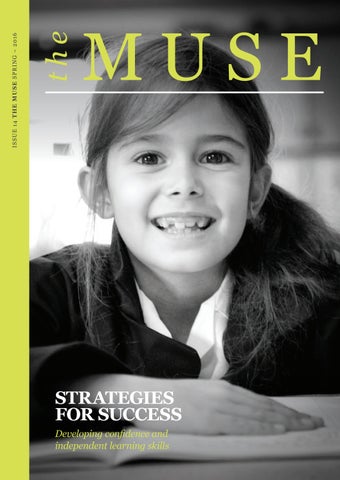
STRATEGIES FOR SUCCESS Developing confidence and independent learning skills
Visits & Voyages This list is by no means exhaustive, but offers a flavour of guests in and visits out during the Spring Term.
Visitors In Activity Morning with Bedford Prep School, Year 5 Anything Goes, Drama, Years 10-Upper Sixth Cathy Sabin, LTA President, Whole School Chinese Art Workshop, Year 6 Community Dance Workshop, Putnoe Lower School, Year 5
Junior School Teatime Concert Logistics Day, Year 9 Lunchbox Careers Lecture, Teresa Brooks, Years 10-Upper Sixth Lunchbox Careers Lecture, Hena Vissian, Years 10-Upper Sixth Lunch Club, Girls’ Leadership Group
Drama Day, Year 9
Maths Feast, Year 10
Ernest Shackleton Speaker, Year 4
Pool and Pizza Night, Year 6
Film Night, Sixth Form
Prehistoric Workshop, Year 3
First Give Charity Event, Lower Sixth
Psychology Film Night, Sixth Form
Geography Workshop, British Cartographic Society, Years 10-Upper Sixth
Roman Morning, Year 7
German Play, Years 7-Upper Sixth
Songs from the Musicals Evening, Years 10-Upper Sixth
Godspell, Drama, Years 8-Lower Sixth
Spring Chamber Concert, Senior School
History Conference, Sixth Form
The Association Quiz Night
House Pancake Race, Whole School
Theological Tea, Sixth Form
Intermediate Maths Challenge, Years 9-10
World Book Day, Whole School
Voyages Out A2 Government and Politics Lecture Day, London
Imperial War Museum Trip, London, Year 10
A Level English Conference, London, Sixth Form
Lord of the Flies Trip, Curve Theatre, Leicester, Year 9
An Inspector Calls, MK Theatre, Year 11
Love Through The Ages Literature Conference, University of London, Lower Sixth
AS Government and Politics Lecture Day, London, Lower Sixth Bedfordshire Festival of Music, Speech and Drama, Whole School BGS French Roadshow, Year 9, Turvey Lower School Bletchley Park Trip, Year 7 Captain Safety Roadshow Trip, Bedford Corn Exchange, Year 4 CCF Royal Navy Trip, HMS Bristol CERN Trip, Switzerland, Year 11 Computer Club, Milton Keynes Apple Store, Years 7-8 and Sixth Form Cultural Trip to London, Year 5 European Youth Parliament Trip, Cambridge, Lower Sixth Geography Trip, Sicily, Italy, Year 8
Mathematics Roadshow, John Gibbard Lower School, Year 10 Paris Trip, Sixth Form Politics Trip, Washington, USA, Upper Sixth Philosophy and Ethics Conference, London, Sixth Form Royal Academy of Arts Trip, London, Year 9 Rowing Training Camp, Gravelines, France, Senior School Scott Polar Research Institute Trip, University of Cambridge, Year 4 Science Live Trip, London, Year 10 Spanish Trip, El Puerto de Santa Maria, Years 10-Upper Sixth The UKMT Junior Team Maths Challenge, Years 8-9, Cambridge
Editor’s Insight
T
he speed at which terms rush by always staggers me, but with Easter falling so early this year it has been particularly busy; we have all worked at a great pace to achieve so much in such a short length of time. The school has been buzzing with trips, visiting lecturers, wonderful drama and musical performances, exceptional sports matches and impressive classroom learning; and the community has risen to the challenge of a shortened term. The fact that our pupils can maintain this pace demonstrates an high level of perseverance and commitment. They know when it is time to dig deep and keep going, they understand that there are periods when they need to be resilient and work at a greater pace. The ability to tackle these challenges are indicative of a Bedford Girls’ School education and building these skills starts in the Junior School. In this Edition of the Muse Mrs Carolyn Howe, Head of the Junior School, introduces us to a new technique which will further aid the development of these attributes. I hope you enjoy reading about what is known as the Learning Pit. The Junior School lays the foundation for strong independent learning and risk-taking skills, providing important building blocks to tackle learning Mathematics in the Senior School. Mr Adolph Palmer, Head of Mathematics, explains his department’s philosophy and ambition for the girls in our article entitled Magic Numbers. In February I was honoured to represent the School at an international conference on Girls’ Education which took place in New York. I was delighted to have the opportunity to learn from world leading educationalists and was greatly inspired by incredible speakers such as JoAnn Deak, Baroness Sue Campbell, Gloria Steinem and Arianna Huffington. Each speaker returned to the important themes of building an inner resume by developing grit, self-belief and resilience, enabling young women to unlock their potential and grow into successful and confident individuals. As part of the conference I delivered a session on the importance of engaging students in campaigning and how our girls develop a strong, global outlook as they learn to use their
intellect and voices to promote issues which they care deeply about. The importance of developing a global outlook is vital, it sets young people apart when they enter the working world. At BGS we don’t only develop this through our co-curricular activities but it is rooted in our curriculum. In this issue of the Muse we explore how looking back in time and studying Classics and Latin offers huge benefits for pupils as they look forward into the modern world. It helps them place modern languages, art, literature and culture into context and enables our pupils to have a deeper level of understanding than many of their contemporaries. Sport and Drama are two other key parts of the curriculum which help the girls widen their skillsets. They promote teamwork, collaboration and confidence as well as building resilience. In this issue we reflect on the benefits of taking part in musical collaborations with Bedford School and of the opportunities offered by the vast array of sports at BGS. Building connections with our Alumnae and learning from important role models remains a priority and it is pleasing to see many of them re-engaging with the school. I am particularly excited that Dr Clare Miller, winner of BBC2’s Special Forces: Ultimate Hell Week, will be our Guest of Honour at Prize Giving. In My School, Your School she discusses the impact of her education along with two current Sixth Form students.
“ The importance of developing a
global outlook is vital, it sets young people apart when they enter the working world.
”
Finally, I do hope you and your daughters will take time to read Legend in their Lifetime, Baroness Helena Kennedy. She is a truly inspirational figure: her formidable intellect and tenacity combined with her down to earth personality, she illustrates many of the attributes I so greatly admire, and we hope to instil in our pupils. Baroness Kennedy is a wonderful role model.
Jo MacKenzie Headmistress
The Muse | 02
Inspired by
Sarah Lee Lower Sixth
Laura Lopez-Odriozola Upper Sixth
The Northern Lights The old adage of ‘seeing is believing’ is something Sixth Form students can adhere to, after viewing the spectacular Aurora
A
Borealis in the Arctic Circle.
key part of the Bedford Girls’ School ethos is that students gain inspiration from learning outside of the classroom.
A trip during the Christmas holidays to Tromsø, known as the Capital of the Arctic, and into the northern Norwegian wilderness to experience the Aurora Borealis (the Northern Lights), whale watching and arctic camping, has given Sixth Form students a sense of awe and wonder about the world around them. In keeping with the School’s cross curricular focus, the girls also profited from the trip’s cultural and historical elements, spending time camping in a Sami tent and visiting the Polar Museum, where they learnt about the city’s past. Before they even set foot on Norwegian soil, the girls were welcomed by a breath-taking view of the Northern Lights from the aeroplane. Energised by this experience, they were looking forward to the following day’s activities. They started their first full day by visiting Tromsø’s Science Museum, a venue offering more than 80 interactive exhibits, which focuses on arctic conditions, ranging from energy, climate and weather to Northern Lights, resources and the environment. The party, including Mrs Keeler and Mrs Goodman, then visited the impressive Arctic Cathedral and walked over the imposing Tromsø Bridge, a structure connecting the mainland and the island of Tromsøya. An even more stunning view of the Northern Lights was on offer in the evening, as the budding physicists travelled 90 minutes out 03 | The Muse
of Tromsø, to an area free of the city’s light pollution.
seals. The visit helped the girls gain a greater knowledge of the region.
Sarah Lee said: “To watch the Northern Lights in all their glory was a jaw dropping experience, and something I will never forget.
Arguably the highlight of the trip came that evening when the students packed their bags for an overnight stay in Sami huts.
“From start to finish there was a constant green glow behind the mountains, where at times we witnessed the green lights dancing in the sky.
Not deterred by a blizzard upon their arrival, the party embraced the Sami lifestyle.
“We were there for around four hours and despite the temperature being -5°C, a supply of hot chocolate and cake sustained us. The guide helped us set up our camera to capture the stunning experience on film.” Sarah continued: “Prior to viewing the Northern Lights, we watched a video in the most northern panoramic dome in the world, which explained how they are formed. Charged particles emitted from the Sun are drawn into the Earth’s magnetic fields. These charged particles collide with the Earth’s atmosphere, creating little bursts of green light. “Seeing the Aurora later that day and knowing how it is formed made us appreciate and admire them a lot more. It made us wonder what ancient peoples might have thought of them.” The third day involved the girls heading on a whale watching outing, with plenty of Orca and Humpback whales spotted. December proved the perfect time to go whale watching, as the animals venture close to the coastline to feed during the winter months. The girls also caught fresh Cod and enjoyed a tasty, warming Cod soup on the way back to shore. The next day also started with an animal theme, as the girls visited Polaria - the world’s most northerly aquarium. With its displays focusing on the desolate northern islands of Svalbard, the Polaria boasts a five-screen panoramic cinema, an Arctic Walkway area containing displays of polar exploration equipment and an open pool containing a group of Bearded and Harbour
Laura Lopez-Odriozola commented: “Staying in the Sami tent was a truly fantastic experience, and something I never thought I’d get the chance to do. “We were given a traditional Sami Reindeer stew, a delicious dish, for dinner and set about getting a few hours sleep in sub-zero conditions, which was new to us all. “Dog sledding the next morning was quite amazing and then we all tried snowshoeing something which we all managed to get the hang of after some practice. “We were also lucky enough to see the Northern Lights one more time, before heading back to Tromsø.” Laura concluded: “After five days in semidarkness, with only a few hours of daylight in the morning, returning home made us all appreciate just how much daylight we get in the UK, even in winter.” Such trips aren’t only designed to inspire students in their relevant subjects, but they come away with memories and experiences that will live with them forever.
“To keep the body in good health is a duty - otherwise we shall not be able to keep our mind strong and clear.” Buddha
PLAYING TO DIFFERENT STRENGTHS
C
entral to Bedford Girls’ School ethos is a focus on health and fitness. A healthy body is key to a healthy mind and a positive outlook, and the life skills learnt through sport are a vital part of a Bedford Girls’ School education. Mrs Jane Axford, Head of Sport, said: “We excel on the sports field, however, PE is so much more than just winning, it is also about developing a life-long commitment to being healthy and active. Different girls have different strengths and interests, our role is to find the right fit for each student and it is important we offer a wide range of sports to attract different girls.” Within the PE timetable all pupils are taught a number of ball and team sports, including hockey, lacrosse, netball, rounders and tennis, as well as enjoying more individual disciplines in the form of athletics, fitness, dance, cross country, gymnastics, rowing and swimming. Understanding the psychology of the individual is important, as some prefer sports where individual performance and improvement is easy to measure, where others prefer the thrill of a team sport. Mrs Axford explained: “Some girls have really good hand-eye co-ordination and love the team spirit that ball sports provide. Others, whilst enjoying these type of sports, don’t like the physical contact so much, and prefer disciplines such as tennis or badminton. Many girls are passionate about individual sports such as swimming and they work hard to excel at it.” “Athletics, cross country and swimming work in a similar way and often appeal to like-minded girl as improvements are very measurable and focused on personal bests.”
A key benefit of providing a wide array of sports is that there’s ample opportunity for girls to master a discipline which helps them develop the confidence to try other pursuits.
expected from the curriculum sports, and
Mrs Axford added: “Students might try one sport and really love it and grow in stature. It gives the girls that confidence to take up something new.”
pursue different sports outside of school and
The PE Department work with the pupils to ensure that they understand that if they are committed and disciplined they will improve and that developing this mindset will help them to easily transfer skills to other sports. Rowing, for example, is a discipline which lends itself to girls transferring skills acquired from other sports. Mrs Axford continued: “Often it’s the athletes and the swimmers that take up rowing in Year 8. You also get girls who have never shown any particular competitive instincts in team games but absolutely love rowing, and they are willing to put in the huge levels of commitment required to compete at a high standard. “The Bedford Girls’ School Rowing Club has a real sense of community and girls enjoy its very supportive environment. The older girls help the younger ones, whilst our dedicated rowing coaches provide first class tutelage. There’s a unique feel to rowing at BGS and this is reflected in their incredibly strong results.” In addition, the School runs a large number of co-curricular sports clubs including equestrian, water polo and downhill skiing, to ensure there is something to appeal to all tastes. Whilst attracting smaller numbers these clubs are popular and incorporate the same professional attitude and discipline
this is reflected in great success at local and regional competitions. Mrs Axford commented: “Many of our girls we value their sporting interests and successes whether they are in cricket, canoe polo, or ice skating. We want the girls to feel they are part of a like-minded community who share their passions. Our water polo and equestrian teams provide great examples of successful clubs which combine the girls’ individual talent with success at a team level.” Investing in sports facilities, new equipment and different types of classes is also key to ensuring that as the girls get older, they continue to prioritize fitness. Mrs Axford said: “The new fitness suite has made a big difference. Sixth Formers manage their own time to fit a fitness session into their weekly routine, habits they will continue outside school. The younger girls who use it in a class lesson environment are really selfmotivated. They know how important good health is and the importance of raising your heart rate. They want to push themselves by seeing how far they can run or cycle. The girls are comfortable with their body image and they’re used to being hot and sweaty and this is very important.” Mrs Axford concluded: “Not all of our students will continue to play sport at a top level after they leave school, but all will benefit from our sporting ethos, and have the opportunity to develop into confident young women with a love of an active lifestyle.” The Muse | 04
READY, STEADY, JUMP Encouraging pupils to jump into the bottom of a pit has surprisingly uplifting results.
R
isk taking, resilience, creativity and thinking skills are all key words in the Bedford Girls’
School vocabulary, underpinning
the International Baccalaureate (IB) learning attributes and skills which Bedford Girls’ School believe are fundamental for the
student to have, in order face the challenges of the 21st century. But how do you really bring these into the classroom? And how
can you measure if these attributes are being developed in a child?
These are questions which Mrs Howe, Head
of the Junior School has been asking. Having launched the Enhanced Curriculum last year, she is constantly looking at new ways to
reinforce The Tree of Learning, and to bring
even greater depth to the learning experience. Mrs Howe explained: “As a forward thinking
school we need to be reviewing and revising our teaching methods in line with our
05 | The Muse
pedagogy to keep moving pupils forward. “Central to our philosophy is the development of the growth mindset, where the pupils are creative, confident, independent and willing to take risks. We need innovative teaching strategies which help us develop this mindset and which allow us to measure the growth of their learner attributes.”
In essence the Learning Pit takes the pupils on
To help achieve this aim, a new educational concept called the Learning Pit will be introduced into the Junior School. Devised by educational expert James Nottingham, the Learning Pit is designed to promote challenge in the classroom, encourage inquiry and nurture a growth mindset. It works through an approach where pupils learn that uncertainty and making mistakes is part of the learning process and that when they encounter challenges in the classroom they must take a risk, fall into a metaphorical “pit” and then learn to climb out onto higher ground on the
strategies to tackle the brief.
other side.
a visible learning journey by presenting them
with conflicting ideas around a central concept that teachers want to embed into pupils’
learning. By throwing in curve ball questions,
or adding elements of conflicting views, into a task, students are encouraged to think about
the purpose of the assignment and to develop Mrs Howe added: “The key to this way of
learning is getting the girls to think more deeply and make connections in their understanding of key concepts. When they use the Learning
Pit they are also ‘learning how to learn’, a term experts call ‘metacognition’. Learning is not
black and white and it is not a defined straight
line. The girls find that making mistakes is part
of learning but persevering and finally climbing out is building their resilience.”
Mrs Howe explained using the following
Mathematics example of what could happen
in the Learning Pit: “In Year 5, the girls could be looking at three numbers and be asked to find an odd-one-out; they say one is different
She continued: “The Learning Pit fits in
perfectly into our teaching ethos, by working out the problems themselves, the girls are
What also really excites teachers about this model is the ability to assess the development of the key learner profiles. Built
because it’s an odd number. The teachers
gaining confidence and self-belief.”
then ask what an odd number is and the
Dialogue with their peers is crucial to the
their learning, self-evaluate their success
teamwork to solve questions and they need
Giving this feedback and reviewing it with
girls will more than likely say an odd number can’t be divided by two. The teacher would then ask more probing questions to cause cognitive conflict such as ‘if I have £7 then are you saying I can’t share it between two people?’ Then when the girls answer ‘yes, each would get £3.50. The teacher might then ask if seven is an even number which inevitably will frustrate the girls and they’ll reply no. They are now in the Learning Pit. “In the Learning Pit, teachers are asking questions to cause that conflict in the girls’ minds and the girls then slip into that pit. The teacher steers the girls out of it by perhaps introducing practical equipment or by further questioning.
success of this model, as girls need to use
and to reflect on what they have learned.
to articulate their thoughts and next steps.
the teachers provides a holistic view of the
Mrs Howe commented: “The idea of the Learning Pit is that the girls will work
stuck’ and they will have pointers from the
was for the girls to be more engaged and
It takes the girls away from saying ‘they’re
Enhanced Curriculum one of the key aims
teachers, which will be based on how the
show a real quest for learning, and for the
teachers structure the questions.
The style of teaching is key to the success of delivering the Learning Pit and this will move away from traditional teaching methods. In
order for the girls to be challenged, teachers
will need to ask thought-provoking questions and gently probe pupils - something Mrs
the steps to get them out of that pit. It really
She added: “The teachers love the concept.
The pupils have to put these attributes into practice to get to the top of the pit - they need to be enquirers, be independent learners and show determination. What is so clever is that it is visible learning - the
on individual learning. Mrs Howe said: “When we introduced the
Howe’s staff are ready to embrace.
of the pit resembles the IB Learner Profile.
learning experience, and supports the focus
collaboratively to help climb out of the pit.
“Together the teacher and the girls build works well because that ladder to climb out
into the model is time for the girls to review
The Learning Pit will encourage teachers to ask more challenging questions, whereas before, when planning a lesson, teachers
would consider what the girls need to know
in progressive steps, whilst that is still central to the process, the teachers will now be
evaluating how to probe more deeply, to
curriculum to be more skills driven. “As teachers we’re looking for examples when the girls are using learner attributes, for instance, when they’ve shown curiosity and open mindedness. We will see the class teachers spending more one-to-one time with the girls, talking to them about where they’ve been really successful using learning attributes and where they can improve. The Learning Pit facilitates these discussions.” Looking towards the future, BGS recognises the importance of not standing still and making sure girls are ready to adapt to an ever-changing educational landscape. Mrs Howe concluded: “Our Years 3s are
girls can see where they started, what they
make the children think.
thought about and how they got there. By
“We don’t want to spoon feed the girls but
years’ time, and we don’t know what the
to achieve the right answers. They need
or what skills will be tested. It could be that
which explore a concept and will bring up
based questions, it will be more about the
the pupils what makes a capital city a capital,
the Learning Pit tools will help ensure we
capital city.”
future holds.”
making them see this, the girls can refer to this process next time they learn a new concept. We will encourage the girls to draw the pits physically, with the steps out showing what strategies they have put in place. This depth of understanding is vital in developing a growth mindset and a positive learning attitude.”
going to take their GCSEs in eight or nine
we want to find ways of supporting them
structure of those exams will even look like,
to focus more on open ended questions
students aren’t asked an awful lot of content-
conflicting answers. For instance, asking
application of skills. We believe embedding
rather than just asking them to name a
are preparing our pupils for whatever the
The Muse | 06
CLASSICAL ROOTS
The Muse investigates what makes Classics and Latin relevant in a 21st century school
A
classical revival is happening
these subjects gives Bedford Girls’ School
Miss Brice added: “It is believed that
all around us. Popular books,
pupils the edge.”
Latin, Greek and Sanskrit are the routes
films and plays, all drawing
on classical influences and ancient stories are being retold to a modern audience and their timeless themes of love, evil, peace
At Bedford Girls’ School all pupils start Classics lessons in Year 7 with the aim of introducing the girls to a wide breadth of
to all modern languages and the girls love making those connections. There are lots of ‘lightbulb moments’ as they see patterns in
content, to help them to see how Classics
the language; it helps them to see that these
and conflict, are just as meaningful today
influences so many aspects of the
languages still live on and are far from dead.”
as they would have been in the 4th century
modern world.
BC. Indeed, it is reported that more Greek plays have been performed in the last 50 years than at any time since 5th century Athens. Miss Claire Brice, Head of Classics, explained: “Far from being irrelevant, I believe that Classics should always be at
mythology and Homer’s Iliad, introducing
7 curriculum we started by looking at what is
the girls to the roots of epic story-telling
covered on a university syllabus and boiled
and narration. These immense tales show
it down into a ‘mini’ course. Our aim is to demonstrate the range of areas covered by the subject and to engage the girls in the endless possibilities that Classics opens up.”
the heart of a curriculum. The study of
Over the course of the year pupils
classical languages and culture develops
are introduced to both the Latin and
mental abilities to deal with opportunities
Greek languages, with an emphasis on
and challenges of the modern world, and helps students make intellectual
investigating how these have influenced modern worlds, looking at links and
connections in the broadest of senses.
patterns. Decoding modern English
“Humanities, Modern Languages, Science,
classical languages teaches pupils vital
Art and Mathematics all link back to
Later in the year the girls move on to study
Miss Brice said: “When developing the Year
language and finding its roots in both
that centuries ago men and women were still battling with the same issues that pre-occupy the world today, whilst opening the girls’ eyes and ears to a world of endless creativity that often holds no boundaries. “Not only does the study of mythology open up wonderful philosophical and political debates but it also gives the girls a huge advantage when studying English literature at GCSE. Up to the late 19th century all education would have been
investigatory and research skills, and helps
based on classical studies and therefore
the classical world. Many schools have
them build confidence to look deeper and
references throughout literature are based
dropped Classics and Latin, but we really
try to make connections with all areas of
on a presumption that every reader would
believe that having a good grounding in
their study.
have had a good understanding of the
07 | The Muse
classical world. Having access to mythology
and challenging the intellectual leaps are
Ancient Greece and Rome. My study of
and classical poets such as Homer’s Iliad
huge and it stretches the students to develop
Classics enables me to also explore my
is a huge advantage for the girls as they
new linguistic skills, which have wonderful
creative activities further, and I have found
study everything from Shakespeare to
crossovers into all aspects of their study.
it a real inspiration for my AS Level Textiles
Wordsworth, because they are able to identify classical references and appreciate literature at a deeper level.
“The study of literature and the focus on the translation and interpretation of Latin poetry and prose is something unique to
“In addition, current teenage literature, such
the Latin language GSCE, and although
as Harry Potter, The Hunger Games and
sometimes challenging, it is very rewarding,
Percy Jackson are full of classical references
and our girls always find this aspect of the
and the girls are excited to make those
syllabus the most satisfying.”
shifts to learning the Latin language. To many, Latin is the purest of languages, with its structure, syntax and grammar showing with crystal clarity how a language should work, and therefore providing a vital linguistic framework for learning all other languages. Latin has often been compared to Mathematics, as the problem solving and logical approach to learning the language transfers perfectly into a mathematics skillset. “Graduates with a background in Latin are highly valued by employers. Whether you are a graduate of Law, Medicine or Science, a background in Latin is hugely beneficial. Furthermore, the structure and rigour of Latin teaches wonderful skills which can be applied not only to other languages
has also been cemented in my study of Classics. My enthusiasm for a subject which started in class has led me at home to research the connections between Classics and how it has been portrayed in art. This has now grown into a strong personal interest of mine. “
connections as it brings it all to life.” As the girls move into Year 8 the focus
coursework. My interest for Art and History
“ Graduates with a
background in Latin are highly valued by employees. Whether you are a graduate of Law, Medicine or Science, a background in Latin is hugely beneficial.
”
As a department, Classics offer a huge range of day and residential trips to help bring the subject out of the classroom, whether it is a day at the British Museum, a theatre visit, or a trip to ancient Rome and Pompeii, all help enthuse the students and deepen
Miss Brice added: “As a teacher it is wonderful when a student excitedly comes to tell you they have unearthed an unexpected link. Recently one of our Sixth Form students was studying the modern American artist Cy Twombly and came across a piece of his work which explored the classical themes of irrationality and being
but also more fundamentally to areas
understanding.
of logical thinking and programming.
The Department has worked closely with the
never heard of this artist and was able to
Drama Department to put on a classically
research him together with the girls.
Being able to unravel, decode and recode are highly sought-after skills and when studying Computer Sciences a basis in Latin gives you a headstart. “One of Latin’s most famous pupils is Facebook founder Mark Zuckerberg, who
inspired productions to recreate the great stories of the ancient world, as they are accessible and hugely emotional stories. A recent production of Antigone was hugely popular with drama students and
out of control. It was really exciting as I had
“Many of our Classics students go on to study it at university, either as a standalone degree or in conjunction with other subjects. A love of Latin and Classics never leaves you and you really do find yourself using it every
has been quoted as saying he believes the
audiences alike.
study of Latin was key to his success in
Classics, like few other subjects, sits perfectly
character in a modern TV show (apparently
developing a tech business.”
day, whether it is referencing a mythological
with both Science and Humanities. In the
even the script writers for EastEnders have
On entering Year 9, pupils start to be given
Sixth Form, what students love most about
a list of the great Greek epics on the wall for
a little bit of individual choice over their
studying the subject is the variety within one
inspiration) or noting the root of an ancient
curriculum and can choose to study Latin or
course. Where else do you get to study Art,
word in modern vocabulary.”
Classics, with several deciding to continue
Literature, Politics and Psychology under
Latin at GSCE.
one subject?
“As Virgil said “Audentes fortuna iuvat” -
Jenny Trudgill, Sixth Form Classics student,
ensure that all our girls leave BGS with the
“fortune favours the brave” - and I think this
explained: “I enjoy studying Classics due
ability to make those connections and to
very aptly sums up what studying Latin at
to the sheer amount of things in modern
smile, inwardly, at the power the ancient
GCSE is all about. Whilst it can be hard work
day life that can trace their roots back to
world still holds over us today.”
Miss Brice finished: “Classics is living amongst us every day and my role is to
The Muse | 08
Veronica Coladangelo Lower Sixth
Alice Frost Lower Sixth
Your School, My School Dr Clare Miller (CM), former Dame Alice Harpur School pupil and a Haematologist, fresh from winning BBC2’s Special Forces: Ultimate Hell Week series at the end of last year, discusses her time at the School and what inspired her to pursue a career in medicine. IB students Veronica Coladangelo (VC) and Alice Frost (AF) join Dr Miller, to speak about their love of the sciences and how they have developed as individuals at BGS and the heritage schools.
Do you remember your first day at
The first day at Bedford Girls School
in Sixth Form and got to sit and chat (in
school?
however, as a Year 8 pupil, was not as
French) in lessons with my good buddy
nerve-racking. I knew what to expect
Estella Amos.
AF: If there is one thing that I distinctly remember from my first day at school, it has to be the welcoming sense of community. After the first day, I felt I was as settled as anybody else, thanks to girls who, seven years later, I am still friends with. After joining in the May half term in Year 5, I was the only ‘new girl’ at the time, so to feel a part of the community so quickly was quite special. CM: I remember my first day at Dame Alice Harpur School in Year 4. I was
from school, how to make new friends and accepted that I would have new teachers, but I was much more anxious and curious as to how the school environment would be.
AF: In my early years at Dame Alice, I had a particular interest and fascination in practical subjects.
sample lunch menu at open day weren’t a
not necessarily for the right reasons. As
daily occurrence.
an excited, yet nervous, 10-year old, I
feelings of excitement and typical nervous ‘butterflies’ as I thought about meeting new teachers and making new friends. I was
step approach which really appealed to me. to me at a young age, and a discipline
first time I used a Bunsen burner, however
put on my new uniform. I remember the
a problem was always a logical step-byAs one of the first subjects introduced
jam and cream which had featured on the
day essentials and not being able to wait to
subject was Maths because the solution to
why?
For instance, I distinctly remember the
Bedford High School backpack with my first
early Senior School years, my favourite
What was your favourite subject and
disappointed to learn that the scones,
VC: I remember vividly packing my
VC: Throughout the Junior School and
accidentally set the gas tap alight rather than the Bunsen burner itself. Although it was rather exciting to create what could have been mistaken to be a dragon-
I continue to study as part of the International Baccalaureate, it has always interested me. Another subject that really intrigued me was Latin when it was first introduced to us, because it was something new but also allowed me to discover where all our other languages had come from. What/who inspired you to study the sciences?
breathed flame, my terrified teacher did
AF: For as long as I can remember I have I
not seem to agree. Luckily, my practical
wanted to be a doctor.
science skills have significantly improved.
From a young age I had a fascination as
apprehensive as I did not really know what
CM: I really enjoyed French. I remember
to why and how our complex bodies work,
to expect but I soon settled in and I was hit
struggling with the subject in Year 7 but
and how to solve problems when they
by a rush of excitement.
eventually loving it. I had great teachers
arise. One of the first things that I was
09 | The Muse
interested in was becoming a surgeon, and this medical dream has stayed with me to this day. Upon reflection, I would say that my love of Science stemmed from my dream of becoming a doctor, and the hard work and determination that are required definitely comes from this aspiration. CM: I think I fell into studying the sciences because they were what I was good at. Even from a very young age I was much better at Mathematics than English - teachers despaired at my handwriting and story-writing. The sciences were an obvious choice. VC: I have always enjoyed learning about the sciences and it was, in fact, the enthusiastic science teachers and exciting experiments we did in lessons that made me so determined to carry the sciences on
VC: I do not regret any of my school
these are not only an exciting challenge,
experiences and I would certainly not
but are also necessary if we are to strive
change any of the decisions I made. I
for an equal future.
completely cherish the memories I have made over the years.
CM: School life taught me to be ambitious and to work hard; to try and fit as much
through my school career. I was always
If anything, I would have liked to
in to life as possible. I discovered my love
intrigued by how much you could find
appreciate the School more and
for sport through rowing and realised
out about the world in just one lesson,
acknowledged the privilege of having such
the importance of a work-life balance. I
be it about a living creature in Biology, a
a good education at an earlier age, perhaps
respected my teachers; they helped shape
material in Chemistry or a force in Physics.
maybe I could have got more out of my
my character and taught me to develop an
education at the time but I’m making up
open mind.
for it now.
VC: School has only motivated me further
If you had your time at school again, would you do anything differently? AF: I believe that I took as many
How has school shaped your values and
to aim high and aspire to my goals. I have learned how to be realistic in my goal
opportunities that I could have done and
aspirations?
I have definitely benefitted from these. I
AF: Before I joined the School, I was often
this way I am even more motivated to
described to be shy, quiet and lacking
exceed my targets. It has allowed me to
in confidence. Both Dame Alice and
mature as an individual and taught me
Bedford Girls’ School have empowered me
to be confident, courageous and above all
to become an inquisitive, assertive and
emphasised the importance of reflecting
determined individual.
on your actions; one of the School’s own
remember attending six different clubs a week in my earlier years at the School, and so, I was really able to explore and experiment with all sorts of new skills and experiences. One thing that I would have done differently was to try and be more involved with sports teams, as this is one thing that my school career has definitely lacked. It is a real shame that I did not take up more opportunities. CM: I’m pleased with the subjects and activities I chose. I hope I would be more
The School has given me the confidence to believe that I can achieve my aspiration of becoming a doctor, and through the extremely valuable pastoral care and careers guidance provided by the School, I know that I will always be supported in this decision, which is something that I am
setting but always aspire for the best;
values. It has allowed me the opportunity to make invaluable friendships which is such a big part of school life. If you could sum up your time at school in three words what would they be? AF: Holistic, challenging and inspiring.
truly grateful for.
CM: Busy, sporty and diverse.
self-confident and I suspect very
I also value very highly the encouragement
VC: Exhilarating, thought-provoking and
annoying to teach.
to study scientific subjects, as I believe that
gratifying.
considerate to others; I was loud and
The Muse | 10
Adolph Palmer Head of Mathematics
MAGIC NUMBERS “Mathematics is everywhere…understanding it gives you the power to change and influence your world.” Professor Marcus Du Sautoy
T
he word mathematics evokes a variety of reactions. Some smile as Mathematics was a subject that came easily to them, while others start to waver as they remember their days of struggling with numbers on a page. Our rather emotional reaction to the subject is often due to the way that Mathematics was taught at school.
Mr Palmer added: “Mathematics is a subject that is made up of building blocks and it is important that we build secure foundations with the students, that they understand the bigger picture and how it fits together. You need to have a solid understanding of each level before you move to the next. This means it is vital to make sure concepts are truly embedded before moving on.”
Bedford Girls’ School are on a mission to ensure that all pupils find Mathematics both stimulating and fun, that they understand the concepts and see the relevance of the subject. When they leave Bedford Girls’ School they should have the confidence in taking risks to tackle complex logic problems, as well as having a practical understanding of the value of Mathematics in everyday life.
This journey starts in the Junior School where the new Mathematics Curriculum, introduced in September, is focusing on placing a greater emphasis on learning mathematical skills, by looking at the subject in deeper context and have a greater understanding of how numbers work and how they relate to each other to form patterns. Using creative processes and collaboration in the classroom, students are able to build strong foundations and develop problem solving skills by the time they move into the Senior School.
Mr Adolph Palmer, Head of Mathematics, explained: “Because Mathematics tends to be precise, girls can be nervous about pushing themselves as they don’t want to give the wrong answer. The psychology of teaching is very important, we are teaching our students to have a growth mindset and this is particularly important for success at Mathematics, if you don’t have the self belief to try it is extremely hard to move forward. We need to encourage them to take on the challenges of the harder questions, persevere a little longer and not see difficulties as failure. “By streaming the girls for Mathematics all the way through the School we are able to help individualise their learning, giving them the opportunity to work within their strengths, as well as being challenged to think and work outside their comfort zone, so that they are able to increase their skill base.”
11 | The Muse
Mr Palmer commented: “We have taken the bold step to begin iGCSE from as early as Year 7, so we have time to deeply embed the syllabus, and then balance it with enrichment and fun activities. The girls are all rising to the challenge and it has created a buzz especially throughout Years 7 and 8. “As a department, we place no glass ceiling on achievement and no barriers for teachers to explore areas beyond the syllabus. Mathematics should be fun, look at how children and adults alike enjoy puzzles such as Sudoku. They enjoy the challenge of a logic game and get a buzz of adrenaline when they get the puzzle or question right. We aim to translate this into the classroom. From introducing “puzzle of the week” in the Junior School to girls taking part in joint
Mr Adolph Palmer leads a BGS Maths Roadshow
Maths workshops with Bedford School, we want to demonstrate just how fun Mathematics can really be. We have also started to bring teams of girls together to compete against each other in Mathematics competitions, the friendly rivalry helps to encourage them along. “From Year 7 we enter girls into the UK Maths Challenges, both as individuals and as teams, not only does this give the girls a chance to reinforce learning, but it also helps build confidence with so many of the them achieving high marks against national competition.” Mr Palmer continued: “To see Mathematics as a living subject we need to take the girls out of the classroom and put their learning into context. Our recent Year 7 trip to Bletchley Park was a wonderful example. Not only did the girls feel a real sense of wonder at seeing the code-breaking Enigma machine, but it really brought home the role Mathematics had played in world events. By combining Maths and History we enriched learning and inspired the students.” As the girls progress and their theoretical understanding increases, they are encouraged to attend lectures and conferences, with girls from Year 10
upwards attending events all over the UK. In addition, the Sixth Form are engaged in debates around the larger philosophical questions in Mathematics to help them build depth and cross curricular understanding. Assistant Head and Mathematics teacher, Mrs Kate Jones, recently gave a lecture entitled Mathematics; was it invented or discovered? to a group of IB Sixth Form mathematicians. It proved such a popular topic that the debate continued into the Think Tank debating society, as Elena Salmon, Lower Sixth, explained: “In our discussion about whether Mathematics was discovered or created, we spanned many topics from the infinite nature of Pi, to the golden ratio and fractals. Near the end of the debate, our attentions turned towards Physics, as Mathematics is one of the tools which physicists use to describe our universe; our conversation became heated as we discussed whether you can really say if anything is impossible due to the possibly infinite nature of our universe and our limited technologies.” Such discussions are continued in the Pythagorean Club, jointly run with Bedford School, where Sixth Form Mathematicians
learn collaborative skills from working alongside each other from both schools, to share ideas and compete against each other as well as their teachers. Mr Palmer said: “I currently have students in the Sixth Form deliver sessions to Year 11s to show how they have found the study of Mathematics in the Sixth Form. I want to take away the misconception that Maths at IB or A Level is a dry subject, and to show how it fits well with many other choices. We are also fortunate to have many alumnae who have studied Mathematics at university and who come back to explain the various exciting career paths that this subject can open up.” Mr Palmer also explained that technology and the use of iPads offers huge new opportunities for teaching and understanding Mathematics, unlocking potential and individualising the learning experience. “There are many apps, such as Mathletics which really help show where a student is coping and where they might be struggling. It helps tailor the practice and helps us see where a gap in understanding might be.
“There are also a number of great tools which encourage collaboration and teamwork, I see this as key to our teaching ethos. Long gone are the days of sitting silently figuring out lines and lines of sums. We want the girls to discuss and communicate their strategies, challenge others’ views, as it is through these methods of investigation and inquiry that the girls can clarify their own understanding, and we can determine any areas of concern. If you can articulate a strategy clearly it usually means you have a clear understanding of it.” In conclusion, Mr Palmer ended: “I feel it is a really incredible time to teach Mathematics. New research and technological advances are creating exciting developments both in mathematic theories and teaching practices. “As a forward thinking department we embrace this current wind of change and are rising to the challenge, delivering a curriculum which we hope will help all girls fall in love with Mathematics. We see real potential for our girls to be some of the best mathematicians in the country and that is a very exciting prospect for us all.”
The Muse | 12
Working Together Whilst girls and boys learn in evidently different ways, Bedford Girls’ School’s relationship with Bedford School means that the schools can regularly collaborate on projects where
T
both can learn from each other’s strengths. his has certainly proved to be
best out of the girls, as they offer a great
The nature of musical theatre is such that
the case with the Spring
deal of energy, enthusiasm and drive,
it allows for a variety of individuals to excel
Term production of Anything
which the girls feed off. The girls also
in an inclusive environment. Whether it be
Goes - a romantic comedy,
complement the boys well, as they’re very
through singing, dancing or acting, there’s
containing many much loved musical
good at leading the way, channelling their
a role for everyone, and the cast are all
numbers, set on board the S.S. American
enthusiasm and showing commitment to
required to work together to develop their
as it sails from New York to England in
the production.”
performance skills.
the 1930s.
She added: “The success of any
“Musical performances have a real energy
With the Dance and Drama departments
production is underpinned by creating a
about them and because the productions
sense of a theatrical company, which is
we put on are often well known, there’s
done by everyone being encouraged to
already an audience interest there.”
teaming up alongside an external music expert, the girls and boys brought out the best out in each other, with the varied skillsets demanded by Anything Goes appealing to a wide array of students.
work together towards a final goal. If that’s achieved and you get a real buzz amongst the group, your chances of having a successful production are high. Being part
Key to the versatility required is the willingness of the students to adapt and transfer their ability from one skill to another and not to be afraid of taking risks.
Mrs Sue Perren, Head of Drama,
of a collaborative endeavour gives the girls
explained: “Every production requires
and boys a real sense of fulfilment and the
As Mrs Winter, Head of Dance, explained,
something different from the cast, and
growth in their confidence can be reflected
the perseverance of the cast ensures they
on the stage the boys really can bring the
in other parts of their school life.”
master all the skills required.
13 | The Muse
“You will find that some may prefer to
developing confidence and encouraging
there is the enthusiasm there from the
sing rather than dance and vice versa,
one another; a vital part of the rehearsal
cast members, you can teach them these
however, in order to be part of the whole
process.
attributes.”
“This is where a strong mindset is
The inclusive nature of musical theatre
essential as the girls and boys need to
allows for individuals who wouldn’t
plan how they’re going to prioritise their
necessarily perform in a straight play, to
“In the 1930s when Anything Goes was
workload in accordance with the areas
thrive in a production that would better
first staged, the choreography was
that need most support. The cast will all
suit their skillset.
predominantly tap but as our cast were
learn at a different pace, depending on
not all experienced tap dancers, we
their experience, as some may have never
adapted the choreography, presenting
performed before.
process, they need to have transferrable skills so they can perform all of these aspects to the best of their ability.
movement that was tap-based and accessible to all members. Those with little background in dance worked tirelessly to master the steps. Both the girls and boys adapted brilliantly because they had the personality and the drive to
She concluded: “There’s a strong interest in musical theatre at this school and as it requires such a varied skillset, there’s a
“Learning and developing new skills, such
whole variety of girls and boys who can
as movement memory, was very new
participate.
to some of the cast but each individual had their own way of remembering and retaining movement material. Both the
“It’s so exciting when someone comes along to audition for a show and
girls and boys demonstrated dedication
demonstrates a particular talent that you
and commitment to this. The fun and
were not aware that they had, and all of
Different performers needed to spend
excitement of stepping out of their
a sudden they stand up and an amazing
more time working on a certain discipline
comfort zone brought a wonderful
singing voice emerges, or they act or
and this is where a good grasp of time
cohesive atmosphere to the whole
dance brilliantly.
management is required.
rehearsal process.
“This happened in a previous performance
Mrs Winter continued: “During this
Mrs Perren added: “It is brilliant to watch
when a student who was a very quiet
collaborative work with both the girls and
a young cast grow as performers during
girl who got on with her work in class
boys it was such a joy to see individuals
the rehearsal process. You often see the
suddenly came along to the auditions and
sharing their skills with each other and
students stepping out of their comfort
displayed an immense talent. Musical
spending time refining their work. The
zones by taking on challenging roles, and
Theatre’s very inclusive and as the
cast would dedicate pockets of rehearsal
they have to learn skills they’ve perhaps
success of our latest production shows,
time to evaluate each other’s work,
not had to hone before. But as long as
very popular at BGS.”
do so.”
The Muse | 14
Legend in their Lifetime
Catriona Kyle Head of Modern Foreign Languages
HELENA KENNEDY, BARONESS KENNEDY OF THE SHAWS, QC Leading Barrister and expert in human rights law School, before going on to study Law at London’s Council of Legal Education. Upon qualifying, her rise was meteoric.
Photo courtesy of Jason Ashwood
H
elena Kennedy, Baroness Kennedy of The Shaws, QC, is indisputably one of our country’s finest lawyers. She is a woman who against the odds has navigated her way through the most male of professions and her achievements are legend. She has spent her professional life giving voice to those who have the least power, championing civil liberties and human rights. My own mother was a barrister, having trained at Gray’s Inn in the late 1960s. I have therefore some small notion of the intellect, tenacity and sacrifices required to be successful in this particular field, especially during a period when very few women embarked on this career choice. Baroness Kennedy was born in Glasgow in 1950, to devoutly Roman Catholic parents who were both committed Labour activists. The family lived in a two room and kitchen tenement in a predominantly working class district on the south side of the city. In spite of these humble beginnings, or perhaps because of them, Baroness Kennedy went on to engage enthusiastically with matters academic, becoming Head Girl of her school, Holyrood Secondary
Baroness Kennedy quickly garnered a reputation for accepting controversial and divisive cases and clients, the most notorious of which may have been acting as a junior counsel for the child murderer, Myra Hindley. One can only surmise as to whether the young lawyer felt any personal conflict upon taking the case. As a vociferous advocate of human rights, perhaps not. As someone with an acute concern for moral issues, the conclusion is less sure. Kennedy was called to the Bar in 1972, only a few years after my own mother. The two shared a deeply-held passion for the concept of justice. It was Baroness Kennedy’s force of personality, natural charm and warmth that enabled her to pursue this passion, combining idealism and realism to superlative effect. In 1974, aged only 24, she started her own Chambers, choosing to specialise in sex discrimination and domestic violence cases. Her growing interest in civil liberties and constitutional issues led to her becoming an expert in many fields; recognition of and respect for her work have been deserved and universal. Over the last 30 years she has acted in many of the prominent cases including the Brighton bombing, the Guildford Four Appeal and the bombing at the Israeli Embassy in London. Baroness Kennedy’s triumphs have not been confined to the courtroom, she was appointed to the House of Lords in 1997 as a Labour peer and has chaired lobby groups, and engaged in social justice and civil liberties including JUSTICE and Charter 88. She has been an outstanding force in promoting equal opportunities for women at the Bar. Somewhat ahead
of her time in the 1970-80s she was a leading voice questioning inequalities and discrimination against women in the law, as members of the legal profession but also as users of the law, both victims and defendants. Baroness Kennedy received the Times Newspaper Lifetime Achievement Award for her work as a member of the Bar Council, where she called for a review and research into the experience of women lawyers, and why there was a lack of women presence on the Bench. This led to significant changes in policy by the Lord Chancellors Department and code of practice at the Bar.
unique ability to demystify “theHer Law has enabled her to write extensively on the subject and to articulate its finer details in an engaging and accessible style. It is precisely this will to communicate and indeed to illuminate complex
”
issues that is to be so admired.
Baroness Kennedy’s fierce intellect and great facility with words are made still more appealing by her humour and unusual lack of pretension. She says as the first member of her family to enter higher education, her mother never let her “get too big for my boots”. Here is a woman who has made great strides through her professional life by defending human rights with absolute conviction, by taking her job and the many responsibilities incumbent upon her very seriously, whilst retaining her geniality and wit. Baroness Kennedy’s prodigious talents, unyielding commitment and sheer likability unquestionably make her a legend in her own lifetime.