the
ISSUE 13 THE MUSE AUTUMN ~ 2015
MUSE
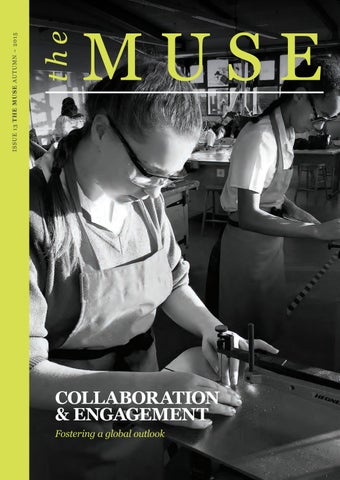
COLLABORATION & ENGAGEMENT Fostering a global outlook
Visits & Voyages
This list is by no means exhaustive, but offers a flavour of guests in and visits out during the Autumn Term.
Visitors In Anti-Bullying Ambassadors Conference
iPad Day, Year 7
The Sixth Form Common Room Opening
Anything Goes, Drama, Years 10-Upper Sixth
Jazz on the Lawn, The Association, Junior School Gardens
Tudor Bake Off, Year 4
Careers Day - Learn to Earn, Year 8 Christmas Fayre, The Association Christmas Production, The Magical Christmas Jigsaw, Year 3 Community Dance Workshop with Roxton Lower School DAHSA Reunion Dance and Psychology Day, Lower Sixth
Junior School Teatime Music Concert First Team v Old Girls Friendly, Lacrosse Law and Languages Careers Evening, Years 10-Upper Sixth Lunch Club, Girls’ Leadership Group Lunchbox Lecture, Enterprise Sales, James Tapp
David Litchfield Illustration Lecture, Year 11-Upper Sixth
Lunchbox Lecture, Public Relations and Communications, Vivienne McDuell and Francesca Hart
Dr Heike Bartel Languages Lecture, Years 8-Upper Sixth
Nights at the Circus, Drama, Year 11-Upper Sixth
English Forever Week, Senior School European Day of Languages, Senior School EU Politics Lecture, Harpur Trust Schools, Sixth Form General Knowledge Quiz Night, Bedford School, Years 5 and 6 History Day, Year 8
Wellbeing Day, Year 9 World War II Tea Party, Year 5 Year 5 MK Prep/Broughton Manor Activity Morning, Senior School Year 2 Pilgrims Activity Morning, Junior School Year 2 Polam Activity Morning, Junior School
Open House, Current Parents Open Morning Our Country’s Good, Drama, Upper Sixth Presbyterian Ladies College (Perth, Australia), Student Exchange, Year 10 Professor Krista Cowman, historical advisor to Suffragette, Lecture to Year 8, Parents and Alumnae
House Drama Competition, Year 7 and Lower Sixth
Senior School Christmas Concert, Years 7-Upper Sixth
House Glee, Whole School
Spanish Play, Years 8-10
Voyages Out Bedford Art Trip, The Higgins Gallery and St Paul’s Church, Year 10
CCF Remembrance Day, Bedford School, Years 9-Upper Sixth
Bedford River Cruise, Year 3
Cranedale Geography Trip, Yorkshire, Lower Sixth
Beijing Business Trip, China, Upper Sixth
Edale Trip, Derbyshire, Year 10
Biology in Action Trip, UCL Institute of Education, London, Upper Sixth
Educate Girls Charity Walk, Bedford Girls’ School and the Danish Camp, Year 9
Bletchley Park Trip, Year 5
Elite Swimming Training, Bath, Years 6-Lower Sixth
British Museum Trip, London, Years 10-Upper Sixth
Engineering Trip, M1/M6/A14 Junction, Upper Sixth
Castleton Geography Trip, Derbyshire, Year 9
Psychology Interest Day, UCL Institute of Education, London, Upper Sixth
GCSE Ethics Conference, Milton Keynes, Years 10 and 11
Rome Classics Trip, Italy, Years 10-Upper Sixth
CCF Adventure Training, Isle of Wight
German Christmas Markets Trip, Cologne, Years 7-Upper Sixth Girls Go Gold Conference, Headington School, Oxford, Year 11 Hampton Court Palace Trip, London, Year 4 Hispanic Theatre Festival, North London Collegiate School, Sixth Form
Maths In Action Trip, Warwick University, Year 10 National Portrait Gallery, London, Lower Sixth Norway Trip, Sixth Form Nuclear Medicine Lecture, Open University, Milton Keynes, Years 11-Upper Sixth Politics Lecture, Bedford School, Sixth Form
Science Museum Trip, Birmingham, Year 6 Senior Team Maths Challenge, Centre for Mathematical Sciences, Cambridge Sorted, Westminster Chapel, Years 9-Upper Sixth St Paul’s Christmas Tree Festival, Bedford, Junior School Choir
House Swimathon, Bedford School, Whole School
Tate Modern Art Trip, London, Year 11 and Upper Sixth
Knitting and Stitch Show, Alexandra Palace, London, Years 10-Sixth Form
Winter Wonderland, Hyde Park, London, Year 11 and Lower Sixth
Love Through The Ages Literature Conference, University of London, Upper Sixth Making Theatre Day, National Theatre, Years 5 and 6
Women in Biotechnology and Engineering, GSA Conference, University Technical College, Cambridge, Years 10-Lower Sixth
Editor’s Insight
O
ne of the many things I never tire of in a school is the continual spirit of collaboration which I see all around me.
Collaboration is key to learning, and encouraging it is central to our educational philosophy. We all grow through the sharing of ideas, learning to work as a team, and being inspired by others’ views. We develop new skills by sharing experiences, and all of this helps young brains make important connections. Collaboration also builds relationships within peer groups, across our community and in the wider world. And as we prepare our girls to go out into a global environment with intelligence and maturity, helping them to have the confidence to make these connections with ease gives them a head start. In this issue of the Muse we explore how collaboration helps build self-belief and leadership, through initiatives such as House Drama, but we also look at how we encourage the girls to build wider connections. This is never more evident than through the international excursions we run, such as our Business Studies trip to Beijing, and through our first overseas exchange programme, with my alma mater, Presbyterian Ladies College in Perth. Welcoming the Australian students into our school back in September was a wonderful experience, and opened all of our eyes to the power of building friendships. We review the advantages of the programme through our feature The Value of Exchange. I am committed to ensuring we are always at the forefront of both educational and developmental research, making sure that we are moulding our curriculum and pastoral care, to provide our pupils with the skills they need to really be future smart. Ensuring that staff, parents, and girls understand the working of the teenage brain is key to unlocking their true potential. In our article on the cranium we introduce you to new research which explains the changes and development to the brain during the teenage years, and unravel why they behave in such different ways. We have applied this knowledge to the development of our Year 9 curriculum, to help the students manage these changes. A recently published book by neuroscientists Amy Nutt and Frances Jensen,
The Teenage Brain, makes for an insightful read and I would highly recommend it to all parents. It is widely known that diet and exercise are key to building a healthy brain and never is this more pertinent than in the teenage years. We believe that building a foundation for a love of sport and an active lifestyle should start early, which is why sport is central to our Junior School curriculum. Not only does this help nurture the brain but it also builds key habits and skills which stay with the pupils throughout their lives. We discuss this with Deputy Head of Sport Nikki Howlett in Staying Ahead of the Game. A privilege of being a Head is attending educational conferences and hearing from eminent speakers, yet another form of collaboration, they always spark creative thoughts as to how to improve our school. At a recent International Baccalaureate (IB) Conference I listened to Dutch architect, Francine Houben, speak about the importance spaces play in the learning environment. Spaces should inspire students and help them respond to different learning and teaching needs. This idea strongly resonates with me, and we continue to work, within the constraints of our period buildings, to look at how we deliver such spaces. I hope the renovation of our Sixth Form House, which you can read about in Inspiring Spaces, creates such conditions to enhance learning.
“ I am committed
to ensuring we
are always at the forefront of both educational and developmental research.
”
Meanwhile, our Design Technology Department are keen that our pupils appreciate both the beauty and practical elements involved in design, and where better to start than being inspired by the architectural design of our own building, which was built by prominent modernist architect, Oswald P Milne. Read more about this in our piece Beauty in Design. At the start of a new year I look back on 2015 with great pride at all that the girls and the school have achieved. I look forward to another inspiring year bursting with collaboration and creativity.
Jo MacKenzie Headmistress
The Muse | 02
Inspired by
Giselle Inglis Lower Sixth
Arielle Adams Year 10
Annabella Taylor Year 10
Italy Central to Bedford Girls’ School’s educational principles is the value placed on students learning outside the classroom, gaining inspiration from a subject by immersing themselves in historic environments.
T
his vision strikes a chord with
Before the girls headed home they had the
Whilst the purpose of such a trip is to extend
the Classics Department at
chance to stop off at Ostia Antica, a small
students’ knowledge, the experiences gained
Bedford Girls’ School, where
town featuring both ancient and modern
also present a number of holistic benefits.
practical and visual learning -
aspects of Italy.
through visits to museums, theatres, external lectures and participation in Harpur Trust Classical Society debates - is key to the girls garnering a better understanding of the
Being placed out of their comfort zone,
Giselle Inglis (Lower Sixth) believes the
on a tough trek up Mount Vesuvius or
contrast of the two eras Ostia boasts, helped
experimenting with new tastes in Rome’s
her to appreciate how Roman life has evolved
restaurants for instance, allows the girls to
classical world. Seeing an important artefact,
over the years.
grow and mature as individuals - for many
centuries old, in the flesh, naturally has more
She said: “My favourite and final part of the
abroad away from their family.
of a profound effect on an individual than simply reading about it in a textbook. Years 10, 11 and Sixth Form Classics students had the ideal opportunity to extend their knowledge of the ancient world in its natural environment, when they visited Italy during the October half-term, a trip that proved particularly relevant to A Level students, who are studying the heroic founding of Rome. The trip began with the girls visiting the historical city of Pompeii, where they studied its ancient remains which were covered by the eruption of Mount Vesuvius in 79AD. The girls then proceeded to climb to the summit
trip was discovering Ostia Antica. “There is nothing particularly special about Ostia, however it is much quieter than the other towns we visited. In Ostia, you are left alone to explore. This makes the experience much more enjoyable as you are able to ‘live like a Roman’ and you can time travel into the past.
of them it would have been their first trip
And sharing that journey together sees new friendships flourish between the girls. Annabella Taylor (Year 10) added: “I really enjoyed the whole trip, however wet or windy it got, everyone always had fun where ever we went. The historical and archaeological things I learnt I will never forget. But also the friendships I formed with people, who
“I also benefitted from Ostia being
I hadn’t known before coming to Italy,
surrounded by infrastructure such as main
is something I very much value from our
roads and airports. I felt that it contrasted
time away.”
two different eras, and you could experience
There’s no doubting that the mantra ‘seeing
Roman life, whilst also seeing how it has
is believing’, which is so key to the learning of
of the volcano, where they were greeted with
impacted on the modern day living.”
stunning views of the Bay of Naples.
Arielle Adams (Year 10) agreed: “Seeing the
The second half of the excursion was spent
ruins in Ostia and to be able to get so close
of knowledge to use in the classroom.
to the mosaics and walk around the ancient
She concluded: “I would say that my trip
party visited the Colosseum, the Forum, Ara
buildings was amazing. It offered a real sense
to Italy was an eye opener and it really
Pacis (Altar of Peace), a monument made to
of what ordinary Roman life would have been
expanded my knowledge of the classical
honour the return of Augustus to Rome, and
like. Being able to experience physically what
world, as well as allowing me to see some
Capitoline Museums, as well as the Pantheon
we have learnt in the classroom is inspiring
amazing wonders that I would recommend
and the Spanish Steps.
and has brought the subject to life for me.”
to anyone.”
in the capital Rome, where the travelling
03 | The Muse
Classics, can be applied to the girls’ five-day stay in Italy, with Giselle armed with plenty
HOUSE DRAMA HELPS GIRLS GROW An integral part of the Bedford Girls’ School community, the House system builds continuity and a wider sense of community as students move through the school.
G
overnment research published in 2011 showed 16% of pupils did not feel ready to start secondary school (Year 7).
The House system at BGS, however, helps girls at the school negotiate such times of change. Junior School pupils regularly work alongside Senior School students in their Houses, helping with the transition from Junior to Senior School in Year 7. Mrs Kate Jones, Assistant Head, Co-curricular, explained: “We have a robust transition programme in place so that both existing students and new girls settle into the Senior School quickly. The House system definitely plays an important role in helping this transition along.” In the first half of the Autumn Term a fiercely competed House Drama competition is held, with Year 7 working with Lower Sixth students. The event involves weeks of rehearsals where Lower Sixth students are cast as directors and responsible for polishing the performance of their Year 7 colleagues, an ideal chance for the girls to work in a collaborative manner and to throw themselves into life in the Senior School. Mrs Jones added: “House events such as the drama competition really builds the girls’ confidence and gives them a sense of satisfaction, as it takes a lot of courage to get up on stage and perform before your peers.” In addition, working with the Lower Sixth provides the younger girls with role models and shows the Year 7 pupils that they really are a central part of the Senior School community. It helps build trust between the year groups and amongst their peers, helping new students form stronger friendships. Mrs Jones continued: “The first few weeks of the Senior School can be a little daunting, but working with the older girls helps break down barriers. Ensuring students feel comfortable in their new surroundings and making them feel part of the school community as quickly as possible, is key to helping them settle down to the academic routines too.
“Most importantly, the drama competition is great fun and provides an energetic and creative focus to the first half of the term.” This year’s theme saw the six Houses creating new versions of classic fairy tales. The Lower Sixth Form then had to arrange everything from rehearsals to make-up in a short fiveweek period. However, the hard work paid off and wonderful witty performances were performed to the girls and parents. With Parks the eventual winners, all the Houses were praised for their efforts and polished performances. Reflecting on the experience, Masooma Sultana said: “House Drama was a great experience for me as I got to know both the Year 7 pupils and Lower Sixth students in Nightingale. Landing a main part in the performance made it easier to get to know the other students around me, having only just joined Bedford Girls’ School and not knowing everyone.” Grace Gaffey commented: “House Drama gave me a lot more confidence, being new to the school, and I became friends with people in my year and with girls in Lower Sixth. The Lower Sixth were really good at organising us all and making sure we learnt our lines. They made the show run smoothly.”
Victoria Pinney, who moved up to Year 7 from the Junior School, added: “This year for House Drama we all had to perform a modern day version of a fairy tale and although there could only be one winner, we all showed that we could work well in a team and with the Lower Sixth girls, who we had never met before.” A transitional time not only for Year 7 but also the Lower Sixth, as they become accustomed to the demands of Sixth Form study and take on added responsibility, Jaspreet Sohal has praised the House system for allowing her to develop her leadership skills. She concluded: “House Drama was a great way of assisting me with my transition from the Senior School to Sixth Form, as I was able to become much more confident in a leadership role. “I thoroughly enjoyed leading the younger girls with the rest of our House Team. I know each of the girls on a much more personal level and I would hope that they feel comfortable enough to come and talk to a Sixth Former should they ever need advice or support. “I think that this experience has helped me to grow and mature as an individual.” As the girls now look forward to the next team challenge it is clear that the House system is truly vital to the BGS ethos. The Muse | 04
THE TEENAGE BRAIN Managing the teenage years is a challenge. At Bedford Girls’ School we ensure that we are in line with the latest scientific and educational thinking, to enable us to help pupils navigate these changes with confidence.
I
t tends to be in Year 9 when many
The teenage brain is a wondrous organ,
is the reptilian brain, which carries out the
feats of learning, but it is not yet fully
sensory development and digestion. This part
hormonal chemicals rushing into it which
individual, and ensures the rest of the brain
impulsiveness, a lack of insight and often,
must be hydrated, oxygenated and fed the right
capable of huge stimulation and stunning
basic biological functions such as breathing,
developed or properly wired and has
of the brain instinctively acts to protect the
together explain the mood swings, irritability,
works effectively. It needs to be looked after, it
emotional changes.
poor judgement.
nutrients. Hence why we stress to pupils the
Up to a decade ago little research had been
Scientific studies now show that the
parents find their daughter change from being affable, and open, to a somewhat grumpier, introspective
individual. It is the mark of becoming a teenager, and for some it is a difficult time, as they face both physical and
undertaken into understanding the teenage brain. It was a commonly held belief that the teenage brain was similar to an adult, hence the sense of frustration that whilst perceived to be adults teenagers don’t behave like adults. Extensive scientific research by JoAnn Deak and Frances Jensen has been incredibly insightful in explaining the changes the brain goes through during the teenage years, and the impact this has on behaviour and learning.
05 | The Muse
importance of exercise and a balanced diet.
teenage brain is at a very special point
The second section is the limbic system,
and the capacity of the brain are different
the amygdala which is involved in emotional
of development. The functioning, wiring in adolescents to that of an adult, and
understanding this is key to managing teenage behaviour and guiding them
through this complex stage of development more effectively.
In summary the brain has three parts and is essentially built from the back to the
front. At the back, and the first to develop,
the emotional part of the brain, it contains behaviour. This part of the brain is still
developing in teenagers. Emotional and
physical feeling affects the level of dopamine released in the brain and it is vital to get the
right levels of dopamine in order to help with
the wiring of the brain, and to assist in making the right connections. This part of the brain is
very susceptible to hormones, and is the seat of strong emotional response. Stressing the
importance of positive attitudes and the “can do” approach to learning is vital in trying to manage this hormonal state of flux.
The final part of the brain is the cortex. This
is at the frontal lobe, and is where the ability to generate insight, judgement, abstraction and planning sits. It is also the source of self-awareness, managing the ability to
assess danger and risk. During teenage years this part of the brain undergoes extensive reorganisation, it gets rewired.
The teenage brain has an overabundance of neurons which are the basic building
blocks of the brain, and an undersupply of
the connective wiring that helps information flow efficiently from one part of the brain to another. The connectivity to and from the
cortex is the most complex and the last to develop fully and the wiring is thinnest in
teenage years. This explains why teenagers do not behave in rational ways. It is just not
developed yet or connected properly to the emotional part of the brain.
Excitingly this opens up many opportunities. These young brains are full of untapped
potential but helping teenagers learn how to make the right connections is key.
Miss Jo MacKenzie, Headmistress, said: “At the start of this year we spent the day with Year 9, discussing brain development and looked at strategies to help them manage the changes and confusion they feel. It is
fundamental that the pupils understand what is happening to them. We have to help them
articulate how they feel and encourage them
to reflect on how they can manage situations and challenges more effectively.”
Under the leadership of Mrs Kathy Cruse, the Head of Year 9, the curriculum has
been enhanced, providing the pupils with opportunities to take risks in a safe and
supportive environment and allow them more responsibility, independence and opportunities to be creative thinkers.
Mrs Cruse explained: “Central to managing the pupils through this period is to keep
them engaged in the school community,
encouraging them to be involved in projects where they can feel a real sense of pride
whilst learning new skills. And importantly,
where they can work as a group, so they don’t feel isolated.”
Mrs Cruse continued: “To achieve this
we have put into place a number of new
initiatives. We have introduced a dedicated
Year 9 charity, Educate Girls, an organisation
working in rural northern India which promotes getting girls back into education. The girls
have created committees to raise awareness and funds for this organisation, both within our school and the wider community. Not
only does this give the opportunity to take on leadership and responsibility in an
independent and collaborative manner, but it
also opens their eyes to wider injustices. This helps them put their concerns into context,
and allows them to freely express their voices on an important global issue, teaching them
how to articulate their feelings in a mature and considered manner.
Miss MacKenzie said: “As the brain is developing there are conflicting signals coming at the teenagers all the time, one area that is often hard for them to deal with is time management. As pupils enter the GCSE years this becomes an essential skill, so it is important we develop this capability. We know there will be bumps along the way, panics and missed deadlines, but it is better this happens now than in Year 11. “We have scheduled more project based homework in the Humanities, giving the pupils longer deadlines for assignments,
“For many pupils campaigning takes them out
with an interim meeting to discuss their
sense of fulfilment when they see the impact
Managing a longer deadline brings with it a
of their comfort zones, but they gain a huge
they are having. They are learning important life skills and making hugely valuable neurological connections.”
In addition, the PE Department has created a Year 9 Sports Council, so all successes can
be shared. Year 9 representatives report back in assemblies on the triumphs and hard work of the Year 9 girls on the sports field. Music,
arts and drama are celebrated by asking Year 9 girls to perform in year group assemblies.
ideas. It teaches pupils to manage their time. different sense of commitment and the girls are responding to it very well. “I believe encouraging this level of selfdiscipline and independent learning, is crucial to the girls staying calm and focused in the years ahead.” Miss MacKenzie ended by stressing: “I do want to reassure both parents and pupils, they do come through
Mrs Cruse added: “At this age performing to
this fog as their
of achievement and self-respect they get
Our role in
worthwhile. I want them to understand that we
with the
your peers is nerve-racking, but the sense
brains mature.
from the enthusiast feedback makes it all
partnership
all have talents and that every individual can
girls is to
make a positive contribution to Year 9.”
ensure
Changes have also been introduced to the
they come
in taking a more independent approach
confident, and
scheduling.
young women.”
homework schedule, to assist the pupils
out as strong,
to studying and to facilitate more complex
compassionate
The Muse | 06
BEAUTY IN DESIGN At the heart of the Design and Technology (DT) curriculum is a focus on teaching pupils to understand the importance of design, and to explore the connection between everyday products and problem solving.
M
rs Shema Hill, Head of
“In the same way that we introduce the
by the prominent modernist architect
Design Technology,
girls to leading artists and musicians,
(and Bedford School alumnus) Oswald P
explained: “Central to the
we want them to become familiar with
Milne, who assisted the offices of Sir Edwin
study of DT is the ability to solve problems
leading designers and to understand
Lutyens and, amongst other commissions,
by generating workable, practical
their influence on our world. We visit the
was responsible for interiors of The Savoy.
solutions. All design, whether a huge
Victoria & Albert Museum, explore the
When the school opened in 1939 it was
engineering project or creating a simple
iconic works of designers such as Alessi
prominently featured in The Architectural
and Philippe Starke, as well as studying
Journal and copies of the original articles
kitchen gadget, starts with the need to find a solution to a problem. My vision for
jewellery design from influential figures
still sit in Miss MacKenzie’s office. Year
the department is to help the girls develop
including Hermann Junger.”
problem solving skills whilst gaining an
Mrs Hill is keen the girls see design in
from the 1930s features in the school, and
appreciation of good design, and giving
everything and everywhere, and where
translating them into modernist inspired
them the technical skillsets to express
better to start off than in Bedford Girls’
clocks, bringing together an artistic eye
their ideas.
School’s buildings. The school was designed
with practical skills.
07 | The Muse
7 students have been taking inspiration
Mrs Hill continued: “I wanted the girls
but to start to use their eyes to take
of every DT project you need the ability to
to understand how the school was a
inspiration from all that is around them.”
do your own research, collate and explore
very modern building, and how the architect used cutting edge techniques and materials to build a school fit for a ‘modern’ education. As we continue
All pupils are introduced to DT in Years 6, 7 and 8, where they work with a number of different techniques to help them develop technical skills, whilst also
to be a forward-thinking school it is
teaching them how to translate shape
rather wonderful to think that our
and forms into products.
design heritage was cutting edge too, and it is great to be able to show the girls how it has been adapted over time to enable us to continue to provide modern
In Year 8 they focus on combining their skills in working with wood and acrylic with use of the CAD CAM milling machine to experience how design and manufacture
educational spaces.
can be enhanced.
“The Year 7 pupils have really enjoyed
DT becomes an optional subject in Year
using their iPads to photograph the finer
9 and remains very popular at GSCE and
details they don’t even notice day-to-day,
A Level.
and then see how they could translate these into their finished product. I
data and use this knowledge creatively to develop your solution. These skills are used by the girls everywhere and DT fits particularly well with both other arts subjects as well as Physics and Maths. Our students go on to study a wider range of disciplines including architecture, graphic design and engineering. At the heart of all of these professions is the need to respond intelligently to a client brief in a creative and innovative way. “As teachers we really need to ensure that the girls have skills beyond the pure academic which will help them be future smart and to seize opportunities in the wider world. I believe DT is a great
Mrs Hill added: “The wonderful thing
subject to help them on their way, teaching
about DT is it brings together so many
them creativity, critical thinking and
hope not only to have helped the girls
skills that the girls are developing
independent learning skills in a practical
understand the heritage of the school,
elsewhere in the curriculum. At the start
environment.”
The Muse | 08
BUSI N ESS SK ILL S Business and Economics provides students with an insight into a world beyond school. Head of Department, Miss Cindy Birch, explains the attraction of these subjects at A Level and IB.
“
B
usiness and Economics
Miss Birch went on to explain: “We also
Shouyang Steel Works exemplified this.
provides an understanding of
feel it is particularly important to put these
A fully functioning steel works, it shut after
the dynamic world of business,
subjects into context. Students learn best
less than 20 years due to environmental
combining theoretical situations
when they see what they are learning in the
concerns and relocated out of the city. The
with real life case studies.” said Miss Birch.
classroom in the real world, which is why
“They provide a link between academic study
site has ingeniously been re-engineered into
activities, speakers and trips are a vital part
and the real world. They open students’ eyes
a tourist attraction, showing the girls real
of the curriculum.
transformation and the ups and downs of
to another insightful view of the world they
economic growth.”
live in, whilst at the same time expanding analytical and research tools; as well as the evaluation and interpretation of data skills, honed in the study of their GSCEs. At Bedford Girls’ School the students are encouraged to question and challenge issues. Both Business and Economics helps them make the connections in a relevant and engaging manner. “Whilst Business tends to be discussion and case studies based, Economics, both
“ This year’s Upper Sixth trip to China
The girls also explored the traditional side of Chinese life, to provide a contrast with the
enabled our pupils to see the impact
economic focus.
a rapidly growing economy has on
Simran Garewal said: “The highlight of the
a traditional culture. It gave them a
trip for me was experiencing the difference
first-hand opportunity to witness how
between the ancient style buildings
two opposing theories of communism and capitalism have come together
and culture, and the developed city. My favourite destination was the old Huteng neighbourhood as I enjoyed experiencing a
to create an economic power house.
home cooked meal and the traditional way
at IB and A Level, is a more theoretical and
Whilst studying this in a classroom
abstract based subject which looks at financial
is exciting, it is only when you are in
beautiful and tranquil despite the crowds.”
models and economic theories. Economics
the country seeing the juxtaposition of
Jess Whitham recalled: “The most surprising
often appeals to students who enjoy tackling complex problems whilst Business has a boarder base. Introducing these new
traditional and modern, that deeper
of life. Additionally, the Summer Palace was
”
level connections can really be made.
subjects in the Sixth Form creates a sense of
Miss Birch added: “Both subjects focus on learning how to apply business and economic theory to a wide range of issues and situations. We encourage them to question the rationale behind decisions with the knowledge they gather on the courses. Not only does this debate help the students gain a deeper level of understanding of their subject matter, but it
rickshaws and went on to eat at a local lady’s house. We arrived to see a long line of red rickshaws with enthusiastic drivers.
excitement amongst the students as they look forward to new experiences.”
day was Thursday, when we rode in
In addition to visiting Tiananmen Square, the Summer Palace and the Great Wall of China, the students were given a unique insight into commercial and industrial life in China, with a trip to the Yanying Brewery.
The ride was so exciting because we got to see a traditional side of Beijing that we had not yet experienced. After the journey, we ate at a local home, where the home cooked lunch and hospitality made it an
The scale of the plant overwhelmed everyone.
unforgettable meal.”
We were also provided with a fascinating
As a school we need to ensure that our
insight to a disused steel plant, which has been turned into a tourist attraction.
students have the skills and the knowledge to actively participate in the wider world.
also helps them to learn how to communicate
Miss Birch concluded: “The pace of change
Business and Economics play an important
in a confident and considered manner.”
in China is extraordinary. The trip to the
role in helping our pupils achieve this goal.
09 | The Muse
New Spaces For a long time, artists and designers have understood the effect different types of spaces and environments have on pupils’ behaviour.
R
einforcing this view, a 2010 survey by the British Council for School Environments stated that 95.8% of teachers agreed that the school environment could influence the learning process. Buildings need an arrangement which creates an emotional response to the spaces. Within schools, learning spaces can help inspire pupils to work in different ways. If the focus is on collaborative learning then the space should be open, however, quieter, more enclosed spaces are better for reflective private study. Schools should be starting to move away from traditional uniformed spaces and be looking at using space more flexibly so that it can respond to the learning situation, and provide a greater range of opportunities to learn in different ways. Understanding the importance of ensuring our girls have the best possible learning environment to be inspired by, Bedford Girls’ School commissioned a refurbishment of its Sixth Form House over the summer holidays. Changes have seen the Sixth Form corridor receive an eye-catching facelift, with a graffiti artist turning all 200 lockers into a sea of green, grey and black bearing the school’s eagle emblem. The Common Room has been redecorated and fitted with new furniture, providing a modern open space where the girls can relax and work in a collaborative fashion. The entrance has been moved to the front of the Sixth Form House to give the girls a more formal entrance of their own. The Careers Department has been relocated to the heart of the building, allowing girls lower down the school to access the team’s services more easily. The Sixth Form loft has been turned into a silent study area, with individual learning booths allowing privacy for focused selfdirected learning. Students also have access to
a larger media suite that has more space to use desktop computers.
ones who will reap the benefits of an uplifting learning environment.
“In the Sixth Form House we wanted to generate a brighter, inspiring environment that is more conducive to the girls’ learning and working behaviour,” said Dr Jennifer Walters, Director of Sixth Form at Bedford Girls’ School.
“By giving the girls the responsibility of having an input in the decision making process, we are giving them the opportunity to lead and make key decisions, which will be vital when they enter further education and pursue a career.”
“For the girls to enjoy their learning and produce the best possible results, they need to be inspired by the environment they’re working in. Little things like revamping the lockers, or a big change such as completely refurbishing the Common Room, will all have an impact.”
An aspect of the initiative has been enhancing ties between the Sixth Form and the Alumnae Association, whose donations part funded the work.
A further feature of the Sixth Form redevelopment is the creation of a flexible working space - the revamped S101 room for students to use for a number of different activities including the weekly lunchtime lectures with speakers from our alumnae, our parental body and our growing connections with PhD students and university lecturers. Passing on their pearls of wisdom to Sixth Formers, professionals range from PR specialists to lawyers, with one recent lecture taken by Ginny Bradwell, a Director at accountancy company First Intuition. Dr Walters commented: “We want to do all we can to prepare the girls for life after school, whether that would be further education or entering the world of work.
Sizeable images of famous Dame Alice and Bedford High School alumnae, including Olympic silver medallist (badminton) Gail Emms MBE and artist Dora Carrington, adorn the walls of the Common Room for Sixth Formers to draw inspiration from. Dr Walters said: “The link between the Sixth Form and our alumnae is absolutely crucial as they are wonderful role models and mentors for our current girls, offering support and advice.” Dr Walters concluded: “Through our renovation we have not only created inspiring modern spaces but we have also made the Sixth Form House a real hub for the school’s wider community. By opening our doors to alumnae, parents, mentors and friends we are further able to support the girls with their transition to a wider world.”
“External speakers who know what university life is like, or have extensive experience in their particular profession, they are best placed to advise the girls, who are eager to tap into their knowledge.” The girls themselves were central to the renovation plans, with the Girls’ Leadership Group canvasing opinion of what the Sixth Formers would like to see done with the space. Dr Walters added: “We wanted the girls themselves to be able to shape the new look of the Sixth Form House, as they will be the The Muse | 10
THE VALUE OF EXCHANGE As Bedford Girls’ School waved farewell to its inaugural Australian exchange students, we explore the value an exchange programme
M
holds and how it benefits the wider school community.
iss Jo MacKenzie, Headmistress, explained: “The catalyst for the exchange came from a long overdue visit back to my old school, Presbyterian Ladies College (PLC), in Perth two years ago. I have fond memories of my life at school, and strongly believe the education I received has shaped the person I have become. As soon as I stepped over the threshold I was staggered by the similarities shared with Bedford Girls’ School, and how the girls and teachers had the same sense of vitality and forward thinking attitude towards teaching and learning. “It was immediately obvious that both schools would benefit hugely from building links, bringing together like-minded young women from across the world and really helping both communities to demonstrate what it means to be part of a global world, whilst helping to build important life skills for the girls who take part.” Miss MacKenzie recognised that this was an ambitious, time intensive and expensive
11 | The Muse
undertaking, and therefore it should be taken in a serious and considered manner, with the girls applying to take part through a rigorous process. Mrs Kate Jones, Assistant Head, Co-curricular, said: “We aim to give the girls as many opportunities through our co-curricular programme as possible and ensure that the girls understand the level of commitment needed for each activity. Being part of the exchange is a huge commitment, and we have introduced an application process to help the girls understand what a big undertaking it is, you are not only away from home for three weeks but you are an ambassador for BGS in another school. “The girls who take part in the exchange programme need to be able to manage their workload and numerous other commitments, whilst also looking after their Australian partner in a way that allows everyone to get the most out of the experience.” The programme is open to any Year 9 student to apply, firstly with a written
application to explain why they would be a good candidate, followed by an interview and references from teachers. The school also assess the applicants’ current participation in school life. The exchange takes place in Year 10, with the Australian pupils attending Bedford Girls’ School in the Autumn Term and our pupils travelling to Australia during the following summer holidays. For the first exchange five girls were picked from each school. Kara Christensen, one of the successful BGS applicants, commented: “I applied for the exchange as I wanted to experience a different culture and to travel to a country I had never been to before. I also liked the idea of opening myself to new social situations in which I did not know who I would be paired up with.” BGS’ Harriet Potter added: “I applied for the exchange because I thought it would be a really good experience. I’ve always wanted to participate in such a programme but doing one to Australia was even more exciting.”
The Perth students arrived first on Saturday 19th September for three weeks, hosted by the Bedford Girls’ School families. They were expected to participate in the classroom as well as going out on excursions to get a true flavour of the UK. Prior to their arrival the girls had been getting to know each other through social media, so meeting up was like a reunion of old friends rather than new acquaintances. Mrs Jones commented: “Miss MacKenzie and I picked up the girls from Heathrow and their enthusiasm and excitement was infectious. When we arrived at school they jumped off the bus and hugged the waiting girls. I felt a wonderful sense of relief that it was set to be a great success!” During their stay the girls took part in day-to-day life at school but also visited London, Cambridge, Warwickshire, and Bletchley Park, as well as undertaking many other individual experiences with the host families. The students from PLC - Eliza Rimmer, Ciara Taylor, Tiffany Evans, Arianne Kane and Sophia Azzopardi - said: “We have all had numerous trips outside of school time with our host families. By visiting all these places, we have gained a sense of the culture, and have been able to immerse ourselves in it. “Overall, this exchange trip has been the most incredible opportunity for all of us. We came to Bedford to experience a new school life and walk in the shoes of our
fellow host friends and peers, but little did we know we would leave here with so much more than a new host friend and a love for Yorkshire puddings. “Looking back at the trip, we can safely say that we’ve made many new friends which we will keep lasting connections with and extended our understanding of travelling abroad. Our excitement has grown for the girls to come back to Australia and we are confident this exchange will continue to be a success.” BGS’ Annabella Taylor added: “I expected the exchange to be very busy but what I didn’t expect was the strength of friendship formed between us all, I really didn’t expect that in such a short time such strong bonds could be made.” Kara agreed: “I learnt that even from overseas, people are so similar and everyone has similar qualities, which in a way makes me more comfortable meeting new people and facing new conversations.” The PLC pupils added: “Our host families were all extremely welcoming to all of the girls, and have really given us all the chance to experience Bedford and the rest of the UK. We are all very grateful for how inviting and accommodating the families have been and how they’ve accepted us into their homes.” The BGS students are now raring to get to Perth. Bella and Harriet said: “We are looking forward to the differences in day-to-day
life as well as the beaches and the general atmosphere of Perth.” Kara continued: “I’m really excited to meet my exchange’s friends who I have heard so much about, and also experience their way of schooling.” Miss MacKenzie concluded: “What has been really rewarding is the value the exchange programme offers far beyond the small number of girls selected to take part. The presence of the Australian girls in the school was a wonderful addition to the energy in and around the building. Not only would you often see a group of younger girls quizzing them in a corridor but it opened our eyes to the power of collaboration - with the girls participating in sports, helping with Junior School activities and rehearsing and performing musical pieces together. “It has helped to demonstrate to our students that there is a wide world, full of young women just like themselves, who are willing to connect and engage with other communities. It has shown us all that by stepping outside our comfort zones, there are endless new and exciting opportunities. “We believe that school trips are a vital part of the educational curriculum. We aim to ensure there is a trip which will appeal to every pupil at some point of her life at Bedford Girls’ School. Trips teach skills you cannot get in the classroom, often transforming the pupils and creating memories that last a lifetime.”
The Muse | 12
Ahead of the Game At a time when two thirds of 14-year-old girls admit to taking part in no regular sporting activity, many citing self-consciousness in front of boys as a primary reason, the benefits of learning sports in an all girls’ environment from a young age cannot be overstated.
F
ree from the pressure of undertaking Physical Education alongside their male counterparts, Bedford Girls’ School pupils are able to enjoy the holistic advantages that so many young people now crave from sport. According to a 2014 Sport England review into youngsters’ lives, the organisation found that young people are looking for sport to provide them with meaningful experiences, which will improve them as an individual, or provide a healthier lifestyle. The report states that it is between the ages of 11-16 (Years 6-11) when children form an emotional commitment to sport and are more likely to adopt sporting habits for life. Central to the Bedford Girls’ School educational philosophy is developing the whole child, who has the confidence and the skills to make a positive contribution to the wider world. The benefits of playing sport are widely known and encouraging participation as well as a lifelong enjoyment of sport is part of the school’s educational aims. Mrs Nikki Howlett, Deputy Head of Sport, explained: “Experience shows that by 13 | The Muse
introducing a whole range of sports to
girls early on, they are more likely to carry on with these all the way through their
school life. They like the team spirit and
camaraderie sport brings and are proud to pull on the school shirt.
“We also believe that this is where singlesex education comes into its own, as the
girls don’t have that pressure of boys being around and worrying about their image. As the girls go further up the school, keeping
them fully engrossed in sport is important as you want them to carry on with it to
university level and beyond. We believe
putting a strong emphasis on sport in the
Junior School helps cement these habits.” In order to prepare Junior School girls
for the Senior School sports curriculum,
they’re given the chance to sample all the sports they’ll play from Year 7.
Years 3-6 pupils complete five hourly lessons of sport every fortnight, with
hockey, netball and swimming taught in the winter, while gym is also learnt by some
years. In the summer, girls learn athletics,
rounders and tennis. In Year 6, lacrosse is also introduced in the winter.
Mrs Howlett added: “The Junior School curriculum is based on what the girls are going to do in the Senior School. The girls are looking at the different disciplines with a strong focus on skills, so they’re trying to establish good practices. “We see skills as the foundation to later success in games. Establishing a strong base provides our girls with every opportunity to flourish as they progress through school. “There’s a strong focus on swimming in Years 3 and 4, to ensure the girls are all able to swim and are water safe, as well as identifying who will be competing in the school teams. “In addition to curriculum sports lessons in the week, we offer, from Year 3, the opportunity for our students to take up an additional sport practice - giving them the chance to be as active as possible. 70% of Junior School girls are undertaking extracurricular sport, with many attending after school sessions.” However it is not all hard work, and Mrs Howlett was keen to stress that it is important to make all sport fun as this encourages the girls to take it further.
She continued: “Inspiring the girls at a young age is really important, so we try to incorporate a fun element into every discipline they undertake, whilst we maintain our focus on developing their allround skillset so they are ready to take part in competitive matches.
and commitment that comes with that opportunity.”
“Competition in the Junior School comes in so many forms. In Years 3 and 4 the girls compete in less fixtures and tournaments against schools, but they’ll play competitive games between themselves. In Years 5 and 6 the girls are participating in inter-school fixtures in all of the major sports, whilst after school and Saturday fixtures are also gradually introduced. As members of the Independent Association of Prep Schools (IAPS), fixtures and competitions take place both near and far, introducing the girls to schools all over the south of England.
attributes and seeing how we can get the
“We will always field as many teams as possible so that all girls get to benefit from being part of a competitive team, and experience the sense of pride
Bedford Girls’ School is keen that the skills pupils acquire from sport are also applied to different areas of the curriculum and
everyday life. In the Junior School the focus is on helping develop a whole range of best out of each individual.
Mrs Howlett commented: “Sport suits all characters and personalities. With
a range of individual and team sports
available, girls can find an area that works for them. That’s why having a wide range
of activities is important, ensuring there’s something for everyone.”
Mrs Howlett concluded: “Sport is also a
great way to help the girls develop wider
social and time management skills. They’re good at working with different people and are confident in approaching tasks.
“Those girls with sports commitments tend to be busy, as they have a number of
practices, both before and after school, and on Saturdays they often take their sport further than school. We expect
team commitment from Year 5 and stress this with the pupils. A number of girls
are swimming in the mornings and at the
weekend have sessions in hockey, netball and swimming, while possibly playing
club hockey or tennis. They’re still fitting their homework in and learning how to
prioritise their workload which is great to hone early in life.”
The Bedford Girls’ School sporting vision pays huge dividends with regional and
national success across a whole range of
sports in the Junior School, including IAPS hockey and rounders in 2015 alone.
The encouragement, motivation and
dedication of the Junior School PE team develops the core skills in the Junior
School, to ensure the pupils are committed and confident on the sports field in the
Senior School, where their hard work and passion translates into continued success.
The Muse | 14
Legend in their Lifetime
Adolph Palmer Head of Mathematics
ADRIAN RALPH PALMER Butcher and Father “ He never lost his love of learning and was
truly influential in guiding us all to a path of intellectual achievement. He indeed paved the path for us to follow and I feel it is my obligation to do so in the memory of a great man.
”
M
y legend is very close to home, he is my father, the man who has inspired me to do all that I have done, supported me and encouraged me to achieve my best. Adrian Ralph Palmer was born in Jamaica in 1924, he was one of two brothers, and grew up in British colonial Jamaica during a time of great transition. At the start of the 1930s Jamaica was hit by a slump in sugar prices which resulted in a significant economic depression, igniting the rumbling of social unrest and political instability. This ultimately led to the introduction of limited self-rule and the universal adult suffrage in 1944. All this marked the beginning of transition to full Independence, which was granted in 1962. Life in Jamaica would have been tough during this time and my father was one of the lucky ones. His own parents understood the value of education and he was sent to a local grammar school. My grandfather ran a successful butchery business and from the age of 11 my own father was put to work checking the accounts and, over time, managing the finances for the business. He was a truly fabulous mathematician and I can never remember seeing him use a calculator. He worked for his father at night and attended school during the day. When my grandfather finally retired my father happily took over the family
business and continued to run it until his own death.
donation projects, always setting a great example to us all.
One of the things I always admired about my father was the extreme dedication he gave to the job, he was a perfectionist and worked hard to ensure that everything was completed. He always worked not for the betterment of himself but of his family. What I have found so inspirational is that he sought not material wealth but wealth of the mind, body and spirit. He exemplified the role of a good father, supported by my mother to whom he was married for 20 years.
He taught us moral and ethical values, impressing upon us the need to achieve a high academic standard. But he did not pressure us into anything. He always gave us liberty to find our own way and to choose our own paths. Looking back, this sometimes made us feel guilty because of course as teenagers we sometimes abused this freedom. However, my father stood by us and accepted our mistakes.
Although many of his friends and family, including his brother, left Jamaica for the UK during the 1950s, when they were encouraged to move to Britain to fill the country’s labour shortage after World War II, my father stayed put, happily running his business and raising seven children. I have to admit he was a rather traditional figure - kind but dominant, who sought to impress us with the best virtues of life. As a devout Christian he worked for the greater glory of God and to ask God to be our companion. It is said that “from him that is given much, much in return is expected” this was usually the norm for my father. He dedicated a large part of his life to helping others, always active in our community and in local politics. He helped less fortunate families fund education for their children and ran food
He never lost his love of learning and was truly influential in guiding us all to a path of intellectual achievement. He indeed paved the path for us to follow and I feel it is my obligation to do so in the memory of a great man. Although he never wanted to leave his homeland, he was supportive of the idea that my siblings and I had ambitions of moving to study and work abroad and was proud of all that we achieved. He sadly died in 1989, and by the early 2000s most of my siblings, my mother and I had all left Jamaica to take up opportunities in other parts of the world. In this day and age where man seeks material wealth, fame and popularity, a political, economic and social status, this man provides me with an example of strength, endurance, righteousness, perseverance and that triumphant struggle over both life and death. For these reasons, he will forever be my eternal role model.