the
ISSUE 12 THE MUSE SUMMER ~ 2015
MUSE
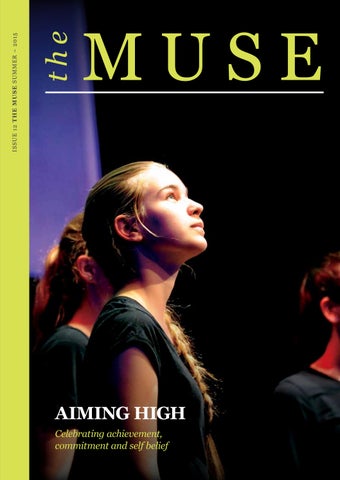
AIMING HIGH Celebrating achievement, commitment and self belief
Visits & Voyages
This list is by no means exhaustive, but offers a flavour of guests in and visits out during the Summer Term.
Visitors In A Midsummer Night’s Dream Production, Years 7-9 BGS Let’s Beat It Music Night Boombiz Day, Year 10 Camping, Junior School Gardens, Year 4 CCF Annual Dinner Celebration Evening, Year 6 Dance Workshop with Putnoe Lower School, Year 5 Dance Workshop with Renhold Lower School, Year 4 Dame Alice Harpur School Association Year 2000 Reunion English Public Speaking Competition, Years 7-10 French Play, Years 8-10 French students Girls and Guardians Evening, Year 5 Higher Education Day, Lower Sixth Honk! Jr Production, Junior School Junior School Summer Concert
Lower 6th Induction Day, with Dr Jonathan Pearson, University of Nottingham Lunch Club Mathematics Activity Afternoon, Year 8 Mathematics Challenge, Years 7 and 8 Mighty Zulu Warriors Workshop, Year 6 Mock Election, Senior School Performing Arts Awards Evening, Guest of Honour Gloria Onitiri, Senior School Sports Awards Evening, Guest of Honour Kate Richardson-Walsh MBE, Senior School The Theatre of Widdershins Visit, Year 3 Visiting Author Mark Adkin, Lower Sixth IB Work the Room, Lower Sixth World War II Tea Party, Year 5 Year 6 Celebration Evening Year 11 Prom
Voyages Out Activities Day, Whole School
Macbeth, Key Theatre, Peterborough, Year 9
Activity Morning, Bedford School, Year 6
Marston Vale Trip, Year 4
Activity Evening, Bedford School, Year 6
Mathematics at Work Conference, University of Northampton, Year 10
Barnham, CCF Joint Field Weekend, Years 9-Upper Sixth
National History Museum, London, Lower Sixth IB
Bedford Regatta Alumnae Event
Paris Trip, Years 7 and 8
Biology Field Trip, Holt, Norfolk, Lower Sixth British Museum/Library, Sixth Form
Prize Giving, Guest of Honour Baroness Sue Campbell CBE, Bedford Corn Exchange, Senior School
Burwell House, Year 3
Politics Debate, Bedford School, Lower Sixth
Cadbury World, Birmingham, Year 4
Regional French Debating Competition, Year 10
Chemistry at Work, MK Discovery Centre, Year 10
Science Trip, Isle of Wight, Year 8
Cuffley Camp Trip, Year 6
The Royal Society Science Trip, Year 10
Faith Tour, Year 6
Upper Sixth Leavers’ Ball, Bedford Corn Exchange
Geography Trip, Mid Bedfordshire, Year 7
V&A, Art, Textiles and Technology Visit, Year 8
Geography Trip, Sheringham, Norfolk, Year 10 Grafham Water, Year 4
Visit to meet Rosalind Franklin’s sister, Jenifer Glynn, Cambridge, Years 11 and Sixth Form
IB Dinner, Bedford School
Wimbledon Tennis, Years 11 and Sixth Form
Imperial War Museum and War Horse Theatre Visit, London, Year 10
Ypres Battlefields Trip, Belgium, Year 9
Editor’s Insight
A
s I walk around the school ahead of the new Autumn Term I cannot help but reflect back on the last academic year, with a sense of pride at all that was achieved.
we must reflect this in the way that we teach. It is important to reward these attributes, and in this edition we also explain why we believe success should be celebrated by the school community.
The pace of the school year means that we sometimes gallop through activities and, if we are not careful, we do not allow ourselves the proper breathing space to consider all that we, as a community and as individuals, have accomplished. Finding time to be mindful is something that I am very aware we need to factor into our daily lives. I believe without allowing ourselves the space to be really reflective, we cannot genuinely grow in a thoughtful and considered manner.
We were very fortunate to welcome three inspiring women as guests of honour to our awards evenings this year. Kate RichardsonWalsh MBE, Captain of Great Britain and England Hockey, spoke passionately at our Sports Awards Evening; leading actress and Dame Alice alumna, Gloria Onitiri, enthralled the audience at the Performing Arts Evening; and we were all greatly inspired by Baroness Sue Campbell CBE, who was our guest speaker at Prize Giving.
Our successes last year were impressive. Academically, in the arts and on the sports field we achieved many fine things. Reading the individual school reports last term I was so proud of the girls. Time after time they showed high levels of commitment to really achieve their best. Their effort, discipline and joy in learning needs to be applauded. As I watched our Upper Sixth students leave us as confident young women I again felt huge pride. Much of this would not be possible without the incredible commitment of our forward thinking teaching staff who are always looking at how we can both extend and support our pupils, so they can deliver to the best of their abilities. Understanding each and every student is key, and in this issue of The Muse we look at how we challenge the girls to really extend themselves. Our role as educators is to ensure that the students can be inspired and motivated. As a Head I am constantly questioning: What makes a good education? How do we liberate and transform minds rather than stifle and conform them? How do we best prepare our pupils for the world they will be moving into rather than prepare for the world that was? We examine how we set out to achieve this in two different articles in this issue, as we introduce a new Mathematics Curriculum in the Junior School and a new style of delivering the curriculum in Year 7. We need to develop confidence, intellectual character and creativity in young people and
They all spoke with a common voice about the importance of having aspirations and aiming for your dreams, showing commitment and huge dedication to achieving your goals – no one does it without hard work. All three also spoke in different ways about achieving this with humility and empathy.
“ I measure our
success by watching our pupils wanting
Baroness Campbell, Chair of UK Sport, ended her Prizing Giving address with the following extract from the poem Invictus by William Ernest Henley:
to go out and make a
“I am the Master of my fate I am the Captain of my soul”
in which they live
difference to the world
”
These words profoundly resonate with me. My dream is that our girls leave Bedford Girls’ School with confidence, self belief, determination, and with compassion and empathy. My commitment is to ensure that we deliver an education that truly develops these attributes. I measure our success by watching our pupils wanting to go out and make a difference to the world in which they live, because I do believe our role as educators is to encourage our pupils to make a better world. I am in no doubt that our current pupils and future pupils will do just that.
Jo MacKenzie Headmistress
The Muse | 02
Inspired by
Sarah Maplesden Lower Sixth
Rebecca Sumner Lower Sixth
Fieldwork
B
edford Girls’ School feels it’s
important that students are
inspired by different learning opportunities. Taking the girls
away from the confines of a classroom and into natural environments, where they are able to explore their subject in more depth, can help to stimulate greater levels of curiosity, understanding and interest in a subject. This notion is particularly relevant when it comes to practical-based subjects such as Biology and Geography, with the outdoors providing the best possible environment to conduct research and fieldwork. A particular part of the North Norfolk coast provides an excellent location for such study, and is a perennially popular destination for Bedford Girls’ School geographers and biologists alike, with its stunning natural landscape providing an inspiring environment in which to undertake such work. The ecological importance of the North Norfolk coastline has long been recognised and the Holkham National Nature Reserve is the UK’s largest nature reserve. It consists of a number of rare and precious habitats which are home to a huge diversity of flora and fauna, which live in the salt marshes, sand dunes and the surrounding woodlands, thus providing an extraordinary environment in which to put classroom theory into practice. The latest girls to benefit from the trip to North Norfolk were a group of AS and IB biologists who headed to Holt for three days, where they developed a more in-depth understanding of the Ecology part of their curriculum. 03 | The Muse
The girls focused on methods of assessing animal and plant populations including the use of transects to assess succession on sand dunes. They learnt about the conservation strategies employed at the Holkham Estate to maintain species diversity. Lower Sixth student Rebecca Sumner felt the experience provided the perfect opportunity to use, to good effect, what she had learnt in the classroom. “The trip really helped me with both my A2 coursework and revision for exams, as we learnt how to undertake systematic and random sampling, which are key parts of the Ecology syllabus,” said Rebecca. “The expedition to Holt was a great chance for us to gain experience of performing field research and actually put into practice the theory we’ve learnt. The knowledge we acquire from these practical exercises can be applied to a wider area of the curriculum. “I really enjoy doing these activities as I feel I learn best when I’m outside and replicating an ecologist’s work. To be in such incredible surroundings really made it all come alive and helped me see what we learn in the classroom in a broader context.” Sarah Maplesden found the time she spent in Norfolk a valuable learning curve, enabling her to develop important techniques that will help her to record ecological data. Sarah added: “I did not study Geography at GCSE and that meant I did not have any previous experience of producing a kite diagram, which is a chart that shows the number of animals (or percentage cover for plants) against a distance along a transect. Kite diagrams are an essential part of an ecologist’s work so it was really important to learn how to use such a tool. Learning these
techniques in such incredible surroundings made our research even more interesting and relevant.” Not only did undertaking fieldwork enable the girls to put their theory into practice but it also enabled them to work on teamwork and leadership skills. The experiments involved the girls collaborating with others and quickly forming good working relationships, in order to complete the tasks with enough data to finish their coursework. Rebecca continued: “We were working in groups and bouncing ideas off each other. “I felt as though I was pushed out of my comfort zone, which in turn has given me added confidence. I worked in a group where I didn’t really know many people, so it was good to understand how they worked and to all get the best out of each other. I enjoy working towards a common goal as a group. I found this produced a really positive working environment.” When their A Levels are complete, Sarah and Rebecca plan to study degrees relating to Biology and Ecology at university – in the form of Biology and Physics, and Animal Behaviour. With such a heavy emphasis placed on ecology in Holt, Rebecca believes such field research can only help her in her degree. She concluded: “I’m hoping to study Animal Behaviour at university and there’s a lot of Ecology modules that feature in the syllabus. Doing this type of field research helped me develop a much better understanding of animals in their native environments, and made me even more excited about my intended course of study.”
DRIVING THE CURRICULUM
B
edford Girls’ School recognise the need to assess, review and enhance the curriculum regularly to provide an inspiring education for our students. This year Deputy Head Tom Hill and the Futures Group (made up of representatives from both the Senior and Junior School) have turned their attention to the middle years of 7, 8 and 9. Mr Hill explained: “As an independent school we have total freedom to choose our curriculum for the middle years. This give us an exciting opportunity to create an innovative teaching model, which will enthuse the girls and develop the mindset and skills they will need to tackle the challenges of the examination years, as well as life beyond school. “We have witnessed just how receptive girls, teachers and parents have been to the introduction of the Enhanced Curriculum in the Junior School. We want to ensure that we do not lose the focus on creative and independent thinking as the girls move into the Senior School, whilst still delivering the demands of 20 complex subject areas.” Although the girls are introduced to many of these subjects in the Junior School, it has been delivered via more holistic units of enquiry, and for the majority of the time, by a single class teacher. The challenge for Mr Hill and the Futures Group was how to ensure the demands of the in-depth Senior School curriculum could be met – without losing the joined up thinking the girls relished in the Junior School. “Moving from a form teacher and a few specialist areas to 20 different subjects can be a little overwhelming for some of our pupils in
the first few months of Senior School. Whilst they all love the idea of trying new subjects, the reality of prioritisation in Year 7 can be tough. Our objective has been to look at how best to address this and ensure that as they make the transition from Junior School to Senior School, we continue to build upon their levels of engagement and enthusiasm.” Mr Hill continued: “In line with the latest educational research, we looked at the skills which we should be focusing on in the middle years, and then looked at what this means in relation to the curriculum and the way in which it is delivered in the classroom and beyond.” This work has led to the development of a modern new approach, called the DRIVEN curriculum, which is inspired by the International Bacculaterate (IB) learner profiles. Mr Hill expanded: “DRIVEN refers to the learner attributes we want to foster, many of which dovetail with the IB learner attributes: deep thinking; enquiry-led learning; embedding a value for tradition and culture; empowerment through skills and nurturing curiosity. These are the skills the girls will need to master not only for success at GSCE, IB and A Level but also for life. These are the skills businesses and universities want to see.” Having determined these common learner profiles, the Futures Group then looked at implementing a system which would help develop these skills through a meaningful, rigorous curriculum. The consensus was that by building stronger links between subjects, there was ample opportunity to create a greater depth of understanding and cross curriculum learning.
For example, if Mathematics and ICT both introduce the study of databases at the same time, the girls can draw parallels between the two subject areas, and teachers can work together to build complimentary programmes of study. However, Mr Hill and his Futures group saw even greater potential: “The introduction of units of enquiry in the Junior School has led to independent learning, collaboration and greater engagement. We want our pupils to make connections and to use what they have learnt in one subject, to enhance or challenge what they are studying in another discipline. “Through the introduction of enquiry based learning in the Senior School, departments can work together on their planning. In the Autumn Term we will roll out the first of these units to Year 7 – called Home. It is being led by Art, English and ICT with support from departments including History, Mathematics, Modern Foreign Languages, Classics and Design Technology. Although the girls will still work with specialist teachers, it will foster collaboration and encourage creative thinking between subjects. For example, the students will explore the concept of what is home through prose and poetry in English, work with CAD design programmes in ICT, study monarchs and castles in History, and in Art and Design Technology the girls will think about what evokes images of home, in response to different artwork and how these can be translated into design.” This project-based approach will be extended to some of the homework, and trips will be linked to the units of enquiry with a cross subject emphasis. A similar approach will be rolled out into Year 8 over the coming 12 months. Mr Hill concluded: “What is particularly exciting for me is that by delivering the curriculum in this way, we can start to track and monitor the girls’ progress against these important DRIVEN learner attributes, and help the girls extend in areas they find more challenging. I believe it will really enable us to deliver an individualised experience for each pupil and ensure these skills are truly embedded. “We strive to ensure our pupils are passionate about their learning and we believe this approach encourages them to expand their intellectual curiosity and love of learning.” The Muse | 04
CELEBRATING SUCCESS Within educational circles there is an ongoing debate about the right and wrongs of awards ceremonies - do they segregate or celebrate and how do you ensure that you are rewarding those who really deserve recognition?
colours with pride and set a superb example for other pupils.” Prize Giving events also provide excellent opportunities to introduce the girls to impressive role models, to hear from experts in their fields, individuals who have achieved extraordinary things. Miss MacKenzie explained: “We have been honoured to have such inspirational speakers and it is important to me that the girls have access to such high achieving women. The girls are enthralled by what the speakers have to say and it really makes a difference. We want our pupils to see that there are no sticky floors and that achieving your dreams is possible, but they also need to understand the reality of just how hard these women have persevered to be where they are today.”
R
ecognising and rewarding both achievement and effort is embedded in Bedford Girls’ School life, whether is it a comment from a teacher or peer, a House Point, or a mention in assembly, we ensure that the community celebrates all endeavours and achievements. However, within this culture we believe that there is still room for award ceremonies, where we highlight the extraordinary achievements of some of our pupils. Miss Jo MacKenzie, Headmistress, said: “At Bedford Girls’ School we excel across the curriculum in so many different fields. We endeavour to recognise and reward every achievement, as well as those who show extraordinary effort and commitment. “To achieve at the highest level the girls have to put in consistent hard work, and perseverance. They have to show great emotional and intellectual intelligence – whether they are playing first team lacrosse, performing in the orchestra or pushing themselves to achieve their absolute best in examinations. These girls should be applauded for their efforts and be seen as wonderful role models within the school community.” Miss MacKenzie continued: “Coming together with parents and friends to recognise the girls publicly is important to me. I am exceptionally proud of our students’ achievements and want to celebrate this success with our wider community. It is important for students to feel 05 | The Muse
that sense of pride and for younger girls to aspire to achieve one of those accolades. We have established a very broad definition of what represents achievement, and I believe that we reward and recognise the core values of the school through individual and group success.” The school has now established four yearly award evenings and introduced, for the first time, school colours for Sports and the Performing Arts. Senior School Sports and Performing Arts now have dedicated award events whilst Annual Prizing Giving remains an important fixture on the Bedford Girls’ School calendar. In the Junior School, the Year 6 Celebration Evening reflects on the wonderful achievements of the girls’ time in Howard House. Miss MacKenzie commented: “This year we have added three new awards to Annual Prize Giving – to underpin the importance of our three school values – an accolade each for boldness, imagination and reflection. “We believe without these values the achievements of all our pupils would not be possible. They would not push themselves to succeed or have the passion to aim high; and without reflecting on how hard they will need to work to get there, they will not have the resilience to achieve great things. “We have also introduced colours in Sports and the Performing Arts, a request that came from the student body. The girls are keen to have a public symbol of their success. They wear their
This year the school has been extremely privileged to welcome the captain of Great Britain’s Hockey squad, Kate Richardson-Walsh MBE, as the Sports Awards speaker, Gloria (Tola) Onitiri, a Dame Alice alumna and leading British actress, as the Performing Arts Guest of Honour, and finally Baroness Sue Campbell CBE, Chair of UK Sport, as our Prize Giving speaker. All three spoke to their audiences about the importance of setting goals, having dreams and the reality of the grit and determination it takes to make those dreams come true. Baroness Campbell, eloquently framed this in the word CARE - creativity, aspiration, resilience and empathy, words which truly resonate with Bedford Girls’ School key values. Miss MacKenzie concluded: “For me, the comments the speakers make about commitment and set backs – whether it was Tola talking of “suffering more rejections than acceptances” or Kate Richard-Walsh dedicating three years of her life to full-time training for the 2012 Olympics – are more pertinent for the girls than hearing about the success these individuals have achieved. Our students need to understand that set backs are important steps on the way to creating success. “All of our guest speakers reinforced the BGS values, all of our prize winners already demonstrate these attributes and I believe that through publically rewarding these girls, we encourage other students to aspire to achieve their goals.”
Adding Up After the successful introduction of the Enhanced Curriculum in the Junior School, Mrs Carolyn Howe and her team are now ready to introduce phase two. They have spent the last 12 months looking at innovative and more effective ways of delivering the Mathematics Curriculum.
M
rs Howe, Junior School Head, explained: “We want to make sure that the delivery of our Mathematics Curriculum really helps to reinforce the girls’ learner attributes. At the same time, the national mathematics agenda has changed, so this has provided us with the perfect opportunity to marry our philosophy within the national framework. “Our new approach will place greater emphasis on the learning of mathematical skills: through creative ways of learning – in keeping with Bedford Girls’ School’s ethos – instead of just solving equations from a text book. The new curriculum will be introduced across the year groups from the start of the 2015/16 academic year.” The Enhanced Junior School Curriculum, launched in September 2014, already encourages girls to be independent thinkers, have creative ideas and be willing to take a risk, and the new Mathematics template will fit well into this model of education. Mrs Howe’s vision is for the new Mathematics Curriculum to give the girls the chance to think about the subject in a deeper context, and to create broader connections to the whole curriculum. Mrs Howe added: “We’re acutely aware of the need to ensure that we are keeping at the forefront of latest educational thinking, and tailoring the Mathematics Curriculum to suit the needs of the girls. Our girls achieve well above the national average, but we want them all to extend themselves, reach new targets and to have confidence in their
mathematical understanding, so that they have the skills and mindset to take risks and challenges, when they face more complex mathematics problems.” She continued: “We believe that success in Mathematics does not come from simply committing facts and procedures to memory, but from a growing understanding of how numbers work and how they relate to each other, interact and make patterns. Constructing these understandings entails effort, risk, discussion and perseverance. Each girl will take her own journey in this learning process and will require guidance and support to overcome obstacles she may meet along the way. There’s more content for us to teach and additional skills for the girls to learn. The new curriculum places a big focus on skills.” Whereas boys are traditionally known to question during their learning, girls are happy to work through a set list of questions and can worry that they are using the wrong method. We want to change this and help them understand that there is often a range of ways to tackle the same problem and that getting a wrong answer is part of the learning process, which in the longer run ensures the pupil has a greater understanding of the concept. Mrs Howe said: “The girls use Mathematics text books a lot and while these books are really good for practising equations, girls like to be told how to do something, and they’ll quite happily work through an exercise full of mathematics calculations and get all the answers right. Their goal traditionally has been ticks on the page. We want to change the way they think about mathematics and
give them more opportunities in class to problem solve instead of just doing text book work.” To aid this, the Junior School has produced a Calculations Handbook which outlines the syllabus and the different strategies pupils can employ. The guide aims to provide continuity across the Mathematics Curriculum and it will act as a tool for parents and girls to understand better what their daughters are learning. With girls able to use their creative skills and problem solve, the new syllabus will also give them a chance to work in a collaborative manner and for the teachers to individualise the curriculum for each girl, so they can work at their own pace under the guidance of their teachers. Mrs Howe concluded: “In class, girls will be encouraged to explore, discuss and practise, with teachers first showing the girls a strategy. So in division for example, teachers will demonstrate to pupils how to divide by counting up. For instance, 24/8 will see the girls count in 8s. Girls will then go off in small groups and work collaboratively with big sheets of paper and felt tip pens and work out how to divide with different numbers. “This method is much more exploratory. It’s about finding a balance between collaborative and traditional text book work to ensure that the pupils are being motivated, and really understand the concepts they are learning. “Our aim is that by the end of Year 6 the girls are confident mathematicians with a wide skillset ready to make the transition to the Senior School.”
The Muse | 06
THE ART OF EXHIBITING
The Design
For the exam project, I
I wanted my product to be
Technology
plumped for paper methods
completely different to what
Department was
to develop new patterns,
was already out there on the
filled with
furthering my drawing skills
market. I didn’t want it just
outstanding
as well as my ability to create
to be something ‘with a twist’
projects of Years 9 to Sixth Form students’
textiles from paper beginnings. I used an
but something new, vibrant and interesting,
work at last term’s Art, Textiles, Food and
expansive range of pattern development
which formed the platform for my BBQ
Design Technology Show.
methods including digital manipulation
salmon with red pepper, spinach and
and hand-made techniques.
sweetcorn pasty (pictured).
speakers and set the bar high for the other
At the conclusion of my project, I
My market research helped me identify
years. The pieces by the students exhibited a
developed a 70s inspired chiffon dress
the scarcity of fish-based pastry products,
high standard of creativity and detail, which
(pictured), heat pressed and lino printed
providing me with an ideal opportunity to
were showcased throughout the school and
with shells, with abstract and realistic
develop a traditional meat-based product,
could be observed by parents’ reactions.
aspects. I enjoy taking inspiration from
and broaden it out to a wider market.
Year 9 produced a range of magnificent music
As parents and students travelled upstairs from the Green Room, they encountered
past fashion eras, whilst innovating to create something new and exciting.
After seven weeks of experimenting with size, flavours, pastries, marinades
the wonderful Year 10 and Sixth Form
Also, with the rise of 70s styles returning to
and proteins, I finally found my perfect
projects. The projects (pictured) ranged from
the catwalk for Spring/Summer 2016, this
combination of ingredients that worked well,
children’s toys to an innovative design of the
seemed fitting to include in my final design.
but still had a unique and special appeal.
I really enjoyed this project and I hope
I accomplished all of this while keeping in
to evolve the skills that I used in this
mind the importance of food sustainability,
section of the AS course, to create a further
and balanced any possible issues around
in depth and developed study of pattern
the ingredients ethically, creating a healthy
next year.
and appetising dish.
Amy Osgood, Lower Sixth, Textiles
Sam Waters, Year 11, Food Technology
school’s Drama Studio. The development of the ideas were displayed behind the 3D models, which showed the dedication and hard work of the students. Sky Thomas and Amy Bird, Lower Sixth, Design Technology
07 | The Muse
The annual Art, Textiles, Food and Design Technology Show exhibits a wide range of work from across year groups and disciplines. Here, some of our Year 11, Lower Sixth and Upper Sixth girls discuss their thoughts and inspiration behind their submissions.
In our exam project for
For my AS Textiles exam
I have really enjoyed my
AS Art, we were given the
project, I chose the
AS Art this year and in
topic Relationships, which I
title Mixed Media and
particular being able to
portrayed in this image.
Techniques, as I thought it
explore new artists that I
I decided I wanted to look at portraiture and explore different paint techniques. I investigated different
allowed me to explore what I
personally chose through
enjoyed learning about whilst answering
our new given theme of Relationships.
the question at hand.
I chose to look at Dreams vs Reality as
paintings including the works of Edvard
I wanted to explore straight lines and
Munch and Pierre-Auguste Renoir. I
the way they can form curves if you put
focused solely on self-portraiture and
enough of them together, as I find this
the relationship between oneself and an
fascinating especially when explored
individual’s hobby, such as sewing, writing
through stitch.
and reading.
I completed the project with mainly
I planned to paint a piece which was
hand embroidery and created three
personal, and reflect a mood which could
cubes (pictured) covered in photos with
be interpreted by the viewer.
embroidery on for my final piece.
In my 10 hour exam at the end of the year,
I really enjoyed this project as it included
I painted my final piece, taking inspiration
lots of sewing onto family photos and
from the impressionist artists. I painted
it was fun to relive all of my childhood
a self-portrait, depiciting me reading a
memories, adding a sentimental and
book (pictured), which was made by my
personal touch to my examinations.
grandfather, in front of a long red curtain, next to a table with a lamp, to create contrast in light and darkness.
Kate Mallalieu, Lower Sixth, Textiles
I was able to use personal photographs of my family and friends which would reflect on the ‘reality’ side (pictured), and then use inanimate objects which I would collaborate with these photographs to portray a more ‘unrealistic approach’, which would convey the ‘dreams’ side to my theme. One of the artists I decided to explore, Christian Schloe, had a painting which I responded to of an air balloon (realistic) made up of millions of colourful butterflies (dreams). I loved exploring Schloe and other artists for this project, as I was able to work on large sheets of A1 paper and respond using bright acrylics, oils, inks and even glitter. Mihaila Kuveljic, Lower Sixth, Art
Joanna Griffiths, Lower Sixth, Art
The Muse | 08
An Interview with…
Elaine Teale Bedford Girls’ School welcomes Elaine Teale to its community as Assistant Head, Pastoral. A Biology teacher, Elaine comes from an international background and The Muse caught up with her as she moved from Singapore to Bedfordshire. Can you tell us a little about your
which was a really inspirational place for a
It was an exciting place to live but not the
background?
young teacher to work.
safest city. I decided that two years was
I grew up in St Neots with my three older
Seeking adventure, three years later I took a job
enough and travelled overland through
brothers and I went to Kimbolton School,
in Mexico City. La Escuela de Lancaster was a
where I can remember playing hockey against Dame Alice. I then went on to study Biological Sciences at the University of Exeter and followed that with a PGCE, also at Exeter. My first job was at Dulwich College in London
small bicultural school. I had to learn to speak Spanish very quickly in order to communicate
Equador, around Argentina and flew home from Brazil; a trip that took six months and allowed me to visit a biologist’s dream
with most of the staff , who were from Mexico.
destination – the Galapagos Islands.
I certainly learnt a great deal about surviving
I then spent six years teaching in London
in a very different culture and in a school with
which is a city I love. However, I felt the urge
very limited resources. I think if any experience
to see another part of the world, this time
developed my resilience, that was it.
Asia. I then spent the next 10 years at the
“ The borders we have on earth are not visible from space, they are a human construct and if we are to remedy many of the problems we face today, we need to start thinking like global citizens.”
09 | The Muse
United World College of South East Asia in
influence learning. The evidence for the
I enjoy supervising extended essays
Singapore, where I was Head of Science. It’s
importance of this relationship is incredibly
immensely as the process develops so many
a huge school with almost 3000 pupils aged
strong. The role I’ll have at BGS will allow
different skills: problem solving, analysis
5 to 18 who come from over 80 countries.
me to investigate and support staff and
and research techniques. It’s an invaluable
It was a fabulous place to work and I also
pupils in developing such relationships
experience to have had before going to
travelled extensively in the region.
further.
university.
I return from Singapore with my husband, Alex, and my two children, Benjamin and Orla.
What skills do you think you bring to the role? I think I’m a good listener and
What inspired you to go into teaching? I really like young people and I also love Biology so it’s a career that allows me to marry the two together.
good sense of humour and I also always try to assume positive intent in any interaction I have.
Do you have a mentor/role model?
to when I’m trying to make a decision at
This was a question that really made me
school, is how that decision will benefit
dad. This came as a bit of a surprise to me. When my son was born in Singapore almost five years ago, my mum flew over from the UK. Now this may not seem particularly out of the ordinary, but my mother had
student learning. How has working in an international environment influenced your views? It has made me much more aware of global issues and more sensitive to cultural
never been out of the country before. She
differences.
sorted a passport, took a long haul flight to
An ex-student of my previous school is an
Singapore and had an absolute ball! That’s
astronaut and we had a video link up to the
pretty impressive for a 71-year-old. The
space station last year which was hugely
other thing about my mum is that she had
exciting.
three boys under five years of age in an era
There was something he said which resonates
where there weren’t disposable nappies or automatic washing machines. To me, that is an incredible feat of endurance and resolve.
pupils to think about novel ideas or ways of investigating research questions in innovative ways.
communicator. I am told that I have a
The guiding question that I always refer
think. In fact, I have two – my mum and
The extended essay encourages staff and
What attributes would you like to further develop in a BGS pupil? Empathy, compassion, generosity. What do you like to do in your spare time? I have two small children aged four and one so much of my spare time is spent indulging them. I started playing golf in Singapore and whilst I don’t have a handicap to be proud of, it’s a sport I’d love to play more of in any spare time I can find.
strongly with me and that is the fact that the borders we have on earth are not visible from space, they are a human construct and if we
My dad really developed my love of the
are to remedy many of the problems we face
natural world. He had an allotment where we
today, we need to start thinking like global
would hang out, eat vegetables straight out
citizens.
of the ground and play in the mud. He cycled everywhere and I’m the same. One of my first
Has working in an IB environment
purchases in Singapore was a bicycle.
shaped you as a teacher in any way?
My love of the outdoors really comes from
I would say it has completely changed me as a
my dad and it’s down to him that many of
teacher.
my best memories involve walking in the
The qualification demands international
mountains.
awareness so you think more broadly. Its emphasis on understanding means that I have
What excites you about your new
focused on developing formative assessment
role at BGS?
techniques so that I can get a clearer picture
I have mainly been focused on the academic
of my students’ learning. This means I can
curriculum in my career so far and in the last few years I have become increasingly interested in how pupil-teacher relationships
support and challenge every pupil. The pupils become much more independent learners and this is essential for life.
The Muse | 10
THE CHALLENGE OF EXTENSION “ Every great dream begins with a dreamer. Always remember,
you have within you the strength, the patience and the passion to reach for the stars - to change the world.
”
Harriet Tubman, African American, humanitarian and suffragette
H
arriet Tubman was an exceptional woman who changed the world; at Bedford Girls’ School we believe that every girl has the ability to be exceptional, to shape and change her world for the better. Our role as educators is to offer the opportunities, inspire intellectual curiosity and reward the risks as the girls recognise there are no limits to their aspirations. Mrs Claire Hoar, Challenge and Extend co-ordinator, explained: “We recognise that every girl from Years 3 to Upper Sixth has the right to be stretched intellectually both in and out of the classroom. We want to encourage them to explore new concepts and ideas, to question, discover and share. Key to my role is to work cross functionally throughout the school to ensure these opportunities are available both through the curriculum and in the co-curriculum, to ensure every girl has the chance to exceed her potential.” At the very heart of Bedford Girls’ School’s educational philosophy is a belief in the concept of the individual and her ability to grow and exceed expectations. In order to achieve this, the school advocates the concept of a ‘growth mindset’, a theory purported by world renowned Psychologist, Professor Carol Dweck. Professor Dweck suggests that giving labels such as ‘gifted and talented’ implies that levels of intelligence are fixed, rather
11 | The Muse
than something that can be gained through effort and experience, and that this fixed view limits the risks that students are prepared to undertake. The pupils who see intelligence as fixed tend to seek out tasks that validate their intelligence and avoid tasks that are challenging for fear of the risk of failing. Pupils, however, who subscribe to the belief that intelligence is gained through effort and experience, do not mind failing in learning situations because the failure is not a reflection of any innate fixed ability, but rather a particular learning strategy that has gone wrong which therefore needs reviewing.
the right environment in which to support the independent learning and risk taking skills required to support a growth mindset.
Dweck therefore supports the theory “teaching people to have a ‘growth mindset,’ which encourages a focus on effort rather than on intelligence or talent, helps turn them into high achievers in school and in life.”
the curriculum, pupils are taught to analyse
Her research has shown that embedding this ethos allows students to become better, more successful learners. In contrast, those labelled as gifted are often poorly motivated and underperform as they do not recognise the need to try very hard (because they see themselves as gifted). Others, not identified, feel “deflated” and not motivated because they had failed to reach the prescribed criteria of being gifted. At Bedford Girls’ School we are alert to new learning and teaching methodologies and embed progressive thinking programmes into our teaching, which allow us to create
Mrs Hoar continued: “To enable our pupils to truly believe in their own talents and to have the intellectual and emotional
resilience to take risks, we need to provide the tools and skills to develop a growth mindset.
“Fundamental to this is teaching the girls
to think and to thrive on problems that are challenging and that push them beyond
their natural comfort zone. To achieve this we have introduced thinking skills within a range of questions and concepts to
help move their thinking from the literal or
concrete level (‘What is the answer?’) to the abstract or conceptual level (‘What is the idea...?’).
“This approach helps our students exercise both cognitive and metacognitive skills.
We believe that our pupils need to develop thinking skills to enable them to become
more effective learners capable of taking responsibility for developing their own
intelligence and independent learning skills. These are the skills they will need in the wider world.”
Bedford Girls’ School recognises that
independent learning and enquiry should
be open to all pupils to enrich the learning experience of all at different levels.
Teachers in their lessons ensure that they take a problem posing as well as problem solving approach, to emphasise abstract as well as basic concepts, to avoid repetition and excessive note taking, to encourage the students to make connections between different subject areas, to encourage questioning as part of everyday learning and to stimulate thinking and creative problem solving.
Essay Prize are just a few examples of
Throughout the school, environments are created where students are encouraged to become involved in as many areas of interest as possible.
internally and externally before a grade is
Mrs Hoar added: “Sometimes extension for a pupil can mean not pushing them further within an area they already excel in, but supporting them to try to achieve more in areas they find challenging. For example, a talented mathematician may find aspects of Art harder to master. Motivating her to take risks in this area can build confidence and help develop untapped skills.”
the work expected is akin to university-
To inspire the girls to step out of their comfort zones and embrace new challenges, they are put forward for a wide range of national and international challenges and competitions such as Go4set, Mathematics challenges, Science Olympiads, MKL debates and Young Aviators project. In addition, the girls are taught to take intellectual risks by entering public debates; The Cambridge Debating Competition, Mock Trial Competition and the Staton
such challenge and extend opportunities. Within the school, all Lower Sixth students have the opportunity to take part in the
EPQ extended project, which contributes to their UCAS points. They have the
freedom to create a project or an event and present it in a way they consider
appropriate. It is then assessed both awarded.
The pupils have to be self-disciplined and guide their own learning, and the level of style study. The range of projects
undertaken is hugely diverse, ranging from a study of South African political history to
the influence that mathematics and graphs have in Textile Design.
Mrs Hoar added: “The number of activities
the girls have on offer is vast. We may steer them towards a new skill such as learning
an additional language, encourage them to become part of our Philosophy discussion group or contribute to the WriteOn blog,
as well as encouraging them to participate in special interest activity weekends such as science fairs, archaeological digs
and residential music colleges. We also offer opportunities to attend specialist sessions in leading museums, and
extension lectures at Oxbridge and other institutions.”
Whilst providing such a wide range of opportunities, it is also vital that the school has the provision in place to support the girls on their journey. Mrs Hoar explained: “Bedford Girls’ School is a community of high achieving young women and in taking risks, the girls will have to experience knock backs and a sense of failure. It is important that they recognise that failure is part of the process of success, but this can be a hard lesson to understand fully. We have an extremely rigorous pastoral care system which encourages the girls not to be afraid of set backs as the support is in place to help them through these moments. “We also ensure that the girls recognise that hard work underpins all exceptional performances. We praise and reward the process of trying as well as commending the end results. “Progress is continually monitored by myself in liaison with the Head, the Assistant Head and Head of Departments. This is implemented through progress checks, work scrutiny, and discussions with individual students. This allows us to ascertain any necessary intervention, thus ensuring that every pupil in our care has the opportunity to achieve their full potential.” Mrs Hoar concluded: “At Bedford Girls’ School, our girls are the dreamers; we give them the tools to discover their strengths, and embrace their passion to reach for the stars, and to change the world.”
The Muse | 12
BU ILDI NG R ESIL IENCE , LE A R NING TO LE A D Bedford Girls’ School recognises that building resilience is a key attribute that schools need to help foster in their pupils. To do this it is vital to encourage pupils to move far beyond their comfort zones and into situations which challenge them intellectually, emotionally and physically.
confidence.” Bedford Girls’ School is extremely committed to the scheme and has invested in a dedicated DofE co-ordinator to ensure the scheme is effectively managed and available to all from Year 10 and above. The current DofE co-ordinator, Mr Phil Ellis, joined the school in March and has witnessed the importance of the qualification from the other side as an employer.
T
he Duke of Edinburgh’s (DofE) Award Scheme is the perfect partner, as it embraces these values as well as helping the girls to build teamwork and leaderships skills. Established in 1956, The DofE Award is open to youngsters aged 14 to 24 and available at three levels, which when completed, lead to a Bronze, Silver or Gold qualification. Each Award is split into four sections (five for Gold) – Volunteering, Physical, Skills, and Expedition, plus for Gold, a Residential trip, often overseas. Miss Jo MacKenzie, Headmistress, explained: “The DofE Award is a brilliant scheme as it truly pushes the girls out of their everyday comfort zones. It is not easy, being out on a hill top in the rain, exhausted and then having to cook your own dinner whilst putting up your own tent. It is a real test of resilience for the girls and challenges them on so many levels. I really believe that DofE is very much about pushing yourself and finding out what you’re capable of achieving. “Our pupils all lead comfortable lives, learning to manage without these comforts and to really think and act independently are vital skills for the girls to develop. To be frank, it toughens them up a little and enables them to face both academic and nonacademic challenges with a greater degree of 13 | The Muse
“When working in the Royal Air Force’s Careers Department, I was responsible for recruitment. A lot of applicants would put buzz words on their personal statements and CVs but it doesn’t mean anything without examples to back them up. The DofE Award allows applicants to build a strong CV because when they’re away on expeditions or doing volunteer work, they’re actually performing the skills they mention in their application. This is exactly what employers and Higher Education establishments are looking for.” He added: “The DofE Award Scheme recently commissioned a study asking 3,000 employers – in both the private and public sectors – for the most important things they look for in applicants once they get to the interview stage. Employers were given a list of up to 40 extra-curricular activities performed in schools and they rated the DofE Award as number one.” Mr Ellis continued: “Key attributes such as teamwork, leadership and negotiation are developed through the programme. Learning to keep a cool head, navigate a map and problem solving are all great life skills that come from undertaking the DofE.” The popularity of the programme is at an alltime high at Bedford Girls’ School with over 25% of eligible students this last year having obtained a qualification, whether it be Gold, Silver or Bronze. It is also an impressive feat that 22 girls were awarded Gold and went up to London to receive their award.
Mr Ellis commented: “Achieving Gold is quite extraordinary and something the girls should be extremely proud of. It is often too easy for young people to give up, and so to show the determination and commitment to get to this level is impressive.” One student to profit from the DofE Award is Head Girl Ellen Lovell, who completed her Gold Award last year, with the programme involving Lower Sixth participating in a four day, three night expedition, walking and camping in the Yorkshire Dales. “I got an awful lot out of the Gold Expedition and The Duke of Edinburgh’s (DofE) Award programme as a whole and I would really advise others to sign up. Although there were moments when I did not enjoy the challenges ahead, I always felt a huge sense of achievement at the end,” said Ellen. “The Gold Expedition was a fantastic opportunity to improve skills such as teamwork and leadership, as we had to complete tasks including navigating a certain route around the countryside.” Ellen added: “I learnt a lot about myself while doing the DofE awards, they really pushed me to challenge myself and to dig deep when the situation got tough. I learnt that I can really achieve something if I put my mind to it. One challenge on the Gold Expedition led to us climbing an extremely steep hill. I knew that some of the people in our team were struggling so I ignored the pain I was suffering and set mini targets for the girls to concentrate on. By showing empathy for others I was also able to help myself. Ellen concluded: “I feel as though I’ve really developed as a person during the programme. By venturing outside my comfort zone, I’ve become more self-sufficient, resilient and confident.”
INTERNATIONAL ASPIRATIONS Over the years Bedford Girls’ School and its heritage schools have produced a string of sporting stars who have represented their country on the international stage.
T
his plethora of sporting talent includes badminton player and Olympic silver medallist Gail Emms MBE, retired modern pentathlete and Olympic gold medallist, Stephanie Cook MBE, and 21-year-old Rebecca Murray, who currently dons the U23 Great Britain cross country vest. And the development of international sportswomen by the PE Department shows no sign of stopping. Kate Axford (Year 11) currently plays hockey and lacrosse for England U16 Girls while rower Robyn Armstrong, who has just graduated from the Sixth Form, won gold as part of the Great Britain women’s junior quadruple sculls crew at the Coupe de la Jeunesse in Hungary last month. Furthermore, Tor Caldwell, who also graduated this summer, has been picked as a goalkeeper for the Independent Schools Football Association U18 Girls team for the past two years. “It’s been a dream of mine to play for England since I was playing football in my back garden as a child,” said Tor. “You don’t really think about the enormity of what you’ve achieved until you walk out onto that pitch. Playing at a standard where I was one of the best independent school players in the country, it suddenly hit me that all the hard work over the years had paid off.” An all-round athlete, Tor has turned her hand to a number of disciplines at Bedford Girls’ School, something – which along with the coaching – she credits with helping her to an international level of competition. “The high standard of coaching I’ve received from a young age at the school has assisted me in playing for England. “Playing a variety of team sports including netball and hockey has been key, as I’ve learnt skills which can be transferred to football. As
a goalkeeper you need sound communication skills, which I learnt when playing hockey.”
strong mind and skillset so the girls can make it to the top level.
As well as Tor’s sporting commitments for her country and school, the 18-year-old plays for Queens Park Rangers Ladies.
She said: “There is a real focus on developing a framework of basic skills which each individual girl can build on in all the sports we teach. When girls go to trials at any level they should have the skills and the positive work ethic to help them stand out from others in the crowd.
Naturally a busy time with A Level exams taking place, Tor – like all other girls at the school – has the full support of her teachers in balancing her academic work with extra-curricular activities. Tor continued: “There were times when it was hard to play football for club and country. The hockey, football, tennis and netball seasons all clashed and in the past 12 months I’ve been working towards my A Levels. “If you’re committed then it is possible to stick to such a schedule and reap the benefits, whether that would be good exam results or performing well in sport. And whenever I needed advice or struggled with the workload, my form tutor and teachers were there to help.” Robyn added: “I train 10 times a week which includes sculling on the water, ergos, spinning, core and weights. Recovery is a vital aspect as I believe you can only train as hard as you can recover. For me, sleep is incredibly important and I try to get at least nine hours each night. This comes alongside eating well and staying hydrated. You’ve got to remember what your end goal is and never give up on it. “Studying around training can be a challenge but if you manage your time well, the two can complement each other. Training gives you a break from your books and study gives the legs a well earned rest.” Responsible for overseeing the girls’ development early in their careers is Mrs Jane Axford, Head of Sport, and her team. As coaches increasingly favour technical ability, the PE Department has identified the need for a
“In netball, for example, we concentrate a lot on individual ball work and making sure the girls’ skills are ambidextrous. There is a lot of work with the ball in the hand for the first part of each session. It is all about encouraging high standards and making sure that as coaches we are constantly implementing the right habits. “What’s also important from a teacher and a coach’s point of view is that we always strive to improve and keep in touch with the latest techniques. “Many members of the PE Department are involved in the performance pathways, from county through to national level, in different sports. We regularly attend courses with the best coaches and keep in touch with coaches at a local, regional and national level, so that we are in tune with the skills and qualities that selectors and talent development personnel are looking for.” Mrs Axford concluded: “It’s also important for the girls to have the right mental attitude at trials. “Girls at the school are confident and comfortable mixing with different people. They work well in groups and teams and are not dependent on the security blanket of their friends from school. Many girls are already used to stepping out of their comfort zone in their school sport at regional or national competitions and dealing with high pressure situations.” The Muse | 14
Legend in their Lifetime
Pippa Milton Head of PSHE
DR RICHARD MAYON-WHITE Leading paediatrician and grandfather reputation and a large team of experts. As a member of the British Medical Association, he was also a senior negotiator for the government serving on the Joint Consultants Committee for a decade, where he fought, using polite argument and subtle negotiation, with various health ministers. In recognition for all of his work as a doctor and with the BMA, he was made a fellow of the Association in 1980.
W
hen asked to look for an inspirational figure, high profile individuals came to mind, but when I sat down and thought who has given me real guidance, I realised it was a figure much closer to home – my maternal grandfather, a leading paediatric doctor, a man of common sense and integrity, who instilled in me a strong set of principles which continue to influence me today. Dr Richard Mayon-White, “Grandpa”, was born in December 1915, educated at Eastbourne College, and qualified as a doctor at St Thomas’ Hospital, London. During the Second World War he served as a member of staff at the War Emergency Medical Research Council investigating the effects of explosions on tanks and tank crews. During this period he wrote and published his thesis Tank Crew Casualties earning him an MD and a PhD. Hard working and immensely dedicated to his profession, he studied children’s medicine in America, and at Cambridge University. In 1949, which saw the birth of the NHS, Dr Mayon-White was appointed the first paediatric consultant at the Ipswich and Bury St Edmunds hospitals, where he built a strong
As well as being a highly-respected doctor, Grandpa was a family man. When he was not at the hospital you
“ He illustrated the
importance of always keeping a balance between work and home, committing yourself to the task in hand and making sure you enjoy every moment. ”
would find him pottering in the garden: cutting logs, having bonfires, enjoying his sit on the lawn mower and filling potholes on the drive with stones from the back of his pick up van. Grandpa was also a keen sailor, enjoying time on the River Orwell. As a younger man he enjoyed racing, but in his later years you could see him enjoying the water on a motorsailor craft Fish Eagle. As commodore of the yacht club, he had duties such as escorting a flotilla of yachts to welcome HMS Britannia to the river as part of the Queen’s Silver Jubilee. He illustrated the importance of always keeping a balance between
work and home, committing yourself to the task in hand and making sure you enjoy every moment. Grandpa was always a fair man; he taught me right from wrong. Many of my core values still hold true today, stemming from those days spent at my grandparents’ house in Suffolk. As the family was large, we all had to learn to respect each other and ‘treat others as we would wish to be treated’. On our visits to my grandparents we would often get involved with projects and ‘if a job is worth doing, it’s worth doing well’ was one of the first lessons we were taught; if it wasn’t done properly it would be done again. Within this rather strict household, we often worked hard but still had huge fun together. At Christmas, Grandpa would combine both work and home life. He showed us the importance of compassion and personal responsibility. Each year we would meet Grandpa at the hospital on the children’s ward at midday on Christmas Day. Grandpa was very keen that children in hospital should enjoy Christmas as much as possible. He also dressed up in fancy dress, for example Captain Hook, to cut the turkey and wish the children a Merry Christmas. Whilst the children ate their meal we would join him on a trip round Ipswich Hospital, to as many other wards as we could in the time allowed, wishing the patients a very Merry Christmas. At about 3 o’clock we would return back to my grandparents’ house where we would then enjoy our own Christmas meal and presents. My ‘legend of a lifetime’ sadly passed away in 1984; however, he remains very much in my thoughts and actions. I often tell stories to my children of Grandpa, and find myself repeating his words of wisdom in my household. It is a fervent wish that my children inherit some of my Grandpa’s values.