the
ISSUE 11 THE MUSE SPRING ~ 2015
MUSE
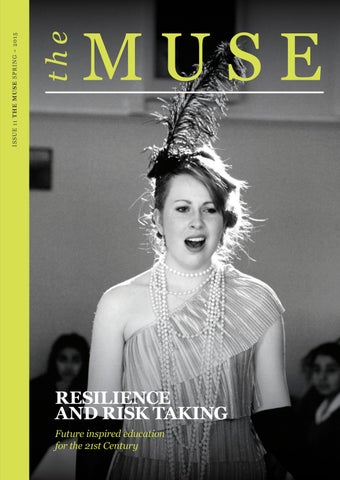
RESILIENCE AND RISK TAKING Future inspired education for the 21st Century
Visits & Voyages
This list is by no means exhaustive, but offers a flavour of guests in and visits out during the Spring Term.
Visitors In Alexis Monks, Alumna, Computer Science at University Talk, Years 9-Upper Sixth Allied Health Careers Evening, Years 10-Upper Sixth
Lunch Club, LRC Compass Room Natalie Cooper Lewis, Alumna, Psychology at University Talk, Years 10-Upper Sixth
American and German 20th Century History Conference, with Professor Breuilly, Dr Miller, Professor Emsley and Professor Wynn, Sixth Form
Parents’ Afternoon, Year 4
Anna Edwards (Sky Sports News HQ Producer), Alumna, Journalism Talk, Years 10-Upper Sixth
Professor Alison Ribeiro de Menezes, Languages Talk, Years 10-Upper Sixth
Putnoe Primary School, Afternoon of Dance, Junior School
Art Show, Year 7
Richard Gill, English Lectures, Sixth Form
Bedford Prep School Quiz, Years 7 and 8
Roman Morning, Year 7
Bedford Borough Youth Cabinet Elections, Senior School
Scene Production Drama Day, Year 9
Ben Walden, Contender Charlie Leadership Workshop, Year 10 Classics Society, Years 11-Upper Sixth
Welcome to China Workshop, Year 6
Strategies for Self Esteem Talk, Dr Pooky Knightsmith, Year 9 Social Evening with Bedford School, Year 8
First Give Programme, Lower Sixth
Spanish Play ¡Fuera!, Onatti Productions Ltd, Years 8-10
Harpur Trust Debating Society, Years 10-Upper Sixth
The Association Quiz Night
Logistics Activity Day with Young Enterprise, Year 9
Tudor Music Workshop, Year 4
Voyages Out Activity Day, Scott Polar Institute and Fitzwilliam Museum, Cambridge University, Year 4
GCSE History Revision Conference, Germany Live, Coventry, Year 11
A Student’s Guide to DNA and Genetics, Institute of Education, London, Upper Sixth
Geography Trip to Northern Ireland, Upper Sixth
BASE Competition, Open University, Milton Keynes, Upper Sixth Bedford Borough Council Captain Safety Roadshow Event, Bedford Corn Exchange, Year 4 Bedfordshire Festival of Music, Speech and Drama, Bedford Corn Exchange, all Year Groups Bedford School, Rock Night, Years 9-Upper Sixth BGS Annual Rowing Ball, Park Inn Hotel, Bedford Burns Night Supper and Dance, Bedford School CCF Combat Cadet Training, Norfolk CCF Field Weekend (Royal Navy), Portsmouth CCF Welbeck Competition, Loughborough Cecil Higgins Museum Trip, Bedford, Year 5 Classics Trip Virgil Lectures, London, Sixth Form Cultural Trip, London, Year 5 Disco, Bedford Prep School, Years 7 and 8 English Language Conference, London, Sixth Form Ethics Conference, Cambridge, Lower Sixth
German Society Quiz, Bedford School History and Art Trip, Amsterdam, Years 9-Lower Sixth Lessons from Auschwitz Conference, London, Lower Sixth Maths Feast, Linton Village College, Year 10 Maths Roadshow, Silsoe Lower School and Great Barford Lower School, Year 10 National History Museum Trip, London, Year 3 Physics Lecture, Cavendish Laboratory, Cambridge University, Years 11-Upper Sixth Politics Debate, Bedfordshire County Hall Debating Chamber, Year 9 Science and Engineering Lecture, University of Cambridge, Years 11-Upper Sixth RS Department and West End Theatre Society Trip to Shaftesbury Theatre, Memphis, Years 10-Upper Sixth STEM Fair, Kings Centre, Ampthill, Year 9 The Physics of Knots Lecture, Open University, Milton Keynes, Years 11-Upper Sixth
To Kill A Mockingbird, MK Theatre Trip, Year 10 UK Maths Trust Junior Team Challenge, Peterborough, Years 8 and 9
Editor’s Insight
A
s I look back on the Spring Term my mind races at the pace which we have run through those 11 short weeks. It never ceases to amaze me what can be achieved and how every student and teacher manages to squeeze so much into this space of time.
but also to educate the girls about the importance of looking after themselves, both mentally and physically. In Fuelling for Sport, our Head of Sport, Mrs Jane Axford, looks at the role that good nutrition plays in maintaining peak performance and explains how the Department helps reinforce messages about healthy lifestyles.
The fact that this term we had the additional pressure of an ISI Inspection but still carried on as normal to achieve extraordinary things is a testament to the wonderful community that flourishes here at Bedford Girls’ School, where the energy is full of vitality and enthusiasm. We aim high in everything we do and the aspirations and achievements of our students can be witnessed in every corridor of the school.
As we now return for the Summer Term, the atmosphere at school feels slightly different as the girls aspirations concentrate on preparing for examinations. There is a sense of anticipation and focus in the corridors as final weeks of revision and preparation takes place. As our Sixth Formers sit their last school examinations, they are starting to look forward to the next chapter of their lives. We, as educators, have a responsibility to make sure they are fully equipped to take those next steps, as bright, self-assured and resourceful young women. As the International Baccalaureate (IB) motto says, we should be “Educating for a better world”. To become the leaders of tomorrow, our students need to be ready to rise to the challenges and opportunities that will face them. In this issue of the Muse, our Head of Careers, Mrs Laura Longstaff, describes the support that the girls get as they progress through the school to help prepare them for the wider world.
Ensuring that our girls are confident and resilient risk takers is embedded in every aspect of the curriculum, whether that be within the classroom, by encouraging the girls to try the harder question, or through the sense of independence felt when they leave the school grounds and go off on trips and excursions. I also feel that the performing arts play an important role in helping develop these skills and I am proud that at Bedford Girls’ School we offer thriving, high achieving departments across all performance disciplines. Both within the curriculum and co-curriculum classes, these areas are aiding our girls to become confident, well balanced young women, who understand the importance of commitment and teamwork. During the Spring Term alone we were treated to an outstanding Speech and Drama Evening, our annual Evening of Dance featuring over 150 girls, stunning formal and informal musical concerts, two major drama productions and our hugely successful first ever operatic production of Handel’s Dido and Aeneas. As well as entering nearly all of our Speech and Drama students into the Bedfordshire Festival of Music, Speech and Drama, where we once again swept the honours board. As a school, I often think that our holistic approach to education is most clearly visible in the PE Department, where we need to not only challenge and extend our students to perform to the best of their ability on the sports pitches,
We all recognise that languages play an increasingly vital part in preparing our students for the global stage on which they will perform, and last term we were incredibly fortunate to welcome Professor Alison Ribeiro de Menezes, Head of Hispanic Studies at the University of Warwick, to talk about the role languages play in the global economy, and the benefits of studying languages at university. There is a whole body of research that overwhelmingly supports the belief that continuing to learn a second language until at least 18 has huge advantages, enabling the brain to stretch, make connections and broaden. Head of Modern Foreign Languages, Ms Catriona Kyle, explores the advantages of being bilingual in our feature Bilingual Benefits.
“ Ensuring our girls are confident and
resilient risk takers is something which we embed into every aspect
”
of the curriculum.
Jo MacKenzie Headmistress
I hope that this edition of the Muse gives you once again a glimpse into how we are turning our vision of delivering a forward thinking 21st century education into a reality.
The Muse | 02
Inspired by
Leila Duchenne Year 11
Amsterdam
T
he relationship between Art and History is a strong one. When studying these subjects one is considering not only how people of a certain time have lived, but also how they reflected on the world around them through the artwork they generated. When studying any form of art it is essential to understand the social, political and economic situation in which the art was produced, in the same way historians need to reflect on the artwork being generated by artists, in order to gain a different perspective of interpretations. A trip which encourages a dialogue between historians and artists is a valuable one, and one that will ultimately lead to a greater understanding of both Art and History. Where better to experience this than in Amsterdam, a city steeped in both artistic and historical significance and where the stories of individuals symbolise so clearly the struggles of a nation. February half term holiday offered a group of Art and History students from Years 9 to Upper Sixth the chance to spend three days in this vibrant and cosmopolitan city, immersing themselves in all it had to offer. Year 11 student Leila Duchenne reflects on the trip and explains what it meant to her: “We began our trip at the well-known Anne Frank
House in the heart of Amsterdam, where we spent our morning learning about the struggles of a Jewish family during the Second World War. This was a particularly thought-provoking experience, during which I, and I’m sure many others, had the opportunity to reflect on how fortunate we are. One of the things I found most striking was Anne Frank’s simple desire to go outside in the fresh air and to ride a bike. To us, this seems a humble wish, but to her it was an impossibility. “The videos of Anne’s father, the only survivor of the Frank family, were particularly heartwrenching as he talked of his loss, and even reduced some of us to tears. It was a highly emotional but inspiring experience. “Next we visited the Van Gogh Museum. As we made our way there, we had the opportunity to see a large part of the city and walk along the many canals. It was one of the most beautiful cities I have visited and completely different from any other place I have been. The iconic tall, thin buildings lined the edges of the famous canals, and bicycles were tied to railings everywhere. At the Van Gogh Museum we were able to see a vast amount of the postimpressionist painter’s work, and learn a bit about his history. This visit was particularly useful for the Art students and inspired many to use some of his methods.
“Later we visited the famous Rijksmuseum, which had a vast range of artwork, including The Night Watchman, by Rembrandt and The Milkmaid, by Vermeer. It was truly impressive.” A surprise boat trip along the canals brought the first day to a close and gave the girls the opportunity to learn about the history of Amsterdam, and enabled them to see the city from another view. After a busy day the girls and teachers retired to bed, preparing themselves for another emotional day ahead. The second day focused on a moving trip to Westerbork transition camp. Leila continued: “Kamp Westerbork is the labour camp Anne Frank was taken to, along with 107,000 others. “En route to the camp we were told the tragic story of Leon Greenman, a British Jew who survived Auschwitz. He was married to a Dutch Jew and they were taken along with their young son to Westerbork before being transported to Auschwitz. Upon arrival at Auschwitz, Leon was one of the first 50 men off the train and was sent to work, but his wife Elsa and son Barnie were taken in the opposite direction. It is thought they would have been gassed within two hours of arrival. “During our visit we learnt the stories of many others. Some stayed at Westerbork for days, and others months, before going on to other camps, but only 5,200 survived. Although the majority of the camp was demolished when it was liberated, monuments created in the memory of those who stayed there had been erected, which helped us to feel the emotion of the place further.” Leila concluded: “It was really fascinating to undertake a joint trip with both History and Art students. We were often looking at things from a slightly different perspective and it was great to have those views intertwined with your own. I learnt a lot about artists that I hadn’t really considered before, and seeing the connections between Art and History was really fascinating. “As a History student, I found the trip highly educational and I am now inspired to look further into the details of the lives of historical figures, and learn more about the struggles many people in Europe faced during the Second World War, an event which moulded the Europe we know today.”
03 | The Muse
What’s Cooking at BGS? With the perception of Food Technology historically being one of a subject largely focusing on cooking, Bedford Girls’ School is proving that it is so much more. As with all parts of the curriculum, Food Technology is a holistic experience and has many cross-curricular links.
“
T
he view of Food Technology is that the subject is only about cooking, but there’s so much more to it in terms of the skills the girls develop, said Mrs Gaynor Sayce, Head of Food Technology. While girls do learn to cook a wide variety of dishes, covering a range of skills during practical sessions, from as early as Year 6 they’re taught topics encompassing food hygiene and safety, healthy eating and nutrition alongside the design and development of food products. Mrs Sayce continued: “The subject focuses on topics such as nutrition and wellbeing, nutritional profiling, special diets, and sustainability, which allows girls to use their practical skills to meet specific needs. There are also strong links to Design and Technology, enabling girls to appreciate the development process and enabling them to experiment and create their own product ideas. Underpinning all of those elements is the food science theory; understanding the functions of ingredients is key. “For example, Year 6 may use the grill or oven, which has a direct link to Physics where the girls will learn about heat transference. In Year 7, we carry out investigations to determine the best piece of equipment for a practical task considering time, quality of outcome, ease of use, or to carry out product comparison. We’re also looking at a decision and problem solving process. It’s a very holistic experience that is really multi-faceted.
“In Food Technology we want to teach transferable skills and provide the girls with enough confidence to make and share the food they create with others.” Offering a wide-ranging Food Technology curriculum is critical in this day and age for girls who wish to study food further, as universities offer degrees spanning from food science, nutrition and dietetics to hospitality and culinary arts. Behind every cookery show, there will be a team of Home Economists sourcing ingredients, researching new ideas and making them work on camera; Mrs Sayce believes it’s a great time to be joining the food industry. “The idea that studying Food Technology means that you can only be a chef is a limited view. We stress to our students that by building on everything they’ve learnt at Bedford Girls’ School they should be able to get a good qualification in Food Technology related degrees, and then there are so many more opportunities than just actual cooking out there. It’s not a closed sector. You can take many routes. For example food science is a fast growing sector and can lead to careers in microbiological safety, food safety, dietetics and nutrition. It is all wonderfully exciting. “We are now seeing girls deciding to study a food marketing or food business degree, and that let’s them access some very successful courses that lead to stimulating, well paid and highly specialist jobs in the food retail sector.” By attending universities such as Sheffield Hallam, which offers a four-year course: including a year’s placement in the industry, students end up securing roles in the sector,
ranging from marketing in large food retailers, to working in a research and development role with a cooking programme. In addition, Food Technology also links nicely to careers in nursing and healthcare. Lower down the school this academic year has seen the introduction of the French Gourmet Lunch Club, a joint Modern Foreign Languages and Food Technology initiative open to Year 7. Held half termly, girls have the opportunity to learn about the origins of French ingredients and dishes whilst developing their language skills. In the most recent session Ms Catriona Kyle prepared a worksheet as a prompt to discuss the history of the croissant, pain au chocolat and pain aux raisins and the girls shaped, baked and ate a croissant. Such events reflect the emphasis on holistic learning, linking the subject into different areas of the curriculum, helping students make the wider connections and developing enquiring minds. Mrs Sayce concluded: “Whilst science plays a role in the girls’ learning of Food Technology, this isn’t the only subject that the subject links to. That’s why we hold events such as the French Gourmet Club and Mrs Montse Gomez’s Spanish Society. Mrs Susan Wright has also recently run a Fairtrade Fortnight activity with Year 7. Each form was encouraged to examine information about the importance of using fairtrade ingredients and then to cook with them. This links very successfully with Geography.” The Food Technology Department remains a hub of activity, creativity and exploration, as the students at Bedford Girls’ School learn practical life skills and develop a strong academic understanding from this important subject. The Muse | 04
JOURNEY TO GROWING UP A regular sighting on Cardington Road, Bedford, is an orderly line of excited Junior School girls, in smart mufti, rucksacks at the ready, about to set off on another adventure.
D
ay trips and excursions are an
She continued: “We recognise the
School curriculum at Bedford
risks with their learning. These days, we
integral part of the Junior
Girls’ School. By learning out
in the field, pupils gain relevant hands-on
experience which gives added depth to the learning that takes place in the classroom,
whilst also making an important contribution to girls’ physical, personal and social education.
Mrs Tina Copp, Deputy Head of the Junior School, explained: “Trips and excursions
importance of encouraging the girls to take can be somewhat risk averse and as both
educators and parents, we are often faced
with the difficult decision about supporting
our girls, as they grow in independence while keeping them safe from harm. Trips provide
an ideal opportunity to experience elements of independence, whilst being reassuringly
well-supervised and supported by teachers and fellow students.”
are an integral part of our learning ethos.
In addition to the 40 day trips undertaken
local environment, or the annual residential
residential trip for every year group, starting
Whether they are day outings to explore our trips, they are all planned into our curriculum, to support the units of enquiry as well as our Junior School learner attributes.”
05 | The Muse
each year, the Junior School provides a with the well-established Year 3 trip to
Burwell House, where the girls enjoy two nights in the beautiful environment; Year
4 residential water sports activity trip to Grafham Water Centre in Cambridgeshire; the renowned cultural trip to London in Year 5 and finally in Year 6, the outward bound adventure to Cuffley Camp in Hertfordshire. These are eagerly anticipated by students and staff alike throughout the school year, and the levels of independence and freedom on offer increases with each year group. Mrs Copp added: “For many of our younger girls, the trip to Burwell House is the first time they may have been away from home, other than the odd sleepover. It really helps them to build skills of being independent and resilient and we quickly see nervous faces being replaced with happy smiles. The Burwell Trip at the end of the Summer Term is a celebration of their completion of their first year at Bedford Girls’ School and marks the transition from a young, more reserved Year 3 girl into a confident young student ready to take on the challenges of Year 4.” Trips and excursions are carefully planned to tie in with the units of enquiry. The new enhanced curriculum provides a perfect platform for taking the learning out of the classroom and into the wider world. Both in preparation and on return from an outdoor learning activity, girls are inspired and motivated to work across many different subject disciplines, with links being made to Art, Design Technology and English. Even the simple visit to a shop on a school
visit can be especially beneficial to the younger girls as they use their mathematics skills independently in a real life practical setting. Whilst a trip to a museum may bring together work across a number of subjects creating links between History, Science and Geography. Mrs Copp said: “We are encouraging our students to be independent thinkers and where better to do that than outside the classroom? We want them to explore, ask questions and make connections with the world around them, and to reflect on what they study at school and how it links to the things that surround them every day. Furthermore, during these trips, pupils have the opportunity to talk to experts or receive specialist instruction in acquiring a new physical skill. On their return to school, girls are inspired and motivated to study in more depth about their experiences gained whilst being out and about.” The big excursion, which is eagerly looked forward to by all girls in Year 5, is the annual cultural trip to London. For many girls, it may be the first time they have properly explored the Capital and the buzz of excitement is audible in the weeks running up to their departure. Girls feel very excited about staying in a hotel and enjoy the bonus of a tour of central London from the excellent viewpoint of a large coach, ably guided by the knowledgeable tour guides of the Study Experiences Company. Mrs Copp continued: “The London experience is another great example of the trip fitting into The World of Difference Unit of Enquiry, taking in museums, theatre trips, restaurants and the London Eye. It allows
the girls to learn about London first-hand, connecting their classroom learning with the structures and sights around them.
the girls prepare to leave behind the Junior School and take on the responsibility of life in the Senior School.
“They can reflect on what we have learnt so far and see how the history of London has influenced the city they see today.
Mrs Copp concluded: “Not only does this trip link to the Unit of Enquiry called Footprints but it is also a defining moment for the girls.
“ We are encouraging our students to be
independent thinkers and where better to do that than outside the classroom? ”
“Not only does it really aid learning and enables them to take back ideas to the classroom, but as a social experience it also works incredibly well. Whilst having great fun, the girls also have to behave in restaurants and learn to manage themselves in large, often crowded public spaces. They know that they are representing the school and we are always impressed by the way they rise to the challenge and grow in stature during our stay.” The final rite of passage is the Year 6 adventure trip during the Summer Term. It is the pinnacle in the transition process and
“Set in a woodland, the physical challenges such as mountain biking, tree climbing, the Leap of Faith and sleeping in tents will take many of the students out of their comfort zone. The supportive nature shown by the whole year group is always wonderful to witness when comfort zones are challenged and girls are given the opportunity to experience things closer to the ‘edge’. It is times like these where we see the school values in action – girls being bold and prepared to take reasonable risks; imaginative in how they problem solve as a team and the creative ideas they come up with; reflective in thinking of ways they might have undertaken the challenges differently and more effectively. Hidden talents and strengths often come from surprising individuals, and some girls have been known to rebook activity holidays with their families having loved the experience so much. “Each evening we will come together to celebrate not only the achievements of that day, but the achievement of their time in the Junior School. They then move seamlessly into life across the road where they continue their learning journey. The foundations laid throughout the course of their Junior School career sets the girls on their way to being successful in the Senior School.” The Muse | 06
BILINGUAL BENEFITS
A
According to a survey
IB, as well as the A Level qualification,” said
“Moreover, there is a wealth of evidence to
published by the European
Ms Catriona Kyle, Head of MFL.
suggest that modern linguists will ultimately
Commission, a mere 38% of Britons speak one additional
language – compared to the European Union average of 56%. Learning a foreign language has often not been a popular option at school in Britain; it is common for children to
“The study of at least one language is a prerequisite of the IB. The IB itself is an innovative qualification that prepares the girls for the wider world and linguistic proficiency is key.
completely at 14. And yet the importance of speaking another language, or indeed several, for future employment prospects, confidence and even long-term health must not be underestimated. It is for precisely this reason that Modern Foreign Languages (MFL) are central to a Bedford Girls’ School education. The MFL Department offers French, Spanish and German in the Senior School and students from Years 3 through to Year 11 are
“ New studies are showing that a multilingual brain is
nimbler, quicker, better able to deal with ambiguities, resolve conflicts and even resist Alzheimer’s disease and other forms of dementia for longer. ”
with languages in the Sixth Form; indeed the study is integral to the International Baccalaureate (IB) qualification.
the majority of university graduates are able to speak several languages. If we are to keep pace with these countries, we need to emulate them. The ability to speak another careers. Language graduates go on to work in sectors ranging from business to law, from the Civil Service to interpreting or translation.” In January, Bedford Girls’ School was privileged to host Professor Alison Ribeiro de Menezes, Head of the Hispanic Studies Department at the University of Warwick. Professor Ribeiro spoke to budding linguists from Years 10 to Upper Sixth about the value of a modern language and career prospects. “Being able to speak English is simply not enough on a global scale. In industries such as Business and Tourism, travelling overseas
required to study at least one of the three. We strongly encourage girls to continue
countries, languages are highly valued and
language is a huge advantage for a number of
start studying a foreign language at the age of 11 and many students give up languages
command higher salaries. In other European
“The Confederation of British Industry has repeatedly expressed concerns about the dearth of people in this country who can claim fluency in a foreign language. If our
and being fluent in different languages are essential parts of the job,” said Professor Ribeiro, a Spanish graduate from the University of Oxford. “Employers are not just looking for English; they require a plethora
“Bedford Girls’ School is a forward-thinking
economy is to flourish and compete with
school, preparing students for the demands
our global partners, we must ensure greater
of the 21st century workplace and it is with
numbers of students coming out of schools
performed in different ways depending on the
this in mind that we are pleased to offer the
and universities with language skills.
language one is speaking. Many blue-chip
07 | The Muse
of skills including communication, problem solving and teamwork, all of which can be
multicultural organisations want employees who have a global outlook and are sensitive to cultural differences; the ability to build relationships in different areas of the world makes a huge difference.”
and also that you can adapt to
Professor Ribeiro added: “The statistics back up the importance of speaking languages. 91% of MFL students are employed within six months after graduation, the figure rising to 97.4% after three years.”
CVs when recruiting new PhD
This compares extremely favourably with most other degrees and only serves to illustrate the usefulness of modern foreign languages. Dame Alice alumna, Dr Suman-Lata Sahonta, is testament to Professor Ribeiro’s words.
different working environments. “This is essential for the international nature of modern work. As a science researcher, I often have to assess
students or postdoctoral researchers to our university department, and I am always impressed if they have
studied in other countries through Erasmus or similar programmes.”
As with all areas of the curriculum at BGS, the MFL Department has
welcomed the recent introduction of iPads and is delighted at the way in
which they are enabling students to create their own learning journeys, encouraging greater levels of
Having left Dame Alice Harpur School in 1998, Dr Sahonta studied Chemistry at the University of Bristol and then went on to study in Spain and Mexico as part of the Erasmus Programme. She is currently based in the Department of Materials Science and Metallurgy at the University of Cambridge.
research, collaboration and creativity
Dr Sahonta commented: “The programme was not very large or well-known at the time, with only a few partner institutions available, but since then it has grown into a very prestigious network of universities, with lots of opportunities for studying, working and volunteering all over the world.
tools on the devices that support the
She continued: “If you like languages and would like to experience another culture, I thoroughly recommend taking part in the Erasmus programme. Being a graduate no longer makes you stand out as it once did. The fact that you have used your university experience to study in another country really adds a lot to your CV, since it shows that you are proficient in another language
across all languages.
Ms Kyle added: “Language learning and the use of the iPads in the
curriculum go hand in hand. We have excellent teachers in the department who are making fantastic use of
the iPads. There are many different
girls’ learning and we are constantly striving to make even better use of
the available technology. There are many
apps which enhance the students’ language experience and make learning it even more fun. Girls can record themselves, create
avatars, make an iMovie or practise their
receptive skills using apps such as Quizlet and Memrise. These apps provide great
practice and increase students’ motivation.” As well as the benefits of enhancing
employability prospects and having a more rounded skill set, learning a language can
improve one’s mental health. New studies are showing that a multilingual brain is
nimbler, quicker, better able to deal with
ambiguities, resolve conflicts and even resist Alzheimer’s disease and other forms of dementia for longer.
Learning a foreign language can even
increase the size of your brain. This is what Swedish scientists discovered when they
used brain scans to monitor what happens when someone learns a second language. The study is part of a growing body of
research using brain-imaging technologies to understand the cognitive benefits of language learning.
Ms Kyle commented: “People who have more than one language are less likely to suffer from Dementia and Alzheimer’s, hence the more languages you have, the less chance there is of you having a degenerative, mental illness as you get older. “People talk of the older generation doing Sudoku or crosswords to keep their brain active. Actually one of the best things we can do is to learn a new language; they are like gymnastics for the brain. Increased plasticity can be observed in the brains of bilinguals. In fact, learning a second language is made possible through functional changes in the brain: the left inferior parietal cortex is larger in bilingual brains than in monolingual brains. Languages encourage students to think and to make connections. Everyone needs a language. It is fundamental to everything we do.” Ms Kyle concluded: “We are a global community and central to our ethos here at BGS is preparing the girls to be part of that community. Having the skills and the confidence to speak a foreign language will only ever prove to be an asset, ushering students towards a richer, more rewarding world.” The Muse | 08
Widening Horizons At Bedford Girls’ School the role of the Careers Department reaches deep into the heart of the school. The department is a hub where students are welcome to pop in for a chat or use the resources to access a plethora of information, as they prepare for the next steps in their lives.
H
ead of Careers, Mrs Laura Longstaff, explained: “Our approach is integrated within the School’s values. Today’s school leavers need to be prepared to think outside the traditional pathways and see a broader perspective. We are educating them to be independent thinkers and this is reflected in the way we approach our careers programmes.” Mrs Longstaff continued: “The careers education we offer at Bedford Girls’ School is focused on preparing girls for careers of the future. Whilst there are some traditional sectors that will remain in demand, it is clear that we need to consider the labour market our students will be entering. With an increasing (and ageing) population, food scientists, renewable energy specialists
09 | The Muse
and healthcare professionals are on the rise as well as a large number of jobs involving technology.” A recent publication by the UK Commission for Employment and Skills reinforces this and explores what they predict will be the top 40 most crucial jobs in the next decade. These include: Business and Finance; Construction; Education; I.T, Manufacturing, Installation and Maintenance; Protective Services; Science, Engineering and Technology; Transport and Logistics. Many of these are not areas that school age children would traditionally explore but it is important that students are introduced to them. From Year 8, careers days are factored into the academic year. Mrs Longstaff said: “Whilst it is important for the girls to be open minded
and not to narrow their choices too early, it is as equally important that they start to have a realistic understanding of the wider world. Exploring the cost of living and salaries, through the Learn to Earn day helps the girls with this process.” As the girls progress into Year 9 they attend a dedicated Logistics Day introducing them to frequently little considered career choices. The Boombiz activity for Year 10 gives them a taste of working in a business and allows them to explore the pros and cons of emerging markets, seasonal trends and niche products. Also from Year 10 onwards, the school runs themed careers evenings, providing an insight into many sectors and giving the girls the opportunity to network with the speakers; careers in Healthcare, Media, Law, STEM and Finance are just some of the subjects covered.
Furthermore, the school benefits from an active alumnae and parent base who provide inspiration and mentoring for the girls across a huge range of careers. Whether it is a current university student sharing their insights into undergraduate courses, or a professional explaining their career paths, they all act as wonderful role models. “Speakers often come in conjunction with academic departments, so rather than being seen as a standalone careers event their talks are embedded in the classroom, helping the girls link the subjects they are studying to the working world. Take the case of the Sky Sports News HQ Producer, Anna Edwards, who spent the day with English students discussing everything from blogging to the role of women in sport. Not only did Anna give the girls wonderful advice, but she gave them so much confidence as they were able to talk to a leader in her field and to see that she too had started at the bottom, putting in years of hard work and commitment to get where she is today.” Bedford Girls’ School knows employability is so much more than a set of examination results. Students need to be equipped with emotional resilience and communication and networking skills when they leave school. In Year 11 and Lower Sixth the role of the careers team intensifies. Mrs Longstaff added: “We structure our work not only to introduce the girls to a wide range of careers but also to give them some of these value added skills. We work closely with the Heads of Years and PSHE and in the Sixth Form the CAS programme to make sure the girls have the confidence and emotional intelligence to make the right decisions. “We offer all students from Year 10 onwards the chance to undertake psychometric testing and in the Sixth Form they all have Careers Tutors supporting them, alongside their Form Tutors, so that by the time they are making choices we really understand their talents and preferences.” The school is keen for the girls to understand that many companies operate on a global scale and therefore our students need a ‘global mindset’, Bedford Girls’ School works hard to ensure these skills are woven into every student’s education. This encompasses the ability to communicate across cultures, proficiency in a foreign language; understanding and accepting other cultures and religions, understanding global issues; the capacity to work outside one’s comfort zone and take risks.
As current Upper Sixth student, Kate Sivills, explained: “I have chosen to study for an International Business degree and over the last two years, I’ve done as much as I can to learn about it. Firstly, I took three online FutureLearn courses, on Branding, Management and Starting Your Own Business, all of which had an international element. Secondly, I did as much work experience as possible, including working for an insurance company in London, and in the Marketing Department of a Japanese shipping company. These placements gave me my first taste of global business and the opportunities it could offer. Finally, studying German A Level has given me the opportunity to focus on German brands for my oral exam. I researched Audi and Aldi to help me learn about a global automotive company and a rapidly growing retail brand. Taking part in German exchanges has given me experience of travelling independently and living in a different culture. All this has inspired me to want to have a global career and I’m hoping to spend the third year of my university course on a work placement either in Hong Kong or Australia.”
“ Bedford Girls’ School
knows employability is so much more than a set of examination results. Students need to be equipped with emotional resilience and communication and networking skills when they leave school. ”
In such a competitive market place networking and interview performance skills are two key areas which make a huge difference to employability. Our Lower Sixth programme Work the Room gives girls a real chance to develop networking skills and put them into practice with alumnae and local professionals, learning the art of acquiring contacts and gaining work experience. Once in the Upper Sixth all girls have the opportunity to undertake mock interviews and attend
a session on interview preparation run by a recruitment specialist. This year a new course on LinkedIn and managing your personal brand is being added to the careers curriculum. More than ever employers are looking for candidates with work experience as it provides real evidence of key attributes such as teamwork, communication and reliability. A recent presentation by Ernst and Young stated that over a third of their graduate places are filled before graduation, by those who have completed internships with them. This demonstrates just how important work experience can be. Mrs Longstaff said: “After GSCEs in Year 11 we actively encourage all our students to undertake work experience, and whilst we are here to support them, we put the responsibility onto the girls to make it happen. It is important that they develop that sense of independence, putting themselves forward and seeking out opportunities. We have had an incredible uptake and most girls find interesting placements ranging from working with EasyJet to being on the shop floor at Fortnum and Mason. We encourage the girls to continue with work placements throughout their Sixth Form and to consider alternatives to traditional university courses, such as School Leavers’ Programmes, which are a great alternative to consider as they are employer based but can still include access to a degree.” Mrs Longstaff concluded: “Through our extensive careers programme we are confident that we are providing students with the right skills for the next stages of their lives. They leave Bedford Girls’ School not only with excellent examination results, but with a confident understanding and practical experience of what is expected of them in the workplace.” The fact that over 90% of our students go on to study their first choice courses and then enjoy successful and fulfilling careers seems to bear testament to these thoughts. The Muse | 10
THE IMPORTANCE OF PERFORMANCE “ Creativity takes Courage ” Henri Matisse
T
he performing arts are at the heart of Bedford Girls’ School. With an average of 35 major performances each year there are a wealth of opportunities for girls of all ages to be involved. The Muse sits down with Headmistress, Miss Jo Mackenzie, and the Heads of our performing arts departments to talk about the role these subjects play in school life. At Bedford Girls’ School all pupils have Music, Drama and Dance lessons built into the curriculum from Years 3 to 8, and all students throughout the school have access to over 40 co-curriculum clubs and classes, many continuing with some aspects of involvement in the performing arts up to the end of the Upper Sixth. Miss MacKenzie explained: “I believe access to the performing arts is a key component to a child’s education; this is supported by the Arts
11 | The Muse
Council, who believes that the performing arts are an essential part of a broad and balanced curriculum for all children.
subject cannot be underestimated and many of the skills that are developed will be of value throughout the students’ lives.
“Research shows that the benefits for performance go far beyond building personal confidence, as the students develop the ability to take risks and be courageous, as well as learning to work as part of a team through participation in a performance related subject. Our vision is to create confident young women who can be the compassionate leaders of tomorrow. The skills they learn through the performing arts are a critical part of this process.”
The subject allows students a high degree of control over their learning because they have the opportunity to be independent thinkers to extend their own experience of the world.
All the Heads of the Departments agree that students are richer for studying at least one area of performing arts. These subjects encourage awareness, confidence and development of the individual within the group context, where parts and ideas are often negotiated and developed. The great personal, social and aesthetic values of the
Mrs Susan Perren, Head of Drama, said: “Drama makes a unique contribution to children’s learning. Its origins are in our basic need to play and to take on roles, whether we do so in order to re-live experiences or to anticipate what is to come. Drama engages our feelings, it asks us to face problems, and make meaningful decisions, and then to reflect on the implications of those decisions.” Mrs Vivienne Redford, Head of Speech and Drama, added: “We are lucky that Speech and Drama is seen in an important light at BGS. It’s very rarely taught as an isolated subject in schools, yet it is absolutely critical in providing
good, sound performance and communication skills. Girls study every type of literature, poetry and proses. They learn how to read and present effectively. “Speech and Drama is a very technical subject and it’s about the individual.” Importantly Speech and Drama also teaches other skills, such as responsibility and reflection, all of which can be put into practice in other aspects of daily life at Bedford Girls’ School. The girls are responsible for getting themselves to their co-curricular Speech and Drama lessons; to learn the pieces and practise at home. As with learning a musical instrument, there is the need for a high level of individual commitment without which they will not reach their potential in examinations. Mrs Helen Parsons, Director of Music, reflected: “The girls understand that hard work and commitment are required to do well in Music, as it is in all other performing arts fields. But they also all enjoy the buzz of excitement you feel when you have reached beyond your comfort zone and performed well in a concert or an examination. Learning how to handle this level of commitment gives them transferrable skills which they will use in the future.” Both Mrs Parsons and Mrs Perren encourage the girls to participate in group performances. Being part of a cast or musical ensemble helps the girls to learn how to work as part of a team, problem solve, persevere and create. Whether it is acting in Senior School productions such as Words not Deeds; or performing in the school’s first ever opera production, Dido and Aeneas, pupils are taken out of their comfort zone and grow through those experiences. Mrs Parsons added: “When producing Dido and Aeneas there was huge expectation on the whole cast and crew. But the girls and
boys made it look effortless. To take the step of producing our first ever opera was a bold move – and the right one. Even though everyone was pushed out of their comfort zones, their confidence increased so much.” An often overlooked advantage of studying performing arts is that of learning accountability, where mistakes are made but resolutions are found. Mrs Perren commented: “Teaching Drama in school provides a safe, controlled environment in which students express ideas and concepts. Students can be encouraged to push boundaries. It doesn’t always go right, we have all been in situations where a girl has forgotten a line or a step. What is important is that the students learn from this experience, that they reflect and are able to overcome and continue with the performance. This takes a certain level of maturity and by providing a supportive environment for the girls, we enable them to develop this level of understanding.” Dance, like Drama, enhances a number of the girls’ skills, including creativity and the ability to self-evaluate. Mrs Suzanne Winters, Head of Dance, said: “Dance is a rich and exciting approach to learning, where the girls can respond to the world around them, developing the capacity to be open minded, question, challenge and take risks. “The girls develop both physical and artistic skills in Dance. It also offers opportunities for linguistic, logical-mathematical, musical and interpersonal skills. These multiple intelligences are all developed and nurtured through Dance and help to create a bright, and confident young lady.” The annual Evening of Dance, where over 150 girls perform more than 20 different dances, is testament to the talent, commitment and
enthusiasm of all the dancers, and showcases the range of dance disciplines available in the School. For all the work performing arts subjects do in preparing girls for auditions, interviews and, most importantly, future life in general, they also have a proud record at the Bedfordshire Festival of Music, Speech and Drama. This annual event takes place in March and the 2015 Festival proved to be another exciting year for BGS, with the school victorious in 45 Speech and Drama categories and recorded around 80 second and third places, ranging from Verse Speaking Year 3 to Prepared Reading Lower Sixth and above. Our musicians did equally as well, scooping up numerous awards. Notable highlights included Olivia Benjamin (Year 8) winning the Melville Prize for the Most Promising Performer of the Festival Award, with the Junior School windband emerging victorious in the JT Stephenson Trophy. Flora Charatan (Upper Sixth) also won the Hans Freyhan Salvar for her piano recital at the Gala Performance. Miss MacKenzie concluded: “It was a phenomenal week and we’re all very proud of the girls who performed. Participating in events such as the Bedfordshire Festival gives the girls great experience of performing before large crowds, and it really builds their confidence and makes all the hard work worthwhile. “We are lucky to have dedicated experts leading our departments, who inspire the girls to perform to the best of their ability across the performing arts. “It is a joy to watch all of our productions, and I look forward to seeing more creativity and courage on the stages at Bedford Girls’ School.” The Muse | 12
Busy Blogging The advent of social media and the internet has opened up a whole range of communications channels and as a future inspired school with a strong emphasis on the integration of technology into learning, it seems only natural that Bedford Girls’ School embraces the world of blogging.
F
or Bedford Girls’ School, blogs are a great tool to illustrate what is happening in the School and to enable communication to be more pertinent to specific communities. For example, the Junior School Views blog gives the Junior School parents an in-depth sense of life in the Junior School, whilst the Trips Blog provides a snap shot of the students when they are out and about – great for any parent wondering just how muddy a child is getting on during school adventure weekend.
The newly established Arts Blog is a wonderful tool for creating a day to day image bank, capturing the wealth of creative material that is being developed in the Arts and Design Technology areas, whilst the From the Headmistress blog aims to help parents understand some of the leading principles behind the ethos of the School, and to give a personal insight into educational issues. Excitingly for the school it is the access that students can have to blogs which holds the most potential. We have recently launched two student led blogs, enabling a wider audience to have an instant glimpse of the quality of thinking and writing from our student community. The educational benefits of blogging have been widely reported and according to Peter Duffy of The Hong Kong Polytechnic University and Dr Bruns from Queensland University of Technology, these benefits are multifaceted. They explain how writing a blog encourages students to be greater risktakers by moving them out of their normal comfort zones and putting their writing into a more public arena, as well as encouraging them to become more critical and analytical thinkers. This is a view that is strongly supported at Bedford Girls’ School as Mrs Claire Hoar, English Teacher, who has helped the girls in 13 | The Muse
the Write On creative writing club establish their blog earlier this year, explained: “The blog on the school’s website was the final piece of the jigsaw for Write On. It looks stunning and gives the girls a platform to showcase their work. “The group has risen to the challenge and they are producing some mind blowing articles. For the girls, it’s not just about the writing but the responsibility of meeting deadlines, being creative, managing the administrative side of a blog, listening and working with each other and not being afraid to share their views.”
uploading articles, checking them for appropriateness and ensuring that they are timely. Head of History and Politics, Mrs Kathy Cruse, commented: “We have encouraged the girls to establish the blog to share their views with a wider audience. It has been an interesting process and the girls are still in the early stages of juggling how to balance time and resources to ensure appropriate, timely and accurate stories go on the blog. The blog is in its infancy but we are hoping it will go from strength to strength.” The fact that blogs also open platforms, allowing comments and feedback, is seen as another important element as it gives the students a third party view of their work, encouraging them to handle feedback and differing views. This helps the girls be more reflective on understanding how other people may view their words. The School also believes that the skills the girls gain from blogging will add substance to their CVs as they move into a technology focused world.
Mrs Hoar added: “The blog format really works because we can reach a global audience instantly by having a section on the school’s website dedicated to Write On. Girls are able to have their log-ins and upload stories quickly when they wish. The blog’s really accessible and it’s critical Write On moves with the progression of digital technology, as they’ll be working in such an environment during their careers.” According to Duffy and Bruns, blogs help foster a sense of self-responsibility and independent thinking and this was a key driver when allowing certain groups of students to establish blogs. The newly launched Sixth Form Politics and History blog was created with this in mind.The students have sole responsibility for
Mrs Hoar added: “We are always looking for opportunities to provide our students with additional skills, learning about blogging and how to communicate through this medium is a wonderful skill for them to develop. For our students looking to pursue careers in writing or the media, having work which has already been publically displayed will be really helpful, illustrating to future employers, not only their writing skills, but their levels of commitment.” Blogging at Bedford Girls’ School is still in its infancy and it is hoped that the school can extend its reach further giving staff and students greater opportunities to express themselves, truly illustrating what happens behind the school’s doors.
All the School’s blogs can be accessed via: www.bedfordgirlsschool.co.uk/news
Fuelling for Sport The role nutrition plays in improving performance, as well as our general health, is something Bedford Girls’ School’s Physical Education Department is acutely aware of and promotes amongst the students.
M
rs Jane Axford, Head of Sport at Bedford Girls’ School, explained: “Part of our ethos is to encourage our students to embrace active and healthy lifestyle choices. Educating them about eating healthy food, and getting the right amount of rest before a long day of sport are key messages for all the girls to embrace. These messages are reinforced in PHSE and taught throughout the Food Technology curriculum, so the girls have an in depth understanding of the issues.”
ensuring the girls have the energy to maintain concentration during the day.
activities. If they do not refuel effectively
“On a matchday, or ahead of a heavy training session, we encourage the girls to eat two to three hours before they are due to perform. They need to eat food, which is easy for the body to digest, to help maintain consistent energy levels, with a slow release of sugars during the period of exercise.
concentration levels, to get through the rest of
“We are pleased that The Green Kitchen now provide special lunches for athletes after intense lunchtime training sessions.”
Finally, the message on hydration is key. The
She added: “The benefits of good nutrition include increased concentration, promoting mental well-being, preventing injury and a leaner body mass which in turn boosts confidence. All of those things lead to improved performance.”
When going to tournaments the School asks the students not to bring sweets or chocolate, but healthy snacks instead. A bagel with cheese or rice crackers with ham are great examples, as are oat-based bars and dried fruit.
vitally important that all students maintain
Mrs Axford continued: “When we are taking the girls away overnight we always check what they are eating.
water are drunk before playing sport, with water
Playing over 1,000 fixtures across 12 disciplines against some of the best schools in the country each academic year; travelling long distances and overnight stays are part and parcel of being part of a high achieving sports department. Whilst it might be far easier and tempting for pupils to consume less healthier options during this time, the girls and their parents are fully behind PE’s policy of good nutrition and a balanced diet. The school works with the students to ensure they follow the recommended guidelines. Recognising that each student is different, the PE Department encourages the girls to try different pre-sport meals to be aware of what works for them. Mrs Axford added: “We continually reinforce the message that a decent breakfast is vital in
“In the evening we encourage them to eat pasta and rice-based dishes with a decent serving of protein. Often they are nervous on the morning of a match and there is a tendency to sit down to half a bowl of cereal, but something more substantial such as scrambled eggs or omelettes are ideal. “We work hard as a team to ensure they eat well.” The Department also stresses to the students the importance of post-performance food to help rebuild muscle, restore energy levels and help limit injuries. Mrs Axford commented: “After a match the girls are often excited and tired. Most of them will have a busy day the next day, whether that be in the classroom, evening homework or weekend
they will not have the energy to maintain the day. “Post-match, or after heavy training sessions, they should ideally refuel with a full meal within 90 minutes, or if that is not possible, with snacks such as nuts, milkshakes and bananas.” body uses water to transport glucose and remove waste from the cells. It is therefore good levels of hydration to perform both physical and mental activity, as without this the body cannot function effectively. It is recommended that a couple of glasses of breaks during the game and a couple more glasses after the period of activity is finished. Sports drinks are recommended for a long day at a tournament, where they can be useful in replacing the electrolysis lost when sweating. The PE Department is constantly encouraging the girls to bring a water bottle to every PE lesson, practice and match. The message is given loud and clear that they should be packing a water bottle in their games bag as an essential part of their everyday sports kit. Mrs Axford concluded: “Whether the girls are playing sport for fitness and fun, or competing at elite levels, the message is the same. Good nutrition does make the difference and will ensure you gain the most out of every exercise session, maintaining a healthy, happy mind and body.” The Muse | 14
Legend in their Lifetime
Sue Willis Assistant Head, Pastoral
SEAMUS HEANEY, Poet ‘The surface of a slate-grey lake is lit By the earthed lightning of a flock of swans, Their feathers ruffled and ruffling, white on white, Their fully grown headstrong looking heads Tucked or cresting or busy underwater.’
T
hese words come from one of my favourite Heaney poems, Postscript. Here he reflects on a moment of beauty caught fleetingly, when the settling on the water of a flock of swans creates a lightning strike on him, and so too, on the reader. Heaney’s concern that we remain open to experience, that we recognise beauty, and the urgency created by the detail here, are characteristics that can be found in many of the huge store of poems that he has bequeathed to us. The technical brilliance of his handling of language conveys so evocatively his many themes, including, amongst others, the loss of childhood innocence. The idea that our past is central to our present, and the significance of memory in our identity, resonates through his work. He makes that which is complex more simple and understandable. And I love that about Heaney, a modest, private, family man. He wasn’t pretentious about poetry. He once said: “I can’t think of a case where poems have changed the world.” But he followed this up by the wise “what [poems] do is they change people’s understanding of what’s going on in the world.” And so they do. Heaney (or Seamus the Famous as we in Northern Ireland like to call him) was born in 1939, eldest son of a family of nine children, raised by a farming father in County Derry, in a house called Mossbawn; this house and farming background feature largely in his early work. The influence of nature and the rituals associated with working the land can be seen in works like Digging where he describes his father digging with his spade, and the moment
when the young Heaney decided that his pen would be his spade: “Between my finger and my thumb The squat pen rests. I’ll dig with it.” A prolific writer, Heaney also wrote plays, notably The Burial at Thebes written in 2004, where he saw links between Creon the King and the foreign policies of the Bush administration, an example of how successfully he made universal that which was local. Translations were an important part of his work too, and he won many prizes for his translation of Beowulf. As a Sixth Former (so long ago…) I was lucky to find myself in the same room as Heaney - at the Abbey Theatre in Dublin, where he appeared at the ‘gathering’ after the first night of his friend Brian Friel’s The Freedom of the City. I was tucked beside my sister, feeling hot and overwhelmed, and wearing her coat, because mine wasn’t grand enough. Glass in hand, I nearly dropped with shock to see the human form of my hero move around the room, replenishing drinks. Rendered mute by adulation, I put my sticky hand over the glass and shook my head as he offered me a refill. As he moved on past me, he took a second glance at my glass, said “Holy God, would you look at that…?” and passed by…Crestfallen that I had missed my chance, I ducked my head down to look into my glass, to find a set of Co Op savers’ stamps floating on the surface, stamps collected so carefully by my sister in her coat pocket.
Throughout his life Heaney managed to stay apolitical but defended the right of the poet to describe what happened; he didn’t shy away from writing poems about ‘the Irish Troubles’ as well as elegies for friends who died in them. His wish that ‘hope and history’ would ‘rhyme’ has become a well-loved phrase, recently used as the title of her autobiography by writer Amina Cachalia, instrumental in the launch of the National Federation of South African Women. Heaney says of knowledge about the past that “You don’t have to love it; you just have to allow it”. This belief in the freedom to speak is found in much of his work. Heaney seems to have touched us all. Such is his power that on his death I received notes from friends and family conveying their shock. The first Nobel prizewinning poet since W B Yeats, he died in a Dublin hospital, in August 2013. He was a man who lived comfortably and simultaneously in different worlds so languages of all sorts were constantly circulating in his head. Little wonder then, that just before he died, he wrote the words ‘Noli Timere’ (‘Don’t be afraid’) to his wife. For poet Don Paterson: “The death of this beloved man seems to have left a breach in the language itself.” For others it was Andrew Motion, former Poet Laureate, who echoed this sentiment, calling Heaney: “A great poet, a wonderful writer about poetry, and a person of truly exceptional grace and intelligence”. For me, I now know that these and other memories will suddenly “catch my heart off guard and blow it open.”